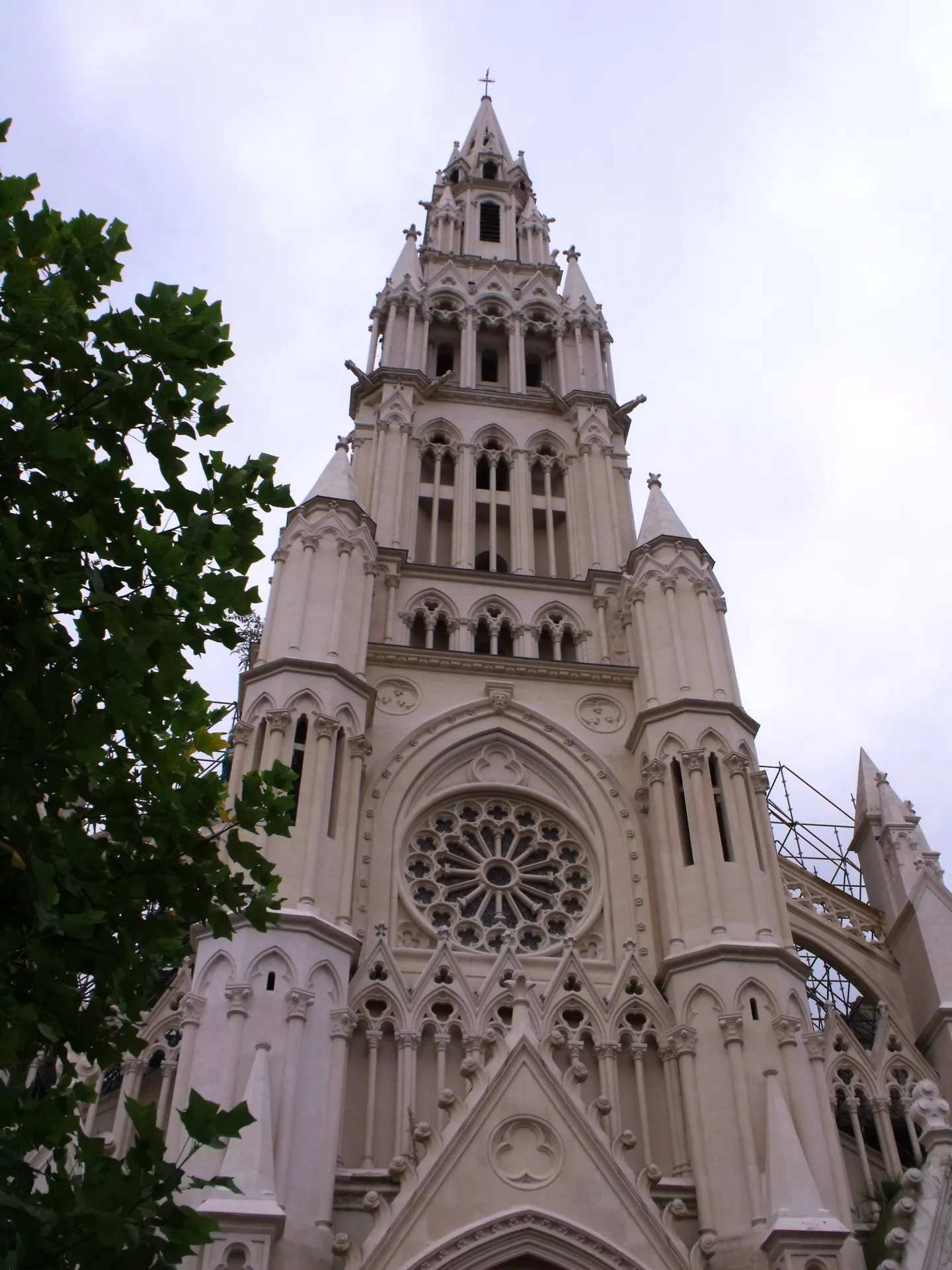
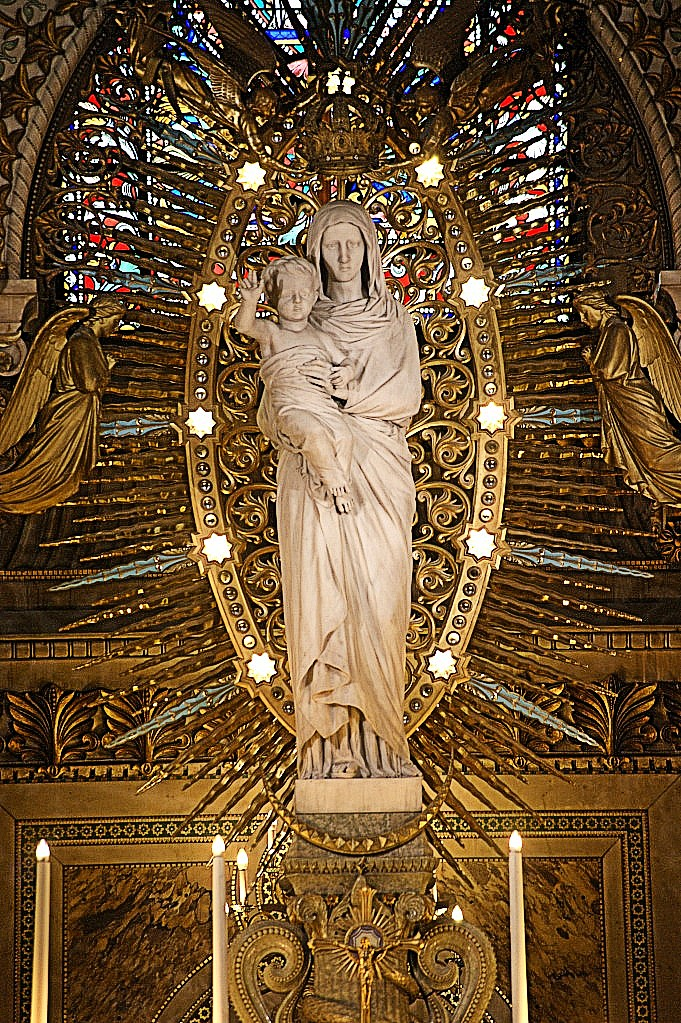
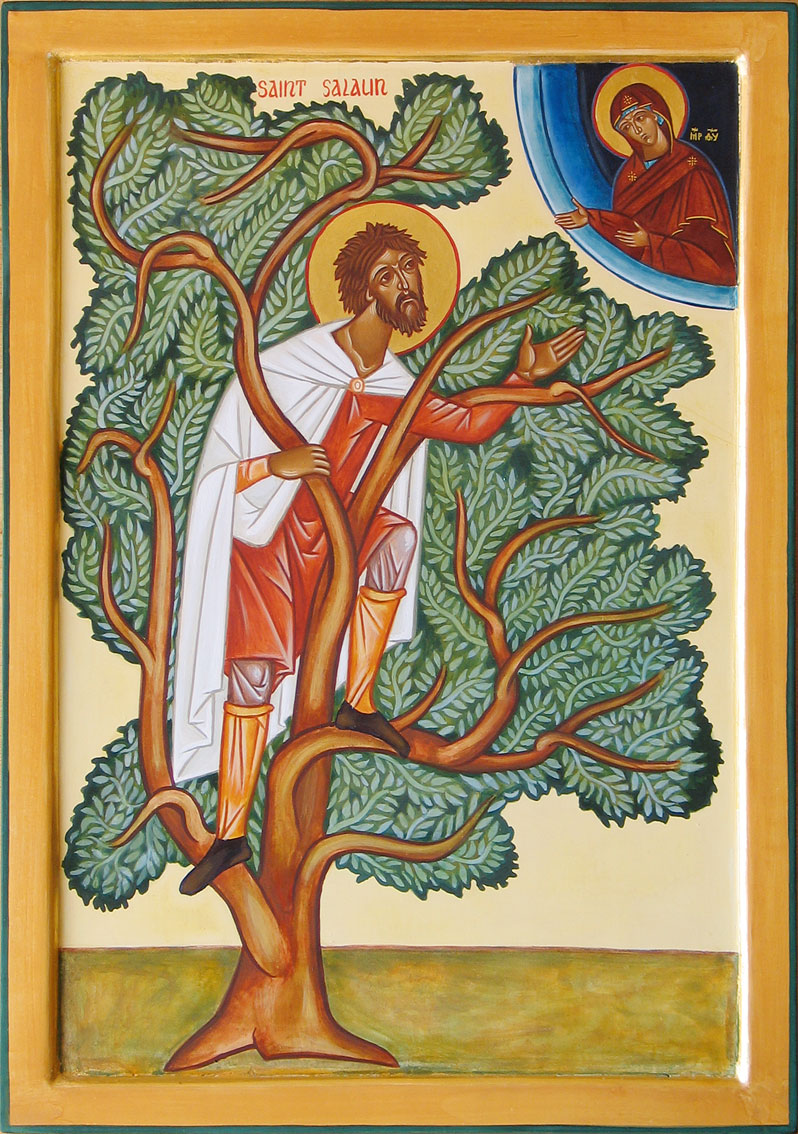
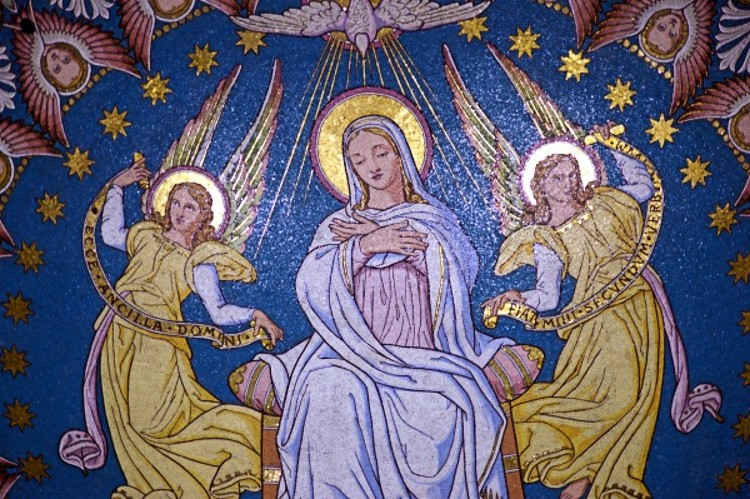
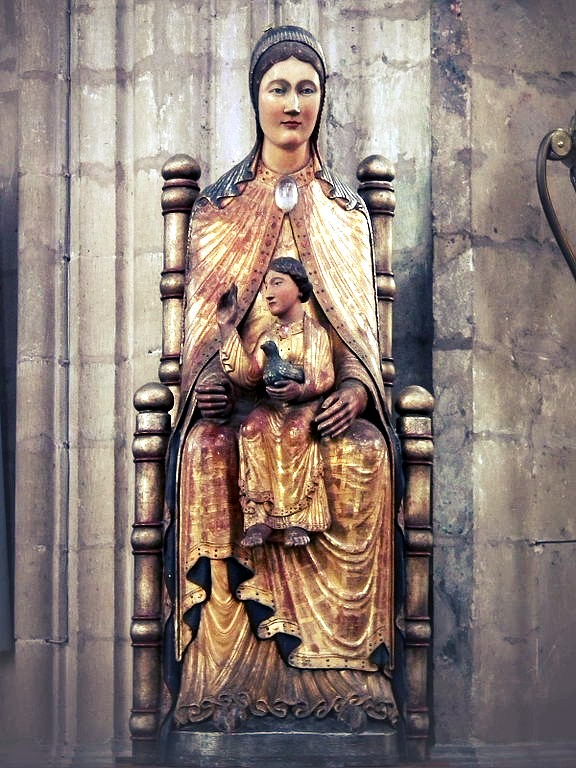
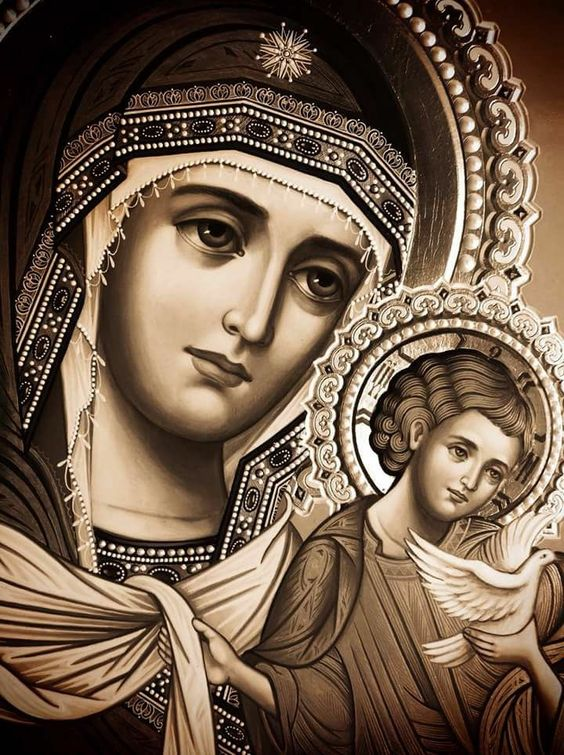
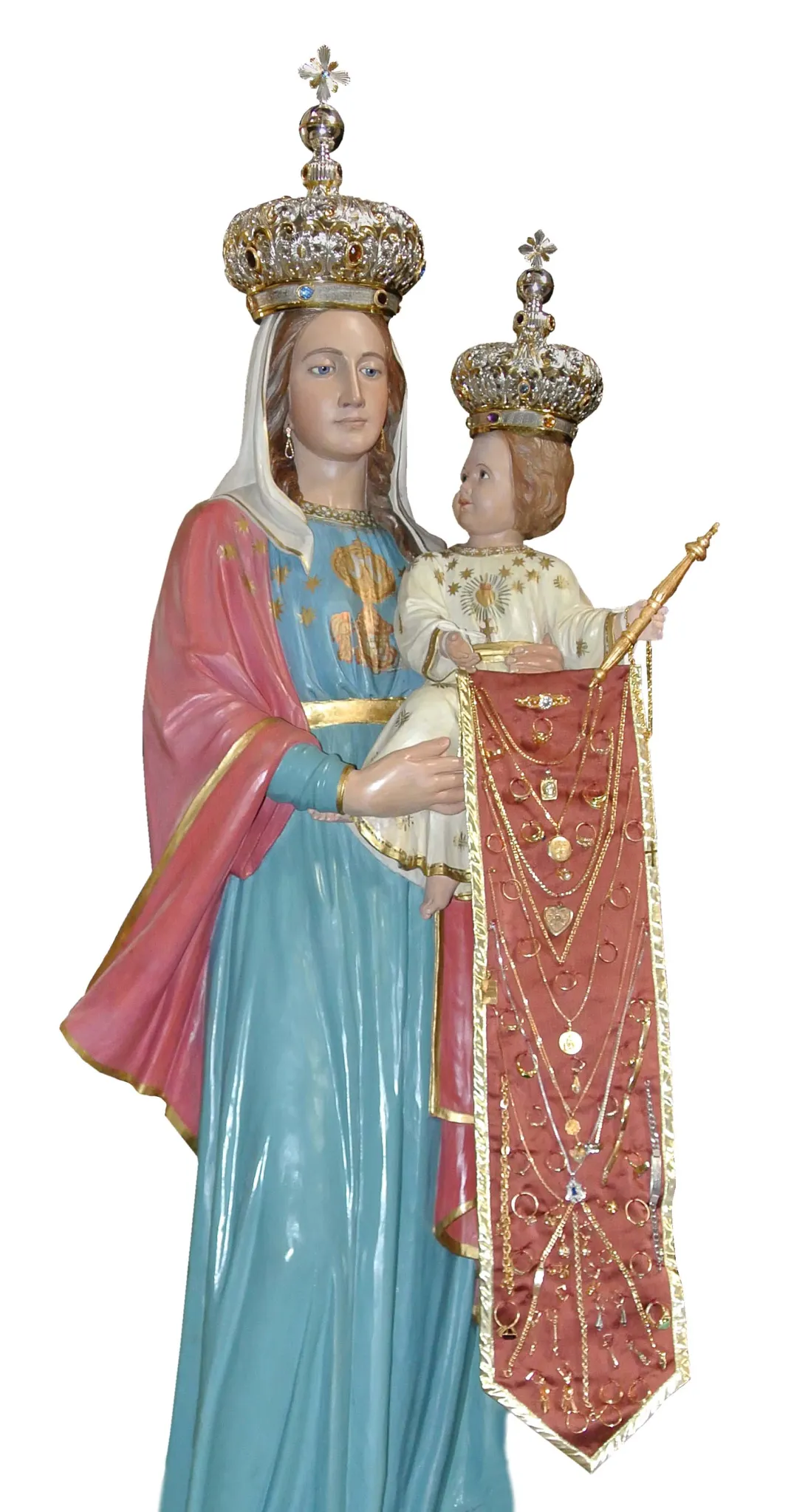
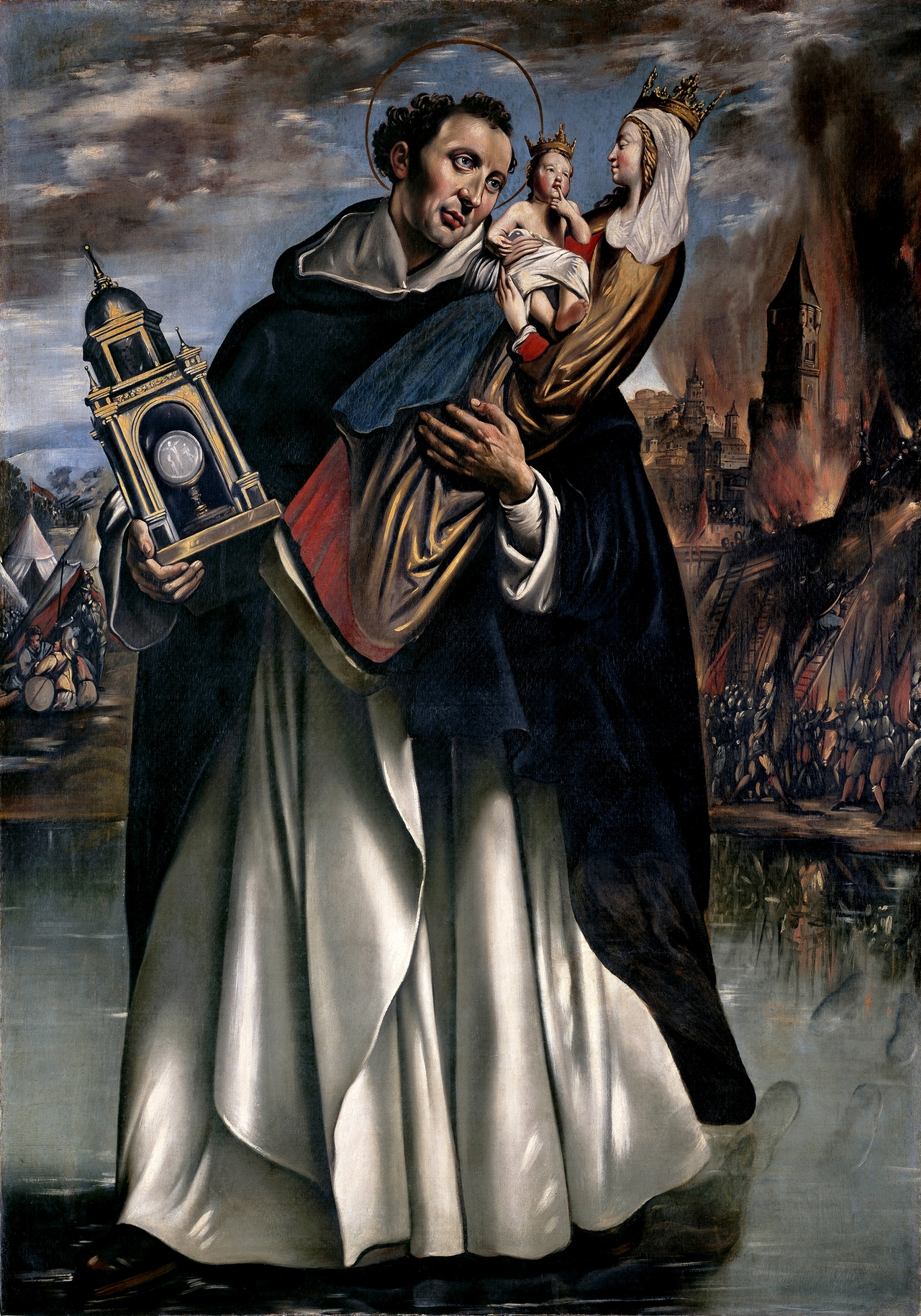
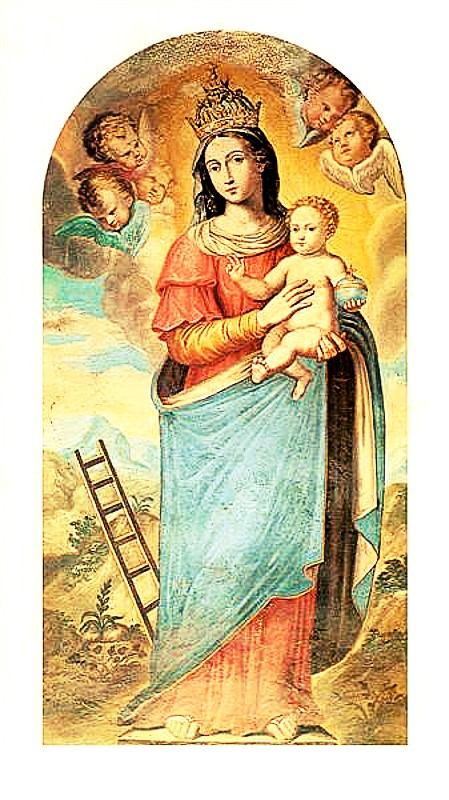
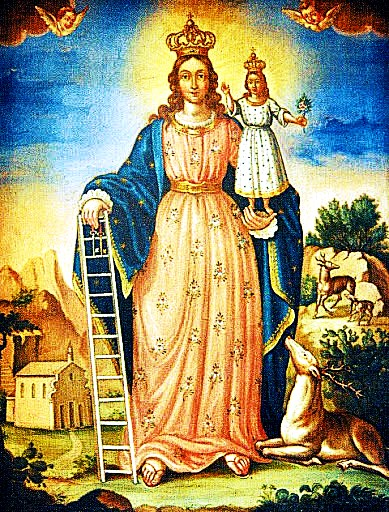
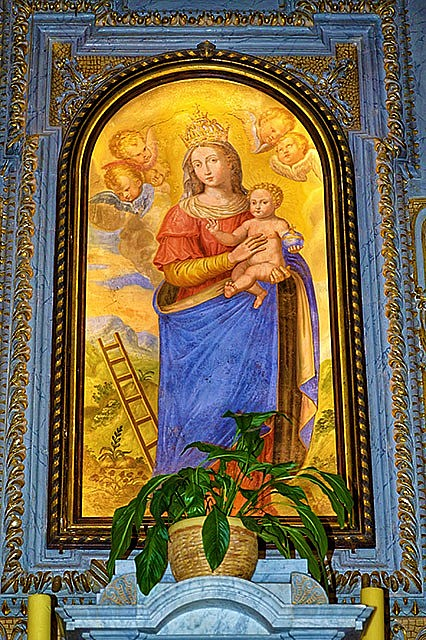
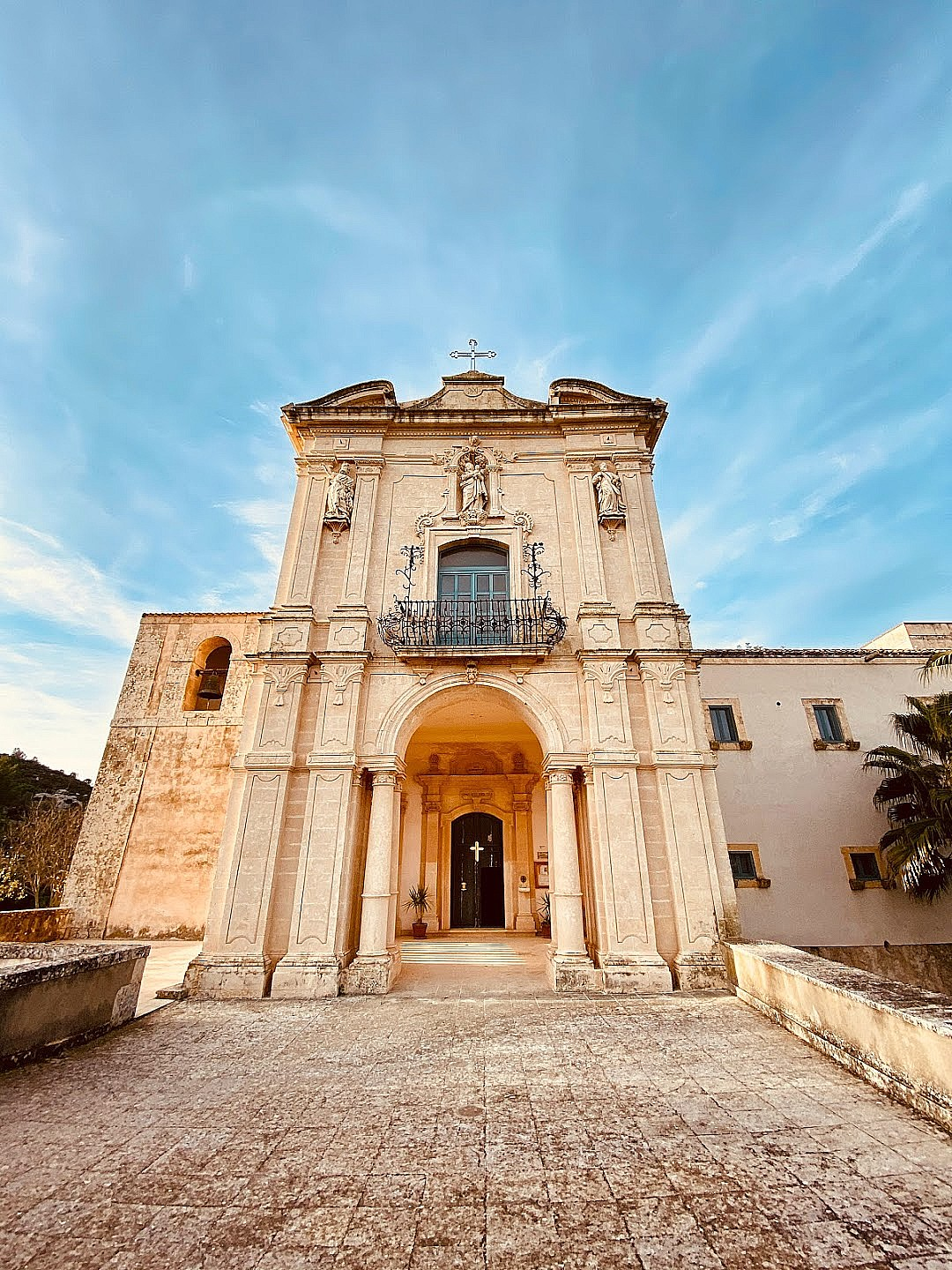
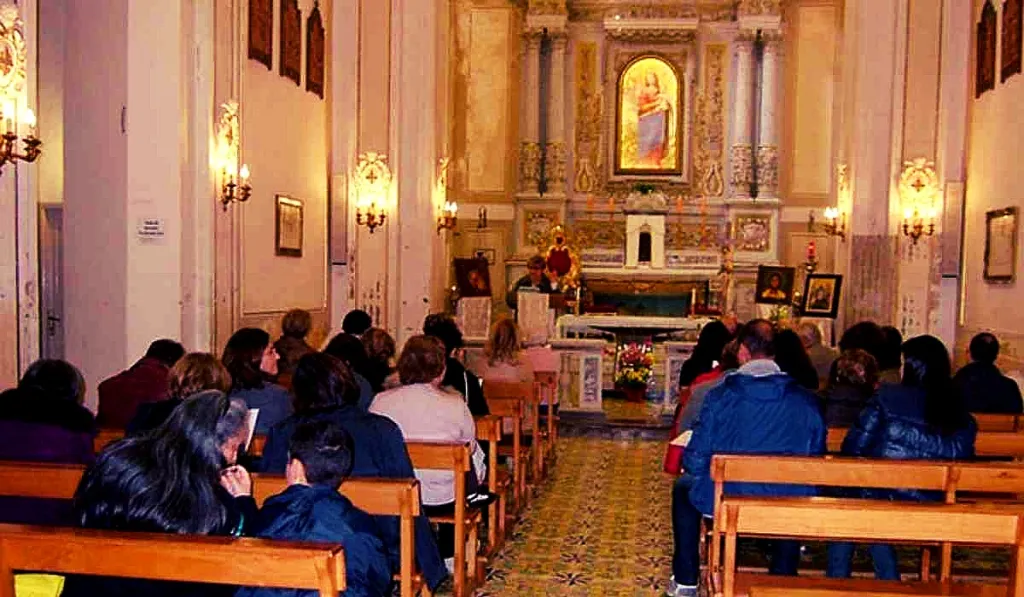
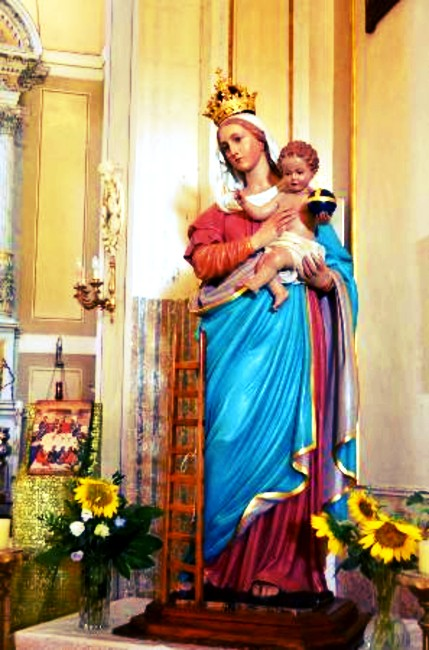
Maria Santissima Scala del Paradiso / Holy Mary, Ladder to Paradise, Noto, Siracusa, Sicily, Italy (1498) – 3 August:
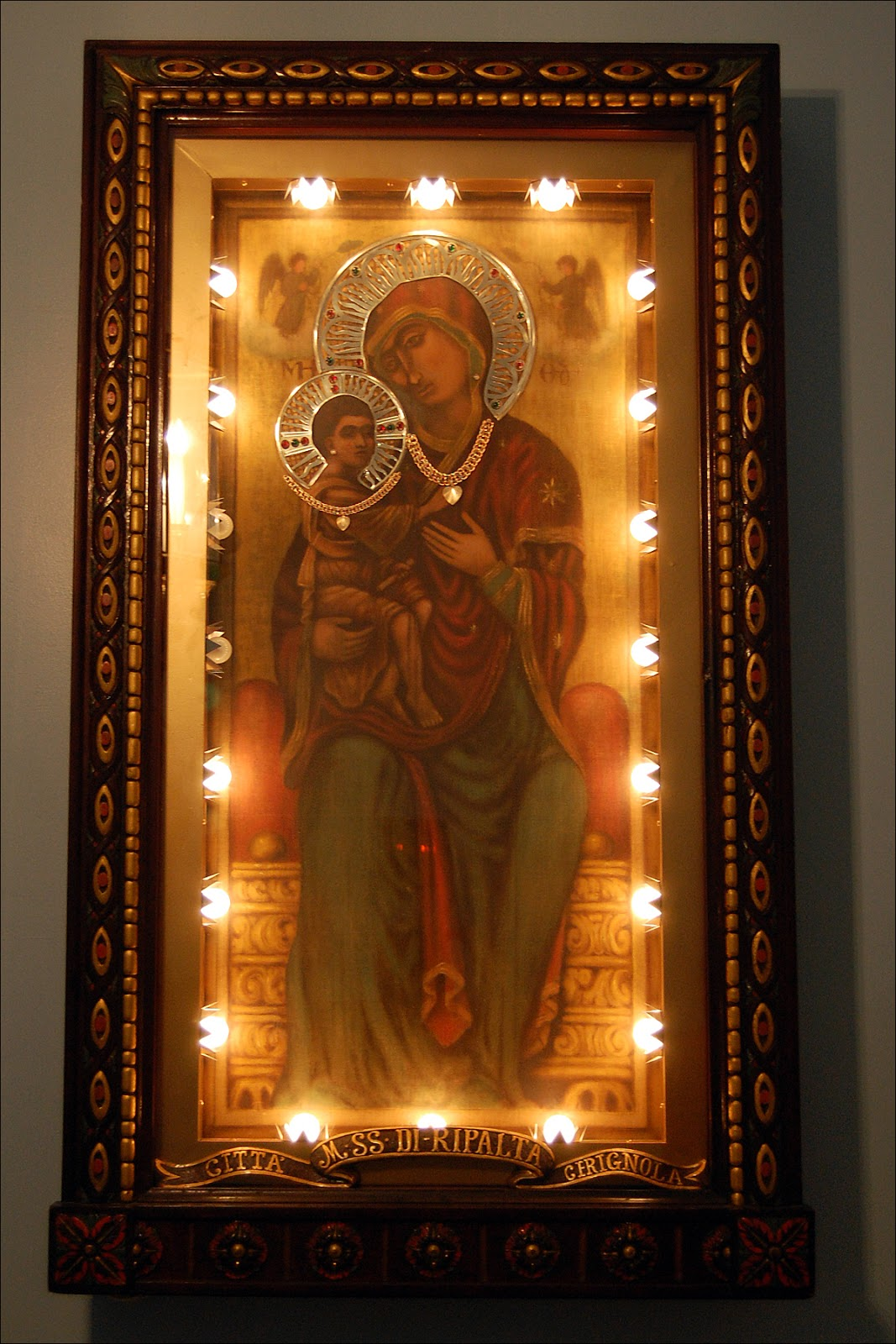
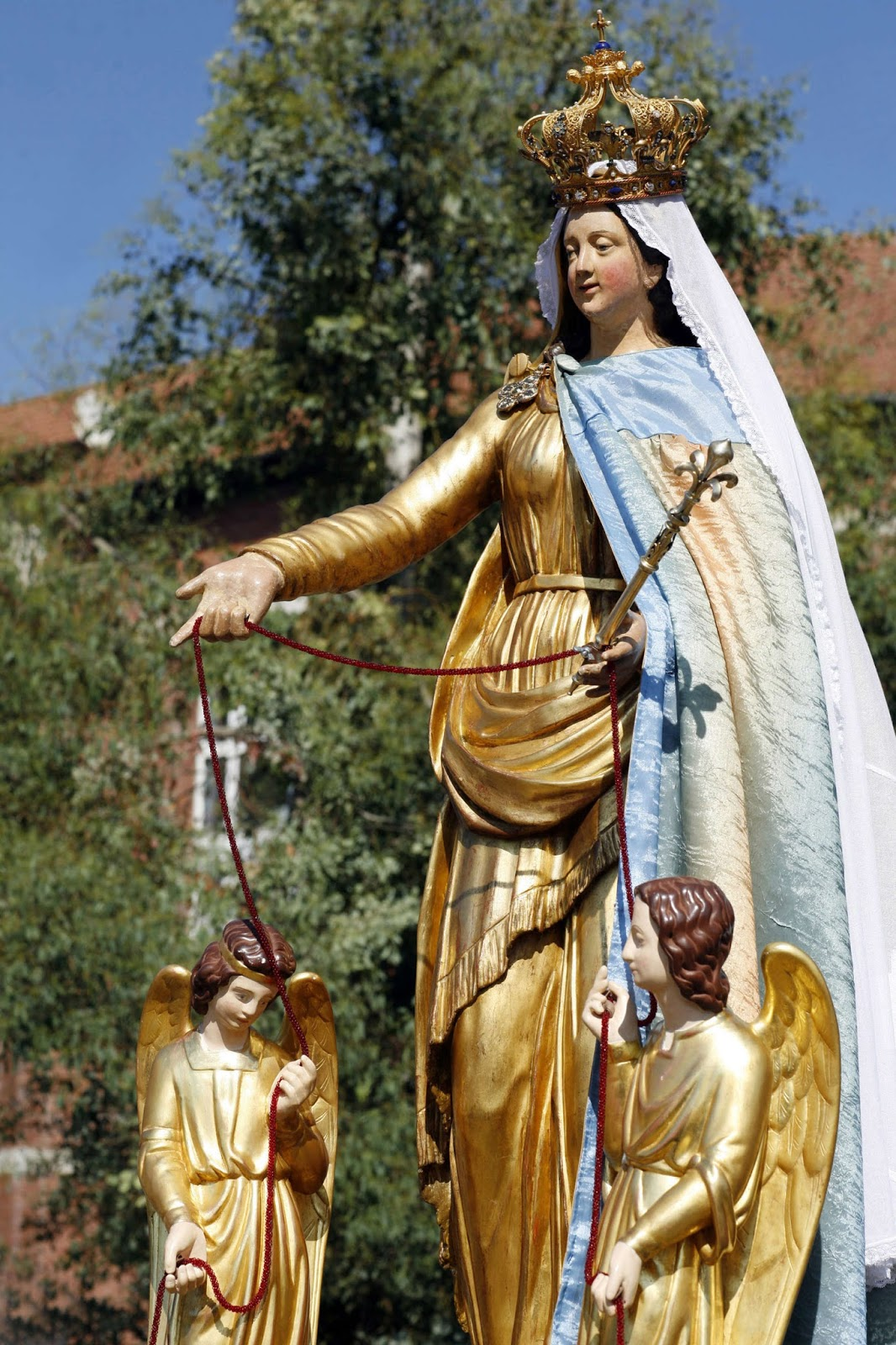
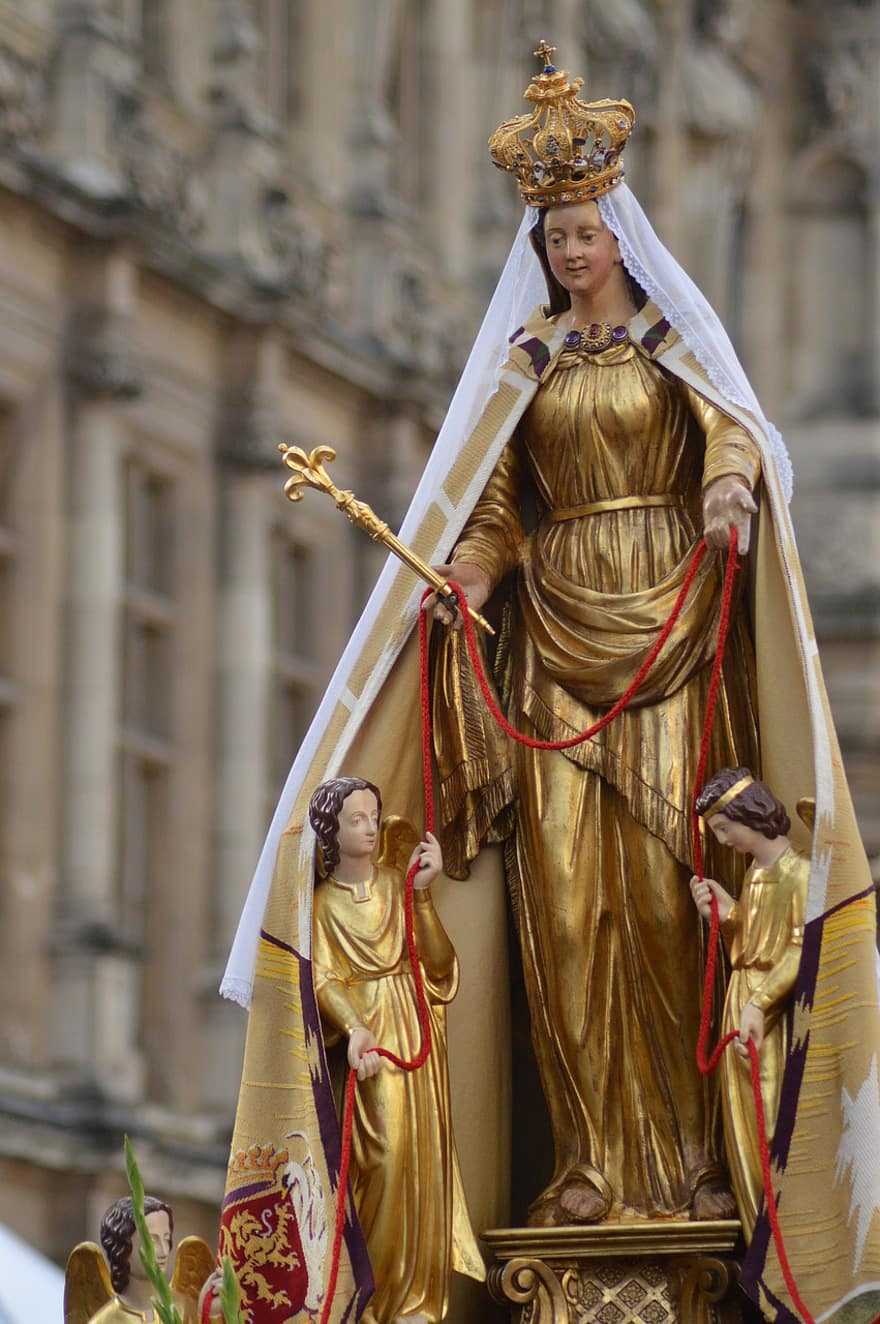
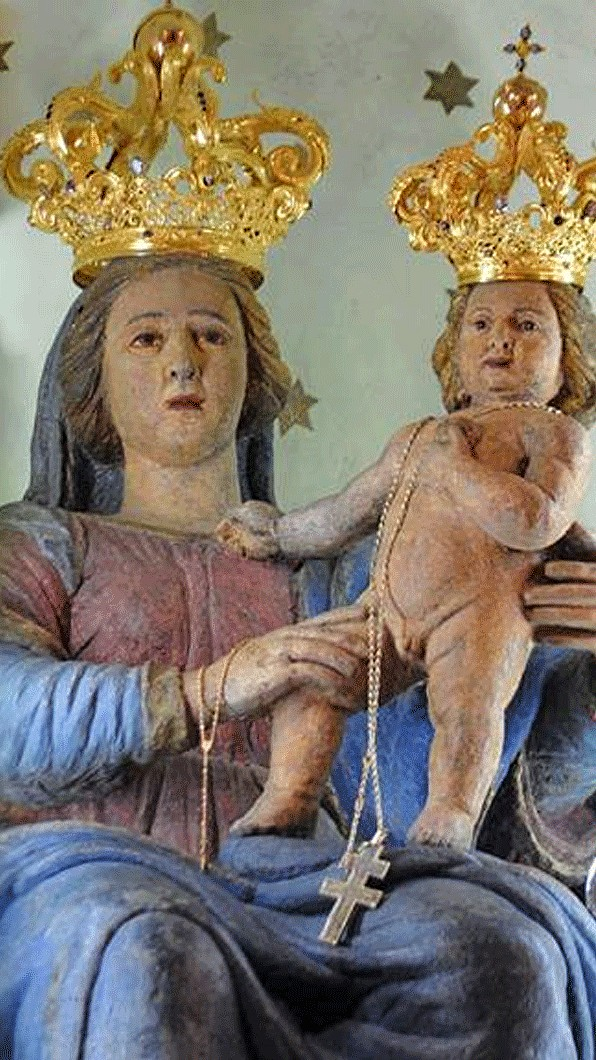
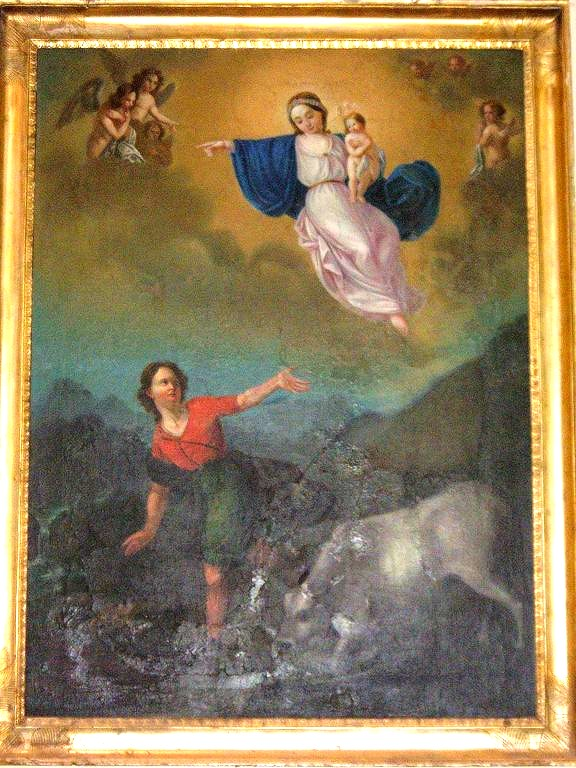
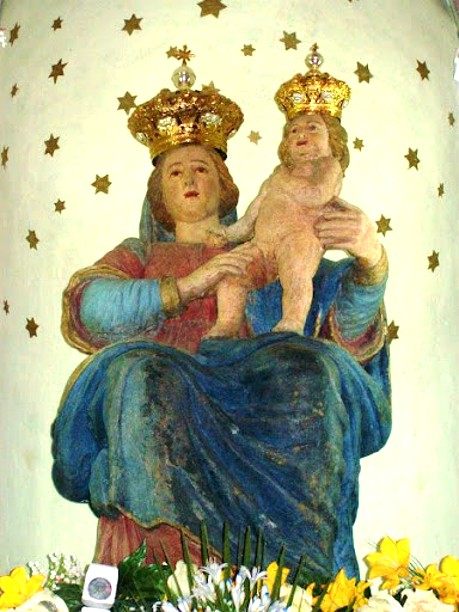
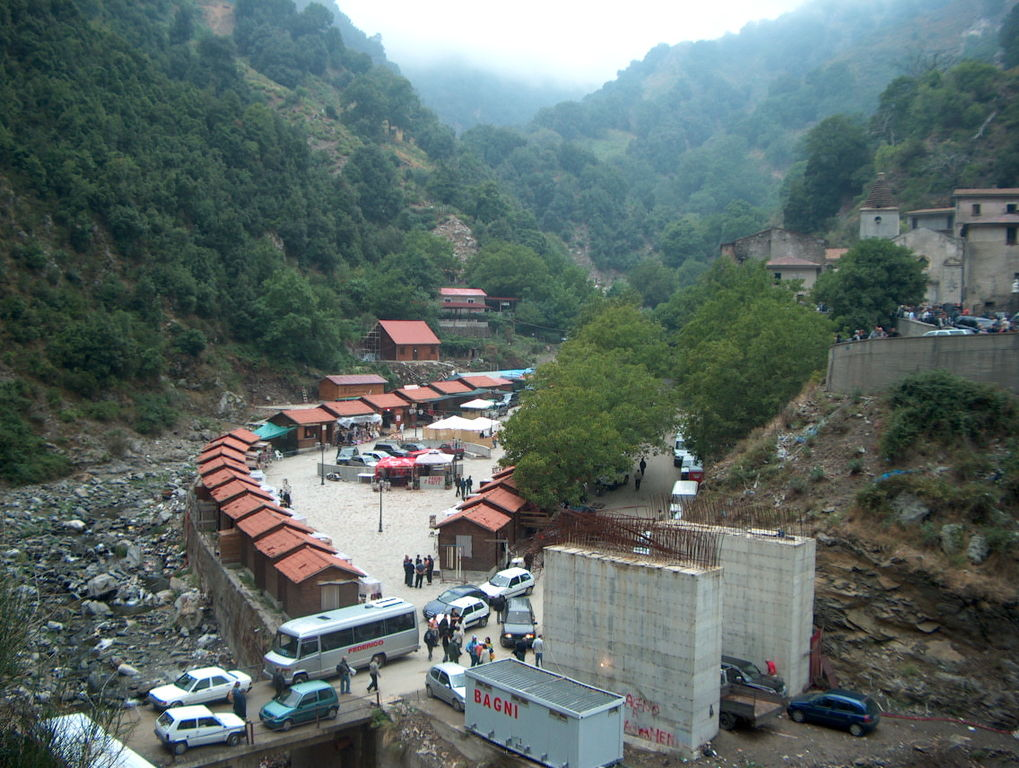
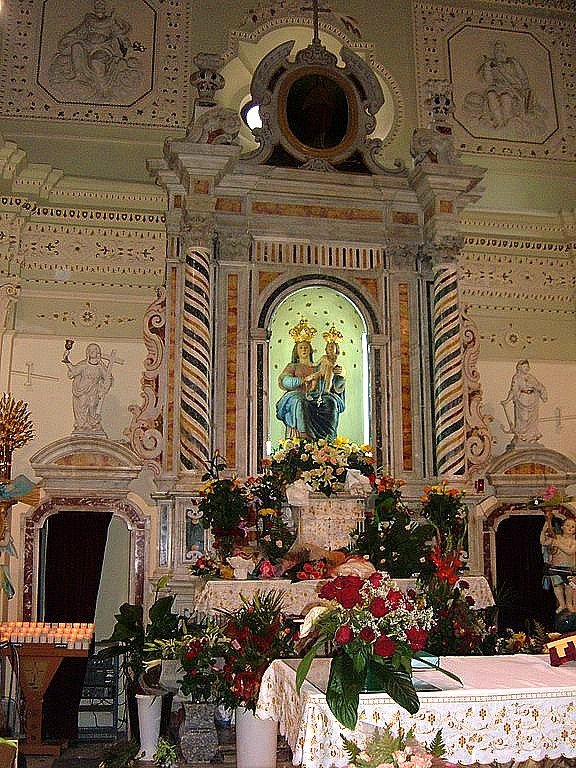
Local tradition holds that Angels frescoed the image of the Madonna, Ladder to Paradise, on a rock wall in the countryside before St. Corrado di Fuori’s arrival in 1340 and, that it was discovered there on 3 August 1498. However, the Diocese of Noto, of which the Madonna della Scala is the Patron, suggests that an unknown artist created the fresco in the late 1500s or early 1600s, a period more in keeping with its style.
In any case, by the time of the earthquake that destroyed the City of Noto on 11 January 1693, popular devotion had grown around the image, surrounding it with votive lamps, ex votos left in thanksgiving for answered prayers, and eventually, an Oratory. The earthquake demolished the chapel but the image remained intact.
In 1708, a group of Carmelite Hermits took over the site and undertook the building of another church, which was blessed the following year. In 1712, Ven. Girolamo Terzo, recently appointed the group’s Superior, hired an expert to detach the fresco from its rock and arranged its spectacular transfer to the church, pulled by a team of untamed oxen. Ven. Girolamo promoted devotion to the Madonna of the Ladder by distributing copies of the image on evangelical visits throughout the region.
With a reputation for cures and other miracles, the Hermitage became a place of pilgrimage, particularly on the Feast of the Nativity of Mary, 8 September. The Sanctuary suffered damage during World War I.
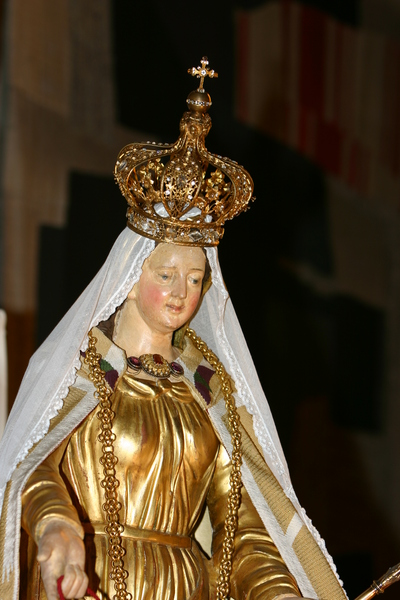
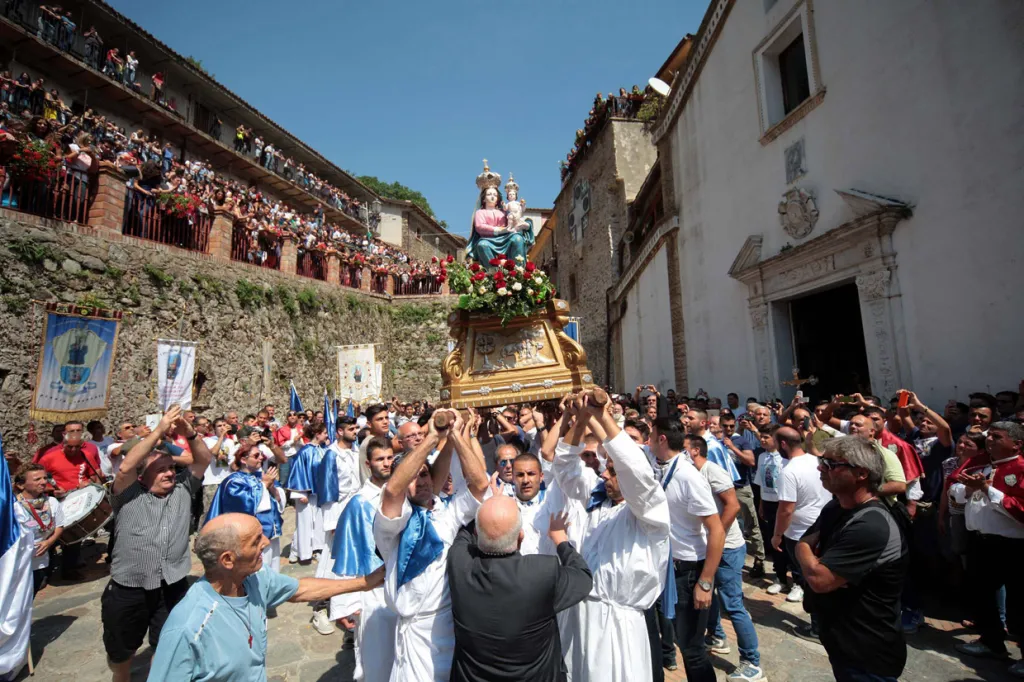
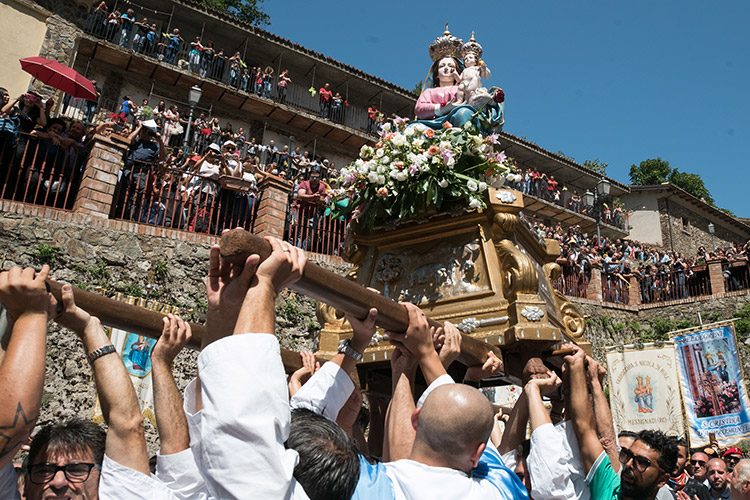
Afterwards it was restored and in 1919 the Catholic Church gave the Madonna, Ladder to Paradise, her own liturgical feast day, 3 August. An annual festa on this date draws the people of Noto to the Shrine seven miles distant, where after Mass in the Carmelite Chapel a statuary version of the image goes in procession through all the neighbouring districts.
The image of the “Ladder to Paradise” echoes the story of Jacob (Genesis 28:12) and St John Climacus’s Ladder of Ascent, a guide to the spiritual life written in Greek in the 600s, which became popular among Western religious after its translation into Latin in the 1500s (Scala Paradisi). Here, the Virgin is identified with the way to heaven because of her role in bringing Christ to humanity and her ongoing help to all who follow Him.
St Abibas St Aspren (1st Century) Bishop of Naples
Blessed Augustine Gazotich OP (1262-1323) Bishop of Lucera, Croatia, Of the Order of Preachers. He was also noted for being the guide for Dante Alighieri as the poet travelled through Croatia. His reputation for personal holiness remained noted long after his death; this resulted in Pope Innocent XII confirming the late Bishop’s beatification in 1700.
St Dalmatius St Euphronius of Autun St Gamaliel St Gaudentia Bl Godfrey of Le Mans Bl Gregory of Nonantula St Hermellus St Nicodemus St Senach of Clonard (Died 6th Century) One of the Twelve Apostles of Ireland St Trea of Ardtree
Martyred in the Spanish Civil War: Biandrés Avelino Gutiérrez Moral Bl Antonio Isidoro Arrué Peiró Bl Eleuterio Mancho López Bl Geronimo Limón Márquez Bl Patricio Beobide Cendoya The Story of these around 10000 Martyrs of Spain:
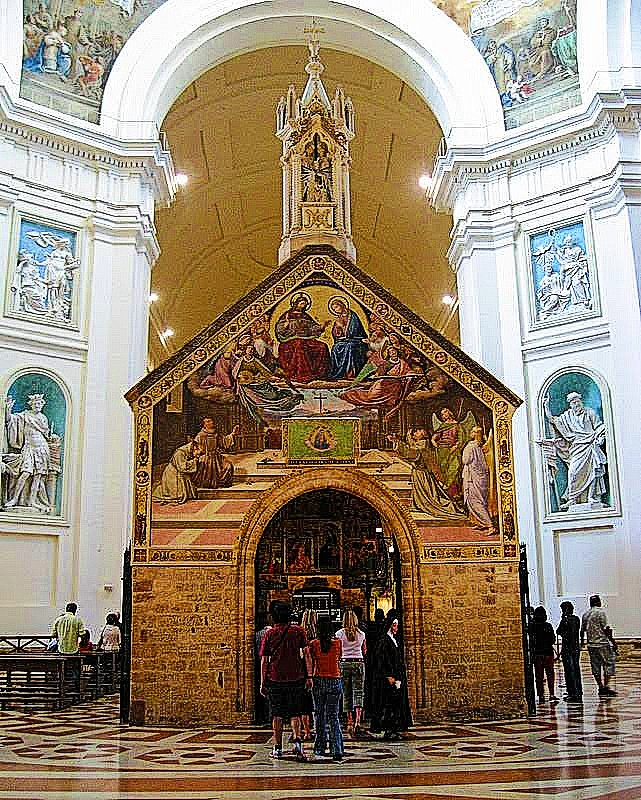
Santa Maria degli Angelis / Our Lady of Angels, Assisi, Italy (13th Century) Feast Day and Portiuncula Indulgence: 2 August
Our Lady of Angels, or of the Portiuncula, is located on the outskirts of the City of Assisi, in Italy. It was a desolate locality and apparently an unsettled one where robbers and the lawlessness flourished, for the Benedictines who had lived at the Monastery felt it was too hazardous to remain there. They abandoned the Monastery, relocating to Mount Subasio, which was a fortified Monastery.
The original chapel is thought to date from the 4th Century and was built by holy hermits who had come from the Valley of Josaphat. It is said that they brought relics of the Blessed Virgin with them to the region when they constructed the chapel.
The history of the feast is inspiring. St Francis of Assisi, in the early days of his conversion, while he was still uncertain as to what path to pursue, was praying earnestly for enlightenment before the Crucifix at the Church of San Damiano, when he heard within himself the command of the Crucified: “Build up my house, for it is nearly falling down.” Taking the words literally, Francis began to restore San Damiano and other dilapidated Churches in and near Assisi. The most famous of these was the Church of Our Lady of the Angels.
Some time after the restoration of this little chapel, an angel told St Francis to come to the church of Our Lady of Angels, or Portiuncula. There he found Our Lord, His Blessed Mother and the Angels waiting for him. Our Lord commended Francis because of his zeal for the salvation of souls and promised to grant him whatever he should ask on behalf of sinners. St Francis asked for this great favour – that all those who came to this church to pray and, truly sorry for their sins, confessed them, should “Obtain in perpetuity a Plenary Indulgence” so that they would have nothing to account for when God called them. This was the great favour he asked, but Our Lord granted it to him through Mary.
When Saint Francis came upon the little, run down and abandoned chapel of Our Lady of Angels, or Santa Maria degli Angelis, in the year 1208, it was almost completely hidden in shrubs and bush. Saint Francis entered the hidden church, which measured only (7 x 4 metres) twenty-two feet by thirteen feet and saw the ancient fresco that had been placed above the main Altar. It was an image of the Assumption of the Blessed Virgin surrounded by Angels. Some say that this is why the chapel was named Our Lady of Angels, although there are also legends that Angels could often be heard singing there.
The place took its name, the Little Portion, or Portiuncula in the native Italian, from the small section of fertile land that was gifted to the Monks to work for their support. It is said that this was the place where Saint Francis first understood his vocation, received visions and was also where the saint desired to live. The Benedictines had lived at that location for hundreds of years but the Benedictine Monks gave this Chapel to Saint Francis upon his request. It was certainly here that the Franciscan Order was founded.
At first Saint Francis wished the convent which he built there to be the principal one of his Order. He assembled the first General Chapter there, where there were five thousand religious. It was also where he yielded up his spirit on 3 October 1226, the twentieth of his conversion and the forty-fourth of his age. The cell in which the poor man of Assisi died can still be seen where it rests against one of the columns of the cupola under the choir bay.
The Roman Martyrology states of St Alphonsus today: “At Nocera-de-Pagani, Saint Alphonsus Maria de Liguori, Bishop of St Agatha of the Goths and Founder of the Congregation of the Most Holy Redeemer (the Redemptorists), distinguished by his zeal for the salvation of souls, by his writings, his preaching and his example.
He was inscribed on the Calendar of the Saints by Pope Gregory XVI in the year 1839, the 52nd after his happy death and , in 1871, was declared Doctor of the Universal Church by Pius IX, according to a decree of the Sacred Congregation of Rites.“
St Eusebius of Vercelli (c 283-371) Bishop (Optional Memorial) Bishop, Confessor, Founder of monasticism in his region of Italy.
St Peter Julian Eymard SSS (1811-1868) – “Apostle of the Eucharist”Priest, Founder of two religious institutes, Congregation of the Blessed Sacrament Fathers and Brothers and the Servants of the Blessed Sacrament.
St Auspicius of Apt St Betharius of Chartres St Centolla of Burgos St Etheldritha of Croyland Bl Frederic Campisani Bl Giustino Maria Russolillo Bl Gundekar of Eichstätt Bl Joanna of Aza Bl John of Rieti St Maximus of Padua St Pedro de Osma
St Peter Faber SJ (1506-1546) the “Second Jesuit” – as co-Founder with St Ignatius. He was the first Priest and theologian of the Order.
Portiuncula Indulgence: An Indulgence which may be gained in any Church so designated by the Bishop, by all the faithful who, after Confession and Holy Communion, visit such Churches between noon of 1 August and midnight of 2 August, or on the Sunday following. The Indulgence is toties quoties and is applicable to the souls in Purgatory.
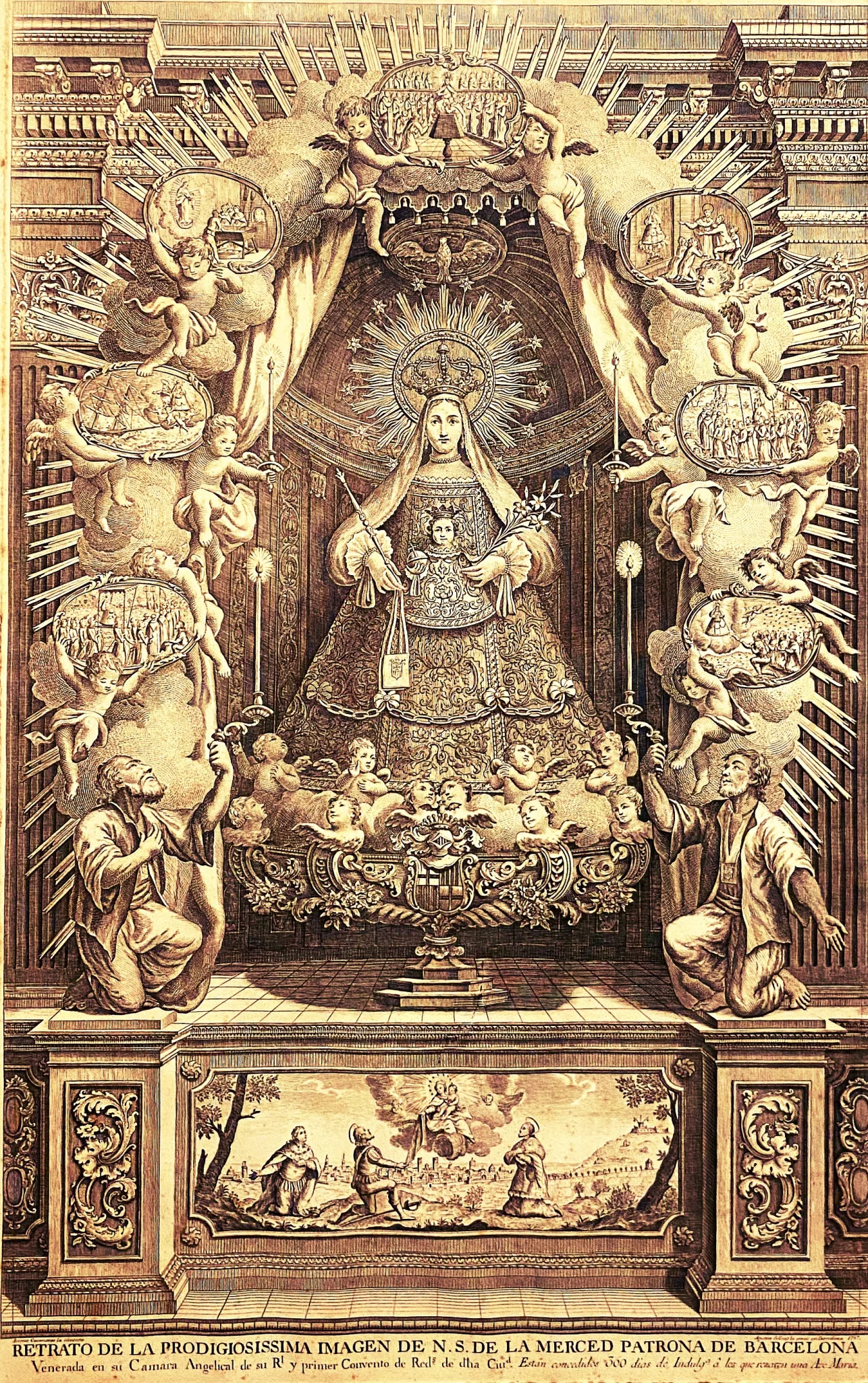
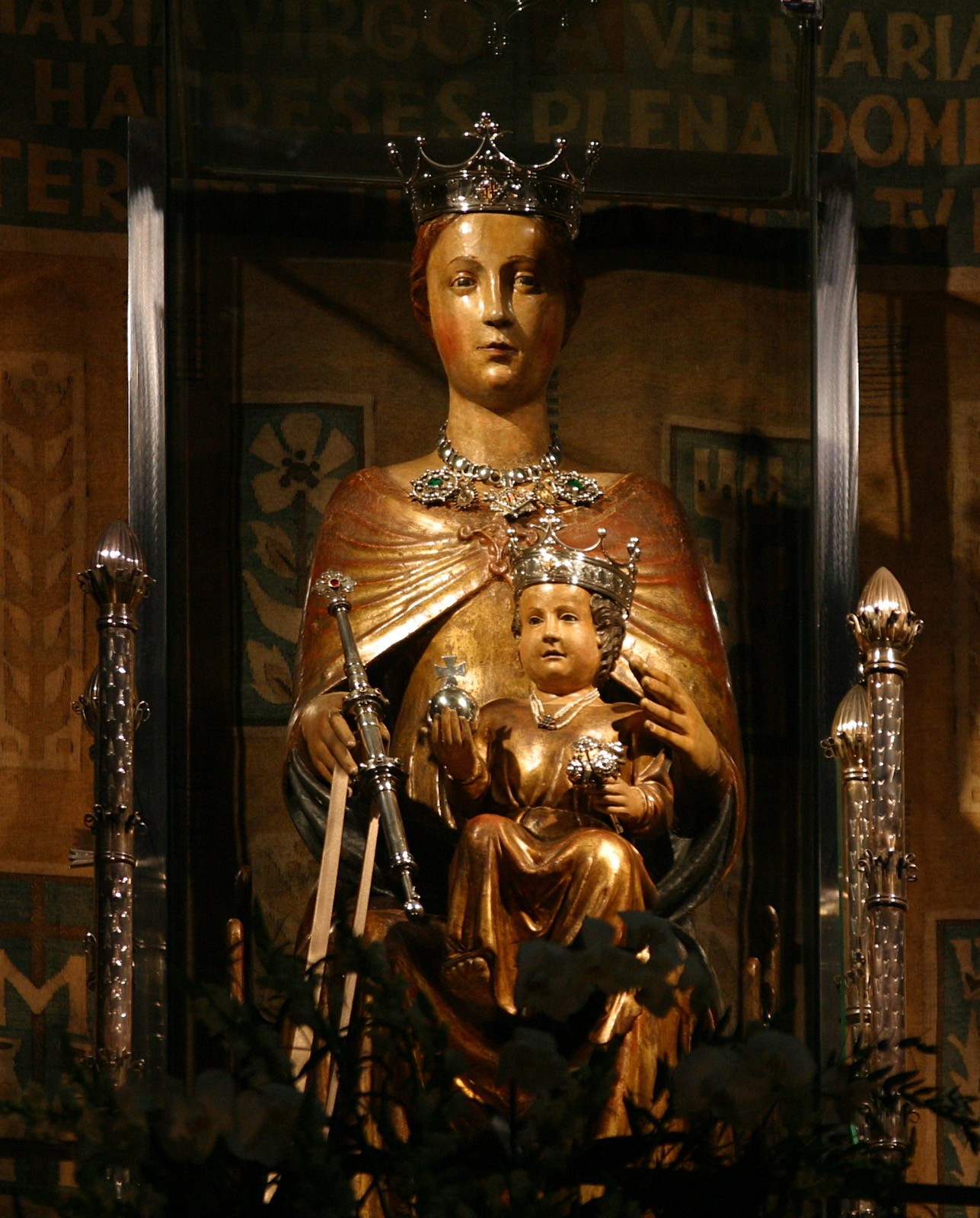
Nuestra Señora de las Mercedes / Our Lady of Mercy, Barcelona, Spain (1218,) Founding of the Mercedarian Order – 1 August, 24 September :
On 1 August of 1218, St Peter Nolasco, St Raymund of Penafort and James, King of Aragon, each had a vision of the Virgin Mary asking them to found a religious Order devoted to freeing Christian captives from the Muslims, who still held much of Spain. The Order of the Blessed Virgin Mary of Mercy grew quickly, collecting alms for ransom and sometimes offering themselves in exchange for prisoners. The Statue of the Mother of God of Mercy in Barcelona (below) dates from the 1300s. She became the City’s Patron after saving it from a plague of locusts in 1687. Before the counter-reformation, the Mercedarian Order celebrated the Feast of Our Lady of Ransom on 1 August, the date when she showed St. Peter Nolasco their white habit. The Vatican changed the date to 24 September when it extended the feast to entire Church in 1696. Since Vatican II, Catholic observance of Our Lady of Mercy’s day is limited to places and organisations that claim her as Patron.
Meanwhile, the Mercedarians have changed their mission to teaching and chaplaincy and the Barcelona soccer team visits the Basilica of La Mercè after victories in thanksgiving for her help. Her fiesta in Barcelona is a spectacular sequence of processions, dances, music, games and fireworks.
St Adela Mardosewicz Bl Aleksy Sobaszek St Alexander of Perga St Almedha St Arcadius St Attius of Perga St Buono St Brogan St Charity St Ethelwold of Winchester (c 912-984) Bishop St Exuperius of Bayeux St Faith St Faustus St Felix of Gerona St Friard Bl Giovanni Bufalari St Hope St Jadwiga Karolina Zak St Jonatus St Justin of Paris St Kenneth of Wales St Leontius of Perga St Maur St Nemesius of Lisieux Bl Orlando of Vallombrosa St Peregrinus of Modena St Rioch Bl Rudolph St Secundel St Secundus of Palestrina St Sophia St Verus of Vienne
Holy Maccabees: Jewish dynasty which began with the rebellion of Mathathias and his five sons against the Syrian king, Antiochus IV (168 BC) and ruled the fortunes of Israel until the advent of Herod the Great. Syrian attempts to force Greek paganism on the Jews, the profanation of the Temple at Jerusalem and the massacre which followed, brought the nation to arms under Mathathias, a priest of the sons of Joarib. At the death of Mathathias, Judas Machabeus, his third son, drove the Syrians and Hellenists out of Jerusalem, rededicated the Temple and began an offensive and defensive alliance with the Romans. Before the treaty was concluded, however, Judas, with 800 men, risked battle at Laisa with an overwhelming army of Syrians under Bacchides, and was slain. He was succeeded in command by his youngest brother, Jonathan (161 BC). Jonathan defeated Bacchides, revenged the death of his brother and made peace with Alexander who had usurped the throne of Demetrius, the successor to Antiochus. A period of peace followed in which Jonathan ruled as high priest in Jerusalem but Tryphon, who was plotting for the throne of Asia, treacherously captured him at ptolemais and later put him to death. The captaincy of the armies of Israel then fell to Simon, the second son of Mathathias. Under him the land of Juda flourished exceedingly. He obtained the complete independence of the country and a grateful people bestowed upon him the hereditary kingship of the nation. His rule marked five years of uninterrupted peace. He was treacherously slain by his son-in-law, Ptolemy, about the year 135 BC After Simon the race of the Machabees quickly degenerated. In 63 BC the Romans thought it necessary to interfere in the fratricidal war between Hyrcanus II and Aristobulus II. With this interference and the advent of Herod the Great the sceptre passed forever from the land of Juda. The story of the Machabees is written in the two books of the Old Testament which bear that name.
Martyrs of Nowogrodek – 11 beati: A group of eleven Holy Family of Nazareth nuns who were murdered by the Nazi Gestapo in exchange for 120 condemned citizens of Nowogrodek, Belarus who were scheduled for revenge killings. They are – • Adela Mardosewicz • Anna Kukolowicz • Eleonora Aniela Józwik • Eugenia Mackiewicz • Helena Cierpka • Jadwiga Karolina Zak • Józefa Chrobot • Julia Rapiej • Leokadia Matuszewska • Paulina Borowik • Weronika Narmontowicz They were machine-gunned by firing squad on 1 August 1943 by the Gestapo about three miles outside Novogrudok (Nowogródek), Hrodzyenskaya voblasts’, in Nazi occupied Belarus and buried on the site of the execution in a common grave. One of their surviving sisters, Maria Malgorzata Banas, located the grave on 19 March 1945 and tended to it until her death in 1966. Their relics have since been re-interred in a common sarcophagus in the chapel of the Novograd Farny Church (the Church of the Transfiguration, also known as Biala Fara or the White Church).
Our Lady of the Slain, also known as Our Lady of the Murdered, is located at a Cistercian monastery in Ceica, near Lorban, in the country of Portugal.
It is believed that this image was brought directly from heaven to be given to the Abbot John, who was the uncle of King Afonso I of Portugal. The statue earned its unique title through many spectacular miracles. It is best known for the fact that life was restored to several persons who had been murdered. In memory of these miracles, those who had been raised from the dead would bear from that time forward, a red mark upon their throats, like that which was seen on the throat of the image.
King Afonso I, the Conqueror, (also known as Afonso Henriques), was the first king of Portugal and a lifelong sworn opponent of Islam. He spent 46 years as king of Portugal waging war against the Moors in order to drive the invaders from his land. He was also known for his piety and great love for God. A relative of Saint Bernard of Clairvaux, he bestowed many privileges and benefits to the religious orders and built Alcobaca Monastery for the Cistercian Order. He was responsible for the foundation of several monasteries and convents, and was favorable especially toward the Cistercians.
St Calimerius of Milan Bl Cecilia Schelingov Bl Everard Hanse St Fabius of Caesarea St Firmus of Tagaste
St Germanus of Auxerre (c 378 – c 448) Bishop of Auxerre (c 378 – c 448), Lawyer, Missionary, Reformer, Exorcist, Miracle-Worker.
Blessed Giovanni Colombini (1300-1367) Layman, Husband and Father, Founder of the Apostolic Clerics of Saint Jerome (the Jesuati).
St Giustino de Jacobis CM (1800-1860) Bishop, Apostolic Vicar of Abyssinia, Missionary of the Congregation of the Mission.
St Helen of Skofde Bl Jean-François Jarrige de La Morelie de Breuil St Marcel Denis St Neot — Martyrs of Syria – 350 saints: 350 monks massacred by heretics for their adherence to orthodox Christianity and the decrees of the Council of Chalcedon. 517 in Syria.
Martyrs of Synnada: 3 Saints Democritus Dionysius the Martyr Secundus
Martyred in the Spanish Civil War: Thousands of people were murdered in the anti-Catholic persecutions of the Spanish Civil War from 1934 to 1939. • Blessed Ciriaco Olarte Pérez de Mendiguren • Blessed Dionisio Vicente Ramos • Blessed Francisco Remón Játiva • Blessed Miguel Goñi Ariz • Blessed Miguel Francisco González-Díez González-Núñez • Blessed Agapito Alcalde Garrido • Blessed Ciriaco Olarte Pérez de Mendiguren • Blessed Dionisio Vicente Ramos • Blessed Francisco Remón Játiva • Blessed Jaume Buch Canals • Blessed Maria Roqueta Serra • Blessed Miguel Goñi Ariz • Blessed Miguel Francisco González-Díez González-Núñez • Blessed Prudencio Gueréquiz y Guezuraga • Blessed Segundo de Santa Teresa • Blessed Teresa Subirà Sanjaume • Blessed Vicenta Achurra Gogenola • Blessed Francisca Pons Sardá
Madonna dei Miracoli / Holy Mary of Miracles, Morbio Inferiore, Ticino, Switzerland (1594) – 29 July:
Where the Sanctuary of Morbio now stands, a castle stood centuries ago, attested in 1198 and destroyed in the first half of the sixteenth century. Only the ruins of a Chapel, dedicated to St Bernardino of Siena, transformed over time into a pile of rubble, buried by weeds, brambles and thorns., remained. Surrounded by ivy and fortunately well preserved, remained the Fresco in the Chapel, depicting the Virgin with the Child.
The history of the Sanctuary of Holy Mary of Miracles began on 29 July 1594. It was a Friday when the two mothers with their daughters, Catherine and Angela , respectively ten and seven years old, travelled to Morbio to entreat the assistance of Fr Gaspare Basbetrini. They were sick girls, tormented by the devil and had travelled to Morbio, to ask for the blessing of Don Gaspare Barberini, the assistant Priest at Morbio, who was well-known as an Exorcist. However, sadly for the pilgrims, Fr Basbetrini was absent.
To the tiredness of the journey and the sadness of illness, the bitterness of disappointment was added. Among the ruins of the ancient castle the little group of supplicants waited and discovered on the crumbling and crumbling walls, the faded remains of a fresco depicting the Virgin in a deeply maternal position nursing Baby Jesus.
The two mothers knelt before the Virgin with their daughters and prayed in deep sadness and devotion for the intercession of the Holy Mother to come to the aid of the sick children.
And then the miracle happened. Those two poor simple and innocent creatures were cured. This is Morbio’s miracle – the Madonna appeared to the two little girls and cureds them of all their illnesses, dispelling any demonic presence within them.
Our Lady spoke to the elder girl, Catherine and instructed her to tell the Bishop that the Church should be rebuilt and that the Holy Rosary must be said everyday.
Eight days after the event, on 5 August 1594, the episcopal curia of Como, whose ecclesiastical jurisdiction also extended to the southern regions of Ticino, instructed the regular canonical process, which recognized, upon the sworn deposition of the main eyewitnesses, the truth of what happened and their prodigious and supernatural nature.
A stained-glass window, located at the top of the apse and placed at the beginning of this century, illustrates and reminds those who enter the Sanctuary of this miracle. Catherine is depicted on a ladder, with her arms outstretched, listening in front of the image of the Madonna dei Miracoli. At the foot of the ladder, Angela, the other sick girl, is lying asleep.
In a short while an Oratory was built on the site to recite the Rosary and celebrate Mass there, as the Madonna had said to Catherine, while on 29 July 1595, the Anniversary of the apparition and the miracle, the first stone was blessed and laid for the construction of the Sanctuary, Consecrated on 16 May 1631 by the Bishop of Como, Msgr Filippo Archinti.
St Antony St Beatrix of Rome Bl Beatrix of Valfleury St Callinicus of Paphlagonia Bl Charles-Antoine-Nicolas Ancel St Faustinus of Rome St Faustinus of Spello St Felix of Rome St John Baptist Luo Tingyin St John the Soldier Bl José Calasanz Marqués St Joseph Zhang St Kilian of Inishcaltra St Lek Sirdani Bl Luis Bertran St Lupus of Troyes Bl Mancius of the Cross St Martha Wang St Olaf II St Olaus of Sweden St Paulus Chen Changpin Bl Petrus of Saint Mary St Pjetër Çuni St Prosper of Orleans St Rufo of Rome St Seraphina St Serapia of Syria St Simplicius of Rome St Sulian
Blessed Pope Urban II (c 1035-1099) Bishop of Rome from 1088 until his death, Carthusian Abbot, Confessor
Martyrs of Calanda – 8 beati: A group of Dominican priests and friars who were martyred over the course of a day in the same town by the same group of anti-Christian forces in the Spanish Civil War. • Antonio Manuel López Couceiro • Felicísimo Díez González • Gumersindo Soto Barros • Lamberto María de Navascués de Juan • Lucio Martínez Mancebo • Matías Manuel Albert Ginés • Saturio Rey Robles • Tirso Manrique Melero They were martyred on 29 July 1936 in Calanda, Teruel, Spain I.
Martyrs of Lleida – 12 beati: Carmelites of the Ancient Observance novices, friars and priests who were all martyred together in the Spanish Civil War. • Àngel Prat Hostench • Eliseo Maneus Besalduch • Gabriel Escoto Ruiz • Ginés Garre Egea • Joan Maria Puigmitjà Rubió • Joan Prat Colldecarrera • Josep Solé Rovira • Lluis Fontdecava Quiroga • Manuel Serrano Buj • Miquel Soler Sala • Pere Dorca Coromina • Pere Ferrer Marín They were martyred on 29 July 1936 in Clot dels Aubens, Cervera, Lleida, Spain.
Martyred in the Spanish Civil War: Thousands of people were murdered in the anti-Catholic persecutions of the Spanish Civil War from 1934 to 1939. • Blessed Bartolomé Rodríguez Soria
Martyrs of Rome – 23 saints Eugene Flora the Martyr Lucilla Theodore
The Siege of Rhodes. Victory over the Turks by the Knights Hospitaller at Rhodes in 1480 through the intercession of Our Lady, final battle 27 July 1480 – commemorated on 28 July:
Constantinople, the capital of the Byzantine Empire, the last remnant of the Holy Roman Empire, fell to the “Scourge of Europe,” the Sultan Mehmet II, in the year 1453. This dire news was almost impossible to believe in the rest of Christendom but, it was sadly true and Constantinople was made into the new seat of the Ottoman Empire.
A few short years later, Pierre D’Aubusson was Grand Master of the Hospitallers, the Knights of Saint John, living on the island of Rhodes. He and his Knights were untiring opponents of Islam, sworn to do everything in their power to fight against them. Having made the island of Rhodes their home, the Knights harassed Ottoman shipping lanes and assisted with attacks against the Ottoman Empire.
In the year 1479, D’Aubusson refused to pay tribute to Mehmet in exchange for peace and furthermore, had the audacity to continue harassing the sultan’s shipping lanes. The Grand Master continued to work on the massive fortifications on Rhodes as he awaited the siege of Rhodes that he knew would soon come. His walls were strong but the Grand Master had only a few hundred Knights and about 2,000 natives to defend them.
Mehmet was not intimidated by the Christian defenses on Rhodes, for he had huge cannons and basilisks which had blasted holes in the stout walls of Constantinople. He also had over 70,000 men in his army, and he was determined to wipe out “that abode of the sons of Satan,” as he referred to the Catholic Knights of Rhodes.
The Siege of Rhodes began with a tremendous bombardment on the Tower of Saint Nicholas. Grand Master Pierre D’Aubusson was not intimidated as he asked: “What is more sacred than to defend the Faith? What is happier than to fight for Christ?”
Breaches were eventually made in the walls and the Muslim’s unremittingly attempted to rush through the breaches. Many of the Turks had to be forced to attack the defenses, as their commanders lashed them forward with whips and chains. The Janissaries, however, did not have to be urged, for they were the sultan’s finest troops. They were warriors to the core and advanced over the fallen bodies of their comrades, anxious to cross swords with the Catholic Knights.
Finally, the Tower of Italy began to crumble from the terrific assault, and large breaches opened in the wall. The Bashi-Bazouks and Janissaries rushed into the breach, placing the standard of Islam above the Tower.
On witnessing this act, the Grandmaster rushed into the breach together with a few of his excellent Knights. Howling and raging like madmen, the Janissaries pressed the assault, for the Knights seemed too few to stand against their wave after wave of thousands of elite warriors. Yet, the Grandmaster stood, insensible of any wounds he received in return for the carnage he wreaked among the fanatical Muslim warriors.
Fighting with broken blades and notched axes, the Knights of Saint John continued to hold the breach, cutting down any who approached them, until a huge Janissary rose up and hurled a spear with all his might directly at the Grand Master. Propelled at incredible speed, the sharp steel tip easily pierced D’Aubusson’s breastplate, puncturing a lung. The Grand Master went down beneath a torrent of hacking blades as the Knights struggled to drag his body from the fray.
By his courageous stand D’Aubusson had proven he was at least the equal of any Grand Master in history, but now, he was wounded unto death and could do no more. The siege of Rhodes appeared to be lost as D’Aubusson’s Knights struggled to haul him to safety. Thousands of Jannisaries were rushing into the breach with no-one to stop them and at this point the Knights knew, it would take a miracle to keep Rhodes from being overrun.
A miracle is exactly what they got. Suddenly there appeared in the sky “a refulgent cross of gold, by the side of which stood a beautiful woman clothed in garments of dazzling white, a lance in her hand and a shield on her arm, accompanied by a man dressed in goatskins and followed by a band of heavenly warriors armed with flaming swords.” It was the glorious figures of Saint John the Baptist, the Patron Saint of the Order of Saint John, Saint Michael the Archangel brandishing his unsheathed sword and the Queen of Heaven, the Blessed Virgin Mary herself, dressed in battle array!
The Turks turned at the sight and ran in panic-stricken flight. Thousands fell as they fled, cut down and pursued through the breaches by the Knights of Rhodes and their heavenly allies. Chased all the way back to their camp, it was now the defeated Muslims who suffered the insult of having their sultan’s own standard captured.
The siege of Rhodes had ended, and Grandmaster D’Aubusson later recovered of his wounds. He had lost 231 of his Knights but that was nothing compared to the thousands upon thousands of Muslim warriors who lay dead upon his shores.
It was in the year of Our Lord 1480 that the Knights of Rhodes had gained this signal victory over the Turks, by the help of the Blessed Virgin, whom the Knights regarded ever after as Our Lady of Victory. They renewed their dedication to her who had appeared on the walls during the siege of Rhodes holding a lance in her hand to defend them, bringing with her Saint Michael the Archangel and a heavenly army. She, the Patroness of the Sovereign and Military Order of Hospitallers, had turned the formerly obstinate enemy, who retired in disorder, to lose the greater part of their army. Thanks BE to Our Lady of Victory, the all-conquering sword of Mehmet II had shattered upon the walls of Rhodes!
St Acacius of Miletus
St Arduinus of Trepino St Botwid of Sudermannland St Camelian of Troyes St Celsus of Rome Bl Christodoulos Bl Davíd Carlos-Marañon St Eustathius of Galatia St Pope Innocent I (Died 417) St Irene of Cappadocia Bl John Soreth St José Caselles-Moncho Bl José Melchór García-Sampedro Suárez Bl Josep Castell-Camps St Longinus of Satala St Lucidius of Aquara St Lyutius Bl Manuel Segura-López St Nazarius of Rome
Martyred in the Spanish Civil War – Thousands of people were murdered in the anti-Catholic persecutions of the Spanish Civil War from 1934 to 1939.
Martyrs of Fernán Caballero – 14 beati: Fourteen Claretian clerics who were martyred together in the Spanish Civil War. – 28 July 1936 in Fernán Caballero, Ciudad Real, Spain. Bl Antolín Astorga Díez Bl Enrique Serra Chorro Bl Gregorio Charlez Ribera Bl Joan Ayats Plantalech Bl Joan Bover Teixidor Bl Joan Costa Canal Bl José Aurelio Calleja de Hierro Bl José Gutiérrez Arranz Bl Josep Camí y Camí Bl Josep Martí Coll Bl Lluis Casanovas Vila Bl Lorenzo Arribas Palacio Bl Manuel Collellmir Sentíes Bl Miguel Léibar Garay Bl Narcís Felíu Costa Bl Pedro Alonso Fernández Bl Pelagi Ayats Vergés Bl Pere Vilar Espona Bl Primitivo Sandín Miñambres Bl Ramon Gros Ballbé Bl Vicente Toledano Valenciano
Notre-Dame-de-Foy / Our Lady of Faith,Gravelines, Liege, France (1616) – 27 July:
Not far from the small town of Dinant, in Liege near a home belonging to the Lord of Celles, two magnificent oaks once grew. One of the two venerable old trees was felled in the year 1609 by a man named Gilles, a lumberjack. The worker who inspected the tree found a small terracotta statue of the Mother of God, enthroned, as it were, with three iron bars that served as a trellis. The old oak stood on the edge of a path taken by pilgrims travelling to St Hubert. Apparently, at some time in the distant past, some pious Christian soul had placed the holy image in a hollow of the oak, as if in a niche. Then, over a period of time, the opening the tree had made while it was still young gradually closed and as it grew, the tree hid in its womb, the precious figure. Over the years the bark of the tree closed upon it and, as the road became less frequented, the existence of the Statue was completely forgotten.
To honour the Virgin, the Statue was subsequently displayed on the other oak, once again behind an iron grating, by order of the Baron of Celles. In this new Sanctuary, the Mother of God was honoured with the title of Our Lady of Faith. Those passing by did not fail to venerate the Statue;and there were many unexpected miracles. Graces of all kinds multiplied,and soon pilgrims began to flock to the area because of the dazzling miracles and very quickly a spontaneous cult grew.
The Statue was first placed in another oak but it was almost thrown away by servants who thought it had no value. The local Baron placed it near the door to his oratory at the Castle of Veves as pilgrims began to flock there. In this new Sanctuary, the image of Our Lady was honoured under the title of Our Lady of Faith, which was the name of the farm.
The first miracle occurred in 1616. As a result of the intercession of the Blessed Virgin Mary an old man was healed from a painful and debilitating hernia. The canonical investigation prescribed by the Bishop of Liege, was positive in its conclusion.
A Priest of the Society of Jesus had recently been sent to Gravelines. He worked diligently to cultivate souls, as if upon a fruitful vine and by his sermons excited the people of the region to a greater love for the Mother of God. Seeing that this devotion had taken root, he met with the local Magistrate to discuss how to maintain and increase the piety of the people. It was decided that they should make replicas of the Statue of Our Lady of Faith, made from the wood of the first oak. When the first was completed, the image was observed to have a great resemblance to the original. Received with great joy, it was placed in a large reliquary above the high Altar in the Parish Church.
St Aetherius of Auxerre St Anthusa of Constantinople St Arethas St Aurelius of Cordoba St Benno of Osnabruck (c 1020-1088) Bishop Bl Berthold of Garsten
St Pope Celestine I (Died 432) called “the Heresy Fighter.” Much is unknown about Celestine, including his birthday. But his reign as Pope – from 422 to his death in 432 – is credited with many achievements.
St Ecclesius of Ravenna Bl Felipe Hernández Martínez St Felix of Cordoba St Galactorio of Lescar St George of Cordoba St Hermippus St Hermocrates St Hermolaus Bl Jaime Ortiz Alzueta Bl Joaquín Vilanova Camallonga Bl José María Ruiz Cano St Juliana of Mataró St Lillian of Cordoba Bl Lucy Bufalari St Luican
Bl Maria Klemensa Staszewska Blessed Maria Magdalena Martinengo OSC Cap (1687-1737) Nun St Maurus of Bisceglia Bl Modesto Vegas y Vegas St Natalia of Cordoba Bl Nevolone of Tavenisa St Pantaleimon
St Pantaleon (Died c 305) Martyr, Lay Physician, one of the Fourteen Holy Helpers.
Bl Rudolf Aquaviva S.J. Bl Robert Sutton St Semproniana of Mataró St Sergius of Bisceglia Bl William Davies Bl Zacarías Abadía Buesa
Martyrs of Nicomedia – 3 saints: Three Christians martyred together. The only other information to survive are their names – Felix, Jucunda and Julia. Nicomedia, Asia Minor.
Seven Sleepers of Ephesus: A group of seven young Christian men who hid in a cave in hopes of avoiding the persecution of Decius in the year 250. Found and arrested, they were ordered by the pro-consul in Ephesus to renounce their faith; they refused and were sentenced to die. Legend says that they were walled up in their hiding cave, guarded by the dog Al Rakim; when the cave wall was breached in 479 – they all woke up!
It is likely that the youths were tortured to death in various ways and buried in the cave. The resurrection story confusion came from the phrase “went to sleep in the Lord” which was used to describe the death of Christians and 479 is when their relics were discovered. Their names were Constantinus, Dionysius, Joannes, Malchus, Martinianus, Maximianus and Serapion. They were martyred in 250 in Ephesus (in modern Turkey); tradition says that they were walled up in a cave to suffocate but other records indicate that they were tortured to death in various ways. Their relics discovered in 479 and translated to Marseilles, France and enshrined in a large stone coffin.
Madonna del Faggio (Our Lady of the Beech Tree), Castelluccio, Bologna, Emilia Romagna, Italy (1672) – 26 July, Ascension Thursday:
In 1672 the Blessed Virgin appeared to a shepherd boy and told him that she wished to be venerated at a certain place in the beech woods near Castelluccio in central Italy. The child , following the directions to the site, discovered a terracotta Madonna affixed to one of the trees. The tiny Statue, barely 18 centimetres tall (7 inches) was moved to a wayside Shrine and then, in 1722, to its own mountain Sanctuary. Until 1964 a caretaker lived in the hermitage there. Since then a volunteer opens the Chapel only in summer on Sundays. In 1975 the sacred image was stolen and a copy was made to replace it.
Since 1756, an annual pilgrimage on Ascension Day brings the image to the Town and back again, and on St Anne’s day, 26 July, a procession goes to the site of the beech tree where the Statue had been originally found, although the tree itself is no longer there as it fell during a storm.
The Sanctuary’s holy card, shown above, does not seem to depict the terracotta image. It may represent one of the paintings of Lorenzo Pranzini, who decorated the interior of the Chapel in the 1800s.
St Benigno of Malcestine Bl Camilla Gentili St Charus of Malcestine Bl Edward Thwing Bl Élisabeth-Thérèse de Consolin St Erastus Bl Évangéliste of Verona St Exuperia the Martyr Bl George Swallowell St Gérontios Bl Giuseppina Maria de Micheli St Gothalm St Hyacinth Bl Jacques Netsetov Bl John Ingram St Joris Bl Marcel-Gaucher Labiche de Reignefort Bl Marie-Claire du Bac Bl Marie-Madeleine Justamond Bl Marie-Marguerite Bonnet St Olympius the Tribune St Parasceva of Rome (Died c 180) Virgin Martyr, Confessor St Pastor of Rome Bl Pérégrin of Verona Bl Pierre-Joseph le Groing de la Romagère
St Simeon of Padolirone St Symphronius the Slave St Theodulus the Martyr
Blessed Titus Brandsma OCD (1881-1942) Martyr of the Faith, Carmelite Religious Priest, Mystic, Philosopher, Lecturer, Writer, Editor, Preacher, Linguist, Social Activist.
St James the Greater (Feast) – Son of Zebedee and Salome, brother of Saint John the Apostle. He is called “the Greater” simply because he became an Apostle before Saint James the Lesser.
Notre-Dame du Saguenay / Our Lady of Lac Bouchet, Quebec (1920) – 25 July:
The Saguenay Fjord is an ancient glacial valley that has been overrun with sea water. In the year 1828 a surveyor, Joseph Bouchette, ventured into the region for the purpose of collecting data for topographical maps. It was during this expedition that he found a suitable site for a future village, which Pascal Dumais and his family later settled. This marked the founding of the village of Lac-Bouchette, with more and more people coming to settle in the area until the village had 300 inhabitants by 1888.
Our story actually begins with a man named Charles Napoleon Robitaille, a salesman who travelled the roads in and around Quebec. During the winters he would have to cross frozen rivers and it was in the winter of 1878 while trying to cross the Saguenay River that the ice broke under the weight of his horse and sleigh. Pulled beneath the surface of the icy waters, Charles was alone and completely helpless. Knowing he was dying, he implored the Blessed Virgin Mary to save him.
Charles miraculously survived, and managed to escape from the river with his life. He knew the Virgin had assisted him and so to honour Mary and her recent apparition at Lourdes, he asked Louis Jobin to create a huge Statue of the Blessed Virgin sculpted in the image of Our Lady of Lourdes, the Immaculate Conception. He envisioned the Statue in the heights overlooking the mouth of the river. The Statue Jobin sculpted became known as Notre-Dame du Saguenay.
The finished Statue is an impressive more than 10,5 metres high and weighs 3 tons. Sculpted of solid white pine, it was then sheathed in lead to protect it from the harsh weather. Hauling such a huge Statue into place was a difficult task in the late nineteenth century. After being constructed, it was broken down into 14 separate pieces and then hoisted into place and rebuilt. The Statue made Louis Jobin the most famous sculptor of the time, and it has become a regional landmark, with visitors from all over the world assembling at her feet to sing the Ave Maria.
In 1889 the mission Church of Saint Thomas Aquinas was built and the next year Father Joseph Ironwood became the first Priest there A second Church was soon built, in 1898, as the population increased dramatically. Now, on the north shore of Lake Bouchet, in the Province of Quebec, there stand the buildings of a Friary and the Sanctuary of Our Lady of the Saguenay. In 1920, Father Elzear Delamarre built a house and a private Chapel dedicated to Saint Anthony of Padua on the site, which later became known as the hermitage of Saint Anthony and is one of the national Shrines in Quebec. So began the pilgrimage-shrine that has since grown steadily in popularity.
After Father de Lamarre’s death in 1925, the Capuchin Franciscans took over the property, built their house and Church there and minister to the thousands of pilgrims who visit the Blessed Mother at her Sanctuary.
Bl Alexius Worstius
Blessed Antonio Lucci OFM.Conv. (1682-1752) Bishop of Bovino, Franciscan Friar, Theologian, Professor, Writer, Apostle of Charity and Marian devotee.
Bl Antonio of Olmedo St Bantu of Trier St Beatus of Trier
St Cugat del Valles Bl Darío Acosta Zurita St Ebrulfus St Fagildo of Santiago St Felix of Furcona St Florentius of Furcona St Glodesind of Metz St Magnericus of Trier (c 520-596) Bishop and Confessor Bl Michel-Louis Brulard Bl Mieczyslawa Kowalska St Mordeyren St Nissen of Wexford St Olympiad of Constantinople St Paul of Palestine
Blessed Pietro Corradini OFM (1435–1490) Priest of the Franciscan Friars Minor, Confessor, Preacher, Spiritual Director
St Theodemir of Cordoba — Martyrs of Caesarea – 3 saints: Three Christians martyred together in the persecutions of emperor Maximilian and governor Firmilian – Paul, Tea and Valentina. 309 in Caesarea, Palestine.
Martyrs of Cuncolim – 20 saints: On 15 July 1583 the group met at the church of Orlim, and hiked to Cuncolim to erect a cross and choose land for a new church. Local anti-Christian pagans, seeing the unarmed Christians, gathered their weapons and marched on them. One of the parishioners, a Portuguese emigre named Gonçalo Rodrigues, carried a firearm, but Father Alphonsus Pacheco stopped him from using it. The pagans then fell upon them, and killed them all without mercy. They were – • Alphonsus Pacheco • Alphonsus the altar boy • Anthony Francis • Dominic of Cuncolim • Francis Aranha • Francis Rodrigues • Gonçalo Rodrigues • Paul da Costa • Peter Berno • Rudolph Acquaviva • ten other native Christian converts whose names have not come down to us They were martyred on Monday 25 July 1583 at the village of Cuncolim, district of Salcete, territory of Goa, India. Beatified on 30 April 1893 by Pope Leo XIII.
Foundation of Our Lady of Cambron, France (1148) – 24 July:
This feast day celebrates the Foundation of the Abbey of Our Lady of Cambron, near Mons, in Hainault, Belgium, by Anselm de Trasigny, Lord of Peronne and Canon of Soignies, in the year 1148.
The Abbey of Cambron was founded on the River Blanche and was a daughter house of Saint Bernard of Clairvaux. It was situated some distance from Mons in Cambron-Casteau in Hainaut, Belgium and took its name from the land on which it was built. Cambron, in its turn, had daughter houses in the Abbeys of Fontenelle at Valenciennes and six other sites. The image of Our Lady formerly honoured at Cambron was famous for a great number of miraculous cures. A Chapel dedicated to Our Lady of Cambron, was built at Mons in 1550 in a part of the Prince’s park.
In the following centuries the magistrates of Mons had a beautiful door built for the Shrine and added other embellishments. There was a small but well honoured and visited Oratory. In 1559, thieves broke into the Chapel and stole everything of value.
After the French Revolution when the State took over all properties belonging to the Church, this Chapel of Our Lady of Cambron was also taken. It was demolished after all the wood, iron and lead was removed. The Statue of the Blessed Virgin which decorated the Altar was then placed in the Church of Saint Elizabeth at Mons. The Abbey of Cambron was rebuilt in the 18th Century but was ordered to be vacated in 1783 by the Holy Roman Emperor Joseph II. It was later sold to a wealthy Count who built a mansion on the property and the land remained in his family’s hands until it was sold in 1993 to a family, who turned the holy and once revered site, into the location of a public zoo known as the Pairi Daiza.
Verneration of Our Lady of Cambron: “In 1322 there was a serious incident at Cambron. An image of the Virgin Mary was profaned. The widely held suspicion was that a Jewish perpetrator had falsified conversion to Christianity to gain access to the image. The affair caused significant unrest and provoked the sympathy of many Christians. There were prayers and devotions held to repair the image. Thus the devotion to Our Lady of Cambron was begun. After a request by the King of France Philip of Valois, Pope Benedict XII issued a Papal Bull granting indulgences to pilgrims to Cambron. The pilgrimage to the Virgin of Cambron was thus begun. A solemn procession takes place each year on the third Sunday of Easter.”
Among the pilgrims and visitors were several important figures, including the Emperor Maximilian I, who, passing through Belgium in the early 16th century, visited the Sanctuary of Our Lady of Cambron. He gave the Abbey sufficient funds to commission the restoration of the painted image.
St Charbel Makhluf OLM (1828-1898) (Optional Memorial) Monk, Priest, Hermit, Miracle Worker – The holy monk whose dead body radiated white light.
St Aliprandus of Pavia St Antinogenes of Merida St Aquilina the Martyr St Arnulf of Gruyere Bl Balduino of Rieti St Boris of Kiev St Capito
Martyred in England: John Boste Joseph Lambton Nicholas Garlick Richard Simpson Robert Ludlam
Martyred in the Spanish Civil War: Bl Cándido Castán San José Bl Cecilio Vega Domínguez St Ignacio González Calzada St Jaime Gascón Bordas Bl José Joaquín Esnaola Urteaga Bl José Máximo Moro Briz St Josep Guillamí Rodo St Marcos Morón Casas Bl Maria Angeles of Saint Joseph Bl Maria Mercedes Prat Bl Maria Pilar of Saint Francis Borgia Bl Teresa of the Child Jesus and of Saint John of the Cross St Xavier Bordas Piferrer
Madonna di Altino / Our Lady of Altino, Albino, Bergamo, Lombardy, Italy (1496) – 23 July:
On 23 July 1496, during a heatwave and drought,Quinto Foglia and his two little boys were walking from their home in Vall’Alta to the wooded slopes of Monte Altino, where they worked making charcoal. Stricken with thirst and afraid for his children, Quinto prayed to the Madonna. She appeared and told him to strike a rock with his staff. When he did, a spring surged forth. The next day, people began building a little Chapel, which was completed on 5 September 1496. In 1865 a statuary group depicting the apparition was installed in the Sanctuary. On 23 July 1919, in thanksgiving for her protection during World War I, the Madonna’s Statue was solemnly crowned. The Shrine celebrates its feast with an evening procession on 22 July and solemn Mass on 23 July, the anniversary of both the apparition and the crowning.
St Anne of Constantinople
St Apollonaris (1st Century) Bishop Martyr, Disciple of St Peter
Bl Beaudoin of Beaumont St Conan of Cornwall Bl Emilio Arce Díez St Eugene of Rome St Herundo of Rome Blessed Giovanna of Orvieto OP (c 1264-1306) Virgin, Tertoary of the Order of Preachers, Mystic, Stigmatist
St John Cassian (c 360- c 435) Priest, Monk, Theologian, Writer, Founder., Father of the Church.
Bl Josep Sala Picó Bl Juan de Luca Bl Juan de Montesinos Bl Leonard da Recanati
Bl Pedro Ruiz de los Paños Angel St Phocas the Gardener St Primitiva of Rome St Rasyphus of Macé St Rasyphus of Rome St Ravennus of Macé St Redempta of Rome St Romula of Rome St Severus of Bizye St Theophilus of Rome St Trophimus of Rome St Valerian of Cimiez Bl Wojciech Gondek — Martyrs of Barcelona – 7 beati: Seven Christians, some lay people, some members of the Missionaries of the Sacred Hearts of Jesus and Mary and some of the Franciscan Daughters of Mercy, who were martyred in two groups on the same day in the Spanish Civil War. • Catalina Caldés Socías • Francesc Mayol Oliver • Miquel Pons Ramis • Miquela Rul-Làn Ribot • Pau Noguera Trías • Prudència Canyelles Ginestà de Aguadé • Simó Reynés Solivellas 23 July 1936 in Barcelona, Spain. They were Beatified on 28 October 2007 by Pope Benedict XVI.
Martyrs of Bulgaria: An unknown number of Christians killed for their faith during the 9th century war between the Greek Emperor Nicephorus and the Bulgars.
Martyrs of Carabanchel Bajo – 9 beati: A group of nine Passionist priests, brothers and clerics who were martyred together in the Spanish Civil War. • Anacario Benito Nozal • Felipe Ruiz Fraile • Felipe Valcobado Granado • José Osés Sainz • José Ruiz Martinez • Julio Mediavilla Concejero • Laurino Proaño Cuesta • Manuel Pérez Jiménez • Maurilio Macho Rodríguez 22 July 1936 in Carabanchel Bajo, Madrid, Spain.
Martyrs of Horta – 10 beati: A lay woman and nine Minim nuns who were martyred together in the Spanish Civil War. • Ana Ballesta Gelmá • Dolors Vilaseca Gallego • Josefa Pilar García Solanas • Josepa Panyella Doménech • Lucrecia García Solanas • Maria Montserrat Ors Molist • Mercè Mestre Trinché • Ramona Ors Torrents • Teresa Ríus Casas • Vicenta Jordá Martí 23 July 1936 at the Sant Genís dels Agudells highway, Horta, Barcelona, Spain.
Martyrs of Manzanares – 5 beati: Five Passionist clerics who were martyred together in the Spanish Civil War. • Abilio Ramos y Ramos • Epifanio Sierra Conde • José Estalayo García • Vicente Díez Tejerina • Zacarías Fernández Crespo They were shot on 23 July 1936 in Manzanares, Ciudad Real, Spain
Notre-Dame-de-Verdun / Our Lady of Verdun, Lorraine , France (5th Century) – 21 July:
The present Cathedral of Notre-Dame-de -erdun is both a Cathedral and a national monument of France. It has a long and ancient history. It was in the year 330 when Saint Sanctinus, a disciple of Saint Denis, converted the City of Verdun to the True Faith and later made it an Episcopal City when he became its first Bishop. He built a Church there in honour of Saints Peter and Paul.
In the year 457 Saint Pulchrone, built the first Church located at the site where Our Lady of Verdun is presently located. The fifth Bishop of Verdun, Saint Pulchrone, built the Church inside the walls of the City on ancient Roman ruins. This Church was actually named to honour of the Blessed Virgin Mary as Mother of God, a title that had recently been confirmed at the Councils of Ephesus and Chalcedon. It was at the Council of Ephesus in 431 that Mary was formally affirmed to be Theotokos, “God-bearer,” or “the one who gives birth to God.” At Chalcedon, the nature of Christ was formally defined, teaching that He was God and man, “one and the same Christ, Son, Lord, Only-begotten, known in two natures, without confusion, without change, without division, without separation.” With this definition Mary was shown to be the Mother of God and not just of Our Lord in His human nature. The Church and Our Lady of Verdun was celebrated for numerous miracles. In the year 990, Bishop Heimon built a new Cathedral to Our Lady of Verdun, and in the 12th century a choir and two portals were added. In 997, the Emperor Otto III conferred on this Bishop Heimon, or Haymon, the title of Count, making him and his successors Episcopal Counts.
The Cathedral was consecrated by Pope Eugene III in 1147. In the 14th century the flat wooden ceiling was replaced with a vaulted ceiling and side-Chapels were added to the nave. Another side Chapel, dedicated to the Blessed Virgin of the Assumption, was built in the 16th century. In 1755 the roof and towers were hit by lightning, which set them both on fire, which did significant damage to the Church. In 1760 the Church was repaired and rebuilt in the Neo-Classical style.
The Cathedral was once again severely damaged in World War I, as it was hit by artillery rounds in the Battle of Verdun, which destroyed the towers. The crypt was rediscovered during the renovation that went on until the year 1936 and a re-inauguration took place in 1935. The millennial celebration of the Cathedral took place in 1990.
The Arbennes family were the Counts of Verdun, and Godfrey of Bouillon was a member of that family. Godfrey gave up his right to the title before leaving on the First Crusade.
St Lawrence of Brindisi OFM Cap (1559-1619)Doctor of the Church (Optional Memorial) St Lawrence is known as the “Franciscan Renaissance Man” – he was a Religious member of the Franciscan Friars Minor Capuchin, a Priest, Theologian, Vicar General of the Franciscans, Language scholar, Apologist of immense and calm resources, Humanist, Philosopher, Biblicist, Preacher, Missionary, Professor, International Administrator, Confidant of Popes, Emperors, Kings and Princes, Diplomatic envoy, Army Chaplain, Military Strategist and Morale builder, Polemicist, Prolific writer.
Bl Agrícola Rodríguez García de Los Huertos Bl Alberic Crescitelli
Blessed Angelina of Marsciano TOR (1357-1435) – Abbess, Foundress of the Franciscan Sisters of Blessed Angelina who work with the poor and the sick.
St Arbogast of Strasbourg (Died c 678) Bishop St Barhadbescialas St Benignus of Moyenmoutier Bl Claudius of Avignon St Claudius of Troyes St Corona of Marceille Bl Cristóbal López de Valladolid Orea Bl Daniel Molini St Daniel the Prophet St Eleutherius of Marseille St Eternus of Evreaux Bl Gabriel Pergaud St Iosephus Wang Yumei St John of Edessa St John of Moyenmoutier Bl Juan de Las Varillas Bl Juan de Zambrana St Jucundinus of Troyes St Julia of Troyes St Justus of Troyes Bl Parthenius of Thessaly St Praxides of Rome St Simeon Salus
St Wastrada St Zoticus of Comana — Martyrs of Africa – 6 saints: Six Christians who were martyred together. We know no other details about them but the names – Emilian, Hugal, Motanus, Saphus, Stercorius and Victor. They were martyred in an unknown location in Africa, date unknown.
Nuestra Señora de Zocueca / Our Lady of Zocueca, Bailén, Jaén, Andalucía, Spain (1808 – 20 July:
Around 1150, Mozarabic Christians built a rudimentary Chapel near the Rumblar River, the Guadalquivir tribuitary that waters this region in southern Spain, at a place called Zocueca. When Alfonso VII reconquered the area in 1155, people gave thanks to the Virgin at the Shrine. In the 1400s it was was rebuilt, and from this period the graceful, standing Gothic Statue of the Mother and Child seems to date, although tradition holds it to be older than the first Chapel.
During the cholera epidemic of 1681, the people vowed to hold an annual feast in honour of the Virgin, preceded by a day of fasting, if she would save them. The promise has been kept on 5 August ever since. The Chapel was re-decorated in Baroque style in the 1700s.
In 1808, people again thanked the Virgin of Zocueca for her help during the Battle of Bailén, the first Spanish victory against Napoleon. Annually since 1810, the municipality commemorates the battle with a series of civil, patriotic, and religious events from 17-22 July, reaching their greatest splendour on the 20th, when the Patroness, the Virgin of Zocueca, goes through the City streets in procession. Another event in her honour, the romería or pilgrimage, takes place on the last Sunday in September in thanks for her help in ending a plague of locusts which threatened the region’s crops in the late 1800s. Men carry the Statue, bristling with decorations, on their shoulders from its usual home in the Church of the Incarnation in Bailén, to the Sanctuary four miles distant, where overnight vigil is kept before a sunrise Mass. In 1925, the Virgin of Zocueca was proclaimed “Captain General” and her Statue given a military sash. After the Statue burned in the Civil War, religious sculptor Jose Maria Alcacer made a replica, blessed on 5 August1954.
Bl Anne Cartier St Ansegisus St Aurelius of Carthage St Cassian of Saint Saba St Chi Zhuze St Elijah the Prophet
St Elswith
Blessed Gregory Lopez (1542-1596) “The Mystery Man” – Hermit, Spiritual Advisor, Writer. Around 1585, word of a “Mystery Man” began to leak into Mexico City, a strange hermit who lived out in the lonely valley of Guesteca, who walked miles to go to Mass, lived totally subject to “Lady Poverty” and had travelled from the Shrine of Our Lady of Guadalupe in Spain (which dates from 712), to her Shrine in Mexico (which dates from 1531).
St Margaret of Antioch (3rd century) Virgin Martyr. Margaret is one of the Fourteen Holy Helpers and is one of the Saints who spoke to St Joan of Arc.
St Maria Fu Guilin St Mère St Paul of Saint Zoilus St Rorice of Limoges St Severa of Oehren St Severa of Saint Gemma St Wulmar
Martyrs of Corinth – 22 saints: 22 Christians who were martyred together. We know nothing else about them but the names – • Appia • Calorus • Cassius • Celsus • Cyriacus • Donatus • Emilis • Felix • Fructus • Magnus • Maximus • Nestita • Partinus • Pasterus • Paul • Romanus • Spretus • Tertius • Theodolus • Ueratia • Valerian • Victor. They were martyred in Corinth, Greece.
Martyrs of Damascus – 16 saints: 16 Christians who were martyred together. We know the names of six of then, but no details about any of them – Cassia, Julian, Macrobius, Maximus, Paul and Sabinus. They were martyred in Damascus, Syria, date unknown.
Martyrs of Seoul – 8 saints: Eight lay native Koreans in various states of life who were murdered together for their faith. • Anna Kim Chang-gum • Ioannes Baptista Yi Kwang-nyol • Lucia Kim Nusia • Magdalena Yi Yong-hui • Maria Won Kwi-im • Martha Kim Song-im • Rosa Kim No-sa • Theresia Yi Mae-im They were martyred on 20 July 1839 at the Small West Gate, Seoul, South Korea
Martyrs of Zhaojia – 3 saints: Married lay woman and her two daughters in the apostolic vicariate of Southeastern Zhili, China. During the persecutions of the Boxer Rebellion, the three of them hid in a well to avoid being raped. They were found, dragged out, and killed for being Christian. Martyrs. They were – Maria Zhao Guoshi (mother), Maria Zhao and Rosa Zhao (sisters). They were martyred in late July 1900 in Zhaojia, Wuqiao, Hebei, China.
Martyrs of Zhujiahe – 4 saints: Two Jesuit missionary priests and two local lay people who supported their work who were martyred together in the Boxer Rebellion during and immediately after Mass. • Léon-Ignace Mangin • Maria Zhu Wushi • Paul Denn • Petrus Zhu Rixin They were martyred on 20 July 1900 in church in Zhujiahe, Jingxian, Hebei, China
Martyred in the Spanish Civil War: • Blessed Abraham Furones y Furones • Blessed Antoni Bosch Verdura • Blessed Francisca Aldea y Araujo • Blessed Jacinto García Riesco • Blessed Joan Páfila Monllaó • Blessed Josep Tristany Pujol • Blessed Matías Cardona-Meseguer • Blessed Rita Josefa Pujalte y Sánchez • Blessed Vicente López y López
Nuestra Señora del Milagro / Our Lady of the Miracle, Lima, Peru (1630) – 19 July and 27 November:
The Franciscan Friars who accompanied the Conquest to Peru hung an image of the Immaculate Conception over the door of their first Church in Lima. On missionary journeys around the region, they would take the image, “La Misionera,” with them. They were in Cusco, the Inca capital, on 23 May 1536 when, during the rebellion of Manco Inca against the two-year Spanish regime, natives trapped many Spaniards in a hut and set fire to the straw roof. La Misionera was seen by all to leave her place inside and to appear above the burning building together with Santiago (St.James the Greater). The fire ceased and all were saved. In honour of this event, the Spanish built the Church of the Triumph, now an adjunct of the Cusco Cathedral.
Back in Lima, after the Franciscans surrounded the little Chapel with a big Monastery complex, the image over the door was gradually forgotten. By the 1600s, it had one regular devotee, a poor woman. One day she heard the Virgin speak: “You alone, daughter, among all the people here, visit me and pray to me. One day I will repay you.” After the woman told saintly Brother Juan Gomez, he often remarked, “Lima does not recognise the great good it has in this miraculous image, but soon it will know.”
On 27 November 1630, when most of the people of Lima were attending a bullfight in the main plaza, a violent earthquake struck the City. All were terrified, for it seemed certain that they would perish. But those near the Franciscan Church saw the image of Our Lady turn in the direction of the Blessed Sacrament, with her hands held in suppliant gesture. Abruptly, the earthquake stopped.
Several hours later, at vespers that evening, while the populace was leaving the Church, the image, in full view of all present, returned to its original position, when the Marian hymn Tota Pulchra was intoned. This painting shows the Virgin kneeling in prayer, with her arms crossed upon her breast, presumably interceding for Lima.
Now called “Our Lady of the Miracle,” the image was given a magnificent new Church. In 1835, the church burned down. Only the image remained intact. On J19 une 1953, the Papal Nuncio crowned the miraculous image The feast of Our Lady of the Miracle is on 27 November the anniversary of the 1630 earthquake and today the Crowning is honoured each year.
St Ambrose Autpertus Bl Antonio of Valladolid St Aurea of Cordoba St Arsenius the Great (c 354-c 449) Deacon, Hermit, Desert Father. Bl Bernhard of Rodez St Daria of Constantinople St Epaphras of Colosse St Felix of Verona
St John Plessington (c 1637-1679) Martyr, Priest. Also celebrated on 25 October as one of the Forty Martyrs of England and Wales.
St Macrina the Younger (c 327-379) Virgin, Ascetic. With charm and grace, St Macrina ruled the roost in a family of saints. St Basil the Elder and St Emmelia, her parents, had ten children including the younger St Basil the Great (329-379) Father and Doctor of the Church, St Gregory of Nyssa (c 335–C 395) Father of the Church and St Peter of Sebaste Bishop (c 340–391). As the eldest child, Macrina exercised a formative influence on her more famous brothers and even on her mother.
St Martin of Trier St Michael the Sabaitè Bl Pascasio of Lyon
St Peter Crisci of Foligno TOSF (c 1243-1323) called a “Fool for Christ” – Franciscan Tertiary, Penitent, Hermit, Pilgrim, Beggar, Preacher.
St Romain of Ryazan St Pope Symachus St Vicente Cecilia Gallardo — Martyrs of Meros – 3 saints: Three Christians tortured and martyred together in the persecutions of emperor Julian the Apostate and governor Almachio. We know nothing else about them but the names – Macedoniuis, Tatian and Theodule. They were burned to death on an iron grill in Meros, Phrygia (in modern Turkey).
Martyrs of China: 3 Beati Elisabeth Qin Bianshi Elisabeth Ioannes Baptista Zhu Wurui Simon Qin Chunfu
Notre-Dame-de-Bonne Délivrance /Our Lady of Good Deliverance (14th Century): 18 July Since the 1000s, the Church of Saint-Etienne-des-Grès in the old Latin Quarter of Paris had a chapel to Our Lady of Good Deliverance, where, across the centuries, pilgrims sought the Virgin’s help in their of sufferings. During the Wars of Religion and counter-Reformation, her Confraternity had 12,000 members, including the King and Queen of France.
Schwarzen Madonna / Black Madonna of Einsiedeln, Schwyz, Switzerland (853) – First Sunday after Our Lady of Mount Carmel:
“Einsiedeln” means “hermitage.” It was the home of St Meinrad (c 797–861) Martyr, a Benedictine Monk who retreated to this place in the pine woods to live in solitude, with a pair of tame crows for company. Abbess Hildegarde of Zurich gave him a Statue of the Madonna for the forest Chapel built in 853, which soon became a place of pilgrimage. In 863, hoping to get his stash of pilgrim donations, two thieves murdered the Saint, who was living in poverty. The crows alerted people, who found and buried the body and executed the killers.
In 948, Benedictines built a Church on the site of St Meinrad’s hermitage. On 14 September, the night before Bishop Conrad was to bless the new Church, he dreamed that Jesus Himself was blessing it. In the morning, when he began the ceremony, everyone heard a voice say, “Stop, for the Church has been Consecrated divinely.” In 1028 the first of five fires destroyed everything but the Chapel containing the Statue. These miracles increased popular devotion to the Shrine, which was repeatedly rebuilt.
Although tradition holds the present Statue to be the original, it is unlike any that remain from the Ottonian period. Carved of dark wood, the graceful, sweet-faced Madonna, her right knee slightly bent, stands a little over three feet tall, holding the Divine Child in her left arm. This is a typical late Gothic work of the mid-1400s, possibly installed after the third fire in 1465. Displayed before a great aureole of golden rays,the Statue has worn elaborate vestments in colours matching those of Priests for each liturgical season. The Feast of Our Lady of Einsiedeln is 16 July but is usually celebrated on the Sunday following. Even greater pilgrimages occur on 14 September in honour of the Church’s miraculous Consecration.
St Aemilian of Dorostorium St Alanus of Sassovivo St Alfons Tracki Blessed Angeline of Marsciano Bl Arnold of Amiens St Arnold of Arnoldsweiler St Arnoul the Martyr St Arnulf of Metz (c 580-640) Bishop St Athanasius of Clysma Bl Bernard de Arenis Bl Bertha de Marbais
St Bruno of Segni OSB (1049-1123) Benedictine Bishop, Confessor, Missionary, Papal Advisor, Theologian.
St Ðaminh Ðinh Ðat St Edburgh of Bicester (Died c 620) Abbess, Nun, Pr5incess St Elio of Koper
St Theneva St Theodosia of Constantinople — Martyrs of Silistria – 7 saints: Seven Christians who were martyred together. No details about them have survived but the names – Bassus, Donata, Justus, Marinus, Maximus, Paulus and Secunda. They were martyred in Silistria (Durostorum), Moesia (in modern Bulgaria), date unknown.
Martyrs of Tivoli – 8 saints: A widow, Symphorosa and her seven sons ( Crescens, Eugene, Julian, Justin, Nemesius, Primitivus and Stracteus) martyred in Tivoli, Italy in the 2nd-century persecutions of Hadrian.
Madonna della Campitelli / Our Lady of Campitelli, Italy (524) – 17 July and 2 February:
The Sanctuary of Sancta Maria in Campitelli is one of the most celebrated of Rome. It is dedicated to the Blessed Virgin Mary, and is located on the Piazza di Campitelli in Rome, Italy.
There is venerated at the Church a precious image that was transported from the portico of the palace of the Roman matron, Galla Patrizia Seveath, to whom the Virgin herself appeared on 17 July 524. The icon is only 25 centimeters high. Mention is made of the miraculous appearance by Pope Gregory the Great. The image is known as Our Lady in the Portico, or the Madonna del Portico.
The Church where the icon was kept was known as Santa Galla Antiqua and it used to be located just north of the Piazza Bocca della Verita and west of the Via Petroselli. It was destroyed by Mussolini under pretext that the street should be widened.
In the year 1618 the congregation was transferred to a new Church known as Santa Maria in Campitelli, finished in 1667. The work of the Shrine is that of the architect Rainaldi. The new edifice was erected by vote of the people in thanksgiving for the preservation of the city from the pestilence of 1656 and was designed in the Baroque style. There are tall columns on the façade of the church that were intended to include statues, although the statues were never completed as originally planned.
The icon of Our Lady of Campitelli is surrounded by an ornate Shrine behind the High Altar and there is a stairway behind the display that allows a closer inspection of the famous Icon. It is not open to the general public.
Many times the sacred image of Our Lady of Campitelli has been carried in procession through the streets of Rome – the people invoking Mary’s protection against pestilence, epidemics and earthquakes. This image is also invoked under the title of Our Lady of Security and two feasts are commemorated in Mary’s honour – 17 July and 2 February.
St Alexius of Rome (Died early 5th Century) Hermit, Mystic, beggar – known as “the Man of God.”
Bl Carlos de Dios Murias OFM Conv (1945-1976) Priest Martyr St Cynllo St Ennodius of Pavia St Fredegand of Kerkelodor St Generosus St Gorazd St Hedwig, Queen of Poland St Hyacinth of Amastris St Kenelm St Pope Leo IV
St Petrus Liu Zeyu Bl Sebastian of the Holy Spirit Bl Tarsykia Matskiv St Theodosius of Auxerre St Theodota of Constantinople St Turninus
Martyrs of Compiegne (16 beati): Sixteen Blessed Teresian Martyrs of Compiègne. Eleven Discalced Carmelite nuns, three lay sisters and two lay women servants who were martyred together in the French Revolution. They were the earliest martyrs of the French Revolution that have been recognised. • Angelique Roussel • Anne Pelras • Anne-Marie-Madeleine Thouret • Catherine Soiron • élisabeth-Julitte Vérolot • Marie Dufour • Marie Hanniset • Marie-Anne Piedcourt • Marie-Anne-Françoise Brideau • Marie-Claude-Cyprienne Brard • Marie-Françoise de Croissy • Marie-Gabrielle Trezel • Marie-Geneviève Meunier • Marie-Madeleine-Claudine Lidoine • Rose-Chretien de Neuville • Thérèse Soiron • They were guillotined on 17 July 1794 at the Place du Trône Renversé (modern Place de la Nation) in Paris, France.
Martyrs of Scillium (12 saints): A group of twelve Christians martyred together, the final deaths in the persecutions of Emperor Marcus Aurelius. Upon their conviction for the crime of being Christians, the group was offered 30 days to reconsider their allegiance to the faith; they all declined. Their official Acta still exist. Their names – • Acyllinus • Cythinus • Donata • Felix • Generosa • Januaria • Laetantius • Narzales • Secunda • Speratus • Vestina • Veturius They were beheaded on 17 July 180 in Scillium, Numidia (in North Africa).
Nuestra Señora del Carmen (Rute, Córdoba, Andalucía, Spain) (17th Century)– 16 July, 13 February – Patron of Rute:
By order of Pope Pius XI, Our Lady of Mount. Carmel was proclaimed Patron of the Town of Rute in southern Spain on 13 February1924. Her beloved image goes back to the late 1600s, when Luisa Roldán (La Roldana) of Seville carved the head and hands. Made to be dressed, the Statue did not have a proper body until the 1960s.
It occupies a neo-baroque setting over the High Altar, also of the 1960s. Rute honours its Patron several times a year. The anniversary celebration lasts three days, culminating on 13 February with Mass, presentations to the Chief of the Brotherhood and the Fiesta Queen of gifts made for the Virgin, and a ceremony of kissing the Scapular of Our Lady of Mount. Carmel. Her liturgical feast day, 16 July is the focus of another three-day celebration. On the last Sunday of June, the procession is held, when the Statue goes in procession through the neighbourhood to the main Parish Church of Santa Catalina Mártir. Another triduum is celebrated around the feast of the Assumption, 14-16 August.
Bl André de Soveral St Andrew the Hermit St Antiochus of Sebaste Bl Arnold of Clairvaux Bl Arnold of Hildesheim
St Bartholomew of Braga OP – Archbishop of Braga also known as Bl Bartholomew of the Martyrs (Bartolomeu Fernandez dei Martiri Fernandes) (1514-1590) Portuguese Dominican Friar and Priest, Writer, Theologian, Advisor, Teacher and Catechetical writer, Apostle of Charity founding a series of hospitals and hospices in Braga and surrounds.
St Benedict the Hermit
Blessed Ceslaus Odrowaz OP (c 1184– 1242) (Brother of St Hyacinth) Priest and Friar of the Order of Preachers, Confessor, Spiritual Advisor, miracle-worker.
Bl Claude Beguignot Bl Domingos Carvalho St Domnin St Domnio of Bergamo Bl Dorothée-Madeleine-Julie de Justamond St Elvira of Ohren St Eugenius of Noli St Faustus St Faustus of Rome and Milan St Fulrad of Saint Denis St Generosus of Poitou St Gobbán Beg St Gondolf of Saintes St Grimoald of Saintes St Helier of Jersey Bl Irmengard Bl John Sugar St Landericus of Séez Bl Madeleine-Françoise de Justamond Bl Marguerite-Rose de Gordon Bl Marguerite-Thérèse Charensol Bl Marie-Anne Béguin-Royal Bl Marie-Anne Doux
St Marie-Madeline Postel (1756-1846) Religious Sister and Founder of the Sisters of Christian Schools of which she is the Patron, Teacher, Franciscan tertiary.
Bl Marie-Rose Laye Bl Milon of Thérouanne Bl Nicolas Savouret Bl Ornandus of Vicogne St Paulus Lang Fu St Reinildis of Saintes ( c 630 – c 700) Virgin, Laywoman, Martyr Bl Robert Grissold Bl Simão da Costa St Sisenando of Cordoba St Tenenan of Léon St Teresia Zhang Heshi St Valentine of Trier St Vitalian of Capua St Vitaliano of Osimo St Yangzhi Lang — Martyrs of Antioch – 5 saints: Five Christians who were martyred together. No details about them have survived by the names – Dionysius, Eustasius, Maximus, Theodosius and Theodulus. They were Martyred in Antioch, Syria, date unknown.
Mariae Virginis Molanus / Our Lady of Molanus, Jerusalem (1099) – 15 July :
In the year 1099, the Christian armies arrived in Jerusalem, overjoyed that they had survived and reached their objective. Their joy turned nearly to despair, however, as they ran short of food and suffered greatly with a plague during the siege of the City.
The leaders of the Crusade concluded, that they could not win without courting the Divine Assistance. It was agreed by all, that they should march together barefoot around the City while singing litanies to the Blessed Virgin Mary. This they did, as the Jews had done centuries before at Jericho, while praying, fasting and giving alms. Eight days later, Godfrey of Bouillon, known as the “Defender of the Holy Sepulchre,” was the first to breach the walls and set foot in Jerusalem, which was then swiftly taken.
The Muslims were finally defeated after what had been a long and difficult siege and the First Crusade ended with a Christian victory. Now that the City was in Christian hands, the Crusaders desired that they should have a king for the new Kingdom of Jerusalem. The nobleman Raymond of Saint Gilles was offered the crown but he refused, as it did not seem proper to him to be named king in that holy place. Next, Robert Courte-Heuse also refused. Finally, Godfrey of Bouillon, who had so distinguished himself in the taking of Jerusalem, was asked to accept the crown.
Godfrey of Bouillon was a good man, the son of Blessed Ida of Bouillon, whose father was the Duke Godfrey of Lorraine, himself a descendent of Blessed Charles the Great. Although Godfrey agreed to be made king, still, as they were about to crown him King of Jerusalem, Godfrey pushed aside the crown, saying, “I cannot wear a diadem in the place where my Lord wore a Crown of Thorns.” Instead, as he had prayed at Our Lady at Boulogne-sur-mer before leaving on the Crusade, he credited the Blessed Virgin Mary with the victory, and symbolically gave the crown to Our Lady of Molanus. After the victory, clad in white garments, the Crusaders expressed, in solemn procession, hymns and prayers, their gratitude to the Mother of God for giving them this singular victory over the enemies of the Church.
The annual celebration in remembrance of the victory occurs each year on 15 July with a Mass offered to Our Lady of Molanus. Formerly the feast of this event was celebrated with a double office and octave.
St Bonaventure of Bagnoregio OFM (1221-1274) – Seraphic Doctor of the Church – Friar of the Friars Minor Order of St Francis, Bishop, Theologian, Philosopher, Writer, Mystic, Preacher, Teacher. One of the early Biographers of St Francis.(Memorial)
Dispersion of the Apostles: Commemorates the missionary work of the Twelve Apostles. It was first mentioned in the 11th century and was celebrated in the northern countries of Europe during the Middle Ages. It is now observed in Germany, Poland and some dioceses of England, France and the United States.
St Abundantia of Spoleto St Abudemius of Bozcaada St Adalard the Younger St Anrê Nguyen Kim Thông
Blessed Anne-Mary Javouhey (1779-1851) “The Mother of the Slaves,” Religious Sister, Missionary and Founder of the Sisters of Saint Joseph of Cluny. Imagine a Mother Teresa in the France of Napoleon’s day and you will have a picture of Anne-Marie Javouhey. Nanette, as she was called, was a “velvet brick,” a thin layer of gentleness covering her determined core. A competent leader, Nanette dominated every scene in her adventurous life. Blessed Anne-Marie was Beatified on 15 October 1950 by Ven Pope Pius XII.
Bl Antoni Beszta-Borowski St Apronia St Athanasius of Naples St Antiochus of Sebaste St Benedict of Angers Blessed Bernard of Baden TOSF (1428-1458) St David of Sweden St Donivald St Eberhard of Luzy St Edith of Tamworth St Eternus St Felix of Pavia St Gumbert of Ansbach St Haruch of Werden St Jacob of Nisibis St Joseph Studita of Thessalonica Bl Michel-Bernard Marchand Bl Peter Aymillo St Phêrô Nguyen Bá Tuan St Plechelm of Guelderland Bl Roland of Chézery St Valentina of Nevers St Vladimir I of Kiev — Martyred Jesuit Missionaries of Brazil – 40 beati: A band of forty Spanish, Portugese and French Jesuit missionaries martyred by the Huguenot pirate Jacques Sourie while en route to Brazil. They are – • Aleixo Delgado • Alonso de Baena • álvaro Borralho Mendes • Amaro Vaz • André Gonçalves • António Correia • Antônio Fernandes • António Soares • Bento de Castro • Brás Ribeiro • Diogo de Andrade • Diogo Pires Mimoso • Domingos Fernandes • Esteban Zuraire • Fernando Sánchez • Francisco Alvares • Francisco de Magalhães • Francisco Pérez Godoy • Gaspar Alvares • Gonçalo Henriques • Gregorio Escribano • Ignatius de Azevedo • Iõao • João Fernandes • João Fernandes • Juan de Mayorga • Juan de San Martín • Juan de Zafra • Luís Correia • Luís Rodrigues • Manuel Alvares • Manuel Fernandes • Manuel Pacheco • Manuel Rodrigues • Marcos Caldeira • Nicolau Dinis • Pedro de Fontoura • Pedro Nunes • Simão da Costa • Simão Lopes • They were martyed on 15 and 16 July 1570 on the ship Santiago near Palma, Canary Islands. They were beatified on 11 May 1854 by Pope Pius IX.
Martyrs of Alexandria – 13 saints: Thirteen Christians who were martyred together. We know the names of three, no details about them and the other ten were all children. – Narseus, Philip and Zeno. Martyred in the early 4th-century in Alexandria, Egypt.
Martyrs of Carthage – 9 saints: A group of nine Christians who were martyred together. We know nothing else but their names – Adautto, Catulinus, Felice, Florentius, Fortunanziano, Januarius, Julia, Justa and Settimino. They were martyred in Carthaginian and their relics at the basilica of Fausta at Carthage.
Martyrs of Pannonia – 5 saints: Five 4th-century martyrs killed together. No information about them has survived except the names – Agrippinus, Fortunatus, Martialis, Maximus and Secundinus.
Mare de Déu de Canòlich / Mother of God of Canòlich, Canòlich, Sant Julià de Lòria, Andorra, Spain (1223) – 14 July and 4th Saturday of May
On 14 July 1223, a shepherd was pasturing his flock near the village of Canòlich in southern Andorra, when suddenly a bird with brilliant plumage came to rest on an outcrop. The shepherd approached and caught the bird with no trouble and carried it to his house. The next day the bird had disappeared and again he found it in the field. The sequence recurred three times but the last time, the shepherd found an image of the Virgin Mary in a niche in the rock.
In response to this prodigy, the people of Sant Julià de Lòria Parish decided to build a Shrine to the Virgin where her Statue was found. Many miracles ensued at the Shrine and still do. Sadly now, nothing remains of that Church. The present Sanctuary, containing a baroque Altarpiece from a previous Shrine, dates from the 1970s. The Romanesque image of the Mother of God of Canòlich resides in the Parish Church of Sant Julià y San Germà in the urban centre of Sant Julià de Lòria: a wooden Statue from the late 1100s, with original polychrome.
On the last Saturday in May, parishioners gather in Sant Julià de Lòria for morning fireworks and Mass in the Virgin’s honour. Then the celebration — moves to Canòlich, for Masses at the Sanctuary and after Mass, dancing, and blessing and distribution of bread.
St Camillus de Lellis MI (1550-1614) (Optional Memorial) Priest and Founder the Order of the Ministers of the Sick, or simply as the “Camillians,” known as “The Giant of Charity.”
Bl Boniface of Canterbury St Colman of Killeroran St Cyrus of Carthage St Deusdedit of Canterbury St Donatus of Africa Bl Dorotea Llamanzares Fernández
St Francisco Solano y Jiménez OFM (1549 – 1610) Priest , Friar of the Order of Friars Minor, Missionary, Musician, Preacher, Miracle worker, Apostle of the Blessed Sacrament, the Holy Virgin Mother and of Prayer, Polyglot – “The Wonder Worker of Whe New World. ”
Madonna del Soccorso / Our Lady of Soccorso, Castellammare del Golfo, Trapani, Sicily, Italy ( 1718)- 13 July
In Castellammare del Golfo, in the Province of Trapani, a miraculous event occurred on 13 July 1718, when the Town was in the midst of war between Philip V and Amedeo di Savoia, for the possession of Sicily. A Spanish ship, pursued by five English ships, arrived to take refuge under the castle, from where the enemy ships were repelled.
The people, frightened, cried out for a miraculous help to their Patron – all fled the City, and despite the blows of the English artillery, no-one was killed or injured. But all of a sudden, to everyone’s amazement, the white-dressed Madonna appeared from Mount delle Scale, followed by a group of Angels, who descended towards Cala Marina. This vision terrified the British who hastened in retreat and left the port.
The name of Madonna del Soccorso derives from this extraordinary event. Every two years, in fact, on 13 July in the Town of the Gulf the “Historical Re-enactment” of the miraculous intervention of Maria Santissima del Soccorso, in the City of Castellammare.
Devotion to the Madonna del Soccorso is particularly felt in the Magolà hamlet, in Lamezia Terme but also, in the whole area. The Sanctuary of the Madonna del Soccorso is located on a green hill overlooking the City of Lamezia Terme and overlooking the plain of Sant’Eufemia, in the most panoramic point . The presence of this Church then gave its name to the whole area. According to a historical research by Don Pietro Bonacci ( 1915 – 2007 ), devotion to the Madonna del Soccorso is very ancient and was initially practiced in the Church of the Reformed Fathers of St Frances (currently the Church of Santa Maria Maggiore) in very remote times. This devotion was also in use in the Church of Santa Lucia , which until the eighteenth century, had the title of Parish of St Maria del Soccorso, then passed to the Church of Magolà. It is said that the Reformed Fathers decorated with great piety and love, a miraculous image of the Madonna painted by St Luke and brought from Jerusalem by a Franciscan Friar who landed in Sant’Eufemia, fell ill and died with the Reformed Fathers. This image was of great veneration for its continuous graces but no trace has been found, it has disappeared.
The current Church was built shortly after the construction of the votive Shrine. In fact, a document reports that it was completed in 1740. . At the beginning of the nineteenth century cholera broke out and a small hospital was built to treat the sick. In the twentieth century everything returned to normal and the celebrations in honour of the Madonna began, which were established on the third Sunday of July, preceded by the Novena. On Saturdays it was customary to celebrate The Rosary and other Marian devotions, in which one spent a whole day with the Madonna and sang traditional hymns. On the day of the festival, after several Masses, the procession with the Statue of the Madonna begins,and looks out from the hill to bless the City. There was also a great fair. Today the festival is held the same way.
St Henry (972-1024) Holy Roman Emperor (Optional Memorial) Henry was well known for his missionary spirit and for his protection of the Pope in times of trouble. Henry ruled with a spirit of great humility and always sought to give the glory to God. He used his position to promote the work of the Church and the peace and happiness of the people.
Bl Anne-Andrée Minutte St Arno of Würzburg Bl Barthélemy Jarrige de la Morelie de Biars Bl Berthold of Scheide
St Clelia Barbieri (1847-1870) Foundress of the Congregation of the Little Sisters of the Mother of Sorrows, Mystic.
Bl Marie-Anastasie de Roquard Bl Marie-Anne Depeyre Bl Marie-Anne Lambert St Mildred of Thanet St Muritta of Carthage St Myrope St Paulus Liu Jinde St Salutaris of Carthage St Sarra of Egypt St Serapion of Alexandria Serapion of Macedonia Bl Thérèse-Henriette Faurie Bl Thomas Tunstal St Turiaf — Martyrs of Cyprus – 300 saints: 300 Christians who retired to Cyprus to live as cave hermits, devoting themselves to prayer and an ascetic life devoted to God. Tortured and martyred for their faith and their bodies dumped in the various caves in which they had lived. We know the names of five of them but no other details even about them – Ammon, Choulélaios, Epaphroditus, Eusthénios and Héliophotos. They were beheaded in the 12th century on Cyprus and their bodies dumped in the cave where they had lived and only rediscovered long afterwards.
Martyrs of Philomelio – 31 saints: 31 soldiers martyred for their faith in the persecutions of prefect Magno, date unknown. The only name that has come down to us is Alexander. In Philomelio, Phrygia (in modern Turkey).
Notre-Dame -de- lure / Our Lady of Lure, Avignon, France (1110) – 12 July:
At the beginning of the 6th century, a Priest from Orleans, France, named Saint Donat du Val, in search of solitude, made his way into the Alps. The mountain of Lure seemed to be the kind of place he was looking for and with the approval of the Bishop of Sisteron, he settled there. On the side of the mountain he built an oratory for which he himself made the Statue of Our Lady, carving it from native stone. When after 32 years he died, having spent these years in penance and apostolic work, he was replaced by the Benedictines of Val-Benoit.
A Chapel was built to replace the oratory which proved too small to accommodate the many pilgrims. When the Saracens invaded Provence, the religious had to flee and so they hid the Statue. Barbarians ravaged the country several times and the Convent was destroyed.
In 1110, the Countess Adelaide, to whom the land of Lure belonged, gave the place of the original oratory to the Bishop of Sisteron. Several nobles aided in the work of restoring the Monastery of Our Lady of Lure. The ancient sSatue was found and placed above the tomb of Saint Donat. The Church became well known and pilgrimages were well attended. In 1318, Pope John XXII attached the Shrine of Our Lady of Lure, to the metropolitan area or See of Avignon. In 1481, Pope Sixtus IV called back to Avignon the 12 canons at the Shrine. The Church fell into disrepair. For 80 years the place remained desolate. One day a shepherd, who was resting near the ruins, heard a voice saying, “Oh, how many graces I would give to men in this place, if my Sanctuary were rebuilt.”
The ecclesiastics to whom he told his story took the shepherd seriously. The Shrine was rebuilt and the Statue rescued from the debris, was placed on a new Altar which was Consecrated in 1637. Pilgrimages again flourished. During the French Revolution the Chapel was pillaged and the Statue mutilated.
With the return of peace, pilgrims again came. On a number of occasions, Mary granted the miracle of an abundant rain to pilgrims that had come to seek this favour. The largest number of pilgrims were wont to come on Pentecost, the Feast of the Assumption and the Nativity of Our Lord.
St Agnes De St Andreas the Soldier St Ansbald of Prum St Balay St Clement Ignatius Delgado Cebrian St Colmán of Cloyne (c 522-600) Priest, Monk Bl David Gonson St Epiphana St Faustus the Soldier St Felix of Milan St Fortunatus of Aquileia (1st Century – Died c 66) Deacon St Hermagorus of Aquileia (1st Century – Died c 66) Bishop, Disciple of St Mark the Evangelist St Hilarion of Ancyra St Jason of Tarsus Bl Jeanne-Marie de Romillon
St John Gualbert (c 985-1073) Abbot, Founder of the Vallumbrosan Order and many Monasteries. “The Merciful Knight.”
St John Jones OFM (c 1574 – 1598) Priest and Martyr, Franciscan Friar, Missionary.
St John the Georgian Bl Lambert of Cîteaux
Bl Madeleine-Thérèse Talieu Bl Marguerite-Eléonore de Justamond Bl Marie Cluse St Menas the Soldier St Menulphus of Quimper St Nabor of Milan St Paternian of Bologna St Paulinus of Antioch St Phêrô Khan St Proclus of Ancyra St Proculus of Bologna St Uguzo of Carvagna St Ultán
St Veronica – The woman who who wiped the Face of Jesus on the way to His Crucifixion. The cloth is believed to exist today in the Vatican and is considered one of the most treasured relics of the Church.
St Viventiolus of Lyons — Martyrs of Nagasaki – 8 beati: Additional Memorial – 10 September as one of the 205 Martyrs of Japan Eight lay people, many them related to each other, who were martyred together: • Catharina Tanaka • Ioannes Onizuka Naizen • Ioannes Tanaka • Ludovicus Onizuka • Matthias Araki Hyozaemon • Monica Onizuka • Petrus Araki Chobyoe • Susanna Chobyoe 12 July 1626 in Nagasaki, Japan Beatified on 7 May 1867 by Pope Blessed Pius IX.
Madonna del Carmine / Our Lady of Carmine, Combarbio di Anghiari, Arezzo, Tuscany, Italy, (1536) – 11 July:
A 12-year-old shepherdess, Marietta Del Mazza, reported apparitions of the Virgin on 11 July 1536 and days following. When news spread through the region, along with reports of miracles attributed to the Virgin’s intercession, the Bishops of Arezzo and Sansepolcro, conducted an investigation and authorised a Shrine at the apparition site.
The Shrine was completed in 1539. The Sanctuary was staffed by the Franciscan order at first, then by the Carmelites until 1782. Since 1987 it has been under the jurisdiction of the local Bishop.
The Sanctuary took the name of Our Lady of Carmel and over the centuries, it has continued uninterruptedly to recall the devotion of the people of the surrounding area. A fervent testimony of trust and love to Our Lady of Carmel occurred on the evening of 11 July 1986, 450 years anniversary from the date of the first apparition.
On the main Altar you can admire a beautiful Florentine school painting representing the Madonna and the Child with Saint John the Baptist pointing to the Lord, from the 16th century.
St Abundius of Ananelos St Amabilis of Rouen St Anna An Jiaoshi St Anna An Xingshi Bl Antonio Muller St Berthevin of Lisieux St Cindeus St Cowair St Cyprian of Brescia St Cyriacus the Executioner St Hidulf of Moyenmoutier St Januarius St John of Bergamo Bl Kjeld of Viborg St Leontius the Younger St Marcian of Lycaonia St Marciana of Caesarea Bl Maria An Guoshi Bl Maria An Linghua Bl Marie-Clotilde Blanc Bl Marie-Elisabeth Pélissier Bl Marie-Marguerite de Barbégie d’Albrède
St Olga Queen of Kiev (c 890-969) She was known as a ruthless and effective ruler but “when Olga was enlightened, she rejoiced in soul and body. The Bishop, who instructed her in the faith, said to her, ‘Blessed art thou among the women of Rus’, for thou hast loved the light and quit the darkness. The sons of Rus’ shall bless thee to the last generation of thy descendants.”
Notre-Dame de Boulogne -sur-Mer , France / Our Lady of Boulogne-Sur-Mer (1469) – 10 July:
In the year 636, a small group of people standing on the seashore witnessed a boat without oars or sails came into the harbour of Boulogne. It finally came to rest in the estuary, seemingly of its own accord. One of the witnesses boarded the boat and confirmed that there was none aboard, and that the vessel had no rudder, oars or sails. The ship, however, bore a luminous Statue of Our Lady. Taking hold of it to bring it to land, a voice was heard saying, “I choose your City as a place of grace.” The citizens welcomed Mary to their City by erecting a Shrine in her honour, which reached its height of glory in the 12th Century.
King Henry VIII is reported to have stolen the Statue of Our Lady of Boulogne and taken it to England. After many negotiations, the French managed to get it back. The image had been stolen and hidden many other times, but always saved and returned.
World War II almost completely destroyed the Statue. In modern times, four exact replicas of Our Lady of Boulogne toured France for more than seven years as a symbol of French devotion to Mary. One of these was taken to Walsingham, England, in 1948 and carried in procession by the Cross-bearing pilgrims.
Boulogne was one of the most important Lady Shrines of medieval France; among its noted pilgrims have been: Henry III, Edward II, the Black Prince, John of Gaunt. The dedication of a new Church built in honour of Our Lady of Boulogne was Consecrated in the year 1469 by Bishop Chartier of Paris. The confraternity of Our Lady of Boulogne was so celebrated, that six French Kings have chosen to belong to it.
At the French Revolution, the Statue was burnt to ashes and the Church pulled down. A new Statue was made in 1803 and pilgrimages began again. The image represents the Mother with the Child in her arms, standing in a boat, with an angel on either side. At the Marian Congress in Bolougne in 1938, a the custom began, to take replicas of this Statue on visitations through France and abroad. A branch of the Confraternity of Our Lady of Compassion at Boulogne has been established for the reconciliation of the Church of England.
The Sanctuary Church at Boulogne was badly damaged during World War II, and Mary’s image smashed but the return, the “Great Return” of one of the copies of the Statue which had been sheltered at Lourdes, took place in 1943, and the occasion will long be remembered by lovers of the Blessed Virgin Mary. There is an ancient offshoot of this Shrine at Boulogne-sur-Seine.
St Sylvanus of Pisidia Bl Sylvie-Agnès de Romillon St Waltram — Martyrs of Africa – 4 saints: A group of Christians martyred together in Africa. The only information that has survived are four of their names – Felix, Januarius, Marinus and Nabor.
Martyrs of Antioch – 10 saints: A group of ten Christians martyred together. We have no details about them but the names – Diogenes, Domnina, Esicius, Macarius, Maxima, Maximus, Rodigus, Timoteus, Veronia and Zacheus. They were martyred in Antioch, date unknown.
Martyrs of Damascus – 11 beati: A group of Franciscans and laymen ordered by Druz Muslims to convert to Islam. They refused and were hacked to pieces. • ‘Abd Al-Mu’ti Masabki • Carmelo Bolta Bañuls • Engelbert Kolland • Francisco Pinazo Peñalver • Fransis Masabki • Juan Jacobo Fernández y Fernández • Manuel Ruiz López • Nicanor Ascanio de Soria • Nicolás María Alberca Torres • Pedro Soler Méndez • Rufayil Masabki They were cut to pieces on 9-10 July 1860 in Damascus, Syria. Beatified on 10 October 1926 by Pope Pius XI.
Martyrs of Nicopolis – 45 saints: A group of 45 Christians tortured and martyred together in the persecutions of emperor Licinius. We know nothing else but six of their names – Anicetus, Anthony, Daniel, Leontius, Mauritius and Sisinno. c 329 in Nicopolis, Armenia (modern Koyulhisar, Turkey).
Martyrs of Nitria – 5 saints: Fathers of Nitria – Four monks and the bishop of Alexandria, Egypt who were martyred by heretics. Saint John Chrysostom wrote about them but their names have not come down to us. They were martyred in the 4th century in Nitria, Egypt.
Virgen del Rosario / Our Lady of the Rosary (Chiquinquirá, Boyacá, Colombia) (1586) – 9 July, 26 December:
In the mid-16th century the Spanish painter Alonso de Narvaez created a portrait of the Virgin of the Rosary. He painted in pigments from the soil, herbs and flowers of the region of modern Colombia and his canvas was a rough 44 inch x 49 inch cloth woven by local Indians. The image of Mary is about a meter high. She has a small, sweet smile, both her face and the Divine Child’s are light coloured and she looks like she’s about to take a step. She wears a white toque, a rose-coloured robe and a sky blue cape. A Rosary hangs from the little finger of her left hand and she holds a sceptre in her right. She holds the Christ Child cradled in her left arm and looks toward Him. Christ has a little bird tied to His thumb and a small Rosary hangs from His left hand. To either side of Mary stand Saint Anthony of Padua and Saint Andrew the Apostle, the personal Patrons of the colonist, Don Antonio de Santana and Monk, Andrés Jadraque, who commissioned the work.
In 1562 the portrait was placed in a rustic Chapel. It was exposed to the air, the roof leaked and soon the damage caused by the humidity and sun completely obscured the image. In 1577 the damaged painting was moved to Chiquinquirá, Colombia and stored in an unused room. In 1585 Maria Ramos, a pious woman from Seville, cleaned up the little Chapel and hung the faded canvas in it. Though the image was in terrible shape, she loved to sit and contemplate it.
On Friday 26 December 1586 the faded, damaged image was suddenly restored. It’s colours were bright, the canvas cleaner, the image clear and seemingly brand new. The healing of the image continued as small holes and tears in the canvas miraculously self-sealed. It still has traces of its former damage and the figures seem brighter and clearer from a distance than up close. For 300 years the painting hung unprotected and thousands of objects were touched against the frail cotton cloth by pilgrims. This rough treatment should have destroyed it but it healed and survives. In 1829, Pope Pius VII declared Our Lady of Chiquinquirá Patroness of Colombia and granted a special liturgy. In 1897 a thick glass plate was placed over it to shield the painting from the weather and the excess zeal of the faithful. The image was canonically crowned in 1919 and in 1927 her sanctuary declared a Basilica.
Patronages – Colombia, Venezuelan National Guard.
St Augustine Zhao Rong, Priest and Martyr (Died + 1815) and his 119 companions or Martyrs of China (Died 1648–1930, Qing dynasty and Republic of China) (Optional Memorial): 25 priests, friars, nuns, seminarians and lay people. The 87 Chinese Catholics and 33 Western missionaries, from the mid-17th century to 1930, were martyred because of their ministry and, in some cases, for their refusal to apostatise. Many died in the Boxer Rebellion, in which xenophobic peasants slaughtered 30,000 Chinese converts to Christianity along with missionaries and other foreigners.
Blessed Adrian Fortescue TOSD (1476-1539) Martyr,. A husband and father, a Justice of the Peace, a Knight of the Realm, a Knight of Malta and a Dominican Tertiary (Lay Dominican), he was at once a loyal servant of the Crown so far as he could be but still more, he was a man of unshakeable faith.
St Agrippinus of Autun St Alexander of Egypt St Audax of Thora St Brictius of Martola St Copra of Egypt St Cyril of Gortyna Bl Dionysius the Rhetorician St Everild of Everingham St Faustina of Rome St Felician of Sicily Bl Fidelis Chojnacki Blessed Giovanna Scopelli O.Carm (1428 – 1491) Virgin, Religious of the Carmelites. Incorrupt. St Floriana of Rome St Hérombert of Minden St Joachim Ho Bl Luigi Caburlotto Bl Marguerite-Marie-Anne de Rocher Bl Marie-Anne-Madeleine de Guilhermier
St Patermutius of Egypt St Paulina do Coração Agonizante de Jesus
Four Holy Polish Brothers – 4 saints: Four brothers who became hermits, Benedictine monks and saints – Andrew, Barnabas, Benedict and Justus. They were born in Poland and died in 1008 of natural causes.
Martyrs of Gorkum – 19 saints: Nineteen martyrs killed by Calvinists for loyalty to the Pope and for their belief in the Real Presence in the Eucharist. They are – • Adrianus van Hilvarenbeek • Andreas Wouters • Antonius van Hoornaar • Antonius van Weert • Cornelius van Wijk • Francisus de Roye • Godfried van Duynen • Godfried van Melveren • Hieronymus van Weert • Jacobus Lacops • Joannes Lenaerts • John of Cologne • Leonardus van Veghel • Nicasius Janssen van Heeze • Nicolaas Pieck • Nicolaas Poppel • Petrus van Assche • Theodorus van der Eem • Willehad van Deem • They werehanged on 9 July 1572 in Brielle, Zuid-Holland, Netherlands. Beatified on 24 November 1675 by Pope Clement X and Canonised on 29 June 1867 by Pope Pius IX.
Martyrs of Orange – 32 beati: 32 nuns from several orders who spent up to 18 months in prison and were finally executed for refusing to renounce Christianity during the persecutions of the French Revolution. • Anne Cartier • Anne-Andrée Minutte • Dorothée-Madeleine-Julie de Justamond • élisabeth Verchière • élisabeth-Thérèse de Consolin • Jeanne-Marie de Romillon • Madeleine-Françoise de Justamond • Madeleine-Thérèse Talieu • Marguerite-Eléonore de Justamond • Marguerite-Marie-Anne de Rocher • Marguerite-Rose de Gordon • Marguerite-Thérèse Charensol • Marie Cluse • Marie-Anastasie de Roquard • Marie-Anne Béguin-Royal • Marie-Anne Depeyre • Marie-Anne Doux • Marie-Anne Lambert • Marie-Anne-Madeleine de Guilhermier • Marie-Claire du Bac • Marie-Clotilde Blanc • Marie-Elisabeth Pélissier • Marie-Gabrielle-Françoise-Suzanne de Gaillard de Lavaldène • Marie-Gertrude de Ripert d’Alauzier • Marie-Marguerite Bonnet • Marie-Marguerite de Barbégie d’Albrède • Marie-Rose Laye • Rosalie-Clotilde Bes • Suzanne-Agathe Deloye • Sylvie-Agnès de Romillon • Thérèse-Henriette Faurie They were guillotined between 6 July and 26 July 1794 at Orange, Vaucluse, France. Beatified on 10 May 1925 by Pope Pius XI.
Martyrs of the Baths – 10,204 saints: A group of Christians enslaved by Diocletian to build the gigantic baths in imperial Rome, Italy. The end of their labours coincided with the beginning of the great persecutions of Diocletian and they were all executed. Ancient records indicated there were 10,204 of them; Zeno of Rome is the only one whose name has come down to us and we know nothing else about any of their individual lives.
Onze Zoeten Dame van Den Bosch , Arras / Our Lady of Arras, Netherlands (1380) – 7 July:
The image known as the “Kind Mother” at Sint Hertogenbosch, or “Our Sweet Lady” of Den Bosch, as she is also known in the north Brabant Province of the Netherlands, was an object of derision when it was first heard of in 1380. It had been found dirty and damaged in a builder’s junk-yard, but it soon became celebrated for the wonders connected with it. It was in 1380, when Saint John’s Cathedral was being renovated, that the Statue was found. An apprentice stone mason, was looking for wood for his fire when he uncovered a scruffy wooden Statue in the rubble. The Statue was in such poor condition, that he didn’t recognise it as the Mother of God. The mason in charge somehow recognised Her, even without the Infant Jesus in her arms.
The Statue was placed on the Altar of Saint Martin, in the Cathedral,but the faithful did not like it and were upset that such a dilapidated Statue was exposed for veneration. It wasn’t long before one of the Priests attempted to remove the Statue but found that it had become so heavy, that he could not move it.
It was soon noted, though, that any who spoke disapprovingly of the Statue became weak, fainted, or had nightmares. One woman mocked the Statue, and became partially paralysed. That night, she had a vision of Our Lord, who ordered her to repair the Statue and honour it. The next day she was able to drag herself to the Cathedral to begin the work. At the end of each day, she was able to walk a little more.
It was an entire year later when a Brother Wout found the missing image of the Infant Jesus that belonged to the Statue. Local children were using if for a toy but now the Statue was reunited and complete. There were still some who ridiculed the Statue but now they fainted on the spot. Many experienced strange pains, headaches,and even indigestion. On the other hand, those who prayed before the Statue received a cure of their illnesses and otherwise were greatly favoured. Due to the presence of the Statue, the Church became a place of pilgrimage. Emperor Maximilian, Holy Roman Emperor, and King Fernando of Castile were among the notables who visited the miraculous Statue.
The Statue of Our Sweet Lady is of oak and is nearly four feet tall and is of an unusual pattern – Our Lady stands upright, while her forearms are extended at right angles to her body. The Child is balanced on her left hand and in her right she holds an apple.
The dedication of the new Church of Our Lady of Arras occurred in the year 1484 by Bishop Peter de Ranchicourt, who was Bishop of that City. The first Church which had been built at the site had been constructed by Saint Vaast, who had been the Bishop of Arras, in the year 542, using the liberal donations of the first Kings of France.
The desolation caused by the Calvinists began in 1566 and many Churches were plundered. The Kind Mother was hidden and saved from the destruction. Years later, when the City was seized by the Spanish, two Carmelites took the Statue to Bishop Ophovius, who gave it to one of the women of the parish to safeguard.
Eventually it was feared that the Statue of the Kind Lady would not be safe if it stayed were it was and so, it was decided to take the Statue to Brussels for safety. The Statue had to be hidden and was placed in a chest and smuggled through the Town gates. It was then taken to St Geradus’ Church in Belgium before being taken to Koudenberg Church in Brussels.
It wasn’t until the year 1810 when the Cathedral at Den Bosch was returned to the Catholics by Napoleon. Then, it took the prolonged efforts of Bishop J. Zwijsen, the Bishop of Hertogenbosh, to have the beloved Statue of Our Sweet Lady returned to his Cathedral in 1878. It was Crowned by the grateful Bishop in the name of Pope Leo XIII that same year and the Feast is 7 July with proper Mass and Office in certain places.
INTERESTING NOTE: Around 7% of the men in the Netherlands are called Maria. Yes, over 1/20 of Dutch men are named after the Virgin Mary. In 1954, a Marian Year, 17% of Dutch men where named after the Blessed Virgin. Incidentally, most of those men named Mary live in or around Den Bosch, and Mary is one of the Patron Saints of this beautiful City.
Saint Cyril (827-869) Saint Methodius (826-885) “Apostles to the Slavs,” Sibling Brother Bishops, Confessors, Theologians, Missionaries, Writers, Preachers, Patrons of Europe. Creators of the Glagolitic alphabet, the first alphabet used to transcribe Old Church Slavonic and Cyrillic Alphabet, which was developed from it. Their Feast Day is 7 July (moved in 1969). The great Saints Cyril & Methodius: https://anastpaul.wordpress.com/2018/02/14/saints-of-the-day-14-february-sts-cyril-827-869-methodius-826-885/
Blessed Pope Benedict XI OP (1240-1303) Cardinal-Priest of St Sabina, Bishop of Ostia then of Rome, Dominican Friar, Prior Provincial of Lombardy prior to becoming the Master of the Order in 1296, Apostolic Papal Legate to Hungary and France, Teacher, Preacher, Writer and renowned Scholar with special emphasis on Biblical commentary. His Papacy began on 22 Ocober 1303 and ended at his death on 7 July 1304. His Life: https://anastpaul.com/2020/07/07/saint-of-the-day-7-july-blessed-pope-benedict-xi-1240-1303/
Bl Bodard of Poitiers St Bonitus of Monte Cassino St Carissima of Rauzeille St Eoaldus of Vienne St Ethelburga of Faremoutier Bl Francisco Polvorinos Gómez St Hedda of Wessex Bl Joseph Juge de Saint-Martin Bl Juan Antonio Pérez Mayo Bl Juan Pedro del Cotillo Fernández Bl Justo González Lorente St Maelruan Bl Manuel Gutiérrez Martín St Marcus Ji Tianxiang Bl María del Consuelo Ramiñán Carracedo
Bl Marie-Gabrielle-Françoise-Suzanne de Gaillard de Lavaldène St Medran St Merryn Bl Oddino Barrotti St Odo of Urgell St Odran St Palladius of Ireland St Pantaenus of Alexandria
St Pantænus (Died c 216) Father of the Church, Theologian, Philosopher, Teacher, Confessor and Defender of the Faith, Writer and interpreter of the Bible, the Trinity and Christology, |Missionary. Convert ofthe disciples of the Apostles. Head of the Alexandrian School of Learning – a famous pupil was St Clement of Alexandria. Biography: https://anastpaul.com/2019/07/07/saint-of-the-day-7-july-st-pantaenus-father-of-the-church-died-c-216/
St Prosper of Aquitaine St Syrus of Genoa St Willibald of Eichstätt (c.700 – 787) Bishop, Prince, Missionary — Martyrs of Durres – 7 saints: Also known as – Martyrs of Dyrrachium/ Martyrs of Durazzo. A group of seven Italian Christians who fled Italy to escape the persecutions of emperor Hadrian. Arrived in Dyrrachium, Macedonia to find Saint Astius tied to a cross, covered in honey, laid in the sun and left to be tortured by biting and stinging insects. When they expressed sympathy for Astius, they were accused of being Christians, arrested, chained, weighted down, taken off shore and drowned. We know little more about each of them than their names – Germaus, Hesychius, Lucian, Papius, Peregrinus, Pompeius and Saturninus. They were born in Italy and were martyred at sea c117 off the coast of Dyrrachium (Durazzo), Macedonia (modern Durres, Albania).
Notre-Dame d’Iron / Our Lady of Iron, Dunois, France (1631) – 6 July:
Saint-Sulpice-le-Dunois is a small Village located near the centre of France. Once home to Our Lady of Iron, it is situated near the larger Town of Blois, its population was only 517 citizens in the year 2007, which was a decrease from the 636 citizens who had lived there in 1999. It was in the Chapel of this tiny Village of Saint-Sulpice-le-Dunois, in the year 1631, that our story takes place involving Our Lady of Iron.
There was a young French couple living in the village at that time, who felt themselves singularly blessed. Were they not fortunate? They took pleasure in their youth and enjoyed good health, had happy employment,lived in a modest home and they had recently been blessed with a fine baby whom they felt was as sweet as the Babe of Bethlehem. Thus they mused on their way home together after early morning Mass one day.
As soon as they entered their home, Pierre hurried to the cradle to gaze lovingly at his infant son. The child must have been restless, he thought, as there was evidence that he had struggled with the bedclothes which were tossed about and tangled strangely about the infant. Pierre reached in and lifted his son to hold him in his arms, only to find that the tiny figure was rigid and cold. Stunned, he called for his wife disbelieving, for it seemed their baby was dead!
Pierre’s thoughts turned to Our Blessed Mother and then to the Statue of Our Lady of Iron at the Parish Church. They had spent many hours there in the past praying for her assistance and her help had never failed them. They determined to take their baby there instantly! Surely, Mary would not fail them in this time of dire need.
Together they entered the Church, and sadly laid the lifeless form at the feet of the Statue of Our Lady of Iron. As they began to pray for her intercession, they dedicated their baby to the Blessed Virgin Mary. In that very instant, the child who had been smothered by struggling in its cradle, cried out and came back to life. News of the miracle spread far and wide and the fame of Our Lady of Iron was assured.
Bl Angela of Bohemia Bl Augustin-Joseph Desgardin Bl Christopher Solino St Cyril of Thessaloniki St Dominica of Campania (c 287-303) Virgin Martyr St Gervais St Giusto of Condat St Goar of Aquitaine St Godelieve
St Saxburgh of Ely St Sisoes the Great Bl Suzanne Agathe de Loye St Thomas Alfield St Tranquillinus of Rome — Martyrs of Campania – 23 saints: A group of 23 Christians arrested, tortured and then beheaded together in the later 3rd century by order of governor Rictiovarus in the persecutions of Diocletian. The names that have come down to us are – Antoninus, Arnosus, Capicus, Cutonius, Diodorus, Dion, Isidore, Lucia, Lucian, Rexius, Satyrus and Severinus.
Martyrs of Fiesole – 5 saints: Five Christians martyred together in the persecutions of emperor Domitian – Carissimus, Crescentius, Dulcissimus, Marchisianus and Romulus. c 90 near Fiesole, Italy.
Our Lady of Mount Athos, Great Lavra, Greece , 8th cent. – 5 July:
In the 900s, the unfinished Great Monastery on Mount Athos ran out of funds and the starving Monks had to leave. Finally the Monastery Founder, St Athanasius the Athonite, left too in search of help. On the road he met a woman in a long blue veil, who said, “Go back! You will have everything you need if you do not abandon the Monastery!” When Athanasius asked the lady’s name, she answered, “I am the Mother of your Lord.”
The Abbot asked for a sign. “Strike the rock with your staff,” she said, and promised to be responsible for the Monastery provisions herself — to be its stewad. As water flowed from the rock, she vanished.
Athanasius returned to find the building completed and stocked with supplies. Soon it was full of Monks again. To this day, the Great Lavra regards the Mother of God as its steward, helped by a Monk with the title of assistant steward. In a Shrine on the left of the entrance to the Monastery Church, the Icons depict many saints connected with the Monastery. To Our Lady’s right St. Athanasius holds a model of the building. Down the road, the holy spring still flows.
St Agatho of Sicily St Athanasius the Athonite St Athanasius of Jerusalem St Cast St Cyprille of Libya / St Cyrilla of Cyrene St Domèce St Domitius of Phrygia St Edana of West Ireland Bl Edward Cheevers Blessed Elias of Bourdeilles OFM (c 1407-1484) Archbishop of Tours and Cardinal St Erfyl St Fragan Bl George Nichols St Grace of Cornwall St Gwen Bl Humphrey Pritchard
St Marinus of Tomi St Mars of Nantes St Marthe Bl Matthew Lambert St Modwenna St Numerian of Treves Bl Patrick Cavanagh St Philomena of San Severino St Probus of Cornwall Bl Richard Yaxley Bl Robert Meyler St Rosa Chen Aijieh St Sedolpha of Tomi St Stephen of Reggio St Teresia Chen Qingjieh St Theodotus of Tomi Bl Thomas Belson St Thomas of Terreti St Triphina of Brittany St Triphina of Sicily St Zoe of Rome
Nuestra Señora del Refugio / Our Lady of Refuge, Matamoros, Tamaulipas, Mexico (1720) – 4 July:
Jesuit Missionary Father Juan José Güica brought a painting of Our Lady, Refuge of Sinners from Italy to Mexico in 1720. In a dream, the Virgin told Padre Güica to ask the Franciscans of Zacatecas to use and promote the image; – they distributed over 150 copies, making this one of the most widespread Marian devotions in Mexico.
In 1793 Franciscan Friars came to the new settlement which would become Matamoros, renaming the area “Nuestra Señora del Refugio de los Esteros Hermosos” (Our Lady of the Refuge of the Lovely Marshes).
The Cathedral of Our Lady of Refuge, built in 1832, displays an 1886 painting of her. Her fiesta, celebrated in many Mexican Towns, commemorates the coronation of the original “Refugium Peccatori” in the Jesuit Church of Frascati, Italy, on 4 July 1717.
Bl Agatha Yun Jeom-Hye St Albert Quadrelli St Andrew of Crete St Anthony Daniel St Aurelian of Lyons St Bertha of Blangy St Carileffo of Anille Bl Catherine Jarrige St Cesidio Giacomantonio Bl Damiano Grassi of Rivoli St Donatus of Libya St Edward Fulthrop St Elias of Jerusalem St Finbar of Wexford St Fiorenzo of Cahors St Flavian of Antioch St Giocondiano Bl Giovanni of Vespignano St Haggai the Prophet Bl Hatto of Ottobeuren Bl Henry Abbot St Henry of Albano St Hosea the Prophet St Innocent of Sirmium Bl John Carey Blessed John Cornelius SJ (1557– 1594) Martyr, English Priest of the Society of Jesus, Missionary. Bl Jozef Kowalski St Jucundian St Laurian of Seville St Lauriano of Vistin Bl Maria Crocifissa Curcio St Namphanion the Archmartyr Bl Natalia of Toulouse St Odo the Good Bl Odolric of Lyon Bl Patrick Salmon Bl Pedro Romero Espejo
Our Lady of the Walnut Our Lady of Madhu Our Lady of Montallegro Our Lady of the Grove Our Lady of the Leśniów Spring Our Lady of the Visitation Our Lady of the Way of Leon Our Lady of Vaussivieres
Notre Dame de la Visitation / Our Lady of the Visitation, Lescure, Valuéjols, Cantal, Auvergne, France (1717) – Commemorated on the Fourth Sunday of June, 2 July :
At around 19 years old, Shepherd Jean Paillé was devoted to the Virgin Mary, and would daily lead his flock, from his little village in central France ,to a wayside Cross on a bluff, where he would kneel to say the Rosary. On 2 July, 1717, his prayers at the Cross were met by an apparition of the Virgin herself, who asked that a Church be built on that spot, leaving behind a small Statuette of herself at the foot of the Cross. She returned several times with the same request. Finally, Jean answered, “But no one will believe me.”“Keep telling the people of Lescure,” she said “and eventually they will listen.” Both were right. When the shepherd mustered the courage to tell the villagers about his visions, they ridiculed him as a simpleton. So he built a small Shrine in the holy place himself, of dry stone, placing the Statuette inside it.
When bad weather threatened, Jean would go there to pray for help. Seeing those prayers answered, the villagers began to believe in his communication with the Virgin and decided to build her a Church in the village. Jean argued that the Holy Virgin wanted her Church on the promontory but wanting the convenience of building and having it in town, the people built the new Church in Lescure and installed the Statuette there. But, the next day, it had returned to the bluff. Jean was suspected of moving it but the same thing kept happening, even with the shepherd under watch, so finally everyone agreed, that Heaven wanted the Virgin’s Chapel to be on the heights and not in the town. This time Jean Paillé himself organised the work. Building materials poured in, which oxen carried up the hill as easily if they were made of feathers.
In 1724, some 3,000 pilgrims camped in the open air to witness the Consecration of the new Church. The Bishop’s delegate dedicated the Sanctuary to Our Lady of the Visitation, in memory of the first apparition date, 2 July, then the Catholic Feast of the Visitation, commemorating the visit of Mary, pregnant with Jesus, to her cousin Elizabeth, pregnant with John the Baptist. In recent years, the Feast of the Visitation has been moved to 31 May and the Solemnity of Our Lady of Lescure to the last Sunday in June.
She is invoked against illness, of the sick and for cures. Notre-Dame de Lescure, santé des infirmes, priez pour nous. Our Lady of Lescure, health of the sick, pray for us.
Bl Giovanni da Fabriano Becchetti St Jacques Fermin Bl Jarich of Mariengaarde St Jéroche St Lidanus of Sezze St Martinian of Rome St Monegundis St Oudoceus
Martyred Soldiers of Rome – 3 saints: Three soldiers who were converted at the martyrdom of Saint Paul the Apostle. Then they were martyred, as well. We known nothing else about them but their names – Acestes, Longinus and Megistus. Martyred c68 in Rome, Italy
Martyrs in Carthage by Hunneric – 7 saints: A group of seven Christians tortured and murdered in the persecutions of the Arian Vandal king Hunneric for remaining loyal to the teachings of orthodox Christianity. They were some of the many who died for the faith during a period of active Arian heresy. – Boniface, Liberatus, Maximus, Rogatus, Rusticus, Septimus and Servus.
Martyrs of Campania – 10 saints: A group of ten Christians marytred together in the persecutions of Diocletian. The only details about them to have survived are their names – Ariston, Crescention, Eutychian, Felicissimus, Felix, Justus, Marcia, Symphorosa, Urban and Vitalis. Martyred in 284 in Campania, Italy.
Martyrs of Seoul – 8 saints: Additional Memorial – 20 September as part of the Martyrs of Korea.
A group of eight Christians who were martyred together as part of the lengthy persecutions in Korea. • Agatha Han Sin-ae • Antonius Yi Hyeon • Bibiana Mun Yeong-in • Columba Gang Wan-suk • Ignatius Choe In-cheol • Iuliana Gim Yeon-i • Matthaeus Gim Hyeon-u • Susanna Gang Gyeong-bok They were martyred on 2 July 1801 at the Small West Gate, Seoul, South Korea. Beatified on 15 August 2014 by Pope Francis.
Our Morning Offering – 12 May – “The Month of the Blessed Virgin Mary”
O Mary, Twice Mother of Mercy By St Jerome Emiliani (1486–1537)
O Mary, thou art twice Mother of Mercy because thou hast been made Mother of our most merciful Saviour, and, furthermore because, thou hast given to us so many signs of thy maternal care and love. Turn upon us, we beseech thee, thy glance of compassion and grant, that we may always live free from sin, which is the only impediment to receiving the fruits of the Divine Mercies. Amen
You must be logged in to post a comment.