Posted in FEASTS and SOLEMNITIES, MARIAN TITLES, SAINT of the DAY

Feast of the Most Holy Name of Jesus, Notre-dame de Montaigu-Zichem / Our Lady of Sichem / Our Lady of Montaigu (474) and Memorials of the Saints – 3 January

The Octave of St John, Apostle and Evangelist

Feast of the Most Holy Name of Jesus, which we celebrated yesterday (Optional Memorial)
The Holy Name of Jesus:
https://anastpaul.wordpress.com/2018/01/03/3-january-feast-of-the-most-holy-name-of-jesus/
AND:
https://anastpaul.com/2019/01/03/feast-of-the-most-holy-name-of-jesus-3-january/

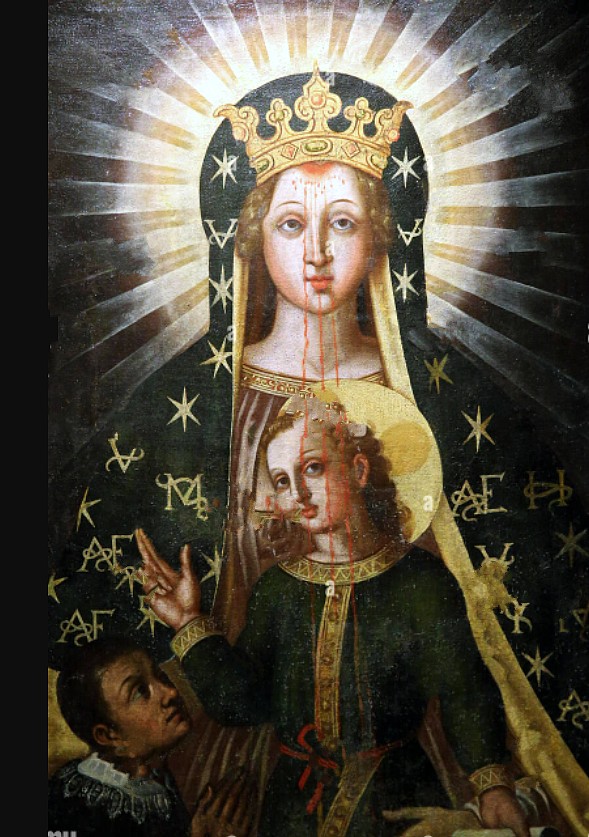
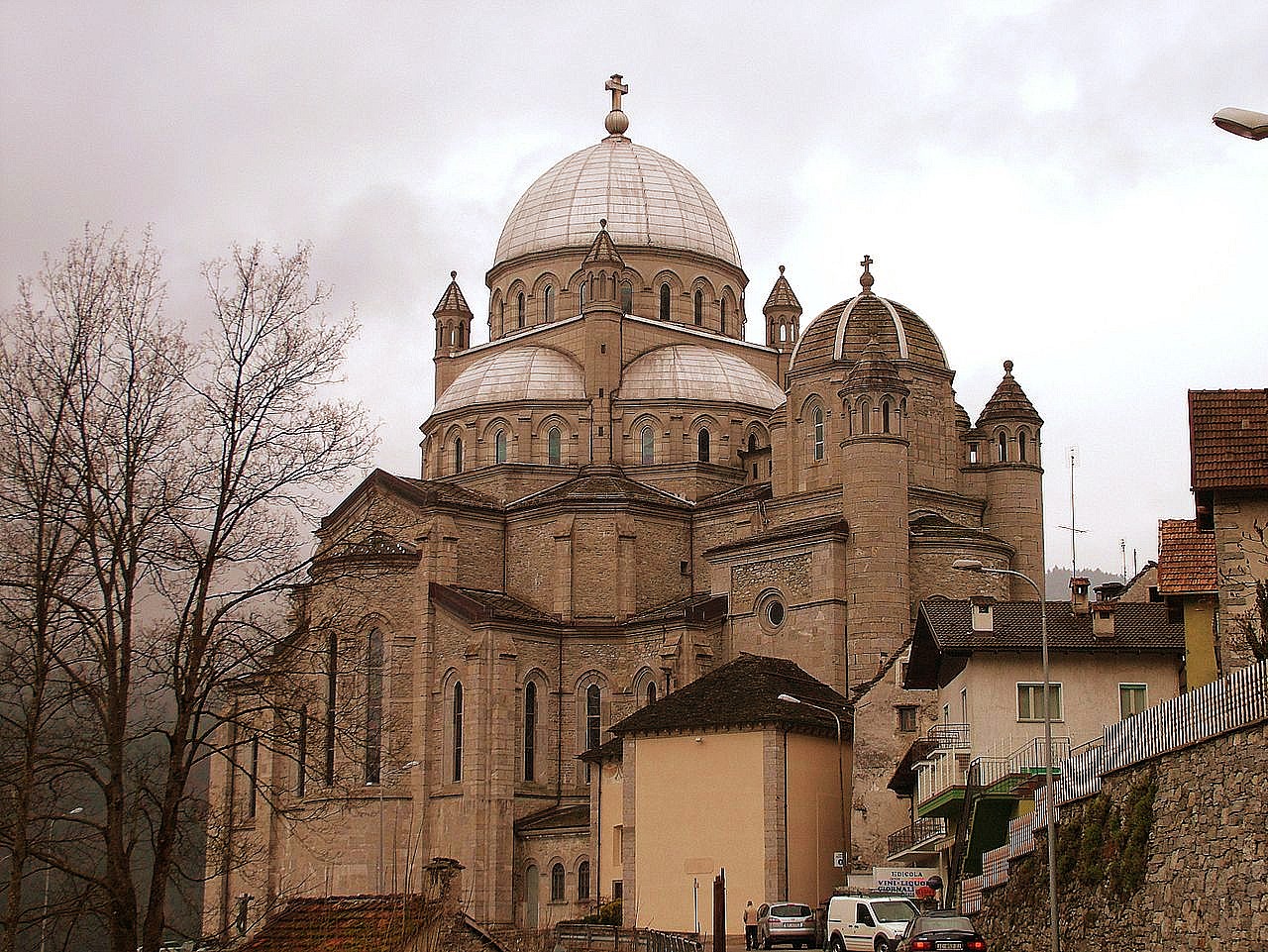
Notre-dame de Montaigu-Zichem / Our Lady of Sichem / Our Lady of Montaigu (474) – 3 January:

The Shrine in Brabant in the Duchy of Louvain, is a replacement of the one below Mount Garizim, Israel. Hadrian restored the temple on Mount Garizim and dedicated it to Jupiter. A small Christian community settled there and on several occasions they suffered greatly at the hands of the pagans. In 474 the Emperor, to avenge an unjust attack on the community, gave Mount Garizim to the Christians, who built on it a Church dedicated to the Blessed Virgin.
After the Mohammedan conquest, Christianity practically disappeared from the district. The French made amends by erecting a Shrine to Mary in the Duchy of Louvain. The ancient Statue of Our Lady of Sichem, or as Our Lady of Montaigu-Zichem, which is the title more commonly used today, has been venerated in Belgium from very early times. The Mother of God rewarded the faithful magnanimously for their pious attention.
According to legend, a shepherd boy originally found the Statue of Our Lady after it had apparently fallen from a niche cut in an old oak tree. The Statue was mysteriously too heavy for him to lift alone, so he ran to find his master, and have him return to help him replace the statue in its place in the old oak.
It is said that in 1306 the Blessed Virgin Mary moved the hearts of the people by causing four drops of blood to flow from the eyes of the Statue. This revived the faith of the people and increased their fervour.
A small Chapel was built beneath the tree, which was rebuilt in 1602 and the dedication of Our Lady of Sichem took place in the year 1604 by the Archbishop of Mechlin, Mathias Hovius.
From that time forward, there were many miracles as Our Lady seemed to demonstrate her appreciation by granting many favours. The Statue was soon venerated as miraculous, and there have been many pilgrimages to the site during the centuries, continuing even until this day.

The Titular Feast of the Society of Jesus
https://anastpaul.com/2017/01/03/the-titular-feast-of-the-jesuits/

St Pope Antherus (Died 235) Martyr, Bishop of Rome from 21 November 235 to 3 January 236, the date of his Martyrdom.
Biography:
https://anastpaul.com/2021/01/03/saint-of-the-day-3-january-saint-pope-antherus-died-235-martyr/

Bl Arnold Wala
St Athanasius of Cilicia
St Bertilia of Mareuil
St Bertille of Thuringia
St Blitmund of Bobbio (Died 660) Monk, Abbot
St Constant of Gap
St Cyrinus of Cyzicus
St Daniel Himmerod the Younger
Bl Daniel of Padua
St Eustadius
St Finlugh
St Fintan of Doon
St Florentius of Vienne
St Florentius of Vienne the Martyr

St Genevieve (c 419-c 502) Virgin, Apostle of prayer and of the poor and sick.
Biography:

https://anastpaul.com/2020/01/03/saint-of-the-day-3-january-saint-genevieve-c-419-c-502/

Bl Gerard Cagnoli
St Gordius of Cappadocia
St Imbenia
St Kuriakose Elias Chavara
St Lucian of Lentini
St Melorius
St Peter of Palestine
St Primus of Cyzicus
St Salvator of Belluno
St Theogenes of Cyzicus
St Theonas
St Theopemptus of Nicomedia
St Wenog
Bl William Vives
St Zosimus of Cilicia

Martyrs of Africa – 12 saints: A group of Christians martyred together in Africa, date unknown, exact location unknown. We know nothing more than their names – Acuta, Candidus, Constantius, Eugenia, Firmus, Hilarinus, Lucida, Martial, Poenica, Possessor, Rogatianus and Statutianus.

Martyrs of Tomi – 7 saints: A group of Christians martyred together, date unknown. We know nothing more than their names – Claudon, Diogenius, Eugene, Eugentus, Pinna, Rhodes and Rhodo. They were martyred at Tomi, Exinius Pontus, Moesia (modern Constanta, Romania).

Posted in DOCTORS of the Church, FATHERS of the Church, MARIAN PRAYERS, MARIAN TITLES, SAINT of the DAY, The APOSTLES & EVANGELISTS

The Octave Day of St Stephen, Nuestra Señora del Pilar / Our Lady of the Pillar (Zaragoza, Spain) (40) and Memorials of the Saints – 2 January

The Octave Day of St Stephen

Nuestra Señora del Pilar / Our Lady of the Pillar (Zaragoza, Spain) (40) – 2 January, 12 October (originally 4 October), 15 August – (This Apparition it is considered the first Marian Apparition, and is unique because it happened while Mary was still living on Earth):

According to ancient Spanish history, on 2 January in the year 40, in the early days of Christianity, James the Greater, one of the original Twelve Apostles of Jesus Christ, was preaching the Gospel in what was then the pagan land of Caesaraugusta (now Zaragoza), in the Roman Province of Hispania.

St James was disheartened with his mission, having made only a few converts. While he was praying by the banks of the Ebro River with some of his disciples, the Blessed Virgin Mary miraculously appeared before him atop a pillar accompanied by Angels. Mary assured James that the people would eventually be converted, becoming a stronghold of the Faith due to his efforts and their faith would be as strong as the pillar she was standing on. She gave him the pillar as a symbol and a wooden image of herself. James was also instructed to build a Chapel on the spot where she left the pillar which he did, making it the first Church in Spain.

Apparition of the Virgin of the Pillar to Saint James and his Saragossan disciples by Francisco Goya, c 1769.

It is generally believed, that Mary appeared to James through bilocation, as she was still living, either in Ephesus or Jerusalem, at the time of this event, as she is believed to have died three to fifteen years after Jesus ascended into Heaven. After establishing the church, James returned to Jerusalem with some of his disciples where he became a Martyr, beheaded in 44 under Herod Agrippa. His disciples returned his body to Spain.
The pillar left by the Virgin Mary is presently enshrined in the same but larger Basilica of Our Lady of the Pillar. It is believed to be the same pillar given and promised by Mary, in spite of numerous disasters that beset the Church. A fire in 1434 razed the Church that preceded the present Basilica Cathedral, see below.

The image of the Blessed Virgin Mary may or may not be the original. Some reports state that the original wooden image was destroyed when the Church burned down in 1434, contradicting other reports, that it is still the original Statue. The Statue of the Blessed Virgin Mary is made of wood and stands 39 centimetres tall while the 1.8 m pillar is made of jasper.quartz. The Statue depicts Mother Mary with the Child Jesus on her left arm, Who has a dove sitting on His left palm. Since the 16th century, the pillar is usually draped in a skirt-like cover called manto (in English: mantle). As a whole, it is protected by a bronze case and then another case of silver. The image was canonically crowned in 1905 during the reign of Pope Pius X. The crown was designed by the Marquis of Griñi, valued at 450,000 pesetas (£18,750, in1910). During the three Marian festivities of today, 15 August and 12 October, the faithful adorn the base of the Pillar and Statue with flowers – see below (both our Blessed Mother and St James would be thrilled by this display of such immense faith and piety!)

The apparition of Our Lady of the Pillar is a widely accepted sacred tradition. Popes from earliest times issued Papal Bulls attesting to the authenticity of the Shrine and the appearance of the Virgin Mary. Pope Calixtus III issued a Bull in 1456 encouraging pilgrimage to the Lady of the Pillar. It acknowledged the miracle of its foundation and the miracles that had taken place at the Spanish Shrine. It was also through this Bull that the name “Our Lady of the Pillar” was confirmed.
So many contradictions had arisen concerning the miraculous origin of the Church that during the reign of Pope Innocent XIII , the Bishops of Spain appealed to the Holy See to settle the controversy. After careful investigation, the twelve Cardinals, in whose hands the affair rested, adopted the following account, which was approved by the Sacred Congregation of Rites on 2 August 1723 and has since been inserted in the lessons of the Office of the Feast of Our Lady of the Pillar, celebrated on 12 October.

Of all the places that Spain offers for the veneration of the devout, the most illustrious is doubtless the Sanctuary consecrated to God under the invocation of the Blessed Virgin, under the title of Our Lady of the Pillar, at Saragossa.
According to ancient and pious tradition, St James the Greater, led by Providence into Spain, spent some time at Saragossa. He there received a signal favour from the Blessed Virgin. As he was praying with his disciples one night, upon the banks of the Ebro, as the same tradition informs us, the Mother of God, who still lived, appeared to him and commanded him to erect an oratory in that place. The Apostle delayed not to obey this injunction,and with the assistance of his disciples, soon constructed a small Chapel. In the course of time, a larger Church was built and dedicated, which, with the dedication of Saint Saviour’s, is kept as a festival in the City and Diocese of Saragossa on the 4th of October.

Holy Chapel of the Pillar of Zaragoza. Altar with the Arrival of the Virgin by ‘José Ramírez de Arellano.

In 1730, Pope Clement XII allowed the celebration of the Feast of Our Lady of the Pillar all over the Spanish Empire. As the date coincides with the discovery of the Americas, the Lady was later named as Patroness of the Hispanic World although her Patronages include all of the following:
Zaragoza, Spain, Melo, Uruguay, Buenos Aires, Argentina, Diocese of Imus, Cavite, Zamboanga City, Santa Cruz, Manila, Alaminos, Laguna, San Simon, Pampanga, Libmanan, Camarines Sur, Pilar and Morong in Bataan, Mamburao, Occidental Mindoro, Sibonga, Cebu, Baleno, Masbate, Cauayan, Isabela.

Prayer:
Hail, Mary, Our Lady of the Pillar,
conceived without sin,
I come to venerate and honour you.
above all the Angels and Saints in Heaven,
as my Queen, my Lady and my dearest Mother.
I firmly resolve to serve you always
and to do whatever I am able,
that all may render faithful service to you.
Most Holy Mary,
through your kind intercession
and by your own merits,
obtain for me from your Divine Son Jesus,
our Lord and Saviour,
all the graces I need
for the eternal salvation of my soul.
Therefore, most devoted Mother of mothers,
through the Precious Blood
which your Son shed for us,
I humbly beseech thee to receive me
among your devotees
and to accept me as your servant forever.
Help me in my every thought,
action word and deed,
never to be displeasing in your sight
and in the sight of your Son,
our Lord and Redeemer.
Think of me always,
my dear Lady of the Pillar
and do not forsake me
in the hour of my death.
Amen.

Our Lady of the Pillar by Ramón Bayeu, 1780.

St Basil the Great (329-379) Father & Doctor of the Church (Memorial)
St Basil is celebrated individually on 14 June (General Roman Calendar from 13th century to 1969.
St Gregory of Nazianzen (330-390) Father & Doctor of the Church (Memorial)
St Gregory is celebrated individually on 9 May (General Roman Calendar prior to 1969).
About these 2 great Fathers and Doctors:
https://anastpaul.wordpress.com/2018/01/02/saint-s-of-the-day-st-basil-the-great-329-379-and-st-gregory-of-nazianzen-330-390-fathers-and-doctors-of-the-church/
AND:
https://anastpaul.com/2019/01/02/saint-s-of-the-day-2-january-st-basil-the-great-329-379-and-st-gregory-of-nazianzen-330-390-two-bodies-one-spirit/

St Adelard of Corbie (c 751 – 827) Monk, Abbot, Apostle of the poor and needy, Court administrator, Counsellor to Charlemagne.
Biography:

https://anastpaul.com/2021/01/02/saint-of-the-day-2-january-saint-adelard-of-corbie-c-751-827/

Bl Airaldus of Maurienne
St Asclepius of Limoges
St Aspasius of Auch
St Blidulf of Bobbio
Bl Guillaume Répin
St Hortulana of Assisi
St Isidore of Antioch
St Isidore of Nitria
St Laurent Bâtard

Blessed Marie Anne Blondin SSA (1809-1890) Religious Sister and Foundress of the Sisters of Saint Anne, apostle of the Holy Eucharist and Divine Providence, Teacher.
https://anastpaul.com/2020/01/02/saint-of-the-day-blessed-marie-anne-blondin-ssa-1809-1890/

Saint Macarius the Younger of Alexandria (Died c 401) Priest, Monk, Desert Hermit.

St Maximus of Vienne
Bl Odino of Rot
St Paracodius of Vienne
St Seiriol
Blessed Sylvester of Troina
St Telesphorus, Pope
St Theodota
St Theopistus
St Vincentian of Tulle

Many Martyrs Who Suffered in Rome: There were many Martyrs who suffered in the persecutions of Diocletian for refusing to surrender the holy books. Though we know these atrocities occurred, we do not know the names of the Saints and we honour them as a group. c 303 in Rome, Italy.

Martyrs of Antioch – 5 saints: A group of Christian soldiers Martyred together for their faith. We know the names of five – Albanus, Macarius, Possessor, Starus and Stratonicus. They were born in Greece and were Martyred in Antioch (modern Antakya, Turkey).

Many Martyrs of Britain: The Christians of Britain appear to have escaped unharmed in the earlier persecutions which afflicted the Church but the cruel edicts of Diocletian were enforced in every corner of the Roman Empire and the faithful inhabitants of this land, whether native Britons or Roman colonists, were called upon to furnish their full number of holy Martyrs and Confessors. The names of few are on record but the British historian, Saint Gildas, after relating the Martyrdom of Saint Alban, tells us, that many others were seized, some put to the most unheard-of tortures and others immediately executed, while not a few hid themselves in forests and the caves of the earth, where they endured a prolonged death until God called them to their reward. The same writer attributes it to the subsequent invasion of the English, then a pagan people, that the recollection of the places, sanctified by these Martyrdoms, has been lost and so little honour paid to their memory. It may be added, that, according to one tradition, a thousand of these Christians were overtaken in their flight near Lichfield and cruelly massacred and that the name of Lichfield, or Field of the Dead, is derived from them.

Martyrs of Ethiopia – 3 saints: A group of Christians Martyred together for their faith. We know the names of three – Auriga, Claudia and Rutile.

Martyrs of Jerusalem – 2 saints: A group of Christians Martyred together for their faith. We know the names of two – Stephen and Vitalis.

Martyrs of Lichfield: Many Christians suffered at Lichfield (aka Lyke-field, meaning field of dead bodies), England in the persecutions of Diocletian. Though we know these atrocities occurred, we do not know the names of theSsaints and we honour them as a group. Their Martyrdom occurred in 304 at Lichfield, England.

Martyrs of Piacenza: A group of Christians who died together for their faith in the persecutions of Diocletian. No details about them have survived. They were Martyred on the site of Church of Madonna di Campagna, Piacenza, Italy.

Martyrs of Puy – 4 saints: Missionaries, sent by Saint Fronto of Périgueux to the area of Puy, France. Tortured and Martyred by local pagans. We know the names – Frontasius, Severinus, Severian and Silanus. They were beheaded in Puy (modern Puy-en-Velay), France and buried together in the Church of Notre Dame, Puy-en-Velay by Saint Fronto, their bodies laid out to form a cross.

Martyrs of Syrmium – 7 saints: Group of Christians Martyred together, date unknown. We know the names of seven – Acutus, Artaxus, Eugenda, Maximianus, Timothy, Tobias and Vitus – but very little else. This occurred in the 3rd or 4th century at Syrmium, Pannonia (modern Sremska Mitrovica, Serbia).

Martyrs of Tomi – 3 saints: Three brothers, all Christian soldiers, in the Imperial Roman army and all three Martyred in the persecutions of Emperor Licinius Licinianus. We know their names – Argeus, Marcellinus and Narcissus – but little else.
They were Martyred in 320 at Tomi, Exinius Pontus, Moesia (modern Constanta, Romania).

Posted in FEASTS and SOLEMNITIES, JESUIT SJ, MARIAN TITLES, MOTHER of GOD, SAINT of the DAY, The NATIVITY of JESUS

The Octave Day of the Nativity of the Lord, The Circumcision of the Lord, Mary, Mother of God and Memorials of the Saints – 1 January

The Circumcision of the Lord (Feast) (Holy Day)

The Octave Day of the Nativity of the Lord

Mary, Mother of God, the Divine Motherhood:

The Feast was celebrated in the East before it was in the West but by the 5th Century it was celebrated in France and Spain on the Sunday before Christmas. In Rome, even before the 7th Century, 1 January was used as a celebration of the Maternity of the Blessed Virgin Mary. In the 13th and 14th Centuries, the Feast of the Circumcision of Christ had come to replace the Marian Feast on 1 January. The celebration of the Feast of the Circumcision on 1 January was expanded to the entire Catholic Church in 1570 when Pope Pius V promulgated the Missal.
In 1914, the Feast of the “Maternity of the Blessed Virgin Mary” was established in Portugal, occurring on 11 October. In 1931, this Feast was extended to the entire Catholic Church by Pope Pius XI and maintained on 11 October. Following the Second Vatican Council in 1974, Pope Paul VI removed the Feast of the Circumcision of Christ from the Liturgical Calendar and replaced it with the Feast of the “Solemnity of Mary, Mother of God.” In the Extraordinary form of the Roman Rite, Catholics continue to celebrate this Feast day with the old name “The Maternity of the Blessed Virgin Mary” on 11 October, and 1 January is the Octave Day of the Nativity of the Lord and the Feast of the Circumcision.
The feast is a celebration of Mary’s motherhood of Jesus. The title “Mother of God” is a western derivation from the Greek: Theotokos, the God-bearer. The term was adopted at the First Council of Ephesus as a way to assert the Divinity of Christ, from which it follows, that what is predicated of Christ is predicated of God. So, if Mary is the Mother of Jesus, she is the Mother of God. Therefore, the title “Mother of God” which celebrates her under this title, are at once both Mariological and Christological.

Titular Feast of the Society of Jesus – But now celebrated on 3 January, the Feast of the Holy Name of Jesus

Bl Adalbero of Liege
St Baglan of Wales
St Basil of Aix
Bl Bonannus of Roio
St Brogan
St Buonfiglio Monaldi
Bl Catherine de Solaguti
St Clarus of Vallis Regia
St Clarus of Vienne
St Colman mac Rónán
St Colman Muillin of Derrykeighan
St Concordius of Arles
St Connat
St Cuan
St Demet of Plozévet
St Elvan
St Eugendus of Condat
St Euphrosyne of Alexandria
St Fanchea of Rossory
St Felix of Bourges
St Frodobert of Troyes

St Fulgentius of Ruspe (c 462 – 533) “The Pocket Augustine,” Abbot, Bishop of the City of Ruspe, North Africa in modern day Tniisia, Theologian, Writer.
About St Fulgentius!

https://anastpaul.com/2020/01/01/saint-of-the-day-1-january-saint-fulgentius-of-ruspe-c-462-533-the-pocket-augustine/

St Gisela of Rosstreppe
St Gregory Nazianzen the Elder
Bl Hugolinus of Gualdo Cattaneo
Bl Jean-Baptiste Lego
Bl Jean of Saint-Just-en-Chaussée
St Joseph Mary Tomasi CR (1649-1713) Cardinal, of the Order of Clerics Regular Theatine
St Justin of Chieti
Bl Lojze Grozde
St Maelrhys
St Magnus the Martyr
Bl Marian Konopinski
St Mydwyn

St Odilo of Cluny OSB (962-1049) “Archangel of the Monks,” Priest, Monk, 5th Abbot of Clun, Reformer, Apostle of the poor and needy, Marian devotee and promoter of prayer for the Souls in Purgatory. He established All Souls’ Day (on 2 November) in Cluny and its Monasteries as the annual commemoration to pray for all the faithful departed. The practice was soon adopted throughout the whole Church.
St Odilo’s Life:

https://anastpaul.com/2021/01/01/saint-of-the-day-1-january-saint-odilo-of-cluny-osb-962-1049-the-archangel-of-the-monks/

St Odilo of Stavelot
St Peter of Atroa
St Peter of Temissis
Bl René Lego
St Sciath of Ardskeagh
St Severino Gallo
St Telemachus
St Thaumastus of Mainz
St Theodotus
St Tyfrydog
Bl Valentin Paquay
St Vincent Strambi
St William of Dijon
St Zedislava Berka
St Zygmunt Gorazdowski

Breton Missionaries to Britain
Martyred Soldiers of Rome: Thirty soldiers martyred in Rome as a group during the persecutions of Diocletian. We don’t even known their names. They were martyred c 304 at Rome, Italy.

Martyrs of Africa – 8 saints: Eight Christians martyred together in Africa, date unknown. The only details we have are four of their names – Argyrus, Felix, Narcissus and Victor.

Martyred in the Spanish Civil War:
• Blessed Andrés Gómez Sáez

Posted in MARIAN TITLES, SAINT of the DAY

The Seventh Day of the Octave of Christmas, Santa María la Real de Uxue / Our Lady of Uxue (Uxue, Spain) (8th Century) and Memorials of the Saints – 31 December

The Seventh Day of the Octave of Christmas

Santa María la Real de Uxue / Our Lady of Uxue (Uxue, Spain) (8th Century) – 31 December:

The Town of Uxue formed, according to legend, around the site of the discovery of the image of Our Lady of Uxue, whose site was designated by the flight of a dove. By the 8th century, the image was well-known.
The settlement takes the form of a fortress and the 11th Century, Church of St Mary, is a medieval jewel of Romanesque art of Navarra, which is very popular and protected by successive Monarchs.

The strong medieval devotion to this image has remained to our times. Among the celebrations and devotions, are the festivities of an annual pilgrimage and the pilgrimage of the Brotherhood of the Twelve of Uxué.
Uxué is a small medieval Town full of charm, located in the eastern middle of Navarra (north of Spain and on the border with France), 53 km from Pamplona and 20 km from Tafalla. Its location is unique, as it is located on the top of a mountain overlooking the Sierra de Uxué. With an altitude of 815 meters above sea level, Uxué constitutes an authentic watchtower from which on clear days you can see from the Pyrenean ridge to the north to the banks of the Ebro and the silhouette of the Moncayo to the south. The origins of this Town are unclear, the exact date of its foundation being unknown but the beginnings are attributed to the Virgin Mary accompanied by the Holy Spirit in the form of a dove.

Legend has it that a dove went in and out of the hole in a rock. A boy who was herding sheep, moved by curiosity, approached with the intention of scare the dove away.
But the dove continued with its insistent flapping, he approaches and found a beautiful Romanesque image of the Virgin Mary. This is how the Uxué was born. The name of the town comes from Uxua, the Basque language word for “dove“.
Already before Roman domination, there was a Basque population scattered throughout the mountains, as recent archaeological discoveries attest. A Sanctuary honouring the Blessed Virgin was immediately built and has retained it’s popularity amongst the pious faithful across the ages. Many miraculous graces and cures have been granted there.
A total of 44 members of the Brotherhood of the Twelve Apostles of Our Lady of Uxué, including the Chaplain, participate each year in their traditional night march to the sanctuary of the Virgin of Uxué. This Brotherhood has its origins in 1607 and therefore 2007 commemorated the fourth centenary of its foundation.

St Pope Sylvester I (Died 335) Papal Ascension 314. Bishop of Rome, Confessor. (Optional Memorial)
Biography:

https://anastpaul.com/2018/12/31/saint-of-the-day-st-pope-sylvester-i-died-335/

Blessed Alain de Solminihac OSA (1593-1659) Bishop of Cahors, Abbot, Reformer, Marian devotee most especially to Our Lady of Rocamadour, Apostle of the Holy Eucharist especially by his promotion of Adoration, he was also a member of the Compagnie du Saint-Sacrement.
His Story:

https://anastpaul.com/2019/12/31/saint-of-the-day-31-december-blessed-alain-de-solminihac-osa-1593-1659/
St Anton Zogaj
St Barbatian of Ravenna
St Columba of Sens (c 256-273) Virgin Martyr
Bl Dominic de Cubells
St Festus of Valencia
St Gelasius of Palestine
Bl Giuseppina Nicoli
St Hermes the Exorcist

St Melania the Younger (c 383-439) Foundress, Desert Hermit, Wife, Mother, Widow.
Her Life:

https://anastpaul.com/2020/12/31/saint-of-the-day-31-december-saint-melania-the-younger-c-383-439/

St Offa of Benevento
Bl Peter of Subiaco
St Pinian
St Potentian of Sens
St Sabinian of Sens
St Theophylact of Ohrid
Bl Walembert of Cambrai
Bl Wisinto of Kremsmünster
St Zoticus of Constantinople

Martyrs of Catania – 10 saints: A group of early Christians martyred together, date unknown. The only other information to survive are ten of their names – Attalus, Cornelius, Fabian, Flos, Minervinus, Pontian, Quintian, Sextus, Simplician and Stephen. They were martyred in Catania, Sicily, Italy.

Martyrs of Rome – 10 saints: A group of Roman women martyred in an early persecution, date unknown. We known the names of ten of them – Dominanda, Donata, Hilaria, Nominanda, Paolina, Paulina, Rogata, Rustica, Saturnina and Serotina.
Their relics were enshrined in the catacombs of Via Salaria, Rome, Italy.

Martyred in the Spanish Civil War:
• Blessed Leandro Gómez Gil
• Blessed Luis Vidaurrázaga González

Posted in ART DEI, MARIAN TITLES, SAINT of the DAY, The APOSTLES & EVANGELISTS

The Sixth Day in the Christmas Octave, Madonna of San Luca / Nostra Signora della Guardia / Our Lady of Saint Luke of La Guardia, Bologna, Italy (433) and Memorials of the Saints – 30 December

The Sixth Day in the Christmas Octave

Madonna of San Luca / Nostra Signora della Guardia / Our Lady of Saint Luke of La Guardia, Bologna, Italy (433) – 30 December:

The Abbot Orsini wrote: “This picture was in the Church of Santa Sophia, at Constantinople, with this inscription: “This picture, painted by Saint Luke, must be taken to the mountain of La Garde and placed over the Altar of the Church.” A Greek monk set out for Italy about the year 433, with the picture entrusted to him and deposited it on the mountain of La Garde.

The account mentioned by the Abbot above, is also told in the chronicle of Graziolo Accarisi, who wrote of a Greek hermit who went on pilgrimage to Constantinople where he received from the Priests of the Church of Santa Sofia, the icon of Our Lady of La Guardia. This image was attributed to Saint Luke the Evangelist and there was an inscription on the painting itself that it should one day be taken to the “mountain of the guard.”
The hermit took the Icon,and walked throughout Italy in search of the place where the Icon was meant to be,but it was not until he reached the City of Emilia near Bologna that the authorities of the City came out to greet him and processed with the icon back to the mountain. The Icon had finally found its home and it is now more commonly known as the Madonna of San Luca.
Among the many miracles attributed to the image is especially noted the “miracle of the rain,” which occurred on 5 July 1433. An extremely heavy spring rain came late in the season, threatening to destroy the crops. Facing the prospect of famine, the people turned to the Blessed Virgin for assistance. The storm and rain stopped suddenly, with the arrival into the City, of a procession carrying the miraculous Icon. Since that time these processions have been repeated annually. There is even an incredible arched walkway that is only a little short of four kilometers in length, that is meant to protect the Icon from the elements, as well as those on procession.
The Icon shows the Blessed Virgin Mary holding the Infant Jesus in blessing. She wears a blue-green robe, with a red tunic. The nose, eyes and fingers appear somewhat elongated. The Divine Child wears a tunic of the same colour as His Mothers’, with His right hand in a gesture of giving a blessing and his left hand being closed. In 1625 the image was covered with a silver panel which leaves only the faces of the figures uncovered.
The Icon was crowned in 1603 by the Archbishop Alfonso Paleotti. The Sanctuary of Saint Luke, where the Icon is kept, was declared a national monument in the year 1874. In 1907 the Church was raised to the dignity of a Minor Basilica by the holy Pope Saint Pius X.

The Sanctuary is situate some 300 metres above the City plain, just south-west of the historical centre of the City. While a road now leads up to the Sanctuary, it is also possible to reach it along a 3.8 km monumental roofed arcade (Portico di San Luca) consisting of 666 arches, which was built in 1674–1793. It was meant to protect the Icon as it was paraded up the hill. A yearly procession from the Cathedral of San Pietro in the centre of Bologna to the Sanctuary goes along this path. The arches held sacred images or Chapels erected by patron families. There is also a cable car which takes tourists up to the Basilica.

Cable car approaching the Mountain Sanctuary

St Anysia of Thessalonica
St Anysius of Thessalonica

St Egwin of Worcester OSB (Died 717) Bishop of Worcester, England, Benedictine Monk, Reformer and Penitent, miracle-worker. Egwin was devout and lived for God from his youth. His biographers say, that king, clergy and the faithful, all united in demanding Egwin’s elevation to Bishop.
About St Egwin:

https://anastpaul.com/2020/12/30/saint-of-the-day-30-december-saint-egwin-of-worcester-osb-died-717/

St Elias of Conques
St Eugene of Milan
St Pope Felix I
St Geremarus

Blessed Giovanni Maria Boccardo (1848-1913) He is remembered as “Father of the Poor” – Priest, Founder of the Poor Daughters of Saint Cajetan. 
His Life:

https://anastpaul.com/2019/12/30/saint-of-the-day-30-december-blessed-giovanni-maria-boccardo-1848-1913-father-of-the-poor/

St Hermes of Moesia
St Jucundus of Aosta
St Liberius of Ravenna
Blessed Margherita Colonna (c 1255-1284) Virgin, Nun

St Perpetuus of Tours
Bl Raoul of Vaucelles
St Raynerius of Aquila
Bl Richard of Wedinghausen
St Ruggero of Canne
St Sebastian of Esztergom

Martyrs of Alexandria – (5 saints): A group of Christians martyred in the unrest caused by Monophysite heretics. We know the names for five of them – Appian, Donatus, Honorius, Mansuetus and Severus. They were martyred in c 483 at Alexandria, Egypt.

Martyrs of Oia – (6 saints): A group of Christians martyred together, date unknown. The only details to have survived are the names – Cletus, Florentius, Papinianus, Paul, Serenusa and Stephen. They were martyred in Oia, Greece.

Martyrs of Spoleto – (4 saints): A group of Christians martyred in the persecutions of Diocletian – Exuperantius, Marcellus, Sabinus and Venustian. They were martyred in 303 in Spoleto, Italy.

Posted in CATHOLIC-PRAYERS OF THE CHURCH, DOCTORS of the Church, FATHERS of the Church, MARIAN Antiphons, MARIAN PRAYERS, MARIAN TITLES, SAINT of the DAY

The Fifth Day of the Octave of Christmas, Unsere Liebe Frau vom Speyer / Our Lady of Speyer, Germany, Featuring the Salve Regina and St Bernard (1146) and Memorials of the Saints – 29 December

The Fifth Day of the Octave of Christmas

Unsere Liebe Frau vom Speyer / Our Lady of Speyer, Germany Featuring the Salve Regina and St Bernard (1146) – 29 December:

The Abbot Orsini wrote: “Our Lady of Spire (Speyer), in Germany. Saint Bernard, entering this Church on the 29th of December, 1146, was honourably received there by the Canons, who conducted him to the choir, singing the Salve Regina. The antiphon being finished, Saint Bernard saluted the image of the Blessed Virgin in these terms: “O clems, O pia, O dulcis Virgo Maria!” and she answered: “Salve Bernarde!” The words of this Saint to the image are seen engraved in a circle on the pavement of the Church, on the same spot where he pronounced them and they have since been added to the Salve Regina, which was composed in the year 1040, by Herman, surnamed Contractus, a Benedictine monk.” [He is Blessed Herman of Reichenau (often known as Blessed Herman the Cripple OSB (1013–1054) – his Biography here: https://anastpaul.com/2019/09/25/saint-of-the-day-blessed-herman-of-reichenau-the-cripple-osb-1013-1054-the-wonder-of-his-age/ ]

This date on the Marian calendar, Our Lady of Speyer, actually refers to the Cathedral of Speyer, dedicated to the Blessed Virgin Mary and known as Kaiserdom zu Speyer in Germany. Construction began on the Romanesque style Cathedral in the year 1030 and was completed in 1106. It is 134 metres long and 43 metres wide, which made it one of the largest buildings constructed at that time and is now thought to be, the largest surviving Romanesque building in the world.

During the Nine Years’ War the entire Town of Speyer was burned to the ground and the heat from the inferno caused part of the nave to collapse. In 1792 the Town was occupied by the French revolutionary troops and the Church pillaged. It was in that century that the ruins of the Chapel of Saint Bernard were removed. The Cathedral was subsequently used as a warehouse and hospital.
In 1957 the Cathedral was restored and, although much of the plaster and 19th century paintings were removed, the scenes of the life of the Blessed Virgin were left undisturbed. n 1981 the Cathedral was added to the World Heritage List of UNESCO.

St Thomas a Becket (1118-1170) Martyr, Archbishop of Canterbury from 1162 until his murder in 1170. He engaged in conflict with Henry II, King of England, over the rights and privileges of the Church and was murdered by followers of the King in Canterbury Cathedral. Soon after his death, he was Canonised by Pope Alexander III. (Optional Memorial)
Biography:
https://anastpaul.wordpress.com/2017/12/29/saint-of-the-day-29-december-st-thomas-a-becket-1118-1170/
AND:
https://anastpaul.com/2018/12/29/saint-of-the-day-29-december-st-thomas-a-becket-1118-1170-martyr-archbishop-of-canterbury/

St Aileran of Clonard
St Albert of Gambron
St Aproniano de Felipe González
St David the King
St Ebrulf of Ouche (c 626-c 706) Abbot, Hermit
St Enrique Juan Requena
St Florent of Bourges
Bl Francis Ruiz
St Girald of Fontenelle
St Jacinto Gutiérrez Terciado
Bl José Aparicio Sanz
Bl José Perpiñá Nácher
St Juan Bautista Ferreres Boluda
St Libosus of Vaga
St Marcellus the Righteous
St Martinian of Milan
Bl Paul Mary
Bl Peter the Venerable
St Quartillosa of Carthage
St Thaddeus of Scythia
St Trophimus of Arles
St Trophimus of Ephesus

Blessed William Howard (1614–1680) Martyr, Married Laymam and Father, 1st Viscount Stafford. William was the grandson of the Venerable Philip Howard, Earl of Arundel, fifth son of Earl Thomas (the first great art collector of England) and Uncle of Thomas Philip – Cardinal Howard.
His Life and Death:

https://anastpaul.com/2020/12/29/saint-of-the-day-29-december-blessed-william-howard-1614-1680-martyr/

Martyrs of North Africa – (8 saints): A group of Christians executed together for their faith. The only details to survive are eight names – Crescentius, Dominic, Honoratus, Lybosus, Primian, Saturninus, Secundus and Victor.

Martyrs of Rome – (3 saints): A group of Christians executed together for their faith. The only details to survive are three names – Boniface, Callistus and Felix.

Martyrs of Seoul – (7 saints): Additional Memorial – 20 September as part of the Martyrs of Korea.
A group of seven lay woman in the apostolic vicariate of Korea who were martyred together.
• Barbara Cho Chung-I
• Barbara Ko Sun-I
• Benedicta Hyong Kyong-Nyon
• Elisabeth Chong Chong-Hye
• Magdalena Han Yong-I
• Magdalena Yi Yong-Dok
• Petrus Ch’oe Ch’ang-Hub
They were born in South Korea and were martyred by beheading on 29 December 1839 at the Small West Gate, Seoul, South Korea. They were Canonised on 6 May 1984 by St Pope John Paul II.

Martyred in the Spanish Civil War:
Thousands of people were murdered in the anti-Catholic persecutions of the Spanish Civil War from 1934 to 1939.
• Blessed Aproniano de Felipe González
• Blessed Enrique Juan Requena
• Blessed Jacinto Gutiérrez Terciado
• Blessed Juan Bautista Ferreres Boluda

Posted in FEASTS and SOLEMNITIES, MARIAN TITLES, SAINT of the DAY

The Fourth Day of the Octave of Christmas, Feast of the Holy Innocents, Notre-Dame de Pontoise / Our Lady of Pontoise, France (12th Century) and Memorials of the Saints – 28 December

The Fourth Day of the Octave of Christmas
The Holy Innocents (Feast)
About:
https://anastpaul.wordpress.com/2017/12/28/saints-of-the-day-feast-of-the-holy-innocents-28-december-4th-day-of-the-christmas-octave/
AND:
https://anastpaul.com/2018/12/28/saints-of-the-day-feast-of-the-holy-innocents-martyrs-28-december-4th-day-of-the-christmas-octave/

Notre-Dame de Pontoise / Our Lady of Pontoise, France (13th Century) – 28 December:

Pontoise is an old Town built around a bridge across the Oise and its Shrine dates from around the 13th Century, as is evidenced by a charter of donation from the year 1231. Our Lady of Pontoise is about seven leagues from Paris. This image, is celebrated for many miracles which are wrought there.
The Statue of Our Lady of Pontoise is of marble and stands over 1,8 metres in height. The Madonna wears a short veil and a dress with long tight sleeves. Our Lady’s face is framed by her hair. The Divine Child lays His hands on an orb that His mother holds.
The Statue was, according to tradition, carved by a pious youth in the quarry at Blangis, near Abbeville and brought to Pontoise. In 1226 the Archbishop of Rouen dedicated a Chapel there and in 1249 it was made a Parish Church, and the sSatue was placed outside, over the main entrance. The Church was visited by the Saint-king, Louis IX.
In around 1434 the Church was destroyed by the English soldiers fighting in the area. The faithful Catholic, determined to rebuild the Shrined. It was partly finished when the French reconquered the territory. They finished the rebuilding in 1484.
During the years of 1580 and 1650, when the plague was destroying the country, people flocked to Our Lady of Pontoise and the danger was averted. Again in 1849 a cholera epidemic was averted through her intercession, so that the Shrine had the name of being powerful against plagues.
In Reformation times, a devout Protestant tried to steal the Statue and failing that, knocked off the head of the Infant and threw it into the river. A fisherman had spread his nets just below the bridge and the severed head was saved and returned to the Statue.
In 1585 the Church was destroyed again by the English; in 1790 by the revolutionaries. Each time the Statue was saved and returned; the last time by a man who bid on it at an auction-house and kept it until the troubled days were over. The Church was rebuilt in 1800 and a century later was still extant; the yearly thanksgiving procession for Our Lady’s protection from the plague is held annually. The Statue now resides inside the Church. Replicas of the statue were placed over many doorways of the City after the plague of 1640 and some are still there today.

St Anthony of Lérins (c 428-c 520) Monk, Hermit.

St Caesarius of Armenia

Saint Caterina Volpicelli (1839-1894) Religious and Foundress of the Servants of the Sacred Heart of Jesus of which Order she is the Patron.
Biography:

https://anastpaul.com/2019/12/28/saint-of-the-day-28-december-saint-caterina-volpicelli-1839-1894/

BL Claudia Weinhardt
St Conindrus
St Domitian the Deacon
St Domnio of Rome
St Eutychius
St Gowan of Wales
Bl Gregory of Cahors
Bl Hryhorii Khomyshyn
St Iolande of Rome
Bl Johannes Riedgasser

Blessed Matthia de Nazzarei OSC (1253-1319) Virgin, Nun of the Poor Clares, Abbess, gifted with the charism of miracles and prophecy.
Her Life:

https://anastpaul.com/2020/12/28/saint-of-the-day-28-december-blessed-matthia-de-nazzarei-osc-1253-1319/

Bl Nicolas Mello
Bl Otto of Heidelberg
St Romulus
St Simon the Myroblite
St Theonas of Alexandria
St Theodore of Tabenna
St Troadius of Pontus

20,000 Martyrs of Nicomedia: 20,000 Christians who were murdered during in 303 in Nicomedia, Bithynia (modern Izmit, Turkey) during the persecutions of Diocletian. Many of them were killed en masse when they were ordered, during Christmas Mass, to sacrifice to idols; when they refused, they were locked in the churches and the buildings burned around them. We know some details of a few of them, but most are known only to God. The names we have are – Agape, Anthimos, Domna, Domna, Dorotheus, Esmaragdus, Eugene, Euthymius, Glykerios, Gorgonius, Hilary, Indes, Mardonius, Mardonius, Maximus, Migdonius, Migdonus, Peter, Peter, Theophila, Theophilus and Zeno. 303 in Nicomedia, Bithynia (modern Izmit, Turkey).

Martyrs of Africa – (3 saints): Three Christians murdered together in Africa for their faith. The only details to survive are their names – Castor, Rogatian and Victor.

Posted in FEASTS and SOLEMNITIES, MARIAN TITLES, SAINT of the DAY, The APOSTLES & EVANGELISTS

Feast of St John the Apostle and Evangelist, Nossa Senhora do Rosário / Our Lady of the Rosar (Atibaia, São Paulo, Brazil) (1817) and Memorials of the Saints – 27 December

Third Day of the Christmas Octave

St John the Apostle and Evangelist, the Beloved (Feast)
St John the Beloved:

https://anastpaul.wordpress.com/2017/12/27/saint-of-the-day-27-december-st-john-the-apostle-and-evangelist/
AND:
https://anastpaul.com/2020/12/27/saint-of-the-day-27-december-the-disciple-whom-jesus-loved-the-eagle-by-dom-prosper-gueranger/

Nossa Senhora do Rosário / Our Lady of the Rosary (Atibaia, São Paulo, Brazil) (1817) – 27 December:

In 1763, slaves who couldn’t attend St John the Baptist’s, the main Church in Atibaia, began building their own. Completed in 1817, the Church is often called Nossa Senhora do Rosário dos Pretos, Our Lady of the Rosary of the Blacks.
This agricultural City is home to the oldest and most active tradition in the region. The five indigenous groups in Atibaia combine African and Portuguese religious practices, centered around devotion to St Benedict and Our Lady of the Rosary. On 27 December, as they have for over 200 years, the locals gather outside Our Lady’s Church at dawn, dressed in brilliant uniforms of scarlet, green, blue, pink, or white and carrying swords, banners and musical instruments.

The day begins with a serenade and ends with fireworks. In between, to the sound of drums, guitars and pealing bells, the faithful process dancing through the City: young, old, male, female, black and white. The festa of Our Lady of the Rosary is part of a Christmas celebration beginning on 25 December with the erection of two towering poles topped with images of the Saints in Rosary Plaza and concluding 28 December with processions and Holy Mass honouring St Benedict.

Bl Adelheidis of Tennenbach
Bl Alejo Pan López
Bl Alfredo Parte-Saiz
Bl Christina Ebner

St Fabiola (Died 399) Physician, Foundress of the first known hospital and hospice, disciple of St Jerome, benefactress of the Church.
St Fabiola’s Life:

https://anastpaul.com/2019/12/27/saint-of-the-day-27-december-st-fabiola-died-399/

Bl Francesco Spoto
Bl Hesso of Beinwil
St José María Corbin-Ferrer
St Maximus of Alexandria
St Nicarete of Constantinople
Bl Odoardo Focherini
Bl Raymond de Barellis
Bl Roger of Verdun

Blessed Sára Schalkház S.S.S. (1899–1944) Martyr, Religious Sister of The Sisters of Social Service, Teacher.
Biography of Blessed Sára:

https://anastpaul.com/2018/12/27/saint-of-the-day-27-december-blessed-sara-salkahazi-s-s-s-1899-1944-martyr-a-catholic-gem/

St Theodore of Apamea
St Theophanes of Nicaea
Bl Walto of Wessobrünn

Posted in MARIAN TITLES, SAINT of the DAY

St Stephen the ProtoMartyr (c 05-c 34) (Feast) The Second Day in the Christmas Octave, Madonna della Acheropita, Maria Santissima Acheropita / Our Lady of Acheropita, Rossano, Italy (1140) and Memorials of the Saints – 26 December

St Stephen the ProtoMartyr (c 05-c 34) (Feast) The Second Day in the Christmas Octave
St Stephen’s Story:

https://anastpaul.wordpress.com/2017/12/26/saint-of-the-day-st-stephen-the-first-martyr-26-december-the-second-day-in-the-octave-of-christmas/
AND:
https://anastpaul.com/2018/12/26/saint-of-the-day-26-december-st-stephen-the-protomartyr-c-05-c-34-26-december/

Madonna della Acheropita, Maria Santissima Acheropita / Our Lady of Acheropita, Rossano, Italy (1140) – 26 December:

The Abbot Orsini relates: “Tradition has it that one night, a woman in great brightness appeared to a watchman on duty where a new Church was being built in Rossano, Italy. She asked him to withdraw from the place. The next morning there was seen in the building a picture of the Blessed Virgin, painted but not by the hand of man. For that reason it came to be called “Acheropita,” not made by human hands.

The latest historical research has established that the image of Acheropita – a fresco on a pillar – was found in a small Chapel near the cave of one of the many hermits who formed the aura of Saint Nicholas of Vallone in the 6th century.
It seems a holy hermit named Ephrem was very devoted to the Blessed Virgin Mary. In the year 580, a certain Captain Mauricio, was deflected from his course by the winds and landed near present day Rossano. The hermit Ephrem went to meet him with the strange sounding greeting of:
It was not the winds that brought you here but Our Lady, for once you are appointed emperor, you will build a Church here.”
A mere two year later, in the year 582, Mauritius was crowned Emperor and remembering the prophesy, had artists brought to the cave to paint a fitting image of the Blessed Virgin Mary. Although the artists toiled all day, during the night their work always mysteriously disappeared. The Governor, unsure of what was happening, ordered that the cave be guarded at night.
That night as the guards went about their duty in front of the cave, a young woman of rare beauty came out of nowhere amidst a bright light wearing a white silk cape. She asked the guard to depart from the site, which they did. Informed the next morning of what had happened, the Governor went to the Church. To everyone’s surprise he observed an image that perplexed him, for painted on the bottom of the inner wall was a beautiful picture of Our Lady, similar to the Byzantine icons he had seen before. It was exactly where his artists had been trying in vain to draw the image.
The news of the miracle soon spread throughout the City. The faithful began arriving to the place, shouting in wonder and cheering in tears with songs of praise, “Acheropita! Acheropita!
The image became an object of veneration for the people of Rossano and a new Church had to be built to satisfy popular piety in a more worthy manner. That Church is now known as the Rossano Cathedral, and it was built next to the grotto where the image is still preserved. It is also said, that later, the Saracens attacked, trying to surprise the City of Rossano but they were repulsed by Our Lady, who appeared dressed in purple and holding in her hand a lighted torch. The sight of her majesty terrified the Saracens, who turned and fled.
On 26 May 1949, the Diocesan Cathedral was erected at the Shrine. From 16 August to 16 October 1949, a silver Statue of Our Lady was carried on a triumphal pilgrimage through the Archdiocese. 15 August is the annual date for the celebration of the Madonna Acheropita and it is said that during the celebration a wonderful atmosphere envelops the whole of the City, with the festival offering an opportunity for the faithful to demonstrate their love for the Blessed Virgin.
On 18 June 1950, Cardinal Micara crowned the image of the Blessed Virgin.

St Abadiu of Antinoë
Bl Agata Phutta Bi
Bl Agnès Phila
St Amaethlu of Anglesey
St Archelaus of Mesopotamia
Bl Bibiana Khamphai
Bl Cecilia Butsi
Bl Daniel of Villiers

St Pope Dionysius (Died 268) Bishop of Rome from 22 July 259 to his death on 26 December 268. According to early Church records, Dionysius was the first pope not Martyred for his Faith.
Biography:

https://anastpaul.com/2020/12/26/saint-of-the-day-26-december-st-pope-dionysius-died-268/

St Euthymius of Sardis
St Evaristo of Constantinople
Bl Giovanni Orsini
Bl Jean of Hainaut
Bl Lucie Khambang
St Margaret of Hohenfels
Bl Maria Phon
Bl Marinus of Rome
Bl Paganus of Lecco
Bl Pierre Boffet
St Tathai of Wales
St Theodore the Sacristan

St Vincenza Maria Lopez (1847- 1890) Religious Sister, Founder of the Daughters of Mary Immaculate.
Biography:

https://anastpaul.com/2019/12/26/saint-of-the-day-26-december-saint-vincenza-maria-lopez-1847-1890/

St Zeno of Gaza
St Pope Zosimus (Died 418) Bishop of Rome from 18 March 417 to his death on 26 December 418.

Posted in MARIAN TITLES, SAINT of the DAY

Notre-Dame de Ardilliers de Saumur / Our Christmas Novena to the Christ Child, Day Eight, Notre-Dame de Ardilliers de Saumur / Our Lady of Ardilliers, Saumur, Anjou, France (1454) and Memorials of the Saints – 23 December

Christmas Novena to the Christ Child, Day Eight:
https://anastpaul.com/2018/12/23/christmas-novena-to-the-christ-child-day-eight/

Notre-Dame de Ardilliers de Saumur / Our Lady of Ardilliers, Saumur, Anjou, France (1454) – 23 December:

Our Lady of Ardilliers, located at Saumur, in Anjou, France. Its name is illustrious throughout France, as well on account of the concourse of people who were attracted there, as from a fountain which cured several maladies. This image represents Our Lady of Pity, who holds in her arms her dead Son, whose head is supported by an Angel.
Notre Dame Ardilliers has a Statue, a fountain and a Church dedicated to Our Ladye.
In 1454 a farmer, while ploughing his field, discovered in the “ardille” ( meaning “clay” – a word which will give its name, according to the legend, to Notre-Dame-des-Ardilliers) a stone Statuette of about thirty centimeters high representing a Pietà . The peasant took it home. On two occasions he discovered the Pietà had returned to its place of discovery, near a fountain already known for its beneficial virtues. From then on, devotions began. It was placed in a niche under a stone arch at its place of discovery.
Jean Olivier , Bishop of Angers , laid the foundations of the Notre-Dame-des-Ardilliers Chapel in Saumur on1 August 1534 in the presence of Jean de Castagnier, Mayor of Saumur and Guillaume Bourdeau, Alderman. Msgr Gabriel Bouvery , Bishop of Angers, Consecrated the new Church on 30 July1553
Crowds of people were attracted to the Shrine and its name was illustrious throughout that country, for there Our Lady cured many maladies.
The Sanctuary attained magnificent proportions as successive additions were made, notably by Cardinal Richelieu. Devotion to Our Lady became widespread as many miracles occurred.
Mary’s clients at Ardilliers number such illustrious persons as Louis XII, Anne of Austria, Marie de Medici, Henrietta of England, Cardinal Richelieu and others. The Founders of the Sulpician Company went there for inspiration; Saint Louis de Montfort begged blessings and Mary’s help on the Institute of the Fathers of the Holy Ghost and the Daughters of Wisdom he was about to found.
Cities placed themselves under the protection of Notre-Dame des Ardilliers and promised annual pilgrimages. During the Revolution the Church and Shrine were despoiled of their treasures but not destroyed and the image was left unharmed. In 1849 the ravages of time necessitated the renovation of the Chapel and pilgrimages became more frequent than ever.

And today? We hardly speak of the Pilgrimages to Ardilliers but guided tours of the remarkable architectural continue.  In July and August, except on Sundays, the Association Patrimoine Religieux en Saumurois, in partnership with the City of Saumur, provides guided tours of the Notre-Dame des Ardilliers Chapel. We are very saddened aren’t we, that this former great Marian Shrine has become today, above all a tourist destination. So why shouldn’t one of our readers launch a Pilgrimage to Notre-Dame des Ardilliers. This would justify its second name, Notre-Dame de Bon Retour, Our Lady of Good Return.

St John of Kanty/Cantius (1390-1473) (Optional Memorial) Priest, Theologian, Scholastic Philosopher, Physicist, Teacher, Confessor, Philosopher, Apostle of Charity – Patron of Poland and Lithuania
His Feast Day is 20 October (Poland, General Roman Calendar 1770–1969)
Full Biography:

https://anastpaul.wordpress.com/2017/12/23/saint-of-the-day-23-december-st-john-of-kanty-cantius-1390-1473/
AND more:
https://anastpaul.com/2018/12/23/saint-of-the-day-23-december-st-john-of-kanty-1390-1473-patron-of-poland-and-lithuania/

St Besa of Egypt
Bl Bincema
St Dagobert II of Austrasia
Bl Epifanio Gómez Alvaro
St Frithbert of Hexham
Bl Hartmann of Brixen
Bl Herman of Scheda
Bl James Aymerich
St Ivo of Chartres (c 1040-1115) Bishop, Confessor
St John Cirita
St John Stone
St Joseph Cho Yun-ho
St Mardonius of Rome
St Mazota of Abernethy
St Migdonius of Rome

Blessed Nicolás Factor-Estaña OFM (1520-1583) Priest of the Order of Friars Minor, Painter, Preacher, Ascestic, Spiritual Director.
His Life:

https://anastpaul.com/2019/12/23/saint-of-the-day-23-december-blessed-nicolas-factor-estana-ofm-1520-1583/

St Servulus (Died c 590) Layman, Beggar, paralysed by Palsy from birth. Saint Servulus was a perfect model of submission to the divine Will; it would be difficult to offer a more consoling example to persons afflicted by poverty, illnesses and the other miseries of life. It is Saint Gregory the Great who narrates for us his edifying story.
St Servulus’ Life of devotion:

https://anastpaul.com/2020/12/23/saint-of-the-day-23-december-saint-servulus-died-c-590/

Martyred Dominicans of Santander – (9 beati) – Martyred in the Spanish Civil War:
• Blessed Bernardino Irurzun Otermín
• Blessed Eleuterio Marne Mansilla
• Blessed Eliseo Miguel Lagro
• Blessed Enrique Cañal Gómez
• Blessed Enrique Izquierdo Palacios
• Blessed Epifanio Gómez Alvaro
• Blessed José María García Tabar
• Blessed Manuel Gutiérrez Ceballos
• Blessed Miguel Rodríguez González
• Blessed Pedro Luís y Luís

Martyrs of Crete – (10 saints): A group of ten Christians who died in the persecutions of Decius. They were –
• Agathopus • Basilides • Cleomenes • Eunician • Euporus • Evaristus • Gelasius • Saturninus • Theodulus • Zeticus They were martyred in 250 on the island of Crete.

Posted in ADVENT PRAYERS, ADVENT QUOTES, CARMELITES, DOCTORS of the Church, MARIAN POETRY, MARIAN REFLECTIONS, MARIAN TITLES, POETRY, The HEART, The INCARNATION, The NATIVITY of JESUS

Quote of the Day – 22 December – .If you want … ‘

Quote of the Day – 22 December – Wednesday of the Fourth Week of Advent, O Rex Gentium/O King of all Nations,

“If you want, the Virgin will come
walking down the road
pregnant with the Holy and say:
I need shelter for the night.
Please take me inside your heart.
My time is so close
.”
Then, under the roof of your soul,
you will witness the sublime intimacy,
the Divine, the Christ,
taking birth forever.
As she grasps your hand for help,
for each of us is the midwife of God,
each of us.
Yes, there, under the dome of your being,
does creation come into existence eternally–
through your womb,
dear pilgrim–the sacred womb of your soul!
As God grasps our arms for help;
for each of us is His beloved servant never far.
If you want, the Virgin will come,
walking down the street,
pregnant with Light and sing!”

St John of the Cross (1542-1591)
Mystical Doctor of the Church

Posted in JESUIT SJ, MARIAN TITLES, SAINT of the DAY

Notre-Dame de Chartres / Our Lady of Chartres, (Pèlerinage de Chartres / The Chartres Pilgrimage) Mother of Youth (1935) and Memorials of the Saints – 22 December

Notre-Dame de Chartres / Our Lady of Chartres, (Pèlerinage de Chartres / The Chartres Pilgrimage) Mother of Youth (1935): also known as the Pilgrimage of Christendom, has been gathering thousands of people on the Solemnity of Pentecost for a three-day trek from the Cathedral of Notre Dame in Paris to the Cathedral of Notre Dame in Chartres.

Our Lady of Chartres, or Notre-Dame de Chartres, is a beautiful Gothic style Cathedral located in Beauce, France, which is about 80 kilometres southwest of Paris. This Cathedral, which was first built in the time of the Apostles, was demolished several times over the centuries. It was re-erected in its present state by Saint Fulbert, the fifty-fifth Bishop of Chartres at the end of the 12th Century into the beginning of the 13th century.
The Pilgrimage was inspired by French-Catholic writer Charles Péguy, who made a solitary Pilgrimage from Notre Dame of Paris to the Marian Sanctuary of Chartres in 1912, covering more than 136 kilometres in four days, 14-17 June, to ask the intercession of the Virgin Mary to help his ill son. He undertook the same Pilgrimage a year later, shortly before losing his life on the battlefield at the beginning of World War I in 1914.

The student’s Pilgrimage to Chartres started in 1935 with a group of fifteen young men and girls of the Sorbonne, who sacrificed their Pentecostal holidays in prayer to the Holy Spirit and to Mary. They marched 100 kilometres to the Shrine in Chartres and prayed there together. The next year there were 36 who went and in the following year 150. Then the war came but during the eight hard years that followed, the Pilgrimages were not deserted. The numbers increased, until in 1948, about 6,500 students formed a line to march to Mary.
Most of the Pilgrims were in their early twenties or late teens, from the universities, colleges and schools of Paris and the Provinces, although some were from foreign countries. The number of unbelievers, atheists and Communists has always been high even among the students; while Protestants and Jews also make up a goodly portion of the number (very much like the Santiago de Compostela). Some come out of curiosity, some following the persistent urgings of a friend; some for the sport of hiking, or to answer an invitation to test their grit and endurance but whatever their reasons for starting, few end, without a definite spiritual “joy.” Many make the Pilgrimage in bare feet over gravel roads; the sick and crippled go, too.
In our day there are thousands, perhaps 10,000 Pilgrims who walk through the French countryside to Chartres. Their trek is an open act of faith and reparation, something almost never seen in modern times.

In making the Chartres Pilgrimage, these young people help to give France a new birth of devotion to Mary; something new and spotless has been born as in the warmth of endless glorious Saints – re-lit in the hearts of young moderns. France must now place her hope in youth, the youth of France and the youth of the Church, through Our Blessed Mother, Mary the Lady of Chartres. Although this is primarily a Pentecost Pilgrimage, many smaller groups commence a Pilgrimage on 22 December to be in time for Midnight Mass on Christmas Eve and, in fact, all year round. Below,  a French flag displaying the Most Sacred Heart of Jesus with ‘Hope and Salvation of France.’ A Priest hears confession while other Pilgrims participate in Adoration in the background (at the final campsite of the pilgrimage in Gas, France, about 12 miles from Chartres). 

St Frances Xavier Cabrini (1850-1917) – Universal optional memorial (except in the USA which is on 13 November) Italian-American religious sister, who founded the Missionary Sisters of the Sacred Heart of Jesus.
About St Frances:

https://anastpaul.wordpress.com/2017/12/22/saint-of-the-day-22-december-st-frances-xavier-cabrini-m-s-c-1850-1917/

St Abban of New Ross
Bl Adam of Saxony
St Amaswinthus of Málaga
St Athernaise of Fife
St Bertheid of Münster
St Chaeremon of Nilopolis
St Flavian of Acquapendente (Died 363) Martyr Layman
St Honoratus of Toulouse

St Hungerus Frisus of Utrecht (Died 866) Bishop of Utrecht
His Life:

https://anastpaul.com/2020/12/22/saint-of-the-day-22-december-saint-hungerus-frisus-of-utrecht-died-866/

St Ischirione of Alexandria

Blessed Jutta of Disibodenberg OSB (c 1084-1136) Nun of the Benedictine Order, Foundress and Abbess, Spiritual Director (most notably of St Hildegard of Bingen), Mystic, miracle worker.
Biography:

https://anastpaul.com/2018/12/22/saint-of-the-day-22-december-blessed-jutta-of-disibodenberg-osb-c-1084-1136/

Bl Ottone of Toulouse

Blessed Thomas Holland SJ (1600-1642) Priest of the Society of Jesus and Martyr. of England and Wales.
His Life and Death:

https://anastpaul.com/2019/12/22/saint-of-the-day-22-december-blessed-thomas-holland-sj-1600-1642-priest-and-martyr-his-faith-was-his-crime/

St Zeno of Nicomedia

Martyrs of Ostia – (3 saints): A group of Christians martyred together. The only details about them to survive are three names – Demetrius, Florus and Honoratus. They were martyred at Ostia, Italy.

Martyrs of Rhaitu – (43 saints): 43 monks martyred by Blemmyes, in Raíthu, Egypt, date unknown.

Martyrs of Via Lavicana – (30 saints): A group of 30 Christians martyred together in the persecutions of Diocletian.
c 303 in Rome, Italy and were buried between two bay trees on the Via Lavicana outside Rome.

Posted in JESUIT SJ, MARIAN TITLES, NOVENAS, SAINT of the DAY, The APOSTLES & EVANGELISTS

Feast of St Thomas, Apostle of Christ, Christmas Novena to the Christ Child, Day Six, Notre-Dame de Saint-Acheul / Our Lady of Saint Acheul, Amiens, France, (4th Century) and Memorials of the Saints – 21 December

Feast of St Thomas, Apostle of Christ
His Feast was moved to 3 July in 1969

https://anastpaul.com/2018/07/03/saint-of-the-day-feast-of-st-thomas-apostle-of-christ/
AND:
https://anastpaul.com/2019/07/03/feast-of-st-thomas-apostle-of-christ-martyr-3-july/
AND:
https://anastpaul.com/2017/07/03/saint-of-the-day-3-july-st-thomas-the-apostle-of-christ/

Christmas Novena to the Christ Child, Day Six:
https://anastpaul.com/2018/12/21/christmas-novena-to-the-christ-child-day-six-21-december-2/

Notre-Dame de Saint-Acheul / Our Lady of Saint Acheul, Amiens, France, founded by Saint Firmin, Bishop (4th Century) – 21 December:

The Church containing the Shrine of Our Lady of Acheul, was located near Amiens. In fact, Saint Acheul was once considered the Mother-Church of the Cathedral of Amiens and was sometimes called the “Old Cathedral of Amiens,” although this is no longer the case, as there is now a larger Cathedral Church in Amiens.
The Church stands on the very place where once a Roman temple stood, and tradition tells that Saint Firminus (Died 303) was the Apostle of Amiens, arriving there before the close of the third century after Christ. It is said that by the eloquence of his preaching and the number of his miracles, Saint Firminus (or Saint Firmin) converted many idolaters to the True Faith and Baptised three thousand men in forty days.
The early Church, built around the year 300, contained the remains of the Martyred Saint. This Church was devastated repeatedly by the invasions of the Normans, and was finally totally destroyed in 1218. The relics of Saint Firmin were transferred to the Cathedral of Amiens during the Middle Ages.
The Shrine of the Virgin of Saint Acheul, is noteworthy for a singular miracle – an apparition which occurred during the Holy Sacrifice of the Mass. The celebrant, after the Consecration, saw a hand appear from within a luminous cloud and the hand of Christ took the Sacred Host and dropped it into the Chalice. Some of the faithful present likewise witnessed the same thing – a certain skeptic was brought to his knees in humble acceptance of the fact, that the Holy Sacrifice is truly the same as that of Calvary. The armorial bearings of the Abbey of Saint-Acheul, displays a hand in remembrance of this miracle.

The Altar to Our Lady at the Cathedral

The present Cathedral of Saint Acheul was not finished until the fifteenth century. After the erection of the new Cathedral at Amiens, Saint Acheul was known as the Church of Our Lady of Acheul. Miracles took place frequently and pilgrimages continued.
The Church of Saint Acheul was destroyed by a natural phenomenon, probably a strong storm, in about the year 1751. It was rebuilt and completed in 1760. A few short years later, during the Terror of the French Revolution, the Church was used as a stable.
Today, the Church is protected as an historical monument, the decree given in 1969. The Abbey buildings are now occupied by a private party but the Church is used as a Parish Church.

The Abbey building is visible next door

St Peter Canisius SJ (1521-1397) Doctor of the Church (Optional Memorial)
His Feast day is 27 April (General Roman Calendar, 1926–1969.
Biography:

https://anastpaul.wordpress.com/2017/12/21/saint-of-the-day-21-december-st-peter-canisius-s-j-1521-1397-doctor-of-the-church/
AND Pope Benedict’s Catechesis on St Peter Canisius:
https://anastpaul.com/2018/12/21/saint-of-the-day-21-december-st-peter-canisius-s-j-1521-1397-the-second-apostle-of-germany-doctor-of-the-church/

Bl Adrian of Dalmatia

St Anastasius II of Antioch (Died 609) Bishop and Martyr, Confessor, Defender of the Faith.
https://anastpaul.com/2020/12/21/saint-of-the-day-21-december-saint-anastasius-ii-of-antioch/

St Anrê Tran An Dung
St Baudacarius of Bobbio
St Beornwald of Bampton
Bl Bezela of Göda
Blessed Daniel of the Annunciation OdeM Mercedarian Friar (13th Century?)
St Dioscorus

Blessed Dominic Spadafora OP (1450-1521) Dominican Priest, renowned Preacher and Evangelist. His body is incorrupt.
Biography:

https://anastpaul.com/2019/12/21/saint-of-the-day-21-december-blessed-dominic-spadafora-op-1450-1521/

St Festus of Tuscany
St Glycerius of Nicomedia
St James of Valencia
St John of Tuscany
St John Vincent
St Micah the Prophet
St Phêrô Truong Van Thi
St Severin of Trèves (Died c 300) Bishop, Confessor
Bl Sibrand of Marigård
St Themistocles of Lycia

Posted in MARIAN TITLES, NOVENA, SAINT of the DAY, The APOSTLES & EVANGELISTS

Notre-Dame de Bon Retour à Île-Molène / Our Lady of Molene, France (1075), Christmas Novena Day Five and Memorials of the Saints – 20 December

Christmas Novena to the Christ Child – DAY FIVE:
https://anastpaul.com/2018/12/20/christmas-novena-to-the-christ-child-day-five-20-december-3/

Vigil of St Thomas, Apostle.

Notre-Dame de Bon Retour à Île-Molène / Our Lady of Molene, France (1075) – 20 December

The Abbot Orsini wrote: “The Shrine of Our Lady of Molene is in the Abbey of the Order of Saint Benedict in Langres. It was founded on the 20th of December, 1075, by Saint Robert who was the Abbot.”

The Benedictine Monastery in the Diocese of Langres founded by Saint Robert was actually the famous Molesme Abbey. As the Abbot Orsini mentioned, it was indeed founded by Saint Robert, henceforth known as Saint Robert of Molesme O.Cist (1028-1111), in the year 1075. He had been the Abbot of Saint Michael Abbey but left and founded a new Abbey when they refused to accept his necessary reforms.
Saint Robert was born in the year 1029 and had a deep, childlike devotion to the Mother of God – by reason of a vision his mother saw, before Robert was born – and he instilled the same into the hearts of his Monks. Saint Robert’s holiness attracted many sincere men to join him, and as many of them were also noblemen, they provided Saint Robert with the financial means necessary to build a magnificent Abbey. Among those who flocked to Saint Robert was St Bruno of Cologne, who was the future Founder of the Carthusian Order.
When Saint Robert died in the year 1111, he was buried in the Ahurch at the Abbey he founded. St Alberic, Robert’s Successor, decided that the Order should be dedicated to Mary. According to legend, Mary bestowed on Alberic a white mantle; for that reason, the Monks changed their black habit and wore white. All their Churches were dedicated to the Virgin and each had its Mary Altar before which the office of Mary was chanted every Saturday.
The Church and Monastery were destroyed and any remaining property stolen in 1472 during the war between Burgundy and France. The Huguenots burned what had been rebuilt the following century during the French Wars of Religion. The end came during the French Revolution when the Abbey was suppressed and the buildings and Church destroyed.
The small Church pictured is the Church of Sainte-Croix, built in the 13th century as a Chapel for the novices at the Abbey. Even this building was damaged in 1940 during combat between the French and German troops and some of that damage can still be seen. However, this is now a thriving Parish with an annual pilgrimage to honour Our Lady. The Grotto above and below, stands in the open field previously the site of the Monastery.
The Abbey site has been an historical monument since 1985. The once thriving community is gone and the site now is only accessible by prior arrangement.
The Monastery seal pictured the Virgin Mary crowned.

St Attala of Strasbourg
St Bajulus of Rome
St Crescentius of Africa
St Dominic of Brescia

St Dominic de Silos OSB (1000-1073) Monk, Abbot.
Biography:

https://anastpaul.wordpress.com/2017/12/20/saint-of-the-day-20-december-st-dominic-de-silos-o-s-b-c1000-1073/

St Eugene of Arabia
St Gabriel Olivares Roda
St Hoger of Hamburg-Bremen
Bl John de Molina
St Julius of Gelduba
Bl Lorenzo Company
St Liberatus of Rome
St Macarius of Arabia
St Malou of Hautvillers

Blessed Michal Piaszczynski (1885-1940) Priest and Martyr.
His Life and Death:

https://anastpaul.com/2019/12/20/saint-of-the-day-20-december-blessed-michal-piaszczynski-1885-1940-priest-and-martyr/

St Paul of Latra
Bl Peter de la Cadireta
Bl Peter Massalenus
St Philogonius of Antioch (Died 324) Bishop

St Thomas of Dover
St Ursicinus of Saint-Ursanne

St Vincenzo Romano (1751-1831) “A Priest of the People.”
His story:

https://anastpaul.com/2018/12/20/saint-of-the-day-20-december-st-vincenzo-romano-1751-1831-a-priest-of-the-people/

St Pope Zephyrinus (Died 217) Bishop of Rome from 199-217, Confessor, Defender of the Faith especially of the Doctrine of the Holy Trinity. He is known for combatting heresies and defending the Divinity of Christ.
About Pope Zephyrinus:

https://anastpaul.com/2020/12/20/saint-of-the-day-20-december-saint-pope-zephyrinus-died-217/

Posted in MARIAN TITLES, NOVENAS, SAINT of the DAY

The Fourth Sunday of Advent, Christmas Novena to the Christ Child – Day Four, Nuestra Señora de Toledo / Our Lady of Toledo, Spain (The Chasuble of St Ildephonsus) (657) and Memorials of the Saints – 19 December

The Fourth Sunday of Advent

Christmas Novena to the Christ Child – Day Four:
https://anastpaul.com/2018/12/19/christmas-novena-to-the-christ-child-day-four-19-december-2/

Nuestra Señora de Toledo (La Casulla de Santo Ildephonsus) / Our Lady of Toledo, Spain (The Chasuble of St Ildephonsus) (657) – 19 December:

XJL86515 Presentation of the Cope to St. Ildefonsus, 1600-24 by Aguilar, Diego de (the Younger) (fl.1570-1624) oil on canvas 151×103 Museo de Santa Cruz, Toledo, Spain Spanish, out of copyright

In the year 657 one day while St Ildephonsus (607-670), Archbishop of Toledo, was saying matins, Our Lady appeared to him, accompanied by a great number of the blessed and holding in her hands the book which he had composed in her honour. Sshe thanked him for it and out of gratitude, gave him a white Chasuble.
This celestial gift is still preserved and is now at Oviedo — Alphonsus, the chaste King of Castile, having transferred it to the Church of St Saviour, which he had built.
Tradition claims, that Ildephonsus’successor, Siagrius, tried to use the Vestment but died in the act of robing. The garment is said to have been seen and touched by Herbert Losinga, Bishop of Norwich, as late as the eleventh century.

St Adelaide of Susa (c 1014-1091) Countess, Married Laywoman

St Pope Anastasius I (Died 401) Bishop of Rome from 27 November 399 until his death on 19 December 401.
Biography:

https://anastpaul.com/2019/12/19/saint-of-the-day-19-december-st-pope-anastasius-i-died-401/

St Augustine Moi Van Nguyen
St Avitus of Micy
Bl Berengar of Banares

St Berardo Valeara OSB (c 1050-1122) Benedictine Monk, Bishop of Teramo, Evangelist, Apostle of Charity and Peace.
His life:

https://anastpaul.com/2018/12/19/saint-of-the-day-st-berardo-valeara-of-teramo-osb-c-1050-1122/

Bl Bogumila Noiszewska
St Boniface of Cilicia
Bl Cecilia of Ferrara
St Dominic Uy Van Bui
St Fausta of Sirmium
St Gregory of Auxerre
St Jaume Boguñá Casanovas
St Johannes Gogniat
St Jordi Sampé Tarragó
St Josep Albareda Ramoneda
Bl Kazimiera Wolowska
Bl Konrad Liechtenau
St Manirus of Scotland
St Meuris of Alexandria
St Nemesius of Alexandria
St Phanxicô Xaviê Hà Trong Mau
St René Dubroux
Ribert of Saint-Oyend
St Stêphanô Nguyen Van Vinh
St Thea of Alexandria
St Timothy the Deacon
St Tôma Nguyen Van Ðe

Blessed Pope Urban V (1310-1370) Bishop of Rome from 28 September 1362 to his death in 1370, Priest, Benedictine Monk, Abbot, Canon lawyer, brilliant scholar, teacher.
About Blessed Pope Urban:

https://anastpaul.wordpress.com/2017/12/19/saint-of-the-day-19-december-blessed-pope-urban-v-1310-1370/

Blessed William of Fenoli O.Cart. (1065-1120) Carthusian Monk, Hermit, miracle-worker.
His Life:

https://anastpaul.com/2020/12/19/saint-of-the-day-19-december-blessed-william-of-fenoli-o-cart-1065-1120/

Blessed Mercedarian Fathers – (6 beati): A group of Mercedarian monks noted for their dedication to the Order’s rule, for their continuous prayer life and their personal piety.
• Blessed Bartolomeo of Podio
• Blessed Giovanni of Verdera
• Blessed Guglielmo de Gallinaris
• Blessed Guglielmo of Prunera
• Blessed Pietro of Benevento
• Blessed Pietro of Gualba

Martyrs of Nicaea – (4 saints): A group of Christians martyred together. The only surviving details are four of their names – Darius, Paul, Secundus and Zosimus. They were martyred at Nicaea, Bithynia (modern Izmit, Turkey).

Martyrs of Nicomedia – (5 saints): A group of Christians martyred together in the persecutions of Diocletian. We know little more than the names of five – Anastasius, Cyriacus, Paulillus, Secundus and Syndimius. They were martyred in 303 at Nicomedia, Asia Minor.

Martyred in the Spanish Civil War:
Thousands of people were murdered in the anti-Catholic persecutions of the Spanish Civil War from 1934 to 1939. Virtually each day of the year a Group are celebrated, usually individually but sometimes an entire Monastery or Convent or Lay Movement were martyred together. Today we remember:
• Blessed Jaume Boguñá Casanovas
• Blessed Jordi Sampé Tarragó
• Blessed Josep Albareda Ramoneda

Posted in DECEMBER - The DIVINE INFANCY and The IMMACULATE CONCEPTION, HYMNS, MARIAN DEVOTIONS, MARIAN Saturdays, MARIAN TITLES, Our MORNING Offering, The IMMACULATE CONCEPTION

Our Morning Offering – 18 December – O Purest of Creatures, Sweet Mother, Sweet Maid

Our Morning Offering – 18 December – “Month of the Immaculate Conception”and also the Feast of Our Lady of Expectation

O Purest of Creatures, Sweet Mother, Sweet Maid
By
Fr Frederick W Faber C.Orat. (1814-1863)

O Purest of creatures, sweet Mother, sweet maid,
The one spotless womb wherein Jesus was laid!
Dark night hath come down on us, Mother! and we
Look out for thy shining, sweet Star of the Sea!

Deep night hath come down on this rough-spoken world,
And the banners of darkness are boldly unfurled;
And the tempest-tossed Church,—
all her eyes are on thee;
They look to thy shining, sweet Star of the Sea!

He gazed on thy soul, it was spotless and fair,
For the empire of sin—it had never been there;
None ever had owned thee, dear Mother but He.
And He blest thy clear shining, sweet Star of the Sea!

Earth gave Him one lodging; t’was deep in thy breast,
And God found a home where the sinner finds rest;
His home and His hiding-place, both were in thee,
He was won by thy shining, sweet Star of the Sea!

Raised in the Church of England, Frederick W Faber (born at Calverley, Yorkshire, England, 1814 and died Kensington, London, England, 1863) came from a Huguenot and strict Calvinistic family background. He was educated at Balliol College, Oxford and ordained in the Church of England in 1839. Influenced by the teaching of John Henry Newman, Faber followed Newman into the Roman Catholic Church in 1845 and served under Newman’s supervision in the Oratory of St Philip Neri. Fr Faber wrote 150 hymns for the use of the Catholic faithful. One of his best known is , “Faith of Our Fathers.”

Posted in ADVENT, EMBER DAYS, MARIAN TITLES, NOVENAS, SAINT of the DAY

Christmas Novena to the Christ Child – Day Three, Ember Saturday, Our Lady of Expectation and Memorials of the Saints – 18 December

Christmas Novena to the Christ Child – Day Three:
https://anastpaul.com/2018/12/18/christmas-novena-to-the-christ-child-day-three-18-december-3/

EMBER SATURDAY
Fast and Partial Abstinence

Our Lady of the Expectation – This Feast originated in Spain. When the Feast of the Annunciation (25 March) was transferred to 18 December because of the regulation forbidding Feasts in Lent, it remained on this date after the Annunciation was again celebrated on its original date. It impressed on the faithful, the sentiments of the Blessed Virgin as the time of her delivery approached.

More about the Feast here:
https://anastpaul.com/2018/12/18/the-feast-of-our-lady-of-expectation-18-december/

St Auxentius of MopsueStia
St Basilian of Laodicea
St Bodagisil of Aquitaine
St Desiderius of Fontenelle
Bl Eugenio Cernuda Febrero
St Flannán of Killaloe (7the Century) Bishop, Abbot, Missionary.

St Gatian of Tours (c 251-301) The founding Bishop of the See of Tours, Missionary..
About St Gatian:

https://anastpaul.com/2019/12/18/saint-of-the-day-18-december-saint-gatian-of-tours-c-251-301/

Blessed Giulia Valle (1847-1916) Nun
About Blessed Giulia:

https://anastpaul.wordpress.com/2017/12/18/saint-of-the-day-18-december-bl-giulia-nemesia-valle-1847-1916/

St Malachi the Prophet
St Mawnan of Cornwall
Bl Miguel San Román Fernández
St Phaolô Nguyen Van My
St Phêrô Truong Van Ðuong
St Phêrô Vu Van Truat
Bl Philip of Ratzeburg
St Rufus of Philippi
St Samthann of Clonbroney
St Theotimus of Laodicea

St Winebald OSB (c 701-761) Benedictine Priest, Abbot, Confessor, Missionary, Founder of many Monasteries, disciple of St Boniface.
St Winebald’s Life:

https://anastpaul.com/2020/12/18/saint-of-the-day-18-december-saint-winebald-osb-c-701-761/

St Zosimus of Philippi

Martyrs of Northwest Africa – 42 saints:
Mercedarian Redeemers – 6 beati – These are a group of Mercedarian friars who worked together, under the leadership of Saint Peter de Amer, to ransom (e.g., redeem) prisoners and minister to them after.

Posted in FATHERS of the Church, HYMNS, MARIAN POETRY, MARIAN PRAYERS, MARIAN TITLES, MOTHER of GOD, Our MORNING Offering, QUEENSHIP of MARY, QUOTES of the SAINTS

Our Morning Offering – 17 December – Queen on Whose Starry Brow Doth Rest

Our Morning Offering – 17 December – “Month of the Immaculate Conception” – Friday of the Third Week of Advent

Queen on Whose Starry Brow Doth Rest
St Venantius Fortunatus (c 530-c 609)

Translation by Monsignor Ronald A Knox (1888 – 1957)

Queen, on whose starry brow doth rest
The crown of perfect maidenhood,
The God who made thee, from thy brest
Drew, for our sakes, His earthly food.

The grace that sinful Eve denied,
With thy Child-bearing, re-appears;
Heaven’s lingering door, set open wide,
Welcomes the children of her tears.

Fate, for such royal progress meet,
Beacon, whose rays such light can give,
Look, how the ransomed nations greet
The virgin-womb that bade them live!

O Jesus, whom the Virgin bore,
Be praise and glory unto Thee.
Praise to the Father evermore
And His life-giving Spirit be.
Amen!

Saint Venantius Fortunatus (c 530 – c 609) Bishop, Poet, Hymnist, Writer – born c 530 at Rreviso, Italy and died c 609 at Poitiers, modern France of natural causes.
St Venantius was unique, first a travelling lay poet, he later became a Priest and then a Bishop. But he always remained a professional author of poetry, a “Troubadour” of Christ. He is the attributed author of the Ave Maris Stella, amongst many others.

Posted in EMBER DAYS, MARIAN TITLES, NOVENAS, SAINT of the DAY

Christmas Novena, Ember Day, Madonna del Terremoto (Madonna del Carmine) / Our Lady of the Earthquake, Paterno, Potenza, Basilicata, Italy (1857) and Memorials of the Saints – 17 December

DAY TWO of the CHRISTMAS NOVENAhttps://anastpaul.com/2018/12/17/christmas-novena-to-the-christ-child-day-two-17-december-3/

EMBER FRIDAY

Madonna del Terremoto (Madonna del Carmine) / Our Lady of the Earthquake, Paterno, Potenza, Basilicata, Italy (1857) – 17 December. (As Patron-Our Lady of Carmel – 26 July):

In the evening of 16 December 1857 a terrible earthquake struck the population of Basilicata and neighbouring regions. In the entire area, the earthquake wreaked havoc devastating the region.
The next day, the residents of Paterno began to pray and they processed with the Statue of the Madonna del Carmine, Out Lady of Carmel, who is the Patron of the Town.
As soon as the procession reached the devastated area where the destroyed buildings and carts containing the bodies of the dead stood, Our Lady turned her face and her eyes shed blood.
This miraculous event is commemorated every year on 17 December with a procession and Holy Mass.

St Briarch of Bourbriac

St John of Matha O.SS.T (1160-1213) Priest, Founder of The Order of the Most Holy Trinity and of the Captives, also known as the Trinitarians, Confessor.
Biography:

https://anastpaul.com/2018/12/17/saint-of-the-day-17-december-st-john-of-matha-o-ss-t-1160-1213/

St Josep/José Manyanet y Vives (1833-1901) Priest and Founder of of the Sons of the Holy Family and the Missionary Daughters of the Holy Family.
Biography:

https://anastpaul.wordpress.com/2017/12/17/saint-of-the-day-17-december-st-josep-manyanet-y-vives-1833-1901/

St Judicaël
St Lazarus of Bethany (1st Century) Bishop, Martyr, Missionary

BL Mariano Alarcón Ruiz
Bl Mathilde Téllez Robles
St Maxentiolus
St Modestus of Jerusalem

St Olympias of Constantinople (c 361-365 – 408) Childless Widow, Diaconess, friend of St John Chrysostom, Apostle of charity and Founder of a Convent, hospital and an orphanage, Defender of the true faith.
About St Olympias:

https://anastpaul.com/2019/12/17/saint-of-the-day-17-december-st-olympias-of-constantinople-c-361-365-408/

Bl Peter of Spain

St Sturmi of Fulda OSB (c 705-779) Priest, Monk, Missionary, disciple of Saint Boniface and Founder and first Abbot of the Benedictine Monastery and Abbey of Fulda. Known as “The Apostle of the Saxons,” “The Apostle of Germany.”
About St Sturmi:

https://anastpaul.com/2020/12/17/saint-of-the-day-17-december-saint-sturmi-of-fulda-c-705-779/

St Tydecho
St Wivina
St Yolanda

Martyrs of Eleutheropolis – (60+ Martyrs-Beati): Approximately 60 Christian soldiers in the imperial Roman army of emperor Heraclius; they were murdered as a group for their faith by invading Saracen Muslims. We know the names of two of them – Calaoicus and Florian. 638 in Eleutheropolis (Beit Jibrin), Palestine.

Posted in DECEMBER - The DIVINE INFANCY and The IMMACULATE CONCEPTION, MARIAN PRAYERS, MARIAN QUOTES, MARIAN TITLES, PRAYERS of the SAINTS, The IMMACULATE CONCEPTION

Quote/s of the Day – 15 December – The Immaculate Conception of the Blessed Virgin Mary

Quote/s of the Day – 15 December – “Month of the Immaculate Conception” – The Octave Day of the Immaculate Conception of the Blessed Virgin Mary

“I am the Immaculate Conception.”

Our Lady of Lourdes to St Bernadette
25 March 1858

“He came down into the Virgin’s womb,
a womb unstained, unspotted,
hallowed by the touch of divine unction.

St Amadeus of Lausanne (1108-1159)

“Enraptured by the splendour of your heavenly beauty
and impelled by the anxieties of the world,
we cast ourselves into your arms,
O Immaculate Mother of Jesus and our Mother Mary,
confident of finding in your most loving heart,
appeasement of our ardent desires
and a safe harbour from the tempests
which beset us on every side.

Ven Pope Pius XII (1876-1958)

Deign, O Immaculate Virgin
By St Paschasius Radbertus (785–865)

Deign, O Immaculate Virgin,
Mother most pure,
to accept the loving cry of praise
which we send up to you
from the depths of our hearts.
Though they can but add little to your glory,
O Queen of Angels,
you do not despise, in your love,
the praises of the humble
and the poor.
Cast down upon us a glance of mercy,
O most glorious Queen,
graciously receive our petitions.
Through your immaculate purity
of body and mind,
which rendered you so pleasing to God,
inspire us with a love of innocence and purity.
Teach us to guard carefully the gifts of grace,
striving ever after sanctity, so that,
being made like the image of your beauty,
we may be worthy to become the sharers
of your eternal happiness.
Amen

Posted in DECEMBER - The DIVINE INFANCY and The IMMACULATE CONCEPTION, Gerard MANLEY HOPKINS SJ, MARIAN POETRY, MARIAN PRAYERS, MARIAN TITLES, Our MORNING Offering, The IMMACULATE CONCEPTION

Our Morning Offering – 15 December – Rosa Mystica

Our Morning Offering – 15 December – “Month of the Immaculate Conception” – The Octave Day of the Immaculate Conception of the Blessed Virgin Mary

Rosa Mystica
By Fr Gerard Manley Hopkins SJ (1844-1889)

The rose in a mystery, where is it found?
Is it anything true? Does it grow upon ground? —
It was made of earth’s mould
but it went from men’s eyes
And its place is a secret and shut in the skies.
In the Gardens of God, in the daylight Divine
Find me a place by thee, Mother of mine.

But where was it formerly? which is the spot
That was blest in it once, though now it is not? —
It is Galilee’s growth: it grew at God’s Will
And broke into bloom upon Nazareth hill.
In the Gardens of God, in the daylight Divine
I shall look on thy loveliness, Mother of mine.

What was its season then? how long ago?
When was the summer that saw the bud blow? —
Two thousands of years are near upon past
Since its birth and its bloom
and its breathing its last.
In the Gardens of God, in the daylight Divine
I shall keep time with thee, Mother of mine.

Tell me the name now, tell me its name.
The heart guesses easily: is it the same? —
Mary the Virgin, well the heart knows,
She is the Mystery, she is that Rose.
In the Gardens of God, in the daylight Divine
I shall come home to thee, Mother of mine.

Is Mary the Rose then? Mary the tree?
But the blossom, the blossom there, who can it be? —
Who can her Rose be? It could be but One:
Christ Jesus our Lord, her God and her Son.
In the Gardens of God, in the daylight Divine
Shew me thy Son, Mother, Mother of mine.

What was the colour of that blossom bright? —
White to begin with, Immaculate white.
But what a wild flush on the flakes of it stood
When the Rose ran in crimsonings
down the Cross-wood!
In the Gardens of God, in the daylight Divine
I shall worship His Wounds with thee, Mother of mine.

How many leaves had it? — Five they were then,
Five like the senses and members of men;
Five is their number by nature but now
They multiply, multiply who can tell how?┬░
In the Gardens of God, in the daylight Divine
Make me a leaf in thee, Mother of mine.

Does it smell sweet too, in that holy place? —
Sweet unto God and the sweetness is grace:
O Breath of it bathes great Heaven above
In grace that is charity, grace that is love.
To thy breast, to thy rest, to thy glory Divine
Draw me by charity, Mother of mine.
Amen

Posted in EMBER DAYS, MARIAN TITLES, QUOTES on FASTING, SAINT of the DAY

Nuestra Señora de Monguí / Our Lady of Mongui, Monguí, Boyacá, Colombia (16th Century), Memorials of the Saints and an Ember Day – 15 December

Octave Day of the Immaculate Conception of the Blessed Virgin Mary

Ember Wednesday – Fast and Partial Abstinence
In case you have forgotten about Ember Days as they are not promoted or encouraged since Vatican II, here is a reminder:
https://anastpaul.com/2020/12/16/today-is-an-ember-day-did-you-remember/

Nuestra Señora de Monguí / Our Lady of Mongui, Monguí, Boyacá, Colombia (16th Century) – 15 December:

Highly venerated, the Virgin of Monguí, is the Patroness of Boyacá. When King Charles I of Spain retired from his throne, he went to the Monastery of Yuste in the Spanish Province of Cáceres to prepare for death. He went into the Monastery looking for painted works of the Virgin Mary to send to the New World, in order to express gratitude to indigenous leaders for their loyalty to the Spanish Crown. 
In 1558, King Philip II, his son and successor, sent two paintings: one of St Martín which was to be presented to the leader of Monguí and another of the Holy Family, for Sogamoso. Although the works were marked, there was confusion and the destinations were reversed. Given the error, the inhabitants of Sogamoso protested and asked for the exchange. But the pictures inexplicably returned to the same places and the exchange, through divine intervention, could, therefore, not be accomplished. All agreed that this was a miraculous occurence and the great devotion to the Blessed Virgin began to grow. This painting still includes its original frame, a rare but fortunate occurrence and the fine gold-leaf embellishments.
It is because of miraculous events like these, among others, that the Virgin Mary is present in the history of Boyacá and its inhabitants feel entrusted to her protection. Between 1694 and 1760, the present Church was built to house the image and still draws thousands of pilgrims to its Shrine each year. The Church has been elevated to the status of a Basilica.

Blessed Karl Steeb (1773 – 1856) Priest. Blessed Karl founded the Institute of the Sisters of Mercy in support of the needy and the sick of which he is the Patron.
The Story of Blessed Karl:

https://anastpaul.com/2018/12/15/saint-of-the-day-15-december-blessed-karl-steeb-1773-1856/

St Margaret of Fontana
Bl Maria della Pace

Blessed Maria Vittoria De Fornari Strata (1562–1617) Widow, Nun, Foundress of the Order of the Annunciation – or Blue Nuns, of which she is the Patron.
Her Lifestory:

https://anastpaul.com/2019/12/15/saint-of-the-day-15-december-blessed-maria-vittoria-de-fornari-1562-1617/

Blessed Marino of Cava OSB (1146-1170) Monk, Abbot

St Mary Crocifissa di Rosa (1813–1855) Religious, Foundress of the Handmaids of Charity/Sisters of Charity.
Biography:

https://anastpaul.wordpress.com/2016/12/15/saint-of-the-day-15-december/

St Maximinus of Micy
St Offa of Essex
Bl Pau Gracia Sánchez
St Paul of Latros
Bl Ramón Eirin Mayo
St Silvia of Constantinople
St Urbicus
St Valerian of Abbenza
Blessed Victoria Strata (1562-1617) Widow,

St Virginia Centurione Bracelli (1587-1651) Religious, Founder of the Sisters of Our Lady of Refuge in Mount Cavalry.
Biography:

https://anastpaul.wordpress.com/2017/12/15/saint-of-the-day-15-december-st-virginia-centurione-bracelli-1587-1651/

Martyrs of Drina – (5 beati): Also known as
• Daughters of Divine Charity of Drina
• Drina Martyrs
Five members of the Daughters of Divine Charity who were martyred while fighting off Chetnik rapists. They were –
Jozefa Bojanc
Jozefa Fabjan
Karoline Anna Leidenix
Kata Ivanisevic
Terezija Banja
Their martyrdom occured in December 1941 in Gorazde, Bosansko-Podrinjski, Bosnia-Herzegovina
They were Beatified on 24 September 2011 by Pope Benedict XVI.

Martyrs of North Africa – (7 saints): A group of Christians martyred together for their faith in North Africa. The only details about them that survive are their names – Caelian, Candidus, Faustinus, Fortunatus, Januarius, Lucius and Mark.

Martyrs of Rome – (22 saints): A group of 22 Christians martyred together in the persecutions of Valerian. The only details we have are five of their names – Antonius, Irenaeus, Saturnin, Theodorus and Victor. c 258 in Rome, Italy.

Posted in CARMELITES, franciscan OFM, MARIAN TITLES, SAINT of the DAY

Madonna del Patrocinio / Our Lady of Defence (Faenza, Ravenna, Emilia-Romagna, Italy) (1685) and Memorials of the Saints – 14 December

Madonna del Patrocinio / Our Lady of Defence – also known as Santa Maria del Calcare (Faenza, Ravenna, Emilia-Romagna, Italy) (1685) – 14 December:

In Forlì, in eastern Italy, the Baldi family owned a painting of the Madonna nursing the Christ Child. A woman of the family joined the Camaldolese Benedictine Convent there under the name of Sister Frances and at her death, the Bishop requested that the sacred image be moved to the Convent Church.
In 1614, such great crowds attended the Madonna’s transfer ceremony that the Sisters decided to build a special Chapel for the Blessed Virgin of Defence. On the last Sunday of September, 1650, the painting was installed in its new marble Shrine. An annual festa on that day commemorated the beginning of public veneration of the Virgin of Defence.
During the night of 20 November 1685, a fire spread from the Convent laundry to the parlour and Sacristy and had almost entered the Chapel of the holy image when the flames stopped unexpectedly. Only in morning did the nuns realise what happened.
This miracle rekindled public devotion to the Blessed Virgin of Defence, which the Vatican approved officially in 1721. During the Risorgimento, the government closed many religious communities and seized their goods. When their Convent was suppressed in 1862, the Camaldolese Nuns of Forlì moved with their Madonna to Faenza, about 15 miles away. The small Sanctuary of the Madonna del Patrocinio, is located along the old mule track that led from Bieno and Santino to the sunny pastures of Ompio. The Sanctuary, built at the beginning of the 18th century, was the destination of endless penitential processions of peasants, shepherds and woodcutters. The place is surrounded by dense chestnut and oak woods; almost a border between the lakes (Maggiore and Mergozzo) and the infinite forest of the Val Grande.
On 14 December 1954, at the close of the Marian Year, the sacred image was solemnly crowned by the Bishop of Faenza, Msgr Giuseppe Battaglia. At the nuns’ request, the Virgin’s crown was made of the gold rings they had received at their solemn profession, together with pilgrims’ votive offerings. St Catherine’s Convent was demolished in 2008 for construction of a Catholic rest home. I believe the miraculous image now resides in the local Parish Church.

St John of the Cross OCD (Memorial) (1542-1591) Doctor of the Church
St John’s Feast Day is 24 November (General Roman Calendar, 1738–1969)
Full Biography:
https://anastpaul.wordpress.com/2017/12/14/saint-of-the-day-14-december-1542-1591-doctor-of-the-church/
AND:
https://anastpaul.com/2018/12/14/saint-of-the-day-14-december-st-john-of-the-cross-ocd-1542-1591/

St Abundius of Spain
St Agnellus of Naples
St Berthold of Regensburg OFM (c 1220-1272) Friar of the Order of the Friars Minor, Renowned Preacher for which reason he was known as “Sweet Brother Berthold,” “The Beloved of God and man,” “A Second Elias,”,”The Teacher of the Nations.”
Bl Buenaventura Bonaccorsi

St Folcuino of Therouanne
Bl Joan Lambertini
St John Pan y Agua (Bread-and-Water)
Bl John Discalceat
St Justus of Spain
St Matronianus of Milan
St Pompeius of Pavia
Bl Protasi Cubells Minguell

St Venantius Fortunatus (c 530 – c 609) Bishop, Poet, Hymnist, Writer.
Another “Golden Words”:

https://anastpaul.com/2019/12/14/saint-of-the-day-14-december-saint-venantius-fortunatus-c-530-c-609/

St Viator of Bergamo
St Yusuf Jurj Kassab al-Hardini
Bl William de Rovira

Martyrs of Alexandria – 4 saints: A group of Egyptian Christians martyred together in the persecutions of Decius – Arsenius, Dioscurus, Heron and Isidore. They were burned to death in 250 at Alexandria, Egypt.

Martyrs of Apollonia – 7 saints: Martyred in the persecutions of Decius. The only surviving details are three names – Callinicus, Leucio and Tirso. Apollonia, Bithynia (in modern Turkey).
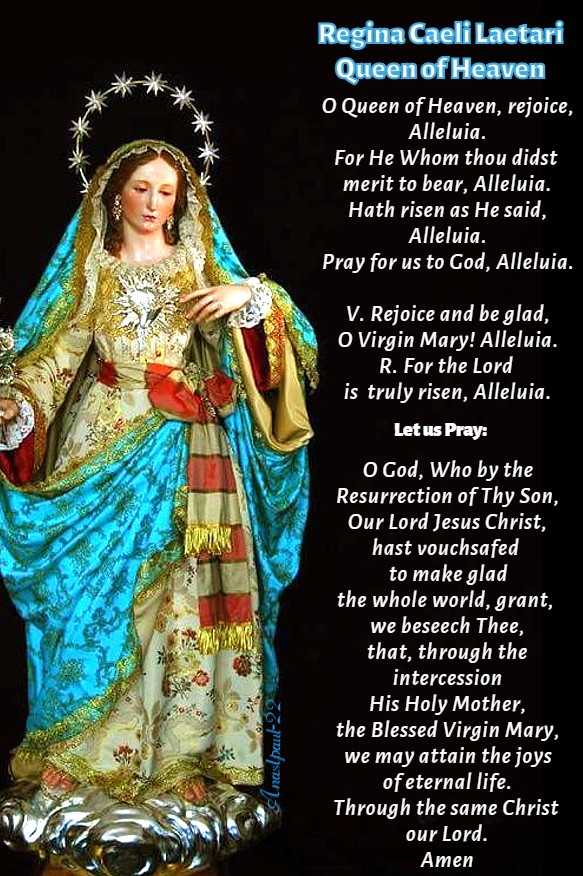
Martyrs of Ashkelon – 3 saints: Several pilgrims from Egypt to Cilicia (in modern Turkey) who planned to minister to fellow Christians suffering in the persecutions of emperor Maximinus. They were arrested, torture, mutilated and then imprisoned in Ashkelon. Some were ordered to forced labour in the mines, but we have the names of three who were martyred by order of governor Firmilian – Ares, Elijah and Promo. They were burned at the stake or beheaded at the gates of Ashkelon c 308.

Martyrs of Hayle – 2+ saints: Several Christians, including a brother and sister, who were martyred together by pagans. The only other information to survive are the names of the two siblings – Fingar and Phiala. 5th century at Hayle, Cornwall, England.

Martyrs of Syria – 3 saints: Three Christians who were martyred together. Known to Saint John Chrysostom who preached on their feast day and left us the only details we have – their names – Drusus, Theodore and Zosimus. The date and precise location of their martyrdom is unknown, but it was in Syria, possibly in Antioch.

Posted in MARIAN TITLES, SAINT of the DAY

La Reina del Rosario de Banos de Agua Santa / Queen of the Holy Rosary, also known as the Virgin of the Holy Waters, Baños de Agua Santa, Ecuador (1570) and Memorials of the Saints – 13 December

La Reina del Rosario de Banos de Agua Santa / Queen of the Holy Rosary, also known as the Virgin of the Holy Waters, Baños de Agua Santa, Ecuador (1570) 13 December:

This is or is similar to, the Statue which stands at the Holy Waters

A few years before the founding of Quito, Dominican Missionaries travelled throughout the Ecuadorian Province of Tungurahua, bringing the Faith to the people. A bamboo Chapel was erected at Baños de Agua Santa ( Bath) wherein was venerated the Blessed Virgin of Montserrat.
One night the Sacristan of the Church saw a small Statue of the Virgin accompanied by two beautiful Angels hovering in the air then coming down to the foot of a waterfall that flowed from the mountain. This event was repeated several times, causing the people gathered in the Chapel, to beseech the Blessed Virgin to clearly manifest her intentions. The following night the Virgin appeared asking for the erection of a Church at the spring, promising to cure the sick who bathe with faith, in those waters.

A new Church was built as Our Lady asked but the Statue of the Virgin of Montserrat had disappeared before it could be transferred to the new Church. A mule came to the Town Square carrying a box containing a beautiful Statue of Our Lady of the Rosary. When this was unclaimed by anyone, it was seen as a gift from Our Lady and the image of “La Reina del Rosario de Agua Santa” was lovingly placed in the Church.
The present Basilica was completed in 1929. A brief of Pope Pius XII in 1957 declared the Virgin of Banos de Agua Santa “Principal Patroness of the missions of eastern Ecuador.” On 13 December 1959, the Cardinal Archbishop of Quito, Carlos M de la Torre, solemnly crowned the Statue of the Virgin in the presence of President of the Republic, Dr Camilo Ponce, who offered to the Mother of God, the Presidential baton invoking her as the Patron of Ecuador.

Many miracles and cures were granted by Our Lady of the Rosary of Agua Santa and numerous times, the Church has provided a sanctuary when the volcano Tungurahua hsd erupted. On one occasion, a horrendous eruption began while many were gathered to honour Our Lady. Lava was flowing toward the Church. The people raised the Statue of Our Lady of Agua Santa on high and processed to the Town Square. There, Our Lady lifted her hand silencing the roaring volcano and and diverting the flow of lava.
In 1916, a nearby farmhouse was burned completely to the ground, except for a picture of Our Lady of the Rosary of Agua Santa.

St Lucy (of Syracuse) – St Lucy/Lucia of Syracuse (c 283-304) Virgin and Martyr
Patron of the blind, eye disorders, martyrs, Perugia, Italy, Malta; epidemics; salesmen, Syracuse, Italy, throat infections, writers, against fire, against poverty, against spiritual blindness, peasants, penitent prostitutes, poor people, sick children, authors, cutlers, farmers, glass blowers, glass makers, glaziers, labourers, lawyer, maid servants, notaries, ophthalmologists, opticians, porters, printers, saddler, sailors, salesmen, seamstresses, stained glass workers, tailors, upholsterers, weavers and 10 further towns and cities.
St Lucy’s Life and Death:

https://anastpaul.wordpress.com/2017/12/13/saint-of-the-day-13-december-st-lucy-c-283-304/

St Antiochus of Sulci

Blessed Antonio Grassi Cong. Orat. (1592 – 1671) Priest of the Oratorians of St Philip Neri, Confessor, Spiritual advisor, Counsellor, Mediator, Miracle Worker, Apostle of the poor and the sick.
Blessed Antonio’s biography:

https://anastpaul.com/2018/12/13/saint-of-the-day-13-december-blessed-antonio-grassi-cong-orat-1592-1671/

St Aristone
St Arsenius of Latro
St Aubert of Arras
Bl Bartholomew of Tuscany
St Edburgh of Lyminge
St Einhildis of Hohenburg
Bl Elizabeth Rose
St Jodocus

Blessed Giovanni Marinoni CR (1490-1562) Priest of the Theatines of St Cajetan (1480-1547) (The Congregation of the Clerics Regular of the Divine Providence), renowned Preacher and spiritual director.
Biography:

https://anastpaul.com/2019/12/13/saint-of-the-day-blessed-giovanni-marinoni-cr-1490-1562/

St Martino de Pomar
St Odilia of Alsace (c 660-720) Virgin Abbess
St Roswinda
St Tassio of Bavaria
St Wifred

Blessed Mercedarian Knights – (7 beati): A group of Mercedarian knights who fought the enemies of the Catholic faith in the first century of the Order.
• Blessed Bernardo de Podio
• Blessed Giacomo de Copons
• Blessed Giovanni de Bruquera
• Blessed Guglielmo de Sa
• Blessed Pietro Boguer
• Blessed Pietro Ricart
• Blessed Raimondo de Frexa

Martyrs of Jeongju – (6 saints): Six Christian laymen who were imprisoned, tortured and martyred together in the persecutions in Korea. They were beheaded on 13 December 1866 in Supjeong-i, Jeongju, Chungcheong-do, South Korea
and Canonised on 6 May 1984 by St Pope John Paul II.
• Bartholomaeus Chong Mun-Ho
• Iosephus Han Won-So
• Peter Cho Hwa-so
• Petrus Son Son-Ji
• Petrus Yi Myong-So
• Petrus Chong Won-Ji

Martyrs of Sebaste – (5 saints): A group of Christians martyred together in the persecutions of Diocletian. We know little more than their names – Auxentius, Eustratius, Eugene, Mardarius and Orestes. They were martyred in c 302 at Sebaste, Armenia (in modern Turkey) and their relics are enshrined at the church of Saint Apollinaris in Rome, Italy.

Posted in MARIAN TITLES, SAINT of the DAY

Gaudete Sunday, the Third Sunday of Advent, Feast of Nuestra Senora De Guadalupe / Our Lady of Guadalupe and Memorials of the Saints – 12 December

Gaudete Sunday – The Third Sunday of Advent

Nuestra Senora De Guadalupe / Our Lady of Guadalupe (Feast) The First Apparition was on 12 December 1531.
All about Our Lady of Guadalupe:

https://anastpaul.wordpress.com/2017/12/12/saint-of-the-day-the-feast-of-our-lady-of-guadalupe-12-december/
AND:
https://anastpaul.com/2018/12/12/feast-of-our-lady-of-guadalupe-12-december/

St Abra
St Agatha of Wimborne
Bl Bartholomew Buonpedoni
St Pope Callistus II (c1065-1124) Bishop of Rome 1 February 1119-13 December 1124)

St Colman of Clonard
St Columba of Terryglass
Bl Conrad of Offida
St Corentius of Quimper
St Cormac
St Cury
St Donatus the Martyr
St Edburga of Thanet

St Finnian of Clonard (470–549) “Tutor of the Saints of Ireland,” Monk and Founder of Monasteries the most famous being Clonard Abbey, Confessor, Ascetic, Missionary, Teacher, miracle-worker.
About St Finnian:

https://anastpaul.com/2019/12/12/saint-of-the-day-12-december-saint-finnian-of-clonard-470-549-tutor-of-the-saints-of-ireland/

St Gregory of Terracina
St Hermogenes
Bl Ida of Nivelles

Bl Ludwik Bartosik
Bl Martin Sanz
St Simon Phan Ðac Hòa
St Spyridon of Cyprus
St Synesius

St Vicelinus of Oldenburg (1086-1154) Bishop, Missionary, “the Apostle of Holstei,” zealous Preacher.
His Life

https://anastpaul.com/2020/12/12/saint-of-the-day-12-december-saint-vicelinus-of-oldenburg-1086-1154/

Martyrs of Alexandria – (6 saints): A group of six Christians martyred for their faith during the persecutions of Decius. We know little more than five of their names – Alexander, Ammonaria, Dionysia, Epimachus and Mercuria. They were burned to death c 250 in Alexandria, Egypt.

Martyrs of Trier – (4 saints): A group of six Christians martyred for their faith during the persecutions of Decius. We know little more than five of their names – Alexander, Ammonaria, Dionysia, Epimachus and Mercuria. They were burned to death c 250 in Alexandria, Egypt.

Posted in CATHOLIC-PRAYERS OF THE CHURCH, INDULGENCES, MARIAN DEVOTIONS, MARIAN PRAYERS, MARIAN Saturdays, MARIAN TITLES, Our MORNING Offering, PARTIAL Indulgence, PRAYERS of the SAINTS

Our Morning Offering – 11 December – Our Lady of Guadalupe,Mystical Rose By St Pius X

Our Morning Offering – 11 December – As Sunday is the Feast of Our Lady of Guadalupe and today is Mary’s Saturday, let us pray this powerful indulgenced prayer now.

Our Lady of Guadalupe,
Mystical Rose
Prayer to Our Lady of Guadalupe
By St Pius X (1835-1914)

Our Lady of Guadalupe,
Mystical Rose,
make intercession
for the holy Church,
protect the Sovereign Pontiff,
help all those who invoke thee in their necessities,
and since thou art the ever Virgin Mary
and Mother of the true God,
obtain for us from thy most holy Son
the grace of keeping our faith,
sweet hope in the midst of the bitterness of life,
burning charityand the precious gift
of final perseverance.
Amen

This prayer was approved and enriched with an indulgence of five hundred days by St Pope Pius X at an audience held on August, 1908 and was included in the official edition of approved indulgenced prayers (1950).
Raccolta number 389, 500 days Indulgence, St Pope Pius X audience, 15 August 1908.

Posted in MARIAN DEVOTIONS, MARIAN TITLES, SAINT of the DAY

Santissima Casa de Loreto / The Holy House of Loreto / Our Lady of Loreto (1291) and Memorials of the Saints – 10 December

Santissima Casa de Loreto / The Holy House of Loreto / Our Lady of Loreto (1291) – 10 December:
A complete background here:
https://anastpaul.wordpress.com/2017/12/10/the-feast-of-the-our-lady-of-loreto-and-the-holy-house-10-december/

The title Our Lady of Loreto refers to the Holy House of Loreto, the house in which Mary was born and where the Annunciation occurred and to an ancient statue of Our Lady which is found there. Tradition says that a band of angels scooped up the little house from the Holy Land and transported it first to Tersato, Dalmatia in 1291, then Recanati, Italy in 1294 and finally to Loreto, Italy where it has been for centuries. It was this flight that led to her patronage of people involved in aviation and the long life of the house that has led to the patronage of builders, construction workers, etc. It is the first shrine of international renown dedicated to the Blessed Virgin and has been known as a Marian centre for centuries. Popes have always held the Shrine of Loreto in special esteem and it is under their direct authority and protection.

The Holy House of Loreto – The feast is so named from the tradition that the house where the Holy Family lived in Nazareth, was transported by angels to the city of Loreto, Italy. The Holy House is now encased by a basilica. It has been one of the famous shrines of the Blessed Virgin since the 13th century.

St Abundius
St Albert of Sassovivo
St Angelina of Serbia
Bl Brian Lacey
BL Bruno of Rommersdorf
St Caesarius of Epidamnus
St Carpophorus
St Deusdedit of Brescia

St Eulalia of Mérida (Died 304) Virgin Martyr
Her Life and Death:

https://anastpaul.com/2020/12/10/saint-of-the-day-10-december-saint-eulalia-of-merida-died-304/

St Edmund Gennings
St Emérico Martín Rubio
St Florentius of Carracedo
St Fulgentius of Afflighem
St Gemellus of Ancyra
St Gonzalo Viñes Masip

St Pope Gregory III (Died 741) Cardinal Deacon Reigned 731-741. He was an educated man who knew both Latin and Greek, polished in style, learned in Holy Scripture, pious, zealous for the faith and a lover of the poor.
Biography:

https://anastpaul.com/2018/12/10/saint-of-the-day-10-december-st-pope-gregory-iii-died-741/

Bl Guglielmo de Carraria
St Guitmarus
St Hildemar of Beauvais
Bl Jerome Ranuzzi
Bl John Mason
St John Roberts (1577-1610) Priest Martyr
St Julia of Merida
St Lucerius
Bl Marco Antonio Durando
St Maurus of Rome
St Mercury of Lentini
St Pope Miltiades
St Polydore Plasden
Bl Sebastian Montanol
Bl Sidney Hodgson
St Sindulf of Vienne
St Swithun Wells
St Thomas of Farfa
Bl Thomas Somers
St Valeria
Martyrs of Alexandria – 3 saints – A group of Christians murdered for their faith in the persecutions of Galerius Maximian – c312. The only details that have survived are three of the names – Eugraphus, Hermogenes and Mennas.

Posted in MARIAN TITLES, MIRACLES, REDEMPTORISTS CSSR, SAINT of the DAY

Nostra Signora dell’Immacolata Concezione / Our Lady of the Conception, Naples, Italy (1618) and Memorials of the Saints – 9 December

Nostra Signora dell’Immacolata Concezione / Our Lady of the Conception, Naples, Italy (1618) – 9 December:

The Abbot Orsini wrote: “Our Lady of the Conception, at Naples, so called because, in the year 1618, the Viceroy, with all his Court and the soldiery of Naples, made a vow, in the Church of Our Lady the Great, to believe and defend the Immaculate Conception of the Blessed Virgin.

Pedro Tellez-Giron, 3rd Duke of Osuna, was the Viceroy of Naples under King Philip III of Spain. He was a Spanish nobleman born in 1574 and married in 1594. He joined the army of the Archduke of Austria as a mere private but his ability and courage, must have been considerable, as he was soon placed in command of two cavalry companies. He fought in several battles and was seriously wounded on two occasions before being made the Viceroy of Sicily in 1610.
When he took this new position as Viceroy, the Spanish had not a single galley on the island that was seaworthy. It was necessary to remedy that problem at once, as Sicily was vulnerable to Barbary pirates as well as potential attacks of the fleet of the Ottoman Empire. Within two years he was no longer in a weak position, and as he had 8 galleys and several other ships in the new navy, he used them to attack Ottoman territory.
In the summer of 1613 his fleet encountered a larger Ottoman fleet under the command of Sinari Pasha. The encounter lasted three hours and became known as the Battle of Cape Corvo. Sinari Pasha was captured, and Mahamet, Bey of Alexandria and son of Muezzinzade Ali Pasho, Commander of the Ottoman fleet at the battle of LepanTo, was also captured.
In 1616 Pedro Tellez-Giron was promoted to Viceroy of Naples and it was during this time, that the now Knight of the Order of the Golden Fleece ,made his vow to defend what would later become a Dogma of the Catholic Faith, the Immaculate Conception of the Blessed Virgin Mary. This doctrine was not actually formally proclaimed by the Church until the Blessed Pope Pius IX formally proclaimed it, on 8 December 1854, in the Papal Bull, Ineffabilis Deus. The Napule have a great devotion to the Blessed Virgin of the Immaculate Conception as manifested by this immense “Guglia” Column or Spire proudly displayed in Naples.

St Juan Diego Cuauhtlatoatzin (1474-1548) Visionary of Our Lady of Guadalupe, Layman. (Optional Memorial)
St Juan Diego:

https://anastpaul.wordpress.com/2017/12/09/saint-of-the-day-9-december-st-juan-diego-cuauhtlatoatzin-1474-1548/

And About the Tilma:
https://anastpaul.wordpress.com/2017/12/09/st-juan-diegos-tilma-9-december-2/

St Adam Scotus
Bl Agustín García Calvo *
Bl Antonio Martín Hernández *
St Auditor of Saint-Nectaire
St Balda of Jouarre
St Bernhard Mariea Silvestrelli
St Budoc of Brittany
Bl Carmen Rodríguez Banazal *
St Caesar of Korone
St Cephas
Bl Clara Isabella Fornari
St Cyprian of Perigueux
Bl Dolores Broseta Bonet *
Bl Estefanía Irisarri Irigaray *
St Ethelgiva of Shaftesbury
St Gorgonia
Bl Isidora Izquierdo García *
Bl José Ferrer Esteve *
Bl José Giménez López *
Bl Josefa Laborra Goyeneche *
Bl Josep Lluís Carrera Comas *
St Julian of Apamea
Bl Julián Rodríguez Sánchez *

St Leocadia of Toledo (Died c 304) Virgin Martyr. Hearing of the Martyrdom of St Eulalia, she prayed that God would not prolong her exile but unite her speedily with her beloved Lord in His glory.
Her Life and Death:

https://anastpaul.com/2020/12/09/saint-of-the-day-9-december-saint-leocadia-of-toledo-died-c-304-virgin-martyr/

Blessed Liborius Wagner (1593-1631) Priest and Martyr, Confessor, Teacher.
His Life and Death:

https://anastpaul.com/2019/12/09/saint-of-the-day-9-december-blessed-liborius-wagner-1593-1631-priest-and-martyr/

Bl María Pilar Nalda Franco *
St Michaela Andrusikiewicz
St Nectarius of Auvergne

St Peter Fourier CRSA (1565-1640) “The Good Father of Mattaincourt,” Priest, Founder, Reformer, Confessor, Ascetic, Theologian, Teacher, Preacher, Apostle of Prayer, Penance and Charity, Marian devotee. Together with the Blessed Alix Le Clerc, in 1597, Fourier founded the Congregation of Notre Dame of Canonesses Regular of St Augustine, who were committed to the free education of children, taking a fourth vow to that goal.
Biography:

https://anastpaul.com/2018/12/09/saint-of-the-day-9-december-st-peter-fourier-c-r-s-a-1565-1640/

St Proculus of Verona
Bl Recaredo de Los Ríos Fabregat *
St Syrus of Pavia (1st Century) Bishop
St Valeria of Limoges
St Wulfric of Holme

Blessed Mercedarian Fathers – (10 beati): The memorial of ten Mercedarian friars who were especially celebrated for their holiness.
• Arnaldo de Querol • Berengario Pic • Bernardo de Collotorto • Domenico de Ripparia • Giovanni de Mora • Guglielmo Pagesi • Lorenzo da Lorca • Pietro Serra • Raimondo Binezes • Sancio de Vaillo

Martyred Salesians of Valencia – (5 beati)
Martyrs of North Africa – (4 saints): Twenty-four Christians murdered together in North Africa for their faith. The only details to survive are four of their names – Bassian, Peter, Primitivus and Successus.

Martyrs of Paterna – (7 beati)
Martyrs of Samosata – (7 saints): Seven martyrs crucified in 297 in Samosata (an area of modern Turkey) for refusing to perform a pagan rite in celebration of the victory of Emperor Maximian over the Persians. They are – Abibus, Hipparchus, James, Lollian, Paragnus, Philotheus and Romanus. They were crucified in 297 in Samosata (an area in modern Turkey).
Martyrs of the Spanish Civil War – (13 beati):
• Blessed Agustín García Calvo
• Blessed Antonio Martín Hernández
• Blessed Carmen Rodríguez Banazal
• Blessed Dolores Broseta Bonet
• Blessed Estefanía Irisarri Irigaray
• Blessed Isidora Izquierdo García
• Blessed José Ferrer Esteve
• Blessed José Giménez López
• Blessed Josefa Laborra Goyeneche
• Blessed Josep Lluís Carrera Comas
• Blessed Julián Rodríguez Sánchez
• Blessed María Pilar Nalda Franco
• Blessed Recaredo de Los Ríos Fabregat

Posted in DECEMBER - The DIVINE INFANCY and The IMMACULATE CONCEPTION, DOCTORS of the Church, FATHERS of the Church, MARIAN QUOTES, MARIAN TITLES, The IMMACULATE CONCEPTION, The INCARNATION

Quote/s of the Day – 8 December on the Immaculate Conception

Quote/s of the Day – 8 December on the Solemnity of the Immaculate Conception

“This Virgin Mother
of the Only begotten of God,
is called Mary,
worthy of God,
Immaculate of the Immaculate,
One of the One.

Origen (c 185-253)
Priest, Theologian, Exegist, Writer, Apologist, Father

“Thou alone and Thy Mother,
are in all things fair,
there is no flaw in Thee
and no stain in Thy Mother.

St Ephrem of Syria (306-373)
Father and Doctor of the Church

“Come, then and search out Your sheep,
not through Your servants or hired men
but do it Yourself.
Lift me up bodily and in the flesh,
which is fallen in Adam.
Lift me up not from Sarah but from Mary,
a Virgin not only undefiled
but a Virgin whom grace had made inviolate,
free of every stain of sin.

St Ambrose (340-397)
Father and Doctor of the Church

“The very fact
that God has elected her,
proves, that none was ever
holier than Mary;
if any stain had disfigured her soul,
if any other virgin
had been purer and holier,
God would have selected her
and rejected Mary.

St Jacob of Sarug (c 451-521)
Bishop, Theologian, Poet, Writer

“Today humanity, in all the radiance
of her Immaculate nobility,
receives its ancient beauty.
The shame of sin
had darkened the splendour
and attraction of human nature
but when the Mother
of the Fair One par excellence,
is born, this nature again,
regains in her person,
its ancient privileges
and is fashioned according to a perfect model,
truly worthy of God….

The reform of our nature begins today
and the aged world,
subjected to a wholly divine transformation,
receives the first fruits of the second creation.”

St Andrew of Crete (c 650-c 740)
Bishop, Theologian, Hymnist

Posted in DECEMBER - The DIVINE INFANCY and The IMMACULATE CONCEPTION, DOCTORS of the Church, FATHERS of the Church, FEASTS and SOLEMNITIES, MARIAN PRAYERS, MARIAN REFLECTIONS, MARIAN TITLES, ONE Minute REFLECTION, PRAYERS of the SAINTS, QUOTES on HOPE, QUOTES on PURITY, QUOTES on TEMPTATION, QUOTES on THE WORLD, The IMMACULATE CONCEPTION, The WORD

One Minute Reflection – 8 December – ‘ … Mary is the new Tree of Life …’

One Minute Reflection – 8 December on the Solemnity of the Immaculate Conception – Readings: Genesis 3:9-15, 20, Psalm 98:1-4, Ephesians 1:3-6, 11-12, Luke 1:26-38

And behold, you will conceive in your womb and bear a son and you shall call his name Jesus.

And Mary said, “Behold, I am the handmaid of the Lord, let it be done to me according to your word.” … Luke 1:38

REFLECTION – “Son of God, grant me Your own admirable Gift, that I may celebrate the wondrous beauty of Your beloved Mother! The Virgin gave birth to a Son while preserving her virginity, she suckled Him who gives nourishment to the peoples, in her Immaculate breast she bore Him who carries the whole world in His Hands. She is Virgin and Mother, what will she not be hereafter? Holy in body, all beautiful in soul, pure of mind, upright in intelligence, perfect in feeling, chaste and faithful, pure of heart and filled with virtue.

May the hearts of virgins rejoice in Mary, since of her was born the One Who set humankind free from dreadful slavery. May the old Adam, wounded by the serpent, rejoice in Mary; it is Mary who gives Adam a posterity that allows him to crush the accursed serpent and who cures him of his mortal wound (Gen 3:15). Let Priests rejoice in the blessed Virgin; she has brought the High Priest into the world, Who gave Himself as a victim, putting an end to the sacrifices of the Old Covenant. … Let the Prophets rejoice in Mary, since in her, were fulfilled their visions, in her were realised their prophecies, in her were confirmed their oracles. Let all the Patriarchs rejoice in Mary since she received the blessing promised to them, she, who, in her Son, has brought them to completion. …
Mary is the new Tree of Life, who, instead of the bitter fruit picked by Eve, gives to mankind that Sweet Fruit on which the whole world is fed.”St Ephrem (306-373) Deacon in Syria, Father and Doctor of the Church (Marian hymn).

PRAYER O Mary, My Hope! By St John Damascene (675-749) Father and Doctor of the Church
I salute you, O Mary!
you are the hope of Christians.
Receive the prayer of a sinner,
who loves you tenderly,
honours you in a special manner
and places in you the whole hope
of his salvation.
From you I have my life.
You reinstate me in the grace of your Son:
you are the sure pledge of my salvation.
I beseech of you, therefore, to deliver me
from the burden of my sins,
dispel the darkness of my mind,
banish from my heart the love of the world,
repress the temptations of my enemies
and so rule my whole life, that by your means
and under your guidance,
I may obtain everlasting happiness in heaven.
Amen