Posted in SAINT of the DAY

Dedication of the Basilicas of Peter and Paul and Memorials of the Saints – 18 November

Dedication of the Basilicas of Peter and Paul (Optional Memorial):   From the twelfth century the Dedications of the Vatican Basilica of St Peter and the Basilica of St Paul on the Via Ostiense, have been celebrated on this day, as the anniversary of their dedication by St Pope Silvester and St Pope Siricius in the fourth century.   In more recent times, this feast has been extended to the whole Roman Rite.   As the anniversary of the Dedication of the Basilica of St Mary Major (5 August) honours the motherhood of Our Lady, so this Feast honours the memory of the two Princes of the Apostles.
About this Feast:
https://anastpaul.wordpress.com/2017/11/18/feast-of-the-dedication-of-the-basilicas-of-sts-peter-and-paul-at-rome-18-november/

St Rose Philippine Duchesne RSCJ (1769-1852) (Optional Memorial, United States)
About St Rose:
https://anastpaul.com/2018/11/18/saint-of-the-day-18-november-st-rose-philippine-duchesne-rscj-1769-1852/

St Amandus of Lérins
Bl Andreas Murayama Tokuan
St Anselm of Lérins
St Augusto Cordero Fernández
St Barulas
St Constant
Bl Cosmas Takeya Sozaburo
Bl Domingos Jorge
St Emiliano Martínez de La Pera Alava
St Esteban Anuncibay Letona
Bl Ferdinando Santamaria
St Francisco Marco Alemán
St Germán García y García
Bl Guilminus
Bl Ioannes Yoshida Shoun
St José María Cánovas Martínez
Bl Karolina Kózkówna
St Keverne
Bl eonard Kimura
St Mawes
St Maximus of Mainz
St Modesto Sáez Manzanares
St Mummolus of Lagny
St Nazarius of Lérins
St Noah the Patriarch
St Odo of Cluny (c 880–942)

St Oriculus
St Patroclus of Colombier
St Romfarius of Coutances
St Romano of Antioch
St Teofredo of Vellaicum
St Thomas of Antioch
St Vidal Luis Gómara

Martyred Visitationists of Madrid:
• Blessed Amparo Hinojosa Naveros
• Blessed Augusto Cordero Fernández
• Blessed Carmen Barrera Izaguirre
• Blessed Emiliano Martínez de La Pera Alava
• Blessed Esteban Anuncibay Letona
• Blessed Francisco Marco Alemán
• Blessed Germán García y García
• Blessed Inés Zudaire Galdeano
• Blessed José María Cánovas Martínez
• Blessed Josefa Joaquina Lecuona Aramburu
• Blessed Laura Cavestany Anduaga
• Blessed Martina Olaizola Garagarza
• Blessed Modesto Sáez Manzanares
• Blessed Vidal Luis Gómara

Posted in PAPAL MESSAGES, QUOTES - J R R Tolkien and MORE, QUOTES on CHARITY, SAINT of the DAY

Thought for the Day – 17 November – ‘The poor save us …’

Thought for the Day – 17 November – The Third World Day for the Poor and The Memorial of St Elizabeth of Hungary (1207-1231)

“The poor acquire genuine hope, not from seeing us gratified by giving them a few moments of our time but from recognising in our sacrifice, an act of gratuitous love, that seeks no reward.

I encourage you to seek, in every poor person whom you encounter, his or her true needs, not to stop at their most obvious material needs but to discover their inner goodness, paying heed to their background and their way of expressing themselves and in this way to initiate a true fraternal dialogue.

For once, let us set statistics aside – the poor are not statistics to cite when boasting of our works and projects.   The poor are persons to be encountered, they are lonely, young and old, to be invited to our homes to share a meal; men women and children who look for a friendly word.   The poor save us because they enable us to encounter the face of Jesus Christ.” … Pope Francis Third World Day of Poor Message (Excerpt)

“Elizabeth was a lifelong friend of the poor and gave herself entirely to relieving the hungry.   She ordered that one of her castles should be converted into a hospital in which she gathered many of the weak and feeble.   She generously gave alms to all who were in need, not only in that place but in all the territories of her husband’s empire. She spent all her own revenue from her husband’s four principalities and finally she sold her luxurious possessions and rich clothes for the sake of the poor.”

From a letter by Fr Conrad of Marburg,
spiritual director of Saint Elizabeth of Hungary

St Elizabeth of Hungary,
please Pray for the poor and homeless,
Pray for us all!st-elizabeth-pray-for-us1.jpg

Posted in HYMNS, PRACTISING CATHOLIC, QUOTES - J R R Tolkien and MORE, QUOTES on CHARITY, QUOTES on HOPE, QUOTES on LOVE, QUOTES on MERCY, QUOTES on PERSEVERANCE, QUOTES on PRAYER, SAINT of the DAY, The WORD

Quote/s of the Day – 17 November – Serve, Love, Trust, Hope – The Third World Day of the Poor

Quote/s of the Day – 17 November – The Third World Day of Prayer for the Poor and the Thirty Third Sunday in Ordinary Time, Year C, Luke 21:5–19

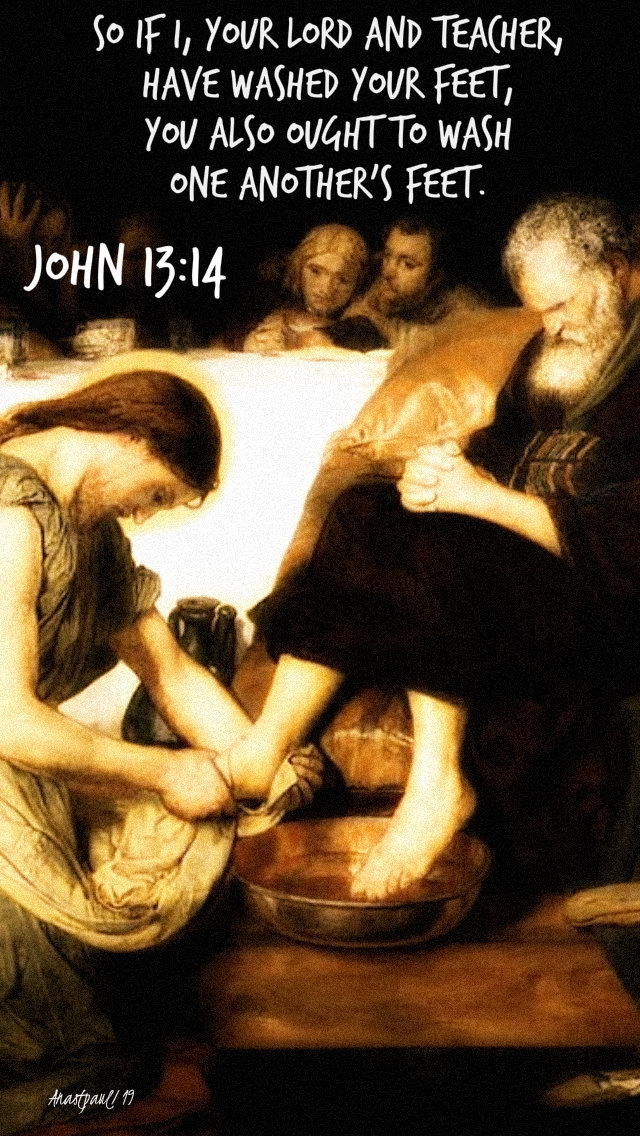
So if I, your Lord and Teacher,
have washed your feet,
you also ought to wash
one another’s feet.

John 13:14john 13 14 - so if I your lord and teacher have washed your feet - 17 nov 2019 3rd world day of the poor.jpg

“A new commandment I give to you,
that you love one another,
even as I have loved you,
that you also lone one another …”

John 13:34

a new commandment I give to you - john 13 34 - 19 may 2019.jpg

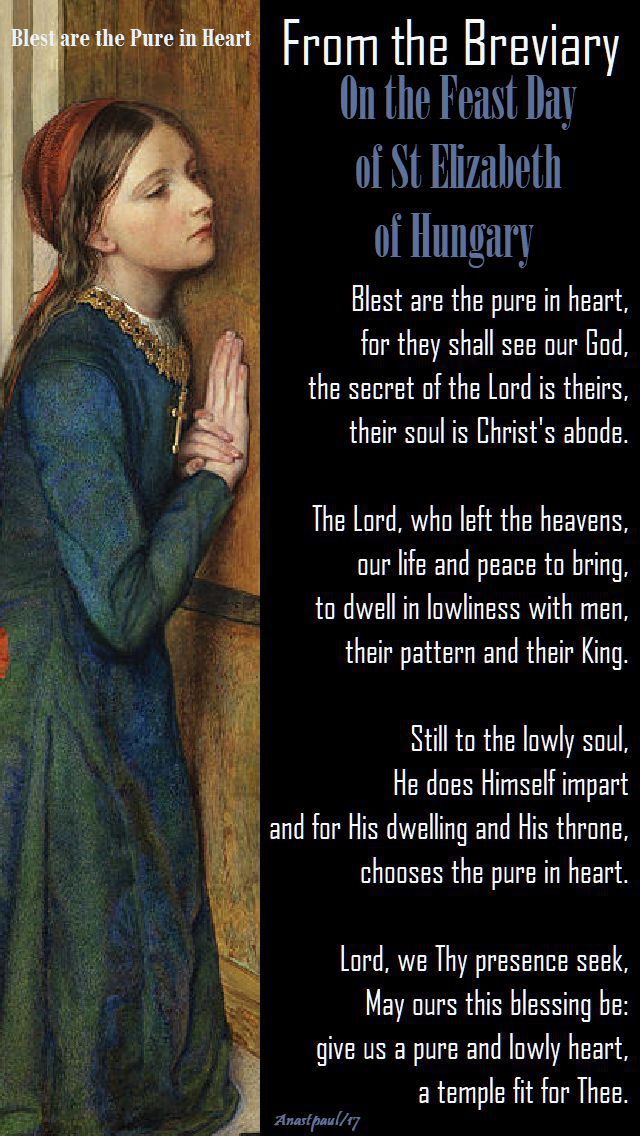
Blest are the Pure in Heart” – From the Breviary
(A perfect hymn/prayer for the Feast of St Elizabeth of Hungary)

Blest are the pure in heart,
for they shall see our God,
the secret of the Lord is theirs,
their soul is Christ’s abode.

The Lord, who left the heavens,
our life and peace to bring,
to dwell in lowliness with men,
their pattern and their King.

Still to the lowly soul,
He does Himself impart
and for His dwelling and His throne,
chooses the pure in heart.

Lord, we Thy presence seek,
May ours this blessing be:
give us a pure and lowly heart,
a temple fit for Theeblest-are-the-pure-in-heart-on-feast-of-st-elizabeth-of-hungary-17-nov-20171.jpg

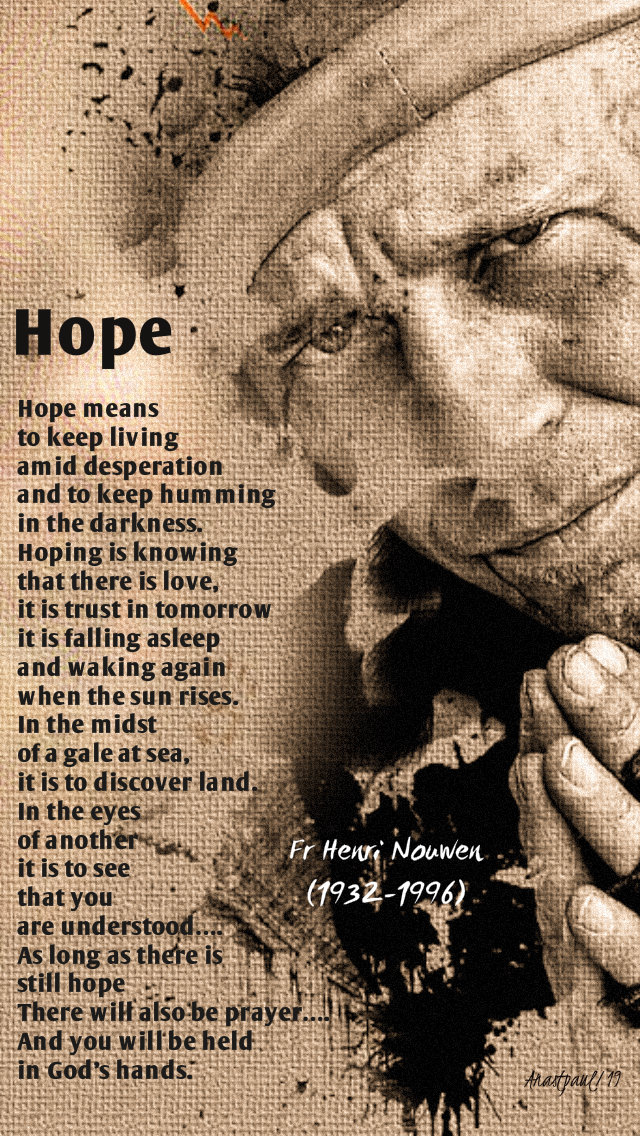
Hope means to keep living
amid desperation
and to keep humming
in the darkness.
Hoping is knowing that there is love,
it is trust in tomorrow
it is falling asleep
and waking again
when the sun rises.
In the midst of a gale at sea,
it is to discover land.
In the eyes of another
it is to see that you are understood….
As long as there is still hope
There will also be prayer….
And you will be held in God’s hands.

Fr Henri Nouwen (1932-1996)

Priest, Writer, Professor, Spiritual Director

With Open Handshope - henri nouwen 17 oct 2019 world day of the poor 3rd.jpg

Posted in FATHERS of the Church, ONE Minute REFLECTION, QUOTES of the SAINTS, QUOTES on DIVINE PROVIDENCE, QUOTES on PERSEVERANCE, QUOTES on SUFFERING, QUOTES on TRUST and complete CONFIDENCE in GOD, SAINT of the DAY, The WORD

One Minute Reflection – 17 November – “By your perseverance you will secure your lives.”

One Minute Reflection – 17 November – The Thirty Third Sunday in Ordinary Time, Year C, Luke 21:5–19, The Third World Day of Prayer for the Poor and the Memorial of St Elizabeth of Hungary (1207-1231)

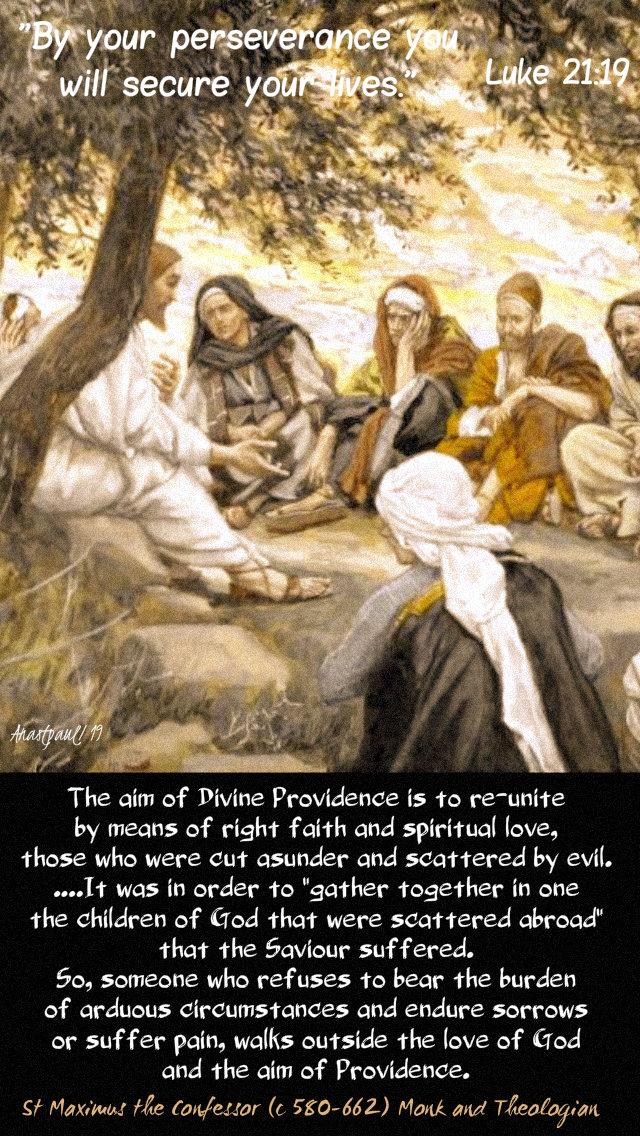
“By your perseverance you will secure your lives.” … Luke 21:19

REFLECTION – “That person has not yet attained perfect love and profound knowledge of Divine Providence who, in time of trial, when affliction befalls, does not have magnanimity but cuts himself off from love for the spiritual brethren.
The aim of Divine Providence is to re-unite by means of right faith and spiritual love, those who were cut asunder and scattered by evil.   It was in order to “gather together in one the children of God that were scattered abroad” (Jn 11:52) that the Saviour suffered. So, someone who refuses to bear the burden of arduous circumstances and endure sorrows or suffer pain, walks outside the love of God and the aim of Providence.   If “charity is patient and kind” (1Cor 13:4), does not the person who is fainthearted in sorrows, who bears malice against those giving offence, or who severs the love due to them, fall short of the aim of Divine Providence?…   They are long-suffering who await the end of the trial and receive praise for what they have endured.
“Whoever is slow to wrath abounds in wisdom” (Prv 14:29), for such a one, relates all that happens, to the ultimate end and, in its expectation, bears all afflictions.   And the end, says the Apostle, is everlasting life (cf. Rm 6:22).   “And this is eternal life, that they might know You, the only true God and Jesus Christ, whom You have sent” (Jn 17:3).” … St Maximus the Confessor (c 580-662) Monk, Theologian, Father – Fourth Century on Love, nos 16-18, 23-24luke 21 10 by your perseverance you will secure your lives - the aim of divine providence - st maximus 17 nov 2019.jpg

PRAYER – Holy God and Father, grant us a strong Faith!   Poor Your graces into our hearts that we may believe with all our hearts, minds and souls and that in believing, we may constantly raise our entire being to You in prayer and supplication, in prayer and adoration, in prayer and love.   May the intercession of St Elizabeth of Hungary, a woman of deep prayer from her youth, strengthen our perseverance and trust.   Through Jesus Christ, our Lord in the unity of the Holy Spirit, God forever and ever, amen.st-elizabeth-of-hungary-pray-for-us-17-nov-2018 AND 2019.jpg

Posted in SAINT of the DAY

Saint of the Day – 17 November – Saint Hilda of Whitby (c 614–680)

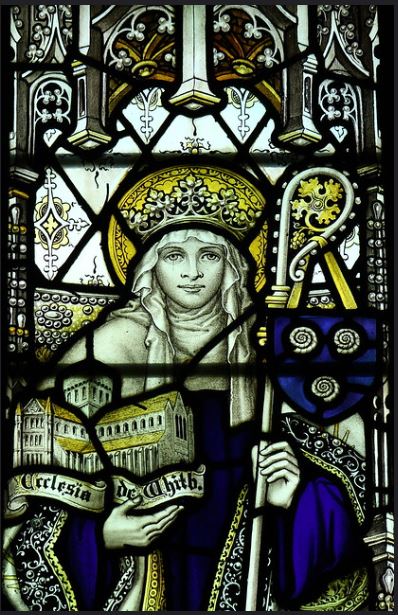
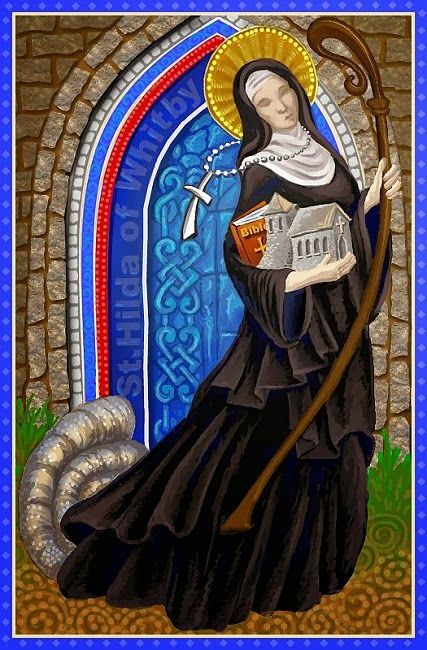
Saint of the Day – 17 November – Saint Hilda of Whitby (c 614–680) Abbess, Apostle of Charity, teacher, administrator and advisor, spiritual director, reformer – born in c 614 at Northumbria, England and died in 680 of natural causes – also known as St Hild.   St Hilda was the founding abbess of the monastery at Whitby, which was chosen as the venue for the Synod of Whitby.   An important figure in the Christianisation of Anglo-Saxon England, she was abbess at several monasteries and recognised for the wisdom that drew kings to her for advice.   Patronages – learning and culture, poetry.st hilda of whitby snip header

The source of information about Hilda is the Ecclesiastical History of the English People by St Bede the Venerable (673-735) Doctor of the Church, in 731, who was born approximately eight years before her death.   He documented much of the Christian conversion of the Anglo-Saxons.

According to Bede, Hilda was born in 614 into the Deiran royal household.   She was the second daughter of Hereric, nephew of Edwin, King of Deira and his wife, Breguswīþ. When Hilda was still an infant, her father was poisoned while in exile at the court of the Brittonic king of Elmet in what is now West Yorkshire.   In 616, Edwin killed Aethefrith, the son of Æthelric of Bernicia, in battle.   He created the Kingdom of Northumbria and took its throne. Hilda was brought up at King Edwin’s court.

In 625, the widowed Edwin married the Christian princess Æthelburh of Kent, daughter of King Æthelberht of Kent and the Merovingian princess Bertha of Kent.   As part of the marriage contract, Aethelburh was allowed to continue her Roman Christian worship and was accompanied to Northumbria with her chaplain, St Paulinus of York, a Roman monk sent to England in 601 to assist Augustine of Canterbury.   Augustine’s mission in England was based in Kent and is referred to as the Gregorian mission after the pope who sent him.   As queen, Æthelburh continued to practice her Christianity and no doubt influenced her husband’s thinking as her mother Bertha had influenced her father.

In 627 King Edwin was Baptised on Easter Day, 12 April, along with his entire court, which included the 13-year-old Hilda, in a small wooden church hastily constructed for the occasion near the site of the present York Minster.

In 633 Northumbria was overrun by the neighbouring pagan King of Mercia, at which time King Edwin fell in battle.  St Paulinus accompanied Hilda and Queen Æthelburh and her companions to the Queen’s home in Kent.   Queen Æthelburh founded a convent at Lyminge and it is assumed that Hilda remained with the Queen-Abbess.

Hilda’s elder sister, Hereswith, married Ethelric, brother of King Anna of East Anglia, who with all of his daughters became renowned for their Christian virtues.   Later, Hereswith became a nun at Chelles Abbey in Gaul (modern France).   Bede resumes Hilda’s story at a point when she was about to join her widowed sister at Chelles Abbey. At the age of 33, Hilda decided instead to answer the call of Bishop St Aidan of Lindisfarne and returned to Northumbria to live as a nun.st hilda of whitby.jpg

Hilda’s original convent is not known except that it was on the north bank of the River Wear.   Here, with a few companions, she learned the traditions of Celtic monasticism, which Bishop Aidan brought from Iona.   After a year Aidan appointed Hilda as the second Abbess of Hartlepool Abbey.   No trace remains of this abbey but its monastic cemetery has been found near the present St Hilda’s Church, Hartlepool.

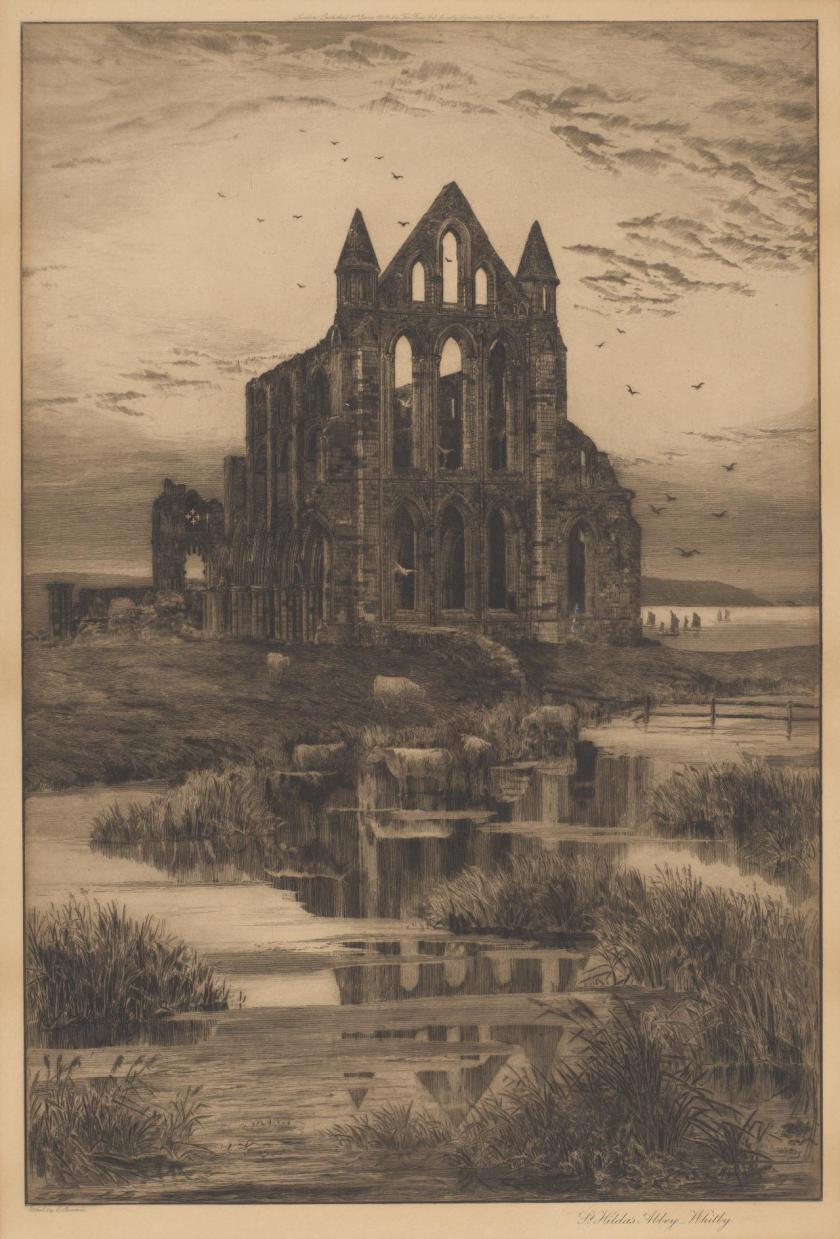
In 657 Hilda became the founding abbess of Whitby Abbey, then known as Streoneshalh, she remained there until her death.   Archaeological evidence shows that her monastery was in the Celtic style, with its members living in small houses, each for two or three people.   The tradition in double monasteries, such as Hartlepool and Whitby, was that men and women lived separately but worshipped together in church.   The exact location and size of the church associated with this monastery is unknown.

whitby abbey st hilda.jpg
Whitby Abbey ruins

Bede states that the original ideals of monasticism were maintained strictly in Hilda’s abbey.   All property and goods were held in common, Christian virtues were exercised, especially peace and charity.   Everyone had to study the Bible and do good works.

Five men from this monastery later became bishops.   Two, John of Beverley, Bishop of Hexham and Wilfrid, Bishop of York, were Canonised for their service to the Church at a critical period in its fight against paganism.

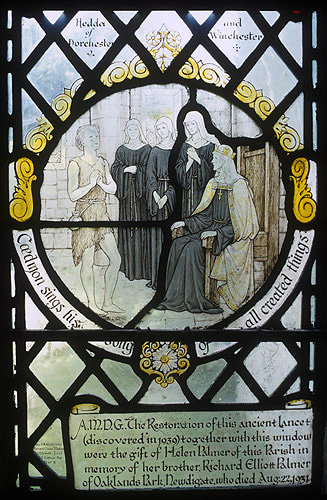
Bede describes Hilda as a woman of great energy, who was a skilled administrator and teacher.   As a landowner she had many in her employ to care for sheep and cattle, farmin, and woodcutting.   She gained such a reputation for wisdom that kings and princes sought her advice.   However, she also had a concern for ordinary folk such as St Cædmon (memorial 11 February).   He was a herder at the monastery, who was inspired in a dream to sing verses in praise of God.   Hilda recognised his gift and encouraged him to develop it.   Bede writes, “All who knew her called her mother because of her outstanding devotion and grace”.   Read St Caedmon’s beautiful story and Hymn here:  https://anastpaul.com/2019/02/11/saint-of-the-day-11-february-st-caedmon-died-c-680/

st hilda and st caedmon
St Hilda and St Caedmon

The prestige of Whitby is reflected in the fact that King Oswiu of Northumberland chose Hilda’s monastery as the venue for the Synod of Whitby, the first synod of the Church in his kingdom.   He invited churchmen from as far away as Wessex to attend the synod. Most of those present, including Hilda, accepted the King’s decision to adopt the method of calculating Easter currently used in Rome, establishing Roman practice as the norm in Northumbria.   The monks from Lindisfarne, who would not accept this, withdrew to Iona and later to Ireland.

Hilda suffered from a fever for the last seven years of her life but she continued to work until her death on 17 November 680, at what was then the advanced age of sixty-six.   In her last year she set up another monastery, fourteen miles from Whitby, at Hackness.   She died after receiving viaticum and her legend holds that at the moment of her death the bells of the monastery of Hackness tolled.   A nun there named Begu claimed to have witnessed Hilda’s soul being borne to heaven by angels.st hilda of whitby artwork

A local legend says that when sea birds fly over the abbey they dip their wings in honour of Saint Hilda.   Another legend tells of a plague of snakes which Hilda turned to stone, supposedly explaining the presence of ammonite fossils on the shore;  heads were carved onto these ‘petrified snakes’ to honour this legend.   In fact, the ammonite genus Hildoceras takes its scientific name from St Hilda.   It was not unknown for local “artisans” to carve snakes’ heads onto ammonites and sell these “relics” as proof of her miracle.   The coat of arms of nearby Whitby includes three such ‘snakestones’ and depictions of ammonites appear in the shield of the University of Durham’s College of St Hild and St Bede.   A carved ammonite stone is set into the wall by the entrance to the former chapel of St Hild’s College, Durham, which later became part of the College of St Hild and St Bede.

St_Hilda_memorial_ammonites.jpg
St Hilda monument detail in Whitby. Note ammonites at feet.

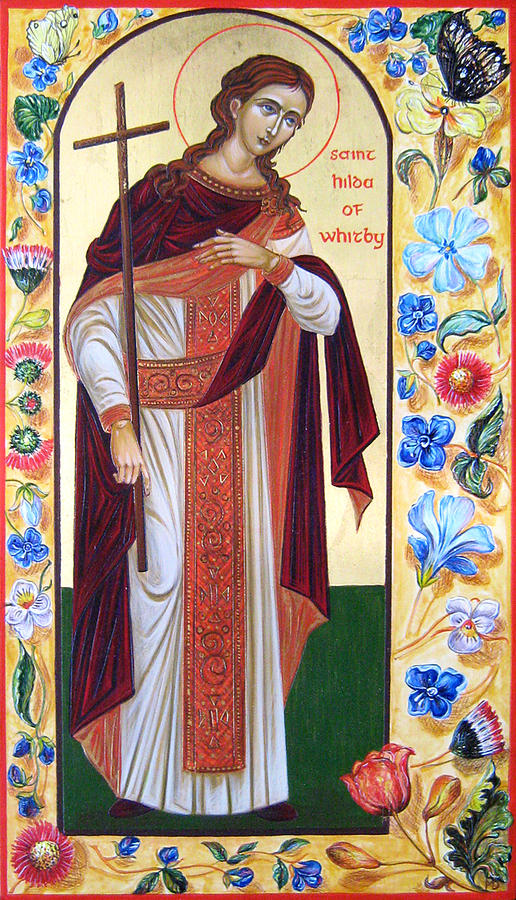
St Hilda was never formally Canonised as her life is pre-congregation but the veneration of St Hilda from an early period is attested by the inclusion of her name in the calendar of St Willibrord, written at the beginning of the 8th century.   According to one tradition, her relics were translated to Glastonbury by King Edmund, another tradition holds that St Edmund brought her relics to Gloucester.saint-hilda-of-whitby-marchela-dimitrova

Posted in franciscan OFM, SAINT of the DAY

The 33rd Sunday, Third World Day of the Poor and Memorials of the Saints – 17 November

The Thirty Third Sunday in Ordinary Time, Year C +2019

The Third World Day of the Poor +2019

St Elizabeth of Hungary TOSF (1207-1231) (Memorial)
About St Elizabeth:
https://anastpaul.wordpress.com/2017/11/17/saint-of-the-day-st-elizabeth-of-hungary-1207-1231-t-o-s-f/

St Acisclus
St Aignan of Orléans
St Alphaeus of Palestine
St Eugene of Florence
St Eusebio Roldán Vielva
St Florinus of Remüs
St Giacinto Ansalone
St Gregory of Tours
St Gregory Thaumaturgus (c 213-c 270) Bishop
St Gregory’s life:

Saint of the Day – 17 November – St Gregory Thaumaturgus “the Wonder-Worker” (c 213-c 270)


St Hilda of Whitby (c 614–680)

St Hugh of Noara
St Josefa Gironés Arteta
St Juan de Castillo-Rodriguez
St Laverius
St Lazarus Zographos
St Lorenza Díaz Bolaños
St Namasius of Vienne
Bl Salomea of Galicia
Bl Sébastien-Loup Hunot
St Thomas Hioji Nishi Rokuzaemon
St Victoria of Cordoba
Bl Yosafat Kotsylovsky
St Zacchaeus of Palestine

Jesuit Martyrs of Paraguay – 3 saints

Martyred in the Spanish Civil War:
• Blessed Eusebio Roldán Vielva
• Blessed Josefa Gironés Arteta
• Blessed Lorenza Díaz Bolaños

Posted in MARIAN QUOTES, MARIAN TITLES, MATER DOLOROSA - Mother of SORROWS, POETRY, QUOTES of the SAINTS, QUOTES on the CROSS of CHRIST, SAINT of the DAY, The HOLY CROSS, The PASSION

Thought for the Day – 16 November – I grieve, Mary, for thy son and thee.

Thought for the Day – 16 November – The Memorial of St Edmund Rich of Abingdon (1175-1240) Archbishop of Canterbury

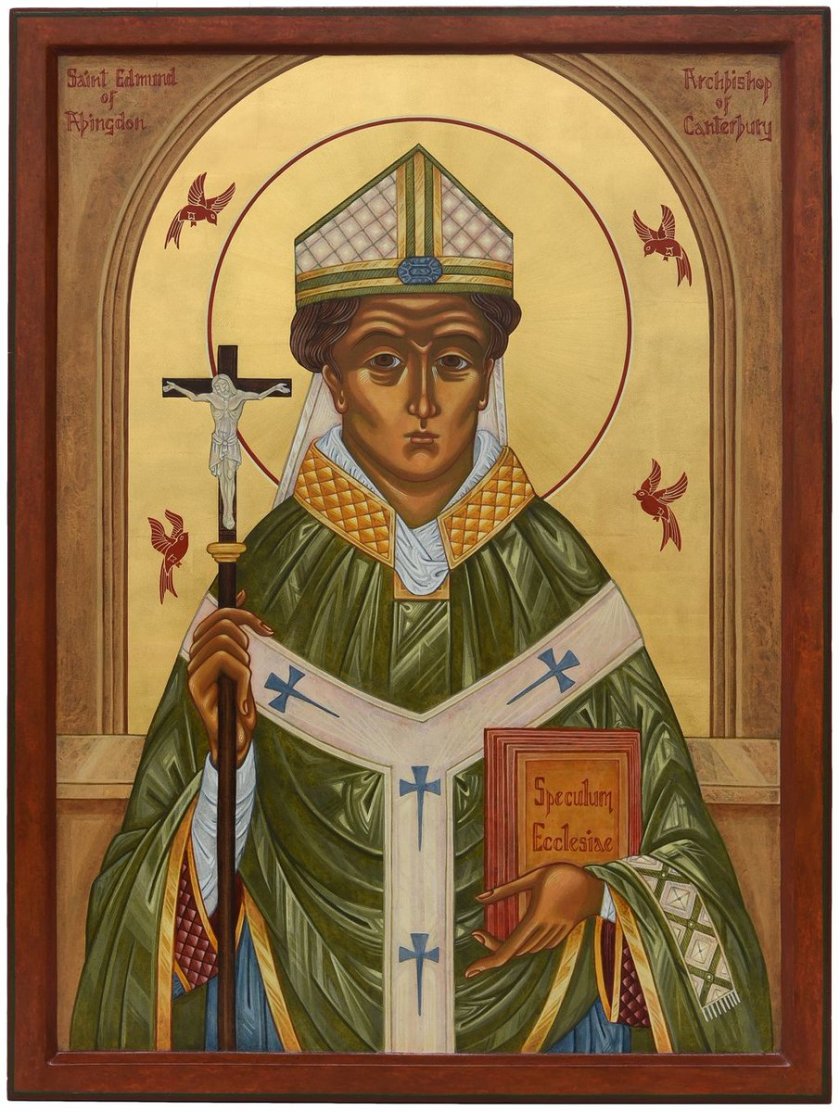
St Edmund’s best-known work in the Middle Ages was his Speculum Ecclesie.   It’s a work on the contemplative life, offering (among other things) meditations on different moments in the life of Christ, aiming to help the reader to enter imaginatively into the scenes of His Passion and feel intense compassion for His sufferings.   I don’t know whether people read the Speculum Ecclesie today, but most students of Middle English will have read a poem which survives as part of it.   This is one of the earliest, shortest and most popular devotional poems in Middle English:

Nou goth sonne under wod,
Me reweth, Marie, thi faire rode.
Nou goth sonne under tre,
Me reweth, Marie, thi sone and thee.

Now goes the sun under the wood,
I grieve, Mary, for your fair face.
Now goes the sun under the tree,
I grieve, Mary, for thy son and thee.

This short poem is designed to be a spur to meditation on the Crucifixion, perhaps at the appropriate hour of the day when the sun begins to set.   Apparently very simple, the poem is dense with meaningful wordplay – as the sun sets behind the wood, so Christ the Son is shrouded in darkness on the wood of the cross, the tree; that is, the ‘rode’, which means both ‘face’ and ‘rood’ (cross).   And here we have another pair of a mother and her son, and their strong emotional bond (like St Edmund himself and his mother).   The poem encourages the reader to meditate and dwell on Christ’s Crucifixion by approaching the Son through the Mother, to feel compassion for His suffering as it is reflected in her grief (underlined by that wordplay on ‘rode’ – (His cross and her face). How wonderful it is that this poem should be associated with a saint whose mother was such an important presence in his life.

Back in Abingdon, the Catholic church is dedicated to him and to the Virgin Mary, the mother and bride who was so constant a presence in his spiritual life.

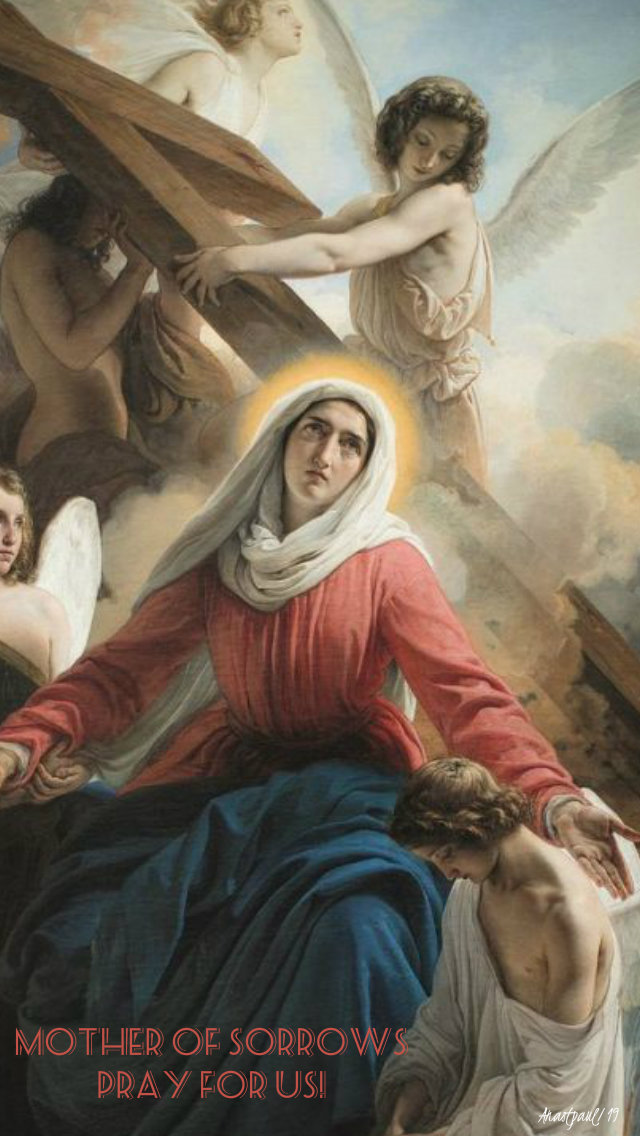
Mother of Sorrows, Pray for Us!

St Edmund, Pray for Us!mother of sorrows pray for us 16 nov 2019

Posted in CHRIST, the WAY,TRUTH,LIFE, PRACTISING CATHOLIC, QUOTES of the SAINTS, QUOTES on DEATH, QUOTES on SANCTITY, SAINT of the DAY, The WILL of GOD

Quote/s of the Day – 16 November – St Edmund Rich

Quote/s of the Day – 16 November – The Memorial of St Edmund Rich of Abingdon (1175-1240) Archbishop of Canterbury

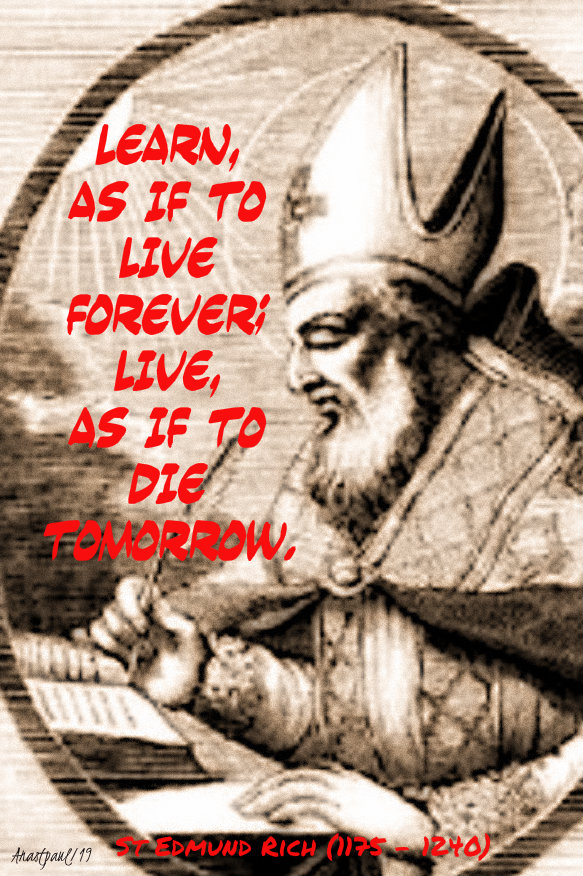
“… Learn, 
as if to live forever;
live, as if to die
tomorrow.”learn as if to live forever, live as if to die tomorrow st edmund rich of abingdon 16 nov 2019.jpg

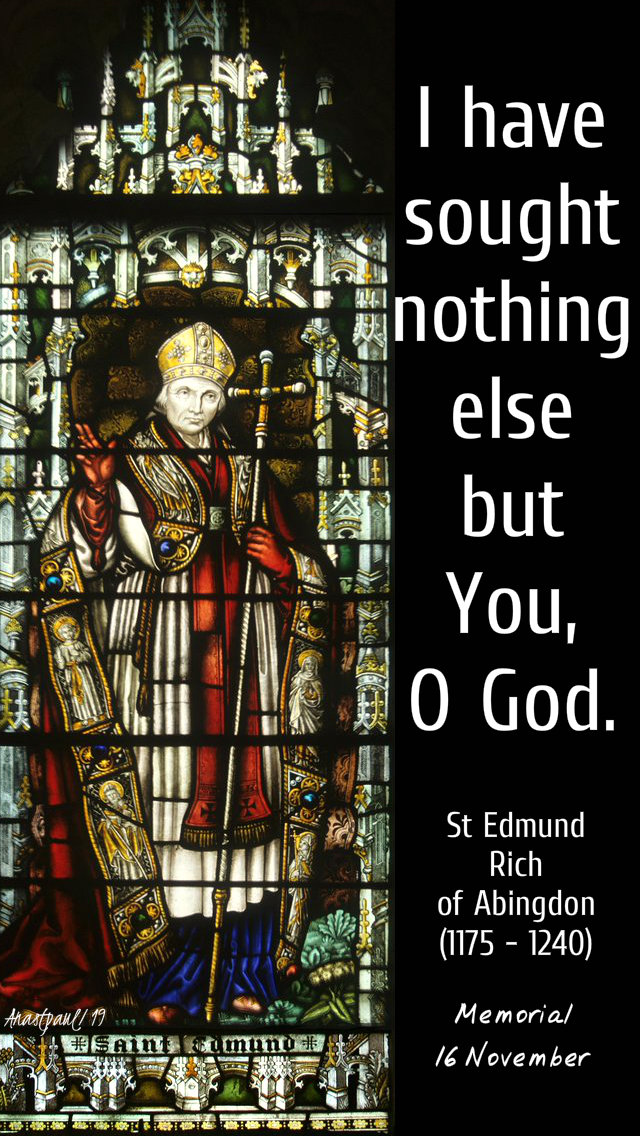
“I have sought nothing else
but You, O God.”

On his death bed

St Edmund Rich of Abingdon (1175 – 1240)i have sought nothing else but you o god st edmund rich of abingdon 16 nov 2019.jpg

Posted in EUCHARISTIC Adoration, ONE Minute REFLECTION, QUOTES of the SAINTS, QUOTES on PERSEVERANCE, QUOTES on PRAYER, SAINT of the DAY, The HOLY EUCHARIST / The HOLY MASS, The WORD

One Minute Reflection – 16 November – “Pray at all times ”

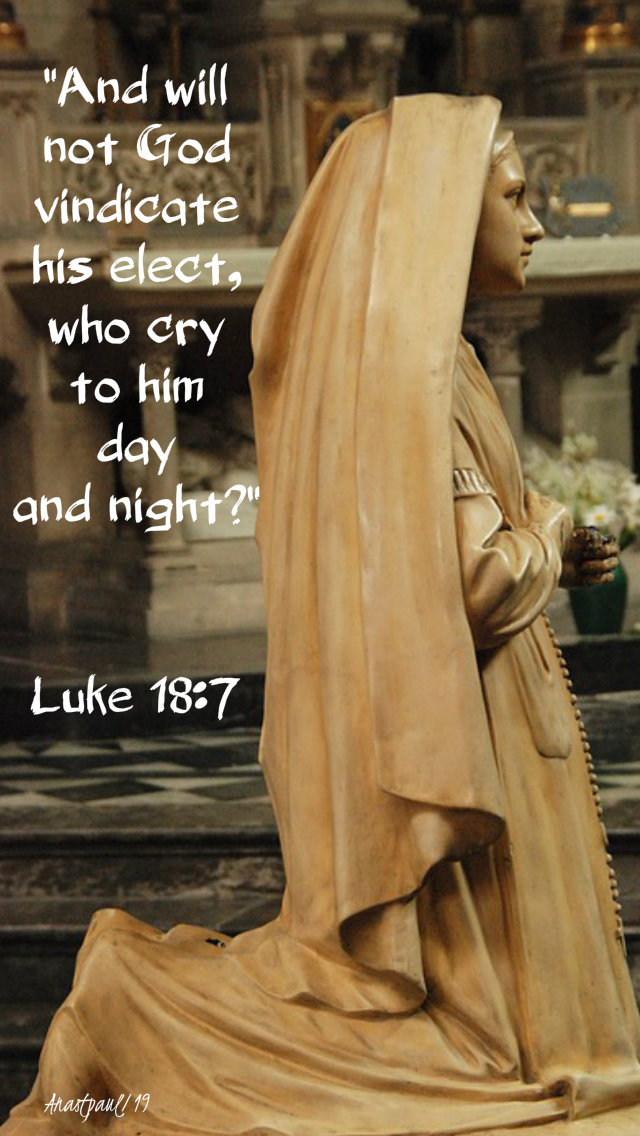
One Minute Reflection – 16 November – Saturday of the Thirty Second week in Ordinary Time, Year C, Gospel: Luke 18:1–8 and The Memorial of St Edmund Rich of Abingdon (1175-1240) Archbishop of Canterbury

“And will not God vindicate his elect, who cry to him day and night?” … Luke 18:7luke 18 7 and will not god vindicate his elect who cry to him day and night 16 nov 2019.jpg

REFLECTION “ Pray at all times ” commands the apostle Paul (1 Th 5:17).   Calling to mind this precept, Clement of Alexandria writes: “We have been commanded to praise and honour the Word, which we know to be our Savior and King and through Him, the Father, not on certain select days as others do but continually, our whole lives long and in every possible way.”

Amidst our daily occupations, at times when we overcome our egoistical tendencies, when we experience the joy of friendship towards others, at all such times, Christians must discover God.   Through Christ and in the Holy Spirit, Christians gain intimacy with God the Father and run along the way, as they seek that kingdom which, although it is not of this world (Jn 18:36), is prepared for, in this world and begins in this world.

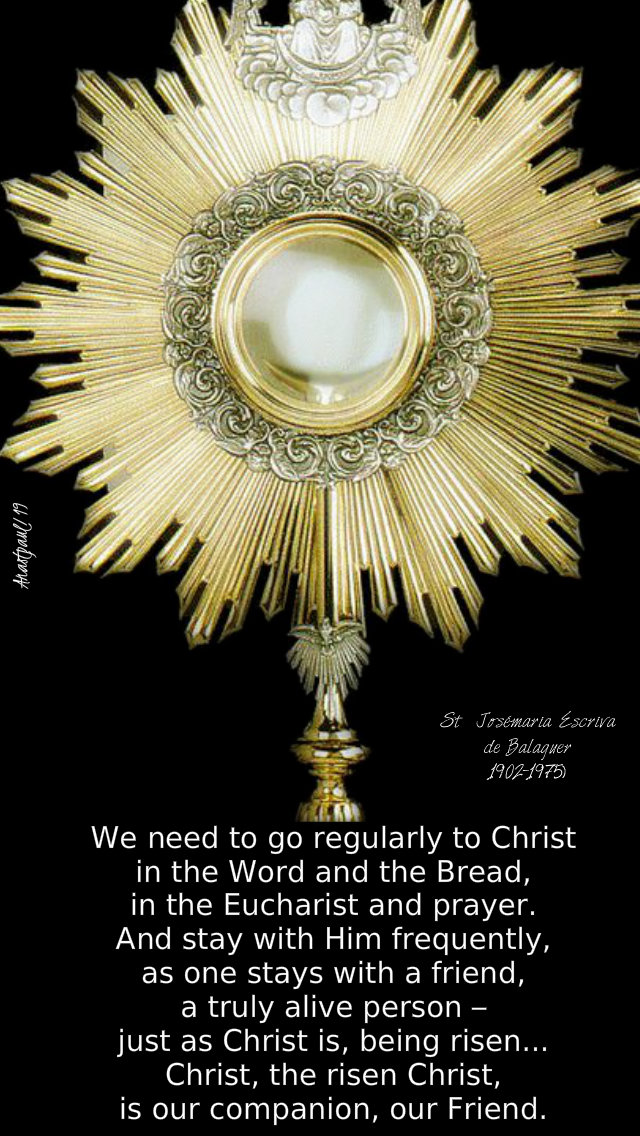
We need to go regularly to Christ in the Word and the Bread, in the Eucharist and prayer. And stay with Him frequently, as one stays with a friend, a truly alive person – just as Christ is, being risen…   Christ, the risen Christ is our companion, our Friend.   A companion who is only to be seen in the semi-darkness but whose reality fills our lives and makes us want His company permanently.   “The Spirit and the Bride say:  ‘Come!’ Let those who hear say: ‘Come!’   Let anyone who thirsts come forward and let those who desire it receive the gift of life-giving water…   He who gives this testimony says:  ‘Yes, I am coming soon!’  Amen.  Come, Lord Jesus!” (Rv 22:17.20).” … St Josémaria Escriva de Balaguer (1902-1975) – Sermon of 26/03/67 in ‘Es Cristo que pasa’we need to go regularly to christ - st josemaria 16 nov 2019.jpg

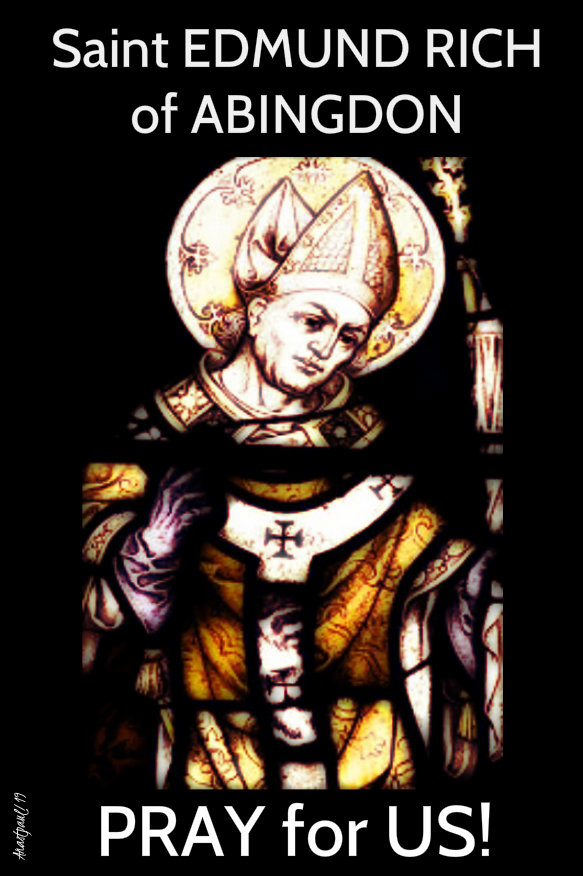
PRAYER – Holy Father, grant us a strong Faith! Poor Your graces into our hearts that we may believe with all our hearts, minds and souls and that in believing, we may constantly raise our entire being to You in prayer and supplication, in prayer and adoration, in prayer and love.   May the intercession of St Edmund Rich of Abingdon, a man of deep prayer from his youth, strengthen our perseverance.   Through Jesus Christ, our Lord in the unity of the Holy Spirit, God forever and ever, amen.st edmund rich of abingdon pray for us 16 nov 2019.jpg

Posted in DYING / LAST WORDS, SAINT of the DAY

Saint of the Day – 16 November – Saint Edmund Rich of Abingdon (1175-1240) Archbishop of Canterbury

Saint of the Day – 16 November – Saint Edmund Rich of Abingdon (1175-1240) Archbishop of Canterbury, Confessor, Apostle of Prayer and Charity, Mystic, Doctor of Divinity/Theology, eloquent Preacher, Ascetic, highly regarded Professor lecturer, Reformer, Writer, peacemaker, social activist and negotiator. Born, it is thought, on 20 November c. 1175 at St Edmund’s Lane, Abingdon, Berkshire (now Oxfordshire), England and died on 16 November 1240 at Soisy-Bouy, Seine-et-Marne, France.   Patronages – Abingdon, Oxfordshire, Roman Catholic Diocese of Portsmouth; St Edmund’s College, Cambridge; St Edmund Hall, Oxford, St Edmund’s College, Ware.st edmund rich icon.jpg

Of English birth, he became a respected lecturer in mathematics, dialectics and theology at the Universities of Paris and Oxford, promoting the study of Aristotle.   Having already an unsought reputation as an ascetic, he was ordained a priest, took a doctorate in divinity and soon became known, not only for his lectures on theology but as a popular preacher, spending long years travelling within England, and engaging, in 1227 preaching the sixth crusade.   Obliged to accept an appointment as Archbishop of Canterbury by Pope Gregory IX, he combined a gentle personal temperament with a strong public stature and severity towards King Henry III in defence of Magna Carta and in general of good civil and Church government and justice.   He also worked for strict observance in monastic life and negotiated peace with Llywelyn the Great.   His policies earned him hostility and jealousy from the king and opposition from several monasteries and from the clergy of Canterbury Cathedral.   He died in France at the beginning of a journey to Rome in 1240.

St Edmund was born circa 1174, possibly on 20 November (the feast of St Edmund the Martyr), in Abingdon in Berkshire (now Oxfordshire), 7 miles south of Oxford, England. He was the oldest of four children.

“Rich” was an epithet sometimes given to his wealthy merchant father, Reynold.   It was never applied to Edmund or his siblings in their lifetimes.   His father retired, with his wife’s consent, to the monastery at Eynsham Abbey, leaving in her hands the education of their family.   Her name was Mabel, she was a devout woman who lived an ascetic life and encouraged her children to do the same.   Both her daughters took the veil.

Edmund may have been educated at the monastic school in Abingdon.   He developed a taste for religious learning, saw visions while still at school and at the age of twelve took a vow of perpetual chastity in the Virgin’s church at Oxford.   His early studies were in England but he completed his higher learning in France, at the University of Paris.   He became a teacher about 1200, or a little earlier.   For six years he lectured on mathematics and dialectics, apparently dividing his time between Oxford and Paris and helped introduce the study of Aristotle.

Edmund became one of Oxford’s first lecturers with a Master of Arts but was not Oxford’s first Doctor of Divinity.   Long hours at night spent in prayer had the result that he often “nodded off” during his lectures.   There is a long-established tradition that he utilised his lecture-fees to build the Lady Chapel of St Peter’s in the East at Oxford.   The site where he lived and taught was formed into a mediaeval academic hall in his name and later incorporated as the college of St Edmund Hall.st edmund rich.jpg

His mother’s influence then led to his taking up the study of theology.   Though for some time Edmund resisted the change, he finally entered upon his new career between 1205 and 1210.   He spent a year in retirement with the Augustinian canons of Merton Priory, received ordination, took a doctorate in divinity and soon became known as a lecturer on theology and as an extemporaneous preacher.   In this capacity he gained some reputation for eloquence.   He spent the fees which he received in charity and refused to spend upon himself the revenues which he derived from several benefices.   He often retired for solitude to Reading Abbey and it is possible that he would have become a monk if that profession had afforded more scope for his gifts as a preacher and expositor.

His spiritual fervour, eloquent and effective preaching led to miracles and conversions. He constantly encouraged the faithful to pray.   “A hundred thousand people are deceived by multiplying prayers,” he said once. “I would rather say five words devoutly with my heart, than 5,000 which my soul does not relish with affection and intelligence.”

He was known for his great self-discipline – under his clothes, he wore a sackcloth pressed close to his skin by metal plates and he slept only a few hours at night in order to spend time in prayer and meditation.   On one occasion, he was observed levitating, consumed in prayer.

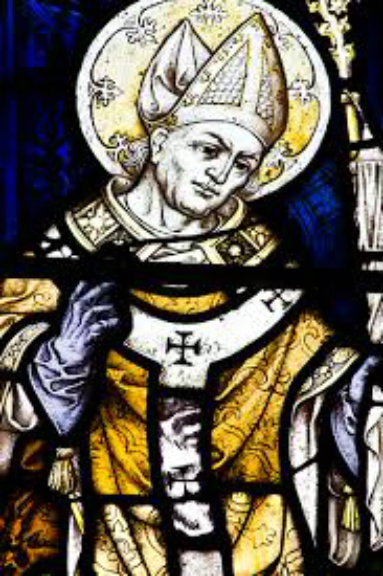
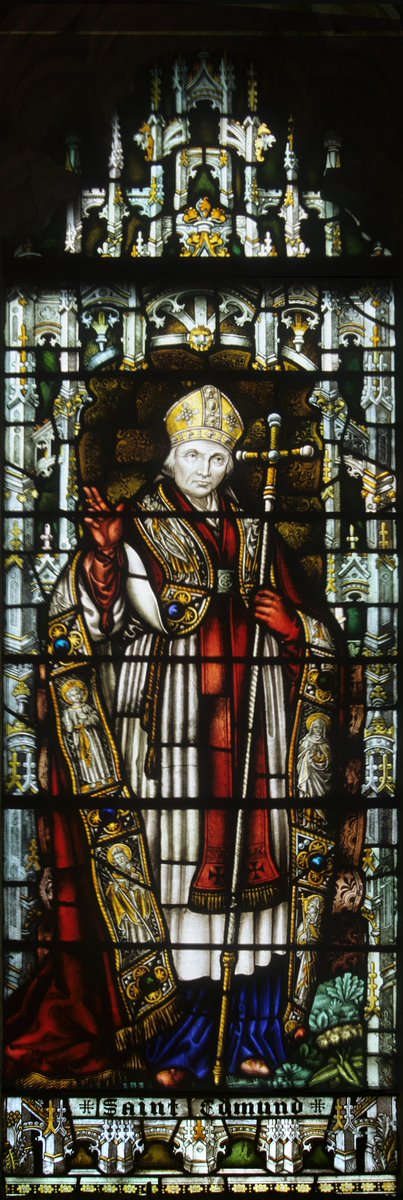
In 1233 he was named the 46th Archbishop of Canterbury against his wishes.   He advised King Henry III and presided at the king’s confirmation of the Magna Carta in 1237.   Edmund was at the centre of relations between Rome and England and spoke truth to power on both sides.   He admonished the king for having favourites in his court and travelled to Rome to urge reforms in the Church.st edmund rich glass large.jpg

Because he was so truthful and did not vary from what he saw as just and right, many people found him inconvenient.   Political movements forced Edmund’s resignation in 1240 and he moved to France and became a Monk.   He died later that year and miracles at his grave were reported soon after his burial.   His relics rest in the Reliquary Chapel in the Basilica.  “I have sought nothing else but Thee, O God.” – St Edmund’s Dying Words.

In less than a year after Edmund’s death, miracles were wrought at his grave.   Despite Henry’s opposition, he was Canonised only 6 years after his death, on 16 December 1246 by Pope Innocent IV.    A few years later, the first chapel dedicated to him, St Edmund’s Chapel, was Consecrated in Dover, by his friend St Richard of Chichester (c 1197-1253), making it the only chapel dedicated to one English Saint by another. st edmund_of_abingdon.jpg

Edmund’s body was never translated to Canterbury, because the Benedictine community there resented what they regarded as Edmund’s attacks on their independence.   After his death he was taken back to Pontigny Abbey, where his main relics are now found in a baroque reliquary tomb dating to the 17th century.

An arm is enshrined in the Chapel of Our Lady of the Assumption at St Edmund’s Retreat on Enders Island off the coast of Mystic, Connecticut.   The retreat is operated by the Society of the Fathers and Brothers of St Edmund.

In 1853, the fibula of the Edmund’s left leg was presented to St Edmund’s College, Ware,by Cardinal Wiseman.   Many local cures of serious illnesses were attributed to the intercession of St Edmund, one of the earliest of these was of a student who nearly died after a fall in 1871.   His complete healing led to the accomplishment of a vow to extend the beautiful Pugin chapel with a side chapel to honour the saint.

St Edmund’s silk chasuble, which Edmund had with him at his death, remains in a local church, with a stole and maniple.   His works, Speculum Ecclesiae (Mirror of the Church)
and Provincial Constitution, are still relevant today.  He holds the sad honour, of being the last Archbishop of Canterbury, to be Canonised.   The Society of St Edmund, formed in his honour in France in the 1840s, operates from the US – you can read about them here:  http://www.sse.org/history.html.

462px-St_Edmund_bronze.jpg
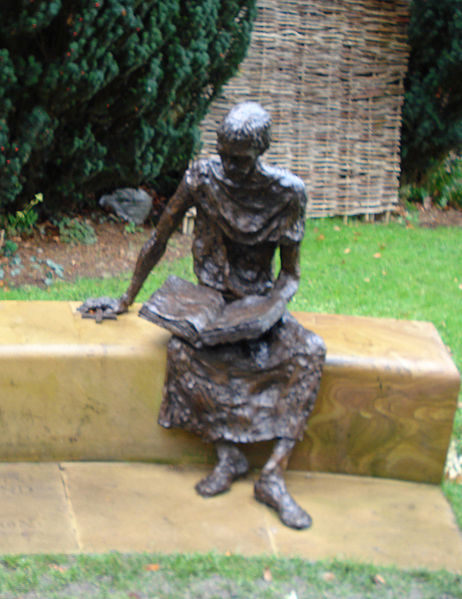
Bronze statue of Edmund at St Edmund Hall, Oxford
Posted in MARIAN TITLES, SAINT of the DAY

Feasts of Our Lady and Memorials of the Saints – 16 November

St Gertrude the Great (1256-1302) (Optional Memorial)
About St Gertrude:
https://anastpaul.com/2017/11/16/saint-of-the-day-st-gertrude-the-great-1256-1302-16-november/

St Margaret of Scotland (1045-1093) Queen (Optional Memorial)
About St Margaret:
https://anastpaul.com/2018/11/16/saint-of-the-day-16-november-st-margaret-of-scotland-1045-1093-queen/

Patronage of Our Lady:   Feast permitted by a 1679 decree of the Sacred Congregation of Rites for all provinces of Spain, in memory of the victories obtained there over infidels. Pope Benedict XIII granted it to the Papal States and it may now be celebrated with due permission by churches throughout the world.

Our Lady of the Gate of Dawn/Our Lady of Ostra Brama:  is the prominent Catholic painting of the Blessed Virgin Mary venerated by the faithful in the Chapel of the Gate of Dawn in Vilnius, Lithuania.  The painting was historically displayed above the Vilnius city gate; city gates of the time often contained religious artefacts intended to ward off attacks and bless passing travellers.
The painting is in the Northern Renaissance style and was completed most likely around 1630.   The Virgin Mary is depicted without the infant Jesus.   The artwork soon became known as miraculous and inspired a following.   A dedicated chapel was built in 1671 by the Discalced Carmelites.   At the same time, possibly borrowing from the Eastern Orthodox tradition, the painting was covered inexpensive and elaborate silver and gold clothes leaving only the face and hands visible.
In 1702, when Vilnius was captured by the Swedish army during the Great Northern War, Our Lady of the Gate of Dawn came to her people’s rescue.   At dawn, the heavy iron city gates of the gate fell crushing and killing four Swedish soldiers.   After this, the Polish-Lithuanian Commonwealth Army successfully counter-attacked near the gate.
In the following centuries, the cult grew and Our Lady became an important part of religious life in Vilnius.   This inspired many copies in Lithuania, Poland and diaspora communities worldwide.   On 5 July 1927, the image was canonically crowned as Mother of Mercy.   The chapel was visited by St Pope John Paul II in 1993.   It is a major site of pilgrimage in Vilnius and attracts many visitors, especially from Poland.

St Afan of Wales
St Africus of Comminges
Bl Agnes of Assisi
St Agostino of Capua
St Alfric of Canterbury
St Anianus of Asti
St Céronne
St Edmund Rich of Abingdon (1175-1240)
Bl Edward Osbaldeston
St Elpidius the Martyr
St Eucherius of Lyon
St Eustochius the Martyr
St Felicita of Capua
St Fidentius of Padua
St Gobrain of Vannes
St Ludre
St Marcellus the Martyr
St Othmar of Saint Gal
Bl Simeon of Cava

Martyrs of Africa – (11 saints)

Martyrs of Almeria – (9 saints): Soon after the start of the Spanish Civil War in 1936, the Communist-oriented Popular Front had all clergy and religious arrested and abused as they considered staunch Christians to be enemies of the revolution. Many of these prisoners were executed for having promoted the faith and this memorial remembers several of them killed in the province of Almeria.
• Adrián Saiz y Saiz
• Bienvenido Villalón Acebrón
• Bonifacio Rodríguez González
• Diego Ventaja Milán
• Eusebio Alonso Uyarra
• Isidoro Primo Rodríguez
• Justo Zariquiegui Mendoza
• Manuel Medina Olmos
• Marciano Herrero Martínez
Beatification – 10 October 1993 by St Pope John Paul II

Posted in franciscan OFM, SAINT of the DAY, VATICAN Resources

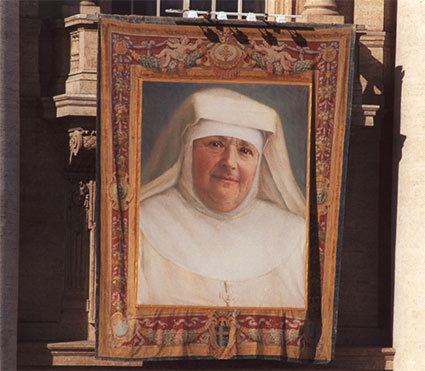
Saint of the Day – 15 November – Blessed Mary of the Passion (1839-1904)

Saint of the Day – 15 November – Blessed Mary of the Passion (1839-1904) Religious, Foundress of the Franciscan Missionaries of Mary, Missionary – born as Hélène-Marie-Philippine de Chappotin de Neuville on 21 May 1839 in Nantes, Loire-Atlantique, France and died on 15 November 1904 in San Remo, Imperia, Italy of natural causes. Patron of the Order she founded.   The Franciscan Missionaries of Mary were founded in British India in 1877 and is currently one of the largest religious institutes in the Church.bl marie passion-fundo2
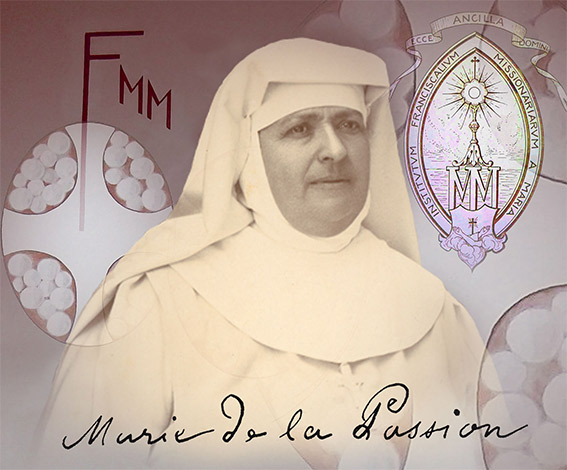
Born on 21 May 1839 in Nantes, France, into a noble Christian family, Hélène Marie Philippine de Chappotin de Neuville, in religion Mary of the Passion, showed from childhood eminent natural gifts and a deep faith.

In April 1856, during a retreat, she first experienced a call from God to a life of total consecration.   The unforeseen death of her mother delayed its realisation.   In December 1860, with the consent of the Bishop of Nantes, she entered the Poor Clares whose ideal of the simplicity and poverty of Saint Francis attracted her.

On 23rd January 1861, while still a postulant, she had a profound experience of God who invited her to offer herself as a victim for the Church and the Pope.   This experience marked her for life.   A short time after, having become seriously ill, she had to leave the monastery.   When she was well again, her confessor directed her towards the Society of Marie Reparatrice.   She entered with them in 1864 and on the following 15 August, in Toulouse, she received the religious habit with the name of Mary of the Passion.bl mary of passion and jesus.jpg
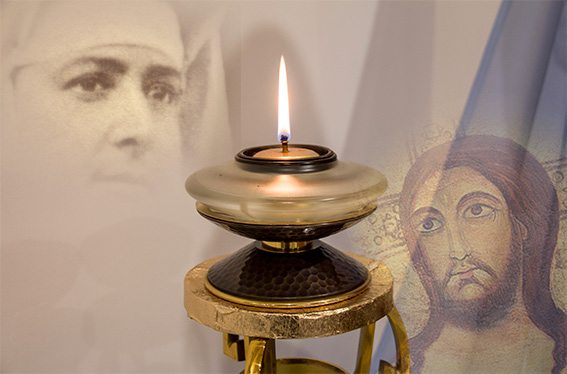
In March 1865, while still a novice, she was sent to India, to the Apostolic Vicariate of Madurai, confided to the Society of Jesus.   The Reparatrice sisters there had the task of formation of sisters of an autonomous congregation as well as being involved in other apostolic activities  . It was there, that she pronounced her temporary vows on 3 May 1866.

Because of her gifts and virtues, she was nominated local superior and then, in July 1867, she was named provincial superior of the three convents of the Reparatrice.   Under her guidance, the works of the apostolate developed, peace which had been somewhat disturbed by tensions which were already existing in the mission, was re-established and fervour and regularity flourished again in the communities.

In 1874, a new house was founded in Ootacamund in the Vicariate of Coimbatore, confided to the Paris Foreign Mission Society.   However, in Madurai the dissensions became exacerbated to such an extent that, in 1876 some religious, among them Mary of the Passion, were driven to leave the Society of Marie Reparatrice, reuniting, at Ootacamund under the jurisdiction of the Vicar Apostolic of Coimbatore, Monsignor Joseph Bardou MEP.

In November 1876, Mary of the Passion went to Rome to regularise the situation of the twenty separated sisters and, on 6 January 1877, obtained the authorisation from Pius IX to found a new Institute which was to be specifically missionary and was to be called the Missionaries of Mary.Mary.Passion-World.jpg

On the suggestion of the Congregation of Propaganda Fide, Mary of the Passion opened a novitiate in Saint-Brieuc in France, where very soon numerous vocations came along.   In April 1880 and in June 1882, the Servant of God went to Rome to resolve the difficulties which were threatening to hinder the stability and growth of the young Institute.   This latter journey, on June 1882, marked an important stage in her life, in fact, she was authorised to open a house in Rome and, through providential circumstances, she rediscovered the Franciscan direction which God had indicated to her twenty-two years previously.   On 4 October 1882, in the Church of the Aracoeli, she was received into the Third Order of Saint Francis and thus began her relationship with the Servant of God, Fr Bernardin de Portogruaro, Minister General, who with paternal solicitude would support her in her trials.

In March 1883, due to latent opposition, Mary of the Passion was deposed from her office of Superior of the Institute.   However, after an inquiry ordered by Pope Leo XIII, her innocence was fully acknowledged and at the Chapter of July 1884 she was re-elected.

The Institute of the Missionaries of Mary then began to develop rapidly.   On 12 August 1885 the Laudatory Decree and that of affiliation to the Order of Friars Minor were issued.   The Constitutions were approved ad experimentum on 17 July 1890 and definitively on 11 May 1896.   Missionaries were sent regularly to the most perilous and distant places overcoming all obstacles and boundaries.

The zeal of the Foundress knew no bounds in responding to the calls of the poor and the abandoned.   She was particularly interested in the promotion of women and the social question – with intelligence and discretion, she offered collaboration to the pioneers who were working in these spheres, which they appreciated very much.bl Maria Passion .jpg
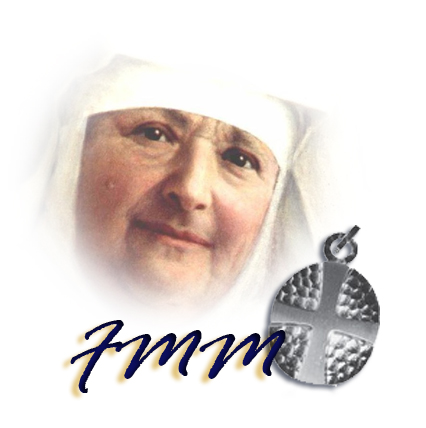
Her intense activity drew its dynamism from contemplation of the great mysteries of faith.   For Mary of the Passion, all led back to the Unity-Trinity of God Truth-Love, who communicates Himself to us through the paschal mystery of Christ.   It was in union with these mysteries that, in an ecclesial and missionary dimension, she lived her vocation of offering.   Jesus in the Eucharist was for her, “the great missionary” and Mary, in the responsibility of her role, traced out for her, the path of unconditional donation to the work of God.   Thus she opened her Institute to the horizons of universal mission, accomplished in Francis of Assisi’s evangelical spirit of simplicity, poverty and charity .

She took great care, not only of the external organisation of the works but above all of the spiritual formation of the religious.   Gifted with an extraordinary capacity for work, she found time to compose numerous writings on formation, whilst by frequent correspondence, she followed her missionaries dispersed throughout the world, relentlessly calling them to a life of holiness.   In 1900 her Institute received the seal of blood through the martyrdom of seven Franciscan Missionaries of Mary, who were Beatified in 1946 and Canonised during the Great Jubilee of the year 2000.   To be the spiritual mother of these missionaries who had known how to live to the shedding of their blood, the ideal proposed by her, was for Mary of the Passion, both a great sorrow, a great joy and a time of great emotion.mary-of-the-passion--750
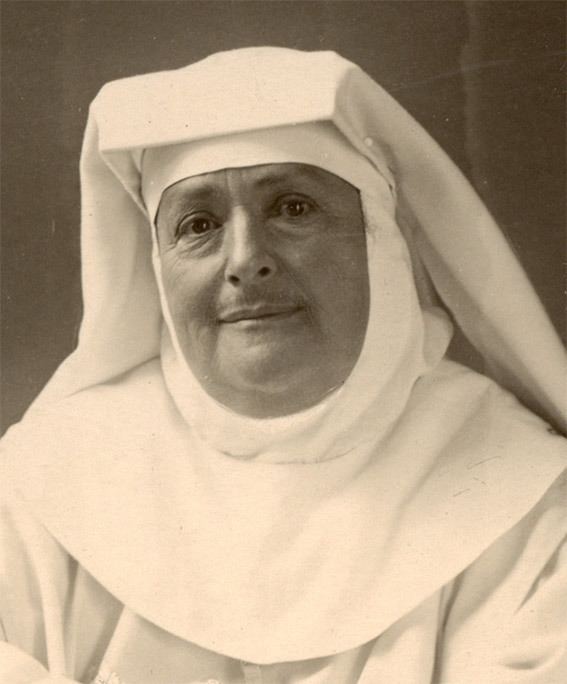
Worn out by the fatigue of incessant journeys and daily labour, Mary of the Passion, after a brief illness, died peacefully in San Remo on 15 November 1904, leaving more than 2,000 religious and eighty-six houses scattered about the four continents.   Her mortal remains repose in a private oratory of the General House of the Institute of the Franciscan Missionaries of Mary in Rome.bl mary of the passion shrine
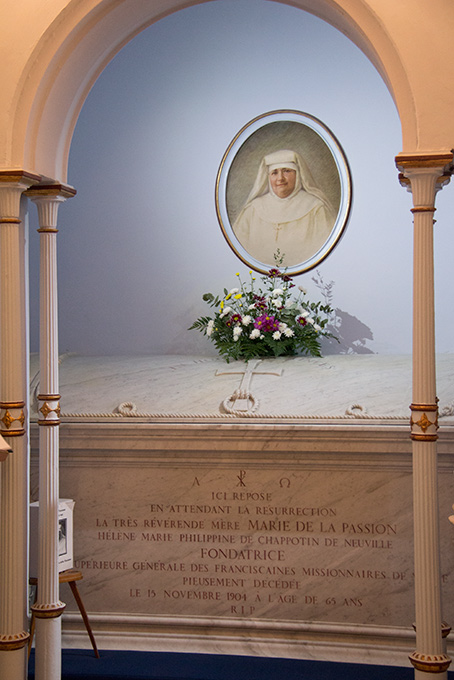
bl mary of the passion shrine 2

In February 1918, in San Remo, the Informative Process was opened for the Cause of Beatification and Canonisation.   In 1941, the Decree on the writings was promulgated and, during the following years, numerous postulatory letters were addressed to the Holy See from all parts of the world in favour of the Cause of the Servant of God.   After the Consultors had voted unanimously in its favour, the Decree for the Introduction of the Cause was published on 19 January 1979, with the approbation of His Holiness St John Paul II.   On 28 June 1999 the Sovereign Pontiff St John Paul II solemnly promulgated the Decree on the heroicity of the virtues of Mother Mary of the Passion

On 5 March 2002, the healing of a religious, suffering from “pulmonary and vertebral TBC, Pott’s Disease”, was recognised as a miracle granted by God, through the intercession of the Venerable Mary of the Passion.   On 23 April 2002, in the presence of the Sovereign Pontiff St John Paul II, the Decree opening the path for the Beatification of the Venerable Servant of God was promulgated. … Vatican.va

Bl Mary was Beatified 10 October 2002, Vatican City, by St Pope John Paul II.mary-of-the-passion-beatification750
Posted in DOCTORS of the Church, DOMINICAN OP, EUCHARISTIC Adoration, QUOTES of the SAINTS, SACRAMENTS, SAINT of the DAY, The HOLY EUCHARIST / The HOLY MASS

Thought for the Day – 15 November – Do This in Remembrance of Me

Thought for the Day – 15 November – The Memorial of St Albert the Great OP (1200-1280), Bishop and Doctor of the Church

Do This in Remembrance of Me

Saint Albert the Great
Bishop and Doctor of the Church

An excerpt from Commentary on the Gospel of Luke

Do this in remembrance of Me.   Two things should be noted here.   The firs,t is the command that we should use this Sacrament, which is indicated when He says: Do this. The second, is that this Sacrament commemorates the Lord’s going to death for our sake.

Do this.   Certainly He would demand nothing more profitable, nothing more pleasant, nothing more beneficial, nothing more desirable, nothing more similar to eternal life.  We will look at each of these qualities separately.

This Sacrament is profitable because it grants remission of sins;  it is most useful because it bestows the fullness of grace on us in this life.   The Father of spirits instructs us in what is useful for our sanctification.   And his sanctification is in Christ’s sacrifice, that is, when He offers Himself in this Sacrament to the Father for our redemption, to us for our use.   I consecrate Myself for their sakes.   Christ, who through the Holy Spirit offered Himself up without blemish to God, will cleanse our consciences from dead works to worship the living God.

Nor can we do anything more pleasant.   For what is better than God manifesting His whole sweetness to us.   You gave them bread from heaven, not the fruit of human labour but a bread endowed with all delight and pleasant, to every sense of taste.   For this substance of Yours revealed Your kindness toward Your children and serving the desire of each recipient, it changed to suit each one’s taste.

He could not have commanded anything more beneficial, for thisSsacrament is the fruit of the tree of life.   Anyone who receives this Sacrament with the devotion of sincere faith will never taste death.   It is a tree of life for those who grasp it and blessed is he who holds it fast.   The man who feeds on Me shall live on account of Me.

Nor could He have commanded anything more lovable, for this Sacrament produces love and union.   It is characteristic of the greatest love to give itself as food.   Had not the men of my tent exclaimed:  Who will feed us with his flesh to satisfy our hunger? as if to say:  I have loved them and they have loved Me so much, that I desire to be within them and they wish to receive Me so that they may become My members.   There is no more intimate or more natural means for them to be united to Me and I to them.

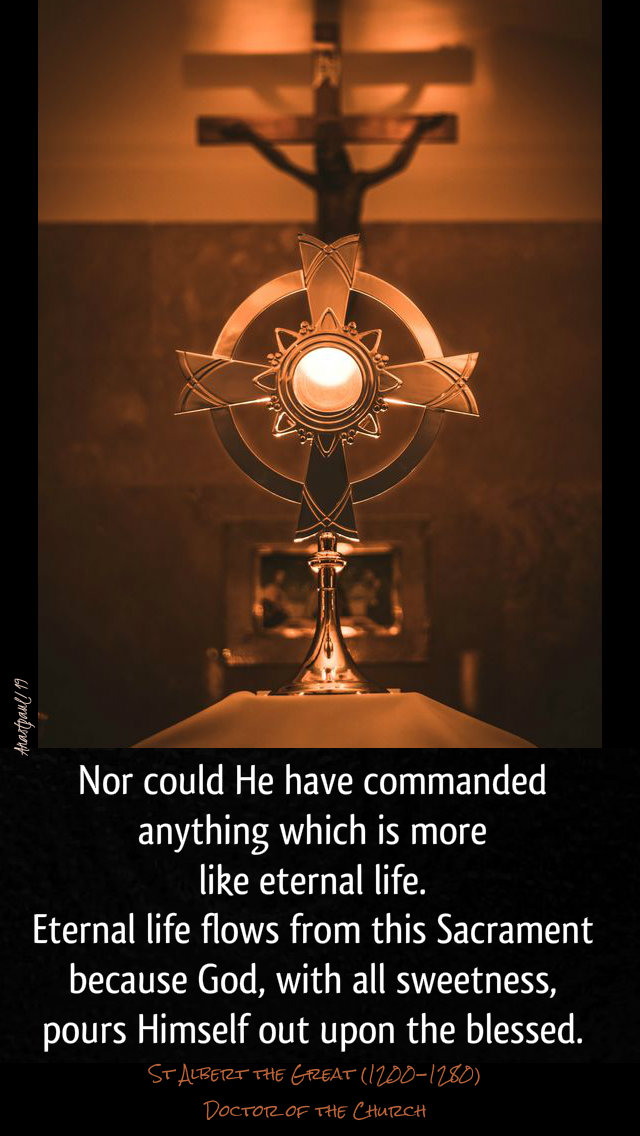
Nor could He have commanded anything, which is more like eternal life.   Eternal life flows from this Sacrament, because God, with all sweetness, pours Himself out upon the blessed.

St Albert the Great, Pray for Us that we may receive the Body of Christ with total faith, conviction and love!nor could he have commanded anything - st albert the great - eucharist 15 nov 2019.jpg

Posted in DOCTORS of the Church, DOMINICAN OP, EUCHARISTIC Adoration, franciscan OFM, MARIAN QUOTES, MATER DOLOROSA - Mother of SORROWS, QUOTES of the SAINTS, SAINT of the DAY, The BLESSED VIRGIN MARY, The HOLY CROSS, The HOLY EUCHARIST / The HOLY MASS, The PASSION

Quote/s of the Day – 15 November – St Albert and Bl Mary of the Passion

Quote/s of the Day – 15 November – The Memorial of St Albert the Great OP (1200-1280) Doctor of the Church and of Bl Mary of the Passion FMM (1839-1904)

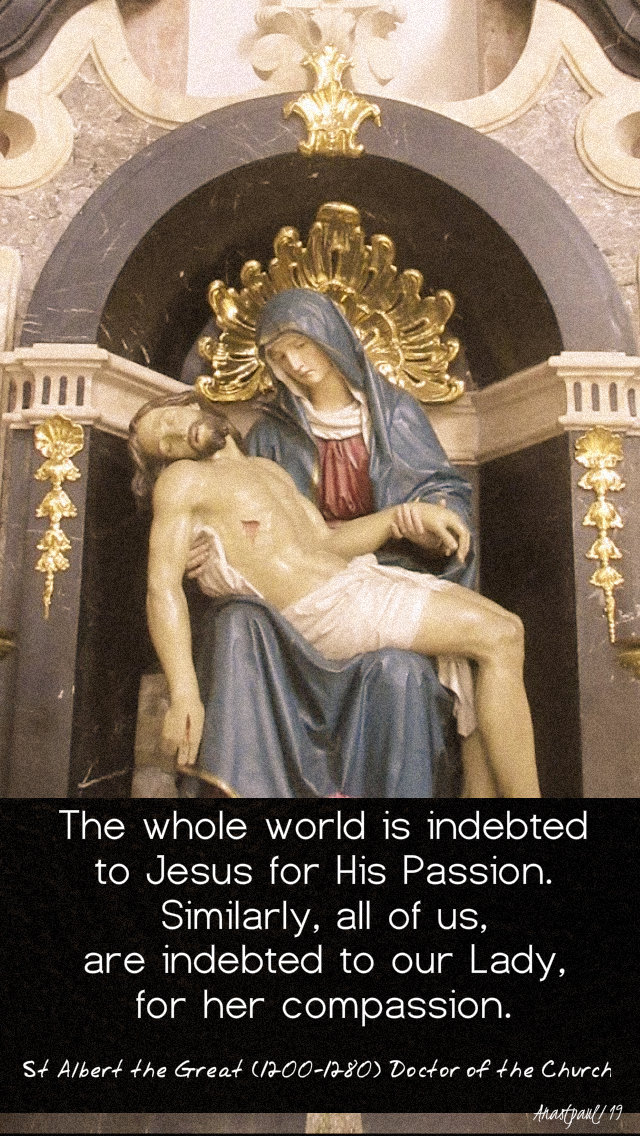
“The whole world is indebted
to Jesus for His Passion.
Similarly, all of us,
are indebted to our Lady,
for her compassion.”

St Albert the Great (1200-1280)the whole world is indebted to jesus - st albert the great mary's compassion 15 nov 2019.jpg

More from St Albert here:
https://anastpaul.com/2018/11/15/quote-s-of-the-day-15-november-the-memorial-of-st-albert-the-great-1200-1280-doctor-universalis-universal-doctor/

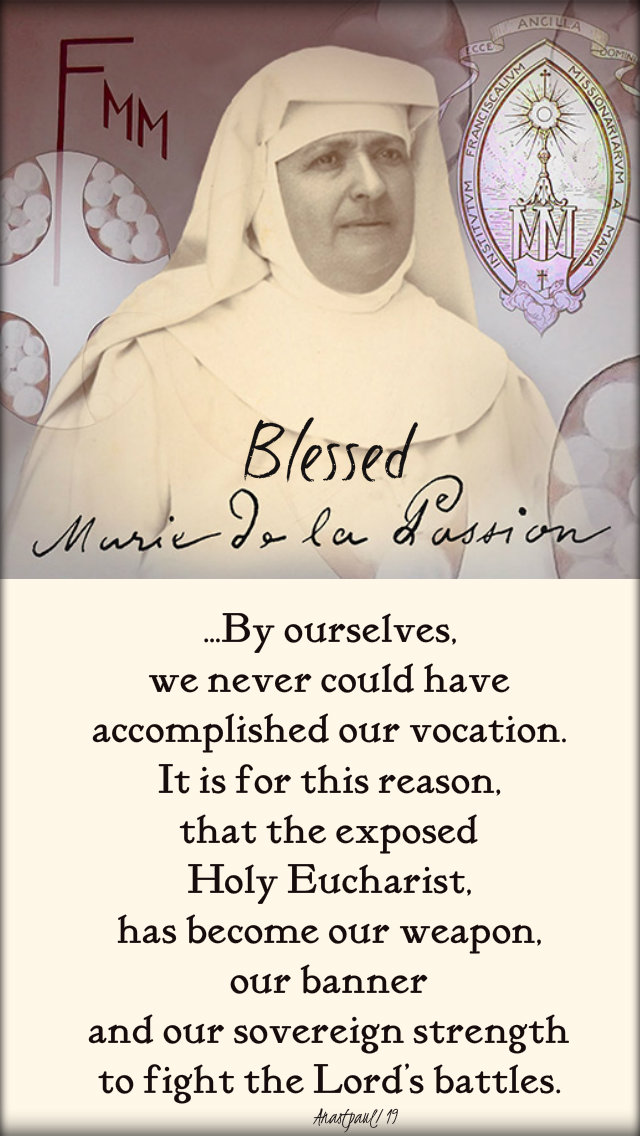
“…By ourselves,
we never could have
accomplished our vocation.
It is for this reason,
that the exposed Holy Eucharist,
has become our weapon,
our banner
and our sovereign strength
to fight the Lord’s battles.”by ourselves we never could've - bl mary of the passion 15 nov 2019

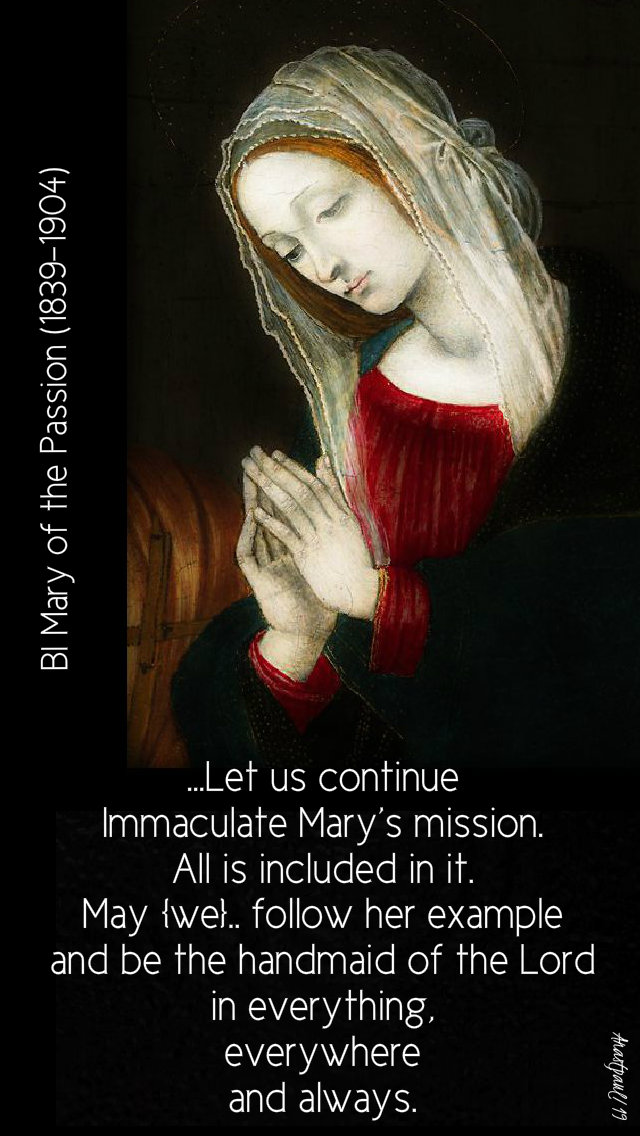
“…Let us continue
Immaculate Mary’s mission.
All is included in it.
May [we].. follow her example
and be the handmaid of the Lord
in everything,
everywhere
and always.”

Bl Mary of the Passion (1839-1904)let us continue imm mary's mission - bl mary of the passion 15 nov 2019

Posted in DOCTORS of the Church, ONE Minute REFLECTION, PRACTISING CATHOLIC, QUOTES of the SAINTS, QUOTES on DEATH, QUOTES on ETERNAL LIFE, QUOTES on FAITH, QUOTES on HEAVEN, QUOTES on LOVE, QUOTES on SANCTITY, SAINT of the DAY, The LAST THINGS, The WORD

One Minute Reflection – 15 November – ‘Let us try to merit this hour of eternal delights.’

One Minute Reflection – 15 November – Friday of the Thirty Second week in Ordinary Time, Year C, Gospel: Luke 17:26–37 and the Memorial of St Albert the Great OP (1200-1280) Doctor of the Church and of Bl Bl Mary of the Passion FMM (1839-1904)

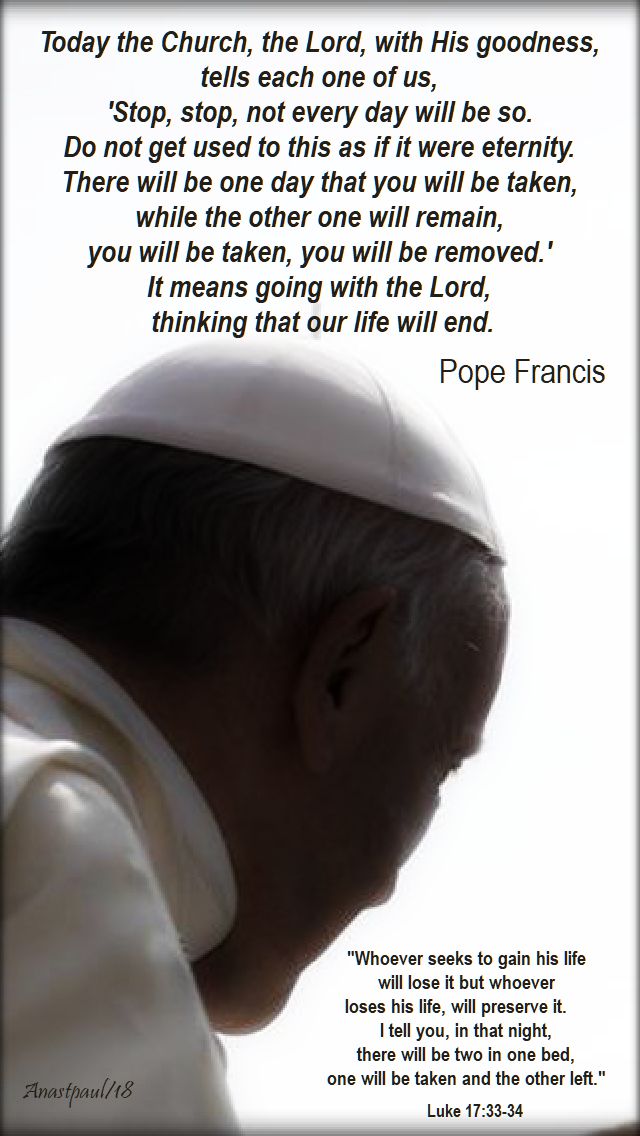
“Whoever seeks to gain his life, will lose it but whoever loses his life, will preserve it.   I tell you, in that night there will be two in one bed, one will be taken and the other left.”…Luke 17:33-34

REFLECTION – “Today the Church, the Lord, with His goodness, tells each one of us, ‘Stop, stop, not every day will be so.   Do not get used to this as if it were eternity.   There will be one day that you will be taken, while the other one will remain, you will be taken, you will be removed.’   It means going with the Lord, thinking that our life will end.”…Pope Francis – Santa Marta, 17 November 2017whoever-seeks-to-gain-his-life-today-the-church-the-lord-pope-francis-16-nov-2018 and 15 nov 2019.jpg

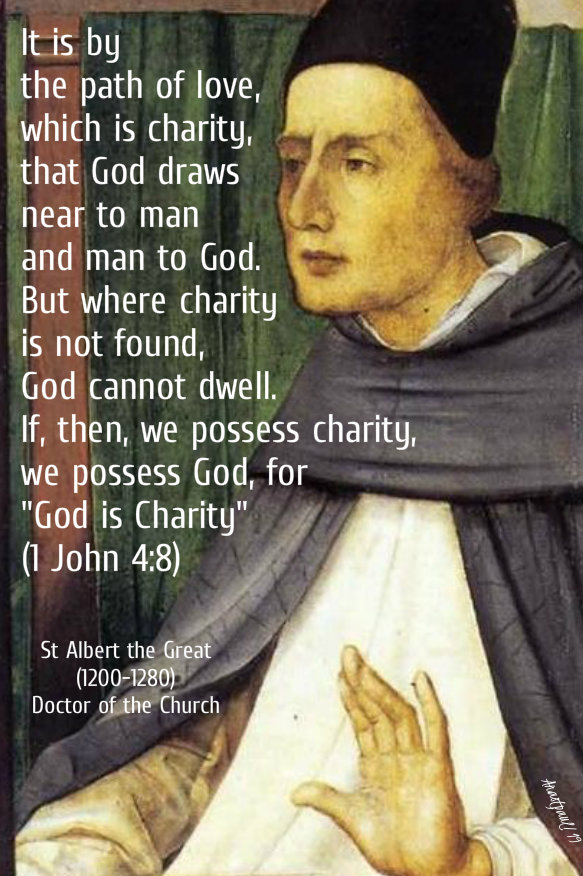
“It is by the path of love, which is charity, that God draws near to man and man to God. But where charity is not found, God cannot dwell. If, then, we possess charity, we possess God, for “God is Charity” (1 John 4:8) … it is by the path of love - st albert the great 15 nov 2019

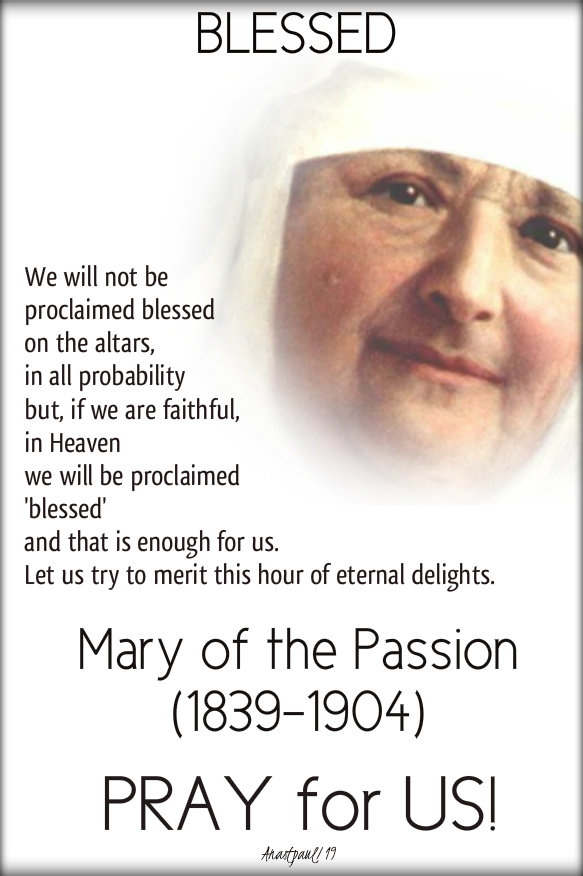
“We will not be proclaimed blessed on the altars in all probability but if we are faithful, in Heaven we will be proclaimed ‘blessed’ and that is enough for us.   Let us try to merit this hour of eternal delights.” … Bl Mary of the Passion (1839-1904)we will not be proclaimed blessed - bl mary of the passion 15 nov 2019 pray for us .jpg

PRAYER – Lord God, You made St Albert great by his gift for reconciling human wisdom with divine faith.   Help us so to follow his teaching that every advance in science may lead us to a deeper knowledge and love of You.   May his prayers on our behalf be a succour to us all.   We ask too for the intercession of the blessed Mary of the Passion that her zeal and perseverance may be the driving force of our lives.   Through our Lord Jesus Christ with the Holy Spirit, one God for all eternity, amen.st-albert-the-great-pray-for-usno 2 - 15 nov 2017

Posted in CHRIST the KING, DOCTORS of the Church, DOMINICAN OP, Our MORNING Offering, PRAYERS of the SAINTS, SAINT of the DAY

Our Morning Offering – 15 November – Supreme Lord By St Albert the Great

Our Morning Offering – 15 November – Friday of the Thirty Second week in Ordinary Time, Year C and the Memorial of St Albert the Great OP (1200-1280) Doctor of the Church

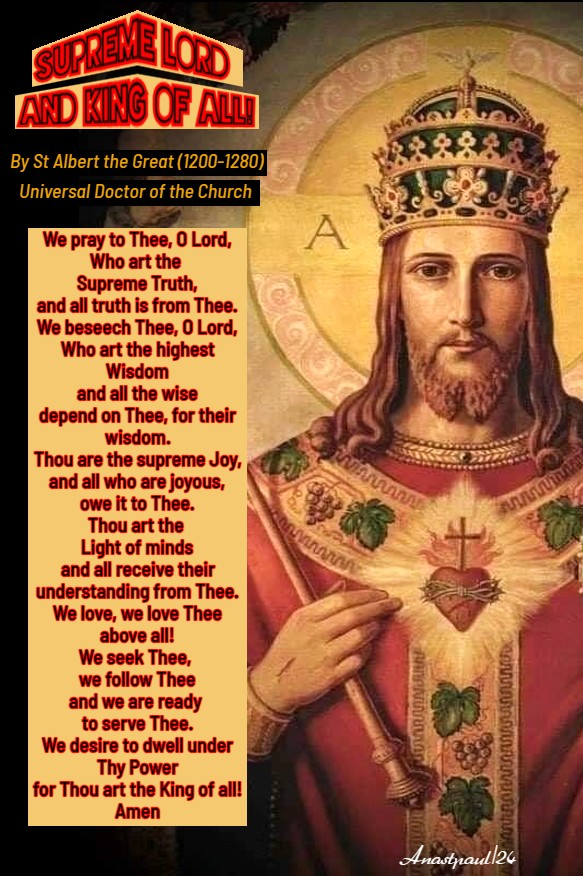
Supreme Lord and King of All!
By St Albert the Great (1200-1280)
Universal Doctor of the Church

We pray to Thee, O Lord,
Who art the Supreme Truth,
and all truth is from Thee.
We beseech Thee, O Lord,
Who art the highest Wisdom
and all the wise
depend on Thee, for their wisdom.
Thou are the supreme Joy,
and all who are joyous, owe it to Thee.
Thou art the Light of minds
and all receive their understanding from Thee.
We love, we love Thee above all!
We seek Thee, we follow Thee
and we are ready to serve Thee.
We desire to dwell under Thy Power
for Thou art the King of all!
Amen

Posted in DOCTORS of the Church, SAINT of the DAY

Memorials of the Saints – 15 November

St Albertus Magnus OP (1200-1280) (Optional Memorial)
St Albert!

Saint of the Day – 15 November – St Albert the Great OP (1200-1280) Bishop, Confessor, Doctor of the Church

St Anianus of Wilparting
St Arnulf of Toul
Bl Caius of Korea
St Desiderius of Cahors
St Eugene of Toledo
St Felix of Nola
St Findan
St Fintan the Missionary
St Gurias of Edessa
Bl Hugh Faringdon
Bl John Eynon
Bl John Rugg
Bl John Thorne
St Joseph Mukasa
St Joseph Pignatelli
St Leopold III/Leopold the Good ( 1073 – 1136)
Biography:

Saint of the Day – 15 November – St Leopold III (1073-1136) – “Leopold the Good”


St Luperius of Verona
St Machudd of Llanfechell
St Malo of Aleth
St Marinus of Wilparting
Bl Mary of the Passion FMM (1839-1904)
Bl Miguel Díaz Sánchez
St Paduinus of Le Mans
Bl Richard Whiting
Bl Roger James
St Shamuna of Edessa
St Sidonius of Saint-Saens

Martyrs of Hippo – 20 saints: 20 Christians martyred together and celebrated by Saint Augustine. The only details about them to survive are three of the names – Fidenziano, Valerian and Victoria. Hippo, Numidia (in north Africa).

Martyrs of North Africa – 3 saints: A group of Christians murdered for their faith in imperial Roman north Africa. The only details that have survived are the names of three of them – Fidentian, Secundus and Varicus.

Posted in ArchAngels and Angels, JESUIT SJ, ONE Minute REFLECTION, QUOTES of the SAINTS, QUOTES on HEAVEN, SAINT of the DAY, The KINGDOM of GOD / HEAVEN, The WORD

One Minute Reflection – 14 November – ” … For behold, the kingdom of God is in the midst of you.”

One Minute Reflection – 14 November – Thursday of the Thirty Second week in Ordinary Time, Year C, Gospel: Luke 17:20–25 and the Memorial of Saint Joseph Maria Pignatelli SJ (1737 – 1811)

” … For behold, the kingdom of God is in the midst of you.” … Luke 17:21for-behold-the-kingdom-of-god-is-in-the-midst-of-you-luke-17-21-15-nov-2018 and 14 Nov 2019

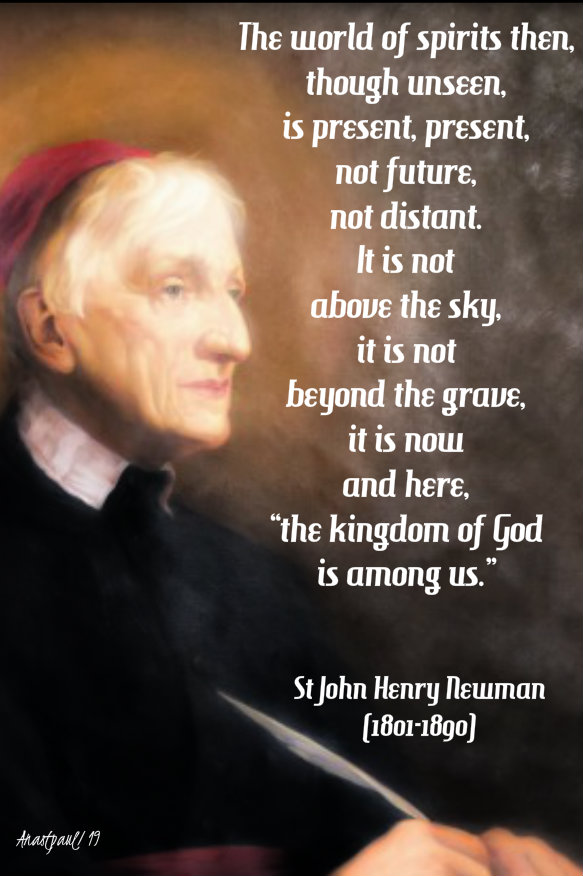
REFLECTION – “Is it difficult to faith to admit the word of Scripture concerning our connection with a world superior to us?…   The world of spirits then, though unseen, is present, present, not future, not distant.   It is not above the sky, it is not beyond the grave, it is now and here, “the kingdom of God is among us.”   Of this the text speaks—”We look,” says St Paul, “not at the things which are seen, but at the things which are not seen, for the things which are seen are temporal but the things which are not seen are eternal” (2 Cor 4:18)…

Such is the hidden kingdom of God and, as it is now hidden, so in due season it shall be revealed.   Men think that they are lords of the world and may do as they will.   They think this earth their property and its movements in their power, whereas…  it contains Christ’s little ones, whom they despise and His Angels, whom they disbelieve and these, at length, shall take possession of it and be manifested.   At present, “all things,” to appearance, “continue as they were from the beginning of the creation” and scoffers ask, “Where is the promise of His coming?”(2 Pt 3:4) but at the appointed time there will be a “manifestation of the sons of God” and the hidden saints “shall shine out as the sun in the kingdom of their Father.” (Mt 13:43)the world of spirits then is here now present - st john henry newman 14 nov 2019.jpg

When the Angels appeared to the shepherds, it was a sudden appearance—“Suddenly there was with the Angel a multitude of the heavenly host” (Lk 2:13).   How wonderful a sight!   The night, had before that, seemed just like any other night – they were keeping watch over their sheep, they were watching the night as it passed.   The stars moved on—it was midnight.   They had no idea of such a thing when the Angel appeared.   Such are the power and virtue hidden in things which are seen and at God’s will, they are manifested.” … St John Henry Newman (1801-1890) Cardinal, founder of the Oratory in England, Theologian – PPS “The Invisible world” vol.4, no.13

PRAYER – Our Father, hallowed be Your name, Your kingdom come, Your will be done! Grant us Lord, a true knowledge of our salvation, so that freed from fear and from the power of our foes, we may serve You faithfully, all the days of our lives and thus attain eternal joy with You. May the prayers of St Joseph Pignatelli on our behalf, be a succour to us all. Through our Lord Jesus Christ with the Holy Spirit, one God for all eternity, amen.st joseph pignatelli pray for us 14 nov 2019.jpg

Posted in JESUIT SJ, Our MORNING Offering, PRAYERS of the CHURCH, QUOTES on DIVINE PROVIDENCE, SAINT of the DAY

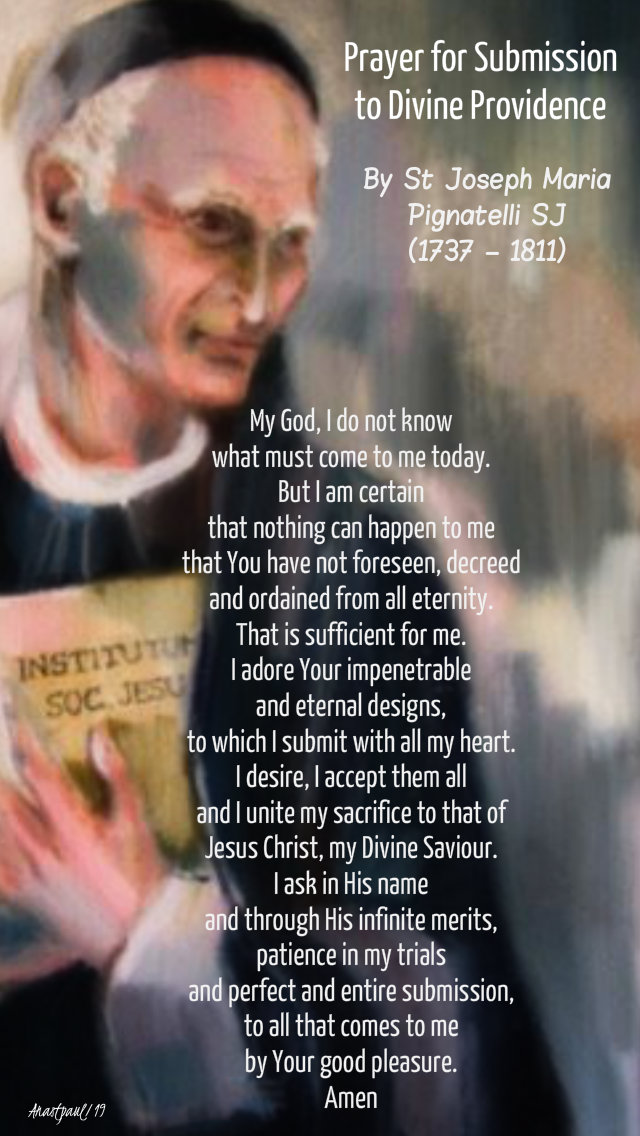
Our Morning Offering – 14 November – Prayer for Submission to Divine Providence

Our Morning Offering – 14 November – Thursday of the Thirty Second Weeek in Ordinary Time, Year C and the Memorial of St Joseph Maria Pignatelli SJ (1737 – 1811)

Prayer for Submission to Divine Providence
By St Joseph Maria Pignatelli SJ (1737 – 1811)

My God, I do not know
what must come to me today.
But I am certain
that nothing can happen to me
that You have not foreseen, decreed
and ordained from all eternity.
That is sufficient for me.
I adore Your impenetrable
and eternal designs,
to which I submit with all my heart.
I desire, I accept them all
and I unite my sacrifice to that of
Jesus Christ, my Divine Saviour.
I ask in His name
and through His infinite merits,
patience in my trials
and perfect and entire submission,
to all that comes to me
by Your good pleasure.
Amenprayer for submission to divine providence - st joseph pignatelli 14 nov 2019.jpg

Posted in JESUIT SJ, SAINT of the DAY

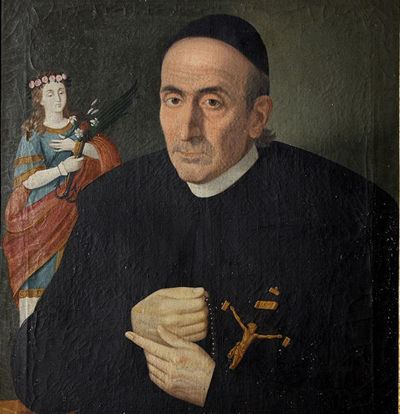
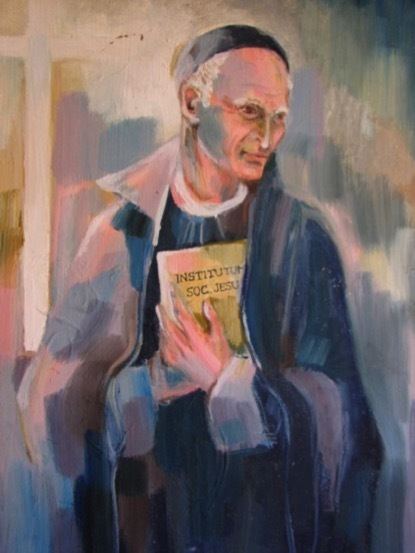
Saint of the Day – 14 November – Saint Joseph Maria Pignatelli SJ (1737 – 1811)

Saint of the Day – 14 November – Saint Joseph Maria Pignatelli SJ (1737 – 1811) Religious Priest of the Society of Jesus, known as “Restorer of the Society of Jesus” and “The Second Founder of the Society of Jesus” – born as José María Pignatelli on 27 December 1737 in Zaragoza, Spain and died on 15 November 1811, aged 73, in Rome.   Patronage – Jesuit Novices.St-Joseph-Pignatelli-D3X_4089-smallest-500x800

Saint Joseph Pignatelli was born in Saragossa, Spain, of noble descent.   His mother died when he was six and his father moved with the younger children to Naples but within four years his father also died.

At twelve, Joseph returned with his younger brother, Nicholas, to Saragossa, where they studied at the Jesuit school.   By special privilege, they resided in the Jesuit community. Living among the Jesuits convinced Joseph of his vocation and in 1753, he entered the novitiate at Tarragona and took his religious vows two years later.   Joseph spent the following year at Manresa, doing classical studies, the next three years studying philosophy at Calatayud and the subsequent four years back at Saragossa, for his theology.

After Joseph was ordained in 1762, he taught grammar to young boys at his old school and assisted in its parish.   He taught for four and a half years, visited the local prisons and ministered to condemned convicts about to be executed.   This apostolate ended abruptly when in 1767, King Charles III expelled the Jesuits from his kingdom and confiscated their property, making five thousand Jesuits homeless with one royal stroke of the pen.ST joseph-pignatell 750

Fr Pignatelli was made the acting provincial over some 600 exiled Jesuits on board thirteen ships during their three months at sea before arriving at Bonifacio, on the southern tip of Corsica.   Later they were taken away to Genoa.   After travelling three hundred miles on foot, they arrived at Ferrara, in the Papal States, tired and exhausted but were welcomed by Fr Pignatelli’s cousin and future cardinal, Msgr Francis Pignatelli.

The princes of Europe were pressuring the Pope to suppress the Society.   Although Clement XIII heroically withstood the pressure, his successor, Clement XIV crumbled beneath it and decreed the dissolution of the Society of Jesus.   This meant, that Fr Pignatelli and 23,000 others were no longer Jesuits and were no longer bound by their vows.

Saddened by this decree, Fr Pignatelli moved to Bologna where he and his brother, Nicholas, also a Jesuit, continued to live the life of a Jesuit and for the next twenty four years (1773-1797) he kept in contact with his dispersed brethren.   Meantime, in White Russia (today’s Belarus), the Jesuits survived, because the Russian Czarina, Catherine II did not carry out the suppression.   When Fr Pignatelli heard about this, he obtained permission from Pope Pius XI to affiliate with the Russian Jesuit province.   Meantime Ferdinand, Duke of Parma also entered into negotiations with White Russia and in 1793, three Jesuits came to his Duchy to open a house for the Society.   Fr Pignatelli associated himself with this group and in 1797, at sixty, he also promised God poverty, chastity and obedience, just as he did in Spain in 1755.ST joseph-pignatelli ART

Fr Pignatelli was made Master of novices in 1799 and in 1803, he was appointed provincial of Italy.   When the Society was restored in the kingdom of the Two Sicilies, many former Jesuits came to them to be re-admitted and the Jesuit apostolate became active again.ST joseph-pignatelli-5ff4aaed-334e-4b25-a666-8ebb1647af7-resize-750

Fr Pignatelli and the other Jesuits were expelled from Naples when Napoleon’s brother Joseph Bonaparte overran the country.   They headed for Rome and were welcomed by Pope Pius VII.   Within months of their arrival in Rome, the Jesuits set up a novitiate at Orvieto and were teaching in six diocesan seminaries.  During the exile of Pope Pius VII and the French occupation of the Papal States, the Society continued untouched, owing largely to the prudence of Pignatelli, he even managed to avoid any oaths of allegiance to Napoleon.   He also secured the restoration of the Society in Sardinia in 1807.  Fr Pignatelli was already seventy and had been in exile for forty years when he came to Rome.   He still cherished the hope that the Society would be restored throughout the world during his lifetime.   His health was weakening and during his last two years, he suffered from frequent hemorrhages due to tuberculosis and was soon confined to bed.st joseph pignatelli - pieta lg

Fr Pignatelli died peacefully and serenely on 15 November 1811 without seeing the end of the 41-year suppression.   However, his dearest hope of seeing the entire Society restored was realised, when Pope Pius VII decreed it on 7 August 1814, three years after his death.

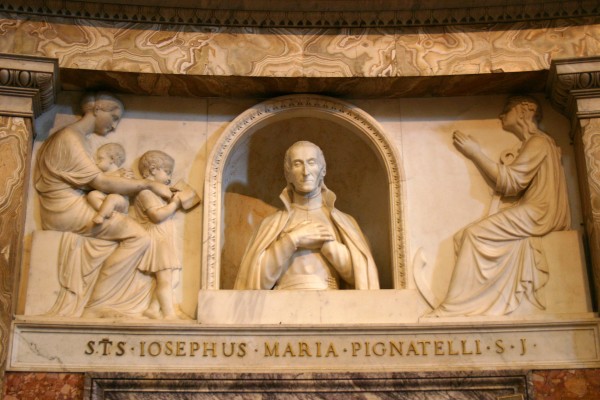
His remains rest today in a reliquary under the altar of the Chapel of the Passion in the Church of the Gesù in Rome.chiesa_del_gesu_roma_giuseppe_pignatelli_high

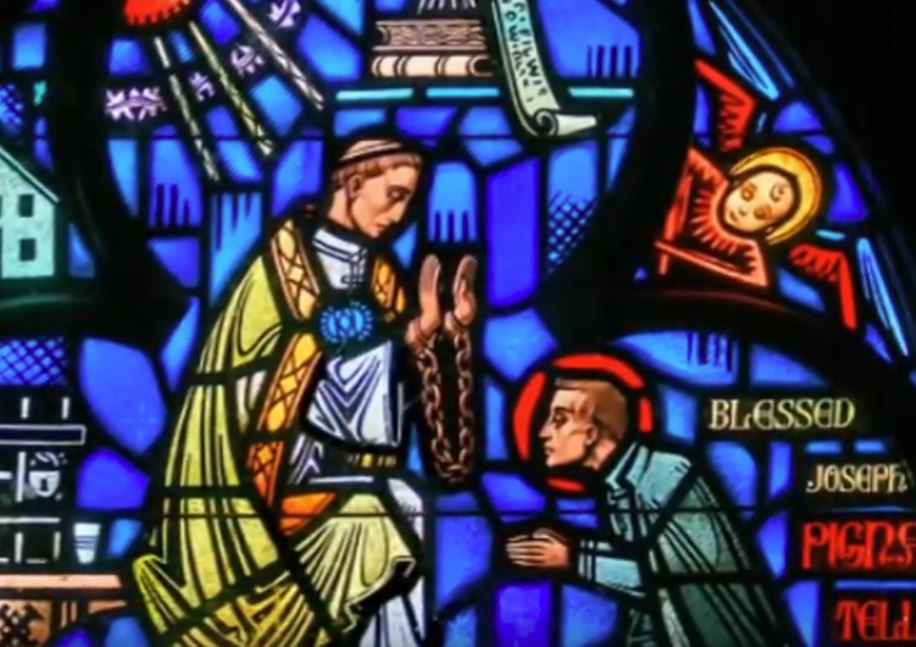
st joseph pignatelli glass snip
This Shrine and window of St Joseph Pignatelli, is in the Church of the Gesù

The cause for Pignatelli’s Canonisation was introduced under Pope Gregory XVI.   He was Beatified on 21 May 1933 by Pope Pius XI and was Canonised on 12 June 1954 by Venerable Pope Pius XII.

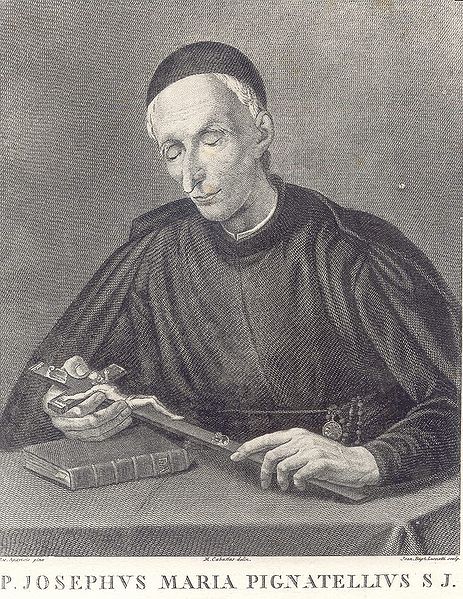
After St Ignatius of Loyola, the founder of the Society of Jesus, Pignatelli is arguably the most important Jesuit in its subsequent history, linking the two Societies, the old Society which was first founded in 1540 and the new Society which was founded forty years after it had been suppressed by Pope Clement XIV in 1773.   Pignatelli can thus be rightly considered the saviour and restorer of the Society of Jesus.463px-st Joseph_Pignatelli_(1737-1811).jpg

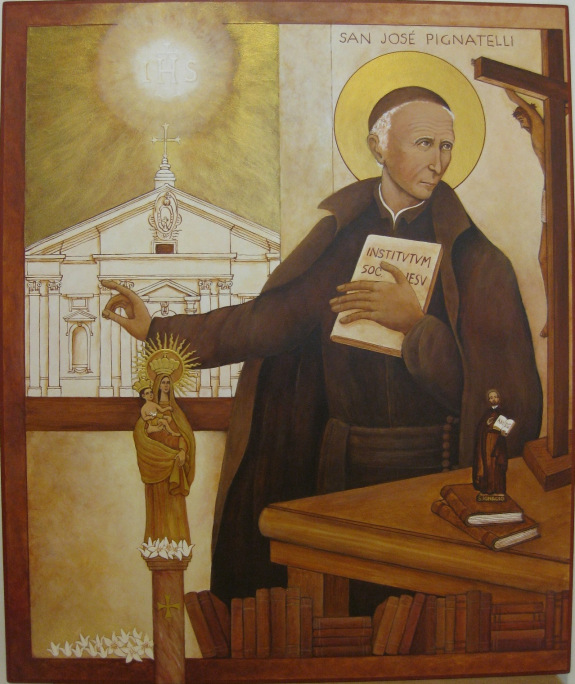
ST JOSEPH Pignatelli - ICON

Posted in DOMINICAN OP, JESUIT SJ, SAINT of the DAY

Memorials of the Saints – 14 November

St Adeltrude of Aurillac
St Alberic of Utrecht
St Antigius of Langres
St Dubricius of Wales
St Etienne-Théodore Cuenot
St Hypatius of Gangra
Bl Jean of Tufara
Bl John Licci OP (1400-1511)
Biography here:   https://anastpaul.wordpress.com/2017/11/14/saint-of-the-day-14-november-blessed-john-licci-o-p-1400-1511/
St John Osorinus
St Joseph Maria Pignatelli SJ (1737 – 1811) ‘Restorer of the Society of Jesus’

St Jucundus of Bologna
St Laurence O’Toole/Lorcán Ua Tuathail (c 1128 – 1180)
Biography:
https://anastpaul.com/2018/11/14/saint-of-the-day-14-november-st-laurence-otoole-c-1128-1180/

Bl Maria Louise Merkert
Bl Maria Teresa of Jesus
St Modanic
St Ruf of Avignon
St Serapion of Alexandria
St Serapion of Algiers
St Siard
St Venerando the Centurian
St Venerandus of Troyes

Holy Fathers of Merida

Martyrs of Emesa: Group of Christian women tortured and executed for their faith in the persecutions of the Arab chieftain Mady. They died in Emesa (modern Homs, Syria).

Martyrs of Heraclea – (3 saints): Group of Christians murdered together for their faith. The only details we have are three of their names – Clementinus, Philomenus and Theodotus. They were martyred in Heraclea, Thrace.

Martyrs of the Jaffa Gate:
• Blessed Déodat of Rodez
• Blessed Nikola Tavelic
• Blessed Pierre of Narbonne
• Blessed Stefano of Cuneo

Posted in JESUIT SJ, PRACTISING CATHOLIC, QUOTES for CHRIST, QUOTES of the SAINTS, QUOTES on PRIESTS, the PRIESTHOOD and CONSECRATED LIFE, QUOTES on the CHURCH, SAINT of the DAY

Quote/s of the Day – 13 November – St Norbert, St Stanislaus Kostka, Bl Karl Lampert

Quote/s of the Day – 13 November – The Memorial of St Stanislaus Kostka SJ (1550-1568) and Bl Karl Lampert (1894-1944) Martyr and of all the Saints of the Order of St Norbert, the Order of Canons Regular of Prémontré, also known as the Premonstratensians, the Norbertines and the White Canons.

On the day of his ordination, St Norbert said:

“O Priest!
You are not of yourself because you are of God.
You are not of yourself because you are the servant and minister of Christ.
You are not your own because you are the spouse of the Church.
You are not yourself because you are the mediator between God and man.
You are not from yourself because you are nothing.
What then are you? Nothing and everything.
O Priest!
Take care, lest what was said to Christ on the cross be said to you:
‘He saved others, himself he cannot save!”

St Norbert (c 1080-1134)O Priest! - St Norbert

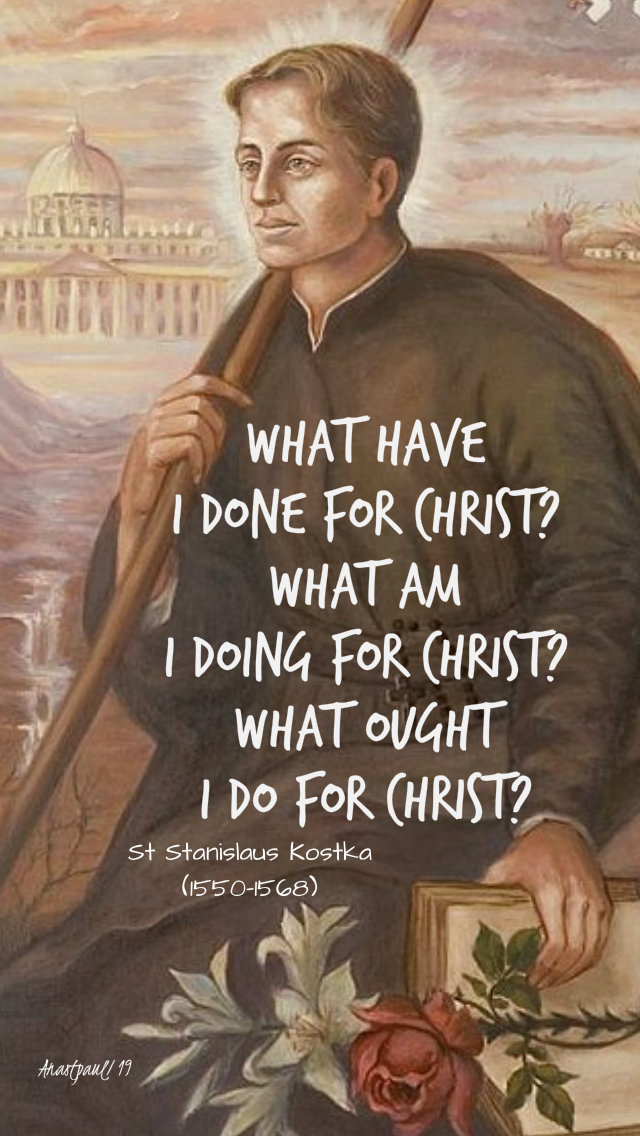
“What have I done for Christ?
What am I doing for Christ?
What ought I do for Christ?”

St Stanislaus Kostka SJ (1550-1568)what have i done for christ st stanislaus kostka 13 nov 2019

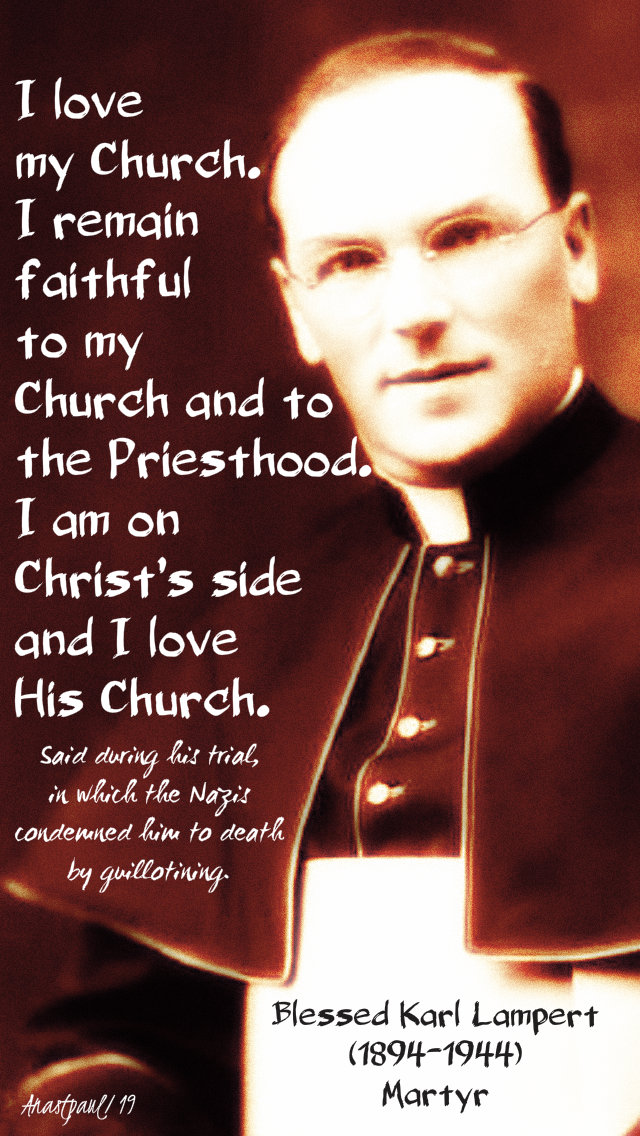
“I love my Church.
I remain faithful to my Church
and to the priesthood.
I am on Christ’s side
and I love His Church.”

Said during his trial, in which the Nazis condemned him to death by guillotining.

Blessed Karl Lampert (1894-1944) Martyri love my church - bl karl lampert 13 nov 2019

Posted in DOCTORS of the Church, ONE Minute REFLECTION, QUOTES of the SAINTS, QUOTES on GRATITUDE, QUOTES on HUMILITY, QUOTES on THANKSGIVING, SAINT of the DAY, The WORD

One Minute Reflection – 13 November – “Let us show our gratitude, not just in our words and on our lips but in deed and in truth.”- St Bernard

One Minute Reflection – 13 November – Wednesday of the Thirty Second week in Ordinary Time, Year C, Gospel:   Luke 17:11–19 and the Memorial of All Benedictine and Cistercian Saints and Blessed Karl Lampert (1894-1944) Martyr

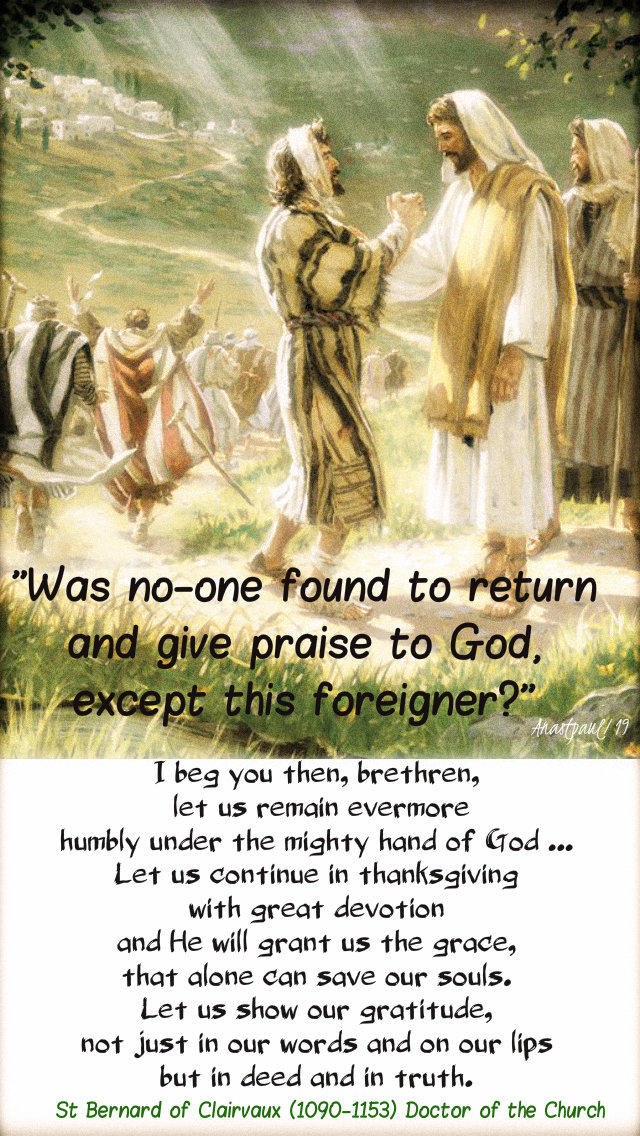
“Was no-one found to return and give praise to God, except this foreigner?” … Luke 17:18

REFLECTION – “How happy was that Samaritan leper who recognised that “he possessed nothing he had not received” (1Cor 4:7). “He guarded what had been entrusted to him” (2 Tm 1:12) and turned back to the Lord to thank Him.   Blessed are they who, after each gift of grace, turn back to Him in whom is the fullness of all the graces, for if we show ourselves thankful in regard to Him for all we have received, then we make ready a place for grace within ourselves… in even greater abundance.   In fact, our ingratitude is the only thing, that prevents us making progress, following our conversion…
Happy, then, are they who think of themselves as strangers and who give great thanks for even the least blessing, thinking that everything given to a stranger and foreigner is a wholly free gift.   How unfortunate and wretched we are, on the other hand, if after first of all appearing timid, humble and pious we then forget, just how freely given, is what we have received…
I beg you then, brethren, let us remain ever more humbly under the mighty hand of God (1 Pt 5:6)…  Let us continue in thanksgiving, with great devotion and He will grant us the grace, that alone can save our souls.   Let us show our gratitude, not just in our words and on our lips but in deed and in truth.” … St Bernard of Clairvaux (1090-1153) Doctor of the Churchluke 17 18 was no-one found to return and give thanks, i beg you then brethren - st bernard 13 nov 2019.jpg

PRAYER – You Lord, Holy Father, never forget Your solemn covenant and grant us new life each day.   We, though in our hearts of stone do forget and cease to thank and bless You.   Make our hearts turn in gratitude, for all we are and have is by Your grace and we are as nothing without You.   May our minds, hearts and souls sing with love and thanks to You, Lord our God.   Grant us new hearts by the prayers of Blessed Karl Lampert and all the saints in heaven, who always lived with grateful hearts, praising You always.  We ask this this through Jesus Christ, our Lord, with the Holy Spirit, one God forever, amen.bl karl lampert pray for us 13 nov 2019

Posted in CATHOLIC-PRAYERS OF THE CHURCH, DOCTORS of the Church, HYMNS, Our MORNING Offering, PRAYERS of the CHURCH, PRAYERS of the SAINTS, SAINT of the DAY

Our Morning Offering – 13 November – Jesus, the Very Thought of Thee

Our Morning Offering – 13 November – Wednesday of the Thirty Second week in Ordinary Time, Year C and the Memorial of All Benedictine and Cistercian Saints

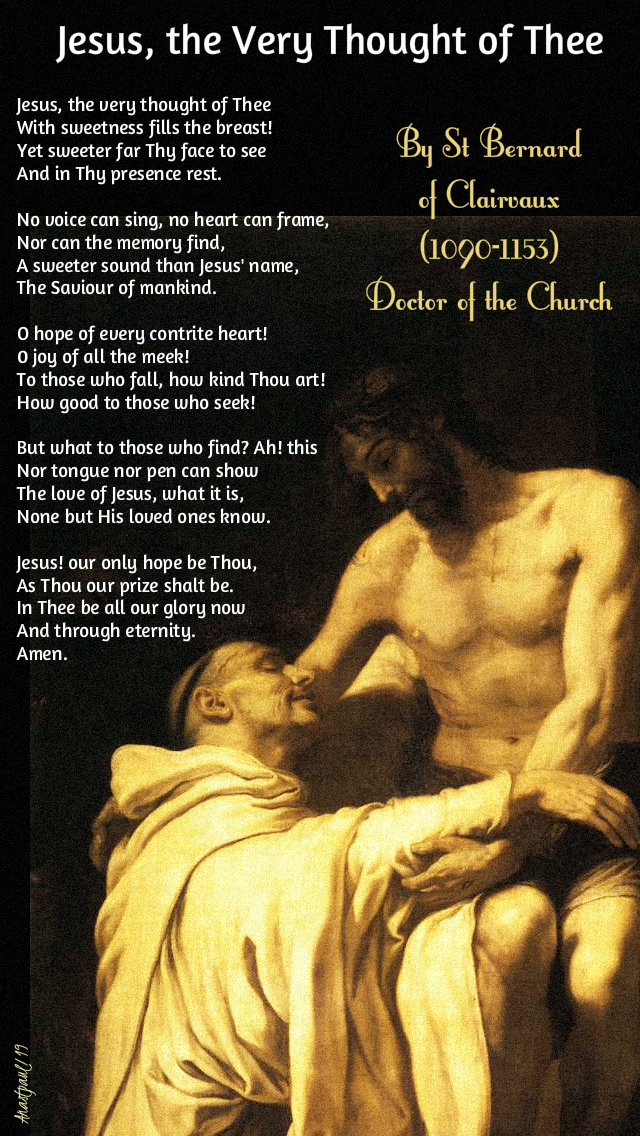
Jesus, the Very Thought of Thee
By St Bernard of Clairvaux (1090-1153)
Doctor of the Church

Jesus, the very thought of Thee
With sweetness fills the breast!
Yet sweeter far Thy face to see
And in Thy presence rest.

No voice can sing, no heart can frame,
Nor can the memory find,
A sweeter sound than Jesus’ name,
The Saviour of mankind.

O hope of every contrite heart!
0 joy of all the meek!
To those who fall, how kind Thou art!
How good to those who seek!

But what to those who find? Ah! this
Nor tongue nor pen can show
The love of Jesus, what it is,
None but His loved ones know.

Jesus! our only hope be Thou,
As Thou our prize shalt be.
In Thee be all our glory now
And through eternity.
Amen.

St Bernard was a French Abbot and a major leader in the reform of Benedictine Monasticism that caused the formation of the Cistercian order.jesus the very thought of thee by st bernard - 13 nov 2019 mem of all cistercian saints.jpg

Posted in SAINT of the DAY

Saint of the Day – 13 November – Blessed Karl Lampert (1894-1944) Priest and Martyr

Saint of the Day – 13 November – Blessed Karl Lampert (1894-1944) Priest and Martyr – born on 9 January 1894 in Göfis, Feldkirch, Austria and died, aged 50, by being guillotined on 13 November 1944 in Halle an der Saale, Germany.   Fr Karl served as the Pro-Vicar for the Diocese of Feldkirch in addition to being an outspoken critic of Nazism during World War II.   This led to constant surveillance against him and his eventual arrests on several occasions.   This all culminated in his final arrest in 1943 and his death from the guillotine in 1944 alongside a fellow Christian prisoner.   He was declared to have been killed “in odium fidei” (in hatred of the faith) and was Beatified on 13 November 2011 in Austria. Cardinal Angelo Amato presided over his Beatification on the behalf of Pope Benedict XVI, who had approved the cause.   Patronages – Prisoners and Persecuted Christians.BL kARL-lampert-d43733f1-a31c-4473-9854-82794a4b16d-resize-750

Fr Karl Lampert was born as the last of seven children of Franz Xaver Lampert and Maria Rosina Lampert in Feldkirch in 1894.   He attended school in his hometown and would attend a state high school after the completion of his first studies, the death of his father seemed to jeopardise this but an uncle of his provided financial aid to assist him to further his education.

He commenced his studies for the priesthood in 1914 in Brixen and received his ordination from Bishop Franz Eggar on 12 May 1918 during World War I.   He celebrated his first Mass on 26 May 1918.   Following his ordination he worked as a chaplain in Dornbirn and was involved in pastoral work with adolescents.BL Karl-lampert-f9098fe0-bb8f-4262-a6c7-0eba251a0e2-resize-750.jpeg
In 1930 he moved – with the financial support of Bishop Sigismund Waitz – to Rome for studies in canon law and moved to new quarters at the Collegio Teutonico di Santa Maria dell’Anima until 1935 as a secretary to the Roman Rota.   Pope Pius XI later made him a Monsignor in 1935.BL Karl-lampert-982be2cf-256a-4570-becb-b5e2b75878a-resize-750

On 1 October 1935 he was stationed in the Diocese of Innsbruck where Bishop Waitz wanted him to perform several administration duties.   Around this time he was considered to be the Diocese’s new Bishop but Pius XI did not choose him, instead he was made Pro-Vicar of that Diocese on 15 January 1939.   In 1940 he attempted in vain to secure the release of Blessed Otto Neururer and when he was killed Lampert published an obituary in a church newsletter for him.   However he was arrested for this due to violating what was Nazi confidentiality laws and was deported to Dachau on 25 August 1940.   (Blessed Otto Neururer was arrested for opposing “a Germanic wedding” when he told a young lady she could not marry a divorced man.   He would eventually become the 1st priest martyred inside a Nazi concentration camp, (Buchenwald), in 1940 – he was Beatified by St John Paul II in 1996 – see image below.)BL OTTO NEURURER.JPG

He was then sent to Sachsenhausen in Berlin on 1 September 1940 where he was forced to do labour in a penal colony.   A popular saying of his – while there – was “in the name of Christ for the Church.”   He was sent back to Dachau on 15 December 1940 and remained there for eight months, before being released on 1 August 1941 and sent to Stettin.   Despite being freed he was put under intense surveillance and was regarded with much suspicion, his phone calls were tapped and all correspondence was read.   He continued to work as a pastor but also worked as a hospital chaplain.bl karl-lampert-c0fa4582-99bc-42eb-9588-af1e02ec493-resize-750.jpeg

Fr Karl was arrested for the last time on 4 February 1943 and endured intense interrogations and was also tortured.   He was found to be guilty of both treason and sedition on 30 December 1943 and was sent to Torgau on 14 January 1944 where he spent seven months in solitary confinement.   A third trial ordered the death sentence on 8 September 1944.   Lampert – alongside a fellow priest – was executed in a guillotine on 13 November 1944 at 4:00pm.

His remains were cremated and buried in Halle an der Saale and were returned to his hometown in 1948.   In the Domskirche – the Cathedral of Innsbruck, there are side Altars devoted to both Blessed Otto and Blessed Karl, below is Blessed Otto’s Altar and Plague.

This slideshow requires JavaScript.

The Beatification process commenced on 5 September 1997 under Pope John Paul II and granted Lampert the title Servant of God.   The Diocesan process spanned from 1 October 1998 to 18 November 2003 and had to ascertain the facts about whether or not Lampert died in hatred of his Christian faith.   The process was validated on 14 March 2008 and allowed for the drafting of the Positio – documenting his life and reasons for how he died in hatred of the faith – which was submitted to the Congregation for the Causes of Saints in 2009.

On 27 June 2011 his Beatification was approved as Pope Benedict XVI acknowledged the fact that Lampert had indeed been killed in the camps for his faith.   Cardinal Angelo Amato presided over the Beatification in Austria on the behalf of the pope on 13 November 2011.   The current postulator assigned to the cause is Dr Andrea Ambrosi.

Posted in DOCTORS of the Church, JESUIT SJ, SAINT of the DAY

Memorials of the Saints – 13 November and Happy Birthday St Augustine!

St Frances Xavier Cabrini (Optional Memorial, United States only – her Universal Feast Day is 22 December and this is the Day on which I will honour her on this site.)

All Saints of the Augustinian Order:   On 13 November (The birthday of St Augustine), we celebrate the feast of All Saints of the Augustinian Order.   On this day we call to mind the many unsung brothers and sisters of the Augustinian family who have “fought the good fight” and celebrate now, in Heaven.
Let us pray for one another that we too may one day join in the “unceasing chorus of praise” with all our Augustinian brethren in Heaven.happy-birthday-st-augustine-13-nov-2018 and 2019all-saints-of-the-augustinian-order-13-nov-birthday-of-st-augustine

All Saints of the Benedictine & Cistercian Orders:   Those interested in the Benedictine family may be interested to know that today, within the Benedictine liturgical tradition, is traditionally celebrated the feast of All Saints of the Benedictine Order – In Festo Omnium Sanctorum Ordinis S.P.N. Benedicti.
The Cistercians — who also follow the Rule of St Benedict — likewise observe this day for All Saints of their Order. (On a related note, the Benedictines also traditionally observe 14 November as All Souls of their Order.all-benedictine-saints-13-nov-2018

640px-São_Bento_e_São_Bernardo_(1542)_-_Diogo_de_Contreiras.png
Saint Benedict and Saint Bernard (1542), by Diogo de Contreiras. Saint Bernard is depicted in the white cowl of the Cistercians.

All Saints of the Premonstratensian Order:   The Order of Canons Regular of Prémontré, also known as the Premonstratensians, the Norbertines and, in Britain and Ireland, as the White Canons , are a Roman Catholic religious order of canons regular founded in Prémontré near Laon in 1120 by Saint Norbert, who later became Archbishop of Magdeburg.   Premonstratensians are designated by O.Praem. following their name. St Norbert was a friend of Saint Bernard of Clairvaux and so was largely influenced by the Cistercian ideals as to both the manner of life and the government of his order.
Aside from St Norbert there are at present fifteen saints of the Order who have been Canonised or have had their immemorial cults confirmed by the Holy See.st-norbertall-saints-of-the-norbertians-13-nov-arbor-sancti-patris-norberti

St Abbo of Fleury
St Agostina Pietrantoni S.D.C. (1864-1894)
Her Story here:
https://anastpaul.com/2018/11/13/saint-of-the-day-13-november-st-agostina-livia-pietrantoni-s-d-c-1864-1894/
St Amandus of Rennes
St Amanzio
St Beatrix of Bohemia
St Brice of Tours
St Caillin
St Chillien of Aubigny
Bl Christopher Eustace
St Columba of Cornwall
St Dalmatius of Rodez
Bl David Sutton
St Devinicus
St Didacus
St Eugenius of Toledo
St Florido of Città di Castello
St Gredifael
St Himerius
St Homobonus of Cremona
Bl John Sutton
Bl Juan Gonga Martínez
St Juan Ortega Uribe
Blessed Karl Lampert (1894-1944) Priest and Martyr
St Leoniano of Vienne
Bl María Cinta Asunción Giner Gomis
Bl Maurice Eustace
St Maxellendis
St Mitrius
St Pope Nicholas I
St Paterniano
St Quintian of Rodez
Bl Robert Fitzgerald
Bl Robert Montserrat Beliart
Bl Robert Scurlock
St Stanislaus Kostka SJ (1550-1568):
Biography here:
https://anastpaul.wordpress.com/2017/11/13/saint-of-the-day-13-november-st-stanislaus-kostka-sj-1550-1568/

Bl Thomas Eustace
Bl Warmondus of Ivrea
Bl William Wogan

Martyrs of Caesarea – 5 saints: A group of Christians murdered for their faith in the persecutions of Diocletian, Galerius Maximian and Firmilian. – Antoninus, Ennatha, Germanus, Nicephorus and Zebinas. 297 at Caesarea, Palestine.

Martyrs of Ravenna – 3 saints: A group of Christians murdered together in the persecutions of Diocletian. The only information about them that has survived are three names – Solutor, Valentine and Victor. c 305 in Ravenna, Italy.

Martyrs of Salamanca – 5 saints: The first group of Christians exiled, tortured and executed for their adherence to the Nicene Creed during the persecutions of the Arian heretic Genseric. – Arcadius, Eutychianus, Paschasius, Paulillus and Probus.
Born in Spain and Martyred in 437. Their relics are at Medina del Campo, Spain.

Posted in CATHOLIC-PRAYERS OF THE CHURCH, PRAYERS of the CHURCH, QUOTES of the SAINTS, QUOTES on HUMILITY, SAINT of the DAY, The WORD

Thought for the Day – 12 November 2019 – ‘Make yourself small …’

Thought for the Day – 12 November 2019 – Tuesday of the Thirty Second week in Ordinary Time, Year C, Gospel: Luke 17:7-10 and the Memorial of St Josaphat Kuncewicz (1584-1623)

“Say, ‘We are unprofitable servants”
Luke 17:10

St Isaac the Syrian of Nineveh (c 613-c 700)
Bishop of Nineveh, Monk at Mosul

The eyes of the Lord look on the lowly to make them glad.   But the face of the Lord turns away from the proud to humble them.   The lowly always receive pity from God…  Make yourself small before everyone and you will be raised up higher than this world’s princes.   Make all creatures go before you, embrace them, humble yourself before them, and you will be honoured more than those who make an offering of gold.   Descend lower than your own self and you will see God’s glory within you.   For where humility sprouts, God’s glory spreads…   If you have humility in your heart, God will reveal his glory to you in it…

Do not love honour and you will not be dishonoured.   Honour flees before someone who runs after it.   But honour pursues the one who flees it and makes known to everyone his humility.   If you despise yourself so as not to be honoured, God will make you known.   If you accuse yourself for love of the truth, God will permit you to be praised in front of every creature.   They will open before you the door to the glory of your Creator and praise you.   For you are truly made in His image and likeness (Gn 1:26).

Collect:

Stir up in Your Church, we pray, O Lord,
the Spirit that filled Saint Josaphat
as he laid down his life for the sheep,
so that through his intercession
we, too, may be strengthened by the same Spirit
and not be afraid
to lay down our life for others.
Through our Lord Jesus Christ, Your Son
Who lives and reigns with You
in the unity of the Holy Spirit,
one God, for ever and ever.

St Josaphat, Pray for Us!st-josaphat-pray-for-us-12-nov-2017 and 2019-2.jpg

Posted in CATHOLIC-PRAYERS OF THE CHURCH, PRACTISING CATHOLIC, PRAYERS of the CHURCH, QUOTES of the SAINTS, QUOTES on SACRIFICE, SAINT of the DAY

Quote of the Day – 12 November – St Josaphat “I am ready to die….”

Quote of the Day – 12 November – The Memorial of St Josaphat Kuncewicz (1584-1623) Martyr

“I am ready to die for the holy union,
for the supremacy of Saint Peter
and of his successor,
the Supreme Pontiff.”i-am-ready-to-die-st-josaphat-12-nov-2017 and 2019

St Josaphat’s favourite devotional exercise was to make prostrations in which the head touches the ground, saying, the Jesus prayer:

‘Lord Jesus Christ,
Son of God,
have mercy on me,
a sinner.”

St Josaphat Kuncewicz (1584-1623)

Pope Pius XI’s “He gave his life for the unity of the Church” is here:

https://anastpaul.com/2018/11/12/thought-for-the-day-12-november-he-gave-his-life-for-the-unity-of-the-church-the-memorial-of-st-josaphat-1584-1623-bishop-and-martyr/

the jesus prayer - st josaphat's fav - 12 nov 2019.jpg

Posted in ONE Minute REFLECTION, PRAYERS of the SAINTS, QUOTES of the SAINTS, QUOTES on HUMILITY, SAINT of the DAY, The WORD

One Minute Reflection – 12 November – ‘To Serve Thee’

One Minute Reflection – 12 November – Tuesday of the Thirty Second week in Ordinary Time, Year C, Gospel: Luke 17:7-10 and the Memorial of St Josaphat (1584-1623) Martyr

“So you also, when you have done all that is commanded you, say, ‘We are unworthy servants, we have only done what was our duty.’ ”… Luke 17:10luke 17 10 - we are unworthy servants - 12 nov 2019.jpg

REFLECTION – “Thou, O my God, have a claim on me and I am wholly Thine!   Thou are the Almighty Creator and I am Thou workmanship.   I am the work of Thou Hands and Thou are my owner.   As well might the axe or the hammer exalt itself against it’s framer, as I against Thee.   Thou owe me nothing, I have no rights in respect to Thee, I have only duties.   I depend on Thee for life and health and every blessing every moment.   If Thou withdraw Thy breath from me for a moment, I die, I am wholly and entirely Thy property and Thy work and my one duty is to serve Thee.   Amen” … St John Henry Newman (1801-1890) Cardinal, Theologian, Poet, Writer, Apologist, Professorluke 17 10 we are unworthy servants - thou o lord have a claim on me - pg 195 heart to heart st john henry newman 12 nov 2019.jpg

PRAYER – O Lord our God, grant that we may not so much seek to be consoled as to console, to be understood as to understand, to be loved as to love and to be only good influences to our neighbour.   That by our love, our brothers in faith may be one . St Josaphat you fought and struggled to unite the Church and by your efforts achieved the crown of martyrdom, please pray for our world, for a one united faith.   Amenst-jospahat-pray-for-us-ora-pro-nobis-12-nov-2018 and 2019.jpg

Posted in SAINT of the DAY

Saint of the Day – 12 November – St Lebuinus of Deventer (Died 775) Apostle of the Friesens

Saint of the Day – 12 November – St Lebuinus of Deventer (Died 775) Apostle of the Friesens, Priest, Monk, Confessor, Missionary – born in England and died in c773 at Deventer, Netherlands.   Patronage – Deventer.

Lebuinus was a monk in St Wilfrid’s monastery at Ripon,Yorkshire.    Inspired by the example of Saint Boniface, Saint Willibrord and other great English missionaries, he resolved to devote his life to the conversion of the Germans.st lebuinus engraving

After his ordination, he proceeded in 754 to Utrecht and was welcomed by Saint Gregory, acting bishop of that place, who entrusted him with the mission of Overijssel on the borders of Westphalia and gave him a companion – Marchelm (or Marcellinus), a disciple of Saint Willibrord.

He preached the Gospel among the tribes of the district and erected a little chapel at Wilp on the west bank of the IJssel.  st lebuinus smlHis venerable personality and deep learning quickly won many to Christianity, even among the nobles and it soon became necessary to build a much larger church at Deventer on the east bank of the river.

However, Lebuinus’s great success aroused hostility among the pagans.   Ascribing his conversions to witchcraft, they formed an alliance with the anti-Christian Saxons, burned the church at Deventer and dispersed the converts.  st LebuinusAfter escaping with difficulty, Lebuinus determined to voice the claims of Christianity at the national assembly of the Saxons at Marklo near the Weser (Northwestern Germany) .

The Vitae of Lebuinus describes in great details, his appearance before the assembly, where, it is claimed, he pointed out to the Saxons the inefficacy of their deities.   It also describes how he warned them of impending destruction at the hands of a powerful king unless they converted to Christianity.   With the intercession of the nobleman Buto, he persuaded them sufficiently of the power of his mission that they not only allowed him to escape with his life but allowed him to preach unmolested in the territory allotted him.   His life may have been a source of inspiration in the creation of the cultus on Saint Livinus of Ghent.

On his return to Friesland, Lebuinus rebuilt the church at Deventer where he was later buried.   His body and a copy of the Gospel,s presumed to have been written by his hand, were still in Deventer, in a church bearing his name, until 882 when it was destroyed by the Normans.   The relics of St Livinus of Ghent (c 580–657) Martyr, (whose feast also is on 12 November are probably those of Lebuinus.   Saint Ludger rebuilt the church a few years later and in doing so rediscovered the saint’s remains beneath the site.

The Lebuïnuskerk, Deventer, see below, was consecrated in his name where he is highly venerated and in fact in all of the Netherlands.

This slideshow requires JavaScript.