One Minute Reflection – 5 February – Wednesday of the Fourth week in Ordinary Time, Year A, Readings: 2 Samuel 24:2, 9-17, Psalm 32:1-2, 5-7, Mark 6:1-6 and the Memorial of St Philip of Jesus (1572-1597) Martyr
“Is not this the carpenter?”…Mark 6:3
REFLECTION – “According to the people of Nazareth, God is too great to humble Himself to speak through such a simple man! It is the scandal of the Incarnation – the unsettling event of a God made flesh, who thinks with the mind of a man, works and acts with the hands of a man, loves with a human heart, a God who struggles, eats and sleeps like one of us.
The Son of God overturns every human framework – it is not the disciples who washed the feet of the Lord but, it is the Lord who washed the feet of the disciples (cf. Jn 13:1-20). This is a reason for scandal and incredulity, not only in that period but in all ages, even today.”…Pope Francis – Angelus, 8 July 2018
PRAYER – Lord God, source of strength and grace, grant us eyes to see and ears to hear and hearts to love the Word of Your Son. Make us recognise Your Son in our daily lives and be generous in sharing our faith to all we meet. Grant, we pray, that the prayers of St Philip of Jesus, may help us to manifest zeal and courage. Through Jesus Christ, our Lord, in unity with the Holy Spirit, God forever, amen.
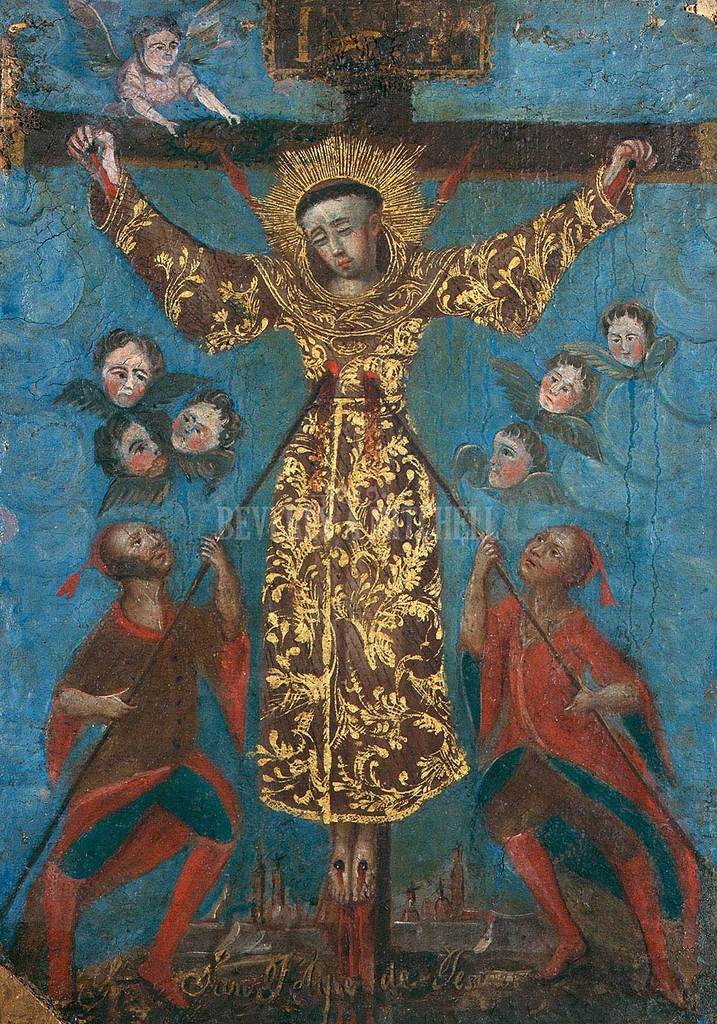
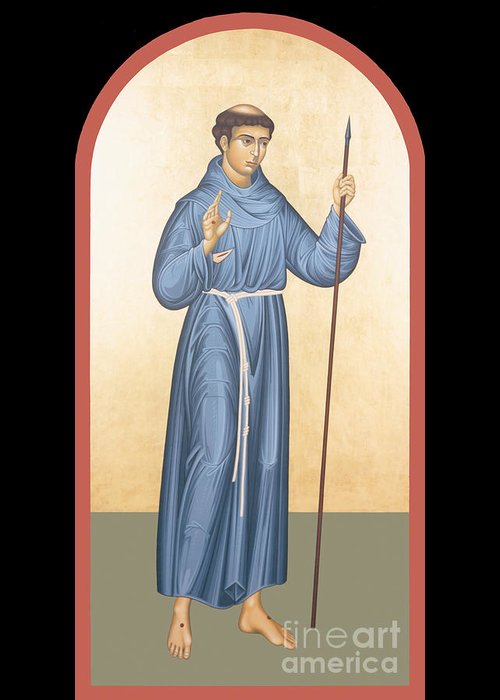
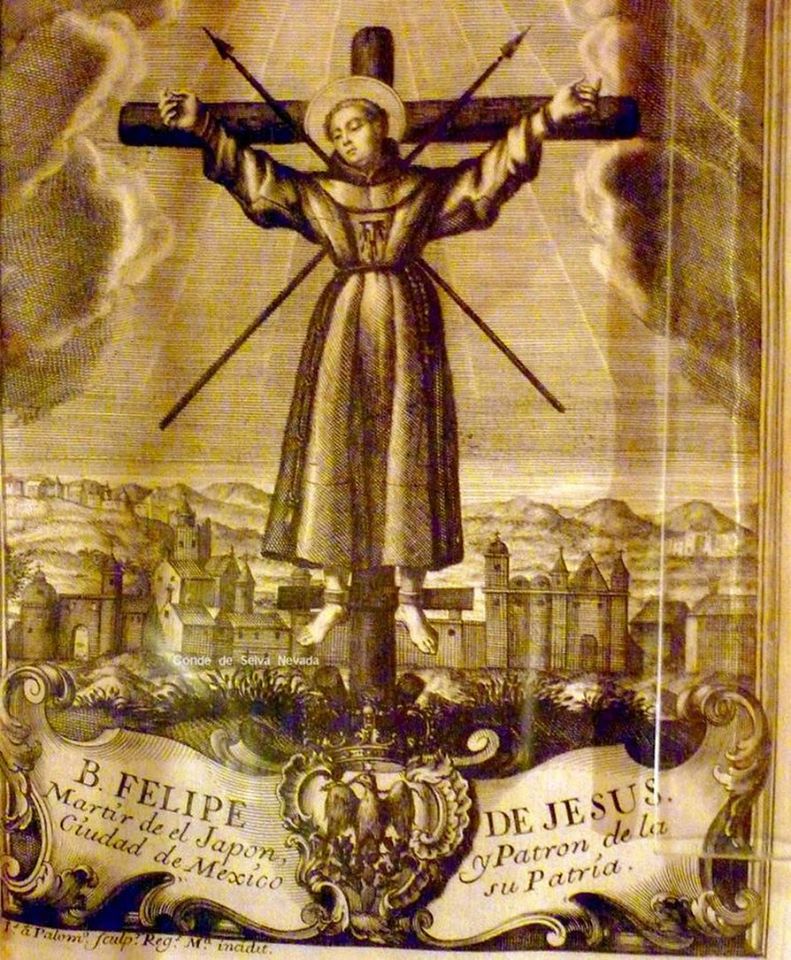
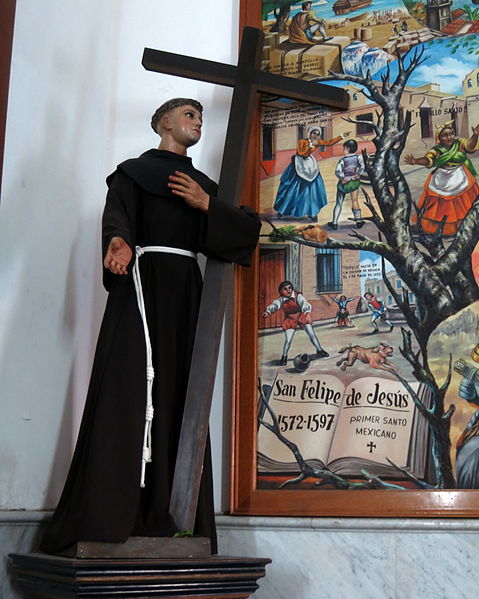
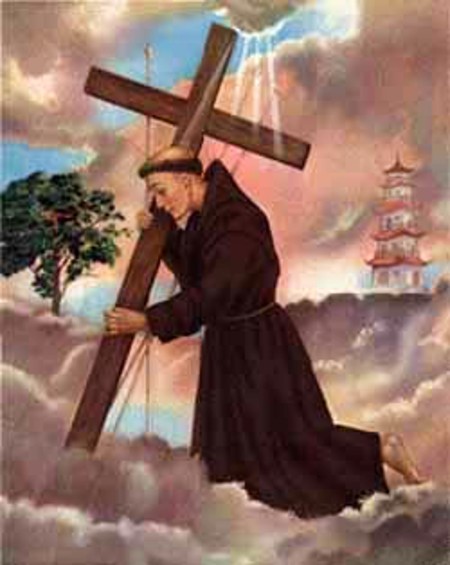
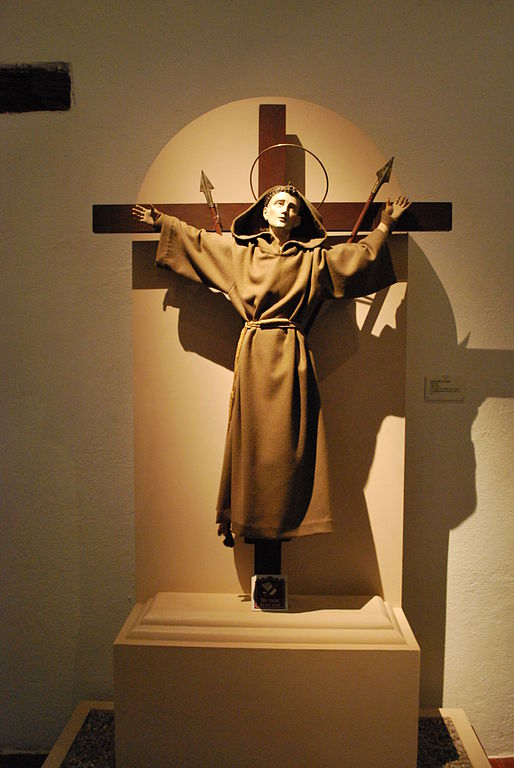
Saint of the Day – 5 February – St Philip of Jesus (1572-1597) Martyr, Missionary, Discalced Friar of the Reformed Franciscans of the Province of St Didacus, founded in Mexico by St Peter Baptista, with whom he suffered martyrdom later. He was born Felipe de las Casas in Mexico and died on 5 February 1597 aged 24-25 in Nagasaki, Japan by being bound upon a cross and then pierced to death with spears. Patronage – Mexico City. He became the Protomartyr and Saint of Mexico. St Philip is also honoured on 6 February amongst the Holy Martyrs of Japan.
Philip de las Casas was born in the city of Mexico to businessman Alsonso de las Casas and his wife. Although he was brought up piously, Philip at first showed little care for the pious teaching of his parents but at last resolved to enter the Reformed Franciscan Convent of Santa Barbara at Pueblo.
But he was not yet weaned from the world and soon left the novitiate. Grieved at the inconstancy of his son, his father sent him to the Philippine Islands on a business errand. There, in vain Philip sought to satisfy his heart with pleasure. But of course, he was constantly unhappy and felt that God was calling him to a religious life. Gaining courage by prayer, he entered the Franciscan Convent of Our Lady of the Angels at Manila and persevered, taking his vows in 1594. The richest cargo that he could have sent to Mexico would not have gratified his pious father as much as the tidings that Philip was a professed friar.
His father, Alonso de las Casas obtained from the abbot of the Order, directions that Philip could be sent to Mexico. He embarked in July, 1596, with other religious. Storms drove the vessel to the coast of Japan and it was wrecked while endeavouring to enter a port. Amid the storm Philip saw over Japan a white cross, in the shape used in that country, which after a time became blood-red and remained so for some time. It was an omen of his coming victory.
The commander of the vessel sent our Saint and two other religious to the emperor to solicit permission to continue their voyage but they could not obtain an audience. He then proceeded to Macao, to a house of his Order, to seek the influence of the Fathers there but the pilot of the vessel by idle boasts had excited the emperor’s fears of the Christians and the heathen ruler resolved to exterminate the Catholic missionaries.
In December, officers seized a number of the Franciscan Fathers, three Jesuits and several of their young pupils. St Philip was one of those arrested and heard with holy joy that sentence of death had been passed on them all. His left ear was cut off and he offered this first-fruit of his blood to God for the salvation of that heathen land.
The martyrs were taken to Nagasaki, where crosses had been erected on a high hill. When St Philip was led to that on which he was to die, he knelt down and clasped it, exclaiming: “O happy ship! O happy galleon for Philip, lost for my gain! Loss—no loss for me but the greatest of all gain!” He was bound to the cross but the structure under him gave way, so that he was strangled by the cords. While repeating the holy name of Jesus, he was the first of the happy band to receive the death-stroke.
Miracles attested the power before God of these first martyrs of Japan. Pope Urban VIII Beatified him with his companions, on 14 September 1627 and granted permission to say an Office and Mass in their honour and Pope Pius IX formally Canonised them on 8 June 1862.
In 1949 a Mexican film Philip of Jesus portrayed his life and death.
There is a wonderful miracle related to St Philip’s Mother’s maid, Dominica – it is as follows:
Philip’s mother, when told of his misbehaviour, would exclaim, “God make thee a saint, Felipe “ and old Dominica’s usual answer was: ” Felipillo a saint! He will be one when the old fig-tree grows green again.” Now the fig-tree Dominica spoke of so often, was indeed far off from growing green, there it stood in a corner of the court, dry, dead for many years and for some reason allowed to remain in the corner it once shaded with its thick foliage. One morning Dominica, now an aged woman, went into the court, to her amazement she saw the old dead fig-tree covered with luxuriant green foliage. Scarcely able to believe her own eyes she called to her mistress, “Come, come, Felipillo is a saint; the fig-tree has again become green.” And, sure enough, months after this amazing event, news reached his native city that Felipe had received a martyr’s death in Japan in a mountain near Nagasaki city, “Mount of the Martyrs.”
St Agatha Hildegard of Carinthia
St Agricola of Tongres
St Albinus of Brixen
St Anthony of Athens
St Avitus of Vienne
St Bertulph
St Buo of Ireland
St Calamanda of Calaf
St Dominica of Shapwick
St Fingen of Metz
Bl Françoise Mézière
St Gabriel de Duisco
St Genuinus of Sabion
St Indract
St Isidore of Alexandria
St Jesús Méndez-Montoya
Bl John Morosini
St Kichi Franciscus
St Luca di Demenna
St Modestus of Carinthia St Philip of Jesus (1572-1597) Martyr
Bl Primo Andrés Lanas
St Saba the Younger
St Vodoaldus of Soissons
—
Martyrs of Pontus: An unknown number of Christians who were tortured and martyred in assorted painful ways in the region of Pontus (in modern Turkey) during the persecutions of Maximian.
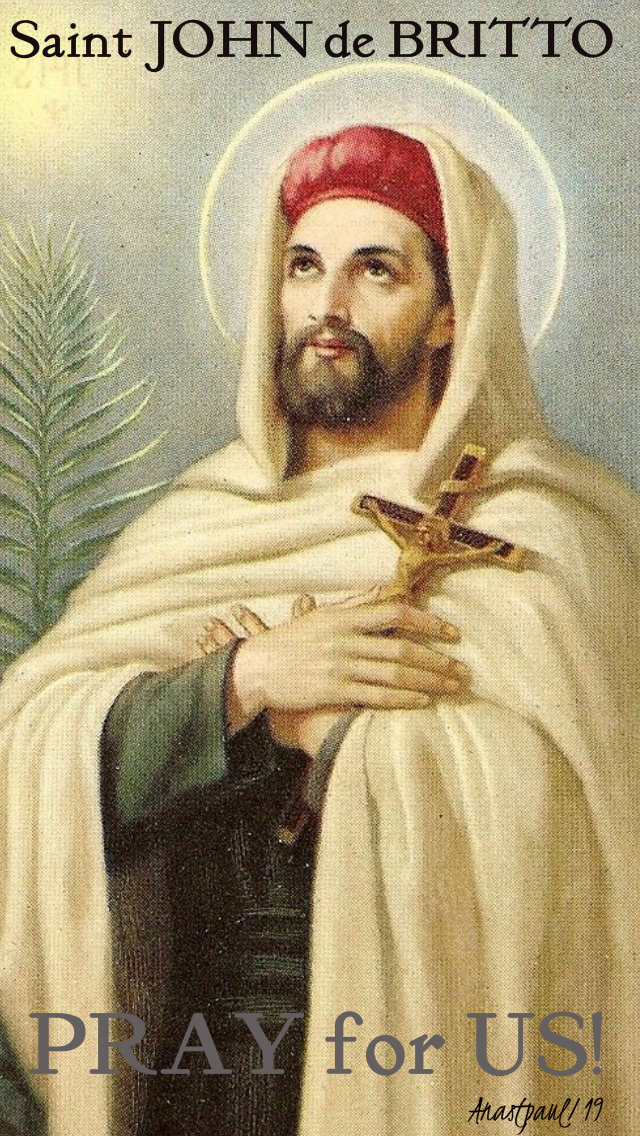
One Minute Reflection – 4 February – Tuesday of the Fourth Week in Ordinary Time, Year A, Readings: 2 Samuel 18:9-10, 14, 24-25, 30–19:3, Psalm 86:1-6, Mark 5:21-43 and the Memorial of St John de Britto SJ (1647-1693) Martyr
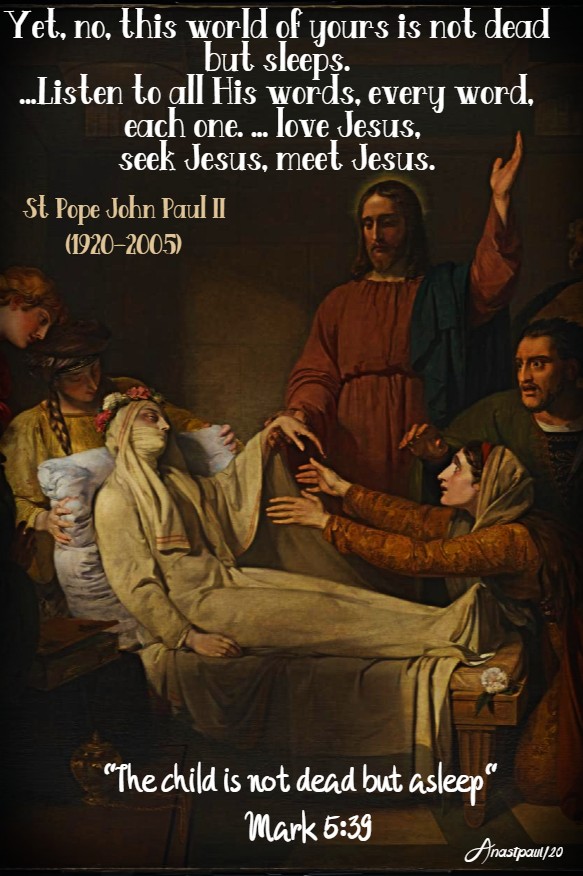
“The child is not dead but asleep” … Mark 5:39
REFLECTION -“My dear young people, the future depends on you, the completion of this millennium and beginning of another depend on you. So do not be passive, assume your responsibilities in every area that opens itself up to you in this world. (…) Take up your responsibilities! Inspired by faith in the Lord “always be ready to give an explanation to anyone who asks you for a reason for your hope” (1 Pet 3:15) (…) What is the reason for your confidence? Your faith, recognition and acceptance of the tremendous love God is constantly showing towards humankind.(…) Jesus Christ, “the same today, yesterday and forever” (Heb 13:8), continues to show to all young people the same love the Gospel describes when he met up with a young man or woman.
So we can contemplate the raising of Jairus’ daughter who “was twelve years old” (…) Jairus frankly exposes his anguish to the Master, he earnestly beseeches his heart: “My daughter is at the point of death. Please, come lay hands on her that she may get well and live”. “Jesus went off with him”. The heart of Christ, which is moved before this man and his daughter’s human suffering, cannot remain heedless before our suffering. Christ always hears us but He asks us to turn to Him with faith (…). The Lord’s every gesture and word express this love.
I would like especially to pause over the words drawn from Jesus’ own lips: “The child is not dead but asleep”. These words that are so deeply illuminating, prompt me to think of the mysterious presence, of the Lord of life, in a world that appears to have succumbed to the shameless promptings of hate, violence and injustice. Yet, no, this world of yours is not dead but sleeps. In your hearts, dear young people, we perceive the strong beat of life and the love of God. Youth is not dead when it is close to the Master. Yes, when it is close to Jesus, you are all close to Jesus. Listen to all His words, every word, each one. Young people, love Jesus, seek Jesus, meet Jesus.” … Saint John Paul II (1920-2005), Pope from 1978 to 2005 – Speech to the youth of Chile, 02/04/1987
PRAYER – Increase in us, O Lord, the gift of faith, so that we may arise and offer our praise to You and by Your grace, yield fruit from heaven, for the glory of Your Kingdom. Lord God, may St John de Britto, who became precious in Your sight through his pure life and valiant martyrdom, plead for our forgiveness. Through Jesus Christ, Your divine Son, in unity with the Spirit, one God forever. St John de Britto, pray for us, amen.
Our Morning Offering – 4 February – Tuesday of the Fourth Week in Ordinary Time, Year A and The Memorial of Blessed Rabanus Maurus (776-856)
Veni Creator Spiritus By Blessed Rabanus Maurus (776-856)
Come, Creator, Spirit,
come from Your bright heavenly throne,
come take possession of our souls
and make them all Your own.
You who are called the Paraclete,
best gift of God above,
the living spring,
the vital fire,
sweet christ’ning and true love. . . .
O guide our minds with Your best light,
with love our hearts inflame
and with Your strength,
which ne’er decays,
confirm our mortal frame.
Far from us drive our deadly foe,
true peace unto us bring
and through all perils lead us safe
beneath Your sacred wing.
Through You may we the Father know,
through You th’eternal Son
and You the Spirit of them both,
thrice-blessed Three in One. . . .
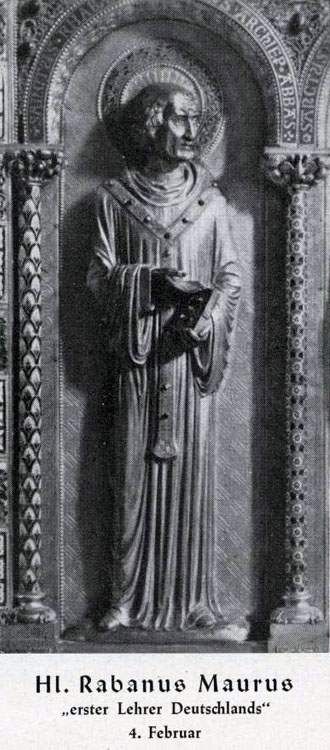
Saint of the Day – 4 February – Saint Rabanus Maurus OSB (776-856) Archbishop, Monk, Abbot,Theologian, Poet, Writer, Teacher, Encyclopedist – also known as Hrabanus or Rhabanus and “The Teacher of Germany” – born in 776 at Mainz, Germany and died on 4 February 856 at Winkel, Germany of natural cause. In the most recent edition of the Roman Martyrology (Martyrologium Romanum, 2004, pp. 133), his feast is given as today and he is qualified as a Saint (‘sanctus’).
Rabanus was born of noble parents in Mainz. The exact date of his birth remains uncertain, but in 801 he was ordained a deacon at Benedictine Abbey of Fulda in Hesse, where he had been sent to school and had become a monk. At the insistence of Ratgar, his abbot, he went to complete his studies at Tours. There he studied under St Alcuin(735-804) , who in recognition of his diligence and purity gave him the surname of Maurus, after the favourite disciple of Benedict, Saint Maurus.
Returning to Fulda, in 803 he was entrusted with the principal charge of the abbey school, which, under his direction, became one of the most pre-eminent centres of scholarship and book production in Europe and sent forth many erudite and saintly pupils. It was probably at this period that he compiled his excerpt from the grammar of Priscian, a popular textbook during the Middle Ages. According to Alban Butler’s Lives of the Saints, Rabanus ate no meat and drank no wine.
In 814 Rabanus was ordained a priest. Shortly afterwards, apparently on account of disagreement with Abbot Ratgar, he withdrew for a time from Fulda. This banishment has long been understood to have occasioned a pilgrimage to Palestine, based on an allusion in his commentary on Joshua. Rabanus returned to Fulda in 817 on the election of a new abbot, Eigil, and at Eigil’s death in 822, Rabanus himself became abbot.He handled this position efficiently and successfully but in 842 he resigned so as to have greater leisure for study and prayer, retiring to the neighbouring monastery of St Petersberg.
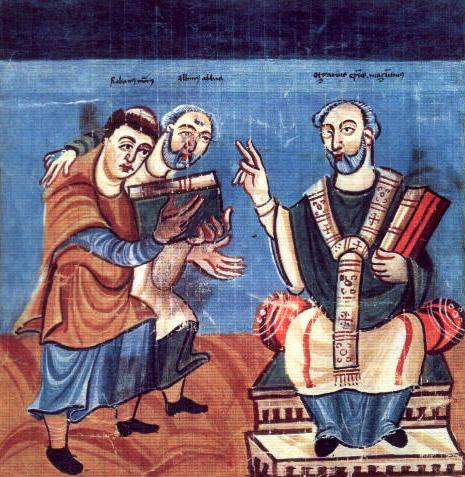
Rabanus Maurus (left) with Alcuin presents his work to Otgar of Mainz (right). Illustration from a Fulda manuscript, c. 830–840.
In 847, he was chosen to be Archbishop of Mainz, at the age of sixty-three and the last years of his life were spent directing the affairs of his Diocese, holding provincial Synods and directing a multitude of charitable works. During a famine, he fed three hundred poor people at his own house. He became bedridden shortly before his death and from the moment of his death was regarded as a saint.
Blessed Rabanus composed a number of hymns, the most famous of which is the Veni Creator Spiritus. This is a hymn to the Holy Spirit often sung at Pentecost and at ordinations. It is known in English through many translations, including Come, Holy Ghost, our souls inspire,Come, Holy Ghost, Creator blest and Creator Spirit, by whose aid. Veni Creator Spiritus was used by Gustav Mahler as the first chorale of his eighth symphony.
One of his most popular and enduring works is a spectacular collection of poems centred on the cross, called De laudibus sanctae crucis or In honorem sanctae crucis, a set of highly sophisticated poems that present the cross (and, in the last poem, Rabanus himself kneeling before it) in word and image, even in numbers.
He was buried at the monastery of St Alban’s in Mainz but later his relics were transferred to Halle.
St Liephard of Cambrai
St Magnus of Fossombrone
St Modan
St Nicholas Studites
St Nithard
St Obitius
St Phileas of Alexandria Blessed Rabanus Maurus OSB (776-856)
St Rembert
St Themoius
St Theophilus the Penitent
St Vincent of Troyes
St Vulgis of Lobbes
—
Jesuit Martyrs of Japan: A collective memorial of all members of the Jesuits who have died as martyrs for the faith in Japan.
Martyrs of Perga – 4 saints: A group of shepherds martyred in the persecutions of Decius. The only details we have about them are the names – Claudian, Conon, Diodorus and Papias. They were martyred in c 250 in Perga, Asia Minor (in modern Turkey).
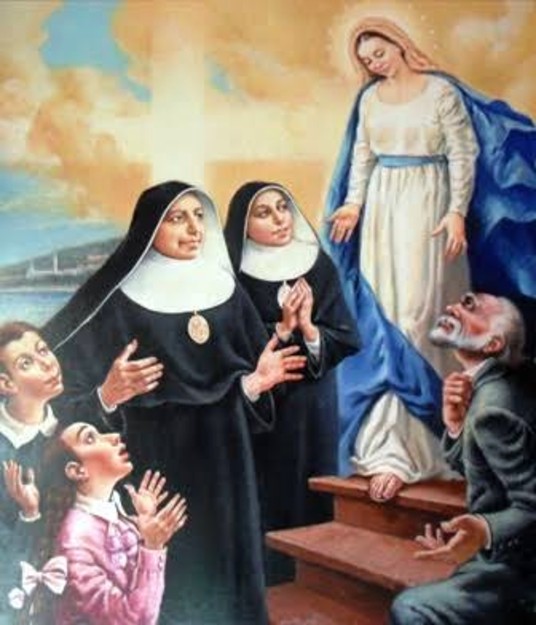
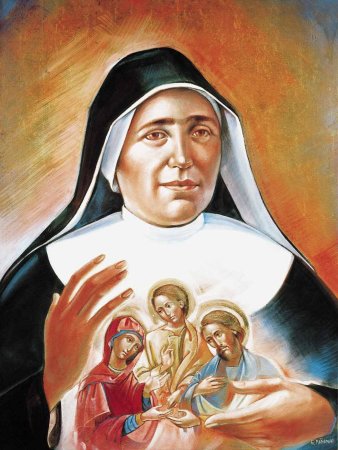
Saint of the Day – 2 February – Blessed Maria Domenica Mantovani (1862-1934) Virgin, Religious and and the co-founder of the Little Sisters of the Holy Family which she established them alongside Blessed Giuseppe Nascimbeni (1851-1922), Marian devotee, Apostle of Prayer, the poor, children and the sick. As a nun, she received the religious name of “Maria Giuseppina of the Immaculata.” Patronage – the Little Sisters of the Holy Family.
Born on 12 November 1862 in Castelletto di Brenzone, Italy, Maria Domenica Mantovani was the first of Giovanni and Prudenza Zamperini’s four children. She grew up in this small farming village and attended elementary school up to the third grade. Her intelligence, strong will and good sense made up for her incomplete education. She learned a healthy, balanced piety from her parents and at an early age was drawn to prayer and to helping others.
In 1877, when Maria Domenica was 15 years old, Fr Giuseppe Nascimbeni arrived in Castelletto as curate of the parish. As Maria’s spiritual director, he encouraged the young girl to play an active role in the parish by visiting the sick and teaching catechism. Fr Nascimbeni, who desired to enter into the lives of the townspeople to lead them to God, found Maria Domenica to be a zealous “collaborator”. Her life of prayer and her love of God and others, continued to expand under the care and direction of this austere, holy priest (Beatified 17 April 1988).
On 8 December 1886, before a statue of Mary Immaculate, Maria made a private vow of perpetual virginity. She felt that God was calling her to be consecrated to Him. This profound love for the Virgin Mary was characteristic of Maria Domenica, who allowed herself to be guided by Mary and to follow Our Lady’s motherly example in caring for souls.
In 1892, Fr Nascimbeni founded the Congregation of the Little Sisters of the Holy Family with four women, to promote parish life and any activity that would help the spiritual and material well-being of people in need. Maria Domenica assisted him in the foundation and was made Co-foundress and Superior General. She was given the name “Mother Maria of the Immaculate” and to the sisters and townspeople she was simply known as “Mother”.
She was faithful in assimilating and putting into practice, the formation she had received from Fr Nascimbeni during the “preparatory years”, carefully passing it on to the sisters and novices who were entrusted to her care. Mother Maria’s life of prayer was exemplary, she was noted for her complete trust in Mary Immaculate and always sought guidance for the direction of the congregation and the direction of the souls of her “daughters” at Our Lady’s feet.
Mother Maria felt her own “littleness” in front of the greatness of what God was calling her to do, especially since she, after Fr Nascimbeni, became a reference point and a model for the townspeople who came to her for counsel and comfort. With deep faith, however, she would say: “The Holy Family, for the great and mysterious project [that God is calling it to], has chosen me as its Co-foundress…, knowing that the Lord uses the least qualified, little, unknown instruments to do great works…. I am tranquil and convinced that the Institute, the work of God, will be provided for and guided by Him”.
The sisters were put under the direct care of Mother Maria in their spiritual and apostolic formation. Their charism was one of service to the poor and needy of the villages, achieved through the religious instruction of parishioners, assisting the sick and elderly in their homes and working with children in nursery schools.
Mother Maria constantly transmitted to all around her a feeling of great peace and was known for her goodness, humility and also firmness when needed. In 1922 Fr Nascimbeni died and Mother Maria continued to guide the growing religious family with constancy, simplicity and dedication. She herself died on 2 February 1934 in Castelletto di Brenzone.
Today the Little Sisters of the Holy Family can be found in Italy, Switzerland, Albania, Africa, Argentina, Brazil, Uruguay and Paraguay. They are dedicated to serving children and youth, families, priests, the elderly and the disabled in parishes. … Vatican.va
After approval of a first miracle Mother Maria was Beatified on 27 April 2003 by St Pope John Paul II. A second miracle is currently being investigated.
Feast of the Presentation of the Lord: The feast commemorates the purifying of the Blessed Virgin according to the Mosaic Law, 40 days after the birth of Christ and the presentation of the Infant Jesus in the Temple. The feast was introduced into the Eastern Empire by Emperor Justinian I and is mentioned in the Western Church in the Gelasian Sacramentary of the 7th century. Candles are blessed on that day in commemoration of the words of Holy Simeon concerning Christ “a light to the revelation of the Gentiles” (Luke 2) and a procession with lighted candles is held in the church to represent the entry of Christ, the Light of the World, into the Temple of Jerusalem. “Candlemas” is still the name in Scotland for a legal term-day on which interest and rents are payable (2 February).
Patronage
• Jaro, Philippines
• Western Visayas, Philippines
Our Lady of the Candles – (formally known as Nuestra Señora de la Purificación y la Candelaria) is a Marian title and image venerated by Filipino Catholics. The image, which is enshrined on the balcony of Jaro Cathedral, is known as the patroness of Jaro District of Iloilo City and the whole of the Western Visayas.
The feast day of Our Lady of the Candles is on Candlemas (2 February) and is celebrated in Iloilo City with a Solemn Pontifical Mass presided by the Archbishop of Jaro. St Pope John Paul II personally issued a Canonical coronation towards the venerated image on 21 February 1981.
World Day of Prayer for Consecrated Life – 2 February: Begun in 1997 by St Pope John Paul II, the World Day for Consecrated Life was intended to serve three purposes:
• to praise the Lord and thank Him for the great gift of consecrated life;
• to promote a knowledge of and esteem for the consecrated life by the entire People of God;
• to allow those in consecrated life to celebrate together the marvels which the Lord has accomplished in them, to discover by a more illumined faith the rays of divine beauty, spread by the Spirit in their way of life and to acquire a more vivid consciousness of their irreplaceable mission, in the Church and in the world;
It serves an opportunity to highlight the extraordinary contributions of men and women religious, as well as a time to pray for vocations to the consecrated life.
—
St Adalbald of Ostrevant
St Adeloga of Kitzingen
St Agathodoros of Tyana
St Andrea Carlo Ferrari
St Apronian the Executioner
St Bruno of Ebsdorf
St Burchard of Wurzburg
St St Candidus the Martyr
St Columbanus of Ghent
St Cornelius the Centurion
St Felician the Martyr
St Feock
St Firmus of Rome
St Flosculus of Orléans
St Fortunatus the Martyr
St Hilarus the Martyr
St Jean Theophane Venard
St Jeanne de Lestonnac
St Lawrence of Canterbury
Bl Louis Alexander Alphonse Brisson Blessed Maria Domenica Mantovani (1862-1934)
St Marquard of Hildesheim
St Mun
Bl Peter Cambiano
St Rogatus the Martyr
St Saturninus the Martyr
St Sicharia of Orleans
St Simon of Cassia Fidati
Bl Stephen Bellesini
St Theodoric of Ninden
St Victoria the Martyr
—
Martyrs of Ebsdorf: Members of the army of King Louis III of France under the leadership of Duke Saint Bruno of Ebsdorf. The martyrs died fighting invading pagan Norsemen, and defending the local Christian population. Four bishops, including Saint Marquard of Hildesheim and Saint Theodoric of Ninden, eleven nobles, and countless unnamed foot soldiers died repelling the invaders. They were martyred in the winter of 880 in battle at Luneberg Heath and Ebsdorf, Saxony (modern Germany).
Quote/s of the Day – 1 February – The Memorial of Blessed Luigi Variara SDB (1875-1923)
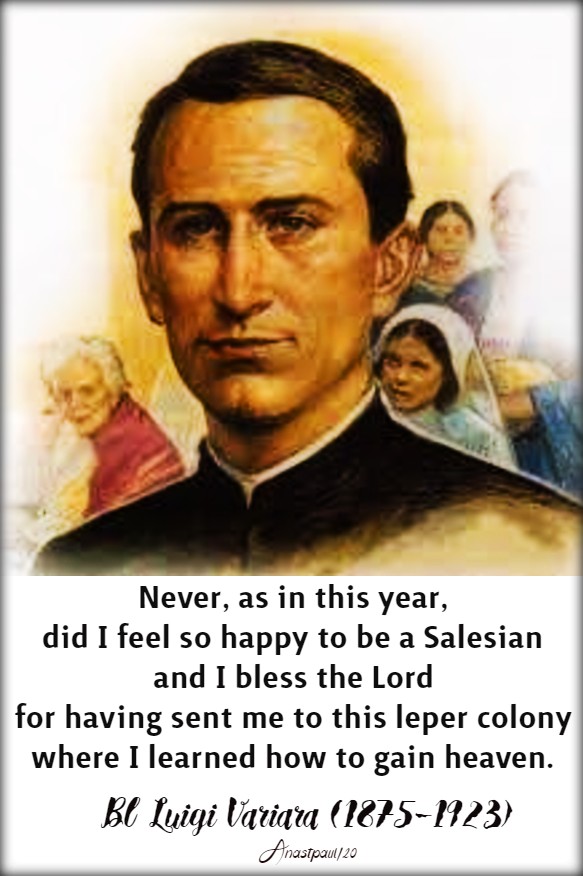
“Never, as in this year, did I feel so happy to be a Salesian and I bless the Lord for having sent me to this leper colony where I learned how to gain heaven.”
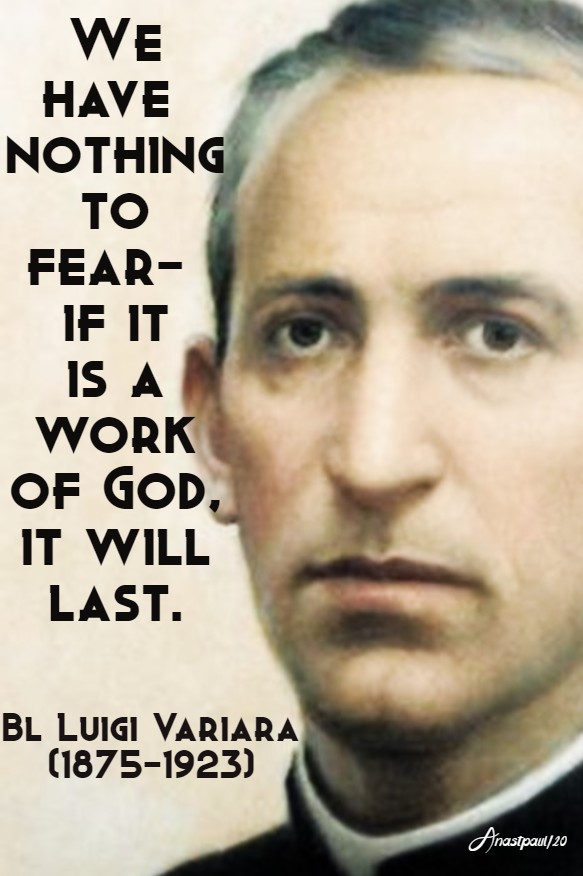
“We have nothing to fear – if it is a work of God, it will last.”
One Minute Reflection – 1 February – Saturday of the Third Week in Ordinary Time, Year A , Readings: 2 Sm 12:1-7A, 10-17, Psalm 51(50),12-13.14-15.16-17, Mk 4:35-41 and the Memorial of Blessed Luigi Variara SDB (1875-1923)
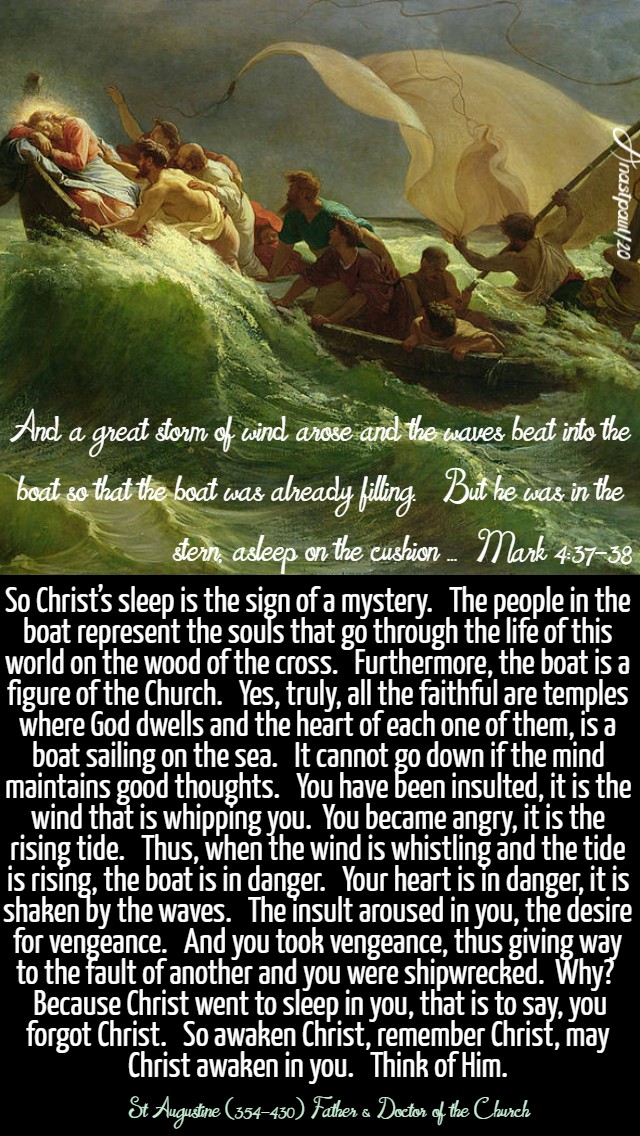
And a great storm of wind arose, and the waves beat into the boat so that the boat was already filling. But he was in the stern, asleep on the cushion … Mark 4:37-38
REFLECTION – “With the Lord’s grace, I am going to talk to you about today’s gospel. With God’s help, I also want to encourage you not to let faith sleep in your hearts in the midst of the storms and swells of this world. Without any doubt, the Lord Jesus Christ exercised His power over sleep, no less than over death and, when He was sailing on the lake, the Almighty could not succumb to sleep, if He did not want to do so. If you think He did not have this power, it is because Christ is asleep in you. If on the contrary, Christ is awake in you, your faith is also awake. The apostle Paul said: “May Christ dwell in your hearts through faith.” (Eph 3:17)
So Christ’s sleep is the sign of a mystery. The people in the boat represent the souls that go through the life of this world on the wood of the cross. Furthermore, the boat is a figure of the Church. Yes, truly, all the faithful are temples where God dwells and the heart of each one of them, is a boat sailing on the sea. It cannot go down if the mind maintains good thoughts. You have been insulted, it is the wind that is whipping you. You became angry, it is the rising tide. Thus, when the wind is whistling and the tide is rising, the boat is in danger. Your heart is in danger, it is shaken by the waves. The insult aroused in you, the desire for vengeance. And you took vengeance, thus giving way to the fault of another and you were shipwrecked. Why? Because Christ went to sleep in you, that is to say, you forgot Christ. So awaken Christ, remember Christ, may Christ awaken in you. Think of Him.” … St Augustine (354-430) Bishop of Hippo and Father & Doctor of the Church – Sermon 63, 1-3
PRAYER – Waken us holy Lord, to Your presence in us, with us, now and forever. Open our eyes to see Your presence and our ears to hear Your voice. Teach us that You are always with us and Your presence is all we need to survive the storms and the winds of this world. For You, just You, are our rock and our foundation, our ship and our harbour. Grant that the prayers of Blessed Luigi Variara and all Your saints may serve to remind us of Your love and power. Through Christ our Lord, with the Holy Spirit, God forever, amen.
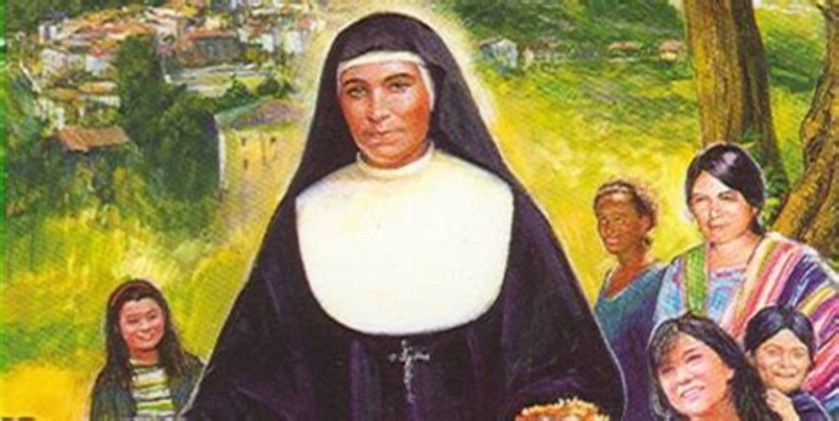
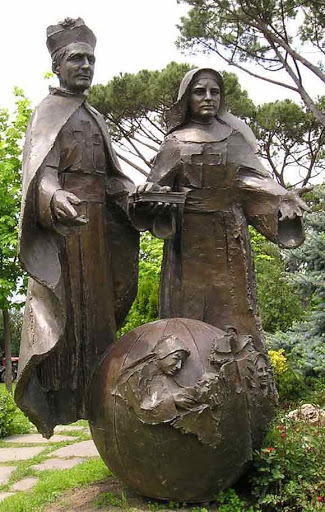
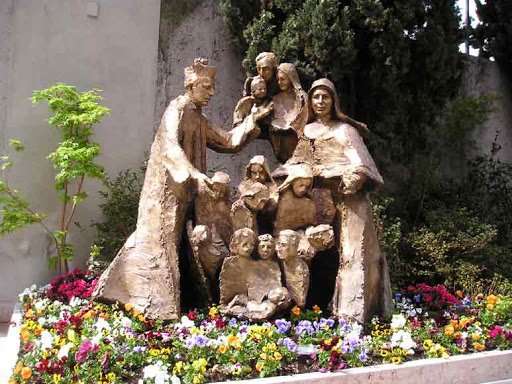
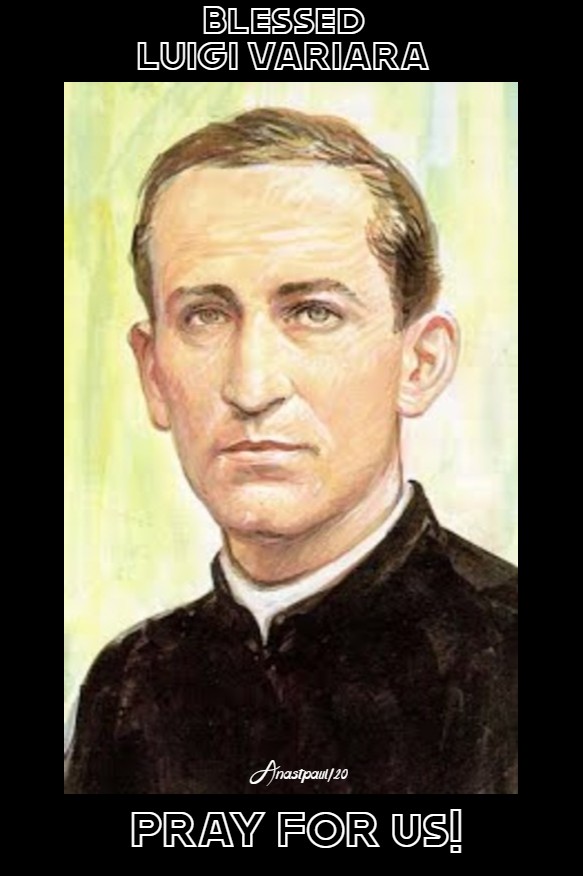
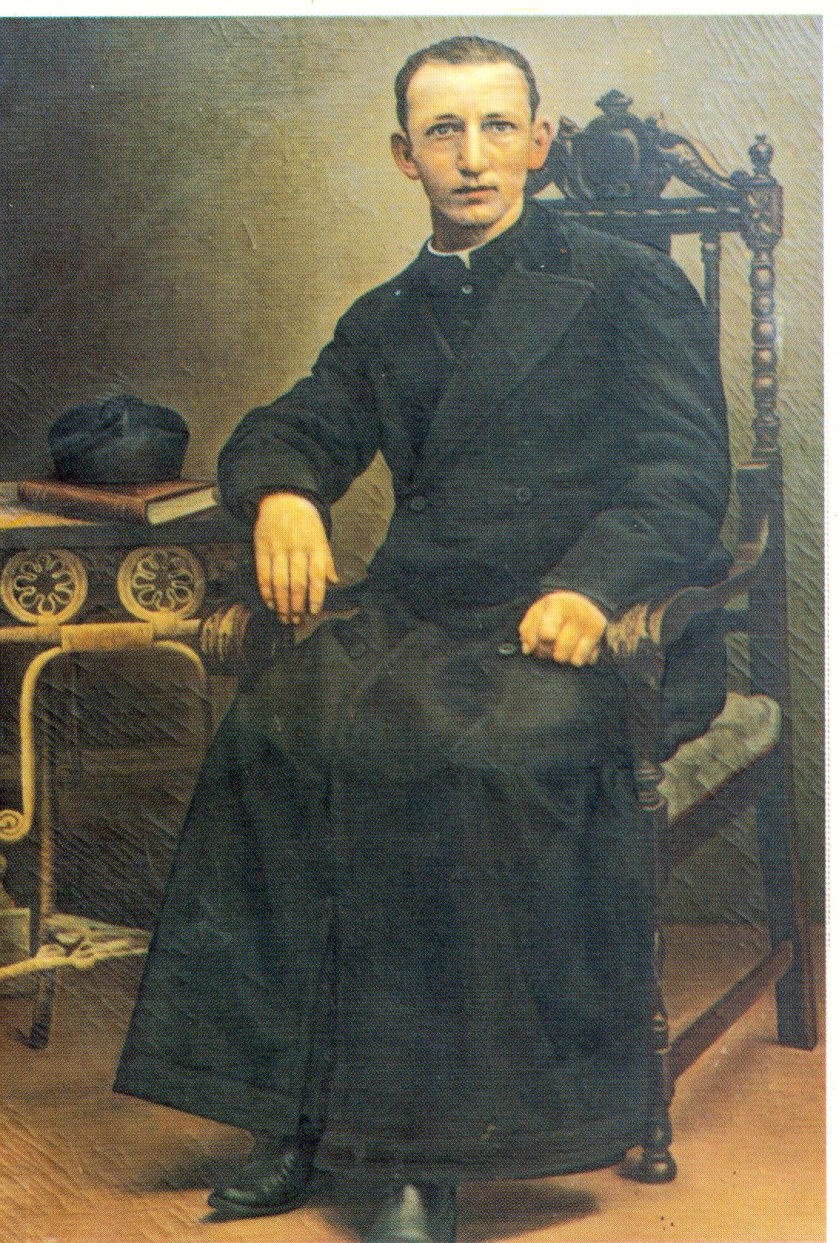
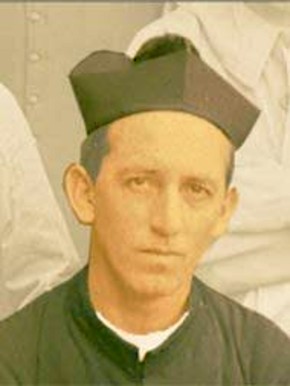
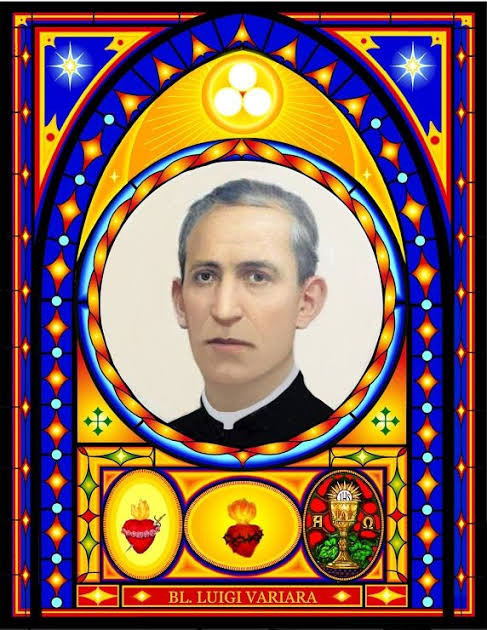
Saint of the Day – Blessed Blessed Luigi Variara SDB (1875-1923) Priest of the Salesians of Don Bosco, Founder of the Daughters of the Sacred Hearts of Jesus and Mary, of which Order he is the Patron. Blessed Luigi Variara was born in Viarigi (Asti), Italy, on 15 January 1875 and died on 1 February 1923 in Cucuta, Colombia. He was an apostle to the lepers in Colombia and founder of the Congregation of the Daughters of the Sacred Hearts of Jesus and Mary who ran the homes he set up for lepers.
He was born to Pietro Variara and Livia Bussa. When he was 12 years old he entered the Salesian Oratory in Turin, while the founder Don Bosco of the Salesian Congregation, was still alive. Luigi had the privilege of meeting this living saint on one occasion and it was an encounter that changed his life. John Bosco looked into the eyes of the young boy and this gaze was for Luigi a confirmation of his future Salesian vocation. John Bosco died a month later on 31 January 1888.
In 1891 he entered the novitiate and shortly afterward he made his profession in the hands of Bl Michael Rua, Don Bosco’s first successor. After his novitiate, Luigi did his study of philosophy at Valsalice and there he met Fr Michele Unia, the Salesian apostle of lepers of Colombia, who had come to speak to the community about his mission. His talk won Luigi over and in 1894 he left for Colombia with Fr Unia when he returned. Here he dedicated himself to the lepers of Agua de Dios, sharing with them his passion for music and drama. Fr Unia died shortly thereafter, leaving Luigi and three other priests in charge of the leper colony.
The three years before his priestly ordination in 1898 proved to be a time of spiritual growth and maturation for the young Luigi, who came to understand better the reality of sacrifice and self-giving in serving others and in running the risk of contagion through continual contact with lepers.
After his ordination, he exercised his duties as priest in the leper colony and with responsibility for the parish, often spending four or five hours a day in the confessional. He also continued to teach music and drama, especially concerned for the moral health of the young people of Agua de Dios.
From the first year of his priesthood, Luigi felt the need to open a leprosarium for young patients, a project that mirrored that of his predecessor, Fr Unia. The scope of such a foundation was to educate these children in the faith, to teach them how to read and write and skill in manual labour, so that they would be saved from a life of desolation and vice. In 1905 the “Michele Unia Youth Hostel” was opened. On 7 May 1905 he founded the Congregation of the “Daughters of the Sacred Hearts of Jesus and Mary”, in order to provide care for the residents of the hostel. “Our goal”, he stated, “along with that of our own personal sanctification, is to care for the leperosy patients in the hostel and in serving God by offering ourselves as victims of expiation”.
He also said of the year 1905: “Never as in this year did I feel so happy to be a Salesian and I bless the Lord for having sent me to this leper colony where I learned how to gain heaven.”
As the Congregation was also founded with the intention of offering to women lepers the possibility to consecrate their lives to God, Fr Variara’s initiative was much criticised and misjudged by other religious institutes and even by some of his own brothers, who questioned whether this new Salesian “branch” was in accordance with the charism of their founder. He had founded a community of “outcasts” it seemed, in the eyes of the world.
Luigi, however, held firmly to God’s will and began to climb the Calvary of not being understood or accepted by those who should have been closest to him. He received, however, the consolation and relief of knowing that he was acting out of obedience, since Fr Michael Rua, Don Bosco’s first successor stood behind him and encouraged him to continue with the foundation.
His greatest trial proved to be his transferal from Agua de Dios to Venezuela, a separation from his Congregation which cast a shadow of mystery on the foundation itself and began 18 years of misunderstandings for Luigi. He was transferred from city to city after leaving Agua de Dios and in 1921 he was definitively moved to Táriba. He continued, however, to keep in contact with Mother Lozano, co-foundress of the Institute. He assured her that there was “nothing to fear – if it is a work of God, it will last.”Luigi Variara died on 1 February 1923 in Cucuta, aged 48.
The Congregation is currently present in Colombia, Ecuador, Venezuela, Bolivia, Brazil, Mexico, Spain, Italy, Dominican Republic and Equatorial Guinea and is dedicated in the service of the poor and the sick. ... Vatican.Va
As of 2005 there have been around 382 religious of the congregation operating in a total of 71 houses.
St Pope John Paul II approved a miracle attributed to his intercession and celebrated his Beatification on 14 April 2002. The current postulator of the cause is the Salesian Father Pierluigi Cameroni.
St Agrepe
Bl Andrew of Segni
Bl Anthony Manzoni
St Asclepiades
St Autbert of Landevenec
St Barbara Ch’oe Yong-i Bl Benedict Daswa (1946-1990) – Martyr The first South African Blessed:
St Brigid of Fiesole St Brigid of Ireland/Kildare (c 453-523) St Brigid’ Story: https://anastpaul.com/2019/02/01/saint-of-the-day-st-brigid-of-ireland-kildare-c-453-523/
St Cecilius of Granada
St Cinnia of Ulster
St Clarus of Seligenstadt
Bl Conor O’Devany
St Crewenna
St Darlaugdach of Kildare
St Henry Morse
St Ioannes Yi Mun-u
St Jarlath
Bl John of the Grating
St Kinnia Blessed Luigi Variara SDB (1875-1923)
Bl Patrick O’Lougham
St Paul of Trois-Châteaux
St Paulus Hong Yong-ju
St Raymond of Fitero
St Sabinus
St Severus of Avranches
St Severus of Ravenna
St Sigebert III of Austrasia
St Tryphon of Lampsacus
St Ursus of Aosta
St Veridiana
—
Martyrs of Avrillé – 47 beati: Forty-seven Christians executed together for their faith in the anti-Catholic persecution of the French Revolution.
• Anne-François de Villeneuve
• Anne Hamard
• Catherine Cottenceau
• Charlotte Davy
• François Bellanger
• François Bonneau
• François Michau
• François Pagis epouse Railleau
• Gabrielle Androuin
• Jacquine Monnier
• Jeanne Bourigault
• Jeanne Fouchard épouse Chalonneau
• Jeanne Gruget veuve Doly
• Jeanne-Marie Sailland d’Epinatz
• Louise-Aimée Dean de Luigné
• Louise-Olympe Rallier de la Tertinière veuve Déan de Luigné
• Madeleine Blond
• Madeleine Perrotin veuve Rousseau
• Madeleine Sailland d’Epinatz
• Marguerite Rivière epouse Huau
• Marie Anne Pichery épouse Delahaye
• Marie-Anne Vaillot
• Marie Cassin épouse Moreau
• Marie Fausseuse épouse Banchereau
• Marie Gallard épouse Quesson
• Marie Gasnier épouse Mercier
• Marie Grillard
• Marie-Jeanne Chauvigné épouse Rorteau
• Marie Lenée épouse Lepage de Varancé
• Marie Leroy
• Marie Leroy épouse Brevet
• Marie Roualt épouse Bouju
• Odilia Baumgarten
• Perrine Androuin
• Perrine Besson
• Perrine-Charlotte Phelippeaux épouse Sailland d’Epinatz
• Perrine Grille
• Perrine Ledoyen
• Perrine Sailland d’Epinatz
• Renée Cailleau épouse Girault
• Renée Grillard
• Renée Martin épouse Martin
• Renée Valin
• Rose Quenion
• Simone Chauvigné veuve Charbonneau
• Suzanne Androuin
• Victoire Bauduceau epouse Réveillère
They were martyred on 1 February 1794 in Avrillé, Maine-et-Loire, France and Beatified on 19 February 1984 by St Pope John Paul II at Rome, Italy.
Martyrs of Korea: Thousands of people were murdered in the anti-Catholic persecutions in Korea. Today we celebrate and honour:
• Saint Barbara Ch’oe Yong-i
• Saint Ioannes Yi Mun-u
• Saint Paulus Hong Yong-ju
Second Thought for the Day – 31 January – The Memorial of Saint Francis Xavier Bianchi CRSP (1743-1815) “Apostle of Naples”
Trainer of many candidates for the altars
In 1776 he met a Franciscan Tertiary, Maria Francesca delle Cinque Piaghe (aka Anna Maria Rosa Nicoletta Gallo, Canonised in 1867), to whom supernatural gifts were attributed. He was her Spiritual Director until her death on 6 October 1791.
Among his disciples for whom the causes of Beatification and Canonisation have been opened, in addition to the aforementioned Francesco Maria Castelli, there are Don Mariano Arciero (Beatified in 2012), Don Placido Baccher, Don Agnello Coppola and Giovanni Battista Jossa.
Don Vincenzo Romano (Canonised in 2018) and Queen Maria Clotilde of Savoy, in exile in Naples with her husband Carlo Emanuele IV, as well as many cardinals and bishops, also had spiritual relationships with him.
His style, between special gifts and cheerfulness
Father Francesco Saverio remained in his convent even when the subversive laws of 1809 suppressed his Order. He had the gift of prophecy and visions of events distant in time and space. Miracles and charismatic gifts increased his reputation for holiness – one of many, the arrest, with a sign of the cross, of the lava erupted by Vesuvius in 1804 and 1805.
Similar in joyfulness to Saint Philip Neri, he had mysterious tremors like him and heart palpitations during the prayer and the celebration of the Mass, which he officiated with a fervour, which amazed those who attended. Maria Francesca delle Cinque Piaghe said: “We have two Filippo, one black and one white”, referring to similar spiritual qualities and also to the two surnames “Neri” and “Bianchi.”
Never underestimate the power of the Saints to assist us on this journey home!
Quote/s of the Day – 31 January – Friday of the Third Week in Ordinary Time, Year A, the Memorial of Saint Francis Xavier Bianchi CRSP (1743-1815) “Apostle of Naples” and St John Bosco (1815-1888)
“When you hear, that I cannot celebrate Mass anymore, count me as dead.”
One Minute Reflection – 31 January – Friday of the Third Week in Ordinary Time, Year A, Readings: 2 Samuel 11:1-10, 13-17, Psalm 51:3-7, 10-11, Mark 4:26-34 and the Memorial of Saint Francis Xavier Bianchi CRSP (1743-1815) “Apostle of Naples” and St John Bosco (1815-1888)
“To what shall we compare the kingdom of God, or what parable can we use for it? It is like a mustard seed…” … Mark 4:30-31
REFLECTION – “The Word of God is like a grain of mustard seed, before cultivation it looks extremely small. But when it is cultivated in the right way, it grows so large, that the highest principles of both sensible and intelligible creation, come like birds to revive themselves in it. For the principles – or inner essences of all things, are embraced by the Word but the Word is not embraced by anything. Hence, the Lord has said, that whoever has faith like a grain of mustard seed, can move a mountain by a word of command (cf. Mt 17:20), that is, he can destroy the devil’s dominion over us and remove it from its foundation.
The grain of mustard seed is the Lord, who by faith is sown spiritually in the hearts of those who accept Him. Whoever diligently cultivates the seed by practising the virtues, moves the mountain of earthbound pride and, through the power thus gained, expels the obdurate habit of sin. In this way, the activity of the principles and qualities, or divine powers, present in the commandments, is revived as though they were birds. (…) Those who seek the Lord should not look for him outside themselves. On the contrary, they must seek Him, within themselves, through faith made manifest in action.
For it is written, “The word is very near to you, in your mouth and in your heart” (Rm 10:8), that is, the word of faith, Christ, being Himself, the word that is sought.” … Saint Maximus the Confessor (c 580-662) Monk and Theologian – Second Century on Theology, nos. 10-11, 35
PRAYER – Almighty Father, we bless You Lord of life, through whom all living things tend. You are the source of all, our first beginning and our end! Grant holy Father, that we may allow the Word to enter our hearts and grow by Your grace, so that we may always live for Your glory. May the intercession of St Francis Xavier Bianchi and St John Bosco, who consistently tended Your seed, grant us strength and zeal. Through Jesus Christ, our Lord with the Holy Spirit, God forever, amen.
Our Morning Offering – 31 January – Friday of the Third Week in Ordinary Time, Year A and the Memorial of St John Bosco (1815-1888) Founder of the Society of St Francis de Sales now known as the Salesians
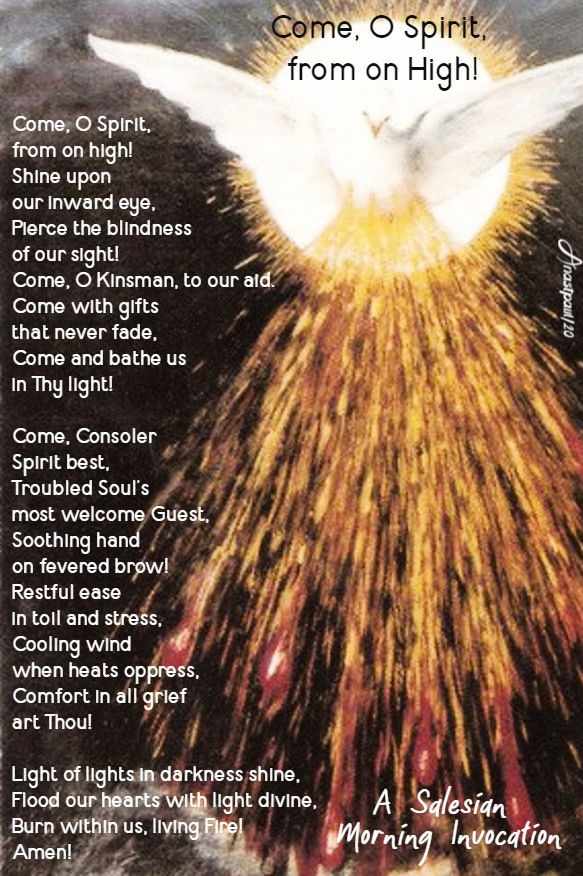
Come, O Spirit, from on High! A Salesian Morning Invocation
Come, O Spirit, from on high!
Shine upon our inward eye,
Pierce the blindness of our sight!
Come, O Kinsman, to our aid.
Come with gifts that never fade,
Come and bathe us in Thy light!
Come, Consoler Spirit best,
Troubled Soul’s most welcome Guest,
Soothing hand on fevered brow!
Restful ease in toil and stress,
Cooling wind when heats oppress,
Comfort in all grief art Thou!
Light of lights in darkness shine,
Flood our hearts with light divine,
Burn within us, living Fire!
Amen!
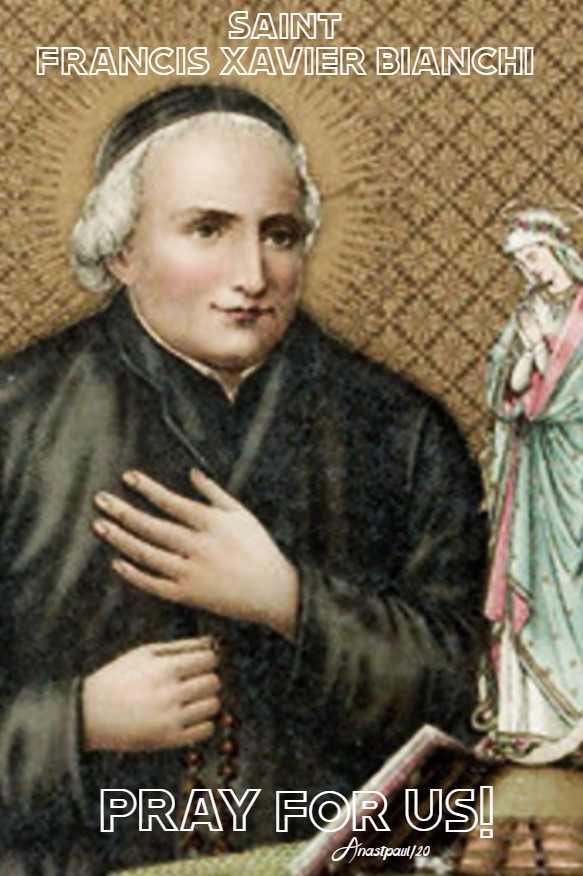
Saint of the Day – 31 January – Saint Francis Xavier Bianchi CRSP (1743-1815) “Apostle of Naples” – Priest of the Barnabite Order (The Clerics Regular of St Paul), Apostle of the poor, Eucharistic Adorer, Marian devotee, Ascetic and Mystic, Spiritual Director and Confessor, Professor – born as Francesco Saverio Maria Bianchi on 2 December 1743 in Arpino, Frosinone, Italy and died on 31 January 1815 in Naples, Italy of natural causes. Patronage – Naples. St Francis gained a reputation for sanctity during his lifetime from his commitment to his students, his guidance of all who sort his spiritual direction and to the poor of Naples.
Francis was born in 1743 in Arpino in the Lazio region, then part of the Papal States, into a loving and pious family. His mother taught him to care for the poor around them, giving him example by setting up a small clinic in the family home where she would nurse up to 16 needy people. He was, nevertheless, far from a standard pious child. He would later confess to how he would occasionally pilfer money from his parents.
He made his first studies in the Collegio dei Santi Carlo e Filippo in Arpino, run by the Regular Clerics of San Paolo, also called Barnabiti, founded in 1530 in Milan by Father Antonio Maria Zaccaria (Canonised in 1897). What changed Bianchi’s life was a slow and steady resolve to conquer his own will. As he grew older, he felt called to religious life. He initially thought of entering the Society of Jesus but then he chose the Order to which his teachers belonged. The parents, on the other hand, would have preferred to see him as a diocesan priest. As a result, at the age of 15 he was enrolled in a minor seminary in Nola, while at the same time, he began the study of law at the University of Naples Federico II. During this period, he came under the spiritual guidance of St Alphonsus Maria de Ligouri, the founder of the Redemptorists.
In 1757, Francis was admitted by the Barnabite Order into their novitiate in Zagarolo that same year, professing religious vows as a member of the Order the following year. He was then sent to pursue his study of philosophy and theology, first at Macerata, followed by Rome and Naples, where he was ordained a priest in 1767. Prior to his ordination he had taught at the Barnabite college in his hometown. He was immediately appointed the Superior of the College of Santa Maria in Cosmedin in Portanova, which office he filled for 12 years.
His superiors then assigned him to the Barnabite monastery attached to the Church of Santa Maria di Caravaggio, Naples, where he was to spend the rest of his life. In 1778 he was appointed a professor at Regia University (now the University of Palermo), as well as a member of the Royal Academy of Science and Letters of the Pontifical Ecclesiastical Academy. Despite his academic honours and pride of place in the Order, his fellow Barnabites also saw another side to him, as he became known among them for the deeply ascetic way of life he followed, with a deeply contemplative prayer life and for his constant concern for the poor of the cities where he lived.
He became part of a circle of notable religious figures living in Naples in that era. He became the Spiritual director and Confessor of Mary Frances of the Five Wounds, a Franciscan tertiary, who lived in one of the most crime-ridden neighbourhoods of the city and is now also honoured as a saint. In turn, he became friends and under the guidance of such figures as Placido Baccher, the Blessed Mariano Arciero, his fellow Barnabite and student, the Venerable Francesco Maria Castelli, Giovanni Battista Jossa, the Servant of God Agnello Coppola. He was in frequent communication with the Blessed Vincent Romano as well as with King Charles Emmanuel IV of Sardinia and his niece, Princess Maria Clotilde of Savoy, then in exile in Naples.
Fr Francis’ life changed in 1800, when he fell into a state of religious ecstasy while praying before the exposed Blessed Sacrament on Pentecost of that year. Shortly after this, he developed an illness which left his legs twisted and with open sores for the rest of his life. During the last three years of his life, he continued to preside daily at Mass, despite the agony of having to stand. Mostly bedridden, he used this time to deepen his spiritual life even further as well as guiding others spiritually and hearing Confessions.
Fr Francis also begun to tremble and experiences palpitations of his heart whenever he prayed, in a manner similar to that which had been experienced by St Philip Neri two centuries earlier. The tertiary Mary Frances commented that we have two Philip’s, one white and one black, which was a pun on the meanings of their family names in Italian.
He was still living in the Barnabite monastery of Naples when it was closed in 1809, as part of the suppression of all monasteries and religious houses under the Napoleonic Kingdom of Naples. He was able to remain in the city, where he died in 1815.
Fr Francis was Beatified on 22 January 1893 by Pope Leo XIII, who also declared him to be the “Apostle of Naples.” He was Canonised on 21 October 1951, by Pope Pius XII. His remains are enshrined in the Church of Santa Maria di Caravaggio in Naples. His feast day is celebrated on 30 January by the Barnabites (moved to avoid being in conflict with St John Bosco’s feast) but the Catholic Church in Naples celebrates today, the feast of their beloved Saint with great honour and festivities each year.
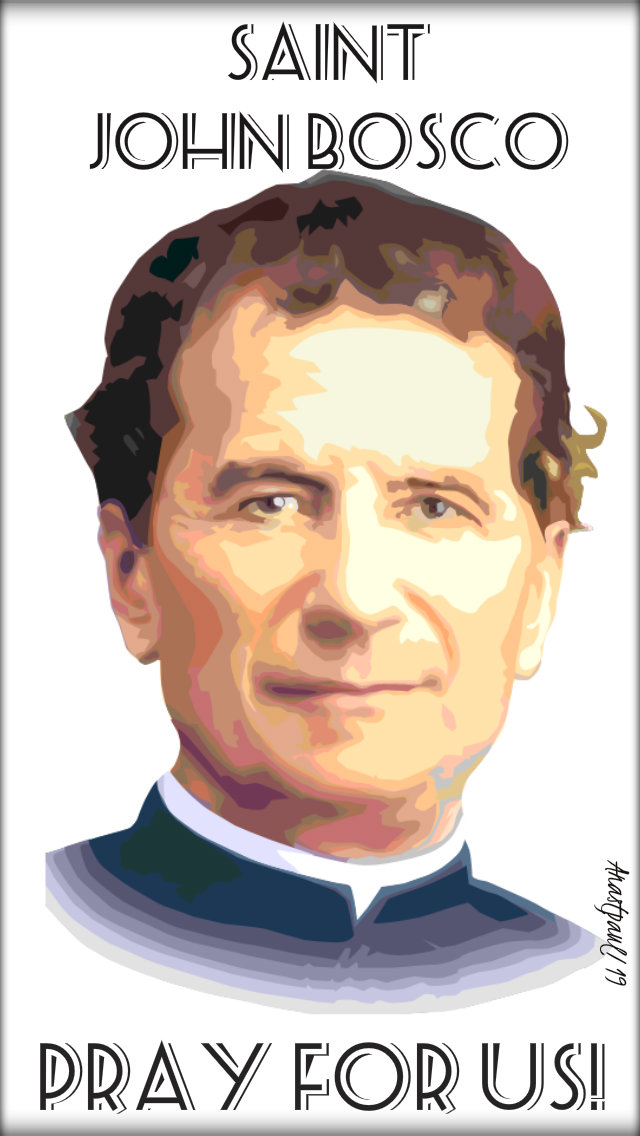
St John Bosco “Don Bosco” SDB (1815-1888) (Memorial) Founder of the Society of St Francis de Sales now known as the Salesians All about beautiful Don Bosco:
St Abraham of Abela
Bl Adamnan of Coldingham
St Aedan of Ferns
St Aiden
St Athanasius of Modon
St Bobinus of Troyes
St Eusebius of Saint Gall St Francesco Saverio Maria Bianchi/Francis Xavier Bianchi CRSP (1743-1815) “Apostle of Naples”
St Geminian of Modena
Bl John Angelus
St Julius of Novara
Bl Louise degli Albertoni
Bl Luigi Talamoni
St Madoes
St Marcella
Bl Maria Cristina di Savoia
St Martin Manuel
St Nicetas of Novgorod
St Tryphaena of Cyzicus
St Tysul
St Ulphia of Amiens
St Waldo of Evreux
St Wilgils
—
Martyrs of Corinth – 14 saints: A group of Christians tortured and martyred together in Corinth, Greece in the persecutions of Decius. We know nothing about them except some names – Anectus, Claudius, Codratus, Crescens, Cyprian, Diodorus, Dionysius, Nicephorus, Papias, Paul, Serapion, Theodora, Victor and Victorinus.
Martyrs of Canope:
Athanasia
Cyrus the Physician
Eudoxia
John the Physician
Theoctista
Theodotia
Martyred in Alexandria, Egypt
Cyriacus
Metranus
Saturninus
Tarskius
Thyrsus
Victor
Zoticus
Martyred in Alexandria, Egypt:
Cyriacus
Metranus
Saturninus
Tarskius
Thyrsus
Victor
Zoticus
Martyred in the Spanish Civil War:
José Acosta Alemán
Juan José Martínez Romero
Pedro José Rodríguez Cabrera
Martyrs of Korea: Thousands of people were murdered in the anti-Catholic persecutions in Korea.
• Saint Agatha Kwon Chin-i
• Saint Agatha Yi Kyong-I
• Saint Augustinus Park Chong-Won
• Saint Magdalena Son So-Byok
• Saint Maria Yi In-Dok
• Saint Petrus Hong Pyong-Ju
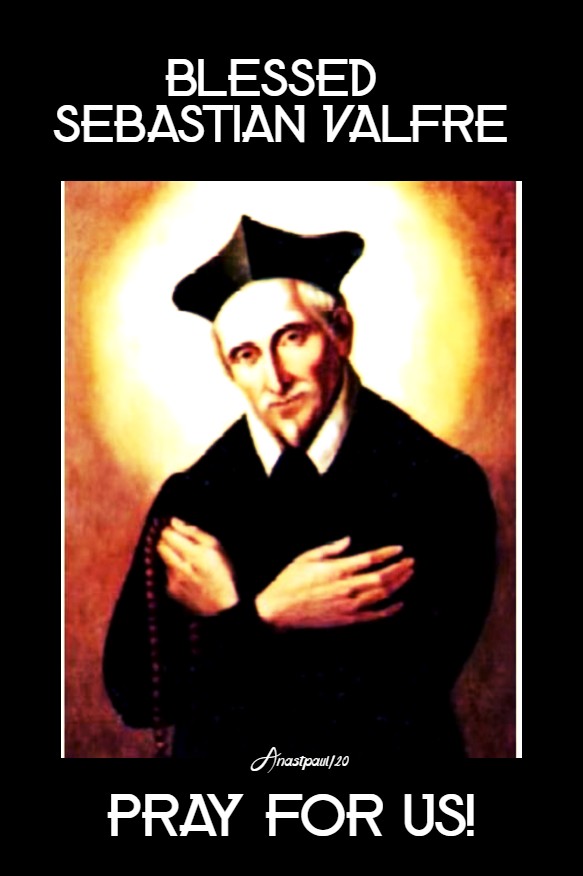
Second Thought for the Day – 30 January – The Memorial of Blessed Sebastian Valfrè CO (1629-1710)
Blessed Sebastian’s sanctity, under God, arose from his struggles to conform himself to Saint Philip – and that was quite a task. Whereas Philip was gentle and kind by nature, Sebastian was harsh and prone to outbursts of anger. Philip had to refrain from extended prayer in public for fear of going into ecstasy. Sebastian experienced nothing but dryness in prayer and had to keep his mind from wandering. The thought of death and judgement so tormented him, that he could not sleep at night.
And Sebastian found one of the principal works of the Oratory – the hearing of confessions – so repugnant that the congregation could not prevail upon him to accept faculties until ten years after his ordination. Yet, he was able to overcome all these difficulties and always to maintain a serene and joyful expression, so that everyone considered him to be another Saint Philip.
Community life presented Sebastian with many opportunities for mortifying his short temper. When teaching theology to the novices, he had to endure a student who had no interest in the subject and showed his annoyance by constantly arguing and contradicting the professor.
Sebastian patiently answered his objections and did not betray his own displeasure, although, as he confided to one of the fathers, the very sight of the man filled him with repugnance. The novice subsequently left the congregation; more serious, however and more enduring was Sebastian’s natural antipathy for one of the fathers. He admitted that there was nothing objectively wrong with the priest but that the dislike was so strong that he had to take a private vow to endure the father’s company. Sebastian believed that he never once betrayed his feelings and was grateful for the opportunity to mortify his nature which he recognised to be imperfect.
Sebastian had a beautiful plaster Crucifix, over the prie-Dieu in his room, to which he was quite attached. He once asked a father to get some papers for him which were inside the flap of the prie-Dieu. In opening the flap, the priest let it slip and it shattered the crucifix into tiny pieces. Sebastian, although he was in the room when it happened, remained calm, told the father not to trouble himself with it and swept up the pieces himself.
The Congregation of the Oratory derives its name from a place of prayer and Saint Philip used to say that anyone who did not intend to pray should leave the community. Sebastian, although he was intent on praying, found prayer extremely difficult. He found it dry and God seemed to be very far away from him. When engaged in mental prayer, Sebastian found it hard to concentrate, although he was careful to prepare his meditations. The inability to concentrate was especially painful to him when saying his office and he seems to have given in to scruples on occasion, reciting the office more than once. And at Mass, too, he found it difficult to concentrate, although for a brief time after Communion, his soul found some peace.
Sebastian remained in this state of anguish for many years. But, although he suffered interiorly, he was able to lead his penitents in the way of Christian joy associated with his spiritual father, Saint Philip. Sebastian, himself, acknowledged the value of these torments in teaching him perfect detachment from all earthly things. Others have seen them as protecting his humility from his admiring disciples who were intent on bestowing every honour upon the Saint.
Blessed Sebastian is a model of perseverance and a great source of hope. He fought against imperfections such as his temper and repugnances and prevailed. And he persevered in prayer although he did not find any consolation there but, more often than not, spiritual torment. Yet, God used these means to purify him and present him to the outside world as a great saint full of Christian joy. His exemplary life of holiness would inspire the Church in Turin for many generations and now, he inspires the faithful in perseverance, hope and humility, knowing that we are all called to be Saints too! It is comforting and a source of consolation to realise, that the Saints too, experienced the hardships we sometimes do – let us never give up the pursuit of holiness, amen.
Quote/s of the Day – 30 January – The Memorial of Blessed Sebastian Valfrè CO (1629-1710)
Some of his advice, given to the novices, suffice for us all:
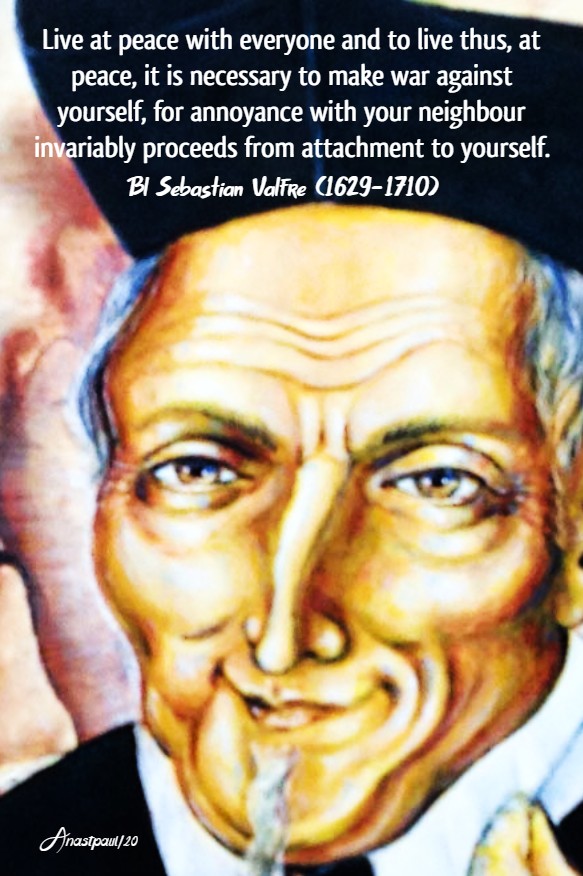
“Live at peace with everyone and to live thus, at peace, it is necessary to make war against yourself, for annoyance with your neighbour invariably proceeds from attachment to yourself.”
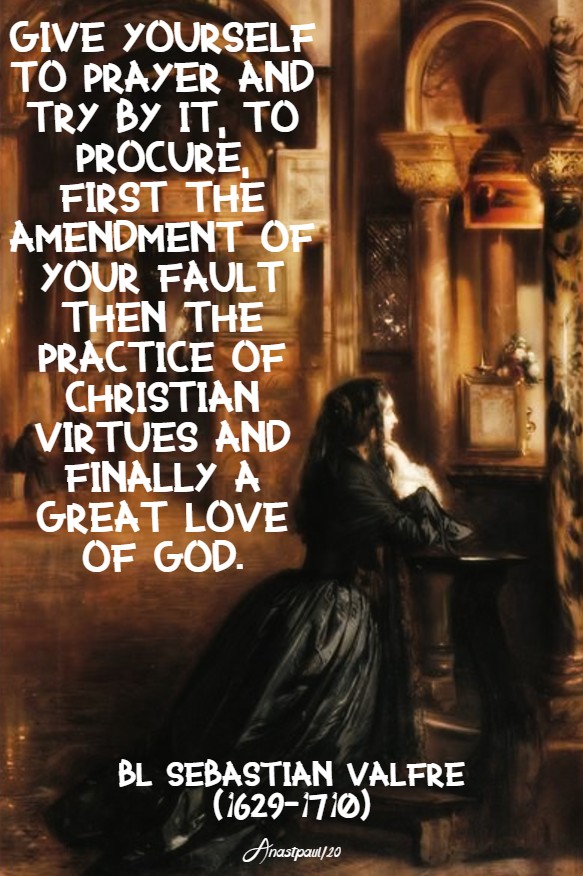
“Give yourself to prayer and try by it, to procure, first the amendment of your fault then the practice of Christian virtues and finally a great love of God.”
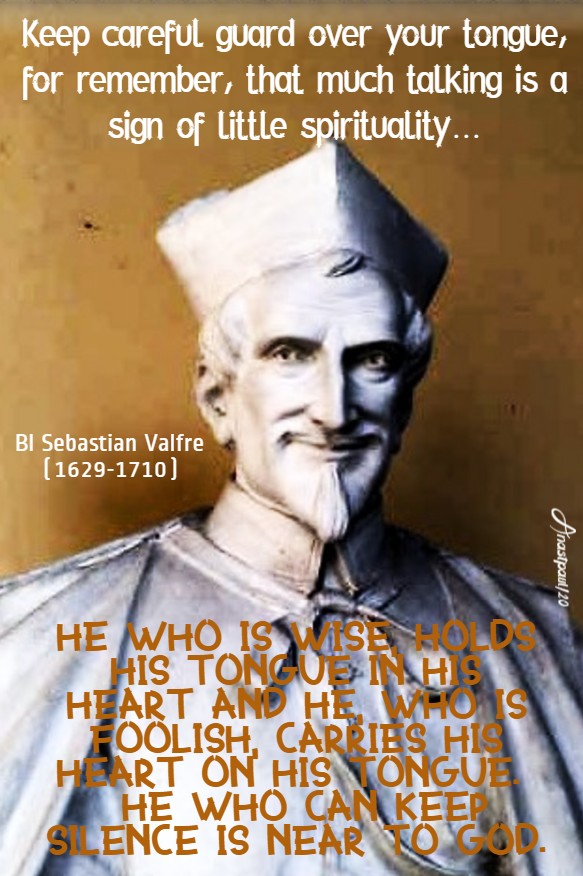
“Keep careful guard over your tongue, for remember, that much talking is a sign of little spirituality…”
“He who is wise, holds his tongue in his heart and he, who is foolish, carries his heart on his tongue. He who can keep silence is near to God.”
He was much in demand as a spiritual father and would advise the Fathers of his Congregation:
“A confessor should above all, give a good example to his penitents, especially by practising the virtues he wishes to impress upon them. If he exhorts them to humility, let him first be humble; if to devotion, let him be devout himself; if he is to do this he will more readily be believed and obeyed. Woe to confessors and preachers who teach virtue without practising it. Woe to him who counsels, instructs and directs others, if he be not virtuous himself! Let such a man dread the Judgement!”
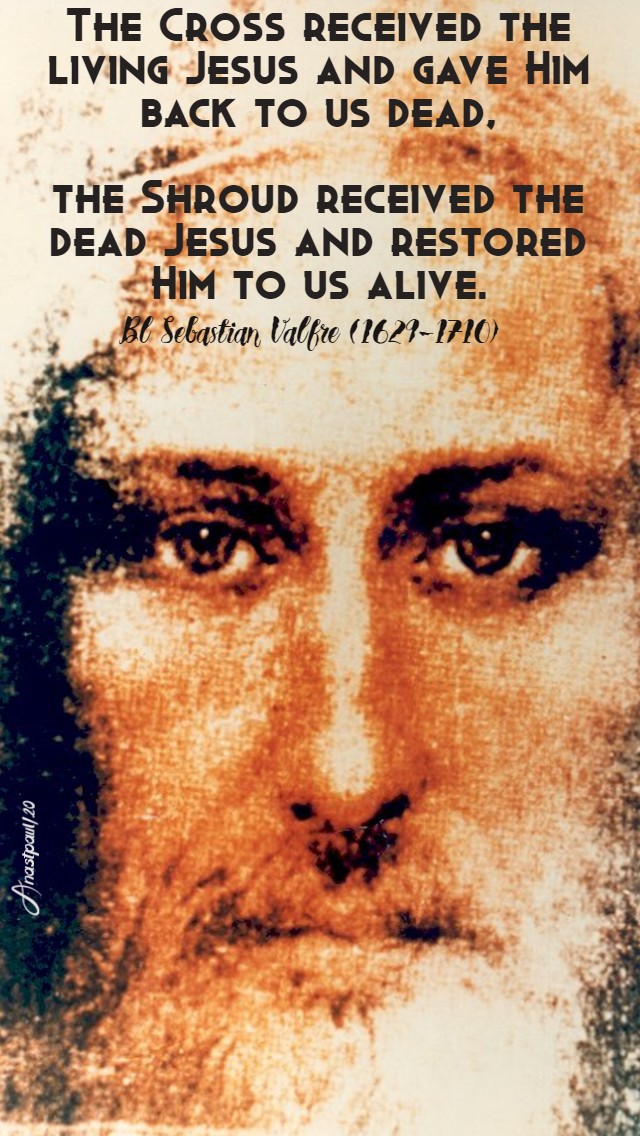
Blessed Sebastian speaking of the Shroud of Turin to which he had a great devotion:
“The Cross received the living Jesus and gave Him back to us dead, the Shroud received the dead Jesus and restored Him to us alive.”
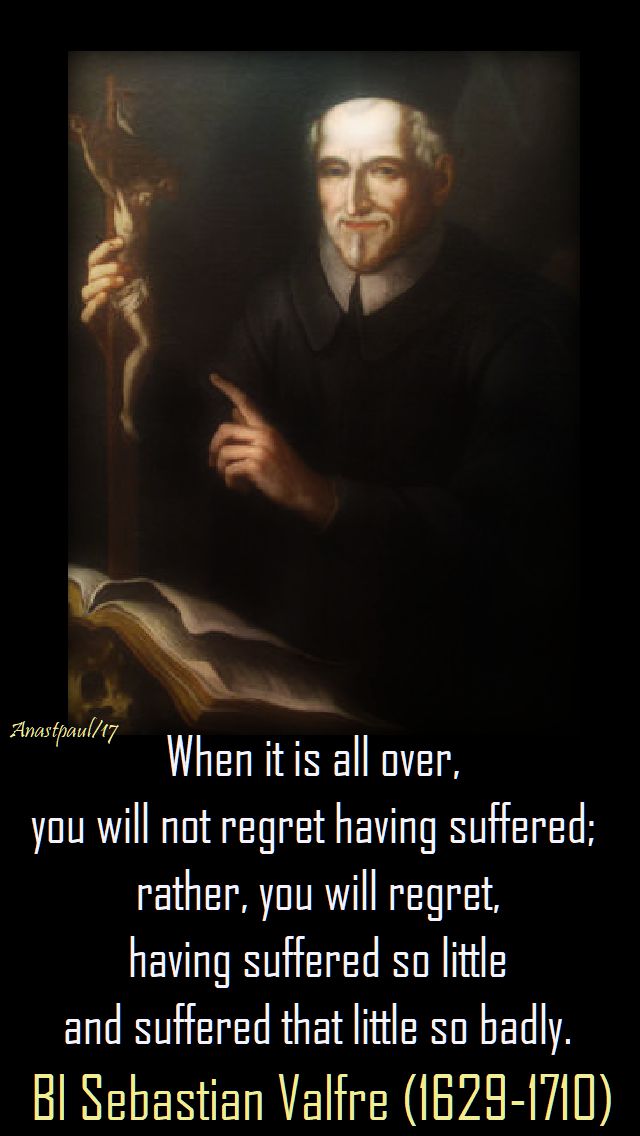
“When it is all over, you will not regret having suffered, rather, you will regret, having suffered so little and suffered that little so badly.”
One Minute Reflection – 30 January – Thursday of the Third week in Ordinary Time, Year A, Readings: 2 Samuel 7:18-19, 24-29, Psalm 132:1-5, 11-14, Mark 4:21-25 and the Memorial of Blessed Sebastian Valfrè CO (1629-1710)
He said to them, “Is a lamp brought in to be placed under a bushel basket or under a bed, and not to be placed on a lampstand?” … Mark 4:21
REFLECTION – “A well, when pumped regularly, produces purer water. If neglected, and no-one uses it, it changes into a source of pollution. Use, keeps metal brighter but disuse produces rust. For, in a word, exercise produces a healthy condition both in souls and bodies. So “No-one lights a candle and puts it under a bowl but upon a candlestick, that it may give light.” For of what use is wisdom, if it fails to make those who hear it wise.” … St Clement of Alexandria (150-215) Father of the Doctor
PRAYER – Lord God, in Your wisdom You created us, by Your providence You rule us, You have planted us, penetrate our inmost being Your holy Light, so that our way of life may always be one of faithful service to You. Grant us the grace and love to walk in Your ways and to radiate Your Light by our lives. May the prayers of all the angels and saints and of Blessed Sebastian Valfrè be unfailing assistance to us. Through Jesus Christ our Lord, with You and the Holy Spirit, one God forever, amen.
Our Morning Offering – 30 January – Thursday of the Third week in Ordinary Time, Year A and the Memorial of Blessed Sebastian Valfrè CO (1629-1710)
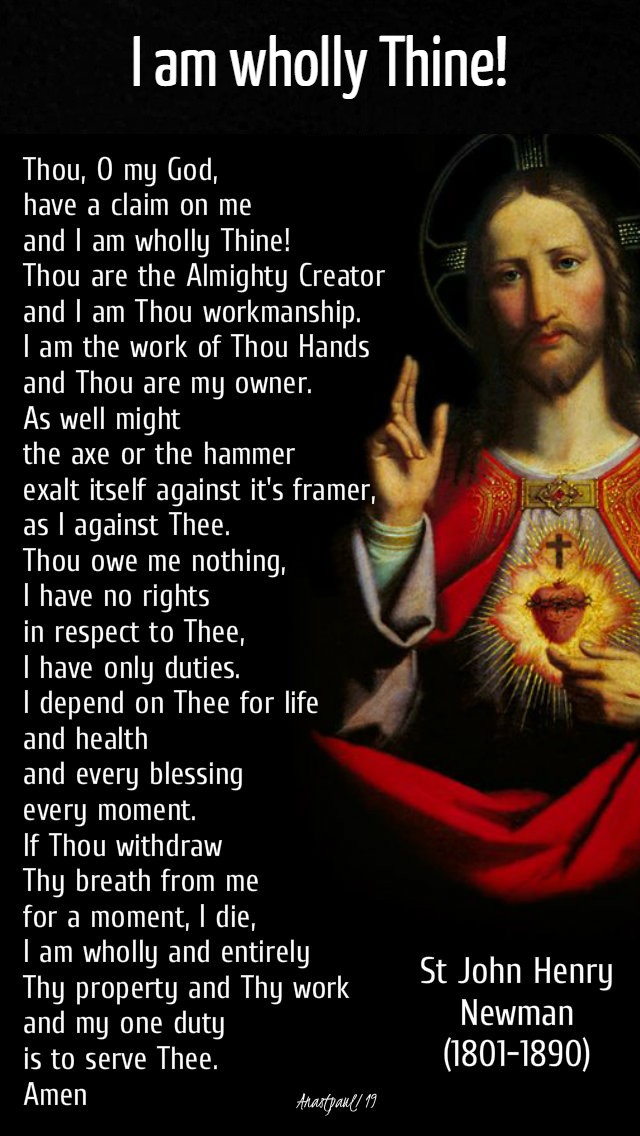
I am wholly Thine! St John Henry Newman CO (1801-1890)
Thou, O my God,
have a claim on me
and I am wholly Thine!
Thou are the Almighty Creator
and I am Thou workmanship.
I am the work of Thou Hands
and Thou are my owner.
As well might the axe or the hammer
exalt itself against it’s framer, as I against Thee.
Thou owe me nothing,
I have no rights in respect to Thee, I have only duties.
I depend on Thee for life and health
and every blessing every moment.
If Thou withdraw Thy breath from me
for a moment, I die, I am wholly and entirely Thy property
and Thy work and my one duty is to serve Thee.
Amen
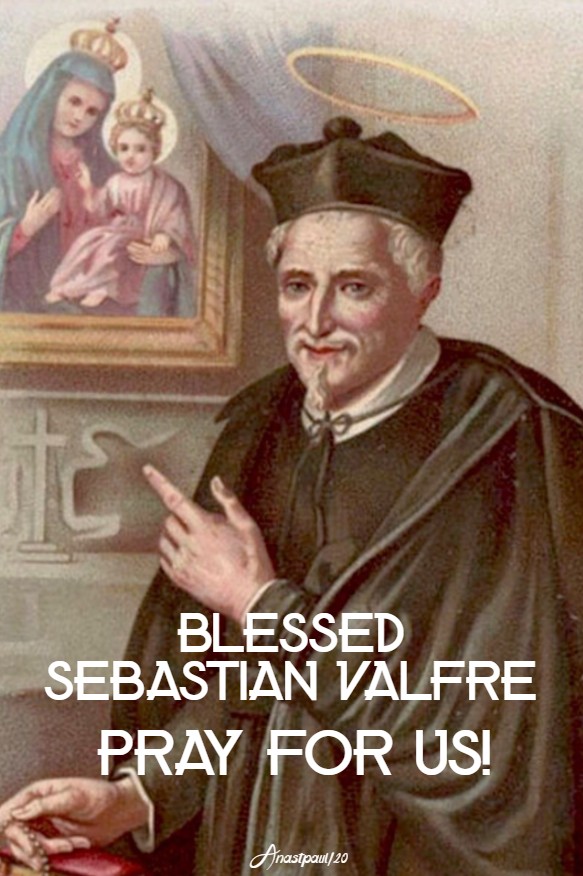
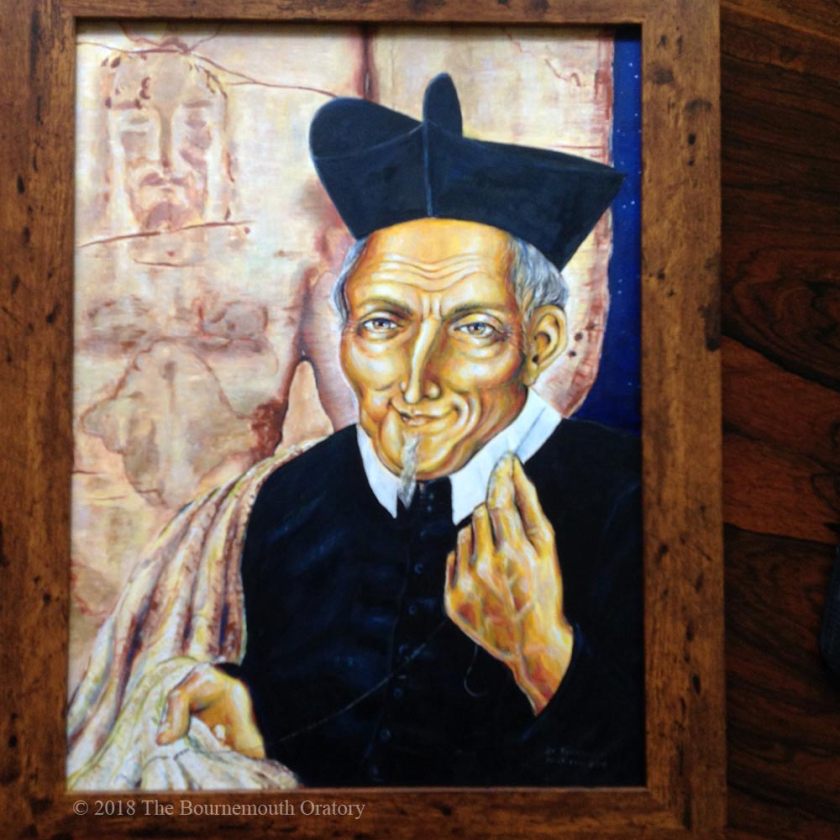
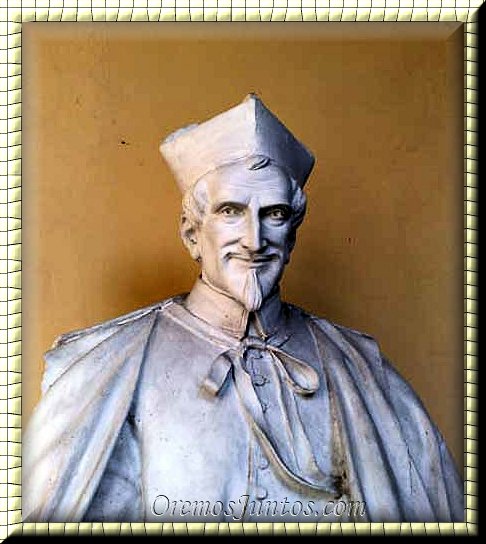
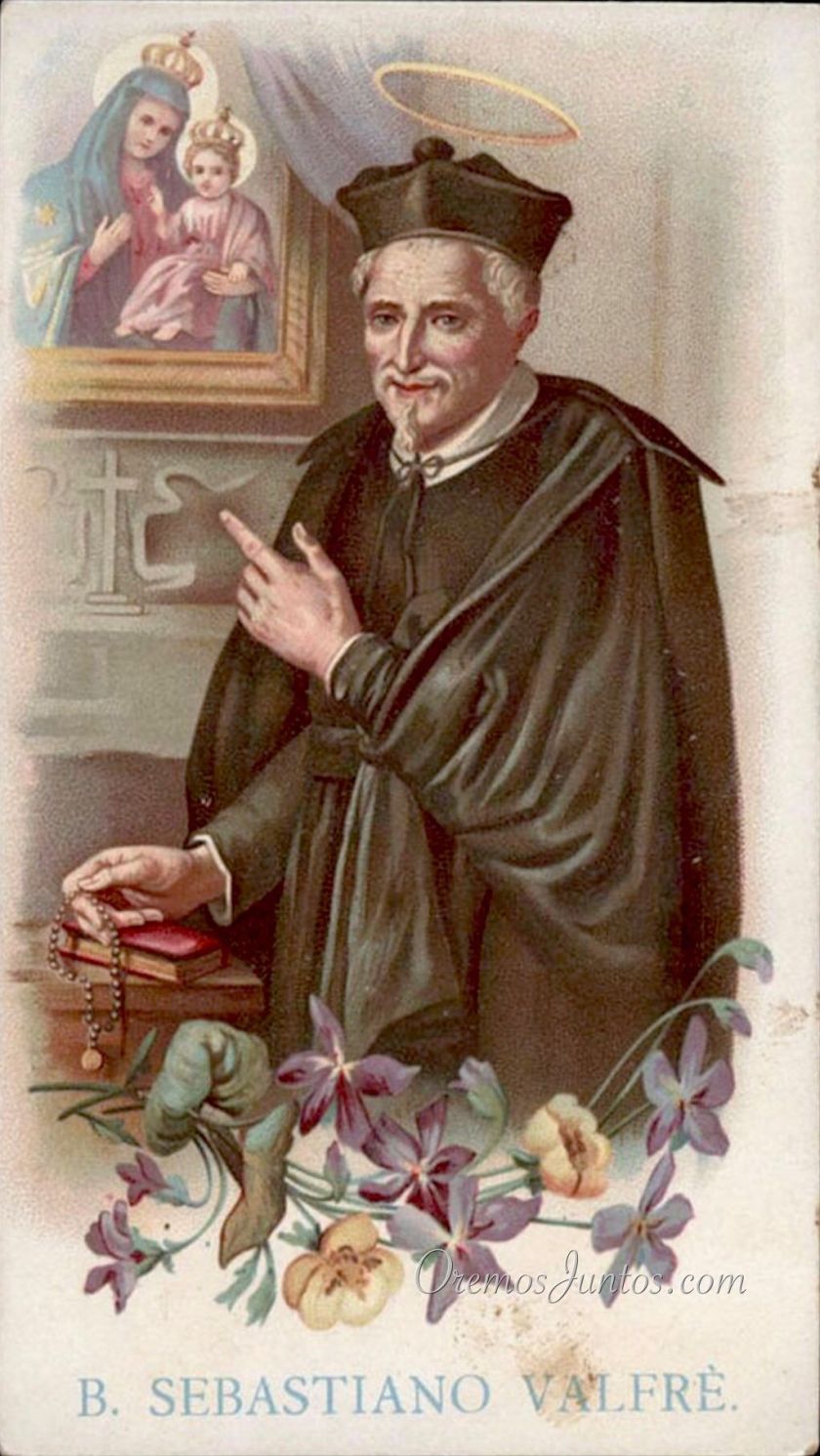
Saint of the Day – 30 January – Blessed Sebastian Valfrè CO (1629-1710) Oratorian Priest, Apostle of the poor, the ill, widows and orphans, prisoners, Confessor with deep insight, Writer – known as the Apostle of Turin and St Philip of Turin, Marian devotee. Born on 9 March 1629 in Verduno, Duchy of Savoy (in modern Italy) and died on 30 January 1711 in Turin, Duchy of Savoy of natural causes. Blessed Sebastian is known for his service to the poor during the famine of 1678-80 and the 17-week siege of Turin during the war between Piemonte and Louis XIV. He is still invoked as patron of Military Chaplains for his ministry to soldiers during the war. Patronage – Turin, the Oratory in Turin and Military Chaplains and soldiers. His body is incorrupt.
Sebastian Valfrè was born on 9 March 1629 at Verduno in the southern Alps. His background was humble – his mother and father were poor farmers and the dull routine of work in the fields with his parents and seven siblings took up much of his childhood. He felt a call to the priesthood at an early age but ran into difficulties with his family, who were loathe to lose his assistance with the farm work, however, he persevered and eventually won them over. He left Verduno to begin his studies in 1641 at the age of twelve and again, these days were not easy for him – at one stage he had to stay up most nights copying out books, to pay for his education, which took him, in its later stages, to Turin for studies with the Jesuits.
Also at Turin was the Oratory, which had in earlier years been influential, particularly on the youth of the city but by 1650 was rather down-at-heel – only one priest, Fr Cambiani, remained and he is described as ‘ragged and eccentric’. It can hardly have been an enticing prospect in human terms but Sebastian nonetheless joined, on St Philip’s Day, 26 May 1651, being Ordained Deacon only a week later. By the end of the year, the community had been bolstered by the arrival of three new priests, so by the time Sebastian was Ordained Priest in February 1652, the Oratory showed signs of life once more.
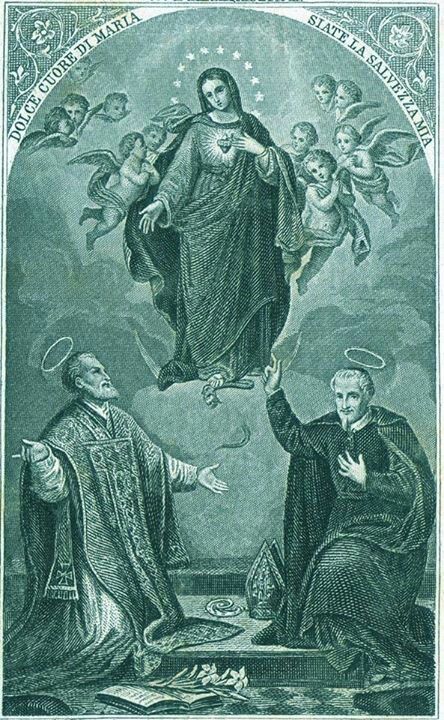
St Philip Neri, left and Bl Sebastian
Turin soon began to benefit from his presence as a priest. In common with many cities of that and other ages, it had its share of poverty, which Sebastian did much to alleviate. He was not afraid to ask the rich for alms to give to the poor but he took care to be as discreet as possible, doing much of the distribution at night when it was easier to remain anonymous. These activities took on heightened importance from 1678 to 1680, when famine struck Piedmont and again, during the war between Piedmont and Louis XIV, which culminated for Turin in a seventeen-week siege which caused great hardship as well as anxiety — and which Sebastian’s prayers are said to have been efficacious in bringing to a successful end for the inhabitants.
Sebastian’s interests and influence were not limited to the duchy. He helped to found the Pontifical Academy of Ecclesiastical Nobles in Rome in 1701, which was established to train diplomats for the Papal States. Under its current name of the Pontifical Ecclesiastical Academy, it still fulfils that function for the Vatican City State.
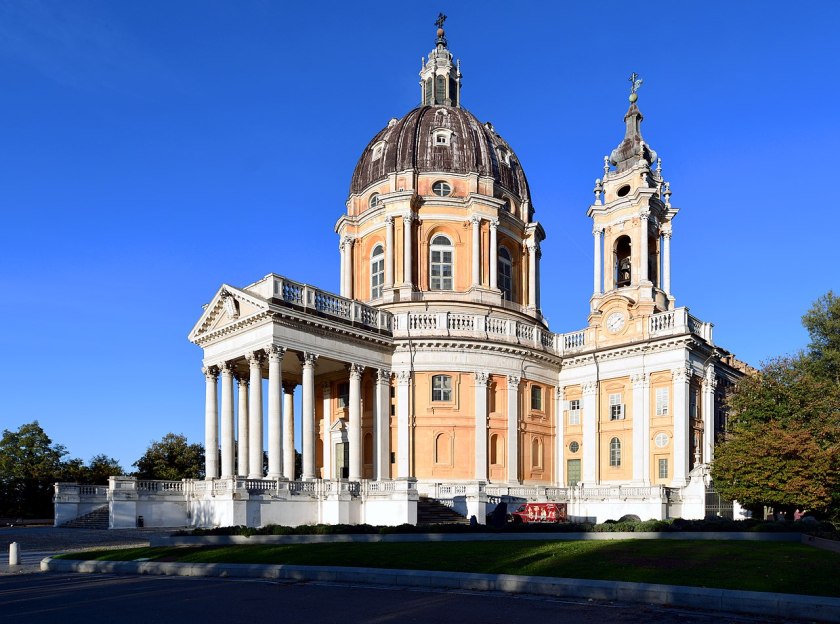
If Sebastian was esteemed by the less well-off, he was also on good terms with those who were more fortunate. In particular, he maintained good relations with the Dukes of Savoy, one of whom, Victor Amadeus II, he had helped to form, from the age of nine, into the just ruler he later became. Sebastian was the spiritual director to the entire court of the Duke and such was the esteem in which he was held, that at one stage the Duke did his best to procure the Archbishopric of Turin for Sebastian. His cause was furthered by the good reputation which he had in the Vatican but Sebastian’s humility led him to dread this ecclesiastical dignity and was profoundly grateful to be able to avoid accepting it. Additionally, through his devotion to the Blessed Mother, he inspired the duke to erect the Basilica of Superga.
Sebastian’s corporal works of mercy went hand- in-hand with the spiritual. He was very reluctant at first to start taking on the special responsibility for souls involved in hearing confessions — again, his humility is evident — but, once he did, his reputation spread throughout the city. He also searched out penitents far and wide — hospitals, schools, convents, barracks, prisons, galleys all benefited from his concern for spiritual well-being. His success in this field, as well as in his approach to life in the Oratory in general, was probably due, above all else, to his blending of careful attention to detail with a genuine compassion and, his penances reflected this. His penitents told of his ability to read souls . Sebastian’s work in the confessional was, at the very least, instrumental in sparking something of a revival of religious observance in Turin – like St Philip, it was said that he had the gift of discernment of spirits.
The life of Sebastian Valfrè was not one of extravagant and heroic deeds done for God but of the sanctification of an existence of regular routine, year in, year out and of service to God in the circumstances of ordinary life. His cheerful and attractive manner were an example to all and he also had his fair share of difficulties which he had to work hard to overcome. He was, for example, rather petulant and sensitive by nature, being easily offended – he remedied this by trying to be unfailingly polite even to those who hurt him. He also knew what it was to suffer from spiritual darkness, finding prayer a real struggle at times and study even more unattractive. But his perseverance, which manifested itself from his earliest years, stood him in good stead.
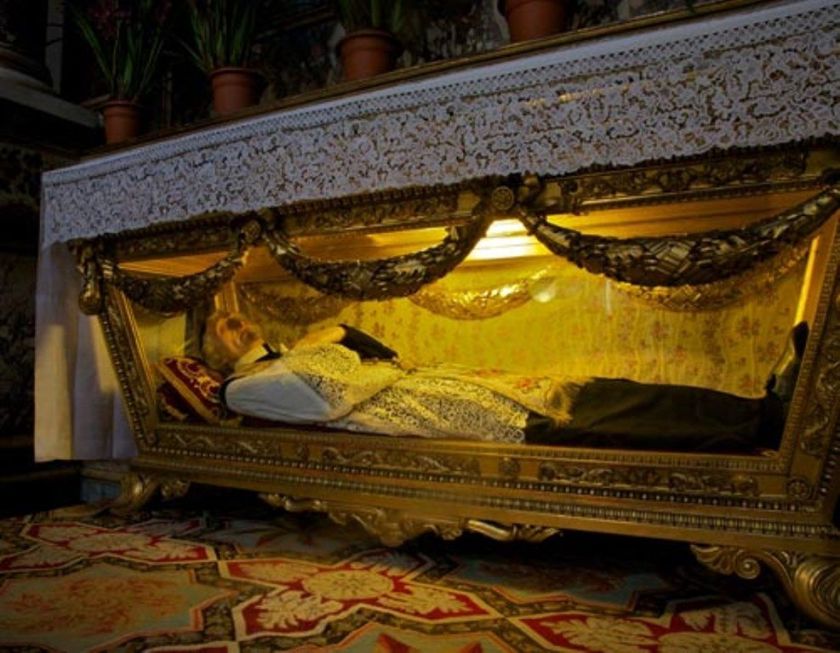
The Father who had Paradise in his eyes, Blessed Sebastian, died early in the morning of 30 January 1710. Miracles began even before he could be buried and he was Beatified by Pope Gregory XVI in 1834. His incorrupt body is now preserved in a silver urn in the Oratory Church of Turin.
When Father Sebastian died and his body was laid out in the church, Turin’s citizens wanted to say goodbye to the priest who walked with them, through all the joys and difficulties in life, for sixty years. Father Sebastian’s legacy was the extroversion of the faith preached by Christ for the dignity of all people, the witness of Christian charity knew no boundaries.
The Archives of the Turin Oratory possess some 22 volumes of his writings. One of his most important works was his ‘Compendium of Christian Doctrine’, a Catechism organised on a question and answer basis. This rapidly became a well-used teaching aid and lasted until the introduction of the Catechism of Pope Pius X.
In 1835, a year after Sebastian was Beatified, there was a solemn translation of his relics.
Overshadowed at the time by royalty and ecclesiastical dignitaries, there were three future saints in the crowd. There was Saint Joseph Benedict Cottolengo (1786-1842) – known as “The Labourer of Divine Providence”, who devoted himself to the care of the destitute sick; Saint Joseph Cafasso (1811-1860) “The Priest of the Gallows”, whose work with prisoners caught the imagination of all Turin and Saint John Bosco (1815-1888), whose work with children is known to the whole world and whose feast day we celebrate tomorrow. All of these could draw their spiritual lineage both by inspiration and imitation to Blessed Sebastian Valfrè .
Grant us, we beseech You, O Lord, that, as You did wonderfully raise Your priest, Blessed Sebastian, for the salvation of many, so we may persevere in Your love, for the sake of helping souls. Through Christ our Lord. Amen.
Bl Carmen Marie Anne García Moyon St David Galván-Bermúdez (1881-1915) Martyr of the Mexican Revolution Biography here: https://anastpaul.wordpress.com/2018/01/30/saint-of-the-day-30-january-st-david-galvan-bermudez-1881-1915-martyr/St Felician of Africa
St Felix IV, Pope
Bl Francis Taylor
Bl Haberilla
St Hippolytus of Antioch
St Hyacintha of Mariscotti
Bl Margaret Ball
Bl Maria Bolognesi
St Martina of Rome
St Matthias of Jerusalem
St Mutien Marie Wiaux
St Paul Ho Hyob
St Philippian of Africa
St Savina of Milan Blessed Sebastian Valfrè CO (1629-1710)
St Theophilus the Younger
St Tôma Khuông
St Tudclyd
Bl Zygmunt Pisarski
Our Morning Offering – 29 January – Wednesday of the Third Week in Ordinary Time, Year A and The Memorial of St Dallan Forgaill (c 530- 598)
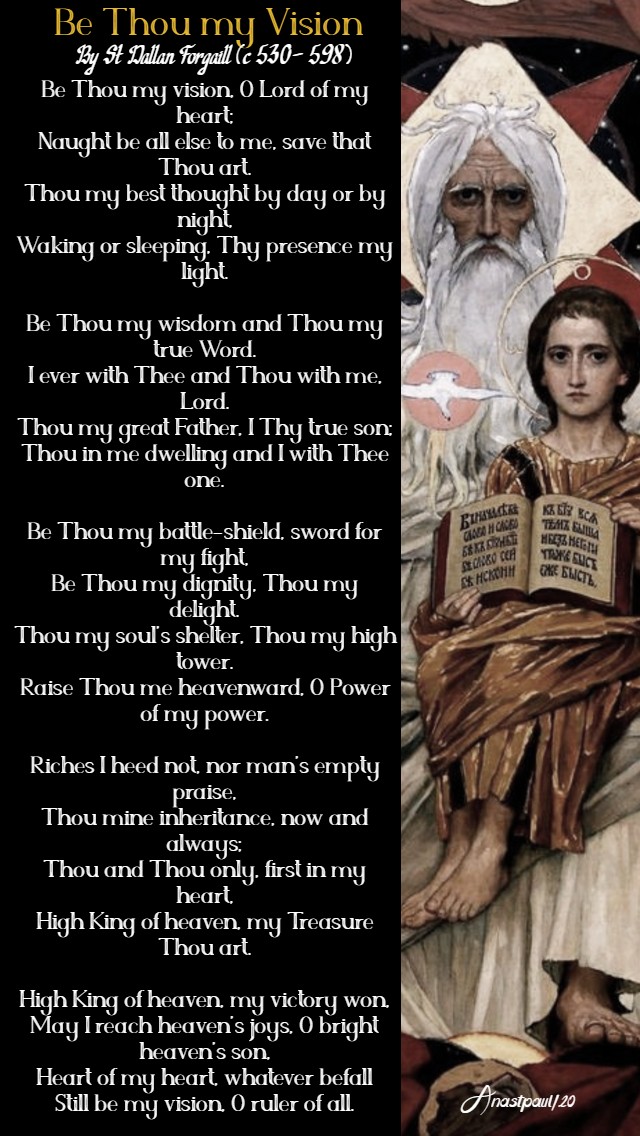
Be Thou my Vision By St Dallan Forgaill (c 530- 598)
Be Thou my vision, O Lord of my heart;
Naught be all else to me, save that Thou art.
Thou my best thought by day or by night,
Waking or sleeping, Thy presence my light.
Be Thou my wisdom and Thou my true Word.
I ever with Thee and Thou with me, Lord.
Thou my great Father, I Thy true son;
Thou in me dwelling and I with Thee one.
Be Thou my battle-shield, sword for my fight,
Be Thou my dignity, Thou my delight.
Thou my soul’s shelter, Thou my high tower.
Raise Thou me heavenward, O Power of my power.
Riches I heed not, nor man’s empty praise,
Thou mine inheritance, now and always;
Thou and Thou only, first in my heart,
High King of heaven, my Treasure Thou art.
High King of heaven, my victory won,
May I reach heaven’s joys, O bright heaven’s son,
Heart of my heart, whatever befall
Still be my vision, O ruler of all.
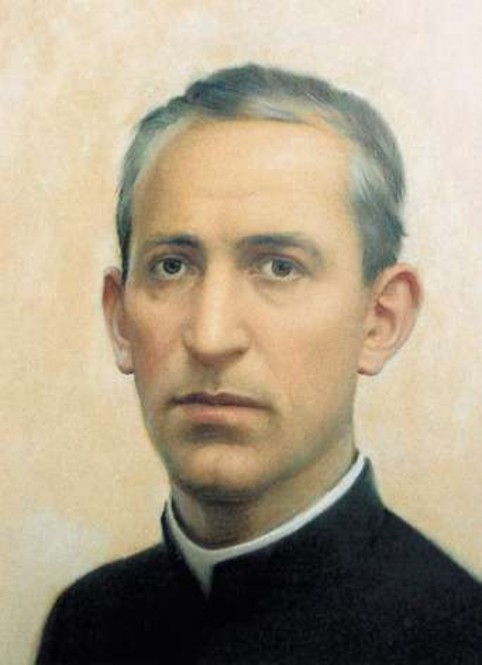
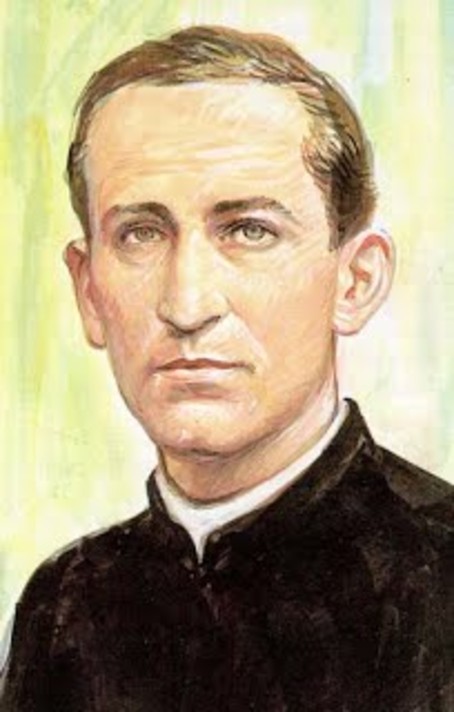
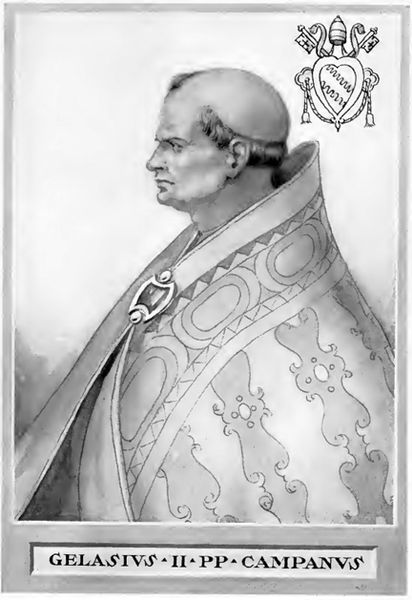
Saint of the Day – 29 January – St Pope Gelasius II (c 1060–1119) born Giovanni Caetani or Giovanni da Gaeta (also called Coniulo), was head of the Catholic Church and ruler of the Papal States from 24 January 1118 to his death in 1119. A monk of Monte Cassino and chancellor of Pope Paschal II, Caetani was unanimously elected to succeed him. In doing so he also succeeded to the conflicts with Emperor Henry V over investiture. Gelasius spent a good part of his brief papacy in exile.
He was born between 1060 and 1064 at Gaeta into the Pisan branch of the Caetani family, and became a monk of Monte Cassino. Pope Urban II, who wished to improve the style of papal documents, brought him to Rome and made Caetani a Papal subdeacon (August 1088) and Cardinal deacon of Santa Maria in Cosmedin (probably on 23 September 1088). As Chancellor of the Holy Roman Church from 1089 to 1118, he drastically reformed the papal administration, establishing a permanent staff of clerks for the papacy, overcoming the previous custom of relying on Roman notaries to write Papal documents and introducing the minuscule curial script. His tenure also established the precedent of the Papal Chancellor always being a cardinal and holding the office for life or until elected pope.
Shortly after his unanimous election to succeed Pope Paschal II in 1118, he was seized by Cencio II Frangipane, a partisan of Holy Roman Emperor Henry V but was freed by a general uprising of the Romans on his behalf.
Henry V sought to enforce the privilege of investiture conceded (and later revoked in 1112) by the Papacy, under duress, by Paschal II. He drove Gelasius II from Rome in March 1118, pronounced his election null and void and set up Maurice Bourdin, Archbishop of Braga, as antipope under the name of Gregory VIII.
Gelasius II fled to Gaeta, where he was Ordained a Priest on 9 March 1118 and on the following day received Episcopal Consecration. He at once excommunicated Henry V and the antipope and, under Norman protection, was able to return to Rome in July. But the disturbances of the imperialist party, especially those of the Frangipani, who attacked the Pope while celebrating Mass in the church of St Prassede, compelled Gelasius II to go once more into exile. He set out for France, consecrating the Cathedral of Pisa on the way and arrived at Marseille in October. He was received with great enthusiasm at Avignon, Montpellier and other cities, held a Synod at Vienne in January 1119 and was planning to hold a General Council to settle the investiture contest when he died at the Abbey of Cluny.
St Abundantia the Martyr
St Aphraates
St Aquilinus of Milan
St Barbea of Edessa
St Blath of Kildare
Bl Boleslawa Maria Lament
St Caesarius of Angoulême
Bl Charles of Sayn
St Constantius of Perugia (Died 170) Martyr St Dallan Forgaill (c 530- 598) Martyr St Dallan’s story: https://anastpaul.wordpress.com/2018/01/29/saint-of-the-day-29-january-st-dallan-forgaill-c-530-598/
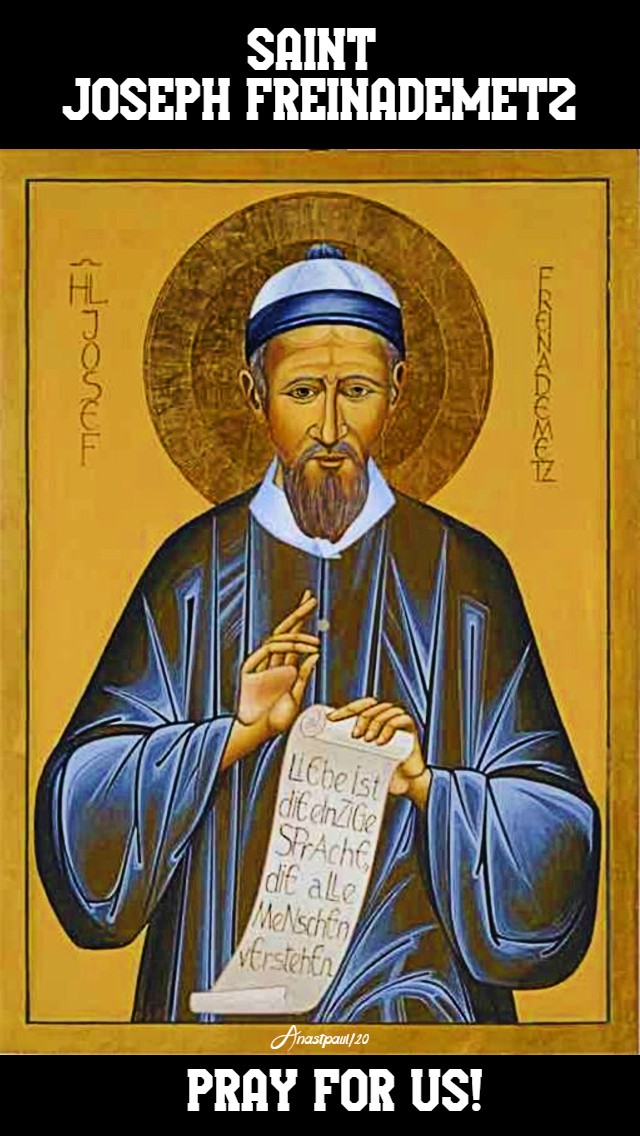
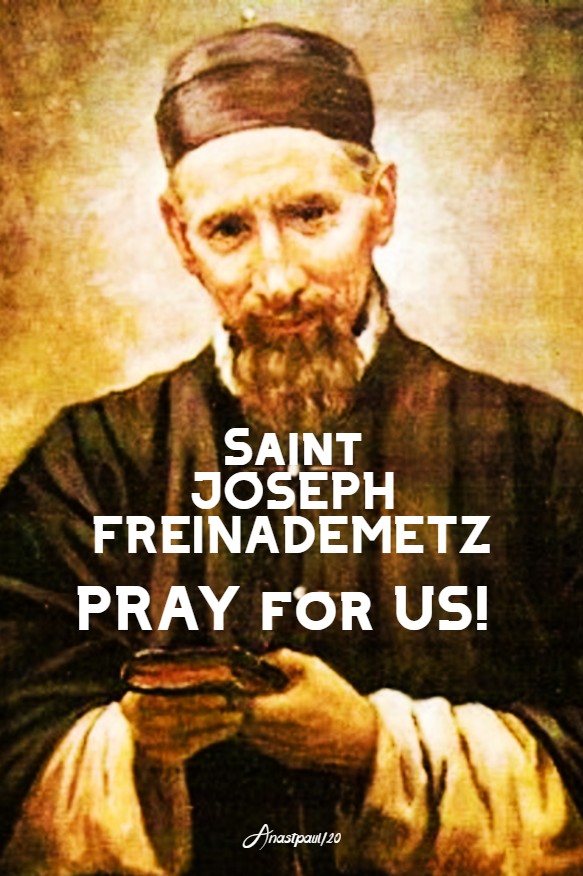
Second Thought for the Day – 28 January – The Memorial of St Joseph Freinademetz SVD (1852-1908) “Fu Shenfu” – Lucky Priest
Man of Prayer
Freinademetz was what one would call a ‘great man of prayer’ and a ‘spiritual’ person. In his preparatory work for the first diocesan synod of South Shandong, his fundamental attitude became clear in the synod paper on “The Clergy.” “Do you imagine you can become holy without meditation, something no saint was able to do? Meditation is a waste of time? The very opposite is true. Without meditation life is lost. Furthermore, set aside one day a month for prayer and meditation. Such days, are among life’s most beautiful and enriching. On such days the Holy Spirit has promised to speak to our hearts.”
Just to see him at prayer was edifying for many – “Mostly he knelt in the sanctuary of the church and for us, it was an extraordinary experience, to see him at prayer. The image of that kneeling priest is indelibly impressed in my memory. You got the impression that nothing could disturb him . He was a great man of prayer. His piety was open and aroused fervour” (Cardinal Tien).
Henninghaus states straight out, that “Prayer” was his “life element and life’s joy,” it was the “source from which he lived.” Even when he had to work until late at night, he still took time for prayer and spiritual reading. In summer, Freinademetz often began his working day at 3 a.m., with prayer and meditation. He preferred to pray the breviary kneeling, mainly very erect without any support. He may often have recalled his childhood when the whole family knelt every day on the hard boards of the living room, praying the rosary before the house altar.
He celebrated holy Mass “in a dignified and devout manner, without haste but without irritating slowness” (Henninghaus). The man from Tyrol obviously did not wish to be importunate in these things either.
The official name of the Steyl missionaries, ‘Society of the Divine Word’, fitted as if tailored made for him: “Daily spiritual reading. Do not let even a single day pass without meditating on sacred scripture which has been called the Priest’s Book. Woe to you if the well-springs of devotion in you run dry!” he exhorted in one of the synod papers.
He himself knew the Bible inside out. He frequently quoted scripture, mostly in Latin, and above all he was always able to find suitable comparisons for current situations – i.e. he had truly internalised the Bible. It was not a dead letter for him, not ‘dry’ but full of life, a well from which he knew how to draw water.
With the same intensity he challenged his confreres to continue to update themselves – “Cultivate serious study! Sacred scripture says, ‘Because you have despised wisdom, I will despise you’.” That, too, is an example of the way in which he could quote the Bible.
The cross of Christ, the Eucharist and contemplation of God’s Word were the central pillars of the missionary life of Joseph Freinademetz, may they be our central pillars too!
Prayer to St Joseph for Missionaries
Heavenly Father,
You have given us your graces
and blessings through the saints.
We thank You for choosing St Joseph Freinademetz,
a zealous missionary to China, to be our model.
He was a man of prayer who prayed without growing weary.
Prayer was the air he breathed and the joy of his life.
Prayer nourished his missionary vocation,
his love of neighbour,
his enthusiasm and readiness for sacrifice
and his profound faith.
Through the intercession of St Joseph
we implore You to shower Your graces on all missionaries
so that they become persons of prayer
and adopt the culture of the people they are sent to.
Enlighten them to discover the road
You want them to travel
and the plan You have mapped out for them.
May they have courage like St Joseph to keep going,
in spite of many trials and hardships in their mission work
and to live out their vocation faithfully.
We ask this through Christ our Lord.
Amen.
One Minute Reflection – 28 January – Tuesday of the Third week in Ordinary Time, Year A, Readings: 2 Samuel 6:12-15, 17-19, Psalm 24:7-10, Mark 3:31-35 and the Memorial of Joseph Freinademetz SVD (1852-1908) “Fu Shenfu” – Lucky Priest-
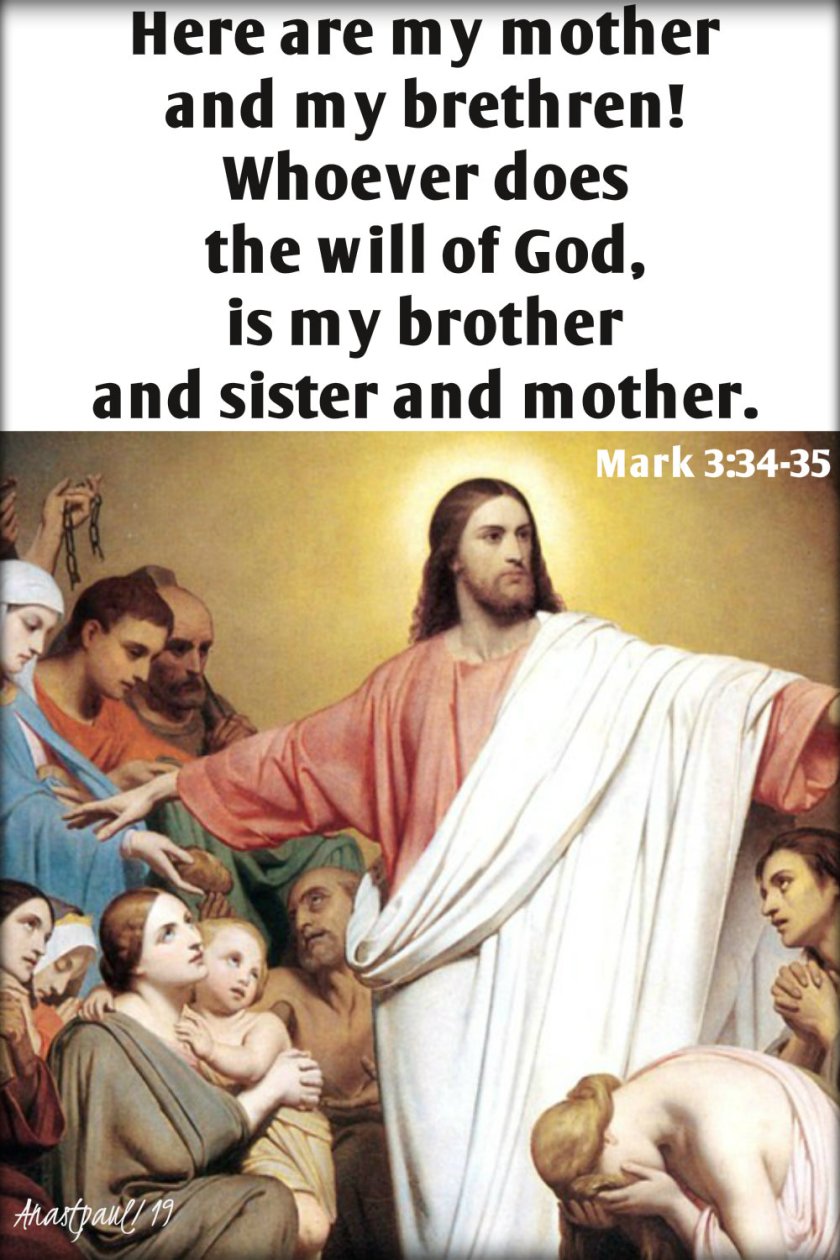
“Here are my mother and my brethren! Whoever does the will of God, is my brother, and sister and mother.”…Mark 34-35
REFLECTION – “Grace is thicker than blood – As mother, Mary made significant appearances in the life of Jesus. She followed Him in His ministry.
In today’s short Gospel text, she is outside with the relatives of Jesus asking for Him.
Notice the delicacy of Mary. She neither interrupts the ministry of Jesus nor enters the room where Jesus is ministering. She waits outside.
The response of Jesus to the one who brought the message seems like a rebuff.
In fact, it is a tribute to Mary.
She was His mother, not merely because she gave Him birth but even more, because she did the will of God.
Blood is thicker than water no doubt – but Grace is thicker than blood.
She conceived Jesus in faith, even before she conceived him in her womb.” … Msgr Alex Rebello – Diocese of Wrexham, Wales – Daily Reflections, Year A
PRAYER – Loving Father, You gave us Your only-begotten Son to teach us, to make us Your adopted children by His adoption of ourselves as His siblings. What grace, what mercy, what love, is this! We give You our gratitude and our love. Mary, holy and blessed Virgin, Mother of God, pray for us. St Joseph Freinademetz, you survived solely on faith in a strange land and brought Christ to those who spoke another language by the language of Grace, please pray for us. Through Jesus, our brother and our Saviour, who gave us His mother to guide and protect us, we pray, with the Holy Spirit, God forever, amen.







 Here he dedicated himself to the lepers of Agua de Dios, sharing with them his passion for music and drama. Fr Unia died shortly thereafter, leaving Luigi and three other priests in charge of the leper colony.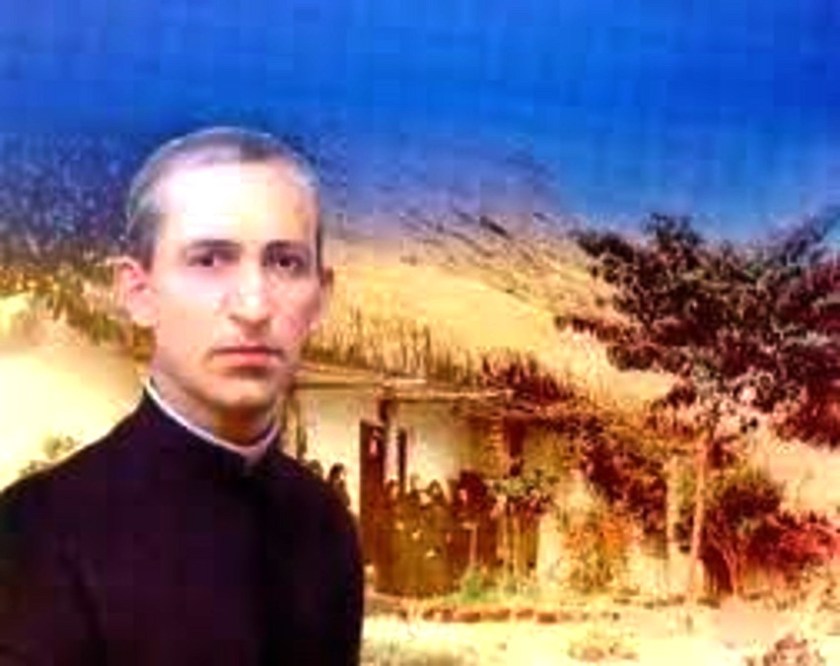






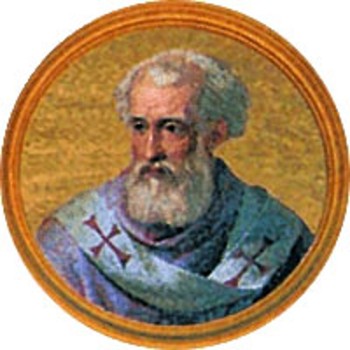 He at once excommunicated Henry V and the antipope and, under Norman protection, was able to return to Rome in July. But the disturbances of the imperialist party, especially those of the Frangipani, who attacked the Pope while celebrating Mass in the church of St Prassede, compelled Gelasius II to go once more into exile. He set out for France, consecrating the Cathedral of Pisa on the way and arrived at Marseille in October. He was received with great enthusiasm at Avignon, Montpellier and other cities, held a Synod at Vienne in January 1119 and was planning to hold a General Council to settle the investiture contest when he died at the Abbey of Cluny.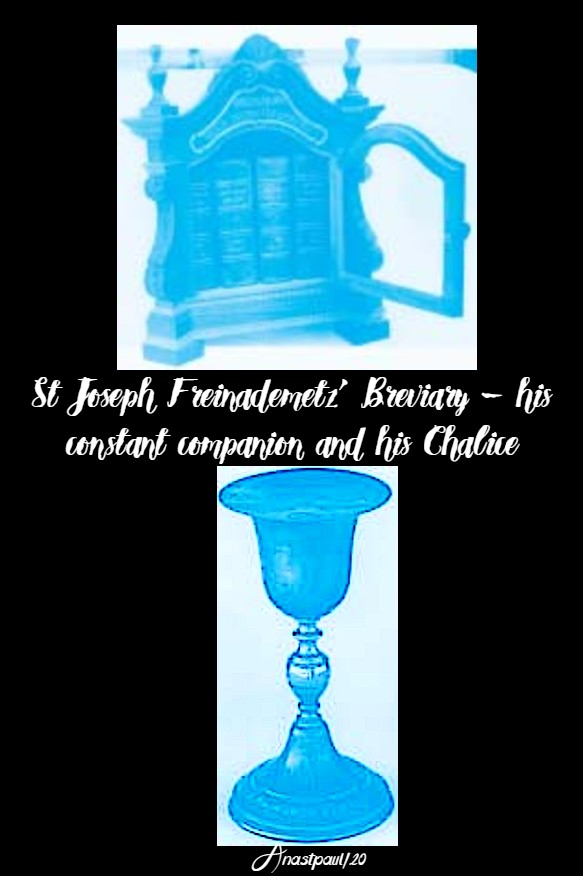



You must be logged in to post a comment.