Posted in SAINT of the DAY

Memorials of the Saints – 12 November

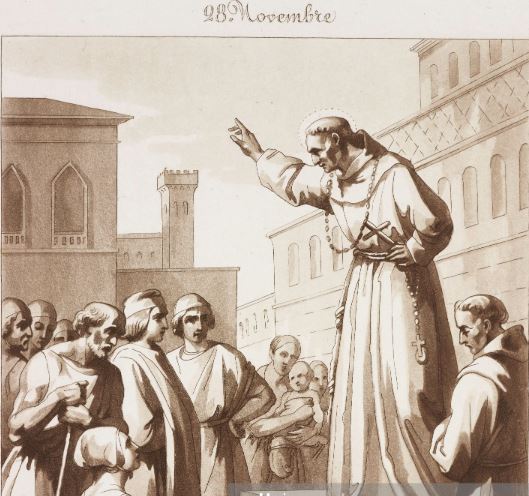
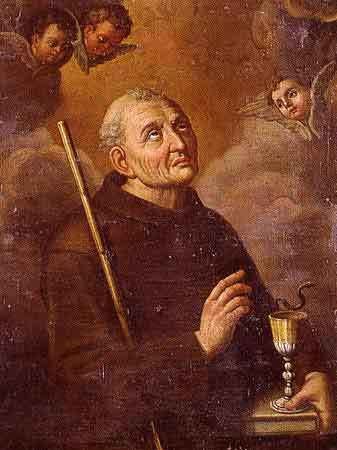
St Josaphat Kuncewicz OSBM (1584-1623) Martyr (Memorial)
All About St Josaphat:
https://anastpaul.wordpress.com/2017/11/12/saint-of-the-day-12-november-st-josaphat-kuncewicz-1584-1623/
MORE:
https://anastpaul.com/2018/11/12/saint-of-the-day-12-november-st-josapha-osbm-1584-1623-martyr/

St Arsatius
St Astricus of Ungarn
St Aurelius
St Cadwallader
St Cummian Fada
St Cunibert of Cologne
St Emilian Cucullatus
St Evodius of Le Puy
St Hesychius of Vienne
Bl John Cini della Pace
Bl José Medes Ferrís
St Lebuinus of Deventer (Died 775)
St Livinus of Alost
St Machar of Aberdeen
St Margarito Flores-García
St Namphasius
St Nilus the Elder
St Paternus of Sens
St Publius
St Renatus of Angers
St Rufus of Avignon
Bl Ursula Medes Ferris
St Ymar of Reculver

Five Polish Brothers – martyrs: They weren’t Polish and they weren’t related but were instead five Italian Benedictine monks who worked with Saint Adalbert of Prague as missionaries to the Slavs and were martyred together. They were – Benedict, Christinus, Isaac, John and Matthew. Born in Italy. They were martyred in 1005 at the Benedictine monastery near Gnesen, Poland and Canonised by Pope Julius II.

Posted in MIRACLES, QUOTES of the SAINTS, QUOTES on FAITH, SAINT of the DAY, The WORD

Thought for the Day – 11 November – “If you had faith …”

Thought for the Day – 11 November – Monday of the Thirty Second week in Ordinary Time, Year C, Gospel: Luke 17:1-6 and The Memorial of Saint Martin of Tours (c 316-397)

St Martin, the Miracle-Worker

By St John Henry Newman (1801-1890)

Two Essays on Biblical and Ecclesiastical Miracles

And the Lord said,
“If you had faith as a grain of mustard seed,
you could say to this sycamine tree,
‘Be rooted up and be planted in the sea,’
and it would obey you.”

Luke 17:6luke 17 5 if you had faith as a mustard seed and you said to this tree - 11 nov 2019

“Before Martin was a Bishop, while he was near St Hilary at Poitiers, a certain Catechumen, who lived in his monastery, died of a fever, in Martin’s absence, without baptism.
On his return, the Saint went by himself, into the cell where the body lay, threw himself upon it, prayed and then raising himself with his eyes fixed on it, patiently waited his restoration, which took place before the end of two hours ….
At another time, on his giving orders for cutting down a pine to which idolatrous honour was paid, a heathen said, “If thou has confidence in thy God, let us hew the tree and do thou receive it as it falls.   If thy Lord is with thee, thou wilt escape harm.”
Martin accepted the condition and when the tree was falling upon him, made the Sign of the Cross.   The tree reeled round and fell on the other side!   This miracle converted the vast multitude who were spectators of it.”

St Martin of Tours, Pray for Us!st martin of tours, pray for us 11 nov 2019

Posted in PRAYERS of the SAINTS, QUOTES of the SAINTS, QUOTES on ALMS, QUOTES on CHARITY, QUOTES on DISCIPLESHIP, QUOTES on MERCY, QUOTES on MISSION, QUOTES on OBEDIENCE, QUOTES on PERSEVERANCE, QUOTES on SACRIFICE, SAINT of the DAY, The WILL of GOD

Quote/s of the Day – 12 November – “I will do the work You entrust to me.”

Quote/s of the Day – 12 November – The Memorial of Saint Martin of Tours (c 316-397) and Blessed Vincenza Maria Poloni (1802-1855)

Lord, if Your people still have need
of my services,
I will not avoid the toil.
Your will be done.
I have fought the good fight long enough.
Yet, if You bid me to continue to hold
the battle line, in defence of Your camp,
I will never beg to be excused
from failing strength.
I will do the work You entrust to me.
While You command,
I will fight beneath Your banner.
Amen

Saint Martin of Tours (c 316-397)lord if your people - st martin of tours prayer - 11 nov 2019

“The poor are our masters,
let us love them and serve them,
as we would serve
Jesus Christ Himself. “

Blessed Vincenza Maria Poloni (1802-1855)the poor are our masters - bl vincenza maria poloni 11 nov 2019

Posted in DOCTORS of the Church, FATHERS of the Church, ONE Minute REFLECTION, QUOTES of the SAINTS, QUOTES on FORGIVENESS, QUOTES on PATIENCE, QUOTES on UNITY/with GOD, SAINT of the DAY, The WORD

One Minute Reflection – 12 November – ‘..You must forgive him.’

One Minute Reflection – 12 November – Monday of the Thirty Second week in Ordinary Time, Year C, Gospel:   Luke 17:1-6 and the Memorial of St Martin of Tours

“… if he sins against you seven times in the day and turns to you, seven times and says, ‘I repent,’ you must forgive him.” … Luke 17:4

REFLECTION “Love bears all things, believes all things, hopes all things, endures all things” (1 Cor 13:7).  By this the apostle Paul showed that love can persevere steadfastly because it has learned to endure all things.   And in another place he says:  “Bear with one another through love, striving to preserve the unity of the spirit through the bond of peace” (Eph 4:2-3).

Neither unity nor peace can be preserved, unless brothers cherish one another, with mutual forbearance and preserve the bond of unity, with patience as intermediary.   How then will you be able to endure these things – not to swear or curse, not to seek again what has been taken away from you, on receiving a blow to offer the other cheek also to your assailant, to forgive your brother who offends you, not only seventy times seven times but all his offences without exception, to love your enemies, to pray for your adversaries and persecutors, if you do not have the steadfastness of patience and forbearance?

We see what happened in the case of Stephen.   When he was being killed by the violence and stones of the Jews, he did not ask for vengeance but forgiveness for his murderers, saying:  “Lord, do not hold this sin against them” (Acts 7:60).” … St Cyprian of Carthage (c 200- c 258) Bishop and Martyr, Father of the Church – The Good of Patienceluke 17 4 - if he sins against you seven times - we see what happened inthe case of stephen - st cyprian of carthage 11 nov 2019

PRAYER – Lord God, Your Son has shown us the way. As we follow in His steps, may we never wander from the path that leads to life. Renew the wonders of Your grace in our hearts so that neither death nor life may separate us from Your love. Holy Father, as You were glorified by the life and death of St Martin, grant that by his prayers, we may receive strength to always give You our hearts, minds and selves. Through our Lord, Jesus Christ, with You in union with the Holy Spirit, one God for all eternity, amen.st-martin-of-tours-pray-for-us-11-nov-2017-no-2

Posted in SAINT of the DAY

Saint of the Day – Blessed Vincenza Maria Poloni (1802-1855)

Saint of the Day – Blessed Vincenza Maria Poloni (1802-1855) Nun and Co-Founder of Sisters of Mercy of Verona, Apostle of the Holy Eucharist and of Charity and Mercy to the Sick, the Sacred and Immaculate Hearts, Our Lady of Sorrows – Born as Luigia Francesca Maria on 26 January 1802 in Verona, Italy and died on 11 November 1855 in Verona, Italy of cancer.   She is Patron of the Order she founded.   Additional memorial –  10 September, within her Order.bl vincenza mria polomni.jpg

On 26 January 1802, in Verona, at the present number 8 of Piazza delle Erbe, the Servant of God Vincenza Maria Poloni was born to Gaetano and Margherita Biadego.   In the afternoon of the same day, she was baptised in the Parish of St Maria Antica near the Scaliger Tombs with the name of Luigia Francesca Maria.

She was the last of twelve children – all the others being brothers, of whom nine died at an early age.   Luigia grew up in a family atmosphere permeated by solid religious principles and a style of solidarity with the weakest.   From her parents, she absorbed the sense of faith, prayer and industriousness and received a degree of education appropriate to her social condition.

A young woman of open and lively genius, she became the mother’s right hand in the care of the home, the irreplaceable support in the education of the numerous grandchildren, the caring assistant of a sister-in-law who was often sick and the main help in her father’s shop.   Also, her brother Apollonio, found in his sister Luigia, a valid support for the management and administration of the complex agricultural activity in Palazzina (Verona).

Under the spiritual direction of Blessed Karl Steeb (1773 – 1856), her heart went along with the calls of the Holy Spirit who led her with ever greater inspiration, to devote time and attention to the elderly and chronically ill at the Pius Ricovero home.   In 1836, during a terrible cholera epidemic, she showed unconditional assistance in the emergency wards, endangering her own health.Beata Vincenza_Maria.jpg

Meanwhile, God’s will was becoming more and more clear, the elderly and the sick constituted the body of the suffering Christ to whom He generously gave Himself and to whom He wanted to attract others who would offer themselves with Him.

Overcoming the many resistances posed by family members, who considered Blessed Vincenza, to be indispensable to the well-being of the family, on 2 November 1840 she settled with three companions in two small rooms at the Pio Ricovero to devote herself full time to the service of the elderly and the sick.

The beginnings of God’s works are always characterised by the zeal of self-giving and by a generous poverty, chosen consciously.   Those four people immediately assumed the lifestyle of a religious community marked by a strict timetable, fervent prayer and a total service of charity towards others.   Soon other companions were added, a house was purchased, civil and canonical authorisations were obtained and so on 10 September 1848 Luigia Poloni, she taking the name of Vincenza Maria and twelve sisters took religious vows of poverty, chastity and obedience.

The Sorelle della Misericordia Institute of Verona became a reality.   A new source of light and love flowed in Verona, a city of saints and blesseds.

founders - bl karl steeb and vincenza maria poloni.JPG
Blessed Karl & Blessed Mother Vincenza at the Sorelle della Misericordia in Verona

Mother Vincenza Maria, in the fifteen years she lived after the foundation of the Institute, exercised her mission of assistance to the elderly, sick and orphan children with admirable zeal.   With the wisdom that derived from her temperament, from the experience of life in the family and above all from fidelity to the Spirit, the Community expanded reaching – at her death – the number of 48 sisters.

With the example of life and teaching, she recommended to her daughters rectitude in action, tenderness towards the sick, patience in tribulations, humility in recognising their mistakes, charity towards others, especially towards Poors.   She used to say: ” The poor are our masters, let us love them and serve them as we would serve Jesus Christ Himself. “bl vincenza maria poloni fondatrice-arche-Manara-002.jpg

Blessed Vincenza endured difficulties and sacrifices with faith and confidence in the divine Providence.   She cultivated prayer, love for the Eucharist, devotion to Our Lady of Sorrows, to the Most Sacred Hearts of Jesus and Mary.   She also nurtured a particular devotion towards St Vincent de Paul, the saint to whom Blessed Karl Steeb was inspired in laying down the Rules for the Institute that was about to arise.

The fame of the new Institute spread even outside Verona and Mother Vincenza Maria soon received requests for sisters to establish a service of mercy, in other cities and countries.   The first communities were opened in Cologna Veneta, Montagnana, Zevio, Este and Monselice.

logo-bl vincenza maria poloni
Sisters of Mercy Emblem

In the last years of her life, Mother Vincenza Maria was struck by a tumour that slowly but inexorably consumed her  . She endured the pain with Christian fortitude and in silence so as not to be a burden to the sisters.   She underwent surgery and even more painful treatment without anesthesia.

He spent the last ten days of her life in preparation for death, comforted by the presence of her spiritual director, Don Karl Steeb, who gave her the sacrament of the sick.

She entered eternity at 9.00 on 11 November 1855, leaving her daughters the treasure of her example and a wonderful spiritual testament in which she recommended charity with all her strength.   Those words seem written with her blood and still have the charm of a heroism achieved by her commitment to conformity to Christ.   Her figure constitutes a shining light that shows us the sure path of holiness.

This pearl could not remain hidden, so we say our thanks to the Church which, after scrupulous historical and theological examination, officially recognised on 28 April 2006 the exercise of the heroic virtues of mother Vincenza Maria Poloni and 17 December 2007 the miraculous healing of Sr Virginia Agostini, who had turned to her intercession in 1939.

Today our joy is complete, because Mother Vincenza Maria is officially proclaimed Blessed by the Church.   A new saint is offered to us as an example and as a protector. … Vatican.va

For the Full Biography of Blessed Karl Steeb:
https://anastpaul.com/2018/12/15/saint-of-the-day-15-december-blessed-karl-steeb-1773-1856/

Posted in SAINT of the DAY

Memorials of the Saints – 11 November

St Martin of Tours (c 316-397) (Memorial)
Biography here:
https://anastpaul.wordpress.com/2017/11/11/saint-of-the-day-11-november-st-martin-of-tours-c-316-397/

Bl Alicia Maria jadwiga Kotowska
St Bartholomew of Rossano
St Bertuin of Malonne
St Cynfran of Wales
St Isidre Costa Hons
St John the Almoner (c 550-c 616)
St John’s Life:
https://anastpaul.com/2018/11/11/saint-of-the-day-11-november-st-john-the-almoner-c-550-c-616/
Bl Josaphat Chichkov
Bl Kamen Vitchev
Bl (Luigia) Vincenza Maria Poloni (1802-1855)
St Marina of Omura
St Menas Kallikelados
St Mennas of Santomenna
St Mercurius the Soldier
Bl Pavel Dzjidzjov
St Rhediw
St Theodore the Studite
St Turibius of Palencia
St Veranus of Lyon
St Veranus of Vence
Bl Vincent Eugene Bossilkoff

Martyrs of Torredembarra: Members of the Brothers of the Christian Schools, Discalced Carmelites, and Carmelite Tertiaries of Education who were martyred together in the Spanish Civil War.
• Blessed Bonaventura Toldrà Rodon
• Blessed Damián Rodríguez Pablo
• Blessed Felipe Arce Fernández
• Blessed Frederíc Vila Bartolì
• Blessed Isidre Tarsá Giribets
• Blessed Joan Roca Vilardell
• Blessed José Alberich Lluch
• Blessed Josep Boschdemont Mitjavila
• Blessed Josep Maria Bru Ralduá
• Blessed Julio Alameda Camarero
• Blessed Lluís Domingo Oliva
• Blessed Mariano Navarro Blasco
• Blessed Miquel Saludes Ciuret
• Blessed Pedro de Eriz Eguiluz
They were martured on 11 November 1936 in Torredembarra, Tarragona, Spain and Beatified
• 13 October 2013 by Pope Francis
• beatification celebrated in Tarragona, Spain.

Posted in SAINT of the DAY

Saint of the Day – 9 November – Blessed Ludovico Morbioli (1433-1485)

Saint of the Day – 9 November – Blessed Ludovico Morbioli (1433-1485) Penitent, Preacher, Ascetic.   The oldest biography of Blessed Ludovico is a poem composed between 1485 and 1489 by Bl Baptist of Mantua, who lived in Bologna for many years.Blessed-Ludovico-Morbioli

Ludovico belonged to a family of the lower middle class.  His father was Francis of Anthony, his mother Agnes and these were blessed with six children, five
boys and one girl.   Ludovico was born in Bologna in 1433.   His youth was happy and carefree, with little thought for God and his religious roots, nor did his life change after his marriage with Lucy, daughter of John Tura.

In 1462 he moved to Venice, where he was struck by a serious illness, taken into the hospice of the Canons Regular of St Saviour, he underwent a profound spiritual crisis that resulted in a radical change in his life.   He probably returned to Bologna in 1470 and aroused admiration and amazement for his austere and penitent conduct.   He separated from his wife, put on a plain grey habit, much like that of the Carmelites (hence the erroneous affirmation that he was a Carmelite tertiary), which he afterwards changed for a white one with a cross on his breast and which he wore both summer and winter.   He went through the streets of Bologna preaching penance and mortification and accompanied those condemned to the scaffold.   He visited other cities of Emilia (Modena, Ferrara) on a mule.   He travelled the streets holding a cross in his hand and preaching penance.

He spent his last months in a basement that he transformed into a cell like those in convents.   When he became ill, he refused every relief.   He died at Bologna on 9 November 1485, aged 52, as he himself had foretold.

He was buried in the cathedral of St Peter.   Although a popular cult to him began
immediately after his death, his bones were not found in the restoration of the
cathedral, which occurred under Gabriel Card. Paleotti (1566-97).   Already in 1582, Ludovico was inscribed in the catalogue of saints of Bologna and Card.   Paleotti included him in the Archiepiscopalis Bononiensis /Of the Archdiocese of Bologna/ in 1594.   Under Jerome Card. Boncompagni a regular process of canonisation was begun (1654) but the work was never brought to a conclusion.   In 1843 his cult was permitted for the diocese of Bologna and for the Carmelite Order, which erroneously claimed him as one of its tertiaries.   The liturgical celebration at Bologna is fixed for 17 November as an optional memorial.

Blessed Ludovico’s Beatification received full approval on 24 October 1843 after Pope Gregory XVI confirmed the late penitent’s longstanding and enduring local ‘cultus’, with his memorial prescribed for today.

Posted in FEASTS and SOLEMNITIES, MARIAN TITLES, SAINT of the DAY

Feast of the Dedication of the Basilica of Saint John Lateran, Our Lady of Almudena and Memorials of the Saints – 9 November

Dedication of the Basilica of Saint John Lateran (Feast):  The oldest and first in rank of the four basilicas of Rome, Italy.   The name is derived from the Laterani family, on the site of whose palace the basilica stands. King Constantine presented this palace to the Church.   Its annual celebration throughout the Latin Church is a sign of love and unity with the Papacy and Pope.
The original church building, probably adapted from the hall of the palace, was dedicated to the Saviour and from its splendour was known as the Basilica Aurea. Though several times destroyed and rebuilt, the basilica retained its ancient form, being divided by rows of columns into aisles and having an atrium with colonnades.   The tasteless restoration of the 17th century changed its appearance.   A monastery was formerly between the basilica and the city wall of which the cloister still remains. The original apse survived until 1878, when it was destroyed and a deeper apse built.   The ancient mosaics have been preserved   The high altar, which is of wood and is believed to have been used by Saint Peter, is now encased in marble.   In the upper part of the baldachinum are the heads of the Apostles, Peter and Paul.   The baptistery is an octagonal edifice with porphyry columns.   The font is of green basalt.   This basilica has been the cathedral of Rome since the 4th century.

More here:
https://anastpaul.wordpress.com/2017/11/09/feast-of-the-dedication-of-the-basilica-of-saint-john-lateran-9-november/
AND:
https://anastpaul.com/2018/11/09/feast-of-the-dedication-of-st-john-lateran-9-november/

Our Lady of Almudena:   The Virgin of Almudena (Virgen de la Almudena) is a medieval icon of the Virgin Mary, mother of Jesus Christ.   The image is the advocation of the Virgin that serves as a patroness of Madrid, Spain.
Intriguingly, however, its name derives from the Arabic term of Al Mudayna, or the citadel.   There are various legends regarding the icon.   One story is that in 712, prior to the capture of the town by the advancing Muslim forces, the inhabitants of the town secreted the image of the virgin, for its own protection, inside the walls surrounding the town.   In the 11th century, when Madrid was reconquered by the King Alfonso VI of Castile, the Christian soldiers endeavoured to find the statue.   After days of prayer, the spot on the wall hiding the icon crumbled, revealing the statue.   Another legend is that as Christian soldiers approached the town, they had a vision of Mary imploring them to allow her to lead them into the city. Again the miraculous crumbling of the wall occurred, with the icon showing an entry route through the walls.
The Cathedral of Madrid is dedicated to this advocation of the Virgin and her feast day, 9 November, is a major holiday in Madrid.502px-virgin_de_la_almudena_-_catedral_de_la_almudena

St Agrippinus of Naples
St Alexander of Salonica
St Aurelius of Riditio
St Benignus of Armagh
St Eustolia
St Francisco José Marín López de Arroyave
St Gabriel Ferretti
Bl George Napper
Bl Gratia of Cattaro
Bl Helen of Hungary
Bl Henryk Hlebowicz
St Jane of Segna
Bl Ludovico Morbioli (1433-1485)

St Justo Juanes Santos
St Luigi Beltrame Quattrocchi
St Luis Morbioli
St María de la Salud Baldoví Trull
Bl María del Carmen of the Child Jesus
St Pabo
St Sopatra
St Theodore Stratelates
St Ursinus of Bourges
St Valentín Gil Arribas
St Vitonus of Verdun

Martyrs of Constantinople – 3 saints: A group of ten Catholic Christians who tried to defend an image of Jesus over the Brazen Gate of Constantinople from an attack by Iconoclasts during the persecutions of emperor Leo the Isaurian. The group of was seized by soldiers, condemned by judges for opposing the emperor, and martyred. The only details that have survived are three of their names – Julian, Marcian and Maria. They were martyred in 730 at Constantinople (modern Istanbul, Turkey).

Martyred in the Spanish Civil War:
• Blessed Anastasio Garzón González
• Blessed Francisco José Marín López de Arroyave
• Blessed Justo Juanes Santos
• Blessed María de la Salud Baldoví Trull
• Blessed Valentín Gil Arribas

Posted in CARMELITES, EUCHARISTIC Adoration, POETRY, PRACTISING CATHOLIC, QUOTES of the SAINTS, QUOTES on PEACE, QUOTES on SILENCE, QUOTES on the CROSS of CHRIST, SAINT of the DAY, The HOLY CROSS, The HOLY EUCHARIST / The HOLY MASS, The LAMB of GOD

Thought for the Day – 8 November – To Surrender To Love

Thought for the Day – 8 November – The Memorial of St Elizabeth of the Trinity O.Carm (1880-1906)

To Surrender To Love
By St Elizabeth of the Trinity (1880-1906)

Oh how good it is in silence
To listen to Him over and over,
To enjoy the peace of His presence
and then to surrender, wholly to His love.

O Lamb, so pure and so meek,
You my All, my only One,
How well You know that Your fiancée,
Your little one, hungers greatly for You.

She hungers to feed upon her Master,
Above all to be consumed by Him,
To surrender fully to Him her whole being
So she may be totally taken.

Oh, that I may be possessed by You;
One who lives by You alone,
Yours, Your living host,
Consumed by You on the Cross.to surrender to love st elizabeth of the trinity 8 nov 2019

Posted in CARMELITES, CHRIST, the WAY,TRUTH,LIFE, franciscan OFM, GOD is LOVE, PRAYER WARRIORS, PRAYERS of the SAINTS, QUOTES of the SAINTS, QUOTES on HEAVEN, QUOTES on JOY, QUOTES on LOVE, SACRAMENTS, SAINT of the DAY, The HOLY EUCHARIST / The HOLY MASS, The MOST HOLY & BLESSED TRINITY

Quote/s of the Day – 8 November – United to You

Quote/s of the Day – 8 November – The Memorial of Blessed John Duns Scotus OFM (c 1265-1308) and St Elizabeth of the Trinity O.Carm (1880-1906)

O Lord our God!
You are one in nature.
You are one in number.
Truly have You said
that besides You there is no God.
For though many may be called gods
or thought to be gods,
You alone are by nature God.
You are the true God from whom,
in whom
and through whom,
all things are,
You are blessed forever.
Amen!

Blessed John Duns Scotus (c 1265-1308)o-lord-our-god-bl-john-duns-scotus-8-nov-2018 and 2019.jpg

“A soul united to Jesus,
is a living
smile
that radiates Him
and,
gives Him.”a sol united to jesus is a living smile that radiates him and gives him - st elizabeth of the trinity 8 nov 2019

“I have found
heaven on earth,
since heaven is God
and God is in my soul.”

St Elizabeth of the Trinity (1880-1906)i have found heaven on earth - st elizabeth of the trinity 8 nov 2019

Posted in CARMELITES, ONE Minute REFLECTION, PRACTISING CATHOLIC, SAINT of the DAY, The WORD

One Minute Reflection – 8 November – The dishonest steward…

One Minute Reflection – 8 November – Friday of the Thirty First week in Ordinary Time week in Ordinary Time, Year C, Gospel: Luke 16:1–8 and The Memorial of St Elizabeth of the Trinity O.Carm (1880-1906)

“The master commended the dishonest steward for his prudence”…Luke 16: 8

REFLECTION – “But what does Jesus wish to tell us with this parable?   And with its surprising conclusion?   The Evangelist follows the parable of the dishonest steward with a short series of sayings and recommendations on the relationship we must have with money and the goods of this earth.   These short sentences are an invitation to a choice that presupposes a radical decision, a constant inner tension.   Life is truly always a choice – between honesty and dishonesty, between fidelity and infidelity, between selfishness and altruism, between good and evil.
… As a result, it is necessary to make a fundamental decision between God and mammon, it is necessary to choose between the logic of profit as the ultimate criterion for our action and the logic of sharing and solidarity.   If the logic of profit prevails, it widens the gap between the poor and the rich, as well as increasing the ruinous exploitation of the planet.   On the other hand, when the logic of sharing and solidarity prevails, it is possible to correct the course and direct it to a fair development for the common good of all.   Basically, it is a matter of choosing between selfishness and love, between justice and dishonesty and ultimately, between God and Satan.   If loving Christ and one’s brethren is not to be considered as something incidental and superficial but, rather, the true and ultimate purpose of our whole existence, it will be necessary to know how to make basic choices, to be prepared to make radical renouncements, if necessary, even to the point of martyrdom.   Today, as yesterday, Christian life demands the courage to go against the tide, to love like Jesus, who even went so far as to sacrifice Himself on the Cross.

We could then say, paraphrasing one of St Augustine’s thoughts, that through earthly riches we must procure for ourselves those true and eternal riches – indeed, if people exist who are prepared to resort to every type of dishonesty to assure themselves an always unpredictable material well-being, how much more concerned we Christians must be to provide for our eternal happiness with the goods of this earth (cf. Discourses, 359, 10).   Now, the only way of bringing our personal talents and abilities and the riches we possess to fruition for eternity is to share them with our brethren, thereby showing that we are good stewards of what God entrusts to us  . Jesus said: “He who is faithful in a very little is faithful also in much and he who is dishonest in a very little is dishonest also in much” (Lk 16: 10).luke 16 8 - the master commended the dishonest steward - life is truly always a choice - pope benedict 8 nov 2019

PRAYER – My Lord and my God, You have prayed that we may be in You and You in us. This is the guiding consolation of our life and the source of our prayer.   Lead us to Yourself, guide us and teach us, that we may never stray from You and the way You set out.   May we share and build the unity of Your people and the goods of the earth.   Holy St Elizabeth of the Trinity, in your young life you followed the way of the Lord, the way of the Cross, doing all for God by the love of the Holy Spirit. Please pray for us, amen.st elizabeth of the trinity pray for us 8 nov 2019

Posted in SAINT of the DAY

Saint of the Day – 8 November – Saint Godfrey of Amiens OSB (1066–1115)

Saint of the Day – 8 November – Saint Godfrey of Amiens OSB (1066–1115) Bishop of Amiens, Reformer, Apostle of Prayer and Charity, Penitent.

St Godfrey was the son of Frodon, a noble citizen in a small town.   He was raised from the age of 5 in the Benedictine abbey of Mont-Saint-Quentin where his godfather Godefroid was the Abbot.   He immediately donned a Benedictine habit and lived as a tiny monk.st gottfried of amiens

In his youth he always gave the better part of his meals to the poor and sometimes did not make his appearance at all in the refectory, spending his time in some private prayer and he often spent a great part of the night in prayer.   The streams of tears which frequently watered his cheeks at his prayers were proofs of the tender compunction and devotion of his soul.   He took his vows as a Benedictine Monk when he came of age and then proceeded with his studies for the Priesthood.   He was ordained a Priest by Bishop Radbod II of Noyon, at the age of 25.

In 1096, he was made Abbot of Nogent-sous-Coucy, in the Diocese of Rheims, in the province of Champagne.   When he arrived, the place was overrun by weeds and housed only six nuns and two children.   He rebuilt, restored and revitalised the Abbey, bringing people to the Order of St Benedict and order to the people.

He was offered the Abbacy of Saint-Remi but he refused.   He was also offered the Bishopric of Reims in 1097 but again he refused, claiming he was unworthy.   When he was offered the Bishopric of Amiens in 1104, he still considered himself unworthy of the trust.   However, King Philip and the Council of Troyes each, ordered him to accept the honour.

His palace was truly the house of a disciple of Christ.   Everyday he served, at his ow  n table, poor people and washed their feet.   To attend the most loathsome lepers seemed his greatest pleasure.   St Godfrey was noted for his rigid austerity with himself, those around him and in his approach to his mission as  Bishop.  He was an enforcer of clerical celibacy.   He was also a fierce lifelong opponent of drunkenness and simony, which led to an attempt on his life.

For most of his time as Bishop, he wished to resign and retire as a Carthusian monk. In 1114 he moved to a monastery but a few months later his people petitioned for his return and he bowed to their request.

He also took part in the Council of Chálons.

As he was going to Rheims to confer with his metropolitan upon certain matters of importance, he was taken ill of a fever on the road and, having received the holy sacraments, joyfully departed to our Lord on 8 November, in 1115, in the Abbey of St Crispin at Soissons and was there interred.

His name is honoured in the Roman Martyrology.   His life was written by Nicholas, a monk of Soissons, in the same century.st godfrey of amiens medal

Posted in CARMELITES, franciscan OFM, SAINT of the DAY

Memorials of the Saints – 8 November

St Adeodatus I, Pope
St Clair of Tours
St Cybi of Caenarvon
St Drouet
Blessed John Duns Scotus OFM (c 1265-1308)
Blessed John Duns Life:
https://anastpaul.com/2018/11/08/saint-of-the-day-8-november-blessed-john-duns-scotus-ofm-c-1265-1308/
St Elizabeth of the Trinity O.Carm
Biography:
https://anastpaul.com/2017/11/08/saint-of-the-day-8-november-st-elizabeth-of-the-trinity-o-c-d-1880-1906/
 

St Gervadius
St Giuse Nguyen Ðình Nghi
St Godfrey of Amiens OSB  (1066–1115)
St Gregory of Einsiedeln
St John Baptist Con
Bl Maria Crucified Satellico
St Martinô Tho
St Martinô Ta Ðuc Thinh
St Maurus of Verdun
St Moroc of Scotland
St Phaolô Nguyen Ngân
St Tysilio of Wales
St Willehad of Bremen
St Wiomad of Trèves

All Deceased Dominicans

All Saints of Wales

All Saints of the Diocese of Evry:   A regional memorial of all the saints and beati of the calendar who have a connection to the Diocese of Evry-Corbeil-Essonnes, France.
• Blessed Isabella of France, founded the Longchamp monastery
• Blessed Nicolas Gaudreau, pastor of Vert-le-Petit
• Blessed Pierre Bonse, pastor of Massy
• Our Lady of Good Guard, patron saint of the diocese, venerated in Longpont-sur-Orge, France
• Saint Corbinian, born in Saint-Germain-lès-Arpajon
• Saint Denis of Paris, evangelizer of part of Essonne and revered ni Longpont-sur-Orge
• Saint Eloi, who lived in Chilly-Mazarin
• Saint Germain of Paris
• Saint William of Bourges, son of Count Baldwin IV of Corbeil
• Saint William of Aebelholt, pastor of Brunoy
• Saint Wulfran of Sens, born in Milly-la-Forêt
• Blessed Nativelle, vicar of Longjumeau
• Blessed René Le Bris, pastor of Bris-sous-Forges
• Saint Spire of Bayeux, whose relics are in Corbeil in the cathedral that bears his name
All Saints of Wales

Augustinian Martyrs of Spain

Four Crowned Martyrs:   Saint Castorus, Saint Claudius, Saint Nicostratus, and Saint Simpronian. Skilled stone carvers in the 3rd century quarries. Martyred when they refused to carve an idol of Aesculapius for Diocletian. They were drowned in the River Sava in 305. Patronages – • against fever• cattle• sculptors• stone masons, stonecutters.

Martyred in the Spanish Civil War
• BlessedAntolín Pablos Villanueva
• BlessedLaureano Pérez Carrascal
• BlessedManuel Sanz Domínguez
• BlessedMaximino Serrano Sáiz

Posted in DIVINE Mercy, Goodness, Patience, POETRY, QUOTES of the SAINTS, QUOTES on REPENTANCE, SAINT of the DAY, The WORD

One Minute Reflection – 7 November – ‘Rejoice with me, for I have found my sheep which was lost.’

One Minute Reflection – 7 November – Thursday of the Thirty First week in Ordinary Time, Year C, Gospel: Luke 15:1–10 and the Memorial of Saint Vincenzo Grossi (1845-1917)

“‘Rejoice with me, for I have found my sheep which was lost.’”… Luke 15:6

REFLECTION –
“I have wandered in the desert,
Gone astray in the wilderness,
One among a hundred
As in the parable of the sheep.

The wicked enemy tore it to pieces,
He covered it with incurable wounds,
Hence there is no other cure for the wound
But You, to heal it.

In floods of tears I implore You,
I lift up my cries to my Lord:
O Good Shepherd, come down from heaven,
Go in search of the little flock.

Lord, seek out the fallen coin,
Your image that was lost (Gn 1:26),
That I trampled in the vice of sin
And the stinking mud.

Wash me, Lord, from my filth,
Make my soul pure, as the whiteness of snow (Is 1:18).
Make up the number of the ten coins
As You did for the forty saints [of Sebaste].

Carry me on Your shoulders,
O You who bore the Cross,
Be pleased to raise up my fallen soul.
Give joy to the heavenly host of angels
At the return of a single sinner.” … Saint Nerses Chnorhali (1102-1173), Armenian Bishopluke 15 6 rejoice with me for i have found - carry me on your shoulders - st nerses chnorhali 7 nov 2019

PRAYER – Lord God, in Your wisdom, You created us, by Your providence You rule us, penetrate our inmost being with Your holy light, so that our way of life, may always be one of faithful service to You. With great love we thank You for the great gifts You shower upon us and for being our Father, who seeks and finds us when we are lost.   Grant that by the intercession of St Vincenzo Grossi, we may ever seek to stay true to our baptism. Through Jesus, our Lord, with the Holy Spirit, God forever, amen.st vincenzo grossi pray for us 7 nov 2019

Posted in PRAYERS to the SAINTS, SAINT of the DAY

Saint of the Day – 7 November – Saint Vincenzo Grossi (1845-1917)

Saint of the Day – 7 November – Saint Vincenzo Grossi (1845-1917) Priest and Founder of the Daughters of the Oratory, Spiritual Director, Apostle of the Holy Eucharist and of Charity, renowned Preacher – born on 9 March 1845 in Pizzighettone, Cremona, Italy and died on 7 November 1917 (aged 72) in Vicobellignano, Cremona, Kingdom of Italy. Patronage – The Daughters of the Oratory.Beato Vincenzo Grossi - Fondatore delle Figlie dell'Oratorio

Vincenzo Grossi was born in Pizzighettone, in the province of Cremona, on 9 March 1845 and was immediately baptised in the parish church of San Bassiano.   He was the penultimate of the ten children (three died at an early age) of Baldassarre Grossi and Maddalena Cappellini, owners of a mill.   From them he learned meekness and industriousness, combined with a sincere love for God.

He spent his childhood helping his parents and starting to cultivate, in prayer, the desire to resemble his brother Joseph, who attended the diocesan seminary.   On 23 March 1854 he received Confirmation and, two years later, First Communion.   It was then that he declared to his parish priest, Don Giuseppe Favenza and to his parents,. the conviction that he must become a priest.   On the part of the family, there was no opposition but they merely pointed out, that they could still need hi,; besides, having already the other son who studied as a priest, they could not afford the expenses for both.   Thus, while working with his father in delivering the sacks of flour, the boy took some time to privately study, under the guidance of the parish priest, the subjects of the seminary.

At the age of nineteen, on 4 November 1864, Vincenzo was admitted to the Cremona Seminary, after having taken the necessarily examination  s. His lecturers soon realised that Vincenzo was dedicated – not only within the seminary but also in the world – when he returned to Pizzighettone, he gathered around him the children to instruct them.

In February 1869 he received the minor orders and, on the following 22 May, he was ordained a priest by the bishop of Brescia, Monsignor Girolamo Verzieri.   His first assignments were in the parishes of San Rocco in Gera di Pizzighettone and in Sesto Cremonese, followed in 1871 by the one as spiritual director (a loophole by the bishop to appoint parish priests without annoying the civil authorities) to Ca ‘dei Soresini.

The first effective Parish Priest position was from 1873, in Regona, a small suburb of Pizzighettone.   The population of the place had long been far from religious practice but Don Vincenzo devoted himself with such care that after a few years he transformed the small village into a “model”, as it was defined by his priest colleagues.   The passion for the young had not abandoned him – he allowed them not only to visit his house but even to empty the pantry, in order to keep them from dangerous places and companions.   For the girls, in particular, he had a genuine concern.   In significant agreement with the work carried out in those same years by some lay people in the diocese of Milan and with what St John Bosco was doing in Turin, he gave the name of “oratory” to the small group he had managed to gather in his presbytery, because his young parishioners could enjoy themselves in peace.

He also took care of the restoration of the parish church but without neglecting the tasks most closely related to the ministry – to confess, to take care of the liturgy, to take care of the formation of the faithful.   His reputation as a preacher stretched far and wide and soon he was begged to preach in parish missions.   Sometimes he was alone, others in collaboration with fellow priests.

All this work, already enormous, did not completely satisfy Don Vincenzo.   Living in constant contact with the rural population, he realised that youth grew up in very compromised and complicated situations.   But there were some good girls who had asked him to be their spiritual director – one of them, Vittoria Squintani, besides being an apostle among the youth of her parish, had offered herself a victim for the sanctification of priests.   He himself, faced with the spiritual decadence of the clergy of the time, was aware of this necessity, he saw in her a precious instrument to understand his new mission more clearly.   He then began to gather some of his assistants and set them on the common life between them.   The death of Vittoria, only twenty-nine years old, seemed to nullify those first steps but the encounter with a soul similar to hers, Maria Caccialanza, led him to continue.st vincenzo grossi.jpeg

In 1883 Don Vincenzo was ready for a new obedience – the bishop, Monsignor Geremia Bonomelli, destined him as parish priest in Vicobellignano.   His presence had been recognised as the most providential, in that territory where Protestantism had taken hold, in its Methodist declination.   Immediately, he showed great charity and openness also to those brothers – “The Methodists must understand that I love them too”, he often said.   The effects were noticed, the same pastor came several times to listen to his Lenten sermons and the Protestant families sent their children to the parochial school.

The new destination, which took him far away from Regona, did not make Don Vincenzo desist from the project of the new female community.   The name chosen was that of “Daughters of the Oratory” not so much to indicate the privileged place of their work but to recall to them to a very specific spiritual model – spiritual joy or, as he preferred to call it, the “holy joviality” of St Philip Neri, founder of the Congregation of the Oratory.   He did not want them to wear a definite habit, to bring young women closer but he wanted them to be serious and convin  ced religious.   He personally took care of their training by holding regular conferences, annual spiritual exercises and sending them numerous letters.   The first bases for the nascent Institute were placed in 1885 in Pizzighettone. Sister Maria Caccialanza was chosen as the Prioress of that first group, in 1895 but sadly, she died on 5 September 1900. Her successor was Ledovina Scaglioni, the first Mother General.

The diocesan approval, meanwhile, was slow to arrive.   In fact, Monsignor Bonomelli, after some unhappy experiences in the diocese, was not very keen on opening new religious communities, for this reason, the analysis of the Constitutions was postponed for some time.   Finally he gave his assent on 20 June 1901.
Meanwhile, the Daughters of the Oratory had opened a house in Maleo with the approval of the bishop of Lodi, Giovanni Battista Rota and other communities in the city of Lodi, where it was decided to buy a house in via Paolo Gorini that became the Mother House.st vincenzo-grossi-3eb86840-3eed-4184-954b-f701056ed07-resize-750

Don Vincenzo was divided between the parish and the nuns and continued even in the difficult years of the First World War.   In 1917, while he was in Lodi to settle some urgent matters for the Institute, he   fell ill. Despite stomach pains, he wanted to return to Vicobellignano.   In the early days of November his condition worsened, so much so that the Sisters of Lodi rushed to receive a final blessing from him.   He could speak only very few words: “The way is open, I must go.”  A few days earlier, to the Mistress of Novices, he said:  “Try not to complain ever, even try to rejoice when things go contrary to your desires.”   At 9.45 pm on 7 November, Don Vincenzo gave his soul to God.   He was 72 years old and was parish priest for 43 of those years.

The Daughters of the Oratory received pontifical approval on 29 April 1926 – currently they are active in Italy, in Argentina and Ecuador.

On 1 November 1975 Paul VI Beatified him as an example to all the priests and pastors throughout the world. He was Canonised on 18 October 2015 by Pope Francis, after approval of the second miracle.   His relics rest at the Mother House of Lodi.

At his Canonisation Pope Francis said:

” Saint Vincenzo Grossi was a zealous parish priest, ever attentive to the needs of his people, especially those of the young.   For all he was concerned to break the bread of God’s word and thus became a Good Samaritan to those in greatest need.”St._Vincenzo_Grossi Canonisation

Prayer for the Intercession of St Vincenzo Grossi
(With the approval of the Bishop of Lodi)

Most Holy Trinity,
who shaped the evangelical life of Saint Vincent Grossi
and made him a faithful servant of Christ
and of the Church in the priestly ministry,
loving educator of the young
and wise founder of the Daughters of the Oratory,
grant, by his intercession,
peace to the world,
harmony to families,
comfort to those who suffer,
for the future for the new generations,
grant fervour for priests,
a spirit of communion in parishes
and to all robust faith,
certain hope and active charity,
to proceed swiftly towards
the fullness of the Christian vocation.
Amen

Posted in DOMINICAN OP, JESUIT SJ, SAINT of the DAY

Memorials of the Saints – 7 November

All Dominican Saints

St Achillas
St Amarand
St Amaranthus
Bl Anthony Baldinucci SJ (1665-1717)
Biography here:
https://anastpaul.wordpress.com/2017/11/07/saint-of-the-day-blessed-anthony-baldinucci-s-j-1665-1717/

St Athenodorus of Neo-Caesarea
St Auctus of Amphipolis
St Baud of Tours
St Blinlivet
St Congar
St Engelbert of Cologne
St Ernest of Mecca
St Florentius of Strasburg
St Gebetrude of Remiremont
St Herculanus of Perugia
St Hesychius of Mytilene
St Hieron of Mytilene
St Hyacinth Castañeda Puchasons
Bl John Duns Scotus
St Lazarus the Stylite
St Nicander of Mytilene
St Peter Ou
St Prosdocimus of Padua
St Prosdocimus of Rieti
St Raverranus of Séez
St Rufus of Metz
St Taurion of Amphipolis
St Thessalonica of Amphipolis
St Tremorus of Brittany
St Vincent Liem
St Vincenzo Grossi (1845-1917)

St Willibrord (c 658 – 739) “Apostle to the Frisians”
Biography:
https://anastpaul.com/2018/11/07/saint-of-the-day-7-november-st-willibrord-c-658-739-apostle-to-the-frisians/

Martyred in the Spanish Civil War:
• Blessed Alfredo Fanjul Acebal
• Blessed Andrés Francisco Simón Gómez
• Blessed Isabelino Carmona Fernández
• Blessed José Delgado Pérez
• Blessed José Vega Riaño
• Blessed Juan Mendibelzúa Ocerín
• Blessed Manuel Marín Pérez
• Blessed Serviliano Riaño Herrero
• Blessed Vicente Rodríguez Fernández

Posted in CHRIST, the WAY,TRUTH,LIFE, MYSTICS, PAPAL DECREE, QUOTES of the SAINTS, QUOTES on FAITH, SAINT of the DAY

Quote of the Day – 6 November – Bl Christina of Stommeln

Quote of the Day – 6 November – The Memorial of Blessed Christina of Stommeln (1242–1312)

“I am a person who believes in Christ.
I want to live so that all things in
me are strengthened by Christ.”

Blessed Christina of Stommeln (1242–1312)i am a person who believes in christ - bl christina of stommeln 6 nov 2019.jpg

Posted in MYSTICS, SAINT of the DAY

Saint of the Day – 6 November – Blessed Christina of Stommeln (1242–1312)

Saint of the Day – 6 November – Blessed Christina of Stommeln (1242–1312)  Virgin, Mystic, Stigmatist, Beguine Nun. – also known as Christina Bruso and Christina Bruzo.

bl christina of stommeln

Christina is believed to have been born on 24 July 1242, to farmers Heinrich and Hilla Bruso in the village of Stumbeln (now Stommeln), northwest of Cologne.   At the age of five, she began to experience religious visions.   When she was twelve her parents wished to arrange her marriage but she left home without their permission and joined a + Beguine community in Cologne.   At the age of fifteen, in 1268, she manifested stigmata on her hands, feet and head.   The wounds reappeared throughout her life each Easter Sunday.

This, combined with other mystic experiences and demonic attacks, convinced others in the community that she was insane and she was treated with contempt, leading her to return to her home village in 1267, there she came under the direction of the local pastor, a priest named Johannes.

While in his care, Christina met Peter of Dacia, a Dominican, who became a lifelong friend.   Following Peter’s death in 1288, Christine’s mystic experiences ceased.   She left the priest’s household and moved into a small cloister, where she lived a quiet life until her death at the age of 70 on 6 November 1312.   She was first buried in the Stommeln churchyar, but her remains have been moved several times – first into the church, then in 1342 to Nideggen and finally in 1569 to the Propsteikirche (Provost’s Church) in Jülich, where a monument to Christine still exists.   Her relics survived the destruction of the Provost’s Church during the Allies’ air raid on Jülich on 16 November 1944.

Statue of Blessed Christina von Stommeln (northern portal Cologne Cathedral)

St Pope Pius X Beatified her on 8 November 1908 and her liturgical Feast was affixed to the date of her death.
BL CHRISTINA OF STOMMEIN HEAD

+The Beguines were women who lived in semi-monastic communities in Northern Europe between the 13th and 16th centuries.   While their members did not take formal religious vows, they dedicated their lives to poverty, care for the poor and sick and to religious devotions.   Their lifestyle was directly influenced by a spiritual revival of the period that has come to be known as the Devotio Moderna.

Posted in SAINT of the DAY

Memorials of the Saints – 6 November

St Atticus
St Barlaam of Novgorod
Bl Beatrice of Olive
Blessed Christina of Stommeln (1242–1312)
St Demetrian of Cyprus
St Edwen of Northumbria
St Efflam of Brittany
St Emilian of Faenza
St Erlafrid of Hirschau
St Felix of Fondi
St Felix of Genoa
St Felix of Thynissa
St Illtyd
St Israel of Limoges
St Leonard of Noblac (c 496-559)
About St Leonard:
https://anastpaul.wordpress.com/2017/11/06/saint-of-the-day-st-leonard-of-noblac-c496-559/

St Leonard of Reresby
Bl Leonianus of Autun
St Melaine of Rennes
St Paul of Constantinople
St Pinnock
St Severus of Barcelona
Bl Simon of Aulne
St Stephen of Apt
St Theobald of Dorat
St Théophane Vénard MEP (1829-1861) Martyr
Biography:
https://anastpaul.com/2018/11/06/saint-of-the-day-6-november-saint-jean-theophane-venard-m-e-p-1829-1861-martyr/
St Valentine of Genoa
St Victor Chumillas-Fernández
St Winnoc (c 640-c 716/717)

Martyrs of Antioch – 10 saints: Ten Christians murdered together by Arabs after their seizure of Antioch, Syria. No names or other details about them have come down to us. 637 in Antioch, Syria.

Martyrs of Gaza – 9 saints: A group of Christian soldiers who were captured by Saracens invading the area of Gaza in Palestine. When the men continued to profess their Christianity, they were executed. We know the names of some of the martyrs – Himerius, John (2 of them), Kallinikos (Callinoco), Paul, Peter, Stephen and Theodore (2 of them). They were beheaded in Gaza, Palestine.

Martyrs of Spain – 498 saints and beati: – Martyred Franciscan Capuchins of Barcelona – 26 beati
Martyred Vincentians of Spain – 14 beati

Posted in CHRIST, the WAY,TRUTH,LIFE, QUOTES of the SAINTS, QUOTES on DISCIPLESHIP, QUOTES on HUMILITY, QUOTES on LOVE, QUOTES on MISSION, QUOTES on PATIENCE, QUOTES on PERSEVERANCE, QUOTES on WORK/LABOUR, SAINT of the DAY, SOLDIERS/ARMOUR of CHRIST, The HOLY SOULS, The LAST THINGS

Quote/s of the Day – 5 November – St Guido Maria Conforti

Quote/s of the Day – 5 November – The Memorial of St Guido Maria Conforti (1865-1931)

“Work always with the same spirit of Christ.
Keep Jesus before your eyes.
He is the model of all called to glory.”

The First Circular Letterwork always with the same spirit of christ - st guido maria conforti 5 nov 2019.jpg

“Don’t be discouraged,
the Lord measures,
not so much the results of your labour,
as the right intention
with which you work.”

don't be discouraged - st guido maria conforti 5 nov 2019.jpg

“Persevere always with a simple spirit,
humility, mortification, good intention,
cleanliness of heart, fraternal charity
and you will constitute a formidable army,
for the Lord will be by your side.”

The Second Circular Letterpersevere always - st guido maria conforti 5 nov 2019.jpg

“On the last day, we will not be asked
if we accomplished great deeds,
or been acclaimed by men,
rather we will be asked
if we followed His will,
in the state and condition,
to which we were called.”

The Eighth Circular Letter

St Guido Maria Conforti (1865-1931)on the last day - st guido maria conforti 5 nov 2019.jpg

Posted in DOCTORS of the Church, FATHERS of the Church, ONE Minute REFLECTION, QUOTES of the SAINTS, QUOTES on CONVERSION, SAINT of the DAY, The WORD

One Minute Reflection – 5 November – ‘He sends them into the highways, because wisdom sings aloud in passages.’ – St Ambrose

One Minute Reflection – 5 November – Tuesday of the Thirty-first week in Ordinary Time, Year C, Gospel: Luke 14:15–24 and the Memorial of St Guido Maria Conforti (1865-1931)

“‘Go out quickly into the streets and alleys of the town and bring in here the poor and the crippled, the blind and the lame…”… Luke 14:21luke 14 21 - go out quickly into the streets and alleys - parable of the great banquet 5 nov 2019.jpg

REFLECTION – “He turned to the Gentiles from the careless scorn of the rich.   He invites both good and evil to enter in order to strengthen the good and change the disposition of the wicked for the better.   The saying that was read today is fulfilled, “Then wolves and lambs will feed together.”   He summons the poor, the maimed and the blind.   By this, he shows us, either that handicaps do not exclude us from the kingdom of heaven and whoever lacks the enticements of sinning rarely offends, or that the Lord’s mercy forgives the weakness of sinners.   Whoever glories in the Lord glories as one redeemed from reproach not by works but by faith.

He sends them into the highways, because wisdom sings aloud in passages.   He sends them to the streets, because he sent them to sinners, so that they should come from the broad paths to the narrow way that leads to life.   He sends them to the highways and hedges.   They, who are not busied with any desires for present things, hurry to the future on the path of goodwill.   Like a hedge that separates the wild from the cultivated and wards off the attacks of wild beasts, they can distinguish between good and evil and extend a rampart of faith against the temptations of spiritual wickedness.” … St Ambrose (340-397) Bishop of Milan, Father & Doctor of the Church (Exposition on the Gospel of Luke, 7)he sends them to the highways -luke 14 21 parable of the great banquet st ambrose 5 nov 2019.jpg

PRAYER – Almighty God, to whom this world with all its goodness and beauty belongs, You give us life to joyfully follow Your commandments and to learn Your ways.   Guard our hearts, that we may always hear and accept Your invitation and race to attend Your banquet in honour of Your Son, our Lord Jesus Christ.   Fill us with an active love to run our race in holiness and may the prayers of Your servant, St Guido Maria Conforti, be a help in our efforts.   We make our prayer through Christ, our Lord with the Holy Spirit, God for all eternity, amen.st guido maria conforti pray for us 5 nov 2019

Posted in ON the SAINTS, Our MORNING Offering, PRAYERS of the CHURCH, PRAYERS to the SAINTS, QUOTES on the CROSS of CHRIST, SAINT of the DAY

Our Morning Offering – 5 November – Saint Guido Maria Conforti:  Driven by the Gospel

Our Morning Offering – 5 November – Saint Guido Maria Conforti (1865-1931)

Prayer of the Church
The Church honours Saint Guido Maria Conforti

These prayers are composed based on certain characteristics of Saint Guido Maria Conforti and his life as Bishop and Founder.   From his writings and the witness of people who have come to know this great Bishop of the 20th century, we appreciate his gifts as follower of the Word, Good Shepherd, contemplative of the Cross, faithful disciple, founder of a missionary family, at the service of humanity, model of unity, discerner of the signs of the times, a person driven by the Gospel and a disciple of Jesus the missionary of the Father.

Saint Guido Maria Conforti:  Driven by the Gospel

O God, who through
the contemplation of the Cross,
imprinted on the heart
of Saint Guido Maria Conforti
a burning love for the proclamation
of the Gospel to all nations.
Grant that, through his intercession,
we too may be filled by the same love of Christ,
to constantly work for the salvation
of all our brothers and sisters.
Through Our Lord, Jesus Christ, Your Son,
who lives and reigns with You,
in the unity of the Holy Spirit,
One God, for ever and ever.
Amen

More beautiful prayers here: http://www.guidoconforti.com/Resource/Res_PrayerChurch.htmst guido maria conforti driven by the gospel - 5 november 2019.jpg

Posted in SAINT of the DAY

Saint of the Day – 5 November – Saint Guido Maria Conforti (1865-1931)

Saint of the Day – 5 November – Saint Guido Maria Conforti (1865-1931) Archbishop, Founder of the Xaverian Missionaries on 3 December 1895, teacher, reformer, Contemplative of the Passion, Eucharistic and Marian devotee – born on 30 March 1865 at Ravadese, Parma, Italy and died on 5 November 1931 in Parma, Italy of natural causes – Patronage – the Xaverian Missionaries.st Guido_Maria_Conforti_Vescovo.jpg

Saint Guido Maria Conforti was born in Casalora di Ravadese near Parma to his parents Rinaldo and Antonia Adorni, the eighth of 10 children.   In Parma, he attended primary school at the Brothers of the Christian Schools.   On the way to school, he passed the Church of Peace in Borgo delle Colonne and entered it every day to stop in front of the Crucifix:  “I looked at him and He looked at me and it seemed to me that he said many things,” he said.   It was precisely from the encounter with that Crucifix that the priestly vocation was born in young Conforti.

Despite his father’s resistance, in 1876 Guido entered the seminary.   In those years, the rector was Msgr Andrea Ferrari, future Cardinal and Blessed.   Their relationship became a friendship., who was the mentor of the young man.   Although he was still a student, Conforti was appointed vice-rector and kept the position even after his ordination, demonstrating considerable qualities as an educator.   During the seminary years, Conforti began reading a biography of St Francis Xavier, the Jesuit missionary who proclaimed the message of Christ throughout Asia up to Shangchuan, the gateway to China, where he died in 1552.   The young man was fascinated by the figure of Xavier and felt invited to continue the work that had remained unfinished.st guido young art Conforti-GDL-e9800ec7

This was the spark that inspired his new vocation – the missionary vocation.
Overcoming many obstacles due to his fragile health, he was ordained a priest in the sanctuary of Fontanellato (Parma) on 22 September 1888.   During his years of study, he sought to approach both the Salesians of St John Bosco and the Jesuits in order to become a missionary but it was not possible for him because of his precarious health conditions. However, this did not make him give up his missionary ideal and on 3 December 1895 (the feast of St Francis Xavier) he inaugurated the Emilian Institute for Foreign Missions, which was officially recognised on 3 December 1898 as the Congregation of St Francis Xavier for Foreign Missions.   In the following March, it was with great joy that he handed over the cross to the first two Xaverian missionaries leaving for China – Fr Caio Rastelli and Fr Odoardo Mainini.HEADER WITH ST FRANCIS XAVIER st guido Conforti_Saverio_117mb-de150adc

The years following, he continued his activity as Vicar General in Parma until he was called by Pope Leo XIII to rule the Archdiocese of Ravenna.   On  11  June 1902, the day of his episcopal ordination, Conforti made religious vows together with a vow to devote himself unreservedly to the proclamation of the Gospel ad gentes.

Unfortunately, his poor health worsened and after only two years he had to give up the position of Archdiocese of Ravenna.   He returned to Parma to his Missionary Institute where he was able to follow the formation of young aspiring missionaries.   But new appointments awaited him -St Pope Pius X initially appointed him Coadjutor with the right to be successor to the Bishop of Parma, a diocese that he had been in charge of from 1907, nearly 25 years.   Religious education was the focal point of his pastoral commitment.   Faced with toils and hardships without number, he made the pastoral visit five times, celebrated two diocesan syods, and established and promoted Catholic Action, especially for young people.   He paid particular attention to the culture and holiness of the clergy, the formation of the laity, the Catholic associations, the Catholic press, missions to the people and Eucharistic, Marian and missionary congresses.st guido artwork bangledesh branch -conforti-1024x956.png

Bishop Conforti combined new activities with the commitments of his episcopal office and of his Missionary Institute.   He was active in the diffusion of the Pontifical Mission Societies and collaborated with Blessed Fr Paolo Manna in the foundation of the Pontifical Missionary Union, becoming its first president.   In fact, Conforti believed that the proclamation of the Gospel ad gentes was the main road for the evangelisation of people.

In these years, he had the joy of sending Xaverian missionaries to China and of consecrating one of his missionaries, Fr Luigi Calza, Bishop of Cheng-Chow, to the Cathedral of Parma in 1912.   Another important date in the history of the Xaverian Institute was on 15 August 1921, Bishop Conforti finished his “Testament Letter (Rule)” that had been definitively approved by the Pope and presented it to the Xaverian Constitutions.   And in 1928, he went to China to visit his missionaries, confirming the bond of communion between the Church of Parma and the young church of western Honan.st guido founder testata-onde-conforti-1024x956.png

When he returned to Parma, he resumed his pastoral activity but his health deteriorated. On 5 November 1931, after having received the Sacrament of the Anointing of the Sick and Viaticum and having publicly professed his faith and implored God for his clergy and his people, Bishop Guido Maria Conforti fell asleep in the Lord.   His funeral was attended by all of Parma.   He was buried in the centre of the apse of the church of the motherhouse of the Xaverian Missionaries in Parma.

Guido Maria Conforti’s heroic virtues were approved by the decree on 11 February 1982, while the decree on the miracle that took place through his intercession in Burundi dates back to 6 April 1995.   Guido Maria Conforti was beatified by Saint John Paul II on 17 March 1996 and proclaimed a saint by Pope Benedict XVI on 23 October 2011.

Conforti is said to have provided the initiative behind Pope Benedict XV’s encyclical, Maximum illud, of 30 November 1919.   That document is called the Magna Carta of modern Catholic missionary work.San_guido_maria_conforti_in_fontanellato

Posted in FEASTS and SOLEMNITIES, JESUIT SJ, SAINT of the DAY

Feast of the Holy Relics, All Saints and Blesseds of The Society of Jesus

Feast of the Holy Relics:
About:
https://anastpaul.wordpress.com/2017/11/05/feast-of-the-holy-relics-5-november/

All Saints and Blesseds of The Society of Jesus:   The Society of Jesus, commonly known as the Jesuits, was Founded in 1534 by Saint Ignatius Loyola (1491-1556) at Montmartre, Paris, France.   A body of clerics regular organised for Apostolic work, following a religious rule and relying on alms for their support.   It was the chief instrument of the Catholic Reformation.   Pope Paul III approved the new rule in 1540 and Ignatius was elected the first general of the order in 1541.   The constitutions, drafted by him and based on his Spiritual Exercises were adopted in 1558.   It was the first order which enjoined by its constitutions devotion to the cause of education.   The ministry of the Society consists chiefly in preaching. teaching catechism, administering the sacraments, conducting missions in parishes, taking care of parishes, organising pious confraternities, teaching in schools of every grade, writing books, pamphlets, periodical articles, going on foreign missions and special missions when ordered by the current Holy Father, to whom they take a vow of total obedience.   Our current Holy Father, Pope Francis is a Jesuit and has jokingly wondered aloud who is boss of whom in his Order. The general resides at Rome, Italy and has a council of assistants.   The motto of the Society is Ad Majorem Dei Gloriam (For the greater glory of God).

Post Here:
https://anastpaul.com/2018/11/05/feast-of-all-the-saints-and-blesseds-of-the-society-of-jesus/

St Augustine of Terracina
Bl Bernhard Lichtenberg
St Bertille
St Canonica
St Comasia
St Ðaminh Mau
St Dominator of Brescia
St Domninus the Physician
St Epistemis
St Eusebius of Terracina
St Felix of Terracina
St Fibitius
St Galation
St Gerald of Beziers
Bl Gomidas Keumurjian
Bl Gregory Lakota
St Guetnoco
St Guido Maria Conforti (1865-1931)

St St Hermenegild
St Idda
St Juan Antoni Burró Mas
St Juan Duarte Martín
St Kanten
St Kea
St Laetus of Orleans
St Magnus of Milan
St Mamete
St Marco of Troia
Bl María del Carmen Viel Ferrando
Bl Simon Ballachi
St Spinulus of Moyen-Moûtier
St Sylvanus of Syria

Martyrs of Caesarea Maritima – 4 saints: Four young Christian men who were martyred together in the persecutions of Maximian – Aussenzius, Philotheus, Timothy and Theotimus. They were martyred in the arena at Caesarea Maritima, Palestine.

Martyred in the Spanish Civil War:
• Blessed Juan Antoni Burró Mas
• Blessed Juan Duarte Martín
• Blessed María del Carmen Viel Ferrando

Posted in SAINT of the DAY

Saint of the Day – 2 November – Blessed Pius of St Aloysius CP (1868-1889)

Saint of the Day – 2 November – Blessed Pius of St Aloysius CP (1868-1889) Passionist Religious – born on 29 April 1868 in Trebbio di Possio Berni, Rimini, Italy as Luigi Campidello and died on 2 November 1889 in San Vito di Romagna, Forlì, Italy of tuberculosis, aged 21.   Patronages – youth and Passionist seminarians.   Blessed Pius died before he could receive his ordination to the priesthood but in his short life managed to inspire all those who encountered him by his strong dedication to his order’s charism and his deep faith.   His body is incorrupt.bl Piocampidelli

Luigi Campidelli was born to an impoverished farmers on 29 April 1868 as the fourth of six children to Giuseppe Campidelli and Filomena Belpani.   He was baptised as “Luigi Nazreno Francesco”.   His parents nicknamed him “Gigino”.   His father caught typhoid in 1874 and soon died which left his widow and children destitute but an uncle came to their aid to help manage their farm.

He received his Confirmation on 9 February 1873 from the Bishop of Rimini, Luigi Poggi and in 1875 enrolled in the private school at Trebbio di Poggio Berni before making his First Communion in 1878.   In his schooling he was admired as a good student and devout child and in his teens became more active in the life of his local parish.   He was known throughout the neighbourhood as a pious and sincere child, with an unwavering allegiance to Pope Pius IX, whom he felt was going through terrible trials due to the loss of the Papal States in 1870.   He also taught other children catechism.   He encountered the Passionists in 1880 and knew at once that he wanted to join them.

From this time on he was a frequent visitor to the Santuario della Madonna di Casale and was soon invited to enter their novitiate.   He entered on  on 2 May 1882.   On 27 May 1883 he was clothed in the Passionist habit and he received the religious name of “Pius of Saint Aloysius”.   His was transferred to Viterbo in January 1883 where he continued his theological and philosophical studies.   On 30 April 1884 he made his vows and then received the minor orders at the Sant’Eutizio convent in Viterbo.   In 1888 he began to manifest the first sings of turberculosis and became progressively worse throughout 1889.

He died on 2 November 1889 at 10:30pm.   His remains were buried in San Vito di Romagna and then on 6 May 1923 they were moved to the Santuario della Madonna di Casale.   His body was exhumed on 17 June 1985 for canonical inspection as part of the Beatification process and was found to be incorrupt.

He was Beatified by St Pope John Paul II on 17 November 1985.

Posted in SAINT of the DAY, The HOLY SOULS

The Commemoration of the Faithful Departed and Memorials of the Saints – 2 November

All Souls Day (Commemoration):   Commemoration of the faithful departed in Purgatory. Abbot Odilo of Cluny instituted it in the monasteries of his congregation in 998, other religious orders took up the observance and it was adopted by various dioceses and gradually by the whole Church.   The Office of the Dead must be recited by the clergy on this day and Pope Benedict XV granted to all priests the privilege of saying three Masses of requiem –
• one for the souls in Purgatory
• one for the intention of the Holy Father
• one for the priest’s
If the feast should fall on Sunday it is kept on 3 November.
Patronage: Monselice, Italy

Details here:
https://anastpaul.com/2018/11/02/commemoration-of-all-souls-day-2-november/
AND:
https://anastpaul.wordpress.com/2017/11/02/the-commemoration-of-all-the-holy-souls-in-purgatory-2-november/

St Ambrose of Agaune
St Amicus of Fonte Avellana
St Amicus of Rambone
St Baya of Scotland
St Domninus of Grenoble
St Erc of Slane
St Eustochium of Tarsus
St George of Vienne
Bl John Bodey
St Jorandus of Kergrist
St Justus of Trieste
Bl Pius of St Aloysius CP (1868-1889)
St Marcian of Chalcis
Bl Margaret of Lorraine
St Mateo López y López
St Maura of Scotland
St Theodotus of Laodicea
St Victorinus of Pettau
St Willebald of Bavaria

Martyrs of Isfahan – 5+ saints: Acindynus, Pegasius and Anempodistus were Persian priests who were imprisoned, tortured, interrogated and martyred in the persecutions of king Sapor II of Persia; he considered any Christian to be a Roman spy and anti-Persian. The three were brought back to life, miraculously healed, freed from their chains and began preaching Christianity, miraculously healing Sapor II in the process. This defiance enraged Sapor so much that he ordered them executed again; they were thrown into a cauldron of molten lead, but walked out unharmed. This miracle brought one of the torturers, Aphthonius, to convert; he was immediately martyred. Other attempts were made to kill them, and they emerged each time unharmed. Senator Elpidiphorus led a group speaking in favour of the Christians for their courage and faith; he was immediately executed. In the end the original three Christians were burned to death. Martyrs all – Acindynus, Anempodistus, Aphthonius, Elpidephorus and Pegasius.
They were born in Persia and Died:
• c.350 in Isfahan, Persia
• relics transferred to Constantinople and enshrined in a church dedicated to them
• some relics taken to France in 1204 during the 4th Crusade
• relics in France were lost when hidden from anti-Christian forces in the French Revolution
• relics in France re-discovered in 1892 in Grozon.

Martyrs of Sebaste – 10 saints: A group of ten soldiers in the imperial Roman army of Emperor Licinius Licinianus who were executed together for refusing to burn incense as a sacrifice to the emperor. The only details that have survived are five of their names – Agapius, Cartherius, Eudoxius, Styriacus and Tobias. They were burned at the stake in 315 in Sebaste (in modern Turkey).

Posted in FEASTS and SOLEMNITIES, SAINT of the DAY

Solemnity of All Saints – 1 November and Memorials of the Saints

All Saints Day (Solemnity) –  (a Holy   Day of Obligation) Instituted to honour all the saints, known and unknown.   It owes its origin in the Western Church to the dedication of the Roman Pantheon in honour of the Blessed Virgin Mary and all the martyrs by Pope Saint Boniface IV in 609, the anniversary of which was celebrated at Rome on 13 May.   Pope Saint Gregory III consecrated a chapel in the Vatican basilica in honour of All Saints, designating 1 November as their feast.   Pope Gregory IV extended its observance to the whole Church.   It has a vigil and octave and is a holy day of obligation – the eve is popularly celebrated as Hallowe’en. Patronage – Arzignano, Italy.

About:
https://anastpaul.com/2018/11/01/1-november-solemnity-of-all-saints/
AND:
https://anastpaul.wordpress.com/2017/11/01/1-november-the-feast-of-all-the-saints/

St Amabilis of Auvergne
St Austremonius
St Benignus of Dijon
St Cadfan
St Caesarius of Africa
St Caesarius of Damascus
St Ceitho
St Cledwyn of Wales
Bl Clemens Kyuemon
St Cyrenia of Tarsus
St Dacius of Damascus
St Deborah the Prophetess
St Dingad
Bl Dionysius Fugixima
St Floribert of Ghent
St Gal of Clermont
St Genesius of Lyon
St Germanus of Montfort
St Harold the King
St James of Persia
St Jerome Hermosilla
St John of Persia
St Julian of Africa
St Juliana of Tarsus
St Lluís Estruch Vives
St Marcel of Paris
St Mary the Slave
St Mathurin
St Meigan
St Nichole
St Pabiali of Wales
St Pere Josep Almató Ribera Auras
St Peter Absalon
Bl Peter Paul Navarra
Bl Petrus Onizuka Sadayu
St Rachel the Matriarch
St Ruth the Matriarch
St Salaun of Leseven
St Severinus of Tivoli
St Valentin Faustino Berri Ochoa
St Vigor of Bayeux

Posted in Gerard MANLEY HOPKINS SJ, JESUIT SJ, POETRY, SAINT of the DAY

Thought for the Day – 31 October – ‘That in Majorca, Alfonso watched the door.’

Thought for the Day – 31 October – The Memorial of St Alphonsus Rodriguez SJ (1532-1617)

Tragedy and challenge beset today’s saint early in life but Alphonsus Rodriguez found happiness and contentment, through simple service and prayer.

Born in Spain in 1533, Alphonsus inherited the family textile business at 23.   Within the space of three years, his wife, daughter and mother died.   Meanwhile, business was poor.   Alphonsus stepped back and reassessed his life  . He sold the business and, with his young son, moved into his sister’s home.   There he learned the discipline of prayer and meditation.

At the death of his son years later, Alphonsus, almost 40 by then, sought to join the Jesuits.   He was not helped by his poor education.   He applied twice before being admitted.   For 45 years he served as doorkeeper at the Jesuits’ college in Majorca.   When not at his post, he was almost always at prayer, though he often encountered difficulties and temptations.

His holiness and prayerfulness attracted many to him, including Saint Peter Claver, then a Jesuit seminarian.  Alphonsus died in 1617. He is the patron saint of Majorca.

We like to think that God rewards the good, even in this life.   But Alphonsus knew business losses, painful bereavement and periods when God seemed very distant.   None of his suffering made him withdraw into a shell of self-pity or bitterness.   Rather, he reached out to others who lived with pain, including enslaved Africans.   Among the many notables at his funeral were the sick and poor people whose lives he had touched. May they find such a friend in us!

Alphonsus’ life as doorkeeper may have been humdrum but centuries later he caught the attention of poet and fellow-Jesuit Gerard Manley Hopkins, who made him the subject of one of his most famous poems.

Honour is flashed off exploit, so we say
And those strokes once that gashed flesh or galled shield
Should tongue that time now, trumpet now that field
And, on the fighter, forge his glorious day.
On Christ they do and on the martyr may
But be the war within, the brand we wield
Unseen, the heroic breast not outward-steeled,
Earth hears no hurtle then from fiercest fray.

Yet God (that hews mountain and continent,
Earth, all, out;  Who, with trickling increment,
Veins violets and tall trees makes more and more)
Could crowd career with conquest while there went
Those years and years by, of world without event
That in Majorca, Alfonso watched the door.

Gerard Manley Hopkins SJ (1844-1889),
in honour of Saint Alphonsus Rodriguez SJ (1532-1617)gerard manley hopkins poem for st alphonsus rodrigues 31 oct 2019 no 2.jpg

St Alphonsus Rodriguez, Pray for Us!st alphonsus rodriguez pray for us - 31 oct 2018.jpg

Posted in JESUIT SJ, QUOTES of the SAINTS, QUOTES on LOVE, QUOTES on PRAYER, QUOTES on REPENTANCE, QUOTES on SACRIFICE, QUOTES on SANCTITY, QUOTES on SUFFERING, QUOTES on the CROSS of CHRIST, SAINT of the DAY

Quote/s of the Day – 31 October – St Alphonsus Rodriguez SJ (1532-1617)

Quote/s of the Day – 31 October – The Memorial of St Alphonsus Rodriguez SJ (1532-1617)

“You must strive, with all possible care,
to please God, in such a manner,
as neither to do, nor behold anything,
without first consulting Him
and in everything,
to seek Him alone and His glory.”you must strive with akll possible care to seek - st alphonsus rodriguez 31 oct 2019.jpg

“I put myself in spirit before our crucified Lord,
looking at Him full of sorrow,
shedding His blood
and bearing great bodily hardships for me.
As love is paid for in love,
I must imitate Him, sharing in spirit all His sufferings.
I must consider how much I owe Him and what He has done for me.
Putting these sufferings between God and my soul, I must say,
‘What does it matter, my God, that I should endure for Your love,
these small hardships? For you, Lord, endured so many great hardships for me.’

Amid the hardship and trial itself, I stimulate my heart with this exercise.
Thus, I encourage myself, to endure for love of the Lord, who is before me,
until I make what is bitter, sweet.
In this way learning from Christ our Lord,
I take and convert the sweet into bitter,
renouncing myself and all earthly and carnal pleasures,
delights and honours of this life,
so that my whole heart is centred solely on God.”

St Alphonsus Rodriguez (1532-1617)as love is paid for in love - st alphonsus rodriguez - 31 oct 2019

“I’m Coming, Lord”

i'm coming lord - st alphonsus rodriguez.jpg

Posted in DOCTORS of the Church, FATHERS of the Church, ONE Minute REFLECTION, QUOTES of the SAINTS, QUOTES on SANCTITY, QUOTES on the CROSS of CHRIST, SAINT of the DAY, The WORD

One Minute Reflection – 31 October – “Do you not know that you are the temple of God ..”

One Minute Reflection – 31 October – Thursday of the Thirtieth week in Ordinary Time, Ywear C, Gospel: Luke 13:31–35 and The Memorial of St Wolfgang of Regensburg (c 934 –994)

“O Jerusalem, Jerusalem” ... Luke 13:34

REFLECTION – “Believers are valued according to the merits of their faith and not the place they live in.   And God’s true worshippers have no need of Jerusalem or Mount Gerizim to worship the Father because “God is spirit” and his worshippers should “worship him in spirit and truth” (Jn 4:21-23).   Now, “the Spirit breathes where he will” (Jn 3:8) and “the Lord’s is the earth and its fullness” (Ps 24[23]:1)…

The holy places of the Cross and Resurrection are only of use to those who carry their cross, rise with Christ daily and prove themselves worthy of living in such localities.   As for those who say: “The Temple of the Lord, the Temple of the Lord, the Temple of the Lord” (Jer 3:8), let them listen to the apostle’s words:  “Do you not know that you are the temple of God and that the Spirit of God dwells within you?” (1 Cor 3:16)…” … St Jerome (347-420) Father & Doctorluke 13 34 o jerusalem jerusalem - the holy places - st jerome 31 oct 2019

PRAYER – Shed Your clear light on our hearts, Lord, so that walking continually in the way of Your commandments, we may never be deceived or misled.   Grant that the prayers of St Wolfgang of Regensburg, who always held Your Light up for others to see by, give us strength. Through Jesus Christ, with the Holy Spirit, God forever, amen.st wolfgang pray for us 31 oct 2019