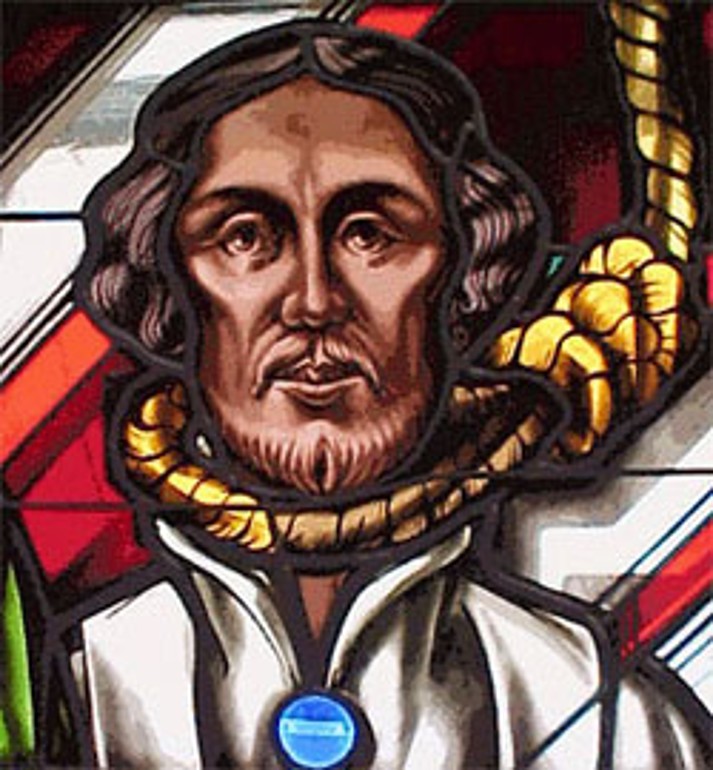
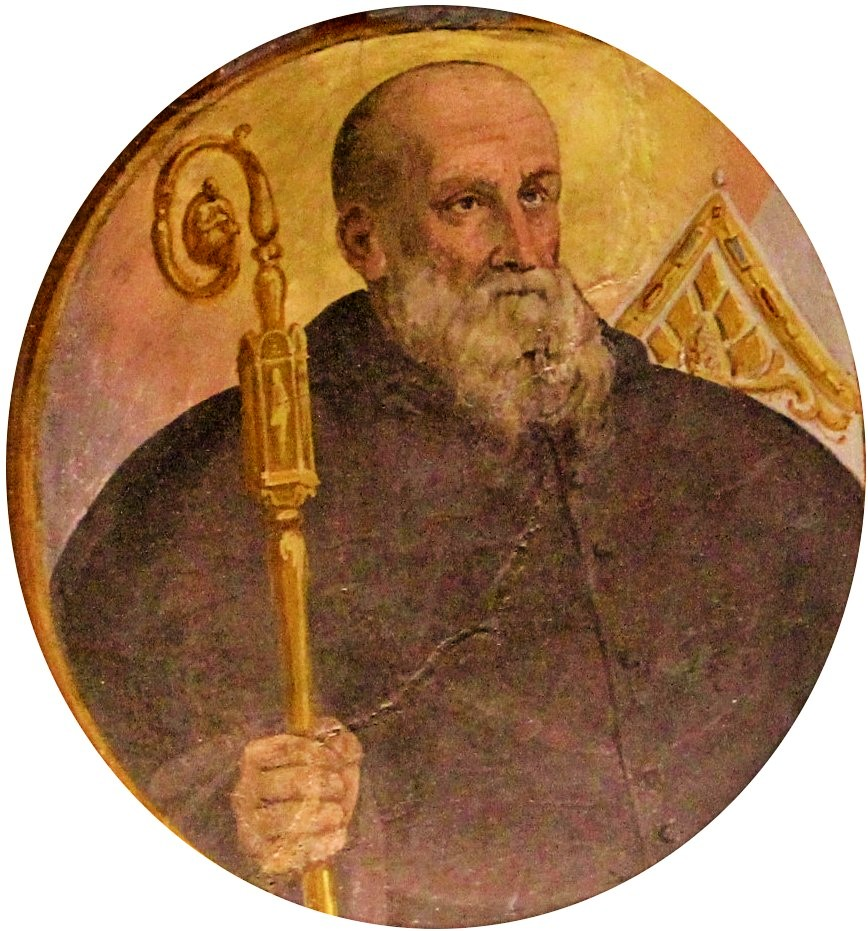
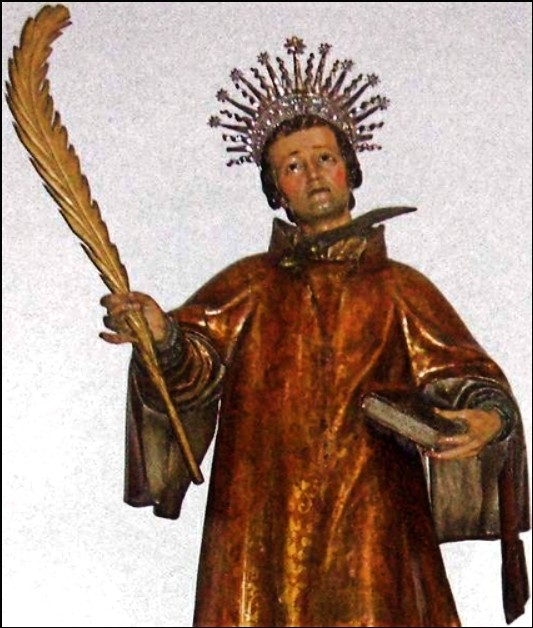
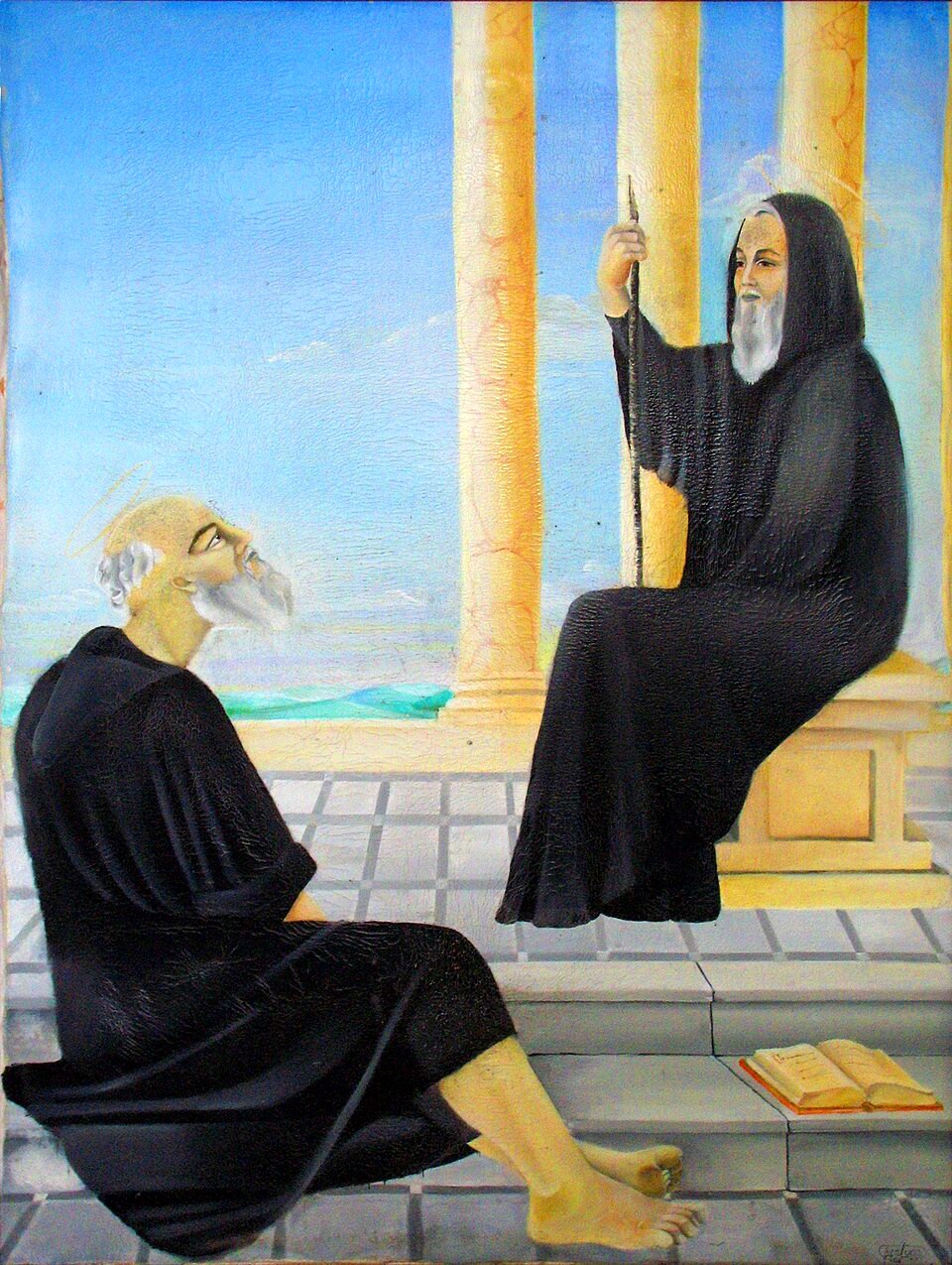
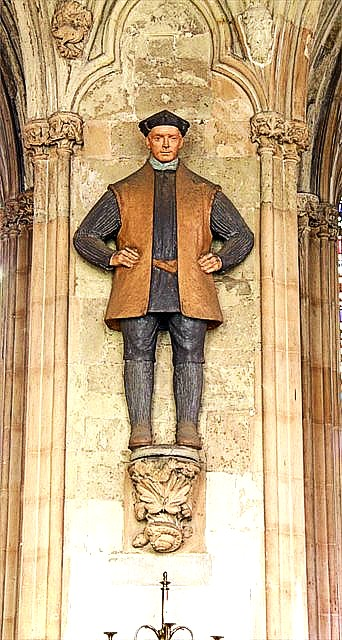
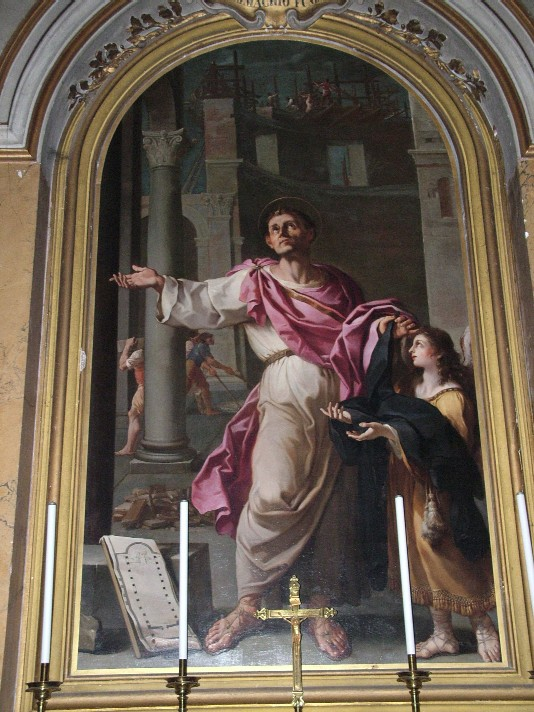
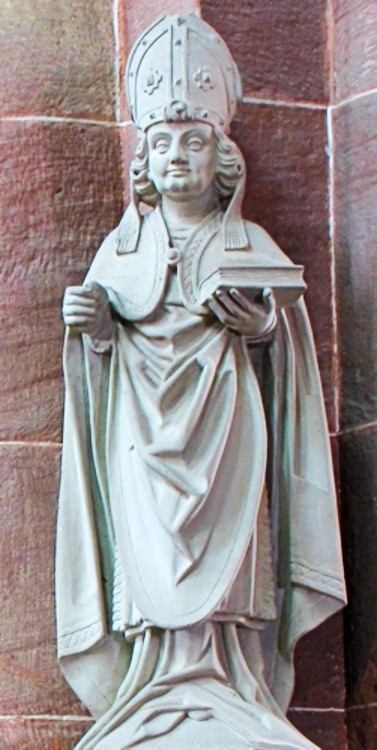
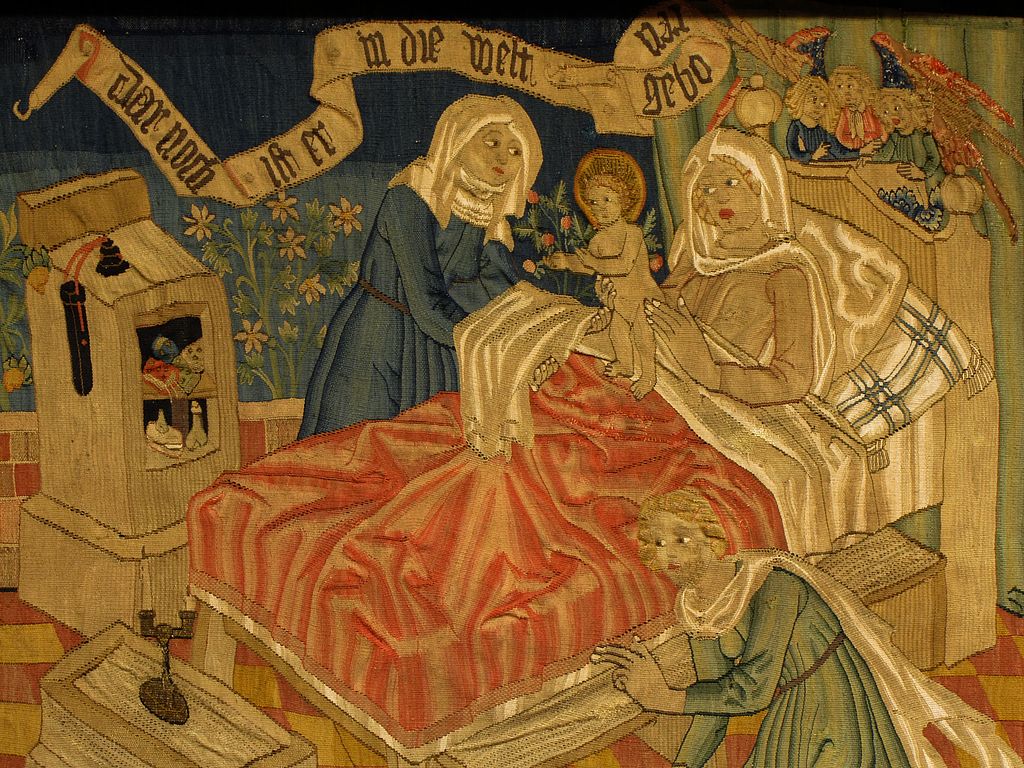
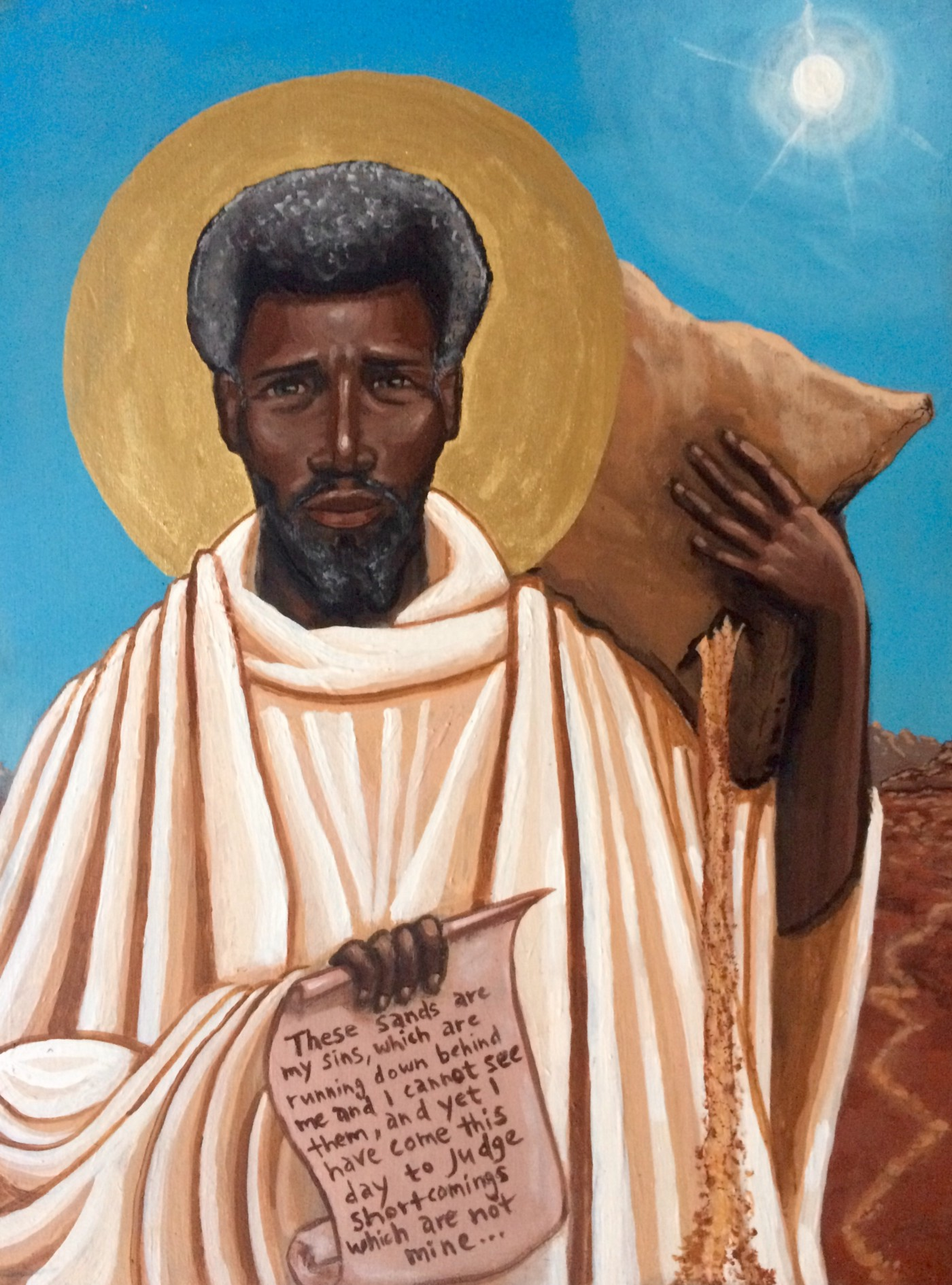
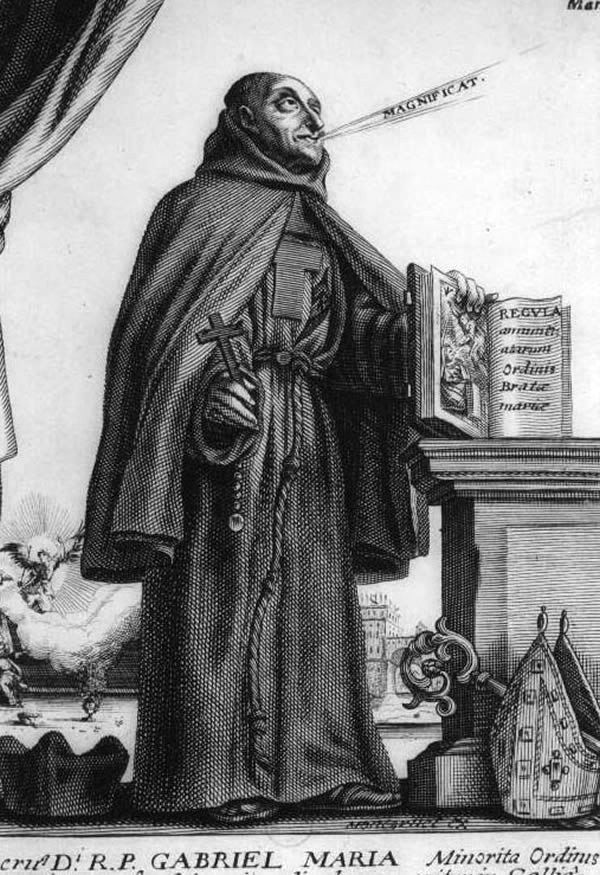
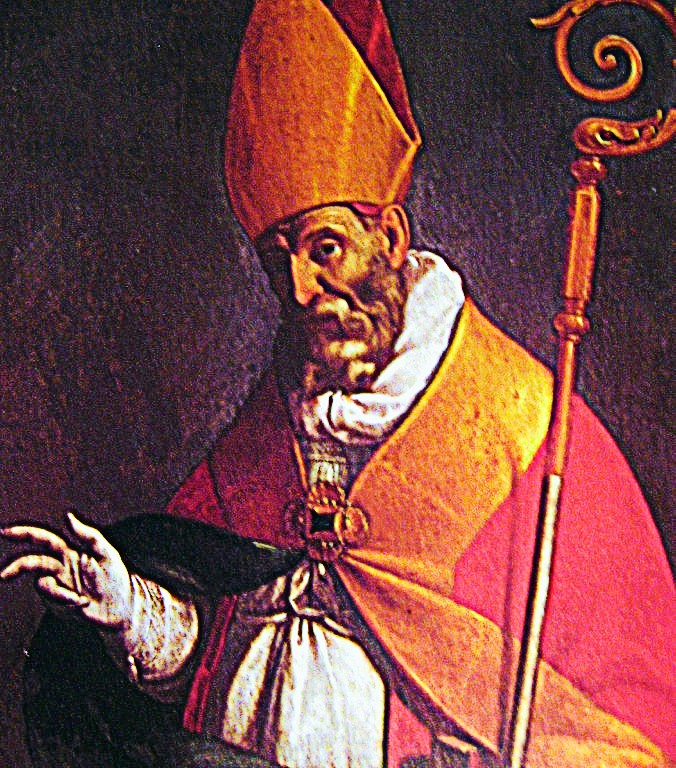
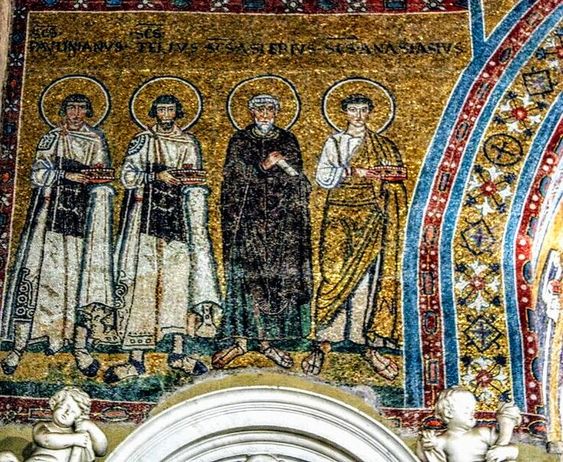
Saint of the Day – 1 July – St Simeon Salus (Died c570) Confessor, Monk, Hermit, Apostle of the poor and needy, Miracle-worker known as “The Holy Fool”
The Roman Martyrology reads today: “At Emesa, St Simeon, surnamed Salus, Confessor, who feigned to be an idiot for Christ but God manifested His high Wisdom by great miracles,”
Born in Syria, at the age of 30 Simeon entered the Monastery of Abbot Gerasimus in Syria. He spent the next 29 years in a desert near the Dead Sea. He felt inspired to move to Emesa to help the poor of that City without any formal recognition.
He came to learn that the best way to be humble was to love humiliation, so he took it upon himself to act foolishly. Only the truly wise could see Simeon’s sanctity.
By simulating simplicity, he saved many souls and brought them to Christ. He was also able to heal many possessed people by his prayer, fed the hungry, preached the Gospel,and helped the poor and needy of the Town. Most of Simeon’s good deeds were done secretly.
Simeon did not play a fool with his friend John, Deacon of the Church in Emesa. Simeon once saved John from being executed when he was falsely accused. Shortly before his death, Simeon told John:
“I beg you, never disregard a single soul, especially when it happens to be a Monk or a beggar. For your charity knows that His place is among the beggars, especially among the blind, people made as pure as the sun through their patience and distress …Show love of your neighbour through almsgiving. For this virtue, above all,, will help us on the Day of Judgment.”
Simeon died in c570 and was buried by the City’s poor in a potter’s field. While the Saint’s body was carried there, people heard a choir singing though none could be found anywhere.
St Aaron of Caerleon St Aaron the Patriarch St Arnulf of Mainz St Calais of Anisole St Carilephus St Castus of Sinuessa St Cewydd St Concordius of Toledo St Cuimmein of Nendrum
St Domitian (c347-440) Abbot, who had been the first Hermit of the surrounding region in France, Founder of a Monastery which became the foundation of the spiritual, cultural and social teachings of its region and day. Born in c347 in Rome and died in 440 at the Saint Rambert de Joux Abbey in the Diocese of Lyons in France. The Roman Martyrology reads: “In the Diocese of Lyons, the decease of St Domitian, Abbot, who was the first to lead there, an eremitical life. After having assembled, in that place, many servants of God and gained great renown for virtues and miracles, he was gathered to his fathers at an advanced age.” His Devoted Life: https://anastpaul.com/2024/07/01/saint-of-the-day-1-july-st-domitian-c347-440-abbot/
Bl Elisabeth de Vans St Eparchius of Perigord St Eutychius of Umbria St Esther the Queen
St Gall of Clermont St Golvinus of Leon St Gwenyth of Cornwall Bl Huailu Zhang St Julius of Caerleon St Justino Orona Madrigal St Juthware St Leonorious of Brittany St Leontius of Autun St Martin of Vienne St Nicasius of Jerusalem
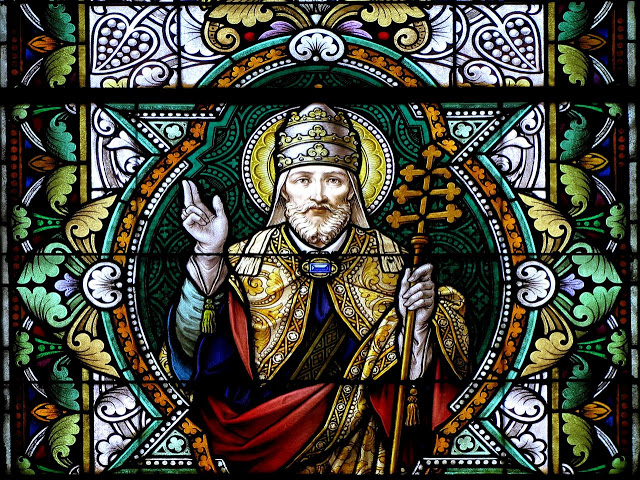
St Secundinus of Sinuessa St Servan of Culross St Simeon Salus (Died c570) Confessor, Monk, Hermit known as “The Holy Fool”
St Theobald of Vicenza St Theodoric of Mont d’Or St Veep
Martyrs of Rome – 6 Saints: Six Christians who were Martyred together. No details have survived except their names – Esicius, Antonius, Processus, Marina, Serenus and Victor. They were martyred i
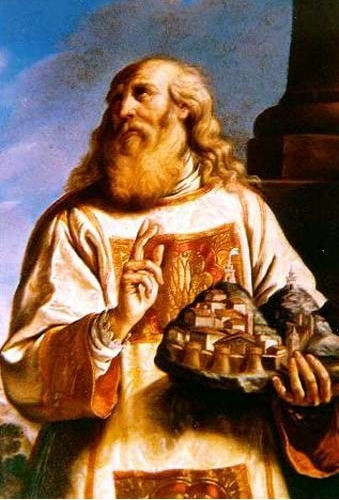
Saint of the Day – 30 June – Saint Ostian (6th Century) Priest, Confessor and Hermit in Viviers, France, Miracle-worker. Patronages – Viviers, France, for rain (most especially in Viviers). Also known as – Ostianus, Ostiane, Ostiano, Hostien.
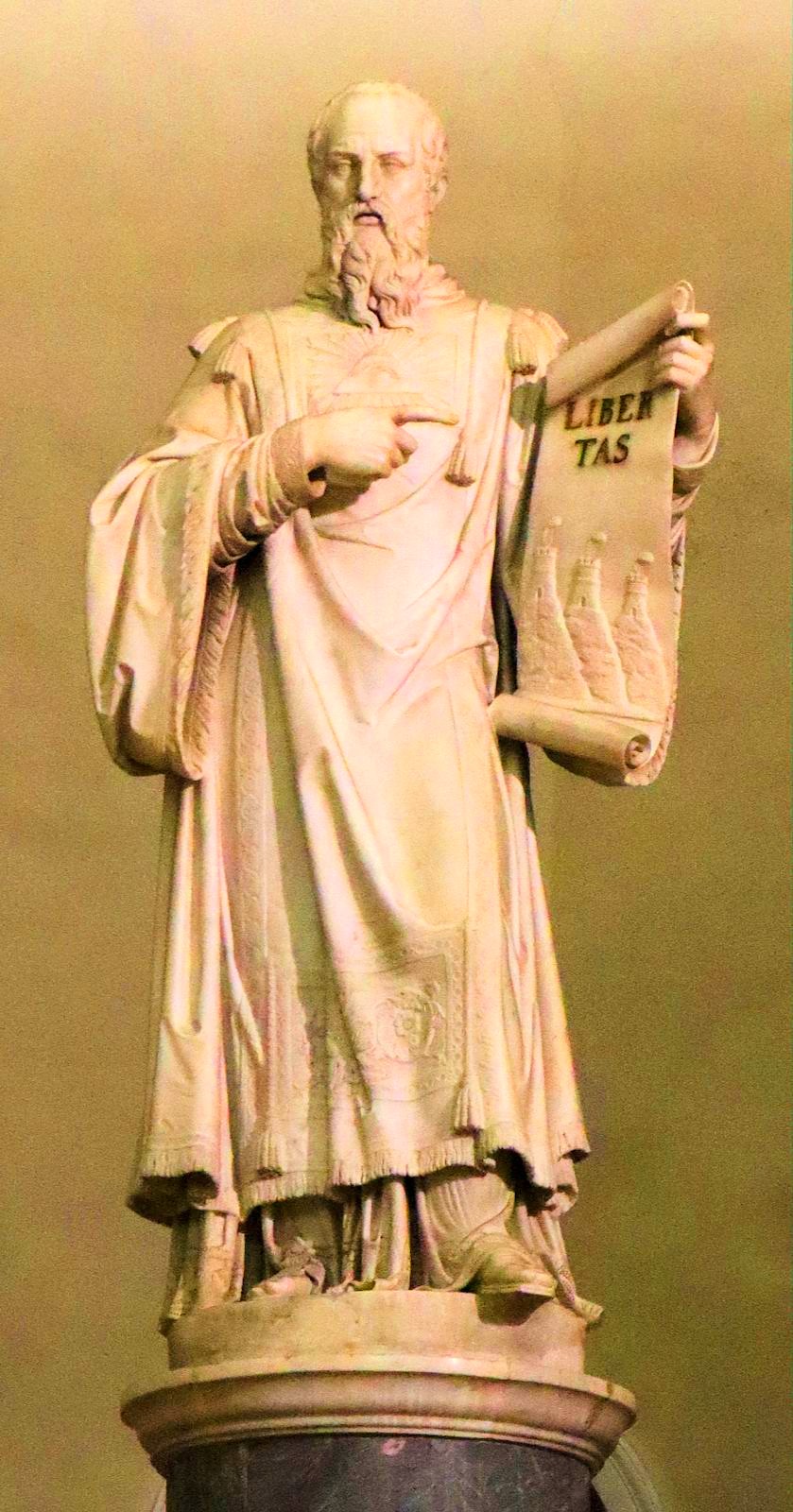
The Roman Martyrology reads today: “In the territory of Viviers, St Ostian, Priest and Confessor.”
“Living in the 6th Century, Ostian first evangelised the Dioceses of Viviers and Le Puy. He was then a Hermit near Viviers. The 16th Century handwritten Martyrology mentions him in these terms: ‘in the territory of Viviers, in the Church of St Martin of the Couspié valley, one mile north of the City, at the foot of the mountain of the Tour St Martin, the body of the blessed Ostian, Priest, rests to this day.’ His Relics were solemnly brought to the Cathedral on 19 August 1880. He is the Patron of the City of Viviers.” ( Diocese of Viviers: Consecrated life. He is celebrated on 30 June in the Calendar of the Diocese of Viviers).
We have very limited information of our Saint Ostian. He is believed to have been a relative of Sigismund, the King of Burgundy.
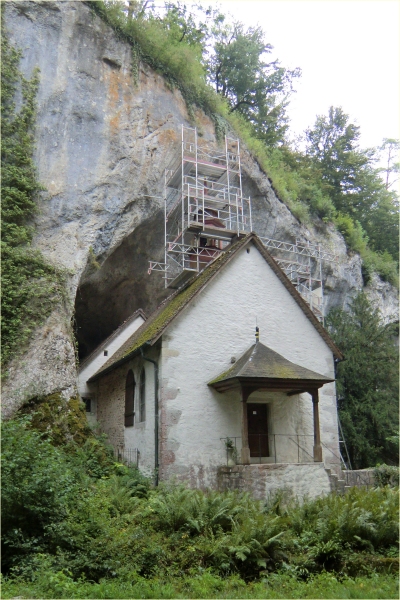
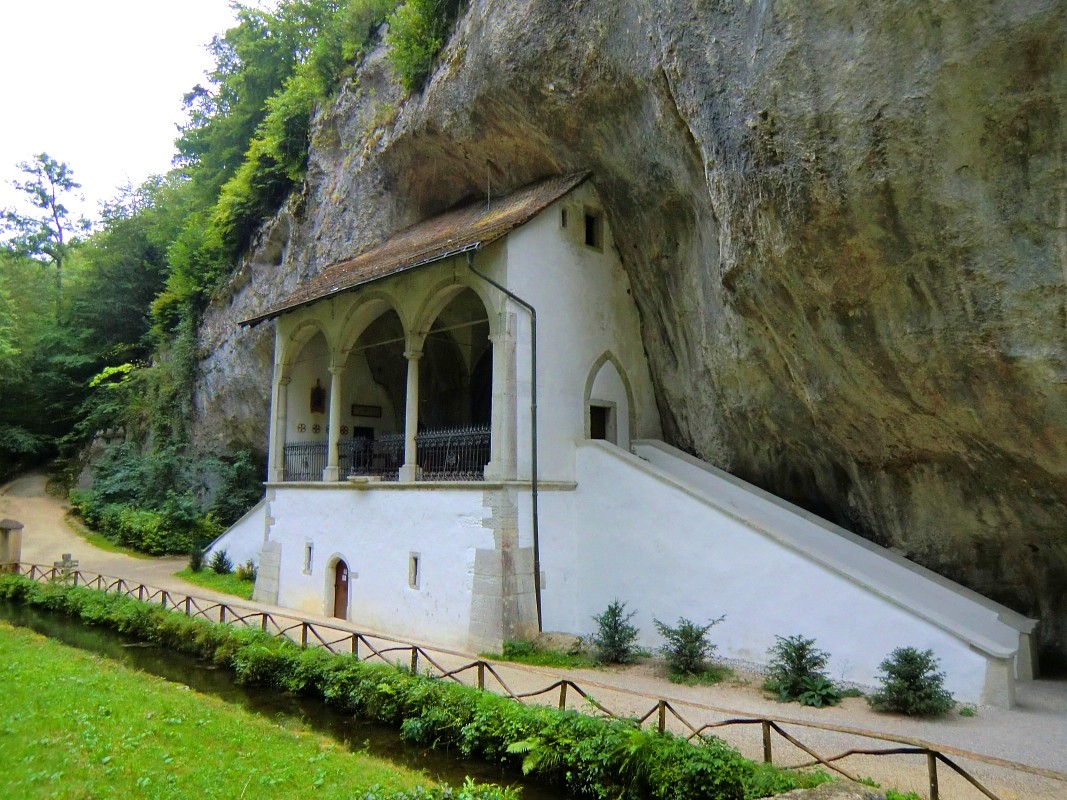
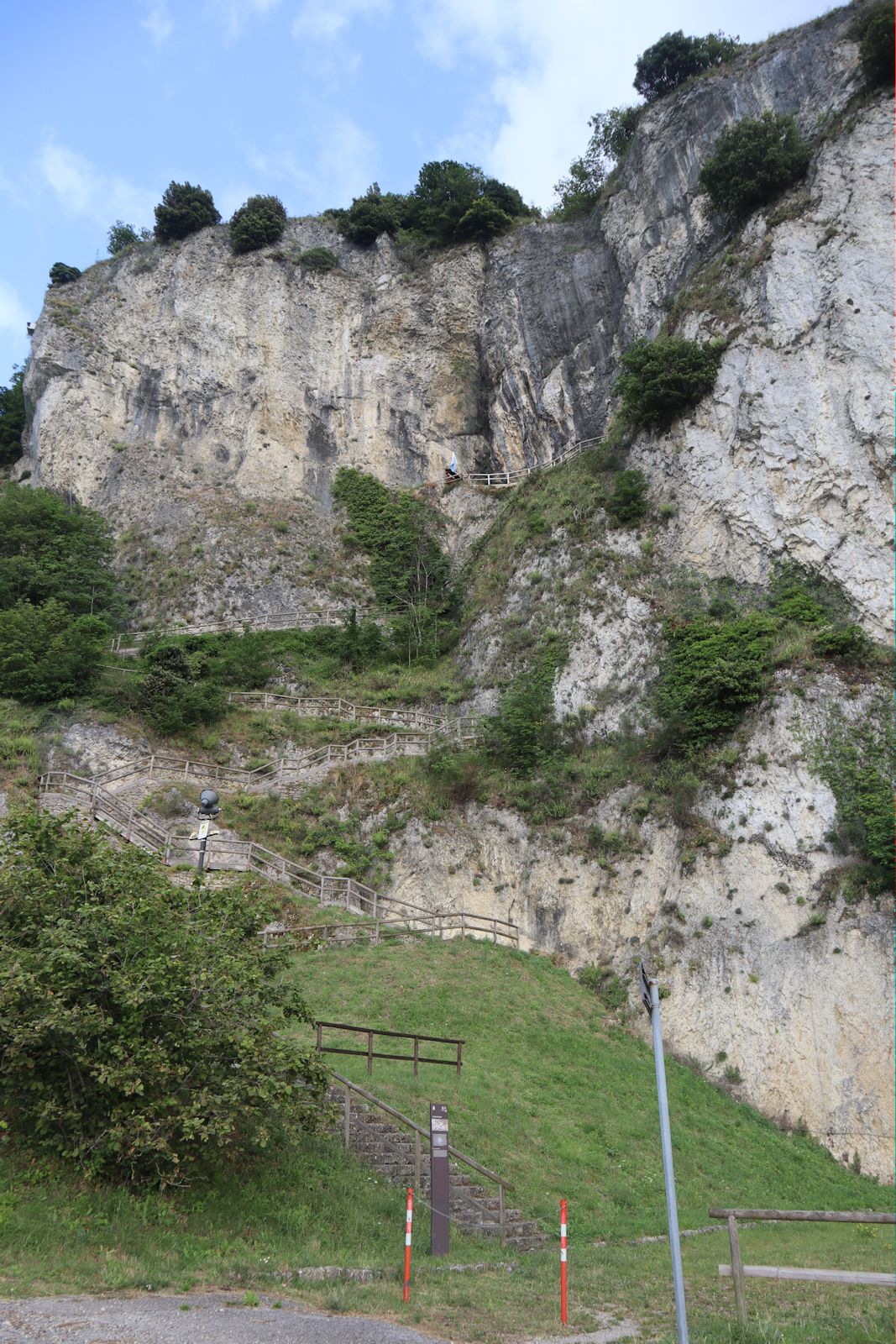
After distributing all his possessions, Ostian is said to have followed the King’s son, Saint Venantius, who was the Bishop of Viviers. The Bishop, wanting to fulfill Ostian’s wish, is said to have granted him ownership of a piece of land in the Couspier valley, at the foot of Mount Bayna, where the Saint lived for 15 years. During these 15 years, it is believed he performed various miracles, including the cures of some blind people. Below is his little stone Chapel where he lived and preached and spread the Gospel, evangelising the region and confessing Christ to all who had ears to hear.
In the 9th Century, Bishop Bernoin (851-874) made a first survey of the Relics of Saint Ostian. And, in the 18th Century, it was believed that his body was in the Church of St Martin di Couspiè. In 1711, in the annotations of the resolutions of the City Council, was presented that the “request for a Procession and Solemn Mass at the Church of Saint-Martin to put an end to the drought, in honour of Sant’Ostian.”
The stone Sarcophagus containing his bones was found in 1869. After these Relics were declared authentic, on 19 August 1880, some bones were transferred to the Cathedral of Viviers and deposited in the Chapel of the Holy Relics. The rest of the Relics had been left in the original restored crypt of the Chapel of Saint-Ostian in San Martin.
The inhabitants of Viviers traditionally invoke Saint Ostian to obtain rain in times of drought. Although the first to introduce the name of this saint in a martyrology was Usvardo, while in Vivers, in some Liturgical records of the 14th and 15th Centuries, his memory was remembered. Currently, Saint Ostian, Priest and Confessor, is remembered and celebrated today, 30 June.
The Town called Saint-Hostien (Sant Ostian in Occitan) is part of the Saint Régis en Mézenc-Meygal Parish complex of the Diocese of Puy.
St Adolphus of Osnabrück O.Cist. (1185-1224) Bishop St Alpinian of Limoges St Alrick the Hermit Bl Ambrose de Feis Bl Anthony de Tremoulières Bl Arnulf of Villers St Austriclinian of Limoges St Basilides of Alexandria St Bertrand of Le Mans St Clotsindis of Marchiennes
Bl Elisabeth Heimburg St Emiliana of Rome St Erentrude St Eurgain St Gaius Bl Jacob Clou St Leo the Deacon St Lucina of Rome St Lucina of the Callistus Catacombs St Marcian of Pampeluna St Martial of Limoges St Ostian (6th Century) Priest, Confessor St Otto of Bamberg St Peter of Asti St Petrus Li Quanhui
Blessed Raymond Lull TOSF (c1232 – c 1315) Martyr – known as “Doctor Illuminatus,” Raymond was a Philosopher, Logician, Writer, Poet, Pioneer in computation theory, Franciscan tertiary. Within the Franciscan Order he is honoured as a Martyr. He was Beatified on 25 February 1750 by Pope Benedict XIV (cultus confirmed) and reaffirmed in 1847 by Pope Pius IX. His Life and Death: https://anastpaul.com/2018/06/30/saint-of-the-day-30-june-blessed-raymond-lull-t-o-s-f-c-1232-c1315-martyr/
St Vihn Son Ðo Yen
Martyrs of Africa – 7 Saints: Seven Christians Martyred together. No detail about them have surived but the names – Cursicus, Gelatus, Italica, Leo, Timotheus, Zoilus, and Zoticus. Date and precise location in Africa unknown.
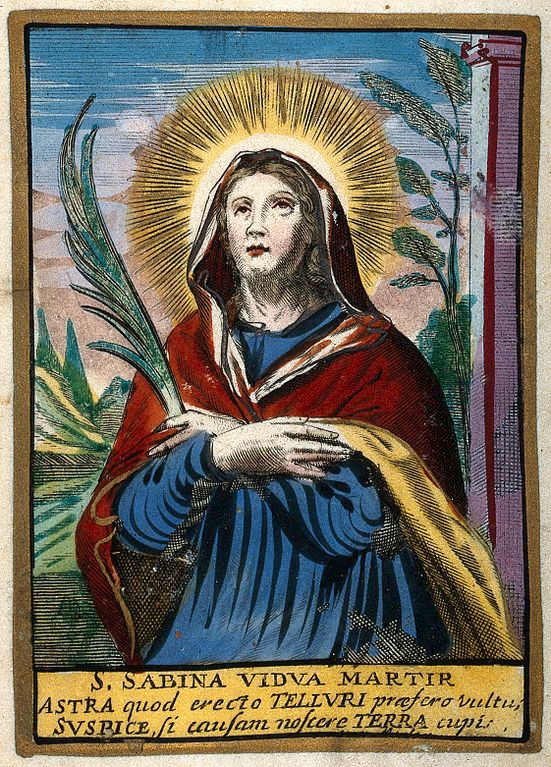
Saint/s of the Day – 29 June – Saint Judith Widow, Recluse and St Salome (9th Century) Recluse both of Niederaltaich in Bavaria.
There is considerable debate regarding the identity of Judith and her companion, St Salome. They may have been cousins (or Judith the aunt of Salome) of Anglo-Saxon Royal lineage, who lived for a considerable period as Recluses under Abbot Walther (or Walker) in Oberaltaich-am-Donau. A later tradition identifies Salome as St Edburga, daughter of King Offa of Mercia, who was exiled for accidentally poisoning her husband. She was then befriended by the Bavarian widow, Judith.
Relics of both were later disinterred and buried near the Altar of St Giles. It is thought that their bodies came to Niederaltaich on the occasion of the destruction of Oberaltaich by the Hungarians.
Another source states that the two Recluses lived in Niederaltaich in about 1100. According to this version, while in the neighbourhood of Regensburg in Germany, after a pilgrimage to the Holy Land, Salome became blind, in answer to prayer, asking for this affliction to escape from sinful proposals.
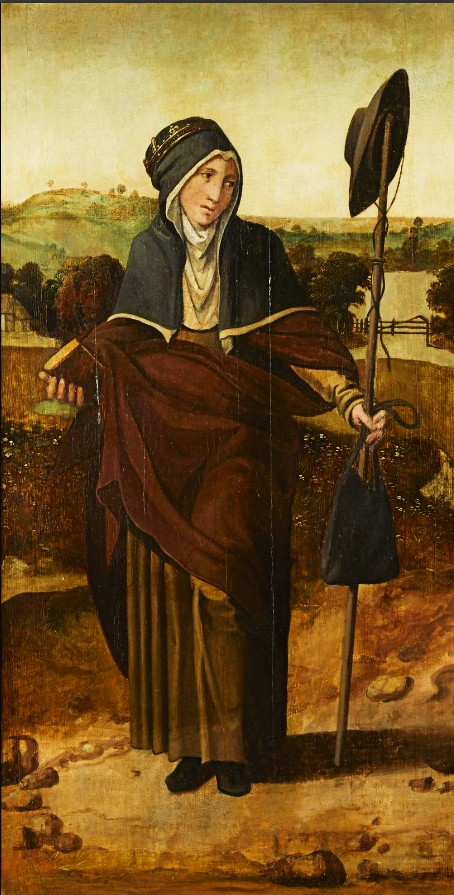
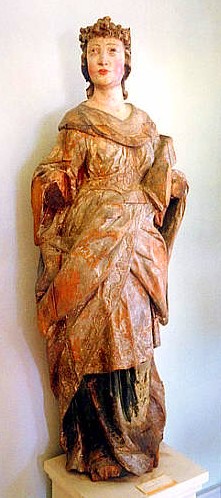
St Salome
She lived by begging. Once she fell into the Danube and was rescued by a passing boat which took her to Passau. She was recommended to the Abbot of Niederaltaich, who had a Recluse’s cell built for her beside the Monastery Church. Here she was found by her blood relative and childhood playmate, Judith, who having been widowed young and having likewise gone to Jerusalem, had searched for Salome. With permission of the Abbot and the Chapter, Judith was then also given a cell by the Church of Niederaltaich. Both women worked as servants in the Monastery. Both died before the end of the 11th Century, Salome first. This Vita dates from the 13th or 14th Century.
It claims that both bodies were interred in a common Shrine before the Altar of St Giles although they have since been lost.
Judith and Salome were venerated in monastic martyrologies and in art but had no liturgical cult.
Sts Peter and Paul, Apostles: The joint commemoration of the Apostles, Peter and Paul, is one of the most ancient customs of the Roman Church, attested already in the oldest surviving Roman Liturgical Calendar, the Depositio Martyrum, written in 336. A verse of the Hymn, Apostolorum Passio, an authentic work of St Ambrose († 397) and still used in the Ambrosian liturgy, says that “the thick crowds make their way through the circuit of so great a city; the feast of the sacred Martyrs is celebrated on three streets.” These “three streets” are the via Cornelia, the main street running up to and over the Vatican hill; the via Ostiensis, where the burial and Church of St Paul are and the via Appia, on which resides the Cemetery “in Catacumbas.”
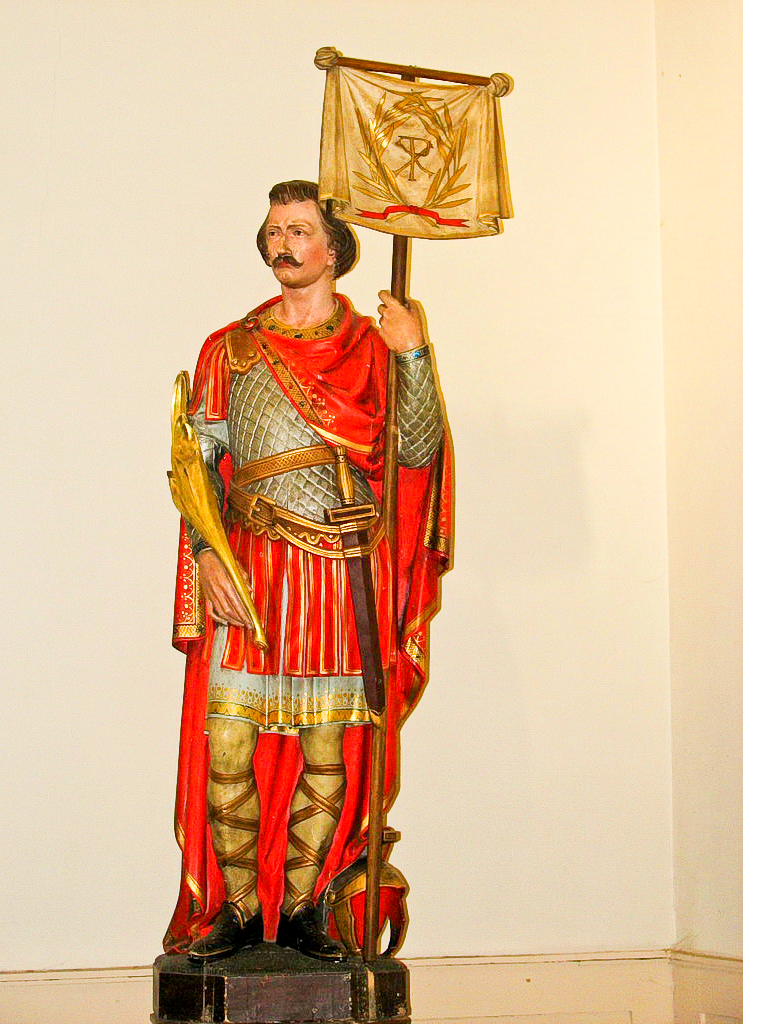
St Anastasius of Bourges (Died c274) Soldier. Martyr. Scourged to death in c274, no other information has survived.
St Benedicta of Sens
St Cassius (Died 558) Bishop of Narni, Italy from 537 to 558, the date of his deat, Miracle-worker. He was praised by St Gregory the Great and was noted for his charity. Died on 30 June 558 in Narni, Italy of natural causes. Relics enshrined in the Cathedral of Narni, Italy. The Roman Martyrology reads: “At Narni, St Cassius, Bishop of that City of whom St Gregory the Great relates, in writing and in sermons, that Cassius permitted scarely any day of his life to pass without offering the Victim of propitiation to Almight God and he was well worthy to do so, for he distributed in alms, all he possessed and his devotion was such that abundant tears flowed from his eyes during the Holy Sacrifice.At Last, he came to Rome on the birthday of the Apostles, as was his yearly custom and after having solemnly celebrated Mass and given the Lord’s Body and the Kiss of Peace to all, he departed for Heaven, the next day at Narni” This Holy man of God: https://anastpaul.com/2023/06/29/saint-of-the-day-29-june-st-cassius-died-558-bishop-of-narni/
St Ciwg ap Arawn St Cocha St Ilud Ferch Brychan St Judith (9th Century) Widow and Recluse AND St Salome (9th Century) Recluse of Niederaltaich
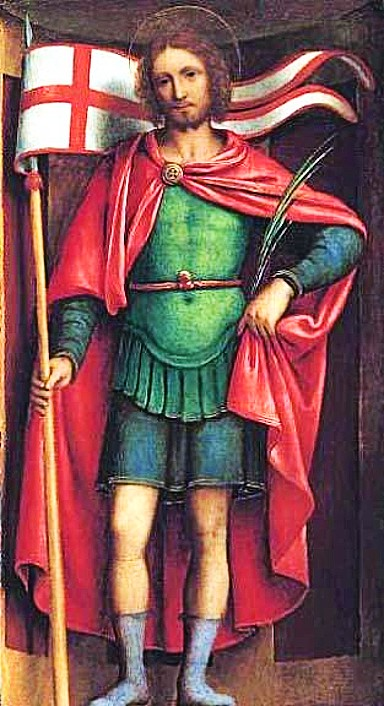
St Marcellus of Bourges (Died c274) Soldier. Martyr. Beheaded in c274, no other information has survived.
Saint of the Day – 28 June – Saint Egilo (Died 871) Abbot of Prüm Abbey near Trier, Germany. Also known as – Egilon, Eigil.
We have no information of our Saint’s birth and life before becoming a Monk.
At Trier he founded the Abbey of Prüm and there he clothed St Humphrey in the Benedictine Habit.
In 860, he was directed by Emperor Charles the Bald, to restore Flavigny Abbey in Dijon, France which he successfully completed. Thereafter, Egilo founded the Abbey of Corbigny, in France.
St John Southworth (1592-1654) Priest Martyr, Missionary. Known as ‘The Parish Priest of Westminster.’ Patronage – the Clergy of the Westminster Diocese. His remains were purchased by the Spanish Ambassador to England and were sent to the English College in Douai, France. There the Relics were hidden to prevent destruction during the French Revolution and were only rediscovered in 1927 and are now housed at Westminster Cathedral, London. His Life and Death: https://anastpaul.com/2024/06/28/saint-of-the-day-28-june-st-john-southworth-1592-1654-priest-martyr-the-parish-priest-of-westminster/
Martyrs of Africa – 27 Saints: 27 Christians Martyred together. The only details about them to survive are the names – Afesius, Alexander, Amfamon, Apollonius, Arion, Capitolinus, Capitulinus, Crescens, Dionusius, Dioscorus, Elafa, Eunuchus, Fabian, Felix, Fisocius, Gurdinus, Hinus, Meleus, Nica, Nisia, Pannus, Panubrius, Plebrius, Pleosus, Theoma, Tubonus and Venustus. Unknown location in Africa, date unknown.
Martyrs of Alexandria – 8 Saints: A group of spiritual students of Origen who were Martyred together in the persecutions of emperor Septimius Severus – Heraclides, Heron, Marcella, Plutarch, Potamiaena the Elder, Rhais, Serenus and Serenus. They were burned to death c206 in Alexandria, Egypt.
Saint of the Day – 27 June – St Desideratus (6th Century) Priest, Monk and Hermit in Gourdon, near Chalon-sur-Saône in Burgundy, Miracle-worker. Patronage – against toothache. Also known as – Désiré, Desert, Didier.
Unknown Hermit
Desideratus lived in the 6th Century in what is now France. The holy Pope St Gregory I the Great (590-604) wrote of him and considered him a man of admirable holiness.
The holy Bishop St Gregory of Tours relates that Desideratus was distinguished by his holiness and that he had seen him in the Monastery of Gourdon, where he restored many sick people to health through his prayers, especially those suffering from toothache.
Details of his life as a Hermit are not known but he was venerated in the Monastery of Mont-Saint-Vincent in Burgundy and in the entire region.
His Feastday is 27 June but 30 April is also mentioned.
In an old record of the Church of Chalon, printed in Lyon in 1520, one finds the Feast of the holy Priest Hermit, St Desideratus celebrated on 30 April.
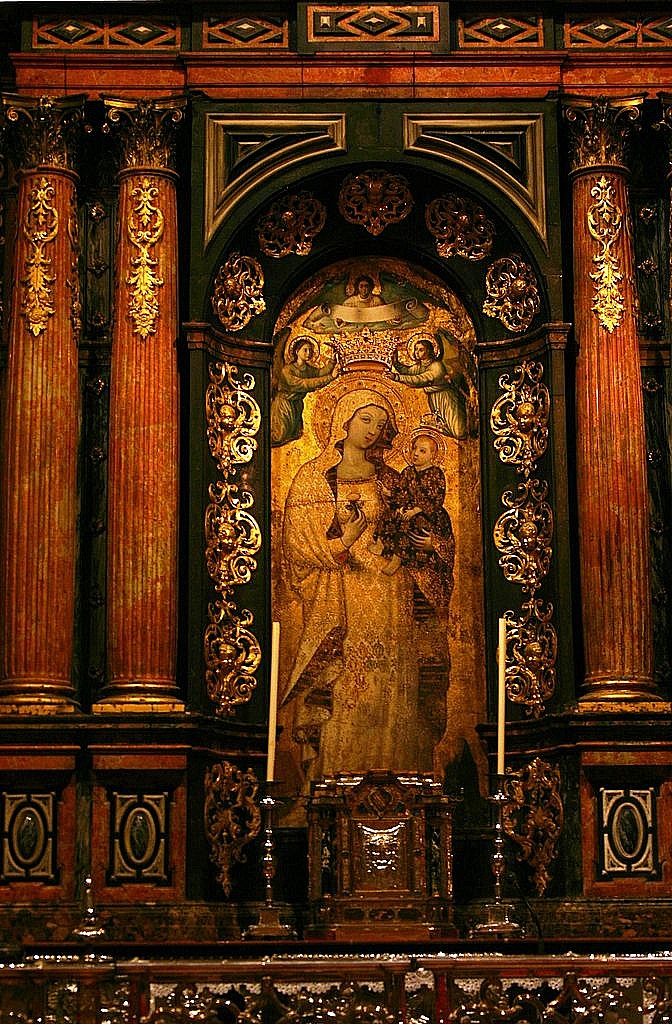
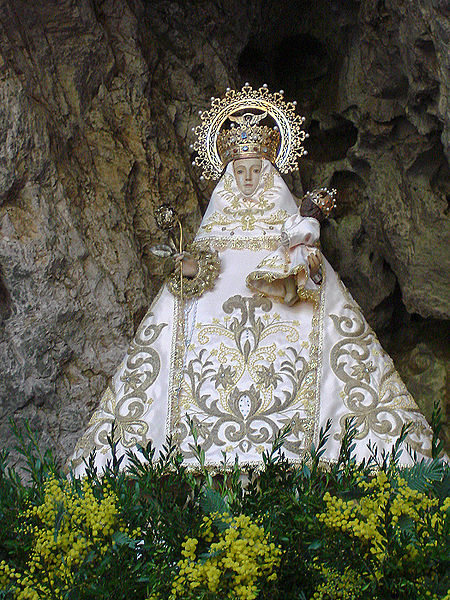
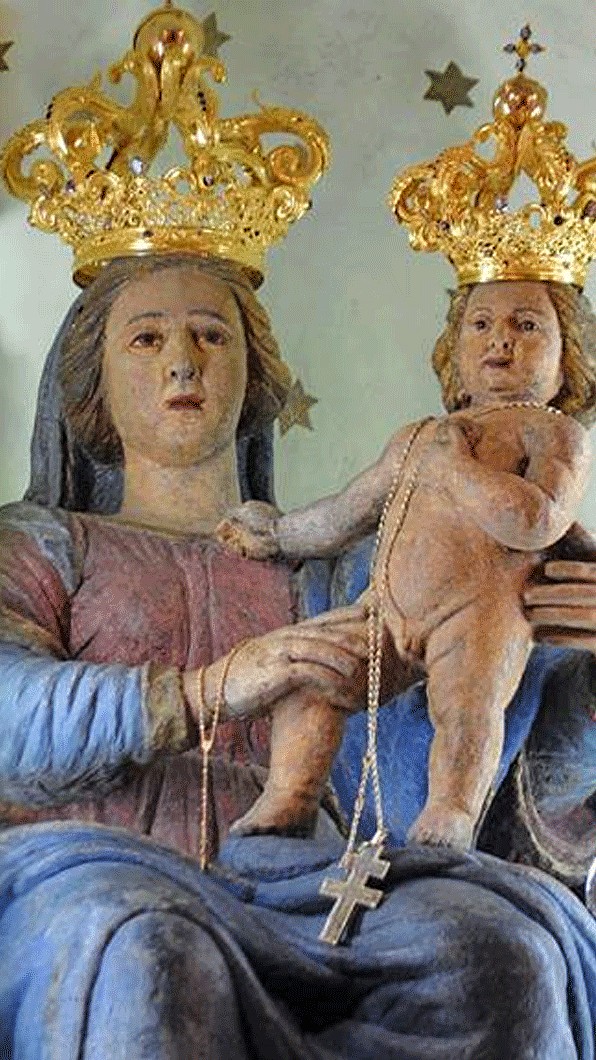
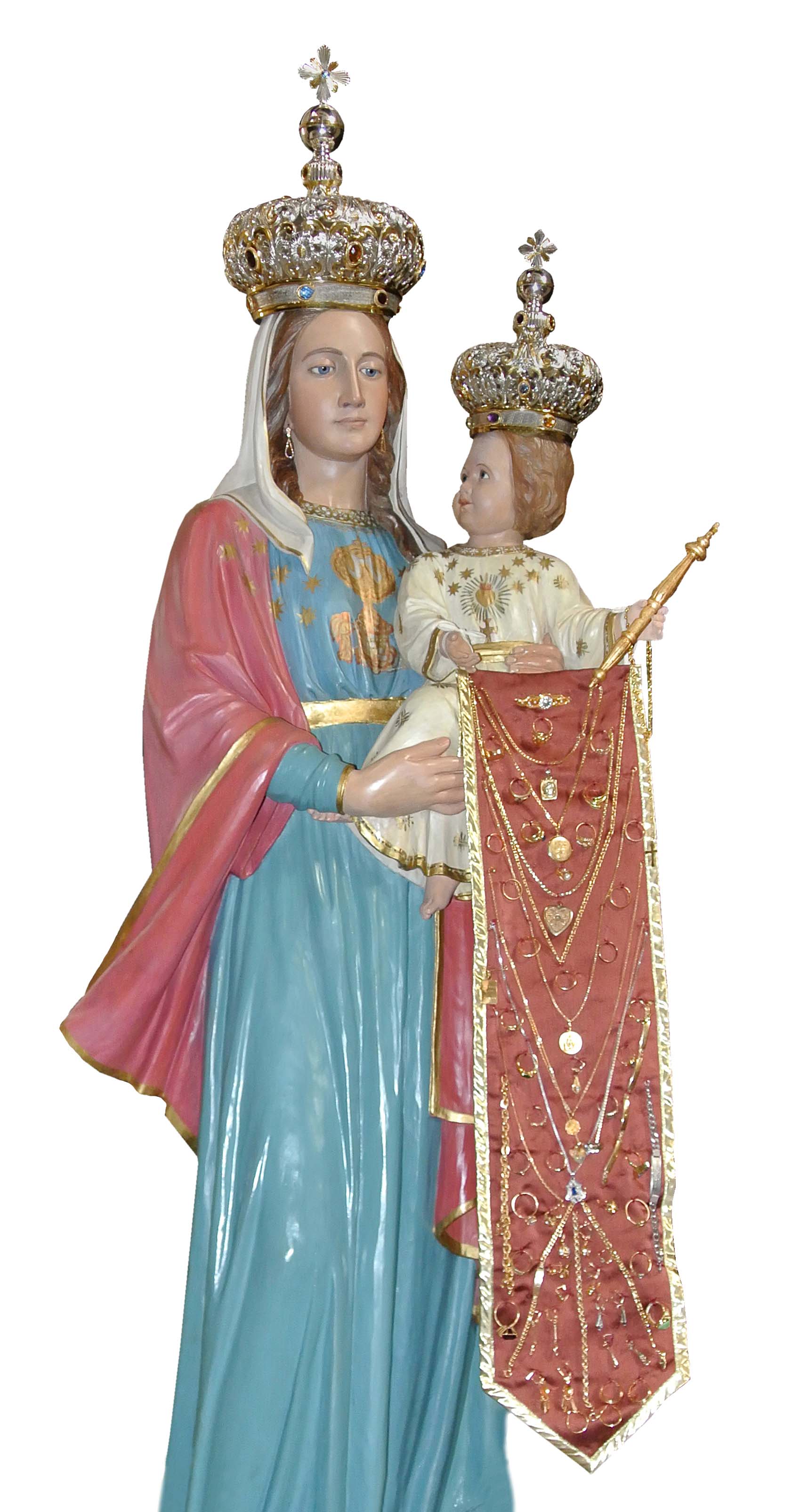
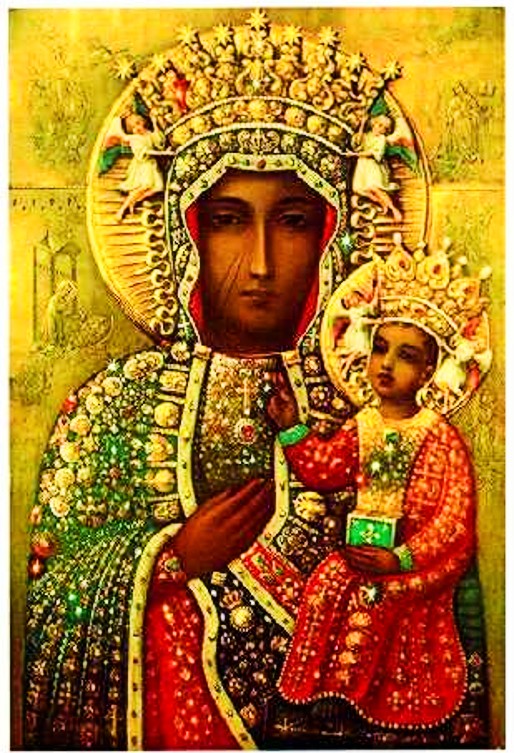
Madre del Perpetuo Soccorso / Mother of Perpetual Succour (Help) – Feast 27 June: Patronage: Porto Cesareo, Italy, Haiti, Labrador City, Labrador, Yorkton, Saskatchewan, 8 Diocese.
Prayer to Our Mother of Perpetual Succour, When In Urgent Need By St Alphonsus’ Redemptorists
O Mother of Perpetual Succour, numerous clients continually surround thy Holy picture, all imploring thy mercy. All bless thee as the assured help of the miserable, all feel the benefit of thy motherly protection. With confidence then, do we present ourselves before thee in our misery. See, dear Mother, the many evils to which we are exposed, see how numerous are our wants. Trials and sorrows often depress us, reverses of fortune and privations, often grievous, bring misery into our lives, everywhere we meet the Cross. Have pity, compassionate Mother, on us and on our dear ones, especially in this our necessity …………… (mention your need). Help us, dear Mother in our distress, deliver us from all our ills, or, if it be the Will of God, that we should suffer still longer, grant that we may endure all, with love and patience. These Grace’s we expect of thee with confidence, because thou art our Perpetual Succour, amen.
St Adeodato of Naples St Aedh McLugack St Anectus of Caesarea St Arialdus of Milan St Arianell of Wales
Blessed Benvenutus of Gubbio OFM ) (Died 1232) Lay brother of the Order of the Friars Minor of St Francis, ex-Soldier, Apostle of the sick and of lepers. Benvenutus was graced with an ardent and mystical devotion to the Blessed Eucharist and to the Mother of God. So ardent was his faith and contemplation that he was seen to hold the Divine Infant in his arms. Biography: https://anastpaul.com/2021/06/27/saint-of-the-day-27-june-blessed-benvenutus-of-gubbio-ofm-died-1232/
St Crescentius of Mainz Bl Daniel of Schönau Bl Davanzato of Poggibonsi OFM (c1200-1295) Priest St Desideratus (6th Century) Priest and Hermit in Gourdon, France St Dimman St Felix of Rome St Ferdinand of Aragon St Gudene of Carthage Bl Hemma of Gurk St Joanna the Myrrhbearer St John of Chinon
St Spinella of Rome St Tôma Toán St Zoilus of Cordoba
DISCLAIMER: Please note: I cannot control the content of the Advertisements on this Site, or of pop-ups which may appear, The revenue from the Advertisements, however, does provide a little assistance in the support of the Site. I do apologise for any inappropriate content.
One Minute Reflection – 26 June – “The Month of the Most Sacred Heart of Jesus” – Saint John and Saint Paul of Rome (Died c362) Martyrs – The Octave Day of Corpus Christi – 1 Corinthians 23-29 – John 6:56-59 – Scripture search here: https://www.drbo.org/
“He who eats this Bread shall live forever.” – John 6:59
REFLECTION – “Since it was the Will of God’s Only-Begotten Son that men should share in His Divinity, He assumed our nature in order that, by becoming Man. He might make men gods . Moreover, when He took our flesh. He dedicated the whole of its substance to our salvation. He offered His Body to God the Father, on the Altar of the Cross, as a sacrifice for our reconciliation. He shed His Blood for our ransom and purification, so that we might be redeemed, from our wretched state of bondage and cleansed from all sin. But to ensure that the memory of so great a gift would abide with us forever, He left His Body as food and His Blood as drink, for the faithful to consume in the form of bread and wine.
O precious and wonderful banquet which brings us salvation and contains all sweetness! Could anything be of more intrinsic value? Under the old law, it was the flesh of calves and goats, which was offered but here, Christ Himself, the True God, is set before us as our food! What could be more wonderful than this? No other Sacrament has greater healing power; through it, sins are purged away, virtues are increased and the soul is enriched with an abundance of every spiritual gift. It is offered in the Church for the living and the dead, so that what was instituted for the salvation of all, may be for the benefit of all. Yet, in the end, no-one can fully express the sweetness of this Sacrament, in which spiritual delight is tasted at its very source, and in which, we renew the memory, of that surpassing love for us, which Christ revealed in His Passion.
It was to impress the vastness of this Love, more firmly upon the hearts of the faithful, that our Lord instituted this Sacrament at the Last Supper. As He was on the point of leaving the world to go to the Father, after celebrating the Passover with His disciples, He left it as a perpetual memorial of His Passion. It was the fulfilment of ancient figures and the greatest of all His Miracles, while, for those who were to experience the sorrow of His departure, it was destined to be a unique and abiding consolation.” – St Thomas Aquinas (1225-1274) Dominican Priest and Theologian, Doctor of the Church (An excerpt from On the Feast of the Body of Christ).
PRAYER – We beseech Thee, Almighty God that on this feast-day, we may have the double joy of celebrating blessed John and Paul, true brothers ,who obtained eternal glory through one Faith and one Martyrdom. Through Jesus Christ, Thy Son our Lord, Who lives and reigns with Thee, in the unity of the Holy Ghost, God, world without end. Amen (Collect).
O HEART of love, I place all my trust in Thee; for though I fear all things from my weakness, I hope all things from Thy mercies. – Ejaculation of Saint Margaret Mary – Indulgence 300 Days, Everytime – Raccolta 180St Pius X, 3 June 1908.
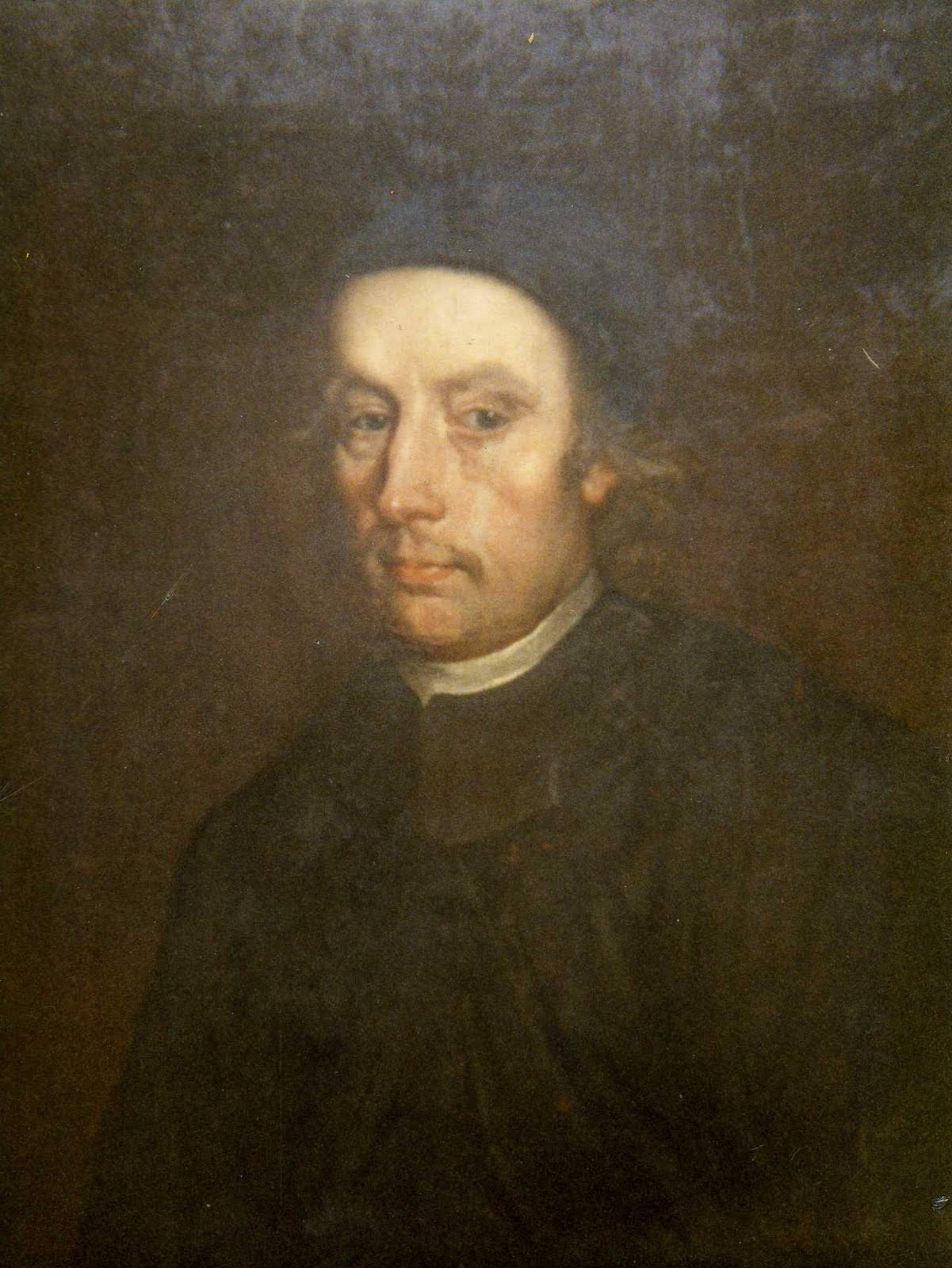
Saint of the Day – 26 June – St Deodatus (Died 473) Bishop of Nola succeeding St Paulinus the Younger after having been his Archpriest. He had previously been the Deacon of St Paulinus Nola (c354-431) (St Paulinus image below).
The life of Saint Deodatus, although rich in virtues and meritorious works, has come down to us in fragments.
From various sources we learn that Deodato was first Archpriest of the City of Nola during the Episcopate of Saint Paulinus the Younger, who died in 442. His wisdom and prudence were such that “with the consent of all the Presbyters and Clerics of the entire Nolan Church,, he was entrusted with the administration of the revenues to be collected and distributed and, in a certain sense, he was a bishop.”
However, his moral integrity was put to the test by slanderous accusations. Malicious individuals denounced him to the Emperor Valentinian III, accusing him of disposing of Ecclesiastical goods “at his pleasure and for his own use.”
Following these accusations, Deodato was imprisoned, exiled and only thanks to divine intervention was he able to regain his freedom.
Unknown Deacon
Two years after the death of St Paulinus the Younger, in 444, Deodatus was elected as the Bishop of Nola, assuming the leadership of the Diocese with dedication and wisdom.
His Episcopate was characterised by intense pastoral activity and deep attention to the needs of the faithful. Deodatus distinguished himself by his humility and charity, earning the affection and esteem of all. He died on 26 June 473 and was buried in his hometown of Nola.
Already in life, Deodatus was venerated for his sanctity. While still the Archpriest, he had prepared a cenotaph with an inscription which emphasised his humility: “Deodatus, unworthy Archpriest of the Holy Church of Nola, rests here.” After his death, another epigraph was dedicated to him, extolling his virtues: “Beloved by God and men in the Priesthood.”
Several historical sources, including the author of the Vita himself, confirm that Deodatus was both Archpriest and Bishop of Nola.
Around 840, his Relics were transported to Benevento, where they are still venerated today.
St John of Rome * Layman Brothers, Martyr St Paul of Rome * Layman Brothers, Martyr The year of their Martyrdom is uncertain according to their Acts; it occurred under the Emperor, Julian the Apostate. The Roman Martyrology reads today: “At Rome, on Mount Coelus, the holy Martyrs, John and Paul, brothers. The former was Steward, the other Secretary of the virgin Constantia, daughter of the Emperor Constantine. Afterwards, under Hulian the Apostate, they received the Palm of Martyrdom by being beheaded.” Their Lives and Deaths: https://anastpaul.com/2023/06/26/saints-of-the-day-26-june-saint-john-and-saint-paul-died-c362-laymen-brothers-martyrs/
St Acteie of Rome St Albinus of Rome
St Anthelm O. Cart. (c1105-1178) Bishop of Belley, France, Prior of the Carthusian Grand Chartreuse. Reformer, talented Administrator, Founder of the female Carthusians and originated of the Carthusian Rule (with the zealous and learned assistance of Bless John the Spaniard whom we celebrated yesterday) Apostle of the poor, the sick and the needy. The wonderful St Anthelm: https://anastpaul.com/2021/06/26/saint-of-the-day-st-anthelm-of-belley-o-cart-c-1105-1178/
St Babolenus of Stavelot-Malmédy St Barbolenus of Fossés Bl Bartholomew of Vir St Corbican St David of Thessalonica St Deodatus (Died 473) Deacon of St Paulinus Nola (c354-431) St Dionysius of Bulgaria St Edburga of Gloucester St Hermogius of Tuy St John of the Goths
St Medico of Otricoli St Pelagius of Oviedo St Perseveranda of Poitiers Bl Raymond Petiniaud de Jourgnac St Salvius Bl Sebastian de Burgherre St Soadbair St Superius St Terence of Rome St Vigilius of Trent
Martyrs of Africa – 4 Saints: Four Christians who were Martyred together – Agapitus, Emerita, Felix and Gaudentius at an unknown location in Africa, date unknown.
Martyrs of Alexandria – 3 Saints: Three Christians who were Martyred together but we really know little more that the names – Agatho, Diogenes and Luceja. They were Martyred in Alexandria, Egypt, date unknown.
Martyrs of Cambrai – 4 Beati: Four Daughters of Charity of Saint Vincent de Paul, Nuns at Arras, France. Imprisoned together in 1792 and executed together two years later in the anti-Catholic excesses of the French Revolution. They were: , Jeanne Gerard, Marie-Françoise Lanel, Marie-Madeleine Fontaine, Thérèse-Madeleine Fantou, They were guillotined on 26 June 1794 at Cambrai, Nord, France and Beatified in June 1920 by Pope Benedict XV.
Saint of the Day – 25 June – St Febronia (284-305) Virgin Martyr. Also known as – Fevronia, Fibronia, Pebronia.
The Roman Martyrology reads today: “At Sibarolis, in Syria, under the Governor Lysimachus, in the persecution of Diocletian, St Febronia, Virgin and Martyr, who was scourged and racked for defending her faith and her charity, then torn with iron combs and exposed to fire. Finally having her teeth plucked out and her breasts cut off, she was condemned to capital punishment and went to her Spouse adorned with her sufferings as with so many jewels!”
Febronia is the subject of a Passio in Greek which is at least as old as the 17th Century and which has early medieval translations in Syriac and in Latin.
This Passio speak of her as a Nun who refused to flee her monastery during the Persecution and who was arrested, tortured at great length and finally decapitated at Nisibis (now Nusaybin in south eastern Turkey’s Mardin Province).
Guglielmo Borremans – The Martyrdom of Saint Febronia
Nisibis was the Seat of a Syrian Christian Diocese (Nestorian from the later 5th Century onward) for most of late antiquity and throughout the Middle Ages. Febronia’s Passio is thought to have been written there.
St Febronia on the North Colonnade at St Peter’s
An apparently reliable later reference and in 563, the existence of a Church dedicated to Febronia in Marga, across the Tigris from Nisibis, has been cited to show the cult’s existence already at that time.
St Amand of Coly (6th Century) Founder and the 1st Abbot of Saint-Amand-de-Coly Monastery, Diocese of Limoges, France. There is now a village named for St Amand.
Saint of the Day – 24 June – Saint Simplicius (Died c375) Bishop and Confessor of Autun, married but living in a chaste marriage by mutual consent, Defender of the Faith against heresies, excellent administrator and devoted and zealous shepherd of his flock paying great attention to the temporal and spiritual needs of the poor and lowly. Miracle-worker. He led his Diocese with wisdom and compassion, preaching the Gospel and fighting the heresies which threatened to corrupt the faith of the faithful.
The Roman Martyrology reads today: “At Autun, the demise of St Simplicius, Bishop and Confessor.”
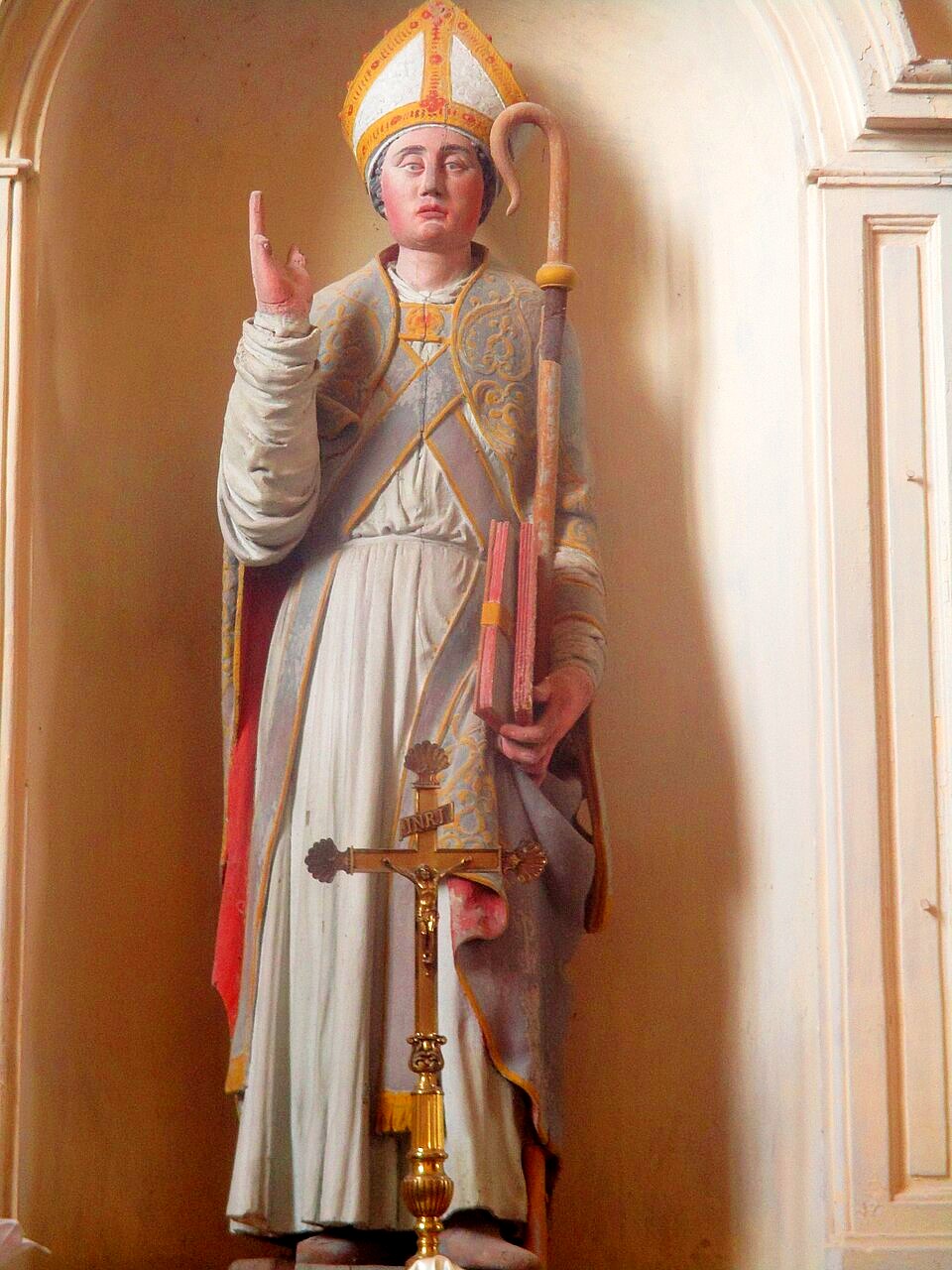
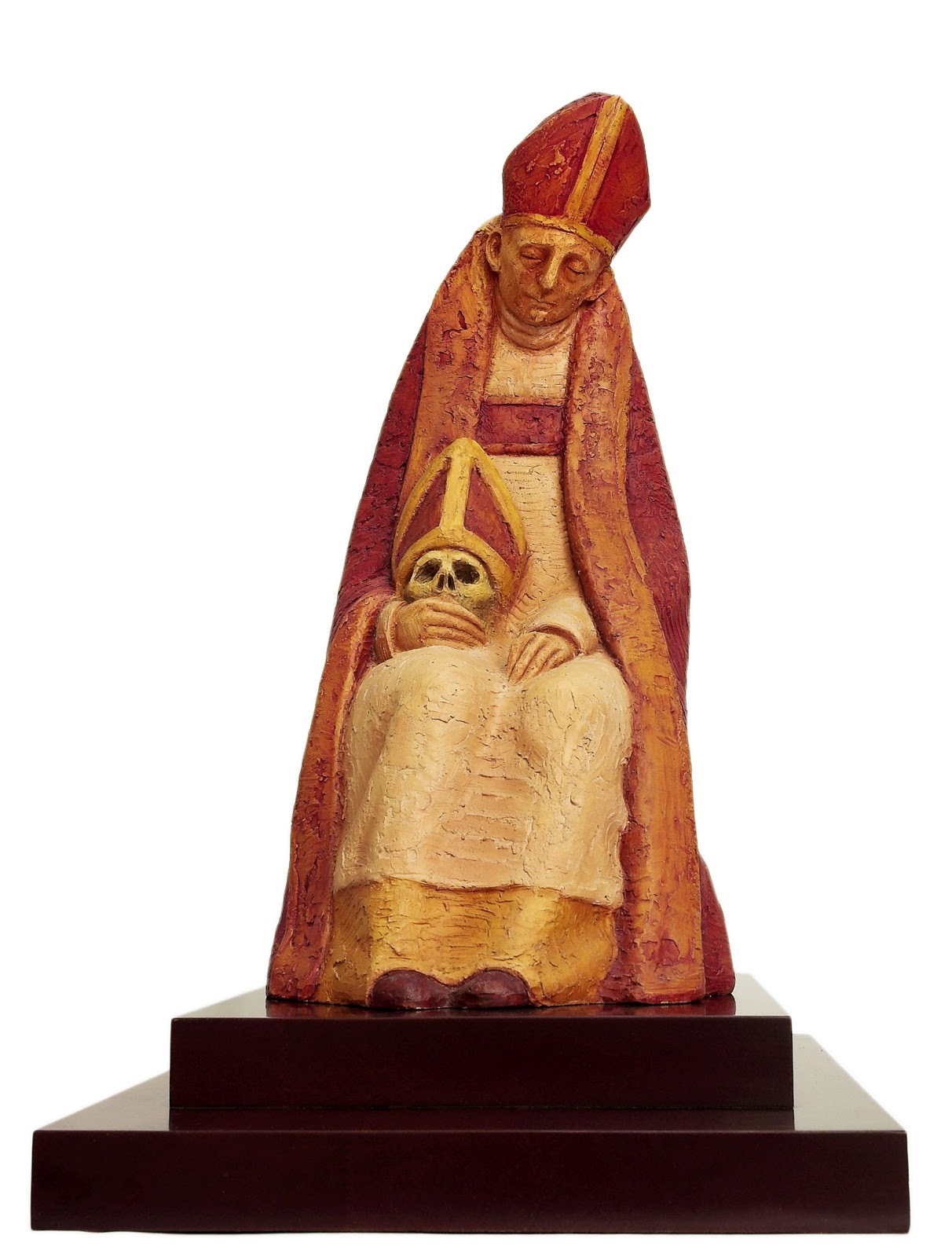
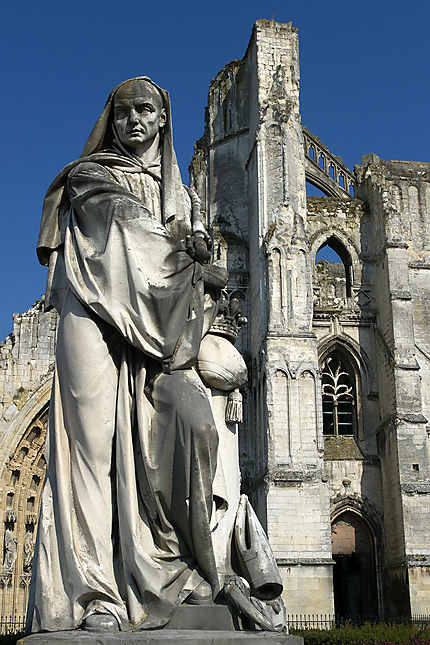
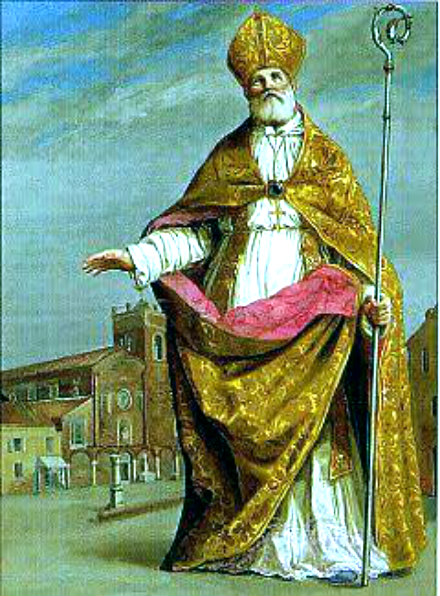
Unknown Bishop Statue
Simplicius was born into a noble Gallo-Roman family in Autun, in present-day France. From a young age, he stood out for his piety and moral rigour.
At a time when society was still permeated by pagan customs, Simplicius and his wife, a woman of equal virtue, chose to live in chastity, while remaining united in marriage. This bold and unconventional choice testifies to the depth of their faith and their desire to consecrate themselves entirely to God.
Simplicius’ fame for sanctity and wisdom soon spread, winning the applause and esteem of his fellow citizens. Upon the death of Bishop Hegemonius, the choice of successor fell unanimously upon him. Recognising in him a man of profound faith and exceptional virtue, the people of Autun saw in Simplicius, the idealshepherd for their community. Having assumed the Episcopate, Simplicius devoted himself with zeal and self-denial to his pastoral task. His work was distinguished by the particular attention paid to the poorest and the needy, to whom he offered relief and material and spiritual support.
The life of Saint Simplicius was studded with miracles and wonders which consolidated his reputation for sanctity. Among the most famous is the miracle performed to expose the falsity of the pagan cult of the pagan goddess, Cybele Berecintiana. According to tradition, Simplicius, with a gesture of unshakable faith, caused the statue of the goddess to collapse, demonstrating the futility of idolatry and converting numerous pagans to Christianity.
Another episode exemplifies his moral integrity and his unshakable faith. Unjustly accused of immorality by his jealous detractors, Simplicius subjected himself to the test of fire, walking barefoot on burning coals. He emerged unscathed from this ordeal, proving his innocence and strengthening his spiritual authority.
Saint Simplicius died in Autun around 375, leaving behind an invaluable spiritual legacy. His memory was immediately venerated by the faithful who considered him a miracle-worker and an intercessor with God. His remains were buried in the Cathedral of Autun, where they became a place of pilgrimage for devotees from all over the region and further afield.
Even today, Saint Simplicius is highly venerated by the Church which celebrates his memory on 24 June. (Author: Franco Diego).
St John of Tuy St Joseph Yuan Zaide St Rumold St Simplicius (Died c375) Bishop and Confessor of Autun St Theodulphus of Lobbes
The First Martyrs of the Church of Rome: Countless numbers were Christians Martyred in the City of Rome during Nero’s persecution in 64. The event is recorded by both Tacitus and Pope Clement I, among others. They are celebrated today.
Martyrs of Satala: Seven Christian brothers who were soldiers in the imperial Roman army. They were expelled from the military, exiled and eventually martyred in the persecutions of Maximian. We know little more about them than their names – Cyriacus, Firminus, Firmus, Longinus, Pharnacius, Heros and Orentius. The martyrdoms occurred in c 311 at assorted locations around the Black Sea.
Saint of the Day – 23 June – Blessed Thomas Garnet SJ (1574-1608) Priest Martyr, Born in 1574 at Southwark, England and died by being hanged, drawn and quartered on 23 June 1608 at Tyburn Tree, London. A vowed Priest of the Society of Jesus and a Missionary to the Recusant Catholics suffering under Elizabeth I. He should not be confused with his uncle, St Henry Garnet SJ (1555-1606) Martyr. Our Thomas was named in love for St Thomas a Becket and St Thomas More – both Martyrs. He was Beatified on 15 December 1929 by Pope Pius XI. Additional Feasts – 25 October as one of the Forty Martyrs of England and Wales; 1 December as one of the Martyrs of Oxford University.
Portrait from the Royal English College in Valladolid
Thomas Garnet was imprisoned on three different occasins but would not be deterred from caring for English Catholics. He was arrested for the last time when the man in whose home he was living was implicated in the fabricated Gunpowder Plot supposedly to explode the Houses of Parliament.
A native of London, Thomas’ parents were loyal Catholics who allowed him to attend the newly-opened Jesuit College in Saint-Omer, Flanders. He wanted to continue his studies at the English Seminary in Valladolid, Spain and was travelling there but landed at England rather than Spain when a storm pushed the ship off course.
Thomas and five companions were immediately arrested but they all managed to escape and eventually to make their way to Spain. Thomas finished his theology studies in 1599, was Ordained to the Holy Priesthood and then returned to England.
For six years the young Priest worked fearlessly among the Recusant Catholics who refused to accept the Queen’s supremacy in religious matters, this was, of course, after the death of Henry VIII. Inspired by the example of his uncle, Father Henry Garnet, the superior of the Jesuits in England, the young Thomas decided to enter the Jesuits himself. He was accepted in September 1604 but could not progress further before he was caught in the entangling web of deceit of the Gunpowder Plot.
Although he himself was innocent, he was implicated when government agents searched for Thomas Rookwood, in whose home our Thomas resided, who had been involved to some degree. Eventually his captors concluded he had no information to divulge and sent him back to prison where he remained for seven months until a group of 47 Priests were deported to make room for other, more dangerous Priests. All were warned that they would lose their lives if they returned.
Thomas made his way to the English Jesuit Novitiate at Louvain and took his vows there a year later, on 2 July 1607. In September he returned to England but was arrested within 6 weeks when an apostate priest betrayed him. He was taken back to the same prison he had endured before but would give no information when he was interrogated.
On 19 June 1608 he went to trial at the Old Bailey, indicted for being a Priest under orders from Rome. The only evidence against him was the testimony of a witness who claimed he had once seen a letter on which Thomas had signed his name and then added, “Priest.” He was found guilty of High Treason and condemned to be hanged, drawn and quartered.
“I wandered,” he said during his trial, “from place to place to recover souls who had gone astray and were in error as to the knowledge of the true Catholic Church.”
Four days later Thomas was publicly dragged through the cobbled, muddied and we streets, to Tyburn Tree for execution. During the customary final speech, he said that he was indeed a Priest and a Jesuit and that he was happy to die for his Lord. He was 33 years old at his death.
Bl Peter of Juilly Bl Thomas Corsini of Orvieto Blessed Thomas Garnet SJ (1574-1608) Priest Martyr. Beatified on 15 December 1929 by Pope Pius XI. Bl Walhere of Dinant St Zenas of Philadelphia St Zeno of Philadelphia
Martyrs of Ancyra: A family of converts who were arrested, tortured, and sent in chains to Ancyra, Galatia (modern Ankara, Turkey) where they was tortured again by order of governor Agrippinus during the persecutions of Diocletian. Martyrs. They were – Eustochius, Gaius, Lollia, Probus, Urban. Died by being roasted over a fire and finally beheaded c300 in Ancyra, Galatia (modern Ankara, Turkey).
Martyrs of Nicomedia: During the persecutions of Diocletian, many Christians fled their homes to live in caves in the area of Nicomedia. In 303 troops descended on the area, systematically hunted them down and murdered all they could find.
One Minute Reflection – 22 June – “The Month of the Most Sacred Heart of Jesus” – The Solemnity of Corpus Christi and Within the Corpus Christi Octave – St Paulinus of Nola (c 354-431) Bishop, Confessor, Father of the Church –1 John 3:13-18 – Luke 14:16-24 – Scripture search here: https://www.drbo.org/
“The servant went and reported this to his Master. Then the Master of the house was angry and commanded His servant, ‘Go out quickly into the streets and alleys of the city and bring in here, the poor and the crippled, the blind and the lame…” – Luke 14:21
REFLECTION – “He turned to the Gentiles from the careless scorn of the rich. He invites both good and evil to enter, in order to strengthen the good and change the disposition of the wicked for the better. The saying that was read today is fulfilled, “Then wolves and lambs will feed together.” He summons the poor, the maimed and the blind. By this, He shows us, either that handicaps do not exclude us from the Kingdom of Heaven that the Lord’s mercy forgives the weakness of sinners. Whoever glories in the Lord, glories as one redeemed from reproach, not by works but by faith.
He sends them into the highways because Wisdom sings aloud in passages. He sends them to the streets because He sent them to sinners, so that they should come from the broad paths, to the narrow way which leads to life. He sends them to the highways and hedges . They, who are not busied with any desires for present things, hurry to the future on the path of goodwill. Like a hedge, which separates the wild from the cultivated and wards off the attacks of wild beasts, they can distinguish between good and evil and extend a rampart of faith against the temptations of spiritual wickedness.” – St Ambrose (340-397) Bishop of Milan, Father and Doctor of the Church (Exposition on the Gospel of Luke, 7).
PRAYER – O God, Who promised to those who forsake all things in this world for Thee, a hundred-fold reward in the world to come and life everlasting, mercifully grant that, following closely in the footsteps of the holy Bishop, Paulinus, we may look upon earthly things as nought and long only for those of Heaven. Who lives and reigns with God the Father, in the unity of the Holy Spirit, God, world without end. Amen (Collect).
MAY the Heart of JESUS in the most Blessed Sacrament be praised, adored and loved with grateful affection, at every moment, in all the Tabernacles of the world, even to the end of time. Amen. Indulgence 100 Days, Once a day. Raccolta 161 Pope Pius IX, 29 February 1868.
Saint of the Day – 22 June – Saint Giovanni d’Acquarola (Died c849) Bishop of Naples who served as the Bishop of Naples from 26 February 842 until his death. Died on 17 Decenber c849 at his See in Naples. Patronage – co-with many others, of Naples. Also known as – Giovanni Scrib, John IV, John the Peacemaker, John the Serene.
The Roman Martyrology reads today: “At Naples, in Campania, St John, Bishop. who was called to the Kingdom of Heaven by blessed Paulinus, the Bishop of Nola, who is also celebrated today.”
He had the Relics of St Aspren translated to a Chapel in the Church of Santa Restituta in Naples.
Giovanni also assisted Duke Andrew II in negotiating an economic treaty called the Pactum Sicardi with Sicard, the Lombard Prince of Benevento, hence the honourary title ‘the Peacemaker.’
The Solemnity of Corpus Christi, The Most Holy Body and Blood of Our Lord Jesus Christ: Corpus Christi The Feast is liturgically celebrated on the Thursday after Trinity Sunday which this year was 19 June. https://anastpaul.com/2022/06/16/the-festival-of-corpus-christi/
St Paulinus of Nola (c354-431) Bishop, Confessor, Poet, Writer, Apostle of Charity, Preacher, Orator, Senator and Governor. St Paulinus was an inspiration to many—including six great Saints of the Church, who referenced him in letters of encouragement to others: St Augustine, St Jerome, Melania, St Martin of Tours, St Gregory and St Ambrose. St Augustine wrote, “Go to Campania– there study Paulinus, that choice servant of God. With what generosity, with what still greater humility, he has flung from himself the burden of this world’s grandeurs to take on him the yoke of Christ and in His service how serene and unobtrusive his life!” This glorious Saint Paulinus!: https://anastpaul.com/2018/06/22/saint-of-the-day-22-june-st-paulinus-of-nola-c-354-431/ AND: https://anastpaul.com/2022/06/22/saint-of-the-day-22-june-st-paulinus-of-nola-c-354-431-2/
St Aaron of Brettany St Aaron of Pais-de-Laon St Alban of Britain Bl Altrude of Rome St Consortia St Cronan of Ferns
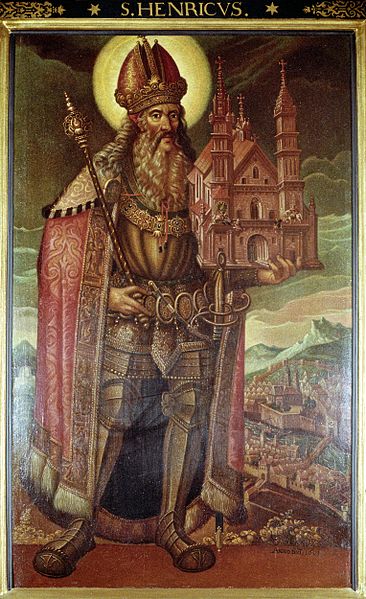
St Eberhard (1085-1164)Archbishop of Salzburg, Austria, Defender of the Papacy, Apostle of the poor and sick, Papal Legate and negotiator. Born in 1085 at Nuremberg, Germany and died on 21 June 1164 at the Cistercian Monastery of Rein, Austria of natural causes. Patronages – Bamberg, Germany, Salzburg, Austria. His Holy Life: https://anastpaul.com/2024/06/22/saint-of-the-day-22-june-saint-eberhard-of-salzburg-1085-1164-bishop/
St Eusebius of Samosata St Exuperantius of Como St Flavius Clemens St Giovanni d’Acquarola (Died c849) Bishop of Naples
St Gregory of Agrigento St Heraclius the Soldier St Hespérius of Metz
Blessed Pope Innocent V OP (c 1225-1275) Papal Ascesion 21 January 1276 unril 22 June 1276 (the date of his death. Friar of the Order of Preachers, Theologian, renowned Preacher, Scholar, Writer,, Dominican Office bearer, disciple of St Albert the Great and collaborator and friend of St Thomas Aquinas.and St Bonaventure. His Life: https://anastpaul.com/2021/06/22/saint-of-the-day-22-june-blessed-pope-innocent-v-op-c-1225-1275/
St John IV of Naples St Julius of Pais-de-Laon Bl Kristina Hamm Bl Marie Lhuilier St Nicetas of Remesiana St Precia of Epinal St Rotrudis of Saint-Omer St Rufinus of Alexandria
Martyrs of Samaria – 1480 Saints: 1480 Christians massacred in and near Samaria during the war between the Greek Emperor Heraclius and the pagan Chosroas of Persia. c 614 in the vicinity of Samaria, Palestine.
Saint of the Day – 21 June – Saint Eusebius (Died c379) Bishop and Martyr of Samosata in Syria. Died by being hit on the head by a thrown roof tile which caused a fractured skull and his death and the glory of the Palm of Martyrdom. His life had been a zealous one of defending the One True Faith against Arianism and of the intense pastoral care of his flock.
The Roman Martyrology reads today: “St Eusebius, the Bishop of Samosata, who, in the time of the Arian Emperor Constantius, disguised himself under a military dress and visited the Churches of God, to confirm them in the Faith. He was banished by Valens into Thrace but when peace was restored to the Church in the reign of Theodosius, he was recalled. As he again visited the Churches, an Arian woman struct him with a tile which fractured his skull and honoured him with the Palm of Martyrdom.”
Eusebius was one of the most zealous defenders of orthodoxy in the 4th Century. All which is definitely known of Eusebius is gathered from the letters of St Basil the Great and of St Gregory Nazianzen and from some incidents in the “Ecclesiastical History” of Theodoret.
In around 361 he became the Bishop of the ancient Syrian City of Samosata. Eusebius had been entrusted with the official recording of the election (360) of Bishop St Meletius of Antioch, who was supported by the Arian Bishops, who were under the mistaken notion that he would prove sympathetic to their cause.
When St Meletius expounded his orthodoxy, the Bishops persuaded the Roman Emperor, Constantius II, a staunch Arian, to extort the record from Eusebius and destroy it. Constantius threatened Eusebius with the loss of his right hand because he refused to surrender the record but the threat was withdrawn when Eusebius offered both hands.
It was chiefly due to the concerted efforts of Eusebius and St Gregory Nazianzen that, in 370, St. Basil was elected Archbishop of Cæsarea in Cappadocia.
During the persecution of orthodox Christians under Julian the Apostate, Eusebius travelled incognito throughout Syria, Palestine and Phoenicia, disguised as a military officer, Ordaining Presbyters and Deacons and celebrated the Sacrament of Confirmation for the faithful.
Orthodox Christians experienced a short respite during the brief reign of Jovian but in 374 the Emperor Valens, an Arian, banished Eusebius to Thrace, in the Balkan Peninsula. Bishop Eusebius asked the messenger to keep the imperial order confidential saying: “If the people should be apprised, such is their zeal for the Faith, they would rise in arms against you and your death might be laid to my charge.”
Although advanced in years, Eusebius left that evening. After the Emperor’s death in 378, Eusebius was restored to his See of Samosata. While in Dolikha to consecrate a Bishop, he was killed after being struck on the head by a roof tile thrown by an Arian woman.
Our lovely zealous St Eusebius is remembered today, 21 June in the Roman Martyrology as a Martyr. We have no extant sermons or writings by St Eusebius bar that little quote above which appears in St Gregory’s letters.
St Lazarus the Leper St Leutfridus of La-Croix St Martia of Syracuse St Martin of Tongres St Melchiorre della Pace St Mewan of Bretagne Bl Nicholas Plutzer
Martyrs of Taw – 3+ Saints: Three Christians of different backgrounds who were Martyred together – Moses, Paphnutius, Thomas. They were beheaded in Taw, Egypt, date unknown.
Saint of the Day – 20 June – Saint Florentia (Died c612) Virgin, Nun, sister of Saints Leander, Isidore and Fulgentius. Born towards the middle of the 6th Century in Cartagena, Spain and died in c612. Florentia was younger than her brother Leander, later Archbishop of Seville but older than St Isidore, who succeeded Leander as the Archbishop. Patron of – the Diocese of Plasencia. Also known as – Florentyna, Florentina.
The Roman Martyrology reads today: “At Seville, in Spain, the holy virgin Florentia, sister of the Holy Bishops Leander, Isidore and Fulgentius.”
Statue of St Florentia at the Church of Santa María de Gracia in Cartagena
Florentia’s family supplies us with an example of lives of total service to God and active engagement in furthering the best interests of the Church of Christ.
Florentina was the sister of three renowned and Sainted Bishops in the time of the Visigothic dominion, Leander, Isidore and Fulgentius, St Isidore also being a Doctor of the Church.
She consecrated her virginity to God. Before his elevation to the Episcopal dignity, Leander had been a Monk and it was through his influence that Florentia embraced the ascetic life. She, together with a number of virgins, who also desired to forsake the world, formed themselves into a religious community. Later sources declare their residence to have been the Convent of St Maria de Valle near Ecija (Astigis), where her brother Fulgentius, was the Bishop.
In any case, it is certain that she had consecrated herself to God before the year 600, as her brother Leander, who died either in the year 600 or 601, wrote for her guidance an extant work dealing with a Nun’s Rule of Life and with contempt for the world.
St Leander expresses the Rules according to which cloistered virgins, consecrated to God, should regulate their lives. He strongly advises them to avoid communication with women living in the world and with men, especially youths; recommends strict temperance in eating and drinking, gives advice concerning the reading of and meditation on Holy Scripture, enjoins equal love and friendship for all those living together in community and earnestly exhorts his sister to remain true to her holy state.
Florentia regulated her life according to the advice of her brother, entered with fervour into the spirit of the Rule in Religious life and was honoured as a Saint after her death.
Her younger brother Isidore dedicated his work “De fide catholica contra Judeos” to her which he wrote at her request.
Florentia died early in the 7th Century and is venerated as the patron of the Diocese of Plasencia. Below from the eldest Leander, then Isidore, then Fulgentius.
Jose’ Montes de Oca and Pedro Duque Cornejo, St. Isidore of Seville, 17th century
St Bagne of Thérouanne (Died c706) the 5th Bishop of Thérouanne in northwest France (now St Omer) and then Abbot of Fontanelle, the Monastery of Saint Wandrille in Normandy, a disciple of *St Wandrille (c 605–668) Priest, Monk, Abbot. Died in c711 of natural causes Patronage – of Calais, France. A Life of Grace: https://anastpaul.com/2024/06/20/saint-of-the-day-20-june-saint-bagne-of-therouanne-died-c706-bishop/
Blessed Benignus of Breslau O,Cist. (13th-14th Century) Cistercian Monk and Martyr St Edburga of CaistorFulgentius. St Florentia (Died c612) Virgin, sister of Sts Leander, Isidore and Fulgentius.
Blessed Francisco Pacheco SJ (1566-1626) Martyr, Priest of the Society of Jesus, Missionary to India, China and Japan, Provincial Superior. Fr Pacheco and his eight Jesuit companions, together with the nine lay Christians, were included among the 205 Martyrs Beatified by Blessed Pope Pius IX on 7 May1867. His Life and Death: https://anastpaul.com/2021/06/20/saint-of-th-day-20-june-blessed-francisco-pacheco-sj-1566-1626/
St Gemma of Saintonge St Goban of Picardie St Helen of Öehren
St Macarius (Died c350) Bishop of Petra and Confessor St Methodius of Olympus
Blessed Michelina TOSF (1300-1356) Widow, Religious of the Third Order of the Friars Minor, Stigmatic, Penitent, Apostle of all in need, Founder of the Confraternity of the Annunciation, to care for the poor, nurse the sick and bury the dead. Patronages – Pesaro, widows, against mental illness, against death of children. Beatified on 13 April 1737 by Pope Clement XII. Her Holy Life: https://anastpaul.com/2022/06/20/saint-of-the-day-20-june-blessed-michelina-of-pesaro-tosf-1300-1356/
St Novatus of Rome (Died c151) Confessor, Layman. The Roman Martyrology reads today: “At Rome, the demise of St Novatus, son of the blessed Senator, Puden and brother of the saintly Priest, Timothy and of the Holy Virgins of Christ, Pudentiana and Praxedes, who were instructed in the Faith by the Apostles. Their house was converted into a Church and bore the title of Pastor.” A Zealous Life: https://anastpaul.com/2023/06/20/saint-of-the-day-20-june-saint-novatus-of-rome-died-c151-confessor/
Martyred in London: Bl Anthony Turner Bl John Fenwick Bl John Gavan BL Thomas Whitbread Blessed William Harcourt
Irish Martyrs – 260 Beati – This is the collective title given to the 260 or more persons who are credited with dying for the Faith in Ireland between 1537 and 1714.
Martyrs of Lower Moesia: Martyred on the Black Sea at Lower Moesia (in modern Bulgaria), date unknown. St Cyriacus St Paul
Martyred in Nagasaki: 9 Beati : burned alive on 20 June 1626 in Nagasaki, Japan. Their ashes were thrown into the sea and no relics remain. They were Beatified on 7 May 1867 by Pope Pius IX. Blessed Baltasar de Torres Arias Blessed Francisco Pacheco Blessed Gaspar Sadamatsu Blessed Giovanni Battista Zola Blessed Ioannes Kisaku Blessed Michaël Tozo Blessed Paulus Shinsuke Blessed Petrus Rinsei Blessed Vincentius Kaun
Saint of the Day – 19 June – Saint Hildegrim (c750-c827) Bishop of Châlons in France from 804 to 810 and then 2nd Abbot of Werden Abbey, after his elder brother, the Founder, St Ludger. Also known as – Hildegrin … of Werden.
This is an Unknown Bishop not our St Hildegrim
Hildegrim was of born of Christian Frisian noble descent. He received a thorough education at the Utrecht Cathedral School, founded by Bishop Gregory, and in York .under St Alcuin.
Mentioned as a Deacon in 793, he was Ordained a Priest three years later.
In around 804, he was elected as the Bishop of Châlons. Upon St Ludger’s death in 809, he succeeded him as the Abbot of Werden and Helmstadt.
He is also traditionally named as the 1st Bishop of Halberstadt, a position now discounted by some scholars. Hildegrim is known to have been active in spreading Christianity as a Missionary into Osterwieck and Halberstadt region after the Saxon Wars of Charlemagne.
St Hildegrim is buried in the Crypt of Werden Abbey Church. He is remembered and celebrated on 19 June.
Sts Adleida and Lupo of Bergamo Married Martyrs Bl Arnaldo of Liniberio St Culmatius of Arezzo St Deodatus of Jointures St Deodatus of Nevers St Gaudentius of Arezzo
St Innocent (Died 559) Bishop of Le Mansserving his Diocese for over 40 years and that is the sum total of the information which we have of this Saint. St Lambert of Saragossa Layman Martyr St Lupo of Bergamo St Modeste Andlauer St Nazario of Koper St Rémi Isoré Bl Sebastian Newdigate Bl Thomas Woodhouse Bl William Exmew St Zosimus of Umbria
Saint of the Day – 18 June – Saint Calogerus (c466-c561) Hermit in Sicily, Missionary evangeliser graced with visions and the charism of casting out demons as an Exorcist, Born in c466 in Chalcedon, Thrace in Egypt and died in c561 at Monte Cronios, Sciacca, Sicily. Patronage – of Petralia Sottana a Town in Sicily. Also known as – Calogero, Calogerus of Sicily, … the Hermit, Calogerus of Sicily. The name Calogerus, is of Greek origin and means “elderly beauty.” In the Greek ideal of beauty, that which is beautiful is also fair and good, suffice it to remember in the Gospel according to St John, the original Greek version calls Jesus the “beautiful Shepherd” which later became the “good Shepherd.”
This term was used in the East and in southern Italy for the Hermit Monks, who were thus called Caloyers or Calogeri, Therefore, some experts believe that this was not the name of our Hermit Haint but rather the appellation he was recognised by. However, other scholars are convinced that this was, in fact, his name.
The Roman Martyrology reads today: “At Sacca, in Sicily,, St Calogerus, Hermit, whose holiness is principally manifested by the deliverance of possessed persons.”
According to tradition, since there is no certain documentation, Calogerus was born around 466 in Chalcedon on the Bosphorus, a Town in ancient Thrace which, in 46 became a Roman Province and then followed the fate of the Byzantine Empire.
Since Calogerus’ childhood he fasted, prayed and studied the Holy Scripture and according to the ‘Acts’ taken from the ancient Siculo-Gallican Breviary, in use in Sicily from the 9th Century to the 16th, he came to Rome on a pilgrimage, receiving from Pope Felix III (483-492), permission to live in solitude in an unspecified place.
Here, he had an angelic vision or a celestial inspiration which instructed him to evangelise Sicily. When he returned from the Pope, he obtained authorisation to go to the island, with his companions Philip, Onofrius and Archileone, to free that people from demons and from the worship of pagan gods. He and his companions spread out to different places to more effectively spread the Gospel.
During stay on the island of Lipari, Calogerus had a vision of the death of King Theodoric († 526) who, in recent years had begun to persecute those Latins he considered a danger to his kingdom, among whom were the philosopher Boethius (480-524). This is reported in the ‘Dialogues’ of Pope St Gregory I the Great, the vision had come true on the exact day and hour of the King’s death and Calogerus saw his soul hurled into the crater of the nearby Volcano.
Calogerus is also held to have worked as a missionary on Lipari in the Aeolian Islands, before retiring to live as a solitary Hermit on Monte Giummariaro which is now sometimes called in Sicilian: Monte San Caluòru in his honour, as is another mountain near Palermo. Calogerus settled in a cave adjacent to the vaporous ones, which, as in Lipari, also exist here in abundance.
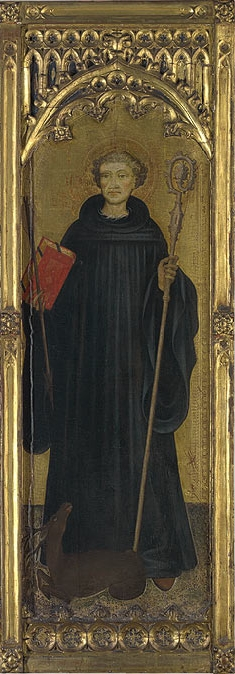
In said cave, there is a majolica image (see below) of St Calogerus walled into the rock, placed above a rustic Altar which is said to have been built by himself, The image is from 1545 and represents the bearded hermit holding a book and a stick-branch in his right hand, at his feet there is a kneeling believer and a doe collapsed and wounded by an arrow.
Saint Calogerus from the Cave above Monte Giummariaro dated 1545, Calogerus the Hermit, Calogerus of Sicily, San Calogero
The image refers to an episode of his last days, being now over ninety years old, he could no longer feed himself, so God sent him a doe which fed him with her delicate milk. One day, a hunter named Sierus, seeing the animal, took his bow and pierced the doe with an arrow which managed to drag itself inside Calogerus’ cave, dying in his arms.
The repentant and crying hunter, recognised, in the old man, the one who had Baptised him years before, asked for forgiveness and Calogerus took him to the nearby steamy cave, giving him instructions for the healing properties of that steam and the waters which flowed from that mountain. The hunter Sierus, who had become his disciple, often climbed the mountain to visit him but 40 days after killing the doe, he found the old hermit dead, still kneeling before the Altar. According to tradition, he had died in the cave between 17 and 18 June 561 and had lived in that place for 35 years.
When the news spread, the inhabitants of the nearby Towns flocked to him and buried him in the cave itself which was then transferred to another cave, whose memory has been lost over the centuries.
It should be added that the Relics of the Saint, according to another tradition, were later transferred to a Monastery three km from the cave. And, in 1490 they were moved to Fragalà (Messina) by the Basilian Monk Urbano da Naso and then to Frazzanò (Messina), to the Parish Church. Some of his Relics are kept in the Sanctuary of San Calogerus built near his cave in the 17 Century. This Church is now a destination for pilgrimages.
In any case, St Calogerus is venerated throughout Sicily and in all the Cities he is honoured with Processions and celebrations, typical of the intense pirty and devotion of the Sicilians, almost all of which take place on his Feastday on 18 June.
St Alena of Dilbeek St Amandus of Bordeaux St Arcontius of Brioude St Athenogenes of Pontus St Calogerus (c466-c561) Hermit in Sicily St Calogerus of Fragalata St Calogerus the Anchorite St Colman mac Mici St Cyriacus of Malaga St Demetrius of Fragalata St Edith of Aylesbury
St Elpidius of Brioude St Equizio of Telese St Erasmo St Etherius of Nicomedia Bl Euphemia of Altenmünster St Fortunatus the Philosopher St Gerland of Caltagirone St Gregory of Fragalata
St Osanna of Northumberland St Osmanna of Jouarre St Paula of Malaga Bl Peter Sanchez
Hermits of Karden: A father (Felicio) and his two sons (Simplicio and Potentino) who became pilgrim to various European holy places and then Hermits at Karden (modern Treis-Karden, Germany). (Born in Aquitaine (in modern France. ) Their relics transferred to places in the Eifel region of western Germany at some point prior to 930. They were Canonised on 12 August 1908 by Pope Pius X (cultus confirmation).
Martyrs of Ravenna – 4 Saints: A group of four Christians Martyred together. We have no details but their names – Crispin, Cruciatus, Emilius and Felix. They were martyred in Ravenna, Italy, date unknown.
Martyrs of Rome – 3 Saints: Three Christians Martyred together . We have no details but their names – Cyriacus, Paul and Thomas. In Rome, Italy, date unknown.
Martyrs of Tripoli – 3 Saints: Three imperial Roman soldiers, at last two of them recent converts, who were imprisoned, tortured and executed for their faith. Martyrs – Hypatius, Leontius and Theodulus. They were Greek born and they died c135 at Tripoli, Phoenicia (in modern Lebanon).
You must be logged in to post a comment.