Posted in ADVENT, CATHOLIC-PRAYERS OF THE CHURCH, CHRISTMASTIDE!, FEASTS and SOLEMNITIES, PRACTISING CATHOLIC, PRAYERS for VARIOUS NEEDS, PRAYERS of the CHURCH, SAINT of the DAY, The APOSTLES & EVANGELISTS

St Andrew’s Christmas Novena – Getting Ready for the arrival of our King!

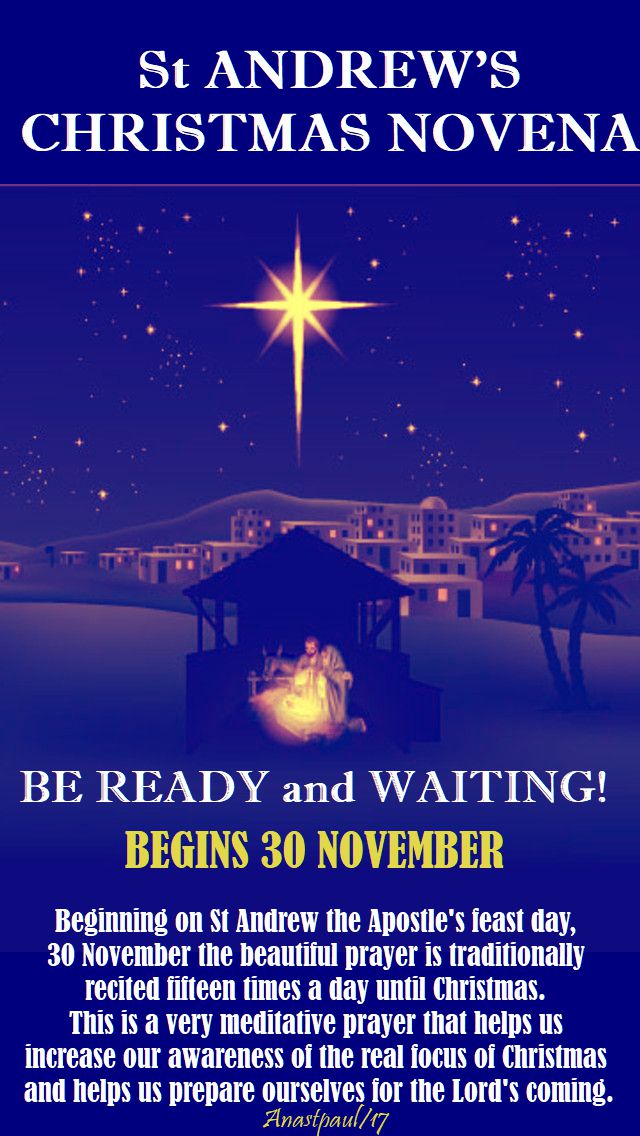
St Andrew’s Christmas Novena – The Christmas Anticipation Prayerbe-ready-and-waiting-st-andrews-christmas-novena-begins-30-nov-2017-pic

The Saint Andrew Christmas Novena is often called simply the “Christmas Novena” or the “Christmas Anticipation Prayer” because it is prayed 15 times every day from the Feast of Saint Andrew the Apostle today, 30 November, until Christmas.   It is an ideal Advent devotion – the First Sunday of Advent is the Sunday closest to the Feast of Saint Andrew.

While the novena is tied to the Feast of Saint Andrew, it is not actually addressed to Saint Andrew but to God Himself, asking Him to grant our request in honour of the birth of His Son at Christmas.   You can say the prayer all 15 times, all at once, or divide up the recitation as necessary (perhaps five times at each meal).st-andrews-prayer-christmas-novena-no-1 - 30nov2017

Prayed as a family, the Saint Andrew Christmas Novena is a very good way to help focus the attention of your children on the Advent season.   In no time, you will all have memorised it and be able to focus totally on the actual words.   In a family, it is a great idea to allow each member to insert their petitions in rotation.

Let us Pray!

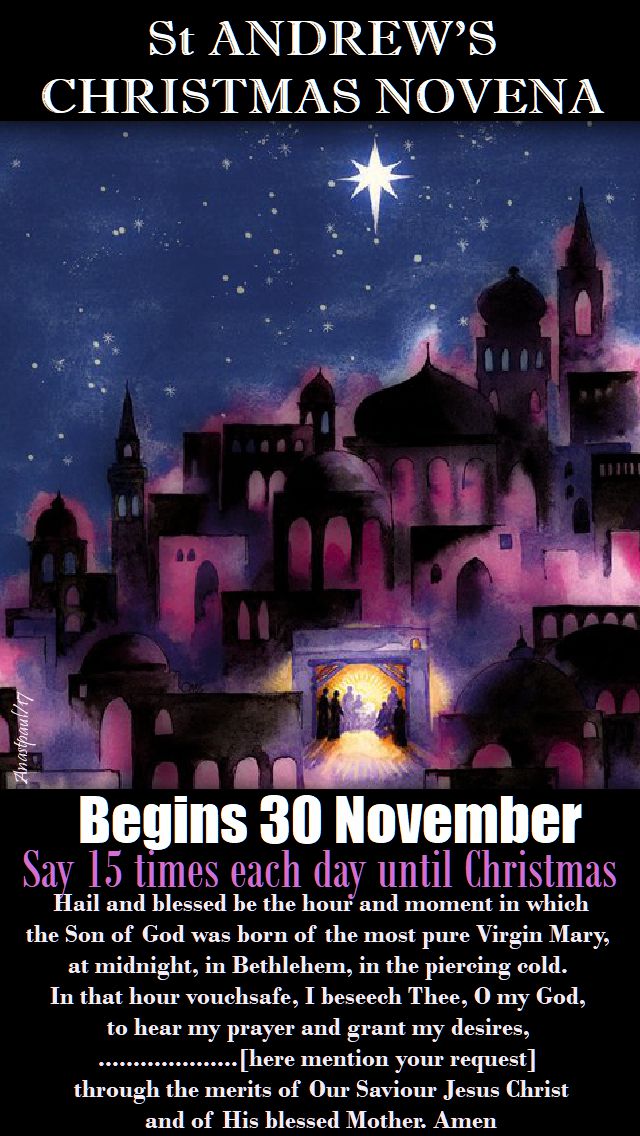
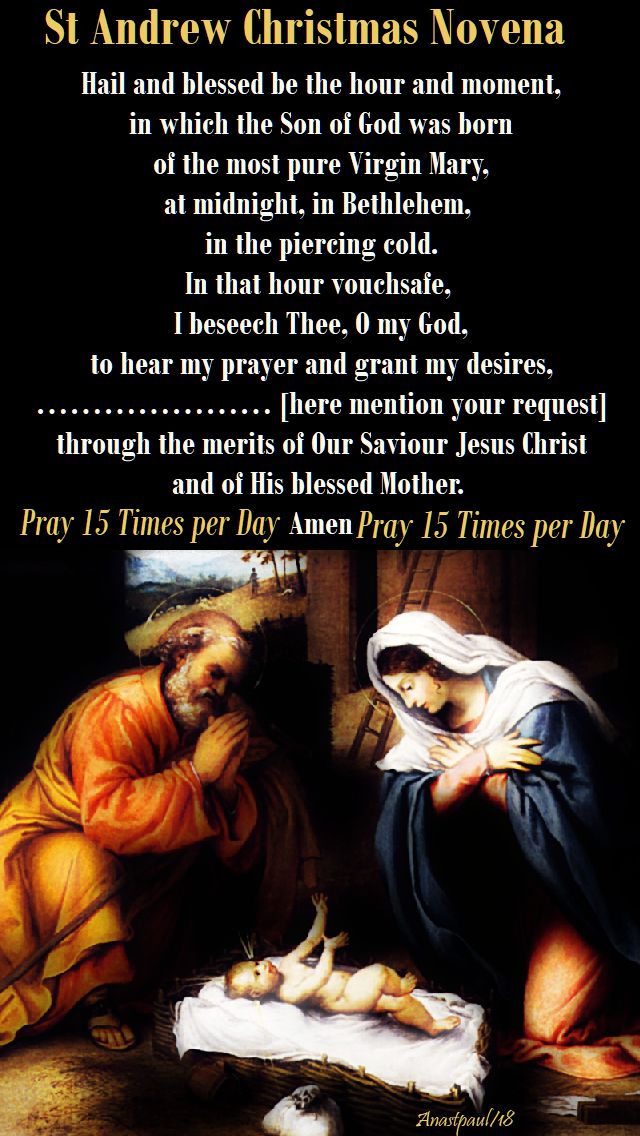
Hail and blessed be the hour and moment,
in which the Son of God was born
of the most pure Virgin Mary,
at midnight, in Bethlehem,
in the piercing cold.
In that hour vouchsafe,
I beseech Thee, O my God,
to hear my prayer and grant my desires,
………………… [here mention your request]
through the merits of Our Saviour Jesus Christ
and of His blessed Mother.
Amenst andrew christmas novena - 30nov2018

Posted in FEASTS and SOLEMNITIES, ON the SAINTS, PAPAL SERMONS, PRAYERS for PRIESTS, SAINT of the DAY, The APOSTLES & EVANGELISTS

Thought for the Day – 30 November – The Feast of St Andrew, Apostle of Christ

Thought for the Day – 30 November – The Feast of St Andrew, Apostle of Christ

Excerpt from Pope Benedict’s Catechesis on St Andrew
Wednesday, 14 June 2006

“This is what the Apostle is claimed to have said on that occasion, according to an ancient story (which dates back to the beginning of the sixth century), entitled The Passion of Andrew:

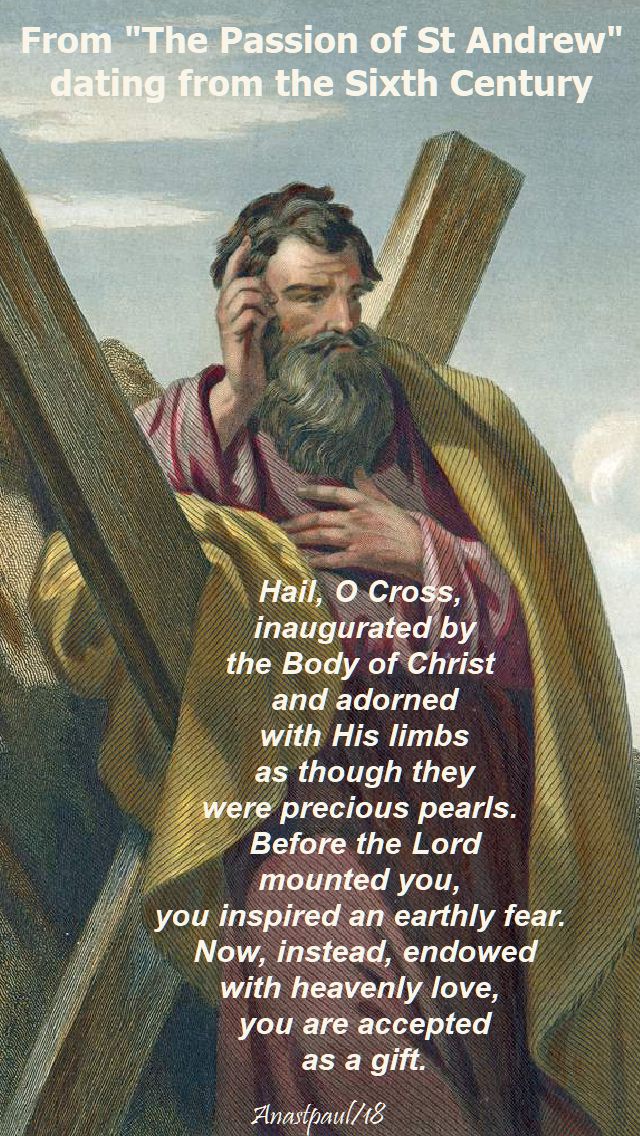
“Hail, O Cross, inaugurated by the Body of Christ and adorned with His limbs as though they were precious pearls.   Before the Lord mounted you, you inspired an earthly fear.   Now, instead, endowed with heavenly love, you are accepted as a gift.

Believers know of the great joy that you possess and of the multitude of gifts you have prepared.   I come to you, therefore, confident and joyful, so that you too may receive me exultant as a disciple of the One who was hung upon you…. O blessed Cross, clothed in the majesty and beauty of the Lord’s limbs!…

Take me, carry me far from men, and restore me to my Teacher, so that, through you, the one who redeemed me by you, may receive me.

Hail, O Cross; yes, hail indeed!”.hail o cross - from the passion of st andrew - 30nov2018

Here, as can be seen, is a very profound Christian spirituality.   It does not view the Cross as an instrument of torture but rather as the incomparable means for perfect configuration to the Redeemer, to the grain of wheat that fell into the earth.

We have a very important lesson to learn, our own crosses acquire value if we consider them and accept them as a part of the Cross of Christ, if a reflection of His light illuminates them.   It is by that Cross alone that our sufferings too are ennobled and acquire their true meaning.

The Apostle Andrew, therefore, teaches us to follow Jesus with promptness (cf. Mt 4: 20; Mk 1: 18), to speak enthusiastically about Him to those we meet and especially, to cultivate a relationship of true familiarity with Him, acutely aware that in Him alone, can we find the ultimate meaning of our life and death.”

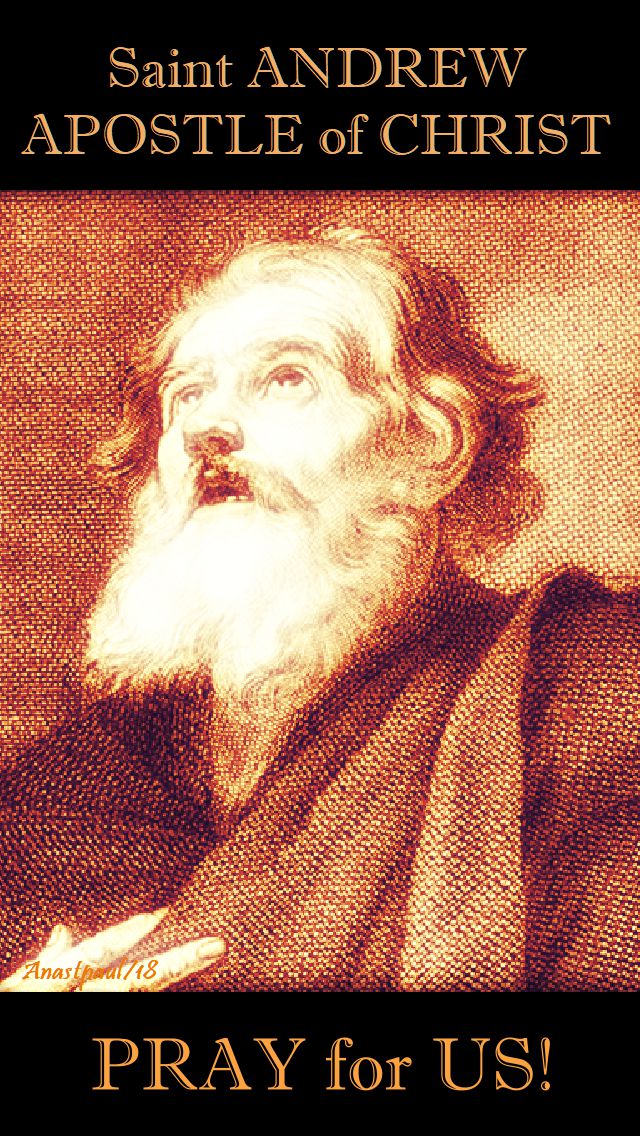
St Andrew, Pray for your Church, Pray for Us all!st andrew apostle pray for us-30nov2018

Posted in DOCTORS of the Church, FATHERS of the Church, ON the SAINTS, QUOTES of the SAINTS, QUOTES on FAITH, SAINT of the DAY, The APOSTLES & EVANGELISTS, The WORD

Quote of the Day – 30 November – The Feast of St Andrew, Apostle of Christ

Quote of the Day – 30 November – The Feast of St Andrew, Apostle of Christ

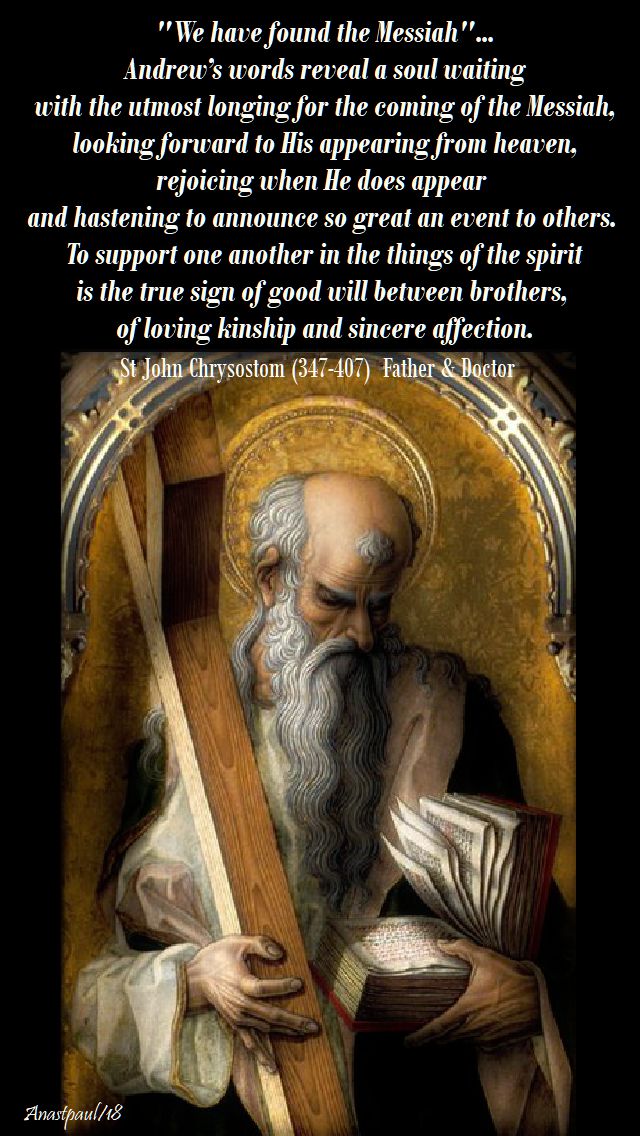
“We have found the Messiah”…
Andrew’s words reveal a soul waiting with the utmost longing
for the coming of the Messiah, looking forward to His appearing
from heaven, rejoicing when He does appear
and hastening to announce so great an event to others.
To support one another in the things of the spirit
is the true sign of good will between brothers,
of loving kinship and sincere affection.”

St John Chrysostom (347-407) Father & Doctorwe have found the messiah - andrews words - st john chrysostom-30nov2018

Posted in DOCTORS of the Church, FATHERS of the Church, MORNING Prayers, ON the SAINTS, QUOTES of the SAINTS, SAINT of the DAY, The APOSTLES & EVANGELISTS, The WORD

One Minute Reflection – 30 November – Today’s Gospel: Matthew 4:18–22 – The Feast of St Andrew, Apostle of Christ

One Minute Reflection – 30 November – Today’s Gospel: Matthew 4:18–22 – The Feast of St Andrew, Apostle of Christ

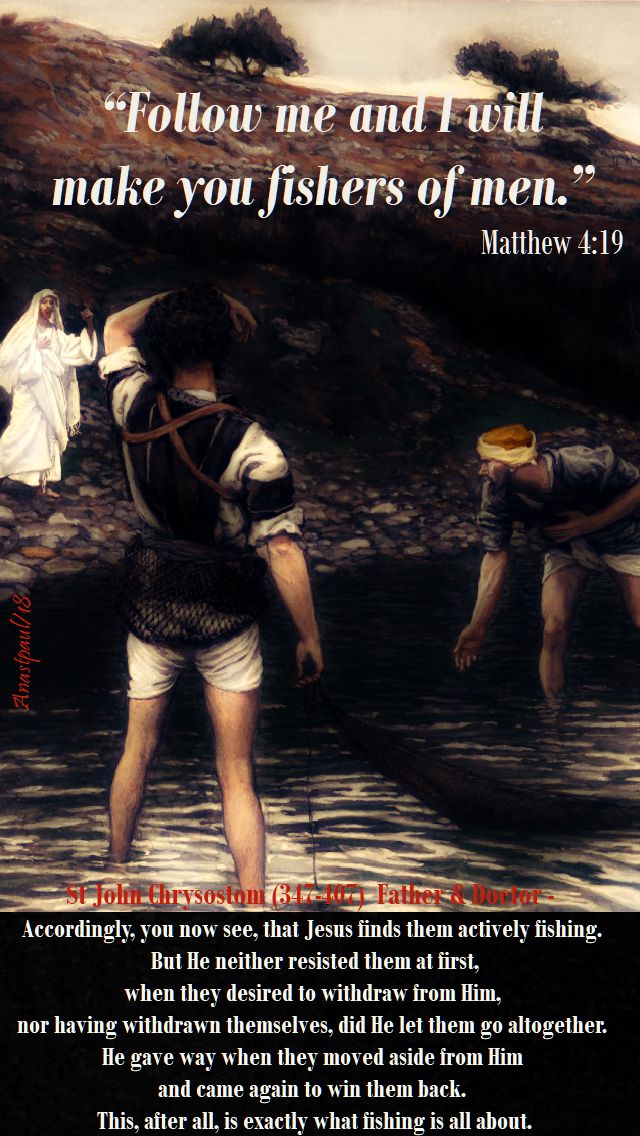
And he said to them, “Follow me and I will make you fishers of men.”...Matthew 4:19

REFLECTION – “And they left their nets and followed him.”   And yet John (the Evangelist) says that they were called in a different way.   From this it is evident that this was a second call.   One may conclude this from several evidences.   For there it is said that they came to Him when “John had not yet been thrown into prison” but here it says, after he was in confinement.   And there Andrew calls Peter but here Jesus calls both.   On the one hand, John says, “Jesus saw Simon coming and said, ‘You are Simon, the Son of Jonah.   You shall be called Cephas, which is translated Peter.’”   On the other hand, Matthew says that he was already called by that name, for he says, “Seeing Simon who was called Peter.”   In the other instance, Andrew is seen coming into His house and hearing many things.   But here, having heard one brief call, they both followed immediately.
When they earlier had seen that John was in prison and that Jesus was withdrawing, it would not have been unnatural for them to return again to their own craft, fishing, having followed Him at the beginning and then later having left Him to fish.
Accordingly, you now see, that Jesus finds them actively fishing.   But He neither resisted them at first, when they desired to withdraw from Him, nor having withdrawn themselves, did He let them go altogether.   He gave way when they moved aside from Him and came again to win them back.   This, after all, is exactly what fishing is all about.”… St John Chrysostom (347-407) Father & Doctor – (The Gospel of Matthew, Homily 14)matthew 4 19 - follow me and I will make you - accordingly, you now see, st john chrysostom - 30nov2018

PRAYER – Lord, in Your kindness hear our petitions.   You called Andrew the apostle, to preach the Gospel and guide Your Church in faith.   May he always be our friend in Your presence to help us with his prayers.   We ask this through our Lord Jesus Christ, Your Son, who lives and reigns with You and the Holy Spirit, one God, forever and ever. Amenst andrew pray for us - 30nov2018

Posted in BREVIARY Prayers, HYMNS, Our MORNING Offering, PRAYERS of the CHURCH, SAINT of the DAY, The APOSTLES & EVANGELISTS

Our Morning Offering – 30 November – Breviary Hymn for the Feast of St Andrew, Apostle of Christ

Our Morning Offering – 30 November – The Feast of St Andrew, Apostle of Christ

Hymn/Prayer on the Feast of St Andrew
From the Breviary

Saint Andrew, who once cast your nets
Upon the lake of Galilee,
Show now your skill in catching souls,
And save us from the world’s wild sea.

Saint Peter’s brother during life,
Not even death your souls could part,
Since both endured the bitter cross
With patient and courageous heart.

True brothers in your work on earth,
Your crown of glory is the same,
Both fathers of the infant Church,
Both crucified for Jesus’ Name.

You were the first to find Our Lord,
And led your brother to His feet,
So help us on life’s weary way,
Befriend us in its dust and heat.

Companion of your brother’s toil,
Preserve the Church in charity,
That with Saint Peter, shepherd true,
We may serve God in unity.

Beloved Saint, so dear to Christ,
Help us to run the path of love,
That we may all God’s praises sing,
United in full joy above.
Amenst andrew who once cast your nets - breviary hymn for the feast of st andrew - 30 nov 2018

Posted in Against SORE THROATS, COUGHS, WHOOPING COUGH,, FEASTS and SOLEMNITIES, Of FISHERMEN, FISHMONGERS, Of MUSICIANS, Choristors, Of the SICK, the INFIRM, All ILLNESS, ON the SAINTS, PAPAL SERMONS, PREGNANCY, SAINT of the DAY, The APOSTLES & EVANGELISTS

Saint of the Day – 30 November – St Andrew, Apostle of Christ, Martyr

Saint of the Day – 30 November – St Andrew, Apostle of Christ, Martyr – Called the “First Called ” – born at Bethsaida, Galilee and was Martyred by crucifixion on a saltire (x-shaped) cross in Patras Greece (around the year 62) – Patronages:  fishermen, fishmongers and rope-makers, textile workers, singers, miners, pregnant women, butchers, farm workers, protection against sore throats, protection against convulsions, protection against fever, protection against whooping cough, Scotland, Barbados, Georgia, Ukraine, Russia, Sicily, Greece, Cyprus, Romania, Patras, Burgundy, San Andrés (Tenerife), Diocese of Parañaque, Telhado, Amalfi, Luqa (Malta) and Prussia; Diocese of Victoria.ANDREW - GLASS maxresdefault
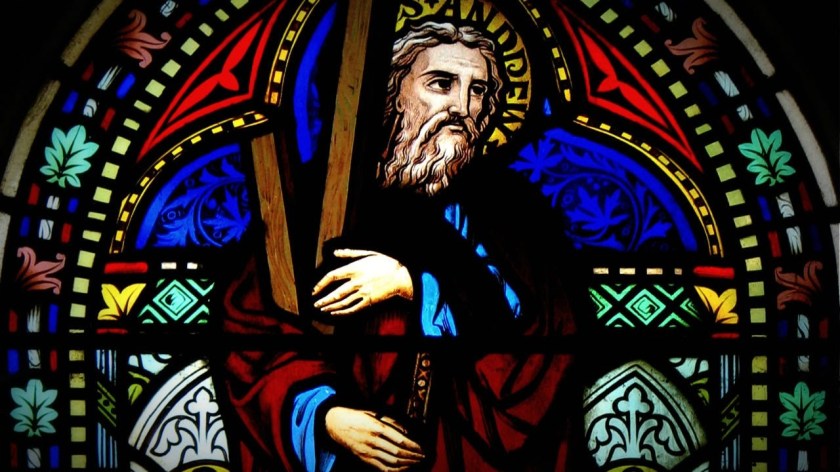
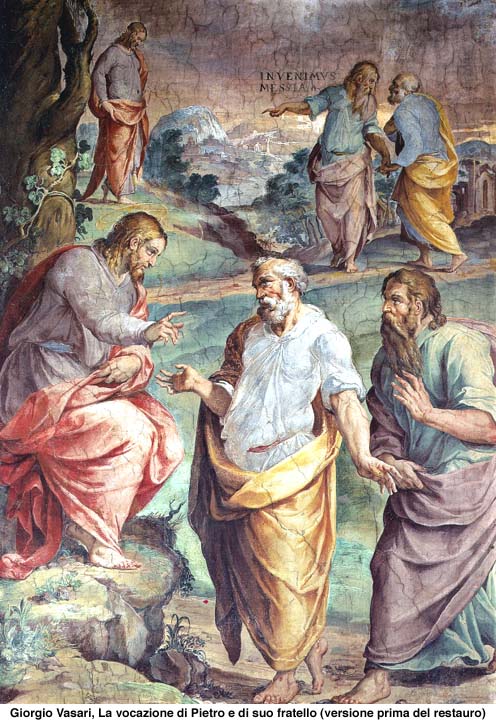
The first striking characteristic of Andrew is his name – it is not Hebrew, as might have been expected but Greek, indicative of a certain cultural openness in his family that cannot be ignored.   We are in Galilee, where the Greek language and culture are quite present.   Andrew comes second in the list of the Twelve, as in Matthew (10: 1-4) and in Luke (6: 13-16); or fourth, as in Mark (3: 13-18) and in the Acts (1: 13-14).   In any case, he certainly enjoyed great prestige within the early Christian communities.   The kinship between Peter and Andrew, as well as the joint call that Jesus addressed to them, are explicitly mentioned in the Gospels.   We read:  “As he walked by the Sea of Galilee, he saw two brothers, Simon who is called Peter and Andrew his brother, casting a net into the sea; for they were fishermen.   And he said to them, “Follow me and I will make you fishers of men'” (Mt 4: 18-19; Mk 1: 16-17).

From the Fourth Gospel we know another important detail:  Andrew had previously been a disciple of John the Baptist and this shows us that he was a man who was searching, who shared in Israel’s hope, who wanted to know better the word of the Lord, the presence of the Lord.   He was truly a man of faith and hope and one day he heard John the Baptist proclaiming Jesus as, “the Lamb of God” (Jn 1: 36), so he was stirred and with another unnamed disciple followed Jesus, the one whom John had called “the Lamb of God”.   The Evangelist says that “they saw where he was staying and they stayed with him that day…” (Jn 1: 37-39).   Thus, Andrew enjoyed precious moments of intimacy with Jesus.   The account continues with one important annotation:  “One of the two who heard John speak and followed him, was Andrew, Simon Peter’s brother.   He first found his brother Simon and said to him, “We have found the Messiah’ (which means Christ). He brought him to Jesus” (Jn 1: 40-43), straightaway showing an unusual apostolic spirit.

Andrew, then, was the first of the Apostles to be called to follow Jesus.   Exactly for this reason the liturgy of the Byzantine Church honours him with the nickname: “Protokletos”, [protoclete] which means, precisely, “the first called”.Sant_Andrea_S
The Gospel traditions mention Andrew’s name in particular on another three occasions that tell us something more about this man.   The first is that of the multiplication of the loaves in Galilee. On that occasion, it was Andrew who pointed out to Jesus the presence of a young boy who had with him five barley loaves and two fish, not much, he remarked, for the multitudes who had gathered in that place (cf. Jn 6: 8-9). In this case, it is worth highlighting Andrew’s realism.   He noticed the boy, that is, he had already asked the question: “but what good is that for so many?” (ibid) and recognised the insufficiency of his minimal resources.   Jesus, however, knew how to make them sufficient for the multitude of people who had come to hear Him.

The second occasion was at Jerusalem.   As He left the city, a disciple drew Jesus’ attention to the sight of the massive walls that supported the Temple.   The Teacher’s response was surprising:  He said that of those walls not one stone would be left upon another.   Then Andrew, together with Peter, James and John, questionedHhim: “Tell us, when will this be, and what will be the sign when these things are all to be accomplished?” (Mk 13: 1-4). In answer to this question Jesus gave an important discourse on the destruction of Jerusalem and on the end of the world, in which He asked His disciples to be wise in interpreting the signs of the times and to be constantly on their guard.   From this event we can deduce that we should not be afraid to ask Jesus questions but at the same time that we must be ready to accept even the surprising and difficult teachings that He offers us.andrew snip
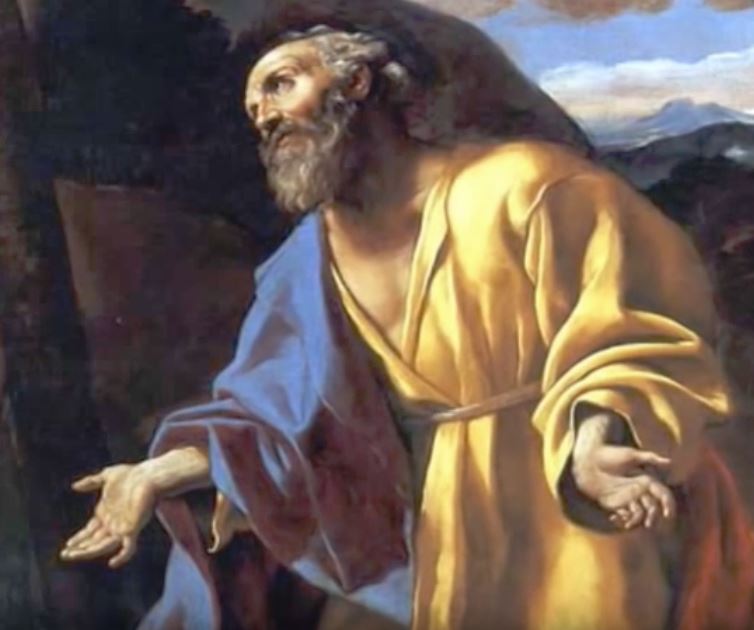
Lastly, a third initiative of Andrew is recorded in the Gospels:  the scene is still Jerusalem, shortly before the Passion.   For the Feast of the Passover, John recounts, some Greeks had come to the city, probably proselytes or God-fearing men who had come up to worship the God of Israel at the Passover Feast.   Andrew and Philip, the two Apostles with Greek names, served as interpreters and mediators of this small group of Greeks with Jesus.   The Lord’s answer to their question – as so often in John’s Gospel – appears enigmatic but precisely in this way proves full of meaning.   Jesus said to the two disciples and, through them, to the Greek world:  “The hour has come for the Son of man to be glorified.   I solemnly assure you, unless a grain of wheat falls to the earth and dies, it remains just a grain of wheat but if it dies, it produces much fruit” (12: 23-24). Jesus wants to say:  Yes, my meeting with the Greeks will take place but not as a simple, brief conversation between myself and a few others, motivated above all by curiosity.   The hour of my glorification will come with my death, which can be compared with the falling into the earth of a grain of wheat.   My death on the Cross will bring forth great fruitfulness, in the Resurrection the “dead grain of wheat” – a symbol of myself crucified – will become the bread of life for the world, it will be a light for the peoples and cultures. Yes, the encounter with the Greek soul, with the Greek world, will be achieved in that profundity to which the grain of wheat refers, which attracts to itself the forces of heaven and earth and becomes bread. In other words, Jesus was prophesying about the Church of the Greeks, the Church of the pagans, the Church of the world, as a fruit of His Pasch.

Some very ancient traditions not only see Andrew, who communicated these words to the Greeks, as the interpreter of some Greeks at the meeting with Jesus recalled here but consider him the Apostle to the Greeks in the years subsequent to Pentecost.   They enable us to know that for the rest of his life he was the preacher and interpreter of Jesus for the Greek world.ANDREW ICON
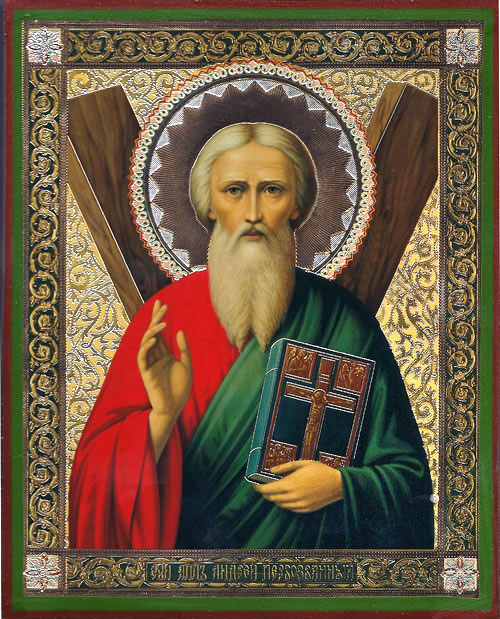
Peter, his brother, travelled from Jerusalem through Antioch and reached Rome to exercise his universal mission, Andrew, instead, was the Apostle of the Greek world.   So it is that in life and in death they appear as true brothers – a brotherhood that is symbolically expressed in the special reciprocal relations of the See of Rome and of Constantinople, which are truly Sister Churches.

A later tradition, as has been mentioned, tells of Andrew’s death at Patras, where he too suffered the torture of crucifixion.   At that supreme moment, however, like his brother Peter, he asked to be nailed to a cross different from the Cross of Jesus.   In his case it was a diagonal or X-shaped cross, which has thus come to be known as “St Andrew’s cross”….Pope Benedict XVI – 14 June 2006
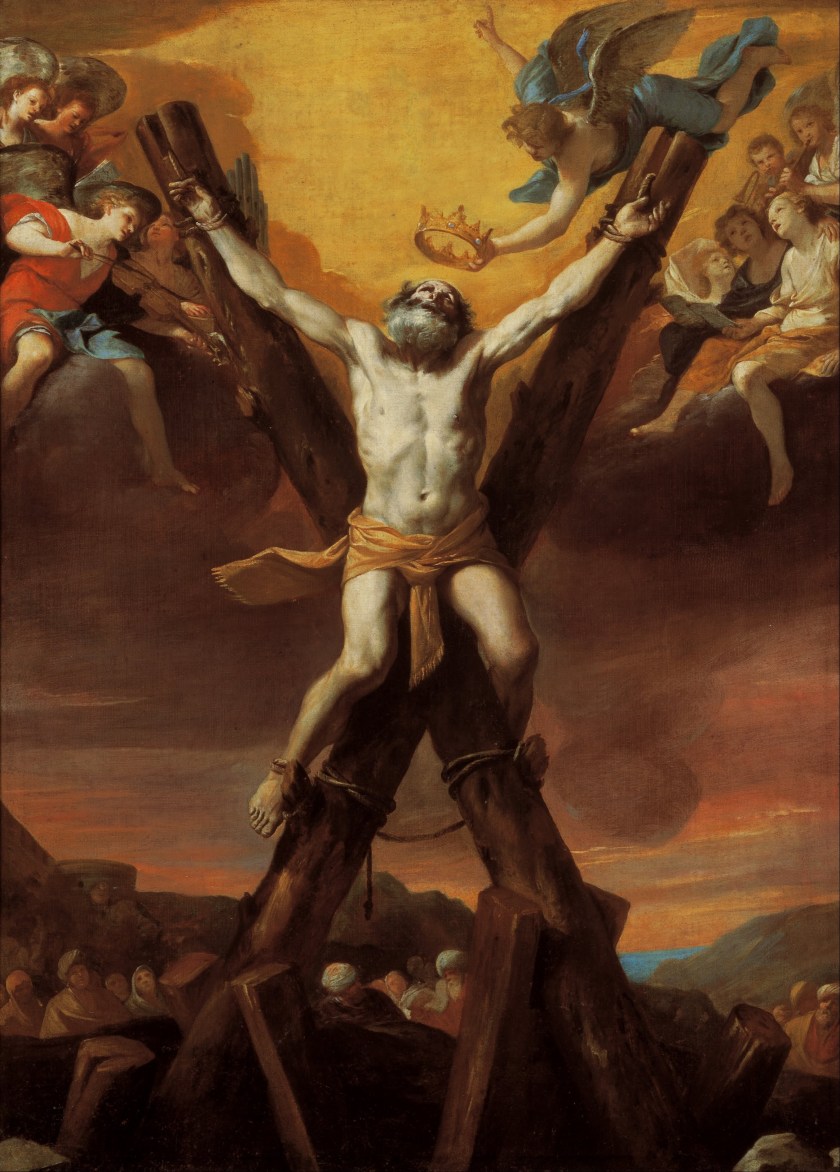
Mattia_Preti_-_The_crucifixion_of_St_Andrew_-_Google_Art_Project-Public-Domain-Image

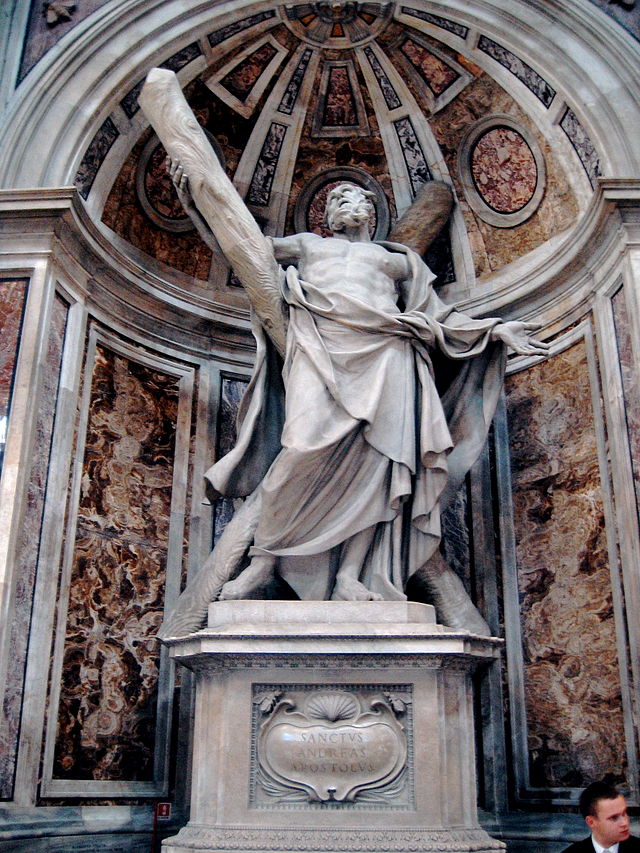
Andrew is the patron saint of several countries and cities and is the patron saint of Prussia and of the Order of the Golden Fleece.  He is considered the founder and the first bishop of the Church of Byzantium and is consequently the patron saint of the Ecumenical Patriarchate of Constantinople.   The flag of Scotland (and consequently the Union Flag and those of some of the former colonies of the British Empire) feature Saint Andrew’s saltire cross. The saltire is also the flag of Tenerife, the former flag of Galicia and the Russian Navy Ensign.

The feast of Andrew is observed on 30 November in both the Eastern and Western churches and is the national day of Scotland.   In the traditional liturgical books of the Catholic Church, the feast of Saint Andrew is the first feast day in the Proper of Saints.VATICAN - ANDREW STATUE -640px-Saint_Andreas
Posted in FEASTS and SOLEMNITIES, SAINT of the DAY, The APOSTLES & EVANGELISTS

Feast of St Andrew the Apostle and Memorials of the Saints – 30 November

St Andrew the Apostle (Feast)

St Abraham of Persia
Bl Alexander Crow
St Anders of Slagelse
Bl Andrew of Antioch
Bl Arnold of Gemblours
St Castulus of Rome
St Constantius of Rome
St Crider of Cornwall
St Cuthbert Mayne
St Domninus of Antioch
St Euprepis of Rome
Bl Everard of Stahleck
Bl Frederick of Regensburg
St Galganus
St Isaac of Beth Seleucia
Bl John of Vercelli
Bl Joscius Roseus
St Joseph Marchand
St Justina of Constantinople
Bl Ludwik Gietyngier
St Mahanes the Persian
St Maura of Constantinople
St Merola of Antioch
St Mirocles of Milan
St Sapor
St Simeon of Persia
St Thaddeus Liu Ruiting
St Trojan
St Tudwal of Tréguier
Bl William de Paulo
Zosimus the Wonder Worker
—
Martyrs of Saxony – 6 saints: Missionaries who worked with Saint Willehad of Bremen. Martyrs. – Attroban, Benjamin, Emmingen, Folkard, Gerwald and Grisold. They were martyred on 30 November 782 at River Weser, Lawer Saxony, Germany.

Martyred in the Spanish Civil War – Martyred Augustinians of Madrid – 51 beati and Martyred Hospitallers of Madrid – 7 beati – Thousands of people were murdered in the anti-Catholic persecutions of the Spanish Civil War from 1934 to 1939.

Posted in franciscan OFM, SAINT of the DAY

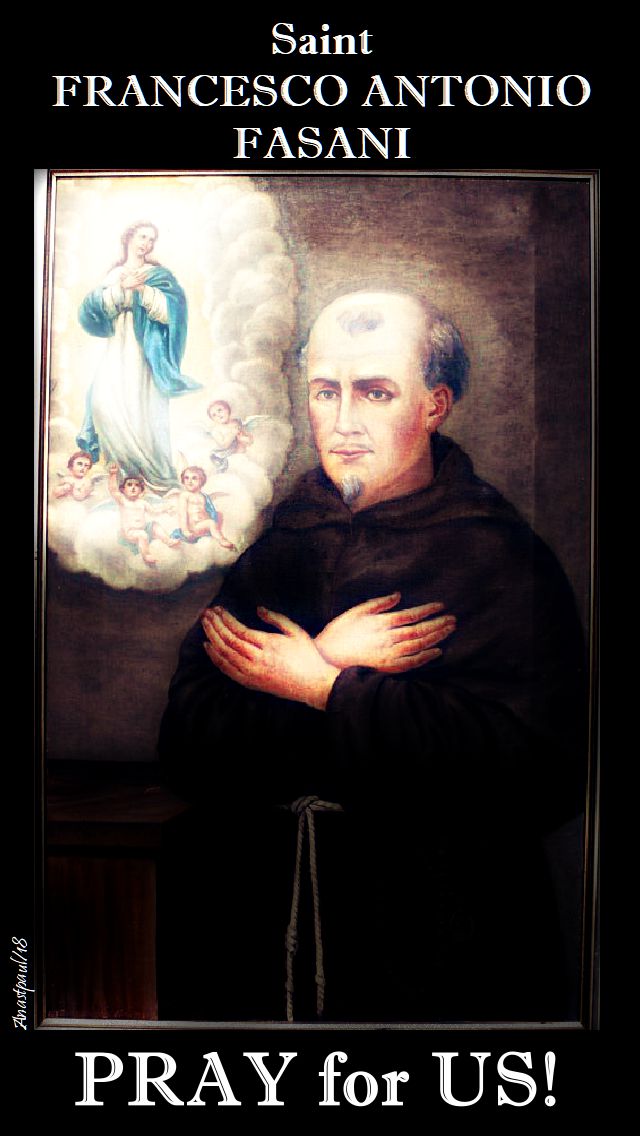
Thought for the Day – 29 November – The Memorial of St Francesco Antonio Fasani OFM Conv (1681 – 1742)

Thought for the Day – 29 November – The Memorial of St Francesco Antonio Fasani OFM Conv (1681 – 1742)

St Francesco was loving, devout and penitential.   He was a sought-after confessor and preacher.   One witness at the canonical hearings regarding Francesco’s holiness testified, “In his preaching he spoke in a familiar way, filled as he was with the love of God and neighbour; fired by the Spirit, he made use of the word and deed of holy Scripture, stirring his listeners and moving them to do penance.”   Francesco showed himself a loyal friend of the poor, never hesitating to seek from benefactors what was needed.

At his death in Lucera, children ran through the streets crying out, “The saint is dead! The saint is dead!”   Francesco was Canonised in 1986.

Eventually we become what we choose.   If we choose stinginess, we become stingy.   If we choose compassion, we become compassionate.   The holiness of Francesco Antonio Fasani resulted from his many small decisions to cooperate with God’s grace.

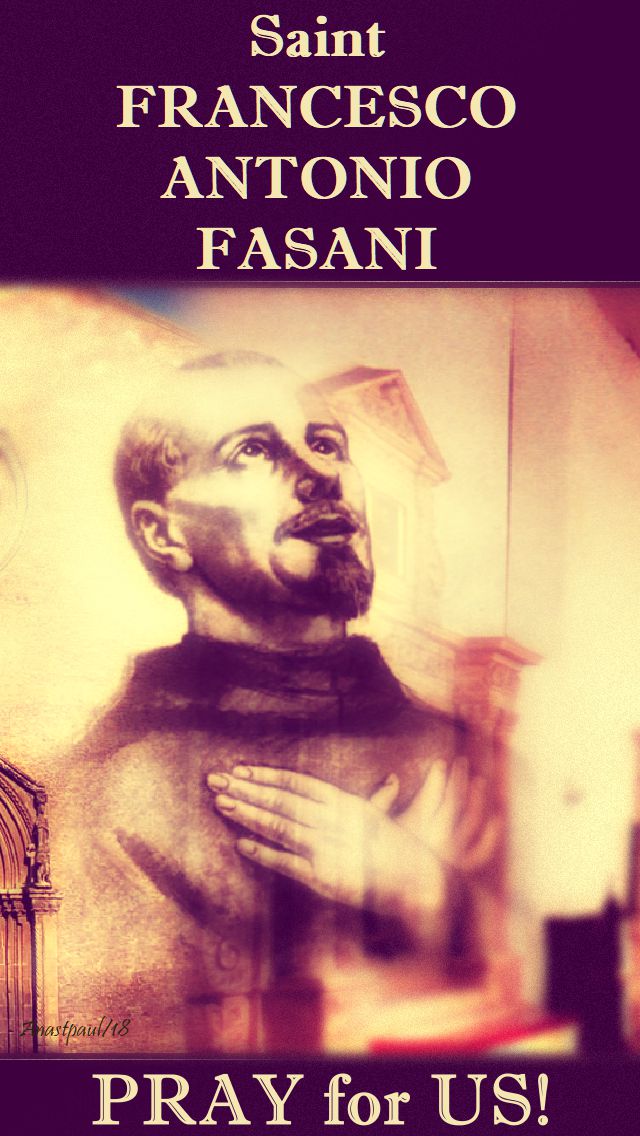
St Francesco Antonio Fasani, Pray for Us!st francesco antonio fasani pray for us - 29 nov 2018

Posted in franciscan OFM, QUOTES of the SAINTS, QUOTES on OBEDIENCE, QUOTES on TRUST and complete CONFIDENCE in GOD, SAINT of the DAY

Quote of the Day – 29 November – The Memorial of St Francesco Antonio Fasani OFM Conv (1681 – 1742)

Quote of the Day – 29 November – The Memorial of St Francesco Antonio Fasani OFM Conv (1681 – 1742)

“The Will of God –
that is my Paradise.”

St Francesco Antonio Fasani (1681 – 1742)the will of god that is my paradise st francesco antonio fasani - no 2 - 29nov2018

Posted in CATHOLIC Quotes, franciscan OFM, MORNING Prayers, PAPAL SERMONS, QUOTES on CONVERSION, QUOTES on GRACE, QUOTES on HEAVEN, SAINT of the DAY, The LAST THINGS, The WORD

One Minute Reflection – 29 November – Today’s Gospel: Luke 21:20–28 – “Look up and raise your heads”

One Minute Reflection – 29 November – Today’s Gospel: Luke 21:20–28, Thursday of the Thirty Fourth week in Ordinary Time, Year B and the Memorial of St Francesco Antonio Fasani OFM Conv (1681 – 1742)

“Now when these things begin to take place, look up and raise your heads, because your redemption is drawing near.”...Luke 21:28now when these things begin to take place - luke 21 28 - 29nov2018

REFLECTION – “Babylon falls because of its corruption;  Jerusalem because of its distraction; its failing to welcome the Lord who comes to her rescue.   She did not feel the need of salvation.   She had the writings of the prophets, Moses and this was enough.  But sealed writings!   She left no room for salvation, her door was closed to the Lord!   The Lord was knocking at her door but there was no willingness to receive Him, to listen, to be rescued by Him.   And so she falls…
Corruption gives you a sort of happiness, it gives you power and it also makes you feel self-satisfied, however, it doesn’t leave room for the Lord, for conversion.   The word corruption speaks of many things today – of not only economic corruption but corruption with so many different sins.   The worst kind of corruption is the spirit of worldliness.
When we think of the end of time, with all of our sins, with our history, let us think of the banquet which will be freely offered us and let us lift up our heads.   Do not give way to depression:  Hope!   Reality is ugly.   There are many, many people, cities and people, so many people who are suffering; many wars, so much hatred, so much envy, so much spiritual worldliness and so much corruption.   Yes, it’s true!   All of this will fall!
Let us ask the Lord for the grace to be prepared for the banquet that awaits us, always with our heads held high.”…Pope Francis – Santa Marta, 27 November 2014when we think of the end of times - pope francis 29 nov 2018

PRAYER – Lord God, creator of all Light and creator of all good, grant that we may look up to You always and know that by Your Light and your goodness we are safe in this world of corruption.   May the Light of our Lord Jesus, make the path He has set out bright and clear and may the prayers of St Francesco Antonio Fasani be a help in our struggle.   Lead us, Lord, in Your kindness and mercy to the banquet which awaits us.  We make our prayer through Christ our Lord, with the Holy Spirit, God forever, amen.st francesco antonio fasani pray for us no 3 - 29 nov 2018

Posted in franciscan OFM, Our MORNING Offering, PRAYERS of the SAINTS, SAINT of the DAY

Our Morning Offering -29 November – Prayer to do the Will of God

Our Morning Offering -29 November – The Memorial of All Franciscan Saints and Blesseds and in particular, of St Francesco Antonio Fasani OFM Conv (1681 – 1742)

Prayer to do the Will of God
By St Francis of Assisi (c 1181-1226)

Almighty, eternal, just and merciful God,
grant us in our misery, the grace to do for You alone
what we know You want us to do
and always to desire, what pleases You.
Thus, inwardly cleansed, interiorly enlightened
and inflamed by the fire of the Holy Spirit,
may we be able to follow in the footprints of
Your beloved Son, our Lord Jesus Christ.
And, by Your grace alone, may we make our way to You,
Most High, Who live and rule in perfect Trinity and simple Unity
and are glorified God all-powerful, forever and ever.
Amen.
(From “A Letter to the Entire Order”)prayer to do the will of god by st francis of assisi - 29 nov 2018

Posted in franciscan OFM, SAINT of the DAY

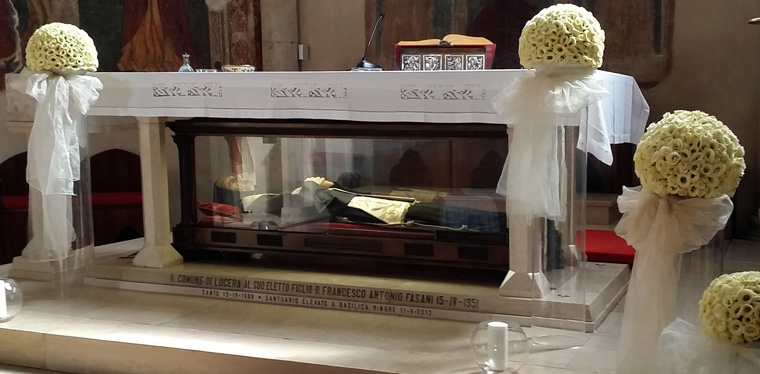
Saint of the Day – 29 November – St Francesco Antonio Fasani (1681 – 1742) – 29 November

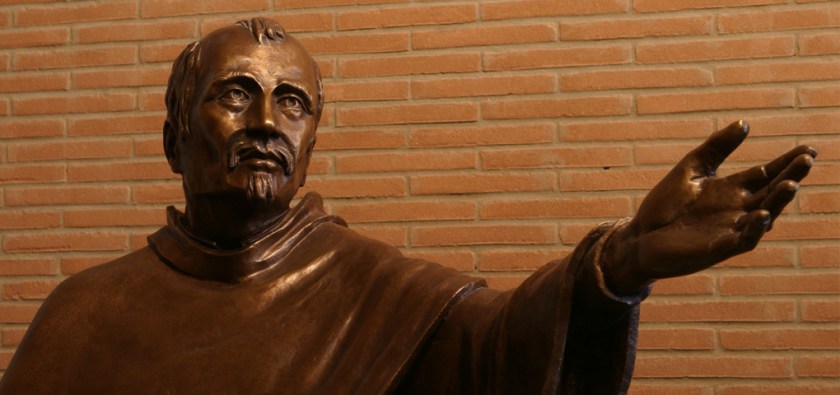
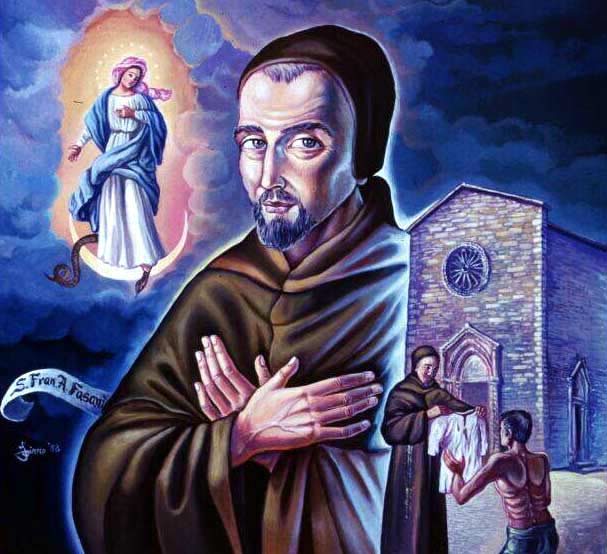
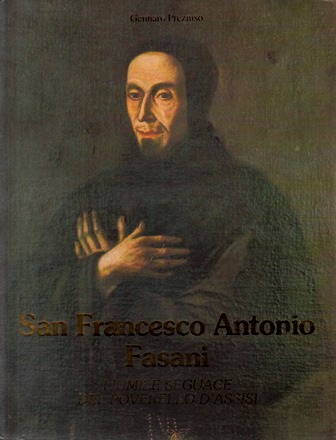
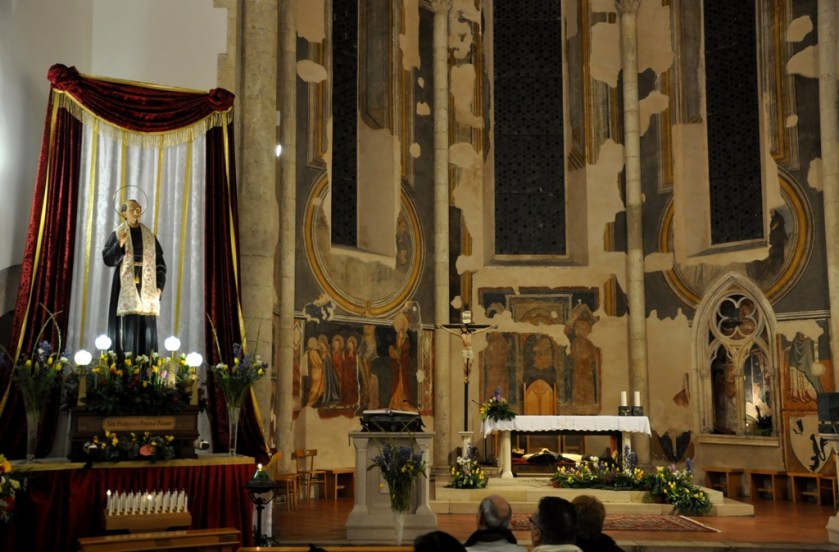
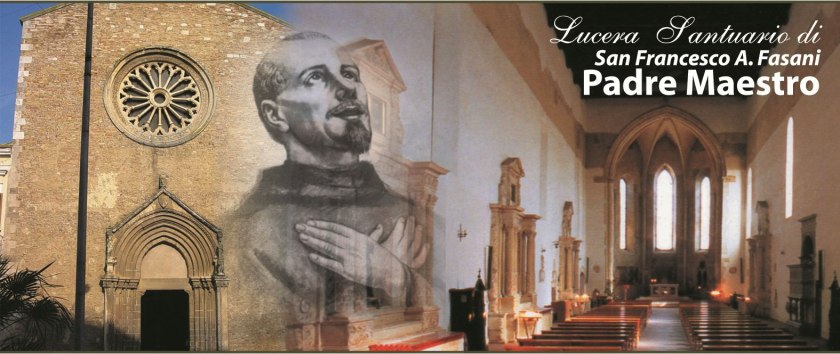
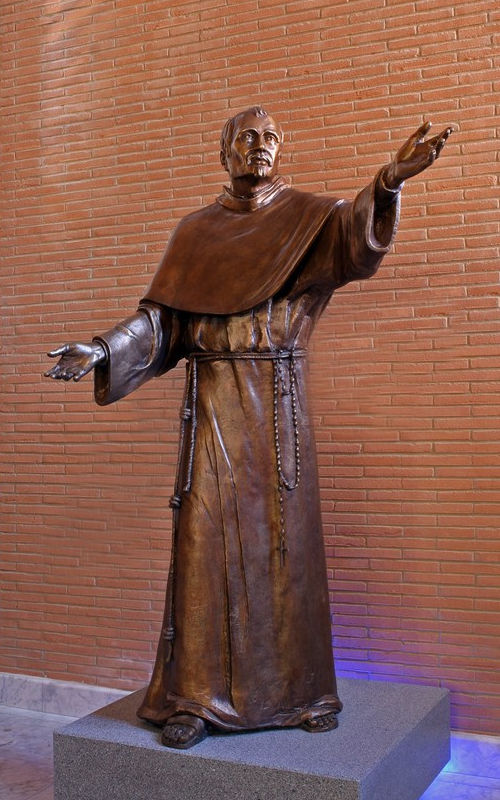
Saint of the Day – 29 November – St Francesco Antonio Fasani OFM Conv. (1681 – 1742) also known as Antony Fasani, Francis Anthony Fasani, Francis Fasani – was an Italian Friar and Priest of the Order of Conventual Friars Minor, Teacher, Confessor, Preacher, Mystic, Apostle of prayer and charity, Marian devotee – he was born on 6 August 1681 in Lucera, Foggia, Italy as Giovanniello Fasani and died on 29 November 1742 in Lucera, Foggia, Italy of natural causes.   Patronage – Lucera, his home town in Foggia.st fasani

St Francesco was the son of Giuseppe Fasani and Isabella della Monaca.   He began his studies at the Conventual friary in his town and there entered the Order, taking the religious names of Saints Francis and Anthony.   Fasani professed his religious vows in 1696.

Once having professed his vows, Fasani began theological studies in Agnone and continued them in the General Study Centre at Assisi, close to the tomb of St Francis.   It was there that Fasani was ordained to the priesthood in 1705.   He stayed in Assisi and completed his theological studies there in 1707.

From 1707 until his death in 1742, Fasani spent the rest of life in residence in his hometown of Lucera and endeared himself to the faithful of that town and all of Daunia and Molise.   In 1709, he received the degree of Doctor of Theology and, from that time on, Fasani became known to all as “Padre Maestro” (“Father Master”), a title which is still attributed to him today in Lucera.   Fasani also fulfilled many duties in the Franciscan Order, being a respected teacher of scholastic philosophy and was entrusted with the position of Master of novices and the junior professed friars. HEADER 1127francesco7

He was later appointed to serve as the guardian of the community of friars and the pastor of the town.   He came to be elected Minister Provincial of his province in the Order.   As a worthy ministry of “the one who uninterruptedly exercises his priestly mission for us in the Liturgy through the Spirit” (PO, 5), Fr Fasani dedicated himself with zeal-especially the administration of the sacrament of Penance and the celebration of the Holy Eucharist.   “He heard the confession of every type of person,” asserted a witness, “with the greatest patience and kindness on his face”.   He was charitable and welcoming to all, giving as his reason the hope of being able one day to say to the Lord:  “I was indulgent, I don’t deny it but it was You who taught me to be so.”SAN FRANCESCO ANTONIO FASANI (1994)-apulia

Fasani was known for having a deep life of prayer and was considered to be a mystic, becoming greatly in demand as a confessor and preacher.   He constantly preached popular parish missions, gave retreats and led Lenten devotions and novenas – either in his own town or wherever he was requested.   It was reported by his contemporaries that he would levitate while at prayer.   At the same time, he was a steadfast friend of the poor, constantly seeking out the financial support necessary for efforts to meet their needs.

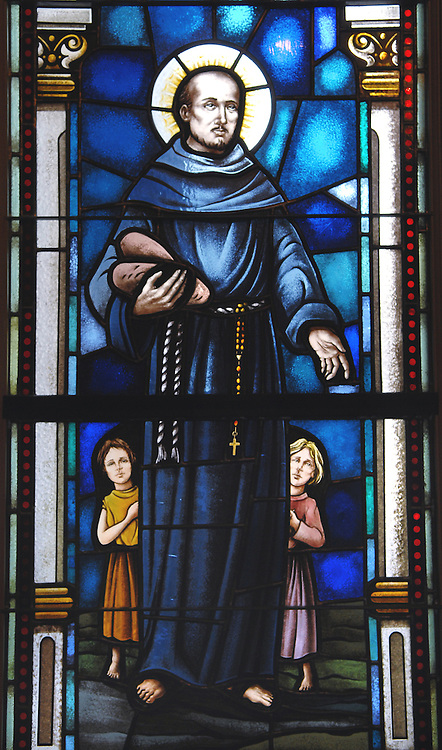
Fasani died in Lucera and was buried in the parish church there.   Upon the news of his death, children could be heard running through the streets shouting, “The saint is dead!   The saint is dead!”stainedglass-anthonyfasani

The proceedings to open the cause for his canonisation began several years after his death.   Testimony to his holy life was given by many people of region.   Among them was his old friend, Blessed Antonio Lucci (1682–1752), who by then was a Bishop in the region.   Progress did not take place, however, until the 20th century, when he was beatified in 1951 by Pope Pius XII and subsequently Canonised in 1986 by St Pope John Paul II.SHRINE of st francesco fasani Parde-Maestro-Santo_gSHRINE of st francesco fasani Parde-Maestro-Santo 2_gHEADER - beautiful - san-francesco-lucera-1

From the Vatican biography of St Francesco: – “The spiritual life of Fr Fasani was characterised by those virtues that made him like his Seraphic Father St Francis.   In fact, it was said in Lucera:  “Whoever wants to see how St Francis looked while he was alive should come to see Padre Maestro.”   In imitation of St Francis he built his religious life on the basis of a generous participation in the mysteries of Christ through the most faithful practice of the evangelical counsels, which he considered to be a radical expression of perfect charity.   In his constant prayers, inflamed with seraphic love, he called out to God, saying to Him:  “O Highest Love, Immense Love, Eternal Love, Infinite Love.”

fasani statue

Posted in franciscan OFM, MARIAN DEVOTIONS, MARIAN TITLES, SAINT of the DAY, The BLESSED VIRGIN MARY

Memorial of Our Lady of Beauraing and of the Saints – 29 November

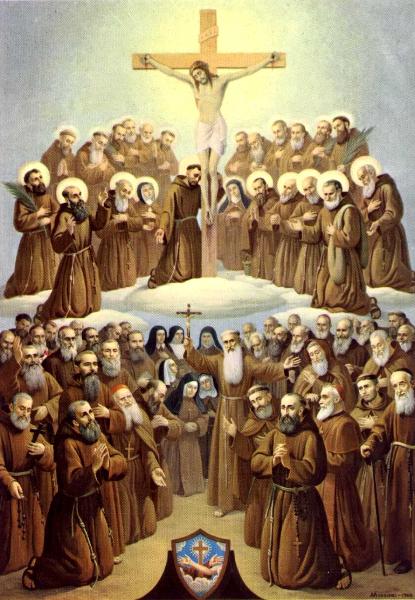
All Saints of the Seraphic Order (Franciscan):   the Church celebrates the many Franciscan saints who followed in the footsteps of St Francis.   It is a special day for all Franciscans to celebrate the feast of ‘All the Saints of the Seraphic Order.’all saints of the Franciscan order - 29 nov
According to tradition, St Francis of Assisi prayed the following prayer:
“O Lord Jesus Christ, two favours I beg of You before I die.   The first is that I may, as far as it is possible, feel in my soul and in my body the suffering in which You, O gentle Jesus, sustained in Your bitter passion.   And the second favour is that I, as far as it is possible, may receive in my heart that excessive charity by which You, the Son of God, were inflamed and which actuated You willingly to suffer so much for us sinners.”
In response to his earnest prayer, the Lord appeared in the form of a seraph, or a six-winged angel (They are usually considered the highest order of angelic beings, immediately above the Cherubim and their special duty is to love God).   Then Jesus bestowed on St Francis the wounds of His suffering.   St Francis had been marked with the love of Christ, the stigmata.   St Francis died two years later in 1226, leaving the world the Franciscan Order, which became synonymous with the Seraphic Order.   To this day, seraph wings and seraphs are symbolic of the Franciscan Order.
The final Rule of life for Franciscan friars was also approved on this day in 1223.   To commemorate this and all the saintly examples produced in the Franciscan Order, on this day all the saints of the Seraphic order are remembered at Franciscan churches.

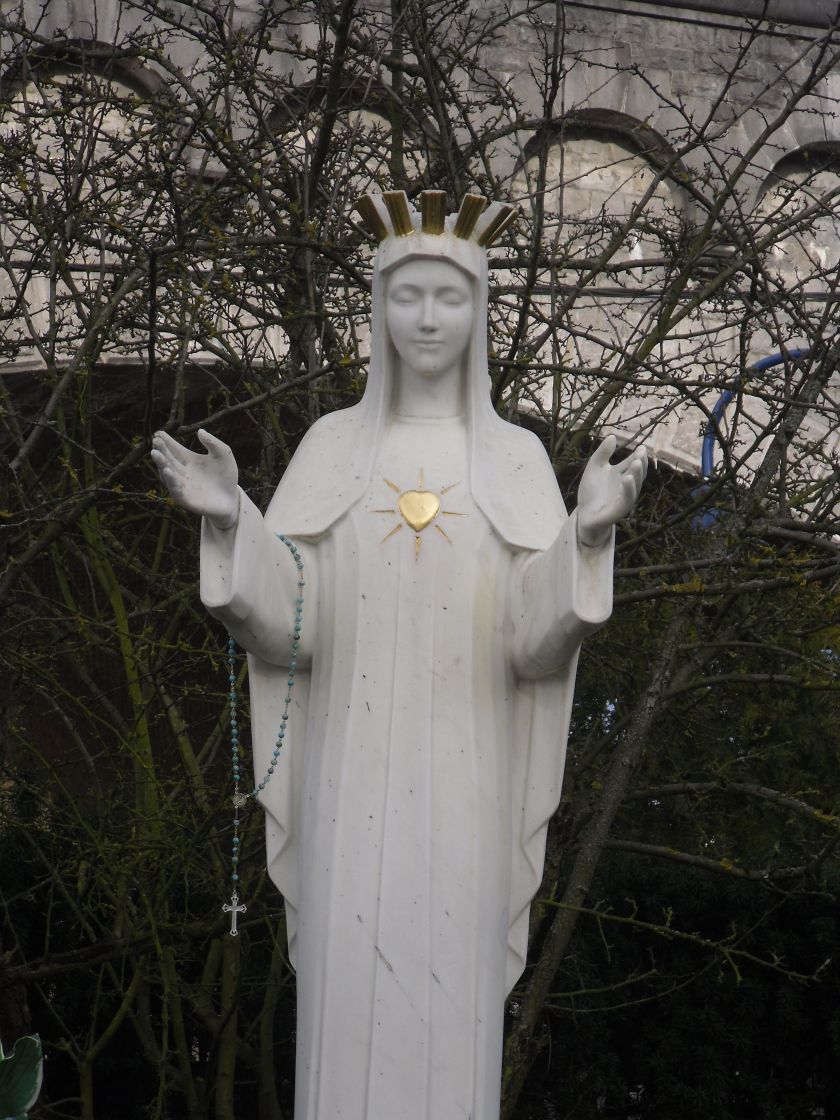
Our Lady of Beauraing/Our Lady of the Golden Heart:
Appeared multiple occasions between 29 November 1932 and 3 January 1933 On 2 February 1943, Bishop Andre Marie Charue authorized public devotion to Our Lady of Beauraing. On 2 July 1949 the Bishop declared that the Queen of Heaven had truly appeared to the children. Pilgrims flock to the small town of Beauraing, province of Namur (Belgium) and many cures are claimed. She is celebrated under this title on 29 November.

our lady of beauraing belgium - of the golden heart - 29 nov

Bl Alfredo Simón Colomina
Bl Bernardo Francisco de Hoyos Seña
St Blaise of Veroli
St Brendan of Birr
St Demetrius of Veroli
Bl Denis of the Nativity
Bl Edward Burden
St Francesco Antonio Fasani OFM Conv (1681 – 1742)
Bl Frederick of Ratisbon
Bl George Errington
St Hardoin of Brittany
St Illuminata of Todi
St James of Saroug
Bl Jutta of Heiligenthal
St Paphnutius of Heracleopolis
St Paramon
St Philomenus of Ancyra
St Radbod of Utrecht
Bl Redemptorus of the Cross
St Sadwen of Wales
St Saturninus of Rome
St Saturninus of Toulouse
St Sisinius of Rome
St Walderic of Murrhardt
Bl William Gibson
Bl William Knight

Posted in DOGMA, MARIAN DEVOTIONS, MARIAN QUOTES, MARIAN TITLES, MORNING Prayers, PRACTISING CATHOLIC, SAINT of the DAY, The BLESSED VIRGIN MARY, The WORD

Thought for the Day – 28 November – The Memorial of St Catherine Labouré DC (1806-1876)

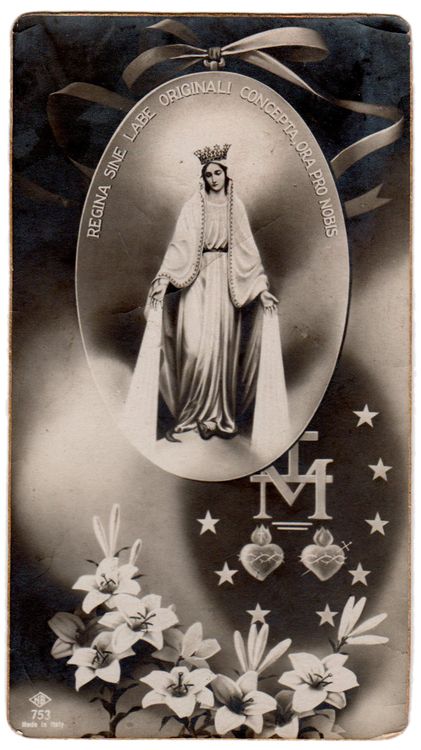
Thought for the Day – 28 November – The Memorial of St Catherine Labouré DC (1806-1876)original french MM

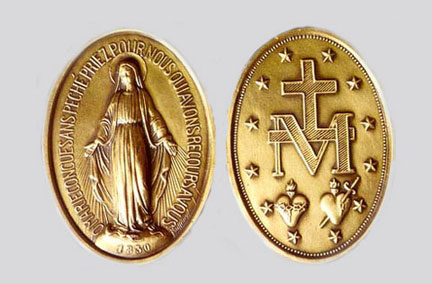
The Miraculous Medal has been called “a summary of the Church’s teaching on Our Lady, a mini-catechism of the faith for everyone.”   Indeed, the Marian vision that inspired the medal included some important symbolism!

For starters, the reference to Mary’s having been conceived without sin on the medal, shown in its original French in the photo above, was defined as a Dogma by the church in 1854, hence the reason that the Medal is actually officially known as the Medal of the Immaculate Conception –  (Note that this refers to Mary’s conception, not to Jesus’ birth, a common misconception!)

Note also that Mary is shown in the photo above standing on a globe crushing the head of a serpent.   This is in line with scripture, from Genesis 3:15, which foretells Satan’s ultimate defeat at the hands of her Son.   (Granted, this is not readily visible here or indeed on many Miraculous Medals, particularly small ones!)

On the back of the medal (the picture on the right above) we see symbols of Jesus and Mary, in the Cross (the symbol of her Son’s victory over sin and death for us at Calvary) with the Letter “M” for Mary right underneath it.   Directly underneath that are two hearts, the Sacred Heart of Jesus and the Immaculate Heart of Mary, both filled with great love for each other and for us too!   We see their sadness over our sins as well in this depiction.   On the left side are the thorns of our indifference and ingratitude piercing our Lord’s Sacred Heart even while it burns with love for us.   On the right side we see a sword piercing Mary’s heart, which is filled with sorrow as well as love (as described here).   Surrounding these poignant images we see twelve stars symbolising the twelve apostles.

On the front of the medal (left) we see our Lady’s hands outstretched with rays of light, symbolising grace, streaming from her fingers.   (Again, granted, this may be hard to see on a small medal!)   We are reminded here of St Louis de Montfort’s reference to her as the “treasurer and dispenser of God’s graces.”

We can see from all this that the Miraculous Medal is an important sacramental, indeed, as it can give us the graces Our Lady wishes us to have on behalf of her Divine Son. Indeed, she herself said to St Catherine when giving her the vision of the medal “Have a medal made according to this model.   Everybody who wears it will receive great graces by wearing it around the neck.   The graces will be abundant for persons who wear it with confidence.”   Remember, however, that the most important place of honour for Mary must be in our hearts, not around our necks.

It is important to note as well that, as with all sacramentals, the Miraculous Medal is not some “lucky charm”.   Keep in mind also, that in expressing devotion to Mary, we do not worship her, as many Christians in other denominations, especially some Evangelicals, believe, but rather honour her in her devotion to our Lord!   As the popular saying goes “to Jesus through Mary.”

Remember also her last words in Scripture, which could almost be her motto, in which she told the attendants at the wedding feast of Cana “Do whatever he [Jesus] tells you” (John 2:5).

Prayers such as the Hail Mary and the Memorare can also help do us worlds of good in receiving and sharing the graces she wishes to give us.   They are all meant to lead us to a closer relationship with Jesus!

Mary showed St Catherine an intriguing symbol in her Miraculous Medal vision.   The rays of light emanating graces came from sparkling jewels on Our Lady’s fingers.   St Catherine noticed, however that some of these jewels were dark and not giving forth any light.   Mary explained that “those stones which remain dark symbolise the graces people have forgotten to request.”   Don’t let such graces be lost on you!   And don’t ever be afraid to ask for her help in obtaining Christ’s mercy!

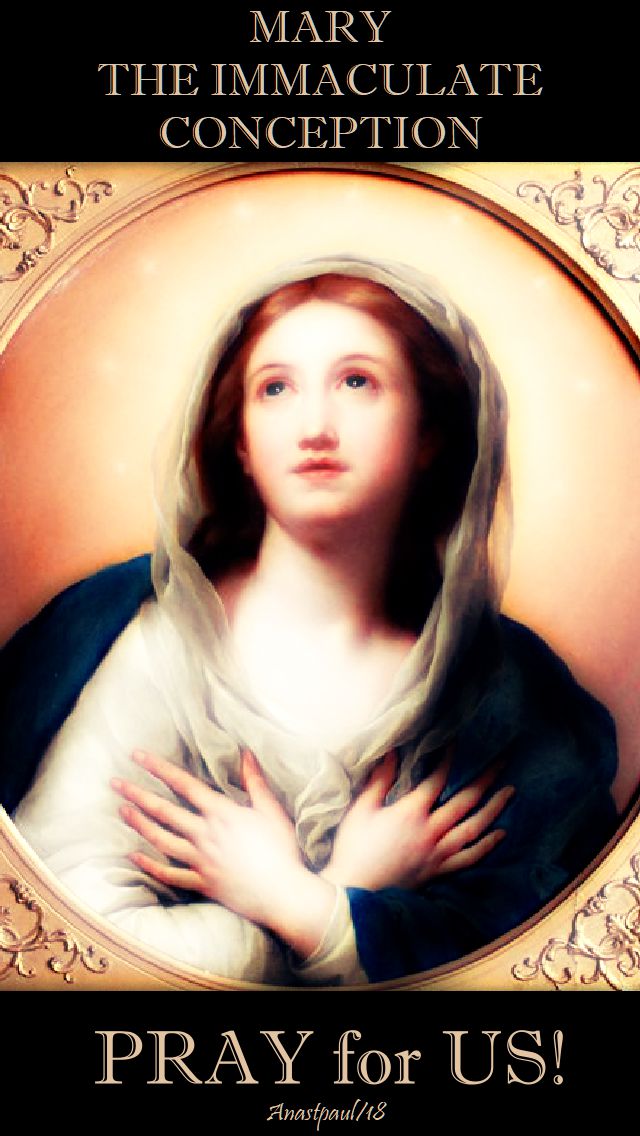
Mary, the Immaculate Conception, Pray for Us!mary the imm conception pray for us - 28 nov 2018

St Catherine Labouré, Pray for Us!st catherine laboure pray for us - 28 nov 2018

Posted in EUCHARISTIC Adoration, QUOTES of the SAINTS, QUOTES on PRAYER, SAINT of the DAY, The HOLY EUCHARIST / The HOLY MASS

Quote of the Day – 28 November – The Memorial of St Catherine Labouré DC (1806-1876)

Quote of the Day – 28 November – The Memorial of St Catherine Labouré DC (1806-1876)

“When I go to the Chapel,
I place myself before the good God and I say to Him:
‘Lord, here I am, give me what You will.’
If He gives me something, I am very pleased and I thank Him.
If He gives me nothing, I still thank Him
because I do not deserve anything.
And then again, I tell Him all that passes through my mind,
I recount my pains and my joys and … I listen.
If you listen to Him, He will speak to you also
because with the good God,
it is necessary to speak and to listen.
He will always speak to you,
if you go to Him simply and sincerely.”

St Catherine Labouréwhen I go to chapel - st catherine laboure - 28 nov 2018.jpg

Posted in CATHOLIC Quotes, MORNING Prayers, PAPAL SERMONS, QUOTES on FAITH, QUOTES on PERSECUTION, SAINT of the DAY, The WORD

One Minute Reflection – 28 November – Today’s Gospel: Luke 21:12–19

One Minute Reflection – 28 November – Today’s Gospel:  Luke 21:12–19, Wednesday of the Thirty Fourth week in Ordinary Time, Year B and the Memorial of St Catherine Labouré DC (1806-1876)

“But not a hair of your head will perish.”...Luke 21:18

REFLECTION – ” In difficult times, one must believe that Jesus is before us and does not cease to accompany His disciples.   Persecution is not in contradiction to the Gospel but rather is part of it.   As if to say that none of man’s suffering, not even that which is most minute and hidden, is invisible to the eyes of God.   God sees and certainly protects and He will give His redemption.   There is in fact in our midst, Someone who is stronger than evil.   Christians therefore, must always be found, on the “opposite side” of the world, that chosen by God – not persecutors but persecuted, not arrogant but meek, not charlatans but submissive to the truth, not imposters but honest men and women.”…Pope Francis General Audience, 28 June 2017but not a hair of your head - luke 21 18-in difficult times - pope fancis 28 nov 2018

PRAYER – Shed Your clear light on our hearts O Lord, so that walking continually in the way of Your commandments, we may never be afraid, never be deceived or misled but by Your strength, stand firm in our faith.   For Your Son, walks before us, beside us and behind us.   The Holy Spirit of Your love fills us.   Let nothing put us to shame  . Grant that by the prayers of St Catherine Labouré and all Your saints, we may be strengthened for the journey.   Through our Lord Jesus, in the Holy Spirit, God eternally and forever, amen.st catherine laboure pray for us - 3 - 28nov2018

Posted in CATHOLIC-PRAYERS OF THE CHURCH, MARIAN PRAYERS, MARIAN TITLES, PRAYERS of the CHURCH, SAINT of the DAY, The BLESSED VIRGIN MARY

Our Morning Offering – 28 November – The Memorial of Our Lady of Kibeho

Our Morning Offering – 28 November – The Memorial of Our Lady of Kibeho

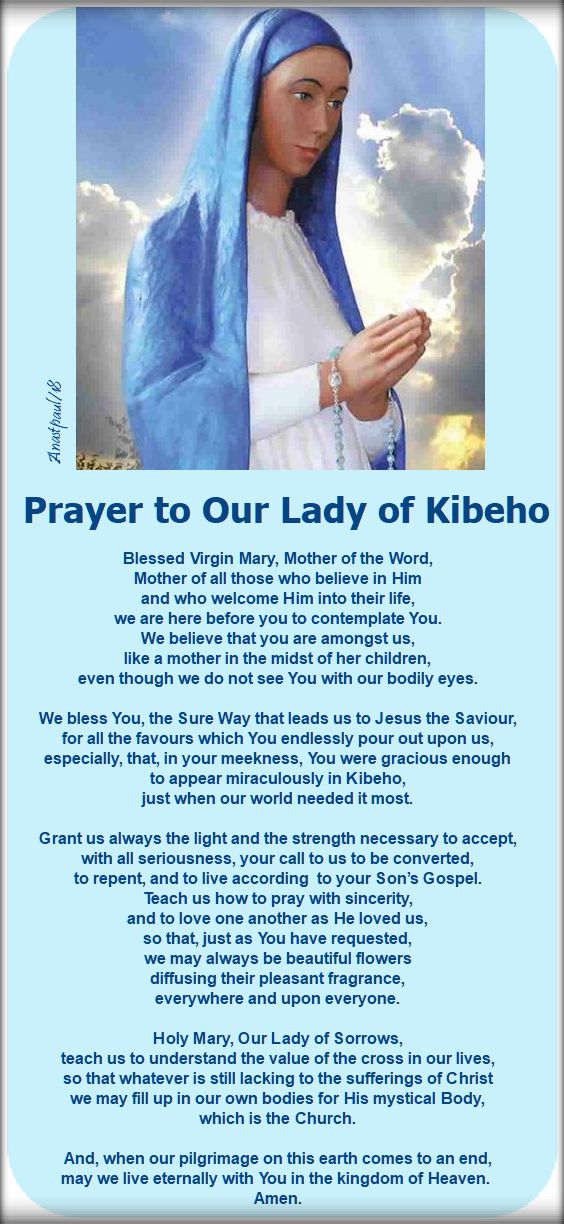
Official Prayer to Our Lady of Kibeho

Blessed Virgin Mary, Mother of the Word,
Mother of all those who believe in Him
and who welcome Him into their life,
we are here before you to contemplate You.
We believe that you are amongst us,
like a mother in the midst of her children,
even though we do not see You with our bodily eyes.

We bless You, the Sure Way that leads us to Jesus the Saviour,
for all the favours which You endlessly pour out upon us,
especially, that, in your meekness, You were gracious enough
to appear miraculously in Kibeho, just when our world needed it most.

Grant us always the light and the strength necessary to accept,
with all seriousness, your call to us to be converted,
to repent, and to live according to your Son’s Gospel.
Teach us how to pray with sincerity,
and to love one another as He loved us,
so that, just as You have requested,
we may always be beautiful flowers
diffusing their pleasant fragrance everywhere and upon everyone.

Holy Mary, Our Lady of Sorrows,
teach us to understand the value of the cross in our lives,
so that whatever is still lacking to the sufferings of Christ
we may fill up in our own bodies for His mystical Body,
which is the Church.

And, when our pilgrimage on this earth comes to an end,
may we live eternally with You in the kingdom of Heaven.
Amen.

Our Lady of Kibeho requested that we pray the Seven Sorrows Chaplet – here: https://7sorrowsrosaries.com/pages/seven-sorrows-rosary

During Mary’s apparitions to Marie-Claire Mukangango, she assigned the young visionary a mission to reintroduce this special rosary to the world. Before her untimely death, Marie Claire did just that, traveling widely to teach it to thousands of people, who then taught it to thousands of others. (Marie-Claire was killed in the genocide of over a million people in Rwanda, a tragedy that was foretold through visions of rivers of blood that the young people in Kibeho received several years before the killings.)pray to our lady of kibeho - 28 nov 2018

Posted in INCORRUPTIBLES, MARIAN TITLES, Of the SICK, the INFIRM, All ILLNESS, PATRONAGE - THE ELDERLY, OLD AGE, SAINT of the DAY, The BLESSED VIRGIN MARY

Saint of the Day – 28 November – St Catherine Labouré DC (1806-1876)

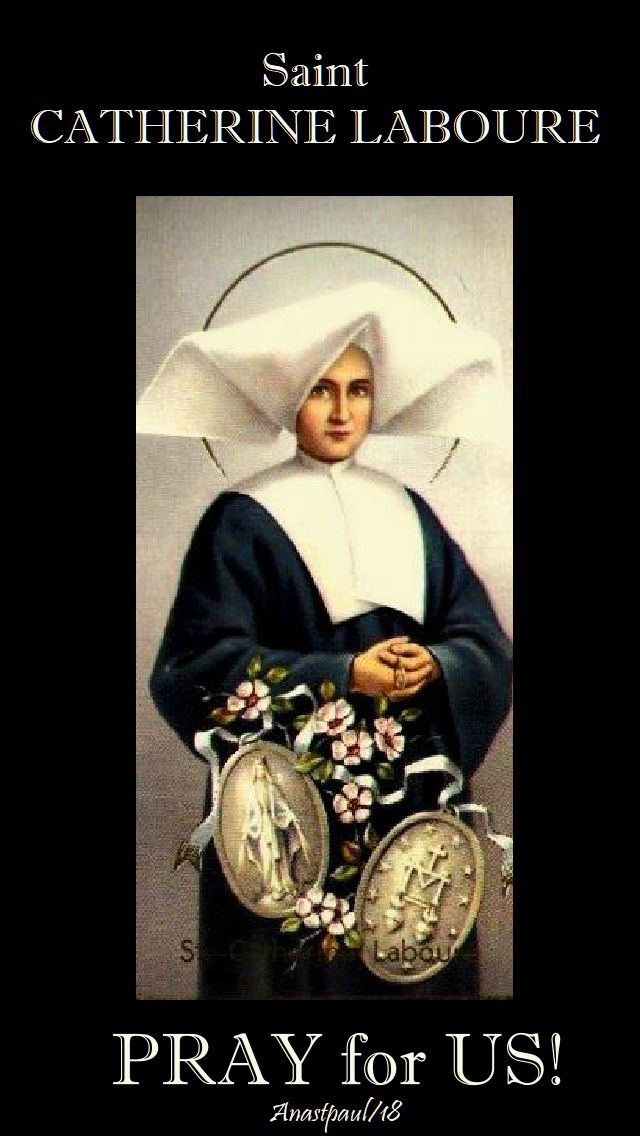
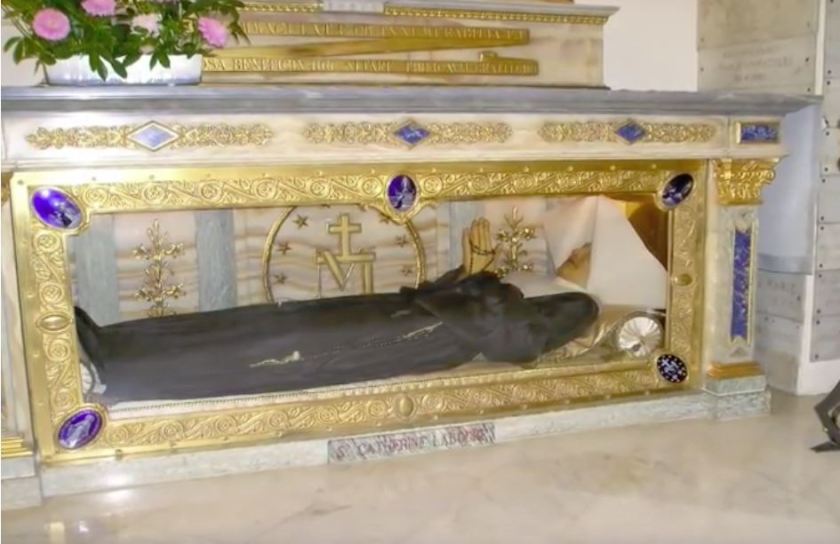
Saint of the Day – 28 November – St Catherine Labouré DC (1806-1876) Virgin, Religious Sister of the Daughters of Charity of Saint Vincent de Paul and is a Marian visionary.   St Catherine was born on 2 May 1806 at Fain-les-Moûtiers, Côte d’Or, Burgundy, France as Zoe Labouré and died on 31 December 1876 at Enghien-Reuilly, France.   Her body is incorrupt and is entombed in glass beneath the side altar in the Chapel of Our Lady of the Miraculous Medal at 140 Rue du Bac, Paris.   Patronages – Miraculous Medal, infirm people, the elderly.header - st catherine laboure

Catherine Zoé Labouré was born in a small village of France in 1806, the daughter of a well-to-do farmer who had at one time wanted to become a priest and his very Christian wife.   Catherine, the ninth of the eleven living children, lost her mother when she was only nine years old and had to abandon school to go to live with an aunt, accompanied by her younger sister.   Two years later she was recalled to take charge of the household, because the older children had all left, one to become a Sister of Saint Vincent de Paul, the others to marry or seek a living elsewhere.

She made a vow of virginity when still very young, desiring to imitate the Holy Virgin, to whom she had confided herself when her mother died.   She longed to see Her and she prayed, in her simplicity, for that grace.   She spent as many hours as possible in the Chapel of the Virgin in the village church, without, however, neglecting the work of the household.   She talked to Our Lady as to a veritable mother and indeed the Mother of Christ and ours, would prove Herself to be such.   Catherine wished to become a nun, without having opted for any particular community but one day she saw a venerable priest in a dream, saying Mass in her little village church.   He turned to her afterwards and made a sign for her to come forward but in her dream she retreated, walking backwards, unable to take her gaze from his face.   He said to her – ‘Now you flee me,but later you will be happy to come to me, God has plans for you.’   The dream was realised and, as a postulant in the Community of Saint Vincent de Paul, she assisted at the translation of his relics to a nearby church of Paris.   She had indeed recognised his picture one day in one of the convents of the Sisters of Charity and obtained her father’s consent to enter that Congregation when her younger sister was old enough to replace her at home.st catherine laboure info

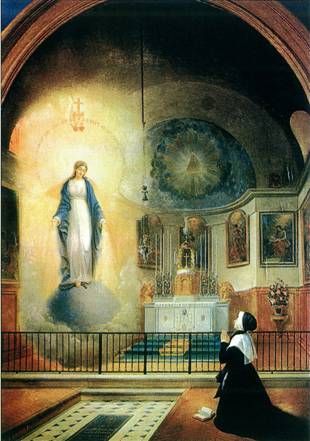
Catherine’s interior life was filled with the visions she frequently had of Jesus in the Blessed Sacrament, where once she saw Him as Christ the King.   And the designs of God for this humble novice began to be fulfilled, after Our Lady appeared to her in July of 1830 and confided to her the mission of having a Medal struck according to the living picture she saw one night, when a little Angel led her to the convent Chapel, and there she knelt at the Virgin’s feet to hear the words which would be the motivating force of her forty-six years of religious life.   The Blessed Mother displayed herself inside an oval frame, standing upon a globe, rays of light came out of her hands in the direction of a globe.   Around the margin of the frame appeared the words “O Mary, conceived without sin, pray for us who have recourse to thee.”   As Catherine watched, the frame seemed to rotate, showing a circle of twelve stars, a large letter M surmounted by a cross, and the stylized Sacred Heart of Jesus and Immaculate Heart of Mary underneath.   Asked why some of the rays of light did not reach the Earth, Mary reportedly replied “Those are the graces for which people forget to ask.”   Catherine then heard Mary ask her to take these images to her father confessor, telling him that they should be put on medallions. “All who wear them will receive great graces.”

Once more,  she would see the Blessed Mother, on 27 November of the same year, when one afternoon while at prayer with her Sisters, she beheld Her to one side of the chapel, Her feet poised on a globe, on which was prostrate a greenish serpent; the hands of the Virgin were holding a golden globe at the level of the heart, as though offering it to God, said Catherine later, in an attitude of supplication, Her eyes sometimes raised to heaven, sometimes looking down at the earth and Her lips murmuring a prayer for the entire world.   The face of the Virgin was of incomparable, indescribable beauty, with a pleading expression which plunged the Sister into ravishment, while she listened to Her prayers.   The Immaculate Virgin, after having offered to God Her Compassion with the suffering Christ, prayed for all men and for each one in particular;  she prayed for this poor world, that God might take pity on its ignorance, its weakness and faults and that by pardoning He would hold back the arm of Divine Justice, raised to strike.   She prayed the Lord to give peace to the universe. st catherine and our lady

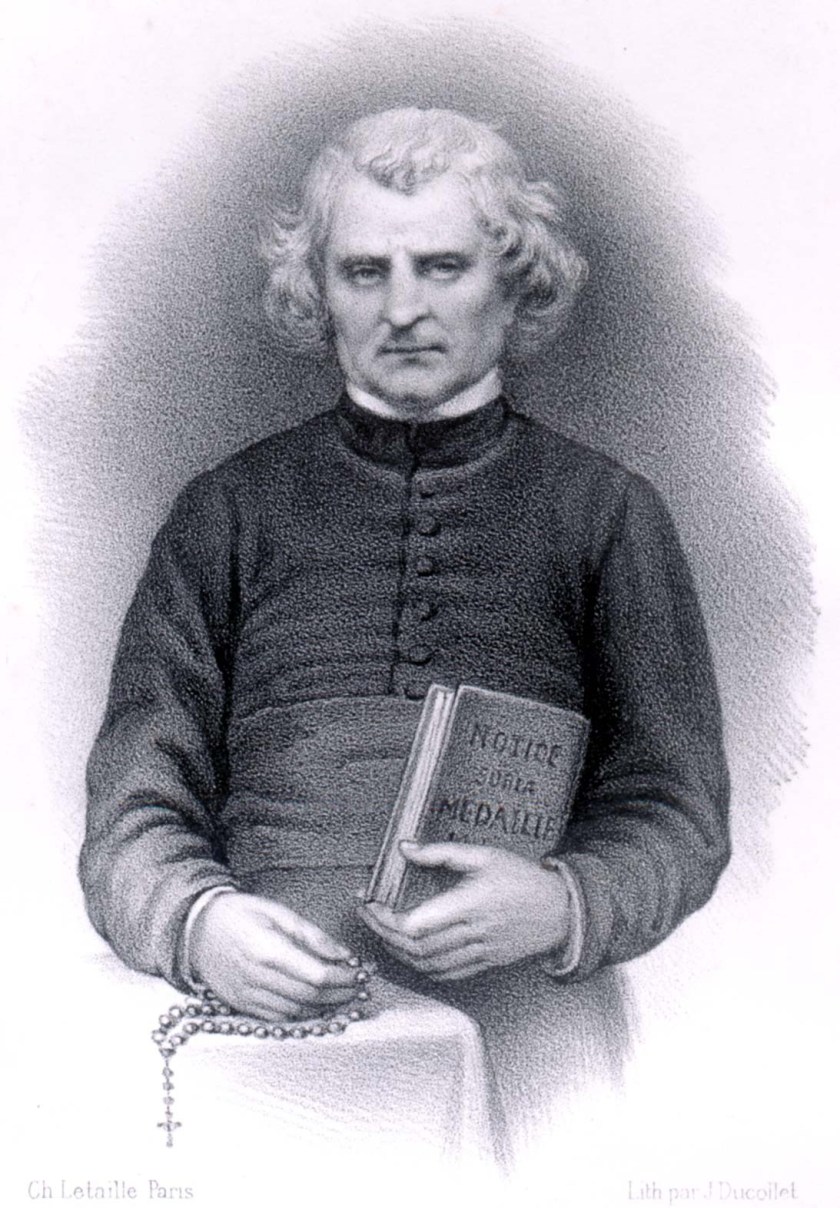
For many years Catherine kept her secrets from all save her confessor, Father Jean-Marie Aladel (1800-1865), priest of the Mission of Saint Vincent, who, wanting to be able to continue with his penitent, saw to it that she was not sent far from Paris, after he had fulfilled the first mission of having the Medal struck.   He died, however, before having the statue made according to this second vision, as Our Lady desired.   Catherine suffered much from her inability to accomplish the second part of her mission.   When she finally confided this second desire of Our Lady to her Sister Superior, a statue of Our Lady, Queen of the World and Mediatrix of all Graces, was made for two Chapels of the nuns.

Padre-Aladel (1)
Fr Jean-Marie Aladel

mm holy card

Saint Catherine died in 1876, after spending the next 40 years of her life in the domestic and agricultural duties associated with the kitchen and garden and in general caring for the elderly of the Hospice of Enghien at Reuilly, only about three miles southeast of Paris. Among her writings recounting the apparitions, we read:  “Oh, how beautiful it will be to hear it said, Mary is Queen of the universe.   That will be a time of peace, joy and happiness which will be long… She will be borne like a banner and will make a tour of the world.   The Virgin foretold that this time would come only after the entire world will be in sadness… Afterwards, peace.”

She was Beatified on 28 May 1933 by Pope Pius XI and Canonised on 27 July 1947 by Pope Pius XII.the Incorrupt body of St Catherine Laboure

Posted in MARIAN TITLES, SAINT of the DAY

Memorial of Our Lady of Kibeho – 28 November and of the Saints

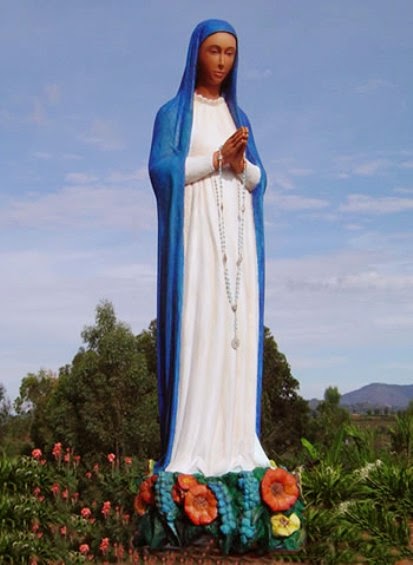
Our Lady of Kibeho:   is the name given to Marian apparitions concerning several adolescents, in the 1980s in Kibeho, south-western Rwanda.   The apparitions communicated various messages to the schoolchildren, including an apocalyptic vision of Rwanda descending into violence and hatred.   The visions may be regarded as an ominous foreshadowing of the Rwandan Genocide, and particularly the second Kibeho Massacre in 1995.   The school where the visions occurred became a place of slaughter during the Genocide as dozens of children were shot and hacked to death by Hutu terrorists.
In 2001, the local bishop of the Catholic Church officially recognised the visions of three schoolchildren as authentic.   The feast day of Our Lady of Kibeho is today, 28 November, the anniversary of the initial apparition to Alphonsine Mumureke in 1981.   The Marian sanctuary at Kibeho was named “Shrine of Our Lady of Sorrows” in 1992.   The first stone was laid on 28 November 1992.   In a 2003 agreement between the local ordinary and the Society of the Catholic Apostolate (Pallotines), the rectorate of the Shrine of Our Lady of Kibeho is entrusted to the Pallotine Fathers.   The rector is appointed by the local bishop and the Regional Pallottine Rector.Our Lady of Kibeho

St Anrê Tran Van Trông
Bl Calimerius of Montechiaro
St Catherine Labouré DC (1806-1876) Incorrupt

St Fionnchu of Bangor
St Hilary of Dijon
St Hippolytus of Saint Claude
St Honestus of Nimes
St Irenarcus
St James of the Marches
Bl James Thompson
St Papius
St Quieta of Dijon
St Rufus
St Simeon the Logothete
St Sosthenes of Colophon
St Stephen the Younger
Bl Theodora of Rossano
—
Martyrs of Constantinople – 8 saints: A group of over 300 Christians martyred during the persecutions of the Iconoclast emperors. We have a lot of information on Saint Stephen the Younger, but for the others we have nothing but seven of their names – Andrew, Auxentius, Basil, Gregor, John, Peter and Stefan. They were
scourged, stoned and/or dragged to death through the streets of Constantinople in 764.

Martyrs of North Africa – 13 saints: A group of thirteen clerics killed or exiled in the persecutions of Arian Vandals in North Africa – Crescens, Crescentian, Cresconius, Eustace, Felix, Florentian, Habetdeum, Hortulanus, Mansuetus, Papinianus, Quodvultdeus, Urban and Valerian.

Martyrs of Tiberiopolis – 14 saints: A group of fourteen Christian laymen, deacons, priests and bishops who were martyred together in the persecutions of Julian the Apostate – Basil, Chariton, Comasios, Daniel, Etymasius, Hierotheos, John, Nicephorus, Peter, Sergius, Socrates, Theodore, Thomas and Timothy.
361 at Tiberiopolis, Phyrgia (in modern Turkey)

Martyred in the Spanish Civil War – Martyred Augustinians of Madrid – 12 beati; Martyred Hospitallers of Madrid – 15 beati; Oblate Martyrs – 23 beati.
• Blessed Ángel Francisco Bocos Hernández
• Blessed Ángel Sastre Corporales
• Blessed Antonio Hilario Delgado Vílchez
• Blessed Antonio Meléndez Sánchez
• Blessed Avelino Rodríguez Alonso
• Blessed Balbino Villaroel y Villaroel
• Blessed Benito Alcalde González
• Blessed Bernardino Álvarez Melcón
• Blessed Cándido Castán San José
• Blessed Cecilio Vega Domínguez
• Blessed Clemente Díez Sahagún
• Blessed Clemente Rodríguez Tejerina
• Blessed Daniel Gómez Lucas
• Blessed Eduardo Bautista Jiménez
• Blessed Eleuterio Prado Villaroel
• Blessed Francisco Esteban Lacal
• Blessed Francisco Polvorinos Gómez
• Blessed Gregorio Escobar García
• Blessed Isidoro Martínez Izquierdo
• Blessed José Guerra Andrés
• Blessed José Mora Velasco
• Blessed José Peque Iglesias
• Blessed José Prieto Fuentes
• Blessed José Ruiz Cuesta
• Blessed José Vega Riaño
• Blessed Juan Alcalde y Alcalde
• Blessed Juan Antonio Pérez Mayo
• Blessed Juan Baldajos Pérez
• Blessed Juan Herrero Arroyo
• Blessed Juan Jesús Adradas Gonzalo
• Blessed Juan José Caballero Rodríguez
• Blessed Juan María Múgica Goiburu
• Blessed Juan Pedro del Cotillo Fernández
• Blessed Julián Plazaola Artola
• Blessed Justo Fernández González
• Blessed Justo Gil Pardo
• Blessed Justo González Lorente
• Blessed Lucinio Ruiz Valtierra
• Blessed Luis Campos Górriz
• Blessed Manuel álvarez Rego
• Blessed Manuel Gutiérrez Martín
• Blessed Marcelino Sánchez Fernández
• Blessed Marcos Pérez Andrés
• Blessed Pascual Aláez Medina
• Blessed Pedro de Alcántara Bernalte Calzado
• Blessed Pedro María Alcalde Negredo
• Blessed Vicente Andrés Llop Gaya
• Blessed Publio Rodríguez Moslares
• Blessed Ramiro Frías García
• Blessed Sabino Rodrigo Fierro
• Blessed Samuel Pajares García
• Blessed Senén García González
• Blessed Serviliano Riaño Herrero
• Blessed Vicente Blanco Guadilla

Posted in CATECHESIS, franciscan OFM, QUOTES of the SAINTS, QUOTES on DEATH, QUOTES on ETERNAL LIFE, QUOTES on HELL, QUOTES on PEACE, QUOTES on REPENTANCE, QUOTES on SANCTITY, QUOTES on SIN, SAINT of the DAY, The LAST THINGS

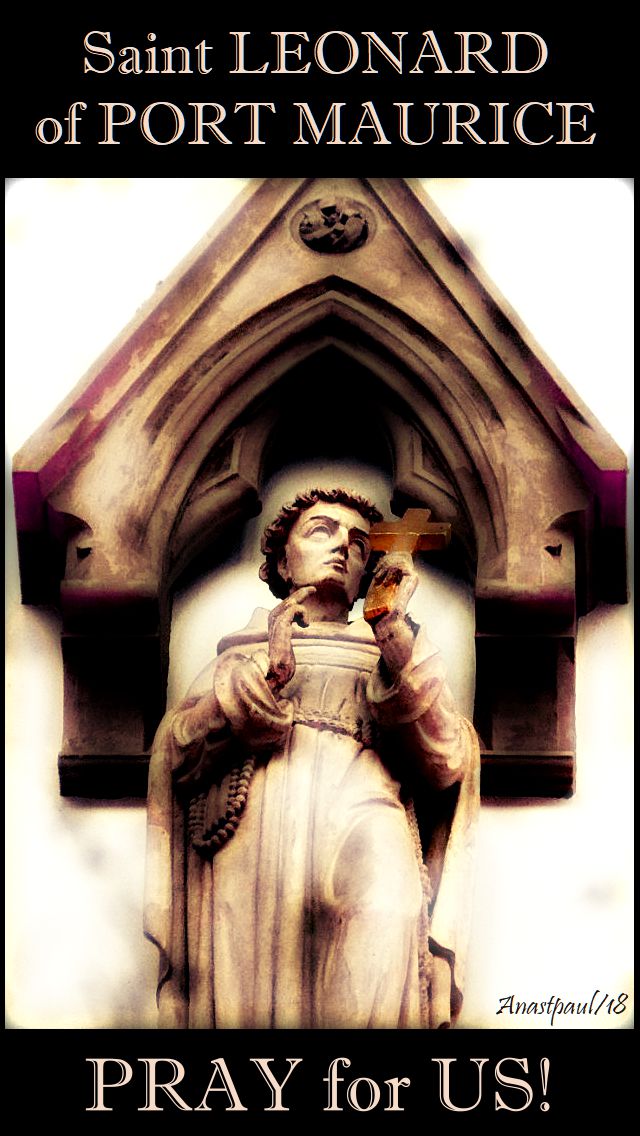
Thought for the Day – 27 November – The Little Number of Those Who Are Saved by St Leonard of Port Maurice OFM (1676-1751)

Thought for the Day – 27 November – The Little Number of Those Who Are Saved by St Leonard of Port Maurice OFM (1676-1751)

“Conclusion”
Brothers, I want to send all of you away comforted today.   So if you ask me my sentiment on the number of those who are saved, here it is:  Whether there are many or few that are saved, I say that whoever wants to be saved, will be saved and that no one can be damned if he does not want to be.   And if it is true that few are saved, it is because there are few who live well.   As for the rest, compare these two opinions – the first one states that the greater number of Catholics are condemned, the second one, on the contrary, pretends that the greater number of Catholics are saved.   Imagine an Angel sent by God to confirm the first opinion, coming to tell you that not only are most Catholics damned but that of all this assembly present here, one alone will be saved.   If you obey the Commandments of God, if you detest the corruption of this world, if you embrace the Cross of Jesus Christ in a spirit of penance, you will be that one alone who is saved.

Now imagine the same Angel returning to you and confirming the second opinion.   He tells you that not only are the greater portion of Catholics saved but that out of all this gathering, one alone will be damned and all the others saved.   If after that, you continue your usuries, your vengeances, your criminal deeds, your impurities, then you will be that one alone who is damned.

What is the use of knowing whether few or many are saved?   Saint Peter says to us, “Strive by good works to make your election sure.”   When Saint Thomas Aquinas’s sister asked him what she must do to go to heaven, he said, “You will be saved if you want to be.”   I say the same thing to you and here is proof of my declaration.   No one is damned unless he commits mortal sin – that is of faith.   And no one commits mortal sin unless he wants to – that is an undeniable theological proposition.   Therefore, no one goes to hell, unless he wants to – the consequence is obvious.   Does that not suffice to comfort you?

Weep over past sins, make a good confession, sin no more in the future and you will all be saved.   Why torment yourself so?   For it is certain, that you have to commit mortal sin to go to hell and that to commit mortal sin, you must want to and that consequently, no one goes to hell, unless he wants to.   That is not just an opinion, it is an undeniable and very comforting truth – may God give you to understand it and may He bless you.   Amen.”

The Little Number of Those Who Are Saved
by St Leonard of Port Maurice
Full Sermon here: https://www.olrl.org/snt_docs/fewness.shtml

St Leonard of Port Maurice, Pray for Us!st leonard of port maurice pray for us no 2 - 27nov2018

Posted in DIVINE Mercy, Goodness, Patience, DOCTORS of the Church, EUCHARISTIC Adoration, franciscan OFM, PRAYERS of the SAINTS, QUOTES of the SAINTS, QUOTES on DEATH, SAINT of the DAY, The HOLY EUCHARIST / The HOLY MASS

Quote/s of the Day – 27 November – The Memorial of St Leonard of Port Maurice OFM (1676-1751)

Quote/s of the Day – 27 November – The Memorial of St Leonard of Port Maurice OFM (1676-1751)

“What graces, gifts and virtues
the Holy Mass calls down!”

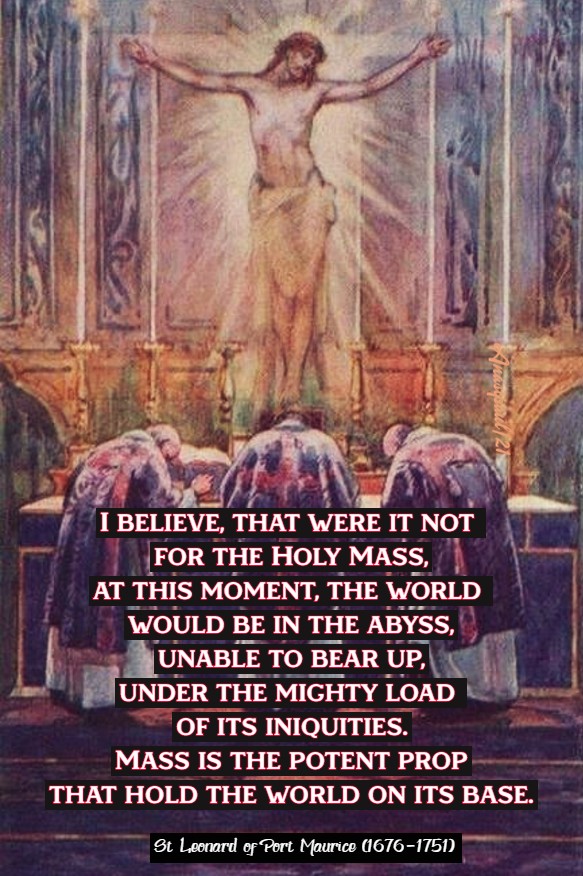
“I believe that were it not for the Holy Mass,
as this moment, the world would be in the abyss,
unable to bear up under the mighty load of its iniquities.
Mass is the potent prop that hold the world on its base.”

“If the Lord, at the moment of my death,
reproves me for being too kind to sinners,
I will answer, ‘My dear Jesus, if it is a fault
to be too kind to sinners, it is a fault
I learned from You, for You never scolded anyone
who came to You seeking mercy.'”if the Lord at the moment of my death - stleonardofportmaurice-27nov2918

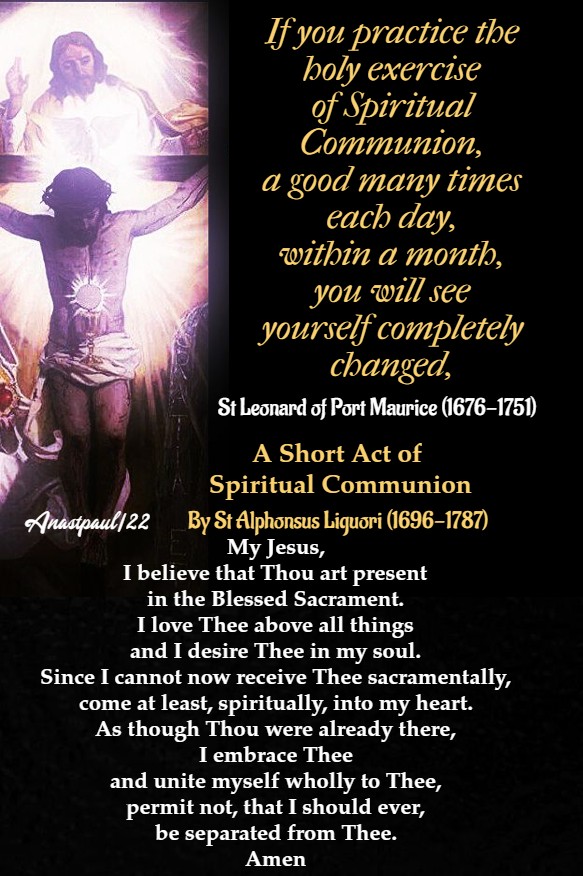
“If you practice the holy exercise
of Spiritual Communion,
a good many times each day,
within a month,
you will see yourself completely changed.”

St Leonard of Port Maurice OFM (1676-1751)

Act of Spiritual Communion
By St Alphonsus Liguori (1696-1787) Doctor of the Church

My Jesus,
I believe that You art present
in the Blessed Sacrament.
I love You above all things
and I desire You in my soul.
Since I cannot now receive You sacramentally,
come at least, spiritually, into my heart.
As though You were already there,
I embrace You
and unite myself wholly to You,
permit not, that I should ever,
be separated from You.
Amen

Posted in franciscan OFM, MORNING Prayers, PAPAL SERMONS, QUOTES on DEATH, SAINT of the DAY, The LAST THINGS, The WORD

One Minute Reflection – 27 November – Today’s Gospel: Luke 21:5–11

One Minute Reflection – 27 November – Today’s Gospel: Luke 21:5–11, Tuesday of the Thirty Fourth week in Ordinary Time, Year B and the Memorial of St Leonard of Port Maurice OFM (1676-1751)

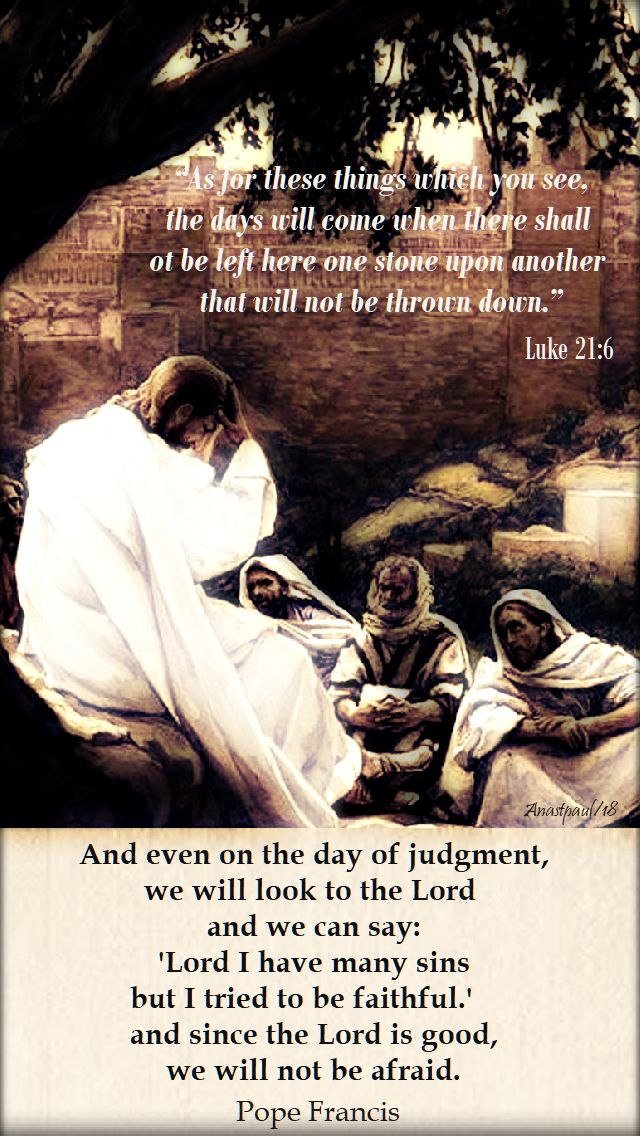
“As for these things which you see, the days will come when there shall not be left here one stone upon another that will not be thrown down.” …Luke 21:6

REFLECTION – ” Indeed, if each one of us is faithful to the Lord, when our death comes, as shall we say what St Francis said:  ‘sister death, come’.   It will not frighten us.   And even on the day of judgement, we will look to the Lord and we can say:  ‘Lord I have many sins but I tried to be faithful.’   And since the Lord is good, we will not be afraid.”…Pope Francis – Santa Marta, 22 November 2016luke 21 6 as for these things which you see the day will come - andevenonthedayofjudgment -pope francis - 26nov2018

PRAYER – True Light of the world, Lord Jesus Christ, as You enlighten all men for their salvation, give us grace, we pray, to herald Your coming, by preparing the ways of justice, love and peace.   Grant us the assistance of the intercession of St Leonard of Port Maurice, who so diligently worked to bring Your good news to all.   Let his example be an inspiration in our lives.   Lord Jesus Christ who live and reign with the Father and the Holy Spirit, God, forever, amen.st leonard of port maurice pray for us - 27 nov 2018

Posted in CATHOLIC-PRAYERS OF THE CHURCH, MARIAN PRAYERS, MARIAN TITLES, Our MORNING Offering, PRAYERS of the CHURCH, SAINT of the DAY, The BLESSED VIRGIN MARY

Our Morning Offering – 27 November – The Memorial of The Medal of the Immaculate Conception/Our Lady of the Miraculous Medal

Our Morning Offering – 27 November – The Memorial of The Medal of the Immaculate Conception/Our Lady of the Miraculous Medal

Prayer to Our Lady of the Miraculous Medal

Virgin Mother of God, Mary Immaculate,
we unite ourselves to you
under your title of Blessed Mother,
Our Lady of the Miraculous Medal.
May this medal be for each one of us
a sure sign of your motherly affection for us and a
constant reminder of our filial duties towards you.
While wearing it, may we be blessed
by your loving protection
and preserved in the grace of your Son.
Most powerful Virgin, Mother of our Saviour,
keep us close to you every moment of our lives
so that like you, we may live and act
according to the teaching and example of your Son.
Obtain for us, your children,
the grace of a happy death
so that in union with you we may enjoy
the happiness of heaven forever.
Amen
O Mary, conceived without sin,
pray for us who have recourse to you.prayer to our lady of the miraculous medal - 2- 27 nov 2018

Posted in franciscan OFM, MISSIONS, MISSIONARIES, PREACHERS, SAINT of the DAY

Saint of the Day – 27 November – St Leonard of Port Maurice OFM (1676-1751)

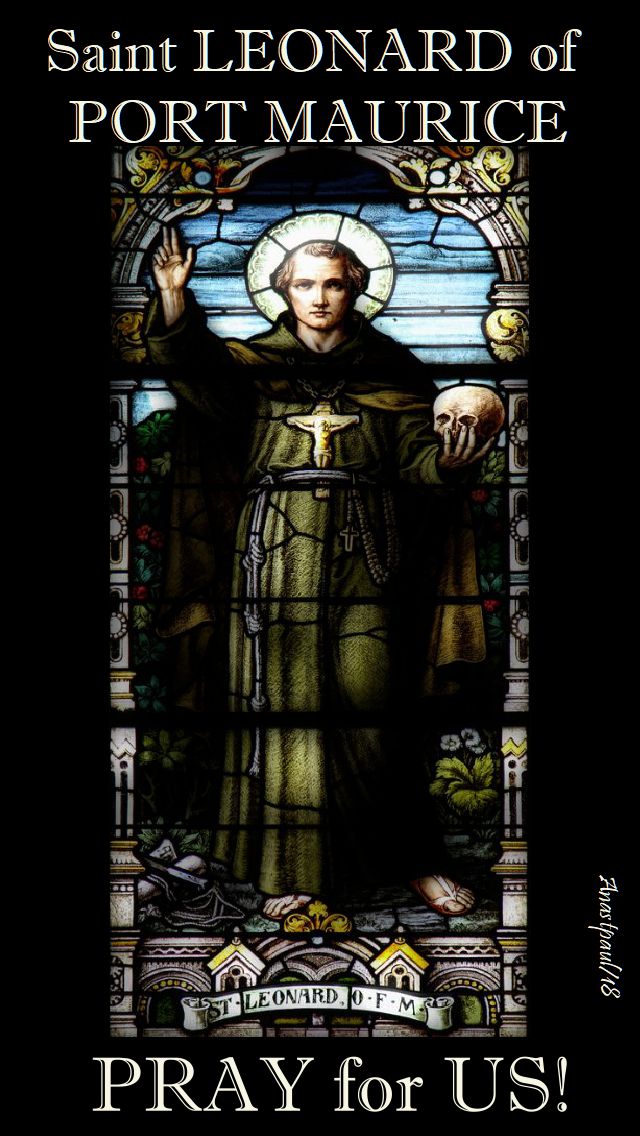
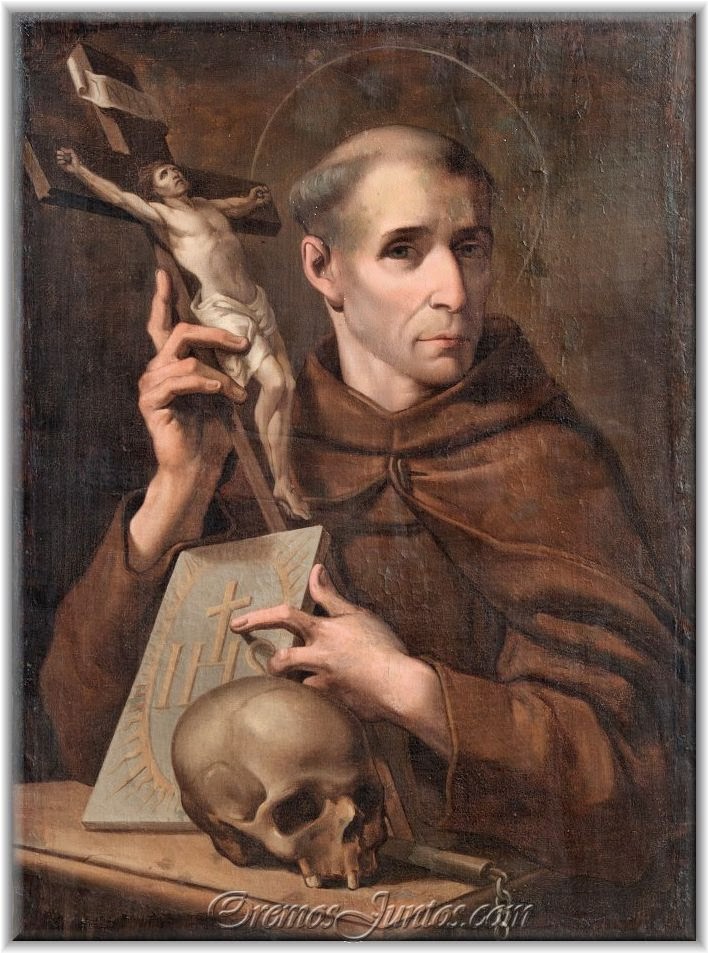
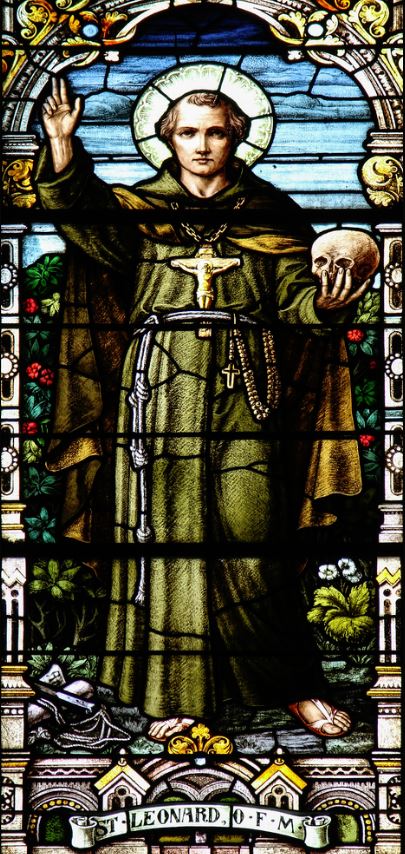
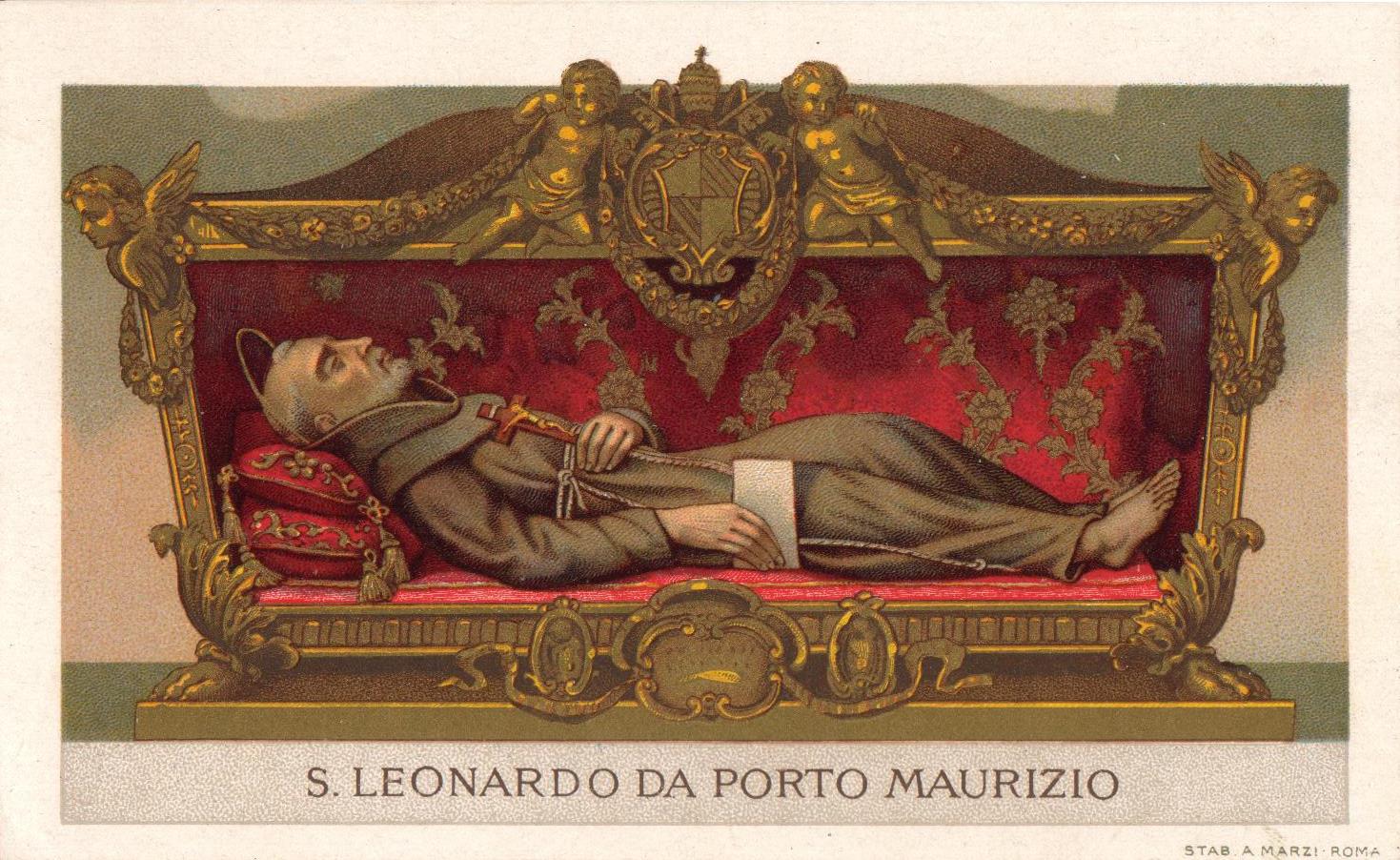
Saint of the Day – 27 November – St Leonard of Port Maurice OFM (1676-1751) – Born on 20 December 1676 at Porto Maurizio, Italy on the Riviera di Ponente as Paul Jerome Casanova and died at 11:00 pm on 26 November 1751 at the Monastery of Saint Bonaventura, Rome, Italy.    Franciscan Friar, Priest, Preacher – in particular Parish Mission Preacher, ascetic Writer, Spiritual Director.   His Memorial is celebrated in the universal calendar, today, 26 November.  St Leonard founded many pious societies and confraternities and exerted himself to spread devotion to the Sacred Heart of Jesus, the Perpetual Adoration of the Most Blessed Sacrament, the Blessed Virgin Mary and the Passion of Christ.   He was among the few to insist that the concept of the Immaculate Conception of Mary be defined as a Dogma of the Faith.   Patronages – Missionaries, Preachers, Imperia, Italy. header-San Leonardo de Puerto-Maurizio-26

Leonard was born in 1676 in Port Maurice, on the cost of northern Italy.   His father was a ship captain.   Because he was a gifted student, he was sent to Rome when he was 13 to live with his uncle while attending the Jesuits’ Roman College.   His family wanted him to become a doctor but after completing his studies, Leonard decided to become a Franciscan friar.   He hoped he could become a missionary to China.st leonard glass

After ordination, Leonard became seriously ill with a bleeding ulcer and was sent home.  No one knew if he would recover.   Leonard promised God that if he did get well, he would devote his life to the missions and to helping sinners change their lives.   It took more than four years but Leonard regained his health and began 40 years of mission work.   Surprisingly, he did not become a missionary in foreign lands.   He became a missionary to the people of his own country.S_Leonardo

Leonard travelled throughout Italy, preaching at parish missions and retreats.   He would often spend two or three weeks in a parish before moving on.   That gave him time to celebrate the Sacrament of Reconciliation with all who wanted to confess their sins and receive God’s forgiveness.   Leonard thought this was the most important part of his ministry.   It was a sign that through his preaching, the Holy Spirit had inspired people to transform their lives and begin to live as followers to Jesus.    St Alphonsus Liguori (1696-1787), called Leonard “the great missionary of the 18th century.”san-leonardo-di-artallo-208157.2.2

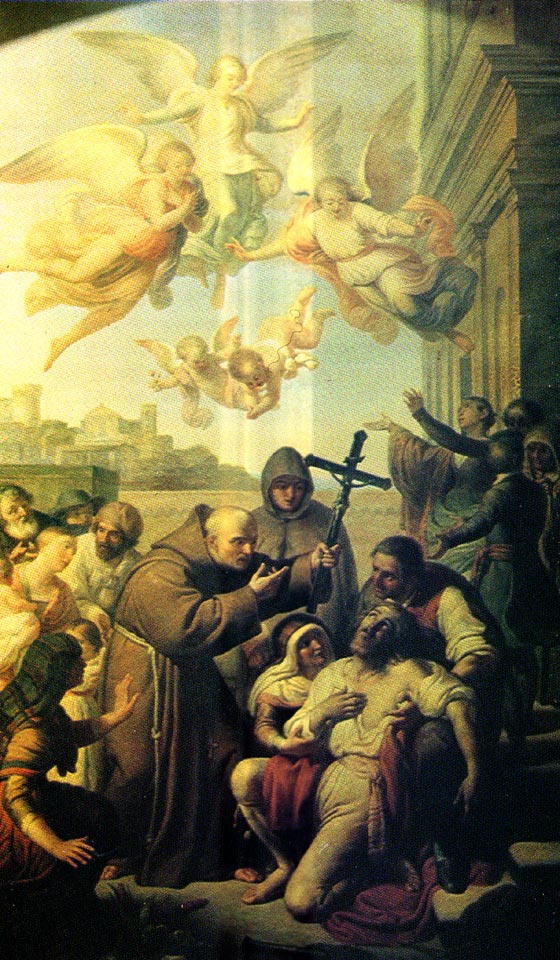
Everywhere the saint made conversions and was very often obliged both in cities and country districts to preach in the open, as the churches could not contain the thousands who came to listen.   Pope Clement XII and Pope Benedict XIV called him to Rome;  the latter especially held him in high esteem both as a preacher and as a propagandist and exacted a promise that he would come to Rome to die.   Pope Benedict XIV appointed him to several complex diplomatic assignments.   In Genoa and Corsica, in Lucca and Spoleto the citizens expected a jewelled cardinal to represent the intentions of the pope.   Instead, they were confronted by a humble, shoeless, muddy friar to confound their hostility and pride.st leonard preaching in corsica

Leonard had a great devotion to the Stations of the Cross.   He believed that praying the Stations would help people better understand that through His Passion and Death, Jesus showed His great love for us.   By this Franciscan saint’s work, almost 600 sets of the Stations of the Cross were erected throughout Italy, most of them in the parishes where he had preached and even one at the Colosseum in Rome, which to this day are used by the Holy Father during Lent and especially on Good Friday.   They were a lasting reminder to the people, of Jesus’ sacrifice on the cross and they encouraged people to stay close to Jesus through prayer.12_11_26_leonard_port_maurice

St Leonard died in Rome in 1751 at the age of 75.   He was Canonised in 1867 and in 1923 he was named the patron saint of parish mission preachers.   His ministry reminds us that Jesus is always calling us to grow in our love for Him and our brothers and sisters. When we think about Jesus’ Death on the Cross, we can remember all people who suffer in their daily journeys.   We can reach out to and pray for the hungry, the homeless, the unborn, the elderly and the neglected people of our world.leonard

Posted in MARIAN DEVOTIONS, MARIAN TITLES, SAINT of the DAY, The BLESSED VIRGIN MARY

Memorial of Our Lady of the Miraculous Medal/The Medal of the Immaculate Conception & Memorials of the Saints – 27 November

Memorial of Our Lady of the Miraculous Medal/The Medal of the Immaculate Conception (the correct title is the latter) :
27 November is the Feast of Our Lady of the Miraculous Medal and is celebrated by it’s own Mass in Some Places.our lady of the MM
The Miraculous Medal is a devotion to the Virgin Mary called the “Miraculous” Medal for the many miracles associated with those that wear it. It is one of my favorite medals to wear.
The Miraculous Medal came to the world through an Apparition of the Virgin Mary to Catherine Labouré in Paris, France in 1830.   In Mary’s second apparition, she asked that “a medal should be struck in this image.   The people wearing it will receive my indulgence and those who piously say this short prayer will enjoy my very special protection”.
Two of the most famous conversions due to the miraculous medal was that of Fr Alphonse Ratisbonne NDS (1814-1884), an anti-Catholic Jewish banker and Claude Newman (1923-1944).   He received a vision of Our Lady of the Miraculous Medal. After his conversion, he became a priest and worked for the conversion of the Jewish people.

St Acacius of Sebaste
St Acharius of Noyon
St Apollinaris of Monte Cassino
St Barlaam
Bl Bernardine of Fossa
St Bilhild of Altmünster
Bl Bronislao Kostkowski
St Eusician
St Facundus
St Fergus the Pict
St Gallgo of Wales
St Gulstan
St Hirenarchus of Sebaste
St James Intercisus
St John Angeloptes
St John of Pavia
St Josaphat
Bl José Pérez González
Bl Juan Antonio de Bengoa Larriñaga
St Laverius
St Leonard of Port Maurice OFM (1676-1751)

St Maximus of Reiz
St Primitivus of Sahagun
St Secundinus of Ireland
St Severinus the Hermit
St Siffred of Carpentras
St Valerian of Aquileia
St Virgilius of Salzburg
—
Martyrs of Antioch – (3 saints): A group of Christians martyred together for their faith. Little information has survived except for their names – Auxilius, Basileus and Saturninus.

Martyrs of Nagasaki – (11 beati): A group of eleven Christians martyred together for their faith during a period of official persecution in Japan. They are:
• Blessed Alexius Nakamura
• Blessed Antonius Kimura
• Blessed Bartholomaeus Seki
• Blessed Ioannes Iwanaga
• Blessed Ioannes Motoyama
• Blessed Leo Nakanishi
• Blessed Matthias Kozasa
• Blessed Matthias Nakano
• Blessed Michaël Takeshita
• Blessed Romanus Motoyama Myotaro
• Blessed Thomas Koteda Kyumi
They were martyred on 27 November 1619 in Nagasaki, Japan and Beatified on 7 May 1867 by Pope Pius IX.

Martyred in the Spanish Civil War:
• Blessed Bartolomé Gelabert Pericás
• Blessed Eduardo Camps Vasallo
• Blessed José Pérez González
• Blessed Juan Antonio de Bengoa Larriñaga
• Blessed Miguel Aguado Camarillo
• Blessed Pedro Armendáriz Zabaleta

Posted in SAINT of the DAY

Saint of the Day – 26 November – St Peter of Alexandria (Died 311) Martyr “The Seal of the Martyrs”

Saint of the Day – 26 November – St Peter of Alexandria (Died 311) Martyr “The Seal of the Martyrs” Bishop of Alexandria.   Tradition attests that the Egyptian Bishop, St Peter, was the last believer to suffer death at the hands of Roman imperial authorities for his faith in Christ.   For this reason, St. Peter of Alexandria is known as the “Seal of the Martyrs.”   He is said to have undertaken severe penances for the sake of the suffering Church during his lifetime and written letters of encouragement to those in prison, before going to his death at the close of the “era of the martyrs.”Alexandria_26November

Both the date of Peter’s birth and of his ordination as a priest, are unknown.   It is clear, however, that he was chosen to lead Egypt’s main Catholic community in the year 300 after the death of Saint Theonas of Alexandria.   He may have previously been in charge of Alexandria’s well-known catechetical school, an important centre of religious instruction in the early Church.   Peter’s own theological writings were cited in a later fifth-century dispute over Christ’s divinity and humanity.

In 302, the Emperor Diocletian and his subordinate Maximian attempted to wipe out the Church in the territories of the Roman Empire.   They used their authority to destroy Church properties, imprison and torture believers and eventually kill those who refused to take part in pagan ceremonies.   As the Bishop of Alexandria, Peter offered spiritual support to those who faced these penalties, encouraging them to hold to their faith without compromise.

One acute problem for the Church during this period was the situation of the “lapsed.” These were Catholics who had violated their faith by participating in pagan rites under coercion but who later repented and sought to be reconciled to the Church.   Peter issued canonical directions for addressing their various situations and these guidelines became an important part of the Eastern Christian tradition for centuries afterwards.

Around the year 306, Peter led a council that deposed Bishop Meletius of Lycopolis, a member of the Catholic hierarchy who had allegedly offered sacrifice to a pagan idol. Peter left his diocese for reasons of safety during some portions of the persecution, giving Meletius an opening to set himself up as his rival and lead a schismatic church in the area.

The “Meletian schism” would continue to trouble the Church for years after the death of Alexandria’s legitimate bishop. Saint Athanasius, who led the Alexandrian Church during a later period in the fourth century, claimed that Meletius personally betrayed Peter of Alexandria to the state authorities during the Diocletian persecution.

Although Diocletian himself chose to resign his rule in in 305, persecution continued under Maximinus Daia, who assumed leadership of the Roman Empire’s eastern half in 310.   The early Church historian Eusebius attests that Maximinus, during an imperial visit to Alexandria, unexpectedly ordered its bishop to be seized and killed without imprisonment or trial in 311.   Three priests – Faustus, Dio, and Ammonius – were reportedly beheaded along with him.

St Peter of Alexandria’s entry in the “History of the Patriarchs of the Coptic Church of Alexandria” (a volume first compiled by a Coptic Orthodox bishop in the 10th century) concludes with a description of the aftermath of his death –

“And the city was in confusion, and was greatly disturbed, when the people beheld this martyr of the Lord Christ.   Then the chief men of the city came and wrapped his body in the leathern mat on which he used to sleep and they took him to the church … And, when the liturgy had been performed, they buried him with the fathers.   May his prayers be with us and all those that are baptised!”Clement-Peter

Posted in SAINT of the DAY

Memorials of the Saints – 26 November

Bl Albert of Haigerloch
St Alypius Stylites
St Amator of Autun
St Basolus of Verzy
St Bellinus of Padua
St Bertger of Herzfeld
St Conrad of Constance
St Ðaminh Nguyen Van Xuyên
Bl Delphine of Glandèves
St Egelwine of Athelney
Bl Gaetana Sterni
Bl Giacomo Alberione
Bl Hugh Taylor
St Humilis of Bisignano
St Ida of Cologne
St James the Hermit
St Peter of Alexandria (Died 311) Martyr
St Magnance of Ste-Magnance
St Marcellus of Nicomedia
Bl Marmaduke Bowes
St Martin of Arades
St Nicon of Sparta
Bl Pontius of Faucigny
St Sabaudus of Trier
St Siricius, Pope
St Stylianus
St Sylvester Gozzolini
St Tôma Ðinh Viet Du
St Vacz
—
Martyrs of Alexandria – 7+ saints: A group of approximately 650 Christian priests, bishops and laity martyred together in the persecution of Maximian Galerius. We have the names and a few details only seven of them – Ammonius, Didius, Faustus, Hesychius, Pachomius, Phileas and Theodore. The were born in Egypt and were martyred there in c 311 in Alexandria, Egypt.

Martyrs of Capua – 7 saints: A group of seven Christians martyred together. The only details about them to survive are the names – Ammonius, Cassianus, Felicissimus, Nicander, Romana, Saturnin and Serenus. They were martyred in Capua, Campania, Italy, date unknown.

Martyrs of Nicomedia – 6 saints: A group of six orthodox Christians martyred by Arians. Few details have survived except their names – Marcellus, Melisus, Numerius, Peter, Serenusa and Victorinus. Martyred in
349 in Nicomedia, Bithynia, Asia Minor (modern Izmit, Turkey).

Posted in CHRIST the KING, MORNING Prayers, PAPAL SERMONS, QUOTES of the SAINTS, SAINT of the DAY, Thomas a Kempis

Thought for the Day – 25 November – The Solemnity of Our Lord Jesus Christ, King of the Universe

Thought for the Day – 25 November – The Solemnity of Our Lord Jesus Christ, King of the Universe

Jesus Christ

You have heard Him spoken of, indeed the greater part of you are already His – you are Christians.

So, to you Christians I repeat His name, to everyone I proclaim Him –

Jesus Christ is the beginning and the end,

the Alpha and the Omega.

He is the king of the new world.

He is the secret of history.

He is the key to our destiny

St Pope Paul VI (1897-1978) 

Homily delivered in Manila, 29 November 1970so to you christians i repeat his name - st popepaul VI - no 2- 25 nov christ the king 2018

“Follow Me. I am the Way, the Truth and the Life. 
Without the Way, there is no going. 
Without the Truth, there is no knowing. 
Without the Life, there is no living. 
I am the Way, which you must follow, 
the Truth, which you must believe, 
the Life, for which you must hope. 
I am the inviolable Way, 
the infallible Truth, 
the unending Life. 
I am the Way that is straight, 
the supreme Truth, 
the Life that is true, 
the blessed, the uncreated Life. 
If you abide in My Way, you shall know the Truth
and the Truth shall make you free
and you shall attain life everlasting.”

Thomas à Kempisfollow-me-the-imitation-of-christ-for-lent-12-feb-2018

Posted in CHRIST the KING, DOCTORS of the Church, FATHERS of the Church, FEASTS and SOLEMNITIES, GOD the FATHER, MARIAN QUOTES, MORNING Prayers, QUOTES of the SAINTS, QUOTES on REPENTANCE, QUOTES on SANCTITY, QUOTES on SIN, SAINT of the DAY, The BLESSED VIRGIN MARY

Quote/s of the Day 25 November – The Solemnity of Our Lord Jesus Christ, King of the Universe

Quote/s of the Day 25 November – The Solemnity of Our Lord Jesus Christ, King of the Universe

“Hers was the happiness of first bearing in her womb
Him whom she would obey as her master.”

St Augustine (354-430) Father & Doctor of the Churchhers was the happiness - st augustine 25 nov - christ the king 2018

“The kingdom of God, in the words of our Lord and Saviour,
does not come for all to see; nor shall they say:
Behold, here it is, or behold, there it is;
but the kingdom of God is within us,
for the word of God is very near, in our mouth and in our heart.
Thus it is clear that he who prays for the coming of God’s kingdom,
prays rightly to have it within himself,
that there it might grow and bear fruit and become perfect.
For God reigns in each of his holy ones.
Anyone who is holy obeys the spiritual laws of God,
who dwells in Him as in a well-ordered city.
The Father is present in the perfect soul
and with Him Christ reigns, according to the words:
We shall come to him and make our home with him.”but the kingdom of god is within us - origen - 25 nov christ the king 2018

“The kingdom of God cannot exist alongside the reign of sin.
Therefore, if we wish God to reign in us,
in no way should sin reign in our mortal body;
rather we should mortify our members which are upon the earth
and bear fruit in the Spirit.
There should be in us a kind of spiritual paradise where God may walk
and be our sole ruler with His Christ.
In us the Lord will sit at the right hand of that spiritual power
which we wish to receive.
And He will sit there until all His enemies,
who are within u,. become His footstool
and every principality, power and virtue in us is cast out.”

Origen (c185-253) Father of the Churchtherefore if we wish god to reign in us - origen - 25 nov chirst the king 2018

“The Word of God, as consubstantial with the Father,
has all things in common with Him and, therefore,
has necessarily supreme and absolute dominion,
over all things created.”

St Cyril of Alexandria (376-444) Father & Doctor of the Churchthe word of god - st cyril of alexandria - 25 nov christ the king 2018

Posted in CHRIST the KING, FEASTS and SOLEMNITIES, MORNING Prayers, PAPAL SERMONS, SAINT of the DAY, The SIGN of the CROSS

One Minute Reflection – 25 November – The Solemnity of Our Lord Jesus Christ, King of the Universe

One Minute Reflection – 25 November – Today’s Gospel: John 18:33–37 – The Solemnity of Our Lord Jesus Christ, King of the Universe

“You say that I am a king.   For this I was born and for this I have come into the world, to bear witness to the truth.   Everyone who is of the truth hears my voice.”...John 18:37

REFLECTION – “But what is the “truth” that Christ came into the world to witness to?   The whole of His life reveals that God is love – so this is the truth to which He witnessed to the full, with the sacrifice of His own life on Calvary.
The Cross is the “throne” where He manifested His sublime kingship as God Love, by offering Himself in expiation for the sin of the world, He defeated the “ruler of this world” (Jn 12: 31) and established the Kingdom of God once and for all.   It is a Kingdom that will be fully revealed at the end of time, after the destruction of every enemy and last of all, death (cf. I Cor 15: 25-26).   The Son will then deliver the Kingdom to the Father and God will finally be “everything to everyone” (I Cor 15: 28).
The way to reach this goal is long and admits of no short cut, indeed, every person must freely accept the truth of God’s love.   He is Love and Truth and neither Love nor Truth are ever imposed, they come knocking at the doors of the heart and the mind and where they can enter they bring peace and joy.   This is how God reigns, this is His project of salvation, a “mystery” in the biblical sense of the word, a plan that is gradually revealed in history.”….Pope Benedict XVI 26 November 2006john 18 37 - for this i was born - but what is this truth - pope benedict - 25 nov 2018 - christ the king

“When did Jesus reveal Himself as king?   In the event of the Cross!   Those who look at the Cross cannot but see the astonishing gratuitousness of love.   One of you could say, “Father, that was a failure!”.   It is precisely in the failure of sin — sin is a failure — in the failure of human ambitions – the triumph of the Cross is there, the gratuitousness of love is there.   In the failure of the Cross, love is seen, a love that is gratuitous, which Jesus gives us.”…Pope Francis – Angelus, 22 November 2015when did jesus reveal himself as king - pope francis - 25 nov 2018 christ the king no 2

PRAYER – Lord God, You gave the peoples of the world as the inheritance of Your only Son;  You crowned Him as King of Zion, Your holy city and gave Him Your Church to be His Bride.   As He proclaims the law of Your eternal kingdom, may we serve Him faithfully and so share His royal power forever.   We make our prayer, through Him and with Him and in Him, our King and our Redeemer, with the Holy Spirit, God forever, amen.our lord jesus christ king of the universe - 25 nov 2018.no 2