Posted in franciscan OFM, INCORRUPTIBLES, SAINT of the DAY

Saint of the Day – 30 October – Blessed Angelo of Acri OFM Cap

Saint of the Day – 30 October – Blessed Angelo of Acri OFM Cap – Priest of the Franciscan Capuchins, Confessor, Preacher, Missionary, Evangeliser, Miracle-Worker, Apostle of Charity and Mercy to the sick, Mystic with the gifts of prophecy, bi-location, visions and the ability to see into men’s souls in Confession.   St Angelo was born on 19 October 1669 at Acri, Cosenza, Italy and died on 30 October 1739 at the Friary of Acri, Consenza, Italy. header st angelo

Luca Antonio Falcone was born in Acri, then a small town at the foot of the Sila mountainous plateau, in the heart of the of the old Casalicchio neighborhood, to a family of humble means.   Of this, he was always proud and in later years would recall in his conversations with the nobility, that he was the son of a baker and a goatherd. ,,He was baptised in the church of St Nicholas the day after he was born.

Having learned to read and write from a neighbour who had opened a sort of elementary school, he was also taught the fundamentals of Christian doctrine by frequenting the parish of St Nicholas and the friary church of the Capuchins, St Mary of the Angels.   As he grew up, an uncle who was a priest, his mother’s brother Fr Domenico Errico, put him to study in the hope of making of him a learned and cultivated person, able to be of assistance to his mother, who had been widowed at a young age.

As he turned twenty, after a brief experience of the eremitical life, Luca Antonio turned to consecrate himself among the Capuchins, casting aside all doubts in 1689 after hearing the charismatic preaching of the Capuchin Antonio of Olivadi.   But the young man soon faced a sort of obstacle course;  twice he put aside the religious habit and left the novitiate, discouraged by the austerity of Capuchin life and giving into how much he missed his mother, whom he had left in tears.   But on the third time, on 12 November 1690, Luca Antonio began the novitiate in the friary of Belvedere Marittimo with the name Angelo of Acri.

This time too, the second thoughts and temptations were not lacking but during the reading of the heroic deeds of Br Bernard of Corleone († 1667), whose cause for beatification was taking place at the time, Br Angelo lifted up a deep prayer to the Lord, asking for help in his struggle.   It is said that the young novice was encouraged by the Lord, who showed him that he should follow in the footsteps of Br Bernard, behaving just as he did.   It was the awaited sign.

Making profession of vows on 12 November 1691, Br Angelo set himself on the way of evangelical perfection, preparing himself also for priestly ordination, which he received in the cathedral of Cassano all’Ionio at Easter, 10 April 1700.   He was then called by obedience to prepare himself to be a preacher.   From 1702 until his death in 1739, he travelled tirelessly through all of Calabria and much of central Italy preaching Lenten sermons, retreats and popular missions.angelus of acri

The beginning of his preaching ministry was not very glorious – his debut in the pulpit of San Giorgio Albanese, near Corigliano Calabro, was a real failure.   For three consecutive evenings he was unable to remember the text which he had studiously committed to memory and, finding himself unable to continue to preach in some other way, could only go away in disappointment.

In tears before the crucifix in his cell, Br Angelo took stock of his failure and reached an irrevocable decision:  from then on he would preach, “Christ crucified and naked, far from esoteric rhetoric and also from the uneasiness of the Tuscan language but only in his native dialect,” repeating “step by step” what the Holy Spirit would suggest to him, as his heart was thus inflamed with zeal and spiritual unction.   And in this he was a success!cell of st angelo

Aware, however, that the preacher who does not also hear confessions is like a sower who does not think of the harvest, Angelo of Acri spent many hours in the confessional, never tiring of listening and of treating sinners with mercy.   He was convinced that the most difficult situations could be resolved with charity and that mercy was the easiest way to lead back to God the sinners that divine love had drawn to kneel at his confessional.   But he didn’t just wait for them; many times the love of God pushed him to seek out sinners in need of reconciliation, just as he was also solicitous for the sick who asked for his spiritual assistance.

Angelo’s love for the poor and those who suffered injustice moved him many times to call the Sanseverino family, for centuries the great nobles of Acri, to listen to the justified claims of the people such that their basic rights would be respected.   He had at heart the salvation of the whole person, of both the spiritually and materially poor, of those denied their dignity and those who distanced themselves from God.

He never left the place where he had preached the mercy of God and reconciled sinners without leaving some concrete signs: an image of Calvary and a statue of Our Lady of Sorrows as tangible reminders of the Love of God that suffers and offers itself that humanity might have Life.beato_angelo_-Acri

Angelo also had roles of authority in the Order and as Provincial Minister he did not fail to recall the friars to an authentic Capuchin life, offering them five precious gems: austerity, simplicity, the exact observance of the Constitutions and the Rule, innocence of life and boundless charity.

At the age of seventy, Angelo died in the friary of Acri, offering his life that God would lavish on the city and on all of Calabria, the greatest of gifts, those of peace and well-being for all.

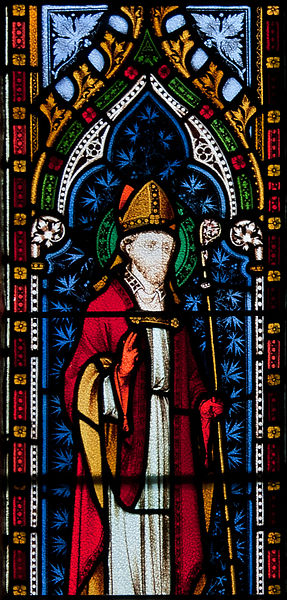
He was Beatified on 18 December 1825 by Pope Leo XII.    His body is incorrupt and is enshrined in in the Basilica dedicated to him in Acri.   His face is covered by a wax mask.

st angelo statue at acri basilicast angelo of acri

Posted in SAINT of the DAY

Memorials of the Saints – 30 October

St Angelo of Acri OFM Cap (1669-1739)

St Arilda
St Asterius of Amasea
Bl Benvenuta Bojani
St Egelnoth the Good
St Eutropia of North Africa
St Gerard of Potenza
St Germanus of Capua
St Herbert of Tours
Bl Jean-Michel Langevin
Bl John Slade
St Lucanus of Lagny
St Marcellus the Centurion
St Marcian of Syracuse
St Maximus of Cumae
St Nanterius of Saint-Mihiel
Bl Oleksa Zarytsky (1912-1963) Martyr
Bl Raymond of Cardona
St Saturninus of Cagliari
St Serapion of Antioch
St Talarica of Scotland
Bl Terrence Albert O’Brien
St Theonestus of Philippi
St Zenobia of Aegea
St Zenobius of Aegea

Martyrs in Africa: A group of 100 to 200 Christians murdered in the early persecutions, and about whom we know nothing except that they died for their faith.

Posted in CONFESSION/PENANCE, DIVINE Mercy, Goodness, Patience, EUCHARISTIC Adoration, MORNING Prayers, PAPAL SERMONS, PRACTISING CATHOLIC, QUOTES of the SAINTS, QUOTES on MERCY, SAINT of the DAY

Thought for the Day – 29 October – The Memorial of St Gaetano Errico (1791-1860)

Thought for the Day – 29 October – The Memorial of St Gaetano Errico (1791-1860), Founder of the Missionaries of the Sacred Hearts of Jesus and Mary

Day by day, city to city, village to village, among both the poorest and those of high esteem, he saw the hunger each possessed to know that sin was forgiven, that God’s mercy was infinite and that they were loved.   Countless souls found a merciful listener, the embodiment of God’s promise of peace and renewal, in Fr Gaetano, in the Confessional.

“The priest, Gaetano Errico, dedicated himself to this sacrament with diligence, assiduity and patience, never refusing it nor counting the cost. He thus entered among the group of other extraordinary priests who tirelessly made the confessional a place to dispense God’s mercy, helping men to rediscover themselves, to fight against sin and make progress in the spiritual life.

The street and the confessional were the two particular places of Gaetano Errico’s pastoral work.   The street was the place that permitted him to offer his customary invitation:  “God loves you, when shall we meet?” and in the confession he made their encounter with the mercy of the heavenly Father possible.   How many wounded souls did he heal in this way! How many people did he help to be reconciled with God through the sacrament of forgiveness!

In this way St. Gaetano Errico became an expert in the “science” of forgiveness, and concerned himself with teaching it to his missionaries:   “God, who does not wish the death of the sinner, is always more merciful than his ministers;  so be as merciful as you can and you will find mercy with God!”

Pope Benedict XVI, Homily at Canonisation Mass, October 2008

He found his own encouragement on his knees in prayer . . . indeed it was prayer and the hours he spent in adoration of the Blessed Sacrament that strengthened and renewed him and kept the fire of his love for God ever burning.

Let us rediscover the great grace of the Confessional and the immense joy of Eucharistic Adoration for ourselves!

St Gaetano Errico, Pray for Us!god who does not wish the death of a sinner - st gaetano errico pray for us no 2 - 29 oct 2018

Posted in QUOTES of the SAINTS, SACRED and IMMACULATE HEARTS, SAINT of the DAY, Uncategorized

Quote of the Day – 29 October – The Memorial of St Gaetano Errico (1791-1860)

Quote of the Day – 29 October – The Memorial of St Gaetano Errico (1791-1860), Founder of the Missionaries of the Sacred Hearts of Jesus and Mary

“Let us toil, to the loss of everything,
not excluding life, if necessary,
to make known to all people,
the most ardent love of the Sacred Hearts
and to kindle this holy
and divine love, in the hearts of humanity.”
(From the Rule)

St Gaetano Errico (1791-1860)let us toil to the loss of everything - st gaetano errico - 29 oct 2018

Posted in DOCTORS of the Church, FATHERS of the Church, MORNING Prayers, QUOTES of the SAINTS, QUOTES on CONVERSION, QUOTES on FAITH, SAINT of the DAY, The WORD

One Minute Reflection – 29 October – Today’s Gospel: Luke 13:10-17

One Minute Reflection – 29 October – Today’s Gospel: Luke 13:10-17 – Monday of the Thirtieth week in Ordinary Time, Year B and the Memorial of St Gaetano Errico (1791-1860)

” And ought not this woman, a daughter of Abraham whom Satan bound for eighteen years, be loosed from this bond on the sabbath day?”…Luke 13:16

REFLECTION – “The whole human race, like this woman, was bent over and bowed down to the ground.   Someone already understands these enemies.   He cries out against them and says to God, “They have bowed my soul down.”   The devil and his angels have bowed the souls of men and women down to the ground.   He has bent them forward to be intent on temporary and earthly things and has stopped them from seeking the things that are above.
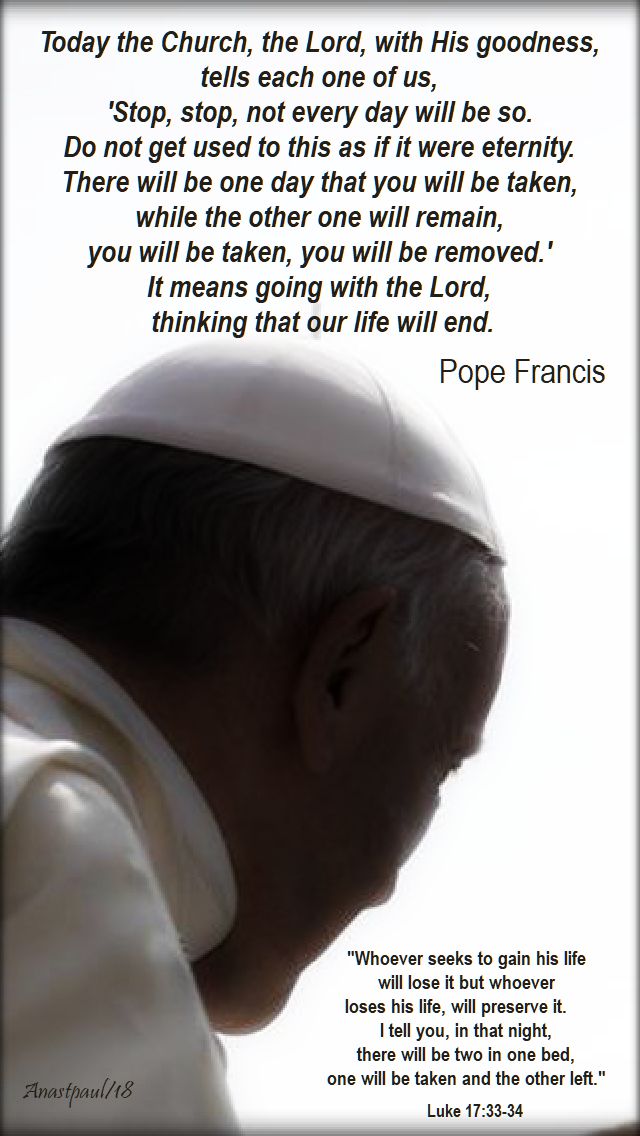
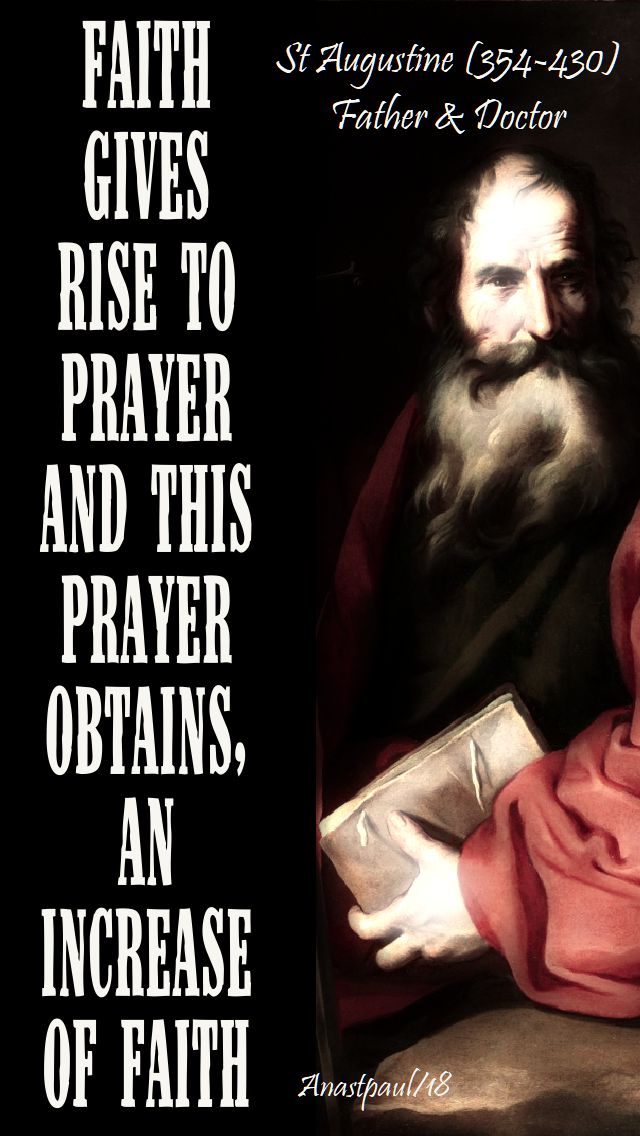
Since that is what the Lord says about the woman whom Satan had bound for eighteen years, it was now time for her to be released from her bondage on the sabbath day.  Quite unjustly, they criticised Him for straightening her up.   Who were these, except people bent over themselves?   Since they quite failed to understand the very things God had commanded, they regarded them with earthbound hearts.   They used to celebrate the sacrament of the sabbath in a literal, material manner and did not notice its spiritual meaning.” … St Augustine (354-430) Father & Doctor (Sermon 162)and out not this woman, a daughter of abraham luke 13 16 the whole human race like this woman was bent over- st augustine 29 oct 2018
PRAYER – Almighty Lord and God, protect us by Your power throughout the course of this day, even as You have enabled us to begin it – do not let us turn aside to any sin but, let our every thought, word and deed aim at doing what is pleasing in Your sight.   Grant we pray, that by the prayers of St Gaetano Errico, we may strive to seek only to please the Sacred Heart of Your Son and the loving Heart of His Mother.   Through Jesus our Lord, Your Son, with the Holy Spirit, God forever, amen.st gaetano errico pray for us 29 oct 2018
Posted in Our MORNING Offering, PRAYERS for VARIOUS NEEDS, PRAYERS of the SAINTS, SACRED and IMMACULATE HEARTS, SAINT of the DAY

Our Morning Offering – 29 October

Our Morning Offering – 29 October – The Memorial of St Gaetano Errico (1791-1860), Founder of the Missionaries of the Sacred Hearts of Jesus and Mary

Prayer to the Two Loving Hearts
By St John Eudes (1501-1680)

O Jesus, only Son of God, only Son of Mary,
I offer You the most loving Heart
of Your divine Mother
which is more precious
and pleasing to You than all hearts.

O Mary, Mother of Jesus,
I offer you the most adorable Heart
of your well-beloved Son,
who is the life and love and joy of your Heart.

Blessed be the Most Loving Heart
and Sweet Name of Our Lord Jesus Christ
and the most glorious
Virgin Mary, His Mother,
in eternity and forever.
Amenprayer to the 2 loving hearts by st john eudes - 29 oct 2018.jpg

Posted in SAINT of the DAY, VATICAN Resources

Saint of the Day – 29 October – St Gaetano Errico (1791-1860)

Saint of the Day – 29 October – St Gaetano Errico (1791-1860) – Priest, Founder of the Missionaries of the Sacred Hearts of Jesus and Mary in 1836, Teacher, Confessor, Apostle of Charity, Eucharistic Adorer  – born on 19 October 1791 in Secondigliano, Naples, Italy and died at 10am on 29 October 1860 in Secondigliano, Naples, Italy of natural causes.
The Missionaries of the Sacred Hearts of Jesus and Mary, are a religious congregation of priests and brothers, dedicated to serving the needs of God’s family, while witnessing the great love present in the Sacred Hearts of Jesus and Mary – St Gaetano is their Patron.gaetano-errico-cfbe2689-28ce-4f94-a597-12b6f7ace0a-resize-750

Gaetano Errico was born on 19 October 1791 in Secondigliano, a small village on the northern boundary of the City of Naples, Italy.   He was the second of nine children born to Pasquale and Marie (Marseglia) Errico.   His father managed a small pasta factory and his mother worked at the loom weaving plush.

As a child he was known in the small village as a good and obedient child, who helped his father in the pasta factory and eagerly shared his parent’s deep faith.   By age 14 Gaetano felt called to the priesthood and religious life.   Many congregations during this time did accept young men at an earlier age than is prevalent today.   However, Gaetano’s first choices, the Capuchins and the Redemptorists rejected his application because of his age.   At the age of 16 he proceeded to apply for the Archdiocesan Seminary of Naples and was accepted.   In January 1808, having received the habit of the Diocese, he began his studies.   His family’s meagre income did not allow him to reside at the seminary.   He therefore registered as a day student which required him to walk the eight kilometers to the seminary and back each day.

During his years of formation in the seminary, he did very well in his studies.   He was deeply faithful to his spiritual life never missing daily Mass and reception of the Eucharist.   While still living at home with his parents, he managed to help them as well. The villagers noted his diligence in filling his days with the studies for the priesthood, visiting the sick on Thursday and even on Sunday he walked through the town encouraging the children to attend their catechism classes.

On 23 September 1815, in the Chapel of St Restituta within the confines of the Cathedral of Naples, Gaetano was ordained to the priesthood by Cardinal Ruffo Scilla.   Soon after ordination he was appointed to a position as a teacher.   For the next twenty years, he taught his students with exemplary dedication.   Entrusted to his care, his students received both the elements of a good education and spiritual formation.   With great care and ambitious zeal, he imparted the tenets of Christian doctrine and moral values.

He also served with loving commitment in pastoral service at the Parish Church of Saint Cosmas and Damian.   His ministry was characterised by four principle concerns – Proclamation of the Word;  Ministry of Reconciliation;  material and spiritual assistance to the sick and selfless charity.   Each principle held for Gaetano the way to proclaim and make known to all men and women, that in God they have a Father, who loves them.

Every year, he travelled to Pagani (in Salerno), a Redemptorist house, for his annual retreat.   In the year 1818 while praying, an extraordinary event occurred – an event that would change his life forever.   St Alphonsus Liguori (1696-1787) appeared to him in a vision and told him that God wanted him to found a new religious congregation.   Further, as a sign of this desire, he was to build a church in Secondigliano in honour of Our Lady of Sorrows.   With this vision of Our Lady in his mind, Gaetano was assured that he would succeed.   At first, the people of Secondigliano welcomed with joy the news that God wanted a church in honour of the Sorrowful Mother of Jesus in their little village.   However, human weakness being ever apparent, some were opposed.   Although their numbers were few, their jealousy and distrust made the task more difficult for Gaetano.   He never lost sight of the goal, however and against all odds, the Church was built as God wanted.   The Church of Our Lady of Sorrows was blessed on 9 December 1830.

When the Church was nearly completed, Fr Gaetano began the construction of a house to serve as the first home of the future congregation.   A small house was built and Fr Errico resided there with a lay brother who maintained the Church.   From such humble beginnings, he proceeded to reach out, welcoming priests to come for retreat, hoping to inspire within their hearts a desire to commit themselves to the missions and religious life.st gaetano errico snip

Upon completion of the Church and house, Fr Gaetano commissioned Francesco Verzella, a famous Neapolitan sculptor, to create an image of Our Lady of Sorrows.   It has been said that the sculptor had to redo the statue several times.   The vision of her face of sorrow was clear in Fr Errico’s mind.   Finally, the sculptor got it right and Fr Errico exclaimed, “It is so!”   The statue arrived in Secondigliano in May of 1835 and from then on drew an unending number of pilgrims.

The following year, again while Fr Errico was on retreat in Pagani, God revealed to him that the new congregation to be founded must be in honour of the Sacred Hearts of Jesus and Mary.   Fr Errico already possessed within himself a most abiding devotion to the Sacred Hearts.   Now he became even more ardent in sharing this love through all his apostolic and missionary activity.   The love of the Sacred Hearts urged him to seek sinners and bring them back to God, to give of himself tirelessly.   With a burning drive within his heart, he especially searched out the most vulnerable, those in danger, the sick, the abandoned and shunned and the spiritually bereft.   He wanted everyone to feel the touch of a loving father who was ever ready to forgive and slow to anger.

He gained approval for the new congregation and its statutes on 14 March 1836 and in October of that year opened a novitiate with eight novices.   He sought papal approval in May 1838.   On 30 June the Congregation of Bishops and Regulars issued the decree.   In order to strengthen his Congregation, he sought royal approval which was granted on 13 May 1840.   In April 1846, he once again went to Rome to ask for final approval.   The Congregation by now had grown, the number of its members had increased and new houses had been opened in southern Italy.   On 7 August1846, Blessed Pius IX issued the Apostolic Brief of Approbation. Gaetano was unanimously elected Superior General.gaetano-errico-6bc4a81b-e80f-4a2e-83a9-8d05ea30c70-resize-750

Fr Gaetano was truly a man of God, a man with a mission, a man on fire with an unquenchable love of Jesus and Mary.   The first secret of his holiness was prayer.   Ever on his knees, his small room in the house in Secondigliano bears the indentations on the floor where, kneeling, he found refuge and strength.   Penance further sustained his holiness.   He fasted continuously, often only taking bread and water in order to give his share of food to the poor.   Self-flagellation was part of his penance, offered humbly for the many sins that wounded the Heart of Jesus.   He was never too tired to travel on, preaching, hearing confessions, encouraging the reception of the Body and Blood of Christ.   His comfort and caring presence reminded all of the love of God the Father… leading many in the small towns and villages to call him a saint.

Fr Errico died on 29 October 1860 at 10:00 AM at the age of 69.   His last testament to his missionaries was… “Love one another and be very observant of our Rules.”santino-RELIQUIA-RELIC-SGAETANO-ERRICO

“A saint is dead.,” the townspeople of Secondigliano affirmed upon hearing the news of his death.   It still echoes today. Gaetano Errico, affectionately known by all who knew him as “O Superiore” (The Superior), continues to be an example, a reference point, an intercessor, showing the way to God as lived out in the example of the Sacred Hearts of Jesus and Mary.

In December 1876, Pope Leo XIII declared him Venerable and Pope Paul VI declared the heroism of his virtues with an apostolic decree on 4 October 1974.   St Pope John Paul II on 24 April  2001, signed the Decree of Beatification after approving a miracle attributed to the sole intercession of Ven Gaetano Errico.   The process for the investigation of the miracle required for canonisation opened in Naples on 10 November 2004 and concluded its business on 10 October 2005 prior to it being validated in 2006.   It received the papal approval of Pope Benedict XVI in 2007 in which he acknowledged the 2003 healing of Anna Russo.   On 12 October 2008 he was proclaimed a saint by Pope Benedict XVI.canonisation

Posted in SAINT of the DAY

Memorials of the Saints – 29 October

St Abraham Kidunaia
St Abraham of Rostov
St Achahildis of Wendelstein
St Anne of Mount Olympus
Bl Chiara Badano (1971-2010)
St Colman of Kilmacduagh
St Dodone of Wallers-en-Fagne
St Donatus of Corfu
St Ermelinda of Meldaert
St Eusebia of Bergamo
St Felician of Carthage
St Gaetano Errico (1791-1860)
St Honoratus of Vercelli
St John of Autun
St Kennera
St Mary of Edessa
St Narcissus of Gerona
St Narcissus of Jerusalem
St Sigolinus of Stavelot
St Stephen of Cajazzo
St Terence of Metz
St Theodore of Vienne
St Zenobius of Sidon

Martyrs of Douai – (160 saints and beati): 160 priests, laymen and religious who studied at the English College in Douai, France, then returned to minister to covert Catholics in England during a period of government persecution of the Church, and were murdered for their work.

Martyrs of Lucania – (4 saints):  A group of Christians executed together for their faith. Only their names have survived – Felician, Hyacinth, Lucius and Quintus.   Their martyrdom occurred in Lucania, southern Italy.

Martyred in the Spanish Civil War:
• Blessed Arsenio Merino Miguel
• Blessed Benito Paradela Novoa
• Blessed Joaquina Rey Aguirre
• Blessed José Ruiz Bruixola
• Blessed Maurilio Tobar González
• Blessed Ponciano Nieto Asensio
• Blessed Victoria Arregui Guinea

Posted in MORNING Prayers, SAINT of the DAY, The APOSTLES & EVANGELISTS

Thought for the Day – 28 October – Thirtieth Sunday in Ordinary Time, Year B and the Feast of Sts Simon and Jude, Apostles of Christ

Thought for the Day – 28 October – Thirtieth Sunday in Ordinary Time, Year B and the Feast of Sts Simon and Jude, Apostles of Christ

As in the case of all the apostles except for Peter, James and John, we are faced with men who are really unknown and we are struck by the fact that their holiness is simply taken to be a gift of Christ.   He chose some unlikely people:  a former Zealot, a former (crooked) tax collector, an impetuous fisherman, two “sons f thunder,” and a man named Judas Iscariot.

It is a reminder that we cannot receive too often.   Holiness does not depend on human merit, culture, personality, effort, or achievement.   It is entirely God’s creation and gift. God needs no Zealots to bring about the kingdom by force.   Jude, like all the saints, is the saint of the impossible –  only God can create His divine life in human beings.

And God wills to do so, for all of us.

Sts Simon and Jude, Pray for Us!sts simon and jude - pray for us no 2 - 28 oct 2018

Posted in MORNING Prayers, QUOTES of the SAINTS, SAINT of the DAY, The APOSTLES & EVANGELISTS, The WORD

Quote/s of the Day – 28 October – Thirtieth Sunday in Ordinary Time, Year B and the Feast of Sts Simon and Jude, Apostles of Christ

Quote/s of the Day – 28 October – Thirtieth Sunday in Ordinary Time, Year B and the Feast of Sts Simon and Jude, Apostles of Christ

Jude, a slave of Jesus Christ
and brother of James,
to those who are called,
beloved in God the Father
and kept safe for Jesus Christ:
may mercy, peace and love
be yours in abundance.

Jude 1:1-2jude 1 1-2 - jude a slave of jesus christ - 28 oct 2018

But you, beloved,
build yourselves up
in your most holy faith,
pray in the holy Spirit.
Keep yourselves in the love of God
and wait for the mercy
of our Lord Jesus Christ
that leads to eternal life.

Jude 1:20-21jude 1 20-21 - but you beloved, build yourselves up - 28 oct 2018

Posted in FEASTS and SOLEMNITIES, MORNING Prayers, PAPAL SERMONS, SAINT of the DAY, The WORD

One Minute Reflection – 28 October – Today’s Gospel: Mark 10:46–52 – Thirtieth Sunday in Ordinary Time, Year B and the Feast of Sts Simon and Jude, Apostles of Christ

One Minute Reflection – 28 October – Today’s Gospel: Mark 10:46–52 – Thirtieth Sunday in Ordinary Time, Year B and the Feast of Sts Simon and Jude, Apostles of Christ

And Jesus said to him, “Go your way, your faith has made you well.”   And immediately he received his sight and followed him on the way.…Mark 10:52

REFLECTION – “We are always in need of salvation.   And all of us should take this step everyday – from beggars to disciples.   And thus, the blind man sets out behind the Lord, becoming part of His community.   The one they wanted to silence, now witnesses aloud to his encounter with Jesus of Nazareth and “all the people, when they saw it, gave praise to God”.   Let us also allow ourselves to be called by Jesus and let us be healed by Jesus, forgiven by Jesus and let us follow Jesus, praising God.   So be it!”…Pope Francis – General audience, 15 June 2016mark 10 52 and immediately he received his sight - pope francis - we are always in need of - 28 oct 2018

PRAYER – Lord God, You taught us to call upon Your name, through the preaching of the Apostles.   Open our eyes each day, grant that we may see Jesus Your Son at our side, open our ears that we may hear His voice, open our mouths that we may beg forgiveness and proclaim the good news as we follow the way Your Son carved out for us.   At the intercession of Sts Simon and Jude, may Your Church continue to grow and to hope in Your love.   We make our prayer through Jesus our Lord, with the Holy Spirit, God forever, amen.sts simon and jude pray for us 29 oct 2018

Posted in FEASTS and SOLEMNITIES, PATRONAGE - IMPOSSIBLE CAUSES, SAINT of the DAY, The APOSTLES & EVANGELISTS

Feast of the Apostles – Sts Simon and Jude – 28 October

Feast of the Apostles – Sts Simon and Jude – 28 October Saints- Simon_and_Jude 1

St Simon Apostle of Christ – Apostle, Martyr, Preacher, Evangelist, Missionary – also known as St Simon the Zealot.   Patronages – curriers, sawmen, sawyers, tanners, woodcutters, Monterchi, Italy.   St Simon was called the Cananean or Zealot because of his zeal for the Jewish law;  he was not from Cana, nor a member of the Zealot party.

Like all the Apostles, he was a convert and was trained by Saint Peter the Apostle.   He evangelised in Egypt and Mesopotamia, though there are traditions of him being in several other locations.   He was a Martyr for the faith but several places claim to have been the site of his martyrdom and in several different ways too.   St Simon’s main attribute is a serrated saw as it is believed that he was he was sawn in half at Suanir, Persia.   Many locations claim to have relics including Toulouse, France and Saint Peter’s Basilica, Rome, Italy.

UNKNOWN CARAVAGGIST st simon apostle

St Jude Apostle of Christ – Martyr, Evangelist, Preacher, Missionary, Writer – also known as – Jude of James, Judas Thaddaeus, Jude, brother of Jesus – Patronages – Armenia, lost cause, desperate situations, hospitals,  the Chicago Police Department, 13 cities,  the Philippines.   Saint Jude’s attribute is a club.   He is also often shown in icons with a flame around his head.   This represents his presence at Pentecost, when he received the Holy Spirit with the other apostles.   Another common attribute is Jude holding an image of Jesus Christ, known as the Image of Edessa.   In some instances, he may be shown with a scroll or a book (the Epistle of Jude) or holding a carpenter’s rule.
His patronage of lost or impossible causes traditionally derives from confusion by many early Christians between Jude and the traitor Judas Iscariot – not understanding the difference between the names, they never prayed for Jude’s help and devotion to him became something of a lost cause.
He was beaten to death with a club, then beheaded post-mortem in 1st century Persia. His relics are at Saint Peter’s Basilica, Rome, Italy, at Rheims, France and at Toulouse, France.lienzo-tela-san-juJude das-tadeo-apostol-arte-sacro-50-x-60-cm-D_NQ_NP_617705-MLM25071735870_092016-F

Simon was a simple Galilean, a brother of Jesus, as the ancients called one’s close relatives — aunts, uncles, first cousins.    He was one of the Saviour’s four first cousins, with James the Less, Jude and Joseph, all sons of Mary, the wife of Alpheus, or Cleophas, either name being a derivative of the Aramaic Chalphai.   The latter was the brother of Saint Joseph, according to tradition.   All the sons of this family were raised at Nazareth near the Holy Family.  (See the Gospel of Saint Matthew 13:53-58.)   Simon, Jude and James were called by Our Lord to be Apostles, pillars of His Church and Joseph the Just was His loyal disciple.

Saint Simon the Zealot or the Zealous, was the name this Apostle bore among the twelve. He preached in Egypt, Mauritania (Spain) and Lybia, leaving behind him the fertile hills of Galilee, where he had been engaged in the healthful cultivation of the vineyards and olive gardens.   He later rejoined his brother, Saint Jude, in Persia, where they laboured and died together (other traditions of their deaths in different locations exist too).   At first they were respected by the king, for they had manifested power over two ferocious tigers who had terrorised the land.   With the king, sixty thousand Persians became Christians and churches rose over the ruins of the idolatrous temples.   But the ancient enemy, who never sleeps, rose up and when the two went elsewhere the pagans commanded them to sacrifice to the sun which led to their martyrdom.Scuola Renana, The Martyrdoms of Saints Simon and Jude, 15th cen

Saint Jude has left us a short but powerful epistle, written after the death of his brother James, bishop of Jerusalem and addressed to the new Christians being tempted by false brethren and heretics.sts simon and jude - tumblr_ofqxb9TV5T1rfr4hno5_400

Posted in FEASTS and SOLEMNITIES, SAINT of the DAY, The APOSTLES & EVANGELISTS

Feast of Sts Simon and Jude Apostles of Christ, the Lord of Miracles and Memorials of the Saints – 28 October

St Jude Thaddeus Apostle (Feast)

St Simon the Apostle/the Zealot (Feast)

Lord of Miracles/Señor de los Milagros de Nazarenas:   A mid-17th-century painting of the Crucifixion that is venerated in Lima, Peru and its celebration involves one of the largest processions in the world.

It was painted by an unnamed African taken to Peru as a slave from what is now Angola. Above the cross is the Holy Spirit and God the Father.   Below and to the right of Jesus is His mother, the Virgin Mary with her heart pierced by a sword of sorrow.   Kneeling and weeping at the foot of the cross is St Mary Magdalene.

The name originated on 13 November 1655 when everything around it was destroyed in an earthquake that left the painting standing and undamaged.   Christ is shown enduring the pain of crucifixion.
Every year in October, hundreds of thousands of devotees from all races and economic backgrounds participate in a procession honouring the image through the streets of Lima.   Boulevards are decorated in purple on 18,19 and the final Feast 28 October to celebrate the Lord of Miracles.578px-SeñordelosMilagrosNazarenas

St Abdias of Babylon
St Abraham of Ephesus
St Alberic of Stavelot
St Anastasia the Elder
St Anglinus of Stavelot
St Cyril of Rome
St Cyrilla of Rome
St Diomedes the Younger
St Dorbhene of Iona
St Eadsin of Canterbury
St Elius of Lyon
St Faro of Meaux
St Ferrutius
St Fidelis of Como
St Genesius of Thiers
Bl Germain of Talloires
St Gioan Dat
St Godwin of Stavelot
St Maria Ascuncion
St Remigius of Lyons
St Rodrigo Aguilar Aleman
St Salvius of Amiens

Martyrs of Avila – 3 saints: Two sisters and a brother who, during a period of persecution, fled Talavera de la Reina, Spain, were caught and executed. Martyrs: Christeta, Sabina and Vincent. 303 in Avila, Spain.

Martyred in China:
St Francis Serrano
St Francisco Díaz del Rincón
St Joaquin Royo-Perez
St Juan Alcober Figuera

Martyred in the Spanish Civil War:
• Blessed Claudio Julían García San Román
• Blessed José Ruiz Bruixola
• Blessed Leoncio Lope García
• Blessed Salvador Damián Enguix Garés

Posted in SAINT of the DAY

Saint of the Day – 27 October – St Frumentius (Died c 383) Apostle to Ethiopia

Saint of the Day – 27 October – St Frumentius (Died c 383) Bishop, Confessor and Apostle to Ethiopia – born in Tyre, Eastern Roman Empire, in the early fourth century, died circa 383, Kingdom of Aksum was the first bishop of Aksum and is credited with bringing Christianity to the Kingdom of Aksum.   He is sometimes known by other names, such as Abuna (“Our Father”) and Aba Salama.   Patronage : Kingdom of Aksum.www-St-Takla-org--Coptic-Saints-Saint-Frumentius-Abba-Salama-01

Saint Frumentius was still a child when his uncle, a Christian philosopher of Tyre in Phoenicia, took him and his brother Edesius on a voyage to Ethiopia.   In the course of their voyage the vessel anchored at a certain port and the barbarians of that country slew with the sword all the crew and passengers, except the two children.

Because of their youth and beauty they were taken to the king at Axuma, who, charmed with the wit and sprightliness of the two boys, took special care of their education and later made Edesius his cup-bearer and Frumentius, who was a little older, his treasurer and secretary of state.   The king, on his deathbed, thanked them for their services and in reward gave them their liberty.

After his death the queen begged them to remain at court and assist her in the government of the state until the young prince came of age;  this they did, using their influence to spread Christianity.   When the young king reached his majority, Edesius desired to return to Tyre and Frumentius accompanied him as far as Alexandria.   There he begged Saint Athanasius (297-373), its Patriarch, to send a bishop to the country where they had spent many years and the Patriarch, considering him the best possible candidate for this office, in the year 328 consecrated him bishop for the Ethiopians.Frumentios01

Vested with this sacred character he gained great numbers to the Faith by his discourses and miracles and the entire nation embraced Christianity with its young king, thus fulfilling a famous prophecy of Isaiah, uttered 800 years before Christ.   (Isaiah 45:14) Saint Frumentius continued to feed and defend his flock until it pleased the Supreme Pastor to call him home and reward his fidelity and labours, in about the year 383.

We may note that the date of 27 October is also the feast day of a king of Ethiopia, Saint Elesbaan, who after overcoming the enemies of Christ, sent his royal diadem to Jerusalem in the time of the Emperor Justinus and embraced monastic life.   He died 250 years after Saint Frumentius, in 523.St-Frumentius

Posted in SAINT of the DAY

Memorials of the Saints – 27 October

St Abban of Magh-Armuidhe
St Abraham the Poor
Bl Bartholomew of Vicenza
St Capitolina
St Colman of Senboth-Fola
St Colman of Templeshambo
St Desiderius of Auxerre
St Elesbaan of Ethiopia
St Emilina of Boulancourt
St Erotheides
St Florentius of Trois-Châteaux
St Frumentius (Died c 383) Apostle to Ethiopia
St Gaudiosus of Naples
Bl Goswin of Clairvaux
St Namatius of Clermont
St Odrian of Waterford
Bl Salvador Mollar Ventura
St Thraseas of Eumenia
St Uni

Posted in SAINT of the DAY

Saint of the Day – 26 October – St Pope Evaristus (c 44 – c 108)

Saint of the Day – 26 October – St Pope Evaristus (c 44 – c 108) – Martyr, Bishop of Rome – Pope Evaristus accounted as the fifth Bishop of Rome, holding office from c 99 to his death c 108.    He was also known as AristusPope_Evaristus

He succeeded Saint Anacletus on the throne of Saint Peter, elected during the second general persecution, under the reign of Domitian.   That emperor no doubt did not know that the Christian pontificate was being perpetuated in the shadows of the catacombs.  The text of the Liber Pontificalis, says of the new pope:

“Evaristus, born in Greece of a Jewish father named Juda, originally from the city of Bethlehem, reigned for thirteen years, six months and two days, under the reigns of Domitian, Nerva and Trajan, from the Consulate of Valens and Veter (96) until that of Gallus and Bradua (108).   This pontiff divided among the priests the titles of the city of Rome.   By a constitution he established seven deacons who were to assist the bishop and serve as authentic witnesses for him.   During the three ordinations which he conducted in the month of December, he promoted six priests, two deacons and five bishops, destined for various churches.   Evaristus received the crown of martyrdom.   He was buried near the body of Blessed Peter in the Vatican, on the sixth day of the Calends of November (25 October 108).   The episcopal throne remained vacant for nineteen days.”St. Evaristus, pope

It was at the same time as Saint Ignatius, the illustrious bishop of Antioch, that Pope Saint Evaristus gave his life by martyrdom.   The acts of his martyrdom are lost but we perceive that the same faith, heroism and devotion united the churches of the East and of the West.   He is often represented with a sword because he was decapitated, or with a crib, because it is believed that he was born in Bethlehem, from which his father migrated.

EvaristusI_7

Posted in SAINT of the DAY, Uncategorized

Memorials of the Saints – 26 October

St Adalgott of Einsiedeln
St St Alanus of Quimper
Albinus of Buraburg
St Alfred the Great
St Alorus of Quimper
St Amandus of Strasburg
St Amandus of Worms
St Aneurin
St Aptonius of Angouleme
St Arnold of Queralt
St Bean of Mortlach
St Bernard de Figuerols
Bl Bonaventura of Potenza
St Cedd
Bl Celina Chludzinska
St Cuthbert of Canterbury
Bl Damian dei Fulcheri
St Eadfrid
St Eata of Hexham
St Pope Evaristus – (c 44 – c 107) Martyr
St Felicissimus of Carthage
St Fulk of Piacenza
St Gaudiosus of Salerno
St Gibitrudis
St Gwinoc
St Humbert
St Lucian
St Marcian
St Quadragesimus of Policastro
St Rogatian of Carthage
St Rusticus of Narbonne
St Sigibald of Metz

Martyrs of Nicomedia – 5 saints

Posted in MORNING Prayers, SAINT of the DAY

Thought for the Day – 25 October – The Memorial of Saints Crispin & St Crispinian – (†285 or 286) Martyrs

Thought for the Day – 25 October – The Memorial of Saints Crispin & St Crispinian – (†285 or 286) Martyrs

From the example of the saints, it appears how foolish the pretences of many Christians are, who imagine the care of a family, the business of a farm or a shop, the attention which they are obliged to give to their worldly profession, are impediments which excuse them from aiming at perfection.   Such, indeed, they make them but this is altogether owing to their own sloth and malice.   How many saints have made these very employments the means of their perfection!   Saint Paul made tents; Saints Crispin and Crispinian were shoemakers,the Blessed Virgin was taken up in the care of her poor cottage, Christ Himself worked with His foster father and those saints who renounced all commerce with the world, to devote themselves totally to the contemplation of heavenly things, made mats, tilled the earth, or copied and bound good books.

The secret of the art of their sanctification was, that fulfilling the maxims of Christ, they studied to subdue their passions and die to themselves;   they, with much earnestness and application, obtained of God and improved daily in their souls, a spirit of devotion and prayer;  their temporal business they regarded as a duty which they owed to God and sanctified it by a pure and perfect intention, as Christ on earth directed everything He did to the glory of His Father.

In these very employments, they were careful to improve themselves in humility, meekness, resignation, divine charity and all other virtues, by the occasion which call them forth at every moment and in every action.   Opportunities of every virtue and every kind of good work never fail in all circumstances and the chief means of our sanctification may be practised, in every state of life, which are self-denial and assiduous prayer, frequent aspirations and pious meditation or reflections on spiritual truths, which disengage the affections from earthly things and deeply imprint in the heart, those of piety and religion….by Father Alban Butler

Sts Crispin and Crispinian, Pray for Us!sts crispin & crisp[inian pray for us NO 2 - 25 oct 2018

Posted in MORNING Prayers, POETRY, QUOTES - J R R Tolkien and MORE, SAINT of the DAY

Quote of the Day – 25 October – The Memorial of Saints Crispin & St Crispinian – (†285 or 286) Martyrs

Quote of the Day – 25 October – The Memorial of Saints Crisp  in & St Crispinian – (†285 or 286) Martyrs

The feast day of Saints Crispin and Crispinian is 25 October.   Although this feast was removed from the Roman Catholic Church’s universal liturgical calendar following the Second Vatican Council, the two saints are still commemorated on that day in the most recent edition of the Roman Martyrology.   Sts Crispin and Crispinian were the first “band of brothers,” who fought bravely on the battlefield of the soul.

The historian and bishop, St Gregory of Tours (538-594) refers twice in his History of the Franks to a Basilica of Sts Crispin and Crispinian in the northern French city of Soissons, if the Church was already well-established at that time, the commemoration of the martyrs dates from much closer to their martyrdom.

The St Crispin’s Day speech was delivered on 25 October 1415 by King Henry V of England to rouse his soldiers on the morning of the Battle of Agincourt and later chronicled by William Shakespeare in his play, Henry V, in Act IV Scene iii 18–67. In the speech, which fell on Saint Crispin’s Day, Henry V urged his men — who were vastly outnumbered by the French — to recall how the English had previously inflicted great defeats upon the French.

The speech by Shakespeare has been famously portrayed by Sir Laurence Olivier to raise British spirits during the Second World War, and by Sir Kenneth Branagh in the 1989 film Henry V (see video below) and it made famous the phrase “band of brothers.”   The play was written around 1600 and several later writers have used parts of it in their own texts.excerpt from the speech by henry V st crispians day - 25 oct 2018 shakespeare

Note: the text is Shakespeare’s, as the wording of Henry’s historical speech is not known.

WESTMORLAND.   O that we now had here
But one ten thousand of those men in England
That do no work to-day!

KING.   What’s he that wishes so?
My cousin, Westmorland? No, my fair cousin,
If we are mark’d to die, we are enough
To do our country loss; and if to live,
The fewer men, the greater share of honour.

God’s will! I pray thee, wish not one man more.
By Jove, I am not covetous for gold,
Nor care I who doth feed upon my cost,
It yearns me not if men my garments wear,
Such outward things dwell not in my desires.

But if it be a sin to covet honour,
I am the most offending soul alive.
No, faith, my coz, wish not a man from England.
God’s peace!  I would not lose so great an honour
As one man more methinks would share from me
For the best hope I have. O, do not wish one more!

Rather proclaim it, Westmorland, through my host,
That he which hath no stomach to this fight,
Let him depart, his passport shall be made,
And crowns for convoy put into his purse,
We would not die in that man’s company
That fears his fellowship to die with us.

This day is call’d the feast of Crispian.
He that outlives this day and comes safe home,
Will stand a tip-toe when this day is nam’d,
And rouse him at the name of Crispian.
He that shall live this day and see old age,
Will yearly on the vigil feast his neighbours,
And say “To-morrow is Saint Crispian.”
Then will he strip his sleeve and show his scars,
And say “These wounds I had on Crispin’s day.”

Old men forget; yet all shall be forgot,
But he’ll remember, with advantages,
What feats he did that day. Then shall our names,
Familiar in his mouth as household words—
Harry the King, Bedford and Exeter,
Warwick and Talbot, Salisbury and Gloucester—
Be in their flowing cups freshly rememb’red.

This story shall the good man teach his son,
And Crispin, Crispian shall ne’er go by,
From this day to the ending of the world,
But we in it shall be rememberèd—
We few, we happy few, we band of brothers,
For he to-day that sheds his blood with me
Shall be my brother, be he ne’er so vile,
This day shall gentle his condition,
And gentlemen in England now a-bed
Shall think themselves accurs’d they were not here,
And hold their manhoods cheap whiles any speaks
That fought with us upon Saint Crispin’s day.

Posted in DOCTORS of the Church, FATHERS of the Church, MORNING Prayers, QUOTES of the SAINTS, SAINT of the DAY, The WORD

One Minute Reflection – 25 October – Today’s Gospel: Luke 12:49–53

One Minute Reflection – 25 October – Today’s Gospel:  Luke 12:49–53 – Thursday of the Twenty Ninth week in Ordinary Time, Year B and the Memorial of Saints Crispin & St Crispinian – (†285 or 286) Martyrs

Do you think that I have come to give peace on earth?   No, I tell you, but rather division…”…Luke 12:51

REFLECTION – “In all our affections, order is necessary.   Love your father, love your mother, love your children after God.   If it becomes inevitable to place love of one’s relatives and children in the balance with love of God, without it being possible to preserve them both, then not to prefer one’s own family, is piety towards God.”…St Jerome (343-420) Father & Doctor of the Churchluke 12 51 - do you think i have come to give peace on earth - in all our affections order is necessary - st jerome - 25 oct 2018

PRAYER – Glory be to the Father and to the Son and to the Holy Spirit, You glorious Trinity are our lesson in love and unity. Grant us this day the grace of true love for You and true order in all our affections.   May the intercession of Sts Crispin and Crispinian, strengthen us.   Amen.sts crispin & crisp[inian pray for us - 25 oct 2018

Posted in SAINT of the DAY

Saints of the Day – 25 October – Sts Crispin & Crispinian (†285 or 286) Martyrs

Saints of the Day – 25 October – Sts Crispin & Crispinian (†285 or 286) Martyrs – twin brother cobblers – Patronages – cobblers; curriers; glove makers; lace makers; lace workers; leather workers; saddle makers; saddlers; shoemakers; tanners; weavers, San Crispin, San Pablo City, Philippines.HEADER - Crépin_et_Crépinien_(Kalkar)crispincrispinianitalianprint

These two glorious martyrs came from Rome to preach the Faith in Gaul toward the middle of the third century.   Fixing their residence at Soissons, they instructed many in the Faith of Christ, which they preached publicly in the day and at night they worked at making shoes, though they are said to have been nobly born and brothers.

The infidels listened to their instructions and were astonished at the example of their lives, especially of their charity, disinterestedness, heavenly piety and contempt of glory and all earthly things and the effect was the conversion of many to the Christian faith.

The brothers had continued their employment several years when a complaint was lodged against them.   The emperor, to gratify their accusers and give way to his savage cruelty, gave orders that they should be convened before Biotin’s Varus, the most implacable enemy of the Christians.st-crispin-crispinian

The martyrs were patient and constant under the most cruel torments and finished their course by the sword about the year 286.   A Christian brother and sister buried their bodies on their own terrain, where later a public oratory was constructed. Bossche_Saints_Crispin_and_Crispinianmartyrdom crispin and crispiniancrispin and crispinian

Posted in SAINT of the DAY

Memorials of the Saints – 25 October

St Alfons Arimany Ferrer
St Bernard of Calvo
St Canna verch Tewdr Marw
St Chrysanthus
St Crispin & St Crispian – (†285 or 286) Martyrs
St Cyrinus of Rome
St Daria
St Dulcardus
Bl Edmund Daniel
St Fronto of Périgueux
St Fructus of Segovia
St Gaudentius of Brescia
St George of Périgueux
St Goeznoveus of Leon
St Guesnoveus
Bl Henry of Segusio
St Hilary of Javols
St Hilary of Mende
St Hildemarca of Fecamp
St Januarius of Sassari
St Lucius of Rome
St Lupus of Bayeux
St Mark of Rome
Bl Maurus of Pécs
St Miniato of Florence
St Peter of Rome
St Protus of Sassari
St Recaredo Centelles Abad
St Tabitha
Bl Thaddeus McCarthy
St Theodosius of Rome

Martyrs of Constantinople:
Marciano
Martirio

Martyrs of Cruz Cubierta – 5 beati: A mother, Blessed María Teresa Ferragud Roig de Masiá and her four daughters, Blessed María Joaquina Masiá Ferragud, Blessed María Vicenta Masiá Ferragud, Blessed María Felicidad Masiá Ferragud and Blessed Josefa Ramona Masiá Ferragud, all nuns, who were Martyred in the Spanish Civil War, on 25 October 1936 in Cruz Cubierta, Alzira, Valencia, Spain.
They were Beatified on 11 March 2001 by St Pope John Paul II.

Forty Martyrs of England and Wales – 40 saints: Following the dispute between the Pope and King Henry VIII in the 16th century, faith questions in the British Isles became entangled with political questions, with both often being settled by torture and murder of loyal Catholics. In 1970, the Vatican selected 40 martyrs, men and women, lay and religious, to represent the full group of perhaps 300 known to have died for their faith and allegiance to the Church between 1535 and 1679. They each have their own day of memorial, but are remembered as a group on 25 October.

• Alban Roe • Alexander Briant • Ambrose Edward Barlow • Anne Line • Augustine Webster • Cuthbert Mayne • David Lewis • Edmund Arrowsmith • Edmund Campion • Edmund Gennings • Eustace White • Henry Morse • Henry Walpole • John Almond • John Boste • John Houghton • John Jones • John Kemble • John Lloyd • John Pain • John Plesington • John Rigby • John Roberts • John Southworth • John Stone • John Wall • Luke Kirby • Margaret Clitherow • Margaret Ward • Nicholas Owen • Philip Evans • Philip Howard • Polydore Plasden • Ralph Sherwin • Richard Gwyn • Richard Reynolds • Robert Lawrence • Robert Southwell • Secular Clergy • Swithun Wells • Thomas Garnet.
Canonised on 25 October 1970 by St Pope Paul VI

Martyrs of Rome – 67 saints: A group of 46 soldiers and 21 civilians martyred together in the persecutions of Claudius II. 269 in Rome, Italy.

Martyred in the Spanish Civil War:
• Blessed Alfons Arimany Ferrer
• Blessed Recaredo Centelles Abad

Posted in MORNING Prayers, SAINT of the DAY, St JOSEPH, Uncategorized

Thought for the Day – 24 October – The Memorial of St Luigi Guanella (1842-1915)

Thought for the Day – 24 October – The Memorial of St Luigi Guanella (1842-1915)

St Luigi and St Joseph – “The Pious Union of St Joseph”

In his daily life, Fr Guanella had a great devotion to St Joseph, custodial father of Jesus and safeguard of the virginity of Mary, his wife, the Mother of God.   He reminded his priests and nuns that St Joseph is the administrator of all their homes.   All superiors must have the love and care of St Joseph, as well as the kindness and gentleness of Mary, in dealing with the residents.

His love and care had no limit.   His dear impaired people were assisted to the very end. When he was home, it was his duty to give his blessing for the dying.   His motto was, “Let us give them bread and paradise” and this was implanted in the hearts of all his nuns and priests.

In Rome, six years before his death and physically tired by his work, Fr Guanella was inspired to build a Church and start an Association in honour of St Joseph, patron of the dying.   Pope Pius X, a very close friend, expressed a desire to have a church in Trionfale, a very poor area near the Vatican.   The Pope’s desire strengthened Fr Guanella’sown ideas.   Trusting to divine providence, he put a down payment on the land and the foundation was immediately begun.   On the property, there was a barn which became the first Chapel of St Joseph.   The people called it the ‘Basilichetta’ (small Basilica.)     In 1912, Fr Guanella announced to the Pope that the Church was completed in honour of St Joseph and His Holiness, whose baptismal name was Joseph Sarto.

The Pope admired Fr Guanella for his courage and devotion to St Joseph and when he heard about the Pious Union Association of prayers for the dying, he said to Fr Luigi, “Please make me the first member.”

PiusX

In 1913, Pope Pius X gave his approval, making the Church of the Pious Union the main centre for all the universal church.   His beloved Pope Pius X died in 1914, one year before Fr Guanella’s own death.   The two saints understood each other so well.

St Joseph, Pray for us!st joseph pray for us - 6 jan 2018

St Pope Pius X, Pray for Us!st-pius-x-pray-for-us-21 aug 2017 no 2

St Luigi Guanella, Pray for Us!st-luigi-guanella-pray-for-us-2

Posted in EUCHARISTIC Adoration, MARIAN QUOTES, MORNING Prayers, QUOTES of the SAINTS, QUOTES on CHARITY, QUOTES on DEATH, QUOTES on ETERNAL LIFE, QUOTES on FAITH, QUOTES on JOY, QUOTES on LOVE, QUOTES on MERCY, QUOTES on PEACE, QUOTES on PRAYER, QUOTES on the CROSS of CHRIST, SAINT of the DAY, The BLESSED VIRGIN MARY, The HOLY CROSS, The HOLY EUCHARIST / The HOLY MASS

Quote/s of the Day – 24 October – The Memorial of St Luigi Guanella (1842-1915)

Quote/s of the Day – 24 October – The Memorial of St Luigi Guanella (1842-1915)

“The sun of our lives is the Eucharist.”the sun of our lives - st luigi guanella - 24 oct 2018

“The fountain of holy love
is in Jesus Christ
and we have Jesus with us,
in the Most Holy
Sacrament of the Altar.
From that throne of love,
how often He enlightens the minds of His children
and how many again find their peace of heart.”the fountain of holy love - st luigi guanella - 24 oct 2018

“The earth is filled with tabernacles – Praise Him!”the earth is filled with tabernacles - st luigi guanella 24 oct 2018

“Our union in heaven
will depend upon
our communion
with God on earth.”our union in heaven - st luigi guanella - 24 oct 2018

“Plant your heart
in Jesus Crucified
and all the thorns
will seem like roses.”plant your heart in jesus crucified - st luigi guanella - 24 oct 2018

“Whoever finds Mary,
finds the way to Salvation.”whoever finds mary - st luigi guanella - 24 oct 2018

“Charity lights the path to divine love.”charity lights the path - st luigi guanella - 24 oct 2018

“Imitate the Heart of Christ in love for the poor.”imitate the heart of christ no 2 - st luigi guanella - 24 oct 2018

“Refuse God nothing!”

St Luigi Guanella (1842-1915)reguse god nothing - st luigi guanella - 24 oct 2018

Posted in MORNING Prayers, PAPAL SERMONS, PRACTISING CATHOLIC, QUOTES of the SAINTS, QUOTES on DEATH, QUOTES on ETERNAL LIFE, QUOTES on HOPE, SAINT of the DAY, The BLESSED VIRGIN MARY, The WORD

One Minute Reflection – 24 October – Today’s Gospel: Luke 12:39–48

One Minute Reflection – 24 October – Today’s Gospel: Luke 12:39–48 – Wednesday of the Twenty Ninth week in Ordinary Time. Year B and The Memorial of St Anthony Mary Claret CMF (1807-1870) and St Luigi Guanella (1842-1915)

“But know this, that if the householder had known at what hour the thief was coming, he would not have left his house to be broken into…”…Luke 12:39but know this if the householder - luke 12 39 24 oct 2018

REFLECTION – “There is need of living well but, there is even more need of dying well.   A good death is everything, especially today, where people think only of things and enjoyment here on earth, rejecting eternity.” … St Luigi Guanella (1842-1915)there is need of living well - st luigi guanella - 24 oct 2018

“The disciple is one, who awaits the Lord and His Kingdom.   May the Virgin Mary help us, not to be people and communities dulled by the present, or worse, nostalgic for the past but striving toward the future of God, toward the encounter with Him, our life and our hope.”...Pope Francis – Angelus, 7 August 2016the disciples is one who awaits the lord - pope francis - 24 oct 2018

PRAYER – Heavenly Father, help me to keep my death constantly before my eyes, for this is my final account.   I pray You for a holy life that my death may be holy and that I may come to You and live for all eternity with You.   When my hour is come, bid me come to You, Lord.   Hear the prayers of your Saints, Anthony Mary Claret and Luigi Guanella, who lived each moment of their lives for the glory of Your Kingdom.   We ask this through Christ, our Lord with the Holy Spirit, God forever, amen.st anthony mary claret pray for us - 24 oct 2018

st-luigi-guanella-pray-for-us-24 oct 2017

Posted in Our MORNING Offering, PRAYERS of the SAINTS, SAINT of the DAY

Our Morning Offering – 24 October – The Memorial of St Anthony Mary Claret CMF (1807-1870)

Our Morning Offering – 24 October – The Memorial of St Anthony Mary Claret CMF (1807-1870)

I Wish to Love Thee, My God
By St Anthony Mary Claret (1807-1870)

I wish to love Thee, my God,
with all my heart,
with all my being,
with all my strength.
I consecrate to Thee,
my thoughts,
desires, words
and actions,
whatever I have
and whatever I can be.
Let me use what I have
for Thy greater honour
and glory,
according to Thy will.
Amen

Posted in SAINT of the DAY

Saint of the Day – 24 October – St Luigi Guanella (1842-1915) “Servant of Charity”

Saint of the Day – 24 October – St Luigi Guanella (1842-1915) – Priest, Founder, Apostle of Charity, Marian devotee, Eucharistic Adorer and passionate apostle – born Aloysius Guanella on 9 December 1842 in Fraciscio di Campodolcino, Sondrio, diocese of Como, Italy and died on 24 October 1915 (aged 72) in Como, Italy of complications from a stroke he suffered on 27 September 1915.   Founder of the Daughters of Saint Mary of Providence (1890) and the Servants of Charity (24 March 1908) alongside his friends Fr David Albertario (1846-1902) and Blessed Giuseppe Toniolo (1845-1918).   Guanella also founded the Pious Union of Saint Joseph (1914) with his supporter and first member St Pope Pius X.   These religious communities focused on the relief of the poor throughout the world.   The Servants of Charity motto reads “In Omnibus Charitas”  – “In all things Love” which became the cornerstone for Guanella’s own life.   Patronages – Daughters of Saint Mary of Providence, Servants of Charity and the Pious Union of Saint Joseph.Guanella2

Louis Guanella was born in Fraciscio di Campodolcino in Val San Giacomo (Sondrio) on 19 December 1842.   The particular geographical location where he grew up, formed Louis into a solid character – firm, temperate and with a spirit of sacrifice.   He was always distinguished for his great faith, strengthened by popular piety, a faith alive for its closeness to the poor and simple.st luigi very young

He studied at the Gallio College in Como and in various diocesan seminaries.   In 1866 he was ordained priest and, soon after, appointed parish priest at Savogno.   He dedicated himself zealously to young people busying himself with helping them in their schooling and revitalising Catholic Action.bl luigi priest beautiful

He was in contact with St Don Bosco SDB (1815-1888) at the time.   Fascinated by the Salesian charism, he tried opening a College for the young but the operation didn’t go ahead.   However, he wanted to stay with Don Bosco and in 1875 became a Salesian.   He was in charge of the “Saint Aloysius” Oratory in Turin and soon after was appointed Rector of the “Dupraz” College in Trinità (Cuneo).   He remained in the Salesian Congregation for just three years, because the Lord had arranged otherwis -: the bishop in fact called him back to the diocese.   Louis had no fear of defending young people and the poor even in front of the powerful and the politicians.

This was another reason why he had to close the school he had opened for poor children in Traona.   Sent by the bishop to look after a hostel for poor elderly people, he founded a group of Ursulines there, whom he organised into a Congregation – the Daughters of Holy Mary of Providence.   The new Congregation was dedicated to the education of youth, especially those who were poor and on the margins but also, to support and be with poor elderly folk.   In Como he founded the House of Divine Providence, at the centre of which he built a Shrine to the Sacred Heart.   With support from the bishop he also founded a male branch – The Servants of Charity, with the same aims.bl luigi header

His Congregations flourished in Italy, Switzerland and the United States.   In support of the dying he founded the Pia Unione del Transito  – Pious Union of Saint Joseph.   He built various churches and works for emigrants and fringe-dwellers.

What he gained from his experience with Don Bosco was not only a love for the young that he carried with him all his life but in particular, blind obedience and sacrifice in his relationships with his superiors.   Like Don Bosco he was obedient to the bishop even when it meant suffering and misunderstanding.   He died at Como 24 October 1925. luigi

Declared Venerable on 6 April 1962, Beatified on 25 October 1964 by Paul VI and Canonised on 23 October 2011 by Pope Benedict XVI.st luigi canonisation tapestry

His older sister was the Servant of God Caterina Guanella (25 March 1841 – 13 June 1891).

Posted in SAINT of the DAY

Memorials of the Saints – 24 October

St Anthony Mary Claret CMF (1807-1870) (Optional Memorial)
About St Anthony Mary here: https://anastpaul.wordpress.com/2017/10/24/saint-of-the-day-24-october-st-anthony-mary-claret-1807-1870-cmf/

Bl Amado García Sánchez
St Audactus of Thibiuca
St Cadfarch
St Ciriacus of Hierapolis
St Claudian of Hierapolis
St Ebregislus of Cologne
St Felix of Thibiuca
St Fortunatus of Thibiuca
St Fromundus of Coutances
St Giuse Lê Dang Thi
Bl Giuseppe Baldo
St Januarius of Thibiuca
St Luigi Guanella

St Maglorius of Wales
St Marcius of Monte Cassino
St Martin of Vertou
St Proclus of Constantinople
St Senoch
St Senócus of Tours
St Septimus of Thibiuca

Martyrs of Ephesus – 3 saints: Three Christians martyred together. All we know about them are the names Mark, Sotericus and Valentina.
They were stoned to death near Ephesus, Asia Minor (in modern Turkey). Their relics are enshrined on the island of Tasos.

Posted in franciscan OFM, SAINT of the DAY

Thought for the Day – 23 October – The Memorial of St John of Capistrano OFM (1386-1456)

Thought for the Day – 23 October – The Memorial of St John of Capistrano OFM (1386-1456)

It has been said the Christian saints are the world’s greatest optimists.   Not blind to the existence and consequences of evil, they base their confidence on the power of Christ’s redemption.   The power of conversion through Christ extends not only to sinful people but also to calamitous events.

Imagine being born in the 14th century.   One-third of the population and nearly 40 percent of the clergy were wiped out by the bubonic plague.   The Western Schism split the Church with two or three claimants to the Holy See at one time.   England and France were at war.   The city-states of Italy were constantly in conflict.   No wonder that gloom dominated the spirit of the culture and the times.

John Capistrano was born in 1386.   His education was thorough.   His talents and success were great.   When he was 26 he was made governor of Perugia.   Imprisoned after a battle against the Malatestas, he resolved to change his way of life completely.   At the age of 30 he entered the Franciscan novitiate and was ordained a priest four years later.

John’s preaching attracted great throngs at a time of religious apathy and confusion.   He and 12 Franciscan brethren were received in the countries of central Europe as angels of God.   They were instrumental in reviving a dying faith and devotion.

The Franciscan Order itself was in turmoil over the interpretation and observance of the Rule of St Francis.   Through John’s tireless efforts and his expertise in law, the heretical Fraticelli were suppressed and the “Spirituals” were freed from interference in their stricter observance.

John of Capistrano helped bring about a brief reunion with the Greek and Armenian Churches.

When the Turks captured Constantinople in 1453, John was commissioned to preach a crusade for the defence of Europe.   Gaining little response in Bavaria and Austria, he decided to concentrate his efforts in Hungary.   He led the army to Belgrade.   Under the great General John Hunyadi, they gained an overwhelming victory and the siege of Belgrade was lifted.   Worn out by his superhuman efforts, Capistrano was an easy prey to an infection after the battle.   He died on October 23, 1456.

John Hofer, a biographer of John Capistrano, recalls a Brussels organisation named after the saint.   Seeking to solve life problems in a fully Christian spirit, its motto was: “Initiative, Organisation, Activity.”   These three words characterised John’s life.   He was not one to sit around.   His deep Christian optimism drove him to battle problems at all levels with the confidence engendered by a deep faith in Christ.   (Lives of the Saints – Franciscan Media)

St John of Capistrano, Pray for us!

St John’s full biography here: https://anastpaul.wordpress.com/2017/10/23/saint-of-the-day-23-october-st-john-capistrano-ofm-1386-1456-the-soldier-saint/st john of capistrano pray for us 23 oct 2018

Posted in MORNING Prayers, QUOTES of the SAINTS, QUOTES on CONVERSION, QUOTES on DIVINE PROVIDENCE, QUOTES on GRACE, QUOTES on PRAYER, SAINT of the DAY

Quote/s of the Day – 23 October – The Memorial of Blessed Arnold Rèche FSC (1838-1890)

Quote/s of the Day – 23 October – The Memorial of Blessed Arnold Rèche FSC (1838-1890)

“..With the grace of God
that we obtain from prayer,
we can do anything.
All we have to do is to will it.”with the grace of god - bl arnold rche - 23 oct 2018

“We do not stand alone
but in a history,
with men and women like ourselves,
who have heard Your word and said
“Yes” to Your call.”

Blessed Arnold Rèchewe do not stand alone - bl arnold reche - 23 oct 2018