
St Josaphat Kuncewicz (Memorial) – https://gloria.tv/video/Q6D1Vsk7HYFm6p8Z8XGDsT1kJ
All Dominican Saints
—
St Arsatius
St Astricus of Ungarn
St Aurelius
St Cadwallader
St Cummian Fada
St Cunibert of Cologne
St Emilian Cucullatus
St Evodius of Le Puy
St Hesychius of Vienne
Bl John Cini della Pace
Bl José Medes Ferrís
St Lebuin of Deventer
St Livinus of Alost
St Machar of Aberdeen
St Margarito Flores-García
St Namphasius
St Nilus the Elder
St Paternus of Sens
St Publius
St Renatus of Angers
St Rufus of Avignon
Bl Ursula Medes Ferris
St Ymar of Reculver
—
Five Polish Brothers – martyrs: They weren’t Polish and they wern’t related, but were instead five Italian Benedictine monks who worked with Saint Adalbert of Prague as missionaries to the Slavs and were martyred together. They were – Benedict, Christinus, Isaac, John and Matthew. Born in Italy. They were martyred in 1005 at the Benedictine monastery near Gnesen, Poland and Canonised by Pope Julius II. http://catholicsaints.info/five-polish-brothers/
Category: SAINT of the DAY
Thought for the Day – 11 November – The Memorial of St Martin of Tours (c 316-397)
Thought for the Day – 11 November – The Memorial of St Martin of Tours (c 316-397)
Today, November 11, we celebrate the feast day of Saint Martin of Tours (also known as “Martin the Merciful” and the “Glory of Gaul,”), bishop, teacher, apostle of charity. Saint Martin saw himself as a member of the “Army of God,” not the army of man. Zealous in his love for the Lord, he served (sometimes reluctantly, but ever obediently) those in need and those who sought him out, for his eight-one years on the earth. Remembered for his great charity, Saint Martin inspires us still today to help those in need, as Christ would have helped them.
Martin’s worry about cooperation with evil reminds us that almost nothing is either all black or all white. The saints are not creatures of another world. They face the same perplexing decisions that we do. Any decision of conscience always involves some risk. If we choose to go north, we may never know what would have happened had we gone east, west, or south. A hyper-cautious withdrawal from all perplexing situations is not the virtue of prudence; it is in fact, a bad decision, for “not to decide is to decide.”
St Martin of Tours, pray for us!
Quote of the Day – 11 November – The Memorial of St Martin of Tours (c 316-397)
Quote of the Day – 11 November – The Memorial of St Martin of Tours (c 316-397)
“In the name of the Lord Jesus and protected
only by the sign of the cross,
without shield or helmet,
I shall penetrate the enemy’s ranks
and not be afraid.”
St Martin of Tours (c 316-397)
One Minute Reflection – 11 November – The Memorial of St Martin of Tours (c 316-397)
One Minute Reflection – 11 November – The Memorial of St Martin of Tours (c 316-397)
Remember your leaders who preached the word of God to you and as you reflect on the outcome of their lives, imitate their faith….Hebrews 13:7-8
REFLECTION – ““I have served you as a soldier. Let me now serve Christ. Give the bounty to these others who are going to fight but I am a soldier of Christ and it is not lawful for me to fight.”…St Martin of Tours
PRAYER – Lord God, You were glorified by the life and death of St Martin. Renew the wonders of Your grace in our hearts so that neither death nor life may separate us from Your love. Through our Lord, Jesus Christ, with You in union with the Holy Spirit, one God for all eternity. St Martin, continue to intercede for us, amen.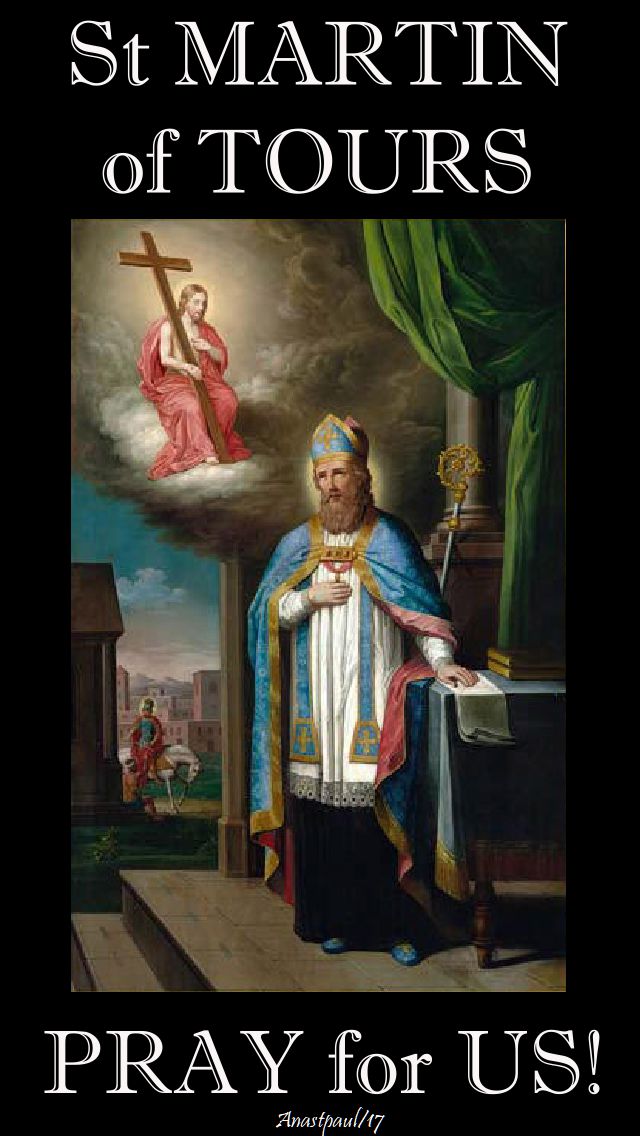
Our Morning Offering – 11 November – The Memorial of St Martin of Tours (c 316-397)
Our Morning Offering – 11 November – The Memorial of St Martin of Tours (c 316-397)
I Will Fight Beneath Your Banner, Lord
Prayer of St Martin of Tours (c 316-397)
Lord, if Your people still have need
of my services,
I will not avoid the toil.
Your will be done.
I have fought the good fight long enough.
Yet if You bid me continue to hold
the battle line in defense
of Your camp,
I will never beg to be excused
from failing strength.
I will do the work You entrust to me.
While You command,
I will fight beneath Your banner.
Amen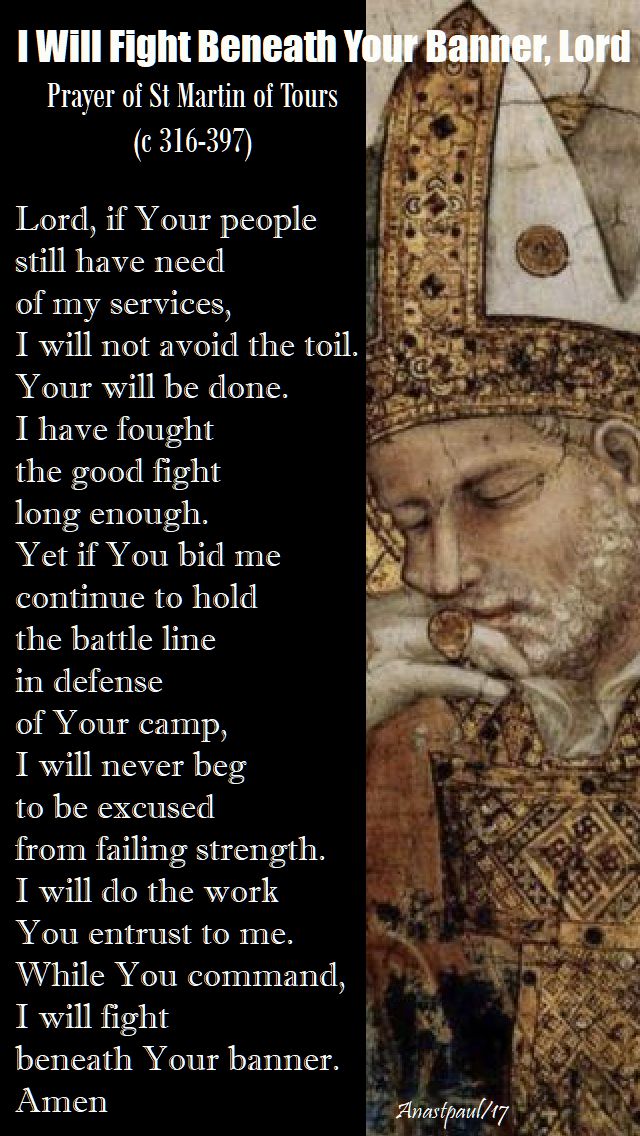
Saint of the Day – 11 November – St Martin of Tours (c 316-397)
Saint of the Day – 11 November – St Martin of Tours (c 316-397) Bishop, Confessor, Miracle-Worker, Apostle of Charity (c 316 at Upper Pannonia (in modern Hungary) – 8 November 397 at Candes, Tours, France of natural causes). By his request, he was buried in the Cemetery of the Poor on 11 November 397. Patronages – • against alcoholism• against impoverishment• against poverty• beggars• cavalry• equestrians• geese• horse men• horses• hotel-keepers• Pontifical Swiss Guards• quartermasters• s• • soldiers• tailors• vintners• wine growers• wine makers• France• 5 Diocese• 31 Cities. His relics rested in the basilica of Tours, a scene of pilgrimages and miracles, until 1562 when the cathedral and relics were destroyed by militant Protestants. Some small fragments on his tomb were found during construction excavation in 1860. His shrine in France became a famous stopping-point for pilgrims on the road to Santiago de Compostela in Spain. He has become one of the most familiar and recognisable Christian saints, sometimes venerated as a military saint. As he was born in what is now Szombathely, Hungary, spent much of his childhood in Pavia, Italy, and lived most of his adult life in France, he is considered a spiritual bridge across Europe.
His life was recorded by a contemporary, the hagiographer Sulpicius Severus. He is best known for the account of his using his military sword to cut his cloak in two, to give half to a beggar clad only in rags in the depth of winter. Conscripted as a soldier into the Roman army, he found the duty incompatible with the Christian faith he had adopted and became an early conscientious objector.

A conscientious objector who wanted to be a monk; a monk who was manoeuvred into being a bishop; a bishop who fought paganism as well as pleaded for mercy to heretics—such was Martin of Tours, one of the most popular of saints and one of the first not to be a martyr.
Born of pagan parents in what is now Hungary and raised in Italy, this son of a veteran was forced at the age of 15 to serve in the army. Martin became a Christian catechumen and was baptised when he was 18. It was said that he lived more like a monk than a soldier. At 23, he refused a war bonus and told his commander: “I have served you as a soldier; now let me serve Christ. Give the bounty to those who are going to fight. But I am a soldier of Christ and it is not lawful for me to fight.” After great difficulties, he was discharged and went to be a disciple of Hilary of Poitiers.
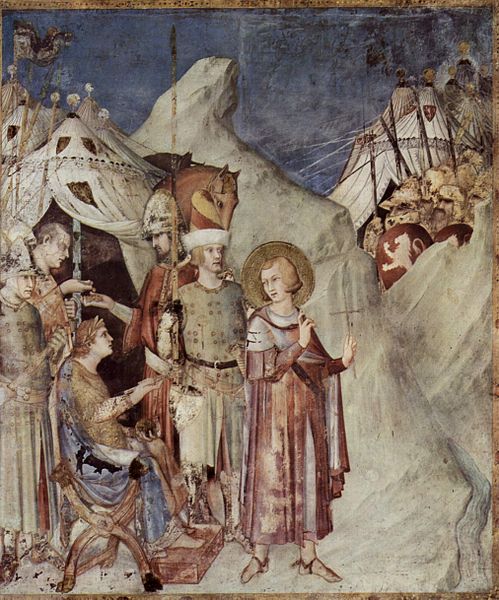
He was ordained an exorcist and worked with great zeal against the Arians. Martin became a monk, living first at Milan and later on a small island. When Hilary was restored to his see following his exile, Martin returned to France and established what may have been the first French monastery near Poitiers. He lived there for 10 years, forming his disciples and preaching throughout the countryside.
The people of Tours demanded that he become their bishop. Martin was drawn to that city by a ruse—the need of a sick person—and was brought to the church, where he reluctantly allowed himself to be consecrated bishop. Some of the consecrating bishops thought his rumpled appearance and unkempt hair indicated that he was not dignified enough for the office.


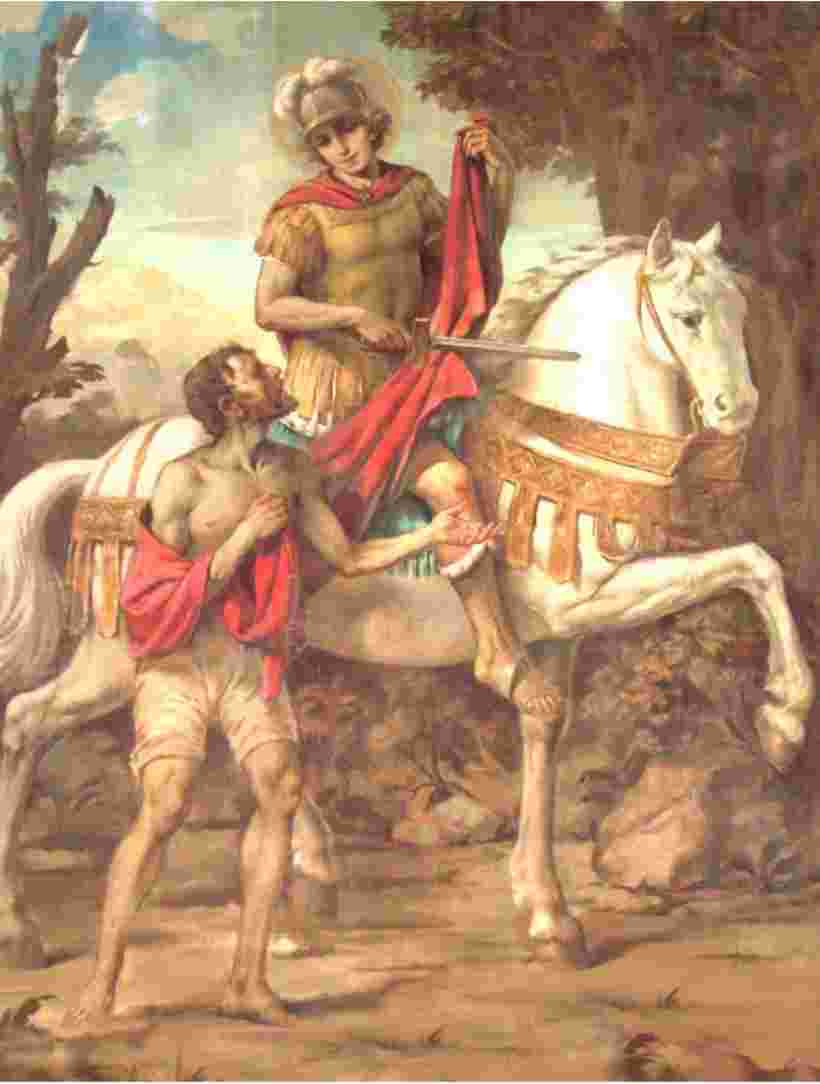
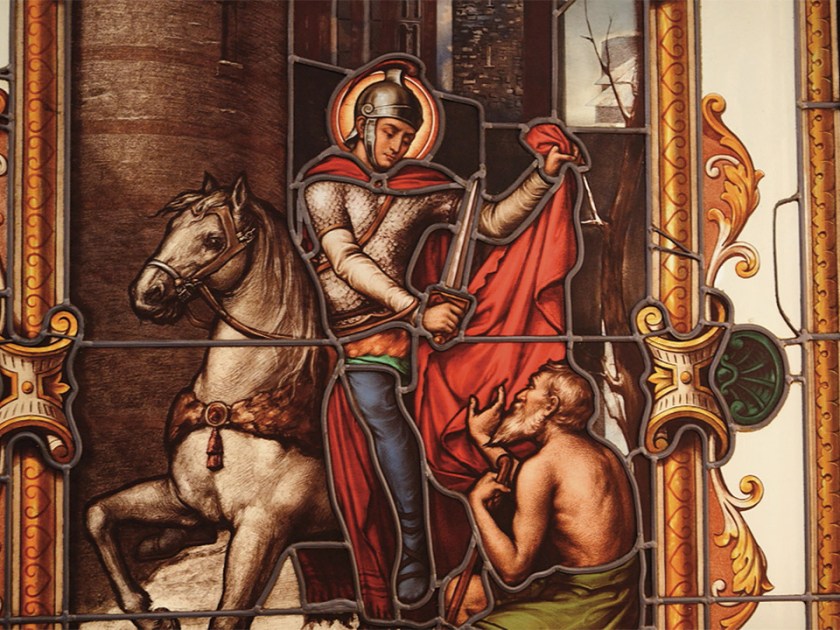
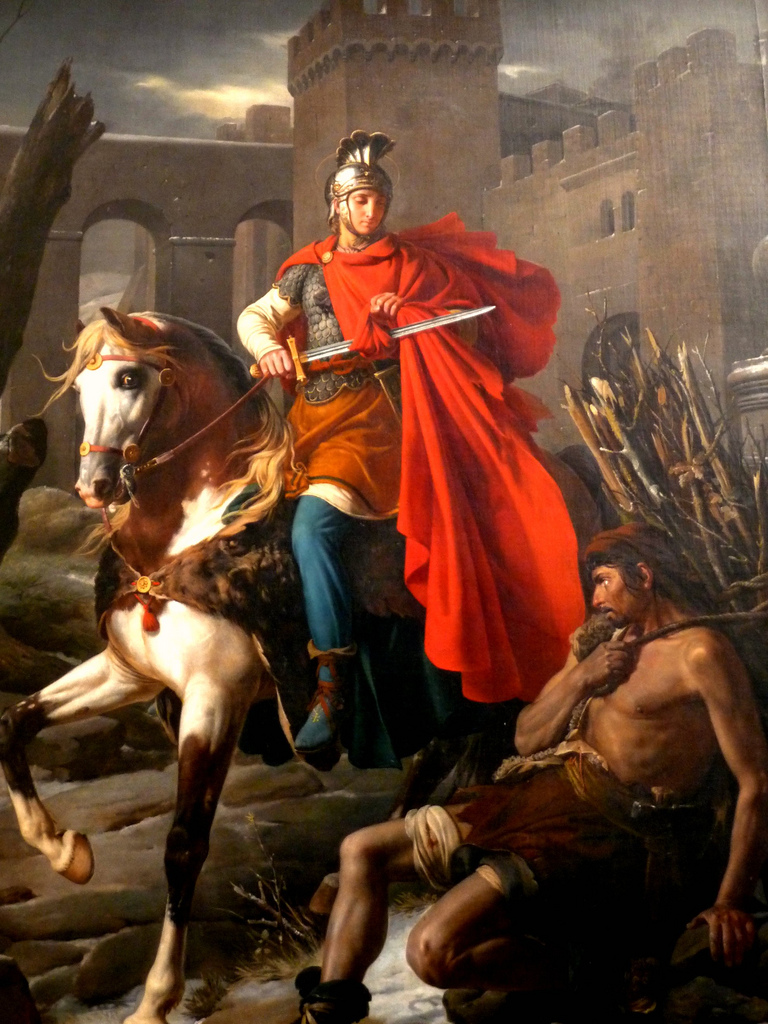
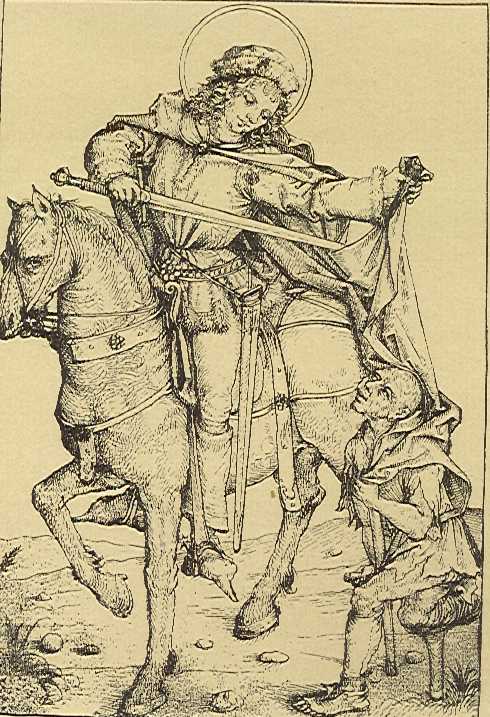
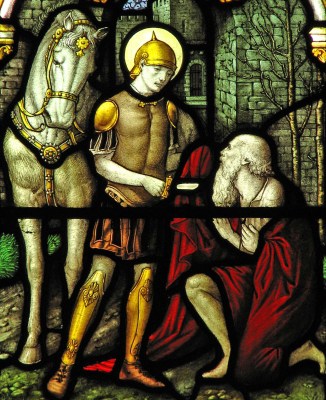
One of the most famous stories about Martin of Tours occurred when he was still a soldier. One day, it is said, he met a beggar wearing rags. He took his sword and cut his military cloak in half and gave half to the poor man for his warmth. That night, Martin dreamed that Jesus was wearing the half of a cloak he had given away. During the Middle Ages, Martin’s cloak (cappa) became a relic that French kings would take into battle. The person whose job it was to care for the cloak was often a priest and he was called a cappellani. It is from this that the word “chaplain” evolved.
As death approached, Martin’s followers begged him not to leave them. He prayed, “Lord, if your people still need me, I do not refuse the work. Your will be done.”

Memorials of the Saints – 11 November
St Martin of Tours (Memorial) – https://www.youtube.com/watch?v=sj_6riKJ7q8
—
Bl Alicia Maria jadwiga Kotowska
St Bartholomew of Rossano
St Bertuin of Malonne
St Cynfran of Wales
St Isidre Costa Hons
St John the Almoner
Bl Josaphat Chichkov
Bl Kamen Vitchev
Bl Luigia Poloni
St Marina of Omura
St Menas Kallikelados
St Mennas of Santomenna
St Mercurius the Soldier
Bl Pavel Dzjidzjov
St Rhediw
St Theodore the Studite
St Turibius of Palencia
St Veranus of Lyon
St Veranus of Vence
Bl Vincent Eugene Bossilkoff
—
Martyrs of Torredembarra: Members of the Brothers of the Christian Schools, Discalced Carmelites, and Carmelite Tertiaries of Education who were martyred together in the Spanish Civil War.
• Blessed Bonaventura Toldrà Rodon
• Blessed Damián Rodríguez Pablo
• Blessed Felipe Arce Fernández
• Blessed Frederíc Vila Bartolì
• Blessed Isidre Tarsá Giribets
• Blessed Joan Roca Vilardell
• Blessed José Alberich Lluch
• Blessed Josep Boschdemont Mitjavila
• Blessed Josep Maria Bru Ralduá
• Blessed Julio Alameda Camarero
• Blessed Lluís Domingo Oliva
• Blessed Mariano Navarro Blasco
• Blessed Miquel Saludes Ciuret
• Blessed Pedro de Eriz Eguiluz
They were martured on 11 November 1936 in Torredembarra, Tarragona, Spain and Beatified
• 13 October 2013 by Pope Francis
• beatification celebrated in Tarragona, Spain.
Thought for the Day – – 10 November – The Memorial of St Pope Leo the Great (c400-461) Doctor of the Church
Thought for the Day – – 10 November – The Memorial of St Pope Leo the Great (c400-461) Doctor of the Church
Leo is called Great in large part because he saved the city of Rome on two separate occasions. But far more noteworthy is his work safeguarding the Roman and apostolic faith from the confusion of so many different figures. Since Christ as perfect Man reveals man to himself (concerning which Vatican II reminds us in Gaudium et Spes §22), understanding Christ’s dignity is essential for recognising our own as restored and elevated in the grace He has won for us.
Preserving and transmitting this teaching does not usually oblige us to face the barbarians at the gates. In the face of those who would obscure the truth, our call—Pope Leo’s call—is to put on what St Paul calls “the mind of Christ.” Embracing what we ourselves have received, we can be tailored to His understanding of us, rather than our conjectures about Him. There are only two choices: we can either remember Him Whose members we are in the Body of Christ, or slide into the grave danger highlighted by John Courtney Murray, SJ:
“Self-understanding is the necessary condition of a sense of self-identity and self-confidence, whether in the case of an individual or in the case of a people… Otherwise the peril is great. The complete loss of one’s identity is, with all propriety of theological definition, hell. In diminished forms it is insanity.”
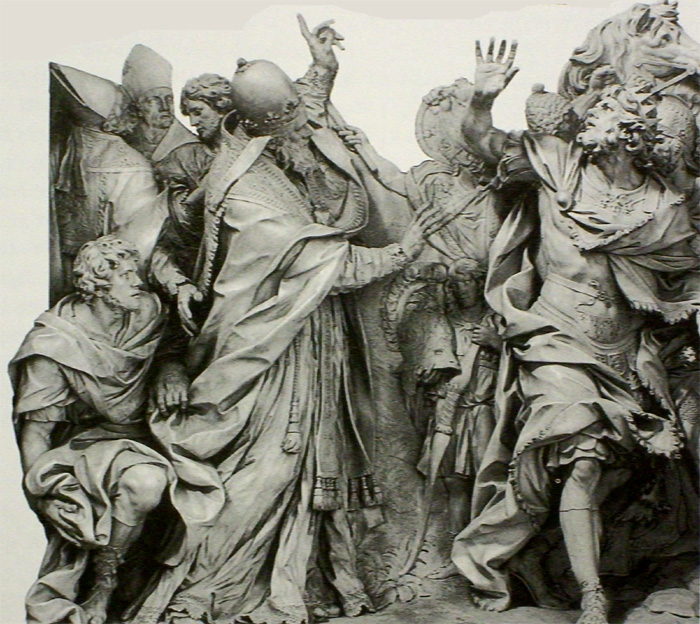
As to insanity, some would say riding out to meet a barbarian without an army fits the bill. But knowing himself and the One who called him, Pope Leo could ride out to Attila, confident that the Hun’s efforts would amount to an empire built on sand, a mass of broken lives and a brief (but memorable) footnote in the textbooks….(Br Leo Camurati OP)
St Pope Leo the Great Pray for us, that we may build our houses upon the Rock of Christ and His Church!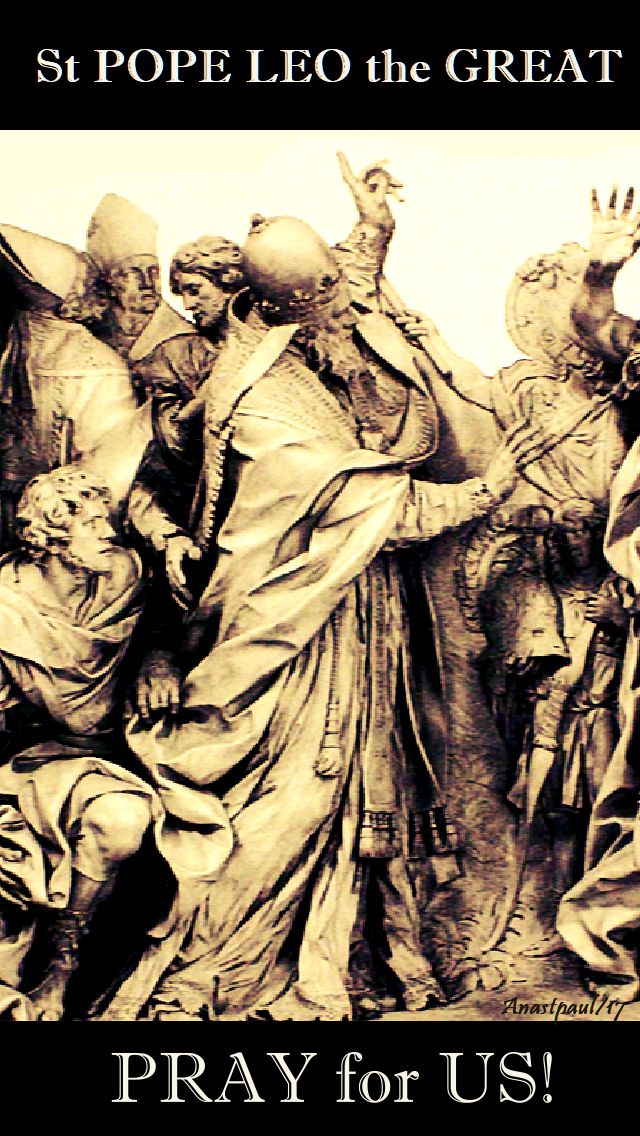
Quote/s of the Day – 10 November – The Memorial of St Pope Leo the Great (c400-461) Doctor of the Church
Quote/s of the Day – 10 November – The Memorial of St Pope Leo the Great (c400-461) Doctor of the Church
“Peter has spoken by the mouth of Leo.”
“Those who are not good to others
are bad to themselves.”
“PEACE is the first thing the angels sang.
PEACE is the mark of the children of God.
PEACE is the nurse of love.
PEACE is the mother of unity.
PEACE is the rest of the blessed souls.
PEACE is the dwelling place of eternity.”
“The faith of those who LIVE
their faith is a serene faith.
What you long for will be given you;
what you love will be yours for ever.”
“Our sharing in the Body and Blood of Christ
has no other purpose than to transform us
into that which we receive.”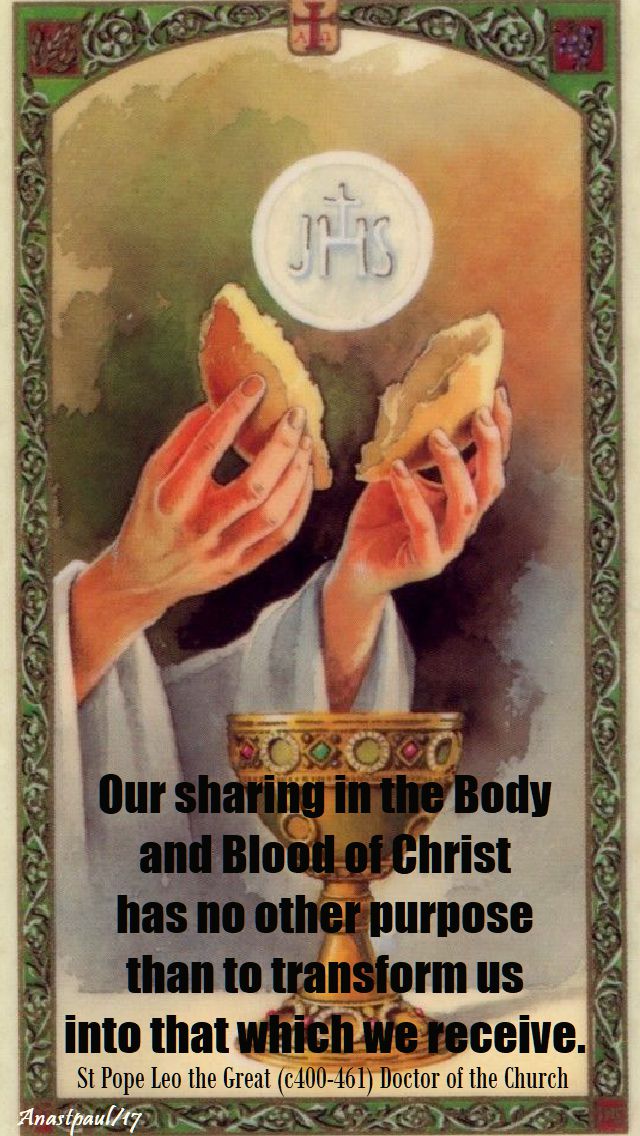
“God decreed that all nations should be saved in Christ.
Dear friends, now that we have received instruction
in this revelation of God’s grace, let us celebrate
with spiritual joy the day of our first harvesting,
of the first calling of the Gentiles.
Let us give thanks to the merciful God,
“who has made us worthy,” in the words of the Apostle,
“to share the position of the saints in light;
who has rescued us from the power of darkness
and brought us into the kingdom of this beloved Son.”
This came to be fulfilled, as we know, from the time
when the star beckoned the three wise men
out of their distant country and led them to recognise
and adore the King of heaven and earth.
The obedience of the star calls us
to imitate its humble service:
to be servants, as best we can,
of the grace that invites all men to find Christ.”
“The cross of Christ is the true ground
and chief cause of Christian hope.”
“Let no one be ashamed of the cross
by which Christ has redeemed the world.
None of us must be afraid to suffer
for the sake of justice or doubt the
fulfillment of the promises,
for it is through toil that we come to rest
and through death that we pass to life.”
“By Baptism we are made flesh of the Crucified.”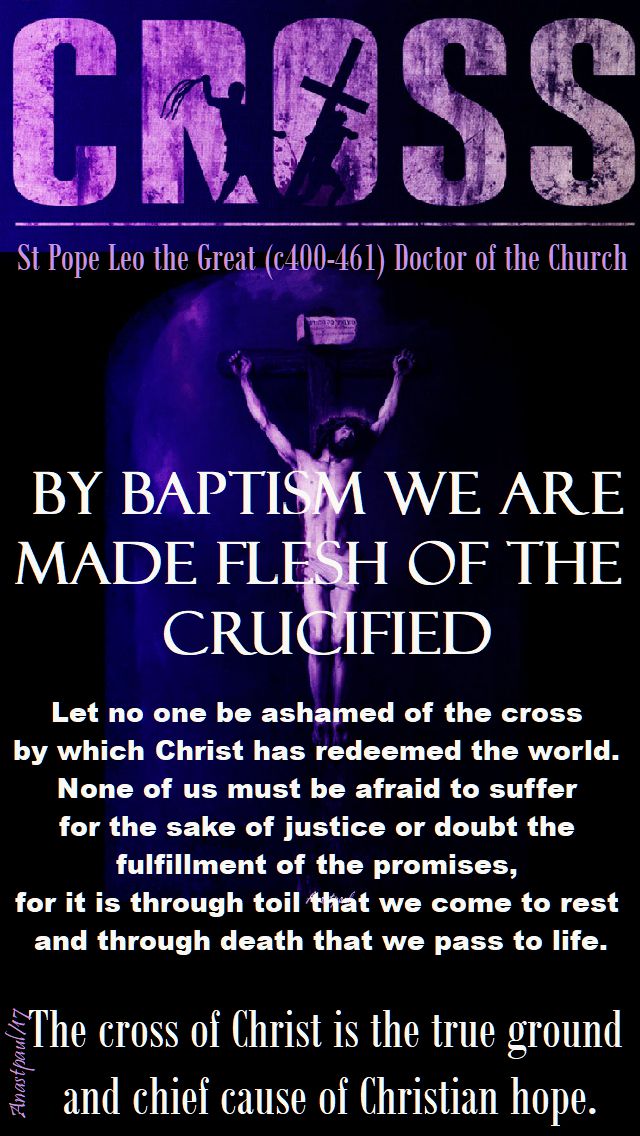
“No-one, however weak, is denied
a share in the victory of the cross.
No-one is beyond the help
of the prayer of Christ.”
St Pope Leo the Great (c400-461) Doctor of the Church
Our Morning Offering – 10 November – The Memorial of St Pope Leo the Great (c400-461) Doctor of the Church
Our Morning Offering – 10 November – The Memorial of St Pope Leo the Great (c400-461) Doctor of the Church
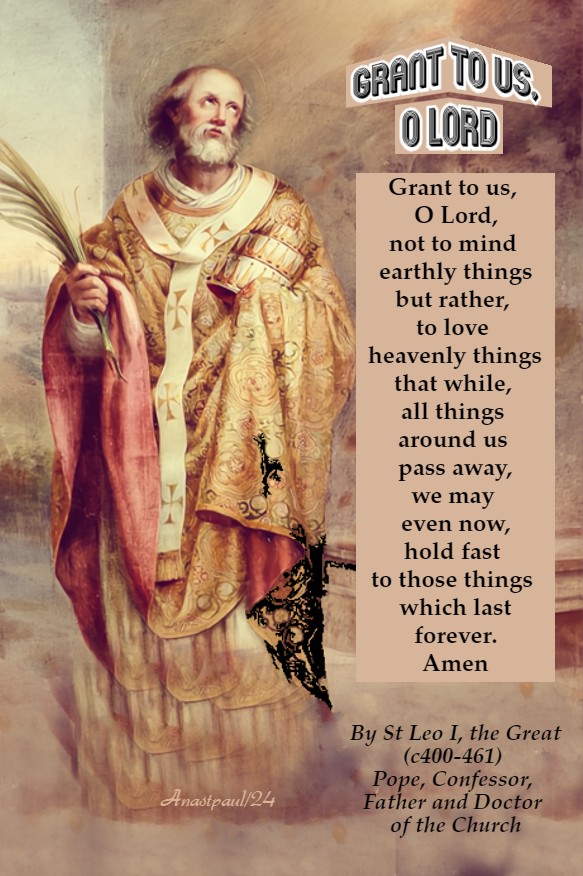
Grant to Us, O Lord
By St Leo I, the Great (c400-461)
Pope, Confessor,
Father and Doctor of the Church
Grant to us, O Lord,
not to mind
earthly things
but rather, to love
heavenly things
that while, all things
around us pass away,
we may even now,
hold fast to those things
which last forever.
Amen
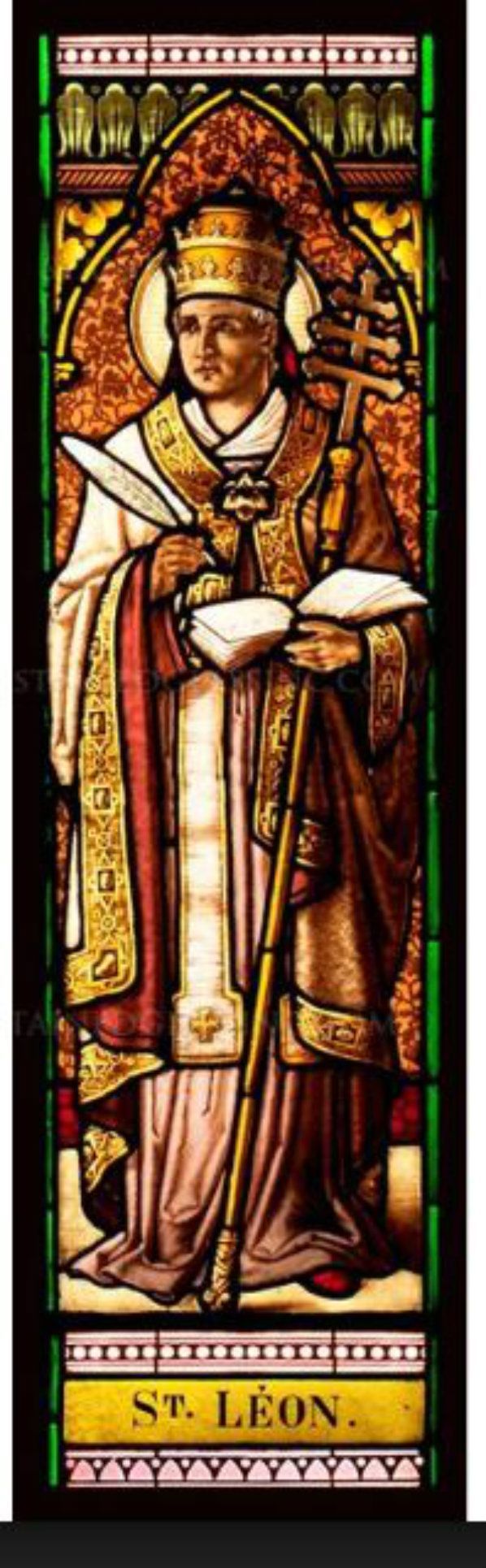
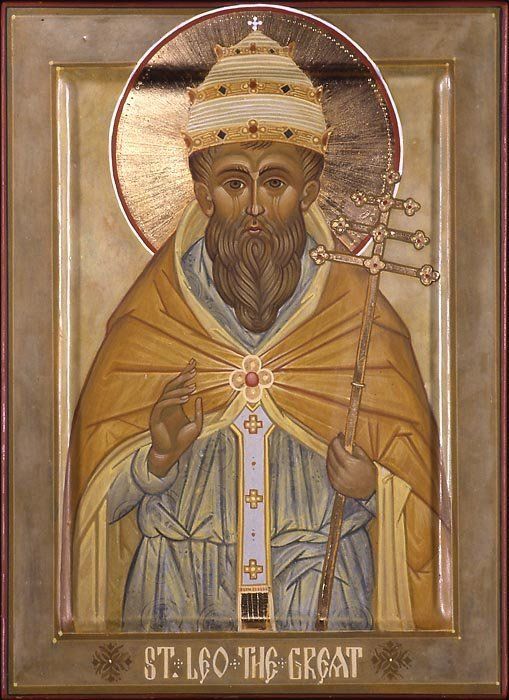
Saint of the Day – 10 November – St Pope Leo I Father and Doctor of the Church (c 400 – 461)
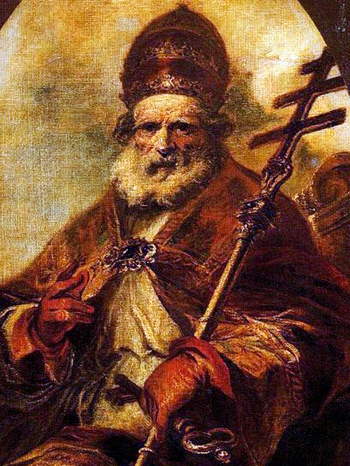
Only two Popes have earned the title Great—Gregory I and Leo I. Leo was born in the beginning of the fifth century. When he was a Deacon, other Church leaders looked to him for advice and for explanations of the faith. Leo was sent to settle arguments between leaders. With strong conviction of the importance of the Bishop of Rome in the Church and of the Church as the ongoing sign of Christ’s Presence in the world, Leo the Great displayed endless dedication as Pope. Elected in 440, he worked tirelessly as “Peter’s successor,” guiding his fellow Bishops as “equals in the episcopacy and infirmities.”
Leo is known as one of the best administrative Popes of the ancient Church. His work branched into four main areas, indicative of his notion of the Pope’s total responsibility for the flock of Christ. He worked at length to control the heresies of Pelagianism–overemphasising human freedom– Manichaeism–seeing everything material as evil–and others, placing demands on their followers so as to secure true Christian beliefs.
A second major area of his concern was doctrinal controversy in the Church in the East, to which he responded with a classic letter setting down the Church’s teaching on the two natures of Christ. With strong faith, he also led the defense of Rome against barbarian attack, taking the role of peacemaker.
In these three areas, Leo’s work has been highly regarded. His growth to sainthood has its basis in the spiritual depth with which he approached the pastoral care of his people, which was the fourth focus of his work. He is known for his spiritually profound sermons. An instrument of the call to holiness, well-versed in Scripture and ecclesiastical awareness, Leo had the ability to reach the everyday needs and interests of his people. One of his sermons is used in the Office of Readings on Christmas. Almost 100 sermons and 150 letters of Leo I have been preserved.
It is said of Leo that his true significance rests in his doctrinal insistence on the mysteries of Christ and the Church and in the supernatural charisms of the spiritual life given to humanity in Christ and in his Body, the Church. Thus Leo held firmly that everything he did and said as pope for the administration of the Church represented Christ, the head of the Mystical Body and Saint Peter, in whose place Leo acted.
Leo died on 10 November 461 and, as he wished to be buried as close as possible to the tomb of St Peter, his body was placed in a tomb in the portico of St Peter’s basilica. In 688 his remains were moved inside the basilica itself.
Pope Emeritus Benedict XVI said that Leo’s papacy “…was undoubtedly one of the most important in the Church’s history.”
The significance of Leo’s pontificate lies in his assertion of the universal jurisdiction of the Roman bishop, as expressed in his letters and still more in his 100 extant orations. This assertion is commonly referred to as the doctrine of Petrine supremacy.
According to Leo and several Church Fathers as well as certain interpretations of the Scriptures, the Church is built upon Peter, in pursuance of the promise of Matthew 16:16–19. Peter participates in everything which is Christ’s; what the other apostles have in common with him they have through him. What is true of Peter is true also of his successors. Every other bishop is charged with the care of his particular flock, the Roman pontiff with that of the whole Church. Other bishops are his assistants in this great task. In Leo’s eyes the decrees of the Council of Chalcedon acquired their validity from his confirmation.
Leo’s letters and sermons reflect the many aspects of his career and personality and are invaluable historical sources. His rhythmic prose style, called cursus leonicus, influenced ecclesiastical language for centuries.
In 1754 Pope Benedict XIV proclaimed Leo I a Doctor of the Church.
Memorials of the Saints – 10 November
St Pope Leo the Great (Memorial)
—
St Aedh Mac Bricc
St Andrew Avellino
St Anianus the Deacon
St Baudolino
St Demetrius of Antioch
St Elaeth the King
St Eustosius of Antioch
St Grellen
St Guerembaldus
St Hadelin of Sees
Bl Joaquín Piña Piazuelo
St John of Ratzenburg
St Joseph the Martyr
St Justus of Canterbury
St Leo of Melun
St Monitor of Orleans
St Narses of Subagord
St Nonnus of Heliopolis
St Orestes of Cappadocia
St Probus of Ravenna
St Theoctiste of Lesbos
St Tryphaena of Iconium
St Tryphosa of Iconium
—
Martyred Sisters Adorers – 23 beati: 23 nuns, all members of the Sisters Adorers, Handmaids of Charity and of the Blessed Sacrament who were martyred together in the Spanish Civil War.
• Blessed Aurea González
• Blessed Belarmina Pérez Martínez
• Blessed Cecilia Iglesias del Campo
• Blessed Concepción Vázquez Areas
• Blessed Dionisia Rodríguez De Anta
• Blessed Emilia Echevarría Fernández
• Blessed Felipa Gutierrez Garay
• Blessed Francisca Pérez de Labeaga García
• Blessed Josepa Boix Rieras
• Blessed Lucía González García
• Blessed Luisa Pérez Adriá
• Blessed Magdalena Pérez
• Blessed Manuela Arriola Uranda
• Blessed María Dolores Hernández San Torcuato
• Blessed María Dolores Monzón Rosales
• Blessed María García Ferreiro
• Blessed Maria Mercè Tuñi Ustech
• Blessed María Zenona Aranzábal de Barrutia
• Blessed Prima de Ipiña Malzárraga
• Blessed Purificación Martínez Vera
• Blessed Rosa López Brochier
• Blessed Sinforosa Díaz Fernández
• Blessed Teresa Vives Missé
They were martyred on 10 November 1936 in Madrid, Spain and Beatified on 28 October 2007 by Pope Benedict XVI.
Martyrs of Agde – 3 saints: A group of Christians who were tortured and martyred together in the persecutions of Diocletian. The only about them to survive are the names – Florentia, Modestus and Tiberius. Martyred c 303 in Agde, France.
One last word on the Feast of the Dedication of the Archbasilica of the Most Holy Saviour, today, 9 November.
One last word on the Feast of the Dedication of the Basilica ofthe Most Holy Saviour, today, 9 November.
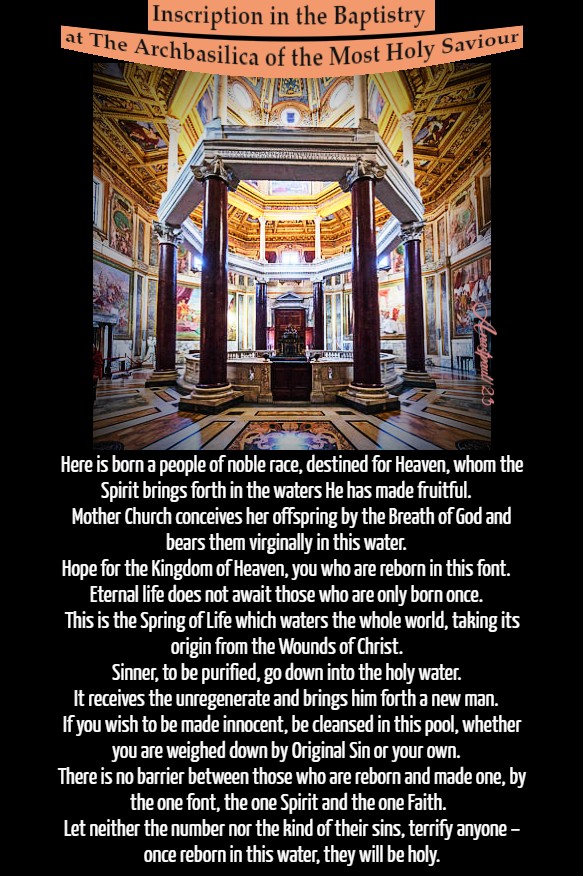
One of the most beautiful attributes of the Basilica is the octagonal (8-sided) Baptistery. There one reads
“Here is born a people of noble race, destined for Heaven, whom the Spirit brings forth in the waters He has made fruitful.
Mother Church conceives her offspring by the Breath of God and bears them virginally in this water.
Hope for the Kingdom of Heaven, you who are reborn in this font.
Eternal life does not await those who are only born once.
This is the Spring of Life which waters the whole world, taking its origin from the Wounds of Christ.
Sinner, to be purified, go down into the holy water.
It receives the unregenerate and brings him forth a new man.
If you wish to be made innocent, be cleansed in this pool, whether you are weighed down by Original Sin or your own.
There is no barrier between those who are reborn and made one, by the one font, the one Spirit and the one Faith.
Let neither the number nor the kind of their sins, terrify anyone – once reborn in this water, they will be holy.”
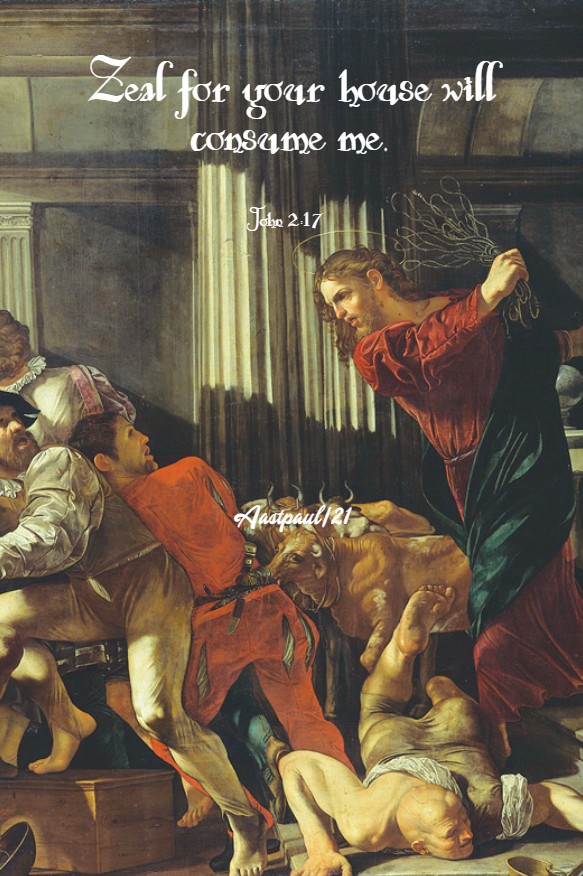
And so we say with the words of Scripture:
“Zeal for your house will consume me.”
Thought for the Day – 9 November – Feast of the Dedication of the Basilica of Saint John Lateran – “omnium urbis et orbis ecclesiarum mater et caput…the Mother and head of all the Churches of the City and the World.”
Thought for the Day – 9 November – Feast of the Dedication of the Basilica of Saint John Lateran – “omnium urbis et orbis ecclesiarum mater et caput…the Mother and head of all the Churches of the City and the World.”
Saint Augustine gives us a few a ideas to meditate on: “‘Jerusalem that is being built as a city.’ When David was uttering these words, that city had been finished, it was not being built. It is some city he speaks of, therefore, which is now being built, unto which living stones run in faith, of whom Peter says, ‘You also, as living stones, are built up into a spiritual house, that is, the holy temple of God’. What does it mean, you are built up as living stones? You live, if you believe, but if you believe, you are made a temple of God; for the Apostle Paul says, ‘For God’s temple is holy, and you are that temple’.”
Unlike the commemorations of other Roman churches, this anniversary is a Feast. The dedication of a church is a Feast for all its parishioners. In a sense, St John Lateran is the parish church of all Catholics because it is the Pope’s Cathedral. This church is the spiritual home of the people who are the Church.
We celebrate the dedication of this Church as the seat of the Bishop of Rome from which all other pastoral authority is derived. We honour the anniversary of a church’s dedication because a church gives full voice to the sacred Liturgy. The feast of the dedication gives full acceptance and capacity to live the ancient theological principle, legem credendi lex statuat supplicandi (the law of belief given through the law of prayer, or even more of short-hand, the law of prayer is the law of belief).
O God, who out of living and chosen stones, builds up an everlasting dwelling-place for Your Majesty – help Your people, who humbly pray to You and whatever material room Your Church may set apart for Your worship, let it bring also spiritual increase.
(Post-Communion prayer)
Quote/s of the Day – 9 November – Feast of the Dedication of the Basilica of Saint John Lateran
Quote/s of the Day – 9 November – Feast of the Dedication of the Basilica of Saint John Lateran
“What was done here, as these walls were rising, is reproduced when we bring together those who believe in Christ. For, by believing they are hewn out, as it were, from mountains and forests, like stones and timber; but by catechising, baptism and instruction they are, as it were, shaped, squared and planed by the hands of the workers and artisans. Nevertheless, they do not make a house for the Lord until they are fitted together through love”.
St Augustine (354-430) Doctor of the Church – Sermon 36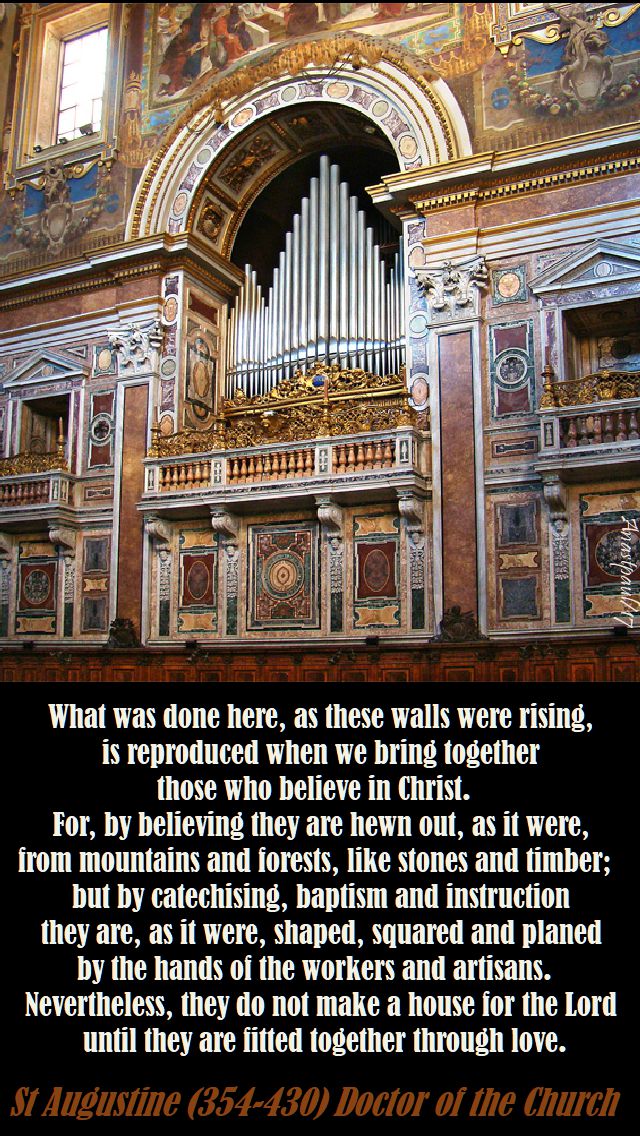
“God’s desire to build a spiritual temple in the world, a community that worships him in spirit and truth (cf. John 4:23-24). But this observance also reminds us of the importance of the material buildings in which the community gathers to celebrate the praises of God. Every community, therefore, has the duty to take special care of its own sacred buildings, which are a precious religious and historical patrimony. For this we call upon the intercession of Mary Most Holy, that she help us to become, like her, the “house of God,” living temple of his love.”
Pope Benedict XVI – 9 November 2008.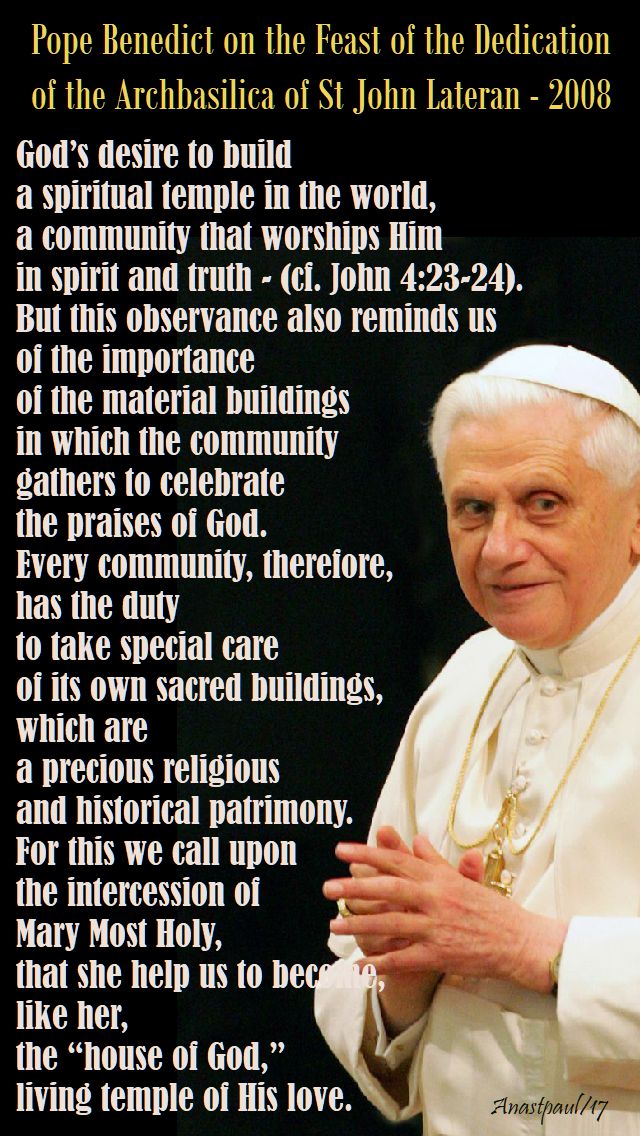
Our Morning Offering – 9 November – Feast of the Dedication of the Basilica of Saint John Lateran
Our Morning Offering – 9 November – Feast of the Dedication of the Basilica of Saint John Lateran
O God,
who from living and chosen stones
prepare an eternal dwelling for Your Majesty,
increase in Your Church the spirit of grace
You have bestowed, so that by new growth,
Your faithful people may build up
the heavenly Jerusalem.
We make our prayer through our Lord Jesus Christ,
in union with the Holy Spirit,
one God, forever and ever.
Amen.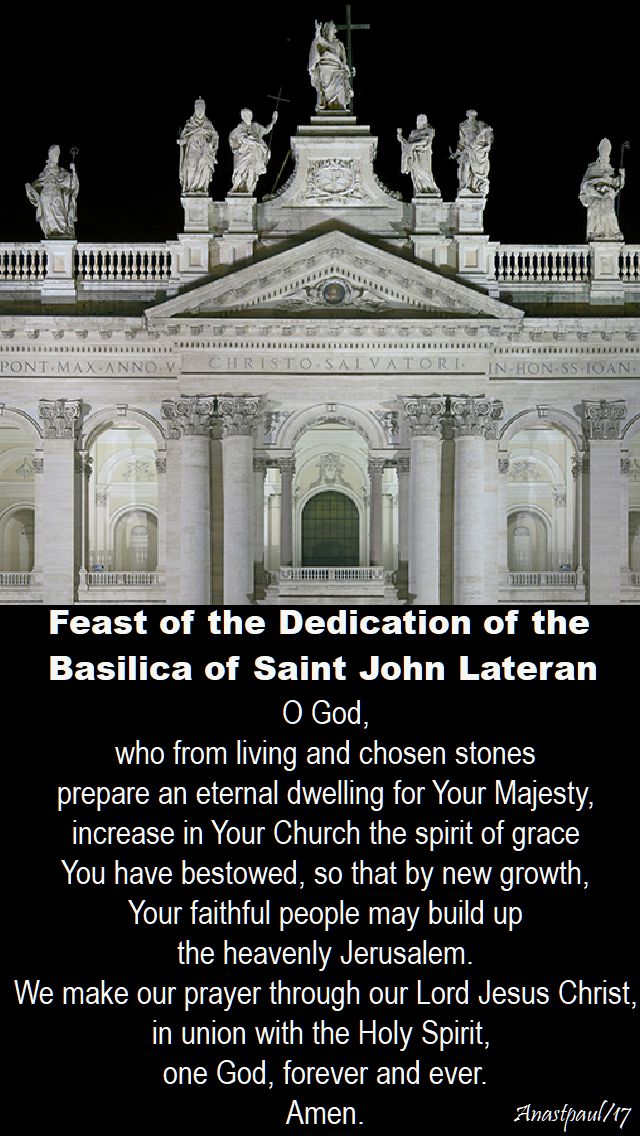
Feast of the Dedication of The Cathedral of the Most Holy Saviour and of Saints John the Baptist and John the Evangelist in the Lateran – 9 November
Feast of the Dedication of The Cathedral of the Most Holy Saviour and of Saints John the Baptist and John the Evangelist in the Lateran- 9 November
The Papal Archbasilica of St John in Lateran (Italian: Arcibasilica Papale di San Giovanni in Laterano), commonly known as St John Lateran Archbasilica, St John Lateran Basilica, St John Lateran, or simply the Lateran Basilica, is the cathedral church of Rome, Italy and therefore houses the cathedra, or ecclesiastical seat, of the Roman Pontiff.
It is the oldest of and has precedence among the four papal major basilicas, all of which are in Rome, because it is the oldest church in the West and houses the cathedra of the Roman Pontiff. It has the title of ecumenical mother church of the Roman Catholic faithful.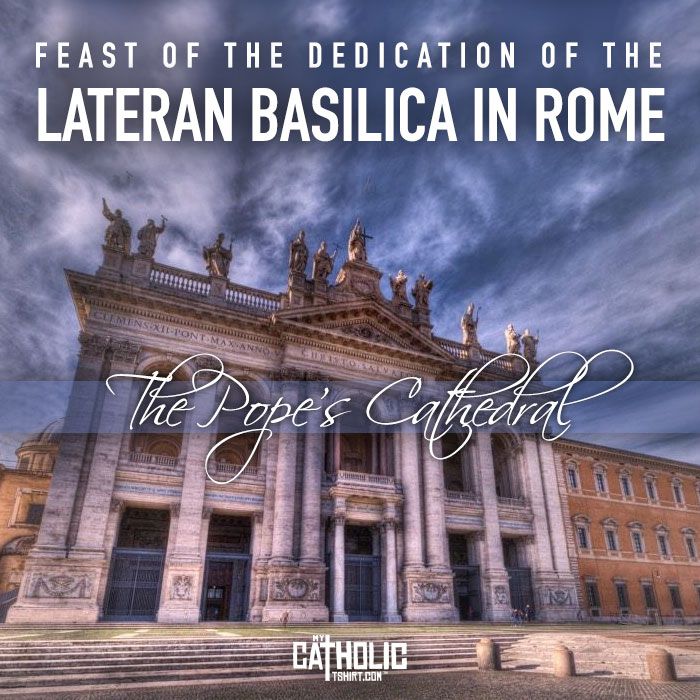


The current archpriest is Angelo De Donatis, Cardinal Vicar General for the Diocese of Rome. The President of the French Republic, currently Emmanuel Macron, is ex officio the “first and only honorary canon” of the archbasilica, a title that the heads of state of France have possessed since King Henry IV.
The large Latin inscription on the façade reads: Clemens XII Pont Max Anno V Christo Salvatori In Hon SS Ioan Bapt et Evang; which is a highly abbreviated inscription which translates to: “Pope Clement XII, in the fifth year [of his Pontificate], dedicated this building to Christ the Saviour, in honour of Saints John the Baptist and John the Evangelist”. The inscription indicates, that the archbasilica was originally dedicated to Christ the Saviour and, centuries later, co-dedicated to St John the Baptist and St John the Evangelist. As the Cathedral of the Pope qua Bishop of Rome, it ranks superior to all other churches of the Roman Catholic Church, including St Peter’s Basilica and therefore it alone is titled “Archbasilica” among all other basilicas.
The archbasilica is sited in the City of Rome, outside and distanced from Vatican City proper, which is approximately 4 km (2.5 mi) to its northwest, although the archbasilica and its adjoining edifices have extraterritorial status from Italy as one of the properties of the Holy See, subject to the sovereignty of the latter, pursuant to the Lateran Treaty of 1929 with Italy under Benito Mussolini.
This feast commemorates the Dedication of the Basilica of St John Lateran which, by a tradition dating to the 12th century, is said to have taken place on this day. It was dedicated as the first Catholic basilica in Rome, by Pope Sylvester in 324. Until the 15th century, the Lateran was the residence of the popes. It is the episcopal seat of the bishop of Rome, the pope and until the 15th century, it was also his residence. At first, the feast was kept only in the City of Rome but the, in honour of the Basilica, which is called the “Mother and Head of all Churches of the City and the World” (omnium urbis et orbis ecclesiarum mater et caput) it was extended to the whole of the Roman Rite as a sign of unity and respect towards the Holy See of Peter, the Holy Father and the Magisterium, which, as St Ignatius of Antioch wrote, presides over the whole assembly of charity.

In the year 313 the Roman Emperor Constantine declared the Edict of Milan, granting religious freedom to Christians. Constantine himself donated the palace of the Lateran, a portion of his wife’s dowry, to the Church for its basilica. The Lateran is the cathedral of the Bishop of Rome, the pope, and, as such, it ranks as the “mother and head of all the churches in the city and the world.”
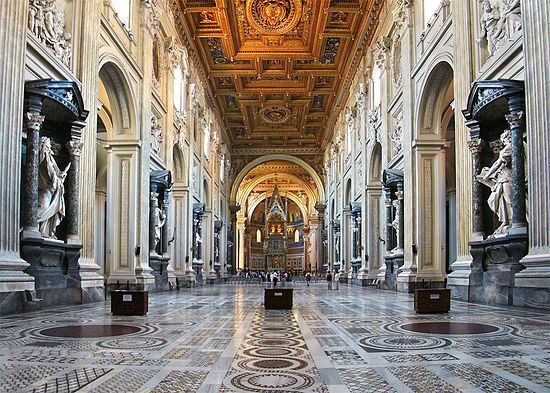
The pope celebrates the Holy Thursday liturgy at Saint John Lateran, surrounded by towering statues of the twelve Apostles bearing the instrument of their martyrdom. Above its towering 18th century façade can be seen the image of Christ Triumphant, surrounded by saints and doctors.
We are all members of our own local church, work for he universal kingdom of Christ, are also members of this “mother-church” in Rome.
The dedication of churches can be traced back to the Jewish practice of dedicating the Temple in Jerusalem to God. Once the Temple had been dedicated, there was a feast each year to celebrate the anniversary of the dedication. This feast was celebrated not only in Jerusalem but in every synagogue as well. Similarly, every Western Catholic church observes the dedication of the Lateran Basilica in Rome.
This feast helps us move beyond our narrow geographical confines to a sense of the universal Church.


The high altar and the 14th-century Gothic ciborium. The relic of the original wooden altar used by St Peter comprises the high altar. Above the ciborium are Sts Peter and Paul.

“Every place set aside for divine worship is a sign of that spiritual temple, which is the Church, made up of living stones: of the faithful united by the one faith, of the participation in the sacraments and of the bond of charity. The Saints, in particular, are precious stones of that spiritual temple”… Saint Pope John Paul II.
Feast of the Dedication of the Basilica of Saint John Lateran, Feast of Our Lady of Almudena and Memorials of the Saints – 9 November
Dedication of the Basilica of Saint John Lateran (Feast): The oldest and first in rank of the four basilicas of Rome, Italy. The name is derived from the Laterani family, on the site of whose palace the basilica stands. King Constantine presented this palace to the Church. Its annual celebration throughout the Latin Church is a sign of love and unity with the Papacy and Pope.
The original church building, probably adapted from the hall of the palace, was dedicated to the Saviour and from its splendour was known as the Basilica Aurea. Though several times destroyed and rebuilt, the basilica retained its ancient form, being divided by rows of columns into aisles and having an atrium with colonnades. The tasteless restoration of the 17th century changed its appearance. A monastery was formerly between the basilica and the city wall of which the cloister still remains. The original apse survived until 1878, when it was destroyed and a deeper apse built. The ancient mosaics have been preserved. The high altar, which is of wood and is believed to have been used by Saint Peter, is now encased in marble. In the upper part of the baldachinum are the heads of the Apostles, Peter and Paul. The baptistery is an octagonal edifice with porphyry columns. The font is of green basalt. This basilica has been the cathedral of Rome since the 4th century.
Video – https://www.youtube.com/watch?v=NzrS5oQ43oQ
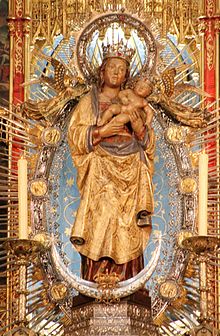
Our Lady of Almudena: The Virgin of Almudena (Virgen de la Almudena) is a medieval icon of the Virgin Mary, mother of Jesus Christ. The image is the advocation of the Virgin that serves as a patroness of Madrid, Spain.
Intriguingly, however, its name derives from the Arabic term of Al Mudayna, or the citadel. There are various legends regarding the icon. One story is that in 712, prior to the capture of the town by the advancing Muslim forces, the inhabitants of the town secreted the image of the virgin, for its own protection, inside the walls surrounding the town. In the 11th century, when Madrid was reconquered by the King Alfonso VI of Castile, the Christian soldiers endeavoured to find the statue. After days of prayer, the spot on the wall hiding the icon crumbled, revealing the statue. Another legend is that as Christian soldiers approached the town, they had a vision of Mary imploring them to allow her to lead them into the city. Again the miraculous crumbling of the wall occurred, with the icon showing an entry route through the walls.
The Cathedral of Madrid is dedicated to this advocation of the Virgin and her feast day, 9 November, is a major holiday in Madrid.
—
St Agrippinus of Naples
St Alexander of Salonica
St Aurelius of Riditio
St Benignus of Armagh
St Eustolia
St Francisco José Marín López de Arroyave
St Gabriel Ferretti
Bl George Napper
Bl Gratia of Cattaro
Bl Helen of Hungary
Bl Henryk Hlebowicz
St Jane of Segna
St Justo Juanes Santos
St Luigi Beltrame Quattrocchi
St Luis Morbioli
St María de la Salud Baldoví Trull
Bl María del Carmen of the Child Jesus
St Pabo
St Sopatra
St Theodore Stratelates
St Ursinus of Bourges
St Valentín Gil Arribas
St Vitonus of Verdun
—
Martyrs of Constantinople – 3 saints: A group of ten Catholic Christians who tried to defend an image of Jesus over the Brazen Gate of Constantinople from an attack by Iconoclasts during the persecutions of emperor Leo the Isaurian. The group of was seized by soldiers, condemned by judges for opposing the emperor, and martyred. The only details that have survived are three of their names – Julian, Marcian and Maria. They were martyred in 730 at Constantinople (modern Istanbul, Turkey).
Martyred in the Spanish Civil War:
• Blessed Anastasio Garzón González
• Blessed Francisco José Marín López de Arroyave
• Blessed Justo Juanes Santos
• Blessed María de la Salud Baldoví Trull
• Blessed Valentín Gil Arribas
Thought for the Day – 8 November – The Memorial of St Elizabeth of the Trinity (1880-1906)
Thought for the Day – 8 November – The Memorial of St Elizabeth of the Trinity (1880-1906)
Elizabeth Catez offers hope to any parent who struggles with a strong-willed child. A holy terror as a toddler, she once embarrassed her mother by shouting out at Mass, “Bad priest! Bad priest! That’s my doll!” The priest had secretly borrowed her doll to be used as the Christ Child in his creche. But gradually Elizabeth channeled her willfulness into a determination to become a saint.
Elizabeth’s first communion and confirmation at age 10 touched her deeply without quelling her rambunctiousness. But from that time she opened up to an interior prayer life that slowly matured into the infused contemplation of a mystic. At 14 she felt drawn to choose Christ as her spouse. Without hesitating she made a private vow of virginity. And having been intrigued by visits to the local Carmelite convent at Dijon, France, since childhood, she was determined to become a Carmelite.
Marie, her mother, was horrified at the thought. She did all she could do to prevent it. She sent Elizabeth to parties in hopes that these might distract her and arranged for suitors to pursue her. But she could not in the end resist her daughter’s strong will. She gave up and allowed Elizabeth to enter the Dijon Carmel in 1901.
Appropriately, she took the name Elizabeth of the Trinity, for the focus of her life became her immersion in the Godhead, or rather the Trinity’s immersion in her. This letter from Elizabeth to a friend typifies her spirituality:
I love to penetrate beyond the veil of the soul to this inner sanctuary where we live alone with God. He wants us entirely to Himself and is making there within us a cherished solitude. Listen to everything that is being sung . . . in His heart. It is Love, the infinite love that envelops us and desires to give us a share . . . in all His blessedness. The whole Blessed Trinity dwells in us, the whole of that mystery which will be our vision in heaven. I am “Elizabeth of the Trinity”—Elizabeth disappearing, losing herself, allowing herself to be invaded by the Three…All day long let us surrender ourselves to Love, by doing the will of God, under His gaze, with Him, in Him, for Him alone. . . . And then, when evening comes, after a dialogue of love that has never stopped in our hearts, let us go to sleep still in love. And if we are aware of any faults, let us simply abandon them to Love, which is a consuming fire and so do our purgatory in His love!
Like St Theresa Margaret of the Sacred Heart, another Carmelite, Elizabeth delighted the other sisters in the cloister with her simple and joyful service. However, in 1903, she contracted Addison’s disease. She suffered intensely and joyfully until she died in 1906. St. Elizabeth of the Trinity was only 26-years-old.
“During painful times, when you feel a terrible void, think how God is enlarging the capacity of your soul, so that it can receive Him – making it, as it were, infinite as He is infinite.” Look upon each pain, as a love token coming to you directly from God, in order to unite you to Him.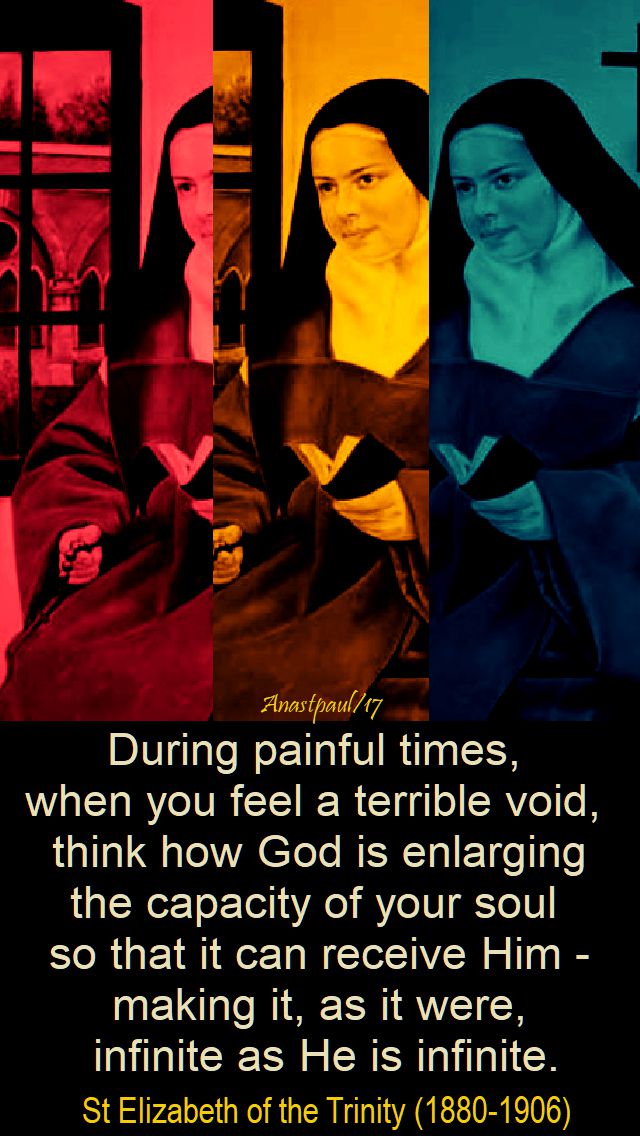
St Elizabeth of the Trinity, Pray for us!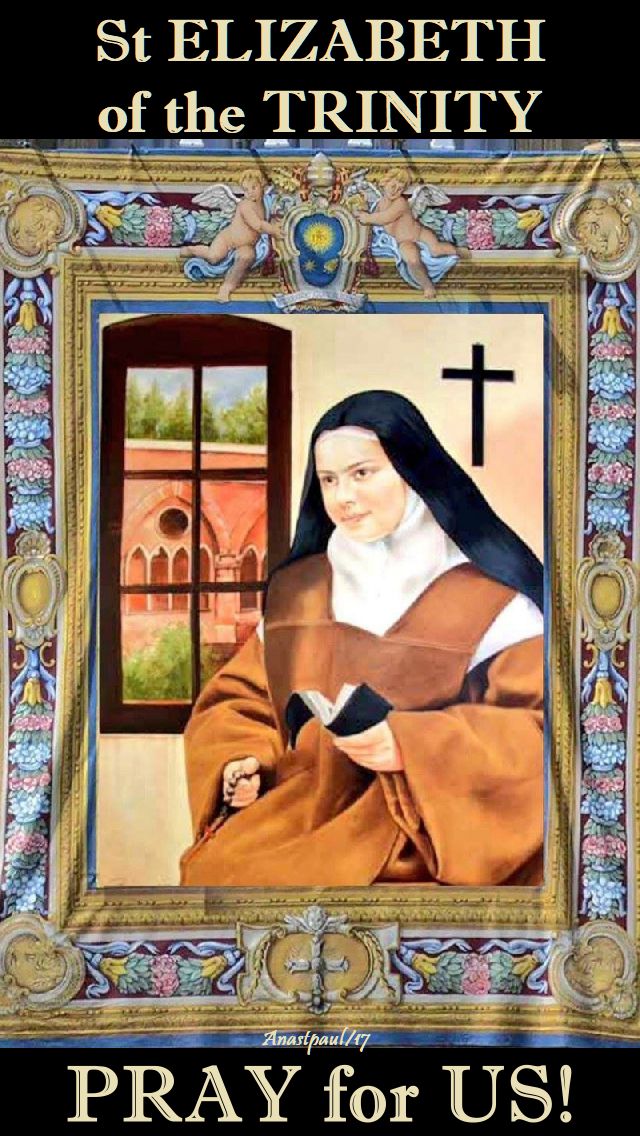
Quote/s of the Day – 8 November – The Memorial of St Elizabeth of the Trinity (1880-1906)
Quote/s of the Day – 8 November – The Memorial of St Elizabeth of the Trinity (1880-1906)
“By our actions we tell Him of our love.”
“A soul united to Jesus is a living smile
that radiates Him and gives Him.”
“May my life be a continual prayer, a long act of love.”
“You will never be commonplace if you are vigilant in love.”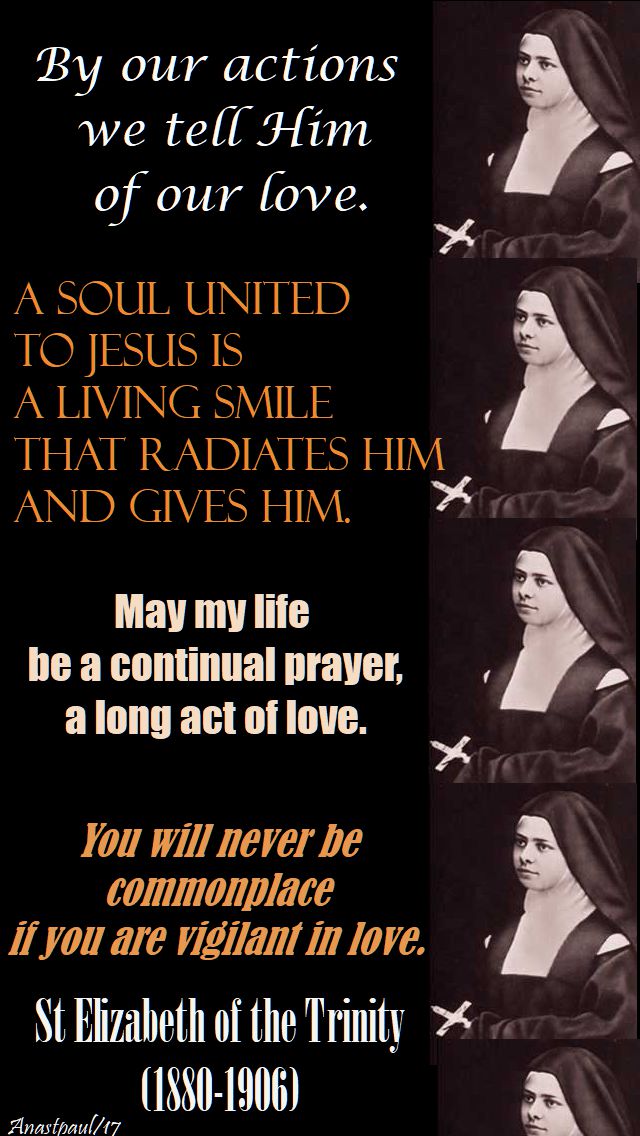
“I have found
heaven on earth,
since heaven is God
and God is in my soul.”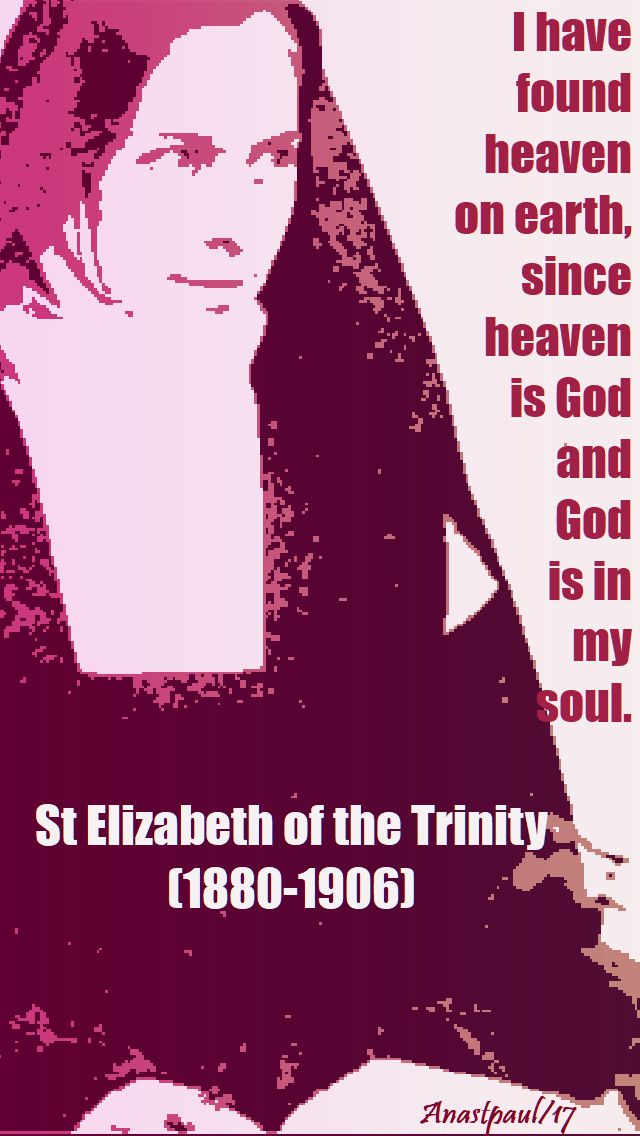
“Make a little cell in your heart
for Jesus of the Agony;
take refuge there
when you hear Him
outraged by men,
try to make reparation;
you, at least, love Him
and keep your heart
quite pure for Him.
Oh! If you only knew how
the good God loves pure hearts!
It is there that He loves to reign!”
St Elizabeth of the Trinity (1880-1906)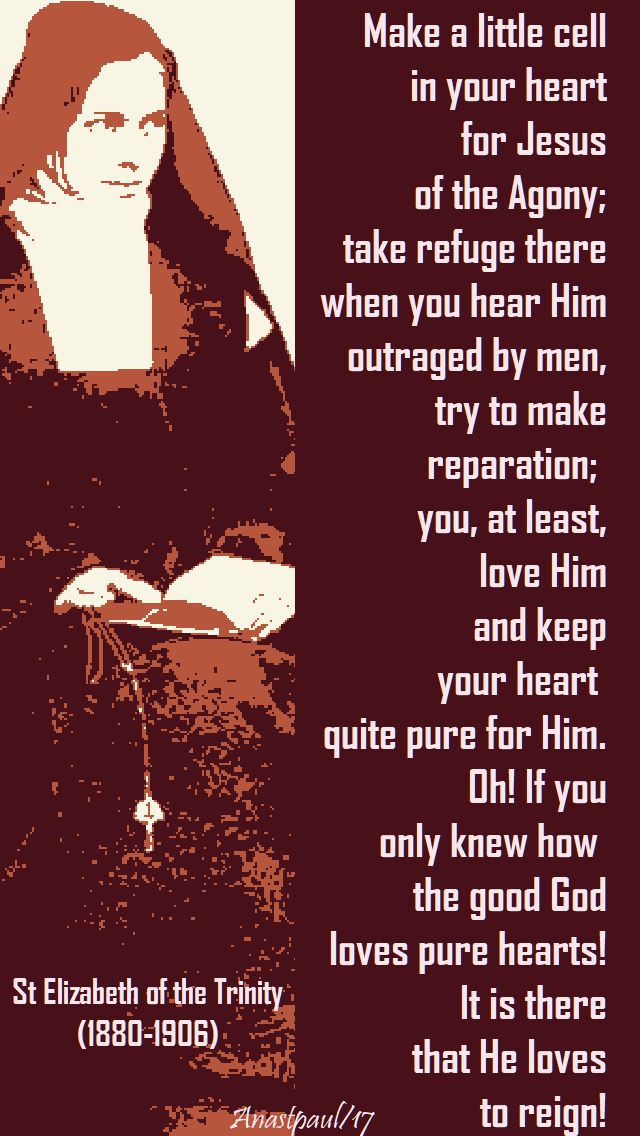
One Minute Reflection – 8 November – The Memorial of St Elizabeth of the Trinity (1880-1906)
One Minute Reflection – 8 November – The Memorial of St Elizabeth of the Trinity (1880-1906)
“Father, I will that where I am, they also whom you have given me may be with me….” John 17:24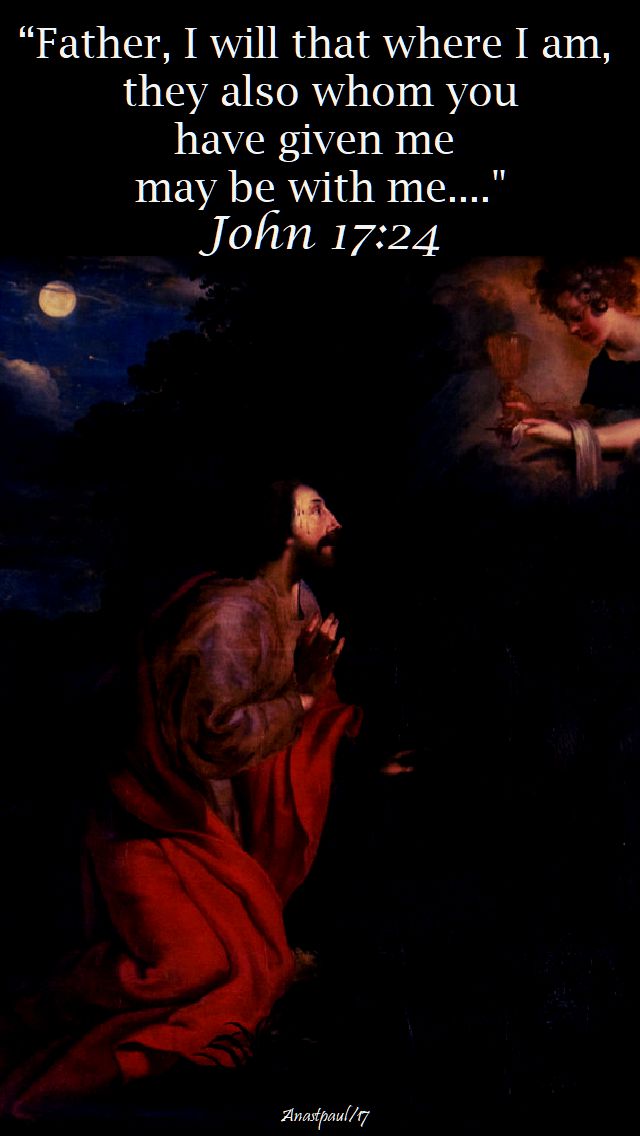
REFLECTION – “Jesus’ desire is for us to be with Him in communion. This is what He aches for, His deepest desire that He prays for. This is what Jesus was doing the night before He died.” …St Elizabeth of the Trinity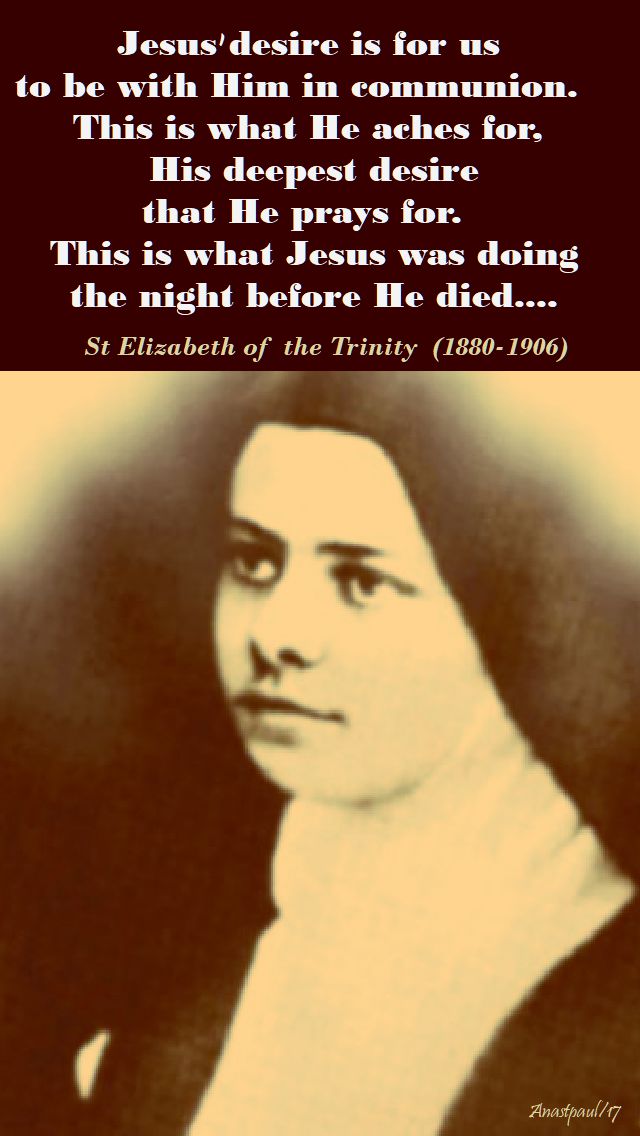
PRAYER – My Lord and my God, You have prayed that I may be in You and You in me. This is the guiding consolation of my life and the source of my prayer. Lead me to Yourself, guide me and teach me that I may never stray from You. Holy St Elizabeth of the Trinity, in your young life you followed the way of the Lord, the way of the Cross, doing all for God by the love of the Holy Spirit. Please pray for us, amen.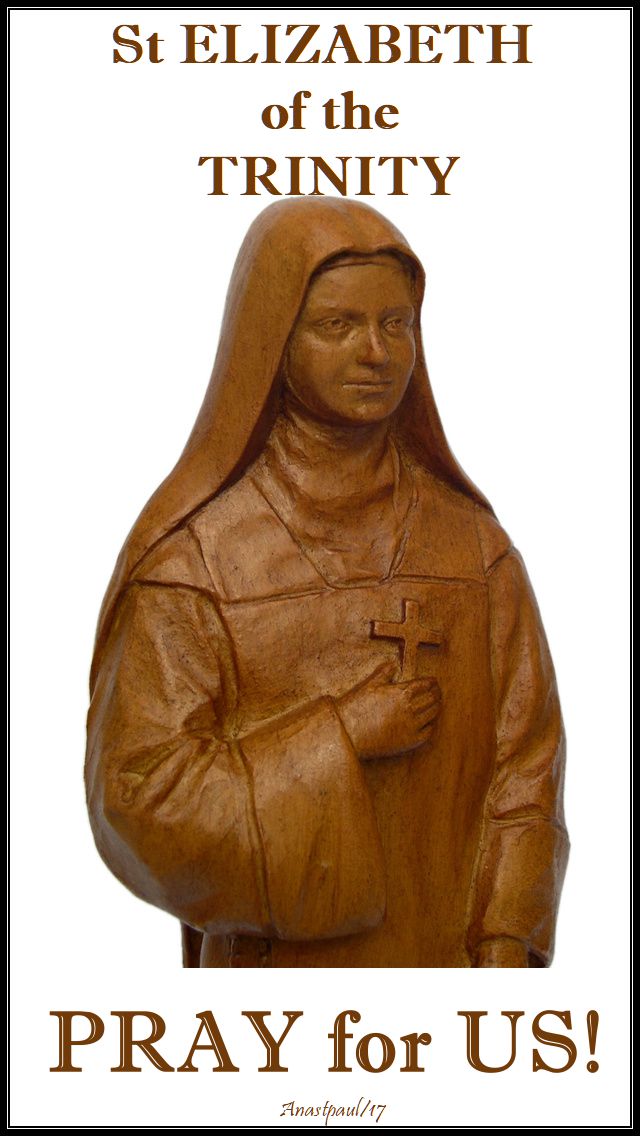
Our Morning Offering – 8 November – The Memorial of St Elizabeth of the Trinity (1880-1906)
Our Morning Offering – 8 November – The Memorial of St Elizabeth of the Trinity (1880-1906)
Holy Trinity, Whom I Adore
By St Elizabeth of the Trinity
O my God, Trinity whom I adore, let me entirely forget myself that I may abide in You, still and peaceful as if my soul were already in eternity; let nothing disturb my peace nor separate me from You, O my unchanging God but that each moment may take me further into the depths of Your mystery! Pacify my soul! Make it Your heaven, Your beloved home and place of Your repose; let me never leave You there alone but may I be ever attentive, ever alert in my faith, ever adoring and all given up to Your creative action.
O my beloved Christ, crucified for love, would that I might be for You a spouse of Your heart! I would anoint You with glory, I would love You – even unto death! Yet I sense my frailty and ask You to adorn me with Yourself; identify my soul with all the movements of Your soul, submerge me, overwhelm me, substitute Yourself in me that my life may become but a reflection of Your life. Come into me as Adorer, Redeemer and Saviour.
O Eternal Word, Word of my God, would that I might spend my life listening to You, would that I might be fully receptive to learn all from You. In all darkness, all loneliness, all weakness, may I ever keep my eyes fixed on You and abide under Your great light; O my Beloved Star, fascinate me so that I may never be able to leave Your radiance.
O Consuming Fire, Spirit of Love, descend into my soul and make all in me as an incarnation of the Word, that I may be to Him a super-added humanity wherein He renews His mystery; and You O Father, bestow Yourself and bend down to Your little creature, seeing in her only Your beloved Son in whom You are well pleased.
O my `Three’, my All, my Beatitude, infinite Solitude, Immensity in whom I lose myself, I give myself to You as a prey to be consumed; enclose Yourself in me that I may be absorbed in You so as to contemplate in Your light the abyss of Your Splendour!
Saint of the Day – 8 November – St Elizabeth of the Trinity O.C.D. (1880-1906)
Saint of the Day – 8 November – St Elizabeth of the Trinity O.C.D. (1880-1906) – professed Religious, Mystic, Writer, gifted Pianist. Born Elizabeth Catez on Sunday 18 July 1880 in a military camp in the diocese of Bourges, France – 9 November 1906 at Dijon, Côte-d’Or, France of Addison’s disease, a hormone disorder whose side effects are painful and exhausting. Pope John Paul II beatified Elizabeth on 24 November 1984 and Pope Francis Canonised her on 16 October 2016. Patronages – • against the death of parents • against bodily ills, illness or sickness • sick people.


Elizabeth was born on 18 July 1880 at the army camp in Avor near Bourges in France, where her father was a captain. She was baptised four days later on the Feast of St. Mary Magdalene, a fact which she treasured. When she was 2½ her sister Marguerite, known as Guite, was born. Elizabeth’s father died when she was only seven years old. By this time the family was living in a camp in Dijon but after the captain died, they moved into a flat. Elizabeth could see the Carmel of Dijon from her bedroom window. She was very high spirited and given to fiery outbursts of anger when things did not go her way. In 1891 Elizabeth received her First Holy Communion and it made a deep impression on her. From this time on the Eucharist became the centre of Elizabeth’s life and it gave her the strength and determination she needed to make a real effort to overcome her rages.
When she was eight Elizabeth’s mother enrolled her in the Conservatoire, probably with the intention of preparing her to teach music. Elizabeth practised the piano for several hours each day; she was an exceptionally gifted pianist. She often played in concerts and when she was thirteen she won first prize for her playing. She could undoubtedly have gone on to become a concert pianist but God had other plans for her.
Around the time of her fourteenth birthday Elizabeth made a vow of virginity, as an act of total self-offering to God. She had already felt the call to religious life and one day after receiving Holy Communion she became convinced God was calling her to Carmel.

Meanwhile she spent happy holidays with her mother and sister. Elizabeth dressed in the latest fashions, enjoyed dances and loved walking in the country, where she appreciated all the beauties of creation. She had a great gift for friendship and was popular with her peers but in everything God was at the centre. She said that when she played the piano she forgot all about the audience and played only for Him.
Elizabeth had a natural gift for contemplative prayer, people remarked on her total stillness and said that she seemed ‘Lost in God’ but she was active in her parish too. She taught catechism and ran a club for the children of workers in a tobacco factory; she visited the sick and sang in the parish choir.
Elizabeth entered the Carmel of Dijon on 2 August 1901 and on 8 December Feast of the Immaculate Conception, she was clothed in the Carmelite habit.


Elizabeth was full of joy as a postulant; she found God everywhere, in her work as well as at prayer. She loved the silence of her cell where she could listen to Him speaking to her in the scriptures. Her novitiate year was not so smooth, as with her great desire for perfection she struggled with scruples. Elizabeth lived in pure faith, during her novitiate; it was a purification which strengthened her and gave her courage. Mother Germaine, at 31 was Elizabeth’s prioress and novice mistress. She understood Elizabeth and emphasised the way of confidence in the merciful love of God, as expressed by Thérèse of Lisieux in her Story of a Soul, which had been sent to the Carmels as Thérèse’s obituary circular about three years before Elizabeth entered.
Elizabeth made her Profession as a Carmelite on J11 January 1903 and on 21 January, the Feast of St. Agnes, she received the black veil in a public ceremony.
Elizabeth shared in her sister’s joy when she married and again later when she had her first two children. Seeing her sister so happy and devoted to her husband, made Elizabeth reflect on her role as spouse of Christ. She wanted to love Him with an undivided heart, to stay with Him all the time in deep communion; to share in His redemptive suffering and prayer and so become fruitful, by nourishing others and drawing them to Him.
Elizabeth’s horizons were expanding; as she pondered the scriptures she felt she was being transformed into another humanity for Christ, an idea which she developed from Paul’s text ‘It is no longer I who live but Christ lives in me’. She had an intuitive grasp of the ‘universal call to holiness’ long before it was named in the Church.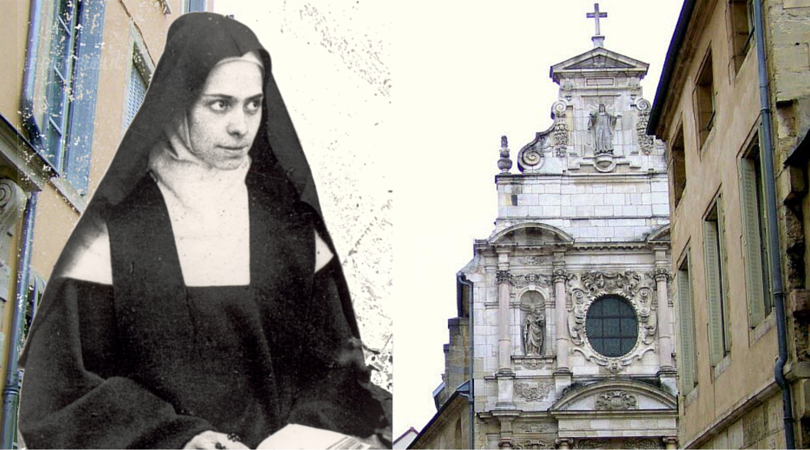
Elizabeth also had a strong awareness of the indwelling of the Trinity. She often called the Trinity ‘My Three’ and had an intimate relationship with Father, Word and Spirit, as she usually called them. Later she discovered her vocation to be a ‘Praise of glory’ and sometimes she even signed herself by this name.
Around the time of her twenty-third birthday it became clear that Elizabeth’s health was failing, she had developed Addison’s disease, at that time incurable. It led to her death at the age of 26 on 9 November 1906. By this time she was fully surrendered to God and died saying, ‘I am going to Light to Love to Life!’


Memorial of the Saints – 8 November
St Adeodatus I, Pope
St Clair of Tours
St Cybi of Caenarvon
St Drouet
St Elizabeth of the Trinity – https://www.youtube.com/watch?v=NT2NXIyQ2Jc
St Gervadius
St Giuse Nguyen Ðình Nghi
St Godfrey of Amiens
St Gregory of Einsiedeln
St John Baptist Con
Bl Maria Crucified Satellico
St Martinô Tho
St Martinô Ta Ðuc Thinh
St Maurus of Verdun
St Moroc of Scotland
St Phaolô Nguyen Ngân
St Tysilio of Wales
St Willehad of Bremen
St Wiomad of Trèves
—
All Deceased Dominicans
All Saints of the Diocese of Evry: A regional memorial of all the saints and beati of the calendar who have a connection to the Diocese of Evry-Corbeil-Essonnes, France.
• Blessed Isabella of France, founded the Longchamp monastery
• Blessed Nicolas Gaudreau, pastor of Vert-le-Petit
• Blessed Pierre Bonse, pastor of Massy
• Our Lady of Good Guard, patron saint of the diocese, venerated in Longpont-sur-Orge, France
• Saint Corbinian, born in Saint-Germain-lès-Arpajon
• Saint Denis of Paris, evangelizer of part of Essonne and revered ni Longpont-sur-Orge
• Saint Eloi, who lived in Chilly-Mazarin
• Saint Germain of Paris
• Saint William of Bourges, son of Count Baldwin IV of Corbeil
• Saint William of Aebelholt, pastor of Brunoy
• Saint Wulfran of Sens, born in Milly-la-Forêt
• Blessed Nativelle, vicar of Longjumeau
• Blessed René Le Bris, pastor of Bris-sous-Forges
• Saint Spire of Bayeux, whose relics are in Corbeil in the cathedral that bears his name
All Saints of Wales
Augustinian Martyrs of Spain
Four Crowned Martyrs: Saint Castorus, Saint Claudius, Saint Nicostratus, and Saint Simpronian. Skilled stone carvers in the 3rd century quarries. Martyred when they refused to carve an idol of Aesculapius for Diocletian. They were drowned in the River Sava in 305. Patronages – • against fever• cattle• sculptors• stone masons, stonecutters.
Martyred in the Spanish Civil War
• BlessedAntolín Pablos Villanueva
• BlessedLaureano Pérez Carrascal
• BlessedManuel Sanz Domínguez
• BlessedMaximino Serrano Sáiz
Thought for the Day – 7 November – The Memorial of Blessed Anthony Baldinucci SJ (1665-1717)
Thought for the Day – 7 November – The Memorial of Blessed Anthony Baldinucci SJ (1665-1717)
Today, 7 November we celebrate the feast day of Blessed Antonio Baldinucci (1665-1717), a Jesuit missionary who, despite failing health, served the Lord with every ounce of strength and love he possessed. While his heart lay in overseas missions, Anthony obediently remained in Italy, giving great missions, reaching many through his preaching and example and working tirelessly for the conversion of souls. His simple faith and acceptance of the will of the Lord, inspire us today to examine our lives and hopes… and then measure how those relate to what the Lord would have us do.
His words “That God may be moved by my sufferings to touch the hearts of my hearers” are an inspiration to us when we wonder how to offer our sufferings to God. Perhaps ours would be “that God may be moved by my sufferings and use my life as an example to the hearts of sinners.”
Blessed Anthony Baldinucci, Pray for us!
One Minute Reflection – 7 November – The Memorial of Bl Anthony Baldinucci SJ (1665-1717)
One Minute Reflection – 7 November – The Memorial of Bl Anthony Baldinucci SJ (1665-1717)
After this I had a vision of a great multitude,
which no one could count,
from every nation, race, people and tongue….Revelations 7:9
REFLECTION – “All Saints is “our” feast, not because we are good but because God’s holiness has touched our life. The Saints aren’t perfect models but persons run through by God. We can compare them to the windows of churches, which let the light enter in different shades of colours. The Saints are our brothers and sisters who received the light of God in their heart and transmitted it to the world, each one according to his own “shade.” However, they were all transparent; they too struggled to remove the stains and the darkness of sin, so as to have God’s kindly light pass through. This is the purpose of life: to have the light of God pass through and also the purpose of our life…..Pope Francis – 1 November 2017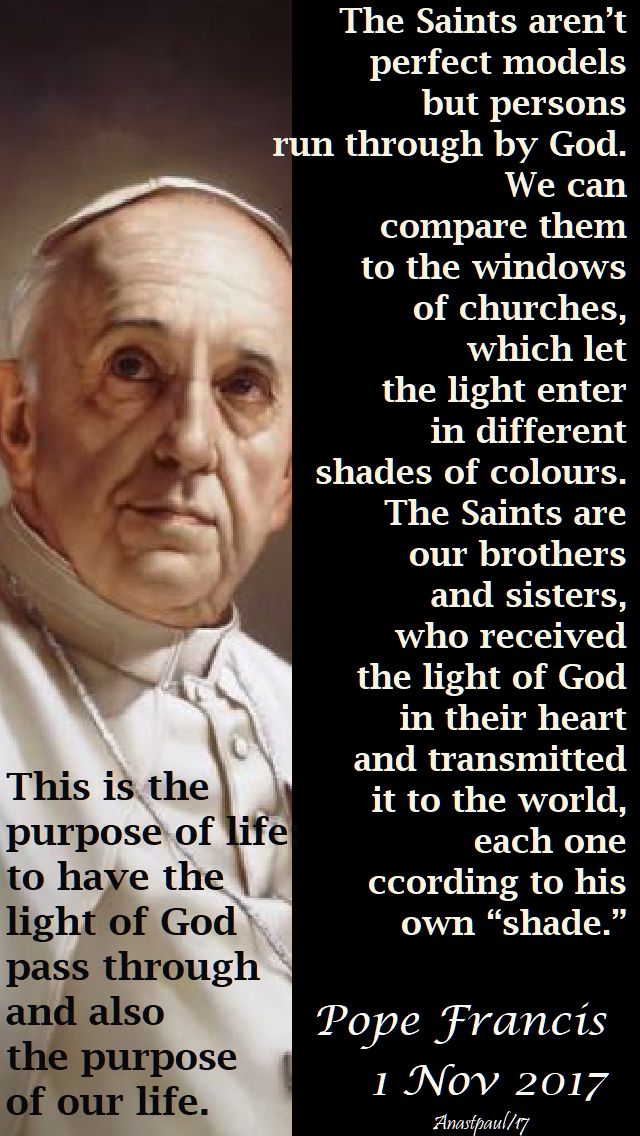
PRAYER – Heavenly Father, may I love and respect Your Saints and by their lives, gain inspiration and assistance. Grant me to obtain an example from their way of life, fellowship in their communion and aid through their prayers. Bl Anthony Baldinucci, displayed a great zeal for teaching and converting sinful souls by his love for the Passion of Your Son and great love for the Holy Eucharist, help me Father to imitate his passionate love. Bl Anthony Baldinucci, pray for us all, amen.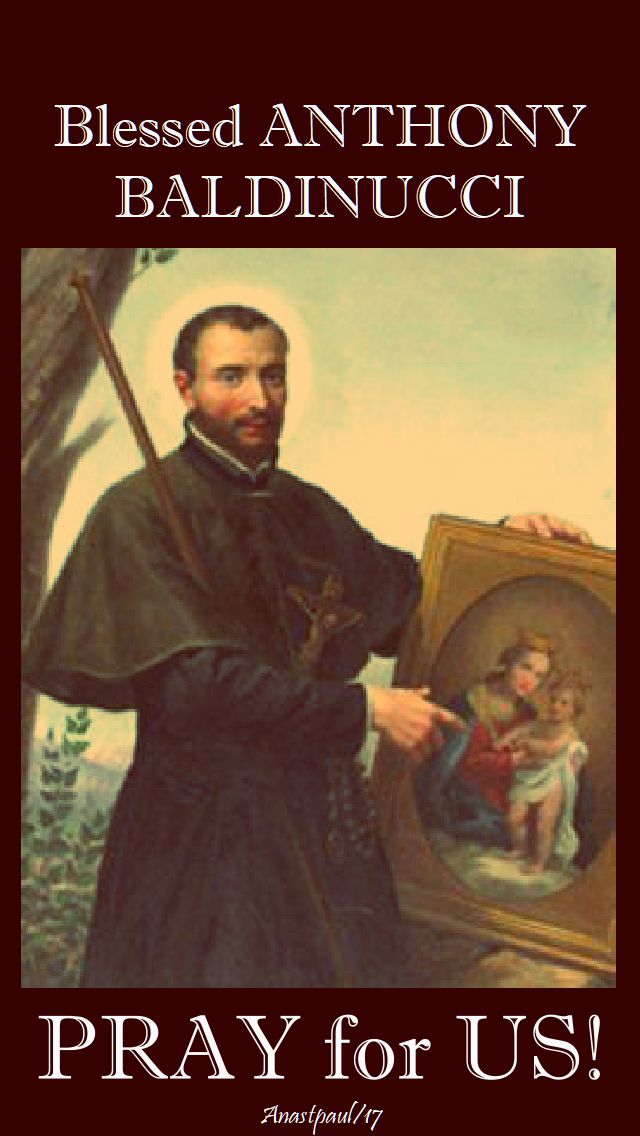
Saint of the Day – 7 November – Blessed Anthony Baldinucci S.J. (1665-1717)
Saint of the Day – 7 November – Blessed Anthony Baldinucci S.J. (1665-1717) Jesuit Priest, Preacher, Writer and Missionary. Born on 19 June 1665 in Florence, Italy and died on 7 November 1717 of natural causes. Beatified on 23 April 1893 by Pope Leo XIII.


Antonio Baldinucci was born in Florence (Tuscany, Italy), the son of a writer and artist and his wife. he fifth of five sons, Antonio’s parents had promised the Lord prior to his birth that if they produced a son, they would devote his life to Saint Anthony of Padua (whose intercession had cured a family member of serious illness). hen Antonio was born, he was raised in the faith, with the intention of his becoming a priest and serving God as promised by his parents. Antonio embraced his parents’ wishes with the zeal of one on fire for the Lord. ather than rebel, as we might expect from a teenage boy, Antonio instead gravitated to the holy, threw himself into his studies and lived a pious life. At age eleven, he began his studies with the Jesuits at San Giovannino but following his eldest brother’s entrance into the Dominican Order, expressed his wish to follow. he Dominicans, however, refused Antonio’s admission, due to his poor health. nstead, his father recommended that he embark on the Spiritual Exercises of Saint Ignatius of Loyola, to attempt to discern God’s plan for his life. Under the spiritual direction of a Jesuit, Antonio was led to seek admission to the Society of Jesusand at the age of 16, began his novitiate in Rome.
Antonio, often ill, was assigned to serve the local Rome community. He first taught the young men at the college, despite his young age. Antonio was not content to remain in Rome, however, expressing his greatest wish to be sent out as a missionary among the Gentiles and to suffer martyrdom for the Lord. He applied, during his tenure with the Jesuits for three overseas missions trips—to India, China, and Japan—and was each time refused, on account of his fragile health. As his health worsened, he experienced debilitating headaches and body fatigue and was sent around the country to various Jesuit houses, seeking advice and cure. Apparently, getting out of Rome was helpful for him and he regained his strength. Allowed to preach, his brothers were amazed by his vigour and success in converting those who heard him!
Returning to Rome, Antonio would spend his afternoons in public places, preaching, and drawing many to the Church. He was ordained at age 30 and immediately applied to be sent overseas as a missionary but again was refused. Instead, Antonio was sent to Frascati, south of Rome, where part of his duties was to provide missions to the poor surrounding towns and villages in the area. Antonio embraced this task with zeal, working among the poor and uneducated for the remainder of his life. Looking to St Ignatius and St Peter Claver as models Antonio traveled barefoot to the towns and villages, regardless of weather. He carried all he needed in a bag on his back and walked with a pilgrim staff. When asked why he walked barefoot, he replied: “That God may be moved by my sufferings to touch the hearts of my hearers.”
Each of Antonio’s missions lasted between eight and fourteen days, depending on the needs of the parish and for his preaching he generally drew from the Spiritual Exercises. At the start of each mission, Blessed Antonio would lead a procession of penitents, during which he wore a crown of thorns, carried a heavy cross and whipped or flagellated himself. This he did as penance for the sins of those he served. Once he had instilled a bit of fear into his mission attendees, Blessed Antonio softened his approach. He spent little time in the pulpit, instead interacting on a personal level with his congregation, writing letters, teaching catechism, visiting and assisting children and the ill. All were welcome, including the ruffians or thugs of the villages. Antonio often began his missions by seeking out the roughest characters of the region and asking them to accompany him, offering him “protection.” By the conclusion of each mission, many of these dissolute characters had come to the faith. Each of Blessed Antonio’s missions ended in the same manner, with a large exhibition where everyone could receive Holy Eucharist. Following Communion, a public burning of cards, dice, obscene pictures, books and secular songs would commence. After one mission, 240 daggers and small guns and 21 pistols were laid at his feet.
Blessed Antonio participated in missions for over 20 years, during that time giving 448 missions in 30 dioceses (an average of 22 each year). Despite this schedule, he found the time to write down many of his sermons, as well as maintain correspondence with those who needed spiritual direction and support. To do so, he maintained a rigorous schedule of work, prayer and penance, sleeping little (about three hours each night on a bed of planks) and fasting constantly. While he had received a special dispensation from Pope Clement XI to not offer daily Mass due to his schedule, he refused to accept it, reading the Liturgy daily.
Gradually, Antonio’s reputation grew and he was summoned to larger and larger cities, drawing great crowds at each mission. Father Baldinucci was deeply devoted to the Eucharist, the Passion of Christ and the Blessed Virgin Mary. He highly revered an image of the Blessed Virgin with the title, “Refuge of Sinners,” attributing numerous conversions and miraculous cures to its veneration. Beginning a new mission in Frosinone, his health failed him and he was confined to his bed. Although he appeared to others to be recovering, Antonio knew his death was approaching and requested that the image of Mary be placed before him. Repeatedly, he prayed to Our Blessed Mother, “Show yourself to be a Mother.” After asking for the Last Sacraments and despite the fact that he was barely able to speak, Antonio continued to recite the prayer, “Jesus and Mary, my hope,” until his death.
He began to convulse through the night until the following morning and finally at 11.00 am on the morning of 7 November 1717, Fr Baldinucci who was only fifty-two surrendered his soul to his Saviour. The indefatigable priest at his death had served the Society for thirty-five years and spent twenty years as an active preacher in the Italian countryside.
Fr Baldinucci was beatified by Pope Leo XIII on 25 March 1893 and his memorial is liturgically celebrated on 7 July.
Blessed Antonio was buried in the chapel of San Giovanni in Florence.

Thought for the Day – 6 November – The Memorial of St Théophane Vénard (1829-1861) Martyr of Vietnam
Thought for the Day – 6 November – The Memorial of St Théophane Vénard (1829-1861) Martyr of Vietnam (The Saint who influenced St Therese of the Child Jesus to dream of becoming a Missionary – she is of course, now a patron of Missionaries).
The letter below holds the last words of Saint Jean-Théophane Vénard—a French Catholic missionary sentenced to death in Vietnam—to his father, written in the night before his execution.
It is said that “on the way to martyrdom Father Vénard chanted psalms and hymns. To his executioner, who coveted his clothing and asked what he would give to be killed promptly, he answered: ‘The longer it lasts the better it will be’.”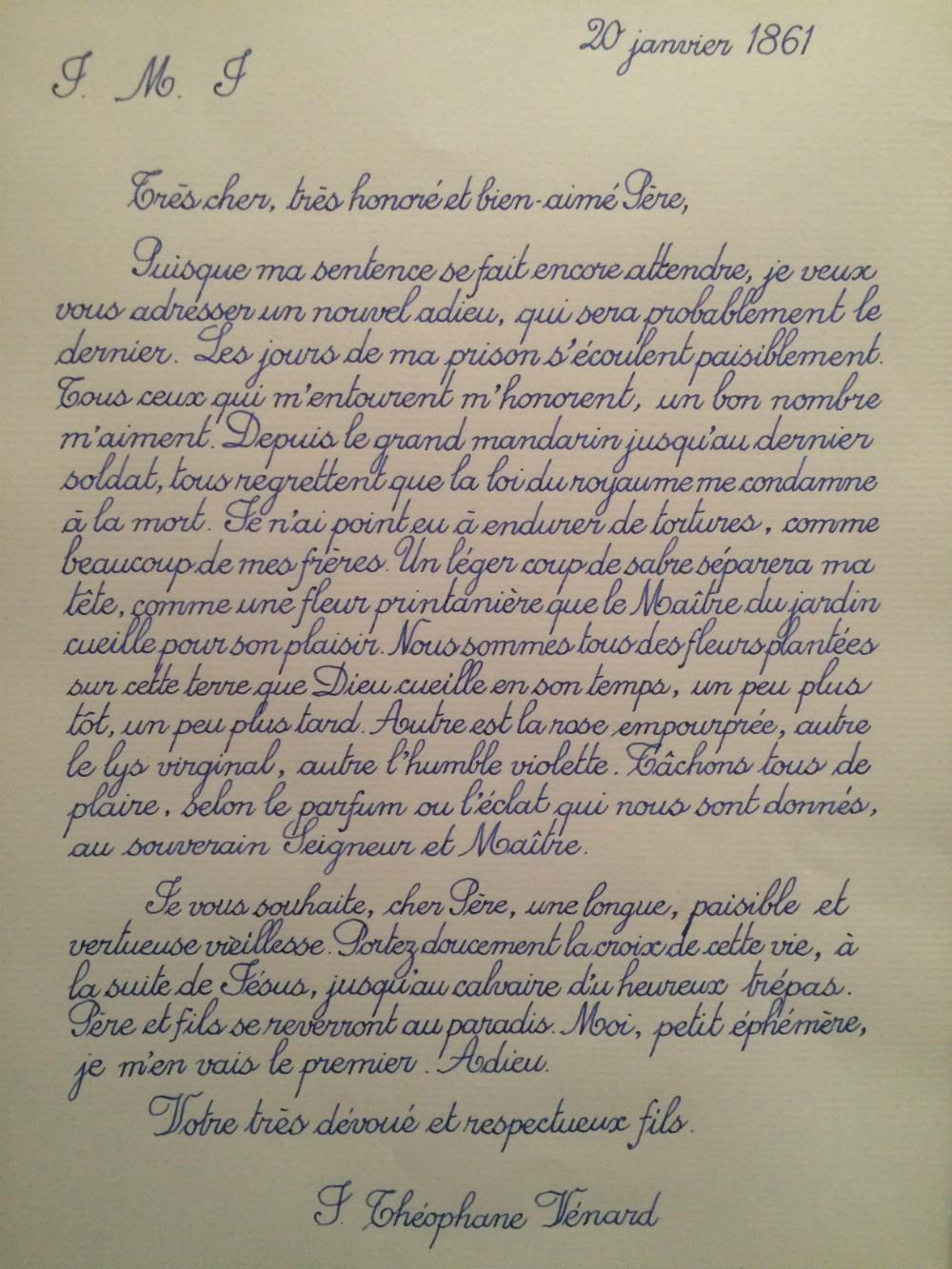
“20 January 1861
Very dear, very respected and beloved father,
Because my sentence keeps me waiting I want to send you another goodbye which will probably be the last. The days of my imprisonment are passing gently. Everybody around me honours me, a great number [of people] loves me. From the great Mandarin to the last soldier, everybody regrets that the law of the kingdom condemns me to death. I did not have to endure torture, like many of my brothers. A light cut of a saber will separate my head [from my body], like the gardener cuts a spring flower for his pleasure. We are all flowers planted on this earth that God reaps in His due time, some earlier, some later. May it be the purple rose, the maiden lily, or the humble violet. Let’s all try to please the Lord and Master according to the scent or colour that is given to us.
I wish you, dear father, a long, quiet and virtuous life. Carry gently the cross of this life, like Jesus did, until the day of the peaceful passing. Father and son will meet again in paradise. I, little ephemeral, I will go there first. Goodbye.
Your very devoted and respectful son
J Théophane Vénard”
However, Théophane’s decapitation at the hands of an executioner was a gruesome event. He died, a martyr of Indochina, on February 2, 1861. The best word to describe Théophane Vénard is “happy.” He was happy at home, happy at school and seminary, happy when he was sick, happy to be sent to Vietnam. And he was happy in his hiding hole, happy in his cage and happy to bend his neck for the executioner’s saber. We may not wish for martyrdom but undoubtedly we would like to be infected with a joy like Théophane Vénard.
St Théophane Vénard, Pray for us!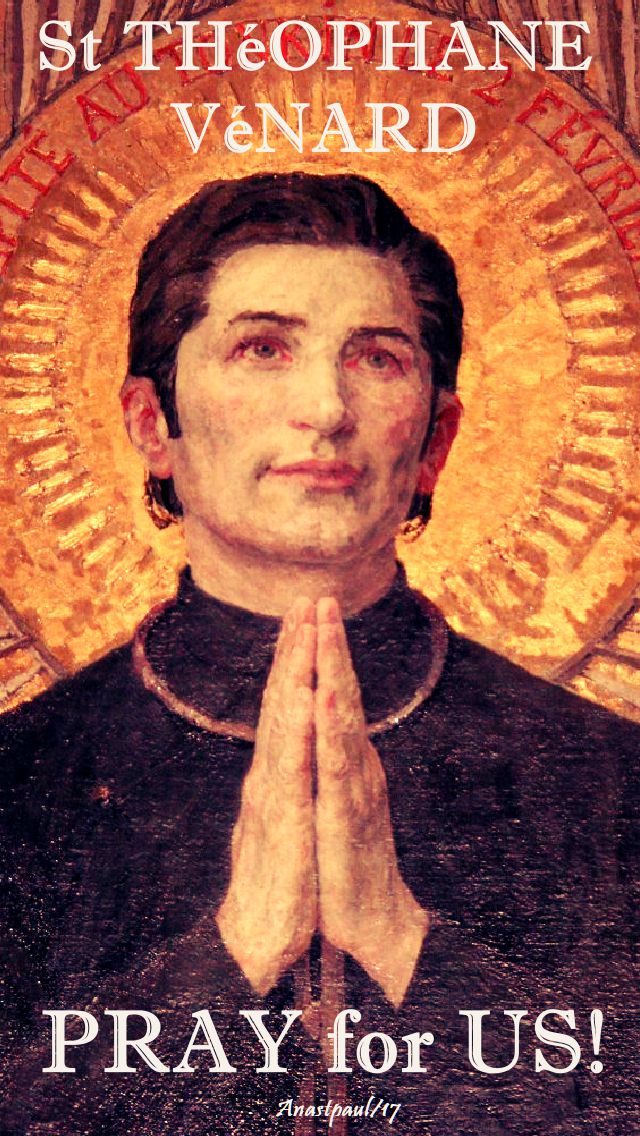
Saint of the Day – St Leonard of Noblac (c496-559)
Saint of the Day – St Leonard of Noblac (c 496-559) Monk, Hermit, Abbot, Miracle-worker. Patronages – • against burglaries • against robberies or robbers • barrel makers, coopers • blacksmiths • captives, prisoners • childbirth • coal miners • coppersmiths • farmers • greengrocers, grocers • horses • locksmiths • miners • porters • prisoners of war • 33 cities. Attributes – depicted as an abbot holding chains, fetters or locks, or manacles.
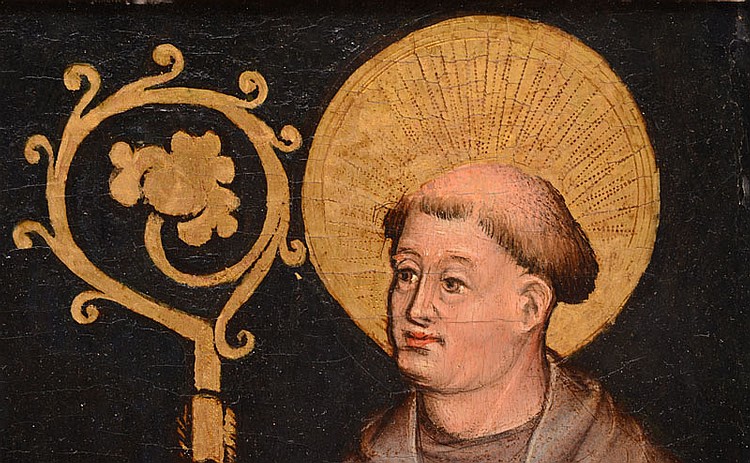
Saint Leonard was born to noble and illustrious parents in Gaul (now France), in the castle of Vendome in Orleans. Born into Frankish royalty, he belonged to the court of King Clovis and his relatives were dignitaries, military commanders and people of both privilege and society. Leonard was baptised by future Saint Remigius and the King, himself, stood as sponsor for him. While he was still very young, the kingdom was threatened by an invading army. The Queen, knowing of Leonard’s Christian faith, jokingly suggested to Leonard that he invoke the help of his God to repel an invading repeal the attack. Leonard prayed, the tide of battle turned and the armies of Gaul were victorious. Saint Remigius used this miracle to convert the King and thousands of followers to Christianity.
From an early age, Leonard was destined for the service of the Lord. As he matured, he was so moved by the holy examples of Saint Remigius, Archbishop of Rheims that he renounced the world in order to lead a more perfect life. Looking to Saint Remigius for advice and spiritual guidance, Leonard quickly came to embrace and exemplify the greatest of Christian virtues and while still a young man, took the tonsure (monk’s haircut) as a symbol to the world of his commitment to serving the Lord. His first calling was in service to prisoners, who he showed great charity, and worked miracles of freedom. Leonard asked the kind monarch to grant him personally the right to liberate prisoners whom he would find worthy of it, any time at all. Based upon his exemplary life, prudence and good judgment (despite a young age), the king agreed.
Leonard earned himself a reputation of goodness, piety and sancity and soon all in the kingdom knew of him. He became a person of pilgrimage, with the sick and poor traveling great distances for his healing and charity. To each, he devoted himself, not only taking care of their physical needs but teaching them the virtues of patience and love and instructing them in the ways of sound doctrine. The king, so pleased with the reputation the holy man was earning for the court, desired to attach him permanently into his service but Leonard, ever humble, replied that he preferred to live in humility and obscurity, as Christ had chosen for Himself for so many years. With the king’s permission, Leonard retired to a monastery in Orleans.


Saint Maximin, the abbot of the monastery, saw to it that Leonard was soon ordained a deacon, which office he accepted out of obedience. However, Leonard did not aspire to any additional ecclesiastical dignities. Rather, he desired a life of austerity, sanctification and preaching—the latter task taking him from the monastery to the pagans of the province of Limoges. On his evangelical journeys, Leonard discovered a nearby mountain, heavily forested and rich in solitude. There he built a cell from the fallen branches of trees and remained for some time, taking great pleasure in the provisions of the Lord. Leonard lived on herbs, wild fruits and spring water, relying solely on the Lord to provide. He spent his days in communion with God, devoting himself to prayer, meditation and physical mortification. Somehow, he was still found by those who sought him and continued to work miracles for the people through his devotion and suffering. For example, from his prayers, the spouse of a nearby king successfully delivered a healthy child following a difficult labour. In deep gratitude, the king bestowed upon Saint Leonard the part of the forest in which he lived, allowing him to do with it as he would. Leonard built a beautiful oratory to the Our Blessed Mother, and was soon joined by two disciples.
With a more prominent building, Leonard was easier to find and the sick increased in numbers, seeking healing. Similarly, word of Saint Leonard’s charity toward those in prison spread and following prayers for his intercession, prisoners reported witnessing their chains break before their eyes. These prisoners would then travel in pilgrimage and thanksgiving to Saint Leonard, dragging their heavy chains and offering them in homage. Soon, a large collection of chains and leg irons could be found at the oratory! Saint Leonard treated each of these freed prisoners with respect and dignity, offering those who wished a tract of land in the forest on which to begin anew. Many remained, transforming their lives into honest work, serving the oratory and the poor of the region and coming to Christ through the work of Saint Leonard. Eventually, a monastery was constructed, attracting an even greater number of disciples.
He fell ill while traveling and as the end of his time on earth grew near, he miraculously had himself transported back to the Oratory of Our Lady, where he died. Numerous miracles of healing and freedom continued to occurand he remains a popular saint of intercession throughout France and Europe. After his death, churches and monasteries were widely dedicated to him throughout Europe, including in France, England, Belgium, Spain, Italy, Switzerland, Germany, Bohemia, Poland and many other countries. Pilgrims continued to travel long distances to his tomb and over 4,000 miraculous favours have been recorded at his intercession.


Memorials of the Saints – 6 November
St Atticus
St Barlaam of Novgorod
Bl Beatrice of Olive
Bl Christina of Stommeln
St Demetrian of Cyprus
St Edwen of Northumbria
St Efflam of Brittany
St Emilian of Faenza
St Erlafrid of Hirschau
St Felix of Fondi
St Felix of Genoa
St Felix of Thynissa
St Illtyd
St Israel of Limoges
St Leonard of Noblac – https://vimeo.com/164320089
St Leonard of Reresby
Bl Leonianus of Autun
St Melaine of Rennes
St Paul of Constantinople
St Pinnock
St Severus of Barcelona
Bl Simon of Aulne
St Stephen of Apt
St Theobald of Dorat
St Théophane Vénard
St Valentine of Genoa
St Victor Chumillas-Fernández
St Winnoc of Wormhoult
—
All Saints of Ireland
All Saints of Africa
Martyrs of Antioch – 10 saints: Ten Christians murdered together by Arabs after their seizure of Antioch, Syria. No names or other details about them have come down to us. 637 in Antioch, Syria.
Martyrs of Gaza – 9 saints: A group of Christian soldiers who were captured by Saracens invading the area of Gaza in Palestine. When the men continued to profess their Christianity, they were executed. We know the names of some of the martyrs – Himerius, John (2 of them), Kallinikos (Callinoco), Paul, Peter, Stephen and Theodore (2 of them). They were beheaded in Gaza, Palestine.
Martyrs of Spain – 498 saints and beati: – Martyred Franciscan Capuchins of Barcelona – 26 beati
Martyred Vincentians of Spain – 14 beati


You must be logged in to post a comment.