Posted in SAINT of the DAY

Saint of the Day – 13 January – Saint Viventius Benedicente of Blera (Died 484) Bishop

Saint of the Day – 13 January – Saint Viventius Benedicente of Blera (Died 484) Bishop of Blera, in the Province of Viterbo, Italy, during which time he also became a Hermit. Patronage – of Blera, the City and the Diocese. Also known as – Vivenzio. Additional Memorials – Easter Monday, 2nd Sunday in May, 11 December in Blera.

According to an oral tradition, Viventius was an illustrious and beloved Bishop of Blera from 457 to 484. There is indeed a very strong oral tradition about this Saint, rich in poetic and evocative details but, unfortunately, no document of historical value which can help us to reconstruct the phases of his earthly life.

According to tradition, the Bishop, in addition to his devout and holy life, he administered the Diocese with firmness but also with the gentleness of a father, dedicated his free time from pastoral commitments, to assisting the sick and especially the dying. One day two unbelieving and vicious nobles, irritated by the admonitions of the Bishop, who invited them to convert, decided to play an atrocious prank on him, to discredit him in the eyes of the faithful. Having bribed the servants, they had his tunic replaced with a female one during the night. Then they woke him, begging him to rush to a house in the town to assist a dying man. In order not to waste time, Viventius did not even light the lamp but putting on his female dress in the darkness, which was only distinguishable from his own by a few gatherings, without noticing anything. Arriving at the house of the dying man, he found the two nobles there who publicly reprimanded him for that unusual garment, saying to those present: D“o you see how brazen this Bishop is who we venerate as a saint? Not only does he associate intimately with women but he is not even ashamed of dressing in their clothes!”

When, the next day, the population found out about it, they accused him of having caused a scandal with his unacceptable behavior, some even tried to stone him. Barely saved from the angry crowd, Viventius gathered the Priests protesting his innocence and telling them that he would leave Blera forever. He retreated to a cave about seven miles away, on the slopes of the Norchia valley, in a place called “the seven caves” to atone, not for his non-existent error but, for those of his slanderous persecutors. Despite his distance he continued to direct the Diocese through his Priests who came to visit him.

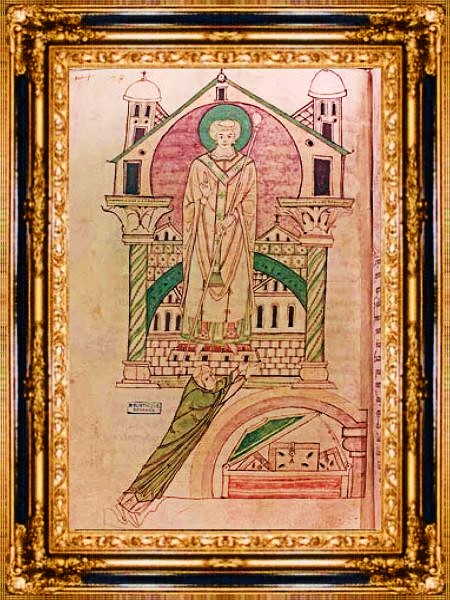
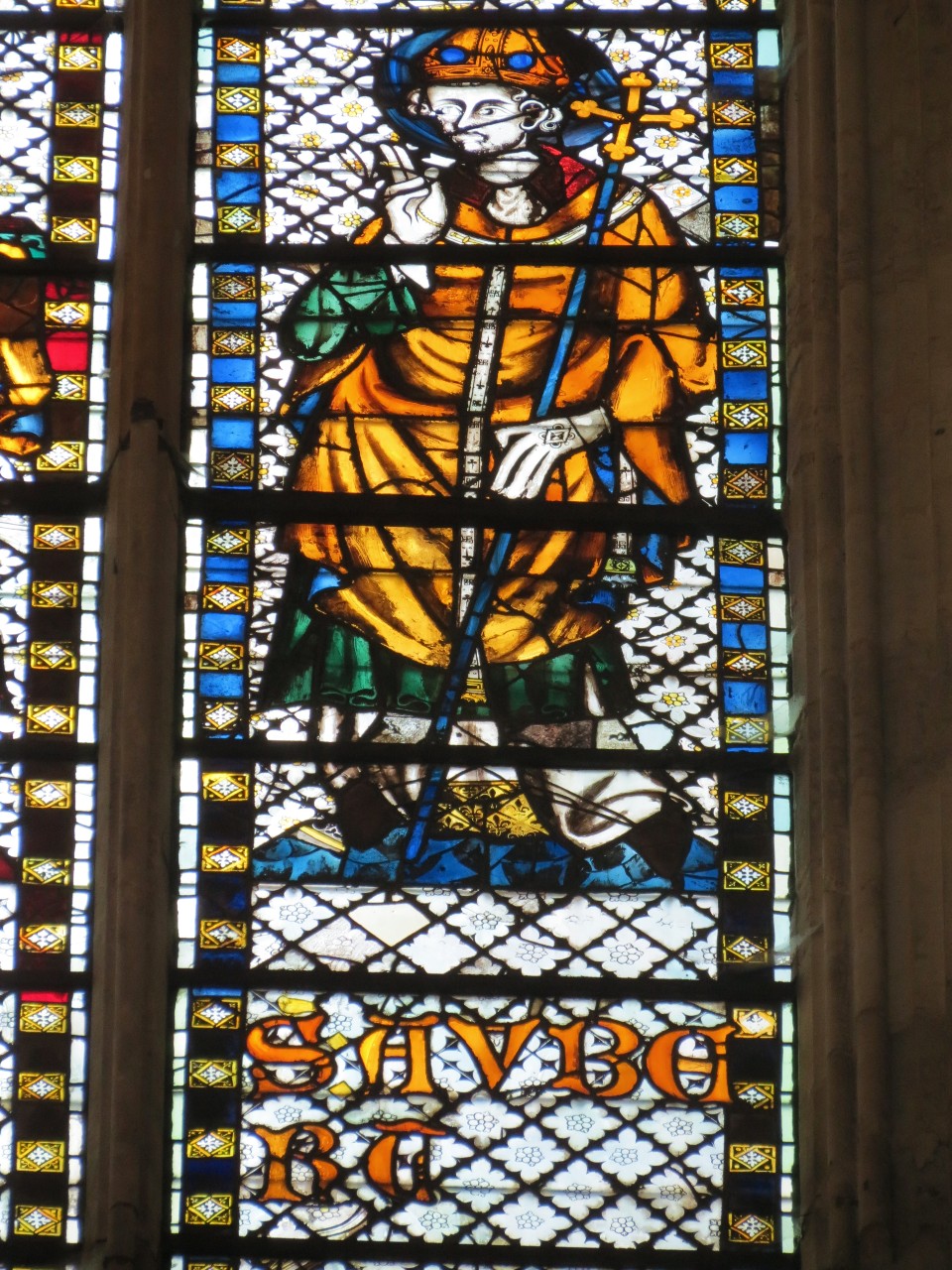
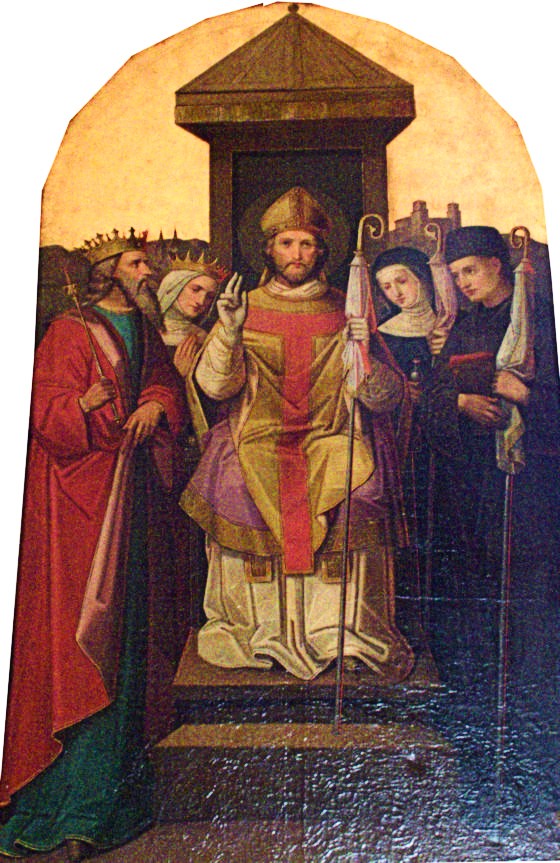
Painting of St Viventius in the Church in Blera

When, thanks to a vision, he knew that he would soon die, he sent for one of his spiritual daughters who had become blind in old age, ordering her to go to Blera to ask the faithful to come and fetch him with a cart on which he would return to the Town. That it was Providence that wanted it was understood from a miraculous event – some indomitable bulls, yoked to the wagon, suddenly became tame. The woman, who wanted to escape that embassy, ​​objected that her blindness prevented her from doing so. “Go, daughter, and you will see, ” replied Viventius and at those words her sight returned.

Faced with the miracle, the inhabitants of Blera hastened to carry out the Bishop’s orders, realising, with amazement that the docile bulls were heading, without any apparent guide, to the Hermit’s cave. Viventius boarded the cart which, instead of following the shortest route, crossed the borders of the Diocese while the bells of the villages across which the wagon travelled, rang in celebration, even though no bell-ringer was present. Iit was theproof of his innocence. Arriving in Blera, he blessed the population, who had repented for having believed those impostors and finally died – it was 13 December which has become his liturgical feast.

St Viventius celebration and procession in Blera

His body was buried in the Collegiate Church of Blera which is dedicated to the Assumption of the Blessed Mother and our St Viventius. The Crypt therein, with cross vaults embellished with stuccos and capitals, houses the Tomb of the Saint. The marble portal of the Church is surmounted by the bust of Viventius. We also find an image of the Saint inside the Church – he is depicted on a large canvas together with San Sensia and the Madonna Assunta. A Chapel in the right nave of the Collegiate Church is also dedicated to St Viventius.

St Viventius’ Tomb

In fact, the Saint is much loved, the veneration of the Patron Saint is still strongly felt and rooted in the souls of the Bleranians.  According to some, Saint Viventius (the name derives from the Latin Vicentius and means ‘who is filled with vitality’) was the Confessor of Vergy in France, who is also celebrated today.

The Martyrology of Usuardo mentions him on 13 January and from there he passed into the Roman Martyrology on the same date. In Blera, our Saint is celebrated on 11 December. But such a loved Patron has 2 further celebrations, which consist of pilgrimages to his hermitage (prior to becoming the Bishop), one on Easter Monday and the other on the second Sunday of May. The Bleranrians, therefore, celebrate their Saint three times a year – on the occasion of the two pilgrimages and on 11 December.

The Hermitage of St Viventius
Posted in MARIAN TITLES, SAINT of the DAY

The Octave of the Epiphany, Panny Marie Vítězné / Our Lady of Victory, Prague (1620) and Memorials of the Saints – 13 January

The Eighth Day, The Octave of the Epiphany

St Agrecius of Trier
St Andrew of Trier
St Berno of Cluny
St Designatus of Maastricht
St Elian of Brittany
St Enogatus of Aleth
St Erbin of Cornwall
St Glaphyra
St Gumesindus of Córdoba
St Hermylus
St Hildemar of Arrouaise
Bl Ida of Argensolles
Bl Ivetta of Huy Widow, Mother, Recluse, Mystic

Bl Matteo de Lana
St Peter of Capitolíade

St Servusdei of Córdoba
St Stephen of Liège
St Stratonicus

St Viventius of Verzy
St Viventius Benedicente of Blera (Died 484) Bishop

Posted in franciscan OFM, SAINT of the DAY

Saint of the Day – 12 January – Blessed Bernard of Corleone OFM Cap (1605-1667)

Saint of the Day – 12 January – Blessed Bernard of Corleone OFM Cap (1605-1667) Lay Brother of the Order of Friars Minor Capuchin, previously a Cobbler. Born on 6 February 1605 at Corleone, Palermo, Sicily as Filippo Latino and died on 12 January 1667 at Palermo, Sicily. Patronages – Mafia victims, expectant mothers. Also known as – Bernardo de Corleone, Brother Bernardo, Filippo Latino, Philipi Latini. He was Beatified on 15 May 1768 by Pope Clement XIII.

Bernard was born in Corleone in the Province of Palermo, in Sicily, Italy. He was the third of six children of Leonardo and Francesca Latini. The family lived in modest circumstances but they never lacked the essentials. The Town of Corleone received its name, “Lionheart” for its heroism during the uprising against the French occupation in 1282 which is known in history. as “The Sicilian Vesper.”

The family house was commonly known as Casa di Santi (House of the Saints) because of the charity of the father and the kindness of all the children. Filippo’s father was a Tanner and he himself, became a Cobbler by profession. But he had another passion, namely the sword and he was considered the best duelist in all of Sicily.

After competing in a duel, he had wounded a man named Vito Canino, so severely that he would be permanently disabled, forcing him to flee from the authorities and seeking Ecclesiastical asylum in the Church of the Capuchins in Palermo. He was safe there, because in the 17th Century, the Church’s right of asylum still applied – no-one could be arrested in a holy place, being a “City of Refuge” (Numbers 35:11-28).

In the silence of the Church, Bernard began to meditate on his life and his past sins and he was graced and penetrated with a deepe sense of self-knowledge and self-dislike, realising that he had not obeyed or loved God. With remorseful tears, he asked God for forgiveness and decided to live the rest of his life in repentance and penance. He left Corleone and went to Caltanisetta, where in 1632, he joined the Capuchins as a Lay Brother with the Religious name “Bernard.”

The only thing he longed for was to grow in spiritual perfection and the way there was humility and penance. The strict rule of lathe Order was not enough for him, so he imposed extreme penance on himself to atone for his past sins. He slepton the floor and never for more than three hours at a time. Even the poor Monastery meals he considered as gluttony.

But his graces were as great as his penances. He never learned to read and write, yet he reached the highest spiritual heights. In time, he could read people’s hearts and became renowned for his many miracles. His intercession was also instrumental in miraculous cures of animals.

Bernard lived a simple life, working as a cook, bering transferred from one Monastery to another, in the Province. We know that he spent his last fifteen years in Palermo itself. Exhausted by pmortifications, he sought refuge at the Tabernacle, where he prayed continually. There, he became ill on the Feast of The Epiphany on 6 January 1667 and he died on 12 January 1667, barely 62 years old. Before the funeral, his tunic had to be changed a total of nine times because all had been torn to pieces by the faithful who wanted to secure a Relic.

Posted in MARIAN TITLES, SAINT of the DAY

Within the Octave of The Epiphany, Nuestra Señora La Conquistadora / Our Lady the Conqueror, Santa Fe, New Mexico, St Benedict Biscop and the Saints for 12 January

Seventh Day Within the Octave of The Epiphany

Bl Bartholomew Alvarez
Bl Bernardo de Plano
St Biccianus
Blessed Bernard of Corleone OFM Cap (1605-1667) Lay Brother of the Order of Friars Minor Capuchin

St Caesaria of Arles
St Caroticus
Bl Emmanuel d’Abreu
St Eutropius
St Ferreolus of Grenoble Bishop Martyr
Bl John Gaspard Cratz
St John of Ravenna
Bl Lucia of Valcaldara
St Martinian of Belozersk
St Peter of Abessala
St Probus of Verona
St Quinctus the Soldier
St Satyrus

St Tigrius
St Victorian of Asana
Bl Vincent da Cunha

Posted in SAINT of the DAY

Saint of the Day – 11 January – St Leucius of Brindisi (Died c180) Bishop, Confessor

Saint of the Day – 11 January – St Leucius of Brindisi (Died c180) Bishop, Confessor, Missionary. Born in Eastern Europe and died in c180 in Brindisi, Italy of natural causes.  Patronages – of Atessa, the City of Brindisi and the Archdiocese of Brindisi-Ostuni, all in Italy. Also known as – Leucio.

The Roman Martyrology reads: “At Brindisi, the holy saint Leucius, Bishop and Confessor.

St Leucius was the first Bishop of Brindisi,who founded the Diocese of Brindisi in 165. A second Bishop of the same name is also honoured as a Saint but he lived in the 5th Century and was Martyred – this latter was mentioned by St Gregory the Great.

Not much is known of Leucius’ early life, although it is believed that he was born in Eastern Europe, to Eudecius and Euphrodisia and was given the name of Eupressius at birth. The young Eupressius was educated and spent the formative years of his life in Alexandria, Egypt.

Following the death of his mother, he entered monastic life. A heavenly vision, during a memoria of the Virgin, would change his name from Eupressius to Leucius (this name means bright, pure as the light). Having already been Ordained a Bishop, Leucius wished to undertake a Missionary Apostolate in Brindisi, to liberate the pagans. Leucius left Alexandria for Brindisi, which at the time was one of the largest ports of the Mediterranean, in the southern part of Italy.

Leucius first became renowned when many pagans in Apulia heard him preaching the Gospel during a drought. He claimed that if they had faith in his message, the rains would come. After the rains fell, the pagans were immediately converted to Chris. Soon after, he became the first Bishop of Brindisi and proceeded to build the Churches of St Mary’s and St John the Baptist.

However, the honour of the Mother of God, however, it is more likely that the Bishop of Brindisi of the 5th Century, was the one who built a Church in honour of the Blessed Virgin. After all, that custom became the norm only after the Blessed Virgin Mary was proclaimed as the Mother of God at the Council of Ephesus in 431. Immediately afterwards, Santa Maria Maggiore was built in Rome. From that moment, every City built a St Mary’s Church as if for battle. It is, therefore, logical that the roots of the St Mary’s Church in Brindisi, dates from the 4th Century rather than the 2nd.

The later part of his life is unknown but according to tradition, he suffered martyrdom in the year 180 but this is not acknowledged in the Martyrology. Soon after his death his remains were returned to Brindisi, there they remained until the Lombard invasion of 768, when they were moved to Trani, then to the capital of the Duchy of Benevento and finally to the Basilica Cathedral of Brindisi, see below.

Posted in MARIAN TITLES, SAINT of the DAY

Within the Octave of Epiphany, St Pope Hyginus (Died 142) Martyr, Notre-Dame de Bessiere / Our Lady of Bessiere, France, Madonna della Vetrana / Our Lady of the Vetrana, Italy (1691) and all the Saints for 11 January

Sixth Day Within the Octave of Epiphany

St Alexander of Fermo

St Boadin of Ireland
St Breandan of Ireland (the name is not an error)
St Eithne
St Fedelemia
St Honorata of Pavia
St Leucius of Alexandria (Died 5th Century) Bishop Martyr

St Leucius of Brindisi )Died c180) Bishop Confessor

St Liberata of Pavia
St Lucius the Soldier
St Luminosa of Pavia
St Mark the Soldier
St Michael of Klopsk
St Palaemon
St Paldo
St Peter Balsam
St Peter of Alexandria
St Peter of Anea
St Peter the Soldier

St Salvius of North Africa (Died 6th Century) Martyr

St Severus of Alexandria
St Speciosa of Pavia
St Taso
St Theodosius the Soldier
St Theodosius of Antioch

St Tipasio of Tigava

Posted in SAINT of the DAY

Saint of the Day – 10 January – St Pope Agatho (Died 681)

Saint of the Day – 10 January – St Pope Agatho (Died 681) Bishop of Rome from 27 June 678 (at this time over 100 years old) until his death on 10 January 681. Born in Sicily of Greek parentage, probably in Palermo of which City he is the Patron. Known for his affability and charity, on account of the many miracles attributed to his intercession, he has been styled as “Thaumaturgus or Wonderworker.” Also known as – Agathon, Agatone, Agathonius.

The Roman Martyrology reads today: “At Rome, the Pope, St Agatho, who terminated a liferemarkable for sanctity and learning by a holy death.”

Agatho was originally a Benedictine Monk at St Hermes in Palermo and there is good authority that he was more than 100 years old when, in 678, he ascended the Papal Chair asthe successor to Pope Donus.

Shortly after Agatho became the Supreme Pontiff, Saint Wilfred, Archbishop of York, who had been unjustly and uncanonically deposed from his See by Theodore of Canterbury, arrived in Rome to invoke the authority of the Holy See on his behalf. At a Synod which Pope Agatho convoked in the Lateran to investigate the affair, Wilfred was restored to his See.

The main event of Agatho’s Pontificate remains however, the Sixth Ecumenical Council, held in Constantinople in 680, at which the Papal Legates presided and which practically ended the Monothelite heresy. Before the Decrees of the Council arrived in Rome for the approval of the Pope, Agatho had died on 10 January 681 and was laid to rest in St Peter’s Old Basilica.

His memory is still wonderfully celebrated in Greece.

Artwork and Shrine of St Agatho at Lipari Cathedral in Sicily
Posted in franciscan OFM, MARIAN TITLES, SAINT of the DAY

The Fifth Day Within the Octave of The Epiphany, Madonna del Pianto / Madonna of the Lament or the Weeping Madonna, Rome, Italy (1546) and the Saints for 10 January

The Fifth Day Within the Octave of The Epiphany

St Aldo of Carbonari
St Pope Agatho (Died 681) Bishop of Rome from 27 June 678

St Arcontius of Viviers
Bl Benincasa of Cava
St Dermot of Inis Clothrann
St Domitian of Melitene

Blessed Giles of Lorenzana OFM (1443-1518) Lay Brother of the Friars Minor.

St Maurilius of Cahors
St Nicanor of Cyprus

St Petronius of Die
Bl Raymond de Fosso
St Saethryth of Faremoutier
St Thecla of Lentini
St Thomian of Armagh
St Valerius of Limoges

Posted in Against STORMS, EARTHQUAKES, THUNDER & LIGHTENING, FIRES, DROUGHT / NATURAL DISASTERS, SAINT of the DAY

Saint of the Day – 9 January – Saint Marcellinus of Ancona (Died c577) Bishop,

Saint of the Day – 9 January – Saint Marcellinus of Ancona (Died c577) the Fifth Bishop of Ancona, Italy.Born in Ancona and died there on 9 January in c577 of natural causes. Patronages – against fire (a raging fire ceased by St Marcellinus waving his prayer book at it; the book survived the fire with only slight damage; afterwards, people who touched it, while praying, were cured of ailments), of Ancona, Italy. Also known as – Marcellin, Marcellino.

The Roman Martyrology reads: “At Ancona, St Marcellinus, Bishop, who, according to St Gregory the Great, miraculously delivered that City from destruction by fire.

Marcellinus, of the noble family of Boccamaiori, became the Fifth Bishop of Ancona in 539. At that time, the Church of Santo Stefano acted as the Cathedral. According to a Vita of the Saint, instead of being proud of the high office which had been entrusted to him, Marcellinus mortified himself with fasting and continual penance which he offered to God, together with vigils, prayers and works of charity.

In his Dialogues, St Gregory the Great (540-604) called him “a man of venerable virtue” and recalled the miracle when he extinguished a fire which was devastating Ancona.

In the Istoria d’Ancona, written in the first half of the 19th Century by Abbot Antonio Leoni, who drew upon a number of ancient sources, we read what happened when the fire “untreated at first” was fuelled by the wind. The City’s inhabitants implored the help of their Bishop who, after raising his eyes to Hea in prayer, was carried on a chair (he had difficulty walking due to a severe attack of gout) to the point where the fire was most threatening. There, he held out and read from the Evangeliary containing the passages of the synoptic Gospels, with notes relating to the Liturgical use of Ancona. The Evangeliary was partly scorched by a sudden upsurge of the flames which, however, went out the instant the Saint suddenly shut the book, to everyone’s gratitude.

A portion of the Evangeliary which was damaged

The Evangeliary of Saint Marcellinus, on the eve of the Saint’s Feast, is carried in procession through the City’s streets and is still kept in the Diocesan Museum of Ancona, after being restored in the 20th Century.  Sick people who touched it regained health; the son of a noble family remained unharmed in the midst of a fire into which the devil had thrown him, out of envy at the veneration shown to Marcellinus by the youth; a fire in a village near Ancona immediately ceased when the prayer book was brought there.

Early 1300s Statue of St Marcellinus

The first Cathedral in Ancona is commemorated by an inscription on the Primary School which is now built on this site.

St Marcellinus’ Relics , circa 1756, in the Crypt of Ancona Cathedral
Posted in FEASTS and SOLEMNITIES, MARIAN TITLES, QUOTES for CHRIST, SAINT of the DAY

Fourth Day Within the Octave of Epiphany, Feast of the Black Nazarene, Marian Feasts and Memorials of the Saints including St Peter of Sebaste (c340-c391) Bishop – 9 January

Fourth Day Within the Octave of Epiphany

Bl Antony Fatati
St Brithwald of Canterbury
St Eustratius of Olympus
Bl Franciscus Yi Bo-Hyeon
St Honorius of Buzancais

St Marcellinus of Ancona (Died c577) Bishop
St Marciana
Bl Martinus In Eon-min
St Maurontius
St Nearchus
St Paschasia of Dijon
St Philip Berruyer
St Polyeucte

Posted in GOUT, KNEE PROBLEMS, ARTHRITIS, etc, SAINT of the DAY

Saint of the Day – 8 January – Saint Albert of Cashel (Died c600) Bishop(?), Missionary

Saint of the Day – 8 January – Saint Albert of Cashel (Died c600) Bishop(?), Missionary.  Born in England and died in 800 at Regensburg, Germany of natural causes. Patronages – against arthritis, of Cashel, Ireland, the Archdiocese of Cashel and Emly, Ireland. Also known as – Albert of Regensburg, Alberto. The name ‘Albert’ means “shining through nobility” (From the Old High German). Canonised on 19 June 1902 by Pope Leo XIII.

Traditionally held to be an Englishman who worked in Ireland and then Bavaria in modern Germany, together with St Erhard of Regensburg who died in the 7th Century and is believed to have been Albert’s brother.

Albert worked mainly around the City of Cashel, in Ireland and itraditionally held to have been the Bishop of that City and today he is reverred as the City’s and the Diocesan Patron Saint. There is a chronilogical error regarding Albert’s life in that the Diocese of Cashel was only founded in 1111.

In a legendary 12th Century Vita, he is called “natione Anglus, conversatione Angelicus – by race an Angle, in manners an Angel!

Our Saint and St Erhard of Regensburg, evangelised and went on pilgrimage to the Holy Land together. They separated when Albert went to Ireland and Erhard remain in Regensburg. According to tradition, Albert became Archbishop of Cashel in County Tipperary in Ireland. Out of longing for his brother Erhard, Albert finally returned to Regensburg, where Erhard had since died. Albert prostrated himself crying at his grave in what was then the Niedermünster Monastery. Albert died soon after and his grave is next to Erhard ‘s.

Albert was Canonised by the confirmation of his cult on 19 June 1902 (the group “Albert , Asicus and Carthagus – Bishops, and their 22 Irish companions”) by Pope Leo XIII. His memorial day is 8 January in the Archdiocese of Cashel and Emly but 19 January is also mentioned. He is celebrated all over Ireland. It is recorded that Albert suffered from arthritis, hence his patronage of this illness.

St Albert’s Reliquary in the Church of the Niedermünster Monastery in Regensburg.
Posted in SAINT of the DAY

Within the Octave of The Epiphany, Our Lady of Prompt Succour, New Orleans, USA (1809) and Memorials of the Saints – 8 January

Third Day of Octave of The Epiphany Octave

St Abo of Tblisi
St Albert of Cashel (Died c600) Bishop

St Athelm of Canterbury
St Atticus of Constantinople
St Carterius of Caesarea
Bl Edward Waterson
St Ergnad of Ulster
St Erhard of Regensburg
St Eugenian of Autun
St Garibaldus of Regensburg
St Gudule of Brussels
St Helladius
St Julian of Beauvais
St Lucian of Beauvais
St Maximian of Beauvais
St Maximus of Pavia
Bl Nathalan of Aberdeen
St Patiens of Metz
St Pega of Peakirk

St Theophilus the Martyr
St Thorfinn
St Wulsin of Sherborne

Posted in SAINT of the DAY

Saint of the Day – 7 January – Saint Lucian of Antioch (Died 312) Confessor, Priest, Martyr,

Saint of the Day – 7 January – Saint Lucian of Antioch (Died 312) Confessor, Priest, Martyr, Teacher, Theologian, Writer, Founder of the renowned School of Antioch. Born in Samosata. Syria in the 2nd Century and died after many tortures by the sword in 312 at Nicomedia, Bithynia (modern Izmid, Turkey). Also known as – Lucian of Drepana, Lucian of Nicomedië, Lucian of Nicomedia, Lucian the Martyr, Lucian of Samosata, Luciano… Lucianus… Lucian means ‘the shining one‘ (Latin).

The Roman Martyrology reads: “The birthday of the blessed Lucian. a Priest of the Church of Antioch and Martyr, who was distinguished for his learning and eloquence. He suffered at Nicomedia for the confession of Christ, in the persecution of Galerius Maximian and was buried at Helenopolis, in Bithynia. His praises have been proclaimed by St John Chrysostom.

Fresco in the Cathedral in Segni. Italy

Lucian came from a respected family, was educated in Edessa – today’s Sanlıurfa – and then worked as a Priest and teacher in Antioch – today’s Antakya/Hatay. He founded the famous Antiochene school – it used literal, grammatical-historical explanations to interpret Scripture which was in contrast to the allegorical interpretation of the Scriptures taught in Alexandria and, therefore, had a reputation for rationalism.

After the condemnation of Bishop Paul of Samosata in 268 and his teaching that Jesus Christ was a normal human being, Lucian, although not subscribing to this view, also found himself increasingly in opposition to the official teaching and soon no longer belonged to the community in Antioch.  Arius, the founder of Arianism , was then one of Lucian’s students, whose followers initially called themselves Syllukianists after Lucian – (meaning: “like-minded with Lucian”).

It seems Lucian corrected his errors and in 285 made peace with the Church and was re-admitted into full communion with the community of Antioch

Lucian was in Nicomedia (today Izmid in Turkey), when Emperor Diocletian’s persecutions broke out and he was imprisoned there for nine years. Twice he was interrogated, when he defended himself ably and refused to deny Christ. In the winter of 311/312 Lucian was brought before Emperor Maximinus Daza, where he presumably suffered Martyrdom after making a profession of his faith. His speech before the Emperor has been preserved but its authenticity is disputed. He was either starved to death, or more likely, killed by sword in 312. His body was taken to Drepanum, which was nearby. Emperor Constantine renamed it Helenopolis in memory of his mother – today’s Hersek -.

According to St Jerome’s testimony, a summary of the Sacred Scriptures published by Lucian was used for a long time, from Constantinople – today’s Istanbul – to Antioch. A surviving creed written by Lucian, according to which Jesus Christ was not Consubstantial but only Consubstantial with God, was also widespread.  Lucian’s life story, written in the middle of the 4th Century, comes from Arian representatives.

A Greek Icon of St Lucian

Lucian’s grave in Drepanon – today’s Hersek – was first venerated by the followers of Arianism but by the end of the 4th Century, Lucian was included in the Church’s list of Saints.

St John Chrysostom gave him an Eulogy, St Eusebius of Caesarea praised him as a Priest of the community in Antioch who was excellent in all his conduct and as a very excellent man in every respect, of a strict way of life and well versed in the Sacred sciences . St Helena had a Church built in his honour in Antioch which was probably Consecrated on 15 October. In the Russian Orthodox Church, Lucian is incorrectly referred to as a Bishop because of his importance.

Canonisation: – As early as the end of the 4th Century, Lucian was included in the list of Saints despite his earlier critical relationship with the official Church.

Posted in MARIAN TITLES, SAINT of the DAY, The HOLY FAMILY, THE HOLY FAMILY - FAMILIAE SANCTAE

Feast of the Holy Family, Within The Octave of The Epiphany, Our Lady of Egypt and the Return of the Child Jesus from Egypt, Madonna delle Grazie / Our Lady of Grace, Italy (1588) and the Saints for 7 January

The Second day Within The Octave of The Epiphany

The Flight into Egypt by Albrecht Durer

Bl Albert of Siena
St Aldric of Le Mans
Bl Ambrose Fernandez
St Anastasius of Sens
St Brannock of Braunton
St Candida of Greece
St Cedd
St Clerus of Antioch
St Crispin I of Pavia
St Cronan Beg
St Emilian of Saujon
St Felix of Heraclea
St Giuliano of Gozzano (c350-c391) Deacon, Missionary
St Januarius of Heraclea
St Julian of Cagliari
St Kentigerna
St Lucian of Antioch (Died 312) Confessor, Priest, Martyr

St Pallada of Greece
St Polyeuctus of Melitene
St Reinhold of Cologne
St Spolicostus of Greece
St Theodore of Egypt
St Tillo of Solignac

St Virginia of Ste-Verge
Bl Wittikund of Westphalia

Posted in Against EPIDEMICS, PRAYERS for VARIOUS NEEDS, PRAYERS to the SAINTS, SAINT of the DAY

Saints of the Day – 6 January – Saint Caspar, Saint Melchior and Saint Balthasar, (1st Century) Martyrs

Saints of the Day – 6 January – Saint Caspar, Saint Melchior and Saint Balthasar, (1st Century) otherwise known as the Three Wise Men/Kings or the Magi – they were all Martyrs. Patronages – against epilepsy/of epileptics, against thunder, furriers, motorists, pilgrims, playing card manufacturers, sawmill workers, travellers, travelling merchants, Cologne, Germany, Saxony. Additional Memorials – 23 July (translation of Relics); 24 July (Cologne, Germany where their Relics lie).

And entering into the house, they found the child with Mary His Mother and falling down they adored Him and opening their treasures, they offered Him gifts; gold, frankincense and myrrh.” – Matthew 2:11

The Three Kings brought Jesus Gold — to show that He was a King;
Frankincense to honour Him as God and Myrrh to greet Him as man.
These Kings first saw the Star which led them to Bethlehem, on the previous 25 March — the day and at the moment, on which Jesus was conceived in the womb of the Blessed Virgin Mary by the power of the Holy Ghost.

It took the Magi nine months and twelve days to reach Bethlehem, guided by the Star. The Star left them when they were in Jerusalem. But it shone again after the Kings left Jerusalem and led them to the cave of Bethlehem.

Our Lady let each of the Kings hold Jesus in his arms. They were given some of His baby clothes to bring back to the East by way of Relics. The Kings returned to the East, to Persia and later were Baptised there by Saint Thomas the Apostle, in the year 40.

All three of the Kings were Martyred for the Catholic Faith. Their names are now and should always be called, Saint Caspar, Saint Melchior and Saint Balthasar. The bodies of Saint Gaspar, Saint Melchior and Saint Balthasar were first brought to Constantinople and then to Milan and in the 12th Century they were placed in the Cathedral of Cologne, in Germany, where they are venerated with much love by the Catholics of all the world.

Around the year 1200, the Cologne Cathedral Chapter commissioned the creation of this Golden Shrine to house the bones of the Magi.

These Relics which were brought from Milan to Cologne in 1164 by ArchbishopRainald of Dassel, remain there to this day.

The precious Reliquary is decorated with gems, intaglios and cameos.
The sides of the Shrine feature images of the Prophets and the Apostles, seated beneath rows of arches while the front-facing end, depicts three manifestations of Christ; the adoration of the Magi on the left, the Baptism in the Jordan on the right and the Last Judgement – above.

For centuries, pilgrims have come from all over Europe and the world, to venerate the Relics in the Shrine.

Prayer for the Intercession of the Three Kings,
Saint Caspar, Saint Melchior and Saint Balthasar
(By Cologne Cathedral)

Lord and God
Thou created us
for a lifelong journey to Thee.
Each one of us takes a different path,
over mountains and through valleys,
through joy and sorrow and need.
May the Three Holy Kings guide us in our wanderings,
as their faith, knowledge and determination guided them
through many perils on their journey to Thee.
They saw Thee, knelt before Thee,
offered up their gifts and paid homage to Thee,
They were filled with the joy of finding Thee!

Lord and God,
We thank Thee for granting us the freedom
to seek and find Thee, our life’s goal!
Grant us the faith, strength and trust we need,
to follow in the path of the Three Kings.
Give us courage when we are at risk
of taking easier but false paths,
Let us experience the joy of being with Thee
at the end of our journey,
so that we may be eternally surrounded by Thy Love.
We ask this, through Jesus Christ our Lord.
the destination of every pilgrimage.
Amen!

(An Imprimatur has been granted for this
publication – Cologne Cathedral
)

Chapel of the Three Kings at Cologne Cathedral
Posted in franciscan OFM, INCORRUPTIBLES, MARIAN TITLES, SAINT of the DAY

The Epiphany of the Lord, Nostra Signora di Cana / Our Lady of Cana and Memorials of the Saints – 6 January

The Epiphany of the Lord
Epiphany celebrates the visit of the three Kings or iMagi (Wise Men) to the Christ Child, signifying the extension of salvation to the Gentiles.
The date of Epiphany, one of the oldest Christian Feasts, is 6 January, the 12th day after Christmas.
However, in some countries, the celebration of Epiphany is transferred to the Sunday which falls between 2 January and 8 January (inclusive). Greece, Ireland, Italy and Poland continue to observe Epiphany on 6 January as do some Dioceses throughout the world.
Because Epiphany is one of the most important Feasts, it is a Holy Day of Obligation.

The Epiphany:
https://anastpaul.wordpress.com/2018/01/07/the-solemnity-of-the-epiphany-of-our-lord-jesus-christ-7-january-god-reveals-himself-to-us/
AND:
https://anastpaul.com/2019/01/06/the-solemnity-of-the-epiphany-of-the-lord-6-january/

Saint Caspar, Saint Melchior and Saint Balthasar (1st Century)

Nostra Signora di Cana / Our Lady of Cana – 6 January:
HERE:

https://anastpaul.com/2022/01/06/the-solemnity-of-the-epiphany-of-the-lord-nostra-signora-di-cana-our-lady-of-cana-and-memorials-of-the-saints-6-january/

St Antoninus
St Basillisa of Antinoe

St Demetrius of Philadelphia
St Diman Dubh of Connor
St Edeyrn
St Eigrad
St Erminold of Prüfening

Bl Frederick of Saint-Vanne
Bl Gertrud of Traunkirchen
Bl Gertrude van Oosten
St Guarinus of Sion
St Guy of Auxerre
St Honorius
St Hywyn of Aberdaron

St Julian of Antinoë
St Julius
Bl Luc of Roucy
Bl Macarius the Scot
St Macra of Rheims
St Merinus
St Nilammon of Geris (Died c404) Hermit
St Petran of Landévennec

St Pia of Quedlinburg
St Pompejanus
Bl Raymond de Blanes
St Schotin
St Wiltrudis of Bergen

Brendan of Birr (Died c 573) Monk, known as “Prophet of Ireland,” Founder of the Monastery at Birr in Central Ireland.
https://anastpaul.com/2021/11/29/saint-of-the-day-29-november-saint-brendan-of-birr-died-c-573/
Brendan the Navigator (c 484–c 577) Priest, Abbot, Founder of many Monasteries.
https://anastpaul.com/2019/05/16/saint-of-the-day-16-may-st-brendan-the-navigator-c-484-c-577/
Columba of Iona (521-597) Apostle of the Picts, Apostle to Scotland, Abbot, Missionary, Evangelist, Poet, Scholar and Writer.
https://anastpaul.com/2020/06/09/saint-of-the-day-9-june-saint-columba-of-iona-521-597-apostle-of-the-picts-apostle-to-scotland/
Columba of Terryglass (Died 552) Abbot, Founder of Monasteries, Miracle-worker.
https://anastpaul.com/2023/12/12/saint-of-the-day-12-december-saint-columba-of-terryglass-died-552-abbot-one-of-the-twelve-apostles-of-ireland/
Keiran of Saighir (Died c 530) Bishop
https://anastpaul.com/2022/03/05/saint-of-the-day-5-march-saint-kieran-died-c-530/
Kieran of Clonmacnois / the Younger (c516-c550) Priest, Monk, Abbot, Teacher.
https://anastpaul.com/2021/09/09/saint-of-the-day-9-september-saint-kieran-the-younger-c-516-c-550/
Canice of Aghaboe
Lasserian of Leighlin
Mobhí of Glasnevin
Ninnidh the Saintly of Loch Erne
Ruadh´n of Lorrha
Senan of Iniscathay

Posted in Against TEMPTATIONS, Against Unexplained FEVER or HIGH Temperatures, Of a Holy DEATH & AGAINST A SUDDEN DEATH, of the DYING, FINAL PERSEVERANCE, DEATH of CHILDREN, DEATH of PARENTS, SAINT of the DAY

Saint of the Day – 5 January –S aint Syncletica (c320-c400) Virgin

Saint of the Day – 5 January –S aint Syncletica (c320-c400) Virgin, Anchorite, Mystic, Spiritual Guide, Abbess in the Sketic Desert? Name means: “the chosen one” (From the Greek). Syncletica was born around 320 in Alexandria in Egypt and died there of natural causes in around 400. Patronages – against bodily ills, against loss of parents, against temptations, of the ill, of single laywomen. Also known as – Sincletica.

The Roman Martyrology reads: “St Syncletica, whose noble deeds have been recorded by St Athanasius.

According to tradition, Syncletica came from a rich and pious family and is reputed to have been very beautiful. From childhood, however, Syncletica was drawn to a life of holiness and piety. She rejected several marriage proposals for she wished to lead a virtuous life devoted to her heavenly Spouse alone.

After the death of her parents, she distributed her inheritance to the poor and with her younger blind sister, Syncletica abandoned the life of the City withdrawing into a cave as a Recluse. Her holy life soon gained the attention of locals and, gradually, many women joined her to live as her disciples in Christ, teaching them the ascetic way of life.

She was mystically gifted. At the end of their lives, the tempter asked God for permission to test them – just as he had done with Job. Syncletica was tormented by many sufferings but despite her old age, she remained steadfast in her faith and asceticism until she died at the age of 84.

About 40 sayings have been preserved of and about Syncletica. Her life story probably dates to the 5th Century.

We are exposed to many temptations in life. Syncletica advises how we should deal with them:

The devil’s snares are common. If he cannot dissuade the soul through poverty, then he brings wealth as a lure. If he cannot do anything through disgrace, then he withholds praise and honour from her. If he has to accept defeat through health, he makes the body sick. If he cannot deceive with his desires, then he tries to bring about a change through unwanted efforts.
He brings about certain very serious illnesses if he is allowed to, in order to darken the love of God in those who become faint-hearted. Then the body is worn out by the most violent fever and is harassed by unbearable thirst. If you, as a sinner, have to endure this, then remember the coming punishment and the eternal fire and the torments inflicted by the Judge and do not be discouraged because of the present.
Rejoice that God has visited you, and have that sweet word on your tongue – God has chastened me but has not delivered me to death (Psalm 117:18).
You were like iron but with fire you burnt away the rust but if you, as a righteous person, fall into sickness, you will progress from greatness to greaterness.
You are gold but through fire you become even more proven.

An Angel has been appointed to you for the flesh (2 Corinthians 12:7).
Be happy!
See who you have become like!
For you were worthy of the lot of St Paul . …
In such exercises let us form our souls. Because we see the enemy before our eyes!
” (Compiled by Abbot em. Dr Emmeram Kränkl OSB
Benedictine Abbey Schäftlarn – for the Katholische SonntagsZeitung).

Fresco in the Chapel at St Thodosios’ Tomb in the Monastery of Agiou Theodosiou tou Neou near Agia Triada near Argos
Posted in MARIAN TITLES, SAINT of the DAY

The Vigil of the Epiphany of Our Lord, Madonna dell’Abbondanza / Our Lady of Abundance, Cursi, Italy (1641), St Telesphorus, (Died c138) Pope Martyr and Memorials of the Saints for 5 January

The Vigil of the Epiphany of Our Lord

Bl Alacrinus of Casamari
St Apollinaris Syncletica
St Cera of Kilkeary
Bl Convoyon of Redon
St Deogratias of Carthage (Died 457) Bishop
St Dorotheus the Younger

St Kiara
St Lomer of Corbion
Bl Marcelina Darowska
Bl Paula of Tuscany
Bl Pietro Bonilli
St Simeon Stylites
St Syncletica (c320-c400) Virgin, Anchorite, Mystic
St Talida of Antinoë

Posted in PATRONAGE - TOOTHACHE and Diseases of the TEETH,, of DENTISTS, SAINT of the DAY

Saint of the Day – 4 January – Saint Rigobert of Rheims (Died c743) Archbishop

Saint of the Day – 4 January – Saint Rigobert of Rheims (Died c743) Archbishop of Rheims, a Benedictine Monk and later Abbot of the Abbaye Saint-Pierre d’Orbais who subsequently succeeded Saint Rieul as the Bishop of Rheims in 695. Born in the late 6th Century in Ribemont southeast of Saint-Quentin and north of Rheims, in the present-day Aisne in Picardy, in northern France and died on 4 January c743 in Gernicourt, in the Aisne in France. Patronage – against toothache. Also known as – Gobert, Rigobertus, Robert. Additional Memorial – 14 June (translation of Relics). the name Rigobert – means: “the rich, shiny one” (From Old High German).

Rigobert was the son of Constantine of an old Ripuarian family, the first Lord (Châtelain) of Ribemont and of the House of Portian. We do not know his mother’s name, only that she was a Frank from the territory of Porçain at the mouth of the river Somme.  Noticing that their son had a strong inclination towards piety, the parents sent him to the Monastery of Orbais in the Champagne-Ardenne region of northeastern France which had been founded in 680 by their nephew, Saint Bishop Regulus of Rheims . There, Rigobert received his first education in the Monastery school.

It was in this academy that he learned the science of the Saints and he was formed for the exercise of the most heroic virtues. When he reached the prescribed age, he took his vows as a Benedictine Monk. He observed the Rule of Saint Benedict so accurately that he, still very young, could be an example even to older Monks. He prayed incessantly and never spoke unnecessarily and he combined an extraordinary prudence and wisdom with great kindness, so that he easily won the hearts of those with whom he conversed. During this time he was Ordained to the Priesthood and his good qualities led to him being entrusted with ever greater tasks and he eventually ascended to the leadership of the Monastery of Orbais as the Abbot, an Office he retained until 695.

He was very close to the head of the Royal House, Pipin of Herstal and under his protection, the young Priest quickly made a career. Rigobert Baptised Pipin’s illegitimate son with his concubine Alpaida, Charles Martell (689-741), the later powerful Frankish Chancellor (716 -741), the actual ruler of the Franks (other sources say that he was Charles Martell’s Godfather at Baptism).

In 695, Rigobert was named the 27th Bishop of Rheims after Saint Regulus, who was his cousin. By virtue of his Office as the Bishop of Rheims, he anointed the Kings. Through wise decrees and strict justice, he brought the Diocese into a very good condition.

Pipin of Herstal ruled the Frankish Kingdom as Chancellor in the Palace during the reigns of Clovis IV, Kildebert III and Dagobert III, all of whom were Kings of the entire Frankish Kingdom. He was a close friend of the Bishop. One day he came to a country house in the village of Gernicourt near Rheims, to go hunting. With his usual courtesy, Rigobert sent him some refreshments and he came to greet the Bishop.

Pipin, wishing to repay this generosity with a substantial donation, so he urged the Bishop to tell him what he desired for himself and for his Church, assuring him that it would be the most significant proof of friendship he could give him. To satisfy the Duke, the Bishop asked about the house where he was then which was not of great value but entirely to his taste. Pipin gave him the house and said that besides this he gave him as much land as he could walk about during his afternoon rest. The Bishop accepted the gift and immediately drew up the boundaries by walking around this house. Everyone soon saw that in asking for this place, the Bishop had no intention of getting rich because as soon as he became the owner of the property, he gave it to his Church to be part of Diocesan assets and income used for the Bishop’s maintenance.

Rigobert’s most important program was to reform the Clergy. To this end he re-established the rules of his predecessors as regards the discipline of the Clergy and he restored the Chapter of the Cathedral, one of the best ordered then in the Frankish Kingdom.

Little is otherwise known about Rigobert’s time as Bishop but he is said to have lived in a room above the City gate. When he was in his room, he used to pray by a window overlooking the City’s Basilica Saint-Remi. But wanting access to a closer Church to pray, he had a passage excavated through the tower of a Church that was next to the City gate, thus gaining easy access via a ladder.

Once he had been given a live goose to take home and make dinner out of. Rigobert placed the bird in the arms of a servant who followed him. Along the way, while Rigobert was reciting the Office prayers, the bird tore itself free and flew away. The boy, grieved deeply over this accident but Rigobert comforted him and exhorted him to trust in God. When Rigobert resumed his prayers, the goose flew back to them. Thereafter, the Bishop kept the bird as a pet. The goose used to go with him to the Church, where it patiently waited outside while Rigobert celebrated Mass at an Altar dedicated to the Virgin Mary. – which Altar, he received in his exile after requesting it from the usurper bishop.

Rigobert’s zeal for the temporal part of God’s house was nothing compared to that which he had for the spiritual part. He was another Paul, who in his extensive charity cared for all believers. He was everything to them all and this conduct was admired by all and it was one of the chief reasons why Pipin was so strongly convinced of the extraordinary merits of this great man. He wanted his son Charles Martell to become a child of God through his service and he entrusted his son to him for education, in the hope that one day he would succeed in gaining the same respect and devotion for the Bishop which he himself had. But the father’s good intentions were not fulfilled by the son and he, whom the father had honoured was later persecuted by the son.

When Pipin died the King replaced him with a man named Raginfrid causing Charles Martell to arm himself in anger believing the position of Chancellor should have been his as son of Pipin. In the decisive phase, Rigobert hesitated to side with Charles Martell and wanted to remain neutral. He remained faithful to the King as his legitimate senior and although he had very great obligations to Pipin, as he had Baptised and raised his son, he preferred to heed his conscience.

When KCharles Martell appeared at the gates of Rheims under the pretence of saying his prayers in the Church of Notre-Dame, Rigobert refused him entry, telling him that since he and his steward were fighting the government of Austrasia, he would not open the City’s gates for other than the one whom heaven declared victorious. Charles Martell was so offended that he decided to get rid of the troublesome Bishop.

After a victorious battle in the power struggle, Charles Martell deposed the King and Rigobert as Bishop of Rheims without any Ecclesiastical judgment and on his own authority appointed his replacement. Rigobert was exiled to Gascony – there he spent the first part of his exile, waiting for the storm to subside, or whether his banishment would last for life. But later he went to the Monastery at Orbais not far from Rheims, where he resumed the monastic life.

To Rigobert it was a great suffering to see that his people had to endure a wolf instead of a true shepherd but apart from that, he found great joy in being relieved of a burden which had always seemed formidable. After various machinations of the usurper bishop Milo to attract Rigobert back to Rheims by uncanonical means, Rigobert refusing his offers finally returned to live on his country estate at Gernicourt which he had received from Pipin. There he lived poor, lonely and hated by the state’s leadership but highly respected by his people. He often visited the Blessed Virgin in her holy house and confided his troubles to her and he asked her for the grace to suffer without complaint until he died. From there, he entered the Churches of Saint-Maurice and Saint-Remy and other places of devotion in the City, especially where the Relics of holy Martyrs were kept.

St Rigobert on the corner on the facade of Rheims Cathedral

Rigobert spent the day in these exercises of piety before returning in the evening to his solitude, until our Lord, who had purified him through a long series of trials, drew him home to crown his patience. The various sources do not agree on what year he died, one says 773, others 749 or 745 but a larger number say, with greater probability that he died on 4 January 743. The Episcopal list in Rheims says that he died in 733.

Bishop Rigobert was given a grand funeral with great honours. All the Priests and people of Rheims were present at the funeral, and his remains were buried in the Church of Saint-Pierre at Gernicourt which he himself had founded, to the right of the High Altar. Many miracles soon happened there, such as three lame people being healed, a blind woman regaining her sight there and several other sick people coming home in perfect health. Several times during the night a light was seen on his grave and at the same time, singing could be heard, so magnificent that it was easy to understand that they were performed by the Angels. An Monk who had an inflammation in his cheek, sent a candle to burn before the holy Bishop’s Relics and he immediately recovered and found himself able to go and pay his respects to the mighty physician. Our Saint is especially invoked against toothache.

In 896, after many translations, St Rigobert’s Relics finally were sent to the new Church of Saint-Denis outside the City, where they were kept and venerated until The French Revolution. Parts of the Relics later came to Paris.

Rheims Cathedral
Posted in MARIAN TITLES, SAINT of the DAY

Octave of the Holy Innocents, Madonna delle Rose / Our Lady of the Rose, Italy (1417) and Memorials of the Saints – 4 January

St Aedh Dubh
St Aggaeus the Martyr

St Celsus of Trier
Bl Chiara de Ugarte
St Chroman
St Dafrosa of Acquapendente

St Ferreolus of Uzès
St Gaius of Moesia

St Hermes of Moesia
St Libentius of Hamburg
Bl Louis de Halles
St Mavilus of Adrumetum
St Neophytos
St Neopista of Rome
St Oringa of the Cross
Bl Palumbus of Subiaco

St Rigobert of Rheims (Diedc743) Archbishop
Bl Roger of Ellant
St Stephen du Bourg
St Theoctistus

Posted in EYES - Diseases, of the BLIND, PATRONAGE - LOST KEYS/LOST ARTICLES, PATRONAGE - PRISONERS, SAINT of the DAY

Saint of the Day – 3 January – Saint Daniel of Padua (Died 168) Deacon Martyr

Saint of the Day – 3 January – Saint Daniel of Padua (Died 168) Deacon Martyr, Missionary, Evangeliser. Born in Italy, tradition says that he was originally a Jew but was converted by Saint Prosdocimus (Died c100), the first Bishop of Padua, who he assisted in evangelising north-eastern Italy. He was Ordained a Deacon and helped the Bishop preach the Gospel. Patronages – of lost articles, the blind and of eye diseases, prisoners, women whose husbands are away from home at war and he is considered the Patron Saint of Treviso and is also one of four Patron Saints of Padua, along with Saints Anthony of Padua, Prosdocimus and Justina of Padua. Also known as – Daniele, Danilo. Additional Memorial – 17 February on some calenders.

Bronze sculpture detail of Daniel of Padua on the doors of the Basilica of St Anthony

According to tradition, Daniel was Martyred in the year 168 under Emperor Marcus Aurelius (161-180), nailed to a table. However, it is more likely that he died in the early 4th Century in the persecutions under the Emperor Diocletian (284-305). The Roman Martyrology gives no further information.

Bronze sculpture of Daniel of Padua on the doors of the Basilica of St Anthony

The traditions about Daniel were forgotten but his remains were discovered many Centuries later. According to the legend, the core of which seems certain, the Martyr appeared to a blind man in Tuscia and invited him to receive the grace of sight in the oratory of St Prosdocimus in Padua, where Daniel’s tomb lay, completely ignored. The miraculous cure was followed by a diligent search, which led to the discovery of a marble sarcophagus. The Martyr lay there, as on the day he was killed. The body, lying on a wooden slab and covered with a slab of marble, had been pierced by many long nails. An inscription said:
Hic corpus Danielis martyris et levitae quiescit – This is the body of Daniel, Martyr and Deacon.

Bronze sculpture of Daniel of Padua on the doors of the Basilica of St Anthony

Bishop Uldericus was present at the first identification and, on 3 January 1076 he had the sarcophagus solemnly processed into the new Cathedral of Santa Maria within the City walls. To appease the opposition of the Monks of Santa Justina and the local population of the place, he built a Chapel dedicated to St Daniel on the site where the Parish Church of the same name now stands – the Statue depicted below is situate on the facade. The Martyr’s remains lay under the High Altar in the Cathedral until in 1592 when they were moved to the crypt in the new Cathedral.

In 1953, the sarcophagus was placed in another Chapel and then Daniel’s original sarcophagus was freed from the marble and bronze which had hidden it. It was the same one in which the Martyr had been found, an old Roman sarcophagus of Carrara marble which had had the old pagan decoration removed, probably at the time it was discovered.

Church of the Monastery of St Daniel in Monte near Abano Terme

Daniel is celebrated in the Diocese of Padua, as a Patron Saint, on 3 January the date of the first translation. This day is also in the general Roman Martyrology, while the day in the edition for the Regular Canons was 17 February.

Daniel is depicted in art as a Deacon wearing a Dalmatic, holding a towel and wash basin. He is also often depicted with a Church or City model and a banner. He is invoked by wives with men away at war. He is also invoked in cases of imprisonment, the blind and eye disorders and lost articles.

Jacopo da Montagnana – Saints Daniel of Padua and Louis of Toulouse
Posted in JESUIT SJ, MARIAN TITLES, SAINT of the DAY

Octave Day of St John, Apostle, Notre-dame de Montaigu-Zichem / Our Lady of Sichem / Montaigu (474), St Genevieve (c419-c 502) Virgin and the Saints for 3 January

Octave Day of St John,Apostle

The Titular Feast of the Society of Jesus
https://anastpaul.com/2017/01/03/the-titular-feast-of-the-jesuits/

St Arnold Wala
St Athanasius of Cilicia
St Bertilia of Mareuil
St Bertille of Thuringia

St Constant of Gap
St Cyrinus of Cyzicus
St Daniel Himmerod the Younger
St Daniel of Padua (Died 168) Deacon, Martyr
St Eustadi

St Florentius of Vienne
St Florentius of Vienne the Martyr
St Gordius of Cappadocia
St Imbenia (Died c300) Virgin, Martyr
St Lucian of Lentini
St Melorius
St Peter of Palestine

St Peter Balsam
St Primus of Cyzicus
St Salvator of Belluno
St Theogenes of Cyzicus
St Theonas
St Theopemptus of Nicomedia
St WenogStl William Vives
St Zosimus of Cilicia

Posted in All THEOLOGIANS, Moral Theologians, DOMINICAN OP, MYSTICS, SAINT of the DAY

Saint of the Day – 2 January – Blessed Stephana de Quinzanis OP (1457-1530) Virgin

Saint of the Day – 2 January – Blessed Stephana de Quinzanis OP (1457-1530) Virgin, Dominican Tertiary, Mystic, Stigmatist, Stephana was particularly devoted to the Passion of our Lord and bore the Stigmata of His Passion. At the same time, she experienced spiritual aridity, as well as doubts and temptations. Stephana was well known for her service to the poor.  Born in 1457 in Orzinuovi near Brescia in Italy and died on 2 January 1530 in Soncino near Crema in Italy. Also known as – Stefana Quinzani, Stephanie de Quinzanis. Patronage – of Theologians, Beatified on 14 December 1740 by Pope Benedict XIV (cultus confirmed). Her Body is interred at the Church of the Convent of the Dominican Tertiary Sisters Soncino, Cremona, Italy which Stephana had founded and some of her Relics are enshrined in her hometown Parish of .Orzinuovi.

She was born in 1457 in Brescia, Italy, to Lorenzo de Quinzanis and his wife, who were a poor and pious couple. Her father became a member of the Third Order of St Dominic while Stephana was very young. While accompanying him on visits to the Dominican Monastery in nearby Soncino, she met the stigmatist Friar, Blessed Matthew Carrieri, who instructed her in the Catechism.

Bl Matthew told her that she would be his spiritual heiress, a statement she did not understand for many years. She began receiving visions of Dominican Saints from age seven, at which point she made vows of poverty, chastity and obedience. In 1464, Christ appeared to her, accompanied bythe Blessed Virgin Mary and Saints Dominic, Thomas Aquinas and Catherine of Siena, presenting her with a wedding ring, signifying her mystical marriage. Bl Matthew Carrieri died when Stephana was 14 years old and soon after he appeared to her in a vision and she herself received the Stigmata.

Stephana started to work as a servant but she continued in her formation in the Third Order and at age 15, made her profession at the Dominican Priory in Soncino. Her devotion to the poor and sick led her to found a community of Third Order Sisters there. She served as its first Prioress.

Her counsel was sought by many, including St Angela Merici, Foundress of the Ursulines, also Bl Augustine Fangi, as well as her fellow Dominican tertiary and mystic, Bl Osanna of Mantua. In 1497, Stephana participated in various stages of the Passion of Jesus Christ which was attested to by 21 witnesses in a still extant account, written in the vernacular and entitled “Relazione dell’Estasi della Passione – Report of the Ecstasy of the Passion.” Sources state that although Stephana was “plain” she had magnificent hair. Grudging herself this one beauty, she pulled it out by the roots.

Bl Stephana in ecstasy, bust on the Altar dedicated to her, in the Parish Church in Orzinuovi. The Sculphture was created in 1930 by Enrico Biondi

Stephana had a particularly intense devotion to Saint Thomas Aquinas. In fact, to overcome the temptation of thoughts against purity, she once threw herself upon a cartload of thorns in imitation of the Doctor Angelicus. Exhausted from this penance, she prayed to Saint Thomas and, was girded by Angels, as St Thomas had been mystically girded with a cord, which they tied so tightly around her waist that she cried out in pain.

Although she had no formal theological training, she could discuss mystical theology at the most profound level. She is considered a patron saint for theologians. Stephana could read the hearts and minds of the people around her and had the gift of prophesy and of curing illnesses. She lived in a nearly continuous fast. She accurately predicted the date of her own death which occurred from natural causes on 2 January 1530.

Stephana’s tomb became a pilgrimage site almost immediately. Her intercession was often felt in the Convent she had founded, where the Sisters obtained both material and spiritual help through her intercession.

Her cult was popularised by the Dominicans Bartholomeo of Mantua and Battista of Salò but their Latin Vitae (Lives of the Blessed), have been lost and only a later Italian version which combined the two texts has survived.

Relics in the Parish Church in Orzinuovi
Posted in DECEMBER - The DIVINE INFANCY and The IMMACULATE CONCEPTION, JANUARY month of THE MOST HOLY NAME of JESUS, MARIAN TITLES, SAINT of the DAY, The DIVINE INFANT, The HOLY NAME

The Octave Day of St Stephen, The Feast of the Most Holy Name of Jesus, The Feast of the Infant Jesus of Prague, Nuestra Señora del Pilar / Our Lady of the Pillar (Zaragoza, Spain) (40) and Memorials of the Saints for 2 January

The Octave Day of St Stephen

The Feast of the Most Holy Name of Jesus
https://anastpaul.wordpress.com/2018/01/03/3-january-feast-of-the-most-holy-name-of-jesus/
AND:
https://anastpaul.com/2019/01/03/feast-of-the-most-holy-name-of-jesus-3-january/

The Feast of the Infant Jesus of Prague
the 16th Century wax-coated wooden Statue of the Child Jesus, holding a globus cruciger (the Orb and Cross) with the right hand being raised in benediction, is of Spanish origin and is just under half a metre in height. It is now located in the Discalced Carmelite Church of Our Lady of Victories in Malá Strana, Prague, Czech Republic, see the Church at the bottom (one where I have been immensely blessed to attend Holy Mass before the Infant each day for a week some years ago). The Statue is venerated on 2 January, on 14 January and on the first Sunday of May.
Our Wonderful Infant:

https://anastpaul.com/2023/01/02/saint-of-the-day-2-january-feast-of-the-infant-jesus-of-prague/

Bl Airaldus of Maurienne
St Alverius of Agaunum
St Asclepius of Limoges
St Aspasius of Auch
St Baudimius of Auvergne
St Blidulf of Bobbio
St Dietmar of Prague (Died 982) Bishop
St Hortulana of Assisi
St Isidore of Antioch
St Isidore of Nitri
St John Camillus the Good
St Macarius of Rome

St Mark the Mute
St Maximus of Vienne
St Munchin of Limerick
Bl Odino of Rot
St Paracodius of Vienne
St Sebastian of Agaunum
St Seiriol
Blessed Stephana de Quinzanis OP (1457-1530) Virgin, Dominican Tertiary, Mystic, Stigmatist
Bl Sylvester of Troina
St Telesphorus, Pope
St Theodota
St Theopistus
St Vincentian of Tulle
St Viance of Anjou

Martyrs of Jerusalem – 2 Saints: A group of Christians Martyred together for their faith. We know the names of two – Stephen and Vitalis.

Posted in SAINT of the DAY

Saint of the Day – 1 January – Saint Justin of Chieti (Died c540) Bishop and Patron of Chieti

Saint of the Day – 1 January – Saint Justin of Chieti (Died c540) the First Bishop of Chieti, Italy, Miracle-worker. Patron of the City and Archdiocese of Chieti-Vasto, Abruzzo, Italy.

The Roman Martyrology reads today: “At Chieti, in Abruzzo, the birthday of St Justin, Bishop of that City, illustrious for holiness of life and miracles.

Saint Justin is considered, by ancient tradition, to be the evangeliser of the City of Chieti, as well as its first Bishop, despite many uncertainties regarding the period in which he lived. In fact, there is no historical documentation from which to draw detailed information about his life. Only in the 15th Century did some of his “passios” appear, largely modelled on those of the Saints of the same name which end up confusing him with a Saint from Siponto who suffered Martyrdom in Abruzzo in the 3rd Century, together with his family.

However, it is certain that the Cathedral of Chieti was instead dedicated to the holy Bishop Justin at least since the 9th Century. In fact, the first documents on the Church which have come down to us, date to this era. Very probably, this mysterious Bishop ruled the Diocese of Chieti during the troubled period of the barbarian invasions and the spread of the Arian heresy, that is, around the end of the 4th Century.

At this historical juncture, faced with the dissolution of the state institutions of Italy at the time, the people began to rally around the shepherds, chosen from among the most charismatic figures of the Christian world. In fact, there are quite a few Italian Cities which venerate their Bishops of that period, as Saints.

Most of our Saint’s relics are still venerated today in an urn, placed in the crypt of the Theatine Cathedral. The object of a particular and ancient veneration, is the Holy Arm, to which popular devotion attributed numerous miracles, including that of 593 in which the Holy Arm, carried in procession by the Theatines, repelled an invasion of locusts which threatened the crops in the surroundings farms.

Saint Justin was once celebrated today, 1 January, then, in 1616, his feast was moved to 14 January and finally moved to 11 May. However,, the Roman Martyrology still commemorates him on the original date – 1 January.

The Cathedral of St Justin in Chieti
Posted in FEASTS and SOLEMNITIES, MARIAN TITLES, SAINT of the DAY

The Circumcision of the Lord (Holy Day), The Octave Day of the Nativity of the Lord, Mary, Mother of God, the Divine Motherhood and Memorials of the Saints – 1 January

All God’s richest blessings for 2024!🙏💖

The Circumcision of the Lord (Holy Day):
At that time, after eight days were accomplished that the Child should be circumcised; His Name was called Jesus, which was called by the Angel, before He was conceived in the womb.” – Luke 2:21
Excerpt from the Catechism of the Council of Trent,
(Part IV – “Hallowed be Thy Name“”)
https://anastpaul.com/2023/01/01/1-january-feast-of-the-circumcision-of-the-lord/

The Octave Day of the Nativity of the Lord

Titular Feast of the Society of Jesus –
But now celebrated on the Feast of the Holy Name of Jesus,
which is tomorrow 2 January

Bl Adalbero of Liege
St Baglan of Wales
St Basil of Aix
Bl Bonannus of Roio
St Brogan
St Buonfiglio Monaldi
Bl Catherine de Solaguti
St Clarus of Vallis Regia
St Clarus of Vienne
St Colman mac Rónán
St Colman Muillin of Derrykeighan
St Concordius of Arles
St Connat
St Cuan
St Demet of Plozévet
St Elvan
St Eugendus of Condat
St Euphrosyne of Alexandria
St Fanchea of Rossory
St Felix of Bourges
St Frodobert of Troyes

St Gisela of Rosstreppe
St Gregory Nazianzen the Elder
Bl Hugolinus of Gualdo Cattaneo
Bl Jean-Baptiste Lego
Bl Jean of Saint-Just-en-Chaussée
St Justin of Chieti (Died c540) Bishop
St Maelrhys
St Magnus the Martyr
St Mydwyn

St Odilo of Stavelot
St Peter of Atroa (773–837) Abbpt
St Peter of Temissis
St Sciath of Ardskeagh
St Severino Gallo
St Telemachus
St Thaumastus of Mainz
St Theodotus
St Tyfrydog
Bl Valentin Paquay
St William of Dijon
St Zedislava Berka OP (c 1220-1252) Married Laywoman and Mother, Tertiary of the Order of Preachers. Canonised by St Pius X on 28 August 1907.

Posted in Of BEGGARS, the POOR, against POVERTY, PATRONAGE - ORPHANS,ABANDONED CHILDREN, SAINT of the DAY

Saint of the Day – 31 December – Saint Zoticus of Constantinople (Died c350) Priest

Saint of the Day – 31 December – Saint Zoticus of Constantinople (Died c350) Priest, known as “The Feeder of Orphans,” possibly a Martyr. Patronages – of the poor and of orphans. Nickname: “Orphanotrophosthe one who feeds orphans. Name means: Z: the man full of life (Greek) and O: the orphan carer (Greek).

Originally from Rome, he journeyed to Constantinople (modern Istanbul, Turkey) when it became the capital city of the Empire under Constantine the Great (r. 324-337). There he founded a hospital for the poor and defended orthodox Christianity before the pro-Arian Emperor Constantius II (r. 641-668).

Some traditions declare him a Martyr due to the above defiance of the Arian Enmperor but the Roman Martyrology does not define him as a Martyr. It says: “The same day, St Zoticus, Roman Priest, who went to Constantinople and took upon himself the care of orphans.

Zoticus is revered as the founder of Byzantium ‘s first Orphanage

Posted in MARIAN TITLES, SAINT of the DAY

Sunday Within the Octave of Christmas, Santa María la Real de Uxue / Our Lady of Uxue, Spain (8th Century), St Pope Sylvester I (Died 335) and the Saints for 31 December

Sunday Within the Octave of Christmas

New Year’s Eve

Bl Dominic de Cubells
St Donatus of Rome
St Eustadius of Bourges
St Festus of Valencia
St Gelasius of Palestine
Bl Giuseppina Nicoli
St Hermes the Exorcist

St Offa of Benevento
St Peter of Subiaco
St Pinian
St Potentian of Sens
St Sabinian of Sens
St Theophylact of Ohrid
St Walembert of Cambrai
St Wisinto of Kremsmünster
St Zeno of Rome
St Zoticus of Constantinople (Died c350) Priest

Posted in SAINT of the DAY

Saint of the Day – 30 December – Saint Raoul of Vaucelles O.Cist. (Died 1152)

Saint of the Day – 30 December – Saint Raoul of Vaucelles O.Cist. (Died 1152) Cistercian Priest, Abbot and Founder of Vaucelles Abbey under the instruction of St Bernard (1090-1153) the Doctor of Clairvaux. Born in Sussex, England and died in 1152 of natural causes at the Monastery which he had founded in France. Also known as – Radulphe, Ralph, Raul. There are sadly no available images of our Saint.

Cistercian Monks

The Abbey, whose foundation was desired by St Bernard himself, included within its walls, the largest Cistercian Abbey Church in the world, is located in the Municipality of Rues-des-Vignes, was suppressed along with all other Catholic Churches, Monasteries and Convents) during the French Revolution.

Saint Raoul, who is believed to have been born in Merston, Sussex in England, was a Priest, who had been entrusted with a Parish in his own Country. Returning from a trip to Italy, Raoul stopped at the Clairvaux Abbey, and was fortunate enough to meet St Bernard along with the Monks of his community.

Raoul became deeply enthusiastic about this way of living his religious calling and he decided not to return to England and asked to become a Novice in that very Monastery.

In 1132, shortly after having pronounced his vows, he was sent by St Bernard together St Richard (Died 1169 – Feast day 28 January), another English Priest who had followed him in entering the Order,and with other Monk, to found the Abbey of Vaucelles, in the Diocese of Cambrai. Raoul was the main protagonist in the construction of the Abbey, whose Church was Consecrated in 1149 by Samson, the Bishop of Reims.

Cistercians at work in a detail from the Life of St Bernard

Saint Raoul was considered a model for his Monks as he personally trained them with the word and with the example of an upright religious life. He also had the temporal well-being of the Abbey under his care and at heart, so much so, that during his governance, the community began to prosper rapidly.

The story of the miracle of the endless wheat is also handed down about our Saint. During a severe famine, Raoul managed to guarantee the subsistence of a large number of poor people. And even when the grain diminished rapidly and he was advised to be prudent in his donations, he replied that as long as there was grain in the Monastery, he would feed all the unfortunate people who came along and, if the grain was not enough, he would also feed the hungry with the livestock of the Abbey.

We know that when he died, after twenty years of his Abbacy, his community was made up of over two hundred Monks.

Saint Raoul was buried in the chapter hall of the Monastery.
After the Lateran Council, his body together with that of St Richard the second Abbot and that of Nicholas the third Abbot, was moved to the cloister near the door of the Abbey by Abbot Adelgo, who governed the fate of the Monastery between 1166 and 1181.

The Feast day for St Raoul, in the Cistercian Menologium, was set for today, 30 December.

Monastery of Vaucelles
Posted in ART DEI, MARIAN TITLES, SAINT of the DAY

The Sixth Day of the Octave of Christmas, Madonna of San Luca / Our Lady of Saint Luke of La Guardia, Italy (433) and Memorials of the Saints – 30 December

The Sixth Day of the Octave of Christmas

St Anysia of Thessalonica
St Anysius of Thessalonica

St Elias of Conques
St Eugene of Milan
St Geremarus

St Hermes of Moesia
St Jucundus of Aosta
St Liberius of Ravenna

St Perpetuus of Tours
St Raoul of Vaucelles O.Cist. (Died 1152) Abbot
St Richard of Wedinghausen
St Ruggero of Canne
St Sebastian of Esztergom