Posted in MORNING Prayers, QUOTES of the SAINTS, The BLESSED VIRGIN MARY

One Minute Reflection – 12 December

One Minute Reflection – 12 December

Who is this that comes like the dawn ….. as awe-inspiring as bannered troops?…..Song 6:10

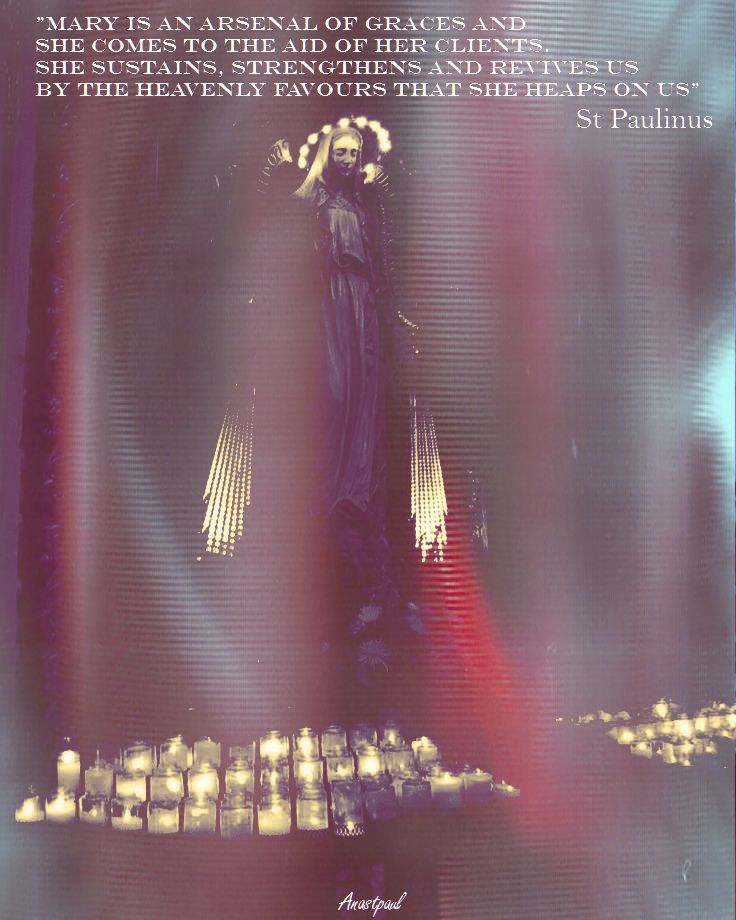
REFLECTION – Mary is an arsenal of graces and she comes to the aid of her clients.  She sustains, strengthens and revives us by the heavenly favours that she heaps on us…..St Paulinus

PRAYER – Lord Jesus Christ my Lord, help me to become a devoted client of Your holy Mother Mary.  Through Your grace, may I receive the spiritual strength she has promised to all her clients. May I, in simplicity, like St Juan Diego, become her vessel to share Your Light of Love throughout my world.   Our Lady of Gaudulupe Pray for us! Amen

1612e3f87071794329d138e32974bd147c403c56972991c450050e0a7f117f66guadalupe2


Posted in MORNING Prayers, The BLESSED VIRGIN MARY

Our Morning Offering – 12 December

Our Morning Offering – 12 December

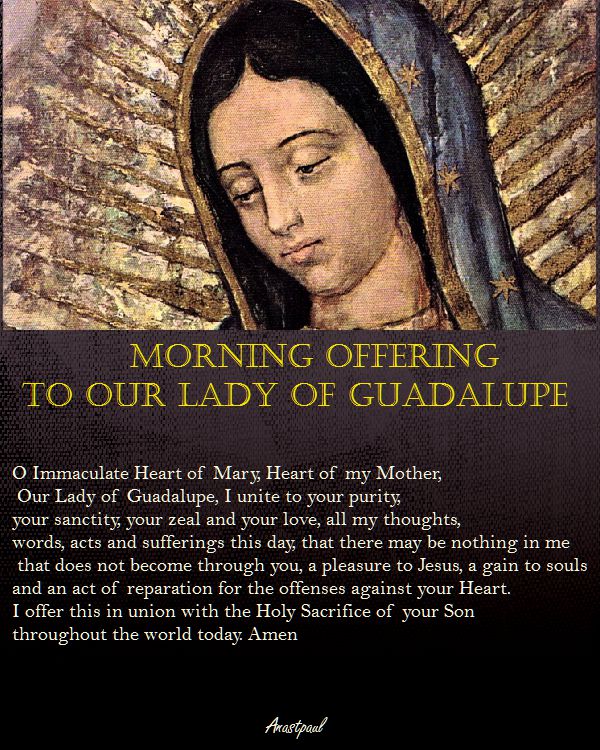
MORNING OFFERING TO OUR LADY OF GUADALUPE

O Immaculate Heart of Mary, Heart of my Mother, Our Lady of Guadalupe, I unite to your purity, your sanctity, your zeal and your love, all my thoughts, words, acts and sufferings this day, that there may be nothing in me that does not become through you, a pleasure to Jesus, a gain to souls and an act of reparation for the offenses against your Heart. I offer this in union with the Holy Sacrifice of your Son throughout the world today. Amen

plain-light-blue-curtain-fabric


Posted in SAINT of the DAY, The BLESSED VIRGIN MARY

Saint of the Day – 12 December

Saint of the Day – 12 December – Our Lady of Guadalupe – Our Mother of Guadalupe,
The Madonna of Tepeyac, Tonantzin – First Apparition on 12 December 1531- Approved by the Holy See 12 October 1895, during the Canonical coronation granted by Pope Leo XIII – Patron of Americas; New World, Central America, Mexico, New Mexico, Pojoaque Indian Pueblo, 12 dioceses, 3 cities

Video – https://www.youtube.com/watch?v=xe4Ozm0oENk

The original tilma of Saint Juan Diego, which hangs above the high altar of the Guadalupe Basilica. The suspended crown atop the image dates back to its Canonical Coronation on October 12, 1895. The image is protected by bulletproof glass and low-oxygen atmosphere.

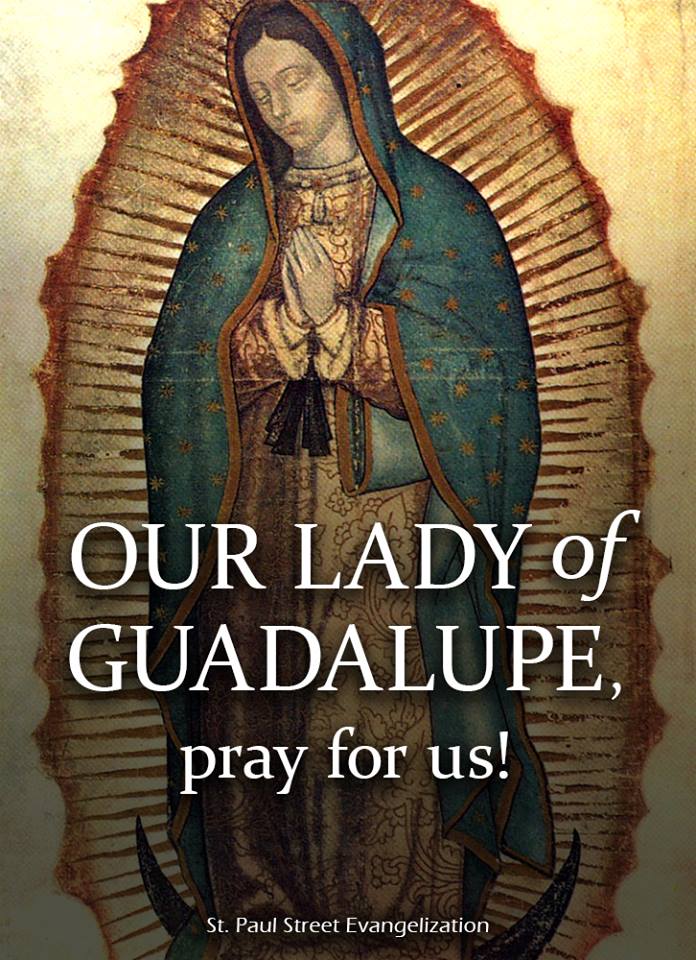
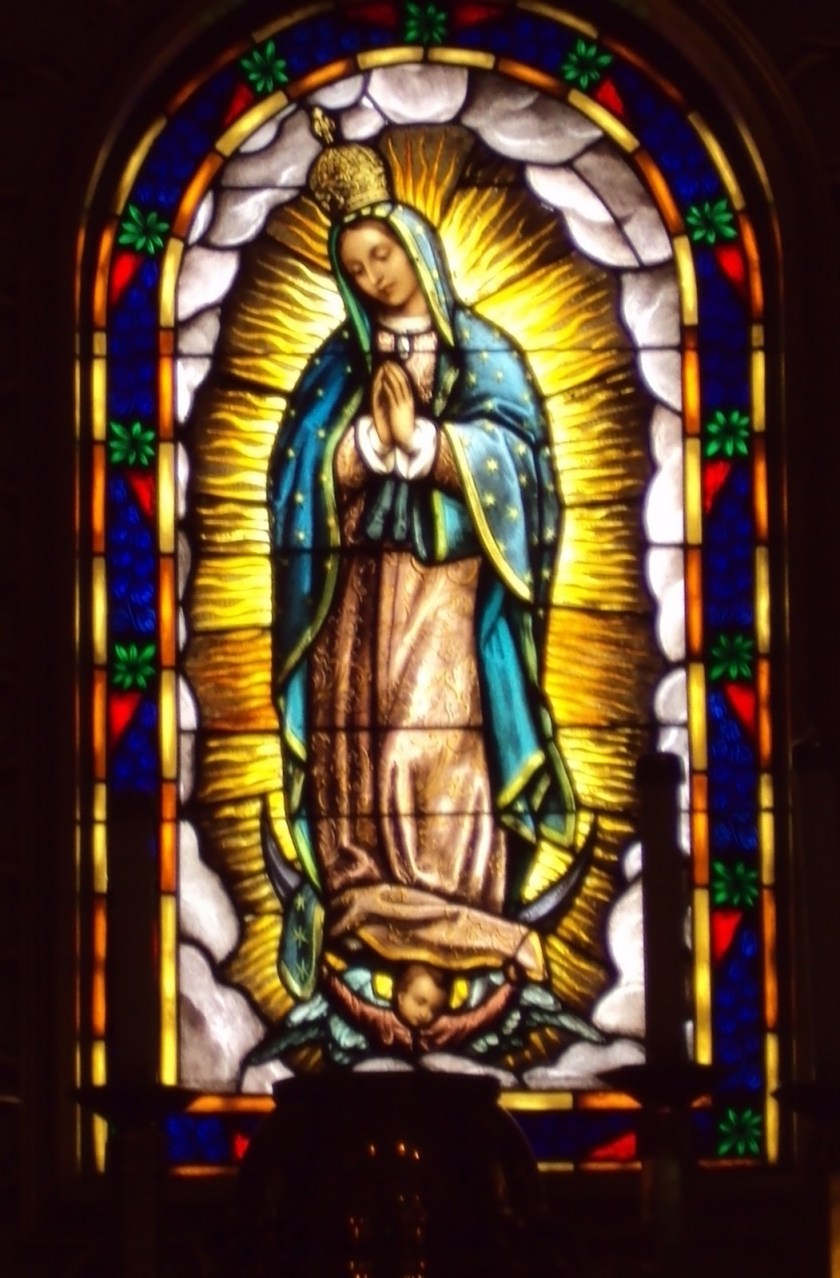
Guadalupe is, strictly speaking, the name of a picture but the name was extended to the church containing the picture and to the town that grew up around the church. It makes the shrine, it occasions the devotion, it illustrates Our Lady. It is taken as representing the Immaculate Conception, being the lone figure of a woman with the sun, moon and star accompaniments of the great apocalyptic sign with a supporting angel under the crescent. The word is Spanish Arabic but in Mexico it may represent certain Aztec sounds.

Its tradition is long-standing and constant and in sources both oral and written, Indian and Spanish, the account is unwavering. The Blessed Virgin appeared on Saturday 9 December 1531 to a 55 year old neophyte named Juan Diego, who was hurrying down Tepeyac hill to hear Mass in Mexico City. She sent him to Bishop Zumárraga to have a temple built where she stood. She was at the same place that evening and Sunday evening to get the bishop’s answer. The bishop did not immediately believed the messenger, had him cross-examined and watched and he finally told him to ask the lady who said she was the mother of the true God for a sign. The neophyte agreed readily to ask for sign desired, and the bishop released him.

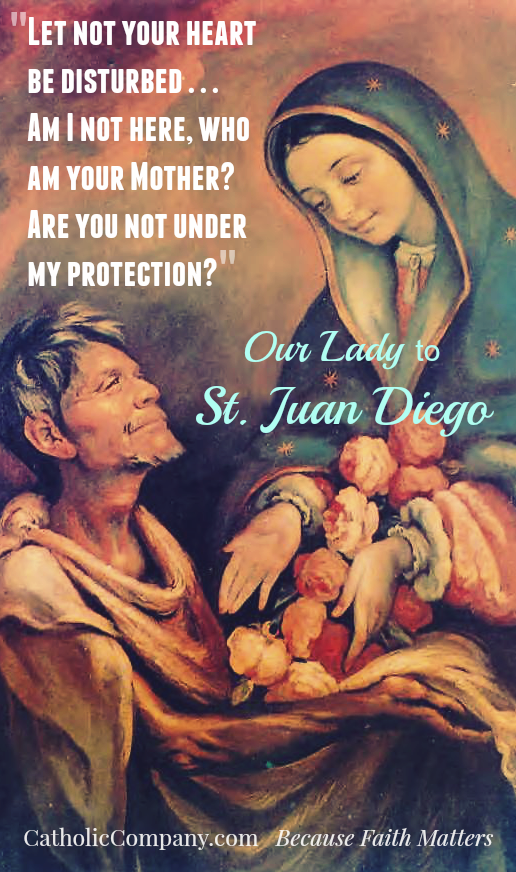
Juan was occupied all Monday with Bernardino, an uncle, who was dying of fever. Indian medicine had failed and Bernardino seemed at death’s door. At daybreak on Tuesday 12 December 1531, Juan ran to nearby the Saint James convent for a priest. To avoid the apparition and the untimely message to the bishop, he slipped round where the well chapel now stands. But the Blessed Virgin crossed down to meet him and said, “What road is this thou takest son?” A tender dialogue ensued. She reassured Juan about his uncle, to whom she also briefly appeared and instantly cured. Calling herself Holy Mary of Guadalupe she told Juan to return to the bishop. He asked Mary for the sign he required. She told him to go to the rocks and gather roses. Juan knew it was neither the time nor the place for roses, but he went and found them. Gathering many into the lap of his tilma, a long cloak or wrapper used by Mexican Indians, he came back. The Holy Mother rearranged the roses and told him to keep them untouched and unseen until he reached the bishop. When he met with Zumárraga, Juan offered the sign to the bishop. As he unfolded his cloak the roses, fresh and wet with dew, fell out. Juan was startled to see the bishop and his attendants kneeling before him. The life size figure of the Virgin Mother, just as Juan had described her, was glowing on the tilma. The picture was venerated, guarded in the bishop’s chapel and soon after carried in procession to the preliminary shrine.

The coarsely woven material of the tilma which bears the picture is as thin and open as poor sacking. It is made of vegetable fibre, probably maguey. It consists of two strips, about seventy inches long by eighteen wide, held together by weak stitching. The seam is visible up the middle of the figure, turning aside from the face. Painters have not understood the laying on of the colours. They have deposed that the “canvas” was not only unfit but unprepared and they have marvelled at apparent oil, water, tempera, etc. colouring in the same figure. They are left in equal admiration by the flower-like tints and the abundant gold. They and other artists find the proportions perfect for a maiden of fifteen. The figure and the attitude are of one advancing. There is flight and rest in the eager supporting angel. The chief colours are deep gold in the rays and stars, blue-green in the mantle, and rose in the flowered tunic.

Sworn evidence was given at various commissions of inquiry corroborating the traditional account of the miraculous origin and influence of the picture. Some wills connected with Juan Diego and his contemporaries were accepted as documentary evidence. Vouchers were given for the existence of Bishop Zumárraga’s letter to his Franciscan brothers in Spain concerning the apparitions. His successor, Montufar, instituted a canonical inquiry, in 1556, on a sermon in which the pastors and people were abused for crowding to the new shrine. In 1568 the renowned historian Bernal Díaz, a companion of Cortez, refers incidentally to Guadalupe and its daily miracles. The lay viceroy, Enríquez, while not opposing the devotion, wrote in 1575 to Philip II asking him to prevent the third archbishop from erecting a parish or monastery at the shrine. Inaugural pilgrimages were usually made to it by viceroys and other chief magistrates. Processes, national and ecclesiastical, were laboriously formulated and attested for presentation at Rome, Italy in 1663, 1666, 1723, and 1750.

The clergy, secular and regular, has been remarkably faithful to the devotion towards Our Lady of Guadalupe, the bishops especially fostering it, even to the extent of making a protestation of faith in the miracle a matter of occasional obligation. Pope Benedict XIV decreed that Our Lady of Guadalupe should be the national patron of Mexico and made 12 December a holiday of obligation with an octave, and ordered a special Mass and Office. Pope Leo XIII approved a complete historical second Nocturne, ordered the picture to be crowned in his name and composed a poetical inscription for it. Pope Pius X permitted Mexican priests to say the Mass of Holy Mary of Guadalupe on the twelfth day of every month, and granted indulgences which may be gained in any part of the world for prayer before a copy of the picture.

The place, called Guadalupe Hidalgo since 1822, is three miles northeast of Mexico City. Pilgrimages have been made to this shrine almost without interruption since 1531-1532. A shrine at the foot of Tepeyac Hill served for ninety years and still forms part of the parochial sacristy. In 1622 a rich shrine was erected and in 1709 a newer, even richer one. There are also a parish church, a convent and church for Capuchin nuns, a well chapel, and a hill chapel all constructed in the 18th century. About 1750 the shrine got the title of collegiate, a canonry and choir service being established. It was aggregated to Saint John Lateran in 1754. In 1904 it was created a basilica, with the presiding ecclesiastic being called abbot. The shrine has been renovated in Byzantine style which presents an illustration of Guadalupan history.

eternal_father_painting_guadalupe

An 18th-century hagiographicpainting of God the Father fashioning the image.

401px-brooklyn_museum_-_virgin_of_guadalupe_-_isidro_escamilla_-_overall

Virgin of Guadalupe, 1 September 1824. Oil on canvas by Isidro Escamilla. Brooklyn Museum
guadalupano

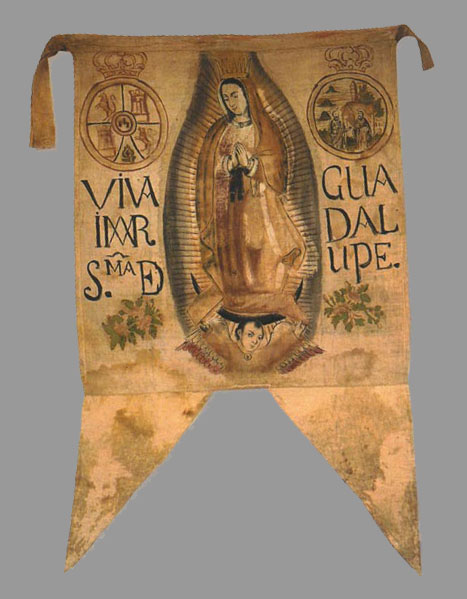
The revolutionary banner carried by Miguel Hidalgo and his insurgent army during the Mexican War of Independence.
apparitions-of-our-lady-of-guadalupefoto3pintura-de-nuestra-senora-virgen-de-guadalupe

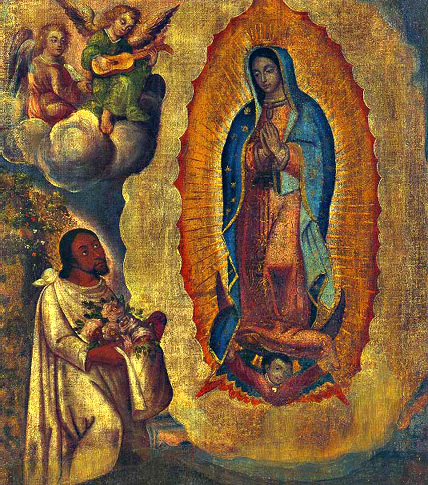
Allegory of the papal declaration in 1754 by pope Benedict XIV of Our Lady of Guadalupe patronage over the New Spain in the presence of the viceroyal authorities. Anonymous (Mexican) author, 18th century.

ourladyofguadalupe

Posted in DEVOTIO, The BLESSED VIRGIN MARY

Act of Consecration to Our Lady of Loreto – 10 December

Act of Consecration to Our Lady of Loreto

O Immaculate Virgin Mary, we come to thee with confidence: welcome this day our humble prayer and our act of consecration.

O Mother, thou didst carry thy Divine Saviour in thy most pure womb: receive our homage of faith and filial love as we come in spirit into thy Holy House. It iso, by the presence of the Holy Family, the holy home par excellence. And it is our wish that every Christian family be inspired by it.

From Jesus, all children learn to obey and to work. From thee, O Mary, all women learn humility and the spirit of sacrifice. From Joseph, who didst live for Jesus and for thee, all men learn to believe in God, to live in and for you, all men learn to believe in God, to live in the family and in society with fidelity and honesty. O Mary, we pray for our Pope and for the Universal Church, for our country and for all the nations of the world, for the suffering souls for all sinners. And we all wish to consecrate ourselves to thee.

Spiritually present in the Holy House, where thou didst conceive by the Holy Spirit, we want to repeat with lively faith the words of the Archangel Gabriel: “Hail, full of grace, the Lord is with thee!” We want to invoke thee still, saying: “Hail Mary, Mother of Jesus, Mother of God and Mother of the Church!”

We turn to thee O Mary. Receive our consecration to thine Immaculate heart. Totally thine, we wish to confirm by this act of love our unlimited love for Jesus, thy Son and our hope in thee, our Mother. And thou, O Queen and Mother of Mercy, grant to thy children an abundance of heavenly blessings. Amen.

UNIVERSAL CONGREGATION OF THE HOLY HOUSE

loreto-image2

Posted in MORNING Prayers, The BLESSED VIRGIN MARY

Thought for the Day – 10 December

LORETO enshrines the original home of the holiest persons who walked the earth: the God-Man Jesus Christ, His mother Mary and the virginal father, St. Joseph. Therefore, it should not be surprising that this sanctuary should attract Saints. There is a marble plaque in the basilica on which are carved the names of thirty-nine saints and twenty-two other holy persons who came on pilgrimage to Loreto. In 1846, there were one hundred and sixty names. One hundred and fifty years later that number must have easily doubled.

Among the more famous and well-known saints are SS. Ignatius Loyola, Francis Xavier, John Berchmans, Stanislaus Kostka, Francis Borgia, Charles Borromeo, Francis of Paula, Francis de Sales, Bernardine of Siena, John of Capistrano, Lawrence of Brindisi, Philip Neri, Camillus de Lellis, Louis Guanella, Robert Bellarmine, Gabriel Possenti, Clement Hofbauer, Brigit of Sweden, Madaleine Sophie Barat, Alphonsus Liguori, Louis Grignon de Montfort, Aloysius Gonzaga, John Bosco and Therese of Lisieux. Blessed Anthony Grassi came to the shrine fifty times. The Holy Spirit obviously is the archenemy of the devil, the father of lies. The favoured friends of the Holy Spirit, the Saints, in whom He took up His abode in a very special way, loved the truth and were rarely taken in by the father of lies. So when we see a vast array of these intimate friends of God visiting the Holy House of Loreto to pay their homage and pray at the very place where the Word was made flesh, we cannot help but be further impressed at its authenticity. No other Marian shrine in the world can boast of such an array of Saints and holy souls visiting its sacred precincts.

ST. JOSEPH LABRE
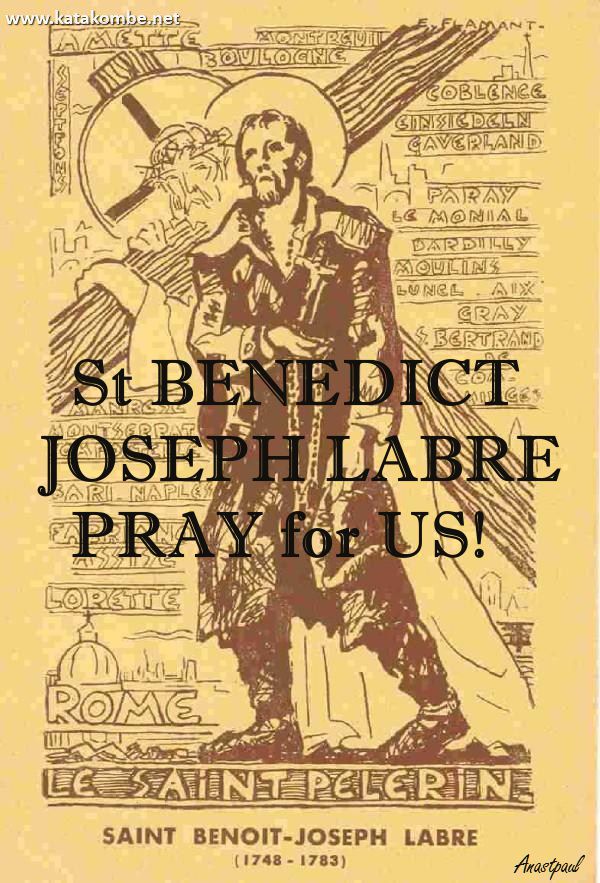
If one were to single out a Saint who was particularly attached to Loreto, it would seem that the pilgrim saint, Benedict Joseph Labre, would have first place. After finding out that his vocation was to be a rather exceptional one—–literally a pilgrim beggar—–Benedict left his home in France in 1770 for Rome at age twenty-two. On this first journey, he stopped on his way at Loreto and Assisi. He stayed in Rome for nine months visiting all the holy places but was back in Loreto in September of the following year. In June 1772, he was back again at Loreto. He then extended his pilgrimages to all the famous shrines in Europe. At the end of 1776, he settled down in Rome, leaving only to make an occasional pilgrimage to his favorite shrine, the Holy House. He continued this each year until his death in 1783 at the age of 35.

The people of Loreto came to know him well. He was that beggar who lived on the charity of others, refusing to take any more than necessary to fill his immediate needs. When compassionate friends offered him a room closer to the shrine, he turned it down when he found it contained a bed. Surely the poverty and utter detachment of the Holy Family of Nazareth was reflected in a most outstanding way in this Saint who spent many long vigils of prayer in the Holy House.

St Benedict Joseph Labre Pray for us!

tumblr_mld7zvxnjr1r9j5xbo1_1280

Posted in MORNING Prayers, The BLESSED VIRGIN MARY

Quote/s of the Day – 10 December

“I went to Loreto with a simple faith, believing what I still believe, even more so after having seen. Now I no longer have any doubts. If you ask me why I believe it, it is because everyone believes it in Rome—–cautious and skeptical as they are in many other things. I believe it as I believe that there is a planet called Neptune, or that chloroform destroys the sense of pain. I have no prior difficulties on this point.”

“It was thought that St. Maximilian Kolbe never visited Loreto. Our Lady, however, always manages to bring to what was her home while on earth those who revere and venerate her in a special way. It comes as no surprise, then, to learn from the Mass register of the Basilica that he participated in a Mass along with thirty priests from Yugoslavia on July 13,1919. The following day, the feast of the Franciscan theologian St. Bonaventure, he celebrated Mass within the Holy house itself. And so another name, a modem day Saint, has been added to the list of Saints and holy persons who have visited the shrine of Loreto. Undoubtedly there will be many more as time goes on, paying their respects and drawing inspiration from the holiest House in this world. ”

Blessed Cardinal Henry John Newman – written in 1848 and 1884

The Popes on Loreto – http://www.catholictradition.org/Mary/loreto3b.htm

loreto-caravaggio

photo

Posted in MORNING Prayers, The BLESSED VIRGIN MARY

One Minute Reflection – 10 December

One Minute Reflection – 10 December

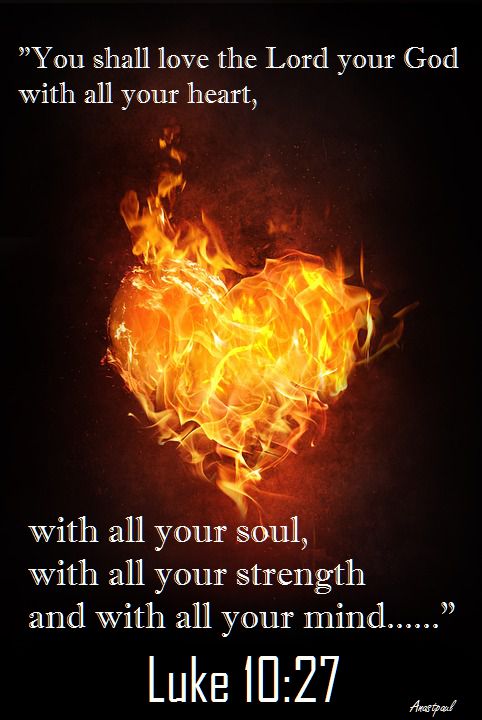
You shall love the Lord your God with all your heart, with all your soul, with all your strength and with all your mind………..Lk 10:27

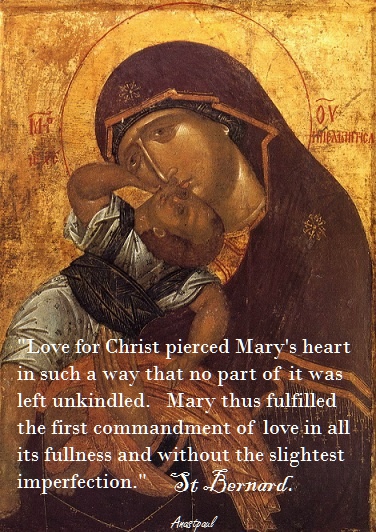
REFLECTION – Love for Christ pierced Mary’s heart in such a way that no part of it was left unkindled.

Mary thus fulfilled the first commandment of love in all its fullness and without the slightest imperfection…………..St Bernard

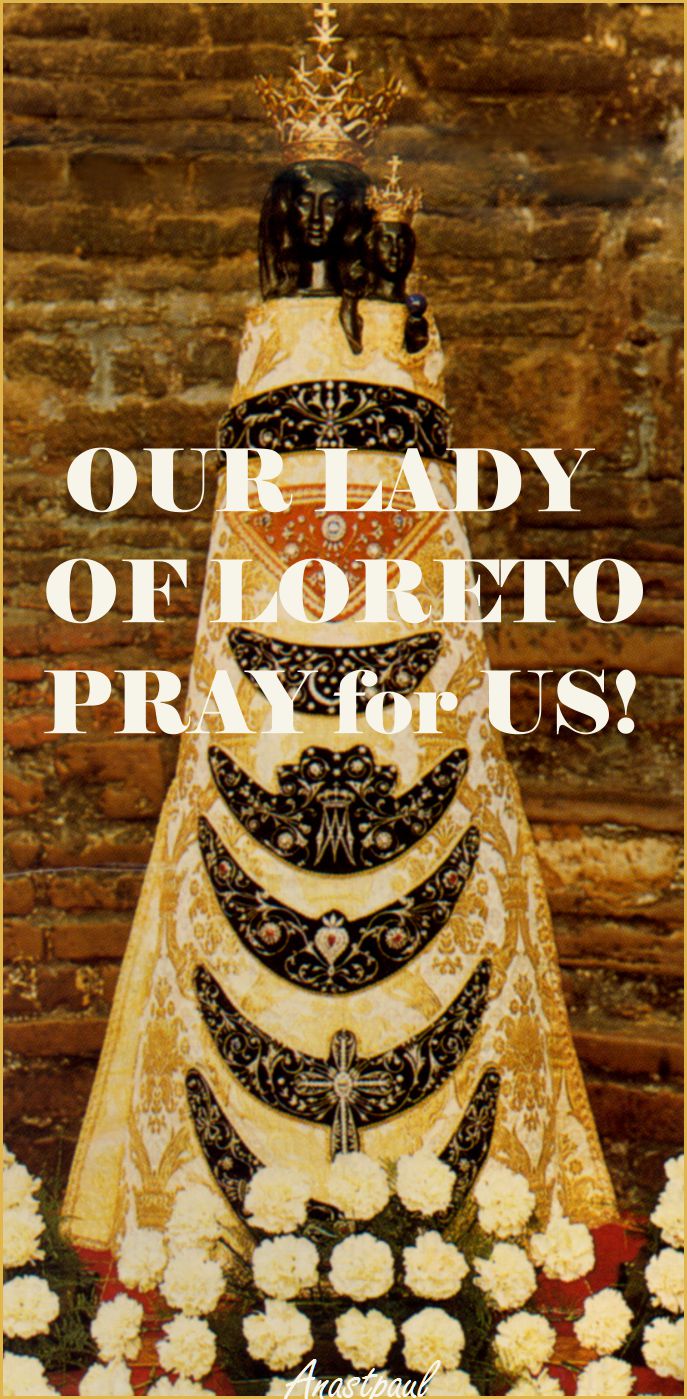
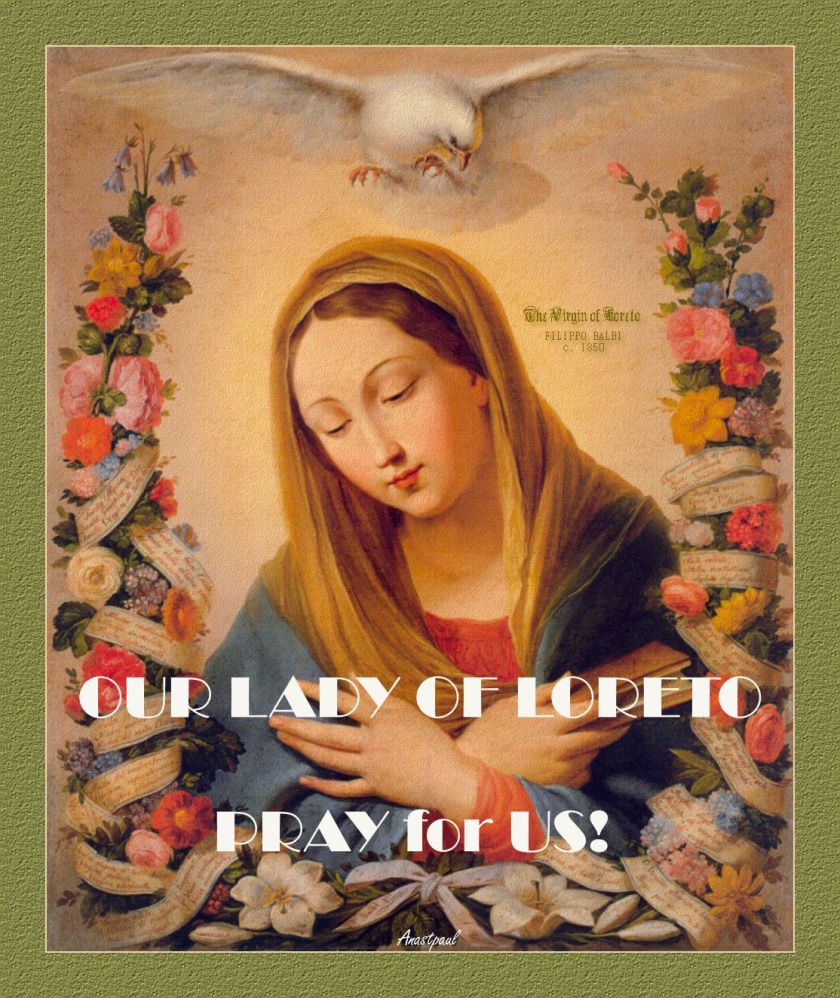
PRAYER – O Mother! You, who carried the Divine Saviour in your immaculate womb and lived with Him in the Holy House that we venerate on the Loreto Hill, grant us the grace to seek Him and imitate His example, He who leads us to salvation. Our Lady of Loreto work miracles in us all! Amen

luke-10-27st-bernardloreto-balbi1