Quote/s of the Day – 13 July – “Month of the Precious Blood” – Readings: Exodus 2: 1-15a; Psalms 69: 3, 14, 30-31, 33-34; Matthew 11: 20-24
“Jesus began to reproach the towns where most of his mighty deeds had been done, for their failure to repent.”
Matthew 11:20
“Even now, says the LORD, return to me with your whole heart, with fasting and weeping and mourning. Rend your hearts, not your garments and return to the LORD, your God. For gracious and merciful is he, slow to anger, rich in kindness and relenting in punishment.”
Joel 2:12-13
“Let us fix our thoughts on the Blood of Christ and reflect how Precious that Blood is, in God’s eyes, inasmuch, as its outpouring for our salvation, has opened the grace of repentance to all mankind.”
St Pope Clement I (c 35-99)
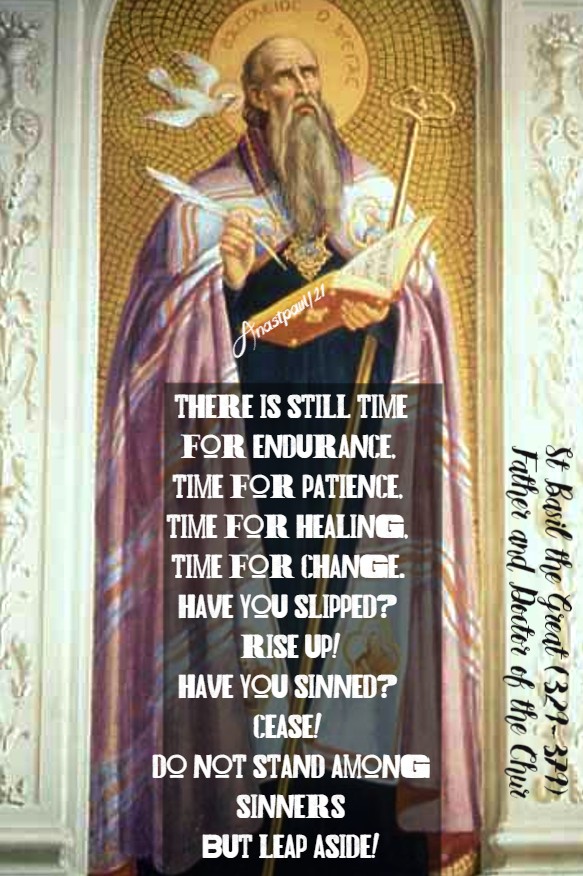
“… In the conceitedness of our souls, without taking the least trouble to obey the Lord’s commandments, we think ourselves worthy to receive the same reward as those who have resisted sin to the death!”
St Basil the Great (329-379) Father and Doctor of the Church
“For this all-powerful Physician, nothing is incurable. He heals without charge! With one word, He restores to health! I would have despaired of my wound were it not, that I placed my trust in the Almighty.”
St Gregory the Great (540-604) Pope, Father, Doctor of the Church
“ … Yet only grant me repentance here below That I may make reparation for my sins, … That these tears may extinguish the blazing furnace With its burning flames. …
And, instead of acting like the merciless, Set merciful compassion within me, That, by showing mercy to the poor, I may obtain Your mercy.”
St Nerses Chnorhali (1102-1173) Armenian Bishop
“ It is better to atone for sin now and to cut away vices, than to keep them for purgation in the hereafter. In truth, we deceive ourselves by our ill-advised love of the flesh. What will that fire feed upon but our sins? The more we spare ourselves now and the more we satisfy the flesh, the harder will the reckoning be and the more we keep for the burning.”
One Minute Reflection – 13 July – “Month of the Precious Blood” – Readings: Exodus 2: 1-15a; Psalms 69: 3, 14, 30-31, 33-34; Matthew 11: 20-24
“Jesus began to reproach the towns where most of his mighty deeds had been done, for their failure to repent.” – Matthew 11:20
REFLECTION – “Let us cry out with David; let us hear him weep and let us shed tears with him. Let us see how he rises up again and let us rejoice with him: “Have mercy on me, O God, in your goodness.” (Ps 51:3)
Let us place before the eyes of our soul a man who is seriously injured, almost on the point of breathing his last breathe and who is lying naked in the dust. In his desire to see a doctor arrive, he is moaning and begging the person who understands his condition, to have pity. Now sin is a wound to the soul. You who are this wounded person, learn that your Doctor is within you and show Him the wounds of your sins. May He, to whom every secret thought is known, hear the moaning of your heart. May your tears move Him and, if you have to seek Him with some insistence, let deep sighs rise up to Him from the bottom of your heart. May your pain come to Him and may you also be told, like David: “The Lord… has forgiven your sin.” (2 Sam 12:13)…

“Have mercy on me, O God, in your goodness.” The people who belittle their fault because they do not know this great tenderness, only draw a little tenderness to themselves. As for me, I fell far, I sinned with full knowledge. But You, Almighty Doctor, correct those who scorn You; You teach those who do not know their fault and You forgive those who admit it to You.” – St Pope Gregory the Great (540-604) Father and Doctor of the Church – Presentation on the seven penitential Psalms
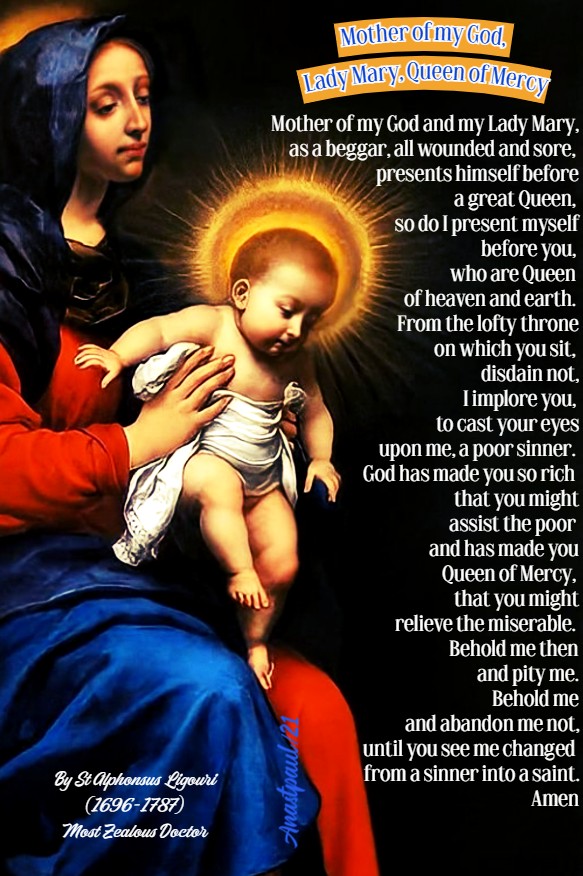
PRAYER – God our Father, we are Your children and You have set us aside to come home to You by the light of the way of Your divine Son. Fill us with knowledge of our need to turn to You in sorrow and repentance, that we may one day attain our final home with You. Grant we pray, that by the intercession of the Blessed Virgin, we may too become lights announcing Your Glory and our great need for repentance. and penance. We make our prayer through our Lord Jesus with You in the unity of the Holy Spirit, God forever, amen.
Our Morning Offering – 13 July – “Month of the Precious Blood”
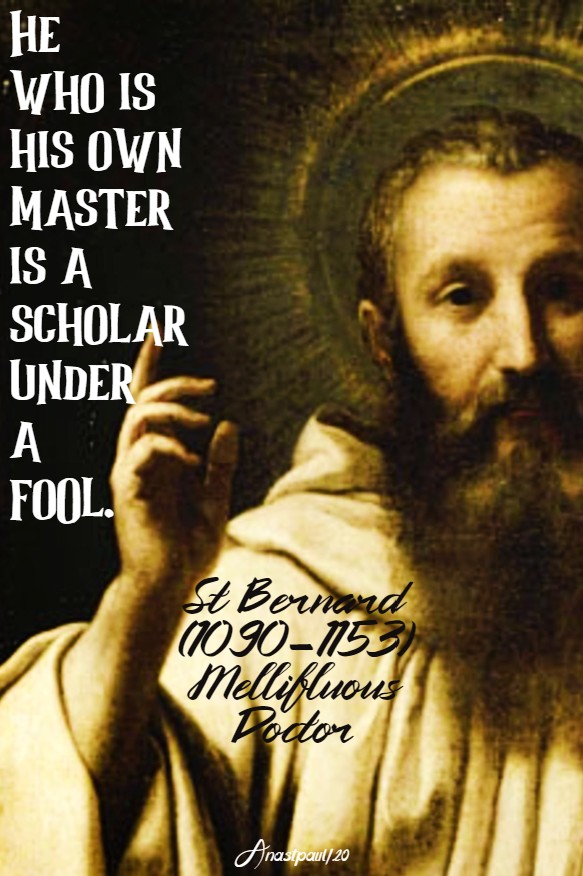
Act of Spiritual Communion By St Bernard (1090-1153 Mellifluous Doctor of the Church
As I cannot this day enjoy the happiness of assisting at the Holy Mysteries, O my God, I transport myself in spirit to the foot of Your Altar. I unite with the Church, which by the hands of the Priest, offers You, Your adorable Son in the Holy Sacrifice. I offer myself with Him, by Him and in His Name. I adore, I praise and thank You, imploring Your mercy, invoking Your assistance and presenting to You, the homage I owe You as my Creator and the love due to You as my Saviour.
Apply to my soul, I beseech You, O Merciful Jesus, Your infinite merits; apply them also to those for whom I particularly wish to pray. I desire to communicate spiritually, that Your Blood, may purify, Your Flesh, strengthen and Your Spirit, sanctify me. May I never forget that You, my divine Redeemer, died for me. May I die to all that is not You, that hereafter, I may live eternally with You. Amen.
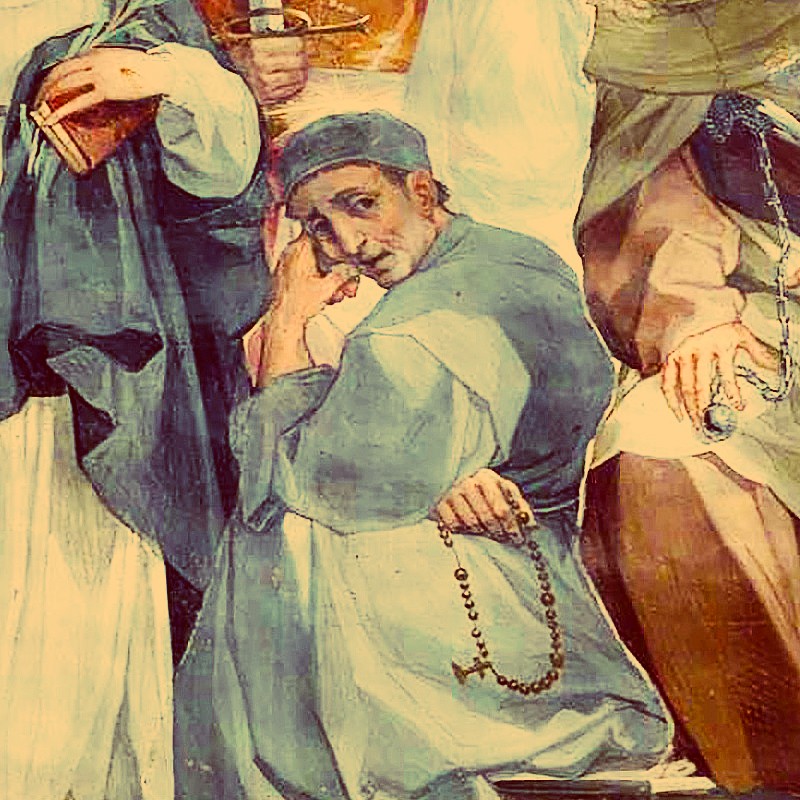
Saint of the Day – 13 July – Blessed James of Voragine OP (c 1226 – 13 or 16 July 1298) Archbishop of Genoa, Author of the ‘Golden Legend’ (a collection of lives of Saints and treatises on Christian festivals, one of the most popular religious works of the Middle Ages and is still published and referred to today – completed 1265), Priest and Friar of the Order of Preachers of St Dominic, Writer, Scholar of great genius, Prior and Provincial General of the Order. Born as Giacomo da Varazze in c 1226 at Varazze (modern Voragine), Diocese of Savona, Italy (near Genoa) and died on either 13 July or 16 1298 in Genoa, Italy of natural causes. Also known as – James of Varazze, James of Viraggio, James of Genoa, Giacomo, Jacob, Jacobus, Jacopo.
James of Voragine has been Beatified by the Church for the sanctity of his life. He lives in secular history for quite a different reason – he was a creative genius of his age. His Golden Legends, which has enjoyed a circulation of nearly seven centuries, is only one of several projects which in his time, as in ours, are a tribute to the versatility of the man and the zeal of a Saint.
Little is recorded of the childhood of James. He entered the Order of Preachers in Genoa and soon was known, both for his virtue and for a singularly alert and practical mind. Tradition says that James was the first to translate the Bible into Italian. Whether this is true or not, it is ample evidence that he was a true scholar.
As Prior, provincial,and later Archbishop, James gained a reputation for strict observance, heroic charity and sound good sense. He was a builder where war had wrecked, a peace maker where others sowed trouble. He must of had a contagious zeal, for the wealthy gave to him as readily as the poor begged from him and under his hand, ruined Churches and hospitals were restored, the sick and poor were cared for, and good practices and devotion reignited. He was a genius at getting things done and, fortunately, his whole heart was bent on doing good for the glory of God.
Like others of his calling and training, James was first of all a Preacher. For those many who could not read, one of the chief means of instruction was via sermons, which took their key note from the feast of the day. The Saints, the stories of their live and examples of their virtues became as much part of a Christians life as the people around him. The collection of stories – later called The Golden Legend – started as a series of sermons prepared by James for the various festival of the Saints. Since he preached in Italian, rather than in Latin, his sermons had immense popular appeal and they were rapidly copied by other Preachers into all the languages of Europe. The Golden Legend was , next to the Bible, the most popular book of the Middle Ages.
James was rigorous in his observance of the Dominican Rule, which, is of itself, enough to canonise him. He had also the good sense to make use of changing trends to further the work of God. Today he would be using the digital world, the press, the movies, and television – then ,he used what his century had to offer – sermons in the vernacular, religious drama and music. How much present day drama and music owed to him, it would be impossible to say.
There is an amusing story told of his efforts to fight fire with fire. He organised a troop of jugglers and acrobats from the student Novices of San Eustorgio, in Milan, who were to mingle entertainment with doctrine in staging ‘plays’ to teach and in an effort to combat the indecency of the secular theatre. This was one scheme which left no lasting effect but it does serve to show, that James was a man of his times, alert to the changing needs of a fast-moving world and whole-heartedly determined to win the world to the truth of the One Holy Catholic Faith by any honest means that came to hand.
Purity, poverty and charity were the outstanding virtues of this man whom the Church has seemed fit to enroll among Her blesseds. He will always be recognised in Dominican history as a man of many and peculiar gifts, who consecrated his talents to God and, in trading with them , gained heaven. Blessed James was Beatified on 11 May 1816 by Pope Pius VII.
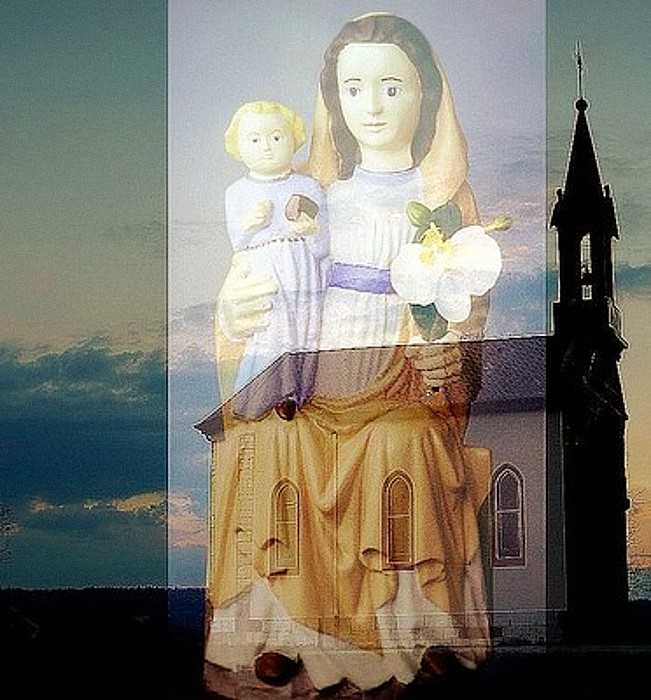
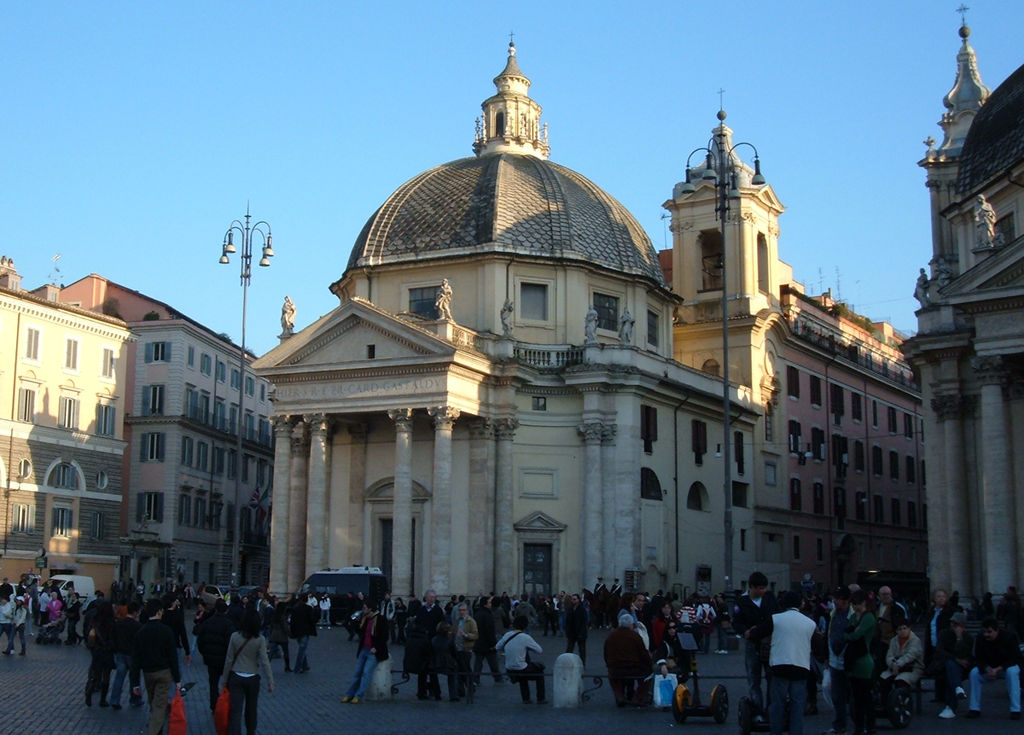
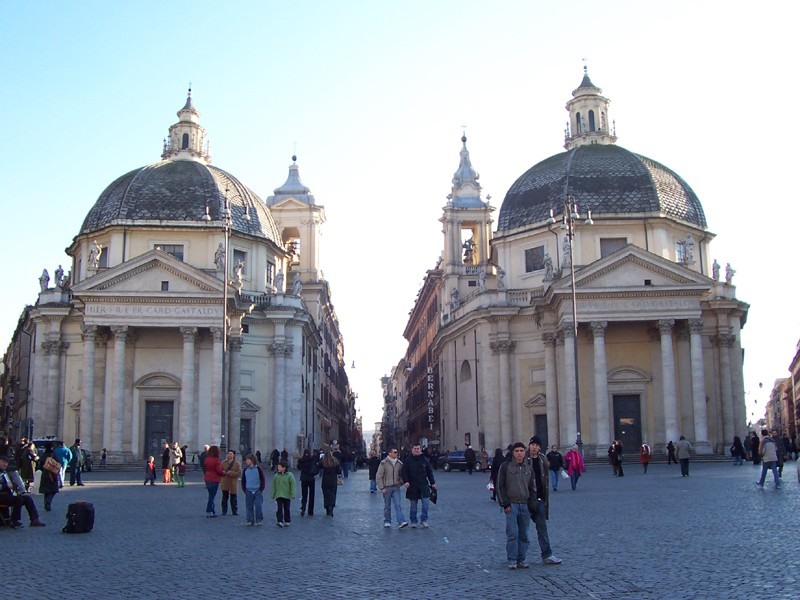
Madonna del Soccorso / Our Lady of Soccorso, Castellammare del Golfo, Trapani, Sicily, Italy ( 1718)- 13 July, 21 August:
In Castellammare del Golfo , in the Province of Trapani, a miraculous event occurred on 13 July 1718, when the Town was in the midst of war between Philip V and Amedeo di Savoia, for the possession of Sicily. A Spanish ship, pursued by five English ships, arrived to take refuge under the castle, from where the enemy ships were repelled. The people, frightened, cried out for a miraculous help to their Patron – all fled the City, and despite the blows of the English artillery, no-one was killed or injured. But all of a sudden, to everyone’s amazement, the white-dressed Madonna appeared from Mount delle Scale, followed by a group of Angels, who descended towards Cala Marina. This vision terrified the British who hastened in retreat and left the port. The name of Madonna del Soccorso derives from this extraordinary event. Every two years, in fact, on 13 July in the Town of the Gulf the “Historical Re-enactment” of the miraculous intervention of Maria Santissima del Soccorso, in the City of Castellammare.
Devotion to the Madonna del Soccorso is particularly felt in the Magolà hamlet, in Lamezia Terme but also, in the whole area. The Sanctuary of the Madonna del Soccorso is located on a green hill overlooking the City of Lamezia Terme and overlooking the plain of Sant’Eufemia, in the most panoramic point . The presence of this Church then gave its name to the whole area. According to a historical research by Don Pietro Bonacci ( 1915 – 2007 ), devotion to the Madonna del Soccorso is very ancient and was initially practiced in the Church of the Reformed Fathers of St Frances (currently the Church of Santa Maria Maggiore) in very remote times. This devotion was also in use in the Church of Santa Lucia , which until the eighteenth century, had the title of Parish of St Maria del Soccorso, then passed to the Church of Magolà. It is said that the Reformed Fathers decorated with great piety and love, a miraculous image of the Madonna painted by St Luke and brought from Jerusalem by a Franciscan Friar who landed in Sant’Eufemia, fell ill and died with the Reformed Fathers. This image was of great veneration for its continuous graces but no trace has been found, it has disappeared.
The current Church was built shortly after the construction of the votive Shrine. In fact, a document reports that it was completed in 1740. . At the beginning of the nineteenth century cholera broke out and a small hospital was built to treat the sick. In the twentieth century everything returned to normal and the celebrations in honour of the Madonna began, which were established on the third Sunday of July, preceded by the Novena. On Saturdays it was customary to celebrate The Rosary and other Marian devotions, in which one spent a whole day with the Madonna and sang traditional hymns. On the day of the festival, after several Masses, the procession with the Statue of the Madonna begins,and looks out from the hill to bless the City. There was also a great fair. Today the festival is held the same way.
St Henry (972-1024) Holy Roman Emperor (Optional Memorial) Henry was well known for his missionary spirit and for his protection of the Pope in times of trouble. Henry ruled with a spirit of great humility and always sought to give the glory to God. He used his position to promote the work of the Church and the peace and happiness of the people. Biography: https://anastpaul.wordpress.com/2017/07/13/saint-of-the-day-13-july-st-henry-ii-holy-roman-emperor/
Bl Anne-Andrée Minutte St Arno of Würzburg Bl Barthélemy Jarrige de la Morelie de Biars Bl Berthold of Scheide
St Dogfan Bl Élisabeth Verchière St Emanuele Lê Van Phung St Esdras the Prophet St Eugene of Carthage Bl Ferdinand Mary Baccilleri St Iosephus Wang Kuiju Blessed James of Voragine OP (c 1226 – 3 or 16 July 1298) Bishop, Author of the ‘Golden Legend.’ Bl Jean of France St Joel the Prophet Bl Louis-Armand-Joseph Adam
Bl Marie-Anastasie de Roquard Bl Marie-Anne Depeyre Bl Marie-Anne Lambert St Mildred of Thanet St Muritta of Carthage St Myrope St Paulus Liu Jinde St Salutaris of Carthage St Sarra of Egypt St Serapion of Alexandria Serapion of Macedonia Bl Thérèse-Henriette Faurie Bl Thomas Tunstal St Turiaf — Martyrs of Cyprus – 300 saints: 300 Christians who retired to Cyprus to live as cave hermits, devoting themselves to prayer and an ascetic life devoted to God. Tortured and martyred for their faith and their bodies dumped in the various caves in which they had lived. We know the names of five of them but no other details even about them – Ammon, Choulélaios, Epaphroditus, Eusthénios and Héliophotos. They were beheaded in the 12th century on Cyprus and their bodies dumped in the cave where they had lived and only rediscovered long afterwards.
Martyrs of Philomelio – 31 saints: 31 soldiers martyred for their faith in the persecutions of prefect Magno, date unknown. The only name that has come down to us is Alexander. In Philomelio, Phrygia (in modern Turkey).
Thought for the Day – 12 July – Meditations with Antonio Cardinal Bacci (1881-1971)
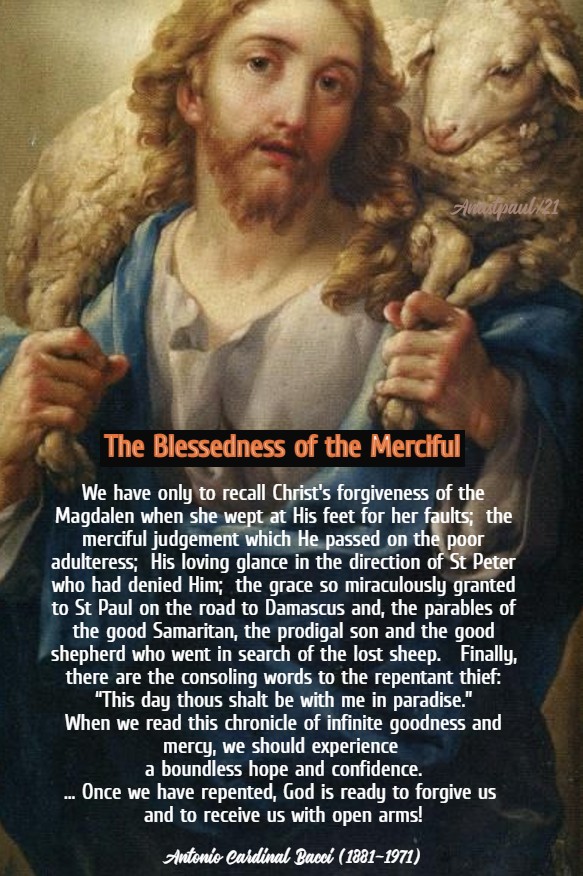
Blessed are the Merciful
“Some day each of us will have to stand before the judgement seat of God and will have to render an account of all his actions. Are we anxious that God will be merciful to us at that crucial moment? Let us be forgiving and charitable towards others now! It is clear from the words of the Gospel, that we shall be pardoned or condemned, largely in accordance with the measure of our mercifulness and charity. God will show mercy towards us as we show mercy towards others. In fact, the Eternal Judge will say to the good: “Come, blessed of my Father, take possession of the Kingdom prepared for you from the foundation of the word: for I was hungry and you gave me to eat; I was thirsty and you gave me to drink; I was a stranger and you took me in; naked and you covered me; sick and you visited me; I was in prison and you came to me.” Then He will turn to the wicked and deliver this terrible sentence: “Depart from me accursed ones, into the everlasting fire which was prepared for the devil and his angels. For I was hungry and you did not give me to eat; I was thirsty and you gave me no drink; I was a stranger and you did not take me in; naked and you did not clothe me; sick and in prison and you did not visit me … Amen, I say to you, as long as you did not do it for one of these least ones, you did not do it for me.” (Mt 25:34-46).
These are terrifying words. They should persuade us to exercise charity towards all who are suffering in any way at all!”
Quote/s of the Day – 12 July – “Month of the Most Precious Blood” – Readings: Exodus 1: 8-14, 22; Psalms 124: 1b-3, 4-6, 7-8; Matthew 10: 34 – 11: 1
“And whoever gives only a cup of cold water to one of these little ones to drink , … he shall not lose his reward.”
Matthew 10:42
“You, who think that you have a healthy hand, beware lest it is withered by greed or by sacrilege. Hold it out often. Hold it out to the poor person who begs you. Hold it out to help your neighbour, to give protection to a widow, to snatch from harm one whom you see subjected to unjust insult. Hold it out to God for your sins.”
St Ambrose (340-397) Father and Doctor of the Church
“ Lift up and stretch out your hands, not to heaven but to the poor… if you lift up your hands in prayer without sharing with the poor, it is worth nothing.”
“… Let us be afraid, my beloved, lest we also see the poor and pass them by, lest instead of Lazarus, there be many to accuse us hereafter.”
St John Chrysostom (347-407) Father and Doctor of the Church
“For just as water extinguishes a fire, just so does charity blot out our sins.”
St John of God (1495-1550)
“We must speak to them with our hands, by giving, before we try to speak to them with our lips.”
St Peter Claver (1581-1654) “Slave of the slaves”
“I am now completely convinced, that when one does a deed of charity, one need not worry about where the money will come from, it will always come!”
Blessed Frédéric Ozanam (1813–1853) “Servant to the Poor”
One Minute Reflection – 12 July – “Month of the Most Precious Blood” – Readings: Exodus 1: 8-14, 22; Psalms 124: 1b-3, 4-6, 7-8; Matthew 10: 34 – 11: 1
“He that receives you, receives me and he that receives me, receivets him that sent me.” – Matthew 10:40
REFLECTION – “The Lord said: “Whoever welcomes this little child on my account welcomes me.” (Lk 9:48) The smaller our brother is, the more Christ is present. For when we welcome a great personality, we often do so out of vainglory but the person who welcomes someone unimportant, does so with a pure intention and for Christ. He said: “I was a stranger and you welcomed me.” And again: “As often as you did it for one of my least brothers, you did it for me.” (Mt 25:35.40) Since He is talking about a believer and a brother, no matter how unimportant he is, Christ comes in with him. Open your house and welcome him!
“He who welcomes a prophet because he bears the name of prophet receives a prophet’s reward.” Thus, the person who welcomes Christ will receive the reward of Christ’s hospitality. Do not doubt His words, trust them. He Himself told us: “In them, I am presenting myself.”And, so that you do not doubt them, He decreed the punishment for those who do not welcome Him and the honours for those who do welcome Him (Mt 25:31ff.). He would not do this if He were not personally touched by honour or scorn. He says: “You welcomed Me into your house; I will welcome you in the Kingdom of My Father. You freed Me from hunger; I will free you from your sins. You saw Me in chains; I will let you see your liberation. You saw Me a stranger; I will make of you a citizen of Heaven. You gave Me bread; I will give you the Kingdom as your inheritance, that is entirely yours. You helped Me in secret; I will proclaim it publicly and I will say that you are My benefactor and that I am in your debt.” – St John Chrysostom (345-407) Bishop of Constantinople, Father and Doctor of the Church – Homilies on the Acts of the Apostles, no 45
PRAYER – Grant us Your Grace O Holy God Almighty, rule over our hearts and bodies this day. Sanctify us and guide our every thought, word and deed according to the commandments of Your divine Son, so that now and forever Your Grace may free us from the world and save us for Yourself. May our eyes see Your Son and our hands feed Him and our hearts love Him in all those who hunger and thirst. And may His Glorious and Blessed Mother and ours protect us always . Through Christ our Lord, with the Holy Ghost, God forever, amen.
Our Morning Offering – 12 July – “Month of the Most Precious Blood”
May We Confess Your Name to the End By St Cyprian of Carthage (200-258) Bishop and Martyr Father of the Church
Good God, may we confess Your Name to the end. May we emerge unmarked and glorious from the traps and darkness of this world. As You have bound us together by charity and peace and as together we have persevered under persecution, so may we also rejoice together in Your heavenly kingdom. Amen
Saint of the Day – 12 July – Saint Colmán of Cloyne (522-600) Priest, (possibly Bishop), Monk, Founder, Poet, known as the Royal Poet of Munster. Born on 15 October 522 at Munster, Ireland and died on 24 November in the year 600 (aged 78). Patronage – Diocese of Cloyne and of its Cathedral in Cóbh. Also known as Colm,Colmán of Conpriest, Colmán mac Léníne. St Colmán is also venerated on 24 November.
No hagiographical Life is known to have been written for Colmán but various aspects of his life are presented in different types of sources, such as Irish annals, genealogies and martyrologies.
Irish genealogies generally agree that Colmán had a father called Lénín. Through his father, Colmán appears to have been descended from the Rothrige, an obscure people who are known elsewhere as a subject people of the Déisi of Munster.
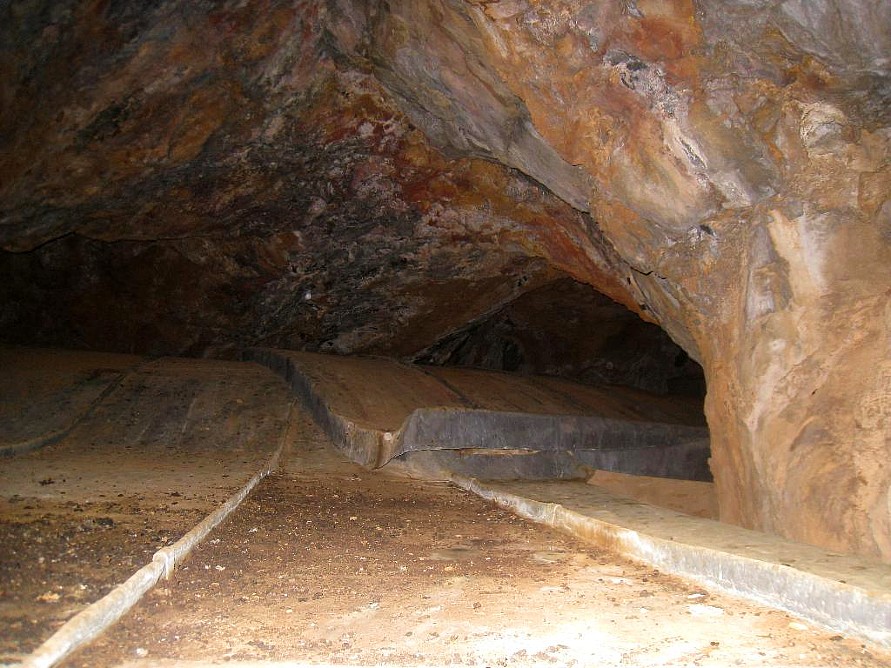
Colmán is remembered as the Founder of the Monastery at Cluain Uama, now Cloyne (Co. Cork, Ireland), in Munster. Cloyne appears to have been his earliest settlement. The Cathedral and round tower are situated on a limestone eminence in the midst of the valley, surrounded by rich meadows. In the rock is the cave extending in various branches underground to a great distance, from which the Town derives its name. Here it is that Colman took up his abode as a place of security and the remains of his primitive Oratory, known as Colman’s Chapel were still to be seen in 1813. Colmán also founded a Monastery, at what would become Killagha Abbey in County Kerry.
Further details of his life are not documented in writing but the connection of many places in counties Cork and Limerick with his name to this day proves the reality of his labours. The tenth-century Triads describes Cloyne as an important schoo of learning.
Colmán is credited with extraordinary poetic powers, being styled by his contemporaries ‘royal poet of Munster. Several of his Irish poems are still extant, notably a metrical panegyric on Saint Brendan.
It is unclear whether he was brought up as a Christian but what is sure ,is that he was educated and became a bard, which required a special education – (in order to reach the highest level (12 years of study were required.) As a member of the class of bard, he became attached to the Court of Cashel where he remained until about the age of 48 years. In 570 he and Saint Brendan of Clonfert were said to have settled a dispute between rivals to the throne of Cashel and Aodh Caomh was acknowledged as King – the first Christian king of Cashel. The King was installed by Saint Brendan. During the time of the coronation Colmán discovered the lost Shrine of Ailbhe of Emly. Brendan said that it was not right that the hands which had held this sacred relic should be defiled henceforth, thus it was that the son of Leinin offered himself to God. Brendan blessed him and gave him the name Colmán, which is a diminutive of Colm. The Gaelic word Colm corresponds to the Latin Columba meaning dove.
Colmán then went to the school of Saint Iarlaithe of Tuam and after his studies he is next mentioned as preaching to the heathen population in the east of County Cork. He is described as a “religious and holy presbyter, who afterwards became a famous Bishop”. The Prince of Déise, in the present County of Waterford, presented his child to Colmán for Baptism. Colmán Baptised him Declan and urged his parents to educate him well in his faith. This child became Saint Declan.
Colmán was given Churches in Erry and Killenaule (4 and 10 miles from Cashel respectively) by the King of Munster (Cashel), as well as lands in Cloyne, Co. Cork. It may well be that the lands in Cloyne (Cluain Uama, the lawn of the cave), were conquered lands and to prevent the possibility of reconquest, were given to the Church. The Cloyne estate was large and contained some of the best land in the area.
St Colmán died in 600 and his probable place of burial is Cloyne.
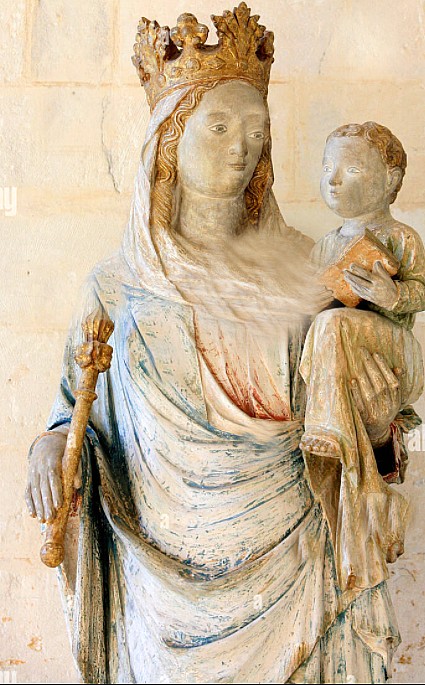
Notre-Dame -de- lure / Our Lady of Lure, Avignon, France (1110) – 12 July:
At the beginning of the 6th century, a Priest from Orleans, France, named Saint Donat du Val, in search of solitude, made his way into the Alps. The mountain of Lure seemed to be the kind of place he was looking for and with the approval of the Bishop of Sisteron, he settled there. On the side of the mountain he built an oratory for which he himself made the Statue of Our Lady, carving it from native stone. When after 32 years he died, having spent these years in penance and apostolic work, he was replaced by the Benedictines of Val-Benoit. A Chapel was built to replace the oratory which proved too small to accommodate the many pilgrims. When the Saracens invaded Provence, the religious had to flee and so they hid the Statue. Barbarians ravaged the country several times and the Convent was destroyed. In 1110, the Countess Adelaide, to whom the land of Lure belonged, gave the place of the original oratory to the Bishop of Sisteron. Several nobles aided in the work of restoring the Monastery of Our Lady of Lure. The ancient sSatue was found and placed above the tomb of Saint Donat. The Church became well known and pilgrimages were well attended. In 1318, Pope John XXII attached the Shrine of Our Lady of Lure, to the metropolitan area or See of Avignon. In 1481, Pope Sixtus IV called back to Avignon the 12 canons at the Shrine. The Church fell into disrepair. For 80 years the place remained desolate. One day a shepherd, who was resting near the ruins, heard a voice saying, “Oh, how many graces I would give to men in this place, if my Sanctuary were rebuilt.” The ecclesiastics to whom he told his story took the shepherd seriously. The Shrine was rebuilt and the Statue rescued from the debris, was placed on a new Altar which was Consecrated in 1637. Pilgrimages again flourished. During the French Revolution the Chapel was pillaged and the Statue mutilated. With the return of peace, pilgrims again came. On a number of occasions, Mary granted the miracle of an abundant rain to pilgrims that had come to seek this favour. The largest number of pilgrims were wont to come on Pentecost, the Feast of the Assumption and the Nativity of Our Lord.
St Agnes De St Andreas the Soldier St Ansbald of Prum St Balay St Clement Ignatius Delgado Cebrian St Colmán of Cloyne (c 522-600) Priest, Monk Bl David Gonson St Epiphana St Faustus the Soldier St Felix of Milan St Fortunatus of Aquileia (1st Century – Died c 66) Deacon St Hermagorus of Aquileia (1st Century – Died c 66) Bishop, Disciple of St Mark the Evangelist St Hilarion of Ancyra St Jason of Tarsus Bl Jeanne-Marie de Romillon
Bl Madeleine-Thérèse Talieu Bl Marguerite-Eléonore de Justamond Bl Marie Cluse St Menas the Soldier St Menulphus of Quimper St Nabor of Milan St Paternian of Bologna St Paulinus of Antioch St Phêrô Khan St Proclus of Ancyra St Proculus of Bologna St Uguzo of Carvagna St Ultán
St Viventiolus of Lyons — Martyrs of Nagasaki – 8 beati: Additional Memorial – 10 September as one of the 205 Martyrs of Japan Eight lay people, many them related to each other, who were martyred together: • Catharina Tanaka • Ioannes Onizuka Naizen • Ioannes Tanaka • Ludovicus Onizuka • Matthias Araki Hyozaemon • Monica Onizuka • Petrus Araki Chobyoe • Susanna Chobyoe 12 July 1626 in Nagasaki, Japan Beatified on 7 May 1867 by Pope Blessed Pius IX.
Thought for the Day – 11 July – Meditations with Antonio Cardinal Bacci (1881-1971)
Following Jesus
“When we have renounced ourselves and have embraced our cross with resignation and love, we must follow Jesus. We must follow Him in a special way as the infallible Teacher of truth. The teachings of men cannot satisfy our intellects. Still less, can they satisfy our hearts. What they teach is either incomplete or false. This is proved by the fact that the doctrines of mean have succeeded and replaced one another, down through the centuries while “the word of the Lord endures forever” (1 Peter 1:25).
The teaching of Christ produces an extraordinary renovation in the individual, in the family and in society. It is this renewal which we call Christianity and Christian civilisation. There is a wide chasm between paganism and Christianity. This gulf would be even wider, only for the fact that Christianity has not yet been fully put into practice throughout the universe. There is only one reform necessary. This is to realise the Christian ideal everywhere. We must begin by carrying it out ourselves. Let us follow Jesus, Who is saying to us: “I am the way and the truth and the life” (Jn 14:6). “He who follows Me does not walk in darkness” (Jn 8:12).
Let us follow our divine Master and we shall be sure that we are travelling towards Heaven!”
Quote/s of the Day – 11 July – “Month of the Most Precious Blood” – Readings: Amos 7: 12-15; Psalms 85: 9-10, 11-12, 13-14 (8); Ephesians 1: 3-14; Mark 6: 7-13
“He began to send them out two by two”
Mark 6:7
“Love one another as I have loved you”
John 15:12
“My brothers, Christ made love the stairway that would enable all Christians to climb to heaven. Hold fast to it, therefore, in all sincerity, give one another practical proof of it and by your progress in it, make your ascent together.”
St Fulgentius of Ruspe (460-533)
“Love is watchful. Sleeping, it does not slumber. Wearied, it is not tired. Pressed, it is not straitened. Alarmed, it is not confused but like a living flame, a burning torch, it forces its way upward and passes unharmed through every obstacle.”
Thomas à Kempis (1380-1471)
“We are born to love, we live to love and we will die, to love still more.”
One Minute Reflection – 11 July – “Month of the Most Precious Blood” – Readings: Amos 7: 12-15; Psalms 85: 9-10, 11-12, 13-14 (8); Ephesians 1: 3-14; Mark 6: 7-13
“He began to send them out two by two” – Mark 6:7
REFLECTION – “Dearly beloved brethren, our Lord and Saviour teaches us, sometimes by His words and sometimes by His actions. His actions themselves are commandments, for when He does something without saying anything, He shows us how we must act. So here, He is sending His disciples out, two by two to preach because there are two commandments of love – love of God and of neighbour. The Lord sent His disciples to preach, two by two, to suggest to us without saying it, that the person who does not have love for the other, must absolutely not take on the ministry of preaching!
It is very good that He “sent them in pairs before him to every town and place he intended to visit.” (Lk 10:1) For the Lord comes after His preachers because preaching is a prerequisite – the Lord comes to dwell in our soul when the words of exhoration have come as a forerunner and have caused us to welcome the truth in our soul. That is why Isaiah said to the preachers: “Prepare the way of the Lord! Make straight in the wasteland a highway for our God!” (Isa 40:3) And the psalmist also told them: “Prepare the way for him who rises up to the west.” (Ps 67:5 Vulgate) The Lord rises up to the west [the lying down of the sun] because in lying down in His Passion, He showed Himself in greater glory in His resurrection. He rose up to the lying down because in rising, He trampled underfoot the death that He suffered. Thus, we prepare the way for Him who rises up to the lying down, when we preach His glory to your souls, so that when He comes after, He might enlighten them by the presence of His love.” – St Pope Gregory the Great (540-604) Father and Doctor of the Church – Homilies on the Gospel, 17,1-3
PRAYER – Human weakness finds its anchor in You, Lord and our faith is built on You as on a rock. Supported by the teachings, lives and prayers of our fathers, Your Apostles, may we always answer Your call and live in ever-closer union with You. And may the Blessed Virgin Mary, Mother of God and our Mother and all your Angels, Martyrs and Saints, pray for Holy Mother Church and for us all. Through Christ, our Lord, in the unity of the Holy Spiirt, God forever and ever, amen.
Our Morning Offering – 11 July – “Month of the Most Precious Blood”
May I Be United With You, Good Jesus By St Peter Canisius (1521-1597) Doctor of the Church
Let my eyes take their sleep but may my heart always keep watch for You. May Your right hand bless Your servants who love You. May I be united with the praise that flows from You, Lord Jesus, to all Your saints; united with the gratitude drawn from Your Heart, good Jesus, that causes Your saints to thank You; united with Your Passion, good Jesus, by which You took away our guilt; united with the divine longing that You had on earth, for our salvation; united with every prayer that welled from Your divine Heart, good Jesus and flowed into the hearts of Your saints. Amen.
Saint of the Day – 11 July – Saint Pope Pius I (Died c 154) The ninth successor of St Peter, there is doubt about whether or not he was a Martyr. Papal Ascension c 142. Born at Aquileia, Italy and died in Rome. The Roman Martyrology states of him today: “At Rome, the blessed Pius, Pope and Martyr, who was crowned with Martyrdom in the persecutionof Marcus Aurelius.”
Pius is believed to have been born at Aquileia, in Northern Italy, during the late 1st century. His father was an Italian called “Rufinus,” who was also a native of Aquileia according to the Liber Pontificalis. According to the 2nd-century Muratorian Canon and the Liberian Catalogue,he was the brother of Hermas, author of the text known as The Shepherd of Hermas. The writer of the later text identifies himself as a former slave. This has led to speculation that both Hermas and Pius were freedmen. However, Hermas’ statement that he was a slave may just mean that he belonged to a low-ranking plebeian family.
According to Catholic tradition, Pius I governed the Church in the middle of the 2nd century during the reigns of the Emperors Antoninus Pius and Marcus Aurelius. He is held to be the ninth successor of Saint Peter. Although credited with ordering the publication of the Liber Pontificalis, compilation of that document was not started before the beginning of the 6th century. He is also said to have built one of the oldest Churches in Rome, Santa Pudenziana.
Saint Justin taught Christian doctrine in Rome during the pontificate of St Pius I but the account of St Justin’s Martyrdom, indicates there was no Roman Bishop present in Rome at the time, an unsurprising occurrence, considering the brevity of the account. The heretics Valentinus, Cerdon and Marcion visited Rome during that period. Catholic apologists see this as an argument for the primacy of the Roman See during the 2nd century. Pope Pius I is believed to have opposed the Valentinians and Gnostics under Marcion, whom he excommunicated.
Seventh Sunday after Pentecost (Traditional Calendar) +2021 Fifteenth Sunday in Ordinary Time +2021
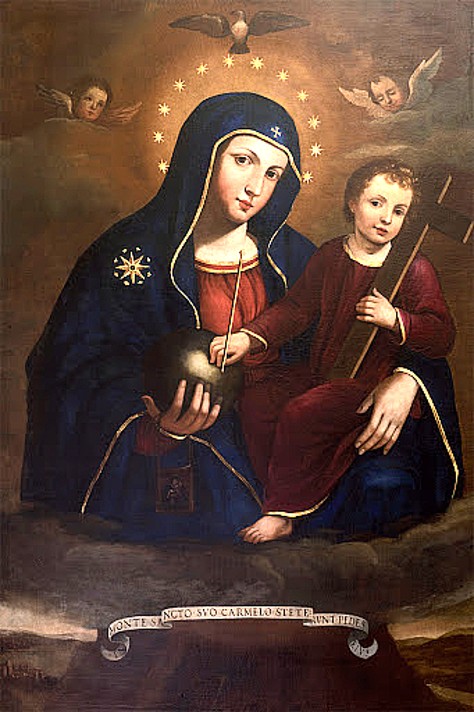
Madonna del Carmine / Our Lady of Carmine, Combarbio di Anghiari, Arezzo, Tuscany, Italy, (1536) – 11 July:
A 12-year-old shepherdess, Marietta Del Mazza, reported apparitions of the Virgin on 11 July 1536 and days following. When news spread through the region, along with reports of miracles attributed to the Virgin’s intercession, the Bishops of Arezzo and Sansepolcro, conducted an investigation and authorised a Shrine at the apparition site.
The Shrine was completed in 1539. The Sanctuary was staffed by the Franciscan order at first, then by the Carmelites until 1782. Since 1987 it has been under the jurisdiction of the local Bishop.
The Sanctuary took the name of Our Lady of Carmel and over the centuries, it has continued uninterruptedly to recall the devotion of the people of the surrounding area. A fervent testimony of trust and love to Our Lady of Carmel occurred on the evening of 11 July 1986, 450 years anniversary from the date of the first apparition.
On the main Altar you can admire a beautiful Florentine school painting representing the Madonna and the Child with Saint John the Baptist pointing to the Lord, from the 16th century.
St Abundius of Ananelos St Amabilis of Rouen St Anna An Jiaoshi St Anna An Xingshi Bl Antonio Muller St Berthevin of Lisieux St Cindeus St Cowair St Cyprian of Brescia St Cyriacus the Executioner St Hidulf of Moyenmoutier St Januarius St John of Bergamo Bl Kjeld of Viborg St Leontius the Younger St Marcian of Lycaonia St Marciana of Caesarea Bl Maria An Guoshi Maria An Linghua Bl Marie-Clotilde Blanc Bl Marie-Elisabeth Pélissier Bl Marie-Marguerite de Barbégie d’Albrède
St Olga Queen of Kiev (c 890-969) She was known as a ruthless and effective ruler but “when Olga was enlightened, she rejoiced in soul and body. The Bishop, who instructed her in the faith, said to her, ‘Blessed art thou among the women of Rus,’,for thou hast loved the light and quit the darkness. The sons of Rus’ shall bless thee to the last generation of thy descendants.” About St Olga: https://anastpaul.com/2020/07/11/saint-of-the-day-11-july-saint-olga-queen-of-kiev-c-890-969/
St Pelagia St Pius I, Pope (Died c 154) (Martyr?) The ninth successor of St Peter. St Placid of Dissentis Bl Rosalie-Clotilde Bes St Sabinus of Brescia St Sabinus of Poitiers St Sidronius St Sigisbert of Dissentis Bl Thomas Hunt Bl Thomas Sprott St Thurketyl
Thought for the Day – 10 July – Meditations with Antonio Cardinal Bacci (1881-1971)
“Give Us this Day Our Daily Bread”
“In the second part of the Lord’s Prayer, we ask the universal Father, on behalf of ourselves and of our brethren, for all things necessary for soul and body. Since we have already paid homage to God, our Creator and our Redeemer and, have prayed for the triumph of His kingdom and for the accomplishment of His will in Heaven and on earth, Our Lord does not forbid us to think now of ourselves and to pray for our own needs. “Give us this day our daily bread,” we ask, intending to pray, both for our spiritual and material requirements.
We should not delude ourselves into imagining that it is we who produce the fruits of the earth. A grain of wheat dies beneath the soil but God has infused into it, a mysterious force as a result of which, in dying, it generates new life.
The moisture of the soil, the warmth of the air and the light of the sun combine to develop this mysterious life-force, which produces the green stalk and then the flaxen ear of corn which provides us with bread. It is God Who has given this vital power to this tiny seed, as well as to all the other seeds of the soil. It is He Who has endowed the soil with the nutritive elements from which the seeds draw life and it is He, Who sends the dew, the rain and the sunshine, which cause the flowers to blossom and the plants to bear fruit.
We should ask God humbly, therefore, to “give us this day our daily bread.” Our own labours would be futile without the intervention of the all-powerful Creator. We are capable, neither of producing, nor of destroying a single atom nor a single seedling. Without God, we are incapable of achieving anything, either inthe natural or in the supernatural order. Therefore, we must ask Him to provide us with what we need. He is supremely good and loves us very much. His Providence will not leave us in want, even if we are often obliged to work hard in co-operation with Him to procure the necessaries of life. The birds have no granary, yet they manage to find enough seed to keep them alive because God is watching over them. How could we suppose, that He will not look after us, if we turn to Him with trust and perseverance?”
Quote/s of the Day – 10 July – “Month of the Precious Blood” – Readings: enesis 49: 29-32; 50: 15-26a; Psalm 105: 1-2, 3-4, 6-7; Matthew 10: 24-33
“The very hairs of your head are numbered.”
Matthew 10:30
“I see clearly with the interior eye, that the sweet God loves, with a pure love, the creature that He has created and has a HATRED for nothing but SIN, which is more opposed to Him, than can be thought or imagined.”
St Catherine of Genoa (1447-1510)
“Every moment comes to us, pregnant with a command from God, only to pass on and plunge into eternity, there to remain forever, what we have made of it!”
St Francis de Sales (1567-1622) Doctor Caritatis
“Oh! My God, how much Your Hand was upon me and yet how little I was aware of it! How good You are! How good You are! How You protected me! How you covered me with Your wings, when I did not even believe in Your existence!”
Bl Charles of Jesus de Foucauld (1858-1916)
“Let us go forward in peace, our eyes upon heaven, the only one goal of our labours.”
St Thérèse of the Child Jesus (1873-1897) Doctor of the Church
One Minute Reflection – 10 July – “Month of the Precious Blood” – Readings: enesis 49: 29-32; 50: 15-26a; Psalm 105: 1-2, 3-4, 6-7; Matthew 10: 24-33
“Are not two sparrows sold for a small coin? Yet not one of them falls to the ground without your Father’s knowledge.” – Matthew 10:29
REFLECTION – “In this passage, Jesus demonstrates His foresight in all things. The word “without” refers, not to will but to foreknowledge. Some things happen because of His direct will but some happen, merely with His approval and consent. And so, on the literal level, He is showing the subtlety of His foresight and His previous knowledge of events.
On the spiritual level, however, a sparrow falls to the ground when it looks at what is below it and falls to earth, ensnared by the vices of the flesh, given up “to dishonourable passions.” It loses its freedom together with its honour. For a sparrow is either borne always upward, or else it comes to rest by alighting on mountains or hills (the hills are metaphors for Scripture). And such a person is one who has been raised aloft by the Word but has his mind on earthly concerns.” – Origen Adamantius (c 185-253) Priest, Theologian, Exegist, Writer, Apologist, Father (Fragment, 212.)
PRAYER – Loving Father, grant me to have a true fervour in Your service. Let me never tire of following Your Son’s example and avoiding evil. Teach me to reside in total peace in Your wisdom and power and thus to trust You above all. Grant that by the intercession of the Blessed Virgin our Mother and Saints Rufina and Secunda, we may grow in holiness and attain our eternal home with You. We ask this through our Lord, Jesus Christ and the Holy Spirit, God forever, amen.
Our Morning Offering –10 July – “Month of the Precious Blood” and Mary’s Day
Let Me Love Your Jesus By St Ildephonsus (c 607-670)
Virgin Mary, hear my prayer, through the Holy Spirit, you became the Mother of Jesus, from the Holy Spirit, may I too have Jesus. Through the Holy Spirit, your flesh conceived Jesus, through the same Spirit, may my soul receive Jesus. Through the Holy Spirit, you were able to know Jesus, to possess Jesus and to bring Him into the world. Through the Holy Spirit, may I too come to know your Jesus. Imbued with the Spirit, Mary, you could say “I am the handmaid of the Lord, be it done unto me according to your word,” in the Holy Spirit, lowly as I am, let me proclaim the great truths about Jesus. In the Spirit, you now adore Jesus as Lord and look on Him as Son, in the same Spirit, Mary, let me love your Jesus. Amen
Saints of the Day – 10 July – Saints Rufina and Secunda of Rome (3rd Century) Virgin Martyrs, sibling sisters. Martyred in 257 in Rome, Italy. The entry in the Roman Martyrology states: “At Rome, in the persecution of Valerian and Gallienus, the holy virgins and martyrs, Rufina and Secunda, sisters, who, after being subjected to torments, the one having her head split open, the other being decapitated, departed for Heaven. Their bodies are kept with due honour in the Lateran Basilica, near to the Baptistry.”
“The honours of this day whereon the Church sings the praises of true fraternity, are shared by two valiant sisters. A century had passed over the empire and the Antonines were no more. Valerian, who at first seemed tike them, desirous of obtaining a character for moderation, soon began to follow them along the path of blood. In order to strike a decisive blow, he issued a decree whereby all the principal ecclesiastics were condemned to death without distinction and every Christian of rank was bound under the heaviest penalties to abjure his faith. It is to this edict that Rufina and Secunda owed the honour of crossing their palms with those of Sixtus and Lawrence, Cyprian and Hippolytus. They belonged to the noble family of the Turcii Asterii, whose history has been brought to light by modern discovery. According to the prescriptions of Valerian, which condemned Christian women to no more than confiscation and exile, they ought to have escaped death but, to the crime of fidelity to God they added that of holy virginity, and so, the roses of martyrdom were twined into their lily-wreaths. Their saced relics lie in St John Lateran’s, close to the Baptistery of Constantine and the second Cardinalitial See, that of Porto, couples with this title, the name of St Rufina, thus claiming the protection of the blessed Martyrs.” – By Abbot Dom Prosper Guerenger OSB (1805-1875)
Saints Rufina and Secunda, Virgins:
Rufina and Secunda were sisters and Roman virgins. Their parents had betrothed them to Armentarius and Verinus but they refused to marry, saying that they had consecrated their virginity to Jesus Christ. They were, therefore, apprehended during the reign of the Emperors Valerian and Gallienus. When Junius, the prefect, saw he could not shake their resolution either by promises or by threats, he first ordered Rufina to be beaten with rods. While she was being scourged, Secunda thus addressed the Judge: “Why do you treat my sister thus honorably, but me dishonorably? Order us both to be scourged, since we both “confess Christ to be God.”
Enraged by these words, the Judge ordered them both to be cast into a dark and foetid dungeon – immediately a bright light and a most sweet odour filled the prison. They were then shut up in a bath, the floor of which was made red-hot but ,from this also, they emerged unhurt. Next they were thrown into the Tiber with stones tied to their necks but an Angel saved them from the water and they were finally beheaded ten miles out of the City on the Aurelian Way. Their bodies were buried by a matron named Plautilla, on her estate and were afterwards translated into Rome.
The Martyrdom of Saints Secunda and Rufina. Collaborative painting by Il Morazzone, Giulio Cesare Procaccini, and Giovanni Battista Crespi (1620-1625)
Their place of burial was at the ninth milestone of the Via Cornelia, as is stated in the Berne manuscript of the “Martyrologium Hieronymianum” (ed. De Rossi-Duchesne, 89). These martyrs are also recorded in the Itineraries of the seventh century, as on the road just mentioned (De Rossi, “Roma sotterranea,” I, 18283). Pope Damasus erected a Church over the grave of the Saints. The Town on this spot named after St. Rufina, became the See of one of the Suburbicarian Diocese that was later united with Porto.
Notre-Dame de Boulogne -sur-Mer , France / Our Lady of Boulogne-Sur-Mer (1469) – 10 July:
In the year 636, a small group of people standing on the seashore witnessed a boat without oars or sails came into the harbour of Boulogne. It finally came to rest in the estuary, seemingly of its own accord. One of the witnesses boarded the boat and confirmed that there was n-one aboard, and that the vessel had no rudder, oars or sails. The ship, however, bore a luminous Statue of Our Lady. Taking hold of it to bring it to land, a voice was heard saying, “I choose your City as a place of grace.” The citizens welcomed Mary to their City by erecting a Shrine in her honour, which reached its height of glory in the 12th Century.
King Henry VIII is reported to have stolen the Statue of Our Lady of Boulogne and taken it to England. After many negotiations, the French managed to get it back. The image had been stolen and hidden many other times, but always saved and returned. World War II almost completely destroyed the Statue. In modern times, four exact replicas of Our Lady of Boulogne toured France for more than seven years as a symbol of French devotion to Mary. One of these was taken to Walsingham, England, in 1948 and carried in procession by the Cross-bearing pilgrims. Boulogne was one of the most important Lady Shrines of medieval France; among its noted pilgrims have been: Henry III, Edward II, the Black Prince, John of Gaunt. The dedication of a new Church built in honour of Our Lady of Boulogne was Consecrated in the year 1469 by Bishop Chartier of Paris. The confraternity of Our Lady of Boulogne was so celebrated, that six French Kings have chosen to belong to it. At the French Revolution, the Statue was burnt to ashes and the Church pulled down. A new Statue was made in 1803 and pilgrimages began again. The image represents the Mother with the Child in her arms, standing in a boat, with an angel on either side. At the Marian Congress in Bolougne in 1938, a the custom began, to take replicas of this Statue on visitations through France and abroad. A branch of the Confraternity of Our Lady of Compassion at Boulogne has been established for the reconciliation of the Church of England.
The Sanctuary Church at Boulogne was badly damaged during World War II, and Mary’s image smashed but the return, the “Great Return” of one of the copies of the Statue which had been sheltered at Lourdes, took place in 1943, and the occasion will long be remembered by lovers of the Blessed Virgin Mary. There is an ancient offshoot of this Shrine at Boulogne-sur-Seine.
St Cuán of Airbhre St Elilantus St Etto Bl Euménios St Lantfrid Bl Marie-Gertrude de Ripert d’Alauzier Bl Parthenios St Pascharius of Nantes St Peter Vincioli St Phêrô Nguyen Khac Tu St Rufina and St Secunda of Rome (3rd Century) Virgin Martyrs
St Sylvanus of Pisidia Bl Sylvie-Agnès de Romillon St Waltram — Martyrs of Africa – 4 saints: A group of Christians martyred together in Africa. The only information that has survived are four of their names – Felix, Januarius, Marinus and Nabor.
Martyrs of Antioch – 10 saints: A group of ten Christians martyred together. We have no details about them but the names – Diogenes, Domnina, Esicius, Macarius, Maxima, Maximus, Rodigus, Timoteus, Veronia and Zacheus. They were martyred in Antioch, date unknown.
Martyrs of Damascus – 11 beati: A group of Franciscans and laymen ordered by Druz Muslims to convert to Islam. They refused and were hacked to pieces. • ‘Abd Al-Mu’ti Masabki • Carmelo Bolta Bañuls • Engelbert Kolland • Francisco Pinazo Peñalver • Fransis Masabki • Juan Jacobo Fernández y Fernández • Manuel Ruiz López • Nicanor Ascanio de Soria • Nicolás María Alberca Torres • Pedro Soler Méndez • Rufayil Masabki They were cut to pieces on 9-10 July 1860 in Damascus, Syria. Beatified on 10 October 1926 by Pope Pius XI.
Martyrs of Nicopolis – 45 saints: A group of 45 Christians tortured and martyred together in the persecutions of emperor Licinius. We know nothing else but six of their names – Anicetus, Anthony, Daniel, Leontius, Mauritius and Sisinno. c 329 in Nicopolis, Armenia (modern Koyulhisar, Turkey).
Martyrs of Nitria – 5 saints: Fathers of Nitria – Four monks and the bishop of Alexandria, Egypt who were martyred by heretics. Saint John Chrysostom wrote about them but their names have not come down to us. They were martyred in the 4th century in Nitria, Egypt.
Thought for the Day –9 July – Meditations with Antonio Cardinal Bacci (1881-1971)
Putting Christianity into Practice
“Imagine what the world would be like, if the Gospel of Christ, were practised in it’s entirety, everywhere and by everybody. It would not, of course, become another earthly Paradise, because suffering and death are the legacy of sin and Our Lord, did not remove these when He redeemed us but made them a necessary element, in our purification and spiritual elevation. Nevertheless, the full practice of Christianity would transform the world. A little reflection will convince us of this. Men would love God above all things and their neighbours as themselves. The sincere and ardent love of God, would cause wickedness, brutality and every kind of immorality to disappear. Love of their neighbour, would make men brothers in reality, so that there would be no more wars nor threats of conflict. The enormous wealth which is squandered on weapons of destruction, could then be diverted to good works. There would be no more poverty, because, if men loved one another, those who had more than enough, would give to those in want. There would be no more prisons, because, there would be no more criminals. There would be no need for a police force, because, everyone would do his duty of his own accord. The reign of love, which is the reign of Jesus Christ, would triumph upon earth. Excessive wealth and the selfish love of ease and pleasure, would disappear on one hand, while, on the other, the extreme need of those who can never be sure of a meal, nor of a roof over their heads, would be palliated, until they had been raised to a standard of living, consistent with the laws of God and with the dignity of men. The love of our neighbour as ourselves, would solve every individual and social problem in this life. Men would grow into a vast community of brothers devoid of all barriers of hate, selfishness and greed. This is not a Utopian dream, because it is the clear teaching of the Gospel. Jesus did not preach the impossible. He taught us the standards of the perfect life, which we are all obliged to try and lead.”
Quote/s of the Day – 9July – “Month of the Precious Blood” – Readings: Genesis 46: 1-7, 28-30; Psalms 37: 3-4, 18-19, 27-28, 39-40; Matthew 10:16-23
“Behold, I send you as sheep in the midst of wolves. Be, therefore, wise as serpents and simple as doves.”
Matthew 10:16
“But above all these things have charity, which is the bond of perfection.”
Colossians 3:14
“What is the surest kind of witness? “Anyone who acknowledges that Jesus Christ came among us in the flesh” (cf. 1Jn 4,2) and who keeps the commands of the Gospel… How many there are each day of these hidden martyrs of Christ who confess the Lord Jesus! … So be faithful and courageous in interior persecutions so that you may also win the victory in exterior persecutions.”
St Ambrose (340-397) Father & Doctor of the Church
“When he has begun to follow me, according to My teaching and precepts, he will find many people contradicting him and standing in his way, many who not only deride but even persecute him. Moreover, this is true, not only of pagans who are outside the Church but also of those, who seem to be in it visibly but are outside of it because of the perversity of their deeds. Although these glory, in merely the title of Christian, they continually persecute faithful Christians.”
One Minute Reflection – 9 July – “Month of the Precious Blood” – Readings: Genesis 46: 1-7, 28-30; Psalms 37: 3-4, 18-19, 27-28, 39-40; Matthew 10: 16-23
“Behold, I send you as sheep in the midst of wolves. Be, therefore, wise as serpents and simple as doves.” –Matthew 10:16
REFLECTION – “I urge you, by the grace in which you are clothed, to press on in your race and urge everyone to be saved. Assert your office with all the diligence of flesh and spirit. Give your attention to unity, for there is nothing better. carry your brethren as the Lord also carries you. Patiently, bear with them all in love, as indeed you do bear with them. Devote yourself to unceasing prayer. Ask for greater understanding than you have. Be watchful, possessing a wakeful spirit. Speak to each one individually, concerning God’s way. “Bear the infirmities” (cf Mt 8,17) of each as a perfect athlete. Where there is more toil, there is greater gain. If you only love the good disciples, this wins you no advantage. Rather, subdue by meekness the more annoying. Not every wound is cured by the same salve. Ease sharp pains with a hot compress. In everything “be wise as serpents” and always “harmless as doves”. You who are of flesh and spirit, humour those things visibly present before you but pray, too, that what is invisible may be manifested to you, so that you may lack nothing and may abound in every spiritual gift.
As pilots invoke the winds and tempest-tossed mariners call for haven, this season invites you to return to God. Be temperate, as God’s athlete. The prize is incorruption and life eternal… It is the part of a great athlete to suffer blows and to conquer. It is above all for God’s sake we ought to endure all things, that He too, may endure us. Become more zealous than you are already. Consider the times. Look for Him Who is above all times, Who is timeless, invisible but made visible for our sakes – He Who, beyond the touch of our hands, beyond suffering, yet knew the Passion for our sakes and endured every suffering.” – St Ignatius of Antioch (c 35-c 108) Father of the Church, Martyr, Bishop – Letter to St Polycarp (69-155) Bishop and Martyr), 1-3 ; SC 10
PRAYER – Father of all holiness, guide our hearts to You. Keep in the light of Your truth, all those You have freed from the darkness of unbelief. May our lives be the source of enlightenment to others and our faith and love every remain strengthened by Your grace. Listen to the prayers of our Blessed Mother on our behalf, as we long for our eternal home. We ask this through our Lord Jesus Christ, Your Son, who lives and reigns with You and the Holy Spirit, one God, forever and ever. Amen
Our Morning Offering – 9 July – “Month of the Most Precious Blood”
Daily Offering to the Father Attri To St Gertrude the Great (1256-1302)
Eternal Father, I offer Thee the most precious blood of Thy Divine Son, Jesus, in union with the Masses said throughout the world today, for all the Holy Souls in Purgatory, for sinners everywhere, for sinners in the universal Church, for those in my own home, and in my family. Amen
You might see fantastic claims for this prayer, especially printed on Holy Cards, such as the release of 1000 souls from Purgatory, each time it is prayed. Nowhere in St Gertrude’s writings, is this wild promise made so be careful of treating prayers and devotions as amulets or magical charms. And further, this prayer is claimed to have been written by heer but this is very uncertain. The Church has summarily condemned prayer cards containing a promise to release one or more souls from Purgatory, or any other ‘miraculous’ claims. Such an easy way to release 1,000 souls seems inconsistent with the Church’s understanding of Purgatory, given that ordinarily, to release one soul, requires a plenary indulgence which is very difficult to get and, given all the means the Church employs to help the dead, such as special masses or indulgences applicable only to the dead.
Saint of the Day – 9 July – Blessed Giovanna Scopelli O.Carm (1428 – 1491) Virgin, Mystic, Italian Religious of the Carmelites and established her own Convent as its first Prioress. She was known, during her lifetime as a miracle-worker with many coming to her to ask for her assistance and prayers. Born in 1428 at Reggio d’ Emilia, Italy and died in 1491 of natural causes, aged 63. Also known as – Jane Scopelli, Joan Scopelli, Giovanna of of Reggio Her body is incorrupt.
Giovanna Scopelli was born in 1428 in Reggio Emilia to Simone and Caterina Scopelli. From her childhood she felt a strong attraction to the religious life though her parents disapproved of this vocation and forbade her to pursue it. Scopelli submitted to this and so led her austere and pious life at home until the death of her parents around 1480, when she then decided to form the Carmelite Convent of Santa Maria del Popolo while in the process of her Novitiate.
Giovanna took on the task of looking for a suitable place, when a widow offered herself, two daughters and her home. They lived together from 1480 until 1484, meanwhile Giovanna was looking for a place twhich could serve as a Monastery. Giovanna set her eyes on the Church of St Bernard, which belonged to the Humiliati Friars. With the support of the Bishop, Philip Zoboli, she obtained it from the Friars’ General on his way through Reggio. The beginnings of the new Monastery dates from 1485, with the name changed from that of St Bernard to that of St Mary of the People (afterwards called of the White Sisters). The inevitable financial difficulties at the beginning were surmounted through the help of a certain Christopher Zoboli. Under Joan’s direction more than twenty religious made up the new community, which was entrusted to the care of the Mantuan Congregation of Carmelites and, for which, in 1487, the Carmelites provided a Confessor.
She refused all endowments and gifts – and urged her fellow religious to do the same thing – unless such gifts were given as alms with no conditions attached to them. In 1487 a Priest was assigned to them as their Confessor. The nuns became known as “The White Nuns.”
God gifted Giovanna with extraordinary charisms. She herself fostered a deep Marian piety (she venerated the Blessed Virgin with a special devotion of her own, called the Tunic of Our Lady – mainly a frequent repetition of Hail Marys and was animated by an intense spirit of penance.
She died on 9 July1491;. Her cult began the following year, with the exhumation of her incorrupt body. In 1500 a public judgement was passed on her life, her virtues and her miracles. During the years 1767-70 the Diocesan process for the recognition of the cult was held, which met with the approval of Pope Clement XIV on 24 August 1771. After the suppression of the Monastery by the secular powers and of the Church of the Carmelite nuns in 1797, the body of the Blessed was transferred to the Cathedral in the year 1803.
Virgen de Itatí / Our Lady of Itati (17th Century) – 9 July:
Our Lady of Itatí is a celebrated wooden representation of Virgin Mary in the City of Itatí, Corrientes Province, Argentina.
According to legend, it saved the life of 17th Century Jesuit missionary Friar Luis de Bolaños. In 1950 a Basilica was built with one of the tallest domes in South America.
The Virgin of Itatí is venerated in the City of Itatí , Province of Corrientes , Argentina . The devotion dates to a Jesuit historical legend, according to which, the recitation of the Rosary saved the missionary Spanish Jesuit Luis de Bolaños and natives he had converted, from an attack by natives who fought with the the conquerors. The legend relates how the Yaguar river opened, creating a passage and the rebels retreated and dispersed, leaving the people of Itatí safe, thanks to the intervention of the Virgin.
Today the Blessed Virgin of Itati is the Patron of the Province of Corrientes and enjoys great popular devotion. The Basilica of Itatí has become the major Pilgrimage centre of the Country.
St Augustine Zhao Rong, Priest and Martyr (Died + 1815) and his 119 companions or Martyrs of China (Died 1648–1930, Qing dynasty and Republic of China) (Optional Memorial): 25 priests, friars, nuns, seminarians and lay people. The 87 Chinese Catholics and 33 Western missionaries, from the mid-17th century to 1930, were martyred because of their ministry and, in some cases, for their refusal to apostatise. Many died in the Boxer Rebellion, in which xenophobic peasants slaughtered 30,000 Chinese converts to Christianity along with missionaries and other foreigners. Canonised on 1 October 2000 by Pope John Paul II in Rome. Full story here: https://anastpaul.com/2019/07/09/saints-of-the-day-st-augustine-zhao-rong-and-companions-or-martyrs-of-china/
Blessed Adrian Fortescue TOSD (1476-1539) Martyr,. A husband and father, a Justice of the Peace, a Knight of the Realm, a Knight of Malta and a Dominican Tertiary (Lay Dominican), he was at once a loyal servant of the Crown so far as he could be but still more, he was a man of unshakeable faith. About Blessed Adrian: https://anastpaul.com/2018/07/09/saint-of-the-day-blessed-adrian-fortescue-1476-1539-martyr/
St Agrippinus of Autun St Alexander of Egypt St Audax of Thora St Brictius of Martola St Copra of Egypt St Cyril of Gortyna Bl Dionysius the Rhetorician St Everild of Everingham St Faustina of Rome St Felician of Sicily Bl Fidelis Chojnacki Blessed Giovanna Scopelli O.Carm (1428 – 1491) Virgin, Religious of the Carmelites. Incorrupt. St Floriana of Rome St Hérombert of Minden St Joachim Ho Bl Luigi Caburlotto Bl Marguerite-Marie-Anne de Rocher Bl Marie-Anne-Madeleine de Guilhermier
Four Holy Polish Brothers – 4 saints: Four brothers who became hermits, Benedictine monks and saints – Andrew, Barnabas, Benedict and Justus. They were born in Poland and died in 1008 of natural causes.
Martyrs of Gorkum – 19 saints: Nineteen martyrs killed by Calvinists for loyalty to the Pope and for their belief in the Real Presence in the Eucharist. They are – • Adrianus van Hilvarenbeek • Andreas Wouters • Antonius van Hoornaar • Antonius van Weert • Cornelius van Wijk • Francisus de Roye • Godfried van Duynen • Godfried van Melveren • Hieronymus van Weert • Jacobus Lacops • Joannes Lenaerts • John of Cologne • Leonardus van Veghel • Nicasius Janssen van Heeze • Nicolaas Pieck • Nicolaas Poppel • Petrus van Assche • Theodorus van der Eem • Willehad van Deem • They werehanged on 9 July 1572 in Brielle, Zuid-Holland, Netherlands. Beatified on 24 November 1675 by Pope Clement X and Canonised on 29 June 1867 by Pope Pius IX.
Martyrs of Orange – 32 beati: 32 nuns from several orders who spent up to 18 months in prison and were finally executed for refusing to renounce Christianity during the persecutions of the French Revolution. • Anne Cartier • Anne-Andrée Minutte • Dorothée-Madeleine-Julie de Justamond • élisabeth Verchière • élisabeth-Thérèse de Consolin • Jeanne-Marie de Romillon • Madeleine-Françoise de Justamond • Madeleine-Thérèse Talieu • Marguerite-Eléonore de Justamond • Marguerite-Marie-Anne de Rocher • Marguerite-Rose de Gordon • Marguerite-Thérèse Charensol • Marie Cluse • Marie-Anastasie de Roquard • Marie-Anne Béguin-Royal • Marie-Anne Depeyre • Marie-Anne Doux • Marie-Anne Lambert • Marie-Anne-Madeleine de Guilhermier • Marie-Claire du Bac • Marie-Clotilde Blanc • Marie-Elisabeth Pélissier • Marie-Gabrielle-Françoise-Suzanne de Gaillard de Lavaldène • Marie-Gertrude de Ripert d’Alauzier • Marie-Marguerite Bonnet • Marie-Marguerite de Barbégie d’Albrède • Marie-Rose Laye • Rosalie-Clotilde Bes • Suzanne-Agathe Deloye • Sylvie-Agnès de Romillon • Thérèse-Henriette Faurie They were guillotined between 6 July and 26 July 1794 at Orange, Vaucluse, France. Beatified on 10 May 1925 by Pope Pius XI.
Martyrs of the Baths – 10,204 saints: A group of Christians enslaved by Diocletian to build the gigantic baths in imperial Rome, Italy. The end of their labours coincided with the beginning of the great persecutions of Diocletian and they were all executed. Ancient records indicated there were 10,204 of them; Zeno of Rome is the only one whose name has come down to us and we know nothing else about any of their individual lives.
Thought for the Day – 8 July – Meditations with Antonio Cardinal Bacci (1881-1971)
Living the Gospel
“The Gospel teaches perfection. It teaches the perfection of the interior life, as well as the exterior life, of private, as well as of domestic and social life. There is no problem in the universe, which has not been solved in the Gospel. In regard to the spiritual life, its command is clear. “You are to be perfect, even as your heavenly Father is perfect” (Mt 5:48). “Thou shalt love the Lord thy God with thy whole heart and with thy whole soul and with they whole mind … Thou shalt love thy neighbour as thyself” (Mt 22:37, Mk 12:30, Lk 10:27). “This is my commandment, that you love one another, as I have loved you” (Jn 15:12). “If anyone wishes to come after me, let him deny himself and take up his cross daily and follow me” (Lk 9:23). “Blessed are the poor in spirit … the clean of heart … the peacemakers …” (Mt 5:3-10). “If thou wilt be perfect, go, sell what thou hast and give to the poor and thou shall have treasure in heaven” (Mt 19:21). “Our Father who art in heaven … thy will be done on earth as it is in heaven” (Mt 6:10). “Father … not my will but thine be done” (Lk 22:42). Anyone who identifies himself with these maxims, rises above the level of a man, to that of an angel. His interior life soars to such a peak, that he seems to be leading a heavenly, rather than an earthly existence. If he is living the Gospel, moreover, his external behaviour will be a faithful mirror of his interior life, for it is not enough to say “Lord, Lord” but a man must also do the will of the Father (Cf Mt 7:21). A man’s domestic and social life, will follow the pattern of his private life.
When he has reached the summit of perfection, an invisible force will emanate from him, the force of good example. This force will transform everything, within him and around him. Like Mary and the Saints, he will become the loyal and powerful co-worker of Christ in the redemption of the human race and in the Christian transformation of society. Redemption and restoration, can come only through the Gospel. Other theories are always bound up with and impeded by, human egoism. The doctrine of the Gospel is reinforced by the love of God and our neighbour. In the Gospel, public and private justice is transformed into the charity of Christ which cannot be impeded by any earthly difficulty, nor by any human barrier, not even by death. “Who shall separate us from the charity of Christ?” (Rom 8:35) asks St Paul. Let us meditate on this.”
You must be logged in to post a comment.