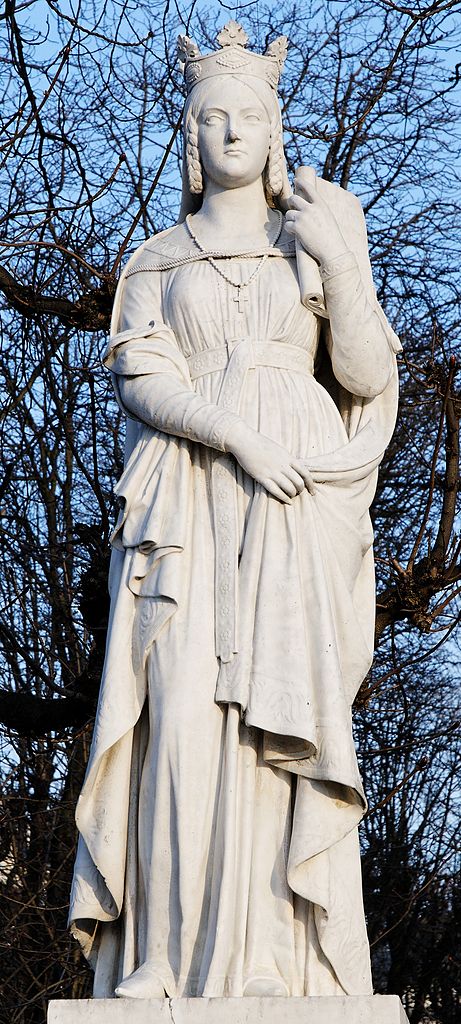
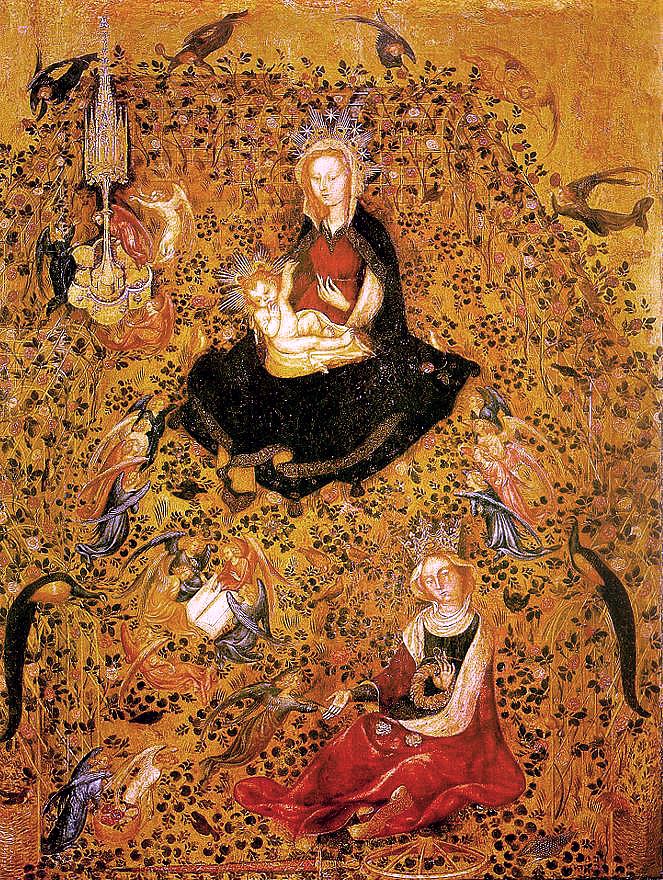
Our Morning Offering – 11 September – Friday of the Twenty Third week in Ordinary Time
Jesus, By this Saving Sign Prayer Before The Crucifix By St Vincent Strambi CP (1745-1824)
Jesus, by this saving sign, bless this listless soul of mine. Jesus, by Your feet nailed fast, mend the missteps of my past. Jesus, with Your riven hands, bend my will to love’s demands. Jesus, in Your Heart laid bare, warm my inner coldness there. Jesus, by Your thorn-crowned head, still my pride till it is dead. Jesus, by Your muted tongue, stay my words that hurt someone. Jesus, by Your tired eyes, open mine to faith’s surprise. Jesus, by Your fading breath, keep me faithful until death. Yes, Lord, by this saving sign, save this wayward soul of mine. Amen
Saint of the Day – 11 September – Blessed Charles Spinola SJ (1564-1622) Priest, Martyr, Missionary to Japan – born as Carlo Spinola in 1564 in Madrid, Spain and died by being slowly burned to death on 10 September 1622 at Nagasaki, Japan.
Charles Spinola was born in Madrid, Spain. His father, the Italian Count of Tassarolo, was tutor to Prince Rudolph, the Emperor’s son. After his early studies in Spain, Charles was sent to the Jesuit school in Nola, Italy where he lived with his uncle Philip Spinola, the Bishop of Nola. As a youth, Charles was so moved by the Martyrdom in India of Rudolph Acquaviva’s heroic example of love for God, that he too was determined to die for Christ and the faith. He entered the Society and became a novice at the Nola novitiate. In 1584 he went to Naples for his philosophy and after taking his vows, he was sent to Brera College in Milan where he completed his philosophy and his theology studies, though at the time his health was not too good. After his Ordination in 1594, he was assigned to give parish missions in Cremona although he had requested to go on foreign missions.
Two years later in 1596 Fr Spinola together with the Sicilian Jesuit, Jerome De Angelis, finally were assigned to the mission in Japan but it took him six years, eight ships and great patience to arrive in Nagasaki, Japan after overcoming shipwrecks, pirates and many unfortunate incidents along the way.
The first ship he took from Genoa struck a rock and was forced to return to Genoa. From Barcelona, he had to walk on foot across Spain and Portugal to reach Lisbon but there the ship met with a violent storm and its rudder was shattered. After five months, the ship was repaired in Brazil, they again set forth only to meet another storm and they found themselves drifted back to the Atlantic to its starting point. His second attempt was also unsuccessful and ended when English pirates captured the ship and took it to England and only managed to escape back to Lisbon after two years. It was only in 1600, when Fr Spinola set off on his third attempt did he reach Malacca, Malaya.
Eventually he reached Japan in 1602, after 6 years of attempts and he studied Japanese before going to Miyako (today’s Kyoto) where he was Novice Master at the Jesuit College and also teacher of mathematics and astronomy. He moved to Nagasaki seven years later to care for the temporal needs of the province. In 1614, the long period of peaceful relations with Shogan Iyeyasu ended, when the number of Christians in Japan had reached two million, causing the country leaders to become fearful that the Christians proposed a national threat and that their country might be taken over by Spain. This resulted in the Shogun’s decree banishing all foreign missionaries and forbidding Japanese Christians to harbour Priests or practice their religion.
Arising from this decree, about 100 Jesuits left Japan but some remained, including Fr Spinola and he eluded Priest-hunters for four years. Fr Spinola was captured together with Bro Ambrose Fernandes and their catechist, John Chogoku and were imprisoned for four years in a bird-like cage under harsh conditions.
We have the record of a letter from one Franciscan, Blessed Richard of St Anne, to his home Monastery in France:
“I have been for nearly a year in this wretched prison, where there are with me, nine religious of our order, eight Dominicans and six Jesuits. The others are native Christians who have helped us in our ministry. Some have been here for five years. Our food is a little rice and water. The road to martyrdom has been paved for us by more than 300 martyrs, all Japanese, on whom all kinds of tortures were inflicted. As for us survivors, we also are all doomed to death. We religious and those who have helped us, are to be burnt at a slow fire; the others will be beheaded… If my mother is still alive, I beg you to be so kind as to tell her of God’s mercy to me in allowing me to suffer and die for Him. I have no time left to write to her myself.”
In September 1622, the nine prisoners who had been caged together, were taken to Nagasaki and felt Martyrdom would soon be theirs. Before they left, Fr Spinola accepted the vows of his seven novices. On 9 September, the nine Jesuits together with twenty-four other prisoners at Suzuta, each with a rope round his neck and the Jesuits in their cassocks, were led to Martyrs’ Hill escorted by 400 soldiers. There they waited for another thirty-three prisoners from the city. When the 2 groups met, they embraced. Fr Spinola recognised Isabel Fernandez among them, the wife of Dominic Jorjes, who had sheltered Charles after he had Baptised her son, Ignatius, now a four-year-old. Isabel said “I brought him [Ignatius] with me to die for Christ before he is old enough to sin against Him.” The boy knelt for a blessing from Charles, witnessed the Martyrdom of his mother and was killed himself—all without crying out.
The religious, with exception of John Chugoku (being a lay person) were condemned to death by slow fire, the Christians and Chugoku were to be beheaded.
When fastened to his stake, Fr Spinola intoned the psalm, Praise the Lord, All You Nations and the martyrs joined in a song of thanksgiving to God. The fires were lit but the wood was so arranged to prolong the victims’ suffering. Fr Spinola died within half an hour as he was greatly weakened after four years of imprisonment. Fr Kimura, endured his martyrdom for three hours and was the last to die, during which time he remained immobile with his arms outstretched in the form of a cross.
The nine martyrs died on Martyrs’ Hill on 10 September 1622. When Pope Pius IX beatified the 205 Japanese Martyrs on 7 May 1867, Bro Ambrose Fernandes, who had died in prison, was also included.
Bl John Bathe St Leudinus of Toul St Matthew of Gravedona sul Lario St Paphnutius of Thebes St Patiens of Lyon Bl Peter Taaffe Bl Petrus Kawano St Protus of Rome St Regula of Zurich Bl Richard Overton St Sperandea St Theodora the Penitent Bl Thomas Bathe — Martyred in the Spanish Civil War: • Blessed José María Segura Panadés • Blessed José Piquer Arnáu • Blessed Josep Pla Arasa • Blessed Lorenzo Villanueva Larrayoz
The Seven Sorrows Novena By St Alphonsus Liguori (1696-1787) Most Zealous Doctor
Day Four – The Fourth Sorrow Mary Meets Jesus on the Way to Calvary
Opening Prayer
V/. O God +, come to my assistance R/. O Lord, make haste to help me.
Gloria Patri …
Reflection (St Alphonsus de Liguori)
Meditation: Mary has known fear and sorrow but none so great, as seeing her beloved Son stumbling under the weight of the Cross. She hears the jeering shouts from the crowd and has no power to help Him. Pity and love are in her eyes as she gazes at His blood-stained face. To many around her, He is no better than a criminal and her heart is breaking as she follows Him to Calvary or Golgotha.
I grieve for thee, O Mary most sorrowful in the consternation of thy heart at meeting Jesus as he carried His Cross. Dear Mother, by thy heart so troubled, obtain for me the virtue of patience and the gift of fortitude. And this my special intention ……………………. (mention your intention) Amen
Ave Maria …
Prayer of St Alphonsus: My sorrowful Mother, by the merit of that grief which thou did feel at seeing thy beloved Jesus led to death, obtain for me the grace also to bear with patience, those crosses which God sends me. Happy me, if I also shall know how to accompany thee with my cross until death. Thou and Jesus, both innocent, have borne a heavy cross and shall I a sinner, who have merited hell, refuse mine? O, Immaculate Virgin, I hope that thou will help me to bear my crosses with patience. Amen
Thought for the Day – 10 September – Meditations with Antonio Cardinal Bacci (1881-1971)
The Creation
“God is infinitely perfect in Himself and has, therefore, no need of creatures of His eternal happiness. He knows Himself fully and this act of knowing, is not transient but substantial and eternal. It is the perfct image of His own Essence, the Word which expressed His Divine Infinity.
Knowing Himself in the infinite depths of His truth, beauty and goodness, God naturally loves Himself. This love, also substantial and external, is the Holy Spirit, Who proceeds, not only from the Father but also from the Word, since God loves Himself because He knows Himself perfectly. The happiness of God, as St Gregory Nazianzen writes, is not a solitary state of beatitude. He has within Himself, the Word, His consubstantial Son, in Whom is reflected the perfection of His nature and to Whom, He repeats from eternity: “You are my son; this day I have begotten you” (Ps 2:7). Moreover, in an act equally substantial and infinite, He pours forth His love, the Holy Spirit. Because, He is infinitely happy and perfect in Himself, God wished to manifest His perfection and to communicate His happiness to others. According to St Thomas Aquinas, the only reason why God has created, is to manifest His glory and to share His happiness. Creation is, therefore, an act of love. “I have loved thee with an everlasting love, therefore, have I drawn thee, taking pity on thee” (Jer 31:3). “God,” says St Irenaeus, “did not create man because He had need of him but because, He wished to have creatures on whom He could shower His gifts.” That is why Sacred Scripture tells us that “the Lord has made everything for His own ends” (Prov 16:4).
Turning over these reflections in our minds, we should make an act of profound humility before God and acknowledge that we are nothing without Him. We should express our deep gratitude to God for our very existence and for all the other gifts with which He has enriched us.
Finally, we should pay Him the tribute of our love, which should be expressed in a practical manner, as well as verbally, by complete and constant fidelity to His commandments.”
Quote/s of the Day – 10 September – Thursday of the Twenty Third week in Ordinary Time, Readings: 1 Corinthians 8:1b-7, 11-13, Psalms 139:1-3, 13-14, 23-24, Luke 6:27-38
“Love one another as I have loved you”
John 15:12
“This is my commandment, that you love one another as I have loved you. Greater love has no man than this, that he lay down his life for his friends.”
John 15:12-13
“Once for all, then, a short precept is given you – Love and do what you will, whether you hold your peace, through love, hold your peace; whether you cry out, through love cry out; whether you correct, through love correct; whether you spare, through love do you spare. Let the root of love be within, of this root, can nothing spring but what is good.”
St Augustine (354-430) Great Western Father and Doctor of the Church
Homily 7 on John
“My brothers, Christ made love the stairway that would enable all Christians to climb to heaven. Hold fast to it, therefore, in all sincerity, give one another practical proof of it and by your progress in it, make your ascent together.”
St Fulgentius of Ruspe (c 462 – 533)
“So hold fast to the sweet and salutary bond of love, without which, the rich are poor and with which the poor are rich. What do the rich possess if not charity? (…) And since “God is love,” (1 Jn 4:8) as John the evangelist says, what can the poor lack, if they merit to possess God by means of charity? (…) So love, dearest brethren and hold fast to charity. without which no-one will ever see God.”
St Caesarius of Arles (470-543)
“At the end of your life, you will be judged by your love.”
St John of the Cross (1542-1591) Doctor of the Church
“And as you wish that others would do to you, do so to them..” … Luke 6:31
REFLECTION – “Whoever loves me, says the Lord, will keep my commandments” and, “this is my commandment: that you love one another” (cf. Jn 14:15.23; 15:12). Thus whoever does not love their neighbour fails to keep the commandment and so cannot love the Lord. (…)
If “love is the fulfilling of the law” (Rm 13:10), anyone who is full of rancour towards a neighbour, laying traps for the neighbour, cursing and exults in their fall, must surely be a transgressor deserving eternal punishment. If “he who speaks evil of his brother and judges him, speaks evil of the law and judges the law” (Jas 4:11) and the law of Christ is love, surely someone who speaks evil of Christ’s love, falls away from it and is the cause of his own perdition.
Do not listen gleefully to gossip at your neighbour’s expense, nor chatter to a person who likes finding fault. Otherwise you will fall away from divine love and find yourself cut off from eternal life. (…) Silence the person who utters slander in your hearing. Otherwise you sin twice over: – first you accustom yourself to a deadly passion and, second, you fail to prevent this gossip against your neighbour. (…)
St Paul says that if we have all the gifts of the Spirit but do not have love, we are no further forward (cf. 1 Cor 13:2). How assiduous, then, we ought to be in our efforts to acquire this love!” … St Maximus the Confessor (c 580–662) Abbot Theologian – First Century on Love, nos. 16, 56-58, 60, 54
PRAYER – Almighty Lord and God, protect us by Your power and love throughout this day, even as You have enabled us, in Your love to begin it. Do not let us turn aside to any sin but let our every thought, word and deed be done in love for You and Your creatures, our neighbour. Teach us to love as You have loved us and may our Sorrowful and Holy Mother, show us the way. Through Jesus Christ our Lord, Who loved us to the end, with the Holy Spiriti, God now and for all eternity, amen.
Our Morning Offering – 10 September – Thursday of the Twenty Third week in Ordinary Time, Readings: 1 Corinthians 8:1b-7, 11-13, Psalms 139:1-3, 13-14, 23-24, Luke 6:27-38
“If you love those who love you, what benefit is that to you? For even sinners love those who love them.”… Luke 6:32
Prayer for the Virtue of Love By St Anselm of Canterbury (1033-1109) Doctor magnificus (Magnificent Doctor); Doctor Marianus (Marian Doctor)
We love You, O God and desire to love You more and more. Grant that we may love You as we wish to love You and as we should love You. O dearest Friend, who has loved us so deeply and redeemed us; come and take Your place in our hearts. Watch over our lips, our steps and our deeds so we no longer need fear for our soul and body. Yes, give us love, most precious of gifts, which knows no enemies. Give our hearts that pure love borne of Your love for us, that we may love others as You love us. O most loving Father of Jesus Christ from whom all love flows, grant that our hearts, frozen in sin and grown cold toward You, may be warmed in the divine glow. Help and bless us in Your Son. O blessed Lord, You have commanded us to love one another, give us the grace that, as we have received your unmerited favours, we may love all persons in You and for You. We implore Your clemency for all people but particularly for our friends, whom You have given us. Love them, Source of Love and instil in them a thorough love of Yourself, that they may seek, utter and do nothing save what is pleasing to You. Amen
Saint of the Day – 10 September – Blessed Oglerio O.Cist (c 1136-1214) Cistercian Monk, Abbot, Mediator and peace-maker, Reformer, Penitent, Writer – born in c 1136 in Trento, Trino Vercellese, Italy and died in 1214 of natural causes. He is also known as Ogerius, Ogler, Oglerius. Blessed Oglerio was devoted to Mary and in his writings praised her prerogatives, especially the Immaculate Conception. Not only a man of learning but of humility as well, he was found by Pope Innocent III to be an “instrument of peace” in settling quarrels among warring factions in Italy.
It can be said that Trino Vercellese is a land of the blessed. In addition to Blessed Magdalene Panattieri and Blessed Arcangela Girlani, Blessed Oglerio, Abbot of St Maria di Lucedio is also the pride of the people of Trento. This was an important Cistercian Abbey, founded in 1123 as a subsidiary of the Monastery of La Fertè, in a vast wooded plain not far from Trino. In those days, the abbeys were indeed centres of spirituality but they also had the important economic role of managing many lands recovered from the state of abandonment.
Oglerio was born around the year 1136, the son of a wealthy family. Even today in the city, his birthplace is traditionally indicated which, despite the inevitable alterations, retains three coats of arms from the 8th century on the facade. There is also a fresco depicting the three local blessed.
In 1248 the young Oglerio witnessed the solemn passage of St Bernard of Clairvaux who accompanied, together with fourteen cardinals, Blessed Pope Eugenio III (also a Cistercian) on the journey from Asti to Vercelli, for the Consecration of the Basilica of St Mary Major. The great Doctor of the Church, with his exceptional charisma, broke into the heart of Oglerio who, probably already a student at Lucedio, wore the white Cistercian habit three years later. According to the Benedictine Rule, he alternated study with work, he took his vows in 1153 and in 1161 he was Ordained a Priest. He killed his own body with penance and fasting but he was meek with others, revealing that character that would distinguish him throughout his life.
In 1174, when Bernard of Clairvaux was Canonised, Lucedio was at its peak. About ten years later Peter II was elected Abbot and Oglerio, his right hand, was often his companion in the many missions he undertook in the ecclesiastical and civil sphere. On behalf of Pope Celestino III they settled the disputes between the Bishop of Tortona and the Templars. From the successor Pope Innocent III, they had the task of reconciling Parma and Piacenza (1200), reforming the important Monastery of Bobbio and, with the Bishop of Vercelli, the congregation of the Umiliati of that city, to smooth out the discords between the Monks and Canons of St Ambrogio of Milan (1202) and between the Bishop of Genoa and the Chapter of his Cathedral (1203).
In 1202 they preached the IV Crusade in Trino, one of the captains was Bonifacio del Monferrato. The Crusade failed in its intent, also because the Venetians, despite the dissent of the Pope, exploited it for their own political gain. Boniface, however, was awarded the title of King of Thessaly and the Abbot Peter II was elected Bishop of Ivrea and later Patriarch of Antioch. Oglerio became the eleventh Abbot of Lucedio who, in that year (1205), had fifty Monks.
The Blessed always had a great love for his country and several times he acted as a “peacemaker” in the long-standing conflicts that arose between the Bishop and the Municipality of Vercelli. In 1210, Trino acquired a certain autonomy and the Emperor Otto IV granted the Monastery, possessions and privileges, that benefited the surrounding territory – great was the charity of the Monks who drew from the Abbey’s granaries to help the needy in the many periods of need.
Oglerio also had many diplomatic assignments, on behalf of the Order of Cîteaux, the Apostolic See and the local dignataries – on behalf of the Marquis Guglielmo il Buono, he went on a mission to the Emperor Conrad and the King of France Louis VII. In 1212 Pope Innocent III appointed him Arbitrator between the Canons of Casale and those of Paciliano and the following year he had the task of re-establishing the rights of the Cistercians at the Monastery of Chortaiton, near Thessalonica, devastated by the Saracens. The Bishop of Novara Gerardo had him reform a female Convent and settle some disputes between Lucedio and the municipality of Vercelli.
However, Oglerio was, above all, an excellent spiritual father, in the years in which the Church opposed the heresy of the Albigensians. Fortunately, the “Tractatus in laudibus Sanctae Dei Genitrix” and an “Expositio super Evangelium in Coena Domini” have come down to us of his writings, also precious from a literary point of view. The first, addressed in particular to consecrated women, narrates the glories of Mary, through the passages of the Gospel and defends her immunity from original sin from conception (what will be the dogma of the Immaculate Conception). The second contains thirteen homilies on the Eucharist, “bread of the Spirit”, dealing with chapters XIII – XV of the Gospel of John. Oglerio indicates Jesus as the Lamb sacrificed for the salvation of men and to his Monks he says the Eucharist is “the way, whereby you must go through, the truth you must come to, the life you must remain in” (sermon VII). Christ prevails over the devil for the virtues of “humility, patience and kindness” (sermon IX). He who “loved you without measure, without measure you must love Him” (Sermon I). Mary is “the uncorrupted virgin, the untempered virgin, the virgin before childbirth and after childbirth” (sermon III). His works, for a long time, were believed to be of St Bernard but, in 1661, Cardinal Giovanni Bona attributed them correctly. From them all the sweetness for his Monks shines – many were those trained by him in the school of holiness. The 13th century parchment codex (141 sheets) containing his writings was kept in the Staffarda Abbey, passed to the Royal Library of Turin and definitively, in 1724, to the University Library.
The illustrious Abbot from Trentino one day passed through a Ligurian city, driving away some evil spirits. This episode characterised its iconography (in the likeness of St Bernard) and in the Cistercian martyrology he is remembered as “terror of unclean spirits” but also, to remember his tireless apostolate as a peacemaker.
Now old, he died on 10 September 1214, with a great reputation as a saint among the people and in his Order. The body was placed first in the cloister of the Monastery, then under the main altar. An altar was dedicated to him in 1577, becoming the local parish. On 2 September 1616 there was a sacking of the Monastery by the soldiers of the Duke of Savoy but fortunately, the relics were not dispersed. In 1786 the Cistercians, moving, took them to Castelnuovo Scrivia. The people of Trento got them back on 9 September 1792 and they were definitively placed in the town’s parish Church, St Bartolomeo of Trino, which also includes the magnificent Altarpiece of the Immaculate Conception (see below). Pope Blessed Pius IX, on 8 April 1875, confirmed the cult and Beatified Oglerio. The Abbey of Lucedio was secularised by Pope Pius VI in 1784, the beautiful bell tower and a few elements of the complex remain original from the times of Oglerio, subsequently remodelled several times.
Beata Vergine Maria della Vita/Our Lady of Life: Celebration of the Blessed Virgin Mary as patroness of the Our Lady of Life Hospital in Bologna, Italy, and as depicted in a painting in a sanctuary dedicated to her c 1375 in the hospital. Patronage – hospitals in the diocese of Bologna, Italy.
Blessed Oglerio O.Cist (c 1136-1214) St Peter Martinez St Pulcheria St Salvius of Albi St Sosthenes of Chalcedon St Theodard of Maastricht St Victor of Chalcedon — Martyrs of Bithynia – 3 sister saints: Three young Christian sisters martyred in the persecutions of emperor Maximian and governor Fronto: Menodora, Metrodora, Nymphodora. They were martyred in 306 in Bithynia, Asia Minor (in modern Turkey).
Martyrs of Japan – 205 beati: A unified feast to memorialise 205 missionaries and native Japanese known to have been murdered for their faith between 1617 and 1637.
Martyrs of Sigum – 8 saints: A group of Nicomedian martyrs, condemned for their faith to be worked to death in the marble quarries of Sigum. There were priests, bishops and laity in the group but only a few names have come down to us: Dativus, Felix, Jader, Litteus, Lucius, Nemesian, Polyanus, Victor. They were worked to death c 257 in Sigum.
Martyred in the Spanish Civil War: • Blessed Félix España Ortiz • Blessed Leoncio Arce Urrutia • Blessed Tomàs Cubells Miguel
The Seven Sorrows Novena By St Alphonsus Liguori (1696-1787) Most Zealous Doctor
Day Three – The Third Sorrow The Loss of the Child Jesus in the Temple
Opening Prayer
V/. O God +, come to my assistance R/. O Lord, make haste to help me.
Gloria Patri …
Reflection (St Alphonsus de Liguori)
Meditation: When Jesus is twelve, He is taken to Jerusalem for the Feast of Passover. On the return journey Joseph and Mary find at the end of the first day that Jesus is not with them. Racked with anxiety, they search for Him. Nobody in the streets, not even the beggars, can tell them where He is. Not till the third day do they find Him, in the Temple.
I grieve for thee, O Mary most sorrowful, in those anxieties which tried thy troubled heart at the loss of thy dear Jesus. Dear Mother, by thy heart so full of anguish, obtain for me the virtue of chastity and the gift of knowledge. And this my special intention ……………………. (mention your intention) Amen
Ave Maria …
Prayer of St Alphonsus: O blessed Virgin, why art thou afflicted, seeking thy lost Son? Is it because thou dost not know where He is? But dost thou not know that He is in thy heart? Dost thou not see that He is feeding among the lilies? Thou, thyself have said it: “My beloved to me and I to Him who feeds among the lilies.” These, thy humble, pure and holy thoughts and affections, are all lilies, that invite the divine spouse to dwell with thee. O Mary, do thou sigh after Jesus, thou who loves none but Jesus? Leave sighing to me and so many other sinners who do not love Him and who have lost Him by offending Him. My most amiable Mother, if through my fault thy Son has not yet returned to my soul, will thou obtain for me, that I may find Him. I know well, that He allows himself to be found by all who seek Him: The Lord is good to the soul that seeks him: ” Bonus est Dominus . . . animse quaerenti ilium.” Make me to seek Him as I ought to seek Him. Thou art the gate through which all find Jesus; through thou, I too hope to find Him. Amen
Thought for the Day – 9 September – Meditations with Antonio Cardinal Bacci (1881-1971)
The Two Standards
“The well-known meditation of St Ignatius in his Spiritual Exercies on the two standards, remains applicable to our times. We need only glance at the world to see, that it contains two different kinds of people – the good and the bad, the enemies of Christ and His faithful followers. But, there is also a third group, those who are indifferent and apathetic, those who think of their own comfort and convenience and of nothing else! When one considers it, it is plain that those people who think only of themselves – and their number seems to grow every year – belong to the rearguard of those, who fight beneath the banner of Satan. That man is an enemy of Christ, who has no generosity, no spirit of sacrifice, no desire to combat the evil which threatens to submerge the world. “He who is not with me, is against me,” (Mt 12:30) said Jesus. He who thinks only of his own convenience and remains indifferent to the spread of evil, is not worthy of Jesus. One cannot be indifferent when faced with the alternative between good and evil because, indifference is tantamount to a betrayal. “The Christian,” writes Tertullian, “is another Christ!”
The fact that we are Christians imposes on us, the obligation to fight openly and courageously under the Standard of Christ. The battle must be waged on two fronts. On one side, the struggle is internal. We must resist our rebellious inclinations and self-centred egoism. At the same time, we must make a constant effort to advance in Christian perfection. On the second front, the struggle is external. It is not sufficient to sanctify ourselves but, we must try to sanctify others. When we consider the sacrifices made in the cause of evil by the enemies of Christ, how can we remain indifferent? We should work with zeal and with the help of God’s grace, to achieve our own sanctification and the reign of Christ in the universe. We should examine what we have already done and resolve to be more determined in our future efforts!“
Quote/s of the Day – 9 Sepember – The Memorial of St Peter Claver SJ (1581-1654) “Slave of the slaves” and Blessed Frédéric Ozanam (1813–1853) “Servant to the Poor” and Founder of the St Vincent de Paul Society
“We must speak to them with our hands, by giving, before we try to speak to them with our lips.”
“To love God as He ought to be loved, we must be detached from all temporal love. We must love nothing but Him, or if we love anything else, we must love it, only for His sake.”
“To do the will of God, man must despise his own; the more he dies to himself, the more he will live to God.”
St Peter Claver (1581-1654) “Slave of the slaves”
“Let us complain less of our times and more of ourselves. Let us not be discouraged, let us be better!”
“Let us learn of Him, that holy preference, which shows most love, to those who suffer most.”
“Let us go in simplicity, where merciful Providence leads us, content to see the stone on which we should step, without wanting to discover, all at once and completely, the windings of the road.”
Blessed Frédéric Ozanam (1813–1853) “Servant to the Poor”
One Minute Reflection – 9 September –Wednesday of the Twenty Third week in Ordinary Time, Readings: 1 Corinthians 7:25-31, Psalms 45:11-12, 14-15, 16-17, Luke 6:20-26 and the Memorial of St Peter Claver SJ (1581-1654) “Slave of the slaves” and Blessed Frédéric Ozanam (1813–1853) “Servant to the Poor” and Founder of the St Vincent de Paul Society
“Blessed are you that weep now, for you shall laugh.” … Luke 6:21
REFLECTION – “Blessed are they that mourn, for they shall be comforted” (Mt 5:5). By this saying the Lord wants us to understand that the path of joy lies in tears. It is through desolation one goes to consolation; in losing one’s life that one finds it; in forsaking it that one possesses it; in hating it that one loves it; in despising it that one keeps it (cf. Mt 16:24 f.). If you would know and have the mastery over yourself, enter within yourself and do not seek yourself without (…) Return to yourself, you sinner, return to where you are, to your heart (…) Will not the one who returns to himself discover himself to be far away, like the prodigal son, in a region of unlikeness, in a foreign land, where he sits and weeps at the memory of his father and his native country? (Lk 15,17) (…)
“Adam, where are you? “(Genesis 3:9) Perhaps still in the shadows, so as not to see yourself, you are sewing leaves together in a vain desire to cover your shame, looking at what is around you and what belongs to you (…). Look inside, look at yourself (…) Return within yourself, you sinner, return to your soul. See and weep for this soul subject to vanity and restlessness who cannot set himself free from his captivity (…) It is clear, my brethren, that we live outside ourselves, we are forgetful of ourselves whenever we fritter our lives away in empty pursuits or distractions decked out with trifles. That is why Wisdom is more concerned to invite us to the house of repentance than the house of feasting, that is to say to call back into himself the man outside himself, saying: “Blessed are they that mourn” and in another passage: “Woe to you who laugh now.”
My brethren, let us groan in the presence of the Lord whose goodness moves Him to forgive; let us turn to Him “with fasting, weeping and mourning “ (Joel 2:12) so that one day His (…) consolation may delight our souls. Blessed indeed are those who weep now, not because they are weeping but because they shall be comforted. Weeping is the way, blessedness the consolation.” … Blessed Isaac of Stella O.Cist (c 1100 – c 1170) Sermon 2 for All Saints, 13-20
PRAYER – God of mercy and love, You offer all peoples the dignity of sharing in your life. Rule over our hearts and bodies this day. Sanctify us and guide our every thought, word and deed, may our hands be held out to our neighbour in imitation of Your love and mercy. By the example and prayers of St Peter Claver and Bl Frederic Ozanam, strengthen us to overcome all racial hatreds and to love each other as brothers and sisters. We ask this through our Lord Jesus Christ, your Son, who lives and reigns with you and the Holy Spirit, one God, forever and ever amen.
Our Morning Offering – 9 September – Wednesday of the Twenty Third week in Ordinary Time
Prayer of Dedication to the Lord By St Francis de Sales (1567-1622) Doctor of Charity
Lord, I am Yours and I must belong to no-one but You. My soul is Yours and I must live only by You. My will is Yours and must love only for You. I must love You as my first cause, since I am from You. I must love You as my end and rest, since I am for You. I must love You more than my own being, since my being subsists by You. I must love You more than myself, since I am all Yours and all in You. Amen
Saint of the Day – 9 September 2020 – Blessed Pierre Bonhomme (1803-1861) Priest and Founder of the Sisters of Our Lady of Calvary of Gramat, Apostle of the poor and the handicapped, Preacher, Evangeliser, Diocesan Missionary. Born on 4 July 1803 in Gramat, Lot, France and died on 9 September 1861 at Gramat, Lot, France, aged 58. Patronages – Sisters of Our Lady of Calvary of Gramat, Preachers.
Pierre Bonhomme (1803-1861), Founder of the Congregation of the Sisters of Our Lady of Calvary. He was born on 4 July 1803 in Gramat, France. As a child, Pierre showed an inclination for study, a deep piety and generosity to his parents and sister. He felt called to be a priest from an early age and was attracted to a life of simplicity and poverty.
He completed his studies at the Royal College and entered the major seminary of Cahors in November 1818. On 23 December 1827 he was Ordained a Priest. From that time, he demonstrated an extraordinary ability to help others, both spiritually and materially. While still a Deacon, he opened an elementary and middle school for boys. In 1831 he opened a school to prepare students for the major seminary. He also founded the spiritual group “Children of Mary” for young girls in Gramat, convinced of the need to give youth both human and spiritual guidance when there was nothing else of the kind for them in the area.
Shortly after his appointment as Parish Priest of Gramat, Fr Bonhomme came into contact with the wretchedness and neglect suffered by so many of the poor, elderly and sick. He longed to help them and was undaunted by the scarcity of the available means. He urged “his young people” to visit them, bringing material aid and spiritual comfort. A little later, Fr Bonhomme received permission to establish a home for the needy. He understood, that to run this charitable institution, a religious congregation was indispensable and that it’s members must be women who would give all of themselves for the good of the poor and the suffering. He believed that the young members of the “Daughters of Mary,” so generous in the gift of themselves and in love for God, might have this vocation. It was this that inspired Fr Bonhomme to found the Congregation of the Sisters of Our Lady of Calvary in Gramat. They were dedicated to educating children and to providing assistance to the poor, sick, elderly, deaf-mutes and the seriously mentally and physically disabled.
Hortense and Adèle Pradel and Cora and Mathilde Roussot, all of whom lived in Gramat, became the first members. They felt called to be consecrated to God in His service and began their formation under Fr Bonhomme and at several religious institutes in Cahors.
Fr Bonhomme continued his parish activity and was known for the many missions he preached in nearby Lot and Tarn-et-Garonne. He acquired a reputation as a gifted preacher, converting many and attracting other young women to his newly-founded congregation. Scorching heat and bitter cold, did not deter him from preaching with the same zeal to save souls. He had a special devotion to Our Lady of Rocamadour, in Gramat and through her, sought the strength and inspiration he needed. On one occasion, while preaching a retreat, he completely lost his voice. It was through prayer to Our Lady of Rocamadour that he received a miraculous cure, recovered his voice and was able to go on speaking.
In 1836, Fr Bonhomme made a brief retreat in the Trappist monastery of Mortagne, feeling the need to discern God’s will for him in deeper prayer and reflection. He felt a growing desire to become a Carmelite and to found a Carmelite community in Gramat. However, the Bishop of Cahors did not accept this proposal and encouraged him to continue his missionary activities and to collaborate with the group of newly-established Diocesan Missionaries in Rocamadour. Fr Bonhomme obeyed and threw himself into this new project with all his energy and enthusiasm. In 1848, during a mission in Lot, Fr Bonhomme was once again unable to speak but this time, he was obliged to give up preaching and a disease of the larynx was diagnosed. The Priest did not despair; he trusted in God’s providence and believed that this would afford him the opportunity to dedicate himself to the flourishing congregation he had founded; it already had 61 religious members in various communities in the rural parishes who were dedicated to educating children and caring for the sick. In 1844, Fr Bonhomme sent a community to serve a psychiatric hospital in Leyme and paid frequent visits to “his daughters” there to encourage them in their difficult mission. In 1856, he opened another community in Paris, dedicated to serving “mentally ill, convalescent poor” persons.
His own disability, due to the disease that deprived him of his voice, made him particularly sensitive to the disabled, especially deaf-mutes. In 1854 he opened a school for deaf-mute children in Mayrinhac-Lentour, Lot and in 1856 he sent sisters to Paris to found a home for deaf-mutes.
In his last years, Fr Bonhomme devoted all his time and energy to forming the sisters and to writing the Rule of his institute which he put under the protection of Our Lady of Calvary, who became Mother and Model of the Congregation.
Fr Bonhomme died in Gramat on 9 September 1861. Today the Congregation of the Sisters of Our Lady of Calvary consists of 250 religious who work in France, Brazil, Argentina, Guinea, Ivory Coast and the Philippi. … Vatican.va
The miracle needed for his Beatification was subjected to full investigation in a Diocesan tribunal and was granted it’s formal ratification on 27 October 2000 in order for the cause to proceed to Rome. John Paul II approved it and Beatified him on 23 March 2004.
St Basura of Masil St Bettelin St Dorotheus of Nicomedia Bl Gaudridus Bl George Douglas St Gorgonio of Rome St Gorgonius of Nicomedia St Isaac the Great Bl Jacques Laval St Joseph of Volokolamsk St Kieran the Younger Bl Maria Eutimia Uffing Bl Mary de la Cabeza St Omer St Osmanna Blessed Pierre Bonhomme (1803-1861) Priest and Founder St Rufinian St Rufinus Bl Seraphina Sforza St Severian St Straton St Teódulo González Fernández St Tiburtius St Valentinian of Chur St Wilfrida St Wulfhilda
The Seven Sorrows Novena By St Alphonsus Liguori (1696-1787) Most Zealous Doctor
Day Two – The Second Sorrow The Flight into Egypt
Opening Prayer
V/. O God +, come to my assistance R/. O Lord, make haste to help me.
Gloria Patri …
Reflection (St Alphonsus de Liguori)
Meditation: Soon the sword of sorrow strikes. Herod the King seeks to kill the Child. Warned in sleep by an angel, Joseph takes Jesus and His Mother Mary, setting out for Egypt, where they lived in obscurity and poverty until it was safe to return to Nazareth.
I grieve for thee, O Mary most sorrowful, in the anguish of thy most affectionate heart during the flight into Egypt and thy sojourn there. Dear Mother, by thy heart so troubled, obtain for me the virtue of generosity, especially toward the poor and the gift of piety. And this my special intention ……………………. (mention your intention) Amen
Ave Maria …
Prayer of St Alphonsus: Then, O Mary, even after thy Son hath died by the hands of men who persecuted Him unto death, have not these ungrateful men yet ceased from persecuting Him with their sins and continuing to afflict thee, O Mother of Sorrows? And I also, O God, have been one of these. O, my most sweet Mother, obtain for me tears to weep for such ingratitude. And then, by the sufferings thou didst experience in the journey to Egypt, assist me in the journey that I am making to eternity, that at length I may go to unite with thee in loving my persecuted Saviour, in the country of the blessed. Amen
Thought for the Day – 8 September – Meditations with Antonio Cardinal Bacci (1881-1971)
The Heart of Judas
“The human heart is a mystery, the depths of which, it is difficult to sound. We do not even understand ourselves. The heart of man can soar to the loftiest heights of goodness or descend to unimaginable depths of evil. Examples of the sublime heights to which men can rise, are provided by the lives of the Saints, who loved God so much, that they were on fire with charity and wished to abide forever in Him, “It is now no longer I that live,” said st Paul “but Christ lives in me” (1 Gal 2:20).
The heart of Judas, is a particularly deep mystery. We read in the Gospel that Jesus called together His disciples in the upper room to celebrate His last Pasch with them. Among them was Judas. Jesus loved men so much, that He wished to remain with them, really and truly for all time, even after His approaching death. “Having loved his own, who were in the world, he loved them to the end” (Jn 13:1). When the meal was over, Jesus took bread and, lifting up His eyes to Heaven, He said: “Take and eat; this is my body.” Then He took the chalice, blessed it and turning towards the Apostles said these words: “All of you drink of this; for this is my blood of the new covenant, which is being shed for many.” Then He added: “Do this in remembrance of me.” In this way, Jesus instituted the Blessed Eucharist, which St Thomas Aquinas describes as Christ’s greatest miracle (Opsculum 57, Officium de festa Corporis Christi). Furthermore, He raised His disciples, including Judas, to the sublime dignity of the Priesthood and bestowed on them, the power to do what He had just done. One might say, that the infinite generosity of Jesus Christ, was exhausted at that moment. He could not give anything more because, at that moment, He had given us Himself!
It was in this solemn moment, in which He received Jesus into his soul and was at the same time raised to the dignity of the Priesthood, that Judas finally decided to carry out his plan to sell his Master for thirty pieces of silver and to hand Him over to those who wished to kill Him. How sin can degrade a human being!“
Quote/s of the Day – The Feast of the Nativity of the Blessed Virgin Mary
“This Virgin Mother of the Only begotten of God is called Mary, worthy of God, immaculate of the immaculate, one of the One.”
Origen (c 185-253)
“She is the flower of the field from whom bloomed the precious lily of the valley.”
St Augustine (354-430) Father & Doctor
“Today the Virgin is born, tended and formed and prepared for her role as Mother of God, who is the universal King of the ages. … Therefore, let all creation sing and dance and unite to make worthy contribution to the celebration of this day. … Let everything, mundane things and those above, join in festive celebration. Today this created world is raised to the dignity of a holy place for Him who made all things. The creature is newly prepared to be a divine dwelling place for the Creator.”
St Andrew of Crete (650-740) Bishop
Happy birthday, dearest Mother! Sing our youthful hearts today, And the birds and flowers seem joining In our merry roundelay. How the angels must be singing Round thy white, resplendent throne, While the saints in their holy rapture Claim thee as their very own. But, dear Mother, deign to listen As thy children here on earth Offer unto thee their greetings, Though they be of little worth, Save that love is pulsing through them From thy little ones sincere, Who are hoping they may meet thee On some birthday, Mother dear.
Brother Cyril Robert
Mary Immaculate: God’s Mother and Mine. Marist Press, 1946
One Minute Reflection – 8 September – Feast of The Nativity of the Blessed Virgin Mary, Readings: Micah 5:1-4a or Romans 8:28-30, Psalms 13:6, 6, Matthew 1:1-16, 18-23
Behold, the virgin shall be with child and bear a son … Matthew 1:23
REFLECTION – “She was called Mary, that is, star of the sea, in the foreseeing purpose of God, that she might declare by her name, that which she manifests more clearly in reality. (…)
Robed in beauty, robed equally in strength, she has girded herself, ready to curb with a single gesture the extraordinary tumults of the sea (Ps 92:1,4). For those who sail upon the sea of the present age and call on her with complete faith, she rescues from the breath of the storm and the raging of the winds and brings them, rejoicing with her, to the shore of their happy country. One cannot tell, beloved, how often some would have struck hard rocks, about to suffer shipwreck, some fall on foul sandbanks to return no more (…) did not the star of the sea, Mary ever virgin, stand in the way with her mighty aid and when now the rudder was broken, the deck shattered and they were without human aid, bring them, by her heavenly leading, to the haven of inner peace. Therefore, rejoicing in new triumphs in the new rescue of the boat, in the new additions of peoples, she manifests her joy in the Lord (…)
Indeed, glowing and and conspicuous with this twofold love on the one hand, she is most ardently fixed on God to whom she clings and she is one spirit with him (cf. 1 Cor 6:17); on the other, she gently comforts and attracts the hearts of the elect and shares with them excellent gifts coming from the generosity of her Son.” … St Amadeus of Lausanne O.Cist (1110-1159) Bishop – Homily VIII in praise of the Blessed Virgin Mary
PRAYER – Lord God, the day of our salvation dawned when the Blessed Virgin gave birth to Your Son. As we celebrate her nativity, grant us Your grace and Your peace. Through Christ, our Lord, Your Son in union with the Holy Spirit. Mary, Mother of God, pray for us, amen.
Saint of the Day – 8 September – Saint Corbinian (c 670–c 730) First Bishop of Freising and Founder of the Diocese, Hermit, Missionary, Confessor. After living as a hermit near Chartres for fourteen years, he made a pilgrimage to Rome. Pope Gregory II sent him to Bavaria. His opposition to the marriage of Duke Grimoald to his brother’s widow, Biltrudis, caused Corbinian to go into exile for a time. Also known as Latin: Corbinianus; French: Corbinien; German: Korbinian, Waldegiso.
Corbinian was born sometime around 670, not in today’s southern Germany but in what we now call France, indeed very near the centre of modern northern France, at Chatres.
Corbinian’s life was recorded by Arbeo of Freising, one of his successors as Bishop of Freising, who lived from 723-784. According to Arbeo, Corbinian’s father, Waldegiso, after whom the boy was originally named, died when he was a child. His father’s death was followed some years later by that of his mother, who had renamed him after her own name, Corbiniana. For some years after her death the young Corbinian lived as a hermit in the forest not far from his home. Here he prayed and studied and attracted a number of disciples. Dismayed by the interruptions in his intended life of prayer that were being made by the demands of his followers, he decided to journey to Rome and become a hermit there, near the tomb of Saint Peter.
On arrival in Rome rumour of his spiritual prowess reached the ears of Pope Gregory II. Gregory suggested that he should use his abilities not in withdrawal into a hermitage but to bring the people of his homeland to the Gospel and he sent him back to the north, ordaining him as a Missionary Bishop before he left. This was fairly standard practice at this time, for a Missionary Bishop had the full power of the Church behind him. He could preach, offer the Eucharist, Baptise, Confirm and Ordain, thus enabling him to plant new Churches with complete structure,s in areas outside the surviving and functioning Roman towns, which still had resident Bishops.
Corbinian set out as a pilgrim Bishop and was successful in the Frankish territories. Sometime around 723 he returned to Rome and on the way there acquired his most famous miracle and the symbol by which he is so well remembered.
According to the story, as he travelled through the foothills of the Alps, his horse was attacked and killed by a bear. Nothing daunted, Corbinian subdued the bear and, as a penance for killing the horse, asked the bear to carry his bags in it’s stead. The bear accepted the penance . Corbinian saddled it and loaded his bags on its back. The bear was as good as its word, carrying them all the way to the gates of Rome. At Rome, Corbinian released it back to the wild with thanks. The bear became the symbol of Saint Corbinian as well as the symbol for the town of Freising.
After reporting to Pope Gregory II on this second trip to Rome, Saint Corbinian was sent back to the north to continue his Missionary work. He appears to have arrived in the Freising region about 724 and established a Benedictine Monastery there.
Franz Kobald, Saint Corbinian and His Bear German, 1899 Kuens, Parish church
Almost immediately he entered into a controversy with Grimoald, the duke then ruling the area now called Bavaria, on behalf of the Frankish kings. Grimoald, who, as a Frankish noble, was already a Christian, had contracted a marriage to his brother’s widow, Biltrudis. This kind of marriage was considered incest if undertaken without a dispensation (this is the very same issue that applied to Henry VIII of England and Catherine of Aragon hundreds of years later, causing Henry to break away from the Catholic Church). Corbinian denounced the marriage and was forced by threats from Grimoald and Biltrudis to leave the area, retreating to northern Italy for a while. On their deaths he was able to return to Freising and resume his work.
Anonymous, Saint Corbinian Confronting Grimoald German, c 1870-1880 Freising, Cathedral
He died there on 8 September 730 and this day became his feast day. Of course, his feast day was overshadowed by the greater feast of the Nativity of the Blessed Virgin Mary and it has subsequently been moved to 20 November in Freising in veneration of the translation of St Corbinian’s relics.
Jan Polack, Death of Saint Corbinian Polish, 1484-1485
Tomb of St Corbinian at Freising Cathedral
Corbinian’s Bear is used as the symbol of Freising in both civic and ecclesiastical heraldry. It appeared on the arms of Pope Benedict XVI, who first adopted the symbol when, still known as Joseph Ratzinger, he was appointed Archbishop of Freising-Munich in March 1977. He retained the bear in his revised coat of arms when he was elevated to Cardinal in June of the same year and again on his Papal Coat of Arms when he was elected in 2005.
Transfer of the Body of Saint Corbinian German, 1724 Freising, Cathedral
Apotheosis of Saint Corbinian German, 1723-1724 Freising, Cathedral of Saint Mary and Saint Corbinian
In Catholic Iconography: The scallop shell is a traditional reference to pilgrimage. For Pope Benedict XVI, it also reminded him of the legend according to which one day St Augustine, pondering the mystery of the Trinity, saw a child at the seashore playing with a shell, trying to put the water of the ocean into a little hole. Then, St Augustine heard the words: “This hole can no more contain the waters of the ocean than your intellect can comprehend the mystery of God.” The crowned Moor is a regional motif in heraldry often seen in Bavaria, Benedict’s German homeland. Benedict has been quoted saying that, in addition to the obvious reference back to Saint Corbinian, the Founder of the Diocese where Benedict would become Bishop in 1977, the bear represents Benedict himself being “tamed by God” to bear the spiritual burdens of Benedict’s own ministries first as Bishop, then asCcardinal, and now as Pope.
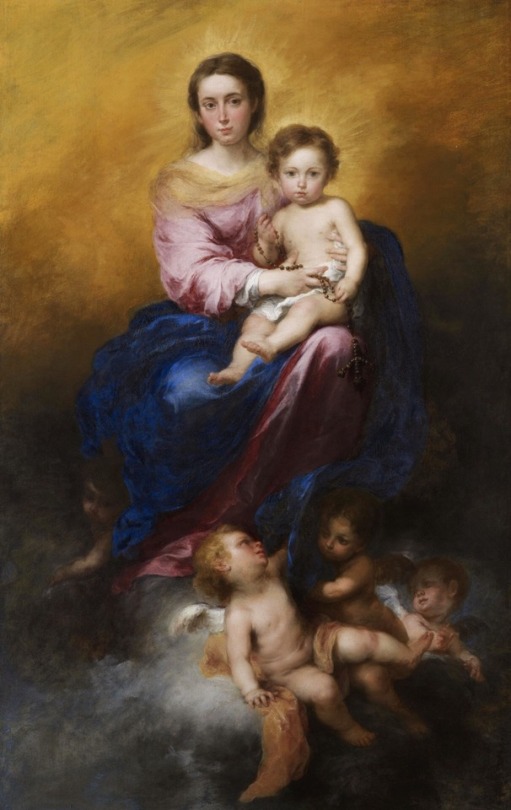
Our Lady of Covadonga – 8 September: is a title of the Blessed Virgin Mary and the name of a Marian shrine devoted to her at Covadonga, Asturias. The shrine in northwestern Spain rose to prominence following the Battle of Covadonga in about 720, which was the first defeat of the Moors during their invasion of Spain. A statue of the Virgin Mary, secretly hidden in one of the caves, was believed to have miraculously aided the Christian victory. Our Lady of Covadonga is the patron of Asturias, and a basilica was built to house the current statue. St Pope John Paul II visited the shrine to honour Our Lady of Covadonga to honour, whose feast day is 8 September.
Our Lady of Health of Vailankanni – 8 September: This is the title given to the Blessed Virgin Mary by people as she twice appeared in the town of Velankanni, Tamil Nadu, India, in the 16th to 17th centuries. The Feast of the Nativity of Mary, is also commemorated as the feast of Our Lady of Good Health. The celebration starts on 29 August and ends on the day of the feast. The feast day prayers are said in Tamil, Marathi, East Indian, Malayalam, Telugu, Kannada, Konkani, Hindi and English.
Our Lady of Meritxell – 8 September: This is an Andorran Roman statue depicting an apparition of the Virgin Mary. Our Lady of Meritxell is the patron saint of Andorra. One 6 January in the late 12th century, villagers from Meritxell, Andorra were going to Mass in Canillo. Though it was winter, they found a wild rose in bloom by the roadside. At its base was a statue of the Virgin and Child. They placed the statue in a chapel in the church in Canillo. The next day the statue was found sitting under the wild rose again. Villagers from Encamp took the statue to their church but the next day the statue had returned to the rose bush. Though it was snowing, an area the size of a chapel was completely bare and the villagers of Meritxell took this to mean that they should build a chapel to house the statue and so they did. On 8-9 September 1972 the chapel burned down and the statue was destroyed, a copy now resides in the new Meritxell Chapel. The feast day of Our Lady of Meritxell is 8 September and the Andorran National Day.
St Adam Bargielski St Adela of Messines Bl Alanus de Rupe St Corbinian (c 670–c 730) Bishop St Disibod of Disenberg St Ethelburgh of Kent St Faustus of Antioch St Isaac the Great St István Pongrácz St Kingsmark St Peter of Chavanon Bl Seraphina Sforza St Pope Sergius I St Timothy of Antioch Bl Wladyslaw Bladzinski — Martyrs of Alexandria – (5 saints) A group of Christians martyred together in the persecutions of Diocletian – Ammon, Dio, Faustus, Neoterius and Theophilus. Martyred in Alexandria, Egypt.
Martyrs of Japan – (21 beati): A group of 21 missionaries and converts who were executed together for their faith. • Antonio of Saint Bonaventure • Antonio of Saint Dominic • Dominicus Nihachi • Dominicus of Saint Francis • Dominicus Tomachi • Francisco Castellet Vinale • Franciscus Nihachi • Ioannes Imamura • Ioannes Tomachi • Laurentius Yamada • Leo Aibara • Lucia Ludovica • Ludovicus Nihachi • Matthaeus Alvarez Anjin • Michaël Tomachi • Michaël Yamada Kasahashi • Paulus Aibara Sandayu • Paulus Tomachi • Romanus Aibara • Thomas of Saint Hyacinth • Thomas Tomachi Died on 8 September 1628 in Nagasaki, Japan Beatified on 7 May 1867 by Pope Pius XI
Martyred in England: Bl John Norton Bl Thomas Palaser
Martyred in the Spanish Civil War: • Blessed Adrián Saiz y Saiz • Blessed Apolonia Lizárraga Ochoa de Zabalegui • Blessed Bonifacio Rodríguez González • Blessed Dolores Puig Bonany • Blessed Eusebio Alonso Uyarra • Blessed Ismael Escrihuela Esteve • Blessed Josefa Ruano García • Blessed Josep Padrell Navarro • Blessed Mamerto Carchano y Carchano • Blessed Marino Blanes Giner • Blessed Miguel Beato Sánchez • Blessed Pascual Fortuño Almela • Blessed Segimon Sagalés Vilá • Blessed Tomàs Capdevila Miquel
The Seven Sorrows Novena By St Alphonsus Liguori (1696-1787) Most Zealous Doctor
Day One
The First Sorrow – The Prophecy of Simeon
Opening Prayer
V/. O God +, come to my assistance R/. O Lord, make haste to help me.
Gloria Patri …
Reflection (St Alphonsus de Liguori)
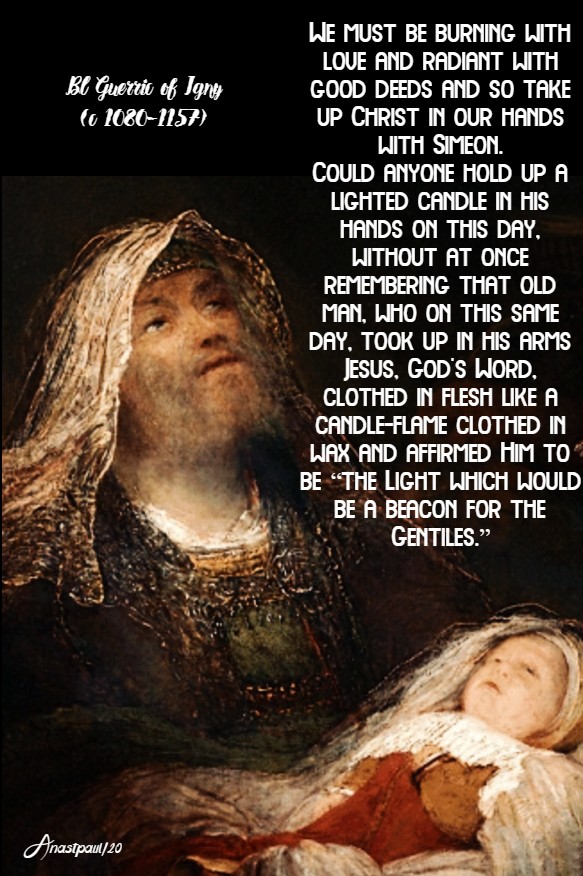
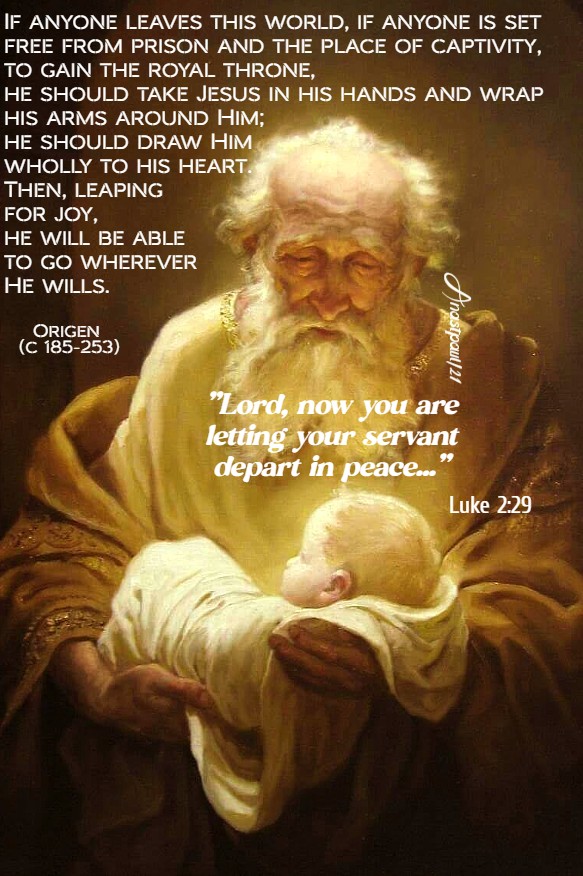
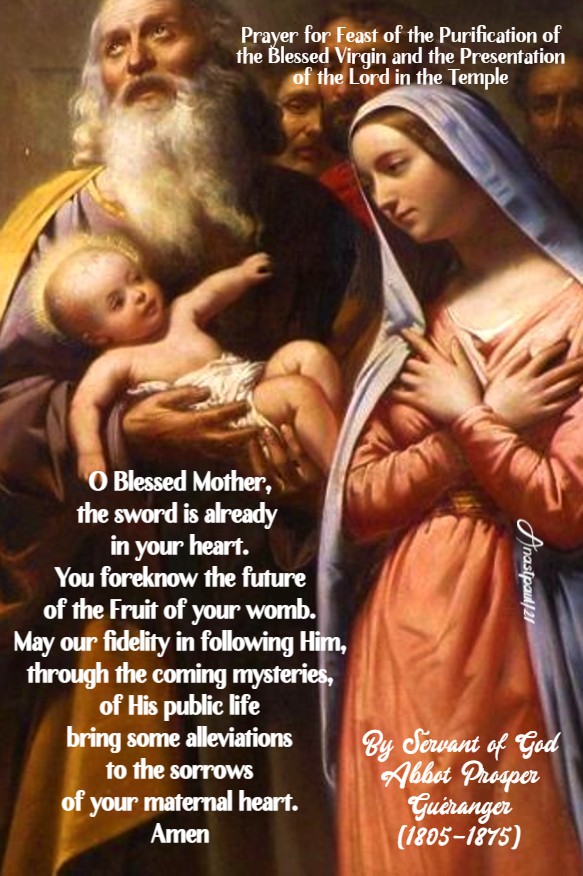
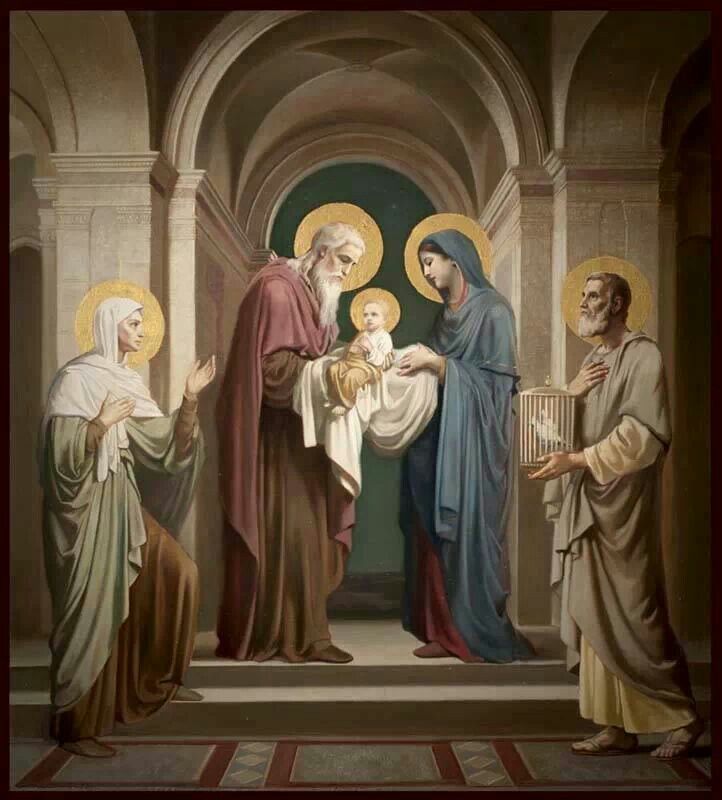
Meditation: Sorrow as sharp as a sword shall pierce Mary’s heart because of her Child. Mary is in the Temple, having come with Joseph to present the Child to God . They meet Simeon, the holy man and Anna, the prophetess. Simeon takes the Baby in his arms, saying he will now die in peace because he has seen Christ, then he foretells the sorrow to come.
I grieve for thee, O Mary most sorrowful, in the affliction of thy tender heart at the prophecy of the holy and aged Simeon. Dear Mother, by thy heart so afflicted, obtain for me the virtue of humility and the gift of the holy fear of God. And this my special intention ……………………. (mention your intention) Amen
Ave Maria …
Prayer of St Alphonsus:
O my blessed Mother, not one sword only but as many swords, as I have committed sins, have I added to those seven in thy heart. O, my Lady, thy sorrows are not due to thee who art innocent but to me who am guilty. But since thou hast wished to suffer so much for me, O, by thy merits, obtain for me great sorrow for my sins and patience under the trials of this life, which will always be light, in comparison with my demerits, for I have often merited hell. Amen
Novena in Preparation for the Feast of the Nativity of the Blessed Virgin Mary
Day Nine
Mediatrix between God and mankind, admirable Mary, by your birth you perfected the joy of all the children of Adam, who, through you, have received the Author of Grace, for He has made you the treasurer of all the graces which are imparted to us. May your birth be a special cause of joy to my soul by obtaining for me from God, eternal salvation and all the graces necessary to obtain it. Dearest Mother, please pray for me and for these my intentions… ……………………… (State your intentions)
Hail Mary…
Prayer: Your Nativity, O Virgin Mother of God, was the herald of joy to the whole world; since from you arose the Sun of Justice, Christ our God, Who, destroying the curse, bestowed the blessing and confounding death, rewarded us with life everlasting.
V. Let us celebrate with joy the birth of the Blessed Virgin Mary.
R. That she may intercede for us with Our Lord Jesus Christ.
Let us pray: Grant to us Your servants, we beseech You, O Lord, the gift of Your heavenly grace, that as our salvation was begun in the child-bearing of the Blessed Virgin, so from this solemn festival of her Nativity, may we obtain an increase of peace. Through Our Lord Jesus Christ. Amen
Thought for the Day – 7 September – Meditations with Antonio Cardinal Bacci (1881-1971)
The Parable of the Barren Fig Tree
“Today’s subject for meditation is the parable of the barren fig tree in the Gospel of St Luke. “A certain man had a fig tree planted in his vineyard and he came seeking fruit thereon and found none. And he said to the vine-dresser, ‘Behold, for tree years now, I have come seeking fruit on this fig tree and I find none. Cut it down, therefore; why does it still encumber the ground?’ But he answered him and said, ‘Sir, let it alone this year too, till I dig around it and manure it. Perhaps it may bear fruit but, if not, then afterwards thous shalt cut it down'” (Lk 13:6-9).
Perhaps Jesus has come many times to us also, looking for the fruit of our good works and has found none. Perhaps, He has continued to bestow favours and blessings upon us and, perhaps, He has waited many years for us to correspond with His grace by performing acts of penance and of expiation.
We may have made good resolutions many times but, what became of them? Temptations of various kinds may have caused us to neglect these resolutions, which remained like branches without any fruit. We must remember, that although God is infinitely good and merciful, He is also, infinitely just. The day could come when He might say: “Cut it down. Why does it still encumber the ground?” In that case, what would become of us?
An episode described in the Gospel of St Mark, should induce serious reflection. Jesus was walking from Bethany to Jerusalem and grew hungry on the way. He saw a fig tree beside the road but, on inspection, found that it was barren. “And He said to it: ‘May no fruit ever come from thee henceforth forever!’ “And immediately, the fig tree withered up.” His disciples, we are told, were amazed when they saw this happening (Cf Mt 21:18-20).
How terrible, if God should ever pronounce this severe condemnation upon us!”
Quote/s of the Day – 7 September – Monday of the Twenty Third week in Ordinary Time, Readings: 1 Corinthians 5:1-8, Psalms 5:5-6, 7, 12, Luke 6:6-11
“Stretch forth your hand.”
Luke 6:10
“While the withered hand was restored, the withered minds of the onlookers were not. … Are you debating what you will do? Worship Him as God. Worship the Wonder-worker. Worship One who worked good things on behalf of another.”
St Athansius (297-373) Father and Doctor of the Church
“What He receives on earth He returns in heaven. … A poor man is begging from you and you are begging from God, he asks for a scrap, you ask for eternal life.”
St Caesarius of Arles (470-543)
“O God, grant that whatever good things I have, I may share generously with those who have not and whatever good things I do not have, I may request humbly from those who do.”
St Thomas Aquinas (1225-1274) Doctor anglicus
“If we look forward to receiving God’s mercy, we can never fail to do good, so long as we have the strength. For if we share with the poor, out of love for God, whatever He has given to us, we shall receive according to His promise, a hundredfold in eternal happiness. What a fine profit, what a blessed reward! With outstretched arms He begs us to turn toward Him, to weep for our sins and to become the servants of love, first for ourselves, then for our neighbours. Just as water extinguishes a fire, so love wipes away sin.”
St John of God (1495-1550)
“So when you leave prayer to serve some poor person, remember, that this very service, is performed for God.”
St Vincent de Paul (1581-1660)
“Yours must be a work of love, of kindness, you must give your time, your talents, yourselves.”
Blessed Frédéric Ozanam (1813–1853) “Servant to the Poor” and Founder of the St Vincent de Paul Society
One Minute Reflection – 7 September – “Month of the Seven Sorrows of the Blessed Virgin Mary” – Monday of the Twenty Third week in Ordinary Time, Readings: 1 Corinthians 5:1-8, Psalms 5:5-6, 7, 12, Luke 6:6-11
“On another Sabbath, he entered the synagogue and was teaching and there was a man whose right hand was withered.” … Luke 6:6
REFLECTION – “Are you angry at me because I have healed the whole man on the sabbath day?” In this place he revivified, with the salutary strength of good works, the hand which Adam stretched out to pluck the fruit of the forbidden tree. The hand which had withered through a crime, was healed by good deeds. Christ thereby rebuked the Jews who violated the precepts of the law with evil interpretations. They thought that they should rest even from good works on the sabbath, since the law prefigured in the present, the form of the future, in which indeed the days of rest from evils, not from blessings, would come.
Then you heard the words of the Lord, saying, “Stretch forth your hand.” That is the common and universal remedy. You, who think that you have a healthy hand, beware lest it is withered by greed or by sacrilege Hold it out often. Hold it out to the poor person who begs you. Hold it out to help your neighbour, to give protection to a widow, to snatch from harm one whom you see subjected to unjust insult. Hold it out to God for your sins. The hand is stretched forth, then it is healed. Jeroboam’s hand withered when he sacrificed to idols, then it stretched out when he entreated God” … St Ambrose (340-397)- One of the 4 original Doctors of the Latin Church – Exposition on the Gospel of Luke, 5
PRAYER – God of mercy and love, You offer all peoples the dignity of sharing in your life. Rule over our hearts and bodies this day. Sanctify us and guide our every thought, word and deed, my our hands be held out to our neighbour in imitation of Your love and mercy. By the intercession of Mary the Mother of Our Lord Jesus Christ and our Mother, strengthen us to love each other as brothers and sisters. We ask this through our Lord Jesus Christ, your Son, who lives and reigns with you and the Holy Spirit, one God, for ever and ever amen.
Our Morning Offering – 7 September – Monday of the Twenty Third week in Ordinary Time
Our Lord, King of all! By St Albert the Great (1200-1280) Doctor of the Church
We pray to You, O Lord, who are the supreme Truth, and all truth is from You. We beseech You, O Lord, who are the highest Wisdom, and all the wise depend on You for their wisdom. You are the supreme Joy, and all who are happy owe it to You. You are the Light of minds and all receive their understanding from You. We love, we love You above all. We seek You, we follow You, and we are ready to serve You. We desire to dwell under Your power for You are the King of all. Amen
You must be logged in to post a comment.