Quote/s of the Day – 3 October – Saturday of the Twenty Sixth week in Ordinary Time, Readings: Job 42:1-3, 5-6, 12-17, Psalms 119:66, 71, 75, 91, 125, 130, Luke 10:17-24
“I Believe”
“Whoever serves me must follow me, so as to be with me wherever I am…”
John 12:26
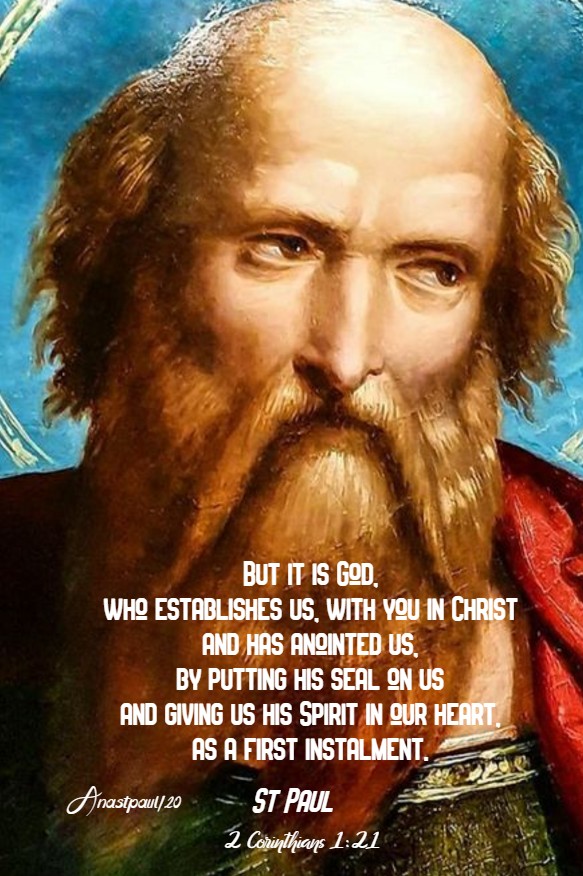
“But it is God, who establishes us, with you in Christ and has anointed us, by putting his seal on us and giving us his Spirit in our heart, as a first instalment.”
St Paul 2 Corinthians 1:21
“Remember, then, that you received a spiritual seal, the spirit of wisdom and understanding, the spirit of knowledge and reverence, the spirit of holy fear. Keep safe what you received. God the Father sealed you, Christ the Lord strengthened you and sent the Spirit into your hearts as the pledge of what is to come.”
St Ambrose (340-397) Father & Doctor of the Church
“Faith is to believe what you do not see; the reward of this faith, is to see what you believe.”
“A person can do other things against his will but belief is possible, only in one who is willing.”
St Augustine (354-430) Father and Doctor of Grace
“If you wish to enter into life, keep My commandments. If you will know the truth, believe in Me. If you will be perfect, sell all. If you will be My disciple, deny yourself. If you will possess the blessed life, despise this present life. If you will be exalted in heaven, humble yourself on earth. If you wish to reign with Me, carry the Cross with Me. For only the servants of the Cross find the life of blessedness and of true light.”
Thomas à Kempis (1380-1471) The Imitation of Christ Chapter 56
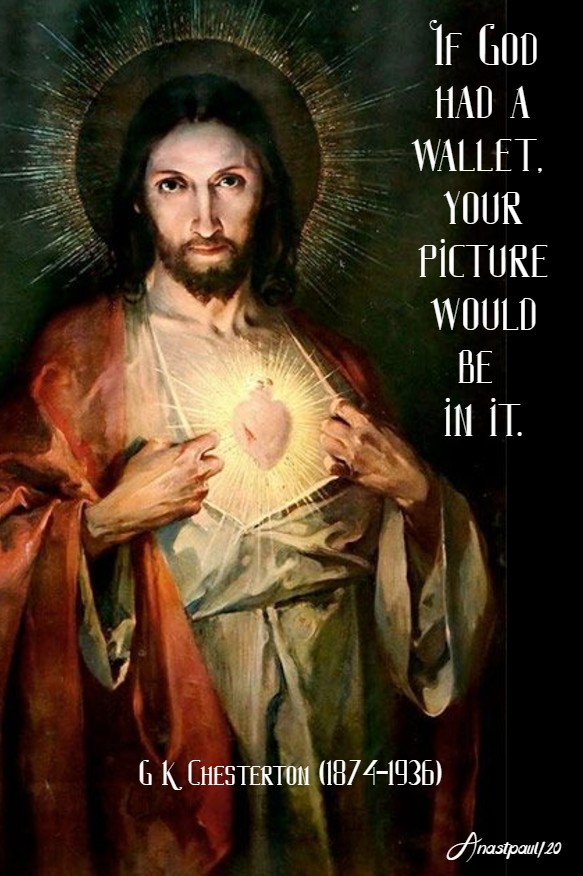
“If God had a wallet, your picture would be in it.”
One Minute Reflection – 3 October – “Month of the Holy Rosary” – Saturday of the Twenty Sixth week in Ordinary Time, Readings: Job 42:1-3, 5-6, 12-17, Psalms 119:66, 71, 75, 91, 125, 130, Luke 10:17-24
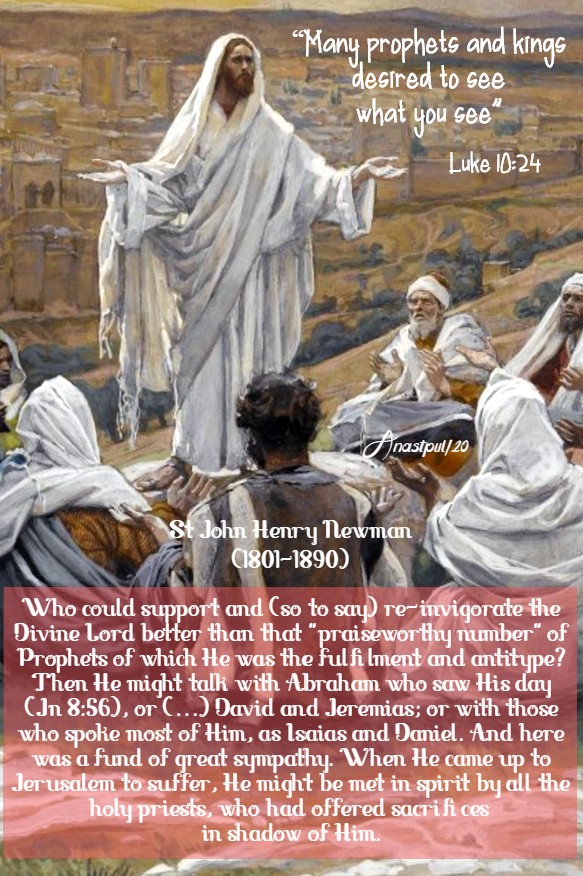
“Many prophets and kings desired to see what you see” … Luke 10:24
REFLECTION – “From the time of His birth we may suppose He held communion with the spirits of the Old Fathers, who had prepared His coming and prophesied of it. On one occasion He was seen all through the night, conversing with Moses and Elias, and that conversation was about His Passion. What a field of thought is thus opened to us, of which we know how little. When He passed whole nights in prayer (…) Who could support and (so to say) re-invigorate the Divine Lord better than that “praiseworthy number” of Prophets of which He was the fulfilment and antitype? Then He might talk with Abraham who saw His day (Jn 8:56), or (…) David and Jeremias; or with those who spoke most of Him, as Isaias and Daniel. And here was a fund of great sympathy. When He came up to Jerusalem to suffer, He might be met in spirit by all the holy priests, who had offered sacrifices in shadow of Him.” … St John Henry Newman (1801-1890) Cardinal, founder of the Oratory in England, Theologian – Meditations and Devotions: Part III, 2, 2, “Our Lord refuses sympathy”
PRAYER – Amidst this world’s changes, help us, by his prayers, to set out hearts always on You. Heavenly Father, let me realise that You guide our lives through Your Providence, Your Word and Sacraments. Help me to be obedient to the rules for my state in life and so be obedient to Your will for me. Grant that the prayers of our Blessed Mother, the Holy Virgin of the Rosary, may assist us as we strive to grow in humility. Through our Lord, Jesus Christ, Your Son in union with the Holy Spirit, one God forever and ever, amen.
Our Morning Offering – 3 October – “Month of the Holy Rosary” – Saturday of the Twenty Sixth week in Ordinary Time
Through Thee, to Us, our Saviour Came To Our Lady of the Rosary By St Amadeus of Lausanne O.Cist (1108-1159)
Through thee, to us, our Saviour came, Through thee, to Him, we fain would go. Our lives are marred by wrong and shame, Yet, confidence in thee we know. The friendship thou dost give to all Who love thy name, shall ever be Assurance thou wilt hear our call, Sweet Lady of the Rosary!
Thou art our Strength upon the way, Our Morning Star, to cheer and guide; Our Beacon Light to show the day, And lead us to the Saviour’s Side; A Comforter in ev’ry pain We find, O Mother blest, in thee, And seek we, never, thee in vain, Fair Lady of the Rosary!
Thy praises, Mary, we would sing, And all our faculties employ, That unto thee our hearts might bring A glory-crown of love and joy. Bless thou each humble effort made In thy regard and grant that we, May by thy influence be swayed, Our Lady of the Rosary!
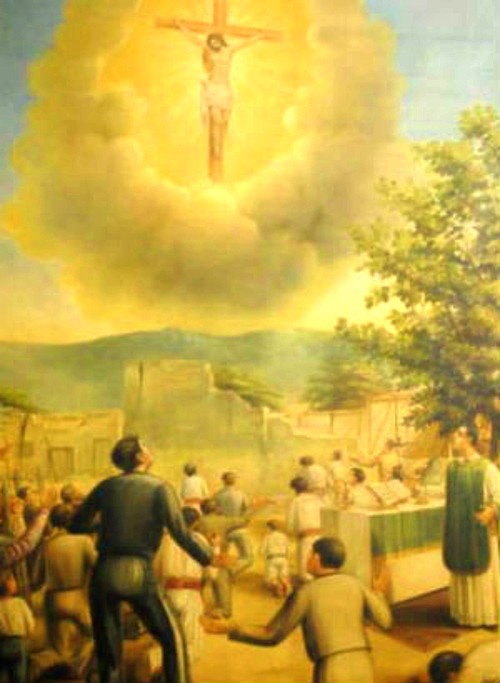
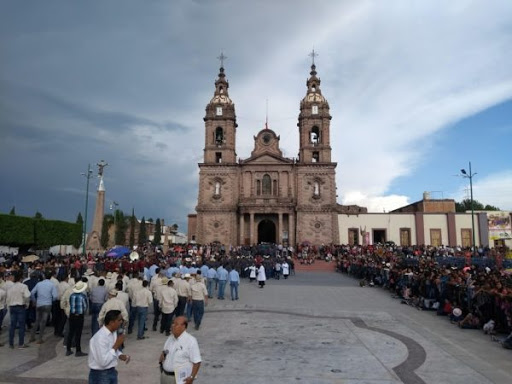
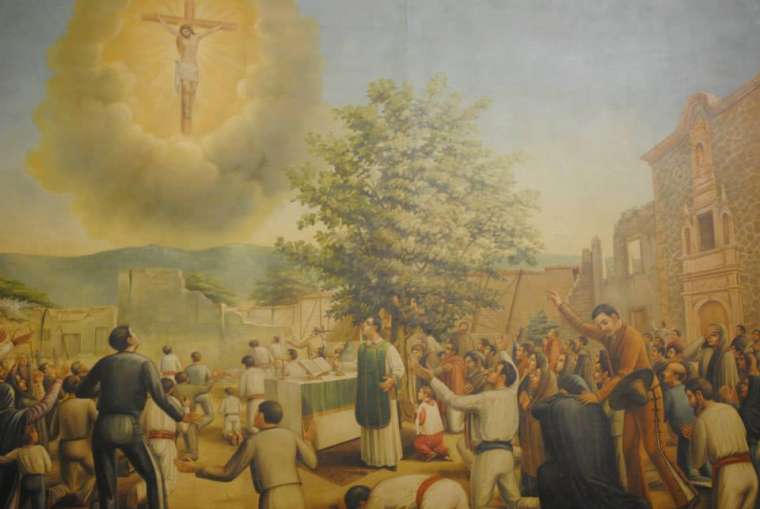
Feast of The Miracle of Ocotlán – Our Lord of Mercy – 3 October. This is a major miracle that you’ve probably never heard of, the appearance of Christ in the clouds, in Ocotlan, Mexico, in 1847. This historical event – approved by the Archdiocese of Guadalajara in 1911 – is known as “The Prodigy of Ocotlán“
On Saturday 2 October 1847, a massive earthquake hit the region of the town of Ocotlán, Mexico; much of the city was destroyed and 40 people died. The next day, Sunday 3 October 1847, before a Mass was celebrated in the cemetery of the Chapel of La Purísima Concepción in the city of Ocotlán, more than 2,000 people witnessed a perfect image of Jesus Christ Crucified that appeared in the skies for more than 30 minutes.
Before Mass began that 3 October which would be presided over by the parochial vicar, Fr Julián Navarro, two very white clouds began to join in the north-west of the sky and in the middle of them the image of Christ appeared.
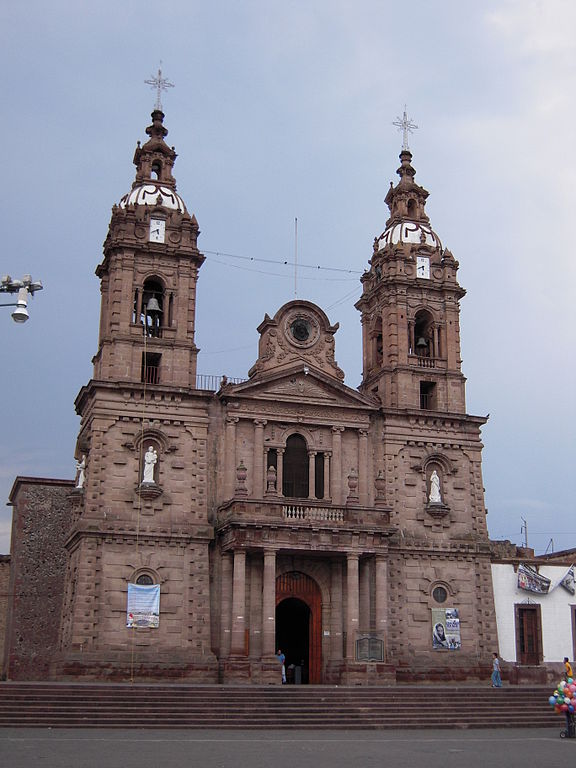
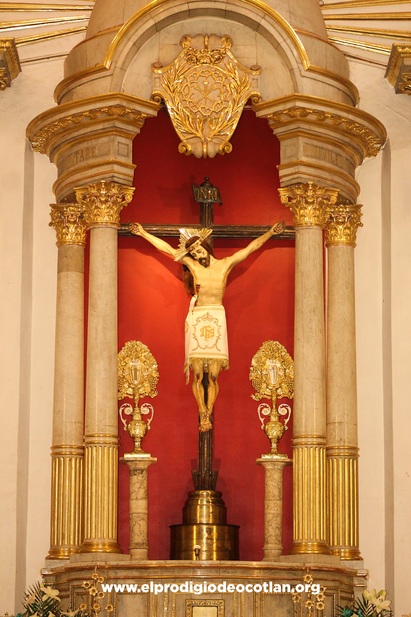
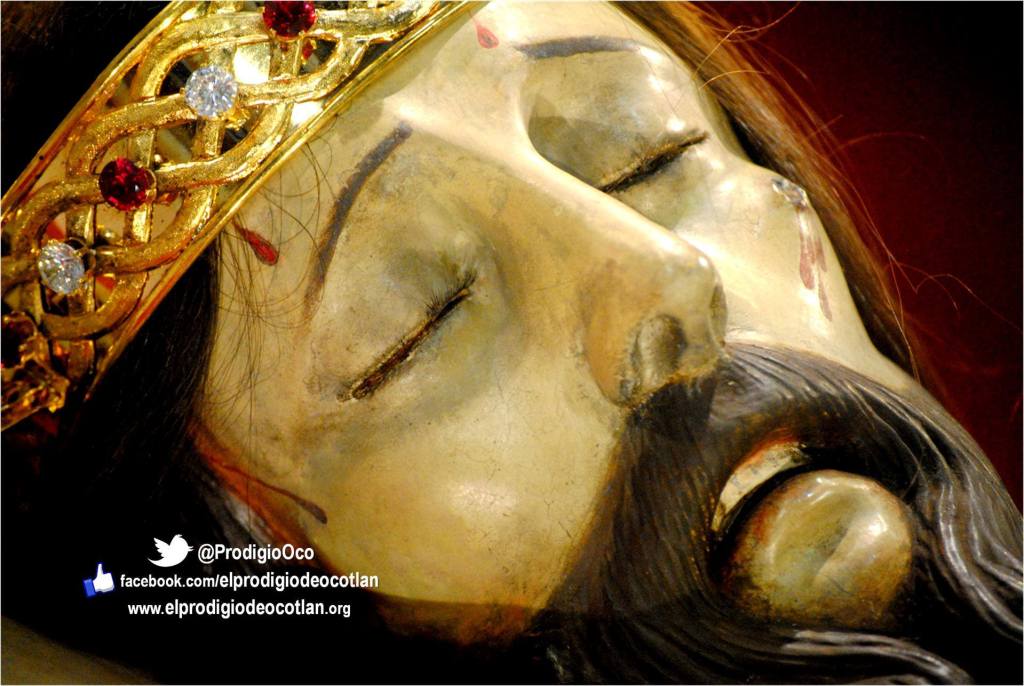
Those present and those in nearby towns were moved, made acts of contrition and shouted for “Mercy to the Lord.” For this reason this Christ was named the “Lord of Mercy” and in his honour, in September 1875, a new Church dedicated to Him was blessed and consecrated.
Among the faithful who witnessed the prodigy were also Fr Julián Martín del Campo, Parish Priest of the community and Antonio Jiménez, the Mayor of the city. Both sent letters to their respective superiors telling what happened.
In addition, after the miracle, a file was prepared with 30 eyewitness testimonies by order of the layman Lic. Miguel Castellanos. Fifty years later, in 1897, under the order of the then Archbishop of Guadalajara, Mons. Pedro Loza y Pardavé, a new file was drawn up with 30 more people, including 5 priests.
On 29 September 1911, the Archbishop of Guadalajara at that time. Mnsgr José de Jesús Ortiz y Rodríguez. signed the document that endorsed the appearance of Jesus Christ in Ocotlán and the worship and veneration that the faithful of that town carry out to the venerated image of the Lord of Mercy located in the Sanctuary of the same name.
“We must recognise as a perfectly proven historical fact the appearance of the blessed image of Jesus Christ Crucified (…) and that it could not have been the work of hallucination or fraud, since it was verified in broad daylight, in view of more than two thousand people, ” said the Archbishop.
He also pointed out that so that the Mercy of the Lord is never forgotten, the faithful should “congregate in the way possible, after purifying their consciences with the holy sacraments of Penance and Holy Communion and solemnly swear in the presence of God, for himself and his descendants, that year by year they will celebrate the anniversary of 3 October. ”
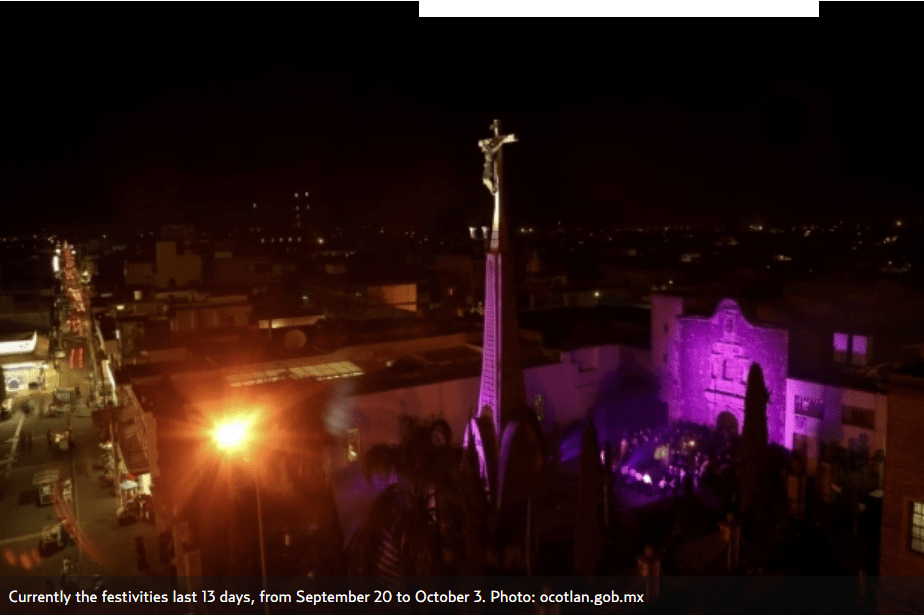
In 1912, after approval and to comply with the provisions of the Archbishop of Guadalajara, the public festivities began in honour of the Lord of Mercy, remembering the Prodigy of 1847. Currently the festivities last 13 days, from September 20 to September 3. October.
In 1997, John Paul II sent his Apostolic Blessing to the town of Ocotlán for the 150th anniversary of the prodigy and asked to celebrate their festivals in a holy way, living the sacraments.
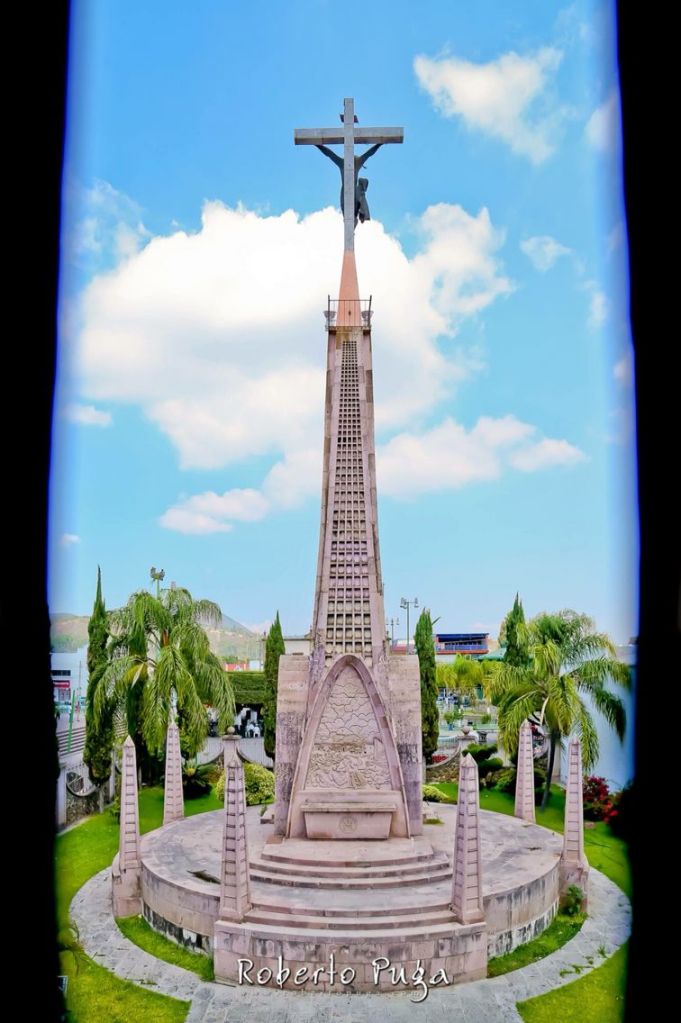
To commemorate the event, a monument, which is entirely carved in pink quarry. On the eastern altar there is a scene of the destruction of the town by the 1847 earthquake and on the western altar there is a representation of the prodigy with the Lord of Mercy in the centre. It has a height of approximately 20 meters.
Prayer to Our Lord of Mercy
Oh Lord of Mercy, Father and King of joyful Ocotlán; our assembled people adore You and a fervent song raise to You. For our people sinned and their sin provoked divine justice and a tremor left nothing but ruins of what was the lovely Ocotlán but the people repented and from Heavens, You came lovingly and with outstretched arms You gave us, a safe haven of peace … Amen
Bl Utto of Metten St Widradus — Martyrs of Alexandria – 9 saints: A number of Christian martyrs remembered together. We know the names Caius, Cheremone, Dionysius, Eusebio, Fausto, Lucio, Maximus, Paul, Peter and that there were at least two more whose names have not come down to us, and that’s about all we know.
Martyrs of Brazil – 30 beati: On 25 December 1597 an expedition of colonists, with two Jesuit and two Franciscan evangelists, arrived at Natal, Rio Grande do Norte, Brazil. The region was colonized by Portuguese Catholics but was invaded by Dutch Calvinists who soon took over the whole territory. They immediately made a policy of the persecution of Catholics. On Sunday 16 July 1645 at Cunhau, Brazil, 69 people were gathered in the Chapel of Our Lady of the Candles for Mass celebrated by Father Andre de Soveral. At the moment of the elevation a group of Dutch soldiers attack the Chapel, murdering many of the faithful including Father Andre; the parishioners died professing their faith and asking pardon for their sins. On 3 October 1645, 200 armed Indians and a band of Flemish troops, led by a fanatical Calvinist convert, hacked to death an unknown number of people of Rio Grande including: • Blessed Ambrosio Francisco Ferro • Blessed André de Soveral • Blessed Antônio Baracho • Blessed Antônio Vilela • Blessed Antônio Vilela Cid • Blessed Diogo Pereira • Blessed Domingos Carvalho • Blessed Estêvão Machado de Miranda • Blessed Francisco de Bastos • Blessed Francisco Mendes Pereira • Blessed João da Silveira • Blessed João Lostau Navarro • Blessed João Martins • Blessed José do Porto • Blessed Manuel Rodrigues de Moura • Blessed Mateus Moreira • Blessed Simão Correia • Blessed Vicente de Souza Pereira and other lay people whose names have not come down to us. They were Beatified on 5 March 2000 at Rome, Italy by Pope John Paul II.
Martyred in the Spanish Civil War: • Blessed Crescencio García Pobo • Blessed José María González Solís • Blessed José María Poyatos-Ruiz • Blessed Manuel Lucas Ibañez • Blessed Raimundo Joaquín Castaño González
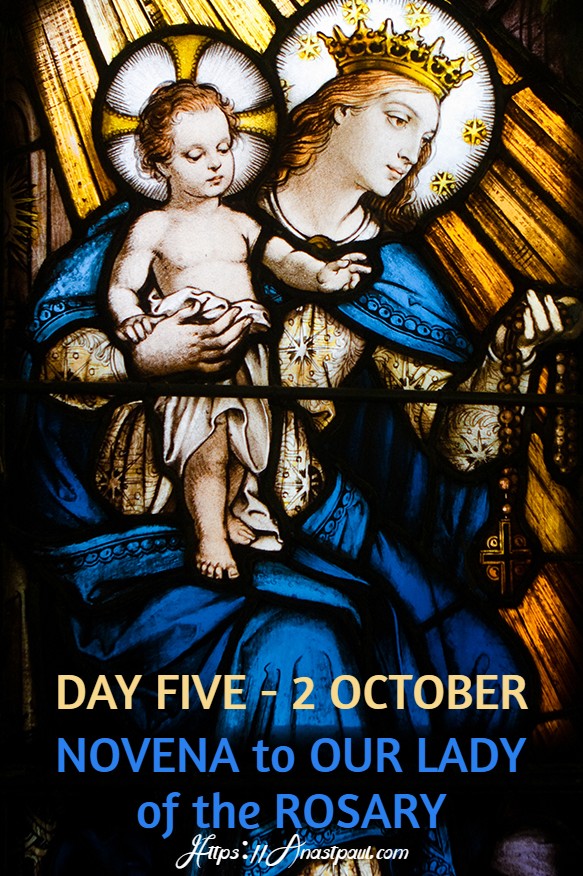
Novena to Our Lady of the Rosary – Day Five – 2 October
Day Five – We Pray for Purity of Heart and our personal intention:
The Ever-Virgin Mary was and remains pure in charity, chastity and love of truth and orthodoxy of faith. And that purity is divine because it is inspired by God! Each of us benefits from the purity of Mary, regardless of how difficult it is to be pure in charity, chastity and right belief, IT IS POSSIBLE… We WILL be pure when we adopt the attitude of Our Blessed Lady and seek the divine purity that even yet radiates from Her. By abandoning ourselves to God as She did, we open ourselves to fresh opportunities of achieving purity. (The Virtue of Purity: An Undivided Heart by Msgr Charles M Mangan)
To Our most holy Mother. To you do we pray first with heartfelt thanks for your YES to the Father. Grant us your guidance and assistance to become as pure as you are.
Daily Prayer along with our Daily Rosary:
My dearest Mother Mary, behold me, your child, in prayer at your feet. Accept this Holy Rosary, which I offer you in accordance with your requests at Fatima, as a proof of my tender love for you, for the intentions of the Sacred Heart of Jesus, in atonement for the offenses committed against your Immaculate Heart and for this special favour which I earnestly request in my Rosary Novena: ………………………….. (Mention your request).
I beg you to present my petition to your Divine Son. If you will pray for me, I cannot be refused. I know, dearest Mother, that you want me to seek God’s holy Will concerning my request. If what I ask for should not be granted, pray that I may receive that which will be of greater benefit to my soul.
I offer you this spiritual Bouquet of Roses because I love you. I put all my confidence in you, since your prayers before God are most powerful. For the greater glory of God and for the sake of Jesus, your loving Son, hear and grant my prayer. Sweet Heart of Mary, be my salvation.
Our Lady of the Rosary, pray for our Holy Mother Church and for our country.
Our Lady of Fatima, obtain for humanity a lasting peace.
Sweet Heart of Jesus, be my love.
Sweet Heart of Mary, at the hour of my death, lead me home.
Thought for the Day – 2 October – Meditations with Antonio Cardinal Bacci (1881-1971)
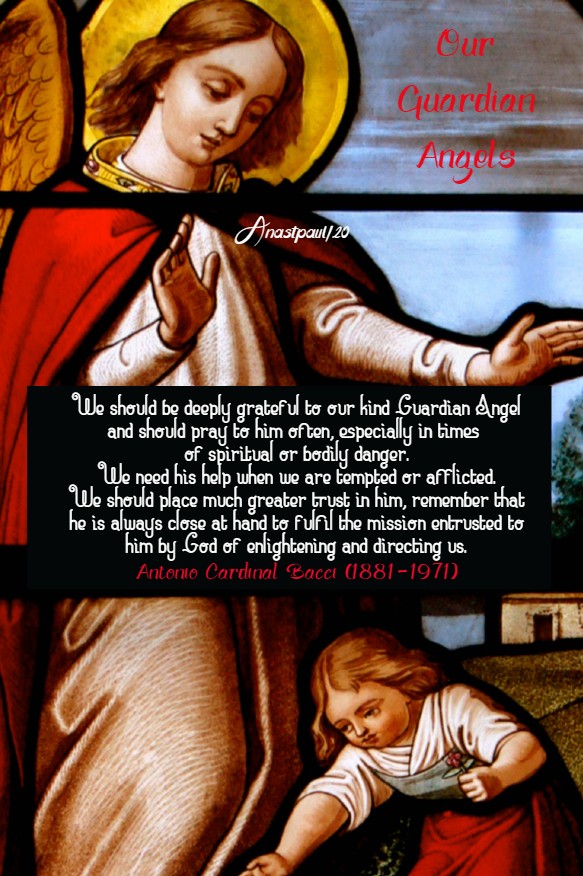
Our Guardian Angels
“Among the many expressions of God’s goodness towards us, is His designation of a heavenly spirit to accompany and to assist each of us on our journey through life. The human eye cannot see him although, he is always on guard by our side. Even while he is near us, he enjoys the beatific vision of God.
This is a wonderful thought. During the day, when we are preoccupied with so many affairs which can cause us to forget God, our angel is beside us, to inspire us to love God more. When we are asleep, he is watching over us and praying for our welfare. When we pray, he gathers our feeble supplications and offers them to God. When temptation presses hard, it is he who sustains us and encourages us to resist with Christian fortitude. Finally, when by some misfortune we fall into grave sin because we have been deaf to the appeals of our Creator, he takes pity on us and inspires in us remorse for our misdeeds and the desire to be restored as soon as possible to God’s favour.
We should be deeply grateful to our kind Guardian Angel and should pray to him often, especially in times of spiritual or bodily danger. We need his help when we are tempted or afflicted. We should place much greater trust in him, remember that he is always close at hand to fulfil the mission entrusted to him by God of enlightening and directing us.”
Quotes of the Day – 2 October – The Memorial of the Holy Guardian Angels
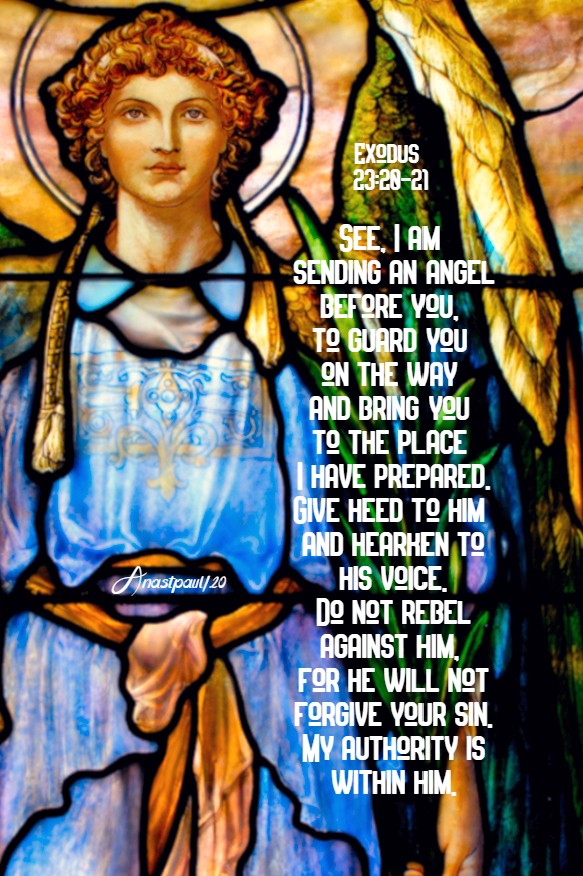
“See, I am sending an angel before you, to guard you on the way and bring you to the place I have prepared. Give heed to him and hearken to his voice. Do not rebel against him, for he will not forgive your sin. My authority is within him.”
Exodus 23:20-21
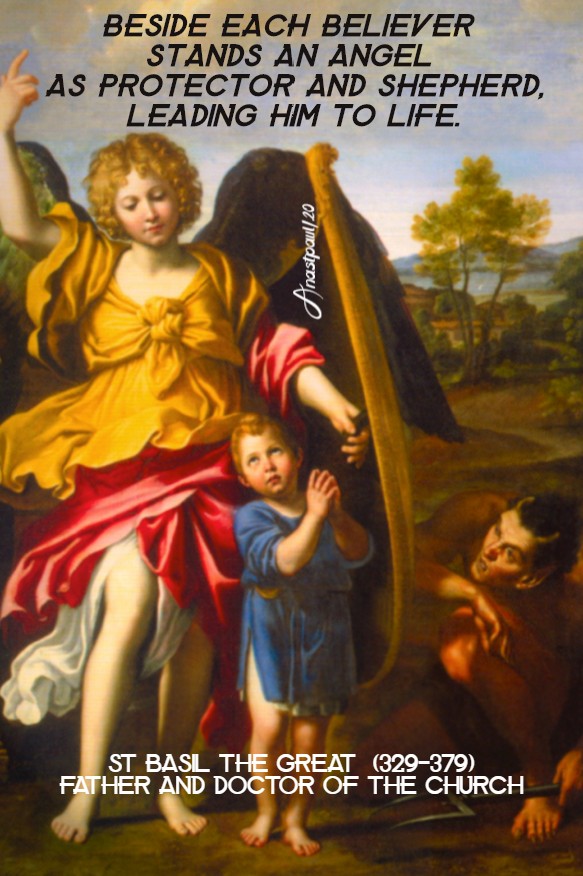
“Beside each believer stands an Angel as protector and shepherd, leading him to life.”
St Basil the Great (329-379) Father and Doctor of the Church
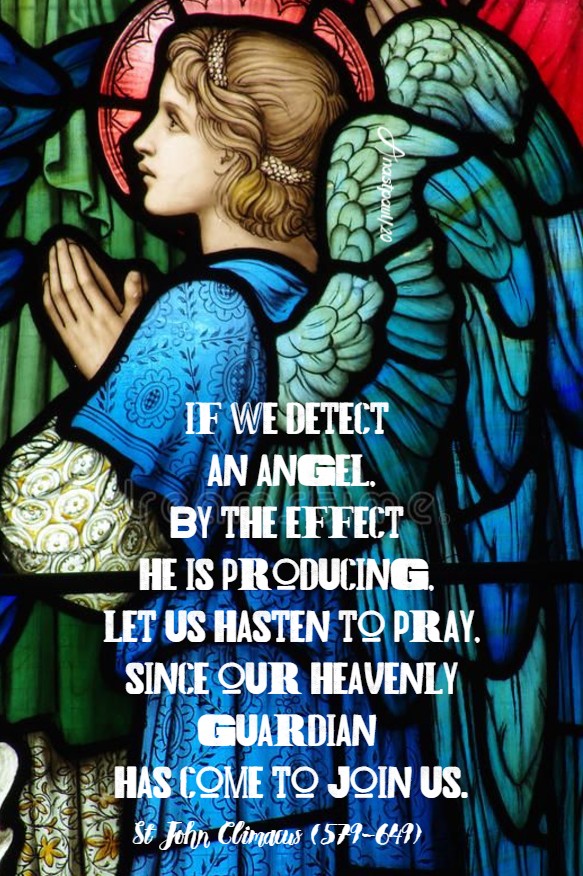
“If we detect an angel, by the effect he is producing, let us hasten to pray, since our heavenly guardian has come to join us.”
St John Climacus (579-649) Father of the Church
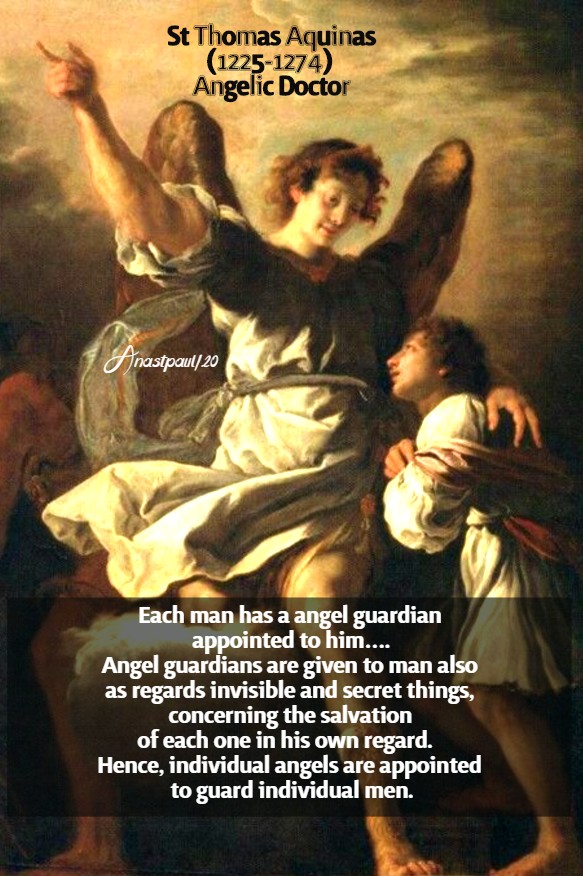
“Each man has a angel guardian appointed to him…. Angel guardians are given to man also as regards invisible and secret things, concerning the salvation of each one in his own regard. Hence, individual angels are appointed to guard individual men.”
St Thomas Aquinas (1225-1274) Angelic Doctor
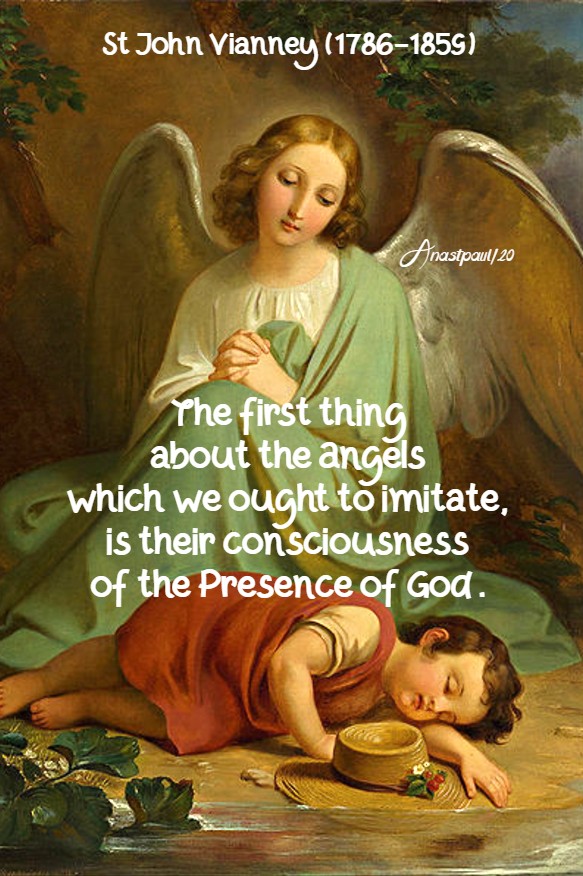
“The first thing about the Angels which we ought to imitate, is their consciousness of the Presence of God.”
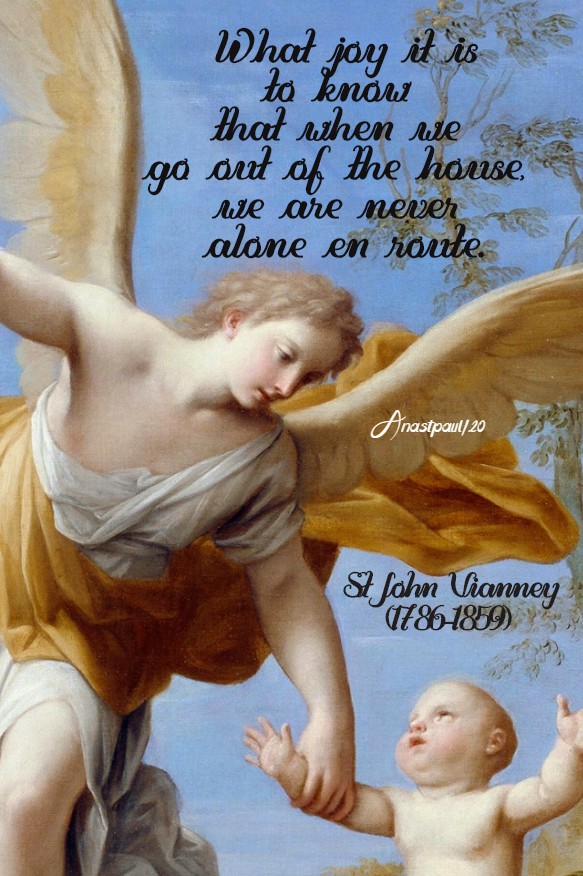
“What joy it is to know that when we go out of the house, we are never alone en route.”
One Minute Reflection – 2 October – Wednesday of the Twenty Sixth Week in Ordinary Time, Readings: Job 38:1, 12-21; 40: 3-5, Psalms 139:1-3, 7-8, 9-10, 13-14, Matthew 18:1-5, 10 and The Memorial of the Holy Guardian Angels
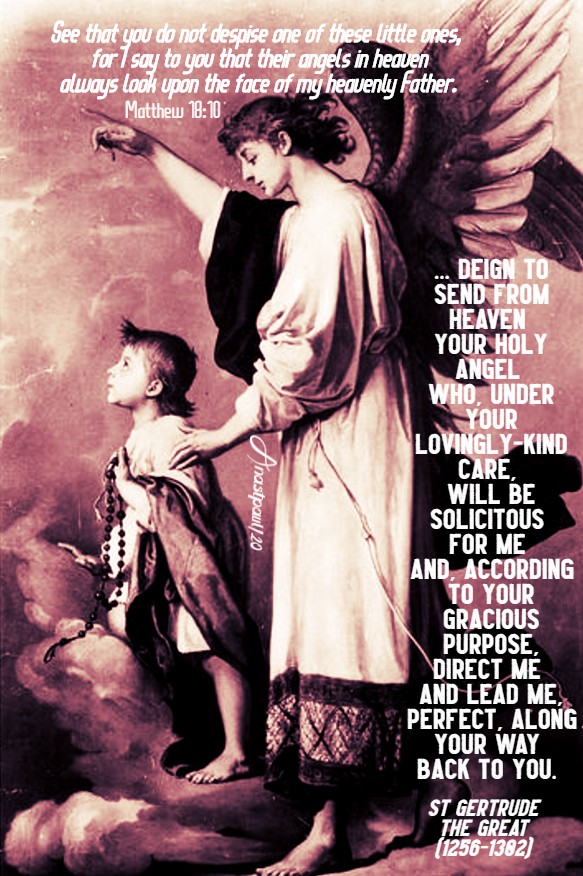
“See that you do not despise one of these little ones, for I say to you that their angels in heaven always look upon the face of my heavenly Father.” …Matthew 18:10
REFLECTION – “Ah, Jesus, Prince of Peace and Angel of great counsel, may You Yourself always be the guide at my right and the guardian of my pilgrimage, lest I move away and stray from You. And deign to send from heaven, Your holy angel who, under Your lovingly-kind care, will be solicitous for me and, according to Your gracious purpose, direct me and lead me, perfect, along Your way back to You. (Ex 23:20).” … St Gertrude the Great (1256-1302) Benedictine nun – Exercises I.60-63, 71-76, 78-86, 99-103.
PRAYER – Lord God of hosts, in Your all-wise providence, You send angels to guard and protect us. Surround us with their watchful care on earth and give us the joy of their company, forever in heaven. We make our prayer through Christ, our Lord, with th Holy Spirit, God for all eternity, amen.
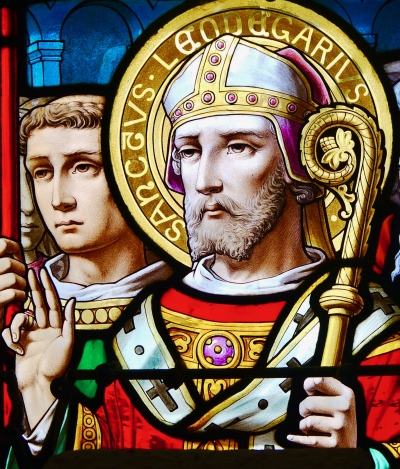
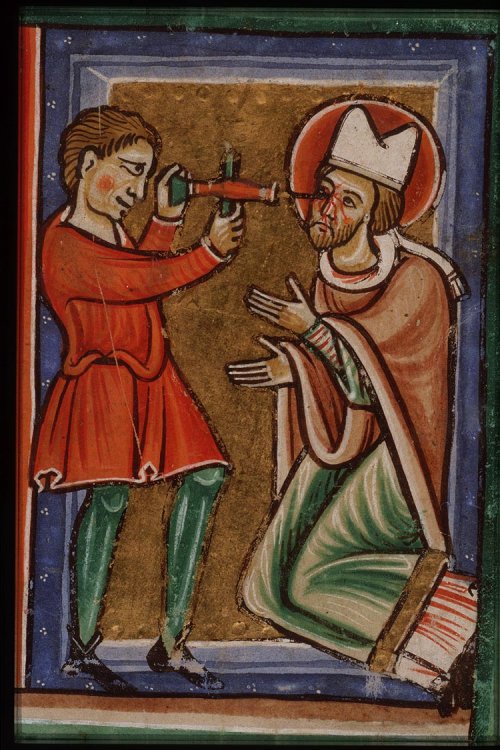
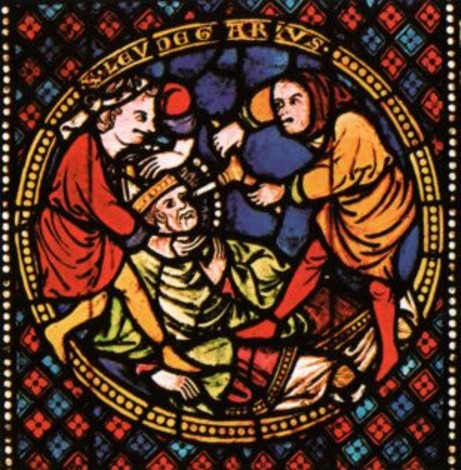
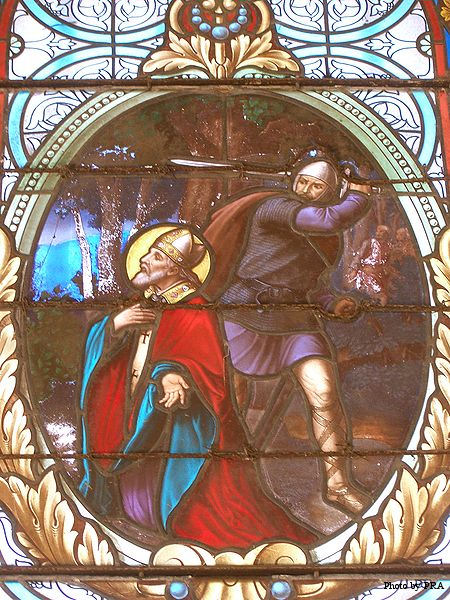
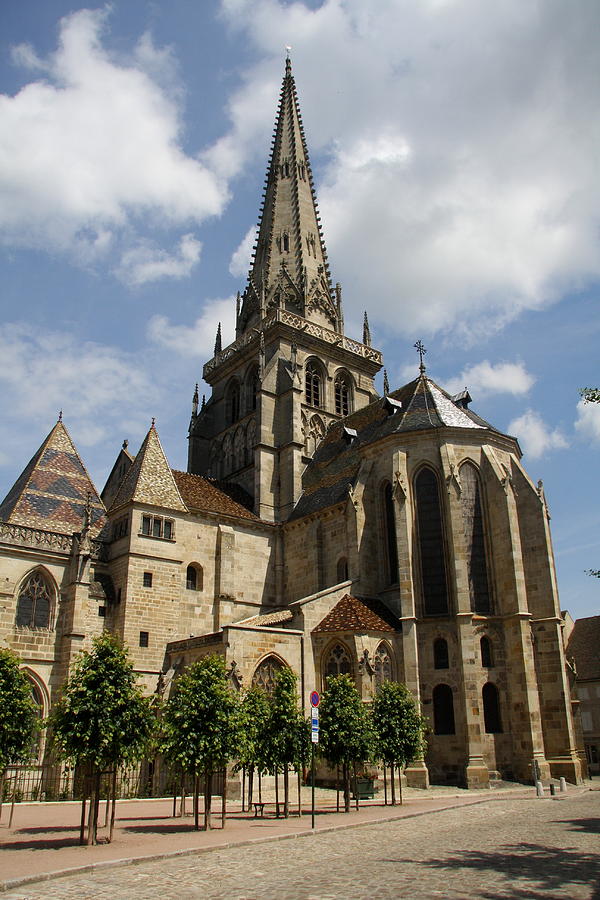
Saint of the Day – 2 October – Saint Leodegar of Autun (c 625-679) Bishop of Autun, France and Martyr, Monk, Abbot, Reformer, apostle of the poor – born in c 615 in Autun, Saône-et-Loire, Burgundy, France and died on 2 October 679 by being murdered in 678 in the woods in Sarcing, Somme, Picardie, France. Patronages – Millers, invoked against blindness, Eye disease, Eye problems, Sore eyes and 5 cities. He was the son of Saint Sigrada, his mother and the brother of Saint Warinus and is also known as St Leodegarius and St Leger.
Leodegar was the son of a high-ranking Burgundian nobleman, Bodilon, Count of Poitiers and Paris and St Sigrada of Alsace, who later became a nun at Sainte-Marie de Soissons.
He spent his childhood in Paris at the court of Clotaire II, King of the Franks and was educated at the palace school. When he was older he was sent to Poitiers, where there was a long-established Cathedral school, to study under his maternal uncle, Desiderius (Dido), Bishop of Poitiers. At the age of 20 his uncle made him an Archdeacon.
Shortly afterwards he became a Priest and in 650, with the Bishop’s permission, became a Monk at the Monastery of St Maxentius in Poitou. He was soon elected Abbot and initiated reforms including the introduction of the Benedictine rule.
Around 656, about the time of the usurpation of Grimoald in Austrasia and the banishment of the boy-heir Dagobert II, Leodegar was called to the Neustrian court by the widowed Queen Bathilde to assist in the government of the united kingdoms and in the education of her children. Then in 659 he was named to the See of Autun, in Burgundy. He again undertook the work of reform and held a council at Autun in 661. The council denounced Manichaeism and was the first to adopt the Trinitarian Athanasian Creed. He made reforms among the secular clergy and in the religious communities and had three baptisteries erected in the city. The Church of Saint-Nazaire was enlarged and embellished and a refuge established for the indigent. Leodegar also caused the public buildings to be repaired and the old Roman walls of Autun to be restored. His authority at Autun placed him as a leader among the Franco-Burgundian nobles.
Meanwhile, in 660 the Austrasian nobles demanded a king and young prince Childeric II was sent to them through the influence of Ebroin, the mayor of the palace in Neustria. The queen withdrew, from a court that was Ebroin’s in all but name, to an abbey she had founded at Chelles, near Paris. On the death of King Clotaire III in 673, a dynastic struggle ensued, with rival claimants as pawns; Ebroin raised Theoderic to the throne but Leodegar and the other Bishops supported the claims of his elder brother Childeric II, who, by the help of the Austrasians and Burgundians, was eventually made king. Ebroin was interned at Luxeuil and Theoderic sent to St Denis.
Leodegar remained at court, guiding the young king. In 673 or 675, however, Leodegar was also sent to Luxeuil. The cause, a protest against the marriage of Childeric and his first cousin, is a hagiographic convention; as a leader of the Austrasian and Burgundian nobles, Leodegar was easily represented as a danger by his enemies. When Childeric II was murdered at Bondi in 675, by a disaffected Frank, Theoderic III was installed as king in Neustria, making Leudesius his mayor. Ebroin took advantage of the chaos to make his escape from Luxeuil and hasten to the court. In a short time Ebroin caused Leudesius to be murdered and became mayor once again, still Leodegar’s implacable enemy.
About 675 the Duke of Champagne, the Bishop of Châlons-sur-Marne and the Bishop of Valence, stirred up by Ebroin, attacked Autun and Leodegar fell into their hands. At Ebroin’s instigation, Leodegar’s eyes were gouged out and the sockets cauterized and his tongue was cut out. Some years later Ebroin persuaded the king that Childeric had been assassinated at the instigation of Leodegar. The Bishop was seized again and, after a mock trial, was degraded and condemned to further exile, at Fécamp, in Normandy. Near Sarcing he was led out into a forest on Ebroin’s order and beheaded.
A dubious testament drawn up at the time of the council of Autun has been preserved as well as the Acts of the council. A letter which he caused to be sent to his mother after his mutilation is likewise extant.
In 782, his relics were translated from the site of his death, Sarcing in Artois, to the site of his earliest hagiography – the Abbey of St Maxentius (Saint-Maixent) near Poitiers. Later they were removed to Rennes and thence to Ebreuil, which place took the name of Saint-Léger in his honour. Some relics are still kept in the Cathedral of Autun and the Grand Séminaire of Soissons. In 1458 Cardinal Rolin caused his feast day to be observed as a holy day of obligation.
Auton Cathedral
For sources to his biography, there are two early Lives, drawn from the same lost source (Krusch 1891) and also two later ones (one of them in verse).
Historically there was a custom among wealthy British merchants to sell in May, spend the summer outside of London, then to return on St Leger’s Day. This gave rise to the saying used in regards to financial trading markets, “Sell in May and go away and come on back on St Leger’s Day.”
St Alfonso del Rio St Andrea Ximenez Blessed Antoine Chevrier TOSF (1825-1879) About Blessed Antoince: https://anastpaul.com/2018/10/02/saint-of-the-day-2-october-blessed-antoine-chevrier-t-o-s-f-1825-1879/ St Beregisius St Eleutherius of Nicomedia Bl Georges-Edme René St Gerinus St Leodegar of Autun OSB (c 625-679) Bishop and Martyr St Leudomer St Maria Antonina Kratochwil St Modesto of Sardinia St Saturius of Soria St Theophilus of Bulgaria St Ursicinus II — Martyred in Antioch, Syria: Martyred in one of the early persecutions, date unknown. St Cyril of Antioch St Primus of Antioch St Secundarius of Antioch
Martyred in Nagasaki, Japan: A husband, wife and two sons, who were all martyred together in the persecutions in Japan. They were beheaded on 2 October 1622 in Nagasaki, Japan and Beatified by Pope Pius IX on 7 May 1867. • Blessed Andreas Yakichi • Blessed Franciscus Yakichi • Blessed Lucia Yakichi • Blessed Ludovicus Yakichi
Martyred in the Spanish Civil War: • Blessed Elías Carbonell Molla • Blessed Enrique Sáiz-Aparicio • Blesssed Felipe González de Heredia Barahona • Blessed Francisco Carceller Galindo • Blessed Isidoro Bover Oliver • Blessed Juan Carbonell Molla • Blessed Juan Iñiguez de Ciriano Abechuco • Blessed Manuel Borrajo Míguez • Blessed María Francisca Ricart Olmos • Blessed Mateu Garrolera Masferrer • Blessed Pedro Artolozaga Mellique • Blessed Pedro Salcedo Puchades
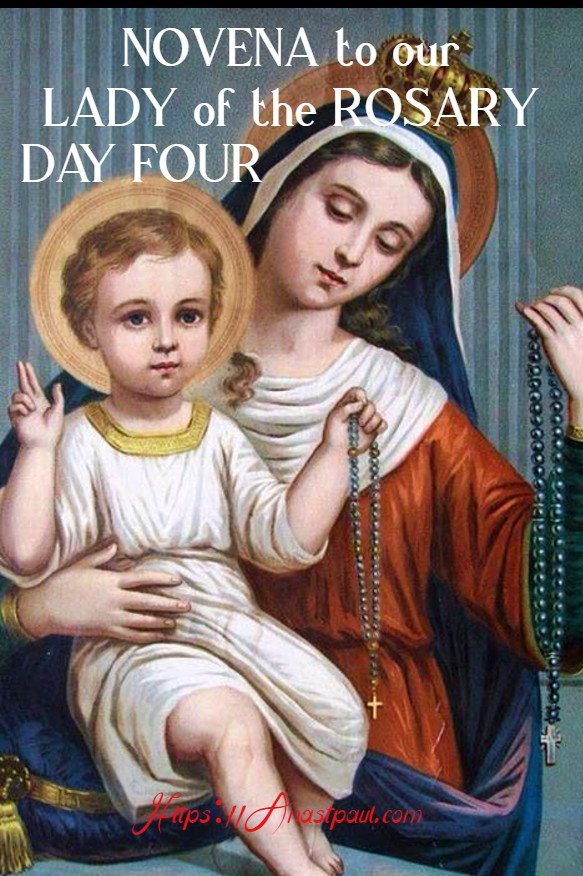
Novena to Our Lady of the Rosary – Day Four – 1 October
Day Four – We Pray for the Virtue of Humility and our personal intention:
May Almighty God give us compassion and humility in our hearts. Let us be kind, gentle, generous, loving, giving and forgiving wherever we may go. Allow pride to never get the best of us as You fulfill our dreams. Help us not to have a boastful tongue against our brothers. Let humility invade our souls… Amen
Daily Prayer along with our Daily Rosary:
My dearest Mother Mary, behold me, your child, in prayer at your feet. Accept this Holy Rosary, which I offer you in accordance with your requests at Fatima, as a proof of my tender love for you, for the intentions of the Sacred Heart of Jesus, in atonement for the offenses committed against your Immaculate Heart and for this special favour which I earnestly request in my Rosary Novena: ………………………….. (Mention your request).
I beg you to present my petition to your Divine Son. If you will pray for me, I cannot be refused. I know, dearest Mother, that you want me to seek God’s holy Will concerning my request. If what I ask for should not be granted, pray that I may receive that which will be of greater benefit to my soul.
I offer you this spiritual Bouquet of Roses because I love you. I put all my confidence in you, since your prayers before God are most powerful. For the greater glory of God and for the sake of Jesus, your loving Son, hear and grant my prayer. Sweet Heart of Mary, be my salvation.
Our Lady of the Rosary, pray for our Holy Mother Church and for our country.
Our Lady of Fatima, obtain for humanity a lasting peace.
Sweet Heart of Jesus, be my love.
Sweet Heart of Mary, at the hour of my death, lead me home.
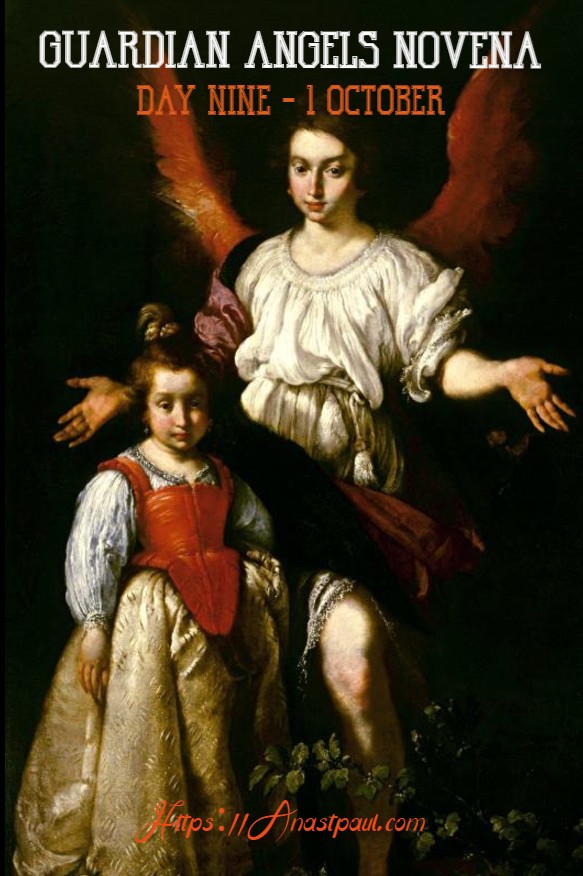
Novena to Our Angel Guardian – Day Nine – 1 October (Indulgence of 300 days, each day of the Novena)
Opening Prayer
Deus in adjutorium: V/. O God +, come to my assistance R/. O Lord, make haste to help me.
Gloria Patri…
DAY IX
O sweetest Angel, my faithful and loving Guardian, how can I thank thee sufficiently for the ardent love and faithful vigilance with which thou has ever watched and will watch over me, till thou has led me safely into the sweet presence of God. Ah! pray for me, that I may thank thee by my obedience to thy holy inspirations, so that loving thee daily more and more, I may merit to be with thee for all eternity. And for this special intention of virtue which I make unto thy prayers …………………….. (the special virtue you desire). Amen
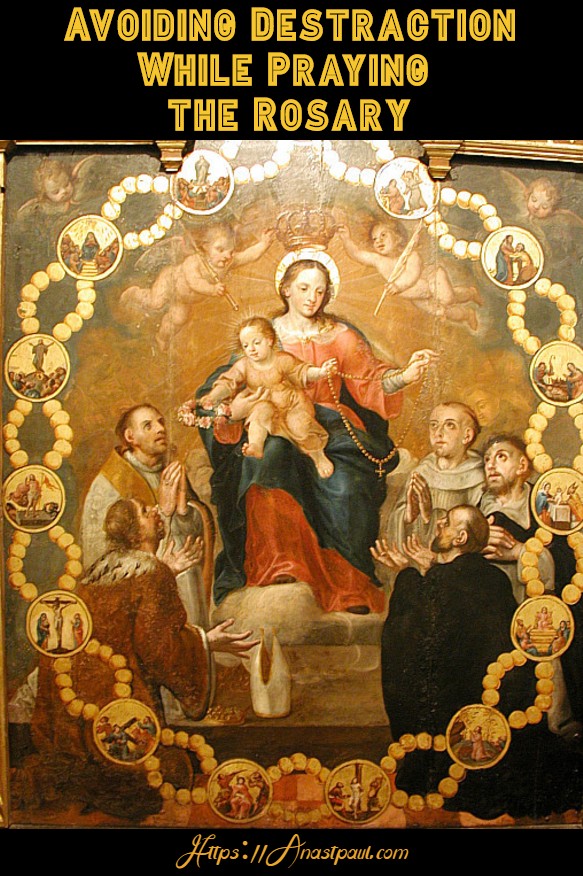
Use various approaches, depending on disposition and degree of concentration. Overall principle – don’t let yourself float and slide, carried away by your imagination. Keep it in check at all times, as much as possible.
When tired and without much focus, “concentrate” on the peaceful repetition of the Hail Marys, entering its rhythm and imaging to be in the company of Mary. Leave it at that. If in somewhat better disposition, try to focus on images, one or more of Christ, Mary or scenes of their lives as mentioned in the Mysteries. Look at and contemplate what you see, while saying the different decades. Don’t even attempt to enter into a more intellectual mood exploring only the imagery.
A different and more demanding mode will lead you to a reflection on the deeper meaning of each one of the Mysteries: What is their meaning regarding salvation history then and now? What is the Mystery’s immediate significance for my personal spiritual life? Entertain some of these considerations while reciting the decade.
Also, don’t forget to make of the Rosary, a prayer of praise and thanksgiving, once in a while at least because it is in the Rosary that we summarise and remember our redemption and the great things God did for Mary and through her.
In a special manner, try to develop a personal habit to say the Rosary in company with Mary. The Mysteries are stations of a beautiful journey leading to eternal happiness. Mary leads the way and is our traveling companion.
Be self-critical enough to shift gears when needed. It may well happen, that all the various modes are methods which need to be applied during one and the same Rosary Prayer.
May your Rosary Prayer be perseverant. Amen
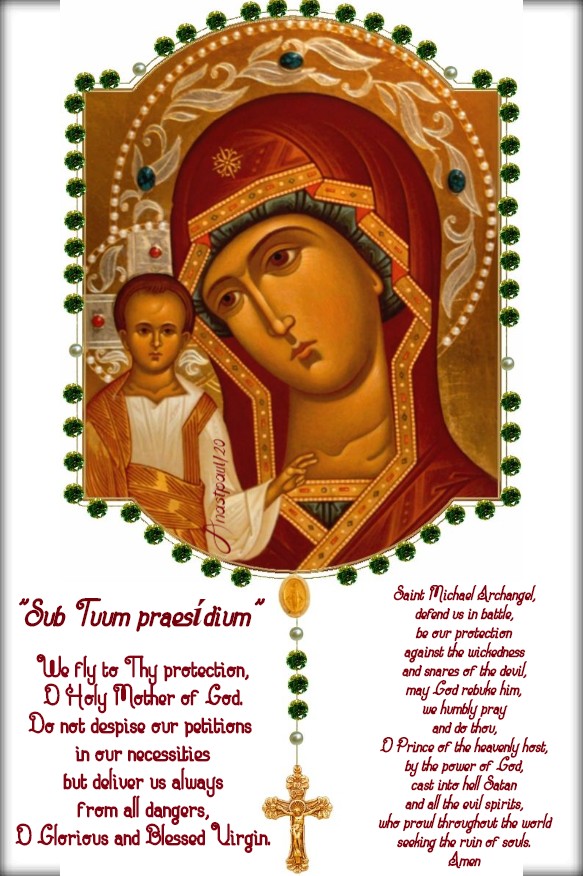
PS – don’t forget to add the “Sub Tuum praesídium” and the St Michael Prayer after the final prayers.
We fly to Thy protection, O Holy Mother of God. Do not despise our petitions in our necessities but deliver us always from all dangers, O Glorious and Blessed Virgin.
Saint Michael Archangel, defend us in battle, be our protection against the wickedness and snares of the devil, may God rebuke him, we humbly pray and do thou, O Prince of the heavenly host, by the power of God, cast into hell Satan and all the evil spirits, who prowl throughout the world seeking the ruin of souls. Amen
Thought for the Day – 1 October – Meditations with Antonio Cardinal Bacci (1881-1971)
The Month of the Holy Rosary
“We should say the Rosary devoutly everyday. This beautiful prayer is very pleasing to Our Lady and, the Church, is particularly anxious that we should recite it during the month of October. Families which say the Holy Rosary together can hope for a special blessing from God and for the maternal protection of Mary.
If possible, every family should gather together in the evening and recite the Rosary before an image of our Blessed Mother. If the parents set an example, their child will join them. It is consoling to come together after the toil and trouble of the day, in order to confide our cares and hopes to Mary.
Do you say the Rosary everyday? If you have neglected ths pious practice, begin today. Do not plead lack of time. There is time for so many other things, so surely, there is time to pray and to entrust ourselves, in a special way, to the protection of our heavenly Mother! The practice of reciting the Holy Rosary will win for you, the blessing of God and the patronage of the Blessed Virgin.”
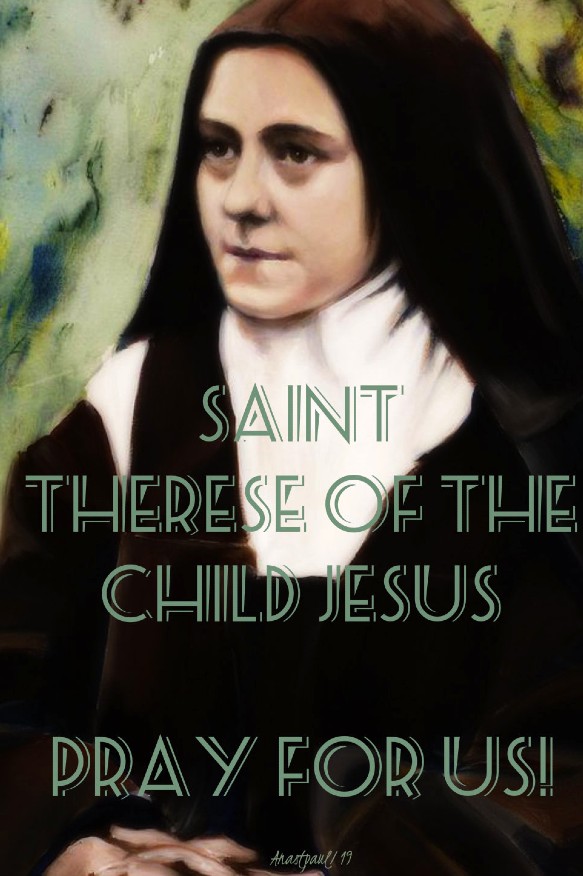
Quote/s of the Day – 1 October – Thursday of the Twenty Sixth week in Ordinary Time, Readings: Job 19:21-27, Psalms 27:7-8, 8-9, 13-14, Luke 10:1-12 and The Memorial of St Romanos the Melodios (c 490-c 556) and St Thérèse of the Child Jesus/Lisieux OCD (1873 – 1897) Doctor of the Church
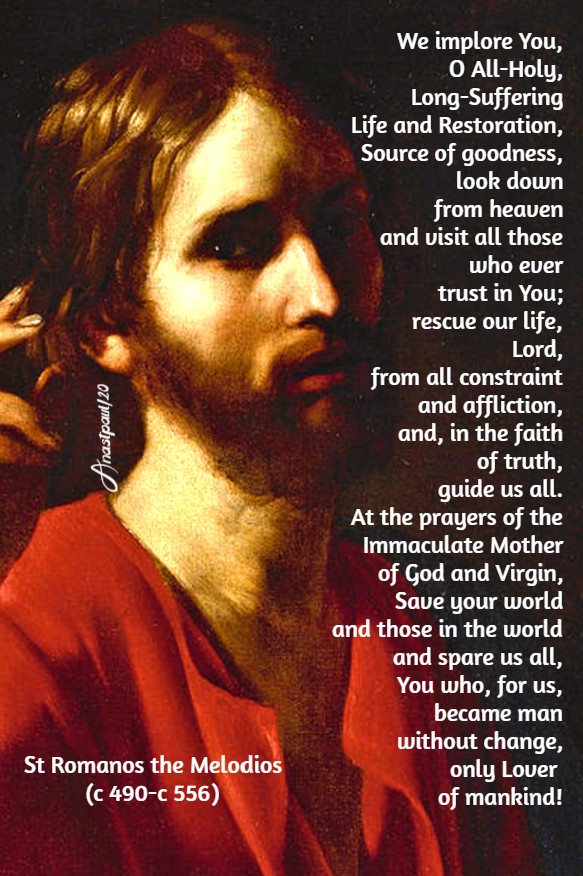
“We implore You, O All-Holy, Long-Suffering Life and Restoration, Source of goodness, look down from heaven and visit all those who ever trust in You; rescue our life, Lord, from all constraint and affliction, and, in the faith of truth, guide us all. At the prayers of the Immaculate Mother of God and Virgin, Save your world and those in the world and spare us all, You who, for us, became man without change, only Lover of mankind.”
St Romanos the Melodios (c 490-c 556) (On the Life of Christ, Feast of the Presentation of the Lord)
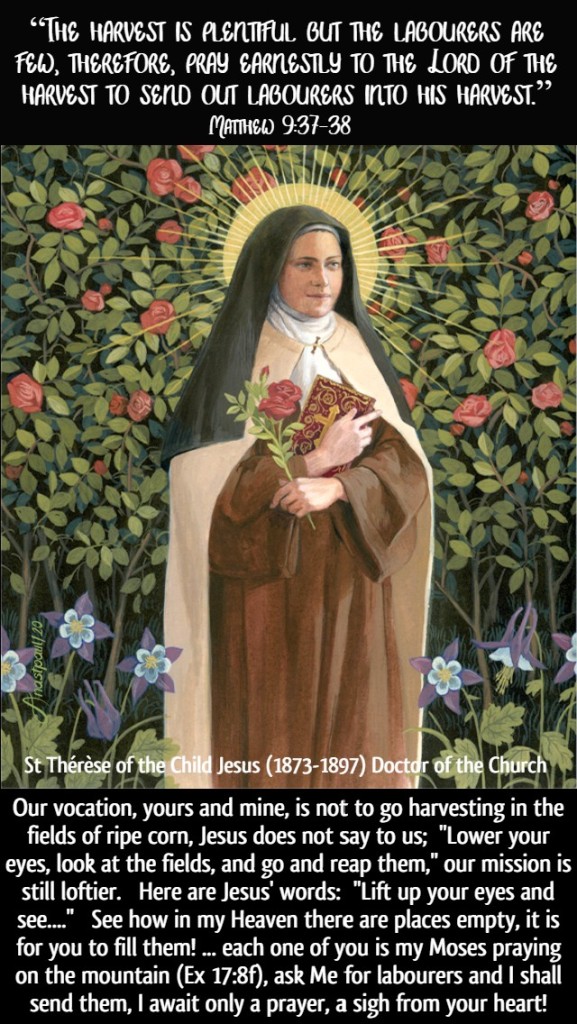
“Our vocation, yours and mine, is not to go harvesting in the fields of ripe corn, Jesus does not say to us; “Lower your eyes, look at the fields and go and reap them,” our mission is still loftier. Here are Jesus’ words: “Lift up your eyes and see….” See how in My Heaven there are places empty, it is for you to fill them! … each one of you is my Moses praying on the mountain (Ex 17:8f), ask Me for labourers and I shall send them, I await only a prayer, a sigh from your heart!”
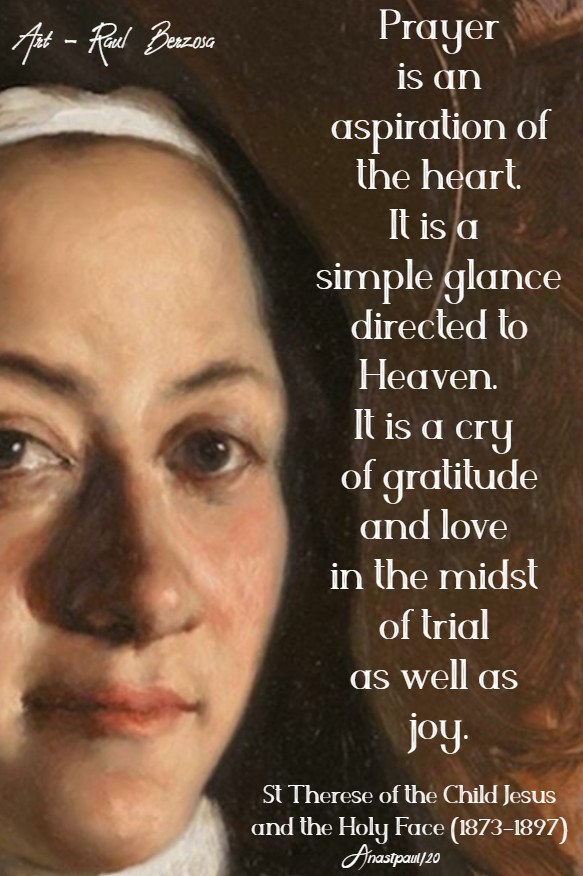
“Prayer is an aspiration of the heart. It is a simple glance directed to Heaven. It is a cry of gratitude and love in the midst of trial as well as joy.”
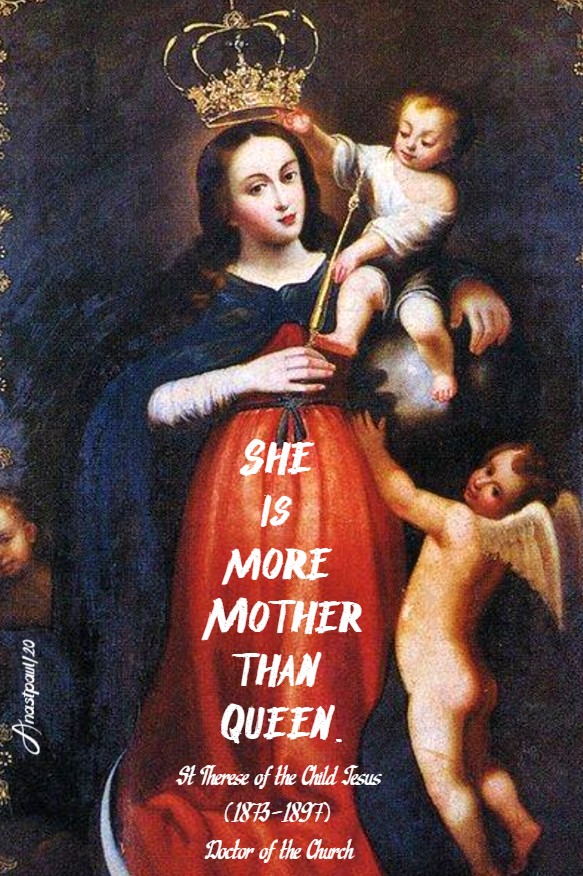
“She is more mother than Queen.”
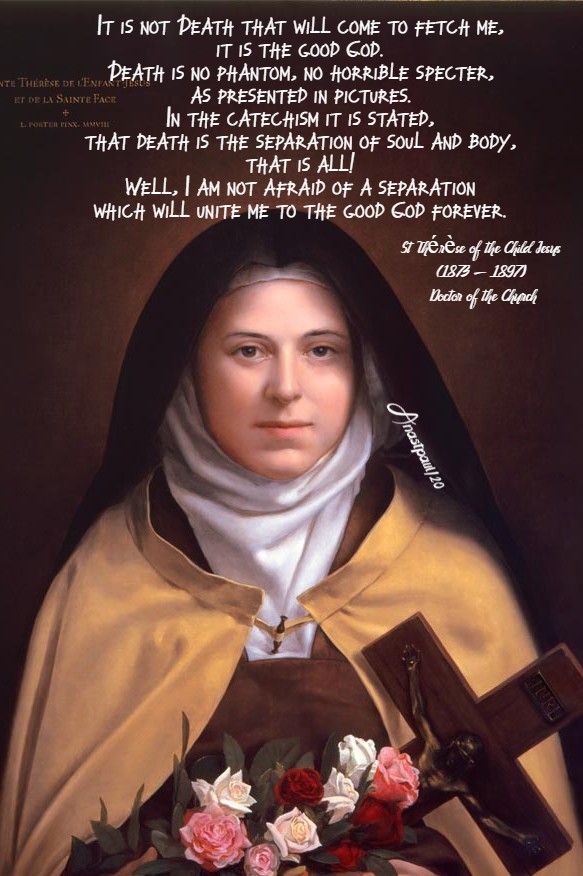
“It is not Death that will come to fetch me, it is the good God. Death is no phantom, no horrible specter, as presented in pictures. In the catechism it is stated, that death is the separation of soul and body, that is all! Well, I am not afraid of a separation which will unite me to the good God forever.”
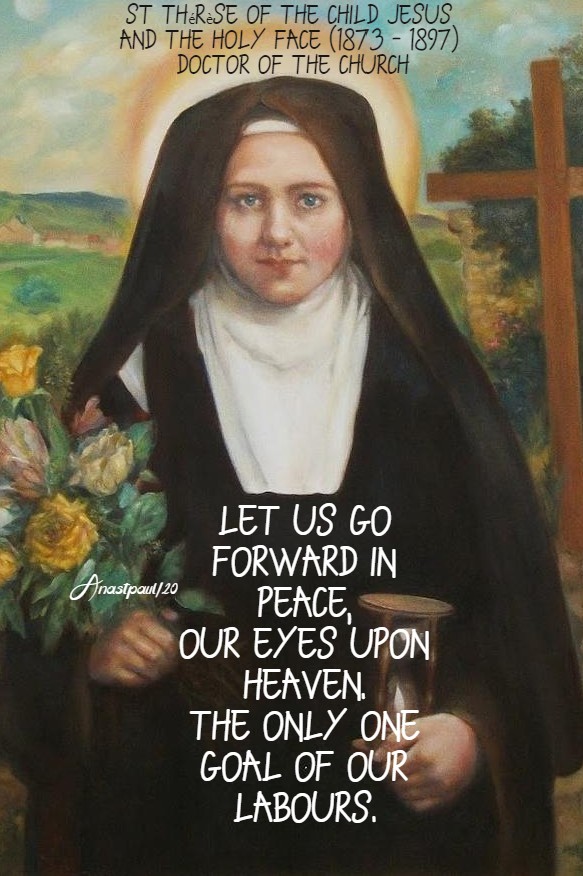
“Let us go forward in peace, our eyes upon heaven. the only one goal of our labours.”
One Minute Reflection – 1 October – Thursday of the Twenty Sixth week in Ordinary Time, Readings: Job 19:21-27, Psalms 27:7-8, 8-9, 13-14, Luke 10:1-12 and the Memorial of St Romanos the Melodios (c 490-c 556) and St Thérèse of the Child Jesus/Lisieux OCD (1873 – 1897) Doctor of the Church
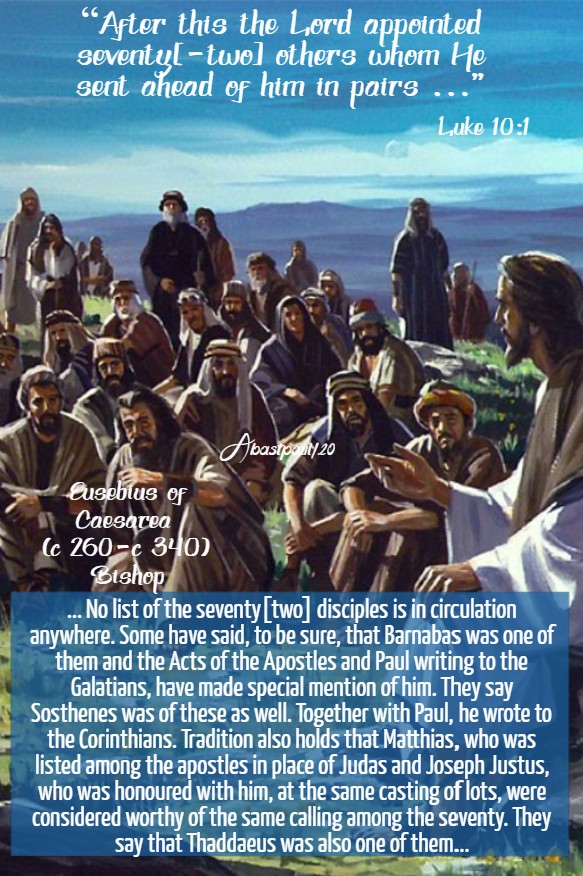
“After this the Lord appointed seventy [-two] others whom He sent ahead of him in pairs to every town and place He intended to visit…” … Luke 10:1
REFLECTION – “The names of the apostles of the Saviour are clear to everyone from the Gospels but no list of the seventy[two] disciples is in circulation anywhere. Some have said, to be sure, that Barnabas was one of them and the Acts of the Apostles and Paul writing to the Galatians, have made special mention of him. They say Sosthenes was of these as well. Together with Paul, he wrote to the Corinthians. Tradition also holds that Matthias, who was listed among the apostles in place of Judas and Joseph Justus, who was honoured with him, at the same casting of lots, were considered worthy of the same calling among the seventy. They say that Thaddaeus was also one of them, about whom I shall presently relate a story which has come down to us.
On observation, you would find that the disciples of the Saviour appear to have been more than the seventy [two]. Paul says that after the resurrection from the dead Cephas saw him first, then the Twelve. After these saw him, he was seen by more than five hundred brothers all at once, some of whom he says had fallen asleep, although the majority were still alive at the time that this account was being composed by him.” … Eusebius of Caesarea (c 260-c 340) Bishop, Historian, Theologian – (Ecclesiastical History, 1.)
PRAYER – God, our Father, Your promised Your Kingdom to the little ones and the humble of heart. Give us grace to walk confidently in the way of St Romanos and St Thérèse, so that helped by their prayers, we may see Your eternal glory. Through Christ our Lord, in the unity of the Holy Spirit, one God forever, amen.
Our Morning Offering – 1 October – Thursday of the Twenty Sixth week in Ordinary Time and the Memorial of St Thérèse of the Child Jesus/Lisieux O.C.D. (1873 – 1897) Doctor of the Church
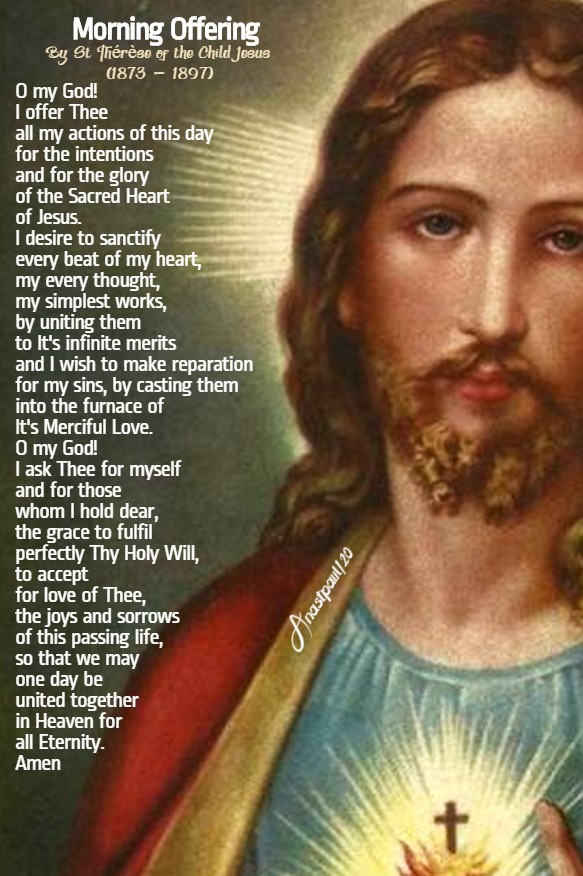
Morning Offering By St Thérèse of the Child Jesus
O my God! I offer Thee all my actions of this day for the intentions and for the glory of the Sacred Heart of Jesus. I desire to sanctify every beat of my heart, my every thought, my simplest works, by uniting them to It’s infinite merits and I wish to make reparation for my sins, by casting them into the furnace of It’s Merciful Love. O my God! I ask Thee for myself and for those whom I hold dear, the grace to fulfil perfectly Thy Holy Will, to accept for love of Thee, the joys and sorrows of this passing life, so that we may one day be united together in Heaven for all Eternity. Amen
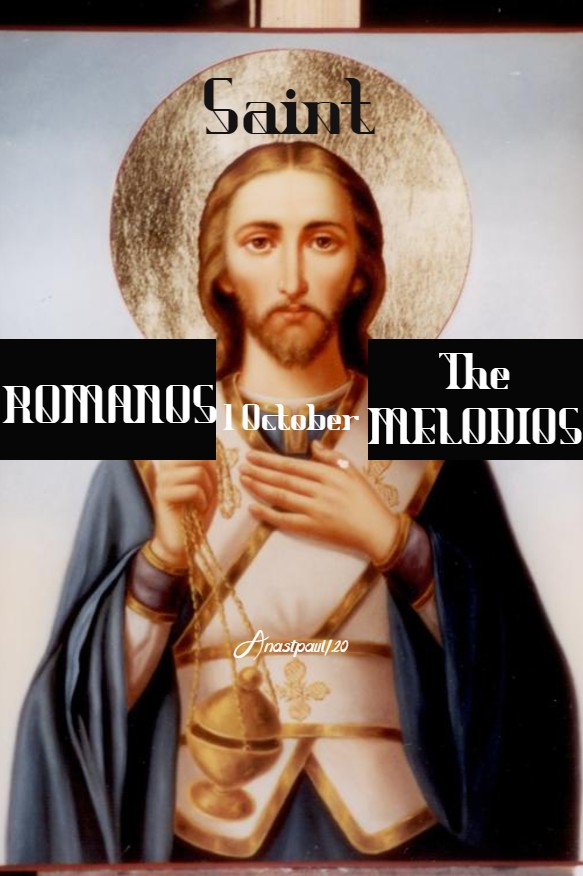
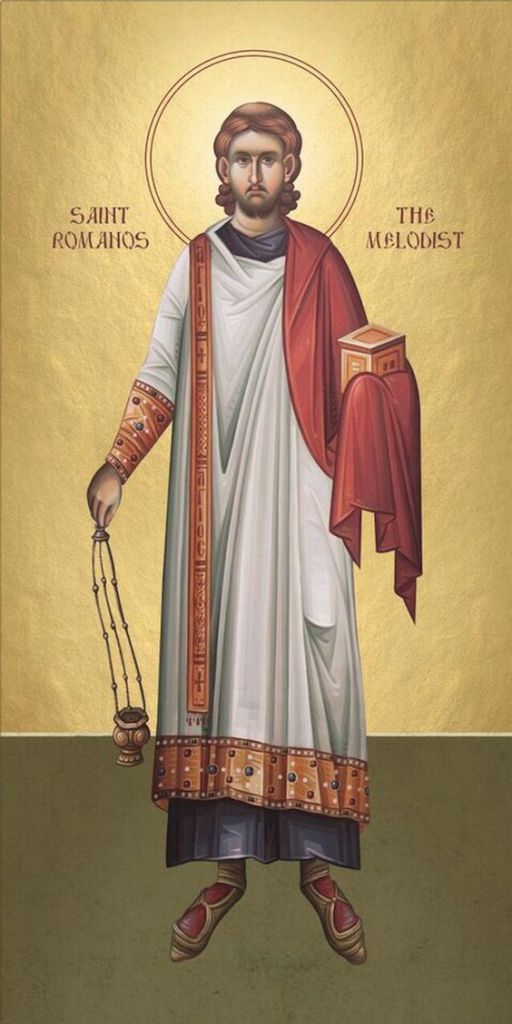
Saint of the Day – 1 October – St Romanos the Melodios (c 490-c 556) Deacon, Hymnographer, Poet, Writer – born in c 490 in Syria and died in c 556 of natural causes in Constantinople. Patronages – Cantors. Also known as – Romanos the Melodist, Romanus l’Hymnographe, Romanos Melodhos, Romanos Melode, Psaitis Dhikeosinis, Sweet Singer, Romain, Romano, Romanus, Glykophonos.
St Romanos was born to a Jewish family in either Emesa (modern-day Homs) or Damascus in Syria. He was baptised as a young boy (though whether or not his parents also converted is uncertain).
When he grew old enough he became an altar boy and then a singer, a reader and finally a Deacon – at first in his home town of Beirut and later in Constantinople where his family had moved. Romanos wanted to serve God to the best of his ability; he prayed a great deal and was the first to come to Church and the last to leave, thus served as a Sacristan in the greatest Church of Contantinople, the Hagia Sophia (Holy Wisdom). He lit the vigil lights with great reverence for he loved Holy Virgin and the Saints, before whose images they burned. Most of all, he like the Church choir and was always happy when he was allowed to sing.
According to legend, Romanos was not at first considered to be either a talented reader or singer. He was, however, loved by the Bishop of Constantinople because of his great humility.
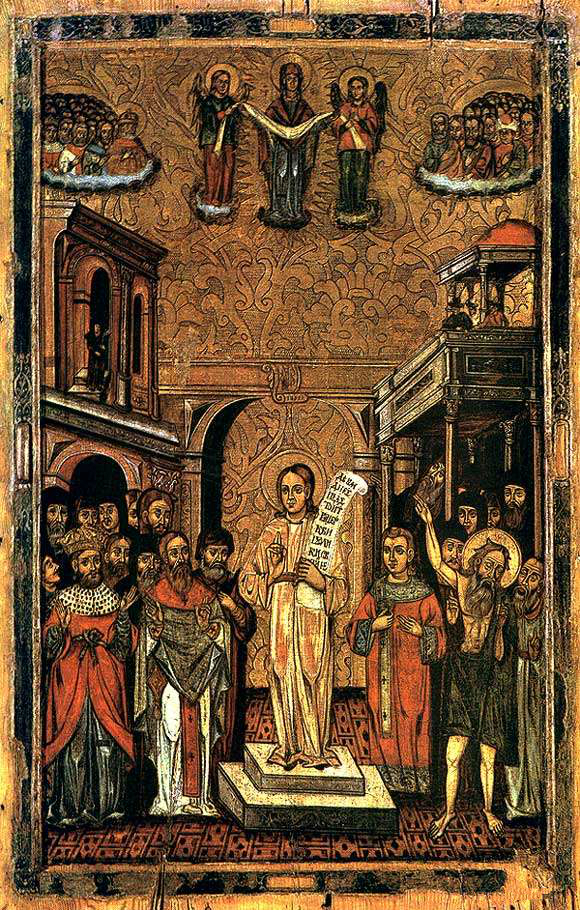
Once, around the year 518, while serving during the All-Night Vigil for the Feast of the Nativity of Christ, he was assigned to read from the Psalter. He read so poorly that another reader had to take his place. Some of the lesser clergy ridiculed Romanus for this and being humiliated he sat down in one of the choir stalls. Overcome by weariness and sorrow, he soon fell asleep. As he slept, the Blessed Virgin Mary appeared to him with a scroll in her hand. She commanded him to eat the scroll and as soon as he did so, he awoke.
He immediately received a blessing from the Bishop, mounted the ambo and chanted his famous Hymn of the Nativity, “Today the Virgin gives birth to Him Who is above all being….” The Emperor, the Bishop, the clergy and the entire congregation were amazed, both at the profound theology of the Hymn and Romanos’ clear, sonorous voice as he sang.
According to tradition, this was the very first Hymn (kontakion) ever sung. The Greek word “kontakion” refers to the shaft on which a scroll is wound, hence the significance of the Blessed Mother’s command for him to swallow a scroll, indicating that his compositions were by divine inspiration. The scene of Romanos’s first performance is often shown in icons.
Romanos wrote in a literary dialect—i.e., he had a popular but elevated style—and abundant Semiticisms support the view that he was of Jewish origin. Arresting imagery, sharp metaphors and similes, bold comparisons, antitheses, coining of successful maxims and vivid dramatisation characterize his style.
He is said to have composed more than 1,000 hymns celebrating various festivals of the ecclesiastical year, the lives of the saints and other sacred subjects, some 60 to 80 of which survive.
Among his most well-known Hymns are: The Nativity of Christ The Martyrdom of St Stephen The Death of a Monk The Last Judgment The Prodigal Son The Raising of Lazarus (for Lazarus Saturday, the day before Palm Sunday) Adam’s Lament (for Palm Sunday) The Treachery of Judas
St Romanos served in the Hagia Sophia, to the end of his life at the Monastery of Kyros, where he was buried along with his disciple St Ananias.
St Aizan of Abyssinia St Albaud of Toul Bl Andrew Sushinda Bl Antoni Rewera St Aretas of Rome St Bavo of Ghent Bl Cecilia Eusepi Bl Christopher Buxton St Crescens of Tomi St Dodo Bl Dominic of Villanova Bl Edward James St Evagrius of Tomi St Fidharleus Bl Gaspar Fisogiro St Gregory the Illuminator St John Kukuzelis Bl John Robinson Blessed Juan de Palafox Mendoza (1600–1659) His Life: https://anastpaul.com/2019/10/01/saint-of-the-day-1-october-blessed-juan-de-palafox-mendoza-1600-1659/ St Julia of Lisbon
St Maxima of Lisbon Bl Nikita Budka St Piaton of Tournai St Priscus of Tomi Bl Ralph Crockett Bl Robert Widmerpool Bl Robert Wilcox St Romanos the Melodist (c 490-c 556) St Sazan of Abyssinia St Verissimus of Lisbon St Virila St Wasnulf — Martyred in the Spanish Civil War: • Blessed Carmelo Juan Pérez Rodríguez • Blessed Higinio Mata Díez • Blessed Juan Mata Díez • Blessed Álvaro Sanjuán Canet • Blessed Florencia Caerols Martínez
Novena to Our Lady of the Rosary – Day Three – 30 September
Day Three – We Pray for the Priesthood and Consecrated Life and our personal intention:
To Our most holy Mother. To you do we pray first with heartfelt thanks for those who have said YES to the Father. Help them to trust in you and your son, Jesus, in all the challenges that they face. Teach them patience in all things and to accept all that happens and when it happens, in God’s time. We join them in total consecration to you. Reclaim us all as you own and mould us in all ways necessary to conform to God’s will. We love you, Mother Mary, Help us all!
Daily Prayer along with our Daily Rosary:
My dearest Mother Mary, behold me, your child, in prayer at your feet. Accept this Holy Rosary, which I offer you in accordance with your requests at Fatima, as a proof of my tender love for you, for the intentions of the Sacred Heart of Jesus, in atonement for the offenses committed against your Immaculate Heart and for this special favour which I earnestly request in my Rosary Novena: ………………………….. (Mention your request).
I beg you to present my petition to your Divine Son. If you will pray for me, I cannot be refused. I know, dearest Mother, that you want me to seek God’s holy Will concerning my request. If what I ask for should not be granted, pray that I may receive that which will be of greater benefit to my soul.
I offer you this spiritual Bouquet of Roses because I love you. I put all my confidence in you, since your prayers before God are most powerful. For the greater glory of God and for the sake of Jesus, your loving Son, hear and grant my prayer. Sweet Heart of Mary, be my salvation.
Our Lady of the Rosary, pray for our Holy Mother Church and for our country.
Our Lady of Fatima, obtain for humanity a lasting peace.
Sweet Heart of Jesus, be my love.
Sweet Heart of Mary, at the hour of my death, lead me home.
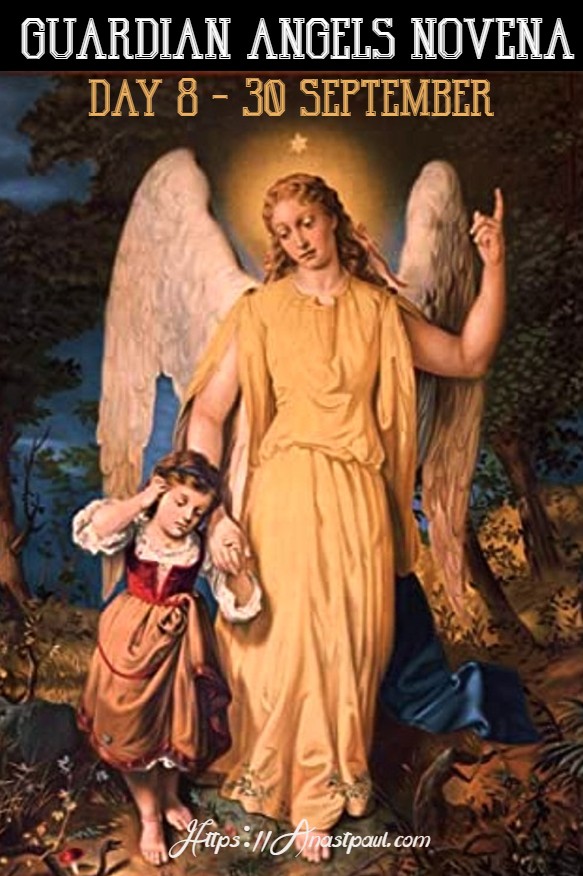
Novena to Our Angel Guardian – Day Eight – 30 September (Indulgence of 300 days, each day of the Novena)
Opening Prayer
Deus in adjutorium: V/. O God +, come to my assistance R/. O Lord, make haste to help me.
Gloria Patri…
DAY VIII
O! most pure spirit, dear Angel Guardian, I pray thee, by the burning love thou has for the Immaculate Virgin Mother of God, the Queen of Angels, to obtain for me great purity of soul and body, that at my death I may be found worthy to associate with our Virgin Mother and with thee in Paradise. And this special intention of virtue which I make unto thy prayers …………………….. (the special virtue you desire). Amen
Thought for the Day – 30 September – Meditations with Antonio Cardinal Bacci (1881-1971)
Christian Modesty
“We are told, that one day in the presence of St Francis de Sales, the beauty of a certain noble lady, his cousin, was being described. (Spirito p Vii, c 10) The Saint described with simplicity: “I’ve heard this said by others also.” Somebody remarked, that he himself often saw this young relative of his and, therefore, there was no need for others to tell him about her. The Saint replied with the same holy simplicity: “It is true that I see her often but, I never stare at her.” This simple but wise reply, underlines the difference between seeing and looking.
We are often obliged, in the ordinary course of living, or by reason of our position, to see many things which could be dangerous to our spiritual welfare. There are many ugly things around us, although sometimes externally beautiful, which we cannot help seeing. At home, on the street, in society, almost everywhere, we meet persons and things which constitute a threat to our virtue. What are we to do? We must see because, very often, we cannot help it but, we must never stare.
In other words, we should never fix our eyes on anything which would seriously disturb us. If we experience the beginnings of any such disturbance, we should look elsewhere at once, raising our minds to God in silent prayer. Delay could cost us our purity. To guard it, we need the holy virtue of modesty, which St Thomas Aquinas calls, the moderating virtue (Summa Theologiae, II-II, q 160, a 1). Not only, the Angelic Doctor observes, does it moderate but, it also directs our internal actions as well as our external ones, in such a way, that he, who possesses this beautiful virtue, has perfect control over his outward behaviour and over his inward dispositions (Ibid, q 160, a 2).”
Quote/s of the Day – 30 September – The Memorial of St Jerome (347-419) Father and Doctor, “The Man of the Bible”
A Light for Our Path By St Jerome
O Lord, You have given us Your word for a light to shine upon our path, grant us so to meditate on that word and follow its teaching, that we may find in it, the light that shines more and more until the perfect day. Amen
“Let sleep find you holding your Bible and when your head nods, let it be resting on the sacred page.”
“Someone who shows no clemency, who is not clothed with the bowels of mercy and tears, no matter what sort of student he is in spirituality, such a one does not fulfil the law of Christ.”
“Instead of speaking saintly words, we must act them.”
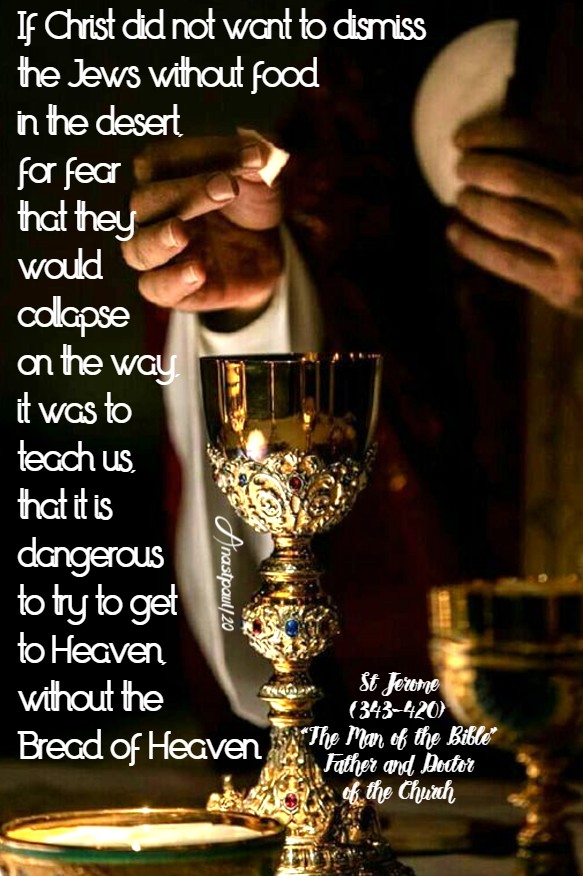
“If Christ did not want to dismiss the Jews without food in the desert, for fear that they would collapse on the way, it was to teach us, that it is dangerous to try to get to Heaven, without the Bread of Heaven.”
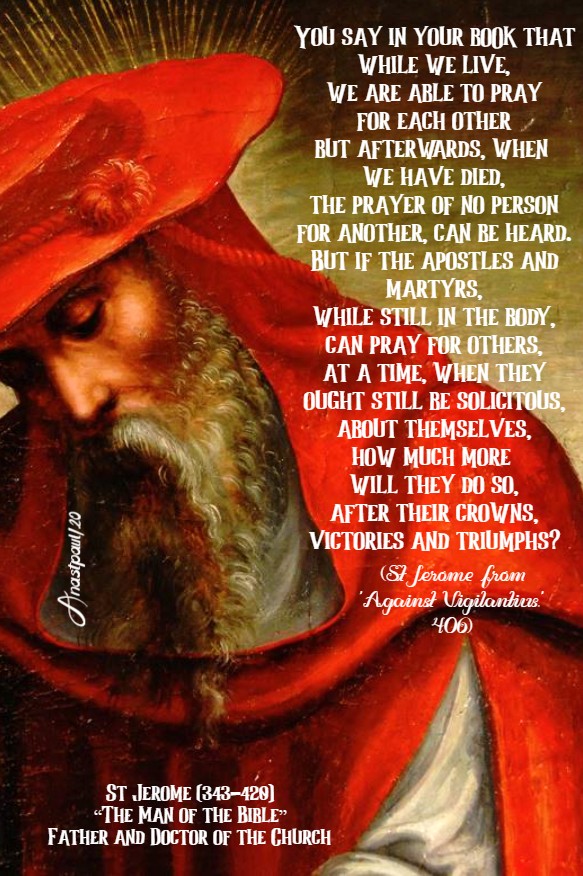
“You say in your book that while we live, we are able to pray for each other but afterwards, when we have died, the prayer of no person for another, can be heard. But if the apostles and martyrs, while still in the body, can pray for others, at a time, when they ought still be solicitous, about themselves, how much more will they do so, after their crowns, victories and triumphs?” (St Jerome from ‘Against Vigilantius,’ 406)
St Jerome wrote to Augustine in 418: “You are known throughout the world; Catholics honour and esteem you as the one who has established anew the ancient Faith.”
One Minute Reflection – 30 September – Wednesday of the Twenty Sixth week in Ordinary Time, Readings: Job 9:1-12, 14-16, Psalms 88:10-11, 12-13, 14-15, Luke 9:57-62 and the Memorial of St Jerome (347-419) Father and Doctor
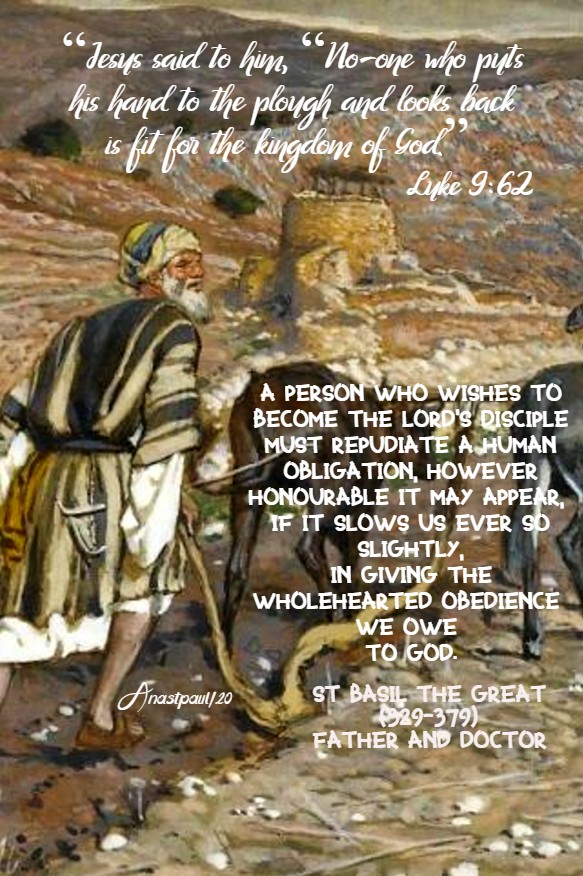
“Jesus said to him, “No-one who puts his hand to the plough and looks back is fit for the kingdom of God.” … Luke 9:62
REFLECTION – “The man said, “Allow me first to go and bury my father.” The Lord replied, “Let the dead bury their dead but go and preach the kingdom of God.” Another man said, “Let me first arrange my affairs at home.” He rebuked him with a stern threat, saying, “No man, putting his hand to the plough and looking back, is fit for the kingdom of God.” A person who wishes to become the Lord’s disciple must repudiate a human obligation, however honourable it may appear, if it slows us, ever so slightly, in giving the wholehearted obedience we owe to God.” … St Basil the Great (329-379) – Concerning Baptism
PRAYER – Almighty, ever-living God, You endowed Saint Jerome with a deep reverence and understanding of Holy Scripture, which he loved with all his heart. Sustain us evermore with Your word and teach us by their precepts. Help us to follow each word which Jesus, Your Son, our Redeemer, uttered that we may find therein the source of life. May the prayers of St Jerome assist us in our love and faithfulness. We ask this through Jesus our Lord, with the Holy Spirit, one God forever, Amen.
Our Morning Offering – 30 September – The Last day of the Month of the Seven Sorrows of the Blessed Virgin Mary – Wednesday of the Twenty Sixth week in Ordinary Time
What Can I Say, Merciful Lady? St Anselm (1033-1109) Doctor of the Church
My most merciful Lady, what can I say about the fountains that flowed from your most pure eyes when you saw your only Son before you, bound, beaten and hurt? What do I know of the flood that drenched your matchless face, when you beheld your Son, your Lord and your God, stretched on the cross without guilt, when the flesh of your flesh was cruelly butchered by wicked me? How can I judge what sobs troubled your most pure breast when you heard, “Woman, behold your son,” and the disciple, “Behold, your Mother,” when you received as a son the disciple in place of the Master, the servant for the Lord? Amen
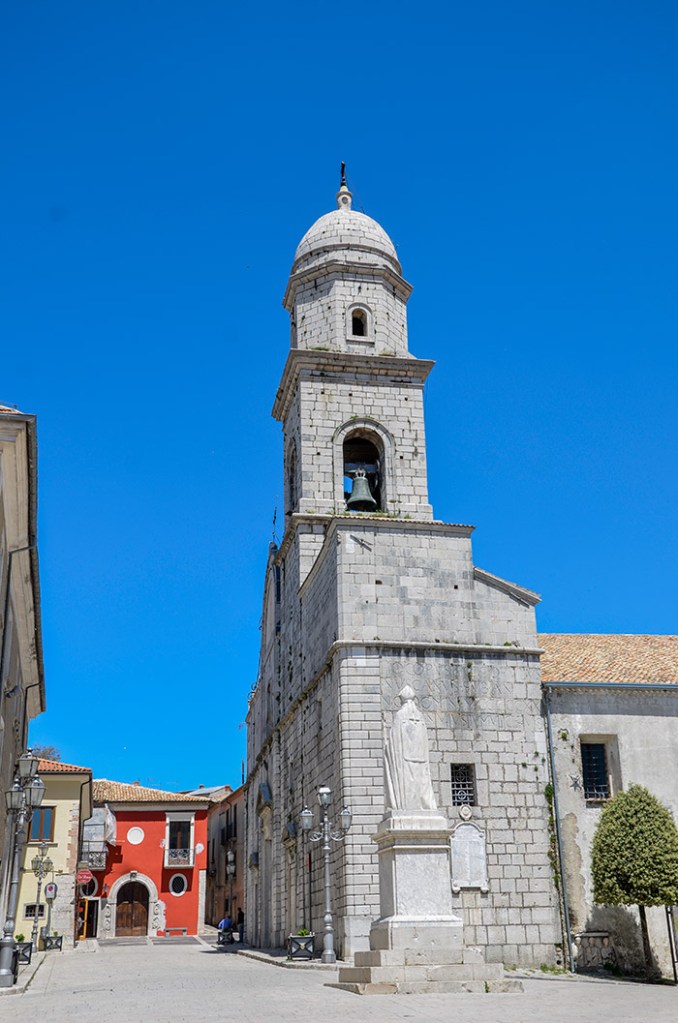
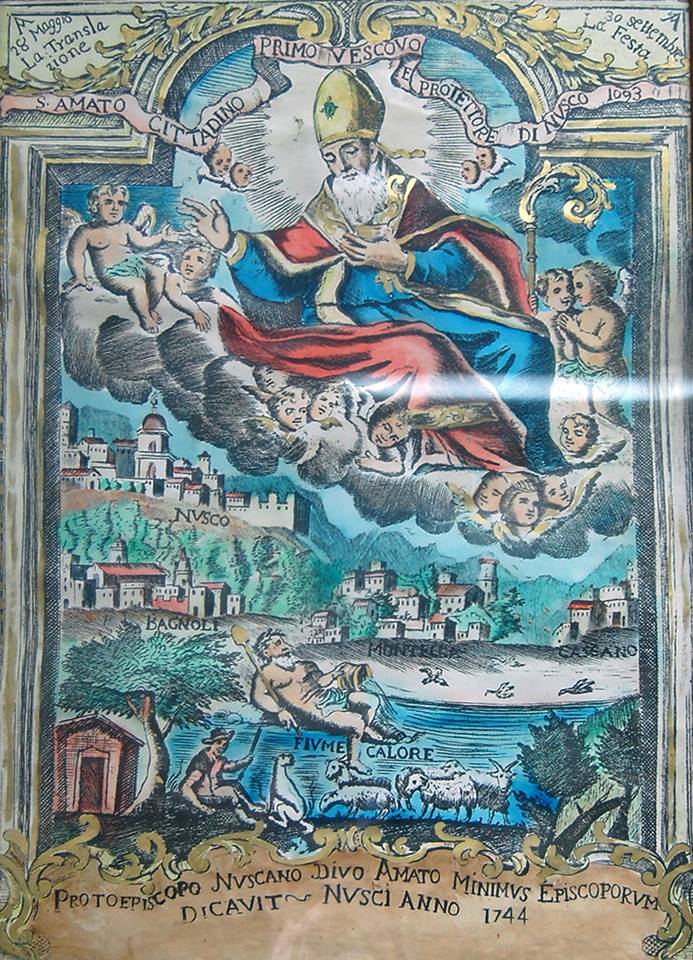
Saint of the Day – 30 September – Saint Amato of Nusco (c 1003-1093) Bishop, Monk, Apostle of the poor, Confessor and evangeliser. Born in c 1003 in Nusco, Italy and died on 30 September 1093 of natural causes. Patronages – Nusco, against earthquakes.
Amato was born in Nusco, the third highest town in the province of Avellino which stands on an isolated mountain in the Irpinia Apennine chain, between the Ofanto and Calore valleys and for its panoramic position it is called a “Balcony of Irpinia.”
His birth took place around 1003, into a wealthy family. As soon as he was able, he destributed all his worldly goods to the poor and entered a Seminary. He was Ordained at a very young age and in 1048, thanks to his great zeal in evangelisation and assistance to the poor, he was Consecrated as the first Bishop of the city of Nusco, by the Archbishop of Salerno Alfano I.
Nusco, already inhabited in very ancient times, probably developed in the Lombard period, near a castle, around which Saint Amato as Bishop gathered the inhabitants of the surrounding villages.
He restored many pre-existing Churches and built many new ones, including the Cathedral dedicated to the protomartyr St Stephen, to whom he was devoted.. He worked tirelessly to assist the poor and to evangelise his Diocese. His mortal remains are now kept and venerated in the crypt of the Cathedral of Nusco, see below.
He died on 30 September 1093 and left all his possessions to the newly formed diocese of Nusco as shown in his will, a small parchment (15 cm x 55 cm) the so-called Chartula Iudicati, still preserved in the Cathedral archives.
At his sepulchre numerous miraculous cures took place, which procured for him the cult of a saint, his successor Ruggero dedicated a Church to him for this.
After having demonstrated the authenticity of his will, it was possible to set the date of his death at 30 September 1093, in contrast to the opinion of the Benedictine monks of Montevergine, who wanting to classify him at any cost as a disciple of their founder St Guglielmo da Vercelli (1085-1142), did not hesitate to move the date of his death to 31 August 1193, therefore 100 years later.
In addition to the anniversary of the saint’s death , the feast of the transfer of his bones from the first sepulchre to the current one in the crypt of the Cathedral is also celebrated in Nusco on 28 May.
The Bishop of Nusco Gaetano De Arco, in the Instructio Synodica seu Synodus pro Dioecesis Nuscanae Tyrcinio published in 1752 in Naples, wrote that there were originally three annual feasts in honour of Saint Amato – the translation of the bones ( 28 May ), the Patronage (last Sunday in July) and death ( 30 September .
Patron of the City of Nusco is invoked against earthquakes, a recurring natural disaster in the Irpini mountains.
The ‘Roman Martyrology’ celebrates his Memorial today, 30 September.
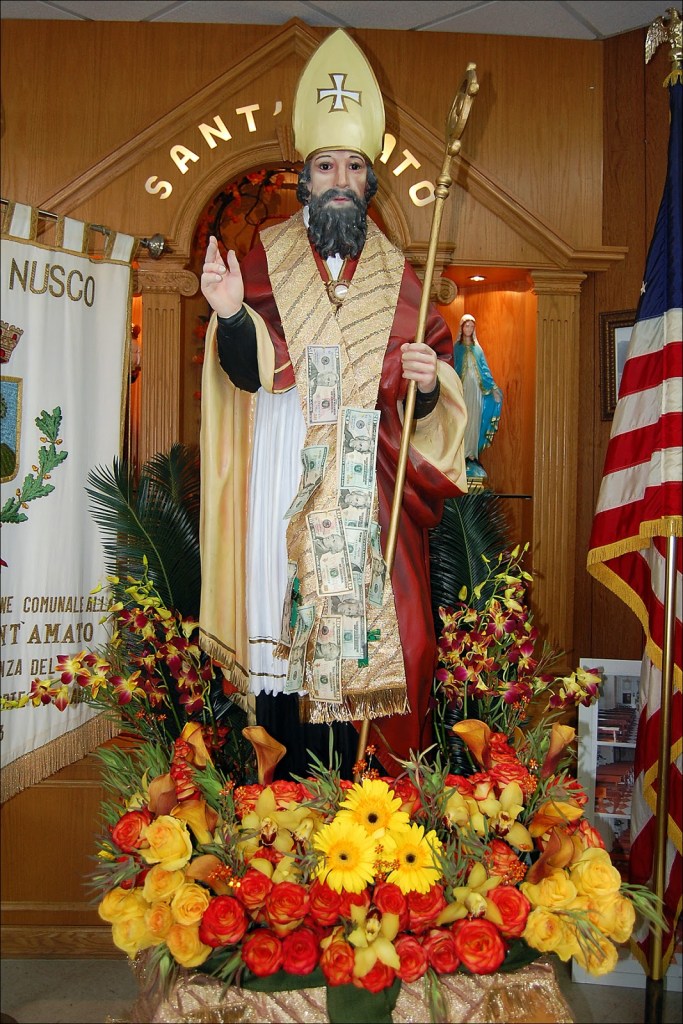
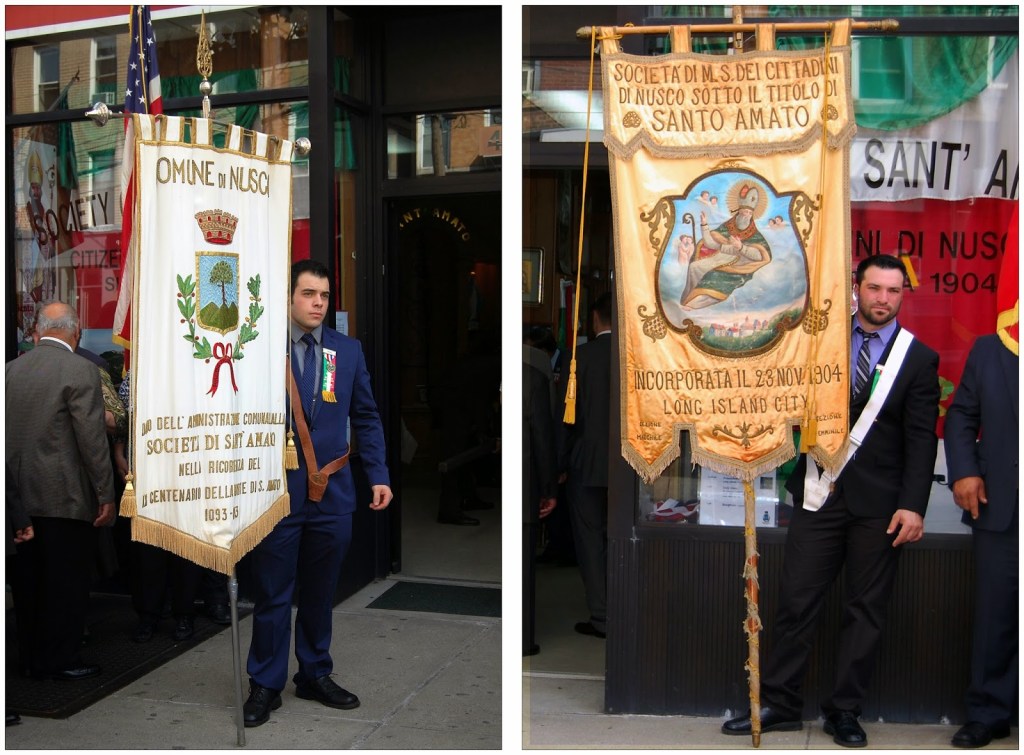
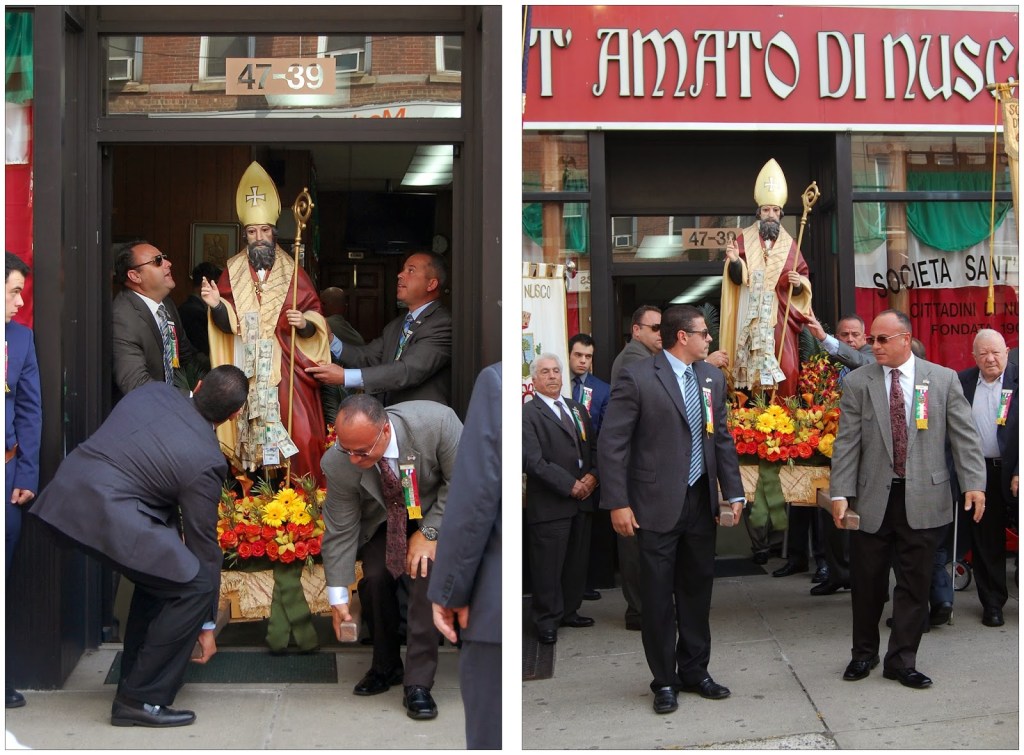
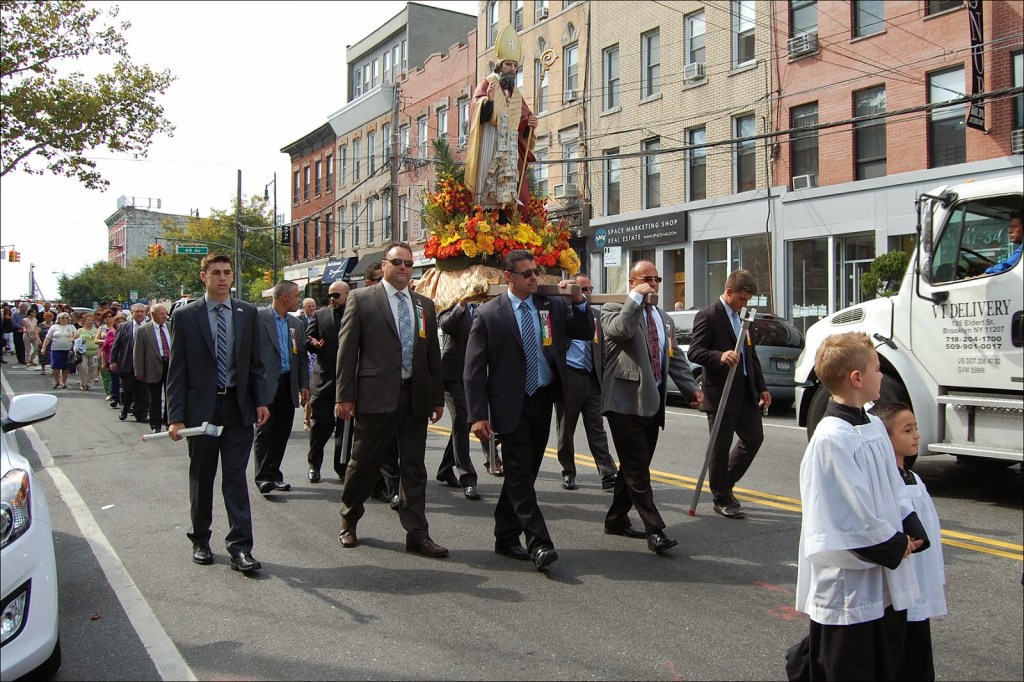
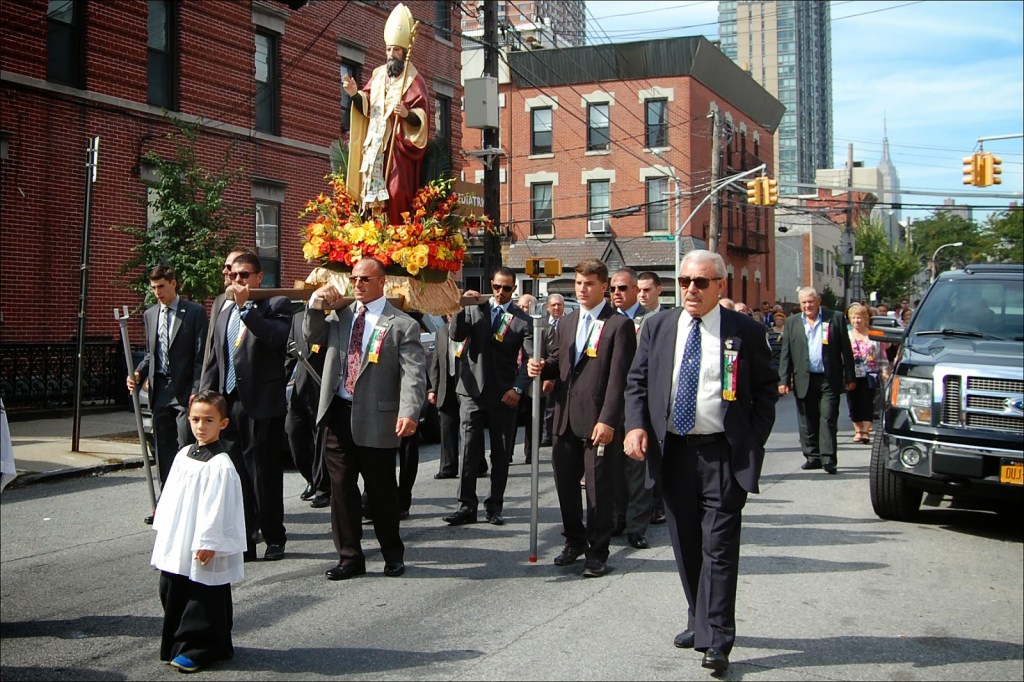
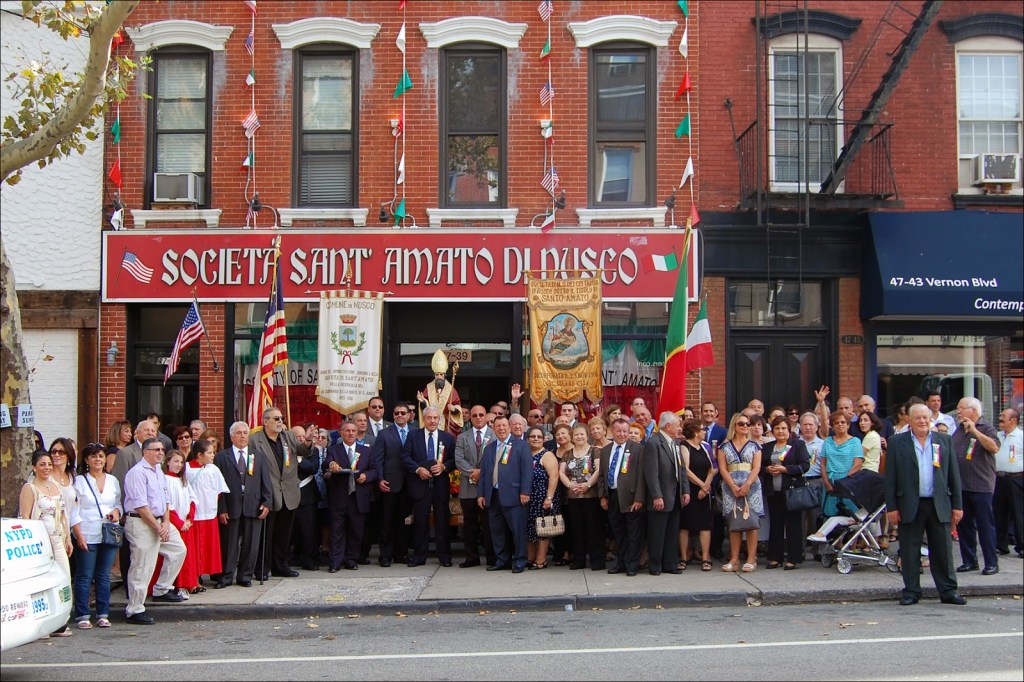
The Società Sant’Amato di Nusco of Long Island City, New York celebrates the Annual Mass and Procession in honour of Saint Amato, Patron Saint of Nusco, Avellino. St Amato’s Memorial is celebrated at Saint Mary’s Church (10-08 49th Avenue), with great aplomb and festivities. The pictures below show the great love and veneration with which our Saint is held, so far from his native home. I believe these images were taken at the celebration a few years ago.
St Honoratus of Canterbury St Ismidone of Die Bl Jean-Nicolas Cordier St Laurus St Leopardus the Slave Bl Ludwik Gietyngier St Midan of Anglesey St Simon of Crépy St Ursus the Theban St Victor the Theban — Martyrs of Valsery Abbey: An unknown number of Premonstratensian monks at the Abbey of Notre-Dame de Valsery, Picardie, France who were martyred by Calvinists. They were martyred in 1567 at Valsery, Pircardy, France
I do not cease to give thanks for you! Ephesians 1:16
My sincerest and humble gratitude to all who have regularly assisted this Site to keep afloat. I extend my thanks today, to Doreena, Hugh and Melanie, who have all generously kept Anastpaul.com in their budgets. Most especial gratitude to our Resident Bishop Daniel Dolan, who very kindly celebrated Holy Mass for all the Benefactors of this Site on the Feast of St Wenceslaus – 28 September. The experiences of the past +-6 months have compromised all of us in unbelievable ways, no matter where we live. Because of this, I know that times are tough but I beg you all, if you too find inspiration and spiritual assistance here, not to forget Anastpaul.com entirely. It is a battle to keep it going from a financial point of view.























You must be logged in to post a comment.