Our Morning Offering – 26 September – “Month of the Seven Sorrows of the Blessed Virgin Mary” – Saturday of the Twenty Fifth week in Ordinary Time
Mother of Love, of Sorrow and of Mercy By St Bridget of Sweden (1303-1373)
O Blessed Virgin Mary, Immaculate Mother of God, who endured a martyrdom of love and grief, beholding the sufferings and sorrows of Jesus! Thou didst co-operate in the benefit of my redemption by thy innumerable afflictions and by offering to the Eternal Father, His only-begotten Son, as a holocaust and victim of propitiation for my sins. I thank thee for the unspeakable love which led thee to deprive thyself of the Fruit of thy womb, Jesus, true God and true Man, to save me, a sinner. Oh! make use of the unfailing intercession of thy sorrows with the Father and the Son, that I may steadfastly amend my life and never again crucify my loving Redeemer by my sins and that, persevering till death in His grace, I may obtain eternal life through the merits of His Cross and Passion. Amen Mother of love, of sorrow and of mercy, pray for us!
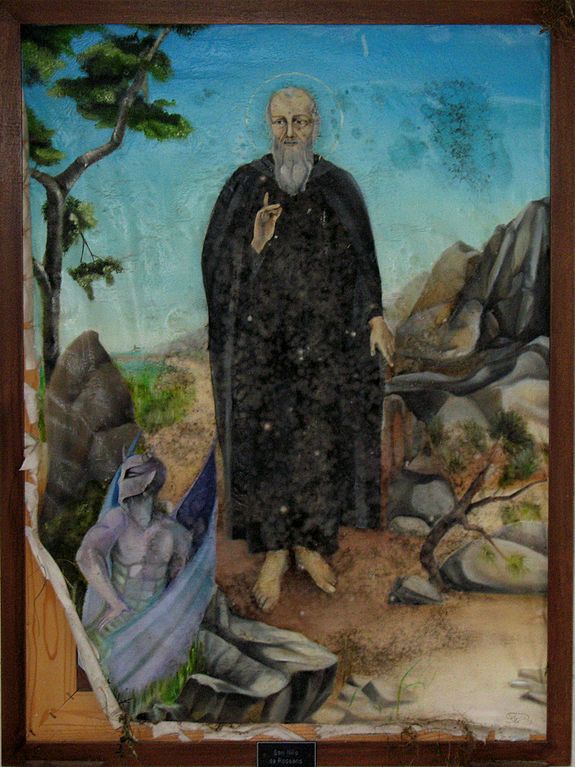
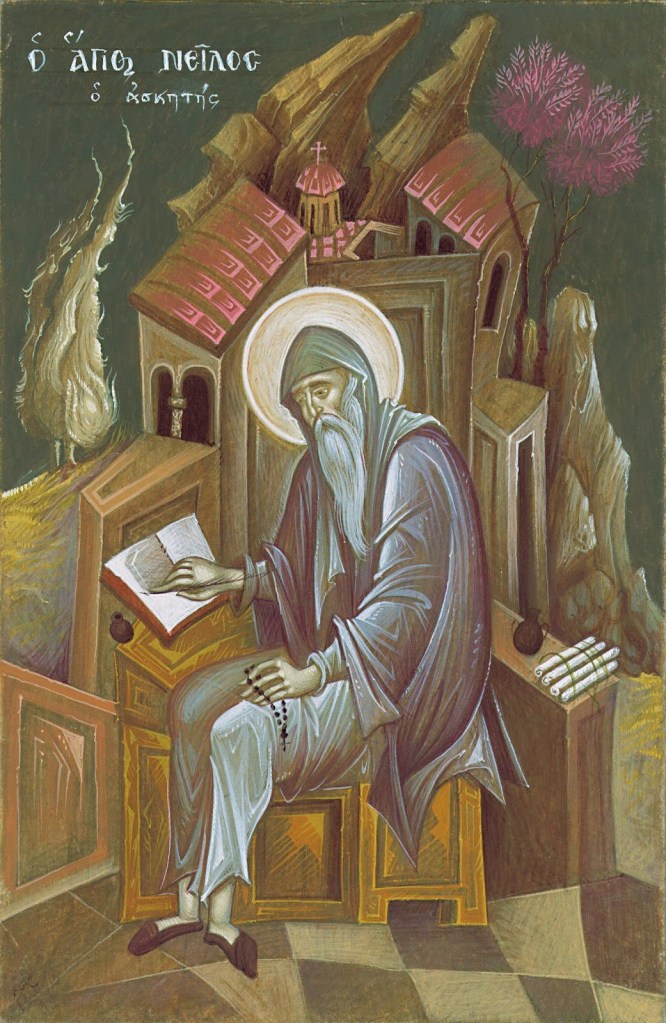
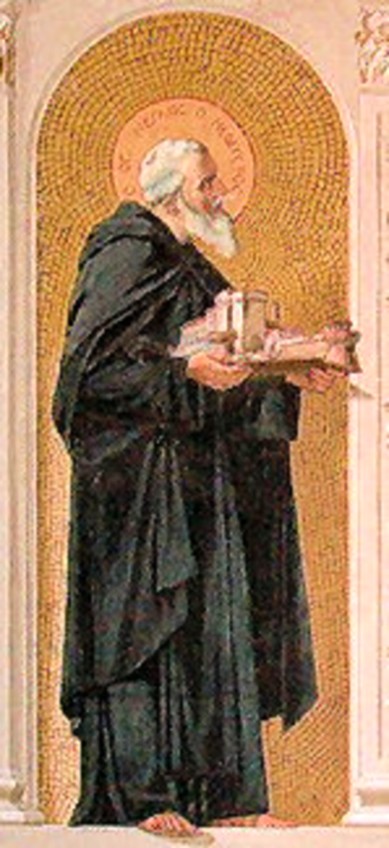
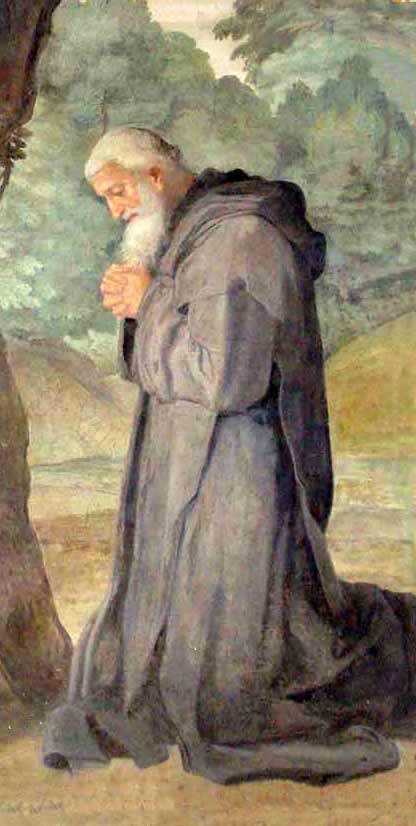
Saint of the Day – 26 September – Saint Nilus the Younger (910-1005) Monk, Abbot, Confessor and Founder of Italo-Greek Monasticism in southern Italy.. St Nilus was a charismatic leader and leading spiritual personality of his time. Born in 910 at Rossano, Calabria, Italy and died on 27 December 1005 at Grottaferrata, Frascati, Italy of natural causes. Patronages – Grottaferrata, Italy, Rossano, Italy. He is also known as Nilus of Calabria, Nilus of Rossano, Nilo….
Portrait of St Nilus, in the Sanctuary of San Nicodemo in Mammola
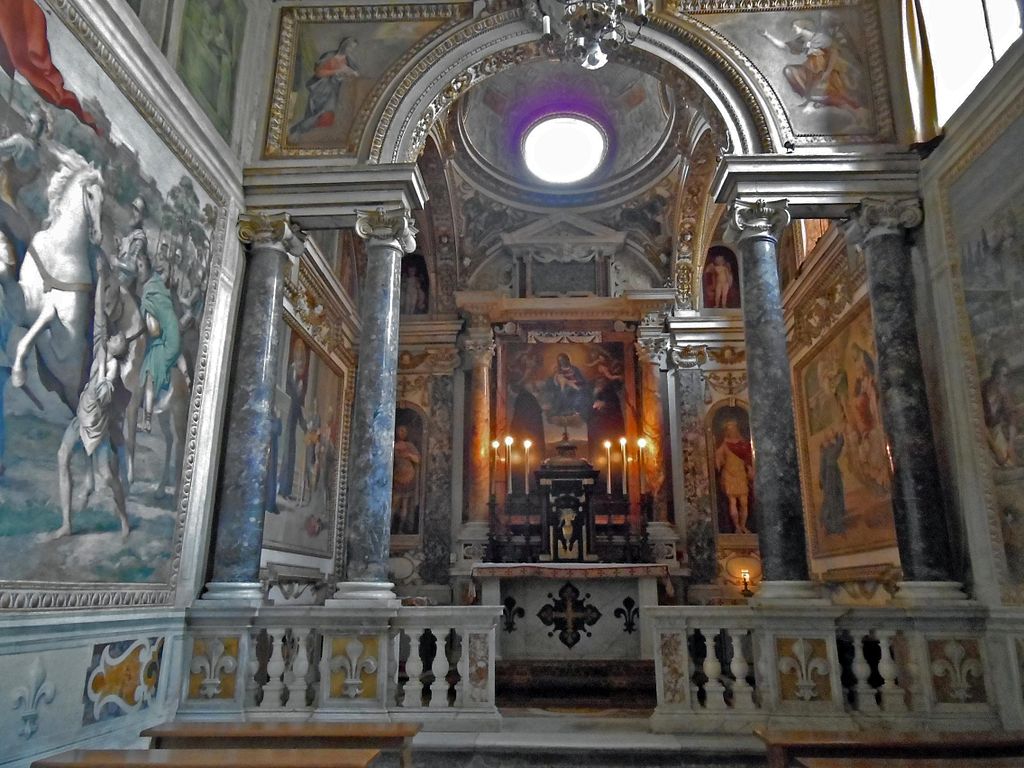
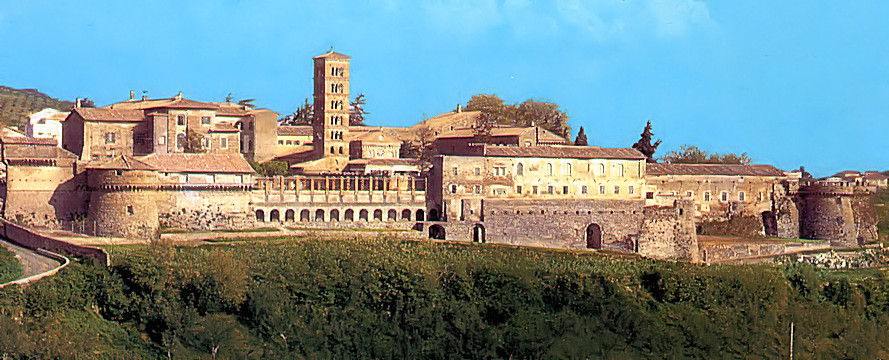
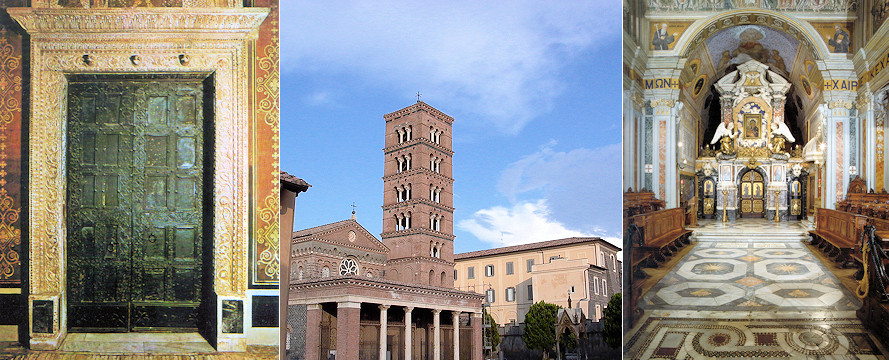
Some miles from Rome stands an Abbey that has a far greater significance than, as a sight for admiring tourists or a treasure for antiquarians. The Exarchic Greek Abbey of Grottaferrata, with its Basilian Monks, is the centre of an important revival of studies of Byzantine Catholicism and of the Oriental apostolate.
The Abbey owes its origin to Saint Nilus. He was born circa 910 in Rossano, to one of the foremost Greek families of Calabria, a southern province of Italy. This area was in ancient times founded as a Greek colony and was afterwards part of the Byzantine Empire until 1059.
The child was Baptised Nicholas, was given a good education and grew up a fervent young man. The monastic life had some attraction for him but he married and it was only after afterwards he seriously turned to God, in the year 940. It was a sombre age, disturbed by internal war between Byzantines and Lombards and suffering frequent Saracen raids on the coasts. After fleeing his own town of Rossan,o he became a Monk and settled at a Monastery near Palma on the Tyrrhenian Sea. A Moslem attack caused the community to flee but Nilus became a Hermit in a nearby forest. Later, at Rossano, he ruled a convent and gained fame for his wisdom and prudence. Here, he interceded with the authorities for mutineers condemned to death and with the Jewish community for a young man who had killed a Jew and once, he succeeded in ransoming a number of enslaved Christians. The position of Archbishop was offered him but Nilus refused.
When a Byzantine Prince asked the Benedictine Monks at Monte Cassino to give Nilus and his fellow Monks a Monastery, the Abbot sent them an invitation to come to Monte Cassino. Their Eastern liturgy were a strange sight to the Benedictines but they provided a Monastery at Valleluce, where the community remained for fifteen years and then moved to Serperi, near Gaeta. Emperor Otto III offered him a Monastery richly endowed but Nilus asked the Emperor only for his promise of repentance and a good life, saying “You are a good emperor, you are mortal and must die. You must render an account of your deeds, good or evil.” Otto bent his crowned head for the old man’s blessing.
Sometime in 1004, Nilus set out on a visit to a Monastery and fell ill near Tusculum. A vision of the Mother of God showed him, that this was to be the permanent home of his Basilian monks. This promise was fulfilled when the count of Tusculum offered land on the slopes of Mount Cavo and the community – of about 60 monks – was sent for. But Nilus died before the monastic buildings could be begun.
The Grottaferrata Abbey with it’s Basilian Monks today is a shining symbol of the Byzantine Catholics who never separated themselves from the unity of the Church under the Holy See. The monks of this ancient Abbey are Catholics of the Byzantine-Greek Rite and represent the Italian Congregation of Basilian Monks, an institution created in the Catholic Church to bring together the Monasteries of the Byzantine Rite present in southern Italy. Currently the Greek Abbey of Grottaferrata (see below) is the last of the numerous Byzantine Monasteries that were widespread throughout southern Italy and in Rome itself in the Middle Ages. It is also unique in that, founded fifty years before the Schism that led to the separation of the Churches of Rome and Constantinople, it has always been in communion with the Bishop of Rome, while preserving the Byzantine-Greek Rite and the oriental monastic tradition of the origins.
North American Martyrs (Optional Memorial) – 8 saints: Two priests and six lay-brothers, all Jesuits, who were sent as missionaries to the area of modern Canada and New York and who were murdered by the locals for their work. • Saint Antoine Daniel • Saint Charles Garnier • Saint Gabriel Lalemant • Saint Isaac Jogues • Saint Jean de Brébeuf • Saint Jean de la Lande • Saint Noel Chabanel • Saint Rene Goupil Canonised – 29 June 1930 by Pope Pius XI
St Amantius of Tiphernum St Callistratus of Constantinople St Colman of Elo St Cyprian of Antioch St Eusebius of Bologna St John of Meda St Justina of Antioch Bl Louis Tezza MI (1841-1923) the “Apostle of Lima” Blessed Louis’ Story: https://anastpaul.com/2018/09/26/saint-of-the-day-26-september-blessed-louis-tezza-m-i-1841-1923-the-apostle-of-lima/ St Marie Victoire Therese Couderc St Meugant St Nilus the Younger (910-1005) Abbot and Confessor St Senator of Albano St Vigilius of Brescia — Martyrs of Korea – 12 saints: Twelve lay people in the apostolic vicariate of Korea who were imprisoned, tortured and martyred together in the persecutions in Korea. • Saint Agatha Chon Kyong-Hyob • Saint Carolus Cho Shin-Ch’ol • Saint Catharina Yi • Saint Columba Kim Hyo-Im • Saint Ignatius Kim Che-Jun • Saint Iulitta Kim • Saint Lucia Kim • Saint Magdalena Cho • Saint Magdalena Ho Kye-Im • Saint Magdalena Pak Pong-Son • Saint Perpetua Hong Kum-Ju • Saint Sebastianus Nam I-Gwan They were beheaded September 1839 in Seoul Prison, South Korea and Canonised on 6 May 1984 by St Pope John Paul II.
Martyred in the Spanish Civil War: • Blessed Amalia Abad Casasempere de Maestre • Blessed Andreu Felíu Bartomeu • Blessed Antonio Cid Rodríguez • Blessed Josefa Romero Clariana • Blessed Manuel Legua Martí • Blessed María Jord´ Botella • Blessed Pau Castell´ Barber´ • Blessed Teresa Rosat Balasch
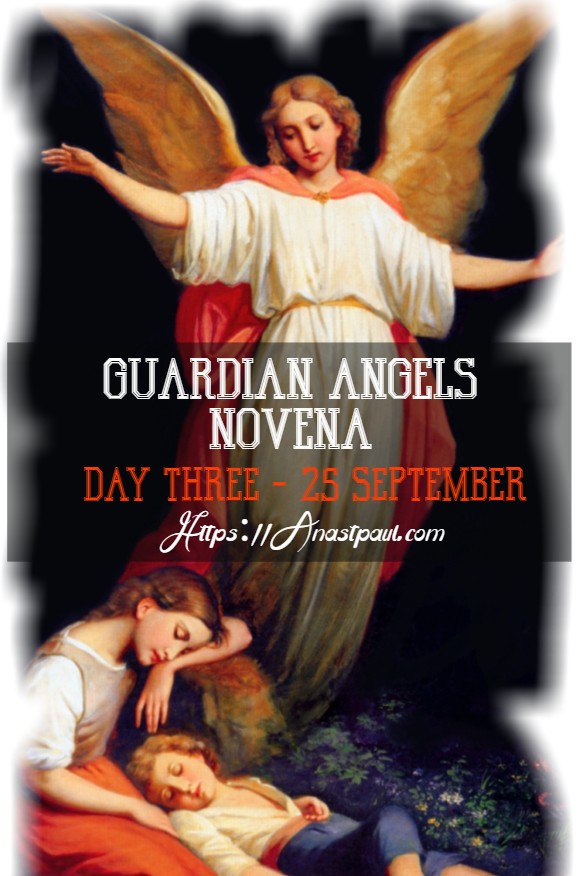
Novena to Our Angel Guardian – Day Three – 25 September (Indulgence of 300 days, each day of the Novena)
Opening Prayer
Deus in adjutorium: V/. O God +, come to my assistance R/. O Lord, make haste to help me.
Gloria Patri…
DAY III.
Most perfect executor of the Will of God, my faithful guardian, I pray thee, by the vigilant and loving eagerness with which thou fulfils the duty of my guardianship which God has confided to thee, obtain for me the grace of being always anxious to know and accomplish perfectly, to the last moment of my life, everything that God asks of me. And this special intention of virtue which I make unto thy prayers …………………….. (the special virtue you desire).Amen
Thought for the Day – 24 September – Meditations with Antonio Cardinal Bacci (1881-1971)
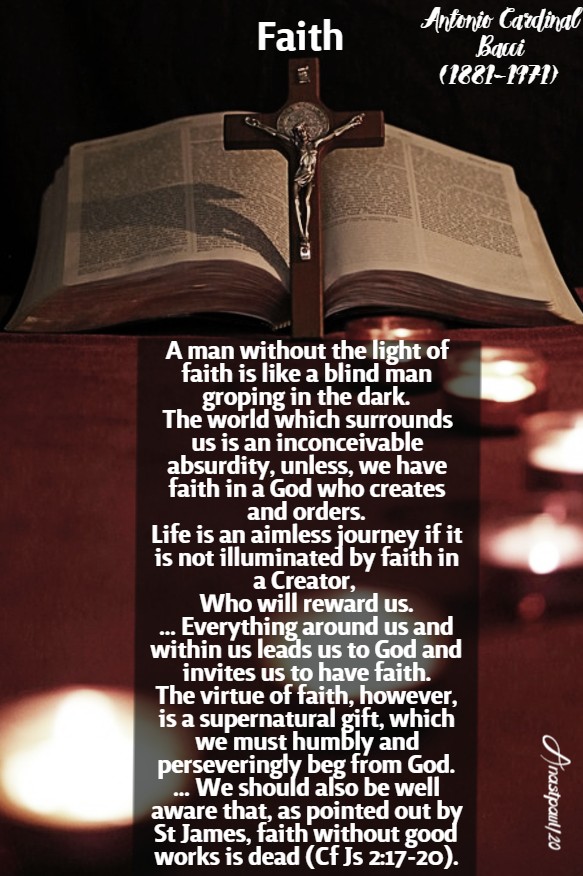
Faith
“A man without the light of faith is like a blind man groping in the dark. The world which surrounds us is an inconceivable absurdity, unless, we have faith in a God who creates and orders. Life is an aimless journey if it is not illuminated by faith in a Creator, Who will reward us. Everything without us and within us, speaks to us of God and directs our steps towards Him, our supreme benefactor, our judge and our eternal reward. The stars of the heavens and the flowers of the fields, tell us of the infinite beauty and goodness of their Creator. In the pages of the Gospel, we find, a clearer and more penetrating light which invites us to adore and love the divine Redeemer and to believe in Him, Who alone, has the words of eternal life and Who alone can satisfy the infinite desires of our hearts.
All this is true. Everything around us and within us leads us to God and invites us to have faith. The virtue of faith, however, is a supernatural gift, which we must humbly and perseveringly beg from God. It is, as St Thomas Aquinas says, the foundation of the entire spiritual life (Summa Theologiae,III,q 73, a 3); without it, the spiritual edifice would collapse. How thankful, therefore, we should be to God for having been called to the faith and for having been born in the Catholic Church. There are so many souls outside Her, who grope in the darkness, longing for the truth. We should pray for them that they may reach the port of salvation and may be able to join with us in praising, loving and serving Our Lord Jesus Christ. We should also be well aware that, as pointed out by St James, faith without good works is dead (Cf Js 2:17-20). Even the devils believe, as St Augustine observes (De Caritate, 10) but, this does not help their salvation. Besides faith, the love of God and love of our neighbour are necessary. The result of this double charity, should be a gradual increase in good works.”
Quote/s of the Day – 25 September – Friday of the Twenty-fifth week in Ordinary Time, Readings: Ecclesiastes 3:1-11, Psalms 144:1, 2, 3-4, Luke 9:18-22
“Then he said to them, But who do you say that I am?” And Peter answered, The Christ of God.”
Luke 9:20
“If I only touch his garment, I will be made well.” Jesus turned, and seeing her he said, “Take heart, daughter, your faith has made you well.” And instantly the woman was made well.”
Matthew 9:21-22
“It is I, be not afraid”
John 6:20
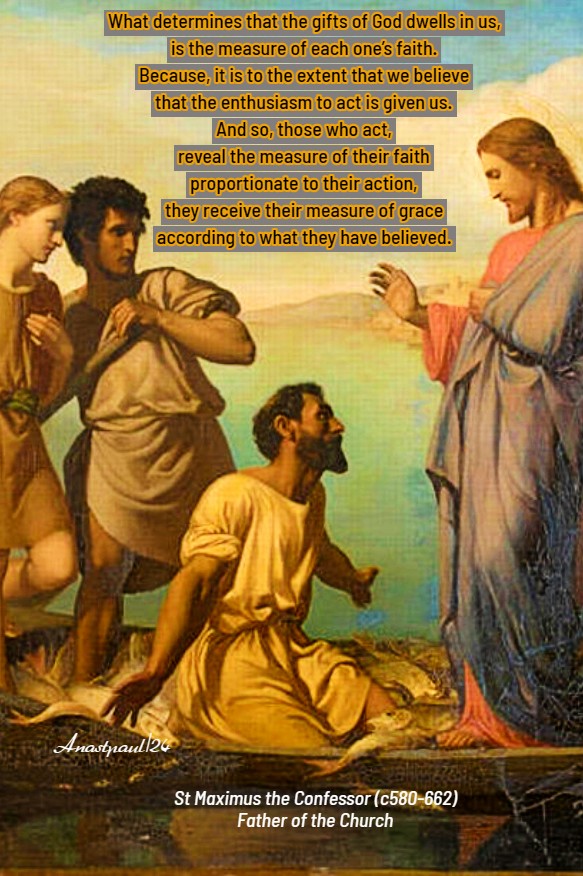
“What determines that the gifts of God dwells in us, is the measure of each one’s faith. Because, it is to the extent that we believe that the enthusiasm to act is given us. And so, those who act, reveal the measure of their faith proportionate to their action, they receive their measure of grace according to what they have believed. …”
St Maximus the Confessor (c 580-662) Monk and Theologian
“I believe though I do not comprehend and I hold by faith, what I cannot grasp with the mind.”
St Bernard (1090-1153) Mellifluous Doctor
“Believing is an act of the intellect assenting to the divine truth, by command of the will, moved by God through grace.”
St Thomas Aquinas (1225-1274) Doctor Angelicus Doctor Communis
“O Heart of love, I put all my trust in Thee, for I fear all things, from my own weakness, but I hope for all things, from Thy Goodness.”
St Margaret Mary Alacoque (1647-1690)
“Faith is that which makes us believe from the depths of our souls… all the truths that our religion teaches us, all that the Gospel holds and all that the Church sets before us. The just man lives truly by this faith (Rom 1:17), for it replaces for him, the greater part of his natural senses. It so transforms all things, that the senses are of little use to the soul, which through them is only deceived, whilst faith shews it realities. Where the eye sees but a poor man, faith sees Jesus (Mt 25:40).”
Bl Charles Eugène de Foucauld of Jesus OCSO (1858-1916)
One Minute Reflection – 25 September – Friday of the Twenty-fifth week in Ordinary Time, Readings: Ecclesiastes 3:1-11, Psalms 144:1, 2, 3-4, Luke 9:18-22 and the Memorial of Saint Finbar (c 550– 623) Bishop of Cork
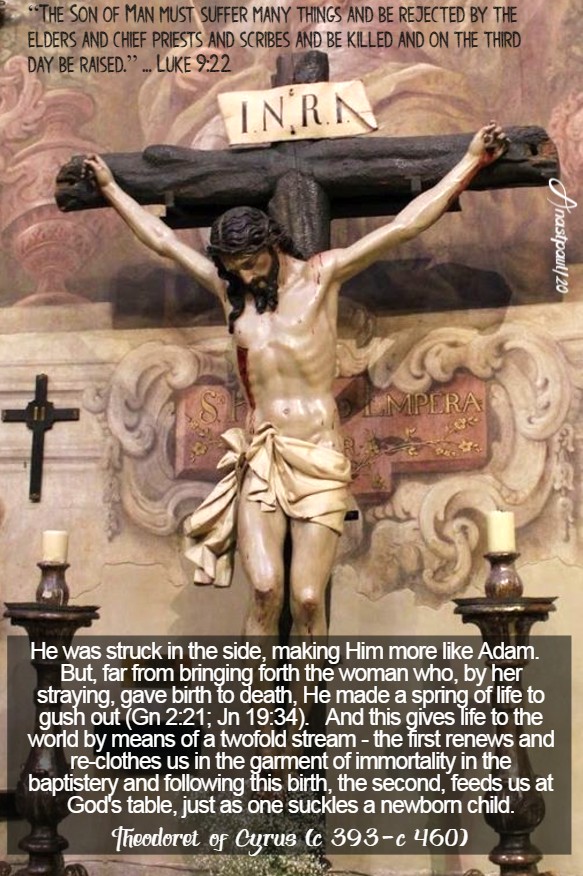
“The Son of Man must suffer many things and be rejected by the elders and chief priests and scribes and be killed and on the third day be raised.” … Luke 9:22
REFLECTION – “Jesus made His way of His own free will towards the sufferings Scripture had foretold. He had frequently predicted them to His disciples and had even severely rebuked Peter, who had received their discovery with indignation (Mt 16:23). Finally, He showed how they were the cause of the world’s salvation. This was why, to the men coming to arrest Him, He referred to Himself as: “I am he whom you are seeking” (cf. Jn 18:5.8) (…) He was struck, covered with spittle, mocked, tortured, scourged and, in the end crucified. He allowed two outlaws, one at His right and one at His left, to share His suffering. Classed alongside murderers and criminals He took vinegar and gall, fruits of a bitter vine. He was struck in mockery by a reed, pierced by a lance in His side and, in the end, laid in a tomb.
All this He suffered while working our salvation (…) By His thorns He brought an end to the punishment laid on Adam, since the latter, having sinned, received this sentence: “Cursed be the ground because of you! Thorns and thistles shall it bring forth to you” (Gn 3:17-18). With the gall He took to Himself all that is bitter and painful in mortal life and sorrowful to men. With the vinegar He accepted human nature’s decline and bestowed on it, it’s restoration to a higher state. By the purple he symbolised His royalty; with the reed He indicated how weak and feeble the devil’s power is. Being slapped, He made known our enfranchisement [just as we do in the case of a slave]. He bore with the abuse, punishment and beating due to us.
He was struck in the side, making Him more like Adam. But, far from bringing forth the woman who, by her straying, gave birth to death, He made a spring of life to gush out (Gn 2:21; Jn 19:34). And this gives life to the world by means of a twofold stream – the first renews and re-clothes us in the garment of immortality in the baptistery and following this birth, the second, feeds us at God’s table, just as one suckles a newborn child.” … Theodoret of Cyrus (c 393-c 460) Bishop – Treatise on the Incarnation, 26-27
PRAYER – O God of love, You sent Your beloved Son to the world to proclaim the Good News of Salvation, to heal every illness and to cure all infirmity of body and soul. Help us to continue the mission of the merciful Christ in the service towards our neighbour, preaching the Gospel and offering our help in whatever way we can. May the example of Your saints, teach us how to love and serve You. Through their intercession, grant us the grace to go forth in love. We ask this through Jesus Christ our Lord, with the Holy Spirit, one God forever, amen.
Our Morning Offering – 25 September – The Memorial of Blessed Herman of Reichenau/the Cripple OSB (1013–1054) the Author of the Salve Regina, the Veni Sancte Spiritus and the Alma Redemptoris Mater amongst others
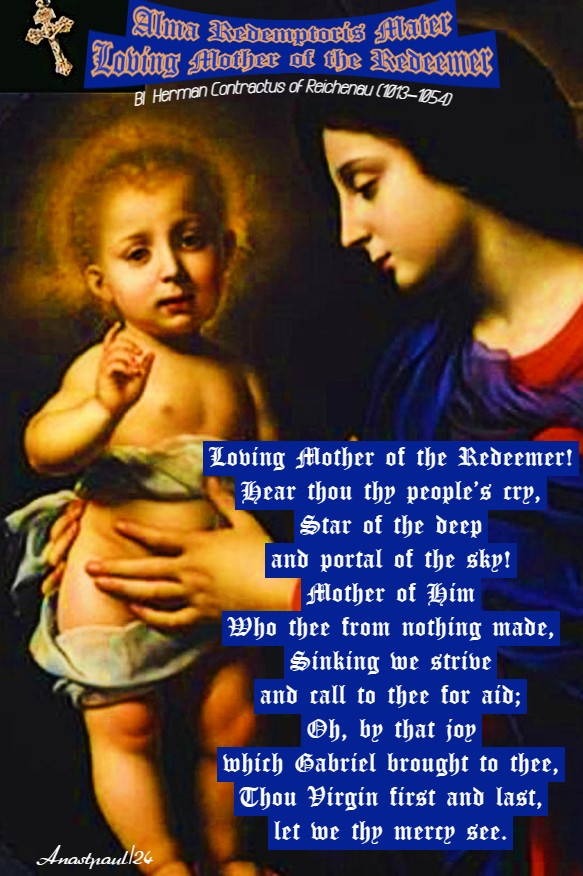
Alma Redemptoris Mater Loving Mother of the Redeemer By Blessed Herman of Reichenau/the Cripple OSB (1013–1054)
Loving Mother of the Redeemer! Hear thou thy people’s cry, Star of the deep and portal of the sky! Mother of Him Who thee from nothing made, Sinking we strive and call to thee for aid; Oh, by that joy which Gabriel brought to thee, Thou Virgin first and last, let we thy mercy see.
Alma Redemptóris Mater, quæ pérvia cæli Porta manes, et stella maris, succúrre cadénti, Súrgere qui curat pópulo: tu quæ genuísti, Natúra miránte, tuum sanctum Genitórem Virgo prius ac postérius, Gabriélis ab ore Sumens illud Ave, peccatórum miserére.
Let us thank God for Blessed Herman the Cripple. He stands as a shining light reminding us that God purposely chose what the world considers nonsense, in order to shame the wise and He chose what the world considers weak, in order to shame the powerful. He chose what the world looks down on and despises and thinks is nothing, in order to destroy what the world thinks is important.
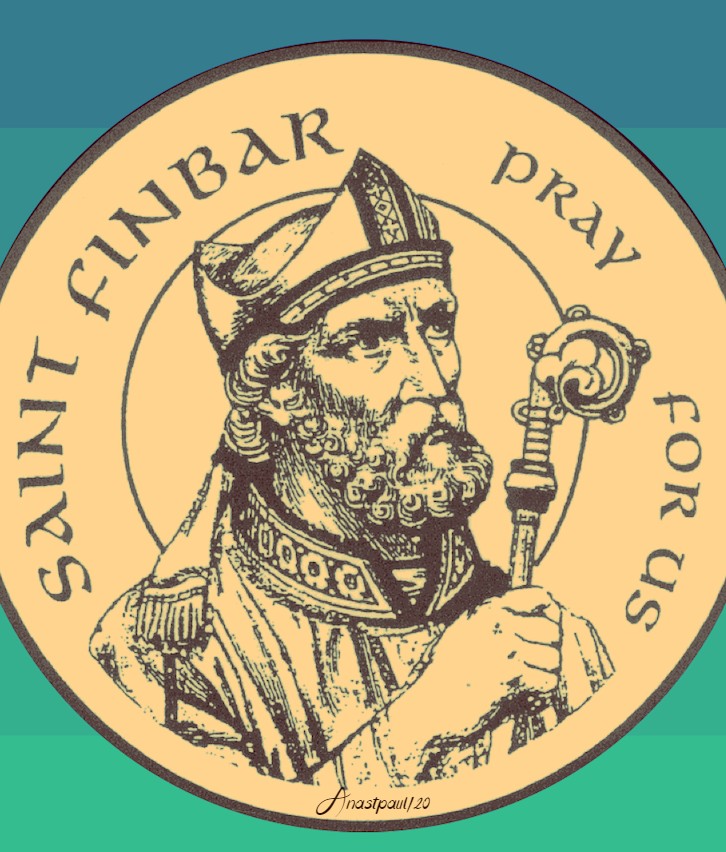
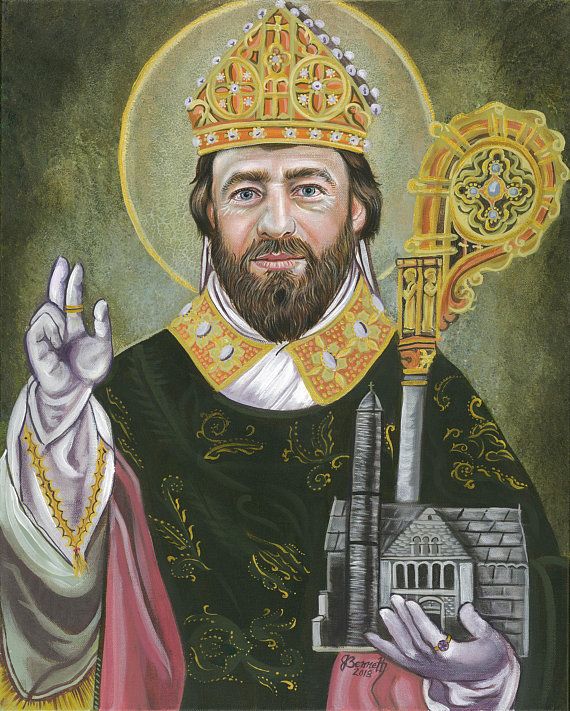
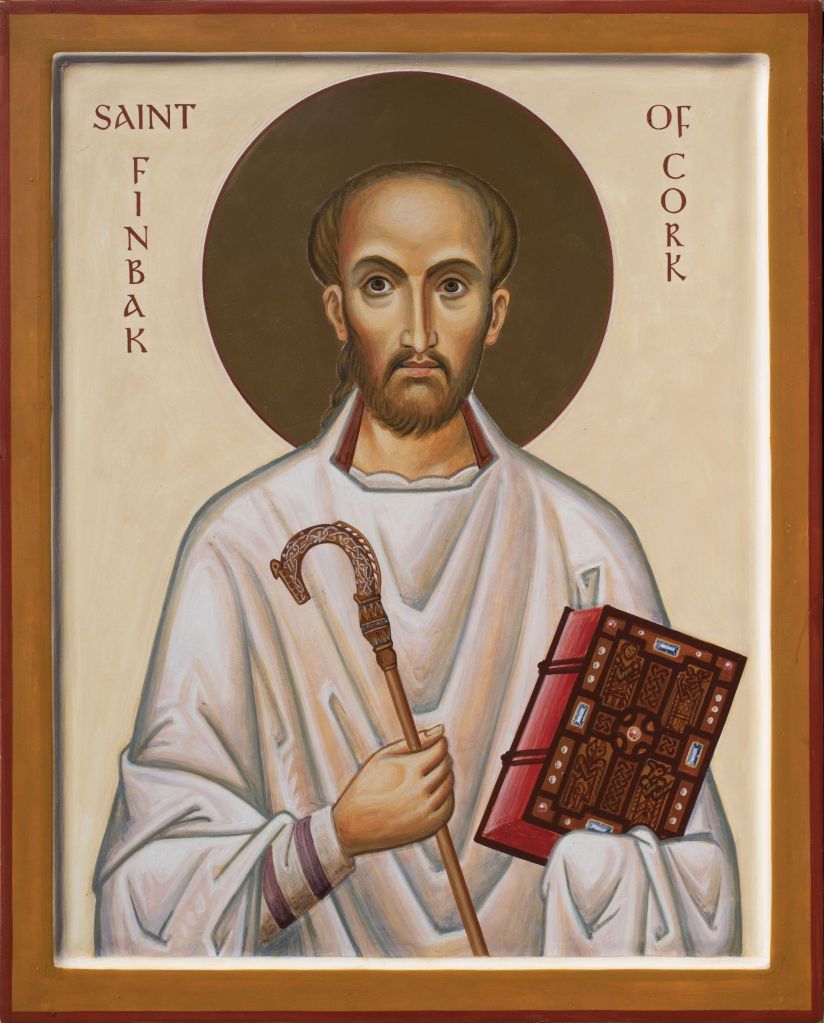
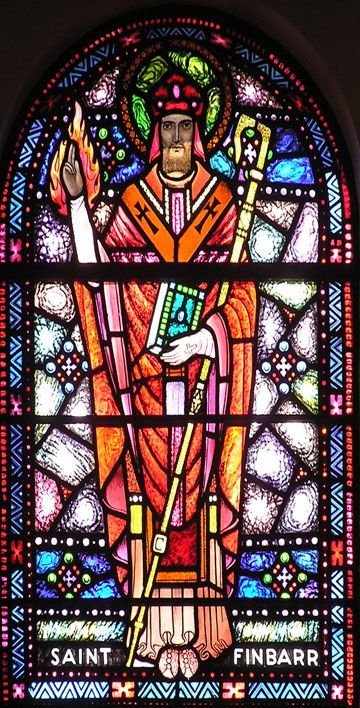
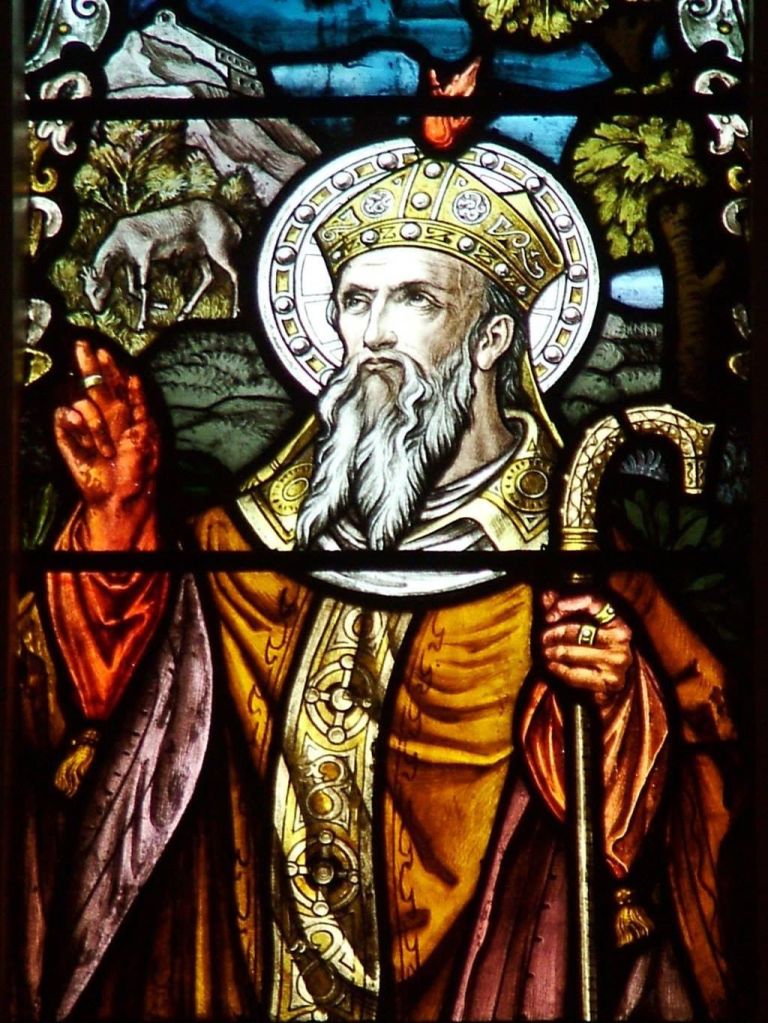
Saint of the Day – 25 September – Saint Finbar of Cork (c 550– 623) Bishop of Cork and Abbot – born in c 550 at Connaught, Ireland as Lóchán and died on 25 September 623 at Cloyne, Ireland of natural causes. Patronages – City and Diocese of Cork, Ireland, Barra in Scotland. Finbar is also known as Bairre, Barr, Barrocus, Finbarr, Findbar, Finnbarr, Fionnbharr, Lochan, Finbarro.
Several lives of this saint have been written. According to these, the saint’s original name was Lóchán but when he went as a young man, to be tonsured as a Monk for the first time, the man shaving his head said: “The hair of this servant of God is beautiful.” Another said: “You have spoken well, because his name will be changed and he shall be called Finn-barr, that is ‘beautiful hair’, from the beautiful head he offered in sacrifice to God.” So he was called Finbar by some and Barra by others, Barra being generally used in the Irish language.
Finbar was the son of a metal-worker. He studied in the Monastic school and was Ordained. On completion of his education he returned home and lived for some time on an island in the small lake then called Loch Irce. He founded a number of schools in the surrounding area. He did not hesitate to join in the manual work of constructing the buildings for his community.
He went on Pilgrimage to Rome with some of the monks, visiting St David in Wales on the way back. Whilst there are also many places in Scotland that have the name Barra this is probably more due to missionary journeys made by Finbar’s disciples than to journeys made by himself.
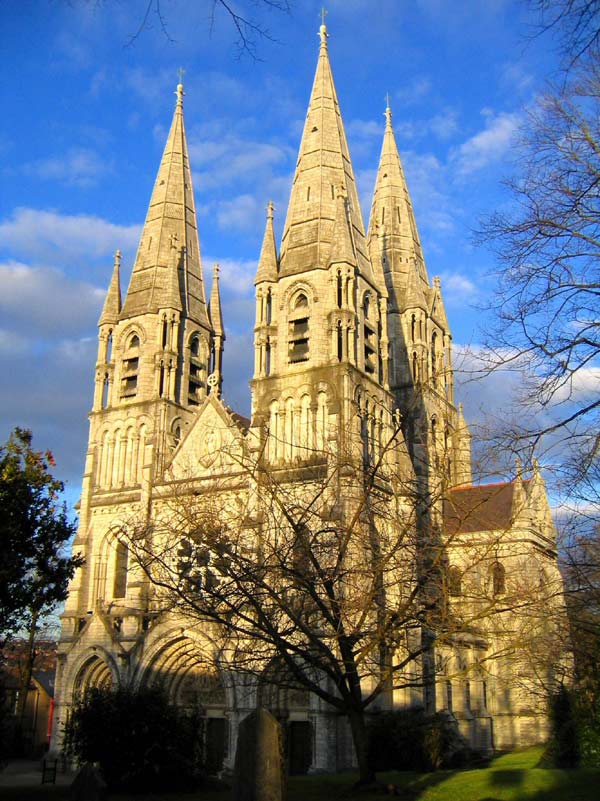
He settled for about the last seventeen years of his life as Bishop, in the area then known as the Great Marsh of Munster, now the City of Cork, where he gathered around him monks and students. This became an important centre of learning, giving rise to the phrase, “Where Finbar taught, let Munster learn” which is now the motto of today’s University of Cork.
The Church and Monastery he founded in 606 were on a limestone cliff above the River Lee, an area now known as Gill Abbey. It continued to be the site of the Cathedral of his Diocese.
Finbar died at Cell na Cluaine, while returning from a visit to Gougane Barra. He was buried in the cemetery attached to his Cathedral in Cork.
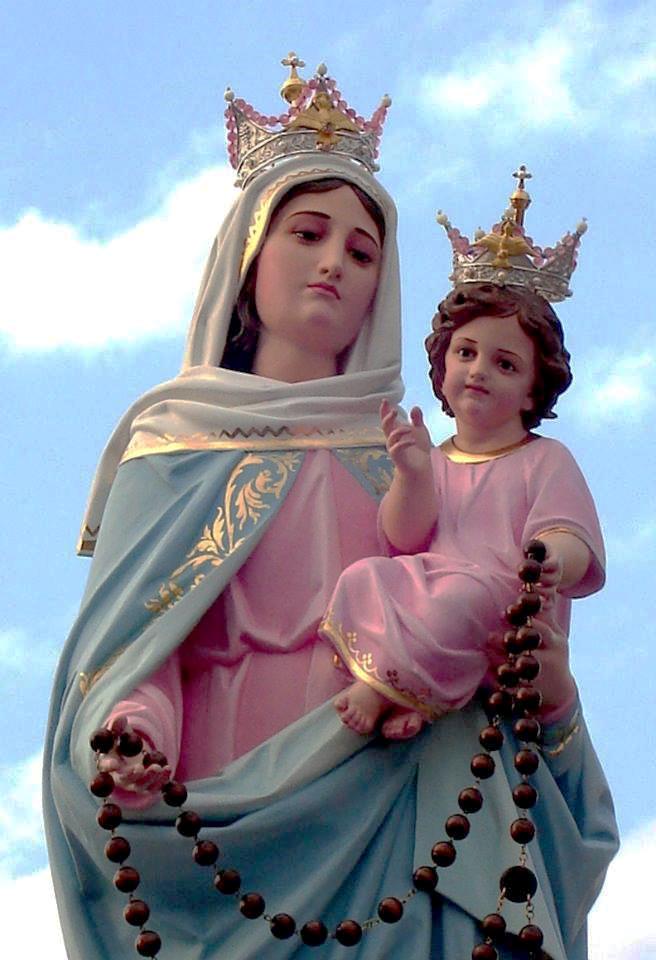
Santa Maria del Rosario / Our Lady of the Rosary, San Nicolás, Buenos Aires, Argentina (1983) – 25 September:
An ordinary housewife, a mother and grandmother who had no formal education and no knowledge of the Bible or theology claimed that she was visited by the Blessed Mother daily for a period of over 6 years. She reportedly additionally received 68 messages from Jesus Christ. Numerous healings, including the cure of a boy with a brain tumour, have been documented.
Every 25 September, the city of San Nicolás hosts hundreds of thousands of pilgrims and faithful who meet to venerate and honour the statue of Our Lady of the Rosary of St Nicholas. In 2003, on the twentieth anniversary of the first apparition of Our Lady, the second largest group ever congregated – 400,000 faithful. Pilgrims came from all the provinces of Argentina, with a group of more than 1,000 people from Buenos Aires who travelled the whole 240 km distance on foot – a distance three times greater than that from Buenos Aires to the national Basilica of Our Lady of Luján. On 25 September 2013, thirty years after the first apparition of Our Lady, 500,000 people gathered surpassing the record of 2004 when the greatest number of pilgrims visited.
In a decree signed on 22 May 2016 and made public a few days later, Héctor Cardelli, Bishop of the Diocese of San Nicolás, declared that the apparitions that took place in city of San Nicolás were supernatural in origin. The devotion is thus approved at the Diocesan level within the Catholic Church.
Martyrs of Damascus: A Christian family of six who were tortured to death in a persecution by Roman authorities. They were: Eugenia, Maximus, Paul, Rufus, Sabinian and Tatta. They were tortured to death in Damascus, Syria, date unknown.
Martyred in the Spanish Civil War: • Blessed Jose María Bengoa Aranguren • Blessed Josep Maria Vidal Segú • Blessed Juan Agustín Codera Marqués • Blessed Julio Esteve Flors • Blessed Pedro Leoz Portillo • Blessed Rafael Pardo Molina • Blessed Tomás Gil de La Cal
Feast of the Holy Bishops of Milan – a 1st Century Diocese!
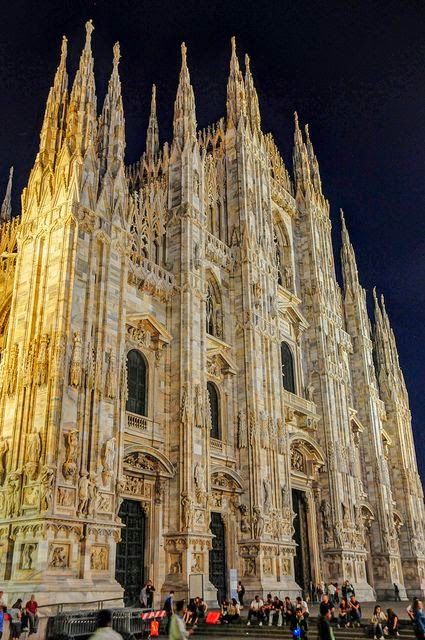
Imagine being part of a diocese in which 37 of your past bishops are saints and some are also Doctors of the Church and Popes (and others being considered for sanctity)! The latest addition to this illustrious role-call, is Pope Paul VI. Today, the Church in Milan commemorates these holy bishops. They are: • Blessed Alfredo Ildefonso Schuster • Blessed Andrea Carlo Ferrari • Pope Pius XI • Saint Ambrose of Milan • Saint Ampelius of Milan • Saint Anathalon of Milan • Saint Antoninus of Milan • Saint Auxanus of Milan • Saint Benedict Crispus of Milan • Saint Benignus of Milan • Saint Calimerius of Milan • Saint Castritian of Milan • Saint Charles Borromeo • Saint Datius of Milan • Saint Dionysius of Milan • Saint Eugene of Milan • Saint Eusebius of Milan • Saint Eustorgius II of Milan • Saint Eustorgius of Milan • Saint Gaius of Milan • Saint Galdinus of Milan • Saint Geruntius of Milan • Saint Glycerius of Milan • Saint Honoratus of Milan • Saint John Camillus the Good • Saint Lazarus of Milan • Saint Magnus of Milan • Saint Mansuetus of Milan • Saint Marolus of Milan • Saint Martinian of Milan • Saint Mirocles of Milan • Saint Mona of Milan • Saint Natalis of Milan • Saint Pope Paul VI • Saint Protasius of Milan • Saint Senator of Milan • Saint Simplician of Milan • Saint Venerius of Milan
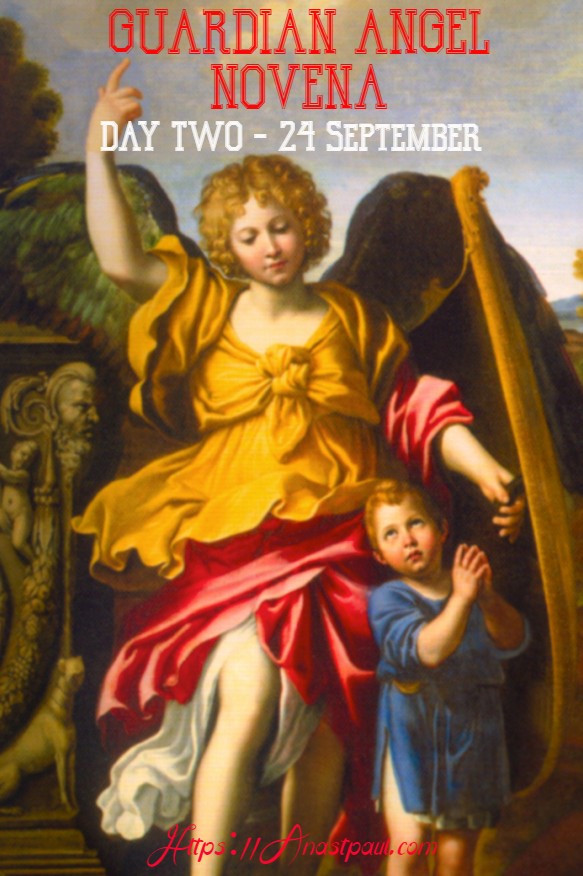
Novena to Our Angel Guardian – Day Two – 24 September (Indulgence of 300 days, each day of the Novena)
Opening Prayer
Deus in adjutorium: V/. O God +, come to my assistance R/. O Lord, make haste to help me.
Gloria Patri…
DAY II.
Most mighty spirit, my angel-guardian, I pray thee, by that supreme felicity thou dost enjoy in seeing God without a veil, even whilst watching over me, obtain for me grace to walk without ceasing in the presence of God, so that I may live as a perfect Christian till my last breath. And this special intention of virtue which I make unto thy prayers …………………….. (the special virtue you desire).Amen
Thought for the Day – 24 September – Meditations with Antonio Cardinal Bacci (1881-1971)
Depending Always on Jesus
Virtue is difficult and life holds more trials than consolations. Sometimes, we feel discouraged because virtue seems impossible and we fall so often, in spite of our best resolutions or because, our cross seems too heavy and we feel that we are overburdened.
Where will we find comfort in our sufferings and strength in our weakness? “Come to me, all you who labour and are burdened and I will give you rest” (Mt 11:28). Go to Jesus and depend always on Him.
Difficulties will be overcome, the cross will grow lighter, the pain will be less severe, if we rely always on Jesus. Isaias, the Prophet, placed these words on the lips of God: “I have made you and I will bear-I will carry and I will save” (Is 46:3). At that time, Jesus had not yet come; He was not yet present among us with His doctrine, with His consoling spirt and with His Divine Eucharist. Now things are different; we have Emmanuel, God with us! Why, therefore, do we not allow ourselves to be carried by Him? It is necessary for us to allow ourselves to be “Carried by the grace of God,” (Bk II, Ch 9) as The Imitation of Christ puts it.
If God is with us, who or what can prevail against us?
We must, as St Francis de Sales writes, lean on the arm of Jesus, as the child leans securely on the arm of it’s mother. “It matters little,” he adds, “where she walks, on a grassy plain or on a steep path surrounded by precipices.” She, is his mother and she carries him; that is enough to make him happy and content. We must trust Jesus in this way, relying always on His support in joy and in sorrow, in moments of trial and in moments of satisfaction, in life and in death. Let us not be afraid; Jesus is better and stronger than our earthly mother. If He guides and supports us, we can be sure of Heaven, no matter what happens!”
Quote/s of the Day – 24 September – Thursday of the Twenty Fifth week in Ordinary Time, Readings: Ecclesiastes 1:2-11, Psalms 90:3-4, 5-6, 12-13, 14 and 17, Luke 9:7-9
“… Who is this about whom I hear such things?” And he sought to see him.”
Luke 9:9
“Come to me, all you who labour and are burdened and I will give you rest. ”
Matthew 11:28
“Through Him, our gaze penetrates the heights of heaven and we see, as in a mirror, the most holy face of God. Through Christ, the eyes of our hearts are opened and our weak and clouded understanding, reaches up toward the light.”
St Pope Clement I (c 35-99) Apostolic Father, Bishop of Rome and Martyr
“He who calls us, came here below, to give us the means of getting there. He chose the wood that would enable us to cross the sea – indeed, no-one can cross the ocean of this world, who is not borne by the Cross of Christ. Even the blind can cling to this Cross. If you can’t see where you are going very well, don’t let go of it, it will guide you by itself. ”
“Do you desire security? Here you have it. The Lord says to you, “I will never abandon you, I will always be with you.” If a good man made you such a promise, you would trust him. God makes it and do you doubt? Do you seek a support, more sure than the word of God, which is infallible? Surely, He has made the promise, He has written it, He has pledged His word for it, it is most certain!”
St Augustine (354-430) Father and Doctor of Grace
“Rest is in Him alone. Man knows no peace in the world but he has no disturbance when he is with God.”
St Bernard of Clairvaux (1090-1153) Mellifluous Doctor
“If you learn everything, except Christ, you learn nothing. If you learn nothing, except Christ, you learn everything.”
St Bonaventure (1221-1274) Seraphic Doctor of the Church
“Only one thing is necessary: Jesus Christ! Think unceasingly of Him. ”
St John Gabriel Perboyre CM (1802-1840) Martyr for Christ
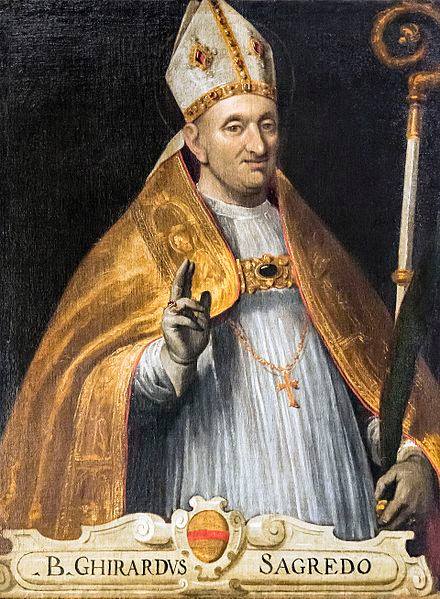
One Minute Reflection – 24 September – Thursday of the Twenty Fifth week in Ordinary Time, Readings: Ecclesiastes 1:2-11, Psalms 90:3-4, 5-6, 12-13, 14 and 17, Luke 9:7-9 and the Memorial of St Gerard Sagredo OSB (980-1046) Bishop and Martyr
“… Who is this about whom I hear such things?” And he sought to see him.” … Luke 9:9
REFLECTION – “He who wishes for anything but Christ, does not know what he wishes; he who asks for anything but Christ, does not know what he is asking; he who works and not for Christ, does not know what he is doing.” … St Philip Neri (1515-1595)
PRAYER – Shepherd of Your Church and we, the sheep of Your flock, who follow You and hear and do Your Word. Support us with grace those who are constantly striving to do Your will, so that following the example of the humble fiat of Your blessed Mother and ours, we may devote all our powers and talents to love of You and our neighbour and finally arrive safely in our heavenly home. May the prayers of St Gerard Sagredo, your faithful servant, be assistance in strengthening us in this vale of tears. In God, our Father we pray through You who live in union with Him and the Holy Spirit, one God, for ages and ages. Amen
Our Morning Offering – 24 September – Thursday of the Twenty Fifth week in Ordinary Time
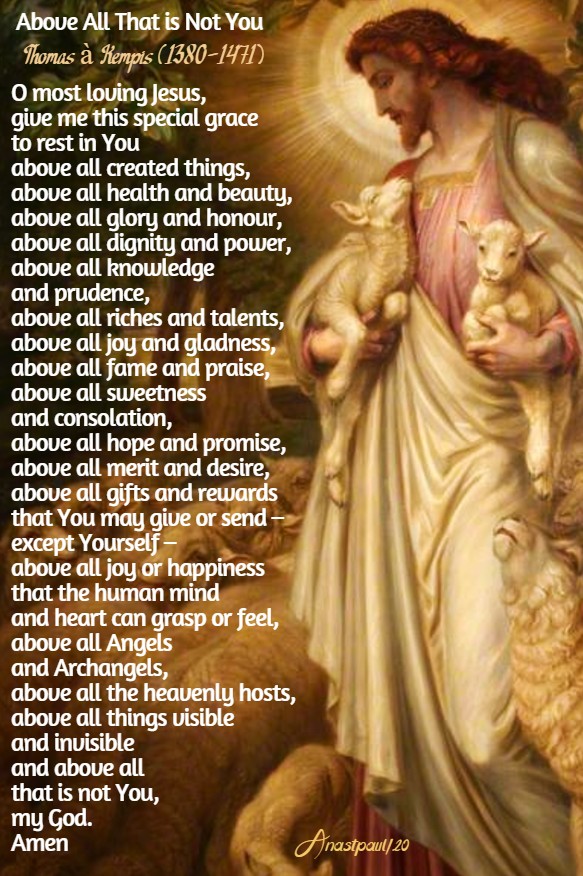
Above All That is Not You Thomas à Kempis (1380-1471)
O most loving Jesus, give me this special grace to rest in You above all created things, above all health and beauty, above all glory and honour, above all dignity and power, above all knowledge and prudence, above all riches and talents, above all joy and gladness, above all fame and praise, above all sweetness and consolation, above all hope and promise, above all merit and desire, above all gifts and rewards that You may give or send – except Yourself – above all joy or happiness that the human mind and heart can grasp or feel, above all Angels and Archangels, above all the heavenly hosts, above all things visible and invisible and above all that is not You, my God. Amen
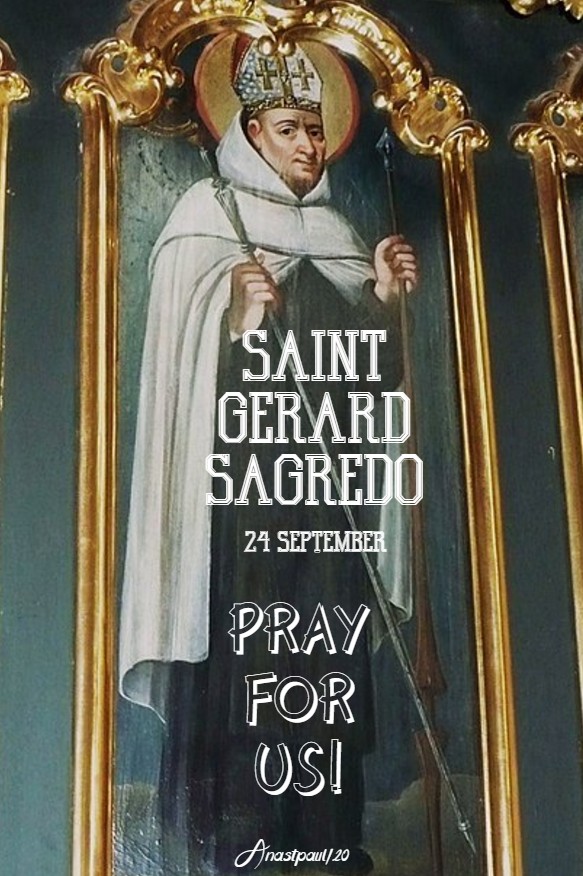
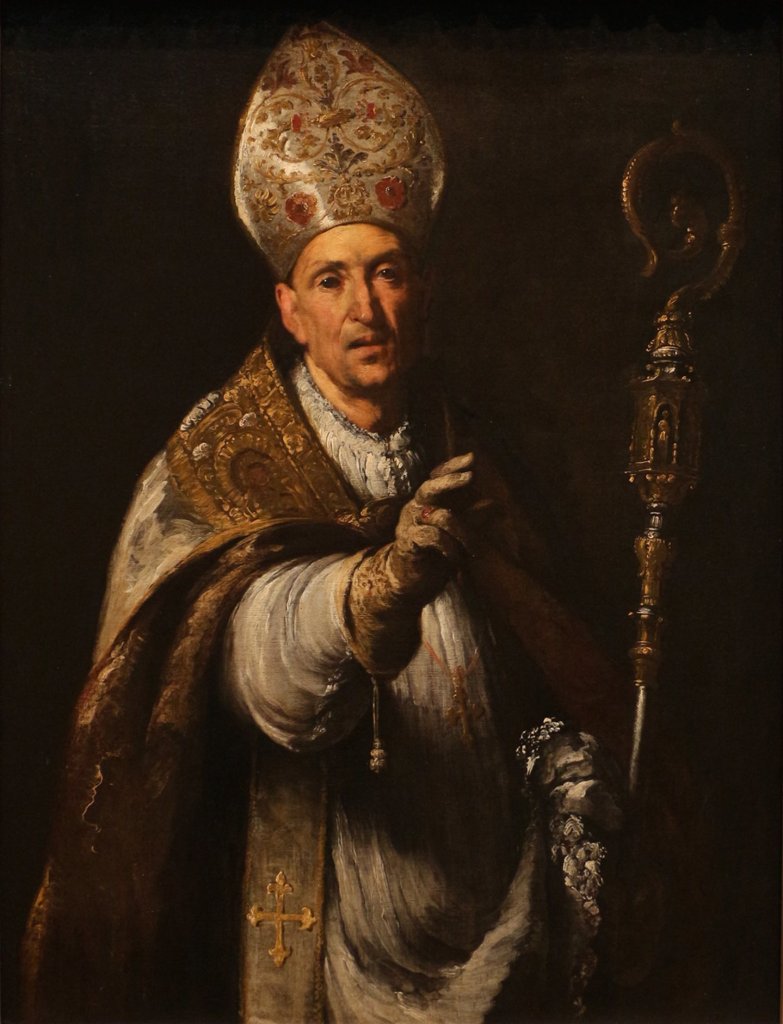
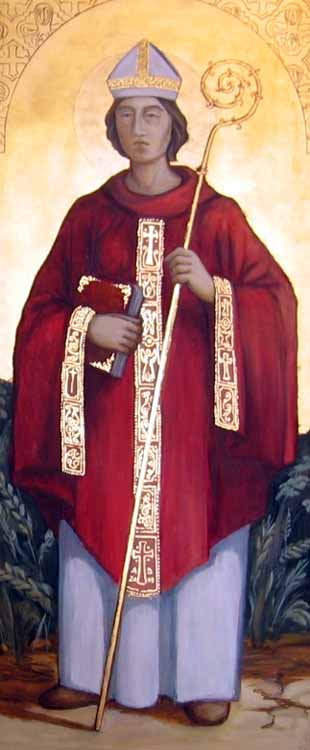
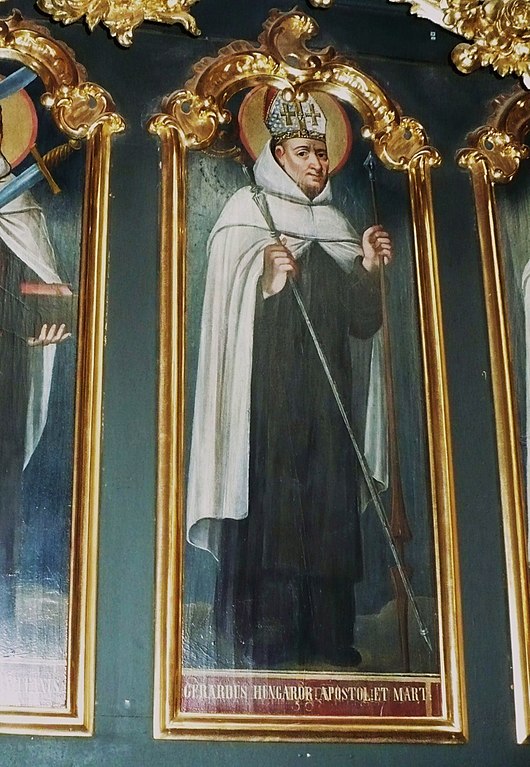
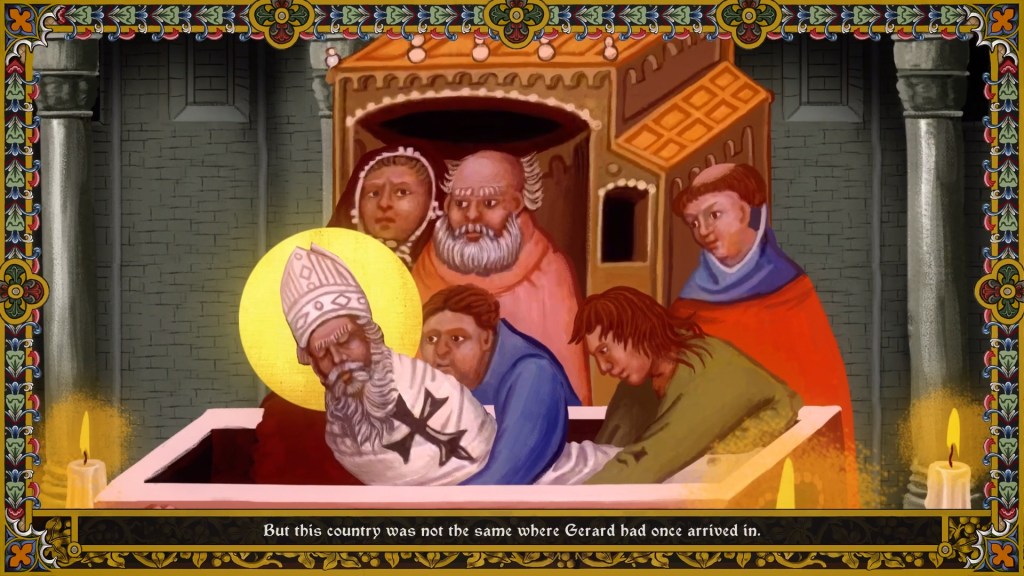
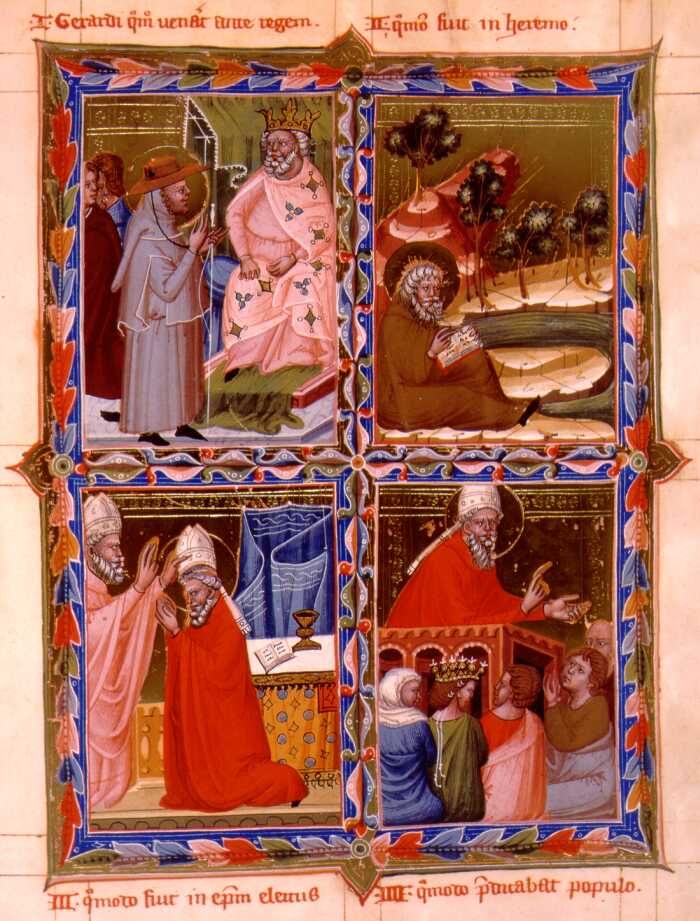
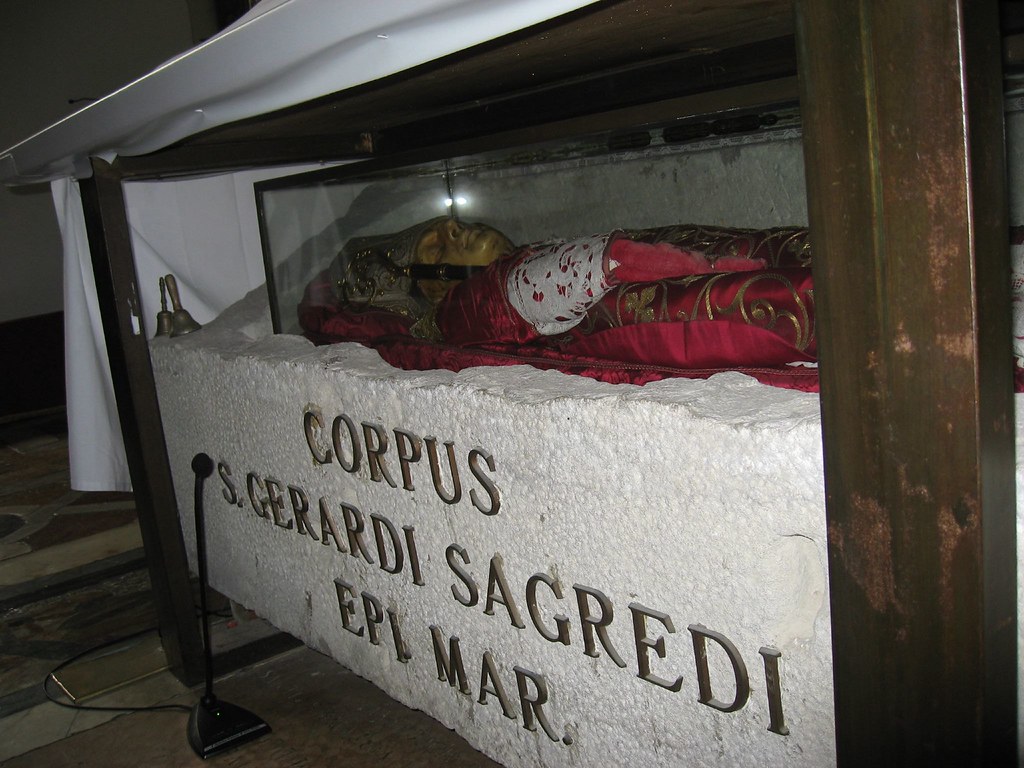
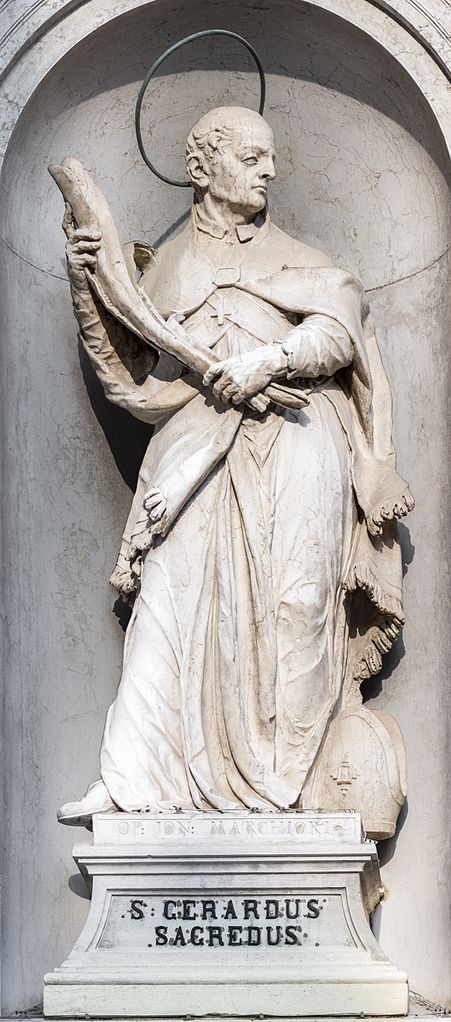
Saint of the Day – 24 September – Saint Gerard Sagredo OSB (980-1046) Bishop and Martyr, “The Apostle of Hungary,” Venetian nobleman, Benedictine monk, Prior of San Giorgio, Missionary to Hungary, Adviser to King Saint Stephen, Tutor to Prince Saint Emeric, Hermit, Bishop of Csanád, Writer, Reformer and Martyr, murdered by pagans on this day in 1046. Born on 23 April 980 in Venice, Italy and died by being stabbed to death with a lance on 24 September 1046 at Buda, Hungary. Also known as Gerard of Hungary, Collert, Gerardo, Gellért.
At Baptism he received the name Jorge and belonged to a family from Dalmatia, which is descended from the Sagredo lineage. At the age of 5 he had a serious fever that his parents implored the grace of Saint George to heal.
Once cured and he had reached the required age, he entered the Benedictine Monastery of San Giorgio Maggiore on the Maggiore Island in Venice and in memory of his recently deceased father, he took the name Gerard. After a few years he was elected Prior of the Monastery and later Abbot but shortly after he resigned because he wanted to go on pilgrimage to Bethlehem.
He left in a ship, reached Zara, from where instead of continuing to the Holy Land, he went to Hungary where he settled. He was persuaded by Saint Stephen of Hungary to work in the evangelisation of the Magyars. However, he did not want to stay at the Court and for seven years he lived as a Hermit in the Beel.
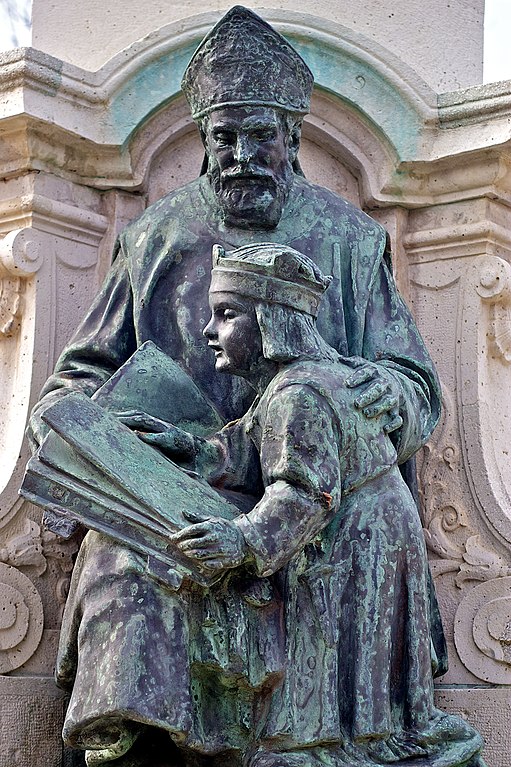
Later he was Tutor to Prince Saint Emeric and in 1035, he was elected the first Bishop of Csnád; he worked with the utmost zeal, especially in liturgical observance and in the evangelisation of the people; they called him the Apostle of Hungary.
St Gerard with St Emeric
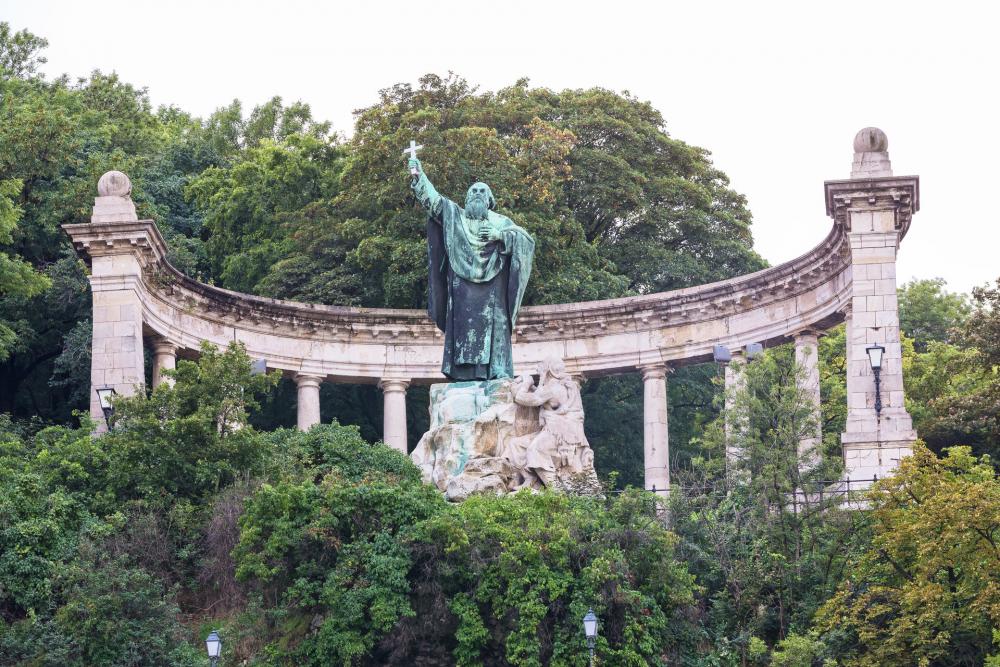
During the pagan reaction to the death of King Saint Stephen, he was martyred in Buda, where he was stoned and pierced by spears, locked in a barrel, he was thrown into the Danube from the top of a hill that today is called “Gellerthegy” – “Mount of San Gerard”; Gerard had refused to crown idolatrous kings.
Martyrdom of St GerardLife of St Gerard
He wrote several works among which the “Commentary on Daniel” is the most higly revered. He is considered the Apostle and Protomartyr of Hungary.
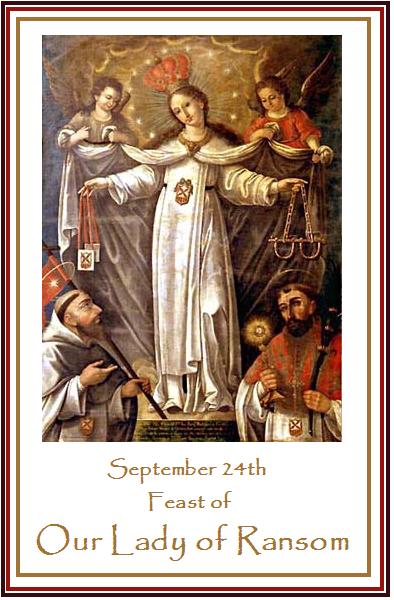
Nuestra Señora de las Mercedes / Our Lady of Mercy/Our Lady of Ransom, Barcelona, Spain (1218) – 1 August, 10 August – The Founding of the Mercedarian Order and 24 September:
Commemorates the foundation of the Mercedarian Order and the apparition of Our Lady of Ransom. In this appearance she carried two bags of coins for use in ransoming Christians imprisoned by Moors. On 10 August 1218, the Mercedarian Order was legally constituted at Barcelona, Spain by King James of Aragon and was approved by Pope Gregory IX on 17 January 1235. The Mercedarians celebrated their institution on the Sunday nearest to 1 August because it was on 1 August 1218 that the Blessed Virgin showed Saint Peter Nolasco the white habit of the Order. This custom was approved by the Congregation of Rites on 4 April 1615. On 22 February 1696 it was extended to the entire Latin Church and the date changed to 24 September. St Peter Nolasco (1189-1256) was the Founder of the Mercedarian Order – Memorial 28 January. Patronages – Bahía Blanca, Argentina, archdiocese of, Barcelona, Spain, Dominican Republic.
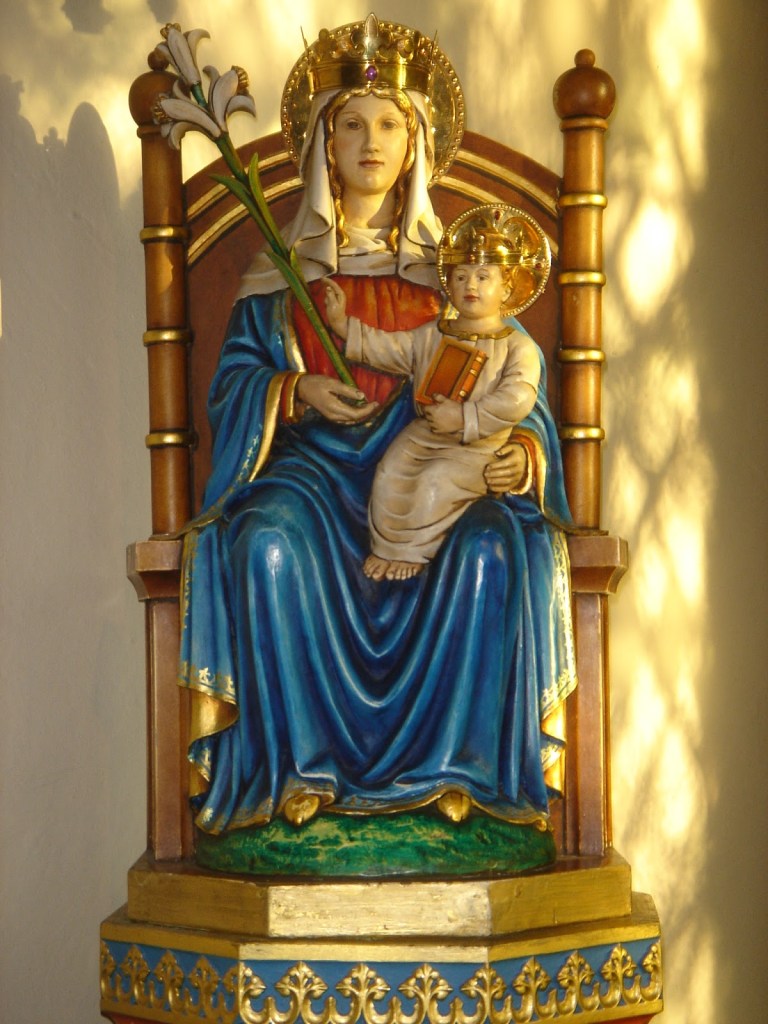
Our Lady of Walsingham / Virgin of the Sea (1061) – 24 September: In 2012 the Personal Ordinariate of the Chair of Saint Peter for Anglicans joining the Church was given its Patron as the Blessed Virgin Mary under the title Our Lady of Walsingham. Patronages – England,East Anglia, England, diocese of, Personal Ordinariate of the Chair of Saint Peter.
St Chuniald Bl Colomba Matylda Gabriel St Coprio St Erinhard St Felix of Autun St Gerard Sagredo OSB (980-1046) Bishop and Martyr, “The Apostle of Hungary” St Geremarus St Gislar St Isarnus of Toulouse St Lupus of Lyons St Pacificus of Severino OFM (1653-1721) His Life: https://anastpaul.com/2019/09/24/saint-of-the-day-24-september-saint-pacificus-of-severino-ofm-1653-1721/ St Paphnutius of Egypt Bl Robert Hardesty St Rusticus of Clermont St. Rupert of Salzburg St Terence of Persaro St Thyrsus of Autun St Ysarn of Saint Victor Bl William Spenser — Martyrs of Chalcedon – (49 saints): Forty-nine Christian choir singers of the church in Chalcedon in Asia Minor who were martyred together in their persecutions of Diocletian in 304.
Martyred in the Spanish Civil War: • Blessed Antonio Pancorbo López • Blessed Esteban García y García • Blessed José María Ferrándiz Hernández • Blessed Juan Francisco Joya Corralero • Blessed Luis de Erdoiza Zamalloa • Blessed Manuel Gómez Contioso • Blessed Melchor Rodríguez Villastrigo • Blessed Pascual Ferrer Botella • Blessed Rafael Rodríguez Mesa • Blessed Santiago Arriaga Arrien
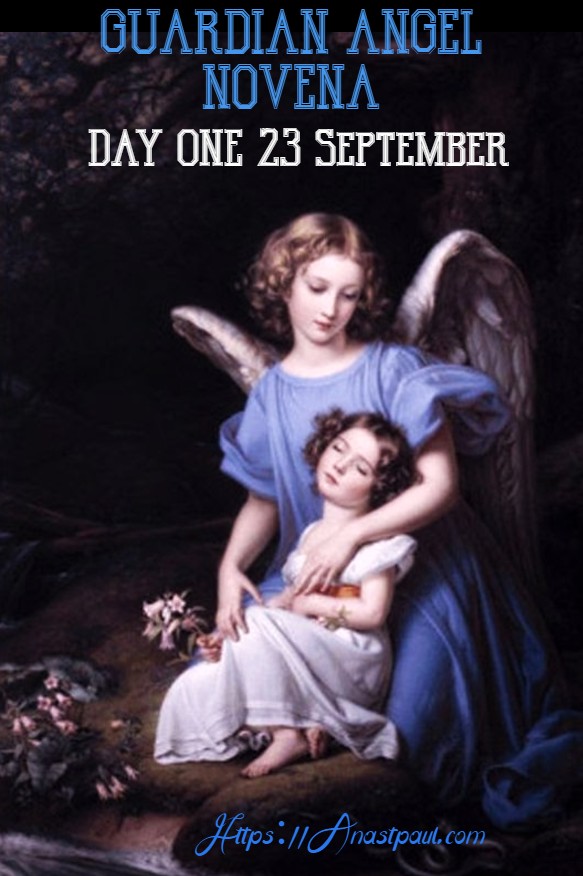
Novena to Our Angel Guardian – Day One – 23 September (Indulgence of 300 days, each day of the Novena)
Opening Prayer
Deus in adjutorium: V/. O God +, come to my assistance R/. O Lord, make haste to help me.
Gloria Patri…
DAY I.
O most powerful angel, thou who art my guardian, I beseech thee, by the sovereign hatred thou hast for sin because it offends God, Whom you love with a pure and perfect love, obtain for me a sincere and lasting sorrow for my sins and an implacable hatred against all sin, of what kind soever, so that I may never more offend my God, till the last moment of my life. And this special intention of virtue which I make unto thy prayers …………………….. (the special virtue you desire).
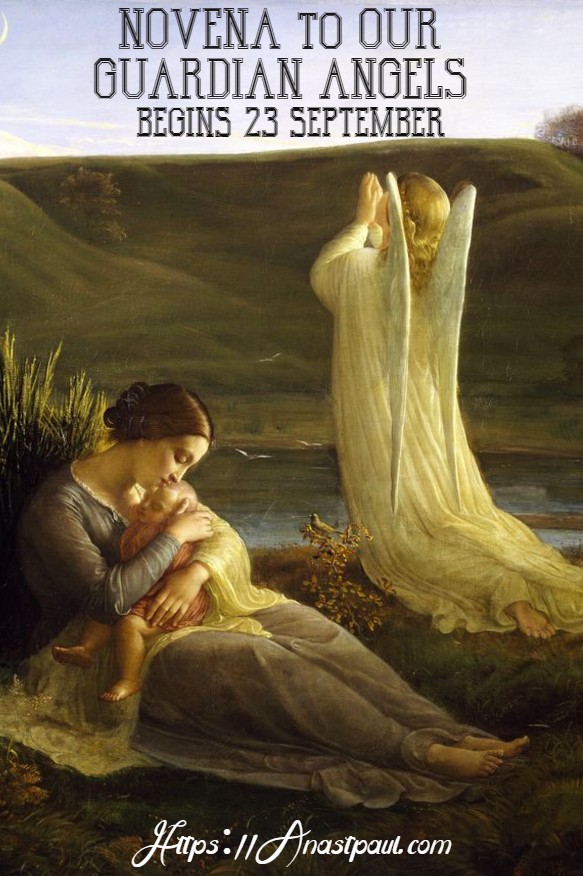
The Novena to our Guardian Angels begins on 23 September in preparation for the Guardian Angels Feast day on 2 October
Guardian Angels are real! “The existence of the spiritual, non-corporeal beings that Sacred Scripture usually calls “angels” is a truth of faith. The witness of Scripture is as clear as the unanimity of Tradition.” (Catechism of the Catholic Church 328) There are countless examples of angels throughout Scripture. They ministered to everyone from shepherds, to Jesus Himself.
“Beside each believer stands an angel as protector and shepherd leading him to life.” – St Basil. Guardian angels are not something that we have to share. They are so valuable to our spiritual wellbeing, that God has blessed us all with our own. “Great is the dignity of the human soul, since each one of them has from the very outset of his life, an Angel deputed to safeguard him.” – St Jerome
“Are they not all ministering spirits, sent out to render service for the sake of those who will inherit salvation?” (Hebrews 1:14) Our Guardian Angels protect us from evil, assist us in prayer, lead us to choose good and represent us before God. They are able to act upon our senses and our imaginations but not our will. They cannot chose for us but, encourage us in every way possible, to choose what is true, good and beautiful.
“Christ is the centre of the angelic world. They are His angels: “When the Son of man comes in His glory and all the angels with Him.” (Mt 25:31 – CCC 331)
Angels are superior to man because although they are sent here to serve us, they are constantly in the presence of God. They are endowed with many spiritual powers and capabilities that humans are not given. Don’t think of your angel as a pretty cherub. They are prayerful and powerful and they stand beside you, to protect, defend and guard you.
Thought for the Day – 18 September – Meditations with Antonio Cardinal Bacci (1881-1971)
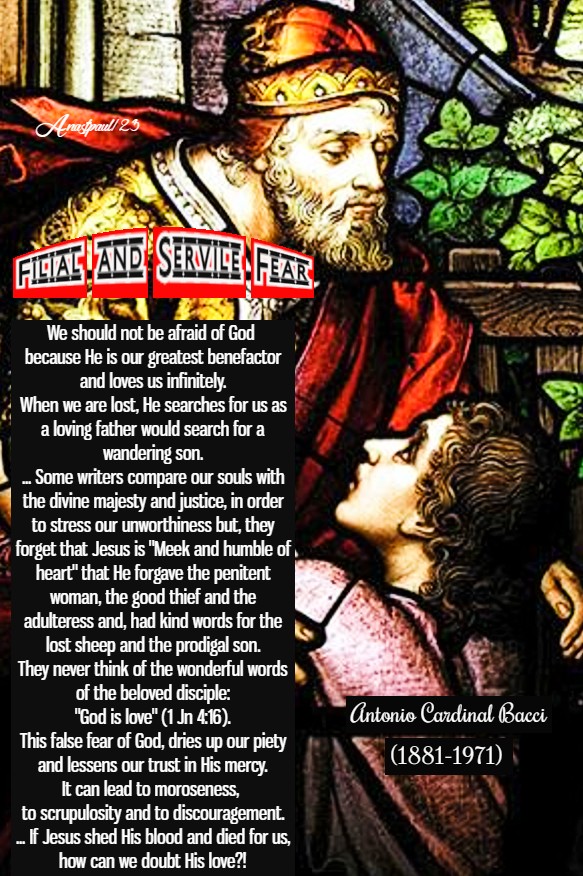
Filial and Servile Fear
“We should not be afraid of God because He is our greatest benefactor and loves us infinitely. When we are lost, He searches for us as a loving father would search for a wandering son. Because they think only of the majesty and justice of God, some people keep themselves at a distance from Him, as Adam did, after he had sinned. They forget that the Lord told Adam, the sinner, of the coming of the pardoning Redeemer (Gen 3:9). Bossuet truly observes, that “after the curse which came upon men through sin, there has always remained, in their hearts, a certain dread of the supernatural, which prevents them from approaching God with confidence.” Jansenism increased this fear, emphasising the justice and majesty of God, rather, than the infinite love of Jesus and the beauty of His teaching.
Some writers compare our souls with the divine majesty and justice, in order to stress our unworthiness but, they forget, that Jesus is “Meek and humble of heart,” that He forgave the penitent woman, the good thief and the adulteress and, had kind words for the lost sheep and the prodigal son. They never think of the wonderful words of the beloved disciple: “God is love” (1 Jn 4:16).
This false fear of God, dries up our piety and lessens our trust in His mercy. It can lead to moroseness, to scrupulosity and to discouragement.
We should avoid this excessive fear which separates us from God. Even though we are sinful and unworthy, we should remember, that God is our loving Father, Who is always ready to help us and to grant us forgiveness. We should recall, moreover, that out of love for us, He did not spare His own Son, (Cf Rom 8:32) but gave Him to us for our redemption. If Jesus shed His blood and died for us, how can we doubt His love?!“
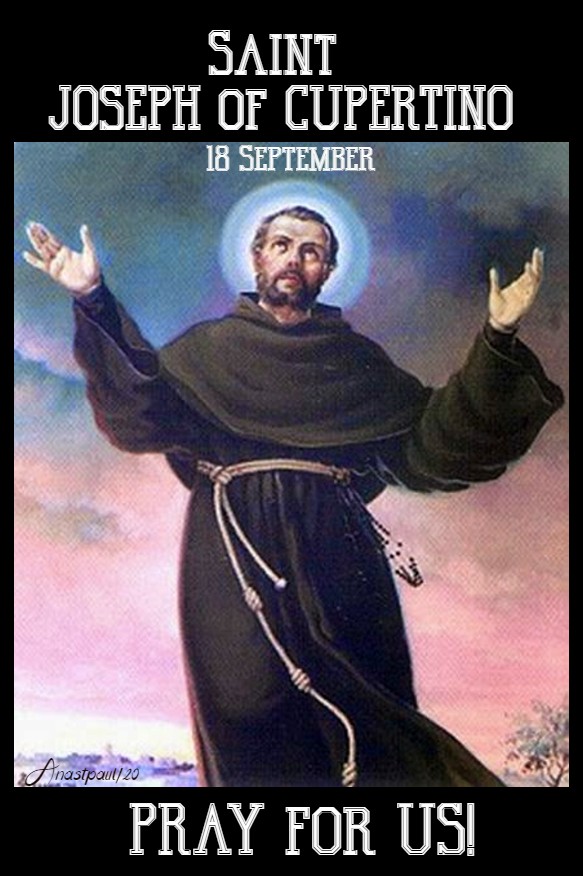
Quote/s of the Day – 18 September – The Memorial of St Joseph of Cupertino OFM Conv. (1603-1663)
Free Will – “Our Unique Possession”
“Clearly, what God wants, above all, is our will, which we received as a free gift from God in creation and possess as though our own. When a man trains himself to acts of virtue, it is with the help of grace from God, from whom all good things come … The will is what man has, as his unique possession.”
St Joseph of Cupertino (1603-1663)
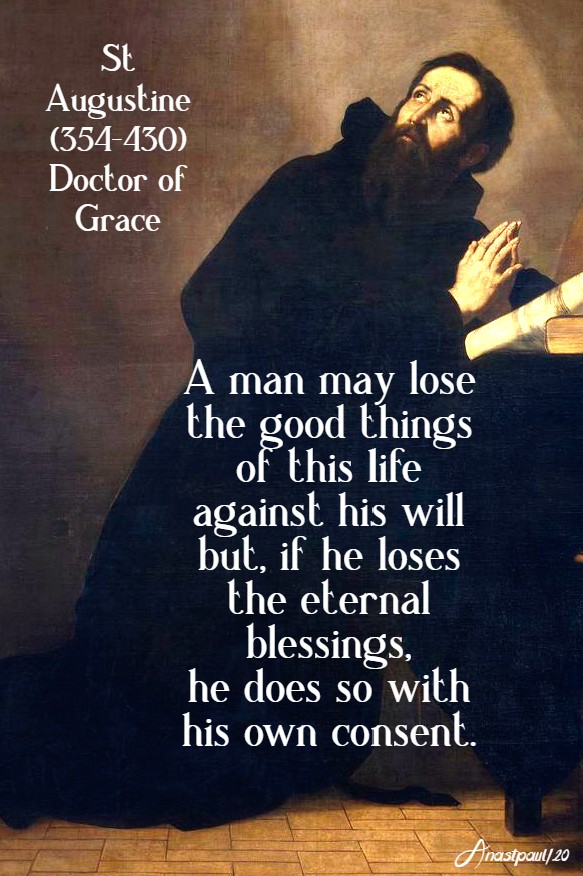
“A man may lose the good things of this life against his will but, if he loses the eternal blessings, he does so with his own consent.”
St Augustine (354-430) Father and Doctor of Grace
“God desires, not death but faith. God thirsts, not for blood but for self-surrender. God is appeased, not by slaughter but by the offering of your free will.”
St Peter Chrysologus (c 400-450) Bishop, Father & Doctor of Homilies
“Remove grace and you have nothing, whereby to be saved. Remove free will and you have nothing, that could be saved.”
St Anselm (1033-1109) Doctor of the Church
“Lord what will Thou have me do? Behold the true sign of a totally perfect soul – when one has reached the point of giving up his will so completely that he no longer seeks, expects or desires to do ought but that which God wills.”
St Bernard (1090-1153) Mellifluous Doctor
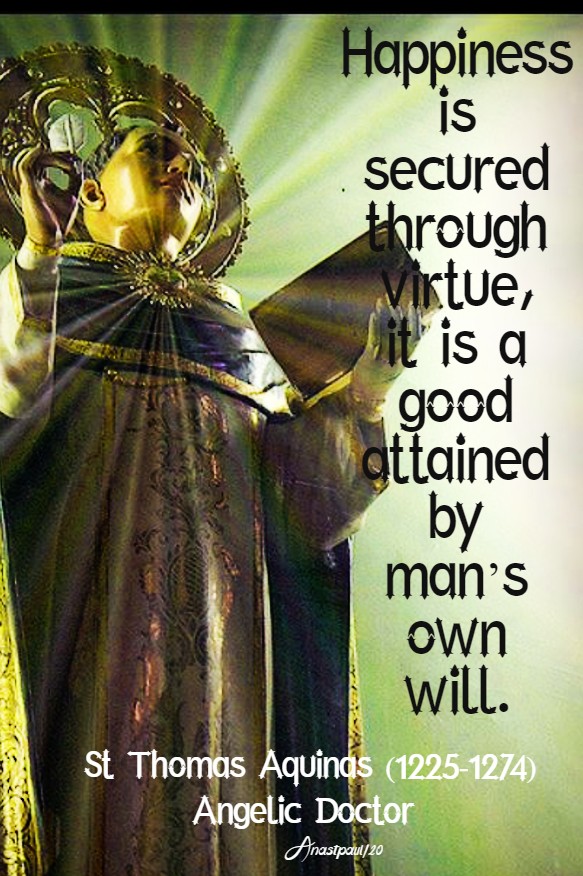
“Happiness is secured through virtue, it is a good attained by man’s own will.”
St Thomas Aquinas (1225-1274) Angelic Doctor
“But do not forget, that all the saints cannot endear you to Christ as much as you can yourself. It is entirely up to you!”
St Cajetan (1480-1547)
“More determination is required to subdue the interior man than to mortify the body and to break one’s will, than to break one’s bones.”
St Ignatius Loyola (1491-1556)
“A man makes the most progress and merits the most grace, precisely in those matters, wherein he gains the greatest victories over self and most mortifies his will.”
St Francis de Sales (1567-1622) Doctor of Charity
“I will attempt, day-by-day, to break my will into pieces. I want to do God’s Holy Will, not my own!”
By St Gabriel Francis Possenti of Our Lady of Sorrows (1838-1862)
One Minute Reflection – 18 September – Friday of the Twenty Fourth week in Ordinary Time, Readings: 1 Corinthians 15:12-20, Psalms 17:1, 6-7, 8 and 15, Luke 8:1-3 and the Memorial of St Joseph of Cupertino OFM Conv. (1603-1663)
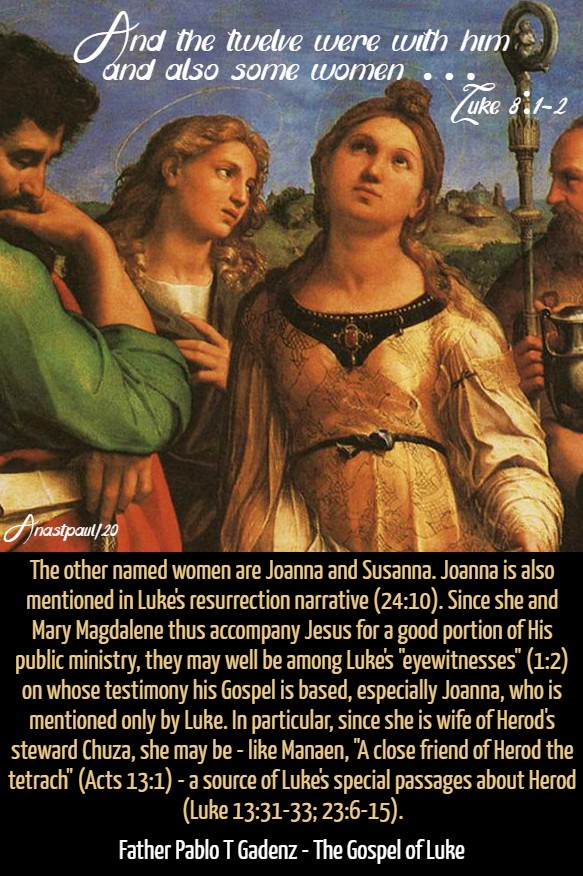
And the twelve were with him and also some women … Luke 8:1-2
REFLECTION – “Also with Jesus are some women… these women from Galilee will follow Jesus, even to His death and buriel (Lk 23:49,55-56) and will be the ones who discover the empty tomb, hear the announcement of the resurrection and report it to the apostles (Lk 24:1-11). Three are named here, though there are many others. Most familiar is Mary, called Magdalene, who is mentioned again in Luke’s resurrection narrative (24:10) and frequently in the other Gospels. She is from Magdala, a fishing town on the western shore of the lake. Jesus had freed her from a severe case of possession by seven demons (11:26).
The other named women are Joanna and Susanna. Joanna is also mentioned in Luke’s resurrection narrative (24:10). Since she and Mary Magdalene thus accompany Jesus for a good portion of His public ministry, they may well be among Luke’s “eyewitnesses” (1:2) on whose testimony his Gospel is based, especially Joanna, who is mentioned only by Luke. In particular, since she is wife of Herod’s steward Chuza, she may be – like Manaen, “A close friend of Herod the tetrach” (Acts 13:1) – a source of Luke’s special passages about Herod (Luke 13:31-33; 23:6-15). Her association with Herod’s household also indicates that Jesus’ followers included people of high social and economic standing. Hence, with their resources, (8:3), she and the other women provided for them. What is emphasised here, is their financial support.
Luke’s complementary depiction of men and women, include, even the itinerant groups of disciples that accompany Him. As Paul says, “There is neither Jew nor Greek, there is neither slave nor free person, there is not male and female – for you are all one in Christ Jesus” (Gal 3:28). By reaching out to Gentiles, the poor and to women, Jesus challenged and turned on it’s head, the social conventions of His time and even in ours.” … Father Pablo T Gadenz – The Gospel of Luke
PRAYER – Heavenly Father, help me to be holy in the way that You have laid out for me. Let me carry out my duties of my state of life to the full and grant me the grace to carry my crosses in honour of You. Only in You may I attain holiness, learning to give myself, my will, my heart and my soul only to You. St Joseph of Cupertino, you who were so disadvantaged, achieved by the grace of God, sanctity in this life and now behold His Face through all eternity. We ask for your intercession, amen.
Our Morning Offering – 18 September – Friday of the Twenty-fourth week in Ordinary Time
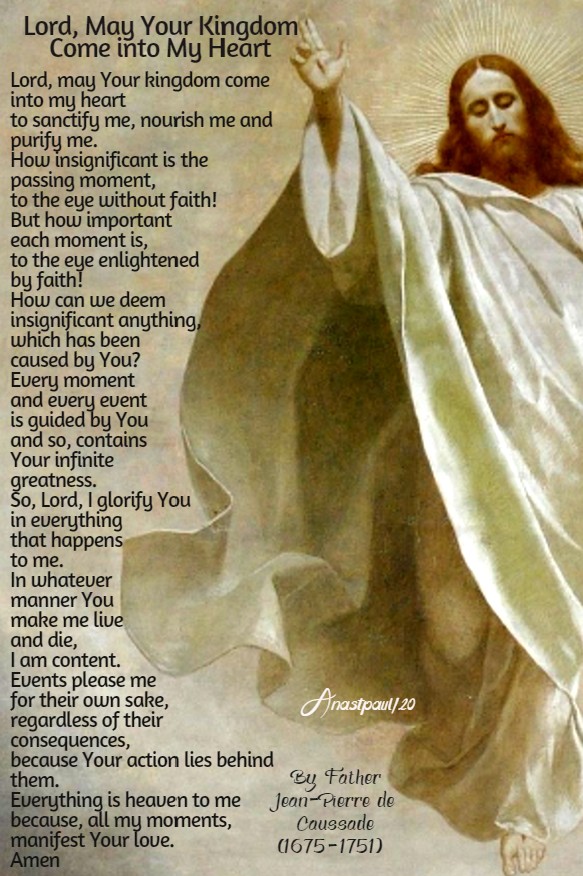
Lord, May Your Kingdom Come into My Heart By Father Jean-Pierre de Caussade (1675-1751)
Lord, may Your kingdom come into my heart to sanctify me, nourish me and purify me. How insignificant is the passing moment, to the eye without faith! But how important each moment is, to the eye enlightened by faith! How can we deem insignificant anything, which has been caused by You? Every moment and every event is guided by You and so, contains Your infinite greatness. So, Lord, I glorify You in everything that happens to me. In whatever manner You make me live and die, I am content. Events please me for their own sake, regardless of their consequences, because Your action lies behind them. Everything is heaven to me because, all my moments, manifest Your love. Amen
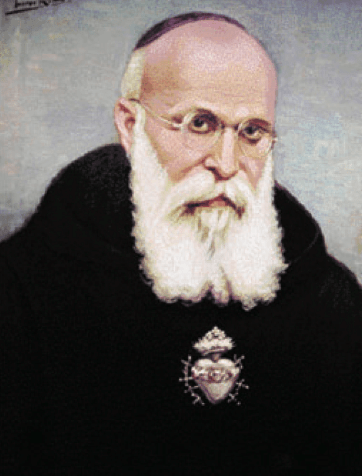
Saint of the Day – 18 September – Blessed Ambrosio María de Torrent (Salvador Chuliá Ferrandis) TC (1866-1936) Priest and Martyr of the Spanish civil War. Blessed Ambrosio was a religious Friar and Priest of The Amigonian Friars. He was a man of deep piety, a devotee of the Eucharist, a great apostle of the confessional and a competent director of souls. Born on 16 April 1866 in Torrent, Valencia, Spain and died by being shot at dawn on 18 September 1936 in Torrent, Valencia, Spain.
The Amigonian Friars and Sisters, are a religious institute of religious founded in Spain during the 19th century which specialises in working with young boys facing issues of juvenile delinquency and drug addiction. They follow the Rule of the Third Order Regular of St Francis. The Friars follow a spirituality based on the vision of St Francis of Assisi, given to them by their founder, a Capuchin Friar Minor. They also model themselves on the role of Our Lady of Sorrows, who stood at the foot of the Cross, sharing her Son’s agony and love for the world. She is a model to the Friars, of the generosity, mercy, strength and tenderness needed in the mission of serving their charges.
Salvador Chuliá Ferrandis , which was his civil name, was born in Torrent (Valencia) on 16 April 1866. He studied ecclesiastical studies at the Conciliar Seminary of Valencia but, once he received the diaconate, he entered the Capuchin Tertiary. On 4 April 1892, he was Ordained a Priest, making his perpetual religious vows on 5 July 1898, taking the name Ambrosio María de Torrent.
A man of broad culture but rather gentle in character and of little authority, he was always more inclined to exercise obedience than to command. In his pastoral ministry, he manifested himself as a man of council and spiritual director of the fraternity, confessor of religious and students.
Captured in his father’s house on 21 August 1936, he was taken to La Torre prison, in his hometown. In that prison, Father Ambrosio and nine other Capuchin Tertiaries practically led community life. From the street, you could hear them sing the Sorrows of the Virgin and the wounds of Saint Francis.
In the early hours of 18 September 1936, he was executed in the area of La Mantellina, Torrent, along with seven other Priests and Friars. Father Ambrosio, despite his shyness, was the one who bravely faced Martyrdom and encouraged his companions by raising, at the final moment, his hands to bless and forgive the executioners.
When trying to delineate his spiritual silhouette, the various biographers agree that Father Ambrosio was a little Franciscan flower – simple, humble, conciliatory, poor, obedient, silent, sparing in words, that he did not speak ill of anyone and that he always looked to find the good in all. Likewise, they define him as a man of deep piety, a devotee of the Eucharist, a great apostle of the confessional and a competent director of souls.
His mortal remains rest in the Chapel of Los Mártires, in the parish of Nuestra Señora de Monte Sión de Torrent (Valencia), where they are frequently visited.
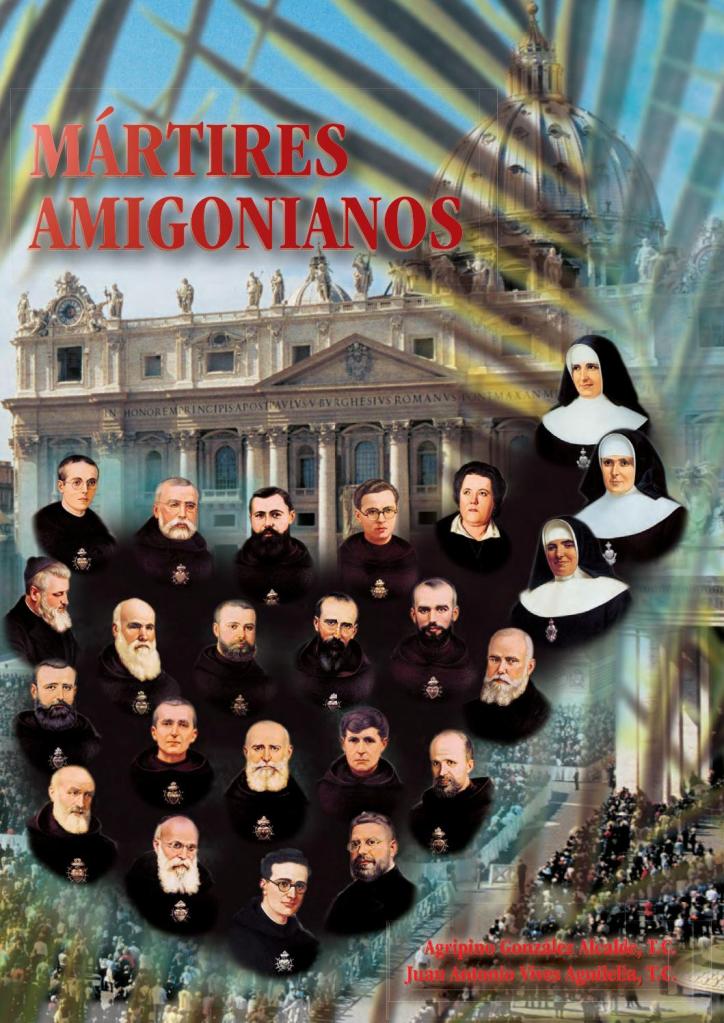
Blessed Ambrosio was Beatified by Pope John Paul II togther with 232 others who were Martyred during the Spanish Civil War. The Image below shows the Martyrs of the Amigonian Orders.
St Oceano of Nicomedia Saint Richardis (839-c 895) Biography: https://anastpaul.com/2019/09/18/saint-of-the-day-18-september-saint-richardis-839-c-895/ St Sophia of Egypt — Martyred in the Spanish Civil War: • Blessed Ambrosio María de Torrent (Salvador Chuliá Ferrandis) • Blessed Carlos Eraña Guruceta • Blessed Fernando García Sendra • Blessed Jacinto Hoyuelos Gonzalo • Blessed Jesus Hita Miranda • Blessed José García Mas • Blessed José María Llópez Mora • Blessed Justo Lerma Martínez • Blessed Salvador Fernández Pérez • Blessed Vicente Gay Zarzo • Blessed Vicente Jaunzarás Gómez
Thought for the Day – 17 September – Meditations with Antonio Cardinal Bacci (1881-1971)
The Commandments and the Desires of Jesus Christ
“Sanctity consists, in doing the will of God, in all things. We can become perfect by doing His will, from the motive of love alone. “He who has my commandments and keeps them,” said Jesus, “he it is who loves me. But he who loves me, will be loved by my Father and I will love him and manifest myself to him. If anyone love me, he will keep my word and my Father will love him and we will come to him and make our abode with him” (Jn 14:21-23).
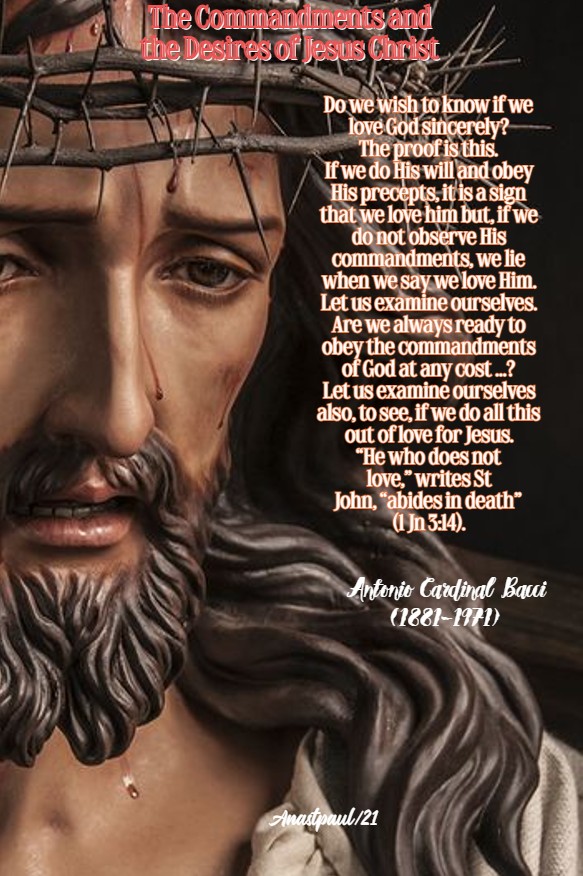
Do we wish to know if we love God sincerely? The proof is this. If we do His will and obey His precepts, it is a sign that we love him but, if we do not observe His commandments, we lie when we say we love Him. We must, therefore, show our love, by observing in all things, the commandments of God. He gave us these commandments our of love for us, so that, by observing them, we should be saved and should be happy with Him. Even as He has given them out of love, we should observe them out of love, for He is our supreme and only good. Just as Jesus lovingly did the will of His heavenly Father, from Bethlehem to Nazareth, from Nazareth to Calvary and from Calvary to Heaven, so we should follow in His footsteps, by doing the adorable will of God in all the circumstances of our lives, both joyful and sorrowful. But, we must obey the divine will out of love, that is, because we love God whole-heartedly and above all created things.
Everything is easy to him who loves. “When we love him who gives us orders,” says St Francis de Sales, “even the hardest of actions becomes easy.”
Let us examine ourselves. Are we always ready to obey the commandments of God at any cost and would we die rather than offend Him? Let us examine ourselves also, to see, if we do all this out of love for Jesus. “He who does not love,” writes St John, “abides in death” (1 Jn 3:14).”
Quote/s of the Day – 17 September – The Memorial of St Robert Bellarmine SJ (1542-1621) Doctor of the Church
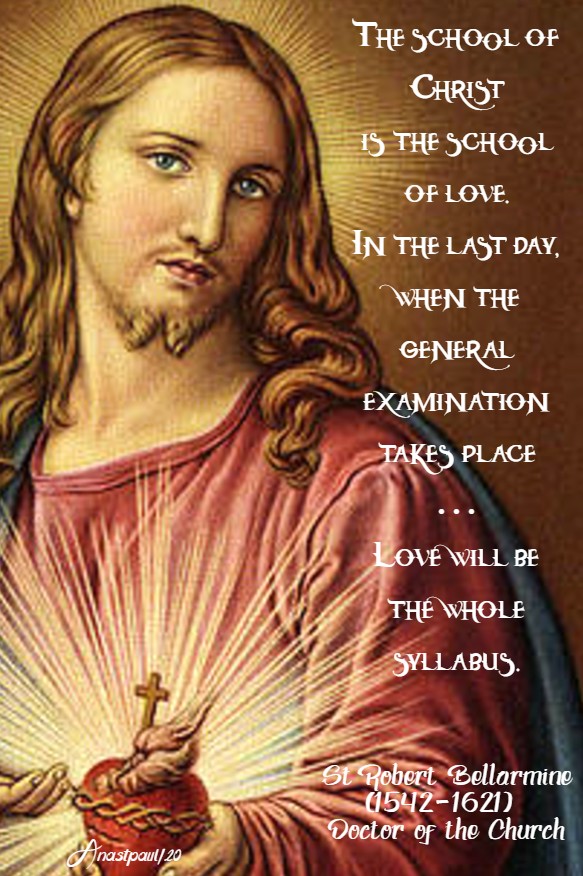
“The school of Christ is the school of love. In the last day, when the general examination takes place … Love will be the whole syllabus.”
“What is easier, sweeter, more pleasant, than to love goodness, beauty and love, the fullness of which, YOU ARE, O Lord, my God?”
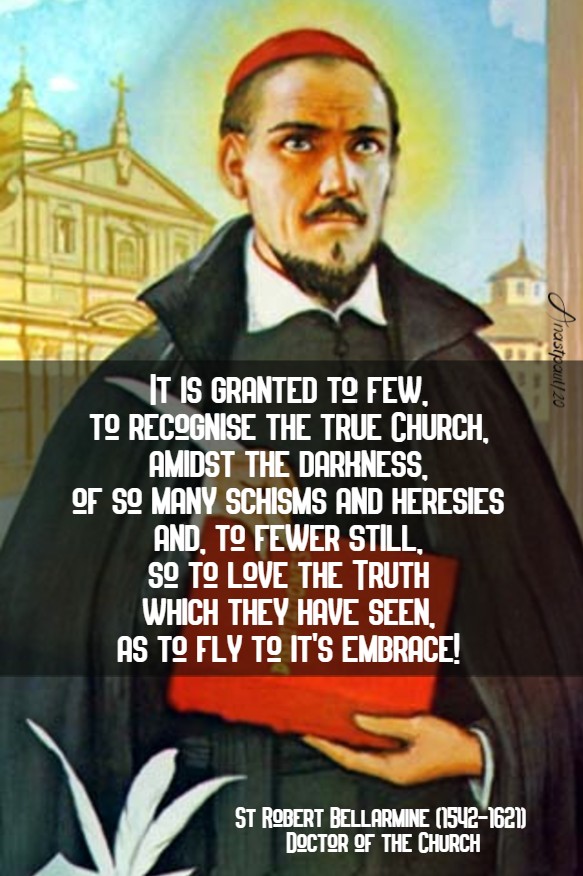
“It is granted to few, to recognise the true Church, amidst the darkness, of so many schisms and heresies and, to fewer still, so to love the Truth which they have seen, as to fly to it’s embrace!”
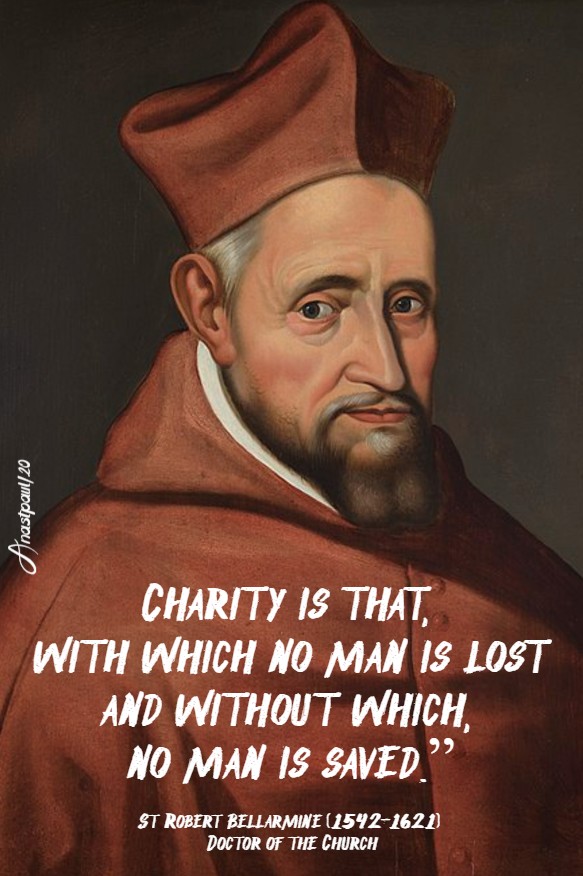
“Charity is that, with which no man is lost and without which, no man is saved.”
“It seems unbelievable that a man should perish in whose favour Christ said to His Mother: ‘Behold thy son’, provided that he has not turned a deaf ear to the words, which Christ addressed to him: ‘Behold thy Mother.’”
St Robert Bellarmine (1542-1621) Doctor of the Church
One Minute Reflection – 17 September – Thursday of the Twenty Fourth week in Ordinary Time, Readings: 1 Corinthians 15:1-11, Psalms 118:1-2, 16-17, 28, Luke 7:36-50 and the Memorial of St Robert Bellarmine (1542-1621) Doctor of the Church
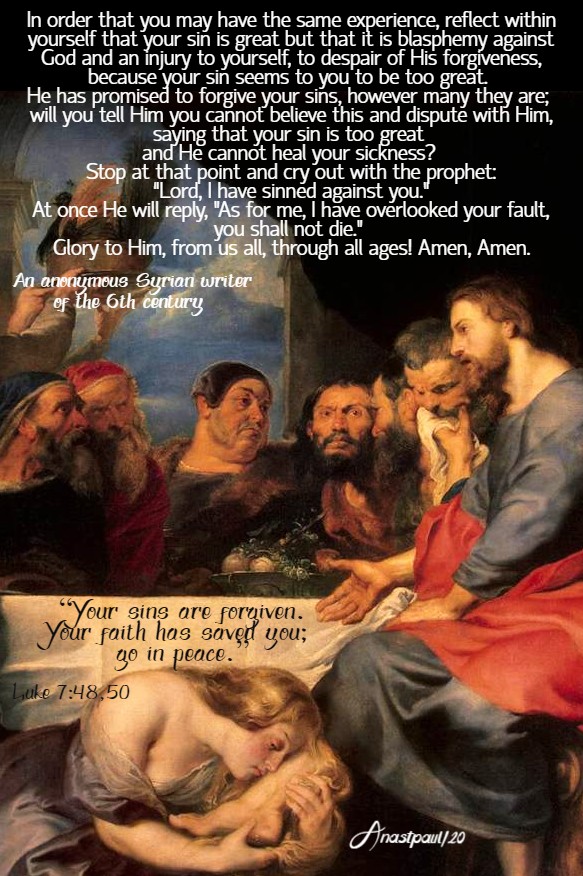
“Your sins are forgiven. Your faith has saved you; go in peace.” ~ Luke 7:48,50
REFLECTION – “A sinful woman has proclaimed to us that God’s love has gone forth in search of sinners. For when He called her, Christ was inviting our whole race to His love and, in her person, He was drawing all sinners to His forgiveness. He spoke to her alone but He was drawing all creation to His grace. (…)
Who would not be struck by the mercy of Christ, who accepted an invitation to a Pharisee’s house in order to save a sinner! For the sake of the woman who hungered for forgiveness, He, Himself felt hunger for the table of Simon the Pharisee and all the while, under the guise of a meal of bread, He had prepared for the sinner a meal of repentance! (…)
In order that you may have the same experience, reflect within yourself that your sin is great but that it is blasphemy against God and an injury to yourself, to despair of His forgiveness, because your sin seems to you to be too great. He has promised to forgive your sins, however many they are; will you tell Him you cannot believe this and dispute with Him, saying that your sin is too great and He cannot heal your sickness? Stop at that point and cry out with the prophet: “Lord, I have sinned against you” (Ps 51[50]:6). At once He will reply, “As for me, I have overlooked your fault, you shall not die.” Glory to Him from us all, through all ages! Amen, Amen.” ~ An anonymous Syrian writer of the 6th century – From a collection of homilies on the sinful woman, 1, 4.5.19.26.28 (Eastern Syrian)
PRAYER – Heavenly Father, teach me to do everything for Your honour and glory. Grant me the grace to work out my salvation with anxious concern each day of my life. St Robert Bellarmine, as you worked tirelessly for the salvation of souls, so now pray for us all, as tirelessly, that we may achieve eternal joy, amen.
Our Morning Offering – 17 September – Thursday of the Twenty Fourth week in Ordinary Time and the Memorial of St Robert Bellarmine (1542-1621) Doctor of the Church
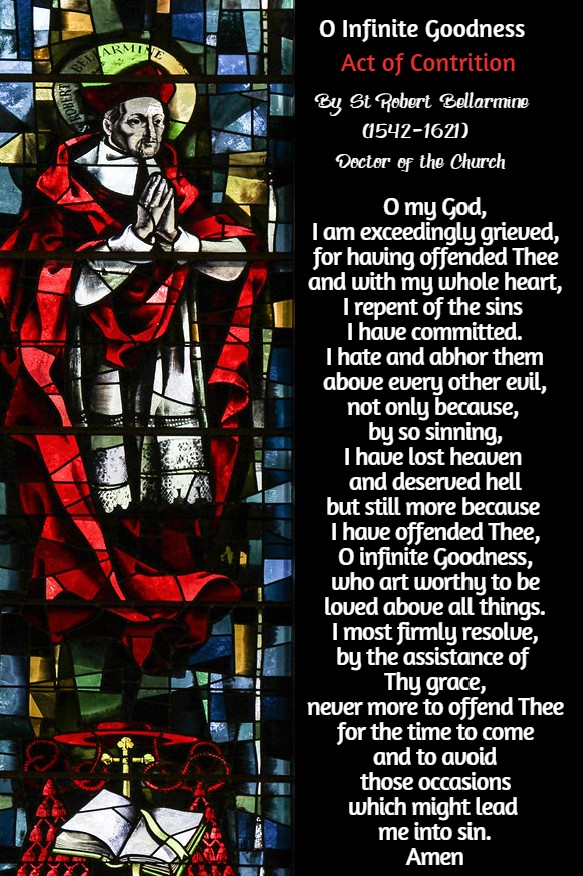
O Infinite Goodness Act of Contrition By St Robert Bellarmine (1542-1621) Doctor of the Church
O my God, I am exceedingly grieved, for having offended Thee and with my whole heart, I repent of the sins I have committed. I hate and abhor them above every other evil, not only because, by so sinning, I have lost heaven and deserved hell but still more because I have offended Thee, O infinite Goodness, who art worthy to be loved above all things. I most firmly resolve, by the assistance of Thy grace, never more to offend Thee for the time to come and to avoid those occasions which might lead me into sin. Amen






















You must be logged in to post a comment.