One Minute Reflection – 2 July – “Month of the Most Precious Blood” – Thursday of the Thirteenth week in Ordinary Time, Year A, Readings: Amos 7: 10-17, Psalms 19: 8, 9, 10, 11, Matthew 9: 1-8 and the Memorial of St Swithun (c 800-863) Bishop
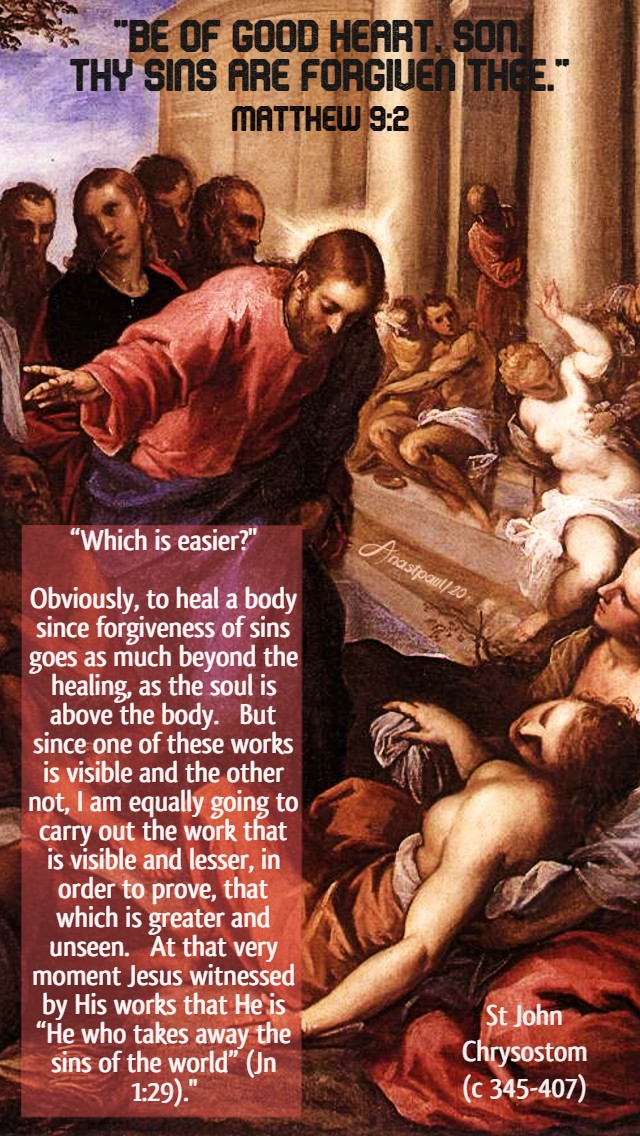
“Be of good heart, son, thy sins are forgiven thee.” … Matthew 9:2
REFLECTION – “The scribes declared that God alone can forgive sins. But Jesus, even before He forgave sins, revealed the secrets of the heart, thereby showing, that He also possessed that other power reserved to God … For it is written: “You alone, O Lord, know the secrets of humankind” and “Man sees the outward appearance but God sees the heart” (2 Chr 6:30; 1 Sam 16:7). In this way Jesus reveals His divinity and equality with the Father, uncovering the depths of their hearts to the scribes and making known those thoughts, they are afraid to speak openly for fear of the crowd. And this He did with great gentleness. …
The lame man might have made his disappointment known to Christ by saying: “OK! You have come to cure another kind of sickness and heal another kind of evil – sin. But what proof am I going to get that my sins are forgiven?” Yet he said nothing of the sort but put his trust in the One who had the power to heal him. …
To the scribes, Christ said: “Which is easier? To say: Your sins are forgiven, or rather: Take up your stretcher and go home?” In other words: ‘What seems easier to you? To strengthen a paralysed body or put aside the sins of the soul?’ Obviously, to heal a body since forgiveness of sins goes as much beyond the healing, as the soul is above the body. But since one of these works is visible and the other not, I am equally going to carry out the work that is visible and lesser, in order to prove, that which is greater and unseen. At that very moment Jesus witnessed by His works that He is “He who takes away the sins of the world” (Jn 1:29).” … St John Chrysostom (c 345-407) – Doctor of the Church – Homilies on Saint Matthew’s Gospel, no. 29, 2 ; PG 57, 359
PRAYER – Lord God, be the beginning and the end of all that we are and do and say. Prompt our actions with Your grace, may Your light be our only way, may Your commands be our only need and complete all, with Your all-powerful help. St Swithun, your love of God in all things proved by Him in your countless miracles, pray for us! We make our prayer through Christ our Lord in the unity of the Holy Spirit, one God with You, forever and ever, amen.
Our Morning Offering – 2 July – “Month of the Most Precious Blood” – Thursday of the Thirteenth week in Ordinary Time
Constant Prayer to the Precious Blood of Jesus By St Catherine of Siena (1347-1380) Doctor of the Church
Precious Blood,
Ocean of Divine Mercy,
Flow upon us!
Precious Blood,
most pure Offering,
Procure us every grace!
Precious Blood,
Hope and Refuge of sinners,
Atone for us!
Precious Blood,
Delight of holy souls,
Draw us!
Amen
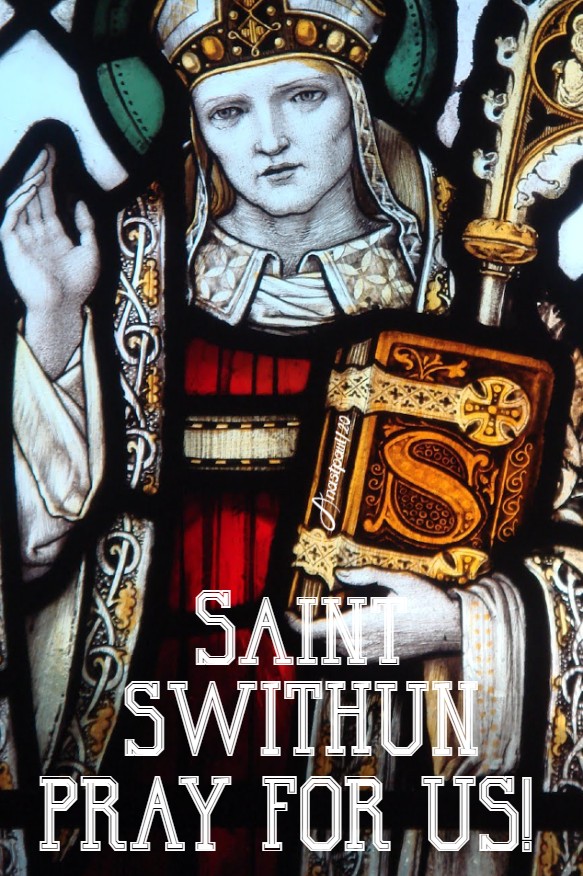
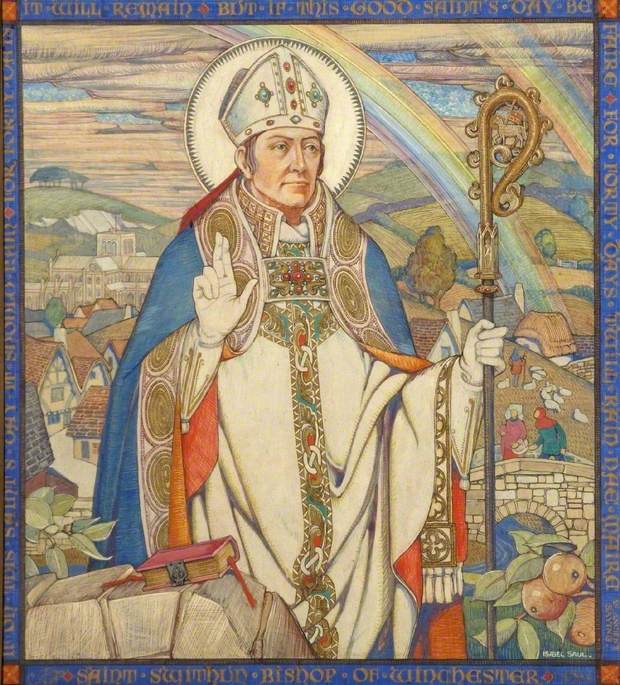
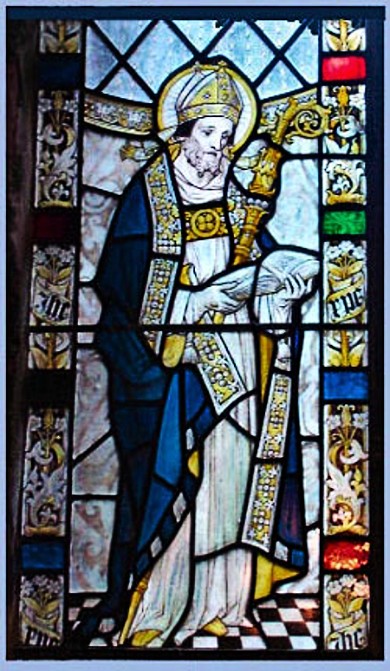
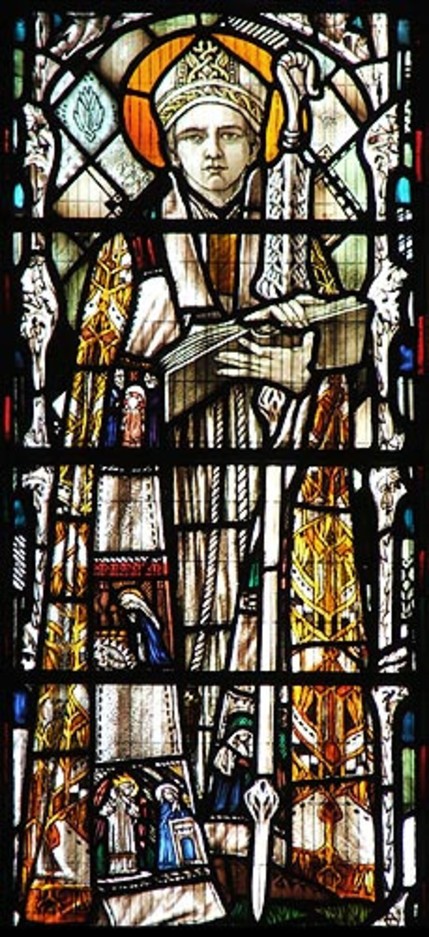
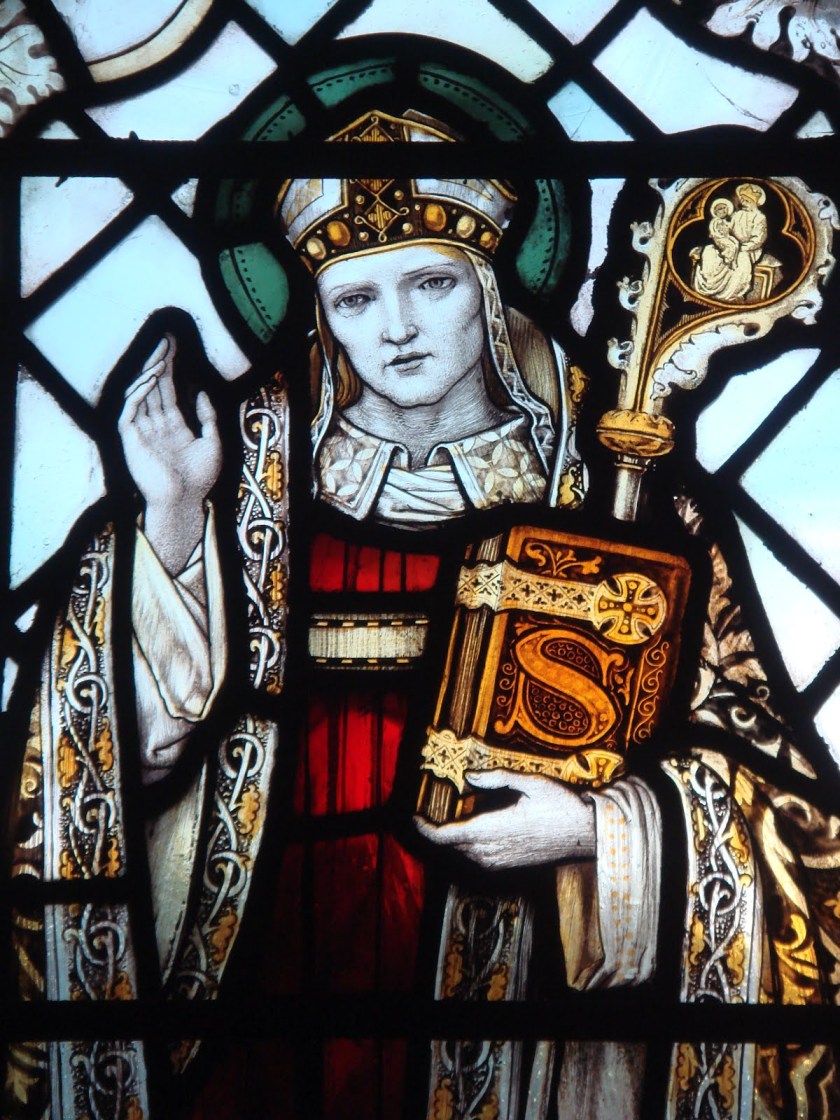
Saint of the Day – 2 July – Saint Swithun (c 800-863) Bishop of Winchester, Miracle-worker – born in c 800 at Wessex, England and died on 2 July 862 of natural causes. Patronages – Hampshire, Winchester, Winchester Cathedral and Diocese, Southwark,the weather, against drought.
He was born in the kingdom of Wessex and educated in its capital, Winchester. He was famous for charitable gifts and building churches. Very little is known for certain about the life of Winchester Cathedral’s first Patron Saint. Some biographies of Swithun state that he was once Prior of Winchester. We do know that he was one of the chief advisors of Egbert, King of the West Saxons and was responsible for the education of Egbert’s son, Ethelwulf. Egbert’s influence procured the post of Bishop of Winchester, which he took up in 852, below is Winchester Cathedral today, obviously, no longer Catholic.
This slideshow requires JavaScript.
Only one miracle is attributed to Swithin while he was alive. An old lady’s eggs had been smashed by workmen building a church. Swithin picked the broken eggs up and, it is said, they miraculously became whole again.
When Swithun’s health failed in 862 and he lay near death, asked that his body be buried outside his Cathedral, rather than within it, as was customary. He wanted passers-by to walk upon his grave and raindrops from the eaves of the Cathedral to fall upon his resting place. Although his wishes were granted, his grave did not long lie undisturbed. In 931 Bishop Ethelwulf had Swithun disinterred and reburied within the walls of the new Church.
The original spot of St Swithun’s tomb
Shortly after, miracles were reported at Swithun’s tomb, which became a popular attraction for pilgrims. So clamorous were the voices reporting these miracles that Swithun’s cult was recognised, which further added to the allure of his shrine. Swithin’s feast day is celebrated in England on 15 July which is the date of the removal of his remains, not the usual day of his entry into life.
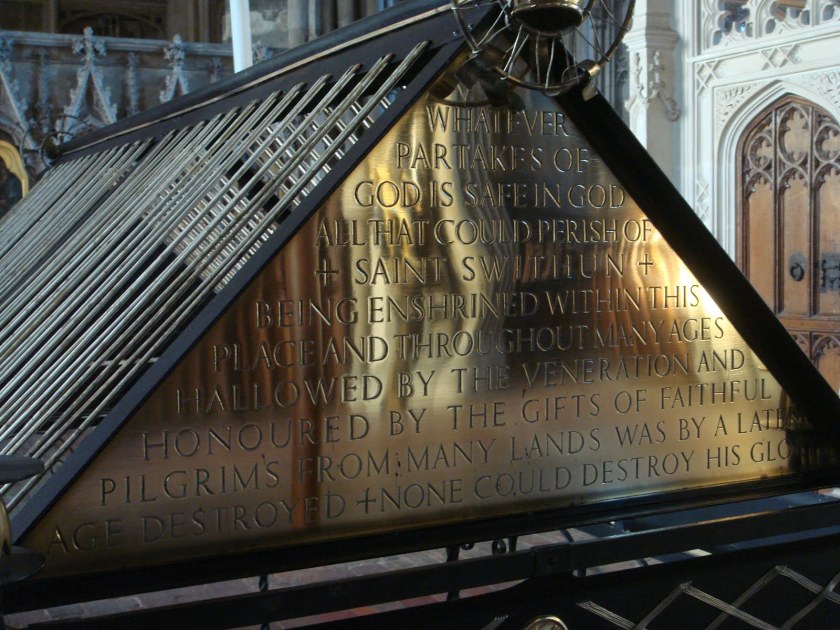
St Swithun’s new Tomb
The translation of St Swithun’s relics was accompanied by ferocious and violent rain storms that lasted 40 days and 40 nights and are said to indicate the saint’s displeasure at being moved. This is the origin of the legend. that if it rains on Saint Swithin’s feast day, the rain will continue for 40 more days.
Saint Swithun’s day, if thou dost rain, For forty days it will remain. Saint Swithun’s day, if thou be fair, For forty days ’twill rain nae mair.
His body was probably later split between a number of smaller shrines. His head was certainly detached and, in the Middle Ages, taken to Canterbury Cathedral. Peterborough Abbey has an arm. Yet, still his bones could not rest, for on 15 July 1093 his remains were once more dug up and reburied with great ceremony within the new Cathedral built by Bishop Walkelin. There they remained until the Dissolution of the Monasteries in 1538, when the shrine was destroyed by Henry VIII’s men. A modern representation of it now stands on the site.
Below are extracts from the story of St Swithun as told by Ælfric, the homilist and hagiographer, writing in English in the 990s. Ælfric had been educated under St Æthelwold at Winchester and he gives us a detailed picture of how the cult of Swithun developed at Æthelwold’s instigation.
“In the days of the noble king Edgar, when by the grace of God, Christianity was thriving among the English people under that king, God revealed St Swithun, showing by many signs that he is glorious. His deeds were not known until God himself made them known and we do not find written in books, in what manner the Bishop lived in this world, before he went to Christ. Such was the carelessness of those who knew him in life, that they did not write about his deeds and conduct, for the benefit of future generations, who did not know his virtue but God, nonetheless, made known his life with manifest miracles and wonderful tokens. This Swithun was Bishop of Winchester, that is, over Hampshire, a blessed servant of God, there were eight Bishops between him and St Æthelwold. Now, as we said before, nothing about his life is known to us, except that he was buried at his episcopal seat, to the west of the church and a tomb was built over him, until his miracles revealed that he was especially blessed by God. Æthelwold, the venerable and blessed Bishop, who in those days was Bishop of Winchester, commanded all his monks who lived in the Minster that every time a sick person was healed, they should all go in procession to the Church and praise in song, the merits of the Saint Swithun and glorify God because of the Saint’s holiness. They began to do this straightaway and sang the song of praise, until it grew tiresome for them to have to get up so often – sometimes three times a night, sometimes four – to sing the Te Deum, when they could have been asleep. At last, they all left off singing the hymn because the bishop was busy with the king and did not know that they had ceased their custom of singing.
But then St Swithun himself appeared to a certain good man in a dream, richly attired and said, “Go to the Old Minster and say to the monks that God is greatly displeased by their grumbling and sloth, that everyday they see the miracles of God performed among them but they do not want to praise the Saviour with hymns, as the Bishop commanded the brothers to do. Tell them, that if they do not sing the hymn, the miracles will soon cease bu,t if they sing the Te Deum for the miracles, as often as sick people are healed there, then so many wonders will be performed among them, that no one alive will be able to remember when any man saw such wonders anywhere.
The man woke up from his sweet sleep and mourned that he could no longer see and enjoy the beautiful light which he had seen accompanying Swithun. Nonetheless, he got up and quickly went to Bishop Æthelwold and told him all this. Æthelwold straightaway sent a message from the King’s court to the monks and said that they should sing the Te Deum just as he had set down for them and that anyone who neglected to do this, should heavily atone for it by fasting for seven nights continuously. Afterwards, they always kept this custom, as we have very often seen for ourselves – and we have often sung that hymn with them.
… We cannot write, nor recount in words, all the miracles that the holy man Swithun performed, by the power of God, in the sight of the people, for prisoners in chains and for sick people, to show to everyone that they themselves may earn the kingdom of heaven by good works, just as Swithun did, who is now made glorious by his miracles. The old Church was hung all round with the crutches and stools of cripples who had been healed there, from one end to the other, on either wall – and, even so, they could not put half of them up. Such tokens declare that Christ is Almighty God, who revealed his Saint by such good deeds…“
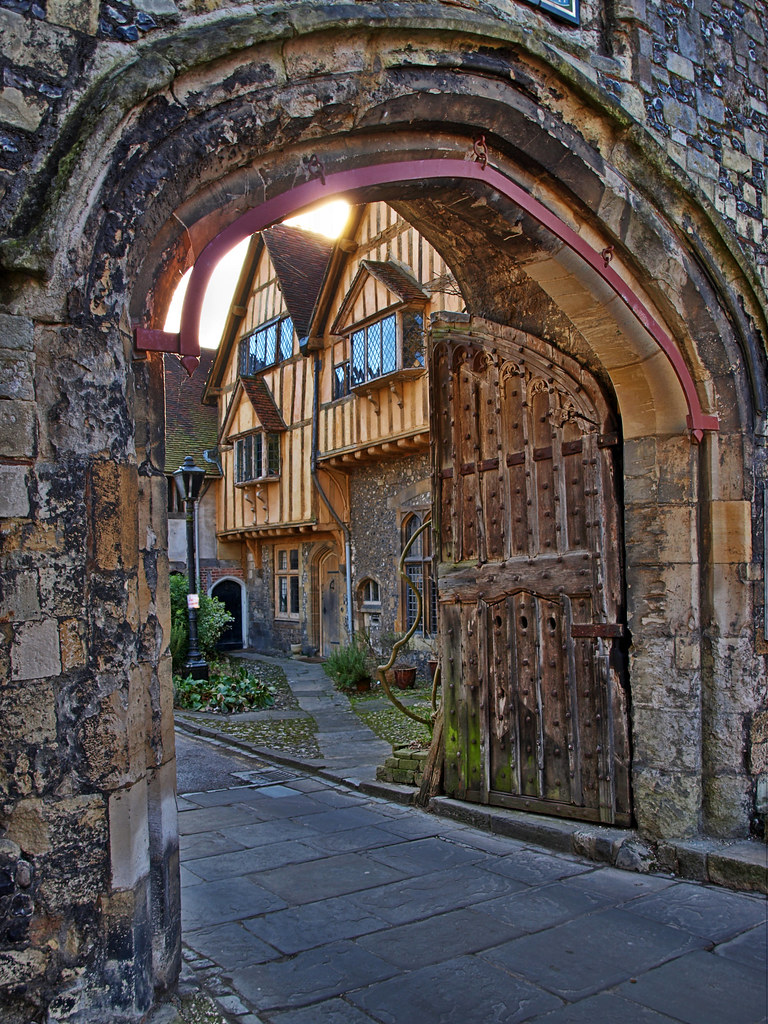
St Swithin’s Gate at Winchester Cathedral and Abbey
“And if any church fell down, or was in decay, St Swithin would anon amend it at his own cost. Or if any church were not hallowed, he would go thither afoot and hallow it. For he loved no pride, ne to ride on gay horses, ne to be praised ne flattered of the people…”
Martyrs in Carthage by Hunneric – 7 saints: A group of seven Christians tortured and murdered in the persecutions of the Arian Vandal king Hunneric for remaining loyal to the teachings of orthodox Christianity. They were some of the many who died for the faith during a period of active Arian heresy. – Boniface, Liberatus, Maximus, Rogatus, Rusticus, Septimus and Servus.
Martyrs of Campania – 10 saints: A group of ten Christians marytred together in the persecutions of Diocletian. The only details about them to have survived are their names – Ariston, Crescention, Eutychian, Felicissimus, Felix, Justus, Marcia, Symphorosa, Urban and Vitalis. Martyred in 284 in Campania, Italy.
Martyrs of Seoul – 8 saints: Additional Memorial – 20 September as part of the Martyrs of Korea.
A group of eight Christians who were martyred together as part of the lengthy persecutions in Korea.
• Agatha Han Sin-ae
• Antonius Yi Hyeon
• Bibiana Mun Yeong-in
• Columba Gang Wan-suk
• Ignatius Choe In-cheol
• Iuliana Gim Yeon-i
• Matthaeus Gim Hyeon-u
• Susanna Gang Gyeong-bok
They were martyred on 2 July 1801 at the Small West Gate, Seoul, South Korea. Beatified on 15 August 2014 by Pope Francis.
Catholic doctrine teaches the faithful, that the Blood of Jesus Christ is part of His Sacred Humanity and hypostatically united to the Second Person of the Blessed Trinity.
And as such, it is worthy of adoration and veneration proper to latreutical worship (cultus latriae) which is rendered only to God. In other words, we adore the human nature of Christ because of its intimate and eternal union with the Person of the Divine Word.
It is for this same reason, that we honour the Most Sacred Heart or the Wounds of Our Lord Jesus Christ.
The Devotion to the Precious Blood:
This devotion is one of the most ancient of pious Church practices. It is said that the Blessed Virgin venerated the Most Precious Blood of her infant Son on the day of His circumcision as she collected the first relics of His Precious Blood on a piece of cloth.
On that momentous occasion she united her tears with that of the Word Incarnate on account of, not so much of the sensible pain bu,t of His supernatural sorrow for the hard-heartedness of mortals.
This was the first of seven Blood-Sheddings of Our Divine Saviour, The rest being:
2. The Agony in the Garden
3. The Scourging at the Pillar
4. The Crowning with Thorns
5. The Way of the Cross
6. The Crucifixion
7. The Piercing of His Heart
The old sacrifice took a new form in the New Testament when the Immaculate Lamb of God offered Himself on the altar of the Cross, to redeem mankind from sin and the slavery of Satan.
And during the Last Supper, Our Lord offered Himself in an unbloody, yet real sacrifice when He uttered the following words: “For this is my blood of the new testament, which shall be shed for many unto remission of sins.”(Matthew 26: 28)
Truly, this “shedding of blood’ or “pouring out of blood” took place and forms one of the glorious mysteries of our Faith.
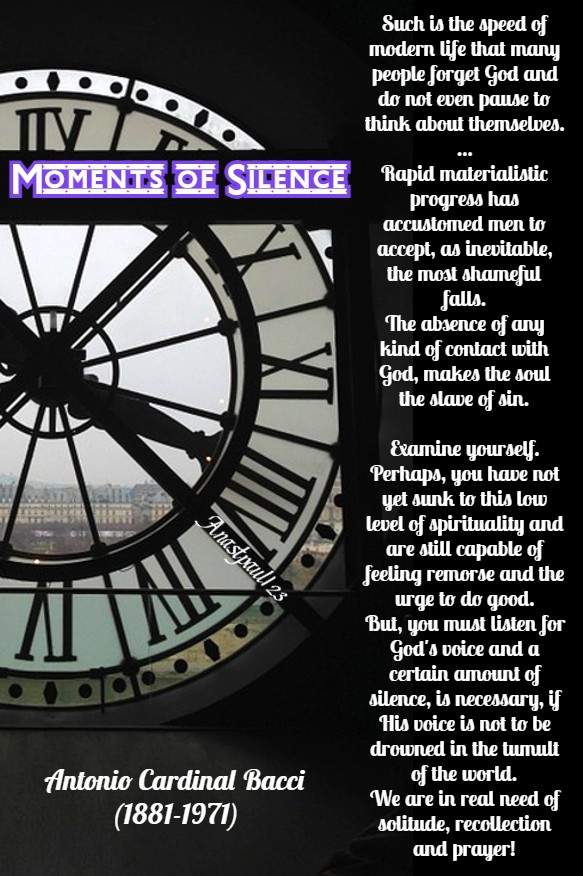
Thought for the Day – 1 July – Meditations with Antonio Cardinal Bacci (1881-1971)
Moments of Silence
“Such is the speed of modern life that many people forget God and do not even pause to think about themselves. Action is everything. There is no time for reflection, no time for prayer. Life has become mechanical and superficial, for nobody has the time, nor the inclination, to think about spiritual matters.
What is the result? Since men are not machines but living beings, composed of soul and body and are capable of feeling and passion, their lower inclinations break loose and insist on being satisfied. In the absence of prayer and of all effort to lead a good life, grace is lacking to inspire the mind, to strengthen the will and to keep the heart pure. Rapid materialistic progress has accustomed men to accept, as inevitable, the most shameful falls. The absence of any kind of contact with God, makes the soul the slave of sin.
Examine yourself. Perhaps, you have not yet sunk to this low level of spirituality and are still capable of feeling remorse and the urge to do good. But, you must listen for God’s voice and a certain amount of silence, is necessary, if His voice is not to be drowned in the tumult of the world. We are in real need of solitude, recollection and prayer!“
Quote/s of the Day – 1 July – “Month of the Most Precious Blood” – Wednesday of the Thirteenth week in Ordinary Time, Year A
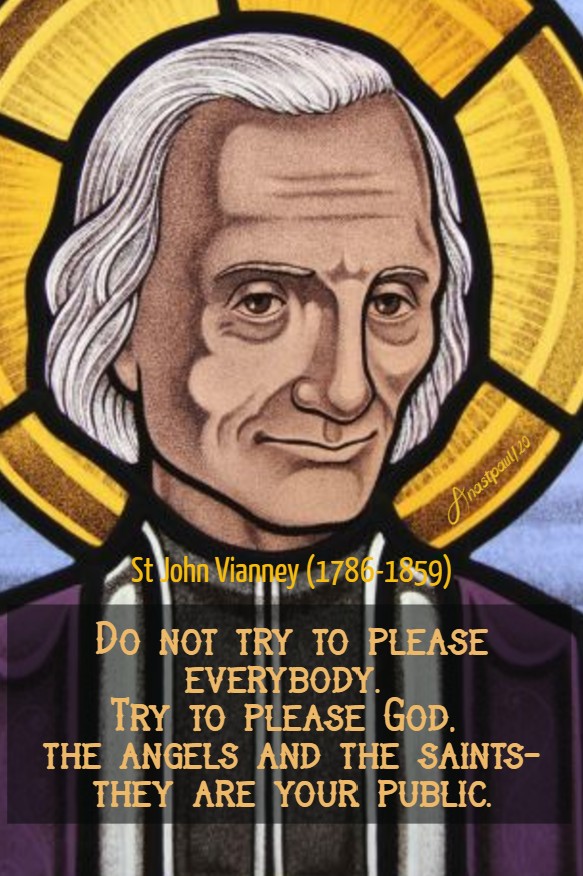
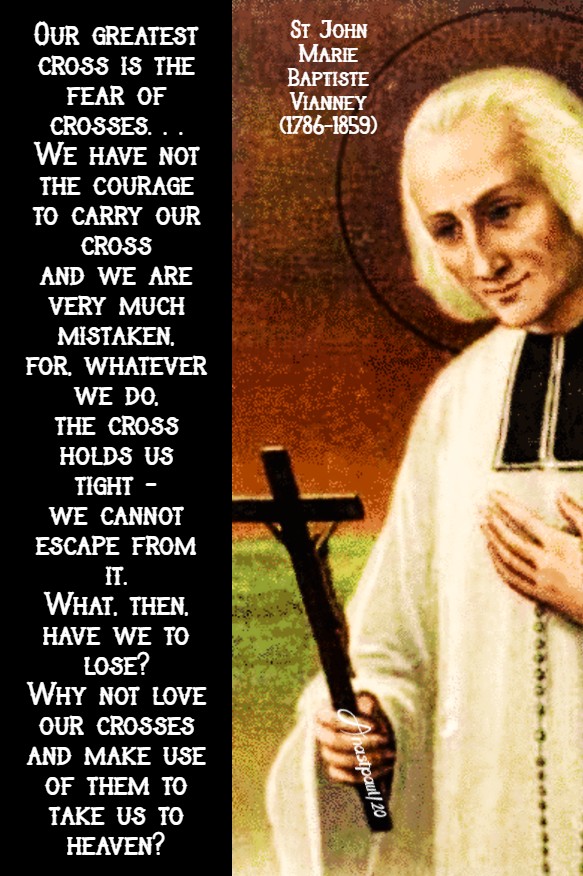
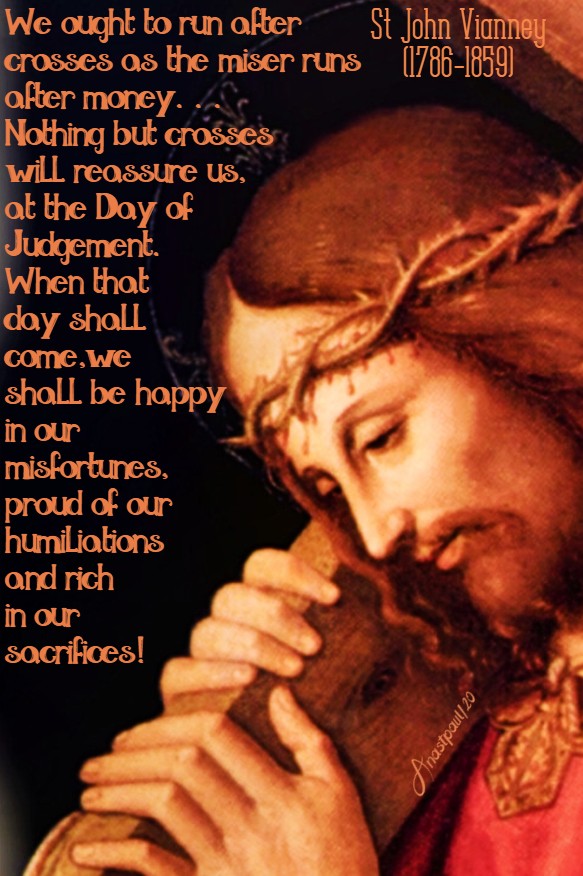
Lessons from St John Marie Baptiste Vianney, the Curé of Ars, Patron of Priests
“Do not try to please everybody. Try to please God, the angels and the saints – they are your public.”
“Our greatest cross is the fear of crosses. . . We have not the courage to carry our cross and we are very much mistaken, for, whatever we do, the cross holds us tight – we cannot escape from it. What, then, have we to lose? Why not love our crosses and make use of them to take us to heaven?”
“We ought to run after crosses as the miser runs after money. . . Nothing but crosses will reassure us, at the Day of Judgement. When that day shall come, we shall be happy in our misfortunes, proud of our humiliations and rich in our sacrifices!”
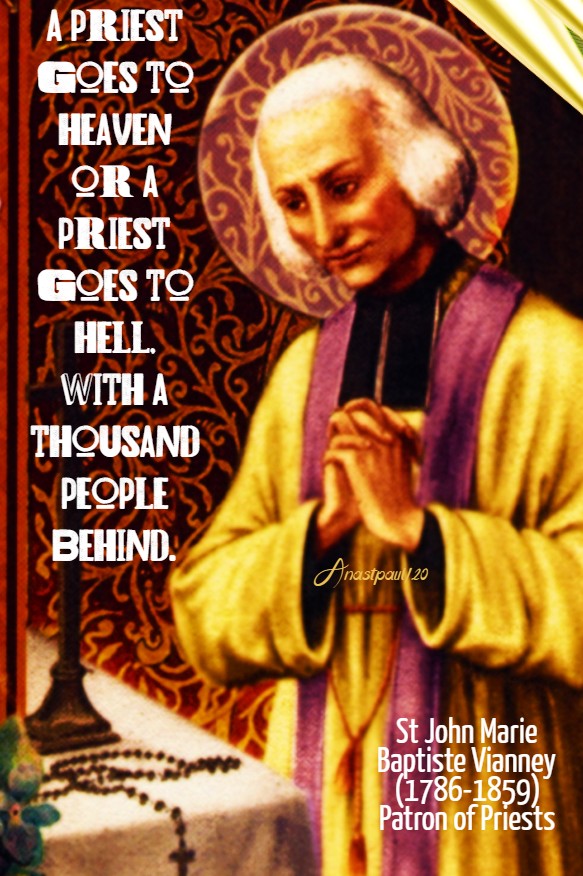
” A priest goes to Heaven or a priest goes to Hell, with a thousand people behind.”
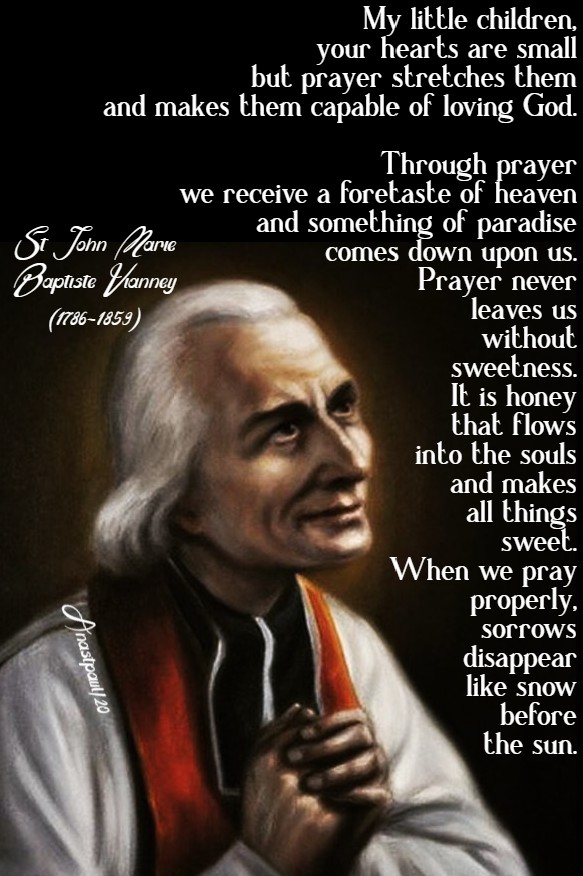
“My little children, your hearts are small but prayer stretches them and makes them capable of loving God. Through prayer we receive a foretaste of heaven and something of paradise comes down upon us. Prayer never leaves us without sweetness. It is honey that flows into the souls and makes all things sweet. When we pray properly, sorrows disappear like snow before the sun.”
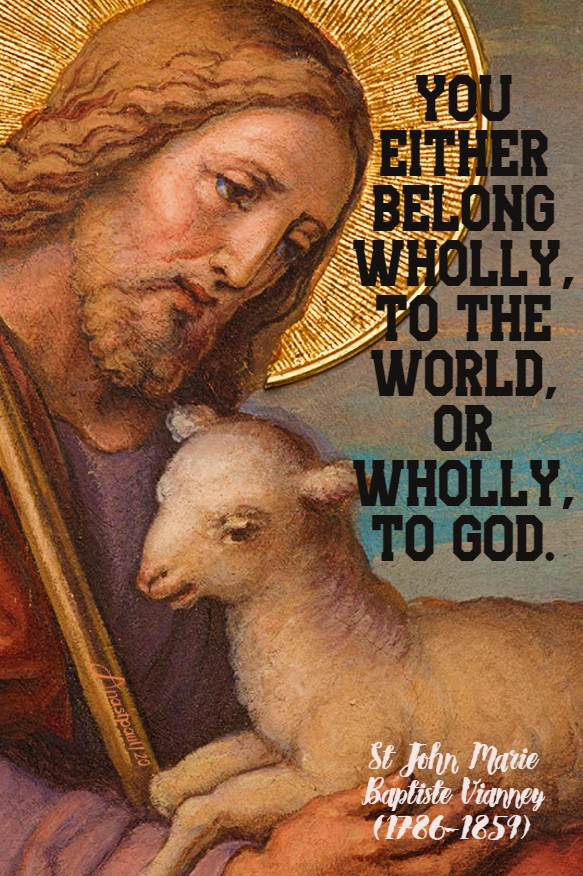
“You either belong wholly, to the world, or wholly, to God.”
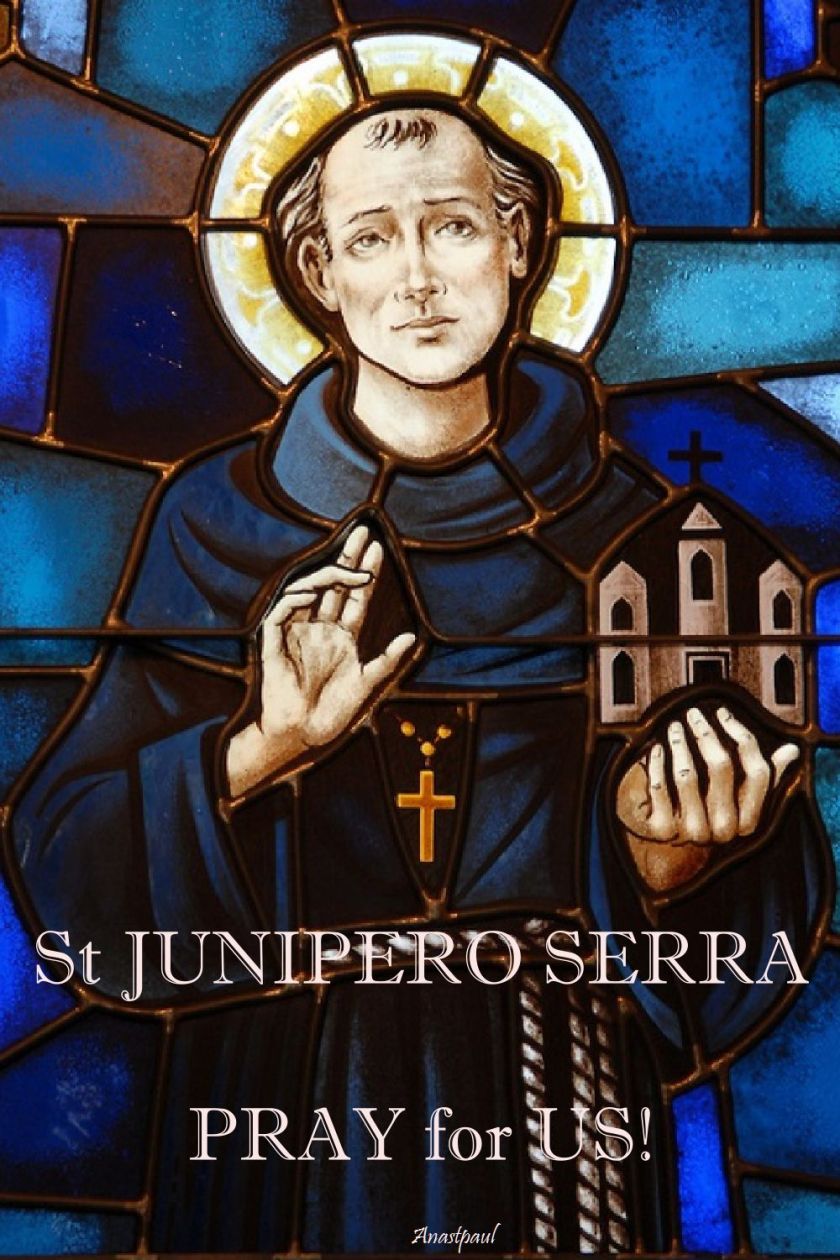
One Minute Reflection – 1 July – “Month of the Most Precious Blood” – Wednesday of the Thirteenth week in Ordinary Time, Year A, Readings: Amos 5: 14-15, 21-24, Psalm 50: 7, 8-9, 10-11, 12-13, 16bc-17, Matthew 8: 28-34 and the Memorial of St Junipero Serra (1713-1784) and Blessed Ignatius “Nazju” Falzon OFS (1813-1865)
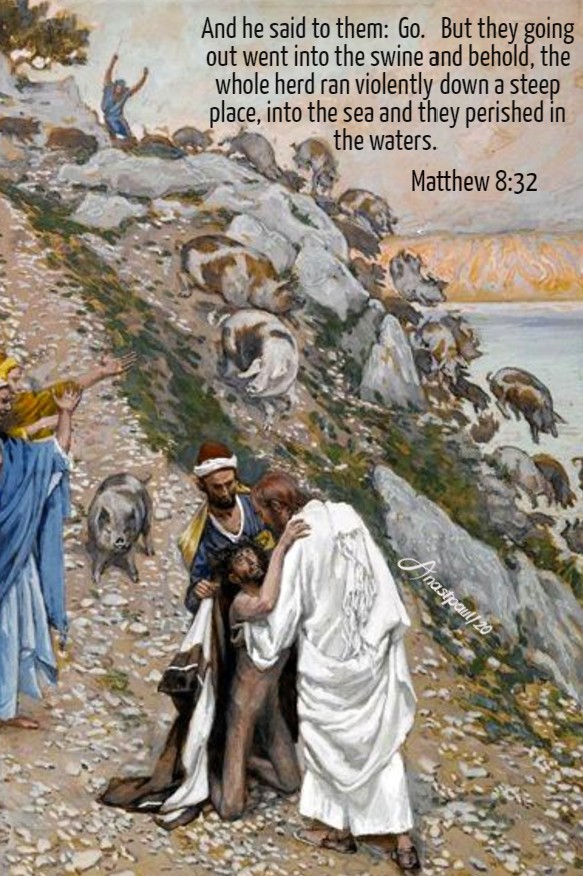
And he said to them: Go. But they going out went into the swine and behold, the whole herd ran violently down a steep place, into the sea and they perished in the waters. And behold the whole city went out to meet Jesus and when they saw him, they besought him, that he would depart from their coasts.. … Matthew 8:32,34… Matthew 8:32-34
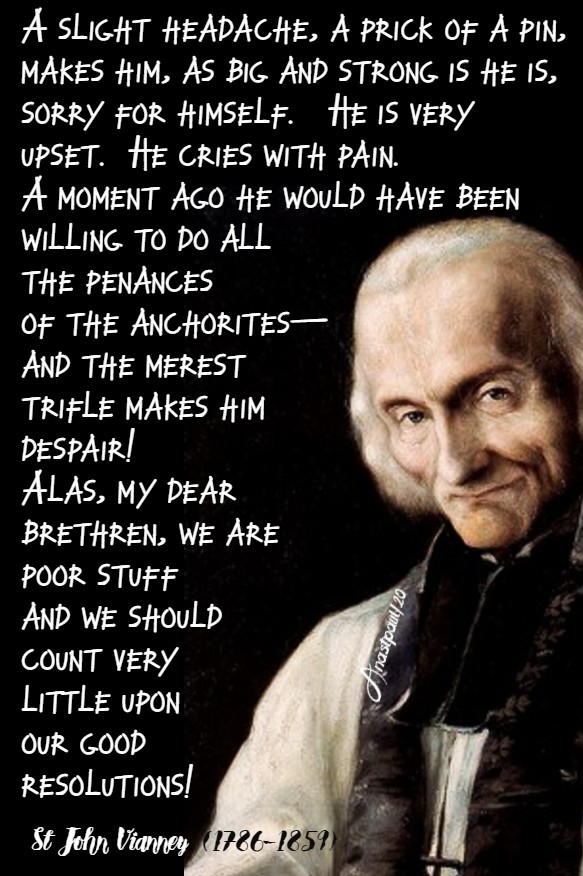
REFLECTION – “Dear Lord, what we are capable of when we are left to ourselves! There are some who, in their own words, are envious of the saints who did great penances. They believe that they could do as well. When we read the lives of some of the martyrs, we would, we think, be ready to suffer all that they suffered for God, the moment is short lived, we say, for an eternity of reward. But what does God do to teach us to know ourselves or, rather, to know that we are nothing? This is all He does – He allows the Devil to come a little closer to us. Look at this Christian who a moment ago was quite envious of the hermit who lived solely on roots and herbs and who made the stern resolution to treat his body as harshly. Alas! A slight headache, a prick of a pin, makes him, as big and strong is he is, sorry for himself. He is very upset. He cries with pain. A moment ago he would have been willing to do all the penances of the anchorites — and the merest trifle makes him despair!
Look at this other one, who seems to want to give his whole life for God, whose ardour all the torments there are cannot damp. A tiny bit of scandalmongering …. a word of calumny …. even a slightly cold reception or a small injustice done to him …. a kindness returned by ingratitude …. immediately gives birth in him to feelings of hatred, of revenge, of dislike, to the point, often, of his never wishing to see his neighbour again, or at least. of treating him coldly with an air which shows very plainly what is going on in his heart. And how many times is this his waking thought, just as it was the thought that almost prevented him from sleeping? Alas, my dear brethren, we are poor stuff and we should count very little upon our good resolutions!” … St John Marie Baptiste Vianney (1786-1859)
PRAYER – All-powerful God, to serve You is to reign. Your love gave St Juniperro Serra and Blessed Nazju Falzon, the courage to proclaim the truth of Christ and to preach and live in the light of the Kingdom. Grant that by their prayers, our lives may bear witness to the faith we profess and our love bring others, to the peace and joy of Your gospel. Through our Lord Jesus Christ, Your Son, who lives and reigns with You in the unity of the Holy Spirit, one God, forever and ever. Amen
Our Morning Offering – 1 July – “Month of the Most Precious Blood” – Wednesday of the Thirteenth Week in Ordinary Tme
Daily Offering to the Father By St Gertrude the Great (1256-1302)
Eternal Father,
I offer Thee the most precious blood
of Thy Divine Son, Jesus,
in union with the Masses said
throughout the world today,
for all the Holy Souls in Purgatory,
for sinners everywhere,
for sinners in the universal Church,
for those in my own home,
and in my family.
Amen
You might see fantastic claims for this prayer, especially printed on Holy Cards, such as the release of 1000 souls from Purgatory, each time it is prayed. Nowhere in St Gertrude’s writings, is this wild promise made so be careful of treating prayers and devotions as amulets or magical charms. The Church has summarily condemned prayer cards containing a promise to release one or more souls from Purgatory, or any other ‘miraculous’ claims. Such an easy way to release 1,000 souls seems inconsistent with the Church’s understanding of Purgatory, given that ordinarily, to release one soul, requires a plenary indulgence which is very difficult to get and, given all the means the Church employs to help the dead, such as special masses or indulgences applicable only to the dead.
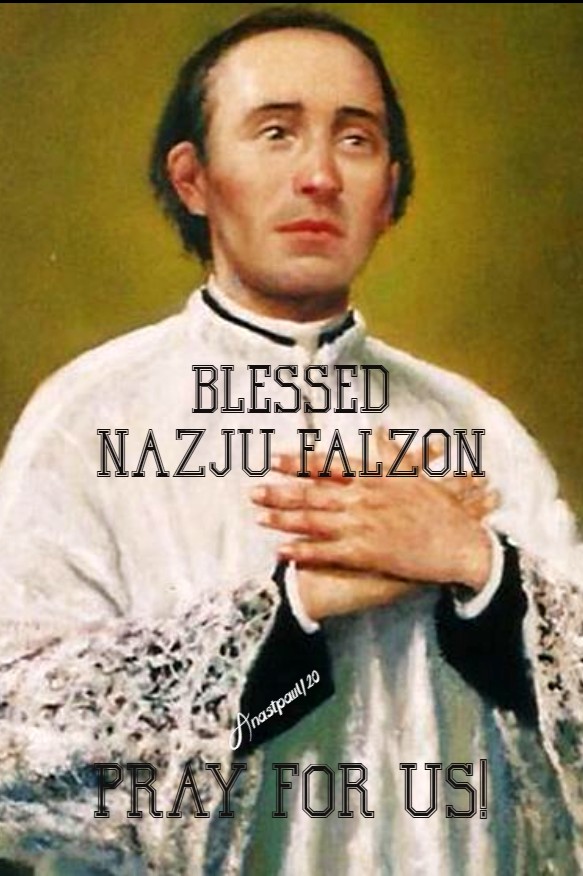
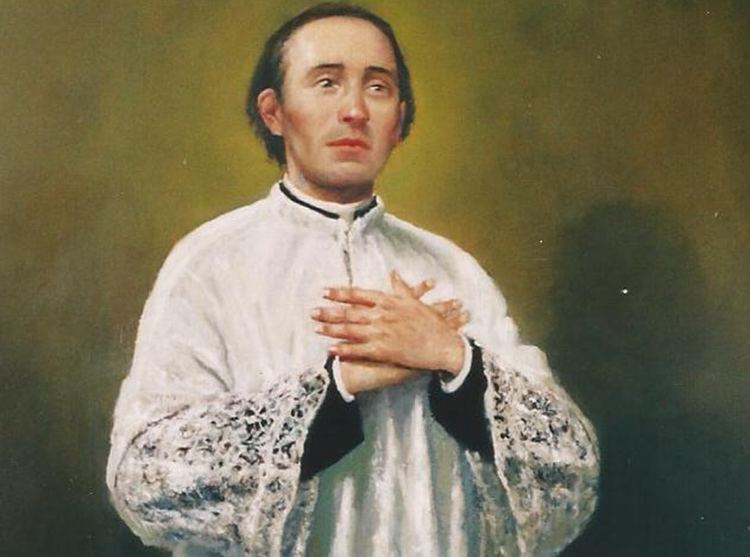
Saint of the Day – 1 July – Blessed Ignatius “Nazju” Falzon OFS (1813-1865) Catechist, Confessor, Evangelist, Apostle of seamen, the poor and the marginalised, Apostle of the Passion of Our Lord and of the Blessed Virgi Mary, Doctor of Civil and Canon Law, Writer. He spread devotion to both the Stations of the Cross and the Holy Rosary in all his works – born on 1 July 1813 at Valletta, Malta and died on 1 July 1865, Valletta, Malta, aged 52. Nazju was baptised on 2 July in the Church of Porto Salvo with the names of “Rocco Angelo Sebastiano Vincenzo Naju Rosario Falzon.” Patronage – Catechists.
Blessed Nazju Falzon was born at 49, Strait Street, Valletta, the capital city of Malta. His parents were Giuseppe Francesco Falzon, a doctor of laws and Maria Teresa Debono, the daughter of a Judge.
Bl Nazju’s Birth home
Nazju had three brothers – all four boys became lawyers and two of the brothers entered the Priesthood. His brother Anthony became a lawyer and married, while his two brothers Kalcidon and Francis, became Priests.
Nazju was instituted a cleric when he was only 15, receiving three years later the Minor Orders from Bishop Publius M Sant OFM. Cap, at the Jesuit church in Valletta but he did not wish to be Ordained as a Priest, as he felt a deep sense of unworthiness, despite the local Bishop’s fervent encouragement. At the age of 20, Nazju graduated as a Doctor of Civil and Canon Law from the University of Malta. He became a lawyer to obey his father and to be able to help the poor who needed his advice, free of charge.
At the time of Nazju, poverty in Malta was rampant after being plagued several times by cholera. Nazju’s love for the poor knew no bounds. He collected the rentals of the many fields his family owned, in different parts of Malta, to be able to help the poor. His love towards the poor knew no limits. His charity was so great, that on one occasion his brothers chided him, saying that his prodigality was ruining the family. However, he took great pains to conceal all his good deeds from the eyes of the people, because he was careful not to yield to the temptation of pride. And although he came from a well-to-do family and of a high social standing, he always manifested poverty. Nazju Falzon led a rather secluded life, shunned all vanities and performed acts of mortification. He blushed whenever he was shown appreciation or was praised by others. He affirmed he was a poor sinner and he attributed to God all his good qualities.
His apostleship consisted in teaching the Christian Catechism to boys and girls in Valletta. Nazju was in fact a pioneer in the teaching of Catechism to the poor children of Valletta. His love for the teaching of Catechism was demonstrated by the fact, that when his family went to Birkirkara. to their summer residence at 284, St Julian’s Road, he went to but primarily to teach Catechism to children at St Helen’s Basilica.
Another branch of his apostolate was the teaching of religion to British servicemen. At the time of the Crimean War, their number amounted to about 20,000. Those who were interested were brought to his own home for lessons and prayer. More grew interested in this and it forced him to move and he soon found a new home for his work, at a Jesuit church in the capital of Valletta. The soldiers would leave their valuables with him if they had to go to the battlefield, in the knowledge, that he would pass them on to their loved ones if killed or missing. Nazju converted 656 Protestants, 4 Arabs and 2 Jews to the Catholic Faith.
Nazju derived his energy for his apostolate from his love for the Eucharist. He received Holy Communion daily and spent quite a long time giving thanks. Nazju used to help Marianna Agius, the family servant in her work to enable her to go to Church to hear Mass and receive Holy Communion daily.
He was a great devotee of the Passion of Our Lord and prayed the way of the cross daily. More than once he was seen elevated from the ground lost in ecstasy.
He had an immense devotion to the Blessed Virgin Mary too and recited the little office of Our Lady daily, together with more than fifteen decades of the Holy Rosary.
Nazju had also a great love for St Joseph. He helped, financially, towards the building of the Parish Church of Mesida which was to be the first Church in Malta, to be dedicated to St Joseph. He died embracing a picture of St Joseph. His love for St Raphael, the Angel guide inspired his guidance of the children, the seaman and the poor and St Joseph Benedict Labre, was his inspiration for poverty of life.
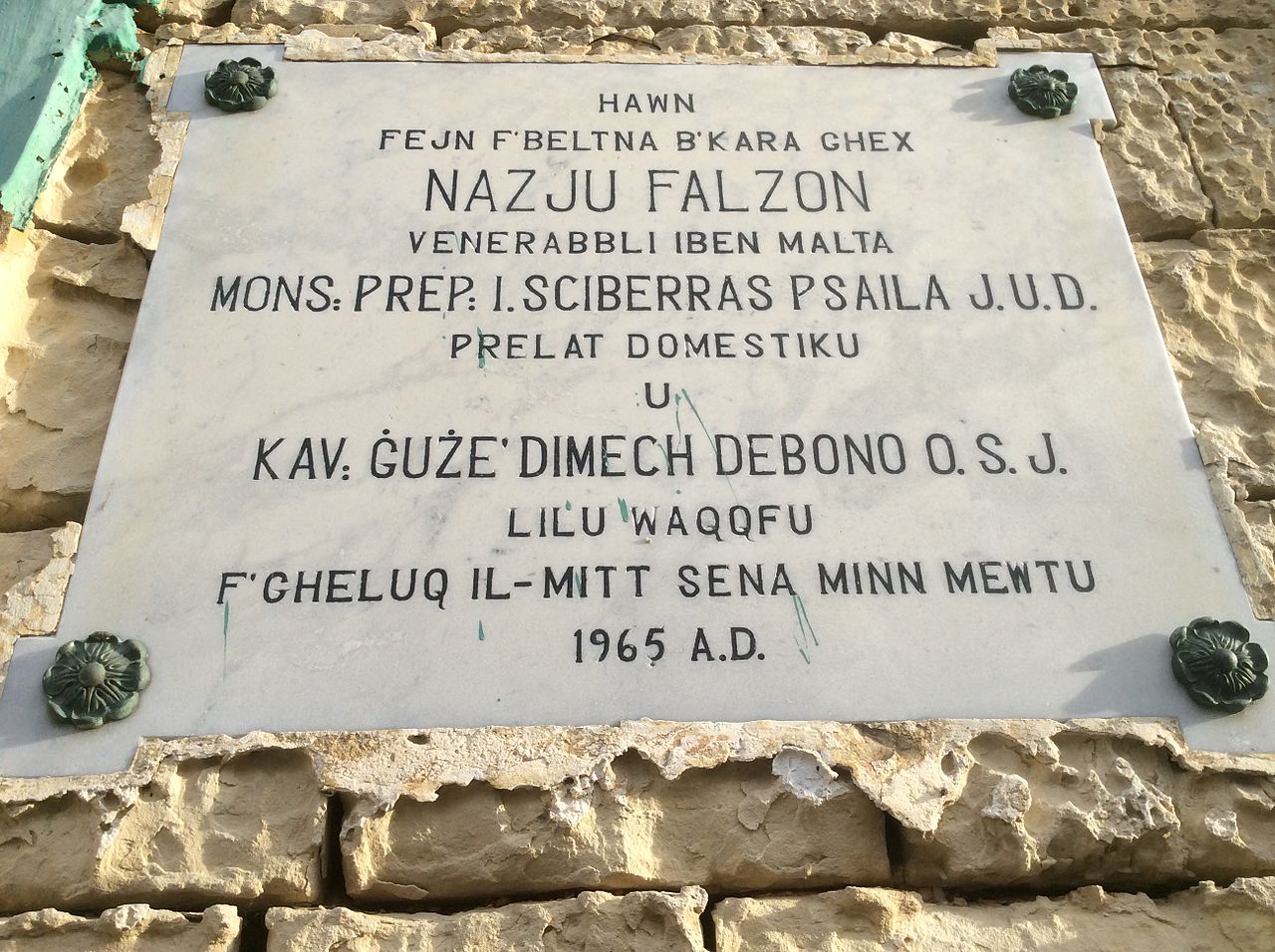
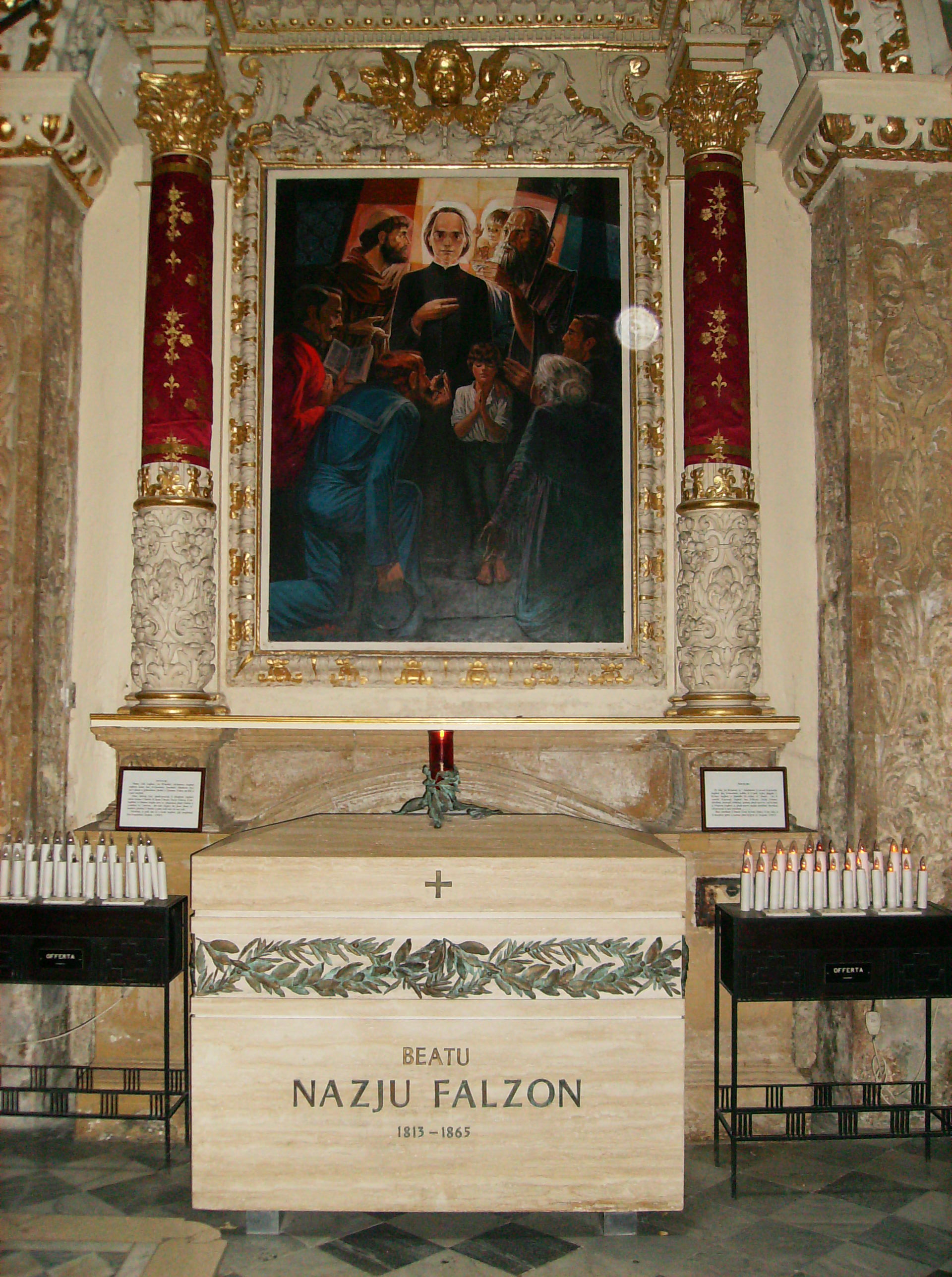
A long time sufferer of heart spasms, he died on the 1 July 1865, as he had foretold, the day of his 52nd birthday. The Funeral Service was held the following day in Ta’ Ġieżu Church in Valletta, where he was also buried in the family vault in the Chapel of the Immaculate Conception in the Church of the Franciscan Minors, Mary of Jesus in Valletta.
The Beatification miracle involved the 1981 cure of a man stricken with cancer, who was totally cured. He was Beatified by St Pope John Paul II on 9 May 2001, in Malta, when he said:
“The Servant of God Ignatius Falzon also had a great passion for preaching the Gospel and teaching the Catholic faith. He too, put his many talents and his intellectual training at the service of Catechetical work. The Apostle Paul wrote that “each one must do as he has made up his mind, not reluctantly or under compulsion, for God loves a cheerful giver” (2 Cor 9:7). Blessed Nazju was one who gave abundantly and cheerfully and people saw in him, not only boundless energy but also deep peace and joy.
He renounced the worldly success for which his background had prepared him, in order to serve the spiritual good of others, including the many British soldiers and sailors stationed in Malta at the time. In his approach to them, few of whom were Catholic, he anticipated the ecumenical spirit of respect and dialogue, which is familiar to us today but which was not always prevalent at that time.
Ignatius Falzon drew his strength and inspiration from the Eucharist, prayer before the Tabernacle, devotion to Mary and the Rosary and imitation of Saint Joseph. These are fountains of grace from which all Christians may drink. Holiness and zeal for God’s Kingdom flourish especially where parishes and communities encourage prayer and devotion to the Blessed Sacrament. I urge you, therefore, to cherish your Maltese traditions of piety, purifying them where necessary and strengthening them with sound instruction and Catechesis. There would be no better way of honouring the memory of Blessed Nazju Falzon. Amen.”
Shrine to Blessed Nazju in the Church of Mary of Jesus in Valletta, where his relics also lie.
The Most Precious Blood of Our Lord, Jesus Christ – 1 July: The feast was removed from the General Roman Calendar in 1969, “because the Most Precious Blood of Christ the Redeemer is already venerated in the solemnities of the Passion, of Corpus Christi, of the Sacred Heart of Jesus and in the feast of the Exaltation of the Holy Cross.” However, as this is the Month of the Most Precious Blood, this day, is most worthy of celebrating this Feast Day everyday.
St Aaron of Caerleon
St Aaron the Patriarch Blessed Antonio Rosmini-Serbati (1797-1855) His Life: https://anastpaul.com/2019/07/01/saint-of-the-day-1-july-blessed-antonio-rosmini-1797-1855/
St Arnulf of Mainz
Bl Assunta Marchetti
St Atilano Cruz Alvarado
St Calais of Anisole
St Carilephus
St Castus of Sinuessa
St Cewydd
St Concordius of Toledo
St Cuimmein of Nendrum
St Domitian of Lerins
Bl Elisabeth de Vans
St Eparchius of Perigord
St Eutychius of Umbria
St Esther the Queen
St Gall of Clermont
Bl George Beesley
St Golvinus of Leon
St Gwenyth of Cornwall
St Huailu Zhang
Bl Jan Nepomucen Chrzan
Bl Jean-Baptiste Duverneuil
St Julius of Caerleon
St Justino Orona Madrigal
St Juthware
St Leonorious of Brittany
St Leontius of Autun
Bl Luis Obdulio Navarro
St Martin of Vienne
Bl Montford Scott Blessed Ignatius “Nazju” Falzon OFS (1813-1865)
St Nicasius of Jerusalem
St Oliver Plunkett (1629-1681) Martyr
Bl Pierre-Yrieix Labrouhe de Laborderie
St Secundinus of Sinuessa
St Servan of Culross
St Theobald of Vicenza
St Theodoric of Mont d’Or
Bl Thomas Maxfield
Bl Tullio Maruzzo
St Veep
—
Martyrs of Rome – 6 saints: Six Christians who were martyred together. No details have survived except their names – Esicius, Antonius, Processus, Marina, Serenus and Victor. They were martyred in Rome, Italy, date unknown.
Thought for the Day – 30 June – “The Last Day of Month of the Sacred Heart” – Meditations with Antonio Cardinal Bacci (1881-1971)
Devotion to the Sacred Heart
“When we consider it under it’s fundamental aspect as the cult of the love of God, rather than of the Incarnate Word, devotion to the Sacred Heart of Jesus, is as old as Christianity, even though it is only in recent centuries, that it has assumed it’s present symbolism. “He who does not love, does not know God,” says St John, “for God is love” (1 Jn 4:8). “And we have come to know,” he continues “and have believed, the love that God has in our behalf. God is love and he who abides in love, abides in God and God in him” (1 Jn 4:16). This cult of the love of God, particularly of the love of God made man, vibrates throughout the pages of the Gospel and of the writings of the Apostles, especially of St John and of St Paul.
In the works of the Fathers, there are references to the Heart of Jesus, pierced with a lance, from which flowed all the infinite graces of the Church for our redemption. We are reminded of this in the Encylical, Haurietis Aquas, published by Pope Pius XII in the year 1956. But the specific cult of the love of God, as symbolised by the Heart of Jesus, was explicitly approved by the Church after Jesus Himself appeared in the year 1674 to St Margaret Mary Alacoque and showed her His Heart on fire with love for men.”
Quote/s of the Day – 30 June – “The Last day of the Month of the Sacred Heart” – Tuesday of the Thirteenth week in Ordinary Time Year A, Readings: Amos 3:1-8; 4:11-12, Psalm 5:5-8, Matthew 8:23-27
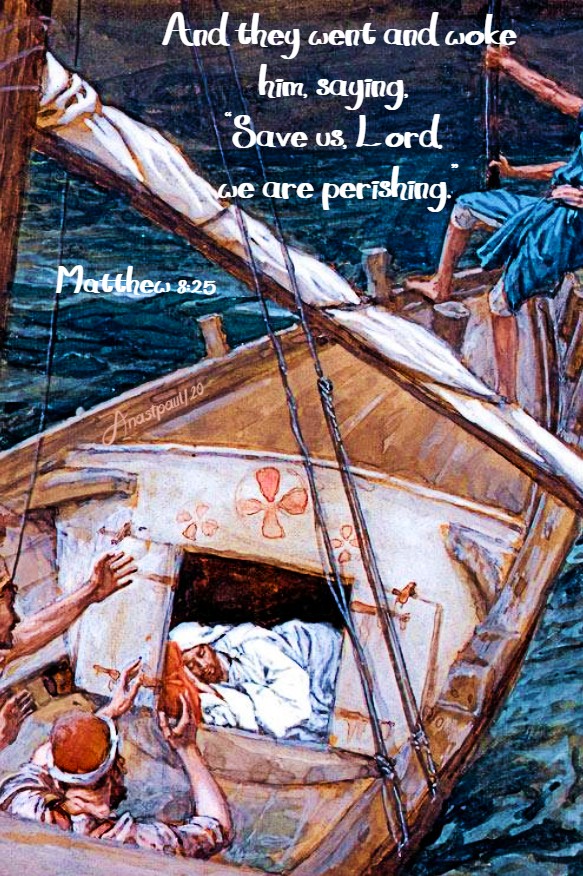
And they went and woke him, saying, “Save us, Lord, we are perishing.”
Matthew 8:25
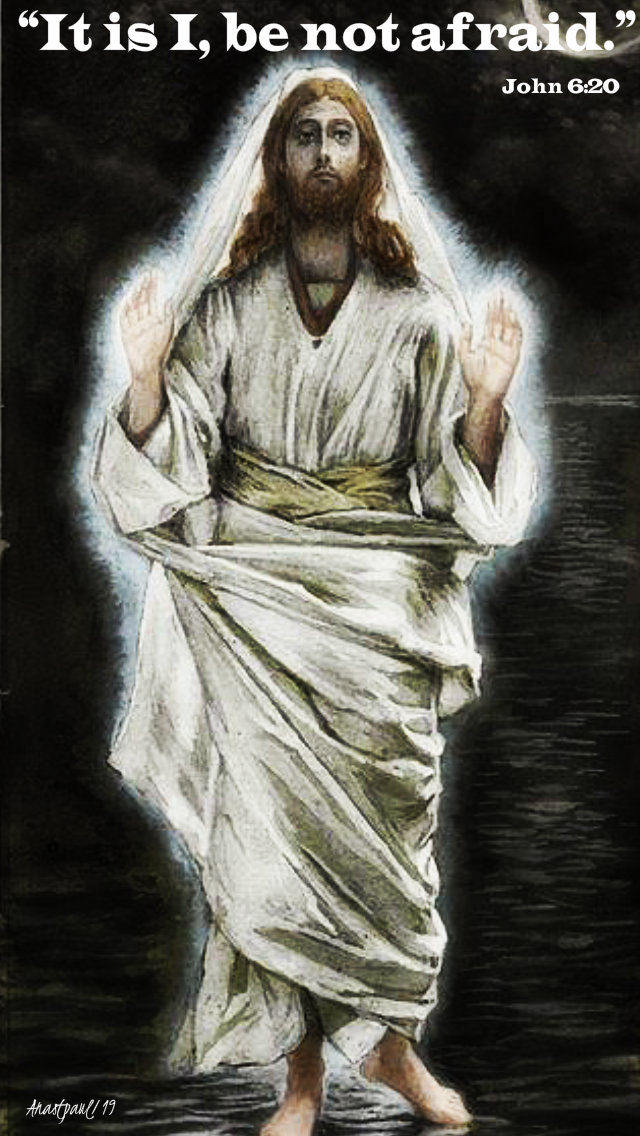
“It is I, be not afraid”
John 6:20
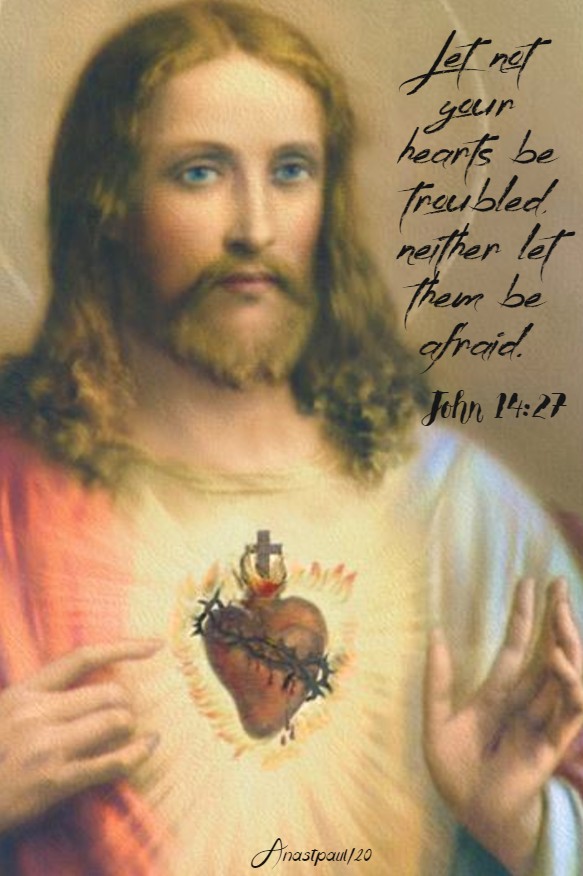
“Let not your hearts be troubled, neither let them be afraid.”
John 14:27
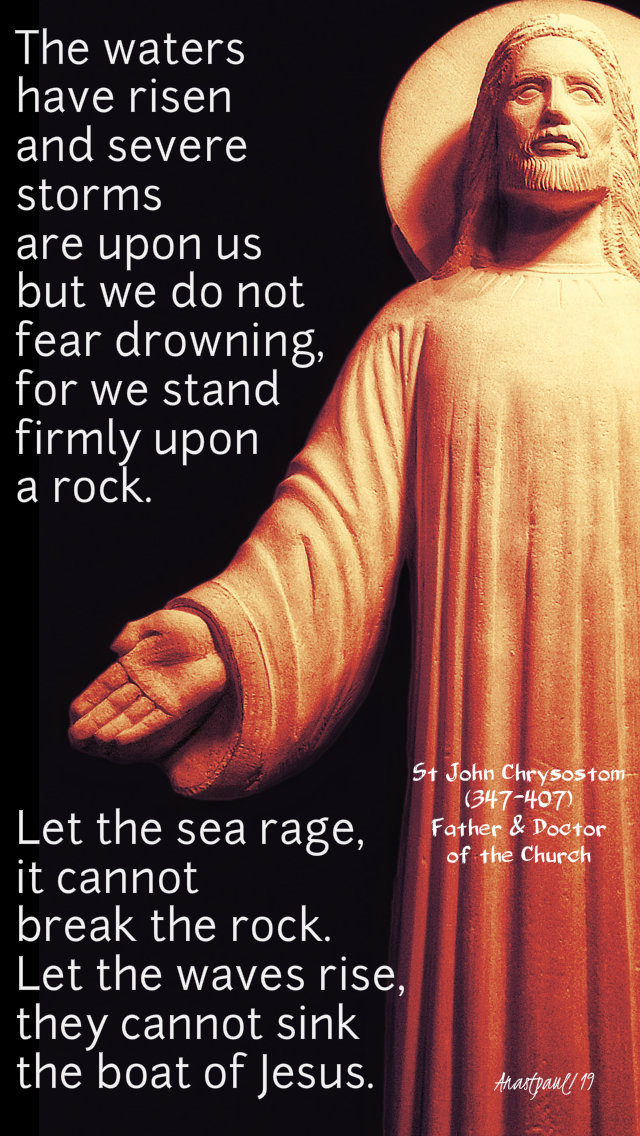
“The waters have risen and severe storms are upon us but we do not fear drowning, for we stand firmly upon a rock. Let the sea rage, it cannot break the rock. Let the waves rise, they cannot sink the boat of Jesus.”
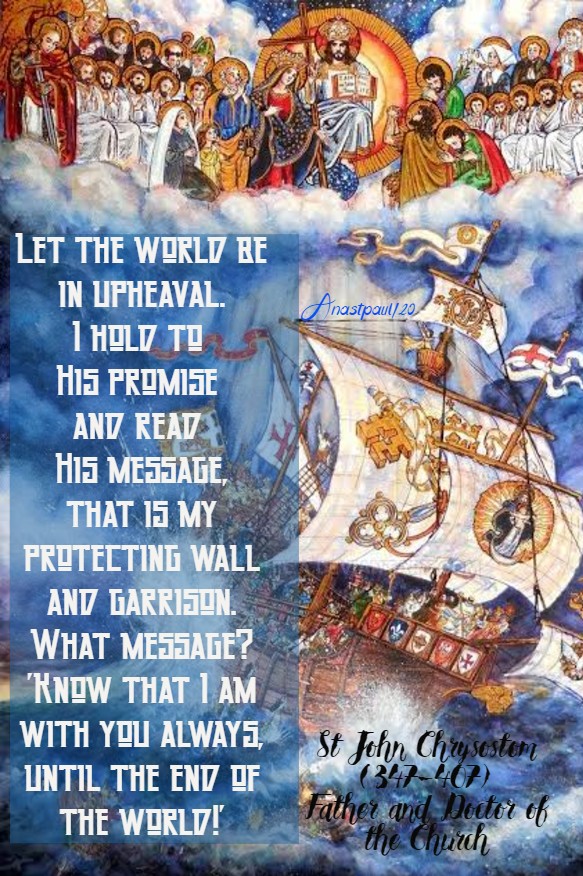
“Let the world be in upheaval. I hold to His promise and read His message, that is my protecting wall and garrison. What message? ‘Know that I am with you always, until the end of the world!'”
St John Chrysostom (347-407)
Father and Doctor of the Church
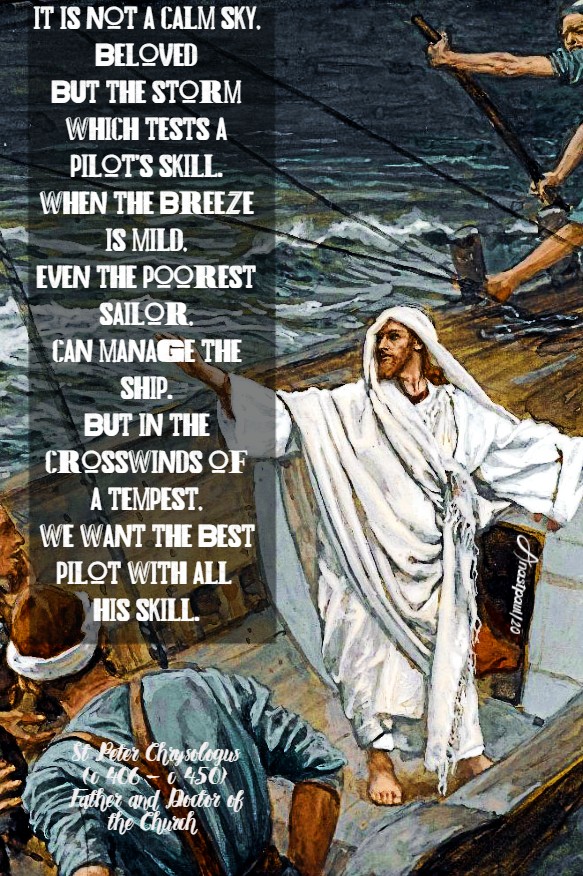
“It is not a calm sky, beloved but the storm which tests a pilot’s skill. When the breeze is mild, even the poorest sailor, can manage the ship. But in the crosswinds of a tempest, we want the best pilot with all His skill.”
St Peter Chrysologus (c 406 – c 450)
Father and Doctor of the Church
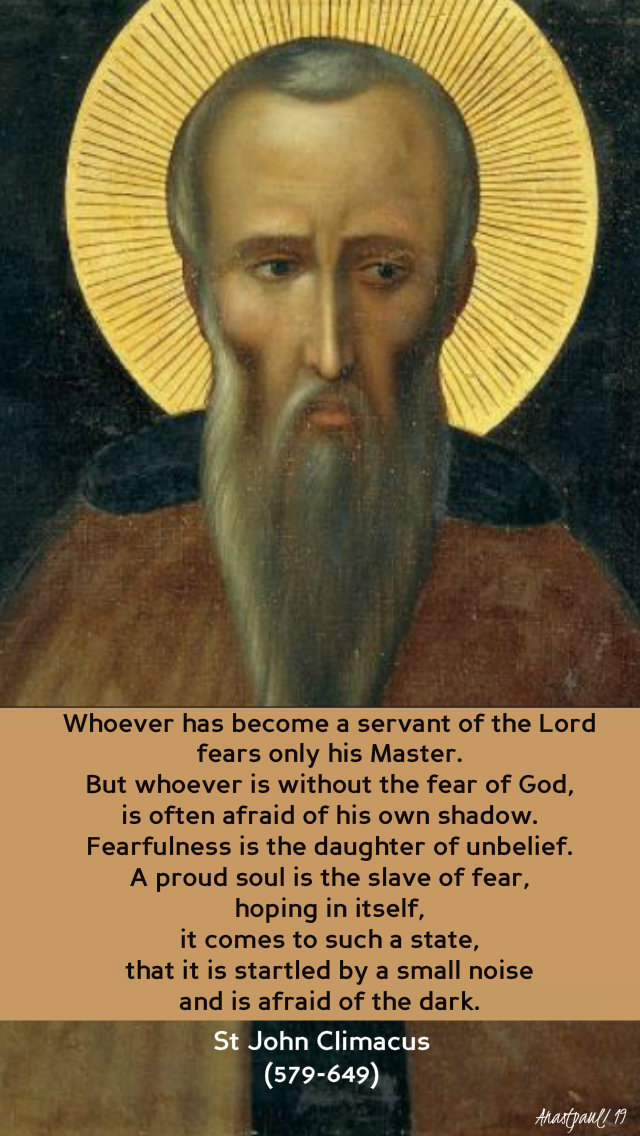
“Whoever has become a servant of the Lord, fears only his Master. But whoever is without the fear of God, is often afraid of his own shadow. Fearfulness is the daughter of unbelief. A proud soul is the slave of fear, hoping in itself, it comes to such a state, that it is startled by a small noise and is afraid of the dark.”
St John Climacus (579-649)
Father of the Church
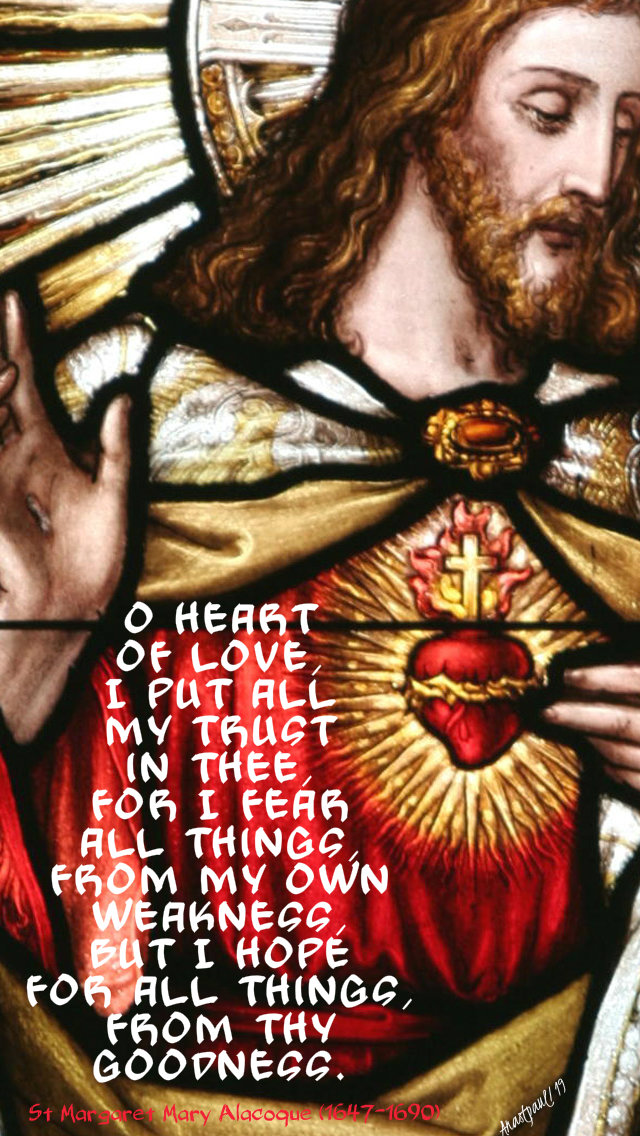
“O Heart of love, I put all my trust in Thee, for I fear all things, from my own weakness, but I hope for all things, from Thy Goodness.”
St Margaret Mary Alacoque (1647-1690)
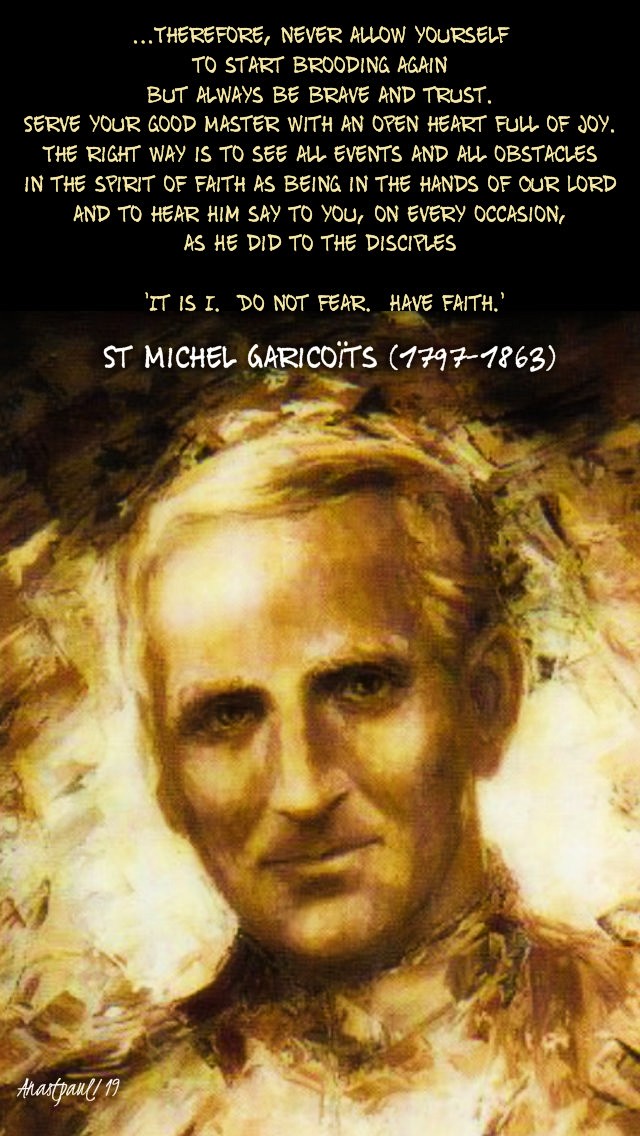
“…Therefore, never allow yourself to start brooding again but always be brave and trust. Serve your good Master with an open heart full of joy. The right way is to see all events and all obstacles in the spirit of faith as being in the hands of Our Lord and to hear Him say to you, on every occasion, as He did to the disciples ‘It is I. Do not fear. Have faith.’”
St Michael Garicoïts (1797-1863)
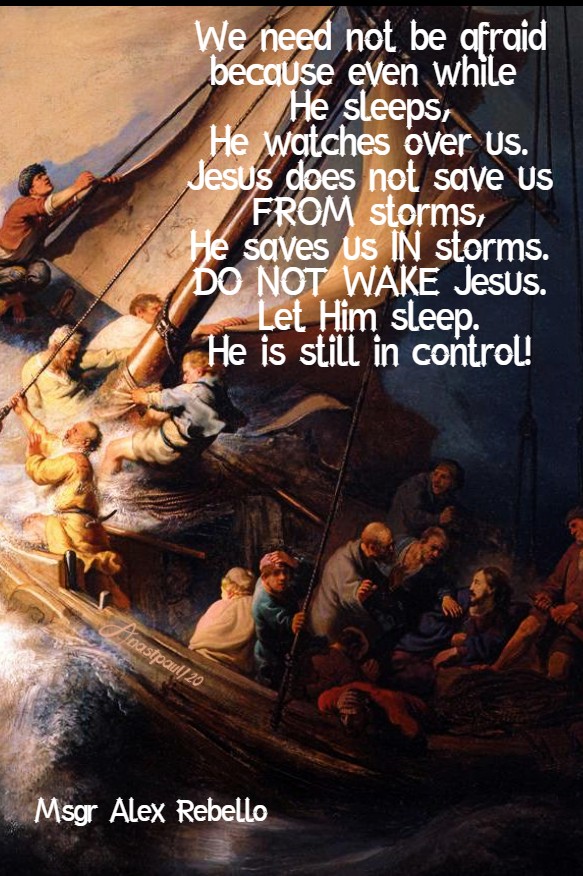
“We need not be afraid because even while He sleeps, He watches over us. Jesus does not save us FROM storms, He saves us IN storms. DO NOT WAKE Jesus. Let Him sleep. He is still in control!”
One Minute Reflection – 30 June – “The Last day of the Month of the Sacred Heart” – Tuesday of the Thirteenth week in Ordinary Time Year A, Readings: Amos 3:1-8; 4:11-12, Psalm 5:5-8, Matthew 8:23-27
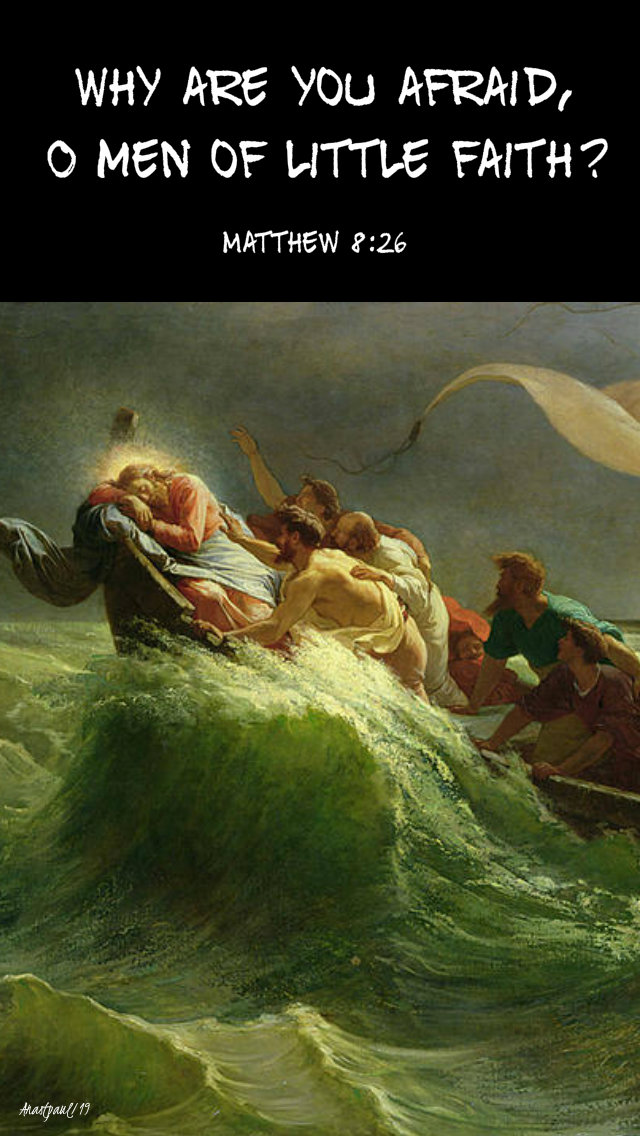
He said to them, “Why are you afraid, O men of little faith?” Then he got up, rebuked the winds and the sea and there was great calm. … Matthew 8:26
REFLECTION – “God is not at all displeased when, on occasion, you quietly complain to him. Don’t be afraid of saying to him: “Lord, why do you stand afar off? (cf. Ps 9:22 LXX) You know well that I love You and only long for Your love. Graciously come to my aid and do not abandon me.”
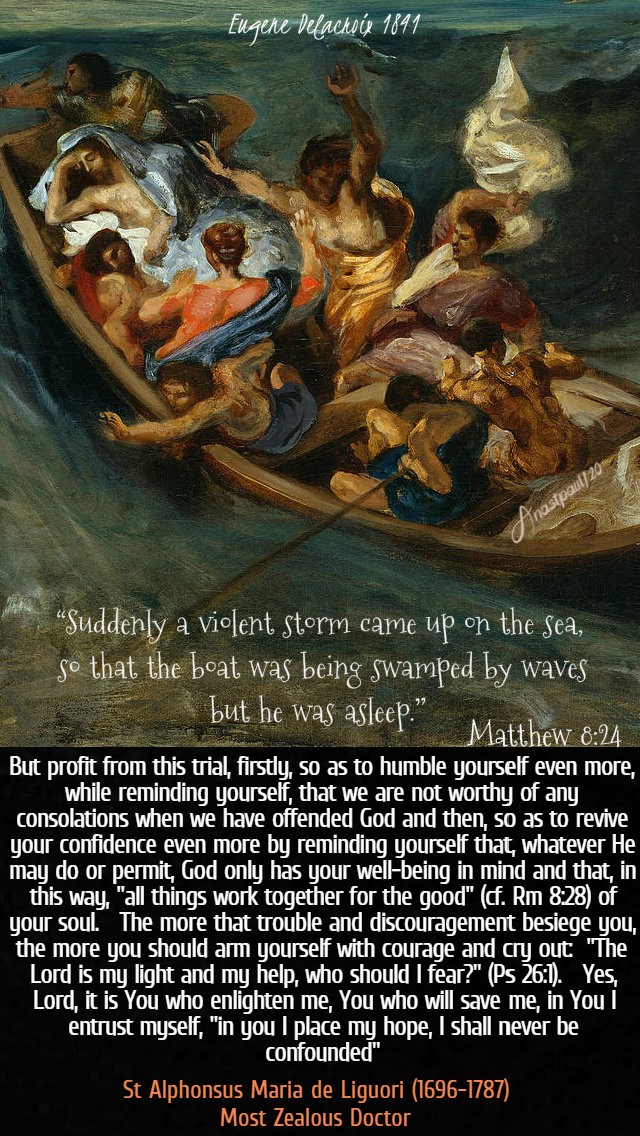
If your desolation continues and your anguish is unbearable, unite your voice to that Jesus, Jesus dying in affliction on the cross – say, as you beg the divine pity: “My God, my God, why have you abandoned me?” (Mt 27:46) But profit from this trial, firstly, so as to humble yourself even more, while reminding yourself, that we are not worthy of any consolations when we have offended God and then, so as to revive your confidence even more by reminding yourself that, whatever He may do or permit, God only has your well-being in mind and that, in this way, “all things work together for the good” (cf. Rm 8:28) of your soul. The more that trouble and discouragement besiege you, the more you should arm yourself with courage and cry out: “The Lord is my light and my help, who should I fear?” (Ps 26:1). Yes, Lord, it is You who enlighten me, You who will save me, in You I entrust myself, “in you I place my hope, I shall never be confounded” (Ps 30:2 LXX).
In this way, stand firm in peace, certain that “no-one has hoped in the Lord and been confounded” (Sir 2:11 Vg.), none have been lost after having placed their trust in God.” … St Alphonsus Maria de Liguori (1696-1787) – Bishop and Doctor of the Church – What should we talk about with God? (from: ‘How to Converse Continually and Familiarly with God’).
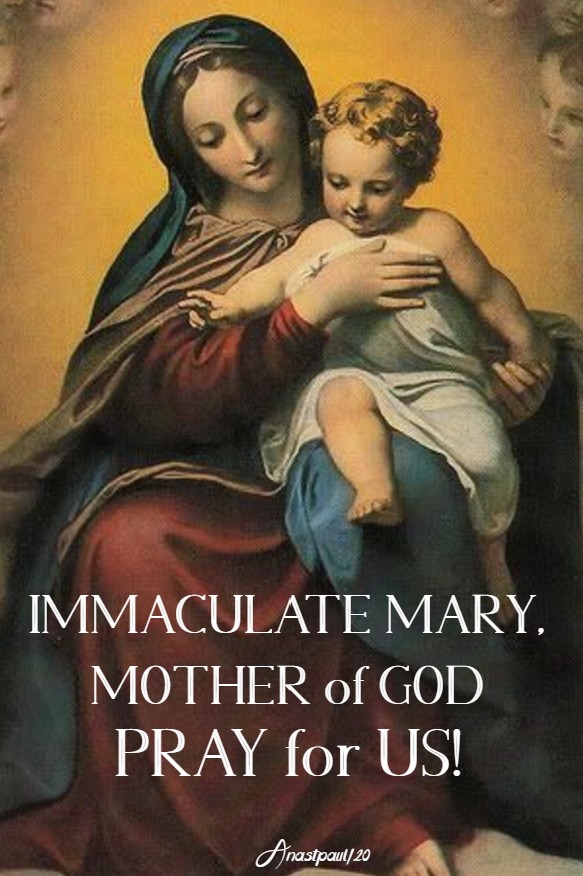
PRAYER – Lord, You are the beginning and the end of all that we do, all that we are and all that we say. Lead us by the light of Your grace in complete trust and confidence and complete us with Your all-powerful help. Let Your light penetrate the hidden fears of our hearts and may our trust be complete. And may we always understand that our Mother, loves us and cares for us in all our needs. We worship You in Christ, Your Son, who lives and reigns with You and the Holy Spirit, God forever and ever, amen.
Our Morning Offering – 30 June – “The Last day of the Month of the Sacred Heart” – Tuesday of the Thirteenth week in Ordinary Time
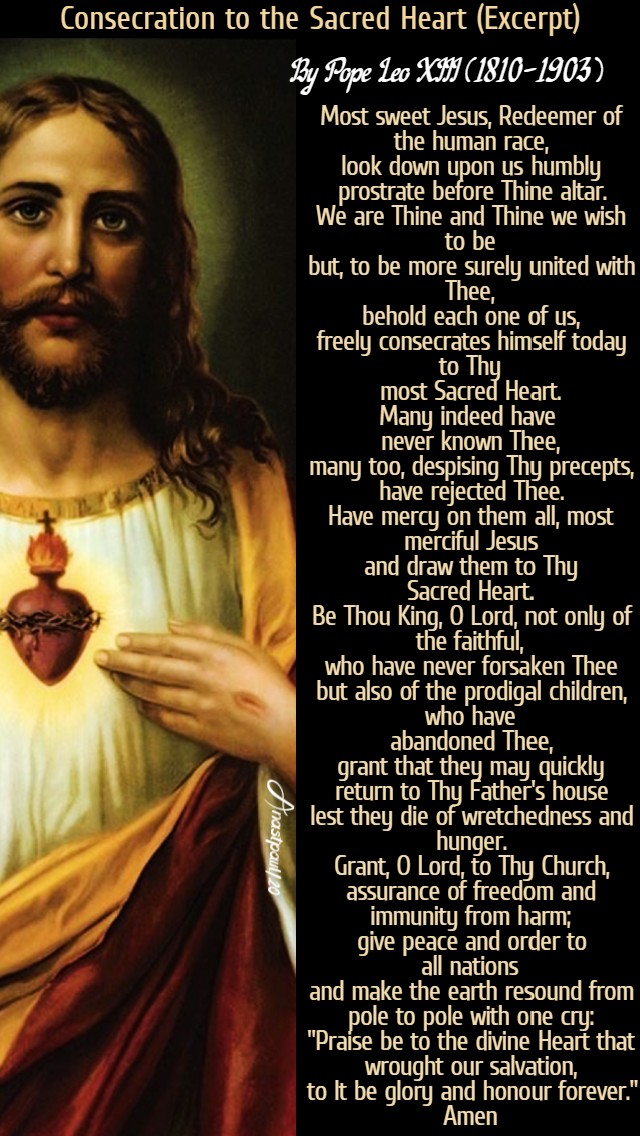
Consecration to the Sacred Heart By Pope Leo XIII (1810-1903) Pope from 1878-1903
Most sweet Jesus, Redeemer of the human race,
look down upon us humbly prostrate before Thine altar.
We are Thine and Thine we wish to be
but, to be more surely united with Thee,
behold each one of us,
freely consecrates himself today to Thy most Sacred Heart.
Many indeed have never known Thee,
many too, despising Thy precepts, have rejected Thee.
Have mercy on them all, most merciful Jesus
and draw them to Thy Sacred Heart.
Be Thou King, O Lord, not only of the faithful,
who have never forsaken Thee
but also of the prodigal children, who have abandoned Thee,
grant that they may quickly return to Thy Father’s house
lest they die of wretchedness and hunger.
Be Thou King of those who are deceived by erroneous opinions,
or whom discord keeps aloof
and call them back to the harbour of truth and unity of faith,
so that there may be but one flock and one Shepherd.
Be Thou, King of all those.
who are still involved in the darkness of idolatry or of Islamism
and refuse not to draw them into the light and kingdom of God.
Turn Thine eyes of mercy towards the children of the race,
once Thy chosen people – of old they called down upon themselves
the Blood of the Saviour;
may it now descend upon them,
a laver of redemption and of life.
Grant, O Lord, to Thy Church,
assurance of freedom and immunity from harm;
give peace and order to all nations
and make the earth resound from pole to pole with one cry:
“Praise be to the divine Heart that wrought our salvation;
to It be glory and honour forever.”
Amen
The above prayer, composed by Pope Leo XIII was included in the 1899 encyclical Annum Sacrum issued by Leo XIII as he Consecrated the entire world to the Sacred Heart of Jesus. The consecration was influenced by two letters written to the Holy Father by Blessed Sister Mary of the Divine Heart, who stated that in visions of Jesus Christ, she had been told to request the Consecration.
Saint of the Day – 30 June – Blessed Philip Powell OSB (1594 – 1646) Priest, Martyr, Benedictine Monk – born on 2 February 1594 in Tralon, Brecknockshire, England and died by being hang, drawn and quartered on 30 June 1646 at Tyburn, London, England. He is also remembered on 4 May with the Forty Martyrs of England and Wales. Also known as – Philip Morgan, Philip Powel, Philip Prosser.
Philip Powell was the son of Roger and Catherine Powell (nee Morgan) and was brought up to the law by David Baker, afterwards Dom Augustine Baker OSB. At the age of sixteen he became a student in the Temple, London but went to Douai three or four years later to study for the Priesthood.
He was Ordained a Priest in 1618 and was professed a Monk on 15 August 1619, having studied under Dom Leander Jones OSB. He was next made Cellarer of St Gregory’s Monastery, Douai and then was sent on the English mission on 7 March 1622. He lived with Dom Baker OSB for sixteen months in Gray’s Inn Lane, London. For the following twenty years he was Chaplain to various families in Devon and Somerset until the Civil War broke out.
After serving as a Chaplain to Royalist troops, he tried to make his way to Monmouthshire in 1646. He was arrested off the Mumbles on 22 February 1646 by Capt Crowther, who kept him confined in his ship for two months in Penarth Roads and then sent him by sea to London. There he was confined in St Catherine’s Gaol, Southwark, where the harsh treatment he received brought on a severe attack of pleurisy.
His trial, which had been fixed for 30 May, did not take place till 9 June, at Westminster Hall. He was found guilty of being a Catholic Priest and was hanged, drawn and quartered at Tyburn.
It is recorded that when informed of his death sentence, Powell exclaimed “Oh what am I, that God thus honours me and will have me to die for His sake?” and called for a glass of sack (or sherry).
At the instance of the Common Council of London, his head and quarters were not exposed but were buried in the old churchyard at Moorfields.
The Martyr’s Crucifix, which had formerly belonged to Feckenham, last Abbot of Westminster, is preserved at Downside, with some of his hair and a cloth stained with his blood.
He was Beatified by Pope Pius XI on 15 December 1929.
St Adolphus of Osnabrück
St Alpinian of Limoges
St Alrick the Hermit
Bl Ambrose de Feis
Bl Anthony de Tremoulières
Bl Arnulf of Villers
St Austriclinian of Limoges
St Basilides of Alexandria
St Bertrand of Le Mans
St Clotsindis of Marchiennes
Bl Elisabeth Heimburg
St Emiliana of Rome
St Erentrude
St Eurgain
St Gaius Bl Gennaro Maria Sarnelli C.Ss.R. (1702–1743) Biography: https://anastpaul.com/2019/06/30/saint-of-the-day-30-june-blessed-gennaro-maria-sarnelli-c-ss-r-1702-1743/
Bl Jacob Clou
St Leo the Deacon
St Lucina of Rome
St Lucina of the Callistus Catacombs
St Marcian of Pampeluna
St Martial of Limoges
St Ostianus
St Otto of Bamberg
St Peter of Asti
St Petrus Li Quanhui Blessed Philip Powell OSB (1594 – 1646) Priest and Martyr
St Raimundus Li Quanzhen Bl Raymond Lull TOSF (c 1232 – c 1315) Martyr His Life: https://anastpaul.com/2018/06/30/saint-of-the-day-30-june-blessed-raymond-lull-t-o-s-f-c-1232-c1315-martyr/
St Theobald of Provins
St Vihn Son Ðo Yen
Bl Zenon Kovalyk
—
Martyrs of Africa – 7 saints: Seven Christians martyred together. No detail about them have surived but the names – Cursicus, Gelatus, Italica, Leo, Timotheus, Zoilus, and Zoticus. Date and precise location in Africa unknown.
Thought for the Day – 29 June – “Month of the Sacred Heart” – Meditations with Antonio Cardinal Bacci (1881-1971)
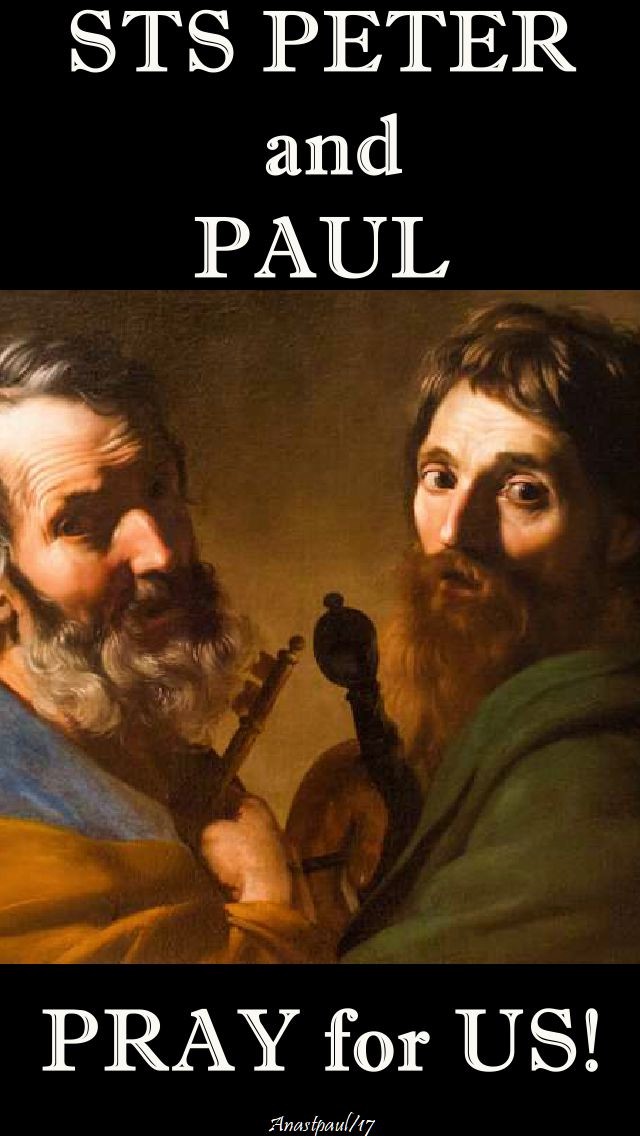
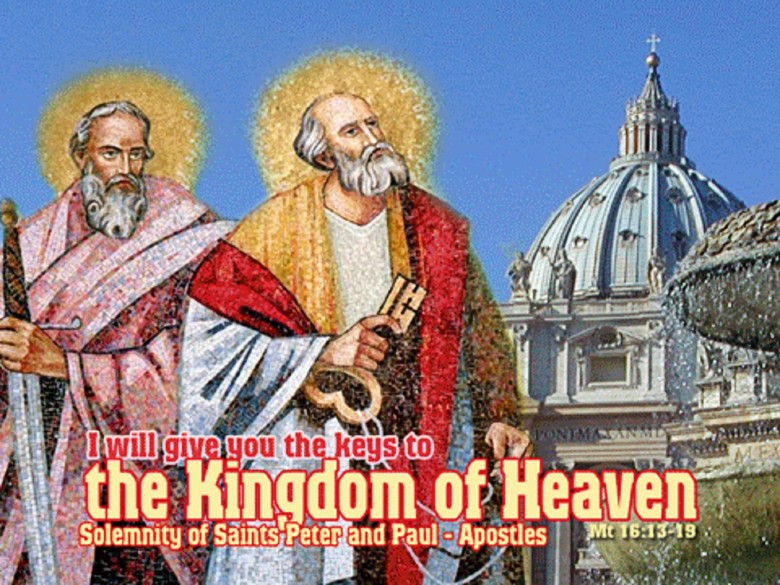
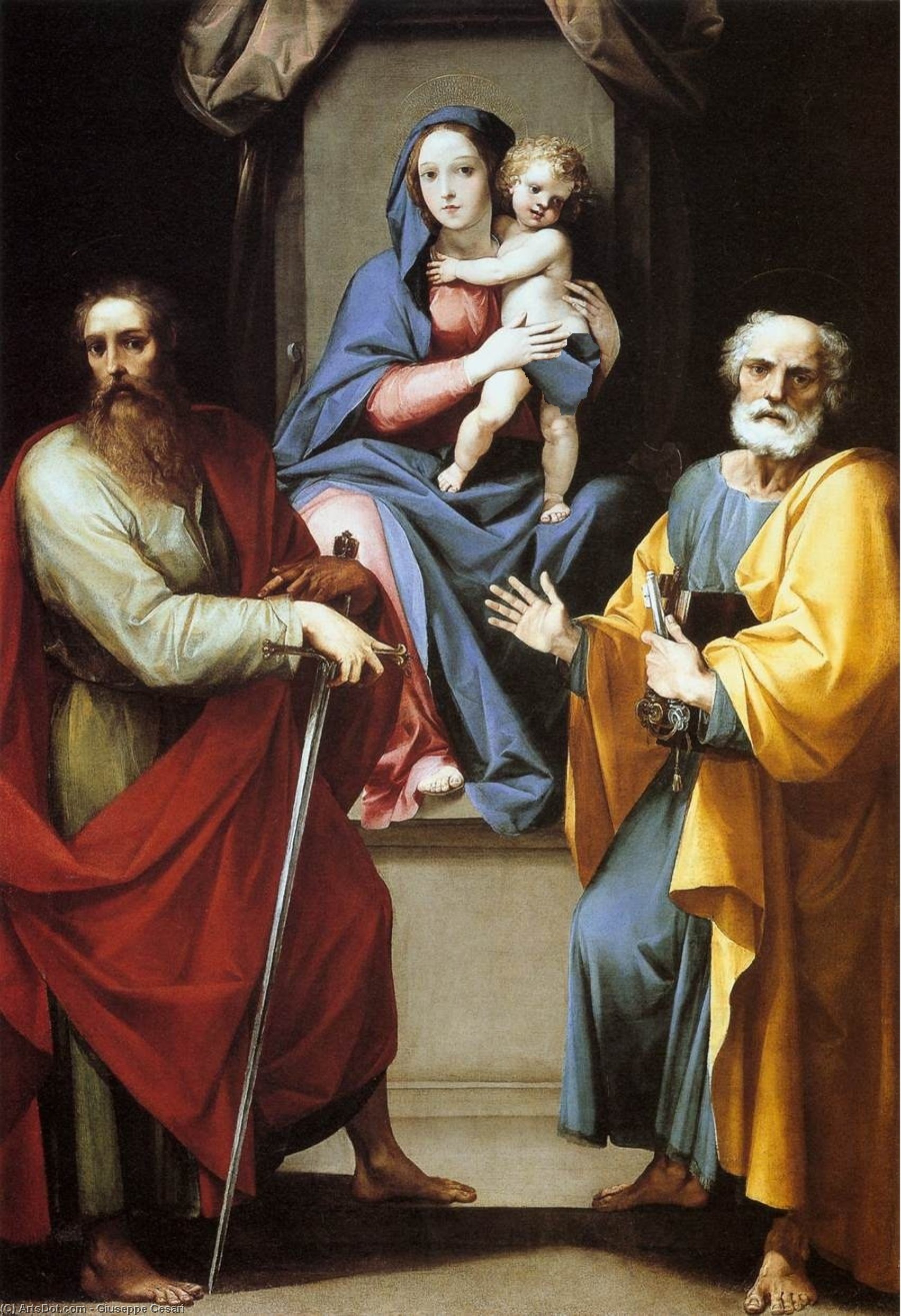
St Peter, Prince of the Apostles
St Paul, the Apostle to the Gentiles
“Jesus was walking one day along the shoe of the Sea of Galilee, when He saw two fishermen casting their nets into the water.
He approached them and said: “Come, follow me and I will make you fishers of men” (Mk 1:17).
These two fishermen were brothers named, Simon and Andrew.
The divine Master won their hearts immediately, so that they left their boat and their nets and followed Jesus.
Simon was later called Peter and became the leader of the Apostles.
Peter’s generosity and great love for Jesus are evident in the pages of the Gospel.
When Our Lord foretold the institution of the Blessed Eucharist, many of His disciples were scandalised and left Him. “Do you also wish to go away?” Jesus asked His Apostles.
St Peter answered Him without delay. “Lord, to whom shall we go? Thou has the words of everlasting life and we have come to believe and to know, that Thou are the Christ, the Son of God” (Jn 6:69).
On another occasion, Jesus asked His disciples – “Who do men say the Son of Man is?” The Apostles hesitated and began to suggest the names of various Prophets.
But St Peter was inspired to make the reply: “Thou are the Christ, the Son of the living God.”
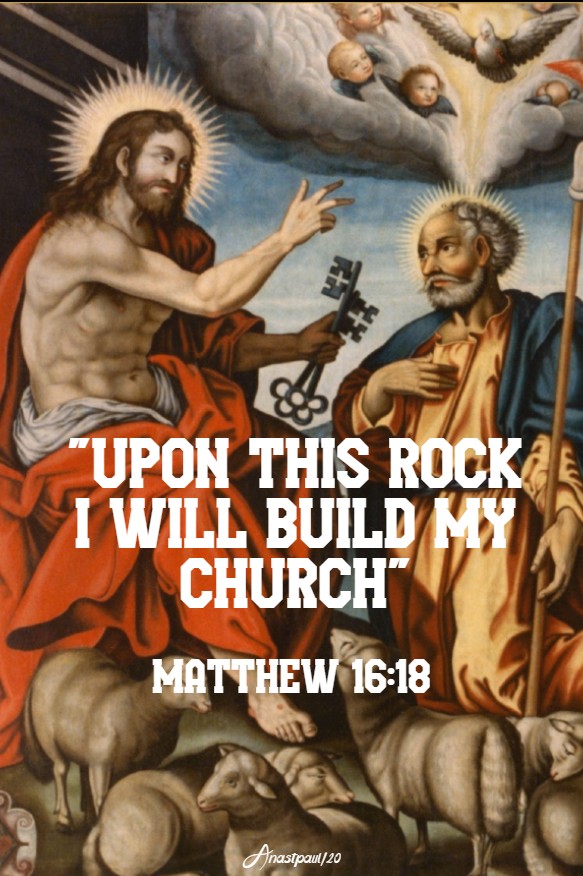
Then Our Lord appointed him Head of the Church. “Blessed are thou, Simon Bar-Jona … thou are Peter and upon this rock I will build my Church and the gates of hell, shall not prevail against it. And I will give thee the keys of the kingdom of heaven and whatever you shall bind on earth shall be bound in heaven” (Mt 16:15-19).
By these words there was instituted the loftiest and most ancient of the dynasties, the Papacy.
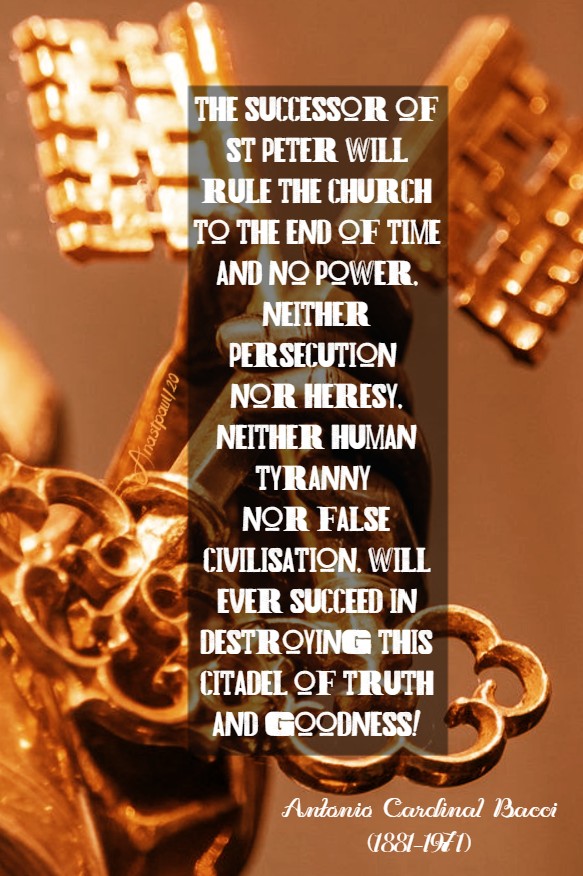
The successor of St Peter will rule the Church to the end of time and no power, neither persecution nor heresy, neither human tyranny nor false civilisation, will ever succeed in destroying this citadel of truth and goodness!”
St Paul, the Apostle to the Gentiles
“St Paul was by nature, fiery and zealous.
Once he discovered the truth, he was ready to die for it.
Originally he was convinced that Judaism contained the whole truth and, for this reason he hated the Christians, whom he regarded as a sect which had corrupted the sacred Hebrew tradition.
The deacon Stephen was the first victim of his persecuting zeal.
As he was being stoned and beaten to death this saintly young man prayed for his persecutors.
It may be that in this moment his eyes, shining with faith and love, encountered those of the man who hated him.
Soon afterwards, Saul (this was Paul’s real name), left Jerusalem for Damascus, carrying letters investing him with new powers for the persecution of the infant Church.
On the way, this headstrong but sincere enemy of Christianity was suddenly dazzled by a light from Heaven.
He fell to the ground and heard a mysterious voice saying: “Saul, Saul, why do thou persecute me?”
Terrified he answered: “Who are thou, Lord?” “I am Jesus,” the voice said, “whom thou are persecuting” (Acts 9:1-15).
From that day, Saul was changed completely.
Under the influence of divine grace, he became the Apostle to the Gentiles.
Before he set out on his missionary journeys, Paul wet apart into the desert of Arabia (Cf Gal 1:17), where, he remained sometime in prayer and recollection.
Then he went to Jerusalem to pay homage to the Prince of the Apostles, St Peter (Gal 1:18).
After this, he began his apostolic travels, in the course of which, he encountered all kinds of hardships and dangers.
The Jews frequently hunted him, in order to put him to death.
He was often cruelly scourged and flung into prison and, several times, he was shipwrecked and had miraculous escapes from death (CF 2 Cor 11:23-27).
He bore everything joyfully however, in order to prove his liove for Jesus Christ.
Charity was always his main incentive. “The love of Christ impels us” (2 Cor 5:14).
Charity, he said himself, “Believes all things, hopes all things,edues all things” (Cf 1 Cor 13:4-13).
His charity was so great, that he could truthfully say: “Who is weak and I am not weak? Who is made to stumble and I am not inflamed?” (2 Cor 11:29).
St Paul could make this claim because his heart had become identified with the Heart of Jesus.
Therefore, he could say: “It is now no longer I that live but Christ lives in me,” (Gal 2:20) and: “For me to live is Christ and to die is gain,” (Phil 1:21) and: “I am hard pressed from both sides, desiring to depart and to be with Christ, a lot by far the better; yet, to stay on in the flesh is necessary, for your sake” (Phil 1:23-24).
Let us meditate on this ardent love of God.
Let us cast aside our coldness and indifference and ask St Paul, to set us on fire with divine charity.” Amen
Quote/s of the Day – 29 June – “Month of the Sacred Heart” – The Solemnity of Saints Peter and Paul
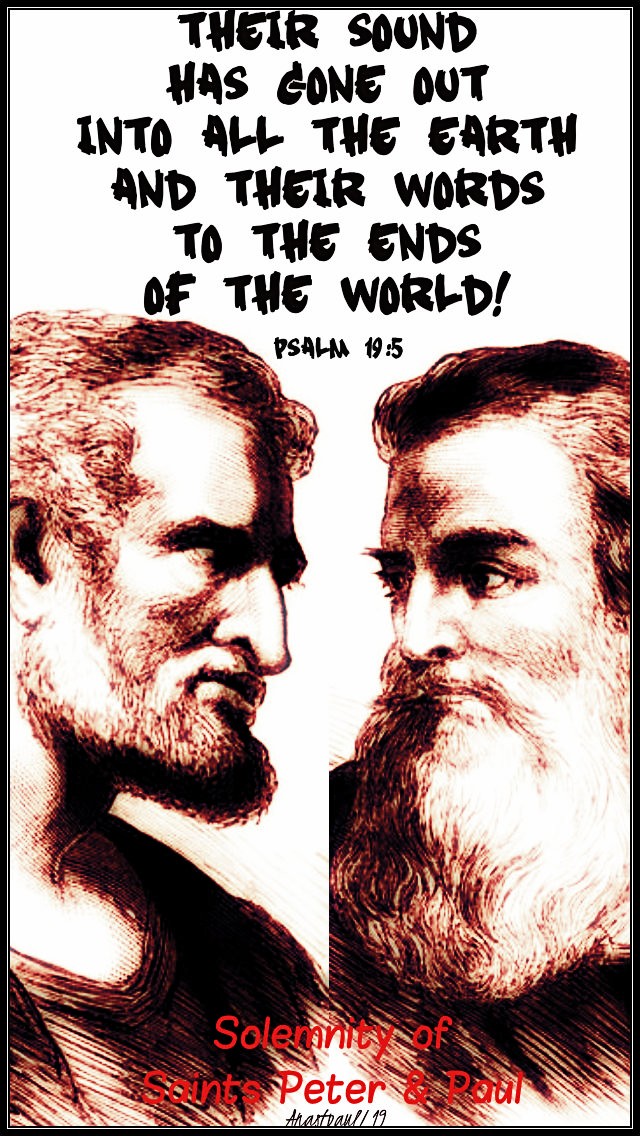
“Their sound has gone out into all the earth and their words to the ends of the world”
Psalm 19:5
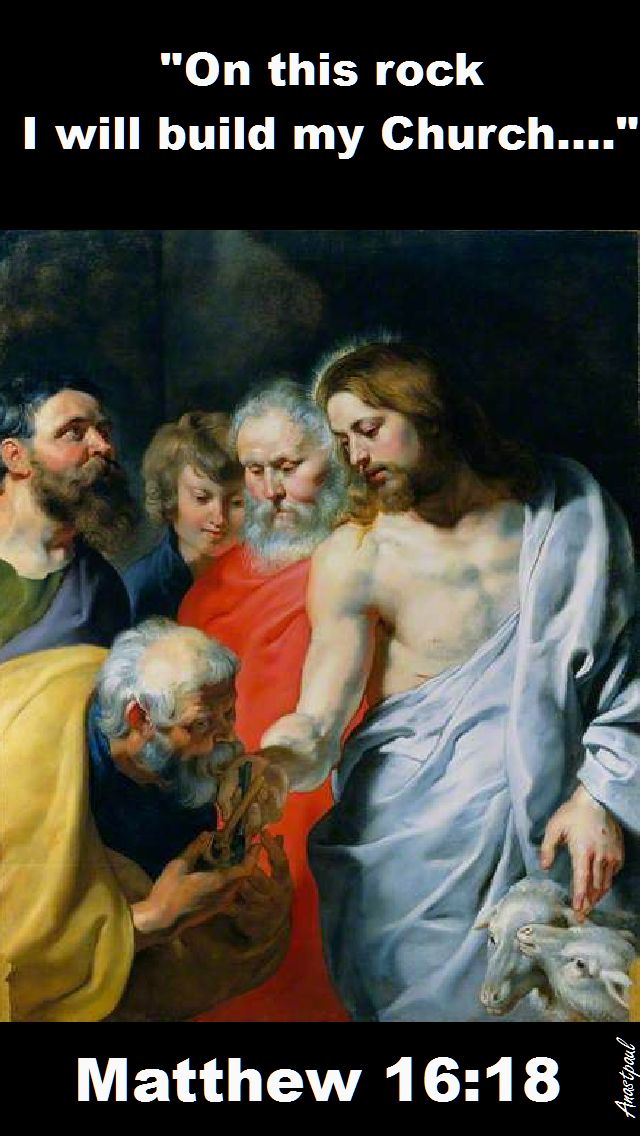
“On this rock I will build my church”
Matthew 16:18
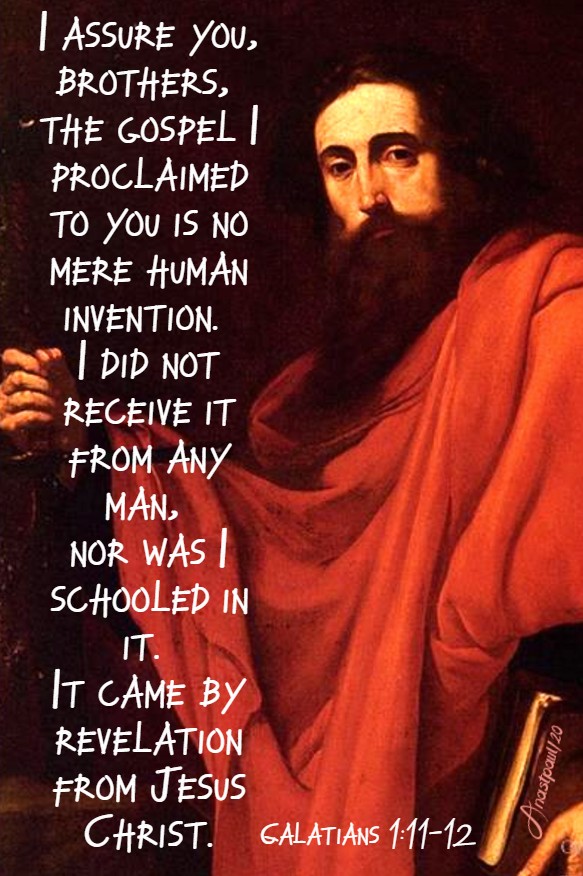
“I assure you, brothers, the gospel I proclaimed to you is no mere human invention. I did not receive it from any man, nor was I schooled in it. It came by revelation from Jesus Christ.”
Galatians 1:11-12
“….but we rejoice in our sufferings because we know, that suffering produces perseverance, perseverance, character and character, hope.”
Romans 5:4
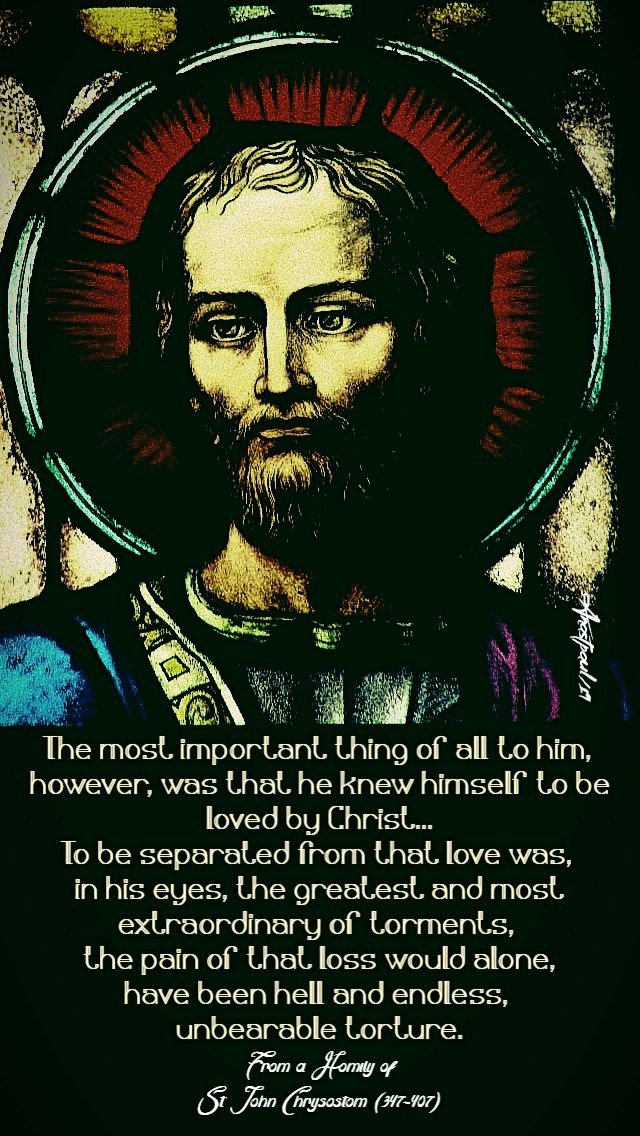
“Paul, more than anyone else, has shown us what man really is and in what our nobility consists and of what virtue this particular animal is capable. Each day he aimed ever higher, each day he rose up with greater ardour and faced with new eagerness, the dangers that threatened him. He summed up his attitude in the words: I forget what is behind me and push on to what lies ahead. … The most important thing of all to him, however, was that he knew himself to be loved by Christ. Enjoying this love, he considered himself happier than anyone else …”
“The most important thing of all to him, however, was that he knew himself to be loved by Christ. … To be separated from that love was, in his eyes, the greatest and most extraordinary of torments, the pain of that loss would alone, have been hell and endless, unbearable torture.”
St John Chrysostom (347-407)
Father and Doctor of the Church
“There must be general rejoicing, dearly beloved, over this holy company whom God has appointed for our example in patience and for our confirmation in faith. But we must glory even more in the excellence of their fathers, Peter and Paul, whom the grace of God has raised to such a height among all the members of the Church that He has set them like twin lights of eyes in that Body whose head is Christ.”
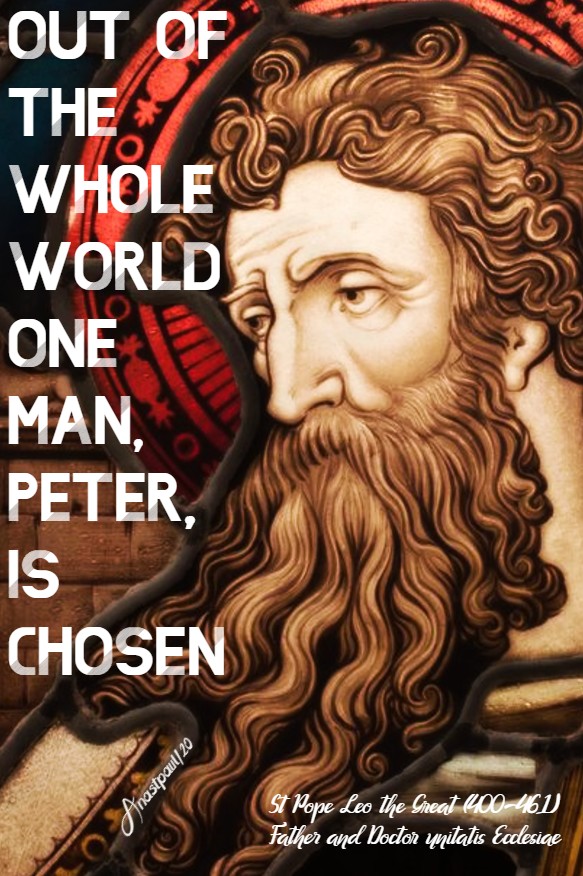
“Out of the whole world one man, Peter, is chosen to preside at the head of all nations and to be set over all the apostles and all the fathers of the church. Though there are, in God’s people, many bishops and many shepherds, Peter is thus appointed to rule in his own person, those whom Christ also rules as the original ruler.”
Saint Pope Leo the Great (400-461)
Father Doctor unitatis Ecclesiae
“…They said that, [the] Mediator had come and gone but, had left behind Him, what was to be His representative till the end of all things, His Mystical Body, the Church, in joining which, lay the salvation of the world.”
St John Henry Newman (1801-1890)
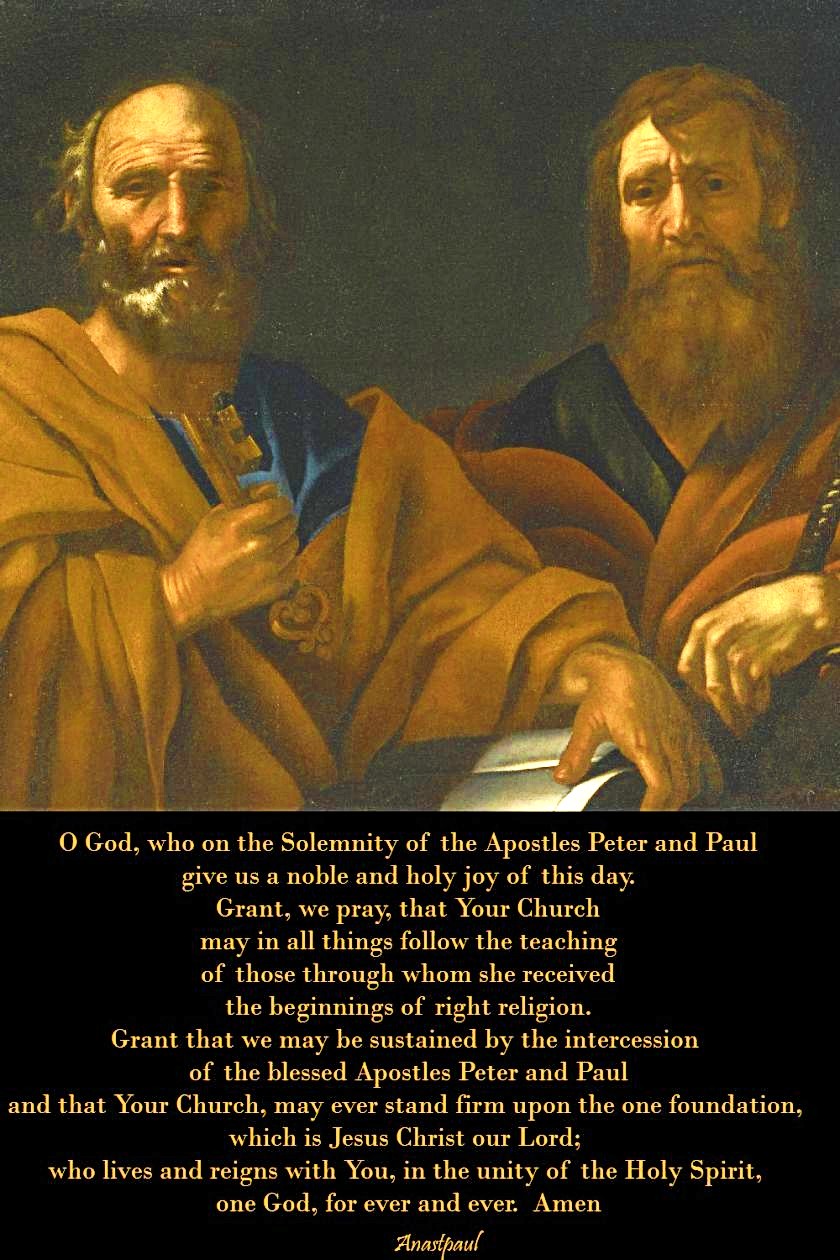
O God, who on the Solemnity of the Apostles Peter and Paul give us a noble and holy joy of this day. Grant, we pray, that Your Church may in all things follow the teaching of those through whom she received the beginnings of right religion. Grant that we may be sustained by the intercession of the blessed Apostles Peter and Paul and that Your Church, may ever stand firm upon the one foundation, which is Jesus Christ our Lord; who lives and reigns with You, in the unity of the Holy Spirit, one God, for ever and ever. Amen
“Simon Peter replied, “You are the Christ, the Son of the living God.” … Jesus said to him in reply … And so I say to you, you are Peter and upon this rock I will build my church and the gates of the hell shall not prevail against it. I will give you the keys to the kingdom of heaven. Whatever you bind on earth shall be bound in heaven; and whatever you loose on earth shall be loosed in heaven.” … Matthew 16:16,17,18-19
REFLECTION – “Christ the Mediator “ committed no sin and no deceit was found in his mouth” (1Pt 2:22). How could I venture to draw near Him, I who am a sinner, a grievous sinner whose sins are more numerous than the sands of the sea? He is all that is most pure, I am all that is most impure … This is the reason why God has given me these apostles, men and sinners – very grievous sinners – who learnt for themselves, through their own experience, how merciful they should be to others. Guilty themselves of great offences, they will grant a ready pardon to great offences and repay us according to the measure meted out to them (Lk 6:38).
The apostle Peter committed a very great sin, possibly the greatest of all. He received a forgiveness for it that was as swift as it was ready, even to not losing anything of the privilege of his primacy. And Paul, who unleashed unrestrained aggression against the newborn Church, was brought to faith at the call of God’s Son Himself. In return for so many evils, he was filled with such great blessings that he became “a chosen instrument to carry the Lord’s name before Gentiles, kings and Israelites” (Acts 9:15) (…)
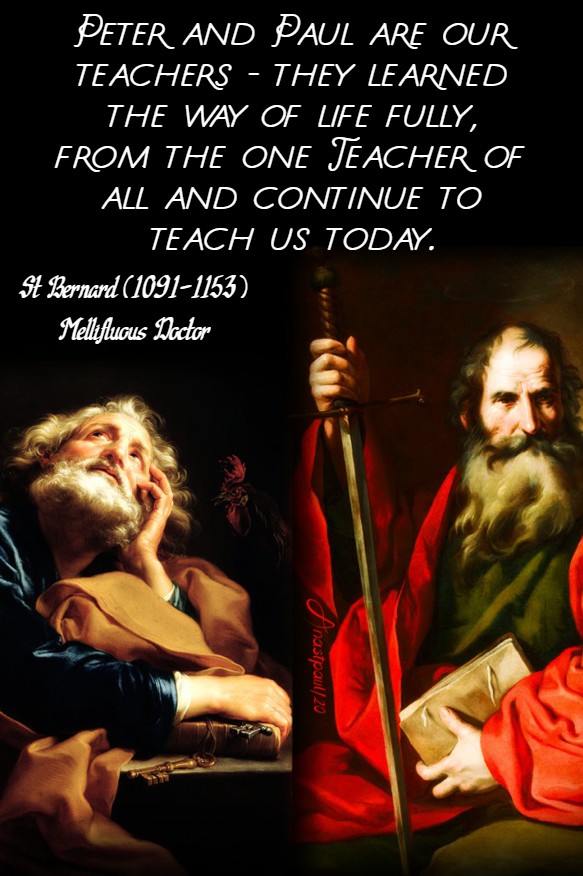
Peter and Paul are our teachers – they learned the way of life fully from the one Teacher of all and continue to teach us today.” … St Bernard (1091-1153) Cistercian Monk, Theologian, Mellifluous Doctor
PRAYER – O God, who on the Solemnity of the Apostles Peter and Paul give us the noble and holy joy of this day, grant, we pray, that your Church may in all things follow the teaching of those through whom she received the beginnings of right religion. Through our Lord Jesus Christ, your Son,who lives and reigns with you in the unity of the Holy Spirit, one God, forever and ever. Amen
Our Morning Offering – 29 June – The Solemnity of Saints Peter and Paul
Apostolorum Passio By St Ambrose (c 340-397) Father and Doctor
This happy day is sanctified
As Martyr’s glory we recall,
The cross bedewed with Peter’s blood,
The sword that won a crown for Paul.
The triumph of their martyrdom
United these great souls in death,
Whose faith in Christ had crowned their lives
In service to their latest breath.
Saint Peter held the primacy,
Saint Paul would equal him in grace,
When once, as chosen instrument
The cause of Christ he would embrace
Once, Simon, leaving Rome, turned back
To give, by death, full praise to God,
That by the cross he too should tread
The self-same path his Master trod.
Now Rome exults, as well she may
And strives to give devotion’s due
To one who sealed with his own blood
His work as priest and shepherd true.
And who can count the crowds that come
As loving children to her gate,
Where nations’ teacher, holy Paul
Once dwelt and gladly met his fate.
Grant us, O Lord, the final grace
Of sharing in their joy above,
That with such princes we may praise
Your bounty and undying love.
Amen
Translation: The Benedictines of Saint Cecilia’s Abbey, Ryde, UK
A Blessed and Holy Solemnity of Saints Peter and Paul, the Pillars of the Church! – 29 June
These are the ones who, living in the flesh, planted the Church with their blood; they drank the chalice of the Lord and became the friends of God.
O God, who on the Solemnity of the Apostles Peter and Paul give us the noble and joy of this day, grant we pray, that your Church may in all things follow the teaching of those through whom she received the beginnings of right religion.
Veneration of the two great Apostles, Peter and Paul, has its roots in the very foundations of the Church. They are the solid rock on which the Church is built. They are at the origin of her faith and will forever remain her protectors and her guides. To them, Rome owes her true greatness, for it was under God’s providential guidance that they were led to make the capital of the Empire, sanctified by their Martyrdom, the centre of the Christian world whence should radiate the preaching of the Gospel.
St Peter suffered Martyrdom under Nero, in 66 or 67. He was buried on the hill of the Vatican where recent excavations have revealed his tomb on the very site of the Basilica of St Peter’s. St Paul was beheaded in the Via Ostia on the spot where now stands the Basilica bearing his name. Down the centuries, Christian people in their thousands have gone on pilgrimage to the tombs of these Apostles. In the second and third centuries the Roman Church already stood pre-eminent by reason of her apostolicity, the infallible truth of her teaching and her two great figures, Sts Peter and Paul.
A partial indulgence may be gained today by anyone who makes devout use of a religious article blessed by any priest but “if the article of devotion has been blessed by the Sovereign Pontiff or by any Bishop, the faithful, using it, can also gain a plenary indulgence, provided they also make a profession of faith (e.g. the Apostles Creed), as long as the usual conditions are satisfied.”
“There is one day for the passion of two apostles. But these two also were as one; although they suffered on different days, they were as one. Peter went first, Paul followed. We are celebrating a feast day, consecrated for us by the blood of the apostles. Let us love their faith, their lives, their labours, their sufferings, their confession of faith, their preaching.”
St Augustine (354-430) Father & Doctor of the Church
St Anastasius of Bourges
St Benedicta of Sens
St Cassius of Narni
St Ciwg ap Arawn
St Cocha
St Ilud Ferch Brychan
St Judith of Niederaltaich
St Marcellus of Bourges
St Mary, the Mother of John Mark
St Salome of Niederaltaich
St Syrus of Genoa
Bl William of Sann
—
Martyrs of China
Ioannes Baptista Wu Mantang
Magdalena Du Fengju
Maria Du Tianshi
Paulus Wu Anju
Paulus Wu Wanshu
Sunday Reflection – 28 June – “Month of the Sacred Heart” – Thirteenth Sunday in Ordinary Time, Year A
This is that Body which was once covered with blood
“When you see (the Most Blessed Sacrament) exposed, say to yourself –
‘Thanks to this Body, I am no longer dust and ashes, I am no more a captive but a freeman, hence, I hope to obtain heaven and the good things that are there in store for me… eternal life, the heritage of the angels, companionship with Christ; death has not destroyed this Body which was pierced by nails and scourged . . . this is that Body which was once covered with blood, pierced by a lance, from which issued saving fountains upon the world, one of blood and the other of water. .
‘This Body He gave to us to keep and eat, as a mark of His intense love’.”
Thought for the Day – 28 June – “Month of the Sacred Heart” – Meditations with Antonio Cardinal Bacci (1881-1971)
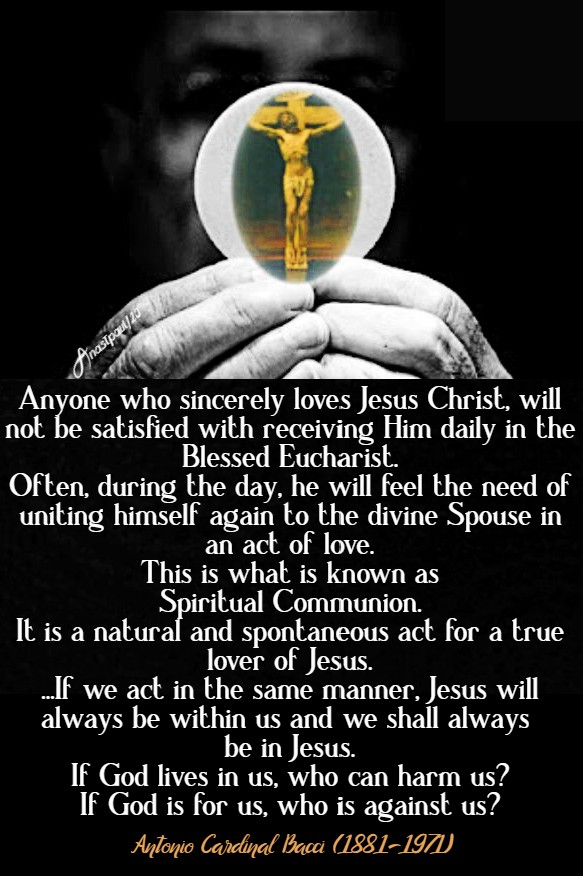
Spiritual Communion
“Anyone who sincerely loves Jesus Christ, will not be satisfied with receiving Him daily in the Blessed Eucharist.
Often, during the day, he will feel the need of uniting himself again to the divine Spouse in an act of love.
This is what is known as Spiritual Communion.
It is a natural and spontaneous act for a true lover of Jesus.
“I am the vine, you are the branches,” Jesus has told us. “He who abides in me and I in him, he bears much fruit … as the branch cannot bear fruit of itself unless it remains on the vine, so neither can you, unless you abide in me” (Cf Jn 15:4).
Since the supernatural life flows into our souls from Jesus, we must maintain our union with Him, even when He is not sacramentally present.
It is true, that the divine grace, remains in us, as long as we do not fall into mortal sin but, it grows weaker under the influence of worldly attractions and temptations.
It is necessary to revive the grace that is in us, when we feel that it is waning.
For this purpose, Spiritual Communion is very useful, for it is an ardent desire to receive Jesus in the Blessed Sacrament (Summa Theologiae, III, q 8, a 1 ad 3) and, an outpouring of love, in which we beseech Jesus to come and take complete possession of our hearts.
This practice was recommended by the Council of Trent (Session XIII, ch 8) and was frequently used by the Saints in order to keep alive the fire of divine charity in their souls and to guard themselves against the onslaughts of the world, the flesh and the devil.
If we act in the same manner, Jesus will always be within us and we shall always be in Jesus.
If God lives in us, who can harm us?
If God is for us, who is against us? (Rom 8:31).”
Quote/s of the Day – 28 June – “Month of the Sacred Heart” – The Memorial of Blessed Paolo Giustiniani ECMC (1476-1528) – Monk, Hermit and Founder of the Congregation of the Camaldolese Hermits of Monte Corona
“The supreme goal to which the monk tends, the summit of the perfection of his heart, is indeed the union of his heart with his Lord.”
St John Cassian (c 360-435)
Monk, Father of the Church and Founder of Monasteries Disciple of St John Chrysostom
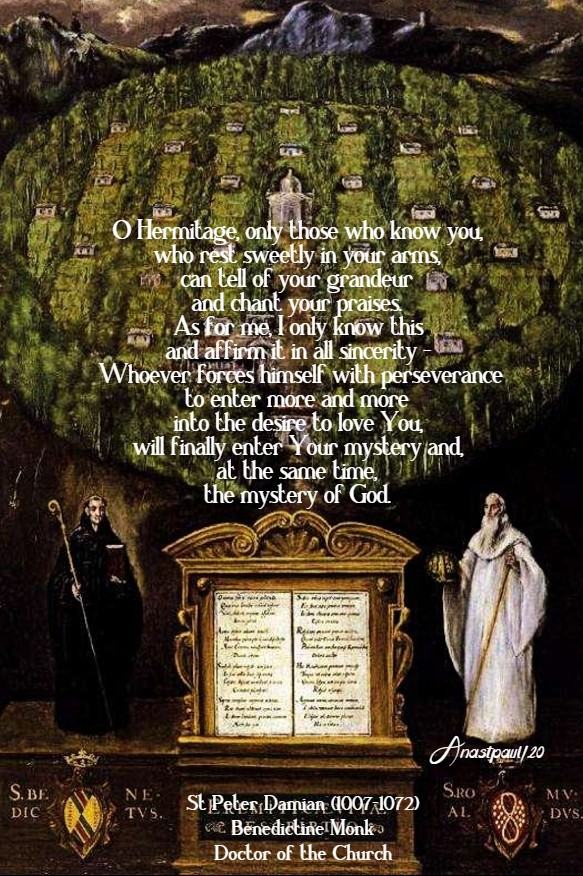
“O Hermitage, only those who know you, who rest sweetly in your arms, can tell of your grandeur and chant your praises. As for me, I only know this and affirm it in all sincerity – Whoever forces himself with perseverance to enter more and more into the desire to love You, will finally enter Your mystery and, at the same time, the mystery of God.”
St Peter Damian (1007-1072)
Benedictine Monk
Doctor of the Church
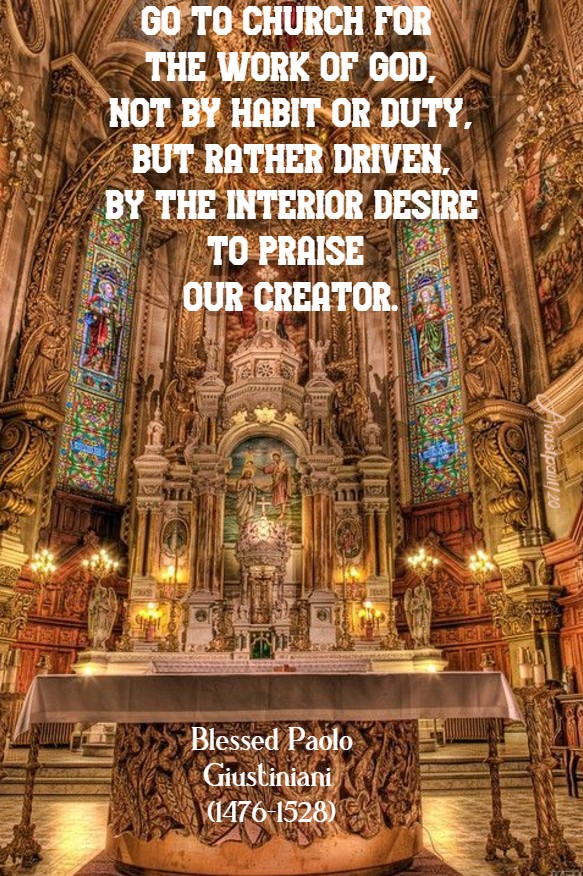
“Go to Church for the work of God, not by habit or duty, but rather driven, by the interior desire to praise our Creator.”
“Celebrate holy Mass in the joy of the Spirit.”
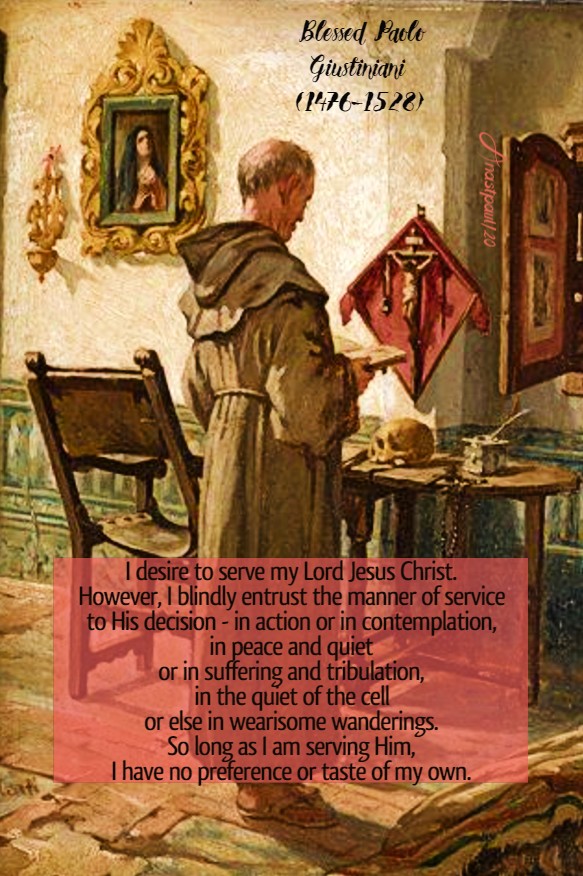
“I desire to serve my Lord Jesus Christ. However, I blindly entrust the manner of service to His decision – in action or in contemplation, in peace and quiet or in suffering and tribulation, in the quiet of the cell or else in wearisome wanderings. So long as I am serving Him, I have no preference or taste of my own.”
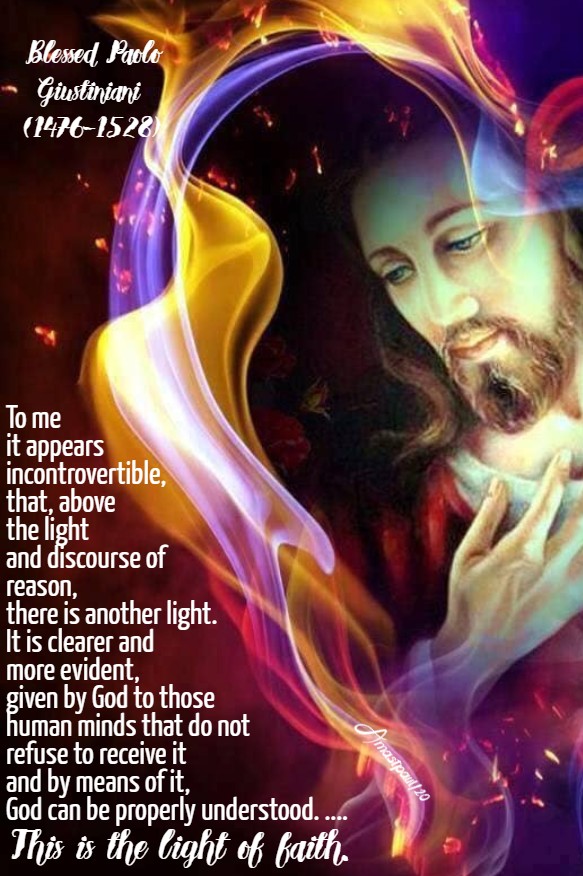
“To me it appears incontrovertible, that, above the light and discourse of reason, there is another light. It is clearer and more evident, given by God to those human minds that do not refuse to receive it and by means of it, God can be properly understood. …. This is the light of faith.“
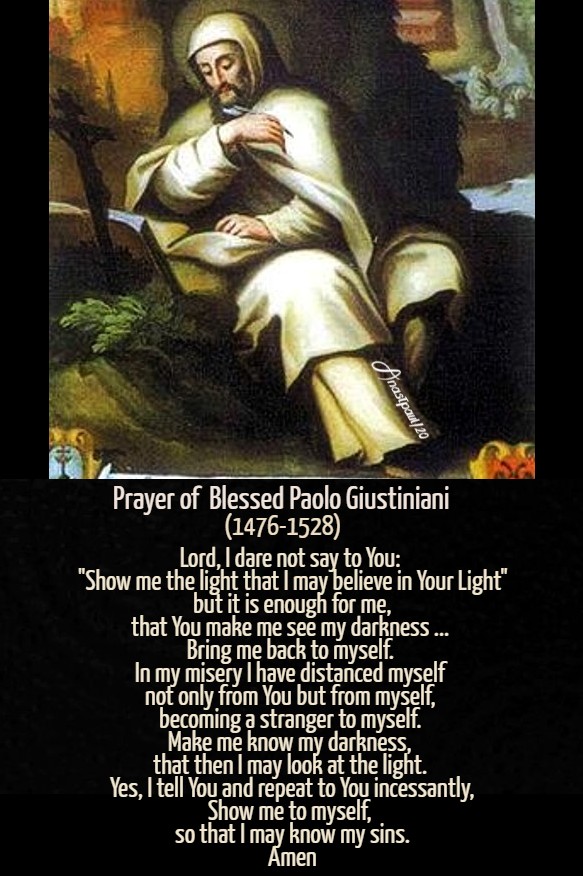
Prayer of Blessed Paolo Giustiniani “Lord, I dare not say to You: “Show me the light that I may believe in Your Light” but it is enough for me, that You make me see my darkness … Bring me back to myself. In my misery I have distanced myself not only from You but from myself, becoming a stranger to myself. Make me know my darkness, that then I may look at the light. Yes, I tell You and repeat to You incessantly, Show me to myself, so that I may know my sins.”
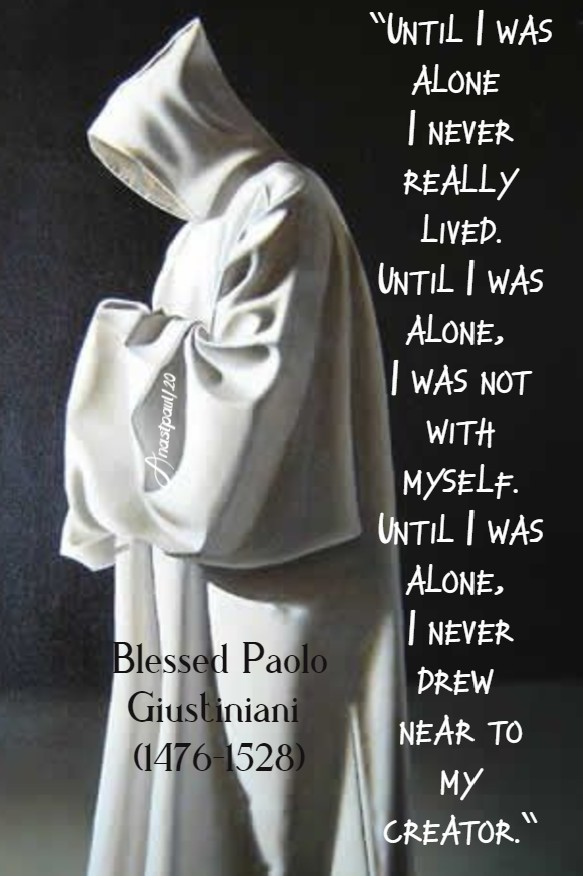
“Until I was alone I never really lived. Until I was alone, I was not with myself. Until I was alone, I never drew near to my creator.”
One Minute Reflection – 28 June – “Month of the Sacred Heart” – Thirteenth Sunday in Ordinary Time, Year A, Readings: 2 Kings 4:8-11, 14-16, Psalm 89:2-3,16-19, Romans 6:3-4, 8-11, Matthew 10:37-42 and the Memorial of St Ireneaus (c 130 – 202) Father and Doctor of the Church
“Whoever receives you, receives me and whoever receives me, receives the one who sent me.” … Matthew 10:40
REFLECTION – “The Lord said: “Whoever welcomes this little child on my account welcomes me.” (Lk 9:48) The smaller our brother is, the more Christ is present. For when we welcome a great personality, we often do so out of vainglory but the person who welcomes someone unimportant, does so, with a pure intention and for Christ. He said: “I was a stranger and you welcomed me.” And again: “As often as you did it for one of my least brothers, you did it for me.” (Mt 25:35.40) Since He is talking about a believer and a brother, no matter how unimportant he is, Christ comes in with him. Open your house and welcome him.
“He who welcomes a prophet because he bears the name of prophet receives a prophet’s reward.” Thus, the person who welcomes Christ will receive the reward of Christ’s hospitality. Do not doubt His words, trust them. He himself told us: “In them, I am presenting myself.” And so that you do not doubt them, He decreed the punishment for those who do not welcome Him and the honours for those who do welcome Him (Mt 25:31). He would not do this if He were not personally touched by honour or scorn. He says: ‘You welcomed Me into your house, I will welcome you in the Kingdom of my Father. You freed Me from hunger, I will free you from your sins. You saw Me in chains, I will let you see your liberation. You saw Me a stranger, I will make of you a citizen of heaven. You gave Me bread, I will give you the Kingdom as your inheritance that is entirely yours. You helped Me in secret, I will proclaim it publicly and I will say that you are My benefactor and that I am in your debt.’” … St John Chrysostom (345-407) Bishop of Constantinople, Father and Doctor of the Church – Homilies on the Acts of the Apostles, no. 45
PRAYER – O Lamb of God By St Irenaeus (c 130 – 202)
O Lamb of God,
who takes away the sin of the world,
look upon us and have mercy upon us;
You who art Yourself, both victim and Priest,
Yourself, both Reward and Redeemer,
keep safe from all evil
those whom You have redeemed,
O Saviour of the world.
Amen
Our Morning Offering – 28 June – “Month of the Sacred Heart” – Thirteenth Sunday in Ordinary Time
O Heart of Jesus in the Blessed Sacrament By The League of the Sacred Heart 1929 (Ireland)
O Heart of Jesus in the Blessed Sacrament,
overflowing with gentleness,
tenderness and charity,
I bury in the abyss of The Mercy,
all my iniquities and all my negligence.
I offer Thee
my labours and my sufferings,
my sorrows and my miseries,
I recommend to Thee
my life and my death.
Solace my doubts Sweet Jesus,
calm my fears
and grant, that day by day,
I may become more united to Thy Sacred Heart,
learning Thy love and Thy holiness.
Amen
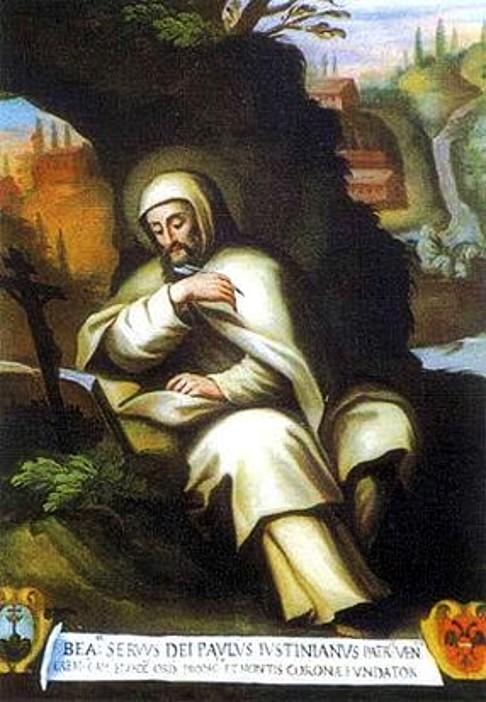
Saint of the Day – 28 June – Blessed Paolo Giustiniani ECMC (1476-1528) – Priest, Monk and Founder of the Congregation of the Camaldolese Hermits of Monte Corona, Reformer – born as Tommaso Giustiniani on 14 June in Venice, Italy and died on 28 June 1528, aged 52 in Monte Soratte.
He was a member of the noble Giustiniani family of Venice and was born there in 1476, the son of Francesco Giustiniani and Paola Malipiero. He studied theology, philosophy and law, at the University of Padua. when he had completed his studies, in 1507, he made a pilgrimage to the Holy Land and upon his return he felt a call to follow the life of a the religious.
He joined the Order of the Camàldula, the Camaldolese, in 1510. The superior of the order, Pietro Delfino, asked him to assist in ending the irregularities that existed in some communities of the order, caused by the autonomy of each house and the lack of authority of the Prior General. Especially, the conventual branch (of cenobitic life) had relaxed in the application of the rule. In 1513, Pope Leo X, at the request of Giustiniani and Delfino, convened a General Chapter of the Camaldolese that decided the creation of the united congregation of the Sacred Hermitage and San Michele de Murano, with temporary general Priors and with a balance between the Conventual and Hermit branches.
In 1516 he was elected Prior of the Hermitage of Camaldoli until 1520 and in 1518 he was Ordained a Priest. Desiring a more hermit-like type of life and faithful to the primitive rule of the order, he obtained from Pope Leo X, permission to found other communities, which would follow the original rule of St Romuald. Pope Leo X granted him the necessary permission and allowed him to found a differentiated congregation, free from the jurisdiction of the Camaldolese Prior General and with its own constitutions, called the Company of Hermits of Saint Romuald, which would later be the Congregation of the Camaldolese Hermits of Monte Corona. This Order would come to considered as the most faithful expression of the original Charism of the Order of St Romuald.
On his return from Rome with permission, Giustiniani resigned as Prior and with a companion, Oliverio da Cortona, went to seek the spiritual guidance of a Hermit who lived in Monte Corona, near Perugia. Together with a Dominican, they went to live alone in a place in the Apennines, Pascialupo, where they lived in a Chapel and in 1521 founded the Hermitage of Monte Cucco.
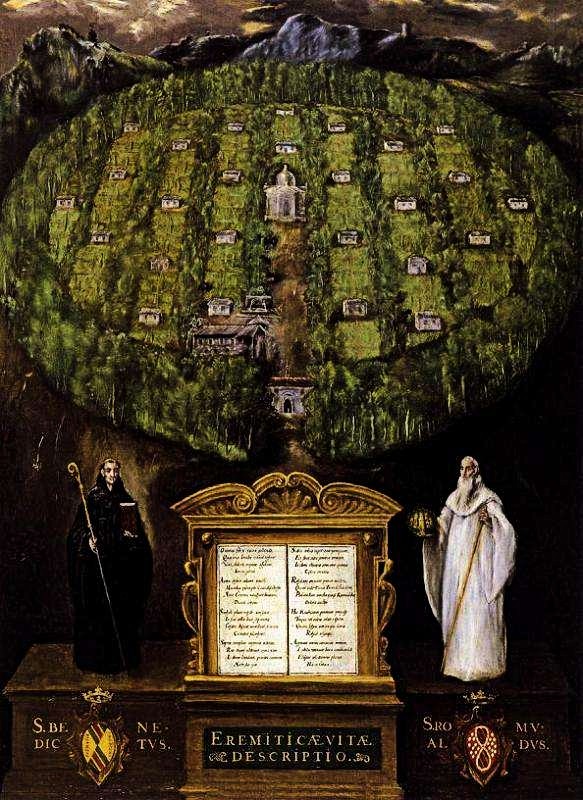
Allegory of the Camaldolese Hermitages by El Greco
Paolo was left alone with the Camaldolese monk who had accompanied him, as the other companion did not want to adopt the rule of St Romuald. The monks of Camaldoli asked him to be closer to them and he soon moved to a Hermitage near Massaccio, where he was joined by other monks of Camaldoli. These first Hermitages were followed by those of Cupramontana, San Leonardo de Monte Volubrio (diocese of Fermo) and San Benedetto de Monte Conero, near Ancona .
In 1522, Giustiniani drafted the constitutions of the new congregation, which consisted of the rigorous application of the original rule, modifying only the habit.
In 1523, the Order recognised the congregation of Monte Corona as independent, remaining in the Camaldolese family and in 1524 the first Chapter of the four hermitages of the congregation took place, which elected the Founder as Prior General. In 1527 he went to Rome for matters of order and was taken prisoner by the soldiers of the army of Charles V who occupied the city. with Gaietà de Thiene , also a prisoner, he was tortured but released. He returned to Venice and then to Massaccio.
In 1528 he returned to Rome and visited the Pope, obtaining confirmation of some privileges of the Order. In Viterbo he contracted the plague. He went to San Silvestro de Monte Soratte, near Rome, an ancient Benedictine Abbey that had been given to the Hermits of Monte Corona. He died there on 28 June 1528.
San Silvestro de Monte Soratte, where Blessed Paolo died
He was succeeded as the Prior General of the congregation by Agostino di Basciano.
He was buried in the crypt of San Silvestro. His relics were lost during the abandonment of the Hermitage and were only rediscovered in 1932. Although he has never been formally Beatified, he had always been considered a saint and was decribed as a “beati.” His cultus was formally confirmed allowing special veneration in his order.
Blessed Paolo Giustiniani’s Camaldolese Hermits of Monte Corona lives solely in Hermitages, usually with a very small number of monks comprising the community. There are three houses in Italy, two in Poland and one each in Spain, the United States and Colombia, as well as a new foundation in Venezuela. Unlike the other congregation, it is not a member of the larger Benedictine Confederation.
Bl Almus of Balmerino
St Argymirus of Córdoba
St Attilio of Trino
St Austell of Cornwall
St Benignus of Utrecht
St Crummine
Bl Damian of Campania
St Egilo
St Heimrad
St Lupercio
St Papias the Martyr Blessed Paolo Giustiniani ECMC (1476-1528)
St Pope Paul I
St Theodichildis St Vincenza Gerosa (1784–1847) Her life: https://anastpaul.com/2019/06/28/saint-of-the-day-28-june-st-vincenza-gerosa-1784-1847/
—
Martyrs of Africa – 27 saints: 27 Christians martyred together. The only details about them to survive are the names – Afesius, Alexander, Amfamon, Apollonius, Arion, Capitolinus, Capitulinus, Crescens, Dionusius, Dioscorus, Elafa, Eunuchus, Fabian, Felix, Fisocius, Gurdinus, Hinus, Meleus, Nica, Nisia, Pannus, Panubrius, Plebrius, Pleosus, Theoma, Tubonus and Venustus. Unknown location in Africa, date unknown.
Martyrs of Alexandria – 8 saints: A group of spiritual students of Origen who were martyred together in the persecutions of emperor Septimius Severus – Heraclides, Heron, Marcella, Plutarch, Potamiaena the Elder, Rhais, Serenus and Serenus. They were burned to death c.206 in Alexandria, Egypt.



























You must be logged in to post a comment.