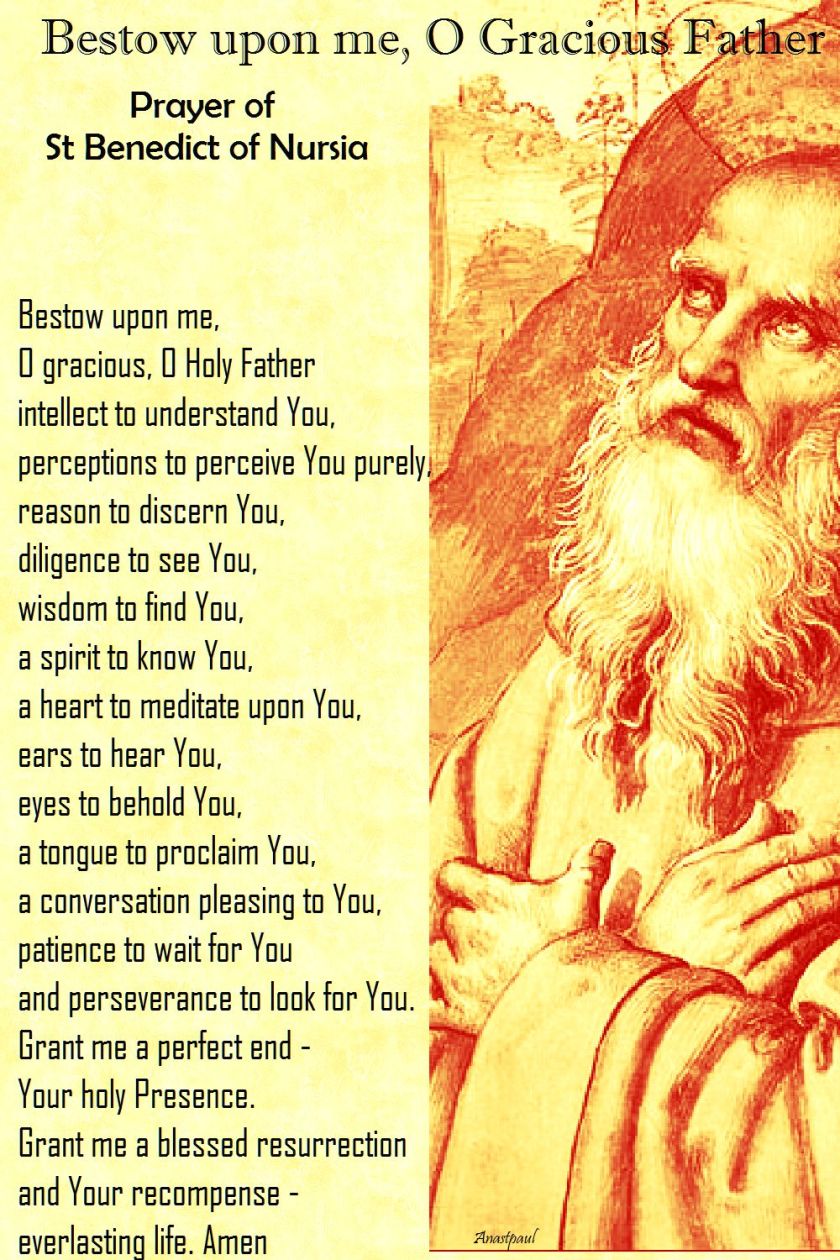
Bestow upon me, O Gracious Father Prayer of St Benedict of Nursia
Bestow upon me,
O gracious, O Holy Father
intellect to understand You,
perceptions to perceive You purely,
reason to discern You,
diligence to see You,
wisdom to find You,
a spirit to know You,
a heart to meditate upon You,
ears to hear You,
eyes to behold You,
a tongue to proclaim You,
a conversation pleasing to You,
patience to wait for You
and perseverance to look for You.
Grant me a perfect end –
Your holy Presence.
Grant me a blessed resurrection
and Your recompense –
everlasting life. Amen
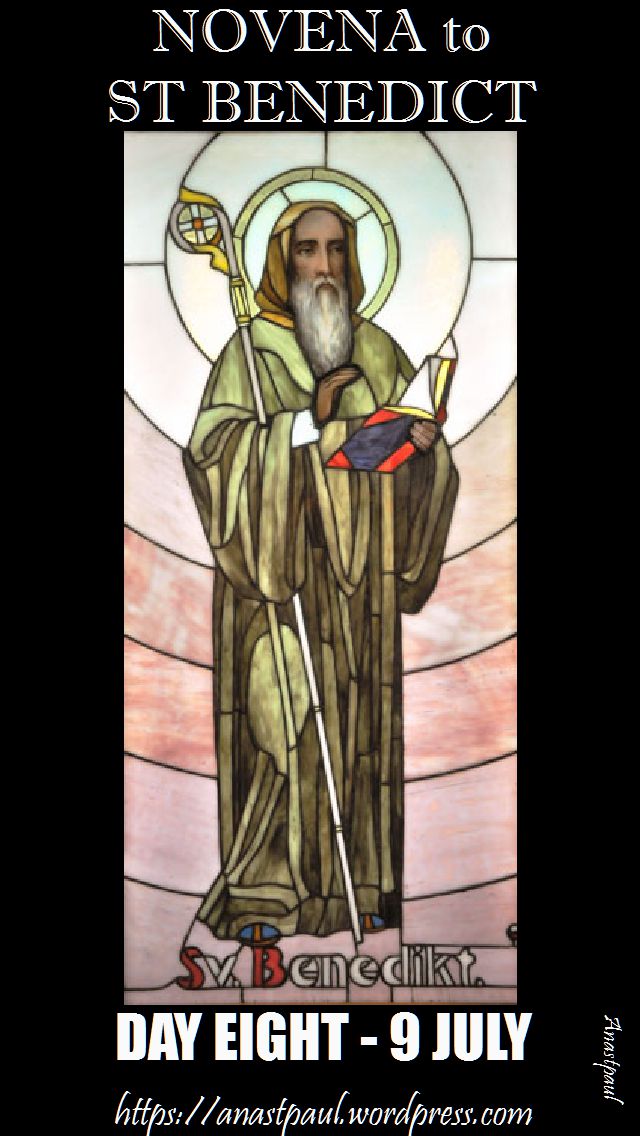
Saint of the Day – 11 July – St Benedict of Nursia O.S.B. – Abbot Patron of Europe (Patronus Europae) – Also known as: Benedict of Narsia, Benedict of Norsia, Benedetto da Norcia, Founder of Western Monasticism – (c 480, Narsia, Umbria, Italy – 21 March 547 of a fever while in prayer at Monte Cassino, Italy). He buried beneath the high altar there in the same tomb as Saint Scholastica. He was Canonised in 1220 by Pope Honorius III. Patronages: Co-Patron of Europe, Against poison, Against witchcraft, Agricultural workers, Cavers, Civil engineers, Coppersmiths, Dying people, Erysipelas, Europe, Farmers, Fever, Gall stones, Heerdt (Germany), Heraldry and Officers of arms, the Institute of Christ the King Sovereign Priest, Inflammatory diseases, Italian architects, Kidney disease, Monks, Nettle rash, Norcia, (Italy), People in religious orders, Schoolchildren and students, Servants who have broken their master’s belongings, Temptations.
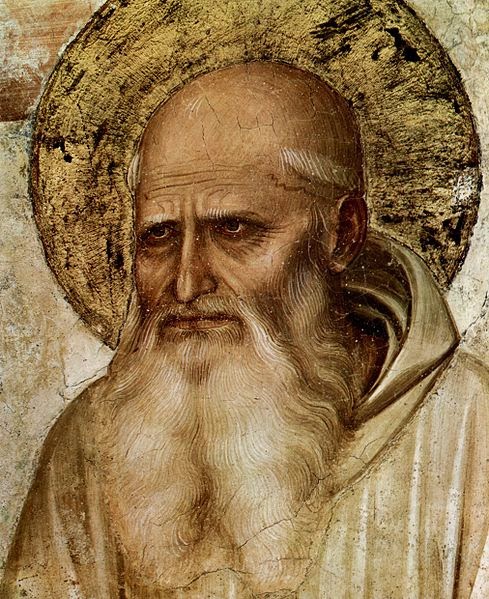
Fra Angelico
Benedict was born into a distinguished family in central Italy, studied at Rome and early in life was drawn to monasticism. At first he became a hermit, leaving a depressing world—pagan armies on the march, the Church torn by schism, people suffering from war, morality at a low ebb.
He soon realised that he could not live a hidden life in a small town any better than in a large city, so he withdrew to a cave high in the mountains for three years. Some monks chose Benedict as their leader for a while, but found his strictness not to their taste. Still the shift from hermit to community life had begun for him. He had an idea of gathering various families of monks into one “Grand Monastery” to give them the benefit of unity, fraternity and permanent worship in one house. Finally he began to build what was to become one of the most famous monasteries in the world—Monte Cassino, commanding three narrow valleys running toward the mountains north of Naples.
The Rule that gradually developed prescribed a life of liturgical prayer, study, manual labor, and living together in community under a common abbot. Benedictine asceticism is known for its moderation, and Benedictine charity has always shown concern for the people in the surrounding countryside. In the course of the Middle Ages, all monasticism in the West was gradually brought under the Rule of St. Benedict.
Today the Benedictine family is represented by two branches: the Benedictine Federation encompassing the men and women of the Order of St. Benedict and the Cistercians, men and women of the Order of Cistercians of the Strict Observance.
St Benedict died at Monte Cassino not long after his sister, Saint Scholastica. Benedict died of a high fever on the day God had told him he was to die and was buried in the same place as his sister. According to tradition, this occurred on 21 March 543 or 547. He was named patron protector of Europe by Pope Paul VI in 1964. In 1980, Pope John Paul II declared him co-patron of Europe, together with Saints Cyril and Methodius.
Rule of Saint Benedict
Seventy-three short chapters comprise the Rule. Its wisdom is of two kinds: spiritual (how to live a Christocentric life on earth) and administrative (how to run a monastery efficiently). More than half the chapters describe how to be obedient and humble and what to do when a member of the community is not. About one-fourth regulate the work of God (the Opus Dei). One-tenth outline how and by whom, the monastery should be managed.
Following the golden rule of Ora et Labora – pray and work, the monks each day devoted eight hours to prayer, eight hours to sleep and eight hours to manual work, sacred reading, or works of charity
Saint Benedict Medal, front.
On the front of the medal is Saint Benedict holding a cross in his right hand, the object of his devotion and in the left his rule for monasteries. In the back is a poisoned cup, in reference to the legend of Benedict, which explains that hostile monks attempted to poison him: the cup containing poisoned wine shattered when the saint made the sign of the cross over it (and a raven carried away a poisoned loaf of bread). Above the cup are the words Crux sancti patris Benedicti (“The Cross of [our] Holy Father Benedict”). Surrounding the figure of Saint Benedict are the words Eius in obitu nostro praesentia muniamur! (“May we be strengthened by his presence in the hour of our death”), since he was always regarded by the Benedictines as the patron of a happy death.
On the back is a cross, containing the letters C S S M L – N D S M D, initials of the words Crux sacra sit mihi lux! Non [Nunquam?] draco sit mihi dux! (“May the holy cross be my light! May the dragon never be my overlord!”). The large C S P B stand for Crux Sancti Patris Benedicti (“The Cross of [our] Holy Father Benedict”). Surrounding the back of the medal are the letters V R S N S M V – S M Q L I V B, in reference to Vade retro satana: Vade retro Satana! Nunquam suade mihi vana! Sunt mala quae libas. Ipse venena bibas! (“Begone Satan! Never tempt me with your vanities! What you offer me is evil. Drink the poison yourself!”) and finally, located at the top is the word PAX which means “peace”
Use of the Medal
There is no special way prescribed for carrying or wearing the Medal of St. Benedict. It can be worn on a chain around the neck, attached to one’s rosary, kept in one’s pocket or purse, or placed in one’s car or home. The medal is often put into the foundations of houses and building, on the walls of barns and sheds, or in one’s place of business.
The purpose of using the medal in any of the above ways is to call down God’s blessing and protection upon us, wherever we are and upon our homes and possessions, especially through the intercession of St. Benedict. By the conscious and devout use of the medal, it becomes, as it were, a constant silent prayer and reminder to us of our dignity as followers of Christ.
The medal is a prayer of exorcism against Satan, a prayer for strength in time of temptation, a prayer for peace among ourselves and among the nations of the world, a prayer that the Cross of Christ be our light and guide, a prayer of firm rejection of all that is evil, a prayer of petition that we may with Christian courage “walk in God’s ways, with the Gospel as our guide,” as St. Benedict urges us.
A profitable spiritual experience can be ours if we but take the time to study the array of inscriptions and representations found on the two sides of the medal. The lessons found there can be pondered over and over to bring true peace of mind and heart into our lives as we struggle to overcome the weaknesses of our human nature and realize that our human condition is not perfect, but that with the help of God and the intercession of the saints our condition can become better.
The Medal of St. Benedict can serve as a constant reminder of the need for us to take up our cross daily and “follow the true King, Christ our Lord,” and thus learn “to share in his heavenly kingdom,” as St. Benedict urges us in the Prologue of his Rule.
—
St Abundius of Ananelos
St Amabilis of Rouen
St Anna An Jiaoshi
St Anna An Xingshi
Bl Antonio Muller
St Berthevin of Lisieux
St Cindeus
St Cowair
St Cyprian of Brescia
St Cyriacus the Executioner
St Drostan
St Hidulf of Moyenmoutier
St Januarius
St John of Bergamo
Bl Kjeld of Viborg
St Leontius the Younger
St Marcian of Lycaonia
St Marciana of Caesarea
Maria An Guoshi
Maria An Linghua
Bl Marie-Clotilde Blanc
Bl Marie-Elisabeth Pélissier
Bl Marie-Marguerite de Barbégie d’Albrède
St Olga of Kiev
St Pelagia
St Pius I, Pope
St Placid of Dissentis
Bl Rosalie-Clotilde Bes
St Sabinus of Brescia
St Sabinus of Poitiers
St Sidronius
St Sigisbert of Dissentis
Bl Thomas Hunt
Bl Thomas Sprott
St Thurketyl
As there is a harsh and evil zeal which separates from God and leads to hell, so there is a virtuous zeal which separates from vice and leads to God and life everlasting.
Let the monks, therefore, practice this zeal with most ardent love; namely, that in honour they forerun one another (cf Rom 12:10). Let them bear their infirmities, whether of body or mind, with the utmost patience; let them vie with one another in obedience. Let no one follow what he thinks useful to himself but rather to another. Let them practice fraternal charity with a chaste love.
Let them fear God and love their Abbot with sincere and humble affection; let them prefer nothing whatever to Christ and my He lead us all together to life everlasting. (Holy Rule 72)
LET US PRAY – DAY NINE:
Glorious Saint Benedict,
sublime model of virtue, pure vessel of God’s grace!
Behold me humbly kneeling at your feet.
I implore you in your loving kindness to pray for me before the throne of God.
To you I have recourse in the dangers that daily surround me.
Shield me against my selfishness and my indifference to God and to my neighbor.
Inspire me to imitate you in all things.
May your blessing be with me always, so that I may see and serve Christ in others and work for His kingdom.
Graciously obtain for me from God those favors and graces which I need so much in the trials, miseries and afflictions of life.
Your heart was always full of love, compassion and mercy toward those who were afflicted or troubled in any way.
You never dismissed without consolation and assistance anyone who had recourse to you.
I therefore invoke your powerful intercession, confident in the hope that you will hear my prayers and obtain for me the special grace and favor I earnestly implore.
{mention your petition}
Help me, great Saint Benedict, to live and die as a faithful child of God, to run in the sweetness of His loving will, and to attain the eternal happiness of heaven.
You will remember a while ago I posted the entire book by Fr Paul O’Sullivan “How to Avoid Purgatory” – you will find the entire Booklet in chapters here: https://anastpaul.wordpress.com/category/purgatory/
Again I wish to share one of Fr Paul’s wonderful booklets which are such amazing works to grow our faith and inspire our daily lives. The byline states “revealing the simplest secret ever of holiness and happiness.” Although January is the Month of the Holy Name – we can never learn this devotion too soon, by January we will be totally ready to give praise, honour and glory to His Name!
We have been hearing and have been repeating
from childhood the Holy Name of Jesus, but alas!
many, very many have no adequate idea of the
great wonders of this Holy Name.
What do you know, dear reader, about the Name
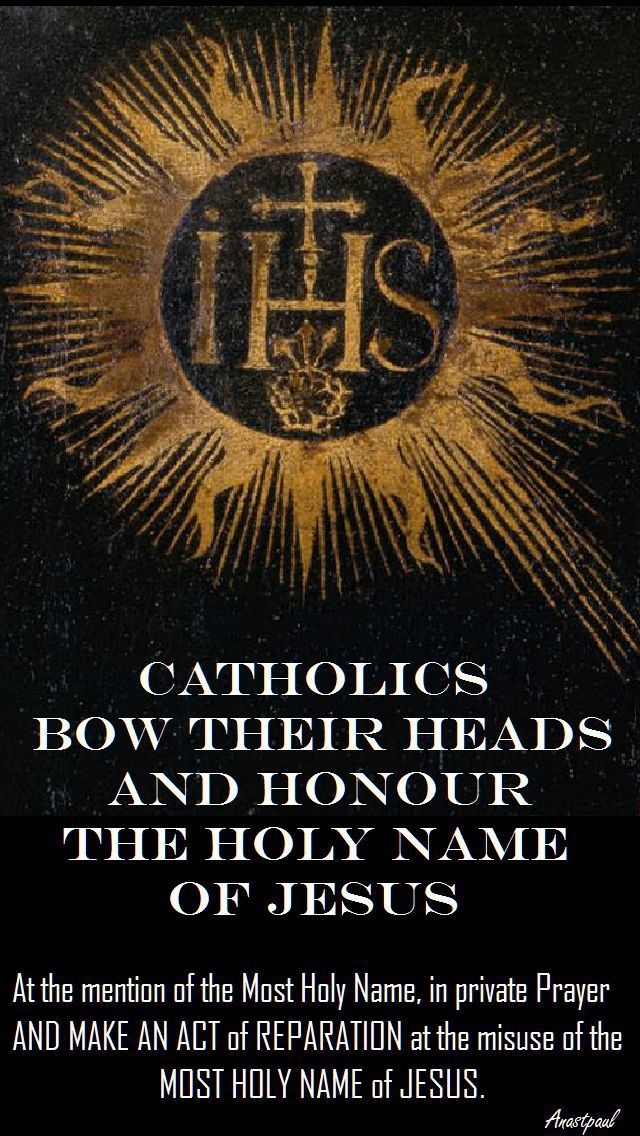
of Jesus? You know that it is a holy name and that you must bow your head reverently when you say it. That is very little. It is as if you
looked at a closed book and merely glanced at
the title on the cover. You know nothing of all
the beautiful thoughts in the book itself.
Even so when you pronounce the Name of Jesus
you know very little of the treasures hidden in it.
This Divine Name is in truth a mine of riches,
it is the fount of the highest holiness and the
secret of the greatest happiness that a man can
hope to enjoy on this Earth. Read and see.
Devotion to the Holy Name is so easy that
everyone without exception can practice it. It
demands no time so that the busiest man can
repeat it countless times.
It is so powerful, so certain that it never fails
to produce in our souls the most wonderful results.
It consoles the saddest heart and makes the
weakest sinner strong. It obtains for us all kinds
of favours and graces, spiritual and temporal.
Two things we must do: First of all we must
understand clearly the meaning and value of the
Name of Jesus. Secondly we must get into the habit of saying
it frequently, hundreds and hundreds of times
every day. Far from being a burden it will be
an immense joy and consolation.
What does the Name of Jesus mean
The Holy Name of Jesus is, first of all, an all-powerful prayer. Our Lord Himself solemnly
promises that whatever we ask the Father in His
Name we shall receive. God never fails to keep
His word.
When, therefore, we say Jesus let us ask God for
all we need with absolute confidence of being heard.
For this reason the Church ends her prayers
with the words: “Through Jesus Christ” which
gives the prayer a new and divine efficacy.
But the Holy Name is something still greater. Each time we say Jesus we give God infinite
joy and glory for we offer Him all the infinite
merits of the Passion and Death of Jesus Christ.
St Paul tells us that Jesus merited the Name
Jesus by His Passion and Death. Each time we say Jesus let us clearly wish to
offer God all the Masses being said all over the
World for all our intentions. We thus share in
these thousands of Masses. Each time we say Jesus we gain 30O days
indulgence which we may apply to the souls in
Purgatory, thus relieving and liberating very many
of these holy souls from their awful pains. They
thus become our best friends and pray for us
with incredible fervour. Each time we say Jesus, it is an act of perfect
love for we offer to God the infinite love of Jesus.
The Holy Name of Jesus saves us from innumerable evils and delivers us especially from the power of the devil who is constantly seeking to do us harm.
The Name of Jesus gradually fills our souls with a peace and a joy we never had before.
The Name of Jesus gives us such strength that our sufferings become light and easy to bear.
In today’s gospel reading, (Mt 9:18-26) we read of two different miracles performed by Jesus. We read of the cure of the woman with a hemorrhage and we read of the raising back to life of the official’s daughter. While both of these miracles leave us in awe and amazement of God’s power, what is also amazing is the faith of the official and the woman. Both of them demonstrated an unshakable faith. Unshakable faith, both the official and the woman had it and because of it they found miraculous cures for insurmountable problems. May we always remember to look to God for comfort, answers and restoration; not only when things are good but especially when they seem their worst. As Christians we are called to have a faith that is unshakable, one that is built upon solid rock, not shifting sand.
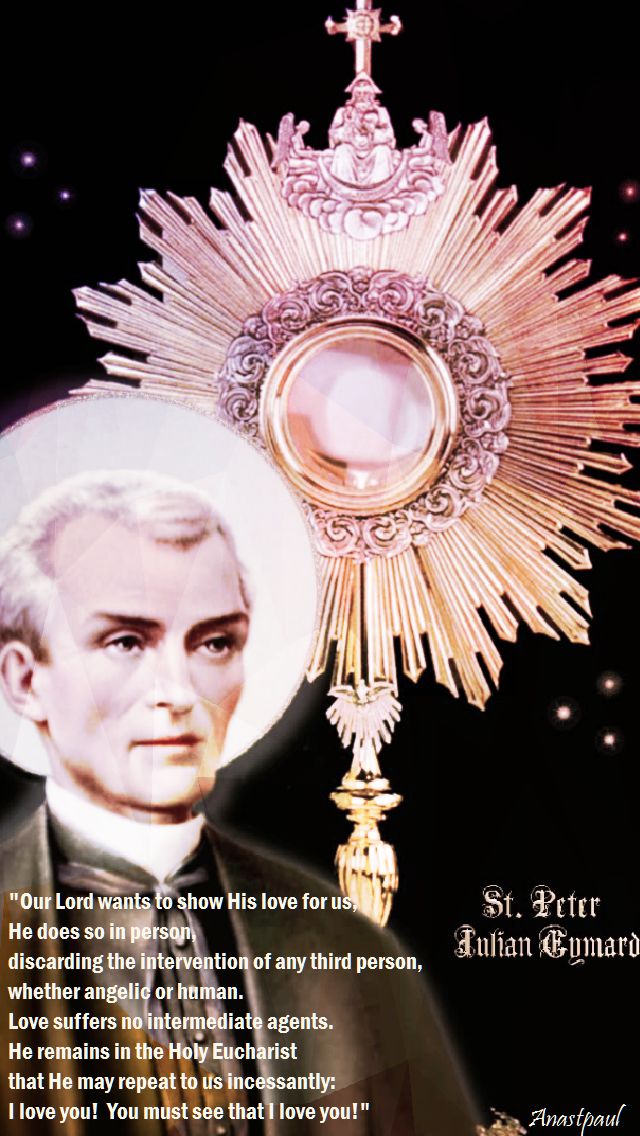
“We believe an honourable man on his word. Why should we put less faith in that of Our Lord? When a friend desires to prove to his friend that he loves him, he tells him so and he presses his hand affectionately. When Our Lord wants to show His love for us, He does so in person, discarding the intervention of any third person, whether angelic or human. Love suffers no intermediate agents. He remains in the Holy Eucharist that He may repeat to us incessantly: I love you! You must see that I love you!”
“Somebody should tell us, right at the start of our lives, that we are dying. Then we might live life to the limit, every minute of every day. Do it! I say. Whatever you want to do, do it now! There are only so many tomorrows.”
“Every mother is like Moses. She does not enter the promised land. She prepares a world she will not see.”
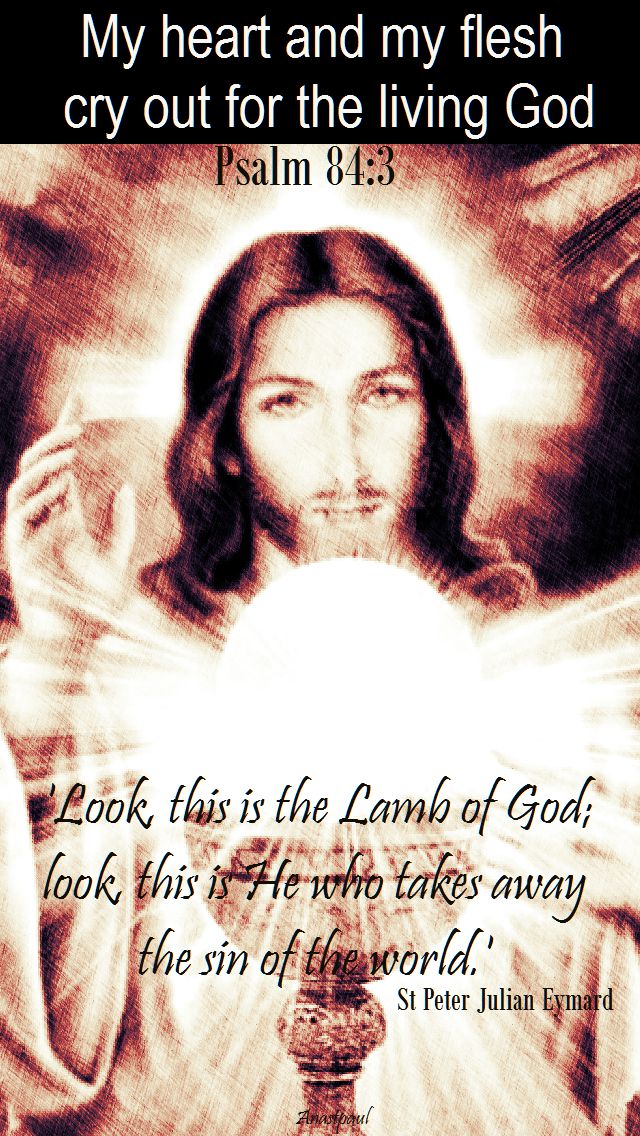
My heart and my flesh cry out for the living God……….Psalm 84:3
REFLECTION – “To adore Jesus Christ in the Most Blessed Sacrament is first of all to acknowledge Him truly, really and substantially present therein by the humble sentiment of a lively and spontaneous faith: humbly surrendering our feeble reason to the divinity of this sublime Mystery; asking neither to see or touch, like the unbelieving Apostle, before accepting the truth of Jesus Hostia; merely waiting, to prostrate ourselves at His feet, for the infallible and gentle word of the Church telling us like Saint John the Baptist: ‘Look, this is the Lamb of God; look, this is He who takes away the sin of the world.’ …………………..St Peter Julian Eymard
PRAYER – Living God, let me desire to see You as often as possible and make use of evey opportunity to visit You and to attend Holy Mass. Grant that I may live in such a way, atoning here on earth for the sins against Your Eucharistic Heart and that I may gain the blessed vision of You in the Holy Eucharist here and now and one day attain the joy of seeing You in Heaven. Amen
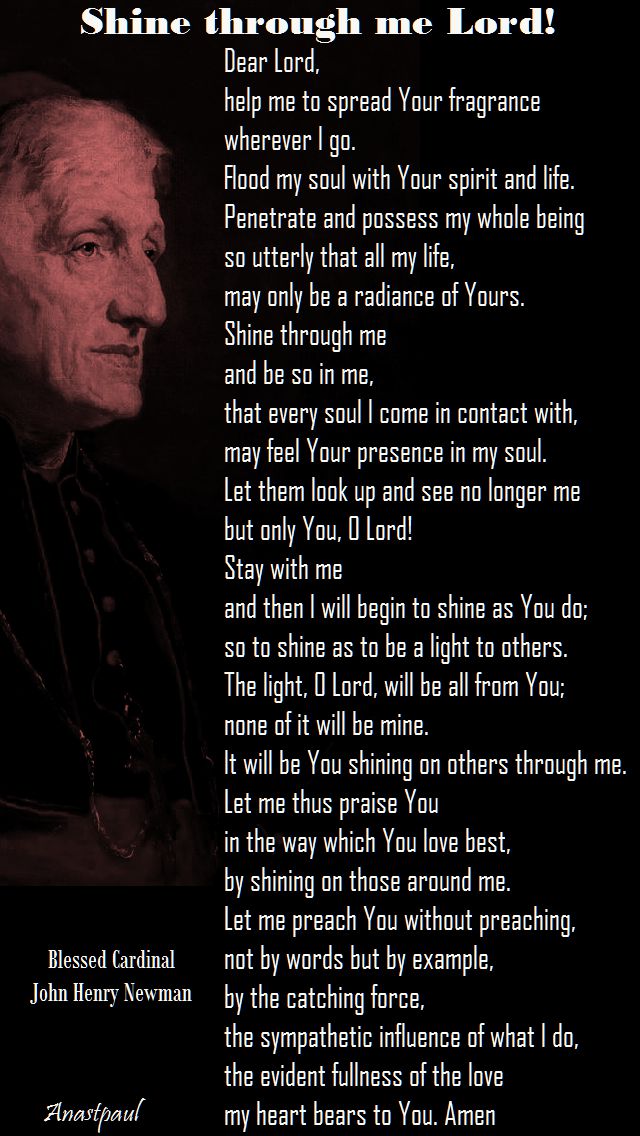
Shine through me Lord! Blessed Cardinal John Henry Newman
Dear Lord,
help me to spread Your fragrance wherever I go.
Flood my soul with Your spirit and life.
Penetrate and possess my whole being
so utterly that all my life may only be a radiance of Yours.
Shine through me
and be so in me, that every soul I come in contact with,
may feel Your presence in my soul.
Let them look up and see no longer me
but only You, O Lord!
Stay with me and then I will begin to shine as You do;
so to shine as to be a light to others.
The light, O Lord, will be all from You;
none of it will be mine.
It will be You shining on others through me.
Let me thus praise You in the way which You love best,
by shining on those around me.
Let me preach You without preaching,
not by words but by example,
by the catching force,
the sympathetic influence of what I do,
the evident fullness of the love my heart bears to You. Amen.
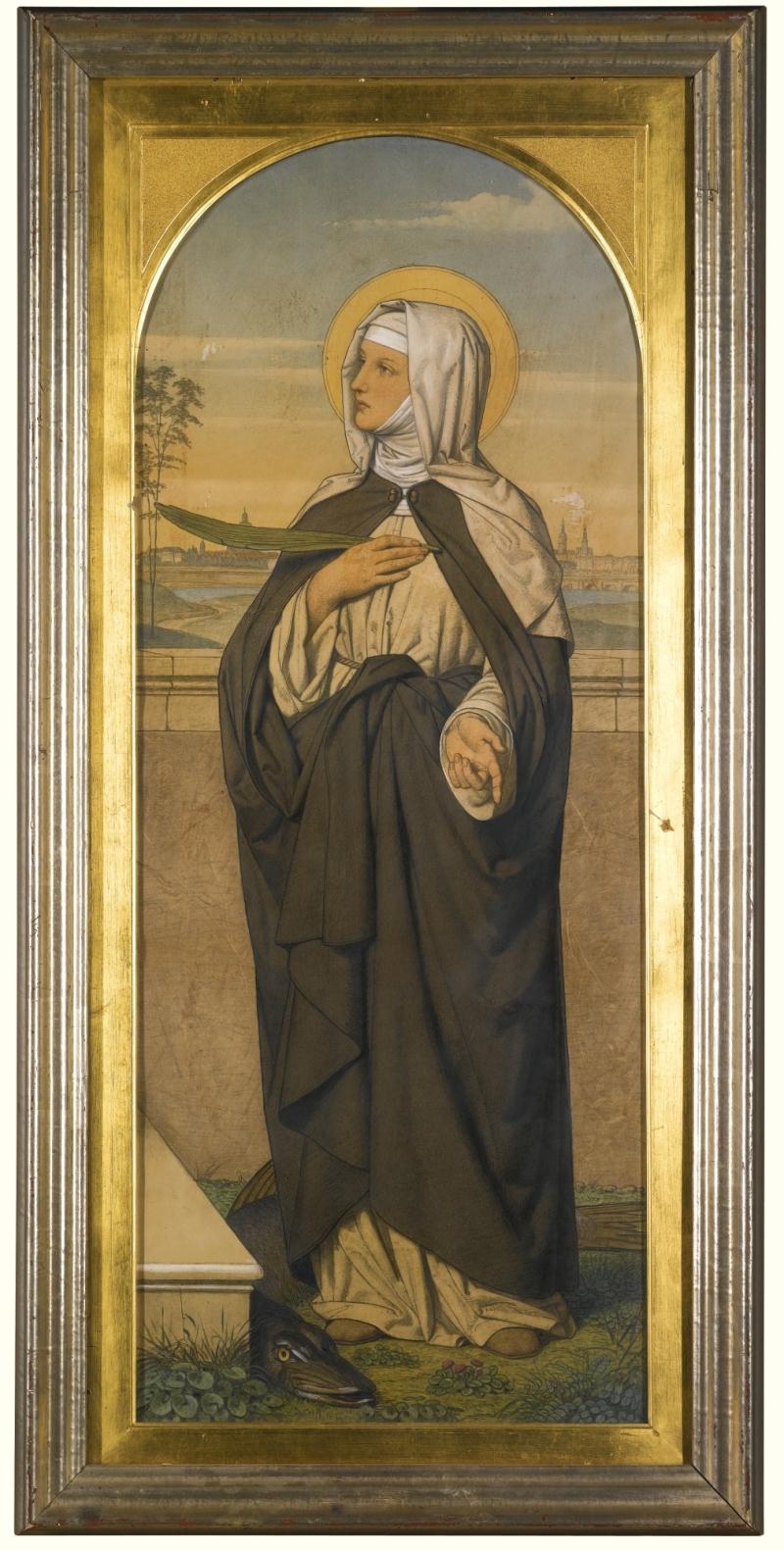
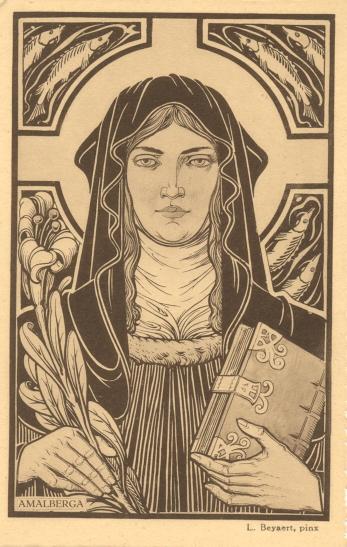
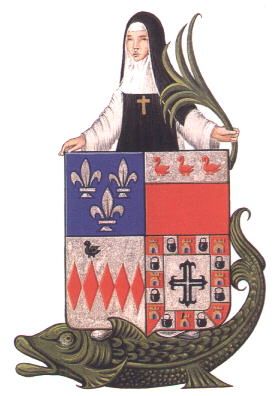
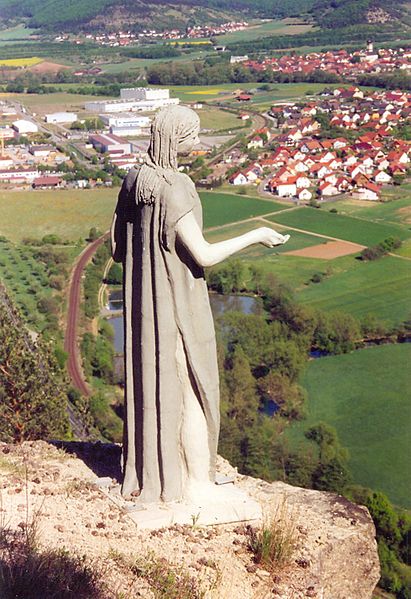
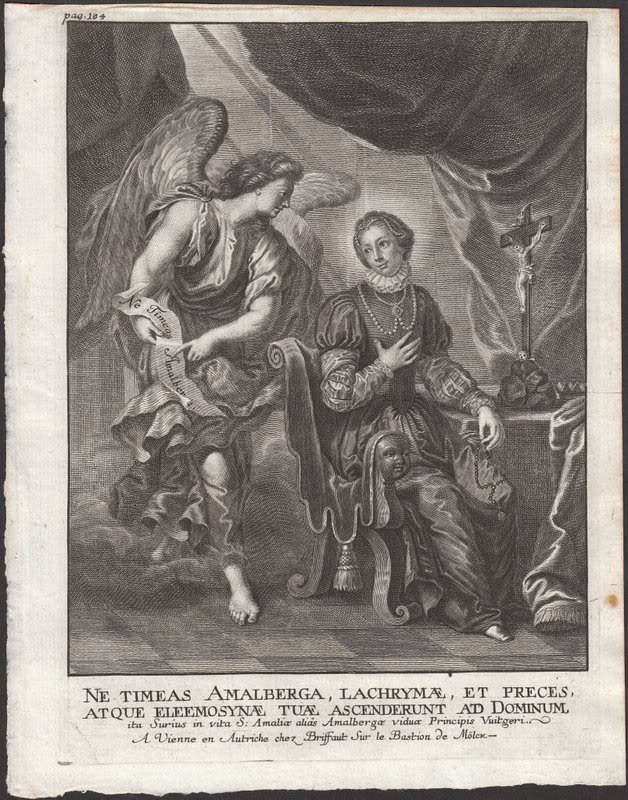
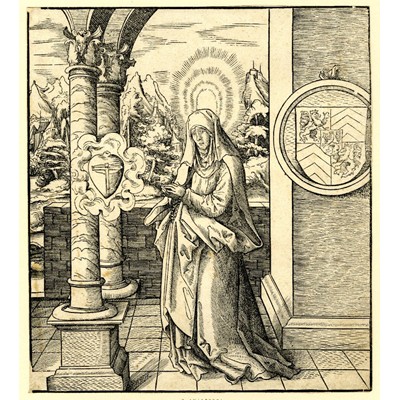
Saint of the Day – 10 July – St Amalberge of Mauberg – also known as: Amalburga of Temse, Amalberga, Amalia, Amelberg, Amelia – (Born in the seventh century in Brabant, Belgium – Died in 690). She is buried beside her husband at the monastery at Lobbes, Belgium and her relics have been in Saint Peter’s abbey church in Ghent, Belgium since 1073. Patronage – against arm pain, against bruises, against fever, of farmers, fever victims, Ghent, Belgium. Attributes – crown, fish, geese, sieve, woman holding a palm and open book, woman standing on a giant sturgeon or other fish, woman with a crown at her feet.
St Amalberga, otherwise Amelia, was born at Brabant and was related to Pepin of Landen. Whether she was a sister or niece, the Bollandists are not sure. She was married to Witger and became the mother of three saints: Gudila, Reinelda, and Emembertus.
The Norman chroniclers speak of her as having been married twice, which seems to be erroneous. She and her husband ultimately withdrew from the world; he becoming a monk and she a nun. There is very great confusion in the records of this saint and of a virgin who came a century after. To add to the difficulty a third St. Amalberga, also a virgin, appears in the twelfth century.
She died in 690 and is buried beside her husband at the Lobbes monastery. Her relics have been in Saint Peter’s abbey church in Ghent, Belgium since 1073. She is known to protect people against arm pain, bruises, and fever.
It is said that she once crossed a lake by riding on the back of a giant sturgeon, which led to her representation on or with a fish.
St Amalberga
St Anatolia of Thora
St Antôn Nguyen Huu Quynh
St Apollonius of Sardis
Bl Arnold of Camerino
St Bianor of Pisidia
St Cuán of Airbhre
St Elilantus
St Etto
Bl Euménios
St Knud of Denmark
St Lantfrid
Bl Marie-Gertrude de Ripert d’Alauzier
Bl Parthenios
St Pascharius of Nantes
St Peter Vincioli
St Phêrô Nguyen Khac Tu
St Rufina of Rome
St Secunda of Rome
St Sylvanus of Pisidia
Bl Sylvie-Agnès de Romillon
St Victoria
St Waltram
—
Martyrs of Africa – 4 saints: A group of Christians martyred together in Africa. The only information that has survived are four of their names – Felix, Januarius, Marinus and Nabor.
Martyrs of Antioch – 10 saints: A group of ten Christians martyred together. We have no details about them but the names – Diogenes, Domnina, Esicius, Macarius, Maxima, Maximus, Rodigus, Timoteus, Veronia and Zacheus. They were martyred in Antioch, date unknown.
Martyrs of Damascus – 11 beati: A group of Franciscans and laymen ordered by Druz Muslims to convert to Islam. They refused and were hacked to pieces.
• ‘Abd Al-Mu’ti Masabki
• Carmelo Bolta Bañuls
• Engelbert Kolland
• Francisco Pinazo Peñalver
• Fransis Masabki
• Juan Jacobo Fernández y Fernández
• Manuel Ruiz López
• Nicanor Ascanio de Soria
• Nicolás María Alberca Torres
• Pedro Soler Méndez
• Rufayil Masabki
They were cut to pieces on 9-10 July 1860 in Damascus, Syria.
Beatified on 10 October 1926 by Pope Pius XI.
Martyrs of Nicopolis – 45 saints: A group of 45 Christians tortured and martyred together in the persecutions of emperor Licinius. We know nothing else but six of their names – Anicetus, Anthony, Daniel, Leontius, Mauritius and Sisinno. c 329 in Nicopolis, Armenia (modern Koyulhisar, Turkey).
Martyrs of Nitria – 5 saints: Fathers of Nitria – Four monks and the bishop of Alexandria, Egypt who were martyred by heretics. Saint John Chrysostom wrote about them but their names have not come down to us. They were martyred in the 4th century in Nitria, Egypt.
Martyrs of Tomis – 45 saints: A group of 45 Christians martyred together. No details about them have survived but seven of their names – Aurelian, Diomedes, Domus, Emilian, John, Marcian and Sisimmus. They were martyred in Tomis, Scythia Minor (modern Constanta, Romania), date unknown.
Seven Holy Brothers – 7 martyrs: A group of seven brothers, the sons of Saint Felicitas, all Christians and all martyred in Rome, Italy in 165 in the persecutions of Emperor Antoninus – Alexander, Felix, Januarius, Martialis, Philip, Silvanus and Vitalis. Patronage – Abbey of Badia di Cava, Italy.
If we do not venture to approach men who are in power, except with humility and reverence, when we wish to ask a favour, how much must we beseech the Lord God of all things with all humility and purity of devotion? And let us be assured that it is not in many words, but in the purity of heart and tears of compunction that we are heard. For this reason prayer ought to be short and pure, unless, perhaps it is lengthened by the inspiration of divine grace. At the community exercises, however, let the prayer always be short, and the sign having been given by the Superior, let all rise together. (Holy Rule 20)
LET US PRAY – DAY EIGHT:
Glorious Saint Benedict,
sublime model of virtue, pure vessel of God’s grace!
Behold me humbly kneeling at your feet.
I implore you in your loving kindness to pray for me before the throne of God.
To you I have recourse in the dangers that daily surround me.
Shield me against my selfishness and my indifference to God and to my neighbour.
Inspire me to imitate you in all things.
May your blessing be with me always, so that I may see and serve Christ in others and work for His kingdom.
Graciously obtain for me from God those favours and graces which I need so much in the trials, miseries and afflictions of life.
Your heart was always full of love, compassion and mercy toward those who were afflicted or troubled in any way.
You never dismissed without consolation and assistance anyone who had recourse to you.
I therefore invoke your powerful intercession, confident in the hope that you will hear my prayers and obtain for me the special grace and favour I earnestly implore.
{mention your petition}
Help me, great Saint Benedict, to live and die as a faithful child of God, to run in the sweetness of His loving will and to attain the eternal happiness of heaven.
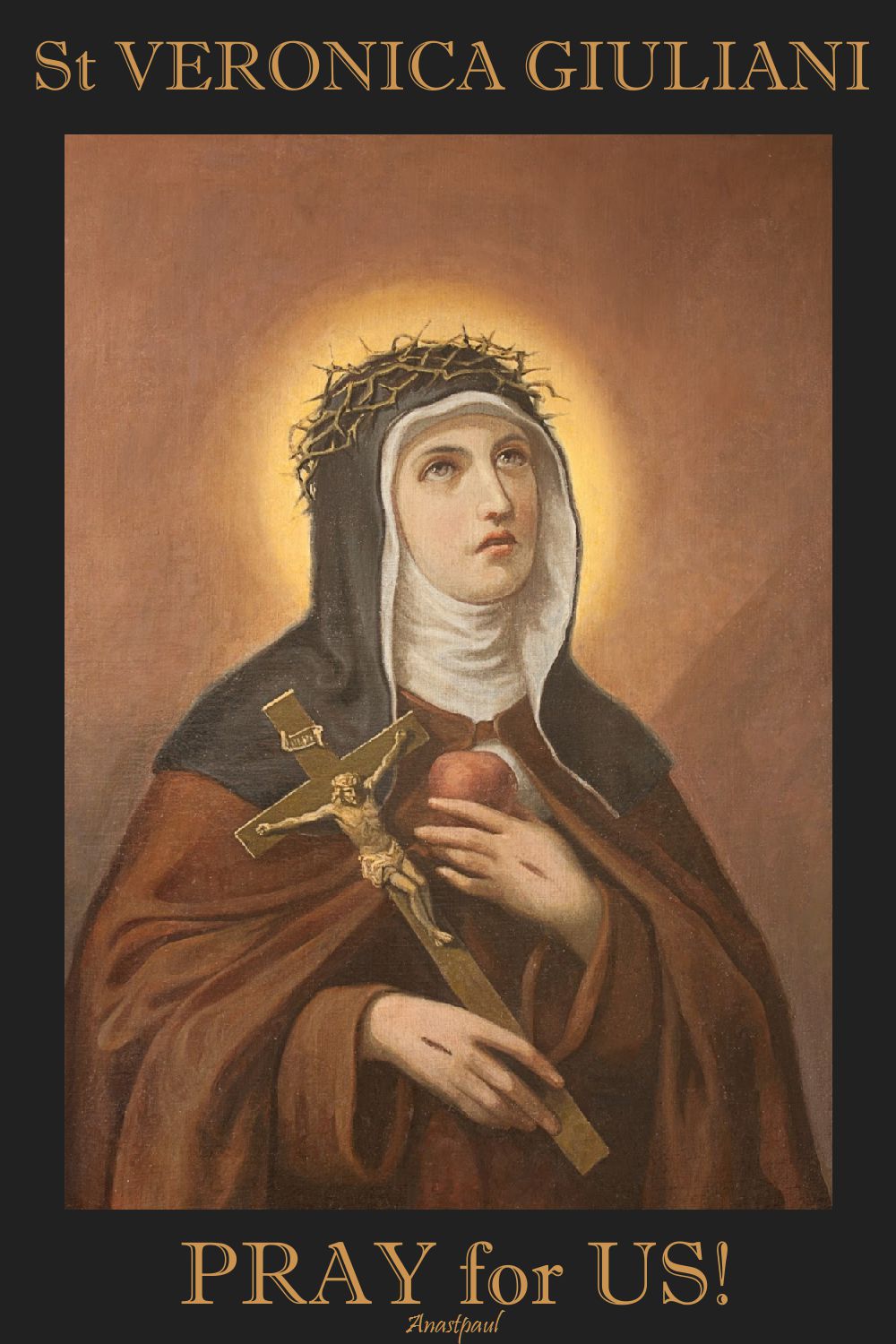
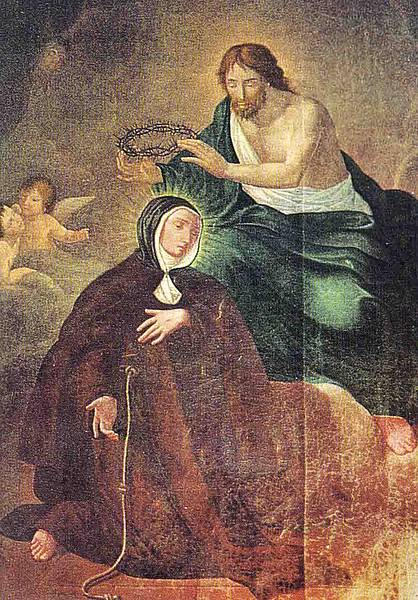
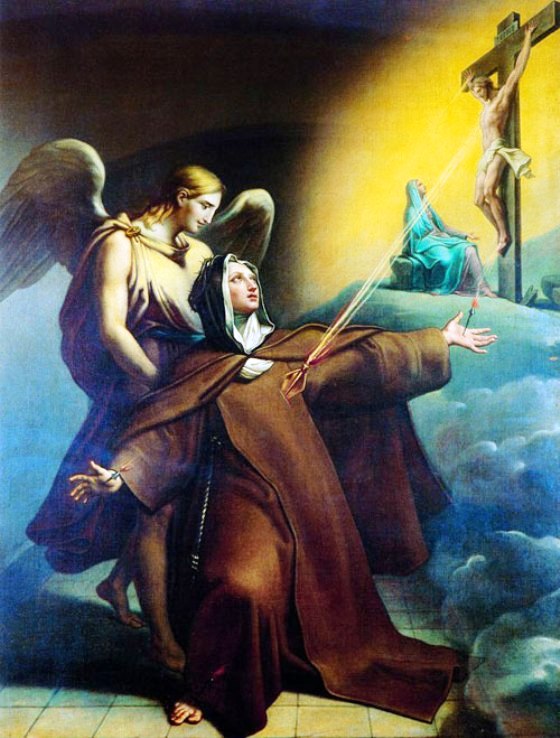
“Saint Veronica, true to the name she took in religion, became a “true image” of Christ crucified; her configuration to the Lord was accompanied by profound mystical experiences such as her crowning with thorns and the stigmata. Veronica’s spirituality, as revealed above all in her Diary, is Christ-centred and spousal: she saw all things in the light of Christ’s love, manifested in His Passion and she united herself to His self-oblation to the Father for the salvation of souls. Her love of the Scriptures was deeply linked to her love of the Church and her strong sense of the communion of the saints.
St. Veronica Giuliani invites us to make our Christian life grow, our union with the Lord in being for others, abandoning ourselves to His will with complete and total trust and to union with the Church, Bride of Christ; she invites us to participate in the suffering love of Jesus Crucified for the salvation of all sinners; she invites us to fix our gaze on Paradise, the goal of our earthly journey, where we will live together with so many brothers and sisters the joy of full communion with God; she invites us to nourish ourselves daily from the Word of God to warm our hearts and give direction to our life. The last words of the saint can be considered the synthesis of her passionate mystical experience: “I have found Love, Love has let Himself be seen!”…. May the life and teaching of Saint Veronica Giuliani inspire us to grow in union with the Lord and His Church and to share in Christ’s loving concern for the salvation of sinners.”
Pope Benedict XVI 15 December 2010
“VERONICA” – Latin alteration of BERENICE, the spelling influenced by the ecclesiastical Latin phrase vera icon meaning “true image”. This was the name of a legendary saint who wiped Jesus’ face with a cloth and miraculously found His image imprinted upon it. It was borne by the 17th-century Italian saint and mystic Veronica Giuliani.
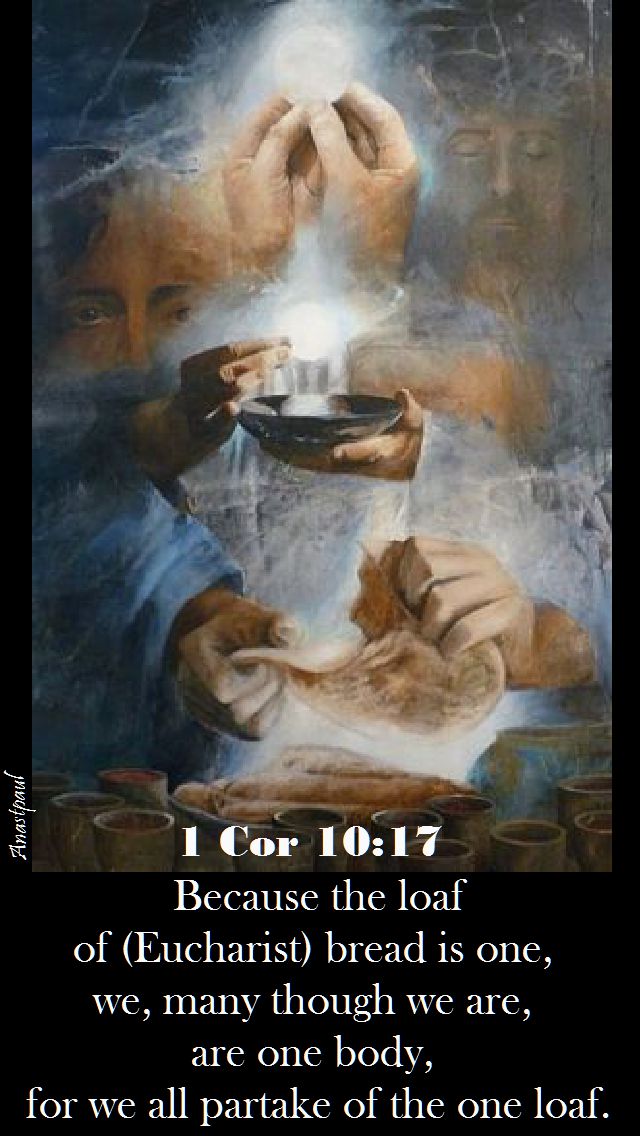
Because the loaf of (Eucharist) bread is one,
we, many though we are,
are one body,
for we all partake of the one loaf…………1 Cor 10:17
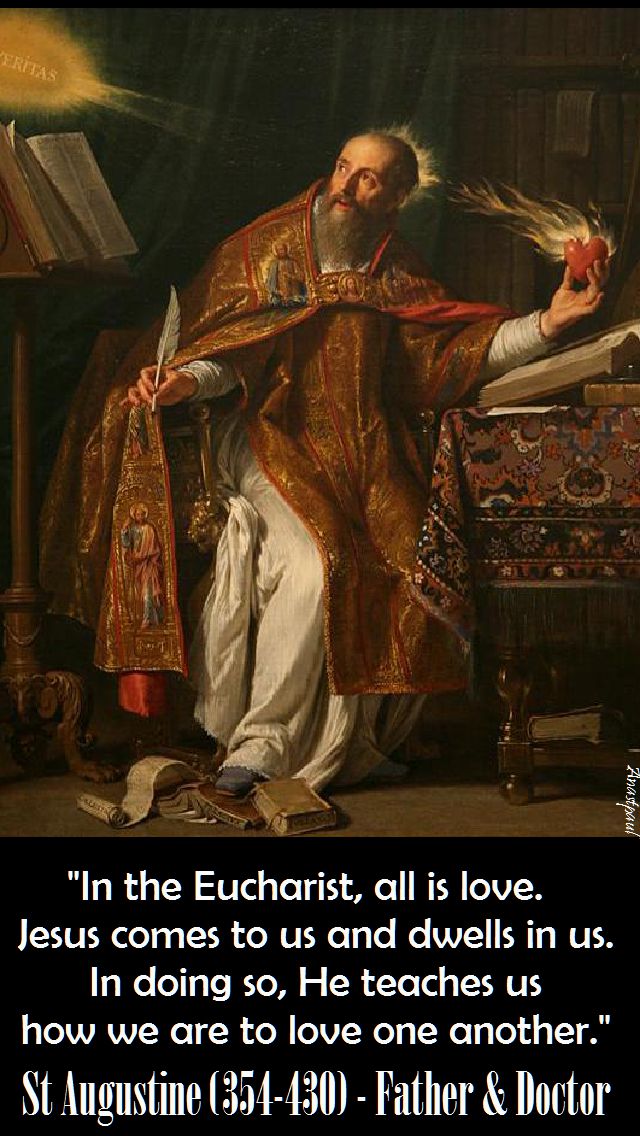
REFLECTION – “In the Eucharist, all is love. Jesus comes to us and dwells in us.
In doing so, He teaches us how we are to love one another.”………….St Augustine (354-430)
PRAYER – Most loving Father, grant that every Eucharistic Celebration may unit me more closely to Your Divine Son. May it also unite me to all Christians and help me to show greater love for them every day. St Veronica Giuliani, you truly experienced total and supreme love in Holy Communion, pray for us that we might come to understand this immense and ineffable love of our Saviour for us all, as He becomes our food of life, amen.
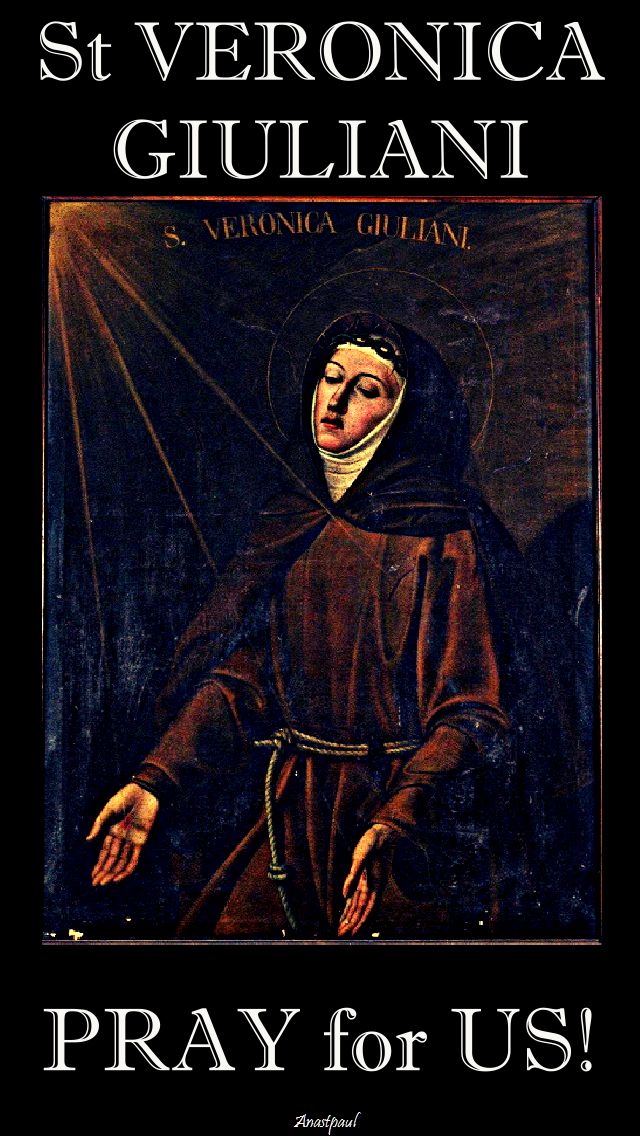
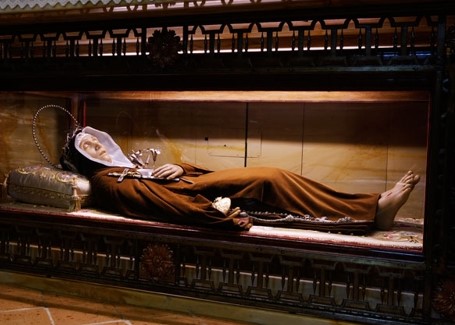
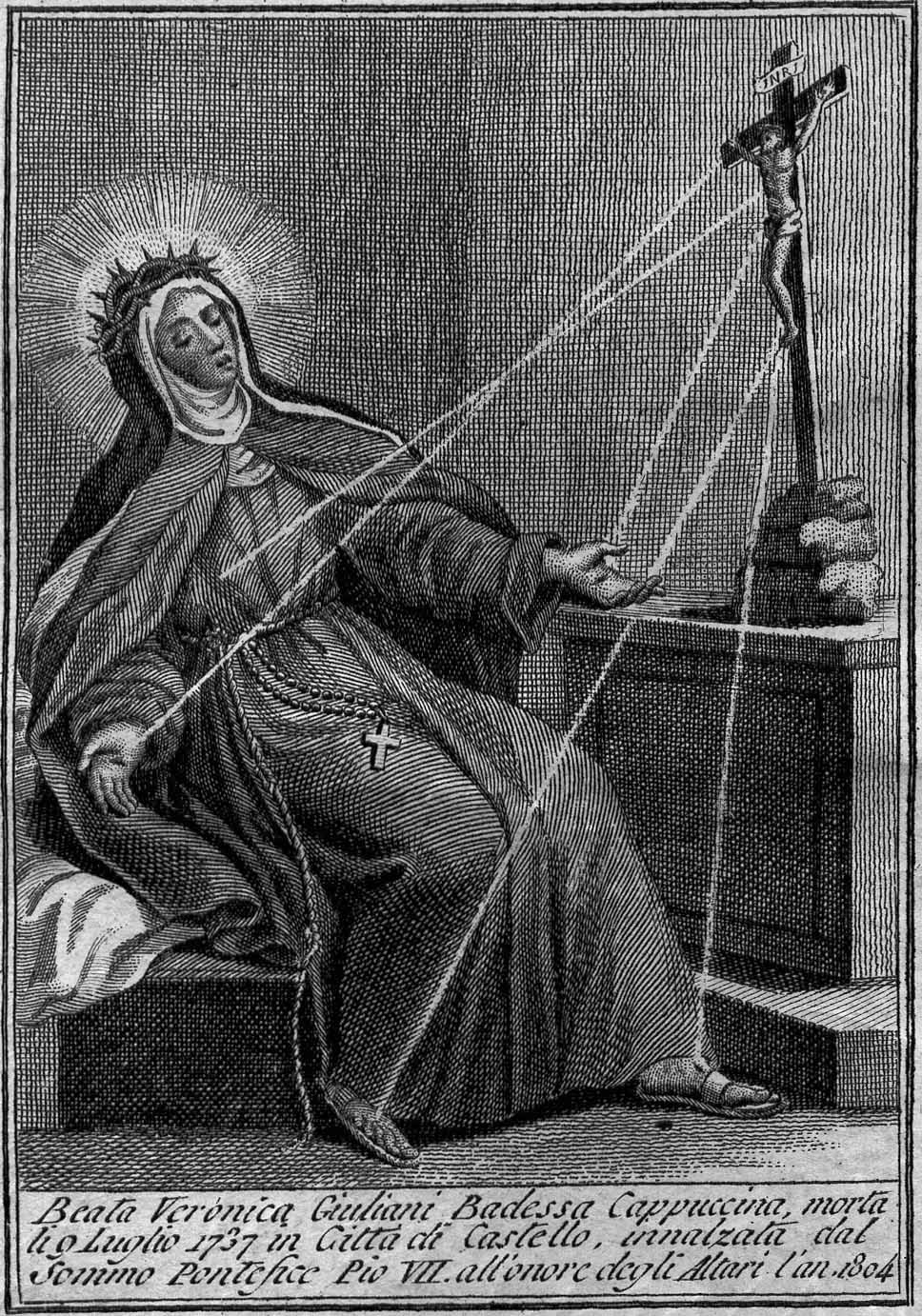
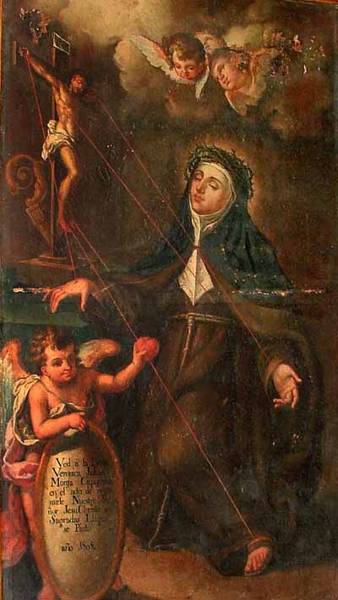
Saint of the Day – 9 July – St Veronica Giuliani – Italian Capuchin Poor Clares nun, Abbot, Mystic, Stigmatist. (1660 at Mercatello, Duchy of Urbino (part of modern Italy) as Ursula Giuliani – 9 July 1727 at Città di Castello, Italy of natural causes). The figure of the cross was found impressed upon her heart. Her body is incorrupt. She was beatified on 17 June 1804 by Pope Pius VII and canonised on 26 May 1839 by Pope Gregory XVI. Attributes – crowned with thorns and embracing the Cross, holding a heart marked with a cross, embracing a Crucifix.
She was born Orsola [Ursula] Giuliani at Mercatello in the Duchy of Urbino on December 27, 1660. Her parents were Francesco and Benedetta Mancini Giuliani. She was the youngest of seven sisters, three of whom embraced the monastic life.
It is told that at the age of three years Ursula supposedly began to show great compassion for the poor. She would set apart a portion of her food for them and even part with her clothes when she met a poor child scantily clad. Her mother died when Ursula was seven years of age.
When others did not readily join in her religious practices she was inclined to be dictatorial. At the age of 16, she experienced a vision which corrected this imperfection of character: she saw her own heart as a “heart of steel”. In her writings she confesses that she took a certain pleasure in the more stately circumstances which her family adopted when her father was appointed superintendent of finance at Piacenza. When Veronica came of age, her father believed she should marry and so he desired her to take part in the social activities of the young people. But she pleaded so earnestly with her father that, after much resistance, he finally permitted her to choose her own state in life.
For fifty years Ursula Giuliani lived as Sister Veronica in the Capuchin convent of Città di Castello in Umbria, Italy. With gritty determination tempered by humility, she led her sisters as novice mistress for thirty-four years and as abbess for eleven. St. Veronica governed the convent with obvious common sense. For example, so that her young novices would not get puffed up with pride, she forbade them to read the elevated works of the great spiritual masters. Instead she required them to study books on Christian basics. And as a most practical woman, she improved her sisters’ comfort by enlarging the convent rooms and having water piped inside.
Like Teresa of Ávila, another very down-to-earth saint, Veronica enjoyed an unusually profound communion with God. In the following excerpt from her Diary, she struggled to put into words her experience of the divine presence:
“While I was about to go to Holy Communion, I seemed to be thrown wide open like a door flung open to welcome a close friend and then shut tight after his entry. So my heart was alone with Him—alone with God. It seems impossible to relate all the effects, feelings, leaping delight and festivity my soul experienced. If I were to speak, for example, of all the happy and pleasant times shared with dear friends . . . , I would be saying nothing comparable to this joy. And if I were to add up all the occasions of rejoicing in the universe, I would be saying that all this amounts to little or nothing beside what, in an instant, my heart experiences in the presence of God. Or rather what God does to my heart, because all these other things flow from Him and are His works.
Love makes the heart leap and dance. Love makes it exult and be festive. Love makes it sing and be silent as it pleases. Love grants it rest and enables it to act. Love possesses it and gives it everything. Loves takes it over completely and dwells in it. But I am unable to say more because if I wished to relate all the effects that my heart experiences in the act of going to Holy Communion and also at other times, I would never finish saying everything. It is sufficient to say that communion is a . . . mansion of love itself.”
Veronica had a lifelong devotion to Christ crucified that eventually became manifested in physical signs. The marks of the crown of thorns appeared on her forehead in 1694 and the five wounds on her body in 1697. Veronica was humiliated by the stigmata itself and by her bishop’s rigorous testing of her experience. He removed the saint from ordinary community life and put her under constant observation. When he decided that the phenomena were authentic, he allowed her to return to normal convent life and continue her service to her sisters. In 1727, Veronica died of apoplexy at the age of sixty- seven.
Martyrs of China (Optional Memorial; 76 saints): 25 priests, friars, nuns, seminarians and lay people, all members of the Franciscan and all murdered together for their faith in the Boxer Rebellion:
• André Bauer • Elia; Facchini • Francesco; Fogolla • Franciscus; Zhang; Rong • Gregorio; Grassi • Iacobus; Yan; Guodong • Iacobus; Zhao; Quanxin • Ioannes; Wang; Rui • Ioannes; Zhang; Huan • Ioannes; Zhang; Jingguang • Jeanne-Marie; Kerguin • Maria; Chaira • Marianna; Giuliani • Marie; Adolphine; Dierks • Marie; Amandine • Marie; de; Saint; Just • Mary; Hermina; Grivot • Matthias; Feng; De • Patricius; Dong • Petrus; Wang; Erman • Petrus; Wu; Anbang • Petrus; Zhang; Banniu • Philippus; Zhang; Zhihe • Simon; Chen • Thomas; Shen; Jihe •
They were beheaded on 9 July 1900 at Taiyuanfu, Shanxi, China and Canonized on 1 October 2000 by Pope John Paul II in Rome.
Our Lady of Chiquinquira
Our Lady of Itatí
Our Lady of Peace
Our Lady of Victories
—
Bl Adrian Fortescue
St Agrippinus of Autun
St Alexander of Egypt
St Audax of Thora
St Brictius of Martola
St Copra of Egypt
St Cyril of Gortyna
Bl Dionysius the Rhetorician
St Everild of Everingham
St Faustina of Rome
St Felician of Sicily
Bl Fidelis Chojnacki
St Floriana of Rome
St Hérombert of Minden
Bl Jane Scopelli
St Joachim Ho
Bl Luigi Caburlotto
Bl Marguerite-Marie-Anne de Rocher
Bl Marie-Anne-Madeleine de Guilhermier
Bl Marija Petkovic
St Patermutius of Egypt
St Paulina do Coração Agonizante de Jesus
St Ursula/Veronica Giuliani
—
Four Holy Polish Brothers – 4 saints: Four brothers who became hermits, Benedictine monks and saints – Andrew, Barnabas, Benedict and Justus. They were born in Poland and died in 1008 of natural causes.
Martyrs of Gorkum – 19 saints: Nineteen martyrs killed by Calvinists for loyalty to the Pope and for their belief in the Real Presence in the Eucharist. They are –
• Adrianus van Hilvarenbeek • Andreas Wouters • Antonius van Hoornaar • Antonius van Weert • Cornelius van Wijk • Francisus de Roye • Godfried van Duynen • Godfried van Melveren • Hieronymus van Weert • Jacobus Lacops • Joannes Lenaerts • John of Cologne • Leonardus van Veghel • Nicasius Janssen van Heeze • Nicolaas Pieck • Nicolaas Poppel • Petrus van Assche • Theodorus van der Eem • Willehad van Deem •
They werehanged on 9 July 1572 in Brielle, Zuid-Holland, Netherlands.
Beatified on 24 November 1675 by Pope Clement X and Canonised on 29 June 1867 by Pope Pius IX.
Martyrs of Orange – 32 beati: 32 nuns from several orders who spent up to 18 months in prison and were finally executed for refusing to renounce Christianity during the persecutions of the French Revolution.
• Anne Cartier • Anne-Andrée Minutte • Dorothée-Madeleine-Julie de Justamond • élisabeth Verchière • élisabeth-Thérèse de Consolin • Jeanne-Marie de Romillon • Madeleine-Françoise de Justamond • Madeleine-Thérèse Talieu • Marguerite-Eléonore de Justamond • Marguerite-Marie-Anne de Rocher • Marguerite-Rose de Gordon • Marguerite-Thérèse Charensol • Marie Cluse • Marie-Anastasie de Roquard • Marie-Anne Béguin-Royal • Marie-Anne Depeyre • Marie-Anne Doux • Marie-Anne Lambert • Marie-Anne-Madeleine de Guilhermier • Marie-Claire du Bac • Marie-Clotilde Blanc • Marie-Elisabeth Pélissier • Marie-Gabrielle-Françoise-Suzanne de Gaillard de Lavaldène • Marie-Gertrude de Ripert d’Alauzier • Marie-Marguerite Bonnet • Marie-Marguerite de Barbégie d’Albrède • Marie-Rose Laye • Rosalie-Clotilde Bes • Suzanne-Agathe Deloye • Sylvie-Agnès de Romillon • Thérèse-Henriette Faurie
They were guillotined between 6 July and 26 July 1794 at Orange, Vaucluse, France.
Beatified on 10 May 1925 by Pope Pius XI.
Martyrs of the Baths – 10,204 saints: A group of Christians enslaved by Diocletian to build the gigantic baths in imperial Rome, Italy. The end of their labours coincided with the beginning of the great persecutions of Diocletian and they were all executed. Ancient records indicated there were 10,204 of them; Zeno of Rome is the only one whose name has come down to us and we know nothing else about any of their individual lives.
c 304.
We believe that God is present everywhere and that the eyes of the Lord behold the good and the bad in every place (cf Prov 15:3). Let us firmly believe this, especially when we take part in the Work of God. Let us, therefore, always be mindful of what the Prophet says, “Serve the Lord with fear” (Ps 2:11). And again, “Sing wisely” (Ps 46[47]:8). And, “I will sing praise to Thee in the sight of the angels” (Ps 137[138]:1). Therefore, let us consider how it becomes us to behave in the sight of God and His angels and let us so stand to sing, that our mind may be in harmony with our voice. (Holy Rule 19)
LET US PRAY: Day Seven
Glorious Saint Benedict,
sublime model of virtue, pure vessel of God’s grace!
Behold me humbly kneeling at your feet.
I implore you in your loving kindness to pray for me before the throne of God.
To you I have recourse in the dangers that daily surround me.
Shield me against my selfishness and my indifference to God and to my neighbour.
Inspire me to imitate you in all things.
May your blessing be with me always, so that I may see and serve Christ in others and work for His kingdom.
Graciously obtain for me from God those favours and graces which I need so much in the trials, miseries and afflictions of life.
Your heart was always full of love, compassion and mercy toward those who were afflicted or troubled in any way.
You never dismissed without consolation and assistance anyone who had recourse to you.
I therefore invoke your powerful intercession, confident in the hope that you will hear my prayers and obtain for me the special grace and favour I earnestly implore.
{mention your petition}
Help me, great Saint Benedict, to live and die as a faithful child of God, to run in the sweetness of His loving will and to attain the eternal happiness of heaven.
The lack of genuine gratitude we experience within our souls and even the sense of selfishness we can have in our prayers to God for deeper feelings toward Him can fill us with disgust. It doesn’t take much in the way of self reflection to know how unsteady our hearts can be. Are we really sorry for our sins or do we simply want the psychological relief of unburdening ourselves? O’Connor sees both her tendencies towards scruples and utter laxity. Yet, despite these unpleasant truths she can in the end step away from her self concern and self focus and say simply to God “I am thankful.” In the end, we have to let go of self conscious shame and take hold of what is greater than ourselves and worthy of our attention.
“You’ve done so much for me already and I haven’t been particularly grateful. My thanksgiving is never in the form of self sacrifice—a few memorised prayers babbled once over lightly. All this disgusts me in myself but does not fill me with the poignant feeling I should have to adore You with, to be sorry with, or to thank You with. Perhaps the feeling I keep asking for, is something again selfish—something to help me to feel that everything with me is all right. And yet it seems only natural but maybe being thus natural is being thus selfish. My mind is a most insecure thing, not to be depended on. It gives me scruples at one minute and leaves me lax the next. If I must know all these things through the mind, dear Lord, please strengthen mine. Thank you, dear God, I believe I do feel thankful for all You’ve done for me. I want to. I do.”
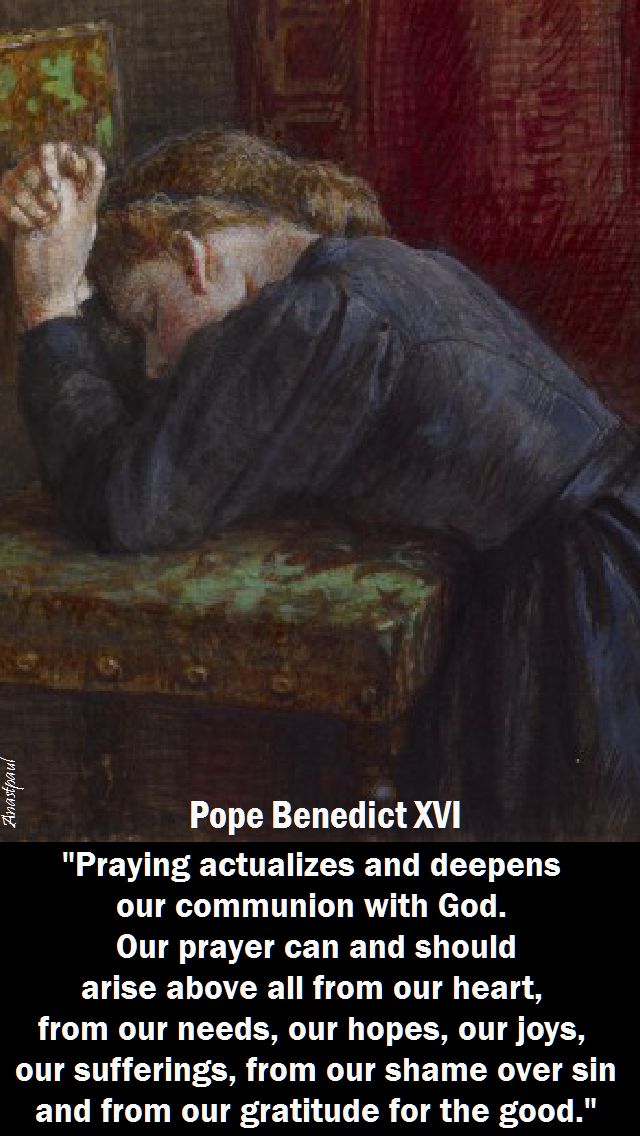
“Praying actualizes and deepens our communion with God. Our prayer can and should arise above all from our heart, from our needs, our hopes, our joys, our sufferings, from our shame over sin and from our gratitude for the good.”………..Pope Benedict XVI
“Know also that you will probably gain more by praying fifteen minutes before the Blessed Sacrament than by all the other spiritual exercises of the day. True, Our Lord hears our prayers anywhere, for He has made the promise, ‘Ask, and you shall receive,’ but He has revealed to His servants that those who visit Him in the Blessed Sacrament will obtain a more abundant measure of grace.”
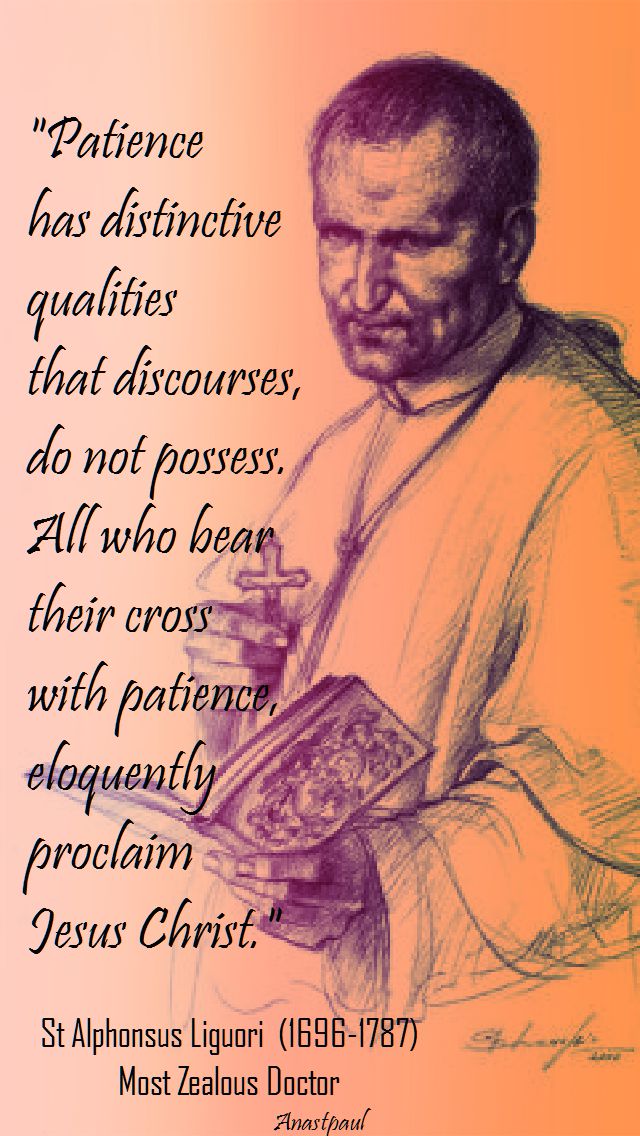
St Alphonsus Liguori (1696-1787) Most Zealous Doctor
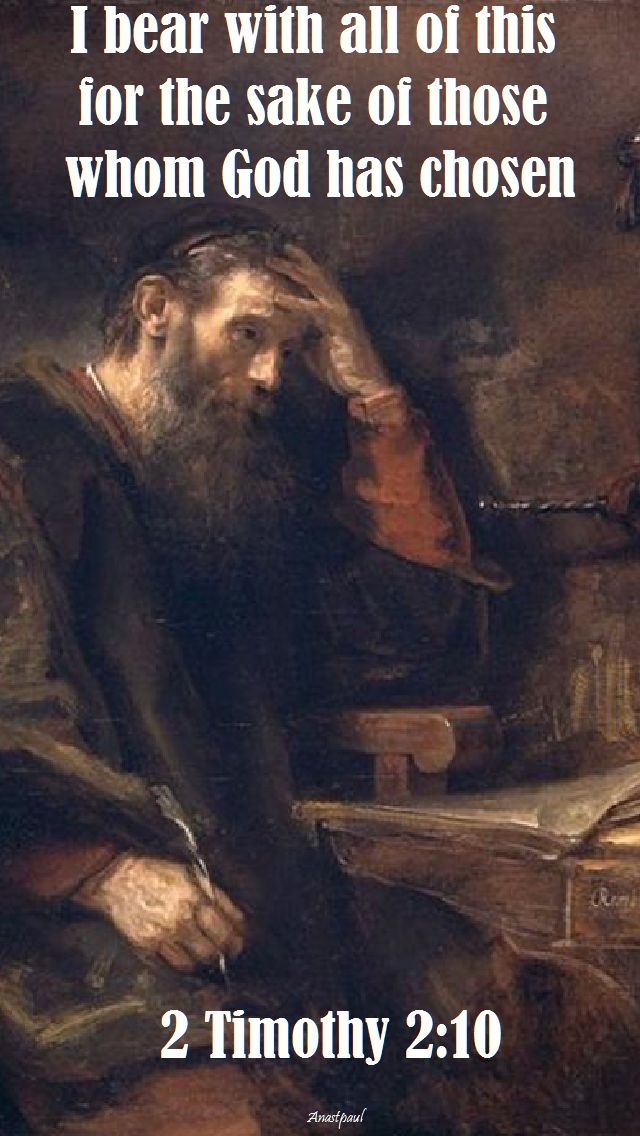
I bear with all of this for the sake of those whom God has chosen..2 Timothy 2:10
REFLECTION – “Patience has distinctive qualities that discourses do not possess. All who bear their cross with patience, eloquently proclaim Jesus Christ.”………….St Alphonsus Liguori
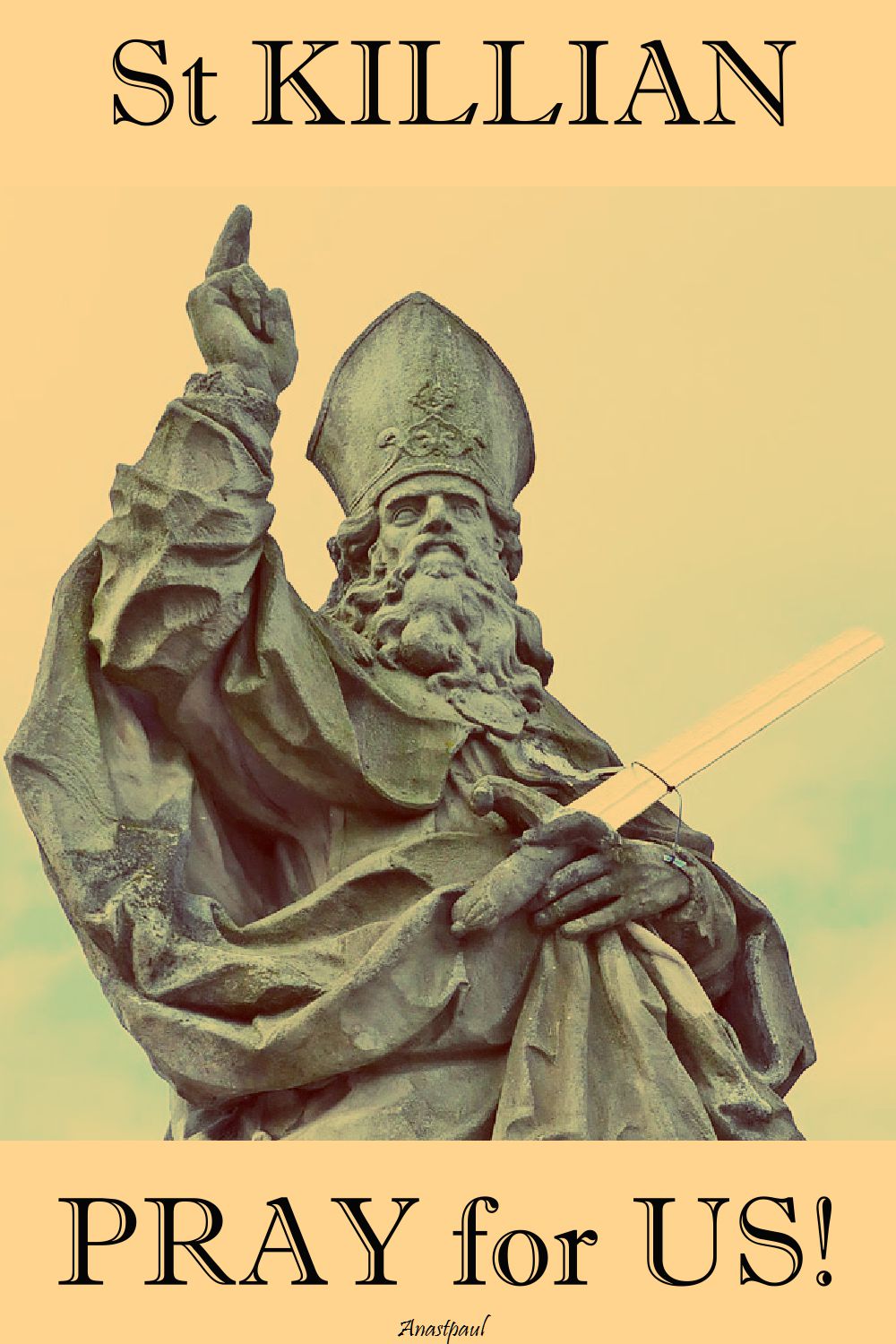
PRAYER – Heavenly Father, teach me to be patient under the crosses that come my way. Let my silent example speak vlumes to others and lead them to faith in Your Son, our Lord Jesus Christ. St Killian, you worked tirelessly and patiently for the glory of the Kingdom, please intercede for us all, amen.
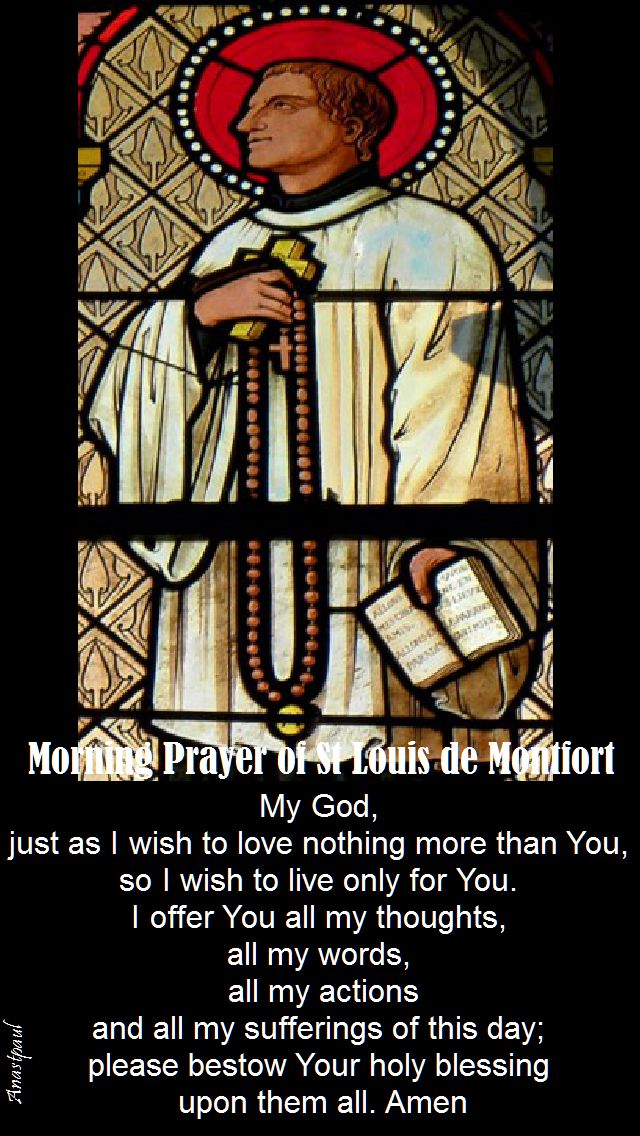
Morning Prayer of
St Louis Marie Grignion de Montfort
My God,
just as I wish to love nothing more than You,
so I wish to live only for You.
I offer You all my thoughts,
all my words,
all my actions
and all my sufferings of this day;
please bestow Your holy blessing
upon them all. Amen
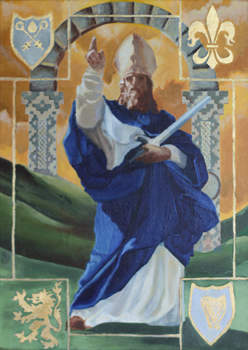
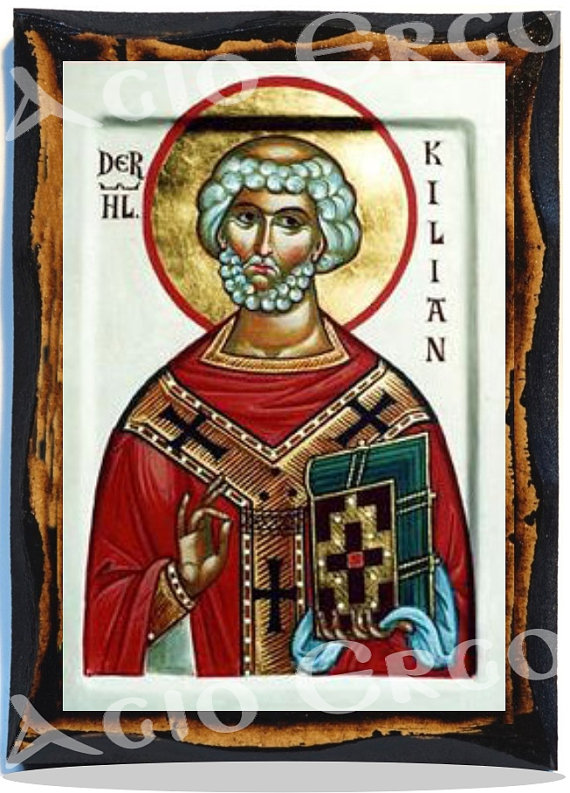
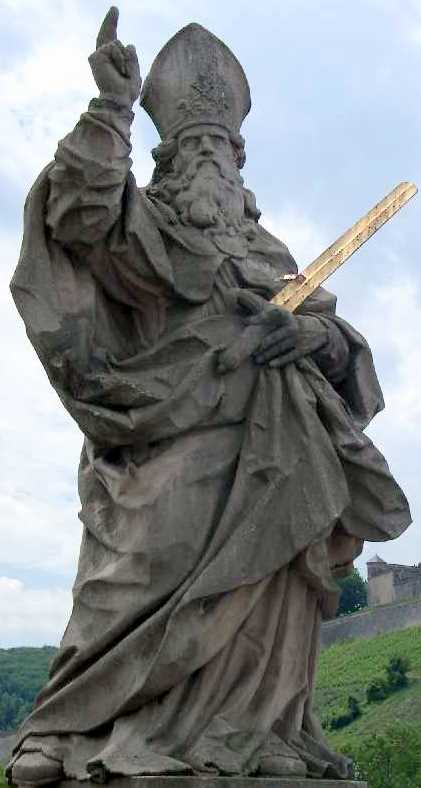
Saint of the Day – 8 July – St Killian (c640-689) Bishop, Martyr, Missionary, “Apostle of Franconia”(nowadays the northern part of Bavaria) – Born in c640 in Mullagh, County Cavan, Ireland – Martyred on 8 July 689 in Wurzburg. Patronages – against rheumatism and gout, against deception, Bavaria, Germany Archdiocese of Paderborn, Germany, Diocese of Würzburg, Germany, Tuosist, County Kerry, Ireland (the City from which his mission to mainland Europe began). Attributes – bishop being murdered with two priests, bishop holding a crozier and sword, bishop holding a large sword and standing between two priests, with Saint Colman and and Saint Totnan.
The Roman Martyrology reads today: “At Wirzburg in Germany, St Killan, a Bishop, who was commissioned by the Roman Pontiff to preach the Gospel. After having converted many to Christ, he was put to death with his companions, Colman, a Priest and Totnan, a Deacon.”
St Killian was born to the Irish nobility. He became a Monk at the monastery of Hy and is thought to have become the abbot. He was appointed as Bishop and travelled throughout Ireland. With eleven companions, he became a missionary through Gaul to Würzburg, Germany whose people he found to be pagan and whom he resolved to convert. On a pilgraimage to Rome, Italy in 686 he received papal authority for his mission; Pope Conon ordained him as a missionary bishop. Kilian then returned to Würzburg in 687 with Saint Colman and Saint Totnan. With them, he evangelised East Franconia and East Thuringia, areas in modern Bavaria, Germany, converted Duke Gozbert and a large part of Gozbert’s subjects.
After Duke Gozbert converted, Killian explained that the duke’s marriage with Geilana, his brother’s widow, was unlawful. He secured the duke’s promise to leave her, which made an enemy of pagan Geilana. She plotted against the saint and caused the murder of him, Colman and Totnan, and the burial of their corpses, sacred vessels, vestments and holy writings at the crime scene. When the duke returned to her, Geilana denied knowing the location of the missionaries. The actual murderer went mad, confessed his crime and died miserably. Geilana herself eventually died insane.
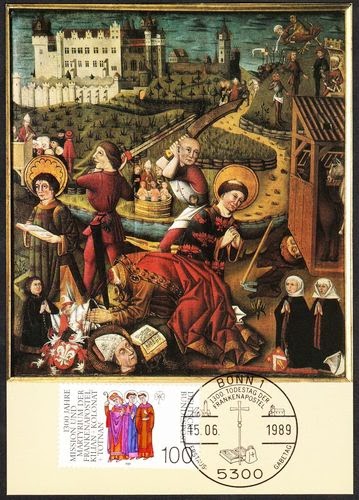
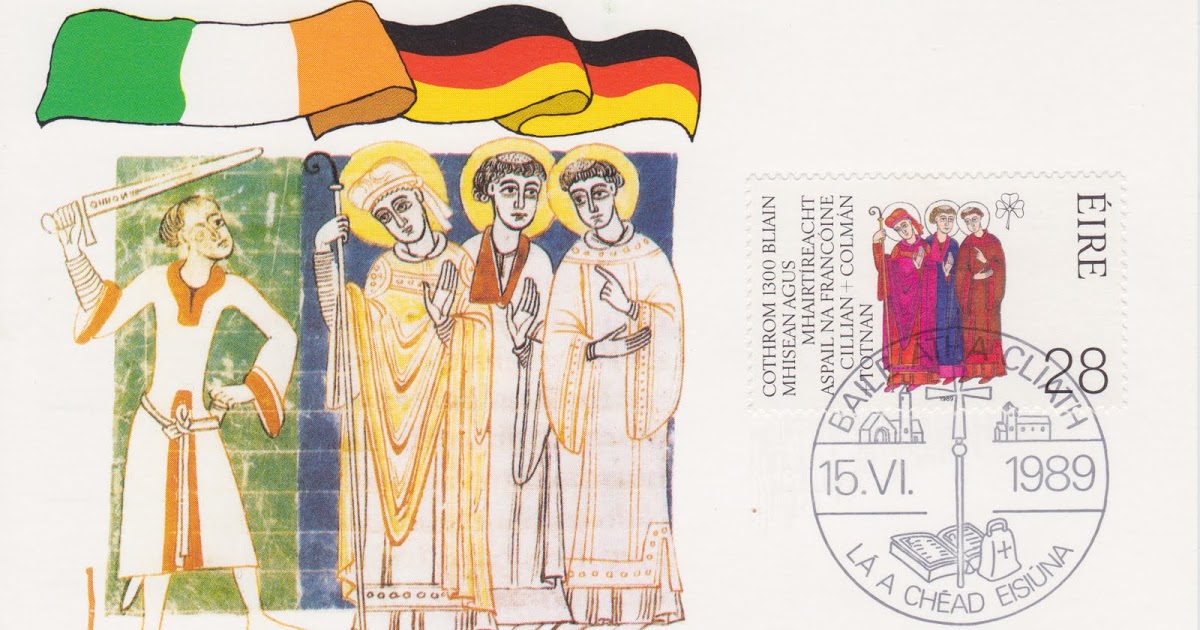
1989 German Stamp honouring St Killian, St Colman and St Totnan
Kilian’s good work did not long survive him. When Saint Boniface arrived in Thuringia, he found evidence of his predecessor’s influence. The relics of the martyrs, after cures had brought fame to their burial place, were transferred to the Church of Our Lady in 743 by Saint Burchard, first Bishop of Würzburg. After Burchard obtained Pope Zachary’s permission for their public veneration, they were solemnly transferred, probably on 8 July 752, to the newly finished Cathedral of the Saviour. Later they were buried in Saint Kilian’s vault in the new cathedral erected on the spot where tradition says they were martyred. His skull is still preserved, is bejewelled and is processed on his feast day. Killian’s copy of the New Testament was preserved in Würzburg Cathedral until 1803, and since then has been in the university library.
St Abraham the Martyr
Bl Adolf IV of Schauenburg
St Adrian III, Pope
St Ampelius of Milan
St Apollonius of Benevento
St Aquila the Tent Maker
St Arnold
St Auspicius of Toul
St Auspicius of Trier
Brogan of Mothil
St Colman of Thuringia
St Doucelin
St Edgar the Peaceful
Bl Pope Eugene III
St Glyceria of Heraclea
St Grimbald
St Ioannes Wu Wenyin
St Ithier of Nevers
St Killian
St Landrada
Bl Mancius Araki Kyuzaburo
St Morwenna
St Pancras of Taormina
Bl Peter the Hermit
St Priscilla the Tent Maker
St Procopius of Ceasarea
St Sunniva of Bergen
St Thibaud de Marly
St Totnan of Thuringia
—
Abrahamite Monks/Martyrs of Constantinople: A group of monks in a monstery founded by Saint Abraham of Ephesus. Martyred in the iconoclast persecutions of emperor Theophilus. They were martyred in c 835 in Constantinople.
Martyrs of Shanxi – 7 saints: In 1898 seven sisters of the Franciscan Missionaries of Mary were sent to the Shanxi diocese in China to serve the poor in hospitals, and care for the unwanted or other destitutes in orphanages. They were –
• Anne-Catherine Dierks
• Anne-Francoise Moreau
• Clelia Nanetti
• Irma Grivot
• Jeanne-Marie Kuergin
• Marianna Giuliani
• Pauline Jeuris
There they all died in one of the periodic crackdowns against foreign missionaries.
They were beheaded on 9 July 1900 at Taiyuanfu, China- Beatified on 24 November 1946 by Pope Pius XII and Canonised on 1 October 2000 by Pope John Paul II.
Martyrs of Syrmium – 5 saints: Five Christians martyred together for their faith. We know nothing else about them but the names – Cecilia, Eperentius, Eraclius, Sostratus and Spirus. They were martyred in the 4th century in Syrmium, Pannonia (modern Serbia).
The twelfth degree of humility is, when a monk is not only humble of heart but always let it appear also in his whole exterior to all that see him; … and always saying to himself in his heart what the publican in the Gospel said, with his eyes fixed on the ground: “Lord, I am a sinner and not worthy to lift up mine eyes to heaven” (Lk 18:13)…
Having, therefore, ascended all these degrees of humility, the monk will presently arrive at that love of God, which being perfect, cast out fear (1 Jn 4:18). In virtue of this love all things which at first he observed not without fear, he will now begin to keep without any effort and as it were, naturally by force of habit, no longer from the fear of hell, but from the love of Christ, from the very habit of good and the pleasure in virtue. May the Lord be pleased to manifest all this by His Holy Spirit in His labourer now cleansed from vice and sin. (Holy Rule 7)
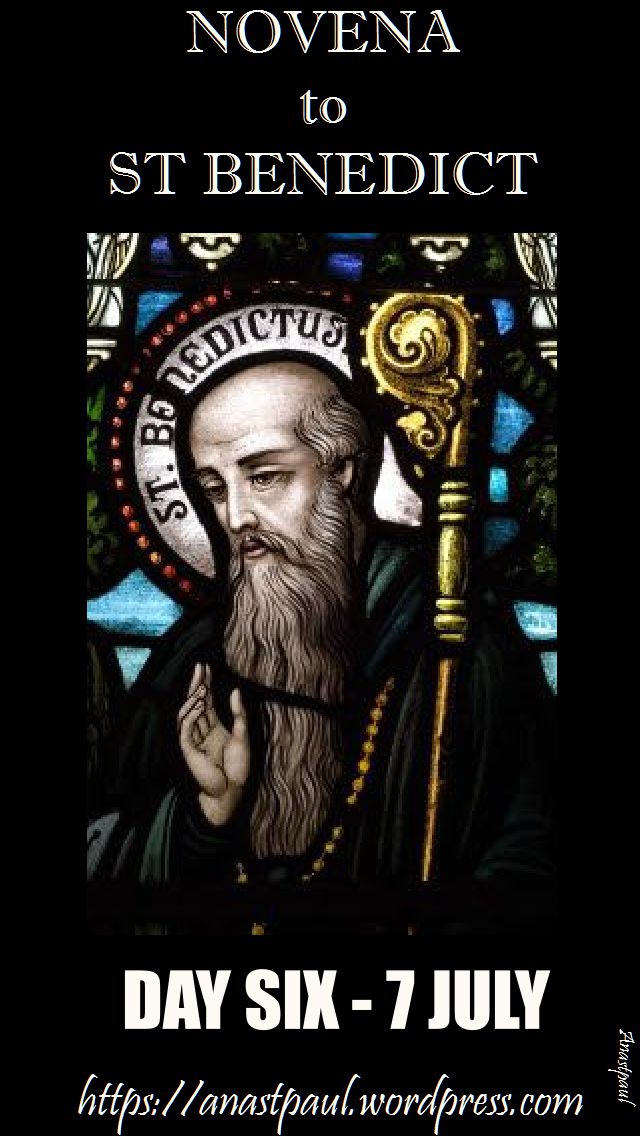
LET US PRAY: DAY SIX
Glorious Saint Benedict,
sublime model of virtue, pure vessel of God’s grace!
Behold me humbly kneeling at your feet.
I implore you in your loving kindness to pray for me before the throne of God.
To you I have recourse in the dangers that daily surround me.
Shield me against my selfishness and my indifference to God and to my neighbour.
Inspire me to imitate you in all things.
May your blessing be with me always, so that I may see and serve Christ in others and work for His kingdom.
Graciously obtain for me from God those favours and graces which I need so much in the trials, miseries and afflictions of life.
Your heart was always full of love, compassion and mercy toward those who were afflicted or troubled in any way.
You never dismissed without consolation and assistance anyone who had recourse to you.
I therefore invoke your powerful intercession, confident in the hope that you will hear my prayers and obtain for me the special grace and favour I earnestly implore.
{mention your petition}
Help me, great Saint Benedict, to live and die as a faithful child of God, to run in the sweetness of His loving will and to attain the eternal happiness of heaven.
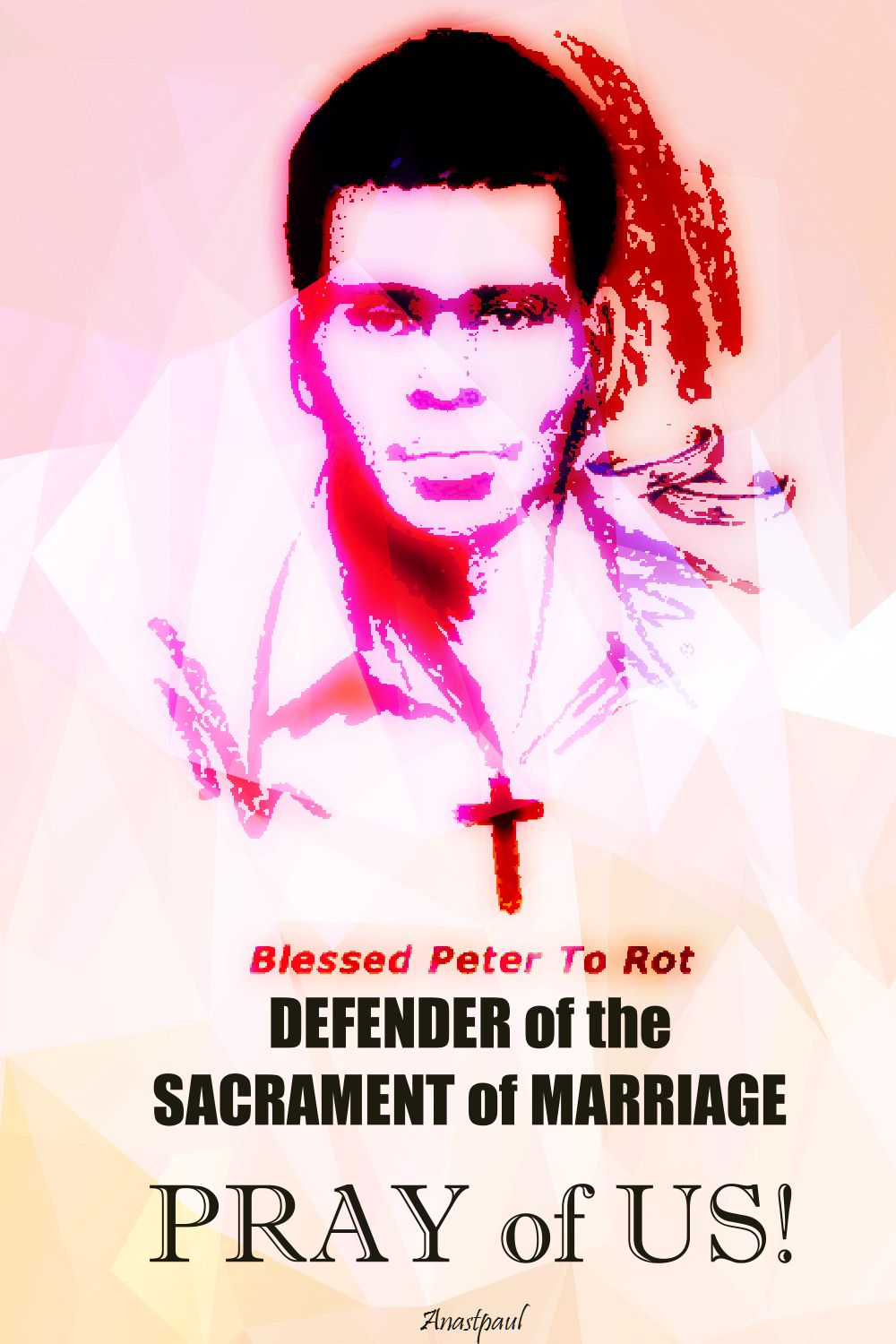
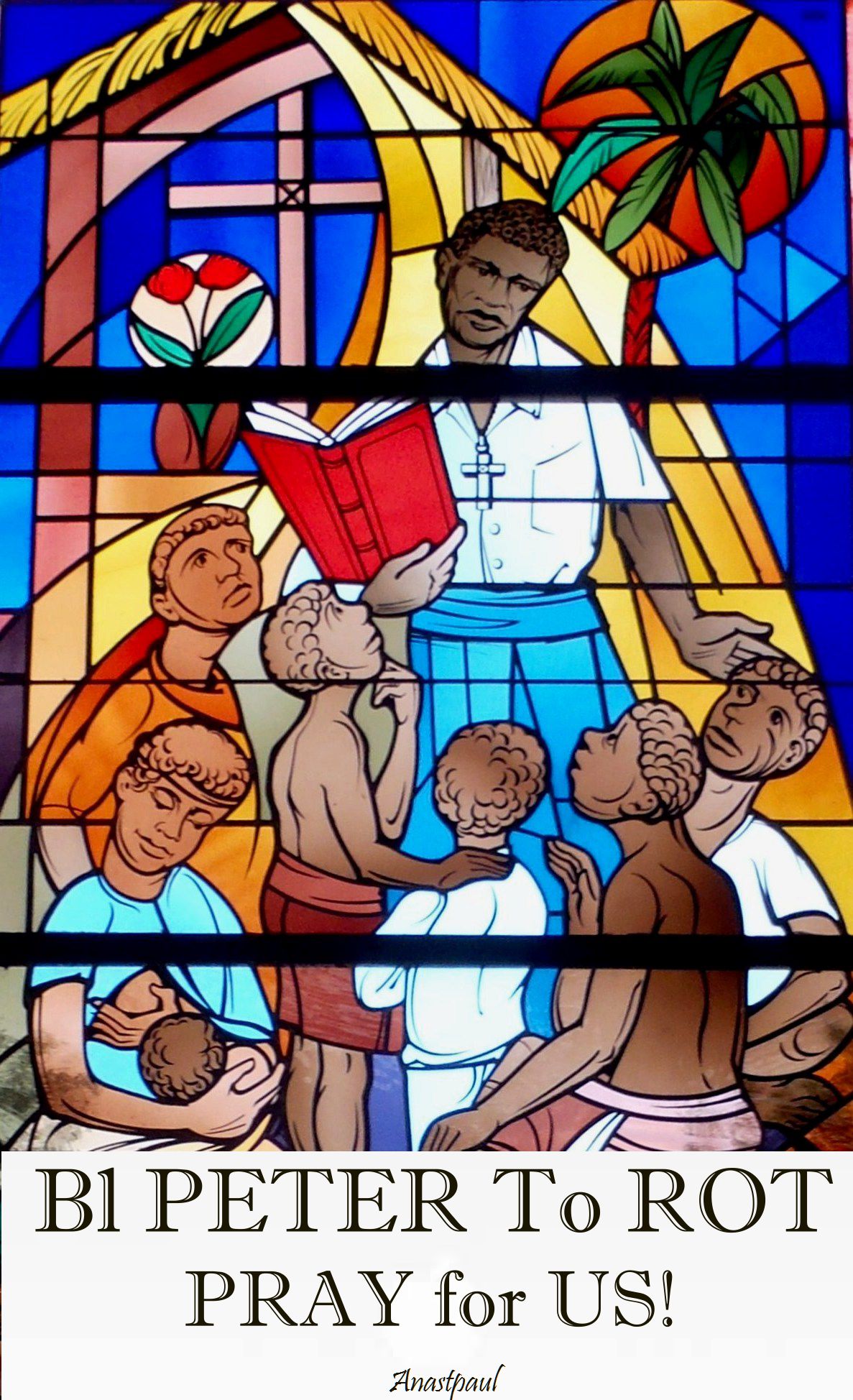
Thought for the Day – 7 July – Memorial of Blessed Peter To Rot “Defender of the Sacrament of Marriage” – a Saint for our times!
“Blessed Peter understood the value of suffering. Inspired by his faith in Christ, he was a devoted husband, a loving father and a dedicated catechist known for his kindness, gentleness and compassion. Daily Mass and Holy Communion and frequent visits to our Lord in the Blessed Sacrament, sustained him, gave him wisdom to counsel the disheartened and courage to persevere until death. In order to be an effective evangeliser, Peter To Rot studied hard and sought advice from wise and holy “big men”. Most of all he prayed – for himself, for his family, for his people, for the Church. His witness to the Gospel inspired others, in very difficult situations, because he lived his Christian life so purely and joyfully. Without being aware of it, he was preparing throughout his life for his greatest offering: by dying daily to himself, he walked with his Lord on the road which leads to Calvary (Cf. Mt. 10: 38-39).
During times of persecution the faith of individuals and communities is “tested by fire” (1Pt. 1: 7). But Christ tells us that there is no reason to be afraid. Those persecuted for their faith will be more eloquent than ever: “it is not you who will be speaking; the Spirit of your Father will be speaking in you” (Mt. 10: 20). So it was for Blessed Peter To Rot. When the village of Rakunai was occupied during the Second World War and after the heroic missionary priests were imprisoned, he assumed responsibility for the spiritual life of the villagers. Not only did he continue to instruct the faithful and visit the sick, he also baptised, assisted at marriages and led people in prayer.
When the authorities legalised and encouraged polygamy, Blessed Peter knew it to be against Christian principles and firmly denounced this practice. Because the Spirit of God dwelt in him, he fearlessly proclaimed the truth about the sanctity of marriage. He refused to take the “easy way” (Cf. ibid. 7: 13) of moral compromise. “I have to fulfil my duty as a Church witness to Jesus Christ”, he explained. Fear of suffering and death did not deter him. During his final imprisonment Peter To Rot was serene, even joyful. He told people that he was ready to die for the faith and for his people.” EXCERPT from the HOMILY OF THE HOLY FATHER ST JOHN PAUL II (Sir John Guise Stadium, Port Moresby, Tuesday, 17 January 1995 on the Beatification of Blessed Peter To Rot)
Blessed Peter To Rot – Pray for us that we too may, in all circumstances and at every opportunity defend the sanctity of the sacrament of marriage without fear and without moral compromise!
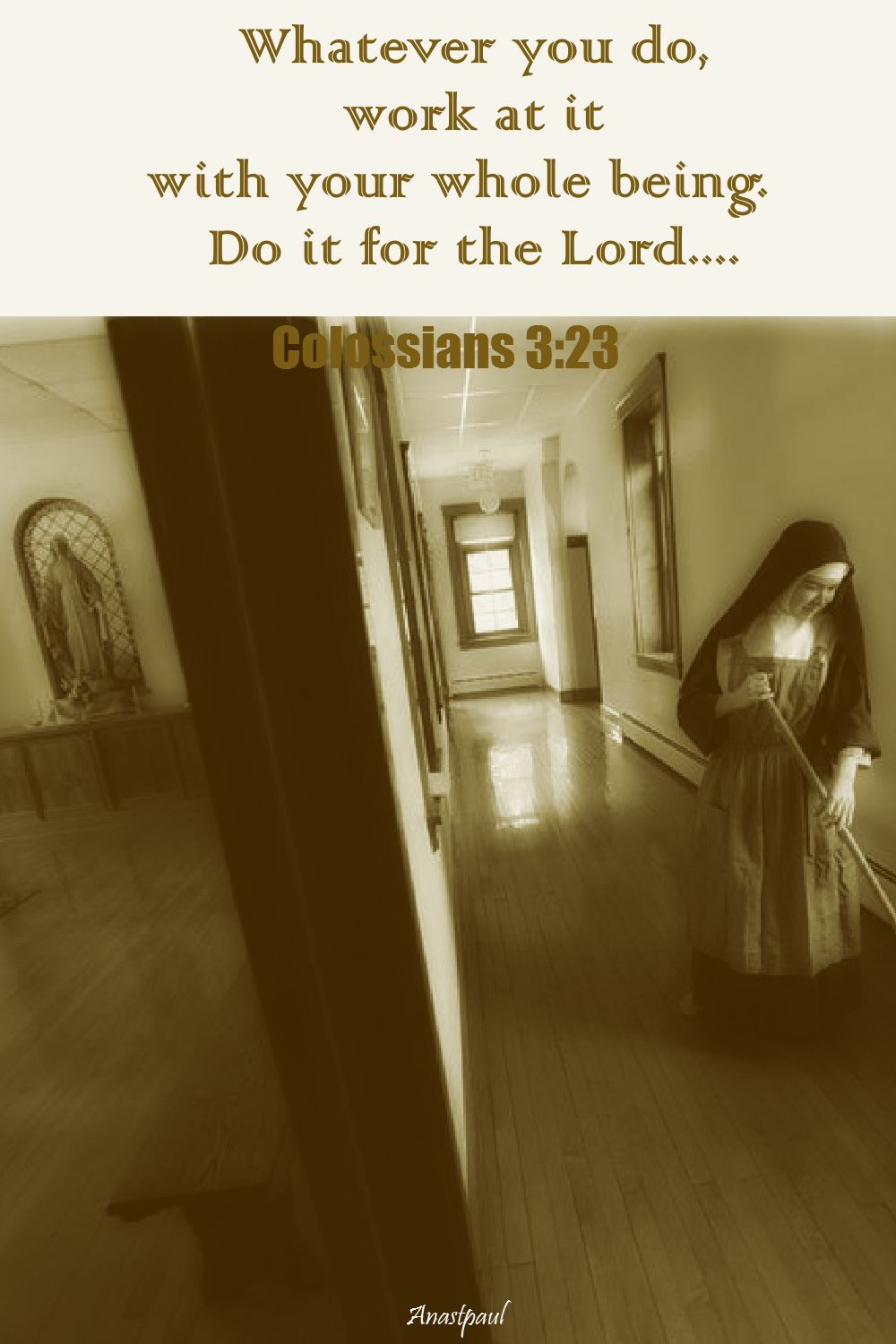
Whatever you do, work at it with your whole being. Do it for the Lord………..Colossians 3:23
REFLECTION -“We do not cease praying so long as we continue to do good.
The prayer of the heart and of good deeds has more value than the prayer of the lips.”…………….St Augustine
PRAYER – Dear God, move me to make a morning offering to You with total sincerety each day and then grant that all my deeds may be a devout continuation of that prayer. Open my eyes to those who need me in any way, let me see as You do and do as You do. Blessed Peter To Rot, you never failed to help each and every person in whatever way you could, you defended the Church and the Faith and your neighbour, please pray for us all, amen.
Be thou a bright flame before me,
Be though a guiding star above me,
Be though a smooth path below me,
Be thou a kindly shepherd behind me,
today, tonight and forever. Amen
















You must be logged in to post a comment.