Posted in "Follow Me", CHRIST, the WAY,TRUTH,LIFE, HUMILITY-Fr Richard Clarke, QUOTES on HUMILITY, QUOTES on PRIDE

Thought for the Day – 11 June – Humility and Criticism

Thought for the Day – 11 June – Meditations with Fr Richard Frederick Clarke SJ (1839-1900)

HUMILITY
Meditations for a Month

Humility and Criticism

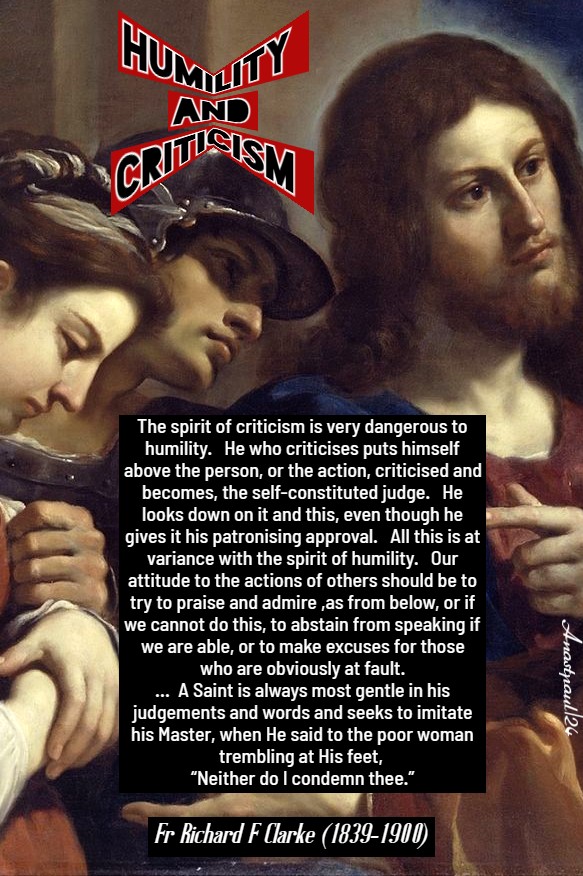
The spirit of criticism is very dangerous to humility. He who criticises puts himself above the person, or the action, criticised and becomes, the self-constituted judge. He looks down on it and this, even though he gives it his patronising approval. All this is at variance with the spirit of humility. Our attitude to the actions of others should be to try to praise and admire ,as from below, or if we cannot do this, to abstain from speaking if we are able, or to make excuses for those who are obviously at fault.

Unjust and bitter criticism is one of the marks of inveterate pride.
The devil is the accuser of the brethren. Much that he urges against them is true but this is no excuse. Much is false and, in this, those who criticise rashly and uncharitably, are sure to imitate their model. They fall unconsciously into false and rash judgements and, even where they were quite certain that they were correct, they nevertheless, often do serious wrong to those whom they criticise. If they were more humble, they would have a clearer and truer view of the characters and actions, of those around them.

Yet how general is this habit of criticism?
Many who are reputed good Catholics, run down their neighbours with a freedom which shows how little they have imbibed of the spirit of the Church and of her Saints. A Saint is always most gentle in his judgements and words and seeks to imitate his Master, when He said to the poor woman trembling at His feet, “Neither do I condemn thee.
Ask yourself whether you are free from fault in this respect and promise amendment.

Posted in HUMILITY-Fr Richard Clarke, QUOTES on HUMILITY, QUOTES on PRAYER, QUOTES on SUFFERING

Thought for the Day – 9 June – The Attainment of Humility

Thought for the Day – 9 June – Meditations with Fr Richard Frederick Clarke SJ (1839-1900)

HUMILITY
Meditations for a Month

The Attainment of Humility

Humility does not spring up in our souls of its own accord. On the contrary, every child of Adam has a deep root of pride within his soul.
It is only by a long and painful process that the generality of mankind can attain humility. We cannot expect to become humble unless we fulfill the necessary conditions.

We must make many acts of humility before we can attain any proficiency in the virtue. Our acts of humility must consist, not merely in protesting to Almighty God that we are vile and worthless ,in His sight and in humbling ourselves before Him by reason of our many sins. Our acts of humility must be practiced towards others by being very gentle towards those who provoke us, by bearing contradictions with patience, by accepting disappointments with patience and rebuffs without complaint. All this is a gradual process and we must not expect proficiency in humility until we have long practiced these means to attain it.

We must pray for humility.
No gift of God can be won without prayer and humility least of all
because it is so opposed to the natural bent of our nature and, can never be had without a special grace from God. Prayer, moreover, is an acknowledgement of our dependence upon God,and humility consists in nothing else, than a recognition of this dependence and an acquiescence in it.
Pray, then, for humility! It is not much use praying for humility unless we also pray for the means that are to implant it in our souls. We must ask God, from our hearts, not to spare us if He sees that we shall not become humble without suffering. We must leave ourselves in His Hands, saying only, “O my God, make me humble at any cost! Amen.

Posted in CHRIST the JUDGE, HUMILITY-Fr Richard Clarke, QUOTES on HELL, QUOTES on HUMILITY, QUOTES on PRIDE, QUOTES on the DEVIL/EVIL, The LAST THINGS

Thought for the Day – 8 June – Aids to Humility

Thought for the Day – 8 June – Meditations with Fr Richard Frederick Clarke SJ (1839-1900)

HUMILITY
Meditations for a Month

Aids to Humility

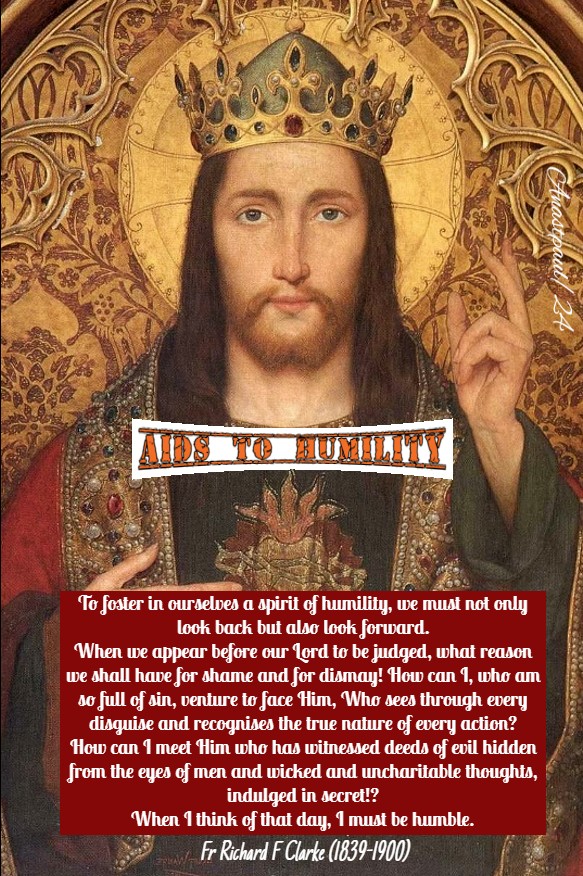
To foster in ourselves a spirit of humility, we must not only look back but also look forward.
When we appear before our Lord to be judged, what reason we shall have for shame and for dismay! How can I, who am so full of sin, venture to face Him, Who sees through every disguise and recognises the true nature of every action?
How can I meet Him who has witnessed deeds of evil hidden from the eyes of men and wicked and uncharitable thoughts, indulged in secret!?
When I think of that day, I must be humble.

Nothing will then be such a cause of shame to me as my pride.
Nothing will so turn away the Face of my Judge from me in anger.
If God abhors the proud, how can I look forward to that day without trembling? St Teresa said that when she had the privilege of seeing our Blessed Lord in a vision, the prevailing thought in her mind was, what a terrible thing it would be, if He were to be angry with her.
He will be angry with me, then, unless I learn more humility!
O my God, make me humble at any cost!

What will be the punishment of pride? Will it be the fire of Hell that was prepared for the devil and his angels, simply and solely because of their pride?
None will endure such misery as the proud; not the gluttonous, or the impure, or the covetous, except, so far as their other vices fostered pride in them.
O my God, if nothing else will make me humble, grant that the thought of the lowest Hell, reserved for the proud, may conquer in me that hateful vice of pride!

Posted in GOD ALONE!, HUMILITY-Fr Richard Clarke, QUOTES on HUMILITY

Thought for the Day – 7 June – What Humility Is

Thought for the Day – 7 June – Meditations with Fr Richard Frederick Clarke SJ (1839-1900)

HUMILITY
Meditations for a Month

What Humility Is

Humility is a realisation of our own nothingness before Almighty God. It is defined by St Bernard, as the virtue by which a man becomes vile in his own eyes, through a thorough knowledge of himself and by St Thomas, as a virtue by which a man, considering his own defects, keeps himself in the lowest place according to his degree.
Think over these definitions and examine yourself whether you are humble, as judged by them.

It is not enough to be conscious of our own vileness or to esteem ourselves as nothing. We must acquiesce in and, be satisfied with, our own nothingness. Humility is not perfect until self is so obliterated, that we are willing to be esteemed according to our deserts. When we can honestly say that what we look to in all our thoughts, words and actions, is not our own advantage and interest but simply, the honour of God, quite independently of what will further our own profit, then! we may begin to thank God that we are in the way of humility.

If this is really the case, we shall not only esteem ourselves as vile but we shall desire to be treated accordingly. We shall not shrink from being humbled in the eyes of men but shall court humiliation, as it will be a satisfaction to us to be treated as we deserve. This is difficult for human nature but, it is possible for all, with the grace of God. It will not come at once but we may hope to reach it someday.
Have I attained it? Do I desire it? Do I even accept humiliations, or do I chafe under them and resent them?

Posted in JUNE-THE SACRED HEART, SACRED and IMMACULATE HEARTS, SACRED HEART QUOTES, SACRED HEART REFLECTIONS, The ADORABLE HEART of JESUS

Thought for the Day – 6 June – On the Nature of the Devotion (Part Two)

Thought for the Day – 6 June – Meditations with Fr Richard Frederick Clarke SJ (1839-1900)

Little Extracts from The Adorable Heart of Jesus

On the Nature of the Devotion (Part Two)

Having made these observations, it will be easy to give a clear and precise idea of the nature of the Devotion to the Sacred Heart of Jesus Christ.
We may define it in this manner.:
It is an exercise of religion which has, for its object, the Adorable Heart of our Lord, inflamed with Love for men and outraged by the ingratitude of these same men and, for its motive, the honouring of this Divine Heart , by rendering It all the homage which love and gratitude can inspire and, more particularly, to offer reparation for the insults It receives in the Sacrament of love.”

Let us explain this definition and try to put it in the clearest
light possible. …
The Devotion of which we speak here, concerns His Heart. Certainly, this Divine Heart is not, in Itself, an object less worthy
of the Devotion of the faithful, than the others we have named and, no objection can be brought to bear against the Devotion to the Heart which would not apply equally and with even more force , to the Devotion to the Wounds, the Cross, the Name of Jesus, as anybody will admit who is capable of judging in these matters.

But, that we may leave no occasion of error to simple, uninstructed persons and that , we may forestall any doubts which may arise, we will add another observation to those we have already made.

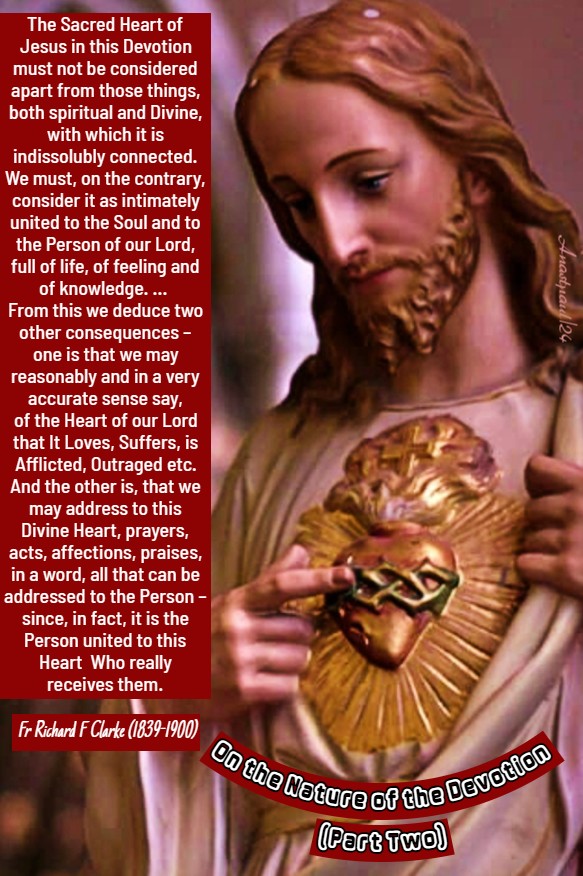
The Sacred Heart of Jesus in this Devotion must not be considered apart from those things, both spiritual and Divine, with which it is indissolubly connected.
We must, on the contrary, consider it as intimately united to the Soul and to the Person of our Lord, full of life, of feeling and of knowledge.

From this follows a consequence worthy of remark which is, that all the honours which are paid to this Adorable Heart, do not terminate precisely and solely in the material Heart ; they terminate equally and indivisibly, in the Soul and the Person united to this Heart – as the honours rendered to a living man are not actually confined to the body or the soul but comprise, the two together, forming thus a whole which is honoured without any division.

From this we deduce two other consequences – one is that we may reasonably and in a very accurate sense say, of the Heart of our Lord that It Loves, Suffers, is Afflicted, Outraged etc.
And the other is, that we may address to this Divine Heart, prayers, acts, affections, praises, in a word, all that can be addressed to the Person – since, in fact, it is the Person united to this Heart Who really receives them.

This has been overlooked by those who have seemed to disapprove of this Devotion towards the Heart of Jesus and, who thus appeared to have regarded this Divine Heart as only an inanimate and insensible portion of the Body of Jesus Christ, setting aside the Intelligent and spiritual adjuncts which are united to It, as we have already observed.

PART ONE:
https://anastpaul.com/2024/06/02/thought-for-the-day-2-june-on-the-nature-of-the-devotion/

Posted in "Follow Me", PATIENCE - Fr Richard CLARKE, QUOTES on HUMILITY, QUOTES on PATIENCE, QUOTES on PRIDE

Thought for the Day – 5 June – The Third Degree of Patience

Thought for the Day – 5 June – Meditations with Fr Richard Frederick Clarke SJ (1839-1900)

PATIENCE
Meditations for a Month

The Third Degree of Patience

  1. When we have succeeded in suppressing all outward impatience and inward resentment, as far as it is voluntary and deliberate, we shall begin to reap the reward of our efforts. We shall find that the treatment which we once regarded as intolerable, has certain advantages resulting from it. We may hope, at last, to find a positive pleasure in being overlooked or unfairly treated, in being humbled in the eyes of men, or blamed for what we did with all good intention.
    I must try to aim at this. It is not out of my reach!
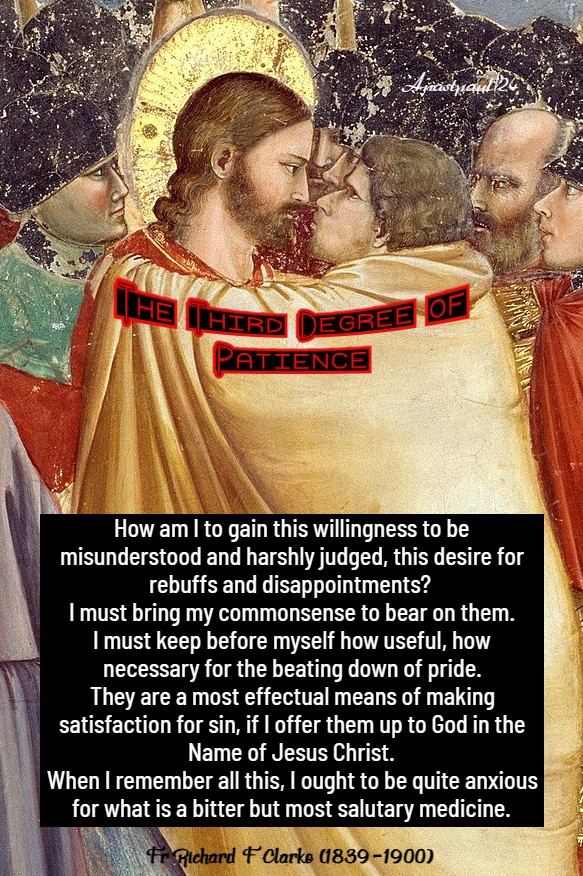
  2. How am I to gain this willingness to be misunderstood and harshly judged, this desire for rebuffs and disappointments? I must bring my commonsense to bear on them. I must keep before myself how useful, how necessary for the beating down of pride. They are a most effectual means of making satisfaction for sin, if I offer them up to God in the Name of Jesus Christ. When I remember all this, I ought to be quite anxious for what is a bitter but most salutary medicine.
  3. When I read the lives of Saints and holy men, I find there the true estimate of all things. Now, what was their attitude towards those who despised, persecuted, ill-treated them? They looked upon them as their greatest benefactors. How did they regard the reproaches, the neglect, the unkindness they had to undergo? They thanked God for them, rejoiced in them, considered it a misfortune if these were absent. If we want to resemble the Saints, we must take their view of obloquy and misunderstanding. We must strive, not only to put up with them but actually, to welcome them, rejoice in them, consider them as our greatest privilege!
Posted in "Follow Me", CHRIST, the WAY,TRUTH,LIFE, PATIENCE - Fr Richard CLARKE, QUOTES on PATIENCE

Thought for the Day – 3 June – First Degree of Patience

Thought for the Day – 3 June – Meditations with Fr Richard Frederick Clarke SJ (1839-1900)

PATIENCE
Meditations for a Month

First Degree of Patience

  1. When we are studying to acquire a virtue, it is generally the better plan to begin with external actions and thence, to proceed to the interior dispositions whence those actions proceed. In accordance with this rule, we must begin by repressing all signs of resentment and anger, when we are offended, or when someone crosses our path, or hinders some work in which we are engaged. If under all this, we can keep an unmoved and tranquil countenance and avoid all expression of personal feeling and annoyance, this is a great point gained.
    Am I able to do this?
  2. Why is it important to begin with exterior patience?
    Firstly because, this helps enormously to calm the feelings within us, just as we can work ourselves up into a fury by raging externally. Peace will soon return if we keep a serene face and quiet demeanour.
    Secondly because, exterior calmness, under ill-usage, edifies others and honours Christ our Lord, just as impatience and irritability disedify and dishonour the Name of Christian. I must remember this when I am tempted to yield to my injured pride and to retaliate on those who have offended me.
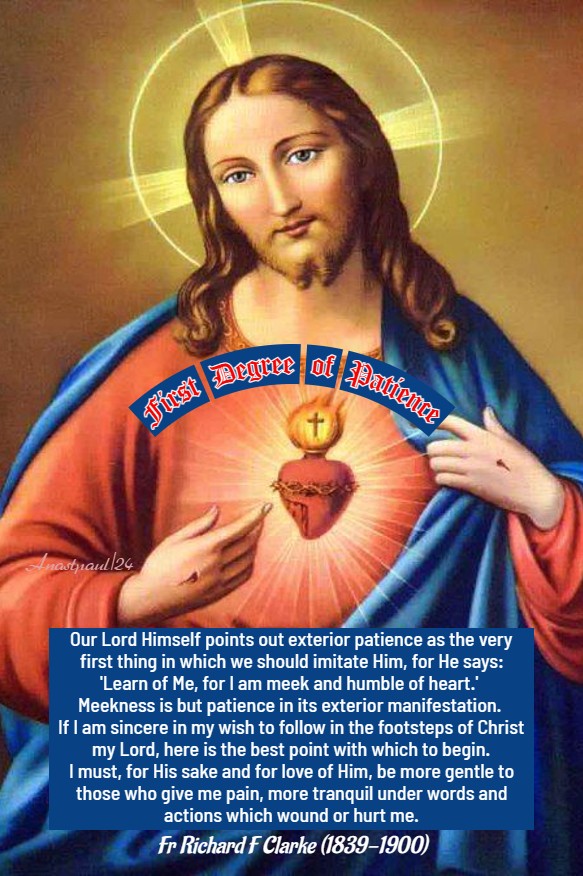
  3. Our Lord Himself points out exterior patience as the very first thing in which we should imitate Him, for He says:
    Learn of Me, for I am meek and humble of heart.’ Meekness is but patience in its exterior manifestation. If I am sincere in my wish to follow in the footsteps of Christ my Lord, here is the best point with which to begin. I must, for His sake and for love of Him, be more gentle to those who give me pain, more tranquil under words and actions which wound or hurt me.
Posted in DEVOTIO, GOD ALONE!, JUNE-THE SACRED HEART, QUOTES on LOVE of GOD, QUOTES on REPARATION/EXPIATION, SACRED HEART QUOTES, SACRED HEART REFLECTIONS, The ADORABLE HEART of JESUS

Thought for the Day – 2 June – On the Nature of the Devotion

Thought for the Day – 2 June – Meditations with Fr Richard Frederick Clarke SJ (1839-1900)

Little Extracts from The Adorable Heart of Jesus

On the Nature of the Devotion

If we desire to enter into the designs of Jesus Christ, we must not seek this idea of the Devotion to the Sacred Heart, outside the revelation itself, from which it derived its origin and, since it has pleased this amiable Saviour to give an explanation Himself on this subject, it is from His own words that we must gather the real idea which we seek.
It will not be difficult, since Jesus Christ has spoken very clearly.
… But , we must here also allude to a circumstance which is essential to the nature of our Devotion and, that is, that the Love with which the Divine Heart of Jesus is inflamed, must be considered as a Love despised and wounded by the ingratitude of men.
This circumstance is expressed in these words which our Lord
adds :
And in return, I receive, for the most part, only ingratitude, contempt, irreverence, sacrileges, in the indifference which they manifest towards Me in the Sacrament of Love.”

The Heart of Jesus must, therefore, here be considered under two aspects – on the one hand, as burning with Love for men and, on the other, as cruelly wounded by the ingratitude of these same men.
These two motives united, must excite in us two feelings, both of which are equally essential to Devotion to the Sacred Heart, that is love which corresponds to Its Love and grief , which would leads us to make reparation for the insults it endures through the hard-heartedness of men!

Finally, the practices prescribed by Jesus Christ in fulfilment of this double duty, are laid down in these last words :
I ask of thee that the first Friday after the Octave of the Blessed Sacrament, should be dedicated as a special festival to do honour to My Heart, by devout acts of reparation and satisfaction, by communicating, on that day, to expiate the indignities it received whilst exposed on the Altar.
Jesus Christ contents Himself with explaining here the principal exercise of the devotion which He desires to establish but, it is
not the only practice which must be employed, to do honour to the Divine Heart. There are many others which will be mentioned further on.

Posted in DIVINE Mercy, Goodness, Patience, PATIENCE - Fr Richard CLARKE, QUOTES on PATIENCE, Quotes on SALVATION

Thought for the Day – 1 June – The Praises of Patience

Thought for the Day – 1 June – Meditations with Fr Richard Frederick Clarke SJ (1839-1900)

PATIENCE
Meditations for a Month

The Praises of Patience

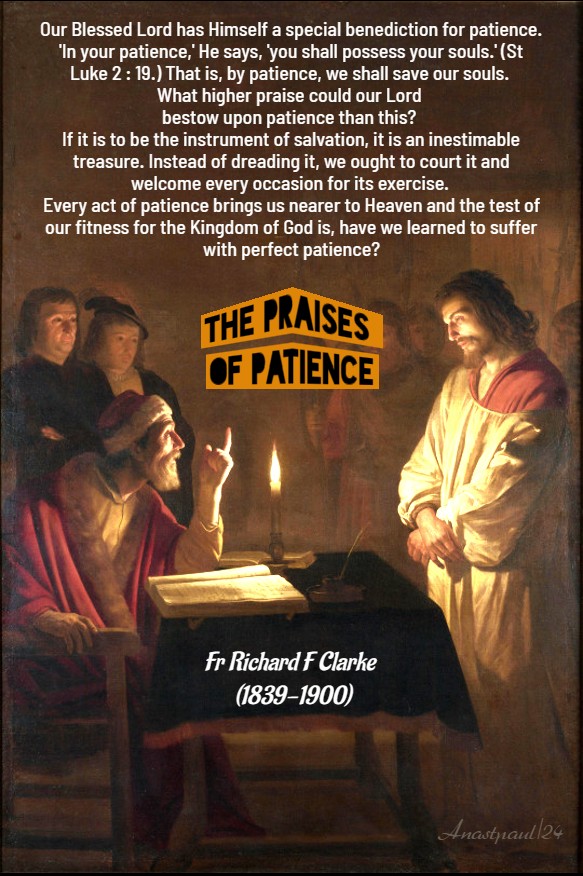
  1. Patience is a virtue which receives, in Holy Scripture and especially in the writings of St Paul, praise almost without end. ‘He that is patient,’ says the Wise Man, ‘is governed with much wisdom.’ (Prov 14 : 29) ‘Patience has a perfect work,‘ says St James (ch. 1 : 4). ‘Patience is necessary to you,‘ says St Paul, ‘that by doing the will of God you may receive the promise. ‘ (Hebrews 10 : 36.) Think over these passages one by one and question yourself whether you fulfil this necessary condition of eternal salvation.
  2. Our Blessed Lord has Himself a special benediction for patience. ‘In your patience,‘ He says, ‘you shall possess your souls.‘ (St Luke 2 : 19.) That is, by patience, we shall save our souls. What higher praise could our Lord bestow upon patience than this? If it is to be the instrument of salvation, it is an inestimable treasure. Instead of dreading it, we ought to court it and welcome every occasion for its exercise. Every act of patience brings us nearer to Heaven and the test of our fitness for the Kingdom of God is, have we learned to suffer with perfect patience?
  3. St John does but echo the words of his Divine Master when he says (Apoc 7 : 14) of the redeemed around the throne, ‘These are they who came out of great tribulation.’ Not that the mere passing through suffering is sufficient, for he adds ‘And have washed their robes and made them white in the Blood of the Lamb that is, have obtained forgiveness by uniting their sufferings with the sufferings of the Son of God.’
    Do I find in myself this description realised? Have I suffered and suffered willingly for Christ’s sake? Or do I seek to avoid all suffering and fight against it,and bear it impatiently when it comes?
Posted in GOD ALONE!, HUMILITY-Fr Richard Clarke, JESUIT SJ, QUOTES on HUMILITY

Thought for the Day – 31 May – What Humility is Not!

Thought for the Day – 31 May – Meditations with Fr Richard Frederick Clarke SJ (1839-1900)

HUMILITY
Meditations for a Month

Chapter Five
What Humility is Not!

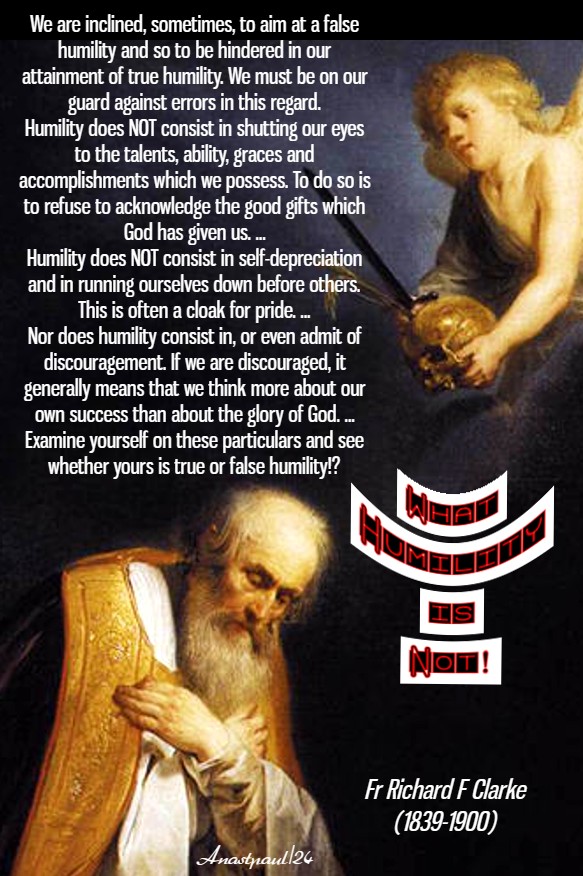
We are inclined, sometimes, to aim at a false humility and so to be hindered in our attainment of true humility. We must be on our guard against errors in this regard.

Humility does NOT consist in shutting our eyes to the talents, ability, graces and accomplishments which we possess. To do so is to refuse to acknowledge the good gifts which God has given us. If we have skill in music, in conversation, in painting, in languages, it is no humility to deny the fact. We ought to thank God for His goodness in bestowing upon us this talent. What is contrary to humility is to take the credit to ourselves and to plume ourselves on what we have received from God.

Humility does NOT consist in self-depreciation and in running ourselves down before others. This is often a cloak for pride. Sometimes its object is to obtain, from others, the praise we deny to
ourselves; sometimes it is a marked expression of discontent. The continual song, “What a poor worm I am!” is very much opposed to the spirit of the Catholic Church and to the cheerfulness which every Christian ought to show in his words.

Nor does humility consist in, or even admit of discouragement. If we are discouraged, it generally means that we think more about our own success than about the glory of God. It means that we are not perfectly resigned; it means that our pride is wounded and our self-will thwarted, or that we have worldly motives in what we do and seek honour from men and not from God. True humility is willing to fail in its projects, if God so wills it.
Examine yourself on these particulars and see whether yours is true or false humility!?

Posted in GOD ALONE!, HUMILITY-Fr Richard Clarke, QUOTES on HUMILITY, QUOTES on PRIDE

Thought for the Day – 30 May – The Deeper Foundations of Humility

Thought for the Day – 30 May – Meditations with Fr Richard Frederick Clarke SJ (1839-1900)

HUMILITY
Meditations for a Month

Chapter Four
The Deeper Foundations of Humility

The consciousness of past sin will not, of itself, give us the perfection of humility. It necessarily fixes the eye of the soul upon ourselves and our own doings, whereas perfect humility means the annihilation of self. We have a deeper and more solid foundation for this virtue in our own nothingness and the absence of any sort of good, save that which God has given us. Every gift of nature is simply a free gift from Him. All that is from ourselves is the marring and injuring of what we have received; the misuse of talents, money, position, influence. What folly, then, to pride ourselves on what belongs to God!

Regarding supernatural gifts, we are still mere nothing and less than nothing. Our natural gifts are put into our hands, they remain with us and are in some sense ours but, a supernatural gift requires a fresh giving immediately from the hand of God each time it is given us! We
cannot begin any supernatural work without His preventing grace; we cannot move a step in it without fresh grace to carry on; we cannot bring it to a successful issue, without the grace necessary to complete it. Do I realise, as I ought, this nothingness of myself and my absolute
and continual dependence upon God, for each thought or act, pleasing to Him?

If this is so, how can I be anything but humble? To pride myself on that which God does in me, would be ridiculous; to pride myself on what I can do of myself, would be to pride myself on all which mars and spoils the work of God.
What hast thou that thou hast not received?” asks St Paul.
Yes, O Lord, I have only one thing that I have not received and that is my vileness, misery, sin.
Can I boast of these!?

Posted in DIVINE Mercy, Goodness, Patience, PATIENCE - Fr Richard CLARKE, QUOTES on POVERTY, QUOTES on SUFFERING

Thought for the Day – 24 May – On Various Trials of our Patience

Thought for the Day – 24 May – Meditations with Fr Richard Frederick Clarke SJ (1839-1900)

PATIENCE
Meditations for a Month

On Various Trials of our Patience

  1. Patience is tried by everything which puts an obstacle in the way of our action – by being kept waiting long; by having to repeat, over and over again, some lesson to a dull learner; by the perverse and wayward conduct of the young; by being interrupted while speaking when we have something we want to say; by a hundred similar incidents which continually occur. All these are a good test of our possession of this virtue. How do I stand the test in each case?
  2. Our patience is also tried by those who misunderstand and misrepresent us. It is not easy to speak and think kindly of them. We are inclined either to avoid them or to show our dislike to them. We want to let them know what we think of them and to give them a return blow for the blows we believe them to have given us. But patience bids us take the offence, real or supposed, quietly and without complaining; it checks the angry word and quenches the fire of resentment. Here, too, I have an excellent means of gauging my possession of this virtue.
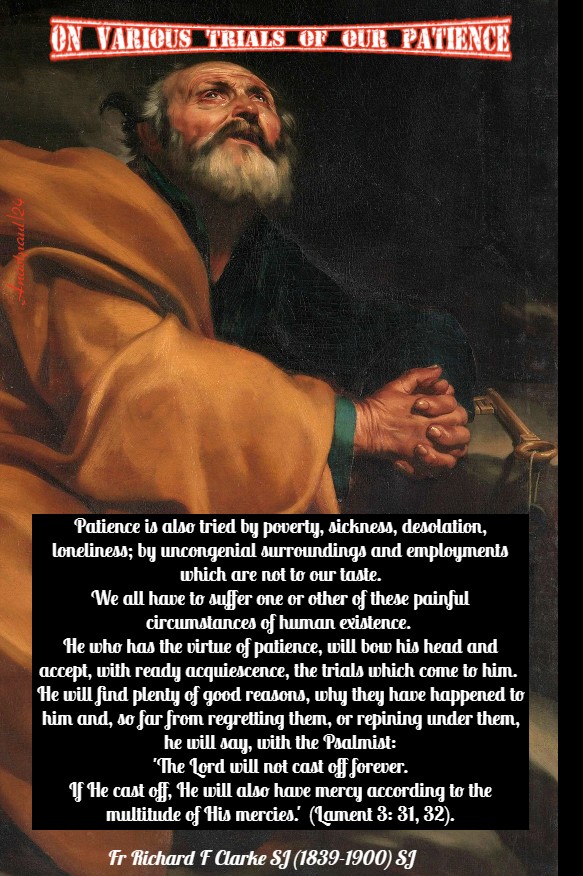
  3. Patience is also tried by poverty, sickness, desolation, loneliness; by uncongenial surroundings and employments which are not to our taste. We all have to suffer one or other of these painful circumstances of human existence. He who has the virtue of patience, will bow his head and accept, with ready acquiescence, the trials which come to him. He will find plenty of good reasons, why they have happened to him and, so far from regretting them, or repining under them, he will say, with the Psalmist:
    The Lord will not cast off forever.
    If He cast off, He will also have mercy according to the multitude of His mercies.’
    (Lament 3: 31, 32).