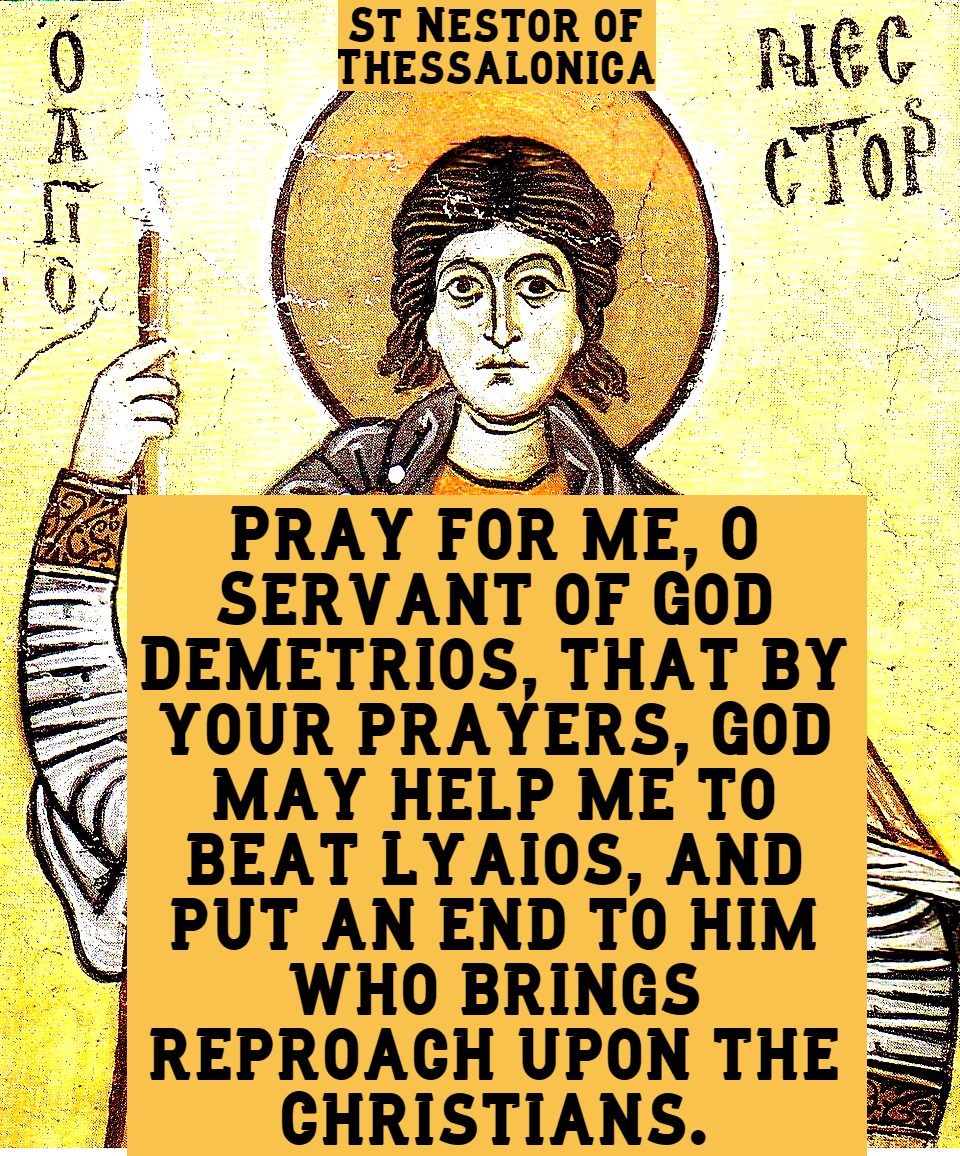
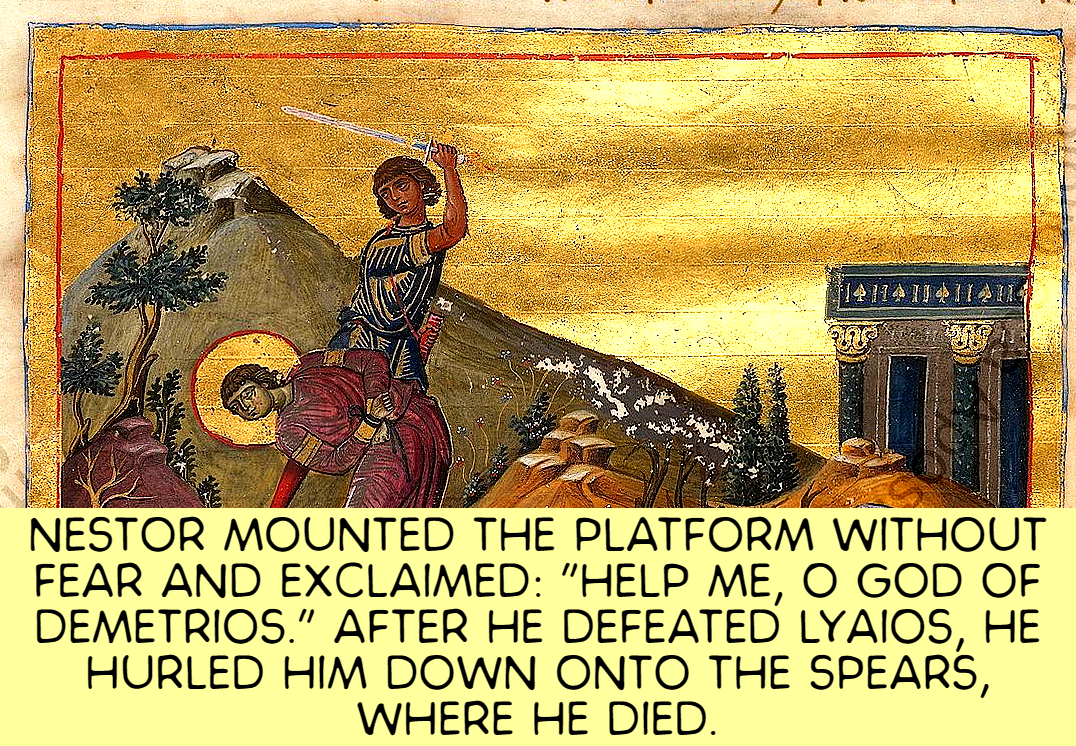
Saint Nestor of Thessalonica, martyr, was a wrestler known for having been the student of St. Demetrius of Thessalonica, who instructed Nestor in the Faith. The emperor was visiting Thessaloniki, and he built a high platform in the midst of the city so that a gigantic barbarian named Lyaios could wrestle there, seen by all. Beneath the platform many spears and other sharp weapons were placed pointing upward. When Lyaios defeated his opponents, he threw them down onto the spears. As a method of execution, Christians were killed in this way. When Nestor saw how Emperor Maximian rejoiced over the victories of his champion, he despised his pride. Seeing the miracles of Saint Demetrios, however, he was inspired and went to the prison where the holy martyr was confined, and fell at his feet.
“Pray for me, O Servant of God Demetrios,” he said, “that by your prayers, God may help me to beat Lyaios, and put an end to him who brings reproach upon the Christians.”
The saint, after making the Sign of the Cross over Nestor, told him that he would prevail over Lyaios, and then suffer for Christ. Nestor mounted the platform without fear and exclaimed: “Help me, O God of Demetrios.” After he defeated Lyaios, he hurled him down onto the spears, where he died.
Maximian (co-ruler with Diocletian) became enraged and ordered that both Nestor and Demetrios should be put to death. Saint Demetrios was stabbed with spears, and Saint Nestor was beheaded.
One Minute Reflection – 6 October – “Month of the Holy Rosary” – Readings: Ps 36:30-31, Ps 36:1, Sir 31:8-11, Luke 12:35-40
Blessed are those servants whom the master, on his return, shall find watching.
Luke 12:35-40
REFLECTION – And your public assemblies I have come to hate. For there are excessive banquetings, and subtle flutes which provoke to lustful movements, and useless and luxurious anointings, and crowning with garlands. With such a mass of evils do you banish shame; and you fill your minds with them, and are carried away by intemperance, and indulge as a common practice in wicked and insane fornication. And this further I would say to you, why are you, being a Greek, indignant at your son when he imitates Jupiter, and rises against you and defrauds you of your own wife? Why do you count him your enemy, and yet worship one that is like him? And why do you blame your wife for living in unchastity, and yet honour Venus with shrines? If indeed these things had been related by others, they would have seemed to be mere slanderous accusations, and not truth. But now your own poets sing these things, and your histories noisily publish them.
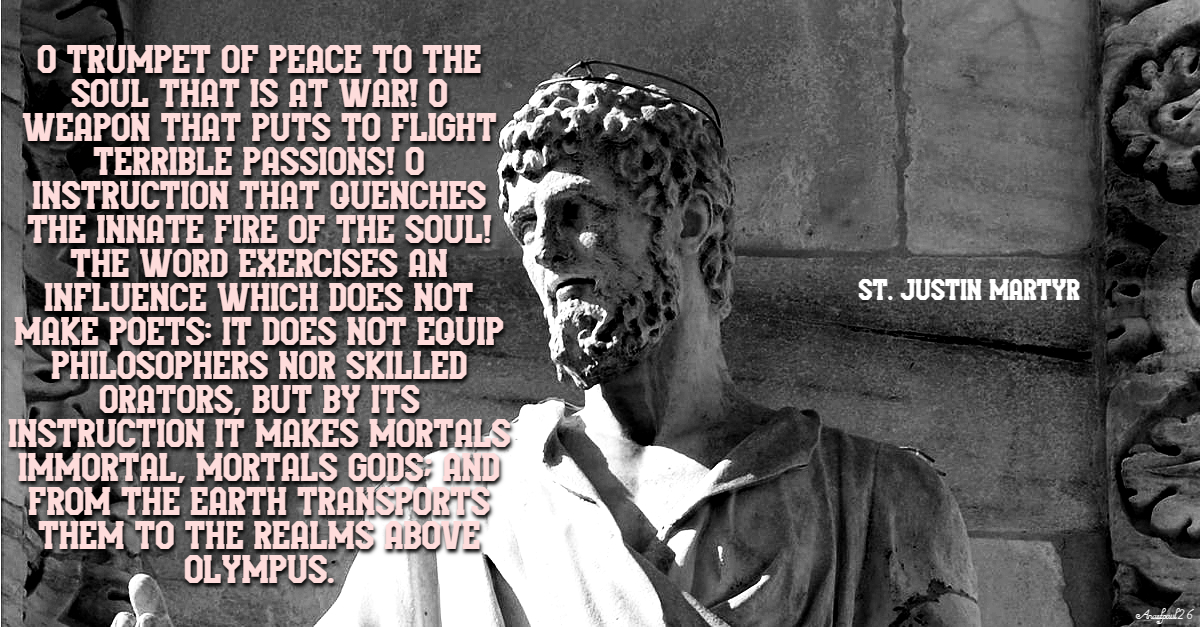
Henceforth, you Greeks, come and partake of incomparable wisdom, and be instructed by the Divine Word, and acquaint yourselves with the King immortal; and do not recognise those men as heroes who slaughter whole nations. For our own Ruler, the Divine Word, who even now constantly aids us, does not desire strength of body and beauty of feature, nor yet the high spirit of earth’s nobility, but a pure soul, fortified by holiness, and the watchwords of our King, holy actions, for through the Word power passes into the soul. O trumpet of peace to the soul that is at war! O weapon that puts to flight terrible passions! O instruction that quenches the innate fire of the soul! The Word exercises an influence which does not make poets: it does not equip philosophers nor skilled orators, but by its instruction it makes mortals immortal, mortals gods; and from the earth transports them to the realms above Olympus.
St. Justin Martyr
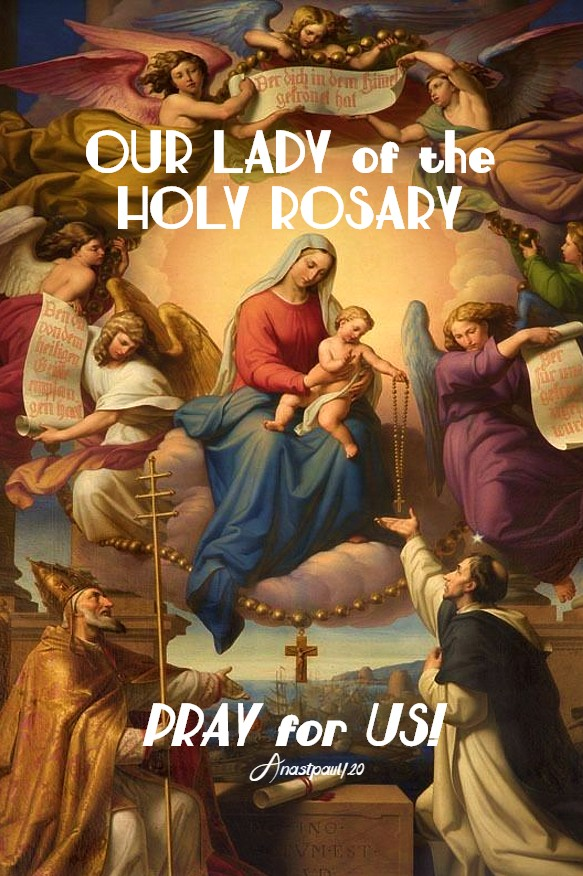
PRAYER – Our Father who art in heaven, Hallowed be Thy name. Teach us Almighty Father to pray, fill us with the love of Your Spirit and guide us always by the Word and Trust of our lives. With the Blessed Mother of God and of the Holy Rosary, we kneel in love and adoration. May her prayers lead us to heaven. Amen
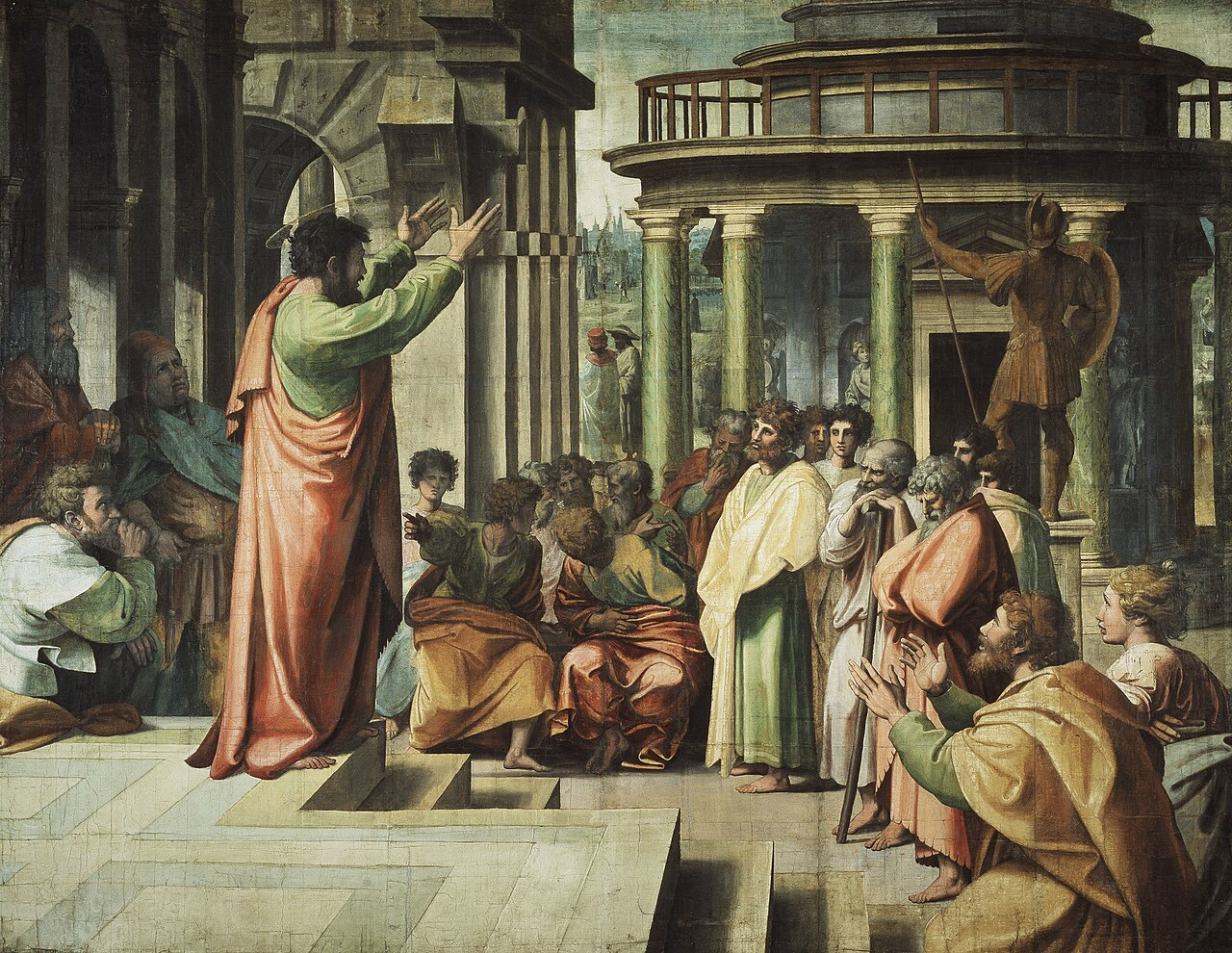
Saint Damaris of Athens, was the first woman convert in Athens. She listened to St Paul preach there. She was married to Saint Dionysius the Areopagite.
But certain men adhering to him, did believe; among whom was also Dionysius, the Areopagite, and a woman named Damaris, and others with them.
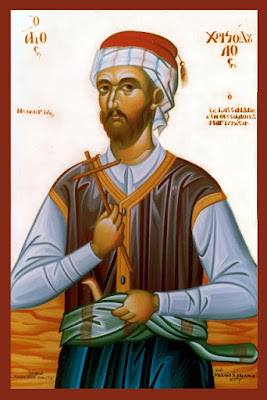
Blessed Christodoulus was born in the village of Kassandra in Halkidiki, Macedonia. He was a young tailor in Thessaloniki during a period of occupation by Ottoman Turks. Seeing local Christians giving in to pressure and proclaiming themselves Muslim, Christodoulus took a cross and went into the streets to encourage Christians, as well as into the coffee shops were the ‘ceremony’ of conversion would take place, and offered them the cross to kiss as a sign of their faith, urging them to recover, repent, and stand strong in the love of Christ. Most courageously, he would make the Sign of the Cross over crowds of Turks as well as the dreaded Janissaries, the most fanatical muslim warriors of all, the elite bodyguard of the Sultan. Janissaries who were themselves once Christian, before being enslaved by the Ottoman emperors as youth.
Enraged by this, the Turks imprisoned and tortured Christodoulus. They urged him to deny the Faith, but in return he urged them to turn away from the false religion of Islam. Driven to an excess of hatred by this, the Turks tortured him gruesomely and then hung him in front of a church in 1777.
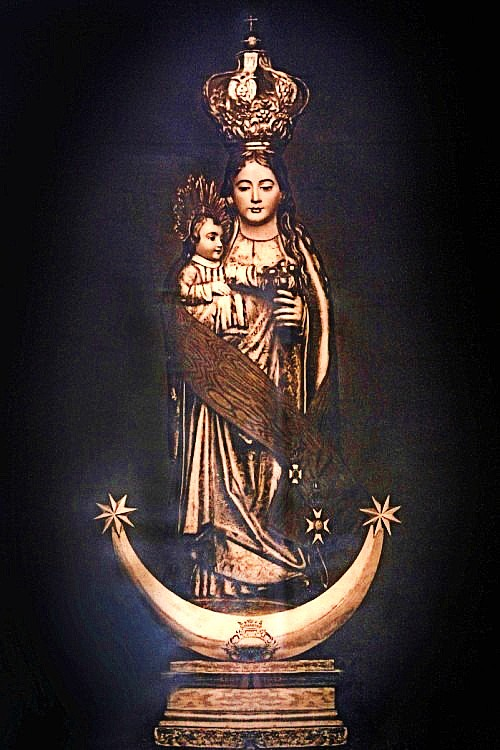
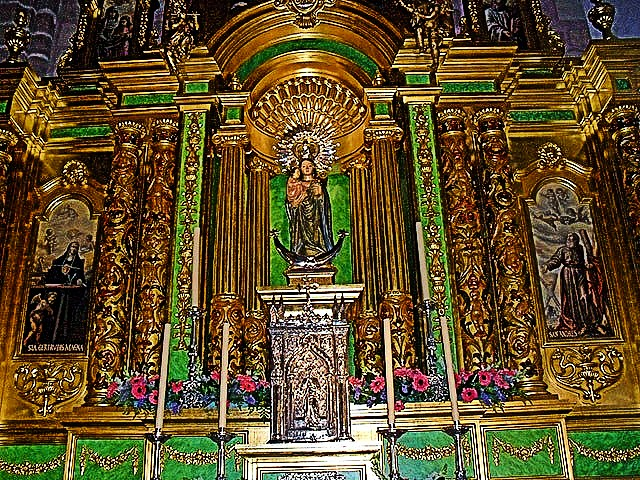
Nuestra Señora de Zocueca / Our Lady of Zocueca, Bailén, Jaén, Andalucía, Spain (1808 – 20 July:
Around 1150, Mozarabic Christians built a rudimentary Chapel near the Rumblar River, the Guadalquivir tribuitary that waters this region in southern Spain, at a place called Zocueca. When Alfonso VII reconquered the area in 1155, people gave thanks to the Virgin at the Shrine. In the 1400s it was was rebuilt, and from this period the graceful, standing Gothic Statue of the Mother and Child seems to date, although tradition holds it to be older than the first Chapel.
During the cholera epidemic of 1681, the people vowed to hold an annual feast in honour of the Virgin, preceded by a day of fasting, if she would save them. The promise has been kept on 5 August ever since. The Chapel was re-decorated in Baroque style in the 1700s.
In 1808, people again thanked the Virgin of Zocueca for her help during the Battle of Bailén, the first Spanish victory against Napoleon. Annually since 1810, the municipality commemorates the battle with a series of civil, patriotic, and religious events from 17-22 July, reaching their greatest splendour on the 20th, when the Patroness, the Virgin of Zocueca, goes through the City streets in procession. Another event in her honour, the romería or pilgrimage, takes place on the last Sunday in September in thanks for her help in ending a plague of locusts which threatened the region’s crops in the late 1800s. Men carry the Statue, bristling with decorations, on their shoulders from its usual home in the Church of the Incarnation in Bailén, to the Sanctuary four miles distant, where overnight vigil is kept before a sunrise Mass. In 1925, the Virgin of Zocueca was proclaimed “Captain General” and her Statue given a military sash. After the Statue burned in the Civil War, religious sculptor Jose Maria Alcacer made a replica, blessed on 5 August1954.
Bl Anne Cartier St Ansegisus St Aurelius of Carthage St Cassian of Saint Saba St Chi Zhuze St Elijah the Prophet
St Elswith
Blessed Gregory Lopez (1542-1596) “The Mystery Man” – Hermit, Spiritual Advisor, Writer. Around 1585, word of a “Mystery Man” began to leak into Mexico City, a strange hermit who lived out in the lonely valley of Guesteca, who walked miles to go to Mass, lived totally subject to “Lady Poverty” and had travelled from the Shrine of Our Lady of Guadalupe in Spain (which dates from 712), to her Shrine in Mexico (which dates from 1531).
St Margaret of Antioch (3rd century) Virgin Martyr. Margaret is one of the Fourteen Holy Helpers and is one of the Saints who spoke to St Joan of Arc.
St Maria Fu Guilin St Mère St Paul of Saint Zoilus St Rorice of Limoges St Severa of Oehren St Severa of Saint Gemma St Wulmar
Martyrs of Corinth – 22 saints: 22 Christians who were martyred together. We know nothing else about them but the names – • Appia • Calorus • Cassius • Celsus • Cyriacus • Donatus • Emilis • Felix • Fructus • Magnus • Maximus • Nestita • Partinus • Pasterus • Paul • Romanus • Spretus • Tertius • Theodolus • Ueratia • Valerian • Victor. They were martyred in Corinth, Greece.
Martyrs of Damascus – 16 saints: 16 Christians who were martyred together. We know the names of six of then, but no details about any of them – Cassia, Julian, Macrobius, Maximus, Paul and Sabinus. They were martyred in Damascus, Syria, date unknown.
Martyrs of Seoul – 8 saints: Eight lay native Koreans in various states of life who were murdered together for their faith. • Anna Kim Chang-gum • Ioannes Baptista Yi Kwang-nyol • Lucia Kim Nusia • Magdalena Yi Yong-hui • Maria Won Kwi-im • Martha Kim Song-im • Rosa Kim No-sa • Theresia Yi Mae-im They were martyred on 20 July 1839 at the Small West Gate, Seoul, South Korea
Martyrs of Zhaojia – 3 saints: Married lay woman and her two daughters in the apostolic vicariate of Southeastern Zhili, China. During the persecutions of the Boxer Rebellion, the three of them hid in a well to avoid being raped. They were found, dragged out, and killed for being Christian. Martyrs. They were – Maria Zhao Guoshi (mother), Maria Zhao and Rosa Zhao (sisters). They were martyred in late July 1900 in Zhaojia, Wuqiao, Hebei, China.
Martyrs of Zhujiahe – 4 saints: Two Jesuit missionary priests and two local lay people who supported their work who were martyred together in the Boxer Rebellion during and immediately after Mass. • Léon-Ignace Mangin • Maria Zhu Wushi • Paul Denn • Petrus Zhu Rixin They were martyred on 20 July 1900 in church in Zhujiahe, Jingxian, Hebei, China
Martyred in the Spanish Civil War: • Blessed Abraham Furones y Furones • Blessed Antoni Bosch Verdura • Blessed Francisca Aldea y Araujo • Blessed Jacinto García Riesco • Blessed Joan Páfila Monllaó • Blessed Josep Tristany Pujol • Blessed Matías Cardona-Meseguer • Blessed Rita Josefa Pujalte y Sánchez • Blessed Vicente López y López



You must be logged in to post a comment.