One Minute Reflection – 21 August – The 11th Sunday after Pentecost and the Memorial of St Jane Frances de Chantal VHM (1572-1641) – Readings: Ps 118:75; 118:120, Ps 118:1, Prov 31:10-31, Matt 13:44-52
I know, O Lord, that Your ordinances are just, and in Your faithfulness You have afflicted me. Pierce my flesh with Your fear; I fear Your ordinances.
Ps 118:75; 118:120
REFLECTION – “He shall rule the world with justice and the peoples with his truth.” Which justice and which truth? He will gather to him his chosen ones; the others he will separate, for he will place the former at his right and the latter at his left. What will be more just, more true than that? Those who did not want to practice mercy before the judge came, will not expect mercy from the judge. Those who wanted to practice mercy, will be judged with mercy. For he will say to those whom he has placed at his right: “Come. You have my Father’s blessing! Inherit the kingdom prepared for you from the creation of the world.” And he will attribute acts of mercy to them: “For I was hungry and you gave me food, I was thirsty and you gave me drink” and all that follows.
Because you are unjust, will the Judge not be just? Because you sometimes lie, will Truth not be truthful? If you want to meet a merciful judge, be merciful before he comes. Forgive if someone has offended you; give away the possessions of which you have an abundance. Give what you have received from him: “Name something you have that you have not received.”These are the sacrifices that are very pleasing to God: mercy, humility, gratitude, peace, charity. If that is what we bring in sacrifice, we will await with assurance the coming of the Judge, of him who “shall rule the world with justice and the peoples with his truth.”
Saint Augustine
PRAYER – Almighty and merciful God, Who endowed St Jane Frances, burning with love of Thee, with a wondrous strength of spirit through all the paths of life, in the way of perfection and willed through her, to ennoble Thy Church, by a new religious family, grant by her merits and prayers, that we who are aware of our weakness, may trust firmly in Thy power and, by the assistance of divine grace, overcome all obstacles in our way. Through Jesus Christ, Thy Son our Lord, Who lives and reigns with Thee, in the unity of the Holy Ghost, God, world without end. Amen
Quote/s of the Day – 21 August – The Memorial of St Jane Frances de Chantal VHM (1572-1641)
“All God wants is our heart.”
“We think not enough of this Truth – that God is present with us that He sees our thoughts, even long before we have them. That He knows what we think and shall think, better than we ourselves that He sees the folds and recesses, of our heart and of this other Truth – that NOTHING HAPPENS to us but by the order of Providence. We should all be Saints, if we well apprehended these Truths. And truly, it is a great consolation, to know that God sees the bottom of our heart.”
“Suffering borne … quietly and patiently, is a continual, very powerful prayer, before God.”
“Hold your eyes on God and leave the doing to Him. That is all the doing, you have to worry about.”
“Follow your own way of speaking to our Lord, sincerely, lovingly, confidently and simply, as your heart dictates.”
“In prayer one must hold fast and never let go, because the one who gives up, loses all. If it seems that no-one is listening to you, then cry out even louder. If you are driven out of one door, go back in by the other.”
“Must you continue to be your own cross? No matter which way God leads you, you change everything into bitterness by constantly brooding over everything. For the love of God, replace all this self-scrutiny, with a pure and simple glance at God’s goodness.”
Quote/s of the Day – 13 August – The Memorial of St Maximus the Confessor (c 580-662) Father of the Church
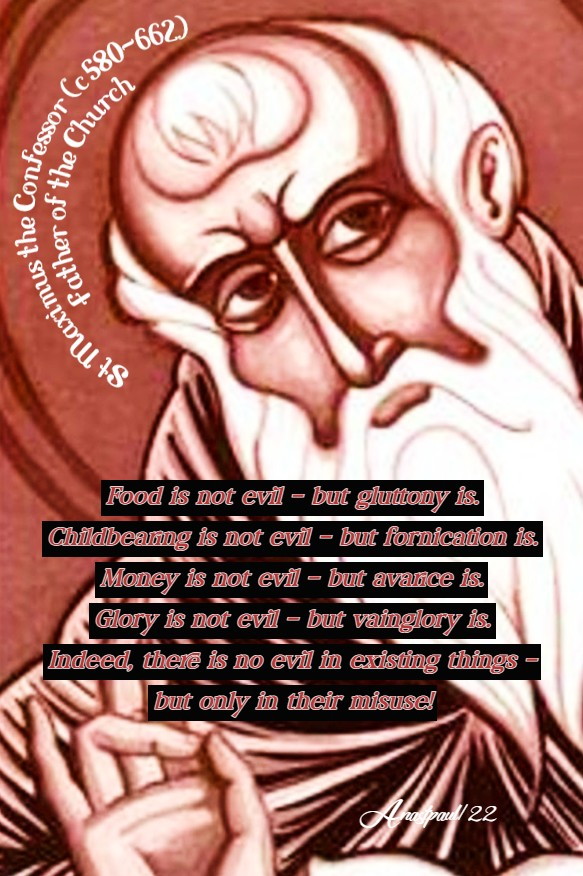
“Food is not evil – but gluttony is. Childbearing is not evil – but fornication is. Money is not evil – but avarice is. Glory is not evil – but vainglory is. Indeed, there is no evil in existing things – but only in their misuse!”
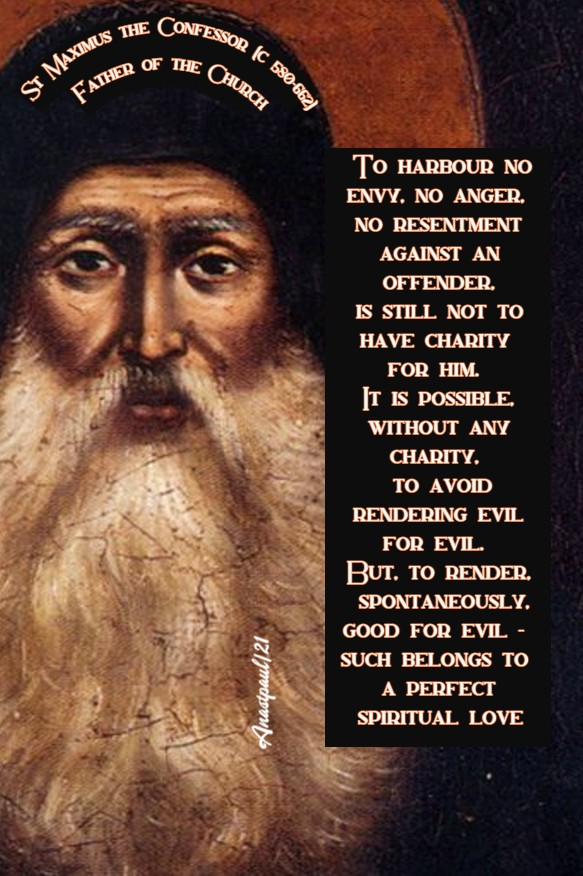
“To harbour no envy, no anger, no resentment against an offender, is still not to have charity for him. It is possible, without any charity, to avoid rendering evil for evil. But, to render, spontaneously, good for evil – such belongs to a perfect spiritual love.”
“In conformity with the philosophy of Christ, let us make of our life, a training for death.”
“For indeed, what is more dire than the evils which today afflict the world? … What is more terrible for the discerning than the unfolding events? What is more pitiable and frightening for those who endure them? To see a barbarous people of the desert overrunning another’s lands as though they were their own, to see civilisation itself, being ravaged by wild and untamed beasts whose form alone is human.”
“All the ends of the inhabited world … look directly to the most holy Church of the Romans and her confession and faith as to a sun of eternal light, receiving from her, the radiant beam of the patristic and holy doctrines.”
“Since He causes the darkness of ignorance and the evil of men to vanish, my Saviour and my God is called a lamp in Scripture. And since He is the only one able to obliterate the darkness of ignorance and disperse the shadows of sin, He has become the way of salvation for all … The lampstand is holy Church because the Word of God shines out through her preaching. This is how the beams of its truth can enlighten the whole world…”
Quote/s of the Day – 9 August – “Month of the Immaculate Heart” – The Memorial of St John Marie Baptiste Vianney (1786-1859) – Readings: Ps 111:9, Ps 111:1, Ecclus 51:1-8, 12, Matt 16:24-27
Voltaire, realising that he was ill, began to reflect upon the state of the sinner who dies with his conscience loaded with sins. He wished to examine his conscience and to see whether God would be willing to pardon him all the sins of his life, which were very great in number. He counted upon the mercy of God, which is infinite, and with this comforting thought in mind, he had brought to him one of those priests whom he had so greatly outraged and calumniated in his writings. He threw himself upon his knees and made a declaration to him of his sins and put into his hands the recantation of all his impieties and his scandals. He began to flatter himself on having achieved the great work of his reconciliation. But he was gravely mistaken. God had abandoned him; you will see how. Death anticipated all spiritual help. Alas! This unfortunate blasphemer felt all his terrors reborn in him. He cried out: “Alas, am I then abandoned by God and men?” Yes, unhappy man, you are. Already your lot and your hope are in Hell. Almost a century of blasphemy and impiety had exhausted the patience of God, Who had already rejected him. He was no more than a victim which the wrath of God fattens for the eternal flames. The priests whom he had so derided but whom, in this moment he so desired, were not there.
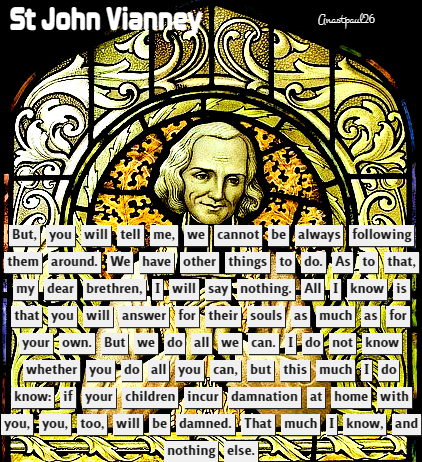
But, you will tell me, we cannot be always following them around. We have other things to do. As to that, my dear brethren, I will say nothing. All I know is that you will answer for their souls as much as for your own. But we do all we can. I do not know whether you do all you can, but this much I do know: if your children incur damnation at home with you, you, too, will be damned. That much I know, and nothing else.You may go on saying “No” to that, saying that I go too far. You will agree with it if you have not entirely lost your faith. That alone should suffice to cast you into a state of despair from which you could not emerge. But I know well that you will not take another step to fulfil any better your duties to your children. You are not at all disturbed, and you are almost right, for you will have plenty of time to torment yourselves during all eternity.
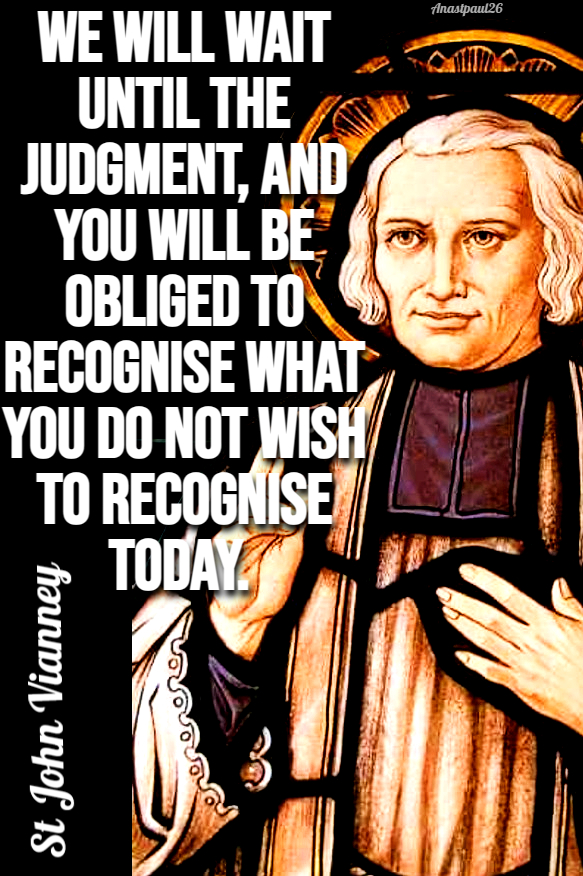
We will wait until the Judgment, and you will be obliged to recognise what you do not wish to recognise today.
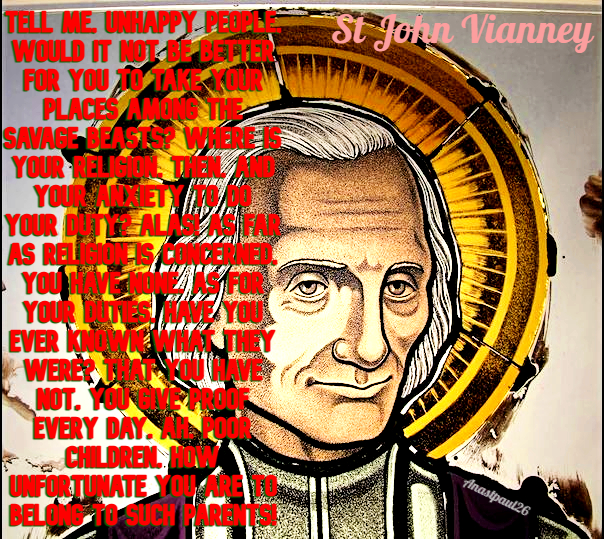
Tell me, unhappy people, would it not be better for you to take your places among the savage beasts? Where is your religion, then, and your anxiety to do your duty? Alas! As far as religion is concerned, you have none. As for your duties, have you ever known what they were? That you have not, you give proof every day. Ah, poor children, how unfortunate you are to belong to such parents!
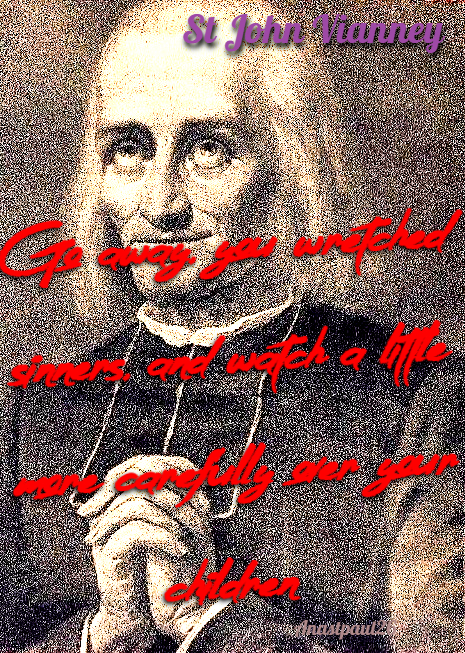
Go away, you wretched sinners, and watch a little more carefully over your children.
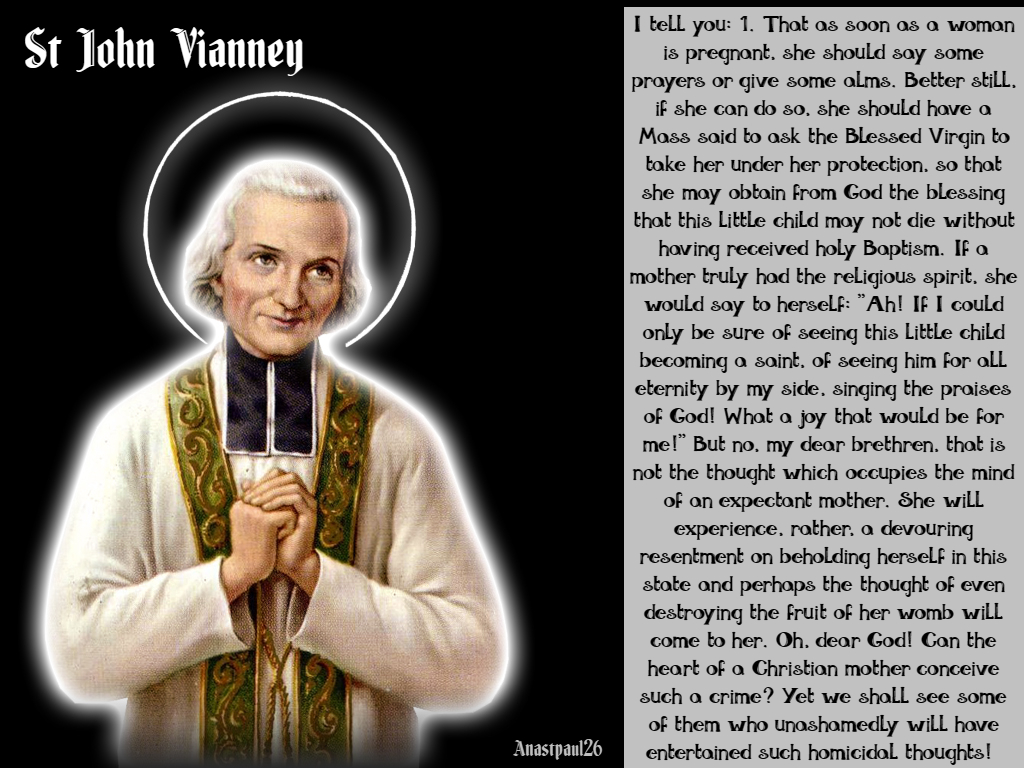
I tell you: 1. That as soon as a woman is pregnant, she should say some prayers or give some alms. Better still, if she can do so, she should have a Mass said to ask the Blessed Virgin to take her under her protection, so that she may obtain from God the blessing that this little child may not die without having received holy Baptism. If a mother truly had the religious spirit, she would say to herself: “Ah! If I could only be sure of seeing this little child becoming a saint, of seeing him for all eternity by my side, singing the praises of God! What a joy that would be for me!” But no, my dear brethren, that is not the thought which occupies the mind of an expectant mother. She will experience, rather, a devouring resentment on beholding herself in this state and perhaps the thought of even destroying the fruit of her womb will come to her. Oh, dear God! Can the heart of a Christian mother conceive such a crime? Yet we shall see some of them who unashamedly will have entertained such homicidal thoughts!
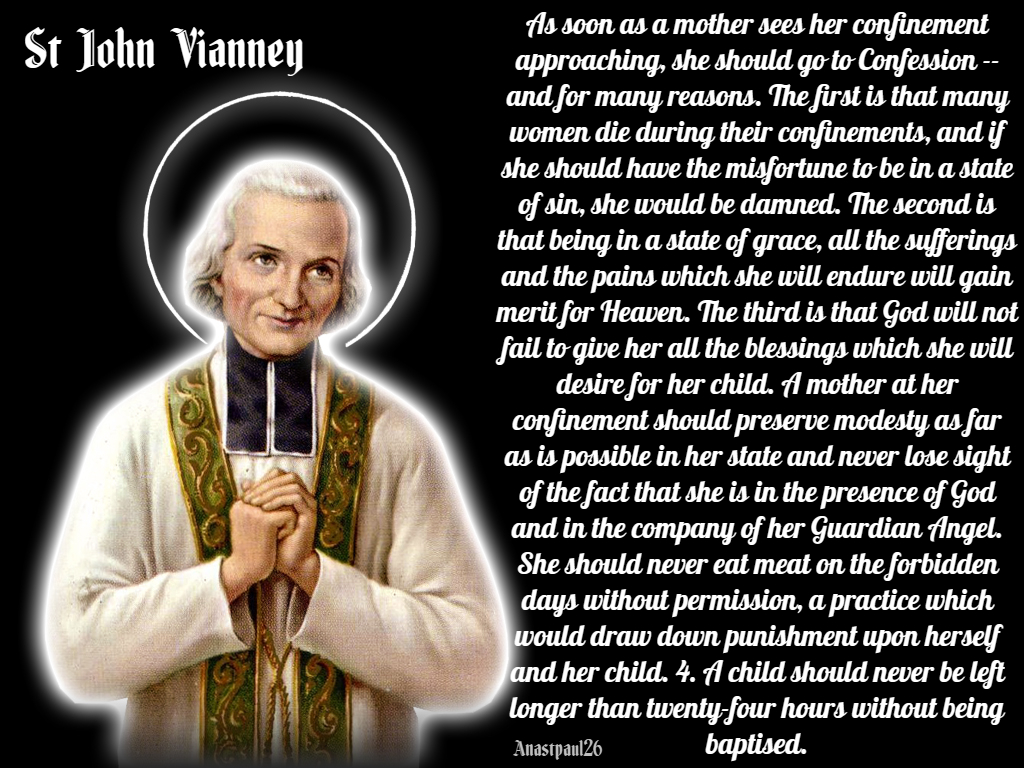
As soon as a mother sees her confinement approaching, she should go to Confession — and for many reasons. The first is that many women die during their confinements, and if she should have the misfortune to be in a state of sin, she would be damned. The second is that being in a state of grace, all the sufferings and the pains which she will endure will gain merit for Heaven. The third is that God will not fail to give her all the blessings which she will desire for her child. A mother at her confinement should preserve modesty as far as is possible in her state and never lose sight of the fact that she is in the presence of God and in the company of her Guardian Angel. She should never eat meat on the forbidden days without permission, a practice which would draw down punishment upon herself and her child. 4. A child should never be left longer than twenty-four hours without being baptised.
Quote/s of the Day – 31 July – “Month of the Precious Blood” and the Memorial of St Ignatius Loyola (1491-1556)
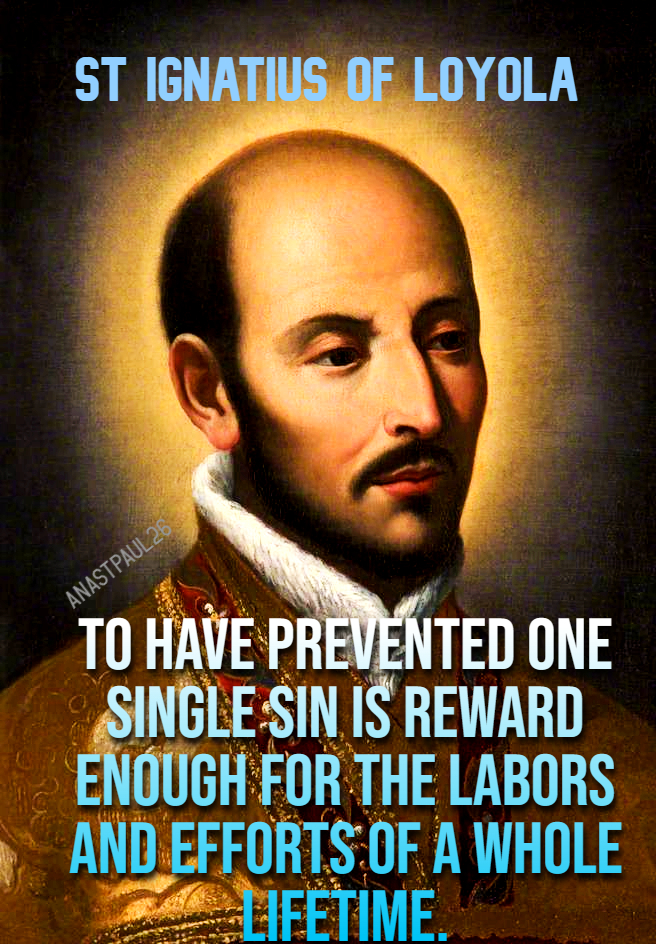
To have prevented one single sin is reward enough for the labors and efforts of a whole lifetime.
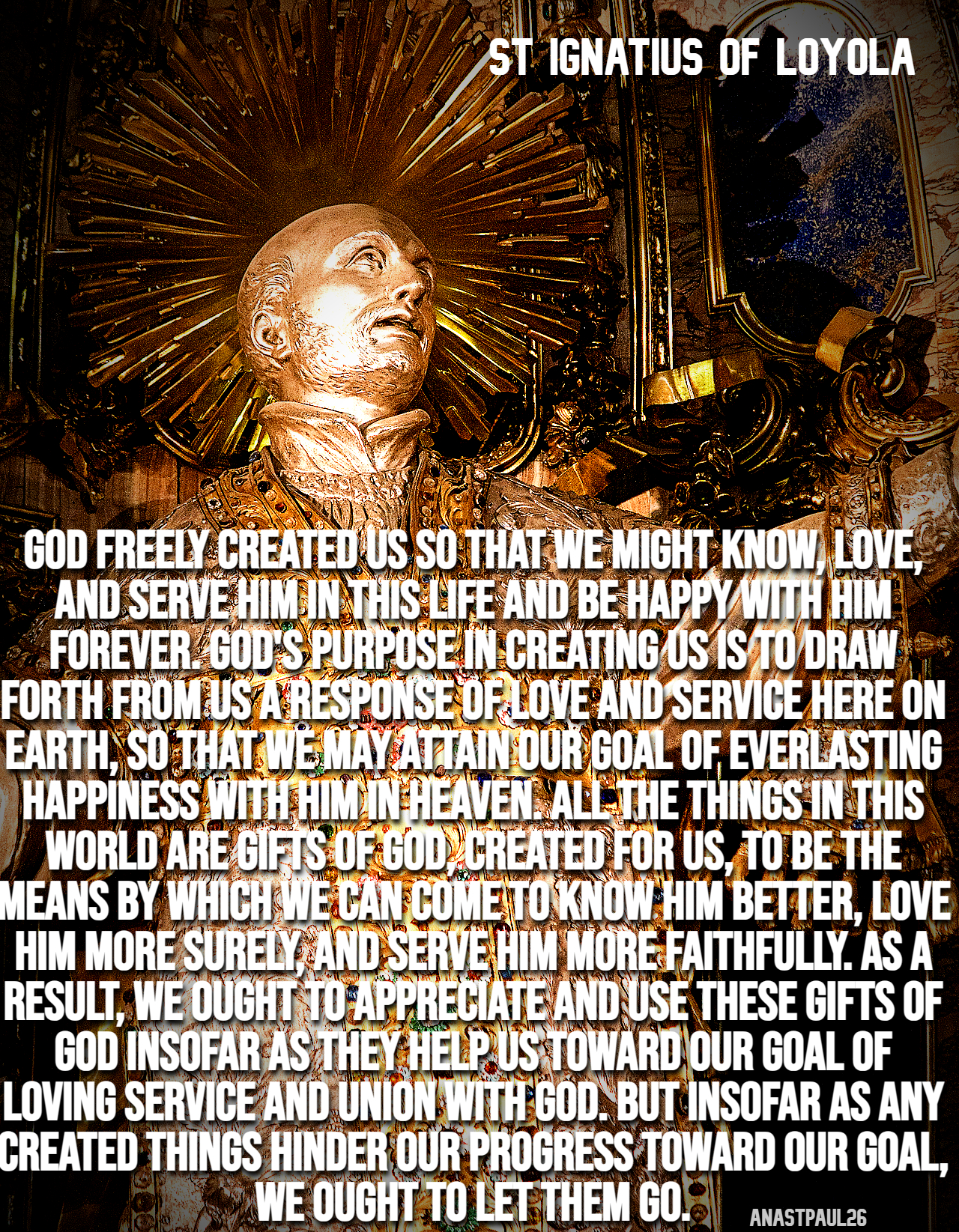
God freely created us so that we might know, love, and serve him in this life and be happy with him forever. God’s purpose in creating us is to draw forth from us a response of love and service here on earth, so that we may attain our goal of everlasting happiness with him in heaven. All the things in this world are gifts of God, created for us, to be the means by which we can come to know him better, love him more surely, and serve him more faithfully. As a result, we ought to appreciate and use these gifts of God insofar as they help us toward our goal of loving service and union with God. But insofar as any created things hinder our progress toward our goal, we ought to let them go.
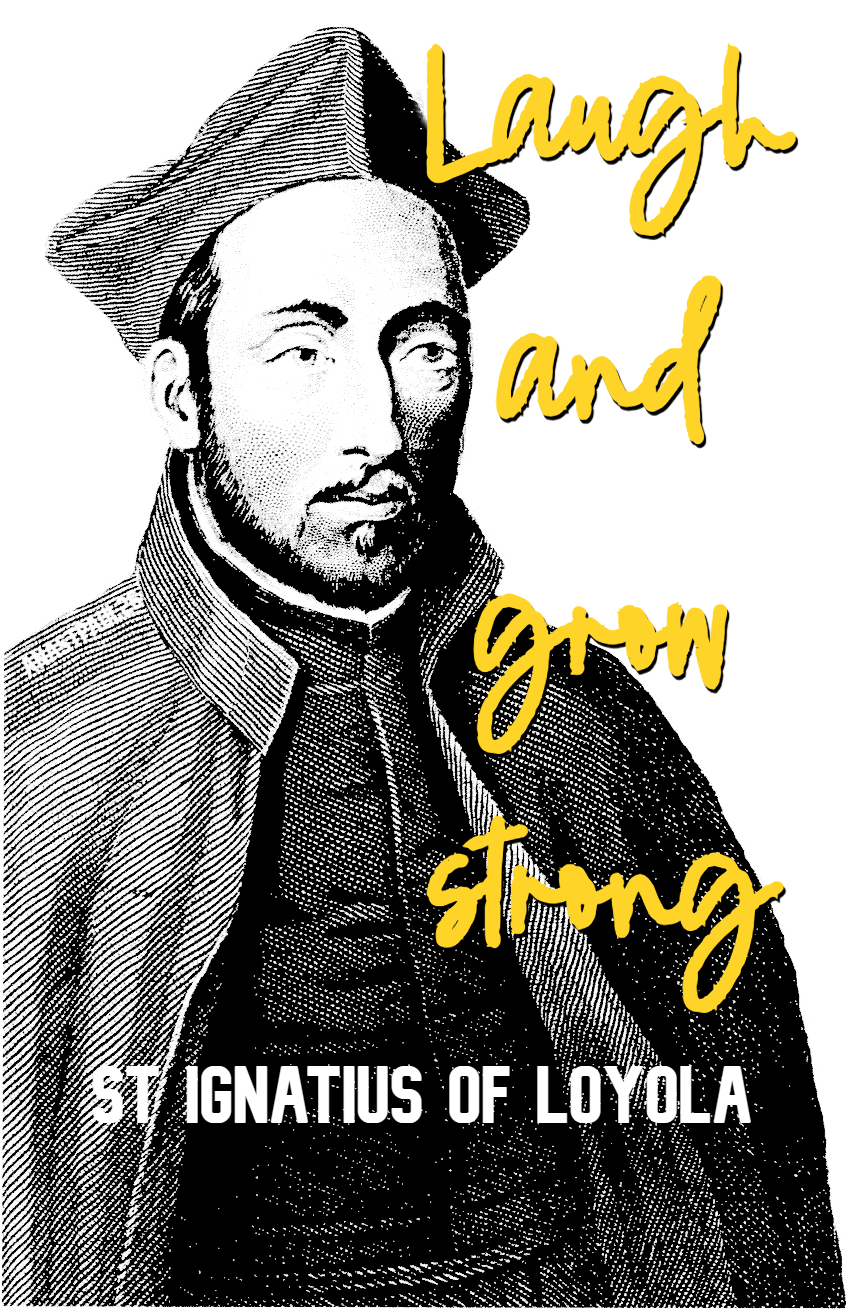
Laugh and grow strong.
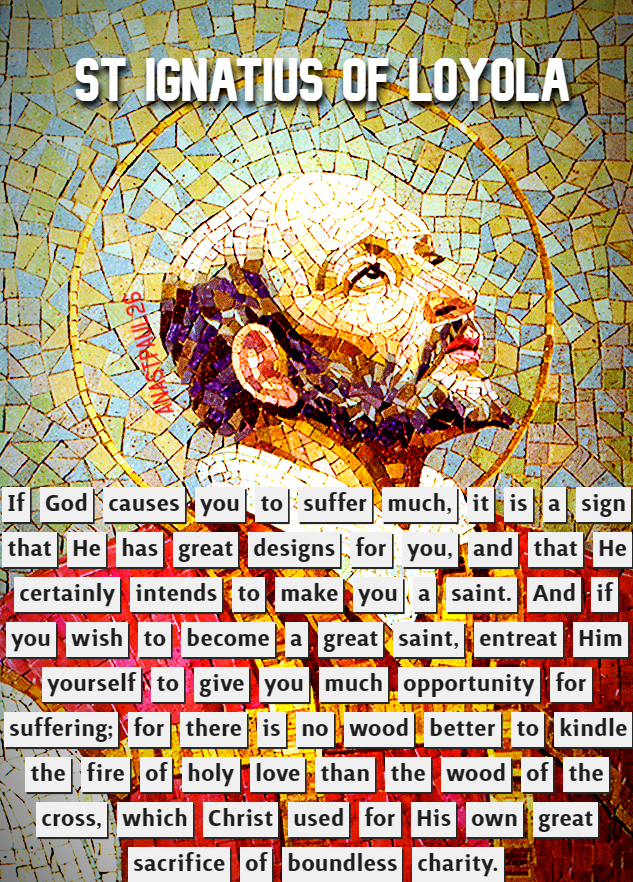
If God causes you to suffer much, it is a sign that He has great designs for you, and that He certainly intends to make you a saint. And if you wish to become a great saint, entreat Him yourself to give you much opportunity for suffering; for there is no wood better to kindle the fire of holy love than the wood of the cross, which Christ used for His own great sacrifice of boundless charity.
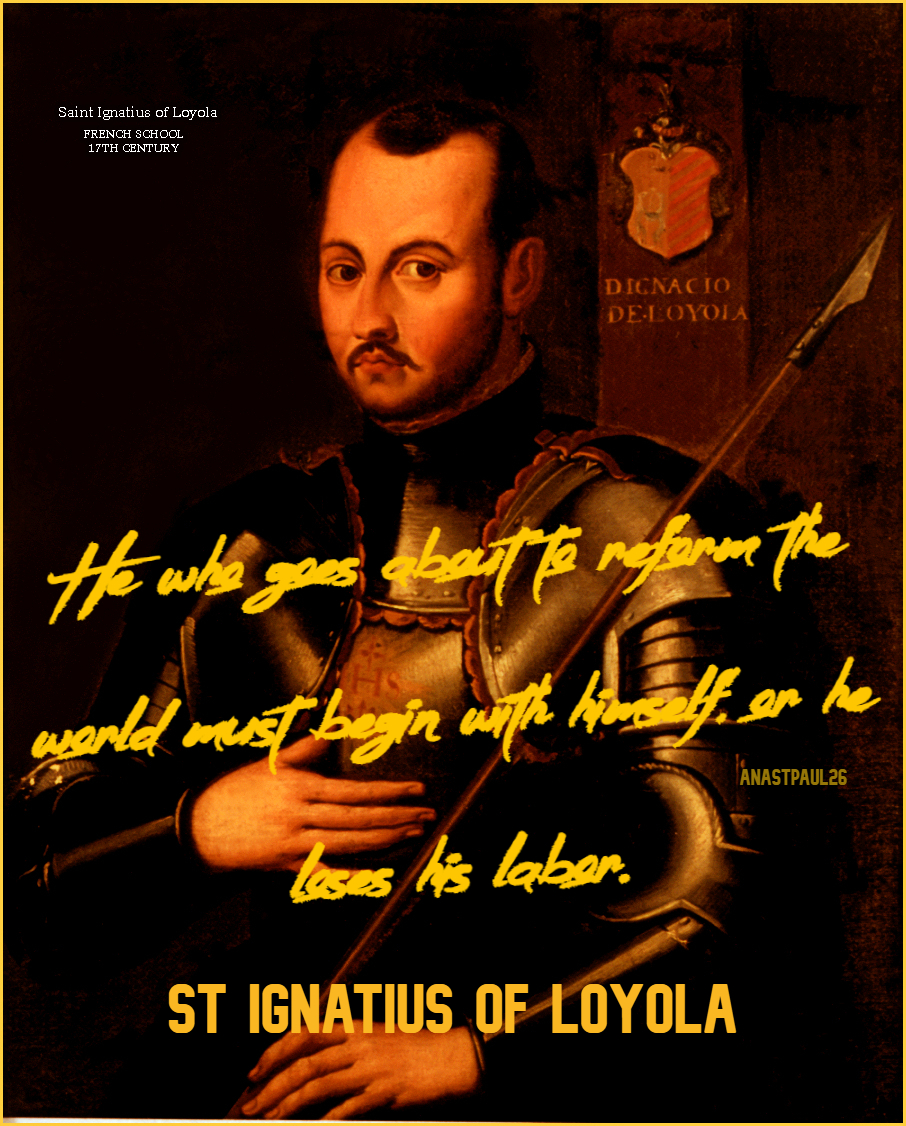
He who goes about to reform the world must begin with himself, or he loses his labor.
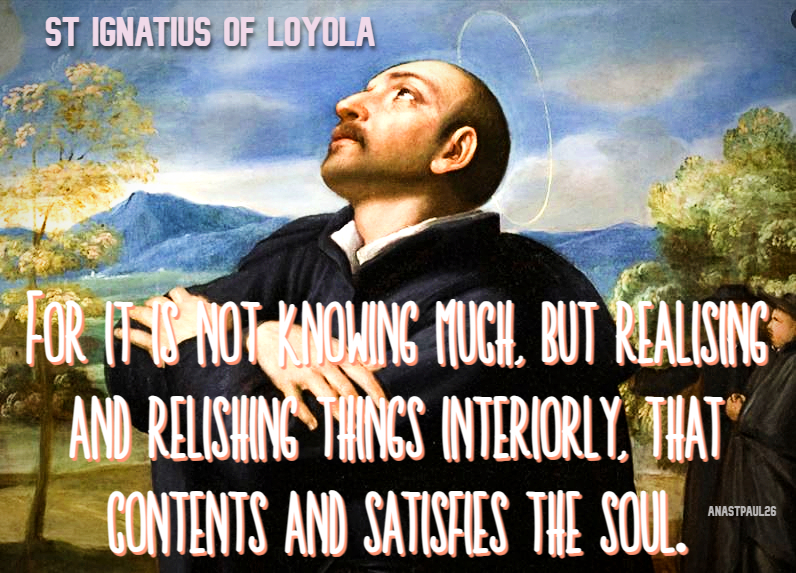
For it is not knowing much, but realising and relishing things interiorly, that contents and satisfies the soul.





You must be logged in to post a comment.