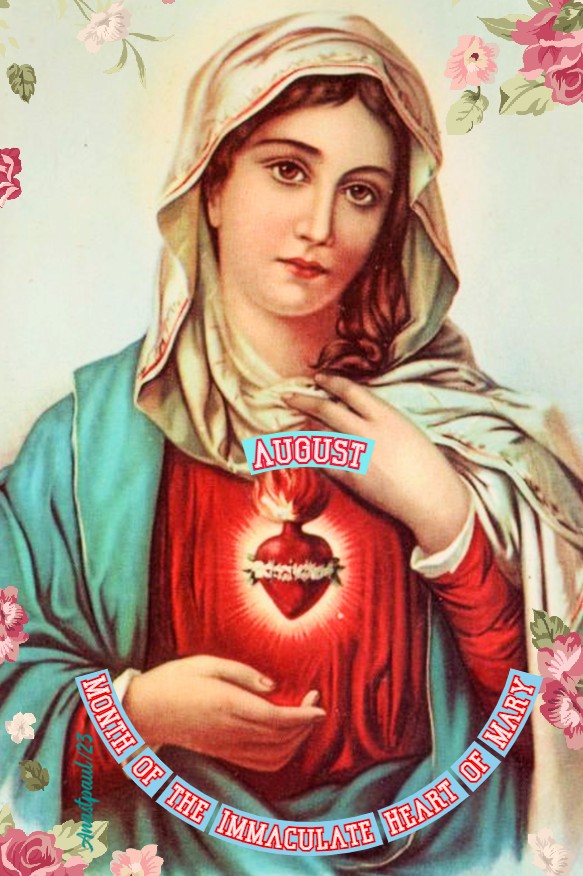
One Minute Reflection – 5 August – “Month of the Immaculate Heart of Mary” – The Memorial of the Dedication of Mary Major, Our Lady of the Snows
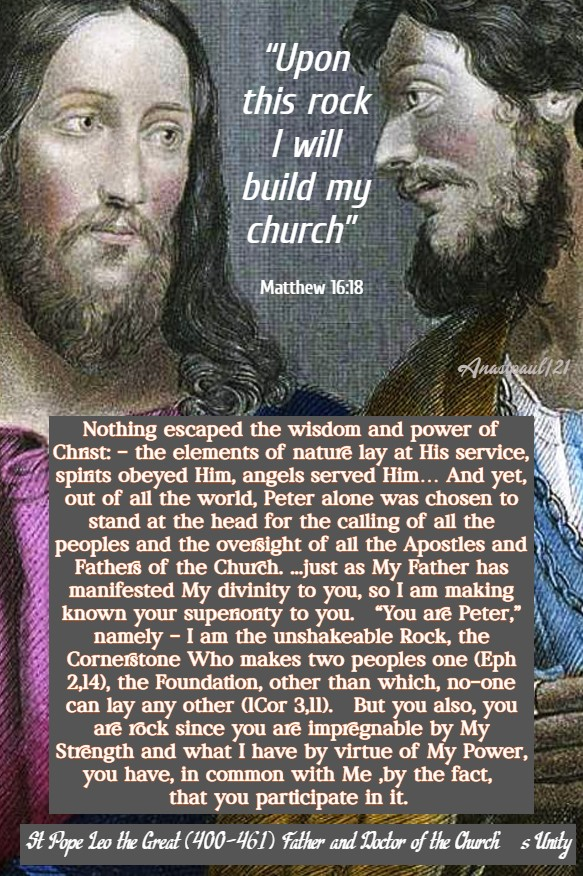
“Upon this rock I will build my church” – Matthew 16:18
REFLECTION – “Nothing escaped the wisdom and power of Christ: – the elements of nature lay at His service, spirits obeyed Him, angels served Him… And yet, out of all the world, Peter alone was chosen to stand at the head for the calling of all the peoples and the oversight of all the Apostles and Fathers of the Church. Thus, even though there are many priests and shepherds among the people of God, Peter governed them all in person while Christ also governs them in the capacity of Head.
The Lord asks all the Apostles what people think of Him and they all say the same thing so long as they are making known the doubts deriving from human ignorance. But when the Lord demands to know what the disciples themselves think, the first to confess the Lord is he who is the first in dignity of the Apostles. As he had said: “You are the Christ, the Son of the Living God”, Jesus answers him: “Blessed are you, Simon son of Jonah. For flesh and blood has not revealed this to you but my heavenly Father.” That is to say: blessed are you because my Father taught this to you. Earthly opinion has not led you astray but it is heavenly inspiration that has instructed you. It is not flesh and blood that enabled you to discover me but He whose only Son I am.
“And so I say to you”, that is to say: – just as My Father has manifested My divinity to you, so I am making known your superiority to you. “You are Peter,” namely – I am the unshakeable Rock, the Cornerstone Who makes two peoples one, the Foundation, other than which, no-one can lay any other. But you also, you are rock since you are impregnable by My Strength and what I have by virtue of My Power, you have, in common with Me by the fact, that you participate in it. “On this rock I will build my Church“. On the firmness of this foundation, He says, will I build an everlasting temple and My Church, whose summit is to reach to heaven, will be raised on the strength of that faith.”
– St Pope Leo the Great (4th Sermon for the Anniversary of his Ordination)
PRAYER – Forgive the sins of Your people Lord and since of ourselves, we are unable to do what pleases You, lead us on the way of salvation by the prayers of Mary, the Immaculate Mother of Your Son, Our Lord Jesus Christ, Who lives and reigns with You and the Holy Spirit, God forever and ever, amen.
Quote/s of the Day – 5 August – “Month of the Immaculate Heart of Mary” – Readings: Sedulius, Ps 44:2, Ecclus 24:14-16, Luke 11:27-28
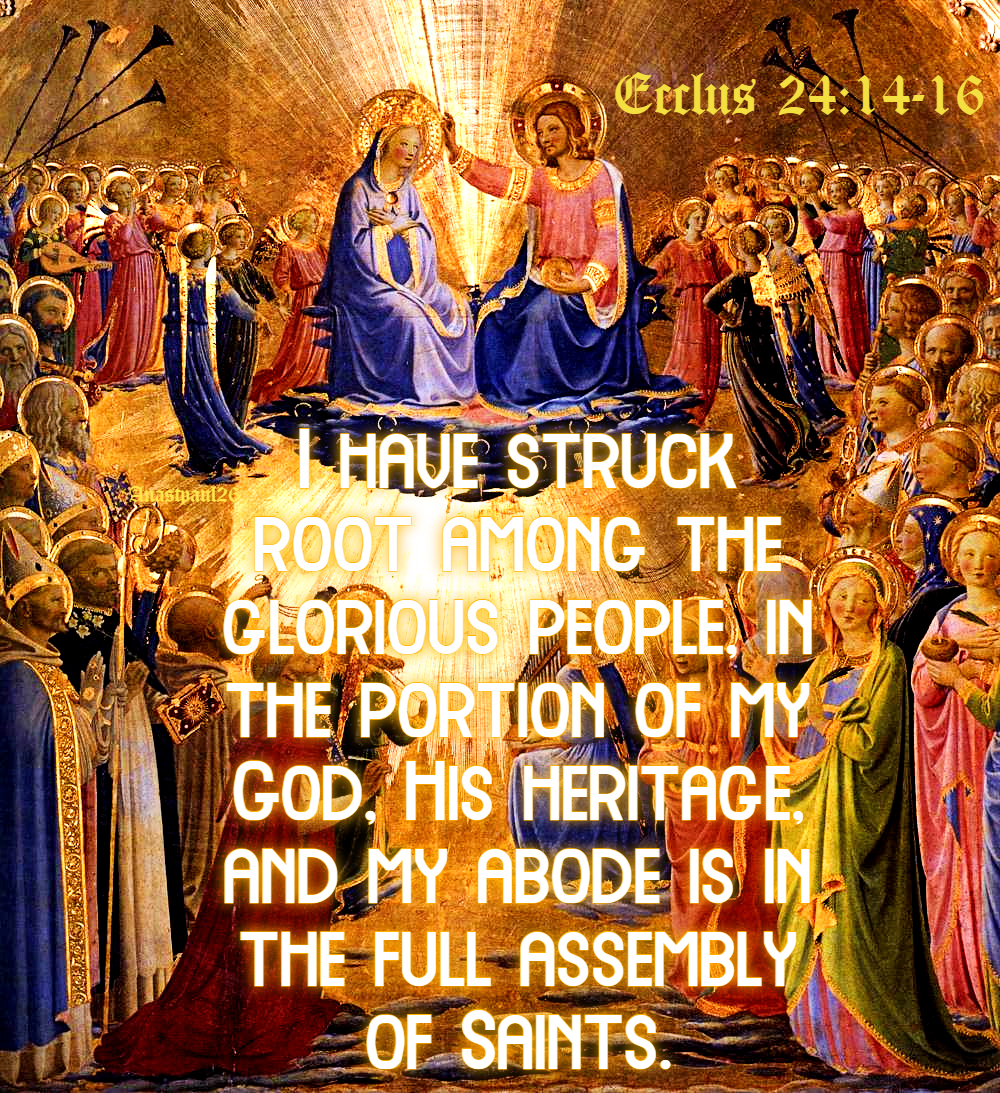
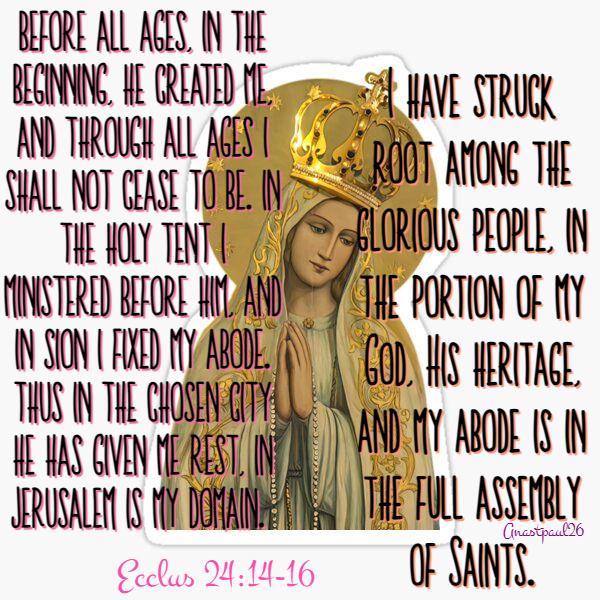
I have struck root among the glorious people, in the portion of my God, His heritage, and my abode is in the full assembly of Saints.
Ecclus 24:14-16
Whoever has no desire to be praised is unable to be altered. The one on whom flattery does not have a hold, constancy does. The one on whom pompous ostentation has no hold, virtue does not forsake.
St Peter Chrysologus
They deem themselves favored because I wish to punish them in this life, and in this finite time; they drive away sin with contrition of heart, and with perfect patience do they merit, and their labors are rewarded with infinite good. Hereafter they learn that all suffering in this life is small, on account of the shortness of time. Time is no more than the point of a needle; and, when time is over, so is suffering – so you see how small it is. Therefore they endure it patiently, and the thorns they pass through do not touch their heart, because their heart is drawn out of them and united to Me by the affection of love. It is indeed the truth that these souls have a foretaste and guarantee of eternal life, even in this life and that, though they walk on thorns, they are not pricked.
God to St Catherine of Siena
As, therefore, we speak justly when we say concerning any teacher of literature who is alone in a city, He teaches literature here to everybody — not that all men learn, but that there is none who learns literature there who does not learn from him — so we justly say, God teaches all men to come to Christ, not because all come, but because none comes in any other way.
St Augustine (On the Predestination of the Saints)
Hades and the devil have been despoiled, and stripped of their ancient armour, and cast out of their peculiar power. And even as Goliath had his head cut off with his own sword, so also is the devil, who has been the father of death, put to rout through death; and he finds that the selfsame thing which he was wont to use as the ready weapon of his deceit, has become the mighty instrument of his own destruction. Yea, if we may so speak, casting his hook at the Godhead, and seizing the wonted enjoyment of the baited pleasure, he is himself manifestly caught while he deems himself the captor, and discovers that in place of the man he has touched the God. By reason thereof do the martyrs leap upon the head of the dragon, and despise every species of torment.
St. Gregory Thaumaturgus (On All the Saints)
There are things which, in your extreme ignorance, you had never read, and therefore you neglected the whole range of Scripture and employed your madness in outraging the Virgin, like the man in the story who being unknown to everybody and finding that he could devise no good deed by which to gain renown, burned the temple of Diana: and when no one revealed the sacrilegious act, it is said that he himself went up and down proclaiming that he was the man who had applied the fire. The rulers of Ephesus were curious to know what made him do this thing, whereupon he replied that if he could not have fame for good deeds, all men should give him credit for bad ones. Grecian history relates the incident. But you do worse. You have set on fire the temple of the Lord’s body, you have defiled the sanctuary of the Holy Spirit from which you are determined to make a team of four brethren and a heap of sisters come forth.
Jesus Christ, the Heart of the Eternal Father, is the Heart of His Holy Mother. Is not the heart the principle of life? And what is the Son of God to His dear Mother? He always was and will be forever the heart of her heart, the soul of her soul, the spirit of her spirit, and the sole principle of all the movements, uses and functions of her most holy life. St. Paul tells us that it is not himself who lives but Jesus Christ who lives in him. Our Lord is the life of all Christians: so who could doubt that He abides in His holy Mother, and that He is the life of her life, the heart of her heart, in a union incomparably more excellent even than with St. Paul and the other faithful saints?
Let us listen to what Our Lady revealed to St. Brigid: “My Son was truly my Heart to me. When He left my bosom to be born, it seemed as though half of my Heart were going forth from me. When He suffered, I felt His pain as though my Heart endured the identical sorrows and torments that He endured. When my Son was being scourged and torn with whips, my Heart was scourged and whipped with Him. When Hel ooked at me from the Cross, and I at Him, two streams of tears gushed from my eyes; and when He saw me oppressed with sorrow, He experienced such violent anguish at my desolation that the pain caused by His sorrow was my sorrow as His Heart was my Heart. Because Adam and Eve together betrayed the world for one, single forbidden fruit, so did my beloved Son wish that I should cooperate with Him in redeeming it with one Heart, quasi cum uno Corde.“
Jesus lives in her soul and in her body, and in each faculty of her body and soul. He lives in her entirely, which means that whatever is in Jesus is also in Mary. His Heart abides in her heart, His soul in her soul, His spirit in her spirit. The memory, intellect and will of Jesus are alive in the memory, intellect and will of Mary; his interior and exterior senses in her interior and exterior senses. His passions in her passions; His virtues, mysteries and divine attributes are living in her Heart. Nay, more than living, they hold sovereign sway, producing inconceivably marvellous effects and impressing a living image of themselves as her Heart mirrors His Sacred Heart.
This veneration of Mary means honoring the corporeal Heart, the spiritual Heart and the divine Heart of Jesus, who are also the Hearts, or rather, the one and only Heart of Mary. It means giving glory to Our Lord, Jesus Christ, who is the Heart of the Eternal Father, and has willed to become the Heart of His Holy Mother. If Holy Church celebrates an annual feast in honor of the chains of St. Peter, the Prince of the Apostles, how great a solemnity does not the august Heart of the Queen of Apostles deserve!
Saint Sithney(or Setna) was one of a group of Irish monks who travelled to western Cornwall, and from there he moved to Guic-Sezni in Brittany, where he founded a monastery. He was a native of Munster, the son of Erc and Magna – a sister of St. David. Sithney had two brothers, Saint Govan and Multos. He may be the Setna, a deaf and mute boy who kept cows on Slieve-Bloom. Saint Columba of Terryglass pitied the child and blessed him. He not only recovered hearing and speech, but also acquired the gift of prophecy.
When God chose Sithney to be the patron of girls seeking husbands; the saint recoiled, saying he would never get to rest in that case, and that he would rather take care of mad dogs than women. Ever since, sick or mad dogs have been given water from Sithney’s well as a tonic.
He died in 529, of natural causes. William Worcester recorded in 1478 that the body of the saint lay within the church of Saint Sithney.
Saint Sithney church
Patronages: Against hydrophobia, against rabies, against mad dogs, Sithney, Cornwall, England
Madonna dell’Apparizione / Our Lady of the Apparition, Pellestrina, Italy (1716) – 4 August:
The Sanctuary of Madonna dell’Apparizione in Pellestrina was built in July 1717, a year after the appearance of the Madonna on the island. The event of 4 August 1716, the Feast day of St Dominic, was in fact confirmed true by canonical process: – a young boy from Pellestrina met a woman who advised him to tell the parish priest to celebrate Mass and to pray for the salvation of Venice, which, at that time, was besieged by the Turks. The following day, at the same hour of the Apparition, the Venetians won the Battle of Petrovaradin against the Turks.
Throughout the entire year the Sanctuary is a destination for many pilgrims and devotees in search of grace and even today, on 4 August in Pellestrina, the Madonna dell’Apparizione and the victory of Venice is celebrated over three days.
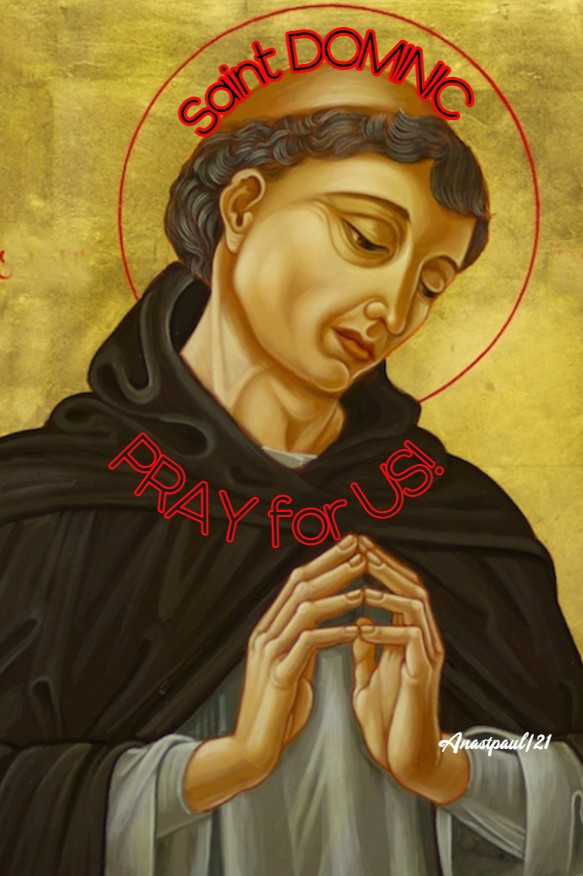
St Dominic de Guzman OP (1170-1221) (Memorial) Founder of the Dominican Order of Preachers – Priest, Founder, Confessor, Teacher, Preacher, Mystic, Miracle-Worker, Apostle of the Holy Rosary. At Dominic’s baptism, Blessed Joan, his Mother, saw a star shining from his chest, which became another of his symbols in art, and led to his patronage of astronomy. The Roman Martyrology states today: “At Bologna, St Dominic, Confessor, Founder of the Order of Friars Preachers, most renowned for sanctity and learning. He preserved his chastity unsullied to the end of his life and by his great merits, raised three persons from the dead. After having repressed heresies by his preaching and instructed many in the religious and Godly life, he rested in peace on the 6th of this month. His Feast, however, is celebrated on this day by decree of Pope Paul IV.
St Hyacinth of Rome St Ia of Persia St Isidore of Besançon St Lua of Limerick St Onofrio of Panaia St Perpetua of Rome St Protasius of Cologne St Rainerio of Split St Sithney (Died c 529) St Tertullinus of Rome Bl William Horne
Our Morning Offering – 4 August – The Memorial of St Dominic de Guzman OP (1170-1221)
St Dominic’s Blessing By St Dominic de Guzman (1170-1221)
May God the Father, who made us, bless us. May God the Son, send His healing among us. May God the Holy Spirit, move within us and give us eyes to see with, ears to hear with, and hands, that Your work, might be done. May we walk and preach the word of God to all. May the angel of peace watch over us and lead us at last, by God’s grace, to the Kingdom. Amen
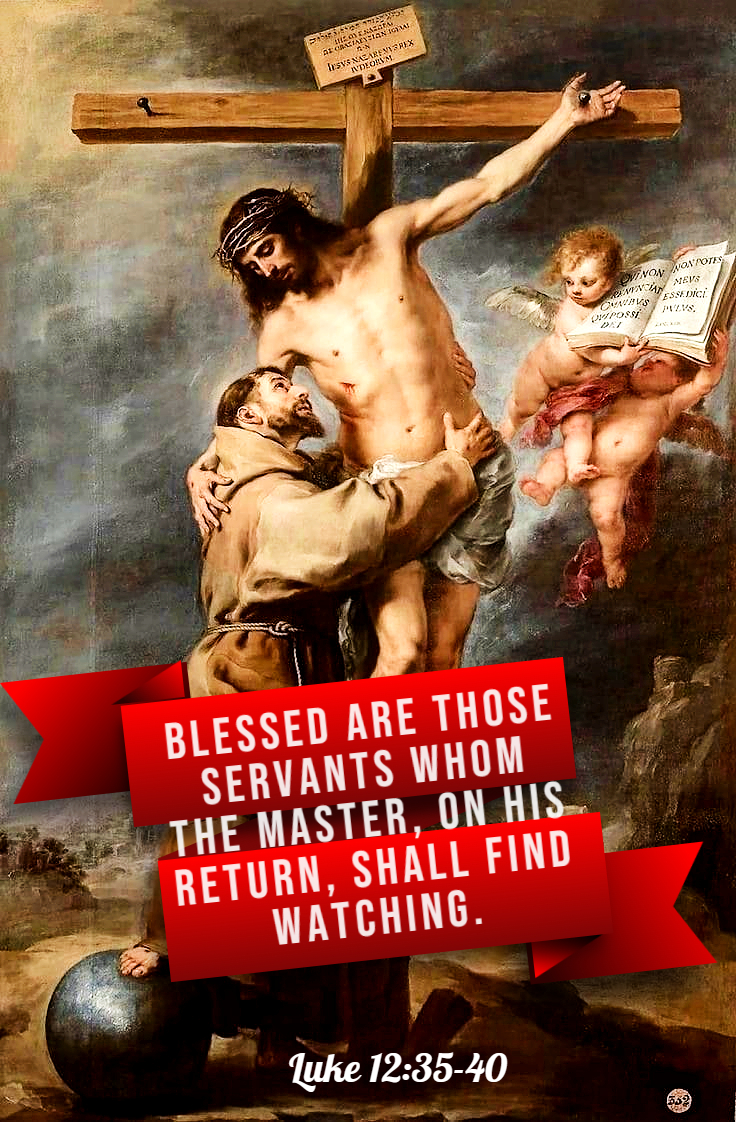
One Minute Reflection – 4 August – “Month of the Immaculate Heart of Mary” – Readings: Ps 36:30-31, Ps 36:1, 2 Tim. 4:1-8, Luke 12:35-40
Blessed are those servants whom the master, on his return, shall find watching.
Luke 12:35-40
REFLECTION – “The just soul, for whom life finishes in the affection of charity and the bonds of love, cannot increase in virtue, time having come to naught, but she can always love with that affection with which she comes to Me, and that measure that is measured to her. She always desires Me, and loves Me, and her desire is not in vain—being hungry, she is satisfied, and being satisfied, she has hunger, but the tediousness of satiety and the pain of hunger are far from her. In love, the Blessed rejoice in My eternal vision, participating in that good that I have in Myself, everyone according to his measure, that is that, with that measure of love, with which they have come to Me, is it measured to them. Because they have lived in love of Me and of the neighbor, united together with the general love, and the particular, which, moreover, both proceed from the same love. And they rejoice and exult, participating in each other’s good with the affection of love, besides the universal good that they enjoy altogether. And they rejoice and exult with the angels with whom they are placed, according to their diverse and various virtues in the world, being all bound in the bonds of love. And they have a special participation with those whom they closely loved with particular affection in the world, with which affection they grew in grace, increasing virtue, and the one was the occasion to the other of manifesting the glory and praise of My name, in themselves and in their neighbor; and, in the life everlasting, they have not lost their love, but have it still, participating closely, with more abundance, the one with the other, their love being added to the universal good, and I would not that you should think that they have this particular good, of which I have told you, for themselves alone, for it is not so, but it is shared by all the proved citizens, My beloved sons, and all the angel —for, when the soul arrives at eternal life, all participate in the good of that soul, and the soul in their good.”
These then do not await, with fear, the Divine judgment, but with joy, and the Face of My Son will not seem to them terrible, or full of hatred, because they finished their lives in love and affection for Me, and good-will towards their neighbor. So you see then, that the transformation is not in His Face, when He comes to judge with My Divine Majesty, but in the vision of those who will be judged by Him. To the damned He will appear with hatred and with justice. And to the saved with love and mercy.”
God the Father to St Catherine of Siena (The Dialogue)
PRAYER – Lord God, You gave St Dominic to the Church as a great preacher of the Truth. We pray that he will help us in these times, our times of lies, ruled by the evil one, by his merits, his teachings and his unfailing prayer. Through Jesus the Christ, Our Lord in the unity of the Holy Spirit, God now and for all eternity, amen.
Quote/s of the Day – 4 August – The Memorial of St Dominic de Guzman OP(1170-1221)
Greatly do we rejoice and thank God because of your holy life and because He has freed you from the corruption of this world. Daughters, fight the ancient adversary insistently with fasting, for only he will be crowned who has striven according to the rules. Be not sparing of discipline and vigils. Be obedient to your prioress. Avoid talking idly to one another. Let not your time be wasted in conversation.
When asked what he would say if faced with martyrdom
I would tell them to kill me slowly and painfully, a little at a time so that I might have a more glorious crown in heaven.
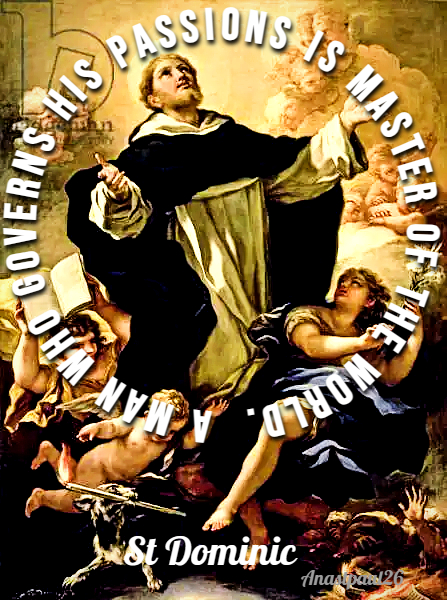
A man who governs his passions is master of the world. We must either rule them or be ruled by them. It is better to be the hammer than the anvil.
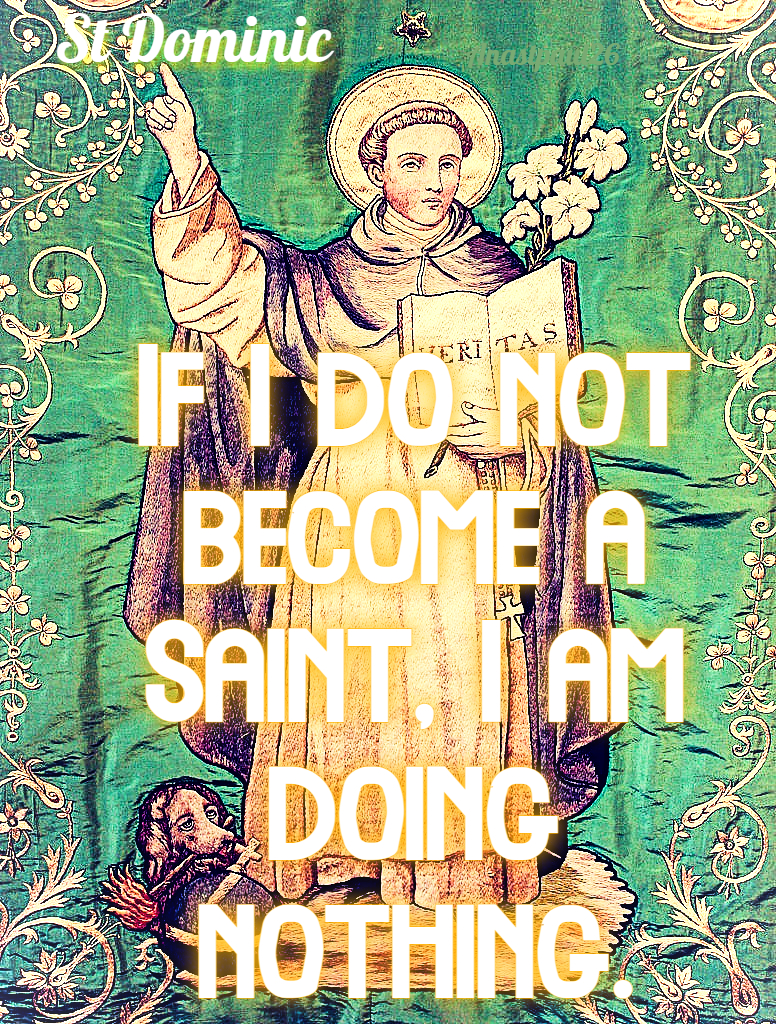
If I do not become a saint, I am doing nothing.
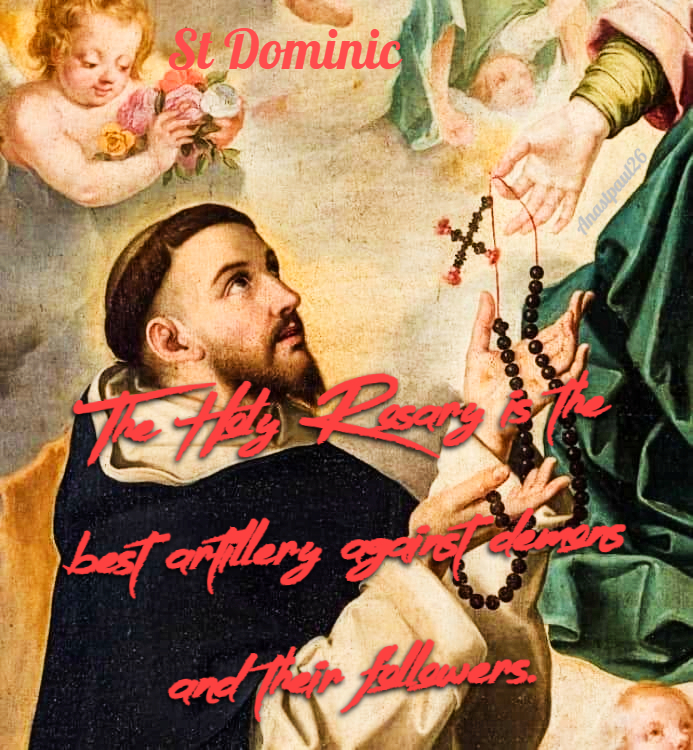
The Holy Rosary is the best artillery against demons and their followers.
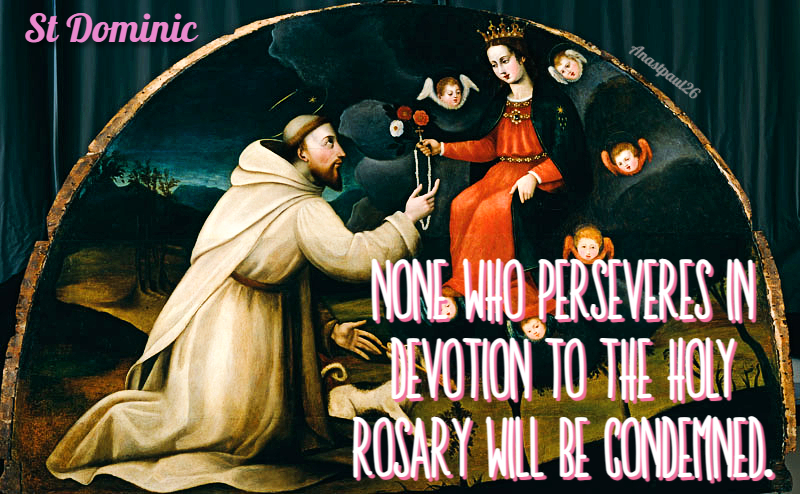
None who perseveres in devotion to the Holy Rosary will be condemned.
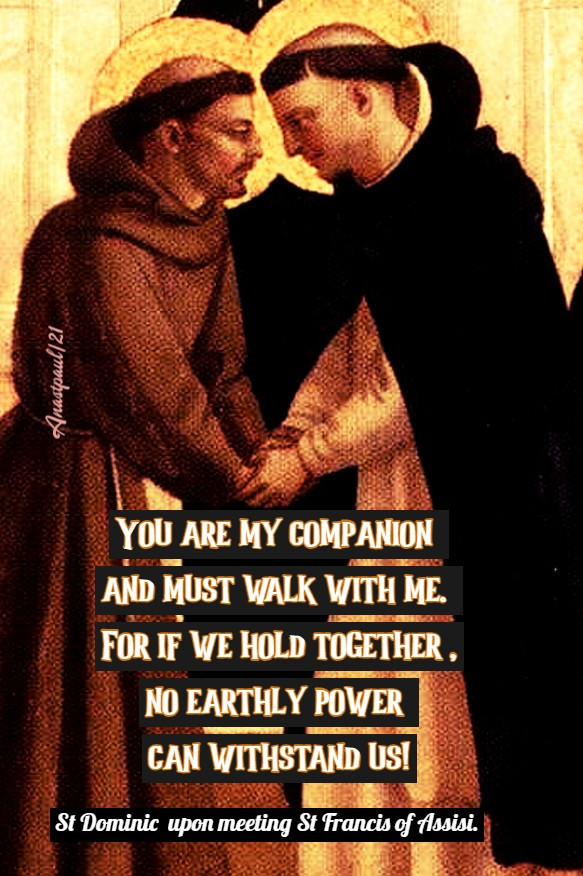
You are my companion and must walk with me. For if we hold together, no earthly power can withstand us.
The Holy Ghost is wont to describe many things with few words. Wishing to praise the principal faculties of the body and soul of His Spouse, the Blessed Virgin Mary, and to exalt the merits of her Heart, He uses very few words, which nevertheless contain many meanings. What does He say? How does He praise Mary, the sovereign of hearts? He utters only three words: Quod intrinsecus latet (“what is hid within“). But these three words encompass all the great and admirable utterances that can be said or thought of her royal Heart; they reveal to us that it is a treasure hidden from the most enlightened eyes of heaven and earth, a treasure so filled with celestial riches that God alone can have a perfect knowledge of its wonders.
The spiritual heart of the Blessed Virgin Mary is the intellectual element of her soul, comprising her memory, intelligence, will and the supreme point of her spirit. This is the heart which expresses itself in the first words of her admirable Canticle, the Magnificat: “My soul doth magnify the Lord: and my spirit hath rejoiced in God my Saviour.” It is the spirit, the soul’s first and noblest part, which must, in a very special manner, glorify God and rejoice in Him. If the virginal heart beating in the consecrated breast of the Virgin of virgins, the most excellent organ of her holy body, is so admirable, as we have already seen, what must be the marvels of her spiritual heart, the noblest portion of her soul? Is it not true that, as the condition of the soul surpasses that of the body, so also does the spiritual heart excel the corporeal?
First of all, Divine Bounty miraculously preserved the heart of the Mother of Our Saviour from the stain of sin, which never touched it because God filled it with grace from the moment of its creation, and clothed it with purity so radiant that, next to God’s, it is impossible to conceive of greater purity. His Divine Majesty possessed her heart so completely from its first instant that it never ceased for a moment to belong entirely to Him and to love Him more ardently than all the holiest hearts of heaven and earth united.
In the second place, the Father of Light has filled this beautiful Sun with the most brilliant lights of nature and of grace. If we consider the natural illumination shining within Mary, we see that God gave to the chosen Spouse of the Holy Ghost a natural intellect more clear, lively, profound, vaster and more perfect in every way than any other intellect, an intellect worthy of the Mother of God, worthy of the woman destined to guide and rule Divine Wisdom, worthy of the Mistress of the Church and Queen Regent of the universe, worthy of her who was to converse familiarly on earth with the angels of heaven, and what is more, with the King of Angels, for thirty four years, an intellect worthy of the lofty functions and sublime contemplation to which she was consecrated.
As regards supernatural light, the luminous heart of Mary, Seat of Wisdom, was so filled with its radiance that the learned Albert the Great, nurtured in the school of the Mother of God, plainly teaches, together with many other holy Doctors, that there was nothing Our Lady did not know. They assert that she possessed infused knowledge of every science, and in a much more eminent degree than the most learned minds that ever existed.
The vast knowledge of the Blessed Virgin Mary was dedicated to a most holy use, employed only to urge her to love God with greater ardor, to procure the salvation of souls with greater fervor, to hate sin more vigorously, to humble herself more profoundly, to despise still further everything that the world esteems and to prize and embrace with greater affection the things it detests, namely poverty, abjections and suffering.
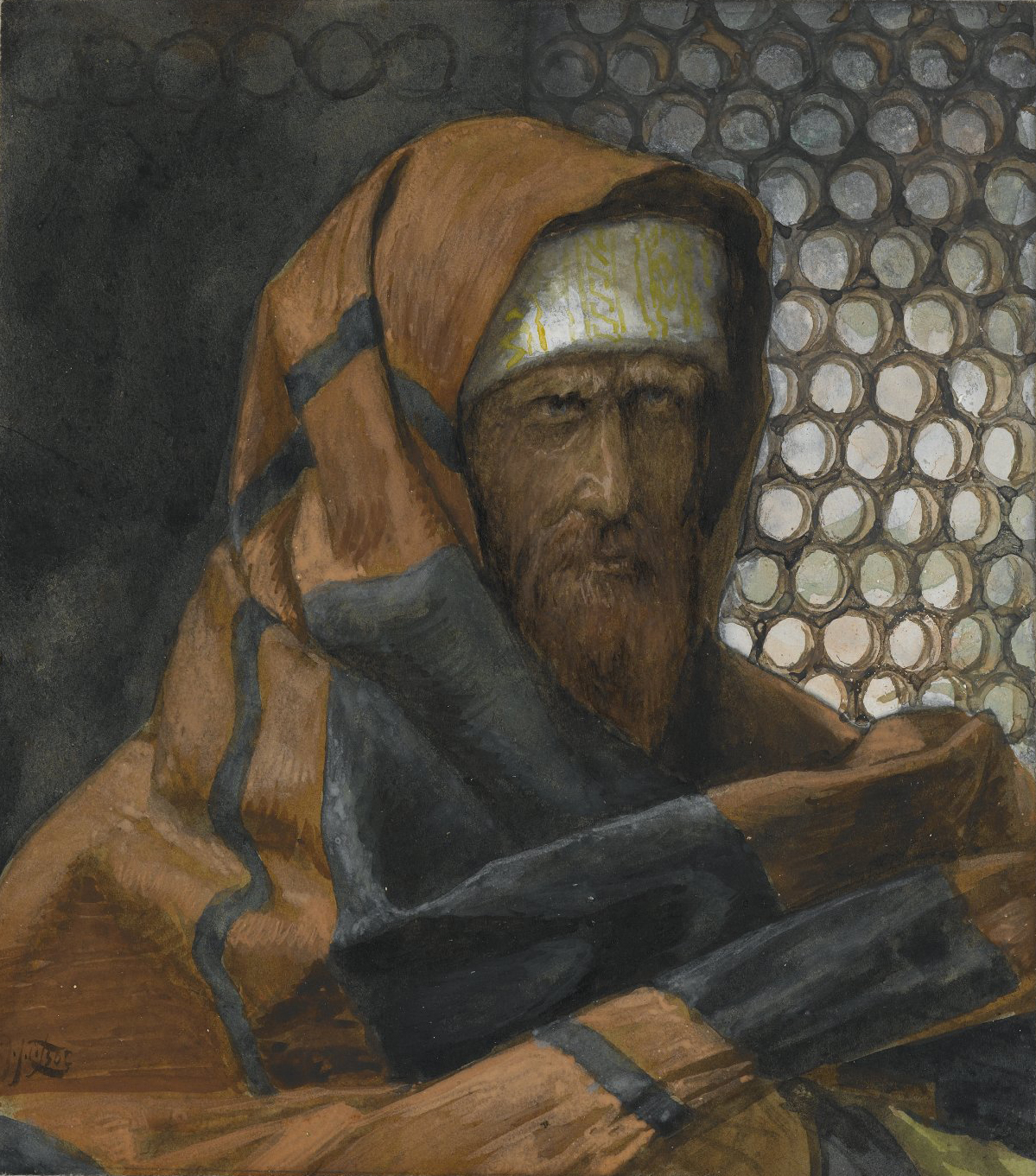
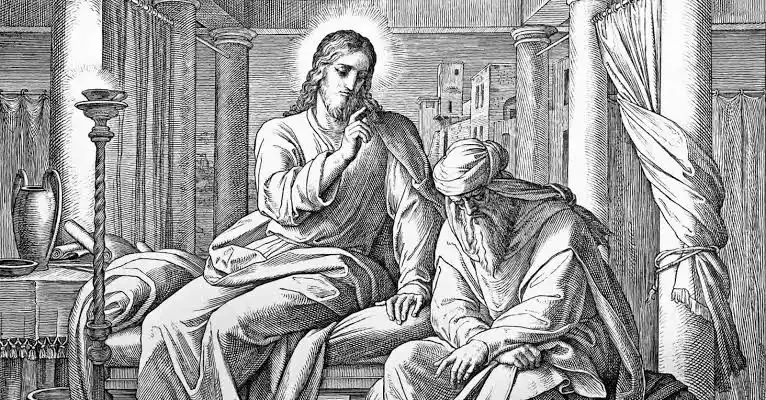
Saint Nicodemus was a Pharisee, a ruler of the Jews, a teacher of Israel, and a member of the Sanhedrin. He went in the secrecy of the night to learn from Jesus, whom he professed as a teacher sent by God. Owing to his insistence on a hearing for Jesus according to Jewish law, Nicodemus is called “defender of Jesus”. In return, the chief priests and his fellow pharisees mocked him by saying that no prophet comes from Galilee.
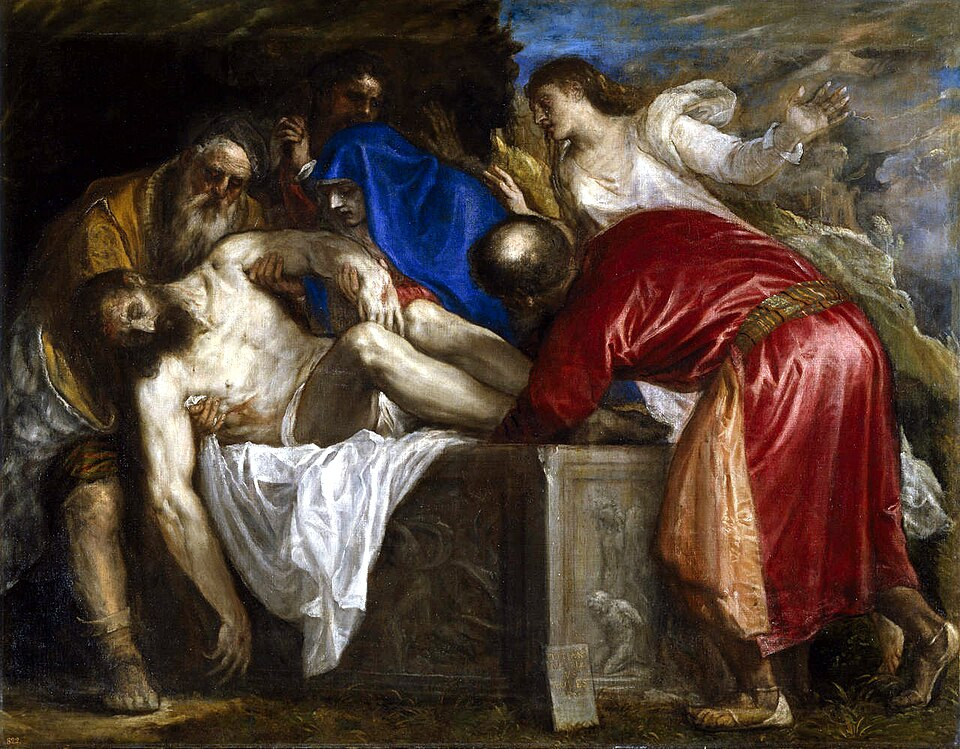
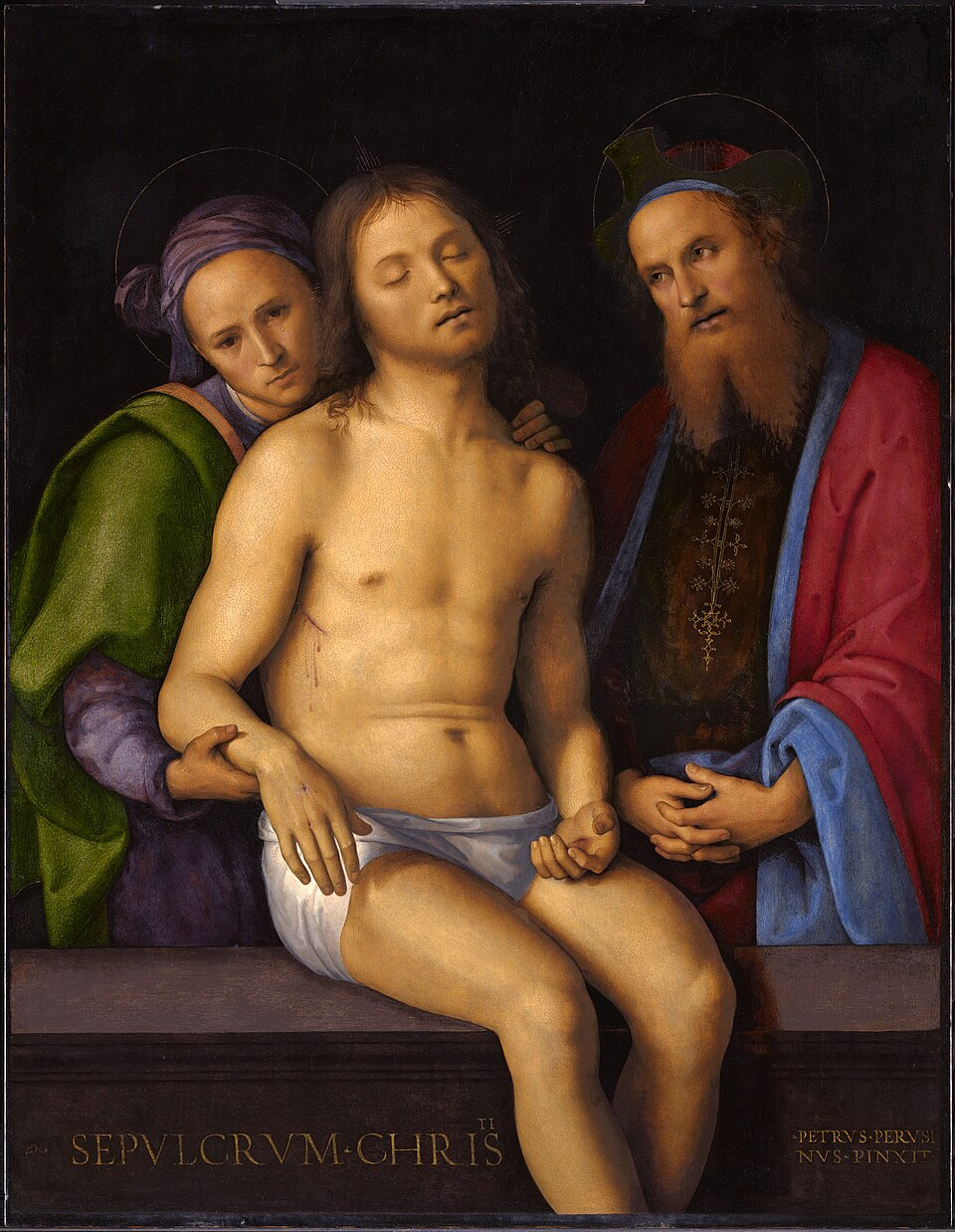
He sought to understand from Jesus how a person might be born again after having left his mother’s womb. After Jesus’ crucifixion, Nicodemus assisted Joseph of Arimathea in laying Jesus’ body in a nearby tomb. He brought a royal, thirty-three kilogramme mixture of myrrh and aloe to anoint the Saviour of the world, thus testifying to his faith and Mary Magdalene-esque devotion.
Later, he was ostracized by the Pharisees for his Christianity. He lived the remainder of his life in the home of Gamaliel, another member of the Sanhedrin. Their relics were housed and venerated together in the 5th century, along with those of St. Stephen the martyr.
He carved both the Holy Face of Lucca and the Batlló Crucifix, receiving angelic assistance with the face in particular.
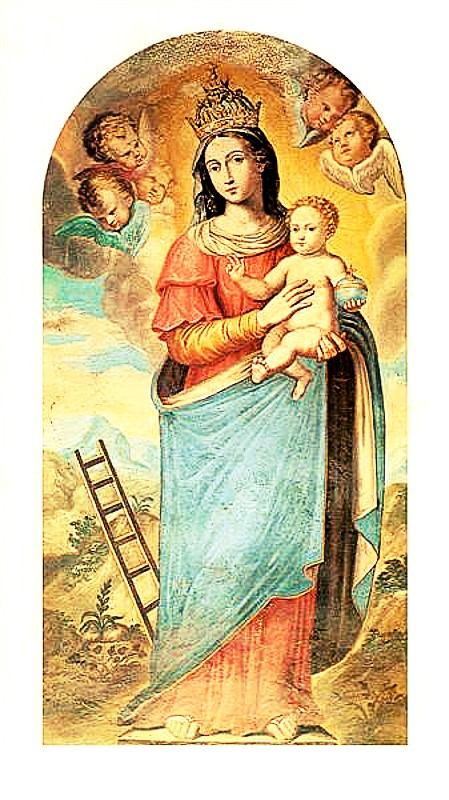
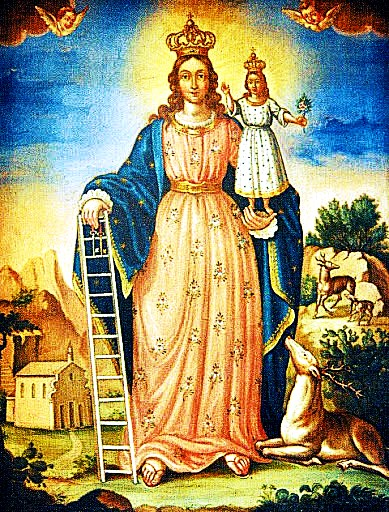
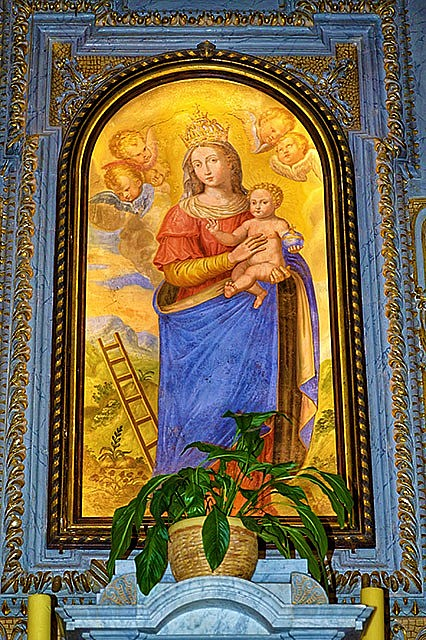
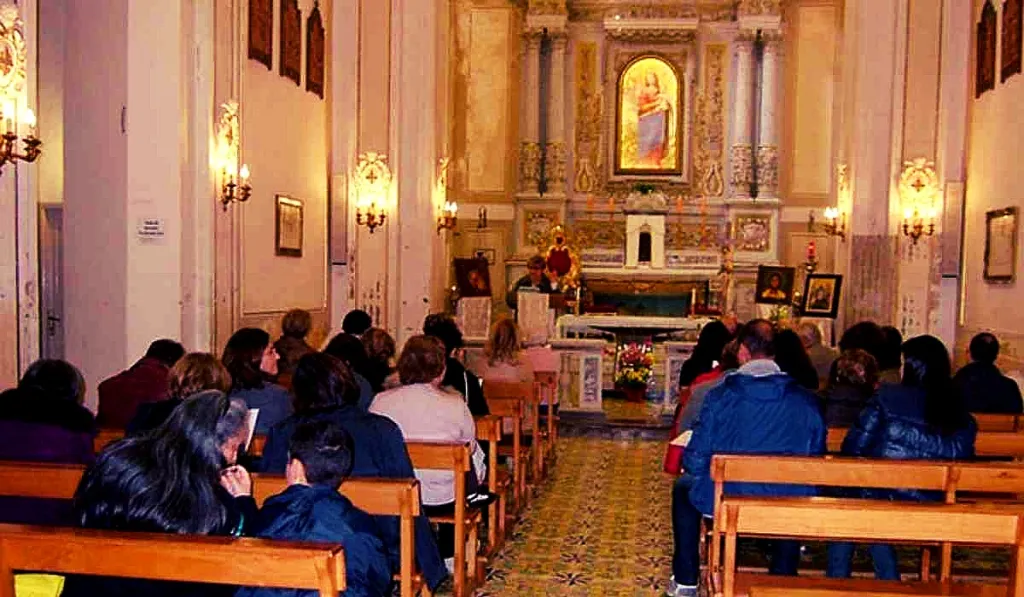
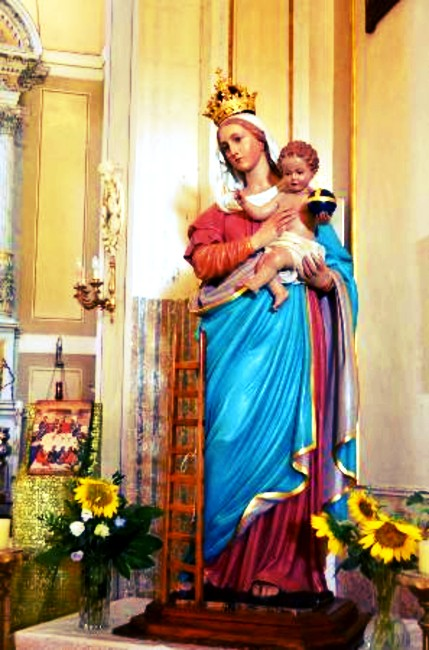
Maria Santissima Scala del Paradiso / Holy Mary, Ladder to Paradise, Noto, Siracusa, Sicily, Italy (1498) – 3 August:
Local tradition holds that Angels frescoed the image of the Madonna, Ladder to Paradise, on a rock wall in the countryside before St. Corrado di Fuori’s arrival in 1340 and, that it was discovered there on 3 August 1498. However, the Diocese of Noto, of which the Madonna della Scala is the Patron, suggests that an unknown artist created the fresco in the late 1500s or early 1600s, a period more in keeping with its style.
In any case, by the time of the earthquake that destroyed the City of Noto on 11 January 1693, popular devotion had grown around the image, surrounding it with votive lamps, ex votos left in thanksgiving for answered prayers, and eventually, an Oratory. The earthquake demolished the chapel but the image remained intact.
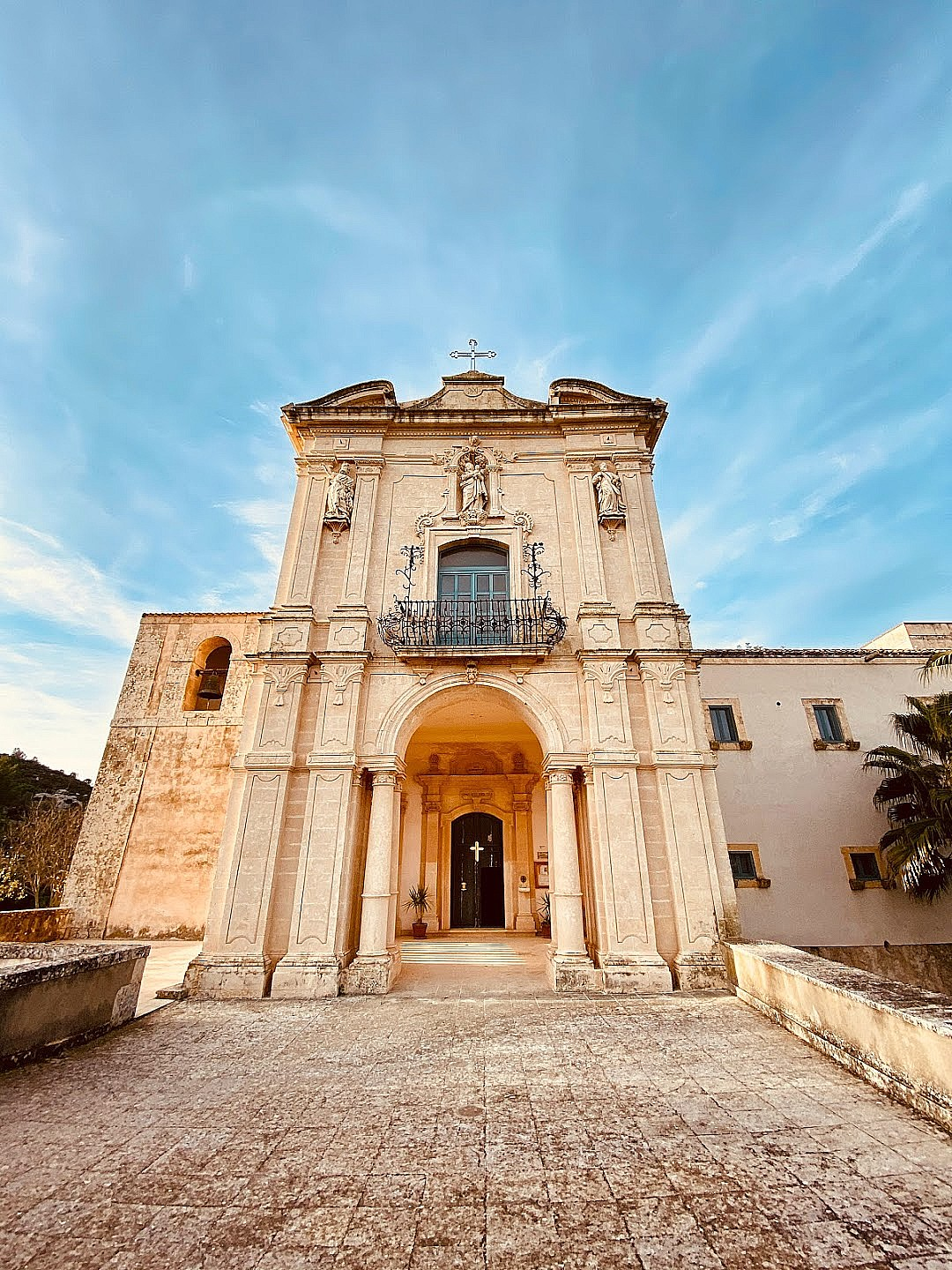
In 1708, a group of Carmelite Hermits took over the site and undertook the building of another church, which was blessed the following year. In 1712, Ven. Girolamo Terzo, recently appointed the group’s Superior, hired an expert to detach the fresco from its rock and arranged its spectacular transfer to the church, pulled by a team of untamed oxen. Ven. Girolamo promoted devotion to the Madonna of the Ladder by distributing copies of the image on evangelical visits throughout the region.
With a reputation for cures and other miracles, the Hermitage became a place of pilgrimage, particularly on the Feast of the Nativity of Mary, 8 September. The Sanctuary suffered damage during World War I.
Afterwards it was restored and in 1919 the Catholic Church gave the Madonna, Ladder to Paradise, her own liturgical feast day, 3 August. An annual festa on this date draws the people of Noto to the Shrine seven miles distant, where after Mass in the Carmelite Chapel a statuary version of the image goes in procession through all the neighbouring districts.
The image of the “Ladder to Paradise” echoes the story of Jacob (Genesis 28:12) and St John Climacus’s Ladder of Ascent, a guide to the spiritual life written in Greek in the 600s, which became popular among Western religious after its translation into Latin in the 1500s (Scala Paradisi). Here, the Virgin is identified with the way to heaven because of her role in bringing Christ to humanity and her ongoing help to all who follow Him.
St Abibas St Aspren (1st Century) Bishop of Naples
Blessed Augustine Gazotich OP (1262-1323) Bishop of Lucera, Croatia, Of the Order of Preachers. He was also noted for being the guide for Dante Alighieri as the poet travelled through Croatia. His reputation for personal holiness remained noted long after his death; this resulted in Pope Innocent XII confirming the late Bishop’s beatification in 1700.
St Dalmatius St Euphronius of Autun St Gamaliel St Gaudentia Bl Godfrey of Le Mans Bl Gregory of Nonantula St Hermellus St Nicodemus St Senach of Clonard (Died 6th Century) One of the Twelve Apostles of Ireland St Trea of Ardtree
Martyred in the Spanish Civil War: Biandrés Avelino Gutiérrez Moral Bl Antonio Isidoro Arrué Peiró Bl Eleuterio Mancho López Bl Geronimo Limón Márquez Bl Patricio Beobide Cendoya The Story of these around 10000 Martyrs of Spain:
Our Morning Offering –3 August – “Month of the Immaculate Heart of Mary”
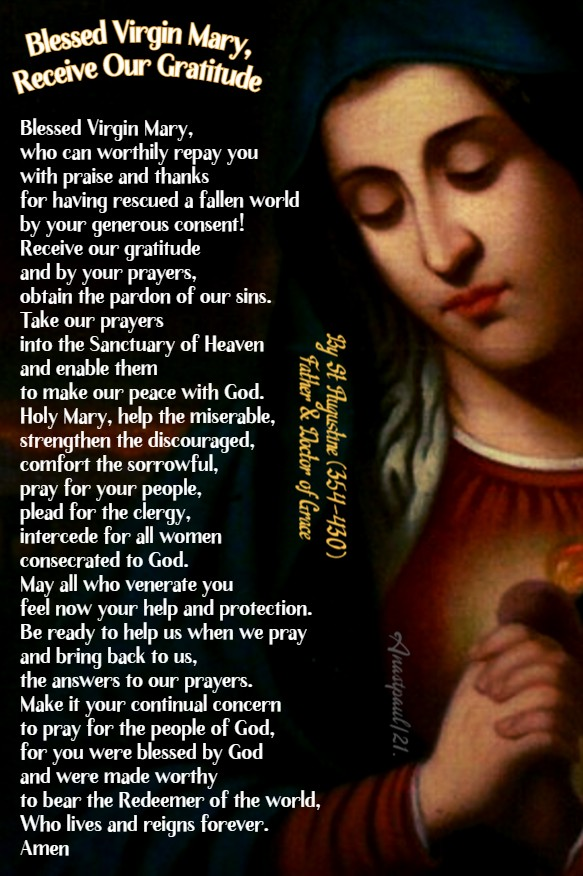
Blessed Virgin Mary, Receive Our Gratitude By St Augustine (354-430) Father & Doctor of Grace
Blessed Virgin Mary, who can worthily repay you with praise and thanks for having rescued a fallen world by your generous consent! Receive our gratitude and by your prayers, obtain the pardon of our sins. Take our prayers into the Sanctuary of Heaven and enable them to make our peace with God. Holy Mary, help the miserable, strengthen the discouraged, comfort the sorrowful, pray for your people, plead for the clergy, intercede for all women consecrated to God. May all who venerate you feel now your help and protection. Be ready to help us when we pray and bring back to us, the answers to our prayers. Make it your continual concern to pray for the people of God, for you were blessed by God and were made worthy to bear the Redeemer of the world, Who lives and reigns forever. Amen
One Minute Reflection – 3 August – “Month of the Immaculate Heart of Mary” – Readings: Ps 54:17-20; 54:23, Ps 54:2-3, 1 Cor. 12:2-11, Luke 18:9-14
At that time, Jesus spoke this parable to some who trusted in themselves as being just and despised others.
Luke 18:9-14
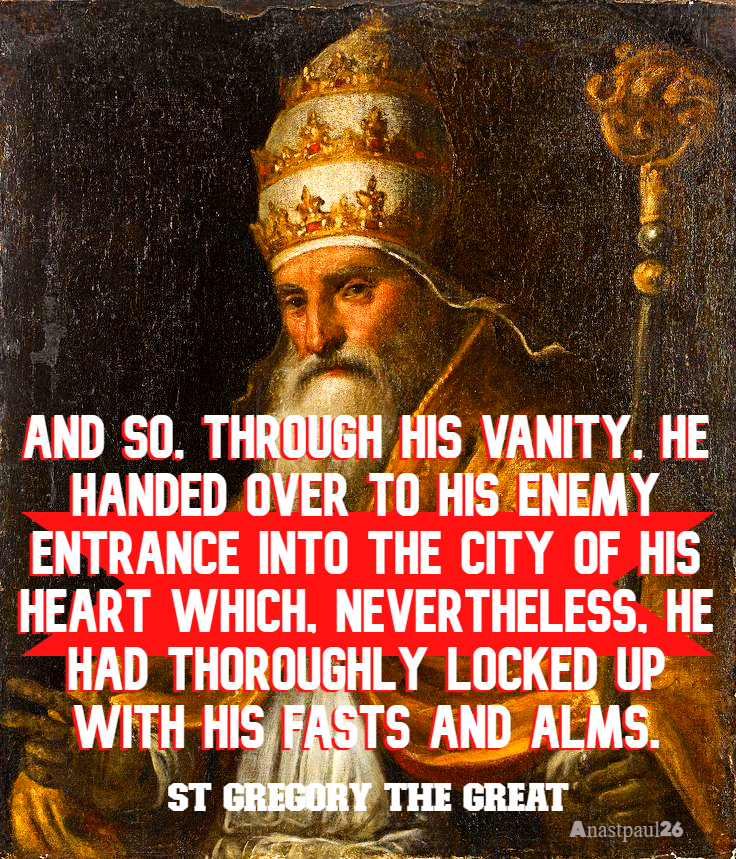
REFLECTION – With what precaution the Pharisee, who went up to the Temple to pray and who had fortified the citadel of his soul, claimed to fast twice a week and give the tenth of all he earned. When he said: “My God, I thank you,” it is very clear he had brought along every imaginable precaution with which to defend himself. However, he leaves one place open and exposed to the enemy by adding: “Because I am not like this publican here”. And so, through his vanity, he handed over to his enemy entrance into the city of his heart which, nevertheless, he had thoroughly locked up with his fasts and alms.
All other precautions are useless, then, when there remains in us some opening by which the enemy might enter. That Pharisee had conquered gluttony with abstinence; he had overcome avarice with generosity. But how much work for the sake of this victory had been made useless by a single vice? by the breach of a single sin?
This is why we ought not simply to think about doing good but watch carefully over our thoughts to keep them pure in our good deeds.For if they are a source of vanity or pride in our hearts then we are only fighting for a glory that is vain, not for that of our Creator.
Saint Gregory the Great (Moralia 76)
PRAYER – Lord our God, the Light and Creator of Light, grant that faithfully pondering on all that is holy, we may ever live in the splendour of Your presence. May we live in Your Presence, withstand the winds of the world and grow daily in faith. By the help and intercession of athe loving and Immaculate Heart of Mary You may never permit us to separate ourselves from You and thus we may come, to completion in You, Through Jesus Christ with the Holy Spirit, one God forever, amen.
When I call upon the Lord, He heard my voice, from those who war against me; and He humbled them, Who is before all ages, and remains forever: cast your care upon the Lord, and He will support you.
Ps 54:17-20; 54:23
I saw an Angel come down from Heaven, having great power ; and the earth was enlightened with his glory. And he cried out with a strong voice, saying: Babylon the Great is fallen, is fallen: and is become the habitation of devils. For her sins have reached unto Heaven, and the Lord hath remembered her iniquities. Render to her as she also hath rendered to you, and double unto her according to her works. As much as she hath glorified herself, and lived in delicacies, so much torment and sorrow give ye to her. Rejoice over her, thou Heaven, and ye holy apostles and prophets, for God hath judged your judgment on her.
The Apocalypse of St John
And it came to pass at midnight, the Lord slew every firstborn in the land of Egypt, from the firstborn of Pharaoh, who sat on his throne, unto the firstborn of the captive woman that was in the prison, and all the firstborn of cattle. And Pharaoh arose in the night, and all his servants, and all Egypt: for there was not a house wherein there lay not one dead.
Exodus 12: 29-30
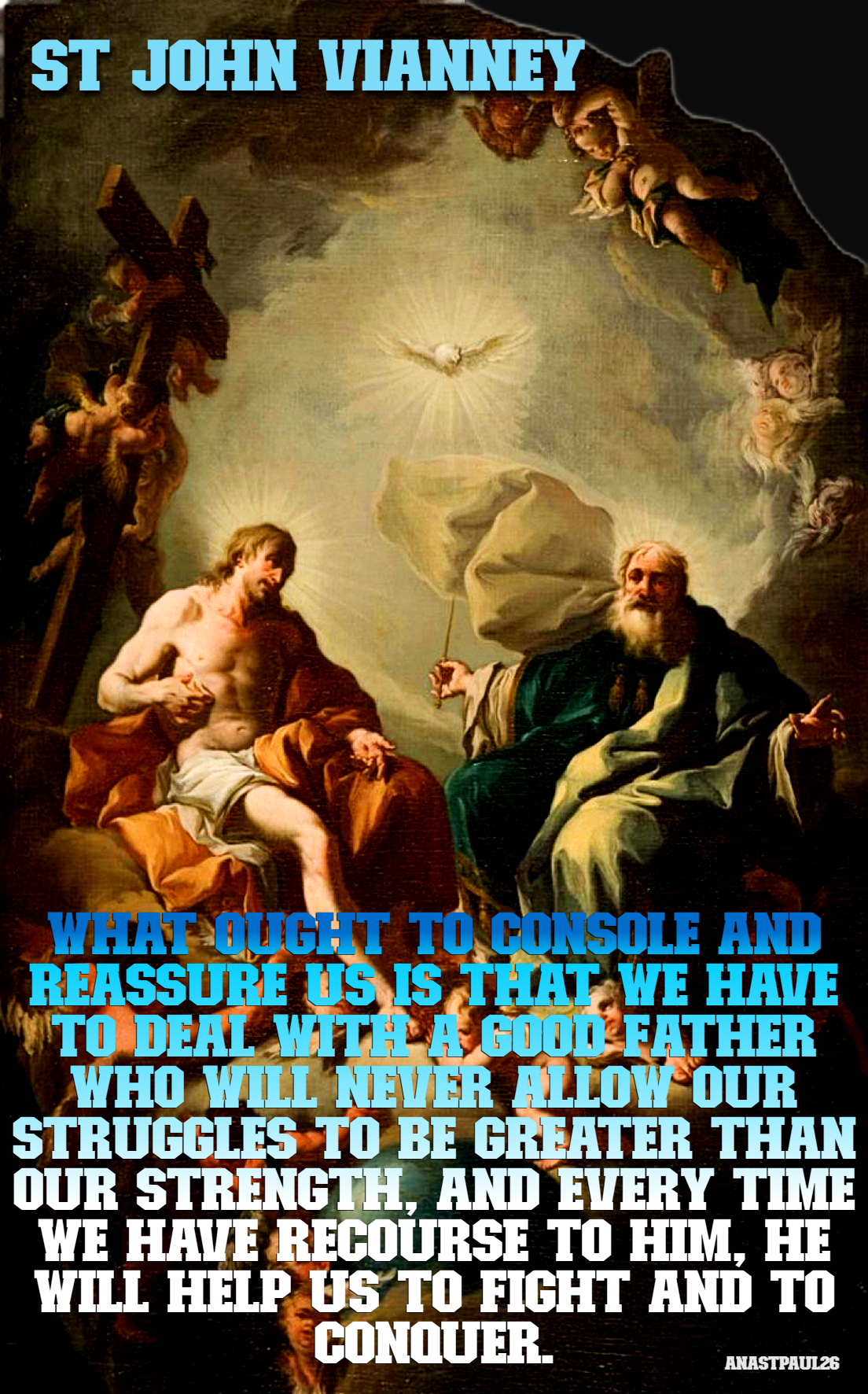
Alas, my dear brethren, some of us do not even know what it is to be tempted because we hardly ever, or very rarely, resist. Which one of us can expect to escape from all these dangers? Which one of us will be saved? Anyone who wanted to reflect upon all these things could hardly go on living, so greatly terrified would he be! However, my dear brethren, what ought to console and reassure us is that we have to deal with a good Father Who will never allow our struggles to be greater than our strength, and every time we have recourse to Him, He will help us to fight and to conquer.
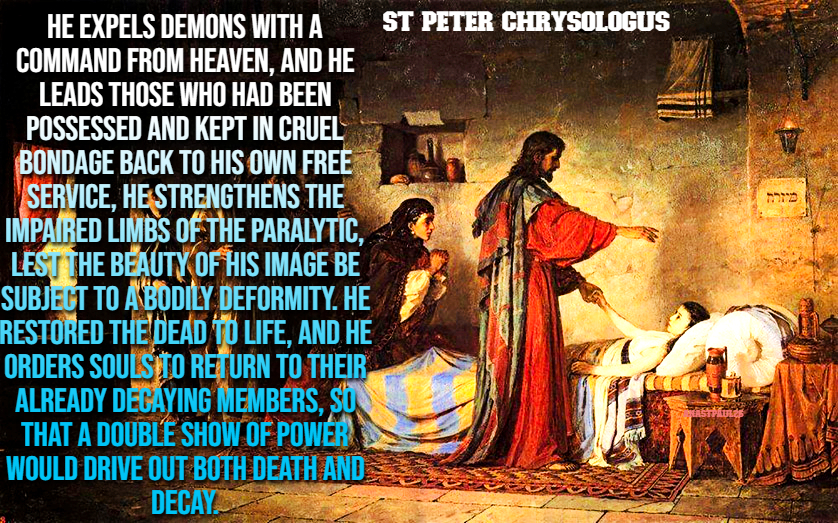
He expels demons with a command from heaven, and he leads those who had been possessed and kept in cruel bondage back to his own free service, he strengthens the impaired limbs of the paralytic, lest the beauty of his image be subject to a bodily deformity. He restored the dead to life, and he orders souls to return to their already decaying members, so that a double show of power would drive out both death and decay.
St Peter Chrysologus
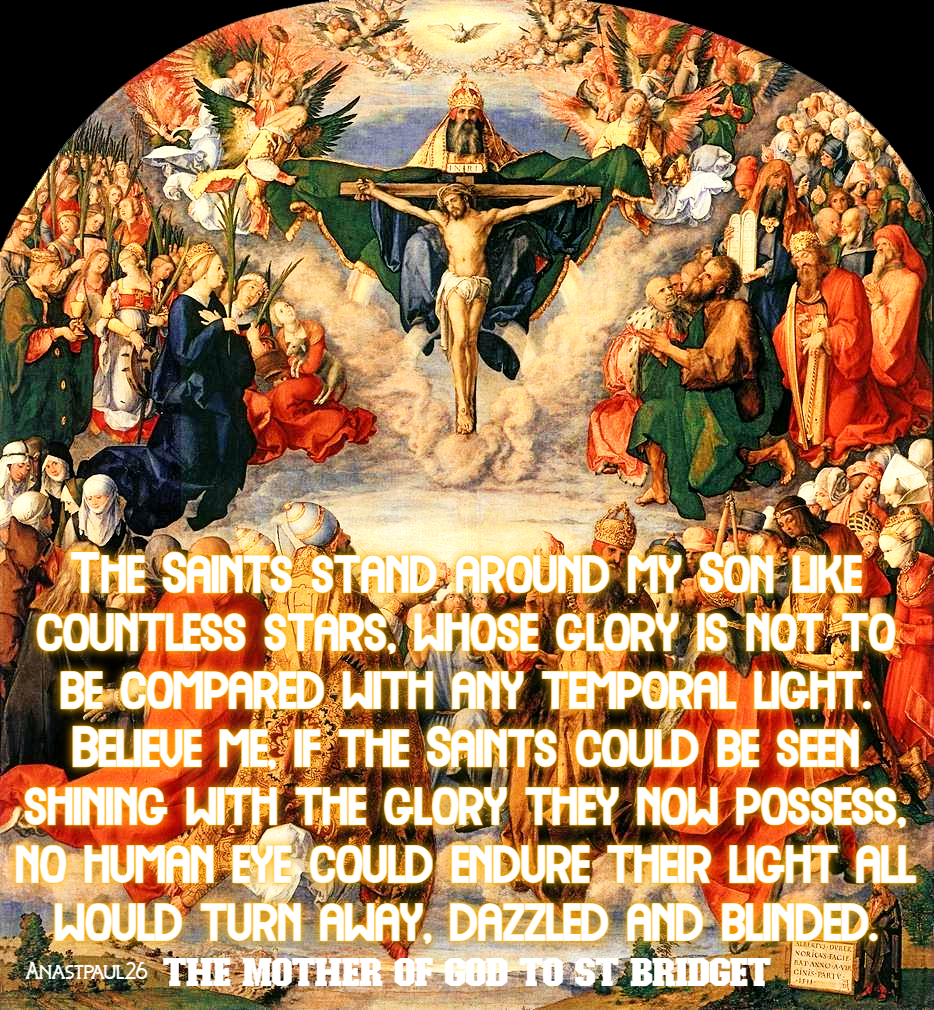
The Saints stand around my Son like countless stars, whose glory is not to be compared with any temporal light. Believe me, if the Saints could be seen shining with the glory they now possess, no human eye could endure their light all would turn away, dazzled and blinded.
Just as everything in Our Lord Jesus Christ is great and admirable, so also everything that concerns Mary, His holy Mother, is replete with grandeur and marvels. Every part of the sacred humanity of the Son of God is deified and raised to an infinite dignity through its union with the Divinity; so likewise everything in the Blessed Virgin Mary is ennobled and sanctified by her divine maternity. There is no part of the sacred body of the God-Man that is not worthy of the eternal admiration of angels and men, and there is nothing in the virginal body of the Mother of God that is unworthy of the eternal praise of all creatures.
There are five marvellous prerogatives of the corporeal heart of Mary which render it forever worthy to receive the veneration of men and angels.
The first prerogative consists in the fact that the heart is the principle of the life of our holy Mother. It is the principle of all the functions of her bodily, material life, ever holy in itself and in its every function and employment. It is the source of the life of the Mother of God, the life of her who gave birth to the only Son of God, the life of the woman through whom God gave life to all the children of Adam, sunk as they were in the abyss of eternal death. Finally, her heart is the source of a life so holy, so noble, so sublime that it is more precious in the sight of God than the lives of all the angels and men.
The second prerogative of the corporeal heart of Mary is that it produced the virginal blood with which the sacred body of the God-Man was formed in the chaste womb of His blessed Mother.
The third prerogative of Mary’s heart of flesh is that it was the source of the human, material life of the Infant Jesus during the nine months that He dwelt in Mary’s sacred womb. While the infant is in its mother’s bosom, the mother’s heart is to such an extent the source of the infant’s life that both mother and infant can be said to depend upon it for their existence. Mary’s admirable heart was therefore the source of the two most noble and precious lives, at once the source of the holy life of the Mother of God and of her only son, the humanly divine as well as the divinely human life of the God-Man.
The fourth prerogative of the amiable heart of Mary to Jesus, who is her Son and her Father, her Brother and her Spouse: “Our bed is flourishing,” that is, our bed is covered and perfumed with flowers. What is this bed? It is the pure heart of the Blessed Virgin where the divine Infant so gently rested?
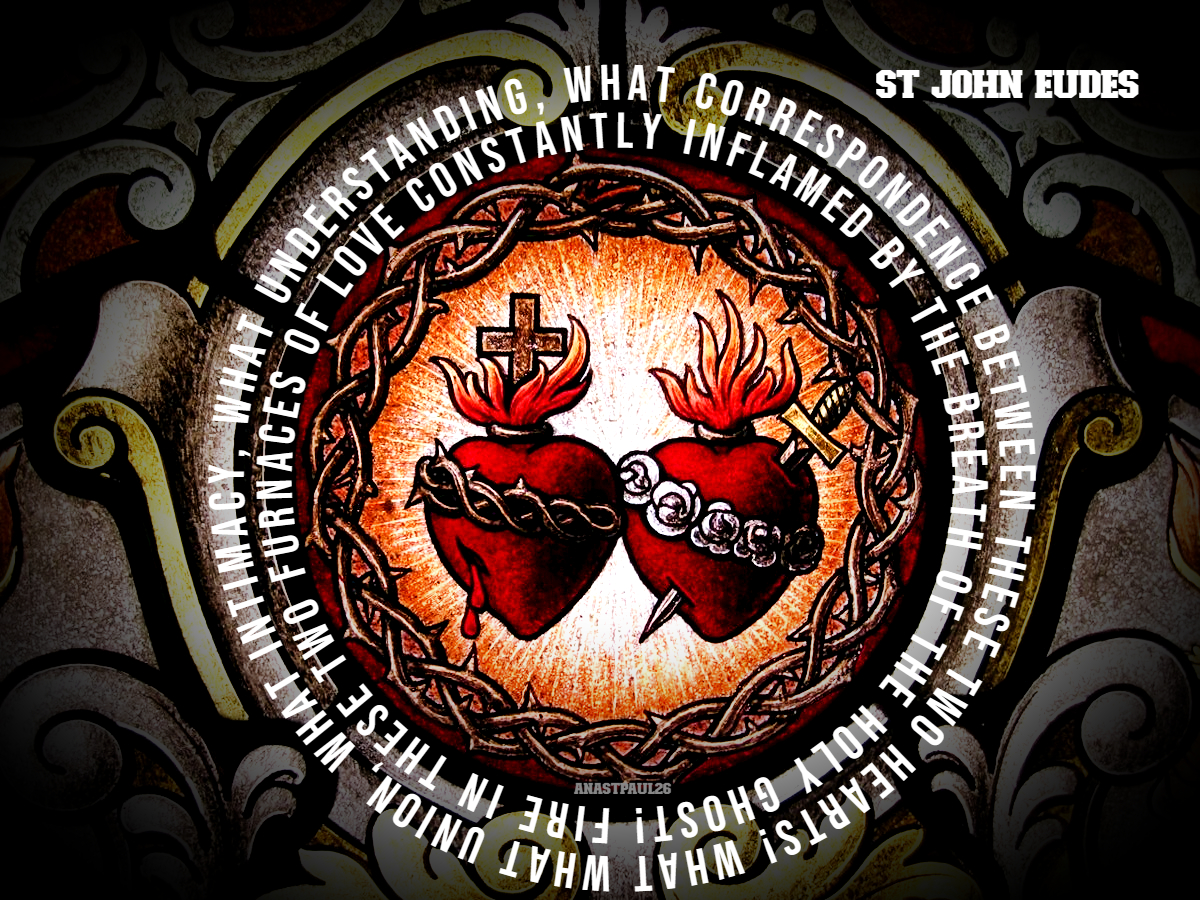
It was a great privilege for St. John, the beloved disciple, to have rested once on the Saviour’s adorable breast, from which he drew such great light and derived the knowledge of so many marvellous secrets. But not only once but many times did our divine Saviour rest on the virginal heart of His dearest Mother.What abundance of lights, of grace and of blessings the Eternal Sun, the very source of light and grace, must have poured into that maternal heart, on which He rested so often! Her heart never interposed the slightest obstacle to divine grace. On the contrary, she was always disposed to welcome every celestial favor. Our Lord loved her heart more than all other hearts put together, and was in turn loved by it more perfectly than by the hearts of all the Seraphim. What union, what intimacy, what understanding, what correspondence between these two Hearts! What fire in these two furnaces of love constantly inflamed by the breath of the Holy Ghost!
And now we come to the fifth prerogative of this holy heart. It is the altar upon which a great and perpetual sacrifice, most agreeable to God, is constantly offered. On it are immolated all the natural passions which reside in the human heart.
We may consider the most pure body of Mary as a sacred temple, indeed as the most august temple that ever was or will be, next to the temple of the sacred humanity of Jesus Christ, her divine Son.
Saint Sidwell, also known as Sidwella, was a virgin saint from Devon, in England. She is the patroness of Exeter and sister of Saint Urith and Saint Juthwara. A Saxon living in Exeter in the 8th century, her father was a wealthy landowner named Benna, who died leaving his daughter in the care of a cruel stepmother, who was jealous of her beauty and virtue and coveted her inheritance.
The girl often left the city to bring food to the villagers working the fields outside the city walls. The Catalogus Sanctorum Pausantium in Anglia says she was beheaded by a couple of corn reapers, hired to do so by her stepmother. They cut off her head with a scythe, and where her head came to rest, water sprang up. A shaft of light shone over the site for three nights. She was buried at St Sidwells. Her ghost was seen carrying her severed head and putting it back on her shoulders at the spot where she was later buried. The spring became the Well of St Sidwell, and was a place of pilgrimage in Anglo-Saxon and Norman England.
The Church of St Sidwell, located just outside the site of Exeter’s east gate, still exists, and one of the main streets in Exeter is Sidwell Street.
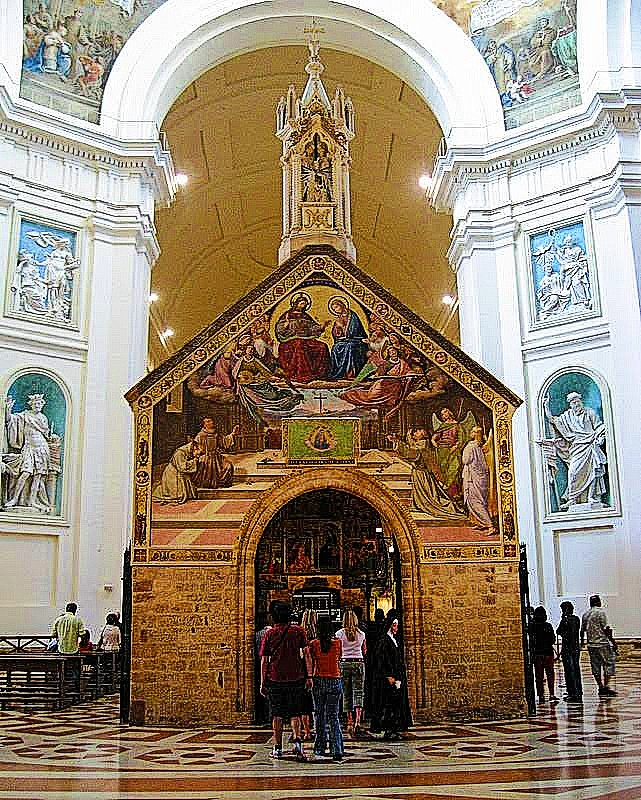
Santa Maria degli Angelis / Our Lady of Angels, Assisi, Italy (13th Century) Feast Day and Portiuncula Indulgence: 2 August
Our Lady of Angels, or of the Portiuncula, is located on the outskirts of the City of Assisi, in Italy. It was a desolate locality and apparently an unsettled one where robbers and the lawlessness flourished, for the Benedictines who had lived at the Monastery felt it was too hazardous to remain there. They abandoned the Monastery, relocating to Mount Subasio, which was a fortified Monastery.
The original chapel is thought to date from the 4th Century and was built by holy hermits who had come from the Valley of Josaphat. It is said that they brought relics of the Blessed Virgin with them to the region when they constructed the chapel.
The history of the feast is inspiring. St Francis of Assisi, in the early days of his conversion, while he was still uncertain as to what path to pursue, was praying earnestly for enlightenment before the Crucifix at the Church of San Damiano, when he heard within himself the command of the Crucified: “Build up my house, for it is nearly falling down.” Taking the words literally, Francis began to restore San Damiano and other dilapidated Churches in and near Assisi. The most famous of these was the Church of Our Lady of the Angels.
Some time after the restoration of this little chapel, an angel told St Francis to come to the church of Our Lady of Angels, or Portiuncula. There he found Our Lord, His Blessed Mother and the Angels waiting for him. Our Lord commended Francis because of his zeal for the salvation of souls and promised to grant him whatever he should ask on behalf of sinners. St Francis asked for this great favour – that all those who came to this church to pray and, truly sorry for their sins, confessed them, should “Obtain in perpetuity a Plenary Indulgence” so that they would have nothing to account for when God called them. This was the great favour he asked, but Our Lord granted it to him through Mary.
When Saint Francis came upon the little, run down and abandoned chapel of Our Lady of Angels, or Santa Maria degli Angelis, in the year 1208, it was almost completely hidden in shrubs and bush. Saint Francis entered the hidden church, which measured only (7 x 4 metres) twenty-two feet by thirteen feet and saw the ancient fresco that had been placed above the main Altar. It was an image of the Assumption of the Blessed Virgin surrounded by Angels. Some say that this is why the chapel was named Our Lady of Angels, although there are also legends that Angels could often be heard singing there.
The place took its name, the Little Portion, or Portiuncula in the native Italian, from the small section of fertile land that was gifted to the Monks to work for their support. It is said that this was the place where Saint Francis first understood his vocation, received visions and was also where the saint desired to live. The Benedictines had lived at that location for hundreds of years but the Benedictine Monks gave this Chapel to Saint Francis upon his request. It was certainly here that the Franciscan Order was founded.
At first Saint Francis wished the convent which he built there to be the principal one of his Order. He assembled the first General Chapter there, where there were five thousand religious. It was also where he yielded up his spirit on 3 October 1226, the twentieth of his conversion and the forty-fourth of his age. The cell in which the poor man of Assisi died can still be seen where it rests against one of the columns of the cupola under the choir bay.
The Roman Martyrology states of St Alphonsus today: “At Nocera-de-Pagani, Saint Alphonsus Maria de Liguori, Bishop of St Agatha of the Goths and Founder of the Congregation of the Most Holy Redeemer (the Redemptorists), distinguished by his zeal for the salvation of souls, by his writings, his preaching and his example.
He was inscribed on the Calendar of the Saints by Pope Gregory XVI in the year 1839, the 52nd after his happy death and , in 1871, was declared Doctor of the Universal Church by Pius IX, according to a decree of the Sacred Congregation of Rites.“
St Eusebius of Vercelli (c 283-371) Bishop (Optional Memorial) Bishop, Confessor, Founder of monasticism in his region of Italy.
St Peter Julian Eymard SSS (1811-1868) – “Apostle of the Eucharist”Priest, Founder of two religious institutes, Congregation of the Blessed Sacrament Fathers and Brothers and the Servants of the Blessed Sacrament.
St Auspicius of Apt St Betharius of Chartres St Centolla of Burgos St Etheldritha of Croyland Bl Frederic Campisani Bl Giustino Maria Russolillo Bl Gundekar of Eichstätt Bl Joanna of Aza Bl John of Rieti St Maximus of Padua St Pedro de Osma
St Peter Faber SJ (1506-1546) the “Second Jesuit” – as co-Founder with St Ignatius. He was the first Priest and theologian of the Order.
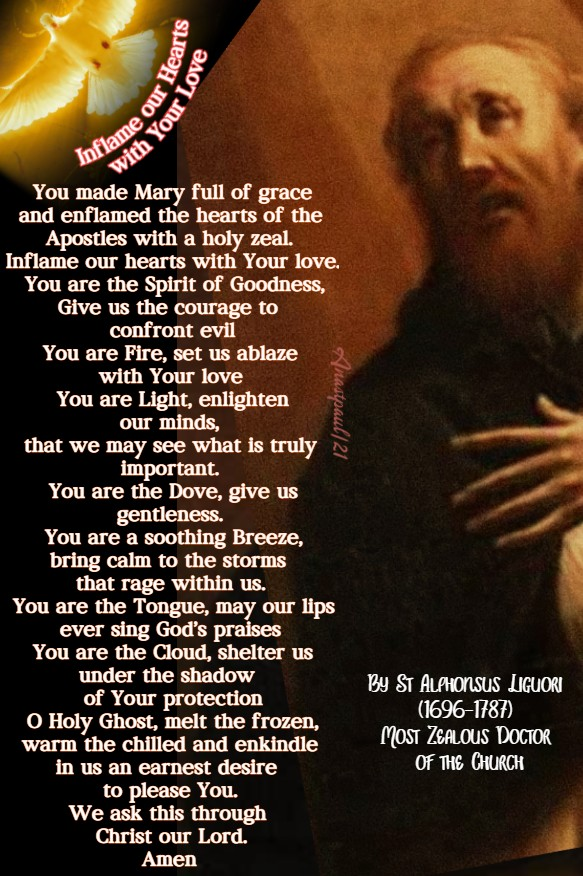
Our Morning Offering – 2 August – The Memorial of St Alphonsus Maria de Liguori (1696-1787) Most Zealous Doctor of the Church and a Catholic Monday of the Holy Ghost
Inflame our Hearts with Your Love Prayer To the Holy Ghost By St Alphonsus Maria de Liguori (1696-1787) Most Zealous Doctor of the Church
You made Mary full of grace and enflamed the hearts of the Apostles with a holy zeal. Inflame our hearts with Your love. You are the Spirit of Goodness, Give us the courage to confront evil You are Fire, set us ablaze with Your love You are Light, enlighten our minds, that we may see what is truly important. You are the Dove, give us gentleness. You are a soothing Breeze, bring calm to the storms that rage within us. You are the Tongue, may our lips ever sing God’s praises You are the Cloud, shelter us under the shadow of Your protection O Holy Ghost, melt the frozen, warm the chilled and enkindle in us an earnest desire to please You. We ask this through Christ our Lord. Amen
One Minute Reflection – 2 August – “Month of the Immaculate Heart of Mary” – Readings: Ps 54:17-20; 54:23, Ps 54:2-3, 1 Cor. 12:2-11, Luke 18:9-14
I tell you, this man went back to his home justified rather than the other; for everyone who exalts himself shall be humbled, and he who humbles himself shall be exalted.
Luke 18:9-14
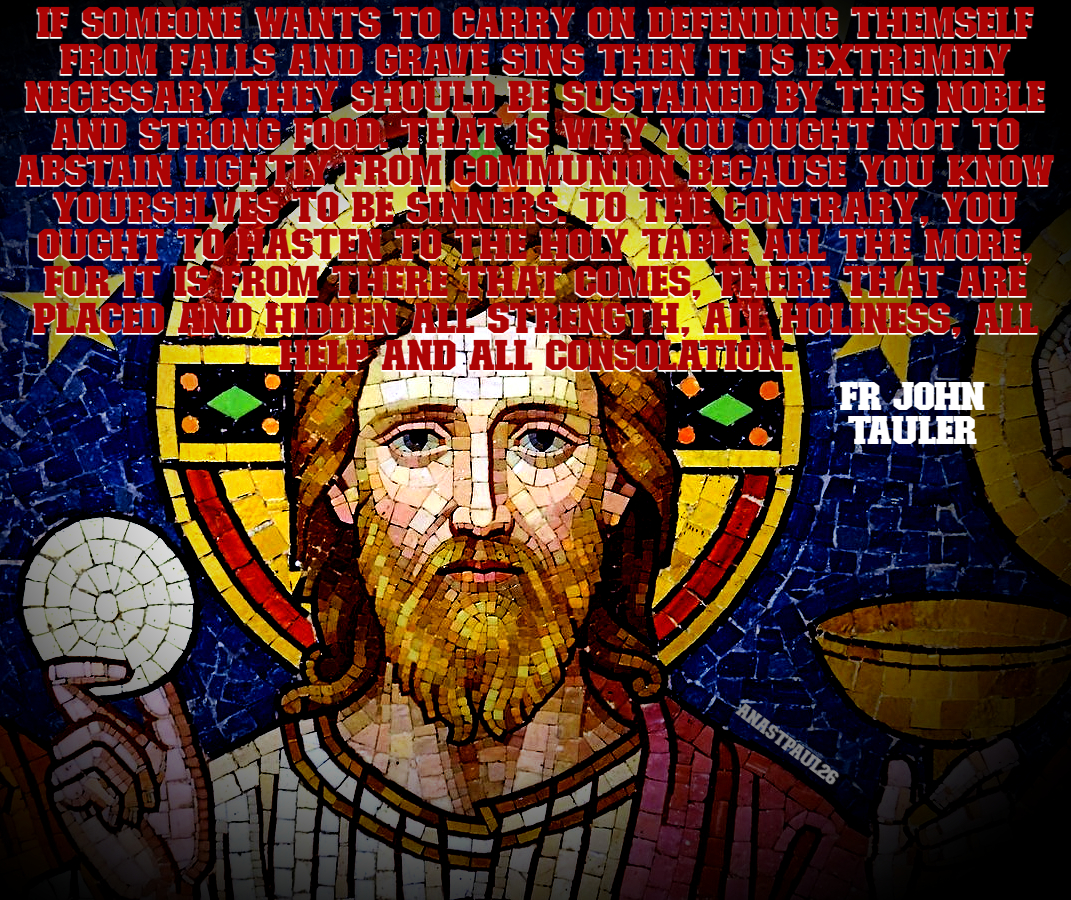
REFLECTION – Dear Sisters, be assured of this, truly, if I were to find someone who really possessed the publican’s feelings, who genuinely took themself for a sinner, so long as that person had a desire to be good while in this feeling of humility. I would give the body of our Lord to them every other day with a good conscience! If someone wants to carry on defending themself from falls and grave sins then it is extremely necessary they should be sustained by this noble and strong food. That is why you ought not to abstain lightly from communion because you know yourselves to be sinners. To the contrary, you ought to hasten to the holy table all the more, for it is from there that comes, there that are placed and hidden all strength, all holiness, all help and all consolation.
But you are not to judge those who don’t do this either… You should bear no judgment so as not to become like the Pharisee who glorified himself and condemned the man standing behind him. Watch yourselves against that as from the loss of your souls; watch yourselves against the dangerous sin of condemnation.
When someone reaches the heights of all perfection nothing has ever been more necessary to them than to plunge into the lowest depths and penetrate to to the roots of humility. This was why the publican, having acknowledged the ultimate depths of his lowliness to the point of not daring any more to raise his eyes to heaven, was raised up on high since “he went back to his house justified”.
Father John Tauler (1300-1361)
PRAYER – Forgive the sins of Your people Lord and since of ourselves, we are unable to do what pleases You, lead us on the way of salvation in Your divine Son who lives in us and gives us life. May the prayers of the Immaculate Heart of Mary, and most zealous Saint Alphonsus Liguori, help us to constantly meditate on Your eternal sustenance. Through, our Lord Jesus Christ, who lives and reigns with You and the Holy Spirit, God forever and ever, amen.
Quote/s of the Day – 2 August – The Memorial of St Alphonsus Maria de Liguori (1696-1787) Most Zealous Doctor of the Church
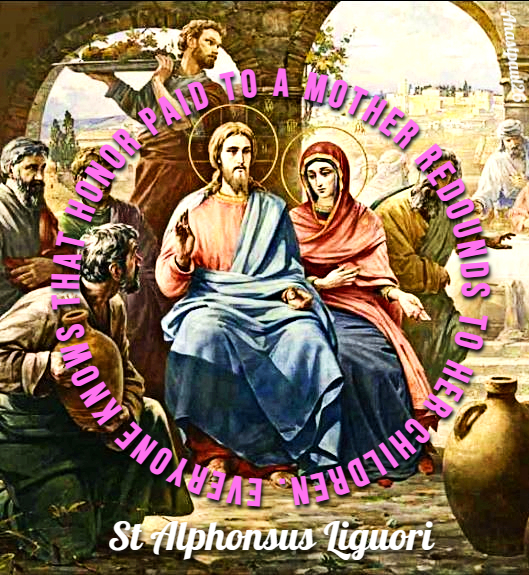
Everyone knows that honor paid to a mother redounds to her children. Hence St. Bernard says, let not any one think that by greatly praising the mother he will throw into the shade the glories of the Son; for the more he honors the mother, so much more he honors the Son. And there is no doubt that on account of the merits of Jesus, the great privilege has been granted to Mary to be the mediatrix of our salvation; not, indeed, mediatrix of justice, but of grace and intercession.
How great then should be our confidence in this queen, knowing how powerful she is with God, and at the same time how rich and full of mercy; so much so that there is no one on earth who does not share in the mercies and favors of Mary!
Let us always have recourse to this most sweet queen, if we would be sure of our salvation; and if the sight of our sins terrifies and disheartens us, Let us remember that Mary was made queen of mercy for this very end, that she might save by her protection the greatest and most abandoned sinners who have recourse to her.
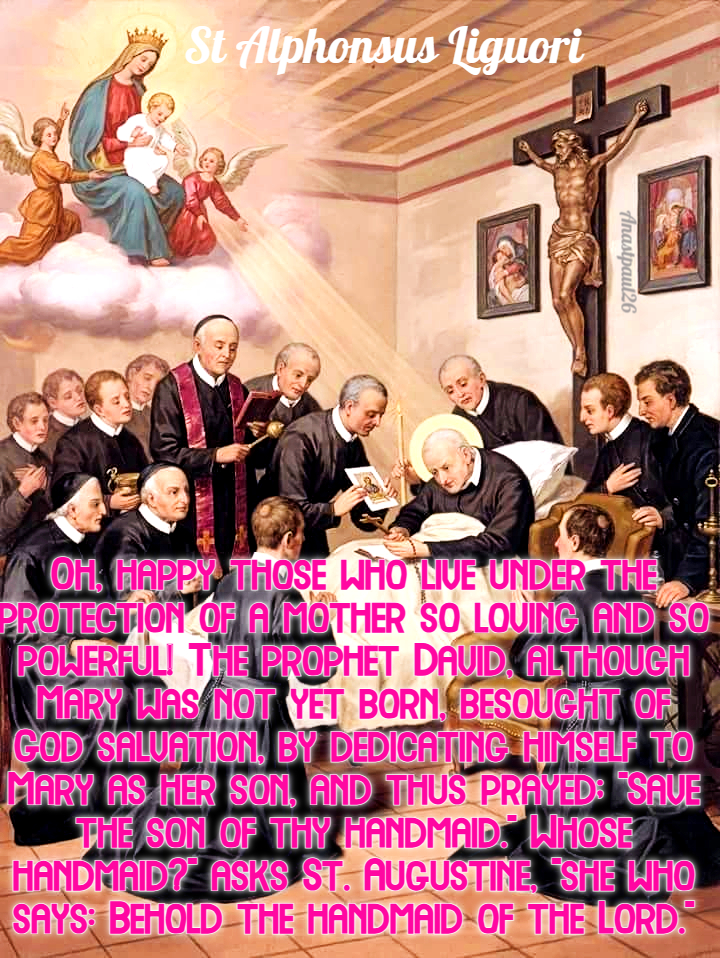
Oh, happy those who live under the protection of a mother so loving and so powerful! The prophet David, although Mary was not yet born, besought of God salvation, by dedicating himself to Mary as her son, and thus prayed; “Save the son of thy handmaid.” Whose handmaid?” asks St. Augustine, “she who says: Behold the handmaid of the Lord.”
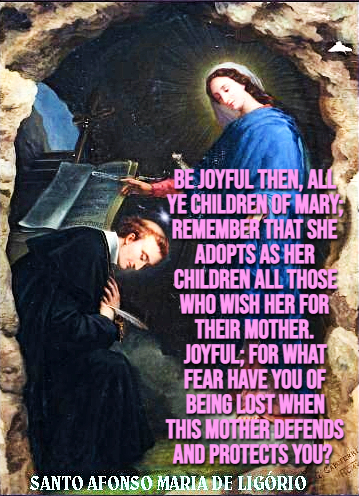
Be joyful then, all ye children of Mary; remember that she adopts as her children all those who wish her for their mother. Joyful; for what fear have you of being lost when this mother defends and protects you?
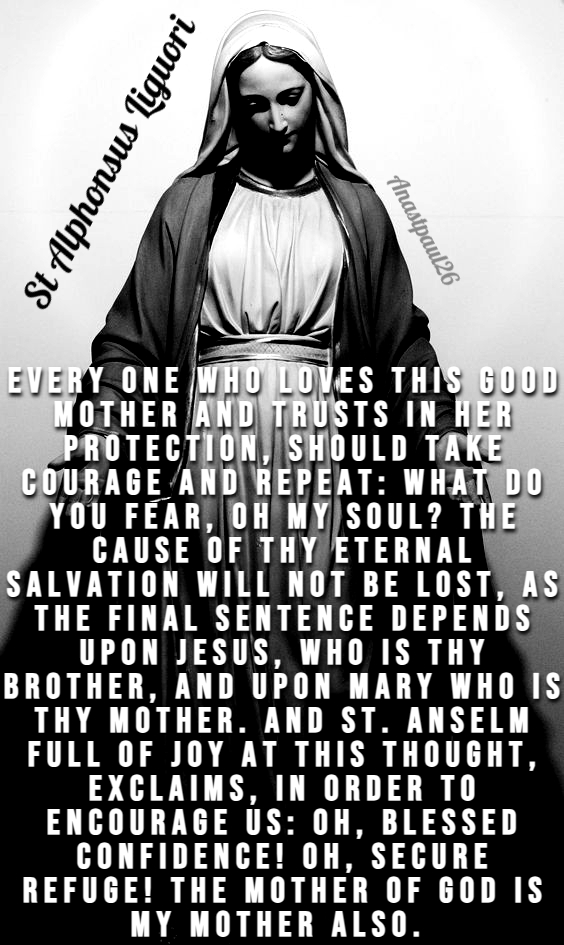
Every one who loves this good mother and trusts in her protection, should take cour age and repeat: What do you fear, oh my soul? The cause of thy eternal salvation will not be lost, as the final sentence depends upon Jesus, who is thy brother, and upon Mary who is thy mother. And St. Anselm full of joy at this thought, exclaims, in order to encourage us: Oh, blessed confidence! Oh, secure refuge! The mother of God is my mother also.
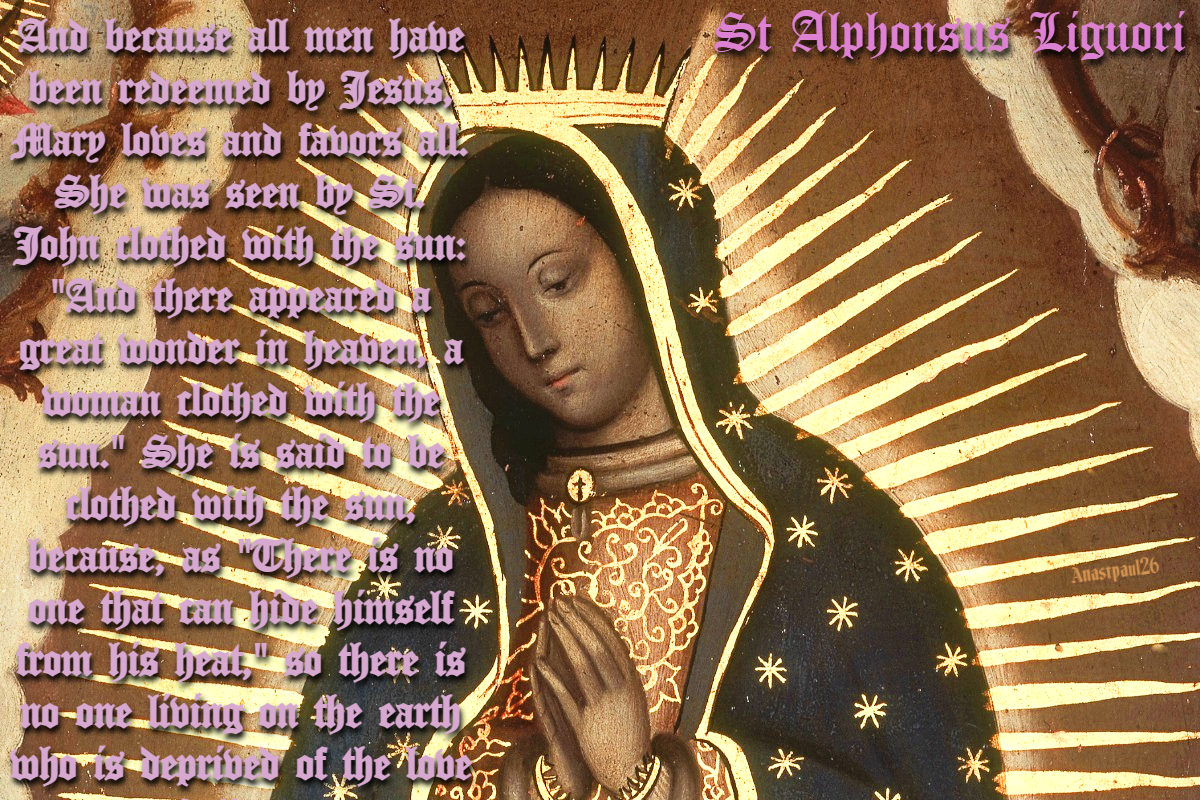
And because all men have been redeemed by Jesus, Mary loves and favors all. She was seen by St. John clothed with the sun: “And there appeared a great wonder in heaven, a woman clothed with the sun.” She is said to be clothed with the sun, because, as “There is no one that can hide himself from his heat,” so there is no one living on the earth who is deprived of the love of Mary.
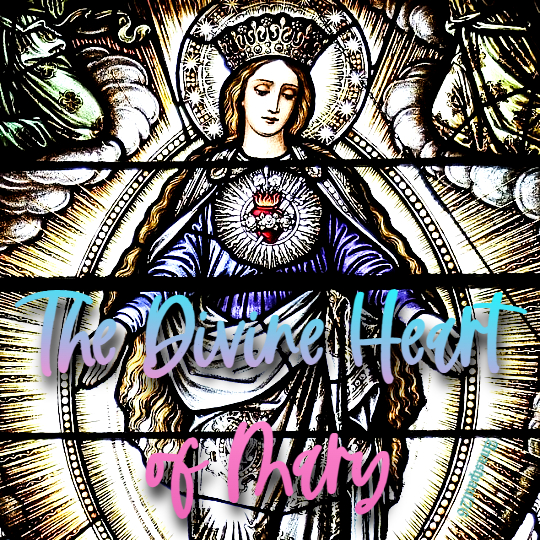
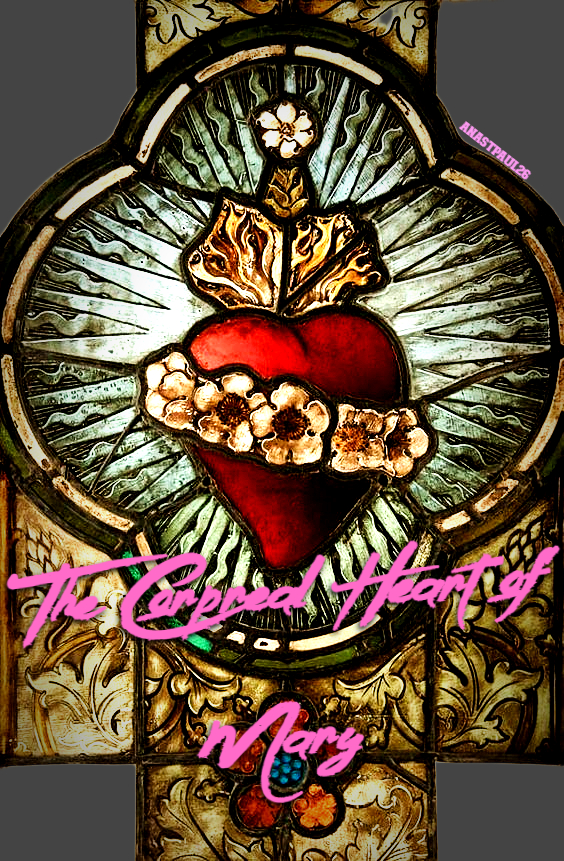
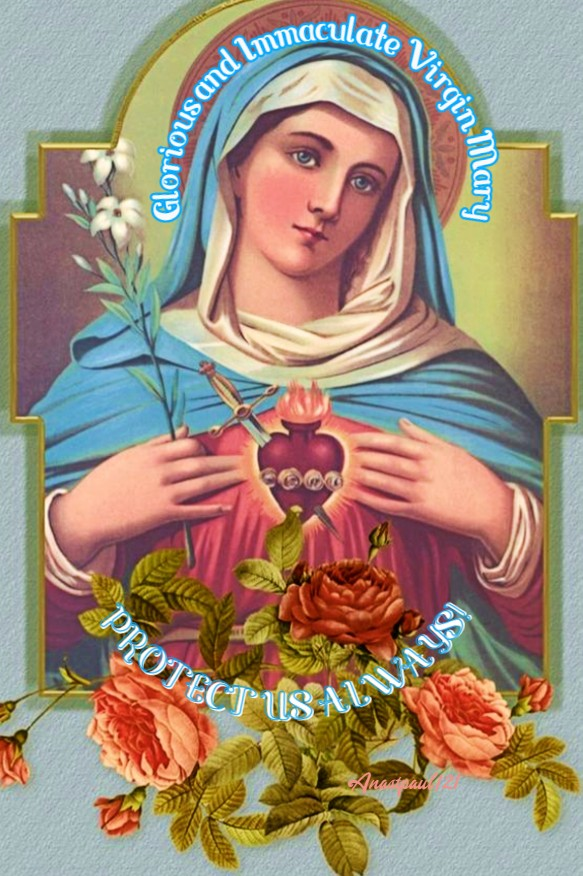
The first heart of Mary, the Mother of God, is the heart of flesh enclosed in her virginal breast. Although this heart is corporeal, it is nevertheless completely spiritualized by the spirit of grace and the spirit of God which fills it.
The second heart is her spiritual heart, made God-like, not indeed by the hypostatic union as in the Incarnate Word, but by a superlative participation in the divine perfections, as we shall see in the following pages. This heart is referred to by the words of the Holy Ghost: “All the glory of the king’s daughter is within,”
The third heart of Mary is divine and is truly God Himself, for it is none other than the love of God. This is the heart of which she says: “I sleep, and my heart watcheth,” which means according to the interpretation of several holy Doctors: “While I grant necessary rest to my body, my Son Jesus, who is my Heart and whom I love like my own heart, is always watching over me and for me.”
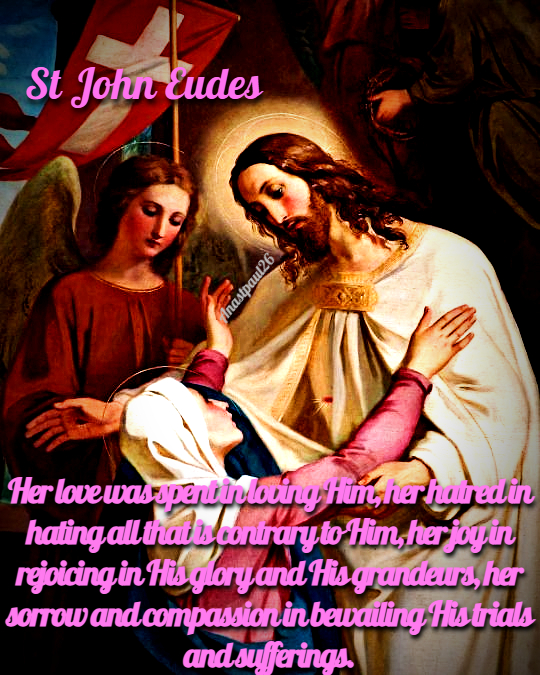
These three hearts of the Mother of God constitute a single Heart, through the holiest and most intimate union that ever was and will be, next to the hypostatic union. Of these three hearts, or rather, of this single Heart, the Holy Ghost has said twice: “Mary kept all these words, pondering them in her heart.” Our Lady cherished the mysteries and marvels of her Son’s life, first of all, in her material and corporeal heart, the principle of life, the seat of love and of the other physical emotions. All the movements, every beat of this virginal heart, the material functions that it accomplished and the emotions that swayed it, existed solely for Jesus and for the things that concerned Him. Her love was spent in loving Him, her hatred in hating all that is contrary to Him, her joy in rejoicing in His glory and His grandeurs, her sorrow and compassion in bewailing His trials and sufferings. The same may be said of every emotion of her bodily heart.
Secondly, Mary kept all these things in her spiritual heart, that is, in the noblest part of her soul, in the inmost recesses of her mind, All the faculties of her soul were constantly applied to contemplating and adoring everything that took place in the life of her Beloved Son, down to the very smallest details. Thirdly, Our Lady kept all these things in her divine Heart, that is, in her Son Jesus, who was the mind of her mind and the heart of her heart. He in turn kept them for her and recalled them to her mind when necessary, that she might feed herself in contemplation upon the mysteries of His life, rendering them due honor and adoration, and repeating them to the holy apostles and disciples, who were to preach them to the faithful.
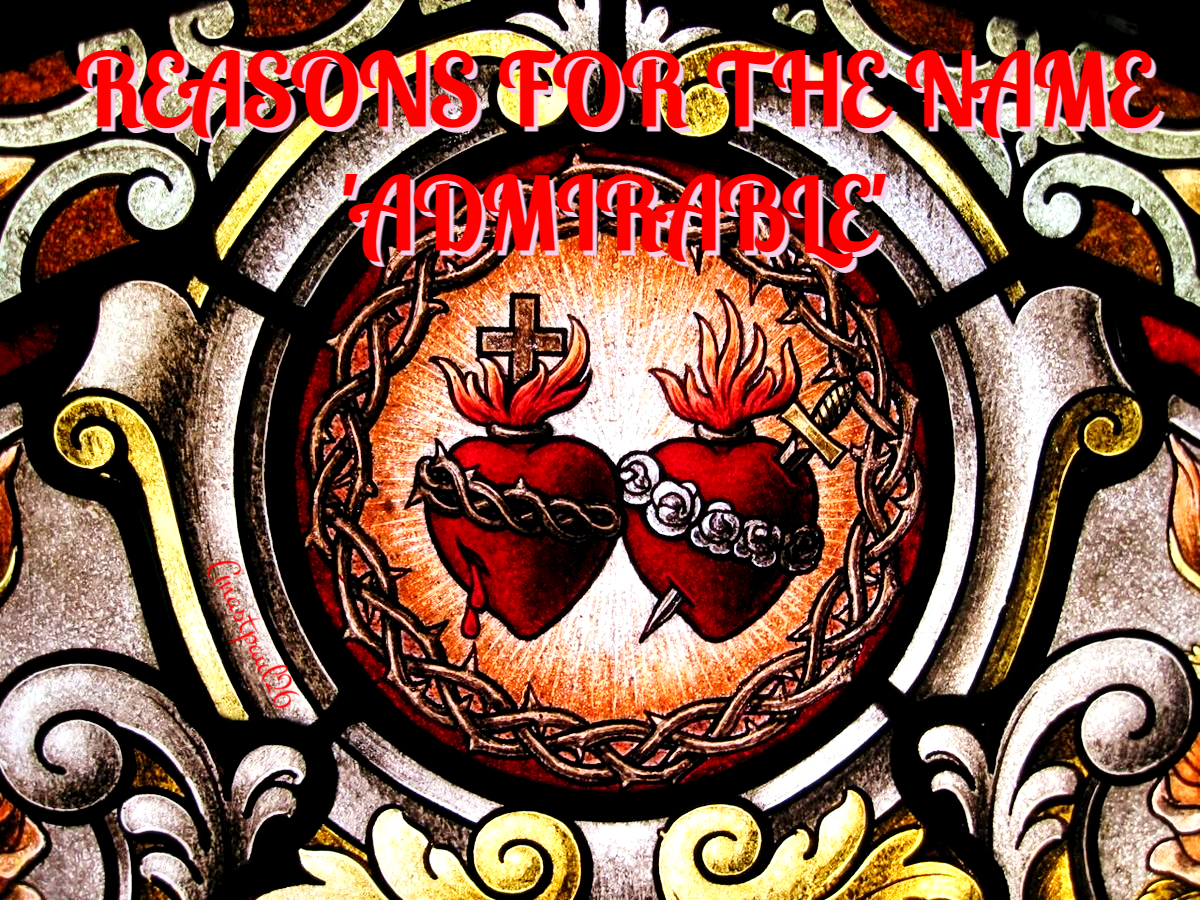
This then is what is meant by the admirable Heart of the beloved Mother of God.
Portiuncula Indulgence: An Indulgence which may be gained in any Church so designated by the Bishop, by all the faithful who, after Confession and Holy Communion, visit such Churches between noon of 1 August and midnight of 2 August, or on the Sunday following. The Indulgence is toties quoties and is applicable to the souls in Purgatory.
Nuestra Señora de las Mercedes / Our Lady of Mercy, Barcelona, Spain (1218,) Founding of the Mercedarian Order – 1 August, 24 September :
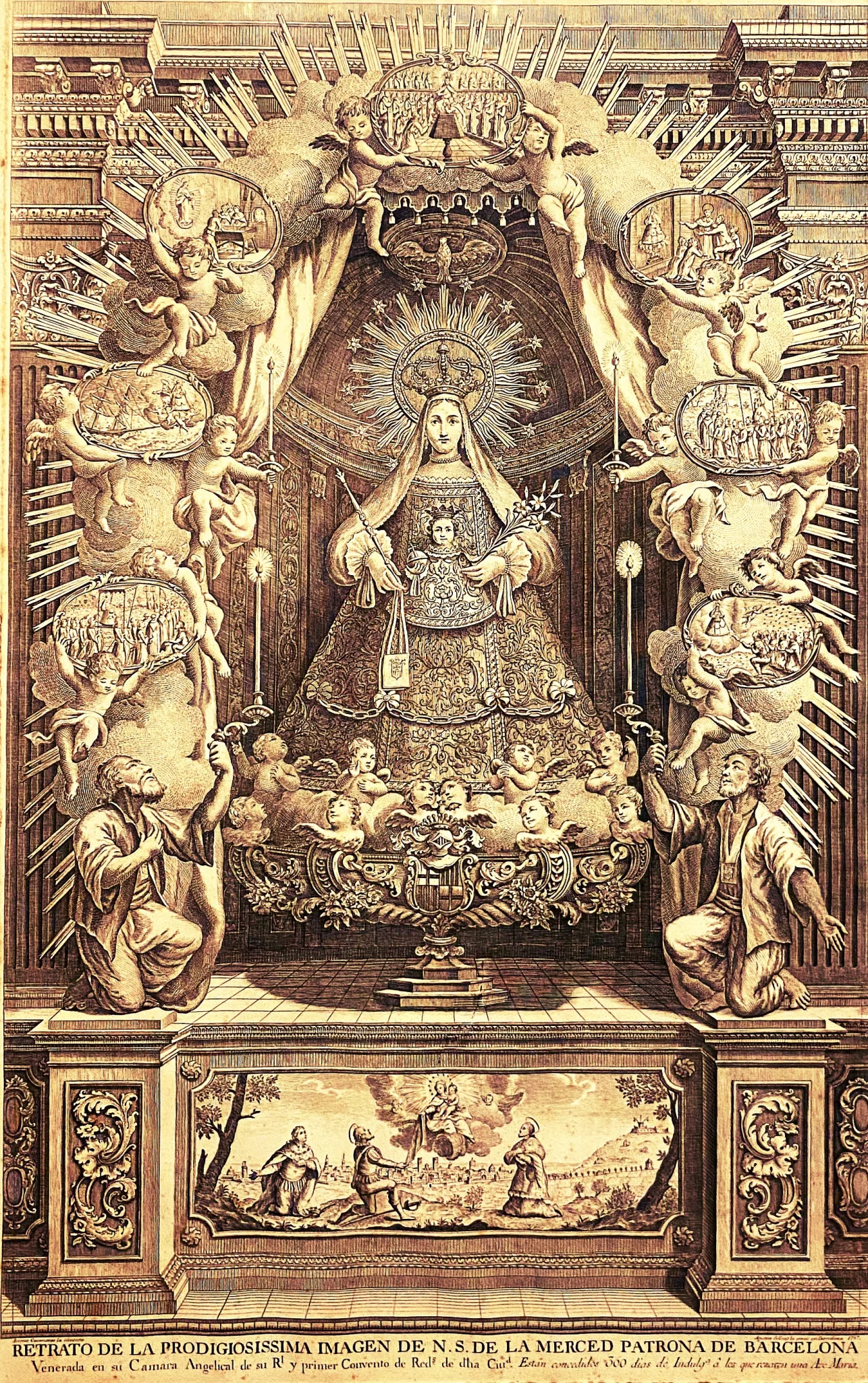
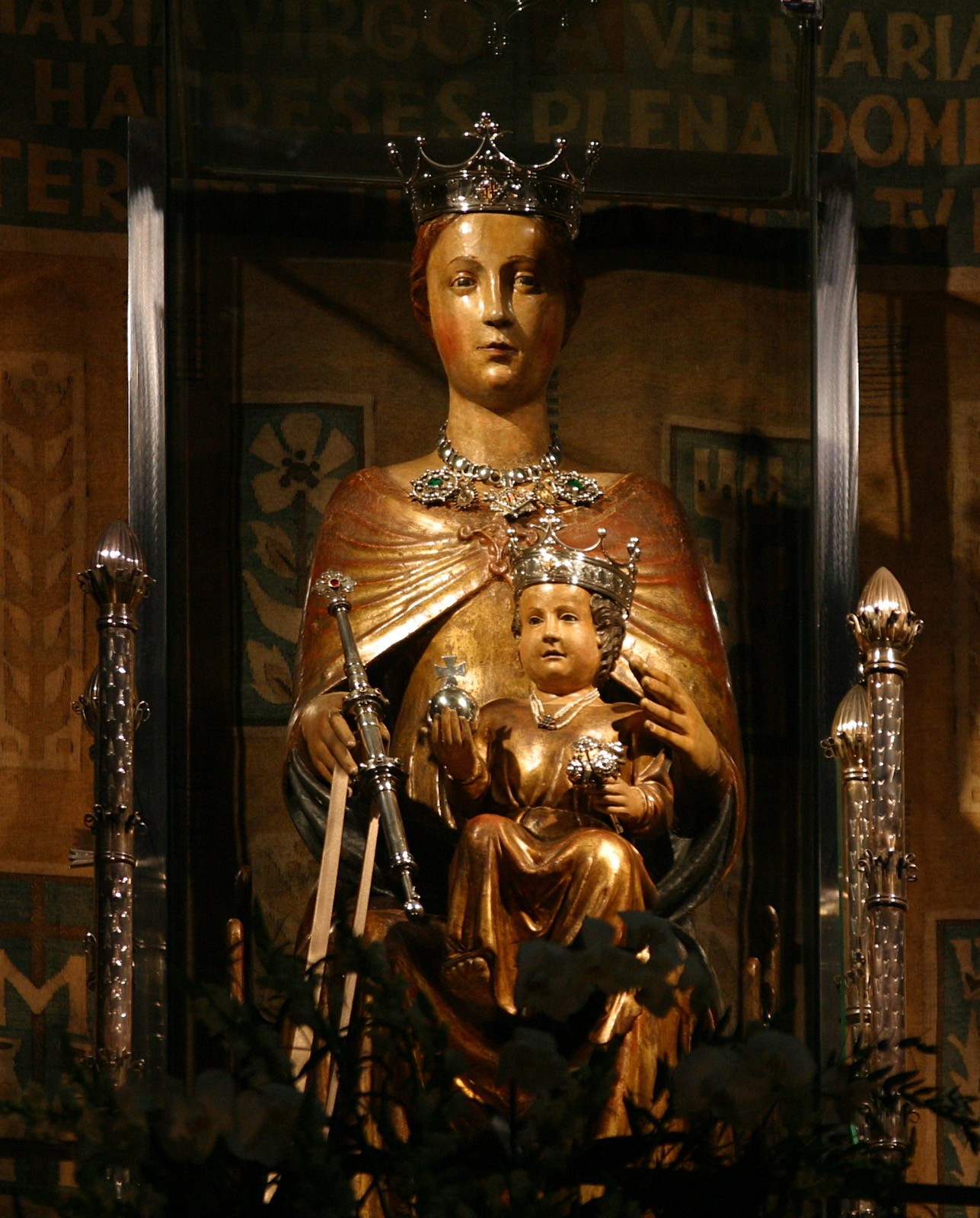
On 1 August of 1218, St Peter Nolasco, St Raymund of Penafort and James, King of Aragon, each had a vision of the Virgin Mary asking them to found a religious Order devoted to freeing Christian captives from the Muslims, who still held much of Spain. The Order of the Blessed Virgin Mary of Mercy grew quickly, collecting alms for ransom and sometimes offering themselves in exchange for prisoners. The Statue of the Mother of God of Mercy in Barcelona (below) dates from the 1300s. She became the City’s Patron after saving it from a plague of locusts in 1687. Before the counter-reformation, the Mercedarian Order celebrated the Feast of Our Lady of Ransom on 1 August, the date when she showed St. Peter Nolasco their white habit. The Vatican changed the date to 24 September when it extended the feast to entire Church in 1696. Since Vatican II, Catholic observance of Our Lady of Mercy’s day is limited to places and organisations that claim her as Patron.
Meanwhile, the Mercedarians have changed their mission to teaching and chaplaincy and the Barcelona soccer team visits the Basilica of La Mercè after victories in thanksgiving for her help. Her fiesta in Barcelona is a spectacular sequence of processions, dances, music, games and fireworks.
St Adela Mardosewicz Bl Aleksy Sobaszek St Alexander of Perga St Almedha St Arcadius St Attius of Perga St Buono St Brogan St Charity St Ethelwold of Winchester (c 912-984) Bishop St Exuperius of Bayeux St Faith St Faustus St Felix of Gerona St Friard Bl Giovanni Bufalari St Hope St Jadwiga Karolina Zak St Jonatus St Justin of Paris St Kenneth of Wales St Leontius of Perga St Maur St Nemesius of Lisieux Bl Orlando of Vallombrosa St Peregrinus of Modena St Rioch Bl Rudolph St Secundel St Secundus of Palestrina St Sophia St Verus of Vienne
Holy Maccabees: Jewish dynasty which began with the rebellion of Mathathias and his five sons against the Syrian king, Antiochus IV (168 BC) and ruled the fortunes of Israel until the advent of Herod the Great. Syrian attempts to force Greek paganism on the Jews, the profanation of the Temple at Jerusalem and the massacre which followed, brought the nation to arms under Mathathias, a priest of the sons of Joarib. At the death of Mathathias, Judas Machabeus, his third son, drove the Syrians and Hellenists out of Jerusalem, rededicated the Temple and began an offensive and defensive alliance with the Romans. Before the treaty was concluded, however, Judas, with 800 men, risked battle at Laisa with an overwhelming army of Syrians under Bacchides, and was slain. He was succeeded in command by his youngest brother, Jonathan (161 BC). Jonathan defeated Bacchides, revenged the death of his brother and made peace with Alexander who had usurped the throne of Demetrius, the successor to Antiochus. A period of peace followed in which Jonathan ruled as high priest in Jerusalem but Tryphon, who was plotting for the throne of Asia, treacherously captured him at ptolemais and later put him to death. The captaincy of the armies of Israel then fell to Simon, the second son of Mathathias. Under him the land of Juda flourished exceedingly. He obtained the complete independence of the country and a grateful people bestowed upon him the hereditary kingship of the nation. His rule marked five years of uninterrupted peace. He was treacherously slain by his son-in-law, Ptolemy, about the year 135 BC After Simon the race of the Machabees quickly degenerated. In 63 BC the Romans thought it necessary to interfere in the fratricidal war between Hyrcanus II and Aristobulus II. With this interference and the advent of Herod the Great the sceptre passed forever from the land of Juda. The story of the Machabees is written in the two books of the Old Testament which bear that name.
Martyrs of Nowogrodek – 11 beati: A group of eleven Holy Family of Nazareth nuns who were murdered by the Nazi Gestapo in exchange for 120 condemned citizens of Nowogrodek, Belarus who were scheduled for revenge killings. They are – • Adela Mardosewicz • Anna Kukolowicz • Eleonora Aniela Józwik • Eugenia Mackiewicz • Helena Cierpka • Jadwiga Karolina Zak • Józefa Chrobot • Julia Rapiej • Leokadia Matuszewska • Paulina Borowik • Weronika Narmontowicz They were machine-gunned by firing squad on 1 August 1943 by the Gestapo about three miles outside Novogrudok (Nowogródek), Hrodzyenskaya voblasts’, in Nazi occupied Belarus and buried on the site of the execution in a common grave. One of their surviving sisters, Maria Malgorzata Banas, located the grave on 19 March 1945 and tended to it until her death in 1966. Their relics have since been re-interred in a common sarcophagus in the chapel of the Novograd Farny Church (the Church of the Transfiguration, also known as Biala Fara or the White Church).
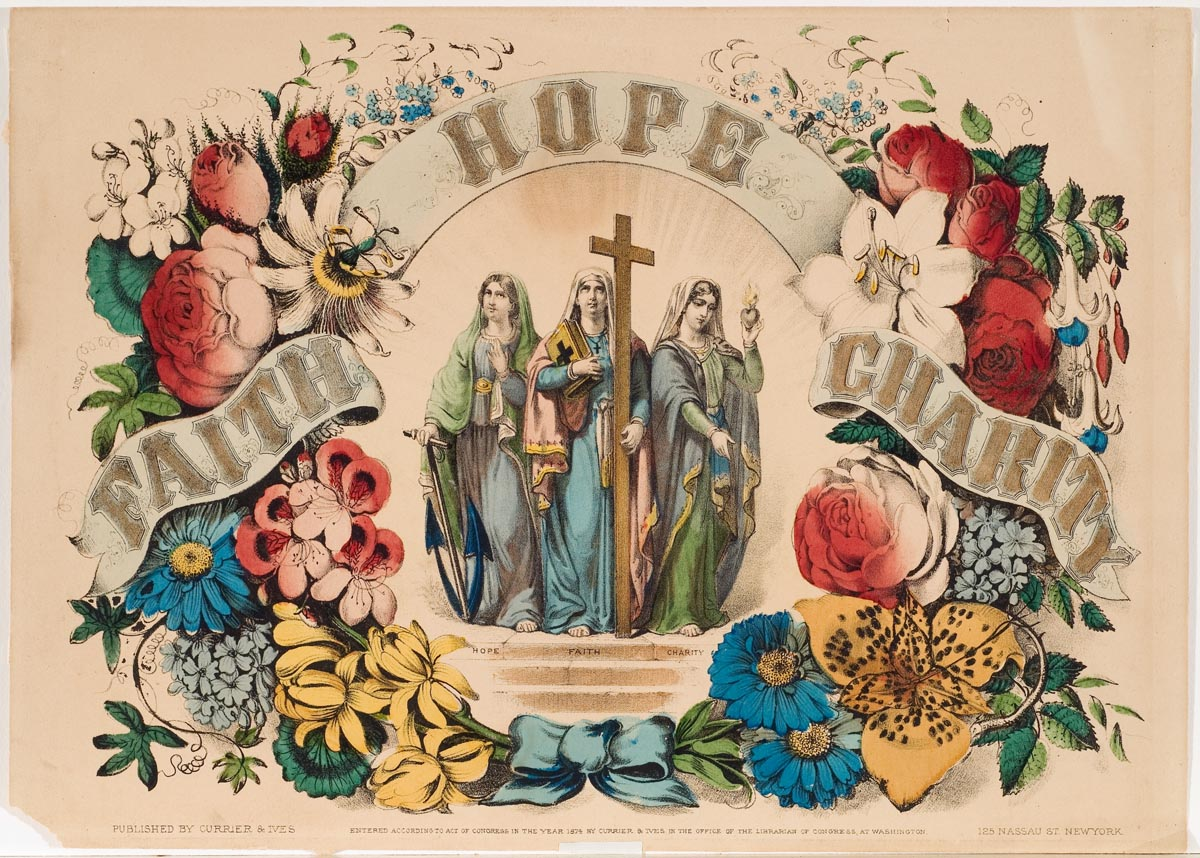
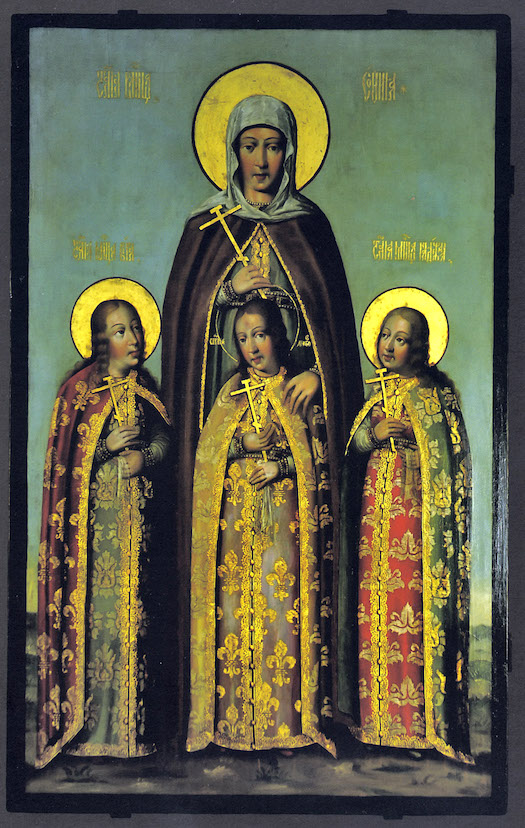
Saints Faith, Hope and Charity were the daughters of Saint Sophia (Wisdom). Sophia was a widow of Milan who gave away her possessions and moved to Rome with her daughters. Her daughters were martyred before her and she buried them at Via Appia. She died a natural death three days later while praying at their grave. Their tomb in a crypt beneath the church afterwards erected to Saint Pancratius was long a place of pilgrimage, as detailed in various documents of the seventh century. Oils were gathered from their tombs and sent to Queen Theodelinda in the time of Gregory the Great.
Early Christians from the 4th century often took in baptism mystical names indicative of Christian virtues, and Sophia, Sapientia, and Fides are attested as names of Christian women in Catacomb inscriptions. While still children, the daughters were tortured and martyred in the persecutions of Hadrian. They were scourged, thrown into a fire, and then beheaded.
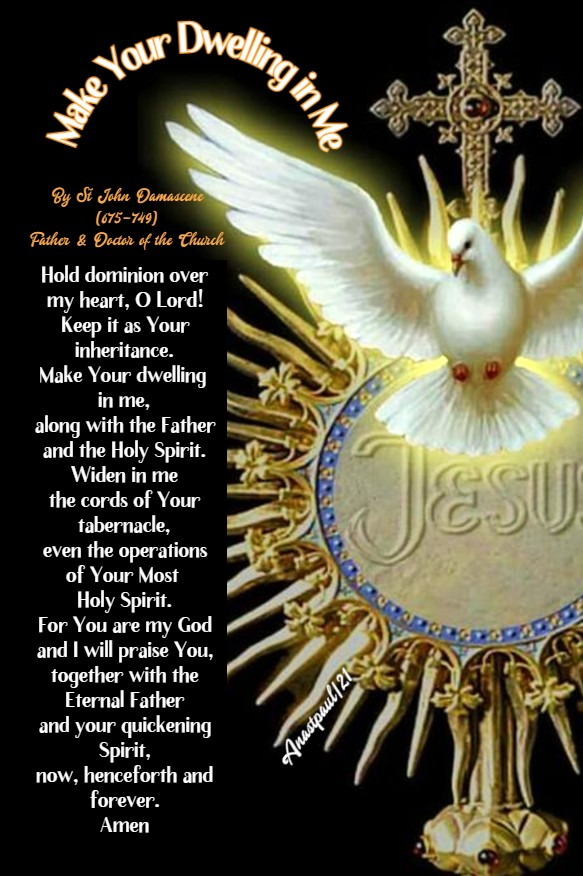
Make Your Dwelling in Me By St John Damascene (675-749) Father & Doctor of the Church
Hold dominion over my heart, O Lord! Keep it as Your inheritance. Make Your dwelling in me, along with the Father and the Holy Spirit. Widen in me the cords of Your tabernacle, even the operations of Your Most Holy Spirit. For You are my God and I will praise You, together with the Eternal Father and your quickening Spirit, now, henceforth and forever. Amen
At that time, as Jesus was speaking to the multitudes, a certain woman from the crowd lifted up her voice and said to Him, Blessed is the womb that bore You, and the breasts that nursed You. But He said, Rather, blessed are they who hear the word of God and keep it.
Luke 11:27-28
REFLECTION – “Happy the one who bore you and she who nursed you at the breast.” How great is the devotion, how great the faith are expressed in the words of this woman in the gospel. Whereas scribes and Pharisees put the Lord to the test and blaspheme against him, this woman acknowledges his incarnation before them all with such loyalty and confesses it with such assurance that she undoes the calumny of her contemporaries and the false faith of heretics to come. Offending against the works of the Holy Spirit, Jesus’ contemporaries deny he is really the Son of God, consubstantial with the Father. Later on people also denied that Mary ever-Virgin had, through the working of the Holy Spirit, provided the substance of her flesh to the Son of God, who would be born with a truly human body. They denied he was really Son of man with the same nature as his mother. But the apostle Paul condemns this opinion when he says of Jesus that he was “born of a virgin, subject to the Law”. For, conceived in the womb of the Virgin, he took his flesh, not out of nothing, nor from some other source, but from the body of his mother. Otherwise it would not be correct to call him truly Son of man.
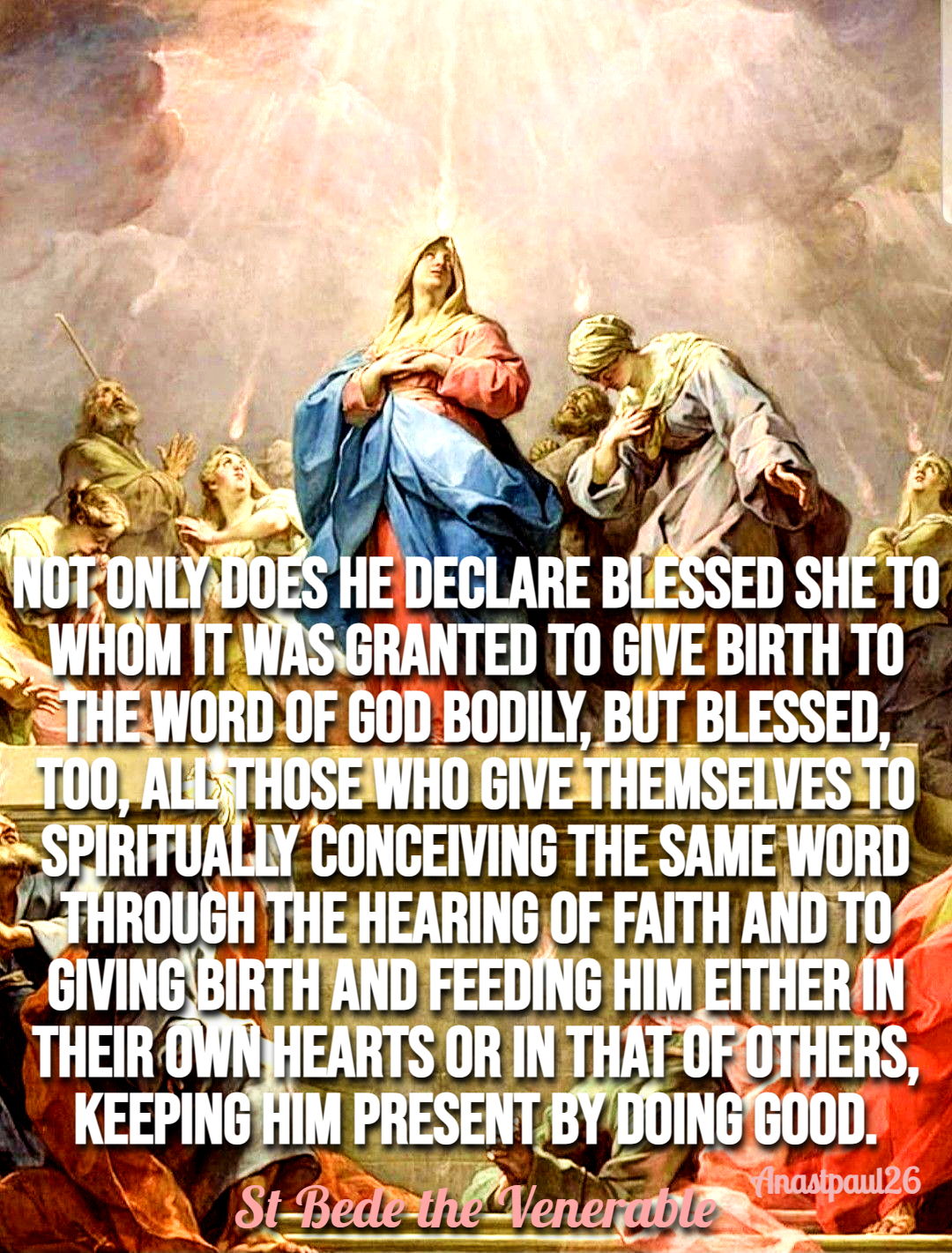
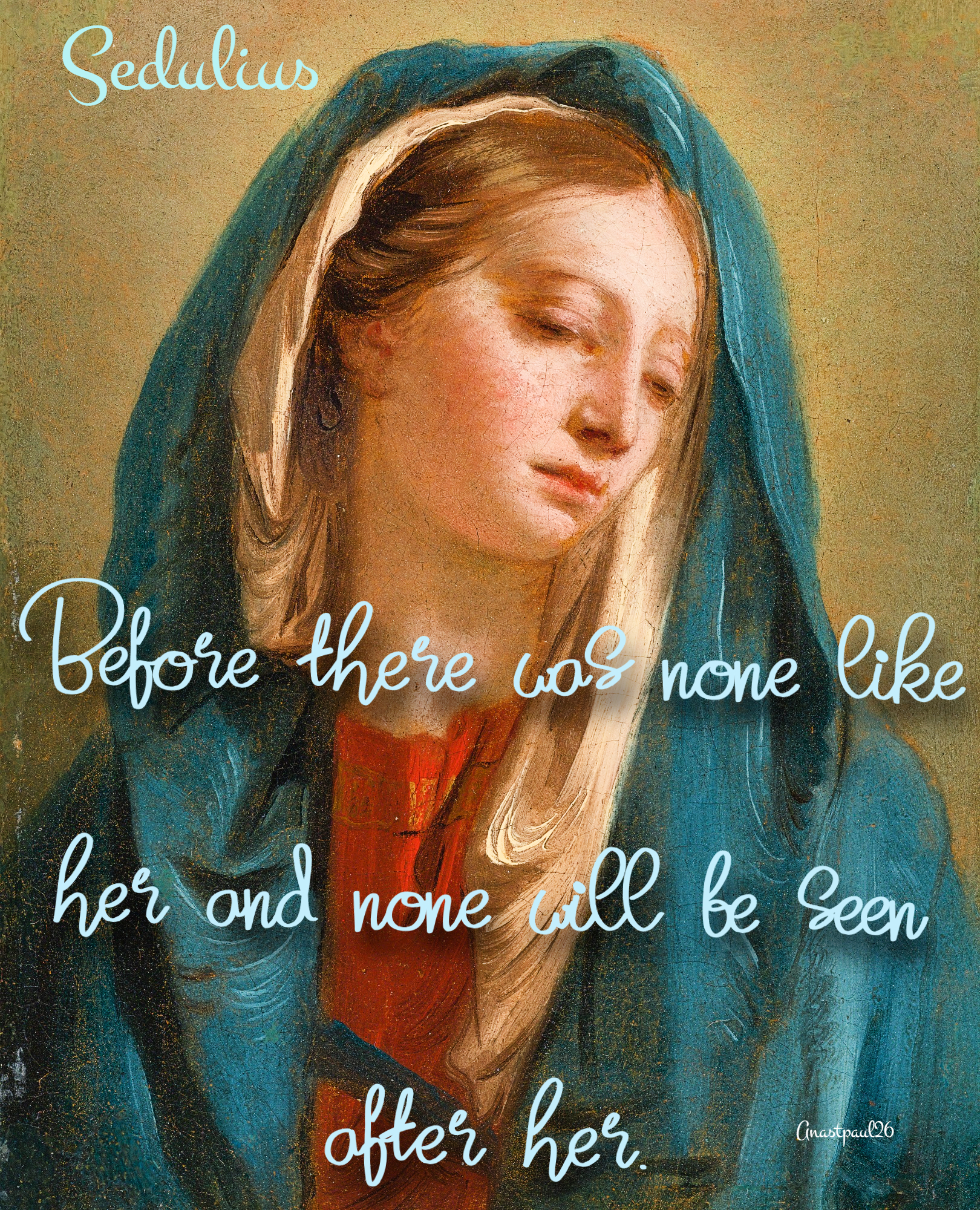
O truly happy mother who, in the words of the poet: “has given birth to the King who, through all ages, rules heaven and earth. She has the joy of motherhood and the honor of virginity. Before there was none like her and none will be seen after her”. Nevertheless the Lord adds: “Happy, rather, are those who hear the Word of God and keep it”. The Savior gives magnificent confirmation to this woman’s testimony. Not only does he declare blessed she to whom it was granted to give birth to the Word of God bodily, but blessed, too, all those who give themselves to spiritually conceiving the same Word through the hearing of faith and to giving birth and feeding him either in their own hearts or in that of others, keeping him present by doing good.
Saint Bede the Venerable (Homily on St Luke)
PRAYER – Forgive the sins of Your people Lord and since of ourselves, we are unable to do what pleases You, lead us on the way of salvation in Your divine Son who lives in us and gives us life. May the prayers of Mary, His Mother help us to constantly meditate on His eternal sustenance. He is our food, our Lord Jesus Christ, who lives and reigns with You and the Holy Spirit, God forever and ever, amen.
Quote/s of the Day – 1 August – “Month of the Immaculate Heart of Mary” – Readings: Sedulius, Ps 44:2, Ecclus 24:14-16, Luke 11:27-28
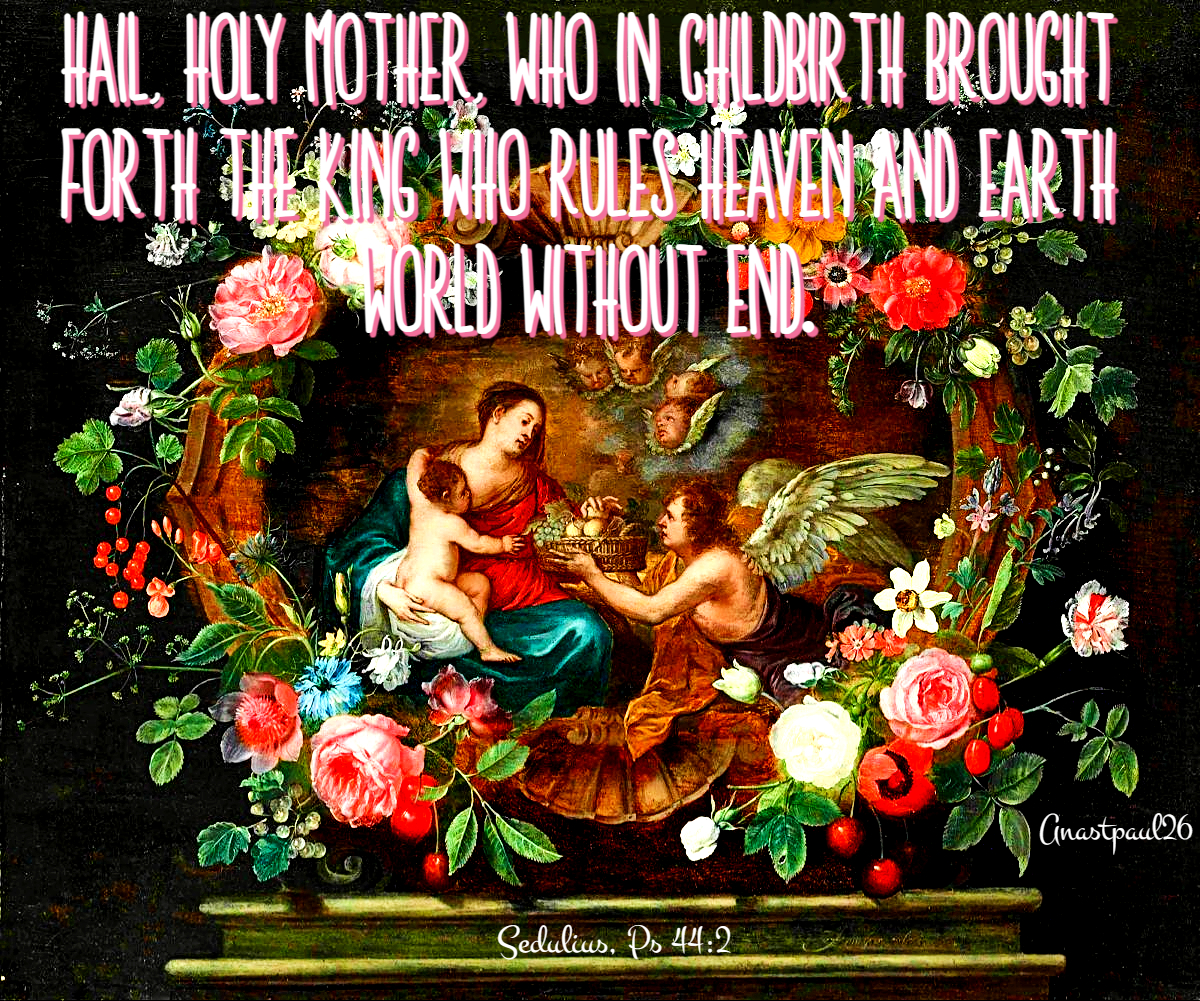
Hail, holy Mother, who in childbirth brought forth the King Who rules heaven and earth world without end.
Sedulius, Ps 44:2
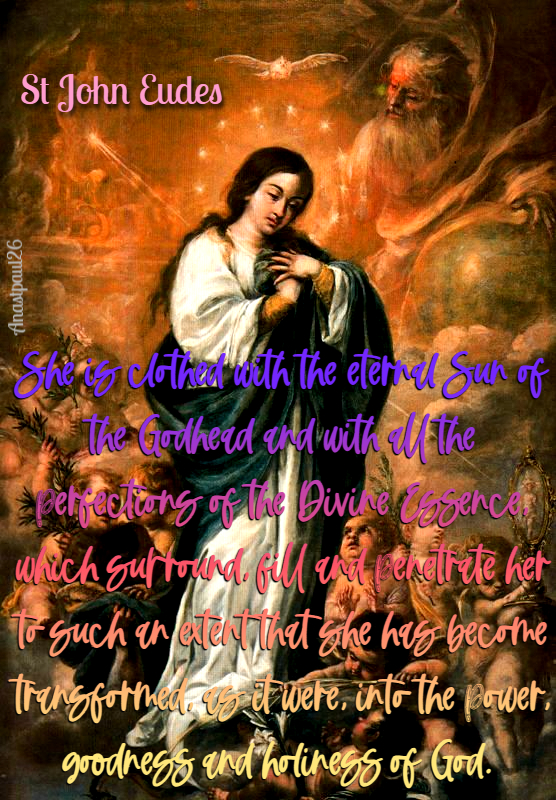
She is clothed with the eternal Sun of the Godhead and with all the perfections of the Divine Essence, which surround, fill and penetrate her to such an extent that she has become transformed, as it were, into the power, goodness and holiness of God.
St John Eudes (The Admirable Heart of Mary)
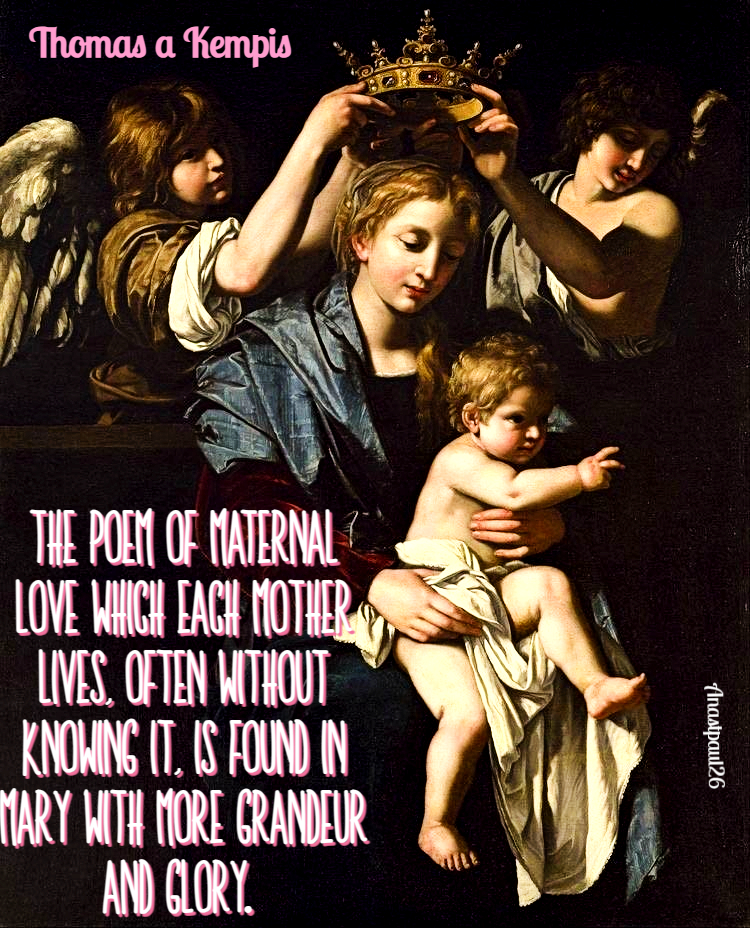
That which denotes the grandeur and the charm of maternity in a woman are grief and tenderness. Grief which rends the heart as it rends the body in order to give life. Tenderness which binds the child to the mother and the mother to the child in such a way as to form only one being, as they form only one flesh. All these characteristics are found physically in the human maternity of Mary, in her relations with Jesus, and mystically in the spiritual maternity of Mary vis-a-vis all Christians but more especially Religious. The poem of maternal love which each mother lives, often without knowing it, is found in Mary with more grandeur and glory.
Thomas a Kempis (The Imitation of Mary)
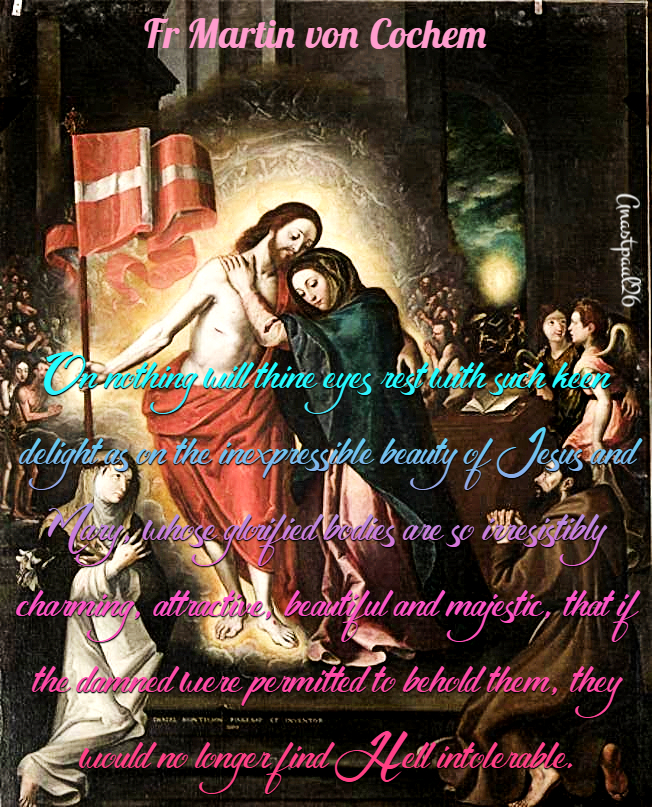
Fifthly, on nothing will thine eyes rest with such keen delight as on the inexpressible beauty of Jesus and Mary, whose glorified bodies are so irresistibly charming, attractive, beautiful and majestic, that if the damned were permitted to behold them, they would no longer find Hell intolerable.
Father Martin von Cochem (The Four Last Things: On Heaven)
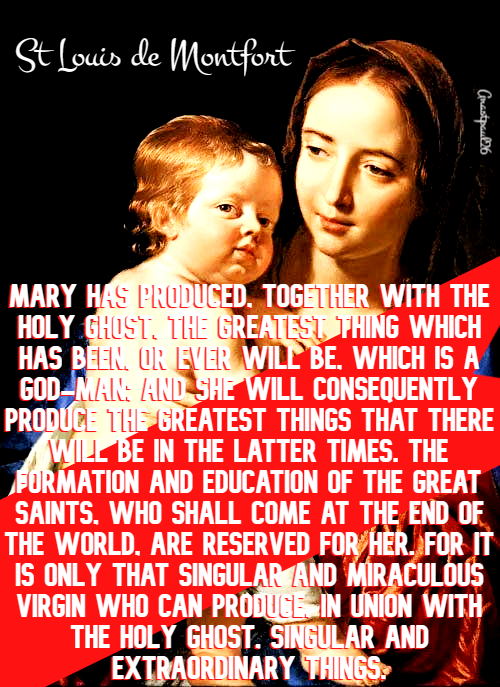
Mary has produced, together with the Holy Ghost, the greatest thing which has been, or ever will be, which is a God-Man; and she will consequently produce the greatest things that there will be in the latter times. The formation and education of the great Saints, who shall come at the end of the world, are reserved for her. For it is only that singular and miraculous Virgin who can produce, in union with the Holy Ghost, singular and extraordinary things.
St Louis de Montfort (True Devotion to Mary)
Before all ages, in the beginning, He created me, and through all ages I shall not cease to be. In the holy Tent I ministered before Him, and in Sion I fixed my abode. Thus in the chosen city He has given me rest, in Jerusalem is my domain. I have struck root among the glorious people, in the portion of my God, His heritage, and my abode is in the full assembly of Saints.
Jesus Christ, the Only-Begotten Son of God, chose the incomparable Virgin Mary from among all creatures to be His Mother and deigned to be nourished and governed by her. In His infinite goodness He also gave her to us to be our Queen, our Mother and our sure Refuge in all our needs. He therefore wishes us to honor her as He honors her and to love her as He loves her.
According to the Apostle St. Paul, Christ is the Head of His Mystical Body, the Church, and we are the members. We must therefore be animated by His Spirit; we must follow His inspirations, walk the path He has traced, and continue, as it were, His life on earth by practising the virtues which were His own. It follows that our devotion to His Holy Mother must be a continuation of His devotion to her. We must be filled with the sentiments of respect, submission and affection which He entertained for her on earth and still entertains in heaven. Mary always held and will hold forever the first place in the Sacred Heart of her Divine Son; she always was and will never cease to be the first object of His love after the Eternal Father; and so He wishes that, next to God, she should be the principal object of our devotion.For this reason, after the veneration we owe to the Divine Majesty of God, we cannot render a greater service to Jesus Christ or do anything more pleasing to Him than to serve and honor His most worthy Mother.
Among the divinely inspired passages of Sacred Scripture I select one from the twelfth chapter of the Apocalypse, which is a compendium of all the great things that can be said or thought of our marvellous Queen. “A great sign appeared in heaven: A woman clothed with the sun, and the moon under her feet, and on her head a crown of twelve stars.”
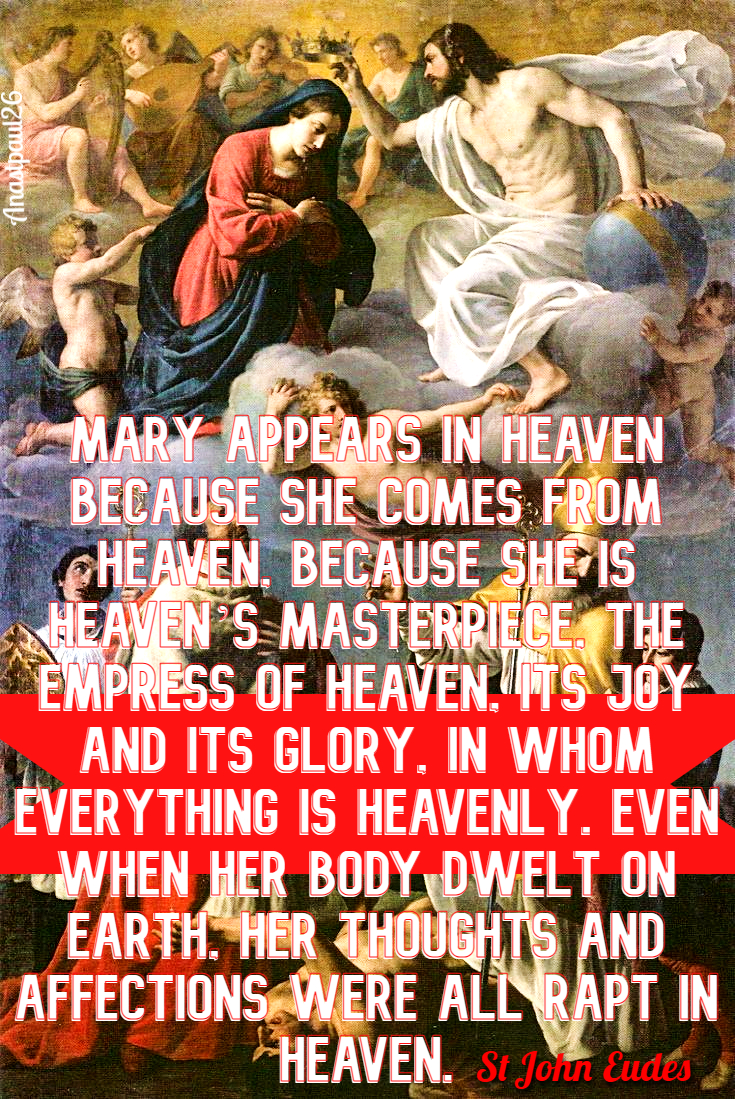
What is this great sign? Who is this miraculous woman? St. Epiphanius, St. Augustine, St. Bernard and many other holy doctors agree that the woman is Mary, the Queen among women, the Sovereign of angels and men, the Virgin of virgins. She is the woman who bore in her chaste womb the perfect man, the God-Man. “A woman shall compass a man.” Mary appears in heaven because she comes from heaven, because she is heaven’s masterpiece, the Empress of Heaven, its joy and its glory, in whom everything is heavenly. Even when her body dwelt on earth, her thoughts and affections were all rapt in heaven.
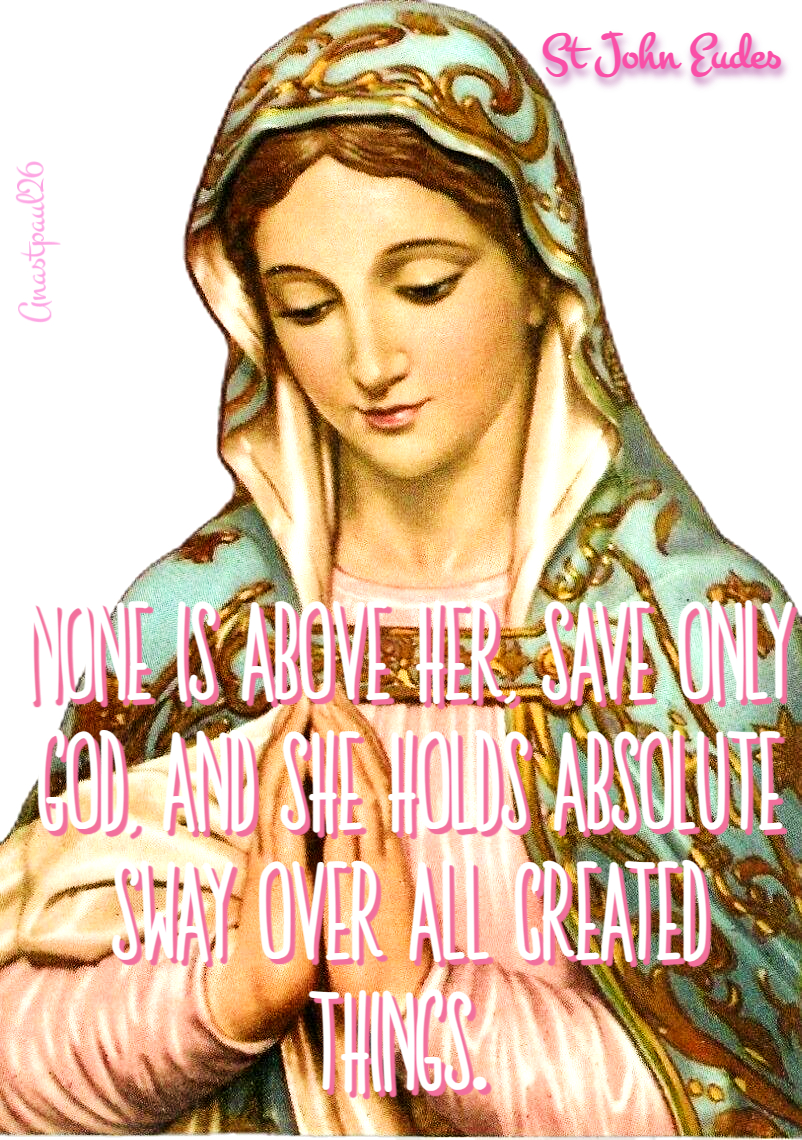
She is clothed with the eternal Sun of the Godhead and with all the perfections of the Divine Essence, which surround, fill and penetrate her to such an extent that she has become transformed, as it were, into the power, goodness and holiness of God. She has the moon under her feet to show that the entire world is beneath her. None is above her, save only God, and she holds absolute sway over all created things.
Do not be surprised if I say that the virginal Heart of this Mother of Fair Love is an admirable Heart indeed. Mary is admirable in her divine Maternity because as St. Bernardine of Siena says, “to be Mother of God is the miracle of miracles,” miraculum miraculorum.
But the august Heart of Mary is also truly admirable, for it is the principle of her divine Maternity and of the wonderful mysteries this privilege implies.
Of Mary’s admirable Heart I shall attempt to speak in this book although to speak and write worthily of the holy Heart of God’s own Mother one would need a heart of fire. To know and proclaim the perfections of the noble Heart of the Queen of Angels one should have the intellect of a cherub and the flaming love of a seraph. Nay more, it would be necessary to possess the mind, the heart, the tongue and the hand of Jesus Christ, the King of all hearts, to understand, honor, proclaim or commit to writing the treasures of sanctity contained in the holy Heart of Mary, the worthiest, most royal and most marvellous of all hearts after the most adorable Heart of our Saviour Himself.
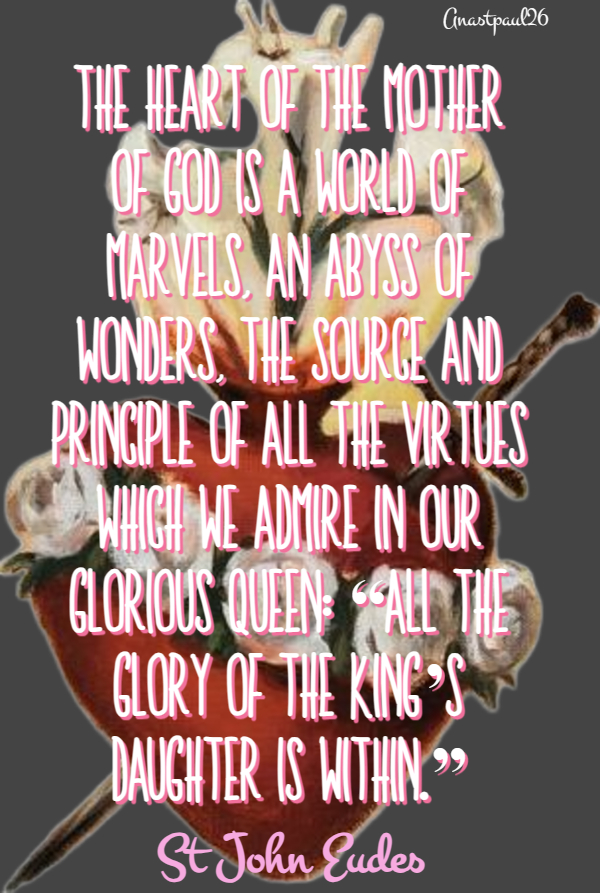
Mary is truly admirable in all her perfections and in all her virtues? But what is most admirable in her is her virginal heart. The heart of the Mother of God is a world of marvels, an abyss of wonders, the source and principle of all the virtues which we admire in our glorious Queen: “All the glory of the king’s daughter is within.”
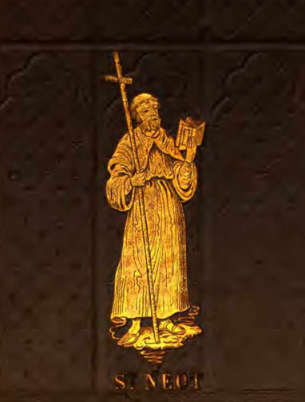
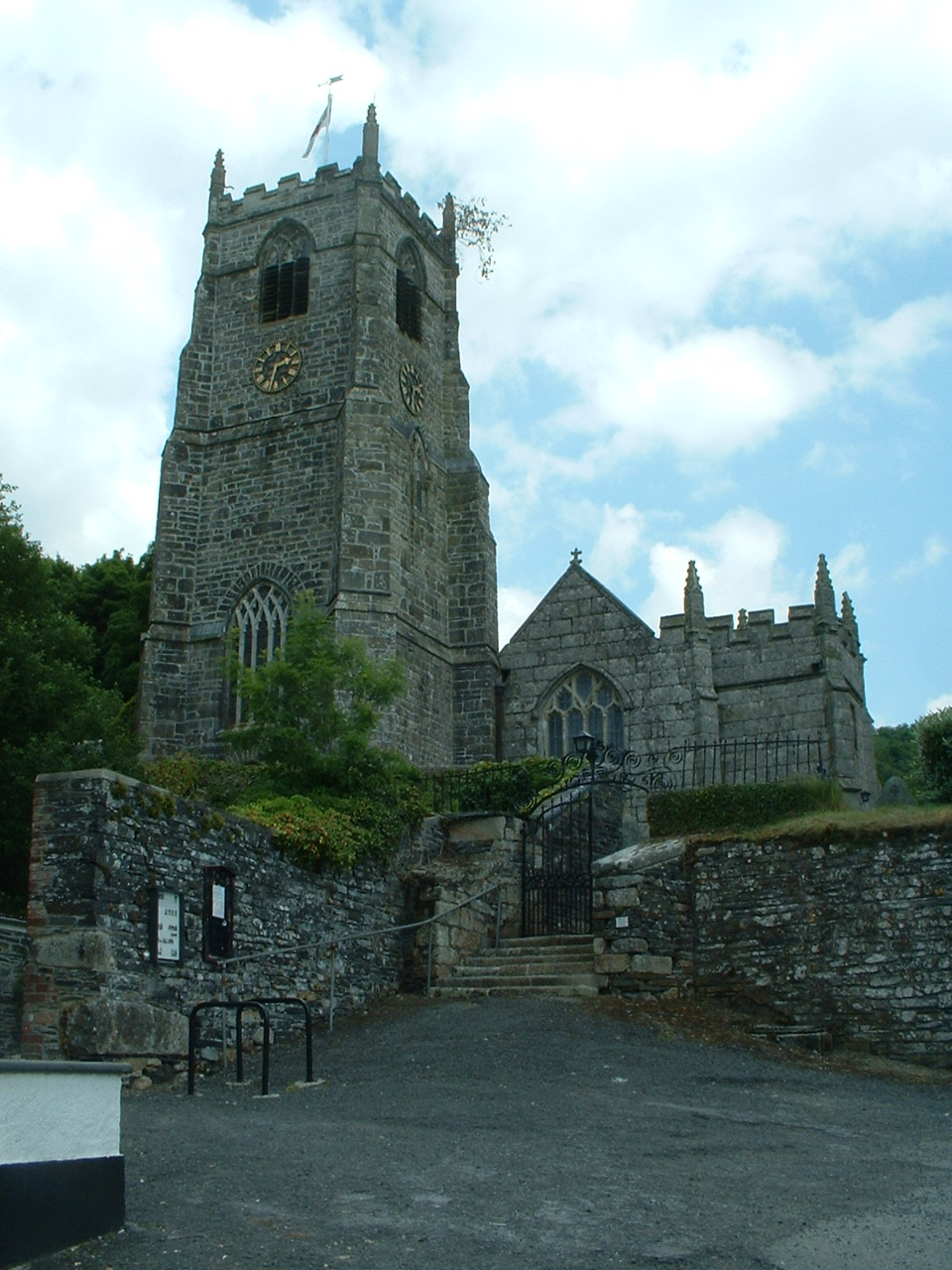
Saint Neot, also known as the Pygmy Saint. Related to King Alfred the Great, who visited him for counsel, Neot was an English monk born in the first half of the ninth century. He lived as a monk at Glastonbury Abbey and preferred to perform his religious devotions privately, fearing the creeping in of pride that came from acclaim. He later went to live an isolated life in Cornwall, near the village now called St Neot. There he lived as if he was a novice in religion; he fasted, he watched, he prayed for long hours, because he had not lived before this in any hermitical strictness.
His wisdom and religious dedication earned him admiration from the monks. He visited the Pope in Rome, who instructed him to found a monastery in Cornwall, saying “scatter the word of God among the people”. He did so, and because of his great piety, he became famous, and attracted large numbers of pilgrims. A number of miracles took place involving him. King Alfred visited numerous times and Neot repeatedly rebuked the King for his unbridled ambition. He warned that Alfred could expect greater misfortunes from the Viking invasions. Alfred had failed, Neot said, to attend to his people’s complaints and petitions.
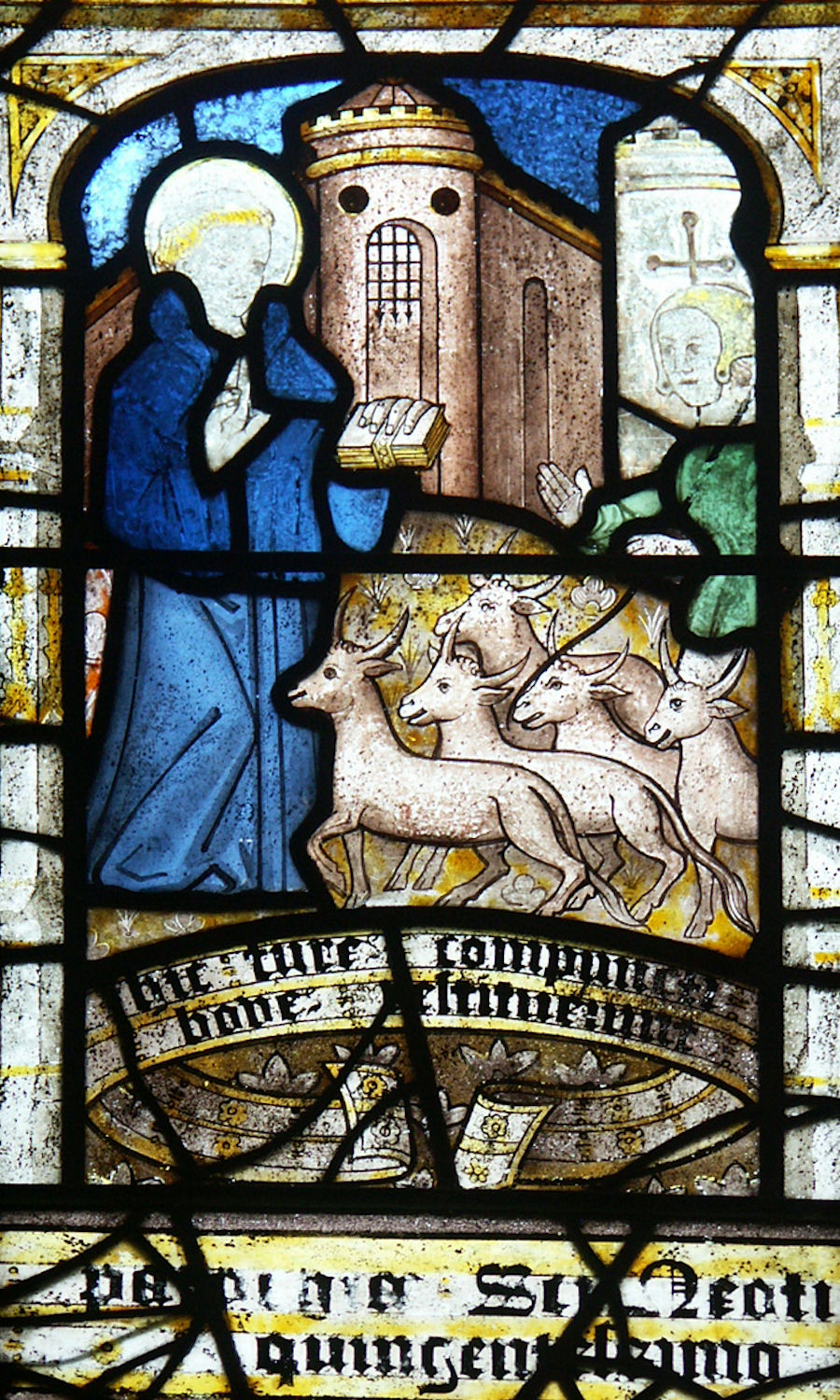
He was very short, and described as being anything from 4 foot tall down to a mere 15 inches. He was so small that he needed to stand on a stool in order to say Mass. He spent much of his day up to his neck in a well during his devotions. Neot had a way with animals and birds, and worked miracles with them. He died of natural causes in 877, and the, because he was so popular, his body was stolen by other monks and taken to their priory in order to gain donations from pilgrims, and finally his remains were lost during the Dissolution of the Monasteries. Relics remain in Saint Neot’s church, Cambridgeshire, England, and at the abbey of Bee, Normandy, France.
St Neot is the patron saint of fish; the reason being that there was a holy well which contained three fish. An angel told Neot that as long as he ate only one fish a day, there would always be three in the well. But when Neot fell ill his servant cooked two of them. Saint Neot prayed for forgiveness and ordered that the fish be taken back to the well. When the cooked fish returned to the water, they miraculously returned to life. The Holy Well of St Neot is still there today.














You must be logged in to post a comment.