Thought for the Day – 7 February – Meditations with Antonio Cardinal Bacci (1881-1971)
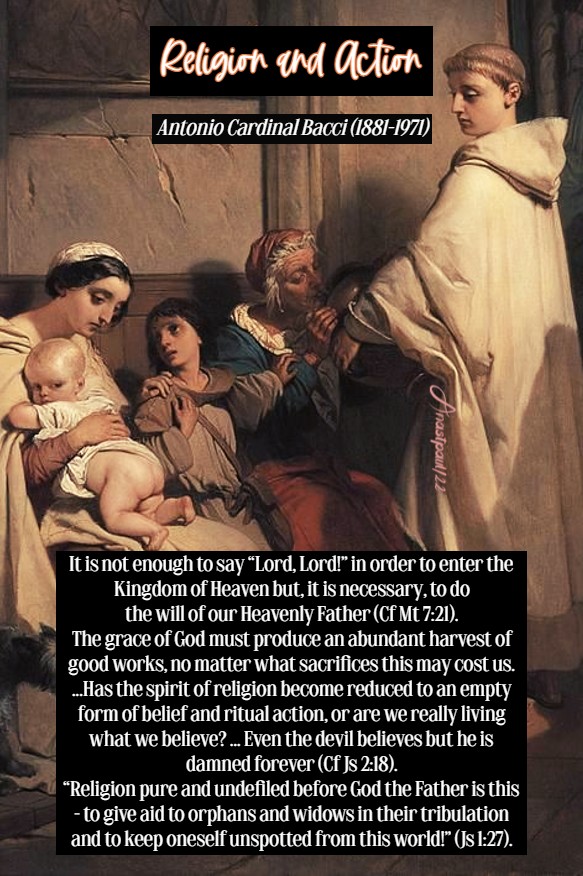
Religion and Action
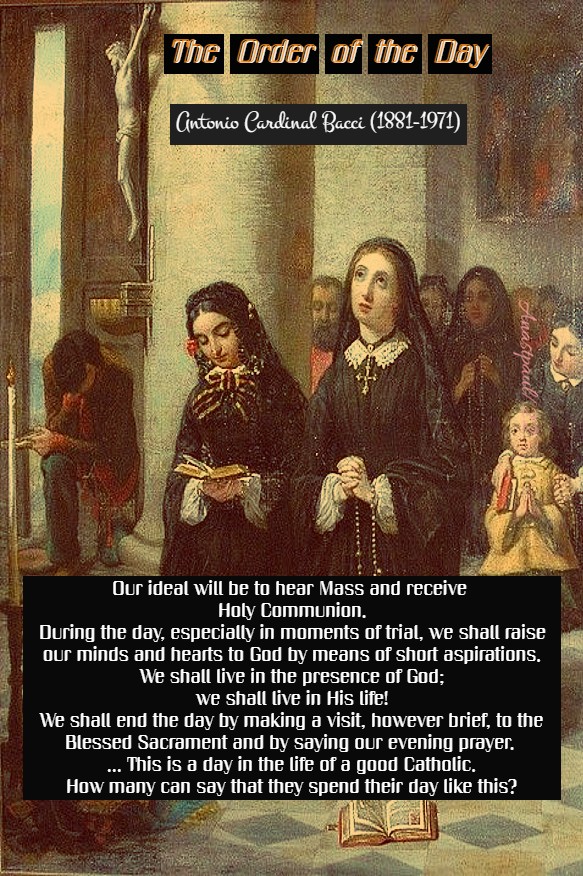
“Anyone who fails to correspond with the grace of God, is not living the life of Jesus. Without the life of Jesus, he is a dead limb, a withered branch cut away from the vine. It is not enough to say “Lord, Lord!” in order to enter the Kingdom of Heaven but, it is necessary to do the will of our Heavenly Father (Cf Mt 7:21). The grace of God must produce an abundant harvest of good works, no matter what sacrifices this may cost us. Otherwise, God’s gift would have been bestowed in vain and, before the Supreme Judge one day, would be a reason for a terrible retribution, instead of a reward. Let us think seriously about this. Has the spirit of religion become reduced to an empty form of belief and ritual action, or are we really living what we believe? Meditate with attention to these words of St James: “What will it profit, my brethren, if a man says he has faith but does not have works? Can the faith save him? And if a brother or a sister be naked and in want of daily food and, one of you say to them, ‘Go in peace, be warmed and filled,’ yet you do not give them what is necessary for the body, what does it profit? So faith too, unless it has works, is dead in itself” (Js 2:14-17).
Even the devil believes but he is damned forever (Cf Js 2:18). “Religion pure and undefiled before God the Father is this – to give aid to orphans and widows in their tribulation and to keep oneself unspotted from this world!” (Js 1:27).
One Minute Reflection –7 February – The Memorial of St Romuald, Abbot (c 951-1027) – Ecclus 45:1-6, Matthew 19:27-29.
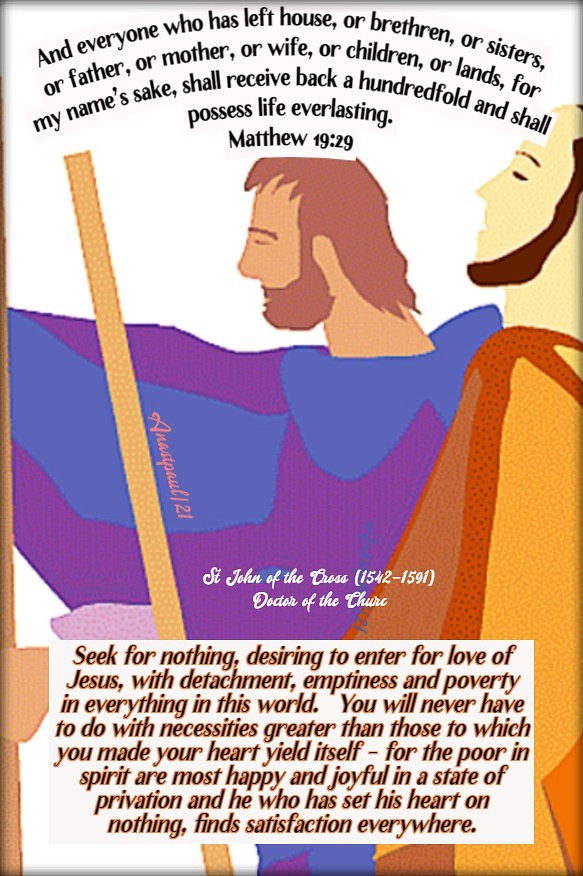
“And everyone who has left house, or brethren, or sisters, or father, or mother, or wife, or children, or lands for my name’s sake, shall receive a hundredfold and shall possess life everlasting.” – Matthew 19:29
REFLECTION – “Seek for nothing, desiring to enter for love of Jesus, with detachment, emptiness and poverty in everything in this world. You will never have to do with necessities greater than those to which you made your heart yield itself – for the poor in spirit are most happy and joyful in a state of privation and he who has set his heart on nothing, finds satisfaction everywhere.
The poor in spirit (Mt 5:3) give generously all they have and their pleasure consists in being thus deprived of everything for God’s sake and out of love to their neighbour … Not only do temporal goods – the delights and tastes of the senses – hinder and thwart the way of God but spiritual delights and consolations also, if sought for or clung to eagerly, disturb the way of virtue.” – St John of the Cross (1542-1591) Carmelite, Doctor of the Church (Spiritual maxims, nos. 352, 355,356, 364; 1693 edition)
PRAYER – Father of might and power, every good and perfect gift comes to us from You. Implant in our hearts the love of Your Name and Your creatures. Increase our zeal for Your service by following behind Your Son with determination and joy. Nourish in us what good and tend it with watchful care. Grant that the prayers and caring love of the Blessed Virgin, our Mother, may help us to follow Jesus our Saviour unreservedly and thus attain eternal life. We make our prayer through Christ, our Lord in the union of the Holy Spirit, one God for all eternity, amen.
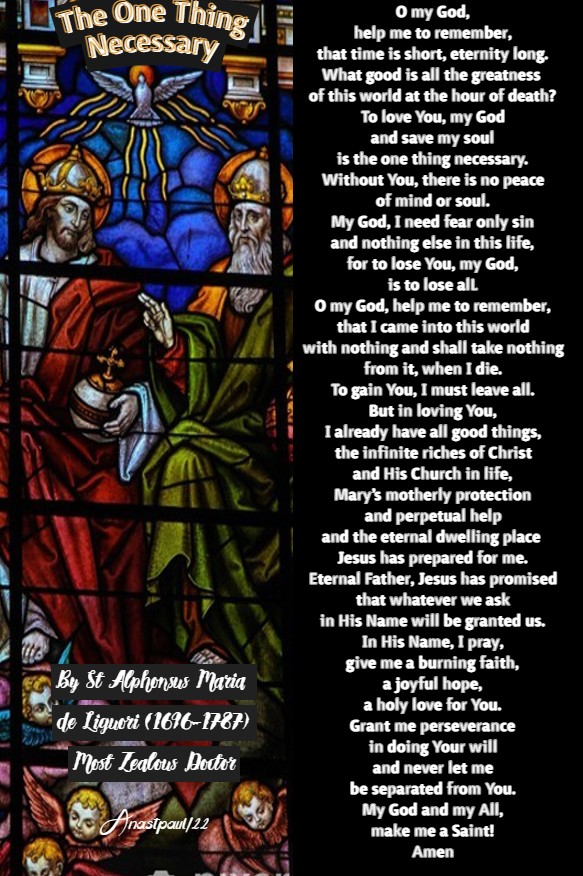
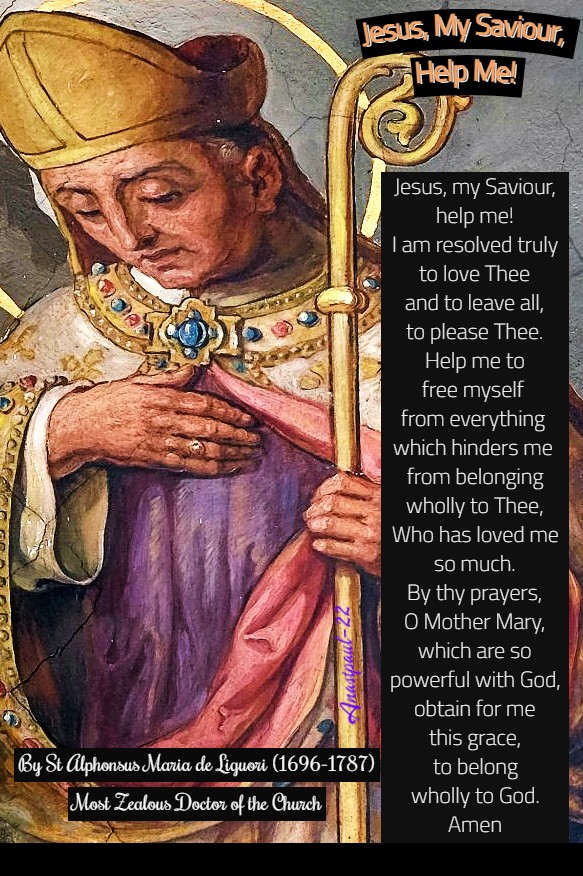
Jesus, My Saviour, Help Me! By St Alphonsus Maria de Liguori (1696-1787) Most Zealous Doctor of the Church
Jesus, my Saviour, help me! I am resolved truly to love Thee and to leave all, to please Thee. Help me to free myself from everything which hinders me from belonging wholly to Thee, Who has loved me so much. By thy prayers, O Mother Mary, which are so powerful with God, obtain for me this grace, to belong wholly to God. Amen
Thought for the Day – 6 February – Meditations with Antonio Cardinal Bacci (1881-1971)
Religion and Devotion
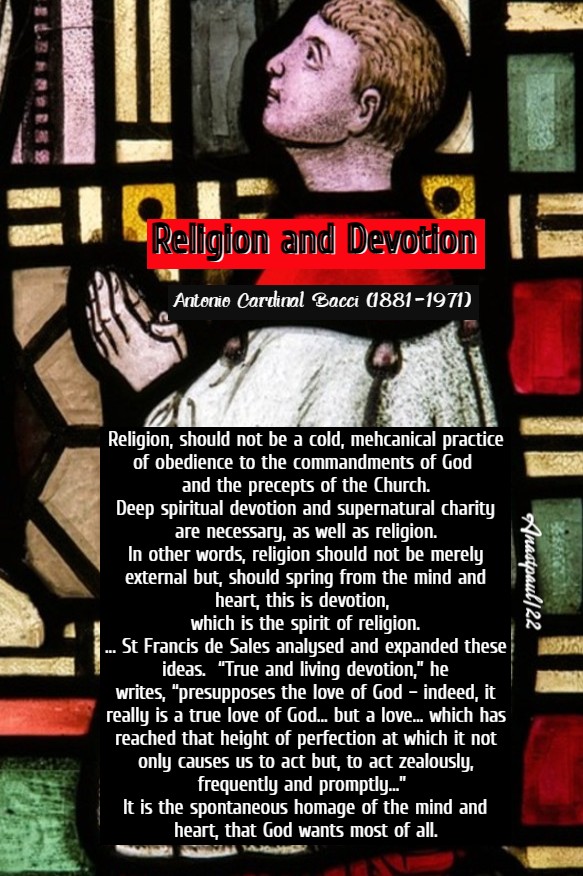
“Religion, should not be a cold, mehcanical practice of obedience to the commandments of God and the precepts of the Church. Deep spiritual devotion and supernatural charity are necessary, as well as religion. In other words, religion should not be merely external but, should spring from the mind and heart, this is devotion, which is the spirit of religion. “Devotion,” wites Aquinas, “seems to be the determination to give one’s self readily to the service of God” (Summa Theologiae, II-II, q 82, a 2, ad 1). But this determination should be loving and effective because, as St Thomas also observes, “charity generates devotion” (Summa Theologiae, II-II, q 82, a 2, ad 2).
St Francis de Sales analysed and expanded these ideas. “True and living devotion,” he writes, “presupposes the love of God – indeed, it really is a true love of God… but a love… which has reached that height of perfection at which it not only causes us to act but, to act zealously, frequently and promptly…” (Introduction to the Devout Life, Bk I, C 1). He continues: “Since devotion consists in an unique degree of charity, it not only makes us prompt, active and zealous in the observance of all the divine commands but, incites us, furthermore, to perform readily and lovingly, as many good works as we can… even if they are only recommended or suggested” (Ibid). From this solid and sincere devotion flows, that taste for divine things, that inner gentleness and peace of spirit which the Saints enjoyed, even in the midst of sorrow and disillusionment. It is the spontaneous homage of the mind and heart, that God wants most of all.”
Quote/s of the Day – 6 February – The Fifth Sunday after the Epiphany – Readings: Colossians 3:12-17, Matthew 13:24-30
“A sower went out to sow”
Matthew 13:30
“Sir, did you not sow good seed in your field? How then has it weeds?”
Matthew 13:27
“It is better to be cured within the Church’s community than to be cut off from its Body as incurable members. As long as a member still forms part of the Body, there is no reason to despair of its cure; once it has been cut off, it can be neither cured nor healed.”
St Augustine (354-430) Father and Doctor of Grace
“Brethren, the just man shall scarcely be saved. What, then, will become of the sinner?”
St Arsenius s the Great (c 354-c 449)
“… [The Kingdom of God] … is within you. That is, it depends on your own wills and is in your own power, whether or not you receive it. Everyone, that has attained to justification, by means of faith in Christ and decorated by every virtue, is counted worthy, of the Kingdom of Heaven.”
St Cyril of Alexandria (376-444) Father and Doctor of the Church
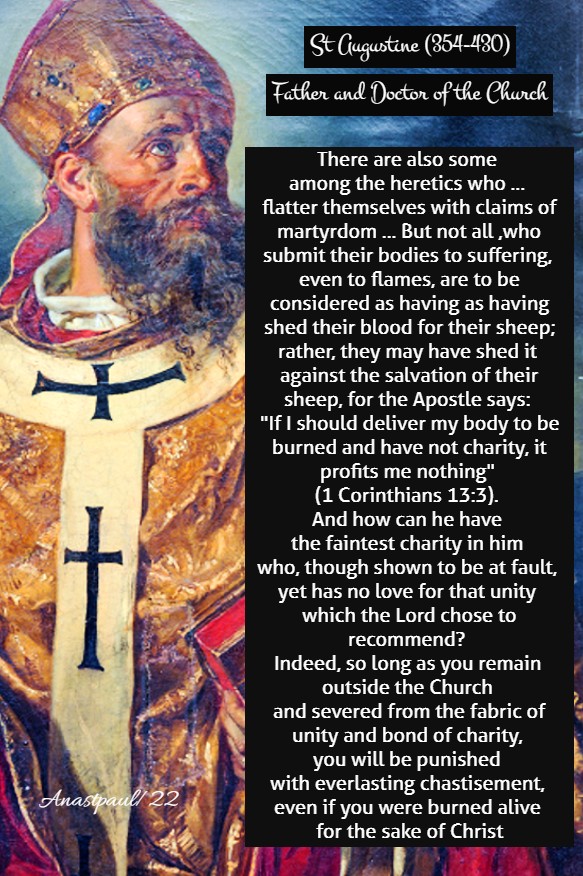
“And like the little grain of mustard seed … we should set it in the garden of our soul, all weeds being pulled out for the better feeding of our faith. Then shall it grow and … through the true belief of God’s word … we shall be well able to command a great mountain of tribulation to void from the place where it stood in our hearts, whereas with a very feeble faith and faint, we shall scarcely be able to remove a little hillock.”
St Thomas More (1478-1535)
“My child, it is indeed the Voice of God you have heard. He has given you a great grace in thus calling you into His one true Church. While you live, never cease to thank Him and bless Him for it.”
One Minute Reflection – 6 February – The Fifth Sunday after the Epiphany – Readings: Colossians 3:12-17, Matthew 13:24-30
“Suffer both to grow until the harvest” – Matthew 13:30
REFLECTION – “Nor must one imagine that the Body of the Church, just because it bears the name of Christ, is made up during the days of its earthly pilgrimage, only of members conspicuous for their holiness, or, that it consists only of those whom God has predestined to eternal happiness. It is owing to the Saviour’s infinite mercy, that place is allowed in His Mystical Body here below, for those whom, of old, He did not exclude from the banquet (cf. Mt 9:11). For not every sin, however grave it may be, is such as of its own nature to sever a man from the Body of the Church, as does schism or heresy or apostasy. Men may lose charity and divine grace through sin, thus becoming incapable of supernatural merit and yet, not be deprived of all life, if they hold fast to faith and Christian hope and if, illumined from above, they are spurred on, by the interior promptings of the Holy Spirit to salutary fear and are moved to prayer and penance for their sins.
Let everyone then abhor sin, which defiles the mystical members of our Redeemer but,, if anyone unhappily falls and his obstinacy has not made him unworthy of communion with the faithful, let him be received with great love and let eager charity see in him a weak member of Jesus Christ. For, as the Bishop of Hippo remarks – “it is better to be cured within the Church’s community than to be cut off from its Body as incurable members. As long as a member still forms part of the Body, there is no reason to despair of its cure; once it has been cut off, it can be neither cured nor healed.’”- Venerable Pius XII (1876-1958) – Pope from 1939 to 1958 – Encyclical – Mystici Corporis Christi, 1943.
PRAYER – All-powerful and ever-living God, splendour of true light and never-ending day, chase away the night of sin and fill our minds with the glory of Your coming. Take away our heart of stone and give us a heart of flesh, help us in our battle with sin and the devil. By our prayers, Your holy sacraments and the strength of the Holy Spirit, may we be ever vigilant of the evil one. Hear the prayers of our Queen and Mother, the Blessed Virgin of Mercy on our behalf dear Lord. We make our prayer through Christ, our Lord with the Holy Spirit, one God forever, amen.
Thought for the Day – 5 February – Meditations with Antonio Cardinal Bacci (1881-1971)
IDLENESS
“Idleness is forbidden by God because work is His commandment. He had already told Adam and his successors: “In the sweat of your brow, you shall eat bread” (Gen 3:19).
St Paul warns us: “If any man will not work, neither let him eat” (2 Thess 3L10). This is a universal law which embraces people of all classes and circumstances. God commands everyone to work. Therefore, anybody who disobeys this law without reason, sins against God. Those who lead leisurely inactive lives should meditate seriously on this law of God. The fact that they possess large fortunes does not excuse them from this divine law. They must engage in some work, either menial or manual. It may be for themselves or it may be for their needy brothers who live in want or in illness and cannot fend for themselves. We are all brothers in Jesus. It is not right that one brother should live in poverty and wretchedness, while another idly enjoys a life of plenty and of pleasure.
Anyone who loves God is never idle, says St Jerome. The love of God works wonderful things, if it does not, it cannot be called love.”
Quote/s of the Day – 5 February – St Agatha (c 231- c 251) Virgin and Martyr – 1 Corinthians 1:26-31, Matthew 19:3-12
“Fasting cleanses the soul, raises the mind, subjects one’s flesh to the spirit, renders the heart contrite and humble, scatters the clouds of concupiscence, quenches the fire of lust and kindles the true light of chastity. Enter again into yourself!”
St Augustine (354-430) Bishop of Hippo Father and Doctor of Grace
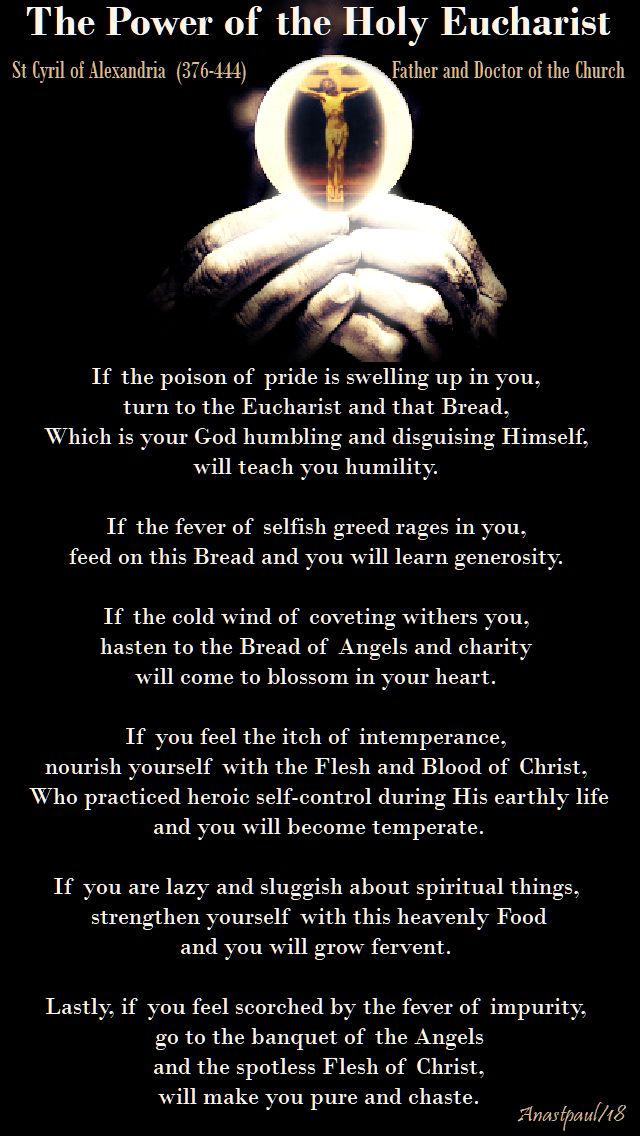
“If the poison of pride is swelling up in you, turn to the Eucharist and that Bread, Which is your God humbling and disguising Himself, will teach you humility.
If the fever of selfish greed rages in you, feed on this Bread and you will learn generosity.
If the cold wind of coveting withers you, hasten to the Bread of Angels and charity will come to blossom in your heart.
If you feel the itch of intemperance, nourish yourself with the Flesh and Blood of Christ, Who practiced heroic self-control during His earthly life and you will become temperate.
If you are lazy and sluggish about spiritual things, strengthen yourself with this heavenly Food and you will grow fervent.
Lastly, if you feel scorched by the fever of impurity, go to the banquet of the Angels and the spotless Flesh of Christ, will make you pure and chaste.”
St Cyril of Alexandria (376-444) Father and Doctor
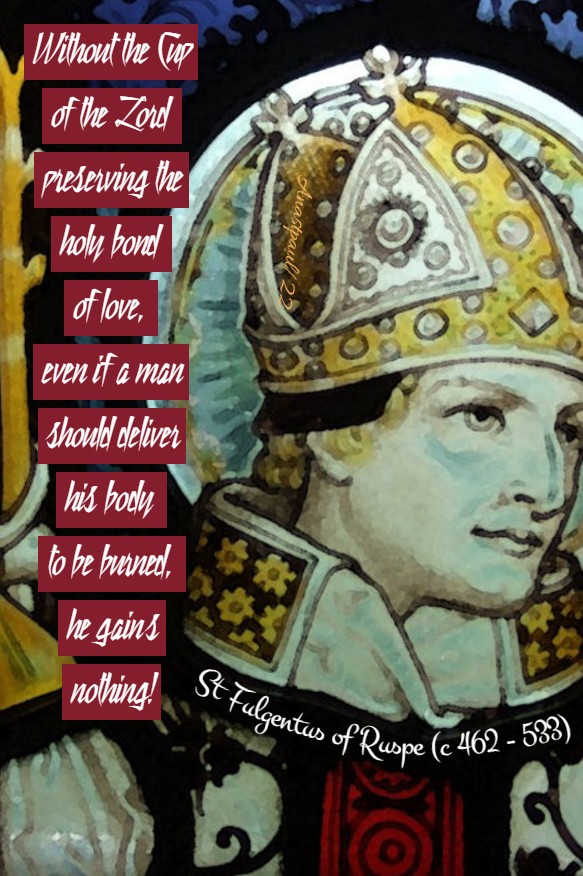
“Be HUMBLE in this life, that God may raise you up in the next. Be truly MODERATE and do not punish or condemn anyone immoderately. Be GENTLE, so that you may never oppose justice. Be HONOURABLE, so that you may never voluntarily bring disgrace upon anyone. Be CHASTE, so that you may avoid all the foulness of lust like the pangs of death.”
St Stephen of Hungary (c 975- 1038)
(King of Hungary, to his son, St Emeric. Sadly St Emeric died aged 24 but had taken a private vow of Celibacy.)
“Chastity depends on the heart, as its source but, it is concerned with the body, as its matter and, therefore, it maybe lost, by all the external senses of the body and by the thoughts and desires of the heart. It is immodesty to behold, to hear, to speak, to smell, to touch, impure things, when the heart occupies itself with them and takes pleasure in them.”
St Francis de Sales (1567-1622) Doctor of the Church
(Introduction to the Devout Life Part Three Chap 13).
“To defend his purity, Saint Francis of Assisi rolled in the snow, Saint Benedict threw himself into a thorn bush and Saint Bernard plunged into an icy pond… You – what have you done?”
One Minute Reflection – 5 February – St Agatha (c 231- c 251) Virgin and Martyr – 1 Corinthians 1:26-31, Matthew 19:3-12
“For there are eunuchs who were born so, from their mother’s womb and there are eunuchs who were made so, by men and there are eunuchs who have made themselves so, for the sake of the kingdom of heaven. Let him accept it who can..” – Matthew 19:12.
REFLECTION – “There are three kinds of eunuchs, two carnal and the third spiritual. One group are those who are born this way. Another are those who are made into eunuchs by captivity or for pleasuring older women. The third are those who “have made themselves eunuchs for the kingdom of heaven” and who become eunuchs for Christ, although they could be whole men. The last group are promised the reward. The other two, for whom chastity is not a matter of willing but necessity, are due nothing at all. We can put it another way. There are eunuchs from birth, who are of a rather frigid nature and not inclined to lust. There are others, who are made eunuchs by men, those who are made so by philosophers, others who are made weak toward sex from their worship of idols and still others, who by heretical persuasion feign chastity, so as to falsely claim the truth of religion. None of the above is receptive to the Kingdom of Heaven.
Only the person, who for Christ, seeks chastity wholeheartedly and cuts off sexual impurity altogether, [is the genuine eunuch]. So he adds, “He who is able to receive this, let him receive it,” so that each of us should look to his own strength, as to whether he can carry out the commands of virginity and chastity. Chastity in itself is agreeable and alluring but one must look to one’s strength, so that “he who is able to receive this may receive it.” It is as if the Lord with His words, were urging on His soldiers to the reward of chastity, with these words – He who is able to receive this, let him receive it; he who is able to fight, let him fight and conquer.” – St Jerome (343-420) Translator of Sacred Scripture (the Vulgate), Father and one of the original four Doctors of the Latin Church (Commentary on Matthew 3).
PRAYER – O God, Who among other wonders of Your power have given the victory of martyrdom even to the gentler sex, graciously grant that we, who commemorate the anniversary of the death of blessed Agatha, Your Virgin and Martyr, may come to You by following her example. Through Jesus Christ, Thy Son our Lord, Who lives and reigns with Thee, in the unity of the Holy Ghost, God, world without end. Amen (Collect).
Thought for the Day – 4 February – Meditations with Antonio Cardinal Bacci (1881-1971)
“Ora et labora” – Work and Sanctity
“Everything we do, whether we are working with our hands or with our minds, can and should be made holy by offering it to God. The peasant who toils in the heart of the sun or in the hardship of winter, to wring a living from the hard soil, the workman who strikes the anvil with his hammer, or who extracts coal from the bowels of the earth, or who controls some complicate piece of machinery in order to produce the press, electricity or other services for men – all these can and should raise their minds frequently in adoration and thanksgiving to God, the Creator and Giver of every good.
In the same way, those who are engaged in intellectual work, dedicated to the study of the different branches of knowledge, human and divine, should remember that light comes from Heaven, not from the earth. They should, therefore, ask in their prayers for God’s help. Science without God is cold and soulless. It can do more harm than good. It fills the soul with pride and dries up the heart. It can lead, as experience has shown us, to the destruction, instead of the wellbeing, of the human race. Students and scientists must be investigators of the mysteries of God, as well as those, of the universe. Only in God will they find an answer to the problems of the spirit.
There are some who work with both their minds and hearts. These include priests, teachers, doctors, good sisters sacrificing their lives in the hospitals, the mothers of families and many others. Their work will be especially fruitful, if it is united in a spirit of faith and charity with their prayers. Doing all for love of God, becomes love!”
Quote/s of the Day – 4 February – The Memorial of St Andrew Corsini O.Carm (1302-1373) Bishop, Confessor r – Sirach 44:16-27; 45:3-20, Matthew 25:14-23
“And he who had received the five talents went and traded with them, and gained five more.”
Matthew 25:16
“I have chosen you and have appointed you, that you should go and should bring forth fruit and your fruit should remain, says the Lord.”
John 15:16
“This is the glory of man – to persevere and remain in the service of God. For this reason, the Lord told His disciples: ‘You did not choose Me but I chose you.’ He meant that His disciples did not glorify Him by following Him but, in following the Son of God, they were glorified by Him. As He said: ‘I wish that where I am they also may be, that they may see My glory.’”
St Irenaeus (c 130 – c 202) Bishop & Martyr, Father of the Church
“If we follow Christ closely we shall be allowed, even on this earth, to stand, as it were, on the threshold of the heavenly Jerusalem and enjoy the contemplation, of that everlasting feast, like the blessed Apostles, who, in following the Saviour as their leader, showed and still show, the way to obtain the same gift from God. They said – See, we have left all things and followed You. We too follow the Lord and we keep His feast by deeds rather than by words.”
St Athanasius (297-373) Father & Doctor of the Church
“May Christ be heard in our language, may Christ be seen in our life, may He be perceived in our hearts”
St Peter Damian (1007-1072) Father and Doctor of the Church
“There are two ways of keeping God’s word, namely, one, whereby we store in our memory what we hear and the other, whereby we put into practice, what we have heard (and none will deny that the latter is more commendable, inasmuch, as it is better to sow grain, than to store it in the barn).”
One Minute Reflection – 4 February – The Memorial of St Andrew Corsini O.Carm (1302-1373) Bishop, Confessor and St Gilbert of Sempringham (c 1083-1189) Priest, Founder – Sirach 44:16-27; 45:3-20, Matthew 25:14-23
“A man going abroad, called his servants and handed over his goods to them.” – Matthew 25:14
REFLECTION – “There is no question but that this Householder is Christ. After His Resurrection, when He was about to return triumphantly to the Father, He called His Apostles and entrusted them with the Gospel teaching, giving more to one, less to the other, never too much or too little but according to the abilities of those who received it. In the same way, the Apostle Paul said that he had fed with milk those unable to take solid food (1Co 3,2)…
Five, two, one talent: let us take these to be the different graces granted to each, whether the five senses for the first; understanding of faith and works for the second; the reasons for distinguishing us from other creatures for the third. “The one who received five talents went away and traded with them and made another five.” That is to say, besides the physical and material senses he had received, he added knowledge of heavenly things. His knowledge was raised from the creatures to the Creator, from the corporal to the incorporeal, from the visible to the invisible, from the transient to the eternal. “The one who received two made another two.” This one likewise, according to his ability, doubled in the school of the Gospel what he had learned in the school of the Law. Or perhaps we could say, that he understood that knowledge of faith and the works of this present life, lead to future happiness. “But the man who received one talent went off and dug a hole in the ground and hid his master’s money.” In the grip of works here below and of worldly pleasures, the wicked servant neglected God’s commands. However, let us note that, according to another evangelist, he wrapped it in a linen cloth – by this we could understand that he took away the force of his Master’s teaching, by a life of softness and pleasure…
The Master welcomed the first two servants… with the same words of praise. “Come,” He said, “share in your master’s joy and receive what eye has not seen and ear has not heard and what has not entered the human heart” (1Cor 2,9). What greater reward could be bestowed on a faithful servant?” – St Jerome (343-420) Translator of Sacred Scripture (the Vulgate), Father and One of the Original Four Doctors of the Latin Church .
PRAYER – O God, Who establish ever new examples of virtue in Your Church, grant that Your people may follow the footsteps of blessed Andrew, Your Confessor and Bishop, so that they may also obtain his reward. Through Jesus Christ, Thy Son our Lord, Who lives and reigns with Thee, in the unity of the Holy Ghost, God, world without end. Amen (Collect).
Take, Lord and receive all my liberty, my memory, my understanding, and my entire will, All I have and call my own. You have given all to me. To You, Lord, I return it. Everything is Yours, do with it what You will. Give me only Your love and Your grace, that is enough for me. Amen
Thought for the Day – 3 February – Meditations with Antonio Cardinal Bacci (1881-1971)
WORK
“God created man master of the world. He commanded him to populate it and to rule it (Cf Gen 1:28). He placed him in an earthly paradise, “to till it and to keep it” (Gen 2:15).
As long as man remained in the state of innocence, however, work was a pleasure. It gave him the joy of collaborating with God in the work of creation. Today, work is still a pleasure. By working, we co-operate with God because, it was His intention, tbat the resources of the earth should be explored by human industry and intelligence and should benefit both the individual and society. Work is a noble occupation because it involves co-operation with God’s work of creation and conservation. If anyone tries to deprive it of its lofty human character and to reduce it to the level of mere toil, regarding it as nothing more than an instrument of production or a handy system of exchange, he is debasing the worker and robbing him of all spiritual incentive.”
One Minute Reflection – 3 February – St Blaise Martyr (Died c 316) – Romans 13:8-10, Matthew 8:23-27
“And behold, there arose a great storm on the sea, so that the boat was covered by the waves but He was asleep.”- Matthew 8:24
REFLECTION – “The sea offered its heaving back for Christ to walk upon. Now, it leveled its crests to a plain, checked its swelling and bound up its billows. It provided rocklike firmness, so He could walk across the waterway.
Why did the seas heave so and toss and pitch, even as if threatening its Creator? And why did Christ Himself, Who knows all the future, seem so unaware of the present, that He gave no thought to the onrushing storm, the moment of its height and the time of its peril? While all the rest were awake, He alone was fast asleep, even with utter doom threatening both Himself and His dear ones. Why? It is not a calm sky, beloved but the storm, which tests a pilot’s skill. When the breeze is mild, even the poorest sailor can manage the ship. But in the crosswinds of a tempest, we want the best Pilot with all His skil!.” – St Peter Chrysologus (c 400-450) Bishop of Ravenna, Father and Doctor of the Church “Doctor of Homilies” (Sermon 20).
PRAYER – O God, You Who know that our human frailty cannot stand fast against the great dangers that beset us, grant us health of mind and body, that with Your help we may overcome what we suffer on account of our sins. Through Jesus Christ, Thy Son our Lord, Who lives and reigns with Thee, in the unity of the Holy Ghost, God, world without end. Amen (Collect).
Grant Us This Day, O Lord By St Thomas Aquinas (1225-1274) Doctor Angelicus Doctor Communis

Grant us this day, O Lord a vigilant heart, that no alien thought can lure away from Thee, a pure heart. that no unworthy love can soil, an upright heart, that no crooked intentions can lead astray. And give us Lord, understanding to know Thee, zeal to seek Thee, wisdom to find Thee and a hope, that will one day take hold of Thee. Amen
Quote/s of the Day – 2 February – The Feast of the Purification of the Blessed Virgin
“The day will come when this Child will no longer be offered in the Temple, nor in Simeon’s arms but outside the City in the arms of the Cross. The day will come when He will not be redeemed by the blood of a sacrifice but redeem others , with His own Blood. …” That will be the evening sacrifice; this is the morning sacrifice; this one is the happiest but that one is the most complete; for this one was offered at the time of birth and that one will be offered in the fullness of time,..”
“But what shall we offer, brothers, what shall we give Him for all the benefits He has given us? He offered the most precious Victim He possessed for our sake; in truth, He could not have had anything more precious. So let up, too, do what we can, let us offer Him the best we have, that is to say, ourselves! He offered Himself, so who are you, to hesitate to offer yourself?”
St Bernard (1091-1153) Mellifluous Doctor of the Church
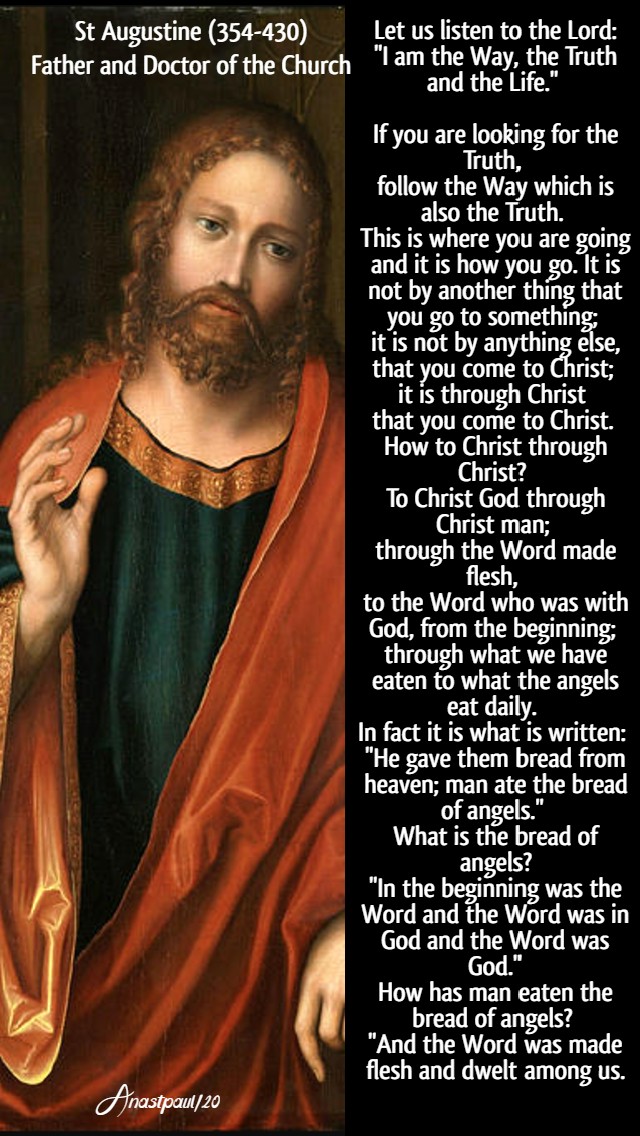
One Minute Reflection – 2 February – The Feast of the Purification of the Blessed Virgin, Candlemas – Mal 3:1-4, Luke 2:22-32
“And inspired by the Spirit he came into the temple and when the parents brought in the child Jesus, to do for him according to the custom of the law, he took him up in his arms and blessed God …” – Luke 2:27-28
REFLECTION – “Your lamps must be burning in your hands” (Lk 12:35). By this outward sign let us remind ourselves of the joy of Simeon, carrying the Light in his hands … We must be burning with love and radiant with good deeds and so, take up Christ in our hands with Simeon … Let us discuss this charming custom of the Church of bearing lights aloft on this feast day … Could anyone hold up a lighted candle in his hands on this day, without at once remembering that old man, who on this same day, took up in his arms, Jesus, God’s Word, clothed in flesh like a candle-flame clothed in wax and affirmed Him to be “the Light which would be a beacon for the Gentiles.” Surely he was that “burning and radiant lamp” (Jn 5:35; 1,7) which bore witness to the Light. For this purpose he came in the Spirit, who had filled him, into the temple, that he might “receive, O God, your loving-kindness in the midst of your temple” (Ps 48[47]:10) and declare him to be loving-kindness indeed and the light of your own people.
Truly, O holy Simeon, in the quiet contentment of old age, you carried this Light not simply in your hands but in the very dispositions of your heart. You were like a lamp-standard, seeing so clearly how much the Gentiles would one day be lit up, while reflecting … the bright rays of our faith. Old, yet still sincere, you can now be happy, in that, you really see what once you but foresaw. Gone is the world’s gloom, “the Gentiles bask in this light of yours,” “the whole earth is full of his glory” (Is 60:3; 6:3).” … Blessed Guerric of Igny O.Cist. (c 1080-1157) Cistercian Abbot
PRAYER – Almighty, eternal God, we humbly beseech Your majesty that, as Your only-begotten Son was this day presented in the temple in the nature of our flesh, so may You grant us to be presented to You, with purified minds. Through Jesus Christ, Thy Son our Lord, Who lives and reigns with Thee, in the unity of the Holy Ghost, God, world without end. Amen (Collect).
Thought for the Day – 1 February – Meditations with Antonio Cardinal Bacci (1881-1971)
“Unless You Turn and Become Like Little Children, You Will Not Enter into the Kingdom of Heaven”
“At the beginning of their ministry, before they had been strengthened and enlightened by the Holy Spirit, the Apostles were as ambitious as most other men. One day, the mother of John and James, the sons of Zebedee, came to Jesus and asked Him, if her two sons could have precedence over the other Apostles and sit on the highest thrones in His Kingdom, one at His right hand and the other at His left. Jesus disapproved of this desire to predominate. “Whoever wishes to become great among you,” He said, “shall be your servant and, whoever wishes to be first among you shall be your slave; even as the Son of Man has not come to be served but to serve and to give his life as a ransom for many” (Mt 20:26-28).
On another occasion, the Apostles came to Jesus and asked Him, which of them would be the greatest in the Kingdom of Heaven. Jesus’ only answer was to call a little child and to place him in the centre of the group. “Amen, I say to you, unless you turn and become like little children, you shall not enter into the kingdom of heaven. Whoever, therefore, humbles himself as this little child, he is the greatest in the kingdom of heaven” (Mt 18:3-4).
This is the lofty teaching of the Gospel. If we wish to be great and pleasing in the eyes of God, we must be unimportant in our own regard and in our relations with men. The Gospel involves an overthrow of human values. Anyone who makes himself insignificant, will become great. Anyone who tries to make himself out to be a great man, becomes of little account in the eyes of God. “God resists the proud but gives grace to the humble” (Cf Js 4:6; 1 Peter 5:5). If we wish to please the Sacred Heart of Jesus, the first thing we must do, is become as little children. In other words, we shall have to suppress our ambition and vanity and destroy our self-love, so that, the Sacred Heart may fill our hearts with the love of God alone!”
Quote/s of the Day – 1 February – The Memorial of St Ignatius of Antioch (c 35– c 107) Bishop and Martyr
“We recognise a tree by its fruit and we ought to be able to recognise a Christian by his action. The fruit of faith should be evident in our lives, for being a Christian, is more than making sound professions of faith. It should reveal itself in practical and visible ways. Indeed, it is better to keep quiet about our beliefs and live them out, than to talk eloquently about what we believe but fail, to live by it.”
“Wherever the Bishop shall appear, there let the multitude also be; even as, wherever Jesus Christ is, there is the Catholic Church.”
(St Ignatius is also responsible for the first known use of the Greek word ‘katholikos’ or Catholic, meaning “universal”, “complete” and “whole” to describe the Church.)
“He who died in place of us, is the one object of my quest. He who rose for our sakes, is my one desire.”
“My dear Jesus, my Saviour, is so deeply written in my heart, that I feel confident, that if my heart were to be cut open and chopped to pieces, the name of Jesus would be found written on every piece.”
One Minute Reflection – 1 February – “Month of the Most Blessed Trinity” – St Ignatius of Antioch (c 35 – 107) Bishop and Martyr – Romans 8:35-39, John 12:24-26
“If it dies, it produces much fruit” – John 12:24
REFLECTION – “Through the glorious achievements of the holy Martyrs with which the Church blossoms everywhere, we are ourselves, proving to our own eyes, how true are the words we have been singing that: “Precious in the sight of the Lord is the death of his saints” (Ps 116[115]:15). For it is precious both in our sight and in the sight of Him, in Whose Name, the death took place.
But the price of those deaths is the death of One Man. How many deaths did that One Man purchase by His death, for, if He had not died, the grain of wheat would not be multiplied? You heard His words when He drew near His passion, that is, when He was drawing near to our Redemption: “Unless a grain of wheat falls into the earth and dies, it remains alone but if it dies, it bears much fruit.” On the Cross He carried out a vast transaction; there the purse of our price was unfastened and, when His side was opened by the lance of the soldier, there streamed the price for the Redemption of the whole earth (cf. Jn 19:34).
Now the faithful ones and Martyrs have been purchased but the faithfulness of the Martyrs, has been proved – their blood is the proof … “As Christ laid down his life for us, so we ought to lay down our lives for the brethren” (1Jn 3:16). In another place it is stated: “At a grand table you have sat; now carefully consider what has been put before you, since it is your duty to prepare for such things” (cf. Prv 23:1). That table is great where the Lord of the table is Himself the Meal. No-one feeds guests with Himself as food but this is exactly what the Lord Christ does, He, Himself is the host who invites; He, Himself is the food and the drink. Therefore, the Martyrs have recognised what they were eating and drinking, so as to be able to repay such gifts. But whence can they make such return, unless He Who first paid the cost, supplies the source from which restitution may be made? That is the reason for the Psalm, where we sing what is written: “Precious in the sight of the Lord is the death of his saints.” ... St Augustine (354-430) Bishop of Hippo, Father and Doctor – (Sermon 329, for the Feast of the Martyrs, 1-2 ; PL 38, 1454).
PRAYER – Be mindful of our weakness, O almighty God and since the burden of our deeds is grievous to us, grant that the glorious intercession of blessed Ignatius Thy Martyr and Bishop, may protect us. Through Jesus Christ, Thy Son our Lord, Who lives and reigns with Thee, in the unity of the Holy Ghost, God, world without end. Amen (Collect).
Saint of the Day – 1 February – Blessed Reginald of Orléans OP (c 1180 – 1220) Priest and Friar of the Order of Preachers, Canon Lawyer, renowned Preacher, Born in c 1180 in Orléans, France and died in early February 1220 in Paris, France of natural causes. Also known as – Réginald de Saint-Gilles, Reginaldo… Additional Memorial – 12 February (Dominicans).
The Miraculous cure of Blessed Reginald by the Blessed Virgin Mary
Reginald of Orleans was known, even during his lifetime, for his brilliance, his prayer, his austerity and his kindness toward others, especially the poor. Originally a powerful Preacher and esteemed Canonist associated with the University of Paris, Reginald encountered St Dominic in Rome. Reginald was captivated by the apostolic way of life championed by Dominic and decided to join the newly-founded Order. Blessed Reginald is one of the great early Dominicans who were acquainted with Dominic himself and seemed to be given a share of the Founder’s spirit.
Blessed Reginald’s life story can be divided into two parts: one before he met St Dominic,and the other, after he had met the Founder. He was born in Orleans, France in c 1180 and having been Ordained a Priest, he had become a Doctor of Canon Law and a well-known figure in the Church in Paris. Many must have looked at him and thought that he had everything he wanted. But, in reality, he was feeling dissatisfied with his life: as was commonplace in the Church in those times he had a very comfortable and well-off lifestyle, yet he knew that his calling from Jesus Christ was to something greater than mere comfort and prestige. And so he was in a dilemma.
Blessed Reginald receives the Habit from the hands of St Dominic
In the year 1218 Reginald was in Rome, when he fell seriously ill. As it happened, Dominic was also in Rome and a mutual acquaintance told him about the condition of Reginald, so that he went to visit him. The biographers tell us, that there was immediately, a perfect understanding between the two men – Reginald saw, that the new Dominican Friars were living the sort of ideal he had been longing for and there and then, he made his religious profession into the Order of Preachers. There was a great sign given to mark this moment of decision: as Reginald lay sick, his life in danger, he was favoured with a vision of the Blessed Virgin Mary who anointed him with oil and held out to him the Dominican habit. Blessed Reginald found himself completely cured and began with great energy to live the Dominican life.
It was quickly apparent to everyone, that he was a changed man. In the City of Bologna where he was assigned and became the Prior of the Dominican Convent there, he became known to the whole City, as a great Preacher of the Gospel, preaching with overflowing faith and conviction. An early biographer wrote, that his preaching ‘like a burning torch, inflamed the hearts of all his hearers.Very few people were so stony-hearted that they could resist the effects of this fire.’.
And, if it is a mark of a true apostle, that he will gather followers to his side, then Reginald, more than passed the test: he attracted a great number in Bologna to join him in the Order of Preachers. Many of them were like him, educated university men and like him, they found the Gospel way of life they had been looking for.
Blessed Reginald was not to enjoy a long life as a Dominican. Early in 1220 he again became ill and this time he died peacefully. . But his place in the history of the Dominican family was assured by the memories of those who had known him in Bologna and had seen a saintly apostle on fire with the love of God and of souls. His meeting with St Dominic gave the final meaning to his life – the beautiful calling, which is given to all those who follow the Lord, to preach the Gospel of Jesus in word and in deed.
“I have no fears for the struggle, nay, I rather look forward to it with impatience, for ever since the Mother of God anointed me with her virginal hands in Rome, I have never ceased to put my whole trust in her and now joyfully await the hour of my deliverance, that I may hasten to see her once more. However, that I may not seem to make little of the Church’s anointing, I profess myself willing to receive it and I humbly ask for it at your hands.”– the final words of Blessed Reginald.
Thought for the Day – 31 January – Meditations with Antonio Cardinal Bacci (1881-1971)
Humility
“Humility is, in fact, truth. Many think that it is a menial fiction, or a pious congregation and that only a few can really achieve it.
In other words, we must disregard ourselves. We must be content to be unknown and unesteemed. This might seem to be contrary to, or at least, superior to human nature but it is based on the simple naked truth. What have we that is not a gift of God? All that we have in the natural and supernatural order, we have received from God: “What hast thou that thou hast not received? And if thou hast receive it, why dost thou boast as if thou hast not received it?” (1 Cor 4:7).
Our defects and sins are the only things which are really our own! So we have a double motive for humility. Everything good about us is a gift from God. Only our sins belong to us!”
Quote/s of the Day – 31 January – The Memorial of St John Bosco (1815-1888)
“Do not try to excuse your faults; try to correct them.”
“Ask your Angel to console and assist you in your last moments.”
“Be ever more convinced that your Guardian Angel is really present, that he is ever at your side. St Frances of Rome always saw him standing before her, his arms clasped at his breast, his eyes uplifted to Heaven but, at the slightest failing, he would cover his face, as if in shame and at times, turn his back to her!”
“Entrust everything to Jesus in the Blessed Sacrament and to Mary, Help of Christians and you will see what miracles are!”
One Minute Reflection – 31 January – St John Bosco, Confessor (1815-1888 – Philippians 4:4-9, Matthew 18:1-5
“Amen, I say to you, unless you turn and become like little children, you will not enter the kingdom of heaven.”… Matthew 18:3
REFLECTION – “We must seek for reasons for individual sayings and actions of the Lord. After the coin was found, after the tribute paid, what do the Apostles’ sudden questions mean? Why precisely “at that time” did the disciples come to Jesus saying, “Who is the greatest in the kingdom of heaven?” Because they had seen that the same tax had been paid for both Peter and the Lord. From the equal price they inferred, that Peter may have been set over all the other Apostles, since Peter had been compared with the Lord in the paying of the tax. So they ask, who is greater in the Kingdom of Heaven. Jesus, seeing their thoughts and understanding the causes of their error, wants to heal their desire for glory, with a struggle for humility.”
He called a child to Him, to ask its age or to show the image of innocence. Or perhaps He actually set a child in their midst — He Himself, Who had not come to be served but to serve — to show them an example of humility.
Whoever humbles himself like this child, he is the greatest in the Kingdom of Heaven. Just as this child, whose example I show you, does not persist in anger, does not long remember injury suffered, is not enamoured inordinately by the sight of a beautiful woman, does not think one thing and say another, so you too, unless you have similar innocence and purity of mind, will not be able to enter the Kingdom of Heaven! Or, it might be taken in another way: “Whosoever, therefore, humiliates himself like this child, is greater in the kingdom of heaven,” so as to imply that anyone, who imitates Me and humiliates himself following My example, so that he abases himself as much as I abased Myself in accepting the form of a servant, will enter the Kingdom of Heaven.” – St Jerome (343-420) Translator of Sacred Scripture into Latin (The Vulgate) One of the original four Doctors of the Latin Church, Father (Commentary on Matthew 3).
PRAYER – O God, Who in Your Confessor, blessed John, raised up a father and teacher of youth and willed that through him, with the help of the Virgin Mary, new religious families should bloom in the Church, grant, we beseech You, that, inflamed by the same fire of love, we may seek to win souls and to serve You alone. Through Jesus Christ, Thy Son our Lord, Who lives and reigns with Thee, in the unity of the Holy Ghost, God, world without end. Amen (Collect)
Thought for the Day – 30 January – Meditations with Antonio Cardinal Bacci (1881-1971)
True Peace
“When He came into the world, Jesus proclaimed peace. The Angels hovering over His humble manger, sang songs of glory to God on high and of peace to men of goodwill on earth. During His earthly pilgrimage, He often spoke of peace. When He forgave sinners their faults, He said to each of them, “Go in peace” and “sin no more” (Lk 7:50; 8:48; Jn 8:11). When He was leaving this earth, He bequeathed His peace to His Apostles, as if it were a sacred heirloom: “Peace I leave with you, My peace, I give to you, not as the world gives do I give to you” (Jn 14:27). We can see, from these words, that the peace of Jesus, is not the same as worldly peace.
The Church, in its liturgy, implores from God, that peace which the world cannot give. When the world speaks of peace, it means, normally, the external public peace which flows from respect for the law and for the established regime. This is peace, there is no doubt about that. It is necessary and is a gift from God. But, it is not enough. We need the inner peace of soul of which we have already spoken, for it is the only true and solid foundation for external peace. Without this peace of soul, external peace is uncertain and fleeting.
We have said, that true peace is based on three things: Right order, harmony and liberty. But, in order to obtain full and perfect peace, still one more thing is necessary – complete and loving abandonment to the will of God. The beginning of real peace and holiness, lies in doing the will of God in every detail. The perfection of peace and holiness, is to do the will of God in everything, purely from love for Him.
Dante expresses this profound idea when he decries the peace of the blessed in Heaven, now unshakeable in their joyful compliance with the divine will.”
“E la sua volontate e nostra pace: Ella E quel mare, al qual tutto si move cio ch’ella crea E che natura face.”
“His Will is our repose: He is the ocean, into which everything flows, which He has created in the universe.”
Quote/s of the Day – 30 January – Fourth Sunday after the Epiphany – Romans 13:8-10, Matthew 8:23-27
“Why are you fearful, O you of little faith? Then He arose and rebuked the wind and the sea and there came a great calm.”
Matthew 8:26
“Whoever has become a servant of the Lord, fears only his Master. But whoever is without the fear of God, is often afraid of his own shadow. Fearfulness is the daughter of unbelief. A proud soul is the slave of fear, hoping in itself, it comes to such a state, that it is startled by a small noise and is afraid of the dark.”
St John Climacus (579-649) Father of the Church
“God’s love calls us to move beyond fear. We ask God for the courage to abandon ourselves unreservedly, so that we might be moulded by God’s grace, even as we cannot see where that path may lead us.”
St Ignatius Loyola (1491-1556)
“Do not look forward to the changes and chances of this life in fear – rather look to them with full hope that, as they arise, God, whose you are, will deliver you out of them. He is your keeper. He has kept you hitherto. Do you but hold fast to His dear hand and He will lead you safely through all things and, when you cannot stand, He will bear you in His arms. Do not look forward to what may happen tomorrow. Our Father will either shield you from suffering, or He will give you strength to bear it.”
“ … Let the fine point of your spirit always turn towards God, its north. Your are about to take to the high seas of the world, do not, on this account, alter dial or mast, sail or anchor or wind. Keep Jesus Christ as your dial, at all times, His Cross for mast, on which to hoist your resolutions, as a sail. Let your anchor be, profound trust in Him and set out early!”
St Francis de Sales (1567-1622) Doctor of the Church
“…Therefore, never allow yourself to start brooding again but always be brave and trust. Serve your good Master with an open heart full of joy. The right way is to see all events and all obstacles in the spirit of faith as being in the hands of Our Lord and to hear Him say to you, on every occasion, as He did to the disciples, ‘It is I. Do not fear. Have faith.’”
One Minute Reflection – 30 January – Fourth Sunday after the Epiphany – Romans 13:8-10, Matthew 8:23-27
“There came a great calm” – Matthew 8:26
REFLECTION – “Christ’s sleep is the symbol of a mystery. The ship’s passengers represent souls traversing the life of this world, on the wood of the cross. In addition, the ship is the symbol of the Church. Indeed, truly… the heart of each member of the faithful, is a ship sailing across the sea: – it cannot sink, provided the spirit engages in good thoughts.
Has someone insulted you? It is the wind beating against you. Have you become angry? It is the swell mounting. Does temptation arise? It is the wind blowing. Is your soul troubled? It is the waves rising up… Awaken Christ and let Him speak to you.“Who, then, is this that even the wind and the sea obey him?” Who is He? “His is the sea for he has made it;“ all things were made by him” (Ps 95[94],5; Jn 1,3). So imitate the winds and the sea, obey your Creator. The sea shows itself to be docile to Christ’s Voice and do you remain deaf? The sea obeys, the winds drop and do you continue to blow? What are we trying to say by this? Speaking, getting upset, plotting revenge – isn’t this continuing to blow and not wanting to give way before Christ’s Word? When your heart is stirred up do not allow yourself to be swamped by the waves!
If, nevertheless, the wind blows us over – for we are only human – and if it stirs up the bad feelings in our hearts, let us not despair. Let us awaken Christ, so as to continue our journey on a peaceful sea.” – St Augustine (354-430), Bishop of Hippo, Great Western Father and Doctor of Grace of the Church (Sermon 63).
PRAYER – O God, You Who know that our human frailty cannot stand fast against the great dangers that beset us, grant us health of mind and body, that with your help we may overcome what we suffer on account of our sins. Through Jesus Christ, Thy Son our Lord, Who lives and reigns with Thee, in the unity of the Holy Ghost, God, world without end. Amen. (Collect).
Our Morning Offering – 30 January – Fourth Sunday after the Epiphany
May Your Heart Dwell Always in our Hearts! By St Francis de Sales (1567-1622) Doctor of Charity
May Your Heart dwell always in our hearts! May Your Blood ever flow in the veins of our souls! O Sun of our hearts, You give life to all things by the rays of Your goodness! I will not go, until Your Heart has strengthened me, O Lord Jesus! May the Heart of Jesus be the King of my heart! Blessed be God. Amen
You must be logged in to post a comment.