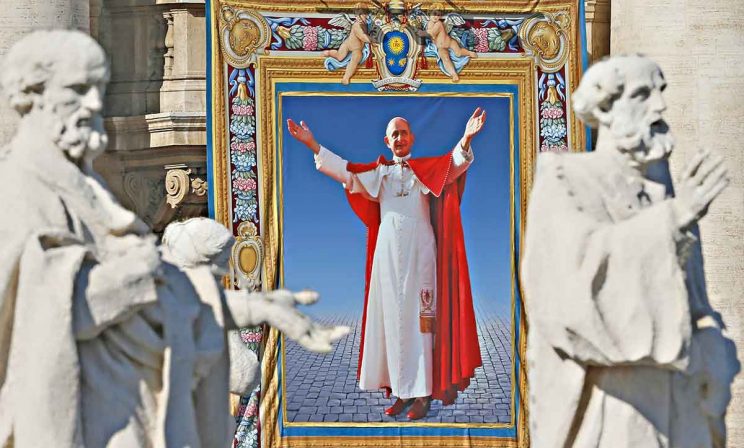
One Minute Reflection – 29 May – “Mary’s Month” – Friday of the Seventh Week of Easter, Readings: Acts 25:13-21, Psalm 103:1-2, 11-12, 19-20, John 21:15-19 and the Memorial of St Pope Paul VI (1897-1978) and Bl Rolando Maria Rivi (1931-1945) “I belong to Jesus,” Seminarian, Martyr
“Do you love me?” … John 21:17
REFLECTION – “Here I find all good shepherds in the one shepherd (Jn 10:14). Good shepherds are not lacking but they are in the one. To speak of many. implies division … If the Lord entrusted them at the time we speak of, it was because He found Peter – indeed, in Peter himself, He recommended unity. There were many apostles but to one is said: “Feed my sheep” … When He entrusted His sheep to Peter, as one to another, He wished to make him one with Himself and, so to entrust the sheep to him, as to be Himself the Head, while Peter assumed the figure of the body (Col 1:18) … What, then, does He first say to Peter, in order to entrust the sheep to him yet avoid entrusting them as if to another? “Peter, do you love me?” And he answered: “I do love you.” And again: “Do you love me?” And he answered: “I do love you.” And a third time: “Do you love me?” And he answered a third time: “I do love you” He makes sure of love so as firmly to establish unity.
Jesus, the one shepherd, feeds His sheep in these shepherds and they in the Him … It was not because of a scarcity of shepherds (as though the prophet were foretelling bad times to come) that He said: “I will feed my sheep myself” as though He had no-one to whom to entrust them. Even when Peter himself was alive and the apostles were still alive in the flesh, He, the one in whom all the shepherds are one reality, said: “I have other sheep, that are not of this fold; them also must I bring, that there may be one flock and one shepherd” (Jn 10:16). So let them all be in the one Shepherd and speak with the one Shepherd’s voice… All should Him speak with the one voice and not with different voices. “I beseech you, brethren, that you all say the same thing and there be no divisions among you” (1Cor 1:10). Let the sheep hear this voice, cleared of all division and cleansed of all heresy and let them follow their shepherd as He says: “Those who are my sheep hear my voice and follow me” (Jn 10:27).” … St Augustine (354-430) Father and Doctor of Grace – Sermon 46, On the Shepherds, #30
PRAYER – Heavenly Father, help us to accept the tasks you have given us to do in life. Let us be faithful all our days and be able to attain Your eternal reward in heaven. May our Blessed Mother, St Paul VI and the Blessed little Rolando Rivi, who so diligently showed their love for Your Son, pray for us that we may always praise Your glory and be faithful at all times and in all circumstances, amen.
Our Morning Offering – 29 May – “Mary’s Month” – Friday of the Seventh Week of Easter and the Memorial of St Pope Paul VI (1897-1978)
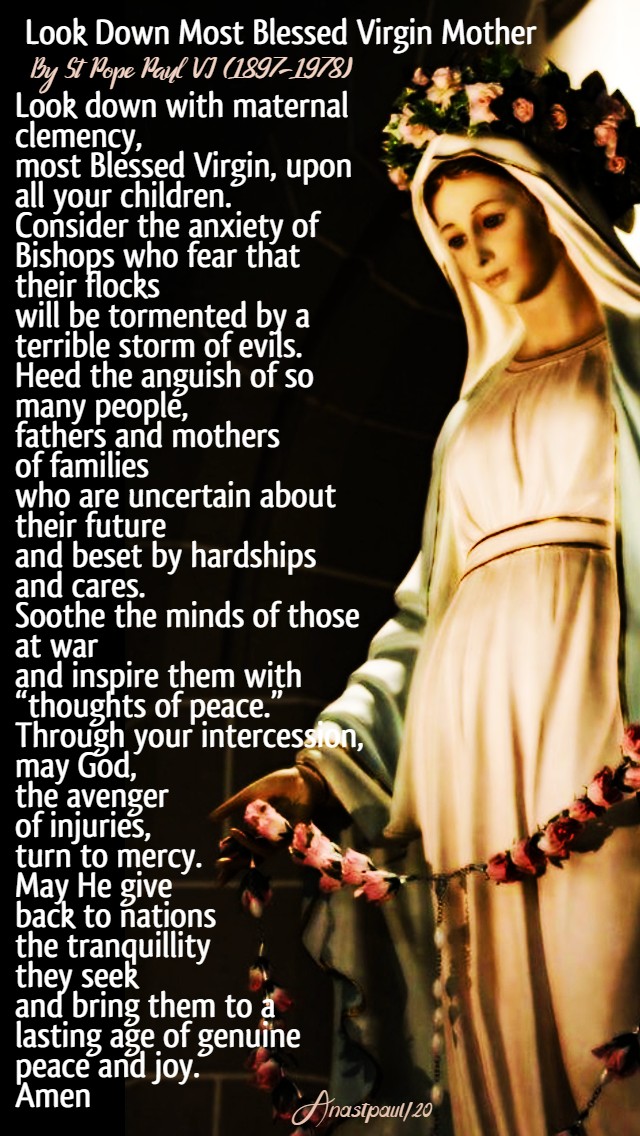
Look Down Most Blessed Virgin Mother By St Pope Paul VI (1897-1978)
Look down with maternal clemency,
most Blessed Virgin, upon all your children.
Consider the anxiety of Bishops
who fear that their flocks
will be tormented by a terrible storm of evils.
Heed the anguish of so many people,
fathers and mothers of families
who are uncertain about their future
and beset by hardships and cares.
Soothe the minds of those at war
and inspire them with “thoughts of peace.”
Through your intercession,
may God, the avenger of injuries, turn to mercy.
May He give back to nations
the tranquillity they seek
and bring them to a lasting age of genuine peace and joy.
Amen
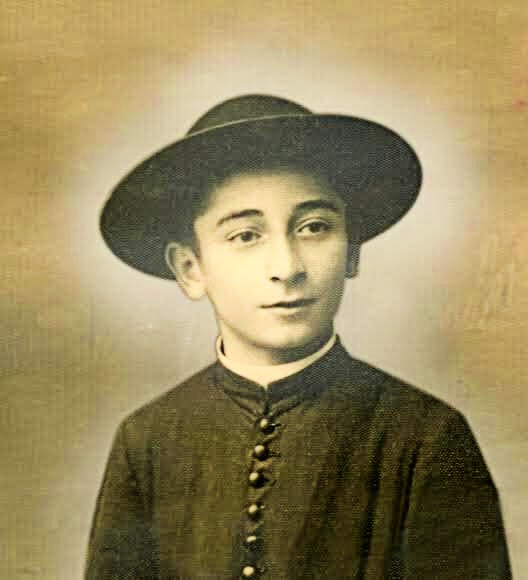
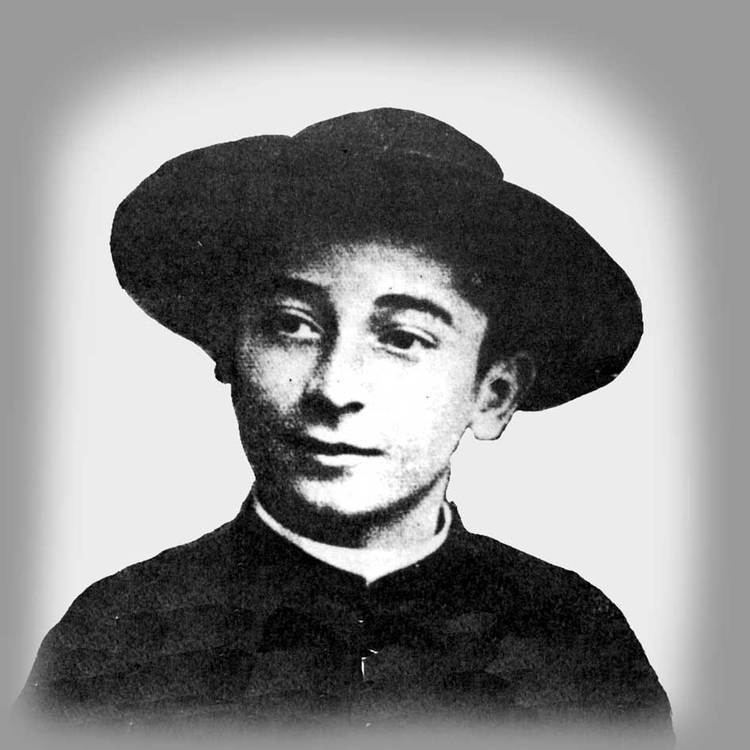
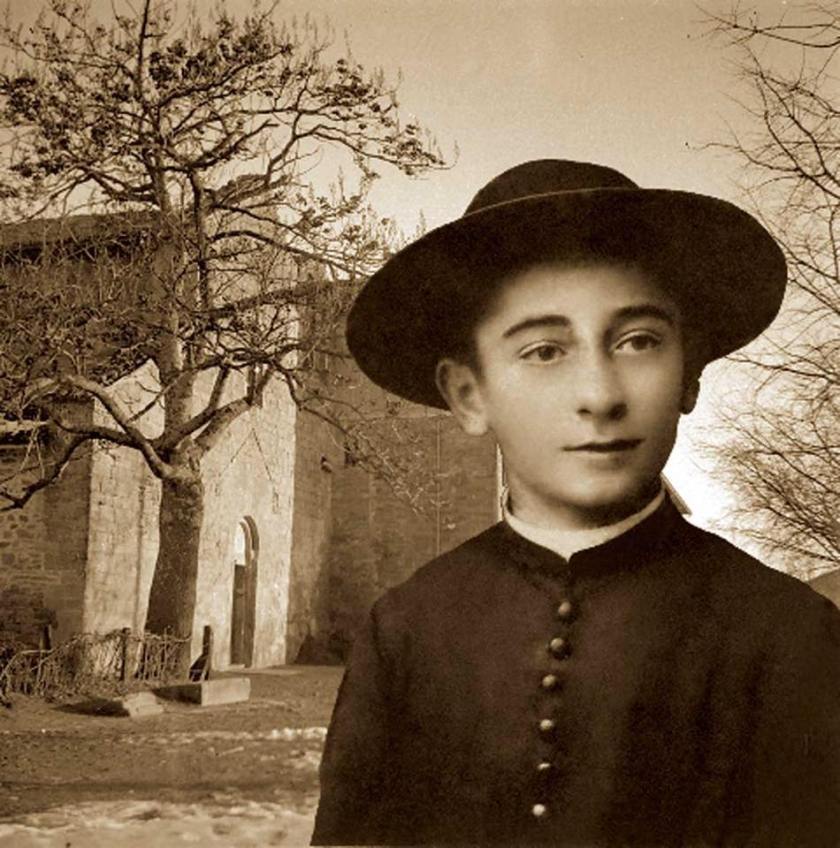
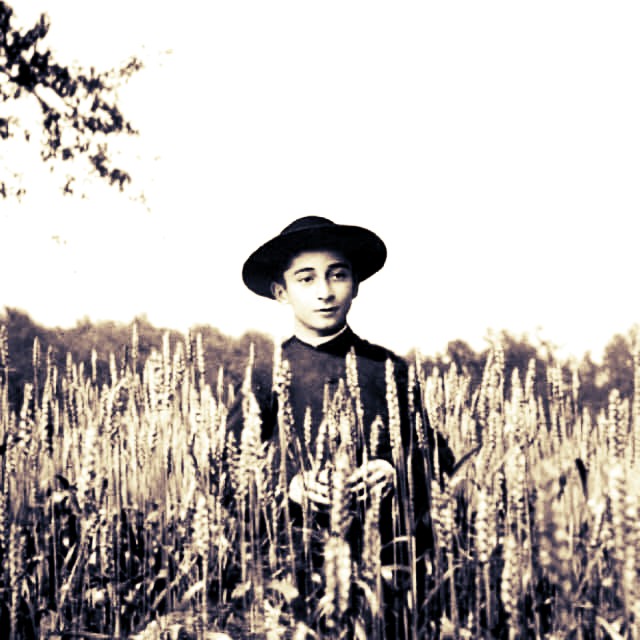
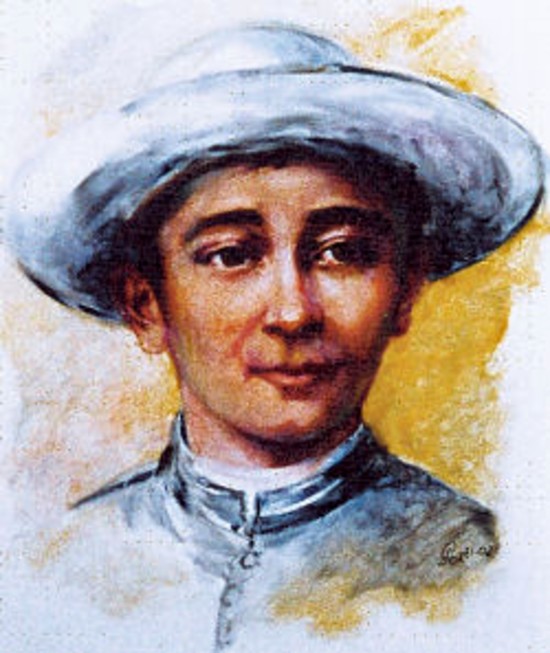
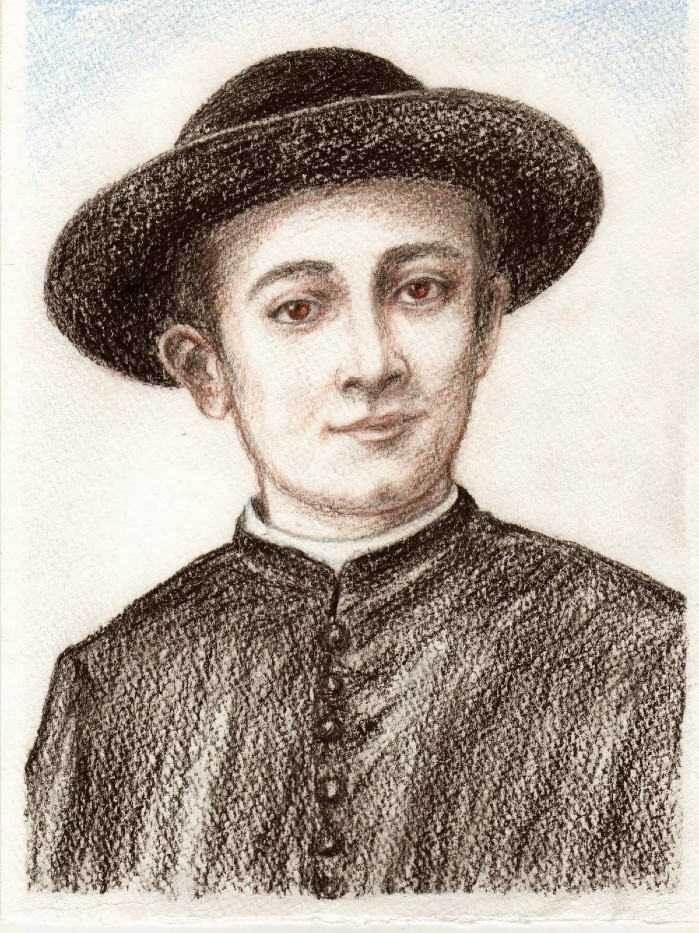
Saint of the Day – 29 May – Blessed Rolando Maria Rivi (1931-1945) “I belong to Jesus,” Seminarian, Martyr, – born on 7 January 1931 in San Valentin di Castellarano, Reggio Emilia, Italy and died on 13 April 1945- aged 14.
Blessed Rolando was noted for his studious and pious nature with an intense love for Jesus Christ which was evident through frequent Confession and the reception of the Holy Eucharist. He was amiable to all and wore his cassock with great pride to the point where he affirmed that he belonged to Christ and His Church. The Communist partisans murdered him “in odium fidei” (in hatred of the faith) towards the end of World War II in Modena, because he would become a Priest.
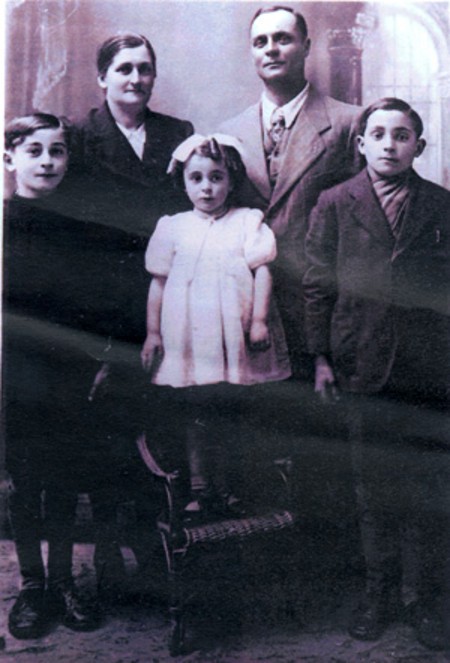
Born in San Valentino, a hamlet of the town of Castellarano, he was the second of three children of Roberto and Albertina Rivi. On the day after he was born, his parents brought him to be Baptised in the village church, after which they dedicated him to Our Lady of Mount Carmel.
Bl Rolando is on the left
Rivi grew up, educated in the faith by his mother and father and in the strong religious atmosphere, was a fixture in his Parish. Before going to work in the fields each morning, he attended the celebration of the Mass and received the Eucharist, after he made his First Communion. In this home filled with faith, he grew along with his older brother Guido and little sister Rosanna. His exuberance and liveliness often proved a test to his parents but his grandmother, Anna sensed his good character and said once that “Rolando will become either a rascal or a saint! He can not walk the middle ground.”
In 1937 he began attending the local school where his teachers cultivated his love for life and for Jesus Christ, while noting his desire to know and love Jesus. He was admitted to receive his First Communion almost at once, because he was among the better prepared children and eager to do so. His First Communion was made on 16 June 1938 on the Feast of Corpus Christi. Rolando changed after that event – while remaining amiable and energetic, he became more mature and responsible, which was a profound change and which was accentuated after receiving his Confirmation on 24 June 1940 from the Bishop of Reggio.
In the meantime, his Parish Priest Father Marzocchini Olinto, became his teacher and a spiritual father. Rivi availed himself of the Sacrament of Penance each week and each morning he got up to serve Mass and receive the Eucharist. He was almost 11 when he was no longer able to ignore the beginnings of his vocation to the Priesthood and he said to his parents and grandparents: “I want to be a Priest to save many souls. I will go as a Missionary to make Jesus known, far far away.” His pious parents did not oppose the decision and after he completed his schooling, he commenced his Ecclesial studies in Marola in Carpineti on 1 October 1942. As was the custom, he wore the cassock from the moment he entered as a Seminarian and was proud of the garment, viewing it as a sign of his belonging to Christ and to the Church.
Bl Rolando outside the Seminary
Rolando was forced to leave his studies and return home in June 1944 after the Nazi forces occupied the Italian nation but he still wore his cassock with pride, against the wishes of his parents. His parents were worried about rising anti-religious sentiment and even violence against Ecclesial figures but he refused to desist and continued to wear it. He said to them: “I study to be a priest and these vestments are the sign that I belong to Jesus.”Rivi wore his cassock during vacation periods and even during the hot summer months. He liked music and could use a harmonium. People in his village admired him for his holiness and even his father admired him and said once: “My son is so good and studious.”
On 10 April 1945, Rolando was taken by a group of Communist insurgents, who forced him to go with them into the woods. His father, Roberto, wrote of that day as follows:
“It was the morning of 10 April 1945. After returning from Mass with my son, I left to work in the fields. When I returned around midday I did not find Rolando in the house. My sister-in-law told me that he had gone to study in his usual place, a grove nearby the house. I called him, there was no response. Together with his mother I went to the place thinking that he might be asleep but a sad surprise awaited us. His books were scattered on the ground and, on a piece of paper taken from one of his notebooks, these words were written: “Do not search for him, he has come with us for a moment. The Insurgents.” My wife began to cry.”
On Friday, 13 April 1945, after three days of torture and humiliation, the insurgents brought him to a forest in the village of Piane di Monchio, where there was already a grave dug. It was about 3:00 in the afternoon. They hurled him to the ground and then forced him to kneel on the edge of the grave. Before they killed him, Rolando asked for – and was granted – a moment to pray for his parents. Even then, he reaffirmed his belonging to Christ. The Communist insurgents then murdered him with two shots of the pistol.
On the evening of 14 April following the directions of some insurgents (including the very assassin!), Roberto Rivi and Father Alberto Camellini, the pastor of San Valentino, recovered Rolando’s body. His face was black and blue, his body tormented and there were two mortal wounds – one at the left temple and the other at the heart. The following day they brought him to the town of Monchio, where the funeral and Christian burial were held.
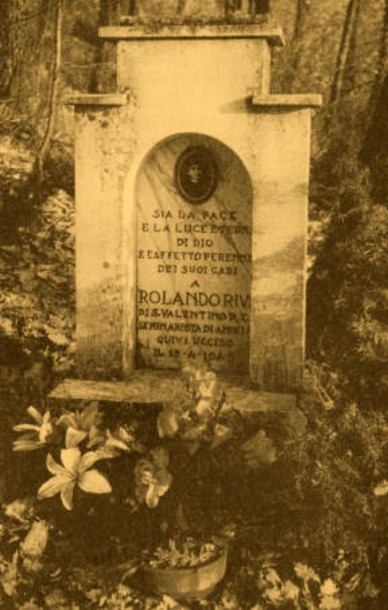
The original Gravestone of Bl Rolando
On the Sunday after Easter, Don Camellini and Roberto Rivi exhumed the Martyr’s body, which was temporarily buried in the neighbouring cemetery. On 25 May 25, 1945, the mortal remains were brought back to San Valentino, surrounded by a crowd of hundreds of young Catholics who had known the young saint. On his tomb, his father had these words engraved:
“Rest in light and peace, you who were extinguished by hatred and darkness.”
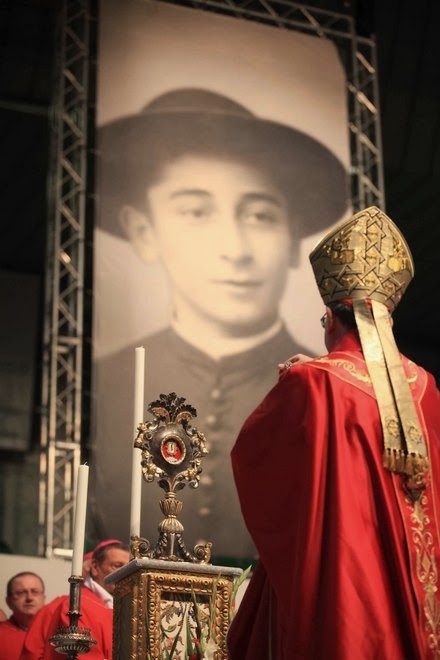
His figure became more well known in 2001 after news broke that the English child James Blacknall (born 1998) was cured of leukemia on 4 April 2001 after a hair and blood relic of Rivi was placed under his pillow with a novena said. Rolando Rivi’s cause for Canonisation was opened by the Archdiocese of Modena on 7 January 2006. In May of 2012, the competent Vatican commission of theologian “censors” approved the validity of Rolando’s Martyrdom in odium fidei – in hatred of the faith. Then, on 28 March 2013, Pope Francis authorised the Congregation for the Causes of Saints to promulgate a decree recognizing the Martyrdom. The ceremony of Beatification was celebrated on 5 October 2013, by Angelo Cardinal Amato, Prefect of the Congregation for the Causes of Saints, in the city of Modena. Almost 20 000 people attended the Beatification.
Cardinal Amato at the Beatification with the Relics
“If we could believe in Jesus Christ with the swiftness, the spontaneity, the simplicity and the docility with which Rolando Rivi believed, our faith would become strong like his, and our Church would become strong like the Church that he had in his heart and for which he did not hesitate to die” (Bishop Negri, Bishop of Montefeltre). We may ask, through the intercession of Blessed Rolando Rivi, for the grace to belong to Jesus totally and without compromise—then, will we enjoy true freedom and reign with Christ forever. Amen.
St Restitutus of Rome
Bl Richard Thirkeld Blessed Rolando Maria Rivi (1931-1945) Seminarian, Martyr Died aged 14
St Theodosia of Caesarea and Companions St Ursula Ledochowska (1865-1939) Her lifestory: https://anastpaul.com/2017/05/29/saint-of-the-day-29-may-st-ursula-ledochowska-mother-maria-ursula-of-jesus/
St Votus of Atares
St William of Cellone
—
Martyrs of Toulouse: A group of eleven Dominicans, Franciscans, Benedictines, clergy and lay brothers who worked with the Inquisition in southern France to oppose the Albigensian heresy. Basing their operations in a farmhouse outside Avignonet, France, he and his brother missioners worked against heresy. Murdered by Albigensian heretics while singing the Te Deum on the eve of Ascension. They werebeaten to death on the night of 28 to 29 May 1242 in the church of Avignonet, Toulouse, France and Beatified on 1 September 1866 by Pope Pius IX (cultus confirmation).
• Adhemar
• Bernard of Roquefort
• Bernard of Toulouse
• Fortanerio
• Garcia d’Aure
• Pietro d’Arnaud
• Raymond Carbonius
• Raymond di Cortisan
• Stephen Saint-Thibery
• William Arnaud
• the prior of Avignonet whose name unfortunately has not come down to us.
The church in which they died was placed under interdict as punishment to the locals for the offense. Shortly after the interdict was finally lifted, a large statue of the Blessed Virgin Mary was found on the door step of church. Neither the sculptor nor the patron was ever discovered, nor who delivered it or how. The people took it as a sign that they were forgiven, but that they should never forget, and should renew their devotion to Our Lady. They referred to the image as “Our Lady of Miracles.”
Until recently there was a ceremony in the church on the night of the 28th to 29th of May, the anniversary of the martyrdom. Called “The Ceremony of the Vow”, parishioners would gather in the church, kneel with lit candles, and process across the church on their knees, all the while praying for the souls of the heretics who had murdered the martyrs.
Martyrs of Trentino: Three missionaries to the Tyrol region of Austria, sent by Saint Ambrose of Milan and welcomed by Saint Vigilius of Trent. All were martyred – Alexander, Martyrius and Sisinius. They were born in Cappadocia and died in 397 in Austria.
One Minute Reflection – 28 May – “Mary’s Month” – Thursday of the Seventh Week of Easter, Readings: Acts 22:30; 23:6-11, Psalm 16:1-2, 5, 7-11, John 17:20-26 and The Memorial of Blessed Lanfranc of Canterbury (c 1005-1089)
“And I have given them the glory you gave me …” … John 17:22
REFLECTION – “… Through our unremitting zeal for you, Lord, set upon us the sign of Your day that is not measured by the sun. … In Your sacrament we daily embrace You and receive You into our bodies; make us worthy to experience the resurrection for which we hope. We have had Your treasure hidden within us, ever since we received baptismal grace, it grows ever richer at Your sacramental table. Teach us to find our joy in Your favour! Lord, we have within us Your memorial, received at Your spiritual table; let us possess it in its full reality when all things shall be made new.
We glimpse the beauty that is laid up for us, when we gaze upon the spiritual beauty Your immortal will, now creates within our mortal selves. Saviour, Your Crucifixion marked the end of Your mortal life; teach us to crucify ourselves and make way for our life in the Spirit. May Your Resurrection, Jesus, bring true greatness to our spiritual self and may Your sacraments be the mirror, wherein we may know that self. Saviour, Your divine plan for the world is a mirror for the spiritual world – teach us to walk in that world as spiritual men.
Lord, do not deprive our souls, of the spiritual vision of You, nor our bodies of Your warmth and sweetness. The mortality lurking in our bodies spreads corruption through us; may the spiritual waters of Your love cleanse the effects of mortality from our hearts. Grant, Lord, that we may hasten to our true city and, like Moses on the mountaintop, possess it now in vision.” … St Ephrem (306-373) Father and Doctor of the Church – (Sermo 3, De fine et admonitione 2. 4-5)
PRAYER – God of mercy, You have filled us with the hope of resurrection by restoring man to his original dignity. May we who relive this mystery each year come to share it in perpetual love. May the Mother of Our Lord stand with us as we gaze upward to her Son and may the prayer of Bl Lanfranc, be a support in our troubles. Grant this through our Lord Jesus Christ, Your Son, who lives and reigns with you and the Holy Spirit, one God, forever and ever.
Our Morning Offering – 28 May – “Mary’s Month” – Thursday of the Seventh Week of Easter and The Memorial of St Germanus (c 490-576)
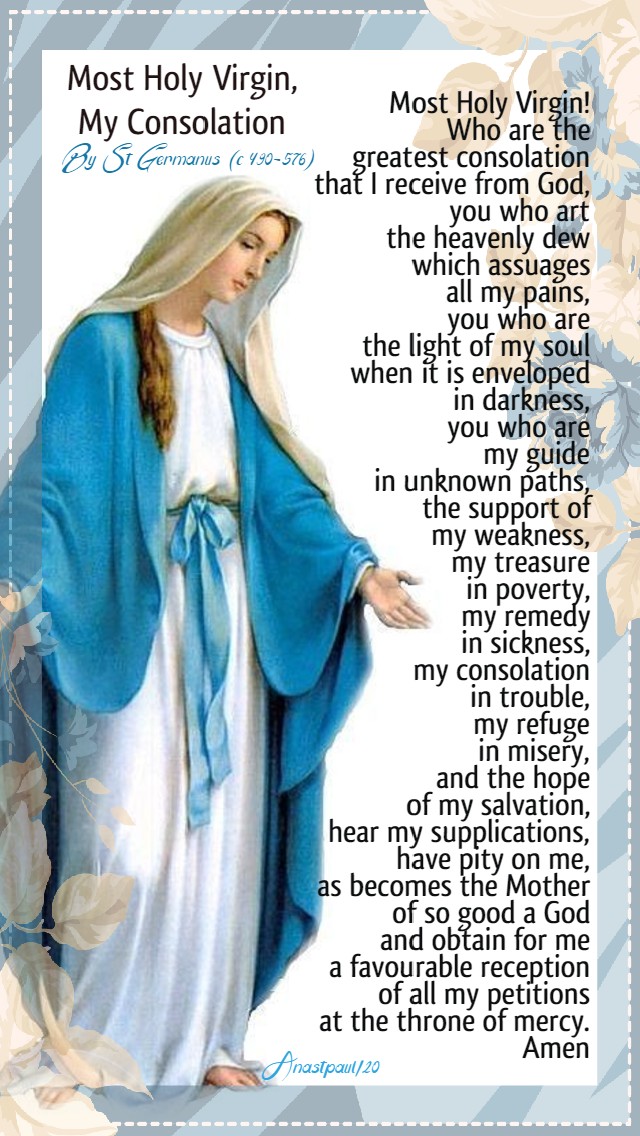
Most Holy Virgin, My Consolation By St Germanus (c 490-576)
Most Holy Virgin!
Who are the greatest consolation
that I receive from God,
you who art the heavenly dew
which assuages all my pains,
you who are the light of my soul
when it is enveloped in darkness,
you who are my guide in unknown paths,
the support of my weakness,
my treasure in poverty,
my remedy in sickness,
my consolation in trouble,
my refuge in misery,
and the hope of my salvation,
hear my supplications,
have pity on me,
as becomes the Mother of so good a God
and obtain for me a favourable reception
of all my petitions at the throne of mercy.
Amen
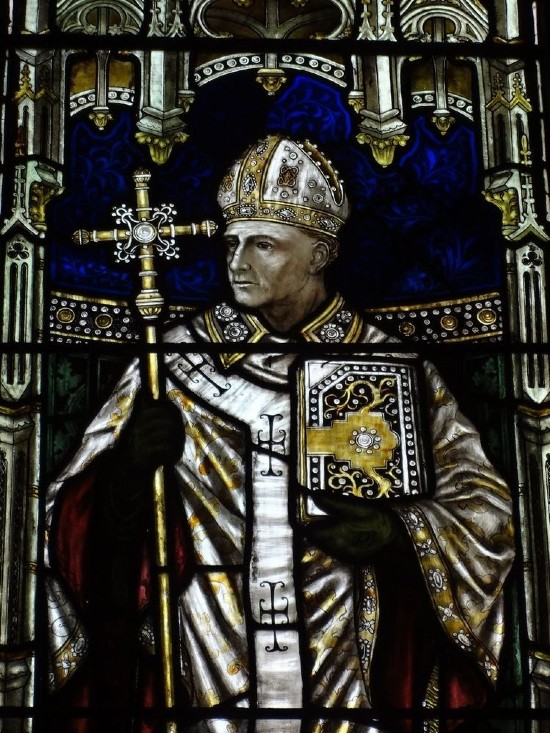
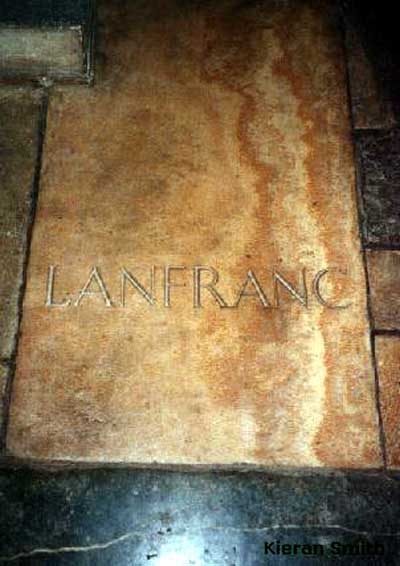
Saint of the Day – 28 May 2020 – Blessed Lanfranc of Canterbury OSB (c 1005-1089) Archbishop of Canterbury, Benedictine Abbot, celebrated Jurist, Scholar, Professor, spiritual writer, Reformer, negotiator – born in c 1005 in Pavia, Italy and died on 24 May 1089 in Canterbury, England of natural causes. He is also variously known as Lanfranc of Pavia,Lanfranc of Bec and Lanfranc of Canterbury. He renounced his career as a very well-known and celebrated jurist, to become a Benedictine monk at Bec in Normandy. He served successively as prior of Bec Abbey and abbot of St Stephen in Normandy and then as Archbishop of Canterbury in England, following its Conquest by William the Conqueror.
Lanfranc was born in the early years of the 11th century at Pavia, where later tradition held that his father, Hanbald, held a rank broadly equivalent to magistrate. He was orphaned at an early age.
He was trained in the liberal arts, at that time a field in which northern Italy was famous. For unknown reasons at an uncertain date, he crossed the Alps, soon taking up the role of teacher in France and eventually in Normandy. About 1039 he became the Master of the Cathedral school at Avranches, where he taught for three years with conspicuous success. But in 1042 he embraced the Monastic life in the newly founded Bec Abbey. Until 1045 he lived at Bec in absolute seclusion.
Lanfranc was then persuaded by Abbot Herluin to open a school at Bec to relieve the Monastery’s poverty. From the first he was celebrated. His pupils were drawn, not only from France and Normandy but also from Gascony, Flanders, Germany and Italy. Many of them afterwards attained high positions in the Church, one student, Anselm of Badagio, became Pope under the title of Alexander II, another, St Anselm of Canterbury (Doctor of the Church) succeeded Lanfranc as the Archbishop of Canterbury.
As a result of his growing reputation, Lanfranc was invited to defend the Doctrine of Transubstantiation against the attacks of Berengar of Tours. He took up the task with the greatest zeal, although Berengar had been his personal friend. He was the protagonist of orthodoxy at the Church Councils of Vercelli (1050), Tours (1054) and Rome (1059). Our knowledge of Lanfranc’s polemics is chiefly derived from the tract De corpore et sanguine Domini, probably written c 1060-63. His work was regarded as conclusive and became for a while a text-book in the schools. It is often said to be the place where the Aristotelian distinction between substance and accident was first applied, to explain Eucharistic change. It is the most important of his surviving works.
When the see of Rouen next fell vacant (1067), the thoughts of the electors turned to Lanfranc. But he declined the honour and he was nominated to the English Primacy as Archbishop of Canterbury. He was speedily Consecrated on 29 August 1070. The new Archbishop at once began a policy of reorganisation and reform.
By long tradition the primate was entitled to a leading position in the king’s councils and the interests of the Church demanded, that Lanfranc should use his power in a manner not displeasing to the king. On several occasions when William I was absent from England Lanfranc acted as his vicegerent.
On the death of the Conqueror in 1087, Lanfranc secured the succession for William Rufus, in spite of the discontent of the Anglo-Norman baronage and, in 1088, his exhortations induced the English militia to fight on the side of the new sovereign against Odo of Bayeux and the other partisans of Duke Robert. He exacted promises of just government from Rufus and was not afraid to remonstrate, when the promises were disregarded. So long as he lived he was a check upon the worst propensities of the king’s administration. But his restraining hand was too soon removed. In 1089 he was stricken with fever and he died on 24 May amidst universal lamentations.
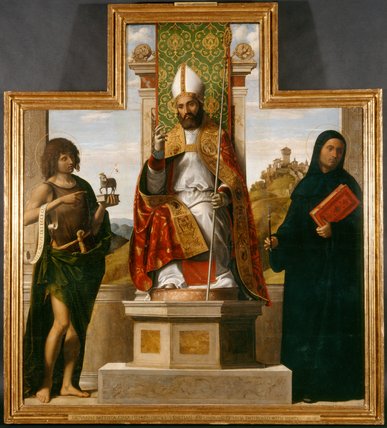
Bl Lanfranc between St John the Baptist and St Liborius
The efforts of Christ Church Canterbury to secure him the status of saint seem to have had only spasmodic and limited effect beyond English Benedictine circles. However, in the period after the Council of Trent, Lanfranc’s name was included in the Roman Martyrology and in the current edition, maintains the rank of beatus, the feast day being celebrated on 28 May. His tomb rests in Canterbury Cathedral.
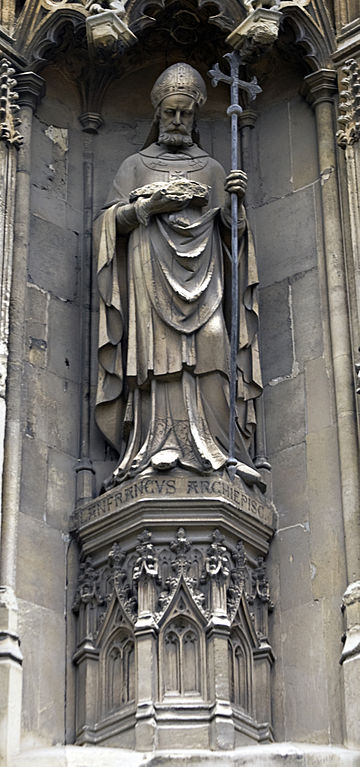
Statue of Bl Lanfranc from the exterior of Canterbury Cathedral
Bl Heliconis of Thessalonica
St Helladius of Rome
St Herculaneum of Piegaro
Bl John Shert
St Justus of Urgell Blessed Lanfranc OSB (c 1005-1089)
St Luciano of Cagliari
Bl Margaret Plantagenet Pole Blessed Maria Bartolomea Bagnesi OP (1514-1577) Her lifestory: https://anastpaul.com/2017/05/28/saint-of-the-day-28-may-blessed-maria-bartholomew-bagnesi-t-o-s-d/
Bl Mary of the Nativity
St Moel-Odhran of Iona
St Paulus of Rome
St Phaolô Hanh
St Podius of Florence
Bl Robert Johnson
St Senator of Milan
Bl Thomas Ford
St Ubaldesca Taccini
St William of Gellone
Bl Wladyslaw Demski
—
Martyrs of Palestine: A group of early 5th century monks in Palestine who were martyred by invading Arabs.
Martyrs of Sardinia – 6 saints: A group of early Christians for whom a church on Sardinia is dedicated; they were probably martyrs, but no information about them has survived except the names Aemilian, Aemilius, Emilius, Felix, Lucian and Priamus. Patrons of the diocese of Alghero-Bosa, Italy.
Martyred in the Spanish Civil War: Blessed Luís Berenguer Moratona
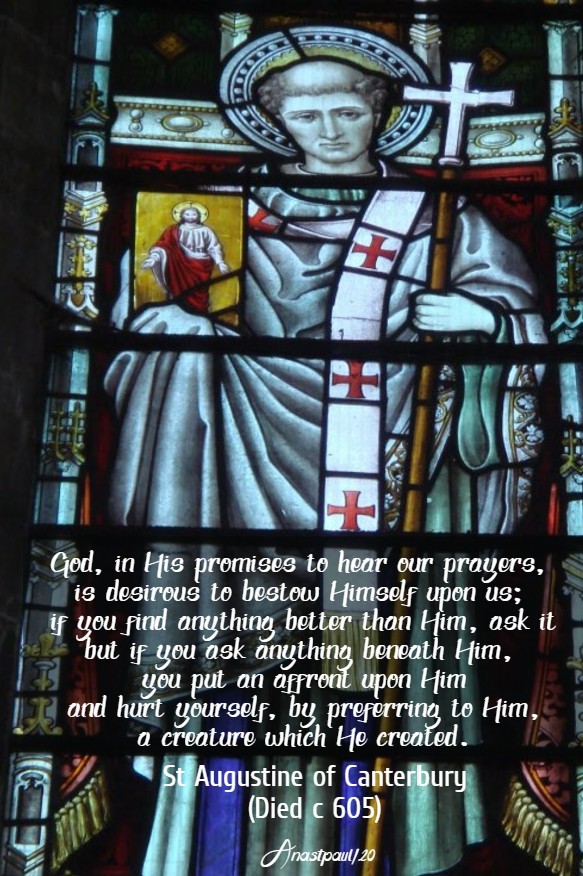
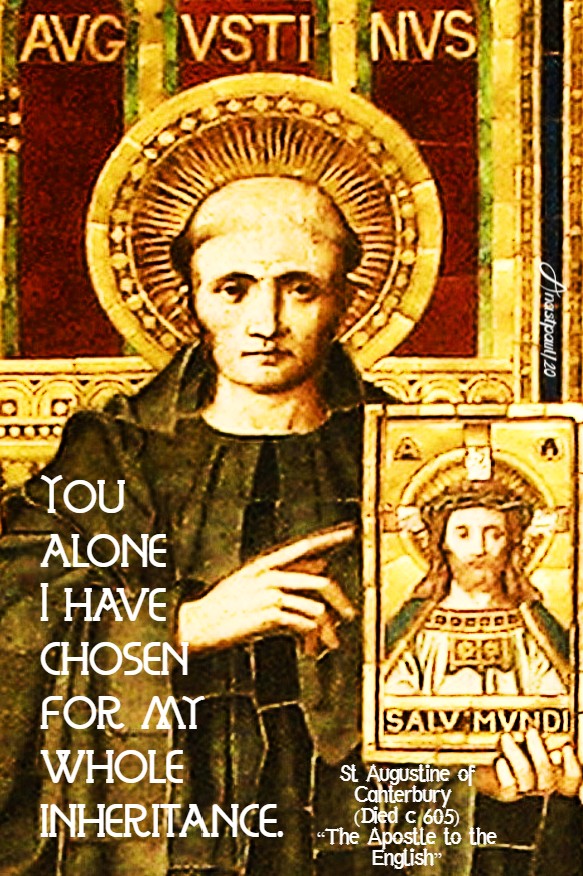
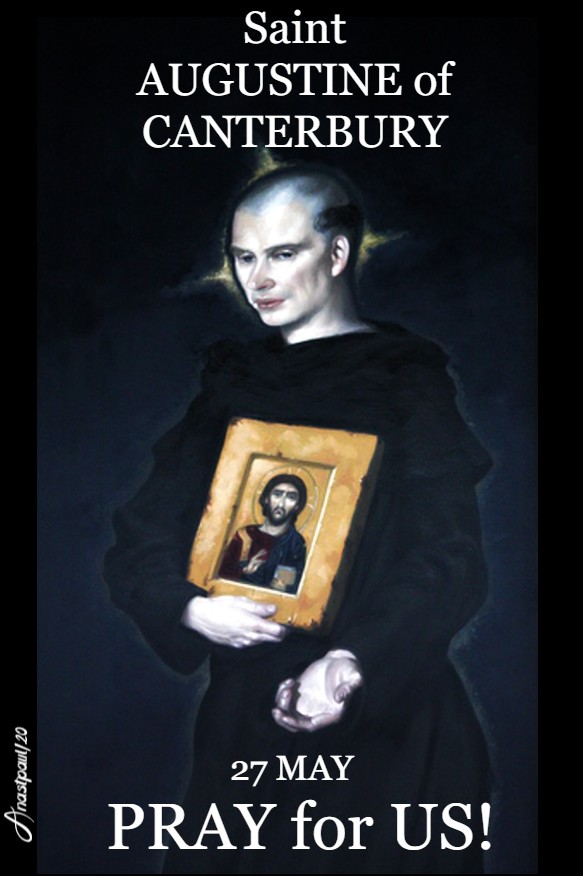
Quote/s of the Day -– 27 May – The Memorial of St Augustine of Canterbury
OSB (Died c 605)
“God, in His promises to hear our prayers, is desirous to bestow Himself upon us; if you find anything better than Him, ask it but if you ask anything beneath Him, you put an affront upon Him and hurt yourself, by preferring to Him, a creature which He created.
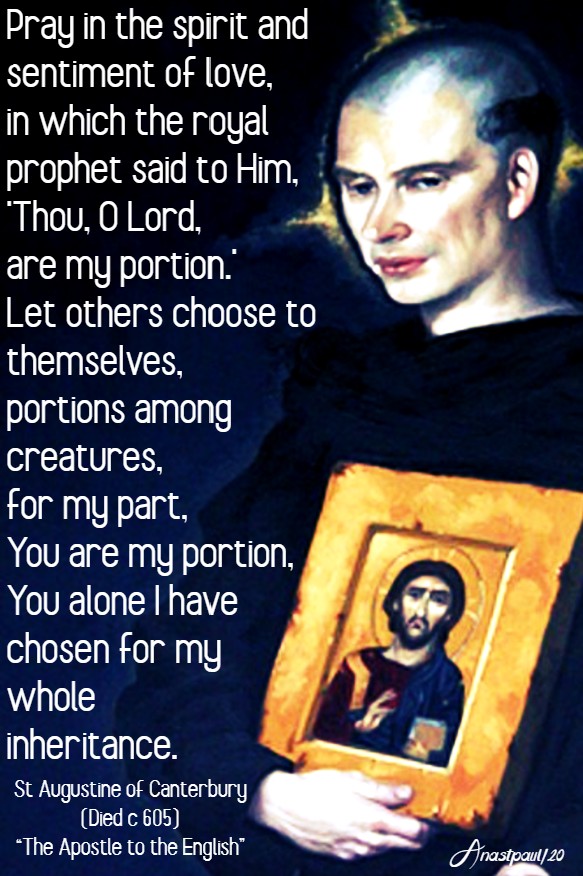
Pray in the spirit and sentiment of love, in which the royal prophet said to Him, ‘Thou, O Lord, are my portion.’ Let others choose to themselves, portions among creatures, for my part, You are my portion, You alone I have chosen for my whole inheritance.”
St Augustine of Canterbury (Died c 605)
“The Apostle to the English”
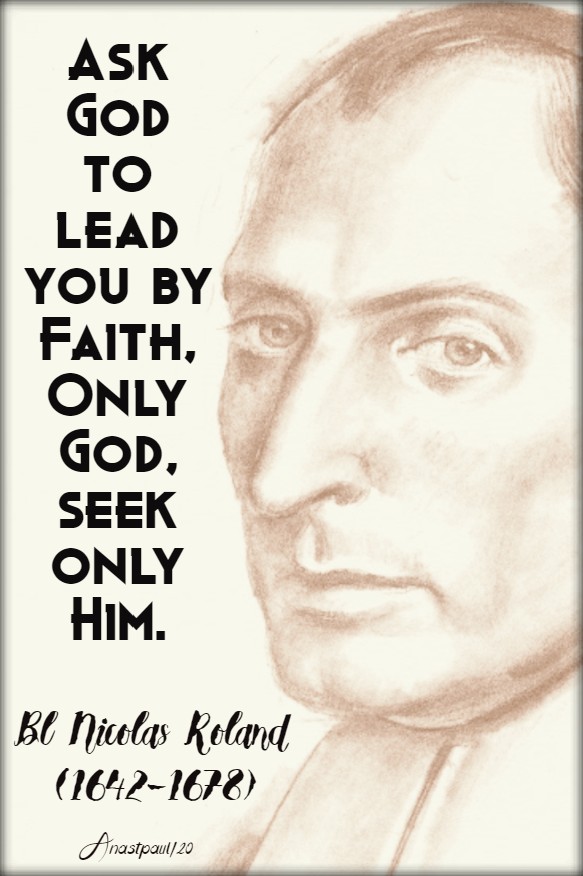
“Ask God to lead you by Faith, Only God, seek only Him.”
One Minute Reflection -– 27 May – “Mary’s Month” Wednesday of the Seventh Week of Easter, Readings: Acts 20:28-38, Psalm 68:29-30, 33-36, John17:11-19 and the Memorial of St Augustine of Canterbury (Died c 605)
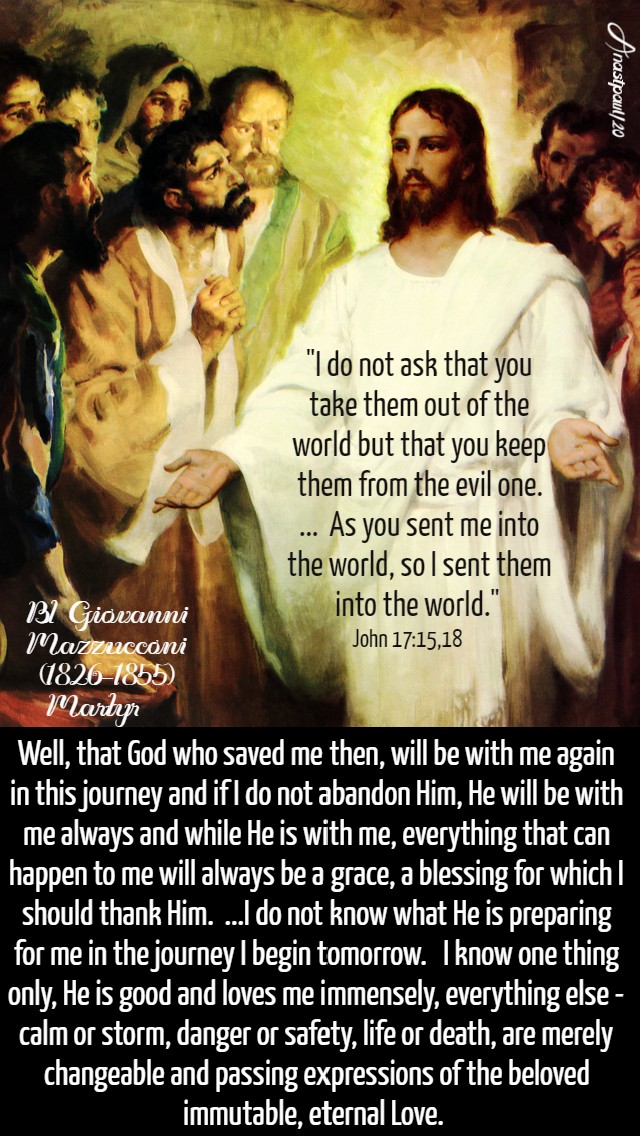
“I do not ask that you take them out of the world but that you keep them from the evil one. … As you sent me into the world, so I sent them into the world.” … John 17:15,18
REFLECTION – “Well, that God who saved me then, will be with me again in this journey and if I do not abandon Him, He will be with me always and while He is with me, everything that can happen to me will always be a grace, a blessing for which I should thank Him. If in danger, He wants to withdraw, or pretends to be asleep on the bow of the ship, like the Apostle, I will go to wake Him and let Him see my danger. And then if He does not want to listen, I will say – Lord, command me to come to You and my soul will walk on the waters, it will go to His feet and be content forever.
I do not know what He is preparing for me in the journey I begin tomorrow. I know one thing only, He is good and loves me immensely, everything else – calm or storm, danger or safety, life or death, are merely changeable and passing expressions of the beloved immutable, eternal Love. Yes, my beloved brethren, we have another country, another home, a kingdom where we must all meet, where there will no longer be separations or departures, where past sorrows and danger will merely serve to increase our consolation and glory.” … Blessed Giovanni Mazzucconi P.I.M.E. (1826-1855) Martyr – Giovanni Battista Mazzucconi was an Italian priest from the Pontifical Institute for Foreign Missions. He was killed in hatred of the faith in Papua New Guinea during his work there amongst the people. He was 29 years old. He was beatified in 1984. His life is herehttps://anastpaul.com/2019/09/07/saint-of-the-day-7-september-blessed-giovanni-battista-mazzucconi-1826-1855-martyr/ and includes this, his letter before his last journey to Papua New Guinea.
PRAYER – Give us the grace Holy God to ever serve You and be faithful to You alone. Nothing of this world is worthy of our love and alone in You do we have life and light. May Your divine Son be our Guide and our Hope and may He always be with us as we make our way to our home country, together with His Mother and ours, the Blessed Virgin. Listen too, we pray, to the prayers of St Augustine of Canterbury, who we ask to intercede for our needs. We make our prayer through Christ our Lord in the unity of the Holy Spirit, God forever and ever, amen.
St Acculus of Alexandria
St Antanansio Bazzekuketta
St Barbara Kim
St Barbara Yi St Bruno of Würzburg (c 1005-1045) Bishop Prince
Bl Dionysius of Semur
Bl Edmund Duke
St Eutropius of Orange
St Evangelius of Alexandria
St Frederick of Liège
Bl Gausberto of Montsalvy
St Gonzaga Gonza
St James of Nocera
Bl John Hogg
St Julius the Veteran and Companions
St Liberius of Ancona
St Matiya Mulumba
Bl Matthias of Nagasaki
St Melangell
St Ranulphus of Arras
St Restituta of Sora and Companions
Bl Richard Hill
Bl Richard Holiday
St Secundus of Troia
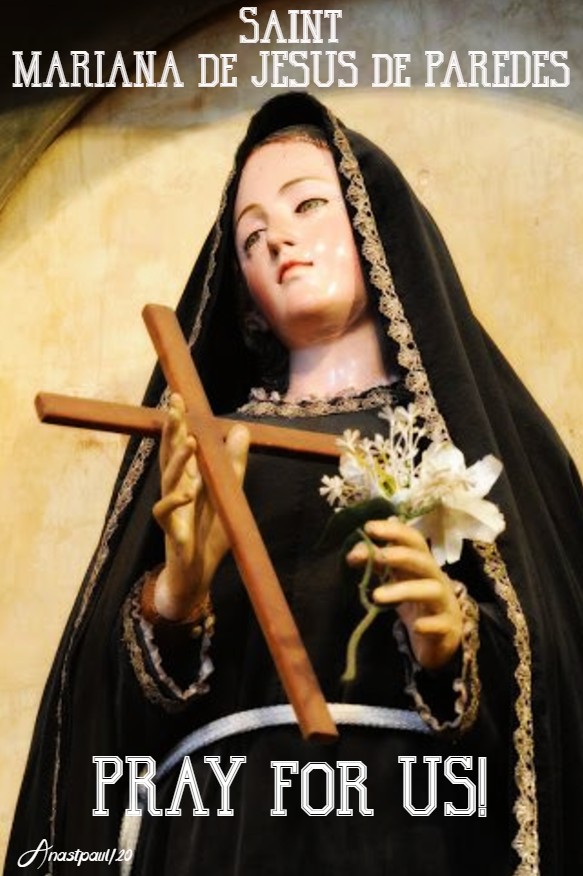
One Minute Reflection – 26 May- “Mary’s Month!” – Tuesday of the Seventh Week of Easter, Readings: Acts 20:17-27, Psalm 68:10-11, 20-21, John 17:1-11 and The Memorial of St Mariana de Jesus de Paredes OFS (1618-1645) “The Lily of Quito”
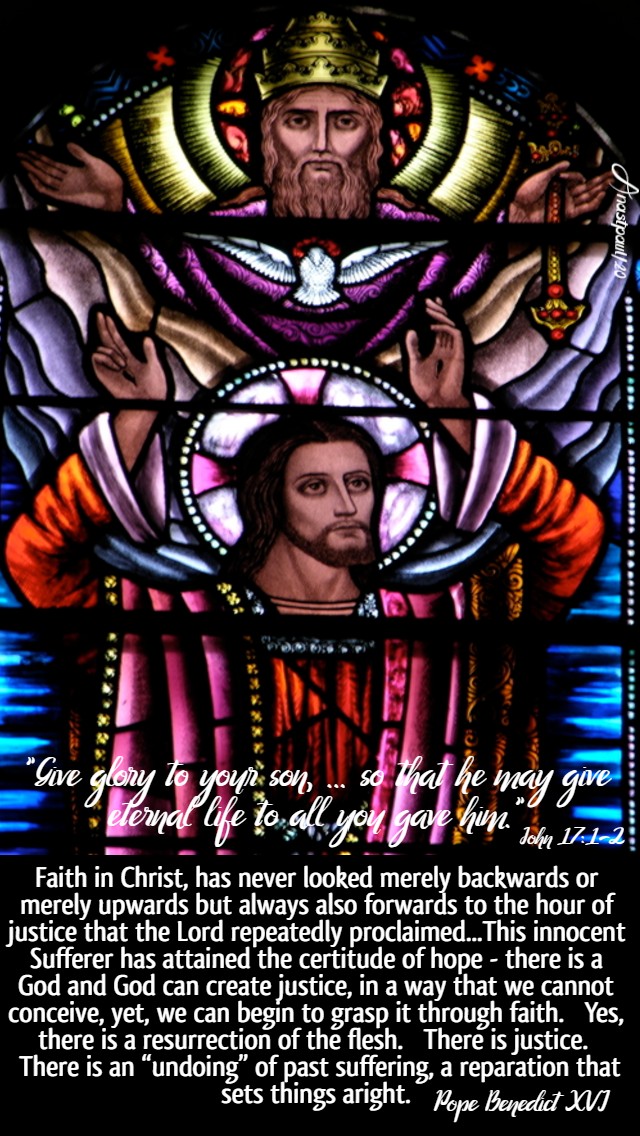
“Give glory to your son, so that your son may glorify you, just as you gave him authority over all people, so that he may give eternal life to all you gave him.” … John 17:1-2
REFLECTION – “At the conclusion of the central section of the Church’s great Credo—the part that recounts the mystery of Christ, from His eternal birth of the Father and His temporal birth of the Virgin Mary, through His Cross and Resurrection to the second coming—we find the phrase: “he will come again in glory to judge the living and the dead.” From the earliest times, the prospect of the Judgement has influenced Christians in their daily living, as a criterion by which to order their present life, as a summons to their conscience and at the same time as hope in God’s justice. Faith in Christ, has never looked merely backwards or merely upwards but always also forwards to the hour of justice that the Lord repeatedly proclaimed…
In Christ who was crucified, the denial of false images of God is taken to an extreme. God now reveals His true Face in the figure of the Sufferer who shares man’s God-forsaken condition, by taking it upon Himself. This innocent Sufferer has attained the certitude of hope – there is a God and God can create justice, in a way that we cannot conceive, yet, we can begin to grasp it through faith. Yes, there is a resurrection of the flesh. There is justice. There is an “undoing” of past suffering, a reparation that sets things aright.
For this reason, faith in the Last Judgement is first and foremost hope—the need for which, was made abundantly clear in the upheavals of recent centuries. I am convinced that the question of justice constitutes the essential argument, or in any case the strongest argument, in favour of faith in eternal life. The purely individual need for a fulfilment, that is denied to us in this life, for an everlasting love that we await, is certainly an important motive for believing, that man was made for eternity but, only in connection with the impossibility, that the injustice of history should be the final word, does the necessity for Christ’s return and for new life become fully convincing.” … Pope Benedict XVI – Pope from 2005 to 2013 – Encyclical “ Spe Salvi ” § 41, 43
PRAYER – Lord God, You opened for us, the way to eternal life, when Christ Your Son was take up to glory and Your Holy Spirit, came to enlighten Your Church. Grant that, as we share in so great a gift, our longing and hope, for our eternal home may grow every stronger and so our service ever more loyal to Your commandments. Listen to the prayers of Holy Mother Mary, the Blessed Virgin Mother of Your Son and of St Maria de Jesus de Paredes, whom we beg to pray for our intercession. Through Christ, Our Lord, with the Holy Spirit, one God for all time and for all eternity, amen.
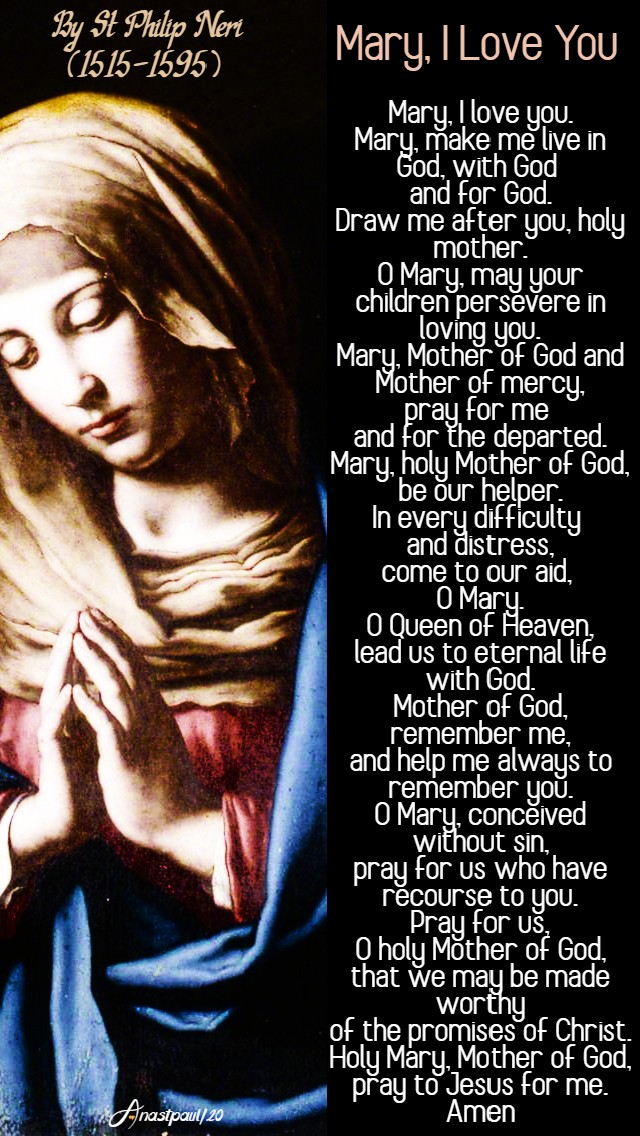
Our Morning Offering – 26 May – “Mary’s Month!” – Tuesday of the Seventh Week of Easter and The Memorial of St Philip Neri (1515-1595)
Mary, I Love You By St Philip Neri (1515-1595)
Mary, I love you.
Mary, make me live in God,
with God and for God.
Draw me after you, holy mother.
O Mary, may your children persevere in loving you.
Mary, Mother of God and Mother of mercy,
pray for me and for the departed.
Mary, holy Mother of God, be our helper.
In every difficulty and distress,
come to our aid, O Mary.
O Queen of Heaven,
lead us to eternal life with God.
Mother of God, remember me,
and help me always to remember you.
O Mary, conceived without sin,
pray for us who have recourse to you.
Pray for us,
O holy Mother of God,
that we may be made worthy
of the promises of Christ.
Holy Mary, Mother of God,
pray to Jesus for me.
Amen
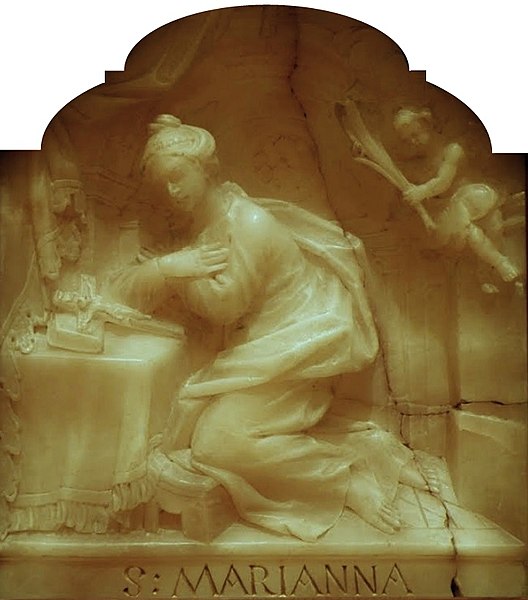
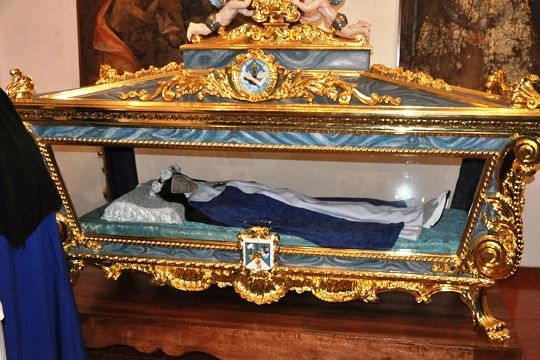
Saint of the Day – 26 May – Saint Mariana de Jesus de Paredes OFS (1618-1645) “The Lily of Quito,”Third Order Franciscan, Hermit, Penitent, Mystic, Ecstatic, miracle-worker. She was endowed with the charism of prophecy. Born as María Ana de Jesús de Paredes y Flores on 31 October 1618 at Quito, Ecuador and died on 26 May 1645 at Quito, Ecuador, aged 26. St Mariana is first Canonised Saint of Ecuador and she has been declared a National Herione. Patronages – Ecuador, Americas, bodily ills, loss of parents, people rejected by religious orders, sick people, sickness. Her Incorrupt body is enshrined in the Cathedral of La Iglesia de la Compañía de Jesús.
Mariana de Jesus de Paredes was born in the city of Quito, in the New Kingdom of Granada (modern-day Ecuador). She was born of aristocratic parents on both sides of her family, her father was Don Girolamo Flores Zenel de Paredes, a nobleman of Toledo, Spain and her mother was Doña Mariana Cranobles de Xaramilo, a descendant of one of the best Spanish families. Mariana was the youngest of eight children and it is claimed her birth was accompanied by most unusual phenomena in the heavens, clearly connected with the child and juridically attested at the time of the process of her Beatification.
She was orphaned at a very young age and, thereafter, she was raised by her older sister, Jerónima de Paredes and the latter’s husband, Cosme de Caso. Mariana was drawn to a spiritual life, her sister and brother-in-law allowed her to live in seclusion in their house, living “the life of an uncloistered beata,” similar to Rose of Lima to whom she is often compared. She was refused entry into a convent, despite supplication by her brother-in-law and surrogate father, Cosme de Caso. She subjected herself to bodily mortification, with the aid of her Indian servant. She did not live in total seclusion but rather focused her spiritual life on the nearby Jesuit church, where she participated in a number of apostolates.
Her spiritual life was closely connected to the Jesuits and her religious name “de Jesús” was no doubt intentional. Following her death in 1645, her funeral and burial were in the Jesuit church. The funeral sermon that the priest Fr Alonso de Rojas preached emphasised her bodily mortification and renunciation of the flesh and put her forward as a model for females in Quito to emulate. “Learn girls of Quito, from your fellow countrywoman, [to prefer] holiness over beauty, virtues over ostentation.” The sermon became a key document in the long process to establish her saintliness, Beatification (1853) and final Canonisation (1950).
The Franciscans claimed de Paredes as a holy person. She did wear the Franciscan scapulary and sash but her seventeenth-century Jesuit hagiographer, Jacinto Morán de Butrón, confirmed that the Jesuits nurtured her spiritual life. Soon after Mariana’s 1645 death, the Franciscan province of Peru, based in Lima, included a biography of Mariana in the history of the province citing the Jesuit funeral sermon as a source. She received the habit of the Third Order from the Franciscans in her native town of Quito. ccording to her Jesuit hagiographer, Mariana did not go to the Franciscan church to receive the garments but sent someone else.
It is reported that the fast which she kept was so strict that she took scarcely an ounce of dry bread every eight or ten days. The food which miraculously sustained her life, as in the case of Catherine of Siena and Rose of Lima, was, according to the sworn testimony of many witnesses, the Eucharist alone, which she received every morning in Holy Communion.
Mariana possessed an ecstatic gift of prayer and is said to have been able to predict the future, see distant events as if they were passing before her, read the secrets of hearts, cure diseases by a mere sign of the Cross or by sprinkling the sufferer with holy water and at least once restored a dead person to life. During the 1645 earthquakes and subsequent epidemics in Quito, she publicly offered herself as a victim for the city and died shortly thereafter.
It is also reported that, on the day she died, her sanctity was revealed in a wonderful manner – immediately after her death, a pure white lily sprang up from her blood, blossomed and bloomed, a miracle which has given her the title of “The Lily of Quito.” The Republic of Ecuador has declared her a national heroine.
St Mariana was Beatified on 10 November 1853, Rome by Pope Pius IX and
was Canonised on 9 July 1950 Rome, by Pope Pius XII.
St Mariana’s incorrupt body is exposed and venerated at her shrine at the Cathedral of La Iglesia de la Compañía de Jesús, known colloquially as La Compañía, is a Jesuit Cathedral in Quito, Ecuador.
Nostra Signora di Caravaggio / Our Lady of Caravaggio, Lombardy, Italy (1432) – 26 May:
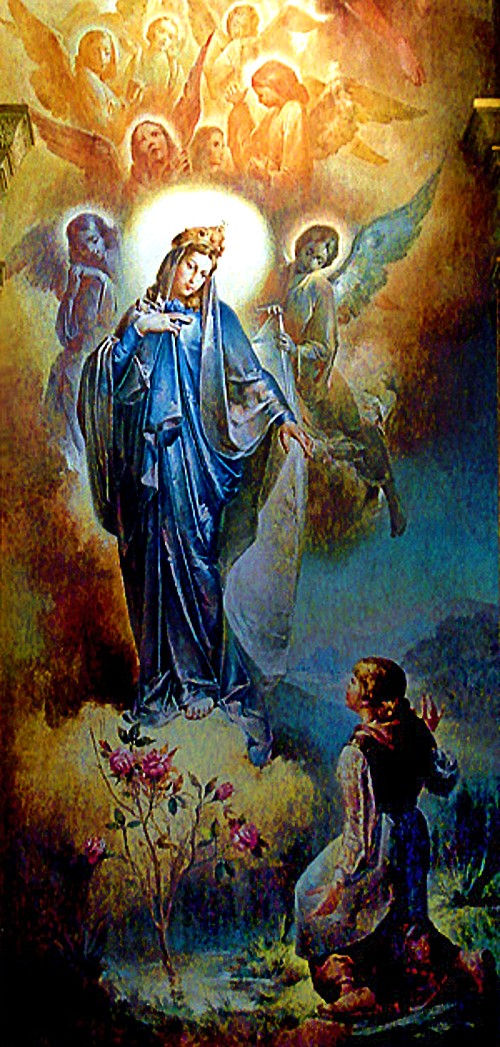
Title given to the Blessed Virgin Mary who appeared in an apparition on 26 May 1432 in the countryside outside Caravaggio, Lombardy, Italy. Giannetta de’ Vacchi Varoli was cutting hay in a field when the Virgin appeared. Mary requested penance from and a chapel built by the locals. A new spring of healing water appeared in the hay field. The apparition anniversary became a day of pilgrimage to the Shrine of Santa Maria del Fonte built at the site and devotion to the Madonna of Caravaggio spread through the region and eventually around the world. In 1879, Italians from Lombardy built a chapel for their settlement in southern Brazil. As it was the only sacred art that any of them possessed, they dedicated the Chapel to the Madonna di Caravaggio. Today the shrine hosts over a million pilgrims annually. Patronage – Diocese of Cremona, Italy.
— St Alphaeus St Anderea Kaggwa Bl Andrea Franchi St Becan of Cork Bl Berengar of Saint-Papoul St Damian the Missionary St Desiderius of Vienne St Pope Eleuterus St Felicissimus of Todi St Fugatius the Missionary St Gioan Ðoàn Trinh Hoan St Guinizo of Monte Cassino St Heraclius of Todi Bl Lambert Péloguin of Vence St Mariana de Jesus de Paredes OFS (1618-1645) “The Lily of Quito” – The first Canonised Saint of Ecuador.
St Odulvald of Melrose St Paulinus of Todi St Peter Sanz St Ponsiano Ngondwe St Priscus of Auxerre and Companions St Quadratus of Africa St Quadratus the Apologist St Regintrudis of Nonnberg St Simitrius of Rome and Companions St Zachary of Vienne
Quote/s of the Day – 25 May – The Memorial of St Maria Magdalena de’ Pazzi O.Carm (1566-1607)
“Trials are nothing else but the forge that purifies the soul of all its imperfections.”
“O Sisters, if we would only comprehend the fact that while the Eucharistic Species remain within us, Jesus is there and working in us inseparably with the Father and the Holy Spirit and, therefore, the whole Holy Trinity is there.”
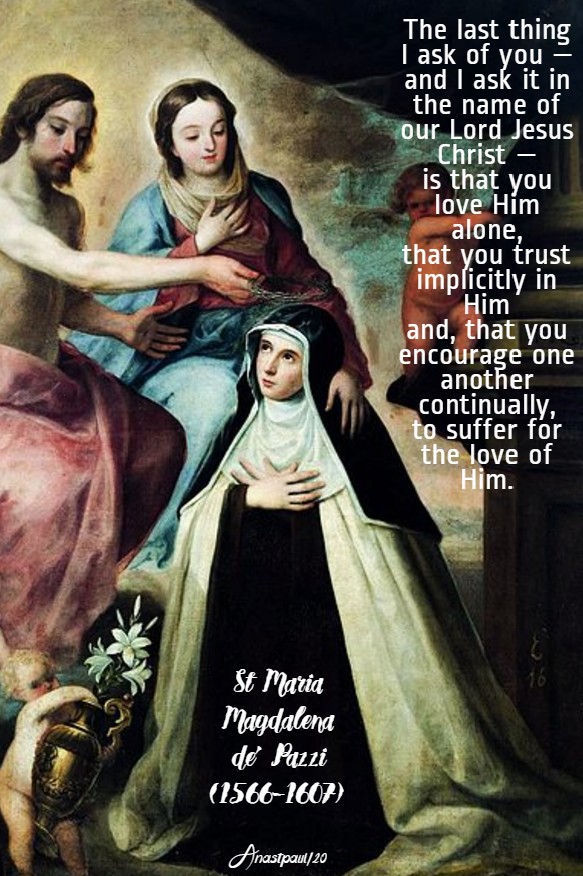
“The last thing I ask of you — and I ask it in the name of our Lord Jesus Christ — is that you love Him alone, that you trust implicitly in Him and, that you encourage one another continually, to suffer for the love of Him.”
One Minute Reflection – 25 May – “Mary’s Month” – Monday of the Seventh week of Easter, Readings: Acts 19:1-8, Psalm 68:2-7, John 16:29-33 and the Memorial of St Maria Magdalena de’ Pazzi O.Carm (1566-1607)
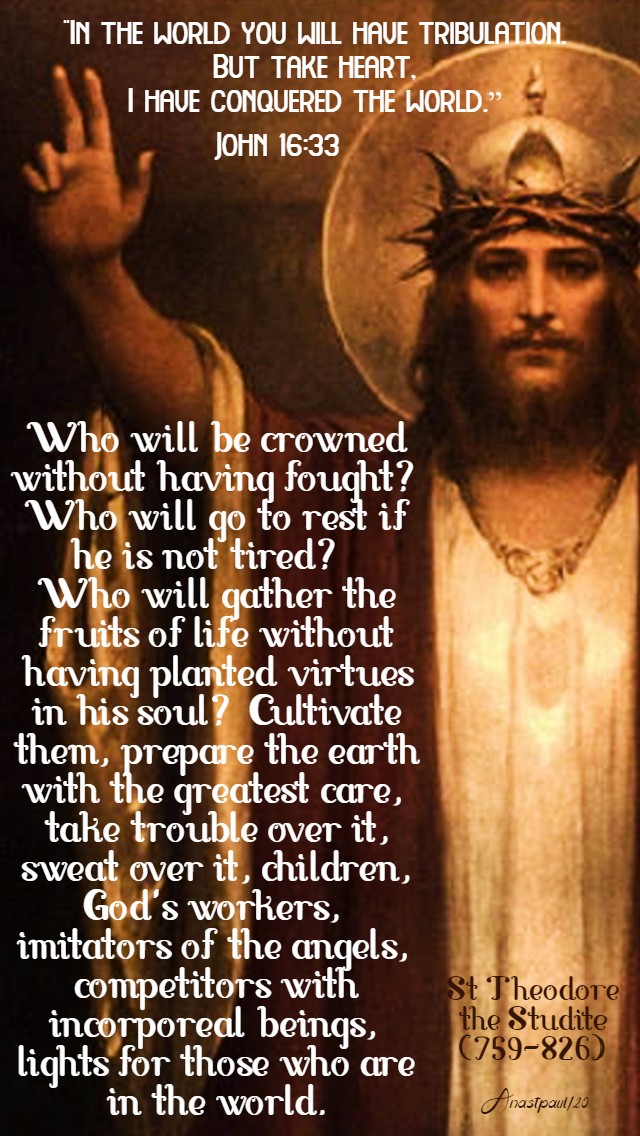
“In the world you will have tribulation. But take heart, I have conquered the world.” ... John 16:33
REFLECTION – “Let nothing intervene to hinder the progress of any who travel alongside each other, in this evangelical life but let us walk with agile step though the road be rough and hard, let us show a brave and manly spirit, overcome obstacles, pass along from pathway to pathway, from hill to hill, until we climb onto the mountain of the Lord and make a home for ourselves in the holy place of His impassibility.
Now, companions assist each other on the way; so then, my brothers, as the apostle says: “Bear one another’s burdens” (Gal 6:2) and make up for whatever is lacking to others (cf. 2 Cor 8:14 ; Phil 2:30). To the negligence that perhaps holds sway today, noble courage will succeed tomorrow, now one is in gloom and then suddenly one rises to the surface and discovers joy again, at one moment our passions rise up but soon God comes to help us, they are broken and calm returns. For you will only be seen like this yesterday and the day before but, dear friend, you will not always remain the same but the grace of God will draw near you, the Lord will fight for you and perhaps, like the great Antony, you will say: “Where were you just now?” and he will answer: “I wanted to see your combat.”
For now, let us persevere, children, dear children, let us be patient for a little, brothers, dear brothers.… Who will be crowned without having fought? Who will go to rest if he is not tired (cf. 2 Tim 2:5-6)? Who will gather the fruits of life without having planted virtues in his soul? Cultivate them, prepare the earth with the greatest care, take trouble over it, sweat over it, children, God’s workers, imitators of the angels, competitors with incorporeal beings, lights for those who are in the world (cf. Phil 2:15)!” … St Theodore the Studite (759-826) Monk – Catechesis 28
PRAYER – Lord God, as You brought joy to the world, through the resurrection of Lord Jesus Christ, Your Son, grant that through His Virgin Mother, we may constantly seek and recognise our Lord and Saviour and turn to Him in complete trust and love. May we ever live in confidence and share our joy with our neighbour. St Maria Magdalena de’ Pazzi, pray that we may know the courage of our Saviour. Through Jesus Christ our Lord, with You and the Holy Spirit, one God forever, amen.
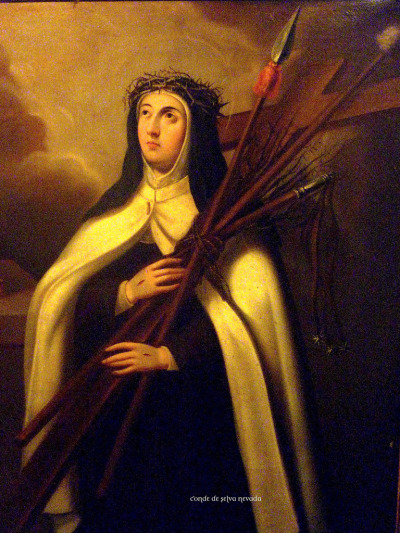
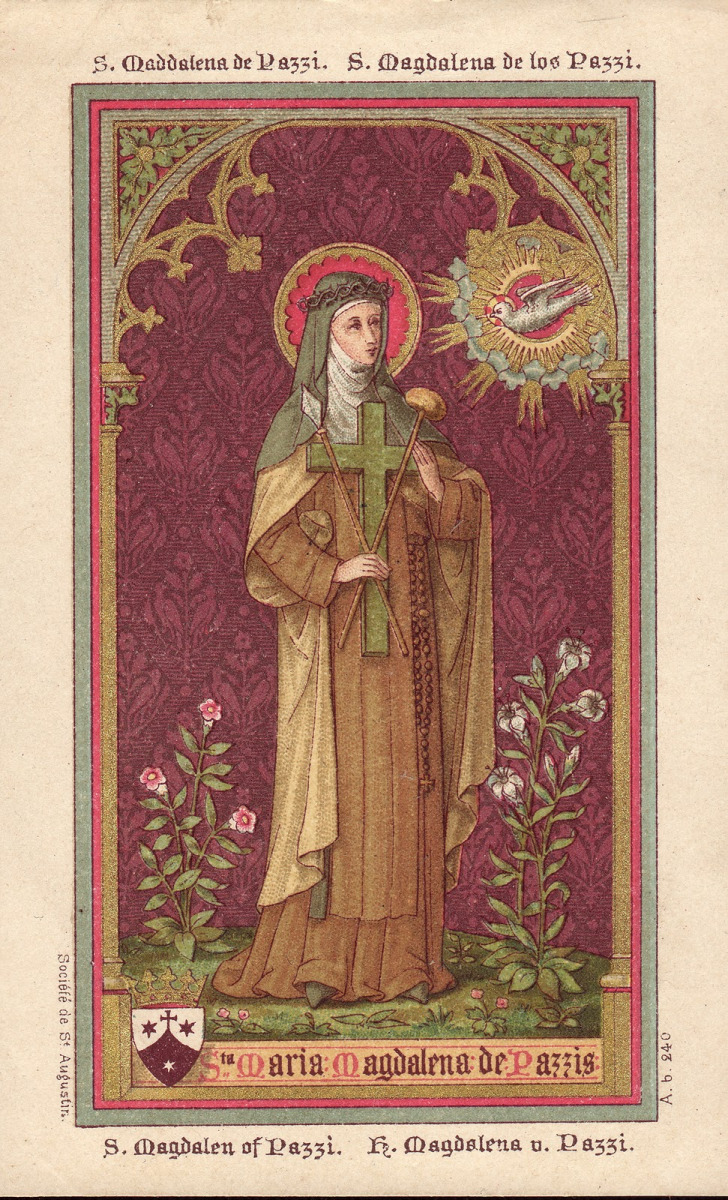
Saint of the Day – 25 May – Saint Maria Magdalena de’ Pazzi O.Carm (1566-1607) Carmelite Nun and Mystic, Ecstatic, she bi-located and was the intercessor of many miracles, Stigmatist – born as Caterina de’ Pazzi (but in the family was called Lucrezia) in 1566 at Florence, Italy and died on 25 May 1607 of natural causes. Patronages – against bodily ills, against sexual temptation, against sickness, sick people, Naples (co-patron).
The second of four children, Caterina was born in Florence on 2 April 1566, to Camilo de’ Pazzi and Maria Buondelmonti. In the comfortable setting of a noble family, that began to call her Lucrezia, after her paternal grandmother, the young girl grew up peacefully and with a certain sensitivity to the aesthetic side of her social condition. Her heart was open to God and to the promptings of the Holy Spirit, in great simplicity, which is something we can see in the way she might share her lunch pack with a needy person, out of compassion, or the way she would help the children of the poor by gently offering them the first truths of faith. Her mother’s deep piety and the visits to her home by the Jesuit Fathers, that her parents invited regularly, helped to stamp on Caterina’s soul that sense of Church, “sensus ecclesiae,” that in later life would appeal so much to her conscience.
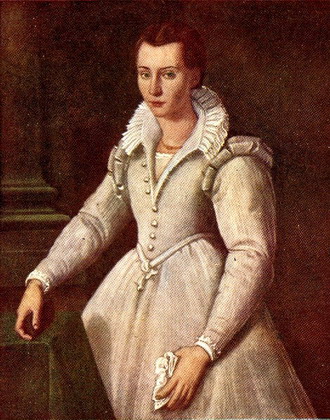
St Maria Magdalena de’ Pazzi at age 16 by Santi di Tito (1583)
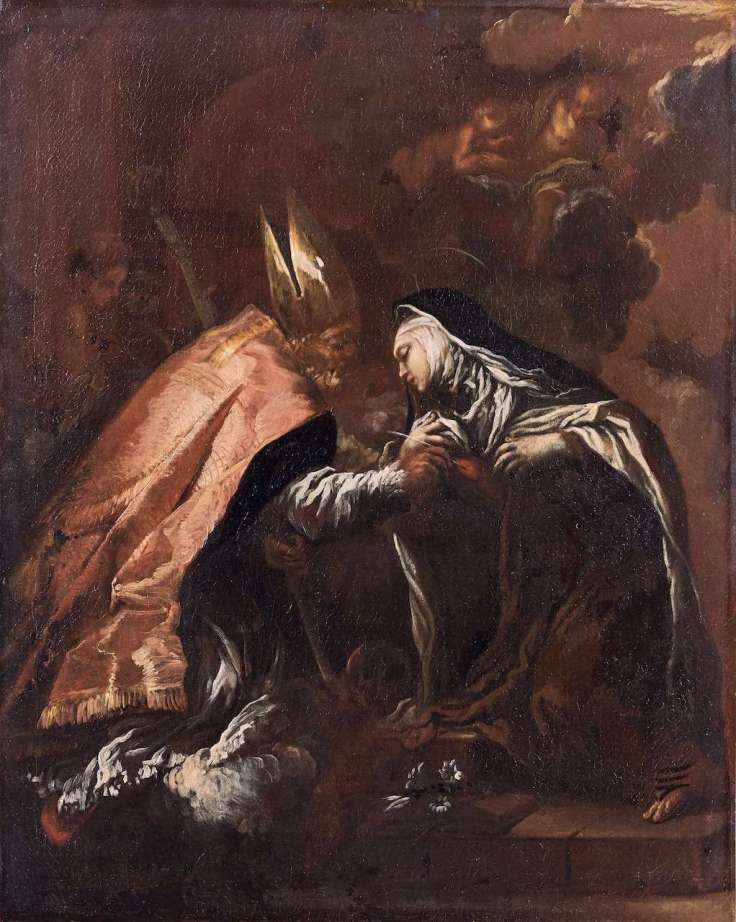
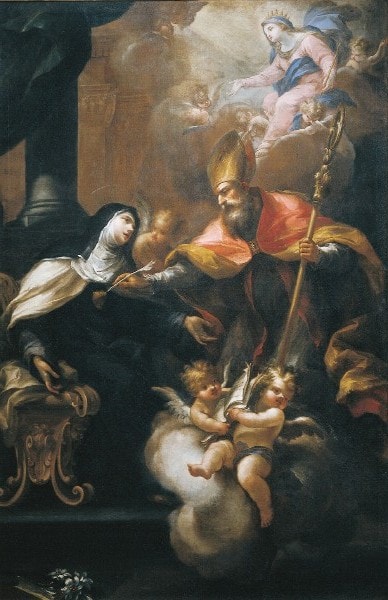
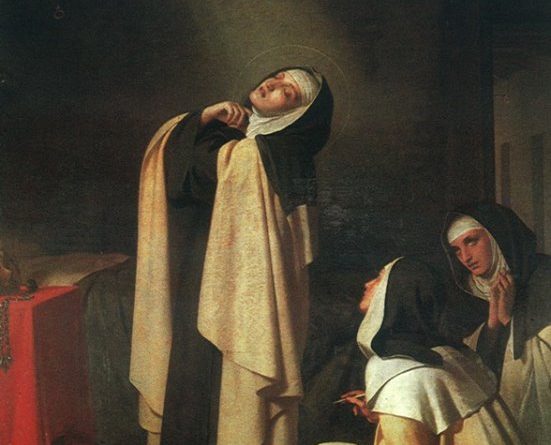
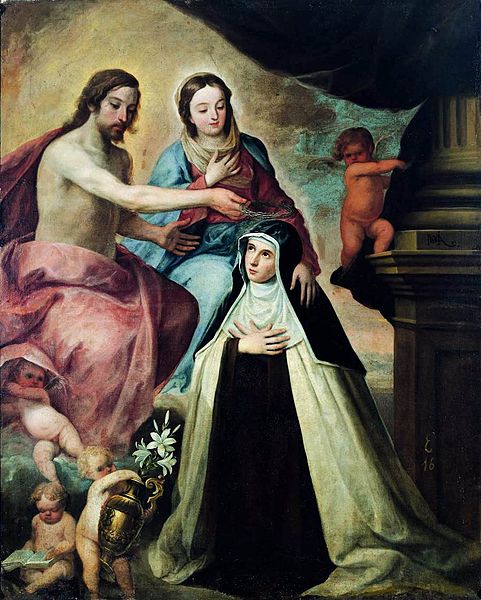
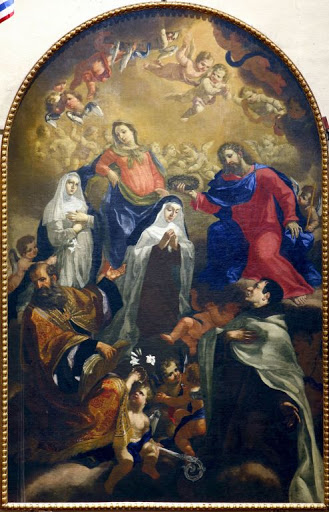
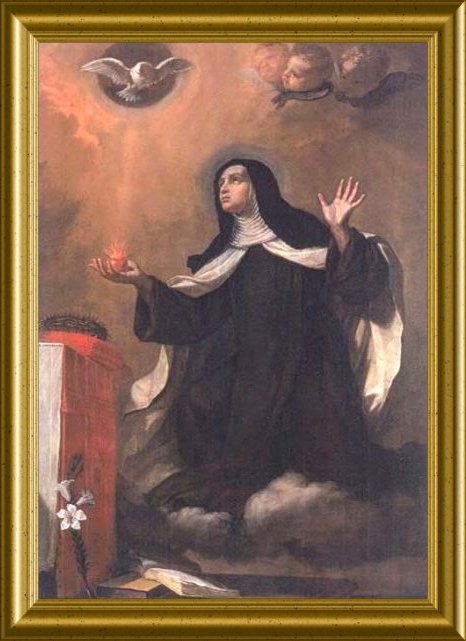
At eight years of age, she was sent as a pupil to the nuns at San Giovannino. The nuns, who noticed the contemplative nature of the child, prepared her for First Holy Communion and not many weeks later, Caterina was sufficiently mature to offer her virginity to God. She was ten years old and now she didn’t need anymore to get the scent of Jesus, by standing near her mother when she had received Holy Communion, now, she began to meditate on the humanity of Jesus. As she was learning to read, she came across the Athanasian Creed and she was very inspired by it. In the same way, she grew to be totally enamoured by the meditations of St Augustine and the Lord’s Passion by Loarte, which she read on the advice of Fr Andrea Rossi, who was her Spiritual Director. The artworks below are of St Augustine writing on her heart.
She had not yet reached the age of seventeen, when she showed her desire to be consecrated to God in religious life. Having overcome the initial opposition of her family, she entered the monastery in Borgo San Frediano, to join the Carmelite community of Santa Maria degli Angeli who were very happy to have her. They allowed her to begin as a Postulant on 8 December 1582. This community, that was well known to and highly regarded by the Bishop of Florence, was attractive to the young girl, principally because of the possibility of receiving Holy Communon everyday.
Two months after entering, on 30 January 1853, Caterina received the Carmelite habit, and with it, the name, Sr Maria Magdalena. At the end of the novitiate year, it was decided, that she would put her profession back until there were other Novices ready to join her. Maria Magdalena , however, got very sick in the following months, to the point of almost dying. With little hope of recovery – even the best doctors in the city had failed to diagnose what today we would call pneuomonia – the Prioress decided to have her make her profession in danger of death, in articulo mortis.
About one hour after her profession, something happened to Magdalena. It was an experience of rapture in God. The sisters tell us that when they went to visit her in the infirmary, they came upon the young eighteen year old patient, transfigured and looking very beautiful. From that day onwards, it was 27 May 1584, the feast of the Most Holy Trinity, the Lord visited her every morning, for forty days and revealed the depth of his love to her. These frequent episodes gave rise to many misgivings in the young girl whose only desire was to live in the hiddenness of her life in Carmel but, it was obvious, that this kind of grace had to be recognised and preserved. For that reason, the sisters began very soon to take notes, writing down what Magdalena. would say while in ecstasy and what she would say, out of obedience, to the Prioress and Mistress.
Towards the end of that same year, a new period of divine favour began for her. This time, Jesus, the divine Word, held her in intense conversation (reported in I Colloqui) that revealed increasingly, the bridal relationship that Christ had formed with her. It was in one of those ecstasies that Christ brought her into His passion and death. It was Holy Week in 1585 – her experiences included the Stigmata impresssed on her soul, the Crown of Thorns, the Crucifixion and every scene from the Gospel was displayed, as if it was happening live in that slender tormented body. Then, on the Sunday after Easter, she received from her divine Bridegroom the ring of her mystical marriage.
The manuscript titled, Revelazioni e Intelligenze, gives a faithful account of the communication of God’s grace, that in the days between the vigil of Pentecost and the Sunday of the Blessed Trinity, gave Magdalena, an entry into the revelation, of the inner dimensions of her Trinitarian life. What was communicated to her, was what goes on between the divine person, and how the human person can fulfil a supernatural vocation, by allowing this mystery dwelling within, to do its work.
The central element in this understanding, is the saving mission of the Word, Love, made flesh in the most pure womb of the Virgin Mary and the intuition of “dead love” as the highest expression of the ultimate gift of self.
On the last day of this intense octave of Pentecost, Magdalena began to see, with some clarity, that the moment had arrived when God, as He had made known to her already on a few occasions, was about to take away from her, the enjoyment of His presence. That was the beginning of five very difficulty years of torment and temptation, to the point where she felt as if she had been thrown into the “lions’ den” and reduced to “nothing.” In these interior trials, described in the Probazione, Jesus continued to support her but without lessening the radical purification that striped her bare, made her more simple and extremely receptive to His visits. In the heart of the crucible, however, Magdalena also received understanding from God concerning the condition of the Church of her time – so slow to implement the renewal sought by the Council of Trent – and she felt that she was being drawn by the Truth, to be involved in a practical way, in calling to order prelates, cardinals and even the Pope, Sixtus V. The twelve letters that she dictated in ecstasy, in the Summer of 1586 are collected in the volume titled, Rinnovamento della Chiesa. The five years of trial restored to us a Magdalena. transformed . The Lord had brought her through a divinising process, through which, today, she could well be considered a master and guide.
After Pentecost 1590, she returned to the normality of ordinary life, something she had always wanted. Apart from just a few and important, moments of ecstasy (reported in the second part of the Probazione) her days passed quietly as she went about the jobs she had to do (on account of her spiritual maturity she was put in charge of the young sisters in formation) and all the other forms of humble service that she tended to seek. Then the experience of “naked suffering” took hold of her and this would unite her once and for all to the Crucified Bridegroom.
Sr Magdalena could read the thoughts of others and predict future events. For instance, during one ecstatic event she predicted the future elevation to the Papacy of Cardinal Alessandro de’ Medici (as Pope Leo XI). During her lifetime, she appeared to several persons in distant places and cured many sick people.
The symptoms of tuberculosis began to appear in 1603. As her strength declined, she suffered the added pain of not being able to feel anything of the Lord’s presence. Just her presence in the community, in the eyes of the sisters, had become a vision of God’s work of art about to be completed. On 25 May 1607, at 3 p.m. in the afternoon, Sr Maria Magdalena, at the age of forty-one gave up her spirit.
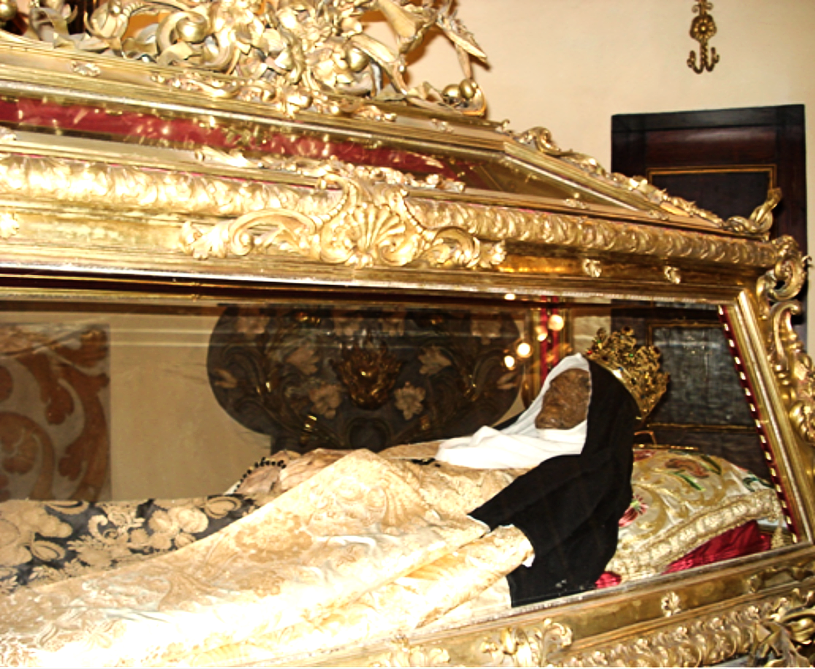
She was buried in the choir of the Monastery chapel. She was Beatified in 1626 by Pope Urban VIII. At her Canonisation in 1668, her body was declared miraculously incorrupt. Her body is located in the Monastery of Maria Maddalena de’ Pazzi in Careggi.
St Maria Magdalena de’ Pazzi O.Carm (1566-1607) (Optional Memorial) About St Maria Magdalena:
St Agustin Caloca
St Aldhelm of Sherborne
Bl Antonio Caixal
Bl Bartolomeo Magi di Amghiari
St Canio
St Cristobal Magallanes Jara
St Denis Ssebuggwawo
St Dionysius of Milan
St Dunchadh of Iona
St Egilhard of Cornelimünster
Bl Gerardo Mecatti
St Gerbald
St Injuriosus of Auvergne
St Iosephus Chang Song-Jib
Bl James Bertoni
Bl Juan of Granada
St Leo of Troyes
St Madeline Sophie Barat
St Matthêô Nguyen Van Ðac Phuong
St Maximus of Evreux
Bl Nicholas Tsehelsky
St Pasicrates of Dorostorum
Bl Pedro Malasanch
St Pherô Ðoàn Van Vân
St Scholastica of Auvergne
St Senzio of Bieda
St Urban I, Pope
St Valentio of Dorostorum
St Victorinus of Acquiney
St Winebald of Saint Bertin
St Worad of Saint Bertin
St Zenobius of Florence
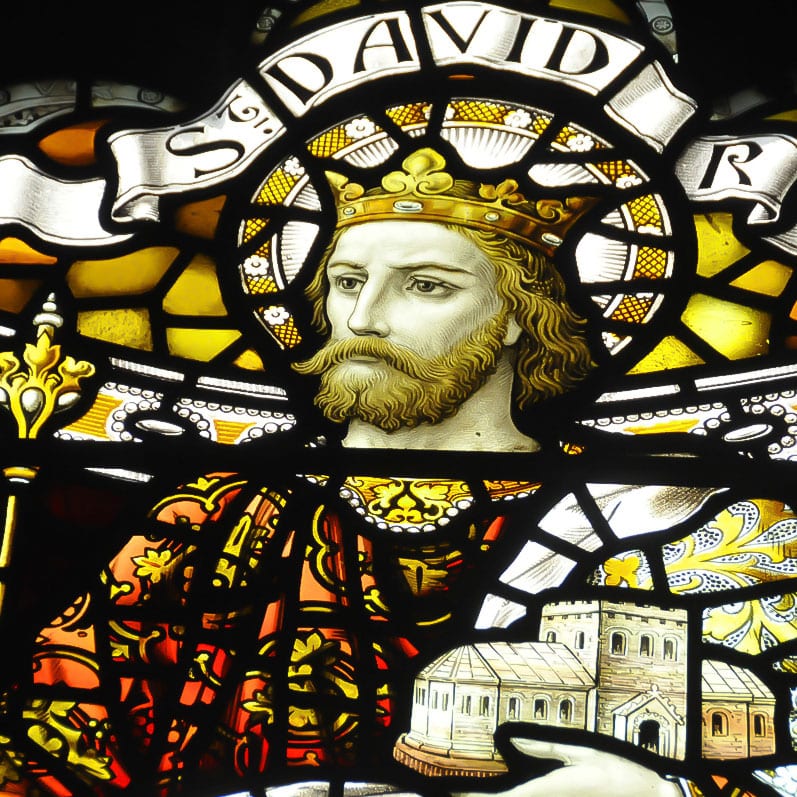
Saint of the Day – 24 May – St David, King of Scotland (1085-1183) King of Scotland from 1124 to 1153 – born as Dabíd mac Maíl Choluim in 1085 and died on 24 May 1183 in Carlisle, Scotland of natural causes. King David was a social and religious Reformer, a man of great administrative skills, apostle of charity and of holy piety. He transformed his Kingdom by the widespread introduction of Catholic Churches and Monasteries, thus also assisting in the international diplomatic influence of his country, it’s farming and agricultural wealth and it’s education. He was the main force and instrument of God in Christianising Scotland. Patronage – Scotland and various Dioceses and Churches there.
St David was the youngest son of King Malcolm III of Scotland and his wife Margaret who is herself a Saint. Although David spent most of his childhood in Scotland, he was educated for some years at the Anglo-Norman court in England. When his brother Alexander acceded to the throne of Scotland in 1107, David became Prince of Cumbria. He married Matilda, daughter of Waldef, Earl of Northampton and Huntingdon and thus became an English Earl. As Prince of Cumbria he was entitled to an inheritance in southern Scotland.
Upon Alexander’s death, David reluctantly became King of Scots in 1124. He brought with him many knights and courtiers from Norman England, many of whom became the future aristocrats and even Kings of Scotland including Bruce, Balliol and FitzAlan, who later became the Stewart kings.
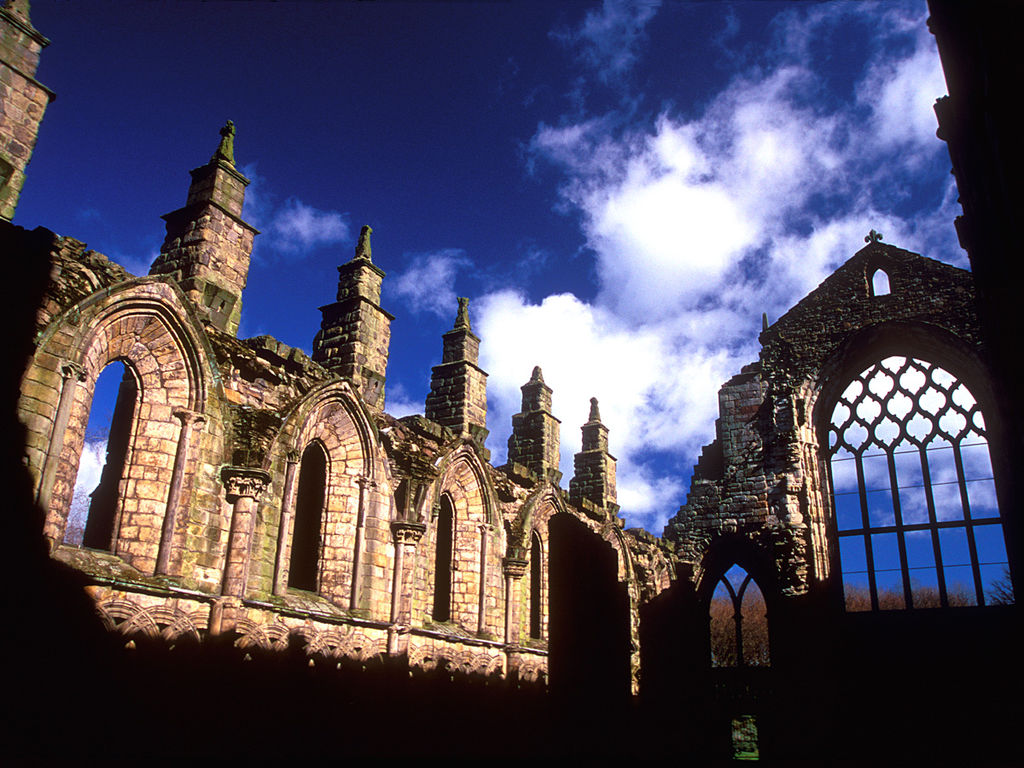
King David oversaw the continuing development of the Scottish state and the organisation of Christianity within it. He established the Royal cities of Edinburgh, Berwick, Roxburgh, Stirling and perhaps Perth and founded Diocese at Brechin, Dunblane, Caithness, Ross and Aberdeen. He founded and endowed numerous Monasteries. Among them were the Cistercian Houses of Melrose, Kinloss, Newbattle and Dundrennan and Holyrood itself for Augustinian canons as well as the Benedictines at Dunfermline. This period in Scottish history has become known as the “Davidian Revolution.”
The ruins of Melrose Abbey. Founded in 1137, this Cistercian Monastery became one of David’s greatest legacies.
The ruins of Holyrood Abbey founded by David I in 1128. The royal lodging developed into Holyrood Palace.
Not only were such Monasteries an expression of David’s undoubted piety but they also functioned to transform Scottish society. Monasteries became centres of foreign influence and provided sources of literate men, able to serve the crown’s growing administrative needs. These new Monasteries and the Cistercian ones in particular, introduced new agricultural practices. Cistercian labour, for instance, transformed southern Scotland into one of northern Europe’s most important sources of sheep wool.
When Queen Matilda died, he gave even more attention to religious matters, reciting the Divine Office himself each day and devoting himself to almsgiving and other works of charity. In all he exercised a wholly civilising influence upon his family and upon the nation.
Perhaps the greatest blow to David’s plans came on 12 July 1152 when Henry, Earl of Northumberland, David’s only son and heir, died. David had under a year to live and he may have known that he was not going to be alive much longer. David quickly arranged for his grandson, Malcolm IV, to be made his successor and for his younger grandson William to be made Earl of Northumberland. The 11 year-old Malcolm around Scotland-proper on a tour to meet and gain the homage of his future Gaelic subjects.
St Ælred of Rievaulx (1110-1167) (his life here: https://anastpaul.com/2018/01/12/saint-of-the-day-12-january-st-aelred-of-rievaulx-1110-1167-saint-bernard-of-the-north/) who was, in his earlier years, master of the household to David with whom he kept up a close friendship with the King, gives a circumstantial account of David’s death at Carlisle on 24 May 1153. On the Friday he was anointed and given Viaticum and then spent much time in praying psalms with his attendants. On Saturday they urged him to rest but he replied, “Let me rather think about the things of God, so that my spirit may set out strengthened on its journey from exile to home. When I stand before God’s tremendous judgement-seat, you will not be able to answer for me or defend me, no-one will be able to deliver me from His hand.” And so, he continued to pray and at dawn of Sunday, he passed away peacefully as if he slept. St David had helped to endow Dunfermline Abbey, founded by his father and mother and he had peopled it with Benedictine monks from Canterbury. There he was buried and at his shrine, his memory was venerated until the Reformation.
After the King’s death, St Ælred delivered the eulogy at the Requiem Mass, praising Saint David’s reluctance to become king, his sense of justice and his accessibility to everyone, his efforts to maintain concord among the clergy, of his personal piety and in general, of the great work he did for the consolidation of the Kingdom of Scotland.
Ælred’s only criticism was of his failure to control the savagery and rapacity of his troops when he invaded England, on behalf of his niece Matilda, against Stephen. For this, David was very contrite and is said to have looked on his defeat at the Battle of the Standard and the early death of his only son, as just retribution therefor.
St David, Pray for Scotland, Pray for us all, amen!
Statue of St David on the West Door of St Giles, Edinburgh, formerly a Catholic Cathedral, of course but now protestant.
The Solemnity of the Ascension of the Lord +2020 (in some countries today, in the USA and elsewhere Ascension was celebrated on Thursday 21 May). OR The Seventh Sunday of Easter +2020
Our Lady of China: Our Lady of China is a title for the Virgin Mary in China who is believed to have appear at the small village of Donglu in 1900. In Chinese she is called Zhōnghuá Shèngmǔ. She is also known as Our Lady of Donglu.
St Afra of Brescia
Bl Benedict of Cassino St David, King of Scotland (1085-1183)
Bl Diego Alonso
St Donatian of Nantes
St Gennadius of Astroga
St Hubert of Bretigny
Bl Isidore Ngei Ko Lat
St Joanna the Myrrhbearer
Bl John del Prado
Bl John of Montfort
Bl Juan of Huete
Bl Louis-Zéphirin Moreau
St Manahen
St Marciana of Galatia Bl Maria Gargani OFS (1892-1973) Biography: https://anastpaul.com/2019/05/24/saint-of-the-day-24-may-blessed-maria-gargani-ofs-1892-1973/
Bl Mario Vergara
St Meletius the Soldier
Bl Nicetas of Pereslav
St Palladia
St Patrick of Bayeux
Bl Philip of Piacenza
St Rogatian of Nantes
St Sérvulo of Trieste
St Simeon Stylites the Younger
St Susanna
Bl Thomas Vasière
St Vincent of Lérins
St Vincent of Porto Romano
—
Martyrs of Istria: A group of early martyrs in the Istria peninsula. We know little more than some names – Diocles, Felix, Servilius, Silvanus and Zoëllus.
Martyrs of Plovdiv: 38 Christians martyred together in the persecutions of Diocletian and Maximian. We don’t even known their names. They were beheaded in Plovdiv, Bulgaria.
Martyrs of the Small West Gate: Additional Memorial – 20 September as part of the Martyrs of Korea. A group of lay catechists and catechumens who were imprisoned and executed together for the crime of being Christian.
• Saint Agatha Kim A-Gi
• Saint Agatha Yi So-Sa
• Saint Anna Pak A-Gi
• Saint Augustine Yi Kwang-Hon
• Saint Barbara Han A-Gi
• Saint Damianus Nam Myong-Hyok
• Saint Lucia Pak Hui-Sun
• Saint Magdalena Kim Ob-I
• Saint Petrus Kwon Tug-In
They were beheaded on 24 May 1839 at the Small West Gate, Seoul, South Korea and were Canonised on 6 May 1984 by Pope John Paul II.
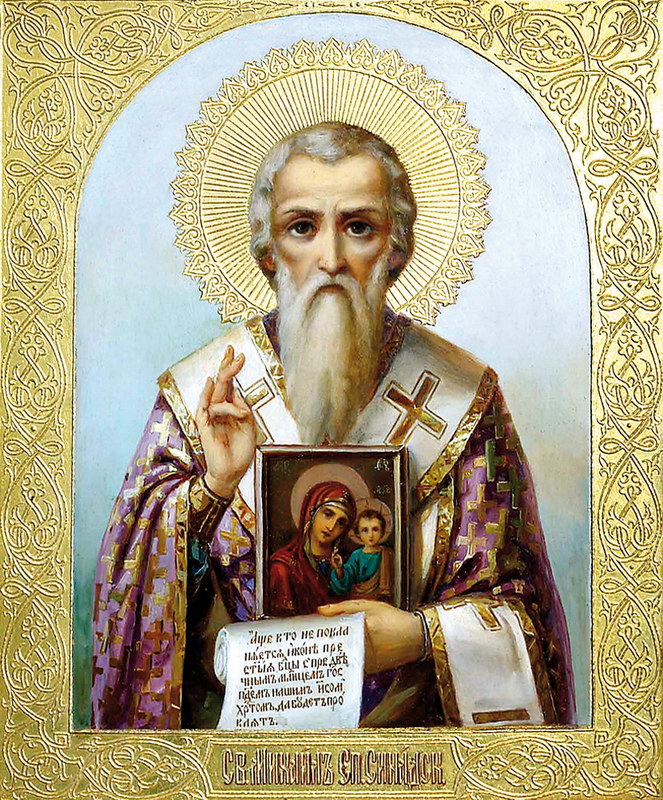
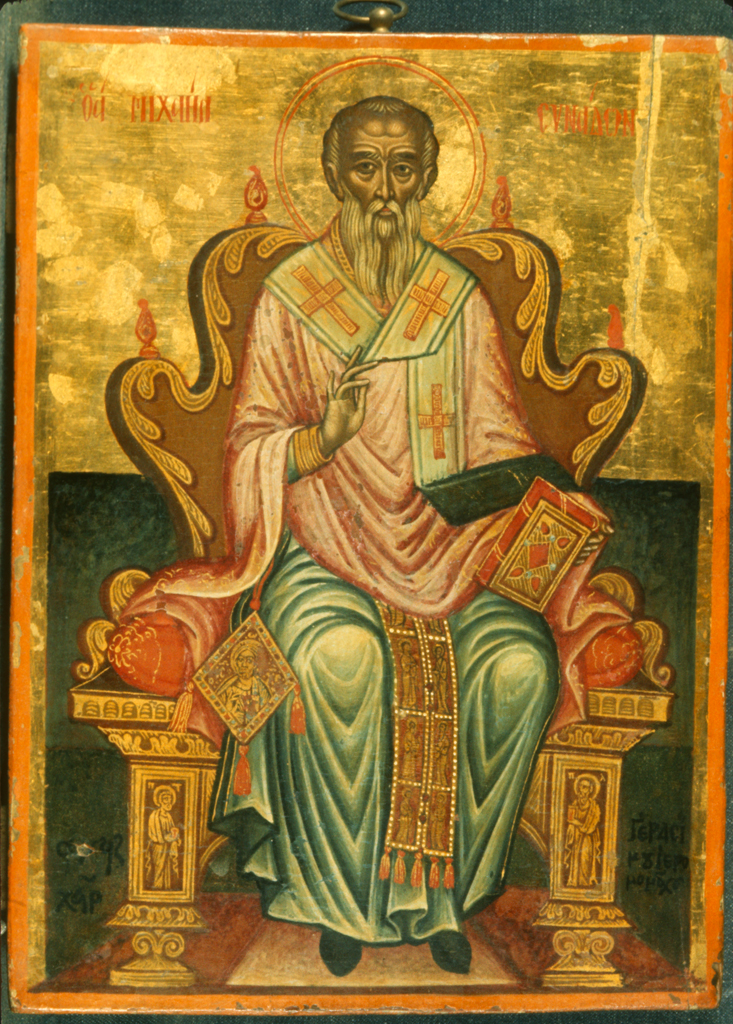
Saint of the Day – 23 May – Saint Michael of Synnada (Died 826) Monk, Bishop, Confessor, emmissary and diplomat of peace – also known as St Michael the Confessor – his birthplace is unknown but he died in 826 in Eudokiadu, Turkey of natural causes. Patronage – protection of crops from pests.
Nothing is known about Michael’s early life but we do know, that as a young man he was much influenced by St Tarasios (Bishop of Constantinople in 784–806) and he thereafter longed for the monastic life. St Tarasios tonsured him and sent him to a Monastery on the coast of the Black Sea, along with St Theophylactus, the future Bishop of Nicomedia.
At the Monastery both Monks became immersed in the holy Gospel and the life of Christ. As his own sanctity grew so did his love for his neighbour. It is reported that he worked many miracles, once, during a harvest, when the people were weakened by thirst, an empty metal vessel was filled with water by the prayer of the Monk. Similarly, during a pestilence of the crops, both Monks prayed that the crops might be saved and, to the great joy of the people, the pestilence, disappeared.
Bishop Tarasius consecrated Saint Michael as Bishop of the City of Synnada, apparently he was not enamoured of becoming a Bishop, but through his holy life, (he continued to live as a Monk) and wisdom, Bishop Michael won the love of his faithful and the notice of the emperors. He was therefore, requested to assist and was instrumental in negotiating various peace treaties in the areas surrounding his Diocese.
Saint Michael was present at the Seventh Ecumenical Council at Nicea in 787 in which his participation in all sessions of the council is recorded.
When the Iconoclast heretic Emperor Leo the Armenian (813-820) assumed the throne, he began to expel Bishops from their Diocese, appointing heretics in their place.
Bishop Michael bravely defended the teachings of the Church, opposing the heretics and denouncing their error. Leo the Armenian brought Bishop Michael to trial but not fearing torture he answered resolutely, “I venerate the holy icons of my Saviour Jesus Christ and the Immaculate ever-Virgin, His Mother and all the saints and, it is to them, I bow down. I shall not obey your decrees to remove icons from our Churches.”
Leo then banished Michael to the city of Eudokiada, where the Confessor died in 826.
The head of Saint Michael is preserved at Saint Athanasius on Mount Athos and part of the relics are at the Iveron Monastery.
Bl Józef Kurzawa
Bl Leontius of Rostov St Michael of Synnada (Died 826)
St Onorato of Subiaco
St Spes of Campi
St Syagrius of Nice St William of Rochester (Died c 1201) Martyr Biography:
Bl Wincenty Matuszewski
—
Martyrs of Béziers: 20 Mercedarian friars murdered by Huguenots for being Catholic. Martyrs. 1562 at the Mercedarian convent at Béziers, France.
Martyrs of Cappadocia: A group of Christians tortured and martyred in the persecutions of Diocletian and Galerius. Their names and the details of their lives have not come down to us. They were crushed to death in c.303 in Cappadocia (in modern Turkey).
Martyrs of Carthage: When a civil revolt erupted in Carthage in 259 during a period of persecution by Valerian, the procurator Solon blamed it on the Christians, and began a persecution of them. We know the names and a few details about 8 of these martyrs – Donatian, Flavian, Julian, Lucius, Montanus, Primolus, Rhenus and Victorius. They were beheaded in 259 at Carthage (modern Tunis, Tunisia).
Martyrs of Mesopotamia: A group of Christians martyred in Mesopotamia in persecutions by imperial Roman authorities. Their names and the details of their lives have not come down to us. They were suffocated over a slow fire in Mesopotamia.
Martyrs of North Africa: A group of 19 Christians martyred together in the persecutions of the Arian Vandal King Hunneric for refusing to deny the Trinity. We know little more than a few of their names – Dionysius, Julian, Lucius, Paul and Quintian. c 430.
One Minute Reflection – 22 May – “Mary’s Month” – Friday of the Sixth Week of Easter, Readings: Acts 18: 9-18, Psalms 47: 2-3, 4-5, 6-7, John 16: 20-23
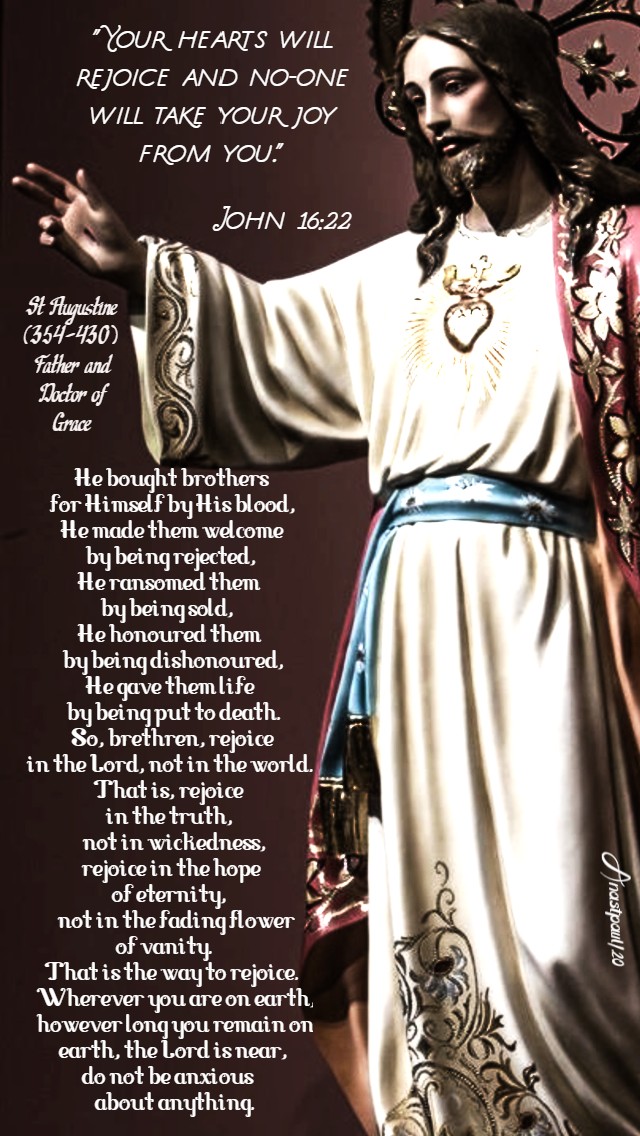
“Your hearts will rejoice and no-one will take your joy from you.” … John 16:22
REFLECTION – “You may object – I am in the world, if I rejoice I certainly rejoice where I am. What is this? Do you mean that because you are in the world you are not in the Lord? Listen again to the Apostle, speaking now to the Athenians in the Acts of the Apostles, he says this is of God and the Lord our creator, In him we live and move and have our being. If He is everywhere, where is he not? Surely this was what He was exhorting us to realise. The Lord is near, do not be anxious about anything.
This is a great truth, that He ascended above all the heavens, yet is near to those on earth. Who is this stranger and neighbour if not the one who became our neighbour out of compassion?
The man lying on the road, left half-dead by robbers, the man treated with contempt by the priest and the levite who passed by, the man approached by the passing Samaritan to take care of him and help him, that man is the whole human race. When the immortal one, the holy one, was far removed from us because we were mortal and sinners, He came down to us, so that He, the stranger, might become our neighbour.
He did not treat us as our sins deserved. For we are now sons of God. How do we show this? The only Son of God died for us, so that He might not remain alone. He who died as the only Son, did not want to remain as the only Son. For the only Son of God made many sons of God. He bought brothers for Himself by His blood, He made them welcome by being rejected, He ransomed them by being sold, He honoured them by being dishonoured, He gave them life by being put to death.
So, brethren, rejoice in the Lord, not in the world. That is, rejoice in the truth, not in wickedness, rejoice in the hope of eternity, not in the fading flower of vanity. That is the way to rejoice. Wherever you are on earth, however long you remain on earth, the Lord is near, do not be anxious about anything.” … St Augustine (354-430) Bishop, Great Western Father and Doctor of Grace – An excerpt from his Sermon 171
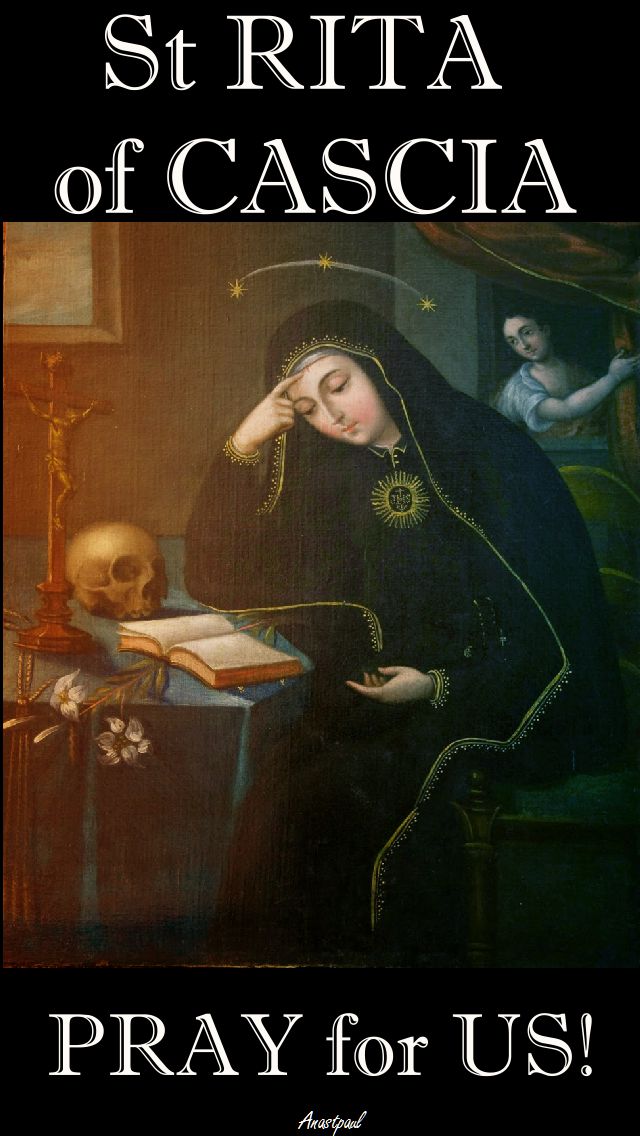
PRAYER – Holy God and Father, help us to discern through prayer and meditation what You truly want of us. Then enable us to offer it to You and indeed, to offer ourselves and all we have and all we are, to You. When You bring us sufferings to mould us closer and make us more like You, help us to accept them and offer them back to You and to do all we do for You in joy at Your nearness. Following Your divine Son, let us pick up those crosses in peace and love. Mary, Mother of God, pray for us. St Rita of Cascia, you prayed so earnestly to give yourself totally to the Lord and suffer for Him, please pray for us, amen.
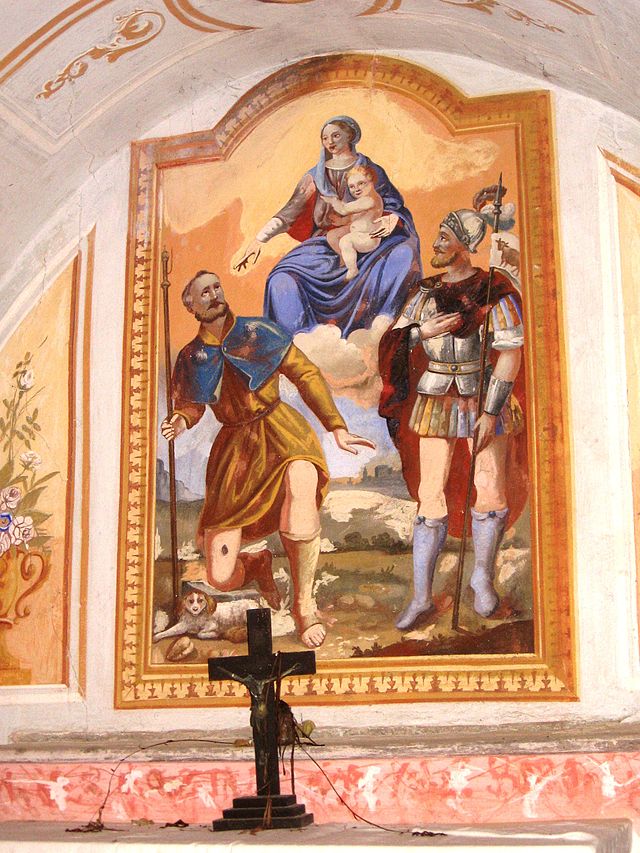
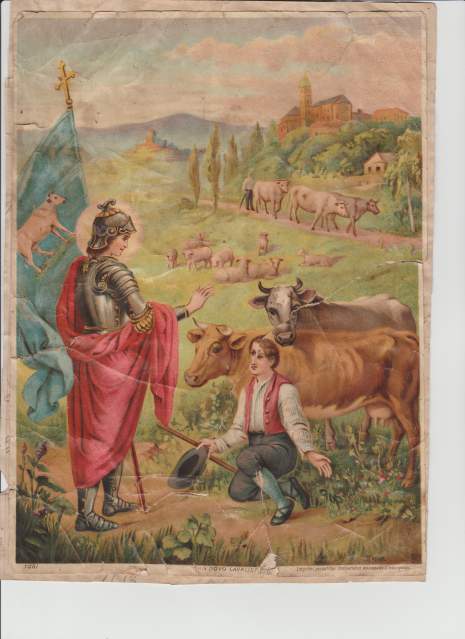
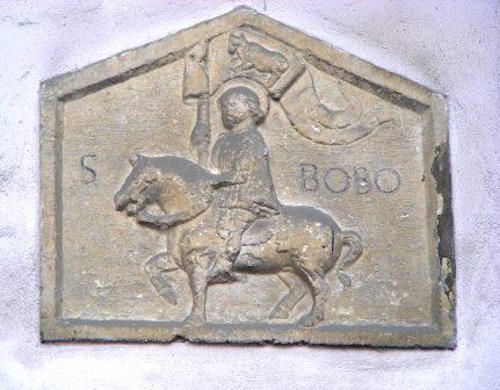
Saint of the Day – 22 May – St Beuvon (Died 986) Pilgrim, Apostle of the poor, Hermit, Knight – also known as St Bobo of Provence, Bovo, Beuve, Bobone. Born in Provence, France and died on 22 May 986 near Voghera, Pavia, Italy of a fever while on a pilgrimage to Rome, Italy. He is known only from the anonymous biography Vita sancti Bobonis. Patronages – Vogerea, Italy and cattle.
Beuvon was born around 940 of two nobles, Adelfrido and Odelinda. It is said that Beuvon was nobilissimis et christianis parentibus natus, that is, born of the most noble and most Christian parents. They had a castle at Noyers-sur-Jabron in the southeastern region of France, which is where Beuvon was born.
That castle is gone, but each year there is some kind of celebration with cattle on his feast day about where it stood, on account of Beuvon’s being the patron saint of cattle.
Beuvon was a knight of Provence who helped to conquer Saracen pirates who were invading and raiding the coast. He is also believed to have fought in the Battle of Tourtour in 973. At some point during his military career, he experienced the truth of the horror of war and renounced his former life to become a pilgrim and a hermit, devoted to the care of orphans and widows. He responded to the inner call of the Gospel, leaving behind his family’s wealth for a life of poverty. Thereafter, he did his best fighting with the Gospel, converting a good number of the Saracens. He responded to violence by means of charity.
After the loss of his brother, he went on a Pilgrimage to Rome and died at Voghera in Lombardy. He was buried in Voghera, his grave becoming a site of many miracles. His relics were enshrined in Voghera in 1469.
St Beuvon , pray for us, that we might fight evil in our day as you did in yours.
St Aigulf of Bourges
St Atto of Pistoia
St Aureliano of Pavia
St Ausonius of Angoulême
St Baoithin of Ennisboyne
St Basiliscus of Pontus St Beuvon (Died 986)
St Boethian of Pierrepont
St Castus the Martyr
St Conall of Inniscoel
Bl Diego de Baja
Bl Dionisio Senmartin
St Emilius the Martyr
St Faustinus the Martyr
St Francisco Salinas Sánchez
St Fulgencio of Otricoli
Bl Fulk of Castrofurli
Bl Giacomo Soler
Bl Giusto Samper
St Helen of Auxerre
St Humility of Faenza
Bl John Baptist Machado Bl John Forest OFM (1471-1538) Martyr of Oxford University Biography: https://anastpaul.wordpress.com/2018/05/22/saint-of-the-day-22-may-bl-john-forest-o-f-m-1471-1538-martyr/
St John of Parma
St José Quintas Durán St Julia (5th century) Martyr Her Life and Death: https://anastpaul.com/2019/05/22/saint-of-the-day-22-may-st-julia-5th-century-martyr/
St Lupo of Limoges
St Marcian of Ravenna
St Margaret of Hulme
Bl Pedro of the Assumption
St Quiteria
St Romanus of Subiaco
St Timothy the Martyr
St Venustus the Martyr
—
Martyred in the Spanish Civil War:
• Blessed Francisco Salinas Sánchez
• Blessed José Quintas Durán
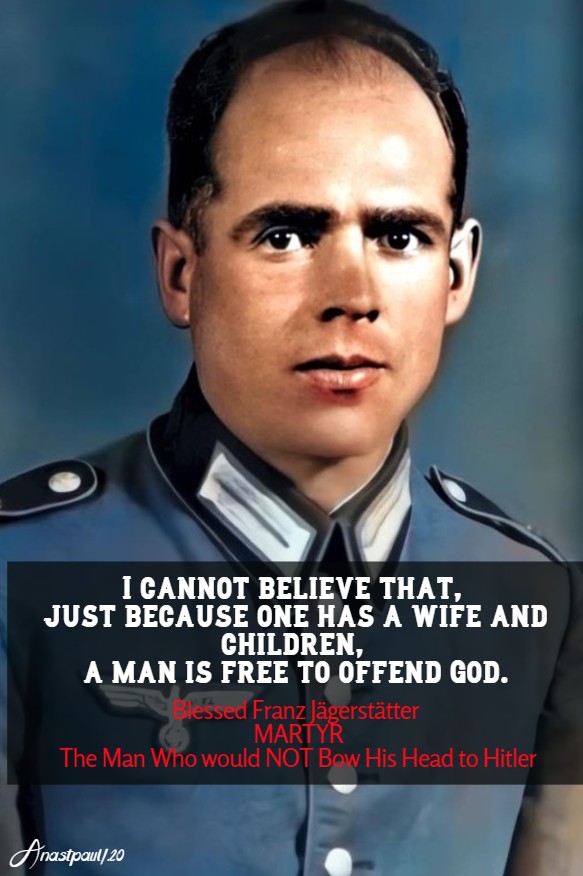
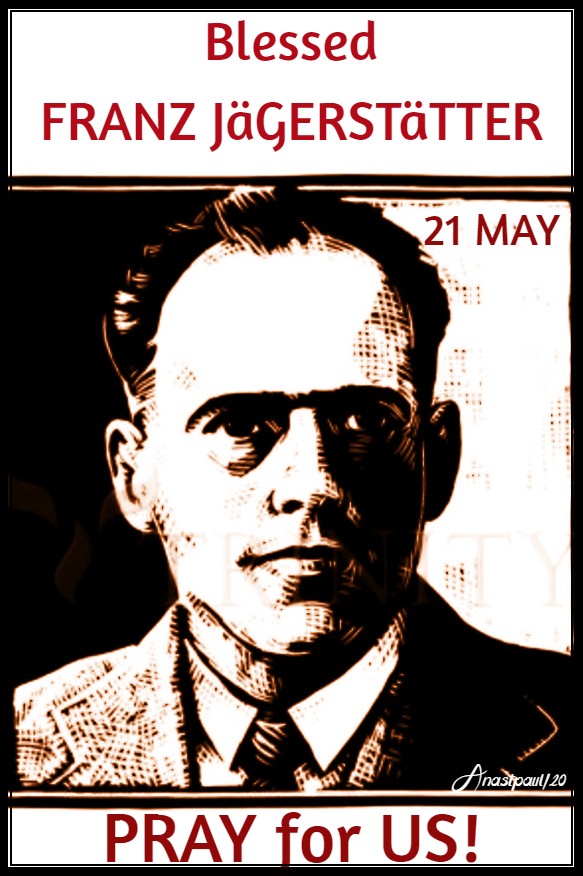
Quote/s of the Day – 21 May – Thursday of the Sixth Week of Easter and the Memorial of Blessed Franz Jägerstätter OFS (1907-1943) Layman Martyr “The Man Who Would Not Bow His Head to Hitler.”
“If the Church stays silent in the face of what is happening, what difference would it make, if no church were ever opened again?”
His sacrifice was uniformly regarded as foolish by his neighbours and his story almost forgotten but for a book written by an American, Gordon Zahn, who heard of Jagerstatter when researching the subject of German Catholics’ response to Hitler. This book, In Solitary Witness, influenced Daniel Ellsberg’s decision to stand against the Vietnam War by bringing the Pentagon Papers to public attention. The following quote, taken from one of Jagerstatter’s last letters while in prison.
“Just as the man who thinks only of this world, does everything possible to make life here easier and better, so must we, too, who believe in the eternal Kingdom, risk everything in order to receive a great reward there. Just as those who believe in National Socialism tell themselves that their struggle is for survival, so must we, too, convince ourselves that our struggle is for the eternal Kingdom. But with this difference – we need no rifles or pistols for our battle but instead, spiritual weapons – and the foremost among these is prayer…. Through prayer, we continually implore new grace from God, since without God’s help and grace it would be impossible for us to preserve the Faith and be true to His commandments….”
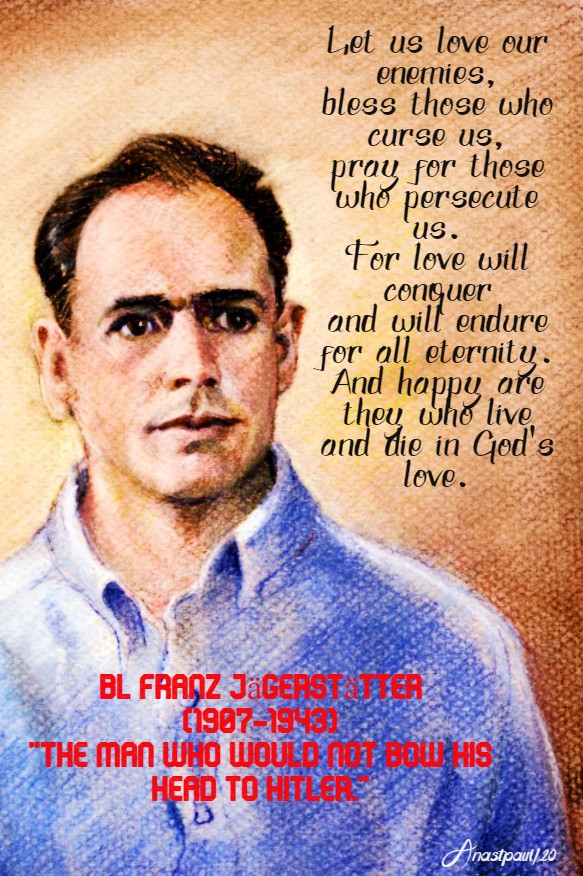
“Let us love our enemies, bless those who curse us, pray for Those who persecute us. For love will conquer and will endure for all eternity. And happy are they who live and die in God’s love.”
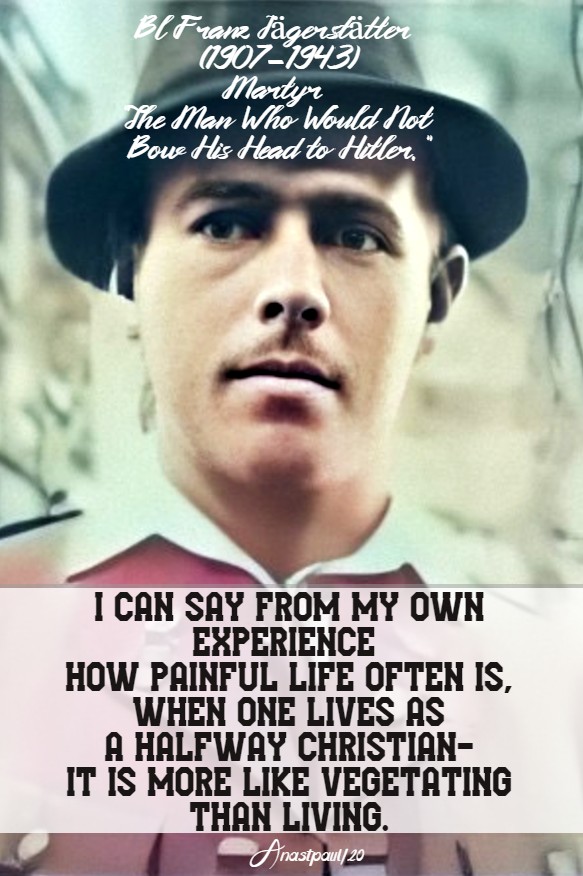
“I can say from my own experience how painful life often is, when one lives as a halfway Christian- it is more like vegetating than living.”
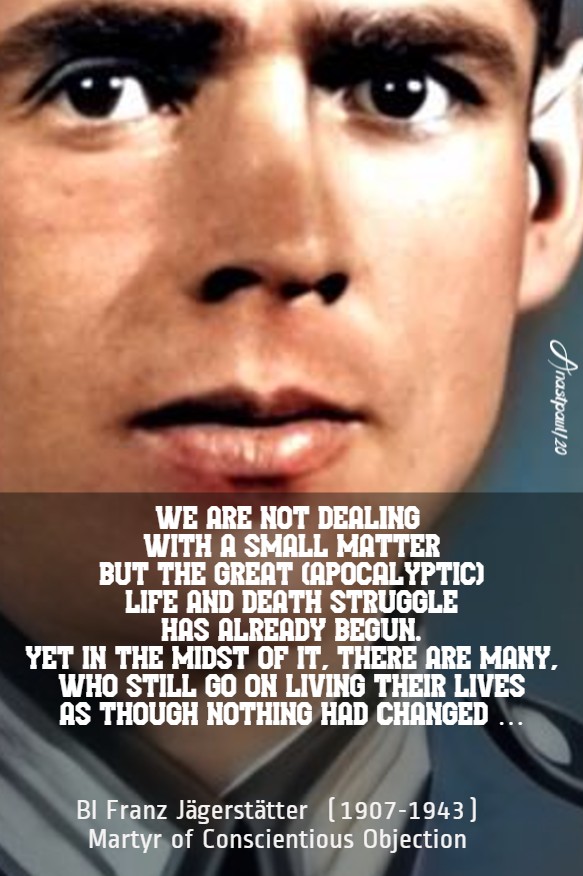
“We are not dealing with a small matter but the great (apocalyptic) life and death struggle has already begun. Yet in the midst of it, there are many, who still go on living their lives as though nothing had changed … “
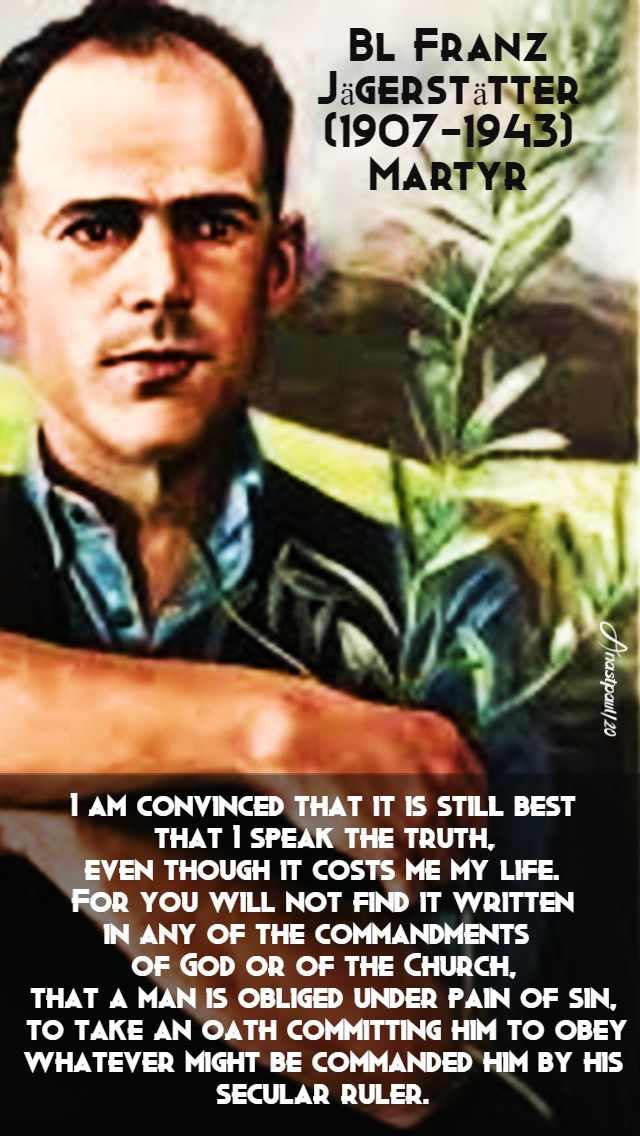
“I am convinced that it is still best that I speak the truth, even though it costs me my life. For you will not find it written in any of the commandments of God or of the Church, that a man is obliged under pain of sin, to take an oath committing him to obey whatever might be commanded him by his secular ruler. “
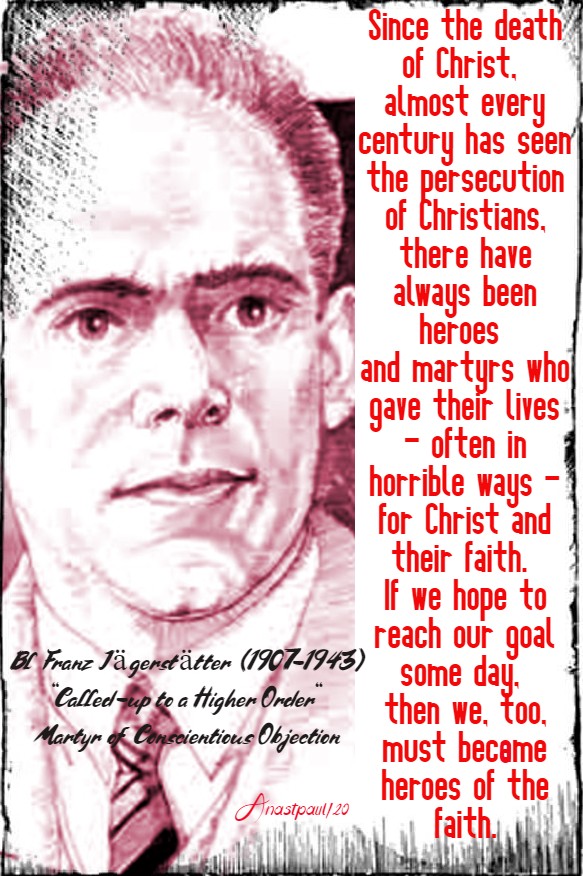
“Since the death of Christ, almost every century has seen the persecution of Christians, there have always been heroes and martyrs who gave their lives – often in horrible ways – for Christ and their faith. If we hope to reach our goal some day, then we, too, must become heroes of the faith.”
“I cannot believe that, just because one has a wife and children, a man is free to offend God.”
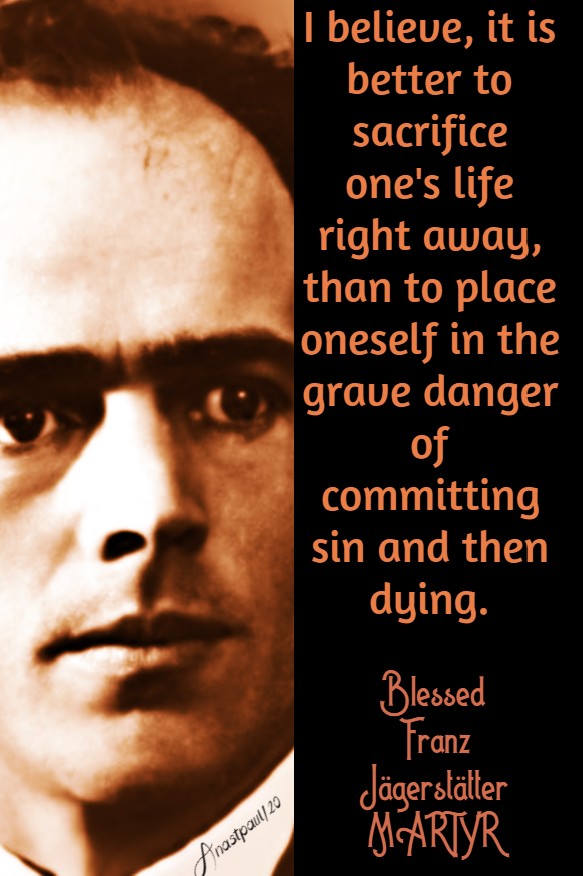
“I believe it is better to sacrifice one’s life right away, than to place oneself in the grave danger of committing sin and then dying.”
Blessed Franz Jägerstätter (1907-1943)
“Called-up to a Higher Order”
Martyr of Conscientious Objection
One Minute Reflection – 21 May – “Mary’s Month” – Thursday of the Sixth Week of Easter, Readings: Acts 18: 1-8, Psalms 98: 1, 2-3, 3-4, John 16: 16-20 and the Memorial of Blessed Franz Jägerstätter OFS (1907-1943) Layman Martyr “The Man Who Would Not Bow His Head to Hitler.”
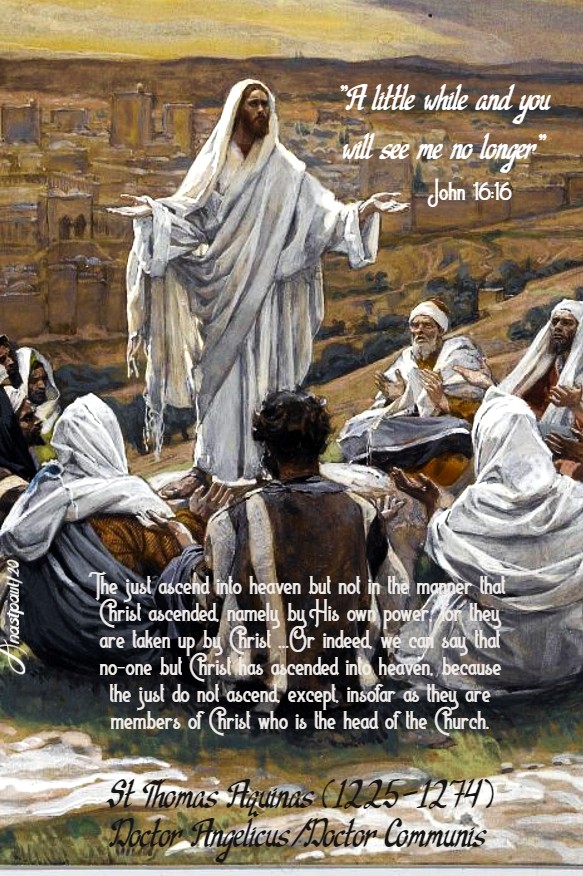
“A little while and you will see me no longer” … John 16:16
REFLECTION – “The Ascension of Christ into heaven is in accord with reason – firstly, because heaven was due to Christ by His very nature. It is natural for someone to return to the place from whence they take their origin. The beginning of Christ is from God, who is above all things. Jesus says to the Apostles (Jn 16:28): “I came from the Father and have come into the world and now I am leaving the world and going back to the Father” … The just ascend into heaven but not in the manner that Christ ascended, namely by His own power, for they are taken up by Christ – “Draw me, we will run after thee.” (Sg 1:3) Or indeed, we can say that no-one but Christ has ascended into heaven, because the just do not ascend, except, insofar as they are members of Christ who is the head of the Church. … Secondly, heaven is due to Christ because of His victory. For He was sent into the world to combat the devil and he did overcome Him. Therefore, Christ deserved to be exalted above all things – “I myself first won the victory and sit with my Father on his throne” (Rv 3:21)
Finally, the Ascension was owing to Christ because of His humility. There never was humility so great as that of Christ who, although He was God yet wished to become man and although He was the Lord, yet He wished to take the form of a servant and, as Saint Paul says: “He was obedient even unto death” (Phil 2:7) and descended even into hell. Therefore, He deserved to be exalted even to heaven, to God’s throne, for humility leads to exaltation. “For whoever humbles himself will be exalted” (Lk 14:11) and, “the one who descended is also the one who ascended far above all the heavens” (Eph 4:10).” … St Thomas Aquinas (1225-1274) Doctor Angelicus/Doctor Communis – Commentary on the Apostle’s Creed
PRAYER – Lord God, You bestowed the Holy Spirit on Your Apostles while they were at prayer with Mary, the Mother of Jesus. Fill us too with the gift of Your grace in the Holy Spirit, that we may live our lives both in prayer and action and grant, that by Mary’s prayer, and the prayer of Your loving Martyr, Blessed Franz Jagerstatter, we may give You faithful service and spread abroad the glory of Your name, by word and example and thus ascend to You, to live forever in Your Light. We make our prayer through Christ our Lord, Your divine Son, in union with the Holy Spirit, one God, forever and ever, amen.
Our Morning Offering – 21 May – “Mary’s Month” – Thursday of the Sixth Week of Easter
We shouldn’t really be praying this prayer right now in this Eastertide of Alleluias but, after so many weeks of this virus tyranny, my heart is sad, we were not able to celebrate Easter, we are beleaguered in every way and our hearts ache with longing for the Sacraments. Then today’s Saint, Blessed Franz Jägerstätter’s devotion to the Cross of Christ, his own courage and passion, seems so very appropriate for these times too. May he inspire us and pray for us. And may our Merciful Lady accept us too, the servants in place of the Master. Let us Pray!
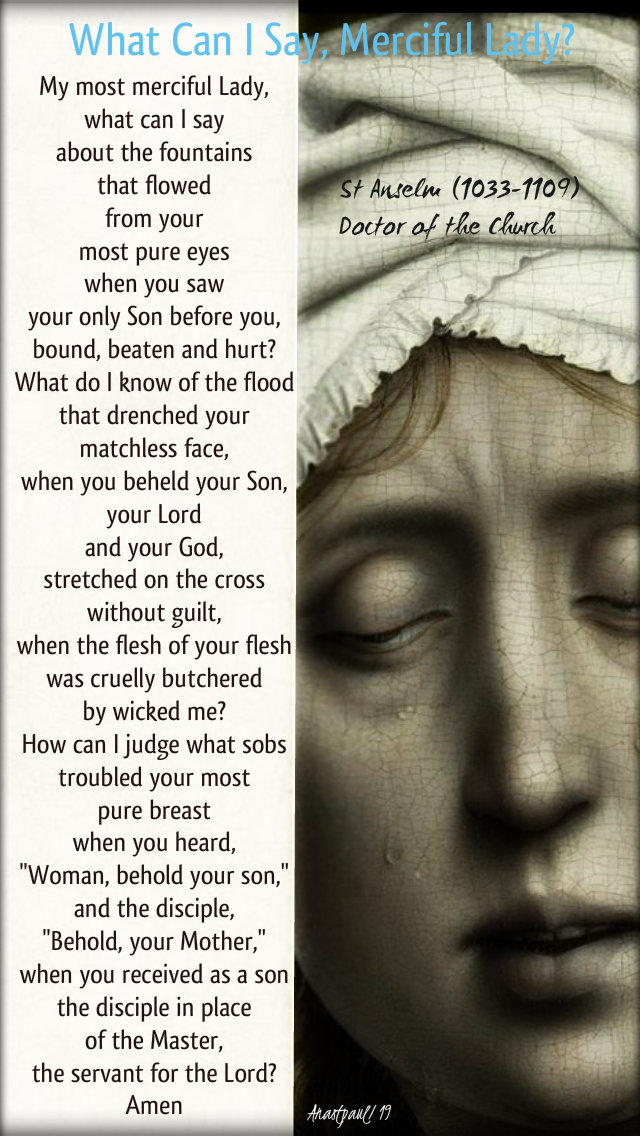
What Can I Say, Merciful Lady? St Anselm (1033-1109) Marian Doctor / Magnificent Doctor
My most merciful Lady,
what can I say about the fountains
that flowed from your most pure eyes
when you saw your only Son before you,
bound, beaten and hurt?
What do I know of the flood
that drenched your matchless face,
when you beheld your Son, your Lord
and your God,
stretched on the cross without guilt,
when the flesh of your flesh
was cruelly butchered by wicked me?
How can I judge what sobs
troubled your most pure breast
when you heard,
“Woman, behold your son,”
and the disciple,
“Behold, your Mother,”
when you received as a son
the disciple in place of the Master,
the servant for the Lord?
Amen




















You must be logged in to post a comment.