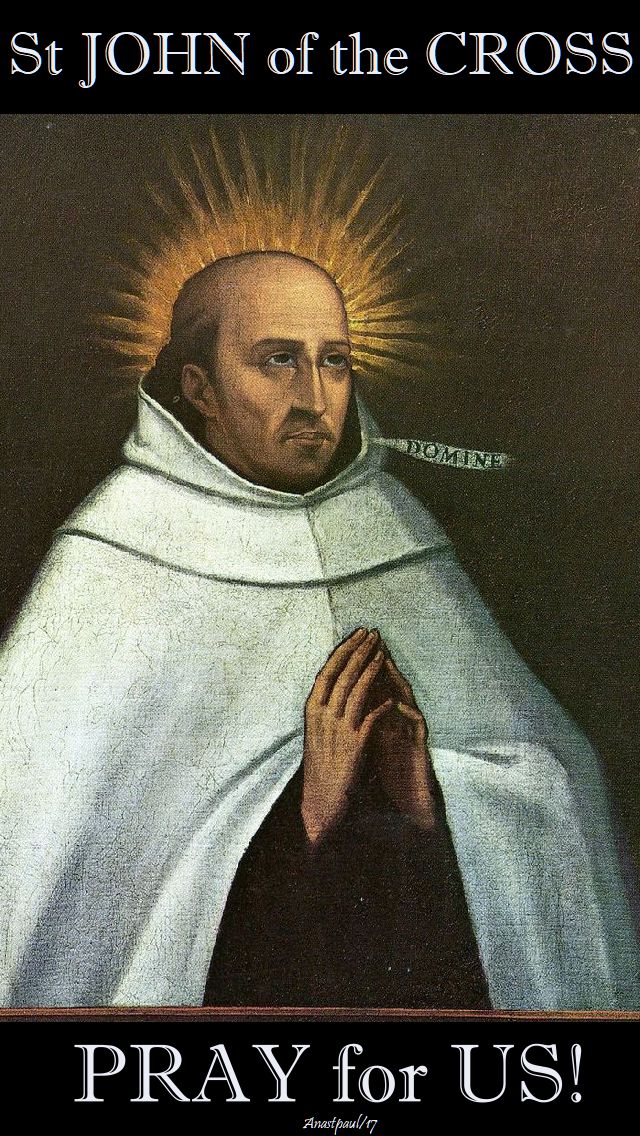
Thought for the Day – 14 December – The Memorial of St John of the Cross (1542-1591) Doctor of the Church
In his life and writings, John of the Cross has a crucial word for us today. We tend to be rich, soft, comfortable. We shrink even from words like self-denial, mortification, purification, asceticism, discipline. We run from the cross. John’s message—like the gospel—is loud and clear: Don’t—if you really want to live! (Fr Don Miller OFM)
‘Song of the soul that is glad to know God by faith’
14 December – The Memorial of St John of the Cross (1542-1591) Doctor of the Church
There have been a number of translations into English of the works of St John of the Cross. One of the translations which has been considered one of the best is that by the Anglo-South African convert poet Roy Campbell (2 October 1901 – 22 April 1957).
In October 2009, Roger Scruton wrote about Roy Campbell in his article “A Dark Horse” published in The American Spectator. He was hated by the English “left establishment” especially because of his position on The Spanish Civil War.
The Wikipedia entry says of Roy Campbell that he “was considered by T. S. Eliot, Edith Sitwell and Dylan Thomas to have been one of the best poets of the period between the First and Second World wars but he is seldom found in anthologies today.”
Campbell’s translations of the poetry by St John of the Cross were lavishly praised by Argentine writer Jorge Luis Borges
For more about Campbell`s work, R J Dent has published an essay on Roy Campbell and his work entitled: Violence and exquisite beauty – the aesthetics of Roy Campbell.
Here is a poem of St John of the Cross with the translations by the late Roy Campbell.
‘Song of the soul that is glad to know God by faith’
How well I know that fountain’s rushing flow Although by night
Its deathless spring is hidden. Even so Full well I guess from whence its source flow Though it be night.
Its origin (since it has none) none knows: But that all origin from it arose Although by night.
I know there is no other thing so fair And earth and heaven drink refreshment there Although by night.
Full well I know the depth no man can sound And that no ford to cross it can be found Though it be night
Its clarity unclouded still shall be: Out of it comes the light by which we see Though it be night.
Flush with its banks the stream so proudly swells; I know it waters nations, heavens, and hells Though it be night.
The current that is nourished by this source I know to be omnipotent in force Although by night.
After the beatification of St John of the Cross on 25 January 1675, the Carmelite convent of Nuestra Señora de los Remedios near Seville commissioned this life-sized statue from the young Sevillian sculptor, Francisco Antonio Gijón, then only 21.
The figure of the saint holds a quill pen in his right hand and, in the left, a book with a model of a mountain surmounted by a cross, which refers to his mystic commentary, “The Ascent of Mount Carmel.”
Francisco Antonio Gijón (1653–c. 1721) and unknown painter (possibly Domingo Mejías)
Saint John of the Cross
c 1675
Painted and gilded wood
168 cm (66 1/8 in.)
Quotes of the Day – 14 December – The Memorial of St John of the Cross (1542-1591) Doctor of the Church
“In giving us His Son, His only Word, He spoke everything to us at once in this sole Word – and He has no more to say… because what He spoke before to the prophets in parts, He has now spoken all at once by giving us the ALL Who is His Son.”
“If a man wishes to be sure of the road he treads on, he must close his eyes and walk in the dark.”
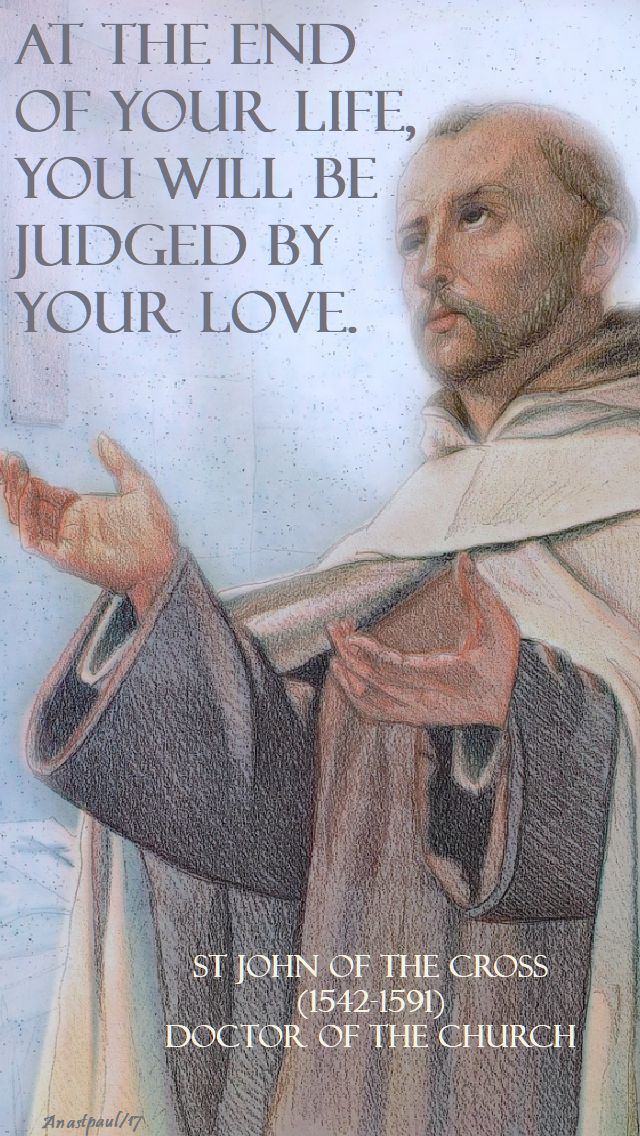
“At the end of your life, you will be judged by your love.”
St John of the Cross (1542-1591) Doctor of the Church
One Minute Reflection – 14 December – The Memorial of St John of the Cross (1542-1591) Doctor of the Church
In all truth I tell you, unless a grain of wheat falls into the earth and dies, it remains only a single grain; but if it dies it yields a rich harvest…John 12:24
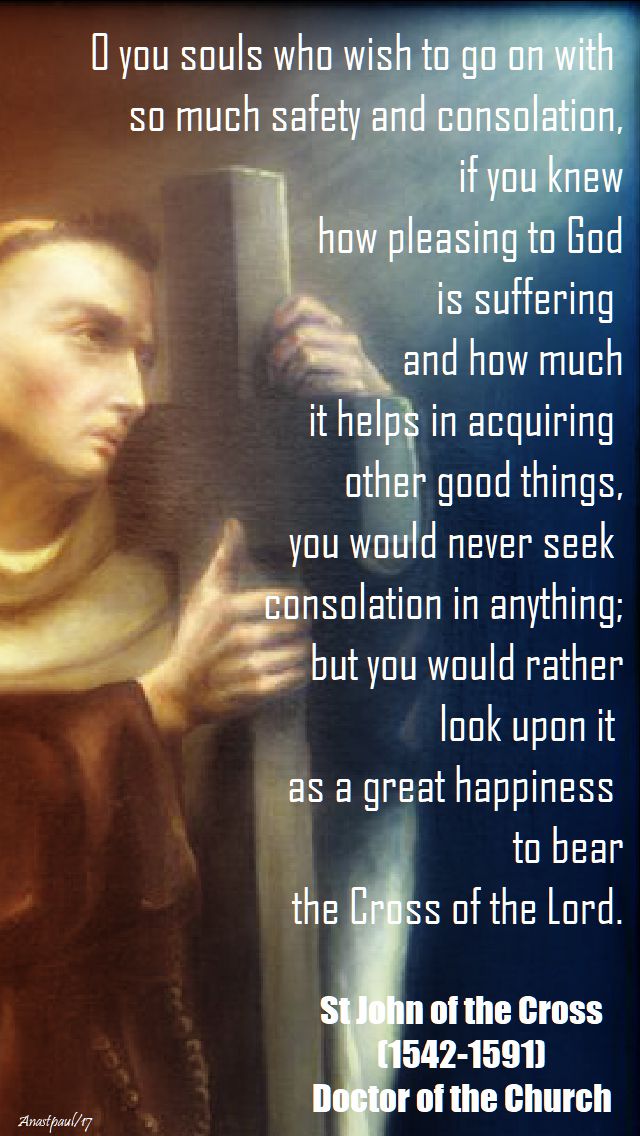
REFLECTION – “O you souls who wish to go on with so much safety and consolation, if you knew how pleasing to God is suffering and how much it helps in acquiring other good things, you would never seek consolation in anything; but you would rather look upon it as a great happiness to bear the Cross of the Lord.”…Saint John of the Cross
PRAYER – Lord God, You gave St John of the Cross, the grace of complete self-denial and an ardent love for the Cross of Christ. Grant that by following always in the footsteps of Christ and by the prayers of St John of the Cross on our behalf, we may come to the eternal vision of Your glory. Through our Lord Jesus Christ, in unity with the Holy Spirit, one God forever, amen.
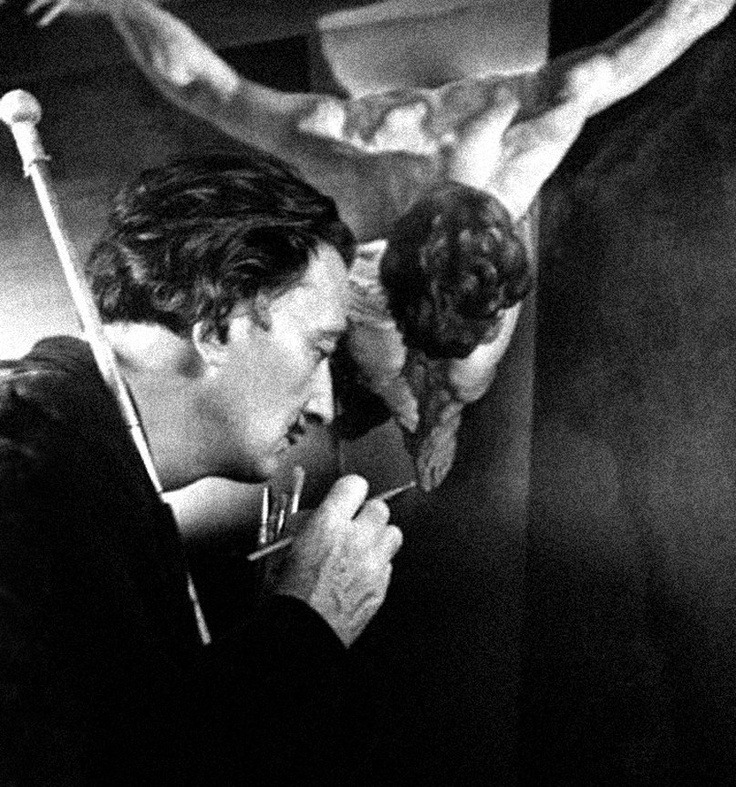
Christ of Saint John of the Cross is a painting by Salvador Dalí made in 1951.
It depicts Jesus Christ on the cross in a darkened sky floating over a body of water complete with a boat and fishermen. Although it is a depiction of the Crucifixion, it is devoid of nails, blood and a crown of thorns, because, according to Dalí, he was convinced by a dream that these features would mar his depiction of Christ. Also in a dream, the importance of depicting Christ in the extreme angle evident in the painting was revealed to him.
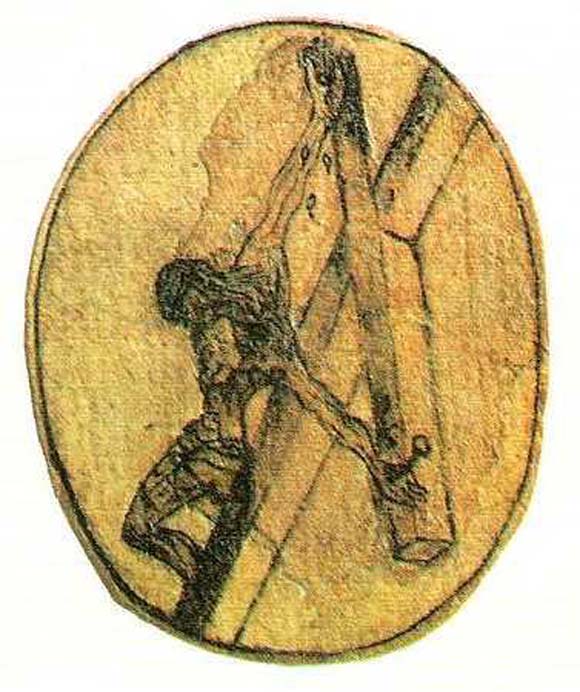
It is known by it’s Title because its design is based on a drawing by the 16th-century Spanish friar, today’s saint and a Doctor of the Church, St Jon of the Cross. The composition of Christ is also based on a triangle and circle (the triangle is formed by Christ’s arms; the circle is formed by Christ’s head). The triangle, since it has three sides, can be seen as a reference to the Trinity and the circle represents Unity. Below is the drawing by St John of the Cross.
On the bottom of his studies for the painting, Dalí explained its inspiration: “In the first place, in 1950, I had a ‘cosmic dream’ in which I saw this image in colour and which in my dream represented the ‘nucleus of the atom.’ This nucleus later took on a metaphysical sense; I considered it ‘the very unity of the universe,’ the Christ!”
In order to create the figure of Christ, Dalí had Hollywood stuntman Russell Saunders suspended from an overhead gantry, so he could see how the body would appear from the desired angle and also envisage the pull of gravity on the human body. The depicted body of water is the bay of Port Lligat, Dalí’s residence at the time of the painting.
Saint of the Day – 14 December – (1542-1591) Doctor of the Church – Carmelite monk and Priest, Religious Founder, Writer, Poet, Mystic, Apostle of Contemplative Prayer. Also known as • Doctor of Mystical Theology • John della Croce • John de la Croix • John de la Cruz. Patronages – • contemplative life, contemplatives• mystical theology, mystics• Spanish poets• World Youth Day 2011• Segovia, Spain• Ta’ Xbiex, Malta. Attributes – eagle, Crucifix, Cross, Carmelite habit. John of the Cross is known for his writings. Both his poetry and his studies on the growth of the soul are considered the summit of mystical Spanish literature and one of the peaks of all Spanish literature. He was canonised as a saint in 1726 by Pope Benedict XIII. He is one of the thirty-six Doctors of the Church, added by Pope Pius XI in 1926. His works are • Ascent of Mount Carmel• Dark Night of the Soul, Book 1 • Dark Night of the Soul, Book 2 • A Spiritual Canticle of the Soul and the Bridegroom Christ.
St John was born Juan de Yepes y Álvarez into a converso family (descendents of Jewish converts to Christianity) in Fontiveros, near Ávila, a town of around 2,000 people. John’s father had been disowned by his wealthy Spanish family when he married a poor weaver rather than a woman of equal economic status. Living in poverty proved to be too much for him and he died shortly after John was born. John spent much of his youth in an orphanage, where he was clothed, fed and given an elementary education. At the age of 17, he found a job in a hospital and was accepted into a Jesuit college. In 1563 he entered the Carmelite Order. Eventually he enrolled in another university, where he did so well that he was asked to teach a class and to help settle disputes.
Ordained a Carmelite priest in 1567 at age 25, John met Teresa of Avila and, like her, vowed himself to the primitive Rule of the Carmelites. As partner with Teresa and in his own right, John engaged in the work of reform and came to experience the price of reform: increasing opposition, misunderstanding, persecution, imprisonment. John was caught up in a misunderstanding and imprisoned at Toledo, Spain. During those months of darkness in that little cell, John could have become bitter, revengeful, or filled with despair. But instead, he kept himself open to God’s action, for no prison could separate him from God’s all-embracing love. During this time he had many beautiful experiences and encounters with God in prayer. He came to know the cross acutely—to experience the dying of Jesus—as he sat month after month in his dark, damp, narrow cell with only his God.
Yet, the paradox! In this dying of imprisonment John came to life, uttering poetry. In the darkness of the dungeon, John’s spirit came into the Light. There are many mystics, many poets- John is unique as mystic-poet, expressing in his prison-cross the ecstasy of mystical union with God in the Spiritual Canticle.
But as agony leads to ecstasy, so John had his Ascent to Mt Carmel, as he named it in his prose masterpiece. As man-Christian-Carmelite, he experienced in himself this purifying ascent; as spiritual director, he sensed it in others; as psychologist-theologian, he described and analysed it in his prose writings. His prose works are outstanding in underscoring the cost of discipleship, the path of union with God: rigorous discipline, abandonment, purification. Uniquely and strongly John underlines the gospel paradox: The cross leads to resurrection, agony to ecstasy, darkness to light, abandonment to possession, denial to self to union with God. If you want to save your life, you must lose it. John is truly “of the Cross.” He died at 49—a life short, but full. AND his reforms of the “Discalced” Carmelites revitalised the Order. He was proclaimed a Doctor of the Church by Pope Pius XI on 24 August 1926.
Diego de Sanabria – Saint John of the CrossImage above – El Greco‘s landscape of Toledo depicts the priory in which John was held captive, just below the old Muslim alcázar and perched on the banks of the Tajo on high cliffs
St John of the Cross (Memorial) (1542-1591) Doctor of the Church
St Abundius of Spain
St Agnellus of Naples
Bl Buenaventura Bonaccorsi
St Folcuino of Therouanne
Bl Joan Lambertini
St John Pan y Agua (Bread-and-Water)
Bl John Discalceat
St Justus of Spain
Bl Mary Frances Schervier
St Matronianus of Milan
St Pompeius of Pavia
BL Protasi Cubells Minguell
St Venantius Fortunatus
St Viator of Bergamo
St Yusuf Jurj Kassab al-Hardini
bL William de Rovira
—
Martyrs of Alexandria – 4 saints: A group of Egyptian Christians martyred together in the persecutions of Decius – Arsenius, Dioscurus, Heron and Isidore. They were burned to death in 250 at Alexandria, Egypt.
Martyrs of Apollonia – 7 saints: Martyred in the persecutions of Decius. The only surviving details are three names – Callinicus, Leucio and Tirso. Apollonia, Bithynia (in modern Turkey).
Martyrs of Ashkelon – 3 saints: Several pilgrims from Egypt to Cilicia (in modern Turkey) who planned to minister to fellow Christians suffering in the persecutions of emperor Maximinus. They were arrested, torture, mutilated and then imprisoned in Ashkelon. Some were ordered to forced labour in the mines, but we have the names of three who were martyred by order of governor Firmilian – Ares, Elijah and Promo. They were burned at the stake or beheaded at the gates of Ashkelon c 308.
Martyrs of Hayle – 2+ saints: Several Christians, including a brother and sister, who were martyred together by pagans. The only other information to survive are the names of the two siblings – Fingar and Phiala. 5th century at Hayle, Cornwall, England.
Martyrs of Syria – 3 saints: Three Christians who were martyred together. Known to Saint John Chrysostom who preached on their feast day, and left us the only details we have – their names – Drusus, Theodore and Zosimus. The date and precise location of their martyrdom is unknown, but it was in Syria, possibly in Antioch.
Thought for the Day – 13 December – Wednesday of the Second Week of Advent and the Memorial of St Lucy (c 283-304)
Gospel for today : Matthew 11:28-30
Jesus exclaimed, Come to me, all you that are weary and are carrying heavy burdens and I will give you rest. Take my yoke upon you and learn from me; for I am gentle and humble in heart and you will find rest for your souls. For my yoke is easy, and my burden is light.
The symbol of “yoke” used by Jesus in the Gospel has a special significance.
Two bulls are required to carry a yoke.
When Jesus says, “Take my yoke upon you” means He is already on one side of the yoke.
He is inviting us to put our shoulder on the other side!
When we take Jesus’ yoke upon ourselves, we experience that the burden is light
and the yoke is easy to carry because of the presence of Jesus.
The ones who walk in the way of the Lord, will never be tired
because the Lord Himself will be their peace and their rest.
The peace and rest that come from the Lord are the signs which assures us
that we are carrying the burden with Jesus, whereas, disturbance and
restlessness, are signs which suggest that we are trying to do things
our own way and are burdened with our own agenda!
So how do we “see” our Lord there, right next to us?
Touch the hem of Christ’s garment! Celebrate the Eucharist – for it is here
that we are given peace and strength – in this mystery, God holds us to His Heart
and we can find Him on the other side of the yoke and we become whole.
Lord Jesus, our Christ, may we always accept Your invitation just as St Lucy did, whose Memorial we celebrate today and whose prayers we implore!
“If you want to honour the body of Christ, do not scorn it when it is naked; do not honour the Eucharistic Christ with silk vestments and then, leaving the church, neglect the other Christ suffering from cold and nakedness”
St John Chrysostom (347-407)
Father and Doctor of the Church – (Hom. in Matthaeum, 50.3: PG 58)
“The more we are afflicted in this world, the greater is our assurance in the next; the more we sorrow in the present, the greater will be our joy in the future.”
St Isidore of Seville (560-636) Doctor of the Church
“When it is all over, you will not regret having suffered; rather, you will regret, having suffered so little and suffered that little so badly.”
One Minute Reflection – 13 December – The Memorial of St Lucy (c 283-304)
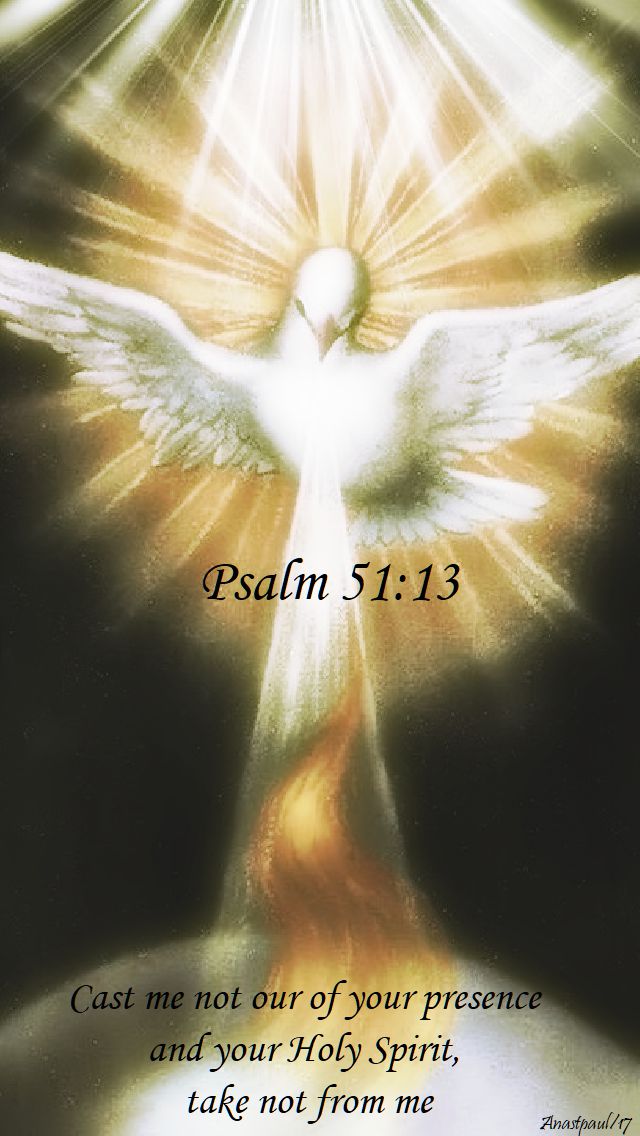
Cast me not our of your presence and your Holy Spirit, take not from me….Psalm 51:13
REFLECTION – “When the Holy Spirit is in a soul, He communicates Himself in one way or another.
We can say that He makes virtue contagious and turns a simple faithful into an apostle.”…St Claude de la Colombiere S.J. (1641-1682)
PRAYER – Heavenly Father, grant that Your Holy Spirit may inspire me to be a true follower of Your Son. May He dwell in me always and keep me ever on the path of holiness. May the prayer of the virgin Martyr Lucy, support us, O Lord, so that with each passing year, we may celebrate her entry into life and finally see You face to face and greet her with joy. Through our Lord, Jesus Christ, in unity with the Holy Spirit, one God forever and ever amen.
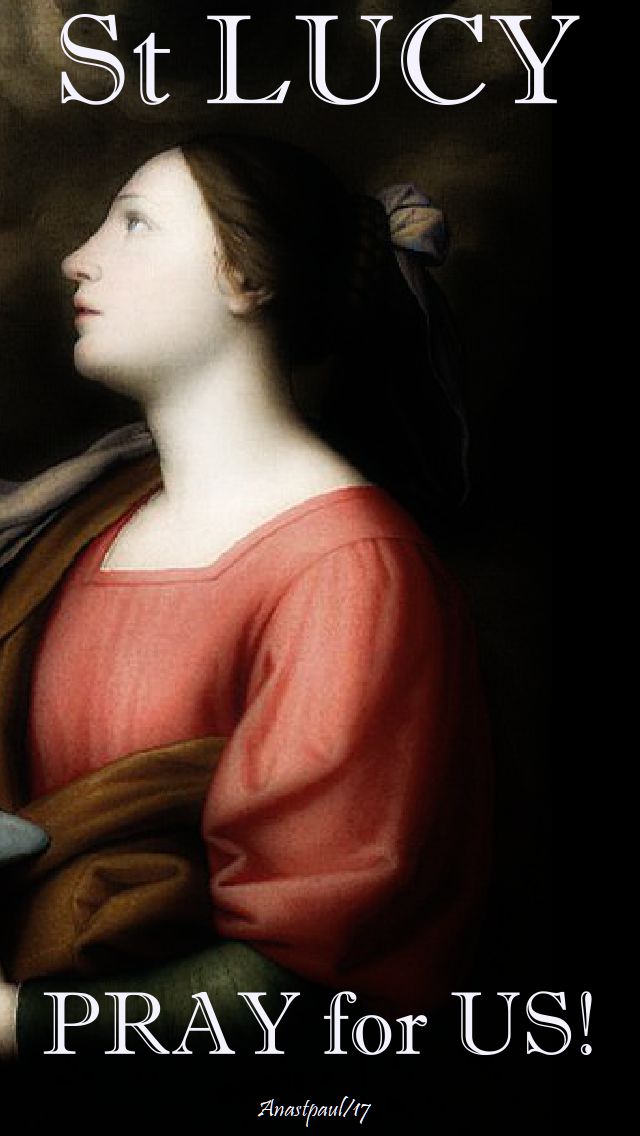
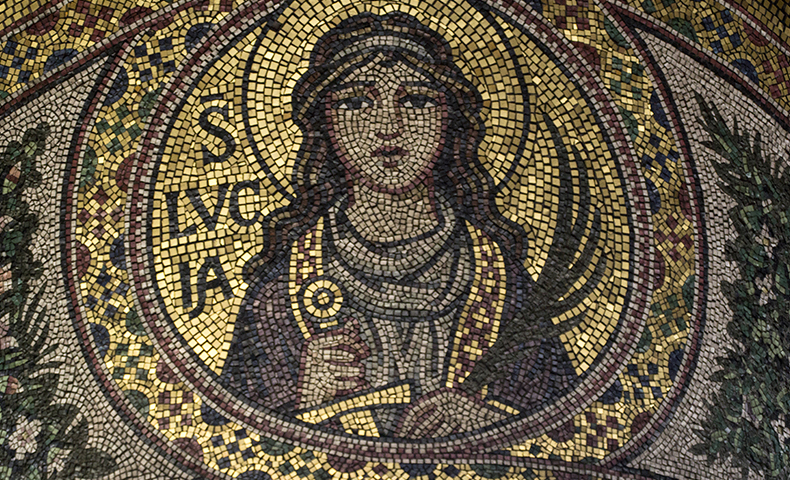
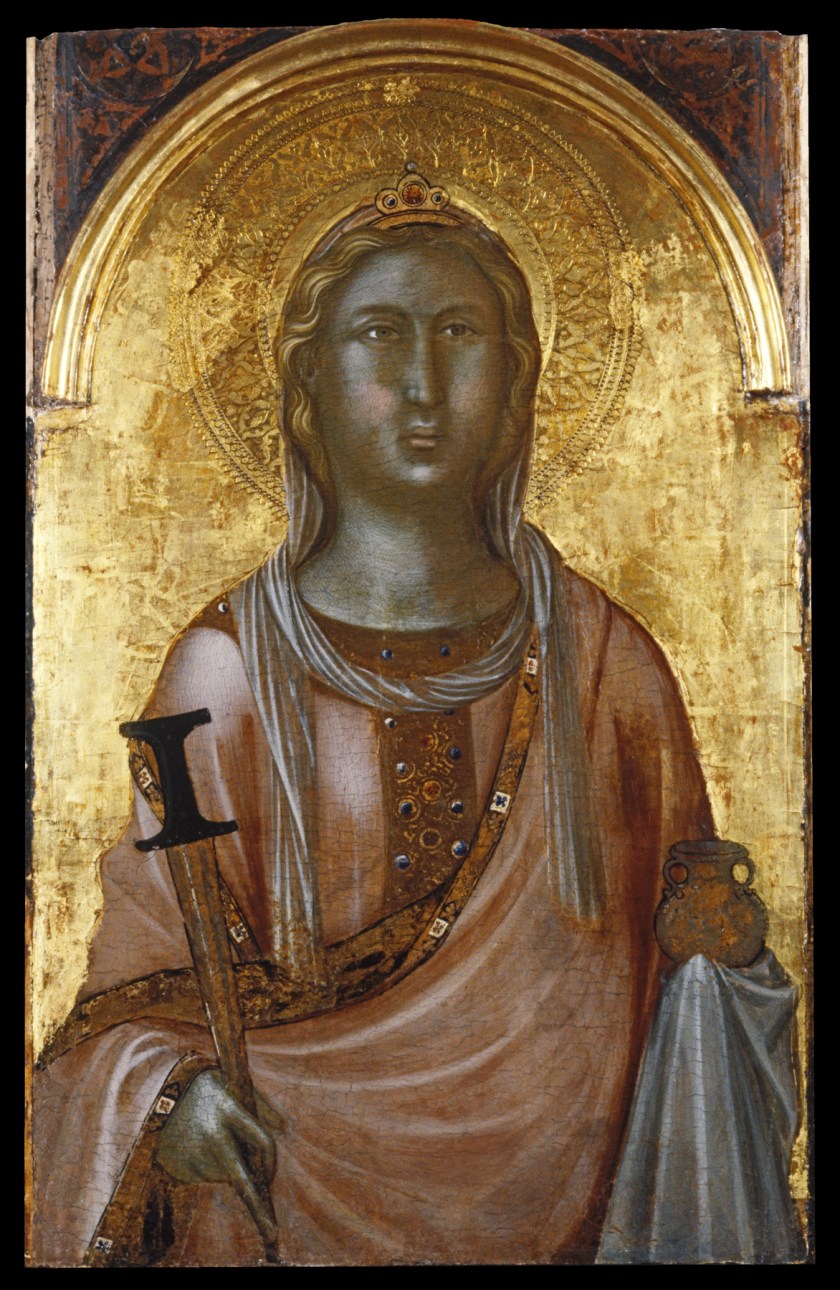
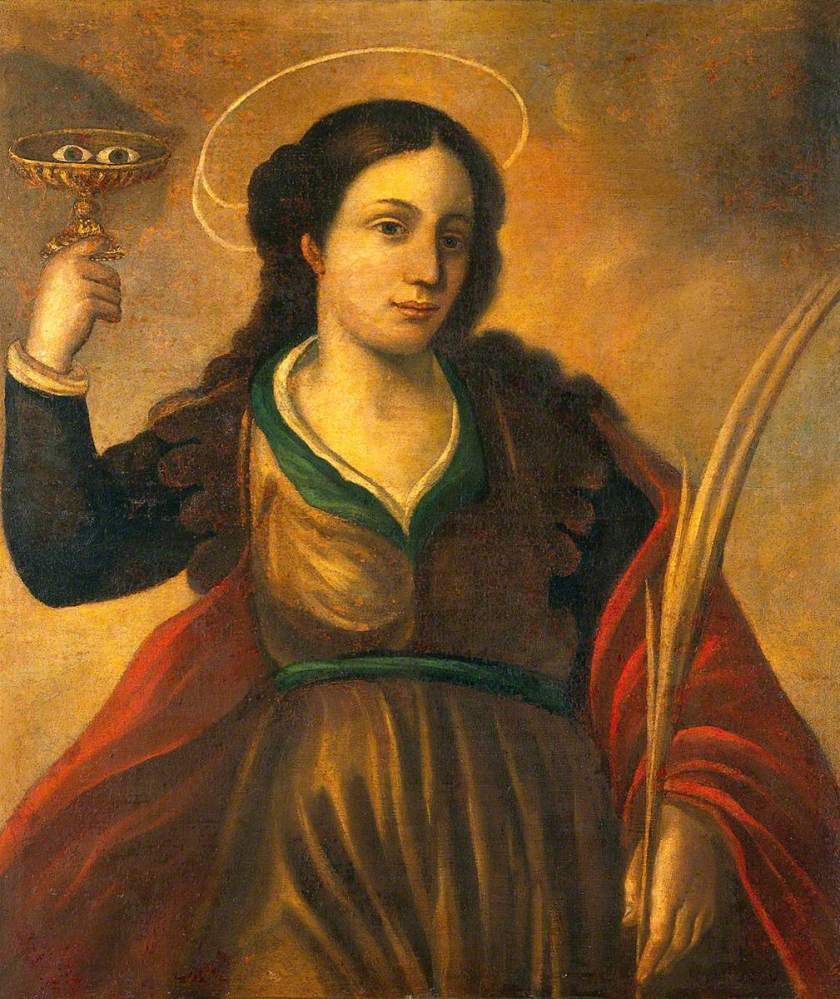
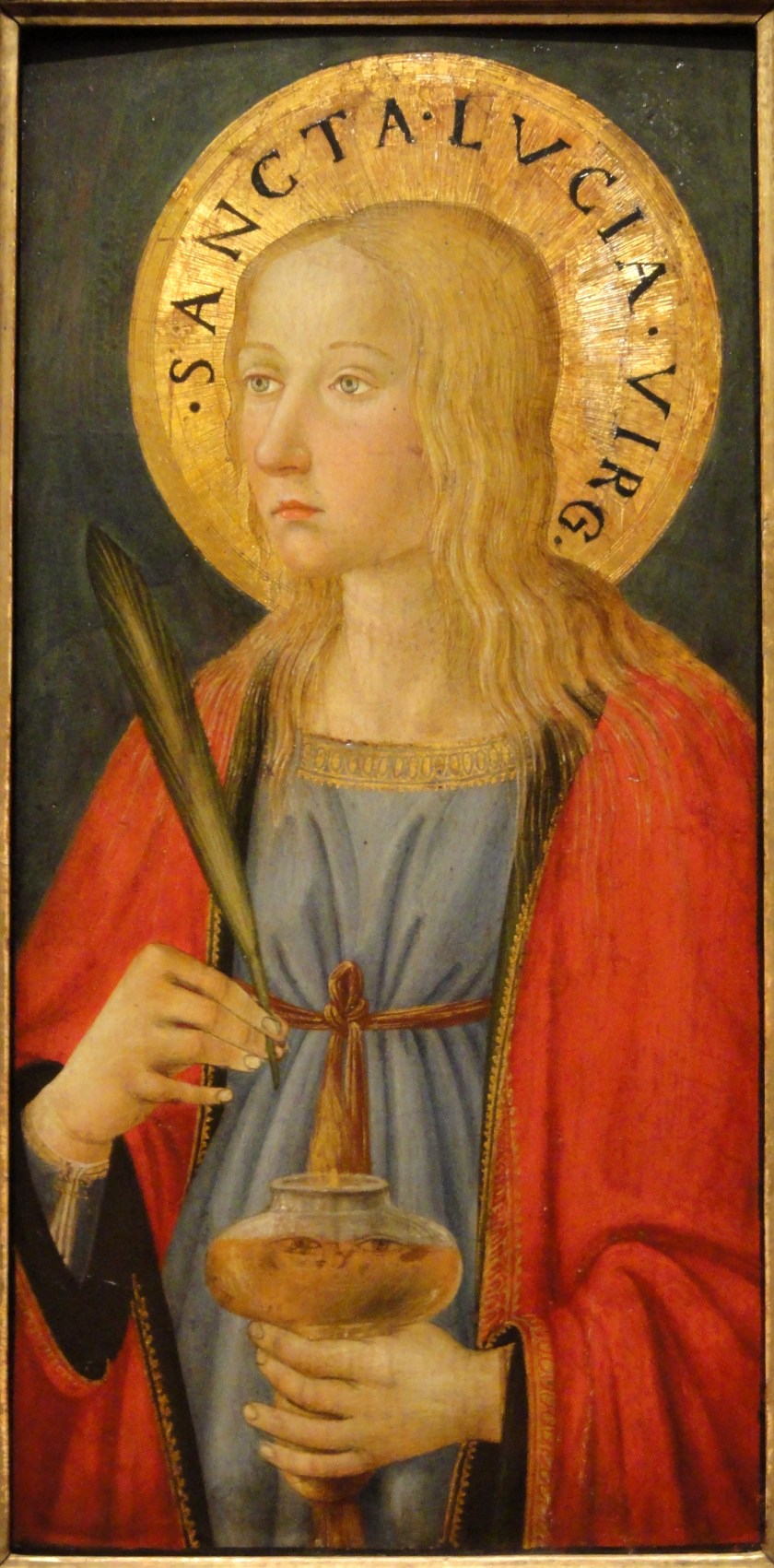
Saint of the Day – 13 December – St Lucy/Lucia of Syracuse (c 283-304) Virgin and Martyr – Patron of the blind, eye disorders, martyrs, Perugia, Italy, Malta; epidemics; salesmen, Syracuse, Italy, throat infections, writers, against fire, against poverty, against spiritual blindness, peasants, penitent prostitutes, poor people, sick children, authors, cutlers, farmers, glass blowers, glass makers, glaziers, labourers, lawyer, maid servants, notaries, ophthalmologists, opticians, porters, printers, saddler, sailors, salesmen, seamstresses, stained glass workers, tailors, upholsterers, weavers and 10 further towns and cities. Attributes – • cord• eyes• eyes on a dish• lamp• swords• woman hitched to a yoke of oxen• woman in the company of Saint Agatha, Saint Agnes of Rome, Barbara, Catherine of Alexandria and Saint Thecla• woman kneeling before the tomb of Saint Agatha
All that is really known for certain of Lucy is that she was a martyr in Syracuse during the Diocletianic Persecution of 304 AD. Her veneration spread to Rome and by the 6th century to the whole Church. The oldest archaeological evidence comes from the Greek inscriptions from the catacombs of St. John in Syracuse.
St Lucy was born in Sicily and died during the persecution of Diocletian. The fact that she is still mentioned in the first Eucharistic Prayer of the Mass shows the great respect that the Church has for her. One story about Lucy is that she is said to have made a vow to remain unmarried. When the man to whom she was engaged found out, he turned her in as a Christian. After torture that included having her eyes torn out, she was surrounded by bundles of wood which were set afire; they went out. She prophesied against her persecutors and was executed by being stabbed to death with a dagger. She was executed in Syracuse (Sicily) in the year 304. Her name is mentioned in the First Eucharistic Prayer, geographical places are named after her, a popular song has her name as its title and down through the centuries many thousands of little girls have been proud of the name Lucy.
One can easily imagine what a young Christian woman had to contend with in pagan Sicily in the year 300. If you have trouble imagining, just glance at today’s pleasure-at-all-costs world and the barriers it presents against leading a good Christian life.
Her friends must have wondered aloud about this hero of Lucy’s, an obscure itinerant preacher in a far-off captive nation that had been destroyed more than 200 years before. Once a carpenter, He had been crucified by the Roman soldiers after his own people turned Him over to the Roman authorities. Lucy believed with her whole soul that this man had risen from the dead. Heaven had put a stamp on all He said and did. To give witness to her faith she had made a vow of virginity.
What a hubbub this caused among her pagan friends! The kindlier ones just thought her a little strange. To be pure before marriage was an ancient Roman ideal, rarely found but not to be condemned. To exclude marriage altogether, however, was too much. She must have something sinister to hide, the tongues wagged.
Lucy knew of the heroism of earlier virgin martyrs in particular St Agatha to whom she prayed for intercession. She remained faithful to their example and to the example of the carpenter, whom she knew to be the Son of God.
Lucy, whose name means “light” kept the light of her loyal faith burning through the experience of death. Now she is enjoying the eternal wedding banquet.
St Lucy (of Syracuse) (Memorial) – St Lucy/Lucia of Syracuse (c 283-304) Virgin and Martyr
St Antiochus of Sulci
Bl Antonio Grassi
St Aristone
St Arsenius of Latro
St Aubert of Arras
Bl Bartholomew of Tuscany
BL Costanza Starace
St Edburgh of Lyminge
St Einhildis of Hohenburg
Bl Elizabeth Rose
St Jodocus
BL John Marinoni
St Martino de Pomar
St Odilia of Alsace
St Roswinda
St Tassio of Bavaria
St Wifred
Blessed Mercedarian Knights – (7 beati): A group of Mercedarian knights who fought the enemies of the Catholic faith in the first century of the Order.
• Blessed Bernardo de Podio
• Blessed Giacomo de Copons
• Blessed Giovanni de Bruquera
• Blessed Guglielmo de Sa
• Blessed Pietro Boguer
• Blessed Pietro Ricart
• Blessed Raimondo de Frexa
Martyrs of Jeongju – (6 saints): Six Christian laymen who were imprisoned, tortured and martyred together in the persecutions in Korea. They were beheaded on 13 December 1866 in Supjeong-i, Jeongju, Chungcheong-do, South Korea
and Canonised on 6 May 1984 by St Pope John Paul II.
• Bartholomaeus Chong Mun-Ho
• Iosephus Han Won-So
• Peter Cho Hwa-so
• Petrus Son Son-Ji
• Petrus Yi Myong-So
• Petrus Chong Won-Ji
Martyrs of Sebaste – (5 saints): A group of Christians martyred together in the persecutions of Diocletian. We know little more than their names – Auxentius, Eustratius, Eugene, Mardarius and Orestes. They were martyred in c 302 at Sebaste, Armenia (in modern Turkey) and their relics are enshrined at the church of Saint Apollinaris in Rome, Italy.
Thought for the Day – 12 December – The Feast of Our Lady of Guadalupe and Rome’s Response
Over the years the Popes have responded with unparalleled enthusiasm to all the pious demands of the Mexican hierarchy to further the cause of their Benefactress. In all, fifteen Pontiffs have affixed their signatures to Guadalupan decrees. She has been canonised the Patroness of Mexico and of all Latin America. Pope Pius XII extended her reign even further by declaring her Empress of all the Americas, North, South and Central.
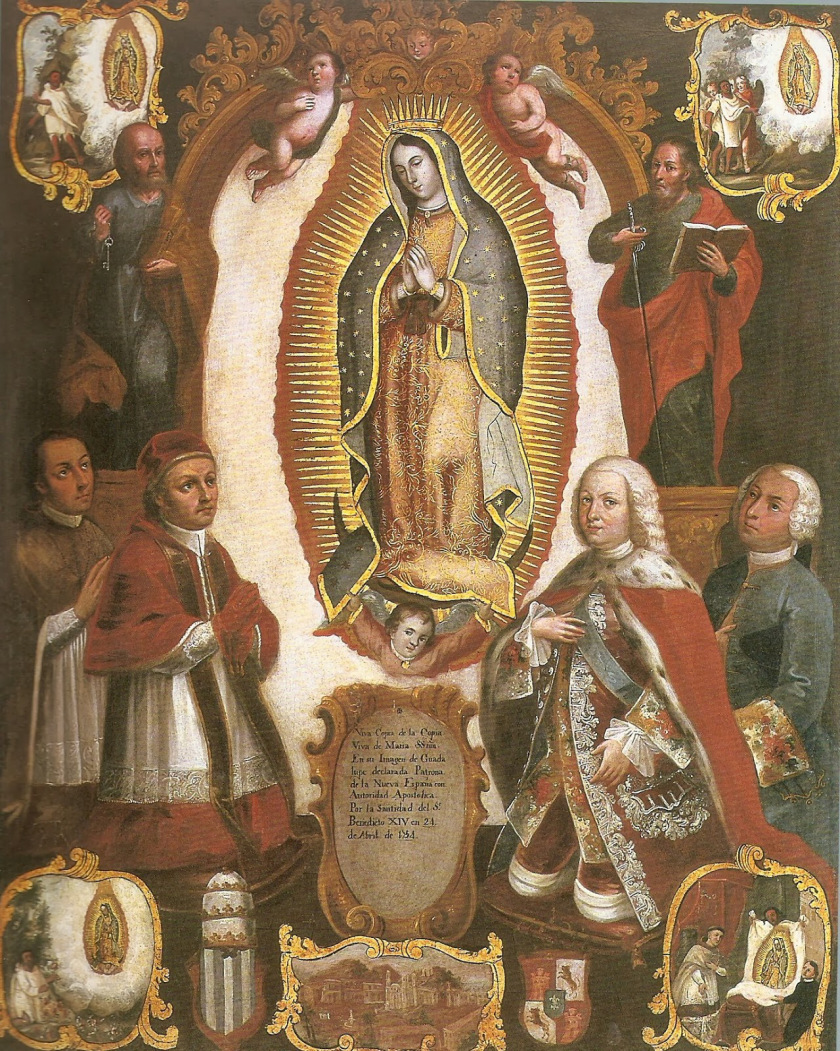
We cannot pass by the Popes without mentioning the most devoted of all the Vicars of Christ to Our Lady of Guadalupe, Pope Benedict XIV. This enigmatic Pontiff, who refused even the Catholic Queen Mary of England a Mass in honour of the then controverted devotion to the Sacred Heart (1750’s) proved incapable of applying his famed over-cautious rigourism to the Mother as he did to her Son. Toward the Mexican Virgin his heart became soft as wax. He did everything he could to honour her. He gave her a Mass, a place in the Divine Office and the first of the above-mentioned titles. And he once told Fr Lopez, the Mexican Jesuit who had introduced him to the miraculous Image, that, if his duties did not prevent him, he would make a pilgrimage to the New World shrine and approach the Holy Virgin as the other poor pilgrims did, “barefoot and on his knees”. In 1754, when none of his predecessors in the chair of Peter had as yet officially approved the apparition, that was a courageous and beautiful thing for a Pope to say.
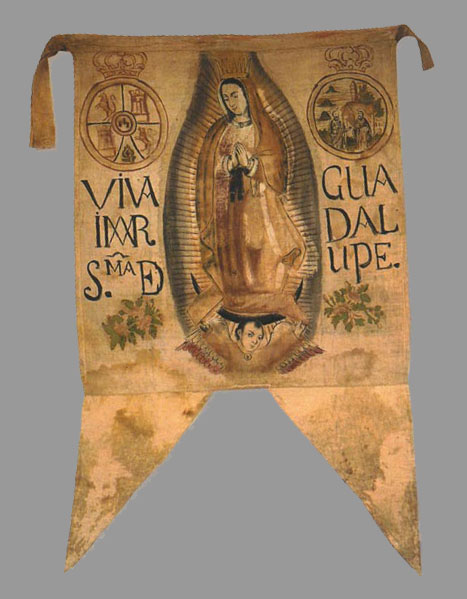
However, the privilege was left to Holy Father John Paul II [1981] to be the first Pope to visit Guadalupe in person. That was in January, 1979. Though it is true that wherever he went in his world-wide tours he drew record-breaking crowds of welcomers, nowhere did he receive the overwhelming turnout that he did in Mexico. God alone knows where they came from or how they got there but an estimated nine million people lined this poor country’s thoroughfares to greet the Holy Father, waving their bandettas and shouting thunderously,
“Long live the Pope! Long live Our Lady of Guadalupe! Long live Christ the King!”
(*excerpt from BR. MICHAEL, M.I.C.M.)
Mary’s appearance to St Juan Diego as one of his people, is a powerful reminder that Mary–and the God who sent her–accept and love all peoples.
While a number of (the indigenous peoples) had converted before this incident, they now came in droves. According to a contemporary chronicler, nine million Indians became Catholic in a very short time. In these days when we hear so much about God’s preferential option for the poor, Our Lady of Guadalupe cries out to us that God’s love for and identification with the poor is an age-old truth that stems from the Gospel itself.
Our Lady of Guadalupe, protect us, guide us, teach us, pray for us!
One Minute Reflection – 12 December – The Feast of Our Lady of Guadalupe
Who is this that comes like the dawn ….. as awe-inspiring as bannered troops?…..Song 6:10
REFLECTION – “Mary is an arsenal of graces and she comes to the aid of her clients. She sustains, strengthens and revives us by the heavenly favours that she heaps on us.”…..St Paulinus of York (died 644)
PRAYER – Lord Jesus Christ my Lord, help me to become a devoted client of Your holy Mother Mary. Through Your grace, may I receive the spiritual strength she has promised to all her clients. May I, in simplicity, like St Juan Diego, become her vessel to share Your Light of Love throughout my world. Our Lady of Guadalupe Pray for us! Amen
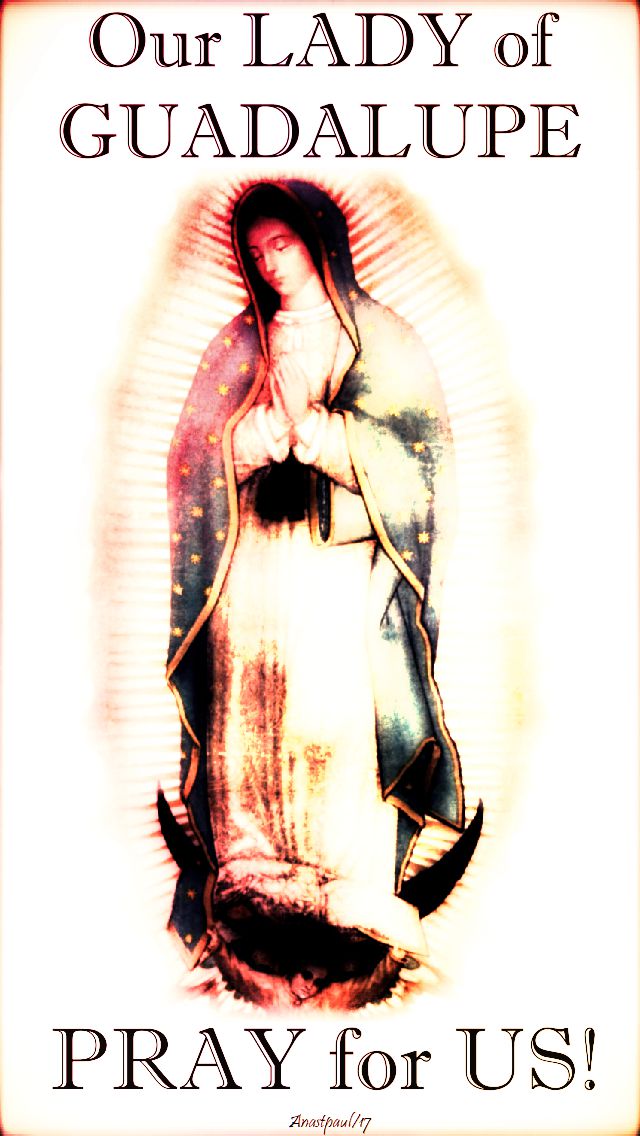
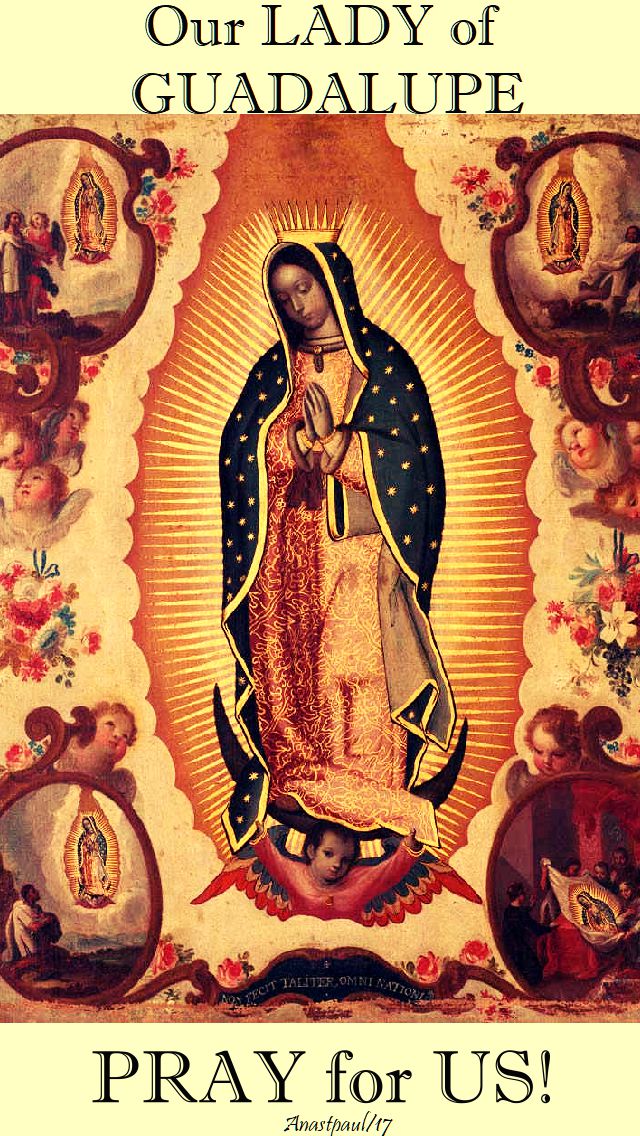
Saint of the Day – The Feast of Our Lady of Guadalupe – 12 December – Our Mother of Guadalupe, The Madonna of Tepeyac, Tonantzin – The First Apparition was on 12 December 1531 and was approved by the Holy See on 12 October 1895, during the Canonical coronation granted by Pope Leo XIII – Patronages: of Americas; New World, Central America, Mexico, New Mexico, Pojoaque Indian Pueblo, 12 dioceses, 3 cities.
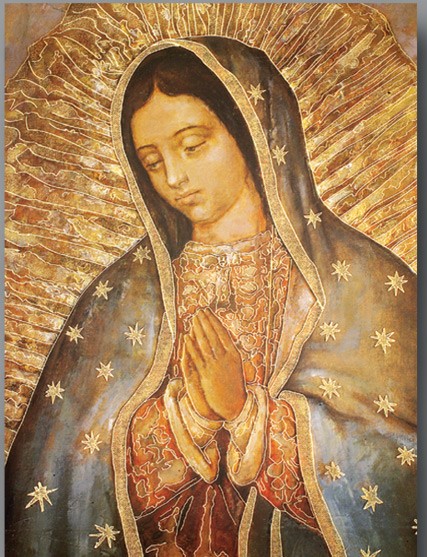
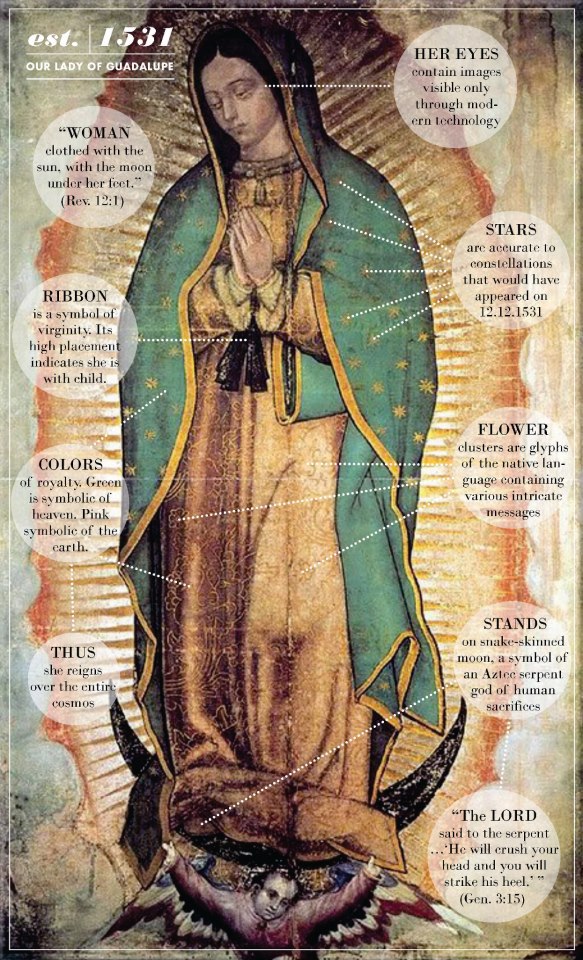
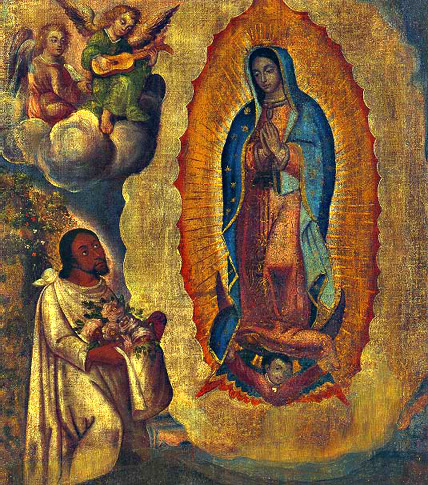
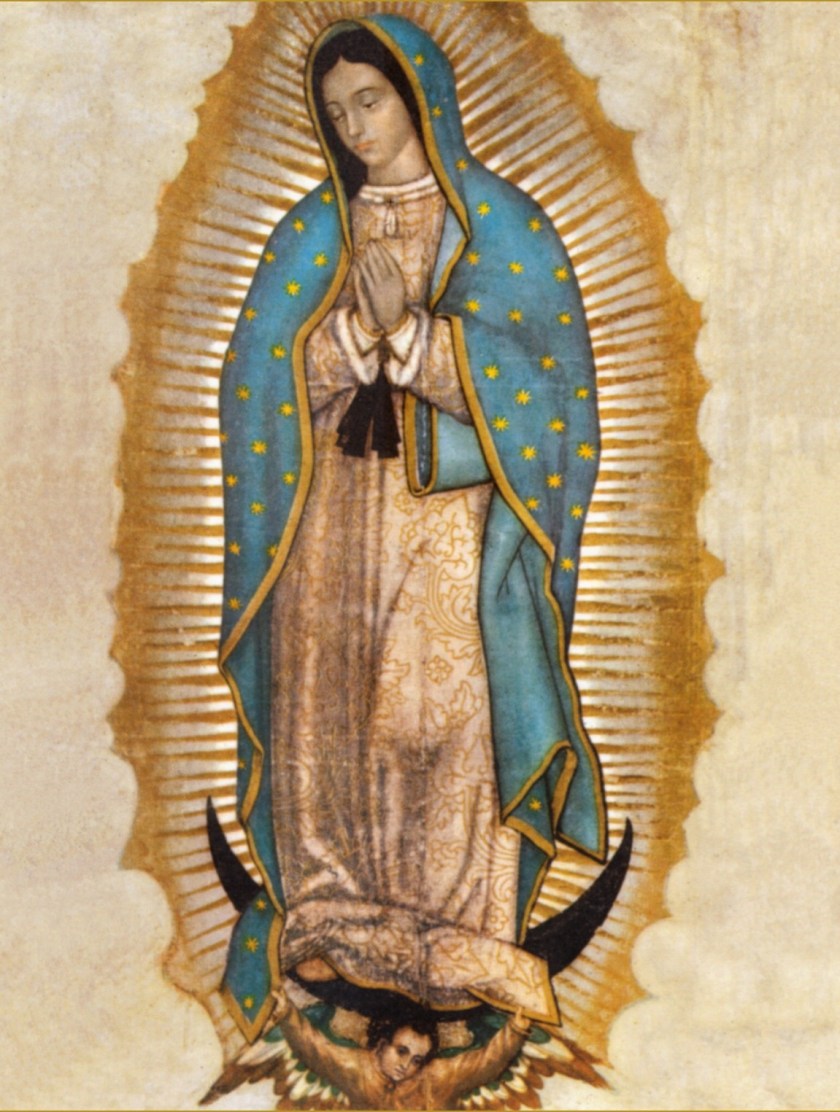
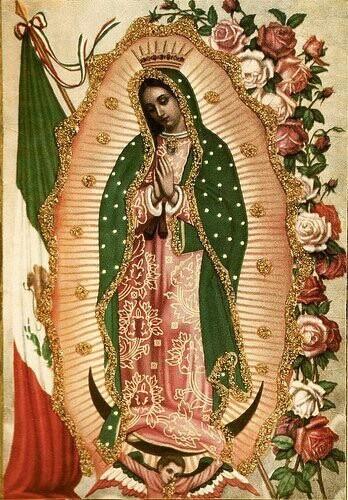
Guadalupe is, strictly speaking, the name of a picture but the name was extended to the church containing the picture and to the town that grew up around the church. It makes the shrine, it occasions the devotion, it illustrates Our Lady. It is taken as representing the Immaculate Conception, being the lone figure of a woman with the sun, moon and star accompaniments of the great apocalyptic sign with a supporting angel under the crescent. The word is Spanish Arabic but in Mexico it may represent certain Aztec sounds.
Its tradition is long-standing and constant and in sources both oral and written, Indian and Spanish, the account is unwavering. The Blessed Virgin appeared on Saturday 9 December 1531 to a 55 year old neophyte named Juan Diego, who was hurrying down Tepeyac hill to hear Mass in Mexico City. She sent him to Bishop Zumárraga to have a temple built where she stood. She was at the same place that evening and Sunday evening to get the bishop’s answer. The bishop did not immediately believe the messenger, had him cross-examined and watched and he finally told him to ask the lady who said she was the mother of the true God for a sign. The neophyte agreed readily to ask for sign desired and the bishop released him.
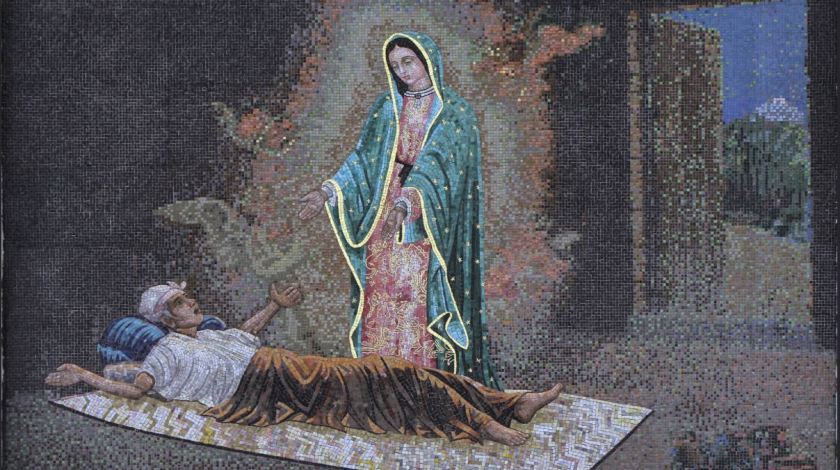
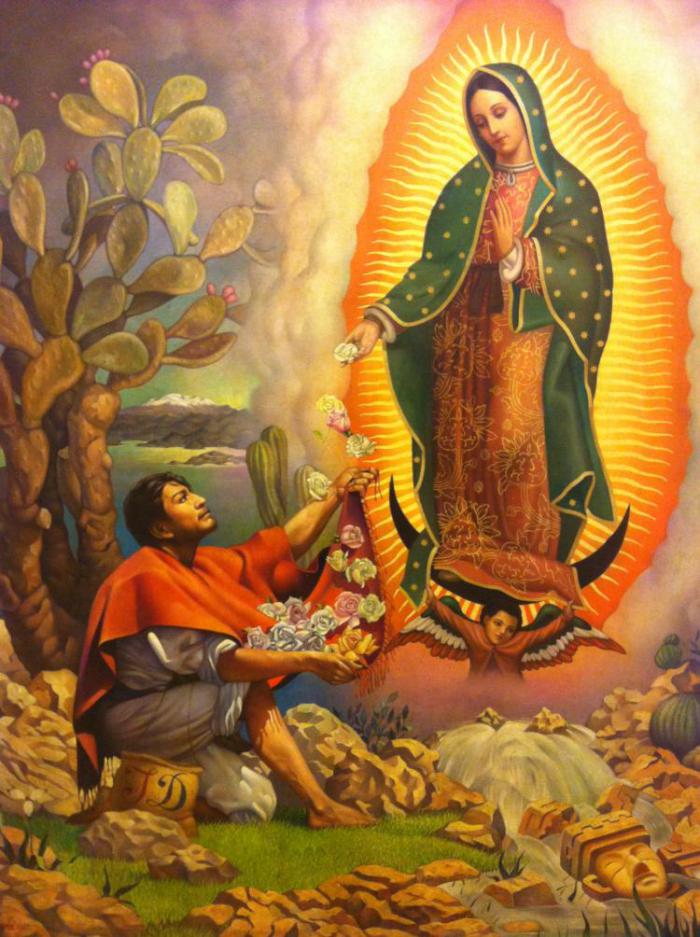
Juan was occupied all Monday with Bernardino, an uncle, who was dying of fever. Indian medicine had failed and Bernardino seemed at death’s door. At daybreak on Tuesday 12 December 1531, Juan ran to nearby the Saint James convent for a priest. To avoid the apparition and the untimely message to the bishop, he slipped round where the well chapel now stands. But the Blessed Virgin crossed down to meet him and said, “What road is this thou takest son?” A tender dialogue ensued. She reassured Juan about his uncle, to whom she also briefly appeared and instantly cured. Calling herself Holy Mary of Guadalupe she told Juan to return to the bishop. He asked Mary for the sign he required. She told him to go to the rocks and gather roses. Juan knew it was neither the time nor the place for roses but he went and found them. Gathering many into the lap of his tilma, a long cloak or wrapper used by Mexican Indians, he came back. The Holy Mother rearranged the roses and told him to keep them untouched and unseen until he reached the bishop. When he met with Zumárraga, Juan offered the sign to the bishop. As he unfolded his cloak the roses, fresh and wet with dew, fell out. Juan was startled to see the bishop and his attendants kneeling before him. The life size figure of the Virgin Mother, just as Juan had described her, was glowing on the tilma. The picture was venerated, guarded in the bishop’s chapel and soon after carried in procession to the preliminary shrine.
The coarsely woven material of the tilma which bears the picture is as thin and open as poor sacking. It is made of vegetable fibre, probably maguey. It consists of two strips, about seventy inches long by eighteen wide, held together by weak stitching. The seam is visible up the middle of the figure, turning aside from the face. Painters have not understood the laying on of the colours. They have deposed that the “canvas” was not only unfit but unprepared and they have marvelled at apparent oil, water, tempera, etc. colouring in the same figure. They are left in equal admiration by the flower-like tints and the abundant gold. They and other artists find the proportions perfect for a maiden of fifteen. The figure and the attitude are of one advancing. There is flight and rest in the eager supporting angel. The chief colours are deep gold in the rays and stars, blue-green in the mantle and rose in the flowered tunic.
Sworn evidence was given at various commissions of inquiry corroborating the traditional account of the miraculous origin and influence of the picture. Some wills connected with Juan Diego and his contemporaries were accepted as documentary evidence. Vouchers were given for the existence of Bishop Zumárraga’s letter to his Franciscan brothers in Spain concerning the apparitions. His successor, Montufar, instituted a canonical inquiry, in 1556, on a sermon in which the pastors and people were abused for crowding to the new shrine. In 1568 the renowned historian Bernal Díaz, a companion of Cortez, refers incidentally to Guadalupe and its daily miracles. The lay viceroy, Enríquez, while not opposing the devotion, wrote in 1575 to Philip II asking him to prevent the third archbishop from erecting a parish or monastery at the shrine. Inaugural pilgrimages were usually made to it by viceroys and other chief magistrates. Processes, national and ecclesiastical, were laboriously formulated and attested for presentation at Rome, Italy in 1663, 1666, 1723, and 1750.
The clergy, secular and regular, has been remarkably faithful to the devotion towards Our Lady of Guadalupe, the bishops especially fostering it, even to the extent of making a protestation of faith in the miracle a matter of occasional obligation. Pope Benedict XIV decreed that Our Lady of Guadalupe should be the national patron of Mexico and made 12 December a holiday of obligation with an octave and ordered a special Mass and Office. Pope Leo XIII approved a complete historical second Nocturne, ordered the picture to be crowned in his name and composed a poetical inscription for it. Pope Pius X permitted Mexican priests to say the Mass of Holy Mary of Guadalupe on the twelfth day of every month and granted indulgences which may be gained in any part of the world for prayer before a copy of the picture.
An 18th-century hagiographicpainting of God the Father fashioning the image.Allegory of the papal declaration in 1754 by pope Benedict XIV of Our Lady of Guadalupe patronage over the New Spain in the presence of the viceroyal authorities. Anonymous (Mexican) author, 18th century.
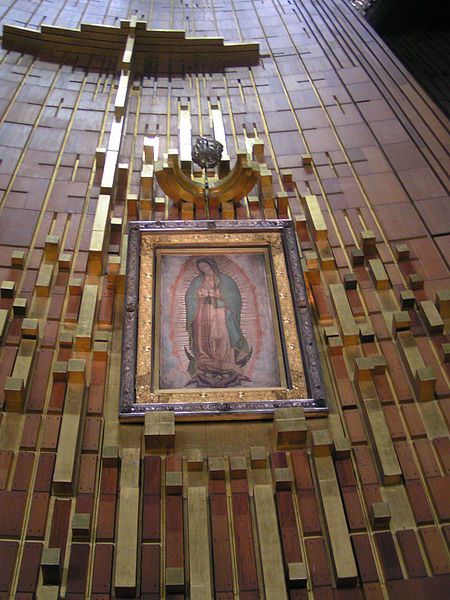
The place, called Guadalupe Hidalgo since 1822, is three miles northeast of Mexico City. Pilgrimages have been made to this shrine almost without interruption since 1531-1532. A shrine at the foot of Tepeyac Hill served for ninety years and still forms part of the parochial sacristy. In 1622 a magnificent shrine was erected and in 1709 a newer, even more beautiful one. There are also a parish church, a convent and church for Capuchin nuns, a well chapel and a hill chapel all constructed in the 18th century. About 1750 the shrine got the title of collegiate, a canonry and choir service being established. It was aggregated to Saint John Lateran in 1754. In 1904 it was created a basilica, with the presiding ecclesiastic being called abbot. The shrine has been renovated in Byzantine style which presents an illustration of Guadalupan history.
Our Lady of Guadalupe (Feast)
St Abra
St Agatha of Wimborne
Bl Bartholomew Buonpedoni
St Pope Callistus II
St Colman of Clonard
St Columba of Terryglass
St Conrad of Offida
St Corentius of Quimper
St Cormac
St Cury
St Donatus the Martyr
St Edburga of Thanet
St Finnian of Clonard
St Gregory of Terracina
St Hermogenes
Bl Ida of Nivelles
Bl James of Viterbo
Bl Ludwik Bartosik
Bl Martin Sanz
St Simon Phan Ðac Hòa
St Spyridon of Cyprus
St Synesius
St Vicelin of Oldenburg
Martyrs of Alexandria – (6 saints): A group of six Christians martyred for their faith during the persecutions of Decius. We know little more than five of their names – Alexander, Ammonaria, Dionysia, Epimachus and Mercuria. They were burned to death c 250 in Alexandria, Egypt.
Martyrs of Trier – (4 saints): A group of six Christians martyred for their faith during the persecutions of Decius. We know little more than five of their names – Alexander, Ammonaria, Dionysia, Epimachus and Mercuria. They were burned to death c 250 in Alexandria, Egypt.
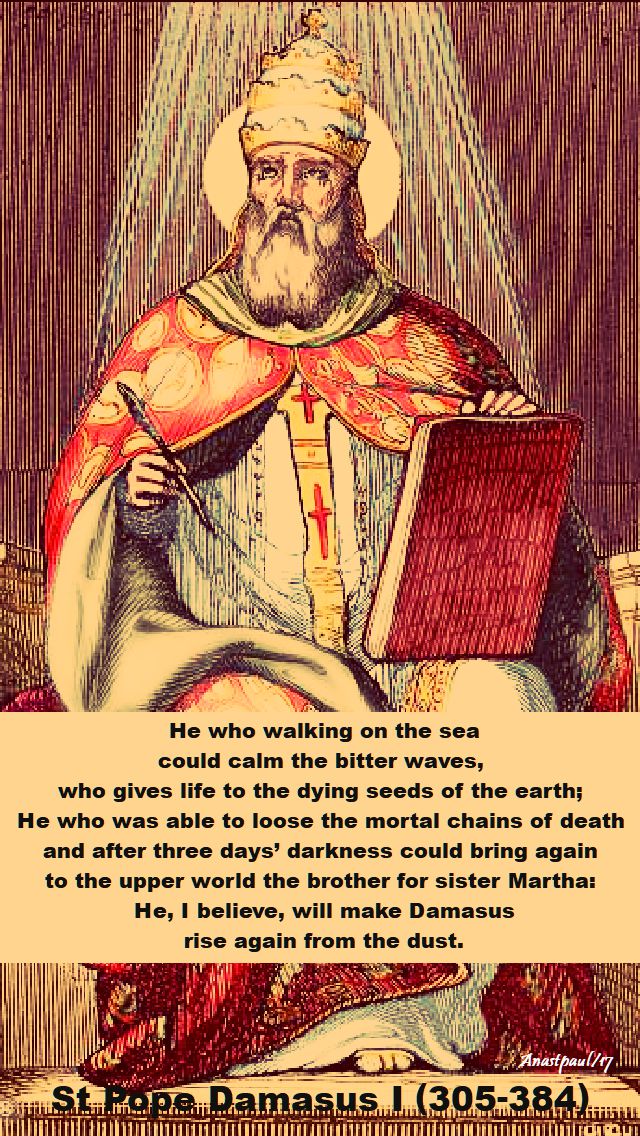
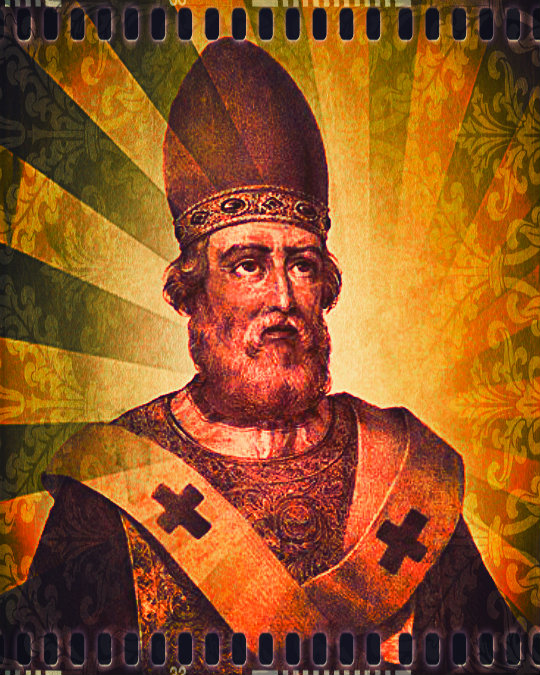
Thought for the Day – 11 December – The Memorial of St Pope Damasus I (c 305-384)
The history of the papacy and the Church is inextricably mixed with the personal biography of Damasus. In a troubled and pivotal period of Church history, he stands forth as a zealous defender of the faith who knew when to be progressive and when to entrench.
And it is to him that we owe our gratitude for the translation of the Scriptures, which influenced so mightily the next 1700 years and still do. Through St Jerome, he provided THE genuine treasure for the Church.
Damasus makes us aware of two qualities of good leadership: alertness to the promptings of the Spirit and service.His struggles are a reminder that Jesus never promised His Rock protection from hurricane winds nor His followers immunity from difficulties. His only guarantee is final victory. (Partially thanks to Fr Don Miller OFM)
Quote of the Day – 11 December – The Memorial of St Pope Damasus I (c 305-384)
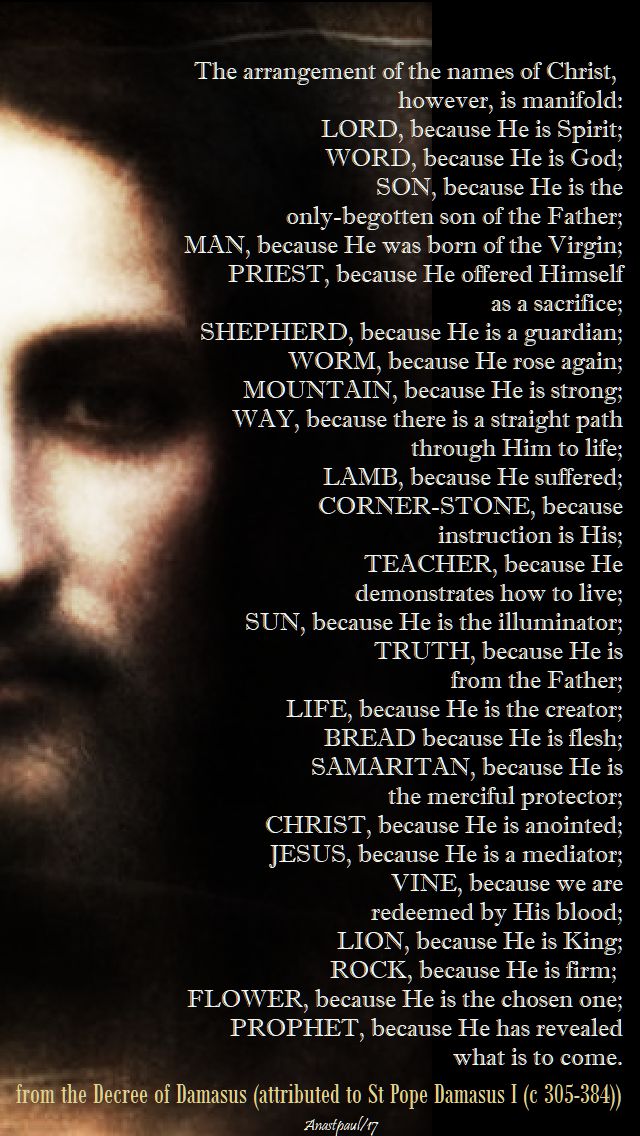
The arrangement of the names of Christ, however, is manifold: LORD, because He is Spirit; WORD, because He is God; SON, because He is the only-begotten son of the Father; MAN, because He was born of the Virgin; PRIEST, because He offered Himself as a sacrifice; SHEPHERD, because He is a guardian; WORM, because He rose again; MOUNTAIN, because He is strong; WAY, because there is a straight path through Him to life; LAMB, because He suffered; CORNER-STONE, because instruction is His; TEACHER, because He demonstrates how to live; SUN, because He is the illuminator; TRUTH, because He is from the Father; LIFE, because He is the creator; BREAD because He is flesh; SAMARITAN, because He is the merciful protector; CHRIST, because He is anointed; JESUS, because He is a mediator; VINE, because we are redeemed by His blood; LION, because He is King; ROCK, because He is firm; FLOWER, because He is the chosen one; PROPHET, because He has revealed what is to come.
from the Decree of Damasus (attributed to St Pope Damasus I)
One Minute Reflection – 11 December – The Memorial of St Pope Damasus I (c 305-384)
Now faith is confidence in what we hope for and assurance about what we do not see…Hebrews 11:1
REFLECTION – “He who walking on the sea could calm the bitter waves, who gives life to the dying seeds of the earth; He who was able to loose the mortal chains of death and after three days’ darkness could bring again to the upper world the brother for sister Martha: He, I believe, will make Damasus rise again from the dust.”……………St Pope Damasus I
PRAYER – Jesus, my Lord and my God, grant us the grace of faith to believe that all that You have said will be fulfilled. And fill us with Your Holy Spirit of love so that we may translate that belief into practice, by obeying Your commands every day. St Pope Damasus, you proved your love for Christ and His Church, please pray that we may always be faithful and filled with a like zeal for the Church and Bride of Christ, amen.
Saint of the Day – 11 December – St Pope Damasus I (c 305-384) Priest and Pope – ( c 305 in Rome, Italy – 11 December 384 in Rome, Italy of natural causes). Patronage – archeologists. He was buried in the Mark and Marcellianus catacombs in Rome and his bones re-buried in the church of San Lorenzo in Damaso.
The son of a Roman priest, possibly of Spanish extraction, Damasus started as a deacon in his father’s church and served as a priest in what later became the basilica of San Lorenzo in Rome. He served Pope Liberius (352-366) and followed him into exile.
When Liberius died, Damasus was elected bishop of Rome; but a minority elected and consecrated another deacon, Ursinus, as pope. The controversy between Damasus and the antipope resulted in violent battles in two basilicas, scandalising the bishops of Italy. At the synod that Damasus called on the occasion of his birthday, he asked them to approve his actions. The bishops’ reply was curt: “We assembled for a birthday, not to condemn a man unheard.” Supporters of the antipope even managed to get Damasus accused of a grave crime—probably sexual—as late as 378. He had to clear himself before both a civil court and a Church synod.
As pope, his lifestyle was simple in contrast to other ecclesiastics of Rome and he was fierce in his denunciation of Arianism and other heresies. A misunderstanding of the Trinitarian terminology used by Rome threatened amicable relations with the Eastern Church and Damasus was only moderately successful in dealing with that challenge.
He appointed St Jerome as his confidential secretary. Invited to Rome originally to a synod of 382 convened to end the schism of Antioch, Jerome made himself indispensable to the pope and took a prominent place in his councils. Jerome spent three years (382–385) in Rome in close intercourse with Pope Damasus and the leading Christians. Writing in 409, Jerome remarked, “A great many years ago when I was helping Damasus, bishop of Rome with his ecclesiastical correspondence, I was also helping to write his answers to the questions referred to him by the councils of the east and west…”
Sts Jerome and Damasus
In order to put an end to the marked divergences in the western texts of that period, Damasus encouraged the highly respected scholar Jerome to revise the available Old Latin versions of the Bible into a more accurate Latin on the basis of the Greek New Testament and the Septuagint, resulting in the Vulgate. Jerome devoted a very brief notice to Damasus in his De Viris Illustribus, written after Damasus’ death: “he had a fine talent for making verses and published many brief works in heroic metre. He died in the reign of the emperor Theodosius at the age of almost eighty”.
The letters from Jerome to Damasus are examples of the primacy of the See of Peter:
Yet, though your greatness terrifies me, your kindness attracts me. From the priest I demand the safe-keeping of the victim, from the shepherd the protection due to the sheep. Away with all that is overweening; let the state of Roman majesty withdraw. My words are spoken to the successor of the fisherman, to the disciple of the cross. As I follow no leader save Christ, so I communicate with none but your blessedness, that is with the chair of Peter. For this, I know, is the rock on which the church is built! This is the house where alone the paschal lamb can be rightly eaten. This is the ark of Noah and he who is not found in it shall perish when the flood prevails. But since by reason of my sins I have betaken myself to this desert which lies between Syria and the uncivilised waste, I cannot, owing to the great distance between us, always ask of your sanctity the holy thing of the Lord. Consequently I here follow the Egyptian confessors who share your faith and anchor my frail craft under the shadow of their great argosies. I know nothing of Vitalis; I reject Meletius; I have nothing to do with Paulinus. He that gathers not with you scatters; he that is not of Christ is of Antichrist!”
During his pontificate, Christianity was declared the official religion of the Roman state, and Latin became the principal liturgical language as part of the Pope’s reforms. His encouragement of Saint Jerome’s biblical studies led to the Vulgate, the Latin translation of Scripture which 12 centuries later the Council of Trent declared to be “authentic in public readings, disputations, preaching.”
St Pope Damasus I (Optional Memorial)
St Aithalas of Arbela
St Apseus of Arbela
Bl Arthur Bell
Barsabas of Persia
St Cian
St Daniel the Stylite
Bl David of Himmerod
Bl Dominic Yanez
St Eutychius the Martyr
St Fidweten
Bl Franco of Siena
Bl Hugolinus Magalotti
Bl Jean Laurens
Bl Kazimierz Tomasz Sykulski
María Maravillas de Jesús
Bl Martín Lumbreras Peralta
Bl Martino de Melgar
Bl Melchor Sánchez PérezPens
Bl Pilar Villalonga Villalba
Bl Severin Ott
Martyrs of Saint Aux-Bois – (3 saints): Two Christian missionaries and one of their local defenders who faith in the persecutions of governor Rictiovarus – Fuscian, Gentian and Victoricus. They were beheaded in 287 in Saint Aux-Bois, Gaul (in modern France).
Martyrs of Rome – (3 saints): Three Christians murdered in the persecutions of Diocletian for giving aid to Christian prisoners – Pontian, Practextatus and Trason. They were imperial Roman citizens. They c 303 in Rome, Italy.
Msgr Josemaria Escriva went to Loreto for the first time on January 3 and 4, 1948. But he considered himself especially indebted to Our Lady of Loreto for a very particular reason: she had heard his prayer in a time of acute need. The 1950s were years of great suffering for St Josemaria because of misunderstandings and conflicts. Amidst all these difficulties he decided to go to Loreto to place himself under our Lady’s protection. In her book Tiempo de Caminar, Ana Sastre tells the story of that visit:
“On August the fourteenth, 1951, Monsignor Escrivá decided to go to Loreto by car to be there on the fifteenth and consecrate Opus Dei to our Blessed Lady. The heat was stifling and they were very thirsty all the way. There was no motorway. The road followed the line of valleys, went steeply up the Apennine Mountains and finally plunged down towards the Adriatic coast.
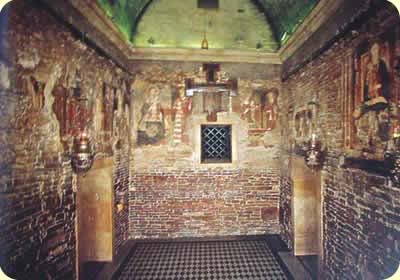
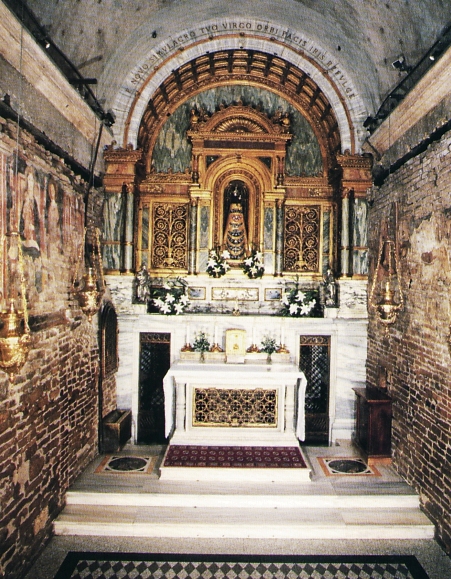
According to a centuries-old tradition the Holy House of Nazareth has stood on the hill of Loreto since 1294, and a basilica was later built around it. The Holy House is rectangular in shape and its walls are about four and a half meters high. One of the walls is modern, but the others, which have no foundations and are blackened by the smoke of candles, are, according to tradition, the walls of the House at Nazareth. The structure of the Holy House and the materials of which it is built, bear no relation to those of local architecture in olden times but are exactly similar to houses built in Palestine twenty centuries ago: sandstone blocks with a limestone mortar. The shrine stands on a ridge covered in laurel-trees, from which comes the name ‘Loreto’.
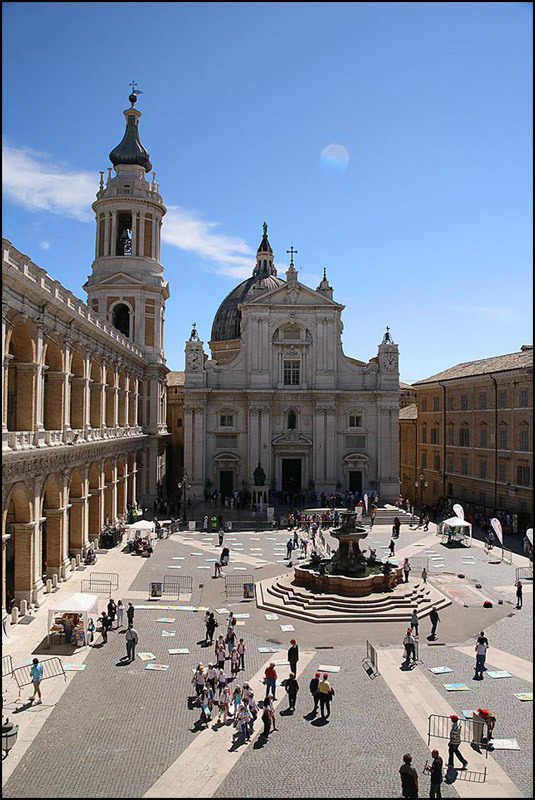
St Josemaria’s party parked in the central square and he got out of the car quickly. For fifteen or twenty minutes he was lost to sight among the people filling the basilica. Finally he emerged, after praying to our Lady, smiling and in good spirits. It was seven-thirty in the evening and they had to go back to Ancona to spend the night.
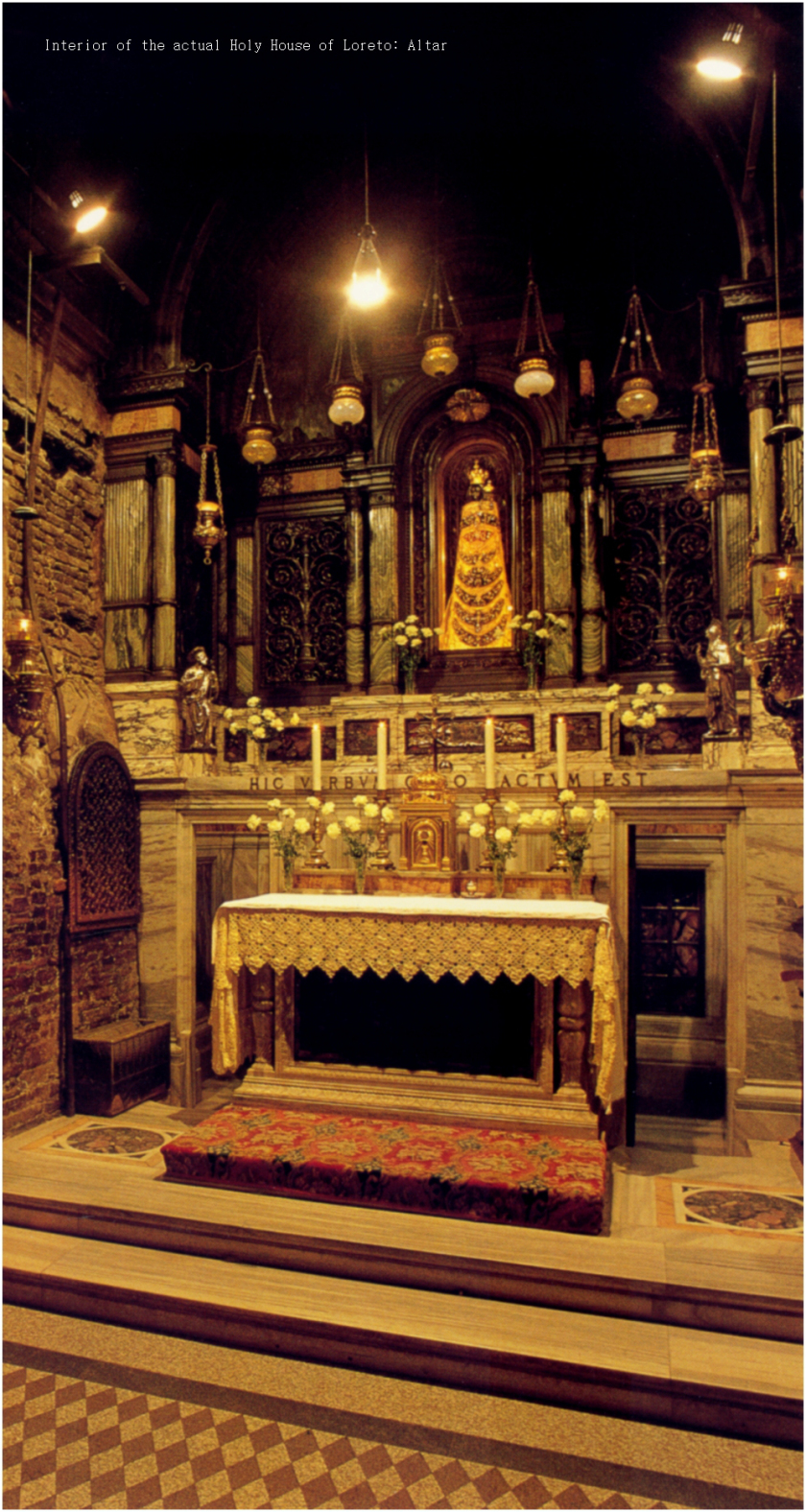
The next morning, before the sun was high, they drove back to Loreto. In spite of the early hour, the shrine was already completely full. St Josemaria vested for Mass in the sacristy and came to the altar of the Holy House of Nazareth to say Mass. The small space was packed with people and the heat was stifling.
Holy Mass:
Under the votive lamps, he wanted to celebrate the sacred liturgy with all possible devotion. But he had not allowed for the fervour of the congregation on this feast day. He wrote later, “When I would kiss the altar in accordance with the rubrics, three or four local women would accompany me. It was distracting but certainly moving. I also noticed that above the altar in that holy house, which tradition says was the home of Jesus, Mary and Joseph, these words were written: ‘Here the Word was made flesh.’ Here, on a bit of the earth on which we live, in a house built by men, God dwelt”(Christ is Passing By, 12).
During the Mass, without a formula but in words filled with faith, St Josemaria consecrated Opus Dei to our Lady. Afterwards, speaking quietly to the people with him, he repeated it in the name of everyone in Opus Dei. “We consecrate to you our being and our life; everything that is ours: all that we love and all that we are. Our bodies, our hearts and our souls are for you; we are yours. And to make this consecration truly effective and lasting, today at your feet, O Mary, we renew the dedication that we made to God in Opus Dei. Inspire us with a deep love for the Church and the Pope and make us live in full submission to all their teachings.”
Invoking our Lady:
St Josemaria had been noticeably tired when he left Rome. But on the way back he seemed like a new man, as though all the obstacles in God’s path had crumbled into dust. Some weeks before he had suggested a new aspiration to his sons and daughters in Opus Dei, an invocation to the Mother of Jesus for them to repeat constantly: “Most sweet heart of Mary, prepare a safe way!” Our Lady’s loving smile always went ahead along the paths of Opus Dei. Once again, its founder had stepped forward in the parameters of faith. He used the human means but trusted in a decisive intervention from on high. “God is the same as always. It is men of faith that are needed: and then, there will be a renewal of the wonders we read of in the Gospel. Ecce non est abbreviata manus Domini, – God’s arm, his power, has not grown weaker!” (The Way, 586).
St Josemaria visited the Holy House of Nazareth on six further occasions: 7 November, 1953; 12 May 1955; 8 May 1960; 22 April 1969; 8 May 1969 and the last one on 22 April 1971. On 9 December 1973, he said, “I think that all the representations, all the names, all the invocations given by Christians to the Virgin Mary, are wonderful. But in Loreto I am especially indebted to our Lady.”
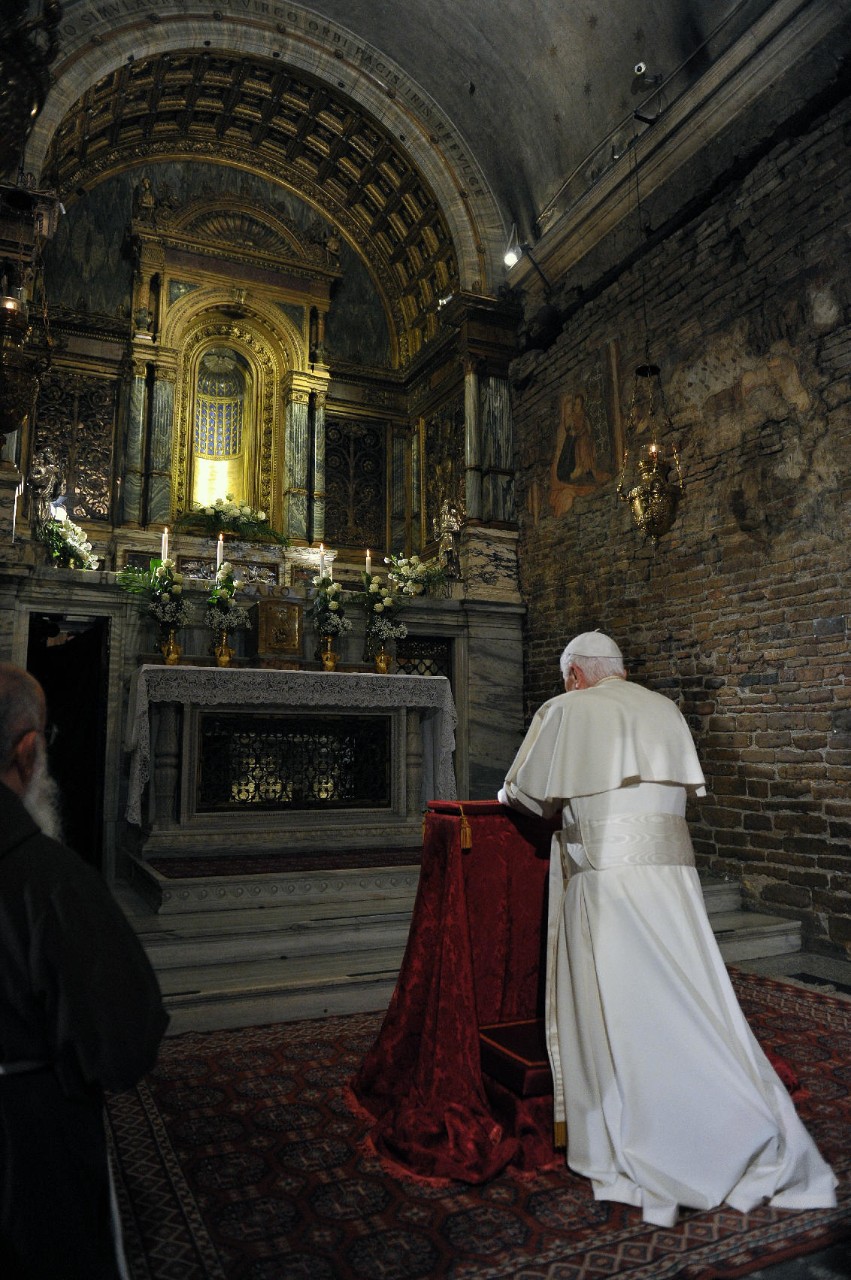
VISIT TO THE SHRINE OF LORETO AND PRIVATE PRAYER AT THE HOLY HOUSE
Mary, Mother of the “Yes”, you listened to Jesus, and know the tone of His voice and the beating of His heart. Morning Star, speak to us of Him, and tell us about your journey of following Him on the path of faith.
Mary, who dwelt with Jesus in Nazareth, impress on our lives your sentiments, your docility, your attentive silence, and make the Word flourish in genuinely free choices.
Mary, speak to us of Jesus, so that the freshness of our faith shines in our eyes and warms the heart of those we meet, as you did when visiting Elizabeth, who in her old age rejoiced with you for the gift of life.
Mary, Virgin of the Magnificat help us to bring joy to the world and, as at Cana, lead every young person involved in service of others to do only what Jesus will tell them.
Mary, look upon the Agora of youth, so that the soil of the Italian Church will be fertile. Pray that Jesus, dead and Risen, is reborn in us, and transforms us into a night full of light, full of him.
Mary, Our Lady of Loreto, Gate of Heaven, help us to lift our eyes on high. We want to see Jesus, to speak with Him, to proclaim His love to all.
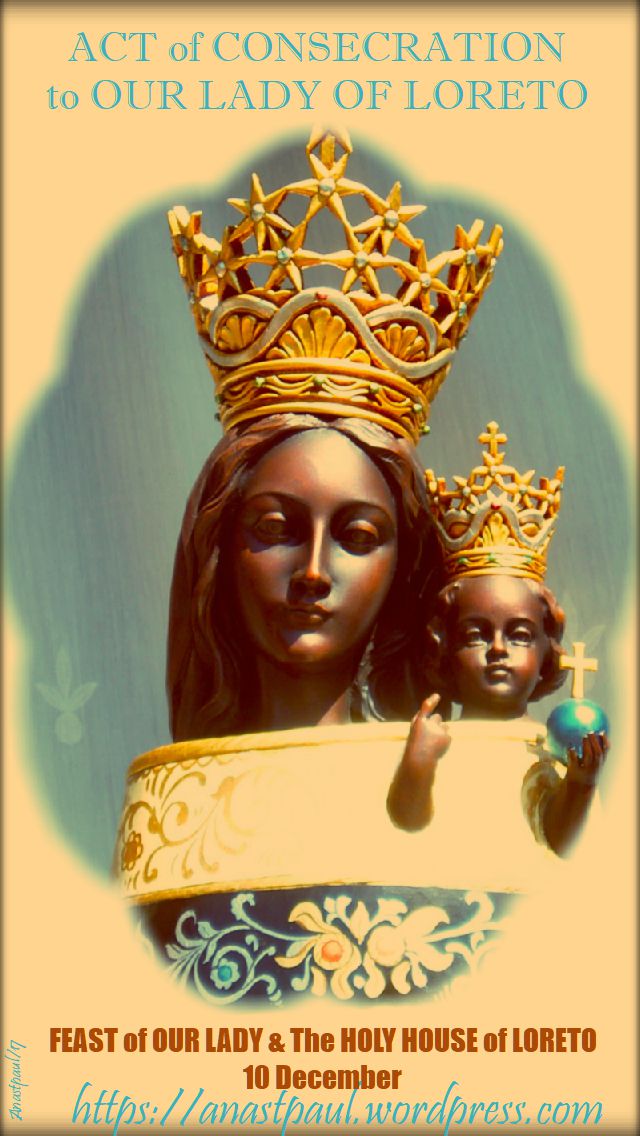
Act of Consecration to Our Lady of Loreto – 10 December – The Memorial of Our Lady and the Holy House of Loreto
O Immaculate Virgin Mary, we come to you with confidence:
welcome this day our humble prayer and our act of consecration.
O Mother, you did carry the Divine Saviour in your most pure womb:
receive our homage of faith and filial love as we come in spirit into your Holy House.
It is also, by the presence of the Holy Family, the holy home par excellence.
And it is our wish that every Christian family be inspired by it.
From Jesus, all children learn to obey and to work.
From you, O Mary, all women learn humility and the spirit of sacrifice.
From Joseph, who did live for Jesus and for you, all men learn to believe in God,
to live in the family and in society with fidelity and honesty.
O Mary, we pray for our Pope and for the Universal Church,
for our country and for all the nations of the world,
for the suffering souls for all sinners.
And we all wish to consecrate ourselves to you.
Spiritually present in the Holy House,
where you did conceive by the Holy Spirit,
we want to repeat with lively faith the words of the Archangel Gabriel:
“Hail, full of grace, the Lord is with thee!”
We want to invoke you still, saying:
“Hail Mary, Mother of Jesus and Mother of the Church!”
We turn to you, Mary.
Receive our consecration to your Immaculate heart.
Totally yours, we wish to confirm by this act of love our unlimited love for Jesus,
your Son, and our hope in you, our Mother.
And you, O Queen and Mother of Mercy,
grant to your children an abundance of heavenly blessings. Amen
Thought for the Day – 10 December – The Memorial of Our Lady and the Holy House of Loreto
LORETO enshrines the original home of the holiest persons who walked the earth: the God-Man Jesus Christ, His mother Mary and the virginal father, St Joseph. Therefore, it should not be surprising that this sanctuary should attract Saints. There is a marble plaque in the basilica on which are carved the names of thirty-nine saints and twenty-two other holy persons who came on pilgrimage to Loreto. In 1846, there were one hundred and sixty names. One hundred and fifty years later that number must have easily doubled.
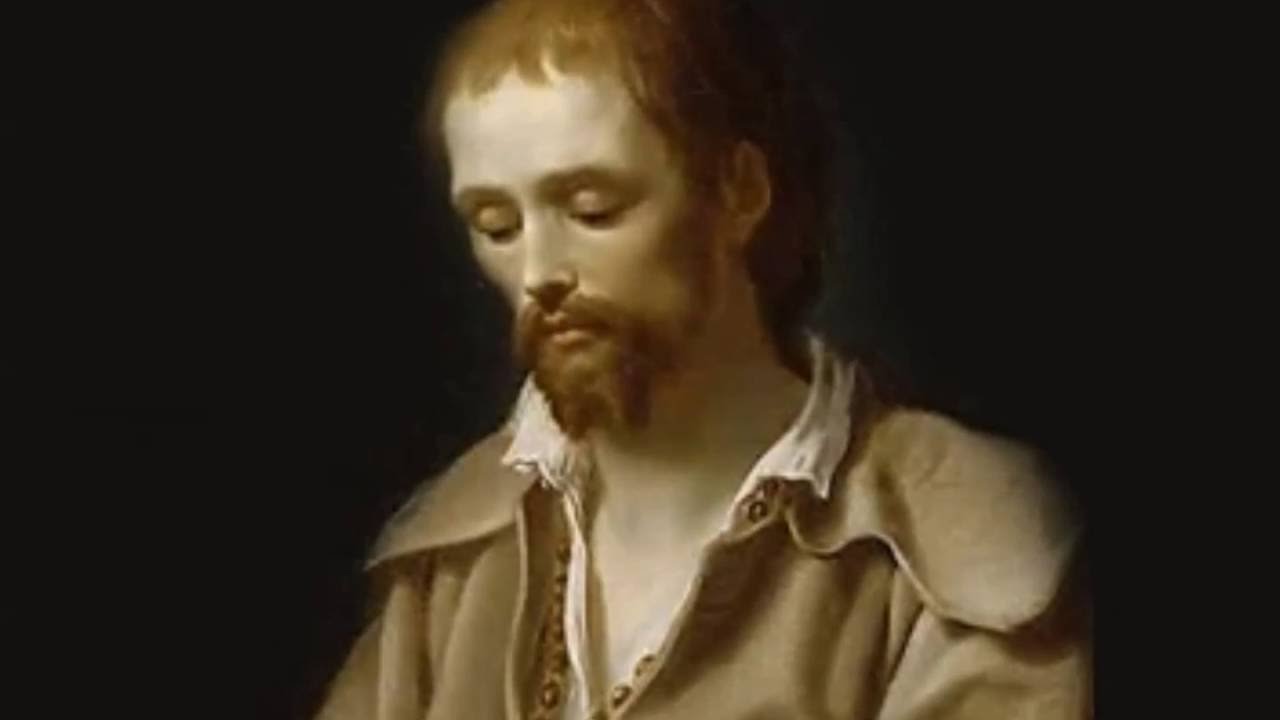
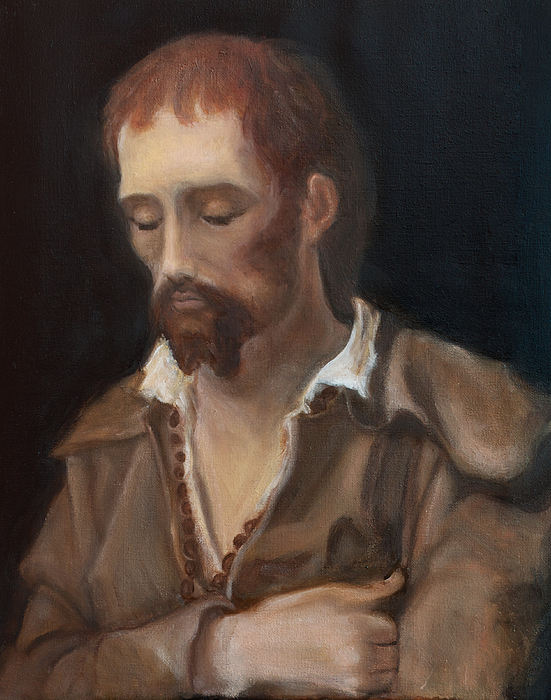
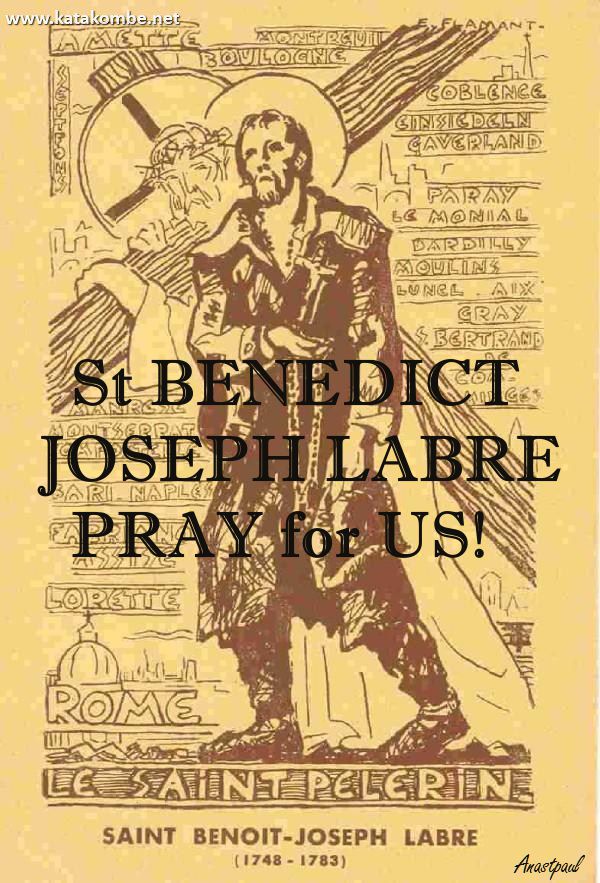
If one were to single out a Saint who was particularly attached to Loreto, it would seem that the pilgrim saint, Benedict Joseph Labre, would have first place. After finding out that his vocation was to be a rather exceptional one—–literally a pilgrim beggar—–Benedict left his home in France in 1770 for Rome at age twenty-two. On this first journey, he stopped on his way at Loreto and Assisi. He stayed in Rome for nine months visiting all the holy places but was back in Loreto in September of the following year. In June 1772, he was back again at Loreto. He then extended his pilgrimages to all the famous shrines in Europe. At the end of 1776, he settled down in Rome, leaving only to make an occasional pilgrimage to his favorite shrine, the Holy House. He continued this each year until his death in 1783 at the age of 35.
The people of Loreto came to know him well. He was that beggar who lived on the charity of others, refusing to take any more than necessary to fill his immediate needs. When compassionate friends offered him a room closer to the shrine, he turned it down when he found it contained a bed. Surely the poverty and utter detachment of the Holy Family of Nazareth was reflected in a most outstanding way in this Saint who spent many long vigils of prayer in the Holy House.
Quote of the Day – 10 December – The Memorial of Our Lady and the Holy House of Loreto
“I went to Loreto with a simple faith, believing what I still believe, even more so after having seen. Now I no longer have any doubts. If you ask me why I believe it, it is because everyone believes it in Rome— cautious and skeptical as they are in many other things. I believe it, as I believe that there is a planet called Neptune, or that chloroform destroys the sense of pain. I have no prior difficulties on this point.”
“It was thought that St Maximilian Kolbe never visited Loreto. Our Lady, however, always manages to bring to what was her hom, while on earth, those who revere and venerate her in a special way. It comes as no surprise, then, to learn from the Mass register of the Basilica, that he participated in a Mass along with thirty priests from Yugoslavia on 13 July 1919. The following day, the feast of the Franciscan theologian St Bonaventure, he celebrated Mass within the Holy house itself. And so another name, a modem day Saint, has been added to the list of Saints and holy persons who have visited the shrine of Loreto. Undoubtedly there will be many more as time goes on, paying their respects and drawing inspiration from the holiest House in this world. ”
Blessed Cardinal Henry John Newman – written in 1848 and 1884
One Minute Reflection – 10 December- The Memorial of Our Lady and the Holy House of Loreto
You shall love the Lord your God with all your heart, with all your soul, with all your strength and with all your mind………..Luke 10:27
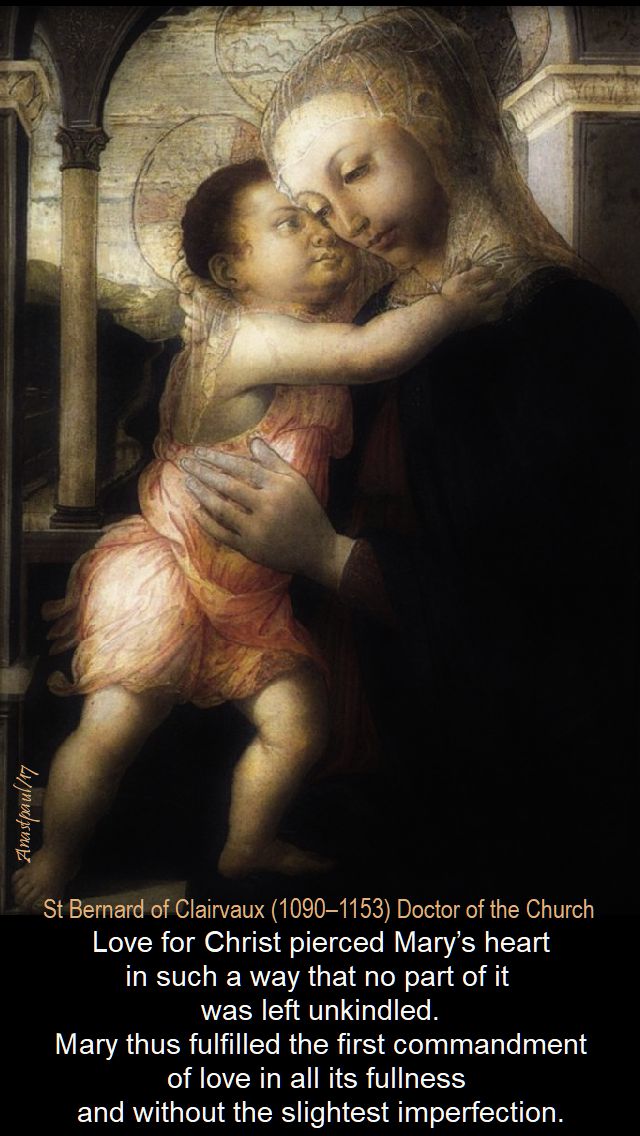
REFLECTION – “Love for Christ pierced Mary’s heart in such a way that no part of it was left unkindled. Mary thus fulfilled the first commandment of love in all its fullness
and without the slightest imperfection.”….St Bernard of Clairvaux (1090–1153) Doctor of the Church
PRAYER – O Mother! You, who carried the Divine Saviour in your immaculate womb and lived with Him in the Holy House that we venerate on the Loreto Hill, grant us the grace to seek Him and imitate His example, He who leads us to salvation. Our Lady of Loreto work miracles in us all! Amen
Our Morning Offering – 10 December – The Second Sunday of Advent and the Memorial of Our Lady and the Holy House of Loreto
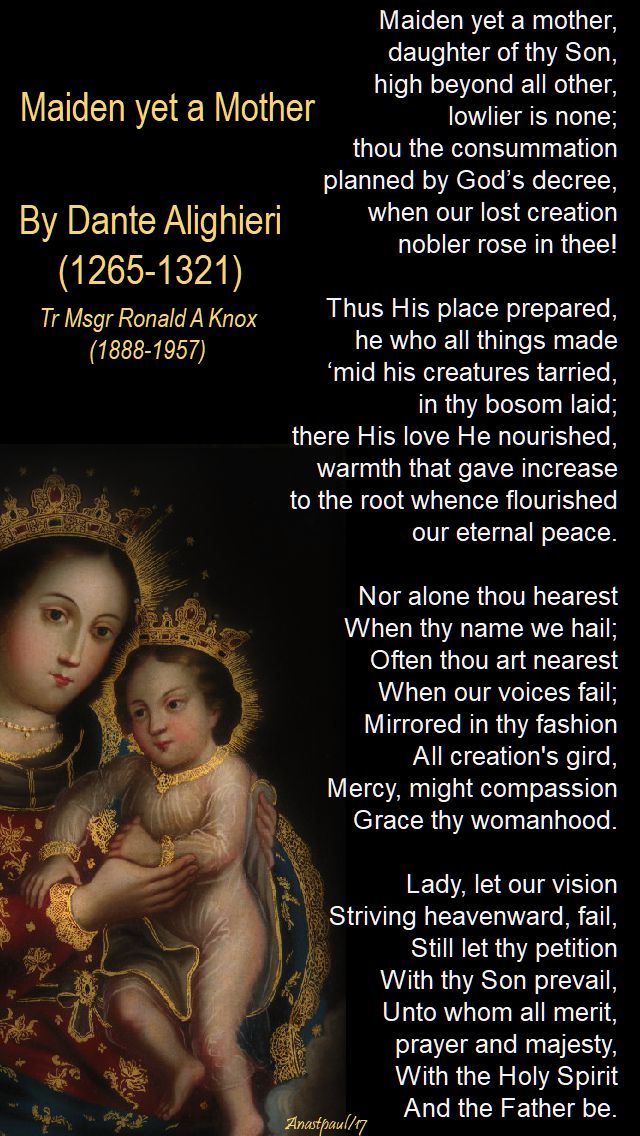
Maiden yet a Mother By Dante Alighieri (1265-1321) Tr Msgr Ronald A Knox (1888-1957)
Maiden yet a mother,
daughter of thy Son,
high beyond all other,
lowlier is none;
thou the consummation
planned by God’s decree,
when our lost creation
nobler rose in thee!
Thus His place prepared,
he who all things made
‘mid his creatures tarried,
in thy bosom laid;
there His love He nourished,
warmth that gave increase
to the root whence flourished
our eternal peace.
Nor alone thou hearest
When thy name we hail;
Often thou art nearest
When our voices fail;
Mirrored in thy fashion
All creation’s gird,
Mercy, might compassion
Grace thy womanhood.
Lady, let our vision
Striving heavenward, fail,
Still let thy petition
With thy Son prevail,
Unto whom all merit,
prayer and majesty,
With the Holy Spirit
And the Father be.
Maiden Yet A Mother is a translation of a poem by Durante (Dante) degli Alighieri (c 1265–1321). It is based upon the opening verses of Canto 33 of the Paradiso from his Divine Comedy in which St Bernard of Clairvaux (1090–1153) praises and prays to the Virgin Mother on behalf of Dante. It was translated from the original Italian into English by the Catholic convert, Monsignior Ronald A Knox (1888-1957).
The Feast of the Our Lady of Loreto and the Holy House – 10 December – Patronages – Aeroplane Pilots and workers, Aviators, Construction workers, Builders.
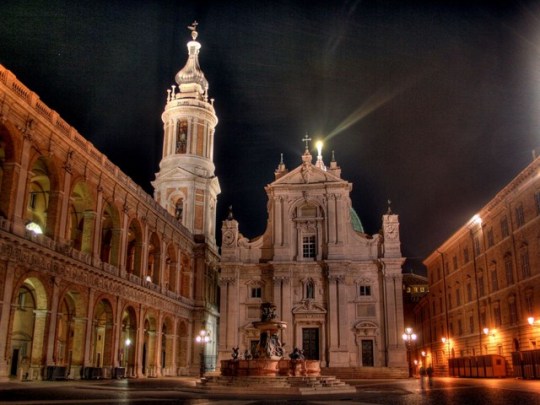
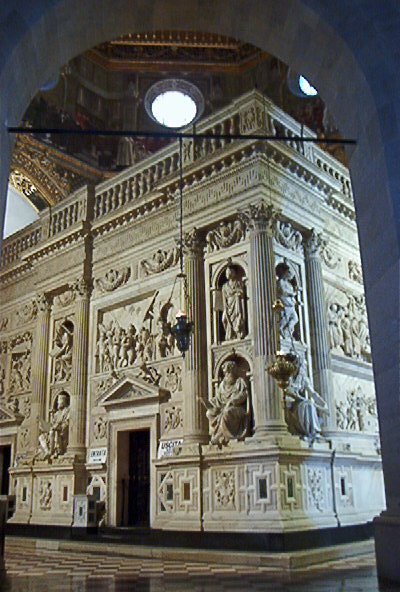
Eighteen miles south of Ancona, and about three miles from the Adriatic coast of Italy, stands the city of Loreto (also spelled Loretto) on the summit of a hill. A vast basilica with a great dome forms the most treasured of all the Pope’s “extraterritorial” Vatican State properties, enshrining, as it does, one of the most sacred and important of all Our Lady’s Shrines — the Home of the Holy Family, “the Holy House of Loreto.” Written at the door of the Basilica are these words: “The whole world has no place more sacred… For here was the Word made Flesh and here was born the Virgin Mother…” On entering the basilica, one finds beneath the central dome and just behind the high altar, a rectangular edifice of white marble, richly adorned with statues. The white marble, however, forms only a protective crust. The contrast between the exterior richness and the poverty of the interior is startling. Inside are the plain, rough walls of a cottage of great antiquity, thirty feet long by fifteen feet wide and about fifteen feet high. In the centre of the House of Our Lady, there is a replica of a wooden statue of the Madonna. The original one, made of cedar of Lebanon, arrived at Loreto together with the house but has since been destroyed.
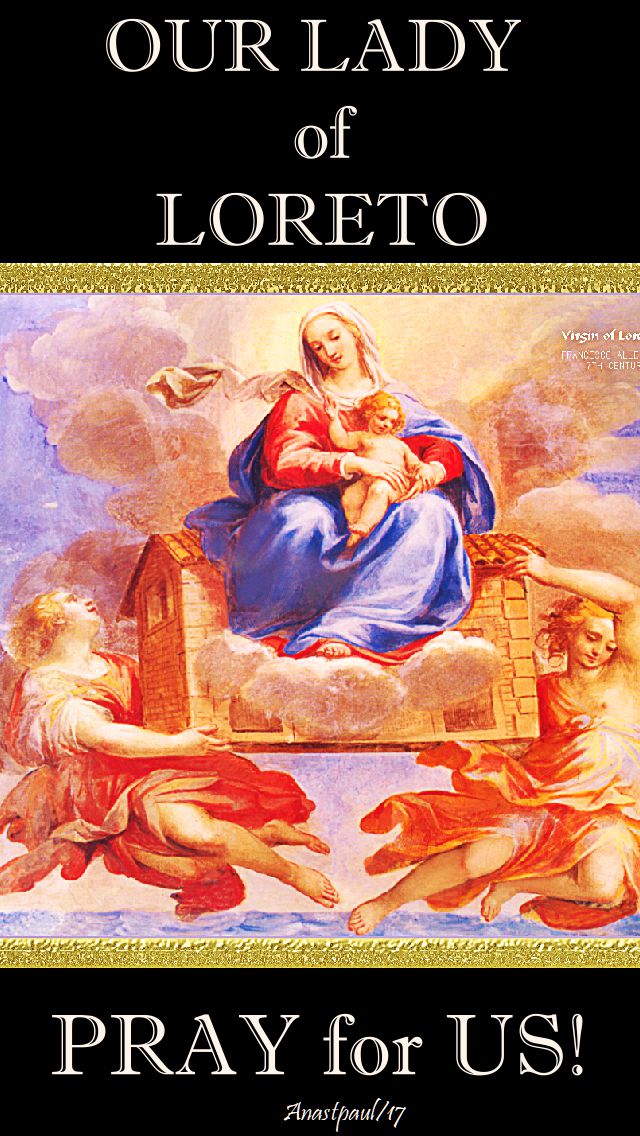
How this Shrine came to be is a fascinating story. This is the House of Nazareth, the home of the Holy Family, which had been brought by angels from Nazareth to the Dalmatian coast and later, by the same angels, transported to Loreto where it stands today enclosed in the huge Basilica just described. The history of Loreto is based upon a wealth of sound tradition and reliably recorded historical facts. We know from the visits of reliable witnesses to the Holy Land, whose journeys were carefully recorded in documents, that the Holy House of Nazareth was intact in Palestine at a relatively late date. St Louis, King of France, heard Mass in Nazareth in 1253 in the same chamber where the Angel announced the coming of Christ to the Blessed Virgin Mary.
Exterior of the Holy House of Loreto
The Holy Land had seen its last and unsuccessful Crusade in 1291. The last of the Christian soldiers withdrew from Nazareth the same year, leaving behind the holiest of houses unprotected. It was to be dealt with according to the Muslim tradition of pillaging and destruction. It may seem far-fetched to think that a tiny clay house venerated by a handful of Christians could merit such vindictive rage. But this was a unique house — visibly an edifice of mud and straw, but preserving within its framework living memories of its Royal Household — Jesus, Mary, and Joseph.
The first assault was that of the Seljukian Turks in 1090. They rampaged through the Holy Land, looting the treasures left in the churches of the Holy Places by devout Christian pilgrims. They turned basilicas and churches into mosques and destroyed what was deemed useless for their unholy purposes. Among the last class fell the fate of Santa Casa, home of the Holy Family. Fortunately, when Constantine had the first Basilica built over the holy spot in 312, the house, along with the grotto that was attached, was interred within a subterranean crypt. And so it survived the initial desecrations of Islam.
In the years that followed, a trickle of Christian pilgrims kept alive the devotion and veneration of the Holy House where the Word was made Flesh. Then, when the first Crusaders arrived victorious in 1100 under Tancred, they built a new Basilica.
During the relative peace that ensued, pilgrims once again freely visited the sanctified ground. But because of the mixed motives that drew some of the Crusaders to the Holy Land, God did not bless all of their attempts to secure a lasting peace for the new Latin Kingdom of Jerusalem. In all there were eight crusades, marked by some glorious victories but punctuated also with terrible defeats. In 1219, Saint Francis of Assisi, whose spiritual sons were later to be given charge of the Holy House, visited this “holiest spot on earth” in Nazareth. It was during the last crusade that St. Louis IX knelt on the ground that had once been frequented by Our Lord and received Him into his heart in Holy Communion. The saintly king deemed this to be a far greater privilege than his earthly royalty.
The year 1263 saw the second destruction of the Basilica, but again the Holy House miraculously survived the assaults of the Infidels. But the defeated Christians eventually withdrew in 1291. Total destruction finally loomed over the former home of the Holy Family, as free reign was given in the Holy Land to its unholy inhabitants. Eternal Wisdom, however, had other plans!
Our Lady of Loretto On the night of May 10th, 1291 the shepherds of Tersatto, now Croatia, parted company to tend to their flocks. The lonely fields in Dalmatia and the shepherds who treaded them daily were well acquainted with each other. So the sudden appearance of a house that wasn’t there the night before caused quite a stir; the evening before, there had been no building, nor any building materials. Little did they realise it once had housed the Morning Star.
The poor, baffled, little shepherds, not suspecting the workings of Divine grace in that little hut, inspected it curiously. The walls did not all evenly touch the ground; half of them hovered over the road and the rest rested in the field. The tiny structure resembled a church more than a domestic abode. The house had an ancient altar, a Greek cross and a strange statue of a lady. As they entered it, the air seemed filled with a heavenly incense. Indeed it was. For in this very house, from the root of Jesse, blossomed the Mystical Rose.
Realising it was no ordinary incident, the shepherds ran off to the local church of St George to awaken Father Alexander Georgevich. The puzzled priest, after investigating the clay “church” himself, could offer little explanation to the humble crowd that gathered. That night the weary old priest, although severely crippled with arthritis, spent hours in prayer beseeching enlightenment from the Virgin Most Powerful. In his sleep the Mother of Good Counsel rewarded his humility by answering his request in a dream. “Know that this house,” She said, “is the same in which I was born and brought up. Here, at the Annunciation, I
conceived the Creator of all things. Here, the Word of the Eternal Father became Man. The altar which was brought with the house was consecrated by Peter, the Prince of the Apostles. This house has now come to your shores by the power of God. And now, in order that you may bear testimony of all these things, be healed. Your unexpected and sudden recovery shall confirm the truth of what I have declared to you.”
The sudden disappearance of Father Georgevich’s familiar malady the next day quite convinced him. He then announced that it was She, who is called Health of the Sick, who had cured him and related the vision of the night before. The peasants of Tersatto now knew for sure that this was the sacred little home of their Saviour. They venerated it accordingly.
Hearing of the miraculous appearance, the Governor of Dalmatia immediately dispatched his emissaries to Nazareth, and they reported that the Holy House had indeed disappeared from there. The length and breadth of the walls of the dwelling found at Tersatto corresponded exactly with the foundations beneath the Basilica of the Annunciation in Nazareth. This basilica had been built over the original Holy Home in Nazareth. Tradition says that the investigation disclosed another bit of valuable evidence: the house found at Tersatto was built of limestone, mortar and cedar wood. These materials were commonplace in Nazareth but almost unobtainable in Dalmatia.
Then suddenly on 10 December 1294, three years later, the little house disappeared as mysteriously as it had come. This time, however, the angels were not so successful in bearing it away without notice! The alert shepherds of Tersatto reported the departure. And across the Adriatic Sea, the happy victims of insomnia, who happened to be out that night, rushed home with reports of a mysterious passage overhead of a little house, borne aloft by angels. The awesomeness of the spectacle gave hint that it was the work of the Son of the Queen of Angels.
To this very day the people of Tersatto in Dalmatia (Croatia), as well as people in the Italian Marche region, on the night of December ninth and tenth, rise at 3:00 a.m. to the sound of a joyful pealing of their bells and light their customary bonfires, as they sing litanies of praise to the Cause of Our Joy.
Across the sea in Italy, on the shores of the Adriatic, a little plain called Banderuolo, four miles from the city of Recanati welcomed the Holy House when the angels lowered its uneven walls onto the wooded area. It took almost no time for people to hear of the arrival of this mysterious, airborne house. Thousands of people began to make pilgrimages to it and it rapidly gained a reputation as a place of cures. But unfortunately, as the pilgrims increased, so did the bandits that lurked in the surrounding forest. Slowly the house of prayer became surrounded by a den of thieves. Feeling the same justified anger that once compelled Him to cast the buyers and sellers from His Father’s House, Our Lord withdrew the House itself!
Once again the soft flutter of angels’ wings stirred the night air as they relocated the home of the House of Gold. This time its foundation-less walls settled down in an open meadow on the Antici property in Recanati. Tradition tells us that, not long after this, the brothers who owned the property, two hot-tempered Italian rustics, took to fighting. The cause of the discord was allegedly over the Holy House itself, each claiming to own the plot it occupied, or perhaps taking credit for its having chosen the land because of their personal holiness! Tradition calls it a mere quarrel but it was sufficient to cause the Refuge of Sinners to abandon the site. Happily, as soon as the Santa Casa moved, the brothers repented and were reconciled.
The Holy House now reached its final destination; final, that is, at least to this present date, on Loreto hill, a few miles away from its previous location, close to the village of Recanati. Although they weren’t quite sure just what was the story behind it, people began to come in droves to venerate it. In 1295 a strong wall was built around it, either for protection, or to keep it from escaping their humble grasp and making another nightly excursion! Identification of Her sweet little home was clearly unfolded by the Virgin of Virgins Herself in 1296 to a saintly hermit who lived nearby. Immediately the government of Recanati sent sixteen of its most reputable citizens to the Holy Land to investigate the situation. After an absence of months, the retinue of homespun scientists returned with the obvious facts. All they found in Nazareth was the spot, still venerated, where the house once stood. The foundation measured up exactly to that of the House of Loreto: thirteen feet by thirty-one. The bricks of the local Nazareth habitation were of the same substance as the Holy House, whereas the other Recanati abodes were completely dissimilar. The Recanati representatives were convinced; this was the House of the Holy Family, miraculously brought to the shores of Italy through the Will of God and for His Glory.
Most of the evidence about the translation of the Holy House came to light through a commission of inquiry set up by Pope Boniface VIII, who sent his investigators to Tersatto and Nazareth, as well as to Loreto. He himself, as well as other popes, declared that the history and traditions of Loreto are “most worthy of belief.” Later the Sacred Congregation of Rites appointed 10 December as the Feast of the “Translation of the Holy House.”
Since 1294, it has become one of the greatest shrines to Our Lady, with pilgrims from all over the world crowding the roads to Loreto. Over 2,000 canonided, beatified and venerable children of the Church have paid homage to the Singular Vessel of Devotion by visiting the home in which she was born and in which she raised the only-begotten Son of God. These include: St Ignatius Loyola, St Francis Xavier, St John Berchmans, St Philip Neri, St Francis de Sales, St John Capistrano, St Clement Mary Hofbauer, St Alphonsus Maria de Liguori, St Louis Marie de Montfort, St Benedict Joseph Labre, St Therese and St Frances Xavier Cabrini, Blessed John Henry Newman, just to mention a few. Forty-seven popes have knelt there during their pontificates and many others came to pray before they were elevated to the Holy See. More than fifty Popes have issued Bulls and Papal Briefs testifying to its authenticity. Hundreds of Papal documents have granted it privileges, exemptions, and authorisations to receive benefits. In 1669, it was given a Mass of its own in the Missal. The Litany of Our Lady, that most beautiful and poetic expression of her virtues and her sublime role for both Heaven and Earth, is named after this Shrine, the Litany of Loreto.
It is a place of many miracles. Those who have come throughout the ages, beseeching aid from the Comforter of the Afflicted, usually return home spiritually aided or physically cured. Three successors to the chair of Peter have physically experienced the benevolence of the Virgin Most Merciful and were restored to health. They were Pope Pius II, Pope Paul II and Pope Pius IX. Even today Her graces continue to flow, for Our Lady still exercises Her Queenship by interceding for Her subjects who implore Her aid under the title of Our Lady of Loreto.
Italy has, perhaps more than any other European country, been the scene of civil strife, wars and revolutions from the thirteenth to the eighteenth centuries. The country was divided with city fighting city, faction pitted against faction, and man against man. Those six centuries of Italian history are the most dramatic in the formation of Europe. But as numerous armies marched from North to South and South to North, no harm was ever done to the House of Loreto and to its mystical image.
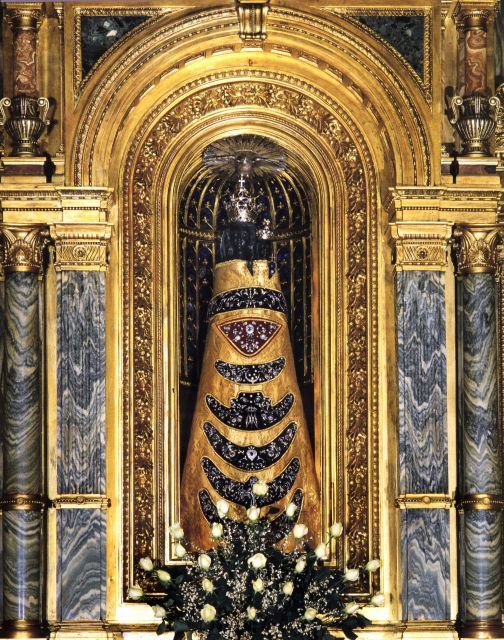
It was again one of the many sacrileges of the Freemasonic French Revolution to desecrate this most sacred image of Our Lady. The French Revolutionary Directory seized all the treasures of Loreto, including the image, took them to Paris and exposed them to profane curiosity. Napoleon III finally gave the statue back to Pope Pius VII, who enthroned it first in the Papal Palace at the Quirinal and then, with great solemnity restored it to Loreto in 1802. Tragically, however, an accident in 1921 destroyed the original statue and a new figure, about three feet high, was then carved from the wood of a cedar grown in the Vatican gardens.
Pope Pius XI enthroned this new statue in September of 1924 in the Sistine Chapel. Then, with his own hands, he crowned the Holy Child and His Mother, whereupon the figure was exposed for a day in the Basi1ica of St Mary Major in Rome. Finally, with great solemnity, it was carried to Loreto. On feast days, the figure of Our Lady and the Holy Child were accustomed to be dressed in robes of gold and silk. The jewels on the robe are the marriage jewels of the Catholic Empress, Maria Theresa of Austria and are of inestimable value.
There are, of course, the inevitable skeptics who obstinately reject the fact of the “translation” of the Holy House from Nazareth to Tersatto and thence to its present location. But their objections are refuted by the very fact that no house could stand for as long a time as this one has — certainly not for centuries — resting on the surface of the ground only, without even having a foundation. Yet the fact remains that the house is not artificially sustained in any way and it has no foundation at all. This can be verified by anyone who visits the shrine. During World War II, the shock of airwaves destroyed many more solidly built houses, ancient and modern, as well as fortified castles. The vicinity of Loreto and the city itself were bombed by the Allies (Americans) several times during the conflict but the House of Nazareth, where the Angel announced that the Word would be made Flesh, still stands erect and unshattered, as if proclaiming to mankind that it need only depend upon the unshakable Rock of Peter, the foundation-stone of Christ’s One, True Church.
Sweet were the days the Blessed Virgin Mary spent with Saint Joseph and the Holy Child in their modest little home. Their life within the clay walls was affluent with poverty, resonant with silence and illustrious in humility. “Her actual life, both at Nazareth and later, must have been a very ordinary one…” said Saint Thèrése, the Little Flower of Jesus, who once visited the Holy House.“She should be shown to us as someone who can be imitated, someone who lived a life of hidden virtue and who lived by faith as we must.” This beautiful and much needed lesson of extraordinary sanctity in very ordinary circumstances, is precisely what the humble and Holy House of Loreto bespeaks to us.




























You must be logged in to post a comment.