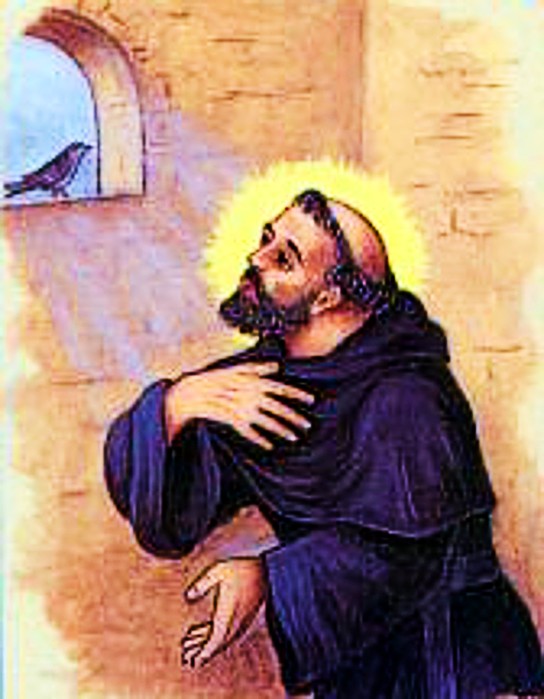
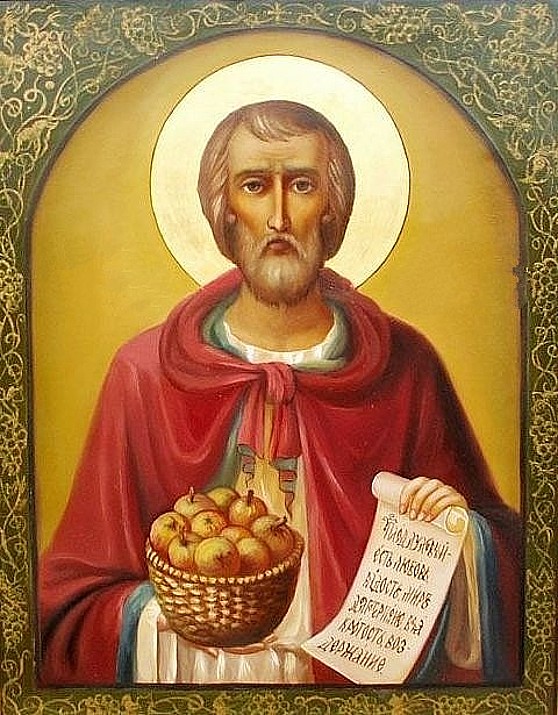
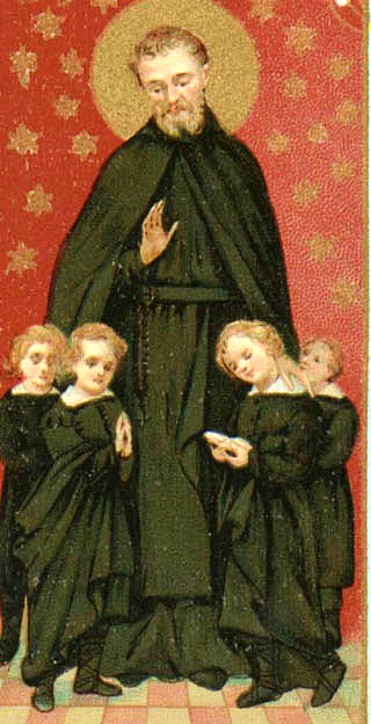
Saint of the Day – 1 August – Blessed Giovanni Bufalari OSA (c 1318-c 1350) Friar of the Order of the Hermits of St Augustine, Porter at his Monastery, Apostle of the poor and sick. Born at Castel Porziano near Rome, Italy as Giovanni Bufalari and died in c 1350 of natural causes aged 32 Brother of Blessed Lucia Bufalari. Also known as – John Bufalari of Rieti. Beatified in 1832 by Pope Gregory XVI.
We know nothing about his parentage and early life. His story starts when he entered the Augustinian Order as a teenager.
He was noted for his innocence, simplicity and love for his Augustinian community. He considered himself to be the servant of all,and showed great fraternal love in caring for the sick and welcoming guests to the Monastery. He spent much time in prayer.
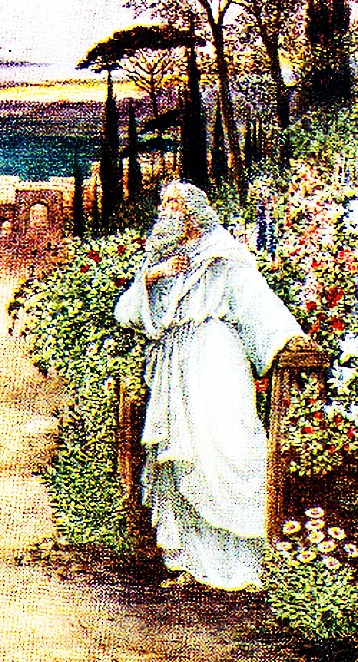
There is a story told about John crying after having spent some time in the Monastery garden. Asked what was wrong, he answered that while the plants, trees and birds were obedient to God, men and women, to whom eternal life is promised, are disobedient to their Creator.
John died in Rieti around the year 1350. He was 32 years old.
His remains are preserved at Saint Augustine Church in Rieti. Pope Gregory XVI proclaimed him Blessed in 1832.
Portiuncula Indulgence: An Indulgence which may be gained in any Church so designated by the Bishop, by all the faithful who, after Confession and Holy Communion, visit such Churches between noon of 1 August and midnight of 2 August, or on the Sunday following. The Indulgence is toties quoties and is applicable to the souls in Purgatory.
St Exuperius of Bayeux St Faith St Faustus St Felix of Gerona St Friard Blessed Giovanni Bufalari OSA (c 1318-c 1350) St Hope St Jadwiga Karolina Zak St Jonatus St Justin of Paris St Kenneth of Wales St Leontius of Perga St Maur St Nemesius of Lisieux Bl Orlando of Vallombrosa St Peregrinus of Modena St Rioch Bl Rudolph St Secundel St Secundus of Palestrina St Sophia St Verus of Vienne
Seven Holy Machabees – 8 Saints: “At Antioch, the Martyrdom of the Seven Holy Brothers, the Machabees and thei mother, who suffered under King Antiochus Epiphanes. Their relics were transferred to Rome and placed in the Church of St Peter in Chains.”
Saints Faith, Hope and Charity: The daughters of Saint Sophia. While still children, they were tortured and Martyred for their faith in the persecutions of Hadrian. They were scourged, thrown into a fire, and then beheaded.
Quote/s of the Day – 31 July – The Memorial of St Ignatius Loyola (1491-1556) Confessor
The Dying Words of today’s Saint of the Day, Blessed Everard Hanse (Died 1581) Priest Martyr at the hands of of Queen Elizabeth I in the English persecutions, led me to contemplate and collate some of these scattered around Breathin Catholic. I will collect them as I go on searches everywhere in the Catholic world, adding to them here from time to time, when appropriate. 🙏🧡
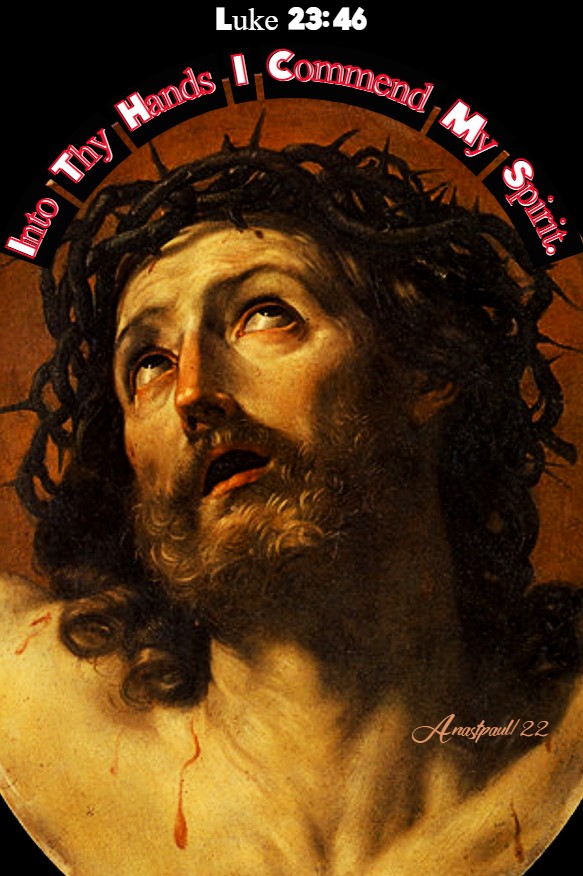
“Into Thy hands I commend My spirit.”
Luke 23:46
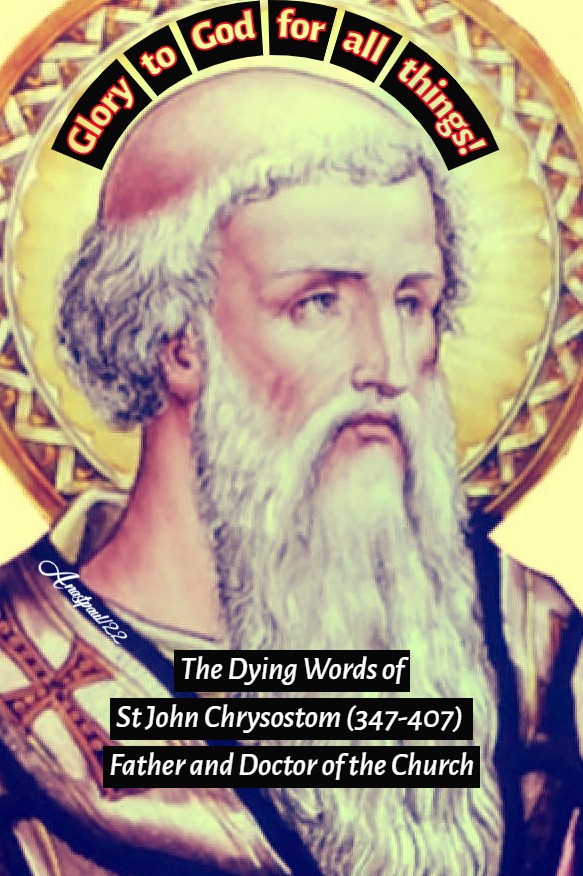
“Glory to God for all things!”
St John Chrysostom (347-407) Father and Doctor of the Church
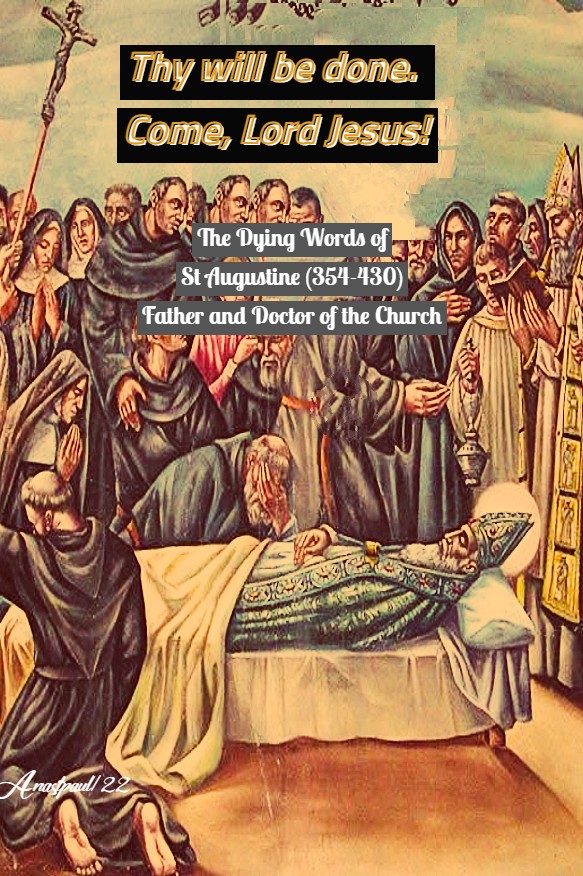
“Thy will be done. Come, Lord Jesus!”
St Augustine (354-430) Father and Doctor of the Church
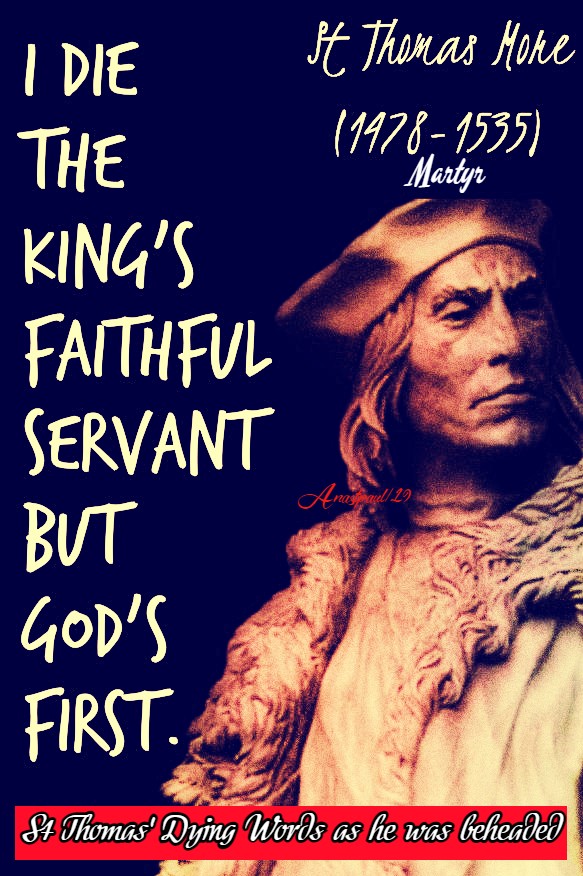
“I die the King’s faithful servant but God’s first.”
St Thomas More (1478-1535) Martyr
“O, my God!”
St Ignatius Loyola (1491-1556)
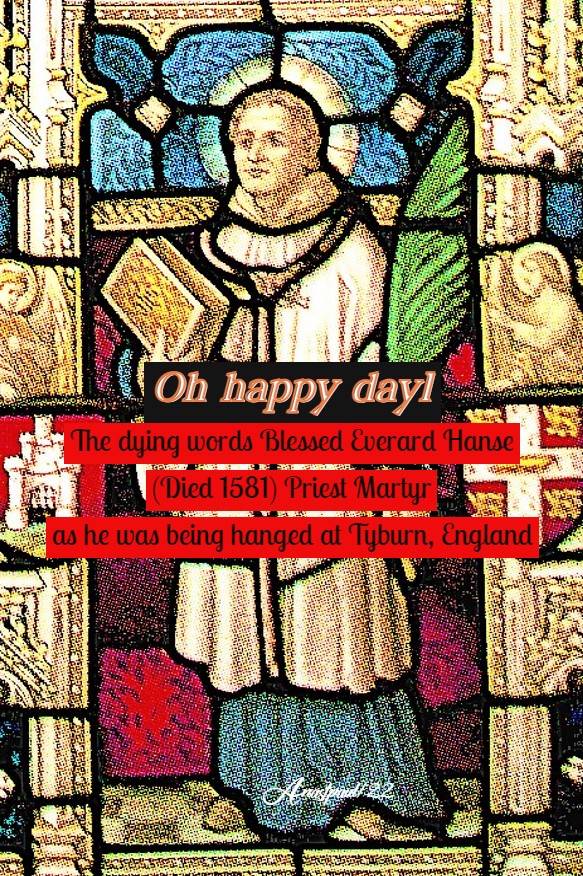
“Oh happy day!”
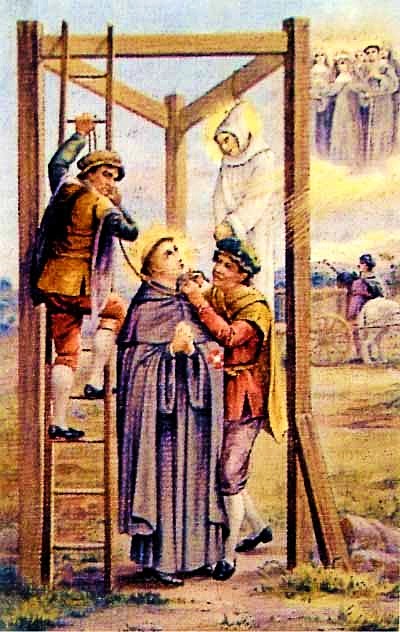
The dying words of today’s Saint of the Day as he was being hanged at Tyburn, England Blessed Everard Hanse (Died 1581) Priest Martyr
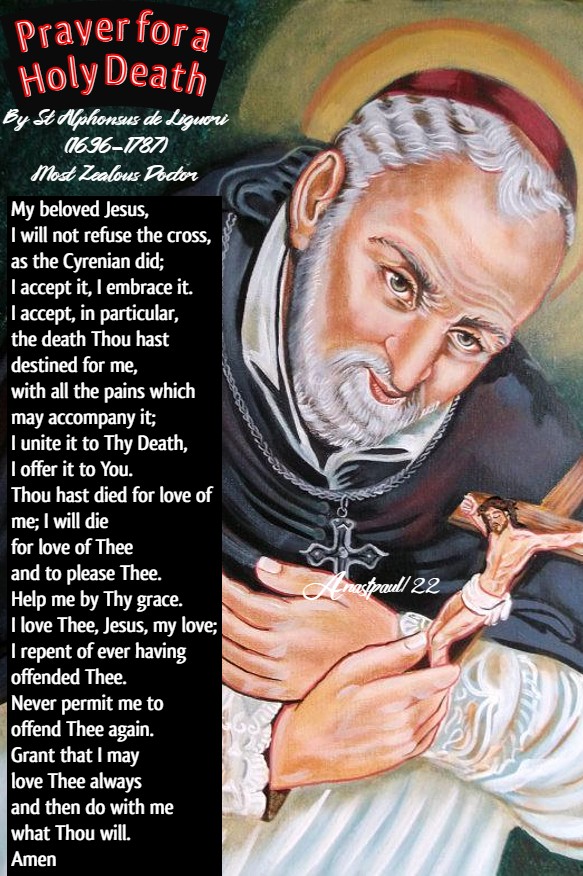
Prayer for a Holy Death By St Alphonsus de Liguori Most Zealous Doctor
“My beloved Jesus, I will not refuse the cross, as the Cyrenian did; I accept it, I embrace it. I accept, in particular, the death Thou hast destined for me, with all the pains which may accompany it; I unite it to Thy Death, I offer it to You. Thou hast died for love of me; I will die for love of Thee and to please Thee. Help me by Thy grace. I love Thee, Jesus, my love; I repent of ever having offended Thee. Never permit me to offend Thee again. Grant that I may love Thee always and then do with me what Thou will.Amen”
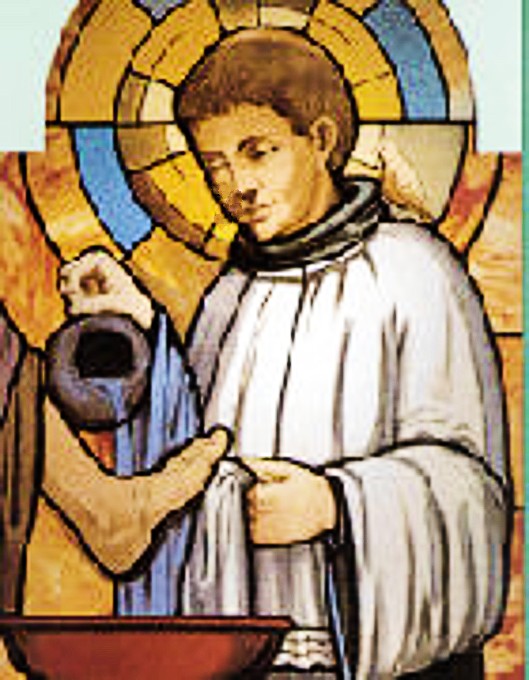
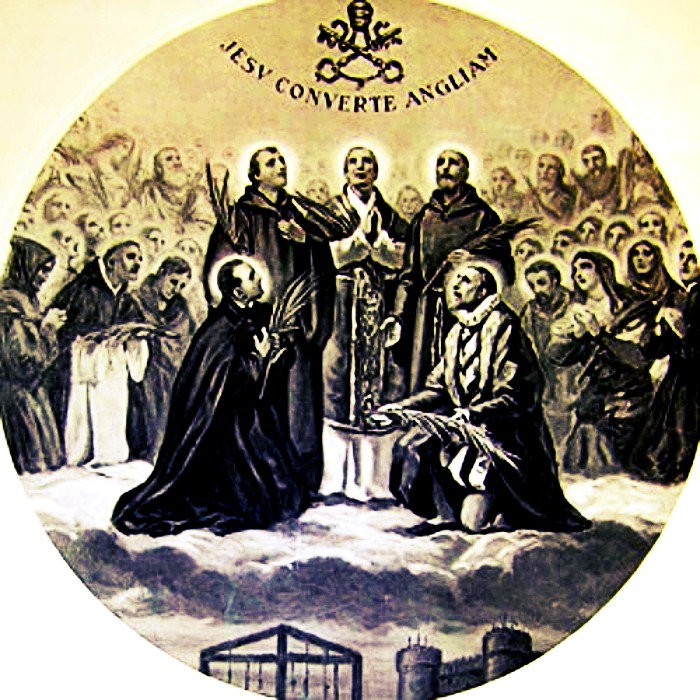
Saint of the Day – 31 July – Blessed Everard Hanse (Died 1581) Priest Martyr Born in Northamptonshire, England and died by being hanged, drawn and quartered on 31 July 1581 at Tyburn, London, England during the persecutions of Queen Elizabeth I. Beatified on 29 December 1886 by Pope Leo XIII. Additional Memorial – 29 October as one of the Martyrs of Douai.
Everald Hanse was born in Northamptonshire, raised as a protestant and educated at Cambridge with the view to becoming an Anglican protestant minister. He was, after his graduation, soon presented with a good living (as it is called in the English Anglican church i.e. a position as the minister of a community, with a house and salary).
Everard’s brother, William, who had converted to the Faith and become a Catholic Priest in April 1579, tried to convert him but in vain, until a serious illness led him to a profound self-examination and contemplation of his death and Judgement. When he was granted the complete recovery of his health, he immediately resigned his rich preferments. and became a Catholic, with the help of his brother, Fr William.
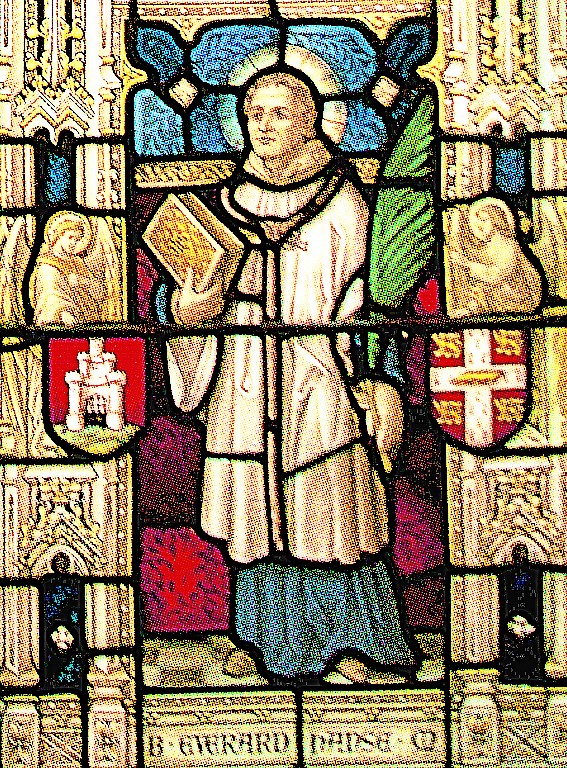
Stained glass of Blessed Everard at St Edmund’s College Ware, England
Everard then travelled to Rheims in northern France (to study at Douai College 1580–1581), where he was Ordained Priest on 25 March 1581. He returned to England to serve the recusant and much persecuted faithful but his service was very short ,for in July of the same year, he was visiting, in disguise, Catholic prisoners in the Marshalsea Prison, when the jailkeeper noticed that his shoes were of a foreign make.
Everard was closely examined and his Priesthood was discovered. As yet, there was no law against Priests and to satisfy the hypocritical professions of the persecutors, it was necessary to find some treason of which he was guilty. He was asked in Court at the Newgate Sessions, what he thought of the Pope’s authority and on his admitting that he believed him “to have the same authority now, as he had a hundred years before.” Everard was further asked whether the Pope had not erred (i.e. sinned) in declaring Queen Elizabeth I Excommunicated. To which he replied “I hope not.” His words were at once recorded as a formal crime and when he was further asked whether he wished others to believe, as he did, he said “I would have all believe the Catholic Faith as I do.”
A second count of criminal action was then added – that he desired to make others also traitors like himself. He was at once found guilty of “persuasion” which was high treason as decreed by Elizabeth. He was, therefore, in due course sentenced to death.
Everard was executed at Tyburn on 31 July 1581 by hanging, whereafter his body was drawn and quartered. His last words were: “Oh happy day!” and his constancy throughout “was a matter of great edification to the good“. The Spanish Ambassador wrote: “Two nights after his death, there was not a particle of earth on which his blood had been shed, which had not been carried off as a relic.“
The trial is noteworthy as one of the most extreme cases of verbal treason on record, and it was so badly received that the Government had afterwards, to change their methods of obtaining sentences.
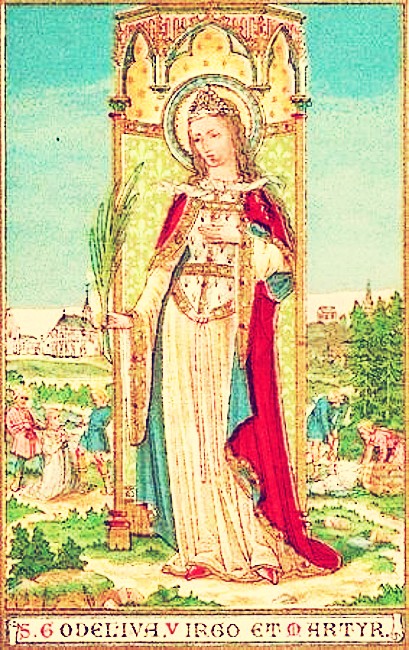
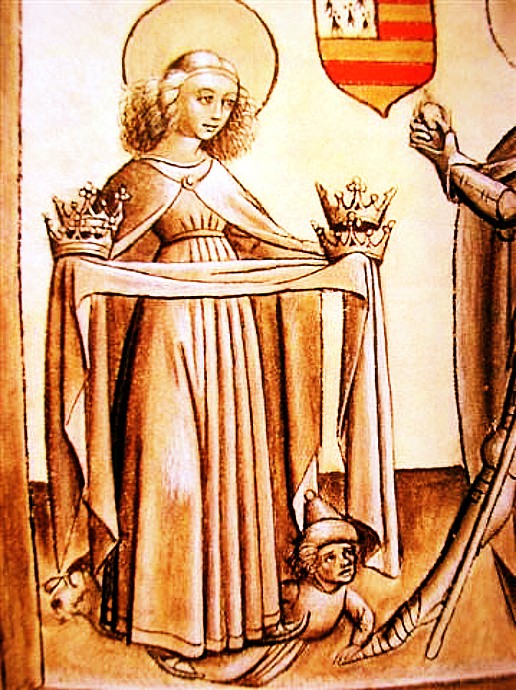
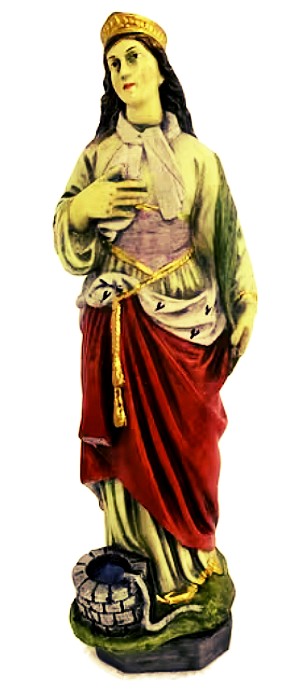
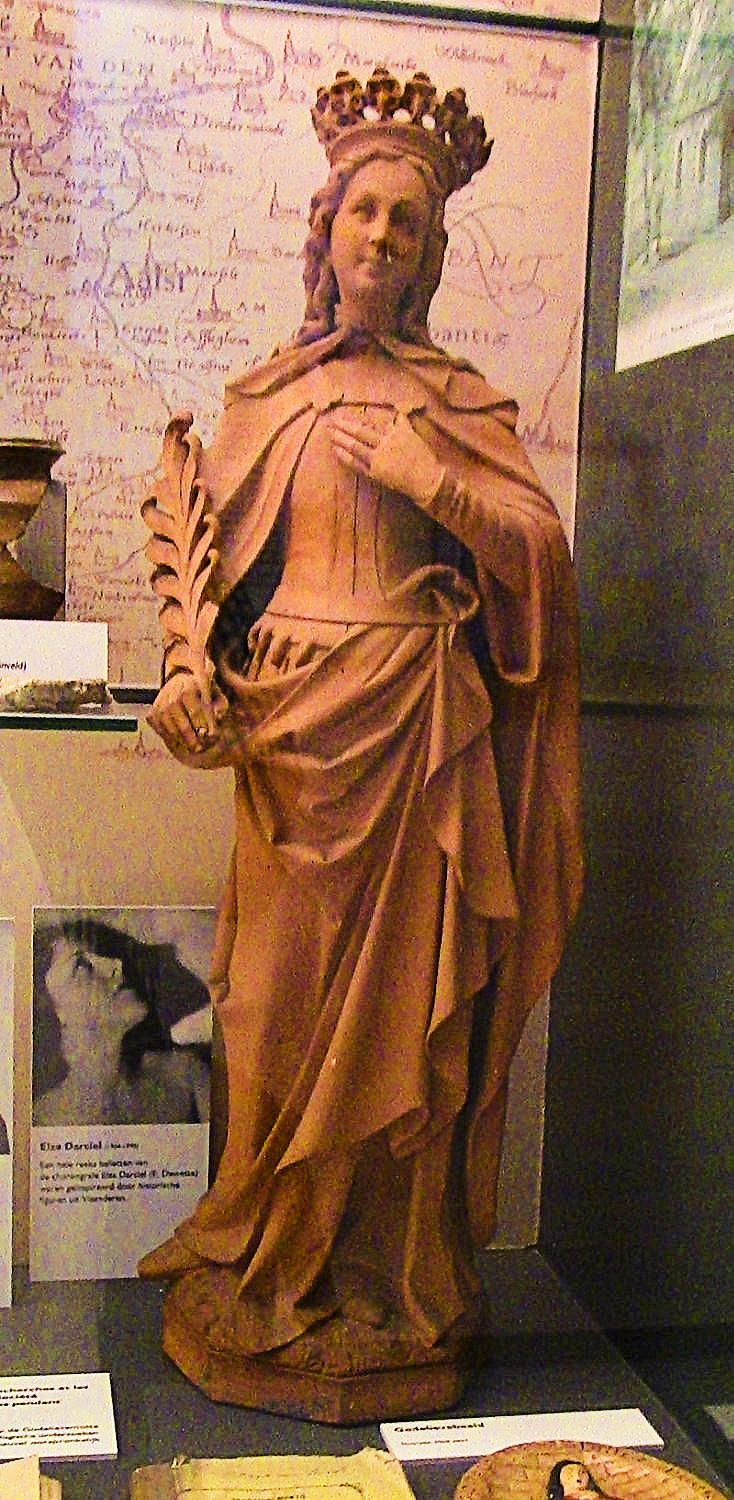
Saint of the Day – 30 July – Saint Godelieve (c 1049-1070) Flemish Married Laywoman. Born in c 1049 at Londefort-lez-Boulogne, France and died by murder by being strangled by her mother-in-law’s and husband’s servants on 6 July 1070 at Gistel, Belgium. Patronages – difficult marriages, against abuse and spousal abuse, against throat diseases, in-law problems, for good weather and against storms. Also known as – Godelieve of, Ghistelles, Godelieve of Gistel, Godaleva, Godeleine, Godeleva, Godeliève, Godelina, Godeliva, Godelive, Godelva, Godliva.
The Cross and Death of St Godelieve By Fr Francis Xavier Weninger SJ (1805-1888)
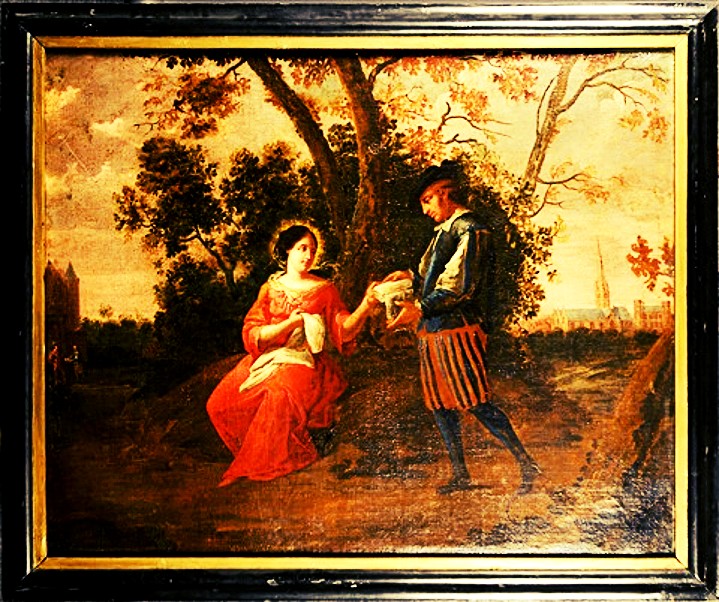
“Godelieve was a native of France and the daughter of rich and noble parents, who neglected nothing, to give her an education in accor,dance with her station in life. She united with most exquisite beauty, great virtue and piety and hence was early sought in holy matrimony by many young men of the nobility. Among these, a certain Bertulph of the Netherlands, who seemed her equal in rank, gained her parent’s consent and Godeliva submitted to their will.
Having received a dowry according to her position, she went, accompanied by some of her relatives, to the Netherlands, where her marriage was to take place. But how surprising an evidence of the inconstancy of human love! Scarcely had the noble bride arrived under the roof of her future husband, when she perceived that Bertulph’s love for her was changed into hatred and aversion, as he hardly deigned to look at her. His wicked mother, if not the first, was not the last cause of this unexpected change – as she reproached her son for having chosen a foreigner for his wife, as if, in his own country, her equal in beauty and virtue could not be found. She found fault with everything the innocent Godeliva said or did and thus inflamed, the fire of contention, to such a degree that later, only the blood of the pious Godeliva could quench it.
The poor maiden’s sadness may easily be conceived but she hoped that these dark clouds would pass away. Meanwhile the arrangements for the wedding were completed and it accordingly took place. Bertulph, however, was present only during the ceremony, as he was unable to hide his aversion for his bride. He appointed a separate dwelling for her and remained with his parents, declaring that he would not hear or see anything of her, so great was the hatred he bore her. The deeply grieved Godeliva, seeing herself thus forsaken by men, sought for refuge with God. Day and night, she was on her knees imploring the Almighty to change Bertulph’s heart and fill it with Christian love.
Although God did not answer her prayers in the manner she desired, He gave her grace to submit entirely to His Divine Will and to carry her cross with heroic patience. Bertulph, in order to torment her still more and slowly to kill her, gave her a servant whom he had commanded to furnish for her sustenance daily, only a piece of bread and some water. The godless servant not only obeyed the cruel order but treated Godoliva with as much rudeness as if she had been his slave, instead of his mistress. Godrliva’s Christian virtue bore all this with indescribable patience. She never showed the least sign of indignation and no complaint of Bertulph’s inhuman command, nor the harsh treatment she received from the servant, ever passed her lips. She only uttered the praises of God, and thanked Him for giving her the opportunity to suffer.
When the profligate mother of Bertulph saw that neither hunger nor grief would, as she had hoped, end Godeliva’s life, she persuaded her son to get rid of her in some other way, as starvation was too slow. Bertulph would have been easily persuaded to follow this wicked advice, had not fear of Godeliva’s noble parents and relatives deterred him, at least for some time.
The innocent handmaid of the Lord perceived meanwhile, by the daily increasing torments, that she had nothing to expect but a violent death and, therefore, sought for an opportunity to escape. God gave her this opportunity and she, embracing it, fled, and after many hardships returned to her parents. The latter were inexpressibly griev,ed when she told them og her sufferings and being greatly indignant at the tyranny she had endured, they requested Baldwin, Count of Flanders and also the Bishop of Nimwegen, as their friend, to reproach Bertulph, seriously, with his impious conduct and command him, at the same time, to receive his wife again and in future to treat her in a different manner. Both took a deep interest in the matter and they supposed that their expostulation had impressed Bertulph, as he professed to them and to the parents of Godeliva, deep regret at his tyranny and promised on , not only to cease from maltreating her but to live with her in love and harmony. On this promise, she was commanded by her parent, to return with him to his home, which she did
No sooner, however, had she arrived there than she was more ill-treated than before. All her former miseries were redoubled and the hatred of Bertulph, now more deeply rooted, made itself more clearly manifest. Nothing was to be expected but the execution of the long nourished murderous design. The innocent Godeliva was ready for her last hour; for she was determined not to leave her husband again, even if it should cost her life. Everyday she prepared herself to die, commending her soul to the mercy of her Creator.
To some women, who came to comfort her in her misery, she said, with great cheerfulness; “You believe that I am an object of pity but I, although encompassed by sorrow, hope one day to be exalted and recompensed above all women in Flanders.” Thus she consoled herself with the contemplation of her reward in Heaven.
Into this she was soon to enter, for Bertulph was determined to do the worst. He hired two assassins to murder Godeliva. Not to be suspected of the bloody deed, he undertook a journey to Brussels, went to Godeliva and pretending to acknowledge and repent of his faults, he informed her that he was obliged to set out for Brussels but that, on his return, he would show greater love for her than she had ever expected from him. Upon this, the false spouse took leave, with the assurance that he would return in a few days. He really went away, believing that no-one would suppose him to be the instigator of the murder, which would take place during his absence.
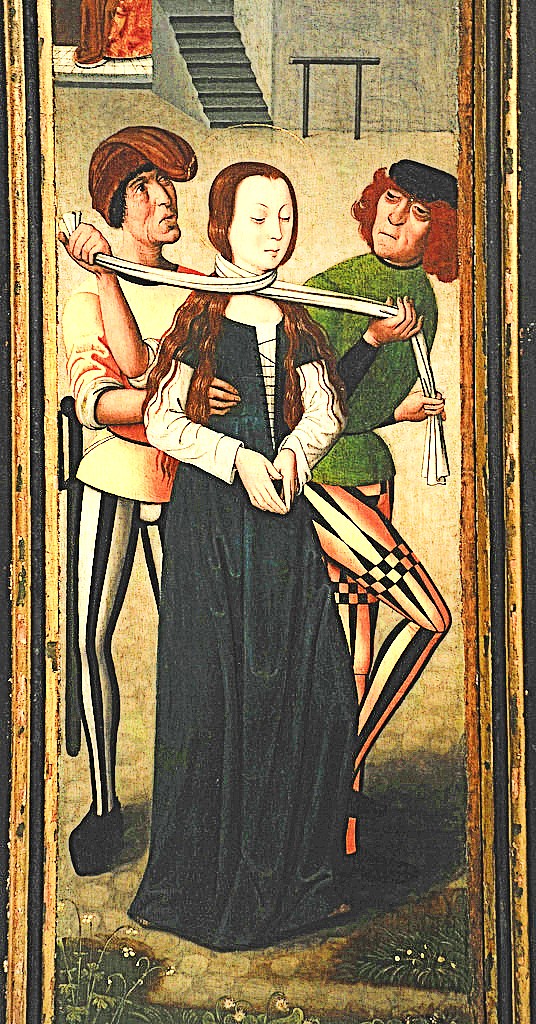
Godeliva had no faith in his promises, his many other false demonstrations had made her suspicious. She had no doubt that her end was near. Soon after Bertulph’s departure, the two assassins entered Godeliva’s chamber at night, dragged her out of bed, put a rope around her neck, and strangled her in a most barbarous manner. After this, they placed the dead body again in the bed and covered it, thinking that no-one would discover how Godoliva had come by her death. When she was found on the following day, everyone believed that grief had put an end to her life. God, however, so ordered, that Bertulph, in the course of time, confessed his crime and, to do penance, retired into a cloister.
How precious Godeliva’s death was in the sight of the Lord, was shown by the many miracles which were wrought at her tomb. History does not tell what became of the wicked mother of Bertulph but she doubtless went to eternal destruction, if she repented not, since, by destroying the harmony between her son and his wife, she had been the cause of so much unhappiness. And the same lot will befall all those, who, by slander, tale-bearing, or other wicked means, produce the same disunion.
Woe to such mischief-makers! How great will be their responsibility before the Judgment-seat of God! The Lord, according to Holy Writ, has the greatest detestation for those who stir up dissensions among brothers and still more, for those who disturb the peace of husband and wife because the quarrels of the latter, are generally of longer duration and their consequences are more disastrous.
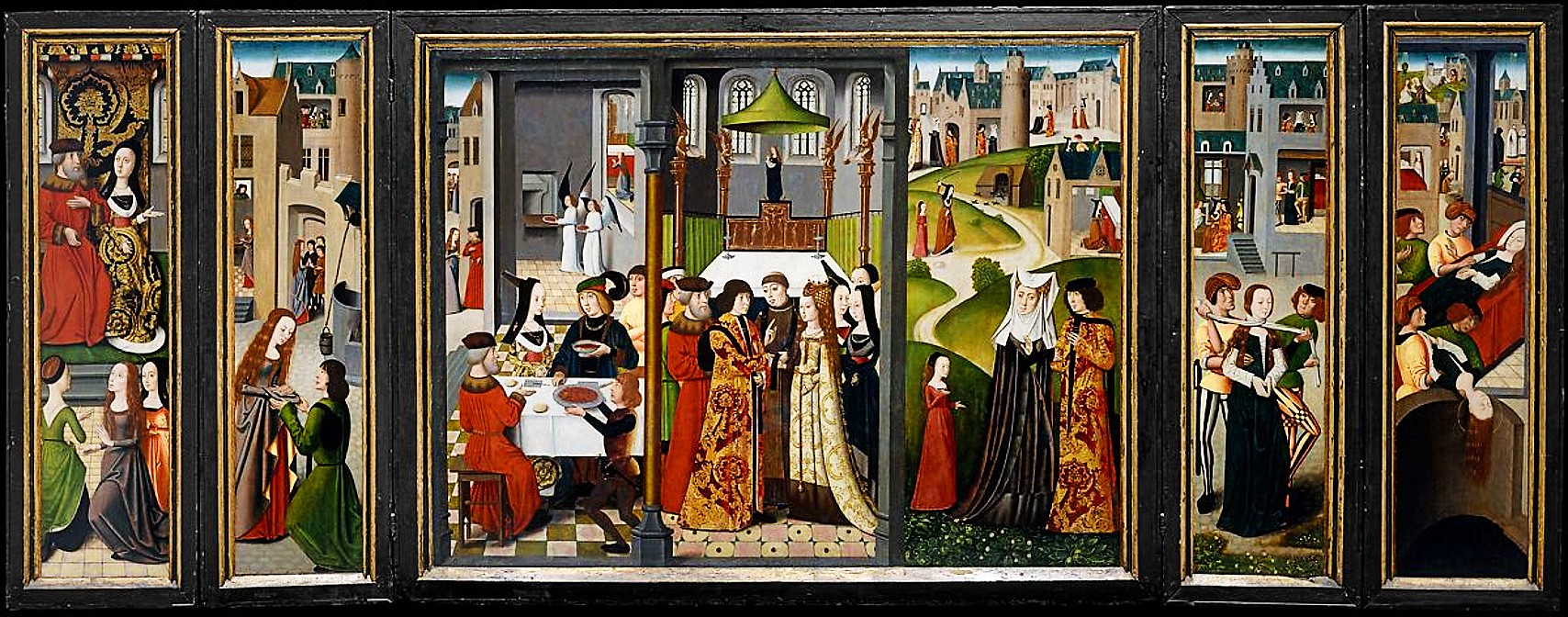
The Life and Miracles of Saint Godelieve, last quarter of 15th century
The two left panels represent the Saint’s piety and charity during her life in Boulogne. In the centre, the first panel shows Bertolf’s courtship, the second their marriage and the third Godelieve’s ill treatment from her husband and mother-in-law. In the two right panels the servants first strangle her, then immerse her in water, then return the body to her bed.
Godelieve’s body was exhumed in 1084 by the Bishops of Tournai and Noyon, in the presence of Gertrude of Saxony, the wife of Robert I, Count of Flanders, the Abbot of St Winnoc’s and a number of clergymen. It was Radbod II, Bishop of Noyon-Tournai, that consecrated Godelieve’s relics in 1084 and Godelieve’s popular cult developed thereafter. Godelieve’s feast day, 6 July in Belgium, was, like that of Saint Swithun in England and Saint Medard in France, connected with the weather. She is thus considered one of the “Weather Saints.”
Drogo, a Monk of St.Winnoc’s Abbey, wrote the Vita Godelieve, about ten years after her death. The Abbey of Ten Putte in Bruges, was dedicated to her. Every year, on the Sunday following 5 July, a procession celebrating Saint Godelieve takes place in Gistel.
Stained glass representations of Saint Godelieve and saint Idesbald.
Bl Richard Featherstone St Rufinus of Assisi St Senen St Tatwine of Canterbury St Terenzio of Imola Bl Thomas Abel St Ursus of Auxerre
Martyrs of Tebourba – 3 Saints: Three girls Martyred together in the persecutions of Diocletian. We know little else about them but the names – Donatilla, Maxima and Secunda. 304 at Tebourba in North Africa.
Saint/s of the Day – 29 July – Blessed Luis Bertran OP (1594-1627) and Companions Martyrs. Luis was a Spanish Priest and Missionary of the Order of Preachers. Born in 1596 in Barcelona, Spain and died by being burned to death on 29 July 1627 at Omura, Nagasaki, Japan. Also known as – Luis Exarch. Additional Memorial – 10 September as one of the 205 Martyrs of Japan. Beatified on 7 May 1867 by Pope Pius IX.
The Dominican Missionary Priest, Luis Bertran, from Barcelona, Spain, was a relative of aother revered Dominican Missionary Priest with the same name, Saint Louis Bertrand (1526-1581), who had served in Latin America..
The younger Father Bertran joined the Dominicans at the Convent of Santa Catalina in Barcelona, Spain in 1611. He was sent as a Missionary firstly to the Philippines in 1618 and then to Japan in 1623 where the Catholics were in great need under the dire persecutions of the regime then in control.
Luis ministered for 4 years in secret, to the Catholics of the Omura region in Japan. Luis brought many pagans to the Faith, especially working with Dominican Tertiaries. During a period of veracious persecution, he hid from the authorities in a leper colony but was found, imprisoned and executed by being burned to death, together with Blessed Mancio de la Cruz, Blessed Pedro de Santa Maria and three of the patients who had given them shelter. Pedro was a native of Japan and Mancio, an elderly man, were both Catechists. Pedro and Mancio were formally admitted to the Dominican Order shortly before their execution.
St Antony St Beatrix of Rome Bl Beatrix of Valfleury St Callinicus of Paphlagonia St Faustinus of Rome St Faustinus of Spello St Felix of Rome St John the Soldier Bl José Calasanz Marqués St Kilian of Inishcaltra St Lek Sirdani Bl Luis Bertran OP (1594-1627) Martyr, Spanish Priest and Missionary of the Order of Preachers. St Lupus of Troyes Bl Mancius of the Cross St Olaf II St Olaus of Sweden Bl Petrus of Saint Mary St Pjetër Çuni St Prosper of Orleans St Rufo of Rome St Seraphina St Serapia of Syria St Sulian
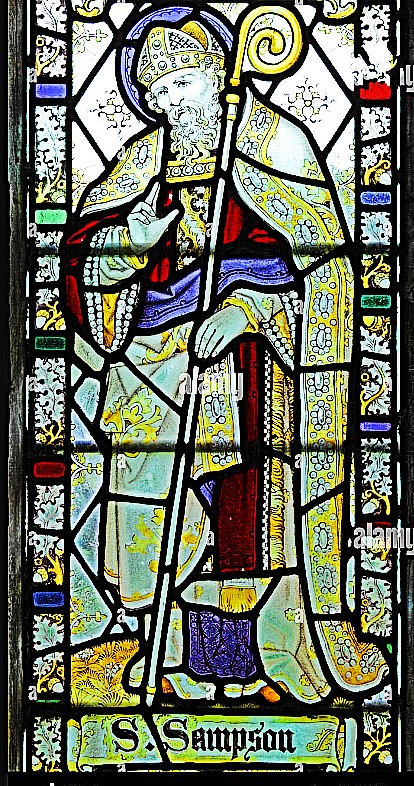
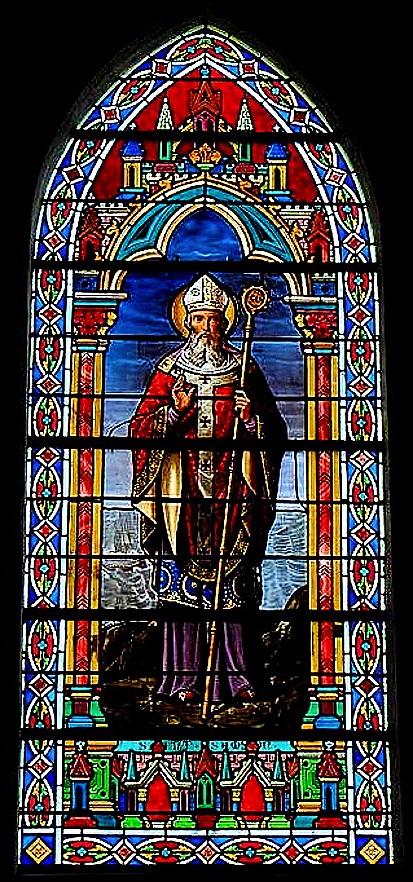
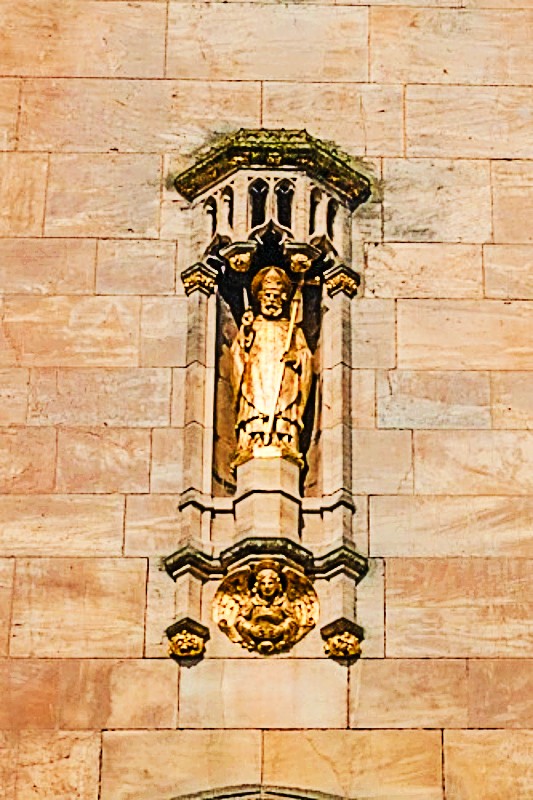
Saint of the Day – 28 July – St Samson of Dol (c 490 – 565) Bishop, Confessor, Abbot, Missionary, Miracle-worker. Born in c 490 at south Wales and died on 28 July 565 at Dol-de-Bre-ta-paign, Brittany of natural causes. Samson was the brother of Saint Gwenyth of Cornwall and Saint Veep. Also known a – Sampson of..
Samson’s parents, whose names are given as Amon of Dyfed and Anna of Gwynedd, were of noble but not royal, birth. While still an infant, he was dedicated to God and , at the age of 7 years, was entrusted to the care of St Illtyd, by whom he was brought up in the Monastery of Llantwit Major in Wales
He showed exceptional talents in his studies and was eventually Ordained Deacon and Priest by St Dubric. After this, he retired to another Monastery n Caldy Island, to practice greater austerities. Some years later , Samson was appointed the Abbot. there In about 516, some Irish Monks who were returning from Rome, happened to visit Samson’s Monastery. So struck was tAbbot Samson, by their learning and sanctity, that he accompanied them to Ireland and there remained for a while
During this visit, he received the submission of an Irish Monastery and, on his return to Wales, sent one of his uncles to act as its Superior. His fame as a miracle-worker now attracted so much attention that he resolved to found a new Monastery or cell “far from the haunts of men” and, accordingly retired with a few companions, to a lonely spot on the banks of the Severn. He was soon discovered, however and forced, by his fellow-countrymen, to become Abbot of the Monastery formerly ruled by St Germanus. Here St Dubric consecrated him Bishop but without appointment to any particular See.
Soon after, Samson received a vision from God telling him to evangelise Brittany in France.. He and some Monks there, established a Monastery at Dol which later became the centre of a new Diocese and of his Episcopal work in the district.
Business taking him to Paris, he visited King Childebert there and was nominated by him, as Bishop of Dol. He is also recorded as having attended a Council in Paris sometime between 556 and 565, by which time he would have been old.
Samson spent the rest of his life in Brittany, gaining renown for wisdom, holiness and zeal for the preaching of the Gospel, the conversion of pagans and glory of God. Samson is regarded by many, as one of the greatest of the Welsh Saints.
Samson attained the age of 85 years and was buried at Dol. Several early lives of Samson exist. The oldest, printed by Mabillon in his “Acta Sanctorum” from a manuscript at Cîteaux and again, by the Bollandists, claims to be compiled from information derived from Samson’s contemporaries, which would refer it to about 600. Dom Plaine in the “Analecta Bollandiana” has edited another and fuller life, (from manuscript Andeg., 719), which he regards as earlier than Mabillon’s. Later lives 0f St Samson are numerous.
The Anglo-Saxon King Athelstan (reign 924–939), obtained several relics of St Samson, including an arm and a crozier, which he deposited at his Monastery at Milton Abbas in Dorset.
St Pope Innocent I (Died 417) Confessor. Papal Ascension 402 until his death on 12 March 417, He defended the exiled Saint John Chrysostom and consulted with the Bishops of Africa concerning the Pelagian controversy, confirming the decisions of the African synods. The Catholic priest-scholar Johann Peter Kirsch, 1500 years later, described Innocent as “a very energetic and highly gifted individual …who fulfilled admirably the duties of his office.” Biography: https://anastpaul.com/2021/07/28/saint-of-the-day-28-july-saint-pope-innocent-i-died-417/
St Acacius of Miletus St Arduinus of Trepino St Botwid of Sudermannland St Camelian of Troyes St Celsus of Rome (Died c 68) Martyr Bl Christodoulos St Eustathius of Galatia St Irene of Cappadocia Bl John Soreth St Longinus of Satala St Lucidius of Aquara St Lyutius St Nazarius of Rome (Died c 68) Martyr St Nicanor the Deacon St Parmenas the Deacon St Peregrinus St Prochorus the Deacon St Samson of Dol (c 490 – 565) Bishop, Confessor, Abbot, Missionary
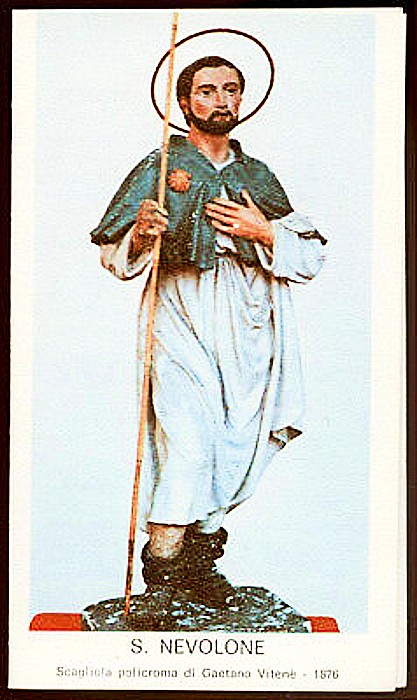
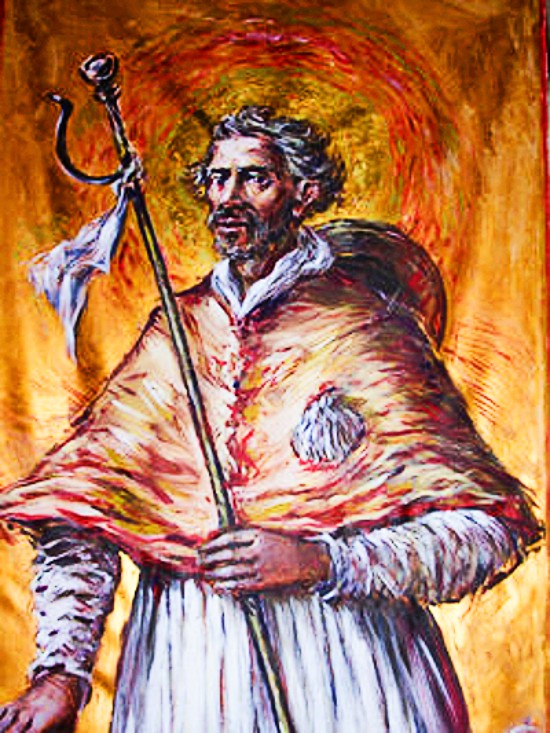
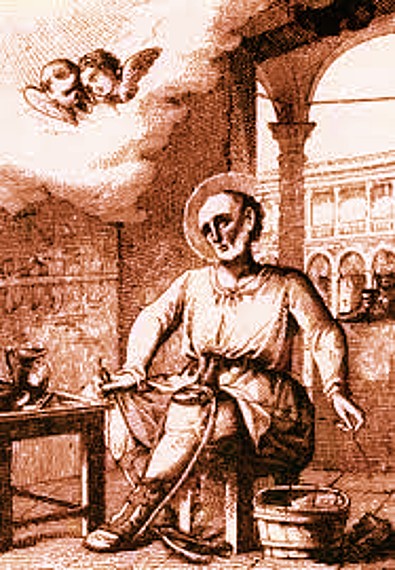
Saint of the Day – 27 July – Blessed Nevolone of Faenza OFM (Died 1280) Penitent, Pilgrim, Widower, Lay Friar of the Order of Friars Minor, then a Camaldolese Hermit, Apostle of the poor and sick, worked as a Cobbler / Shoemaker.. Born in the 13th Century Faenza, Italy and died on 27 July 1280 in Faenza, Italy of natural causes. Patronage – Faenza, cobblers, shoemakers, shoe repairers (chosen by the cobblers of Rimini, Italy in 1331). Also known as – Nevolo of Tavensia, Nevolone, Novellone, Nevolonius. Beatified on 4 June 1817 by Pope Pius VII.
In the great family of Saints the shoemaker stands next to the king’s son and the penitent who has atoned for the errors of his earlier life, may associate with the innocent man who has never lost the grace of God.
Born of devout parents at Faenza, Italy, Nevellon learned the trade of a shoemaker but his bad conduct caused great grief to them, especially to his good mother. He married when he was quite young and it was hoped, that now at least, he would change his ways but he continued in the same bad habits, inflicting still greater pain on his family. His mother, however, prayed and sighed without ceasing that the good Lord, Who consoled the widow of Naim by raising her son to life, would also raise her son from a spiritual death to a new life.
The prayers and tears of the mother did not remain unanswered. Almighty God caused Nevellon to become seriously ill. The nearness of death opened his eyes; he reflected on his past years, grace touched his heart and with bitter tears of true contrition, he vowed that if he recovered, he would lead a penitential life. He also resolved to make a pilgrimage to the tombs of the Holy Apostles Peter and Paul at Rome and to the tomb of St James at Compostela.
A few days later Nevellon recovered his health as if by a miracle . He was then only twenty four years old but he remained faithful to his promise all the rest of the days of his life, even up to an advanced age.
From that time on, prayer and work were his daily occupation. He became a Franciscan tertiary and converted his wife to an active faith. His charity to the poor nearly ruined his business.Mindful of the words, “Alms purge away sins” (Tob. 12,9), Blessed Nevellon retained only so much of his wages, as was necessary for he and his wife’s support and the remainder he divided among the poor and the sick. In the beginning, his wife, who was somewhat anxious over their temporalities, was much vexed at this liberality but when she saw the great blessings that attended her husband’s charity, she gave full consent.
Nevellon severely chastised his body for the sins of his past life and amid great hardships, undertook the pilgrimages he had promised, including several trips to Compostela. When his wife died, Nevelone became a Franciscan Lay Brother. But seeking greater unity with God in prayer and mortification he became a Camaldolese Hermit at the Monastery of San Maglorio in Faenza, Italy where his reputation for piety and wisdom continued to grow, leading many to emulate his spiritual ascent.
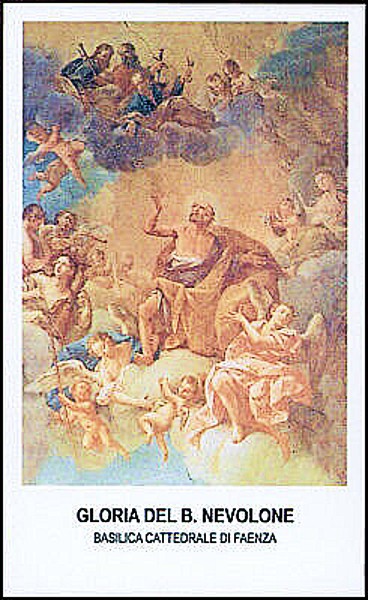
After giving the most edifying example of penance and many holy virtues for a space of fifty-six years, holy Nevellon died peacefully in the Lord in 1280. God glorified him in life and in death by miracles. His remains were interred in the Cathedral of San Pietro in Faenza. By 1282, 2 years after his death, there were so many pilgrims to his tomb that guards had to be posted to maintain order. With the approval of the Pope his native town celebrates his feast and shoemakers have chosen him for their special Patron.
St Aetherius of Auxerre St Anthusa of Constantinople St Arethas St Aurelius of Cordoba St Benno of Osnabruck (c 1020-1088) Bishop Bl Berthold of Garsten
St Ecclesius of Ravenna St Felix of Cordoba St Galactorio of Lescar St George of Cordoba St Hermippus St Hermocrates St Hermolaus St Juliana of Mataró St Lillian of Cordoba Bl Lucy Bufalari St Luican
Blessed Maria Magdalena Martinengo OSC Cap (1687-1737) Nun of the Order of the Capuchin Poor Clares, Mystic with a great devotion to the Passion of Christ. She had a great horror of sin and devoted much time to contemplating death, and the Divine Judgement. The recognition of two miracles attributed to her direct intercession allowed for Pope Leo XIII to preside over her Beatification on 3 June 1900. Her Story: https://anastpaul.com/2021/07/27/saint-of-the-day-27-july-blessed-maria-magdalena-martinengo-osc-cap-1687-1737/
St Maurus of Bisceglia St Natalia of Cordoba Blessed Nevolone of Faenza OFM (Died 1280) Penitent, Widower, Lay brother of the Order of Friars Minor, then a Camaldolese Hermit. St Pantaleimon Bl Rudolf Aquaviva S.J. Bl Robert Sutton St Semproniana of Mataró St Sergius of Bisceglia Bl William Davies Bl Zacarías Abadía Buesa
Martyrs of Nicomedia – 3 Saints: Three Christians Martyred together. The only other information to survive are their names – Felix, Jucunda and Julia. Nicomedia, Asia Minor.
Seven Sleepers of Ephesus: A group of seven young Christian men who hid in a cave in hopes of avoiding the persecution of Decius in the year 250. Found and arrested, they were ordered by the pro-consul in Ephesus to renounce their faith; they refused and were sentenced to die. Legend says that they were walled up in their hiding cave, guarded by the dog Al Rakim; when the cave wall was breached in 479 – they all woke up! It is likely that the youths were tortured to death in various ways and buried in the cave. The resurrection story confusion came from the phrase “went to sleep in the Lord” which was used to describe the death of Christians and 479 is when their relics were discovered. Their names were Constantinus, Dionysius, Joannes, Malchus, Martinianus, Maximianus and Serapion. They were martyred in 250 in Ephesus (in modern Turkey); tradition says that they were walled up in a cave to suffocate but other records indicate that they were tortured to death in various ways. Their relics discovered in 479 and translated to Marseilles, France and enshrined in a large stone coffin.
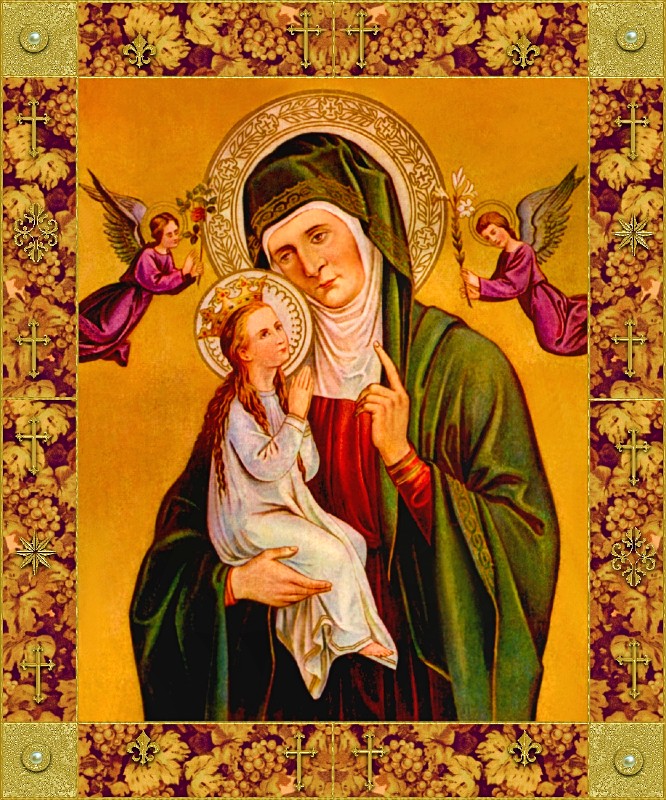
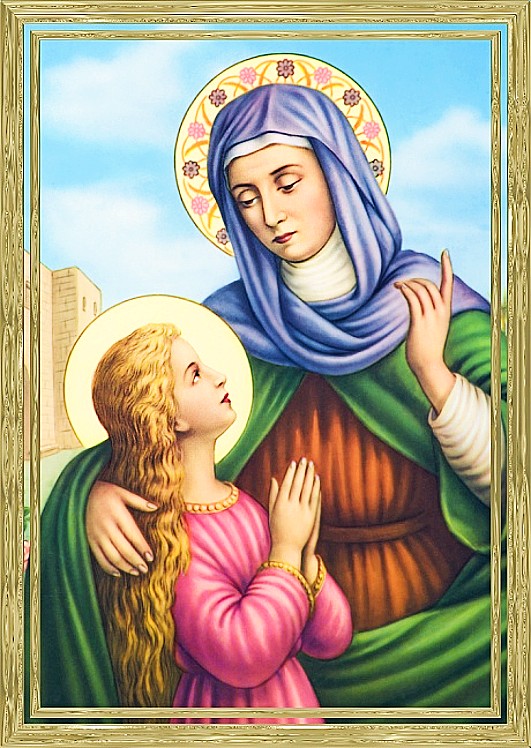
Saint of the Day – 26 July – St Anne, Mother of the Blessed Virgin Mary, Grandmother of Jesus. The name Anne from the Hebrew commonly believed to mean “grace” but St Augustine says (City of God) that it in fact means ,“by the grace of God.” Patronages – against poverty, against sterility or infertility, broommakers, cabinetmakers, carpenters,of childless couples, equestrians, expectant mothers and mothers, childbirth, grandmothers, grandparents, housewives, lace makers, lost articles, miners, old-clothes dealers, the poor,, seamstresses, stablemen, turners, Canada, France, Micmaqs, 4 Diocese, 18 Cities.
St. Anne, Mother of the Blessed Virgin Mary By Fr Francis Xavier Weninger SJ (1805-1888)
St Anne, the mother of the Blessed Virgin, was a native of Bethlehem, a City two miles distant from Jerusalem, frequently mentioned in Holy Writ. Having passed her youth in unstained purity, she was married to a man named Joachim, who was born at Nazareth in Galilee, with whom she lived in such love and harmony and, at the same time, so piously, that one could justly say of them, what St. Luke writes of Zachary and Elizabeth: “They were both just before God, walking in all the commandments and justifications of the Lord without blame.” They divided their income into three parts, the first of which was used for the honour of God and to adorn the Temple, the second to assist the poor and the third, for their own subsistence. They employed the day in prayer, work suitable to their station in life and charitable deeds.
Their only grief was, that, although so long married, they had no issue and a barren marriage was, at that time, considered a disgrace, nay almost a sign of a Divine curse. Saddened by this sorrow, St Anne, as well as her spouse, prayed with many sighs and tears, that God would take pity on them and remove the disgrace that was weighing them down. But when, after having prayed long and earnestly, they were not heard, they determined to bear patiently the will of the Almighty. As, however, St Anne knew that God required continual prayer and ,that He had not given to men a certain time to ask for grace, she ceased not to implore eaven with great confidence, for all that she believed was for His honour and her own salvation .
Being one day in the Temple, she felt her distress so deeply, that she wept bitterly,but she remembered, at the same time, that there had been another Anne, spouse of Elcana, who had been afflicted as she was but whose prayers, God at last had answered, making her the mother of the great prophet Samuel. While thinking of this, she perceived in herself, an invincible desire to beg the Lord for a like grace. Hence, she repeated her prayer with earnest fervour, promising, at the same time, that if God would grant her a child, she would consecrate it in the Temple, to His Divine service, as the above-mentioned Anne had done.
God answered the trusting, tearful prayer of His servant,and sent her, according to the opinion of the Holy Fathers, an Angel, who announced to her that she would give birth to a child who blessed among women, would become the Mother of the long expected Saviour of the world. It is also believed, that the Angel told St Anne the name which she should give to the blessed fruit of her womb. The same revelation was made to St Joachim and the happiness of both and their gratitude to the Almighty, can be easily imagined. Their happiness was crowned when St Anne gave birth to her, who was elected by God from all eternity, to become the Mother of His Only Son.
Who can describe the joy with which Anne pressed her newborn child to her heart, or the solicitude and love with which she brought it up? The knowledge that her blessed daughter was chosen by God to so great a dignity, was incentive enough, to leave nothing undone for her welfare. The mind of the blessed child was so far beyond her years and her whole being, so angelically innocent, that her education was an easy task and St Anne deemed herself, the happiest mother in the world because God had entrusted to her, so priceless a child. The graces which, through the presence of the Blessed Virgin, she received from Heaven, cannot but have been innumerable . For if, in after times, the house of Elizabeth and Zachary was, by a visit from Mary, filled with Heavenly blessings, who can doubt, that St Anne, who was the mother of the Blessed Virgin, was gifted with extraordinary graces?
Knowing, however, that Mary was not only a precious treasure lent her by Heaven but also, had consecrated herself to the service of the Almighty, St Anne did not fail to return to God, what she had received from Him and to offer willingly, what she had so willingly promised. Hardly had Mary reached the age of three years, when Anne and Joachim went with her to the temple at Jerusalem and presenting her to the Priest, consecrated her through him to the Almighty. Nothing could have been more painful to the pious parents than to separate from so perfect a child but, as they were more zealous for the glory of God, than for their own joy, even though it was so pious, they made this sacrifice without complaining. Thus Mary was received among the number of those who, under the direction of the priests, served God in the Temple and were led in the path of virtue.
After they had piously offered this agreeable sacrifice, the parents of the Blessed Virgin returned home and spent the remainder of their days in good works, which were continued by St Anne, when she became a widow by the death of her holy spouse. As she had been an example to the virgins, before her marriage, as well as a perfect model of a wife, so also was she, in her widowhood, a shining light, for all those qualities which St Paul,afterwards required of a Christian widow, in his first Epistle to Timothy. She went frequently to Jerusalem to see her holy daughter and died, according to several authors, in the 79th year of her age. Mary, who at that time still lived in the temple, closed her eyes.
As one cannot give to the Blessed Virgin a higher title than to call her, Mother of God, thus St Anne, cannot be more exalted, than when she is called the mother of her, who bore the Son of God. And for the very reason, that she was chosen to be her mother, we must believe, that the Almighty favoured her here upon earth, with grace above all the Saints and raised her to high glory in Heaven. Hence we may rightly suppose, that her intercession with God, is most powerful and this is also testified by many examples.
St Benigno of Malcestine Bl Camilla Gentili St Charus of Malcestine Bl Edward Thwing Bl Élisabeth-Thérèse de Consolin St Erastus Bl Évangéliste of Verona St Exuperia the Martyr Bl George Swallowell St Gérontios St Gothalm St Hyacinth Bl Hugh of Sassoferrato Bl Jacques Netsetov Bl John Ingram St Joris Bl Marie-Claire du Bac Bl Marie-Madeleine Justamond Bl Marie-Marguerite Bonnet St Olympius the Tribune
Quote’s of the Day – 25 July – Memorial of St Christopher (died c 251) One of the Fourteen Holy Helpers
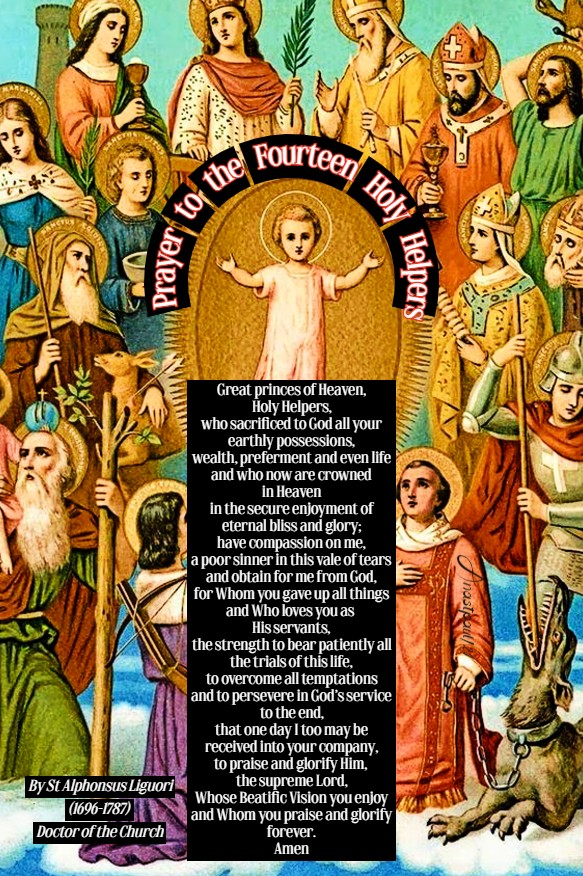
The Fourteen Holy Helpers: – Plague Saints for a time of plague!
Prayer to the Fourteen Holy Helpers By St Alphonsus Liguori (1696-1787) Doctor of the Church
Great princes of Heaven, Holy Helpers, who sacrificed to God all your earthly possessions, wealth, preferment and even life and who now are crowned in Heaven in the secure enjoyment of eternal bliss and glory; have compassion on me, a poor sinner in this vale of tears and obtain for me from God, for Whom you gave up all things and Who loves you as His servants, the strength to bear patiently all the trials of this life, to overcome all temptations and to persevere in God’s service to the end, that one day I too may be received into your company, to praise and glorify Him, the supreme Lord, Whose Beatific Vision you enjoy and Whom you praise and glorify forever. Amen
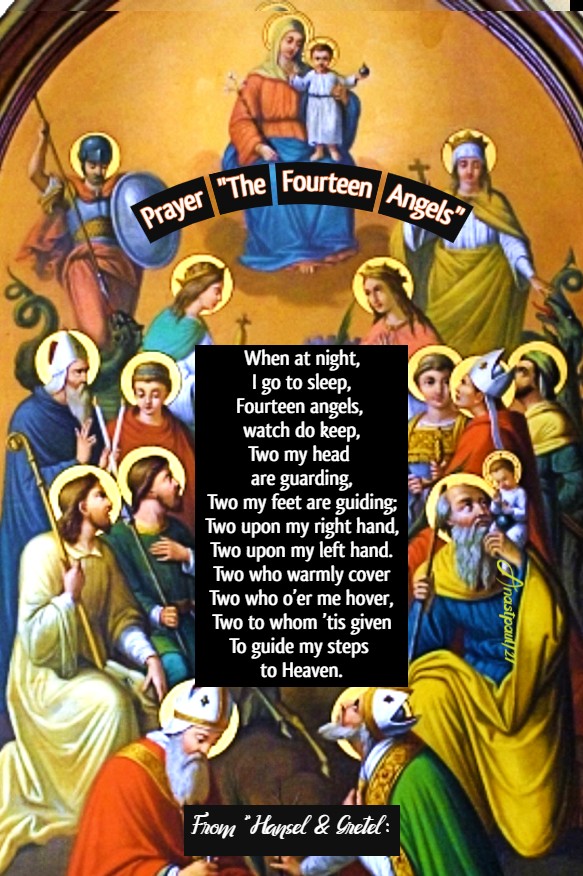
The “fourteen Angels” of the lost children’s prayer in the Composer, Engelbert Humperdinck’s (1854-1921) (not the popular Welsh singer) fairy opera, ‘Hansel and Gretel’, are the Fourteen Holy Helpers. The English words are familiar and very beautiful:
When at night, I go to sleep, Fourteen angels, watch do keep, Two my head are guarding, Two my feet are guiding; Two upon my right hand, Two upon my left hand. Two who warmly cover Two who o’er me hover, Two to whom ’tis given To guide my steps to Heaven.
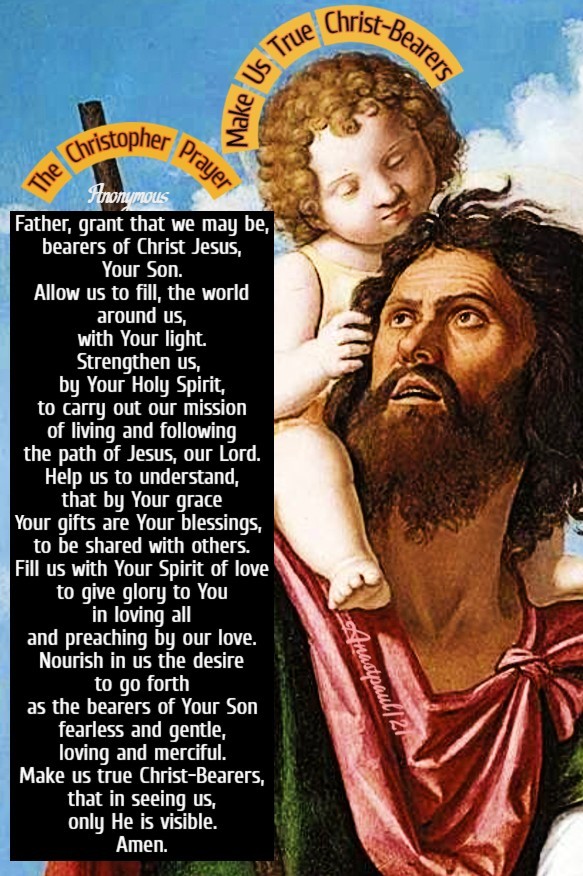
And the beloved St Christopher, probably one of the most loved Saints of all time.
The Christopher Prayer, Make Us True Christ-Bearers Anonymous
Father, grant that we may be, bearers of Christ Jesus, Your Son. Allow us to fill, the world around us, with Your light. Strengthen us, by Your Holy Spirit, to carry out our mission of living and following the path of Jesus, our Lord. Help us to understand, that by Your grace our gifts are Your blessings, to be shared with others. Fill us with Your Spirit of love to give glory to You in loving all and preaching by our love. Nourish in us the desire to go forth as the bearers of Your Son fearless and gentle, loving and merciful. Make us true Christ-Bearers, that in seeing us, only He is visible. Amen.
One Minute Reflection – 25 July – “The Month of the Precious Blood” – Saint James the Greater, Apostle and Martyr – 1 Corinthians 4:9-15, Matthew 20:20-23
“You know not what you ask. Can you drink the Chalice that I shall drink?” – Matthew 20:22
REFLECTION – “Through their mother’s mediation, the sons of Zebedee press Christ as follows in the presence of their fellow apostles: “Command that we may sit, one at your right side and one at your left” (cf. Mk 10:35f.)… Christ hastens to free them from their illusions, telling them they must be prepared to suffer insults, persecutions, even death. “You do not know what you are asking. Are you able to drink the chalice that I shall drink?”
Let no-one be surprised to see the Apostles displaying such imperfect dispositions. Wait until the Mystery of the Cross has been fulfilled and the strength of the Holy Spirit given to them. If you want to see the strength of their souls, take a look at them later and you will see them to be above all human weakness. Christ does not conceal their pettiness, so that you will be able to see what they become later by the power of the grace which will transform them! …”… St John Chrysostom (c 345-407) Father & Doctor of the Church.
PRAYER – Protect Thy people and make them holy, O Lord, so that, guarded by the help of Thy Apostle James, they may please Thee by their conduct and serve Thee with peace of mind. Through esus Christ, Thy Son our Lord, Who lives and reigns with Thee, in the unity of the Holy Ghost, God, world without end. Amen (Collect).
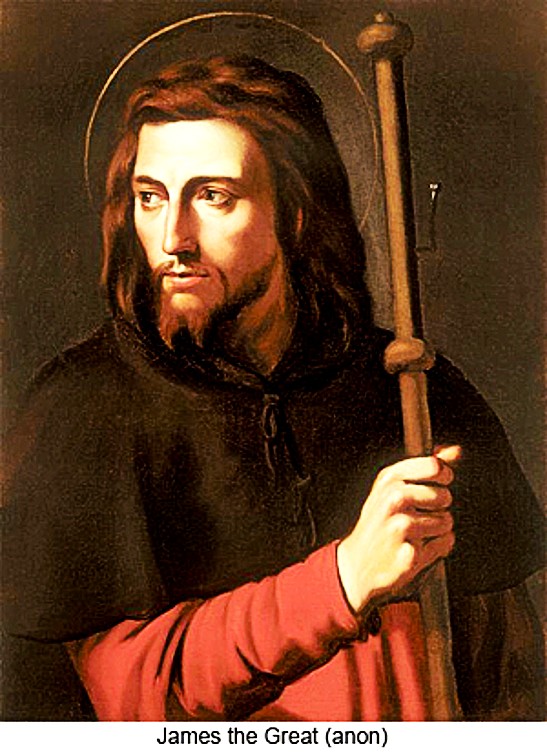
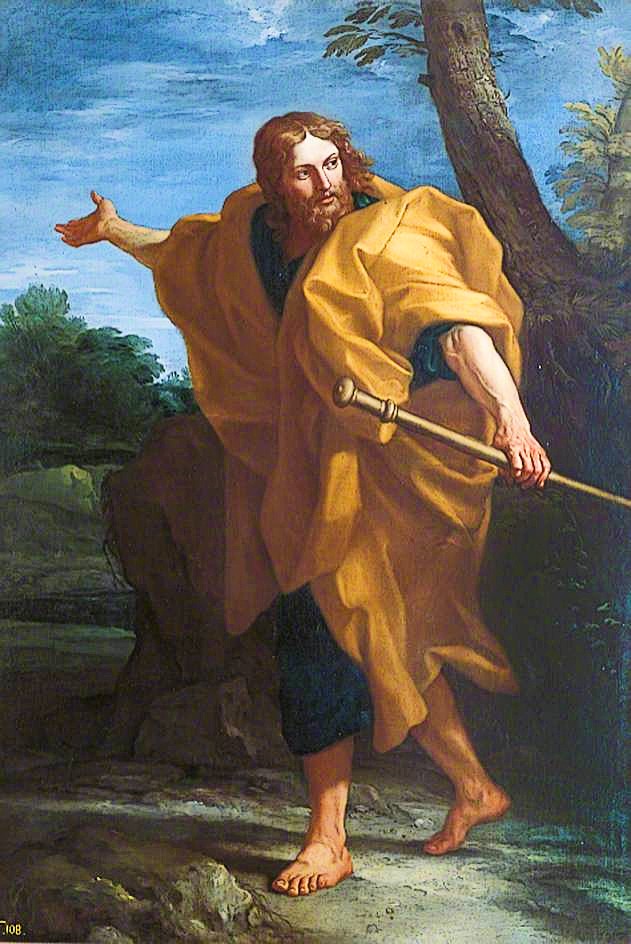
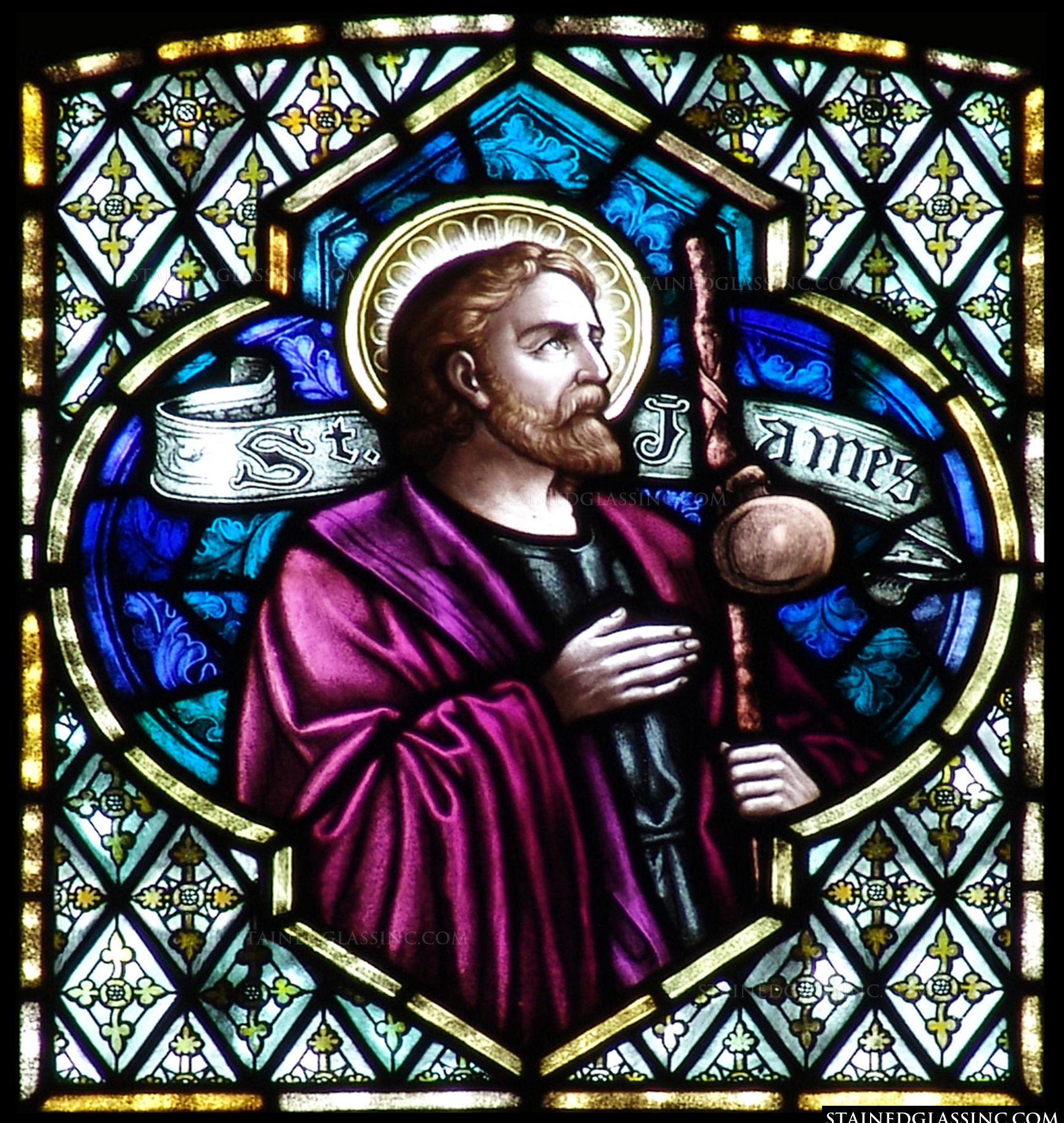
Saint of the Day – 25 July – Saint James the Greater, Apostle and Martyr, “Son of Thunder.”
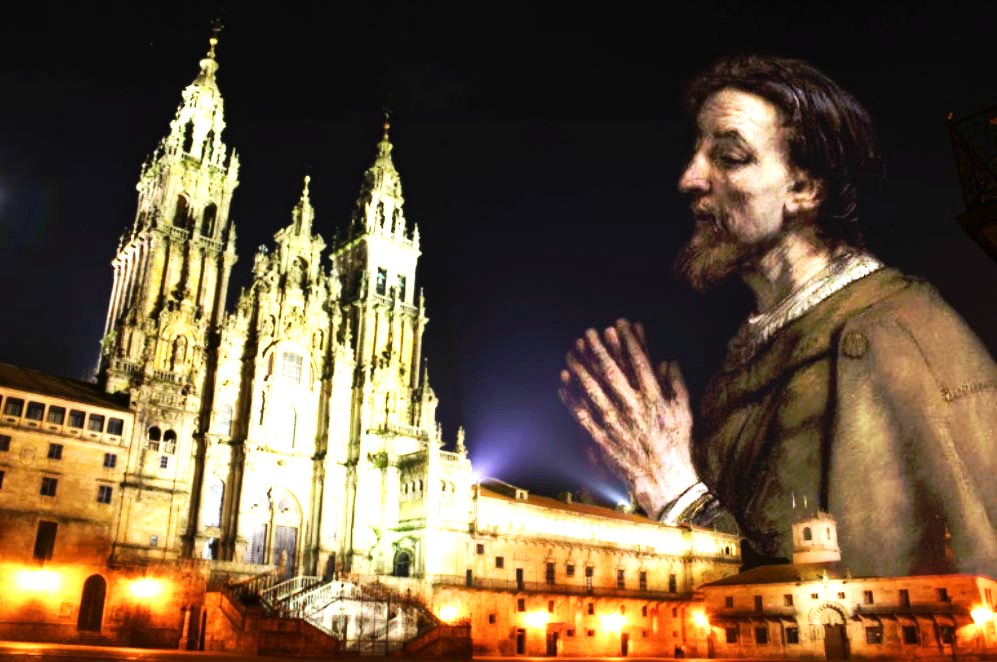
The Roman Martyrology reads: “ST JAMES the Apostle, brother of the blessed Evangelist, John, who was beheaded by Herod Agrippa, about the Feast of Easter. His sacred bones were, on this day, carried from Jerusalem to Spain and placed in the remote Province of Galicia, where they are devoutly honoured by the renowned piety of the inhabitants and the frequent concourse of Christians, who visit them through piety and in fulfilment of their vows.”
By Fr Leonard Goffiné O.Praem (1648-1719) (Excerpt from The Church’s Year)
St James, born in Galilee, son of Zebedee and Salome and a relative of the Blessed Virgin Mary, was a fisherman like his brother John and one of the first of the Apostles called by Christ. He left everything to follow the Lord and with Peter and John, was favoured by Christ, with special confidence.
He was present when Christ was glorified on Mount Thabor, when He healed Peter’s mother-in-law of the fever, raised the daughter of Jairus to life and when He suffered the unutterable terror on Mount Olivet.
He was also, with the rest of the Apostles, a witness of Christ’s Ascension, received with them the Holy Ghost on Pentecost and then preached the Gospel in Judea and the neighbourhood of Jerusalem.
He and his brother John, were called by Christ the Sons of Thunder, on account of their great zeal for the honour and Kingdom of God. When James with this thunderlike zeal continued to preach the Resurrection and the doctrine of Jesus, in Judea, the Jews were so enraged against him, that King Herod thought nothing would please them more than that they should condemn the Apostle to death. This they did, at Easter in the year of our Lord 44.
But when the he, who led him to execution, saw the firmness of his faith, he also became converted to Christ and both were, therefore ,led to death. On the way he prayed the Apostle to forgive him, who said to him: “Peace be with you!” and kissed him. Both were beheaded. This James was the first of the Apostles to shed his blood for Christ and to drink of the chalice of suffering.
His sacred remains were afterwards brought to Compostella in Spain by Abgeks. The Church celebrates his feast on the day of his translation and not on the day of his martyrdom, which, as already said, was at Easter.
PRAYER TO ST. JAMES O brave Apostle, the first to drink the Chalice of suffering after the example of Christ, Who had shed His Blood for thee, obtain, I beseech thee, the grace from Him, that I may not fear to drink of the Chalice of pain and suffering but may bear patiently, all that the hand of my God offers me, so that I may, one day, be worthy to enjo, in thy society, the joy of Heaven. Amen.
Bl Antonio of Olmedo St Bantu of Trier St Beatus of Trier St Cugat del Valles St Ebrulfus St Fagildo of Santiago St Felix of Furcona St Florentius of Furcona St Glodesind of Metz
St Mordeyren St Nissen of Wexford St Olympiad of Constantinople St Paul of Palestine
Blessed Pietro Corradini OFM (1435–1490) Priest of the Franciscan Friars Minor, Confessor, Preacher, Spiritual Director. Pietro and a great devotion to the Holy Mother and constantly taught love of her. Fr Pietro served in several leadership positions within his Order. The Beatification process commenced not too long after Fr Pietro’s death and culminated on 10 August 1760 after Pope Clement XIII issued a formal decree that approved Corradini’s local ‘cultus’ thus naming him Blessed. His Life: https://anastpaul.com/2020/07/25/saint-of-the-day-25-july-blessed-pietro-corradini-ofm-1435-1490-priest/
St Theodemir of Cordoba
Martyrs of Caesarea – 3 Saints: Three Christians Martyred together in the pesecutions of emperor Maximilian and governor Firmilian – Paul, Tea and Valentina. 309 in Caesarea, Palestine.
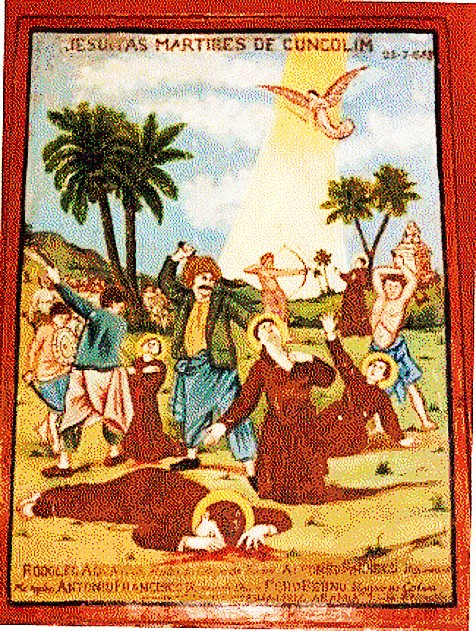
Martyrs of Cuncolim, Goa, south western India– 20 Saints: On 15 July 1583 the group met at the Church of Orlim and hiked to Cuncolim to erect a Cross and choose land for a new Church. Local anti-Christian Hindu pagans, seeing the unarmed Christians, gathered their weapons and marched on them. One of the Parishioners, a Portuguese emigre named Gonçalo Rodrigues, carried a firearm but Father Alphonsus Pacheco stopped him from using it. The Hindu pagans, numbering at least 500, then fell upon them and killed them all without mercy. They were – • Alphonsus Pacheco • Alphonsus the altar boy • Anthony Francis • Dominic of Cuncolim • Francis Aranha • Francis Rodrigues • Gonçalo Rodrigues • Paul da Costa • Peter Berno • Rudolph Acquaviva • ten other native Christian converts whose names have not come down to us They were Martyred on Monday 25 July 1583 at the village of Cuncolim, district of Salcete, territory of Goa, India. They were Beatified on 30 April 1893 by Pope Leo XIII.
St Aliprandus of Pavia St Antinogenes of Merida St Aquilina the Martyr St Arnulf of Gruyere Bl Balduino of Rieti St Boris of Kiev St Capito
St Christina Mirabilis/the Astonishing (1150-1224) Virgin, mendicant, Penitent, Mystic. St Christina the Astonishing has been recognised as a Saint since the 12th century. She was placed in the calendar of the saints by at least two bishops of the Catholic Church in two different centuries (17th & 19th Her Amazing Life: https://anastpaul.com/2019/07/24/saint-of-the-day-24-july-saint-christina-mirabilis-1150-1224/
St Cyriacus of Ziganeus St Declan of Ardmore Bl Diego Martinez Bl Donatus of Urbino
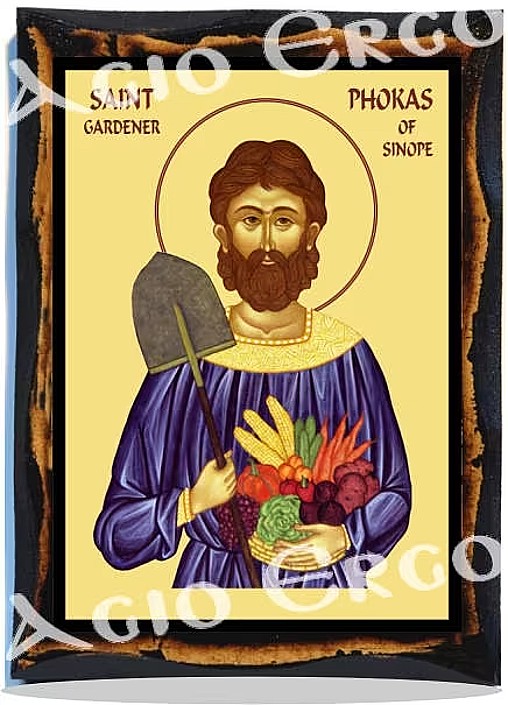
Saint of the Day – 23 July – St Phocas the Gardener (Died c 303) Layman Martyr, Apostle of the poor and needy. Died by beheading c 303 in Sinope, Pontus (in modern Turkey). Also known as – Phocas of Hovenier, Phocas of Sinop, Focas, Fokas. Patronages – against insect bites, against poisoning, against snake bites, agricultural workers, farm workers, farmers, field hands, boatmen, mariners, sailors, watermen, gardeners, husbandmen, market-gardeners.
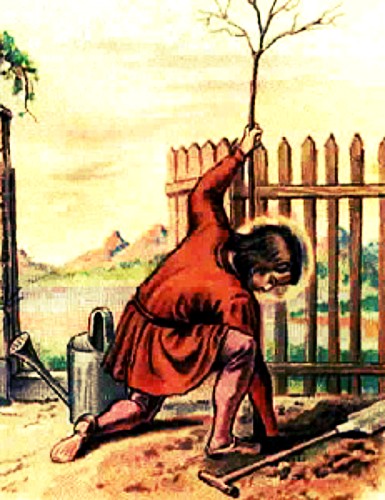
Christian gardener who lived at Sinope, in Paphiagonia, on the Black Sea and was put to death during the persecutions launched by Emperor Diocletian. Phocas is sometimes confused with Phocas of Antioch, although there is no doubt about the historical act of his martyrdom. According to tradition, he gave welcome to the Roman soldiers sent to find and execute him and, as they did not know who he was, he agreed to take them to the Phocas whom they sought. After giving them a meal and allowing them to sleep in his house, he went out and dug his own grave, using the rest of the night to prepare his soul. In the morning, he led them to his prepared grave and informed them of his identity. When they were aghast and hesitated to slay him, he encouraged them to complete their task and behead him. He is especially venerated in the East and was long considered a Patron Saint for gardeners and farmers.
Phocas dwelt near the gate of Sinope, a city of Pontus and lived by cultivating a garden, which yielded him a handsome subsistence and wherewith, plentifully to relieve the indigent and hungry. In his humble profession, he imitated the virtue of the most holy anchorites and seemed, in part restored, to the happy condition of our first parents in Eden. To prune the garden without labour and toil was their sweet employment and pleasure. Since their sin, the earth yields not its fruit but by the sweat of our brow.
But still, no labour is more useful or necessary, or more natural to man and better adapted to maintain in him, vigour of mind and health of body, than that of tillage. Nor does any other part of the universe, rival the innocent charms which a garden presents to all our senses, by the fragrancy of its flowers, by the riches of its produce and the sweetness and variety of its fruits; by the melodious concert of its musicians, by the worlds of wonders which every stem, leaf and fibre exhibit to the contemplation of the inquisitive philosopher and by that beauty and variegated lustre of colours which clothe the numberless tribes of its smallest inhabitants and adorn its shining landscapes, vying with the brightest splendour of the heavens. And in a single lily, surpassing the dazzling lustre, with which Solomon was surrounded on his throne in the midst of all his glory.
And what a field for contemplation does a garden offer to our view in every part, raising our souls to God in raptures of love and praise, stimulating us to fervour, by the fruitfulness with which it repays our labour and multiplies the seed it receives and exciting us to tears of compunction for our insensibility to God, by the barrenness with which it is changed into a frightful desert, unless subdued by assiduous toil!
Our Saint joining prayer with his labour, found in his garden itself, an instructive book and an inexhausted fund of holy meditation. His house was open to all strangers and travellers who had no lodging in the place and after having, for many years most liberally bestowed the fruit of his labour on the poor, he was found worthy also, to give his life for Christ.
Although his profession was obscure and thought lowly by the world, he was well known over the whole country, by the reputation of his charity and virtue.
Bl Juan de Luca Bl Juan de Montesinos Bl Leonard da Recanati Bl Mariano Brandi St Phocas the Gardener (Died c 303) Layman Martyr St Primitiva of Rome St Rasyphus of Macé St Rasyphus of Rome St Ravennus of Macé St Redempta of Rome St Romula of Rome St Severus of Bizye St Theophilus of Rome St Trophimus of Rome St Valerian of Cimiez
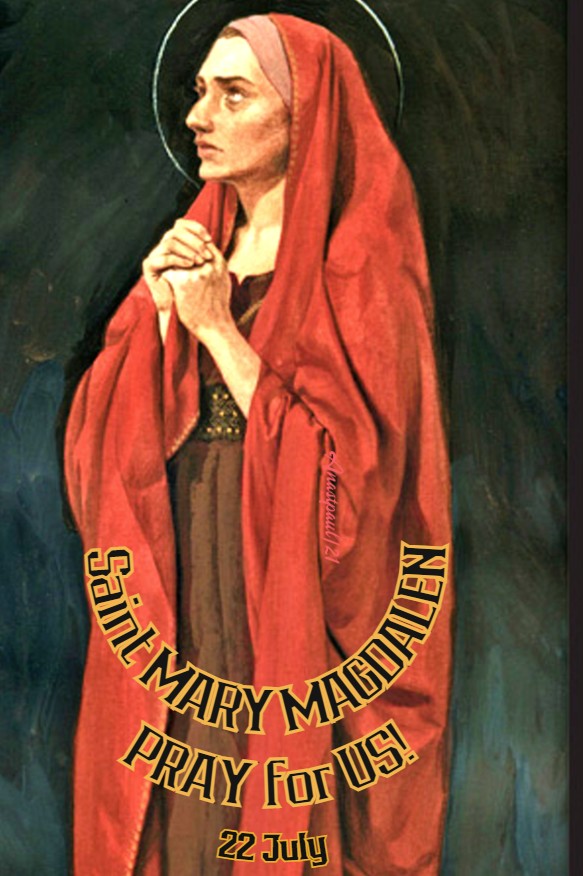
One Minute Reflection – 22 July – “The Month of the Precious Blood” – St Mary Magdalen (1st Century) Penitent – Song 3:2-5; 8:6-7, Luke 7:36-50.
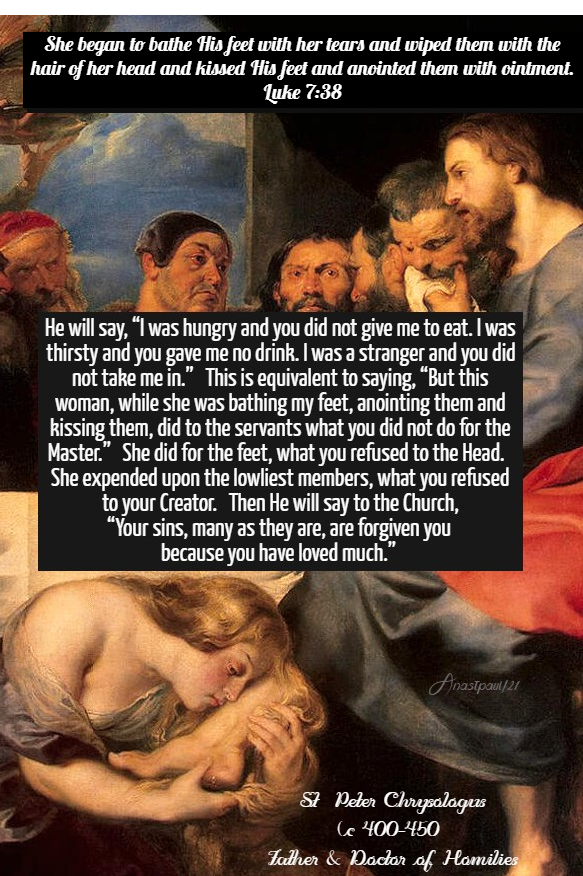
“She began to bathe His feet with her tears, and wiped them with the hair of her head and kissed is feet and anointed them with ointment.” – Luke 7:38
REFLECTION – “With her hands of good works, she holds the feet of those who preach His Kingdom. She washes them with tears of charity, kisses them with praising lips and pours out the whole ointment of mercy, until He will turn her. This means that He will come back to her and say to Simon, to the Pharisees, to those who deny, to the nation of the Jews, “I came into your house. You gave me no water for my feet.”
When will He speak these words? He will speak them when He will come in the Majesty of His Father and separate the righteous from the unrighteous, like a shepherd who separates the sheep from the goats. He will say, “I was hungry and you did not give me to eat. I was thirsty and you gave me no drink. I was a stranger and you did not take me in.” This is equivalent to saying, “But this woman, while she was bathing my feet, anointing them and kissing them, did to the servants, what you did not do for the Master.” She did for the feet, what you refused to the Head. She expended upon the lowliest members, what you refused to your Creator. Then He will say to the Church, “Your sins, many as they are, are forgiven you because you have loved much.”– St Peter Chrysologus (c 400-450) Bishop of Ravenna, Father and “Doctor of Homilies” (Sermon 95).
PRAYER – May the prayers of blessed Mary Magdalen help us, O Lord, Who was moved by her prayers, her love and peniteance, that we too may learn true repentance and sorrow for our sins..Through the same Jesus Christ, Thy Son our Lord, Who lives and reigns with Thee, in the unity of the Holy Ghost, God, world without end. Amen (Collect).
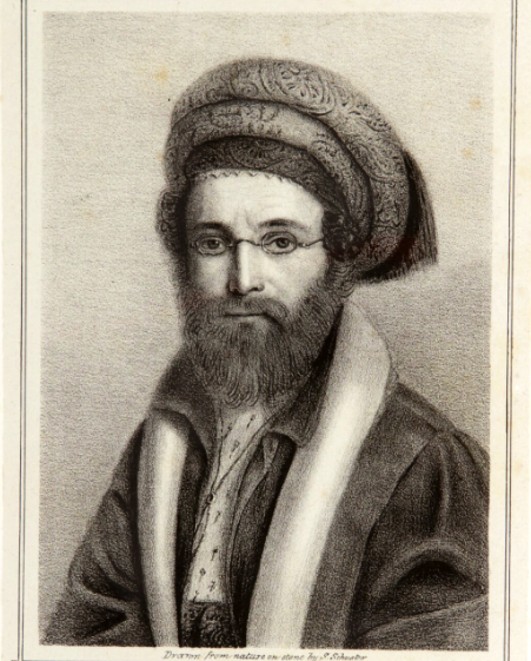
Saint of the Day – 22 July – St Joseph of Palestine (Died c 356) Layman, Convert from Judaism, a contemporary of Emperor Constantine, a Rabbinical scholar, member of the Sanhedrin and a disciple of Hillel II. Following his conversion, Emperor Constantine gave him the rank of Count, appointed him as supervisor of the Churches in Palestine and gave him permission to build Churches in the Galilee. Patronages – converts, guardians. Also known as – Count Joseph, sJoseph of Tiberias.
This is not St Joseph, of whom there are no representations in art. This is a young Rabbinical Scholar.
After the destruction of Jerusalem, the Jews erected two academies, the one at Babylon, the other at Tiberias, a City on the lake of Genesareth, rebuilt by Herod, in honour of the Emperor Tiberius. Both these schools flourished until the Saracen empire overran those countries. That of Tiberias produced the Massoretes or Massoretic doctors, so famous for the invention of the vowel points in the Hebrew tongue and their care, in preserving the genuine text of the Sacred Scriptures.
Although the Jews then retained no sort of jurisdiction or form of government, yet they chose one among their chief doctors, to whom they gave the title of patriarch or prince of the captivity. The most celebrated person who ever bore this honour among them, was Hillel, whose name is still in great veneration amongst the Jews and who was their most learned oracle and the principal founder and ornament of their academy at Tiberias. This Hillel, a few days before his death, sent for a Christian Bishop in the neighbourhood, under the character of a physician, who ordered a bath to be prepared in his chamber, as if it had been for his health and Baptised him in it. Hillel received the Divine Mysteries, and died.
Joseph, one of his assistants, called Apostoli, whose life we are writing, was witness to this secret transaction and, having always been the confidant of Hillel, had the care of his son Judas, who succeeded him in the dignity of patriarch of the Jews. Joseph found the Holy Gospels in Hillel’s treasures and read them with incredible pleasure.
The young patriarch fell into evil ways and employed magical arts, to seduce a Christian woman but the Sign of the Cross made his charms of no effect. Joseph was surprised to hear this prodigy. He seemed in a dream one night, to see Christ and to hear from His mouth these words: “I am Jesus whom thy fathers Crucified; believe in Me.”
He relished our Holy Faith more than ever,and going into Cilicia to collect the tenths (tithes) for the patriarch, he borrowed again the Holy Gospels. The Jews, already dissatisfied with his conduct, finding him with this Holy Book, dragged him to their synagogue and cruelly scourged him. They were preparing worse treatment for him, when the Bishop rescued him out of their hands. Joseph having already begun to suffer for Christ, was soon disposed to receive Baptism.
Constantine the Great became master of the East in 323. He gave Joseph the title and rank of Count, with authority to build Churches all over Palestine, wherever he should judge proper. Joseph began to raise one at Tiberias. The Jews employed many artifices to hinder the work and stopped his lime-kilns from burning by enchantments but he, making the Sign of the Cross upon a vessel of water and invoking the Name of Jesus, poured it on the kilns and the fire instantly burst forth and burned with great activity.
Count Joseph showed no less zeal against the Arians than against the Jews and both conspired together to persecute him;but he was protected by his dignity of Count, which gave him a superior command and authority. Joseph, however, when the Emperor Constantius persecuted the orthodox prelates, retired from Tiberias to the neighbouring City, Scythopolis, where, in 355, he lodged St Eusebius of Vercelli, banished by the Arians. His was the only Catholic house in that Town. He harboured many other illustrious servants of God and among the rest, St. Epiphanius, who had from his own mouth the particulars here related. Joseph was then seventy years of age. He died soon after, about the year 356. The Greeks and Latins both mention his name in their Martyrologies. St Joseph’s guardianship of holy writings and holy men led to his association with and patronage of guardians in general.
The only Marian Feast I can find for today seems to be unverified, in other words, I can find absolutely no references online relating to this invisible Shrine.There is also a Marian Title relating to the Orthodox Church which is not recognised by the Catholic Church.
St Baudry of Montfaucon St Claudius Marius Victorinus of Saussaye St Cyril of Antioch St Dabius St John Lloyd St Joseph of Palestine (Died c 356) Layman, Convert from Judaism St Lewine St Maria Wang Lishi St Meneleus of Ménat St Movean of Inis-Coosery St Pancharius of Besancon Bl Paolo de Lara
Martyrs of Marula/Massylis: – 3 Saints: Three Christians Martyred together. We know nothing else about them but the names – Ajabosus, Andrew and Elian. They were martyred in Massylis (Marula), Numidia (in modern Algeria).
Martyrs of Massilitani: A group of Christians Martyred together in northern Africa. Saint Augustine of Hippo wrote about them.
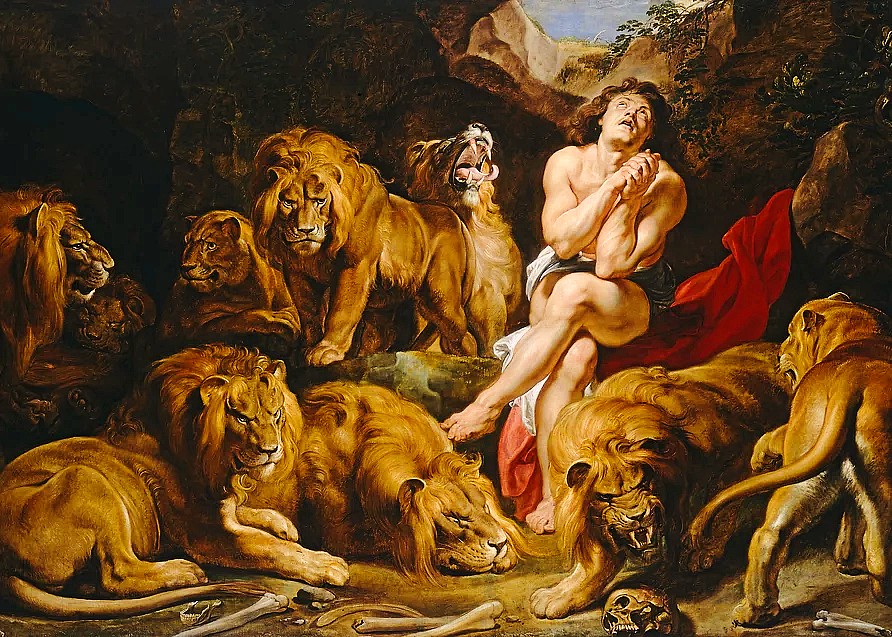
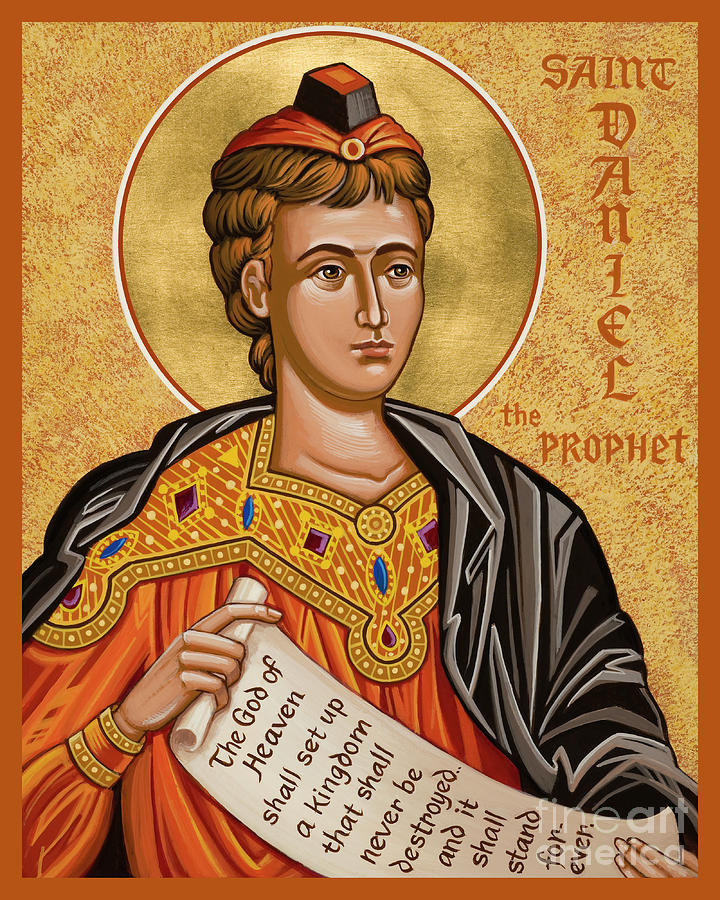
Saint of the Day – 21 July – St Daniel the Prophet (Died 5th-century BC). Daniel means ‘God is my Judge. One of the four Great Prophets in the Old Testament and the Writer of the book of Sacred Scripture which bears his name. Died 5th-century BC in Babylon of natural causes. Patronage – Ledeberg, Belgium.
Daniel was a noble Jewish youth of Jerusalem taken into captivity by Nebuchadnezzar II of Babylon, serving the king and his successors with loyalty and ability until the time of the Persian conqueror Cyrus, all the while remaining true to the God of Israel. Daniel is not a Prophet in Judaism but the rabbis regard him to be the most distinguished member of the Babylonian diaspora, unsurpassed in piety and good deeds, firm in his adherence to the Law ,despite being surrounded by enemies, who sought his ruin.
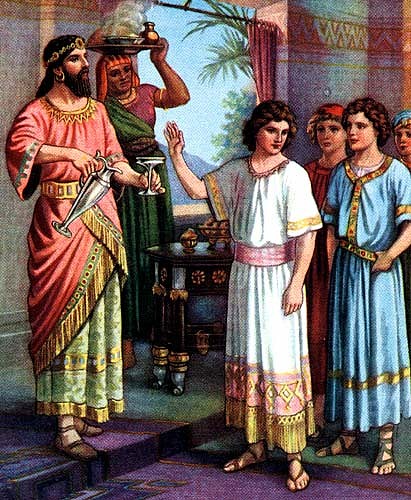
The canon of Sacred Scripture contains the Book of Daniel as part of the Old Testament. In it we hear the tale of Daniel and his three companions carried off to Babylon following the capture of the city by Nebuchadnezzar. They were to be trained in the court and are given new names. In observance of Jewish dietary law, they refuse the food and wine provided by the King.
St Daniel refusing to eat the food of the King
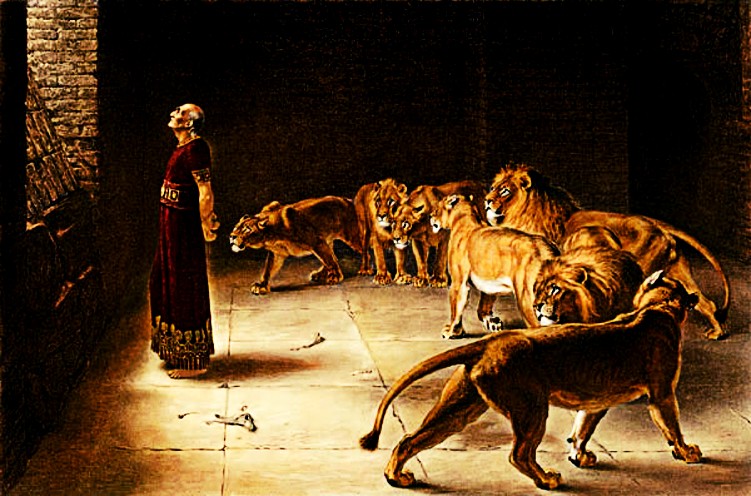
Daniel and his friends gain a reputation for great wisdom. In a number of instances Daniel is the only one who can interpret the dreams of the King, including a dream which foretells the fall of the King’s rule to the rule of the Medes and Persians. Under the new rule, Daniel is appointer to a high position; jealous rivals seek to destroy him by accusing him of worshiping God instead of the King. He is thrown into a den of lions where they assume he will be torn to pieces but he is rescued from the lions den through his trust in the Lord.
Daniel had a number of visions and in the New Testament ,in Matthew 24:15, Jesus recognises Daniel as a Prophet of God.
This statue at St. Daniel the Prophet Parish in Scottsdale depicts the Old Testament author with the lions that were used in an attempt to kill him. (Ambria Hammel/CATHOLIC SUN)
The last mention of Daniel in the Book of Daniel is in the third year of Cyrus (Daniel 10:1). Rabbinic sources suppose that he was still alive during the reign of the Persian King Ahasuer,us (better known as Artaxerxes – Babylonian Talmud, Megillah 15a, based on the Book of Esther 4, 5) but he was killed by Haman, the wicked Governor of Ahasuerus (Targum Sheini on Esther, 4, 11). The 1st century Jewish writer Josephus, reported that Daniel’s body lay in a tower in Ecbatana in Parthia, alongside the bodies of the Kings of the Medes and Persians; later Jewish authorities said he was buried in Susa and that near his house were hidden the vessels from the Temple of Solomon. Muslim sources reported that the Muslims had discovered his body, or possibly only a box containing his nerves and veins, together with a book, a jar of fat and a signet ring, engraved with the image of a man being licked by two lions. The corpse was reburied, and those who buried it decapitated it, to prevent them from revealing the spot.
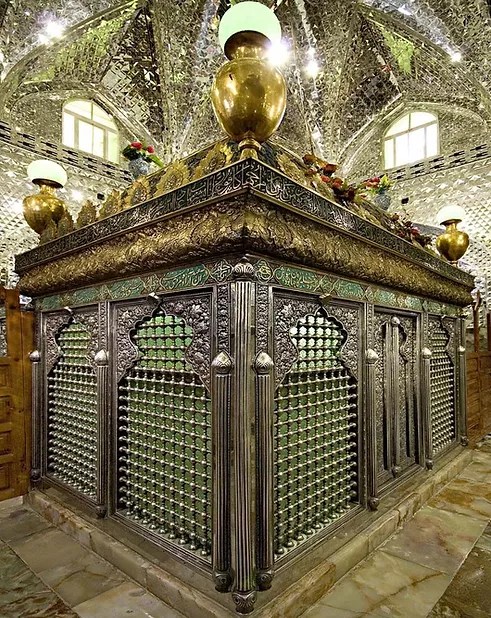
Today six cities claim Daniel’s Tomb – Babylon, Kirkuk and Muqdadiyah in Iraq, Susa and Malamir in Iran and Samarkand in Uzbekistan. The most famous is that in Susa, (Shush, in southern Iran), at a site known as Shush-e Daniyal. According to Jewish tradition. the rich and poor of the city quarrelled over possession of the body and the bier was, therefore, suspended from a chain over the centre of the river. A house of prayer open to all who believed in God, was built nearby and fishing was prohibited for a certain distance up and down the river. Fish that swam in that section of the river had heads that glinted like gold and ungodly persons who entered the sacred precinct, would miraculously drown in the river. To this day the tomb is a popular site of pilgrimage.
The Archangel Gabriel visited Daniel:
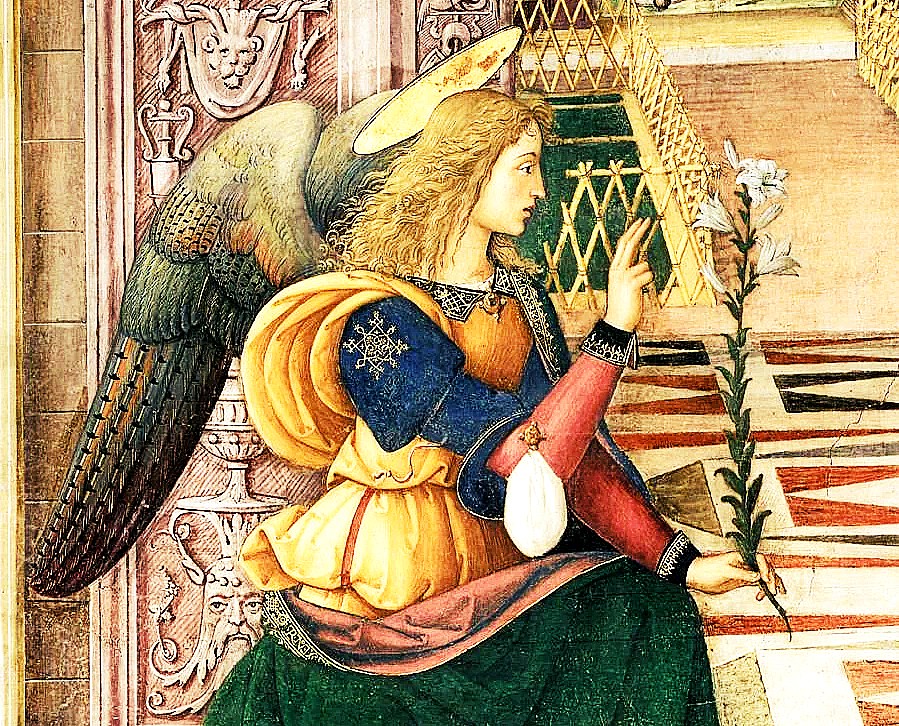
The Archangel St Gabriel, appears to the Prophet Daniel and explains his visions (Daniel 8:15–26, 9:21–27). The Gospel of Luke relates the stories of the Annunciation, in which the angel Gabriel appears to Zechariah and the Virgin Mary, foretelling the births of St John the Baptist and Jesus, (Luke 1:11–38) (The Annunciation: Luke 1:26-45, 57-60).
Daniel 7:13–14
13 “I was watching in the night visions, And behold, One like the Son of Man, Coming with the clouds of heaven! He came to the Ancient of Days, And they brought Him near before Him. 14 Then to Him was given dominion and glory and a kingdom, That all peoples, nations and languages, should serve Him. His dominion is an everlasting dominion, Which shall not pass away, And His kingdom the one, Which shall not be destroyed.”
St Daniel the Prophet (Died 5th-century BC) One of the four Great Prophets in the Old Testament and the Writer of the book of Sacred Scripture which bears his name.
St Barhadbescialas St Benignus of Moyenmoutier Bl Claudius of Avignon St Claudius of Troyes St Corona of Marceille Bl Cristóbal López de Valladolid Orea Bl Daniel Molini St Eleutherius of Marseille St Eternus of Evreaux Bl Gabriel Pergaud St Iosephus Wang Yumei St John of Edessa St John of Moyenmoutier Bl Juan de Las Varillas Bl Juan de Zambrana St Jucundinus of Troyes St Julia of Troyes St Justus of Troyes Bl Parthenius of Thessaly St Praxedes of Rome St Simeon Salus
Martyrs of Africa – 6 Saints: Six Christians who were Martyred together. We know no other details about them but the names – Emilian, Hugal, Motanus, Saphus, Stercorius and Victor. They were martyred in an unknown location in Africa, date unknown.
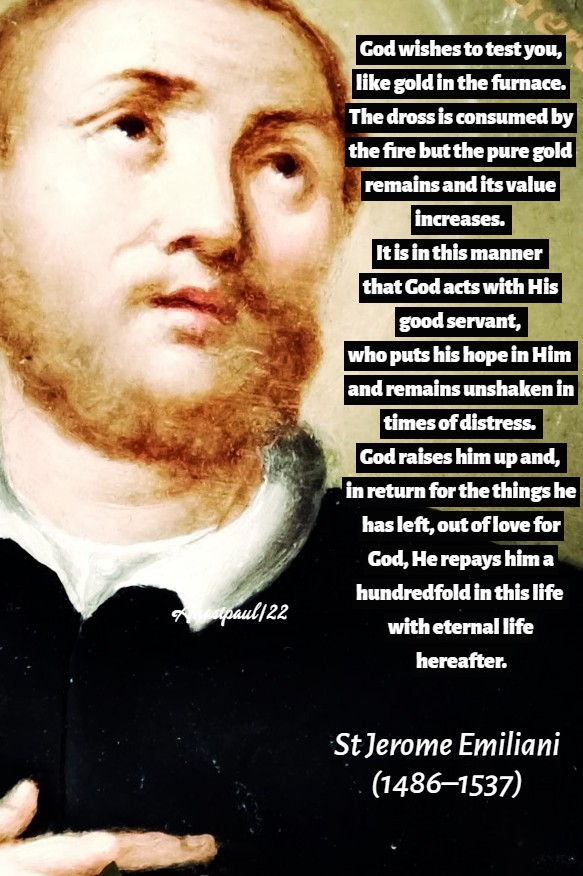
Quote/s of the Day – 20 July – “The Memorial of St Jerome Emiliani (1486–1537) Confessor – Isaias 58:7-11, Matthew 19:13-21
“God wishes to test you, like gold in the furnace. The dross is consumed by the fire but the pure gold remains and its value increases. It is in this manner that God acts with His good servant, who puts his hope in Him and remains unshaken in times of distress. God raises him up and, in return for the things he has left, out of love for God, He repays him a hundredfold in this life with eternal life hereafter.”
Our Morning Offering – 20 July – The Memorial of St Jerome Emiliani (1486–1537) Confessor
O Mary, Twice Mother of Mercy By St Jerome Emiliani (1486–1537)
O Mary, thou art twice Mother of Mercy because thou hast been made Mother of our most merciful Saviour, and, furthermore because, thou hast given to us so many signs of thy maternal care and love. Turn upon us, we beseech thee, thy glance of compassion and grant, that we may always live free from sin, which is the only impediment to receiving the fruits of the Divine Mercies. Amen.
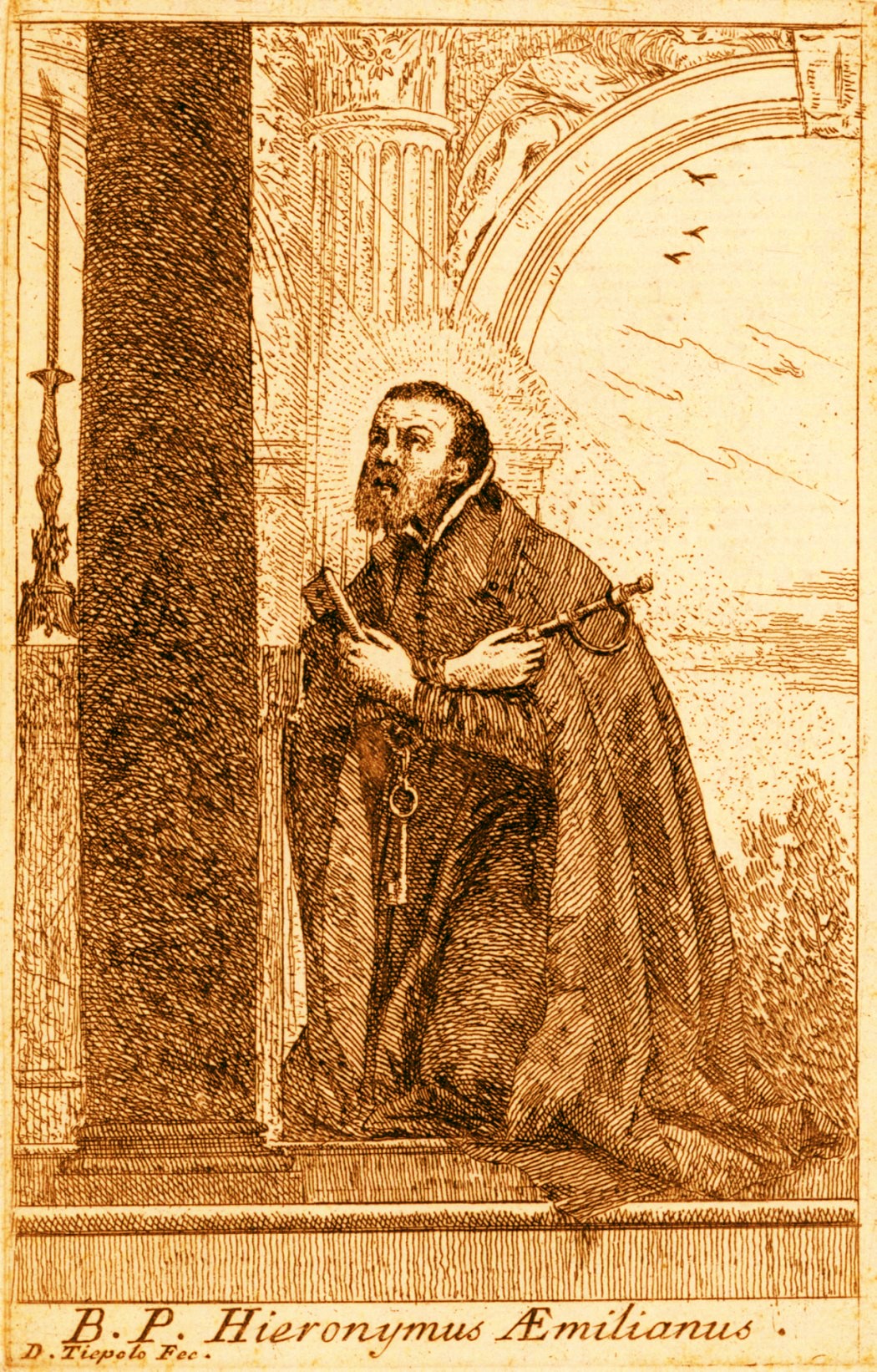
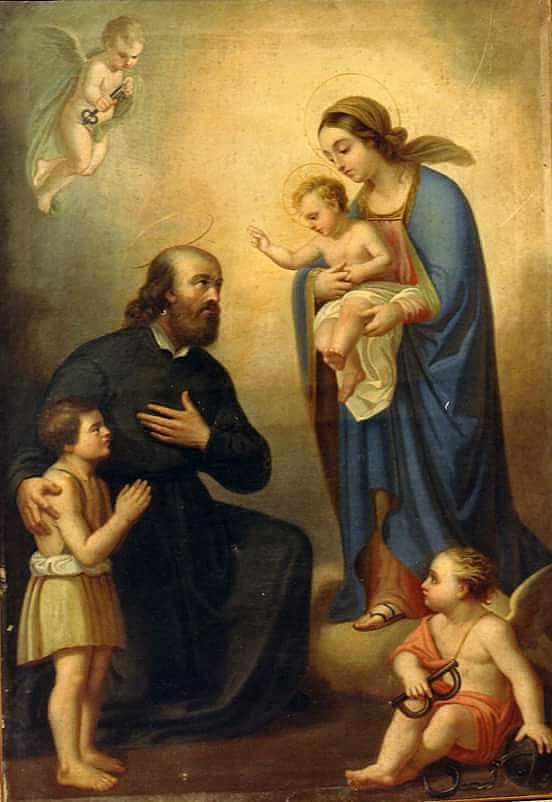
Saint of the Day – 20 July – St Jerome Emiliani (1486–1537) Confessor, Layman, Founder of the Somascan Fathers, Apostle of the poor, orphans, the sick, Catechist, Founder of countless Orphanages, Teaching institutions and Homes for converted street woman, Apostle of prayer. He was Beatified in 1747 by Pope Benedict XIV and Canonised in 1767 by Pope Clement XIII. Patronages – Orphans and Abandoned Children
Ca’Rezzonico – Cappella di Zianigo – San Girolamo Miani – Giandomenico Tiepolo
Jerome was bora at Venice, of the patrician family of the Emiliani and from his boyhood embraced a military life. At a time when the Republic was in great difficulty, he was placed in command of Castelnovo, in the territory of Quero, in the mountains of Tarviso. The fortress was taken by the enemy and Jerome was thrown, bound hand and foot, into a horrible dungeon. When he found himself thus destitute of all human aid, he prayed most earnestly to the Blessed Virgin, who mercifully came to his assistance. She loosed his bonds and led him safely through the midst of his enemies, who had possession of every road, till he was within sight of Tarviso. He entered the town; and, in testimony of the favour he had received, he hung up at the Altar of our Lady, to whose service he had vowed himself, the manacles, shackles and chains which he had brought with him.
On his return to Venice he gave himself with the utmost zeal to exercises of piety. His charity towards the poor was wonderful but he was particularly moved to pity, for the orphan children who wandered poor and dirty about the town. He received them into houses which he hired, where he fed them at his own expense and trained them to lead Christian lives.
At this time Blessed Cajetan and Peter Caraffa, who was afterwards Paul IV., disembarked at Venice. They commended Jerome’s spirit and his new institution for gathering orphans together. They also introduced him into the hospital for incurables, where he would be able to devote himself with equal charity to the education of orphans and to the service of the sick. Soon, at their suggestion, he crossed over to the Continent and founded orphanages, first at Brescia, then at Bergamo and Como. At Bergamo his zeal was specially prolific, for there, besides two orphanages, one for boys and one for girls, he opened a house, an unprecedented thing in those parts, for the reception of fallen women, who had been converted.
Finally he took up his abode at Somascha, a small village in the territory of Bergamo, near to the Venetian border and this he made his headquarters; here, too, he definitely established his Congregation, which, for this reason, received the name of Somasques. In course of time it spread and increased and, for the greater benefit of the Christian Republic, it undertook, besides the ruling and guiding of orphans and the taking care of Sacred buildings, the education, both secular and moral, of young men in Colleges, Academies and Seminaries.
Somasques. Italy
Pius V. enrolled it among religious Orders and other Roman Pontiffs have honoured it with privileges. Entirely devoted to his work of rescuing orphans, Jerome journeyed to Milan and Pavia and in both Cities, he collected numbers of children and provided them, through the assistance given him by noble personages, with a home, food, clothing and education. He returned to Somascha and, making himself all to all, he refused no labour which he saw might turn to the good of his neighbour. He associated himself with the peasants scattered over the fields and while helping them, with their work of harvesting, he would explain to them the mysteries of faith. He used to take care of children with the greatest patience, even going so far as to cleanse their heads and he dressed the corrupt wounds of the village folk, with such success, that it was thought he had received the gift of healing. In 1928 Pope Pius XI proclaimed St Jerome as the Universal Heavenly Patron of Orphans and abandoned children.
On the mountain which overhangs Somascha, he found a cave in which he hid himself and there, scourging himself, spending whole days fasting, passing the greater part of the night in prayer and snatching only a short sleep on the bare rock, he expiated his own sins and those of others. In the interior of this grotto, water trickles from the dry rock, obtained, as constant tradition says, by the prayers of the Servant of God. It still flows, even to the present day and being taken into different countries, it often gives health to the sick.
At length, when a contagious distemper was spreading over the whole valley and he was serving the sick and carrying the dead to the grave, on his own shoulders, he caught the infection and died at the age of fifty-six. His precious death, which he had foretold a short time before, occurred in the year 1537. He was illustrious both in life and death for many miracles. Benedict XIV. enrolled him among the Blessed,and Clement XIII. solemnly inscribed his name on the catalogue of the Saints.
Bl Anne Cartier St Ansegisus St Aurelius of Carthage St Bernward of Hildesheim St Cassian of Saint Saba St Elijah the Prophet
St Elswith St Frumentius of Ethiopia
Blessed Gregory Lopez (1542-1596) “The Mystery Man” – Hermit, Spiritual Advisor, Writer. Around 1585, word of a “Mystery Man” began to leak into Mexico City, a strange hermit who lived out in the lonely valley of Guesteca, who walked miles to go to Mass, lived totally subject to “Lady Poverty” and had travelled from the Shrine of Our Lady of Guadalupe in Spain (which dates from 712), to her Shrine in Mexico (which dates from 1531). Biography: https://anastpaul.com/2018/07/20/saint-of-the-day-20-july-blessed-gregory-lopez-1542-1596/
St Joseph Barsabbas the Just (1st Century) Disciple of Jesus, Bishop, Martyr. The Roman Martyrology states today: “The birthday of the blessed Joseph, surnamed the Just, whom the Apostles selected with the blessed Matthias, for the Apostleshop in the place of the traitor, Judas. The lot having fallen upon Matthias, Joseph, notwithstanding, continued to preach and advance in virtue and after having sustained from the Jews, many persecutions for the Faith of Christ, happoily ended his life in Judea.” His Life and Death: https://anastpaul.com/2021/07/20/saint-of-the-day-20-july-saint-joseph-barsabbas-the-just-1st-century-disciple-of-jesus/
St Mère St Paul of Saint Zoilus St Rorice of Limoges St Severa of Oehren St Severa of Saint Gemma St Wulmar
Martyrs of Corinth – 22 Saints: 22 Christians who were Martyred together. We know nothing else about them but the names – • Appia • Calorus • Cassius • Celsus • Cyriacus • Donatus • Emilis • Felix • Fructus • Magnus • Maximus • Nestita • Partinus • Pasterus • Paul • Romanus • Spretus • Tertius • Theodolus • Ueratia • Valerian • Victor. They were martyred in Corinth, Greece.
Martyrs of Damascus – 16 Saints: 16 Christians who were Martyred together. We know the names of six of then, but no details about any of them – Cassia, Julian, Macrobius, Maximus, Paul and Sabinus. They were martyred in Damascus, Syria, date unknown.























 AnaStpaul
You must be logged in to post a comment.