One Minute Reflection – 14 November – St Josaphat Kuncewicz OSBM (1584-1623) Confessor, Archbishop, Martyr – Hebrews 5:1-6, John 10:11-16 – Scripture search here: https://www.drbo.org/
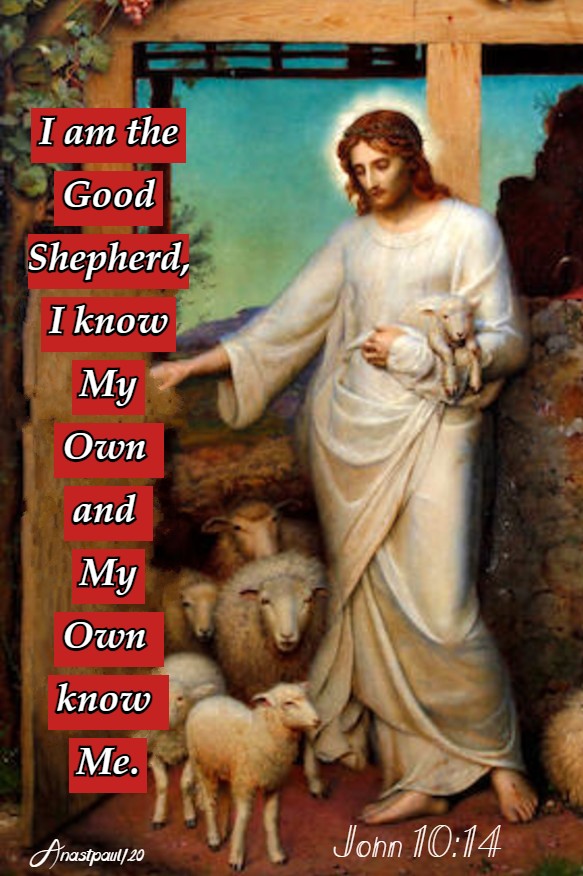
“I am the good shepherd and I know My Own and My Own know Me.”- John 10:14
REFLECTION – “He shows in what manner a shepherd may be proved good and, He teaches that, he must be prepared to give up his life, fighting in defence of his sheep, which was fulfilled in Christ. For man has departed from the love of God and fallen into sin and because of this was, I say, excluded from the divine abode of paradise. And when he was weakened by that disaster, he yielded to the devil tempting him to sin and death, following that sin, he became the prey of fierce and ravenous wolves. But after Christ was announced as the True Shepherd of all men, He laid down His life for us (1 John 3:16), fighting for us against that pack of inhuman beasts. He bore the Cross for us that by His own death, He might destroy death. He was condemned for us that He might deliver all of us, from the sentence of punishment: the tyranny of sin being overthrown by our faith: fastening to the Cross, the decree that stood against us, as it is written (Colossians 2:14).
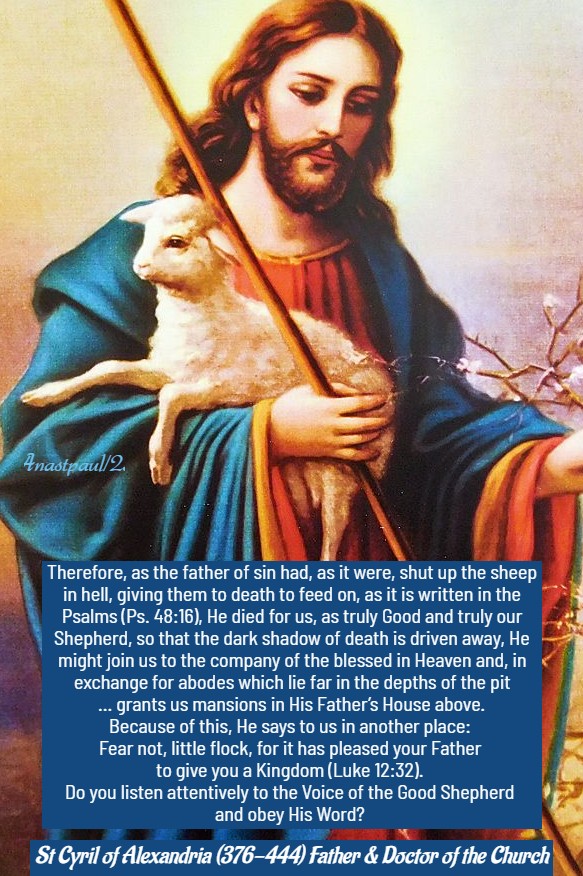
Therefore, as the father of sin had, as it were, shut up the sheep in hell, giving them to death to feed on, as it is written in the Psalms (Ps. Xlviii.16), He died for us, as truly Good and truly our Shepherd, so that the dark shadow of death is driven away, He might join us to the company of the blessed in Heaven and, in exchange for abodes, which lie far in the depths of the pit …grants us mansions in His Father’s House above. Because of this, He says to us in another place: Fear not, little flock, for it has pleased your Father to give you a Kingdom (Luke 12:32). Do you listen attentively to the Voice of the Good Shepherd and obey His Word? – ” – St Cyril of Alexander (376-444) Known as “The Pillar of Faith” Archbishop of Alexandria, Father and Doctor of the Church. (Commentary on the Good Shepherd).
PRAYER – Arouse in Thy Church, O Lord, the spirit with which blessed Josaphat, Thy Martyr and Bishop, was filled, when he laid down his life for his flock; so that, by his intercession, we, also moved and strengthened by the same spirit, may not fear to lay down our lives for our brethren. Through Jesus Christ, Thy Son our Lord, Who lives and reigns with Thee, in the unity of the Holy Ghost, God, world without end. Amen (Collect).
Saint of the Day – 14 November – Saint Siard OPraem (Died 1230) Abbot. Siard of Friesland in the Netherlands, was a holy Abbot of the Norbertine Abbey in Mariëngaard by Hallum in Friesland. He was a powerful and hardworking Administrator, abiding strictly by the Rule of the Order, Apostle of the poor and needy, a holy Abbot of deep and mystical piety and prayer, on occasion he was seen in ecstasy, Peace-maker. Patronage – against blindness, bodily ailments.
He was born to a noble Frisian family in the shadow of the Abbey of Mariëngaard and there received the white habit at the hands of St Frederick (c 780-838). During his first twenty years in the Abbey, Siard practised great penances and mortification and proved a model of edification for the brethren, to such an extent that Abbot John appointed Siard his successor on his death-bed.
Young St Siard kneeling before the Madonna and Child with St Frederick on the right standing
As Abbot his life was particularly marked by its austerity and benevolence.Nothing in his daily life distinguished him from his confreres. He wore the same habit, ate at the same table and slept in the same dormitory. On account of his exceptional humility, he resolutely refused everything that was not strictly necessary. He was a good administrator who governed his Monastery well, both in spiritual and material matters. He laboured zealously with his Monks, particularly in the fields harvesting wheat. He would lead the confreres in the singing of Psalms during harvest time. He was extremely open to those who sought his advice and ensured that the Abbey became known as a place of refuge throughout the region.
As a model of perfection, Siard had also given Blessed Dodo of Haskerland his Norbertine education. He showed a true conciliatory spirit, settling disputes quickly and with the utmost gentleness and understanding. Furthermore, the Saint extended the lands of the Abbey and guided the constructios of various additions to the buildings. The apostolic spirit of the Order thrived at Mariëngaarde under his leadership. Whenever Siard went on a journey, he took along a large basket full of bread and other foods that he could distribute among the poor. Because of this he is usually depicted with a basket at his feet.
Once on a journey, the holy Abbot came across a noisy celebration of music and dance. He stopped and turned to his brothers saying, “Just imagine what songs of joy the angel choirs must sing when they celebrate the conversion of a single sinner.” He urged three things upon the confreres who had to leave the Monastery on a journey – a joyous departure, a peaceful sojourn and a happy return. Known also for his miraculous cures of the sick and ailing, the Monastery began to attract many in search of the alleviation of their physical illnesses, after Siard cured a man of blindness.
Siard had a special devotion to Martha and Mary. He looked to Martha, as an example for his care of the confreres and to Mary, as a reminder of the necessity of listening to Christ, in prayer and meditation. On occasion, he would fall into ecstasy during prayer and hear the heavenly music of the angels.
Naturally the austhere life which Siard had implemented, was not popular with all of the Canons and,, in 1290, one of their number attempted to murder the Abbot. His loud cries brought the aid of the confreres and he escaped with only minor injuries.
He had been Abbot for thirty six years when he died on 14 November 1230. Numerous faithful were granted special favours by God, at his grave. After the destruction of Mariëngaarde by the Calvinists in 1578, his earthly remains were rescued by a Frieslanden nobleman, Siard of Helsema, who brought them to Hildesheim. In 1608 his Relics were divided and placed in two separate Reliquaries. In 1617, one of these was brought to the Abbey of St Feuillin du Roeulz. After the suppression of this Abbey during the French Revolution, the Relics were taken to the Church at Strépy. In 1938 Prelate Bauwens brought them to the Norbertine Abbey of Leffe. The other Reliquary was brought to Tongerlo in 1617, where ever since the people have held St Siard in great honour and celebrated his Feast each year, with great solemnity. A part of the Relic of Siard’s head found a home in the Generalate House in Rome, until 2000 when it was transferred to the Abbey of Windberg.
The cult of St Siard was confirmed by Pope Benedict XIII on 22 January and 8 March in 1728.
O God, Who made Thy Saints to obey the Gospel as an example for many, grant, we beseech Thee, that we may imitate the cheerful goodness and devout piety of the blessed Abbot Siard. We ask this through our Lord Jesus Christ, Thy Son, Who lives and reigns with Thee in the unity of the Holy Ghost, One God forever and ever. Amen.
All Saints of the Carmelite Order: On this day, the Carmelite Family celebrates the memory of all its holy men and women, those known and those unknown, those living on Earth and those living in Heaven, who reflect the glory of God.
St Joseph Maria Pignatelli SJ (1737 – 1811) Priest of the Society of Jesus known as “The Restorer of the Society of Jesus” and “The Second Founder of the Society of Jesus” following the suppression of the Society of Jesus by Pope Clement XIV in 1773. He was Beatified on 21 May 1933 by Pope Pius XI and was Canonised on 12 June 1954 by Venerable Pope Pius XII. His Life: https://anastpaul.com/2019/11/14/saint-of-the-day-14-november-saint-joseph-maria-pignatelli-sj-1737-1811/
St Jucundus of Bologna
St Laurence O’Toole/Lorcán Ua Tuathail (c 1128 – 1180) Archbishop of Dublin, Abbot, Reformer, Mediator, Preacher, Apostle of Charity, Papal Legate to Ireland, he established new Churches and Monasteries. Due to the great number of miracles that rapidly occurred either at his tomb or through his intercession, Lorcán was canonised only 45 years after his death in 1225 by Pope Honorius III. Biography: https://anastpaul.com/2018/11/14/saint-of-the-day-14-november-st-laurence-otoole-c-1128-1180/
St Modanic St Pierre of Narbonne St Ruf of Avignon St Serapion of Alexandria
St Serapion of Algiers OdeM (c 1179–1240) Mercedarian Priest and Martyr, Soldier and Crusader. The Roman Martyrology states today: “At Algiers in Africa, the blessed Serapion, of the Order of Our Blessed Lady of Ransom, for the Redemption of the faithful in captivity and the preaching of the Christian Faith. He was the first of his Order to deserve the Palm of Martyrdom by being crucified and cut to pieces.” On 14 July 1728, a decree was issued confirming his immemorial cult. he was Canonised on 14 April 1728 by Pope Benedict XIII and on 24 August 1743, he was included in the Roman Martyrology. His Life and Death: https://anastpaul.com/2021/11/14/saint-of-the-day-14-november-saint-serapion-of-algiers-odem-c-1179-1240-martyr/
St Siard OPraem (Died 1230) Abbot of the Premonstratensian Order or the “Norbertines.” St Venerando the Centurian St Venerandus of Troyes
Martyrs of Emesa: Group of Christian women tortured and executed for their faith in the persecutions of the Arab chieftain Mady. They died in Emesa (modern Homs, Syria).
Martyrs of Heraclea – (3 Saints): Group of Christians murdered together for their faith. The only details we have are three of their names – Clementinus, Philomenus and Theodotus. They were Martyred in Heraclea, Thrace.
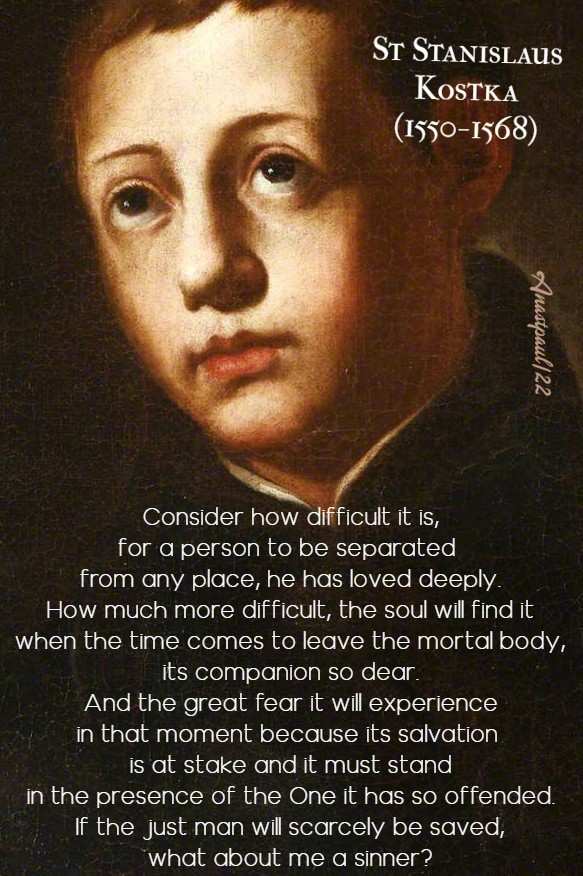
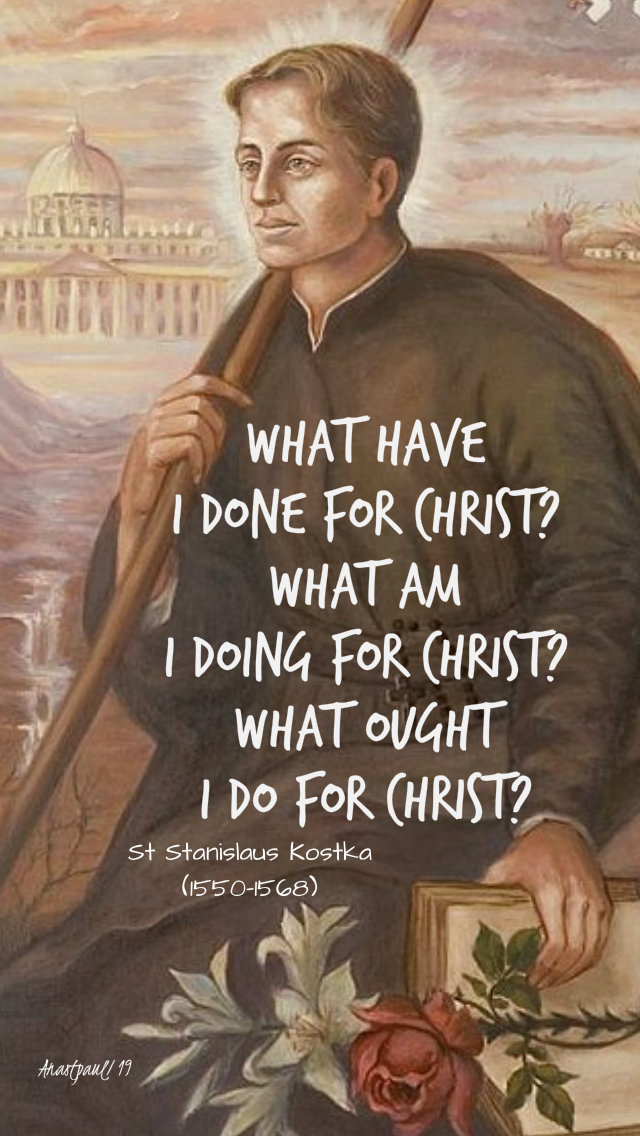
Quote/s of the Day – 13 November – St Stanislaus Kostka SJ (1550-1568) Jesuit Novice
“Consider how difficult it is, for a person to be separated from any place, he has loved deeply. How much more difficult, the soul will find it when the time comes to leave the mortal body, its companion so dear. And the great fear it will experience in that moment because its salvation is at stake and it must stand in the presence of the One it has so offended. If the just man will scarcely be saved, what about me a sinner?”
“What have I done for Christ? What am I doing for Christ? What ought I do for Christ?”
Saint of the Day – 13 November – Blessed Leone of Assisi OFM (Died 1271) Priest and Friar of the Friars Minor of St Francis, Confessor, Secretary and Companion of St Francis, commonly known as “Brother Leo.” Died at Assisi, on15 November, 1271. His date and place of birth is uncertain but is believed to have been in Assisi and not in Viterbo, as some writers have asserted.
Although not one of the original twelve companions of St Francis, Leo was one of the first to join him after the approbation of the first Rule of the Friars Minor (1209-1210) and perhaps was already a Priest. In the course of time, he became the Confessor and Secretary of the Saint, and from about 1220, o the time of Francis’ death, Leo was his constant companion.
Leo was with the “Poverello” when the latter retired to Fonte Colombo near Rieti in 1223 to re-write the Rule of the Order and he accompanied him on his subsequent journey to Rome, to seek its approval. During the following year. Leo was with the Saint on Mount La Verna, when Francis received the Stigmata. Francis called him “Frate Pecorello di Dio – Little poor one of God” because of Leo’s simplicity and tenderness. Leo nursed his master during his last illness.
Leo had entered deeply into the bitter disappointments experienced by the Saint during the last few years of his life and soon after St Francis’s death, he came into conflict with those whom he considered traitors to the Poverello and his ideal of poverty.
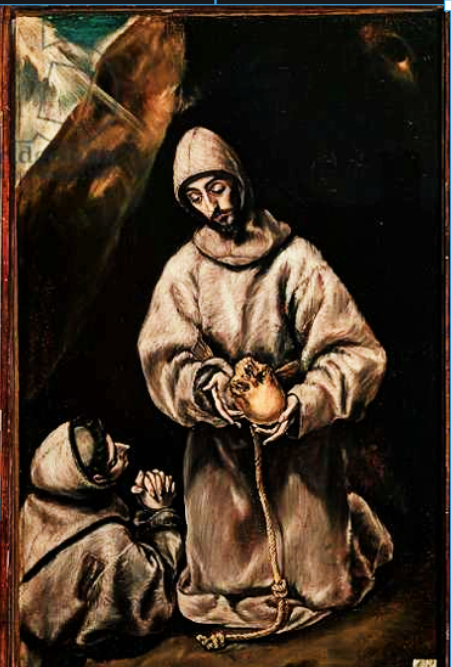
St Francis and Bl Leone contemplating morality by El Greco
After Francis’s death Leo took a leading role in the opposition to Elias of Cortona. Having protested against the collection of money for the erection of the Basilica of San Francesco, it was Leo who broke in pieces the marble box which Elias had set up for offerings, for the completion of the Basilica at Assisi. For this, Elias had him scourged and this outrage, on St Francis’s dearest disciple, consolidated the opposition to Elias. Leo was the leader in the early stages of the struggle in the Order for the maintenance of St Francis’ ideas on strict poverty.
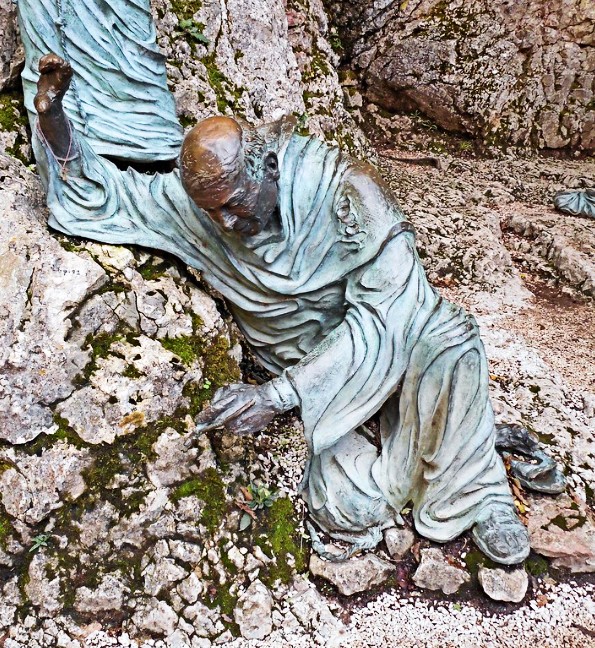
Friar Leone (Detail) – “Saint Francis, Friar Leone and Friar Ginepro admire the sky” – modern bronze statues by Fiorenzo Bacci – “Eremo delle Carceri” at Assisi
He retired , thereafter, to a hermitage of the Order. Leo assisted at Saint Clare’s deathbed in 1253. After suffering many persecutions, by the dominant party in the Order, he died at the Portiuncula, in extreme old age and his remains are buried in the Basilica of St Francis in Assisi.
Much that is known concerning him was collected by Paul Sabatier in the “Introduction” to the Speculum perfectionis (The Mirror of Perfection). It was likely compiled after his death, based on stories that he told and in his writings.
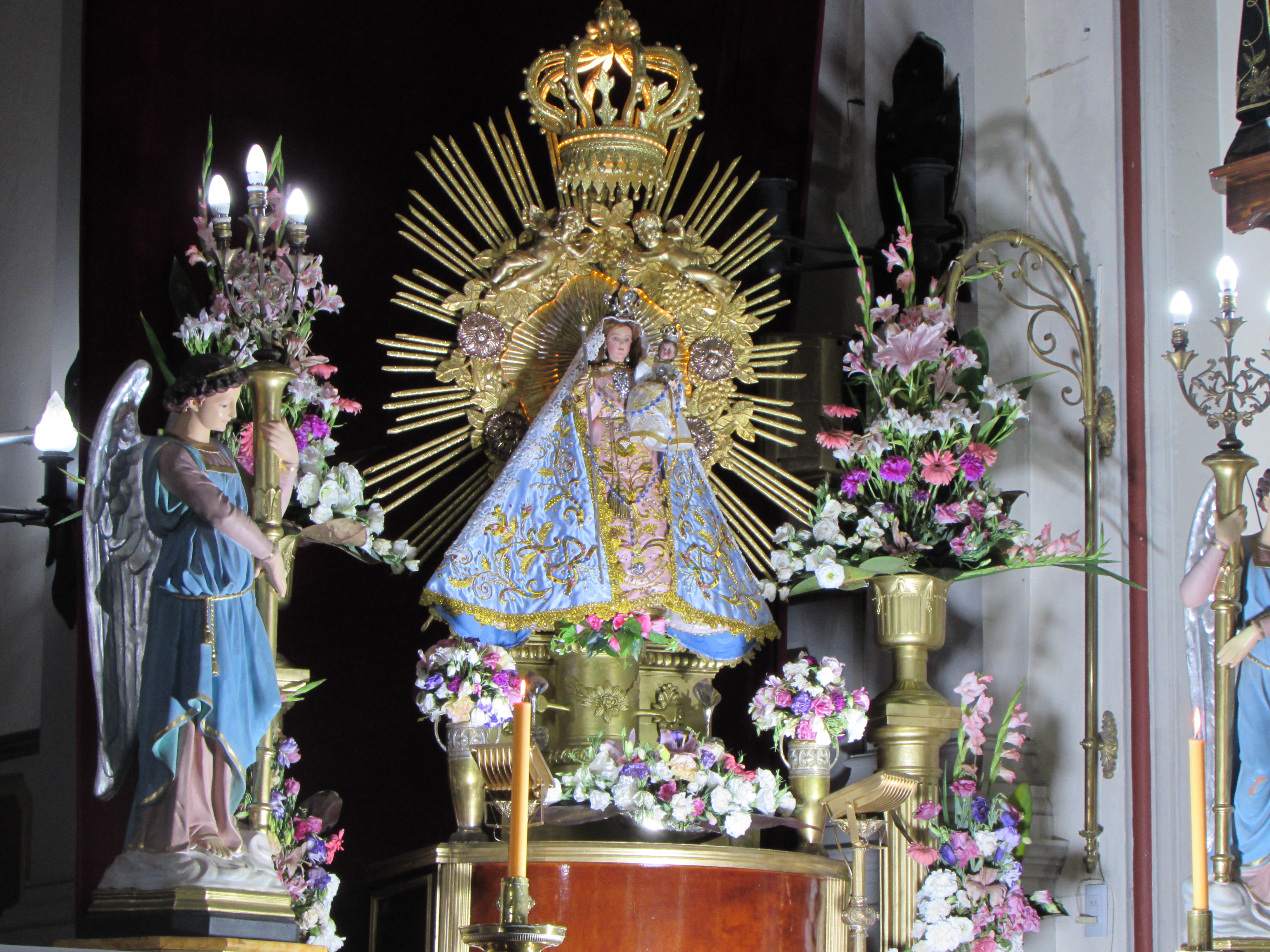
Fiesta del Patronato de Nuestra Señora / Feast of the Patronage of Our Lady (1679):
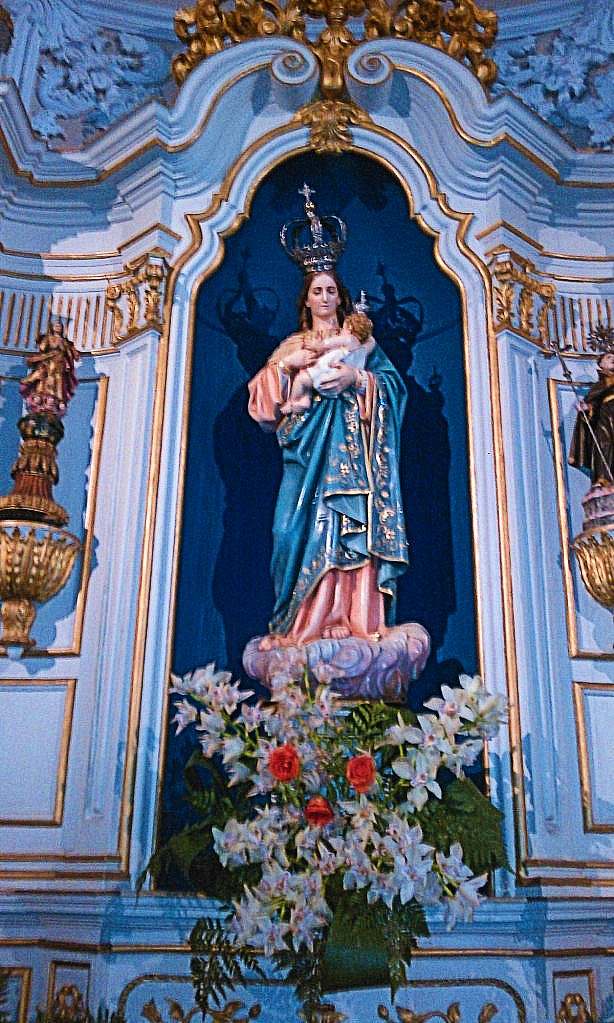
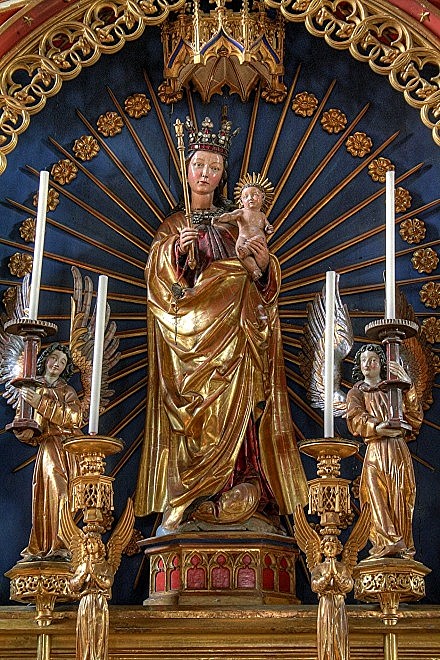
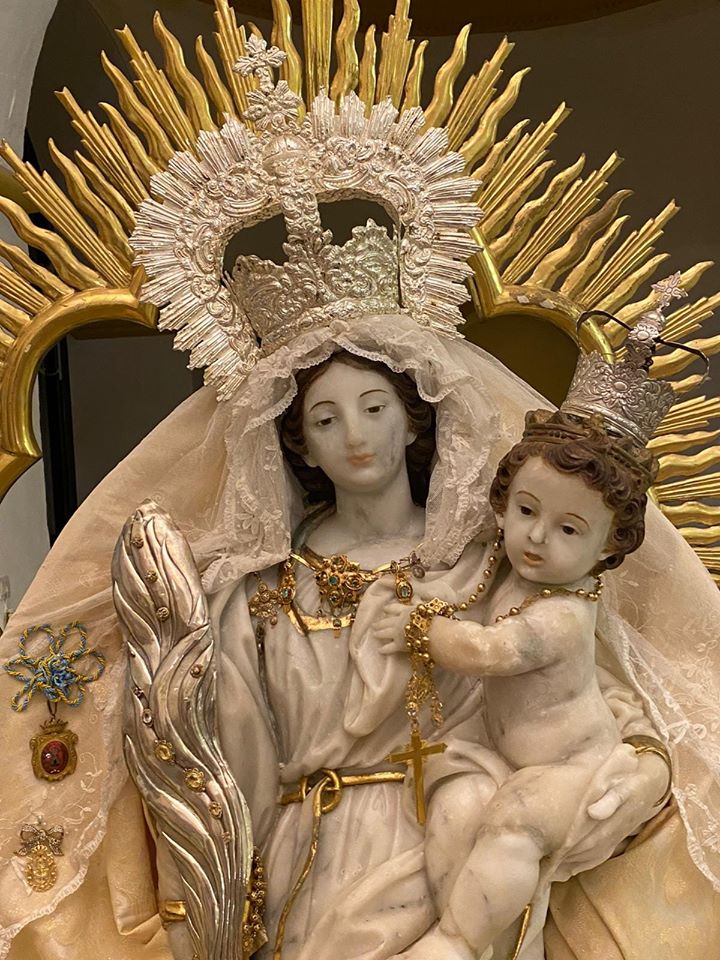
Statue of Our Lady in Barcelona Cathedral
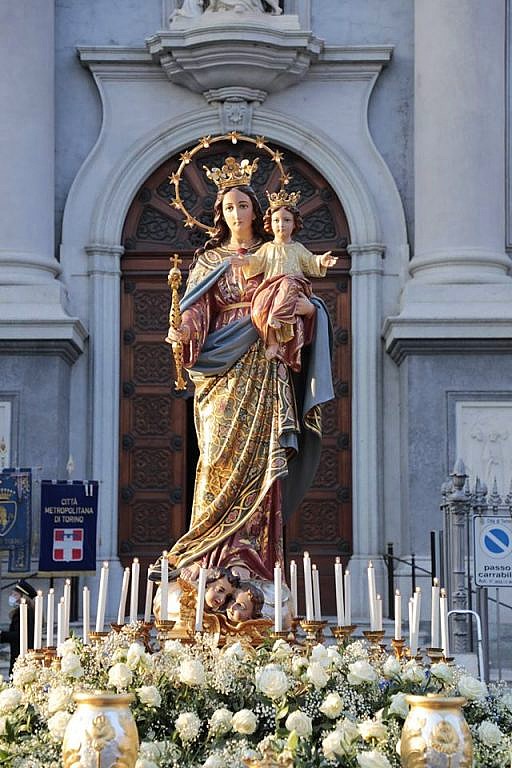
This Feast was first permitted by Decree of the Sacred Congregation of Rites, on 6 May, 1679, for all the Provinces of Spain, in memory of the victories obtained over the Saracens, heretics and other enemies, from the sixth century to the reign of Philip IV. Pope Benedict XII ordered it to be kept in the Papal States on the third Sunday of November. To other places it is granted, on request, for a Sunday in November, to be designated by the ordinary. The Office is taken entirely from the Common of the Blessed Virgin and the Mass is the “Salve sancta parens”. In many places the Feast of the Patronage of Our Lady, is held with an additional title of Queen of All Saints, of Mercy, Mother of Graces.
St Didacus de Alcalá de Henares) OFM (c 1400-1463) Confessor, Lay Brother of the Order of Friars Minor, Hermit, Mystic. Months passed before it was possible to bury Brother Didacus, so great was the number of people who came to venerate his remains. Not only did his body remain incorrupt but it diffused a pleasant odour. After it was laid to rest in the Franciscan Church at Alcalá de Henares, astounding miracles continued to occur at his tomb. Pope Sixtus V, himself a Franciscan, Canonised Brother Didacus in 1588. About this lovely Sainst: https://anastpaul.com/2021/11/13/saint-of-the-day-13-november-saint-didacus-ofm-c-1400-1463/
St Frances Xavier Cabrini (1850-1917) Mother Cabrini, was an Italian-American religious sister, who founded the Missionary Sisters of the Sacred Heart of Jesus, that was a major support to the Italian immigrants to the United States, Cardinal Mundelein of Chicago officiated at her funeral and in 1938 also presided at her beatification by Pius XI. She was canonised by Pius XII in 1946. She lies buried under the altar of the chapel of Mother Cabrini High School in New York City.(Memorial for the United States only ) – her Universal Feast Day is 22 December. Biography: https://anastpaul.com/2017/12/22/saint-of-the-day-22-december-st-frances-xavier-cabrini-m-s-c-1850-1917/
All Saints of the Augustinian Order: On 13 November – St Augustine’s Birthday, we celebrate the Feast of All Saints of the Augustinian Order. On this day we call to mind the many unsung brothers and sisters of the Augustinian family who have “fought the good fight” and celebrate now, in Heaven. Let us pray for one another that we too may one day join in the “unceasing chorus of praise” with all our Augustinian brethren in Heaven.
All Saints of the Benedictine & Cistercian Orders: Those interested in the Benedictine family may be interested to know that today, within the Benedictine liturgical tradition, is traditionally celebrated the Feast of All Saints of the Benedictine Order – In Festo Omnium Sanctorum Ordinis S.P.N. Benedicti. The Cistercians — who also follow the Rule of St Benedict — likewise observe this day for All Saints of their Order. (On a related note, the Benedictines also traditionally observe 14 November as All Souls of their Order.
All Benedictine Saints
St Benedict and St Bernard -1542
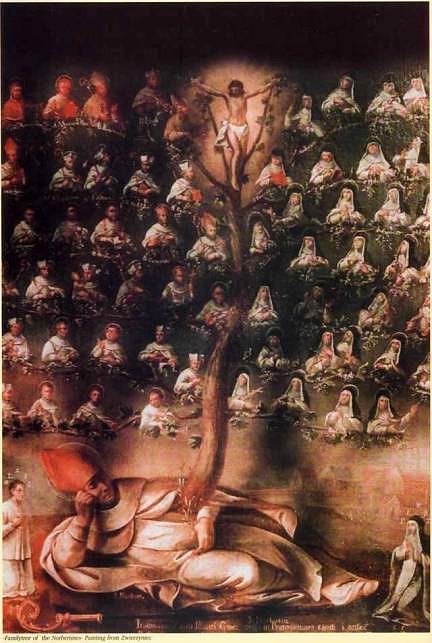
All Saints of the Premonstratensian Order or the “Norbertines.” The Order of Canons Regular of Prémontré, also known as the Premonstratensians, the Norbertines and, in Britain and Ireland, as the White Canons , are a Roman Catholic religious order of canons regular founded in Prémontré near Laon in 1120 by Saint Norbert, who later became Archbishop of Magdeburg. Premonstratensians are designated by O.Praem. following their name. St Norbert was a friend of Saint Bernard of Clairvaux and so was largely influenced by the Cistercian ideals as to both the manner of life and the government of his order. Aside from St Norbert there are at present fifteen saints of the Order who have been Canonised or have had their immemorial cults confirmed by the Holy See. St Norbert (c 1080-1134) “Defender of the Eucharist” and “Apostle of the Eucharist” – Bishop, Confessor, Founder. Patron for peace, invoked during childbirth for safe delivery, of infertile married couples. St Norbert here: https://anastpaul.com/2017/06/06/saint-of-the-day-6-june-st-norbert/
St Norbert
All Saints of the Norbertines
All Deceased Dominican Brothers and Sisters
St Abbo of Fleury St Amandus of Rennes St Amanzio St Beatrix of Bohemia St Brice of Tours (Died 444) Bishop St Caillin St Chillien of Aubigny St Columba of Cornwall St Dalmatius of Rodez St Devinicus St Eugenius of Toledo St Florido of Città di Castello St Gredifael St Himerius St Homobonus of Cremona St Juan Ortega Uribe Blessed Leone of Assisi OFM (Died 1271)Priest and Friar of the Friars Minor, Companion, Secretary and Confessor of St Francis. St Leoniano of Vienne St Maxellendis St Mitrius St Pope Nicholas I St Paterniano St Quintian of Rodez Bl Robert Scurlock Bl Warmondus of Ivrea
Martyrs of Caesarea – 5 Saints: A group of Christians murdered for their faith in the persecutions of Diocletian, Galerius Maximian and Firmilian. – Antoninus, Ennatha, Germanus, Nicephorus and Zebinas. 297 at Caesarea, Palestine.
Martyrs of Ravenna – 3 Saints: A group of Christians murdered together in the persecutions of Diocletian. The only information about them that has survived are three names – Solutor, Valentine and Victor. c 305 in Ravenna, Italy.
Martyrs of Salamanca – 5 Saints: The first group of Christians exiled, tortured and executed for their adherence to the Nicene Creed during the persecutions of the Arian heretic Genseric. – Arcadius, Eutychianus, Paschasius, Paulillus and Probus. Born in Spain and Martyred in 437. Their relics are at Medina del Campo, Spain.
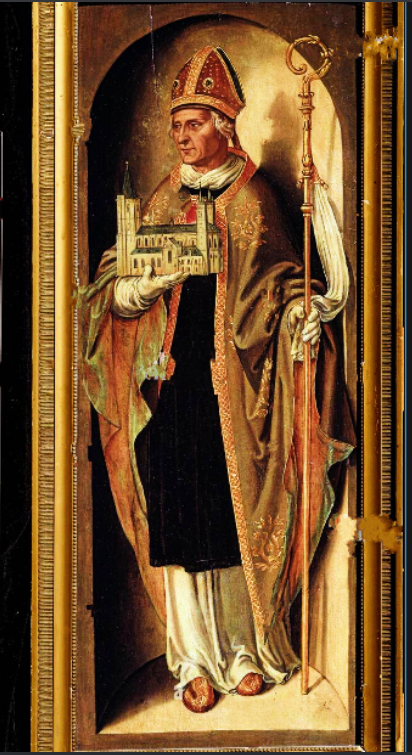
Saint of the Day – 12 November – St Cunibert of Cologne (Died c 663) Archbishop of Cologne, from 627 to his death. He founded many Churches and supported and established Monasteries. Contemporary sources only mention him between 627 and 643. Cunibert died in c 663 in Cologne, Germany of natural causes. Also known as – • Cunibert of Keulen• Cunibert of Köln• Cunibert of Trèves• Cunibert of Trier• Cunipert, Honoberht, Kunibert. He is mentioned in the Roman Martyrology.
Cunibert was born somewhere along the Moselle to a family of the local Ripuarian Frankish aristocracy and educated in Metz at the Court of Chlothar II. He entered religious life and became the Archdeacon of Trier. He was elected Bishop of Cologne in 627. According to legend, he was led by a pigeon to the grave of Saint Ursula.
As Bishop, Cunibert served as an advisor to King Dagobert I. Cunibert also served as tutor to his son and heir, Sigebert III. In 633 or 634 Sigebert was invested as King of Austrasia. Following this, Dagobert made Cunibert and Adalgisel, the mayor of the Palace, co-regents of the Kingdom. After the death of Adalgisel’s successor, Pepin of Landen, Cunibert served as the chief public official of the King, in which capacity, he revised the Lex Ribuaria – the laws of Germany, at that time. Cunibert attended the Synod of Clichy in 626/627.
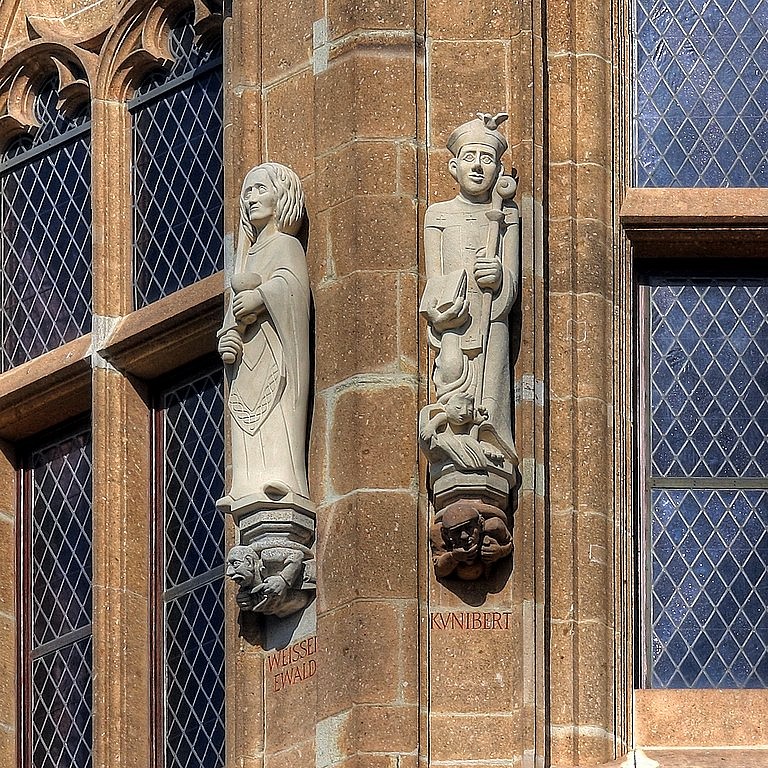
Statue of St Cunibert on the tower of Cologne City
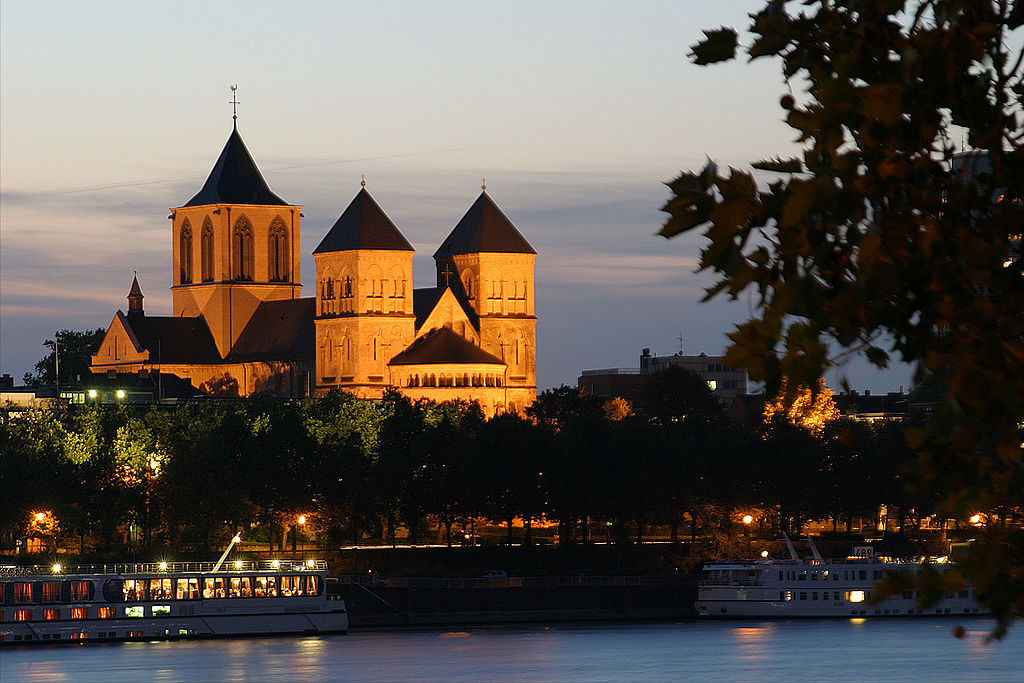
Throughout his Episcopacy, monasticism flourished and Churches were founded and restored. His Feast day is the day of his death, 12 November He is buried in a Church bearing his name in Cologne City, where he lived and died.
St Aurelius St Cadwallader St Cummian Fada St Cunibert of Cologne (Died c 663) Archbishop of Cologne St Emilian Cucullatus St Evodius of Le Puy St Hesychius of Vienne Bl John Cini della Pace
St Livinus of Alost St Machar of Aberdeen St Namphasius St Nilus the Elder St Paternus of Sens St Publius St Renatus of Angers St Rufus of Avignon St Ymar of Reculver
Five Polish Brothers – Martyrs: They weren’t Polish and they weren’t related but were instead five Italian Benedictine Monks who worked with Saint Adalbert of Prague as missionaries to the Slavs and were Martyred together. They were – Benedict, Christinus, Isaac, John and Matthew. Born in Italy. They were Martyred in 1005 at the Benedictine Monastery near Gnesen, Poland and Canonised by Pope Julius II.
Saint of the Day – 11 November – Saint Mennas (Died c 300) Martyr, Layman, Miracle-worker, Soldier, he may have been a camel driver and merchant, Hermit. Born in Egypt and died by beheading in c 300 at Cotyaes, Phrygia, under Emperor Diocletian. He was one of the most popular Saints in the early Eastern Church. Patronages – falsely accused people, general physical ailments, peddlers, pilgrims, travelling salesmen. Also known as – • Aba Mina• Menas of Egypt• Menas of Constantinople• Menas of Cotyaes• Menas of Cotyaeum• Menas of Kotyaeum• Menas of Mareotis• Menas the Martyr• Menas the Miracle Maker• Menas the Miracle Worker• Menas the Soldier• Menas the Wonder Worker• Mena, Mennas, Mina, Minas.
The Roman Martyrology reads: “At Cotyaeus, in Phrygia, during the persecution of Diocletian, the celebrated Martyrdome of St Mennas, Egyptian soldier, who cast off the military belt and obtained the grace of serving the King of Heaven, secretly, at first, in the desert. Afterwards, coming out publicly and freely declaring himself a Christian he was first subjected to dire torments and finally, kneeling in prayer and giving thanks to Our Lord Jesus Christ, he was struck with the sword. After his death, he was renowned for many miracles.”
St Mennas by Paolo Veronese
Mennas, a Christian and an Egyptian by birth, served in the Roman army under the tribune Firmilian. When the army came to Cotyaeus in Phrygia, Menas hearing of the impious edicts issued against the Christians by the Emperors Diocletian and Maximian, left the army in order to practise his faith in safety and retired to a solitude in the mountains and served God by fasting vigils and prayer.
During the celebration of a great pagan festival Mennas appeared in the midst of the populace in the circus and fearlessly professed his faith. He was led before the Prefect Pyrrhus, cruelly scourged, put to torture and finally beheaded.
The Martyrdom of St Mennas by Paolo Veronese
His body was brought to Egypt and the Martyr was soon invoked in many needs and afflictions. The fame of the miracles wrought, spread far and wide and thousands of pilgrims came to the grave in the desert of Mareotis, between Alexandria and the valley of Natron.
For centuries Bumma was a national sanctuary and grew into a large city with costly temples a holy well and baths. A beautiful Basilica was erected by the Emperor Arcadius. The cult was spread into other countries, perhaps by travelling merchants who honoured him as their Patron.
As a result of various vicissitudes, the doctrinal disputes and the conquest of Egypt by the Arabians under Omar in 641 the sanctuary was neglected and ultimately forgotten.
During 1905 Msgr C M Kaufmann of Frankfort, led an expedition into Egypt which made excavations at Bumma. He found in a vast field of ruins, the grave, the well and thermae (public baths), the Basilica, the Monastery, numerous inscriptions on the walls, imploring aid through the intercession of the Saint and, thousands of little water pitchers and oil lamps. The rich findings are partly in the Museums of Alexandria and Cairo and partly in Frankfort and Berlin. The Monsignor published an official report of his expedition in 1908, (La découverte des Sanctuaires de Menas dans le désert de Mareotis).
Terracotta pilgrim’s water flask impressed with Saint Mennas between two camels, 1000s of which were found by Msgr C M Kaufmann
St Bartholomew of Rossano (c 970-c 1065) Abbot Confessor, Spiritual disciple and friend of St Nilus (910-1005), Hymnist an highly skilled Calligrapher of sacred manuscripts – the art of calligraphy he had learned from his blessed guide and teacher, He is known as the “Second Founder,” of the Monastery of Grottaferrata founded by St Nilus. A copyist of many codices, Bartholomew is also considered the greatest hymnographer of the 11th century. His Life: https://anastpaul.com/2021/11/11/saint-of-the-day-11-november-saint-bartholomew-of-rossano-c-970-c-1065/
St Bertuin of Malonne St Cynfran of Wales St Isidre Costa Hons Bl Josaphat Chichkov St Marina of Omura St Mennas of Santomenna St Mercurius the Soldier Bl Pavel Dzjidzjov St Rhediw St Theodore the Studite St Turibius of Palencia St Veranus of Lyon St Veranus of Vence
Quote/s of the Day – 10 November – St Andrew Avellino CR (1521–1608) Confessor
“Ah ! what is all that I do and suffer, compared with what my Jesus did and suffered for my sake? O, that I might, for His honour, be torn with scourges and pierced with nails and expire on the Cross for Him!”
“One cannot separate the most Holy Eucharist from the Passion of Jesus.”
St Andrew Avellino (1521–1608)
“It has been curiously remarked by St Andrew Avellino that those who have a special devotion to the Passion, generally die quiet and sweet deaths, as the Virgin Mary, St John the Evangelist and St Mary Magdalen did. Certainly, it is remarkable that, while most of those close to Our Lord died violent deaths, the three who assisted at Calvary, should have died so softly, as if already their real death had been died there!”
Saint of the Day – 10 November – St Andrew Avellino CR (1521– 1608) Confessor, Theatine Priest, Canon and Civil Lawyer, Reformer, Founder of many new Theatine houses, Preacher, Spiritual Advisor, Miracle-worker.
Saint Andrew Avellino, Confessor By Fr Francis Xavier Weninger SJ (1805-1888)
St Andrew Avellino was born at Castro Nuovo, in the kingdom of Naples. To fear God and to avoid sin, were the maxims which his mother, from early childhood, implanted deep into his heart and which became the rule of his entire life. While he studied at Senise, a lady sought to attract him by several presents which she sent him but the chaste youth, accepted not her gifts,and sent her word, saying that she should trouble him no more and might rest assured that he would rather die than consent to any evil. On another occasion when he was enticed to sin, he fled like the chaste Joseph. To escape similar temptations, he determined to become a Priest and was Ordained after he had finished his studies.
For some time he devoted himself to the practice of Canon Law in the eEclesiastical Courts until one day, in the heat of his argument, a trivial lie escaped him. Soon after, while reading the Holy Scriptures, the words, “The mouth that lieth, killeth the soul,” came under his eyes and his repentance was such that, from that moment, he renounced his profession in order to escape from the danger of offending God and gave himself entirely, to the Sacred ministry. By associating frequently with the religious of the Theatine Order, he conceived the desire of joining their number, which he did in 1556. It was on this occasion that he took the name of Andrew, in honour of the holy Apostle of that name, after whose example he desired to suffer much for the glory of God.
His eminent virtues induced his superiors to make him Master of Novices, although he had been only five years in the Order,and afterwards, to charge him with the administration of several houses. He attended to all his duties to the greatest benefit of those under him. Besides the usual vows, he imposed upon himself two more. The first of these was to work continually against his own inclinations; the second, to make continual progress in perfection. The fervent love he bore to God and men, induced him to employ all his leisure moments in prayer and in labouring for the salvation of souls. Before entering into religion, he had been accustomed to give six hours daily to prayer but as he could not, as a religious, spare so much time during the day, he took a part of the night for this sacred duty.
He benefitted mankind much, by preaching and hearing Confessions. He reformed many a hardened sinner, restrained others from falling again, reconciled embittered minds and led numberless souls to Heaven.
God manifested more than once, by miracles, how agreeable the endeavours of the Saint were to Him. One night as he returned home, with his companion, from the house of a sick man whose Confession he had heard, a violent storm extinguished the light that was carried before them but then, such a brightness emanated from the Saint’s body that the way was made clear through the darkness, whilst, at the same time, neither he, nor his companion, was touched by the rain. Many similar events, as also the frequent visions of Saints, the gifts of prophecy and of reading the hearts of men but above all, the many examples of heroic virtue which he gave to others, won for St Andrew, the highest regard. St Charles Borromeo, the holy Cardinal, esteemed him greatly and made use of his zeal on many occasions.
Notwithstanding this, the holy man had so low an opinion of himself that he regarded as nothing his great and arduous labours to further the honour of God and the salvation of souls; looked upon himself as a great sinner,and frequently evinced great fear in regard to his salvation. “If they,” said he, “must regard themselves as useless servants, who have done all their duty, what must I do, who have done so small a part of what I ought to have done?” Sometimes he would look up to Heaven and sigh: “Will that magnificent mansion of the blessed spirits allow the entrance of one so miserable, despicable and sinful as I am?”
From this fear, however, he was afterwards freed by a comforting vision. St Augustine and St Thomas of Aquin, both of whom he honoured as Patrons, appeared to him, consoled him and promised him their aid, especially in that hour, on which eternity depends. Andrew, taking heart, asked them whether he would enjoy eternal life? The answer was as follows: “The time of thy salvation has not come yet. But as in life, everything is doubtful and uncertain, follow our advice – struggle, with the greatest perseverance, on the battle-field of virtue, as thou hast done till now and thus, thou wilt gather a treasure of merit and God will not close to thee, the gates of Heaven.” With these words, the Saint consoled himself,and not only continued his zeal in the practice of virtue but increased it daily.
During the last 18 years of his life, he allowed himself neither meat, nor eggs, nor fish – his nourishment consisted of beans only, of which he had always enough cooked to last him three days. When advised to change his diet, on account of his advanced age, he said: “Although, at the age of 83 years, I am excused from the law of fasting, I find, when thinking of my sins and my indolence in the service of the Most High that I am obliged to fast and to observe other austerities, in order to appease the wrath of God.” Thus spoke he, who had ever preserved his first innocence. His bed was a sack of straw on two boards. He daily scourged himself to blood. Not content with all this, he daily begged the Almighty to send him something to suffer.
The greatest wrongs he bore with invincible meekness; in persecutions and trials, he evinced heroic patience and he met his enemies with truly Christian gentleness. This was especially experienced by the man who had cruelly murdered the son of the Saint’s brother. The holy man exhorted his brother neither to seek, nor demand vengeance. He knew the murderer but revealed him not and when the wretch was at last discovered and arraigned, before the judges, Andrew implored mercy and pardon for him.
Our Saint’s devotion to the passion and death of our Lord Jesus Christ, was the cause of his earnest desire to suffer more and more. He was often heard to say: “Ah ! what is all that I do and suffer compared with what my Jesus did and suffered for my sake? O, that I might, for His honour, be torn with scourges and pierced with nails and expire on the Cross for Him!”
Not less deep was his devotion to the Blessed Sacrament and at the time of Holy Mass, his whole countenance glowed with divine love. To the very last day of his life, although he was almost entirely exhausted, he insisted on saying Mass but he had hardly begun the Psalm at the foot of the Altar, when he was struck with paralysis. He was then carried to his room, where the last Sacraments were administered to him. Having received them, he blessed all those who were present and peace and happiness shone from his countenance. After this, he turned his eyes upon an image of the Blessed Virgin,whom, during all his life he had greatly loved and honoured and expired in the 88th year of his life. His face beamed after his death with a truly divine radiance and God proclaimed the glory which the Saint enjoyed in Heaven, by many and great miracles. St Andrew Avellino, Pray for us! Amen.
St Andrew Avellino (1521 – 1608) Confessor, Theatine Priest, Canon and Civil Lawyer, Reformer, Founder of many new Theatine houses, Preacher, Spiritual Advisor. In 1624, only 16 years after his death, he was Beatified by Pope Urban VIII and in 1712 was Canonised by Pope Clement XI. His remains lie buried in the Church of St Paul at Naples. Patron against sudden death/of a Holy Death, against Apoplexy or Strokes. Biography: https://anastpaul.com/2018/11/10/saint-of-the-day-10-november-st-andrew-avellino-cr-1521-1608/
St Aedh Mac Bricc St Anianus the Deacon St Baudolino (c 700–c 740) Hermit St Demetrius of Antioch St Elaeth the King St Eustosius of Antioch St Grellen St Guerembaldus St Hadelin of Sees Bl Joaquín Piña Piazuelo St John of Ratzenburg St Joseph the Martyr
St Leo of Melun St Monitor of Orleans St Narses of Subagord St Nonnus of Heliopolis St Orestes of Cappadocia St Probus of Ravenna St Theoctiste St Tryphaena of Iconium St Tryphosa of Iconium
Martyrs of Agde – 3 Saints: A group of Christians who were tortured and Martyred together in the persecutions of Diocletian. The only about them to survive are the names – Florentia, Modestus and Tiberius. Martyred c 303 in Agde, France.
Saint of the Day – 9 November – Blessed Gratia of Cattaro OSA (1438-1508) Lay Brother of the Hermits of St Augustine, Ex-sailor. … Born 27 October 1438 at Mul, Cattaro, Dalmatia (modern Kotor, Montenegro) and died on 9 November 1508 in Murano, Italy of natural causes. Gratia was known for his humility, spirit of penance, love of the Eucharist and for his zealous hard labour. Also known as – Gratia of Kotor, Gracija, Grazia. Gratia was Beatified in 6 June 1889 by Pope Leo XIII (cultus confirmed).
Gratia was born in 1438 in the small town of Mula on the coast of Dalmatia near Cattaro (Kotor), not far from present-day Albania. He followed in the footsteps of his father ,who was a sailor and visited many port cities, being particularly drawn by the beauty of Venice. One day, after hearing a sermon of Simon of Camerino in the Augustinian Church of Saint Stephen in that City, he entered the Order as a brother and took the name Gratia, out of gratitude to God for the many gifts he had received. Simon of Camerino had founded a community near Padua where the Friars lived in absolute poverty while ministering at a Shrine dedicated to our Lady. Here Gratia lived a life of prayer and penance and devoted his energies toward the construction of the monastery and the cultivation of its garden.
Later, when Simon established the Friary of Saint Christopher in Venice, Gratia was transferred there, where he was greatly loved by the people and sought after by them for his prayer and counsel. Here he died on 8 November 1508. Within the Church of Saint Christopher, a marble monument was erected to his memory by a Senator of the City, while Gratia’s remains were eventually taken back to Mula. Pope Leo XIII confirmed his cult in 1889.
Gratia might have been considered a belated vocation in his day, earning a living by the hard labour of an itinerant sailor. Following his entrance into religious life, he continued to use his natural gifts in the service of God and his community and by his simple but genuine demeanour, drew others to also recognise, the grace of God at work in their lives.
St Agrippinus of Naples St Alexander of Salonica St Aurelius of Riditio St Benignus of Armagh St Eustolia St Francisco José Marín López de Arroyave
Blessed Gabriel Ferretti OFM (1385-1456) Priest, Friar of the Order of Friars Minor,, Provincial Superior, Mystic. renowned missionary Preacher. He was zealous in the restoration and establishment of new Convents. He was an ancestor to both Cardinal Gabriele Ferretti and Blessed Pope Pius IX, having been descended from a long noble lineage. Patronage – Ancona. His body is incorrupt. He was Beatified on 19 September 1753 by Pope Benedict XIV. Biography: https://anastpaul.com/2021/11/09/saint-of-the-day-9-november-blessed-gabriel-ferretti-ofm-1385-1456/
Bl George Napper Blessed Gratia of Cattaro OSA (1438-1508) Lay Brother of the Hermits of St Augustine Bl Helen of Hungary St Jane of Segna
St Justo Juanes Santos St Luigi Beltrame Quattrocchi St Luis Morbioli St María de la Salud Baldoví Trull St Pabo St Sopatra St Theodore Stratelates St Ursinus of Bourges St Valentín Gil Arribas St Vitonus of Verdun
Martyrs of Constantinople – 3 Saints: A group of ten Christians who tried to defend an image of Jesus over the Brazen Gate of Constantinople from an attack by Iconoclasts during the persecutions of Emperor Leo the Isaurian. The group of was seized by soldiers, condemned by judges for opposing the emperor, and Martyred. The only details that have survived are three of their names – Julian, Marcian and Maria. They were martyred in 730 at Constantinople (modern Istanbul, Turkey).
Four Crowned Martyrs: Saint Castorus, Saint Claudius, Saint Nicostratus and Saint Simpronian. Skilled stone carvers in the 3rd century quarries. Martyred when they refused to carve an idol of Aesculapius for Diocletian. They were drowned in the River Sava in 305. Patronages – against fever, cattle, sculptors, stone masons, stonecutters.
St Adeodatus I, Pope (Died 618) Bishop of Rome from 19 October 615 to 8 November 618 St Clair of Tours St Cybi of Caenarvon St Drouet
All Saints of the Diocese of Evry: A regional memorial of all the Saints and Beati of the calendar who have a connection to the Diocese of Evry-Corbeil-Essonnes, France. • Blessed Isabella of France, founded the Longchamp monastery • Blessed Nicolas Gaudreau, pastor of Vert-le-Petit • Blessed Pierre Bonse, pastor of Massy • Our Lady of Good Guard, patron saint of the diocese, venerated in Longpont-sur-Orge, France • Saint Corbinian, born in Saint-Germain-lès-Arpajon • Saint Denis of Paris, evangelizer of part of Essonne and revered ni Longpont-sur-Orge • Saint Eloi, who lived in Chilly-Mazarin • Saint Germain of Paris • Saint William of Bourges, son of Count Baldwin IV of Corbeil • Saint William of Aebelholt, pastor of Brunoy • Saint Wulfran of Sens, born in Milly-la-Forêt • Blessed Nativelle, vicar of Longjumeau • Blessed René Le Bris, pastor of Bris-sous-Forges • Saint Spire of Bayeux, whose relics are in Corbeil in the cathedral that bears his name All Saints of Wales
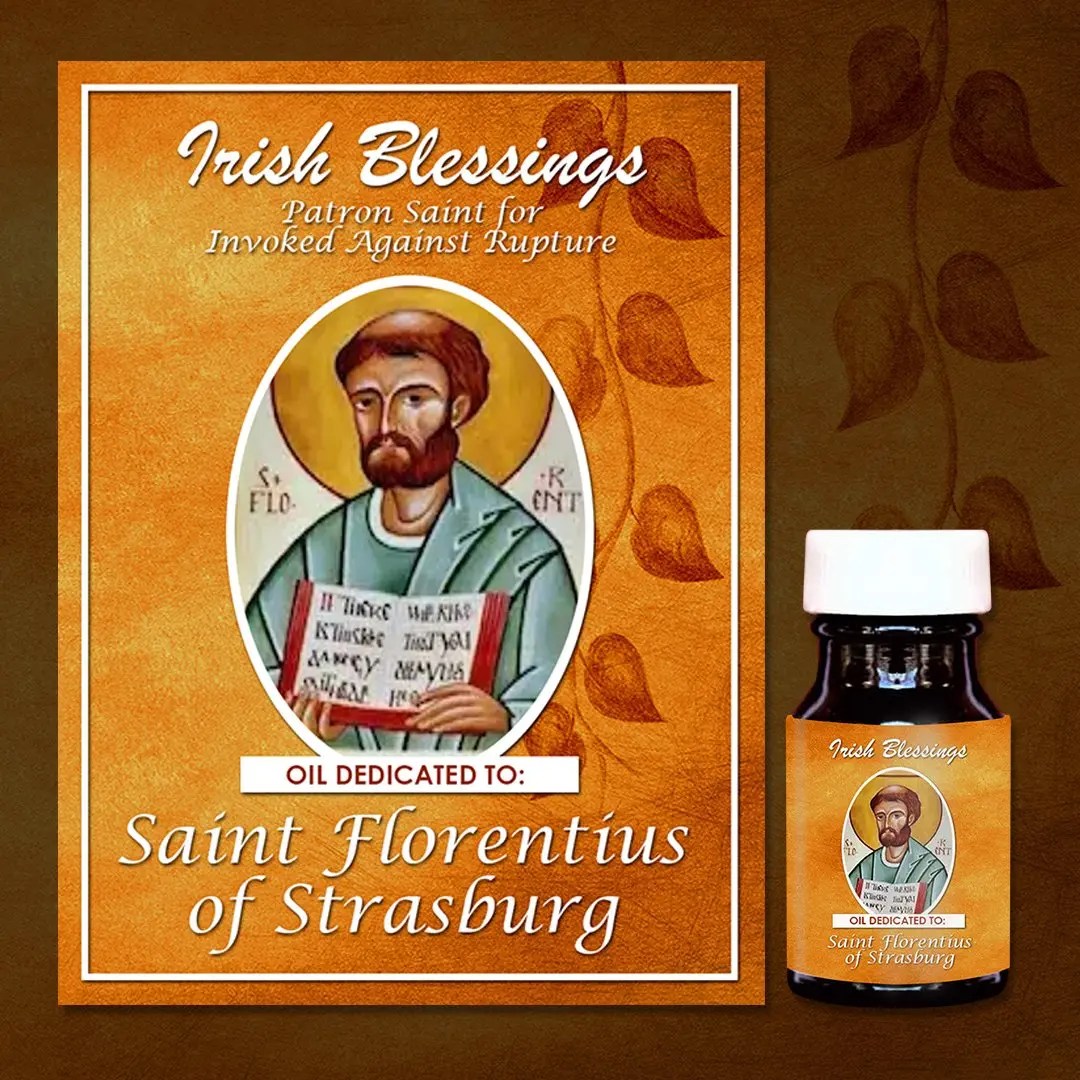
Saint of the Day – 7 November – St Florentius of Strasburg (Died 693) the 13th Bishop of Strasburg in Germany from 618–624, Missionary, Miracle-worker, founder of Monasteries and Churches, Hermit. Born in Ireland and died in 693 in Strasburg. Patronages – against rupture (hernia), Haslach, Germany. Also known as – Florent.
Florentius was an Irishman who laboured in Strasburg, in the seventh Century. Below is an account of his life from a study of early Irish Saints in Europe. Among the many points of interest, is that his Church had an Altar dedicated to Saint Brigid and like Saint Brigid, Florentius is also said to have hung his cloak on a sunbeam!
The fame of Florentius, whose Bishopric is not clearly dated but succeeded that of Arbogast, is due to his two important monastic foundations – St Thomas in the periphery of Strasburg,and that of Niederhaslach, in a valley to the west of the City. There, Florentius erected his first Monastery with the help of his Irish companions. Excavations have revealed that his Church, built on a Roman site, was no mean wooden structure but a stone edifice with three naves in the Byzantine style. Here his followers, it is explicitly stated, obeyed the Rule he laid down for them, adhering later to that of St Columban before adopting that of St Benedict.
Louis the Pious, son of Charlemagne, caused a new Church to be built over the Haslach foundation to receive the remains of the holy Bishop Florentius who was first buried in St Thomas in Strasbourg where he died. The translatio took place on 7 November 810 and was pronounced a Feast day to be celebrated by the entire Diocese and so it has remained.
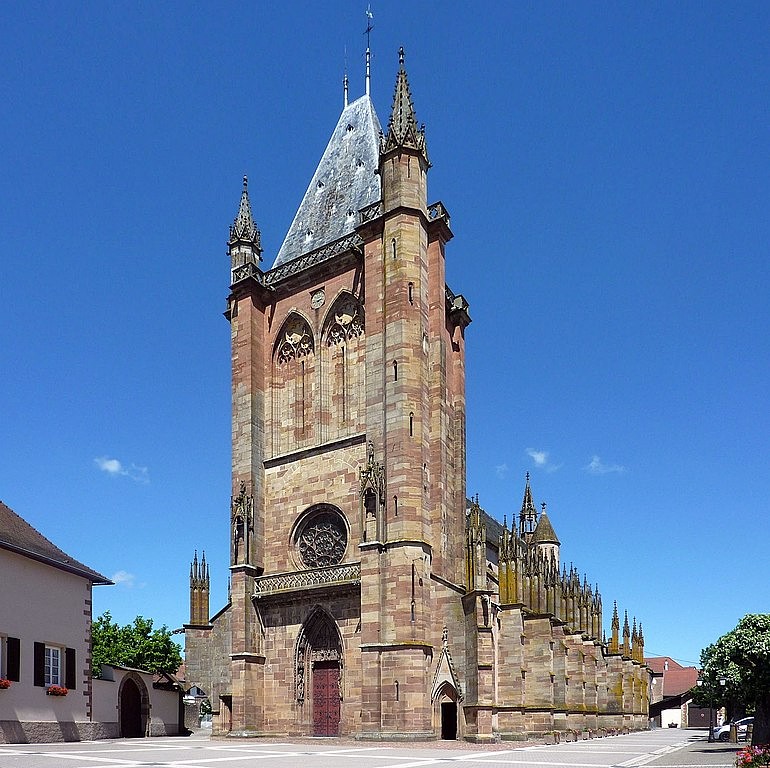
Collegiate church Saint Florentius
This is the Florentiusfest, held yearly on the Sunday following 7 November when the Shrine and a life-size wooden Statue of the Patron Saint are borne in procession around the village of Niederhaslach. Later in the day, pilgrims visit Oberhaslach where they pray in the Chapelle Saint-Florent.
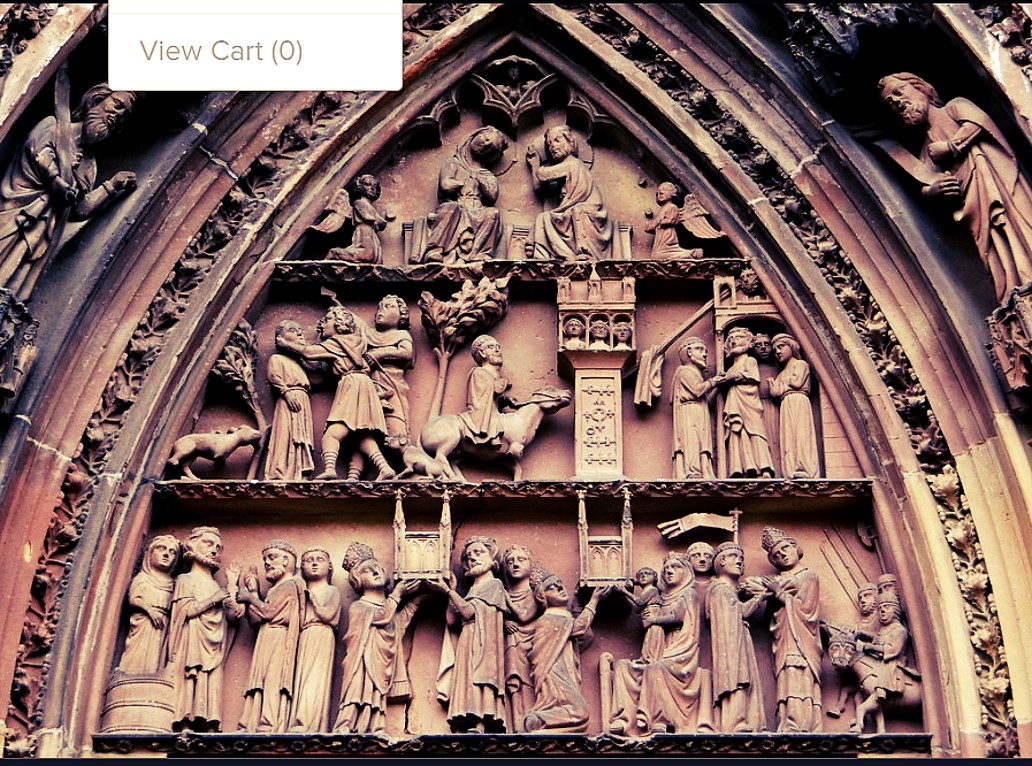
Halsach, whether Ober (Upper)or Nieder (lower), are modest enough villages to harbour so majestic a Church, but the Bishops of Strasburg had once their summer residence here and the place was not divided… The west facade with its slender Gothic portal bears the legend of St Florentius. Inside, we encounter again, the story of Florentius, as a worker of miracles, in one of the stained glass windows… The Altar of St Brigid is gone but Florentius’ relics are in a niche in the choir, his gilded Shrine of 1716 replacing a priceless relic that was robbed in 1525, when the Saint’s remains were thrown on the Church floor. Taken to safety, restored to the Church, then hidden again in various private houses, they were eventually brought back to rest after the French Revolution subsided.
The Life and Miracles of St Florentius
Beside these depredations, the worldy remains of Florentius had other ordeals to overcome, being for centuries the object of fierce controversy between Strasburg and Haslach, both proclaiming to be in possession of them. This endless ‘War of the Relics’ obliged the German Emperor, Karl IV to intervene in the year 1353 in person. He caused the contents of both reliquaries to be examined, after which,, to the joy of Haslach’s Augustinians, the affair was settled in their favour. Gratified, they presented the monarch wih an arm of the holy Patron, which he took with him to his residence in Prague. A special Altar was provided for the Florentius relic in the Cathedral and there it has, hopefully, remained.
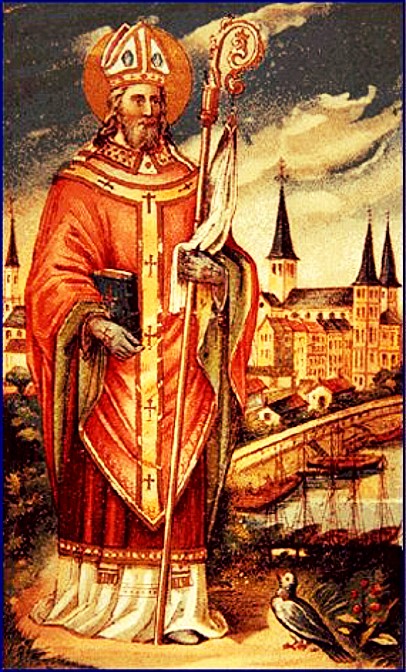
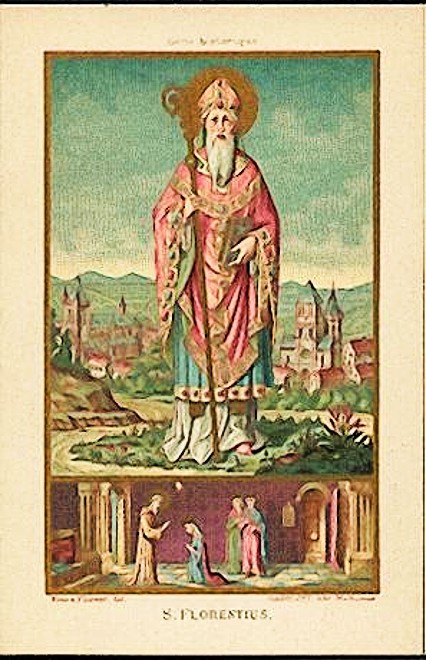
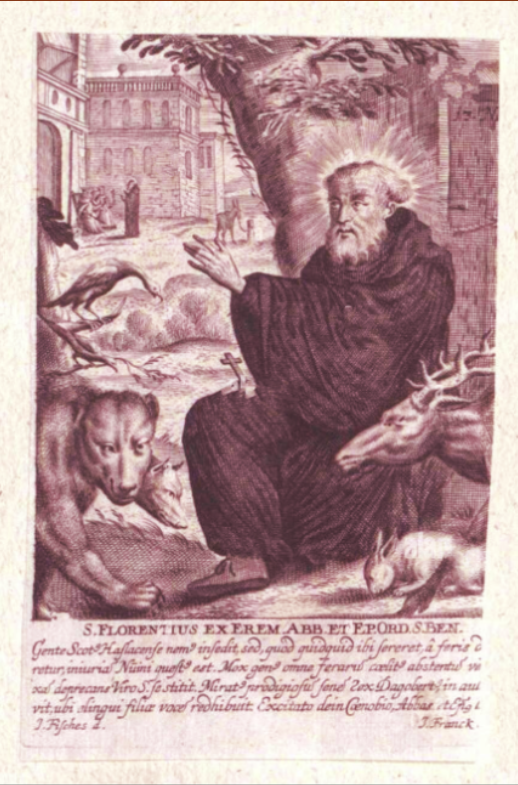
Florentius had started off with a hermitage in the wooded Haslach valley, near the present village of Oberhaslach. Several place-names in the vicinity bear out the tradition of this eremitic community, a site to the northeast of the village. References are given in Strasburg’s early Diocesan files to ‘Priests’ quarters, described as ‘of the Irish’. Considering that these sites were wiped out in the wars, the reference is most welcome and revealing. The pilgrims’ Church of Oberhaslach, does its part in keeping alive the Florentius tradition. The vintage image below shows St Florentius with wild animals on the edge of a ‘cityscape’ – it seems to indicate the many wondrous talents and achievements of this ancient Saint – what a pity we have such a sparcity of information on his holy life.
There an old Roman road leading off in a north-easterly direction to Marlenheim is also indicative. Marlenheim was once the seat of Merovingian Royalty, who donated land to Florentius for a missionary station. The proximity of the Palace brings to mind the miraculous cure of King Dagobert’s daughter, a miracle performed by Florentius, portrayed both in stone and in painted glass, in Niederhaslach’s noble Church. The legend records how the Saint, on arrival, hung up his cloak on a sunbeam – how lovely a thought!
The Feast of All Saints of the Order of Preachers: “Fountain of all holiness, You stirred up in our holy brothers and sisters an extraordinary love of truth, conformity to Christ Crucified and a thirst for the salvation of souls: may we imitate them in offering You thanksgiving on account of the way of life they gave us.” — From the Intercessions at Lauds for the Feast of All Saints of the Order of Preachers. HERE: https://anastpaul.com/2019/11/07/thought-for-the-day-7-november-feast-of-all-dominican-saints/
Blessed Anthony Baldinucci SJ (1665-1717) Priest of the Society of Jesus, Preacher, Writer and Missionary. Fr Baldinucci was Beatified by Pope Leo XIII on 25 March 1893. Biography here: tps://anastpaul.wordpress.com/2017/11/07/saint-of-the-day-blessed-anthony-baldinucci-s-j-1665-1717/
St Athenodorus of Neo-Caesarea St Auctus of Amphipolis St Baud of Tours St Blinlivet St Congar
St Ernest of Mecca St Florentius of Strasburg (Died 693) Bishop St Gebetrude of Remiremont St Herculanus of Perugia St Hesychius of Mytilene St Hieron of Mytilene St Hyacinth Castañeda Puchasons St Lazarus the Stylite Bl Lucia of Settefonti St Nicander of Mytilene Bl Peter Ou St Prosdocimus of Padua St Prosdocimus of Rieti St Raverranus of Séez St Rufus of Metz St Taurion of Amphipolis St Thessalonica of Amphipolis St Tremorus of Brittany
Nostra Signora del Suffragio / Our Lady of Suffrage (For the Souls in Purgatory)
St Atticus St Barlaam of Novgorod Bl Beatrice of Olive Bl Christina of Stommeln St Demetrian of Cyprus St Edwen of Northumbria St Efflam of Brittany St Emilian of Faenza St Erlafrid of Hirschau St Felix of Fondi St Felix of Genoa St Felix of Thynissa St Illtyd St Israel of Limoges
St Leonard of Reresby Bl Leonianus of Autun St Melaine of Rennes St Paul of Constantinople St Pinnock St Protasius of Lausanne St Severus of Barcelona Bl Simon of Aulne St Stephen of Apt St Theobald of Dorat Bl Thomas Ochia Jihyoe St Valentine of Genoa St Victor Chumillas-Fernández
Martyrs of Antioch – 10 Saints: Ten Christians murdered together by Arabs after their seizure of Antioch, Syria. No names or other details about them have come down to us. 637 in Antioch, Syria.
Martyrs of Gaza – 9 Saints: A group of Christian soldiers who were captured by Saracens invading the area of Gaza in Palestine. When the men continued to profess their Christianity, they were executed. We know the names of some of the Martyrs – Himerius, John (2 of them), Kallinikos (Callinoco), Paul, Peter, Stephen and Theodore (2 of them). They were beheaded in Gaza, Palestine.
All Saints and Blesseds of the Society of Jesus: The Society of Jesus, commonly known as the Jesuits, was Founded in 1534 by Saint Ignatius Loyola (1491-1556) at Montmartre, Paris, France. A body of clerics regular organised for Apostolic work, following a religious rule and relying on alms for their support. It was the chief instrument of the Catholic Reformation. Pope Paul III approved the new rule in 1540 and Ignatius was elected the first general of the order in 1541. The constitutions, drafted by him and based on his Spiritual Exercises were adopted in 1558. It was the first order which enjoined by its constitutions devotion to the cause of education. The ministry of the Society consists chiefly in preaching. teaching catechism. administering the sacraments. conducting missions in parishes, taking care of parishes. organising pious confraternities, teaching in schools of every grade, writing books, pamphlets, periodical articles, going on foreign missions and special missions when ordered by the current Holy Father, to whom they take a vow of total obedience. Our current Holy Father, Pope Francis is a Jesuit and has jokingly wondered aloud who is boss of whom in his Order. The general resides at Rome, Italy and has a council of assistants. The motto of the Society is Ad Majorem Dei Gloriam (For the greater glory of God). All Jesuit Saints and Blesseds: https://anastpaul.com/2018/11/05/feast-of-all-the-saints-and-blesseds-of-the-society-of-jesus/
St Canonica St Comasia St Dominator of Brescia St Elizabeth St Domninus the Physician St Epistemis St Eusebius of Terracina St Felix of Terracina St Fibitius St Galation St Gerald of Beziers Bl Gomidas Keumurjian Bl Gregory Lakota St Guetnoco St Hermenegild St Idda St Juan Antoni Burró Mas St Juan Duarte Martín St Kanten St Kea St Laetus of Orleans St Magnus of Milan St Mamete St Marco of Troia Bl Simon Ballachi St Spinulus of Moyen-Moûtier St Sylvanus of Syria St Zachary
Martyrs of Caesarea Maritima – 4 Saints: Four young Christian men who were Martyred together is the persecutions of Maximian – Aussenzius, Philotheus, Timothy and Theotimus. They were martyred in the arena at Caesarea Maritima, Palestine.
Saints of the Day – 4 November – St Vitalis (Died c 304) and St Agricola (Died c 304) Martyrs, Laymen. They died in c 304 in Bologna, Italy in the persecution of Diocletian. Patronage – Bologna.
The Roman Martyrology reads: “In Bologna, Saints Vitalis and Agricola, Martyrs, of whom, according to what Saint Ambrose recounts, the first was first a slave to the other, then a companion in Martyrdom: Vitalis, in fact, suffered such torments that there was no longer any part of his body without wound. Agricola, not at all terrified by the torture of his slave, imitated him in Martyrdom by undergoing crucifixion.”
The painting of Martyrs Vitalis and Agricola in Bologna.
At the roots of the Bolognese Church, there is the figure of two Martyrs, distinguished by social class but united by the Palm of death due to faith. Vitalis and Agricola, servant and master, launched, with their testimony, a message of equality and solidarity that would have public recognition, at the rise of freedom, with the decree of liberation of the serfs (Liber Paradisus).
The oldest memory of the two Proto-martyrs of Bologna, dates back to St Ambrose (340-397) and St Paulinus of Nola (354-431), who attest to their “connection and bonds of Martyrdom.” Their bodies were rediscovered in the Jewish cemetery by Bishop Eusebius and, in 393, were transferred by St Ambrose to the Milan.
Their cult was already widespread in the 5th and 6th Centuries. Their Relics are venerated in the Mother Church of Bologna. At the end of the sixth Century, St Gregory of Tours, in one of his works complained that there was no “passio” of the Saints Vitalis and Agricola. However, this was not entirely correct, as the reports on the two Bolognese Proto-martyrs is based on an authentic statement by the Milanese Bishop St Ambrogio in 392, as well as one of St Paulinus ofi Nola in 403. Two stories have also been included in the Acta Sanctorum also attributed to St Ambrose himself.
In reality, Vitalis and Agricola had been absolutely unknown until 392, the year in which the Bolognese Bishop, St Eusebius, announced the discovery of their remains in a Jewish cemetery in today’s Emilian capital. He gave them a new burial, with a Christian rite, an event which was also attended by St Ambrose, who spoke of the Martyrs in his sermon and invited the population to venerate their Relics.
The cult of the two holy Martyrs spread, thanks to the impulse given by St Ambrose, who, in addition to writing about them, wanted to transfer part of the Relics to Milan and then donated part of them to Florence. Numerous Bishops too, felt compelled to request some for their Cathedrals. However, the cult maintained its epicentre in Bologna, where a Basilica was built specifically to house their remains, which were later transferred to the adjacent Chapel.
So we know little about the life of the two Saints. It seems that Agricola was a Christian citizen of Bologna and Vitalis was his servant. The latter had also followed his master in his religion and was the first to crown his life with Martyrdom. Both were led to the arena, Vitalis was tortured throughout his body until death. The torturers thought that at the sight of his sufferings, Agricola would lose his determination to declare himself a Christian but instead, all this had the opposite effect of what was hoped for. Agricola was in fact fortified and encouraged by the death of his faithful servant and faced the crucifixion with great courage, testifying his Christian faith to the end. His body was also pierced with nails.
PRAYER
We bless and thank Thee, Father, for the gift of Martyrdom in our brothers, Vitalis and Agricola: from their fruitful blood, Thou made the Church of Bologna sprout and in the fraternal solidarity of the slave and the master Thou gave us a shining example of humanity reconciled in the love of Christ. Through their solidarity, grant us to be courageous witnesses of the Faith, living stones of Thy Church, operators of communion and peace. We ask Thee Father, in the Holy Spirit, through Christ our Lord. Amen.
Saint of the Day – 3 November – Blessed Simon Ballachi OP (c 1210-1319) Lay Brother of the Order of Preachers, Mystic. Born in c 1240 at Santarcangelo di Romagna, Italy and died on 3 November 1319 in Rimini, Italy of natural causes. Also known as Simone Ballachi . Ballachi served as a former soldier in Rimini before renouncing that path in favour of the religious life where he became a gardener noted for his strict adherence to the rule of Saint Dominic. He was Beatified by Pope Pius VII on 14 March 1817.
St Archangel, a village in the northern part of Italy, about three miles distant from Rimini, was the birthplace of Blessed Simon Ballachi, lay-brother of the Order of St Dominic. The Bellachi family was distinguished in both Church and State. Two of Simon’s uncles were successively Bishop of Rimini. One of these, at least, Lawrence Ballachi, who died in 1302, was a Friar Preacher. One of Blessed Simon’s brothers, moreover, was a Priest.
Simon came of a family of lords, to whose care had been entrusted the protection and welfare of the little village in which they lived. Simon, it seems, was to carry on the family name and honour. Since his was to be a life in the world, and therefore more active than contemplative, in accordance with the custom of the times, Blessed Simon received little, if any, knowledge of letters. His early youth was spent in the camp acquiring the tactics of military discipline and the training that made for the successful soldier and knight.
At the age of twenty seven he decided to leave the world and seek admission into some religious order, saying with the Psalmist, “I have chosen to be an abject in my Father’s house, rather than to dwell in the tabernacle of sinners.” Accordingly, he presented himself to the Prior of the Dominican Convent of Rimini and humbly asked to be admitted as a lay-brother. His request met with favour. Once clothed in the Habit of St Dominic, Simon never looked back but gave himself unreservedly to the service of the King of kings.
In the cloister his aim was perfection. He hoped to gain this state by a faithful observance of his Rule and Constitutions. The guides that had directed so many before him, even in the first Century of the Order, could not lead him astray. In the following brief account of his life and labours we read the story of a man of God, animated by the love of Jesus Christ and striving to conform his life in all things to that of his Divine Model.
Realising that anything resembling sloth is incompatible with the religious life, Simon waged incessant warfare against this root of all vices. He strove to be constatly employed. His superiors appointed him overseer of the Convent gardens but Simon was far from content with a position of mere direction. He laboured with his own hands and strove to bring each flower and plant to perfection according to its kind.
The good Brother knew no rest. When his own work was finished, or the weather prevented him from working in the garden, it was his custom to take upon himself the duties of the other brothers. This he did from a spirit of humility because he considered himself the least of all and the servant of all. Each week he swept the entire Convent. With Blessed Simon, to work was to pray. He sanctified even the most lowly occupations by doing everything for the honor and glory of God, remembering the words of St Paul to the Corinthians, “Therefore, whether you eat, or drink, or whatsoever else you do, do all to the glory of God.” (I Cor. 10:31)
Just as he laboured in the garden to bring perfection among the plants and flowers, so too, in the garden of his heart, he sowed the seeds of perfection and labored to bring each to maturity. His penances for this purpose were severe and continual. For all of Lent, he fasted on bread and water. Frequently he passed two whole days without taking even this slight nourishment. His fastings were so excessive that soon he began to weaken and it was necessary for his superiors to mitigate the severity of his penances. For twenty years he wore an iron chain that must have caused him great suffering during his labours in the garden. … In his humble position of lay-brother he strove byhis prayers and penances to assist the Fathers in their work of saving souls.
While at prayer, Satan never failed to annoy him, that he might divide his attention or force’ from him some expression of mpatience. All the attacks of hell, however, proved unavailing to disturb the tranquillity of the servant of God. Like another Tobias, God tried the faithfulness of his servant, by many and severe afflictions. At the age of fifty-seven he became blind.
Little by little the severity of his life undermined his strength until finally, his infirmities became so great that he was forced to remain on a couch in a reclining position. To many this would have been a hard lot but not so with Blessed Simon. He made use even of his infirmities to merit grace and honour God. Our Blessed was frequently favoured with a heavenly visitation. An Angel came to console him and assure him that God was mindful of his sufferings and would make him victorious over all the attacks of hell. At times his couch was seen surrounded by a bright light and a voice was heard, saying, “Fear not, Simon, for thou hast found favour before God.“
Blessed Simon had a special devotion to St Catherine of Alexandria. On one occasion, when he was suffering from a severe headache, the Saint appeared to him and cured him. Nor were these the only favours granted to this humble lay-brother. He was the recipient of many and signal blessings. Among the various visions with which he was favoured was one of Our Lord. Our Blessed Mother, St Dominic and St Peter Martyr appeared to him at different times, to console and assist him in the struggle against the enemy of his soul.
Blessed Simon’s reputation for sanctity was widespread. On 3 November 1319, this faithful servant of the Lord was called to his reward. The people came in such crowds to honour the holy man and to carry away some relic or article that had touched his body, that two days hardly sufficed to accommodate those who would honour him. His Habit was literally cut to pieces, so that.it was necessary to clothe him anew before burial.
Devotion to our Blessed has not waned for many centuries . His body was frequently moved from place to place (mainly due to wars and unrest) but finally on the demand of the people of St Archangel, it was laid to rest in the Collegiate Church of that place, where it lies today.
In the year 1817 Pope Pius VII confirmed by Bull, the cult in honour of Blessed Simon and placed this humble lay-brother of the Order of Friars Preachers, on the Altar of Holy Mother the Church. (By Paul Curran OP – Excerpt).
St Acepsimas St Acheric of Vosges Bl Alphais of Cudot Bl Berardo dei Marsi Bl Berchtold of Engelberg St Caesarius St Cecilio Manrique Arnáiz St Clydog St Cristiolus St Domnus of Vienne St Elerius St Englatius St Florus of Lodeve St Francisco Colom González St Gaudiosus of Tarazona St Germanus St Guenhael St Hermengaudius of Urgell St Hilary of Viterbo
St Papulus St Pirmin St Quartus St Rumwold of Buckingham Blessed Simon Ballachi OP (c 1210-1319) Lay Brother of the Order of Preachers, Mystic. St Sylvia of Rome St Theophilus St Valentine of Viterbo St Valentinian St Vitalis St William of Vosges St Winifred of Wales St Wulganus
Innumerable Martyrs of Saragossa: A large group of Christians martyred in Zaragoza, Spain by Dacian during the persecutions of Diocletian. Dacian ordered all Christians of the city into exile under pain of death; when they were assembled to leave, Dacian ordered imperial soldiers to massacre the lot of them. They were Martyred in 304.
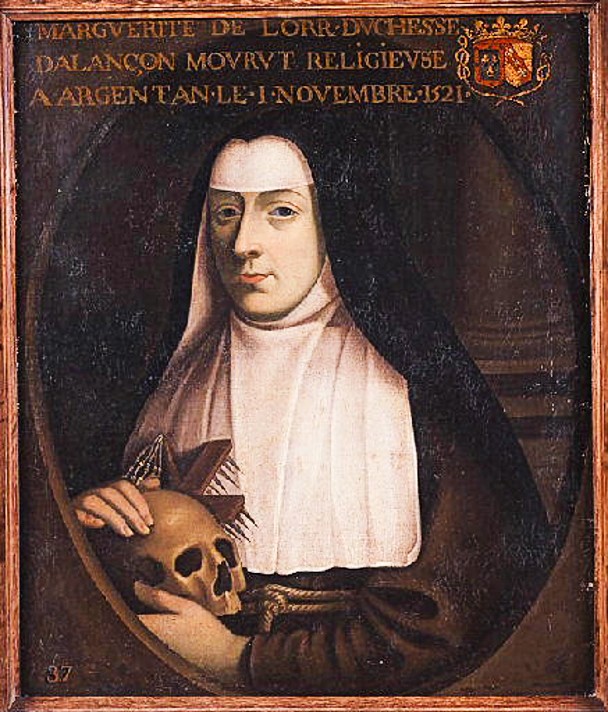
Saint of the Day – 2 November – Blessed Margaret of Lorraine OSC (1463-1521) Duchess of Alençon, Mother, Widow, Nun of the Poor Clares, Apostle of the sick, the poor and those suffering under unjust feudal lords. Born in 1463 as Marguerite de Lorraine-Vaudemont in Vaudemont Castle, Lorraine, France and died on 2 November 1521 at Argentan, Brittany, France of natural causes. Also known as – Margaret Lotarynska, Marguerite de Lorraine-Vaudemont, Margarita, Margherita, Marguerite. Margaret was Beatified on 10 March 1921 by Pope Benedict XV (cultus confirmed).
Blessed Margaret of Lorraine was born of the ancient noble family of the Dukes of Lorraine. Her earnest efforts to lead a virtuous life attracted attention very early in her life. After the death of her husband, Duke Rene of Alençon, she assumed the government of the Duchy. In this, she was guided solely by Catholic principles and by means of prudent economy, she managed to save a significant amount of materials which she used to render aid to the poor and the needy. She took particular pleasure in nursing the sick and the lepers. She built Churches, Convents and hospitals everywhere.
The subject matter taught in the schools and the instruction of the people were objects of particular solicitude to her. Hard-hearted landlords and selfish officials were dealt with by her, with the greatest severity.
Still, she remained very humble and spent a great part of her day in meditating on the sufferings of Christ and in performing works of penance.
In later years, after she had turned the government over to her son, she was invested with the habit of the Third Order. And when that no longer satisfied her desire for perfection, she entered the Convent of the Poor Clares at Alençon, which she herself had founded. Blessed Margaret aspired to perfection as a child, a woman, a ruler, a widow and finally as a religious and she succeeded in achieving her goal.
Every Christian is obliged to strive for perfection. It is not without reason that Our Lord says: “Be you, therefore, perfect as your heavenly Father is perfect” (Mt. 5,48).
This obligation does not require the impossible of us. Everyone can love his neighbour, do good and overcome himself. We must, above all, bear in mind that perfection does not consist in external practices but rather, in the disposition of our heart. The motive must be the love of God. All for the love of God!
Blessed Margaret of Lorraine died a saintly death at the Convent at Alençon in the year 1521. Pope Benedict XV approved her veneration.
In 1792 the body of Blessed Margaret was exhumed and found incorrupt. Inside the casket was found a small reliquary which contained her heart.
During the French Revolution a group of Jacobins disinterred the saint’s body to profane it, later placing it in a common grave. Only the bones and the saint’s heart remain and are now at the Monastery of Clarisses at Alençon
All Saints Day – (a Holy Day of Obligation) Instituted to honour all the saints, known and unknown. It owes its origin in the Western Church to the dedication of the Roman Pantheon in honour of the Blessed Virgin Mary and all the Martyrs by Pope Saint Boniface IV in 609, the anniversary of which was celebrated at Rome on 13 May. Pope Saint Gregory III Consecrated a Chapel in the Vatican Basilica in honour of All Saints, designating 1 November as their feast. Pope Gregory IV extended its observance to the whole Church. It has a Vigil and Octave and is a Holy Day of Obligation – the eve is popularly celebrated as Hallowe’en. Patronage – Arzignano, Italy. ABOUT: https://anastpaul.com/2019/11/01/solemnity-of-all-saints-1-november/ AND: https://anastpaul.com/2018/11/01/1-november-solemnity-of-all-saints/ AND: https://anastpaul.wordpress.com/2017/11/01/1-november-the-feast-of-all-the-saints/
Unsere Liebe Frau von Heede / Our Lady of Heede, Queen of the Universe , Queen of the Poor Souls in Purgatory (1937-1945) – 1 November
St Amabilis of Auvergne St Austremonius St Benignus of Dijon St Cadfan St Caesarius of Africa St Caesarius of Damascus St Ceitho St Cledwyn of Wales Bl Clemens Kyuemon St Cyrenia of Tarsus St Dacius of Damascus St Deborah the Prophetess St Dingad Bl Dionysius Fugixima St Floribert of Ghent St Gal of Clermont St Genesius of Lyon St Germanus of Montfort St Harold the King St James of Persia St John of Persia St Julian of Africa St Juliana of Tarsus St Lluís Estruch Vives St Marcel of Paris St Mary the Slave St Mathurin St Meigan St Nichole St Pabiali of Wales St Pere Josep Almató Ribera Auras St Peter Absalon Bl Peter Paul Navarra Bl Petrus Onizuka Sadayu St Rachel the Matriarch
Saint of the Day – 31 October – Blessed Christopher of Romagna OFM (Died 1272) Priest, Friar of the Order of Friars Minor during the life of St Francis, Missionary, sent by St Francis to preach against the heretic Albigensians in France.and Founder of Franciscan Monasteries there. Born in the late 12th Century in the Romagna region of Italy and died in 1272 in Cahors, France, of natural causes. He was Beatified in 1905 by Pope Pius X. Also known as – Christophe de Romagne.
A Franciscan Friar – unknown name
Christopher had been a Priest for many years when the grace of God impelled him to ask our holy Father St Francis, for the Habit. In 1219 Blessed Christopher of Romagnola was sent to Guienne, in southern France, to establish the Order in those parts. He was a man full of holy simplicity and sincere love for the poor and the unfortunate. He took great pleasure in caring for the many persons who were afflicted with leprosy in those days and were outcasts of society.
Christopher was very severe with himself. He wore an iron shirt for a long time, and always a belt having sharp points. He ate but once a day even in his advanced age. He built a small cell for himself of branches and sticks and covered it with straw. But in spite of these rigorous penances, he was always cheerful of countenance and pleasant in his dealings with others.
The pleasant demeanor by which Blessed Christopher gained the hearts of so many sinners, was a virtue he had learned from St Francis. Father Christopher had seen how St Francis of Assisi dealt with his fellowmen, especially with poor sinners.
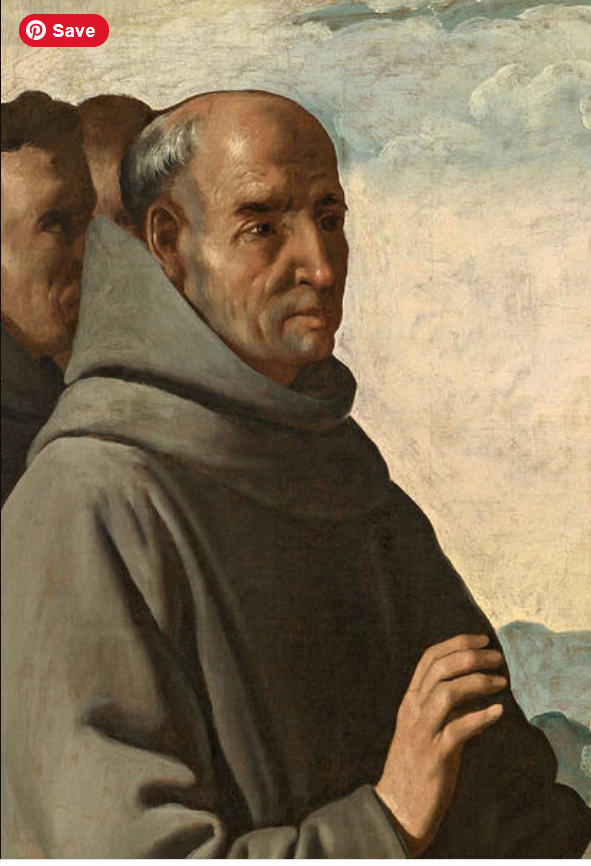
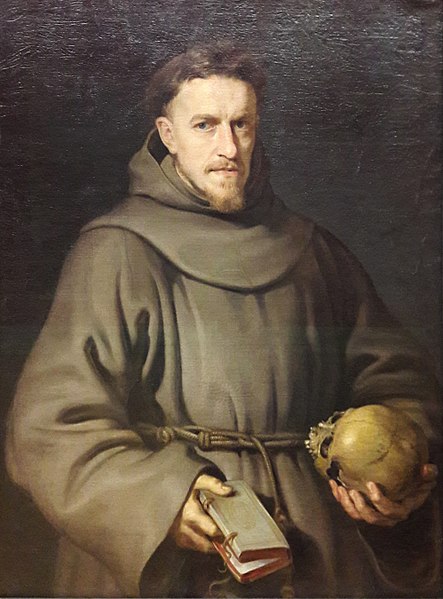
Portrait of an unknown Franciscan Friar
As in all things else, so in this matter, St Francis kept before his mind the example of Our Lord Jesus Christ, Who always received sinners with kindness.
Realising the value of time, Blessed Christopher of Romagna never wasted a moment, always busily occupied in prayer, meditation, manual labour, care of the garden, or other work that benefitted his brethren. His kindness and affability attracted many sinners, whom he succeeded in converting. God frequently favoured him with extraordinary inspirations and so, it was revealed to him, that St Francis was about to die. He hastened from France to Italy and arrived at the Portiuncula shortly before the death of St Francis. He had the consolation of receiving the Saint’s last blessing.
When Christopher arrived at the age of nearly one hundred years, his earthly sojourn came to an end. While earnestly exhorting the brethren gathered about his deathbed, he surrendered his soul to God in the year 1272. In death Blessed Christopher of Romagna looked more like a person who had fallen asleep, than like a dead person. An unusual concourse of people assembled for his burial which took place in Cahors, France. Many miracles occurred after his death; and his cult as Blessed was approved in 1905. He was buried there at the Franciscan Monastery. Sadly his relics were destroyed by the Huguenots in 1580 when they burned down the Monastery
Vigil of All Saints Day or All Hallow’s Eve: Eve of the Feast of All Hallows, that is, All Saints Day. Halloween is a day on which many quaint customs are revived. It is popular in the United States and Scotland and in the US has become the second largest secular holiday of the year.
St Ampliatus St Antoninus of Milan St Apelles of Eraclea Sintica St Arnulf of Novalesa St Begu of Hackness Blessed Christopher of Romagna OFM (Died 1272) Priest St Epimachus of Melusio St Erth of Cornwall
Bl Irene Stefani St Jesús Miquel Girbau St Lucilla of Rome Bl Maria de Requesens St Narcissus St Notburga of Cologne St Quentin St Stachys of Constantinople
St Wolfgang of Regensburg (c 934 –994) “The Great Almoner,” Bishop, Monk, Missionary, Ascetic, Apostle of Charity. He is regarded as one of the three great German saints of the 10th century, the other two being Saint Ulrich and Saint Conrad of Constance. He was Canonised in 1052 by Pope Leo IX. St Wolfgang’s life: https://anastpaul.com/2019/10/31/saint-of-the-day-31-october-saint-wolfgang-of-regensburg-c-934-994/
St Germanus of Capua (Died c 541) Bishop of Capua, Italy, Confessor, Papal Legate. St Germanus was a close friend of St Benedict of Nursia. The Roman Martyrology states: St Germanus, Bishop and Confessor, a man of great sanctity, whose soul, at the hour of death, was seen by St Benedict taken to heaven by angels. His Life: https://anastpaul.com/2020/10/30/saint-of-the-day-30-october-saint-germanus-of-capua-died-c-541/
St Herbert of Tours Bl Jean-Michel Langevin Bl John Slade St Lucanus of Lagny St Marcellus the Centurion St Marcian of Syracuse St Maximus of Cumae St Nanterius of Saint-Mihiel Bl Raymond of Cardona St Saturninus of Cagliari St Serapion of Antioch St Talarica of Scotland Bl Terrence Albert O’Brien St Theonestus of Philippi (Died 425) Bishop, Martyr St Zenobia of Aegea St Zenobius of Aegea
Martyrs in Africa: A group of 100 to 200 Christians murdered in the early persecutions and about whom we know nothing except that they died for their faith.
Saint of the Day – 29 October – Saint Achahildis (Died c 970) Married Laywoman, Apostle of the poor, Miracle-worker, she built the Church in Wendelstein, Germany. Born in Luxembourg and died in c 970 of natural causes in Wendelstein. Also known as – Achatia, Lady Atzin, Atzia, Atza, Reinilda of Luxembourg.
Born into a noble family, she was the sister of Saint Cunégundes. She married Thietmar and the couple were blessed with 5 children.
Achahildis was known for her charity towards the poor. She founded the Wendelstein Church south of Nuremberg in Germany where she is still venerated.
The legend says that having discovered that a servant had stolen and killed geese, she forgave her and brought the geese back to life, including the one that had been cooked. During one of pregnancies, Achahildis developed an appetite for cherries in winter and a cherry tree in her garden bore ripe fruit to her great delight. The cherry tree was considered a tree of paradise . Based on these miracles that have been passed down, Achahildis is depicted with either three geese or a goose leg and a cherry tree with ripe red fruit.
Achahildis died in c 970 and was interred at the Church in Wendelstein, Germany that she had founded. Her tomb re-discovered in 1447 and many miracles, especially of children, were reported at her tomb. Today there is a Chapel dedicated to her in Wendelstein.
St Colman of Kilmacduagh St Dodone of Wallers-en-Fagne St Donatus of Corfu St Ermelinda of Meldaert St Eusebia of Bergamo St Felician of Carthage St Abraham of Rostov St Achahildis of Wendelstein (Died c 970) Married Laywoman. and mother. St Anne of Mount Olympus St Honoratus of Vercelli St John of Autun St Kennera St Mary of Edessa St Narcissus of Gerona
St Sigolinus of Stavelot St Stephen of Cajazzo St Terence of Metz St Theodore of Vienne St Zenobius of Sidon
Martyrs of Douai – (160 Saints and Beati): 160 Priests, Laymen and Religious who studied at the English College in Douai, France, then returned to minister to covert Catholics in England during a period of government persecution of the Church and were murdered for their work.
Martyrs of Lucania – (4 Saints): A group of Christians executed together for their faith. Only their names have survived – Felician, Hyacinth, Lucius and Quintus. Their Martyrdom occurred in Lucania, southern Italy.
























You must be logged in to post a comment.