Our Morning Offering – 9 October – The Eighteenth Sunday after Pentecost
O Jesus, Sweetest Love, Come Thou to Me (1940) By Fr Francis Xavier Lasance (1860–1946)
O JESUS, sweetest Love, come Thou to me. Come down in all Thy beauty unto me. Thou Who didst die for longing of me And never, never more depart from me. Free me, O beauteous God, from all but Thee; Sever the chain that holds me back from Thee; Call me, O tender Love, I cry to Thee; Thou art my all! O bind me close to Thee. O suffering Love, Who hast so loved me; O patient Love, Who wearies not of me. Thou alone O Love! Thou weary not of me! Ah! Weary not till I am lost in Thee, Nay, weary not, till I am found in Thee. Amen
Our Morning Offering – 6 October – Thursday: The Holy Eucharist
O DIVINE Heart of JESUS Pope Leo XIII Indulgence 100 Days, Once a day Raccolta 167 13 March 1901.
O DIVINE Heart of JESUS, grant, we beseech Thee, eternal rest to the souls in purgatory, the final grace to those who shall die today, true repentance to sinners, the light of the faith to pagans and Thy Blessing to me and mine. To Thee, O most compassionate Heart of JESUS! I commend all these souls and I offer to Thee, on their behalf, all Thy merits, together with the merits of Thy most Holy Mother and of all the Saints, Angels and all the Sacrifices of the Holy Mass, Communions, prayers and good works, which shall be accomplished today, throughout the Christian world. Amen
In Catholic Time, Thursday is the day of The Holy Eucharist – Our Lord instituted the most holy Eucharist on a Thursday, so it is fitting that we remember this greatest of sacraments on this day. The Eucharist is the greatest gift of God to mankind, as it is nothing less than Jesus Himself. What gift could be greater?
Saint of the Day – 29 September – The Feast of the Dedication of St Michael the Archangel
Saint Michael, the Guardian Angel of the Blessed Sacrament By Fr Francis Xavier Lasance (1860-1946)
“Michael,” or “Who is like to God?” Such was the cry of the great Archangel when he smote the rebel Lucifer, in the conflict of the heavenly hosts and from that hour, he has been known as “Michael,” the Captain of the Armies of God, the type of of divine fortitude, the champion of every faithful soul, in strife with the powers of evil. Thus he appears in Holy Scripture, as the guardian of the children of Israel, their comfort and protector in times of sorrow or conflict. He it is, who prepares for their return from the Persian captivity, who leads the valiant Machabees to victory and, who rescues the body of Moses from the envious grasp of the Evil One.
And since Christ’s coming, the Church has ever venerated St Michael as her special Patron and Protector. She styles him “the Chief of the Angelic Hosts set over paradise, whom the citizens of Heaven delight to honour; the messenger of God to the souls of the just.” She invokes him by name in her confession of sin, summons him to the side of her children in the agony of death and chooses him, as their escort, from the chastening flames of Purgatory to the realms of Holy Light. Lastly, when Antichrist shall have set up his kingdom on earth, it is Michael, who will unfurl once more, the standard of the Cross, sound the last trumpet and, binding together the false prophet and the beast, hurl them for all eternity into the burning pool.
Although the Blessed Sacrament is the property of the souls of men and belongs to them, in a way and with an intimacy, which the spirits of the Angels cannot share, there is, nevertheless, a great connection between the Angels and the Blessed Sacrament. It is the especial mystery of that human nature, in which Jesus is head of the Angels. It is one of the Mysteries they adore and humbly desire to look into. They admire it with a special admiration and follow it all over the world–in the Priests’ hands, on the throne, in the Tabernacle, round the Church, on its obscure visits to the sick–as if they were attracted by it, which they are. It is called Angels’ Food and the Bread of Angels and, although they cannot enjoy the proper Sacramental union, with the Flesh of our dearest Lord, they doubtless feed on it, in their intelligences by a kind of spiritual Communion. St Thomas says that the Angels see Christ in clear vision and enjoy Him in His own proper species and this, is their spiritual Communion, which precludes their receiving, by a spiritual Communion, this Sacrament, where He is seen only by faith and enjoyed only under the Sacramental Species. “They feed not on the Sacrament but on Him ,Who is in the Sacrament.”–(Summa. p. 3., q. 80, a. 2, c).
It is said that St Michael revealed to St Eutropius, the Hermit, that he had been chosen to be the Guardian Angel of the Blessed Sacrament . . . and there are also on record, several revelations of his to various Saints concerning the worship of the Blessed Sacrament. Some have supposed him to be the Angel of the Mass, referred to in the Canon; he is spoken of at the beginning of the Mass in the Confiteor and again, in the second incensing at the High Mass and also, in the Offertory of Masses of Requiem.
Thought for the Day – 24 August – Meditations with Antonio Cardinal Bacci (1881-1971)
Holy Viaticum
“When the Prophet Elias was afraid and discouraged because the chosen people had abandoned God and slain all the other Prophets, he fled into the desert. One day he was tired and dejected and lay down to sleep in the shade of a Juniper tree. He was awakened suddenly by an Angel of the Lord, who showed him, on two successive occasions, a hearth cake which he pressed him to eat. The Prophet ate and drank “and walked in the strength of that food, forty days and forty nights, unto the mount of God” (Cf 3 Kings 19:4-8).
Some commentaters see, in this bread which Elias ate, an image of the Blessed Eucharist and, in his journey to the mount of God, our own voyage through life to eternity.
Sometimes, we too feel tired along the way and it seems to us that God has abandoned us. Often we are troubled and sorrowful, humbled by our many lapses into sin, despairing of ever becoming holy. On such occasions, like Elias, we need nourishment, the nourishment of the Blessed Sacrament. This spiritual food which contains the Real Living Jesus, the Author of Grace, is all that can give us the courage and strength, to continue our journey and to overcome the obstacles which we encounter on the way.
Let us have frequent recourse to this wonderful means of sustenance, through which, Jesus supplies us with the supernatural strength which we need. Then we shall be able to repeat the words of St Paul: “I can do all things in Him Who strengthens me.” (Phil 4:13).”
Our Morning Offering – 7 August – The Ninth Sunday after Pentecost and the Memorial of St Cajetan (1480-1547) Confessor
Look Down, O Lord By St Cajetan (1480-1547)
Look down, O Lord, from Thy sanctuary and from the high habitation of Heaven and behold this Sacred Oblation which our great High Priest, Thy Holy Servant, the Lord Jesus, immolates unto Thee, for the sins of His brethren and be propitious to the multitude of our iniquities. Behold, the Voice of the Blood of Jesus, our Brother, cries to Thee from the Cross. Graciously hear, O Lord, be appeased, O Lord, hearken and do. Delay not for Thy own sake, my God because Thy Name is invoked upon this city and upon Thy people and do with us, according to Thy mercy. Amen
Plenary Indulgence on the First Thursday of each month for Communicants visiting the Blessed Sacrament and reciting this prayer. Partial indulgence of seven years and seven Quarantines, on all other Thursdays. –Pope Pius VII. “Quarantines” signifies a strict Ecclesiastical penance of forty days, performed according to the practice of the early Church. Hence an Indulgence of “Seven Quarantines,” for instance, implies. the remission of as much temporal punishment, as would be blotted out by the corresponding amount of Ecclesiastical Penance i.e. 7 x 40 = 280 days.
Our Morning Offering – 31 July – The Eight Sunday after Pentecost – “Month of the Most Precious Blood” and the Memorial of St Ignatius Loyola (1491-1556) Confessor
Anima Christi
Soul of Christ, sanctify me Body of Christ, save me Blood of Christ, inebriate me Water from the side of Christ, wash me Passion of Christ, strengthen me Good Jesus, hear me Within Your wounds, shelter me from turning away, keep me From the evil one, protect me At the hour of my death, call me Into Your presence lead me to praise You with all Your saints Forever and ever, Amen
For many years the Anima Christi was popularly believed to have been composed by Saint Ignatius Loyola (1491-1556) , as he puts it at the beginning of his Spiritual Exercises and often refers to it. In the first edition of the Spiritual Exercises Ignatius merely mentions it, evidently supposing that the reader would know it. In later editions, it was printed in full. It was by assuming that everything in the book was written by Ignatius that it came to be looked upon as his composition. On this account the prayer is sometimes referred to as the Aspirations of St. Ignatius Loyola and so my image shows St Ignatius at prayer.
However, the prayer actually dates to the early fourteenth century and was possibly written by Pope John XXII but its authorship remains uncertain. It has been found in a number of prayer books printed during the youth of Ignatius and is in manuscripts which were written a hundred years before his birth. The English hymnologist James Mearns found it in a manuscript of the British Museum which dates to about 1370. In the library of Avignon there is preserved a prayer book of Cardinal Pierre de Luxembourg (died 1387), which contains the prayer in practically the same form as we have it today. It has also been found inscribed on one of the gates of the Alcázar of Seville, which dates to the time of Pedro the Cruel (1350–1369).
The invocations in the prayer have rich associations with Catholic concepts that relate to the Eucharist (Body and Blood of Christ), Baptism (water) and the Passion of Jesus (Precious Blood and Holy Wounds).And yes – that is St Ignatius in my image.
Our Morning Offering – 29 July – “The Month of the Most Precious Blood”
A Prayer of the Passion By St Melito of Sardis (Died 180) Bishop of Sardis, Apologist, Father
Lord Jesus Christ, You were bound as a ram, You were shorn like a lamb, You were led to the slaughter like a sheep, You bore the wood of the Cross on Your shoulders, You were led up the hill of Calvary, You were displayed naked on the Cross, You were nailed to the bitter Cross by three spikes, You delivered Your last Seven Words from the Cross You died on the Cross, with a shout of victory, You were buried in noble Joseph’s rock-hewn tomb, By Your boundless suffering on our behalf, fix our eyes unceasingly on Your broken Body and the Blood that poured from Yout Hands, Feet and Side. By the Holy Sacrifice of the Mass that renews each day Your Sacrifice of the Cross on our Altars, apply the merits of the Cross to all humanity and, especially to those who worship it daily and who offer themselves back to You, our great High Priest and perpetually Intercessor, before the Eternal Throne of God. You live and reign, through all the ages of ages. Amen.
Quote/s of the Day – 13 July – “The Month of the Precious Blood” – The Memorial of St Anacletus (c25-c89) 3rd Bishop of Rome and Martyr
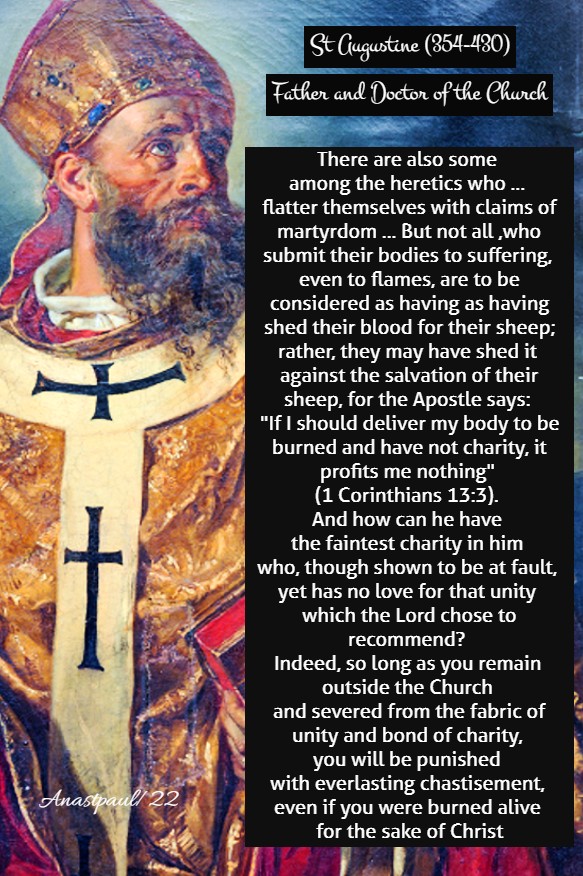
“There are also some among the heretics who … flatter themselves with claims of martyrdom … But not all ,who submit their bodies to suffering, even to flames, are to be considered as having as having shed their blood for their sheep; rather, they may have shed it against the salvation of their sheep, for the Apostle says: “If I should deliver my body to be burned and have not charity, it profits me nothing” (1 Corinthians 13:3). And how can he have the faintest charity in him who, although shown to be at fault, yet has no love for that unity which the Lord chose to recommend? Indeed, so long as you remain outside the Church and severed from the fabric of unity and bond of charity, you will be punished with everlasting chastisement, even if you were burned alive for the sake of Christ
St Augustine (354-430) Father and Doctor of the Church
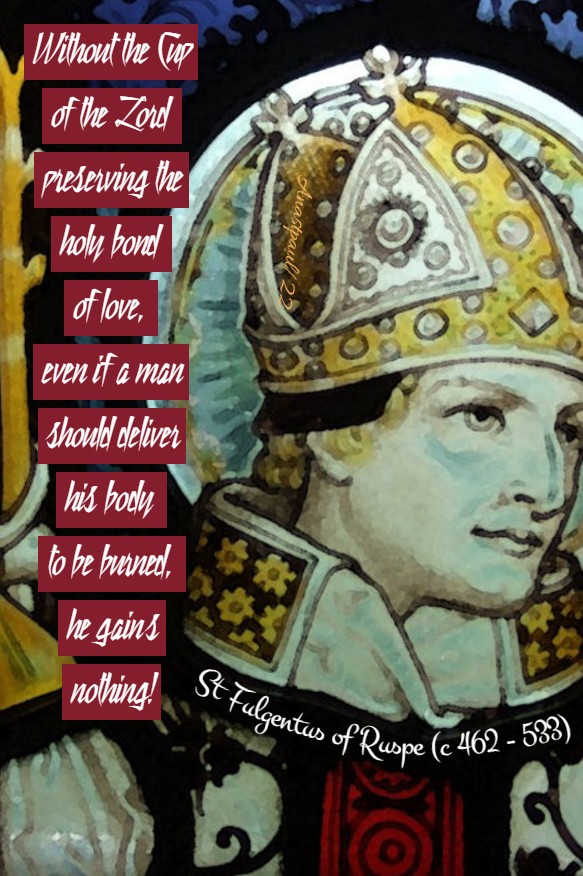
“Without the Cup of the Lord preserving the holy bond of love, even if a man should deliver his body to be burned, he gains nothing!”
St Fulgentus of Ruspe (c 462 – 533)
The prayer below, was written by Saint Thomas More while he was imprisoned in the Tower of London, awaiting execution by King Henry VIII.
Give Me Thy Grace, Good Lord! A Prayer of Hope By St Thomas More (1478-1535)
Give me Thy grace, good Lord. To set the world at naught. To set the mind firmly on Thee and not to hang upon the words of men’s mouths. To be content to be solitary. Not to long for worldly pleasures. Little by little, utterly to cast off the world and rid my mind of all its business. Not to long to hear of earthly things but that the hearing of worldly fancies, may be displeasing to me. Gladly to be thinking of God, piteously to call for His help. To lean into the comfort of God. Busily to labour to love Him. To know mine own vileness and wretchedness. To humble myself under the mighty Hand of God. To bewail my sins past, for the purging of them, patiently to suffer adversity. Gladly to bear my purgatory here. To be joyful in tribulations. To walk the narrow way that leads to life. To bear the Cross with Christ. To have the last thing in remembrance. To have ever before mine eyes, my death that is ever at hand. To make death no stranger to me. To foresee and consider, the everlasting fire of Hell. To pray for pardon before the Judge come. To have continually in mind, the Passion that Christ suffered for me. For His benefits, unceasingly to give Him thanks. To buy the time again, that I before have lost. To abstain from vain conversations. To shun foolish mirth and gladness. To cut off unnecessary recreations. Of worldly substance, friends, liberty, life and all, to set the loss at naught, for the winning of Christ. To think my worst enemies, my best friends, for the brethren of Joseph could never have done him so much good with their love and favour, as they did him, with their malice and hatred. These minds are more to be desired of every man, than all the treasures of all the princes and kings, Christian and heathen, were it gathered and laid together, all in one heap. Amen
Quote/s of the Day – 8 July – The Memorial of St Elizabeth Queen of Portugal TOSF (1271-1336) – Proverbs 31:10-31, Matthew 13:44-52.
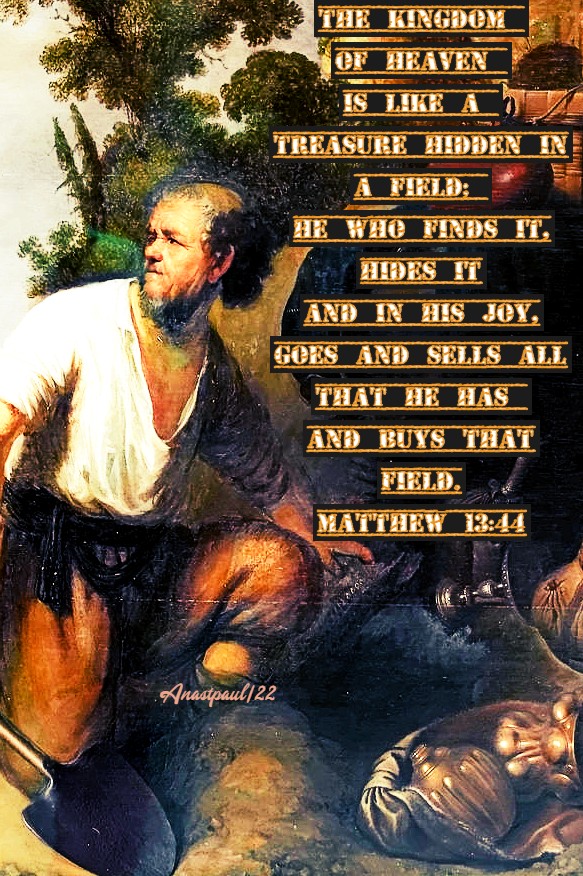
“The Kingdom of Heaven is like a treasure hidden in a field; he who finds it, hides it and in his joy, goes and sells all that he has and buys that field.”
Matthew 13:44
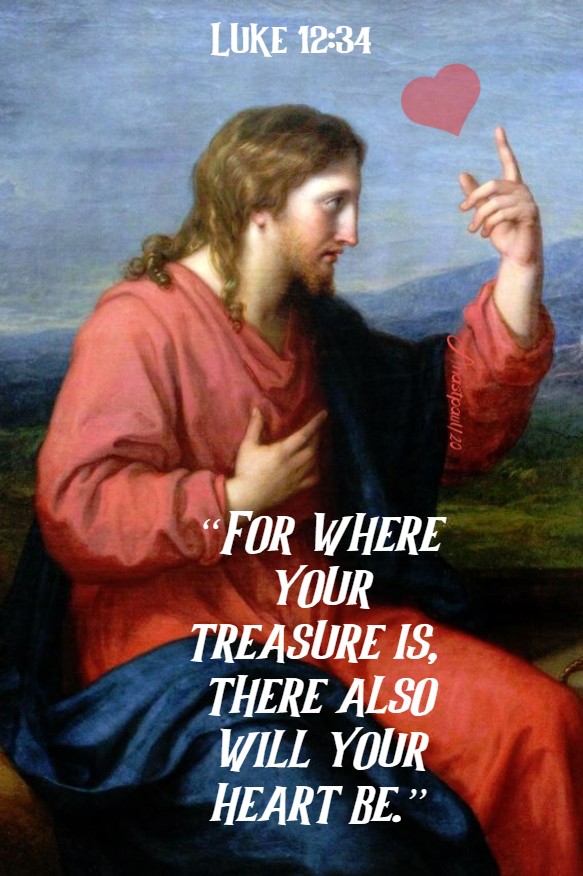
“For where your treasure is, there also will your heart be.”
Luke 12:34
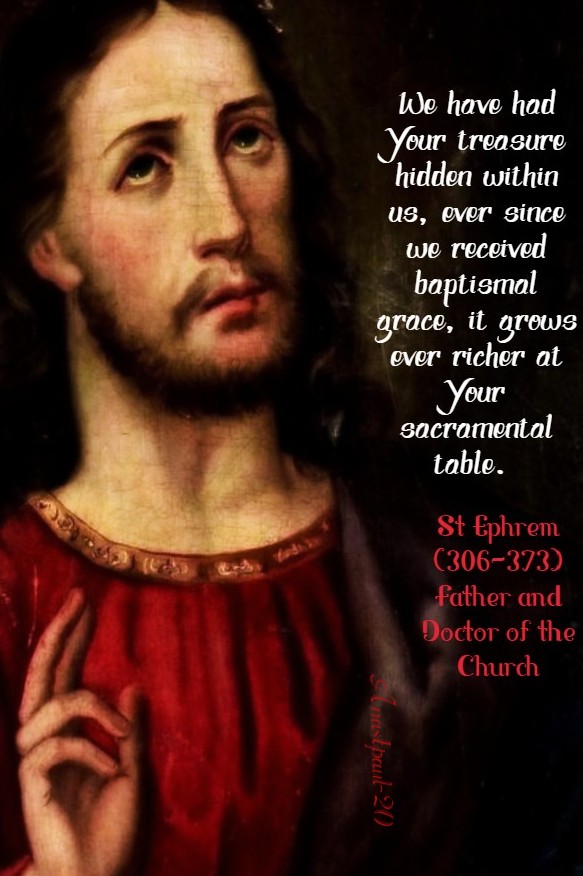
“We have had Your treasure hidden within us, ever since we received baptismal grace, it grows ever richer at Your sacramental table.”
St Ephrem (306-373) Father and Doctor of the Church
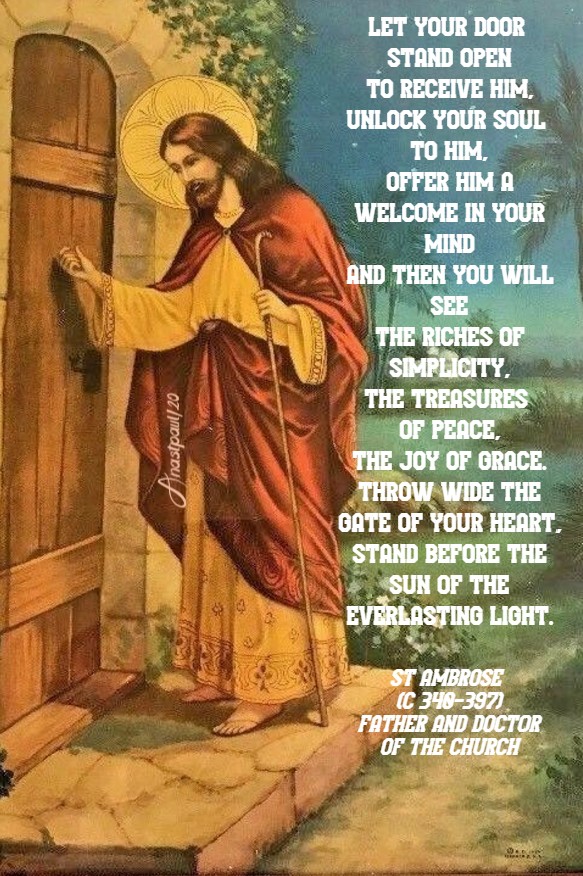
“Let your door stand open to receive Him, unlock your soul to Him, offer Him a welcome in your mind and then you will see the riches of simplicity, the treasures of peace, the joy of grace. Throw wide the gate of your heart, stand before the Sun of the everlasting Light.”
St Ambrose (c 340-397) Father and Doctor of the Church
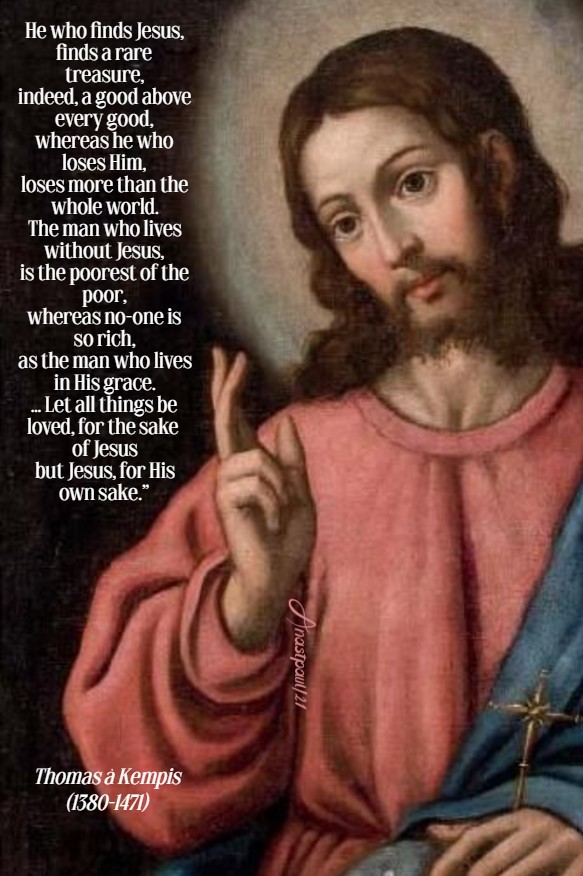
“ He who finds Jesus, finds a rare treasure, indeed, a good above every good, whereas he who loses Him, loses more than the whole world. The man who lives without Jesus, is the poorest of the poor, whereas no-one is so rich, as the man who lives in His grace. … Let all things be loved, for the sake of Jesus but Jesus, for His own sake.”
Thomas à Kempis (1380-1471)
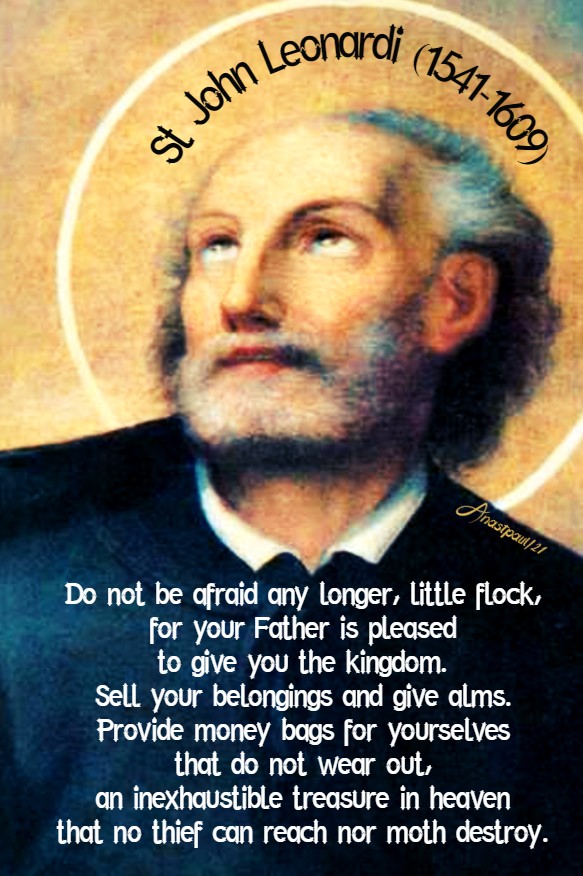
“Do not be afraid any longer, little flock, for your Father is pleased to give you the kingdom. Sell your belongings and give alms. Provide money bags for yourselves that do not wear out, an inexhaustible treasure in heaven that no thief can reach nor moth destroy.”
St John Leonardi (1541-1609)
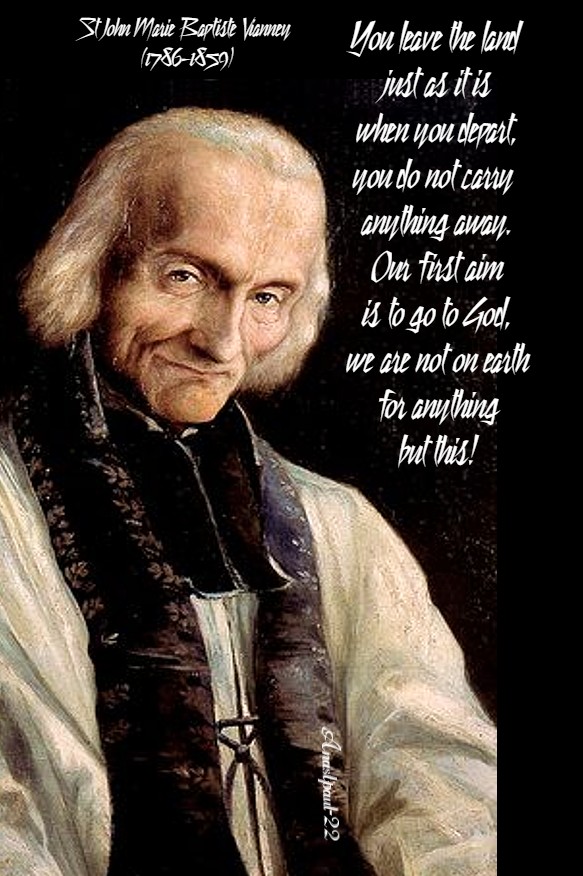
“You leave the land just as it is when you depart, you do not carry anything away. Our first aim is to go to God, we are not on earth for anything but this!”
Quote/s of the Day – 7 July – The Memorial of St Lawrence of Brindisi OFM Cap (1559-1619) Confessor, The “Franciscan Renaissance Man,” Priest
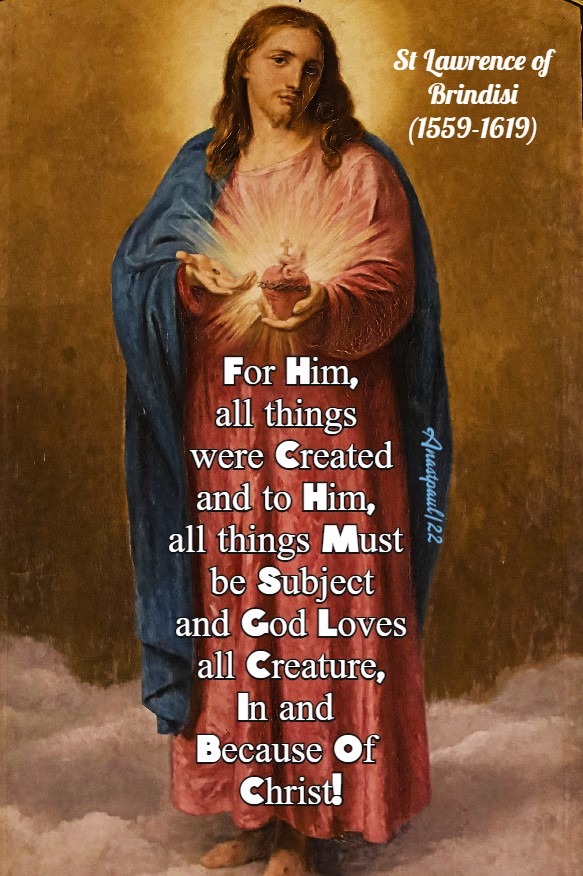
“For Him all things were created and to Him, all things must be subject and God loves all creature, in and because of Christ.”
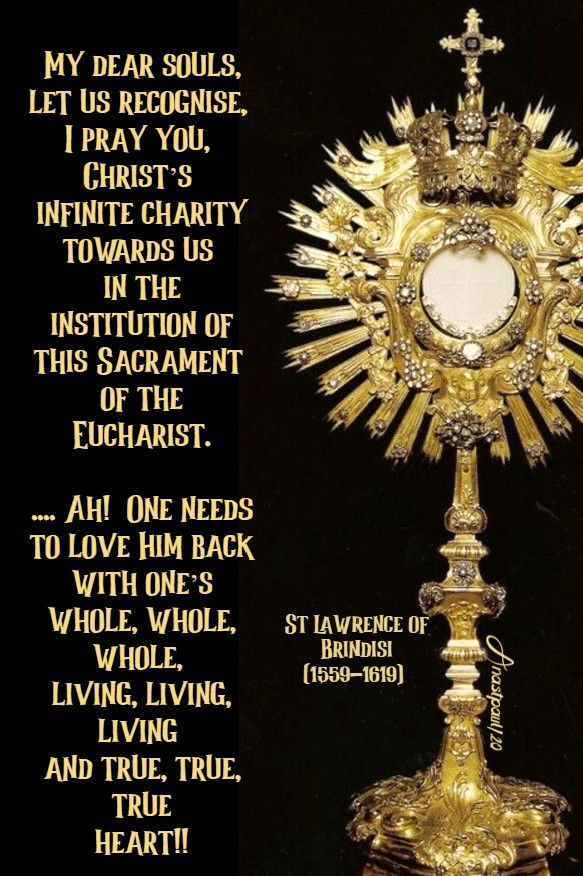
“My dear souls, let us recognise, I pray you, Christ’s infinite charity towards us in the institution of this Sacrament of the Eucharist. In order that our love be a spiritual love, He wills a new heart, a new love, a new spirit for us. It is not with a carnal heart but with a spiritual one, that Christ has loved us with a gratuitous love, a supreme and most ardent love, by way of pure grace and charity. Ah! One needs to love Him back with one’s whole, whole, whole, living, living, living and true, true, true heart!”
Quote/s of the Day – 24 June – “The Month of the Sacred Heart” and the Feast of the Sacred Heart of Jesus
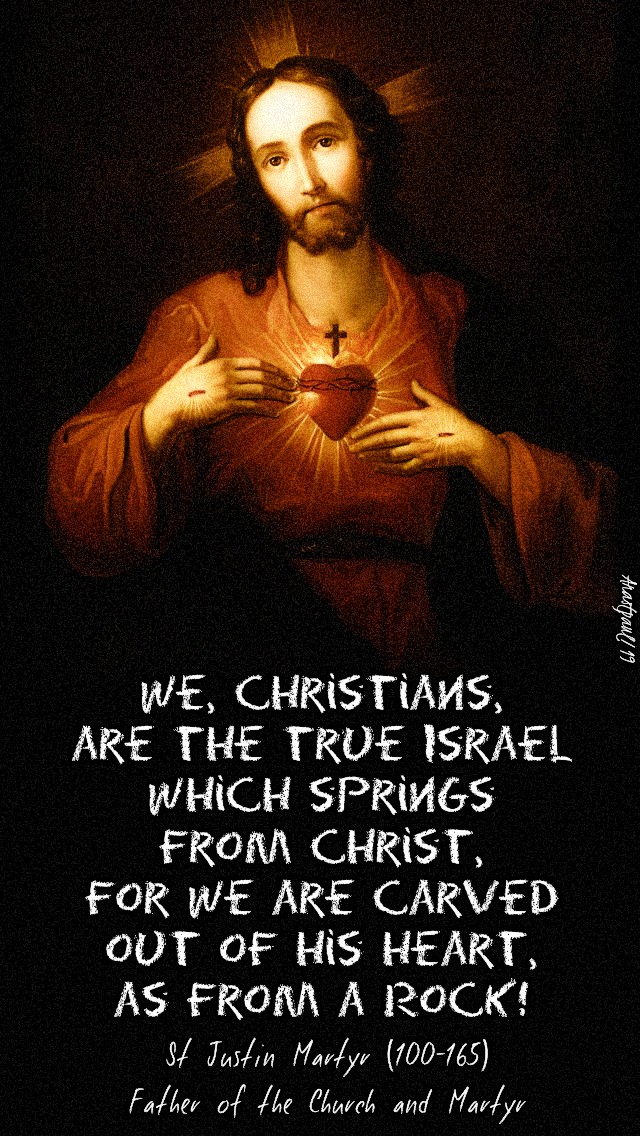
“We, Christians, are the true Israel which springs from Christ, for we are carved out of His Heart, as from a Rock!”
St Justin Martyr (100-165) Father of the Church and Martyr
“Be strengthened in Almighty God and in the power of His might, for with His help, nothing is difficult. Throw off the heavy load of your own will, cast aside the burden of sin and gird yourselves as valiant warriors. Forget what you are leaving behind; strain forward to the great things before you. I tell you, that every place where you set foot, shall be yours. For the Spirit who goes before your face is Christ the Lord. He will carry you to the topmost peak in the arms of His Love.”
St Francis of Assisi (c 1181-1226)
“The Sacred Heart is the symbol of that boundless love which moved the Word to take flesh, to institute the Holy Eucharist, to take our sins upon Himself and, dying on the Cross, to offer Himself as a victim and sacrifice to the eternal Father.”
“O Heart of love, I put all my trust in Thee, for I fear all things, from my own weakness, but I hope for all things, from Thy Goodness.”
The Twelve Promises of Jesus to Saint Margaret Mary or those Devoted to His Sacred Heart:
I will give them all the graces necessary for their state of life.
I will establish peace in their families.
I will console them in all their troubles.
They shall find in My Heart an assured refuge during life and especially at the hour of their death.
I will pour abundant blessings on all their undertakings.
Sinners shall find in My Heart the source of an infinite ocean of mercy.
Tepid souls shall become fervent.
Fervent souls shall speedily rise to great perfection.
I will bless the homes where an image of My Heart shall be exposed and honoured.
I will give to priests the power of touching the most hardened hearts.
Those who propagate this devotion shall have their names written in My Heart, never to be effaced.
The all-powerful love of My Heart will grant to all those who shall receive Communion on the First Friday of nine consecutive months the grace of final repentance; they shall not die under my displeasure, nor without receiving their Sacraments; My heart shall be their assured refuge at that last hour.
From Saint Margaret Mary Alacoque’s Vision of Jesus
St Margaret Mary Alacoque (1647-1690) Visionary of the Sacred Heart
Quote/s of the Day – 23 June – “The Month of the Sacred Heart” – The Octave Day of Corpus Christi
“My dear souls, let us recognise, I pray you, Christ’s infinite charity towards us in the institution of this Sacrament of the Eucharist. In order that our love be a spiritual love, He wills a new heart, a new love, a new spirit for us. It is not with a carnal heart but with a spiritual one, that Christ has loved us with a gratuitous love, a supreme and most ardent love, by way of pure grace and charity. Ah! One needs to love Him back with one’s whole, whole, whole, living, living, living and true, true, true heart!!”
St Lawrence of Brindisi(1559-1619) Apostolic Doctor of the Church
Sweet Sacrament, We Thee Adore
I see upon the Altar placed The Victim of the greatest love. Let all the earth below adore and join the heavenly choirs above: Sweet Sacrament, we Thee adore, Oh! make us love Thee more and more.
Jesus! dear Shepherd of the flock, that crowds in love, about Thy feet, Our voices yearn to praise Thee, Lord and joyfully Thy presence greet: Sweet Sacrament, we Thee adore, Oh! make us love Thee more and more.
O Precious Blood of Jesus, cleanse my soul from every stain! Most pure Heart of Jesus, purify me! Most humble Heart of Jesus, teach me Thy humility! Sweet Heart of Jesus, communicate to me Thy gentleness and patience! Most merciful Heart of Jesus, have mercy on me! Most loving Heart of Jesus, inflame my heart with love of Thee!
One Minute Reflection – 23 June – “The Month of the Sacred Heart” – The Octave Day of Corpus Christi –1 Corinthians 11:23-29, John 6:56-59.
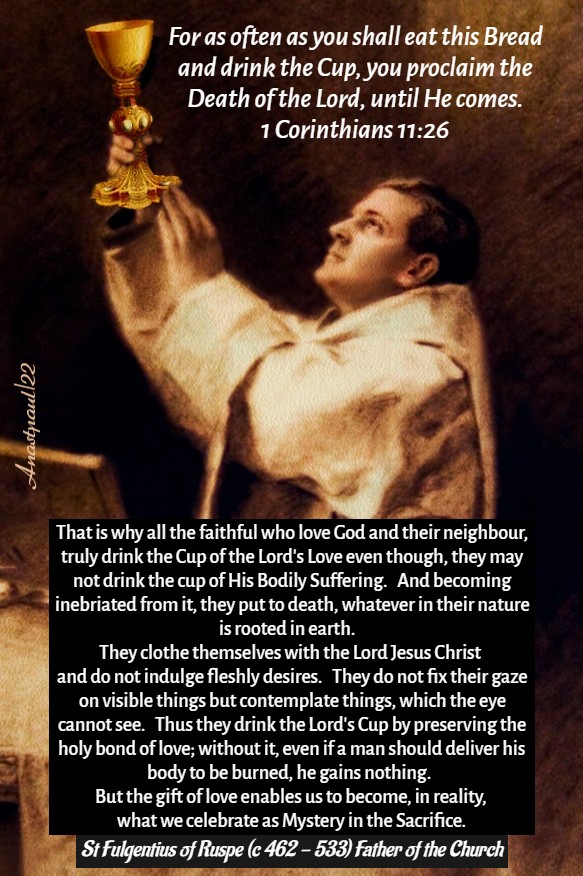
“For as often as you shall eat this Bread and drink the Cup, you proclaim the Death of the Lord, until He comes.” – 1 Corinthians 11:26
REFLECTION – “In our offering of the Holy Sacrifice we fulfil the Command of our Saviour, as recorded by the Apostle Paul: The Lord Jesus, on the night in which He was betrayed, took bread and after He had given thanks, broke it and said: This is My Body, which is given for you. Do this in remembrance of Me. The same way, after the supper, He took the Cup saying: This Cup is the New Covenant in My Blood. Do this, whenever you drink it, in remembrance of Me. For as often as you eat this Bread and drink this Cup, you shall proclaim the Death of the Lord until He comes.
This Sacrifice is offered, then, to proclaim the Lord’s Death; it is offered in remembrance of Him Who laid down His Life for our sake. As He says: Greater love than this no man has, that he lay down his life for his friends. Because Christ died for us out of love, we ask, when we make remembrance of His Death, at the time of Sacrifice, that we too may be granted love through the coming of the Holy Spirit. We pray, that by the Love which Christ had for us when He braved the Cross, we may receive the grace of the Spirit and be crucified to the world and the world to us. The Death Christ died, He died to sin, once for all but the Life He lives, He lives to God. Let us imitate our Lord’s Death and also live a new life. Strengthened with the gift of His Love, let us die to sin and live for God.
For God’s Love has been poured out in our hearts, through the Holy Spirit, Who has been given to us. Indeed our sharing in the Lord’s Body and Blood, when we eat His Bread and drink His Cup, teaches us, that we should die to the world and that we should keep our life hidden with Christ in God, crucifying our flesh with its vices and evil desires.
That is why all the faithful who love God and their neighbour, truly drink the Cup of the Lord’s Love even though, they may not drink the cup of His Bodily Suffering. And becoming inebriated from it, they put to death, whatever in their nature is rooted in earth. They clothe themselves with the Lord Jesus Christ and do not indulge fleshly desires. They do not fix their gaze on visible things but contemplate things, which the eye cannot see. Thus they drink the Lord’s Cup by preserving the holy bond of love; without it, even if a man should deliver his body to be burned, he gains nothing. But the gift of love enables us to become, in reality, what we celebrate as Mystery in the Sacrifice.” – St Fulgentius of Ruspe (c 462 – 533) Bishop, Father (An excerpt from Against Fabianus).
PRAYER – Grant, O Lord, that we may always fear and love Thy Holy Name, for Thou never fails to guide those whom Thou firmly establish in Thy love. Through Jesus Christ, Thy Son our Lord, Who lives and reigns with Thee, in the unity of the Holy Ghost, God, world without end. Amen (Collect). MAY the Heart of JESUS in the most Blessed Sacrament be praised, adored and loved with grateful affection, at every moment, in all the Tabernacles of the world, even to the end of time. – Indulgence 100 Days, Once a Day. Raccolta 161 Pius IX, 29 February 1868.
Thought for the Day – 22 June – Meditations with Antonio Cardinal Bacci (1881-1971)
Frequent Communion
“For the practice of daily Communion, however, we should have the approval of our Confessor. We should be fully determined to preserve ourselves free from every sin, especially from grave sin, for otherwise, we could not approach the Eucharistic banquet (if anyone receives Jesus with mortal sin on his soul, he commits a terrible sacrilege). This practice, moreover, should help us to avoid every deliberate imperfection and venial sin and should inspire in us, a lively spirit of Christian charity. “Receive Communion everyday,” said St Augustine, “because it will help you everyday … but you must live in a manner which will entitle you to communicate daily” (De Verbo Domini – Sermon 28).
Frequent Communion, therefore, will enable us to set out upon the road to perfection, without relaxing in our resolution and without any false scruples. “Two kinds of people,” wrote st Francis de Sales, “should receive Communion frequently – the perfect and the imperfect; the perfect in order to preserve their holiness; the imperfect, in order to reach perfection.” (Introduction to the Devout Life c 2).
Let us ask the advice of our regular Confessor. We shall be fortunate if we can approach the Sacred Banquet everyday, or at least very often, for we shall be sure that we are on the path to holiness.”
Quote/s of the Day – 22 June – “Month of the Sacred Heart” – The Memorial of St Paulinus of Nola (c 354-431) Bishop, Confessor, Father.
“To my mind, the only art, is the Faith and Christ is my Poetry.”
“It is not surprising if, despite being far apart, we are present to each other and without being acquainted, know each other because, we are members of One Body, we have One Head, we are steeped in One Grace, we live on One Loaf, we walk on One Road and we dwell in the Same House!”
One Minute Reflection – 22 June – “The Month of the Sacred Heart of Jesus” – Within the Octave of Corpus Christi and the Memorial of St Paulinus of Nola (c 354-431) Bishop, Confessor – 1 Corinthians 23-29, John 6:56-59.
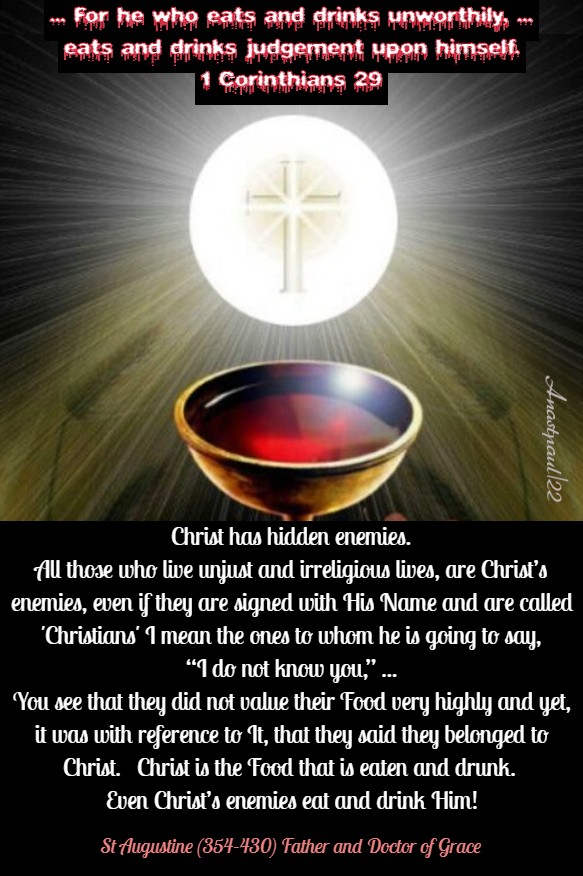
“ … For he who eats and drinks unworthily, … eats and drinks judgement upon himself.”- 1 Corinthians 29
REFLECTION – “Christ has hidden enemies. All those who live unjust and irreligious lives are Christ’s enemies, even if they are signed with His Name and are called ‘Christians’ I mean the ones to whom he is going to say, “I do not know you” and they say to him, “Lord, in your name we ate and drank. In your name, we performed many deeds of power. What did we eat and drink in your name?”
You see that they did not value their food very highly and yet, it was with reference to It, that they said they belonged to Christ. Christ is the Food that is eaten and drunk. Even Christ’s enemies eat and drink Him! The faithful know the Lamb without spot on which they feed, if only they fed on It in such a way that they are not liable to punishment! The Apostle says, “Whoever eats and drinks unworthily is eating and drinking judgment upon himself.” – St Augustine (354-430) Father and Doctor of Grace (Sermon 308).
PRAYER – O God, Who promised to those who forsake all things in this world for Thee, a hundred-fold reward in the world to come and life everlasting, mercifully grant that, following closely in the footsteps of the holy Bishop, Paulinus, we may look upon earthly things as nought and long only for those of Heaven. Who lives and reigns with God the Father, in the unity of the Holy Spirit, God, world without end. Amen (Collect). SWEET HEART of my JESUS, Make me love Thee ever more and more! – Indulgence 300 Days Everytime – Plenary Once a Month – Raccolta 162 – Pope Pius IX 26 November 1876.
One Minute Reflection – 21 June – “The Month of the Sacred Heart of Jesus” – Tuesday within the Octave of Corpus Christi and the Memorial of St Aloysius de Gonzaga SJ (1568-1591) – 1 Corinthians 23-29, John 6:56-59.
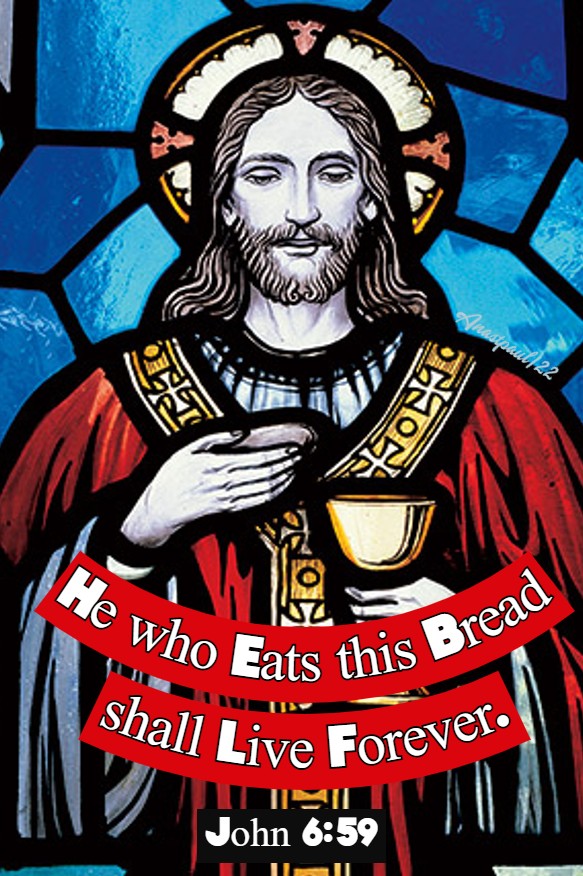
“This is the Bread that has come down from Heaven; not as your fathers ate the manna and died. He who eats this Bread shall live forever.” – John 6:59
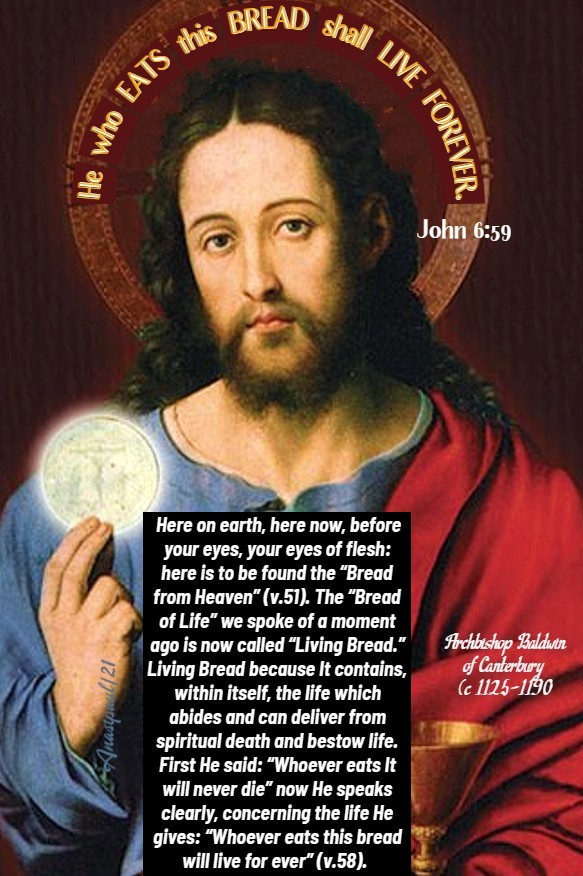
REFLECTION – Christ is “the bread of life” for those who believe in Him: to believe in Christ is to eat the bread of life, to possess Christ within one, is to possess eternal life… “I am the bread of life,” He says; “your fathers ate manna in the wilderness and they are dead” (Jn 6,48f). By this is to be understood ,spiritual death. Why are they dead? Because they believed in what they saw and did not understand what they could not see… Moses ate manna, Aaron ate it and many others, too, who pleased God and are not dead. Why are they not dead? Because they understood, in a spiritual fashion, they were spiritually hungry, they tasted the manna spiritually, so that they might be spiritually satisfied. “This is the bread that came down from heaven: whoever eats it will never die” (v.50). This manna – that is to say, Christ, who Himself spoke like this…, was prefigured by the manna but was able to do more than manna could. For manna could not, of itself, prevent dying spiritually… But the righteous saw Christ in the manna, they believed in His coming and Christ, of whom manna was the symbol, grants to all who believe in Him that they should not spiritually die. Hence He says: “This is the bread come down from heaven; whoever eats it will never see death.” Here on earth, here now, before your eyes, your eyes of flesh: here is to be found the “bread from heaven” (v.51). The “bread of life” we spoke of a moment ago is now called “living bread.” Living bread because it contains, within itself, the life that abides and can deliver from spiritual death and bestow life. First He said: “Whoever eats it will never die” now he speaks clearly, concerning the life He gives: “Whoever eats this bread will live for ever” (v.58). Archbishop Baldwin of Canterbury (c 1125-1190) Cistercian – The Sacrament of the Altar II
PRAYER – O God, bestower of heavenly gifts, Who in the angelic youth Aloysius joined wondrous innocence of life to an equally wondrous love of penance; grant, by his merits and prayers, that we who have not followed him in his innocence may imitate him in his penance. Through Jesus Christ, Thy Son our Lord, Who lives and reigns with Thee, in the unity of the Holy Ghost, God, world without end. Amen (Collect). SACRED Heart of JESUS, Thy Kingdom come! Indulgence 300 Days. Everytime Raccolta 178 St Pius X, 4 May 1906.
Thought for the Day – 20 June – Meditations with Antonio Cardinal Bacci (1881-1971)
The Eucharistic Life
“The Eucharistic life, which is the life of union with Jesus, especially by means of daily Communion, transforms us and makes us holy. It preserves and increases in us, the grace which is the supernatural life of the soul. The Eucharist, of itself, does not bestow grace because, it is a Sacrament of the living. It is our food and food is not given to the dead but, to the living. For this reason, we should receive Holy Communion free from the stain of sin. The Eucharist, moreover, remits venial sin, strengthens us in our resolution and increases our charity. Venial sin, is a sickness of the soul. Just as natural food banishes listlessness and vulnerability to disease, our Eucharistic nourishment has the same effect on our spiritual life.
It is because the Blessed Eucharist increases our love for Jesus, that it weakens our evil inclinations. The Eucharist and sin, are mutually exclusive of one another because, the Eucharist is Jesus and sin is the devil. Our Eucharistic food, moreover, produces, in our souls, a spiritual consolation which is a foretaste of the happiness of Heaven.
Let us listen to Jesus living within us. He will enable us to forget our worldly cares and will raise us to a higher plane where, by God’s Infinite Goodness, we shall continue to grow in virtue.”
Quote/s of the Day – 20 June – “The Month of the Sacred Heart” – Monday within the Octave of Corpus Christi
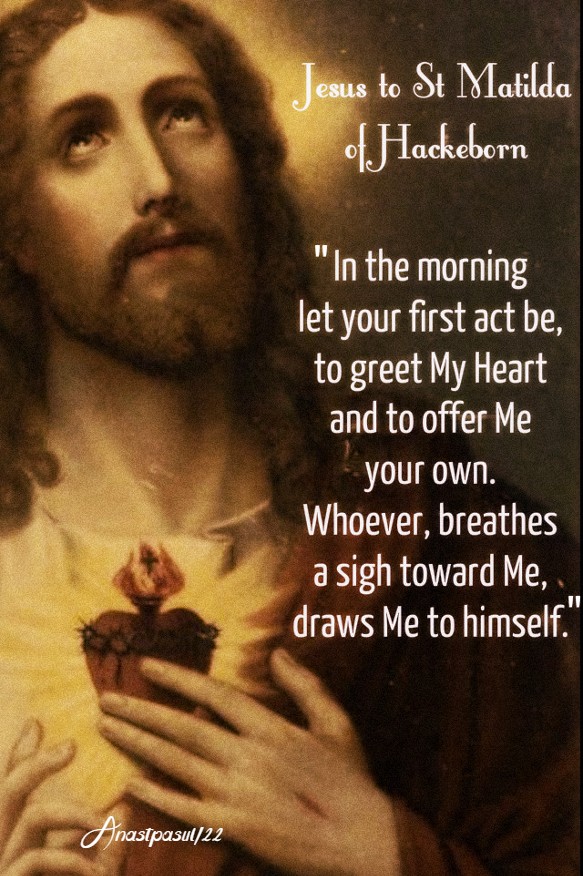
“In the morning let your first act be to greet My Heart and to offer Me your own. Whoever, breathes a sigh toward Me, draws Me to himself.”
Jesus to St Matilda/Mechtilde of Hackeborn (c 1241-1298)
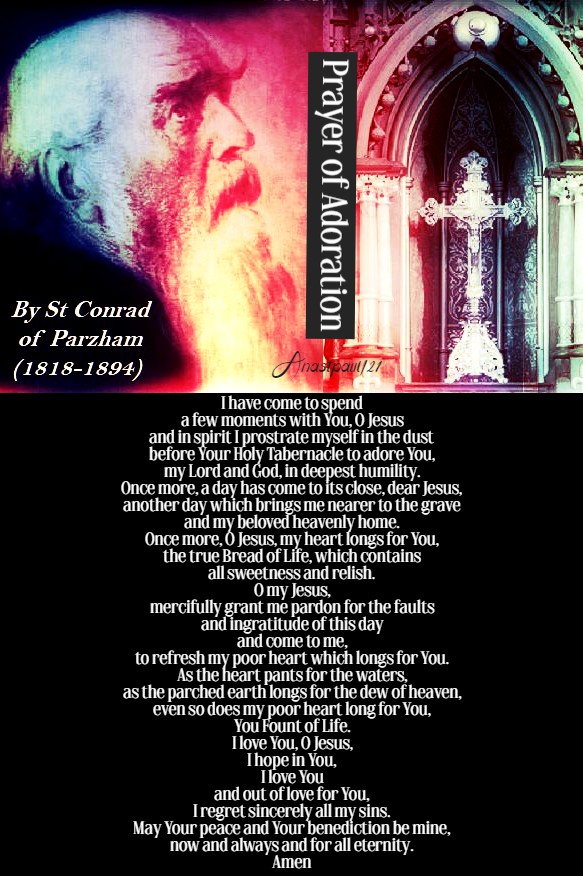
Prayer of Adoration and Repentance/Night Prayer By St Conrad of Parzham (1818-1894)
I have come to spend a few moments with You, O Jesus and in spirit I prostrate myself in the dust before Your Holy Tabernacle to adore You, my Lord and God, in deepest humility. Once more, a day has come to its close, dear Jesus, another day which brings me nearer to the grave and my beloved heavenly home. Once more, O Jesus, my heart longs for You, the true Bread of Life, which contains all sweetness and relish. O my Jesus, mercifully grant me pardon for the faults and ingratitude of this day and come to me, to refresh my poor heart which longs for You. As the heart pants for the waters, as the parched earth longs for the dew of heaven, even so does my poor heart long for You, You Fount of Life. I love You, O Jesus, I hope in You, I love You and out of love for You, I regret sincerely all my sins. May Your peace and Your benediction be mine, now and always and for all eternity. Amen
One Minute Reflection – 20 June – “The Month of the Sacred Heart” – Monday within the Octave of Corpus Christi and the Memorial of St Pope Silverius (Died 538) Martyr – 1 Corinthians 23-29, John 6:56-59.
“He who eats this Bread shall live forever.” – John 6:59
REFLECTION – “Since it was the Will of God’s Only-Begotten Son, that men should share in His Divinity, He assumed our nature in order that, by becoming Man. He might make men gods . Moreover, when He took our flesh. He dedicated the whole of its substance to our salvation. He offered His Body to God the Father, on the Altar of the Cross, as a sacrifice for our reconciliation. He shed His Blood for our ransom and purification, so that we might be redeemed, from our wretched state of bondage and cleansed from all sin. But to ensure that the memory of so great a gift would abide with us forever, He left His Body as food and His Blood as drink, for the faithful to consume in the form of bread and wine.
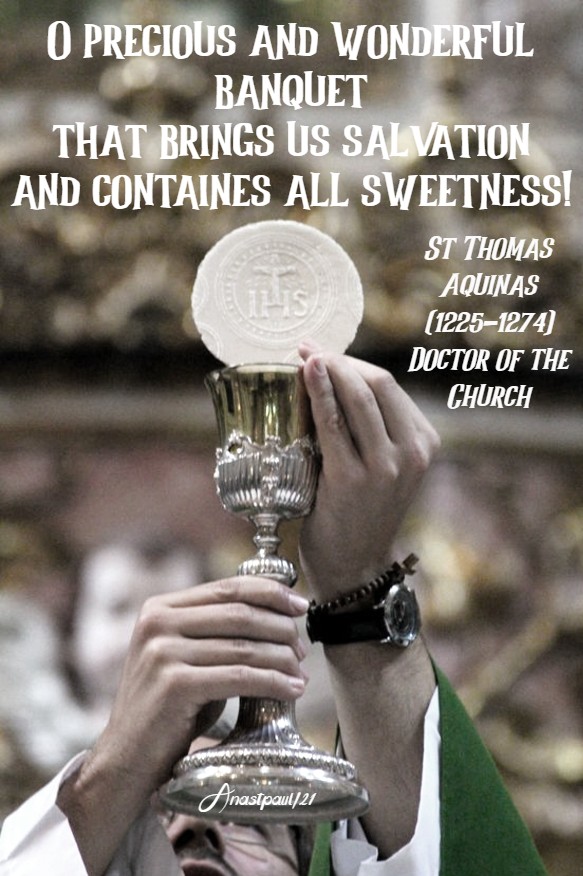
O precious and wonderful banquet which brings us salvation and contains all sweetness! Could anything be of more intrinsic value? Under the old law, it was the flesh of calves and goats, which was offered but here, Christ Himself, the True God, is set before us as our food! What could be more wonderful than this? No other Sacrament has greater healing power; through it, sins are purged away, virtues are increased and the soul is enriched with an abundance of every spiritual gift. It is offered in the Church for the living and the dead, so that what was instituted for the salvation of all, may be for the benefit of all. Yet, in the end, no-one can fully express the sweetness of this Sacrament, in which spiritual delight is tasted at its very source, and in which, we renew the memory, of that surpassing love for us, which Christ revealed in His Passion.
It was to impress the vastness of this love, more firmly upon the hearts of the faithful, that our Lord instituted this Sacrament at the Last Supper. As He was on the point of leaving the world to go to the Father, after celebrating the Passover with His disciples, He left it as a perpetual memorial of His Passion. It was the fulfilment of ancient figures and the greatest of all His Miracles, while, for those who were to experience the sorrow of His departure, it was destined to be a unique and abiding consolation.” – St Thomas Aquinas (1225-1274) Dominican Priest and Theologian, Doctor of the Church (An excerpt from On the Feast of the Body of Christ).
PRAYER – Look forgivingly on Thy flock, Eternal Shepherd and keep it in Thy constant protection, by the intercession of blessed Sylvester thy Martyr and Sovereign Pontiff, whom Thou didst constitute Shepherd of the whole Church. Through Jesus Christ, Thy Son our Lord, Who lives and reigns with Thee, in the unity of the Holy Ghost, God, world without end. Amen (Collect). O HEART of love, I place all my trust in Thee; for though I fear all things from my weakness, I hope all things from Thy mercies. – Ejaculation of Saint Margaret Mary – Indulgence 300 Days, Everytime – Raccolta 180St Pius X, 3 June 1908.
Thought for the Day – 19 June – Meditations with Antonio Cardinal Bacci (1881-1971)
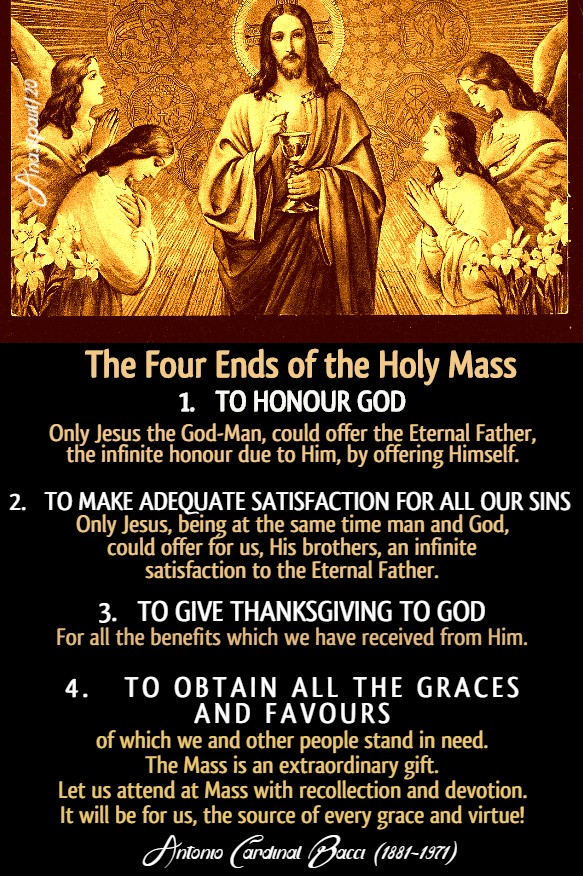
The Four Ends of the Holy Mass
“Let us meditate on the fact, that the Sacrifice of the Eucharist, was instituted for four ends, namely:
1. TO HONOUR GOD All the Angels and Saints of Heaven and all the human beings upon earth, could not possibly honour God, as He ought to be honoured because, they are creatures who derive everything which they possess from God. Only Jesus the God-Man, could offer the Eternal Father, the infinite honour due to Him, by offering Himself.
2. TO MAKE ADEQUATE SATISFACTION FOR ALL OUR SINS Insofar, as they are a revolt against God, our sins are, in a certain way, infinite. This is because they offend an Infinite Being. Only Jesus, being at the same time man and God, could offer for us, His brothers, an infinite satisfaction to the Eternal Father. Only He, could redeem us from the debt of crime and punishment, which we had contracted, by offering Himself, without reserve, in the Eucharistic Sacrifice. It must be explained, however, that although the Mass is of infinite value in itself, God applies this value to us in a finite way only, according to His good pleasure and according to our dispositions. For this reason, we should do well to attend Mass, as often as possible and with the maximum fervour.
3. TO GIVE THANKSGIVING TO GOD for all the benefits which we have received from Him.
4. Finally, TO OBTAIN ALL THE GRACES AND FAVOURS of which we and others stand in need. The Mass is an extraordinary gift. Let us attend at Mass with recollection and devotion. It will be for us, the source of every grace and virtue!” Amen
Quote/s of the Day – 19 June – “The Month of the Sacred Heart of Jesus” – Solemnity of Corpus Christ. Sunday within the Octave and the Memorial of St Juliana Falconieri OSM (1270 – 1341) Virgin
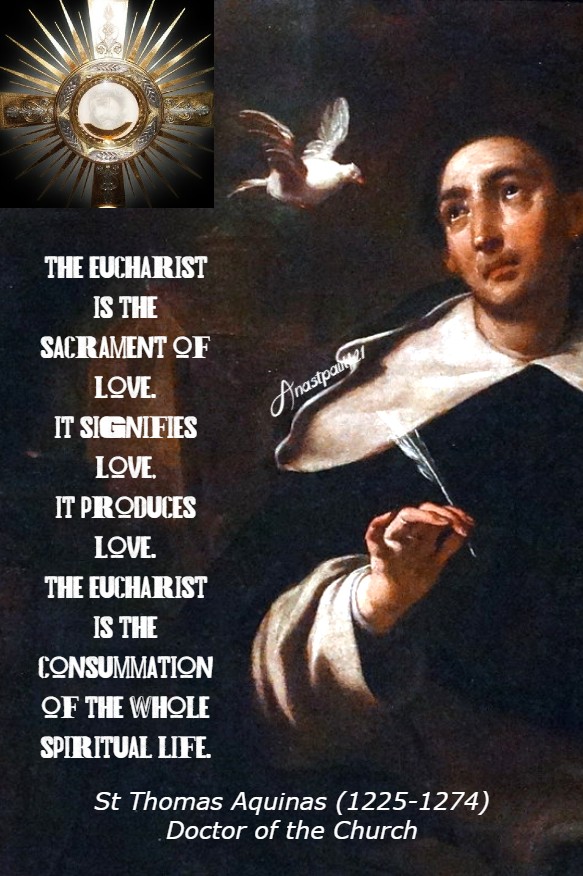
“The Eucharist is the Sacrament of Love. It signifies Love, It produces love. The Eucharist is the consummation of the whole spiritual life.”
“ O precious and wonderful banquet that brings us salvation and contains all sweetness!”
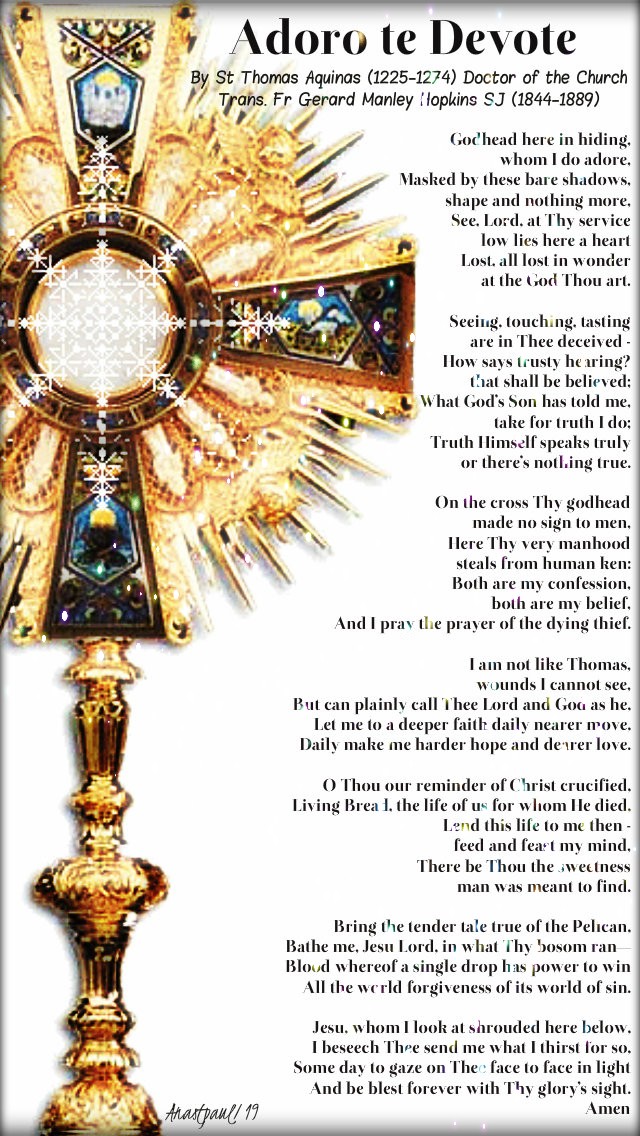
Adoro te Devote Trans. Fr Gerard Manley Hopkins SJ (1844-1889)
Godhead here in hiding, whom I do adore, Masked by these bare shadows, shape and nothing more, See, Lord, at Thy service low lies here a heart Lost, all lost in wonder at the God Thou art.
Seeing, touching, tasting are in Thee deceived – How says trusty hearing? that shall be believed, What God’s Son has told me, take for truth I do, Truth Himself speaks truly or there’s nothing true.
On the cross Thy godhead made no sign to men, Here Thy very manhood steals from human ken – Both are my confession, both are my belief, And I pray the prayer of the dying thief.
I am not like Thomas, wounds I cannot see, But can plainly call Thee Lord and God as he, Let me to a deeper faith daily nearer move, Daily make me harder hope and dearer love.
O Thou our reminder of Christ crucified, Living Bread, the life of us for whom He died, Lend this life to me then – feed and feast my mind, There be Thou the sweetness man was meant to find.
Bring the tender tale true of the Pelican, Bathe me, Jesu Lord, in what Thy bosom ran— Blood whereof a single drop has power to win All the world forgiveness of its world of sin.
Jesu, whom I look at shrouded here below, I beseech Thee send me what I thirst for so, Some day to gaze on Thee face to face in light And be blest forever with Thy glory’s sight. Amen
St Thomas Aquinas (1225-1274) Doctor angelicus/Doctor communis
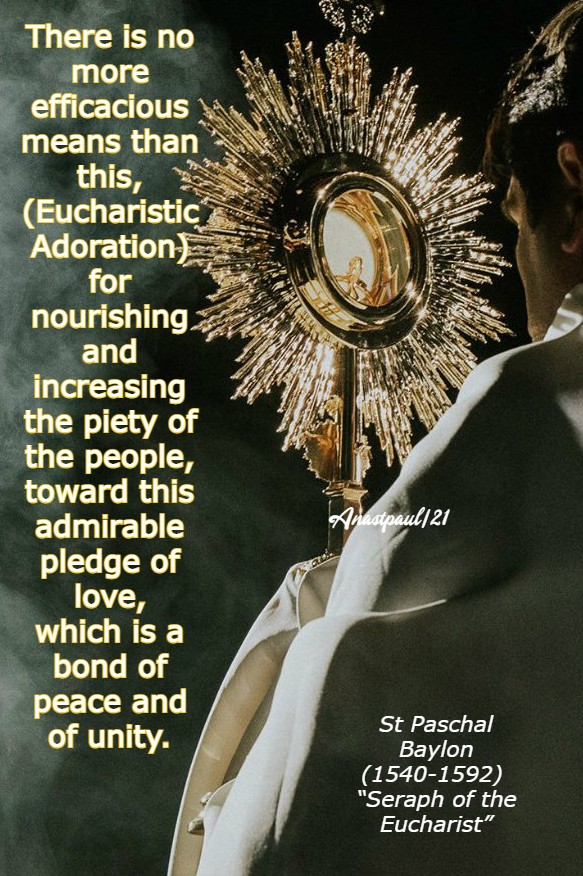
“There is no more efficacious means than this, (Eucharistic Adoration) for nourishing and increasing the piety of the people, toward this admirable pledge of love, which is a bond of peace and of unity.”
St Paschal Baylon (1540-1592)
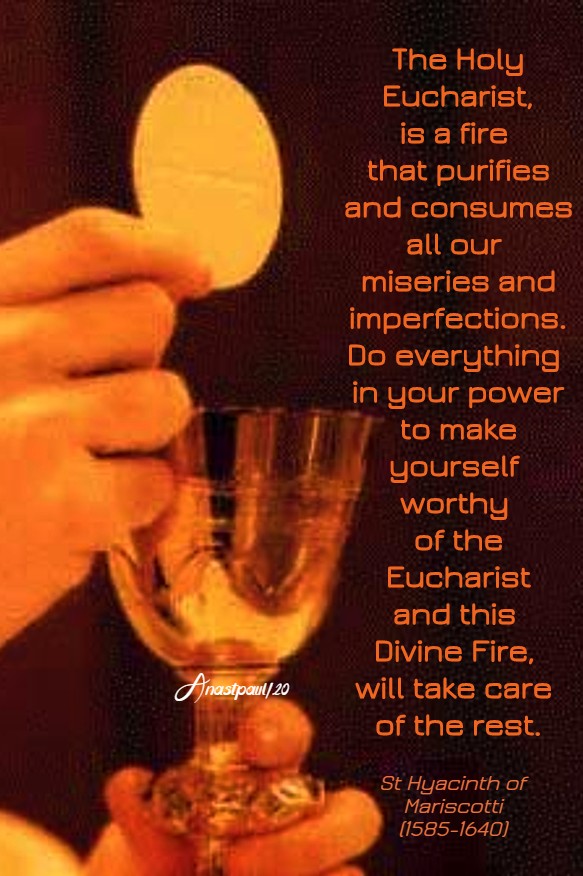
“The Holy Eucharist, is a fire that purifies and consumes all our miseries and imperfections. Do everything in your power to make yourself worthy of the Eucharist and this Divine Fire, will take care of the rest.”
St Hyacinth of Mariscotti (1585-1640)
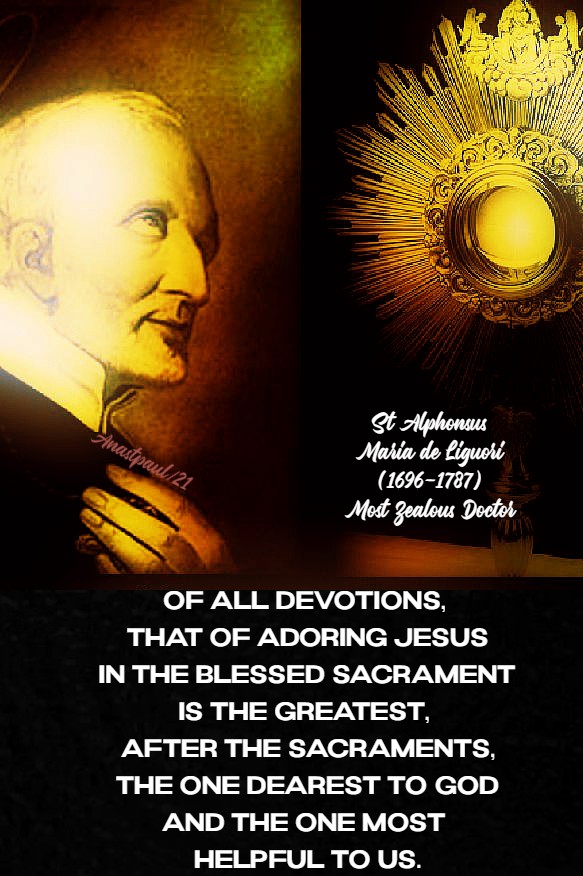
“Of all devotions, that of adoring Jesus in the Blessed Sacrament is the greatest, after the sacraments, the one dearest to God and the one most helpful to us.”
St Alphonsus Maria de Liguori (1696-1787) Most Zealous Doctor
Anima Christi
Soul of Christ, sanctify me Body of Christ, save me Blood of Christ, inebriate me Water from the side of Christ, wash me Passion of Christ, strengthen me Good Jesus, hear me Within Your wounds, shelter me from turning away, keep me From the evil one, protect me At the hour of my death, call me Into Your presence lead me to praise You with all Your saints Forever and ever, Amen
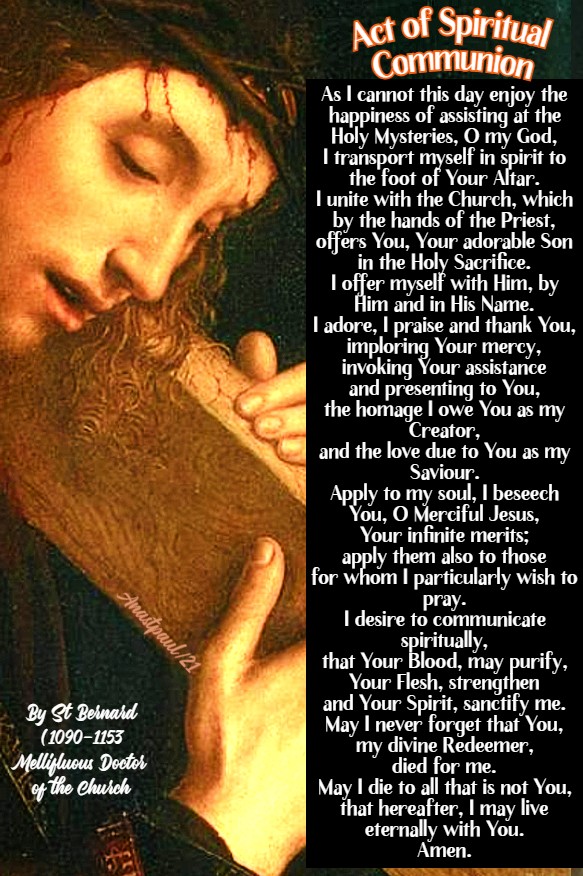
Act of Spiritual Communion By St Bernard (1090-1153 Mellifluous Doctor of the Church
As I cannot this day enjoy the happiness of assisting at the Holy Mysteries, O my God, I transport myself in spirit to the foot of Your Altar. I unite with the Church, which by the hands of the Priest, offers You, Your adorable Son in the Holy Sacrifice. I offer myself with Him, by Him and in His Name. I adore, I praise and thank You, imploring Your mercy, invoking Your assistance and presenting to You, the homage I owe You as my Creator and the love due to You as my Saviour.
Apply to my soul, I beseech You, O Merciful Jesus, Your infinite merits; apply them also to those for whom I particularly wish to pray. I desire to communicate spiritually, that Your Blood, may purify, Your Flesh, strengthen and Your Spirit, sanctify me. May I never forget that You, my divine Redeemer, died for me. May I die to all that is not You, that hereafter, I may live eternally with You. Amen.
Our Morning Offering – 19 June – “The Month of the Sacred Heart of Jesus” – Solemnity of Corpus Christ. Sunday within the Octave
O Heart of Jesus in the Blessed Sacrament By The League of the Sacred Heart 1929 (Ireland)
O Heart of Jesus in the Blessed Sacrament, overflowing with gentleness, tenderness and charity, I bury in the abyss of Thy Mercy, all my iniquities and all my negligence. I offer Thee my labours and my sufferings, my sorrows and my miseries, I recommend to Thee my life and my death. Solace my doubts Sweet Jesus, calm my fears and grant, that day-by-day, I may become more united to Thy Sacred Heart, learning Thy love and Thy holiness. Amen
Saint of the Day – 19 June – St Juliana Falconieri OSM (1270–1341) Virgin and Foundress of the Religious Sisters of the Order of Servites, Mystic, Ecstatic, Ascetic.
The Roman Martyrology reads today: “At Florence, St Julian Falconieri, Virgin, Foundress of the Sisters of the Order of the Servants of the Blessed Virgin Mary, who was placed among the Holy Virgins by the Sovereign Pontiff, Clement XII.”
St Juliana Falconieri, Virgin By Fr Francis Xavier Weninger SJ (1805-1888)
The Roman Martyrology, enlarged by Benedict XIV announces today, the festival of St.Juliana. Florence in Italy, is the place where St Juliana was born, in 1270. Her parents were of the illustrious house of Falconieri and were long without issue, until, at last, the fruit of many prayers, this holy daughter was given to them. It was looked upon as a sign of her future holiness, that Juliana, when an innocent child, pronounced the two blessed names of Jesus and Mary, without having been taught by anyone to utter them. Even in her childhood, she endeavoured, so earnestly, to attain Christian virtues, that her uncle, St Alexius, of the Order of Servites, who was her instructor, hesitated not to say to her mother, that she had not given birth to a mortal maiden, but to an Angel.
And in truth, Juliana’s conduct was such, that she resembled an Angel, rather than a human being. Never was it seen, that she raised her eyes to look at the face of any man, much less that she ever regarded the other sex with boldness. Her horror of sin was innate, so that she trembled when she only heard the name of it, nay, she was seen to sink to the ground, as one dead, when a crime was only mentioned. Regardless of her temporal wealth and of many advantageous offers of marriage, she made a vow, in presence of St Philip Benizi, by which she Consecrated her virginity to God, when she was not yet fifteen years of age. She was the first of her sex who entered the Order of the Servites. Many of the highest nobility followed her example. Juliana prescribed certain rules for them, in the composition of which, she showed extraordinary wisdom and holiness. Hence she is justly recognised and honoured, as the Foundress of the Sisterhood of the Servants of Mary.
St Philip Benizi, (one of the Seven Holy Founders) who not only enlarged the Order of the Servites but also, guided those who belonged to it, in a most exemplary manner, was so thoroughly convinced of the virtues of Juliana, that he said, before his death, that there was no-one more fit to be entrusted with the government of the whole Order–men as well as women–than Juliana. She, however, had quite a different opinion of herself and, although, she was appointed to guide others, she performed, with the utmost willingness, the most menial services for those under her. She was so deeply devoted to prayer, that she continued whole days in this exercise, during which time, she often fell into ecstasies and was favoured with divine apparitions. The time unoccupied by work and prayer, she usually spent in reconciling hostile minds, for which kind office, she was peculiarly qualified and also, in converting sinners, many of whom her persuasions brought to the knowledge of their faults, or in nursing the sick, to whom she was devoted with a mother’s love.
Anxious to conquer herself, she more than once sucked the putrid matter from the ulcers of the sick and God, in consideration of such heroic self-abnegation, instantly restored them to health. She was as severe to herself as she was tender towards others. The rest, which she took at night on the bare floor, was very short – as she occupied the greater part of the night in prayer. She chastised her innocent body with scourges and chains of wire. She fasted every Saturday on water and bread. Two days of every week she lived almost without earthly nourishment, as she then received the Bread of Angels, the Blessed Eucharist. On other days, she partook of food but only of very little and that of the most ordinary kind, as otherwise she refused to touch it.
This continual rigour eventually impaired her health and caused her most severe pains, which at last, in the 70th year of her age, ended her life. She had suffered, in this manner, for many years, with the most cheerful and edifying patience. Only one thing pained her exceedingly in her last day,: which was, that, as she could not retain any food, the Priest could not give her the Blessed Sacrament, for which she longed so ardently. Flying for refuge to God, she prayed that He would not permit her to die without this great consolation. Soon after, as if convinced that God would bestow upon her an extraordinary grace, she requested the Priest to bring the holy Eucharist, at least to her room and hold it to her breast. The Priest consented to her request but no sooner had the Blessed Sacrament been placed near her breast, than it suddenly disappeared and at the same time, the countenance of Juliana expressed a great interior satisfaction and happiness. Whilst the Priest strove to recover from his surprise, the servant of God, miraculously fed with the Bread of Life, expired without a struggle. After her death, they found on the left side of her breast, the form of the Host, bearing the image of the Crucified Saviour, like a seal pressed into the flesh. This led to the belief, that the holy virgin had been, in an unprecedented way, comforted in her last hour with the Blessed Eucharist. The fame of this miracle and of many others with which God honoured her after her death, won for Juliana, the esteem of the whole Christian world. Her holy body was buried in the magnificent Church which her father had built in honour of the Blessed Virgin and in memory of the Annunciation.
Thought for the Day – 18 June – Meditations with Antonio Cardinal Bacci (1881-1971)
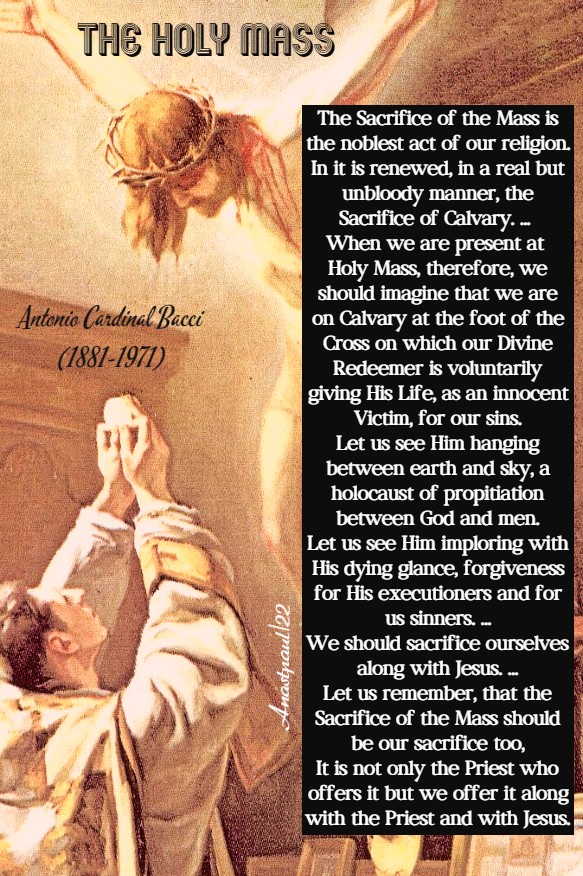
The Holy Mass
“The Sacrifice of the Mass is the noblest act of our religion. In it is renewed, in a real but unbloody manner, the Sacrifice of Calvary.
Jesus desired to remain with us throughout the centuries in the Blessed Eucharist as our friend, comforter and spiritual food. Similarly, not being satisfied with having shed His Precious Blood on the Cross for our Redemption, it was His wish that this sacrificial action should be renewed daily in every corner of the world, in such a way, that everyone could participate in it and benefit from it. When we are present at Holy Mass, therefore, we should imagine that we are on Calvary at the foot of the Cross on which our Divine Redeemer is voluntarily giving His Life, as an innocent Victim, for our sins. Let us see Him hanging between earth and sky, a holocaust of propitiation between God and men. Let us see Him imploring with His dying glance, forgiveness for His executioners and for us sinners.
Let us imagine, moreover, His most Holy Mother as she gazes sorrowfully upon her suffering Son. With love far greater than that of any other human creature, she offers herself in union with Jesus, for our salvation.
We should make a similar offering when we assist at the Sacrifice of the Altar. We should sacrifice ourselves along with Jesus. If we are tormented by sufferings, let us offer them up along with those of Jesus. If we are troubled by passionate inclinations to sin, let us sacrifice these bravely, along with Jesus and for love of Him. If we are full of hatred and coldness towards others, let us sacrifice these feelings for love of Jesus, Who forgave everyone who asked and repented and prayed even for His executioners.
Let us remember, that the Sacrifice of the Mass should be our sacrifice too, It is not only the Priest who offers it but we offer it along with the Priest and with Jesus. “Receive, O Holy Trinity, this oblation which we make to Thee.” Let us unite the offering of our entire selves to the Sacrifice of Jesus and we sgall obtain great spiritual benefits.”
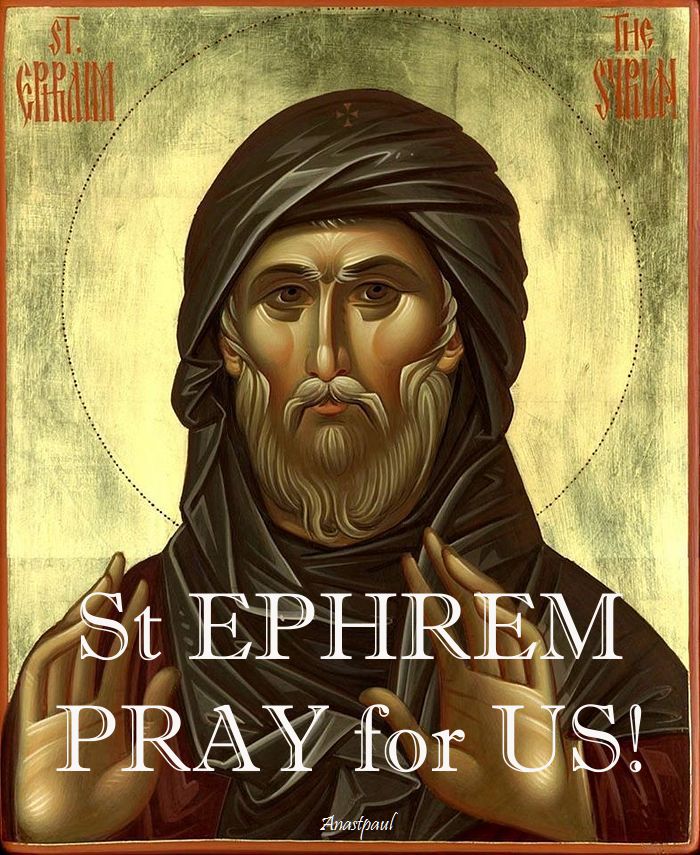
Quote/s of the Day – 18 June – the Memorial of St Ephrem of Syria (306-373) Confessor, Father and Doctor of the Church
“Our Lord chose Matthew, the tax collector, to encourage his fellows to join him. He looked on sinners, called them and brought them to sit beside Him. What a wonderful sight! Angels stand trembling, while publicans, seated, rejoice!”
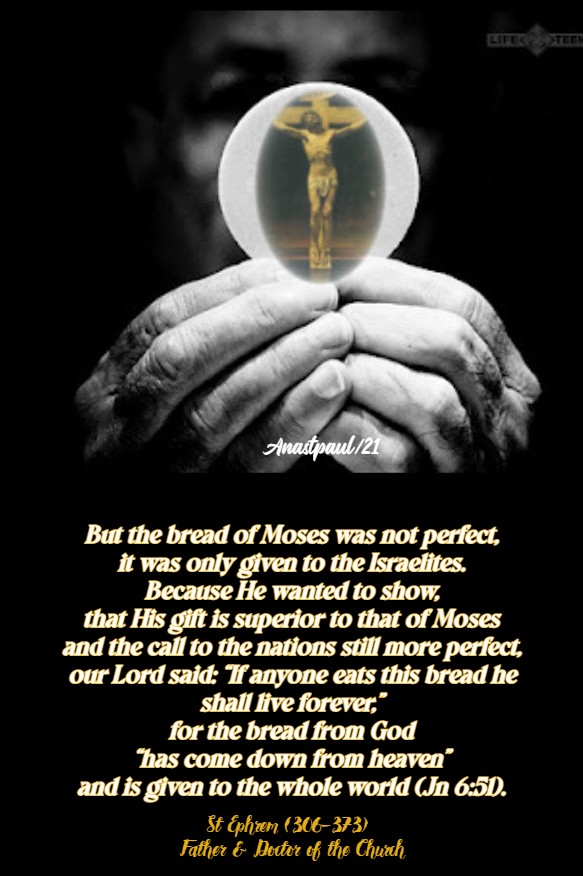
“But the bread of Moses was not perfect, it was only given to the Israelites. Because He wanted to show, that His gift is superior to that of Moses and the call to the nations still more perfect, our Lord said: “If anyone eats this bread he shall live forever,” for the bread from God “has come down from heaven” and is given to the whole world (Jn 6:51).”
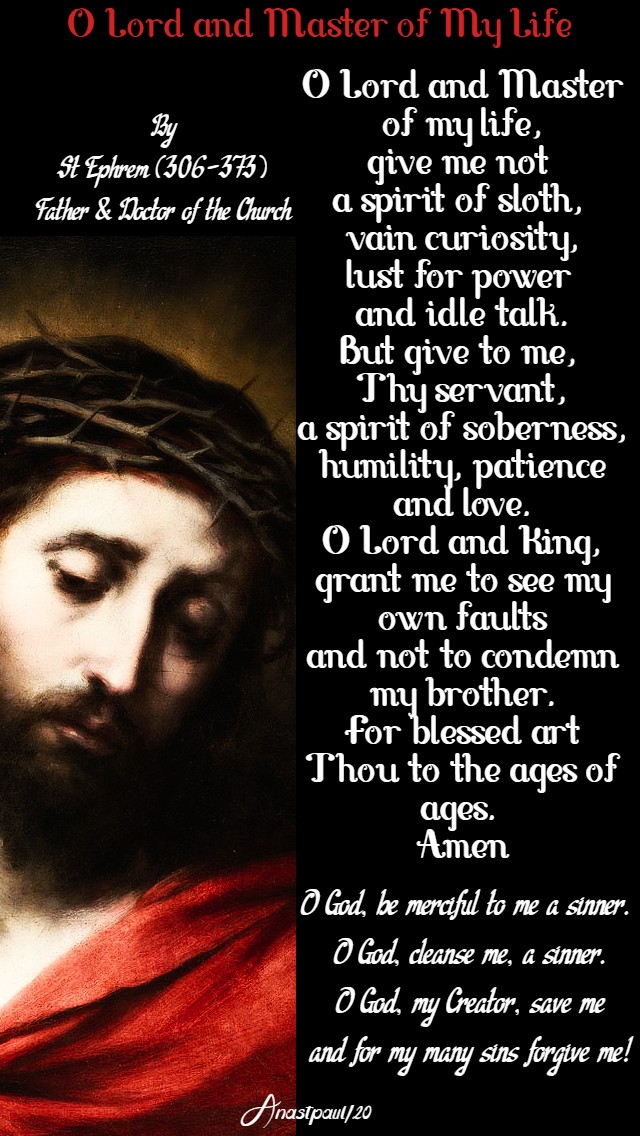
O Lord and Master of My Life By Saint Ephrem (306-373) Father & Doctor of the Church
O Lord and Master of my life, give me not a spirit of sloth, vain curiosity, lust for power and idle talk. But give to me, Thy servant, a spirit of soberness, humility, patience and love. O Lord and King, grant me to see my own faults and not to condemn my brother. For blessed art Thou to the ages of ages. Amen O God, be merciful to me a sinner. O God, cleanse me, a sinner. O God, my Creator, save me and for my many sins forgive me!
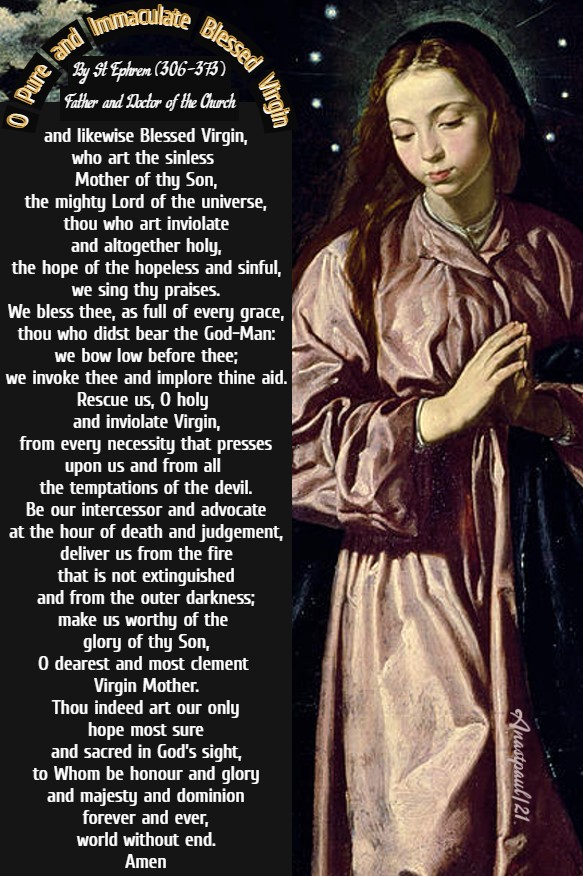
O Pure and Immaculate Blessed Virgin By St Ephrem (306-373) Father and Doctor of the Church
O Pure and Immaculate and likewise Blessed Virgin, who art the sinless Mother of thy Son, the mighty Lord of the universe, thou who art inviolate and altogether holy, the hope of the hopeless and sinful, we sing thy praises. We bless thee, as full of every grace, thou who didst bear the God-Man: we bow low before thee; we invoke thee and implore thine aid. Rescue us, O holy and inviolate Virgin, from every necessity that presses upon us and from all the temptations of the devil. Be our intercessor and advocate at the hour of death and judgement, deliver us from the fire that is not extinguished and from the outer darkness; make us worthy of the glory of thy Son, O dearest and most clement Virgin Mother. Thou indeed art our only hope most sure and sacred in God’s sight, to Whom be honour and glory and majesty and dominion forever and ever, world without end. Amen
One Minute Reflection – 18 June – “The Month of the Sacred Heart of Jesus” – Saturday within the Octave of Cprpus Chris and the Memorial of St Ephrem of Syria (306-373) Confessor, Father and Doctor of the Church – 1 Corinthians 23-29, John 6:56-59.
“As the living Father has sent Me and as I live because of the Father, so he who eats Me, he also shall live because of Me.” – John 6:58
REFLECTION – “We believe that the Word became Flesh and that we receive His Flesh in the Lord’s Supper. How then can we fail to believe, that He really dwells within us? When He became Man, He actually clothed Himself in our flesh, uniting it to Himself forever. In the Sacrament of His Body, He actually gives us His own Flesh, which He has united to His Divinity. This is why we are all one because the Father is in Christ and Christ is in us. He is in us through His Flesh and we are in Him. With Him, we form a Unity, which is in God.
The manner of our indwelling in Him through the Sacrament of His Body and Blood, is evident from the Lord’s own Words: This world will see Me no longer but you shall see Me. Because I live ,you shall live also, for I am in My Father, you are in Me and I am in you. If it had been a question of mere unity of will, why should He have given us this explanation of the steps, by which it is achieved? He is in the Father by reason of His Divine Nature, we are in Him by reason of His Human Birth and He is in us, through the Mystery of the Sacraments. This, surely, is what He wished us to believe; this is how He wanted us to understand the perfect Unity that is achieved through our Mediator, Who lives in the Father, while we live in Him and Who,, while living in the Father, lives also in us. This is how we attain to Unity with the Father. Christ is in very truth in the Father by His Eternal Generation; we are in very truth, in Christ and He likewise is in us.
Christ Himself bore witness to the reality of His Unity, when He said: He who eats My Flesh and drinks My Blood, lives in Me and I in him. No-one will be in Christ, unless Christ Himself has been in him; Christ will take to Himself only the Flesh of those who have received His Flesh.
He had already explained the Mystery of this perfect Unity, when He said: As the living Father sent Me and I draw life from the Father, so he who eats My Flesh will draw life from Me. We draw life from His Flesh, just as He draws life from the Father. Such comparisons aid our understanding, since we can grasp a point more easily, when we have an analogy. And the point is that Christ is the well-spring of our life. Since we, who are in the flesh, have Christ dwelling in us through His Flesh, we shall draw life from Him in the same way, in which He draws life from the Father.” – St Hilary of Poitiers (315-368) Bishop of Poitiers , Father and Doctor of the Divinity of Christ (An excerpt from his On the Trinity).
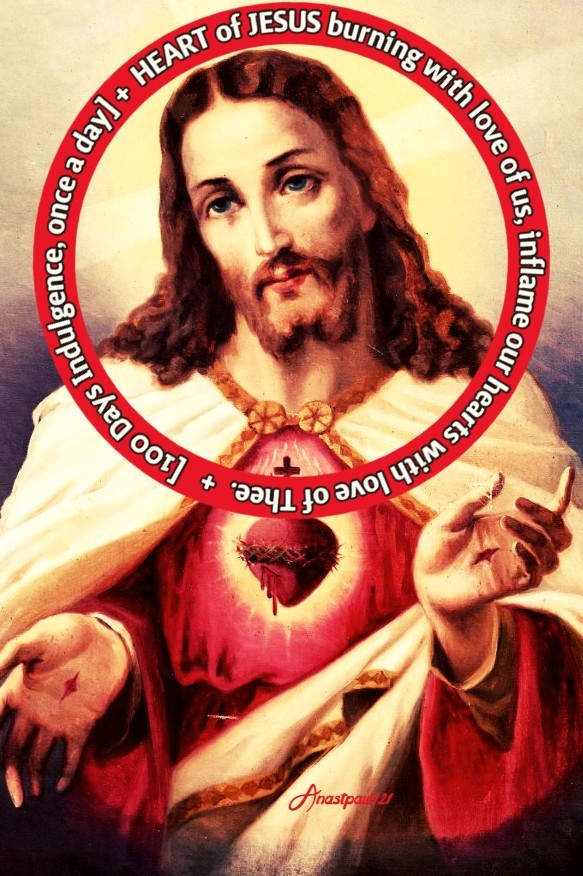
PRAYERS – O God, Who willed to enlighten Thy Church by the wondrous learning and glorious merits of the life of blessed Ephrem, Thy Confessor and Doctor, we humbly pray Thee that, by his pleading, Thou will shield her with Thy lasting power, against the snares of error and evil. Through Jesus Christ, Thy Son our Lord, Who lives and reigns with Thee, in the unity of the Holy Ghost, God, world without end. Amen (Collect). HEART of JESUS burning with love of us, inflame our hearts with love of Thee. – 100 Days, once a day. (See Instructions. – Unless otherwise stated, e.g., “once a day,” a partial Indulgence may be gained any number of times in succession.) [169 Raccolta or Collection of Indulgences, 1910] Pope Leo XIII, 16 July 1893.
Quote of the Day – 17 June – “The Month of the Sacred Heart of Jesus” – Friday within the Octave of Corpus Christi – 1 Corinthians 23-29, John 6:56-59.
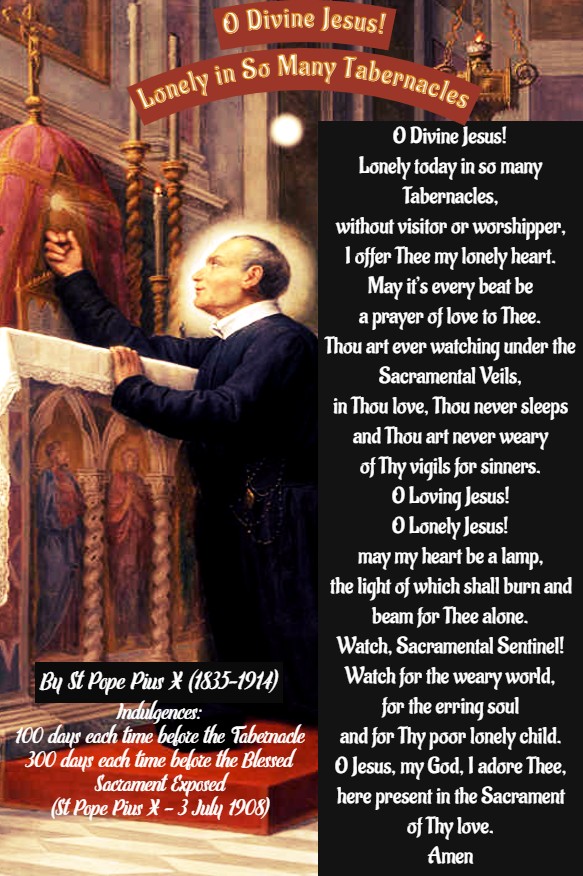
O Divine Jesus! Lonely in So Many Tabernacles By St Pope Pius X (1835-1914) “Pope of the Blessed Sacrament”
O Divine Jesus! Lonely today in so many Tabernacles, without visitor or worshipper, I offer Thee my lonely heart. May it’s every beat be a prayer of love to Thee. Thou art ever watching under the Sacramental Veils, in Thou love, Thou never sleeps and Thou art never weary of Thy vigils for sinners. O Loving Jesus! O Lonely Jesus! may my heart be a lamp, the light of which shall burn and beam for Thee alone. Watch, Sacramental Sentinel! Watch for the weary world, for the erring soul and for Thy poor lonely child. O Jesus, my God, I adore Thee, here present in the Sacrament of Thy love. Amen
Indulgences: 100 days each time before the Tabernacle 300 days each time before the Blessed Sacrament Exposed (St Pope Pius X – 3 July 1908) Prayers to the Sacred Heart 15th Ed 1936
One Minute Reflection – 17 June – “The Month of the Sacred Heart of Jesus” – Friday within the Octave of Corpus Christi – 1 Corinthians 23-29, John 6:56-59.
“This is the Bread that has come down from Heaven; not as your fathers ate the manna and died. He who eats this Bread shall live forever.”- John 6:59
REFLECTION – “It is wonderful that God rained manna on our fathers and they were fed with daily food from Heaven. And so it is written: Man ate the bread of angels. Yet, those who ate that bread all died in the desert. But the food that you receive, that living Bread which came down from Heaven, supplies the very substance of eternal life, and whoever will eat it, will never die, for it is the Body of Christ!
Consider now which is the more excellent – the bread of Angels or the Flesh of Christ, which is indeed the Body that gives Life. The first was manna from Heaven, the second is above the Heavens. One was of Heaven, the other is of the Lord of the Heavens; one subject to corruption if it was kept till the morrow, the other free from all corruption, for if anyone tastes of it with reverence, he will be incapable of corruption. For our fathers, water flowed from the rock; for you, Blood flows from Christ. Water satisfied their thirst for a time; Blood cleanses you forever. The Jew drinks and still thirsts but when you drink, you will be incapable of thirst. What happened in symbol is now fulfilled in reality.
If what you marvel at is a shadow, how great is the reality, whose very shadow you marvel at. Listen to this, which shows, that what happened in the time of our fathers was but a shadow. They drank, it is written, from the rock that followed them and the Rock was Christ! All this took place as a symbol for us. You know now what is more excellent – Light is preferable to its shadow, reality to its symbol, the Body of the Giver, to the manna He gave from Heaven.” – St Ambrose (340-397) Great Western Father and Doctor of the Church (An excerpt from On the Mysteries).
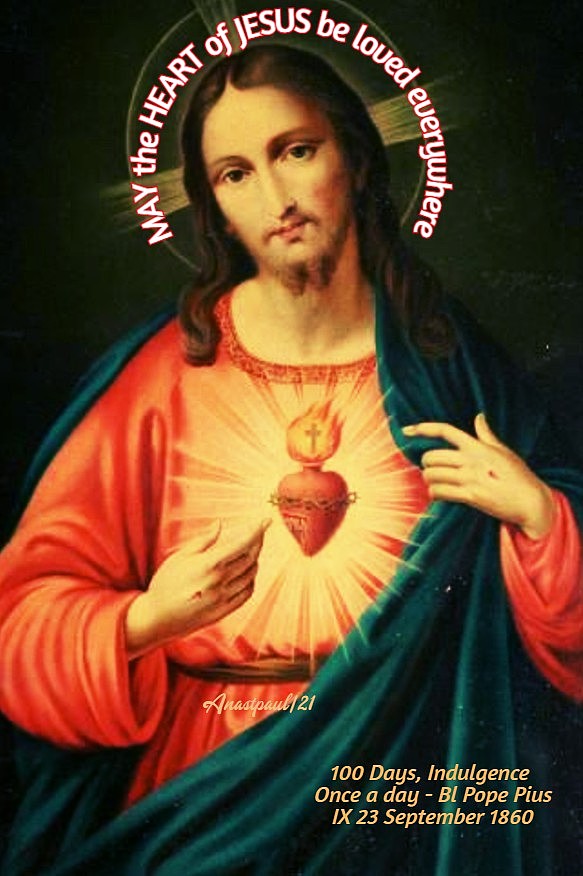
PRAYER – O God, Thou Who in this wondrous Sacrament have left us a memorial of Thy Passion, grant us, we beseech Thee, so to venerate the Sacred Mysteries of Thy Body and Blood, that we may ever experience, within us, the effect of Thy Redemption. Through Jesus Christ, Thy Son our Lord, Who lives and reigns with God the Father, in the unity of the Holy Ghost, God, world without end. Amen (Collect). MAY the HEART of JESUS be loved everywhere.100 Days, Indulgence Once a day – Pope Pius IX 23 September 1860.



































You must be logged in to post a comment.