Posted in SAINT of the DAY, Uncategorized

Saint of the Day – 20 September -St Eustachius, Wife and Sons – Martyrs (Died c 188)

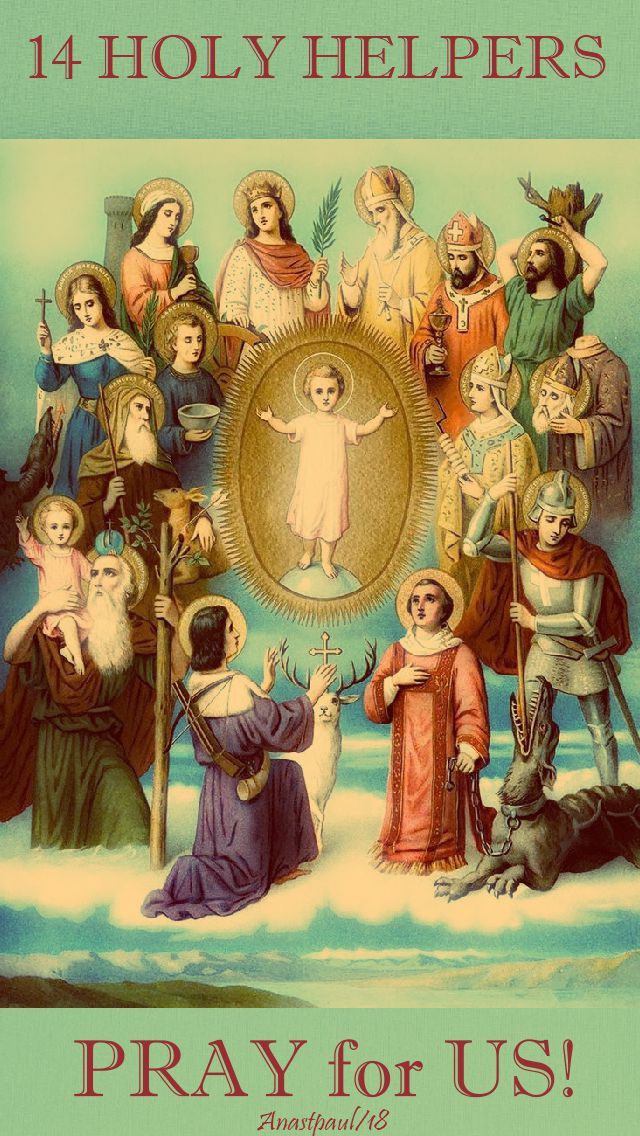
Saint of the Day – 20 September -St Eustachius born as Placidas, Wife and Sons – Martyrs (Died c 188) One of the Fourteen Holy Helpers – Patronages – against fire, difficult situations, fire prevention, firefighters, hunters, hunting, huntsmen, Madrid, torture victims, trappers.st euchasius lg
The remarkable story of Saint Eustachius, is a lesson given by God Himself on the marvels of His Divine Providence.   He was a distinguished and very wealthy officer of the Roman army under the Emperor Trajan, in the beginning of the second century.   He practised generous charity to the poor, although he had not yet perceived the errors of idolatry.

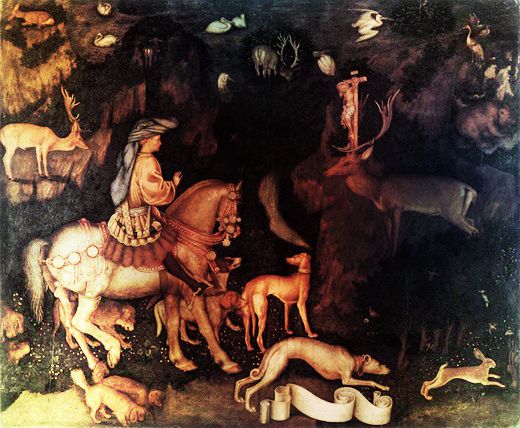
One day, while this distinguished officer was vainly pursuing a deer, the animal suddenly stood immobile before him in the light of a hilltop and he perceived between its horns a luminous cross.   On the cross was the image of the crucified Saviour and a voice said to him, ‘I am the Christ whom you honour without knowing it;  the alms you give to the poor have reached Me.’   Like Saint Paul, he fell from his horse and remained inert for a time.   Coming to himself, he said interiorly, What is this voice I have heard?   You who speak to me, who are you, that I may believe in you?   And the Lord told him interiorly that He was the Creator of the light, of the seasons, of man and all things visible, that He had suffered to save the human race, died and been buried but had risen the third day.
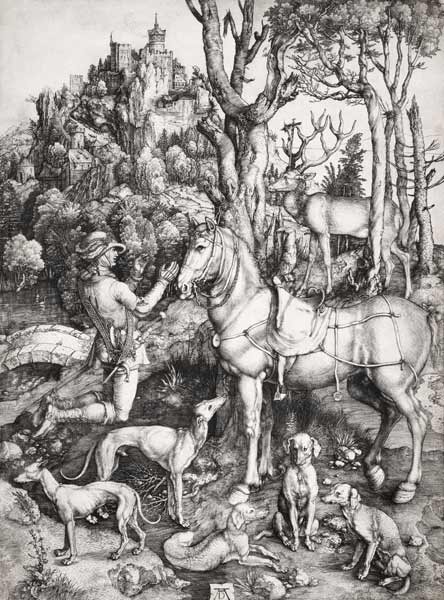
-Eustachius - durer

This was sufficient and the officer went home to fulfil the prescription he had received to be baptised with his wife and two young sons.   His spouse had received a similar revelation at the same time as himself and they all went to the Christian authority of the region in secret, to be baptised the same night.

In a short time he lost all his possessions through natural catastrophes and robbers.   But he had been advised beforehand that the Lord wanted to make of him another Job, that already the ancient enemy had plotted against him and that he was not to allow any thought of blasphemy to arise in his heart amid the sufferings that were awaiting him. He prayed for strength and retired from the region after the calamities, with his wife and children.   When by unforeseeable and extraordinary accidents, his wife and children were also taken from him and he believed the children dead, he was close to despair and wished his life might end but the warning of the Lord returned to his mind and he entered into the service of a land-owner of a village called Badyssus, to tend the fields. He remained for fifteen years in this occupation.   During this time his loved ones were well and safe, all spared in the perilous circumstances which had removed them from his sight but separated, each one like himself, from the three others.Saint_Eustace
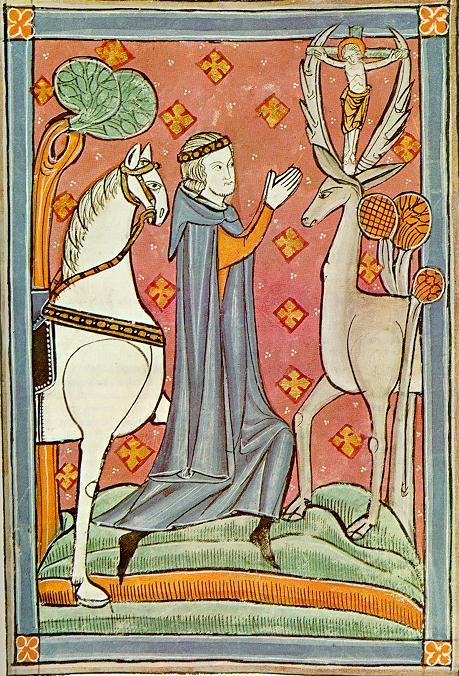
In those days the empire was suffering greatly from the ravages of barbarians and was sinking under the assaults.   The emperor Trajan had Eustachius sought out and when he was found, had him clothed in splendid garments to give him command over the troops he intended to send against the invaders.   During the celebration that accompanied his return, he related to the emperor all that had occurred to him.   When the troops were being assembled, his own sons were conscripted.   Seeing them, he noticed them as young men taller than most and of great nobility of bearing and countenance and kept them near him without yet recognising them.   One of the two, while on bivouac near the very house of his own mother, who like Eustachius had taken employment in the garden of a landowner, related the confused memories of his childhood to his companion. Suddenly, the two brothers recognised one another and embraced in an effusion of joy.

Their mother, by a delicate attention of Providence, had chanced to overhear them and reflecting on what she heard, became certain they were her own sons.   She went to the captain of the campaign to inquire about them and immediately recognised him.   Not wishing to startle him, she began to relate her story, identifying herself as the wife of a certain Placidus and saying she believed she was now in the presence of her two sons from whom she had been separated and whom she had not seen for long years.   One must imagine the sentiments of the captain on hearing this narration, the reunion which followed and the prayers of thanksgiving sent up to God by the family and also the troops, who joined them in their joy and prayers.

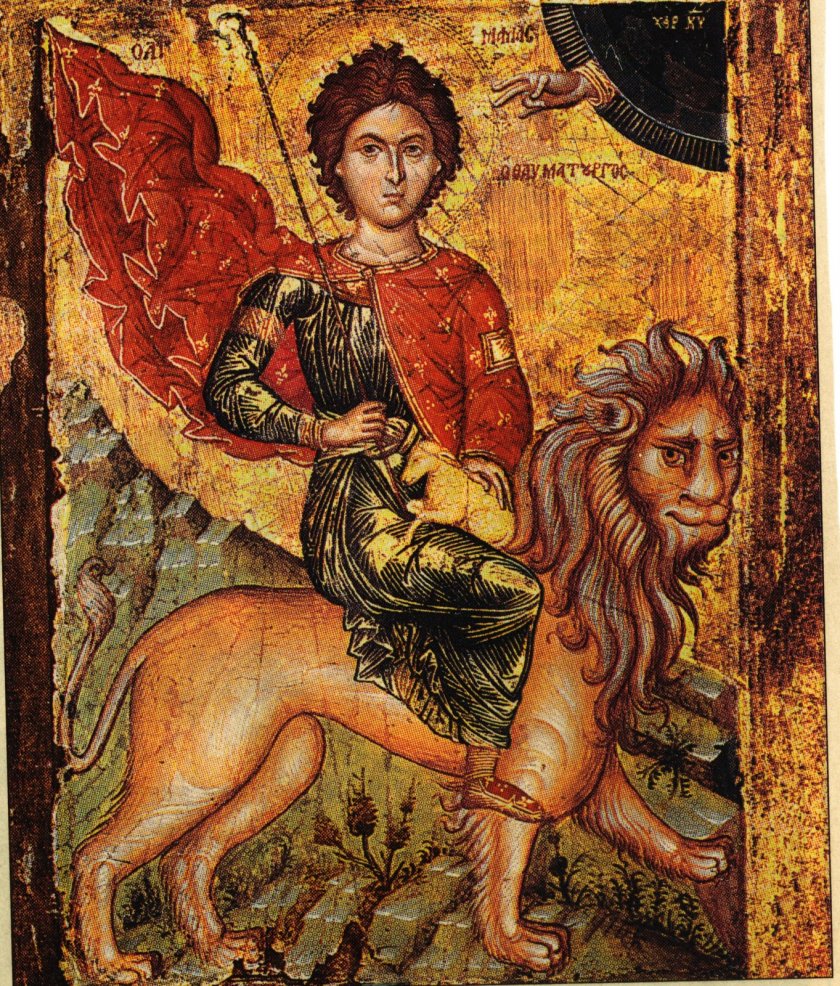
Returning to Rome victorious, Eustachius was received in triumph and greatly honoured, but when commanded to sacrifice during the celebration to the false gods, refused.   The infuriated emperor Adrian — for Trajan had died — ordered him with his wife and children to be exposed to a starved lion.   But instead of harming these servants of God, the beast came up to them, lowered its head as if in homage and left the arena.   The emperor, more furious still, caused the martyrs to be shut up inside a brazen bull, under which a fire was to be kindled, that they might be roasted to death.   Saint Eustachius prayed aloud and thanked God, asking Him who had reunited them to cause that their lives end at the same time, so they might be received together by Him into the happiness of His presence.   They expired but neither their bodies nor even their hair was injured. They were found entire the next day and at first it was believed they were still alive. Many believed in Christ through this final miracle, which to us today seems perhaps less miraculous than the story of their existence while alive.   A church in honour of the martyrs still exists in Rome:  Saint-Eustachius in Thermis.st_eustachius_by_elfessa-d5uoekm
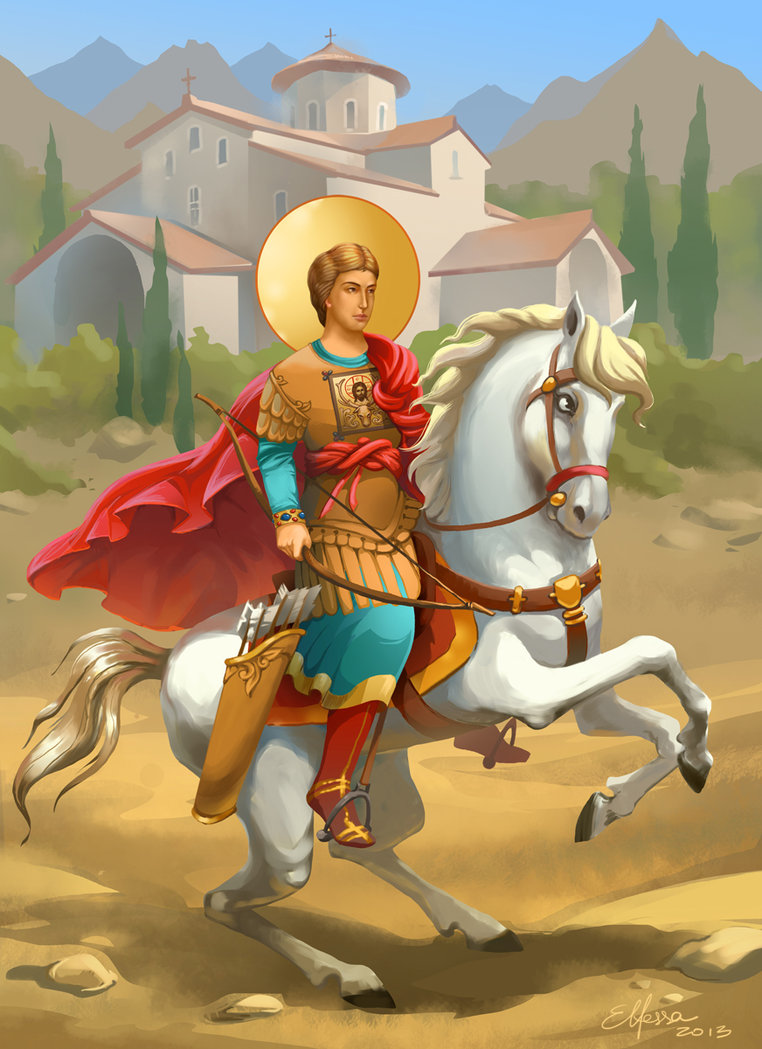
Eustachius became known as a patron saint of hunters and firefighters and also of anyone facing adversity;  he was traditionally included among the Fourteen Holy Helpers. He is one of the patron saints of Madri  d, Spain. The island of Sint Eustatius in the Caribbean Netherlands is named after him.   The d’Afflitto, one of the oldest princely families in Italy, claim to be direct descendants of Saint Eustachius.

The novels “The Herb of Grace” (US title: Pilgrim’s Inn) (1948) by British author Elizabeth Goudge and Riddley Walker (1980) by American author Russell Hoban, incorporate the legend into their plot.   It has also inspired the film Imagination.

The saint’s cross-and-stag symbol is featured on bottles of Jägermeister, a German alcoholic digestif.   This is related to his status as patron of hunters; a Jägermeister was a senior foresters and gamekeeper in the German civil service until 1934, prior to the drink’s introduction in 1935.   Jägermeister has a round logo of a shining cross between the antlers of a deer/stag referring to two persons who had seen such a vision: Saint Hubertus and Saint Eustachius.
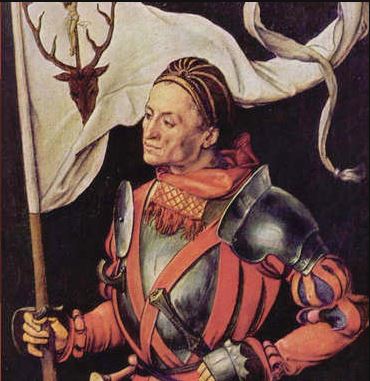
st eustachius

Saint Eustachius has a church dedicated to him in the southern part of India – he is called Saint Esthak in this part of the world and in County Kildare, Ireland.   There is a church dedicated to him on the campus of Newbridge College in Newbridge, County Kildare and the schools’ logo and motto is influenced by the vision of Saint Eustachius;  a nearby village is named Ballymore Eustace.

Sant’Eustachio is also honoured in Tocco da Casauria, a town in the Province of Pescara in the Abruzzo region of central Italy.   The town’s church, built in the twelfth century, was dedicated to Saint Eustachius.   It was rebuilt after being partially destroyed by an earthquake in 1706.

About the 14 Holy Helpers hereSt. Eustace
Posted in SAINT of the DAY, Uncategorized

Memorials of the Saints – 20 September

Martyrs of Korea:  St Andrew Kim Taegon, St Paul Chong Hasang & Companions – 103 saints and beati (Memorial)
—
St Agapitus of Rome
St Candida of Carthage
St Dionysius of Phrygia
St Dorimedonte of Synnada
St Eusebia of Marseilles
St Eustachius
St Evilasius of Cyzicum
St Fausta of Cyzicum
Bl Francisco Martín Fernández de Posadas
St Glycerius of Milan
St John Charles Cornay
Bl John Eustace
St Jose Maria de Yermo y Parres
St Lawrence Mary Joseph Imbert
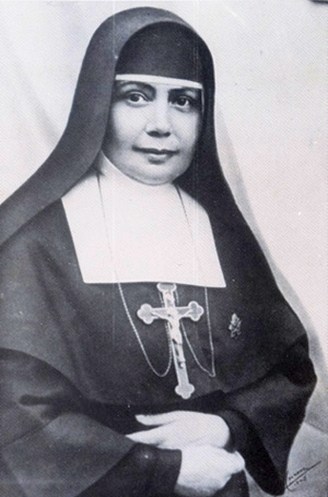
Bl Marie Therese of Saint Joseph (1855-1938)
St Paul Chong Hasang
St Priscus
Susanna of Eleutheropolis
Bl Thomas Johnson
—
Martyrs of Constantinople – 3 saints: A priest and two bishops who were imprisoned, tortured and martyred for the defense of icons in the iconoclast persecutions of emperor Leo the Isaurian. – Andrea, Asiano and Hypatius. They were martyred in 735 in Constantinople (modern Istanbul, Turkey) and their bodies were thrown to the dogs.

Martyrs of Pergen – 6 saints: A group of lay people martyred in the persecutions of Emperor Elagabalus. The names that have come down to us are Dionysius, Dioscorus, Philippa, Privatus, Socrates and Theodore. They were crucified c 220 at Pergen, Pamphylia, Asia Minor (in modern Turkey).

Martyred in the Spanish Civil War:
• Blessed Cristobal Iturriaga-Echevarría Irazola
• Blessed Santiago Vega Ponce
• Blessed Juan Antonio López Pérez

Posted in DOCTORS of the Church, FATHERS of the Church, MORNING Prayers, QUOTES of the SAINTS, SAINT of the DAY, Uncategorized

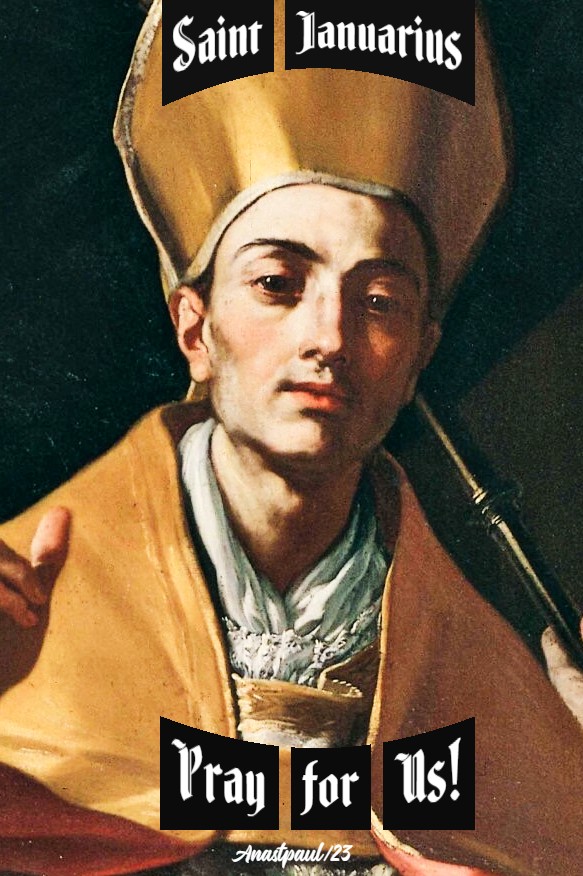
Thought for the Day – 19 September – The Memorial of St Januarius – Martyr (Died c 304)

Thought for the Day – 19 September – The Memorial of St Januarius – Martyr (Died c 304)

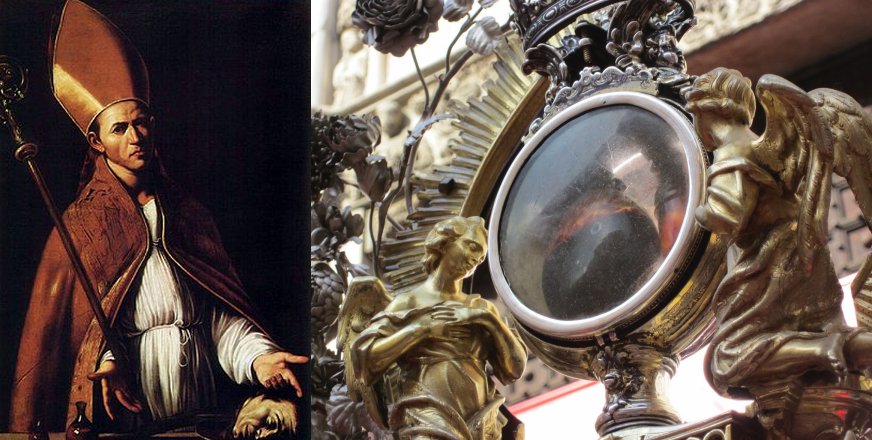
Many centuries ago, St Januarius died for the Faith in the persecution of Diocletian and, to this day, God confirms the faith of his Church and works a continual miracle, through the blood which Januarius shed for Him.

Little did the heathen Governor think that he was the instrument, in God’s Hand, of ushering in the long succession of miracles which attest to the faith of St Januarius.

The Relics of St Januarius rest in the Cathedral of Naples and it is there that the liquefying of his blood occurs.   The blood is congealed in two glass vials but when it is brought near the Martyr’s head it melts and flows like the blood of a living man.

St Alphonsus Liguori wrote regarding St Januarius

“The Neapolitans honour this Saint as the principal Patron of their City and nation and the Lord Himself has continued to honour him, by allowing many miracles to be wrought through his intercession, particularly when the frightful eruptions of Mount Vesuvius, have threatened the City of Naples with utter destruction.   

While the Relics of St Januarius were being brought in procession towards this terrific volcano, the torrents of lava and liquid fire which it emitted have ceased, or turned their course from the City. But, the most stupendous miracle and that which is greatly celebrated in the Church, is the liquefying and effervescence, of this blessed Martyr’s blood whenever the Relic Vials are brought into the sight of his head.   
This miracle is renewed many times in the year, in the presence of all who desire to witness it;  yet, some heretics have endeavoured to throw a doubt upon its authenticity by frivolous and incoherent explanations but, no-one can deny the effect to be miraculous, unless he be prepared to question the evidence of his senses!”

Tertullian said, “The blood of the Martyrs is the seed of the Church.”   Sometimes, that blood is bubbling!

Posted in Uncategorized

Memorials of the Saints and the Feast of Our Lady of La Salette – 19 September

St Januarius of Naples Martyr (Died c 304) (Optional Memorial)
About St Januarius here: https://anastpaul.wordpress.com/2017/09/19/saint-of-the-day-19-september-st-januarius/

Our Lady of La Salette (1846) :
Mary appeared to two small children, Melanie Mathieu and Maximin Giraud, on the mountain of La Salette in the French Alps. She was crying and around her neck was a crucifix, with a hammer and pincers on either side – 19 September 1846.   Approved by the diocesan bishop in 1851.

Read the whole story here: https://anastpaul.wordpress.com/2017/09/19/feast-of-our-lady-of-la-salette-19-september/

St Alonso de Orozco Mena O.S.A. (1500 – 1591)

St Arnulph of Gap
St Carolus Hyon Song-Mun
St Constantia of Nocera
St Desiderius of Pozzuoli
St Emily de Rodat
St Eustochius of Tours
St Felix of Nocera
St Festus of Pozzuoli
St Goeric of Metz
Bl Mary de Cerevellon
St Pomposa
St Sequanus
St Sosius of Puzzuoli
St Theodore of Canterbury
St Trophimus of Synnada
—
Martyrs of Antioch – (3 saints): Christians imprisoned, tortured and executed in various ways in the persecutions of Emperor Probus; some names have come down to us – Dorymedon, Sabbatius and Trophimus. c 277 at Antioch (in modern Turkey).

Martyrs of Phunon – (4 saints): Four bishops in Egypt who were sentenced to forced labour in a rock quarry and martyred in the persecution of Diocletian. Noted for celebrating Mass in prison. – Elias, Nilus, Patermuzio and Peleus. They were burned to death in 310 at Phunon, near Petra in Palestine.

Martyred in the Spanish Civil War:
• Blessed Consuelo Aguiar-Mella Díaz
• Blessed Herman José Fernández Sáenz
• Blessed Juan Pérez Rodrigo
• Blessed Lucas Martín Puente
• Blessed María de La Encarnación de La Yglesia de Varo
• Blessed María Dolores Aguiar-Mella Díaz
• Blessed Miguel Faúndez López
• Blessed Sebastián Obeso Alario

Posted in MORNING Prayers, NOVENAS, Uncategorized

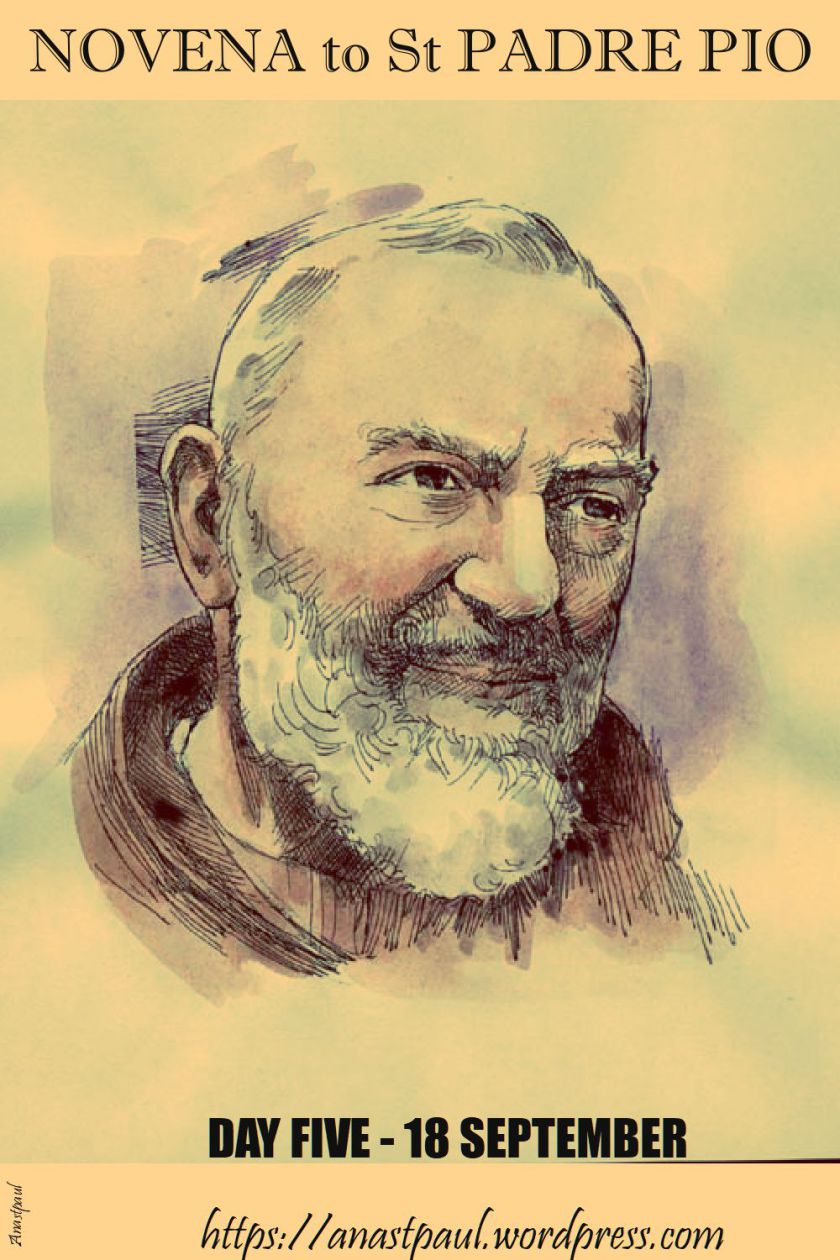
NOVENA to St Padre Pio/St Pius of Pietrelcina – DAY FIVE – 18 September

NOVENA to St Padre Pio/St Pius of Pietrelcina – DAY FIVE – 18 September

St Padre Pio you have said:

St Therese of the Child Jesus used to say, “I don’t want to choose either to die or to live but let Jesus do as He likes with me.”   I see clearly that this is the image of all souls who are stripped of self and filled with God… What St Therese has said ought to be said by every soul inflamed with love of God.

Let us Pray:

Gracious God, You generously blessed Your servant, Padre Pio, with the gifts of the Spirit.
You marked his body with the five wounds of Christ Crucified,
as a powerful witness to the saving Passion and Death of Your Son
and as a stirring inspiration to many people of Your infinite mercy, forgiveness and love.
Through his powerful intercession, many who suffered were healed of sickness and disease.
Endowed with the gift of discernment, he could read people’s hearts.
With dignity and intense devotion, he celebrated daily Mass,
inviting countless men and women to a greater union with Jesus Christ,
in the Sacrament of the Holy Eucharist.
Gracious God, St Pio lived totally for You
teach us too this great act of self-giving and complete oblation.
Through the intercession of Saint Pio,
we confidently beseech You to to grant us the grace of
………………. (state your petition here).
Help us to imitate his example of prayerful holiness and compassion,
so that we, too, may faithfully follow the Risen Lord
and one day rejoice in the Kingdom,
where You live and reign forever and ever.
Amenday-five-novena-st-pio-18-sept

Posted in Uncategorized

Memorials of the Saints – 18 September

St Ariadne
St Dominic Trach Doai
St Eumenius Thaumaturgus
St Eustorgius of Milan
St Ferreolus the Tribune
St Ferreolus of Limoges
St Hygbald
St Irene of Egypt
St Joseph of Cupertino O.F.M. Conv. (1603-1663)

All about the this holy Flying Saint here:  https://anastpaul.wordpress.com/2017/09/18/saint-of-the-day-18-september-st-joseph-of-cupertino-o-f-m-conv-1603-1663/

St Józef Kut
St Juan Macias O.P. (1585-1645)
St Oceano of Nicomedia
St Richardis of Andlou
St Sophia of Egypt
—
Martyred in the Spanish Civil War:
• Blessed Carlos Eraña Guruceta
• Blessed Fernando García Sendra
• Blessed Jacinto Hoyuelos Gonzalo
• Blessed Jesus Hita Miranda
• Blessed José García Mas
• Blessed José María Llópez Mora
• Blessed Justo Lerma Martínez
• Blessed Salvador Chuliá Ferrandis
• Blessed Salvador Fernández Pérez
• Blessed Vicente Gay Zarzo
• Blessed Vicente Jaunzarás Gómez

Posted in Our MORNING Offering, PRAYERS of the SAINTS, Uncategorized

Our Morning Offering – 4 September

Our Morning Offering – 4 September

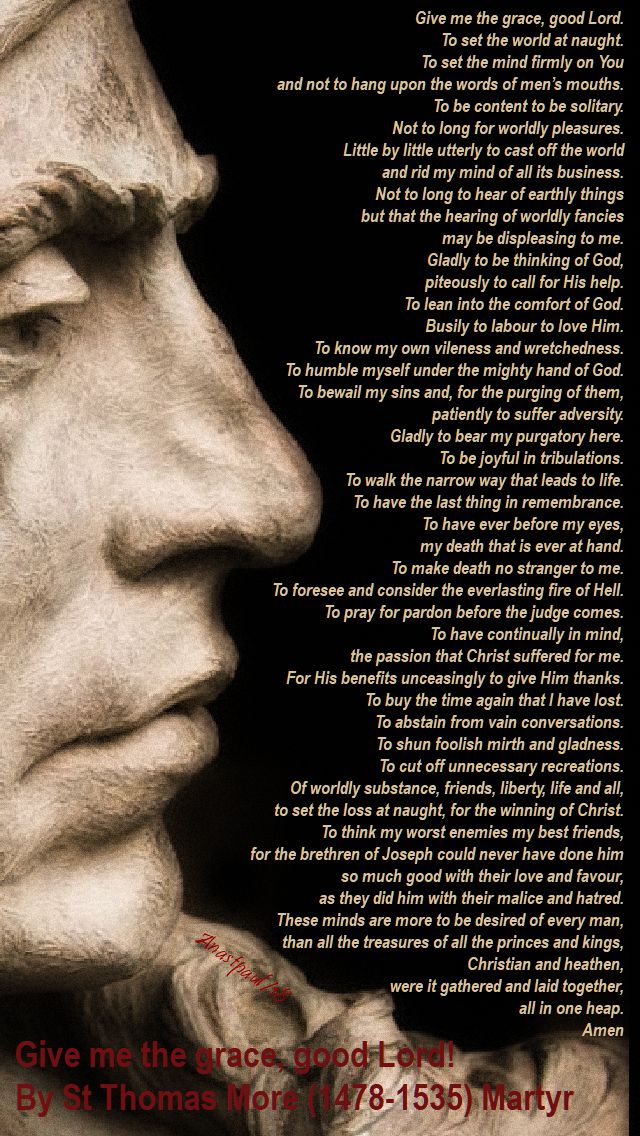
The prayer below, was written by Saint Thomas More while he was imprisoned in the Tower of London, awaiting execution by King Henry VIII.

Give me the grace, good Lord!
By St Thomas More (1478-1535)

Give me the grace, good Lord.
To set the world at naught.
To set the mind firmly on You
and not to hang upon the words of men’s mouths.
To be content to be solitary.
Not to long for worldly pleasures.
Little by little utterly to cast off the world
and rid my mind of all its business.
Not to long to hear of earthly things
but that the hearing of worldly fancies
may be displeasing to me.
Gladly to be thinking of God,
piteously to call for His help.
To lean into the comfort of God.
Busily to labour to love Him.
To know my own vileness and wretchedness.
To humble myself under the mighty hand of God.
To bewail my sins and, for the purging of them,
patiently to suffer adversity.
Gladly to bear my purgatory here.
To be joyful in tribulations.
To walk the narrow way that leads to life.
To have the last thing in remembrance.
To have ever before my eyes,
my death that is ever at hand.
To make death no stranger to me.
To foresee and consider the everlasting fire of Hell.
To pray for pardon before the judge comes.
To have continually in mind,
the passion that Christ suffered for me.
For His benefits unceasingly to give Him thanks.
To buy the time again that I have lost.
To abstain from vain conversations.
To shun foolish mirth and gladness.
To cut off unnecessary recreations.
Of worldly substance, friends, liberty, life and all,
to set the loss at naught, for the winning of Christ.
To think my worst enemies my best friends,
for the brethren of Joseph could never have done him
so much good with their love and favour,
as they did him with their malice and hatred.
These minds are more to be desired of every man,
than all the treasures of all the princes and kings,
Christian and heathen,
were it gathered and laid together, all in one heap.
Amengive me the grace good lord - st thomas more - 4 sept 2018 - new version


Posted in MORNING Prayers, QUOTES of the SAINTS, SAINT of the DAY, Uncategorized

Quote of the Day – 2 September – The Memorial of St Solomon le Clercq FSC (1745-1792) Martyr

Quote of the Day – 2 September – The Memorial of St Solomon le Clercq FSC (1745-1792) Martyr

“I’m Solomon Le Clercq
and I want,
I want to sign,
to say that I’ll die,
I’ll die a happy man
if Jesus is at my side
and I say:
I want to live for Jesus,
I want!
I want to die for Jesus,
I want!
To live and to die
a real man of God!
To live and die a real
Brother from God!”

St Solomon le Clercq (1745-1792)i'm solomon le clerq - 2 sept 2018

Posted in Uncategorized

Quote of the Day – 1 September – The 4th World Day of Prayer for the Care of Creation

Quote of the Day – 1 September

 The 4th World Day of Prayer for the Care of Creation

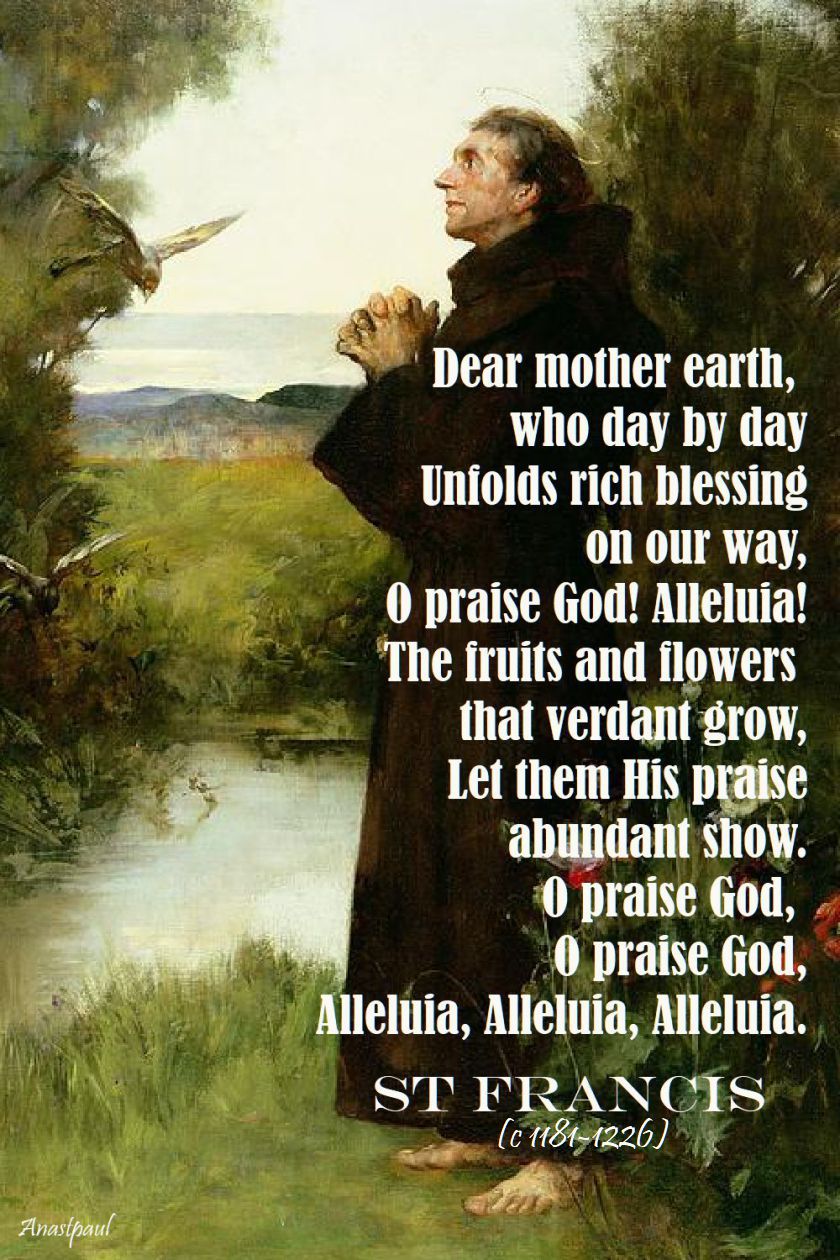
Dear mother earth, who day by day
Unfolds rich blessing on our way,
O praise God!   Alleluia!
The fruits and flowers that verdant grow,
Let them His praise abundant show.
O praise God, O praise God,
Alleluia, Alleluia, Alleluia.

St Francis of Assisi (c 1181-1226)

(Translated by William H Draper) (Image by St Francis by Albert Chevallier Tayler)dear-mother-earth-st-francis-prayer - 1 sept 2017

Posted in MORNING Prayers, OPEN HOUSE...Conversations with..., QUOTES of the SAINTS, QUOTES on CHARITY, QUOTES on HUMILITY, QUOTES on LOVE, Uncategorized

Open House….Conversations with …. 30 August

Open House….Conversations with …. 30 August

Little weekly reflections from those ‘minds alive’, our friends and intercessors waiting on our arrival.

Mother, how do we live by example?

Thomas Malcolm Muggeridge was a British journalist and media celebrity who did not care much about God and religion.   But…he saw compassion actualised before his very eyes through the person of Mother Teresa and that made him do something he had sworn he would never do – he became a Catholic!
Muggeridge had an assignment to write about Mother Teresa.   Travelling to India, he thought the trip was just the usual work but the amazing thing was, in the course of his talks and days of observation of the little nun, he experienced a complete conversion of his heart, his mind, his soul, his very being.
He confessed:  “Words cannot express how much I owe her, she showed me Christianity in action.   She showed me the power of love.   She showed me how one loving person can start a tidal wave of love that can spread to the entire world!”

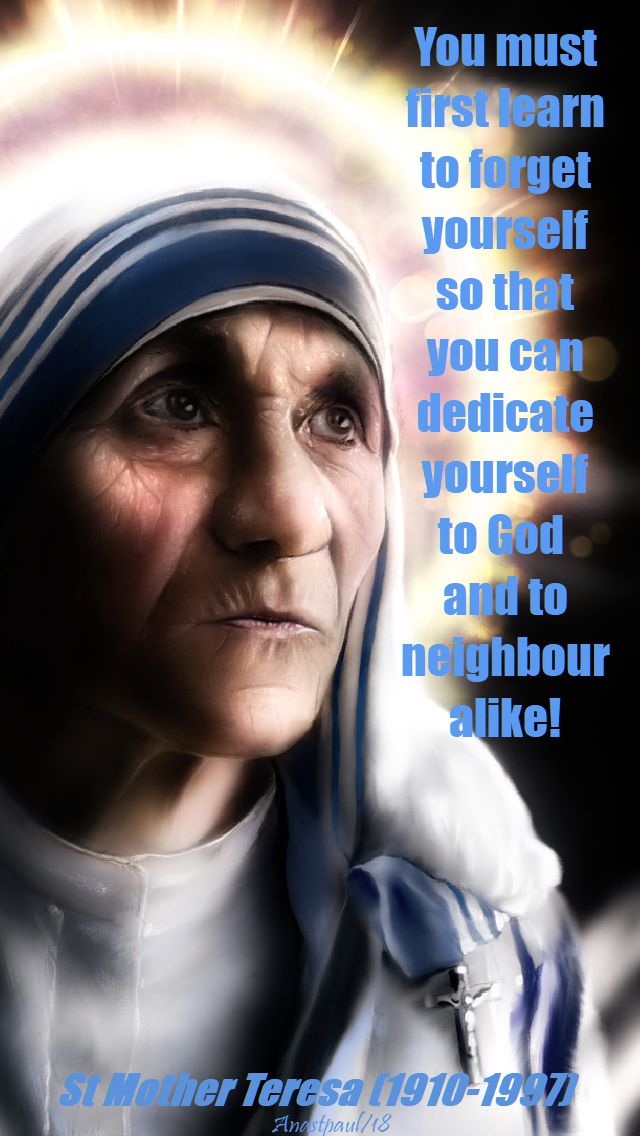
“You must first learn to forget yourself

so that you can dedicate yourself to God and to neighbour alike!”

St Mother Teresa (1910-1997)

you must first learn to forget yourself - st mother terea - 30 aug 2018 - conversations with 2

Posted in Our MORNING Offering, PRAYERS of the SAINTS, SAINT of the DAY, Uncategorized

Our Morning Offering – 28 August – The Memorial of St Edmund Arrowsmith S.J. (1585 – 1628) – Martyr

Our Morning Offering – 28 August – The Memorial of St Edmund Arrowsmith S.J. (1585 – 1628) – Martyr

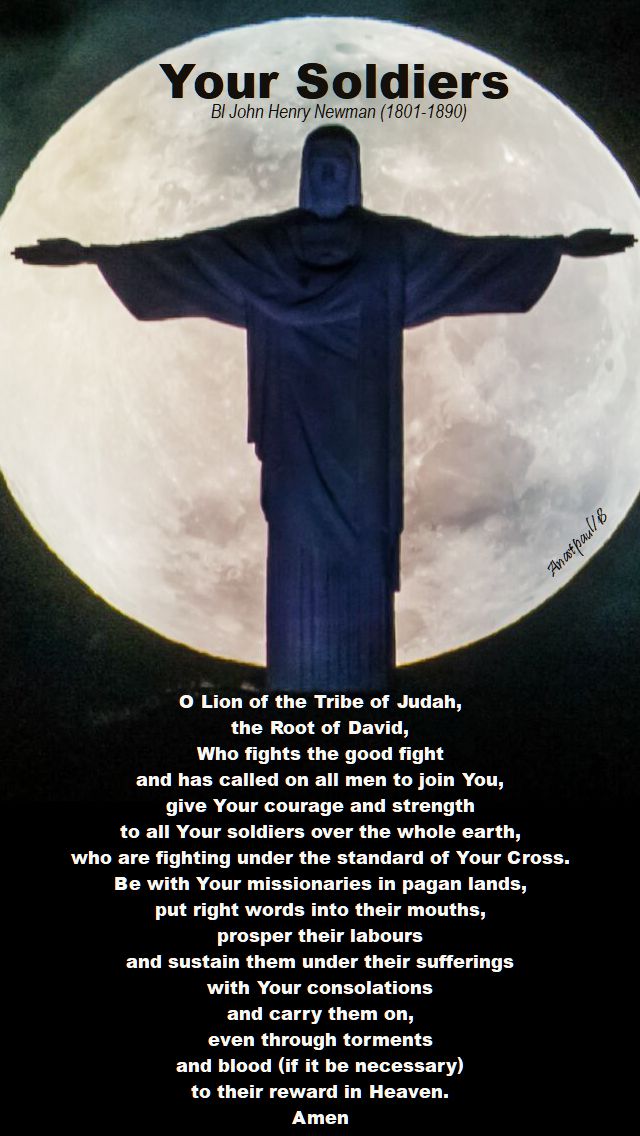
Your Soldiers
Blessed John Henry Newman (1801-1890)

O Lion of the Tribe of Judah,
the Root of David,
Who fights the good fight
and has called on all men to join You,
give Your courage and strength
to all Your soldiers over the whole earth,
who are fighting under the standard of Your Cross.
Be with Your missionaries in pagan lands,
put right words into their mouths,
prosper their labours
and sustain them under their sufferings
with Your consolations
and carry them on,
even through torments
and blood (if it be necessary)
to their reward in Heaven.
Ameno lion of the tribe of judah - your soldiers - bl john henry newman - prayer for martyrs - 28 aug 2018 and 24 march 2018

Posted in SAINT of the DAY, Uncategorized

Memorials of the Saints – 25 August

St Joseph Calasanz Sch.P. (1557-1648) (Optional Memorial)

St Louis IX (1214-1270) King of France (Optional Memorial)
All about this wonderful Saint here: https://anastpaul.wordpress.com/2017/08/25/saint-of-the-day-25-august-st-louis-king-of-france/

St Alessandro Dordi
Bl Andrea Bordino
St Andreas Gim Gwang-Ok
St Aredius of Limoges
St Ebbe the Elder
Bl Eduard Cabanach Majem
St Eusbius of Rome
Bl Fermí Martorell Vies
Bl Francesc Llach Candell
St Genesius of Arles
St Genesius of Brescello
St Genesius of Rome
St Gennadius of Constantinople
St Geruntius of Italica
St Gregory of Utrecht
St Gurloes of Sainte Croix
St Hermes of Eretum
St Hunegund of Homblieres
St Julian of Syria
St Julius of Eretum
Bl Ludovicus Baba
Bl Ludovicus Sasada
Bl Luis Cabrera Sotelo
St Maginus
St Marcian of Saignon
Bl María del Tránsito de Jesús Sacramentado
Bl Maria Troncatti
St Menas of Constantinople
Bl Miguel Carvalho
St Nemesius of Rome
St Patricia of Naples
Bl Paul-Jean Charles
Bl Pedro de Calidis
St Peregrinus of Rome
St Petrus Gim Jeong-Duk
St Pontian of Rome
St Severus of Agde
St Thomas of Hereford
St Vincent of Rome
—
Martyred in the Spanish Civil War:
• Blessed Antoni Prenafeta Soler
• Blessed Antoni Vilamassana Carulla
• Blessed Enric Salvá Ministral
• Blessed Florencio Alonso Ruiz
• Blessed Fortunato Merino Vegas
• Blessed Josep Maria Panadés Terré
• Blessed Juan Pérez Rodríguez
• Blessed Luis Gutiérrez Calvo
• Blessed Luis Urbano Lanaspa
• Blessed Manuel Fernández Ferro
• Blessed Miguel Grau Antolí
• Blessed Pere Farrés Valls
• Blessed Ramon Cabanach Majem
• Blessed Salvi Tolosa Alsina
• Blessed Vicente álvarez Cienfuegos

Posted in Uncategorized

Saint of the Day – 24 August – St Emilie de Vialar (1797–1856)

Saint of the Day – 24 August – St Emilie de Vialar (1797–1856) Religious Sister and Founder of tbe Sisters of St Joseph of the Apparition, Apostle of Charity – born on 12 September 1797 at Gaillace, Albi, southern France as Anne Marguerite Adelaide Emily de Vialar and died on 24 August 1856 at Marseilles, Bouches-du-Rhône, France of natural causes.  Patron of her Order and Gaillace, France.st emily de vialar

Emilie de Vialar was born in 1797 to a rich and distinguished family in an ancient town in the south of France called Gaillac, not far from Toulouse.   Her paternal grandfather was a magistrate and Emilie’s own father, an educated man, held important administrative positions in Gaillac.   Her maternal grandfather, Baron de Portal, belonged to a family of pharmacists and became physician to both Kings Louis Philippe and Charles X.   Her mother was a devout woman, and educated Emilie in the faith from her earliest years.   Just at the time Emilie was due to attend boarding school in Paris her mother died.   After two years there, during which time she made her First Communion, her father called her home to take charge of the household and be his companion at social events.

Emilie’s presence at home was greatly resented by a jealous and interfering housekeeper who made her life almost intolerable over the years, misrepresenting her to her father in many different ways.   Emilie bore this constant suffering and unpleasantness with patience and resignation.

From an early age Emilie had been inspired with an ardent love for God and for the sick poor and suffering people of Gaillac and its surrounds, who eked out a miserable existence alongside the affluent high society of aristocratic France.   She was attracted to prayer and at various times in her life she was blessed with a special spiritual experience.   After one such experience, at the age of 19, she began to set about her works of charity in a very definite and organised way.   She aimed to help people in whatever way she could, taking food and remedies to the poor and even having them come to her own home to receive help.   Her father did not approve of these charitable works and she later wrote, “I continued to perform works of charity towards the poor and this was the occasion of many domestic troubles.” 

Another specific grace encouraged Emilie to make the decision to devote her life entirely to God and to always accomplish his will.   She spent considerable time in prayer in the privacy of her room and made many clandestine visits to the church, which was another cause for dissension between herself and her father.   There were also many arguments when she dismissed several young men who sought her hand in marriage.   As she matured, she gradually formed the idea of founding a Congregation so that the sick and poor could have constant care and attention day and night.

Being determined to accomplish the will of God, Emilie confided her ideas to the new curate, Fr Mercier who encouraged and guided her, giving her a plan of life – pious practices in the church, patience at home and apostolic duties in the parish.   During this time of prayer and discernment seeking to know God’s plans, she was “instrumental in bringing sinful women and girls to repentance, converted some Protestants and cured several poor sick who were considered hopeless by the doctors.”

In 1832 her maternal grandfather died and she received a substantial legacy, with this independence she was able to set about bringing her plans to fruition.   “Although for twenty years, my life in my father’s house was so painful that only the consideration of fulfilling God’s will gave me the strength to remain there, nevertheless, it cost me greatly to determine to leave my father on account of the grief I knew the separation would cause him.   I left my father’s house to found in my own town the work I believed to be advantageous to the interest of God’s glory and the well-being of others less fortunate.”  In the evening of Christmas Day 1832, after leaving a long affectionate letter for her father and arranging for her younger brother’s wife to be attentive to his needs, she left with three companions to set up the fledgling community that was to spread far and wide within her lifetime.

Within six months the little group had increased to twenty-six. Emilie next sought and obtained the approval of the district Archbishop, Mgr de Gualy of Albi.   Within a few more months he approved the Rule of the Congregation.   Besides providing relief for the poorer classes with soup, linen and remedies, caring for the sick and aged in their homes, the sisters also saw to the free education of children.  There was much criticism and malicious gossip in the small town but the sisters carried on regardless.

In 1833 Emilie’s brother Augustin, who had been among the first French settlers to colonise Algeria, suggested that she send some of her sisters to the capital, in particular to staff the hospital just being built.   This was Emilie’s chance to put into action a long held dream to work in mission countries.   The following year an official request came from the Municipal Council of Algiers for staff for the hospital.   Emilie accompanied the three sisters chosen to begin this missionary work, arriving in Algiers in August 1835, – in the midst of a cholera epidemic.   Muslims, Jews, Europeans were all affected and all received the same unselfish care and nursing without distinction.   By the end of 1836 there were twenty sisters at work on this mission, Emilie having purchased buildings with a view to future needs.   Under pressure from the Bishop the French Government had decreed that the sisters must leave Algeria, after eight years of selfless service to the colony and this took place at a moment’s notice.   Resourceful woman that she was, Emilie soon had these valiant missionaries deployed in other foundations where they continued to carry out their works of mercy.   It is to be noted that the bishop later regretted his actions and sought forgiveness from the woman he had maligned.

In 1845, Emilie was on her way from Tunis to Algeria when ship on which she was travelling was caught in a terrible storm for nine days.   Emilie vowed “that wherever they landed safe and sound, she would open a house and dedicate it to St Paul”. The ship came to rest at Malta, where Emily opened one of the first Catholic schools for young ladies.

Meanwhile back in Gaillac the local superior, deceived by an unscrupulous businessman, had accumulated debts.   She abandoned the Congregation and sued for the return of his dowry.   Beset by slander and creditors, Mother de Vialar was forced to leave her hometown.   Her inheritance now long gone on the many institutions she built.   By 1852, Emilie had decided that living in Toulouse was no longer an option, so she began to look further afield.

She decided on Marseilles, the port in which took place all the arrivals and departures of her missionaries.   After five years of privation, humiliation, disappointed hopes, physical and moral suffering, Emilie at last met an understanding and friendly advocate in the person of Mgr de Mazenod, Bishop of Marseilles and founder of a missionary order of men, the Oblates of Mary Immaculate (St Eugene de Mazenod (1782-1861). Finances were still a problem for her and it was some time before the sisters were able to count on a steady income from their work.   She was to write in 1855, “Had I not become poor I would not have been able to establish the Congregation.” [Letter to Sr Eugénie Laurez 3 Jan 1855]   She was fifty-five and now at last was able to experience some peace and stability in her life.

During all those troubled times requests for sisters in missionary countries were numerous and Emilie still found time to establish new houses, and those already existing were flourishing.

How did she cope with so many anxieties, trials and disappointments, so much opposition and heartbreak?   Through her prayer and spiritual life she had developed a very close relationship with God, who favoured her with intimate graces and support. She had learnt to depend totally on the Providence of God and such was her faith and confidence that she was able to function, secure in the knowledge that she was following God’s will.   She was thirty-five before she felt she had finally discerned what God wanted her to do with her life in his service.   From then on she pursued her task with untiring zeal, courage and perseverance.

Her comparative peaceful existence in Marseilles was not to last for long.   In mid August of 1856 Emilie was taken ill and at first her illness was thought to be cholera.   The doctor had difficulty making a diagnosis but managed to relieve the pain.   She gradually worsened and within five days, on 24 August, she died peacefully, surrounded by her Sisters and her nieces.   “The saint is dead,” said the poor people who knew her kindness. It was only after her death that it was realised that her illness was a strangulated hernia which she had sustained many years before.   As a young woman, while attending to the poor on the terrace of her family home she had dragged a large bag of flour up the steps to the terrace and that had caused the damage.   She had suffered intermittently from this act of charity all her life.   The funeral service was conducted with the greatest simplicity and sorrow was tinged with joy, as the life of this valiant woman had been a gift from God to her Sisters.

At her death she was almost fifty nine and during the brief period of twenty four years that her Congregation had been in existence she had supplied missionaries for countries as varied as Algeria, Tunisia, France, Italy, Cyprus, Malta, Syria, Greece, Burma, Palestine, Turkey, Crete and Australia, having made forty two foundations in all.

Her sanctity was officially recognised by the Church when she was Canonised on 24 June 1951 by Pope Pius XII.   Her Feast day is celebrated on 17th June within her Order and today, 24 August in the General Calendar.


Posted in DOCTORS of the Church, DOCTRINE, MARIAN QUOTES, MARIAN TITLES, MORNING Prayers, QUOTES of the SAINTS, SAINT of the DAY, The BLESSED VIRGIN MARY, Uncategorized

Quote/s of the Day – 22 August – The Memorial of The Queenship of Mary, Holy Mother of God

Quote/s of the Day – 22 August – The Memorial of The Queenship of Mary, Holy Mother of God – Today’s Gospel: Luke 1:26–38

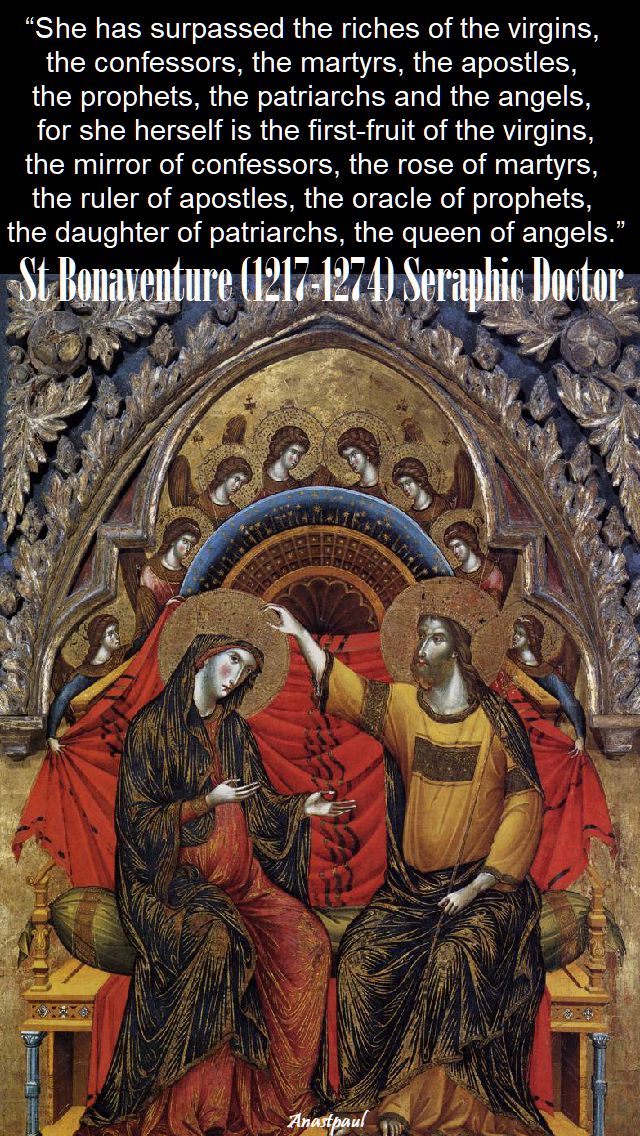
“She has surpassed the riches of the virgins,
the confessors, the martyrs, the apostles,
the prophets, the patriarchs and the angels,
for she herself is the first-fruit of the virgins,
the mirror of confessors, the rose of martyrs,
the ruler of apostles, the oracle of prophets,
the daughter of patriarchs, the queen of angels.

St Bonaventure (1217-1274) Seraphic Doctorshe-has-surpassed-the-riches-st-bonaventure-22 aug 2017

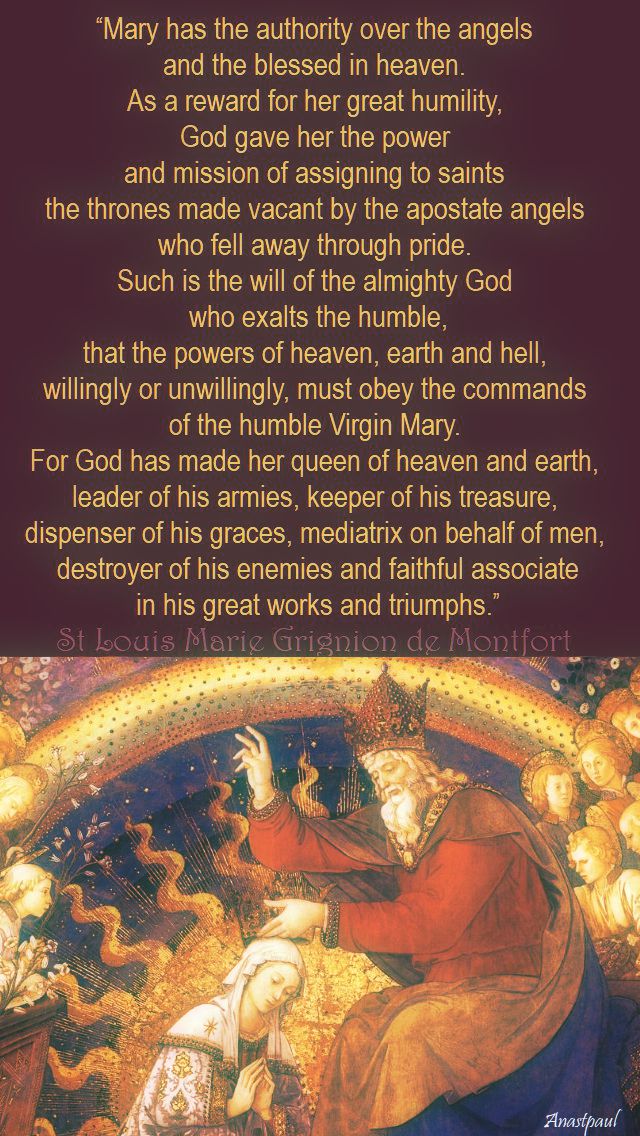
“Mary has the authority over the angels
and the blessed in heaven.
As a reward for her great humility,
God gave her the power and mission of assigning to saints
the thrones made vacant by the apostate angels
who fell away through pride.
Such is the will of the almighty God who exalts the humble,
that the powers of heaven, earth and hell,
willingly or unwillingly, must obey the commands
of the humble Virgin Mary.
For God has made her queen of heaven and earth,
leader of his armies, keeper of his treasure,
dispenser of his graces, mediatrix on behalf of men,
destroyer of his enemies and faithful associate
in his great works and triumphs.

St Louis Marie de Montfort (1673-1716)mary-has-the-authority-over-the-angels-st-louis-de-montfort2-22 aug 2017

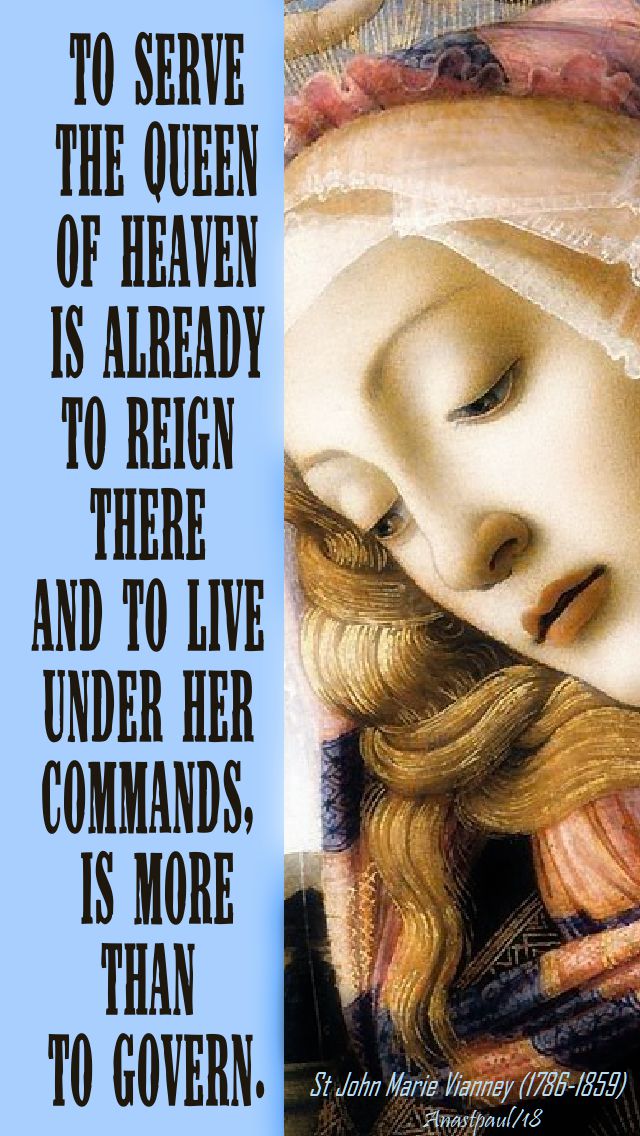
“To serve the Queen of Heaven is already to reign there
and to live under her commands, is more than to govern.”

St John Marie Vianney (1786-1859)to serve the queen of heaven is more than to - st john vianney 22 aug 2018

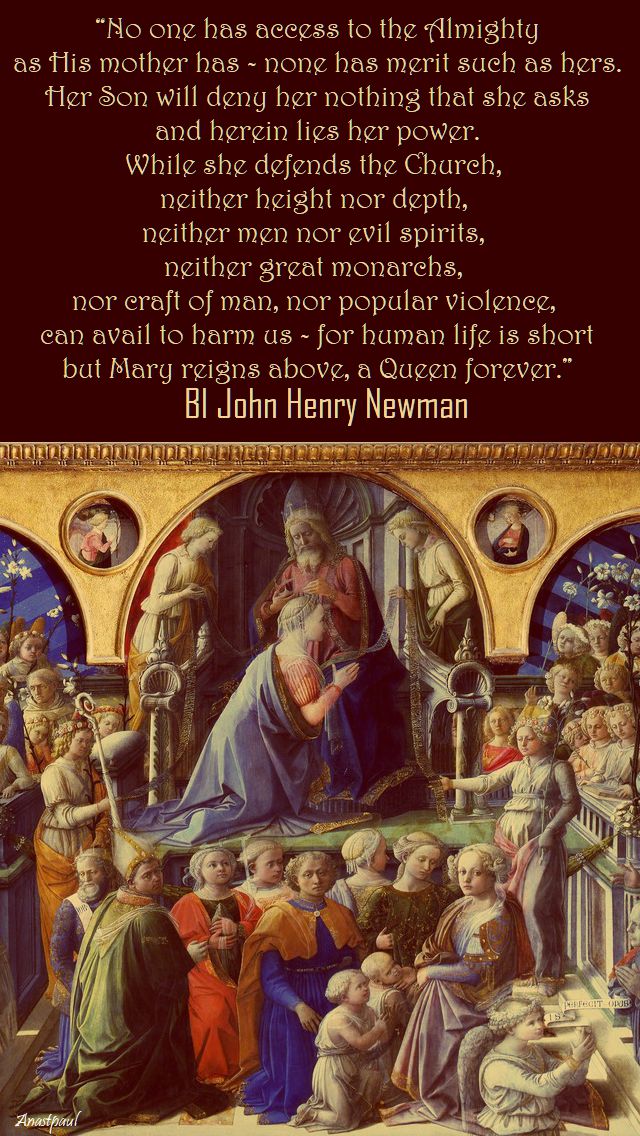
“No one has access to the Almighty
as His mother has – none has merit such as hers.
Her Son will deny her nothing that she asks
and herein lies her power.
While she defends the Church,
neither height nor depth,
neither men nor evil spirits,
neither great monarchs,
nor craft of man, nor popular violence,
can avail to harm us – for human life is short
but Mary reigns above, a Queen forever.”no-one-has-access-to-the-almighty-bl-john-henry-newman-22 aug 2017

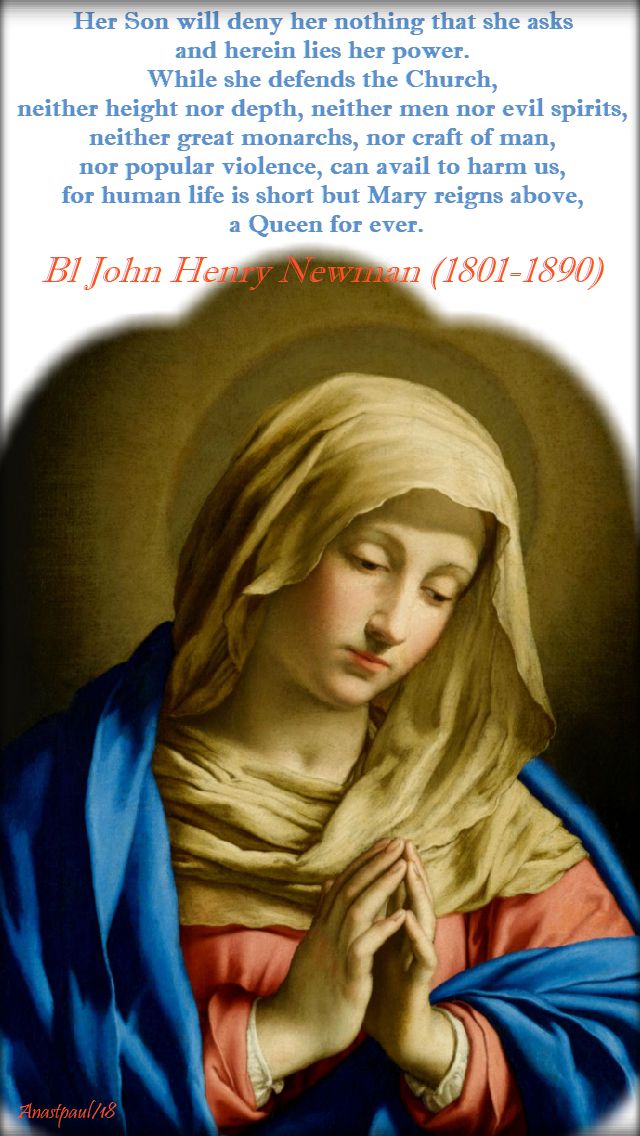
“Her Son will deny her nothing that she asks and herein lies her power.   While she defends the Church, neither height nor depth, neither men nor evil spirits, neither great monarchs, nor craft of man, nor popular violence, can avail to harm us, for human life is short but Mary reigns above, a Queen for ever.”

Bl Cardinal John Henry Newman (1801-1890)her-son-will-deny-her-nothing-bl-john-henry-mary-virgo-potens-28-may-20181

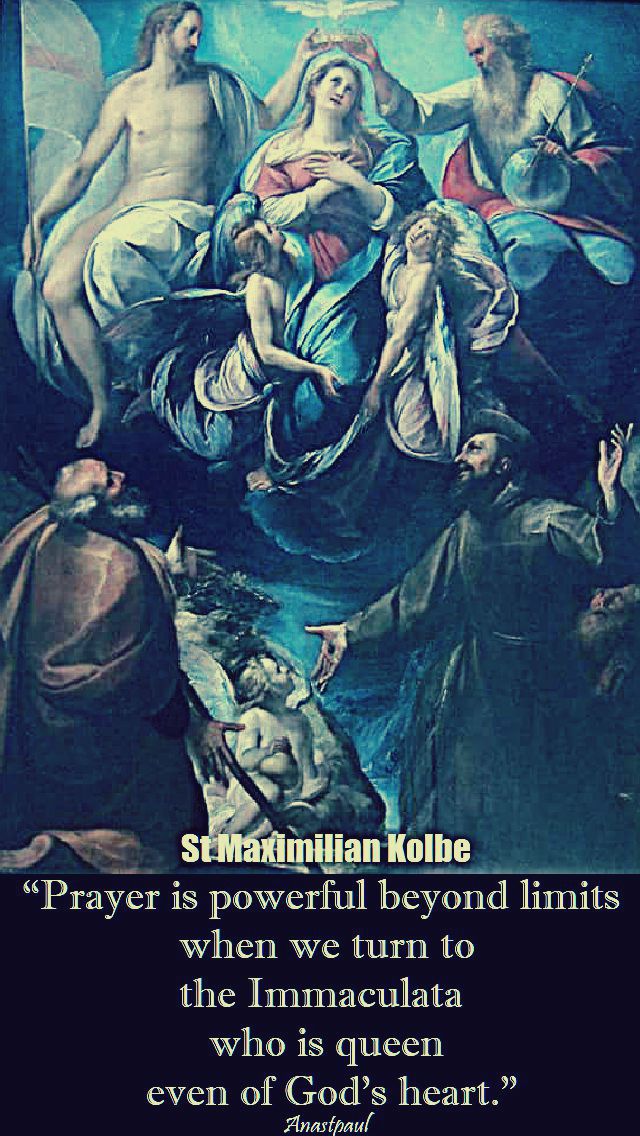
“Prayer is powerful beyond limits
when we turn to the Immaculata
who is Queen even of God’s heart.”

St Maximilian Kolbe (1894-1941)prayer-is-powerful-beyond-limits-st-max-kolbe1-22 aug 2017

Posted in Uncategorized

Memorials of the Saints – 21 August

St Pope Pius X (1835-1914) (Memorial)

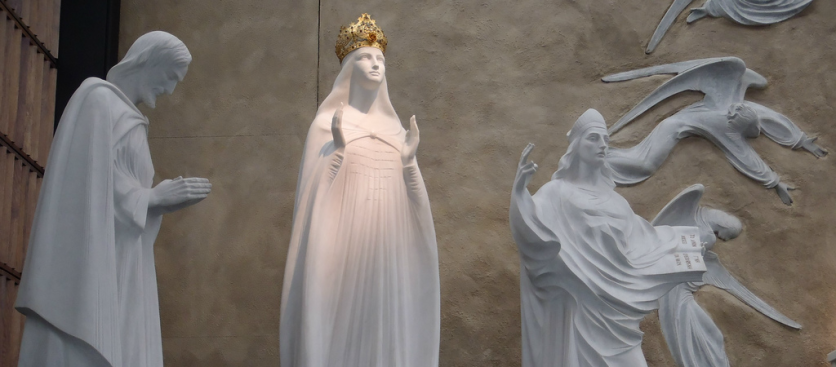
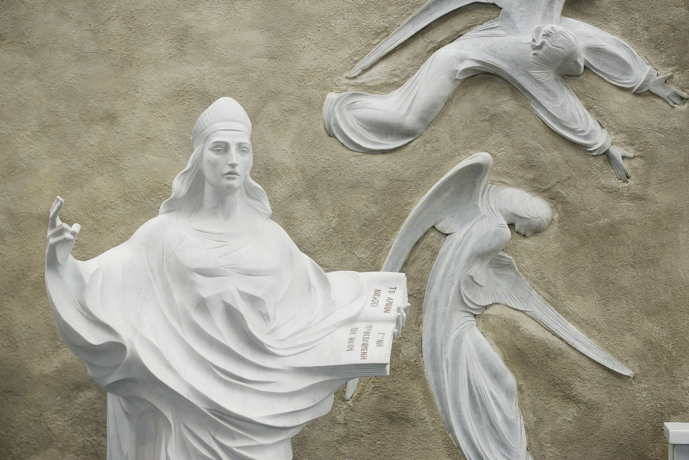
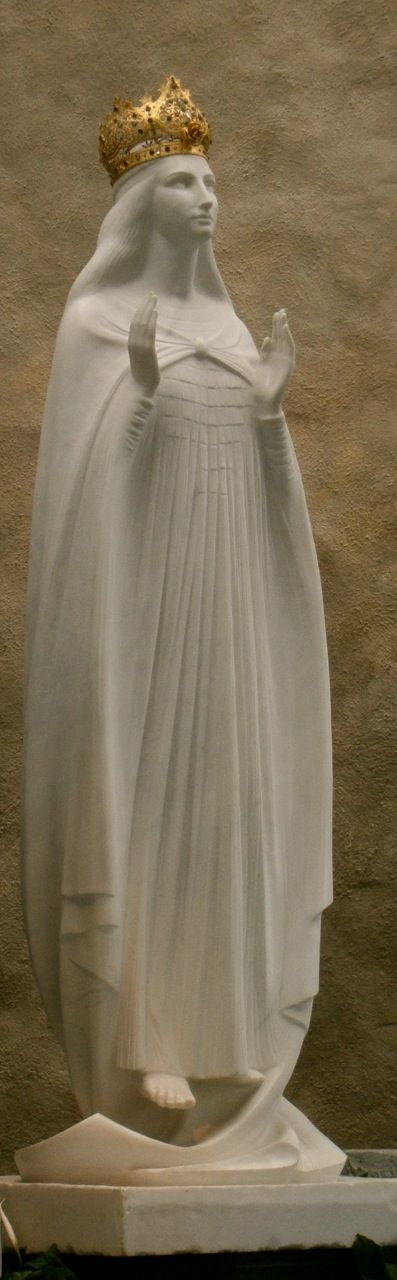
Our Lady of Knock: Our Lady, Saint Joseph and Saint John the Evangelist appeared in a blaze of light at the south gable of Saint John the Baptist Church, Knock, County Mayo, Ireland. They appeared to float about two feet above the ground and each would occassionally move toward the visionaries and then away from them. The Blessed Virgin Mary was clothed in white robes with a brilliant crown on her head. Where the crown fitted to her brow, she wore a beautiful full-bloom golden rose. She was praying with her eyes and hands raised towards Heaven. Saint Joseph wore white robes, stood on Our Lady’s right and was turned towards her in an attitude of respect. Saint John was dressed in white vestment, stood was on Mary’s left and resembled a bishop, with a small mitre. He appeared to be preaching and he held an open book in his left hand. Behind them and a little to the left of Saint John was a plain altar on which was a cross and a lamb with adoring angels. The apparition was witnessed by fifteen people. Miraculous healings were reported soon after the area and it is now a major pilgrimage destination. Patronage – Ireland.our-lady-of-knockstatue-of-st-john-the-evangelistour lady of knock - lg

St Abraham of Smolensk
St Agapius of Edessa
St Agathonicus of Constantinople
St Anastasius Cornicularius
St Aria of Rome
St Avitus I of Clermont
St Bassa of Edessa
Bl Beatrice de Roelas
St Bernhard of Lérida
St Bernard de Alziva
St Bonosus
Bl Bruno Zembol
St Camerinus of Sardinia
St Cameron
St Cisellus of Sardinia
St Cyriaca
St Euprepius of Verona
St Fidelis of Edessa
Bl Gilbert of Valenciennes
St Gracia of Lérida
St Hardulph
St Joseph Nien Vien
Bl Ladislaus Findysz
St Leontius the Elder
St Luxorius of Sardinia
St Maria of Lérida
St Maximianus the Soldier
St Maximilian of Antioch
St Natale of Casale Monferrato
St Paternus of Fondi
St Privatus of Mende
St Quadratus of Utica
St Sidonius Apollinaris
St Theogonius of Edessa
Bl Victoire Rasoamanarivo
St Zoticus the Philosopher

Martyred in the Spanish Civil War:
• Blessed Joan Cuscó Oliver
• Blessed Joan Vernet Masip
• Blessed Pedro Mesonero Rodríguez
• Blessed Pere Sadurní Raventós
• Blessed Ramon Peiró Victori
• Blessed Salvador Estrugo Salves

Posted in SAINT of the DAY, Uncategorized

Memorials of the Saints – 16 August

St Stephen of Hungary (c 975- 1038) King of Hungary (Optional Memorial)

Bl Angelus Agostini Mazzinghi
St Armagillus of Brittany
St Arsacius of Nicomedia
St Frambaldo
Bl Iacobus Bunzo Gengoro
Bl Jean-Baptiste Menestrel
Bl John of Saint Martha
Bl Laurence Loricatus
Bl Magdalena Kiyota Bokusai
Bl Maria Gengoro
Bl Ralph de la Futaye
St Roch (1295-1327) “Pilgrim”
The story of St Roch here:   https://anastpaul.wordpress.com/2017/08/16/saint-of-the-day-16-august-st-roch/

St Serena
Bl Simon Kiyota Bokusai
Bl Thomas Gengoro
St Titus the Deacon
—
Martyrs of Palestine – 33 saints: Thirty-three Christians martyred in Palestine; they are commemorated in old martyrologies, but the date and exact location have been lost.

Martyred in the Spanish Civil War:
Bl Amadeu Monje Altés
Bl Antonio María Rodríguez Blanco
Bl Enrique García Beltrán
Bl José María Sanchís Mompó
Bl Laurentí Basil Matas

Posted in CARMELITES, MORNING Prayers, PRAYERS of the SAINTS, SAINT of the DAY, The TRANSFIGURATION, Uncategorized

Our Morning Offering – 9 August – The Memorial of St Teresa Benedicta of the Cross (1891-1942) Martyr

Our Morning Offering – 9 August – The Memorial of St Teresa Benedicta of the Cross (1891-1942) Martyr

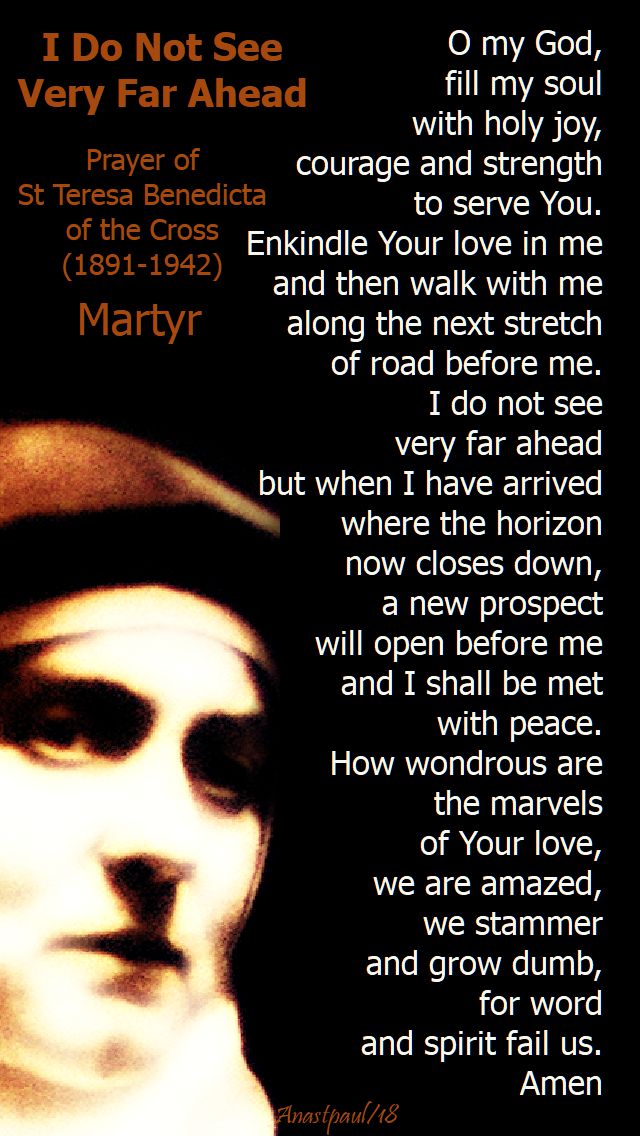
I Do Not See Very Far Ahead
By St Teresa Benedicta of the Cross (1891-1942)

O my God,
fill my soul with holy joy,
courage and strength to serve You.
Enkindle Your love in me
and then walk with me
along the next stretch of road before me.
I do not see very far ahead
but when I have arrived
where the horizon now closes down,
a new prospect will open before me
and I shall be met with peace.
How wondrous are the marvels of Your love,
we are amazed,
we stammer and grow dumb,
for word and spirit fail us.
Ameni do not see very far ahead - st teresa benedicta of the cross - 9 aug 2018

Posted in DOCTORS of the Church, FATHERS of the Church, MORNING Prayers, QUOTES of the SAINTS, SUNDAY REFLECTIONS, The HOLY EUCHARIST / The HOLY MASS, Uncategorized

Sunday Reflection – 5 August – Today’s Gospel: John 6:24-35

Sunday Reflection – 5 August – Eighteenth Sunday in Ordinary Time, Year B – Today’s Gospel: John 6:24-35

“Bread is not made from one grain but from many. It’s as though you, who were many were ground.   When you were baptised it’s as though you were mixed into dough.   When you received the fire of the Holy Spirit, it’s as though you were baked.
Be what you can see and receive what you are.

After all, just as many grains are mixed into one loaf in order to produce the visible appearance of bread, as though what holy scripture says about the faithful were happening:  They had one soul and one heart in God (Acts 4:32);   so too with the wine. Brothers and sisters, just remind yourselves what wine is made from;  many grapes hang in the bunch but the juice of the grapes is poured together in one vessel.”

St Augustine (354-430) Father & Doctor of the Churchbe what you can see and receive what you are - st augustine - 5 aug 2018

Posted in SAINT of the DAY, Uncategorized

Memorials of the Saints – 2 August

St Eusebius of Vercelli (283-371) Bishop (Optional Memorial)
St Peter Julian Eymard SSS (1811-1868) (Optional Memorial)

Our Lady of the Angels:   The image of Our Lady of the Angels is only about 10 cms high and is carved in a simple fashion on dark stone.   She has a round, sweet face, slanted eyes and a delicate mouth.   Her colouring is leaden, with scattered golden sparkles.   She carries the Christ Child on her left arm.   Only the faces of Mary and the Child are visible; the rest is covered by a cloak that is gathered in pleats.   The statuette is displayed in a large gold monstrance that surrounds it and enlarges its appearance.   While searching for firewood on 2 August 1635, the feast of the Holy Angels, a poor mestizo woman named Juana Pereira discovered this small image of the Virgin sitting beside the footpath near Cartago, Costa Rica.   Juana took it home with her but it soon disappeared only to be re-discovered at the same place beside the same path.   The statue repeated this behaviour five more times – taken to homes and then the parish church – and returning on its own to the site where Juan  a found it. The locals finally took this to mean that Our Lady wanted a shrine built there, and so it was.
The shrine soon became a point of pilgrimage, especially for the poor and outcast.   The image was solemnly crowned in 1926.   In 1935 Pope Pius XI declared the shrine of the Queen of Angels a basilica (see below).   The stone on which the statue was originally sitting is in the basilica and is being slowly worn away by the touch of the hands of the pilgrims.   A spring of water appeared from beneath the stone and its waters carried away to heal the sick.   Patronage – Costa Rica, diocese of Getafe, Spain.our-ldy-of-the-angels (1)

St Auspicius of Apt
St Betharius of Chartres
St Centolla of Burgos
St Etheldritha of Croyland
Bl Frederic Campisani
Bl Giustino Maria Russolillo
Bl Gundekar of Eichstätt
Bl Joanna of Aza
Bl John of Rieti
St Maximus of Padua
St Pedro de Osma
St Peter Faber S.J. (1506-1546)

St Plegmund
St Rutilius
St Serenus of Marseille
St Sidwell
St Pope Stephen I
—
Martyred in the Spanish Civil War:
Bl Ceferino Jimenez Malla
Bl Felipe de Jesús Munárriz Azcona
Bl Fernando Olmedo Reguera
Bl Francesc Company Torrelles
Bl Francisca Pons Sarda
Bl Francisco Calvo Burillo
Bl Francisco Manzano Cruz
Bl Francisco Tomás Serer
Bl José Peris Ramos
Bl Juan Díaz Nosti
Bl Leoncio Pérez Nebreda
Bl Leoncio Pérez Ramos
Bl Martí Anglés Oliveras
Bl Miguel Amaro Rodríguez

Posted in Against SCRUPELOSITY, for Scrupulous people, All THEOLOGIANS, Moral Theologians, CONFESSORS, DOCTORS of the Church, GOUT, KNEE PROBLEMS, ARTHRITIS, etc, Of a Holy DEATH & AGAINST A SUDDEN DEATH, of the DYING, FINAL PERSEVERANCE, DEATH of CHILDREN, DEATH of PARENTS, REDEMPTORISTS CSSR, SAINT of the DAY, Uncategorized

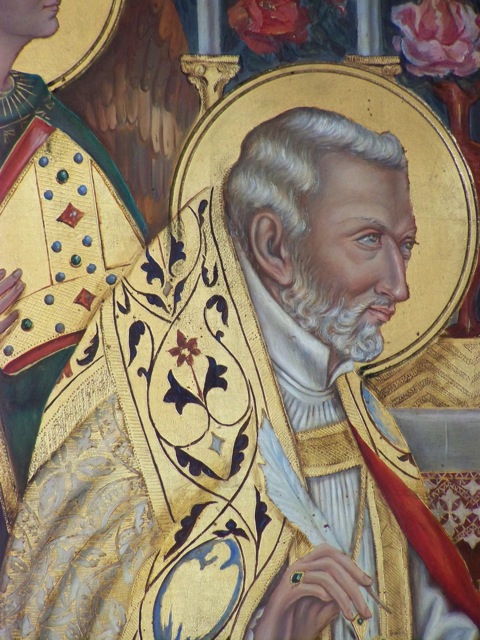
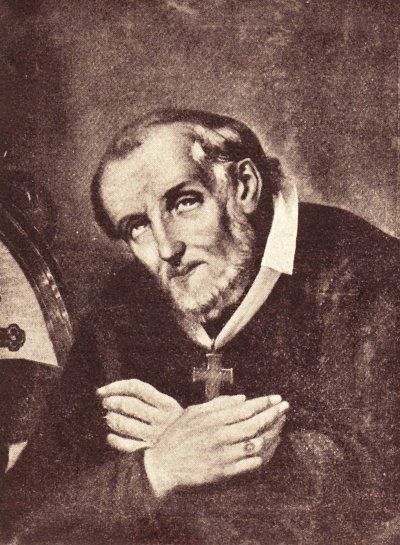
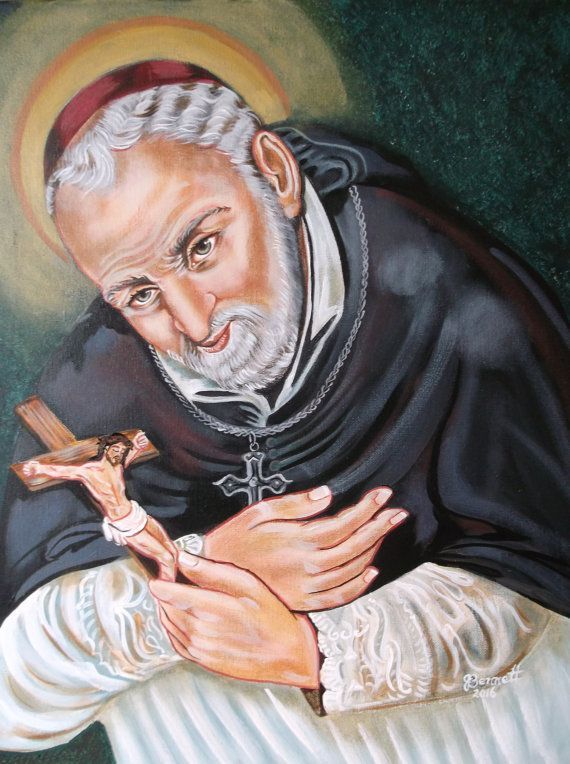
Saint of the Day – 1 August – St Alphonsus Maria de Liguori C.Ss.R. (1696-1787) – Doctor of the Church

Saint of the Day – 1 August – St Alphonsus Maria de Liguori C.Ss.R. (1696-1787) – Confessor, Bishop, Doctor of the Church, Founder of the Redemptorists, Spiritual Writer, Composer, Musician, Artist, Poet, Lawyer, Scholastic Philosopher and Theologian.    Patronages – against arthritis, against scrupulosity, of Confessors (given on 26 February 1950 by Pope Pius XII), final perseverance, moral theologians, moralists (1950 by Pope Pius XII), scrupulous people, vocations, Diocese of Acerra, Italy, Diocese of Agrigento, Italy,l Pagani, Italy, Sant’Agata de’ Goti, Italy.

The Roman Martyrology states of St Alphonsus today: “At Nocera-de-Pagani, Saint Alphonsus Maria de Liguori, Bishop of St Agatha of the Goths and Founder of the Congregation of the Most Holy Redeemer (the Redemptorists), distinguished by his zeal for the salvation of souls, by his writings, his preaching and his example.
He was inscribed on the Calendar of the Saints by Pope Gregory XVI in the year 1839, the 52nd after his happy death and , in 1871, was declared Doctor of the Universal Church by Pius IX, according to a decree of the Sacred Congregation of Rites.
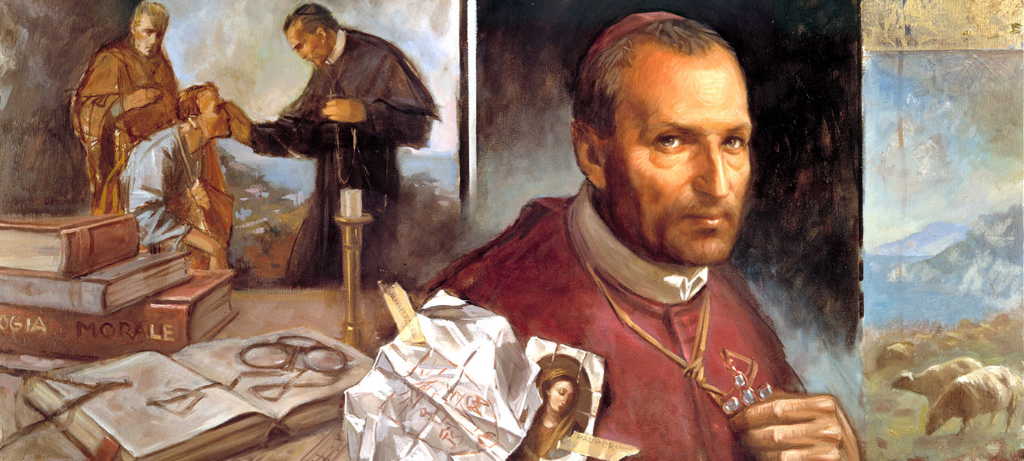
“header image - alphonsus

St Alphonsus was born of noble parents, near Naples, in 1696.   His spiritual training was entrusted to the Fathers of the Oratory in that city and from his boyhood Alphonsus was known as a most devout Brother of the Little Oratory.   At the early age of sixteen he was made doctor in law and he threw himself into this career with ardour and success.

A mistake, by which he lost an important cause, showed him the vanity of human fame and determined him to labour only for the glory of God.   He entered the priesthood, devoting himself to the most neglected souls and to carry on this work he founded later the missionary Congregation of the Most Holy Redeemer,   The Redemptorists.alphonsus - youngalphonsus - very young - magnificent

At the age of sixty-six he became Bishop of St Agatha and undertook the reform of his diocese with the zeal of a Saint.   He made a vow never to lose time and, though his life was spent in prayer and work, he composed a vast number of books, filled with such science, unction and wisdom that he has been declared one of the Doctors of the Church.st alphonsus - BEAUTIFUL image!

St Alphonsus wrote his first book at the age of forty-nine and in his eighty-third year had published about 100 volumes, when his director forbade him to write more.   Very many of these books were written in the half-hours snatched from his labours as missionary, religious superior and Bishop, or in the midst of continual bodily and mental sufferings.   With his left hand he would hold a piece of marble against his aching head while his right hand wrote.

alphonsus

Yet he counted no time wasted which was spent in charity.   He did not refuse to hold a long correspondence with a simple soldier who asked his advice, or to play the harpsichord while he taught his novices to sing spiritual canticles.   He lived in evil times, and met with many persecutions and disappointments.

For his last seven years he was prevented by constant sickness from offering the Adorable Sacrifice but he received Holy Communion daily and his love for Jesus Christ and his trust in Mary’s prayers sustained him to the end.

He died in 1787, in his ninety-first year.alphonsus 2

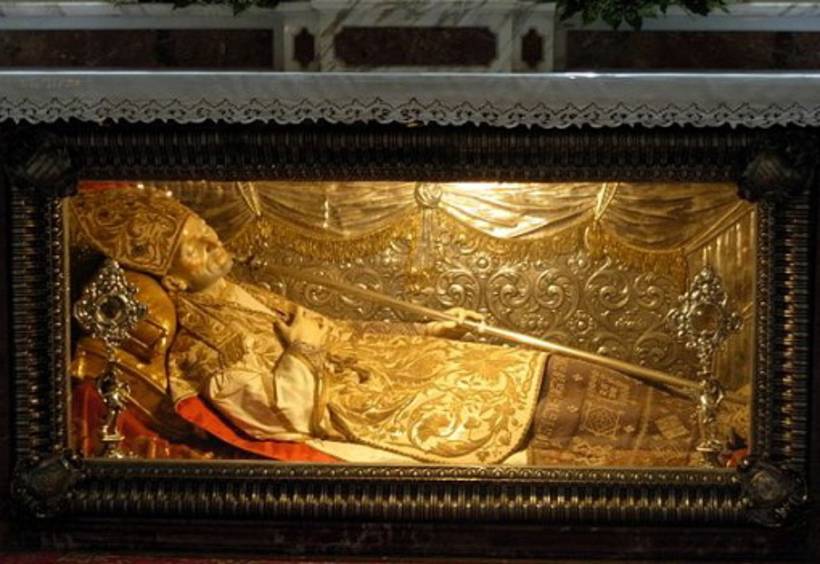
For lots more details on St Alphonsus here:   https://anastpaul.wordpress.com/2017/08/01/saint-of-the-day-1-august-st-alphonsus-maria-de-liguori-c-ss-r-doctor-of-the-church/ alphonsus relics

alphonsus by lawrence op

Posted in CATHOLIC-PRAYERS OF THE CHURCH, DOCTORS of the Church, MORNING Prayers, PRACTISING CATHOLIC, PRAYERS for VARIOUS NEEDS, PRAYERS of the CHURCH, PRAYERS of the SAINTS, PRAYERS to the SAINTS, Uncategorized

Thought for the Day – 25 July – The Memorial of St Christopher (died c 251) One of the Fourteen Holy Helpers

Thought for the Day – 25 July – The Memorial of St Christopher (died c 251) One of the Fourteen Holy Helpersfourteen-holy-helpers-94abfebd-a22d-4068-8082-f47cdecef31-resize-750fourteen-holy-helpers-8d56c60e-abf4-4a22-b615-9fee194d603-resize-750

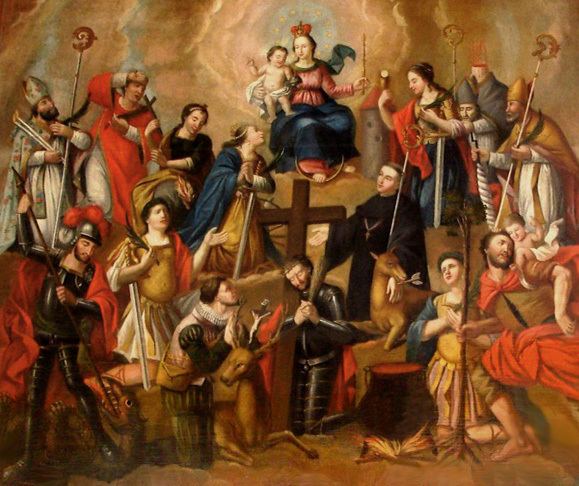
The Fourteen “Auxiliary Saints” or “Holy Helpers” are a group of saints invoked because they have been efficacious in assisting in trials and sufferings.   Each saint has a separate feast or memorial day and the group was collectively venerated on 8 August until the 1969 reform of the Roman calendar, when the feast was dropped.   These saints were often represented together.   Popular devotion to these saints often began in some monastery that held their relics.   All of the saints except Giles were martyrs.   Devotion to some of the saints, such as St George, St Margaret, St Christopher, St Barbara and St Catherine became so widespread that customs and festivals still are popular today.

The Fourteen Holy Helpers are invoked as a group mainly because of the Black Plague which devastated Europe from 1346 to 1349.   Among its symptoms were the black tongue, a parched throat, violent headache, fever and boils on the abdomen.   The victims were attacked without warning, robbing them of their reason and killed within a few hours;  many died without the last Sacraments.   No one was immune and the disease wreaked havoc in villages and family circles.   The epidemic appeared incurable. The pious turned to Heaven, begging the intervention of the saints, praying to be spared or cured.   Each of these fourteen saints had been efficacious in interceding in some aspect for the stricken during the Black Plague.   The dates are the traditional feast days; not all the saints are on the Universal Roman Calendar.the fourteen holy helpers - infographic - from wikepeida my image - 25 july 2018Fourteen Holy Helpers

14Nothelfer

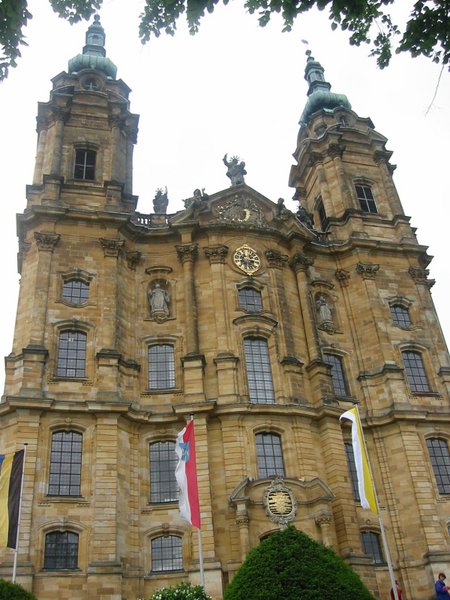
The Basilica of the Fourteen Holy Helpers (also Basilika Vierzehnheiligen) is a church located near the town of Bad Staffelstein near Bamberg, in Bavaria, southern Germany. The late Baroque-Rococo basilica, designed by Balthasar Neumann, was constructed between 1743 and 1772.

Vierzehnheiligen

800px-Vierzehnheiligen-Basilika3-Asio
The altar depicts statues of the Fourteen Holy Helpers.

The Legend of Building the Basilica
On 24 September 1445, Hermann Leicht, the young shepherd of a nearby Franciscan monastery, saw a crying child in a field that belonged to the nearby Cistercian monastery of Langheim  . As he bent down to pick up the child, it abruptly disappeared.   A short time later, the child reappeared in the same spot.   This time, two candles were burning next to it.   In June 1446, the Leicht saw the child a third time.   This time, the child bore a red cross on its chest and was accompanied by thirteen other children.   The child said: “We are the fourteen helpers and wish to erect a chapel here, where we can rest.   If you will be our servant, we will be yours!”   Shortly after, Leicht saw two burning candles descending to this spot.   It is alleged that miraculous healings soon began, through the intervention of the fourteen saints.

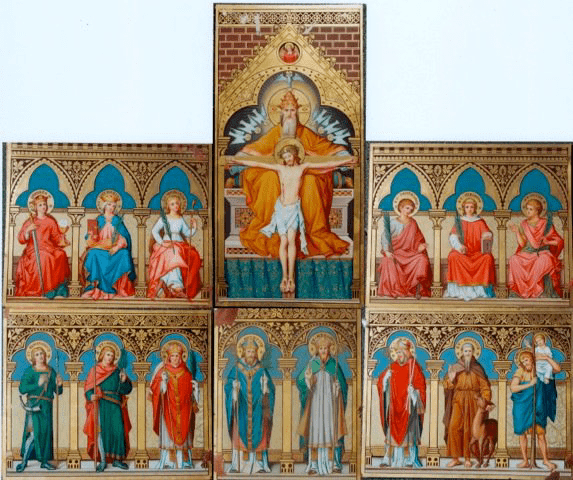
The Cistercian brothers to whom the land belonged erected a chapel, which immediately attracted pilgrims.   An altar was consecrated as early as 1448.   Pilgrimages to the Vierzehnheiligen continue to the present day between May and October.Holy Helpers triptych - anon

One of the most famous group depictions of the “Fourteen Saints” is a 1503 altarpiece by Matthias Grünewald for the monastery in Lichtenfels in Upper Franconia, unfortunately, I cannot find a complete image of this, below are Panels one and two.

The “fourteen angels” of the lost children’s prayer in the Composer, Engelbert Humperdinck’s (1854-1921) fairy opera, ‘Hansel and Gretel’, are the Fourteen Holy Helpers.   The English words are familiar and very beautiful:

When at night I go to sleep,
Fourteen angels watch do keep,
Two my head are guarding,
Two my feet are guiding;
Two upon my right hand,
Two upon my left hand.
Two who warmly cover
Two who o’er me hover,
Two to whom ’tis given
To guide my steps to heaven.

I will pray daily, to the Fourteen Holy Helpers, to Pray for us all, for the world is indeed suffering from a ‘Plague’ of a new kind!

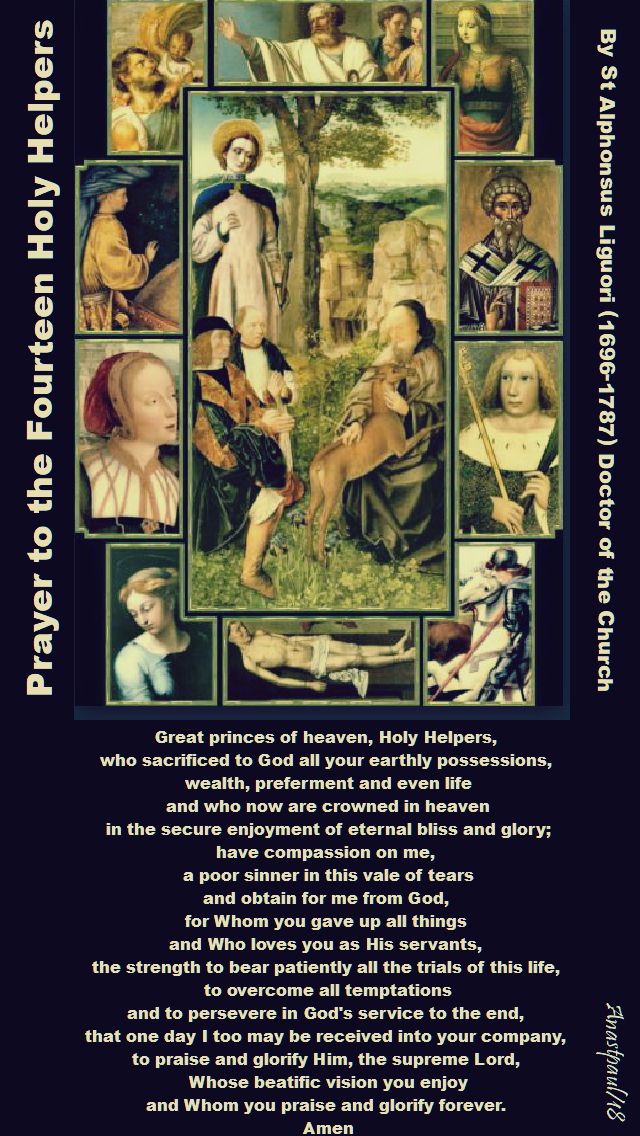
Prayer to the Fourteen Holy Helpers
By St Alphonsus Liguori (1696-1787) Doctor of the Church

Great princes of heaven, Holy Helpers,
who sacrificed to God all your earthly possessions,
wealth, preferment and even life
and who now are crowned in heaven
in the secure enjoyment of eternal bliss and glory;
have compassion on me,
a poor sinner in this vale of tears
and obtain for me from God,
for Whom you gave up all things
and Who loves you as His servants,
the strength to bear patiently all the trials of this life,
to overcome all temptations
and to persevere in God’s service to the end,
that one day I too may be received into your company,
to praise and glorify Him, the supreme Lord,
Whose beatific vision you enjoy
and Whom you praise and glorify forever.
Amenprayer to the 14 holy helpers by st alphonsus - 25 july 2018

14 holy helpers - pay for us - 25 july 2018


Posted in Uncategorized

Saint of the Day – 6 July – Blessed Sr Nazaria of Saint Teresa of Jesus (Nazaria Ignacia March y Mesa) (1889-1943)

Saint of the Day – 6 July – Blessed Sr Nazaria of Saint Teresa of Jesus (Nazaria Ignacia March y Mesa) (1889-1943) Religious and Founder of the Missionaries of the Crusade (later renamed Congregation of the Missionary Crusaders of the Church) – born on 10 January 1889 at Arcos de Santa María N° 41 (Augusto Figueroa), Madrid, Spain and died on 6 July 1943 in the Rivadavia Hospital, Buenos Aires, Argentina of complications from pneumonia and tuberculosis.   Patronage – Missionaries of the Crusade.

img-Blessed-Nazaria-Ignacia-March-Mesa


Fourth of eighteen children born to José Alejandro March y Reus, a merchant, fisherman and industrial worker and Nazaria Mesa Ramos;  Nazairi had a twin sister, Ignazia, and ten brothers who survived infancy.   She and her sister were baptised on the day they were born, Nazaria made her First Communion on 21 November 1898 and made a personal vow of consecration to God.   Unlike many children who are drawn to religious life at an early age, her family was indifferent to the faith and grew so tired of her devotions that they once “grounded” her from going to Mass.   By the time she was confirmed on 15 March 1902, which was celebrated by Blessed Marcelo Spínola y Maestre, her family had grown used to her piety and allowed her to join the Franciscan Third Order and more actively practice her faith.   She succeeded in getting several of them to return to the Church.

In late 1904, business failures led the family to move to Mexico.   On the trip, Nazaria met sisters in the Instituto de Hermanitas de los Ancianos Desamparados (Institute of Sisters of the Abandoned Elders) and was so inspired by their charism that on 7 December 1908 she followed a calling to religious life and entered the Institute in Mexico City, Mexico; she made her perpetual vows on 1 January 1915 and took the name Sister Nazariade Sainte-Thérèse.   Her diaries of the time show a deep devotion to her calling but struggles with her vows of obedience to her superiors.

She was assigned to the Institute hospice in Oruro, Bolivia where she worked as a cook, housekeeper, nurse and occasional beggar to support the poor and neglected for twelve years.   The region around Oruro was not entirely Christian, many Protestant groups were establishing missions and the few priests in the area were often lax or lived scandalous lives.   Beginning in 1920 Sister  Nazaria began to feel a call to found a new congregation devoted to missionary work, evanglisation and religious education.   On 18 January 1925, the feast of the Chair of Saint Peter, Sister  made a special vow of obedience to the Pope and on Pentecost that year, she made a vow to work for the union and extension of the Holy Catholic Church.   On 16 June 1925, with six other sisters, she founded the Pontifical Crusade, later renamed the Congregation of the Missionary Crusaders of the Church and began service as their superior.   The mission of the Congregation was to catechise children and adults, support the work of priests, conduct missions and to print and distribute short religious tracts.

Mother Nazaria met with opposition to her work, much of it from within Church administration.   Her sisters in the Institute treated her as a traitor to her original vocation for turning away from their work;  her superiors considered her disobedient and some Claretian clergy considered her a glory-hound, ignoring all the help members of their order had given her.   But Nazaria clung to Christ and pressed on.

Monsignor Felipe Cortesi, while in Bolivia, had worked to help Mother Nazaria to found the Congregation.  When he was assigned to be the apostolic nuncio of Argentina in 1930, he asked had her open a Missionary Crusader house in Buenos Aires.   The Congregation received an early test under fire during the 1932 to 1935 war between Bolivia and Paraguay;   Mother  Nazaria and the sisters cared for and brought the sacraments to soldiers on both sides and helped establish homes for war orphans.   In 1934 she founded the first magazine in Bolivia for women in religious life, Al Adalid de Cristo Rey, and the first female trade union, Sociedad de Obrera Católicas

In early 1934, Monsignor Cortesi asked the Vatican Congregation of Religious to approve the rules for the Crusaders that Nazaria had written, based on Ignatian spirituality.   Later that year, Mother Nazaria travelled to Rome with an Argentinian pilgrimage group to work for the approval of her Rule.   She made pilgrimages to several sites and had a private audience with Pope Pius XI during which Nazaria said that she was willing to die for the Church;  the Pope told her that she must, instead, live and work for the Church.

Leaving Italy for her native Spain, Mother Nazaria founded a retreat centre for spiritual exercises in Madrid under the flag of Uruguay;  the sisters there survived the Spanish Civil War as Franco did not wish to risk the international incident killing them would cause.   With the help of the Bolivian government, Mother Nazaria was able to leave the persecutions in Spain and return to the Americas.   She summoned a general chapter of the Congregation in 1937 to strengthen the unity and zeal of her sisters.   She worked on the spiritual formation of new sisters and set an example by her pious, simple life.   To the superiors of the Congregation houses she always recommended a maternal approach to the sisters in their care, to remember their role as Mother of the house.   When the Spanish Civil War ended, Nazaria returned to Spain to check on the sisters she had left behind, then returned to the Americas for the final time.

Blessed Nazaria was buried in the Chacorita cemetery in Buenos Aires on 8 July 1943.   Her relics werere-interred at the Congregation house at Buenos Aires on 14 June 1957
and later relics enshrined in the crypt of the mother house of the Congregation in Oruro, Bolivia in 1972.

The Congregation spread throughout South America and began to work in Portugal, Spain, France, Italy and Camaroon.   Though  Nazaria did not live to see it, the Congregation received Vatican recognition on 9 June 1947 by Pope Pius XII.

She was Beatified on 27 September 1992 by Pope John Paul II in Saint Peter’s Basilica, Rome, Italy.   Her Canonisation was announced on 19 May 2018, when Pope Francis promulgated a decree of a miracle attributed to the intercession of Blessed Nazaria and will take place on 14 October 2018.

Posted in franciscan OFM, Lady POVERTY, MORNING Prayers, QUOTES on SANCTITY, The WORD, Uncategorized

Thought for the Day – 2 July – “The poverty that makes rich.”

Thought for the Day – 2 July – Monday of the Thirteenth Week, Year B – Today’s Gospel: Matthew 8:18-22

“The poverty that makes rich.”

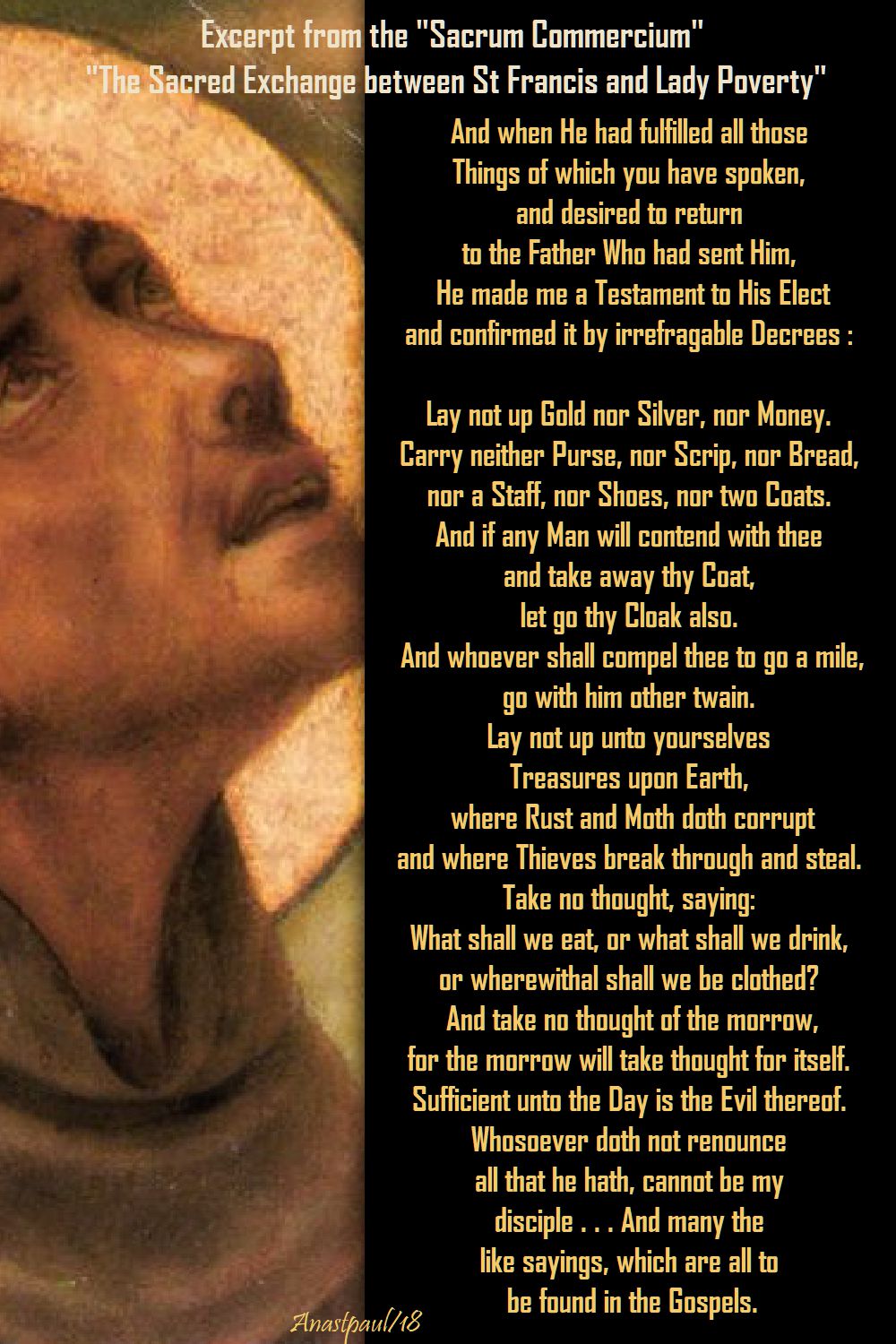
Excerpt from the “Sacrum Commercium” – “The Sacred Exchange between St Francis and Lady Poverty”

“And when He had fulfilled all those
Things of which you have spoken,
and desired to return to the Father Who had sent Him,
He made me a Testament to His Elect
and confirmed it by irrefragable Decrees :

Lay not up Gold nor Silver, nor Money.
Carry neither Purse, nor Scrip, nor Bread, nor a Staff, nor Shoes, nor two Coats.
And if any Man will contend with thee and take away thy Coat,
let go thy Cloak also. And whoever shall compel thee to go a mile,
go with him other twain.
Lay not up unto yourselves Treasures upon Earth,
where Rust and Moth doth corrupt
and where Thieves break through and steal.
Take no thought, saying:
What shall we eat, or what shall we drink,
or wherewithal shall we be clothed?
And take no thought of the morrow,
for the morrow will take thought for itself.
Sufficient unto the Day is the Evil thereof.
Whosoever doth not renounce
all that he hath, cannot be my
disciple . . . And many the
like sayings, which are all to
be found in the Gospels.”st francis - sacrum commercium - lady poverty no 1- 2 july 2018

The Sacred Exchange between Saint Francis and Lady Poverty, is one of the richest texts of the early Franciscan movement, “the single most brilliant example of the simple but lapidary allegory which was to become a major mode of spiritual writing in the later Middle Ages.”   An allegory offering insights into Francis’s vision of poverty, the Sacred Exchange weaves a luxuriant tapestry of images held together by the strong threads of a biblical theology.   For all of its richness, however, no text of these first hundred and fifty years is more mysterious.   Like the weaver of an undated tapestry, the author of the Sacred Exchange is content to hide obscurely making sure that the ends and threads are in their proper place that the beauty and exactness of his work may be seen.   Although there are many names suggested, the author of the Sacred Exchange still remains unknown.   The same holds true for the date of its composition though it is believed by solid historical explorations, to date from late 13th century.

The allegory is an exhortation written to encourage Francis’s followers to live in the authentic way of the saint’s biblical vision of poverty.   The central figure of the work is Lady Poverty, the personification of biblical Wisdom and, at times, of the Church.
The Passage above is one of the most profound, as each word is taken from scripture and bound together into a poem of immense richness.
This is a lesson we now need to embrace, as difficult as it would seem in the world in which we live, the world led only by riches.   For this is a true desire for sanctity, with Christ alone as our riches!

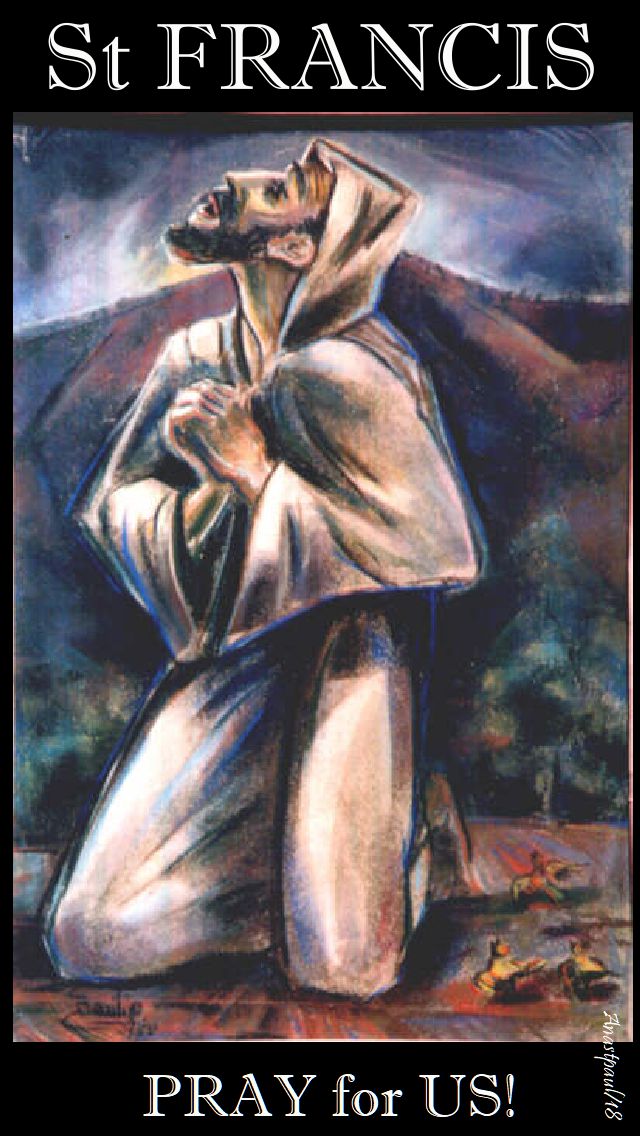
St Francis, Pray for us!st francis pray for us - 2 july 2018

Posted in CATHOLIC DEVOTIONS of the Month, SAINT of the DAY, Uncategorized

The Most Precious Blood of our Lord, Jesus Christ and Memorials of the Saints – 1 July

The Most Precious Blood of Our Lord, Jesus Christ:  The feast was removed from the General Roman Calendar in 1969, “because the Most Precious Blood of Christ the Redeemer is already venerated in the solemnities of the Passion, of Corpus Christi, of the Sacred Heart of Jesus and in the feast of the Exaltation of the Holy Cross.”   However, as this is the Month of the Most Precious Blood, this day, Sunday is most worthy of celebrating this Feast Day, this year (2018).

St Junipero Serra (1713-1784) (Optional Memorial, USA)

and my post last year: https://anastpaul.wordpress.com/2017/07/01/saint-of-the-day-st-junipero-serra-o-f-m-apostle-of-california-1-july/

St Aaron of Caerleon
St Aaron the Patriarch
Bl Antonio Rosmini-Serbati
St Arnulf of Mainz
Bl Assunta Marchetti
St Atilano Cruz Alvarado
St Calais of Anisole
St Carilephus
St Castus of Sinuessa
St Cewydd
St Concordius of Toledo
St Cuimmein of Nendrum
St Domitian of Lerins
Bl Elisabeth de Vans
St Eparchius of Perigord
St Eutychius of Umbria
St Esther the Queen
St Gall of Clermont
Bl George Beesley
St Golvinus of Leon
St Gwenyth of Cornwall
St Huailu Zhang
Bl Jan Nepomucen Chrzan
Bl Jean-Baptiste Duverneuil
St Julius of Caerleon
St Justino Orona Madrigal
St Juthware
St Leonorious of Brittany
St Leontius of Autun
Bl Luis Obdulio Navarro
St Martin of Vienne
Bl Montford Scott
Bl Nazju Falzon
St Nicasius of Jerusalem
St Oliver Plunkett (1629-1681) Martyr

Bl Pierre-Yrieix Labrouhe de Laborderie
St Secundinus of Sinuessa
St Servan of Culross
St Theobald of Vicenza
St Theodoric of Mont d’Or
Bl Thomas Maxfield
Bl Tullio Maruzzo
St Veep
—
Martyrs of Rome – 6 saints: Six Christians who were martyred together. No details have survived except their names – Esicius, Antonius, Processus, Marina, Serenus and Victor. They were martyred in Rome, Italy, date unknown.

Posted in Uncategorized

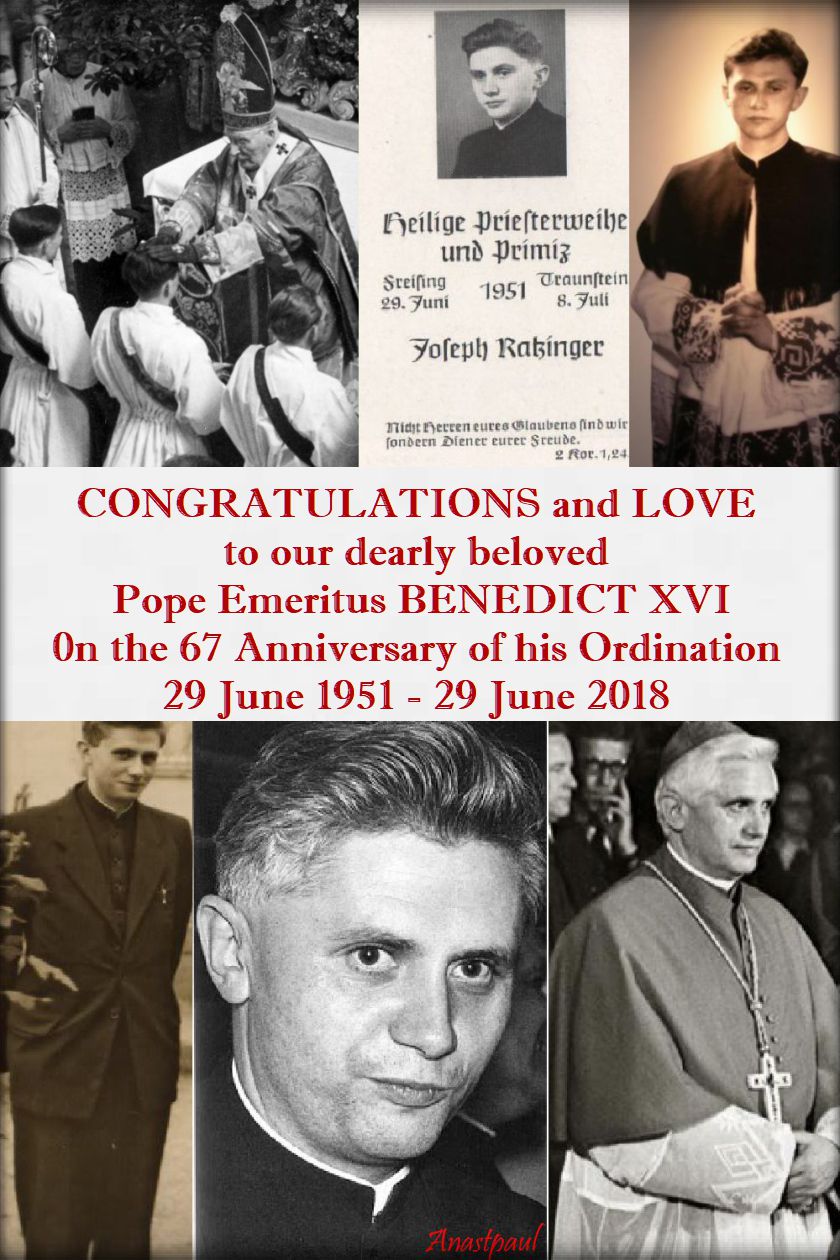
Congratulations, Prayers and Love to Pope Emeritus Benedict XVI on the occasion of the 67th Anniversary of his Priestly Ordination

Congratulations, Prayers and Love to Pope Emeritus Benedict XVI on the occasion of the 67th Anniversary of his Priestly Ordinationcongrats-67-years-29-june-papa-b.29 june 2018

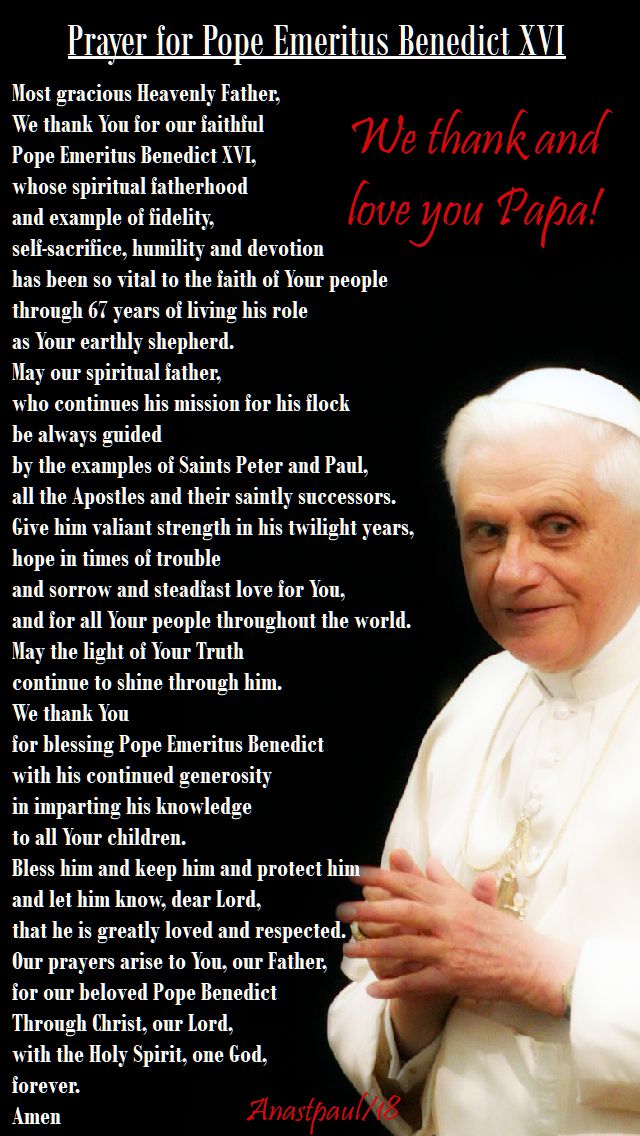
PRAYER FOR POPE EMERITUS BENEDICT XVI

ON THE 67TH ANNIVERSARY OF HIS ORDINATION – 29 JUNE 2018

Most gracious Heavenly Father,
We thank You for our faithful Pope Emeritus Benedict XVI,
whose spiritual fatherhood and example of fidelity,
self-sacrifice, humility and devotion
has been so vital to the faith of Your people
through 67 years of living his role as Your earthly shepherd.
May our spiritual father, who continues his mission for his flock
be always guided by the examples of Saints Peter and Paul,
all the Apostles and their saintly successors.
Give him valiant strength in his twilight years,
hope in times of trouble and sorrow and steadfast love for You,
and for all Your people throughout the world.
May the light of Your Truth continue to shine through him.
We thank You for blessing Pope Emeritus Benedict with his
continued generosity in imparting his knowledge to all Your children.
Bless him and keep him and protect him
and let him know that he is greatly loved and respected.
Our prayers arise to You, our Father for our beloved Pope Benedict
Through Christ, our Lord.
Amenprayer for pope benedict XVI on his 67 anniversary - 29 june 2018

Posted in MARIAN PRAYERS, MARIAN TITLES, MORNING Prayers, ON the SAINTS, PAPAL SERMONS, QUOTES of the SAINTS, SAINT of the DAY, The BLESSED VIRGIN MARY, Uncategorized

Thought for the Day – 26 June – The Memorial of St Josemaria Escrivá (1902-1975)

Thought for the Day – 26 June – The Memorial of St Josemaria Escrivá (1902-1975)

Excerpt from St John Paul’s Homily

on the Canonisation of St Josemaria – 6 October 2002

“All who are led by the Spirit of God are sons of God” (Rom 8,14).   These words of the Apostle Paul, … help us understand better the significant message of today’s canonisation of Josemaría Escrivá de Balaguer.   With docility he allowed himself to be led by the Spirit, convinced that only in this way can one fully accomplish God’s will.

This fundamental Christian truth was a constant theme in his preaching.   Indeed, he never stopped inviting his spiritual children to invoke the Holy Spirit to ensure that their interior life, namely, their life of relationship with God and their family, professional and social life, totally made up of small earthly realities, would not be separated but would form only one life that was “holy and full of God”.   He wrote, “We find the invisible God in the most visible and material things” (Conversations with Josemaría Escrivá, n. 114).

This teaching of his is still timely and urgent today.   In virtue of the Baptism that incorporates him into Christ, the believer is called to establish with the Lord an uninterrupted and vital relationship.   He is called to be holy and to collaborate in the salvation of humanity.

To fulfil such a rigorous mission, one needs constant interior growth nourished by prayer.   St Josemaría was a master in the practice of prayer, which he considered to be an extraordinary “weapon” to redeem the world.   He always recommended: “in the first place prayer;  then expiation;  in the third place but very much in third place, action” (The Way, n. 82).   It is not a paradox but a perennial truth:  the fruitfulness of the apostolate lies above all in prayer and in intense and constant sacramental life.   This, in essence, is the secret of the holiness and the true success of the saints.

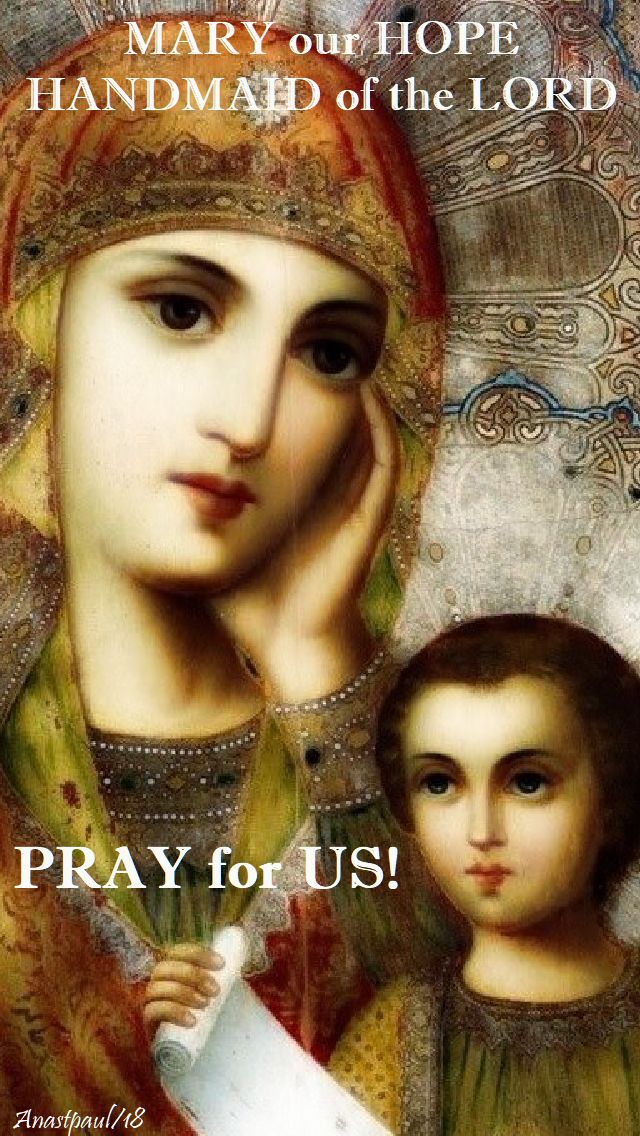
May the Lord help you, dear brothers and sisters, to accept this challenging ascetical and missionary instruction.   May Mary sustain you, whom the holy founder invoked as “Spes nostra, Sedes Sapientiae, Ancilla Domini!” (Our Hope, Seat of Wisdom, Handmaid of the Lord).

May Our Lady make everyone an authentic witness of the Gospel, ready everywhere to make a generous contribution to building the Kingdom of Christ!   May the example and teaching of St Josemaría be an incentive to us, so that at the end of the earthly pilgrimage, we too may be able to share in the blessed inheritance of heaven!   There, together with the angels and all the saints, we will contemplate the face of God and sing His glory for all eternity.”

Mary, Our Hope, Seat of Wisdom, Handmaid of the Lord, Pray for us!mary our hope handmaid of the lord - pray for us - 26 june 2018

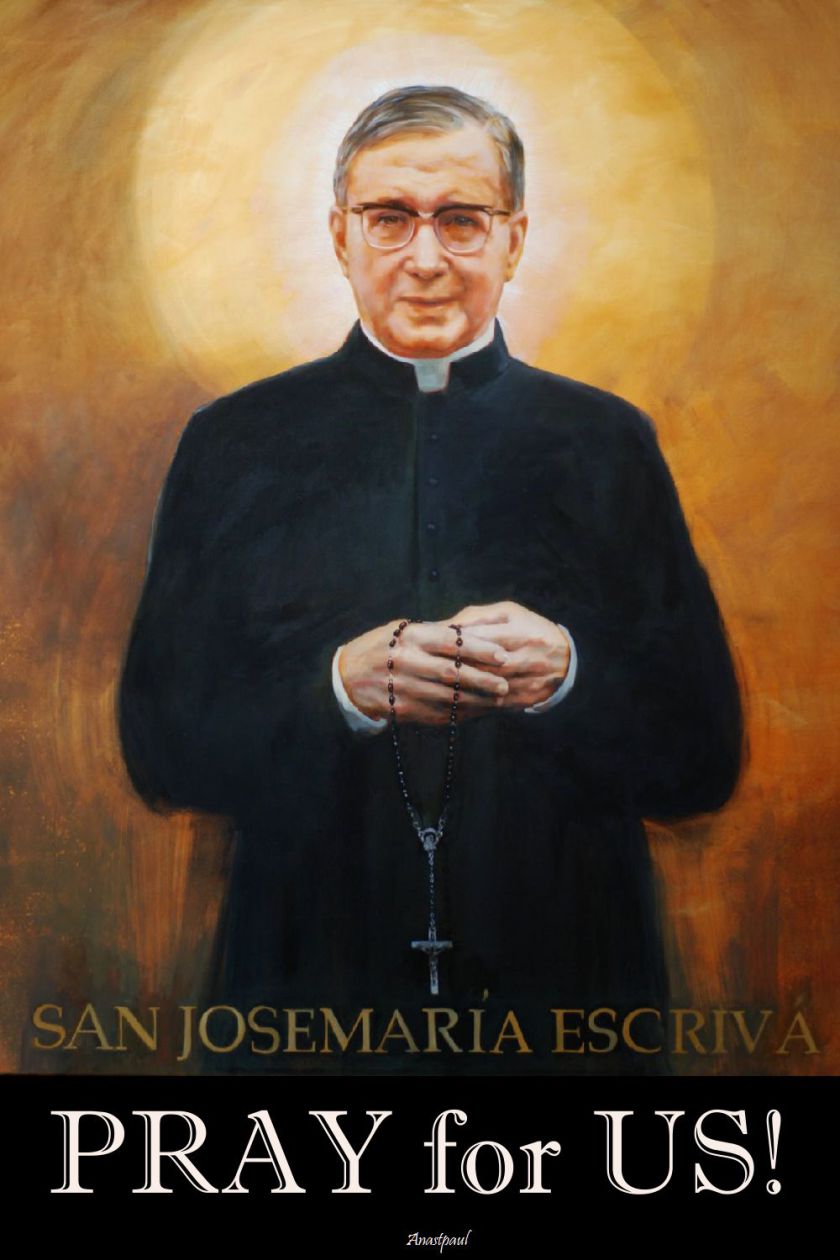
St Josemaria, Pray for us!st-josemaria-pray-for-us-21- 26 june 2017

Posted in FEASTS and SOLEMNITIES, MARIAN TITLES, MORNING Prayers, SAINT of the DAY, The BLESSED VIRGIN MARY, Uncategorized

Feast of Our Lady of Miracles and Memorials of the Saints – 21 June

St Aloysius Gonzaga S.J. (1568-1591) (Memorial)

Madonna of Miracles – Our Lady of Miracles (or Madonna of Miracles) is the patron saint of the town of Alcamo, Italy.

Calata_al_Santuario_della_Madonna_dei_Miracoli_di_Alcamo_-_14
—
St Agofredus of La-Croix
St Alban of Mainz
St Apollinaris of Africa
Bl Colagia
St Corbmac
St Cyriacus of Africa
St Demetria of Rome
St Dominic of Comacchio
St Engelmund
Bl Jacques-Morelle Dupas
St John Rigby
St José Isabel Flores Varela
Bl Juan of Jesus
St Lazarus
St Leutfridus
St Martia of Syracuse
St Martin of Tongres
Bl Melchiorre della Pace
St Mewan of Bretagne
Bl Nicholas Plutzer
St Ralph of Bourges
St Raymond of Barbastro
St Rufinus of Syracuse
St Suibhne the Sage
St Terence
St Ursicenus of Pavia
—
Martyrs of Taw – 3+ saints: Three Christians of different backgrounds who were martyred together – Moses, Paphnutius, Thomas. They were beheaded in Taw, Egypt, date unknown.

Posted in DOMINICAN OP, SAINT of the DAY, Uncategorized

Saint of the Day – 10 June – Blessed John Dominici O.P. (c 1355-1419)

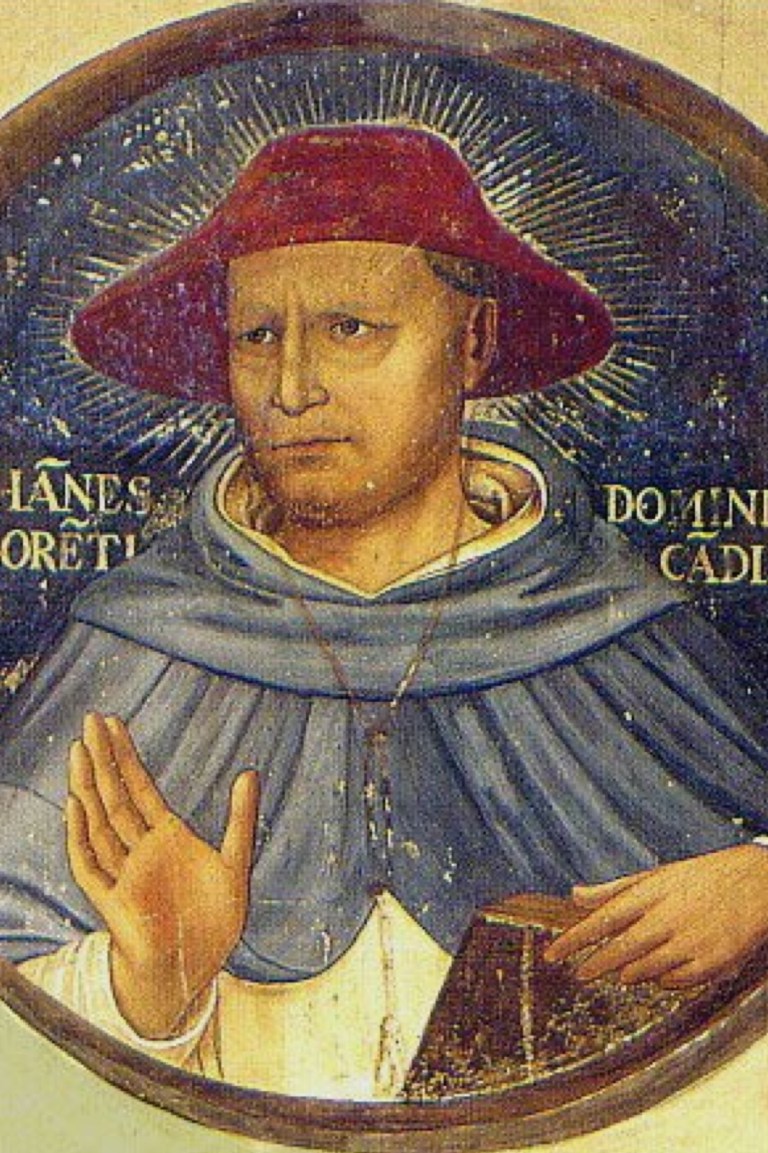
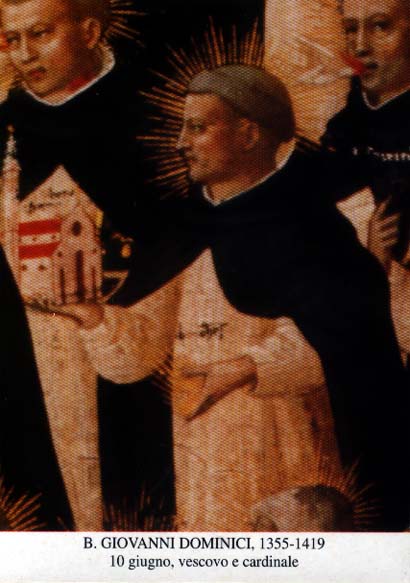
Saint of the Day – 10 June – Blessed John Dominici O.P. (c 1355-1419) ArchBishop, Cardinal, Religious Friar, Theologian, Preacher, Confessor, Reformer, Papal Legate, Papal Counsellor and Confessor, Writer, Evangeliser – born on 1356 at Florence, Italy and died on 10 June 1419 of a fever at Buda, Hungary.  Bl-JohnDominic

Although John had little education and suffered from a speech impediment that caused him to stammer and stutter, he possessed a tremendous drive to improve himself, overcome his obstacles and serve our Lord.   He also had a great memory and later in life became a great theologian and preacher.   John Dominic met St Catherine of Siena when he was young, entered the Order of Preachers and was an integral part of a major reform movement.   This reform helped to revitalise the Order after its decimation by the plague and general laxity of observance.   Not only was he a major force in the Dominican Order but he became a cardinal in the Church and an official legate for the Pope.   Most importantly, he worked to resolve the Great Western Schism.   He also brought Fra Angelico, the world famous painter and St Antoninus, a brilliant theologian and reformer, into the Order.

Born in c 1355 at Florence, Italy, John spent a great deal of his youth in or around the Dominican church of Santa Maria Novella.   He joined the Order at the age of 17, despite his lack of education and his speech impediment, even while the Dominicans are scholars and preachers.   After entering the Order, Blessed John studied in Pisa and Florence and received a degree from the University of Paris.   As a priest, Blessed John once believed that his speech impediment would threaten his vocation but it was cured through the intervention of Saint Catherine of Siena.   Blessed John spent 12 years in Venice as a preacher.

In 1392, Blessed John found himself to be the Vicar provincial serving in Rome.   At the time, Blessed Raymond of Capua was the Master General of the Order and he helped rebuild the Order after the ravages of the Plague and helped return regular discipline to the Order’s members.

Blessed John founded Dominican convents in Venice, Fiesole, Chioggia, Citta de Castello, Cortona, Lucca and Fabriano and was a correspondent of Blessed Clara Gambacorta, advising her of how to restore discipline to Dominican nuns of the day.   For a time, he lost papal support because of support for the Dominican White Penitents in Venice but was later welcomed back and resumed his work in the Order.

Most importantly, Blessed John worked to provide a Christian education to young people. He opposed pagan ideas that were taking hold in the humanism of his day and was a confessor and adviser to Pope Gregory XII.   He was made Cardinal of San Sisto in 1407 and Archbishop of Ragusa in 1408.   In these roles, he helped to heal the Western Schism and convinced Pope Gregory XII to call the Council of Constance and to abdicate the papacy causing the anti-popes to also drop their claims to the papal throne.Blessed John Dominic

He was appointed the Papal legate to Milan, Genoa, Hungary and Bohemia for Pope Martin V and, in that role,  worked to settle the disputes caused by the death of Jon Hus and to heal the Hussite Schism.   However, while Blessed John was able to convert some, he was unable to resolve the Hussite Schism.

John is widely known for his scripture commentaries and hymns.   His portrait was painted by Fra Angelico and a his memoir was written by St Antonius of Florence, who joined the Order after hearing Blessed John preach.

Blessed John died on 10 June 1419 at Buda, Hungary, from a fever and he was buried in the Saint Paul the Hermit church there.   His tomb became a site of miracles and his remains were venerated and miracles reported, until the destruction of the church during a Turkish invasion.   His cultus was confirmed in 1832 and he was beatified by Pope Gregory XVI in 1837.

Posted in CATHOLIC DEVOTIONS of the Month, CATHOLIC-PRAYERS OF THE CHURCH, CONSECRATION Prayers, FEASTS and SOLEMNITIES, MORNING Prayers, PAPAL PRAYERS, SACRED and IMMACULATE HEARTS, Uncategorized

Our Morning Offering – 8 June – The Solemnity of The Most Sacred Heart

Our Morning Offering – 8 June – The Solemnity of The Most Sacred Heart of Jesus

Prayer of Consecration to The Most Sacred Heart of Jesus
By Pope Leo XIII (1810-1903)

Most sweet Jesus,
Redeemer of the human race,
look down upon us,
humbly prostrate before Your altar.
We are Yours and Yours we wish to be
but to be more surely united with You,
behold, each one of us,
freely consecrates himself today
to Your most sacred heart.
Many, indeed, have never known You, many too,
despising your precepts, have rejected You.
Have mercy on them all, most merciful Jesus
and draw them to Your sacred heart.
Be You king, O Lord, not only of the faithful
who have never forsaken You
but also of the prodigal children who have abandoned You;
grant that they may quickly return to their father’s house,
lest they die of wretchedness and hunger.
Be You king, of those who are deceived
by erroneous opinions,
or whom discord keeps aloof
and call them back to the harbour of truth and unity of faith,
so that soon there may be but one flock and one shepherd.
Be you king also, of all those who sit
in the ancient superstition of the Gentiles
and refuse not You to deliver them out of darkness
into the light and kingdom of God.
Grant, O Lord, to Your Church,
assurance of freedom and immunity from harm;
give peace and order to all nations
and make the earth resound from pole to pole with one cry:
Praise to the divine heart that wrought our salvation;
to it be glory and honour forever.
Amen.

and

Daily Consecration to the Sacred Heart of Jesus

Sacred Heart of Jesus,
filled with infinite love,
broken by my ingratitude,
pierced by my sins,
yet loving me still,
accept the consecration that I make to You,
of all that I am and all that I have.
Take every faculty of my soul and body,
and draw me, day by day,
nearer and nearer to Your Sacred Side,
and there, as I can bear the lesson,
teach me Your blessed ways.
Amendaily consecration to the sacred heart of jesus - 8 june 2018

Posted in SAINT of the DAY, Uncategorized

Memorials of the Saints – 7 June

Bl Anne of Saint Bartholomew
St Anthony Mary Gianelli (1789-1846)

St Aventinus of Larboust
Bl Basilissa Fernandez
St Colman of Dromore
Bl Demosthenes Ranzi
St Deochar
St Gotteschalk
St Justus of Condat
St Landulf of Yariglia
St Lycarion of Egypt
Venerable Matt Talbot (1856 – 1925)

St Meriadoc I of Vannes
St Meriadoc II of Vannes
St Odo of Massay
St Potamiaena of Alexandria the Younger
St Quirinus of Cluny
St Robert of Newminster
St Sergius of Cluny
St Vulflagius of Abbeville
—
Martyrs of Africa – 7 saints: A group of seven Christians who were martyred together. No details about them have survived except the names – Donata, Evasius, Guirillus, Januaria, Privata, Spisinna, Victurus. The precise location in Africa and date are unknown.

Martyred in Córdoba, Spain:
Habentius of Córdoba
Jeremiah of Córdoba
Peter of Córdoba
Sabinian of Córdoba
Wallabonsus of Córdoba
Wistremundus of Córdoba