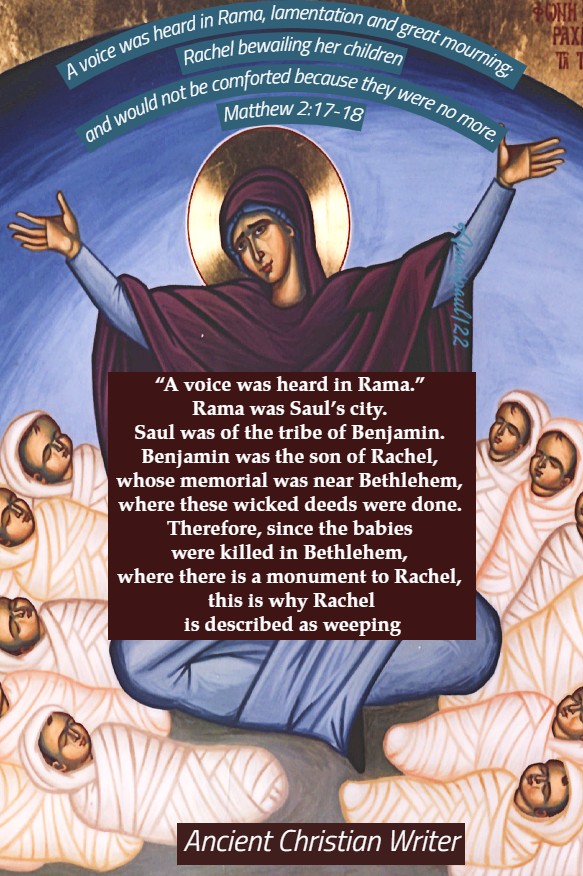
Quote/s of the Day – 1 December – “The Month of the Divine Infancy and the Immaculate Conception” – Romans 13:11-14, Luke 21:25-33 – Scripture search here: https://www.drbo.org/
“When these things begin to come to pass, look up and lift up your heads because your redemption is at hand.”
Luke 21:28
“And do not be afraid of those who kill the body but cannot kill the soul. But rather, be afraid of him, who is able to destroy both soul and body in hell.”
Matthew 10:28
“Elizabeth says: ‘Blessed are you because you have believed.’ You also are blessed, because you have heard and believed. A soul that believes, both conceives and brings forth the Word of God and acknowledges His works.”
St Ambrose of Milan (340-397) Great Latin Father and Doctor of the Church
“Wherever you are on earth, however long you remain on earth, the Lord is near, do not be anxious about anything!”
St Augustine (354-430) Father and Doctor of Grace
“He is present to the eyes of the mind, making Himself seen by those who have a pure heart and conversing with them. So pursue your path …. Do not hinder the Lord’s narrow way with your dragging feet. Hitch up your garment and be ready for action, look up and do not burden yourself with those oppressive loads which are your evil desires. For anyone who is accomplishing the journey from earth to Heaven, it is enough to diligently pursue one’s path without assuming extra weight. … ”
St Theodore the Studite (759-826) Monk and Theologian at Constantinople
One Minute Reflection – 1 December – “The Month of the Divine Infancy and the Immaculate Conception” – Romans 13:11-14, Luke 21:25-33 – Scripture search here: https://www.drbo.org/
“But when these things begin to come to pass, look up and lift up your heads because your redemption is at hand.” – Luke 21:28
REFLECTION – “We are waiting to celebrate Christ’s Birthday and, according to the Lord’s Promise, we will soon see Him. The Scripture demands from us that we rejoice, to the point of raising our spirit above itself and … leaping for joy at the coming of the Lord…For, even before His advent, the Lord comes to you. Before appearing to the whole world, He comes to visit you personally, He who said: “I will not leave you orphaned; I will come back to you” (Jn 14:18).
In fact, according to the merit and fervour of each one,there is a frequent and familiar advent of the Lord that, in this intermediary period, between his first and last coming, models us on one and prepares us to the other. The Lord comes to us now, so that His First Coming to us, may not be vain and that the last one, may not be that of wrath. Through His present coming, in fact, He works at reforming our pride, in the image of the humility of His first advent, to then remodel our humble body, in the image of the glorified body He will show us when He will return. This is why we should desire and fervently ask this personal coming – which gives us the grace of this first advent and promises us the glory of the last. …
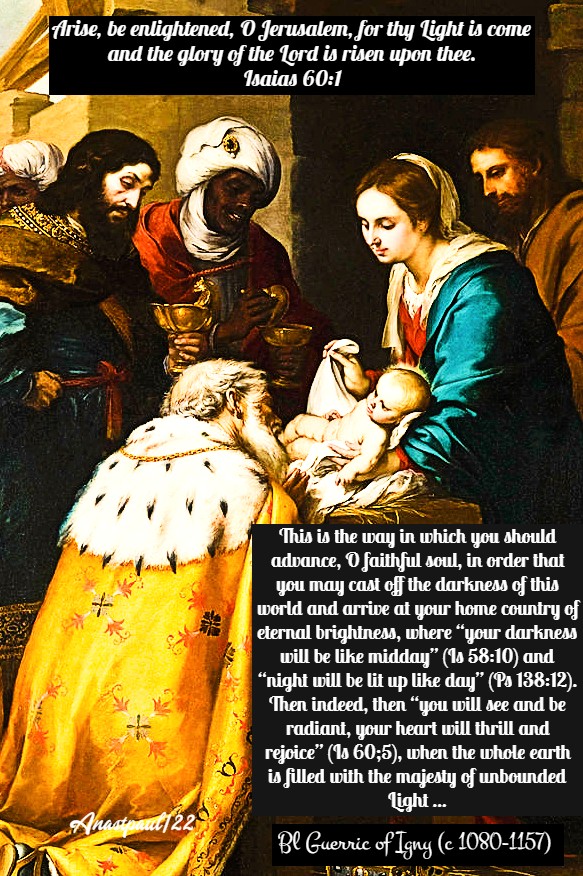
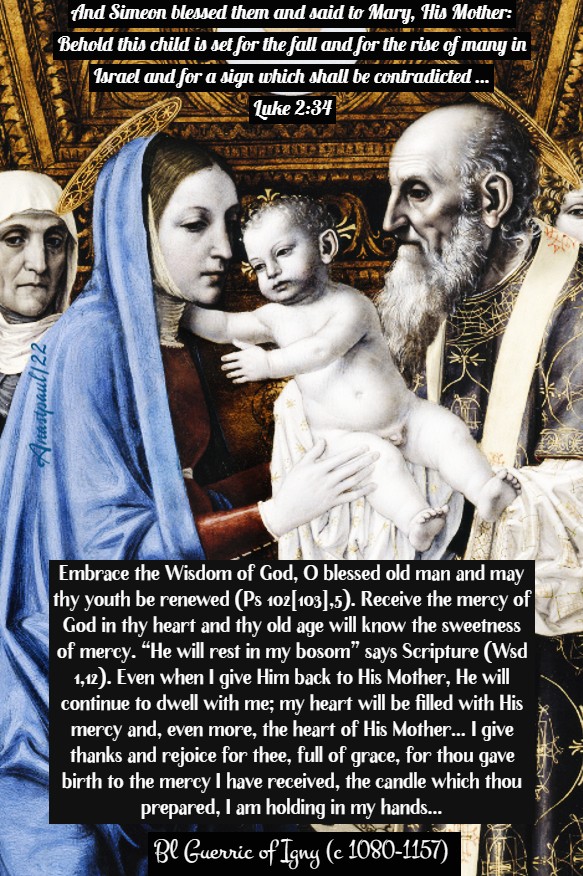
The first was humble and hidden, the last will be resounding and magnificent; the one we are talking about is hidden but it is also magnificent. I say it is hidden, not because it is ignored by whom it concerns but because, it happens secretly in him. … He comes without being seen and He leaves without being noticed. His simple Presence is Light for the soul and for the spirit, by it you may see the invisible and get to know the unknown. This coming of the Lord puts the soul of whom, contemplates it, in a gentle and happy state of admiration. Then, from the inmost depths of man, the cry may burst out: “O Lord, who is like you!” (Ps 34:10). Those who have experienced it know, please God, that those who have not yet had this experience, may feel at least, the desire to !” – Blessed Guerric of Igny (c 1080-1157) Cistercian Abbot (2nd sermon for Advent, 2-4: PL 185, 15-17).
PRAYER – O God, Who, by the message of an Angel, willed to take flesh in the womb of the Blessed Virgin Mary, grant that we, Thy suppliants, who believe her to be truly the Mother of God, may be helped by her intercession with Thee. Through the same Jesus Christ, Thy Son our Lord, Who lives and reigns with Thee, in the unity of the Holy Ghost, God, world without end. Amen (Collect).

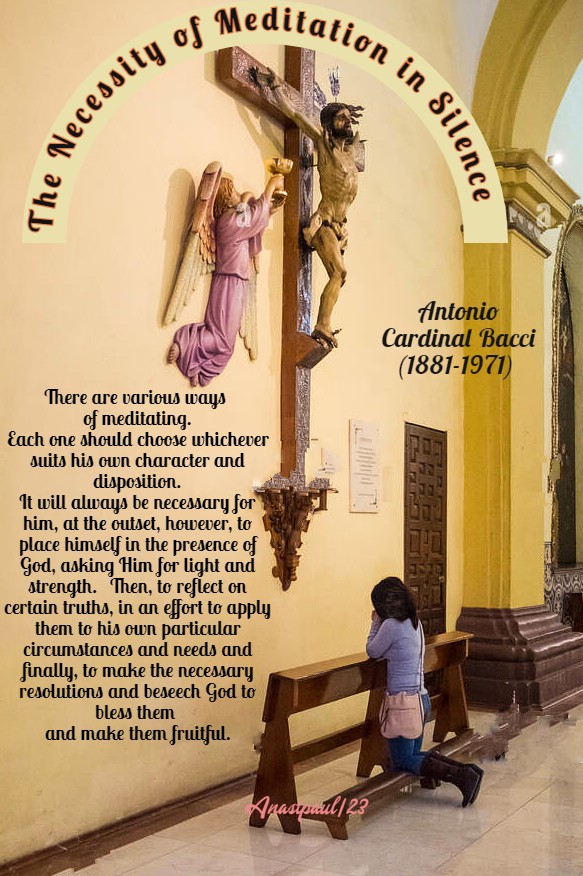
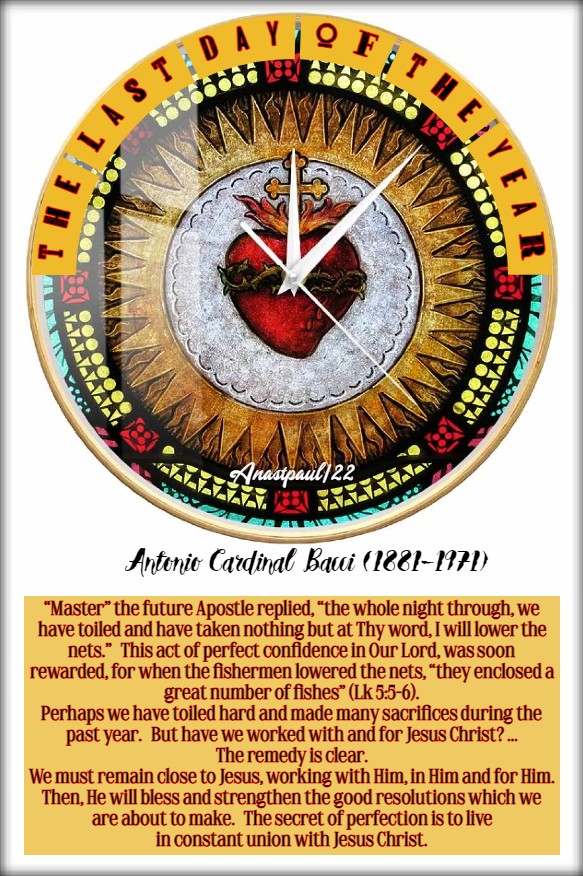
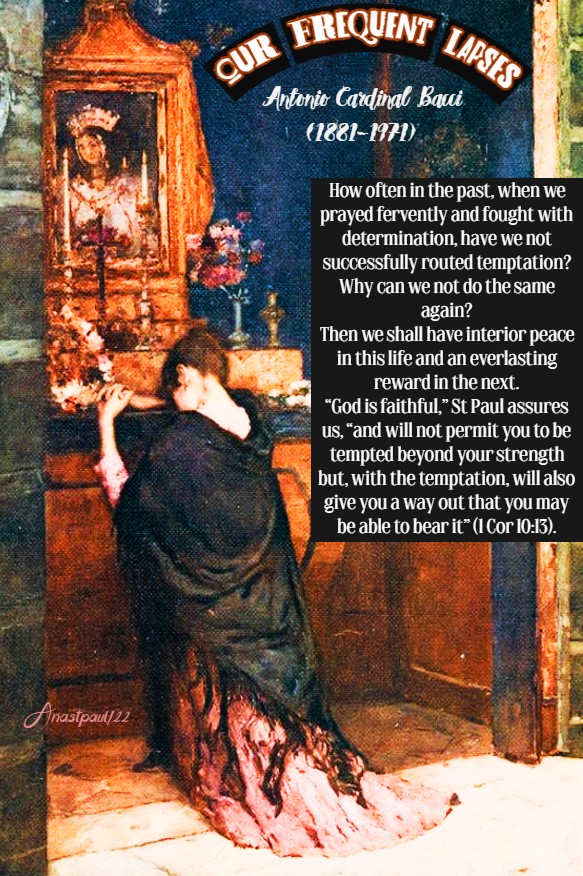
Thought for the Day – 30 November – Meditations with Antonio Cardinal Bacci (1881-1971)
Recollection
“There is a perfect picture of the spiritual and recollected man in The Imitation of Christ.
“The man of interior life soon recollects himself because he never wholly pours forth himself upon exterior things. Exterior labour is no prejudice to him, nor any employment necessary for the time but, as things happen, so he accommodates himself to them. He who is well disposed and orderly in his interior, is not concerned about the strange and perverse doings of ment,” (Bk II c 1:7).
The Imitation of Christ also conta\ins the following passage on the love of solitude.
“Seek a convenient time to attend to thyself and reflect often upon the benefits of God to thee. Let curiosities alone. Read such matters as may produce compunction, rather than give occupation. If you withdraw from superfluous talking and idle visitings and from hearing new things and rumours, you will find time sufficient and proper, to spend in good meditations. The greatest Saints shunned the company of men when they could and chose rather to live unto God in secret. *As often as I have been amongst men, said one, I have returned less a man. (*Ana says – St Albert the Great). This we too often experience when we talk often.” (Bk I c 20, 1-2).
“The cell continually dwelt in, grows sweet” the same chapter continues “but, ill-guarded, it begets weariness” (Bk I c 20, 5).”
Quote/s of the Day – 30 November – The Feast of St Andrew, Apostle of Christ, Martyr on the Cross for Christ
“He found first, his brother Simon and said to him: We have found the Messias.”
John 1:41
This is what the Apostle is claimed to have said, on the occasion of St Andrew’s Martyrdom, according to an ancient account (which dates to the beginning of the sixth century), entitled –
The Passion of Andrew:
“Hail, O Cross, inaugurated by the Body of Christ and adorned with His limbs as though they were precious pearls. Before the Lord mounted you, you inspired an earthly fear. Now, instead, endowed with heavenly love, you are accepted as a gift.
Believers know of the great joy that you possess and of the multitude of gifts you have prepared. I come to you, therefore, confident and joyful, so that you too may receive me, exultant as a disciple of the One Who was hung upon you….
O blessed Cross, clothed in the majesty and beauty of the Lord’s limbs!…
Take me, carry me far from men and restore me to my Teacher, so that, through you, the One who redeemed me by you, may receive me.
One Minute Reflection – 30 November – Feast of St Andrew Apostle – Romans 10:10-18, Matthew 4:18-22 – Scripture search here: https://www.drbo.org/
“At once they left their nets and followed Him.” – Matthew 4:20
REFLECTION – “Andrew was the first of the Apostles to acknowledge the Lord as his teacher. … He abandoned John the Baptist’s teaching to attend the school of Christ. … He sought the true Light in the shining of the lamp (Jn 5:35). Beneath its dampened glow he prepared himself for Christ’s splendour. … Teacher though he was, John the Baptist became servant and herald of the Christ Who stood before him: “Behold,” he said, “the Lamb of God who takes away the sin of the world” (Jn 1:29). Behold Him Who delivers us from death; behold Him Who destroys sin. As for me, I was sent, not as the bridegroom but as the one who accompanies Him (Jn 3:29). I came as servant, not as lord.”
Struck by these words, Andrew left his former teacher and hurried towards the One he was announcing. … He hurried towards our Lord, his longing manifesting itself in his bearing … drawing John the Evangelist with him. Both abandon the lamp and make their way towards the Sun. Andrew is the first plant in the Garden of Apostles, it is he who opens the door to Christ’s teaching, the first to gather fruit in the field the prophets had tilled. … He was the first to recognise Him, of Whom Moses said: “A prophet like me, will the Lord your God raise up for you; to him you shall listen” (Dt 18:15). … He recognised the One, Whom the prophets foretold and brought Peter, his brother, to Him. He showed Peter the treasure which as yet, he did not know: “We have found the Christ (Jn 1:41) the One we have been longing for. We were waiting for His coming: now come and experience His Presence.” … Andrew leads his brother to Christ … – it was his first miracle!” – Basil of Seleucia (Died c 468) Archbishop (,).
PRAYER – We humbly pray Thy majesty, O Lord, that, as blessed Andrew was a preacher and ruler in Thy Church, so he may always intercede for us with Thee. Through Jesus Christ, Thy Son our Lord, Who lives and reigns with Thee, in the unity of the Holy Ghost, God, world without end. Amen (Collect).
Saint of the Day – 30 November – Blessed Cuthbert Mayne (1544-1577) Priest Martyr Born in 1544 at Youlston, Devonshire, England and died at the age of 33, by being hanged, drawn and quartered on 30 November 1577 at Launceston, Cornwall, England. Additional Memorials – • 25 October as one of the Forty Martyrs of England and Wales, • 29 October as one of the Martyrs of Douai, • 1 December as one of the Martyrs of Oxford University.
The son of William Mayne, Cuthbert Mayne was born at Youlston, near Barnstaple in Devon and was Baptised on 20 March 1543/4 – the feaast of St Cuthbert. His uncle was a minister of the Church of England and the family expected the good natured Mayne would inherit his uncle’s rich church. This uncle paid his way through Barnstaple Grammar School and he was ordained a Protestant minister at the age of eighteen and instituted rector of Huntshaw, near Torrington.
After ordination, Cuthbert Mayne attended University, first at St Alban Hall, then at St John’s College, in Oxford, where he was made chaplain. He became BA on 6 April 1566 and MA. on 8 April 1570. Whilst at Oxford, Cuthbert met St Edmund Campion and other Catholics. At some point Cuthbert too, became a Catholic. Late in 1570, a letter addressed to him from Fr Gregory Martin (translator of the Vulgate who remained at Douai) fell into the hands of the protestaznt bishop of London and officers arrested him and the others mentioned in the letter. Being warned by Blessed Thomas Ford (aslo a Martyr), Mayne evaded arrest by going to Cornwall and then, in 1573, to the English College at Douai. Douai.
Cuthbert Mayne was Ordained a Priest at Douai in 1575 and on 7 February, the following year, he obtained the degree of Bachelor of Theology at Douai University. Shortly afterwards, on 24 April 1576, he left for the English mission in the company of another Priest and future Martyr, John Payne. He soon took up his abode in the Parish of Probus, Cornwall, with the Recusant Catholic Francis Tregian, where Cuthbert passed as his steward.
Elizabeth I’s agents quickly became aware of Cuthbert Mayne’s presence in the area and the authorities began a systematic search for him in June 1576, when the Bishop of Exeter William Broadbridge came to the area. High sheriff Sir Richard Grenville, a noted anti-Catholic officer, conducted a raid on Tregian’s house on 8th June 1577, during which the crown officers “bounced and beat at the door” to Cuthbert Mayne’s chamber.
On gaining entry, Grenville discovered a Catholic devotional Sacramental, an Agnus Dei around Mayne’s neck and took him into custody along with his books and papers. Tregian suffered imprisonment and loss of possessions for harbouring a Roman Catholic Priest.
While awaiting trial at the circuit assizes, Cuthbert was imprisoned in Launceston gaol, being chained to his bedposts. The authorities sought a death sentence but had difficulty in framing a treason indictment to that end. At the opening of the trial on 23 September 1577, there were five counts against him… Amongst them was – that he had taught of the Pope and denied the Queen’s ecclesiastical supremacy while in prison; that he had brought into the Kingdom an Agnus Dei and delivered it to Francis Tregian; that he had celebrated Mass.
Cuthbert answered all counts. On the third count, he said that he had asserted nothing definite on the subject to the three illiterate witnesses who swore to the contrary. On the fourth count, he said that the fact he was wearing an Agnus Dei at the time of his arrest, did not establish that he had brought it into the Kingdom or delivered it to Tregian. On the fifth count, he said that the presence of a Missal, a Chalice and Vestments in his room, did not establish that he had celebrated Mass.
The trial judge, Justice Sir Roger Manwood, directed the jury to return a verdict of guilty, stating that, “where plain proofs were wanting, strong presumptions ought to take place.” The circumstantial case, in other words, was to be sufficient to prove the indictments. The jury found Mayne guilty of high treason on all counts and accordingly, he was sentenced to be hanged, drawn and quartered. Mayne responded, “Deo gratias!”
With him had been arraigned Francis Tregian and eight other laymen. The eight were sentenced to seizure of their goods and life imprisonment, Tregian to die (in fact he spent 26 years in prison).
After the sentencing, Judge Jeffries took exception to the proceedings and referred the matter to the Privy Council. The Council submitted the case to the whole bench of Judges, which was inclined to leniency on the grounds of the flimsiness of the evidence. Nevertheless, the Council ordered the execution to proceed. On the night of 27 November Cuthbert Mayne’s cell was reported, by his fellow prisoners, to have become full of a “great light.”
Before being brought to the place of execution, Cuthbert Mayne was offered his life, in return for a renunciation of his religion and an acknowledgment of the supremacy of the Queen as head of the Church. Declining both offers, he kissed a copy of theSacred Scriptures, declaring that, “the Queen neither ever was, nor is, nor ever shall be, the head of the Church of England.”
A special, high gibbet was erected in the marketplace at Launceston and Cuthbert was executed there on 30 November 1577. He was not allowed to speak to the crowd but only to say his prayers quietly. Just as he was about to be hanged, he refused to implicate his co-religionists. It is unclear if he died on the gibbet. It has been said that he was cut down alive but in falling, struck his head against the butcher’s scaffold. He was unconscious when being drawn, and quartered.
Relics of Cuthbert’s body survive in various locations. He was the first “Seminary Priest,” the group of Priests who were trained, not in England but in houses of studies on the Continent. He was also one of the group of prominent Catholic Martyrs of the persecution, who were later designated as the Forty Martyrs of England and Wales.
Cuthbert Mayne was Beatified by Pope Leo XIII, by means of a decree of 29 December 1886..
Thought for the Day – 29 November – Meditations with Antonio Cardinal Bacci (1881-1971)
The Blessedness of Those Who Suffer Persecution
“Why did God will to grant us happiness, only on this condition – that we deny ourselves and carry the cross with resignation? The reason is that we should no longer be ourselves but, should belong entirely to God and, should no longer live our own lives, as St Paul expresses it but, should live the life of Jesus Christ. We ought to become like Him, the Man of Sorrows, Who redeemed us at the price of His Precious Blood and forgave His executioners from the Cross. We must suffer, moreover, so that, by our suffering, we may expiate our sins, purify our souls, detach ourselves from the world and begin to lead a heavenly life, even on this earth.
We should not imagine that this will make our lives sad and dreary. On the contrary, it will fill them with the lasting joy which God sends from on high. Let us acquire the peace which is founded on complete control of the passions, on absolute dedication to God and on the power of charity which can overcome all obstacles. Before we can acquire it, of course, we must be enlightened and strengthened by the Holy Spirit. It was not until after Pentecost that the Apostles achieved this happiness, so that, “they departed from the presence of the Sanhedrin, rejoicing that they had been counted worthy to suffer disgrace, for the Name of Jesus” (Acts 5:41).”
Quote/s of the Day – 29 November – Vigil of the Feast of St Andrew – Romans 13:11-14, Luke 21:25-33 – Scripture search here: https://www.drbo.org/
“Let us walk becomingly, as in the day, not in revelry and drunkenness, not in debauchery and wantonness, not in strife and jealousy. But put on the Lord Jesus Christ.”
Romans 13:13-14
“And Jesus, seeing their faith, said to the paralytic, Take courage, son, your sins are forgiven you.”
Matthew 9:2
“Perhaps, your own faith is feeble. Nevertheless, the Lord, who is love will stoop down to you, provided only that you are penitent and can say sincerely, from the depths of your soul: “Lord, I believe. Help thou mine unbelief,” (Mark 9:23)……”
St Cyril of Jerusalem (315-387) Father and Doctor of the Church
“He who is immortal, voluntarily shed His Blood. He who created the Host of Angels, was bound at the hands of soldiers and He who is to judge the living and the dead, was dragged to justice (cf. Acts 10:42; 2 Tm 4:1). Truth was exposed to false witnesses, was slandered, struck, covered with spittle, hung on the Wood of the Cross – the Lord of Glory (cf. 1 Cor 2:8) endured every outrage and suffering without Himself needing these trials. …
So there is nothing surprising about it, if we submit to even one of these trials, since such is our condition … Therefore, we too have to be offended and tempted, afflicted by the cutting off of our wills.”
St Theodore the Studite (759- 826) Monk at Constantinople, Father
(Catecheses 1)
“Nothing so curbs the onset of anger, so allays the upsurge of pride. It cures the wound of envy, controls unbridled extravagance and quenches the flame of lust. It cools the thirst of covetousness and banishes the itch of unclean desire… For when I Name Jesus, I set before myself, a Man Who is meek and humble of heart, kind, prudent, chaste, merciful, flawlessly upright and holy in the eyes of all and this same Man, is the all-powerful God Whose way of life heals me, Whose support is my strength.”
St Bernard (1090-1153) Father and Mellifluous Doctor of the Church
Lord Jesus, Bind Me to Yourself
Lord Jesus, Bind Me to Yourself Lord Jesus, bind me to Yourself and to my neighbour, with love. May my heart not be turned away from You. May my soul not be deceived, nor my talent or mind, enticed by allurements of error, so that I may never distance myself from Your love. Thus may I love my neighbour as myself, with strength, wisdom and gentleness, with Your help, You who are blessed throughout all ages. Amen.
St Anthony of Padua (1195-1231) Evangelical Doctor of the Church
“… How can anyone put on Jesus Christ and imitate His example, if he does not study this Jesus, who must inspire and perfect our faith? He must run the race to which he is challenged, the glorious race in which, he overcomes the enemy of the human family and follows the Way of the Cross. Under the lordly banner of that Cross, he will attain eternal life.”
St Vincent Strambi CP (1745-1824)
(From his first Pastoral Letter as Bishop)
Hear Me, O Lord By St Peter of Alcantara (1499-1562)
Hear me, O Lord, my soul’s delight, joy of my heart, not because of my merits but because of Thy boundless goodness. Teach me, enlighten me, direct me, help me in all things that I may never say or do anything but that which I know to be pleasing in Thou sight. Guide me, O God, my Love, my Light and my Life! Amen.
One Minute Reflection – 29 November – Vigil of the Feast of St Andrew – Romans 13:11-14, Luke 21:25-33 – Scripture search here: https://www.drbo.org/
“But put on the Lord Jesus Christ.” – Romans 13:14
REFLECTION – “Put on the Lord Jesus Christ and make no provision for the flesh and its desires, so that you may be clothed with the Life of Him, Whom you have put on in this Sacrament. You have all been clothed with Christ by your Baptism in Him. There is neither Jew nor Greek, there is neither slave nor freeman, there is neither male nor female, you are all one in Christ Jesus.
Such is the power of this Sacrament: it is a Sacrament of new lifewhich begins here and now, with the forgiveness of all past sins and will be brought to completion, in the resurrection of the dead. You have been buried with Christ by Baptism into death, in order that, as Christ has risen from the dead, you also may walk in newness of life.
You are walking now by faith, still on pilgrimage in a mortal body away from the Lord but He, to Whom your steps are directed, is Himself the sure and certain Way for you – Jesus Christ, Who, for our sake became man. For all who fear Him, He has stored up abundant happiness which He will reveal to those who hope in Him, bringing it to completion, when we have attained the reality which, even now, we possess, in hope.
This is the octave day of your new birth. Today is fulfilled in you, the sign of faith that was prefigured in the Old Testament by the circumcision of the flesh, on the eighth day after birth. When the Lord rose from the dead, He put off the mortality of the flesh; His Risen Body was still the same Body but it was no longer subject to death. By His Resurrection, He consecrated Sunday, or the Lord’s day. Though the third after His Passion, this day is the eighth after the Sabbath and thus also, the first day of the week.
And so, your own hope of resurrection, though not yet realised, is sure and certain because you have received the Sacrament or sign of this reality and have been given the pledge of the Spirit. If, then, you have risen with Christ, seek the things that are above, where Christ is seated at the right hand of God. Set your hearts on heavenly things, not the things that are on earth. For you have died and your life is hidden with Christ in God. When Christ, your Life, appears, then you too will appear with Him in glory.” – St Augustine (354-430) Father and Doctor of Grace (An excerpt from: Sermon 8 – On the Paschal Octave).
PRAYER – Put forth Thy power, O Lord, we beseech Thee and come, that with Thee as our protector, we may be rescued from the impending danger of our sins and with Thee as our deliverer, may we obtain our salvation .Through the same Jesus Christ, Thy Son our Lord, Who lives and reigns with Thee, in the unity of the Holy Ghost, God, world without end. Amen (Collect).

Our Morning Offering –29 November – “The Month of the Holy Souls in Purgatory”
Prayer for the Holy Souls in Purgatory By St Ignatius of Antioch (c 35-c 108) Apostolic Father of the Church
Receive in tranquility and peace, O Lord, the souls of Thy servants, who have departed this present life to come to Thee. Grant them rest and place them in the habitations of Light, the abodes of blessed spirits. Give them the life that will not age, good things that will not pass away, delights that have no end, through Jesus Christ our Lord. Amen.
Thought for the Day – 28 November – Meditations with Antonio Cardinal Bacci (1881-1971)
The Blessedness of the Peacemakers
“We should not imagine, however, that the peace which Jesus brought to us, is a lifeless peace, like that of a cemetery. On the contrary, it is the peace of conquest, a living peace. It cannot be attained by the sluggard, who is aiming at an easy and comfortable existence but, by the generous warrior who is always prepared to throw himself into the fight for virtue, for the glory of God and for the salvation of souls.
The peace of Jesus Christ is a victory over the evil which is rampant within us and around us. It demands vigilance, strifc and perseverance in fidelity to Our Lord. It requires the spirit of sacrifice, the love of God and dedication to the welfare of our fellowmen. It is the fruit of internal and external combat. It excludes all rancour, envy, detraction and malice, which is why it costs so much hardship and conflict. When a man has gained the victory, however, he experiences that wonderful spiritual tranquility which God alone can give.”
One Minute Reflection – 28 November – The First Week of Advent – Romans 13:11-14, Luke 21:25-33 – Scripture search here: https://www.drbo.org/
“The night is passed and the day is at hand. Let us, therefore, cast off the works of darkness and put on the armour of Light.” – Romans 12:12
REFLECTION – “We Christians are the light, at least by comparison with unbelievers. Thus the Apostle says: For once you were darkness but now you are Light in the Lord; walk then as sons of the Light. And elsewhere he says: The night is far spent, the day is drawing near. Let us, therefore, lay aside the works of darkness and put on the armour of Light; let us walk uprightly as in the day.
Nevertheless, since the days in which we are now living are still dark, compared to the Light which we shall see, hear what the Apostle Peter says. He speaks of a Voice that came from the Supreme Glory and said to the Lord Christ: You are My beloved Son in Whom I am well pleased. This Voice, he says, we heard coming from Heaven, when we were with Him on the holy mountain. Because we, ourselves, were not present there and did not hear the Voice from Heaven, Peter says to us: And we possess a more certain prophetic word to which you do well to attend, as to a lamp shining in a dark place, until the day dawns and the Morning Star rises in your hearts.
When, therefore, our Lord Jesus Christ shall come and, as the Apostle says, bring to Light things hidden in darkness and make plain the secrets of the heart, so that everyone may receive his commendation from God, then lamps will no longer be needed. When that day is at hand, the prophet will not be read to us, the book of the Apostle will not be opened, we shall not require the testimony of John, we shall have no need of the Gospel itself. Therefore, all Scriptures will be taken away from us, those Scriptures which, in the night of this world, burned like lamps, so that we might not remain in darkness.
When all these things are removed, as no longer necessary for our illumination and when the men of God by whom they were ministered to us, shall themselves, together with us, behold the true and dear Light, without such aids, what shall we see? With what shall our minds be nourished? What will give joy to our gaze? Where will that gladness come from which eye has not seen and ear has not heard, which has not even been conceived by the heart of man? What shall we see?
I implore you to live with me and, by believing, to run with me; let us long for our heavenly country, let us sigh for our heavenly home, let us truly feel that here, we are strangers. What shall we then see? Let the gospel tell us: In the beginning was the Word and the Word was with God and the Word was God. You will come to the fountain, with whose dew you have already been sprinkled. Instead of the ray of Light which was sent through slanting and winding ways, into the heart of your darkness, you will see the Light Itself, in all its purity and brightness. It is to see and experience this Light that you are now being cleansed. Dearly beloved, John himself says, we are the sons of God and it has not yet been disclosed what we shall be but we know that when He appears, we shall be like Him because we shall see Him as He is.
I feel that your spirits are being raised up with mine to the heavens above but the body which is corruptible, weighs down the soul and this earthly tent, burdens the thoughtful mind. I am about to lay aside this book and you are soon going away, each to his own business. It has been good for us to share the common Light, good to have enjoyed ourselves, good to have been glad together. When we part from one another, let us not depart from Him!” – St Augustine (354-430) Father and Doctor of Grace (An excerpt from his Treatise on John, 35).
PRAYER – O God, Who, by the message of an Angel, willed to take flesh in the womb of the Blessed Virgin Mary, grant that we, Thy suppliants, who believe her to be truly the Mother of God, maybe assisted by her intercession with Thee. Through Jesus Christ, Thy Son our Lord, Who lives and reigns with Thee, in the unity of the Holy Ghost, God, world without end. Amen (Collect).
Our Morning Offering – 28 November – The First Week of Advent
Let Thy goodness, Lord, Appear to Us An Advent Prayer By St Bernard (1090-1153) Father and Mellifluous Doctor of the Church
Let Thy goodness, Lord, appear to us, that we, made in Thy image, conform ourselves to it. In our own strength, we cannot imitate Thy majesty, power and wonder, nor is it fitting for us to try. But Thy mercy reaches from the heavens through the clouds, to the earth below. Thou hast come to us as a small child but Thou hast brought us the greatest of all gifts, the gift of eternal love. Caress us with Thy tiny hands, embrace us with Thy tiny arms and pierce our hearts with Thy soft, sweet cries. Amen
Thought for the Day – 27 November – Meditations with Antonio Cardinal Bacci (1881-1971)
The Blessedness of the Pure of Heart
“The pure of heart will see God. St Thomas Aquinas observed that the heart may and should be purified in two ways, even as God may be seen in two ways (Summa Theologiae II-II q 8, a 7). The first essential, is to purify the disturbed passions, which blind the soul to heavenly things. The second, is to cleanse the mind and to make it immune to error and to evil fancies, so that it maybe permanently enlightened by God.
Similarly, the vision of God is twofold. When we see God perfectly, we see His Divine Essence and, such happiness is possible only in the Beatific Vision. There is also an imperfect vision of God, by which we see Him, not in Himself but in created things. We can and should, have this vision in this life. All the wonders of creation are rays of the eternal beauty of God. Creatures, therefore, should form, for us, a material ladder which leads us to God. We should never become entangled with transient worldly goods but, should see and love God in them all. The Saints were pure of heart and could see God more clearly than the most learned scholar.”
Quote/s of the Day – 27 November – The First Sunday of Advent –– Romans 13:11-14, Luke 21:25-33 – Scripture search here: https://www.drbo.org/
“Look at the fig tree and all the trees, when they produce their fruit you know that summer is near. So too, when you see these things happening, know that the Kingdom of God is near.”
Luke 21:29-31
“The Kingdom of Heaven is like a treasure hidden in a field; he who finds it, hides it and in his joy. goes and sells all that he has and buys that field.”
Matthew 13:44
“The only true riches are those that make us rich in virtue. Therefore, if you want to be rich, beloved, love true riches. If you aspire to the heights of real honour, strive to reach the Kingdom of Heaven. If you value rank and renown, hasten to be enrolled in the heavenly court of the Angels.”
St Pope Gregory III (Died 741)
“How long are we going to put off obeying Christ, Who calls us into His Heavenly Kingdom? Are WE NOT going to purify ourselves? WILL we NOT resolve to forsake our customary way of life to follow the Gospel radically?… We claim to want the Kingdom of God yet, without bothering, to concern ourselves, with the means of obtaining it?! What is more, in the conceitedness of our souls, without taking the least trouble to obey the Lord’s Commandments, we think ourselves worthy to receive the same reward, as those who have resisted sin, to the death!”
St Basil the Great (329-379) Father and Doctor of the Church
“The soul must grow and expand so as to be capable of God. And its largeness is its love, as the Apostle says, “widen yourselves in love” (2 Cor 6:13). It grows and extends spiritually, not in substance but in virtue. The greatness of each soul is judged by the measure of love that it has- he who has great love, is great- he who has little love is little, while he who has no love at all – is nothing!”
St Bernard (1090-1153) Father & Mellifluous Doctor of the Church
“Where is the heart that loves? On the thing it loves. Therefore, where our love is, there our heart is held captive. It cannot leave it; it cannot be lifted higher, it cannot go either to the right or the left; see, it is fixed. Where the miser’s treasure is, there is his heart and where our heart is, there is our treasure.”
One Minute Reflection – 27 November – The First Sunday of Advent and the Feast of Our Lady of the Miraculous Medal – Romans 13:11-14, Luke 21:25-33 – Scripture search here: https://www.drbo.org/
“Look at the fig tree and all the trees, when they produce their fruit you know that summer is near. So too, when you see these things happening, know that the Kingdom of God is near.” – Luke 21:29-31
REFLECTION – “Look at the fig tree and all the trees, when they produce their fruit you know that summer is near. So too, when you see these things happening, know that the Kingdom of God is near.” He means that just as the coming of summer is recognised by the fruit on the trees, so is the nearness of the Kingdom of God recognised by the destruction of the world. These words show that the fruit of the world is destruction – it increases only to fall, it produces, only to destroy by its disasters whatever it produces. The Kingdom of God is aptly compared to summer, because it is then that the clouds of our sorrow pass away and the days of life shine with the brightness of the Eternal Sun. …
“Heaven and earth will pass away but My words will not pass away.” Nothing among material realities is more lasting than the heavens and the earth and nothing among realities, passes away, as quickly as an utterance. … Therefore, the Lord declares: “Heaven and earth will pass away but My words will not pass away.” He means: “Nothing that is lasting in your world lasts for eternity without change and everything that in Me, is perceived as passing away, is kept firm, without passing away. My utterance, which passes away, expresses thoughts that endure without change.” …
PRAYER – O God, Who, by the message of an Angel, willed to take flesh in the womb of the Blessed Virgin Mary, grant that we, Thy suppliants, who believe her to be truly the Mother of God, may be helped by her intercession with You.. Through the same Jesus Christ, Thy Son our Lord, Who lives and reigns with Thee, in the unity of the Holy Ghost, God, world without end. Amen (Collect).
Our Morning Offering – 27 November – The First Sunday of Advent
Come, Sun and Saviour 8th Century Catholic Advent Prayer/Hymn
Come, Sun and Saviour, to embrace our gloomy world, its weary race. As Groom to Bride, as Bride to Groom, The wedding chamber, Mary’s womb. At Thy great Name, O Jesus, now All knees must bend, all hearts must bow, All things on earth with one accord, Like those in Heaven, shall call Thee Lord. Come in Thou Holy Might, we pray, Redeem us for eternal day. Defend us, while we dwell below, From all assaults of our dread foe. Amen
Thought for the Day – 26 November – Meditations with Antonio Cardinal Bacci (1881-1971)
The Blessedness of the Merciful
“Since God is so merciful to us, however, He requires us to be good and merciful to our neighbour. “Blessed are the merciful,” Jesus says in the Sermon on the Mount, “for they shall obtain mercy” (Mt 5:7). St James adds a stern warning. “Judgement” he says, “is without mercy to him who has not shown mercy but mercy triumphs over judgement” (Js 2:12).
If we hope to receive God’s mercy, we must show compassion to those who are poor or unfortunate in any way, even to the greatest sinner. In the presence of so much need and misfortune in the world – avarice, miserliness, selfishness or indifference – cry out to God for retribution.
If we are not prepared to give, nothing will be given to us. If we refuse to forgive, neither shall we be forgiven. If we do not love, neither shall we be loved!”
Quote/s of the Day – 26 November – The Memorial of St Leonard of Port Maurice OFM (1676-1751) Confessor, Priest
“The Little Number of Those Who Are Saved” By St Leonard of Port Maurice
“Alas! The greater number of Catholics, the greater number of those who live here, perhaps even those who are in this assembly, will be damned! What subject could be more deserving of your tears?!”
“If you practice the holy exercise of Spiritual Communion, a good many times each day, within a month, you will see yourself completely changed.”
St Leonard of Port Maurice (1676-1751)
A Short Act of Spiritual Communion By St Alphonsus Liguori (1696-1787) Doctor of the Church
My Jesus, I believe that Thou art present in the Blessed Sacrament. I love Thee above all things and I desire Thee in my soul. Since I cannot now receive Thee sacramentally, come at least, spiritually, into my heart. As though Thou were already there, I embrace Thee and unite myself wholly to Thee, permit not, that I should ever, be separated from Thee. Amen
One Minute Reflection – 26 November – St Sylvester Gozzolini OSB Silv. (1177– 1267) Priest, Abbot – Ecclesiasticus 45:1-6, Matthew 19:27-29 – Scripture search here: https://www.drbo.org/
“And everyone who has left house, or brethren, or sisters, or father, or mother, or wife, or children, or lands, for My Name’s sake, shall receive a hundredfold and shall possess life everlasting.” – Matthew 19:29
REFLECTION – “Seek for nothing, desiring to enter for love of Jesus, with detachment, emptiness and poverty in everything in this world. You will never have to do with necessities greater than those to which you made your heart yield itself – for the poor in spirit are most happy and joyful in a state of privation and he who has set his heart on nothing, finds satisfaction everywhere.
The poor in spirit (Mt 5:3) give generously all they have and their pleasure consists in being thus deprived of everything for God’s sake and out of love for their neighbour … Not only do temporal goods – the delights and tastes of the senses – hinder and thwart the way of God but spiritual delights and consolations also, if sought for or clung to eagerly, disturb the way of virtue.” – St John of the Cross (1542-1591) Carmelite, Doctor of the Church (Spiritual maxims, nos. 352, 355,356, 364; 1693 edition).
PRAYER – Most merciful God, Who when the holy Abbot Sylvester was devoutly meditating upon the vanity of this world beside an open grave, graciously willed to call him into the desert and enrich him with unusual merits, we humbly pray that, following his example, despising the things of earth, we may thoroughly enjoy Thy everlasting presence.Through Jesus Christ, Thy Son our Lord, Who lives and reigns with Thee, in the unity of the Holy Ghost, God, world without end. Amen (Collect).
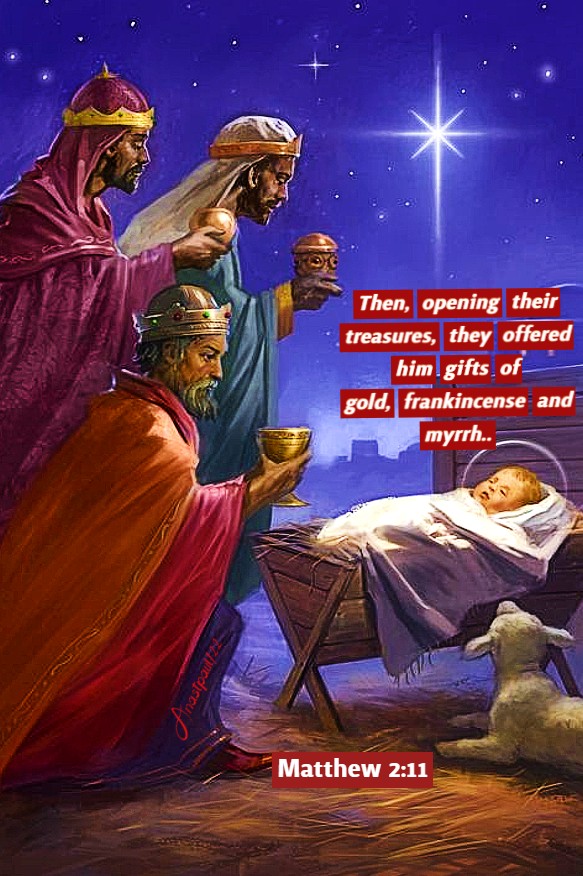
Thought for the Day – 25 November – Meditations with Antonio Cardinal Bacci (1881-1971)
The Thirst for Justice
“Many people, unfortunately, hunger and thirst for wealth, for pleasure and for honour. In practice, if not in tbeory, they forget all about their personal sanctification and the welfare of their neighbour. They pray, certainly and they go to Church, give alms and carry out the duties of their station in life conscientiously, from morning until night. They may even engage in many external works of charity, on their neighbour’s behalf but, what is their dominant thought and their principal ambition? To keep up appearances, to be praised and esteemed, to be successful in their careers. This, however, is not justice or Christian perfection but corresponds to the attitude of the Scribes and Pharisees, who did not seek the Kingdom of Heaven but their own interests (Cf Mt 5:46-48). Of these, it is written that “they have received their reward” (Mt 6:21). They have not sought God but themselves! Therefore, they can never have God or His everlasting happiness as their reward. They must be content with the insignificant and passing glory of the world. Indeed, on many occasions, they will be unable to gain even this much and will find that they have laboured in vain!
The envious man will even find cause for personal sorrow and unhappiness, in the welfare and in the success of others, He would have nobody wealthy, respected or happy in the world but himself! Even when the zealous man is working for a good cause, he is not concerned with it but only, with himself. He identifies his own ego with the cause for which he is fighting!”
Quote/s of the Day – 25 November – Sirach 51:1-8; 5:12, Matthew 25:1-13 – Scripture search here: https://www.drbo.org/
“Watch, therefore, for you know neither the day nor the hour.”
Matthew 25:13
Lord Jesus, Bind Me to Yourself
Lord Jesus, bind me to Yourself and to my neighbour, with love. May my heart not be turned away from You. May my soul not be deceived, nor my talent or mind, enticed by allurements of error, so that I may never distance myself from Your love. Thus, may I love my neighbour as myself, with strength, wisdom and gentleness, with Your help, You Who are blessed throughout all ages. Amen.
St Anthony of Padua (1195-1231) Evangelical Doctor of the Church
“The medicine of God, is Jesus Christ, Crucified and Risen, the measure of all things.”
St John Leonardi (1541-1609) Confessor, Priest, Founder
“Master, which commandment in the law is the greatest?”
Matthew 22:36
“That first and great commandment is not only profitable for the man who keeps it. or for God Who commands it – the other commandments of God also make perfect, him who obeys them, improves him, instructs him and makes him illustrious; in a word, they make him good and holy. If you understand this, realise that you have been created for the glory of God and for your own eternal salvation; this is your end, this is the object of your soul and the treasure of your heart. You will be blessed if you reach this goal but miserable if you are cut off from it.”
St Robert Bellarmine (1542-1621) Doctor of the Church
“O God, fullness of goodness, You do not forsake any, except those who forsake You. You never take away Your gifts, except when we take away our hearts. We rob the goodness of God, if we claim the glory of our salvation for ourselves. We dishonour His mercy, if we say He has failed us. … We blaspheme His goodness, if we deny that He has helped and assisted us. In short, O God, cry loud and clear into our ears: “your destruction comes from you, O Israel. In Me alone is found your help” (Hos 13:9).
St Francis de Sales (1567-1622) Doctor Caritatis
“Entrust yourself entirely to God. He is a Father and a most loving Father at that, Who would rather let Heaven and earth collapse, than abandon anyone who trusted in Him.”
St Paul of the Cross (1604-1775)
“50 Maxims for Attaining Perfection” – all on the link below
One Minute Reflection – 25 November – St Catherine of Alexandria (Died c 305) Virgin Martyr – Sirach 51:1-8; 5:12, Matthew 25:1-13 – Scripture search here: https://www.drbo.org/
“Watch, therefore, for you know neither the day nor the hour.” – Matthew 25:13
REFLECTION – “Consider now the Way of Light – any man who is bent on reaching his appointed goal, must be very careful in all he does. Now these are the directions that have been given to us for this journey,- love your Creator, reverence your Maker; give glory to Him Who redeemed you when you were dead; be single-minded but rich in spiritual treasure; avoid those who travel down death’s highway; hate whatever is displeasing to God; detest all hypocritical pretence; do not abandon God’s commandments. Do not put on airs but be modest in whatever you do; claim no credit for yourself. Plot no evil against your neighbour and do not give pride an entrance into your heart.
Love your neighbour more than your own life. Do not kill an unborn child through abortion, nor destroy it after birth. Do not refrain from chastising son or daughter,but bring them up from childhood in the fear of the Lord. Do not set your heart on what belongs to your neighbour and do not give in to greed. Do not associate with the arrogant but cultivate those who are humble and virtuous.
Accept as a blessing whatever comes your way, in the knowledge, that nothing ever happens without God’s concurrence. Avoid duplicity in thought or in word, for such deception is a deadly snare. Share with your neighbor whatever you have and do not say of anything, this is mine. If you both share an imperishable treasure, how much more must you share what is perishable. Do not be hasty in speech – the mouth is a deadly snare. For your soul’s good, make every effort to live chastely. Do not hold out your hand for what you can get, only to withdraw it when it comes to giving. Cherish as the apple of your eye anyone who speaks to you of the word of the Lord.
Night and day you will bear in mind the hour of judgement; everyday you will seek out the company of God’s faithful, either by preaching the word, earnestly exhorting them, ever considering how you can save souls, by your eloquence, or else by working with your hands, to make reparation for your past sins.
Never hesitate to give and when you do give, never grumble; then you will know the One Who will repay you. Preserve the traditions you have received, adding nothing and taking nothing away. The evildoer will ever be hateful to you. Be fair in your judgments. Never stir dissension but act as peacemaker and reconcile the quarrelsome. Confess your sins and do not begin to pray with a guilty conscience. Such the,n is the Way of Light.” – An excerpt from The Letter of Saint Barnabas (Chapter 19).
PRAYER – O God, Who gave the law to Moses on Sinai’s height and through Thy holy Angels, miraculously placed there, the body of blessed Catherine, Thy Virgin and Martyr, grant, we beseech Thee that by her merits and intercession, we may reach that towering eminence which is Christ our Lord. Through the same Jesus Christ, Thy Son our Lord, Who lives and reigns with Thee, in the unity of the Holy Ghost, God, world without end. Amen (Collect).
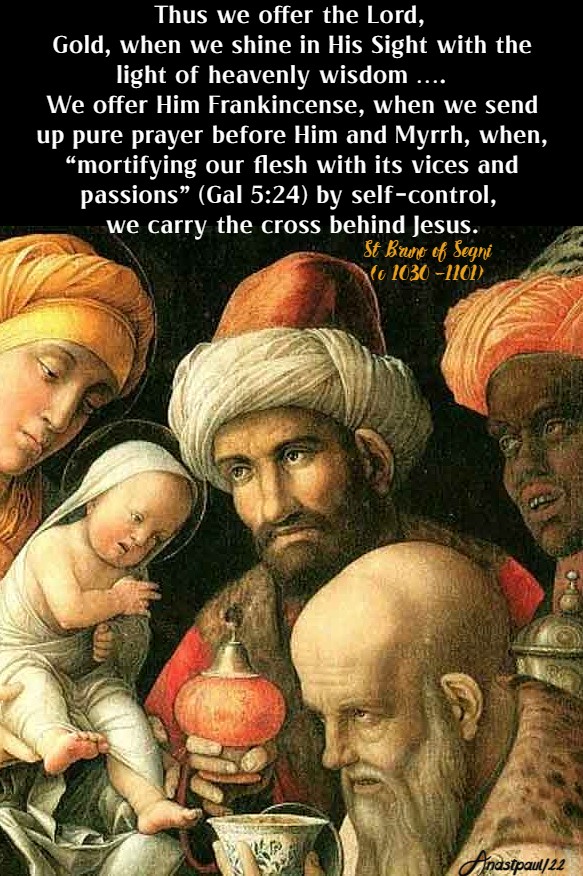
Thought for the Day – 24 November – Meditations with Antonio Cardinal Bacci (1881-1971)
The Blessedness of Those who Hunger and Thirst for Justice
“We must also be just towards ourselves. God has established a hierarchy of faculties in human nature. There are the lower faculties, which are often moved to action by our passions and above these, there is right reason, which ought to govern all else through the will. According to St Thomas Aquinas, the rule of right reason within us, should be comparable to that of God in the universe. (De Regimine I, 12). “It is fitting,” he says elsewhere, “that everything in man, should be subject to reason” (Summa Theologiae I-II, q 100, a 2 ad 1). St Augustine observes that, as the lower faculties should obey the intellect, so the intellect should be subject to God and should fulfil His Holy Law (Cf De Serm. Domini in Monte, Bk 1, c 2).
In this way, there exists in us, absolute justice, which is the harmony of perfection. If the passions, however, rebel and dethrone reason or, if reason revolts against God, there follows the degradation of human nature, the triumph of sin, remorse and spiritual ruin!”
Quote/s of the Day – 24 November – St John of the Cross OCD (1542-1591) Confessor, Doctor of the Church
“Happiness is not a destination, it is a method of travel.”
“It is a matter of real sorrow when God has given us strength to break stronger fetters, those of vanity and sin that we neglect our own progress and the attainment of such great blessings because we will not detach ourselves from trifles. Not only do we not advance, we fall back. For it is well known, that on the spiritual road, not to go on overcoming self, is to go backwards and not to increase our gain, is to lose!”
“O you souls who wish to go on with so much safety and consolation, if you knew how pleasing to God, is suffering and how much it helps, in acquiring other good things, you would never seek consolation in anything; but. you would rather look upon it, as a great happiness, to bear the Cross of the Lord.”
One Minute Reflection – 24 November – St John of the Cross OCD (1542-1591) Confessor, Doctor of the Church – 2 Timothy 4:1-8, Matthew 5:13-19 – Scripture search here: https://www.drbo.org/
“You are the light of the world.” – Matthew 5:14
REFLECTION – “I shall always love and reverence the Apostles sent by Christ and their successors, in sowing the seed of the Gospel, those zealous and tireless co-operators in propagating the Word, who may justly say of themselves: Let a man so account of us as the ministers of Christ and the dispensers of the mysteries of God. For Christ, like a most watchful and most faithful householder, wished that the Gospel lamp should be lighted by such ministers and delegates, with fire sent down from Heaven and once lighted, should not be put under a measure but set upon a candlestick, so that it may spread its brightness far and wide and put to flight, all darkness and error, rife among both Jews and Gentiles.
Now it is not enough for the Gospel teacher to be a brilliant speaker in the eyes of the people; he must also be as a voice crying in the desert and endeavour, by his eloquence, to help many to lead good lives, lest, if he omit his duty of speaking, he be called the dumb dog that is not able to bark, spoken of by the prophet. Yes, he should also burn, in such a way, that, equipped with good works and love, he may adorn his evangelical office and follow the leadership of Paul. He indeed was not satisfied with bidding the Bishop of the Ephesians: This command and teach: conduct thyself in work as a good soldier of Christ Jesus but he unflaggingly preached the Gospel to friend and foe alike and, said with a good conscience to the Bishops gathered at Ephesus: You know how I have kept back nothing that was for your good but have declared it to you and taught you in public and from house to house, urging Jews and Gentiles to turn to God in repentance and to believe in our Lord Jesus Christ.
Such should be the shepherd in the Church who, like Paul, becomes all things to all men, so that the sick may find healing in him; the sad, joy; the desperate, hope; the ignorant, instruction; those in doubt, advice; the penitent, forgiveness and comfort and finally, everyone, whatever is necessary for salvation. And so Christ, when He wished to appoint the chief teachers of the world and of the Church, did not limit Himself to saying to His disciples: You are the light of the world but also added these words: A city seated on a mountain cannot be hid. Neither do men light a candle and put it under a measure but upon a candlestick, that it may shine to all who are in the house. Those churchmen err, who imagine that it is by brilliant preaching, rather than by holiness of and all-embracing love, they fulfil their office.” – St Peter Canisius SJ (1521-1597) Doctor of the Church
PRAYER – O God, Who made blessed John, Thy Confessor and Teacher, an extraordinary lover of perfect self-denial and the Cross, grant that, by continually striving to imitate him, we may reach everlasting glory. Through Jesus Christ, Thy Son our Lord, Who lives and reigns with Thee, in the unity of the Holy Ghost, God, world without end. Amen (Collect).
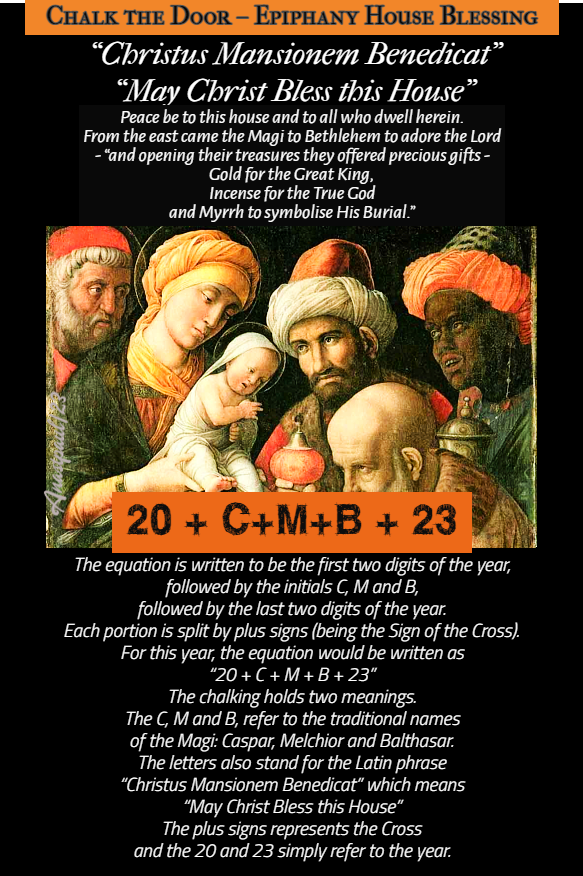
Saint of the Day – 24 November – Saint John of the Cross OCD (1542-1591) Doctor of the Church, Confessor, Carmelite Priest, Mystic, Poet, Reformer, Writer. He was gifted with prophecy and miracles, visions and the ability to read hearts.
St John of the Cross By Father Francis Xavier Weninger SJ (1805-1888)
In 1542, was born at Fontiveros, a hamlet of old Castile, St John of the Cross, renowned through the entire Christian world, as the restorer of the Carmelite Order. His mother, after his father’s early death, went to Medina del Campo, where John commenced his studies and continued them until he entered the Order of the Blessed Virgin of Mount Carmel. From his early youth he had entertained a childlike devotion to the Blessed Virgin, who more than once saved him most miraculously from death. One day, when playing with some other lads around a deep pond, he fell into it. In this danger, the Divine Mother appeared to him in a most beautiful form and offered him her hand, to draw him out of the water. But as his hands were much soiled, he hesitated to take those of so brilliant a lady, whereupon his Guardian Angel, or some other inhabitant of Heaven, held out to him, from the edge of the pond, a long pole, by the aid of which he was happily saved. At another time he fell into a well and when all feared that he was drowned, they saw him sitting quietly upon the water. When they drew him out, he said that the Queen of Heaven had caught him in her cloak and thus prevented his sinking.
Before he was nine years old, he showed a wonderful zeal in mortifying his body, chastising himself by taking only a short rest on a hard bed and by voluntary fasts. While yet a student, he nursed, with great solicitude and charity, the sick in the hospitals. After he had taken the Carmelite Habit, he was not satisfied with the penances then practiced in the Convent but endeavoured to regulate his life, in accordance with the first rules and ancient austerity of the Order.
When he prepared himself to say his first Holy Mass, he searched his conscience very carefully,but found no grievous fault. He then gave humble thanks to the Almighty and during his Mass, begged for the grace to be kept in future, free from all mortal sin. His prayer was accepted and he heard the words: “I grant thee thy wish.” From that time, St John never offended the Lord by a mortal sin, nor voluntarily by a venial one.
St Teresa, who lived at that period, said of him that he was a Saint, and had been one all his life. This renowned and holy virgin met St John at Medina and, conferred with him about her desire to found houses for religious, who would live according to the original strict regulations of the Carmelites. John, who, in his eagerness to live in greater austerity, had thought of joining the Carthusian Monks, asked St Teresa’s advice. She told him that it would be more agreeable to God, if he remained in his Order and restored among the men, the same primitive rigour which she was endeavouring to restore among the women. She added, that God had called him to this work. John took counsel with God and his Confessor and then resolved to follow St Teresa’s advice. He erected his first Monastery on a farm which had been presented to him for this purpose and God so visibly blest his undertaking, that he not only filled his house, in a short time, with zealous men but was enabled also, to found several new Convents.
In these religious houses, all the inmates lived so holy and so austere a life that many, thought it was more to be admired, than imitated. The Saint was an example to all and one could hardly imagine a penance which he did not practice. He gave no ear to those who told him to moderate his severities but said: “The narrow path leading to Heaven cannot be travelled by me, in a manner less austere.” The hardships he endured in founding his Monasteries and in restoring the severe regulations of the Order; the persecutions and wrongs he suffered, cannot be described in the short space allotted to us, yet in all these trials, he was never despondent. The love of God possessed his heart so entirely, that he desired nothing but to labour and to suffer for His honour.
The Lord asked him one day what recompense he desired for all his trouble and labour. “Nothing else, O Lord but to suffer and to be despised for Thy sake,” was his answer. Three things he used to ask of the Almighty – first, much work and much suffering; secondly, not to depart this life as a superior; thirdly that he might live and die despised. So unusual a desire to suffer and to be despised, was the result of his meditation on the Passion of Jesus Christ and of his great love for God. This love was so intense that his countenance was frequently seen radiant with a heavenly light, especially when he spoke of divine things. At the time of prayer, as well as during Holy Mass, he often fell into ecstasy and was dissolved in tears. Our Lord once appeared to him in the same form as when He died for us on the Cross. This picture remained so indelibly imprinted on the Saint’s memory,that it almost daily drew tears from his eyes.
Into all those, over whom he had the slightest influence, he endeavoured to instill a tender devotion to our Crucified Lord, as well as to the Most Holy Trinity and to the Blessed Eucharist. His language to sinners was so forcible that he converted even the most hardened. He was much aided in this by the gift which the Almighty had bestowed upon him, of reading the thoughts of the heart. Many who came to him were reproached with their secret sins and admonished to reform their lives. He possessed also the gifts of prophecy, of driving out devils and curing all kinds of diseases. Besides this, he had many visions of the Blessed Virgin, St Joseph, St John and Christ the Lord. Especially remarkable, were the heavenly favours, with which this great servant of the Almighty was comforted, during an imprisonment of nine months, to which he was unjustly condemned. Christ appeared to him and said: “Behold! John, I am here! Fear not. I will rescue thee!” The Blessed Virgin, accompanied by a great many Saints, appeared to him and said: “My son, be patient and endure, for your trials will soon give way to joy.” In another vision, she admonished him to escape from the prison, promising him her assistance, a promise which she also kept. St Teresa, who, during her life, had been closely united with him, appeared also to him after her death, speaking to him most kindly. In his adversity she comforted him, and encouraged him to new labours for the honour of God.
The reward of all the work which the holy man had accomplished, as also of the trials and tribulations he had suffered, was at length bestowed upon him, in the year 1591, when he was in the forty-ninth year of his age. He was seized with fever, in the hermitage of Pegnuela and was brought from there to Ubeda, according to his wish. He had an ulcer on that part of his right foot where the holy feet of our Lord were pierced with nails. To open it, the surgeon was obliged to make a deep incision. The pain thus caused was very great but greater still, was the patience of the Saint, who even rejoiced at bearing, in some manner, the image of the sufferings of Christ and at having five wounds on one foot.
God had already, some time previously, revealed to him the hour of his death and the Blessed Virgin, whom the Saint had always especially honoured, appeared to him on the eve of the Immaculate Conception, saying that she would come for him on the Sunday after the festival. When the physicians told him that his end was not far distant, he said, in the words of the Psalmist: “I was glad when they said unto me, We shall go up into the house of the Lord.” Half an hour before his death, he called all his religious to him, exhorted them to persevere in their zeal and said: “My parting hour draws near.” After the usual prayers of the Church, he heard the bells ring for the midnight Matins. “I shall sing the Matins in Heaven,” said he, after which, taking the Crucifix, he kissed it most devoutly and calmly ended his holy life, saying: “Into Thy hands, O Lord, I commend my soul.” A large ball, as of fire, was seen above the dying Saint. After his death, his countenance beamed with a heavenly brightness and was so beautiful that none grew weary of looking at him, while at the same time, such delicious odour emanated from him that the whole Monastery was filled with it. The Almighty has carefully preserved his body incorrupt until this hour.
Thought for the Day – 23 November – Meditations with Antonio Cardinal Bacci (1881-1971)
The Blessedness of Those Who Mourn
“As well as regretting the evils which beset humanity, the Christian should also shed tears of repentance for his sins. Our sins are so many that they demand penance and reparation. St Aloysius Gonzaga wept whenever he recalled the peccadilloes of his childhood, which were hardly serious enough to be real sins. We have sinned and maybe sinners still but do we weep for our transgressions?
A sincere Christian is not content merely to regret his sins and to pray for forgiveness but he imposes, on himself, voluntary penances in expiation of his own offences and of the offences of others. Tears of repentance are blessed by God, Who forgives and pardons those who mourn for their transgressions.”
Quote/s of the Day – 23 November – St Clement I (c 88–c 101) Pope Martyr and St Columban (543-615) Monk, Missionary
“Follow the Saints because those who follow them, will become Saints.”
“This world and the world to come, are two enemies. We cannot. therefore. be friends to both but, we must decide which we will forsake and which, we will enjoy.”
“Who can describe the bond of God’s love? Who is able to explain the majesty of its beauty? The height to which love leads is indescribable. … In love the Master received us, Jesus Christ our Lord, in accordance with God’s will gave His Blood for us and His Flesh for our flesh and His Life for our lives.”
“We are all fellow members of one body, whether Franks or Britons or Irish or whatever our race. Thus, let all our races rejoice, in knowledge of the faith and in recognising the Son of God … In Him, let us love one another, praise one another, correct one another, encourage one another, pray for one another.”
(Letter 2, to the French bishops)
Lord, Kindle our Lamps By St Columban (543-615)
Lord, kindle our lamps, Saviour most dear to us, that we may always shine in Your presence and always receive Light from You, the Light Perpetual, so that our own personal darkness, may be overcome and the world’s darkness driven from us. Amen
(This is an excerpt from a much longer prayer and is taken from the wonderful Sermon XII by St Columban/us)
One Minute Reflection – 23 November – St Clement I (c 88–c 101) Pope Martyr – Philippians 3:17-21; 4:1-3, Matthew 16:13-19 – Scripture search here: https://www.drbo.org/
“Blessed art thou, Simon Bar-Jona because flesh and blood hath not revealed it to thee but My Father Who is in Heaven.” – Matthew 16:17
REFLECTION – “Faith in Me, He intimates here, is no ordinary thing or one that comes from human reason but [it] needs a revelation from above. And this He establishes throughout His discourses, showing, that this faith requires a noble sort of soul and one drawn on by God. The expression “that the Father gives Me” shows, that it is no accident whether a person believes or not. It shows, that belief is not the work of human reasoning but requires a revelation from on high and a mind devout enough to receive the revelation. “Whoever then,” our Lord says, “comes to Me, shall be saved,” meaning, they shall be greatly cared for. For to save such as these, I took up flesh and the form of a servant.” – St John Chrysostom (347-407) Archbishop of Constantinople, Father and Doctor of the Church (Homilies on the Gospel of John 45)”
PRAYER – Look forgivingly on Thy flock, Eternal Shepherd and keep it in Thy constant protection, by the intercession of blessed Clement Thy Martyr and Sovereign Pontiff, whom Thou didst constitute Shepherd of the whole Church. Through Jesus Christ, Thy Son our Lord, Who lives and reigns with Thee, in the unity of the Holy Ghost, God, world without end. Amen (Collect).

You must be logged in to post a comment.