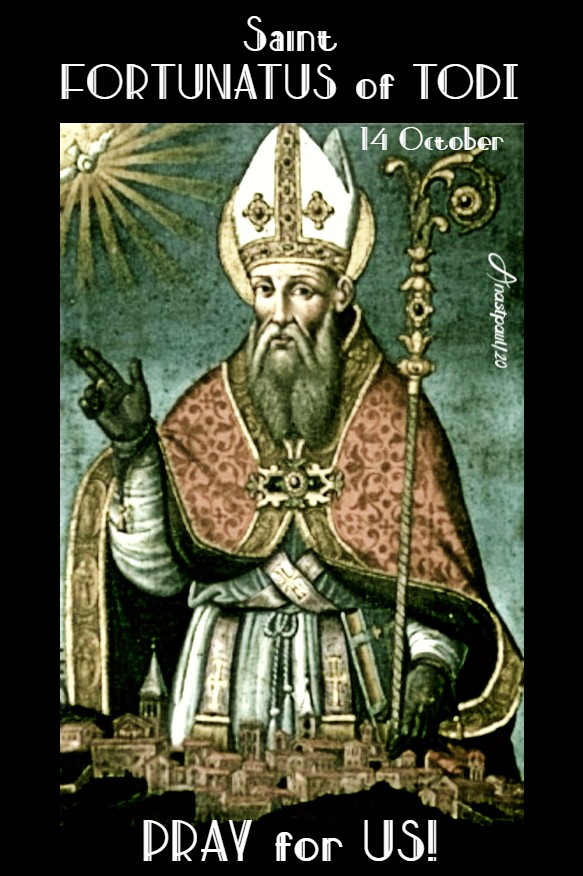
Bl Ana María Aranda Riera St Angadrisma of Beauvais St Bernard of Arce St Celeste of Metz St Dominic Loricatus St Donatian of Rheims (Died 390) Biography: https://anastpaul.com/2018/10/14/saint-of-the-day-14-october-st-donatian-of-rheims-died-390/ Saint Fortunatus of Todi (Died 537) Bishop St Franciszek Roslaniec St Gaudentius of Rimini St Gundisalvus of Lagos Bl Jacques Laigneau de Langellerie St Lupulo of Capua St Lupus of Caesarea St Manacca St Manehildis St Modesto of Capua Bl Richard Creagh Blessed Roman Lysko (1914–1949) Priest and Martyr His Life and Death: https://anastpaul.com/2019/10/14/saint-of-the-day-14-october-blessed-roman-lysko-1914-1949-priest-and-martyr/ St Rusticus of Trier St Saturninus of Caesarea St Stanislaw Mysakowski St Venanzio of Luni — Martyrs of Caesarea – (4 saints): Three brothers and a sister martyred together in the persecutions of Diocletian – Carponius, Evaristus, Fortunata and Priscian. In 303 in Caesarea, Cappadocia (in modern Turkey) – their relics enshrined in Naples, Italy.
Martyred in the Spanish Civil War: • Blessed Ana María Aranda Riera • Blessed Jacques Laigneau de Langellerie
Saint of the Day – 13 October – Blessed Maddalena Panattieri OP (1443–1503) member of the Sisters of Penance of Saint Dominic, Stigmatist, she was blessed with many Mystical gifts – prophecy, visions, Eucharistic Adorer, Catechist – born in 1443 at Turino, Diocese of Vercelli, Piedmont, Italy and died on 13 October 1503 at Turino, Italy of natural causes. Patronages – Trino, Catechists.
Maddalena Pannatieri was born at Trino, near Vercelli, in 1443, of deeply religious parents. She was a devout child, who made a vow of virginity while she was quite young. Before she was twenty years old, she took her vows as a Dominican Tertiary, an exceptional circumstance, showing that she was held in high esteem. The Tertiary chapter was made up principally of widows and older woman who centred their Apostolate of active charities around the Dominican Church. Maddalena fitted into this work with ease and she brought to the chapter a spirit of penance that few of her companions could match. The delightful part of it all wa,s that her penances never rendered her dreary; she was a cheerful, resourceful person to have around. People drew as much good from her spirit of joy as from any other feature of her spirituality.
Maddalena had a special fondness for little children and, what we now call baby-sitting, and used her influence with the children to bring their parents to a better way of life. Childless women won her sympathy and several times her prayers brought the blessing of motherhood to such people. She taught Catechism to children and gradually the older folk of her acquaintance began to sit in on her classes. She was quite unaware that she had great powers of description and could make the truths of religion clear to simple people. The Dominican fathers allowed her to use a large room attached to the Church for a class room and the class grew. Not only the parents of the children and the simple folk of the neighbourhood but also a number of Priests and religious were attending regularly.
When the reform movement started by Blessed Raymond of Capua got underway, Maddalena Parnatieri promoted it in Trino. Through her influence, Blessed Sebastian Maggio was invited to preach there and he accomplished great good.
Maddalena was considered the protectress of the city of Trino. Whatever disaster threatened it, the citizens expected her to look out for their interests and she usually did. In her life there is no mention of a “dark night of the soul” or of grim detachment from all things of earth. Her love of God kept her from attaching herself to any illegitimate pleasures but she thoroughly enjoyed the lawful ones – she loved her family and her townspeople and was happy in their company. Her favourite brother was a good-for-nothing- he was always in trouble. When his conduct had gone beyond the patience of everyone but Magdalene, she threw herself on her knees in front of her Crucifix and she stayed there until our Lord assured her that He would take a hand with the black sheep: ” I cannot refuse you anything,” He said.
The Dominican fathers received her solitude when they were persecuted by a wealthy man of the town. This person carried his hatred so far, that he was finally excommunicated for persecuting the Church. There was of course, a good deal of blood shed before the affair was over and one of the reprobate’s followers made the mistake of hitting Maddalena and calling her names. Before the irate townspeople could deal out justice to him, God did; the man died a violent death.
God revealed to Maddalena the coming political troubles of Italy – the French invasion of the country. She did not live to see this prophecy accomplished but she persistently asked God’s mercy for her people. During the violent quarrels and bloodshed of the time, Trino was always spared, though the villages all around were in a shambles. The townsfolk unhesitatingly gave credit to Maddalena!
Maddalena died on 13 October 1503 in Trino. On her deathbed she said: “I could not be happy in Heaven, if you were not there too” to those assembled near her bedside. She sang “Jesus our Redeemer” and the “Ave Maria” prior to her death. Her remains were found in 1964 and transferred in 1970.
Maddalena received formal Beatification from Pope Leo XII on 26 September 1827 once the Pontiff confirmed that a ‘cultus’ (or popular devotion) to Maddalena existed and had endured since her death.
St Leobono of Salagnac Blessed Maddalena Panattieri OP (1443–1503) St Maurice of Carnoet St Regimbald of Speyer St Romulus of Genoa St Simbert of Augsburg St Theophilus of Antioch St Venantius — Three Crowns of Cordoba – (3 saints): Three Christian men martyred in the persecutions of Diocletian – Faustus, Januarius and Martial. They were burned to death in 304 in Cordoba, Spain.
Martyred in the Spanish Civil War: • Blessed Àngel Presta Batllé • Blessed ángel Ramos Velázquez • Blessed Antonio Ayet Canós • Blessed Ruperto García Arce • Blessed Salustiano González Crespo • Blessed Tomás Pallarés Ibáñez • Blessed Francesc Mitjá i Mitjá • Blessed Herminio Motos Torrecillas • Blessed Joan Puig Serra
Saint of the Day – 12 October – Saint Rodobaldo II Cipolla of Pavia (Died 1254) Bishop of Pavia from 1230 to his death, apostle of the poor. Rodobaldo was the 53rd bishop of Pavia. Archdeacon of the Cathedral, he was elected in 1230 and Consecrated by Pope Gregory IX. St Roboaldo II is remembered as a zealous shepherd and for his intense charitable activity. Together with the Pope he preached the crusade against Frederick II, which earned him prison – he was jailed in Pisa. Then he worked to reconcile the Emperor with Innocent IV. He died in 1254. The relics are kept in the Cathedral of Pavia. He is also known as Cipolla of Pavia.
San Rodobaldo II Cipolla of Pavia is a Bishop who lived in the 13th century. In the chronotaxis of the Bishops of Pavia it is placed in fifty-third place, after San Folco Scotti and before Guglielmo da Caneto. It is indicated with the second appellation, as among the bishops before him there is a Rodobaldo de ‘Sangiorgio, who ruled the Diocese in the second decade of the thirteenth century.
In the Verona hagiographic publication, it is stated that he was born in Verona; belonging to the Cipolla family, who before being elected to lead the Diocese held the office of Archdeacon of the Cathedral chapter.
In 1233 he founded the Company of the Holy Spirit in Pavia and brought the Franciscan friars, Vallombrosan and Dominican monks to the diocese. Among the latter he became a friend of St ‘Isnardo di Vicenza, to whom, it is said, he donated the monastery of San Tommaso Apostolo.
Subsequently, he took an active part in the mediation of peace, working towards the reconciliation between the Emperor and the new Pontiff, Innocent IV. He died in Pavia on 12 October 1254 and since 1279 his body has been placed in the crypt of the City Cathedral of St Siro. His cult as a saint was confirmed by Pope Leo XIII with a decree of 20 December 1888.
In the Roman martyrology, with the words – “In Pavia, St Rodobaldo II, bishop, man of exemplary spirit of penance, who worked hard for the divine worship and in the search for the relics of the saints.”
Nossa Senhora Aparecida / Our Lady Aparecida, Aparecida, Sao Paulo, Brazil (1717) – 12 October: Also known as – Our Lady Who Appeared:
In October 1717, Dom Pedro de Almedida, Count of Assumar passed through the area of Guarantinqueta, a small city in the Paraiba river valley. The people there decided to hold a feast in his honour and though it was not fishing season, the men went to the waters to fish for the feast. Three of the fishermen, Domingos Garcia, Joco Alves and Felipe Pedroso, prayed to the Immaculate Conception and asked God’s help. However, after several hours they were ready to give up. Joco cast his net once more near the Port of Itaguagu but instead of fish, he hauled in the body of a statue. The three cast their net again, and brought up the statue’s head. After cleaning the statue they found that it was Our Lady of the Immaculate Conception. Naming their find Our Lady Aparecida, they wrapped it in cloth and continued to fish; now their nets were full. While we do not know why the statue was at the bottom of the river, we do know who made it. Frei Agostino de Jesus, a carioca monk from Sao Paulo known for his sculpture. The image was less than three feet tall, was made around 1650 and must have been underwater for years. It is a dark brown colour, is covered by a stiff robe of richly embroidered thick cloth and wears an imperial crown which was added in 1904. Only her face and hands can be seen. Pope Pius XII proclaimed her principal patroness of Brazil in 1930. The statue was vandalised by being broken into several pieces just prior to a visit by St Pope John Paul II but a group of dedicated artists and artisans carefully pieced it together again. Patronages: • Aparecida, Brazil, diocese of • Brazil • World Youth Day 2013
Nuestra Señora del Pilar / Our Lady of the Pillar (Imus, Philippines) – 12 October
Tradition says that in the early day of the Church, Saint James the Greater was spreading the Gospel in Spain but making very little progress. He was dejected and questioning his mission. About 44, the Virgin Mary, who was still living in Jerusalem at the time, bi-located and appeared to him in a vision to boost his morale. In it, she was atop a column or pillar, which was being carried by angels. That pillar is believed to be the same one venerated in Zaragoza, Spain today. Miraculous healings reported at the scene. PatronageS: • Imus, Philippines, diocese of • Tagbilaran, Philippines • Zamboanga, Philippines, archdiocese of • Zamboanga City, Philippines • Zaragoza, Spain.
St Pantalus of Basle St Priscian the Martyr St Relindis St Rodobaldo II Cipolla of Pavia (Died 1254) Bishop Bl Roman Sitko St Salvinus of Verona Bl Thomas Bullaker St Wilfrid (c 633-709) Bishop His Life: https://anastpaul.com/2018/10/12/saint-of-the-day-12-october-st-wilfrid-c-633-709/ — Martyred in the Spanish Civil War: • Blessed Bartolomé Caparrós García • Blessed Eufrasio of the Child Jesus • Blessed José González Huguet • Blessed Pedro Salcedo Puchades • Blessed Rafael Lluch Garín
“Friend, how did you come in here without a wedding garment?” – Matthew 22:12
REFLECTION – “But you, my friends, since you have already come into the house of the marriage feast, our holy Church, as a result of God’s generosity, be careful lest, when the King enters, He finds fault with some aspect of your heart’s clothing!
What do we think is meant by the wedding garment, dearly beloved? For if we say it is Baptism or faith, is there anyone who has entered this marriage feast without them? A person is outside because he has not yet come to believe. What then must we understand by the wedding garment but love? That person enters the marriage feast but without wearing a wedding garment, who is present in the holy Church. He may have faith but he does not have love. We are correct when we say that love is the wedding garment because this, is what our Creator Himself possessed, when He came to the marriage feast, to join the Church to Himself. Only God’s Love brought it about, that His Only-Begotten Son, united the hearts of His chosen, to Himself. John says “God so Loved the world that He gave His Only-Begotten Son for us.” – St Pope Gregory the Great (540-604) Father and Doctor of the Church – (Sermons on the Gospel No 38).
PRAYER – Lord Holy God and Father, open our hearts o Your grace. Let it go before us and be with us. Open our hearts to Your love. Let it be the foundation of our love, let our love be Your love. Stepping in the footsteps of Your Son, in imitation of His Saints as St Alexander Sauli lived, grant that by his intercession, we too may reach Your eternal Feast. Through Jesus our Lord who lives and reigns with You and the Holy Spirit, God now and forever, amen.
Saint of the Day – 11 October – Saint Alexander Sauli CRSP (1534-1592) Bishop “The Apostle of Corsica,” Clerk Regular of the Congregation of Saint Paul (The Barnabites) – St Alexander is referred to as “The Second Founder,” Missionary, Writer, Teacher of philosophy and theology at the University of Pavia, Reformer, Evangeliser, Confessor, Superior-General of the Barnabites in 1565. In addition, St Alexander Sauli was both friend, advisor and spiritual comfort to St Charles Borromeo, who held him in very high esteem. Born as Alessandro Sauli on 15 February in 1534 at Milan, Italy and died on 11 October 1592 at Pavia, Italy of natural causes. Patronages – Corsica, Barnabite Seminarians. He was appointed by St Pope Pius V to the ancient see of Aleria, Corsica, where he rebuilt churches, founded colleges and seminaries and, despite the depredations of the Corsairs, placed the Church in a flourishing condition.
In 1591, he was made Bishop of Pavia and died at Calozza the following year. He left a number of works, chiefly catechetical. He was Beatified by Pope Benedict XIV on 23 April 1742 and Canonised by St Pope Pius X on 11 December 1904.
Alexander was born of a wealthy and highly regarded family of Lombard on 15 February 1534. His father, Dominic, was the Marquis of Pozzuolo and assistant to Duke Francesco II of Sforza. Tommasina Spinola, his mother, also came from an ancient and noble family.
His parents provided a superior education for him at Pavia. This enabled him to become a page in the court of Emperor Charles V in Milan when he turned 17. This ended quickly when he sought to enter the Barnabite order, resisting his family and friends who urged him to enter a well-established order such as the Franciscans or Dominicans.
The Barnabites imposed a harsh test on the youth before they would accept him. On 17 May, 1551, the Vigil of Pentecost, he had to carry a heavy cross through the streets dressed as a page and preach on the love of God. That evening he was received as a postulant.
Three months later Alexander received the habit on 15 August. Yet at the next chapter meeting, he received much criticism for being tepid, possessing a superior attitude and being incompetent. A year later, Alexander participated in the sessions on the Constitutions for the Order and then was permitted to continue his theological studies at the Franciscan Friary of St Mary of Peace. Finally, he professed his vows on 29 September 1554. He was Ordained a Subdeacon on 22 December 1954 and a Deacon on 8 June 1555. Having received a special dispensation for his youth — he was 22 years old — he was Ordained on 21 March 1556 and then was assigned to the community library.
When a nobleman miraculously recovered his health, his family built a Church in Pavia in thanksgiving. The Barnabites were given the Church and sent Fr Sauli to be the Parish Priest. Like most saints, he did much more than dispense the Sacraments.
Although possessing no degree, he established study groups for both college students and seminarians. He promoted frequent Holy Communion and the Forty Hours devotion. His classes were well attended with lively debates, and instruction was geared to students’ ability rather than to deadlines. He introduced innovations such as teaching geometry to instill discipline and law so students could protect themselves in a society rife with disputes. He encouraged the organisation of Church law.
After receiving an honourary bachelor’s degree, he was offered a position at the university but his superiors declined saying it was not in accord with humility. Providence changed that when a substitute was needed and Sauli was called. In 1562 because he was such an excellent teacher, he was given a permanent position at the university.
Fr Sauli, although given little time to prepare to discuss the “unity of the creating principle,” passed his doctoral exams even under the demands of an elite board of examiners. He received the degree on 28 May 1563. As a member of the College of Professors of Theology, he taught theology and philosophy while also serving the parish where he taught the Epistles of St Paul. In both places he drew large audiences with his wisdom and eloquence.
Despite his overwhelming success as a preacher and being the dean at the university, he wanted to focus on the running of the private school of the Barnabites. All this was interrupted when Bishop Ippolito de’ Rossi of Pavia called Fr Sauli to his service. He appointed Fr Sauli to be his theologian, lector for cases of conscience, examiner of clergy and planner for pastoral visits. Fr Sauli also published many books and republished some in accordance with the documents of the Council of Trent.
Being a humble man, he had no fear of losing positions and easily made way for others to take over his work and assignments — frequently to develop and encourage more men to serve God’s sheep.
In 1567 he was elected Superior General of the Order at the young age of 33. He proceeded to practice the rule with great diligence, proving his dedication and commitment to the order. Soon Attilio Gritti schemed to take over the church given to the Barnabites but Fr Sauli appealed to Archbishop Cardinal Charles Borromeo, who settled the dispute in a meeting with the Pope.
As superior, Sauli ensured that the Order followed the proclamations of the Council of Trent. Then he called for a Special Chapter to adopt the new Breviary published by Pope Pius V in 1568. In addition, he wrote updated guidelines for the curriculum and the seminary, gave conferences to religious orders, kept up with his voluminous correspondence and settled disputes. Under his leadership the fervour of the order was rekindled, so successfully, that he is credited with being the Second Founder.
About 1569 Fr Sauli went to Milan where he served St Charles Borromeo. He participated in the first Synod of the Archdiocese of Milan, while continuing to serve as Superior General, helping to improve the stature of the Barnabites in Venice — they had been expelled in 1552. St Charles Borromeo recognised a great homilist in Fr Sauli, inviting him to speak at the Cathedral in Milan. Likewise, Pope Gregory XIV also appreciated the prudence and wisdom of Fr Sauli who participated in several Synods and Councils.
When Fr Sauli was sent to hear Borromeo’s general Confession, the cardinal remarked that it had changed his life. Then Borromeo made a miraculous escape from enemies and asked Fr Sauli for advice to which he replied, “Humble yourself and reflect if God has allowed it, in punishment for some of your defects.” Once a month, Borromeo found refuge at the House of St Barnabas. Moreover, he spent the whole Holy Week with the Community. At first he used Sauli for delicate and secret missions, such as peace among spouses and families and delicate cases of conscience. He immediately noticed his prudence and common sense.
In 1571, Pope Pius V appointed Fr Sauli to Aleria on Corsica — a place where the Church was in a wretched state. In Milan the news caused great unrest among the Barnabites who protested, “We have no-one who equals him. We have few among us, whom either age does not qualify for active duty, or youth in consequence of their want of experience, does not render unfit for the government of others.”
They sought Cardinal Borromeo’s help to avert such a disaster. He wrote to his man in Rome, Msgr. Ormaneto: “Having notified the Superior of St Barnabas about the decision of Our Lord to give him the care of the Church of Aleria in Corsica, he, for the humble esteem of himself, has stated not to be qualified: which I do not agree with, as I know very well his qualifications…. Meanwhile I cannot avoid to present to His Holiness the great worry of the old Fathers of this Congregation, whom I have notified about it…. because of the great damage coming to their Congregation with the loss of this man, as it relies on his prudent government with great help from his knowledge, in which, truthfully, there is no equal; … Then, I know too how the city at large will suffer because of it, since the Superior is very useful to it in so many ways, such as conferences and confessions , and other spiritual services , and his prudent counsel, of which I avail myself regularly. If, then, Our Lord believes that he will render greater service to God in his new vocation, he is a son of obedience.”
To prepare himself to follow God’s will, together with St Charles, Fr Sauli went to the Carthusian Abbey in Carignano for a retreat. Writing to his father, Alexander stated: “The effort I have endured here as Superior General seems to me like roses in comparison with what I am starting to experience as a Bishop.”
The ceremony took place in the Cathedral of Milan on 12 March. Sauli was Consecrated bishop by his friend, Cardinal Borromeo of Milan, with Ippolito de Rossi, Bishop of Pavia, and Federico Comer, Bishop of Bergamo, as concelebrants. St Charles provided and donated to him all the Episcopal vestments
Since Corsica had not had a Bishop for 70 years, the Diocese needed much work. Of the 12 priests he was advised to take with him, only four were available. On 18 May 1570 he wrote to Borromeo about the devastation in Corsica after years of guerrilla warfare, famine and lack of pastoral leadership. The priests did not know Latin and had to be trained how to administer the sacraments. He established himself in precarious and humble dwellings and started immediately the visitation of the whole Diocese, entailing great and severe sacrifices, to bring to all the Word of God “like a beneficial rain that the good Lord sends on a field for long time arid and destroyed.” By the end of August he was able to hold a Synod with 150 Priests present to set up rules and regulations. He built a Seminary and a Cathedral and he defused many vendettas. After twenty years, he had revitalized the Church and the Corsicans had come to love and respect their Bishop.
Thus, when he was called to become Bishop of Pavia they grieved deeply. The people of Pavia were thrilled to learn that Sauli was returning and gave him a great welcome. He arrived on 19 October 1591 and began to enkindle a deeper faith in the people, who were also suffering famine. Although for some time he had been sick on and off with fever, toward the end of September 1592, Sauli began the pastoral visit of his new diocese.
After presiding at the Ordinations in Bursignano, he reached Colosso d’Asti on 1 October, where he spent the day in preaching, catechesis, confirmations, and personal meetings. That night he became sick with fever and gout. Not wanting to disturb the local Parish Priest, he decided to accept the invitation of his friend, Count Ercole Roero, to stay at his castle. He died on Sunday, 11 October 1592. A few days before he had said: “Don’t think that I am dying because of the efforts of this pastoral visit; be convinced that this is the hour fixed by God. If I should start all over what I have done, I would do it over again.”
His body was brought to Pavia on 14 October and, the next day, the solemn funeral took place. His universal fame as a saint spread immediately and grew steadily. The unanimous consensus and great devotion, especially in Pavia, led, in 1623, to the initiation of the canonical process. He was Beatified by Pope Benedict XIV, on 23 April 1742 and Canonised by St Pope Pius X, 11 December 1904. St Alexander Sauli is the Patron of Barnabite Seminarians and of Corsica.
Prayer
O God, in the holy bishop Alexander Sauli you have given to Your Church a model of faithful religious observance and of tireless pastoral dedication. Grant, we pray, that Your people may always be led by worthy pastors. We ask this through our Lord Jesus Christ, Your Son, who lives and reigns with You and the Holy Spirit, one God, forever and ever. Amen
St Agilbert of Paris St Alexander Sauli CRSP (1534-1592) Bishop “The Apostle of Corsica” St Anastasius V St Anastasius the Apocrisarius St Andronicus of Ephesus St Andronicus the Soldier St Ansilio St Bruno the Great St Canice St Digna of Sicily St Dionisio de Santarem St Emilian of Rennes St Ethelburgh of Barking St Eufridus St Firminus of Uzes St Germanus of Besancon St Gratus of Oloron St Guiadenzio of Gniezno St Gummarus Bl James Grissinger St Juliana of Pavilly St Maria Soledad Torres Acosta (1826-1887) Her Life: https://anastpaul.com/2019/10/11/saint-of-the-day-11-october-saint-maria-soledad-torres-acosta-1826-1887/
St Nectarius of Constantinople St Phêrô Lê Tùy St Philip the Deacon St Philonilla St Placid St Placidia St Probus of Side St Santino of Verdun St Sarmata St Taracus of Cladiopolis St Zenaides — Martyrs of Vilcassin – 4 saints: Four Christians who were martyred together. We know little more than the names – Nicasius, Pienza, Quirinus and Scubicolus. Their martyrdom occured in Vexin Lugdunense territory of Gaul (modern Vilcassin, France), date unknown.
Quote/s of the Day – 10 October – The Memorial of St Francis Borgia SJ (1510-1572) and St Daniel Comboni (1831-1881)
“We must perform all our works in God and refer them to His glory, so that they will be permanent and stable. Everyone—whether kings, nobles, tradesmen or peasants— must do all things for the glory of God and under the inspiration of Christ’s example. . . . ”
“We must make our way towards eternity, never regarding what men think of us, or of our actions, studying only to please God.”
“Who could ever soften this heart of mine but YOU alone O Lord!”
One Minute Reflection – 10 October – “Month of the Most Holy Rosary” – Saturday of the Twenty SeventhWeek in Ordinary Time, Readings:Galatians 3: 22-29, Psalms 105: 2-3, 4-5, 6-7, Luke 11: 27-28 and the Memorial of St Paulinus of York (c 584-644) and St Francis Borgia SJ (1510-1572)
“While he was speaking, a woman from the crowd called out and said to him, ‘Blessed is the womb that carried you and the breasts at which you nursed.’” – Luke 11:27
REFLECTION – “Mary was more blessed in accepting the faith of Christ than in conceiving the flesh of Christ. To someone who said, “Blessed is the womb that bore you,” he replied, “Rather, blessed are they who hear the word of God and keep it.”
Finally, for his brothers, his relatives according to the flesh who did not believe in him, of what advantage was that relationship? Even her maternal relationship would have done Mary no good, unless she had borne Christ more happily in her heart, than in her flesh.” – St Augustine (354-430) Father & Doctor of Grace – Holy Virginity, 3/
PRAYER – Almighty God and Father, you sent St Paulinus and St Francis Borgia to be Your witnesses and to bring Your Church to the pagans for the salvation of souls. Sustain us by their prayers that by our lives we may lead all to You through Holy Mother Church. Through Jesus Christ our Lord, Who lives and reigns with You and the Holy Spirit, God forever and ever, amen.
Saint of the Day – 10 October – St Paulinus of York (c 584-644) First Bishop of York, Missionary. Born in c 584 in Rome, Italy and died on 10 October 644 at Rochester, Kent, England of natural causes. Patronage – Rochester, England and Rochester Diocese. Paulinus was a member of the Gregorian mission sent in 601 by Pope Gregory I to Christianise the Anglo-Saxons from their native Anglo-Saxon paganism, Paulinus arrived in England by 604 with the second missionary group.
Paulinus, the first Christian Missionary to the kingdom of Northumbria, was a “tall man with a slight stoop, who had black hair, a thin face and a narrow, aquiline nose, his presence being venerable and awe-inspiring.”
He left Italy in 601, at the bidding of Pope Gregory the Great, to assist St Augustine of Canterbury, in his work of conversion. With Paulinus, came Mellitus, Justus, and Rufinianus, and they brought, to Augustine, a letter from Gregory, in which the Pope expressed a desire that York should become a metropolitical see with twelve suffiragans. For many years, Paulinus assisted Augustine and Justus in the south of England. However, in 625, King Edwin of Northumbria, still a pagan, married the Christian Aethelburga, daughter of King Aethelbert of Kent who had received St Augustine. Paulinus escorted her to her husband’s kingdom, having been Consecrated – on 21st July 625 – by Archbishop Justus as Bishop of the Northumbrians.
The story of Paulinus’ labours in the north and the manner in which he succeeded in effecting the conversion of Edwin and of his principal chiefs is well-known. The saint held a famous conference with the highest Northumbrian nobles, probably at a Royal Palace in Londesborough in the East Riding of Yorkshire. Here he explained to them the advantages of the Christian religion, illustrating his arguments thus:
“This is how the present life of man on Earth, King, appears to me in comparison with that time which is unknown to us. You are sitting feasting with your ealdormen and thegns in winter time. The fire is burning on the hearth in the middle of the hall and all outside is warm, while outside the wintry storms of rain and snow are raging – and a sparrow flies swiftly through the hall. It enters in at one door and quickly flies out through the other. For the few moments it is inside, the storm and wintry tempest cannot touch it, but after the briefest moment of calm, it flits from your sight, out of the wintry storm and into it again. So this life of man appears but for a moment. What follows or, indeed, what went before, we know not at all.”
Having been offered hope of life after death, the nobles were won over. Even the King’s pagan high priest, Coifi – probably motivated by hopes of his own survival – rode out to the great pagan temple at Goodmanham, a very short distance from Londesborough, threw a spear into it and began it’s demolition. The present Parish Church there may possibly occupy the site. Shortly after this conference, the Baptism of Edwin took place, at York, on Easter Day (12th April) 627. Two of his children and many other persons of noble birth, were Baptised at the same time. Round the Baptistery, which had been hastily built, the King caused a small stone Church to be constructed. It stood somewhere in the vicinity of the present Minster, under which, it’s cemetery has been excavated.
The kingdom of Edwin embraced the whole country from the Humber to the Clyde and the Forth and there are traces of Paulinus and his labours in many parts of this vast district. “Paulin’s Carr” and the “Cross of Paulinus,” in the adjoining Parish of Easingwold, are both mentioned in an Inquisition of the reign of King Edward I.
In 633, King Edwin fell in the Battle of Hatfield Chase (Nottinghamshire). It was unsafe for the Queen to remain in Northumbria and Paulinus returned with her and her children to Kent. International communications were, not surprisingly, poor in those days and, unaware of this new state of affairs, Pope Honorius I wrote to King Edwin and Archbishop Honorius of Canterbury in June the following year, sending the Pallium for, now exiled, Paulinus.
St Paulinus at Rochester Cathedral
Bishop Romanus of Rochester having died, Paulinus was immediately given his see, which he presided over until his death on 10 October 644. He was buried in the chapter-house of the Cathedral there but Archbishop Lanfranc translated his relics and placed them in a beautiful silver shrine. The name of Paulinus was inserted in the Calendar and he became the great Patron Saint of Rochester.
PRAYER:Lord, through St Paulinus, Your Bishop, You brought those who had no faith out of darkness into the light of truth. By his intercession, keep us strong in our faith and steadfast in the hope of the Gospel he preached. Amen
Statues from left to right of Sts Ethelbert, Justus and Paulinus at Rochester Cathedral
St Fulk of Fontenelle St Gereon St Gundisalvus Bl Hugh of Macon Bl Leon Wetmanski St Maharsapor the Persian St Malo the Martyr St Patrician St Paulinus of Capua St Paulinus of York (c 584-644) First Bishop of York Bl Pedro de Alcantara de Forton de Cascajares St Pinytus of Crete Bl Pontius de Barellis St Tanca St Teodechilde St Victor of Xanten
Martyrs of Ceuta – 7 beati: A group of seven Franciscan Friars Minor missionaries to Muslims in the Ceuta area of modern Morocco. Initially treated as madmen, within three weeks they were ordered to convert to Islam and when they would not they were first abused in the streets, then arrested, tortured and executed. • Angelo • Daniele di Calabria • Donnolo • Hugolinus • Leone • Nicola • Samuele They were beheaded in 1227 in Mauritania Tingitana (Ceuta, Morocco). Local Christians secreted the bodies away and gave them proper burial in Ceuta. They were Beatified in 1516 by Pope Leo X.
Quote/s of the Day – 9 October – The Memorial ofSt Louis Bertrand OP (1526-1581) “Apostle of South America”, St John Leonardi OMD (1541-1609), Founder of the Clerks Regular of the Mother of God and St John Henry Newman C.Orat (1801-1890)
“If, because of your preaching, men lay aside enmities, forgive injuries, avoid occasions of sin and scandals and reform their conduct, you may say that the seed has fallen on good ground. But to God alone give all the glory and acknowledge yourselves ever unprofitable servants.”
St Louis Bertrand (1526-1581)
“The medicine of God, is Jesus Christ, Crucified and Risen, the measure of all things.”
“Christ first of all, Christ in the centre of the heart, in the centre of history and of the cosmos. Humanity needs Christ intensely because, He is our “measure.” There is no realm, that cannot be touched by His strength; there is no evil, that cannot find remedy in Him, there is no problem, that cannot be solved in Him. Either Christ or nothing!”
One Minute Reflection – 9 October – Friday of the Twenty Seventh Week in Ordinary Time, Readings: Galatians 3:7-14, Psalms 111:1-2, 3-4, 5-6, Luke 11: 15-26 and the Memorial of Saint Denis of Paris (Died c 258) and Companions, the First Bishop of Paris, Martyr
“When an unclean spirit goes out of someone, it roams through arid regions searching for rest but, finding none, it says, ‘I shall return to my home from which I came…” – Luke 11:24
REFLECTION – “The unclean spirit dwelt in us before we believed, before we came to Christ when our soul was still committing fornication against God and was with it’s lovers, the demons. Afterward it said, “I will return to my first husband” and came to Christ, who “created” it from the beginning “in his image.” Necessarily, the adulterous spirit gave up his place when it saw the legitimate husband. Christ received us and our house has been “cleansed” from it’s former sins. It has been “furnished” with the furnishing of the sacraments of the faithful that they who have been initiated know. This house does not deserve to have Christ as it’s resident immediately, unless it’s life and conduct are so holy, pure and incapable of being defiled, that it deserves to be the “temple of God.” It should not still be a house but a temple in which God dwells. If it neglects the grace that was received and entangles itself in secular affairs, immediately, that unclean spirit returns and claims the vacant house for itself. “It brings with it seven other spirits more wicked,” so that it may not be able again to be expelled “and the last state of that kind of person is worse than the first.” It would be more tolerable, that the soul would not have returned to it’s first husband once it became a prostitute, than having gone back after confession, to her husband, to have become an adulteress again. There is no “fellowship,” as the apostle says, “between the temple of God and idols,” no “agreement between Christ and Belial.” – Origen of Alexandria (c 185-253) (Homilies on Exodus, 8)
PRAYER – Lord God, You sent St Denis and his companions to proclaim Your glory to the nations and gave them the fortitude to die for Your sake. Help us, by their exmple, to meet with a like indifference, the triumphs and afflictions this world has to offer. We make our prayer through Christ our Lord, one God with You and the Holy Spirit, now and for all eternity, amen.
Our Morning Offering – 9 October – Friday of the Twenty Seventh Week in Ordinary Time and the Memorial of St John Henry Newman C.Orat (1801-1890)
O Heart of Jesus, All Love By St John Henry Newman (1801-1890)
O Heart of Jesus all love, I offer You these humble prayers for myself and for all those, who unite themselves with me in spirit to adore You. O holiest Heart of Jesus most lovely, I intend to renew and to offer to You, these acts of adoration and these prayers, for myself, a wretched sinner and for all those, who are associated with me in Your adoration, through all moments which I breathe, even to the end of my life. I recommend to You, O my Jesus, Holy Church, Your dear spouse and our true Mother, all just souls and all poor sinners, the afflicted, the dying and all mankind. Let not Your Blood be shed for them in vain. Finally, deign to apply it in relief of the souls in Purgatory and of these in particular …………………..…. Amen
Saint of the Day – 9 October – Saint Denis of Paris (Died c 258) and Companions, the First Bishop of Paris, Martyr, Missionary, Confessor. St Denis was Bishop of Paris (then Lutetia) in the third century and, together with his companions the Priest Rusticus and Deacon Eleutherius, was Martyred for his faith by decapitation. He is also known as Denis of France, Dennis, Denys, Dionysius. Patronages – against frenzy, against headaches, against hydrophobia or rabies, against strife, France, Paris, possessed people. The feast of Saint Denis was added to the Roman Calendar in the year 1568 by Pope Pius V, although it had been celebrated since at least the year 800. St Denis was for a time, confused with the writer St Dionysuis the Areopagite, now called Pseudo-Dionysius.
Denis is the most famous cephalophore in Christianiaty (a cephalophore [from the Greek for “head-carrier”] is a saint who is generally depicted carrying their own severed head. The decapitated Bishop picked up his head and walked several miles while preaching a sermon on repentance.
St Gregory of Tours states that Denis was Bishop of the Paris and was Martyred by being beheaded by a sword. The earliest document giving an account of his life and Martyrdom, the “Passio SS. Dionysii Rustici et Eleutherii” dates from c 600, is mistakenly attributed to the poet Venantius Fortunatus and is legendary.
Nevertheless, it appears from the Passio that Denis was sent from Italy to convert Gaul in the third century, forging a link with the “apostles to the Gauls” reputed to have been sent out with six other Missionary Bishops under the direction of Pope Fabian. There Denis was appointed first Bishop of Paris. The persecutions under Emperor Decius had all but dissolved the small Christian community at Lutetia (Paris). Denis, with his inseparable companions Rusticus and Eleutherius, who were Martyred with him, settled on the Île de la Cité in the River Seine. Roman Paris lay on the higher ground of the Left Bank, away from the river.
Saint Denis and his miraculous neck, shining like a light-bulb, seconds after his decapitation, as portrayed in a painting in the Pantheon
Denis and his companions were so effective in converting people that the pagan priests became alarmed over their loss of followers. At their instigation, the Roman Governor arrested the Missionaries. After a long imprisonment, Denis and two of his clergy were executed by beheading on the highest hill in Paris (now Montmartre), which was likely to have been a druidic holy place.
The Martyrdom of Denis and his companions is popularly believed to have given the site its current name, derived from the Latin Mons Martyrum “The Martyrs’ Mountain.”
After he was decapitated, Denis picked his head up and walked several miles from the summit of the hill, preaching a sermon on repentance the entire way, making him the most renowned cephalophores in hagiology. Of the many accounts of this Martyrdom, this is noted in detail in the Golden Legend and in Butler’s Lives Of The Saints.
The site where he stopped preaching and actually died was marked by a small shrine that developed into the Saint Denis Cathedral Basilica, which became the burial place for the Kings of France.
The Cathedral Basilica of St Denis
Montmartre’s heritage pays tribute in it’s own way to Saint Denis and you will find many famous landmarks commemorating the saint around the hill. You can marvel at the statue of Saint Denis, holding his head in the quiet square Suzanne Buisson. Or even walk in his steps on rue Mont-Saint Denis), which is said to follow the same route the Saint took after being decapitated.
The beautiful Rue du St Denis, as seen by painter Utrillo in 1910Saint Denis, holding his head in the quiet square Suzanne Buisson, Montmartre
Since at least the ninth century, the legends of Dionysius the Areopagite and Denis of Paris have often been confused. Around 814, Louis the Pious brought certain writings attributed to Dionysius the Areopagite to France and since then it became common among the French legendary writers to argue that Denis of Paris was the same Dionysius who was a famous convert and disciple of Saint Paul.
Our Lady of Good Help (1859) USA – 9 October: “I am the Queen of Heaven who prays for the conversion of sinners.” Such is the way the Mother of God introduced herself to a twenty-eight-year-old Belgian immigrant, Adele Brise, on 9 October 1859. The pious young woman was on her eleven mile walk home to Robinsonville (now Champion), Wisconsin, after attending Mass in Bay Settlement. Adele was travelling at the time with two companions, her sister and another woman, as well as a male guardian who was working for the Holy Cross Fathers at the Settlement. Our Lady had appeared earlier to Adele the day before and, again, that same morning at the same spot but she had not spoken. Her companions did not see or hear anything. The young woman was told by Heaven’s Queen that she must pray for the conversion of sinners and warn them, for if they do not convert, her Son was going to punish them. She was told to gather together the children in this remote area and teach them the truths they must know for their salvation; teach them the catechism; teach them how to bless themselves with the Sign of the Cross; and teach them how to approach the sacraments. Our Lady ended by telling Adele, whose faith was strong but simple, to fear nothing and be confident in her help. For the next thirty-seven years of her life, until her death in 1896, Sister Adele Brise was faithful to this mission.
Bl Aaron of Cracow St Abraham the Patriarch St Alfanus of Salerno St Andronicus of Antioch St Athanasia of Antioch Bl Bernard of Rodez St Demetrius of Alexandria St Deusdedit of Montecassino St Domninus St Dorotheus of Alexandria St Donnino of Città di Castello St Eleutherius St Geminus St Gislenus St Goswin Bl Gunther
St Lambert St Louis Bertrand OP (1526-1581) Biography: https://anastpaul.com/2018/10/09/saint-of-the-day-9-october-st-louis-bertrand-o-p-1526-1581-apostle-of-south-america/ St Publia St Rusticus St Sabinus of the Lavedan St Valerius — Martyrs of the Spanish Civil War – Martyrs of Astoria – (9 saints): Also known as Martyrs of Turon: A group of Brothers of the Christian Schools and a Passionist priest martyred in the persecutions during the Spanish Civil War. They are – • Aniceto Adolfo • Augusto Andrés • Benito de Jesús • Benjamín Julián • Cirilo Bertrán • Inocencio de la Immaculada • Julián Alfredo • Marciano José • Victoriano Pío They were martyred on 9 October 1934 in Turón, Spain and Canonised on 21 November 1999 by St Pope John Paul II. — Martyrs of Laodicea – (3 saints): Three Christians martyred together in Laodicea, but no other information about them has survived but their names – Didymus, Diodorus and Diomedes. They were martyred in Laodicea, Syria.
Saint of the Day – 8 October – St Pelagia the Penitent (Fourth or Fifth Century) Hermit – also known as Pelagia of Antioch, The Beardless Hermit, Marina (the Latin equivalent of “Pelagia”), Margarita. Patronage – actresses.
Like St Mary Magdalen and St Mary of Egypt, St Pelagia inspired Christians of the Middle Ages as an enchanting icon of repentance. Storytellers probably spun her winsome tale from an anonymous factual illustration embedded in one of St John Chrysostom’s homilies on St Matthew’s Gospel. He told of a nameless actress of Antioch, famous for her glamour and notorious for her wickedness, who suddenly repented, was baptised and afterwards embraced the austere life of a hermit.
Pelagia among her courtesans, as Saint Nonnus prays for her
Later a gifted writer who pretended to be St James, a Deacon working for St Nonnus of Edessa, named the actress Pelagia and created the story that still speaks to our spirit.
As he told it: “One day Pelagia, dressed provocatively and surrounded by an entourage of her fans, passed by a group of Bishops sitting at St Julian’s tomb near Antioch. All but one Bishop was scandalised by her evil charms. But Pelagia’s carefully appointed beauty touched St Nonnus and led him to a spiritually disturbing conclusion. He said to the other Bishops:
. . .we have vast promises in the supernatural heights stored up with our hidden Lord who cannot be seen. It is He we should please but we fail to do so; it is for Him that we should adorn our bodies and souls but we totally fail to do so. We should take pains over ourselves in order to scrub away the dirt of sins, to become clean from evil stains but we have paid no attention to our souls, in the attempt to adorn them with good habits so that Christ may desire to dwell in us. What a reproach to us, seeing that we have not taken pains to make ourselves pleasing to God nearly as much as this prostitute . . . has taken pains to please men—in order to captivate them, leading them into perdition by her wanton beauty. . . . Maybe we should even go and become the pupils of this lascivious woman.”
The next day, the story continues, Pelagia made a rare appearance in Church where she heard Nonnus preach on judgement and salvation. His words stabbed her heart. On the spot Pelagia repented and was converted to Christ.
Then she demanded that Nonnus baptise her, a request he happily obliged. A Deaconess named Romana took Pelagia under her wing, until one day, after giving away all her possessions, Pelagia slipped away. She hid herself in Jerusalem, where disguised as a man, she became a Hermit on the Mount of Olives. Word about the holiness of the monk “Pelagios” spread throughout the Holy Land. And when it was discovered upon her death that the Hermit was the repentant prostitute Pelagia, she was honoured and loved even more.
Our Morning Offering – 7 October – The Memorial of Our Lady of the Holy Rosary and the Month of the Most Holy Rosary
Excerpt from the Petition to Our Lady of the Rosary of Pompeii also known as Supplication to the Queen of the Holy Rosary By Blessed Bartholomew Longo (1841-1926) Apostle of the Holy Rosary
O Blessed Rosary of Mary, sweet Chain, which binds us to God, Bond of love, which unites us to the Angels, Tower of salvation against the assaults of hell, safe Port in our universal shipwreck, we shall never abandon you. You will be our comfort in the hour of agony. To you, the last kiss of our dying life. And the last word from our lips will be your sweet name, O Queen of the Rosary of Pompeii, O dearest Mother, O Refuge of Sinners, O Sovereign Consoler of the Afflicted. Be Blessed everywhere, today and always, on earth and in Heaven. Amen
Our Lady of the Holy Rosary/Our Lady of Victory (Memorial) – (Commemorating the Victory of Lepanto – 1571 [Mandatory Memorial): On Sunday 7 October 1571 the combined Christian fleets under Don John of Austria achieved a significant naval victory over the Turks in the Straits of Lepanto. Thousands of Christians were liberated, the Turkish fleet was destroyed and they suffered their first great defeat at sea. In gratitude to God and Our Lady, Pope Saint Pius V ordered an annual commemoration to be made of Our Lady of Victory. In 1573 Pope Gregory XIII transferred the feast to the first Sunday of October with the title Feast of the Most Holy Rosary since the victory was won through invocation of Our Lady of the Rosary. In 1716 Pope Clement XII extended the feast to the whole Latin Rite calendar, assigning it to the first Sunday in October. Saint Pope Pius X changed the date to 7 October in 1913. In 1969 Pope Paul VI changed the name of the feast to Our Lady of the Holy Rosary.
Martyrs of Arima: Eight lay people Japan who were martyred together in the persecutions of Christianity in Japan: • Blessed Hadrianus Takahashi Mondo • Blessed Ioanna Takahashi • Blessed Leo Hayashida Sukeemon • Blessed Martha Hayashida • Blessed Magdalena Hayashida • Blessed Didacus Hayashida • Blessed Leo Takedomi Kan’Emon • Blessed Paulus Takedomi Dan’Emon They were martyred on 7 October 1613 in Arima, Hyogo, Japan and Beatified on 24 November 2008 by Pope Benedict XVI.
Mercedarian Nuns of Seville: Five Mercedarian nuns at the monastery of the Assumption in Seville, Spain noted for their piety – Sisters Agnese, Bianca, Caterina, Maddalena and Marianna.
Martyred in the Spanish Civil War • Blessed José Llosá Balaguer
Quote/s of the Day – 6 October – The Memorial of St Bruno O.Cart (c 1030-1101)
The Order founded by st Bruno — the Carthusians — is one of the strictest in the Church. Carthusians follow the Rule of St Benedict but accord it a most austere interpretation; there is perpetual silence and complete abstinence from flesh meat (only bread, legumes and water are taken for nourishment). Bruno sought to revive the ancient eremitical (hermit) way of life. His Order enjoys the distinction of never becoming unfaithful to the spirit of it’s founder, never needing a reform.
Saint Bruno’s Profession of Faith, which he pronounced in the presence of all his assembled brothers, when he felt the time was approaching for him to go the way of all flesh, because he had urgently requested us to be witnesses of his faith before God:
I firmly believe in the Father, the Son, and the Holy Spirit: the Father unbegotten, the only begotten Son, the Holy Spirit proceeding from them both and I believe that these three Persons are but one God.
I believe that the same Son of God was conceived by the Holy Spirit in the womb of the Virgin Mary. I believe that the Virgin was chaste before she bore her child, that she remained a virgin while she bore her child and continued a virgin ever after. I believe that the same Son of God was conceived among men, a true Man with no sin. I believe the same Son of God was captured by the hatred of some of the Jews who did not believe, was bound unjustly, covered with spittle and scourged. I believe that He died, was buried and descended into hell to free those of His who were held there. He descended for our redemption, He rose again, He ascended into heaven and from there, He will come to judge the living and the dead.
I believe also in the Sacraments that the Church believes and holds in reverence and especially that, which has been consecrated on the altar, is the true Flesh and the true Blood of our Lord Jesus Christ, which we receive for the forgiveness of our sins and in the hope of eternal salvation.
I believe in the resurrection of the flesh and everlasting life.
I acknowledge and believe the holy and ineffable Trinity, Father, Son, and Holy Spirit, to be but only one God, of only one substance, of only one nature, of only one majesty and power.
We profess that the Father was neither begotten nor created but that He has begotten. The Father takes His origin from no-one; of Him the Son is born and the Holy Spirit proceeds. He is the source and origin of all Divinity. And the Father, ineffable by His very nature, from His own substance has begotten the Son ineffably but, He has begotten nothing, except what He is Himself: God has begotten God, light has begotten light and it is from Him that all Fatherhood in heaven and on earth proceeds. Amen.
The Creed Every late of the night, in a cell at the end of the Office of Lauds of Our Blessed Virgin Mary, about around 2:30 am, the Carthusians always recite a choice between three catholic creeds: The Athanasian Creed [QUICUNQUE VULT] | The Apostle’s Creed The Nicene Creed. This is a deep transforming contemplative prayer of our revealed Creed, like a constant heartbeat and is the defining of the heart of the Carthusian souls in Trinitarian life and of Saint Bruno’s followers’ vocation of devoted presence, like the Seraphim before the revealed God, in the Church for the world.
“Rejoice, my dearest brothers, because you are blessed and because of the bountiful hand of God’s grace upon you. Rejoice, because you have escaped the various dangers and shipwrecks of the stormy world. Rejoice, because you have reached the quiet and safe anchorage of a secret harbour. Many wish to come into this port and many make great efforts to do so, yet do not achieve it. Indeed many, after reaching it, have been thrust out, since it was not granted them from above. By your work you show what you love and what you know. When you observe true obedience with prudence and enthusiasm, it is clear that you wisely pick the most delightful and nourishing fruit of divine Scripture.”
“What benefits What divine exultation The solitude and silence of the desert Hold in store for those who love it!”
One Minute Reflection – 6 October – Tuesday of the Twenty Seventh week in Ordinary Time, Readings: Galatians 1:13-24, Psalms 139:1-3, 13-14, 14-15, Luke 10: 38-42 and the Memorial of St Bruno O.Cart. (c 1030-1101)
“As they continued their journey he entered a village where a woman whose name was Martha welcomed him. She had a sister named Mary [who] sat beside the Lord at his feet listening to him speak…”– Luke 10:38-39
REFLECTION – “Adopt the habit of conversing one to one with God, familiarly, trustingly and with love, as though with the dearest and most affectionate friend you have. (…)
You are not being asked for a continual application of spirit that makes you forget your duties or even your recreational times. Without neglecting your occupations, you are only being asked to behave with God, in the different circumstances that present themselves, as you act with people who love you and whom you love. Your God is always beside you, not to say within you: “In him we live and move and have our being” (Acts 17:28). Whoever wishes to speak to Him has no need of setting up an antechamber, far from it! God wants to see you treat Him without ceremony. Converse with Him about your affairs, projects, annoyances, fears and all that interests you. The essential thing, I repeat, is that you do it without embarrassment and with an open heart. Indeed, God does not speak at all, to the soul that does not speak to Him and who, in consequence, only hears His voice with difficulty, not being accustomed to speak to Him. (…)
It is true that we owe God sovereign respect. But when He favours you with the feeling of His presence and encourages you to speak to Him as to the best of your friends, open your heart freely and with all confidence.” – St Alphonsus Maria de Liguori (1696-1787) Bishop and Doctor of the Church – To converse with God is both pleasant and easy
PRAYER – Lord God, You called St Bruno to serve You in a life of solitude. Amidst this world’s changes, help us, by his prayers, to set out hearts always on You. Heavenly Father, let me realise that You guide our lives through Your Providence, Your Word and Sacraments. Help me to be obedient to the rules for my state in life and so be obedient to Your will for me. Grant that the prayers of St Bruno may assist us as we strive to grow in humility. Through our Lord, Jesus Christ, Your Son in union with the Holy Spirit, one God forever and ever, amen.
Saint of the Day – 6 October – Blessed Adalbero of Lambach (c 1010–1090) Bishop of Würzburg and Count of Lambach-Wels, Reformer, Mediator and Advisor, founder of Churches and Monasteries – born c 1010 in Lambach an der Traun, Austria and died on 6 October 1090 at the Abbey at Lambach, Austria of natural causes, where his mortal remains were buried. Blessed Adalbero’s Episcopal Motto was “Christ yesterday, today and forever.”
Adalbero was born around 1010 in Lambach an der Traun. He was the youngest son of the Carinthian Margrave. Arnold II of Lambach-Wels (Upper Austria) and his wife, the East Franconian Countess Reginlindis. The youngest and, after the violent death of his brothers in 1050, the last male offspring of the family. He was sent to study at the Würzburg Cathedral School, which at the time was highly regarded.
After his studies in the Cathedral School at Würzburg and later in Paris, Adalbero became a Canon of Würzburg. In 1045, King Henry III, nominated Adalbero successor to Bruno, who was Adalbero’s Uncle, as Bishop of Würzburg.
Bishop Adalbero continued the construction of the new Würzburg Cathedral begun by Bruno, adding the east crypt and the east choir. He established the “Neumünsterkirche” (“New Minster Church”) (built between 1058 and 1063). Significant contributions in the reform of ecclesiastical life are attributed to him. He was in close contact with the reformers at Cluny, Gorze and Hirsau. He brought the monk Egbert from Gorze, who proved extremely effective firstly in bringing about renewal.
In 1056 he began the restoration of the Abbey of Lambach, founded by his father in the family castle. After the death of Henry III that same year, Adalbero, Godfather to Henry IV, spent more time attending court, where he gained a reputation as an advisor and mediator. He also intensified his involvement in the councils of the empire and in the synods.
Lambach Abbey
In 1057 Adalbero re-settled the Abbey of St Peter, Paul and Stephen in Würzburg, until then a College of Canons Regular, with Benedictines from Münsterschwarzach. In 1066 in Würzburg he performed the marriage ceremony between Henry IV and Bertha of Savoy. Together with other Princes he brokered the Peace of Speyer in 1075.
Steadfast fighter for the Church and the Pope: In the Investiture Controversy (Controversy between Church and State related to the choosing and investiture of Bishops) which broke out shortly afterwards, Adalbero took the side of Pope Gregory VII in opposition to Henry IV (remember he was the Godfather of Henry IV and his tutor). Gregory objected to the practice of the appointment of Bishops being vested in territorial princes rather than in the Papacy. The Synod of Worms however, supported Henry against Gregory’s ideas and declared the Pope deposed, whereupon Gregory excommunicated Henry, forcing him to set off on the famous “walk to Canossa” (January 1077) to see the Pope and seek absolution.
Having obtained this, however, the dependency of the Bishops on the King was once again reinforced. Adalbero and other Princes, therefore, in March 1077 appointed as anti-king Duke Rudolf of Rheinfelden. Henry IV, hastened to return to Germany and in the same year besieged Wurzburg. Wurzburg was strategically important because it controlled communications between the rebel areas of Saxony and Swabia. Having succeeded in raising the citizens against Adalbero, the Bishop had to leave the city. King Henry appointed a series of anti-bishops.
In 1086 Rudolf of Rheinfelden returned him to Würzburg but he was soon ejected again. Adalbero rejected all attempts at mediation and compromise proposals – Henry IV is said to have offered him the diocese again, saying that he would die rather than yield. At the Synod of Mainz in 1085, therefore, he was formally deposed and forced into exile. He remained faithful to the Pope and was sent to his Monastery in Lambach. In 1088 Adalbero renounced his episcopal dignity and dedicated the Monastery of Komburg, near Schwabisch Hall, in Württemberg. The following year, he was also co-founder of Zwiefalten Abbey in Swabia. On 6 October 1090 he died in Lambach and was buried in the Abbey church which he himself had founded and dedicated.
Soon after his death he began to be venerated as a saint in his Austrian home and his veneration in Münsterschwarzach is evidenced since the 17th century.
In 1883 Pope Leo confirmed Adalbero’s cult and Beatified him. Since 1948, in the “Neumünsterkirche” in Würzburg there has been a glass shrine, by Josef Amberg, containing a thighbone of Adalbero as a relic. Also in Würzburg is the neo-Romanesque St Adalbero’s Church.
Blessed Adalbero of Lambach (c 1010–1090) Bishop St Alberta of Agen Bl Artaldo of Belley St Aurea of Boves St Ceollach St Epiphania St Erotis St Faith of Agen St Francis Trung Von Tran Bl François Hunot Bl Isidore of Saint Joseph St Iwi St John Xenos Bl Juan de Prunera St Magnus of Orderzo St Mary Frances of the Five Wounds TOSF (1715-1791) Mystic, Stigmatist Her Life: https://anastpaul.com/2019/10/06/saint-of-the-day-6-october-saint-mary-frances-of-the-five-wounds-tosf-1715-1791/ St Pardulf St Renato of Sorrento St Romanus of Auxerre St Sagar of Laodicea — Martyrs of Capua – 4 saints: A group of martyrs who were either killed in Capua, Italy, or that’s where their relics were first enshrined. We now know nothing but their names – Aemilius, Castus, Marcellus and Saturninus.
Martyrs of Kyoto – 52 beati: Fifty-two Japanese lay people, some single, some married, some parents, some children, who were martyred together during one of the government sponsored persecutions of Christians.
Martyrs of Trier: Commemorates the large number of martyrs who died in Trier, Germany in the persecutions of Diocletian. 287 in Trier, Germany.
Quote/s of the Day – 5 October – the Memorial of Blessed Raymond of Capua OP (c 1330-1399) “The Second Founder,” Blessed Francis Xavier Seelos CSsR (1819-1867), Blessed Bartholomew Longo (1841-1926) “Apostle of the Holy Rosary”
“My brothers, keep away from the beast of boasting and concern for one’s reputation, for these destroy and weaken, every good work.”
Bl Raymond of Capua (c 1330-1399)
“It is only through suffering that we become holy. And to become holy is our only purpose in life, our only preparation for heaven.”
TOP 10 Practical Guide to Holiness
Go to Mass with deepest devotion.
Spend a half hour to reflect upon your main failing and make resolutions to avoid it.
Do daily spiritual reading for at least 15 minutes, if a half hour is not possible.
Say the rosary every day.
Also daily, if at all possible, visit the Blessed Sacrament and toward evening, meditate on the Passion of Christ for a half hour.
Conclude the day with evening prayer and an examination of conscience over all the faults & sins of the day.
Every month make a review of the month in confession.
Choose a special patron every month and imitate that patron in some special virtue.
Precede every great feast with a novena, that is, nine days of devotion.
Try to begin and end every activity with a “Hail Mary.”
Bl Francis Xavier Seelos CSsR (1819-1867)
“The Rosary could very well be called, the poem of human redemption.”
“The Rosary is the prayer dearest to Mary, most loved by the Saints, most frequently used by Christian peoples, most honoured by God with astounding wonders, most enriched with great promises, by the Virgin.”
Bl Bartholomew Longo (1841-1926) “Apostle of the Holy Rosary
One Minute Reflection – 5 October – Monday of the Twenty Seventh week in Ordinary Time, Readings: Galatians 1:6-12, Psalms 111:1-2, 7-8, 9 and 10, Luke 10: 25-37 and the Memorial of Blessed Raymond of Capua OP (c 1330-1399) “The Second Founder,” Blessed Francis Xavier Seelos CSsR (1819-1867), Blessed Bartholomew Longo (1841-1926) “Apostle of the Holy Rosary”
“The next day he took out two silver coins and gave them to the innkeeper with the instruction, ‘Take care of him. If you spend more than what I have given you, I shall repay you on my way back.’” – Luke 10:35
REFLECTION – “Who is my neighbour?” In answer the Word explained, in the form of a story, God’s entire economy of salvation. He told of man’s descent from heaven, the robbers’ ambush, the stripping of the garment of immortality, the wounds of sin, the progress of death over half of man’s nature while his soul remained immortal. Then came the passage of the Law that brought no help—neither the priest nor the Levite tended the wounds of the man who fell among robbers—for “it was impossible for the blood of goats and oxen to remove man’s sin” (Heb 10:4). And then He came, clothed in our human nature as the first-fruits of the mass in which there was a portion of every race, Jewish, Samaritan, Greek — all mankind. With His body (that is, the beast of the story) He proceeded to the place of man’s disaster, healed his wounds and set him upon His own beast. He created for him the inn of His loving providence, in which all those who labour and are burdened can find rest (Mt 11,28) (…)
“Whoever abides in me, and I in him” (Jn 6:56) (…) Whoever finds shelter in Christ’s mercy accepts two denarii from Him, one of which signifies the love of God with one’s whole heart and the other the love of one’s neighbour as oneself, according to the lawyer’s reply (Mk 12:30f). But “not the hearers of the law are just before God but the doers of the law shall be justified” (Rm 2:13). Hence we must not merely accept these two coins (…) but we must, by our own good deeds, co-operate in the fulfilment of these two commandments. And so, the Lord says to the innkeeper, that whatever he does in caring for the wounded man will be made up to him at the Lord’s second coming according to the measure of his devotion.” … St Gregory of Nyssa (c 335–C 395) Father of the Church, Monk, Bishop – Sermons on the Song of Songs, no14 – [Brother of St Basil the Great (Father & Doctor)]
PRAYER – God our Father, we are Your children and You have set us aside to come home to You by the light of the way of Your divine Son. Grant we pray, that we may grow in faith and love for You and our neighbour daily, by the intercession of Saints Bl Raymond of Capua, Francis Xavier Seelos, Bartholomew Longo, may we learn the gentleness and tenderness of love, to all around us. We make our prayer through our Lord Jesus with You in the unity of the Holy Spirit, God forever, amen.
Saint of the Day – 5 October – Blessed Raymond of Capua OP (c 1330-1399) Priest, “The Second Founder” of the Dominican Order of Preachers, Reformer, Spiritual Director, he worked with St Agnes of Montepulciano and St Catherine of Siena, hagiographer, teacher – born in c 1330 in Capua, Naples as Raymondo delle Vigne and died on 5 October 199, aged 69, in Nuremberg, Germany of natural causes. Also known as – Raymond delle Vigne, Raymund, Raimondo. Raymond was a leading member of the Dominican Order and served as it’s Master General from 1380 until his death. First as Prior Provincial of Lombardy and then as Master General of the Order, Raymond undertook the restoration of Dominican religious life. For his success in this endeavour, he is referred to as the Order’s “Second Founder.” Raymond also worked for the return of the papacy to Rome and for a solution to the Western schism. The important Mystic, Reformer, Doctor of the Church, St Catherine of Siena, accepted him as her spiritual director because of his burning passion for the Church and for the revival of religious life, most especially in their own Order.
He was born “Raymondo della Vigna” a member of a prominent family of that city, and was a descendant of Pietro della Vigna (a figure mentioned in Dante’s Divine Comedy). In 1350, while a student of law at the University of Bologna, he entered the Dominican Order. For the next twenty-five years he worked as a spiritual director or as a teacher in various communities of the Order.
Raymond was first assigned to Montepulciano, where he served as a chaplain to a monastery of nuns of the Dominican Second Order. He was the first biographer of their venerated former prioress, St Agnes of Montepulciano, who had died about fifty years earlier. He was then stationed in Rome, to serve as the Prior of the Friars at Santa Maria sopra Minerva. Later he was sent to Siena, where he was assigned by the Master General to be the spiritual director and confessor to the noted Dominican tertiary, Catherine of Siena.
Raymond spent the next six years advising her and hearing her confidences. While there, Raymond gradually learned to trust her holiness and her judgement. This was sealed, when they both became involved in nursing victims of the plague in 1374. When he contracted the disease himself and lay near death, Catherine came and sat at his bedside until he recovered. Knowing how close he was to death, Raymond credited his recovery to her prayers.
By 1374 Raymond had come to the attention of Pope Gregory XI, then living in Avignon, as a result of his connection to Catherine and also for his novel ways of confronting issues like the Crusades in the Holy Land, the return of the papacy to Rome, and the general reform of the Church. He was well known for his ability to pass seamlessly from dealing with spiritual and supernatural considerations to the more mundane matters of practical politics. For four years Raymond accompanied Catherine in her journeys and went to Avignon to act as an intermediary between her and the Pope.
This experience of trying to reconcile the Church proved to be incredibly important for Raymond who, only weeks after St Catherine’s death, was elected Master of the Order. Not only had the Church been suffering through a schism but the Order too, was undergoing is own divisive period. Raymond strove to unite the two factions in the Order and with the help of holy friars, such as Bl John Dominici, he was able to re-establish the regular observance in the Order and restore peace and concord. For this, he was referred to as the “Second Founder” of the Order. Thanks to Raymond, the Dominican Order never split. During this time, Raymond also wrote The Life of St Catherine of Siena.
In 1379 by command of Pope Urban VI Raymond was examined by Fra. Giacomo Altoviti who promoted him to the grade of Master of Theology.
Raymond was buried first in Nuremberg (now Germany) where he died but his body was later moved to Naples, to the Church of San Domenico Maggiore. In 1899 Pope Leo XIII Beatified him, on the 500th anniversary of his death.
O God, You called Blessed Raymond to seek Your kingdom by following the way of perfect charity. Strengthened by his prayers, may we progress in the same way of love with joyful hearts. We ask this, through our Lord, Jesus Christ, Your Son, who lives and reigns with you and the holy Spirit, one God forever and ever. Amen
Bl Alberto Marvelli St Alexander of Trier St Anna Schaeffer St Apollinaris of Valence St Attilanus of Zamora St Aymard of Cluny Blessed Bartholomew Longo (1841-1926) Apostle of the Holy Rosary Biography here:
St Firmatus of Auxerre St Flaviana of Auxerre Bl Flora of Beaulieu St Gallo of Aosta St Jerome of Nevers Bl John Hewett St Magdalveus of Verdun St Mamlacha St Marcellinus of Ravenna Bl Marian Skrzypczak St Meinulph St Palmatius of Trier Blessed Raymond of Capua OP (c 1330-1399) Priest Bl Robert Sutton Bl Sante of Cori St Thraseas of Eumenia St Tranquilino Ubiarco Robles Bl William Hartley — Martyrs of Messina – 30 saints: A group of about 30 Benedictine monks and nuns, some blood relatives, who were sent in the early days of the order to establish monasteries in the vicinity of Messina, Sicily, Italy, and who were martyred. We know the names, and a few details, about seven of them – • Donatus • Eutychius • Faustus • Firmatus • Flavia • Placidus • Victorinus 6th century Messina, Sicily, Italy.
Martyred in the Spanish Civil War: • Blessed Eugenio Andrés Amo • Blessed Sebastià Segarra Barberá • Blessed Rafael Alcocer Martínez
You must be logged in to post a comment.