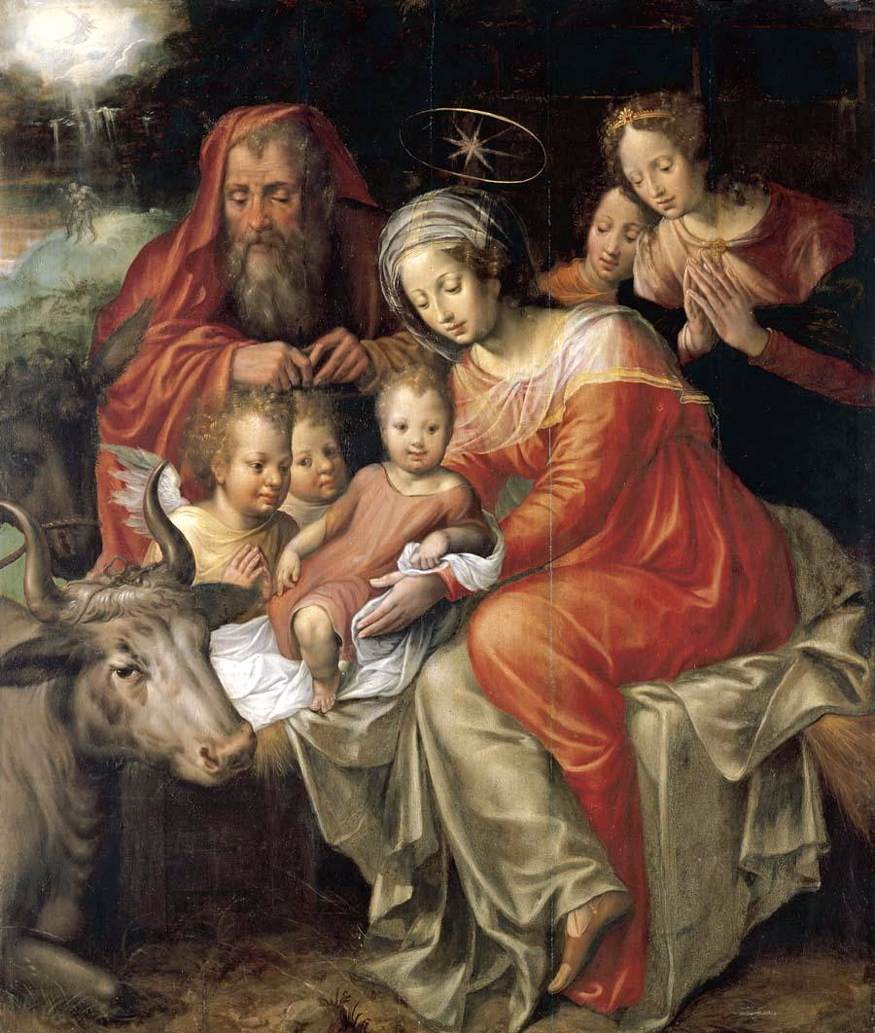
The Holy Family (or the first Sunday after Christmas)
St Pope Sylvester I (Optional Memorial)
—
Bl Alan de Solminihac
St Anton Zogaj
St Barbatian of Ravenna
St Columba of Sens
Bl Dominic de Cubells
St Festus of Valencia
St Gelasius of Palestine
Bl Giuseppina Nicoli
St Hermes the Exorcist
St John Francis Regis
St Marius Aventicus
St Melania the Younger
St Offa of Benevento
Bl Peter of Subiaco
St Pinian
St Potentian of Sens
St Sabinian of Sens
St Theophylact of Ohrid
Bl Walembert of Cambrai
Bl Wisinto of Kremsmünster
St Zoticus of Constantinople
—
Martyrs of Catania – 10 saints: A group of early Christians martyred together, date unknown. The only other information to survive are ten of their names – Attalus, Cornelius, Fabian, Flos, Minervinus, Pontian, Quintian, Sextus, Simplician and Stephen. They were martyred in Catania, Sicily, Italy.
Martyrs of Rome – 10 saints: A group of Roman women martyred in an early persecution, date unknown. We known the names of ten of them – Dominanda, Donata, Hilaria, Nominanda, Paolina, Paulina, Rogata, Rustica, Saturnina and Serotina.
Their relics were enshrined in the catacombs of Via Salaria, Rome, Italy.
Martyred in the Spanish Civil War:
• Blessed Leandro Gómez Gil
• Blessed Luis Vidaurrázaga González
Our Morning Offering – 30 December – The Feast of the Holy Family and the Sixth Day of the Christmas Octave
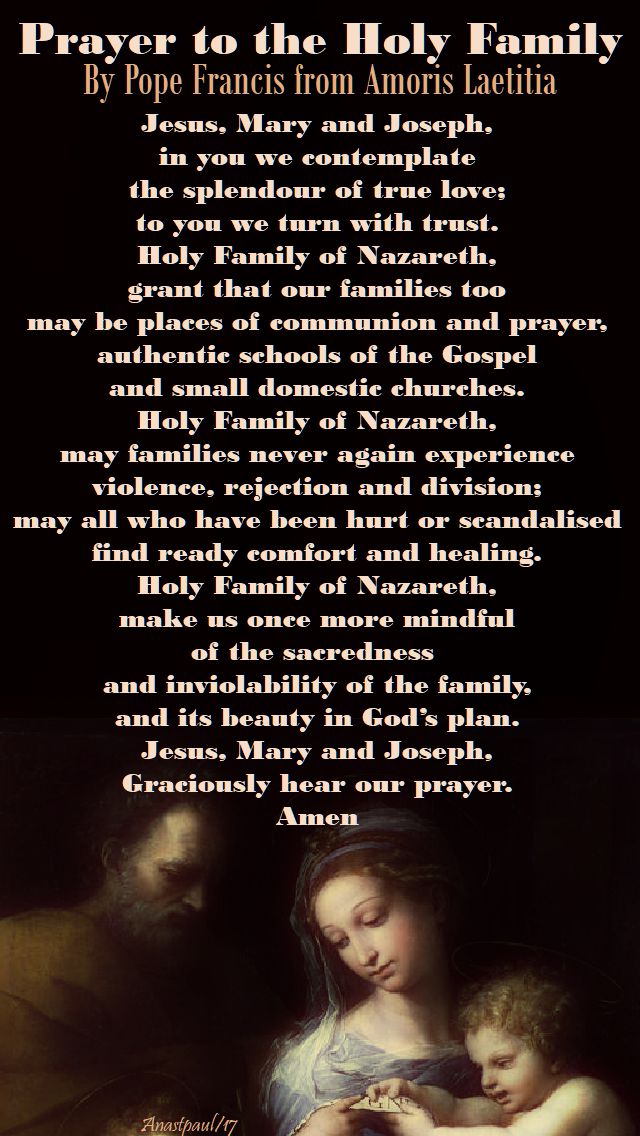
Prayer to the Holy Family By Pope Francis from Amoris Laetitia
Jesus, Mary and Joseph,
in you we contemplate
the splendour of true love;
to you we turn with trust.
Holy Family of Nazareth,
grant that our families too
may be places of communion and prayer,
authentic schools of the Gospel
and small domestic churches.
Holy Family of Nazareth,
may families never again experience
violence, rejection and division;
may all who have been hurt or scandalised
find ready comfort and healing.
Holy Family of Nazareth,
make us once more mindful
of the sacredness
and inviolability of the family,
and its beauty in God’s plan.
Jesus, Mary and Joseph,
Graciously hear our prayer.
Amen
Apologies folks, no new posts today except this morning prayer – the posts for the Holy Family for last year are here https://anastpaul.wordpress.com/2016/12/30/
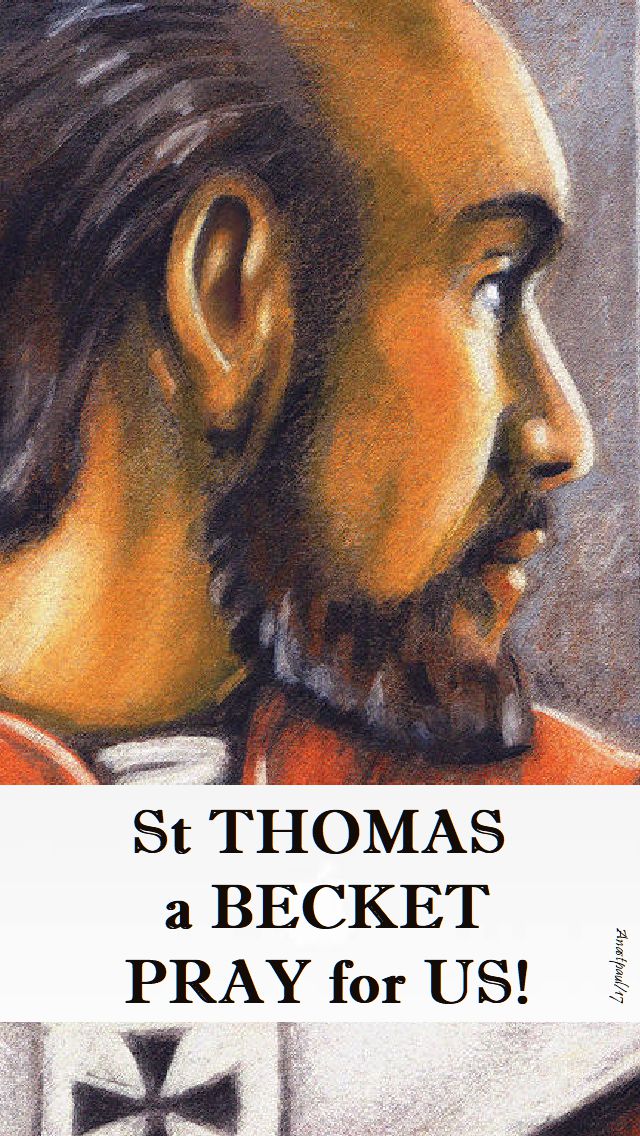
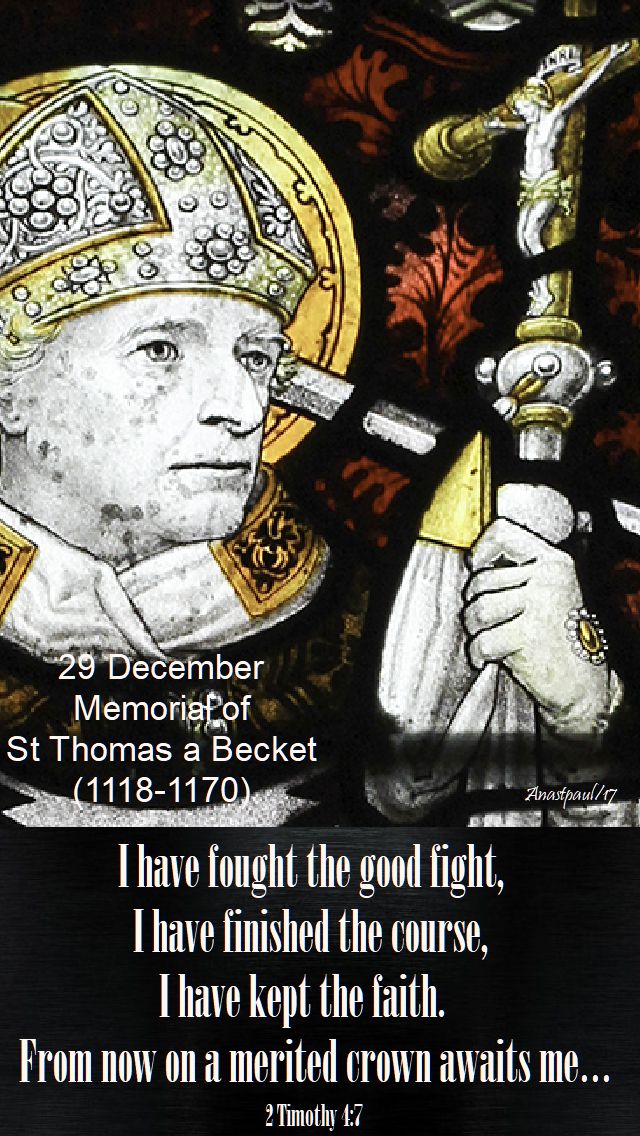
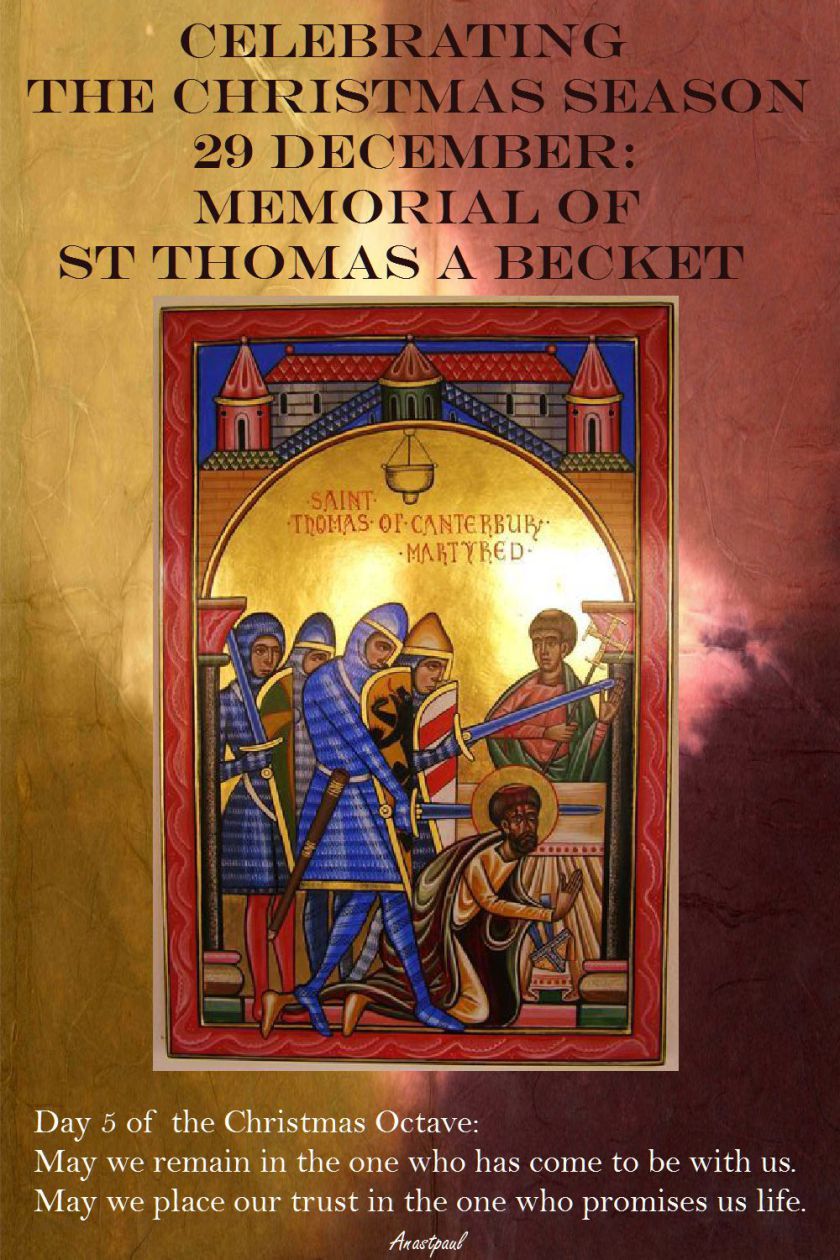
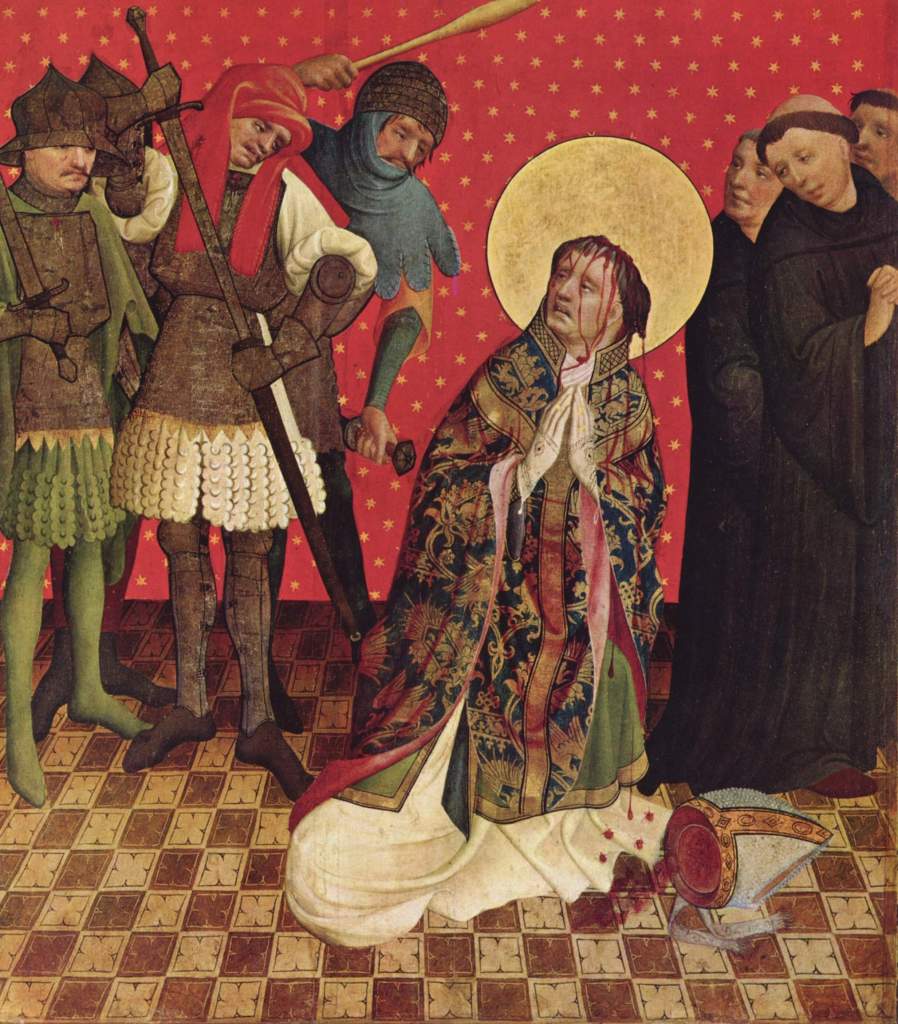
Thought for the Day – 29 December – Fifth Day of the Octave and the Memorial of St Thomas a Becket
I think we know that the twentieth century is probably the century of the greatest flowering of Christian martyrs: across Nazi Germany, the Soviet Union, Vietnam, in communist regimes in Latin America and other places too. Now the twenty-first century is following a similar pattern in other parts of the world: the Middle East, parts of Africa, Pakistan. This moment of prominence for St Thomas a Becket helps us to remember and focus on this fruitfulness of courage and faith which is always the seed of the Church.
For some, Thomas died a traitor, betraying the loyalty they believe he owed to the King. For others he died a martyr, put to death for his defence of the things of the Lord, in this case the honour and rights of the Church.
We know that this relationship between the role and powers of the state on the one hand and the role and commitment of the Church on the other, is never an easy one. It is always a point of tension, a daily struggle in conscience and in public debate. But Thomas’ martyrdom reminds us what can happen when the state seeks to dominate religious belief and reshape it to its own ends, to its own selection of values. When observance of those particular values becomes absolute requirement then we are on a path of confrontation. The example of Thomas a Becket stands before us as a reminder to every age that the point may come where there is no longer any space left for that religious freedom, such a basic human right, which permits the holding and expressing of religious belief in word and action in the public forum.
The tensions that can lead to that point were well delineated in the speech given by Pope Benedict XVI in 2010 when he spoke in Westminster Hall. He said:
‘Each generation, as it seeks to advance the common good, must ask anew: what are the requirements that governments may reasonably impose upon citizens, and how far do they extend? By appeal to what authorities can moral dilemmas be resolved. These questions take us directly to the ethical foundations of civil discourse. If the moral principles underpinning the democratic process are themselves determined by nothing more solid than social consensus, then the fragility of the process becomes all too evident – herein lies the real challenge for democracy.’ Pope Benedict called modern democracies, including our own, to engage in constructive dialogue which brings together faith and reason, affirming that ‘religion is not a problem for legislators to solve, but a vital contributor to national conversation.’
I have only to think of another Thomas, four hundred years after Becket, whose dilemma and heroism echoes that of the earlier Thomas. Thomas More was also asked to show where his fundamental loyalty lay and he too, lacking support from his fellow clergy, stood alone, an uncompromising figure, yet never seeking conflict or confrontation. What was well summed up of him, in words beautifully attributed to him, can also be applied to Thomas a Becket. ‘I am indeed the King’s good servant, but God’s first.’
Excerpt from the Archbishop of Westminister at the Symposium on St Thomas a Becket at Lambeth Palace on 27 May 2016.
St Thomas a Becket, God’s good servant, pray for us!
Quote/s of the Day – 29 December – Fifth Day of the Octave and the Memorial of St Thomas a Becket
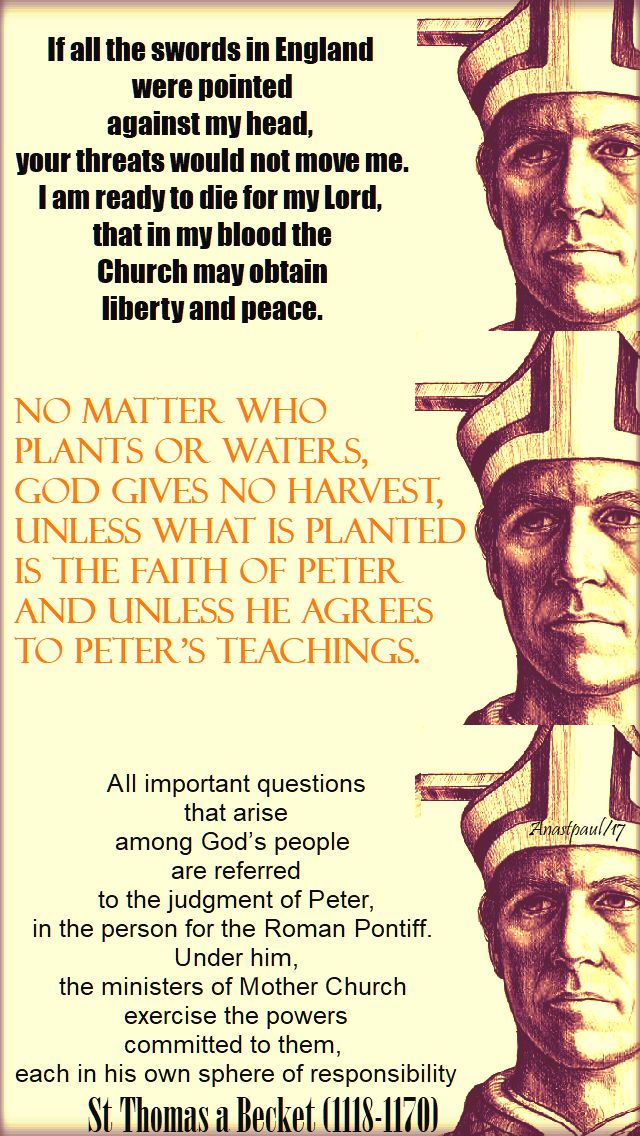
“If all the swords in England were pointed against my head, your threats would not move me. I am ready to die for my Lord, that in my blood the Church may obtain liberty and peace.”
“Many are needed to plant and water what has been planted now, that the faith has spread so far and there are so many people… No matter who plants or waters, God gives no harvest, unless what is planted is the faith of Peter and unless he agrees to Peter’s teachings.”
“All important questions that arise among God’s people are referred to the judgment of Peter, in the person for the Roman Pontiff. Under him the ministers of Mother Church exercise the powers committed to them, each in his own sphere of responsibility.”
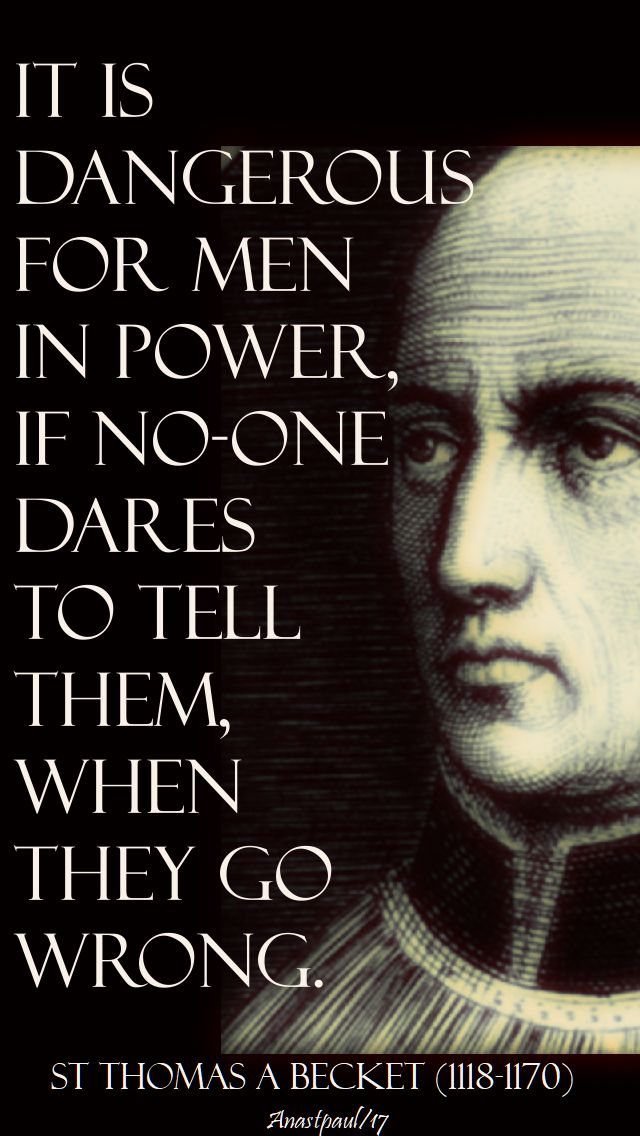
“Hereafter, I want you to tell me, candidly and in secret, what people are saying about me. And if you see anything in me, that you regard as a fault, feel free to tell me in private. For from now on, people will talk about me but not to me. It is dangerous for men in power, if no-one dares to tell them, when they go wrong.” (St Thomas to a friend on his ordination)
One Minute Reflection – 29 December – Fifth Day of the Octave and the Memorial of St Thomas a Becket
I have fought the good fight, I have finished the course, I have kept the faith. From now on a merited crown awaits me….2 Timothy 4:7
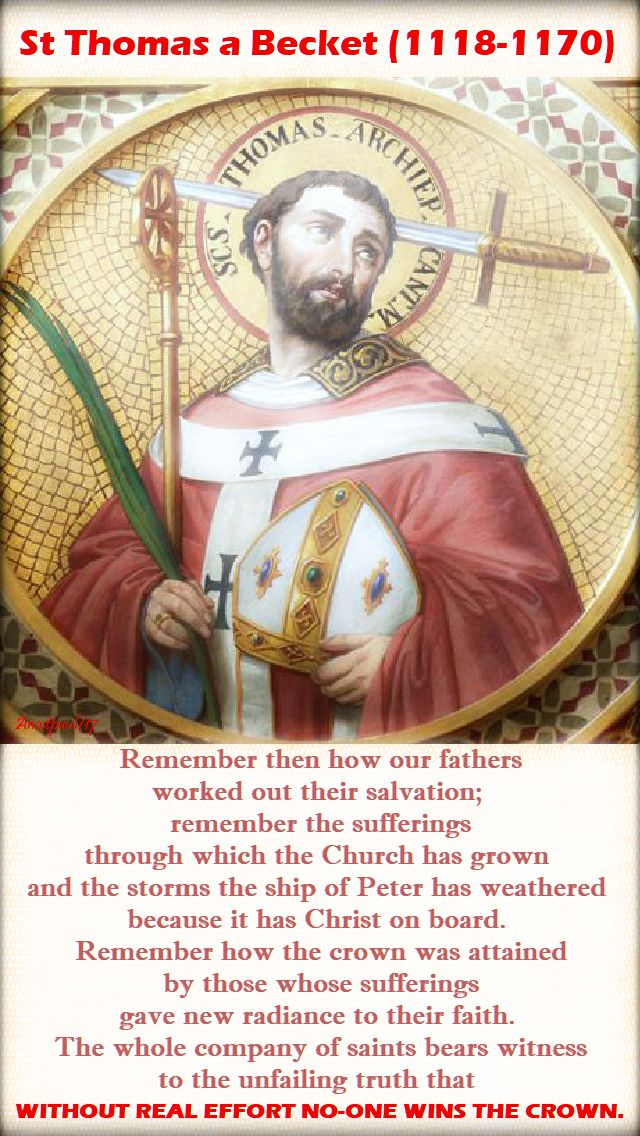
REFLECTION – “Remember then how our fathers worked out their salvation; remember the sufferings through which the Church has grown and the storms the ship of Peter has weathered because it has Christ on board. Remember how the crown was attained by those whose sufferings gave new radiance to their faith. The whole company of saints bears witness to the unfailing truth, that without real effort no-one wins the crown.”……….St Thomas a Becket (1118-1170)
PRAYER – Almighty God, you enable st Thomas a Becket to lay down his life with undaunted spirit for the rights of Your Church. May his prayer help us to deny ourselves for Christ in this life and so find our true life in heaven. Through our Lord Jesus Christ, in union with the Holy Spirit, one God forever and ever, amen.
Our Morning Offering – 29 December – Fifth Day of the Octave and the Memorial of St Thomas a Becket
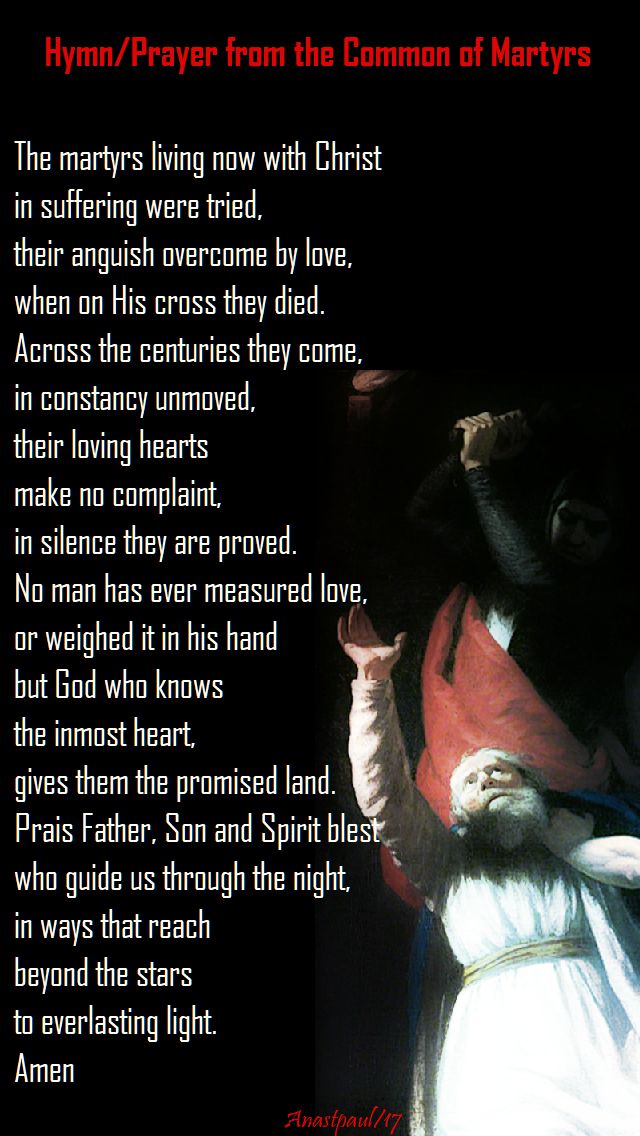
Hymn/Prayer from the Common of Martyrs
The martyrs living now with Christ
in suffering were tried,
their anguish overcome by love,
when on His cross they died.
Across the centuries they come,
in constancy unmoved,
their loving hearts make no complaint,
in silence they are proved.
No man has ever measured love,
or weighed it in his hand
but God who knows the inmost heart,
gives them the promised land.
Prais Father, Son and Spirit blest
who guide us through the night,
in ways that reach beyond the stars
to everlasting light.
Amen
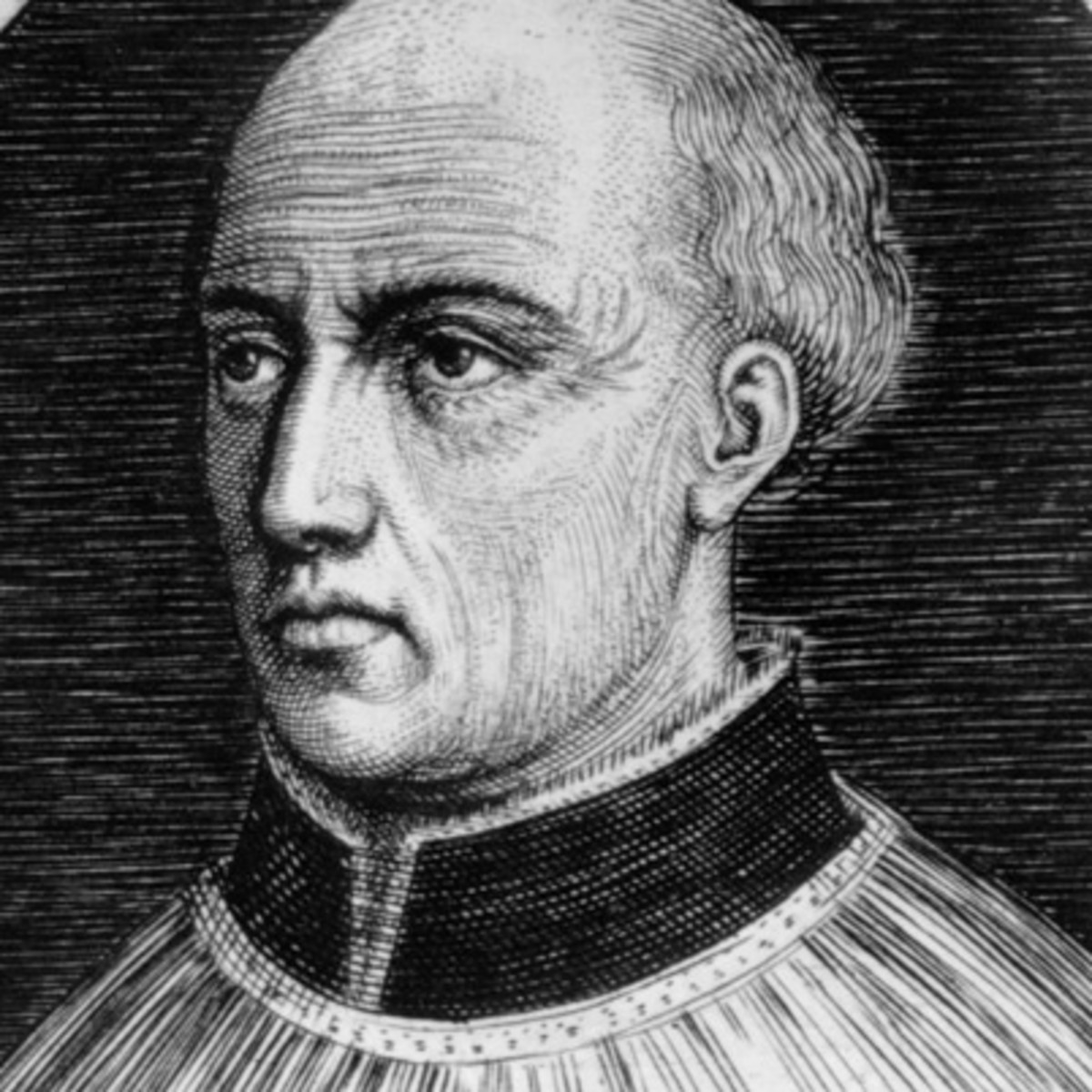
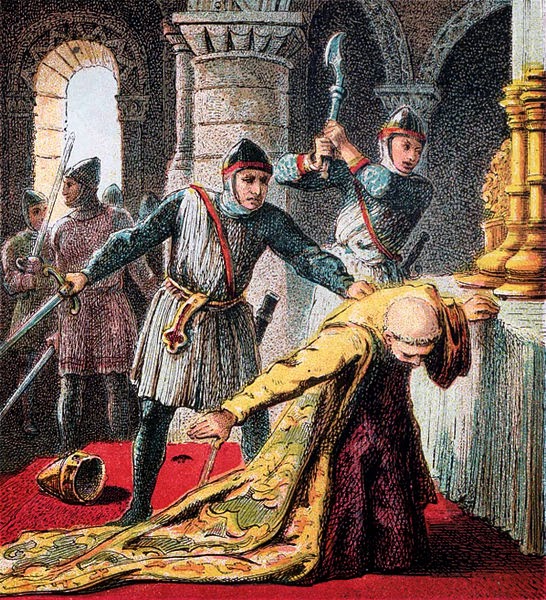
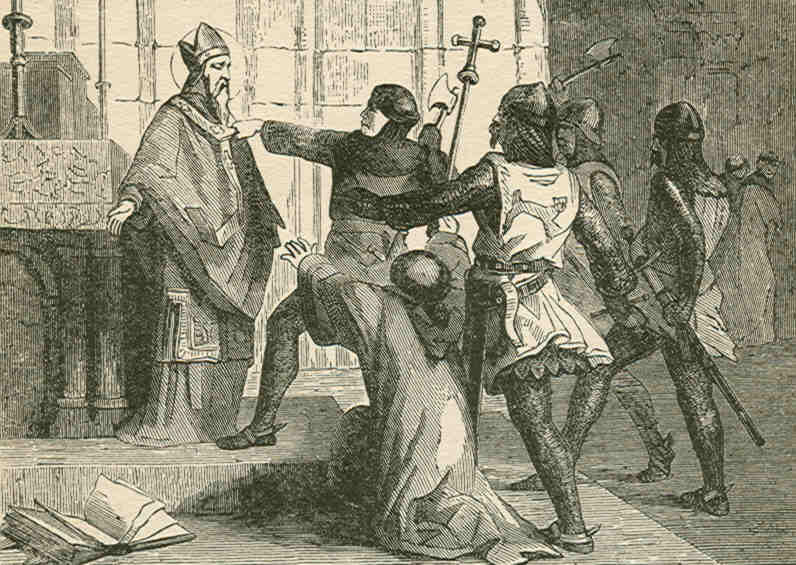
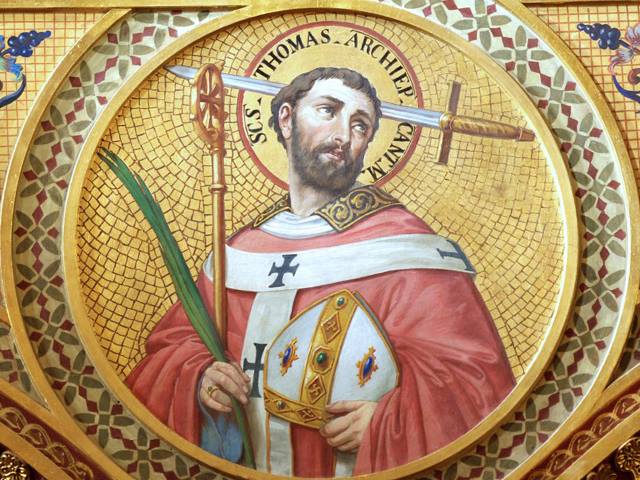
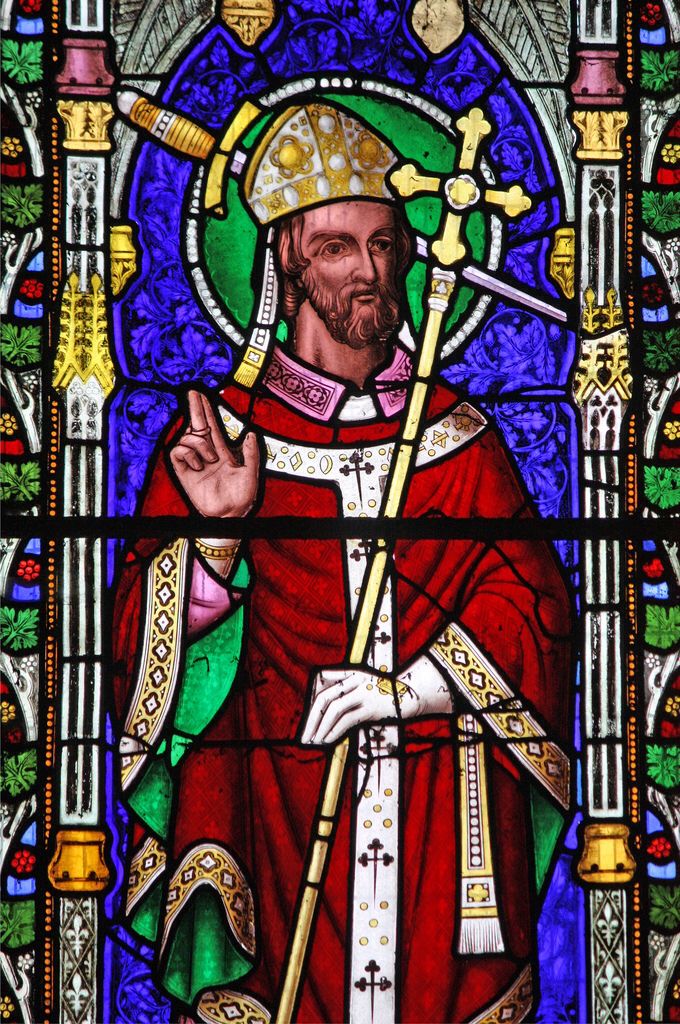
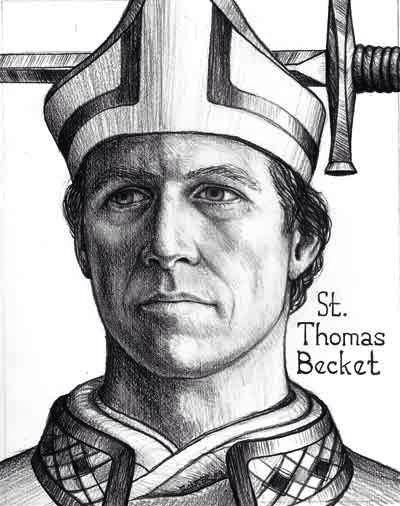
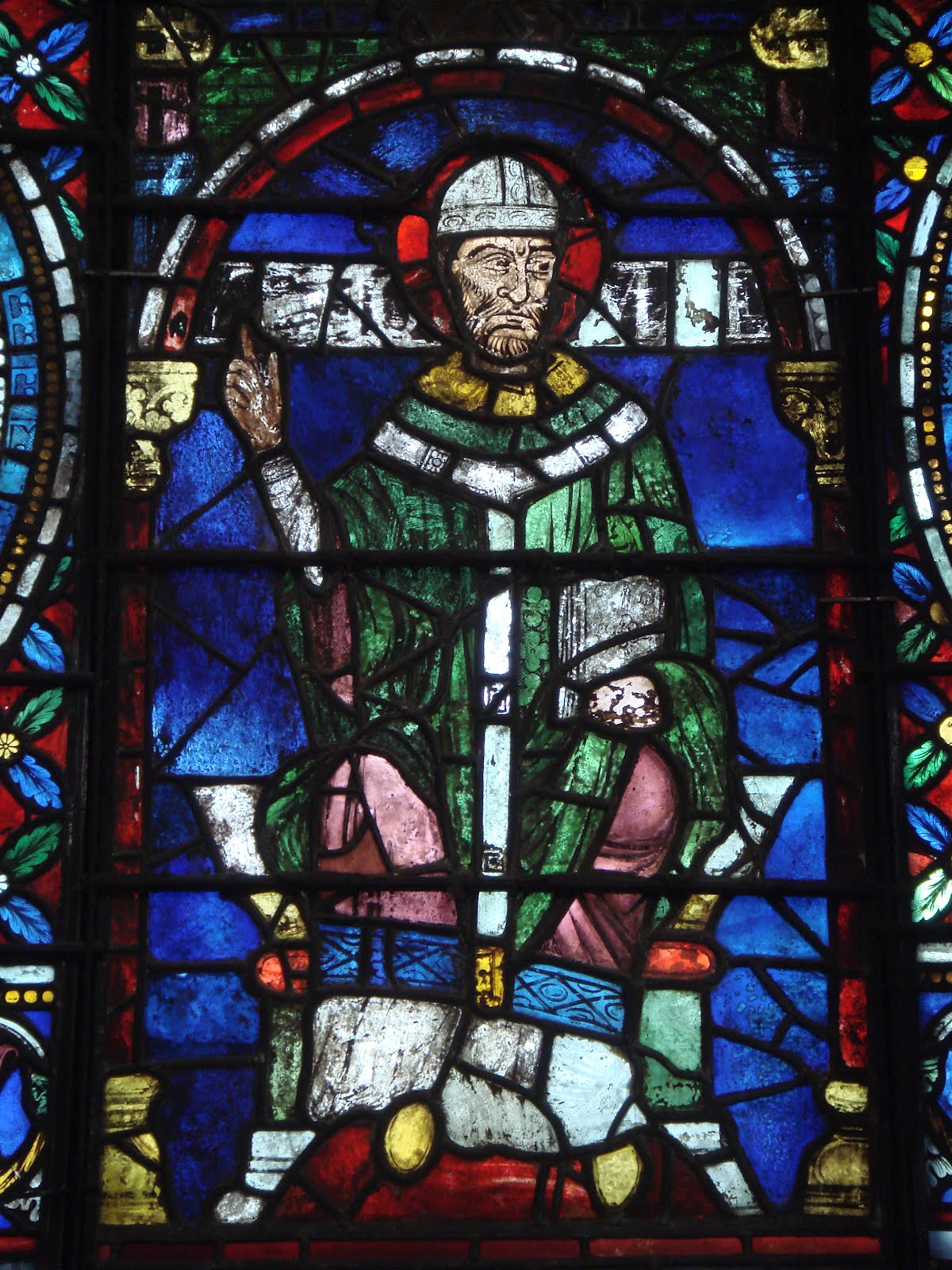
Saint of the Day – 29 December – St Thomas à Becket (1118-1170) – Born on 21 December 1118 at London, England and was murdered on 29 December 1170 in the Cathedral at Canterbury, England. Patronages – • clergy• Exeter College, Oxford, England•Portsmouth, England• secular clergy. Attributes – Sword, Martyrdom, episcopal vestments. St Thomas was Archbishop of Canterbury from 1162 until his murder in 1170. He engaged in conflict with Henry II, King of England, over the rights and privileges of the Church and was murdered by followers of the King in Canterbury Cathedral. Soon after his death, he was Canonised by Pope Alexander III. Someof his relics are enshrined at the Ladyewell Shrine in Lancaster, England.
Thomas was appointed Chancellor of England in 1155 and was a close associate of King Henry II. However, shortly after Thomas was named Archbishop of Canterbury, their relationship soured, eventually resulting in Thomas’ six-year exile in France. Not long after his return to England, Thomas was murdered by four of the King’s knights inside Canterbury Cathedral, making him an instant martyr. Miracles began to occur soon after his death and Canterbury became one of the most popular pilgrimage destinations in Europe.
Excerpt from The Golden Legend
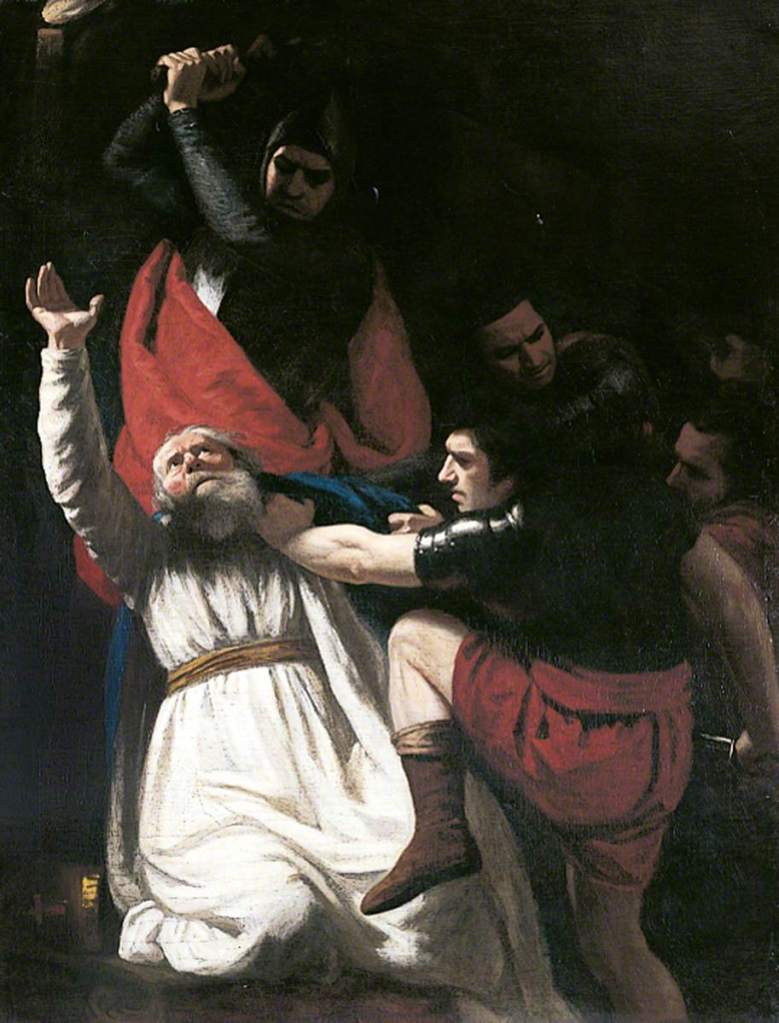
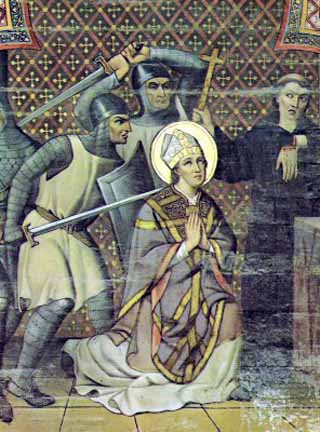
And forthwith four knights took their counsel together and thought they would do to the king a pleasure and [devised] to slay St Thomas and suddenly departed and took their shipping towards England. And when the king knew of their departing he was sorry and sent after them but they were on the sea and departed [before] the messengers came, wherefore the king was heavy and sorry … And these four knights aforesaid came to Canterbury on the Tuesday in Christmas week about Evensong time and came to St Thomas and said that the king commanded him to make amends for the wrongs that he had done and also that he should assoil all them that he had accursed anon, or else they should slay him … And then smote each at him, that they smote off a great piece of the skull of his head, that his brain fell on the pavement. And so they slew and martyred him and were so cruel that one of them [broke] the point of his sword against the pavement.
And thus this holy and blessed Archbishop St Thomas suffered death in his own church for the right of all holy church…And anon it was known all about, how that he was martyred and anon after took this holy body and unclothed him and found bishop’s clothing above and the habit of a monk under. And next his flesh he wore hard hair, full of knots, which was his shirt. And his breech was of the same and the knots slicked fast within the skin and all his body full of worms; he suffered great pain. And he was thus martyred the year of our Lord one thousand one hundred and seventy-one and was fifty-three years old. And soon after tidings came to the king how he was slain, wherefore the king took great sorrow and sent to Rome for his absolution.
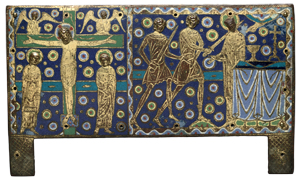
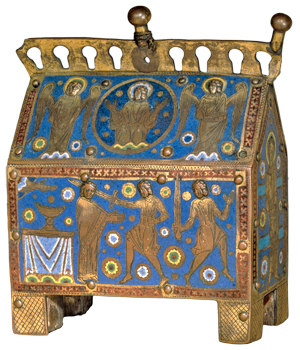
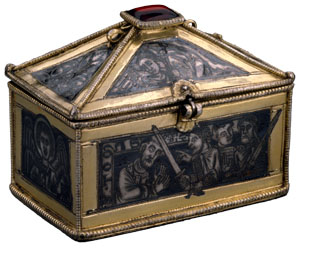
Below is the Reliquary Chasse with Scenes of the Martyrdom of Thomas Becket.
St Thomas a Becket (Optional Memorial) – https://www.youtube.com/watch?v=A9K4xyS0UwI
St Aileran of Clonard
St Albert of Gambron
St Aproniano de Felipe González
St David the King
St Ebrulf of Ouche
St Enrique Juan Requena
St Florent of Bourges
Bl Francis Ruiz
St Girald of Fontenelle
St Jacinto Gutiérrez Terciado
Bl José Aparicio Sanz
Bl José Perpiñá Nácher
St Juan Bautista Ferreres Boluda
St Libosus of Vaga
St Marcellus the Righteous
St Martinian of Milan
Bl Paul Mary
Bl Peter the Venerable
St Quartillosa of Carthage
St Thaddeus of Scythia
St Trophimus of Arles
St Trophimus of Ephesus
Bl William Howard
—
Martyrs of North Africa – (8 saints): A group of Christians executed together for their faith. The only details to survive are eight names – Crescentius, Dominic, Honoratus, Lybosus, Primian, Saturninus, Secundus and Victor.
Martyrs of Rome – (3 saints): A group of Christians executed together for their faith. The only details to survive are three names – Boniface, Callistus and Felix.
Martyrs of Seoul – (7 saints): Additional Memorial – 20 September as part of the Martyrs of Korea.
A group of seven lay woman in the apostolic vicariate of Korea who were martyred together.
• Barbara Cho Chung-I
• Barbara Ko Sun-I
• Benedicta Hyong Kyong-Nyon
• Elisabeth Chong Chong-Hye
• Magdalena Han Yong-I
• Magdalena Yi Yong-Dok
• Petrus Ch’oe Ch’ang-Hub
They were born in South Korea and were martyred by beheading on 29 December 1839 at the Small West Gate, Seoul, South Korea. They were Canonised on 6 May 1984 by St Pope John Paul II.
Martyred in the Spanish Civil War:
Thousands of people were murdered in the anti-Catholic persecutions of the Spanish Civil War from 1934 to 1939.
• Blessed Aproniano de Felipe González
• Blessed Enrique Juan Requena
• Blessed Jacinto Gutiérrez Terciado
• Blessed Juan Bautista Ferreres Boluda
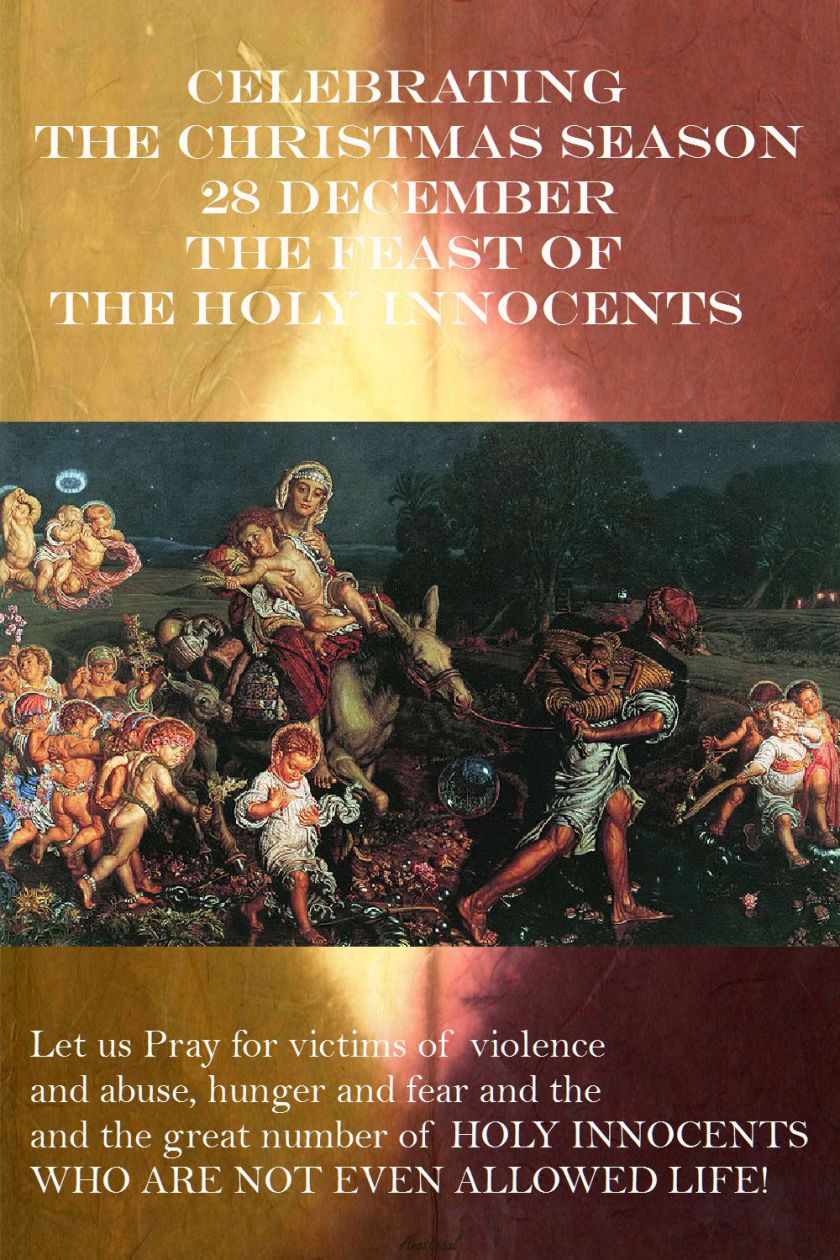
Thought for the Day – 28 December – The Feast of the Holy Innocents – The 4th Octave Day of Christmas
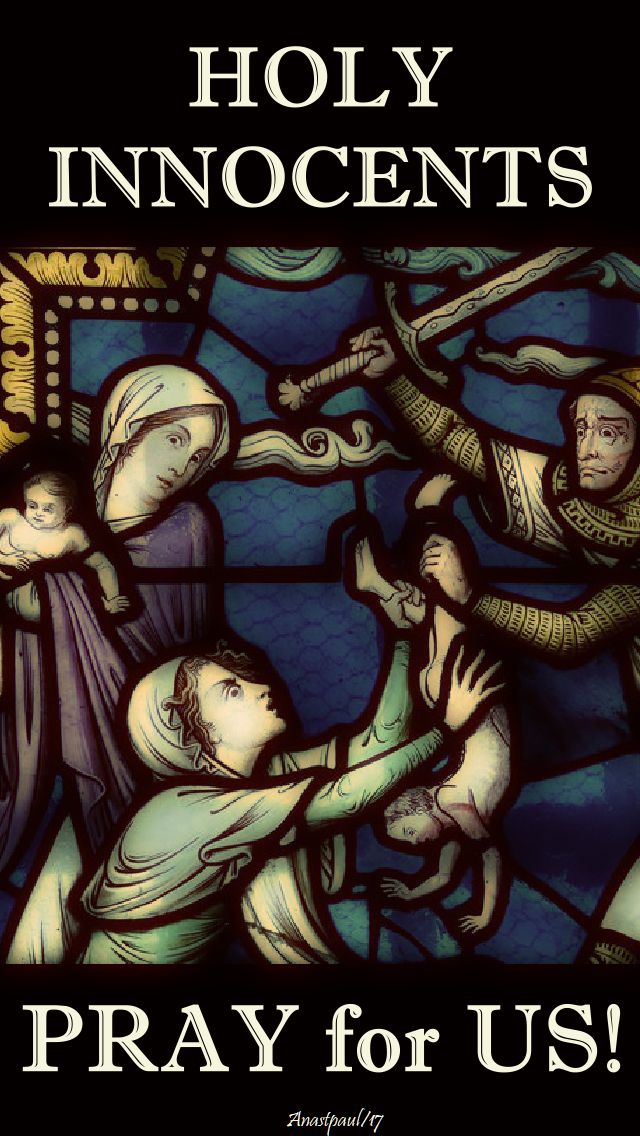
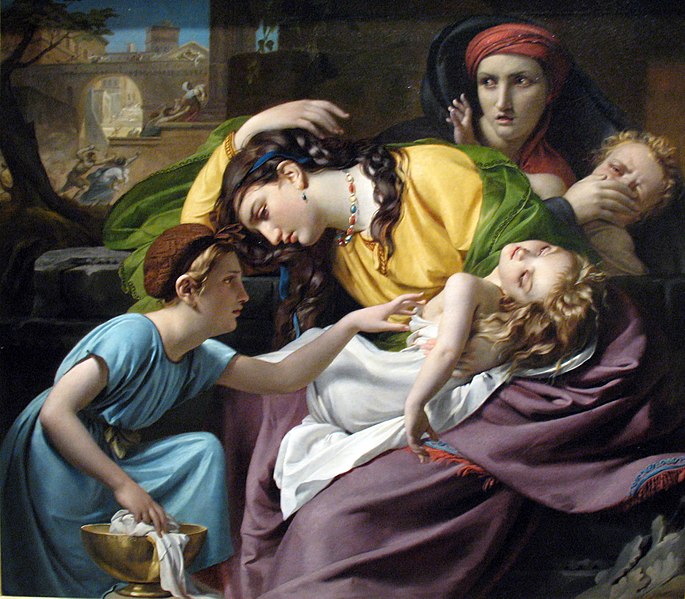
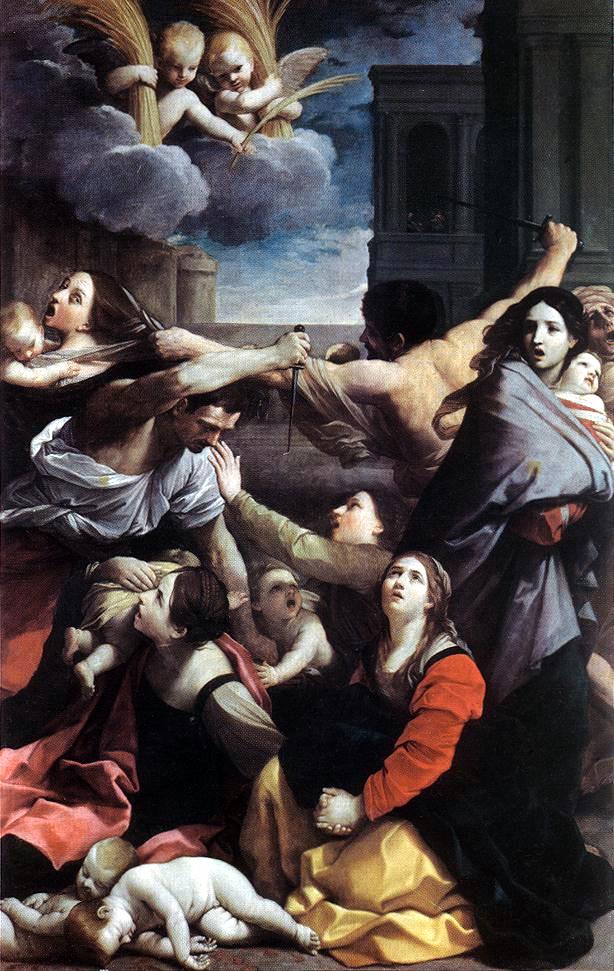
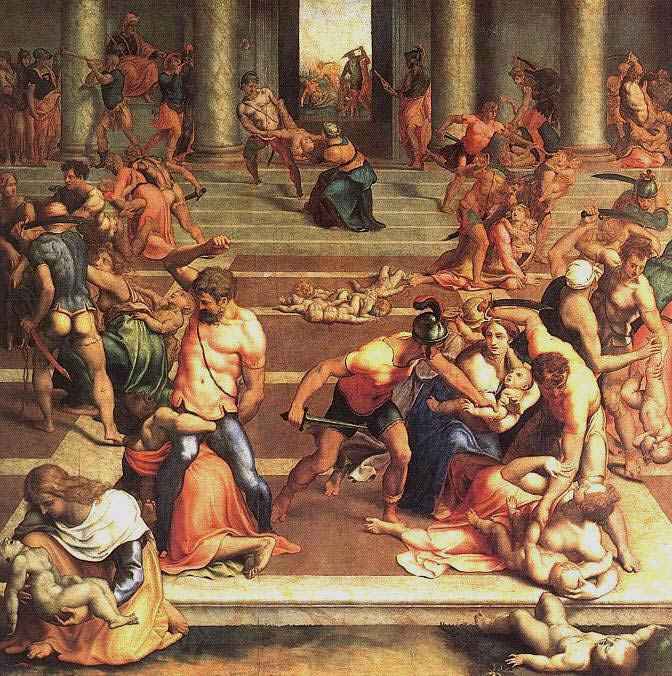
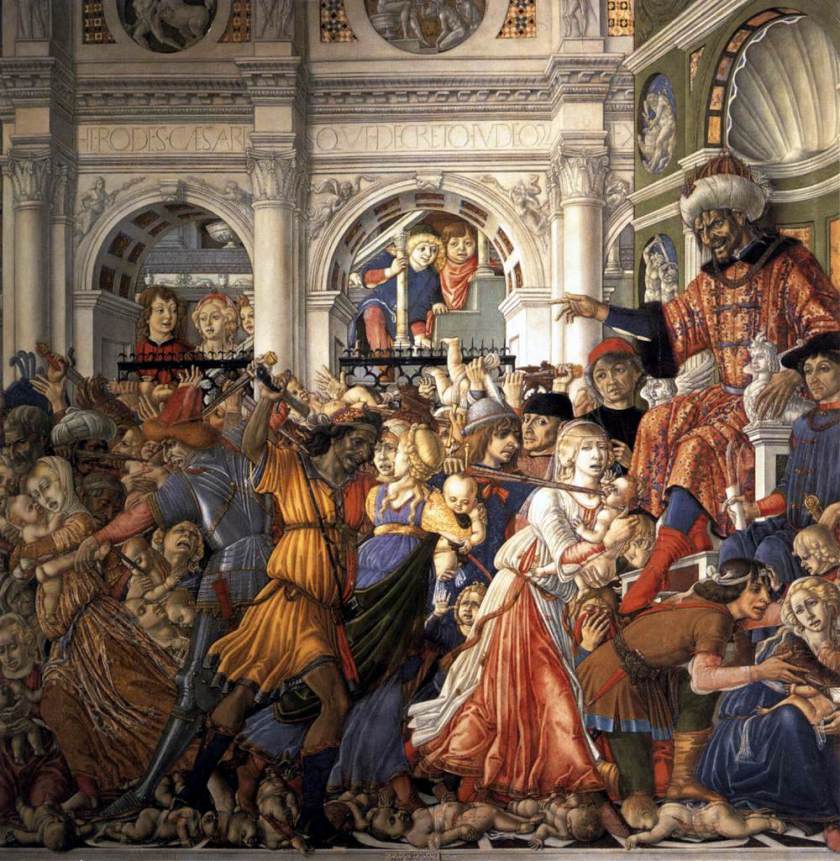
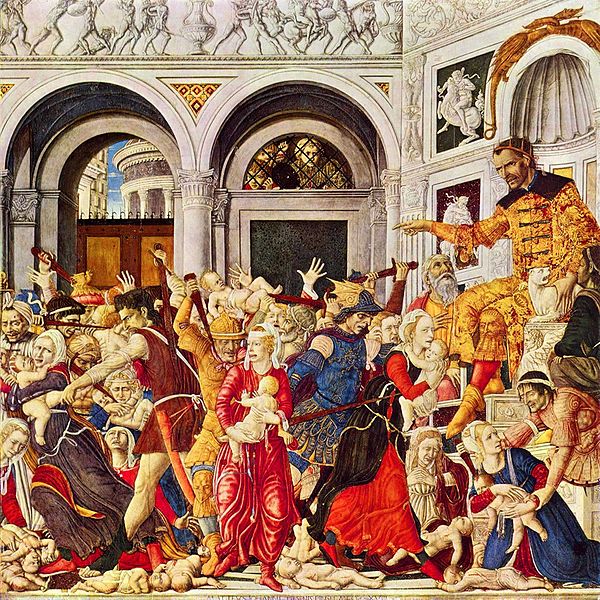
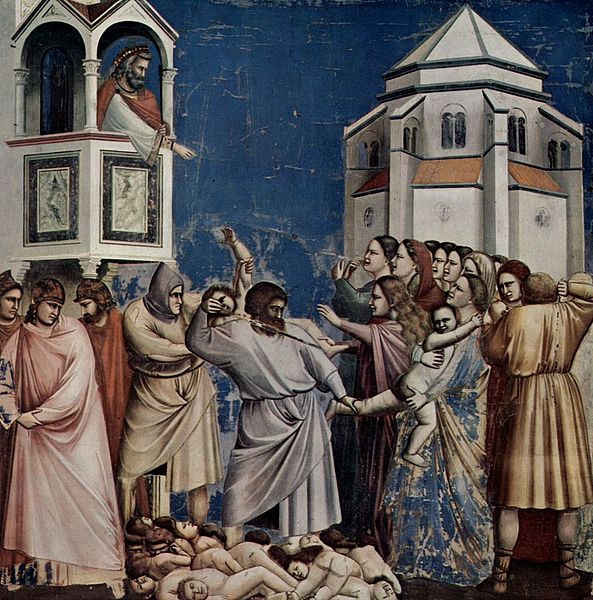
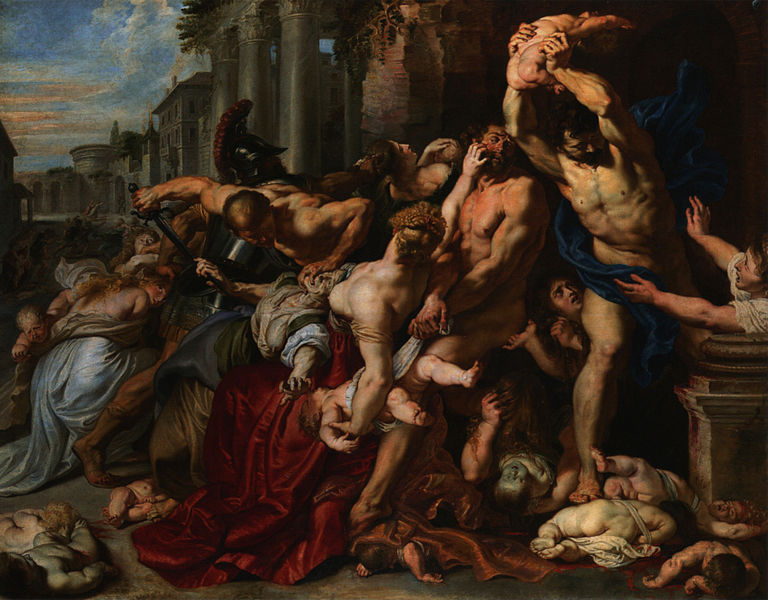
An angel of the Lord appeared to Joseph in a dream and said, “Rise, take the child and his mother and flee to Egypt and remain there till I tell you, for Herod is about to search for the child, to destroy him.” And he rose and took the child and his mother by night and departed to Egypt… Then Herod, when he saw that he had been tricked by the wise men, was in a furious rage and he sent and killed all the male children in Bethlehem and in all that region, who were two years old or under, according to the time which he had ascertained from the wise men….Matthew 2:13-18
We call martyrs those saints who chose to give their lives for Jesus Christ. These innocent children also gave their lives but they didn’t choose to . They were chosen for martyrdom. For centuries innocent lives have been taken and people can’t help asking ‘why?’ The suffering of innocent children is still a scandal for our human hearts. That happened during WWII in a concentration camp. The Nazi guards decided one day to hang a child in front of thousands of prisoners in formation. Elie Wiesel, who writes the story, explains that the child was so light that he hanged, struggling to gasp, for more than half an hour. ‘Where is God now?’ asked one of those prisoners forced to contemplate the suffering of the child. “Behind me,” writes Wiesel, “I heard the same man asking: ‘For God’s sake, where is God?’ And from within me, I heard a voice answer- ‘Where is He? This is where – hanging here from this gallows…’”
God’s agony didn’t finish on Calvary. When innocent children cry, God mixes His Tears with theirs, when they bleed, God’s Heart bleeds with them. If they ask you ‘where is God?’, tell them that God is on Calvary still, dying every day in the womb of some mothers, He is the Victim of famines, of epidemics, of wars, of abuses, of bullying, of mafias, of trafficking, of abandonment, of persecution, of terrorism, of injustice of any kind. God is still in agony in the suffering of innocents.
But we are with you, Mary, Mother of all Innocents, helping Jesus to bear His Cross, comforting Him with our prayer and reminding Him with our love that all that He suffers for us is worthwhile, and asking God for the end of all this injustice.
Fr George Boronat M.D. S.T.D is a Catholic priest from the Prelature of Opus Dei,
working in the Archdiocese of Southwark in London.
Quote of the Day – 28 December – The Feast of the Holy Innocents – The 4th Octave Day of Christmas
”The precious death of any martyr deserves high praise because of his heroic confession; the death of these children is precious in the sight of God because of the beatitude they gained so quickly. For already, at the beginning of their lives, they pass on. The end of the present life is for them the beginning of glory.”
St Augustine (354-430) Father & Doctor of the Church
Our Morning Offering – 28 December – The Feast of the Holy Innocents – The 4th Octave Day of Christmas. When you think about the slaughter of these innocent children and the continuing slaughter of the unborn through the horrors of abortion, it becomes clear that they come from the same supreme act of selfishness. Even though Herod heard the message coming from the prophets of his own people, he had no desire to align his heart with the purposes of God.
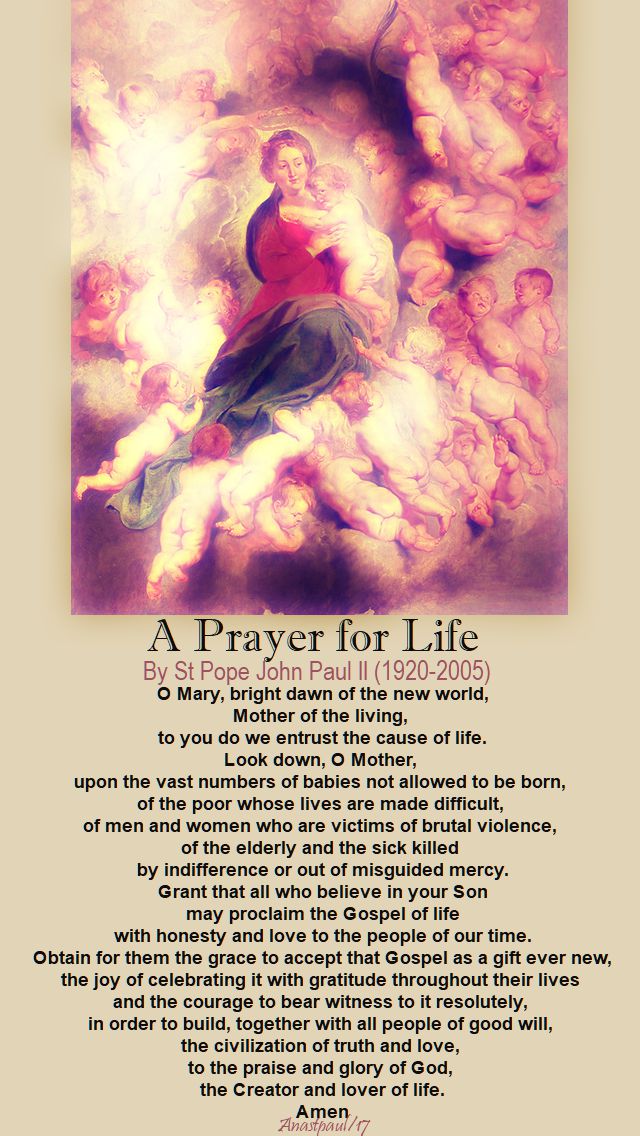
A Prayer for Life
By St Pope John Paul II (1920-2005)
O Mary,
bright dawn of the new world,
Mother of the living,
to you do we entrust the cause of life.
Look down, O Mother,
upon the vast numbers of babies
not allowed to be born,
of the poor whose lives are made difficult,
of men and women
who are victims of brutal violence,
of the elderly and the sick killed
by indifference or out of misguided mercy.
Grant that all who believe in your Son
may proclaim the Gospel of life
with honesty and love to the people of our time.
Obtain for them the grace to accept that Gospel
as a gift ever new,
the joy of celebrating it with gratitude
throughout their lives
and the courage to bear witness to it resolutely,
in order to build,
together with all people of good will,
the civilization of truth and love,
to the praise and glory of God,
the Creator and lover of life.
Amen
Taken from Pope John Paul II’s 1995 encyclical, “The Gospel of Life” (www.vatican.va)
Saints of the Day – Feast of the Holy Innocents – 28 December – 4th Day of the Christmas Octave – Patronages – • against ambition•against jealousy• altar servers•babies•children• children’s choir• choir boys• foundlings• students. The Massacre of the Innocents is the biblical account of infanticide by Herod the Great, the Roman-appointed King of the Jews. According to the Gospel of Matthew, Herod ordered the execution of all young male children in the vicinity of Bethlehem, so as to avoid the loss of his throne to a newborn King of the Jews whose birth had been announced to him by the Magi. In typical Matthean style, it is understood as the fulfilment of an Old Testament prophecy:
Then was fulfilled that which was spoken through Jeremiah the prophet, saying, A voice is heard in Ramah, mourning and great weeping, Rachel weeping for her children and refusing to be comforted because her children are no more.’
The number of infants killed is not stated. The Holy Innocents, although Jewish, have been claimed as martyrs for Christianity and the Feast of the Holy Innocents has long been celebrated.
Taken from THE LITURGICAL YEAR, Christmas II, by Abbot Dom Guéranger. 1 A.D.
THE feast of the beloved Disciple, St John is followed by that of the Holy Innocents. The Crib of Jesus, where we have already met and venerated the Prince of Martyrs and the Eagle of Patmos, has today standing round it a lovely choir of little Children, clad in snow-white robes and holding green branches in their hands. The Divine Babe smiles upon them: He is their King and these Innocents are smiling upon the Church of God. Courage and Fidelity first led us to the Crib; Innocence now comes and bids us tarry there.
Herod intended to include the Son of God amongst the murdered Babes of Bethlehem. The Daughters of Rachel wept over their little ones and the land streamed with blood but the Tyrant’s policy can do no more, it cannot reach Jesus and its whole plot ends in recruiting an immense army of Martyrs for Heaven. These Children were not capable of knowing what an honour it was for them to be made victims for the sake of the Saviour of the world but the very first instant after their immolation, all was revealed to them, they had gone through this world without knowing it and now that they know it, they possess an infinitely better. God showed here the riches of His mercy, He asks of them but a momentary suffering and that over, they wake up in Abraham’s Bosom, no further trial awaits them, they are in spotless innocence and the glory due to a soldier who died to save the life of his Prince belongs eternally to them.
They died for Jesus’ sake, therefore, their death was a real Martyrdom and the Church calls them by the beautiful name of the Flowers of the Martyrs because of their tender age and their innocence. Justly then does the ecclesiastical Cycle bring them before us today, immediately after the two valiant Champions of Christ, Stephen and John. The connection of these three Feasts is thus admirably explained by St Bernard- “In St Stephen, we have both the act and the desire of Martyrdom; in St John, we have but the desire; in the Holy Innocents, we have but the act. . . . Will anyone doubt whether a crown was given to these Innocents?. . . If you ask me what merit could they have that God should crown them? Let me ask you what was the fault for which Herod slew them? What! is the mercy of Jesus less than the cruelty of Herod and whilst Herod could put these Babes to death, who had done him no injury, Jesus may not crown them for dying for Him?”
Stephen, therefore, is a Martyr by a Martyrdom of which men can judge, for he gave this evident proof of his sufferings being felt and accepted, that, at the very moment of his death, his solicitude both for his own soul and for those of his persecutors increased; the pangs of his bodily passion were less intense than the affection of his soul’s compassion, which made him weep more for their sins than for his own wounds. John was a Martyr, by a Martyrdom which only Angels could see, for the proofs of his sacrifice being spiritual, only spiritual creatures could ken them. But the Innocents were Martyrs, to none other eye save Thine, O God! Man could find no merit, Angel could find no merit, the extraordinary prerogative of Thy grace is the more boldly brought out. From the mouth of the Infants and the Sucklings Thou hast perfected praise. The praise the Angels give Thee is- Glory be to God in the highest and peace on earth to men of good will it is a magnificent praise, but I make bold to say that it is not perfect till He cometh Who will say: “Suffer little Children to come unto me, for of such is the kingdom of Heaven.”
Holy Innocents (Feast) – – https://www.youtube.com/watch?v=Pgd8awppW8I
—
St Anthony of Lérins
St Caesarius of Armenia
BL Claudia Weinhardt
St Conindrus
St Domitian the Deacon
St Domnio of Rome
St Eutychius
St Gowan of Wales
Bl Gregory of Cahors
Bl Hryhorii Khomyshyn
St Iolande of Rome
Bl Johannes Riedgasser
Bl Nicolas Mello
Bl Otto of Heidelberg
St Romulus
SiSt mon the Myroblite
St Theonas of Alexandria
St Theodore of Tabenna
St Troadius of Pontus
—
20,000 Martyrs of Nicomedia: 20,000 Christians who were murdered during in 303 in Nicomedia, Bithynia (modern Izmit, Turkey) during the persecutions of Diocletian. Many of them were killed en masse when they were ordered, during Christmas Mass, to sacrifice to idols; when they refused, they were locked in the churches and the buildings burned around them. We know some details of a few of them, but most are known only to God. The names we have are – Agape, Anthimos, Domna, Domna, Dorotheus, Esmaragdus, Eugene, Euthymius, Glykerios, Gorgonius, Hilary, Indes, Mardonius, Mardonius, Maximus, Migdonius, Migdonus, Peter, Peter, Theophila, Theophilus and Zeno. 303 in Nicomedia, Bithynia (modern Izmit, Turkey).
Martyrs of Africa – (3 saints): Three Christians murdered together in Africa for their faith. The only details to survive are their names – Castor, Rogatian and Victor.
Thought for the Day – 27 December – the Feast of St John the Apostle and Evangelist “The Disciple whom Jesus Loved” and the 3rd Octave Day
Taken From THE LITURGICAL YEAR, Abbot Dom Guéranger OSB, Book II
NEAREST to Jesus’ Crib, after Stephen, stands John, the Apostle and Evangelist. It was only right that the first place should be assigned to him, who so loved his God that he shed his blood in his service; for, as this God Himself declares, greater love than this hath no man, that he lay down his life for his friends, [St. John xv 13] and Martyrdom has ever been counted by the Church as the greatest act of love and as having, consequently, the power of remitting sins, like a second Baptism. But next to the sacrifice of Blood, the noblest, the bravest sacrifice and that which most wins the heart of Him Who is the Spouse of souls, is the sacrifice of Virginity. Now just as St Stephen is looked upon as the type of Martyrs, St John is honoured as the Prince of Virgins. Martyrdom won for Stephen the Crown and palm; Virginity merited for John most singular prerogatives, which, while they show how dear to God is holy Chastity, put this Disciple among those who by their dignity and influence are above the rest of men.
St John was of the family of David, as was our Blessed Lady. He was consequently a relation of Jesus. This same honour belonged to St James the Greater, his brother; as also to St James the Less and St Jude, both sons of Alpheub. When our Saint was in the prime of his youth, he left not only his boat and nets, not only his Father Zebedee but even his betrothed, when everything was prepared for the marriage. He followed Jesus, and never once looked back. Hence the special love which our Lord bore him. Others were Disciples or Apostles, John was the Friend of Jesus. The cause of this our Lord’s partiality was, as the Church tells us in the Liturgy, that John had offered his Virginity to the Man-God. Let us, on this his Feast, enumerate the graces and privileges that came to St. John from his being the Disciple whom Jesus loved.
This very expression of the Gospel, which the Evangelist repeats several times—–The Disciple whom Jesus loved [St. John xiii 23; xix 26; xxi 7; xxi 20]—–says more than any commentary could do. St Peter, it is true, was chosen by our Divine Lord to be the Head of the Apostolic College and the Rock whereon the Church was to be built: he, then, was honoured most; but St John was loved most. Peter was bid to love more than the rest loved and he was able to say, in answer to Jesus’ thrice repeated question, that he did love Him in this highest way: and yet, notwithstanding, John was more loved by Jesus than was Peter himself, because his Virginity deserved this special mark of honour.
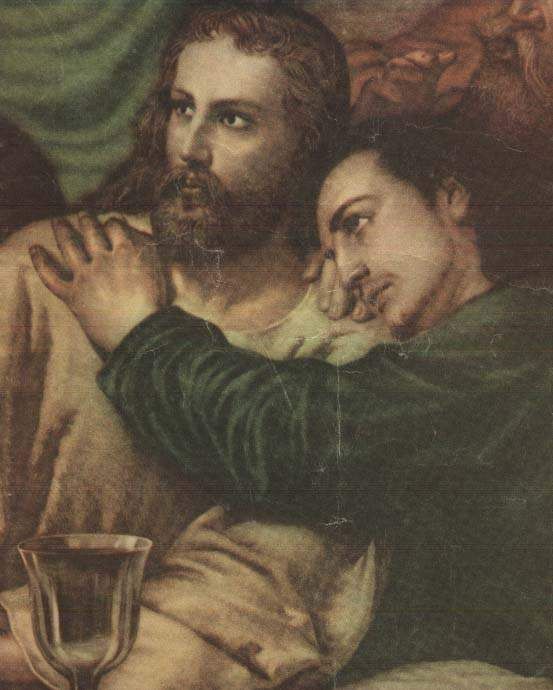
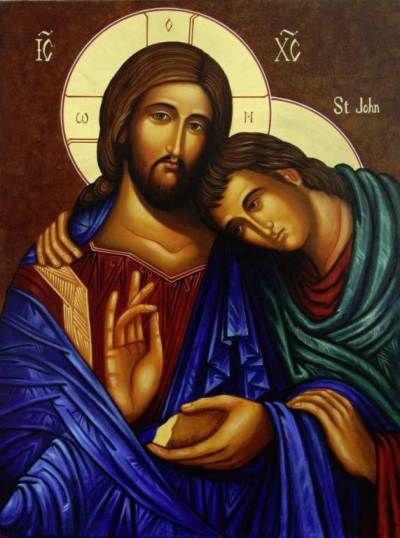
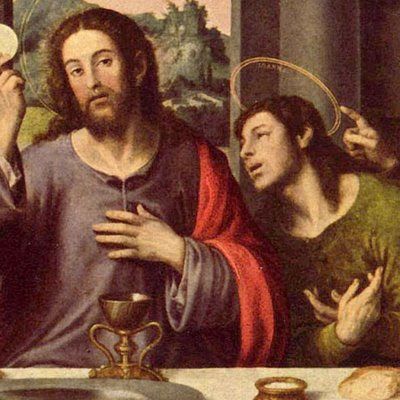
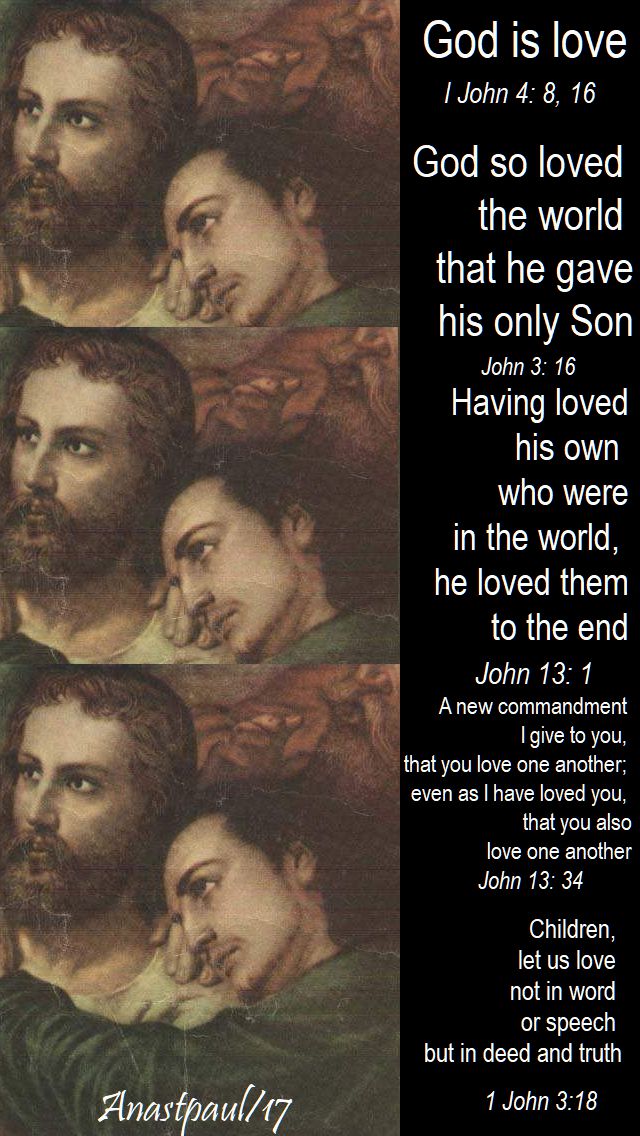
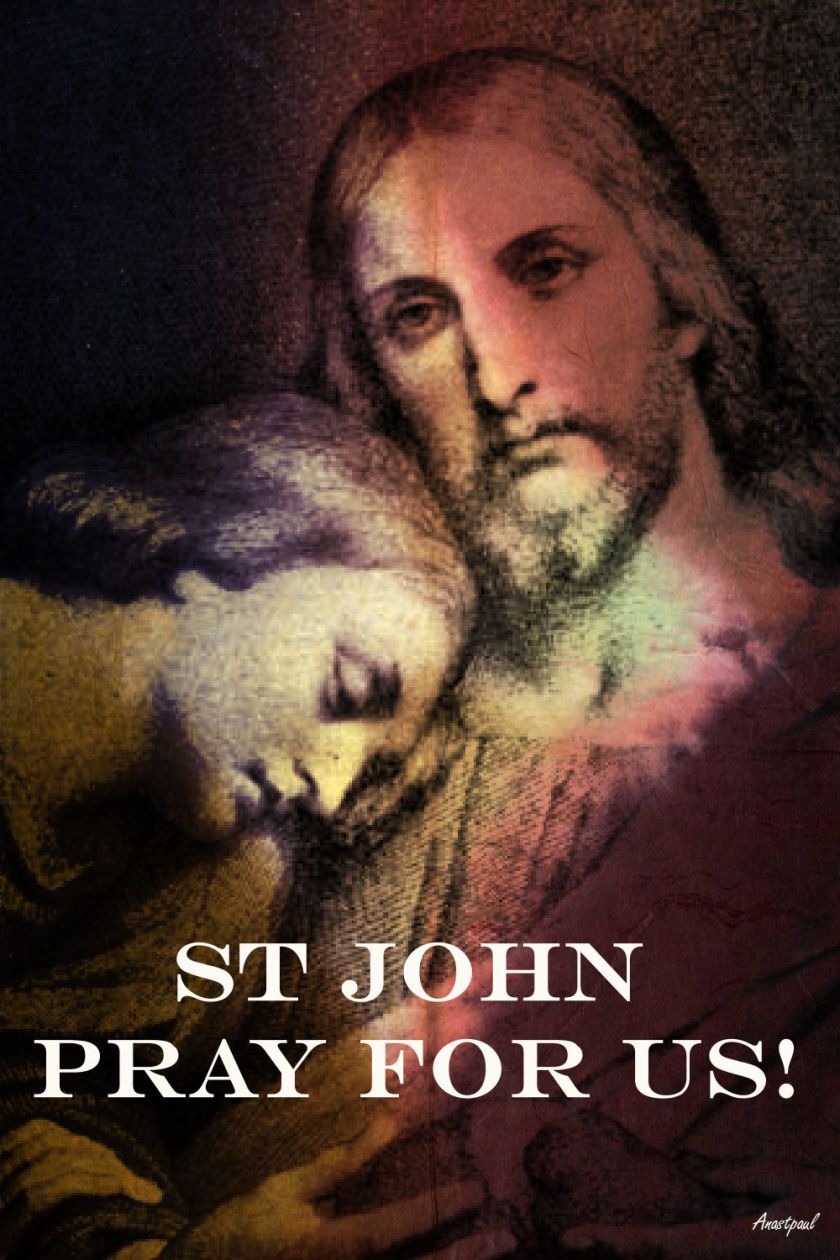
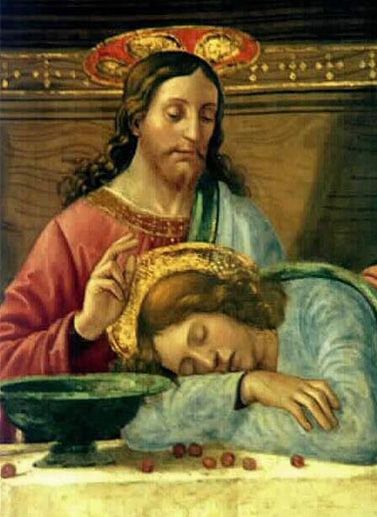
Chastity of soul and body brings him who possesses it into a sacred nearness and intimacy with God. Hence it was that at the Last Supper—–that Supper which was to be renewed on our Altars to the end of the world, in order to cure our spiritual infirmities and give life to our souls—–John was placed near to Jesus, nay, was permitted, as the tenderly loved Disciple, to lean his head upon the Breast of the Man-God. Then it was that he was filled, from their very Fountain, with Light and Love: it was both a recompense and a favour and became the source of two signal graces, which make St John an object of special reverence to the whole Church.
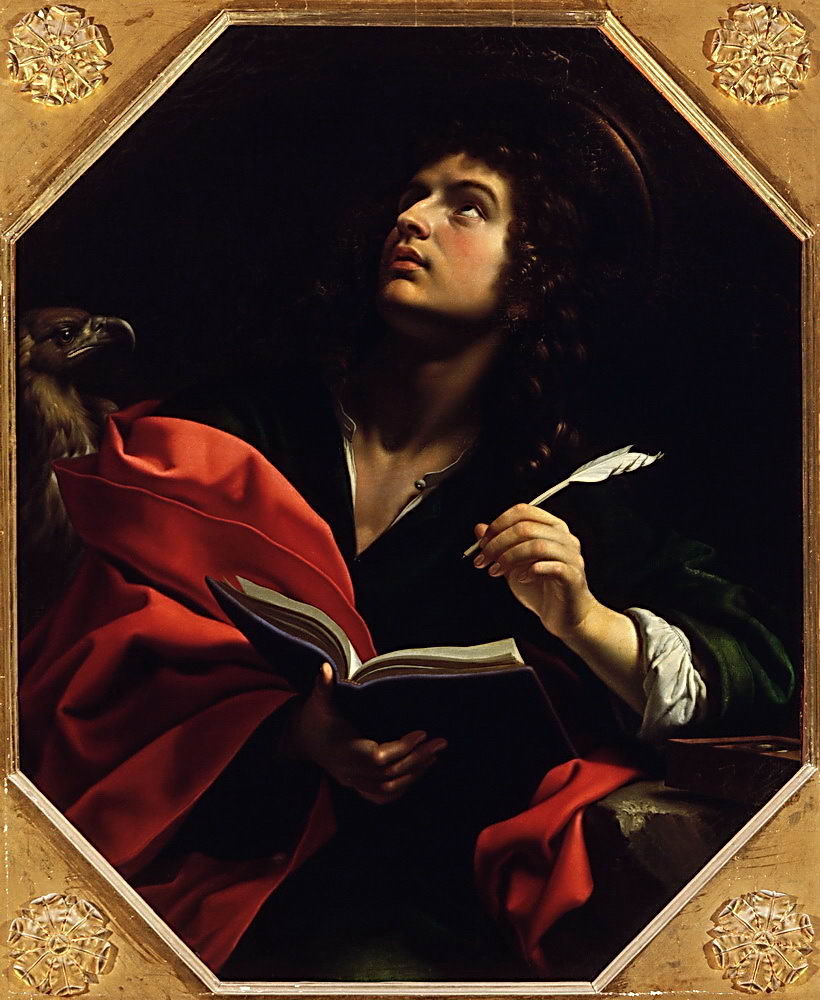
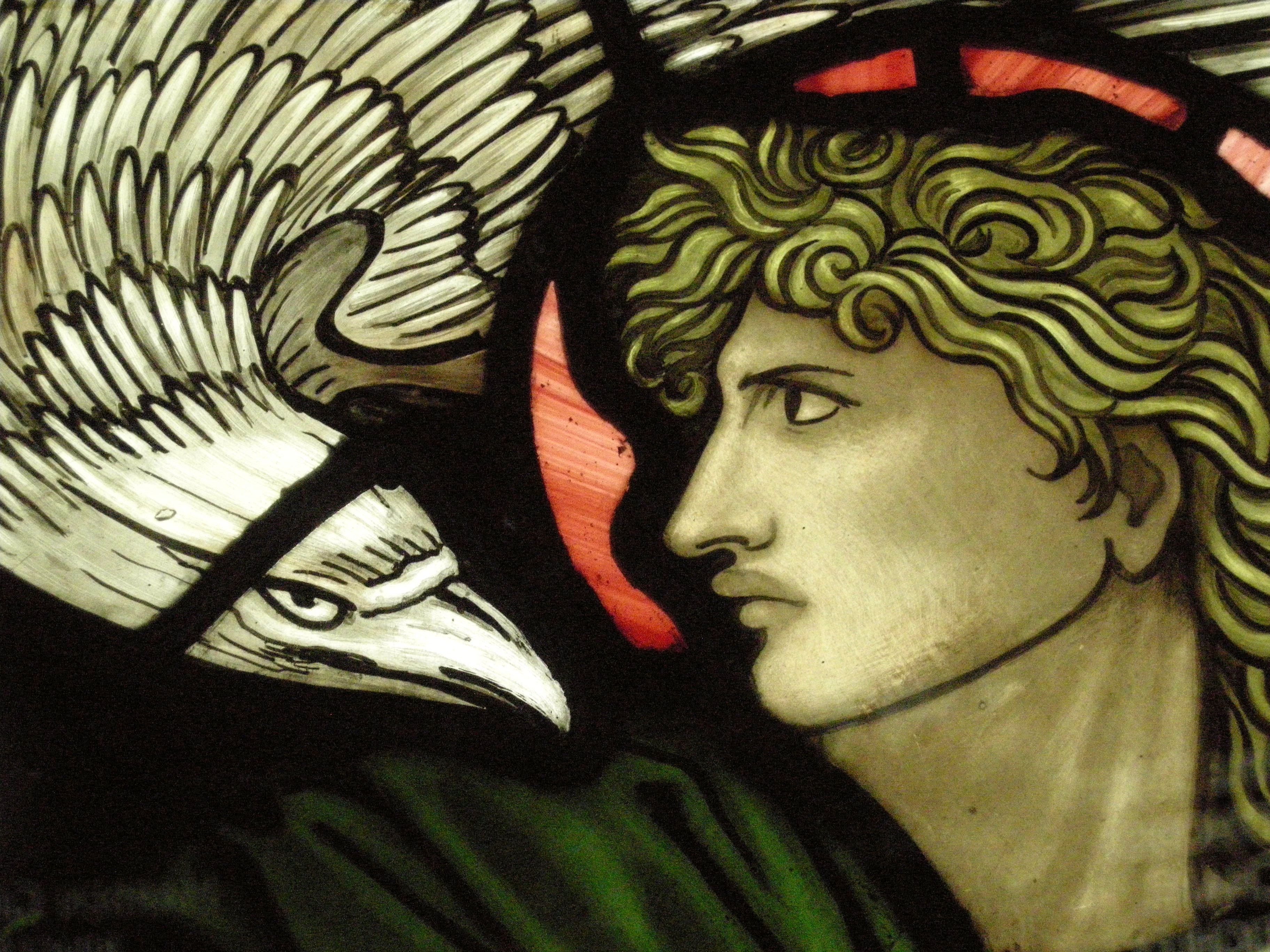
Divine wisdom wishing to make known to the world the Mystery of the Word and commit to Scripture those profound secrets which, so far, no pen of mortal had been permitted to write, the task was put upon John. Peter had been crucified, Paul had been beheaded and the rest of the Apostles had laid down their lives in testimony of the Truths they had been sent to preach to the world; John was the only one left in the Church. Heresy had already begun its blasphemies against the Apostolic Teachings; it refused to admit the Incarnate Word as the Son of God, Consubstantial to the Father. John was asked by the Churches to speak and he did so in language heavenly above measure. His Divine Master had reserved to this His Virgin-Disciple the honour of writing those sublime Mysteries which the other Apostles had been commissioned only to teach—–THE WORD WAS GOD, and this WORD WAS MADE FLESH for the salvation of mankind. Thus did our Evangelist soar, like the Eagle, up to the Divine Sun and gaze upon Him with undazzled eye, because his heart and senses were pure and therefore fitted for such vision of the uncreated Light. If Moses, after having conversed with God in the cloud, came from the Divine interview with rays of miraculous light encircling his head: how radiant must have been the face of St John, which had rested on the very Heart of Jesus, in Whom are hid all the treasures of wisdom and knowledge [Col. ii 3] how sublime his writings! how Divine his teaching! Hence the symbol of the Eagle, shown to the Prophet Ezechiel, [Ezech. i 10; x 14] and to St John himself in his Revelations, [Apoc. iv 7] has been assigned to him by the Church: and to this title of The Eagle has been added, by universal tradition, the other beautiful name of Theologian.
This was the first recompense given by Jesus to His Beloved John—–a profound penetration into Divine Mysteries. The second was the imparting to him of a most ardent charity, which was equally a grace consequent upon his angelic purity, for purity unburdens the soul from grovelling egotistic affections and raises it to a chaste and generous love. John had treasured up in his heart the Discourses of his Master: he made them known to the Church, and especially that Divine one of the Last Supper, wherein Jesus had poured forth His whole Soul to His Own, whom He had always tenderly loved but most so at the end. [1 St. John xiii 1] He wrote his Epistles and Charity is his subject: God is Charity—–he that loveth not, knoweth not God—–perfect Charity casts out fear—–and so on throughout, always on Love. During the rest of his life, even when so enfeebled by old age as not to be able to walk, he was for ever insisting upon all men loving each other, after the example of God, Who had loved them and so loved them! Thus, he that had announced more clearly than the rest of the Apostles the Divinity of the Incarnate Word, was par excellence the Apostle of that Divine Charity which Jesus came to enkindle upon the earth.
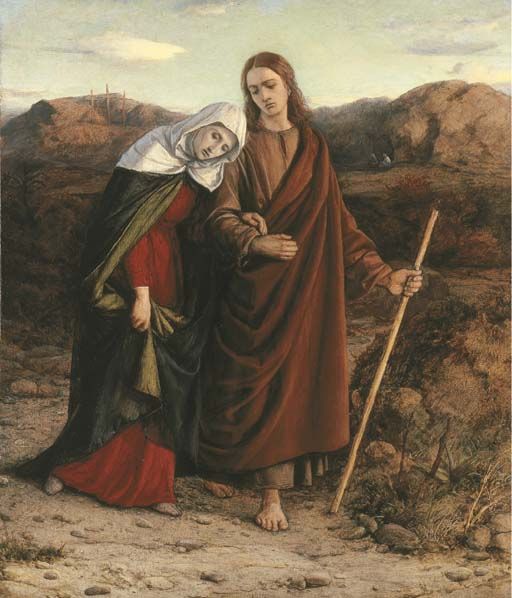
But our Lord had a further gift to bestow and it was sweetly appropriate to the Virgin-Disciple. When dying on his Cross, Jesus left Mary upon this earth. Joseph had been dead now some years. Who then shall watch over His Mother? Who is there worthy of the charge? Will Jesus send His Angels to protect and console her? For, surely, what man could ever merit to be to her as a second Joseph? Looking down, He sees the Virgin-Disciple standing at the foot of the Cross: we know the rest, John is to be Mary’s Son: Mary is to be John’s Mother. Oh! wonderful Chastity, that wins from Jesus such an inheritance as this! Peter, says St Peter Damian, shall have left to him the Church, the Mother of men; but John shall receive Mary, the Mother of God, whom he will love as his own dearest Treasur, and to whom he will stand in Jesus’ stead; whilst Mary will tenderly love John, her Jesus’ Friend, as her Son.
Can we be surprised after this, that St John is looked upon by the Church as one of her greatest glories? He is a Relative of Jesus in the flesh; he is an Apostle, a Virgin, the Friend of the Divine Spouse, the Eagle, the Theologian, the Son of Mary; he is an Evangelist, by the history he has given of the Life of his Divine Master and Friend; he is a Sacred Writer, by the three Epistles he wrote under the inspiration of the Holy Ghost; he is a Prophet, by his mysterious Apocalypse, wherein are treasured the secrets of time and eternity. But is he a Martyr? Yes, for if he did not complete his sacrifice, he drank the Chalice of Jesus, [St. Matt. xx 22] when, after being cruelly scourged, he was thrown into a caldron of boiling oil before the Latin Gate at Rome. He was therefore a Martyr in desire and intention, though not in fact. If our Lord, wishing to prolong a life so dear to the Church, as well as to show how he loves and honours Virginity, miraculously stayed the effects of the frightful punishment, St John had, on his part, unreservedly accepted Martyrdom.
Such is the companion of Stephen at the Crib, wherein lies our Infant Jesus. If the Protomartyr dazzles us with the robes he wears of the bright scarlet of his own blood; is not the virginal whiteness of John’s vestment fairer than the untrod snow? The spotless beauty of the Lilies of Mary’s adopted Son and the bright vermilion of Stephen’s Roses——what is there more lovely than their union? Glory, then, be to our New-Born King, Whose court is tapestried with such heaven-made colours as these! Yes, Bethlehem’s Stable is a very Heaven on earth and we have seen its transformation. First we saw Mary and Joseph alone there: they were adoring Jesus in His Crib; then, immediately, there descended a heavenly host of Angels singing the wonderful Hymn; the Shepherds soon followed, the humble, simple-hearted Shepherds; after these entered Stephen the Crowned and John the Beloved Disciple; and even before there enters the pageant of the devout Magi, we shall have others coming in, and there will be each day grander glory in the Cave, and gladder joy in our hearts. Oh! this birth of our Jesus! Humble as it seems, yet how Divine! What King or Emperor ever received in his gilded cradle, honours like these shown to the Babe of Bethlehem? Let us unite our homage with that given Him by these the favoured inmates of His court. Yesterday the sight of the Palm in Stephen’s hand animated us and we offered to our Jesus the promise of a stronger Faith: today the Wreath that decks the brow of the Beloved Disciple breathes upon the Church the heavenly fragrance of Virginity: an intenser love of Purity must be our resolution, and our tribute to the Lamb.
Beloved Disciple of the Babe of Bethlehem! how great is thy happiness! how wonderful is the reward given to thy love and thy purity! In thee was fulfilled that word of thy Master: Blessed are the clean of heart; for they shall see God. Not only didst thou see this God-Man: thou wast His Friend and on His Bosom didst rest thy head. John the Baptist trembles at having to bend the head of Jesus under the water of Jordan; Magdalen, though assured by his own lips that her pardon was perfect as her love, yet dares not raise her head, but keeps clinging to his feet; Thomas scarce presumes to obey Him when He bids him put his finger into His wounded Side; and thou, in the presence of all the Apostles, sittest close to Him, leaning thy head upon His Breast! Nor is it only Jesus in his Humanity that thou seest and possessest; but, because thy heart is pure, thou soarest like an eagle up to the Sun of Justice and fixest thine eye upon Him in the light inaccessible wherein He dwells eternally with the Father and the Holy Ghost.
Thus was rewarded the fidelity wherewith thou didst keep intact for Jesus the precious treasure of thy Purity. And now, O worthy favourite of the great King! forget not us poor sinners. We believe and confess the Divinity of the Incarnate Word Whom thou hast evangelised unto us; but we desire to draw nigh to Him during this holy season, now that He shows himself so desirous of our company, so humble, so full of love, so dear a Child, and so poor! Alas! our sins keep us back; our heart is not pure like thine; we have need of a Patron to introduce us to our Master’s crib. [Isa. i 3] Thou, O Beloved Disciple of Emmanuel! Thou must procure us this happiness. Thou hast shown us the Divinity of the Word in the bosom of the Eternal Father; lead us now to this same Word made flesh. Under thy patronage Jesus will permit us to enter into the Stable, to stand near His Crib, to see with our eyes and touch with our hands [1 St. John i 1] this sweet Fruit of eternal Life. May it be granted us to contemplate the sweet Face of Him that is our Saviour and thy Friend; to feel the throbs of that Heart which loves both thee and us, which thou didst see wounded by the Spear, on Calvary. It is good for us to fix ourselves here near the Crib of our Jesus and share in the graces He there lavishes and learn, as thou didst, the grand lesson of this Child’s simplicity: thy prayers must procure all this for us.
Then too, as Son and Guardian of Mary, thou hast to present us to thine own and our Mother. Ask her to give us somewhat of the tender love wherewith she watches over the Crib of her Divine Son; to see in us the Brothers of that Child she bore; and to admit us to a share of the maternal affection she had for thee, the favoured confidant of the secrets of her Jesus.
We also pray to thee, O holy Apostle! for the Church of God. She was planted and watered by thy labours, embalmed with the celestial fragrance of thy virtues and illumined by thy sublime teachings; pray now that these graces may bring forth their fruit, and that to the end of her pilgrimage faith may be firm, the love of Jesus fervent, and Christian morals pure and holy. Thou has told us in thy Gospel of a saying of thy Divine Master: I will not now call you my Servants but my Friends: [St. John xv 15] pray, dear Saint, that there may come to this, from our hearts and lips, a response of love and courage, telling our Emmanuel that, like thyself, we will follow Him whithersoever He leads us.
Let us, on this second day after our Divine Infant’s Birth, meditate upon the Sleep He deigns to take. Let us consider how this God of all goodness, Who has come down from Heaven to invite His creature man to come to Him and seek rest for his soul, seeks rest Himself in our earthly home and sanctifies by His Own Divine sleep that rest which to us is a necessity. We have just been dwelling with delighted devotion on the thought of His offering His Breast as a resting-place for the Beloved Disciple and for all souls that imitate John in his love and devotedness: now let us look at this our God, sweetly sleeping in His humble Crib, or on His Mother’s lap.
One Minute Reflection – 27 December – the Feast of St John the Apostle and Evangelist “The Disciple whom Jesus Loved” and the 3rd Octave Day
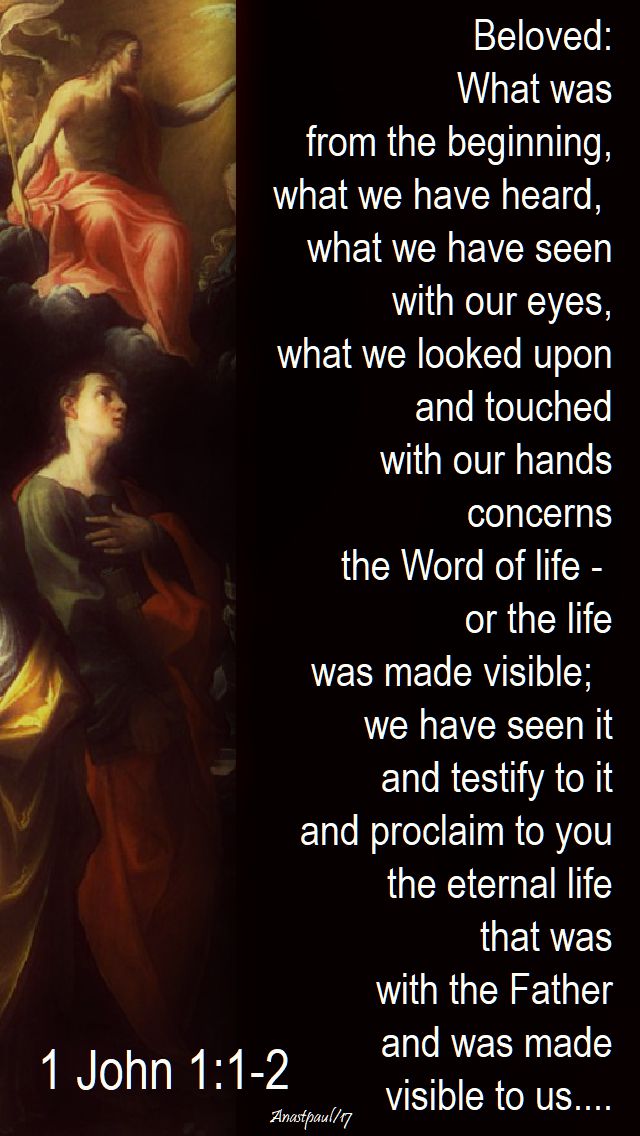
Beloved: What was from the beginning, what we have heard, what we have seen with our eyes, what we looked upon and touched with our hands concerns the Word of life (for the life was made visible; we have seen it and testify to it and proclaim to you the eternal life that was with the Father and was made visible to us.…1 John 1:1-2
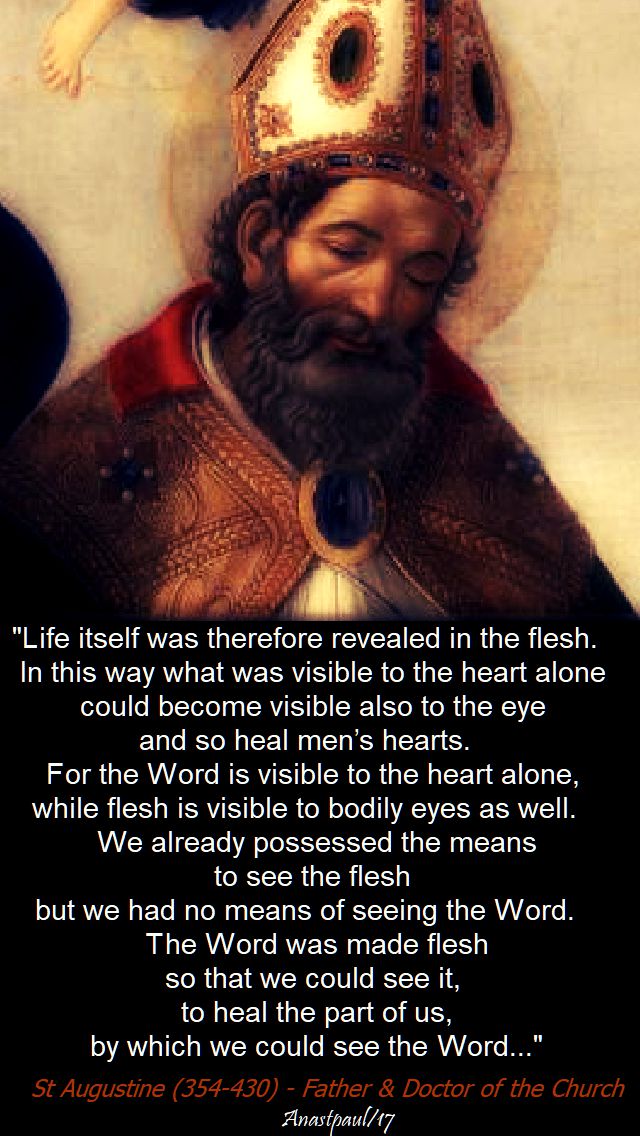
REFLECTION – “Life itself was therefore revealed in the flesh. In this way what was visible to the heart alone could become visible also to the eye and so heal men’s hearts. For the Word is visible to the heart alone, while flesh is visible to bodily eyes as well. We already possessed the means to see the flesh but we had no means of seeing the Word. The Word was made flesh so that we could see it, to heal the part of us, by which we could see the Word…”…St Augustine (354-430) – Father & Doctor of the Church
PRAYER – Almighty God, who through Your Apostle John, unlocked for us the hidden treasures of Your Word, grant that we may grasp with fuller understanding, the message he so admirably proclaimed. Through our Lord Jesus Christ, in union with the Holy Spirit, one God forever and ever, amen.
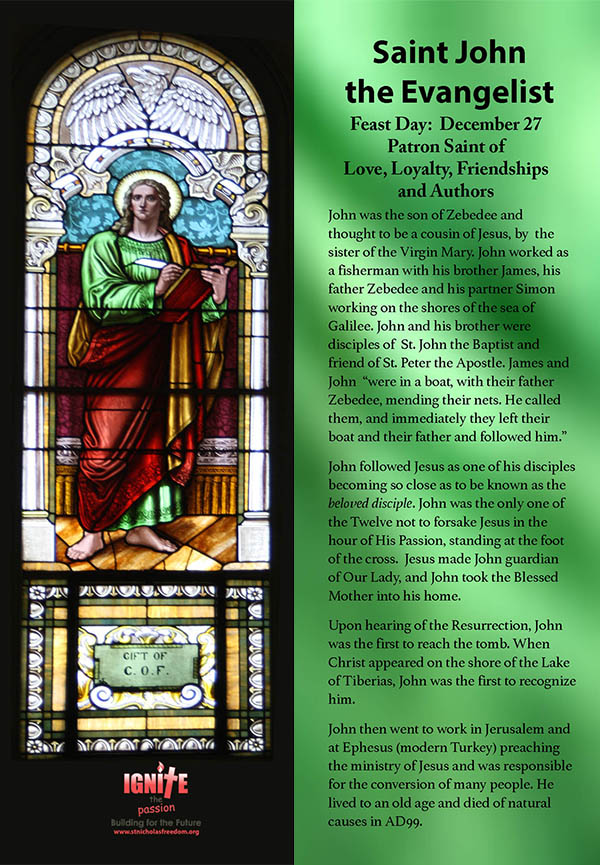
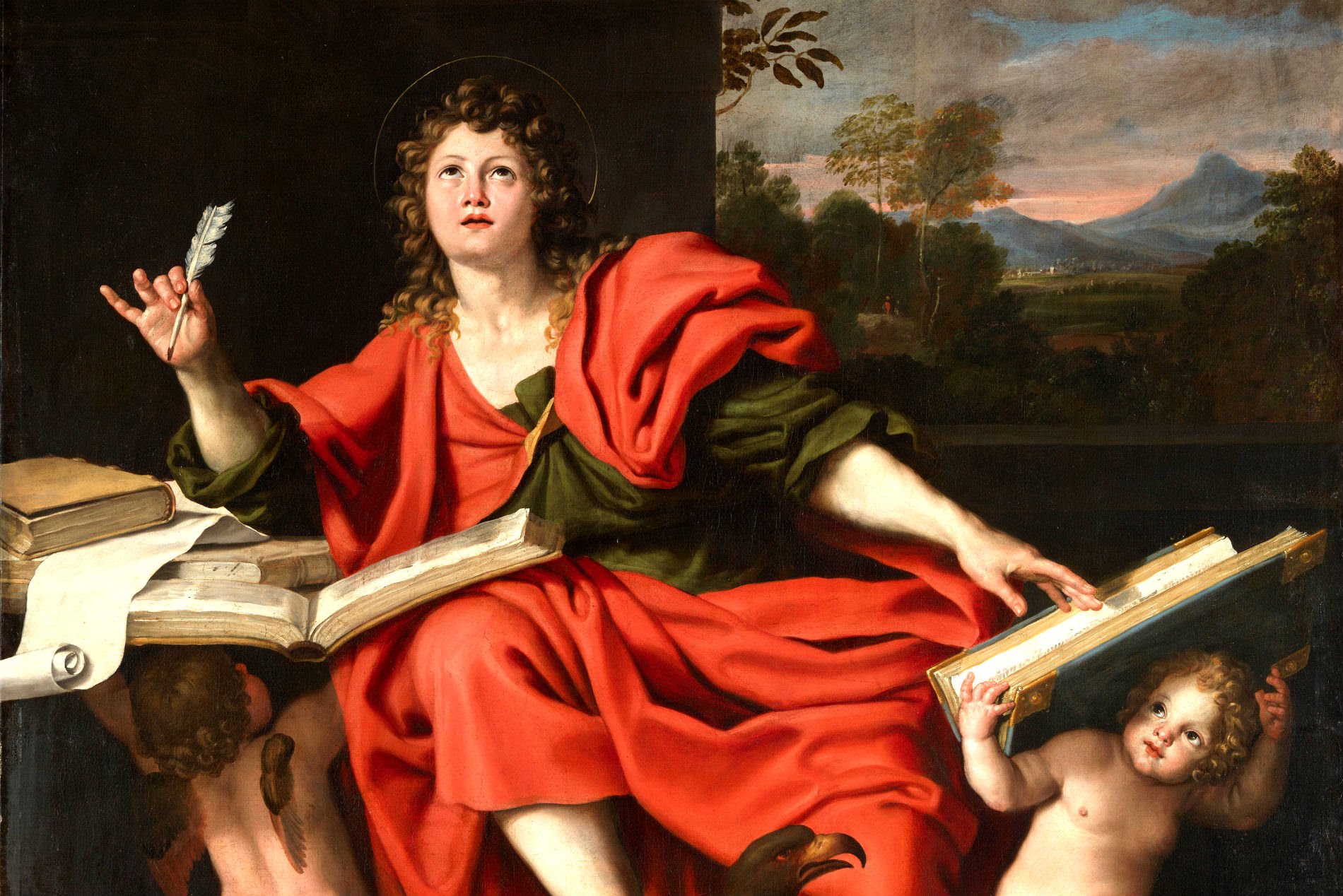
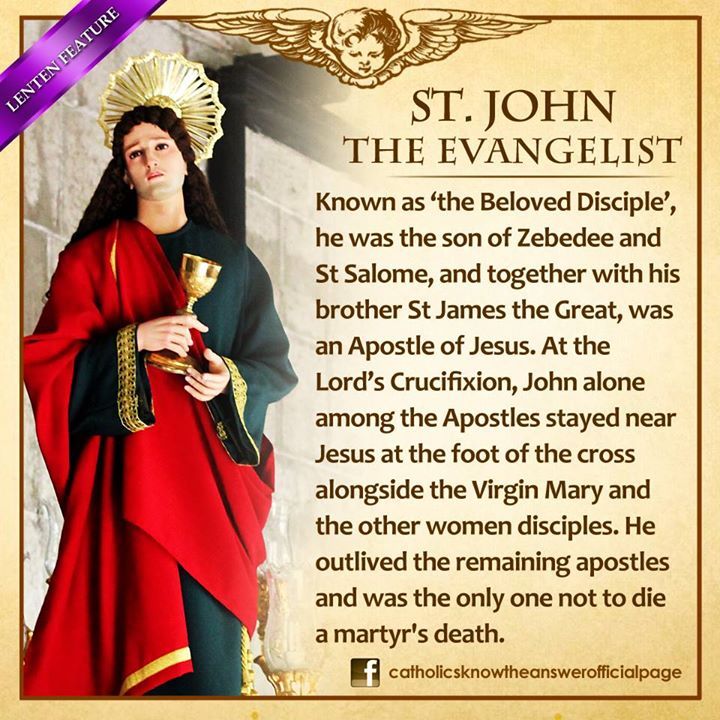
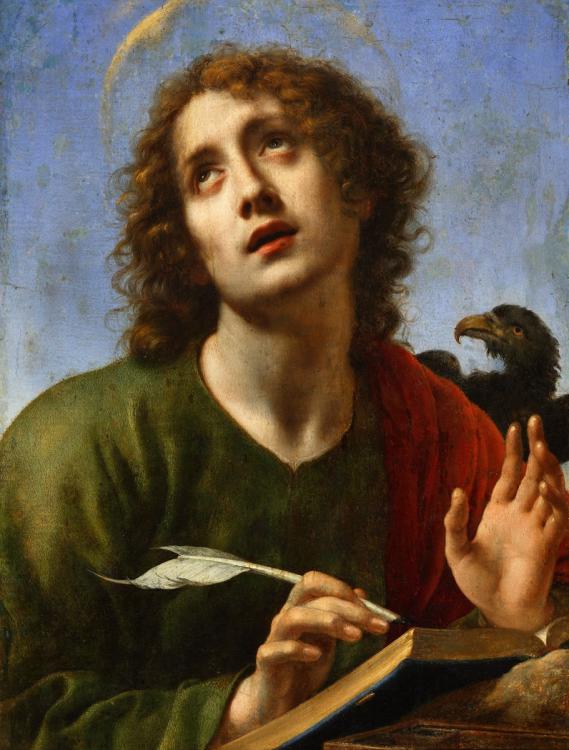
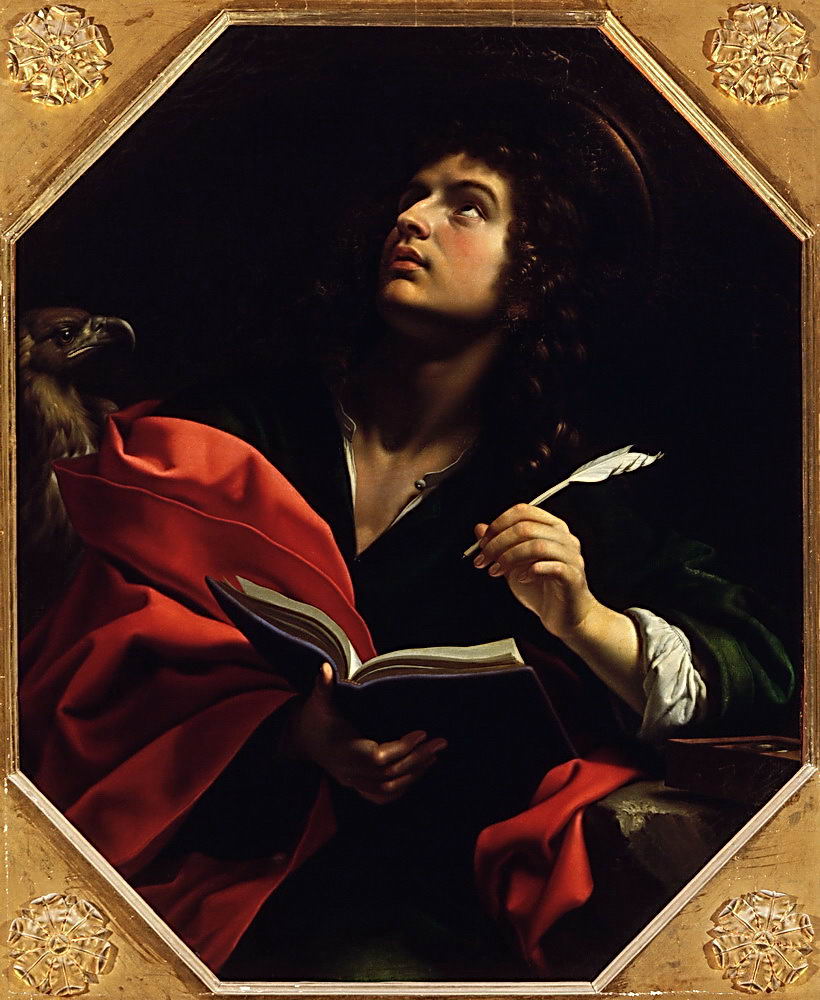
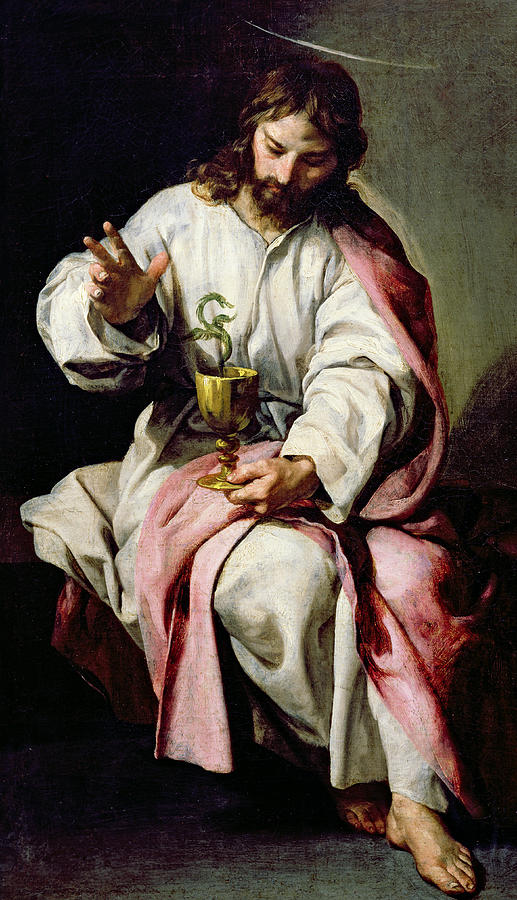
Saint of the Day – 27 December – St John the Apostle and Evangelist – “The Disciple whom Jesus Loved” – (died c 101) Also known as • The Apostle of Charity • The Beloved Apostle • Giovanni Evangelista • John the Divine • John the Evangelist • John the Theologian. Patronages – • against burns; burn victims• against epilepsy• against foot problems• against hailstorms• against poisoning• art dealers• authors, writers• basket makers• bookbinders• booksellers• butchers• compositors• editors• engravers• friendships• glaziers• government officials• harvests• lithographers• notaries• painters• papermakers• publishers• saddle makers• scholars• sculptors• tanners• theologians• typesetters• vintners• Asia Minor (proclaimed on 26 October 1914 by Pope Benedict XV)• 6 Diocese• 7 Cities, Attributes – • book• cauldron• chalice• chalice with a serpent in allusion to the cup of sorrow foretold by Jesus• eagle, representing his role as the evangelist who most concentrated on Jesus’s divine nature• serpent. The author of five books of the Bible (the Gospel of John, the First, Second, and Third Letters of John and Revelation), Saint John the Apostle was one of earliest disciples of Christ. Commonly called Saint John the Evangelist because of his authorship of the fourth and final gospel, he is one of the most frequently mentioned disciples in the New Testament, rivaling Saint Peter for his prominence in the Gospels and the Acts of the Apostles. Yet outside of the Book of Revelation, John preferred to refer to himself, not by name but as “the disciple whom Jesus loved.” He was the only one of the Apostles to die, not of martyrdom but of old age, around the year 101.
St John the Evangelist was a Galilean and the son, along with Saint James the Greater, of Zebedee and Salome. Because he is usually placed after St James in the lists of the apostles (see Matthew 10:3, Mark 3:17 and Luke 6:14), John is generally considered the younger brother, perhaps as young as 17-18 at the time of Christ’s death.
With St James, he is always listed among the first four apostles (see Acts 1:13), reflecting not only his early calling (he is the other disciple of St John the Baptist, along with St Andrew, who follows Christ in John 1:34-40) but his honoured place among the disciples. (In Matthew 4:18-22 and Mark 1:16-20, James and John are called immediately after the fellow fishermen Peter and Andrew.)
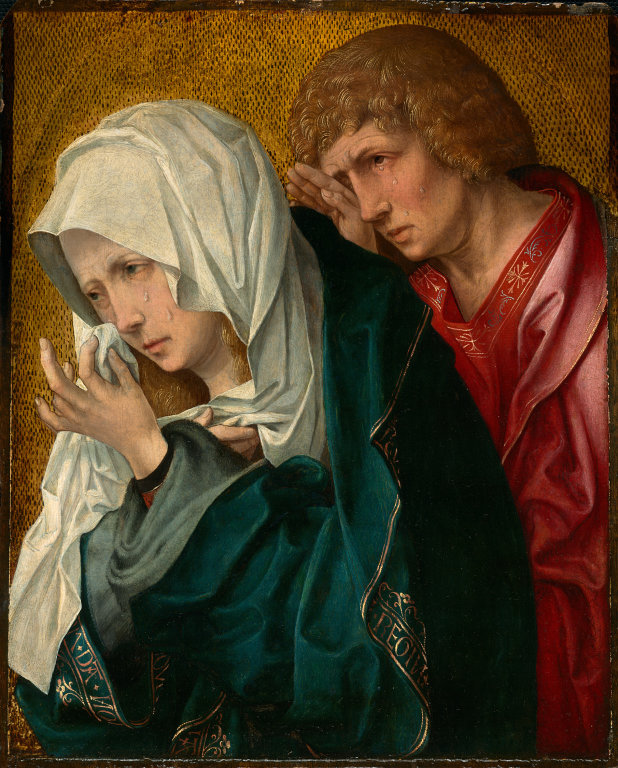
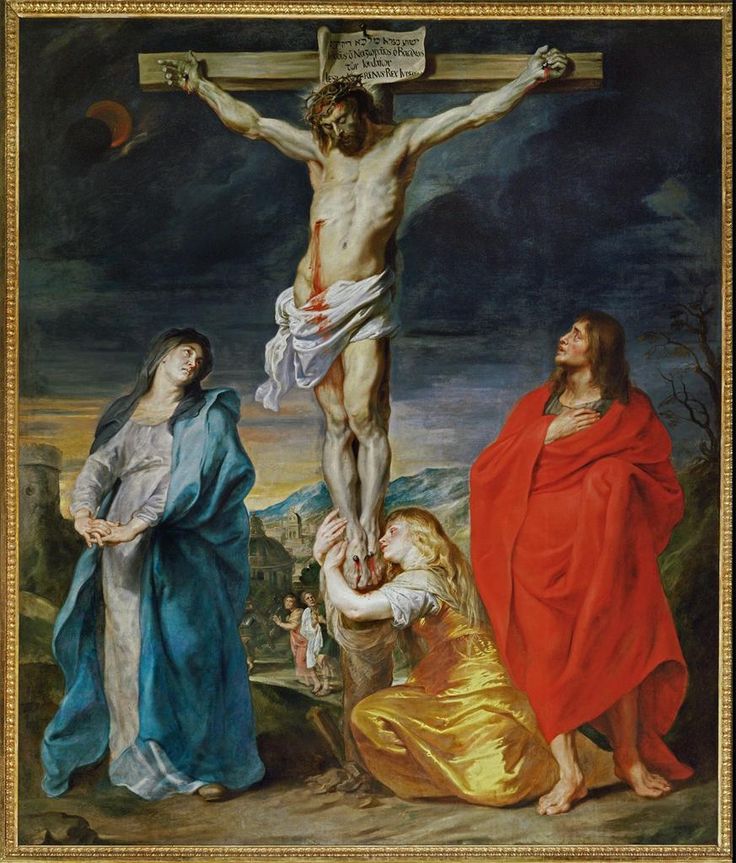
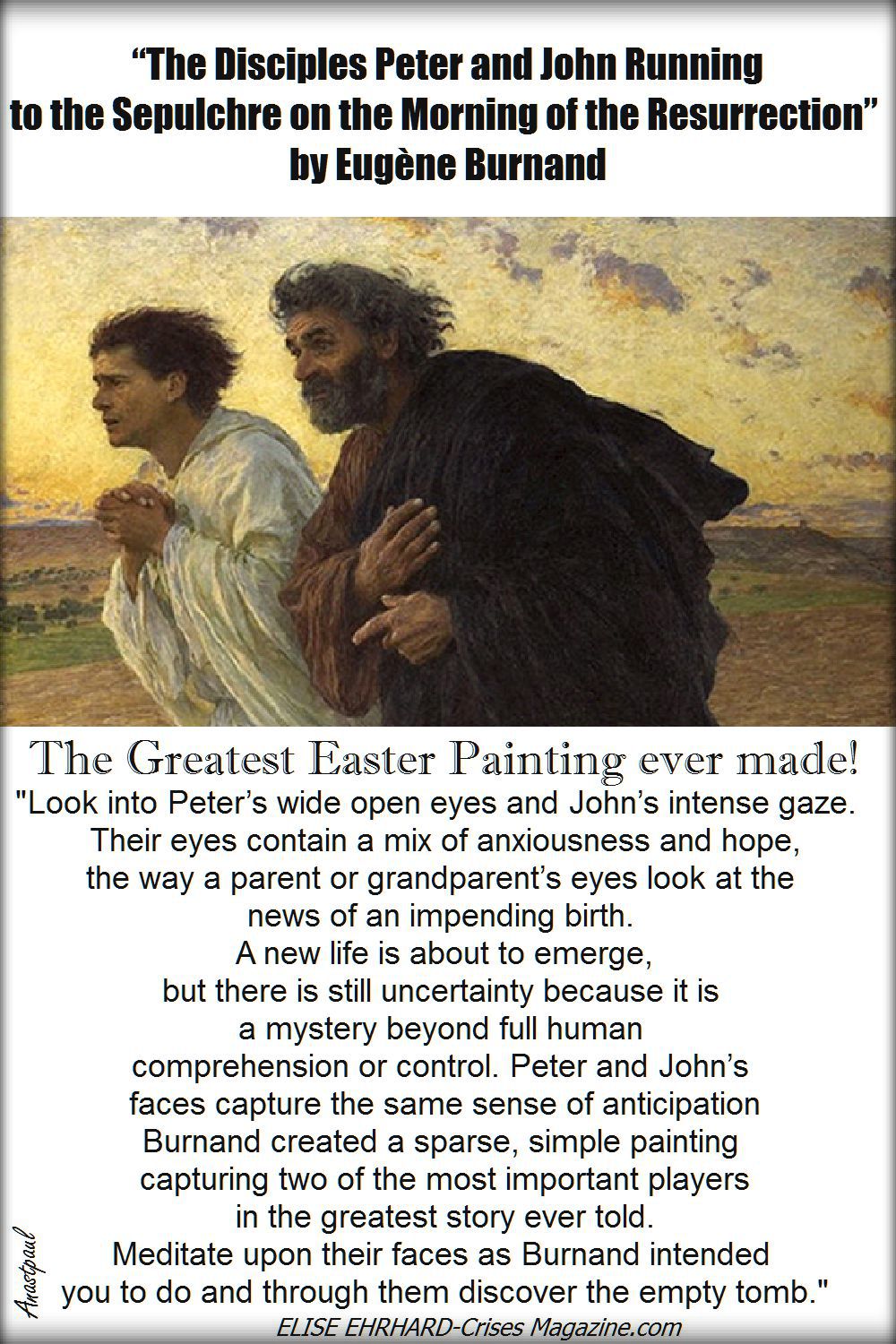
Like Peter and James the Greater, John was a witness to the Transfiguration (Matthew 17:1 ) and the Agony in the Garden (Matthew 26:37). His closeness to Christ is apparent in the accounts of the Last Supper (John 13:23), at which he leaned on Christ’s breast while eating and the Crucifixion (John 19:25-27), where he was the only one of Christ’s disciples present. Christ, seeing St John at the foot of the Cross with His mother, entrusted Mary to his care. He was the first of the disciples to arrive at the tomb of Christ on Easter, having outraced Saint Peter (John 20:4) and while he waited for Peter to enter the tomb first, St John was the first to believe that Christ had risen from the dead (John 20:8).
As one of the two initial witnesses to the Resurrection, St John naturally took a place of prominence in the early Church, as the Acts of the Apostles attest (see Acts 3:1, Acts 4:3, and Acts 8:14, in which he appears alongside St Peter himself.) When the apostles dispersed following the persecution of Herod Agrippa (Acts 12), during which John’s brother James became the first of the apostles to win the crown of martyrdom (Acts 12:2), tradition holds that John went to Asia Minor, where he likely played a role in founding the Church at Ephesus.
Exiled to Patmos during the persecution of Domitian, he returned to Ephesus during Trajan’s reign and died there.
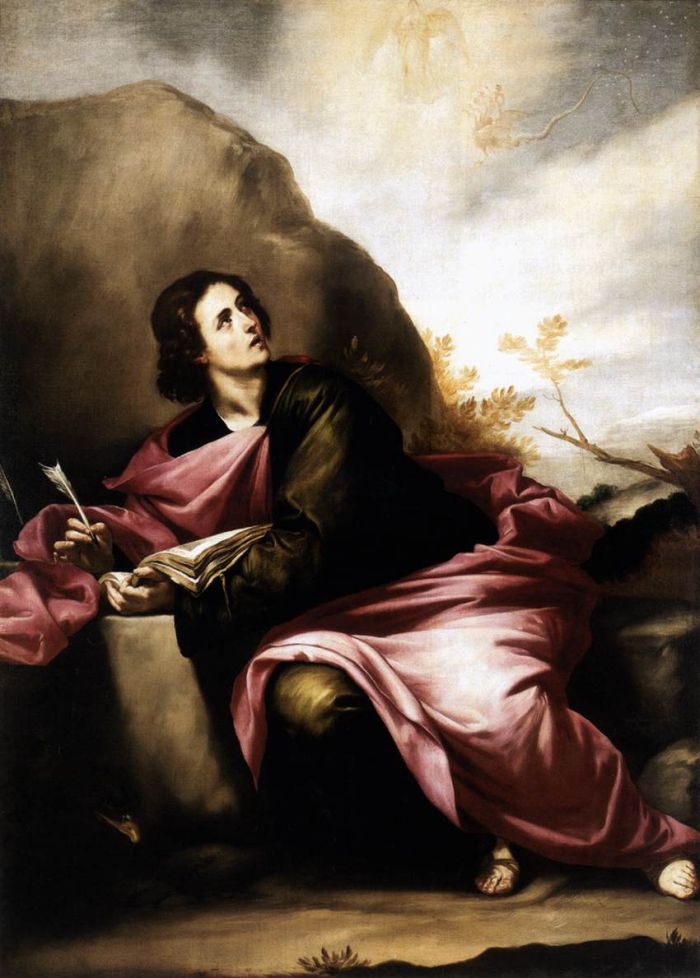
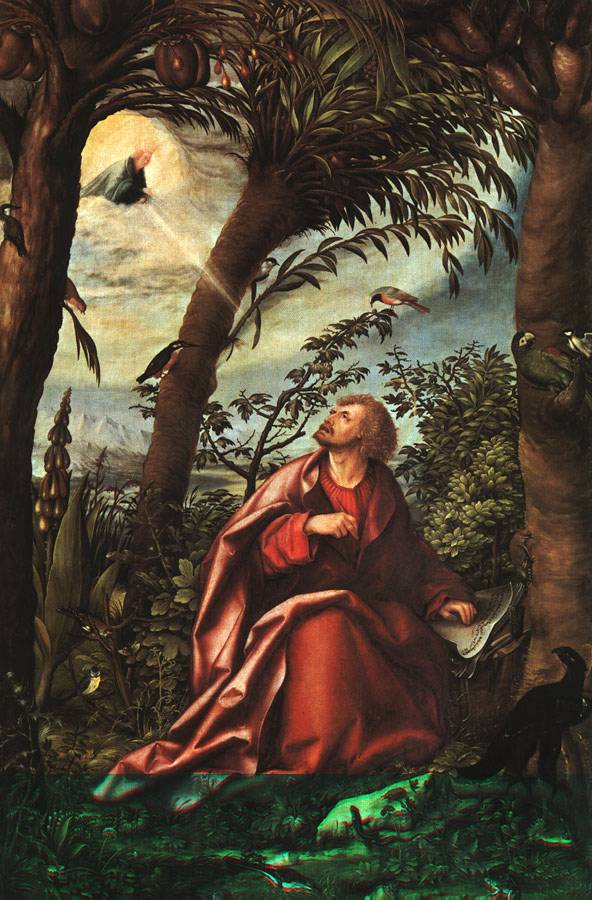
While on Patmos, John received the great revelation that forms the Book of Revelation and likely completed his gospel (which may, however, have existed in an earlier form a few decades before).
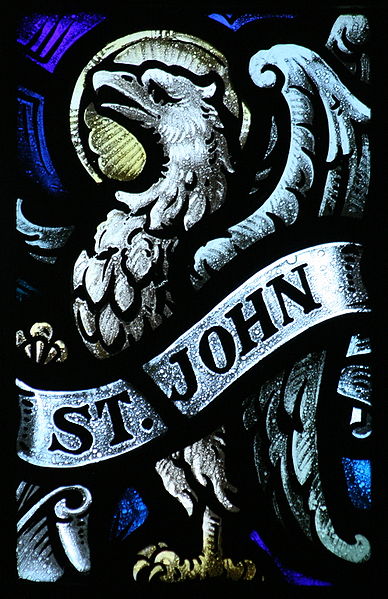
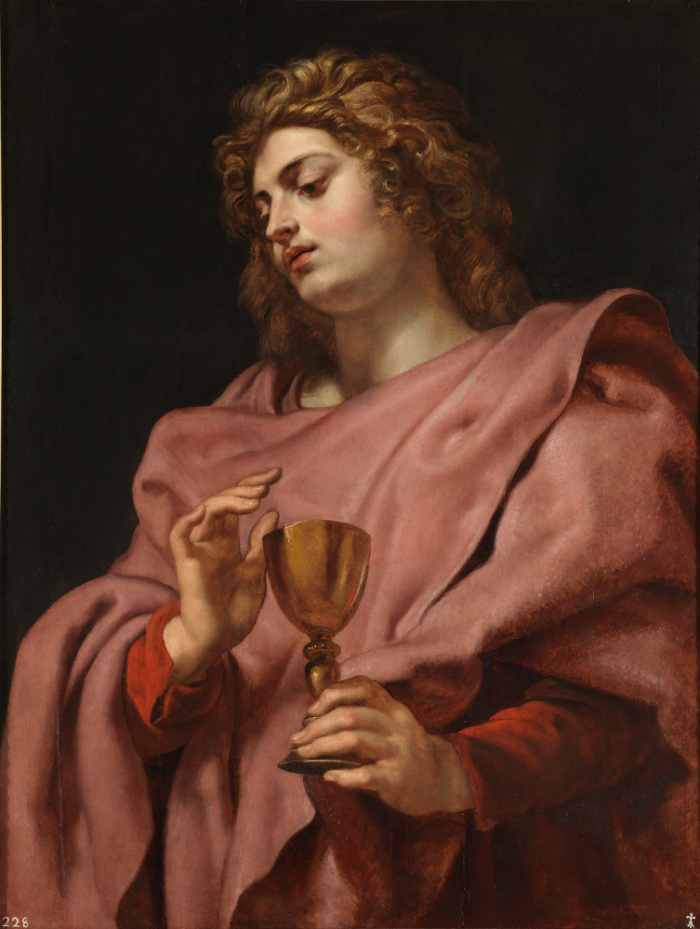
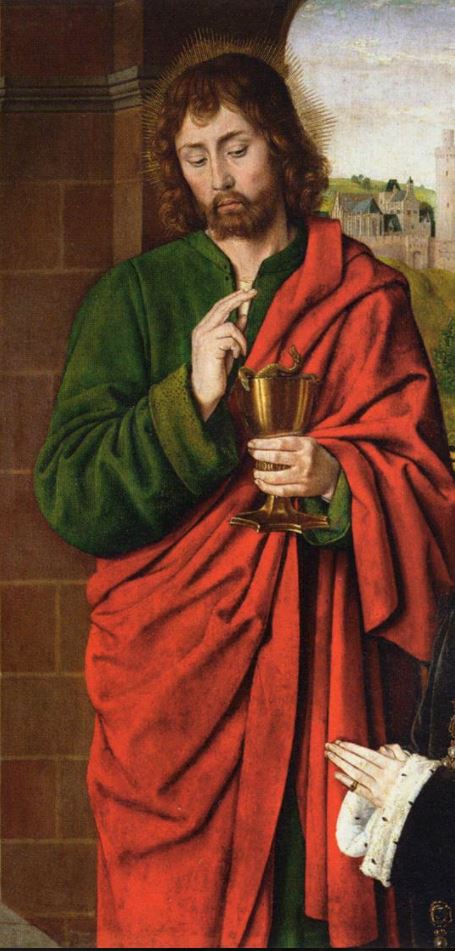
Traditional iconography has represented St John as an eagle, symbolising “the heights to which he rises in the first chapter of his Gospel.” Like the other Evangelists, he is sometimes symbolised by a book and a later tradition used the chalice as a symbol of St John, recalling Christ’s words to John and James the Greater, in Matthew 20:23, “My chalice indeed you shall drink.”
A MARTYR WHO DIED A NATURAL DEATH Christ’s reference to the chalice inevitably calls to mind His own Agony in the Garden, where He prays, “My Father, if this chalice may not pass away but I must drink it, thy will be done” (Matthew 26;42). It thus seems a symbol of martyrdom and yet John, alone among the apostles, died a natural death. Still, he has been honoured as a martyr from the earliest days after his death, because of an incident related by Tertullian, in which John, while in Rome, was placed in a pot of boiling oil but emerged unharmed.
St John the Apostle (Feast) – https://www.youtube.com/watch?v=xfyr98NgRrQ
Bl Adelheidis of Tennenbach
Bl Alejo Pan López
Bl Alfredo Parte-Saiz
Bl Christina Ebner
St Fabiola of Rome
Bl Francesco Spoto
Bl Hesso of Beinwil
St José María Corbin-Ferrer
St Maximus of Alexandria
St Nicarete of Constantinople
Bl Odoardo Focherini
Bl Raymond de Barellis
Bl Roger of Verdun
Bl Sára Schalkház
St Theodore of Apamea
St Theophanes of Nicaea
Bl Walto of Wessobrünn
Thought for the Day – 26 December – The Memorial of St Stephen the First Martyr and the Second Day in the Octave of Christmas
Today the Church remembers the witness of Saint Stephen, the first of the Church’s martyrs. The cruelty of his death is recorded in the Acts of the Apostles, as is the manner in which he died, transforming the violence that took his life into an occasion to give witness to an authority greater than those fallen powers who would rule us by fear and threats.
That the Church remembers Saint Stephen today is no accident. Strip away the sentimentality that obscures the story of Christ’s Nativity and one realises that Christ came into this world and from the first instant He showed His infant face, He was opposed. Recall yesterday’s excerpt from the magnificent prologue to the Gospel of John which testifies that Christ came to His own (us) and His own (again, that means us) “knew him not.” But worse than this- we refused Him.
And many still do.
The Holy Child came ready for this fight and the world was willing to fight Him. However, the world discovered that it was outmatched and the fallen powers of this world turned against those whom the Holy Child loves. Unable to harm the Body of His human nature any longer, the world strikes at His Body, the Church.
Therefore, when the Church remembers its martyrs, like Saint Stephen, it is not merely out of a concern that the faithful become conversant in the details of Church history. Instead it is to keep us honest- not only about the past but also about the present. It has never been easy to be a Christian and being a Christian has always been counter-cultural. If lived authentically, it is lived in defiance against the fallen powers of the world.
This means that like our Saviour we have to be ready. We have to learn the strategy that He used to defeat the fallen powers of this world and how He claimed victory when it seemed that these fallen powers could not be defeated. We must learn His strategy- enacted in the witness of Saint Stephen and all the Church’s martyrs, past and present- lest in our opposition to the powers of this world, we become just like them. (Fr Steve Grunow)
Grant, Lord we pray,
that we may imitate what we worship,
and so learn to love even our enemies,
for we celebrate the heavenly birthday
of Saint Stephen, who knew how to pray for his persecutors.
Through our Lord Jesus Christ your Son,
who lives and reigns with you in the unity of the Holy Spirit,
one God, for ever and ever.
Amen.
Quote/s of the Day – 26 December – The Memorial of St Stephen the First Martyr and the Second Day in the Octave of Christmas
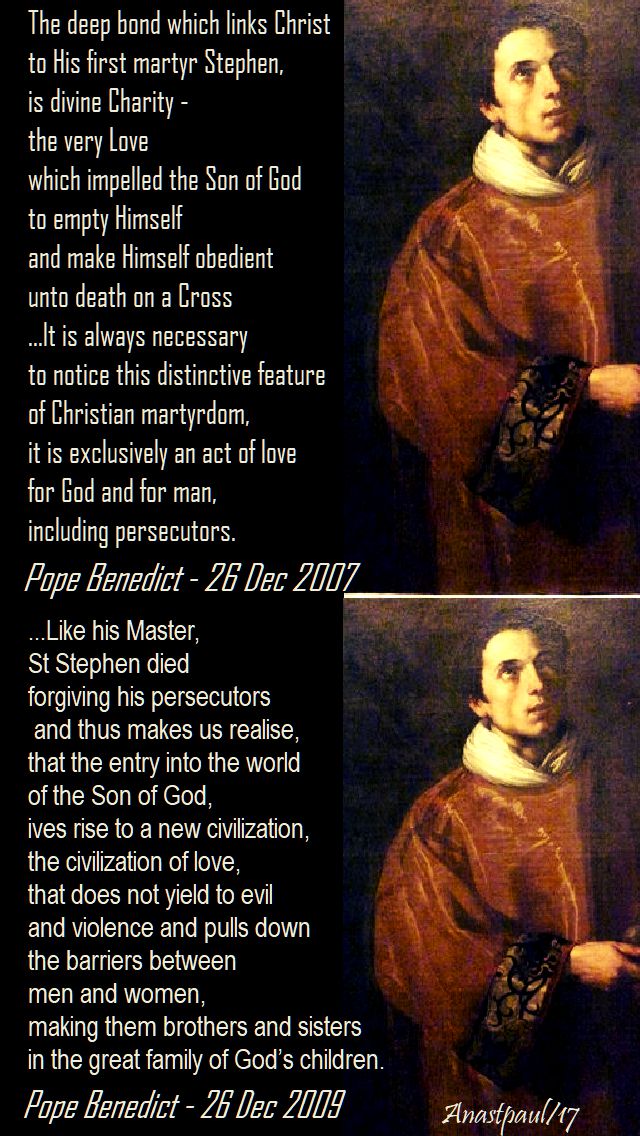
“The deep bond which links Christ to His first martyr Stephen, is divine Charity – the very Love which impelled the Son of God to empty Himself and make Himself obedient unto death on a Cross …It is always necessary to notice this distinctive feature of Christian martyrdom, it is exclusively an act of love for God and for man, including persecutors.”
Pope Benedict XVI – 26 December 2007
” …Like his Master, St Stephen died forgiving his persecutors and thus makes us realise that the entry into the world of the Son of God gives rise to a new civilisation, the civilisation of love that does not yield to evil and violence and pulls down the barriers between men and women, making them brothers and sisters in the great family of God’s children.”
One Minute Reflection – 26 December – The Memorial of St Stephen the First Martyr and the Second Day in the Octave of Christmas
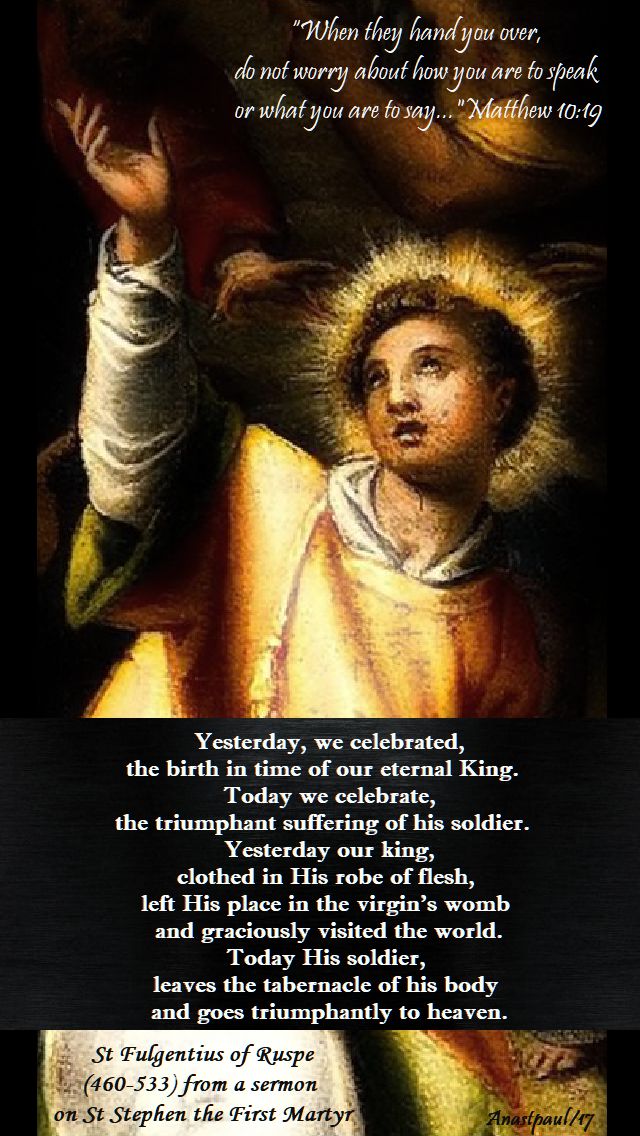
“When they hand you over, do not worry about how you are to speak or what you are to say; for what you to say will be given to you in that hour; for it not you who speak, but the Spirit of your father speaking through you.” …Matthew 10:19-20
REFLECTION – “Yesterday, we celebrated, the birth in time of our eternal King. Today, we celebrate the triumphant suffering, of his soldier. Yesterday our king, clothed in His robe of flesh, left His place in the virgin’s womb and graciously visited the world. Today His soldier, leaves the tabernacle of his body and goes triumphantly to heaven.”…from a sermon by Saint Fulgentius of Ruspe (460-533)
PRAYER – O God, the teacher and ruler of all that minister unto Thee, who did adorn the first beginnings of thy Church both with the ministrations of Thy blessed Deacon Stephen and with the precious blood of his martyrdom: grant, we beseech Thee, that we, in the hour of our departure, obtaining Thy pardon, may be followers of his example and assisted by his prayers. Amen. – Milanese Sacramentary
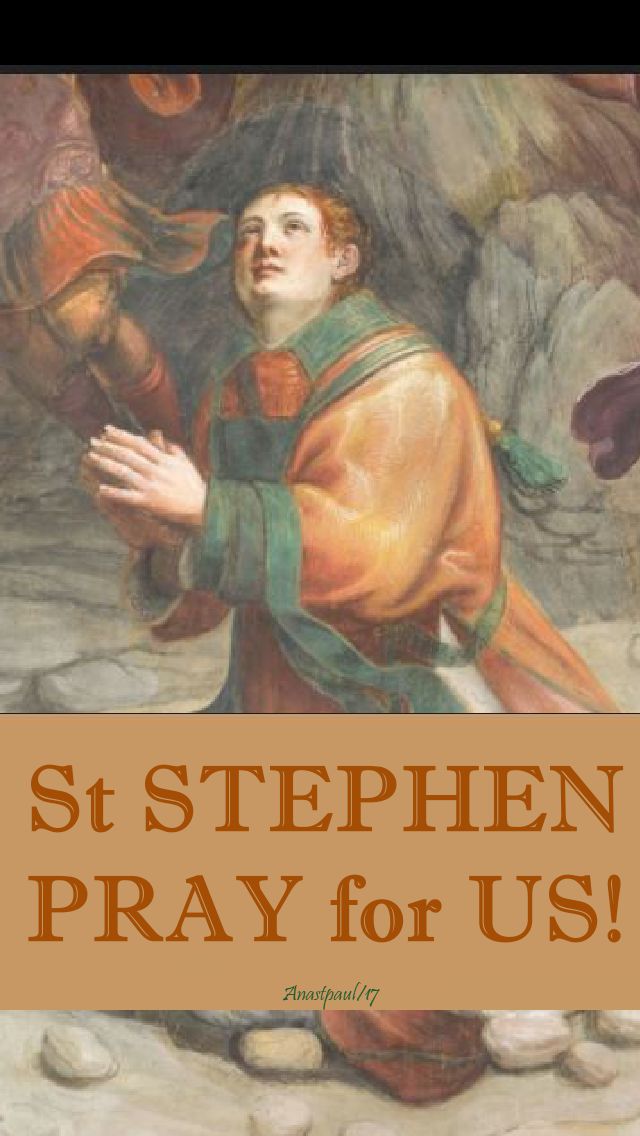
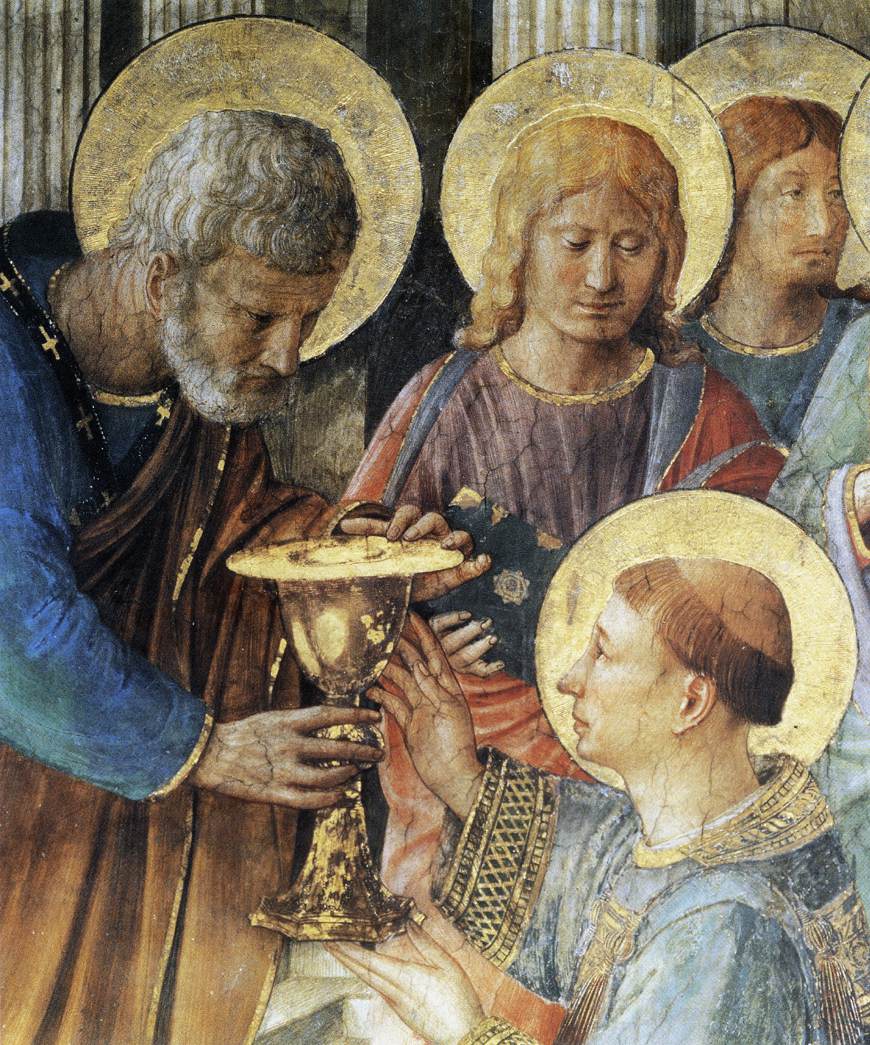
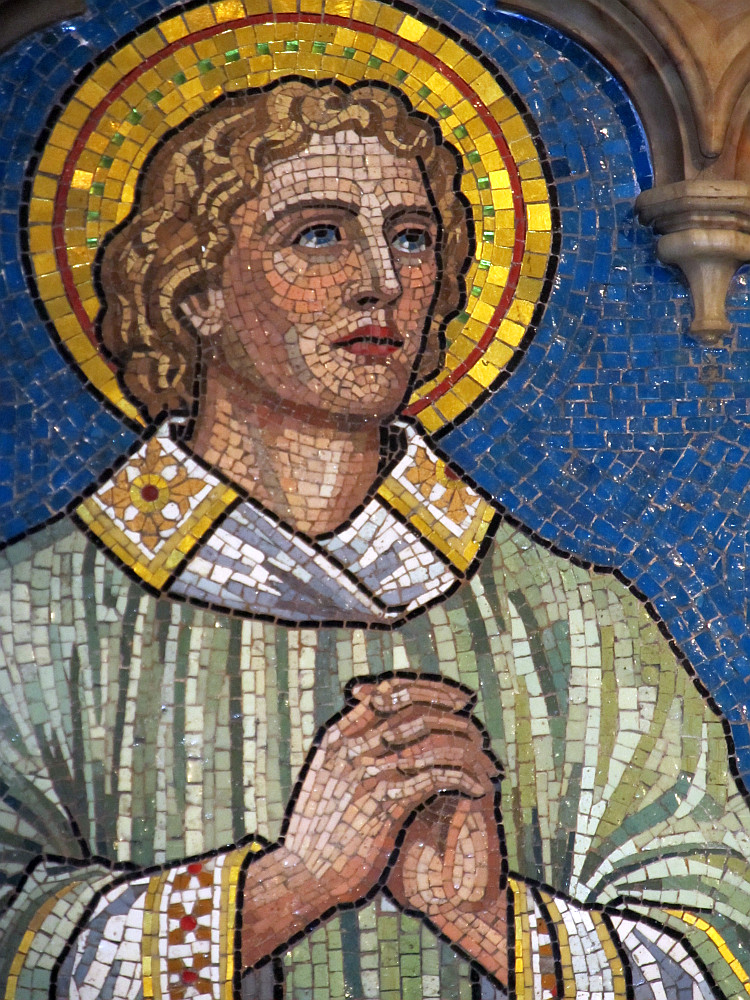
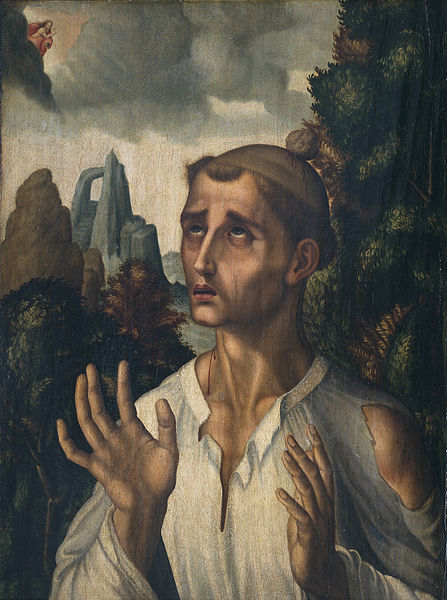
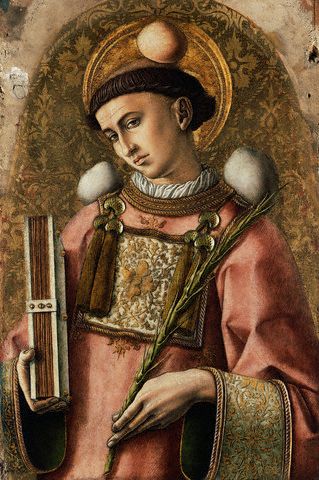
Saint of the Day – St Stephen, The First Martyr (c 05-c 34) – 26 December – Deacon, Preacher. the name “Stephen” – Stéphanos, meaning “wreath, crown” and by extension “reward, honour,” often given as a title rather than as a name. Patronages – against headaches, of brick layers, casket makers, coffin makers, deacons, altar servers, horses, masons, stone masons, Metz, France, Diocese of• Owensboro, Kentucky, Archdiocese of Toulouse, France, 92 cities. Attributes – stones, dalmatic, censer, miniature church, Gospel Book, martyr’s palm frond.
St Stephen – Fra Angelico
St Stephen was according to the Acts of the Apostles a deacon in the early church at Jerusalem who aroused the enmity of members of various synagogues by his teachings. Accused of blasphemy, at his trial he made a long speech denouncing the Jewish authorities who were sitting in judgement against him and was then stoned to death. His martyrdom was witnessed by Saul of Tarsus, a Pharisee who would later himself become a follower of Jesus and known as Paul the Apostle.
The only primary source for information about Stephen is the New Testament book of the Acts of the Apostles. Stephen is mentioned in Acts 6 as one of the Greek-speaking Hellenistic Jews selected to participate as a deacon in the early Church by the eleven – before the twelfth was elected.
“Good King Wenceslaus went out, on the Feast of Stephen”. This is the Feast of St Stephen, the day after Christmas, when we commemorate the first disciple to die for Jesus.
Carlo Crivelli
In the Acts of the Apostles, St Luke praises St Stephen as “a man full of faith and the Holy Spirit,” who “did great wonders and signs among the people” during the earliest days of the Church. Luke’s history of the period also includes the moving scene of Stephen’s death – witnessed by St Paul before his conversion – at the hands of those who refused to accept Jesus as the Jewish Messiah. Stephen himself was a Jew who most likely came to believe in Jesus during the Lord’s ministry on earth. He may have been among the 70 disciples whom Christ sent out as missionaries, who preached the coming of God’s kingdom while travelling with almost no possessions. This spirit of detachment from material things continued in the early Church, in which St Luke says believers “had all things in common” and “would sell their possessions and goods and distribute the proceeds to all, as any had need.” But such radical charity ran up against the cultural conflict between Jews and Gentiles, when a group of Greek widows felt neglected in their needs as compared to those of a Jewish background.
Stephen’s reputation for holiness led the Apostles to choose him, along with six other men, to assist them in an official and unique way as this dispute arose. Through the sacramental power given to them by Christ, the Apostles ordained the seven men as deacons and set them to work helping the widows.
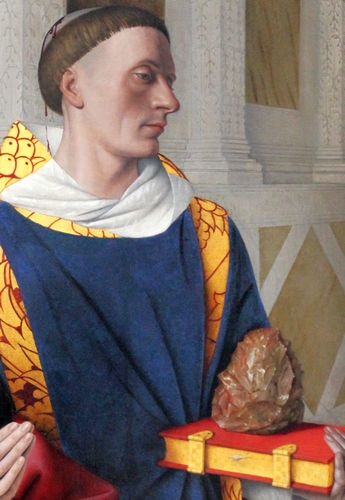
Jean Fouquet Etienne Chevalier with St Stephen (detail of Stephen)
As a deacon, Stephen also preached about Christ as the fulfillment of the Old Testament law and prophets. Unable to refute his message, some members of local synagogues brought him before their religious authorities, charging him with seeking to destroy their traditions. Stephen responded with a discourse recorded in the seventh chapter of the Acts of the Apostles. He described Israel’s resistance to God’s grace in the past and accused the present religious authorities of “opposing the Holy Spirit” and rejecting the Messiah.
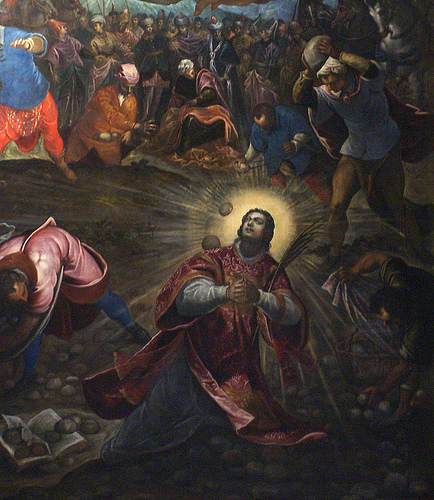
Before he was put to death, Stephen had a vision of Christ in glory. “Look,” he told the court, “I see the heavens opened and the Son of Man standing at the right hand of God!”
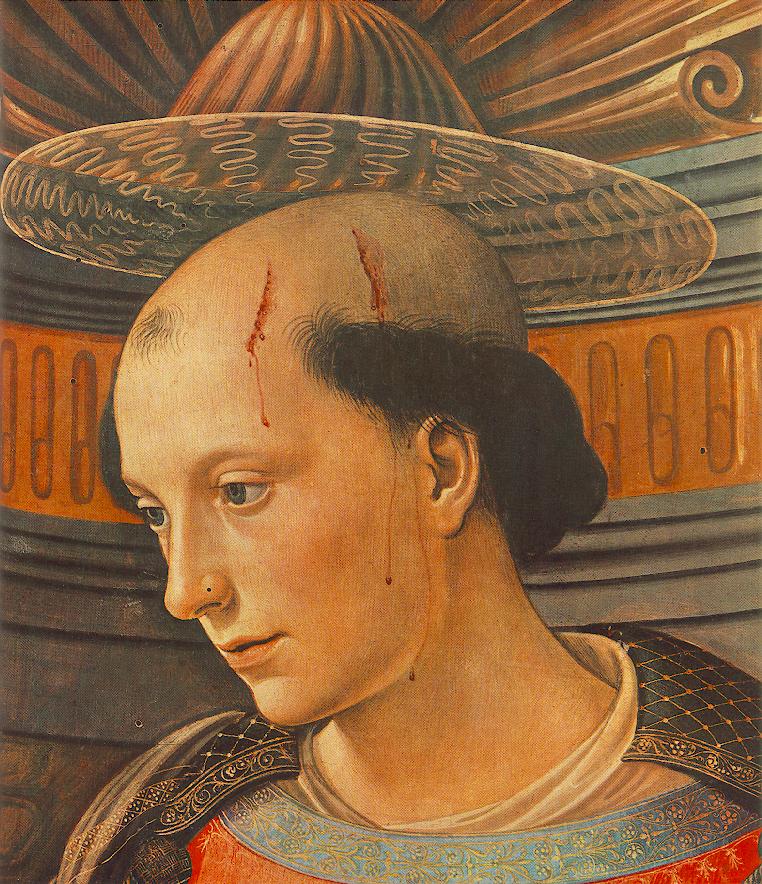
St Stephen – Domenico Ghirlandaio
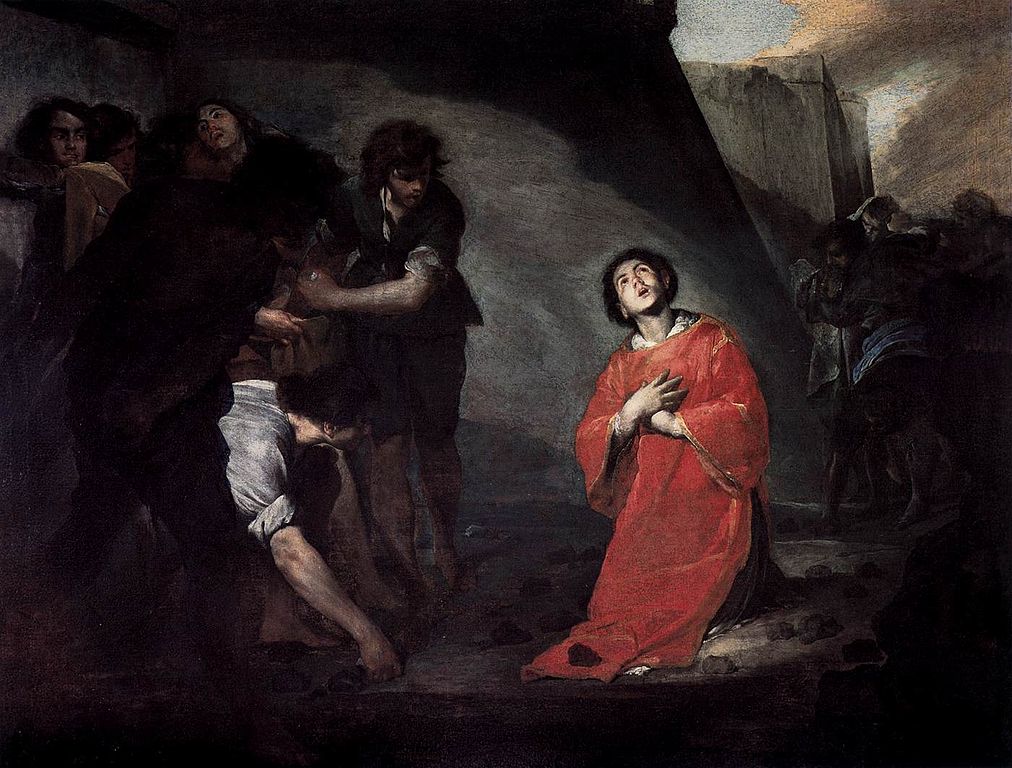
The council, however, dragged the deacon away and stoned him to death. “While they were stoning Stephen, he prayed, ‘Lord Jesus, receive my spirit,’ records St. Luke in Acts 7. “Then he knelt down and cried out in a loud voice, ‘Lord, do not hold this sin against them.’ When he had said this, he fell asleep.”
Bernardo Cavillino
Stoning of Saint Stephen, altarpiece of San Giorgio Maggiore, Venice, by Jacopo & Domenico Tintoretto
St Abadiu of Antinoë
Bl Agata Phutta Bi
Bl Agnès Phila
St Amaethlu of Anglesey
St Archelaus of Mesopotamia
Bl Bibiana Khamphai
Bl Cecilia Butsi
Bl Daniel of Villiers
St Dionysius, Pope
St Euthymius of Sardis
St Evaristo of Constantinople
Bl Giovanni Orsini
Bl Jean of Hainaut
Bl Lucie Khambang
St Margaret of Hohenfels
Bl Maria Phon
Bl Marinus of Rome
Bl Paganus of Lecco
Bl Pierre Boffet
St Tathai of Wales
St Theodore the Sacristan
St Vincentia Lopez y Vicuña
St Zeno of Gaza
St Pope Zosimus
One Minute Reflection – 25 December – The Solemnity of the Nativity of the Lord
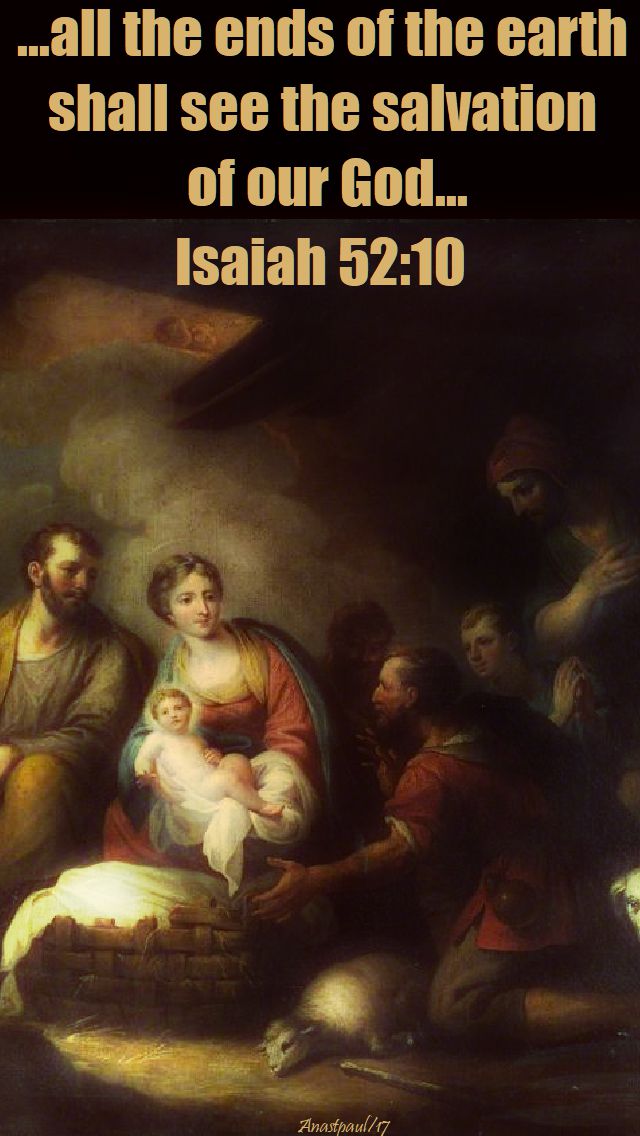
The Lord has bared his holy arm before the eyes of all the nations; and all the ends of the earth shall see the salvation of our God…Isaiah 52:10
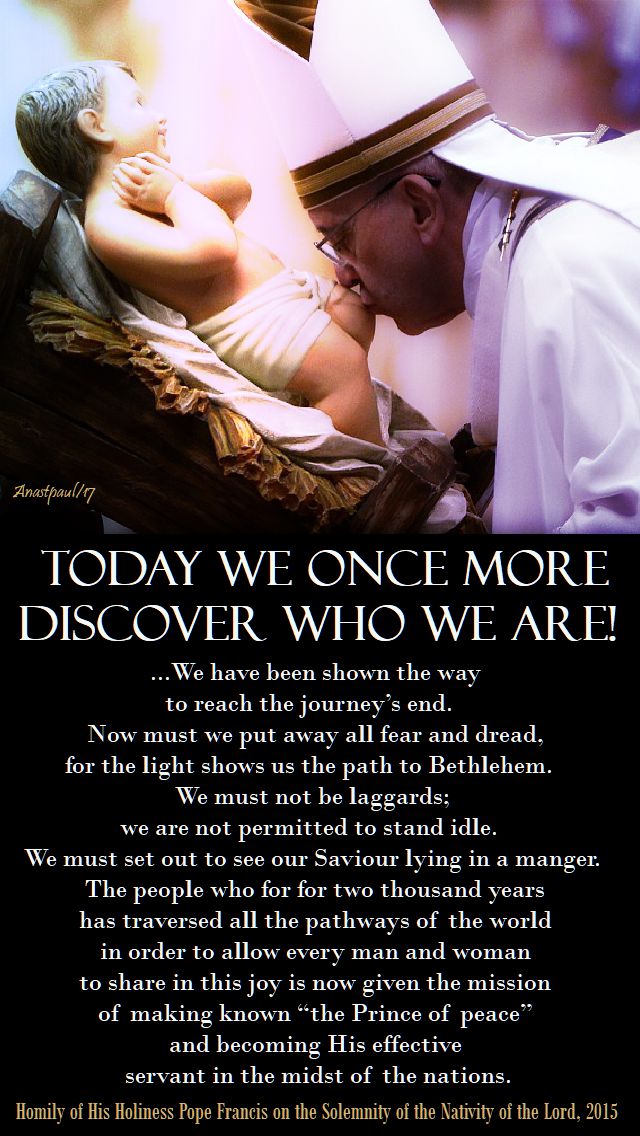
REFLECTION – “Today, the Son of God is born and everything changes. The Saviour of the world comes to partake of our human nature; no longer are we alone and forsaken. The Virgin offers us her Son as the beginning of a new life. The true light has come to illumine our lives so often beset by the darkness of sin. Today we once more discover who we are! Tonight we have been shown the way to reach the journey’s end. Now must we put away all fear and dread, for the light shows us the path to Bethlehem. We must not be laggards; we are not permitted to stand idle. We must set out to see our Saviour lying in a manger. This is the reason for our joy and gladness: this Child has been “born to us”; he was “given to us”, as Isaiah proclaims (cf. 9:5). The people who for for two thousand years has traversed all the pathways of the world in order to allow every man and woman to share in this joy is now given the mission of making known “the Prince of peace” and becoming His effective servant in the midst of the nations.”…HOMILY OF HIS HOLINESS POPE FRANCIS on the Solemnity of the Nativity of the Lord, 2015
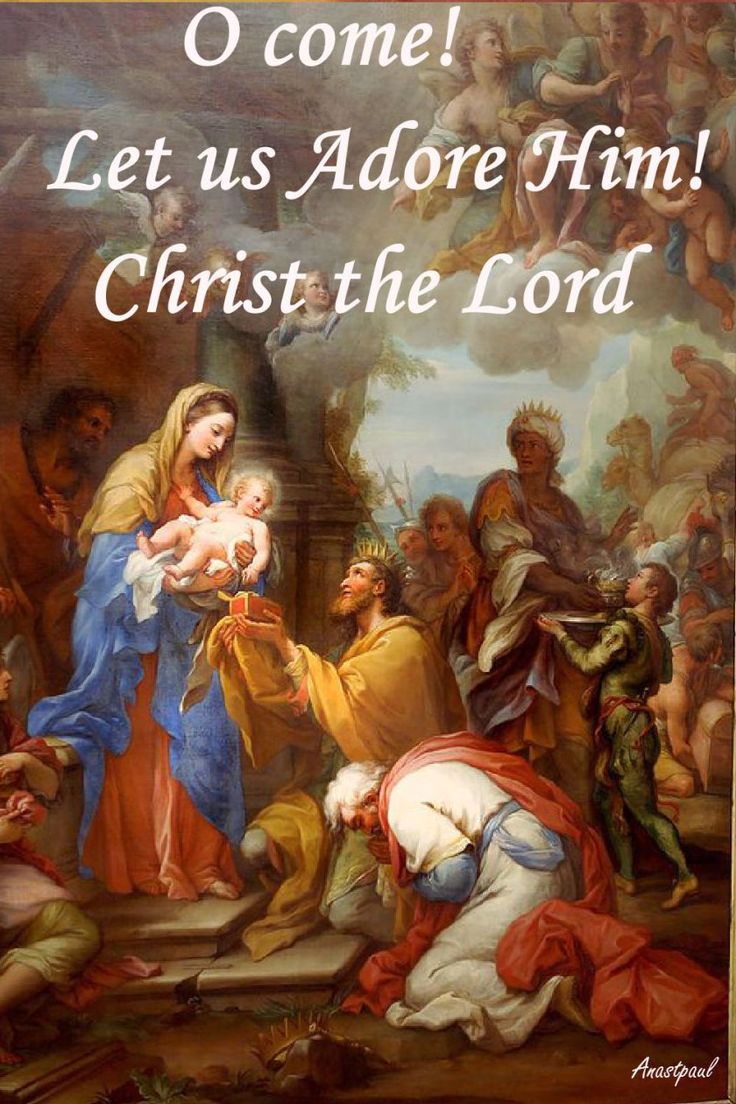
PRAYER – Almighty God, Your incarnate Word fills us with the new light He brought to men. Let the light of faith in our hearts shine through all the ages, to bring Your light to all nations. Come, come, let us adore our Holy Babe of Bethlehem, through whom we pray, in unity with the Holy Spirit, one God, forever and ever amen.
Our Morning Offering – 25 December – The Solemnity of the Nativity of the Lord
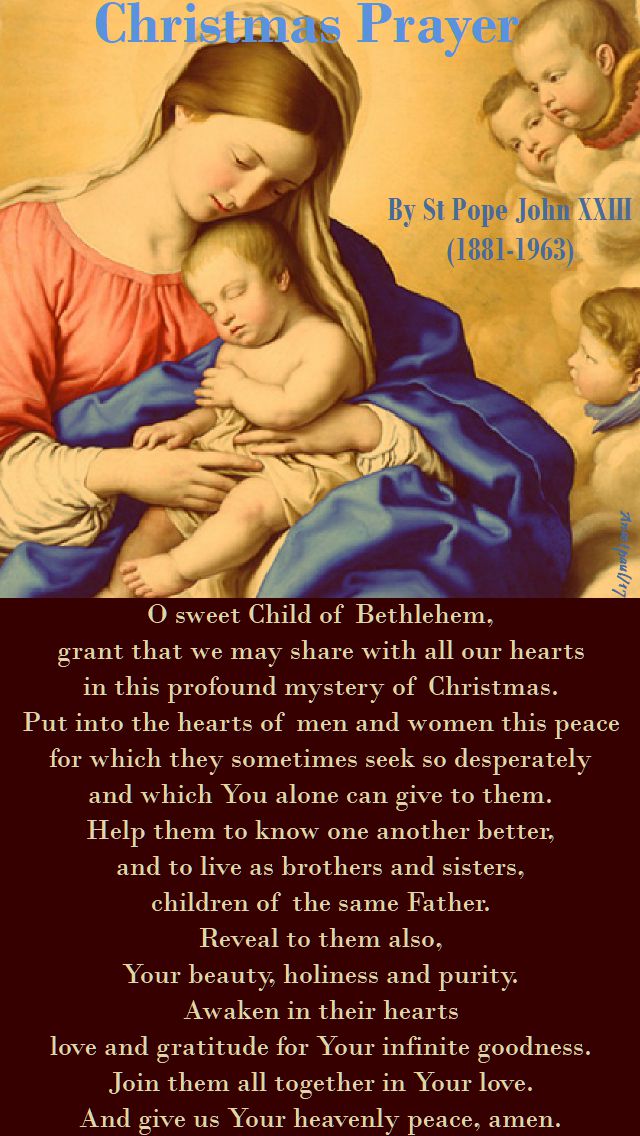
Christmas Prayer By St Pope John XXIII (1881-1963)
O sweet Child of Bethlehem,
grant that we may share with all our hearts
in this profound mystery of Christmas.
Put into the hearts of men and women this peace
for which they sometimes seek so desperately
and which You alone can give to them.
Help them to know one another better,
and to live as brothers and sisters,
children of the same Father.
Reveal to them also,
Your beauty, holiness and purity.
Awaken in their hearts
love and gratitude for Your infinite goodness.
Join them all together in Your love.
And give us Your heavenly peace, amen.
25 December – The Solemnity of the Birth of Our Lord Jesus Christ
Today the Church celebrates the Birth of Jesus Christ, the first day in the octave of Christmas. Throughout Advent the Church longed ardently for the coming of our Saviour. Today she celebrates His birth with unrestrained joy. “The Word was made flesh and dwelt among us.” The Son of God became man to give us a share in that divine life which is eternally His in the Blessed Trinity. Christmas time begins on 24 December with the first Vespers of the feast and ends on the feast of the Baptism of Christ. White vestments reappear in our churches as a sign of joy.
The Christmas feast is a festival full of joy. The Eternal Word has become Man and dwells among us. The longings of the patriarchs and prophets are fulfilled. With the shepherds we hurry to the manger and adore the Incarnate Son of God, who for us and for our salvation descended upon earth. The purpose of the Christmas feast is beautifully expressed in the Preface of the Nativity: “For by the mystery of the Word made flesh the light of Thy glory hath shone anew upon the eyes of our mind; so that while we acknowledge Him a God seen by men, we may be drawn by Him to the love of things unseen.”
Christmas says to us – alone we can’t profoundly change the world to remedy it. Alone, we can make the world better or worse but we can’t save it. Christ came therefore, because left to ourselves; we couldn’t escape the ‘mortal disease’ that has enveloped us from the first moment of conception in our mother’s womb. This gives us hope, true hope and true Christian optimism: I can’t do it but He is there! This is the mystery of grace synthesised in the human figure of God incarnate.
Christmas Eve and Christmas day are moments of contemplation. We consider, in many dimensions, the mystery of love that was incarnated for us. First of all, we contemplate the light and joy, without forgetting Jesus and Mary’s sorrows and sufferings and the many difficulties that had surrounded them: the cold, the uncomfortable place, the dangers….. It would be good to accompany these thoughts by reciting and meditating slowly on the Holy Rosary, preferably in front of a crib. ‘Blessed grotto of Bethlehem that testified to the wonders! Who, in this hour would not turn our hearts? Who would not prefer the opulent palace of the King?’ (Abbot Guéranger, L’Anno Liturgico, Alba 1959 [orig. franc. 1841], I, p122).
Listen to the way that St Bonaventure, the seraphic doctor, invites us to contemplate this scene in his ‘Meditation on the life of Jesus Christ’: ‘You have also lingered, bent your knee, adored the Lord God, venerated His Mother and greeted Joseph, the holy old man, with reverence. Therefore, kiss the feet of the baby Jesus, who lies in the manger, and pray that the Holy Virgin will allow you to hold Him. Take Him between your arms, hold Him and see His lovable face, kiss it with reverence and rejoice with Him. You can do this because He has come to bring salvation to sinners and He has humbly conversed with them, finally giving Himself as food’. (cit. in Guéranger, pp 136-137)
Christmas also reminds us of the great mystery of God’s people, of the Church acquired through Christ’s blood, animated by the life giving Spirit, governed by the legitimate shepherds in communion with the successor of Peter. On this day in which the Word came to earth, assuming human nature, body, and soul, how can we not think about His Mystical Body that is animated by the Holy Spirit? ‘For this reason, by no weak analogy, [the Church] is compared to the mystery of the incarnate Word. As the assumed nature inseparably united to Him, serves the divine Word as a living organ of salvation, so, in a similar way, does the visible social structure of the Church serve the Spirit of Christ, who vivifies it, in the building up of the body’(Vatican II, Lumen Gentium, n.8).
Holy Christmas also reminds us of the mystery of Mary as Mother of God, mother of the Incarnated Word and mother of His mystical body, the Church. Christmas encourages us to contemplate Jesus together with Mary, reflecting on Jesus with ‘His mother’, as recounted many times in the Gospels. If our faith must be fully evangelical, it can not neglect a sane and profound devotion to the Mother of God, as she shows us the easiest way to reach Jesus.
Happy Birthday Jesus, our Lord and our God!
For a post on the Tradition Bible Time From the Creation to The Birth of Jesus go here: https://anastpaul.wordpress.com/2016/12/25/25-december-the-solemnity-of-the-birth-of-our-lord-jesus-christ/
Nativity of the Lord (Solemnity)
—
St Adalsindis of Hamay
St Alburga of Wilton
St Anastasia of Sirmium
Bl Artale
St Basilée of the Via Latina
Bl Bentivoglio de Bonis
Bl Diego de Aro
St Eugenia of Rome
St Fulk of Toulouse
Bl Jacopone da Todi
St Jovin of the Via Latina
Bl Maria Therese von Wüllenweber
Bl Matthew of Albano
Bl Michael Nakashima Saburoemon
Bl Nera
St Peter Nolasco
St Romulus of Berry
—
Martyrs of Nicomedia: 20,000 Christians martyred by order of Diocletian. They were reported to have all been in the single basilica to celebrate Christmas. While there unquestionably was an endless series of martyrs under Diocletian, it’s likely the ancient sources exaggerated the numbers of this incident. And as the Christmas holy day was not celebrated in the East in 303, they were probably gathered for another feast. They were burned alive in 303 in the basilica of Nicomedia.
The Vigil of the Nativity of the Lord and Memorials of the Saints – 24 December
24 December – Vigil of the Nativity of the Lord
St Adam the Patriarch
St Adela of Pfalzel
Bl Alberic of Gladbach
Bl Brocard of Strasbourg
St Bruno of Ottobeuren
St Caran of Scotland
St Delphinus of Bordeaux
St Emiliana of Rome
St Euthymius of Nicomedia
St Eve the Matriarch
Bl Francesco dei Maleficii
St Gregory of Spoleto
St Hanno of Worms
Bl Ignacio Caselles García
St Irmina of Oehren
St Mochua of Timahoe
Bl Pablo Meléndez Gonzalo
St Paola Elisabetta Cerioli
Bl Peter de Solanes
St Trasilla
Bl Venerandus of Clermont
—
All the Holy Ancestors of Jesus: A commemoration of all the holy ancestors of Jeus Christ.
The New Testament has preserved two different genealogies of Our Lord, in Matthew 1 and Luke 3.
Saint Matthew’s list is divided artificially into three equal parts of 14 names each, with several intentional omissions: from Abraham the father of the chosen people to David the king, to whose family the promise was made (2 Kings 7); David and the royal line after him to the Babylonian captivity; the descendants of the royal line from the captivity to Joseph, the legal father of Our Lord.
Saint Luke proceeds in reverse order; he starts from Joseph and goes, beyond Abraham, back to Adam the father of the human race, in accord with the character of his Gospel and he merely enumerates the names without grouping them according to a thesis or point, as is the case in Saint Matthew.
Few names are common to both lists: viz., those between Abraham and David, then Salathiel and Zorobabel after the captivity, and Joseph the foster-father of Christ; the others are absent from Matthew’s list, or the persons are different. To account for these differences several explanations have been advanced but no decisive evidence is extant. Not a few authors hold that Saint Luke gives Mary’s genealogy but this view is more generally considered improbable, so that both lists are taken as giving Joseph’s ancestry. Only it must be supposed that at several points, instead of the actual descent, the one or the other of the lists gives the legal relationship based on adoption in some manner. Our Lord was considered to belong to the family of David; this seems to be taken for granted in the New Testament, where we find no difficulty raised against Him on the ground of His descent. The genealogies show His relationship to the royal family of Juda through Joseph, as it was only through the father, legal or natural, that the rights could be transmitted and Joseph was the legal father of Jesus. To trace Our Lord’s ancestry through His mother would not have served the purpose of the Evangelists.
Matthew 1:1-17 – The book of the genealogy of Jesus Christ, the son of David, the son of Abraham:
Abraham became the father of Isaac, Isaac the father of Jacob, Jacob the father of Judah and his brothers. Judah became the father of Perez and Zerah, whose mother was Tamar. Perez became the father of Hezron, Hezron the father of Ram, Ram the father of Amminadab. Amminadab became the father of Nahshon, Nahshon the father of Salmon, Salmon the father of Boaz, whose mother was Rahab. Boaz became the father of Obed, whose mother was Ruth. Obed became the father of Jesse, Jesse the father of David the king. David became the father of Solomon, whose mother had been the wife of Uriah. Solomon became the father of Rehoboam, Rehoboam the father of Abijah, Abijah the father of Asaph. Asaph became the father of Jehoshaphat, Jehoshaphat the father of Joram, Joram the father of Uzziah. Uzziah became the father of Jotham, Jotham the father of Ahaz, Ahaz the father of Hezekiah. Hezekiah became the father of Manasseh, Manasseh the father of Amos, Amos the father of Josiah. Josiah became the father of Jechoniah and his brothers at the time of the Babylonian exile. After the Babylonian exile, Jechoniah became the father of Shealtiel, Shealtiel the father of Zerubbabel, Zerubbabel the father of Abiud. Abiud became the father of Eliakim, Eliakim the father of Azor, Azor the father of Zadok. Zadok became the father of Achim, Achim the father of Eliud, Eliud the father of Eleazar. Eleazar became the father of Matthan, Matthan the father of Jacob, Jacob the father of Joseph, the husband of Mary. Of her was born Jesus who is called the Messiah.
Thus the total number of generations from Abraham to David is fourteen generations; from David to the Babylonian exile, fourteen generations; from the Babylonian exile to the Messiah, fourteen generations.
Luke 3:23-38:
When Jesus began his ministry he was about thirty years of age. He was the son, as was thought, of Joseph, the son of Heli, the son of Matthat, the son of Levi, the son of Melchi, the son of Jannai, the son of Joseph, the son of Mattathias, the son of Amos, the son of Nahum, the son of Esli, the son of Naggai, the son of Maath, the son of Mattathias, the son of Semein, the son of Josech, the son of Joda, the son of Joanan, the son of Rhesa, the son of Zerubbabel, the son of Shealtiel, the son of Neri, the son of Melchi, the son of Addi, the son of Cosam, the son of Elmadam, the son of Er, the son of Joshua, the son of Eliezer, the son of Jorim, the son of Matthat, the son of Levi, the son of Simeon, the son of Judah, the son of Joseph, the son of Jonam, the son of Eliakim, the son of Melea, the son of Menna, the son of Mattatha, the son of Nathan, the son of David, the son of Jesse, the son of Obed, the son of Boaz, the son of Sala, the son of Nahshon, the son of Amminadab, the son of Admin, the son of Arni, the son of Hezron, the son of Perez, the son of Judah, the son of Jacob, the son of Isaac, the son of Abraham, the son of Terah, the son of Nahor, the son of Serug, the son of Reu, the son of Peleg, the son of Eber, the son of Shelah, the son of Cainan, the son of Arphaxad, the son of Shem, the son of Noah, the son of Lamech, the son of Methuselah, the son of Enoch, the son of Jared, the son of Mahalaleel, the son of Cainan, the son of Enos, the son of Seth, the son of Adam, the son of God.
Blessed Mercedarian Brothers – (4 beati): Four Mercedarian friars who worked to free Christians enslaved by Muslims, and to preach Christ along the way to any who would hear.
• Blessed Dionysius Roneo
• Blessed Philip Claro
• Blessed Giulio Pons
• Blessed Peter of Valladolid
Blessed Mercedarian Sisters – (6 beati): Six cloistered Mercedarian nuns at the convent of Vera Cruz in Berriz, Spain. Noted for their devotion to the rules of the Order and for their deep prayer lives.
• Blessed Anna Maria Prieto
• Blessed Anna de Arrano
• Blessed Orsola de Larisgoizia
• Blessed Maguna Mary
• Blessed Margaret
• Blessed Mary of the Assumption Sarria
Martyred Maidens of Antioch – (40 saints): A group of forty virgins martyred in the persecutions of Decius. None of their names have come down to us. They were martyred in 250 in Antioch, Syria.
Martyrs of Tripoli – (6 saints): A group of Christians martyred together, date unknown. The only details that have surived are six of the names – Drusus, Lucian, Metrobius, Paul, Theotimus and Zenobius. They were martyred in Tripoli, Libya.
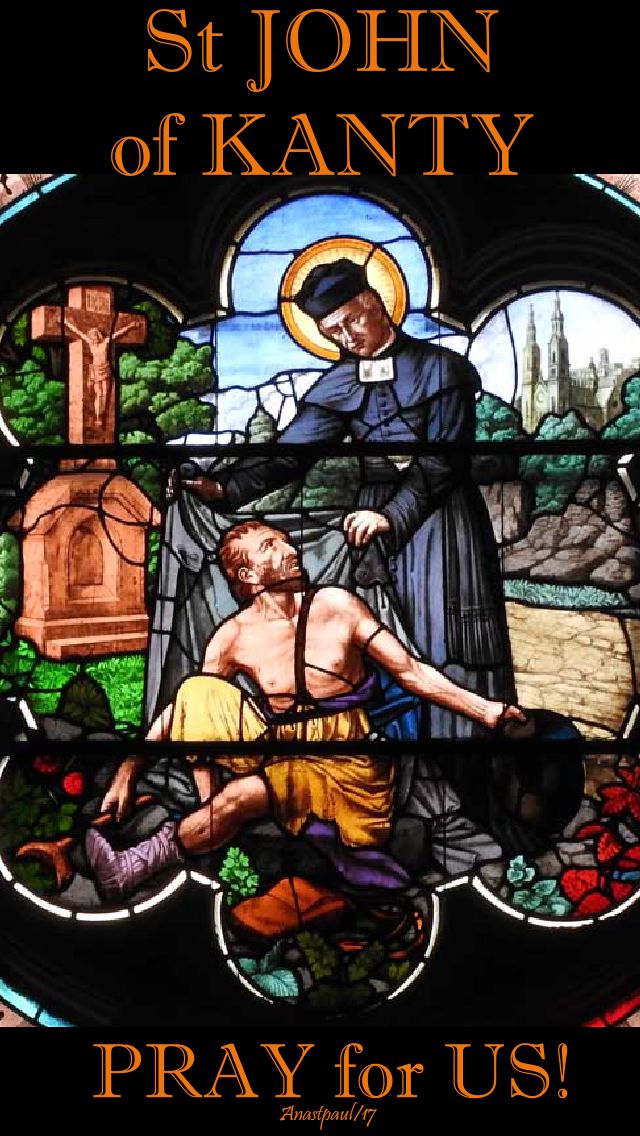
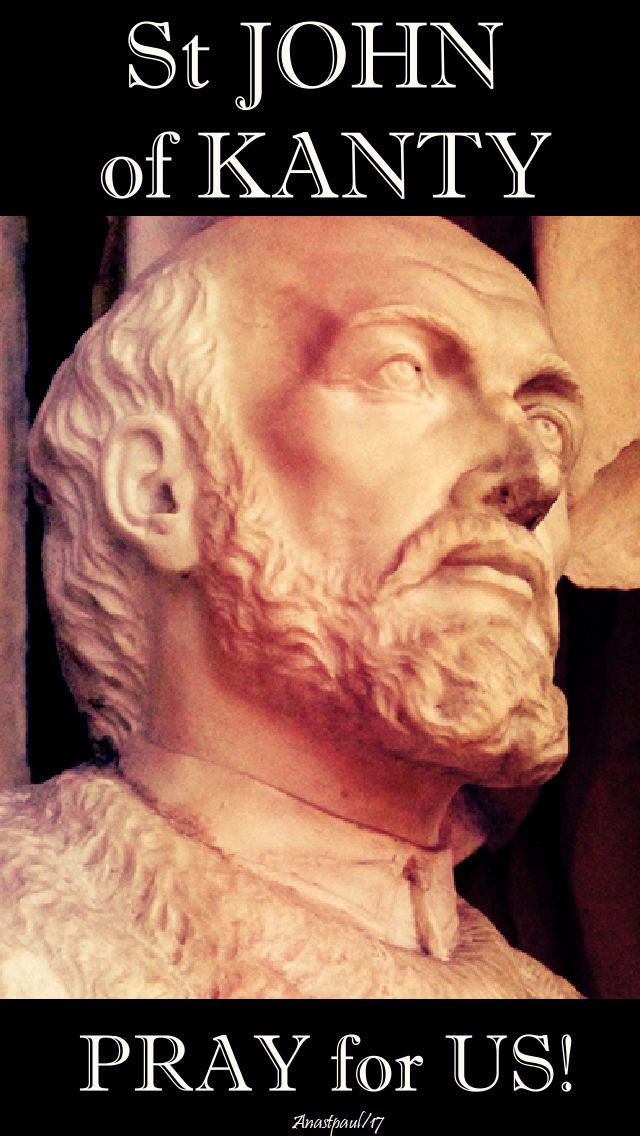
Thought for the Day – 23 December – The Memorial of St John of Kanty (1390-1473)
Sweetness of disposition wins more people than a sharp mind and roughness.
Every human being is worthy of respect, even if his opinions are false and his attitudes wrong.
We may be right in our opinions but we are wrong if we defend those opinions in an unkind and uncharitable way.
Nevertheless, there is one truth, not many – blue is blue and not black – where our kind disposition and words fail to convince another of the truth and we meet violent roughness, we do as we are taught “shake the dust from your feet” (Luke 9:5).
In Christ’s words is a warning: the act of “shaking off the dust from one’s feet” is an act of “testimony against” those who reject the Gospel. At the time of Judgment, we will stand before Christ and be judged by the testimony of how we lived our lives. The testimony of our lives, how we loved or did not love, will either be a testimony in our favour, or a testimony against us.
St John of Kanty, pray for us!
One Minute Reflection – 23 December – Saturday of the Third Week of Advent and the Memorial of St John of Kanty (1390-1473)
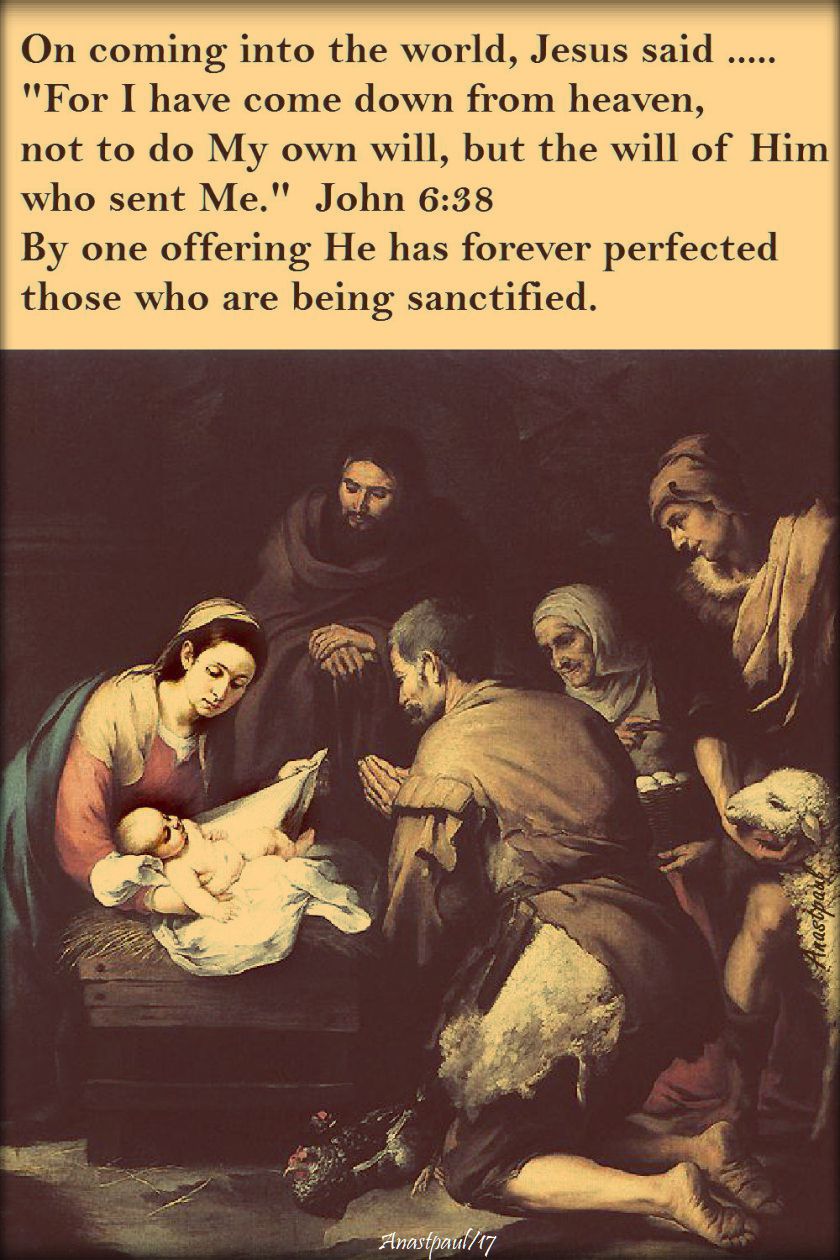
On coming into the world, Jesus said …..”For I have come down from heaven, not to do My own will but the will of Him who sent Me” (John 6:38). By one offering He has forever perfected those who are being sanctified.
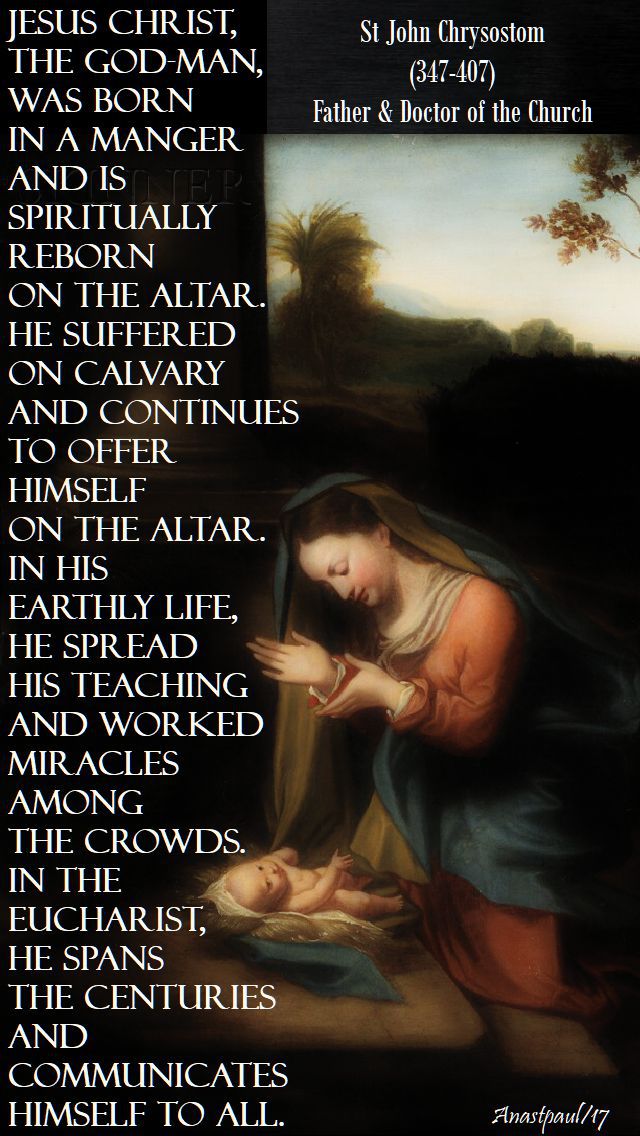
REFLECTION – “Jesus Christ, the God-Man, was born in a manger and is spiritually reborn on the altar. He suffered on Calvary and continues to offer Himself on the altar. In His earthly life, He spread His teaching and worked miracles among the crowds. In the Eucharist, He spans the centuries and communicates Himself to all.”…St John Chrysostom (347-407) Father & Doctor of the Church
PRAYER – Heavenly Father, in contemplating the birth of Your Son in time and in the Eucharist, may I ever attain a new birth. May I through love of You, give my all to my neighbour in true charity. Help me to learn from St John of Kanty to live in humility, true poverty of spirit and charity and of whom we ask for intercession. St John of Kanty, pray for us! Amen






![St. Stephen [Large]](https://anastpaul.com/wp-content/uploads/2017/12/st-stephen-large.jpg)



You must be logged in to post a comment.