Posted in "Follow Me", MARIAN DEVOTIONS, MARIAN REFLECTIONS, MEDITATIONS - ANTONIO CARD BACCI, QUOTES - J R R Tolkien and MORE, QUOTES on CHARITY, QUOTES on CONVERSION, QUOTES on DISCIPLESHIP, QUOTES on HEAVEN, QUOTES on REPENTANCE, QUOTES on SANCTITY, QUOTES on SIN, The ASCENSION of the LORD

Thought for the Day – 14 October – The Second Glorious Mystery – The Ascension of Jesus into Heaven

Thought for the Day – 14 October – Meditations with Antonio Cardinal Bacci (1881-1971)

“Month of the Holy Rosary”
The Second Glorious Mystery
The Ascension of Jesus into Heaven

“Forty days after His glorious resurrection, Jesus came, with all His friends, among them His Mother, to the Mount of Olives.
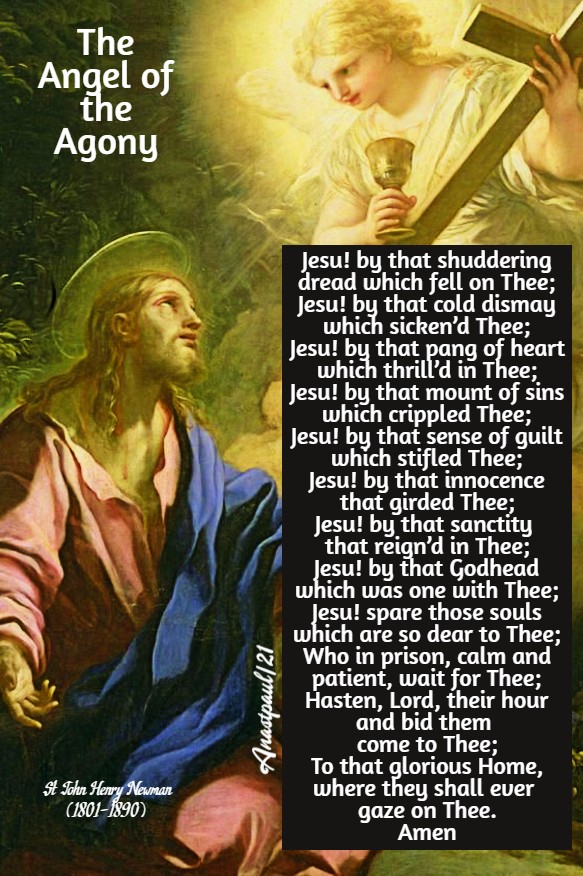
This area had already witnessed the opening phase of His passion, which was all the more poignant, perhaps because in Gethsemane, it was not only His body which was lacerated by scourges and nails but, His soul, which experienced the agonising vision of the sins and ingratitude of the human race.
Now, however, He is here with a glorified body as the Conqueror of sin and of death.
He looks for the last time on His small band of followers, to whom He has entrusted His mission of transforming the entire universe by preaching and putting into practice, the Gospel message, throughout the world.
Now, He promises them the Holy Spirit, Who will give them the power to overcome evil.
Then He is lifted up toward Heaven, until a bright cloud hides Him from their sight.

Perhaps, the Blessed Mother, was the last to take her eyes off the disappearing cloud which had removed Jesus from view.
Her human eyes never saw again the beloved figure of her divine Son but, in her soul, she saw Him entering triumphantly into Heaven among choirs of Angels and sitting at the right hand of the Eternal Father.
She saw and thought with infinite yearnng of the not too distant day, when she would have passed from mortal exile, into the everlasting happiness of Heaven, where she would embrace her divine Son again in an ecstasy of love.

We have all been called to ascend to Heaven with Jesus and Mary.
Let us remember, however, that only the innocent and the repentant can be admitted into Paradise.
If we have been unfortunate enough to have lost our baptismal innocence, only the second way is left to us – the way of penance.
We must purify ourselves of our sins by means of good works.
We must ascend higher and highter, towards the summit of Christian perfection.

Antonio Cardinal Bacci

Posted in CONFESSION/PENANCE, DOCTORS of the Church, FATHERS of the Church, LOVE of NEIGHBOUR, QUOTES of the SAINTS, QUOTES on CONVERSION, QUOTES on FAITH, QUOTES on HYPOCRISY, QUOTES on JUSTICE, QUOTES on LOVE, QUOTES on LOVE of GOD, QUOTES on PRIDE, QUOTES on PURITY of INTENTION, QUOTES on REPENTANCE, QUOTES on SANCTITY, QUOTES on SILENCE, The WORD

Quote/s of the Day – 14 October – Faith, Love, Justice – Luke 11:42

Quote/s of the Day – 14 October – Wednesday of the Twenty-eighth week in Ordinary Time, Readings: Galatians 5:18-25, Psalms 1:1-2, 3, 4 and 6, Luke 11:42-46

“But woe to you Pharisees!
For you tithe mint and rue and every herb
and neglect justice and the love of God.”

Luke 11:42

“Christianity is not a matter
of persuading people of particular ideas
but of inviting them to share
in the greatness of Christ.
So pray, that I may never fall into the trap,
of impressing people,
with clever speech but instead,
I may learn, to speak with humility,
desiring only to impress people,
with Christ Himself.”

St Ignatius of Antioch (c 35 – 107)
Father of the Church, Martyr

“Mint and dill and cumin are only spices for food
but are not themselves, substantial food.
What substantive food would mean in conversion,
would be that which is necessary
for the justification of our souls—faith and love—
unlike these legalisms,
which are more like condiments and flavourings.
It is as if, a meal might be thought to consist,
more of condiments and flavourings,
than the food itself.
The seriousness of judgement is neglected,
while great attention is given to minor matters.”

Origen (c 185-253)
Priest, Theologian, Father

“You hide your heart from man –
hide it from God if you can.
… Where will you go?
Where will you flee?
Do you want to hear some advice?
If you want to flee from Him – flee to Him.
Flee to Him by Confessing, not from Him, by hiding,
for you cannot hide but you can Confess.
Tell Him. “You are my refuge” (Ps 32[31]:7)
and let there be nursed in yo,
the love that alone leads to life.”

St Augustine (354-430)
Father and Doctor of Grace

“It is clear, my brethren,
that we live outside ourselves,
we are forgetful of ourselves
whenever we fritter our lives away
in empty pursuits or distractions,
decked out with trifles.
That is why Wisdom
is more concerned to invite us
to the house of repentance
than the house of feasting,
that is to say to call back into himself,
the man outside himself …”

Blessed Isaac of Stella O.Cist (c 1100 – c 1170)
Sermon 2 for All Saints, 13-20

Posted in ONE Minute REFLECTION, QUOTES of the SAINTS, QUOTES on HYPOCRISY, QUOTES on MISSION, QUOTES on PRIDE, QUOTES on SCANDAL, QUOTES on VANITY, QUOTES on ZEAL, SAINT of the DAY, The WORD

One Minute Reflection- 14 October – The bitter zeal of hypocrisy and pride

One Minute Reflection- 14 October – Wednesday of the Twenty-eighth week in Ordinary Time, Readings: Galatians 5:18-25Psalms 1:1-234 and 6Luke 11:42-46 and the Memorial of St Fortunatus of Todi (Died 537) Bishop

“Woe to you Pharisees! for you love the best seat in the synagogues and salutations in the market places.”…Luke 11:43

REFLECTION – “Forms of zeal, taking the appearance of good, are to be met with. There is, for example, the zeal of the Pharisee, strict observers of the outward law. This bitter zeal (…) has its source, not in the love of God and of our neighbour but in pride. Those who are tainted with it are filled with inordinate esteem for their own perfections; they do not conceive of any other ideal than their own; they want to bend everyone to their own way of seeing and doing; hence arise dissensions. This zeal tends to hatred.

See with what acrimony the Pharisees, moved by this zeal, pursue the Lord Jesus, putting insidious questions to Him, setting snares to entrap Him, seeking not to know the truth but to find Christ in fault. See how they press Him, how they try to induce Him to condemn the woman taken in adultery: “Now Moses in the Law commanded us to stone such a one. But what sayest Thou?” (Jn 8:5). (…) See, too, how they reproach Him for healing on the Sabbath day (Lk 6:7); how they complain of the disciples for rubbing the ears of corn in their hands on the day of rest (Mt 12:2); how they are scandalized at seeing the Divine Master sit down at dinner with the sinners and publicans (Mt 9:2). These are so many manifestation of this bitter zeal into which hypocrisy so often enters.” – Blessed Columba Marmion OSB (1858-1923) Abbot – Good Zeal (Christ the Ideal of the Monk

PRAYER – Heavenly Father, grant that I may believe what I have learned, never presuming to know better than the teachings of Holy Mother Church and that I may put into practice what I believe. Let my commitment be like unto the Bishop, St Fortunatus of Todi, who lived Your Word with joy and great zeal for faith in Christ, Your Son, God with You and the Holy Spirit, amen.

Posted in Our MORNING Offering, PRAYERS of the SAINTS

Our Morning Offering – 14 October – To You, O Master

Our Morning Offering – 14 October – Wednesday of the Twenty-eighth week in Ordinary Time

To You, O Master
By St Macarius the Wonder-Worker (Died 850)

To You, O Master,
who loves all mankind
I hasten on rising from sleep.
By Your mercy,
I go out to do Your work
and I make my prayer to You.
Help me at all times and in all things.
Deliver me from every evil thing of this world
and from pursuit by the devil.
Save me and bring me to Your eternal kingdom,
For You are my Creator,
You inspire all good thoughts in me.
In You is all my hope
and to You I give glory,
now and forever.
Amen

Posted in SAINT of the DAY

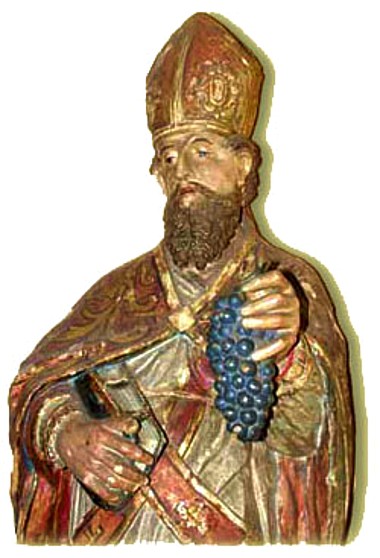
Saint of the Day – 14 October – Saint Fortunatus of Todi (Died 537)

Saint of the Day – 14 October – Saint Fortunatus of Todi (Died 537) Bishop, Confessor, miracle-worker. Patronage – Todi.

An entry in the Roman Martyrology under 14 October records: “At Todi in Umbria, St Fortunatus, Bishop, who, as is mentioned by blessed Gregory, was endowed with an extraordinary gift for casting out unclean spirits.”

Sts Hermagoras and Fortunatus by Giovanni Battista Tiepolo (1736)

According to the Dialogues of Pope Gregory the Great, Bishop Fortunatus of Todi “He possessed extraordinary power over evil spirits, for on occasions he would expel legions of them and, when they turned their violence against him personally, he would crush them with the weapon of incessant prayer.”
He records the following:

On one occasion, Fortunatus drove out the spirits which plagued a woman who had sex before attending the dedication of the Church of St Sebastianus. A noblewoman from Tuscany and her daughter-in-law, were due to attend this ceremony. The night before the dedication, the young woman slept with her husband. As soon as the relics of Sebastian were brought out, a spirit possessed the woman. When a Priest threw the linen cloth from the altar on her to cover her, he was attacked by the same spirit. Only Fortunatus was able to drive out the spirit by spending many days and nights in prayer. He also drove a spirit out of a possessed man, which later inflicted itself on a family in Todi.

Fortunatus cured a blind man by making a sign of the cross in front of his eyes. Later, he cured a mad horse, when he made a sign of the cross over it’s head.

When Goths carried off two small boys from an estate on the outskirts of Ravenna, Fortunatus repeatedly asked them to return the boys unharmed. When leaving Todi, the leader of the Goths passed in front of theCchurch of St Peter. His horse slipped and fell and he suffered a broken rib. After the leader of the Goths sent the boys safely to Fortunatus, one of his Deacons sprinkled the rib with holy water, healing it.

Fortunatus was called to revive a dead man called Marcellus. Before dawn on Easter Sunday, Fortunatus went to see the corpse with two Deacons. When he called to the corpse, the man came back to life.”

St Fortunatus with Sts Cassian and Callistus with a model of Todi

The Dialogues also state that miracles soon occurred at the grave of St Fortunatus but they do not specify where this was. A lead plaque discovered during a recognition of the relics of St Fortunatus in 1580 was inscribed:

Hec sunt reliquie beatissimi Fortunati episcopi et confessoris DCCVIII

These are the relics of St Fortunatus, Bishop and Confessor (708)

This plaque presumably recorded a formal recognition of the relics in 708. It seems likely that this recognition occurred in the Church that stood on the site of the Cappella Gregoriana which was partly demolished in 1296 to make way for the construction of the present Church of San Fortunato. In the following year, Pope Boniface VIII consented to the translation of the relics of Saints Fortunatus, Cassian and Callistus from the old Church to what became the Crypt of the new one. He granted indulgences to those attending the subsequent translation of these relics, see the Church below. The crypt houses a sepulchre containing the remains of Sts Fortunatus, Cassian and Callistus, as well as the tomb of Fra Jacopone da Todi OFM (1230–1306), the well-known hymnist.

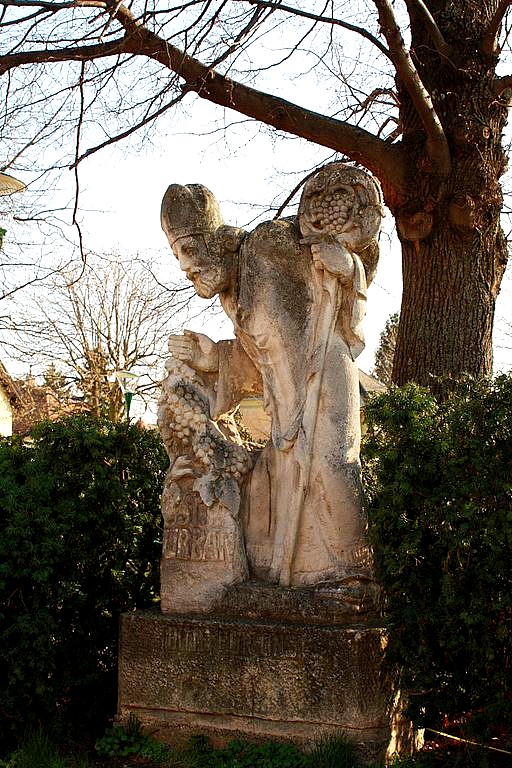
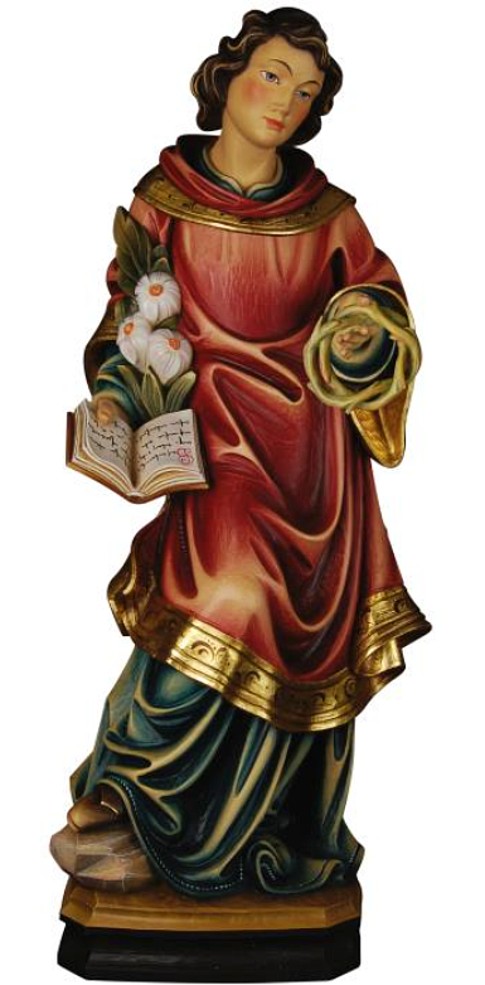
Statue of St Fortunatus in the Crypt
Posted in SAINT of the DAY

Memorials of the Saints – 14 October

St Pope Callistus I (c 218 – c 223) Martyr (Optional Memorial)
Biography here:
https://anastpaul.wordpress.com/2017/10/14/saint-of-the-day-st-pope-callistus-i-14-october/

Bl Ana María Aranda Riera
St Angadrisma of Beauvais
St Bernard of Arce
St Celeste of Metz
St Dominic Loricatus
St Donatian of Rheims (Died 390)
Biography:

https://anastpaul.com/2018/10/14/saint-of-the-day-14-october-st-donatian-of-rheims-died-390/
Saint Fortunatus of Todi (Died 537) Bishop
St Franciszek Roslaniec
St Gaudentius of Rimini
St Gundisalvus of Lagos
Bl Jacques Laigneau de Langellerie
St Lupulo of Capua
St Lupus of Caesarea
St Manacca
St Manehildis
St Modesto of Capua
Bl Richard Creagh
Blessed Roman Lysko (1914–1949) Priest and Martyr
His Life and Death:
https://anastpaul.com/2019/10/14/saint-of-the-day-14-october-blessed-roman-lysko-1914-1949-priest-and-martyr/
St Rusticus of Trier
St Saturninus of Caesarea
St Stanislaw Mysakowski
St Venanzio of Luni

Martyrs of Caesarea – (4 saints): Three brothers and a sister martyred together in the persecutions of Diocletian – Carponius, Evaristus, Fortunata and Priscian. In 303 in Caesarea, Cappadocia (in modern Turkey) – their relics enshrined in Naples, Italy.

Martyred in the Spanish Civil War:
• Blessed Ana María Aranda Riera
• Blessed Jacques Laigneau de Langellerie

Posted in MARIAN REFLECTIONS, MEDITATIONS - ANTONIO CARD BACCI, OCTOBER - The HOLY ROSARY and The HOLY ANGELS, The RESURRECTION

Thought for the Day – 13 October – The First Glorious Mystery – The Resurrection of Our Lord

Thought for the Day – 13 October – Meditations with Antonio Cardinal Bacci (1881-1971)

“Month of the Holy Rosary”
The First Glorious Mystery
The Resurrection of Our Lord”

“Jesus could not have remained lifeless in the sepulchre.
He is the Man-God, the conqueror of sin and of death.
He willed to be subject to all the conditions of human exiastence with the exception of sin, therefore, He suffered and died for love of us.

However, as He had foretold, He rose gloriously from the tomb on the third day.
This resurrection is proved historically in a most certin manner, by the behaviour of the Apostles, who, were at first downcast and incredulous and were transformed, into heroes and martyrs, by the glorious appearance of Jesus.
It is confirmed by the obstinacy and deceitfulness of the Jews, who went so far as to bribe the soldiers who were guarding the sepulchre, not to reveal the truth.
It is proved, moreover, by the fact, that the Apostle Thomas, refused to believe in the Resurrection until he had placed his fingers in the wounds of the Redeemer, Who afterwards appeared to him.

We read in the Gospels and in the Acts of the Apostles, that the risen Jesus appeared many times to the Apostles to confirm their faith, to speak with them of the Kingdom of God and to give them His final instructions and commands.
We read also, that He appeared to Mary Magdalen to reward her great love and to console her.
Nowhere, do we read that He appeared to His beloved Mother, Mary.
However, the heart tells us what the Gospels omit to mention.
Surely, it is impossible to suppose that the risen Jesus would not have hastened to embrace and to console her, who had borne Him in her chaste womb and had loved Him so much, that she followed Him to the foot of the Cross?

The apparitions of Jesus narrated in the Gospel, had a public purpose, being intended to confirm the faith of those who were fearful, discouraged or incredulous.
The apparitions to Mary, were intimate and affectionate meetings with His dear Mother, who had never doubted, for one moment, that He would rise again.

There may be another explanation, however.
It is possible, that Mary’s humility would have prevented her from discussing, with others, her happy moments of reunion with her risen Son.”

Antonio Cardinal Bacci

Posted in AUGUST - The Immaculate Heart of Mary, CONFESSION/PENANCE, CONSECRATION Prayers, MARIAN QUOTES, MARIAN TITLES, PRAYERS of the CHURCH, QUOTES on CONVERSION, QUOTES on PRAYER, QUOTES on REPARATION/EXPIATION, QUOTES on REPENTANCE, QUOTES on SACRIFICE, QUOTES on SIN, The BLESSED VIRGIN MARY, The HOLY ROSARY/ROSARY CRUSADE

Quote/s of the Day – 13 October – Our Lady of Fatima

Quote/s of the Day – 13 October – The 103rd Anniversary of the Last Apparition of Our Lady of Fatima

Our Lady of Fátima –or Our Lady of the Rosary,
the name the three children called her –
is a title given to the Blessed Virgin Mary as She appeared in apparitions reported by three shepherd children at Fátima in Portugal.
These Apparitions occurred on the 13th day of six consecutive months in 1917, the first on 13 May and the last today, 13 October 1917.
The three children were Lúcia Santos
and her cousins Jacinta and Francisco Marto.
Her message was one of hope, repentance
and conversion for the whole world.

“I have come, to warn the faithful,
to amend their lives
and ask pardon for their sins.
They must not continue to offend Our Lord,
Who is already too much offended.”

“Look, my Daughter,”
Our Lady said to Lúcia on 10 December 1925,
“at my heart, surrounded with thorns,
with which ungrateful men pierce me.”

“Say the Rosary everyday
to obtain peace for the world.
And after each decade,
say the following prayer:
‘O my Jesus, forgive us our sins,
save us from the fires of Hell,
lead all souls to Heaven,
especially those in most need of Thy mercy.’”

“Pray, pray a great deal
and make sacrifices for sinners,
for many souls go to Hell
because they have no-one
to make sacrifices
and pray for them.”

“In the end,
my Immaculate Heart
will triumph.”

Our Lady assured Lúcia:
“My Immaculate Heart will be your refuge
and the way that will lead you to God.”

Thus, if we devote ourselves to her Immaculate Heart,
Mary will lead us to her Son, Jesus Christ
and we will be on the way to Heaven.

Official Prayer of Consecration
To Our Lady of Fatima

(Issued for the Jubilee in 2017)

Our lady of Fatima Hail,
Mother of the Lord,
Virgin Mary,
Queen of the Rosary of Fatima!
Blessed among all women,
you are the image of the Church dressed in the Paschal light,
you are the honour of our people,
you are the triumph over the mark of evil.
Prophecy of the merciful Love of the Father,
Teacher of the Annunciation of the Good News of the Son,
Sign of the burning Fire of the Holy Spirit,
teach us, in this vale of joys and sorrows,
the eternal truths that the Father reveals to the little ones.
Show us the strength of your mantle of protection.
In your Immaculate Heart,
be the refuge of sinners
and the way that leads to God.
In Faith, Hope and Love,
I surrender myself to you.
Through you, I consecrate myself to God,
O Virgin of the Rosary of Fatima.
And thus surrounded by the Light that comes from your hands,
I will give Glory to the Lord, forever and ever.
Amen

Posted in CHRIST, the WAY,TRUTH,LIFE, GOD ALONE!, I BELIEVE!, MARIAN TITLES, ONE Minute REFLECTION, QUOTES of the SAINTS, QUOTES on DISCIPLESHIP, QUOTES on FAITH, QUOTES on HYPOCRISY, QUOTES on LOVE of GOD, QUOTES on PRIDE, QUOTES on VANITY, The WORD

One Minute Reflection – 13 October – ‘Only God fills the soul and fills it wholly.’

One Minute Reflection – 13 October – Tuesday of the Twenty-eighth week in Ordinary Time, Readings: Galatians 5:1-6Psalms 119:4143,44454748Luke 11:37-41 and the 103rd Anniversary of the Last Apparition of Our Lady of Fatima

And the Lord said to him, “Now you Pharisees cleanse the outside of the cup and of the dish but inside you are full of extortion and wickedness.”…Luke 11:39

REFLECTION – “If the world that seeks my God were to know, if those learned men who seek for God in science and endless discussion were to know, if people did but know where to find God, how many wars would be prevented, what peace there would be in the world, how many souls would be saved! Unreasoning and stupid that you look for God where He is not! Listen and be filled with awe – God is in our hearts, I know it. God lives in the human heart when this heart lives withdrawn from all that is not Him, when this heart heeds God’s knock at it’s door (Rv 3,20) and, sweeping and cleaning all its rooms, makes itself ready to welcome Him who alone truly satisfies.

How sweet it is to live like this, with God in the heart. What sublime peace to find oneself filled with God!… What little trouble it is, rather it should be said, there is no trouble in doing what He wishes, since we love His will and even pain and suffering are His peace, since we suffer for love. Only God fills the soul and fills it wholly. Let scientists go on asking – Where is God? He is where those clever ones, arrogant in their knowledge, cannot reach.” … Saint Raphael Arnaiz Baron (1911-1938) – Spanish Trappist monk (Spiritual writings)

PRAYER – Lord God, open our hearts to Your Grace, that we may be filled with Your light and overflow with gratitude for Your merciful love. May we love and adore and worship You in return. Although we are sinners, our hearts long to thank You in total trust and humble thankfulness. Grant that by the prayers of the Blessed Virgin Mary of Fatima, our Mother, we may grow in holiness. Through Your only Son, our Saviour and Redeemer, with the Holy Spirit, God, forever, amen.

Posted in CHRIST, the WAY,TRUTH,LIFE, DOCTORS of the Church, FATHERS of the Church, GOD ALONE!, Our MORNING Offering, PRAYERS for VARIOUS NEEDS, PRAYERS of the SAINTS

Our Mormning Offering – 13 October – St Augustine’s O God of Our Life

Our Morning Offering – 13 October – Tuesday of the Twenty-eighth week in Ordinary Time

O God of Our Life
By St Augustine (354-430)
Father & Doctor of the Church

God of our life,
there are days
when the burdens we carry
chafe our shoulders
and weigh us down;
when the road
seems dreary and endless,
the skies grey and threatening;
when our lives
have no music in them
and our hearts are lonely
and our souls have lost their courage.
Flood the path with light,
run our eyes
to where the skies are full of promise;
tune our hearts to brave music;
give us the sense of comradeship
with heroes and saints of every age;
and so quicken our spirits
that we may be able
to encourage the souls of all
who journey with us on the road of life,
to your honour and glory.
Amen

Posted in DOMINICAN OP, SAINT of the DAY

Saint of the Day – 13 October – Blessed Maddalena Panattieri OP (1443–1503)

Saint of the Day – 13 October – Blessed Maddalena Panattieri OP (1443–1503) member of the Sisters of Penance of Saint Dominic, Stigmatist, she was blessed with many Mystical gifts – prophecy, visions, Eucharistic Adorer, Catechist – born in 1443 at Turino, Diocese of Vercelli, Piedmont, Italy and died on 13 October 1503 at Turino, Italy of natural causes. Patronages – Trino, Catechists.

Maddalena Pannatieri was born at Trino, near Vercelli, in 1443, of deeply religious parents. She was a devout child, who made a vow of virginity while she was quite young. Before she was twenty years old, she took her vows as a Dominican Tertiary, an exceptional circumstance, showing that she was held in high esteem. The Tertiary chapter was made up principally of widows and older woman who centred their Apostolate of active charities around the Dominican Church. Maddalena fitted into this work with ease and she brought to the chapter a spirit of penance that few of her companions could match. The delightful part of it all wa,s that her penances never rendered her dreary; she was a cheerful, resourceful person to have around. People drew as much good from her spirit of joy as from any other feature of her spirituality.

Maddalena had a special fondness for little children and, what we now call baby-sitting, and used her influence with the children to bring their parents to a better way of life. Childless women won her sympathy and several times her prayers brought the blessing of motherhood to such people. She taught Catechism to children and gradually the older folk of her acquaintance began to sit in on her classes. She was quite unaware that she had great powers of description and could make the truths of religion clear to simple people. The Dominican fathers allowed her to use a large room attached to the Church for a class room and the class grew. Not only the parents of the children and the simple folk of the neighbourhood but also a number of Priests and religious were attending regularly.

When the reform movement started by Blessed Raymond of Capua got underway, Maddalena Parnatieri promoted it in Trino. Through her influence, Blessed Sebastian Maggio was invited to preach there and he accomplished great good.

Maddalena was considered the protectress of the city of Trino. Whatever disaster threatened it, the citizens expected her to look out for their interests and she usually did. In her life there is no mention of a “dark night of the soul” or of grim detachment from all things of earth. Her love of God kept her from attaching herself to any illegitimate pleasures but she thoroughly enjoyed the lawful ones – she loved her family and her townspeople and was happy in their company. Her favourite brother was a good-for-nothing- he was always in trouble. When his conduct had gone beyond the patience of everyone but Magdalene, she threw herself on her knees in front of her Crucifix and she stayed there until our Lord assured her that He would take a hand with the black sheep: ” I cannot refuse you anything,” He said.

The Dominican fathers received her solitude when they were persecuted by a wealthy man of the town. This person carried his hatred so far, that he was finally excommunicated for persecuting the Church. There was of course, a good deal of blood shed before the affair was over and one of the reprobate’s followers made the mistake of hitting Maddalena and calling her names. Before the irate townspeople could deal out justice to him, God did; the man died a violent death.

God revealed to Maddalena the coming political troubles of Italy – the French invasion of the country. She did not live to see this prophecy accomplished but she persistently asked God’s mercy for her people. During the violent quarrels and bloodshed of the time, Trino was always spared, though the villages all around were in a shambles. The townsfolk unhesitatingly gave credit to Maddalena!

Maddalena died on 13 October 1503 in Trino. On her deathbed she said: “I could not be happy in Heaven, if you were not there too” to those assembled near her bedside. She sang “Jesus our Redeemer” and the “Ave Maria” prior to her death. Her remains were found in 1964 and transferred in 1970.

Maddalena received formal Beatification from Pope Leo XII on 26 September 1827 once the Pontiff confirmed that a ‘cultus’ (or popular devotion) to Maddalena existed and had endured since her death.

Posted in MARIAN TITLES, MIRACLES, SAINT of the DAY

Our Lady of Fatima: 103rd Anniversary of the Sixth & Final Apparition & the Miracle of the Sun (1917) and Memorials of the Saints – 13 October

Our Lady of Fatima: The Sixth & Final Apparition & the Miracle of the Sun (1917) 13 October (103rd Anniversary +2020)

Blessed Alexandrina of Balazar/Maria da Costa (1904-1955)
Her Life:

https://anastpaul.com/2019/10/13/saint-of-the-day-13-october-blessed-alexandrina-maria-da-costa-1904-1955/

St Benedict of Cupra
St Berthoald of Cambrai
St Edward King and Confessor (c 1003-1066)
St Edward’s Life:

https://anastpaul.com/2018/10/13/saint-of-the-day-13-october-st-edward-king-and-confessor-c-1003-1066/

St Carpus of Troas
St Chelidonia
St Comgan the Monk
St Florence of Thessalonica
St Fyncana
St Fyndoca
Bl Gebrand of Klaarkamp

St Gerald of Aurillac (855-909)
Biography here:

https://anastpaul.wordpress.com/2017/10/13/saint-of-the-day-13-october-gerald-of-aurillac-855-909/

St Leobono of Salagnac
Blessed Maddalena Panattieri OP (1443–1503)
St Maurice of Carnoet
St Regimbald of Speyer
St Romulus of Genoa
St Simbert of Augsburg
St Theophilus of Antioch
St Venantius

Three Crowns of Cordoba – (3 saints): Three Christian men martyred in the persecutions of Diocletian – Faustus, Januarius and Martial.
They were burned to death in 304 in Cordoba, Spain.

Martyred in the Spanish Civil War:
• Blessed Àngel Presta Batllé
• Blessed ángel Ramos Velázquez
• Blessed Antonio Ayet Canós
• Blessed Ruperto García Arce
• Blessed Salustiano González Crespo
• Blessed Tomás Pallarés Ibáñez
• Blessed Francesc Mitjá i Mitjá
• Blessed Herminio Motos Torrecillas
• Blessed Joan Puig Serra

Posted in CHRIST, the WAY,TRUTH,LIFE, MEDITATIONS - ANTONIO CARD BACCI, QUOTES - J R R Tolkien and MORE, QUOTES for CHRIST, QUOTES on CONVERSION, QUOTES on REPENTANCE, QUOTES on SIN, The PASSION

Thought for the Day – 12 October – The Fifth Sorrowful Mystery – The Crucifixion

Thought for the Day – 12 October – Meditations with Antonio Cardinal Bacci (1881-1971)

“Month of the Holy Rosary”
The Fifth Sorrowful Mystery
The Crucifixion

“At last, Jesus reaches Calvary, breathless and reduced to utter exhaustion.
The instrument of torture is taken from Him and laid upon the ground.
Our divine Redeemer suffers acute pain as Her is again stripped of His garments, which have stuck to His wounds.
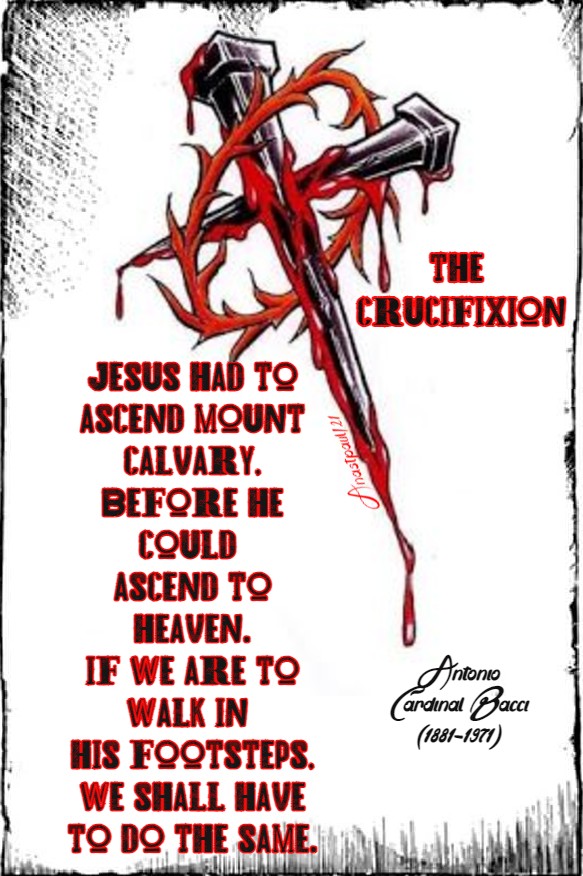
Now, He is stretched, an innocent victim, on the altar of sacrifice, the Cross.
One of the executioners grasps His hand, pierces it with a large nail and attaches it to the wood.
Then, he does the same with the other hand and with the two feet.
His Mother is close at hand.
She feels in her heart the blows of the hammer which lacerate the living flesh of Jesus.
Jesus remains silent “as a meek lamb that is carried to be a victim” (Jer 11:19).

Now, the executioners raise up the Cross and fix it in the hold already prepared for it.
The shock of this impact sends a shudder of terrible pain through the Victim’s members and entire frame.
Behold Him now, suspended between Heaven and earth, the mediator between God and humanity, the victim of expiation for the innumerable sins of men.

Come near to the Cross and kiss the bloodstained feet.
While the Jews are insulting Him and most of the Apostles have abandoned Him, let us tell Him how much we love Him.
Let us tell Him of our sorrow for our sins and of our determination to make amends for our faults and for our ingratitude, by living in accordance with His teachings and example.

Antonio Cardinal Bacci

Posted in "Follow Me", CHRIST, the WAY,TRUTH,LIFE, FATHERS of the Church, GOD ALONE!, HYMNS, I BELIEVE!, POETRY, PRAYERS of the SAINTS, QUOTES for CHRIST, QUOTES of the SAINTS, QUOTES on FAITH, The MOST HOLY & BLESSED TRINITY, The WORD

Quote/s of the Day – 12 October – ‘Firmly I Believe..’

Quote/s of the Day – 12 October – Monday of the Twenty-eighth week in Ordinary Time, Readings: Galatians 4:22-24, 26-27, 31, 5:1, Psalms 113:1-2, 3-4, 5 and 6-7, Luke 11:29-32

“Behold, something greater than Jonah is here.”

Luke 11:32

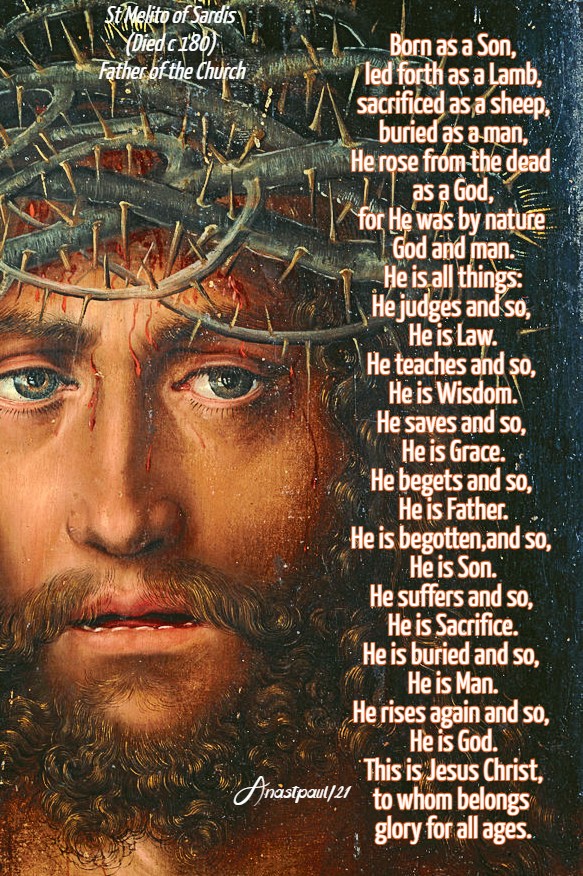
Born as a son,
led forth as a lamb,
sacrificed as a sheep,
buried as a man,
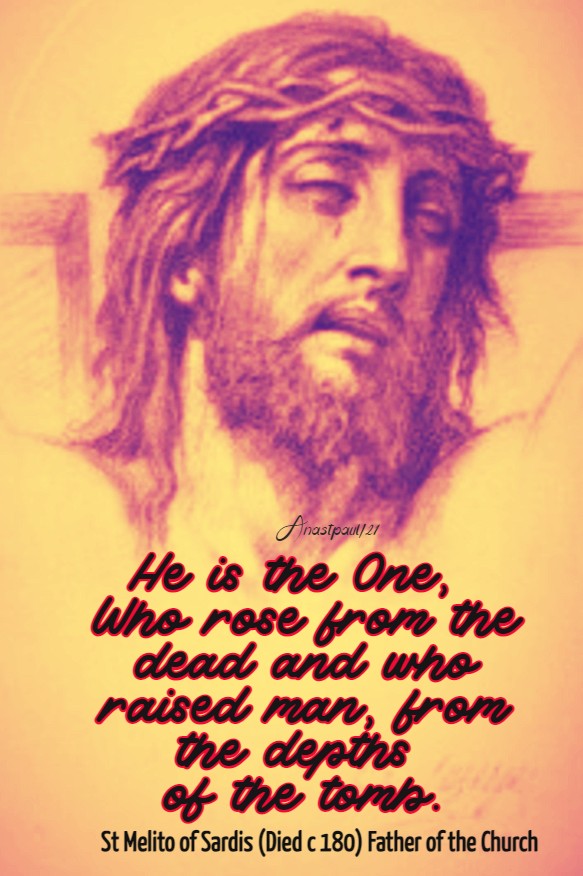
He rose from the dead as a God,
for He was by nature God and man.

He is all things:
He judges and so He is Law,
He teaches and so He is Wisdom,
He saves and so He is Grace,
He begets and so He is Father,
He is begotten and so He is Son,
He suffers and so He is Sacrifice,
He is buried and so He is man,
He rises again and so He is God.
This is Jesus Christ,
to whom belongs glory for all ages.

Saint Melito, Bishop of Sardis (Died c 180)
Early Church Father
In Praise of Christ

Firmly I Believe and Truly
By St John Henry Newman (1801-1890)

Firmly I believe and truly
God is three and God is One
And I next acknowledge duly
Manhood taken by the Son.
And I trust and hope most fully
In that Manhood crucified
And each thought and deed unruly
Do to death, as He has died.
Simply to His grace and wholly
Light and life and strength belong
And I love, supremely, solely,
Him the holy, Him the strong.

And I hold in veneration,
For the love of Him alone,
Holy Church, as His creation,
And her teachings, as His own.
And I take with joy whatever
Now besets me, pain or fear
And with a strong will I sever
All the ties which bind me here.
Adoration aye be given,
With and through the angelic host,
To the God of earth and heaven,
Father, Son, and Holy Ghost.

Posted in CHRIST, the WAY,TRUTH,LIFE, JESUIT SJ, MARIAN TITLES, ONE Minute REFLECTION, QUOTES of the SAINTS, QUOTES on ATHEISM, QUOTES on DOUBT, QUOTES on FAITH

One Minute Reflection – 12 October – ‘ … Every new doubt is for me, new reason to believe.’ Luke 11:29 The Sign of Jonah

One Minute Reflection – 12 October – Monday of the Twenty-eighth week in Ordinary Time, Readings: Galatians 4:22-2426-27315:1Psalms 113:1-23-45 and 6-7Luke 11:29-32 and the Feast of Our Lady Aparecida, Our Lady Who Appeared

“This generation is an evil generation. It seeks for a sign but no sign will be given to it, except the sign of Jonah.” … Luke 11:29

REFLECTION – “Bad christians lack faith and do not deny it but they claim to be excused, in that they have no reasons for believing. Because of this there is nothing as common as this speech in the mouths of many people: “If I had witnessed a miracle I should be a saint!” “Evil and unfaithful generation! It seeks a sign!” (Mt 12:39). The wicked look for signs.

What is even more remarkable about this, is that, even though they have seen many taking place daily before their eyes, even though they are, so to speak, entirely surrounded, they never stop looking for more like the scribes and Pharisees; they would like to see them in heaven when they have seen them on earth. But neither the dead raised up during the life of the Saviour, nor the eclipse of the sun at death, make them believers; their envy becomes stronger, their hatred more malicious; each goes as far as raging, yet their unbelief is not healed by it. It used to be like this regarding those who, living badly, wait for miracles in order to believe: “They will not be persuaded if someone should rise from the dead” (Lk 16:31). (…)

All the difficulties that halt unbelievers, all the contradictions they encounter in the dogmas of faith, everything they find apparent contradiction, everything that seems new to them, surprising, contrary to common sense, contrary to reason, inconceivable, impossible, all their arguments, all their so-called demonstrations, all of this, far from shaking me, strengthens me even more, makes me immovable in my religion. (…) Every new doubt is for me, new reason to believe.” … St Claude de la Colombière (1641-1682) “Apostle of Sacred Heart” Christian Reflections

PRAYER – “Dear Lord! It is just when I am in the world
that I have most need of You
because You know it is full of snares
that the devil has set for me.
You must hold my hand, dear Lord,
if You will not abandon me.
A little of the world is not bad for me;
it is even good, for it teaches me how small it is
and I feel the greater happiness
when I come back to You.
But that I may surely do so,
You must only loose Your hold a little,
that it may not try me too far,
You must not entirely leave hold.
Do You see dear Lord?
I wish to clasp Your hand – do not refuse me!” (I Wish to Clasp Your Hand – Do Not Refuse Me! – Prayer of Eugene de Ferronays) Our Lady Aparecida, Pray for Us!

Posted in BREVIARY Prayers, HYMNS, Our MORNING Offering, PRAYERS of the SAINTS

Our Morning Offering -12 October – It Were My Soul’s Desire

Our Morning Offering -12 October – Monday of the Twenty-eighth week in Ordinary Time

It Were My Soul’s Desire
Anonymous 11th Century
Breviary Prayer/Hymn

It were my soul’s desire
To see the face of God.
It were my soul’s desire
To rest in His abode.

Grant, Lord, my soul’s desire,
Deep waves of cleansing sighs.
Grant, Lord, my soul’s desire
From earthly cares to rise.

It were my soul’s desire
To imitate my King,
It were my soul’s desire
His ceaseless praise to sing.

It were my soul’s desire
When heaven’s gate is won
To find my soul’s desire
Clear shining like the sun.

This still my soul’s desire
Whatever life afford,
To gain my soul’s desire
And see Thy face, O Lord.

Posted in SAINT of the DAY

Saint of the Day – 12 October – Saint Rodobaldo II Cipolla of Pavia (Died 1254)

Saint of the Day – 12 October – Saint Rodobaldo II Cipolla of Pavia (Died 1254) Bishop of Pavia from 1230 to his death, apostle of the poor. Rodobaldo was the 53rd bishop of Pavia. Archdeacon of the Cathedral, he was elected in 1230 and Consecrated by Pope Gregory IX. St Roboaldo II is remembered as a zealous shepherd and for his intense charitable activity. Together with the Pope he preached the crusade against Frederick II, which earned him prison – he was jailed in Pisa. Then he worked to reconcile the Emperor with Innocent IV. He died in 1254. The relics are kept in the Cathedral of Pavia. He is also known as Cipolla of Pavia.

San Rodobaldo II Cipolla of Pavia is a Bishop who lived in the 13th century. In the chronotaxis of the Bishops of Pavia it is placed in fifty-third place, after San Folco Scotti and before Guglielmo da Caneto. It is indicated with the second appellation, as among the bishops before him there is a Rodobaldo de ‘Sangiorgio, who ruled the Diocese in the second decade of the thirteenth century.

In the Verona hagiographic publication, it is stated that he was born in Verona; belonging to the Cipolla family, who before being elected to lead the Diocese held the office of Archdeacon of the Cathedral chapter.

In 1233 he founded the Company of the Holy Spirit in Pavia and brought the Franciscan friars, Vallombrosan and Dominican monks to the diocese. Among the latter he became a friend of St ‘Isnardo di Vicenza, to whom, it is said, he donated the monastery of San Tommaso Apostolo.

Subsequently, he took an active part in the mediation of peace, working towards the reconciliation between the Emperor and the new Pontiff, Innocent IV.
He died in Pavia on 12 October 1254 and since 1279 his body has been placed in the crypt of the City Cathedral of St Siro.
His cult as a saint was confirmed by Pope Leo XIII with a decree of 20 December 1888.

In the Roman martyrology, with the words – “In Pavia, St Rodobaldo II, bishop, man of exemplary spirit of penance, who worked hard for the divine worship and in the search for the relics of the saints.”

Posted in MARIAN TITLES, SAINT of the DAY

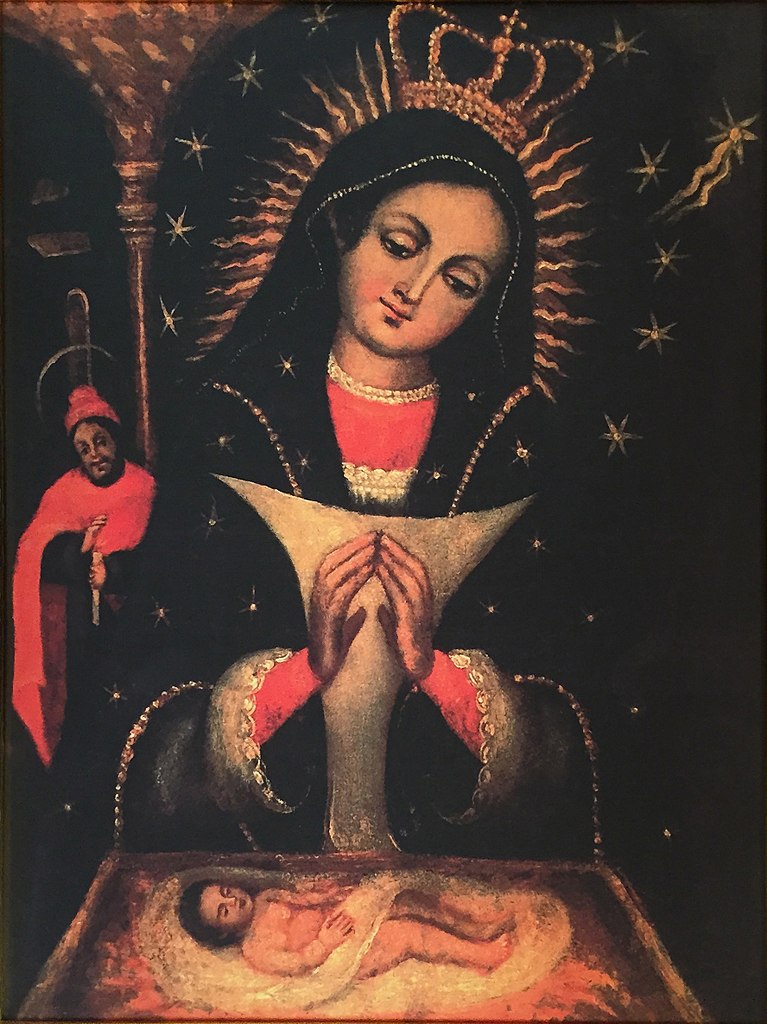
Nossa Senhora Aparecida / Our Lady Aparecida, Nuestra Señora del Pilar / Our Lady of the Pillar (Imus, Philippines) and Memorials of the Saints – 12 October

Nossa Senhora Aparecida / Our Lady Aparecida, Aparecida, Sao Paulo, Brazil (1717) – 12 October: Also known as – Our Lady Who Appeared:

In October 1717, Dom Pedro de Almedida, Count of Assumar passed through the area of Guarantinqueta, a small city in the Paraiba river valley. The people there decided to hold a feast in his honour and though it was not fishing season, the men went to the waters to fish for the feast. Three of the fishermen, Domingos Garcia, Joco Alves and Felipe Pedroso, prayed to the Immaculate Conception and asked God’s help. However, after several hours they were ready to give up. Joco cast his net once more near the Port of Itaguagu but instead of fish, he hauled in the body of a statue. The three cast their net again, and brought up the statue’s head. After cleaning the statue they found that it was Our Lady of the Immaculate Conception. Naming their find Our Lady Aparecida, they wrapped it in cloth and continued to fish; now their nets were full.
While we do not know why the statue was at the bottom of the river, we do know who made it. Frei Agostino de Jesus, a carioca monk from Sao Paulo known for his sculpture. The image was less than three feet tall, was made around 1650 and must have been underwater for years. It is a dark brown colour, is covered by a stiff robe of richly embroidered thick cloth and wears an imperial crown which was added in 1904. Only her face and hands can be seen. Pope Pius XII proclaimed her principal patroness of Brazil in 1930. The statue was vandalised by being broken into several pieces just prior to a visit by St Pope John Paul II but a group of dedicated artists and artisans carefully pieced it together again.
Patronages: • Aparecida, Brazil, diocese of • Brazil • World Youth Day 2013

Nuestra Señora del Pilar / Our Lady of the Pillar (Imus, Philippines) – 12 October

Tradition says that in the early day of the Church, Saint James the Greater was spreading the Gospel in Spain but making very little progress. He was dejected and questioning his mission. About 44, the Virgin Mary, who was still living in Jerusalem at the time, bi-located and appeared to him in a vision to boost his morale. In it, she was atop a column or pillar, which was being carried by angels. That pillar is believed to be the same one venerated in Zaragoza, Spain today. Miraculous healings reported at the scene.
PatronageS: • Imus, Philippines, diocese of • Tagbilaran, Philippines • Zamboanga, Philippines, archdiocese of • Zamboanga City, Philippines • Zaragoza, Spain.

Saint James the Greater

St Amelius of Mortara
St Amicus of Mortara

Blessed Carlo Acutis (1991-2006) Aged 15 Layman

St Cyprian
St Domnina of Anazarbus
St Edisto
St Edistius of Ravenna
St Edwin of Northumbria
About St Edwin:

https://anastpaul.com/2017/10/12/saint-of-the-day-12-october-st-edwin-of-northumbria-586-616/
St Evagrius the Martyr
St Felix
St Herlindis
Blessed Jan Beyzym SJ (1850–1912) Priest, “The Apostle of the Lepers of Madagascar”
Biography:

https://anastpaul.com/2019/10/12/saint-of-the-day-12-october-blessed-jan-beyzym-sj-1850-1912-the-apostle-of-the-lepers-of-madagascar/
St Juan Osiense
St Maximilian of Celeia
St Meinards
St Monas of Milan (Died 249)Rodobaldo Cepolla

St Pantalus of Basle
St Priscian the Martyr
St Relindis
St Rodobaldo II Cipolla of Pavia (Died 1254) Bishop
Bl Roman Sitko
St Salvinus of Verona
Bl Thomas Bullaker
St Wilfrid (c 633-709) Bishop
His Life:

https://anastpaul.com/2018/10/12/saint-of-the-day-12-october-st-wilfrid-c-633-709/

Martyred in the Spanish Civil War:
• Blessed Bartolomé Caparrós García
• Blessed Eufrasio of the Child Jesus
• Blessed José González Huguet
• Blessed Pedro Salcedo Puchades
• Blessed Rafael Lluch Garín

Posted in HOLY WEEK, MARIAN DEVOTIONS, MARIAN REFLECTIONS, MEDITATIONS - ANTONIO CARD BACCI, OCTOBER - The HOLY ROSARY and The HOLY ANGELS, The PASSION

Thought for the Day – 11 October – The Fourth Sorrowful Mystery – The Road to Calvary

Thought for the Day – 11 October – Meditations with Antonio Cardinal Bacci (1881-1971)

“Month of the Holy Rosary”
The Fourth Sorrowful Mystery
The Road to Calvary

“Scourged, crowned with thorns and derided, Jesus is finally condemned to death.
Burdened with the Cross, He sets out for the place of execution in the midst of a crowd of enemies, blasphemers and idle speculators.
Among them , there is only a tiny group which sympathises with Jesus, namely, Mary His Mother, the devout women and the beloved Apostle, St John.

The divine Redeemer goes forward laboriously beneath the heavy weight of the Cross.
He has already lost a large quantity of blood in Gethsemane and during the scourging and crowning with thorns.
His strength seems to be failing but love sustains Him.
Looking feebly around Him, He sees the mocking Jews, the indifferent and disrespectful Roman soldiers and a throng of curious spectators looking for something to amuse them.
Is there nobody else?
Where are those whom He cured miraculously and those whom He comforted and forgave?
Has nobody any pity for Him?
Suddenly the crowd falls silent.
A woman, pale and tearful, is approaching Him, supported by her friends.
She defies the commands of soldiers and the scowls of the executions and comes close to Him.

Here and there, a murmur is heard – It must be His Mother, poor woman!
Jesus and Mary gaze at one another.
It would be impossible for us to guess at the immense depths of love contained in that loving exchange of glances.
Neither utters a word, for no words could express their anguish, nor manifest their love.
They look and understand one another, offering themselves as a holocaust for the redemption of wayward humanity.

Nevertheless, in this silent meeting, there was great consolation for the Heart of Jesus, for He had found someone who loved and understood Him, amongst those malicious throngs.
Why do we not sympathise with Him too and love Him with all our hearts?

Antonio Cardinal Bacci

Posted in "Follow Me", GOD ALONE!, QUOTES for CHRIST, QUOTES of the SAINTS, QUOTES on CHARITY, QUOTES on DISCIPLESHIP, QUOTES on FAITH, QUOTES on LOVE, QUOTES on LOVE of GOD, QUOTES on MISSION, QUOTES on PERSEVERANCE, QUOTES on PRIESTS, the PRIESTHOOD and CONSECRATED LIFE, QUOTES on SELF-DENIAL, QUOTES on THE VOICE OF GOD, QUOTES on TRUST and complete CONFIDENCE in GOD, SAINT of the DAY, The GOOD SHEPHERD

Quote/s of the Day – 11 October – St Alexander Sauli

Quote/s of the Day – 11 October – The Memorial of St Alexander Sauli CRSP (1534-1592) Bishop “The Apostle of Corsica”

“I offer my whole self to You, to You alone.”

St Alexander’s Motto on the profession of his Vows
as a Barnabite.
“EGO TIBI TOTUS, TOTUS TIBI SOLI”

“I will follow God’s inspiration everyday.”

(From a letter written to St Charles Borromeo after his arrival in Corsica)

“If I should start all over, what I have done,
I would do it over again.
For a shepherd,
it is a duty, to give his life for his flock.”

St Alexander Sauli (1534-1592)

(Said just before his death whilst on pastoral visits to his Diocese)

Posted in DOCTORS of the Church, FATHERS of the Church, ONE Minute REFLECTION, QUOTES of the SAINTS, QUOTES on CHARITY, QUOTES on FAITH, QUOTES on HEAVEN, QUOTES on LOVE, SAINT of the DAY, The WORD

One Minute Reflection – 11 October – The Wedding garment – Matthew 22:1-14

One Minute Reflection – 11 October – The Twenty-eighth Sunday of the Year in Ordinary Time, Readings: Isaiah 25:6-10Psalms 23:1-33456Philippians 4:12-14,19-20Matthew 22:1-14 and the Memorial of St Alexander Sauli CRSP (1534-1592) Bishop “The Apostle of Corsica”

Friend, how did you come in here without a wedding garment?” – Matthew 22:12

REFLECTION – “But you, my friends, since you have already come into the house of the marriage feast, our holy Church, as a result of God’s generosity, be careful lest, when the King enters, He finds fault with some aspect of your heart’s clothing!

What do we think is meant by the wedding garment, dearly beloved? For if we say it is Baptism or faith, is there anyone who has entered this marriage feast without them? A person is outside because he has not yet come to believe. What then must we understand by the wedding garment but love? That person enters the marriage feast but without wearing a wedding garment, who is present in the holy Church. He may have faith but he does not have love. We are correct when we say that love is the wedding garment because this, is what our Creator Himself possessed, when He came to the marriage feast, to join the Church to Himself. Only God’s Love brought it about, that His Only-Begotten Son, united the hearts of His chosen, to Himself. John says “God so Loved the world that He gave His Only-Begotten Son for us.” – St Pope Gregory the Great (540-604) Father and Doctor of the Church – (Sermons on the Gospel No 38).

PRAYER – Lord Holy God and Father, open our hearts o Your grace. Let it go before us and be with us. Open our hearts to Your love. Let it be the foundation of our love, let our love be Your love. Stepping in the footsteps of Your Son, in imitation of His Saints as St Alexander Sauli lived, grant that by his intercession, we too may reach Your eternal Feast. Through Jesus our Lord who lives and reigns with You and the Holy Spirit, God now and forever, amen.

Posted in DOCTORS of the Church, FATHERS of the Church, Our MORNING Offering, PRAYERS of the SAINTS, The HOLY EUCHARIST / The HOLY MASS

Our Morning Offering – 11 October – St John Chrysostom’s Prayer before Holy Mass

Our Morning Offering – 11 October – The Twenty-eighth Sunday of the Year in Ordinary Time

Prayer before Holy Mass
By St John Chrysostom (347-407)
Father and Doctor of the Church

O God, loose, remit and forgive
my sins against You.
Whether in word, or in deed, or in thought,
willingly or unwillingly,
knowingly or unknowingly, committed,
forgive them all,
for You are good and love mankind.
And through the prayers of Your most holy Mother,
of Your heavenly servants and holy powers
and of all the saints
who have found favour in Your sight,
enable me to receive, without condemnation
Your holy and immaculate Body
and Your Precious Blood,
to the healing of my soul and body
and to the driving away of all evil imaginations,
for Yours is the kingdom, the power and the glory,
Father, Son and Holy Spirit,
now and forever
and to ages of ages.
Amen

Posted in SAINT of the DAY

Saint of the Day – 11 October – Saint Alexander Sauli CRSP (1534-1592)

Saint of the Day – 11 October – Saint Alexander Sauli CRSP (1534-1592) Bishop “The Apostle of Corsica,” Clerk Regular of the Congregation of Saint Paul (The Barnabites) – St Alexander is referred to as “The Second Founder,” Missionary, Writer, Teacher of philosophy and theology at the University of Pavia, Reformer, Evangeliser, Confessor, Superior-General of the Barnabites in 1565. In addition, St Alexander Sauli was both friend, advisor and spiritual comfort to St Charles Borromeo, who held him in very high esteem. Born as Alessandro Sauli on 15 February in 1534 at Milan, Italy and died on 11 October 1592 at Pavia, Italy of natural causes. Patronages – Corsica, Barnabite Seminarians. He was appointed by St Pope Pius V to the ancient see of Aleria, Corsica, where he rebuilt churches, founded colleges and seminaries and, despite the depredations of the Corsairs, placed the Church in a flourishing condition.

In 1591, he was made Bishop of Pavia and died at Calozza the following year. He left a number of works, chiefly catechetical. He was Beatified by Pope Benedict XIV on 23 April 1742 and Canonised by St Pope Pius X on 11 December 1904.

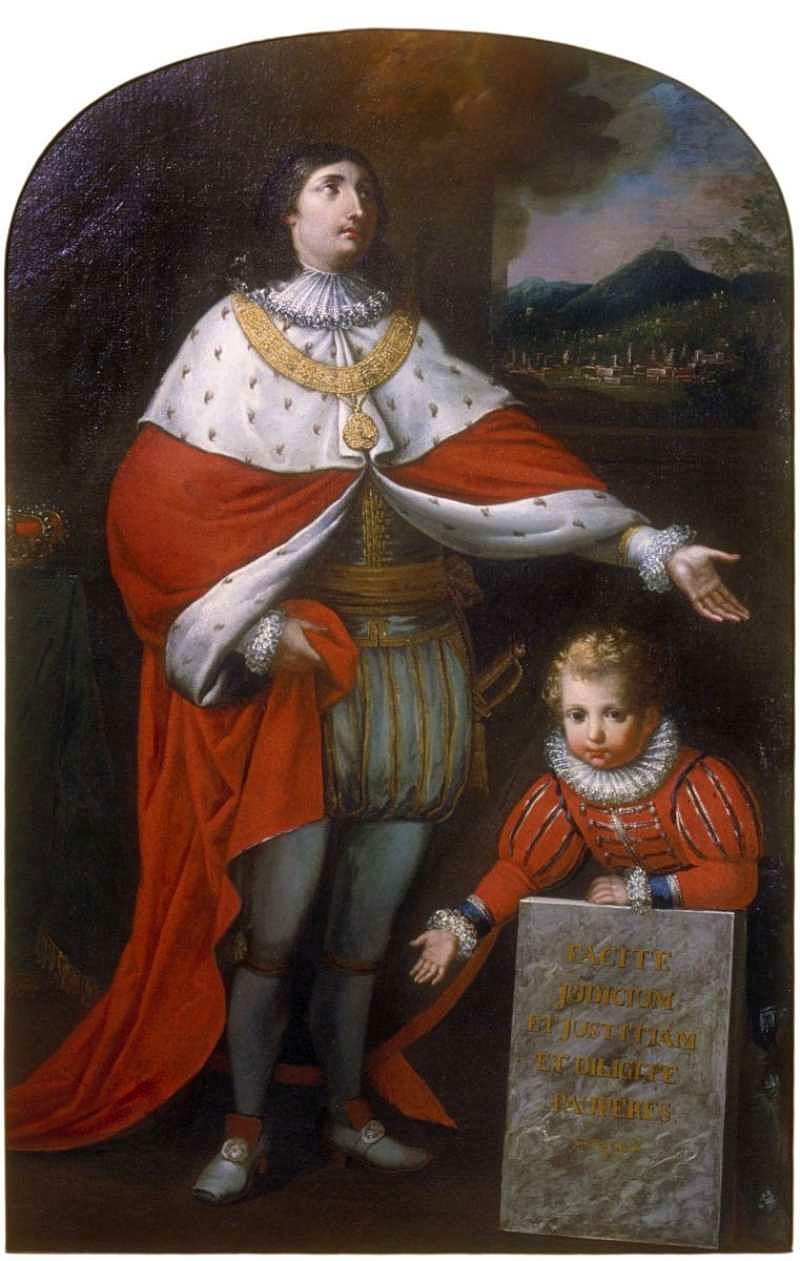
Alexander was born of a wealthy and highly regarded family of Lombard on 15 February 1534. His father, Dominic, was the Marquis of Pozzuolo and assistant to Duke Francesco II of Sforza. Tommasina Spinola, his mother, also came from an ancient and noble family.

His parents provided a superior education for him at Pavia. This enabled him to become a page in the court of Emperor Charles V in Milan when he turned 17. This ended quickly when he sought to enter the Barnabite order, resisting his family and friends who urged him to enter a well-established order such as the Franciscans or Dominicans.

The Barnabites imposed a harsh test on the youth before they would accept him. On 17 May, 1551, the Vigil of Pentecost, he had to carry a heavy cross through the streets dressed as a page and preach on the love of God. That evening he was received as a postulant.

Three months later Alexander received the habit on 15 August. Yet at the next chapter meeting, he received much criticism for being tepid, possessing a superior attitude and being incompetent. A year later, Alexander participated in the sessions on the Constitutions for the Order and then was permitted to continue his theological studies at the Franciscan Friary of St Mary of Peace. Finally, he professed his vows on 29 September 1554. He was Ordained a Subdeacon on 22 December 1954 and a Deacon on 8 June 1555. Having received a special dispensation for his youth — he was 22 years old — he was Ordained on 21 March 1556 and then was assigned to the community library.

When a nobleman miraculously recovered his health, his family built a Church in Pavia in thanksgiving. The Barnabites were given the Church and sent Fr Sauli to be the Parish Priest. Like most saints, he did much more than dispense the Sacraments.

Although possessing no degree, he established study groups for both college students and seminarians. He promoted frequent Holy Communion and the Forty Hours devotion. His classes were well attended with lively debates, and instruction was geared to students’ ability rather than to deadlines.
He introduced innovations such as teaching geometry to instill discipline and law so students could protect themselves in a society rife with disputes. He encouraged the organisation of Church law.

After receiving an honourary bachelor’s degree, he was offered a position at the university but his superiors declined saying it was not in accord with humility. Providence changed that when a substitute was needed and Sauli was called. In 1562 because he was such an excellent teacher, he was given a permanent position at the university.

Fr Sauli, although given little time to prepare to discuss the “unity of the creating principle,” passed his doctoral exams even under the demands of an elite board of examiners. He received the degree on 28 May 1563. As a member of the College of Professors of Theology, he taught theology and philosophy while also serving the parish where he taught the Epistles of St Paul. In both places he drew large audiences with his wisdom and eloquence.

Despite his overwhelming success as a preacher and being the dean at the university, he wanted to focus on the running of the private school of the Barnabites. All this was interrupted when Bishop Ippolito de’ Rossi of Pavia called Fr Sauli to his service. He appointed Fr Sauli to be his theologian, lector for cases of conscience, examiner of clergy and planner for pastoral visits. Fr Sauli also published many books and republished some in accordance with the documents of the Council of Trent.

Being a humble man, he had no fear of losing positions and easily made way for others to take over his work and assignments — frequently to develop and encourage more men to serve God’s sheep.

In 1567 he was elected Superior General of the Order at the young age of 33. He proceeded to practice the rule with great diligence, proving his dedication and commitment to the order. Soon Attilio Gritti schemed to take over the church given to the Barnabites but Fr Sauli appealed to Archbishop Cardinal Charles Borromeo, who settled the dispute in a meeting with the Pope.

As superior, Sauli ensured that the Order followed the proclamations of the Council of Trent. Then he called for a Special Chapter to adopt the new Breviary published by Pope Pius V in 1568. In addition, he wrote updated guidelines for the curriculum and the seminary, gave conferences to religious orders, kept up with his voluminous correspondence and settled disputes. Under his leadership the fervour of the order was rekindled, so successfully, that he is credited with being the Second Founder.

About 1569 Fr Sauli went to Milan where he served St Charles Borromeo. He participated in the first Synod of the Archdiocese of Milan, while continuing to serve as Superior General, helping to improve the stature of the Barnabites in Venice — they had been expelled in 1552. St Charles Borromeo recognised a great homilist in Fr Sauli, inviting him to speak at the Cathedral in Milan. Likewise, Pope Gregory XIV also appreciated the prudence and wisdom of Fr Sauli who participated in several Synods and Councils.

When Fr Sauli was sent to hear Borromeo’s general Confession, the cardinal remarked that it had changed his life. Then Borromeo made a miraculous escape from enemies and asked Fr Sauli for advice to which he replied, “Humble yourself and reflect if God has allowed it, in punishment for some of your defects.” Once a month, Borromeo found refuge at the House of St Barnabas. Moreover, he spent the whole Holy Week with the Community. At first he used Sauli for delicate and secret missions, such as peace among spouses and families and delicate cases of conscience. He immediately noticed his prudence and common sense.

In 1571, Pope Pius V appointed Fr Sauli to Aleria on Corsica — a place where the Church was in a wretched state. In Milan the news caused great unrest among the Barnabites who protested, “We have no-one who equals him. We have few among us, whom either age does not qualify for active duty, or youth in consequence of their want of experience, does not render unfit for the government of others.”

They sought Cardinal Borromeo’s help to avert such a disaster. He wrote to his man in Rome, Msgr. Ormaneto: “Having notified the Superior of St Barnabas about the decision of Our Lord to give him the care of the Church of Aleria in Corsica, he, for the humble esteem of himself, has stated not to be qualified: which I do not agree with, as I know very well his qualifications…. Meanwhile I cannot avoid to present to His Holiness the great worry of the old Fathers of this Congregation, whom I have notified about it…. because of the great damage coming to their Congregation with the loss of this man, as it relies on his prudent government with great help from his knowledge, in which, truthfully, there is no equal; … Then, I know too how the city at large will suffer because of it, since the Superior is very useful to it in so many ways, such as conferences and confessions , and other spiritual services , and his prudent counsel, of which I avail myself regularly. If, then, Our Lord believes that he will render greater service to God in his new vocation, he is a son of obedience.”

To prepare himself to follow God’s will, together with St Charles, Fr Sauli went to the Carthusian Abbey in Carignano for a retreat. Writing to his father, Alexander stated: “The effort I have endured here as Superior General seems to me like roses in comparison with what I am starting to experience as a Bishop.”

The ceremony took place in the Cathedral of Milan on 12 March. Sauli was Consecrated bishop by his friend, Cardinal Borromeo of Milan, with Ippolito de Rossi, Bishop of Pavia, and Federico Comer, Bishop of Bergamo, as concelebrants. St Charles provided and donated to him all the Episcopal vestments

Since Corsica had not had a Bishop for 70 years, the Diocese needed much work. Of the 12 priests he was advised to take with him, only four were available. On 18 May 1570 he wrote to Borromeo about the devastation in Corsica after years of guerrilla warfare, famine and lack of pastoral leadership. The priests did not know Latin and had to be trained how to administer the sacraments. He established himself in precarious and humble dwellings and started immediately the visitation of the whole Diocese, entailing great and severe sacrifices, to bring to all the Word of God “like a beneficial rain that the good Lord sends on a field for long time arid and destroyed.” By the end of August he was able to hold a Synod with 150 Priests present to set up rules and regulations. He built a Seminary and a Cathedral and he defused many vendettas. After twenty years, he had revitalized the Church and the Corsicans had come to love and respect their Bishop.

Thus, when he was called to become Bishop of Pavia they grieved deeply. The people of Pavia were thrilled to learn that Sauli was returning and gave him a great welcome. He arrived on 19 October 1591 and began to enkindle a deeper faith in the people, who were also suffering famine. Although for some time he had been sick on and off with fever, toward the end of September 1592, Sauli began the pastoral visit of his new diocese.

After presiding at the Ordinations in Bursignano, he reached Colosso d’Asti on 1 October, where he spent the day in preaching, catechesis, confirmations, and personal meetings. That night he became sick with fever and gout. Not wanting to disturb the local Parish Priest, he decided to accept the invitation of his friend, Count Ercole Roero, to stay at his castle. He died on Sunday, 11 October 1592. A few days before he had said: “Don’t think that I am dying because of the efforts of this pastoral visit; be convinced that this is the hour fixed by God. If I should start all over what I have done, I would do it over again.”

His body was brought to Pavia on 14 October and, the next day, the solemn funeral took place. His universal fame as a saint spread immediately and grew steadily. The unanimous consensus and great devotion, especially in Pavia, led, in 1623, to the initiation of the canonical process. He was Beatified by Pope Benedict XIV, on 23 April 1742 and Canonised by St Pope Pius X, 11 December 1904. St Alexander Sauli is the Patron of Barnabite Seminarians and of Corsica.

Prayer

O God, in the holy bishop Alexander Sauli
you have given to Your Church
a model of faithful religious observance
and of tireless pastoral dedication.
Grant, we pray, that Your people
may always be led by worthy pastors.
We ask this through our Lord Jesus Christ, Your Son,
who lives and reigns with You and the Holy Spirit,
one God, forever and ever.
Amen

Posted in SAINT of the DAY

Twenty-eighth Sunday in Ordinary Time +2020 and Memorials of the Saints- 11 October

Twenty-eighth Sunday in Ordinary Time +2020
Nineteenth Sunday after Pentecost (Traditional Calendar) +2020
__

St Pope John XXIII (1881-1963) (Optional Memorial)
Biography here:

https://anastpaul.wordpress.com/2017/10/11/saint-of-the-day-11-october-st-pope-john-xxiii-1881-1963/
AND:
https://anastpaul.com/2018/10/11/saint-of-the-day-11-october-st-pope-john-xxiii-1881-1963-good-pope-john/

St Agilbert of Paris
St Alexander Sauli CRSP (1534-1592) Bishop “The Apostle of Corsica”
St Anastasius V
St Anastasius the Apocrisarius
St Andronicus of Ephesus
St Andronicus the Soldier
St Ansilio
St Bruno the Great
St Canice
St Digna of Sicily
St Dionisio de Santarem
St Emilian of Rennes
St Ethelburgh of Barking
St Eufridus
St Firminus of Uzes
St Germanus of Besancon
St Gratus of Oloron
St Guiadenzio of Gniezno
St Gummarus
Bl James Grissinger
St Juliana of Pavilly
St Maria Soledad Torres Acosta (1826-1887)
Her Life:

https://anastpaul.com/2019/10/11/saint-of-the-day-11-october-saint-maria-soledad-torres-acosta-1826-1887/

Quotes by St Maria Soledad Torres Acosta:
https://anastpaul.com/2019/10/11/quote-s-of-the-day-11-october-it-is-him-that-we-serve/

St Nectarius of Constantinople
St Phêrô Lê Tùy
St Philip the Deacon
St Philonilla
St Placid
St Placidia
St Probus of Side
St Santino of Verdun
St Sarmata
St Taracus of Cladiopolis
St Zenaides

Martyrs of Vilcassin – 4 saints: Four Christians who were martyred together. We know little more than the names – Nicasius, Pienza, Quirinus and Scubicolus. Their martyrdom occured in Vexin Lugdunense territory of Gaul (modern Vilcassin, France), date unknown.

Posted in LENTEN THOUGHTS, MARIAN DEVOTIONS, MARIAN REFLECTIONS, MEDITATIONS - ANTONIO CARD BACCI, OCTOBER - The HOLY ROSARY and The HOLY ANGELS, QUOTES - J R R Tolkien and MORE, QUOTES on BLASPHEMY, QUOTES on REPARATION/EXPIATION, The MOST PRECIOUS BLOOD, The PASSION

Thought for the Day – 10 October – The Third Sorrowful Mystery – The Crowning with Thorns

Thought for the Day – 10 October – Meditations with Antonio Cardinal Bacci (1881-1971)

“Month of the Holy Rosary”
The Third Sorrowful Mystery
The Crowning with Thorns

This new torture was a diabolical invention decreed by no law or authority.
Purely for their own savage entertainment, the soldiers procured a bundle of thorned reeds, which they wound into the shape of a crown and pressed into Jesus’ head.

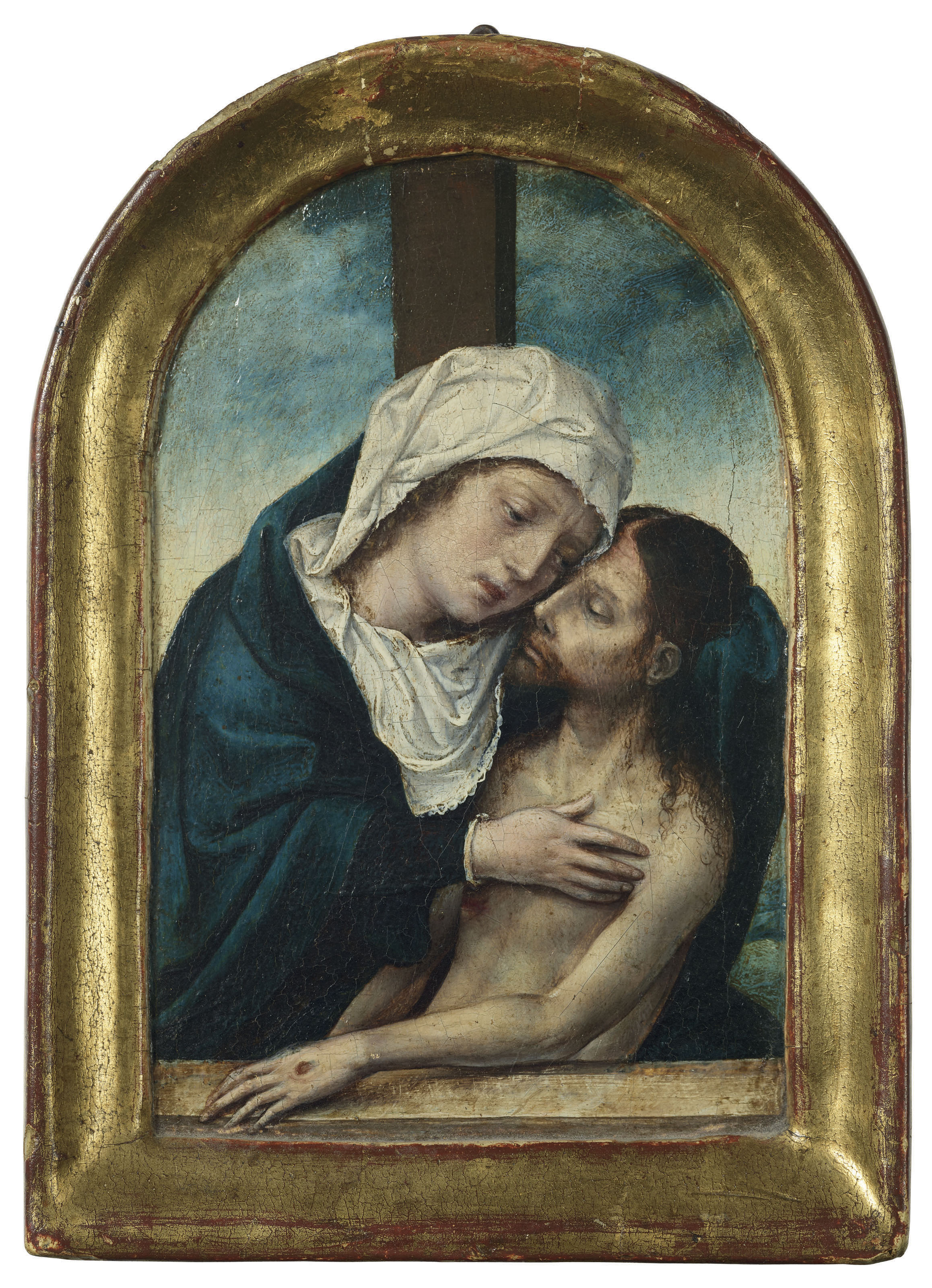
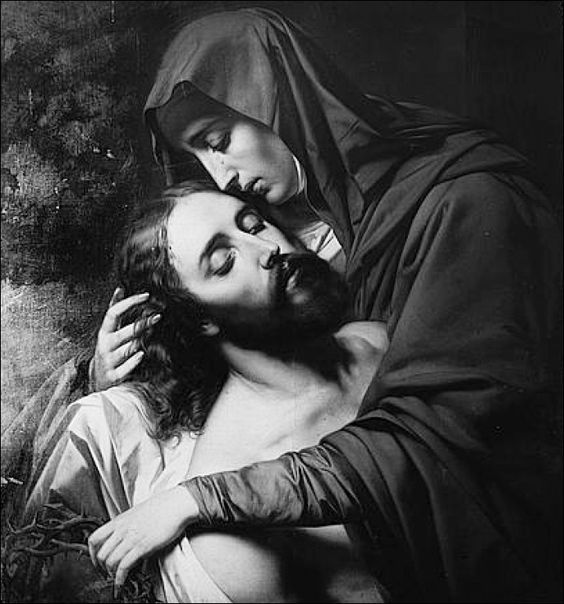
Mary knew what was going on.
She was there with the holy women when Pilate brought her bloodstained Son before the people and, their blasphemous yells pierced her tender heart.
Her mother’s heart felt the sharp thorns too but, she accepted this affliction with resignation, silently protesting against the insults of the crowd by acts of adoration and of love.
We should behave in this way also.
We should participate in the passion of Jesus, by offering our own sufferings and we should make acts of love and of self-surrender, in reparation for these acts of blasphemy!

Antonio Cardinal Bacci

Posted in "Follow Me", CHRIST, the WAY,TRUTH,LIFE, GOD ALONE!, JESUIT SJ, QUOTES of the SAINTS, QUOTES on DISCIPLESHIP, QUOTES on ETERNAL LIFE, QUOTES on FAITH, QUOTES on LOVE of GOD, QUOTES on MISSION, QUOTES on OBEDIENCE, SAINT of the DAY

Quote/s of the Day – 10 October – St Francis Borgia and St Daniel Comboni

Quote/s of the Day – 10 October – The Memorial of St Francis Borgia SJ (1510-1572) and St Daniel Comboni (1831-1881)

“We must perform all our works in God
and refer them to His glory,
so that they will be permanent and stable.
Everyone—whether kings, nobles, tradesmen or peasants—
must do all things for the glory of God
and under the inspiration of Christ’s example. . . . ”

“We must make our way towards eternity,
never regarding what men think of us,
or of our actions,
studying only to please God.”

“Who could ever soften this heart of mine
but YOU alone O Lord!”

St Francis Borgia (1510-1572

Posted in "Follow Me", CHRIST, the WAY,TRUTH,LIFE, DOCTORS of the Church, FATHERS of the Church, I BELIEVE!, JESUIT SJ, MARIAN QUOTES, ONE Minute REFLECTION, QUOTES of the SAINTS, QUOTES on DISCIPLESHIP, QUOTES on FAITH, QUOTES on OBEDIENCE, SAINT of the DAY, The WORD

One Minute Reflection – 10 October – “Rather, blessed are they who hear the word of God and keep it.” Luke 11:28

One Minute Reflection – 10 October – “Month of the Most Holy Rosary” – Saturday of the Twenty SeventhWeek in Ordinary Time, Readings:Galatians 3: 22-29Psalms 105: 2-34-56-7Luke 11: 27-28 and the Memorial of St Paulinus of York (c 584-644) and St Francis Borgia SJ (1510-1572)

“While he was speaking, a woman from the crowd called out and said to him, ‘Blessed is the womb that carried you and the breasts at which you nursed.’” – Luke 11:27

REFLECTION – “Mary was more blessed in accepting the faith of Christ than in conceiving the flesh of Christ. To someone who said, “Blessed is the womb that bore you,” he replied, “Rather, blessed are they who hear the word of God and keep it.”

Finally, for his brothers, his relatives according to the flesh who did not believe in him, of what advantage was that relationship? Even her maternal relationship would have done Mary no good, unless she had borne Christ more happily in her heart, than in her flesh.” – St Augustine (354-430) Father & Doctor of Grace – Holy Virginity, 3/

PRAYER – Almighty God and Father, you sent St Paulinus and St Francis Borgia to be Your witnesses and to bring Your Church to the pagans for the salvation of souls. Sustain us by their prayers that by our lives we may lead all to You through Holy Mother Church. Through Jesus Christ our Lord, Who lives and reigns with You and the Holy Spirit, God forever and ever, amen.

Posted in MARIAN DEVOTIONS, MARIAN POETRY, MARIAN PRAYERS, MARIAN Saturdays, MARIAN TITLES, OCTOBER - The HOLY ROSARY and The HOLY ANGELS, Our MORNING Offering, POETRY, The HOLY ROSARY/ROSARY CRUSADE

Our Morning Offering – 10 October – Queen of the Holy Rosary

Our Morning Offering – 10 October – “Month of the Most Holy Rosary” – Saturday of the Twenty SeventhWeek in Ordinary Time, Readings: Galatians 3: 22-29, Psalms 105: 2-3, 4-5, 6-7, Luke 11: 27-28 and a Marian Saturday

Queen of the Holy Rosary

Queen of the Holy Rosary!
Thee as our Queen we greet,
And lay our lowly, loving prayers
Like roses at thy feet.
Would that these blossoms of our souls
Were far more fair and sweet.

Queen of the Joyful Mysteries!
Glad news God’s envoy bore.
The Baptist’s mother thou didst tend;
Angels thy Babe adore,
Whom with two doves thou ransomest;
Lost, He is found once more.

Queen of the Dolorous Mysteries!
Christ ‘mid the olives bled,
Scourged at the pillar, crowned with thorns,
Beneath His Cross He sped
Up the steep hill and there once more
Thine arms embraced Him–dead!

Queen of the Glorious Mysteries!
Christ from the tomb has flown,
Has mounted to the highest heaven
And sent His Spirit down
And soon He raises thee on high
To wear thy heavenly crown.

Queen of the Holy Rosary!
We, too, have joys and woes.
May they, like thine, to triumph lead!
May labour earn repose,
And may life’s sorrows and life’s joys
In heavenly glory close.

Taken from:
Cyril Robert – Mary Immaculate: God’s Mother and Mine.
Poughkeepsie, New York: Marist Press, 194
6

Posted in SAINT of the DAY

Saint of the Day – 10 October – St Paulinus of York (c 584-644)

Saint of the Day – 10 October – St Paulinus of York (c 584-644) First Bishop of York, Missionary. Born in c 584 in Rome, Italy and died on 10 October 644 at Rochester, Kent, England of natural causes. Patronage – Rochester, England and Rochester Diocese. Paulinus was a member of the Gregorian mission sent in 601 by Pope Gregory I to Christianise the Anglo-Saxons from their native Anglo-Saxon paganism, Paulinus arrived in England by 604 with the second missionary group.

Paulinus, the first Christian Missionary to the kingdom of Northumbria, was a “tall man with a slight stoop, who had black hair, a thin face and a narrow, aquiline nose, his presence being venerable and awe-inspiring.”

He left Italy in 601, at the bidding of Pope Gregory the Great, to assist St Augustine of Canterbury, in his work of conversion. With Paulinus, came Mellitus, Justus, and Rufinianus, and they brought, to Augustine, a letter from Gregory, in which the Pope expressed a desire that York should become a metropolitical see with twelve suffiragans. For many years, Paulinus assisted Augustine and Justus in the south of England. However, in 625, King Edwin of Northumbria, still a pagan, married the Christian Aethelburga, daughter of King Aethelbert of Kent who had received St Augustine. Paulinus escorted her to her husband’s kingdom, having been Consecrated – on 21st July 625 – by Archbishop Justus as Bishop of the Northumbrians.

The story of Paulinus’ labours in the north and the manner in which he succeeded in effecting the conversion of Edwin and of his principal chiefs is well-known. The saint held a famous conference with the highest Northumbrian nobles, probably at a Royal Palace in Londesborough in the East Riding of Yorkshire. Here he explained to them the advantages of the Christian religion, illustrating his arguments thus:

“This is how the present life of man on Earth, King, appears to me in comparison with that time which is unknown to us. You are sitting feasting with your ealdormen and thegns in winter time. The fire is burning on the hearth in the middle of the hall and all outside is warm, while outside the wintry storms of rain and snow are raging – and a sparrow flies swiftly through the hall. It enters in at one door and quickly flies out through the other. For the few moments it is inside, the storm and wintry tempest cannot touch it, but after the briefest moment of calm, it flits from your sight, out of the wintry storm and into it again. So this life of man appears but for a moment. What follows or, indeed, what went before, we know not at all.”

Having been offered hope of life after death, the nobles were won over. Even the King’s pagan high priest, Coifi – probably motivated by hopes of his own survival – rode out to the great pagan temple at Goodmanham, a very short distance from Londesborough, threw a spear into it and began it’s demolition. The present Parish Church there may possibly occupy the site. Shortly after this conference, the Baptism of Edwin took place, at York, on Easter Day (12th April) 627. Two of his children and many other persons of noble birth, were Baptised at the same time. Round the Baptistery, which had been hastily built, the King caused a small stone Church to be constructed. It stood somewhere in the vicinity of the present Minster, under which, it’s cemetery has been excavated.

The kingdom of Edwin embraced the whole country from the Humber to the Clyde and the Forth and there are traces of Paulinus and his labours in many parts of this vast district. “Paulin’s Carr” and the “Cross of Paulinus,” in the adjoining Parish of Easingwold, are both mentioned in an Inquisition of the reign of King Edward I.

In 633, King Edwin fell in the Battle of Hatfield Chase (Nottinghamshire). It was unsafe for the Queen to remain in Northumbria and Paulinus returned with her and her children to Kent. International communications were, not surprisingly, poor in those days and, unaware of this new state of affairs, Pope Honorius I wrote to King Edwin and Archbishop Honorius of Canterbury in June the following year, sending the Pallium for, now exiled, Paulinus.

St Paulinus at Rochester Cathedral

Bishop Romanus of Rochester having died, Paulinus was immediately given his see, which he presided over until his death on 10 October 644. He was buried in the chapter-house of the Cathedral there but Archbishop Lanfranc translated his relics and placed them in a beautiful silver shrine. The name of Paulinus was inserted in the Calendar and he became the great Patron Saint of Rochester.

PRAYER: Lord, through St Paulinus, Your Bishop, You brought those who had no faith out of darkness into the light of truth. By his intercession, keep us strong in our faith and steadfast in the hope of the Gospel he preached. Amen

Statues from left to right of Sts Ethelbert, Justus and Paulinus at Rochester Cathedral
Posted in JESUIT SJ, SAINT of the DAY

Memorials of the Saints – 10 October

St Daniel Comboni (1831-1881) (Optional Memorial)
Biography:

https://anastpaul.com/2018/10/10/saint-of-the-day-st-daniel-comboni-1831-1881-vicar-apostolic-of-central-africa/

St Aldericus
Bl Angela Truszkowska (1825-1899)
Her Life:

https://anastpaul.com/2019/10/10/saint-of-the-day-blessed-maria-angela-truszkowska-1825-1899/

St Cassius
St Cerbonius of Populonia
St Cerbonius of Verona
St Clarus of Nantes
Bl Demestrius of Albania
Bl Edward Detkens
St Eulampia
St Eulampius
St Florentius the Martyr
St Francis Borgia SJ (1510-1572)
Biography here:

https://anastpaul.wordpress.com/2017/10/10/saint-of-the-day-10-october-st-francis-borgia-s-j-1510-1572/

St Fulk of Fontenelle
St Gereon
St Gundisalvus
Bl Hugh of Macon
Bl Leon Wetmanski
St Maharsapor the Persian
St Malo the Martyr
St Patrician
St Paulinus of Capua
St Paulinus of York (c 584-644) First Bishop of York

Bl Pedro de Alcantara de Forton de Cascajares
St Pinytus of Crete
Bl Pontius de Barellis
St Tanca
St Teodechilde
St Victor of Xanten

Martyrs of Ceuta – 7 beati: A group of seven Franciscan Friars Minor missionaries to Muslims in the Ceuta area of modern Morocco. Initially treated as madmen, within three weeks they were ordered to convert to Islam and when they would not they were first abused in the streets, then arrested, tortured and executed.
• Angelo
• Daniele di Calabria
• Donnolo
• Hugolinus
• Leone
• Nicola
• Samuele
They were beheaded in 1227 in Mauritania Tingitana (Ceuta, Morocco). Local Christians secreted the bodies away and gave them proper burial in Ceuta. They were Beatified in 1516 by Pope Leo X.