One Minute Reflection – 7 June – The Solemnity of the Most Holy Trinity, Readings: Exodus 34:4-6, 8-9, Psalm Daniel 3:52.53.54.55.56, 2 Corinthians 13:11-13, John 3:16-18
“Whoever believes in him … might have eternal life” … John 3:16
REFLECTION – “Fools! … how is it that you can’t stop your prying investigations into the Trinity or be content to believe it exists, since you have for your guide the apostle who wrote: “Anyone who approaches God must believe that he exists and that he rewards those who seek him” (Heb 11:6). (…) So let no-one put unnecessary questions to himself but, be content with learning what is contained in Scripture.
… Scripture tells us that the Father is both Source and Light: “They have forsaken me, the source of living waters” (Jer 2:13); “You have forsaken the fountain of wisdom” (Ba 3:12) and, according to John, “God is light” (1Jn 1:5). Now the Son, is called a river, in relation to the source for, according to the psalm, “the river of God is full of water” (Ps 65[64]:10). And in relation to the Light, He is called splendour, when Paul says that he is “the refulgence of his glory and the very imprint of his being” (Heb 1:3). Thus the Father is Light, the Son it’s refulgence… and, in the Son, it is by the Spirit that we are illuminated. “May God give you a spirit of wisdom and revelation,” says Paul, “resulting in knowledge of him. May the eyes of your hearts be enlightened” (Eph 1:17-18). But, when we are enlightened, it is Christ who enlightens us in Him, for Scripture says: “He was the true light who enlightens everyone coming into the world” (Jn 1:9). Moreover, since the Father is Source and the Son is called River, we are said to drink of the Spirit: “We were all given to drink of one Spirit” (1Cor 12:13). But, refreshed by the Spirit, we drink Christ since: “They drank from a spiritual rock that followed them and the rock was the Christ” (1Cor 10:4). (…)
God alone is wise and the Son His wisdom, for “Christ is the power and the wisdom of God” (Rm 16:27; 1 Cor 1:24). So, it is in receiving the Spirit of wisdom, that we possess the Son and gain wisdom in Him. … The Son is Life. He said: “I am the Life” (Jn 14:6). But, it is said, that we are brought to life by the Spirit, as Paul wrote: “The one who raised Christ from the dead will give life to our mortal bodies also through his Spirit that dwells in us” (Rm 8:11). But when we have been brought to life by the Spirit, then Christ will be our life … “I live, no longer I, but Christ lives in me” (Gal 2:20).
When such a correspondence and unity exists in the Holy Trinity, who can separate either the Son from the Father, or the Spirit from the Son or the Father? … God’s mystery is not communicated to our minds by demonstrative arguments but, by faith and reverent prayer.” … St Athanasius (295-373) Bishop of Alexandria, Father and Doctor of the Church – Letters to Serapion, no.1, 19
PRAYER – Firmly I Believe and Truly – St John Henry Newman (1801-1890)
Firmly I believe and truly God is three and God is On And I next acknowledge duly Manhood taken by the Son. And I trust and hope most fully In that Manhood crucified And each thought and deed unruly Do to death, as He has died. Simply to His grace and wholly Light and life and strength belong And I love, supremely, solely, Him the holy, Him the strong.
And I hold in veneration, For the love of Him alone, Holy Church, as His creation, And her teachings, as His own. And I take with joy whatever Now besets me, pain or fear And with a strong will I sever All the ties which bind me here. Adoration aye be given, With and through the angelic host, To the God of earth and heaven, Father, Son, and Holy Ghost.
Our Morning Offering – 7 June – The Solemnity of the Most Holy Trinity
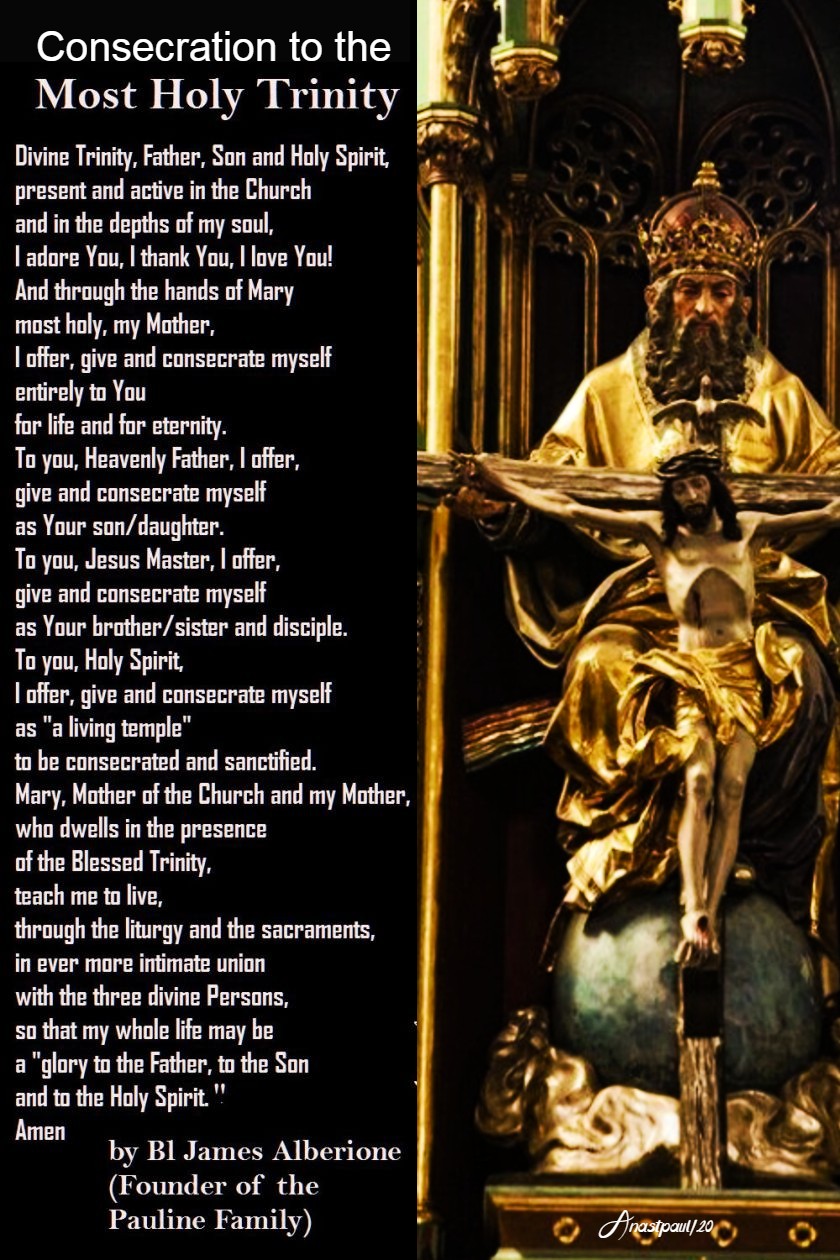
Consecration to the Most Holy Trinity by Blessed James Alberione (1884-1971) Founder of the Pauline Family
Divine Trinity, Father, Son and Holy Spirit,
present and active in the Church
and in the depths of my soul,
I adore You, I thank You, I love You!
And through the hands of Mary most holy, my Mother,
I offer, give and consecrate myself entirely to You,
for life and for eternity.
To you, Heavenly Father, I offer, give and consecrate myself
as Your son/daughter.
To you, Jesus Master, I offer, give and consecrate myself
as Your brother/sister and disciple.
To you, Holy Spirit, I offer, give and consecrate myself
as “a living temple” to be consecrated and sanctified.
Mary, Mother of the Church and my Mother,
who dwells in the presence
of the Blessed Trinity,
teach me to live,
through the liturgy and the sacraments,
in ever more intimate union
with the three divine Persons,
so that my whole life may be
a “glory to the Father, to the Son
and to the Holy Spirit.”
Amen
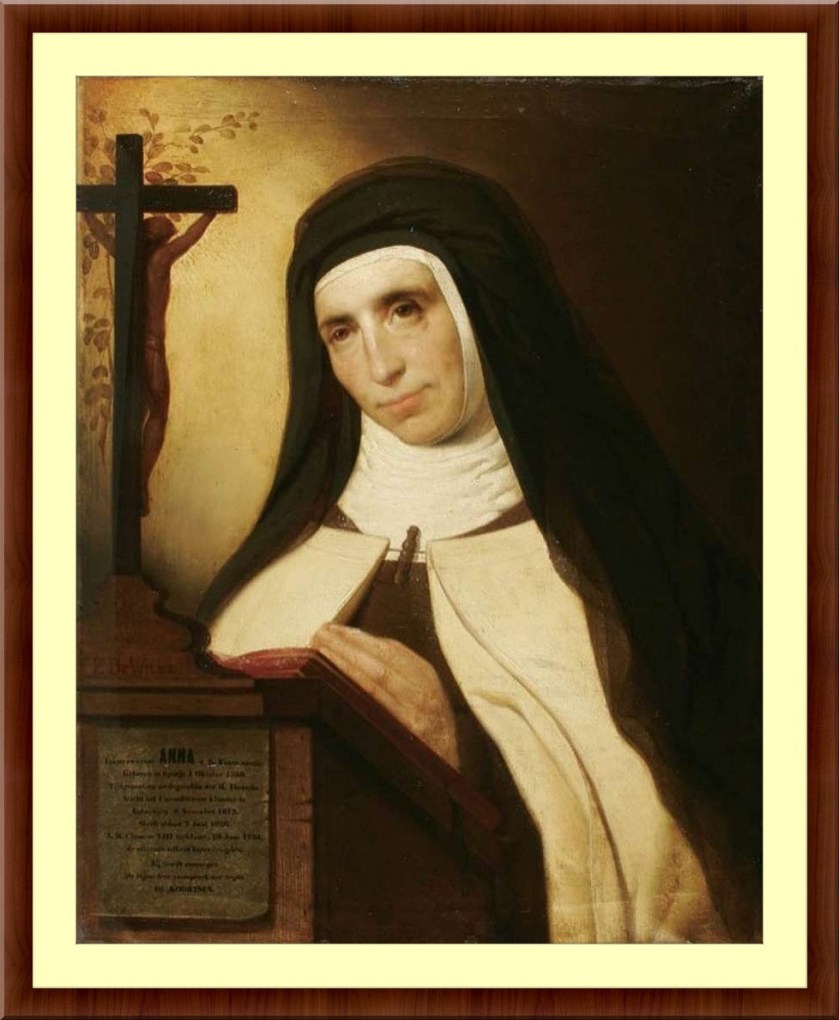
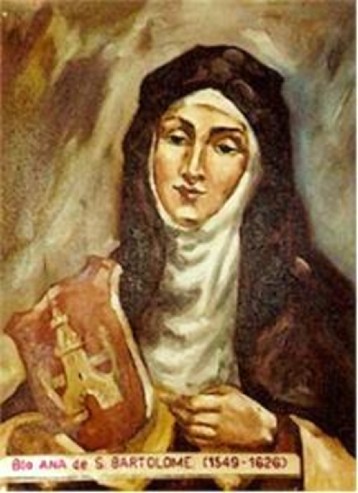
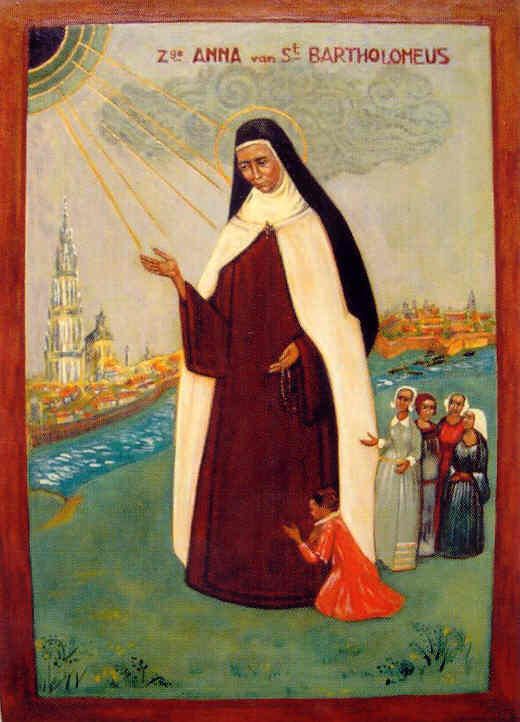
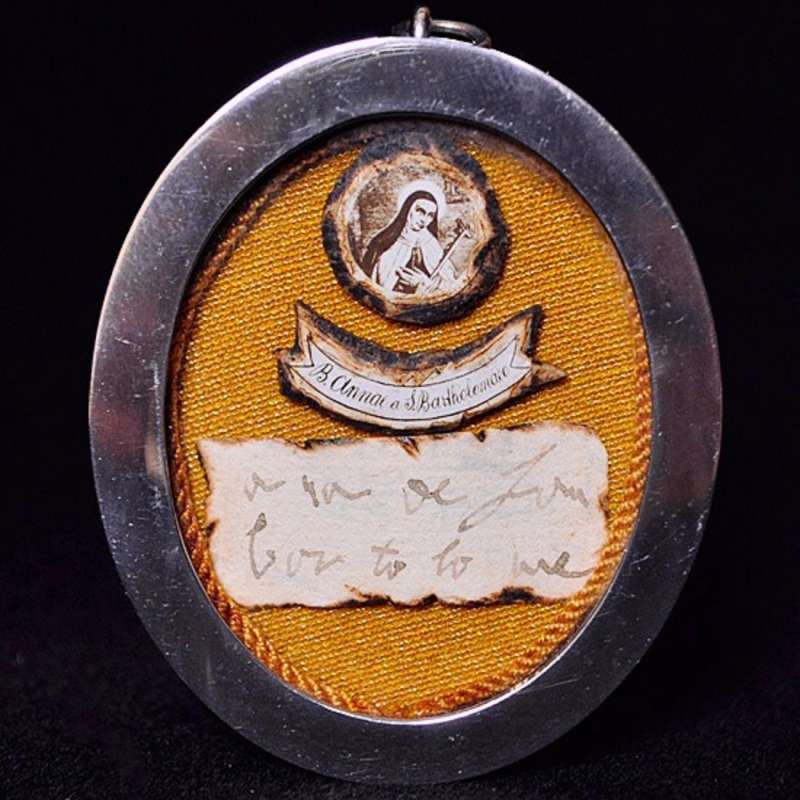
Saint of the Day – 7 June – Blessed Ana of St Bartholomew OCD (1550-1626) – Bl Ana was an early member of St Teresa of Àvila’s Discalced Carmelite Order, Mystic, Spiritual writer, apostle of the poor, Prioress – born Ana García Manzanas on 1 October 1549 at Almendral, Spain and died on 7 June 1626 at Antwerp, Belgium at the time known as the County of Flanders, Spanish Netherlands of natural causes, aged 75. Patronage – Antwerp.
Ana García Manzanas was born in Almendral de la Cañada on 1 October 1550 as the seventh child to Ferdinand García and Maria Mancanas. On the date of her birth she was also Baptised in the Parish Church of His Holiness the Saviour. Together with her three brothers and three sisters she was raised to be close to God by her pious parents. The entire household – on a frequent basis – attended Daily Mass and recited the Holy Rosary together. Her father had a Priest teach the children the doctrine of the faith, while her mother opened their home to the poor and adopted orphans to raise as her own.
In her childhood she loved the paintings that depicted the Passion of the Lord and she wanted to be associated with His suffering – even if in a minor way by giving her food to beggars. She often walked barefoot along stoney paths, in order that she could offer the pain, to her suffering Lord. She said later in this regard:
“I will say here, for the glory of our Lord, that He always gave me consolations when I did good to my neighbour, when the occasion presented itself and when I aided them in their need. I inconvenienced myself, it is true, on these occasions but I found instead of an inconvenience it was a real consolation. It is to the good Master I owe it and it has remained so with me until this day. May His holy Name be blessed!”
In 1559 her mother died and in 1560 her father died. This period turned out to be a time in her life, that she described as being flung into her “deepest affliction.” When she was of the proper age, her older siblings wanted her to enter into marriage, though in her heart she desired to become a religious. Her older brothers tried to test her will, by giving her the difficult task, of sharing the work of the labourers in the fields, in the hope that she would renounce her calling. But once her brothers did this, she refused to speak to them and to any men and thus granting them the opportunity to converse with her, so as to defend herself from marriage, since she wanted to be married to God. The brothers felt that she was too tenderhearted to withstand the austere mode of Monastic life and presumed she would soon leave the Convent life and thus burden the household with dishonour.
Ana experienced visions and apparitions that made her unwilling to give up her dream, though on one occasion had a frightful apparition of a giant demon that scared her to the point of illness. Her relatives became quite concerned for her wellbeing and so took her to a hermitage dedicated to Saint Bartholomew to make a novena. Once she arrived outside the hermitage she was at once seized with paralysis and when her relatives carried her in – and not long after entering – she found herself cured of this extreme affliction.
Finally, on 2 November 1570, Ana entered the Discalced Carmelites as a secular member. She was the first secular that the foundress Teresa of Ávila accepted. She made her religious vows on 15 August 1572. For the next decade she filled the post of a nurse in the Infirmary.
In 1577, when St Teresa broke her left arm, she chose Ana as her personal assistant, nurse and secretary and during the next 5 years Ana was her inseparable companion, travelling with her and assisting in the last four foundations. All of Teresa’s letters in the last few years of her life were dictated to Ana. Teresa died in Ana’s arms in 1582 at the monastery in Alba de Tormes.
Following the death of the Foundress, she returned to Ávila and took part in the foundation of a Convent at Ocana (1595). And she was one of the seven nuns selected for the introduction of the Order into the Kingdom of France on 15 October 1604. In 1605, the French Carmelites appointed Ana the Superior of the Convent in Pontoise. This was a highly unusual step, as Ana was a “secular Carmelite,” meaning she was not part of the choir and removed from the Convent’s life of prayer. She was thus consecrated as a religious sister and took over the Convent at Pontoise. So unusual a step met with the disapproval of her companions but – as the Foundress – had once foretold – she offered no resistance. Ana had also been forewarned that her elevation would cause her great sufferings.
Ana became the prioress of several different Convents: Tours, Flanders, and finally Antwerp, which she governed to the end of her life. Twice she was instrumental in delivering the town from the hands of Protestant forces.
Ana died on 7 June 1626. Soon after her death, miracles were attributed to her intercession and by 1632 over 150 miracles had been approved. She proved herself, like St Teresa, a daughter of the Church in her great zeal for souls. In 1735 Pope Clement XII declared the heroicity of her virtues and Pope Benedict XV Beatified Ana on 6 May 1917.
Her spiritual writings and letters are preserved in Antwerp and Paris.
Father,
rewarder of the humble,
you blessed Your servant Ana of Saint Bartholomew
with outstanding charity and patience.
May her prayers help us
and her example inspire us,
to carry our cross
and be faithful in loving You
and others for your sake.
We ask this through our Lord Jesus Christ, Your Son,
who lives and reigns with You and the Holy Spirit,
one God, forever and ever.
Amen
St Meriadoc I of Vannes
St Meriadoc II of Vannes
St Odo of Massay
St Potamiaena of Alexandria the Younger
St Quirinus of Cluny
St Robert of Newminster
St Sergius of Cluny
St Vulflagius of Abbeville
—
Martyrs of Africa – 7 saints: A group of seven Christians who were martyred together. No details about them have survived except the names – Donata, Evasius, Guirillus, Januaria, Privata, Spisinna, Victurus. The precise location in Africa and date are unknown.
Martyred in Córdoba, Spain:
Habentius of Córdoba
Jeremiah of Córdoba
Peter of Córdoba
Sabinian of Córdoba
Wallabonsus of Córdoba
Wistremundus of Córdoba
Thought for the Day – 6 June – “Month of the Sacred Heart” – Meditations with Antonio Cardinal Bacci (1881-1971)
The Worship of the Sacred Heart
in Relation to the Love of God and of Our Neighbour
“There is nothing sentimental about having devotion to the Sacred Heart of Jesus.
Neither does this devotion consist only in prayers and pious practices.
It is much deeper than this.
It should flood our whole being, enkindle the fire of divine love in our hearts and transform our lives in accordance with the commands of Jesus.
A love which is not active cannot be genuine, it is only a passing emotion.
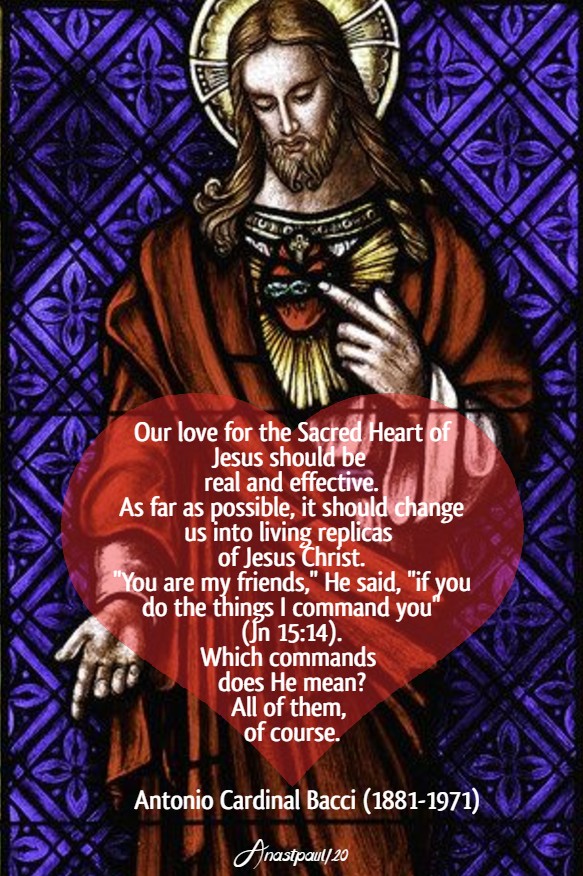
Our love for the Sacred Heart of Jesus should be real and effective.
As far as possible, it should change us into living replicas of Jesus Christ.
“You are my friends,” He said, “if you do the things I command you” (Jn 15:14).
Which commands does He mean?
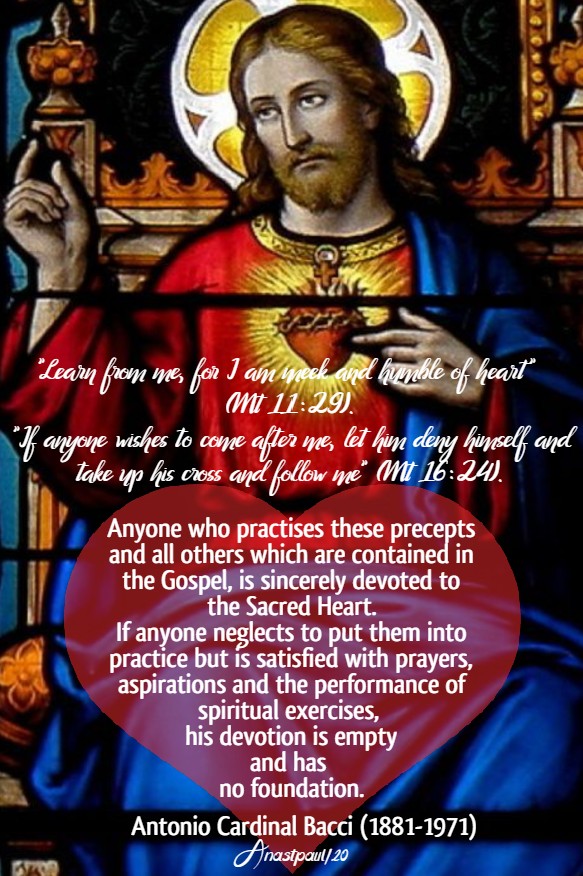
All of them, of course. “Learn from me, for I am meek and humble of heart” (Mt 11:29). “If anyone wishes to come after me, let him deny himself and take up his cross and follow me” (Mt 16:24). “Thy shalt love the Lord thy God, with they whole heart and with they whole soul” (Mt 22:37).
Anyone who practises these precepts and all others which are contained in the Gospel, is sincerely devoted to the Sacred Heart.
If anyone neglects to put them into practice but is satisfied with prayers, aspirations and the performance of spiritual exercises, his devotion is empty and has no foundation.
These prayers, aspirations and pious practices have their value, insofar, as they can attract God’s grace.
But, we must co-operate with God’s grace by our good actions.
Then our devotion to the Sacred Heart of Jesus, will be sincere and effective.”
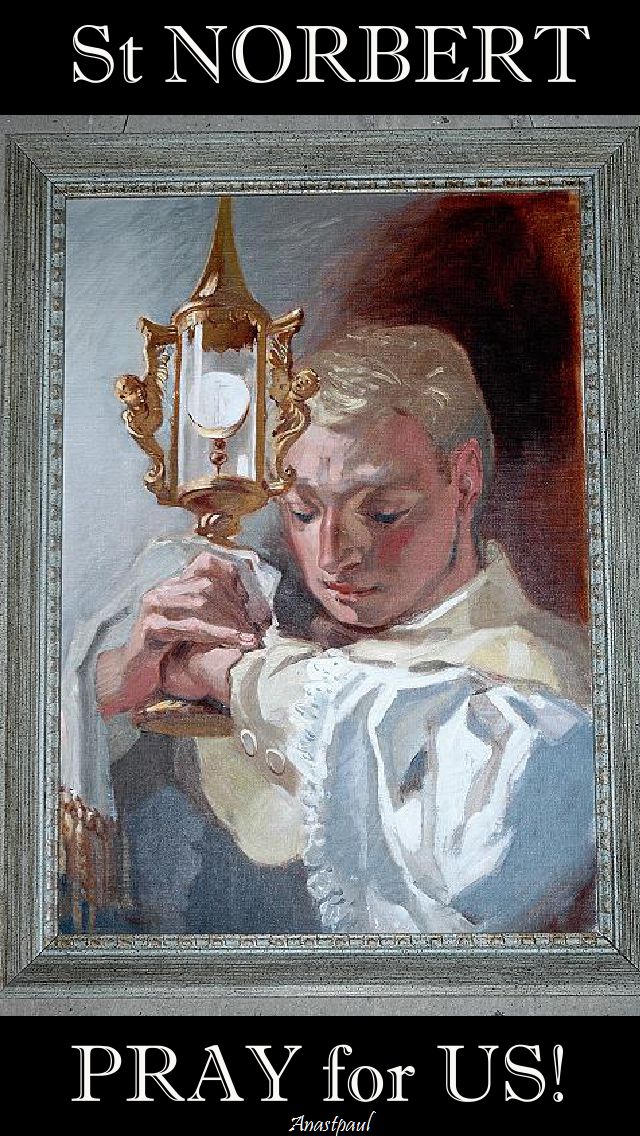
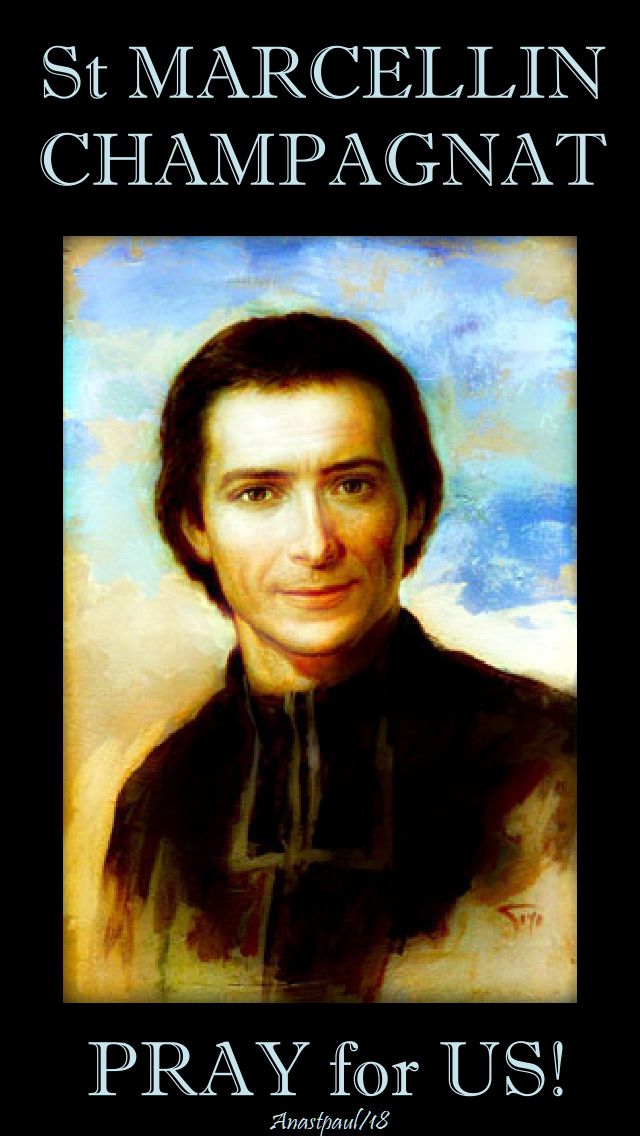
Quote/s of the Day – 6 June – The Memorial of St Norbert (c 1080-1134) and St Marcellin Champagnat FMS (1789-1840)
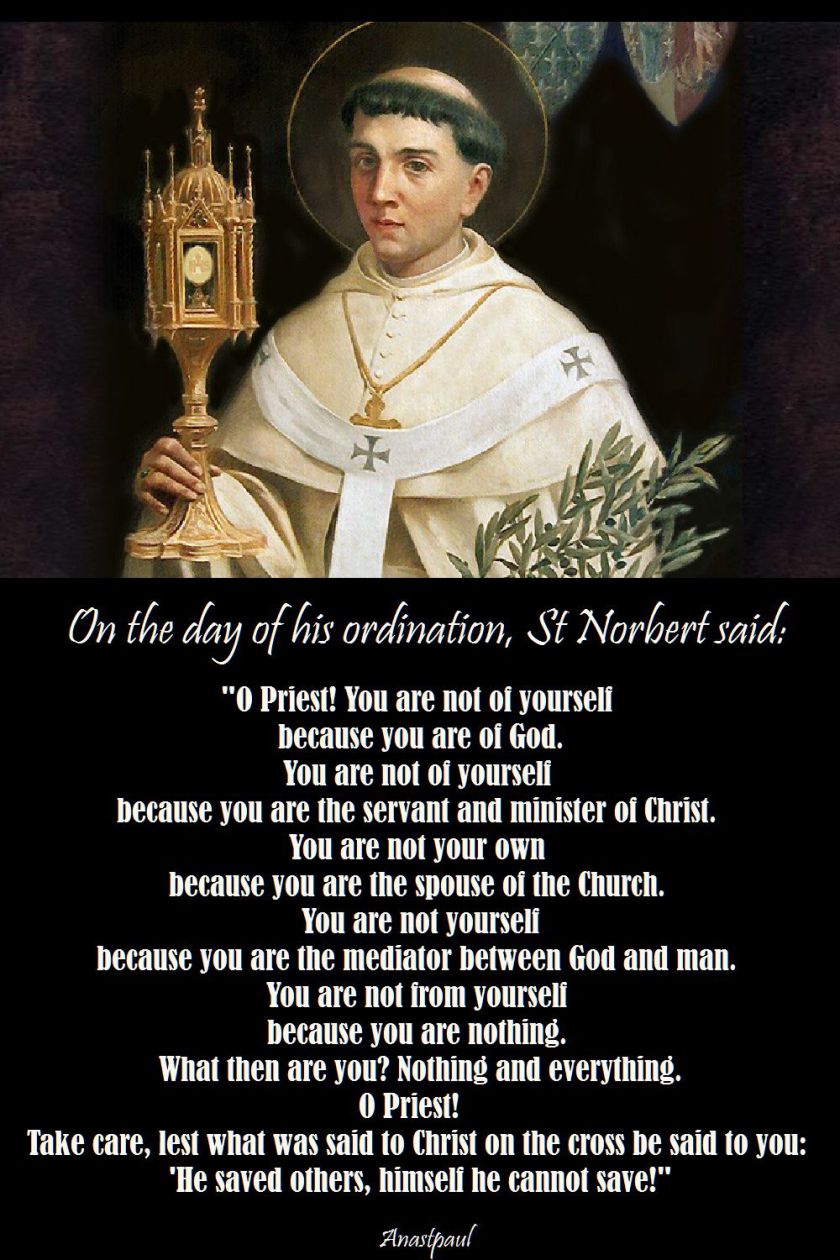
On the day of his ordination, St Norbert said:
“O Priest! You are not of yourself because you are of God. You are not of yourself because you are the servant and minister of Christ. You are not your own because you are the spouse of the Church. You are not yourself because you are the mediator between God and man. You are not from yourself because you are nothing. What then are you? Nothing and everything. O Priest! Take care, lest what was said to Christ on the cross be said to you: ‘He saved others, himself he cannot save!”
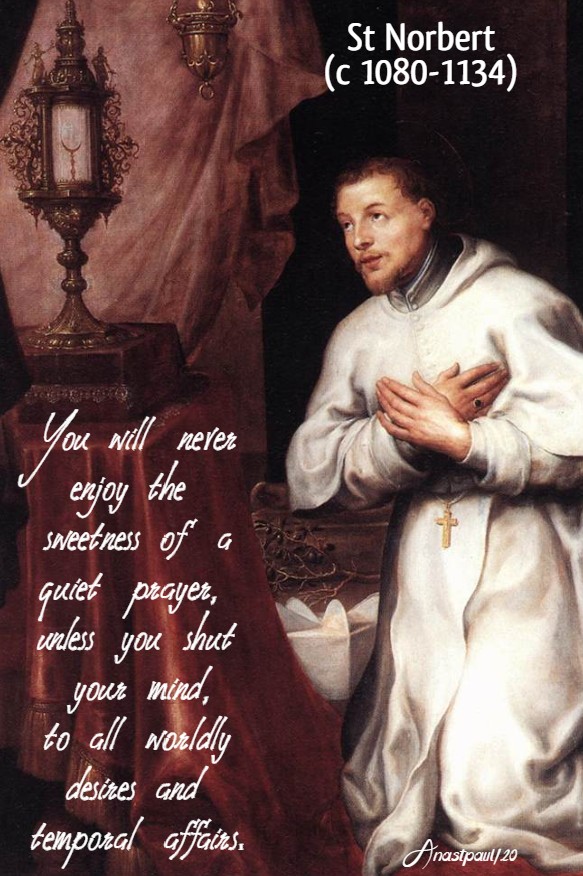
“You will never enjoy the sweetness of a quiet prayer, unless you shut your mind, to all worldly desires and temporal affairs.”
St Norbert (c 1080-1134)
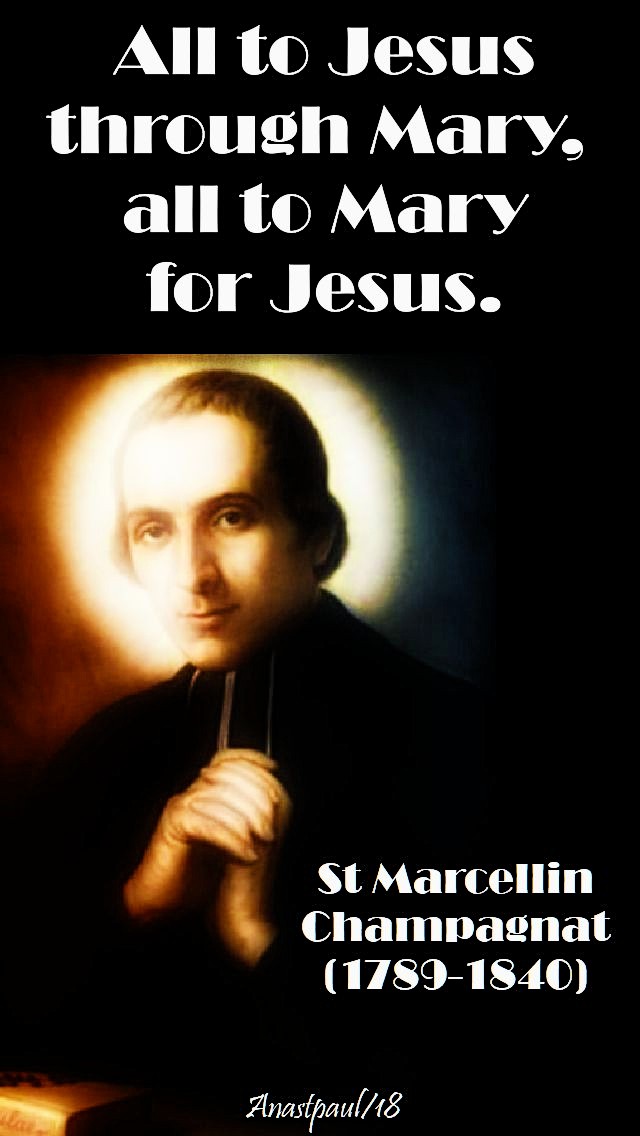
“All to Jesus through Mary, all to Mary for Jesus.”
One Minute Reflection – 6 June – “Month of the Sacred Heart” – Saturday of the Ninth Week in Ordinary Time, Year A, Readings: 2 Timothy 4:1-8, Psalm 71:8-9, 14-17, 22, Mark 12:38-44 and the Memorial of St Norbert O.Praem (c 1080-1134) and St Marcellin Champagnat FMS (1789-1840)
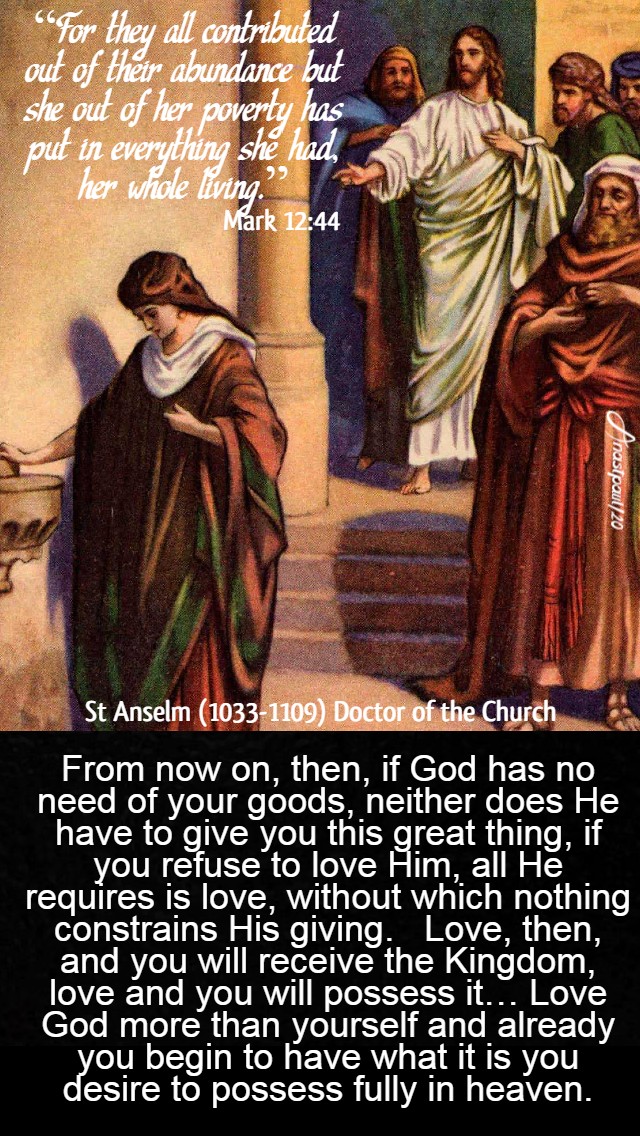
“For they all contributed out of their abundance but she out of her poverty has put in everything she had, her whole living.”…Mark 12:44
REFLECTION – “Now, if someone is wondering what the cost is, here is their answer – He who offers a Kingdom in heaven has no need of earthly coin. No-one can offer God anything, except what already belongs to Him, since all that exists is His. And yet, God does not give away so great a thing, without a price being placed on it, He does not give it to someone who doesn’t value it. For indeed, nobody gives away something they hold dear without placing some kind of value on it.
From now on, then, if God has no need of your goods, neither does He have to give you this great thing, if you refuse to love Him, all He requires is love, without which nothing constrains His giving. Love, then, and you will receive the Kingdom, love and you will possess it… Love God more than yourself and already, you begin to have what it is you desire to possess fully, in heaven.”… St Anselm (1033-1109) Doctor of the Church
PRAYER – Lord God, Your Son has shown us the way. As we follow in His steps, may we never wander from the path that leads to life. Renew the wonders of Your grace in our hearts so that neither death nor life may separate us from Your love. Holy Father, as You were glorified by the life and death of St Norbert and St Marcellin, grant that by their prayers, we may receive strength to always give You our hearts, minds and complete selves. Through our Lord, Jesus Christ, with You in union with the Holy Spirit, one God for all eternity, amen.
Our Morning Offering – 6 June – “Month of the Sacred Heart” and a “Marian Saturday” – Saturday of the Ninth Week in Ordinary Time, Year A
Prayer to the Two Holy Hearts of Jesus and Mary
O Heart of Jesus pierced for our sins
and giving us Your Mother on Calvary!
O Heart of Mary pierced by sorrow
and sharing in the sufferings of your divine Son
for our redemption!
O sacred union of these Two Hearts!
Praised be the God of Love who united them together!
May we unite our hearts and every heart
so that all hearts may live in unity and in imitation
of that sacred unity, which exists in these Two Hearts.
Triumph, O Sorrowful and Immaculate Heart of Mary!
Reign, O Most Sacred Heart of Jesus!
– in our hearts, in our homes and families,
in the hearts of those who as yet do not know You
and in all nations of the world.
Establish in the hearts of all mankind the sovereign triumph
and reign of your Two Hearts so that the earth may resound
from pole to pole with one cry:
Blessed forever be the Most Sacred Heart of Jesus
and the Sorrowful and Immaculate Heart of Mary!
Obtain for me a greater purity of heart
and a fervent love of the spiritual life.
May all my actions be done for the greater glory of God
in unions with the divine heart of Jesus
and the Immaculate Heart of Mary.
Hear and answer our prayers and intentions
according to Your most merciful will.
Amen
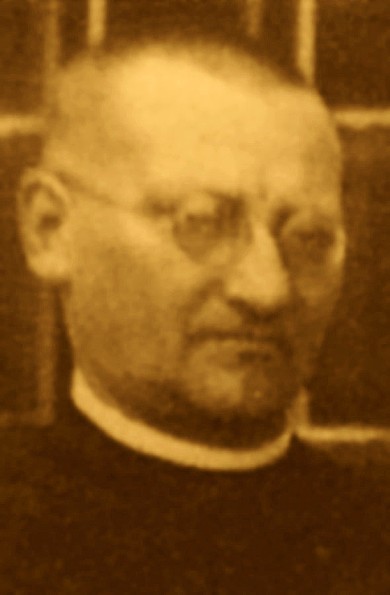
Saint of the Day – 6 June – Blessed Innocenty Józef Wojciech Guz OFM (1890-1940) Priest of the Franciscan Conventual and Martyr of the Nazi Regime – born as Józef Adalbert Guz on 8 March 1890 in n Lemberg, Austria (present-day Poland) and died from trauma resulting from having a charged fire hose stuffed down his throat on 6 June 1940 in the prison camp at Sachsenhausen-Oranienburg, Oberhavel, Germany. He was 50 years old. Additional Memorial – 12 June as one of the 108 Polish Martyrs of World War II.
After high school Jozef tried to join the Jesuits but was turned down. On 25 August 1908 be joined the Franciscans, taking the name Innocenty. He studied philosophy and theology in Krakow, Poland and was ordained on 2 June 1914. He served as a Parish Priest in a number of cities and worked with Saint Maximilian Kolbe.
He was a confessor to a Franciscan monastery at Niepokalanów, Poland from 1933 to 1936, vice-master of clerics and singing teacher in the minor seminary and Parish Priest in Grodno, Poland.
He was imprisoned by invading Russia troops on 21 March 1940 for the crime of being a Polish Priest but he managed to escape and went to the German zone, where he was arrested by the Gestapo. He was sent to several prisons before finally ending at the concentration camp at Sachsenhausen where he was severely beaten and put to forced labour. When he could not work, owing to a broken leg, he was nearly drowned and finally murdered.
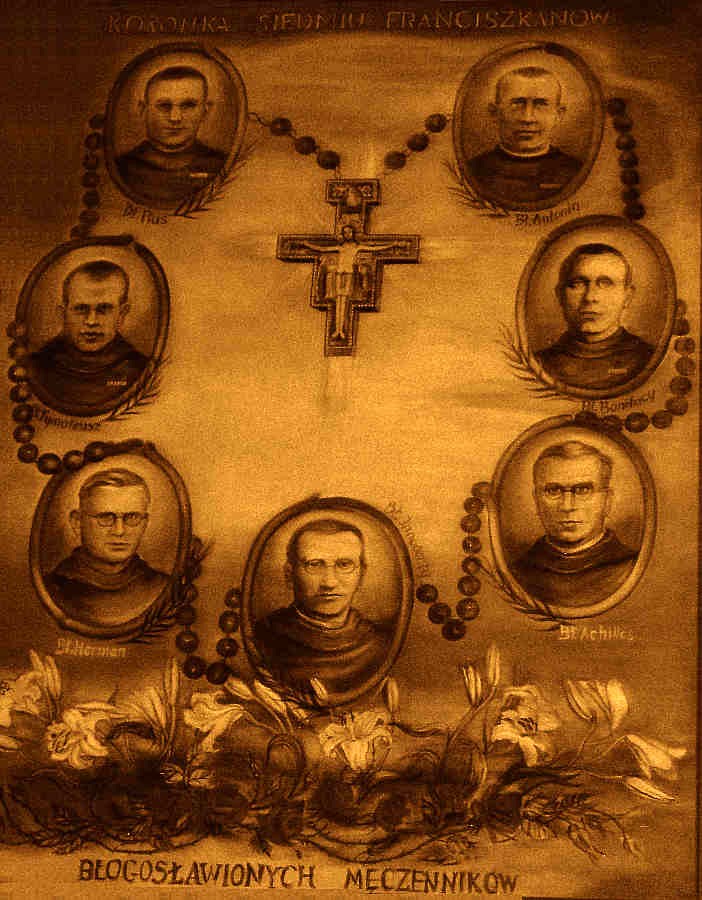
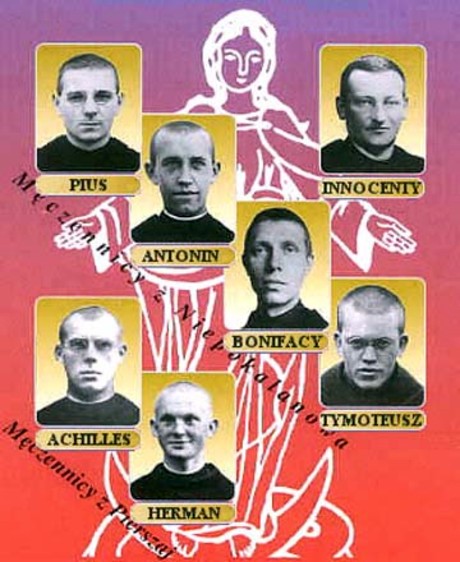
He was Beatified on 13 June 1999 by St Pope John Paul II at Warsaw, Poland. Below are the Franciscan Martyrs of the World War II.
St Agobard of Lyon
St Alexander of Fiesole
St Alexander of Noyon
St Amantius of Noyon
St Anoub of Skete
St Artemius of Rome
St Bazalota of Abyssinia
St Bertrand of Aquileia
St Candida of Rome
St Ceratius of Grenoble
St Claudius of Besançon
St Cocca
St Colmán of Orkney
Bl Daniel of Bergamo
St Euphemia of Abyssinia
St Eustorgius II of Milan
Bl Falco of La Cava
Bl Gerard Tintorio
Bl Gilbert of Neufontaines
St Grazia of Germagno
St Gudwall
Bl Gundisalvus of Azebeyro
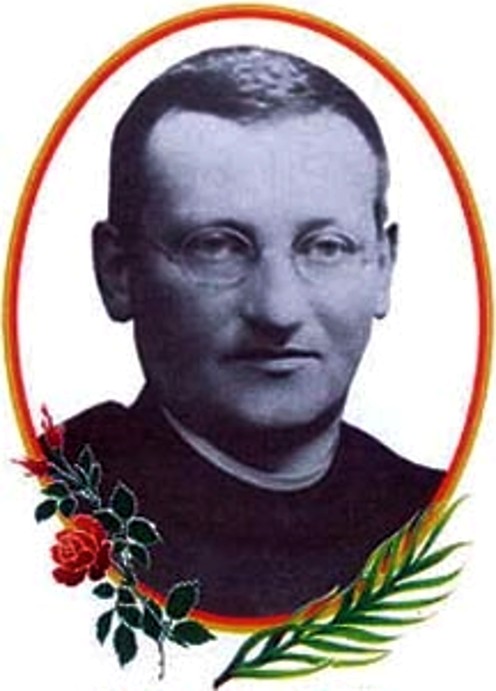
St Hilarion the Younger Blessed Innocenty Józef Wojciech Guz OFM (1890-1940) Priest and Martyr of the Nazi Regime
St Jarlath of Tuam
St John of Verona
Bl Lorenzo de Masculis St Marcellin Champagnat (1789-1840) Wonderful St Marcellin:
St Paulina of Rome
St Phêrô Dung
St Phêrô Thuan
St Rafael Guízar y Valencia
St Vincent of Bevagna
St Vinh-Son Duong
Bl William Greenwood
—
Marytrs of Tarsus: A group of 20 martyrs who were killed together during the persecutions of Diocletian. They were martyred in Tarsus (in modern Turkey).
Mercedarian Fathers of Avignon: Several Mercedarians from the Santa Maria convent of Avignon, France who worked with plague victims in that city and died of the disease themselves. They died in Avignon, France of plague.
Thought for the Day – 5 June – “Month of the Sacred Heart” – Meditations with Antonio Cardinal Bacci (1881-1971)
The Sacred Heart and the Holy Viaticum
“The infinite love of the Sacred Heart of Jesus accompanies us through life. Our Lord loved us so much, that He gave His life for us – there could not possibly be any greater love than this. “Greater love than this no-one has, that one lay down his life for his friends” (Jn 15:13). The Heart of Jesus beats for us continually and His gaze follows us everywhere, especially when we are in danger or in temptation.
Since Jesus loved us so much, that He died for us, it is incredible that He would ever abandon us. Even though He is now happy and beyond suffering in Heaven, He still loves us dearly. But if the Sacred Heart enfolds us now in a close embrace of love, He will certainly protect us in a very special manner at the moment of death, that moment on which, depends an eternity of joy or of suffering.
Let us reflect on what happened when Jesus was hanging upon the Cross. He gave us all His love and all His Precious Blood and, with His dying breath, He gave us the last treasure He possessed, His Blessed Mother. Omnipotent though He was, He could not give us anything more. He had exhausted His infinite love, giving us, not merely all that He possessed but, giving us Himself also.
One of the thieves who was being crucified along with Him, turned towards Him, a look of repentance and of supplication. His Heart was filled with love and mercy and He said to the penitent thief: “This day, thou shalt be with me in paradise” (Lk 23:43). These are comforting words. Someday we also shall be in agony and shall turn to Jesus in our final hour. Then Jesus, in the Blessed Eucharist, will come to us for the last time. Let us pray earnestly that the Viaticum may bring us the same consolation which the words of Jesus gave to the good thief: “This day, thou shalt be with me in paradise!”
Quote/s of the Day – 5 June – The Memorial of St Boniface (c 672-754) “The Apostle of Germany” – Martyr
Let us listen to these very appropriate quotes for our times!
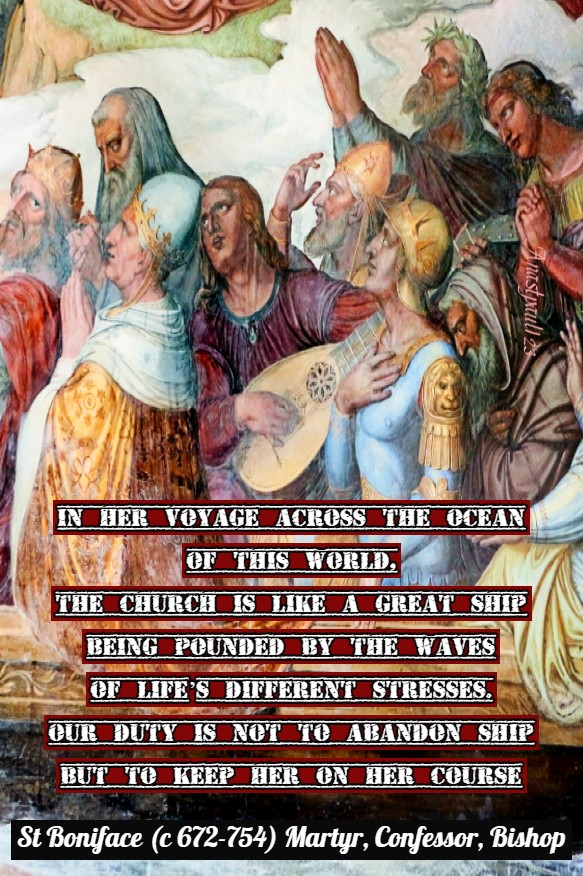
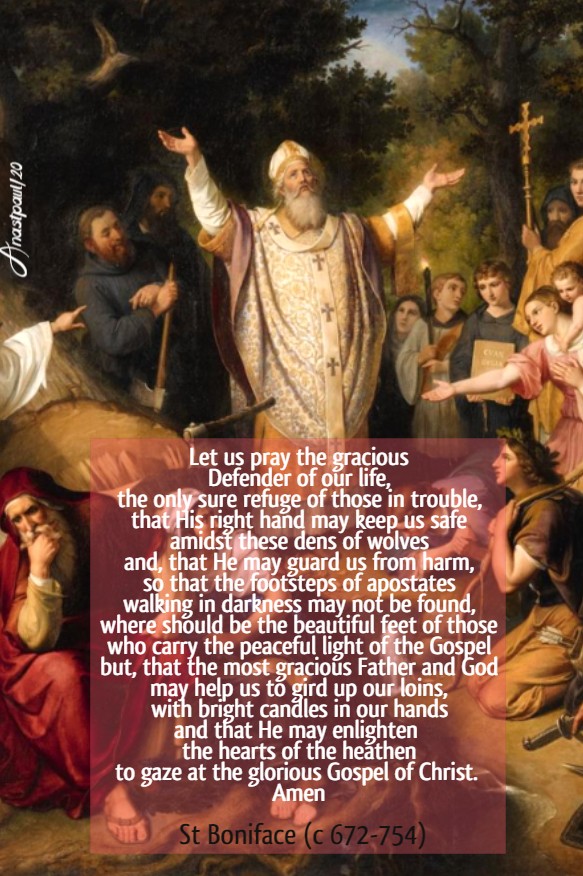
“In her voyage across the ocean of this world, the Church is like a great ship being pounded by the waves of life’s different stresses. Our duty is not to abandon ship but to keep her on her course.”
“Let us pray the gracious Defender of our life, the only sure refuge of those in trouble, that His right hand may keep us safe amidst these dens of wolves and, that He may guard us from harm, so that the footsteps of apostates walking in darkness may not be found, where should be the beautiful feet of those who carry the peaceful light of the Gospel but, that the most gracious Father and God may help us to gird up our loins, with bright candles in our hands and that He may enlighten the hearts of the heathen to gaze at the glorious Gospel of Christ. Amen”
One Minute Reflection – 5 June – “Month of the Sacred Heart” – Friday of the Ninth week in Ordinary Time, Readings: 2 Timothy 3:10-17, Psalm 119:157, 160-161, 165-166, 168, Mark 12:35-37 and the Memorial of St Boniface (672-754) “The Apostle of Germany” – Martyr and Bl Malgorzata Szewczyk (1828-1905)
David himself calls him ‘lord.’ … Mark 12:37
REFLECTION – “Be mindful of the mystery of Christ! Born from the Virgin’s womb, both Servant and Lord – Servant to set to work, Lord to command so that He might plant a Kingdom for God in people’s hearts. Twofold in origin but one in nature, He is not one thing when He comes from the Father, another when He comes from the Virgin. He is the very same, the one born of the Father before all ages and who has taken flesh of the Virgin in the course of time. And that is why He is named both Servant and Lord – Servant with respect to us but, due to the unity of the divine substance, God from God, Principle from Principle, Son equal in all things to the Father who is His equal. For the Father has not begotten a Son different to Himself – the Son of whom He asserted: “In him I am well pleased” (Mt 3:17) (…)
In every respect the Servant preserves His titles of dignity. God is great and the Servant is also great – when He came in the flesh He did not lose this “greatness that has no limit” (Ps 145[144]:3) … “Though he was in the form of God he did not regard equality with God something to be grasped. Rather, he emptied himself, taking the form of a slave” (Phil 2:6-7) … Therefore, as Son of God He is equal to God, He took the form of a slave by becoming incarnate, He whose greatness has no limit “tasted death” (Heb 2:9) (…)
How good is the condition of the Servant who has set us all free! Yes, how good it is! It won for Him “the name which is above all other names!” How good that humility is! It was through it that, “at the name of Jesus every knee should bend, of those in heaven and on earth and under the earth, and every tongue confess that Jesus Christ is Lord to the glory of God the Father” (Phil 2:10-11).” … St Ambrose (c 340-397) Father and Doctor of the Church – Sermon on Psalm 36[35]:4-5
PRAYER – Lord, Your martyr Boniface, spread the faith by his teaching and witnessed to it with his blood. Grant we pray, that the name of our Lord and God, Your divine Son, may be ever on our lips and in our hearts. May we bow in worship to our Lord Jesus now and forever, amen! By the help of the prayers of St Boniface and Bl Malgorzata Szewczyk, grant that we may be ever loyal to our faith and grant us the courage to profess it in our lives. Grant this through our Lord Jesus Christ, Your Son, who lives and reigns with You and the Holy Spirit, one God, for ever and ever, amen.
Our Morning Offering – 5 June – “Month of the Sacred Heart” – Friday of the Ninth week in Ordinary Time
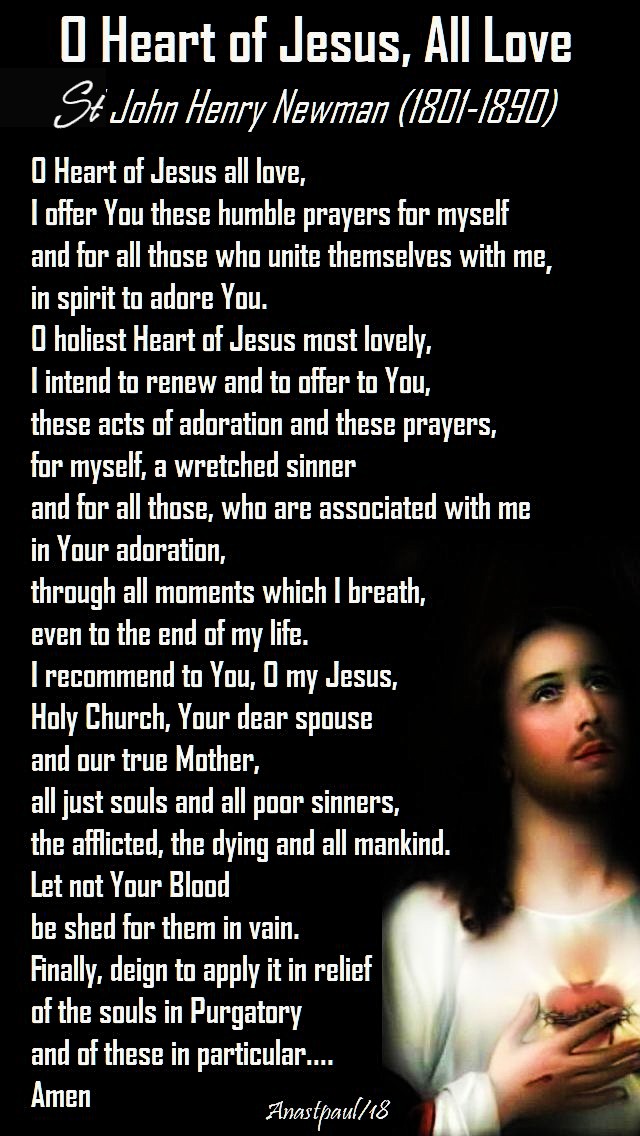
O Heart of Jesus, All Love By St John Henry Newman (1801-1890)
O Heart of Jesus all love,
I offer You these humble prayers for myself
and for all those,
who unite themselves with me in spirit to adore You.
O holiest Heart of Jesus most lovely,
I intend to renew and to offer to You,
these acts of adoration and these prayers,
for myself, a wretched sinner
and for all those, who are associated with me
in Your adoration,
through all moments which I breath,
even to the end of my life.
I recommend to You, O my Jesus,
Holy Church, Your dear spouse
and our true Mother,
all just souls and all poor sinners,
the afflicted, the dying and all mankind.
Let not Your Blood be shed for them in vain.
Finally, deign to apply it in relief
of the souls in Purgatory
and of these in particular
…………………..….
Amen
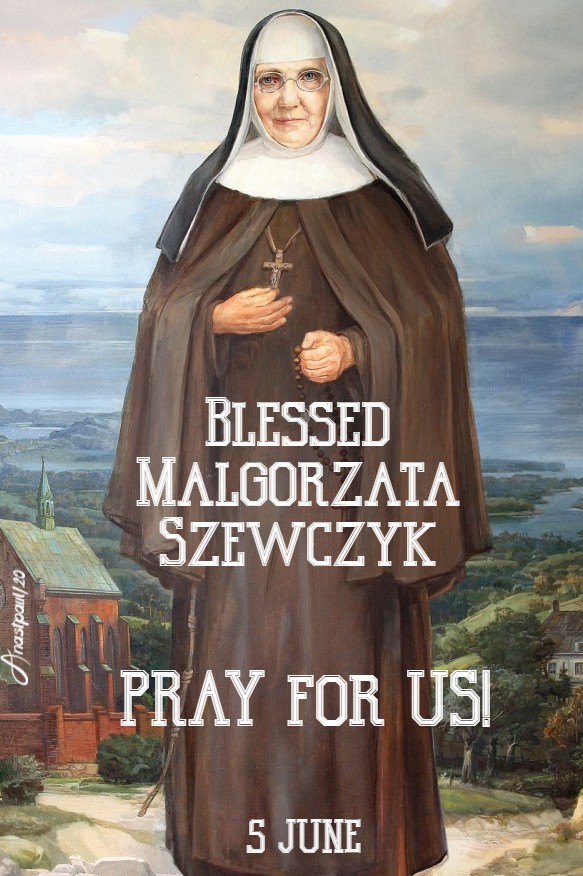
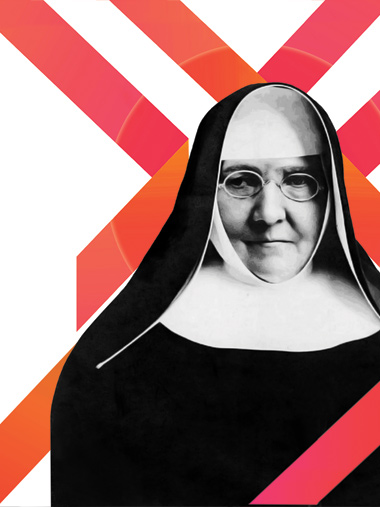
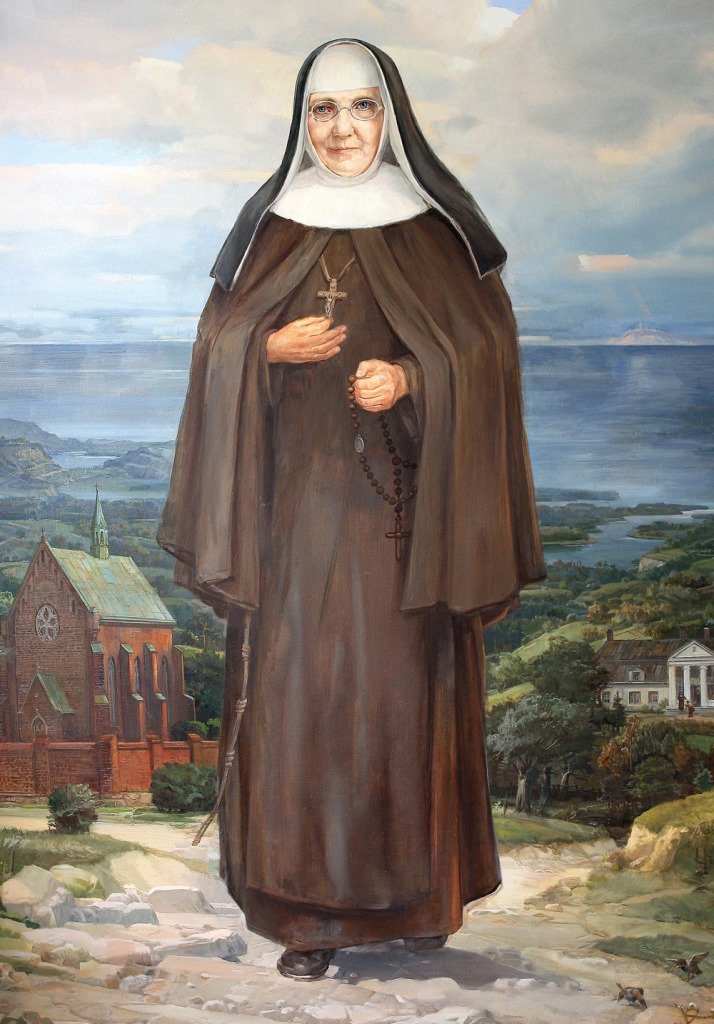
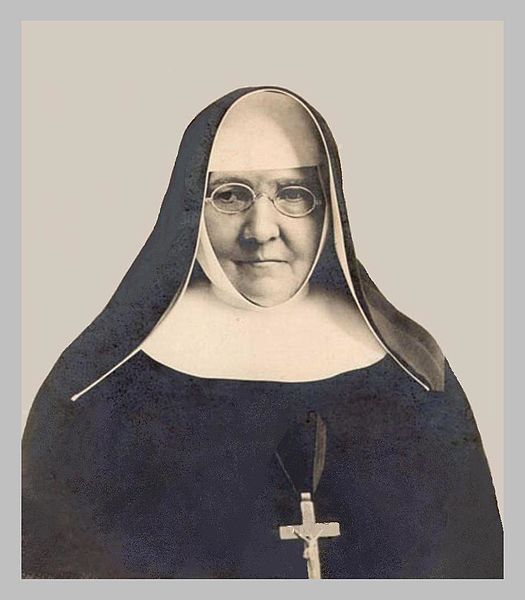
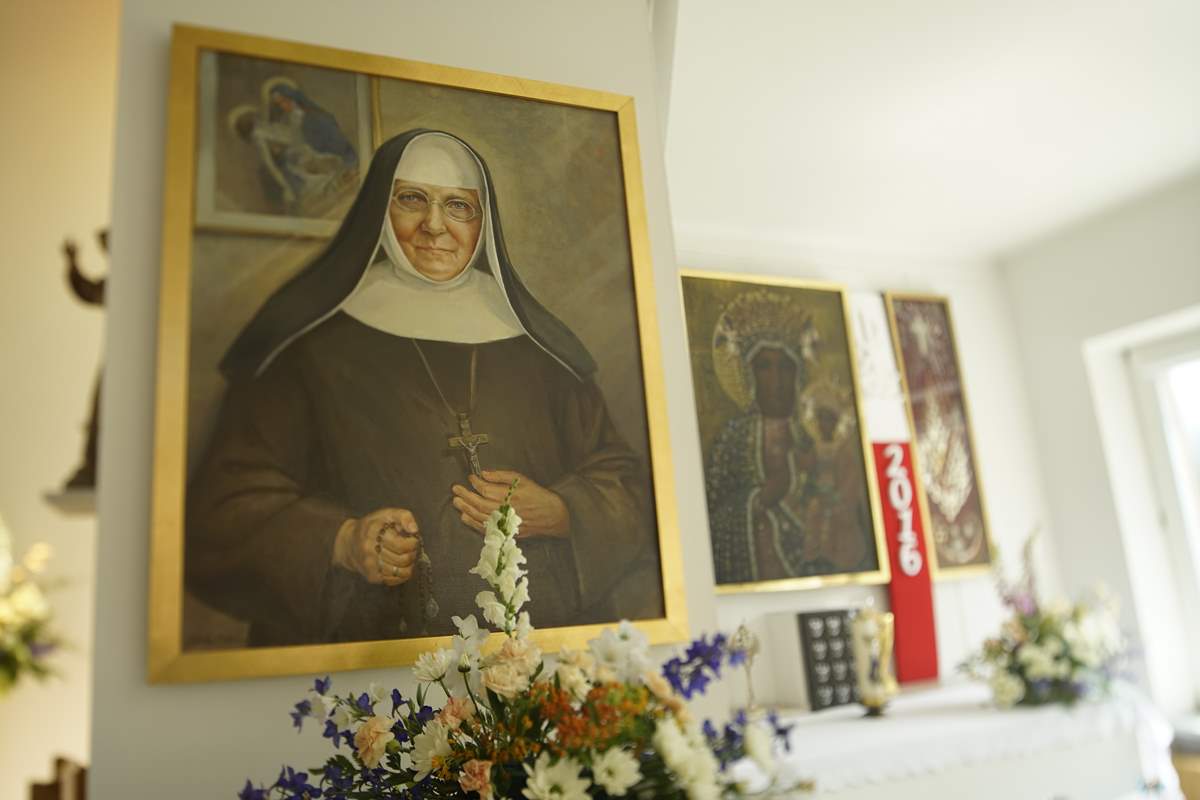
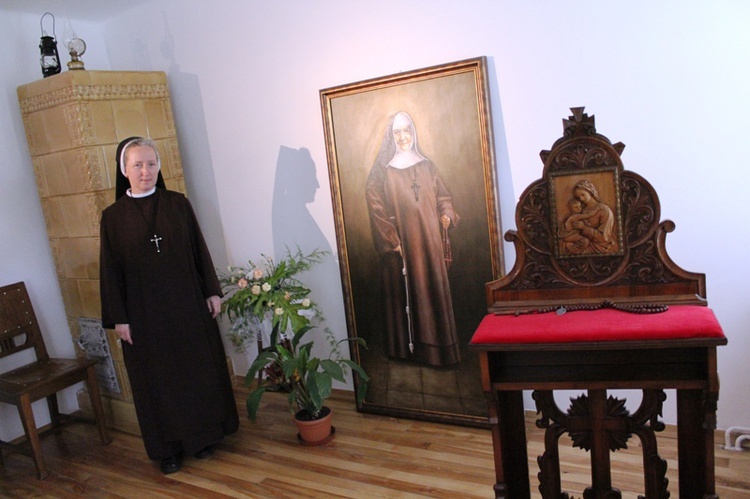
Saint of the Day – 5 June – Blessed Malgorzata Szewczyk (1828-1905). She was called “an Angel of Kindness”– Religious and Founder of the Daughters of the Sorrowful Mother of God, known commonly as the “Seraphic Sisters,” Apostle of Mercy and Charity to the poor, needy, homeless, the sick and orphans – born as Łucja Szewczyk in 1828 in Szepetówka, Khmelnytskyi, Ukraine and died on 5 June 1905 in Nieszawa, Aleksandrów, Poland. Patronage – the Seraphic Sisters.
Łucja Szewczyk was born in 1828 in a noble family in Volhynia. Orphaned at an early age, she was cared for by her half-sister. In the difficult situation of partitions and persecution of the Church at the age of 20, she made her tertiary profession in the Third Order of St Francis. She learned to love “love who is not loved” from the poor man from Assisi.
At the age of 42, together with another tertiary she went on a dangerous journey to the Holy Land. She went all the way to Odessa on foot. There she boarded a ship that sailed to her dream destination. In Jerusalem, she worked at St Joseph’s Hospital alongside French nuns. During her three-year stay in the land of Jesus, she surrendered her life to Our Lady of Sorrows. Here, in the footsteps of the Lord, she discovered her calling – she wished to live “for the glory of God and for the good of suffering humanity.”
After returning from the Holy Land and Loreto, in 1880, she went to Zakroczym near Warsaw. On the advice of Father Honorat Koźmiński, who became her Spiritual Director, the first step she took was to invite two poor and sick elderly women to live in her apartment. According to her memoirs, she carried two elderly women on her own back, whom she cared for. She took care of them in secret, because charitable or church activities were forbidden, according to the decrees of the Russian Emperor, who at the time ruled over Poland. When taking her Franciscan vows, in addition to obedience, poverty and chastity, she took a vow pledging mercy to the needy. Father Honoratwrote: “Łucja felt a desire to devote herself to the misery of the poor … She found paupers and devoted herself to them with a strange passion…. Encouraged by her example, pious people began to join her. … God blessed her.”
Later to accommodate the growing number and better serve those in need, she decided to purchase a new house with a garden. On the feast of Our Lady of Sorrows – on 8 April 1881, she founded a new Congregation, initially under the name of the Sisters of the Poor. Father Honorat chose their Superior, Łucja, who took the name Małgorzata. For the first 10 years, the sisters operated in the Russian partition in a hidden way. Mother Małgorzata opened houses in Warsaw and Częstochowa. In 1891 she went to Galicia, where there was greater religious freedom. She founded a religious house in Hałcnów. The Congregation adopted Franciscan habits and a new name: Daughters of Our Lady of Sorrows.
A year later, the construction of the Monastery in Oświęcim began, which became the Motherhouse of the “Seraphic Sisters.” The sisters created an orphanage for children, a shelter for sick and abandoned old men, a tailoring and embroidery workshop for girls. There was also an orphanage in Żywiec, a religious institution in Wielka Wieś (teaching), in Przemyśl (to serve in a local hospital), Stryj and Frydrychowice (orphanages for children, a shelter for the elderly), Siemiechów (teaching), Przemyślany (hospital ministry), Drohobych (orphanage, orphanage), in Mogila near Kraków (teaching in elementary school) and Jarosław (hospital ministry). Mother Małgorzata, by her example, encouraged the sisters, by using the sick and neglected, to reach their souls and to preserve the “holy virtue of poverty.”
In 1904, after twenty-three years, Mother Małgorzata, “burdened with age and physical weaknesses,” she resigned from the post of Superior General. She went to Nieszawa, a branch which at that time was the only one operating within the Russian partition. She became a “little” sister again. She continued to serve the needy and, toward the end of her life, offered her suffering for their intentions.
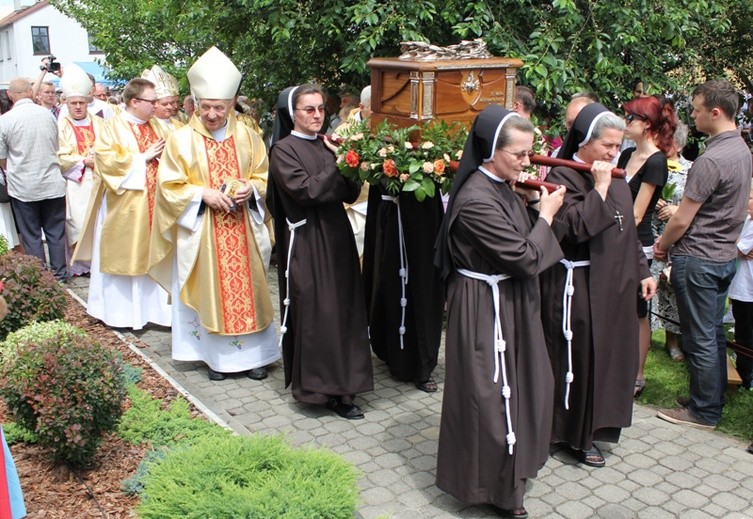
The inhabitants of Nieszawa called their Mother Małgorzata “an Angel of Kindness.” She spent the last months of her life “praying constantly.” She died on 5 June 1905. Crowds of people attended her funeral in 1905. The “mother of the poor and orphaned” was beatified on 9 June 2013 in Krakow, where the Motherhouse of the congregation she founded is currently located, at 3 Łowiecka.
In 1931, her remains were moved from Nieszawa to the cemetery chapel in Oświęcim and in 1951 – to the local church which she, herself had built.
Translation of the Bl Małgorzata’s Relics
Mother Małgorzata makes us careful not to pass by a person who may not seem in need but suffers from loneliness, rejection and ill health. It is not enough to secure someone materially or give him professional help. One must first see a person, a human being, because human suffering has a specific face.
Bl Małgorzata ‘s Order now operates in places such as Belarus and France and in 2005 had 679 religious in 76 houses. The Order received the Papal Decree of praise from Pope Pius X on 12 February 1909 and full pontifical approval from Pope Pius XII on 3 March 1953. At some stage the order was aggregated to the Order of Friars Minor Capuchin.
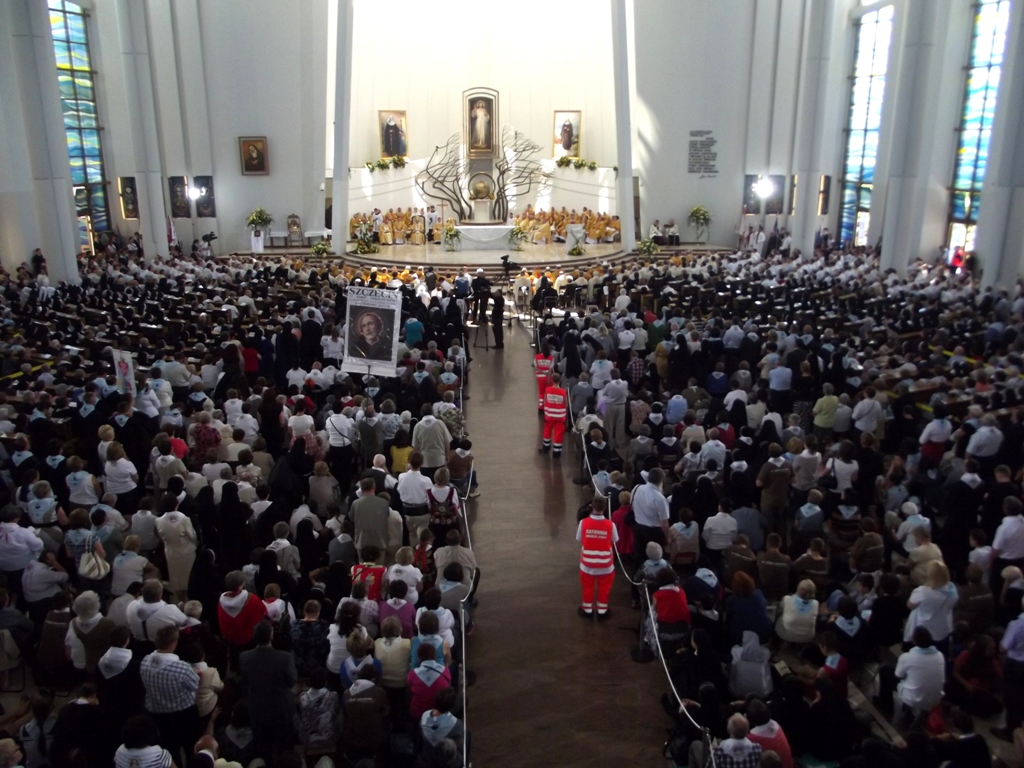
Bl Małgorzata was Beatified on 9 June 2013, Sanktuarium Bożego Miłosierdzia, Kraków, Poland by Cardinal Angelo Amato.
—
St Adalar of Erfurt
Bl Adalbert Radiouski
Bl Adam Arakawa
St Austrebertus of Vienne
St Claudius of Egypt and Companions
St Ðaminh Huyen
St Ðaminh Toai
St Dorotheus of Tyre
St Elleher
St Eoban of Utrecht
St Eutichius of Como
St Evasius of Africa
St Felix of Fritzlar
Bl Ferdinand of Portugal
St Franco of Assergi
St Genesius, Count of Clermont
St Gregory of Lilybaeum
St Gundekar
St Hadulph
St Luke Loan Blessed Malgorzata Lucja Szewczyk (1828-1905)
Bl Meinwerk of Paderborn
St Privatus of Africa
St Sanctius of Córdoba
St Tudno of Caernarvon
St Waccar
Martyrs of Caesarea:
A group of Christians who converted together, were imprisoned together, tortured together, and martyred together. We know nothing more about them but their names – Cyria, Marcia, Valeria and Zenaides.
Died
Caesarea, Palestine, date unknown.
Martyrs of Egypt:
A group of Christians martyred together in the persecutions of Galerius Maximian. The only other information was have is three of their names – Apollonius, Marcian and Nicanor.
Died
in Egypt, date unknown.
Martyrs of Perugia:
A group of Christians martyred together in the persecutions of Decius. We know little more than their names – Cyriacus, Faustinus, Florentius, Julian and Marcellinus.
Died
beheaded in 250 in Perugia, Italy
Martyrs of Rome:
26 Christians martyred together. We have no details about them but their names – Candida, Castula, Fappa, Felician, Felicitas (2 of), Felicula, Fortunatus, Gagus, Gregor, Hilarius, Ingenuus, Juliana, Martialis, Maurus, Mustilus, Nicander, Prima, Rogata, Rutianus, Sacrinus, Saturnin, Secundian, Secundus, Urbicus, Victurus.
Died
• Rome, Italy, date unknown
• relics transferred to Antwerp, Belgium, date unknown
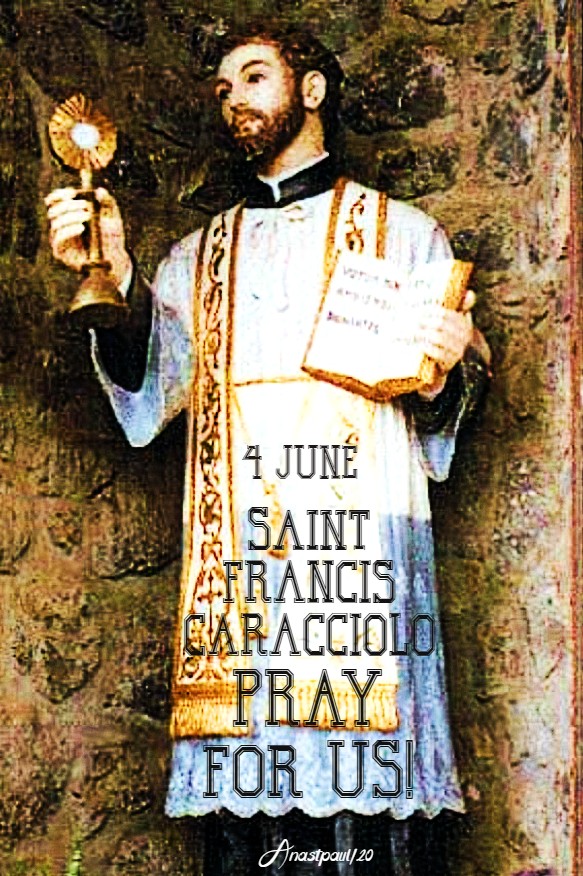
Second Thoughts of the Day – 4 June – “Month of the Sacred Heart” – The Memorial of St Francis Caracciolo CRM (1563-1591) Priest, Founder
From the Clerics Regular Minor – Adorno Fathers
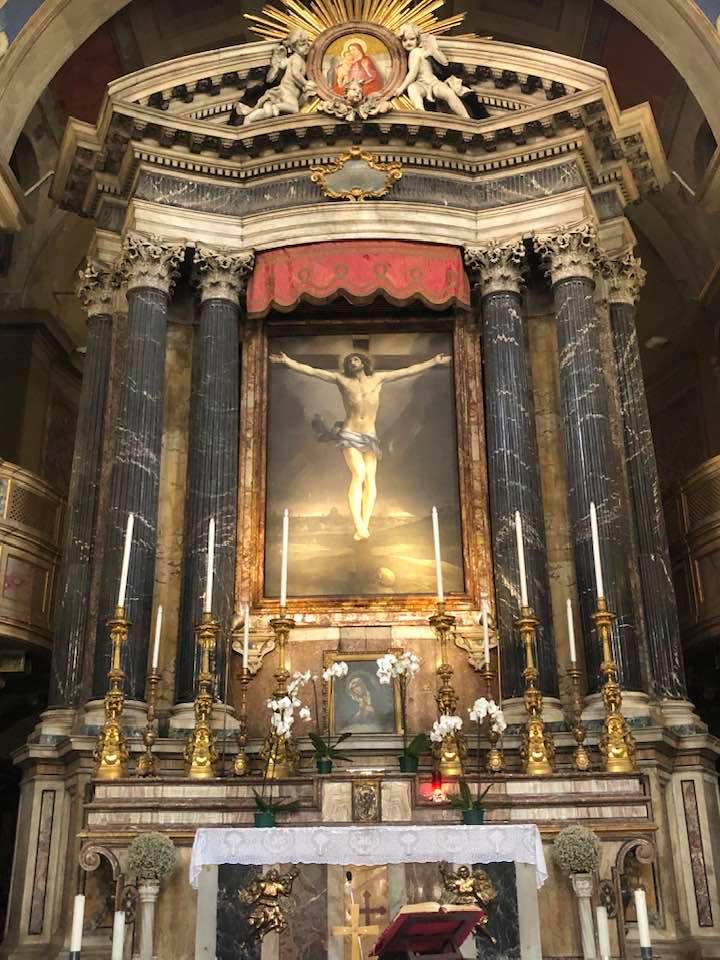
In the church of San Lorenzo in Lucina in Rome, there is a sacred image of the Blessed Mother entitled, LA MADONNA DELLA SANITÀ, or rendered in English as Our Lady of Health.
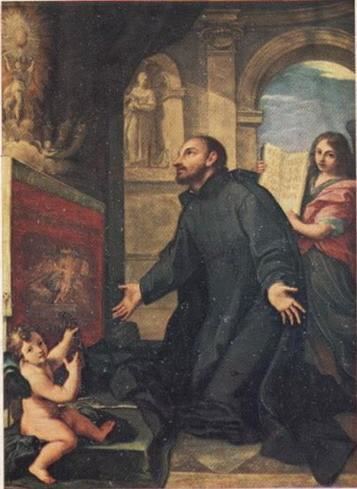
This ancient image had been lost for centuries but was rediscovered as the structure was being restored in the church during the time of Pope Sixtus V. It was moved to the main altar above the painting of the Crucifixion by Guido Reni, see below.
A few years later, Pope Paul V entrusted this church to the Clerics Regular Minor.
His Holiness, who had great esteem for St Francis Caracciolo, spoke to him at length about the Sacred Image of the Madonna, recommending its veneration, entitled Our Lady of Health, in regard to the many graces which were granted to the sick, even during times of plague.
The Clerics Regular Minor promulgated this devotion among the faithful over the years.
In 1867, when a terrible plague afflicted the City of Rome, the faithful of San Lorenzo in Lucina, encouraged by the Clerics Regular Minor, invoked Mary’s aid under this title by reviving this devotion and they were freed from the scourge of cholera.
In 1868, in thanksgiving for graces received, a booklet entitled “Cenni Istorici della Madonna della Sanità di S. Lorenzo in Lucina “ with prayers was published.
Let us invoke the aid of the Blessed Mother under the title of “LA MADONNA DELLA SANITÀ” during this time of for the end of the evil virus and the conversion of sinners.
PRAYER TO OUR LADY OF HEALTH—PREGHIERA ALLA MADONNA DELLA SANITÀ
God gave you, O pre-elected Mary, Mother of the eternal Word, who through such a lofty dignity, filled you with divine Wisdom, who became the wonder of the Angels, the marvel of the world, the Queen of Heaven, the Cooperator of Christ in the redemption of the whole human family and our Mother of love and mercy. Oh! full of joy, we praise and thank the Divine Word for having graced you with so many sublime gifts, enriched by His divine Wisdom. Though we are wretched sinners but humbled and repentant, we turn to your Son Jesus, our Advocate before His Divine Father and to you, our most wise Mother of Mercy, to obtain for us the forgiveness of our sins with sincere sorrow. Say unto the Divine Child, whom you hold close to your bosom, that we strive to be devout and offer Him our repentant hearts again and we will be saved. Give us those graces and help that we need for the benefit of our eternal salvation. Help every devoted infirm person, who trusts in you, by means of this devout exercise to this prodigious Imagine for those who have recourse to you. The favours and graces which you always give to those who trust in you are innumerable and, the new graces, you have obtained, show us that you are for us always, our Mother of Health. Oh Our most loving Mother, obtain for us again from your Son Jesus, our most lovable Redeemer, that we may always trust in His infinite merits and in your most powerful intercession, to obtain, with the graces that we ask for in our temporal needs, the eternal salvation of our souls. AMEN
Thought for the Day – 4 June – “Month of the Sacred Heart” – Meditations with Antonio Cardinal Bacci (1881-1971)
The Sacred Heart of Jesus
and the Blessed Eucharist
“It is from the loving Heart of Jesus that His innumerable gifts come to us – His graces, the Sacraments, the supernatural work of our redemption. His many acts of mercy and compassion, of which we read in the pages of the Gospel, show us the immensity of the love which His Heart bore for us.
The greatest of all His gifts to us, is the Eucharist, for in the Eucharist, He gives us, not merely His gifts but Himself, the Author of all these gifts. There are three great mysteries which show us, in a special way, the infinite love of God for us and indicate, although in a manner which we cannot clearly comprehend, that He is love itself. “God is love.” (1 Jn 4:8) These three mysteries are the Creation, the Incarnation and the Eucharist. God, infinitely perfect and happy in Himself, wished to impart something of His infinite perfection. He created the universe and made man master of it. But, ungrateful man separated himself from God by sin. He became engulfed in an abyss of evil from which he was incapable of rising to return to God, his only good. Then God, in another mysterious act of love, became man. The Eternal Word assumed a human form, taught us the way to Heaven, gave us the means of reaching it and died for our sins on the Cross. We could never meditate sufficiently on this profound mystery of love.
There was more to follow, however. When Jesus was returning to His heavenly Father, He wished to remain among us. During His earthly life, He had given Himself completely up, to the final immolation on Calvary. But, He wished to give us Himself for all time, until the end of the world. This is the explanation of the Eucharist, which is Jesus dwelling amongst us as our nourishment and as our consolation in life and at the hour of death.
By means of this wonderful gift, we can live the life of Jesus Himself!”
Quote/s of the Day – 4 June – “Month of the Sacred Heart” – The Memorial of St Francis Caracciolo CRM (1563-1591) Priest, Founder
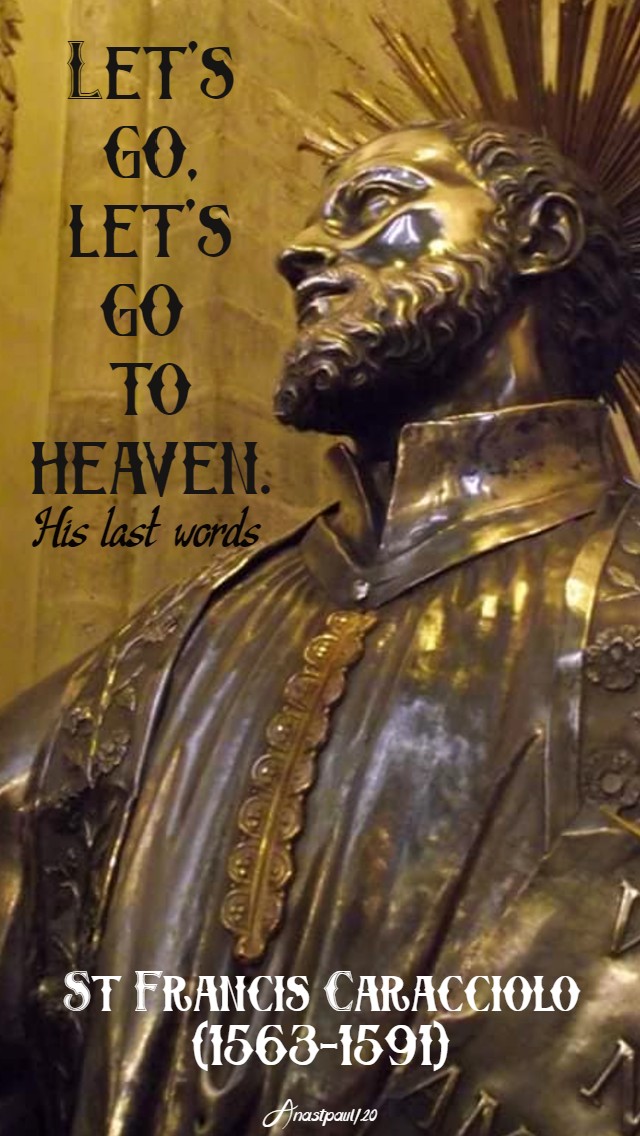
“Let’s go, let’s go to heaven.”
His last words
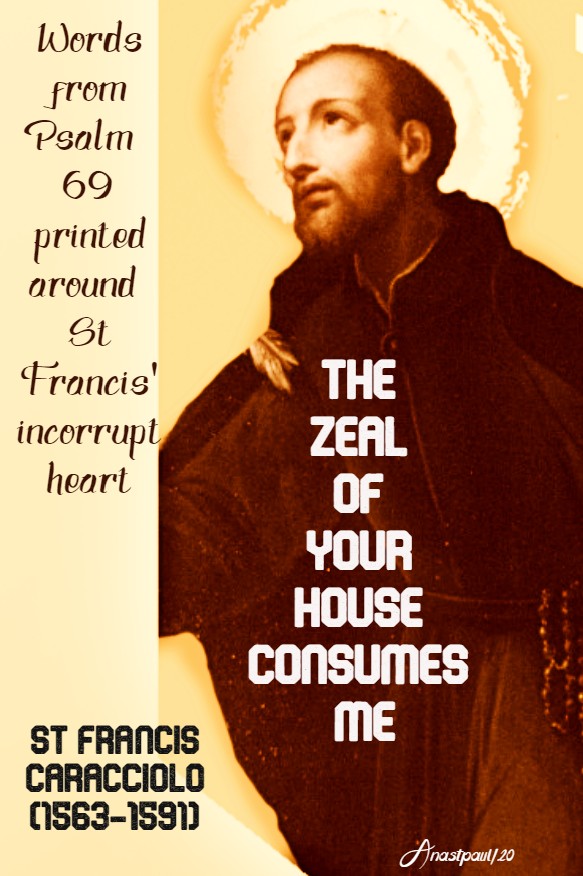
“The zeal of your house consumes me”
(Ps 69:10)
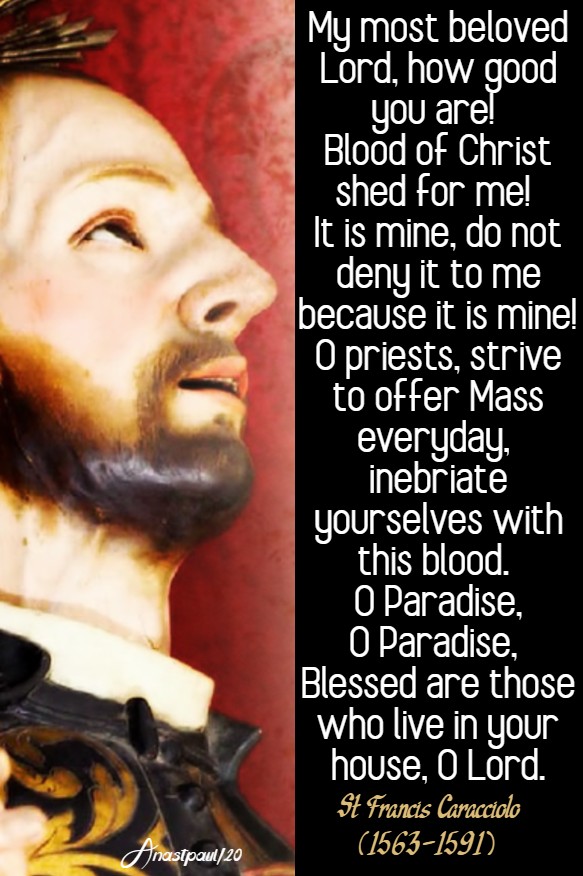
“My most beloved Lord, how good you are! Blood of Christ shed for me! It is mine, do not deny it to me because it is mine! O priests, strive to offer Mass everyday, inebriate yourselves with this blood. O Paradise, O Paradise, Blessed are those who live in your house, O Lord.”
One Minute Reflection – 4 June – “Month of the Sacred Heart” – Thursday of the Ninth week in Ordinary Time, Year A, Readings: 2 Timothy 2:8-15, Psalm 25:4-5, 8-10, 14, Mark 12:28-34
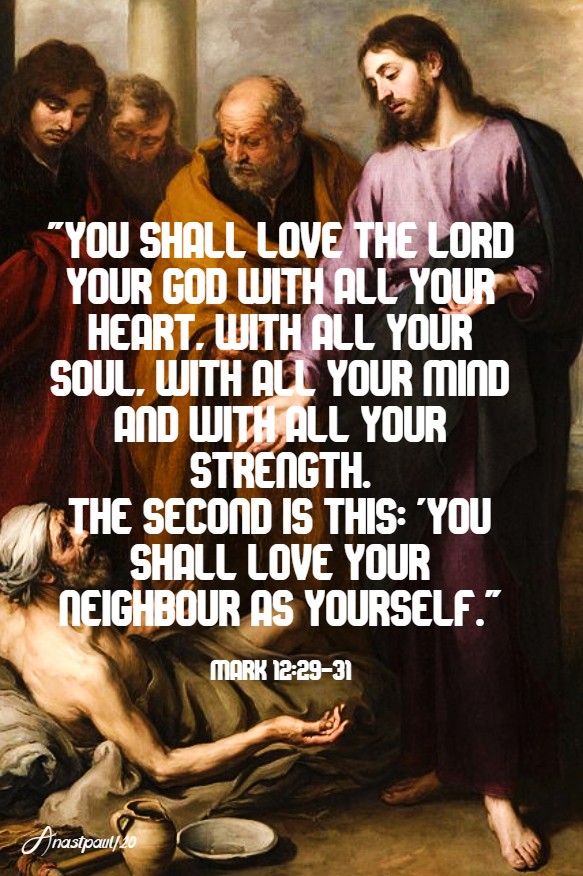
Jesus replied: “You shall love the Lord your God with all your heart, with all your soul, with all your mind and with all your strength. The second is this: ‘You shall love your neighbour as yourself.” … Mark 12:29-31
REFLECTION – “It is God we love; love of God is the first commandment but the second is like it, namely, that it is only through others that we can return love for love to God.
The danger is when the second commandment becomes the first. However, we have a means of control which is to love each person, to love Christ, to love God in each person, without preference or distinction or exception.
The second danger is, that we cannot do it and will not do it, if we separate charity from faith and hope.
It is prayer that gives us faith and hope. Without prayer we won’t be able to love. …
Faith and hope infused by prayer, are what will clear the path of our love from its most cluttering obstacle – self-love.
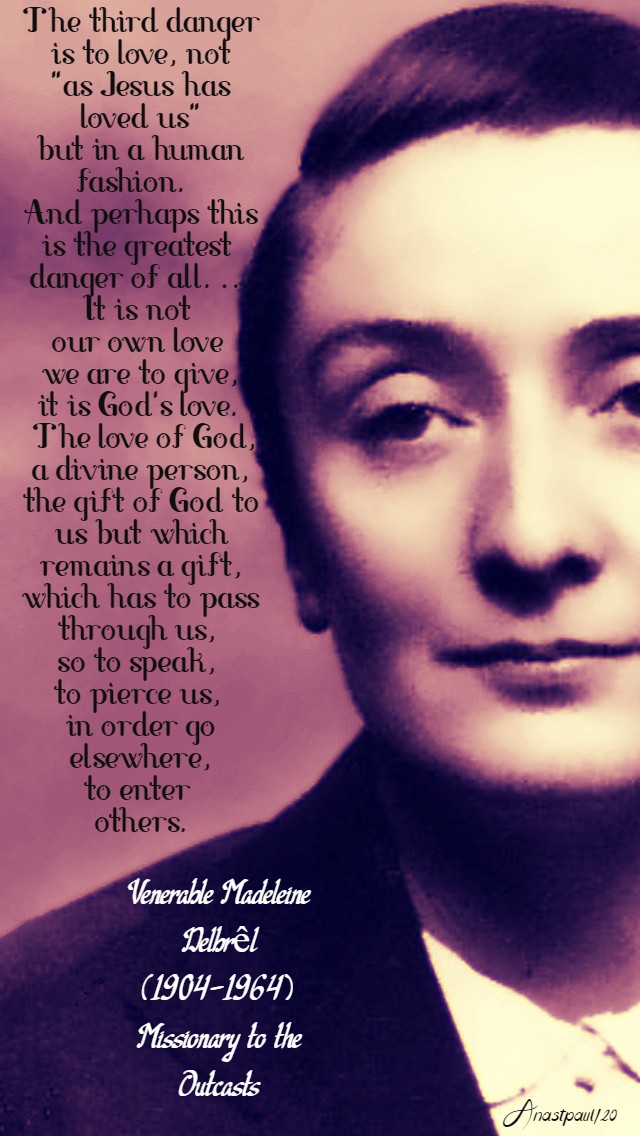
The third danger is to love, not “as Jesus has loved us” but in a human fashion. And perhaps this is the greatest danger of all. …
It is not our own love we are to give, it is God’s love. The love of God, a divine person, the gift of God to us but which remains a gift, which has to pass through us, so to speak, to pierce us, in order go elsewhere, to enter others.” … Venerable Madeleine Delbrêl (1904-1964) Missionary to the Outcasts, Author, Poet, Mystic – Fulfilling even on this earth the love for which God has created us (The joy of believing)
PRAYER – God power and mercy, by whose grace, Your people give You praise and worthy service, help us to see Your face in our neighbour. To love them all as we love You. Save us from faltering on our way and grant us the joys You have promised. St Francis Caracciolo, you who loved even unto death, kindly assist our journey by your prayers. Through Jesus our Lord, with the Holy Spirit, one God forever, amen.
Our Morning Offering – 4 June – “Month of the Sacred Heart” – Thursday of the Ninth week in Ordinary Time, Year A
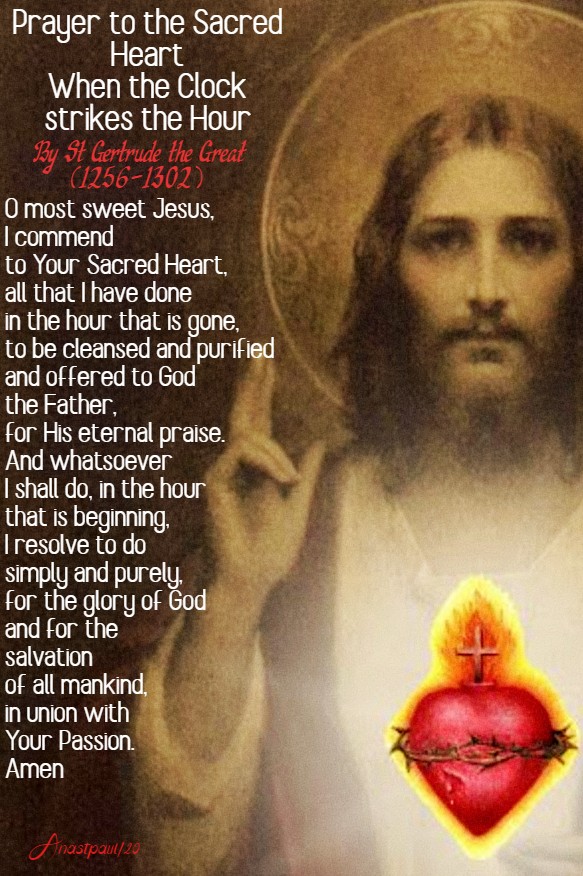
Prayer to the Sacred Heart When the Clock strikes the Hour By St Gertrude the Great (1256-1302)
O most sweet Jesus,
I commend to Your Sacred Heart,
all that I have done in the hour that is gone,
to be cleansed and purified
and offered to God the Father,
for His eternal praise.
And whatsoever I shall do,
in the hour that is beginning,
I resolve to do
simply and purely,
for the glory of God
and for the salvation of all mankind,
in union with Your Passion.
Amen
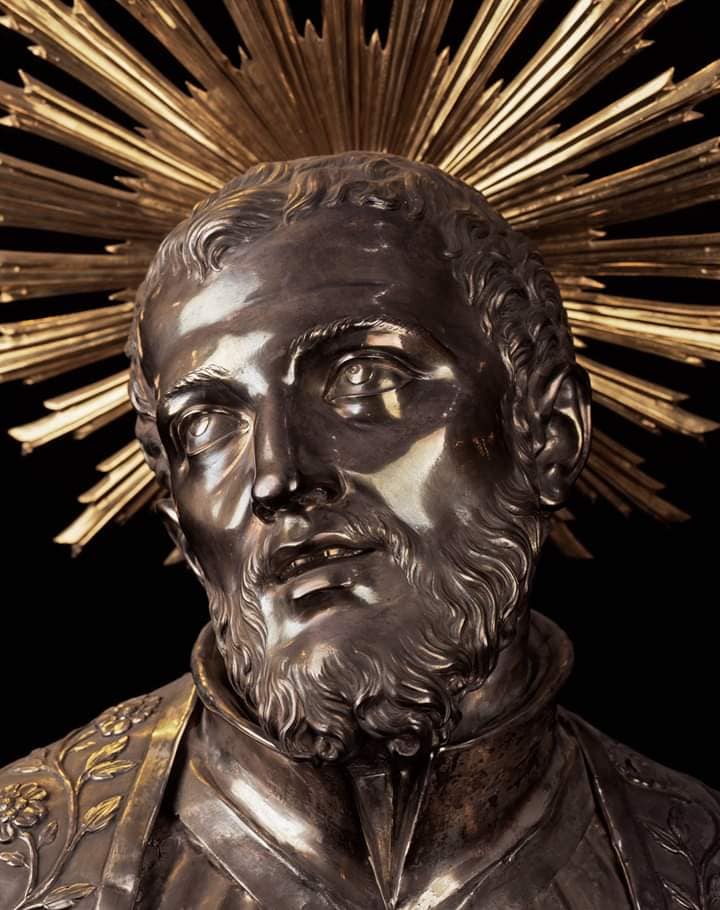
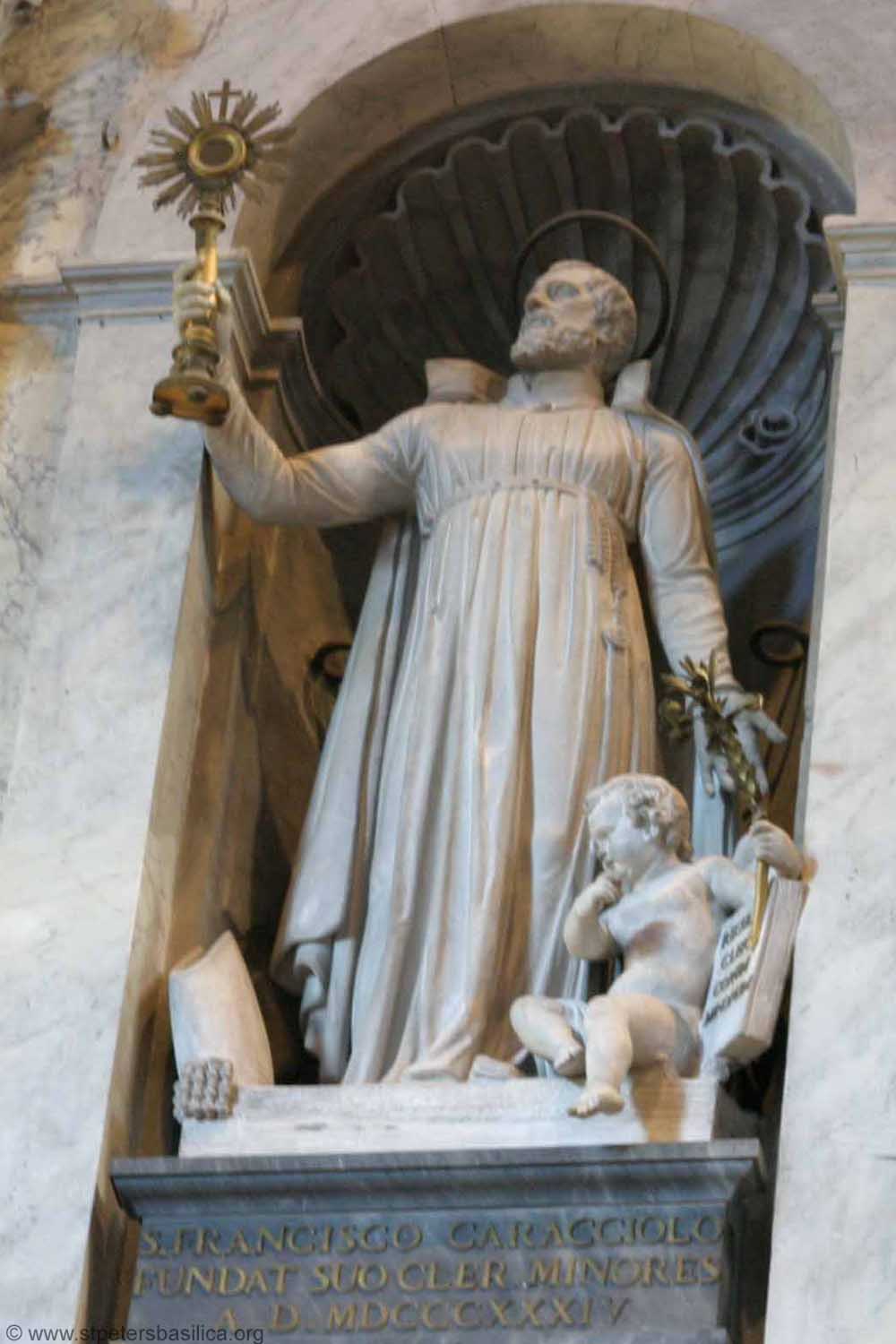
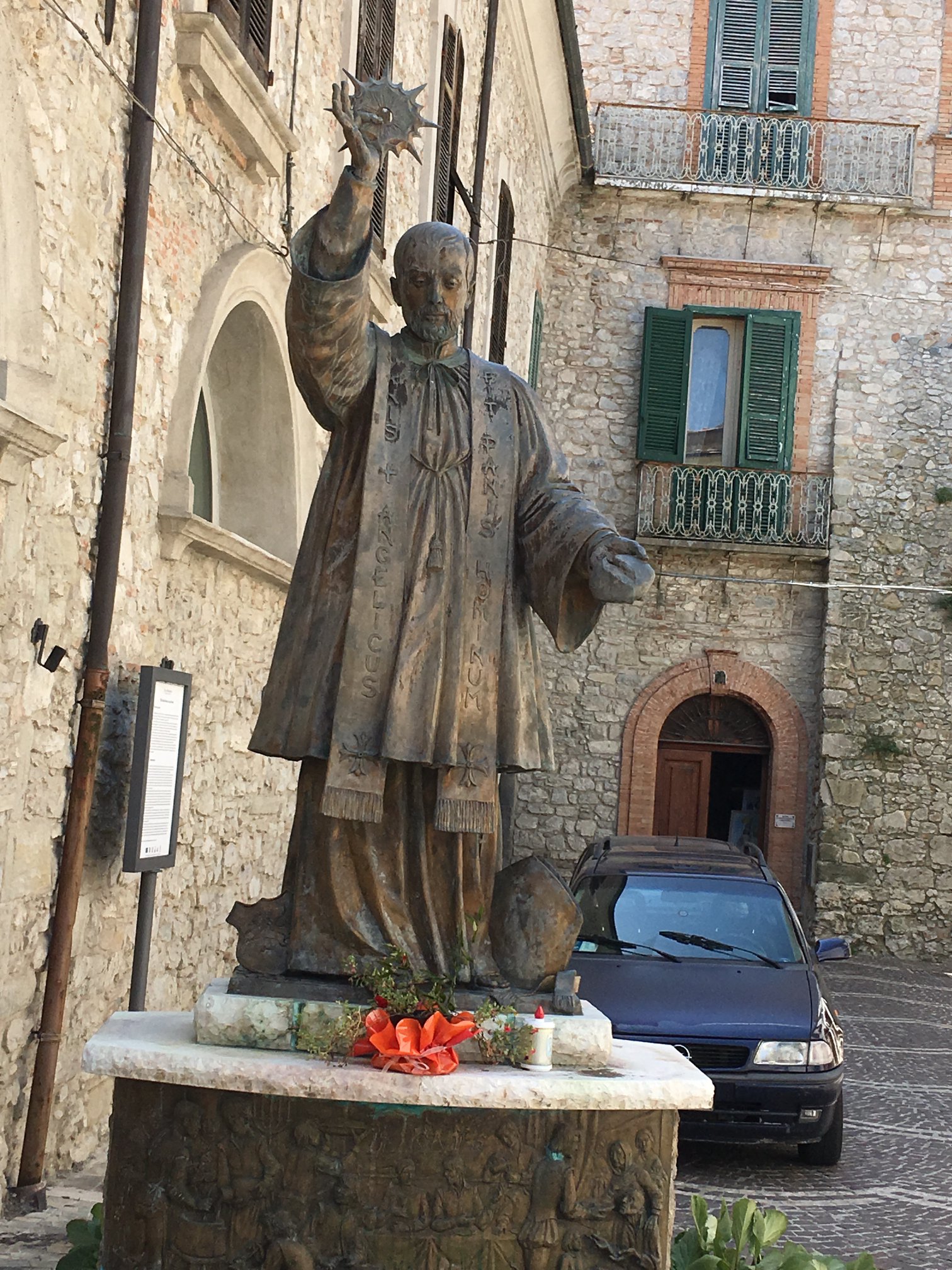
Saint of the Day – 4 June – Saint Francis Caracciolo CRM (1563-1608) Priest, co-Founder of the Congregation of the Clerics Regular Minor with Venerable John Augustine (1551-1587) the “Adorno Fathers,” Confessor, Apostle of the Eucharistic Adoration – born as Ascanio Pisquizio on 13 October 1563 at his family’s castle at Villa Santa Maria, Abruzzi, Italy and died on 4 June 1608 at Agnone, Italy of a fever, aged 44. Patronages – Association of Italian Cooks (chosen in 1996), Naples, Italy (chosen in 1838).
Francis Caracciolo was born of a noble family on 13 October 1563 in Villa Santa Maria (Abruzzo Region). His parents, Ferrante Caracciolo and Isabella Baratucci Baptised him as Ascanio. He received an excellent educational formation and Catholic education and these showed from his virtues, evident from his early childhood.
When he was 22 years old, he was inflicted by a terrible disease which almost led him to death. In this trial he heard the Lord’s call and was ready to dedicate his life completely in the service of God and neighbour, if he would recover.
After his miraculous cure, Ascanio, faithful to his promise, renounced all his properties and noble titles. He left his home and went to Naples to prepare himself for the Priesthood. He was Ordained a Priest and joined the Confraternity of the White Servants of Justice (I Bianchi), a confraternity that looked after the spiritual welfare of prisoners and those condemned to death. It was located close to the Hospital of Incurables.
His real work was revealed to him, however, in 1587, when he mistakenly received a letter addressed to a relative of the same name, Father Fabrizio Caracciolo, the Abbot of St Mary Major in Naples. He learned from it that the writer, Father Augustine Adorno of Genoa, was planning to found a religious Order of Priests whose work would combine both active and contemplative life. The project appealed to Ascanio and he soon joined forces with Augustine Adorno and Fabrizio Caracciolo.
It was the period after the Council of Trent and Ascanio felt strongly the ideals of the Catholic Reform and saw this opportunity, as a providential sign from God. He immediately made himself available to the initiatives of Augustine and Fabrizio.
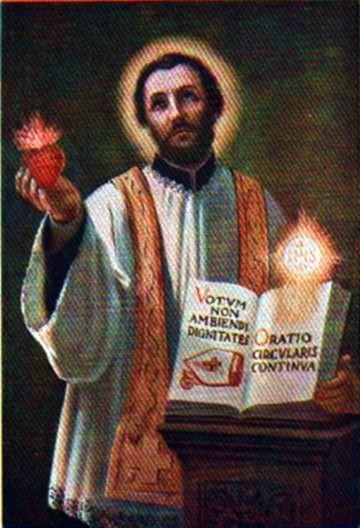
The three fathers retreated to the Camaldolese hermitage in Naples to write the first Constitutions of the Order. In addition to the three evangelical counsels of chastity, poverty and obedience, they contemplated a fourth vow – the renunciation of any ecclesiastical dignity. A particular dedication to the divine worship centred on the Eucharistic Devotions nourished by the Circular Prayer and an austere life expressed in the Circular Penitence were indicated as the main qualities of the spirituality of the new religious Order.
After their stay in the hermitage, Ascanio and Augustine went on foot to Rome to ask for the Papal approval. Sixtus V granted their petition and on 1 July 1588, the new Religious Order was approved under the name of Clerics Regular Minor.
Augustine Adorno and Ascanio Caracciolo made their Religious Profession in the Chapel of the White Servants of Justice (I Bianchi) in Naples on 9 April 1589. Ascanio took the name Francis in honour of his devotion to St Francis of Assisi. They chose the motto: Ad Maiorem Resurgentis Gloriam – For the greater glory of the Risen Christ.
The first community of the Clerics Regular Minor lived and carried out their apostolate at the Church of Mercy in Naples. A few days later, they went on a journey to Spain with the intent of establishing the Order there. They were unsuccessful in establishing the Congregation but, they made contacts with other religious orders and leaders. They came back to Naples after a very tiring trip which caused Francis enormous suffering.
In 1591, while Francis took possession of the Church of St Mary Major in Naples, Augustine Adorno went to Rome for the ratification of the approval of the Order by Pope Gregory XIV. The Pope graciously granted the new Order all the same privileges that other religious institutes have.
In September of the same year, Augustine died prematurely at the age of 40. Most of the responsibilities and concerns of the new religious family fell upon Francis, who became the first Superior General during the First General Chapter in 1593. He accepted out of obedience the office for three years.
Francis was convinced of the necessity of expansion of the Order in Spain. He left for another time with Father Giuseppe Imparato and Brother Lorenzo D’ponte on 10 April 1594. He did his works of apostolate at the Hospital of the Italians in Madrid. The hard work and faith which Francis dedicated to the mission bore its first fruits on 25 July 1595, when he obtained the permission to open a religious house dedicated to St Joseph in Madrid. His success through his zealous priestly works provoked hostility of some people against the Order. Francis, solid in his faith, overcame all the difficult moments and left Spain for Italy in June 1596.
The first religious house in Rome was founded at the Church of St Leonard. He sent the first group of clerics to reside in this house.
In November 1596, Francis returned to Naples, where, after lots of hesitation, accepted to share the charge as Superior General for another year. This was the 23 May 1597.
After he obtained for the Order the Church of St Agnes in Piazza Navona and after his resignation as Superior General, Francis left for his third journey to Spain (September 1598). During his stay, he opened the religious houses in Valladolid and Alcala de Hanares. When returned to Rome, he was elected Vicar General for Italy and Superior of St Mary Major in Naples. In his humility, he asked the Pope Paul V to be spared from this position but in vain. The Order obtained from the same Pontiff the Roman Basilica of San Lorenzo in Lucina.
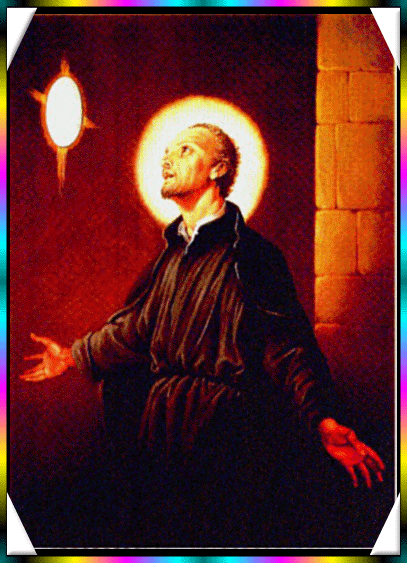
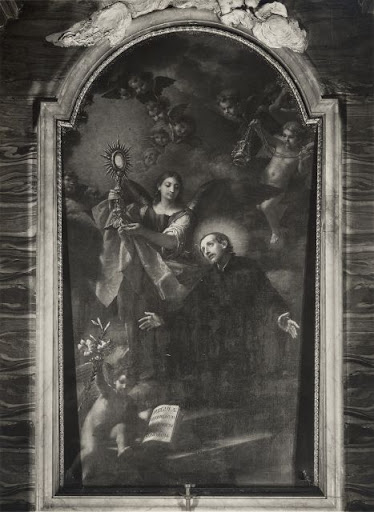
St Francis at San Lorenzo in Lucina
San Lorenzo in Lucina
Francis’ health became weaker because of his austere life. Despite all limitations, he did not hesitate from undertaking his last journey with his brother, Father Antonio of the Theatine Fathers, which led them to Loreto, Villa Santa Maria and Agnone (Molise Region) to accommodate the request of opening a new religious house there.
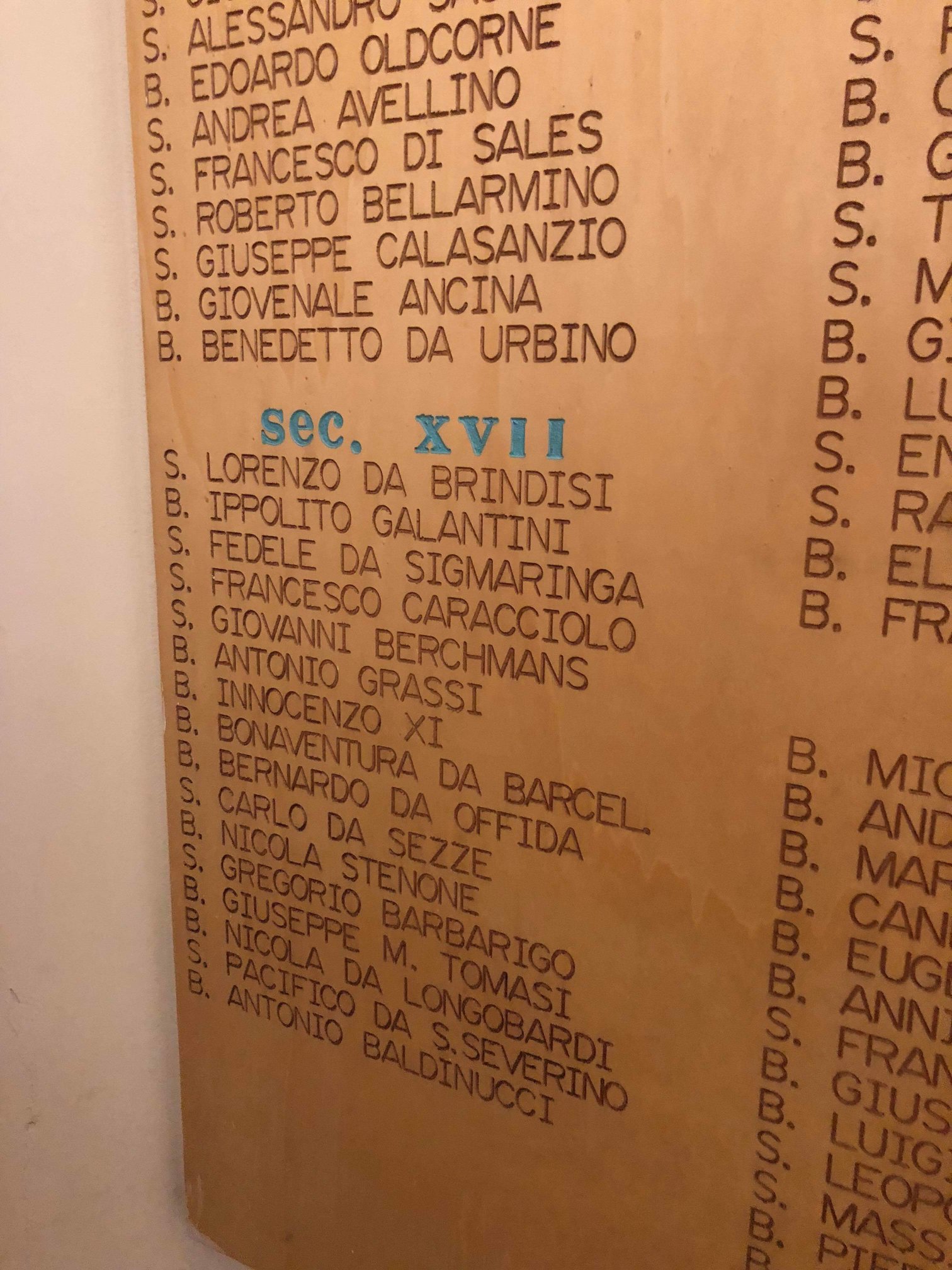
Plague in the Sanctuary of Our Lady of Loreto at the Loreto Shrine showing the names of all the saints, through the centuries, who have visited there.
Upon his arrival to Agnone, Francis was physically tired and fell ill. On 4 June 1608, he died uttering the words: “Let’s go, let’s go to heaven.”
His body was given enough preparation for a long journey to Naples. Truly, God has left His own sign on him. When the body was lanced, the blood spouted a red and scented fluid and his vital organs were incorrupt. Around his heart were printed the words of the Psalm: “The zeal of your house consumes me” (Ps 69:10).
St Francis Caracciolo was Beatified by Pope Clement XIV on 4 June 1769 and Canonised by Pope Pius VII on 24 May 1807. In 1838 he was chosen as a Patron Saint of Naples, where his body lies. At first, he was buried in Basilica of St Mary Major but his remains were afterwards translated to the church of Santa Maria di Monteverginella, which was given in exchange to the Clerics Regular Minor (1823) after their suppression at the time of the French Revolution.
O Saint Francis Caracciolo, for that most ardent love which You brought to this earth and now in heaven you bring to Jesus Christ, our most loving Redeemer and to His ever Virgin Mother Mary Most Holy and for that tender charity with which You consoled and comforted the afflicted and troubled. Oh! obtain the deliverance of our present affliction and tribulation to this soul, which full of trust, has recourse to your loving and mighty patronage and at the same time, that humbly resigns itself to the supreme will of God, whose eternal honour and glory be given forever. AMEN (Clerics Regular Minor – Adorno Fathers)
Founder’s Statue in the Vatican in the Right Tribune
St Aldegrin of Baume
St Alexander of Verona
St Alonio
Bl Antoni Zawistowski
St Aretius of Rome
Bl Boniface of Villers
St Breaca of Cornwall
St Buriana of Cornwall
St Christa of Sicily
St Clateus of Brescia
St Cornelius McConchailleach
St Croidan
St Cyrinus of Aquileia
St Dacian of Rome
St Degan
St Edfrith of Lindisfarne
St Elsiar of Lavedan
St Ernin of Cluain St Filippo Smaldone (1848-1923) Biography: https://anastpaul.com/2018/06/04/saint-of-the-day-4-june-st-filippo-smaldone-1848-1923/
Bl Francesco Pianzola St Francis Caracciolo CRM (1563-1608) Priest, Founder
Bl Francis Ronci
Bl Margaret of Vau-le-Duc
St Medan
Bl Menda Isategui
St Metrophanes of Byzantium
St Nennoc
St Nicolo of Sardinia
St Optatus of Milevis
St Petroc of Cornwall
St Quirinus of Croatia
St Quirinus of Tivoli
St Rutilus of Sabaria
Saturnina of Arras
Bl Stanislaw Kostka Starowieyski
St Trano of Sardinia
St St Walter of Fontenelle
Walter of Serviliano
—
Martyrs of Cilicia – 13 saints: A group of 13 Christians who were martyred together. The only details about them that have survived are their names –
• Cama• Christa• Crescentia• Eiagonus• Expergentus• Fortunus• Italius
• Jucundian• Julia• Momna• Philip• Rustulus• Saturnin
They were martyred in in Cilicia, Asia Minor (in modern Turkey), date unknown
Martyrs of Nyon – 41 saints: A group of 41 Christians martyred together for refusing to sacrifice to imperial Roman idols. We know the names of some but no other details.
• Amatus• Attalus• Camasus• Cirinus• Dinocus• Ebustus• Euticus• Eutychius
• Fortunius• Galdunus• Julia• Quirinus• Rusticus• Saturnina• Saturninus
• Silvius• Uinnita• Zoticus
Martyred by being beheaded in Noviodunum (modern Nyon, Switzerland)
Thought for the Day – 3 June – “Month of the Sacred Heart” – Meditations with Antonio Cardinal Bacci (1881-1971)
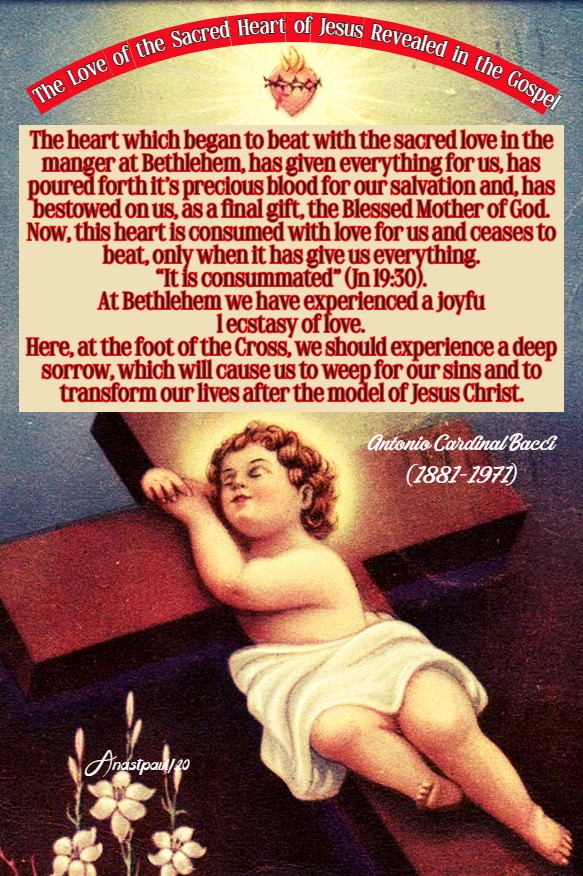
The Love of the Sacred Heart of Jesus Revealed in the Gospel
“If we meditate on the pages of the Gospel, we shall find that they are vibrant with the infinite love of the Sacred Heart of Jesus. Let us, in imagination, enter the cave of Bethlehem and kneel before the crib where the Divine Infant is lying. Darkness is all around, darkness over the earth, darkness in the minds and hearts of the majority of men. But, now, the heavens open and from the brightness the voices of angels ring out, “Glory to God in the highest and on earth, peace among men of goodwill.” Who is this infant? He is the Eternal Word, the substantial image of God, Who, for love of us, has been made man. He is the Infinite One Who has willed to unite Himself with the finite, in order to lift us towards Himself. This little heart is throbbing like that of any baby but, in this throb, is expressed the love of the God-Man. It is a profound mystery, that God should have loved man so much, that He became a tiny infant. Yet, He did this so that we might love Him more easily and in order to show us His own immeasurable love. There is about this Infant, a fascination, at once human and divine, which compels us to love Him, even as Mary, Joseph and the simple shepherds loved Him. He is asking us for love, adoration and complete surrender. Can we refuse Him?
Now let us take ourselves in imagination to Calvary and kneel at the foot of the Cross. The heart which began to beat with the sacred love in the manger at Bethlehem, has given everything for us, has poured forth it’s precious blood for our salvation and, has bestowed on us, as a final gift, the Blessed Mother of God. Now, this heart is consumed with love for us and ceases to beat only when it has give us everything. “It is consummated” (Jn 19:30). At Bethlehem we have experienced a joyful ecstasy of love. Here, at the foot of the Cross, we should experience a deep sorrow, which will cause us to weep for our sins and to transform our lives after the model of Jesus Christ.”
Quote/s of the Day – 3 June – Wednesday of the Ninth week in Ordinary Time, Readings: 2 Timothy 1:1-3, 6-12, Psalm 123:1-2, Mark 12:18-27
“Speaking of: The Last Things”
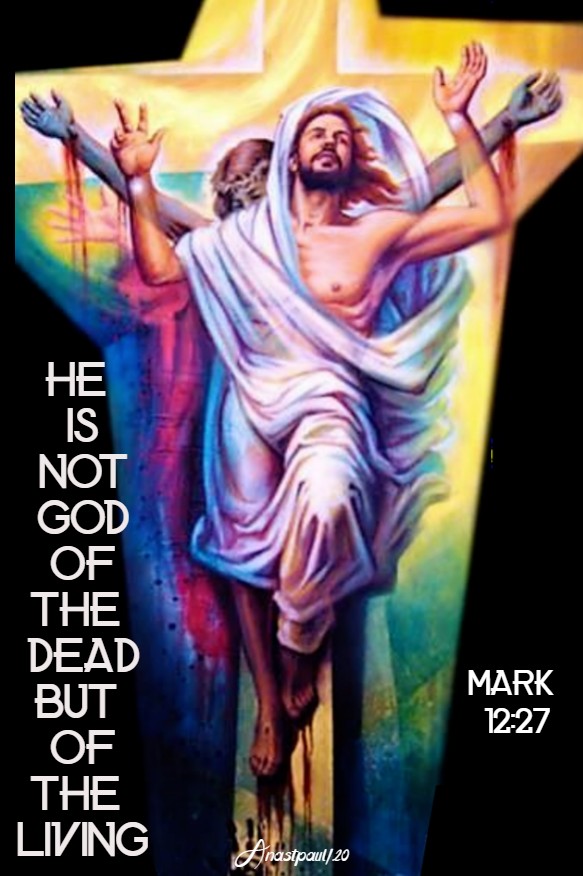
“He is not God of the dead but of the living.”
Jesus
Mark 12:27
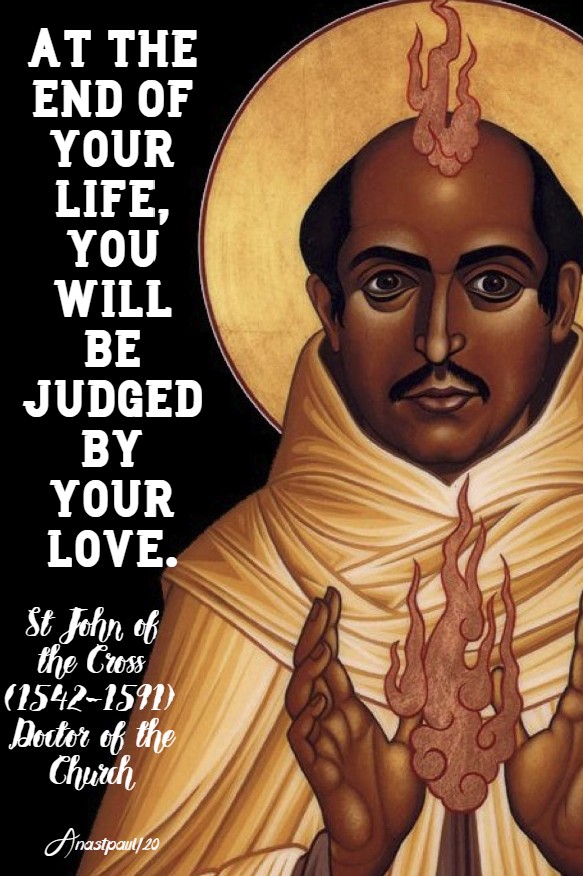
“At the end of your life, you will be judged by your love.”
St John of the Cross (1542-1591)
Doctor of the Church
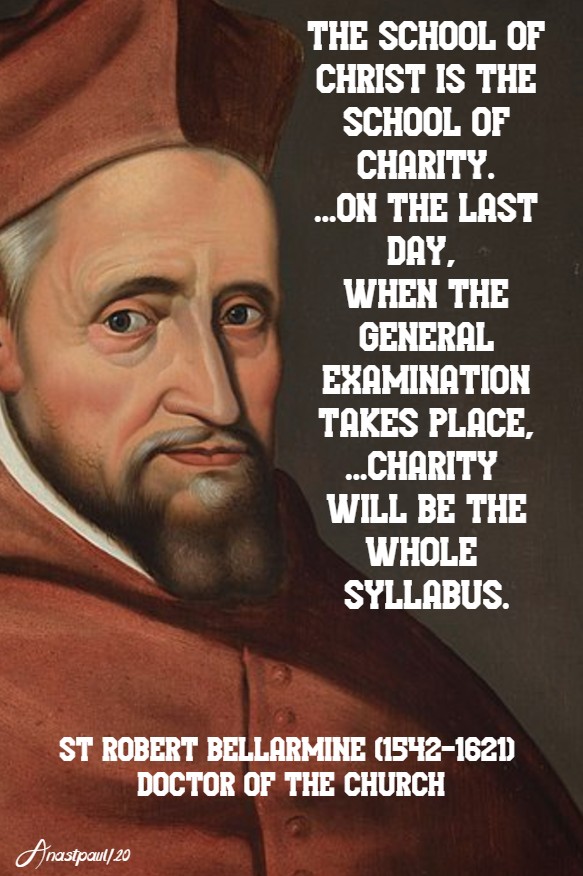
“The school of Christ is the school of charity. …On the last day, when the general examination takes place, …Charity will be the whole syllabus.”
St Robert Bellarmine (1542-1621)
Doctor of the Church
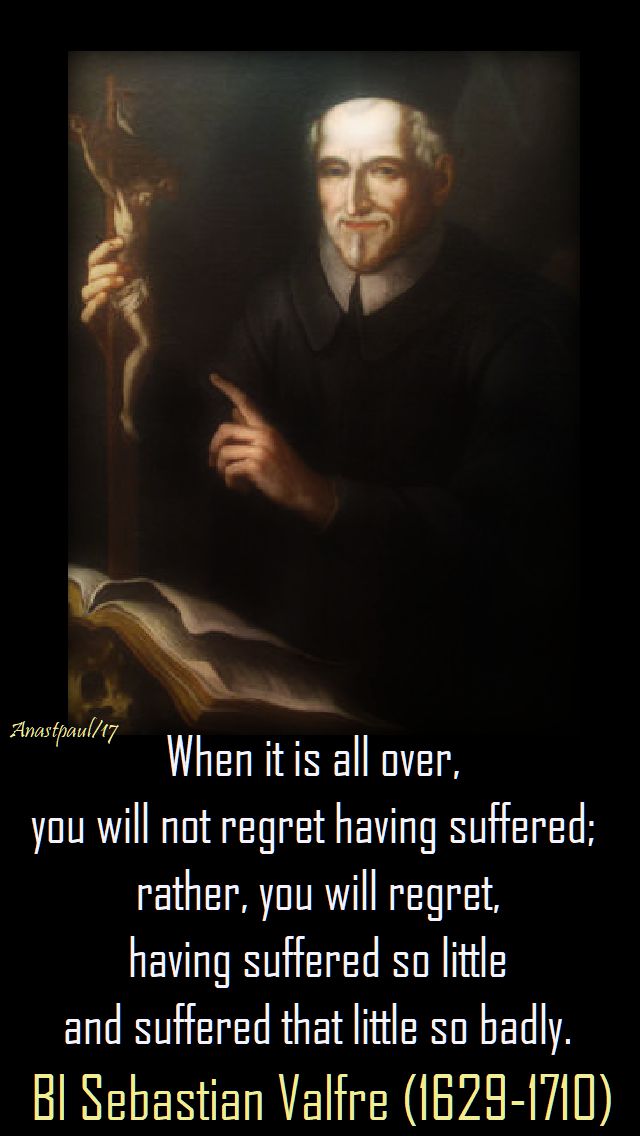
“When it is all over, you will not regret having suffered, rather, you will regret, having suffered so little and suffered that little so badly.”
Bl Sebastian Valfre (1629-1710)
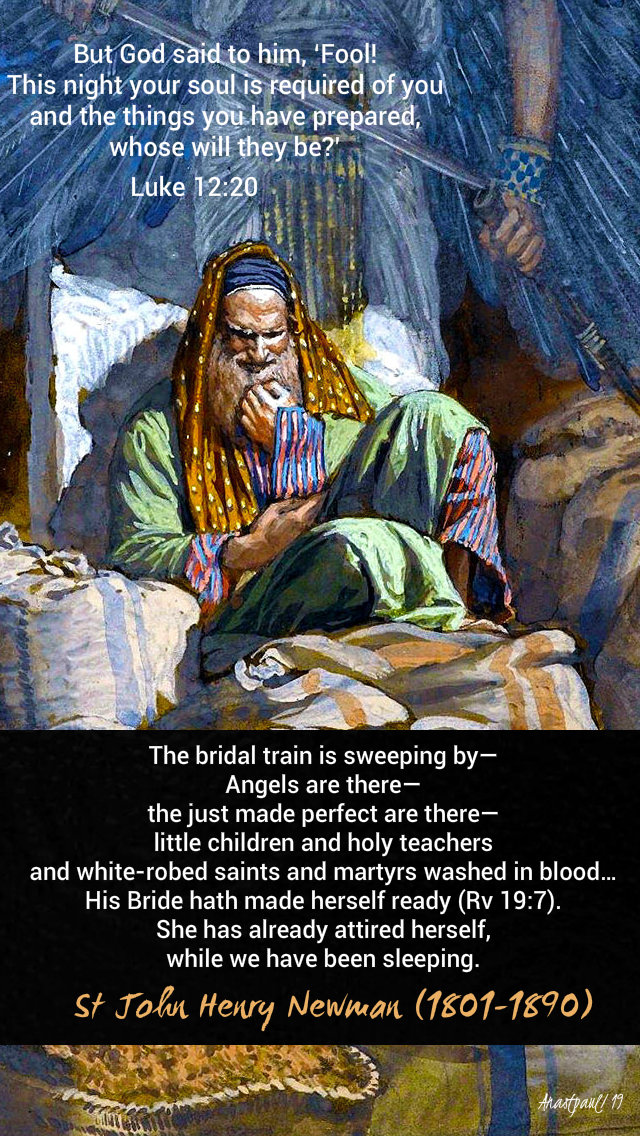
“The bridal train is sweeping by— Angels are there— the just made perfect are there— little children and holy teachers and white-robed saints and martyrs washed in blood… His Bride hath made herself ready (Rv 19:7). She has already attired herself, while we have been sleeping.”
St John Henry Newman (1801-1890)
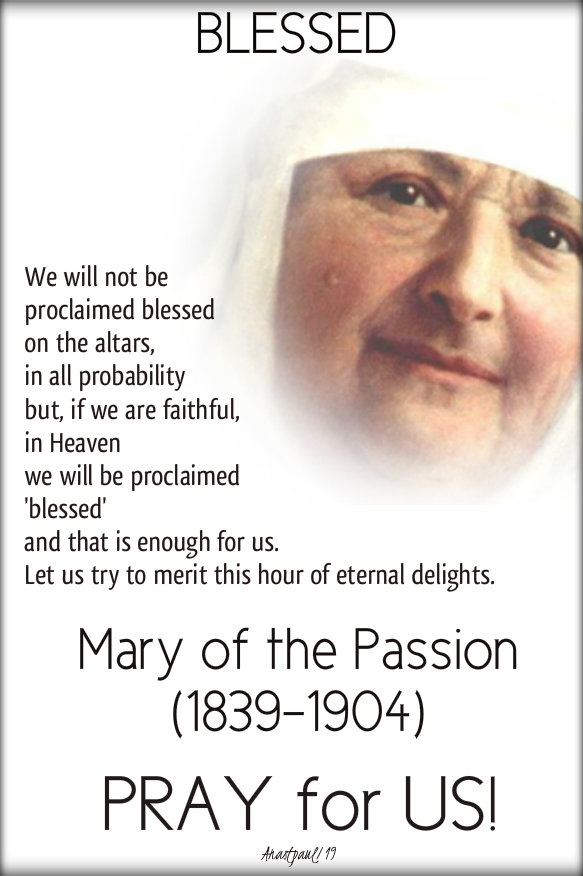
“We will not be proclaimed blessed on the altars in all probability but if we are faithful, in Heaven we will be proclaimed ‘blessed’ and that is enough for us. Let us try to merit this hour of eternal delights.”
Bl Mary of the Passion (1839-1904)
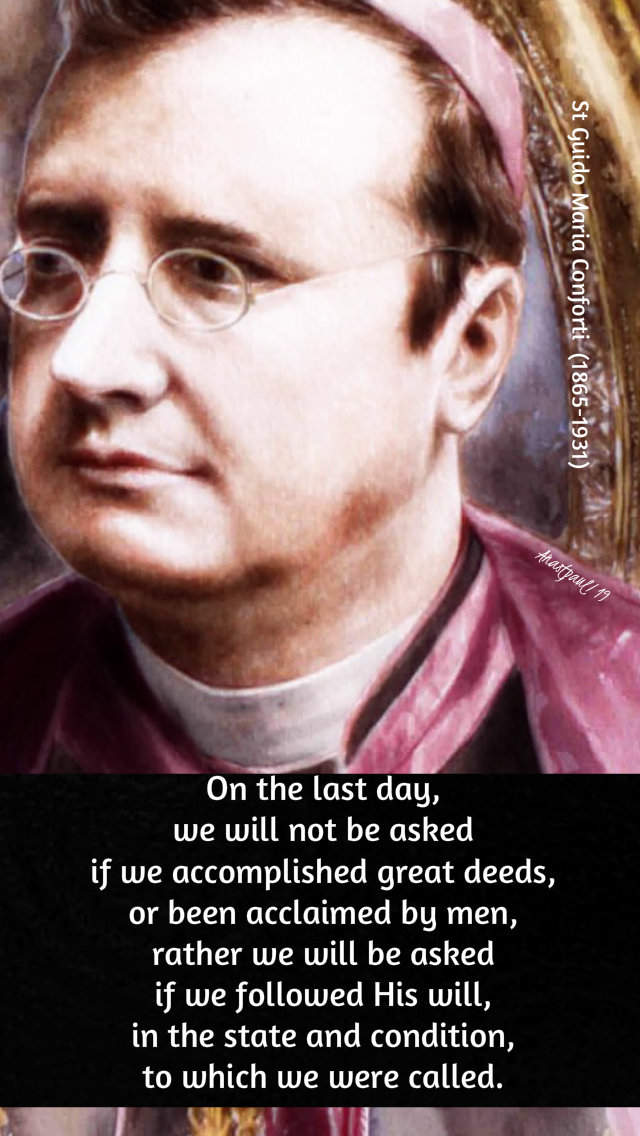
“On the last day, we will not be asked if we accomplished great deeds, or been acclaimed by men, rather we will be asked if we followed His will, in the state and condition, to which we were called.”
St Guido Maria Conforti (1865-1931)
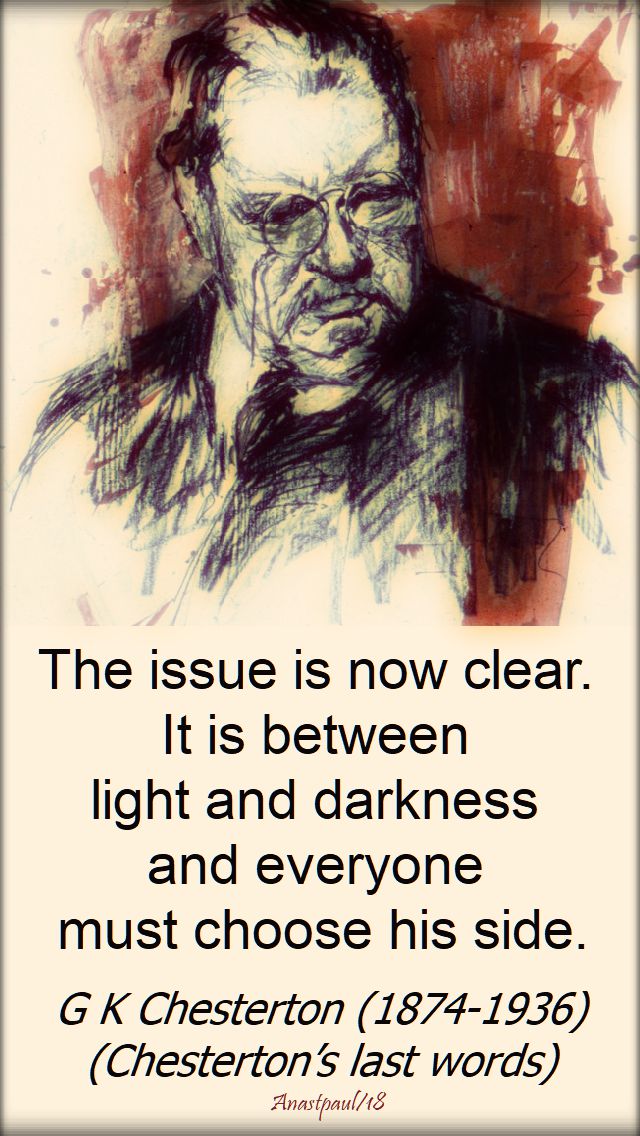
“The issue is now clear. It is between light and darkness and every one must choose his side.”
G K Chesterton (1874-1936)
(Chesterton’s last words)
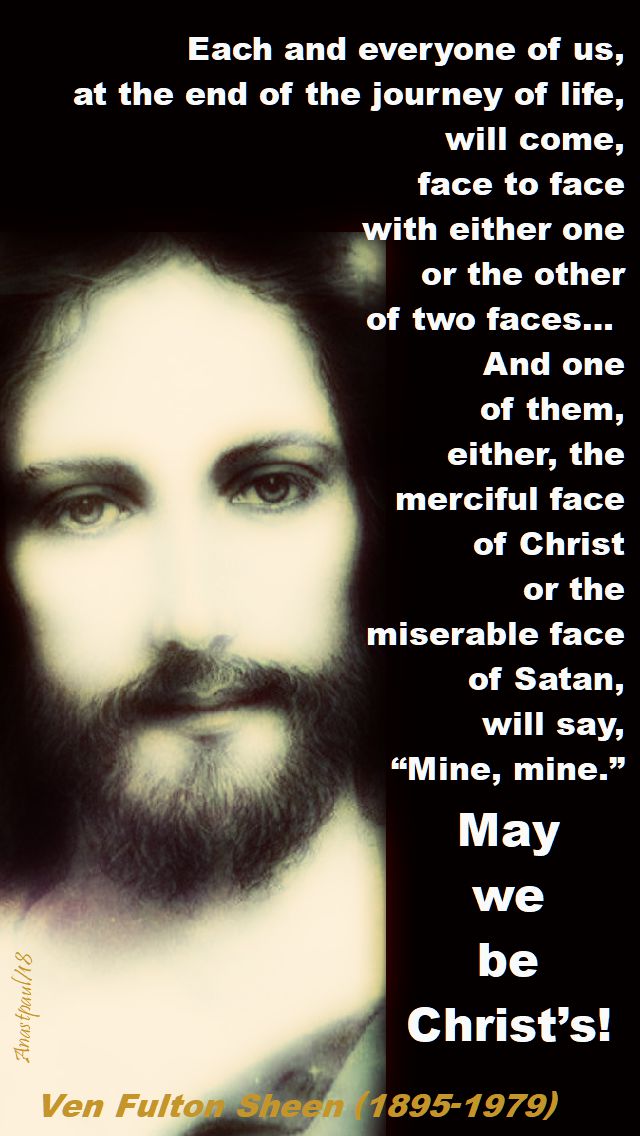
“Each and every one of us, at the end of the journey of life, will come face to face with either one or the other of two faces… And one of them, either the merciful face of Christ or the miserable face of Satan, will say, “Mine, mine.” May we be Christ’s!”
Ven Fulton Sheen (1895-1979)
“We must always be ready. Let our faith be lively and active and our minds turned towards God, Who is waiting for us. There is no need to be afraid. He is good and merciful. He desires our salvation. This is a wonderfully consoling thought. God desires my salvation! Let us surrender ourselves to Him, therefore, as if we had to die this very moment!”
“It is not God Who is relentless. It is the damned soul which was relentlessly ungrateful towards the infinitely good and merciful God.”
“They are flames which will never be extinguished, flames which burn but do not consume, flames without light – dark and accompanied by the shrieking of eternal despair.”
One Minute Reflection – 3 June – “Month of the Sacred Heart” – Wednesday of the Ninth week in Ordinary Time, Readings: 2 Timothy 1:1-3, 6-12, Psalm 123:1-2, Mark 12:18-27 and the Memorial of St Juan Grande OH (1546-1600)
“He is not God of the dead but of the living.” …Mark 12:27
REFLECTION – “How blind are the eyes of the intellect on its own! For they have not noticed that “the blind see, the lame walk” (Mt 11:5) on earth at the Saviour’s word… so that we might believe that the flesh in its entirety will rise again at the resurrection. If He cured diseases of the flesh on this earth and restored wholeness to the body, how much more, will He do so at the moment of resurrection, so that the flesh might rise again wholly and without blemish… It seems to me that such people fail to look, at the divine action in its totality, at the beginning of creation, in the forming of man. They don’t attend to the reason why earthly things were made.
The Word said: “Let us make man in our image and likeness” (Gn 1:26)… Obviously man, formed in the image of God, was flesh. Therefore, how absurd it is to claim, that flesh formed by God in His own image is despicable and worthless! Clearly flesh must be precious in God’s eyes since it is His creation. And since the culmination of His plan for all the rest of creation is to be found in it, this is what has the greatest worth in the eyes of the Creator.”… St Justin (c 100-160), Martyr, Apologist, Philosopher, Father of the Church (Treatise on the resurrection, 2.4.7-9)
PRAYER – Holy Father, You made us, we belong to You. Grant that by the prayers of all your holy saints, we may attain eternal life with You to praise and worship You for all eternity. May the prayers of St Juan Grande (1546-1600) assist us our earthly pilgrimage. We make our prayer through our Lord, Jesus, with You and in the unity of the Holy Spirit, one God forever, amen.
Our Morning Offering – 3 June – “Month of the Sacred Heart” – Wednesday of the Ninth week in Ordinary Time
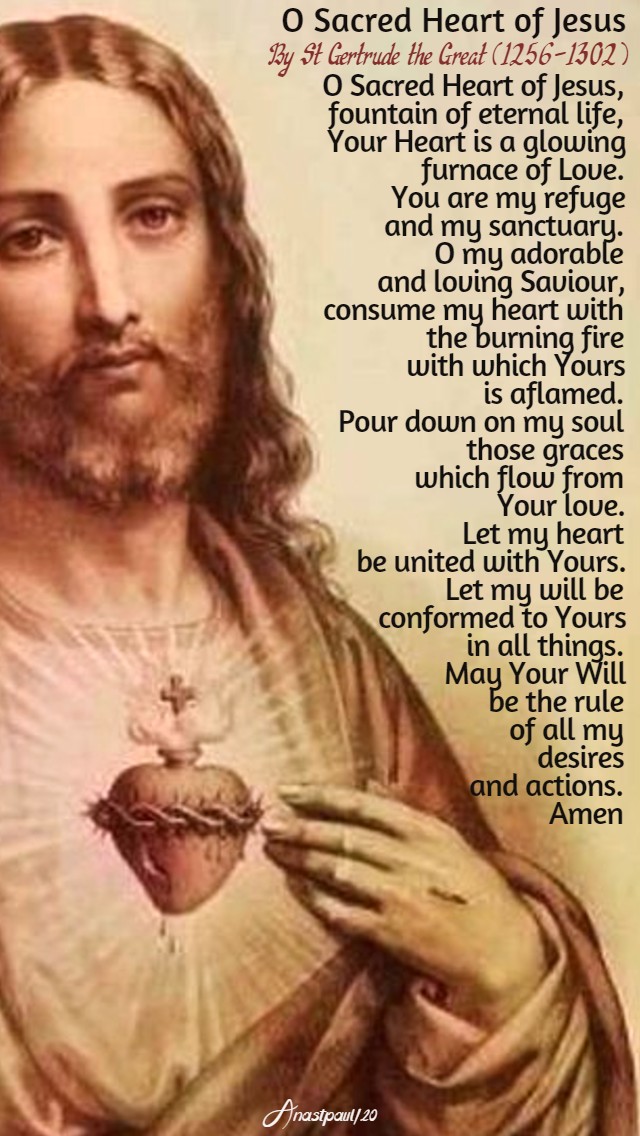
O Sacred Heart of Jesus By St Gertrude the Great (1256-1302)
O Sacred Heart of Jesus,
fountain of eternal life,
Your Heart is a glowing furnace of Love.
You are my refuge and my sanctuary.
O my adorable and loving Saviour,
consume my heart with the burning fire
with which Yours is aflamed.
Pour down on my soul those graces
which flow from Your love.
Let my heart be united with Yours.
Let my will be conformed to Yours in all things.
May Your Will be the rule of all my desires and actions.
Amen
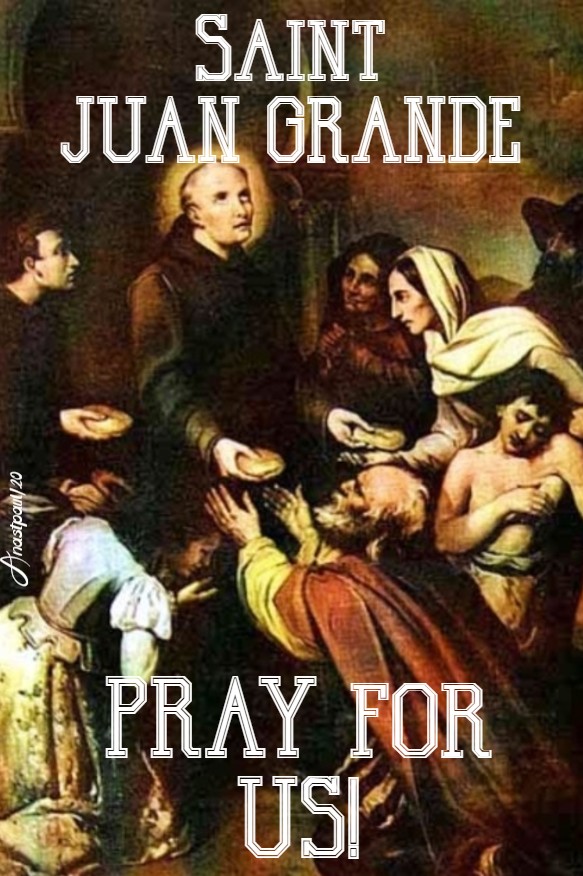
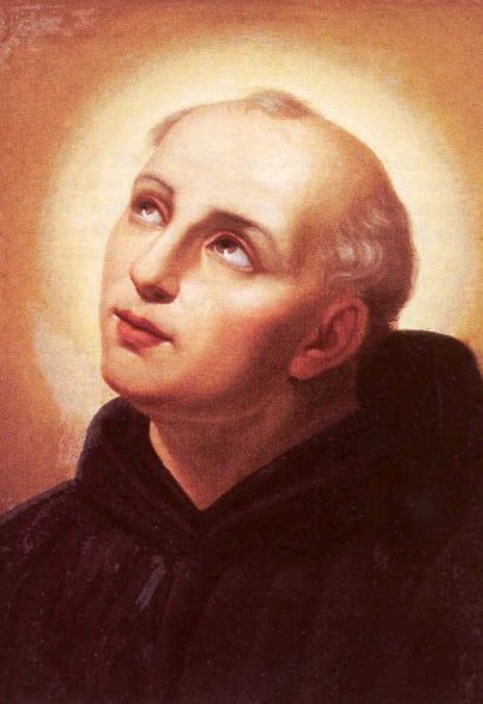
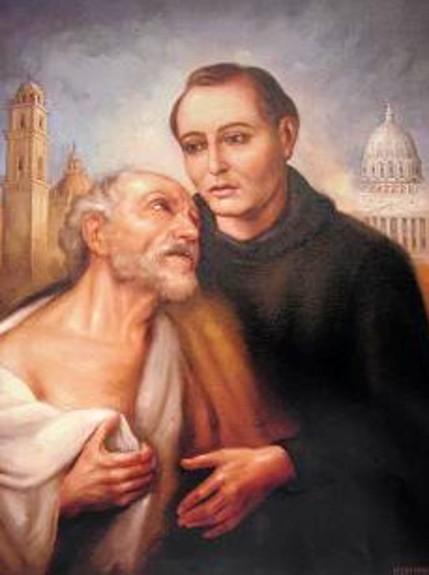
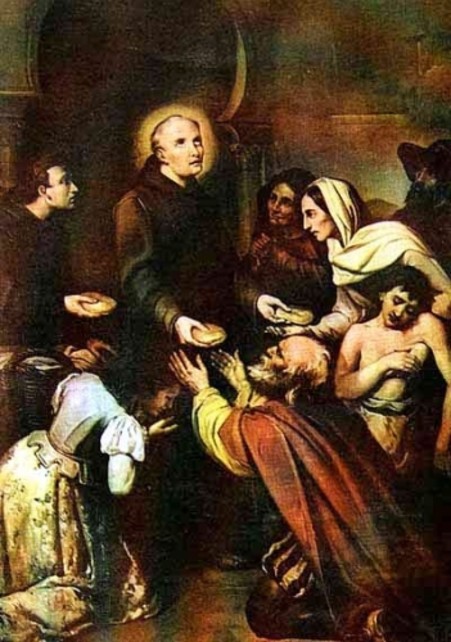
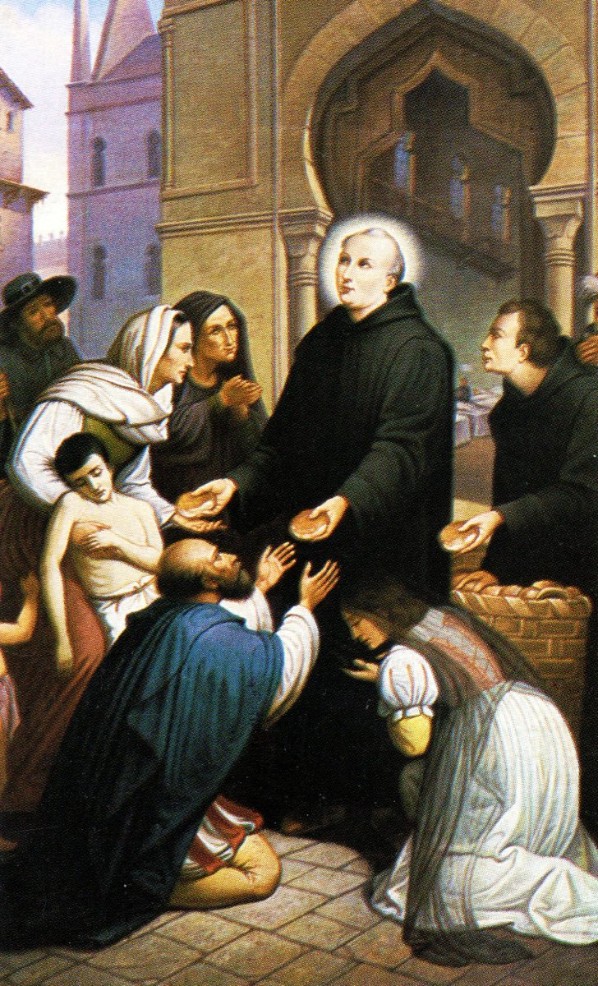
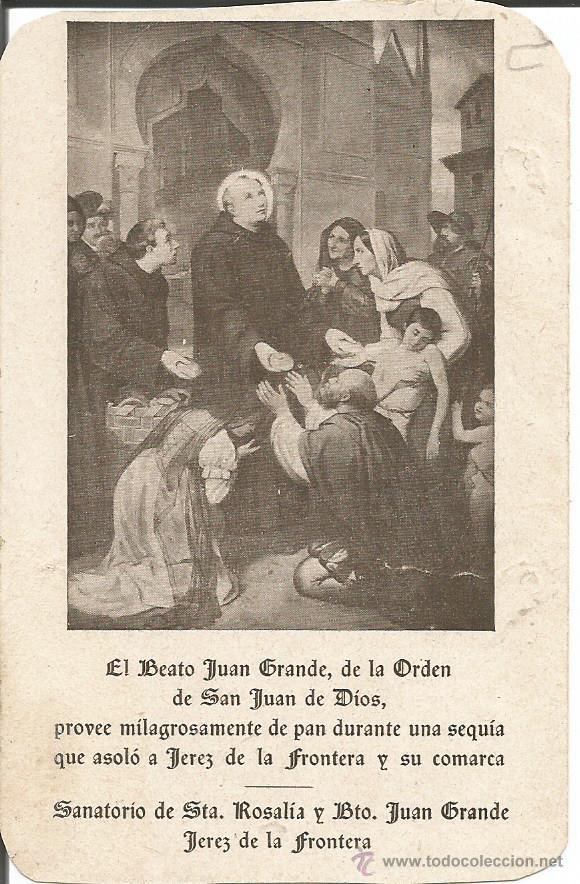
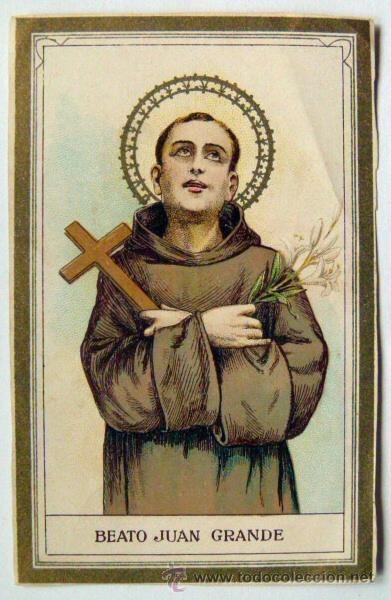
Saint of the Day – 3 June – St Juan Grande Román OH (1546-1600) commonly called St Juan Grande but also known as St John Grande – he adopted the name “John the Sinner,” Religious of the Hospitallers of Saint John of God, Apostle of Charity and Mercy, of the poor, sick, known as “a Prophet and Apostle of health care” – born on 6 March 1546 at Carmona, Andalusia, Spain and died on 3 June 1600 at Jerez, Spain of the plague which he became infected with whilst tending plague victims. Patronage – Diocese of Jerez de la Frontera in 1986.
Juan Grande Roman was born in Carmona, Seville, Spain, on Saturday 6 March 1546, the son of Cristobal Grande and Isabel Roman, themselves devout Christians and was Baptised by the parish priest, Andrés Muñoz. His father, a craftsman, died when John was only eleven years old.
He was given a sound Christian upbringing, firstly in his family and after the age of seven as a choir-boy in his parish.
He completed his educational formation and vocational training in Seville, learning the trade of a weaver and cloth-maker. At 17 he returned home and turned to trade, selling cloth. Shortly afterwards, his work caused him to undergo a profound spiritual crisis.
Opting for God:
He left his family and retired to the Hermitage of St Olalla, at Marchena, a town near Carmona, where he spent a whole year in retreat trying to discover his true vocation. He then decided to devote himself to God – he exchanged his clothes for a sack-cloth habit, renounced marriage and adopted the nickname of “Juan Pecador” “John the Sinner.”
At the same time he began caring for an elderly couple who had experienced difficult times. He took them into his own home and catered for all their needs, going out to beg for alms for them. He then realised that his new vocation was to serve the poor and needy.
Opting totally for the poor:
When he was only 19 years old, Juan Pecador moved to Jerez de la Frontera, Cadiz, to start a new life there – he personally looked after needy people, prisoners in the ‘Royal Prison,’ incurably sick and convalescents who had been left to their own devices. To help them he would beg for alms around the town.
During this time he used to frequent the church of the Franciscans, where he prayed and took spiritual direction from one of the Fathers.
Founding the “Hospital de la Candelaria” (Candlemas Hospital):
Juan Pecador attracted the admiration of the people of Jerez because of his generous life of charity.
In January 1574 a serious epidemic broke out in Jerez and he addressed a petition to the Cathedral Chapter, urging them to assist the many, sick people who had been cast out on to the streets.
He did everything he could to cater for their needs and eventually decided to found a hospital of his own, which he gradually extended. He devoted it to Mary and called it “Our Lady of Candlemas.”
Union with St John of God:
Juan Pecador devoted his whole being and all his work to God, expressed through his service to the poor, sustained by his deep life of faith and prayer.
Meanwhile, he had heard of the Institution founded by St John of God in Granada. He visited it in 1574 and decided to join it, accepting the rules and applying the same form of professed life in his own hospital.
With his new project, his witness and his exemplary self-giving he attracted new companions to join him and he trained them according to “The Statutes of John of God.” This gave him the opportunity to reach a wider area and work with other foundations in Medina Sidonia, Arcos de la Frontera, Puerto Santa Maria, San Lucar de Barrameda and Villamartin.
Reducing the number of hospitals:
The care provided to the destitute sick in Jerez left much to be desired, while small centres mushroomed. The authorities therefore decided to reduce the number of hospitals, demanding greater efficiency. But this measure struck at the interests of not a few, whose attachment to the hospitals, was not so much out of a desire to serve the sick but, because they were a source of personal profit. His path was, therefore, fraught with criticism, opposition and obstacles.
Juan Pecador’s hospital was also affected. Like all the others, he submitted his report to the authorities, explaining his way of caring for the sick in his hospital.
The Archbishop of Seville, Cardinal Rodrigo de Castro, entrusted the delicate mission of reducing the number of hospitals and raising efficiency to Juan Pecador, whom he considered to be the most appropriate and skilled person for this task, in view of his spirit, vocation and Hospitaller experience. Juan Grande set about reducing the number of hospitals boldly and lovingly and, despite the great and small difficulties he encountered, he revealed his particular sensitivity, capacity, sense of humour and great virtue.
The report on his hospital stated that the care was provided “with diligence, care and great charity, doing good and serving God our Lord, because he and his brothers of the cloth, are virtuous men and practise this charity of caring for the needy sick.”
The topical relevance of John Grande today:
In addition to an intense interior life, Juan Grande devoted himself body and soul to the external task, of seeking out, caring for and serving the poor and sick and showing his concern for the most serious and urgent issues of his day – prisoners, the convalescing sick and the incurably ill, prostitutes, rejected sick soldiers, abandoned children, etc. He truly practised all the works of mercy.
Juan Grande was a man who did good because he was good – a practical and efficient man of few words, a merciful tenant of the Gospel of Life, a Good Samaritan, an organiser of hospitals and of hospital care, a critical conscience against injustice, abuse of authority and inadequacy. In short, he was “a Prophet and Apostle of health care.”
The plague epidemic and his death:
When he was 54, living his life dedicated entirely to his community and his hospital, Jerez was stricken by a terrible outbreak of the plague. He worked everywhere, assisting the people and devoting all his strength and generosity to them but, he was eventually infected himself and died on Saturday 3 June 1600.
His glorification:
Beatified in 1853 by Pius IX and Canonised by St Pope John Paul 11 on 2 June 1996, he was proclaimed the Patron Saint of the new Diocese of Jerez de la Frontera in 1986.
His remains are venerated in the “Diocesan Shrine of St John Grande” in Jerez, at the hospital of the Brothers of St John of God that bears his name.
Martyrs of Uganda (Memorial) – 22 saints: Twenty-two (22) Ugandan converts martyred in the persecutions of King Mwanga. They are –
• Achileo Kiwanuka • Adolofu Mukasa Ludigo
• Ambrosio Kibuuka • Anatoli Kiriggwajjo
• Anderea Kaggwa • Antanansio Bazzekuketta
• Bruno Sserunkuuma • Charles Lwanga
• Denis Ssebuggwawo • Gonzaga Gonza
• Gyavire • James Buzabaliao
• John Maria Muzeyi • Joseph Mukasa
• Kizito • Lukka Baanabakintu
• Matiya Mulumba • Mbaga Tuzinde
• Mugagga • Mukasa Kiriwawanvu
• Nowa Mawaggali • Ponsiano Ngondwe
They were Canonised on 18 October 1964 by Pope Paul VI at Rome, Italy. The Lives and Martyrdom of the Ugandan Martyrs: https://anastpaul.com/2017/06/03/saints-of-the-day-3-june-uganda-martyrs-or-st-charles-lwanga-companions/
—
Bl Adam of Guglionesi
St Albert of Como
St Athanasius of Traiannos
St Auditus of Braga
Bl Beatrice Bicchieri
St Caecilius of Carthage St Charles Lwanga & Companions (see the Martyrs of Uganda above)
Bl Charles-René Collas du Bignon
St Clotilde of France
St Conus of Lucania
St Cronan the Tanner
St Davinus of Lucca
Bl Diego Oddi
Bl Francis Ingleby
St Gausmarus of Savigny
St Genesius of Clermont
St Glunshallaich
St Hilary of Carcassone
St Isaac of Córdoba St Juan Grande Román OH (1546-1600)
St Kevin of Glendalough (c 498-618)
St Laurentinus of Arezzo
St Liphardus of Orléans
St Morand of Cluny
St Moses of Arabia
St Oliva of Anagni
St Paula of Nicomedia
St Pergentinus of Arezzo
St Phaolô Vu Van Duong
St Urbicius
—
Dominicans Martyred in China
Martyrs of Africa – 156 saints: 156 Christians martyred together in Africa, date unknown; the only other information to survive are some of their names –
• Abidianus• Demetria• Donatus• Gagus• Januaria• Juliana• Nepor• Papocinicus• Quirinus• Quirus
Martyrs of Byzantium – 5 saints: A group of Christians, possibly related by marriage, who were martyred together. They were –
• Claudius• Dionysius• Hypatius• Lucillian• Paul
They were Martyred in 273 in Byzantium.
Martyrs of Rome – 8 saints: A group of Christians martyred together. We know nothing else about them but the names –
• Amasius• Emerita• Erasmus• Lucianus• Orasus• Satuaucnus• Septiminus• Servulus
They were Martyred in Rome, Italy, date unknown.
Martyrs of Rome – 86 saints: 85+ Christians martyred together in Rome, Italy, date unknown. The only details that have survived are some of their names –
• Apinus • Apronus • Aurelius • Avidus • Cassianus • Criscens • Cyprus • Domitius • Donata • Donatus • Emeritus • Extricatus • Exuperia • Faustina • Felicitas • Felix • Flavia • Florus • Fortunata • Fortunatus • Fructus • Gagia • Gagus • Gallicia • Gorgonia • Honorata • Januaria • Januarius • Justa • Justus • Libosus • Luca • Lucia • Matrona • Matura • Mesomus • Metuana • Nabor • Neptunalis • Obercus • Paula • Peter • Pompanus • Possemus • Prisca • Procula • Publius • Quintus • Rogatian • Romanus • Rufina • Saturnin • Saturnus • Secundus • Severa • Severus • Sextus • Silvana • Silvanus • Sinereus • Tertula • Titonia • Toga • Urban • Valeria • Veneria • Veranus • Victor • Victoria • Victorinus • Victuria • Victurina • Virianus • Weneria • Zetula.
They were Martyred in Rome date unknown.
Thought for the Day – 2 June – “Month of the Sacred Heart” – Meditations with Antonio Cardinal Bacci (1881-1971)
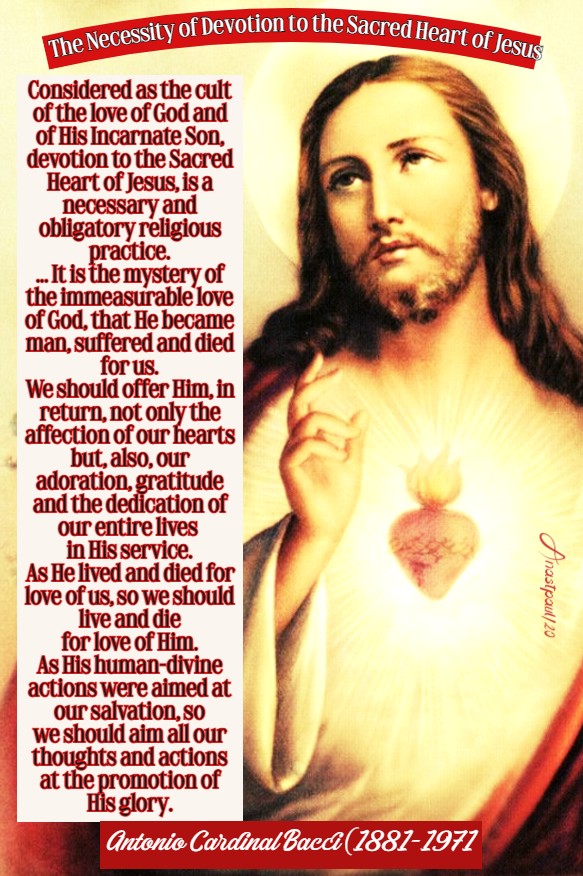
The Necessity of Devotion to the Sacred Heart of Jesus
“Considered as the cult of the love of God and of His Incarnate Son, devotion to the Sacred Heart of Jesus, is a necessary and obligatory religious practice. God loved us so much, that He willed that the Eternal Word should assume a human nature, instruct us concerning the way to Heaven and give us the means necessary to reach it and, die upon the Cross, in order to impart to us, the merits of the shedding of His Precious Blood. It is obvious, then, that we have a strict duty to make a return of homage and love, for such great love on God’s part. “God so loved the world,” the Gospel says, “that He gave His only-begotten Son that those who believe in Him, may not perish but may have life everlasting” (Jn 3:16). “In this, has the love of God been shown in our case,” St John adds in his first epistle, “that God has sent His only-begotten Son into the world that we may live through Him” (1 Jn 4:9).
It is the mystery of the immeasurable love of God, that He became man, suffered and died for us. We should offer Him, in return, not only the affection of our hearts but, also, our adoration, gratitude and the dedication of our entire lives in His service. As He lived and died for love of us, so we should live and die for love of Him. As His human-divine actions were aimed at our salvation, so we should aim all our thoughts and actions at the promotion of His glory. In this way, writes Pope Pius XI, devotion to the Sacred Heart of Jesus, becomes the synthesis of Christianity and the guide to more perfect knowledge, love and imitation of Christ (Encyclical Miserentissimus Redemptor, AAS 1928, p.167).”



 This was a highly unusual step, as Ana was a “secular Carmelite,” meaning she was not part of the choir and removed from the Convent’s life of prayer. She was thus consecrated as a religious sister and took over the Convent at Pontoise. So unusual a step met with the disapproval of her companions but – as the Foundress – had once foretold – she offered no resistance. Ana had also been forewarned that her elevation would cause her great sufferings.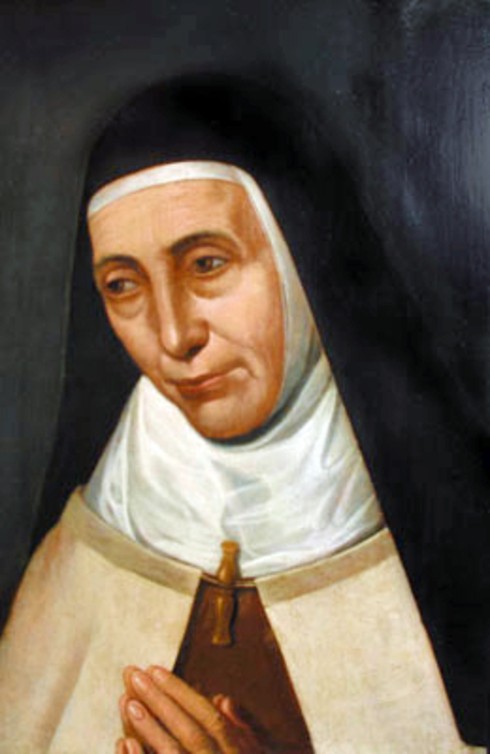








You must be logged in to post a comment.