One Minute Reflection – 11 May – Saturday of the Third Week Easter, C, Gospel: John 6:60–69
“Do you want to leave me too?”...John 6:67
REFLECTION – “Jesus confronts His listeners, including His disciples, with an even more merciless decision, in the light of His promise of the Eucharist. Because He refuses to back away, in the slightest, from His statements about the Eucharist, these words seems so ‘intolerable’ to his listeners, that they are faced with the toughest test of all. Indeed, for His disciples, Jesus hones His assertions even more finely, when He predicts His ascent to the Father and claims that all His words are: ‘Spirit and life.”
This draws a line among His disciples, a line that Jesus knew existed from the outset – it was already clear who would follow Him in faith and who would betray Him.
There could be no neutrality.
The account refers to ‘many disciples’ who excused themselves. Judas is not the only one who does not believe. Jesus is not concerned about numbers, hence He even confronts the twelve with the same choice: “Do you want to leave me too?” As spokesman for the small group of faithful ones, Peter gives voice to the word of faith, to the belief that Jesus is “the Holy One of God.” Faith had brought him to a realisation and that realisation, made possible, the virtually blind faith needed for such a decision!”…Cardinal Hans Urs von Balthasar (1905-1988)
PRAYER – Mould our minds and our hearts, we pray You Lord, by the union of Your Son and His Church. As we belong to You, You joined us to Your Son to become one with Him. May we always strive to live up to this union and may we make our lives, a constant sharing, in Christ’s death and Resurrection. May His Mother give us her heart, to love Him as she does. We make our prayer through Him and in Him and with Him, in the union of the Holy Spirit, God for always and forever, amen.
Our Morning Offering – 11 May – ‘Mary’s Month’ and a Marian Saturday – Third Week Easter, C
Most Holy Mary Sure Refuge of Sinners By St John of the Cross (1542-1591)
Most holy Mary,
Virgin of virgins,
shrine of the most Holy Trinity,
joy of the angels,
sure refuge of sinners,
take pity on our sorrows,
mercifully accept our sighs
and appease the wrath
of your most holy Son.
Amen
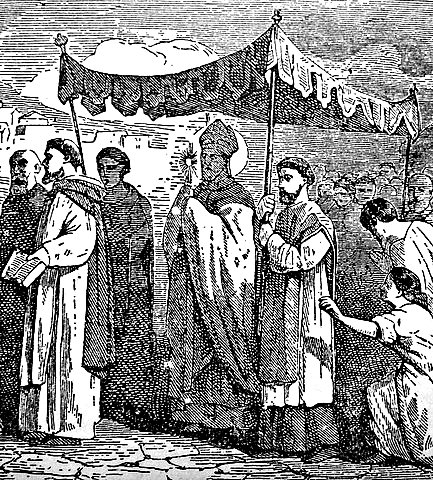
Saint of the Day – 11 May – St Mamertus (Died c 475) also known as Mamertius, Mammertus – Archbishop of Vienne in Gaul – present day France, Theologian, Writer, Founder of the introduction of the praying of Litanies prior to Ascension Day, called “Rogation Days.” Rogation days are days of prayer and fasting in the Church. They are observed with processions and the pra\ying of the Litany of the Saints. The major Rogation is held on 25 April, the minor Rogations are held on Monday to Wednesday, preceding Ascension Thursday. The word Rogation comes from the Latin verb rogare, meaning “to ask,” which reflects the beseeching of God, for the appeasement of His anger and for protection from calamities.
An engraving of Saint Mamertus from an 1878
His feast day is the first of the Ice Saint, who are St Mamertus (or, in some countries, St Boniface of Tarsus), St Pancras and St Servatius. They are so named because their feast days fall on the days of 11 May, 12 May and 13 May respectively, known as “the black-thorn winter” in Austrian, Belgian, Croatian, Czech, Dutch, French, German, Hungarian, North-Italian, Polish, Slovene and Swiss folklore.
Prior to his elevation to the see of Vienne, little has been recorded about Mamertus’ life. The fact that his brother, Claudianus Mamertus, the theological writer, received in his youth a sound training in rhetoric and enjoyed the personal acquaintance of Bishop Eucherius of Lyons (434-50), suggests that the brothers belonged to a wealthy Gallic family from the neighbourhood of Lyons. Like his brother, St Mamertus was distinguished for his secular learning as well as theology and, before his elevation to the episcopate, appears to have been married.
His election and consecration took place shortly before 462. As bishop he enlisted the services of his brother, who had withdrawn to a cloister and ordained him priest of Vienne. The activity of the brothers is described in one letter of Sidonius Apollinaris, while another is addressed to Bishop Mamertus.
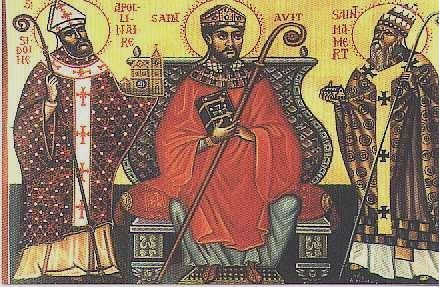
Saint Mamertus (right), pictured with Saints Avitus and Apollinaris (details)
St Mamertus was the founder of the Rogation Processions, according to Sidonius Apollinaris and his second successor, Avitus. In connexion with these intercessory processions, Mamertus summoned a synod at Vienne between 471 and 475.
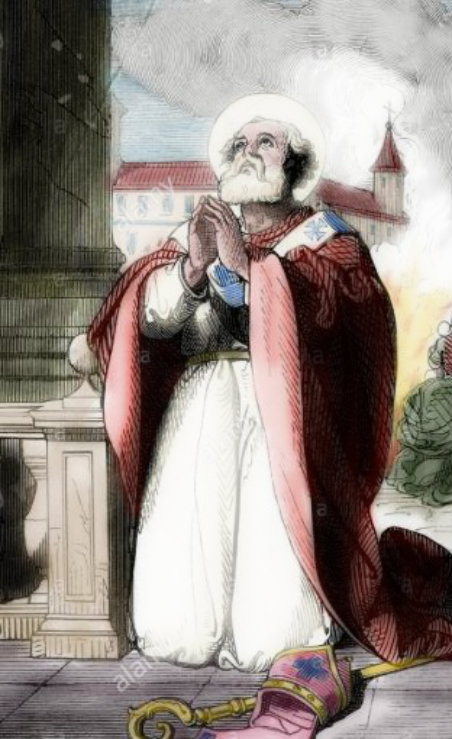
Amidst the scourges of the time, wars, famines and natural disasters, which were seen as divine anger against the sinful lives of the people, which threatened their entire destruction, St Mammertus received a token of the divine mercy. A terrible fire happened in the city of Vienne, which baffled the efforts of men but by the prayers of the good bishop the fire on a sudden went out. This miracle strongly affected the minds of the people. The holy prelate took this opportunity to make them sensible of the necessity and efficacy of devout prayer and formed a pious design of instituting an annual fast and supplication of three days, in which all the faithful should join, with sincere compunction of heart, to appease the divine indignation by fasting, prayer, tears and the confession of sins.
The Church of Auvergne, of which St Sidonius was bishop, adopted this pious institution before the year 475 and it became in a very short time a universal practice.
During his episcopate, the remains of St Ferreolus were discovered and were translated by Mamertus to a church in Vienne, he built in honour of that martyr.
About 475 he attended a synod at Arles, which dealt with the predestination teaching of Lucidus, a Gallic priest. As this is the latest information we possess concerning him, we may assume that he died shortly afterwards.
St Anastasius of Lérida
St Anthimus of Rome
St Bassus of Sabina
St Bertilla
St Criotan of MacReddin
Bl Diego of Saldaña
St Evellius of Pisa
St Fabius of Sabina
St Fremund of Dunstable
St Gengulphus of Burgundy
St Gualberto St Ignatius of Laconi OFM Cap. (1701-1781) Biography: https://anastpaul.wordpress.com/2018/05/11/saint-of-the-day-11-may-st-ignatius-of-laconi-o-f-m-cap-1701-1781/
Bl Illuminatus
St Illuminatus of San Severino
Bl James Walworth
Bl John Rochester
St Maiulo of Hadrumetum
St Majolus of Cluny St Mamertus (Died c 475)
St Maximus of Sabina
St Mayeul
St Mozio of Constantinople
St Possessor of Verdun
St Principia of Rome
St Tudy
St Vincent L’Hénoret
Bl Vivaldus
St Walbert of Hainault
—
Martyrs of Camerino: An imperial Roman official, his wife, their children and servants, all of whom were converts and martyrs: Anastasius, Aradius, Callisto, Eufemia, Evodius, Felice, Primitiva, Theopista.
Marian Thoughts – 10 May – “Mary’s Month” and Friday of the Third Week of Easter, C
From the Constitution on the Church of the Second Vatican Council (Lumen Gentium #61-62)
The Motherhood of Our Lady in God’s Plan of Salvation
From all eternity, together with the Incarnation of the divine Word, the Blessed Virgin was predestined to be the Mother of God. By the will of divine Providence, she was the loving mother of the divine Redeemer, here on earth and, above all others, in a unique way she was the willing partner and the humble handmaid of the Lord. She conceived, brought forth and nourished Christ. She presented Him to the Father in the temple and shared the suffering of His Son as He died on the cross. In an utterly singular way, she co-operated by her obedience, faith, hope and burning charity in the Saviour’s work of restoring supernatural life to souls. For this reason, she is a mother to us in the order of grace.
This motherhood of Mary, in the order of grace, began with the consent which she gave in faith, at the Annunciation and which she sustained without wavering beneath the cross, it will last without interruption, until the eternal fulfilment of all the elect. Once assumed into heaven, she did not set aside this saving role but, with her numerous prayers of intercession, continues to win for us, the gifts of eternal salvation.
By her maternal charity, Mary cares for the brethren of her Son who still wander through this world, in the midst of dangers and difficulties, until they are led to the happiness of their heavenly home.
For this reason the Blessed Virgin is invoked by the Church under the titles of Advocate, Auxiliatrix, Adjustrix and Mediatrix – but they are titles which must be understood, in a way, that neither detracts from, nor adds anything to the dignity and efficacy of Christ the one Mediator.
For no creature could ever be counted as equal with the Incarnate Word and Redeemer. Just as the priesthood of Christ is shared in various ways, both by sacred ministers and by the faithful and, as the one goodness of God, is really communicated in different ways to His creatures, in the same way, the unique mediation of the Redeemer, does not exclude but, rather gives rise among creatures, to a manifold co-operation, which is but a sharing in this one source.
The Church does not hesitate to profess this subordinate role of Mary. She knows it through unfailing experience of it and commends it to the hearts of the faithful, so that, encouraged by this maternal help, they may follow the Mediator and Redeemer more clearly.
Sancta Mater Maria, Mother of God and our Mother, Pray for us!
Thought for the Day – 10 May – Friday of the Third Week of Easter, C and the Memorial of Blessed Ivan Merz (1896-1928)
Excerpt from the Beatification Homily
St John Paul II (1920-2005)
Sunday, 22 June 2003
Dear brothers and sisters, the just man, surrounded by divine light, becomes in turn a lamp which radiates light and gives warmth. This is what we learn today from the figure of Ivan Merz.
A gifted young man, he made a good return on his rich natural talents and obtained great human success – it can be said that he had a very successful life. But that is not the reason why he is today declared Blessed. What makes him one of the choir of the Beati is his success in God’s eyes. The great aspiration of his whole life was “never to forget God, to desire always to be one with Him”. In all his activities Ivan Merz sought “the surpassing worth of knowing Christ Jesus” and he allowed Christ to make him his own (cf. Phil 3:8,12).
At the school of the liturgy, the source and summit of the Church’s life (cf. Sacrosanctum Concilium, 10), Ivan Merz grew to the fullness of Christian maturity and became one of the principal promoters of the liturgical renewal in his country.
Taking part in Mass and drawing nourishment from the Body of Christ and the Word of God, he drew the inspiration to become an apostle of young people. It was not by chance that he chose as his motto “Sacrifice – Eucharist – Apostolate”. Conscious of the vocation he had received in Baptism, he made his whole life a “race” towards holiness, the “high standard” of Christian life (cf. Novo Millennio Ineunte, 31). For this reason, as the First Reading says, “his memory will not disappear and his name will live through all generations” (Sir 39:9).
The name of Ivan Merz, has meant in the past, a programme of life and of activity, for an entire generation of young Catholics. Today too, it must do the same!
…Do not seek a more comfortable life elsewhere, do not flee from your responsibilities and expect others to resolve problems but resolutely counter evil with the power of good.
Like Blessed Ivan, strive for a personal encounter with Christ which sheds new light on life. May the Gospel be the great ideal guiding your approaches and your decisions! Thus you will become missionaries in word and deed, signs of God’s love and credible witnesses of the merciful presence of Christ. Never forget: “one does not light a lamp and put it under a bushel” (cf. Mt 5:15).
Dear brothers and sisters, who take part with such fervour in this celebration, may the peace of God, which transcends all understanding, keep your heart and your spirit in the knowledge and love of God and of His Son, our Lord Jesus Christ!
One Minute Reflection – 10 May – and Friday of the Third Week of Easter, C, First Reading: Acts 9:1-20 and the Memorial of Blessed Ivan Merz (1896-1928)
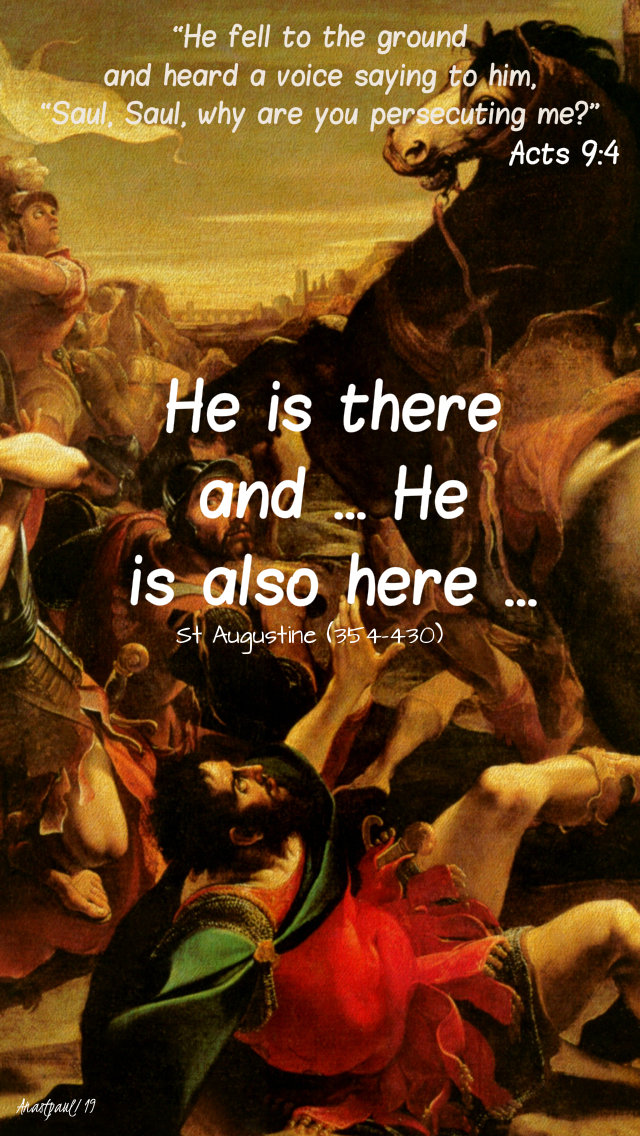
“He fell to the ground and heard a voice saying to him, “Saul, Saul, why are you persecuting me?”…Acts 9:4
REFLECTION – “How can we show that He is there and that He is also here? Let Paul answer for us, who was previously Saul. First of all, the Lord’s own voice from heaven shows this: “Saul, Saul, why are you persecuting me?” Had Paul climbed up to heaven then? Had Paul even thrown a stone at heaven? It was Christians he was persecuting, them he was tying up, them he was dragging off to be put to death, them he was everywhere hunting out of their hiding places and never sparing when he found them. To him the Lord said, “Saul, Saul.” Where is He crying out from? Heaven. So He’s up above. “Why are you persecuting me?” So He’s down below.”…St Augustine (354-430) Bishop of Hippo, Father & Doctor (Sermon 122)
PRAYER – Almighty God, You sent Your Son and we have now come to know the grace of His Resurrection. Through Him we live and move and have our being. As we follow Him, He walks with us and leads us to You. Grant we pray, that His mother and ours, may guide our way to Him and may the prayers of Blessed Ivan Merz, who always followed closely behind the Lord, be a solace in our trials. Through Christ our Lord, with the Holy Spirit, God now and forever, amen.
Our Morning Offering – 10 May – “Mary’s Month” and Friday Third Week of Easter, C
Hail, O Mary, Mother of God By St Cyril of Alexandria (376-444) Father & Doctor of the Church
Hail, O Mary, Mother of God,
Virgin and Mother!
Morning Star, perfect vessel.
Hail, O Mary, Mother of God,
Holy Temple in which god Himself was conceived.
Hail, O Mary, Mother of God,
Chaste and pure dove.
Hail, O Mary, Mother of God,
Who enclosed the One who cannot be encompassed
in your sacred womb.
Hail, O Mary, Mother of God,
From you flowed the true light, Jesus Christ, our Lord.
Hail, O Mary, Mother of God,
Through you the Conqueror
and triumphant Vanquisher of hell came to us.
Hail, O Mary, Mother of God,
Through you, the glory of the Resurrection blossoms.
Hail, O Mary, Mother of God,
You have saved every faithful Christian.
Hail, O Mary, Mother of God,
Pray for us sinners now
and at the hour of our death.
Amen
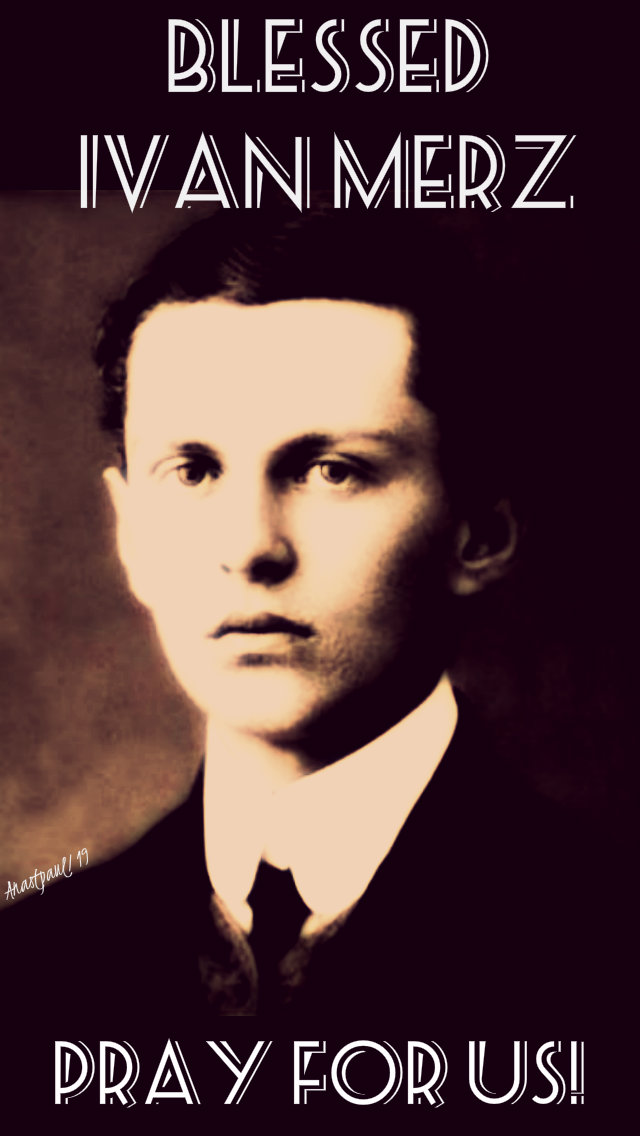
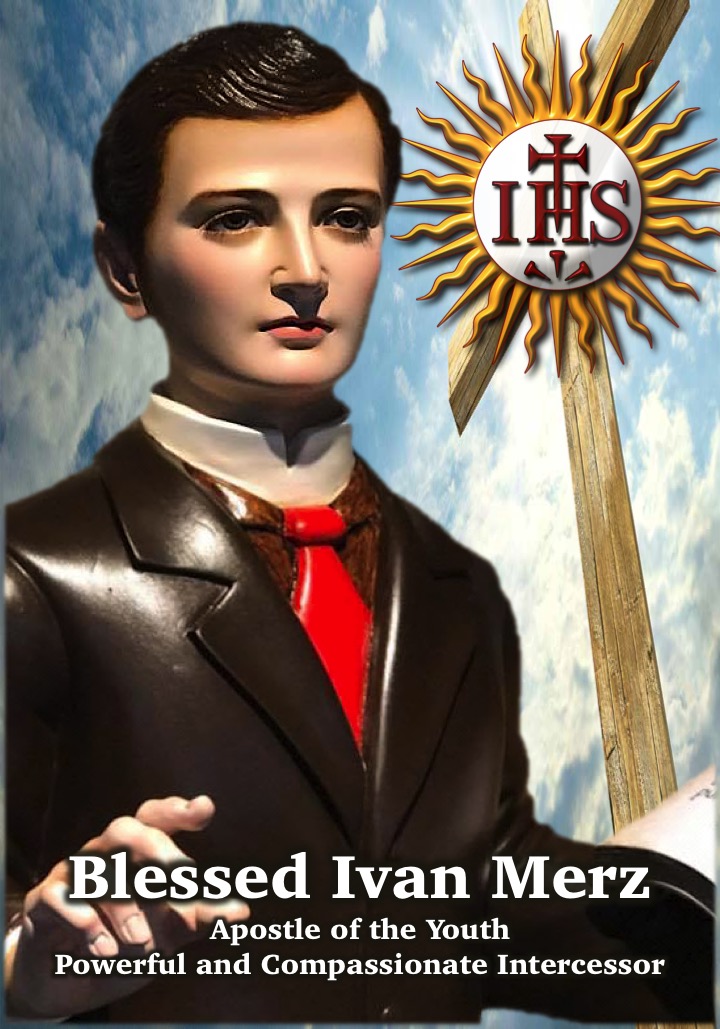
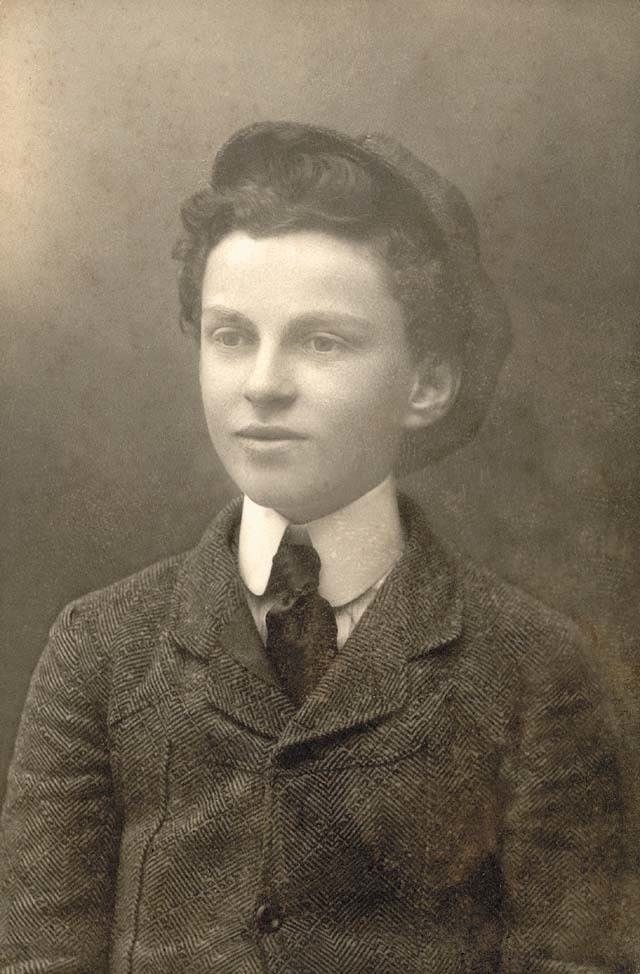
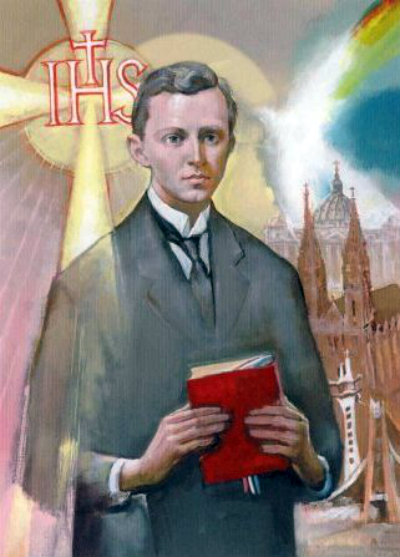
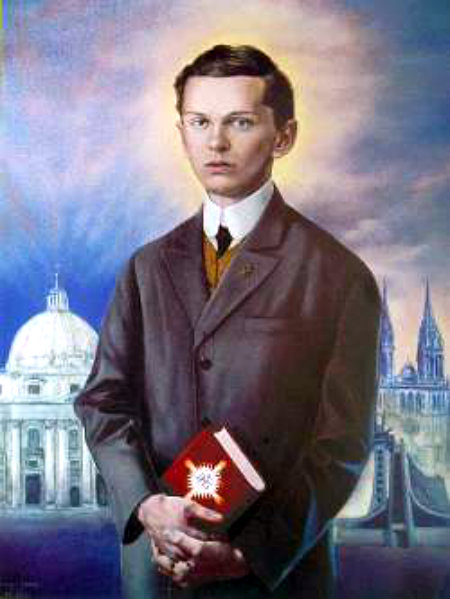
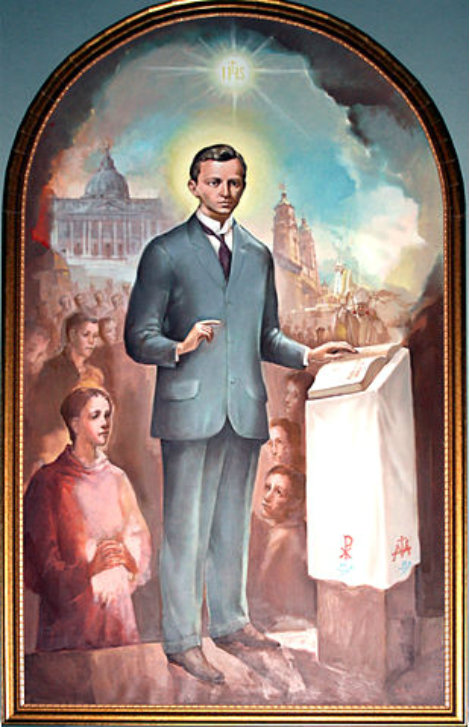
Saint of the Day – 10 May – Blessed Ivan Merz (1896-1928) aged 32 – Layman, Teacher, Professor, Apostle of the Blessed Sacrament and of prayer, Founder of Youth Movements in Croatia – Patronages – Croatian youth, youth as a whole, World Youth Day celebrations.
Ivan Merz was born in Banja Luka, Bosnia, on 16 December 1896 and was baptised on 2 February 1897. He attended elementary and middle school in Banja Luka and, after a brief period of education at the military academy of Wiener Noustadt, he enrolled in 1915 at the University of Vienna, with the dream of teaching young people in Bosnia, thus, he would be following the example of his professor, Ljubomir Marakovic, who helped Ivan to discover the richness of the Catholic faith.
In March 1916, Ivan was enlisted in the army and shipped to the Italian battle front, where he spent the greater part of two years beginning in 1917. The war experience and its horrors marked a turning point in Ivan’s young life and contributed greatly to his spiritual growth, prompting him to abandon his future into God’s hands and to strive with all his might towards the goal of Christian perfection.
On 5 February 1918, he wrote in his diary: “Never forget God! Always desire to be united with Him. Begin each day in the first place with meditation and prayer, possibly close to the Blessed Sacrament or during Mass. During this time, plans for the day are made, one’s defects are put under examination and grace is implored for the strength to overcome all weakness. It would be something terrible if this war had no meaning for me!… I must begin a life regenerated in the spirit of this new understanding of Catholicism. The Lord alone can help me, as man can do nothing on his own”.At this time, Ivan also made a private vow of perpetual chastity.
After the war, he continued his studies at Vienna (1919-20) and then in Paris (1920-22). In 1923 he obtained a degree in philosophy. His thesis was entitled “The influence of the Liturgy on the French authors”.He then became a professor of language and French literature and was exemplary in his dedication to the students and to his responsibilities as a teacher.
In his spare time he studied philosophy and theology and deepened his knowledge of the documents of the Magisterium of the Church.
Ivan was especially noted for his interest in young people and concern for their growth in faith and holiness. He started the “League of Young Croatian Catholics” and the “Croatian League of Eagles” within the Croatian Catholic Action Movement. Their motto was: “Sacrifice Eucharist Apostolate”.
For Ivan, the purpose of this organisation was to form a group of front-line apostles whose goal was holiness. The scope of this goal also flowed over into liturgical renewal, of which Ivan was one of the first promoters in Croatia.
As a Catholic intellectual, Ivan was able to guide young people and adults to Christ and His Church, through his writings and organised gatherings. He also sought to teach them love and obedience to the Vicar of Christ and the Church of Rome.
In the face of any misunderstandings and difficulties, Ivan always had an admirable patience and calm, the fruit of his continual union with God in prayer. Those who knew him well described him as a person who had his “mind and heart immersed in the supernatural”. Convinced that the most effective way to save souls was through efficacious suffering, he offered to God all his physical and moral sufferings, particularly for the intention of the success of his apostolic endeavours.
Shortly before his death, he offered his life for the youth of Croatia. In short, the young man believed that his vocation was very simply “the Catholic faith”.
Ivan Merz died on 10 May 1928 in Zagreb. He was 32 years old….Vatican.va
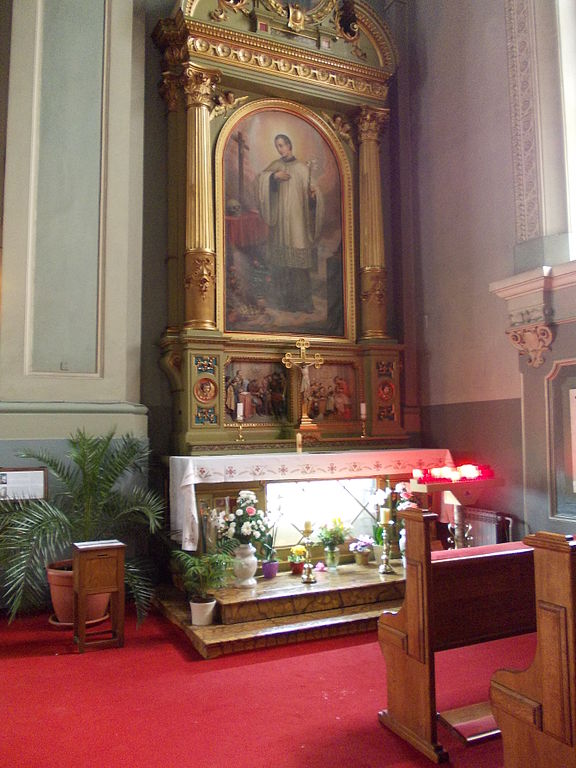
Blessed Ivan left an example of how a man can live, fight and suffer for God’s cause. Merz tried hard to give his life the “full meaning”, heading for sanctity and all his pedagogical task was devoted to the formation of apostles of sanctity. He died with a reputation of a saint. His shrine is located in the Basilica of the Heart of Jesus in Zagreb, Croatia. The canonisation cause started in 1958.
He was Beatified by St Pope John Paul on Sunday, 22 June 2003 in Bosnia Herzegovina.
Blessed Ivan Merz’s tomb in the Basilica of the Heart of Jesus in Zagreb, Croatia
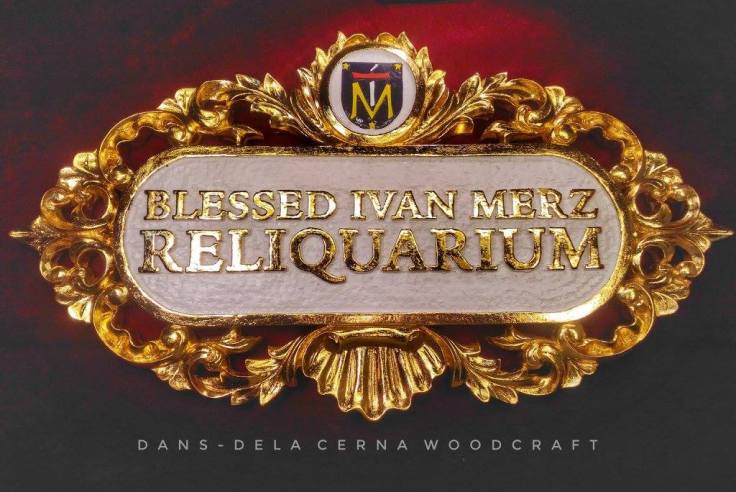
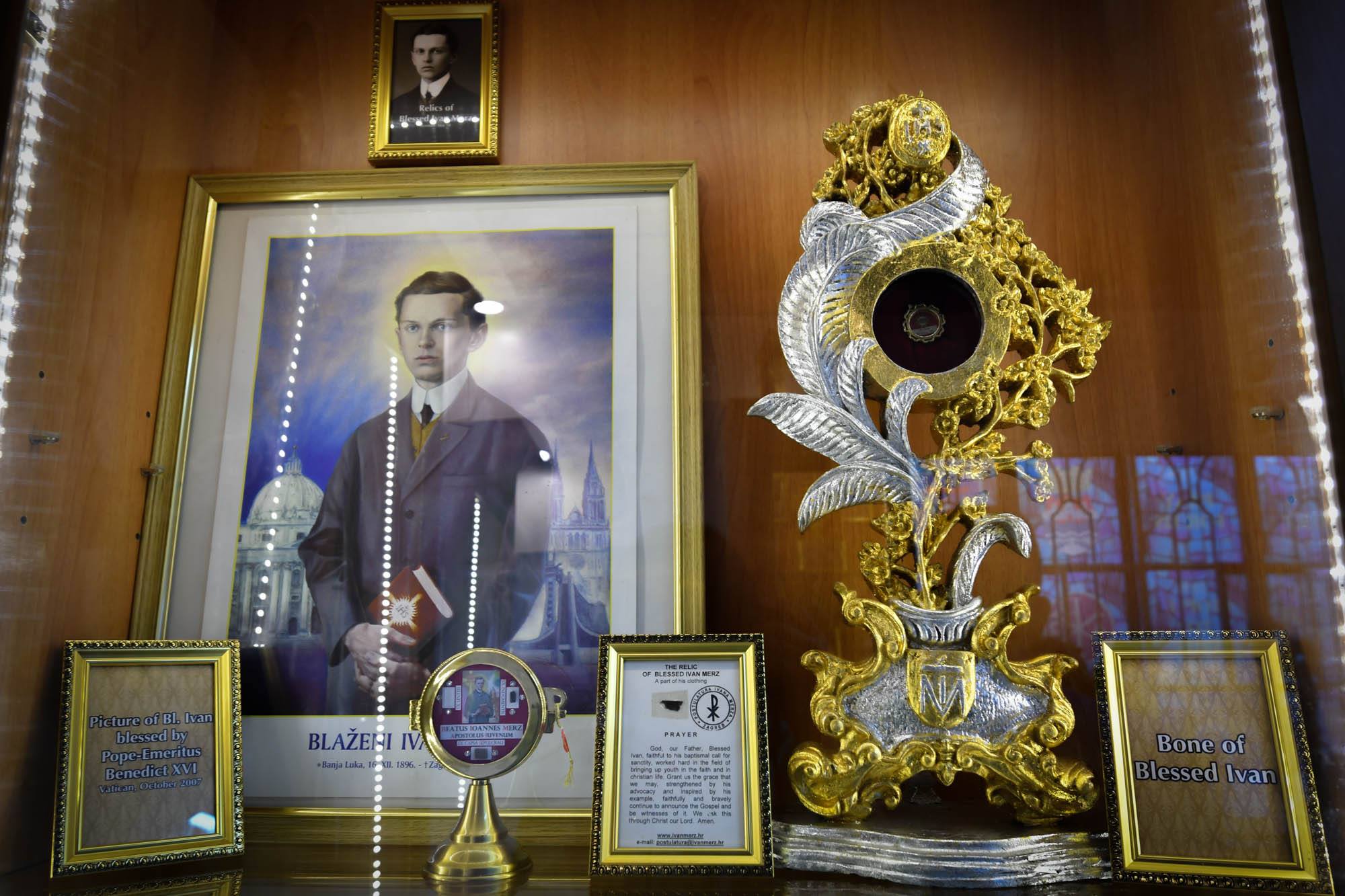
On 3 March 2018, His Excellency Francisco Mendoza De Leon, DD, bishop of the Diocese of Antipolo and local Ordinary of the Blessed Ivan Merz Centre and Reliquarium, formally opened and blessed the Blessed Ivan Merz Reliquarium.
The Blessed Ivan Merz Reliquarium (Home of the Sacred Relics) was established to house the sacred relics of Blessed Ivan Merz and of other sacred relics belonging to Our Lord, the Blessed Mother and beatified and canonised Servants of God. It serves as spiritual oasis for pilgrims, devotees and disciples in faith of the Apostle of the Youth.
We pray that those who will visit Blessed Ivan Merz Reliquarium will experience the Lord’s kind assistance.
May those who venerate the remains of the Saints, especially of Blessed Ivan Merz, with their prayers and merits, obtain pardon for sin and protection from every adversity.
St John of Avila (1499-1569) “Apostle of Andalusia”– Doctor of the Church About St John: https://anastpaul.wordpress.com/2018/05/10/saint-of-the-day-10-may-st-john-of-avila-1499-1569-apostle-of-andalusia-known-as-father-master-avila-doctor-of-the-church/
St Joseph de Veuster (1840-1889) – St Damian of Molokai“The Martyr of Molokai”(Optional Memorial) St Damian’s life: https://anastpaul.wordpress.com/2017/05/10/10-may-the-memorial-of-st-damian-de-veuster-de-molokai/
St Alphius of Lentini
Bl Amalarius of Metz
Bl Antonio of Norcia
St Aurelian of Limoges
Bl Beatrix d’Este the Elder
St Blanda of Rome
St Calepodius of Rome
St Catald of Taranto
St Comgall of Bangor
St Cyrinus of Lentini
St Dioscorides of Smyrna
Bl Enrico Rebuschini
St Epimachus of Rome
St Felix of Rome
Bl Giusto Santgelp
St Gordian the Judge Bl Ivan Merz (1896-1928)
Bl Nicholas Albergati
St Palmatius of Rome
St Philadelphus of Lentini
St Quartus of Capua
St Quintus of Capua
St Simplicius of Rome
St Solange of Bourges
St Thecla
Bl William of Pontnoise
Marian Thoughts – 9 May – ‘Mary’s Month’ – Thursday Third Week of Easter, C
St Aelred of Rievaulx (1110-1167)
From his sermons – Sermon 20
Mary, our Mother
Let us come to His bride, let us come to His mother, let us come to the best of His handmaidens. All of these descriptions fit Blessed Mary.
But what are we to do for her? What sort of gifts shall we offer her? O that we might at least repay to her the debt we owe her! We owe her honour, we owe her devotion, we owe her love, we owe her praise. We owe her honour because she is the mother of Our Lord. He who does not honour the mother, will without doubt dishonour the son. Besides, scripture says: ‘Honour your father and your mother.’
What shall we say, brethren? Is she not our mother? Certainly, brethren, she is in truth our mother. Through her we are born, not to the world but to God.
We all, as you believe and know, were in death, in the infirmity of old age, in darkness, in misery. In death because we had lost the Lord, in infirmity of old age , because we were in corruptio, in darkness because we had lost the light of wisdom and so we had altogether perished.
But through blessed Mary we all underwent a much better birth than through Eve, inasmuch as Christ was born of Mary. Instead of the infirmity of old age, we have regained youth, instead of corruption, incorruption, instead of darkness, light.
She is our mother, mother of our incorruption, of our light. The Apostle says of our Lord, ‘Whom God made our righteousness, our sanctification and our redemption.’
She, therefore, who is the mother of Chris,t is the mother of our wisdom, mother of our righteousness, mother of our sanctification, mother of our redemption. Therefore, she is more our mother than the mother of our flesh. Better, therefore, is our birth, which we derive from Mary, for from her is our holiness, our wisdom, our righteousness, our sanctification, our redemption.
Scripture says, ‘Praise the Lord in his saints’. If the Lord is to be praised in those saints through whom He performs mighty works and miracles, how much more should He be praised in her, in whom He fashioned Himself, He who is wonderful beyond all wonder.
Thought for the Day – 9 May – Thursday Third Week of Easter, C
The Eucharist, Pledge of our Resurrection
Saint Irenaeus (130-202)
Bishop, Father of the Church and Martyr
An excerpt from a Against Heresies
If our flesh is not saved, then the Lord has not redeemed us with His blood, the Eucharistic chalice does not make us sharers in His blood and the bread we break, does not make us sharers in His body. There can be no blood without veins, flesh and the rest of the human substance and this the Word of God actually became – it was with His own blood that He redeemed us. As the Apostle says – In Him, through His blood, we have been redeemed, our sins have been forgiven.
We are His members and we are nourished by creatures, which is His gift to us, for it is He who causes the sun to rise and the rain to fall. He declared that the chalice, which comes from His creation, was His blood and He makes it the nourishment of our blood. He affirmed that the bread, which comes from His creation, was His body and He makes it, the nourishment of our body. When the chalice we mix and the bread we bake, receive the Word of God, the Eucharistic elements become the body and blood of Christ, by which our bodies, live and grow. How then can it be said, that flesh belonging to the Lord’s own body and nourished by His body and blood, is incapable of receiving God’s gift of eternal life? Saint Paul says in his letter to the Ephesians that we are members of His body, of His flesh and bones. He is not speaking of some spiritual and incorporeal kind of man, for spirits do not have flesh and bones. He is speaking of a real human body composed of flesh, sinews and bones, nourished by the chalice of Christ’s blood and receiving growth from the bread which is His body.
The slip of a vine planted in the ground bears fruit at the proper time. The grain of wheat falls into the ground and decays only to be raised up again and multiplied by the Spirit of God who sustains all things. The Wisdom of God places these things at the service of man and when they receive God’s word, they become the Eucharist, which is the body and blood of Christ. In the same way our bodies, which have been nourished by the Eucharist, will be buried in the earth and will decay but they will rise again at the appointed time, for the Word of God will raise them up, to the glory of God the Father. Then the Father will clothe our mortal nature in immortality and freely endow our corruptible nature with incorruptibility, for God’s power is shown most perfectly in weakness.
One Minute Reflection – 9 May – Thursday Third Week of Easter, C, First Reading: Acts 8:26–40
“… and was returning home. Seated in his chariot, he was reading the prophet Isaiah.”…Acts 8:28
REFLECTION – “Consider, I ask you, what a great effort it was not to neglect reading even while on a journey and, especially, while seated in a chariot. Let this be heeded by those people who do not even deign to do it at home but rather think reading the Scriptures is a waste of time, claiming as an excuse their living with a wife, conscription in military service, caring for children, attending to domestics and looking after other concerns, they do not think it necessary for them to show any interest in reading the holy Scriptures.” … St John Chrysostom (347-407) Father & Doctor (Homilies on Genesis, 35.)
PRAYER – Almighty, ever-living God, in Your Word, You shed the light of Your glory on the peoples who are living in the shadow of death. By Your Word, You teach us all things and lead us in the way of hope and love. For Your Word is Truth and Your Word became flesh and filled our world with the Sun of Justice, Your Son, He who is the Sun and the Truth. May our steps be guided by His Mother, as we follow in the footsteps of Your Word and may the prayers of Blessed Maria Carmen Rendiles, be a help in our trials. Through Christ, our Lord Jesus, with You in union with the Holy Spirit, now and forever, amen.
Our Morning Offering – 9 May – ‘Mary’s Month’ – Thursday Third Week of Easter, C
Prayer to our Mother of Perpetual Succour
O Mother of Perpetual Succour,
with great confidence
we come before your holy icon
to be inspired by the example of your life.
We think of you at that moment,
when, full of faith and trust,
you accepted God’s call to be the mother of His Son.
Help us your children, to accept with joy our calling in life.
When you learned that your cousin Elizabeth was in need,
you immediately went to serve her and offer your help.
Make us, like you, to be concerned for others.
We think of you, Mother, at the foot of the cross.
Your heart must have bled to see your Son in agony.
But your joy was great when He rose from the dead,
victorious over the power of evil.
Mother of Sorrows,
help us through our trials and disappointments.
Help us not to lose heart.
May we share with you and your Son,
the joy of having courageously
faced up to all the challenges of life.
AMEN
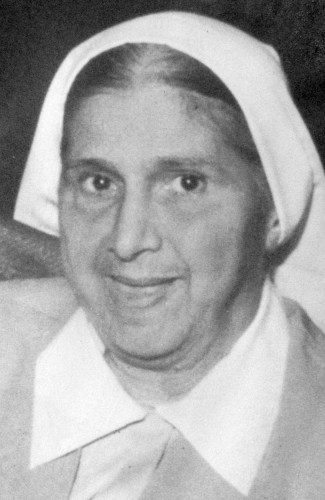
Saint of the Day – 9 May – Blessed Carmen Elena Rendiles Martínez more commonly known as Blessed Maria Carmen Rendiles (1903-1977) – in religion María Carmen – was a Venezuelan professed religious of the Servants of the Eucharist and the founder of the Servants of Jesus of Caracas, Apostle of Charity, Catechist, Administrator and founder of many schools and convents. She served in a leadership position for her order in France where she spent her time of religious formation and returned to Venezuela to found her order in 1965 and assume control as Superior-General of her new order. Patronage – Servants of Jesus of Caracas.
Blessed Maria Carmen was born on 11 August 1903 in Caracas, Venezuela. She was the third of eight children and her family was wealthy and respected in the capital city. Her baptism was celebrated in the church of Santa Anna on 24 September 1903 and she received her Confirmation on 28 October 1905, she made her First Communion on 11 March 1911. Carmen was born with a rare physical deformation and was missing her left arm. She lived her whole life with a prosthetic arm but this physical setback never affected her joyful spirit. She was admired and impressed many people with how she lived her life, not letting her handicap hold her back.
When she was fifteen, she become a Catechist at her parish and would go on missions to nearby towns to teach. She did this for many years and began to feel the calling to be a religious nun and serve God. In 1927 she joined the Congregation of the Servants of the Blessed Sacrament, which was based in France but had convents in Venezuela. She studied in Toulouse, France. When her studies were completed, she went back to Caracas and worked there in the convent for about 10 years.
She served in many different jobs and positions during her time as a nun and in 1951 she was named the Provincial Superior for her region. During this time, she started new convents and several schools in both Venezuela and Columbia. She even started a school for poor children in her old childhood home, which she inherited.
Blessed Maria Carmen founded the Servants of Jesus on 25 March 1965. The order received diocesan approval and support on 14 August 1969 from the Cardinal Archbishop of Caracas José Humberto Quintero Parra. She was the Superior General of her new order from 1969 when she was appointed until her death on 9 May 1977 due to influenza. In 2015 there were 94 religious in a total of 19 communities in both Venezuela and in Colombia.
In 5 July 2013, Pope Francis declared her a venerable (decree of heroic virtues) and on 16 June 2018 she was Beatified. The beatification miracle involved the healing of Trinette Durán de Branger on 18 July 2003 and the ceremony was celebrated in Caracas, Venezuela, by Cardinal Angelo Amato. Her process of sainthood continues.
“It brings immense joy to the entire Catholic Church of Venezuela, and especially for the Archdiocese of Caracas, to announce that Pope Francis has signed the decree approving the beatification of Mother Carmen Rendiles Martínez” announced Archbishop of Caracas Cardinal Jorge Urosa Savino.
“On 21 November, a miracle presented to the Congregation for the Causes of Saints was approved, for which it will be beatified next year.”
Urosa explained that Martinez will become the third Venezuelan beatified by the Vatican. The blessing comes after the Vatican studied and approved, an “instantaneous, perfect, stable and lasting” miraculous healing on Trinette Durán de Branger, on 18 July 2003.
Urosa extended his congratulations to the Congregation Servants of Jesus, founded by Mother Rendiles Martinez, for her tireless and laborious work performed through the commission that leads to the process of beatification and canonisation.
“It has been arduous work carried out by Dr Silvia Correale, postulator of the cause, Sister Rosa María Ríos, vice postulator and the general superiors of the Congregation,” the Cardinal pointed out. “The current head of the religious order is Mother Maria Eugenia Noreña.”
St Banban the Wise
St Beatus of Laon
St Beatus of Lungern
Bl Benincasa of Montepulciano
St Brynoth of Scara
St Dionysius of Vienne
Bl Fortis Gabrielli
St Gerontius of Cervia
St Giuse Hien
St Gorfor of Llanover
St Gregory of Ostia
St Hermas of Rome
Isaiah the Prophet
St John of Châlon Bl Theresa of Jesus/Karolina Gerhardinger (1797-1879) Biography: https://anastpaul.wordpress.com/2018/05/09/saint-of-the-day-9-may-blessed-theresa-of-jesus-karolina-gerhardinger-1797-1879/
St Maria del Carmen Rendiles Martinez
St Pachomius of Tabenna
St Sanctan of Kill-da-Les
Bl Stefan Grelewski
Bl Thomas Pickering
St Vincent of Montes
Martyrs of Persia: 310 Christians murdered together for their faith in Persia. No details about them have survived.
20 Mercedarian Martyrs of Riscala: 20 Mercedarian friars who were murdered by Huguenot heretics for refusing to denounce their faith. 16th century at the Santa Maria convent at Riscala, France.
From the Sermons of St Sophronius (560-638) Father of the Church
(St Sophronius was a courageous leader of the Jerusalem Church during the Islamic conquests of the seventh century, Bishop Saint Sophronius I has his liturgical memorial on 11 March).
The blessings of the Father shone upon men through Mary
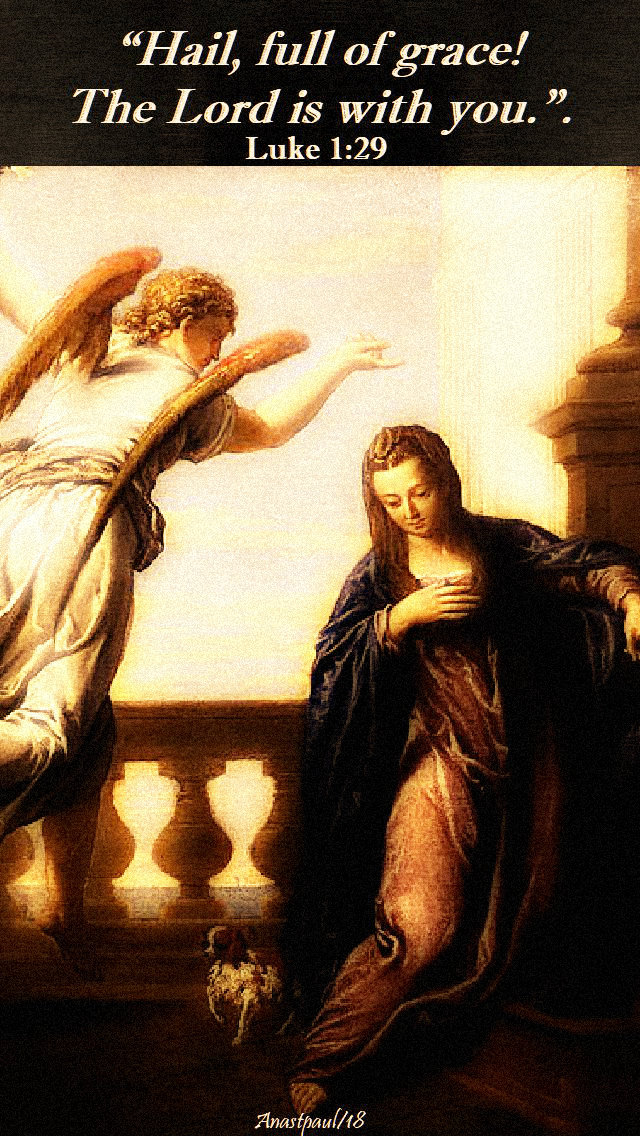
‘Hail, full of grace, the Lord is with you.’ Could anything transcend the joy that is yours, O Virgin Mother? Could anything surpass this race granted by God to you alone? Is it possible to think of anything more gratifying and more splendid? Nothing can even approach the marvel that we see in you. All things lie far below the grace that is yours; in comparison, even the best of them take second place and their brilliance is overshadowed.
‘The Lord is with you’ and who has dared to strive against you? God has been born of you, who would stand in your way and not gladly give you first place and supremacy? For this reason, when I contemplate the privileges that put you above all creatures I cry out to you in highest praise. ‘Hail O favoured one, the Lord is with you.’ The joy that comes from you is shared not only by mankind but also by the powers of heaven.
Truly, ‘you are blessed among women’ for you have changed the condemnation of Eve into a blessing. Because of you, and through you, Adam who hitherto was cast down and condemned received a blessing.
Truly, ‘you are blessed among women’ for through you the blessing of the Father came to mankind and reprieved them from the age-old sentence.
Truly, ‘you are blessed among women’, because through you, your ancestors found salvation. You were to give birth to the Saviour who would win for them God’s salvation.
Truly, ‘you are blessed among women’ for without the seed of man you bore the fruit that gives a blessing to the whole earth and frees it from being condemned to produce only thorns.
Truly, ‘you are blessed among women’, for though you are a woman like any other woman you will in actual fact become the Mother of God. If the one to be born of you, is in truth God incarnate, you rightly deserve to be called ‘she who gave birth to God’, inasmuch, as you truly did give birth to God.
You have God enclosed within your womb. He lives in you according to the flesh and comes forth from you like a bridegroom, giving joy to all and sharing His divine light with all mankind.
In you, O Virgin, as in the clear brightness of heaven, God ‘has placed his tent’ and He ‘will come forth from you like a bridegroom from his chamber’. Like a giant He will run the course of His life to bring salvation to all living things. That course ‘will stretch from one end of the heavens to the other’ filling all things with the life-giving warmth of God’s radiance.
Thought for the Day – 8 May – Wednesday Third Week of Easter, C
“A New Life”
“The perfect surrender and humiliation were undergone by Christ – perfect because He is God, surrender and humiliation, because He is man.
Now the Christian belief is that, if we somehow share the humility and suffering of Christ, we shall also share in His conquest of death and find a new life after we ave died and, in it, become perfect and perfectly happy creatures.
This means something much more than our trying to follow His teaching.
People often ask when the next step in evolution – the step to something beyond man – will happen. But, on the Christian view, it has happened already.
In Christ, a new kind of man appeared and the new kind of life which began in Him, is to be put into us.”
Quote/s of the Day – 8 May – Wednesday 3rd Week of Easter, C, Gospel: John 6:35–40
Jesus said to them, “I am the bread of life, he who comes to me shall not hunger and he who believes in me shall never thirst.”…John 6:35
“A celebration may be flawless on the exterior, very beautiful — but if it does not lead us to encounter Jesus Christ, it is unlikely to bear any kind of nourishment to our heart and our life. Through the Eucharist, however, Christ wishes to enter into our life and permeate it with His grace, so that in every Christian community there may be coherence between liturgy and life.”
Pope Benedict
General Audience, 12 February 2014
“Through the Eucharist we enter Christ’s paschal mystery, allowing us to pass from death to life with Him.”
Pope Francis
“The Eucharist is Jesus Himself who gives Himself entirely to us. Nourishing ourselves of that “Bread of Life” means entering into harmony with the heart of Christ, assimilating His choices, His thoughts, His behaviour. It means entering into a dynamism of love and becoming people of peace, people of forgiveness, of reconciliation, of sharing in solidarity. Heaven begins precisely in this communion with Jesus”
One Minute Reflection – 8 May – Wednesday of the Third Week of Easter, C, Gospel: John 6:35–40 and the Memorial of Blessed Clara Fey (1815-1894)
“This is the will of my Father, that everyone who sees the Son and believes in him may have eternal life”…John 6:40
REFLECTION – “We wish to see Jesus” (Jn 12:21). This request, addressed to the Apostle Philip by some Greeks who had made a pilgrimage to Jerusalem for the Passover, echoes spiritually in our ears too… Like those pilgrims of two thousand years ago, the men and women of our own day — often perhaps unconsciously — ask believers not only to “speak” of Christ but in a certain sense to “show” Him to them. And is it not the Church’s task, to reflect the light of Christ in every historical period, to make His face shine also before the generations of the new millennium?
Our witness, however, would be hopelessly inadequate if we ourselves had not first contemplated His face… The contemplation of Christ’s face, cannot fail to be inspired by all that we are told about Him, in Sacred Scripture, which from beginning to end, is permeated by His mystery, prefigured in a veiled way in the Old Testament and revealed fully in the New… Remaining firmly anchored in Scripture, we open ourselves to the action of the Spirit (cf. Jn 15:26) from whom the sacred texts derive their origin, as well as to the witness of the Apostles (cf. Jn 15:27), who had a first-hand experience of Christ, the Word of life – they saw Him with their eyes, heard Him with their ears, touched Him with their hands (cf. 1 Jn 1:1). What we receive from them is a vision of faith based on precise historical testimony.”…St John Paul II (1920-2005) – Apostolic Letter “ Novo Millennio Inuente ”, §16-17
PRAYER – Holy almighty God, in Your wisdom You created us and by Your providence You rule us. Penetrate our inmost being with Your holy light, so that our way of life may always be one of faithful service, as we follow Your Son, who leads us to eternal life. May the prayers of Mary our Mother and Blessed Clara Fey, help us to shine Your light on our neighbour. Through Christ our Lord, with the Holy Spirit, God forever, amen.
Our Morning Offering – 8 May – “Mary’s Month” – Wednesday of the 3rd Week of Easter, C
Most Holy Virgin, I Choose You this Day By St Francis de Sales (1567-1622) Doctor of Charity
Most Holy Mary, Virgin Mother of God,
I am unworthy to be your servant.
Yet moved by your motherly care for me
and longing to serve you,
I choose you this day to be my Queen,
my Advocate and my Mother.
I firmly resolve ever
to be devoted to you
and to do what I can
to encourage others
to be devoted to you.
My loving Mother,
through the Precious Blood
of your Son shed for me,
I beg you to receive me
as your servant forever.
Aid me in my actions
and beg for me the grace
never by thought, word, or deed
to be displeasing in your sight
and that of your most holy Son.
Remember me, dearest Mother,
and do not abandon me at the hour of death.
Amen
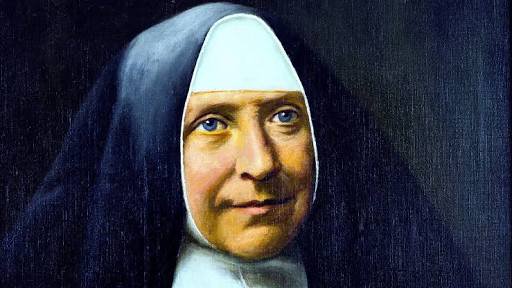
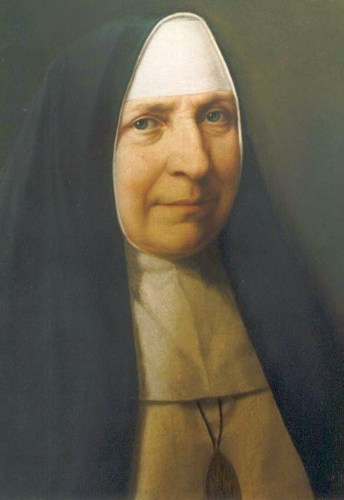
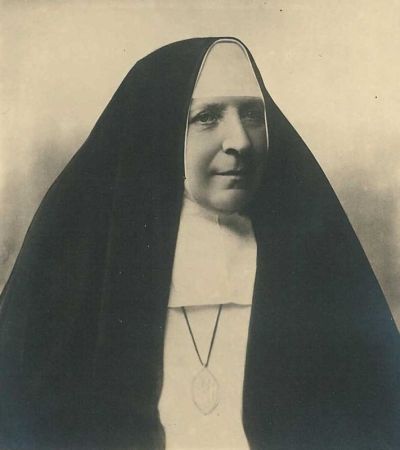
Saint of the Day – 8 May – Blessed Clara Fey (1815-1894) – Religious Nun and Founder of the Sisters of the Poor Child Jesus. Her life was dedicated to providing aid to the poor, with particular emphasis on education, first in Aachen, Germany and later in the Netherlands.
Clara Fey was born on 11 April 1815 in Aachen, the fourth of five children of wealthy textile industrialist Louis and his wife Katherine . Louis was to die following a stroke in 1820, when Clara was aged five years.
She studied under noted teacher, Luise Hensel and became acquainted with the future Blesseds Pauline von Mallinckrodt and Franziska Schevier. In her childhood she observed the poor conditions in her town and was resolved to aid the poor in their suffering more so because of the importance her mother placed on helping those less fortunate than herself.
To that end she would later set up a school with some like-minded friends in Aachen in 1837 in order to cater to the educational needs of poor children. Fey’s brother, Andreas would go on to become a priest, later serving as the vicar of the Saint Paul parish in Aachen.
On 2 February 1844, Bl Clara established the Sisters of the Poor Child Jesus in Aachen, as a means of leading children to Jesus Christ and educating children in a religious environment.
Around 1835 she started to read the works of Saint Teresa of Ávila and professed a desire to become a Carmelite nun. In 1841, however, her spiritual adviser, Father Wilhelm Sartorius, motivated her to instead read the works of Saint Francis de Sales for greater theological inspiration.
Blessed Clara made her vows as a nun in 1850. Her order received diocesan approval on 28 January 1848 from the Archbishop of Cologne and a papal decree of praise from Pope Pius IX on 11 July 1862, with full papal approval for the order issued by Pope Leo XIII on 15 June 1888. The Rule of her order would be based on the teachings of Saint Augustine.
She served as the order’s first superior general from its founding until her death despite her frail health and frequent bouts of illness. In 1875, the Kulturkampf forced her and the order, to relocate to the Netherlands where she remained until her death in May 1894. After her death a devotional cult began at the site of her grave in Simpelveld.
The decree introducing her cause for beatification was issued in 1958 by Pope Pius XII, at which time she became titled a Servant of God. In 1991, following confirmation of her heroic virtue by Pope John Paul II, she was titled Venerable. Pope Francis confirmed a miraculous healing attributed to her intercession on 4 May 2017. Her beatification was celebrated in Aachen on 5 May 2018.
Our Lady of Luján: The Virgin is a two feet tall terracotta statue of Our Lady. It was made in Brazil and sent to Argentina in May 1630. Its original appearance seemed inspired by Murillo’s Immaculates. In 1887, to preserve and protect it, the image was given a solid silver covering. It is usually clothed with a white robe and sky blue cloak, the colours of the Argentinian flag. Only the dark oval face with big blue eyes and the hands folded in prayer are now visible.
St Acacius of Byzantium
Bl Aloysius Luis Rabata
St Amatus Ronconi
Bl Angelo of Massaccio
St Arsenio of Mount Scete
St Benedict II, Pope
St Boniface IV, Pope Bl Clara Fey (1815-1894)
St Desideratus of Bourges
Bl Domenico di San Pietro
St Gibrian
St Helladius of Auxerre
St Ida of Nivelles
St Martin of Saujon
St Metrone of Verona
St Odrian of Waterford
St Otger of Utrecht
St Peter of Besançon
Bl Pietro de Alos
Bl Raymond of Toulouse
Bl Teresa Demjanovich
Bl Ulrika Fransiska Nisch
St Victor Maurus
St Wiro of Utrecht
St Augustine(354-430)
The Image of the Holy Church
Gracious Lady, you are a mother and virgin, you are the mother of the body and soul of our Head and Redeemer, you are also truly mother of all the members of Christ’s Mystical Body. For through your love, you have co-operated in the begetting of the faithful in the Church. Unique among women, you are mother and virgin, mother of Christ and virgin of Christ. You are the beauty and charm of earth, O Virgin. You are, forever, the image of the holy Church. Through a woman came death, through a woman came life, yes, through you, O Mother of God. ==========
Thought for the Day – 7 May – Tuesday of the Third Week of Easter, C, Gospel: John 6:30–35
Let us sing to the Lord a song of love
Saint Augustine(354-430)
Doctor and Great Western Father of the Church
An excerpt from Sermon 34
Sing to the Lord a new song, His praise is in the assembly of the saints. We are urged to sing a new song to the Lord, as new men who have learned a new song. A song is a thing of joy, more profoundly, it is a thing of love. Anyone, therefore, who has learned to love the new life has learned to sing a new song and the new song reminds us of our new life. The new man, the new song, the new covenant, all belong to the one kingdom of Go, and so, the new man will sing a new song and will belong to the new covenant.
There is not one who does not love something but the question is, what to love. The psalms do not tell us not to love but to choose the object of our love. But how can we choose unless we are first chosen? We cannot love unless someone has loved us first. Listen to the apostle John – We love him, because he first loved us. The source of man’s love for God can only be found in the fact that God loved him first. He has given us Himself as the object of our love and He has also given us its source. What this source is you may learn more clearly from the apostle Paul who tells us: The love of God has been poured into our hearts. This love is not something we generate ourselves, it comes to us through the Holy Spirit who has been given to us.
Since we have such an assurance, then, let us love God with the love He has given us. As John tells us more fully: God is love, and whoever dwells in love dwells in God and God in him. It is not enough to say, Love is from God. Which of us would dare to pronounce the words of Scripture – God is love? He alone could say it who knew what it was to have God dwelling within Him. God offers us a short route to the possession of Himself. He cries out – Love Me and you will have Me for you would be unable to love Me if you did not possess Me already.
My dear brothers and sons, fruit of the true faith and holy seed of heaven, all you who have been born again in Christ and whose life is from above, listen to me, or rather, listen to the Holy Spirit, saying through me – Sing to the Lord a new song. Look, you tell me, I am singing. Yes indeed, you are singing, you are singing clearly, I can hear you. But make sure that your life does not contradict your words . Sing with your voices, your hearts, your lips and your lives – Sing to the Lord a new song.
Now it is your unquestioned desire to sing of Him whom you love but you ask me how to sing His praises. You have heard the words: Sing to the Lord a new song and you wish to know what praises to sing. The answer is: His praise is in the assembly of the saints, it is in the singers themselves. If you desire to praise Him, then live what you express. Live good lives and you yourselves will be His praise.
Quote/s of the Day – 7 May – Tuesday of the Third Week of Easter C, Gospel: John 6:30–35
“I am the bread of life…”John 6:35
I am not alone. Jesus dwells within me. Whatever is pure, simple and innocent in me comes from Him. With His love, I can love and give myself to others. With His eyes, I can see God’s face, with His ears, I can hear God’s voice, with His heart, I can speak to God’s heart. I know that, alone, I cannot see, hear or touch God in the world. But God in me, the living Christ in me, can see, hear and touch God in the world and, all that is Christ’s in me is fully my own. His simplicity, His purity, His innocence, are my very own because they are truly given to me, to be claimed, as my most personal possessions. That is what Paul means when he says, “I have been crucified with Christ, yet, I live, no longer I but Christ, lives in me.”
One Minute Reflection – 7 May – Tuesday of the Third Week of Easter, C, Gospel: John 6:30–35 and the Memorial of St Agostino Roscelli
“…My Father gives you the true bread from heaven.”...John 6:32b
REFLECTION – ““Sing a new song to the Lord!” (Ps 96[95]:1). It is a new song to match a new situation. As Paul wrote: “Whoever is in Christ is a new creation: the old things have passed away; behold, new things have come” (2Cor 5:17). Those who were Israelites according to the flesh were set free from the tyranny of the Egyptians thanks to their mediator at that time, all-wise Moses, they were set free from their levy of brickmaking, the useless sweat of their earthly toil…, the cruelty of their overseers, the inhuman harshness of Pharaoh. They passed through the sea, ate manna in the wilderness, drank water that gushed forth from the rock, crossed dry-footed over the Jordan and entered into the Land of promise.
Now all of this has been renewed for our sakes and this new world is incomparably better than the old. We have been set free, not from an earthly slavery but from a spiritual one, we have no longer been delivered from this world’s tasks but from the stains of carnal pleasure. We have escaped, not from Egyptian foremen or an impious and pitiless tyrant, a man like ourselves but from cunning, immoral demons inciting us to sin and from Satan, the leader of their mob.
We have passed over the waves of this present life like a sea, with its commotion and insane bustle. We have eaten spiritual manna, the bread that came down from heaven giving life to the world. When we put our delight in the living waters of Christ, we drank from water that gushed from the rock. We have passed over Jordan thanks to the grace of the holy baptism we were deemed worthy to receive. We entered the Land promised to the saints and made ready for them, that land, which the Lord called to mind when he said: “Blessed the gentle for they shall inherit the earth” (Mt 5:4)….St Cyril of Alexandria (380-444) Father & Doctor of the Church
PRAYER – Almighty Father, to whom this world, with all it’s goodness and beauty belongs, give us grace joyfully to begin this day in Your name and to fill it with the active love for You and our neighbour. By the food You give us, to sustain us on this journey, we are brought to holiness in Your Son, our Lord Jesus the Christ, whom You gave to us as our food. May the Mother of Your Son and our mother, lead us to You and may the prayers of St Agostino Roscelli, be a succour on our way. Through Christ our Lord, with the Holy Spirit, God now and forever, amen.
Our Morning Offering – 7 May – ‘May, the Month of Mary’ -Tuesday of the Third Week of Easter, C
O Lady, I Call upon You By St Bernard (1090-1153) Doctor of the Church
Run, hasten, O Lady,
and in your mercy help your sinful servant,
who calls upon you,
and deliver him from the hands of the enemy.
Who will not sigh to you?
We sigh with love and grief,
for we are oppressed on every side.
How can we do otherwise than sigh to you,
O solace of the miserable,
refuge of outcasts,
ransom of captives?
We are certain that when you see our miseries,
your compassion will hasten to relieve us.
O our sovereign Lady and our Advocate,
commend us to your Son.
Grant, O blessed one,
by the grace which you have merited,
that He who through you
was graciously pleased to become a partaker
of our infirmity and misery,
may also, through your intercession,
make us partakers, of His happiness and glory.
Amen












You must be logged in to post a comment.