Posted in MARIAN TITLES

Feast of the Holy Relics, Nossa Senhora da Medalha Milagrosa / Our Lady of the Miraculous Medal, Monte Sião, Brazil (1939) and Memorials of the Saints

Feast of the Holy Relics

Nossa Senhora da Medalha Milagrosa / Our Lady of the Miraculous Medal, Monte Sião, Brazil (1939) – 5 November now moved to 27 November:
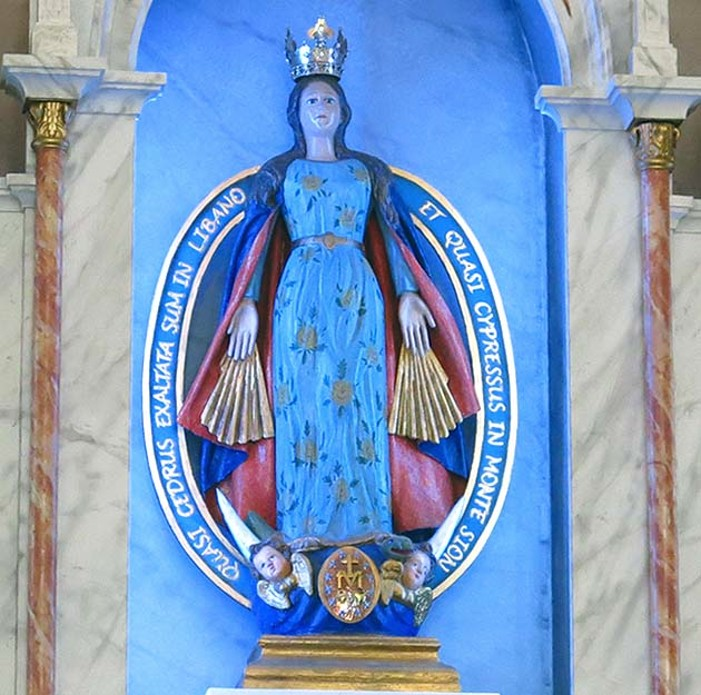
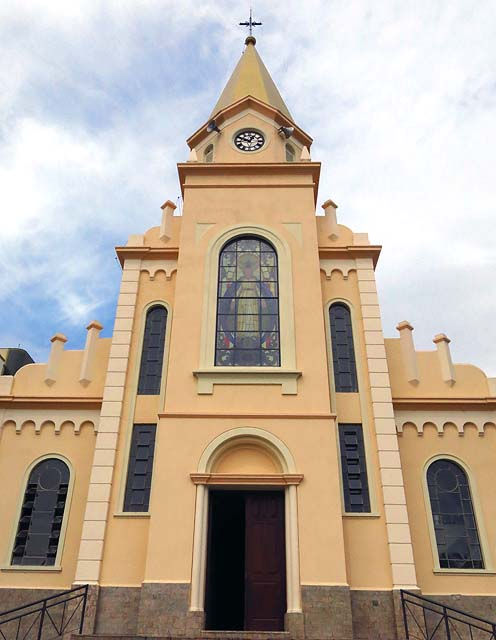
The first Church in Monte Sião appeared in 1849, dedicated to Our Lady of the Miraculous Medal, built by the founder of the place, Antonio Bernardes de Souza. The official Consecration of the Church took place on 13 April 1850. In the Parish of Father Luigi Cocoresi, from 1883 to 1890, more precisely in 1881, the Chapel was replaced by the Parish Church, built on top of in in the same square. The new Church was also built of clay based on strips of sawn wood.

In the parish administration of Fr. José Eugênio de Faria – Fr Zequinha – in 1934, the construction of the current Mother Church began, which is located in the same place as the previous two.

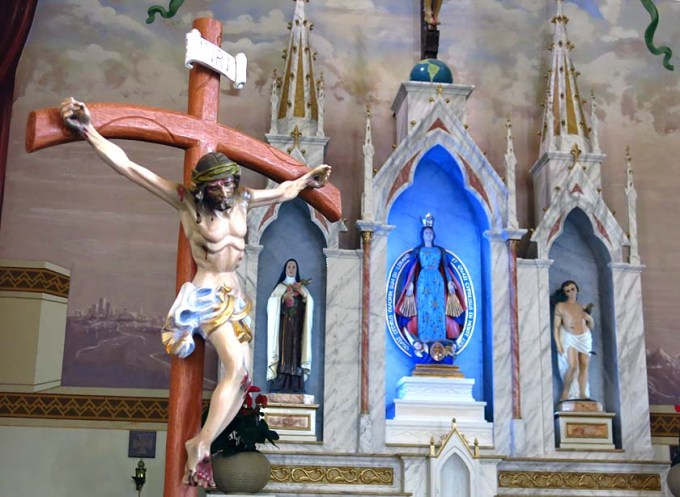
The Church’s architecture resembles the style of Roman art from the 12th century and the main Altar is entirely carved in wood, where the centenary image of the Patron Saint, the Blessed Mother, can be seen. The image of Our Lady of the Miraculous Medal, which adorns the main Altar, was brought to Monte Sião around 1860 and came from Portugal, through a Portuguese farmer, Mr João Pereira Batista Machado, who would have funded both its acquisition and the transportation. The image arrived at the Port of Rio de Janeiro and was brought to the City on the back of animals, inside a cargo jack and wrapped in dry corn husk.
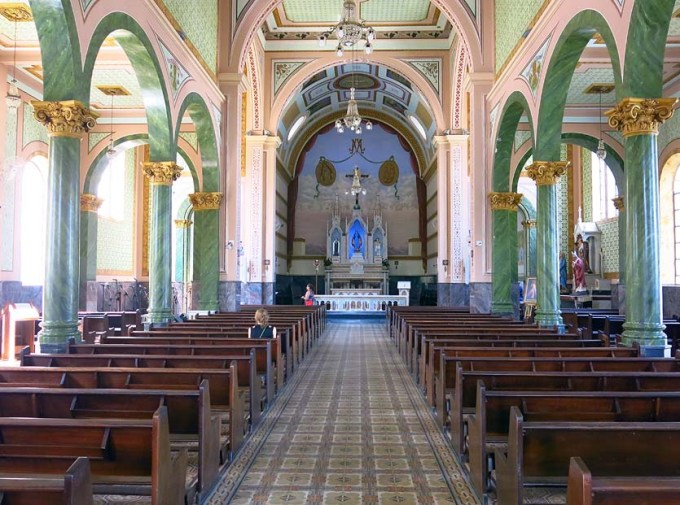
In 1937, at the request of the Bishop, the image was removed from the Altar and sent to a Chapel in the countryside, claiming that the Statue looked too modern.

The faithful greatly missed the Statue in the Igreja Matriz. It was then, that between 1937 and 1939, the City of Monte Sião was inflicted by a period of great drought. There was rain in every other City but not there. The people then associated the lack of rain with the absence of the Statue of their Patron and went to intercede with the Parish Priest, to bring the Statue back. On 5 November 1939, the Statue was allowed to return. The day was sunny and a procession was held to honour the Patroness.

When the Statue reached the City, the first drops began to fall and then a heavy rain, soaking everyone. This was called the rain miracle and after that, everything went smoothly. The Statue underwent a restoration in the year 2015, which returned all the original features to the image, which had been lost with previous restorations.

Although the Feast was 5 November it was moved to co-incide with the official Feast of the Miraculous Medal, 27 November, which is a local public holiday, when it is celebrated after a Novena between 18 and 26 November, with a Mass in honour of the Patron , the Blessed Maria of the Miraculous Medal.
All Saints and Blesseds of the Society of Jesus:

The Society of Jesus, commonly known as the Jesuits, was Founded in 1534 by Saint Ignatius Loyola (1491-1556) at Montmartre, Paris, France. A body of clerics regular organised for Apostolic work, following a religious rule and relying on alms for their support. It was the chief instrument of the Catholic Reformation. Pope Paul III approved the new rule in 1540 and Ignatius was elected the first general of the order in 1541. The constitutions, drafted by him and based on his Spiritual Exercises were adopted in 1558. It was the first order which enjoined by its constitutions devotion to the cause of education. The ministry of the Society consists chiefly in preaching. teaching catechism. administering the sacraments. conducting missions in parishes, taking care of parishes. organising pious confraternities, teaching in schools of every grade, writing books, pamphlets, periodical articles, going on foreign missions and special missions when ordered by the current Holy Father, to whom they take a vow of total obedience. Our current Holy Father, Pope Francis is a Jesuit and has jokingly wondered aloud who is boss of whom in his Order. The general resides at Rome, Italy and has a council of assistants. The motto of the Society is Ad Majorem Dei Gloriam (For the greater glory of God).
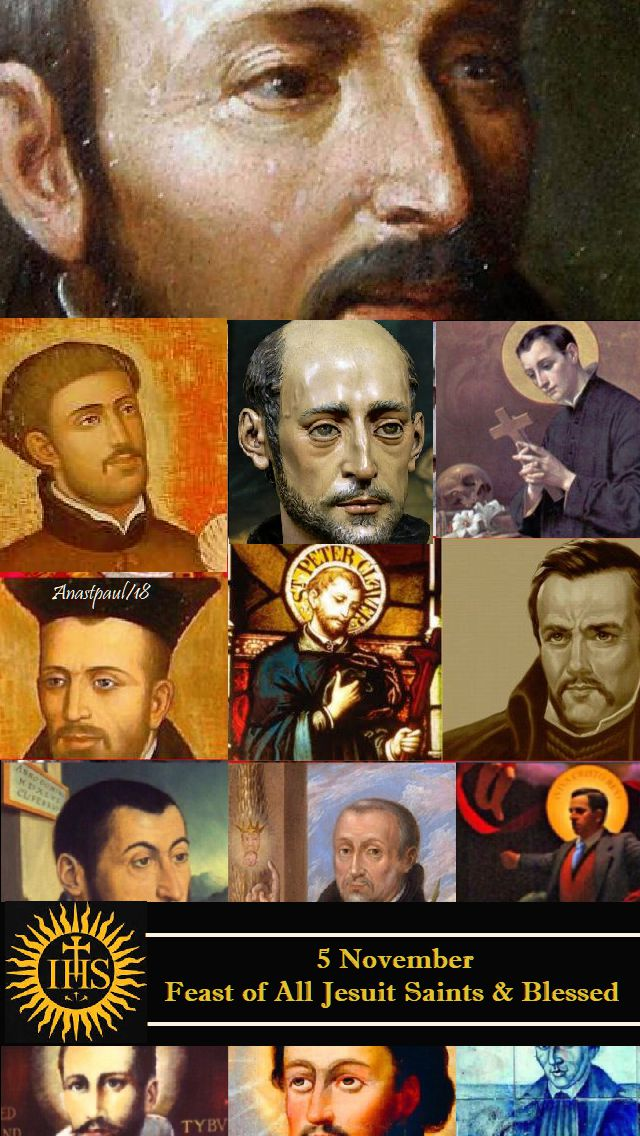
St Augustine of Terracina
Bl Bernhard Lichtenberg
St Bertille (c 629-c 703) Abbess
St Canonica
St Comasia
St Ðaminh Mau
St Dominator of Brescia
St Elizabeth
St Domninus the Physician
St Epistemis
St Eusebius of Terracina
St Felix of Terracina
St Fibitius
St Galation
St Gerald of Beziers
Bl Gomidas Keumurjian
Bl Gregory Lakota
St Guetnoco
St Guido Maria Conforti
St Hermenegild
St Idda
St Juan Antoni Burró Mas
St Juan Duarte Martín
St Kanten
St Kea
St Laetus of Orleans
St Magnus of Milan
St Mamete
St Marco of Troia
Bl María del Carmen Viel Ferrando
Bl Simon Ballachi
St Spinulus of Moyen-Moûtier
St Sylvanus of Syria
St Zachary
—
Martyrs of Caesarea Maritima – 4 saints: Four young Christian men who were martyred together in the persecutions of Maximian – Aussenzius, Philotheus, Timothy and Theotimus. They were martyred in the arena at Caesarea Maritima, Palestine.

Martyred in the Spanish Civil War:
• Blessed Juan Antoni Burró Mas
• Blessed Juan Duarte Martín
• Blessed María del Carmen Viel Ferrando

Posted in SAINT of the DAY

Saint of the Day – 25 August – Blessed Miguel de Carvalho SJ

Miguel de Carvalho SJ, also known as Michael Carvalho, was born in Braga, in 1579, to a noble and wealthy family. In 1597, he joined the Society of Jess in. In 1602, he studied in Portuguese India. After completing his studies of philosophy and theology at St. Paul’s College in Goa, he was ordained to the priesthood. For several years, he was a professor of theology at the Academy. On 21 August 1621, he arrived in Japan where there was an increasing persecution of Catholics in social life. Hidetada Tokugawa, the second shōgun of the Tokugawa dynasty, issued a decree which banned the practice and teaching of the Christian faith, and under the threat of loss of life, all missionaries had to leave Japan. This decree started the bloody persecution of Christians, which lasted several decades.

Carvalho hid in plain view, disguised as a soldier for two years. When the local governor openly confessed that Carvalho was a missionary, and the actual purpose of his stay was to preach and convert the locals to Christianity, he was expelled from the island. With the help of fellow believers, he went to Nagasaki, where the Jesuit Provincial, Francisco Pacheco advised him to remain prudent in the implementation of the apostolate and directed him to care for a small group living in a suburban area. On 22 July 1623, as he returned from the pastoral ministry in Ōmura, Carvalho was arrested thanks to an accusation from an informant.

In the local prison, he joined Franciscan Luis Sotelo, Dominican Pedro Vásquez, and two Japanese Franciscans, Ludovicus Sasada and tertiary Ludovicus Baba. Miguel spent his time in captivity with the celebration of daily Mass and prayer. On 24 August, a death sentence was ordered, which was performed the next day in Ōmura. On 25 August 1624, Carvalho and his companions were burned at the stake.

The steadfastness and joy that he showed convicts in the face of martyrdom for the faith, aroused the admiration of his contemporaries. Carvalho was beatified by Pope Pius IX on 7 July 1867. The death of the martyrs is commemorated by an obelisk in Ōmura.

‘Thanks be to God, that joyous as I was in the flesh, I am now more joyous here.’

Saint Perpetua

Posted in CATHOLIC Quotes

Quote/s of the Day – 31 July – St Ignatius Loyola

Quote/s of the Day – 31 July – “Month of the Precious Blood” and the Memorial of St Ignatius Loyola (1491-1556)

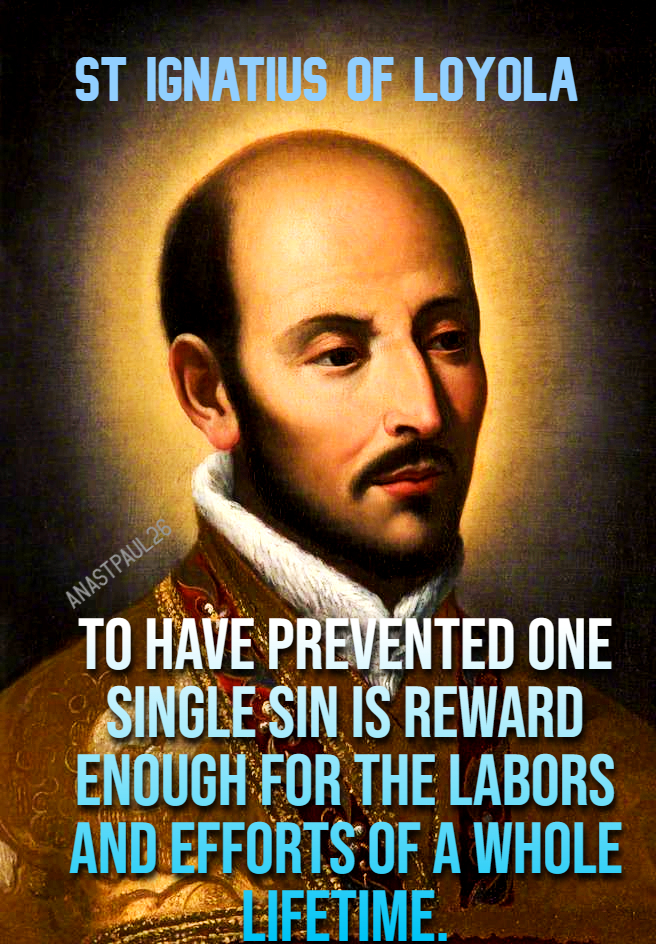
To have prevented one single sin is reward enough for the labors and efforts of a whole lifetime.

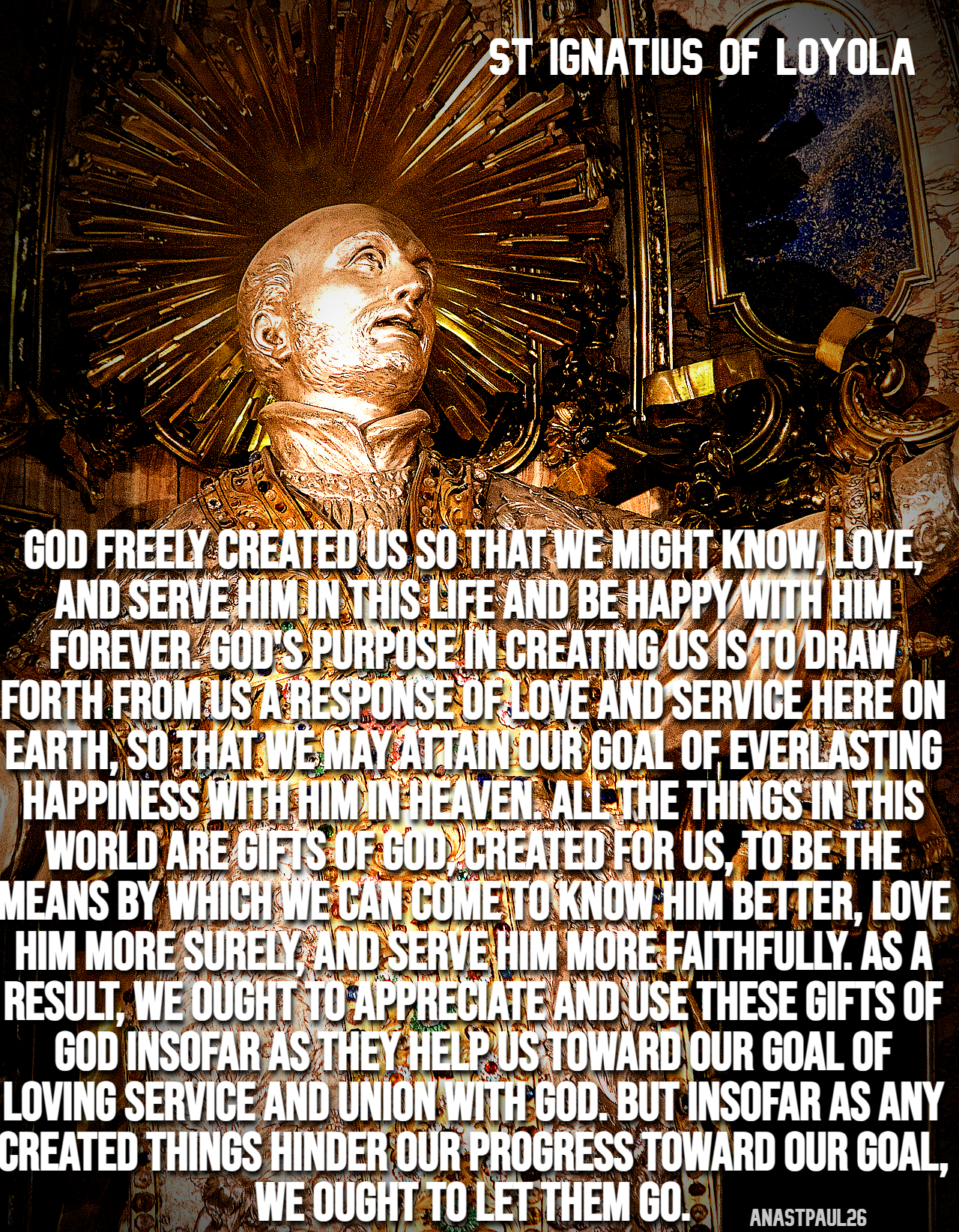
God freely created us so that we might know, love, and serve him in this life and be happy with him forever. God’s purpose in creating us is to draw forth from us a response of love and service here on earth, so that we may attain our goal of everlasting happiness with him in heaven. All the things in this world are gifts of God, created for us, to be the means by which we can come to know him better, love him more surely, and serve him more faithfully.
As a result, we ought to appreciate and use these gifts of God insofar as they help us toward our goal of loving service and union with God. But insofar as any created things hinder our progress toward our goal, we ought to let them go.

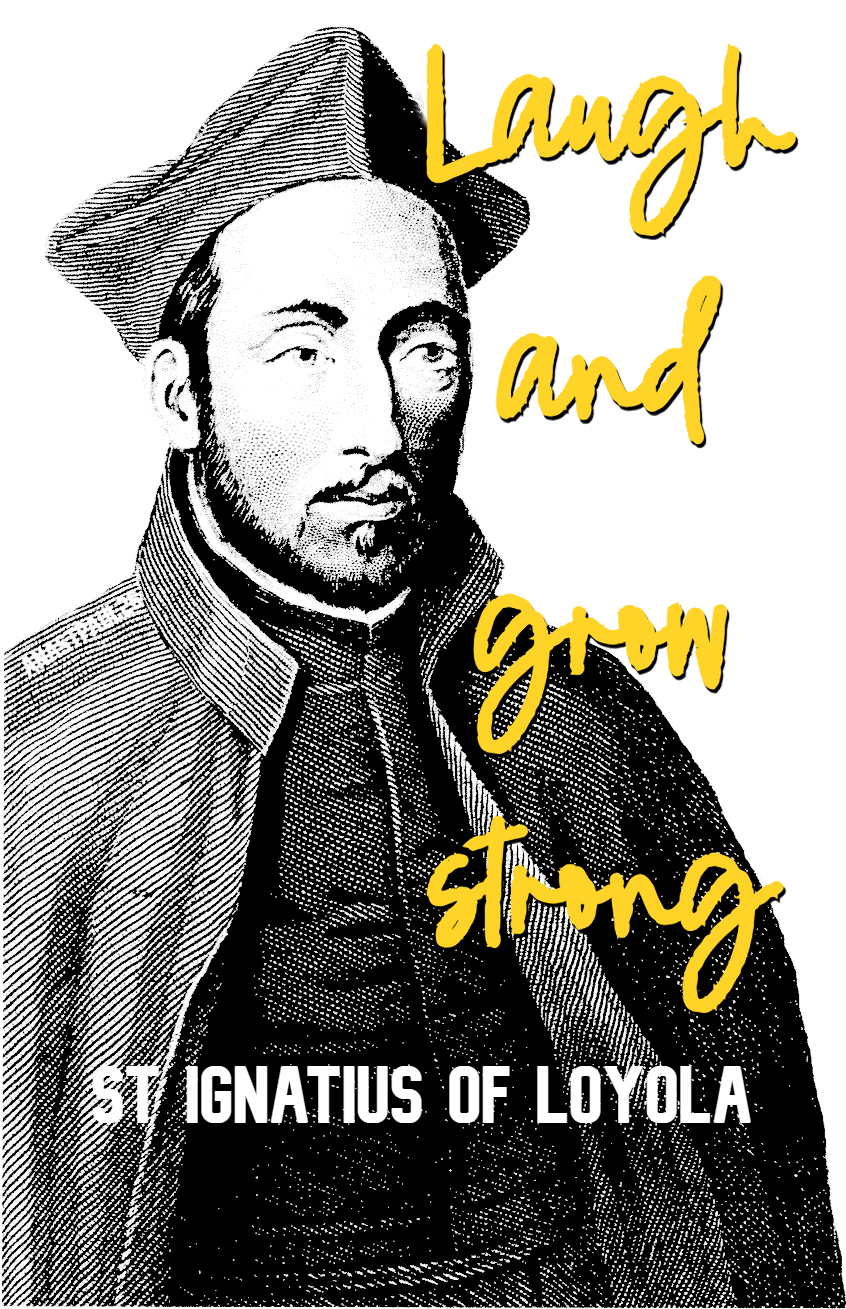
Laugh and grow strong.

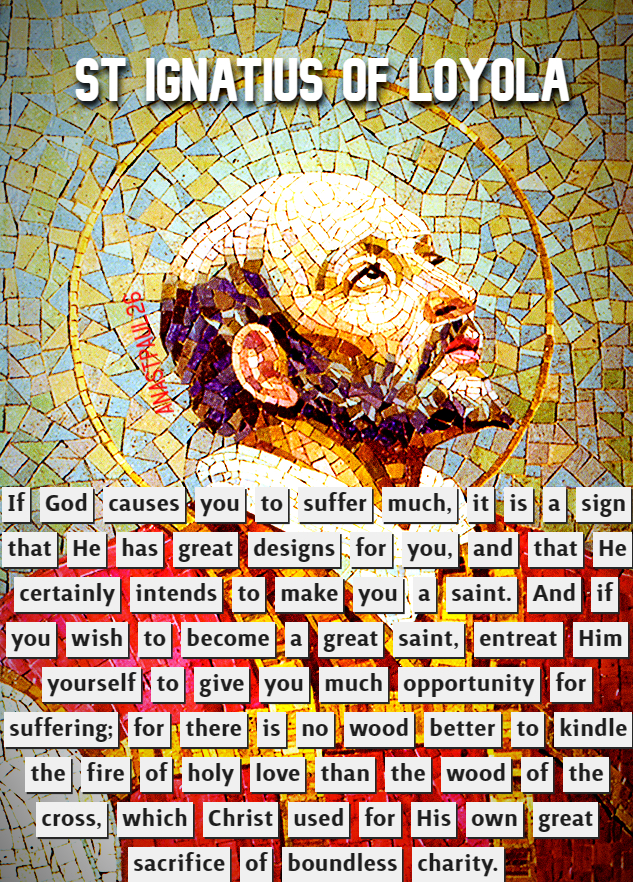
If God causes you to suffer much, it is a sign that He has great designs for you, and that He certainly intends to make you a saint. And if you wish to become a great saint, entreat Him yourself to give you much opportunity for suffering; for there is no wood better to kindle the fire of holy love than the wood of the cross, which Christ used for His own great sacrifice of boundless charity.

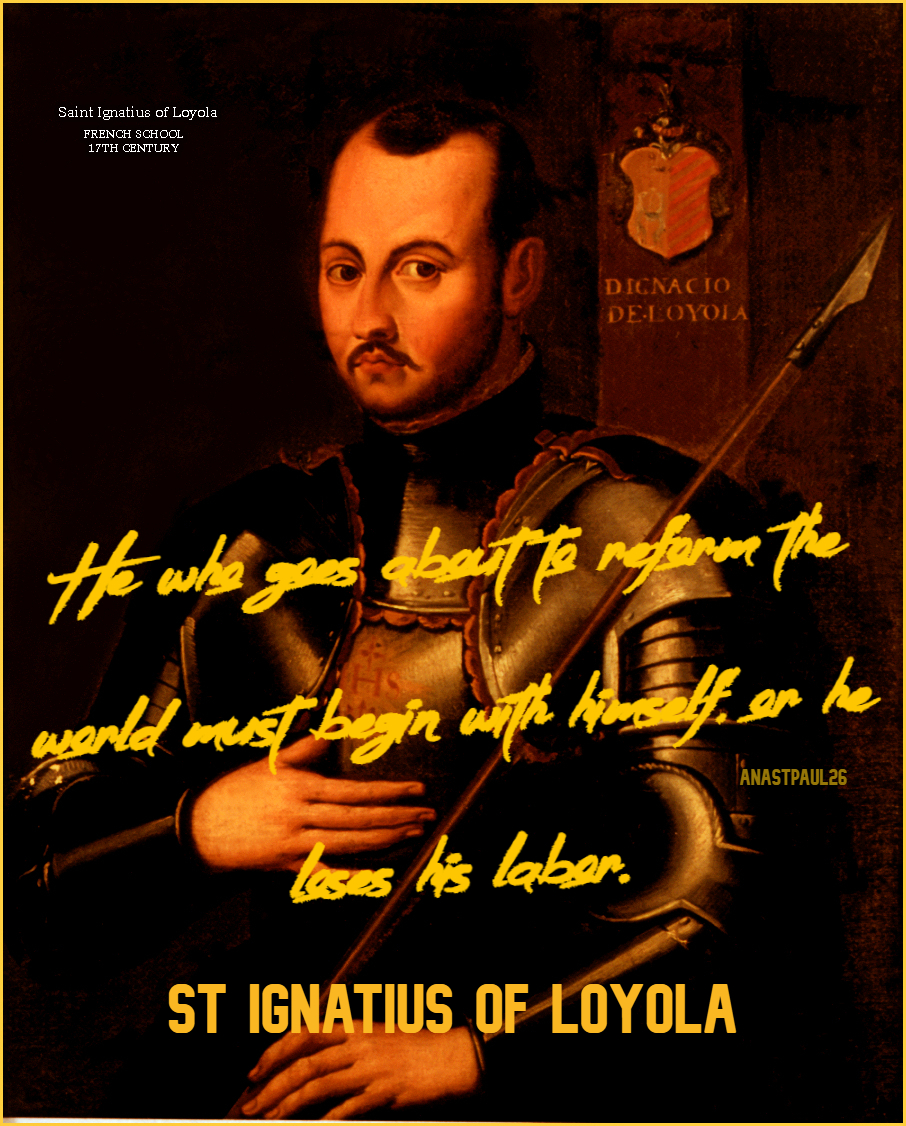
He who goes about to reform the world must begin with himself, or he loses his labor.

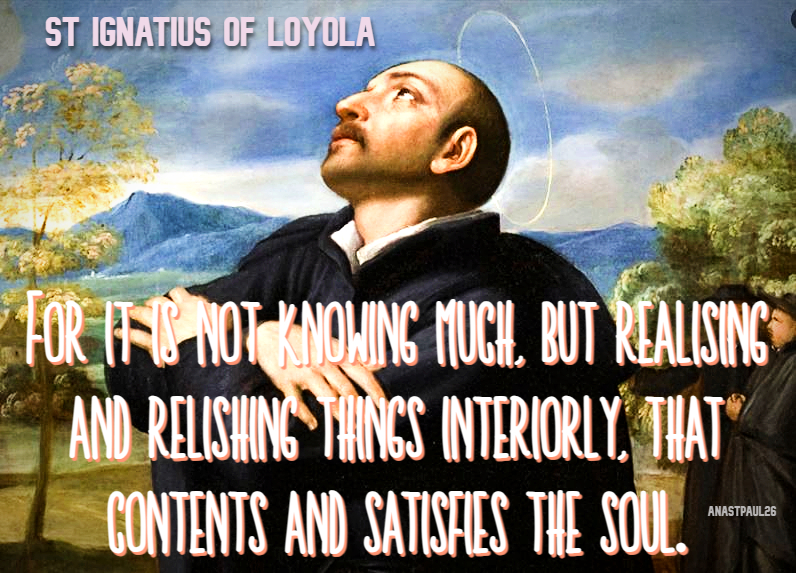
For it is not knowing much, but realising and relishing things interiorly, that contents and satisfies the soul.

Posted in FEASTS and SOLEMNITIES, JESUIT SJ

THE TITULAR FEAST OF THE JESUITS

Today, 3 January, the Celebration of the Feast of the Holy Name of Jesus, we celebrate too, the gift of the Society of Jesus.

See Video 3 January 2014 – https://www.youtube.com/watch?v=kUuOT_rre0w
Pope Francis celebrates the Holy Mass at the Church of the
Jesus, with all the Jesuits in Rome, for thanksgiving for the entry of
Blessed Peter Faber into the catalogue of Saint and on the Solemnity of the
Holy Name of Jesus, the titular feast of the Society of Jesus.

17449930

Jesus said to him, “I am the way and the truth and the life.  No one comes to the Father except through me.”………..John 14:6

The giving of the name “Company (Society) of Jesus” occurred in September 1540 when the early companions and Ignatius were founded as a religious institute.

Ignatius and two of his companions, Peter Faber and James Lainez, decided to go to Rome to place themselves and the other companions at the disposal of the Pope. A few miles outside of Rome at a chapel at La Storta, the companions stopped to pray. At this spot, Ignatius had the second most significant of his mystical experiences. In his vision, God the Father told Ignatius, “I will be favourable to you in Rome” and that he would place him (Ignatius) with His Son. Ignatius did not know what his experience meant, for it could mean persecution as well as success since Jesus experienced both.

Formal approval of this new order was given by Pope Paul III on September 27, 1540. Since they had referred to themselves as the Company of Jesus, in English their order became known as the Society of Jesus. Ignatius was elected on the first ballot of the group to be superior but he begged them to reconsider, pray and vote again a few days later. The second ballot came out as the first, unanimous for Ignatius, except for his own vote. He was still reluctant to accept but his Franciscan confessor told him it was God’s will, so he acquiesced. On the Friday of Easter week, April 22, 1541, at the Church of St. Paul Outside-the-Walls, the friends pronounced their vows in the newly formed Order.

titular-feast-jesuit