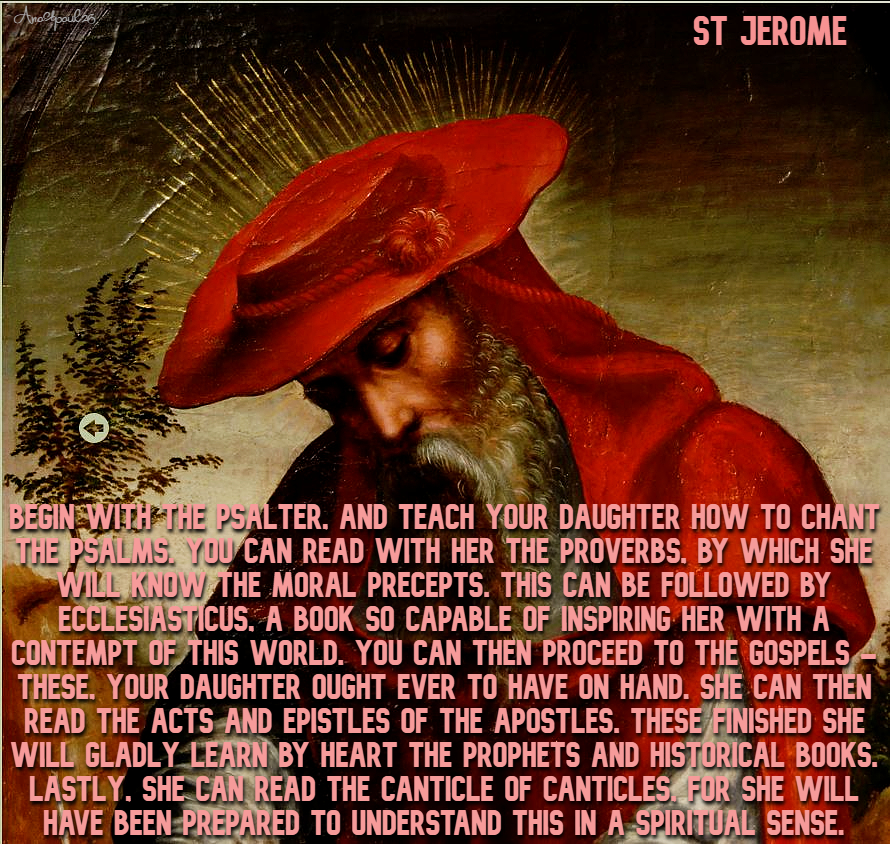
Begin with the Psalter, and teach your daughter how to chant the Psalms. You can read with her the Proverbs, by which she will know the moral precepts. This can be followed by Ecclesiasticus, a book so capable of inspiring her with a contempt of this world. You can then proceed to the Gospels – these, your daughter ought ever to have on hand. She can then read the Acts and Epistles of the Apostles. These finished she will gladly learn by heart the Prophets and Historical books. Lastly, she can read the Canticle of Canticles, for she will have been prepared to understand this in a spiritual sense.
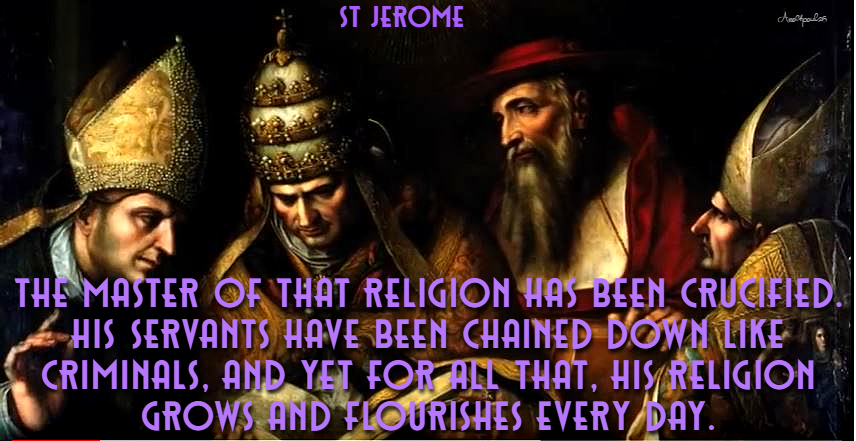
The Master of that religion has been crucified. His servants have been chained down like criminals, and yet for all that, His religion grows and flourishes every day.
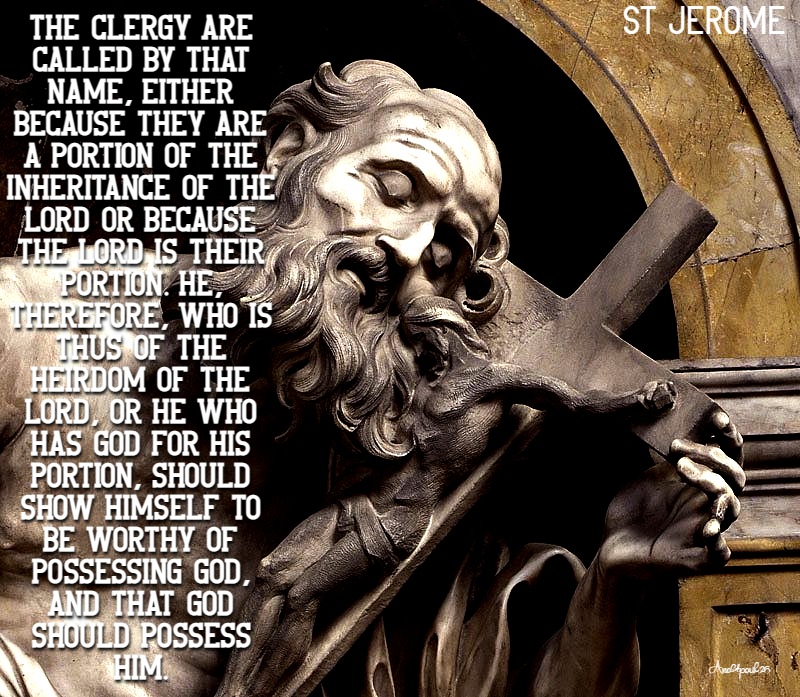
The clergy are called by that name, either because they are a portion of the inheritance of the Lord or because the Lord is their portion. He, therefore, who is thus of the heirdom of the Lord, or he who has God for his portion, should show himself to be worthy of possessing God, and that God should possess him.
Nothing so corrupts the heart and mind as flattery, for the flatterer’s tongue does more harm than the persecutor’s sword. We are dragged downwards by an evil which is inherent within us, we feel favourably towards those who flatter us, and although in our reply we show, or pretend to show, that we are unworthy of their praise, we nevertheless receive the flattering praise with a secret joy and pleasure.
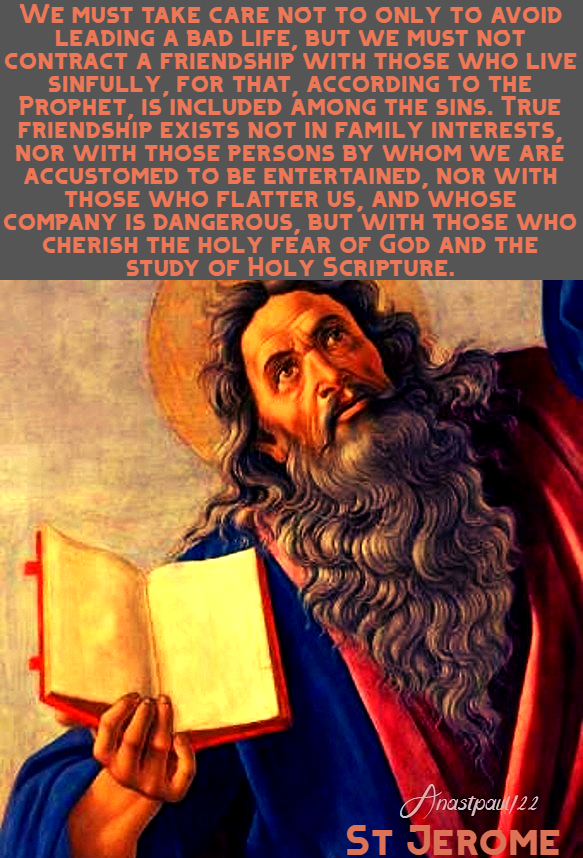
We must take care not to only to avoid leading a bad life, but we must not contract a friendship with those who live sinfully, for that, according to the Prophet, is included among the sins. True friendship exists not in family interests, nor with those persons by whom we are accustomed to be entertained, nor with those who flatter us, and whose company is dangerous, but with those who cherish the holy fear of God and the study of Holy Scripture.
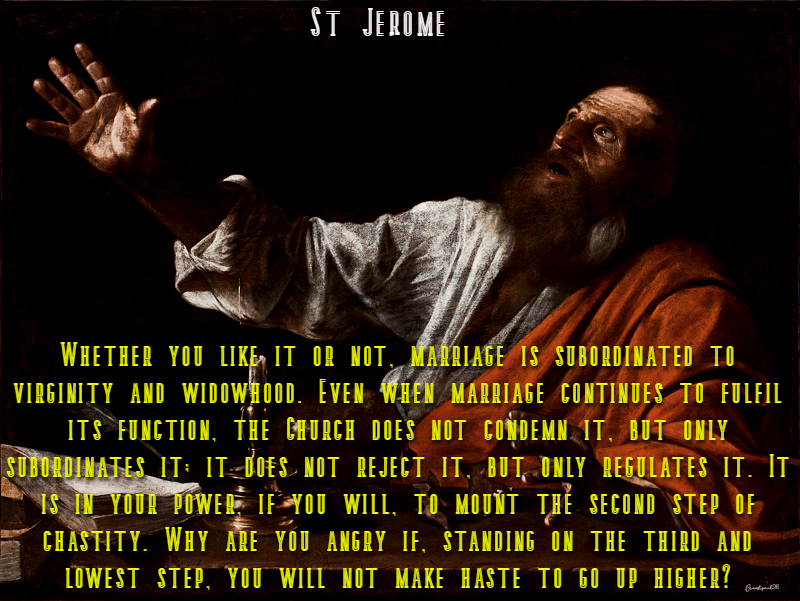
Whether you like it or not, marriage is subordinated to virginity and widowhood. Even when marriage continues to fulfil its function, the Church does not condemn it, but only subordinates it; it does not reject it, but only regulates it. It is in your power, if you will, to mount the second step of chastity. Why are you angry if, standing on the third and lowest step, you will not make haste to go up higher?
Edward Powell (c.1478 – 30 July 1540) was a Welsh priest, theologian, and opponent to King Henry VIII. He was beatified in 1886. Powell was born in Wales, was M.A. of the University of Oxford, and a Fellow of Oriel College. He received the degree of Doctor of Divinity on 26 June 1506 and was styled perdoctus vir by the university.
A court preacher in high favour with Henry VIII, he helped the King write Assertio Septem Sacramentorum, a reply to Martin Luther, and then published his own work on the subject in December 1523. The University of Oxford commended this work, and styled Powell “the glory of the university” in a letter to the king. Powell was one of the four theologians selected to defend the legality of the king’s marriage of Catherine of Aragon, in connection with which he wrote the “Tractatus de non dissolvendo Henrici Regis cum Catherina matrimonio”.
In March, 1533, Powell was selected to answer Hugh Latimer at Bristol, and was alleged to have disparaged his moral character. Latimer complained to Thomas Cromwell, and Powell fell into further disfavour by denouncing Henry’s marriage with Anne Boleyn. He was discharged from the proctorship of Salisbury in January, 1534, and in November he was attainted, together with John Fisher, for high treason in refusing to take the oath of succession, deprived of his benefices, and imprisoned in the Tower of London.
The sentence was not carried out until 30 July 1540. Three Catholics (Powell, Abel, and Richard Featherstone) and three Protestants suffered together. (The protestants were were condemned for teaching Zwinglianism.) The victims were dragged on hurdles from the Tower to Smithfield, a Catholic and a Protestant on each hurdle. Powell’s companion was Robert Barnes, the Protestant divine. The Catholics were hanged, drawn, and quartered as traitors; the others were burned as heretics.
The site of executions at Smithfield
Blessed Thomas Abel
Blessed Thomas Abel (also Able, or Abell), priest and martyr, born about 1497; died 30 July, 1540. He was chaplain to Queen Catherine, and defender of the validity of her marriage to Henry VIII, for which reason he was put to death. He was a graduate of Oxford, and taught the queen modern languages and music. After a journey to Spain on her behalf, he received the parochial benefice of Bradwell in Sussex. He soon published in defence of the queen’s marriage a work entitled: “Invicta Veritas, an answer to the determination of the most famous Universities, that by no manner of law it may be lawful for King Henry to be divorced from the Queen’s grace, his lawful and very wife”. The work contained an answer to the numerous tracts supporting Henry’s ecclesiastical claims. The king, enraged and terrified, bought up copies of the book in order to destroy them.
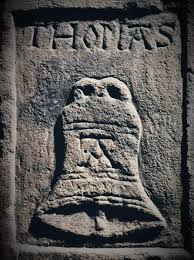
A carving Blessed Thomas created in Beauchamp Tower
For his defence of holy matrimony, he was thrown into Beauchamp Tower, and after a year’s liberation again imprisoned, in December, 1533, on the charges of disseminating the prophecies of the Maid of Kent, encouraging the queen “obstinately to persist in her wilful opinion against the same divorce and separation”, and maintaining her right to the title of queen. He was kept in close confinement until his execution at Tyburn, two days after the execution of Cromwell himself. There is extant a very pious Latin letter written by him to a fellow-martyr, and another to Cromwell, begging for some slight mitigation of his “close prison” — i.e. “license to go to church and say Mass here within the Tower and for to lie in some house upon the Green”. It is signed “by your daily bedeman, Thomas Abell, priest”.
His act of attainder states that he and three others “have most traitorously adhered themselves unto the bishop of Rome, being a common enemy unto your Majesty and this your Realm, refusing your Highness to be our and their Supreme Head of this your Realm of England“.
The Tyburn ‘Tree’
Blessed Richard Fetherston
BlessedRichard Fetherston (Fetherstone, Featherstone) was an English priest. He was Archdeacon of Brecon, Chaplain to Catherine of Aragon, and Latin tutor to her daughter, Mary Tudor. He was executed on 30 July 1540 and beatified by Pope Leo XIII on 29 December 1886.
Richard Featherstone studied at Cambridge where he became a doctor of divinity. In 1523 he was appointed archdeacon of Brecon in South Wales. By 1525 he had become the Princess Mary’s Latin tutor. When the Convocation of Canterbury met in November 1529 and considered whether Henry VIII and Queen Catherine were truly married, he spoke in defence of the marriage. The Act of Parliament which condemned St John Fisher in 1534 for his refusal to take the Oath of Succession, also referred to Fetherstone, who was sent to the Tower of London on 13 December of the same year. There he was confined until his execution in 1540. As in these cases, the limbs of all three were fixed over the gates of the city, and their heads were placed upon poles on London Bridge.
When one finds a worthy wife, her value is far beyond pearls. Her husband, entrusting his heart to her, has an unfailing prize. She brings him good, and not evil, all the days of her life.
– Prov 31:10-31
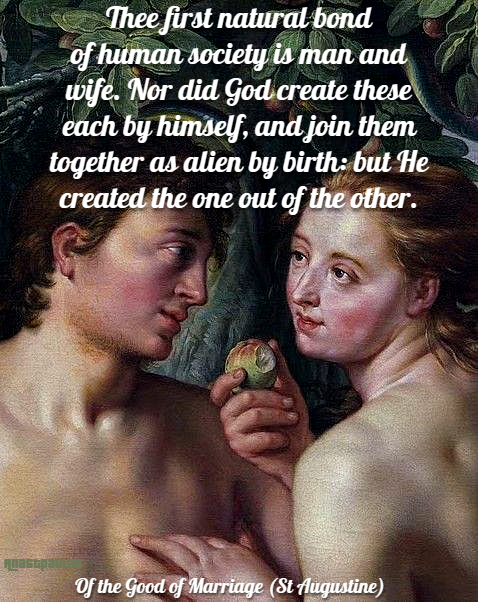
REFLECTION – Forasmuch as each man is a part of the human race, and human nature is something social, and has for a great and natural good, the power also of friendship; on this account God willed to create all men out of one, in order that they might be held in their society not only by likeness of kind, but also by bond of kindred. Therefore the first natural bond of human society is man and wife.Nor did God create these each by himself, and join them together as alien by birth: but He created the one out of the other,setting a sign also of the power of the union in the side, whence she was drawn, was formed. For they are joined one to another side by side, who walk together, and look together whither they walk. Then follows the connection of fellowship in children, which is the one alone worthy fruit, not of the union of male and female, but of the sexual intercourse. For it were possible that there should exist in either sex, even without such intercourse, a certain friendly and true union of the one ruling, and the other obeying.
This we now say, that, according to this condition of being born and dying, which we know, and in which we have been created, the marriage of male and female is some good; the compact whereof divine Scripture so commends, as that neither is it allowed one put away by her husband to marry, so long as her husband lives: nor is it allowed one put away by his wife to marry another, unless she who have separated from him be dead.
Therefore, concerning the good of marriage, which the Lord also confirmed in the Gospel, not only in that He forbade to put away a wife, save because of fornication, but also in that He came by invitation to a marriage, there is good ground to inquire for what reason it be a good. And this seems not to me to be merely on account of the begetting of children, but also on account of the natural society itself in a difference of sex. Otherwise it would not any longer be called marriage in the case of old persons, especially if either they had lost sons, or had given birth to none. But now in good, although aged, marriage, albeit there has withered away the glow of full age between male and female, yet there lives in full vigor the order of charity between husband and wife: because, the better they are, the earlier they have begun by mutual consent to contain from sexual intercourse with each other: not that it should be matter of necessity afterwards not to have power to do what they would, but that it should be matter of praise to have been unwilling at the first, to do what they had power to do. If therefore there be kept good faith of honor, and of services mutually due from either sex, although the members of either be languishing and almost corpse-like, yet of souls duly joined together, the chastity continues, the purer by how much it is the more proved, the safer, by how much it is the calmer. Marriages have this good also, that carnal or youthful incontinence, although it be faulty, is brought unto an honest use in the begetting of children, in order that out of the evil of lust the marriage union may bring to pass some good. Next, in that the lust of the flesh is repressed, and rages in a way more modestly, being tempered by parental affection. For there is interposed a certain gravity of glowing pleasure, when in that wherein husband and wife cleave to one another,they have in mind that they be father and mother.
Of the Good of Marriage (St Augustine)
PRAYER –
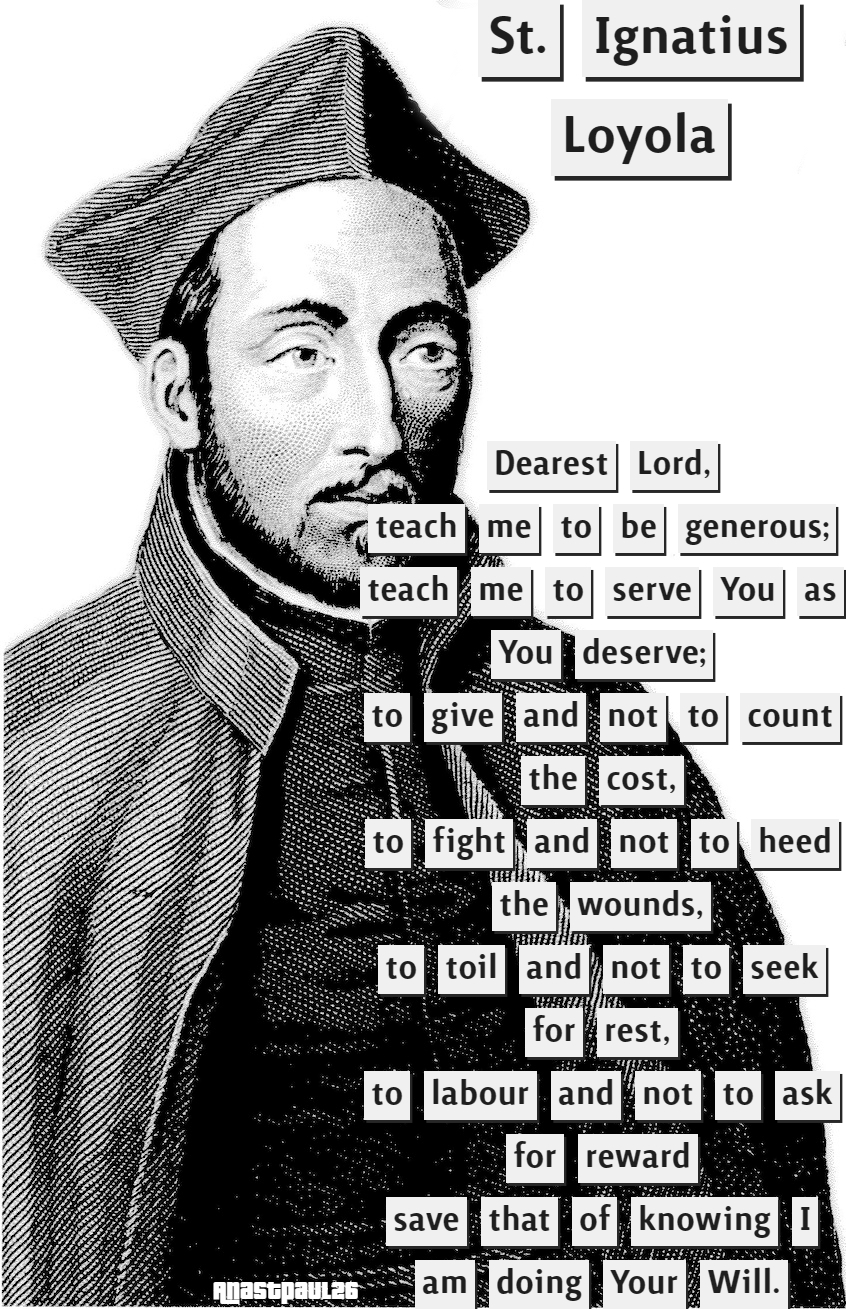
Dearest Lord, teach me to be generous; teach me to serve You as You deserve; to give and not to count the cost, to fight and not to heed the wounds, to toil and not to seek for rest, to labour and not to ask for reward save that of knowing I am doing Your Will.
One Minute Reflection – 15 June – Friday of the Tenth Week of Ordinary Time, Year B – Today’s Gospel Matthew 5:27-32
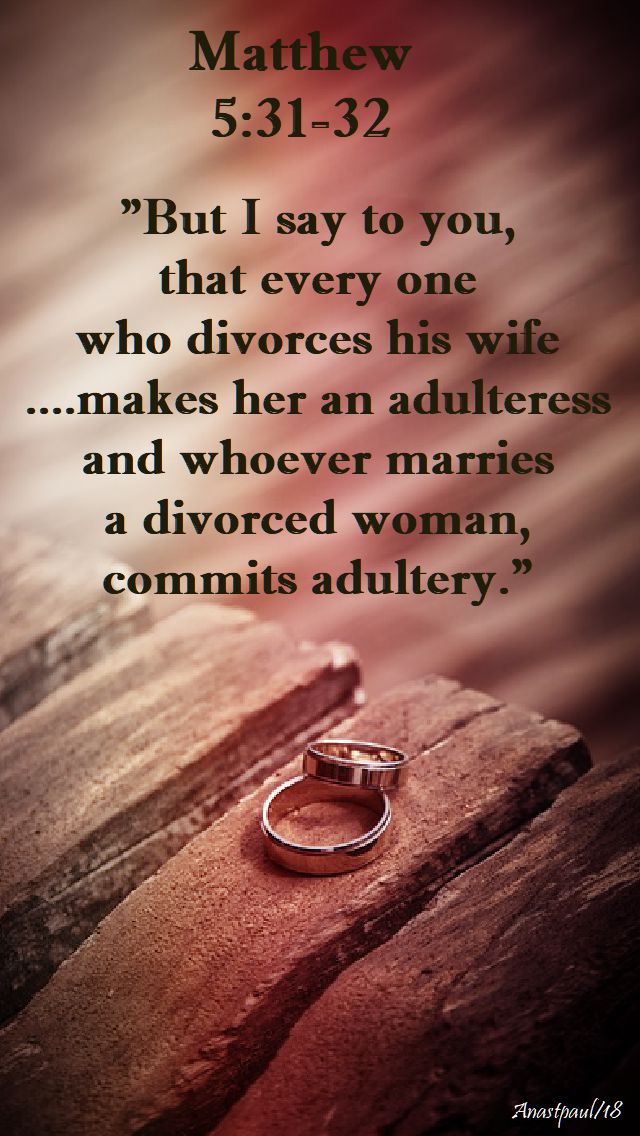
“It was also said, ‘Whoever divorces his wife, let him give her a certificate of divorce.’ But I say to you that every one who divorces his wife, except on the ground of unchastity, makes her an adulteress and whoever marries a divorced woman, commits adultery.”…Matthew 5:31-32
REFLECTION – “Married love particularly reveals its true nature and nobility when we realise that it takes its origin from God, who is love… Marriage, then, is far from being the effect of chance or the result of the blind evolution of natural forces. It is in reality the wise and provident institution of God the Creator, whose purpose was to effect in man His loving design. As a consequence, husband and wife, through that mutual gift of themselves alone… develop that union of two persons in which they perfect one another, cooperating with God in the generation and rearing of new lives. The marriage of those who have been baptised is, in addition, invested with the dignity of a sacramental sign of grace, for it represents the union of Christ and His Church (Eph 5:32).
In the light of these facts the characteristic features and exigencies of married love are clearly indicated. This love is above all fully human, a compound of sense and spirit. It is not, then, merely a question of natural instinct or emotional drive. It is also, and above all, an act of the free will, whose trust is such that it is meant not only to survive the joys and sorrows of daily life but also to grow, so that husband and wife become, in a way, one heart and one soul and together attain their human fulfilment.
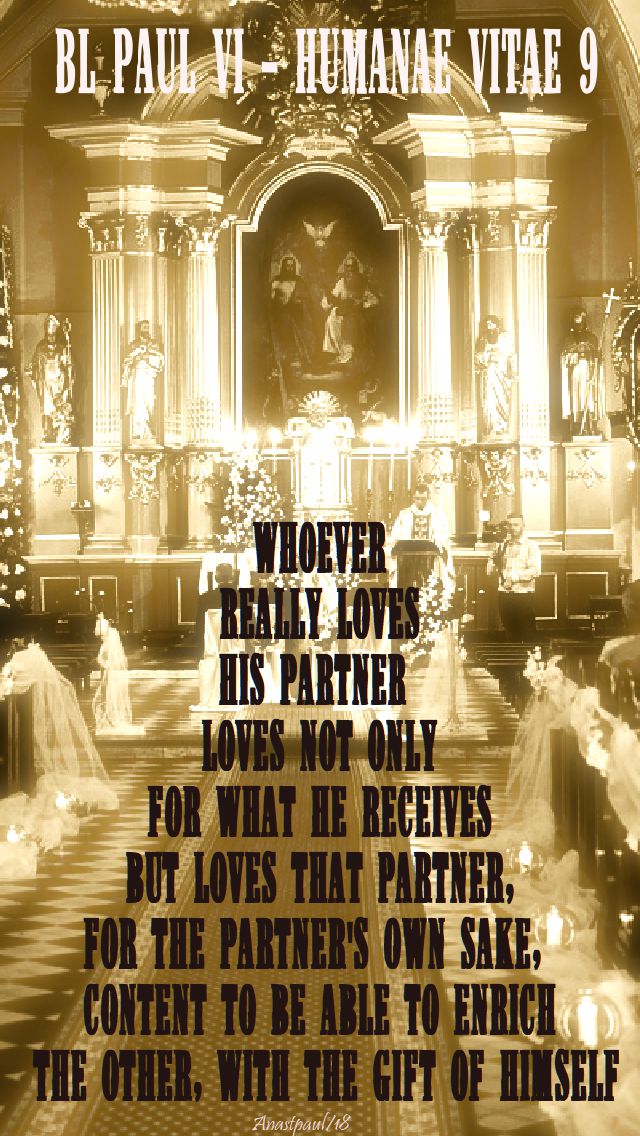
It is a love which is total—that very special form of personal friendship in which husband and wife generously share everything, allowing no unreasonable exceptions and not thinking solely of their own convenience. Whoever really loves his partner, loves not only for what he receives but loves that partner, for the partner’s own sake, content to be able to enrich the other with the gift of himself.
Married love is also faithful and exclusive of all other and this until death. This is how husband and wife understood it on the day on which, fully aware of what they were doing, they freely vowed themselves to one another in marriage… Finally, this love is fecund. It is not confined wholly to the loving interchange of husband and wife; it also contrives to go beyond this to bring new life into being.”…Blessed Paul VI – Humanae vitae, 8-9
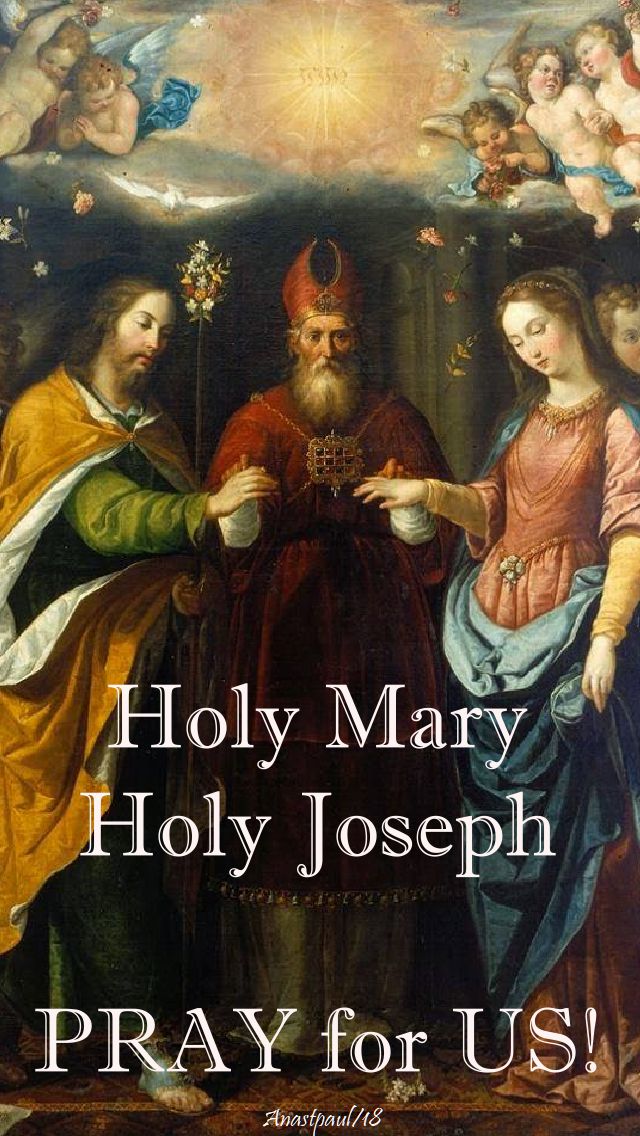
PRAYER – Yours is the day and Yours, the night, Lord God and we are Your children. Grant we pray, that the weakness of our humanity, the drive of our emotions and flesh may not overpower us. Lead us Lord, through the dangers of our day, give us strength and true love, wishing only our final home for those who share our lives, especially our spouse. Mary, pray for us, that we may imitate your faithfulness in all things, St Joseph be a guide and a support to us all. We make our prayer through Christ our Lord, in the unity of the Holy Spirit, one God forever, amen.







You must be logged in to post a comment.