Our Morning Offering – 16 June – Corpus Christ, The Most Holy Body and Blood of our Lord Jesus Christ
Lauda Sion Salvatorem Sion, Lift Up thy Voice and Sing (Excerpt) By St Thomas Aquinas (1225-1274) Doctor Angelicus / Doctor Communis
Sion, lift thy voice and sing, Praise thy Saviour and thy King, Praise with hymns thy Shepherd true, Dare thy most to praise Him well, For He doth all praise excel, None can ever reach His due.
Special theme of praise is Thine, That true living Bread divine, That life-giving flesh adored, Which the brethren twelve received, As most faithfully believed, At the Supper of the Lord.
Let the chant be loud and high, Sweet and tranquil be the joy Felt to-day in every breast; On this festival divine Which recounts the origin Of the glorious Eucharist.
St Thomas Aquinas wrote the Liturgy for Corpus Christi when Pope Urban IV added the Solemnity to the universal Church’s Liturgical calendar in 1264. He provided a great sequence, one of the great poems chanted or recited before the proclamation of the Gospel. Lauda Sion is one of only four medieval sequences which were preserved in the Roman Missal published in 1570 following the Council of Trent (1545–1563)—the others being Victimae Paschali Laudes (Easter), Veni Sancte Spiritus (Pentecost) and Dies irae (requiem masses). (A fifth, Stabat Mater, would later be added in 1727.) Before Trent, many feasts had their own sequences. The existing versions were unified in the Roman Missal promulgated in 1570. The Lauda Sion is still sung today as solemn Eucharistic hymn, though its use is optional in the post-Vatican II Ordinary form. As with St Thomas’s other three Eucharistic Hymns, the last few stanzas of the Lauda Sion are often used alone, in this case, to form the “Ecce Panis Angelorum”.
Our Morning Offering – 11 June – “The Month of the Sacred Heart”
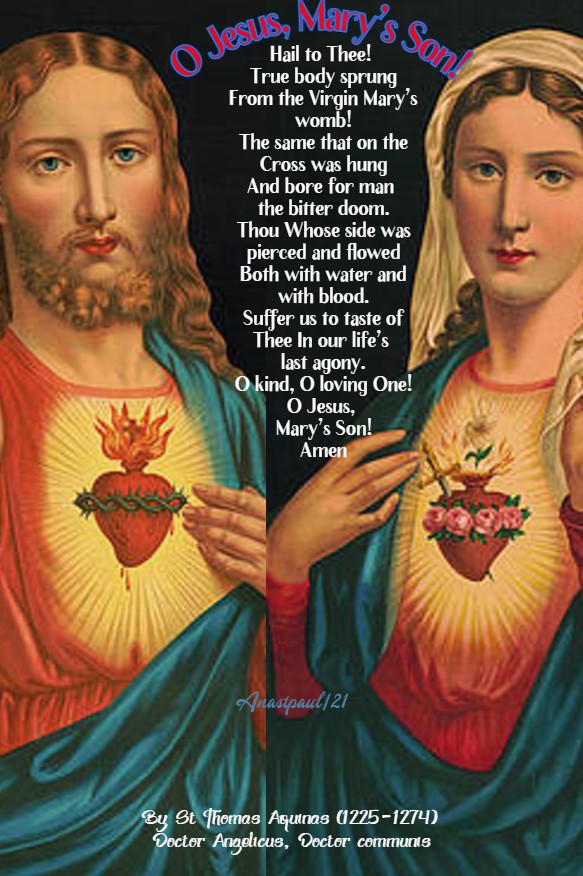
O Jesus, Mary’s Son! By St Thomas Aquinas (1225-1274) Doctor Angelicus, Doctor communis
Hail to Thee! True body sprung From the Virgin Mary’s womb! The same that on the cross was hung And bore for man the bitter doom. Thou Whose side was pierced and flowed Both with water and with blood. Suffer us to taste of Thee In our life’s last agony. O kind, O loving One! O Jesus, Mary’s Son! Amen
Quote’s of the Day – 8 June – Ember Wednesday within the Octave of Pentecost – Acts 2:14-21, John 6:44-52.
“I Am the Living Bread Who came down from Heaven. If any man eat of this Bread, he shall live forever and the Bread that I will give, is My Flesh, for the Life of the world.”
John 6:51-52
“I Am the Bread of Life”
John 6:35
“For His Body, has been given to you under the appearance of bread and His Blood, under the appearance of wine, so that, when you have partaken of the Body and Blood of Christ, you might be One Body and One Blood with Him. So shall we become Christ-bearers [“Christophers”]. His Body and Blood are diffused through all our members – see, then, how we become participants in the Divine Nature!”
St Cyril of Jerusalem (c 313-386) Father and Doctor of theChurch
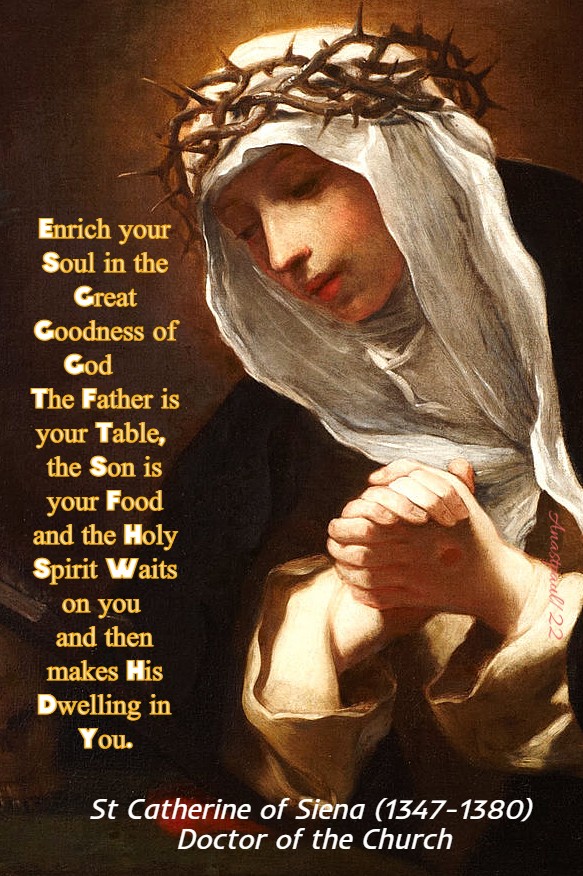
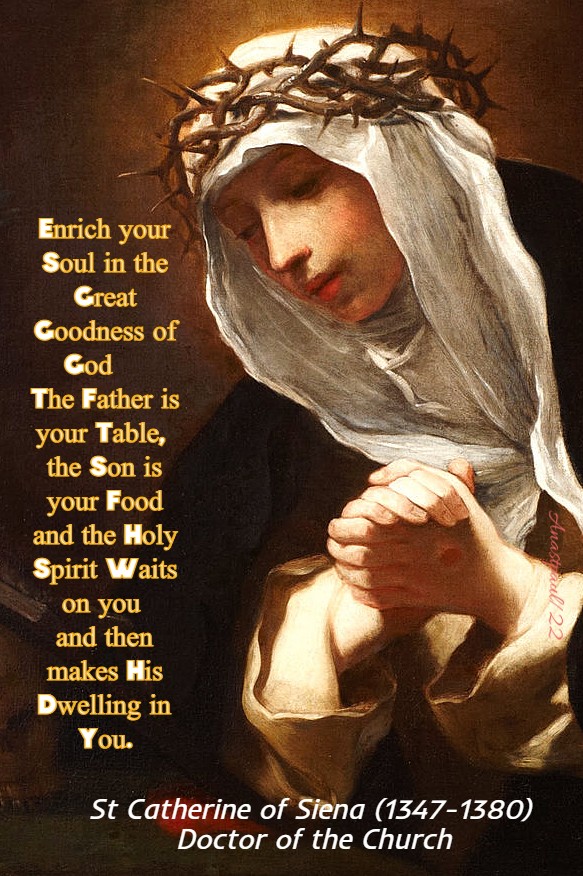
“Enrich your soul in the great goodness of God – The Father is your Table, the Son is your Food and the Holy Spirit waits on you and then makes His Dwelling in you.”
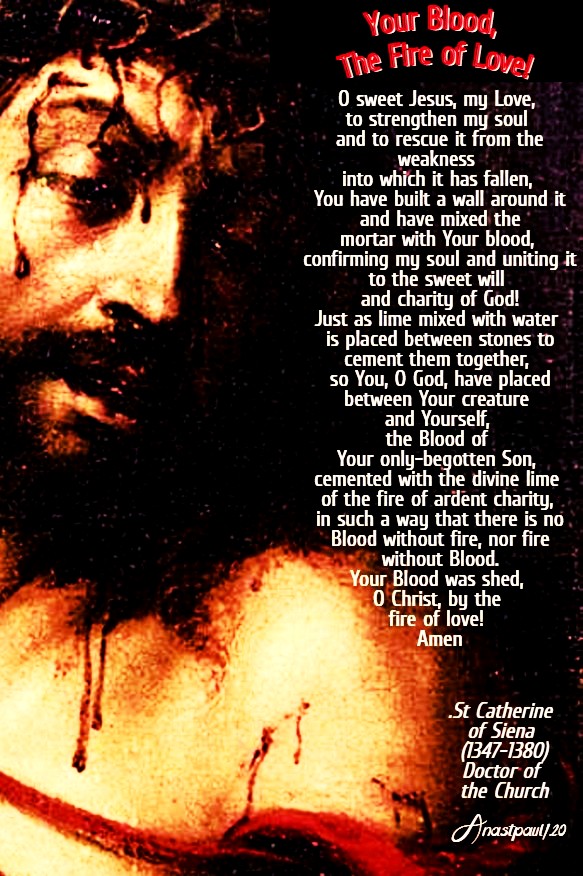
St Catherine of Siena (1347-1380) Doctor of the Church
“What graces, gifts and virtues the Holy Mass calls down!”
St Leonard of Port Maurice (1676-1751)
O Lord, My God, I Am Not Worthy Prayer Before Holy Communion By St John Chrysostom (347-407) Father and Doctor of the Church
O Lord, my God, I am not worthy that You should come into my soul but I rejoice that You have come to me because, in Your loving kindness You desire to dwell in me. You ask me to open the door of my soul, which You alone have created, so that You may enter into it with Your loving kindness and dispel the darkness of my mind. I believe that You will do this, for You did not turn away Mary Magdalene when she approached You in tears. Neither did You withhold forgiveness from the tax collector who repented of his sins or from the good thief who asked to be received into Your kingdom. Indeed, You numbered as Your friends, all who came to You with repentant hearts. O God, You alone are blessed always, now and forever. Amen
St Photinus of Lyons St Rogate Bl Sadoc of Sandomierz St Stephen of Sweden
Martyrs of Lyons and Vienne: A group of 48 Christians from the areas of Vienne and Lyon, France, who were attacked by a pagan mob, arrested and tried for their faith, and murdered in the persecutions of Marcus Aurelius. A letter describing their fate, possibly written by Saint Irenaeus of Lyons, was sent to the churches in the Middle East. Only a few names and details of their lives have survived; some of them have separate entries on this date – • Alexander of Vienne • Attalus of Pergamos • Biblis of Lyons • Blandina the Slave • Cominus of Lugdunum • Epagathus of Lugdunum • Maturus the Novice • Photinus of Lyons • Ponticus of Lugdunum • Sanctius of Vienne • Vettius of Lugdunum They were martyred in assorted ways on on various during 177.
Martyrs of Sandomierz: A group of 49 Dominicans, some of whom received the habit from Saint Dominic de Guzman himself. They worked separately and together to bring the faith and establish the Dominican Order in Poland, basing their operations in and around Sandomierz. In 1260 they were all Martyred by the Tartars as they were singing the Salve Regina at Compline; the custom of singing the Salve Regina at the deathbed of Dominicans, stems from this incident. We know a few details about a few of the martyrs, but most survive only as names – • Zadok• Andrea, chaplain• James, novice master• Malachi, convent preacher • Paul, vicar• Peter, guardian of the garden• Simone, penitentiaryfriars • Abel, Barnabas, Bartholomew, Clemente, Elia, John, Luke, Matthew, Philip deacons• Giuseppe, Joachim, Stefanosub-deacons• Abraham, Basil, Moses, Taddeoclerics• Aaron, Benedict, David, Dominico, Mattia, Mauro, Michele, Onofrio, Timothyprofessed students• Christopher, Donato, Feliciano, Gervasio, Gordian, John, Mark, Medardo, Valentinonovices• Daniele, Isaiah, Macario, Raffaele, Tobialay brothers• Cyril, tailor• Jeremiah, shoemaker • Thomas, organist They were martyred in 1260 at Sandomierz, Poland and Beatified on 18 October 1807 by Pope Pius VII (cultus confirmation).
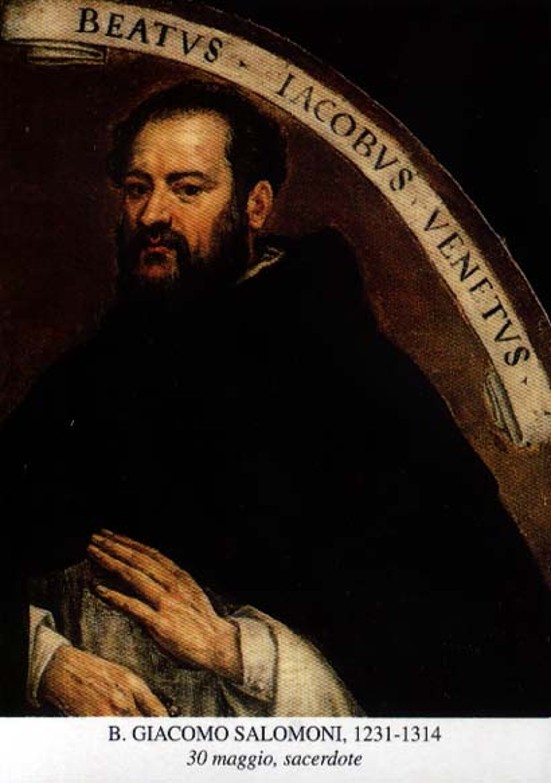
Saint of the Day – 31 May – Blessed James Salomoni OP (1231-1314) Priest of the Order of Preachers, “Father of the Poor,” “Apostle of the Afflicted,” Miracle-worker graced with the ability to cure sickness. Born as Giacomo Salomoni in 1231 at Venice, Italy and died on 31 March 1314 of cancer at Forli, Italy. Patronages – cancer patients, of the sick. Also known as James the Venetian, Giacomo Salomonio, surname spelled variously as Salomone, Salomonelli, Salomonius,
James was born in Venice, in 1231, the only child of noble parents. His father died when he was very young and his mother became a Cistercian nun, leaving him to the care of his grandmother. She did well by her orphaned grandson and James became a good and studious boy, who responded eagerly to any spiritual suggestions.
Under the direction of a Cistercian Monk, he learned to meditate and on the Monk’s counsel, James became a Dominican at the Convent of Sts John and Paul, in Venice, as soon as he was old enough. He gave most of his money to the poor and arrived at the Convent with just enough left, to buy a few books. Seeing that one of the Lay Brothers there was in need of clothing, he gave his final small sum to the him and entered empty-handed.
James wore the Dominican habit with dignity and piety, if not with any worldly distinction, for sixty-six years. He was humble and good and obedient and there was nothing spectacular about his spirituality. He was well-known for his direction of souls but he fled, even from the distinction this work brought him.
Even his retiring habits did not protect him, for the people of Venice beat a path to his door. In self -defence, he transferred to another house, that of Forli. This was a house of strict observance and very poor. Nothing could suit him better. For the remainder of his life he worked and prayed in Forli, going out to visit the sick in the hospitals and spending long hours in the Confessional. His charity to the poor and the sick gave the name ” Father of the Poor.”
God granted James the grace of miracles during his lifetime. Once, while he was hearing the confession of a pious woman, she saw the Holy Spirit, in the form of a white dove, sitting on his shoulder and whispering into his ear. Another time, a young girl was cured through his prayer for her, of a terrible cancer on her leg.
James was himself afflicted with cancer, during the last four years of his life. At his death, the cancerous wound on his chest disappeared, leaving only a faint scar and from it arose a fragrant aroma.
He died on 31 May 1314, in his eighty-third year. His relics now lie in the Basilica of Sts John and Paul in Venice.
Devotion to Blessed James has been approved and encouraged by several Popes. In 1526 he was officiallt Beatified by Pope Clement VII
Prayer
O BLESSED JAMES, during your life you received, with utmost tenderness, those who came to you with their afflictions of body and soul, consoling them even to the point of working miracles on their behalf. Now that you are in Heaven, listen to my poor prayers and out of your goodness, help me in my needs with your unfailing intercession.
(Here state your intentions)
Obtain for me, I beg you, the grace to imitate your virtues, especially your generous love of God and neighbour, your profound humility, your tender devotion to our Lord in the Blessed Sacrament and to the Blessed Virgin Mary. Obtain for me too, patience in adversity, fortitude in suffering and preserve me from those dreadful ills against which you are invoked as a special protector.
May your assistance help me to live a holy life on earth, so that I may deserve to be with you some day in the glory of Heaven. AMEN
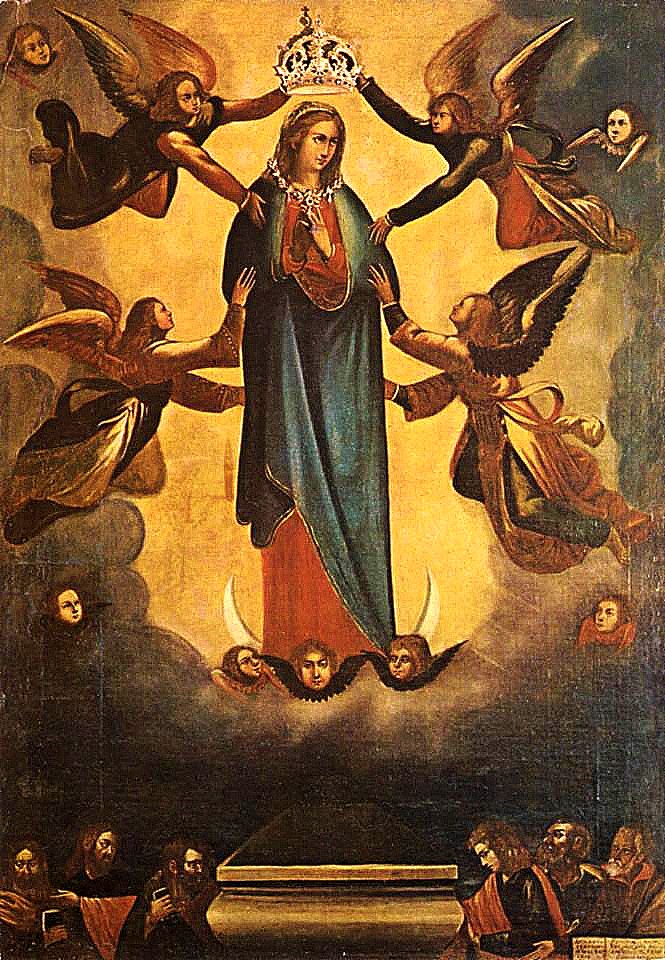
Mary is Queen by grace, divine relationship, right of conquest and singular election. Coming as a crowning event in the beautiful month of May, the Queenship of Mary, we welcome this Feast with spiritual affection and experience a sense of deep interior peace, as we gather in her presence, to rededicate ourselves to our loving Mother and Queen. The Introit of the Mass for the day tells us: “Let us all rejoice in the Lord as we celebrate the feast in honour of our Queen, the Blessed Virgin Mary, on whose solemnity the Angels rejoice and join in praising the Son of God. Alleluia, alleluia.”
The Queenship of Mary is not an empty title or an honourary distinction, showing forth her excellence of virtue, of grandeur, sanctity or glory. Mary is truly a Queen as can be seen in the Gospel of the Mass – the Angel Gabriel greeted Mary with the most startling words ever addressed to a child of Adam: “Hail thou who art full of grace, the Lord is with thee, blessed art thou among women.” Then he continues, “Do not be afraid; thou hast found favour in the sight of God. And thou shalt bear a son and call Him Jesus. He shall be great and men will know Him for the Son of God, the Most High; the Lord will give Him the throne of his father David and He shall reign over the house of Jacob eternally; His kingdom shall never end.” Here is the foundation of our belief in the Queenship of Mary – her Divine Motherhood; – she conceived a King, the King!
Mary is “Queen by grace” because she was immaculately conceived, preserved from the slightest taint of sin, while her soul was literally inundated with divine grace. “Hail, thou art full of grace.”
She is “Queen by divine relationship” for she is related in the first degree of consanguinity in the direct line to Our Lord and Saviour, Jesus Christ, the Son of God. A Queen Mother is one, whose son later becomes king. Mary’s Child, however at the moment of His conception and then His birth, was already a King, the King of the world. Spiritual writers point out for our consolation, that Mary’s maternal relationship to Jesus was more exclusive than any other mother, since He had no human father.
Our Lady is Queen also “by right of conquest;” Our Lord by His Passion and Death recaptured the human race from the slavery of Satan, conquering all as a King. Calvary was the scene of this conquest. Mary, at the foot of the Cross, shared intimately with Him in His Sacrifice and the fruits of the Redemption.
At first it may be somewhat difficult to picture Mary as a Queen, since we think in terms of royalty of the world; yet, when we think of the souls who preceded us in the household of the Faith and glance at Christian art, as it sings of her Queenship, it is not difficult at all.
Majestically, Christ said to Pilate, “My Kingdom is not of this world,” so, too, Our Lady acknowledges herself in humility as a Queen whom all generations call blessed but she, too, would add, “my kingdom is not of this world.” In the Litany of Our Lady, we address her as Queen of Angels, Patriarchs, Prophets, Martyrs, Confessors, Virgins; of Peace, of the Most Holy Rosary; conceived without original sin and, Queen assumed into Heaven. Catholic art represents her, crowned with a diadem holding a scepter, seated on a throne.
The purpose of this Feast, the Queenship of Mary, is to stir up renewed love and devotion to her, to gather before her throne in Heaven and humbly offer her our homage, unreserved, totally, prayerfully and with the simplicity of abandonment, which characterises a devoted child – “Reign over hearts and minds of men that they seek what is true; over their wills, to follow solely the good; over their hearts, to love nothing but what you love…that man may seek and know the truth and follow what is good, Oh Queen!”
St Crescentian of Sassari St Donatian of Cirta St Felice of Nicosia St Galla of Auvergne St Hermias of Comana Bl Jacob Chu Mun-mo Blessed James Salomoni OP (1231-1314) Priest of the Order of Preachers St Juan Moya Collado Bl Kasper Gerarz St Lupicinus of Verona St Mancus of Cornwall Bl Mariano of Roccacasale St Mechtildis of Edelstetten St Myrbad of Cornwall Bl Nicolas Barré Bl Nicholaus of Vangadizza Bl Nicholaus of Vaucelles St Nowa Mawaggali St Paschasius of Rome St Petronilla of Rome Bl Robert Thorpe St Silvio of Toulouse Bl Thomas Watkinson Bl Vitalis of Assisi St Winnow of Cornwall
Martyrs of Aquileia – 3 Saints: Three young members of the imperial Roman nobility and who were raised in a palace and had Saint Protus of Aquileia as tutor and catechist. To escape the persecutions of Diocletian, the family sold their property and moved to Aquileia, Italy. However, the authorities there quickly ordered them to sacrifice to idols; they refused. Martyrs all – Cantianilla, Cantian and Cantius. They were beheaded in 304 at Aquae-Gradatae (modern San-Cantiano) just outside Aquileia, Italy.
Martyrs of Gerona – 29 Saints: A group of Christians Martyred together in Gerona, Catalonia, Spain, date unknown. No details about them have survived but the names – • Agapia• Amelia• Castula• Cicilia• Donatus• Firmus• Fortunata• Gaullenus• Germanus• Honorius• Istialus• Justus• Lautica• Lupus • Maxima• Paulica• Rogate• Rogatus• Silvanus• Tecla• Teleforus• Tertula• Tertus• Victoria• Victurinus• Victurus
Martyrs of the Via Aurelia – 4 Saints: Four Christians Martyred together. No information about them has survived except their names – Justa, Lupus, Tertulla and Thecla. The martyrdom occurred in 69 on the Via Aurelia near Rome, Italy.
Quote/s of the Day – 28 April – “The Month of the Blessed Virgin Mary” – Saturday within the Octave of the Ascension
“There are two ways of keeping God’s word, namely, one, whereby we store in our memory what we hear and the other, whereby we put into practice, what we have heard (and none will deny that the latter is more commendable, inasmuch, as it is better to sow grain, than to store it in the barn).”
Blessed Jordan of Saxony (1190-1237)
“Those who risk all for God, will find. that they have both lost all and gained all.”
St Teresa of Jesus of Ávila (1515-1582) Doctor of Prayer of the Church
“Our business is to love what we have. He wills our vocation as it is. Let us love that and not trifle away our time hankering after other people’s vocations.”
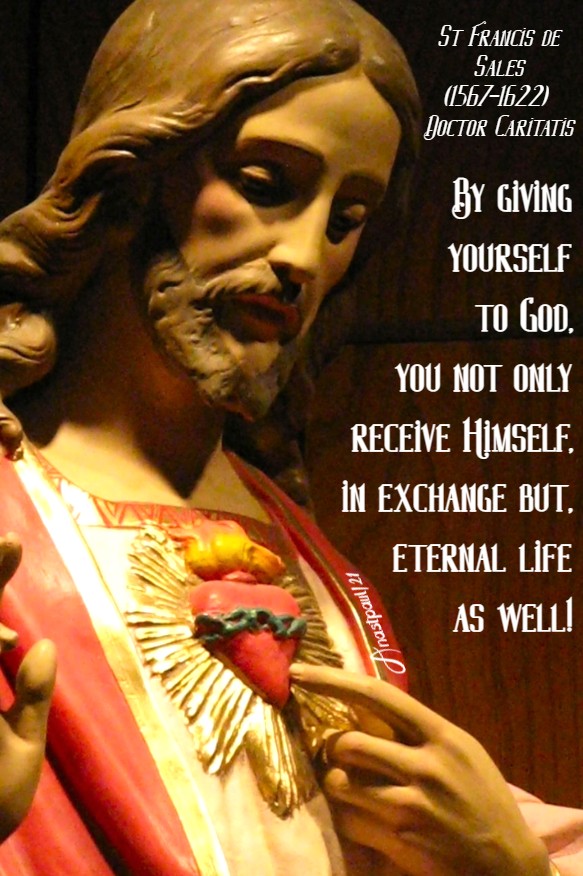
“By giving yourself to God, you not only receive Himself in exchange but, eternal life as well!”
St Francis de Sales (1567-1622) Doctor Caritatis
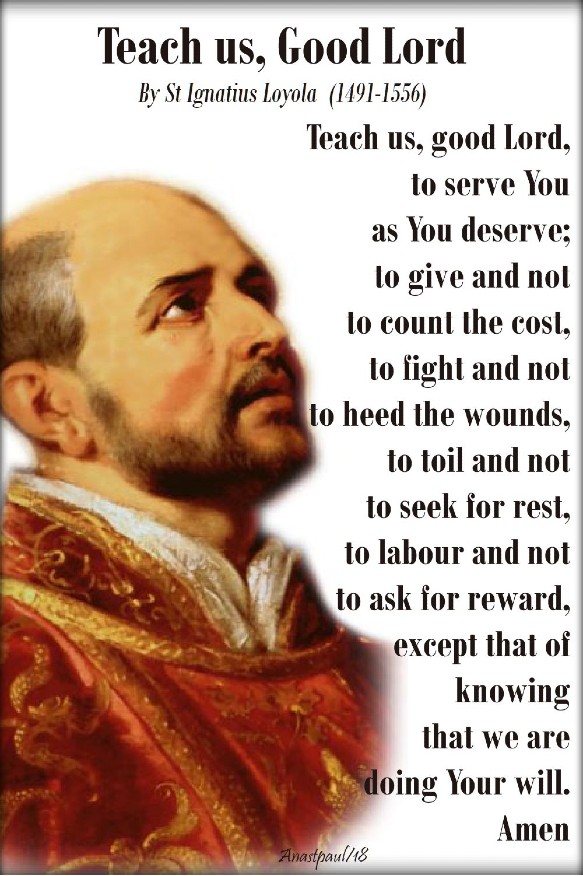
“Teach Us Good Lord” By St Ignatius Loyola (1491-1556)
Teach us, good Lord, to serve You as You deserve; to give and not to count the cost, to fight and not to heed the wounds, to toil and not to seek for rest, to labour and not to ask for reward, except that of knowing that we are doing Your will. Amen
Quote/s of the Day – 22 May – The Fifth Sunday after Easter – James 1:22-27, John 16:23-30
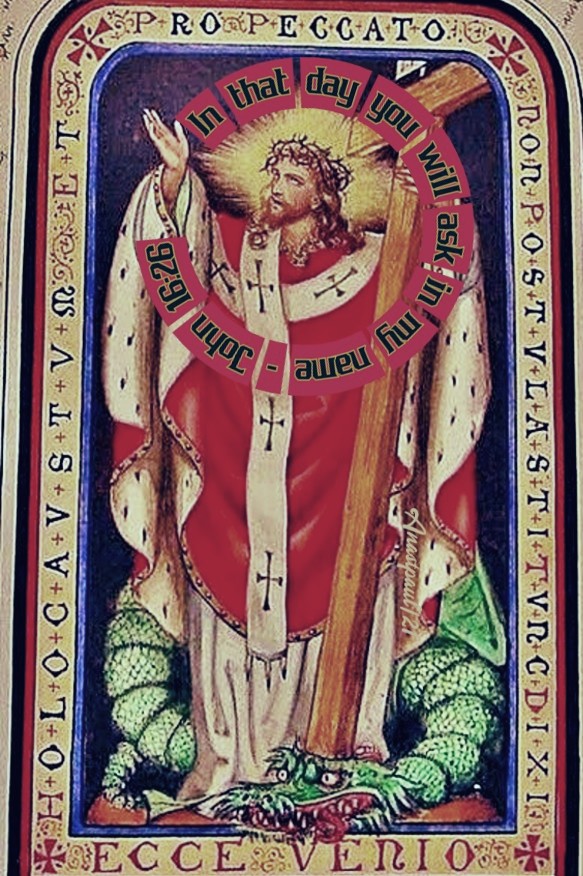
“In that day, you will ask in My Name”
John 16:26
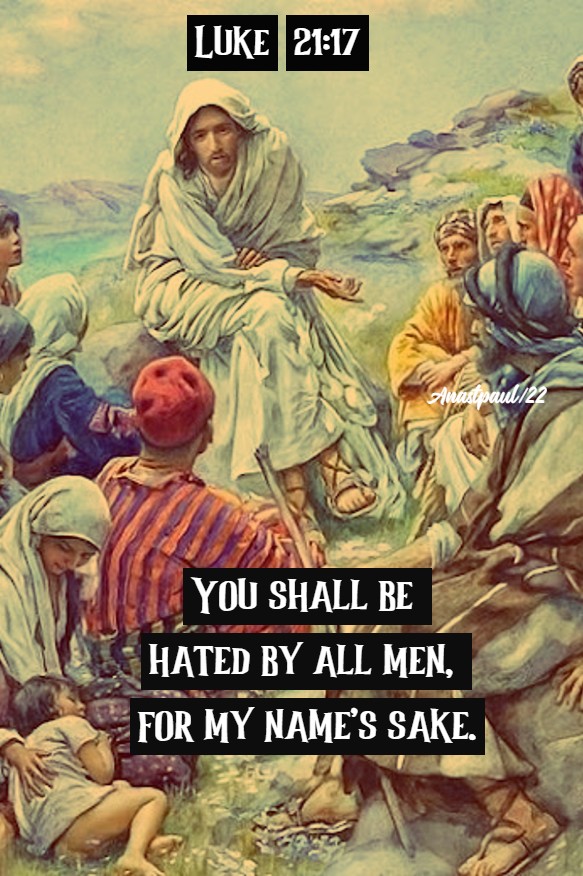
“And you shall be hated by all men, for my name’s sake.”
Luke 21:17
“The eternal God asks a favour of His bride: “Hold me close to your heart, close as locket or bracelet fits.” No matter whether we walk or stand still, eat or drink, we should at all times wear the golden locket “Jesus” upon our heart.”
Bl Henry Suso (1295-1366)
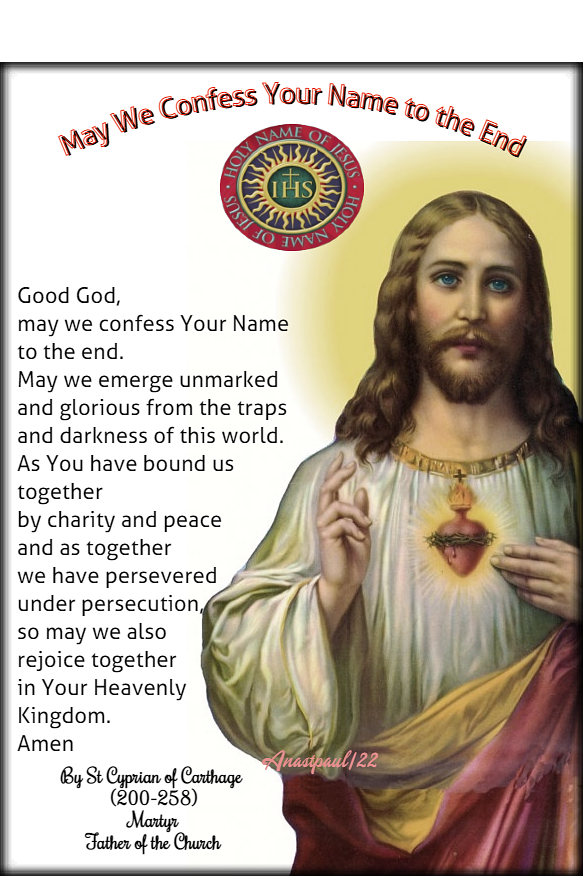
May We Confess Your Name to the End By St Cyprian of Carthage (200-258) Bishop and Martyr Father of the Church
Good God, may we confess Your Name to the end. May we emerge unmarked and glorious from the traps and darkness of this world. As You have bound us together by charity and peace and as together we have persevered under persecution, so may we also rejoice together in Your heavenly kingdom. Amen
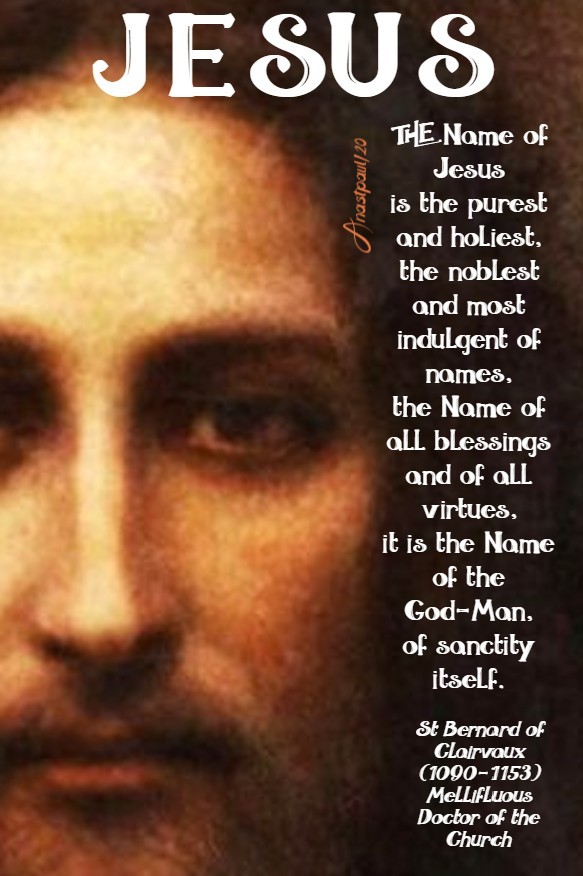
“The Name of Jesus is the purest and holiest, the noblest and most indulgent of names, the Name of all blessings and of all virtues, it is the Name of the God-Man, of sanctity itself.”
St Bernard of Clairvaux (1090-1153) Mellifluous Doctor of the Church
St Abercius Bl Albert of Bologna St Alexander of Edessa St Althryda St Anastasius of Brescia St Aquila of Egypt Bl Arnaldo Serra and Companions St Asterius of Edessa St Austregisilus of Bourges (c 551-624) Bishop St Basilla of Rome St Baudelius of Nîmes St Codrato
St Plautilla of Rome St Protasius Chong Kuk-bo St Rafaél García Torres St Talaleo of Egea St Thalalaeus of Edessa St Theodore of Pavia St Tomás Valera González
Our Morning Offering – 19 May – “The Month of the Blessed Virgin Mary”
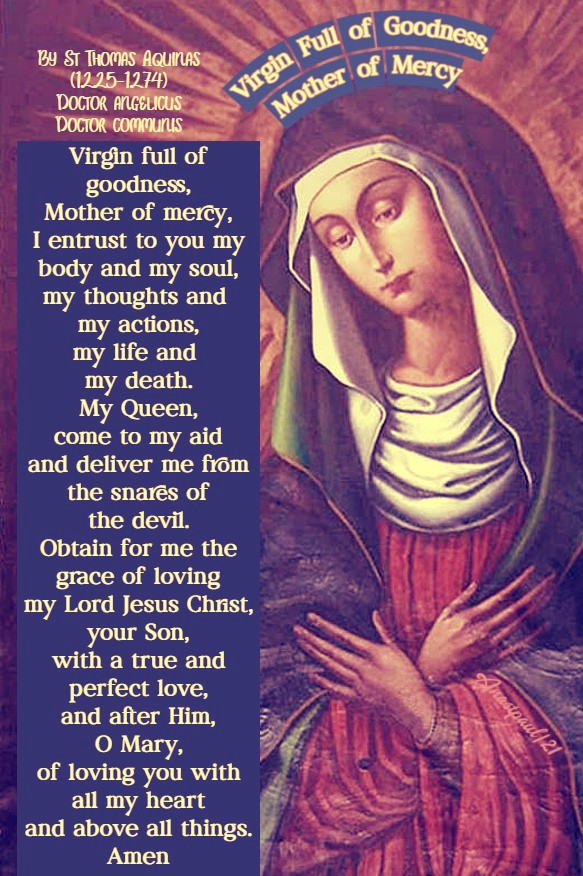
Virgin Full of Goodness, Mother of Mercy By St Thomas Aquinas (1225-1274) Doctor angelicus Doctor communis
Virgin full of goodness, Mother of mercy, I entrust to you my body and my soul, my thoughts and my actions, my life and my death. My Queen, come to my aid and deliver me from the snares of the devil. Obtain for me the grace of loving my Lord Jesus Christ, your Son, with a true and perfect love, and after Him, O Mary, of loving you with all my heart and above all things. Amen.
St Crispin of Viterbo St Cyriaca of Nicomedia and Companions St Cyril of Trèves St Dunstan of Canterbury (909-988) Bishop of London, Worcester then Archbishop of Canterbury St Evonio of Auvergne
Bercthun of Beverley Bertha of Bingen St Caecilius of Granada St Caesarea of Otranto St Cassius of Clermont Bl Clemente of Bressanone St Colman Mc O’Laoighse St Ctesiphon of Verga Blessed Diego of Valdieri
St Hesychius of Gibraltar St Hilary of Galeata St Indaletius of Urci St Isaias St Isidore of Chios Bl Joan Montpeó Masip St Maximus of Clermont St Nicholas the Mystic St Rupert of Bingen St Secundus of Avila St Simplicius of Sardinia St Sophia of Rome St Victorinus of Clermont St Waldalenus of Beze
St Boniface of Ferentino St Boniface of Tarsus St Corona the Martyr St Costanzo of Capri St Costanzo of Vercelli Bl Diego of Narbonne St Dyfan St Engelmer St Erembert of Toulouse St Felice of Aquileia St Fortunatus of Aquileia St Gal of Clermont-Ferrand
St Henedina of Sardinia St Justa of Sardinia St Justina of Sardinia St Maria Domenica Mazzarello FMA (1837-1881) Virgin, Religious Sister and Founder with St John Bosco of the Daughters of Mary Help of Christians. They were founded to work alongside Saint John Bosco and his Salesians of Don Bosco in his teaching projects in Turin. They continue to be a teaching Order worldwide and are now called the Salesian Sisters of St John Bosco.Her Body is incorrupt.
St Pons of Pradleves St Pontius of Cimiez St Tuto of Regensburg St Victor the Martyr
Martyrs of Seoul – 5 Beata: A group of lay people Nartyred together in the apostolic vicariate of Korea. • Petrus Choe Pil-je • Lucia Yun Un-hye • Candida Jeong Bok-hye • Thaddeus Jeong In-hyeok • Carolus Jeong Cheol-sang 14 May 1801 at the Small West Gate, Seoul, South Korea
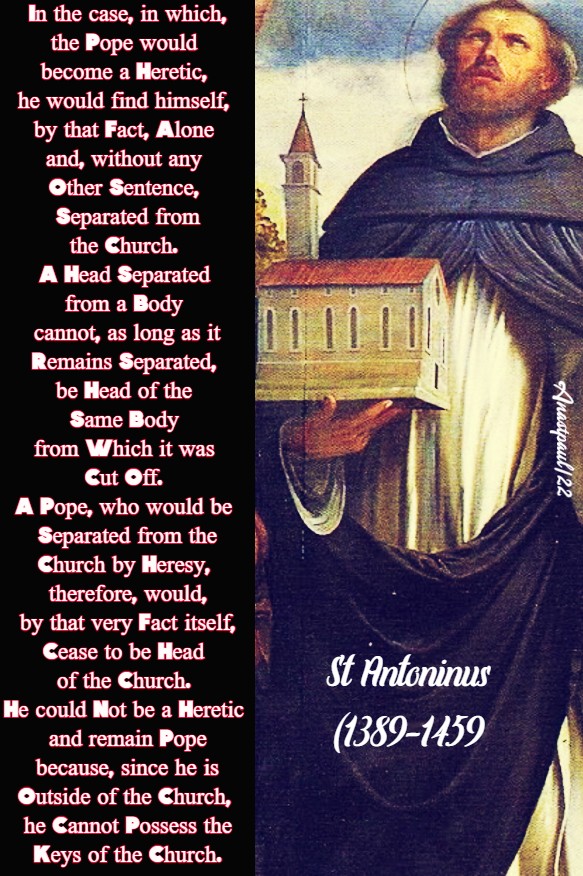
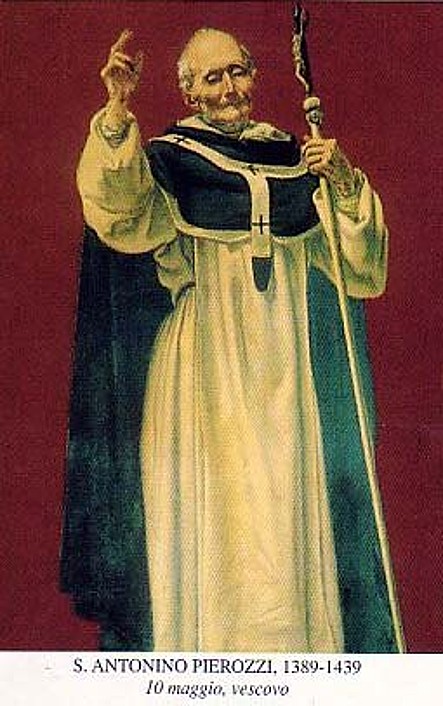
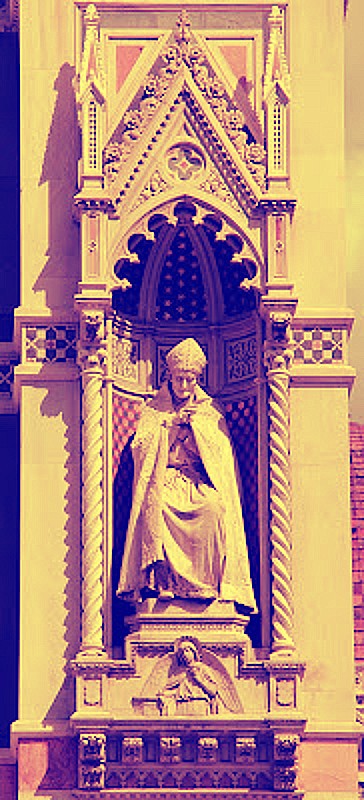
Quote of the Day – 10 May – The Memorial of St Antoninus OP (1389-1459) Archbishop of Florence
“In the case, in which, the Pope would become a heretic, he would find himself, by that fact, alone and, without any other sentence, separated from the Church. A head separated from a body cannot, as long as it remains separated, be head of the same body from which it was cut off. A Pope, who would be separated from the Church by heresy, therefore, would, by that very fact itself, cease to be head of the Church. He could not be a heretic and remain Pope because, since he is outside of the Church, he cannot possess the keys of the Church.”
Saint of the Day – 10 May – Saint Antoninus of Florence OP (1389-1459) Archbishop of Florence, Dominican Priest and Friar, Confessor, Spiritual Director, Apostle of Mercy, Theologian, Writer, Reformer, Prior of the Order. Known as “Antoninus the Counsellor.”
The Roman Martyrology reads: “At Florence, the Bishop St Antoninus, of the Order of Preachers, renowned for holiness and learning.”
Saint Antoninus, Bishop and Confessor By Abbot Prosper Guéranger OSB (1805-1875)
“Antoninus was born at Florence, of respectable parents. He gave great promise, even when quite a child, of his later sanctity. Having at the age of sixteen, entered the Religious Order of Friars Preachers, he at once became an object of admiration, by the practice of the highest virtues. He declared ceaseless war against idleness. After taking a short sleep at night, he was the first at the Office of Matins; which over, he spent the remainder of the night in prayer, or reading, or writing. If at times, he felt himself oppressed with unwelcome sleep, owing to fatigue, he would lean his head, for a while, against the wall and then, shaking off the drowsiness, he resumed his holy vigils with renewed earnestness.
Being a most rigid observer of Religious discipline, he never ate flesh-meat, save in the case of severe illness. His bed was the ground, or a naked board. He always wore a hair shirt, and sometimes an iron girdle next to his skin. He observed the strictest chastity during his whole life. Such was his prudence in giving counsel, that he went under the name of Antoninus the Counsellor. He so excelled in humility, that, even when Prior and Provincial, he used to fulfil, with the utmost self-abjection, the lowest duties of the Monastery.
He was made Archbishop of Florence by Pope Eugenius the Fourth. Great was his reluctance to accept such a dignity: nor would he have consented, had it not been out of fear of incurring the spiritual penalties, wherewith he was threatened by the Pope.
It would be difficult to describe the prudence, piety, charity, meekness and apostolic zeal, wherewith he discharged his Episcopal Office. He learned almost all the sciences to perfection and, what is surprising, he accomplished this by his own extraordinary talent, without having any master to teach him.
Finally, after many labours and after having published several learned books, he fell sick. Having received the Holy Eucharist and Extreme Unction, embracing the Crucifix, he joyfully welcomed death, on the sixth of the Nones of May (2 May), in the year 1459. He was illustrious for the miracles which he wrought during his life, as also for those, which followed after his death. He was Canonised by Pope Adrian the Sixth, in the year of our Lord 1523.
St Joseph de Veuster SS.CC. (1840-1889) – St Damian of Molokai “The Martyr of Molokai,” Priest of the Congregation of the Sacred Hearts of Jesus and Mary, Missionary – known as “Martyr of Molokai”, “Martyr of Charity”, “Apostle to the Lepers” – Patron of lepers. (Optional Memorial) St Damian’s life: https://anastpaul.wordpress.com/2017/05/10/10-may-the-memorial-of-st-damian-de-veuster-de-molokai/
St Alphius of Lentini Bl Amalarius of Metz Bl Antonio of Norcia St Aurelian of Limoges Bl Beatrix d’Este the Elder St Blanda of Rome St Calepodius of Rome
Bl Nicholas Albergati St Palmatius of Rome St Philadelphus of Lentini St Quartus of Capua St Quintus of Capua St Simplicius of Rome St Solange of Bourges St Thecla Bl William of Pontnoise
One Minute Reflection – 8 May – The Third Sunday after Easter – 1 Peter 2:11-19, John 16:16-22 and the Feast of the Apparition of St Michael the Archangel at Monte Gargano, Italy (492)
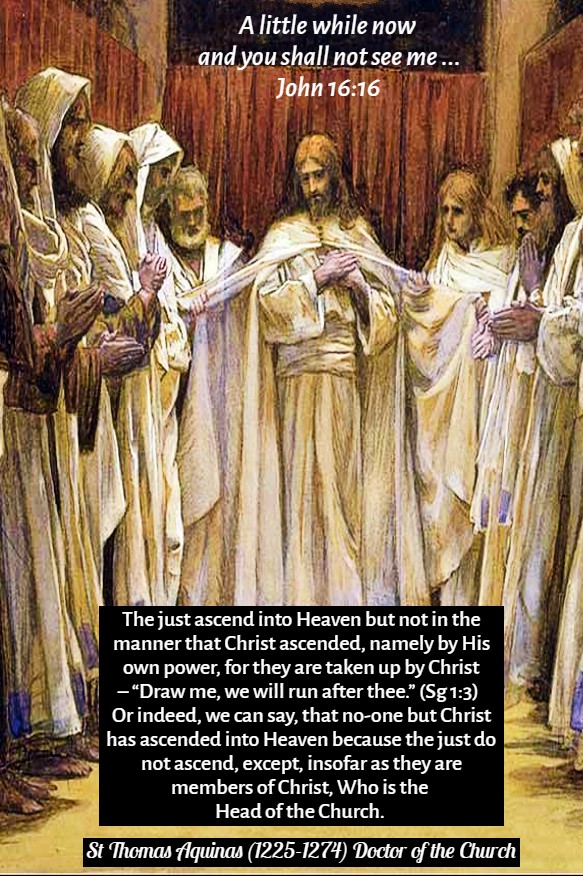
“A little while now and you shall not see me” – John 16:16
REFLECTION – “The Ascension of Christ into Heaven is in accord with reason – firstly, because Heaven was due to Christ by His very nature. It is natural for someone to return to the place from whence they take their origin. The beginning of Christ is from God, Who is above all things. Jesus says to the Apostles (Jn 16:28): “I came from the Father and have come into the world and now I am leaving the world and going back to the Father” … The just ascend into Heaven but not in the manner that Christ ascended, namely by His own power, for they are taken up by Christ – “Draw me, we will run after thee.” (Sg 1:3) Or indeed, we can say, that no-one but Christ has ascended into Heaven because the just do not ascend, except, insofar as they are members of Christ, Who is the Head of the Church. … Secondly, Heaven is due to Christ because of His Victory. For He was sent into the world to combat the devil and He did overcome him. Therefore, Christ deserved to be exalted above all things – “I myself first won the victory and sit with my Father on His throne” (Rv 3:21)
Finally, the Ascension was owing to Christ because of His humility. There never was humility so great as that of Christ Who, although He was God yet wished to become man and although He was the Lord, yet He wished to take the form of a servant and, as Saint Paul says: “He was obedient even unto death” (Phil 2:7) and descended even into hell. Therefore, He deserved to be exalted even to Heaven, to God’s throne, for humility leads to exaltation. “For whoever humbles himself will be exalted” (Lk 14:11) and, “the one who descended is also the one who ascended far above all the heavens” (Eph 4:10).” … St Thomas Aquinas (1225-1274) Doctor Angelicus/Doctor Communis (Commentary on the Apostle’s Creed).
PRAYER – O God, Who hast ordained and constituted the services of angels and men in a wonderful order, mercifully grant, that as Thy holy Angels alway do Thee service in Heaven, so, by Thy appointment, they may succour and defend us on earth. Through Jesus Christ, Thy Son our Lord, Who lives and reigns with Thee, in the unity of the Holy Ghost, God, world without end. Amen (Collect).
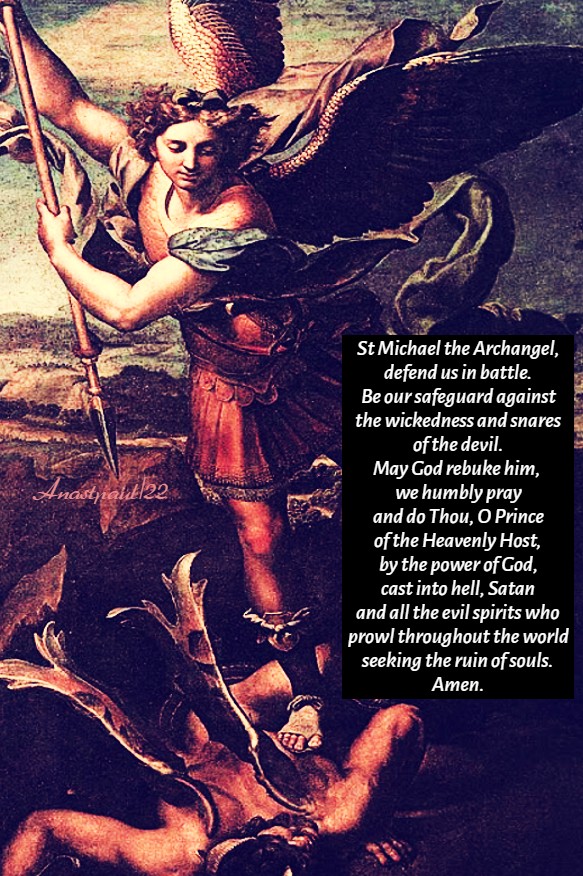
St Michael the Archangel, defend us in battle. Be our safeguard against the wickedness and snares of the devil. May God rebuke him, we humbly pray and do Thou, O Prince of the Heavenly Host, by the power of God, cast into hell, Satan and all the evil spirits who prowl throughout the world seeking the ruin of souls. Amen.
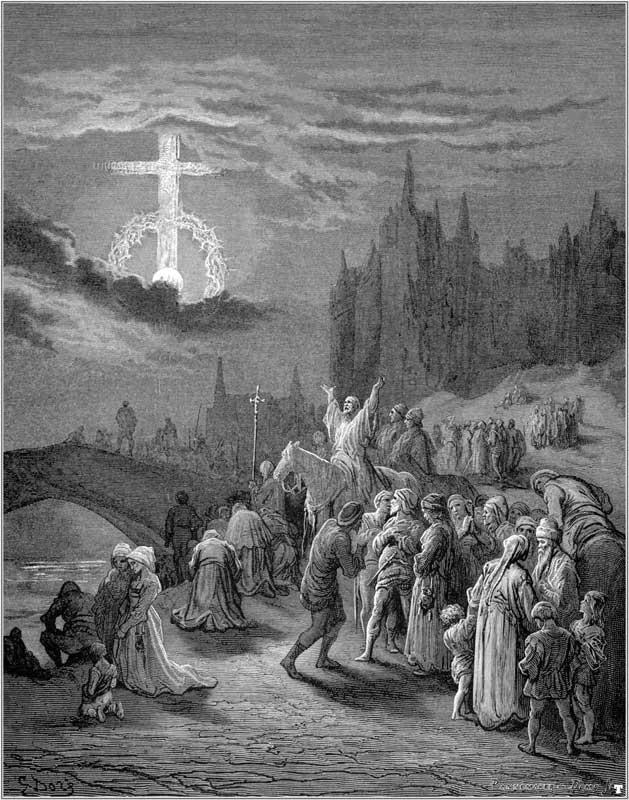
The Apparition of the Holy Cross over Jerusalem: The Commemoration of the appearance on 7 May 351, Pentecost that year, of a luminous image of the Holy Cross in Jerusalem. It stretched from Mount Golgotha to the Mount of Olives (about two miles / three kilometers), was brighter than the sun, lasted several hours and was seen by the entire City. It led to many conversions and was reported in a letter attributed to Saint Cyril of Jerusalem.
Bl Agnellus of Pisa OFM (c 1195-1236) Bl Antonio de Agramunt St Augustine of Nicomedia St Augustus of Nicomedia St Cerenico of Spoleto St Domitian of Huy St Duje
St Flavia Domitilla of Terracina (1st Century) Virgin Martyr. The Roman Martyrology states of her today: “At Terracina, in Campania, the birthday of blessed Flavia Domitilla, Virgin and Martyr, niece of the Consul Flavius Clemens. She received the religious veil at the hands of St Clement and in the persecution of Domitian, was exiled with many others to the island of Pontia, where she endured a long Martyrdom for Christ. Taken afterwards to Terracina, she converted many to the faith of Christ by her teaching and miracles. The judge ordered the chamber in which she was, with the virgins Euphrosina and Theodora, to be set on fire and she thus consummated her glorious Martyrdom. She is also mentioned with the holy Martyrs Nereus and Achilleus, on the 12th of this month.” Her Life and Death: https://anastpaul.com/2021/05/07/saint-of-the-day-7-may-saint-flavia-domitilla-of-terracina-1st-century-virgin-and-martyr/
St Flavius of Nicomedia Bl Francesco Paleari Bl Gisela of Ungarn Bl Jan Eugeniusz Bajewski St John of Beverley (Died 721) Bishop St Juvenal of Benevento St Maurelius of Voghenza-Ferrara Bl Miqael of Ulompo St Peter of Pavia St Placid of Autun St Quadratus of Herbipolis St Quadratus of Nicomedia
St Pius V OP (1504-1573) changed in 1969 this feast which had been celebrated on this day of his birth into Heaven since 1713. Bishop of Rome, Ruler of the Papal States, Pope of the Council of Trent, the Counter-Reformation, the Battle of Lepanto, the Holy Rosary and the Pope who declared St Thomas Aquinas as a Doctor of the Church (Optional Memorial) The Roman Martyrology states of St Pius V today: “At Rome, Pope St Pius V, of the Order of Preachers, who laboured zealously and successfully for the re-establishment of Ecclesiastical discipline, the extirpation of heresies, the destruction of the enemies of the Christian name and, governed the Catholic Church by holy laws and the example of a saintly lfe.” His Life: https://anastpaul.com/2019/04/30/saint-of-the-day-saint-pope-pius-v-1504-1572/ Lepanto by G K Chesterton: https://anastpaul.com/2019/04/30/lepanto-30-april/
St Crescentiana St Echa of Crayke St Eulogius of Edessa St Euthymius of Alexandria St Geruntius of Milan St Godehard of Hildesheim Bl Grzegorz Boleslaw Frackowiak St Hilary of Arles (c 400-449) Bishop
St Hydroc St Irenaeus of Thessalonica St Irenes of Thessalonica Bl John Haile St Jovinian of Auxerre St Jutta Kulmsee St Leo of Africo St Maurontius of Douai St Maximus of Jerusalem St Nectarius of Vienne St Nicetas of Vienne
Quote/s of the Day – 30 April – The Memorial of St Catherine of Siena (1347-1380) Virgin, Doctor of the Church
“Enrich your soul in the great goodness of God – The Father is your Table, the Son is your Food and the Holy Spirit waits on you and then makes His Dwelling in you.”
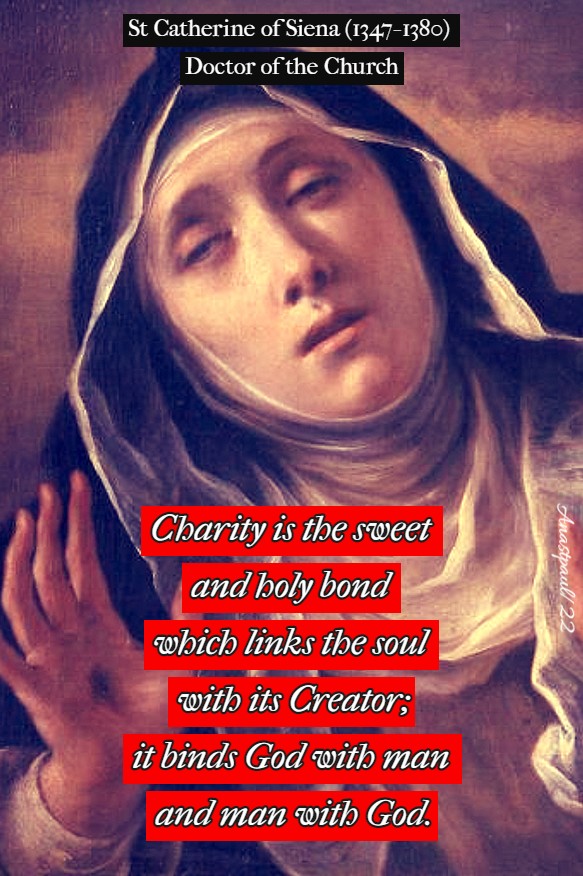
“Charity is the sweet and holy bond which links the soul with its Creator; it binds God with man and man with God.”
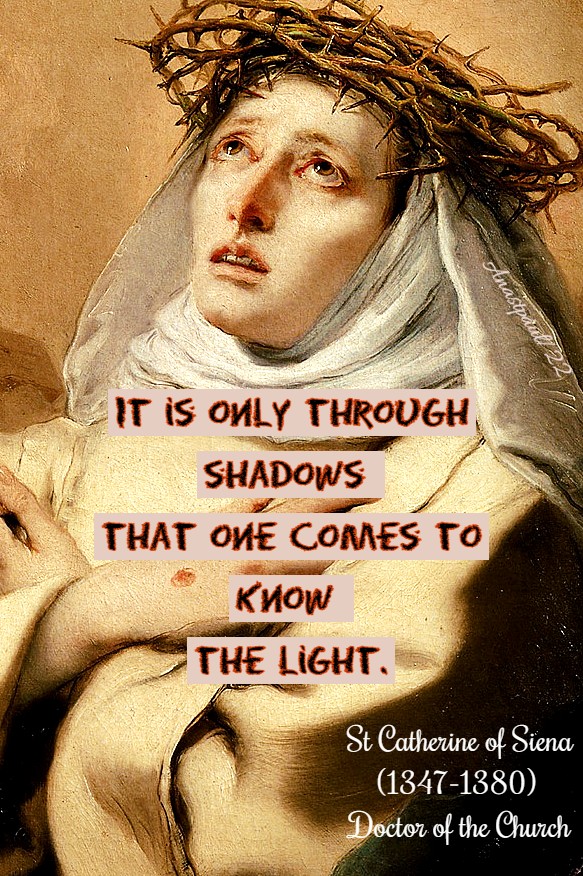
“It is only through shadows that one comes to know the light.”
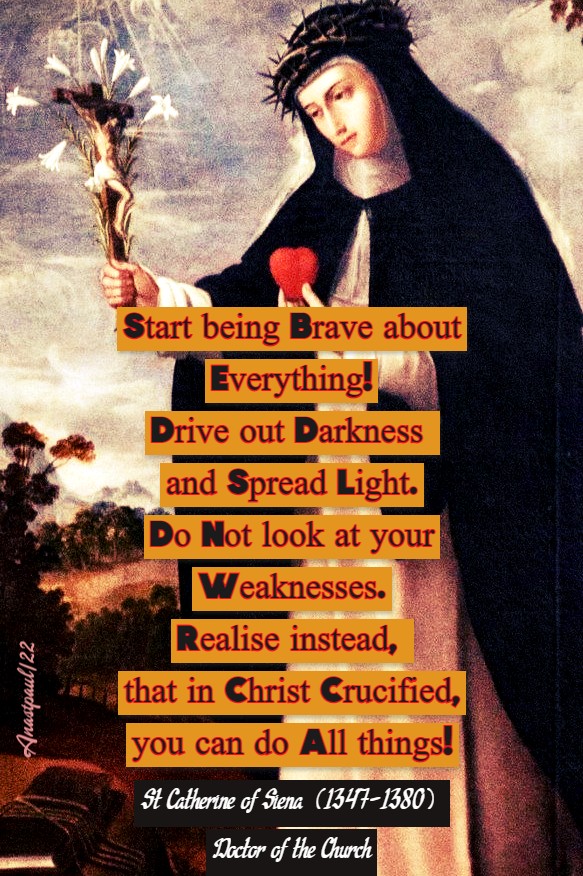
“Start being brave about everything! Drive out darkness and spread light. Do not look at your weaknesses. Realise instead, that in Christ Crucified, you can do all things.”
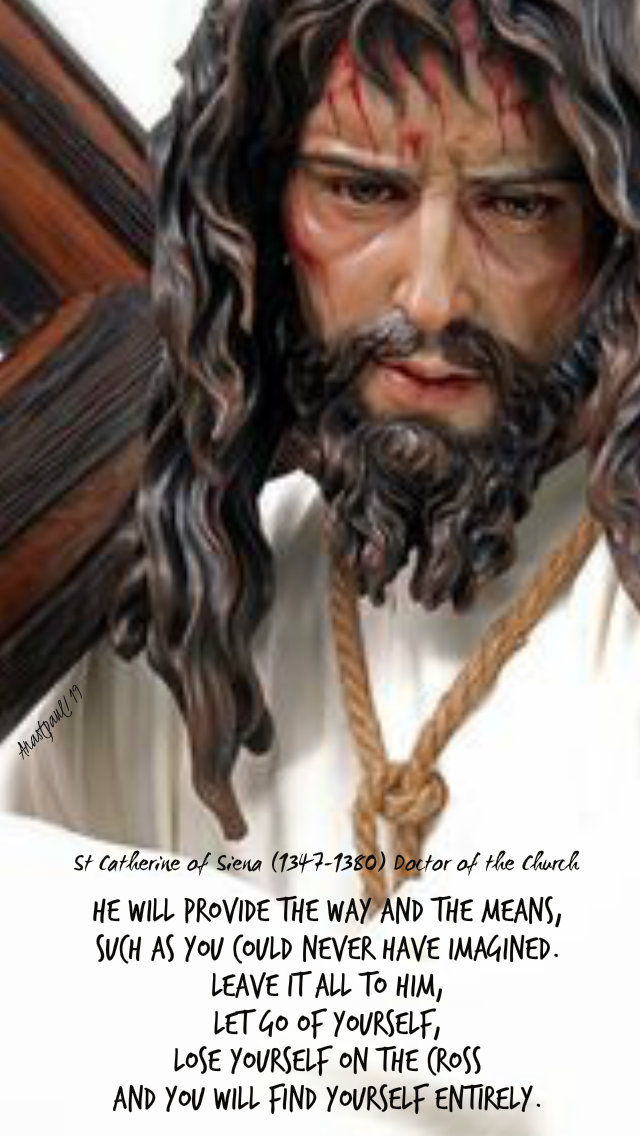
“He will provide the way and the means, such as you could never have imagined. Leave it all to Him, let go of yourself, lose yourself on the Cross and you will find yourself entirely.”
St Catherine of Siena (1347-1380) Doctor of the Church
St Lawrence of Novara St Louis of Córdoba St Mariano of Acerenza St Maximus of Ephesus St Mercurialis of Forlì St Peter of Córdoba St Pomponius of Naples St Quirinus of Rome St Rodopiano of Aphrodisias St Sophia of Fermo St Swithbert the Younger Bl Ventura of Spello Bl William Southerne
Martyrs of Montpellier: A group of 70 Mercedarian Friars, led by Blessed Luigi Puell, who were Martyred by Huguenots for trying to bring people back to the Catholic Church. They were Martyred in 1567 in Montpellier, France.
One Minute Reflection – 29 April – The Memorial of St Peter Martyr of Verona OP (1205–1252) Martyr, Priest – 2 Timothy 2:8-10; 3:10-12, John 15:1-7
“I am the vine, you the branches; he who abides in me and I in him, the same bears much fruit; for without me you can do nothing.” – John 15:5
REFLECTION –“The Lord calls Himself, the vine and those united to Him, branches, in order to teach us how much we shall benefit from our union with Him and how important it is for us to remain in His love. By receiving the Holy Spirit, Who is the bond of union between us and Christ our Saviour, those who are joined to Him, as branches are to a vine, share in His own nature.
On the part of those who come to the vine, their union with Him depends upon a deliberate act of the will; on His part, the union is effected by grace. Because we had goodwill, we made the act of faith that brought us to Christ,and received from Him, the dignity of adoptive sonship which made us His own kinsmen, according to the words of Saint Paul: – He who is joined to the Lord is one spirit with Him.
The prophet Isaiah calls Christ the foundation because, it is upon Him that we as living and spiritual stone, are built into a holy priesthood to be a dwelling place for God in the Spirit. Upon no other foundation than Christ, can this temple be built. Here Christ is teaching the same truth by calling Himself the vine, since the vine is the parent of its branches and provides their nourishment.
From Christ and in Christ, we have been reborn through the Spirit, in order to bear the fruit of life; not the fruit of our old, sinful life but the fruit of a new life, founded upon our faith in Him and our love for Him. Like branches growing from a vine, we now draw our life from Christ and we cling to His holy commandment in order to preserve this life. Eager to safeguard the blessing of our noble birth, we are careful not to grieve the Holy Spirit Who dwells in us and Who makes us aware of God’s presence in us.
Let the wisdom of John teach us how we live in Christ and Christ lives in us – The proof that we are living in Him and He is living in us, is that He has given us a share in His Spirit. Just as the trunk of the vine gives its own natural properties to each of its branches, so, by bestowing on them the Holy Spirit, the Word of God, the Only-Begotten Son of the Father, gives Christians a certain kinship with Himself and with God the Father because they have been united to Him by faith and determination to do His will in all things. He helps them to grow in love and reverence for God and teaches them to discern right from wrong and to act with integrity.” – St Cyril of Alexandria (376-444) Archbishop of Alexandria, Father and Doctor of the Church (An excerpt from: Commentary on the Gospel of John).
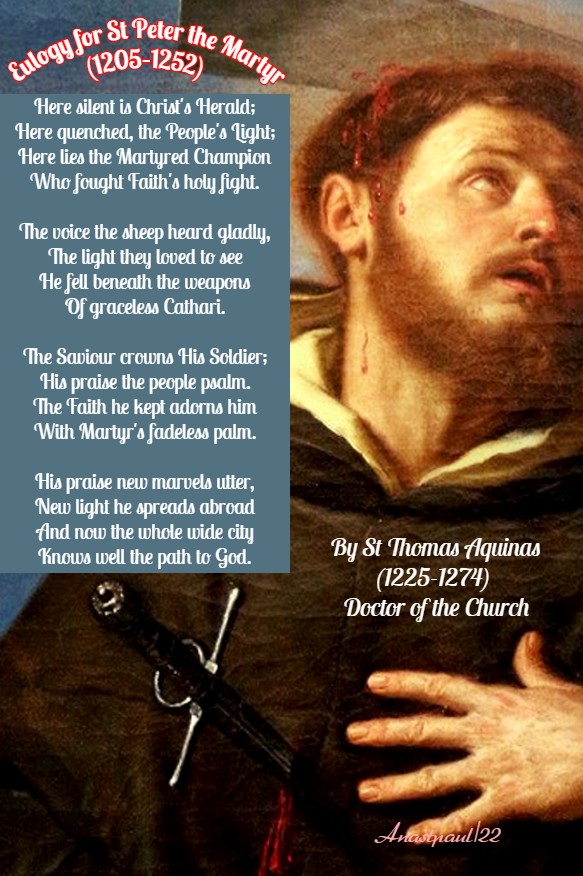
PRAYER – Saint Thomas Aquinas in Eulogy for Saint Peter the Martyr Here silent is Christ’s Herald; Here quenched, the People’s Light; Here lies the Martyred Champion Who fought Faith’s holy fight.
The voice the sheep heard gladly, The light they loved to see He fell beneath the weapons Of graceless Cathari.
The Saviour crowns His Soldier; His praise the people psalm. The Faith he kept adorns him With Martyr’s fadeless palm.
His praise new marvels utter, New light he spreads abroad And now the whole wide city Knows well the path to God.
St Pollio of Cybalae St Simeon of Jerusalem St Stephen of Tarsus St Tertullian of Bologna St Theophilus of Brescia St Winewald of Beverley
St Zita of Lucca (1212-1272) Virgin, Laywoman, Apostle of the Poor. – Her reputation was such that Dante in the Inferno referred to the City of Luccam, her birthplace and home, as “Santa Zita.” P atronages – housewives, butlers, housemaid, domestic servants (proclaimed by Pope Pius XII), housemaid, lost keys, maids, manservants, people ridiculed for their piety, rape victims, servants, servers, single laywomen, waiters, Lucca, Italy. Her body is incorrupt. Biography:. https://anastpaul.wordpress.com/2017/04/27/saint-of-the-day-27-april-st-zita-of-lucca/
Martyrs of Nicomedia: A group of Christians murdered together for their faith. In most cases all we have are their names – Dioscurus, Evanthia, Felicia, Felix, Germana, Germelina, Johannes, Julius, Laetissima, Nikeforus, Papias, Serapion and Victorinus. They died at Nicomedia, Bithynia, Asia Minor (modern Izmit, Turkey).
Bl Antonio Vallesio St Apollonius of Alexandria Bl Archangelus Piacentini St Bademus St Bede the Younger St Beocca of Chertsey Bl Boniface Zukowski Bl Eberwin of Helfenstein St Ethor of Chertsey St Ezekiel the Prophet
St Malchus of Waterford Bl Marco Mattia Blessed Marcus Fantuzzi OFM (c 1405-1479) Priest
St Miguel de Sanctis O.SS.T (1591-1625) Priest of the Order of the Most Holy Trinity and of the Captives also known as the Trinitarian Order or the Trinitarians, Mystic, Penitent, Ecstatic, Apostle of prayer, mortification, of the poor and the sick, he had a special devotion to the Blessed Sacrament and would fall into ecstatic prayer during the Consecration at Holy Mass, so much so, that he became known as “El Extático”, “The Ecstatic.” Pope Pius IX Canonised Miguel on 8 June 1862. About St Miguel: https://anastpaul.com/2020/04/10/saint-of-the-day-10-april-st-miguel-de-sanctis-o-ss-t-1591-1625/
St Palladius of Auxerre St Paternus the Scot
Martyrs of Carthage – 50 Saints: A group of 50 Christians who were imprisoned in a pen of snakes and scorpions and then Martyred, all during the persecutions of Decius. Only six of their names have come down to us – Africanus, Alessandro, Massimo, Pompeius, Terence and Teodoro. Beheaded in 250 at Carthage.
Martyrs of Georgia: Approximately 6,000 Christian Monks and lay people Martyred in Georgia in 1616 for their faith by a Muslim army led by Shah Abbas I of Persia.
Martyrs of Ostia: A group of criminals who were brought to the faith by Pope Saint Alexander I while he was in prison with them. Drowned by being taken off shore from Ostia, Italy, in a boat which was then scuttled, c 115.
St Brogan St Casilda of Toledo St Concessus the Martyr St Demetrius the Martyr St Dotto St Eupsychius of Cappadocia St Gaucherius St Hedda the Abbot St Heliodorus of Mesopotamia St Hilary the Martyr St Hugh of Rouen OSB (Died 730) Bishop, Monk Bl James of Padua Blessed John of Vespignano
Martyrs of Croyland – 9 Saints: A group of Benedictine Monks Martyred by pagan Danes – Agamund, Askega, Egdred, Elfgete, Grimkeld, Sabinus, Swethin, Theodore and Ulric. Croyland Abbey, England.
Martyrs of Masyla: Massylitan Martyrs Group of Christians Martyred in Masyla in northwest Africa.
Martyrs of Pannonia: Seven Virgin-Martyrs in Sirmium, Pannonia (modern Sremska Mitrovica, Serbia).
Martyrs of Thorney Abbey – 3+ Saints: A group of Hermits, hermitesses and monks who lived in or around Thorney Abbey who were Martyred together during raids by pagan Danes. We know little more than the names of three – Tancred, Torthred and Tova. 869 by raiders at Thorney Abbey, Cambridgeshire, England.
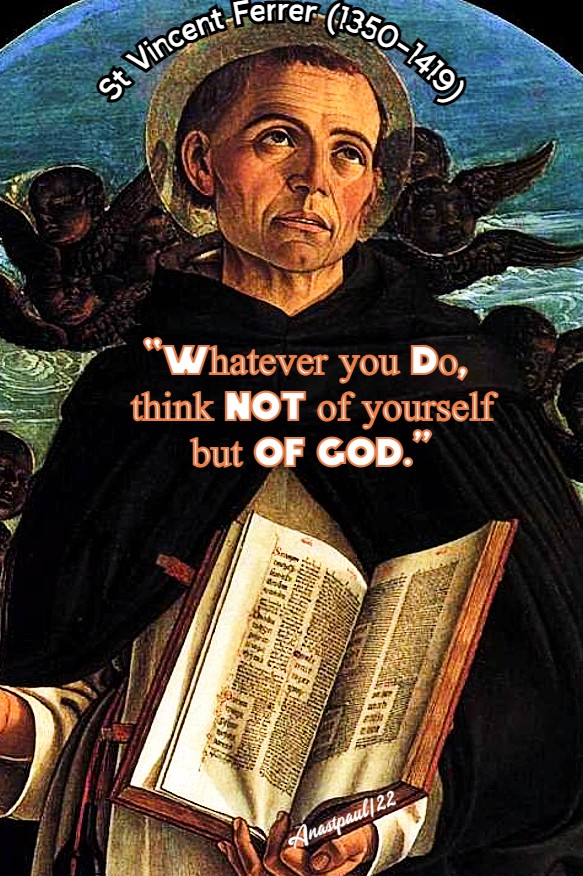
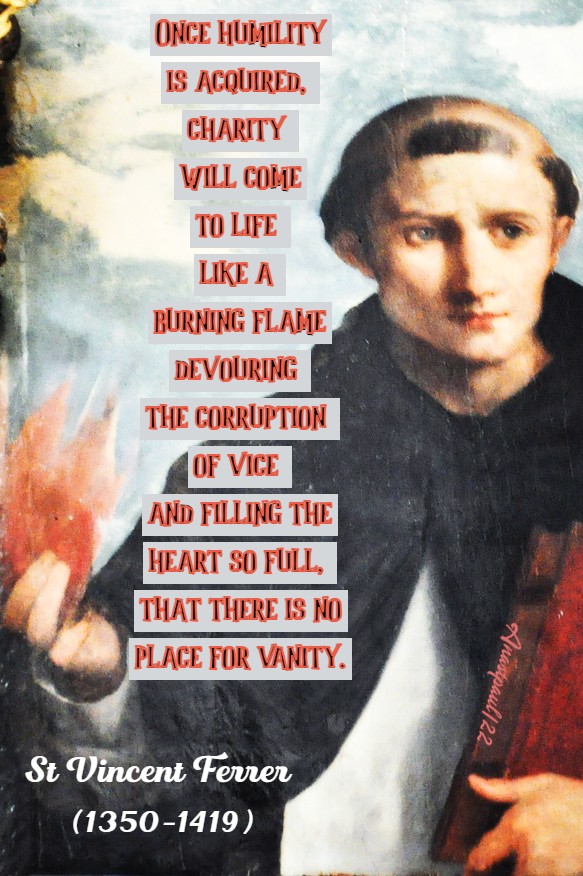
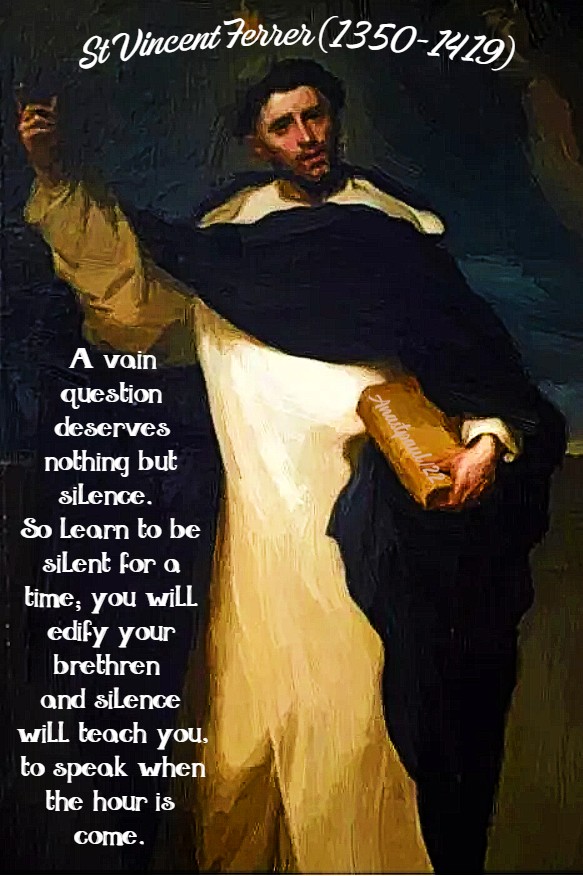
Quote/s of the Day – 5 April – Tuesday in Passion Week – and the Memorial of St Vincent Ferrer OP (1350-1419)
“Whatever you do, think NOT of yourself but OF God.”
“Once humility is acquired, charity will come to life like a burning flame devouring the corruption of vice and filling the heart so full, that there is no place for vanity.”…
“A vain question deserves nothing but silence. So learn to be silent for a time; you will edify your brethren and silence will teach you, to speak when the hour is come.”
St Pausilippus Bl Peter Cerdan St Theodore the Martyr
Martyrs of Lesbos: 5 Saints: Five young Christian women Martyred together for their faith. We don’t even know their names. island of Lesbos, Greece.
Martyrs of North-West Africa: Large group of Christians murdered while celebrating Easter Mass during the persecutions of Genseric, the Arian king of the Vandals. They were Martyred in 459 at Arbal (in modern Algeria).
Martyrs of Seleucia: 120 Saints :One-hundred and eleven (111) men and nine (9) women who, because they were Christians, were dragged to Seleucia and Martyred for refusing to worship the sun or fire or other pagan idols during the persecutions of King Shapur II. They were burned alive in 344 in Seleucia, Persia.
St John of Capistrano OFM (1386-1456) Friar of the Friars Minor, Priest, Confessor and Preacher. Famous as a preacher, theologian and inquisitor, trained lawyer, he earned himself the nickname ‘the Soldier Saint’ when in 1456 at age 70 he led a crusade against the invading Ottoman Empire at the siege of Belgrade. Feast Day moved from 28 March in 1969. Biography: https://anastpaul.com/2017/10/23/saint-of-the-day-23-october-st-john-capistrano-ofm-1386-1456-the-soldier-saint/
St Cyril the Deacon Bl Dedë Maçaj St Donal O’NeylaC St Dorotheus of Tarsus St Gundelindis of Niedermünster St Guntramnus (c 532-592) King, Confessor St Hesychius of Jerusalem St Hilarion of Pelecete Bl Jean-Baptiste Malo Bl Jeanne Marie de Maille St Proterius of Alexandria Bl Renée-Marie Feillatreau épouse Dumont St Rogatus the Martyr St Successus the Martyr St Tutilo of Saint-Gall
Quote/s of the Day – 16 March – Wednesday of the Second week of Lent – Esther 13:8-11; 15-17, Matthew 20:17-28
“Are you able to drink the cup that I am to drink?”
Matthew 20:22
“… Now is the time in this life of suffering, when we journey apart from Him. … So let us fast and pray now because, we are in the days of childbirth!”
St Augustine (354-430) Bishop of Hippo Father and Doctor of Grace
“Only let it be in the name of Jesus Christ, that I may suffer together with Him! I endure everything because He Himself, Who is perfect man, empowers me.”
St Ignatius of Antioch (c 35–107) Martyr
“Embrace, then, Jesus Crucified, raising to Him the eyes of your desire! Consider His burning love for you, which made Jesus pour out His Blood from every part of His body! Embrace Jesus crucified, loving and beloved and in Him, you will find true life because He is God made Man. Let your heart and your soul burn with the fire of love drawn from Jesus on the Cross! … You will have no other desire than to follow Jesus! Run, … do not stay asleep because time flies and does not wait one moment! Dwell in God’s sweet love!”
St Catherine of Sienna (1347-1380) Doctor of the Church
“To labour and to suffer for the One we love, is the greatest proof of our love.”
Thought for the Day – 7 March – Meditations with Antonio Cardinal Bacci (1881-1971)
ST THOMAS AQUINAS
“It is generally recognised that St Thomas Aquinas was a great Philosopher and Theologian. The Cartesian Philosopher, Jourdain , said of him, that no other man had come so near to being infallible! The eclectic Philosopher, Cousin, referred to the Summa Theologiae, as one of the greatest masterpieces of human genius. Dante celebrated in immortal verse, this wonderful synthesis of thought. When he Canonised St Thomas, John XXII declared that “every article he wrote was a miracle!”
One might say that St Thomas Aquinas was raised up by God, for he gathered together, the whole of human knowledge up to his own time and interpreted it in the new light of Christianity. He ordered it into a complete compact body of philosophical and theological doctrine, to serve as an impregnable defence against the errors of his own and later times.
In spite of his greatness, however, Thomas of Aquin, was a very humble man. There is a good deal of truth in Pascal’s remark that a little knowledge makes the mind proud but real wisdom makes it humble.
We cannot all imitate the knowledge of St Thomas Aquinas but we should all imitate his humility.”
You must be logged in to post a comment.