St John Leonardi (1541-1609) (Optional Memorial) Priest, Founder of the Clerks Regular of the Mother of God of Lucca, wherein he assumed the name of “Giovanni of the Mother of God”, Confessor, Reformer, Apostle of the Holy Eucharist and Eucharistic Adoration, Marian devotee. Biography here: https://anastpaul.wordpress.com/2017/10/09/saint-of-the-day-9-october-st-john-leonardi-1541-1609/
Bl Aaron of Cracow St Abraham the Patriarch St Alfanus of Salerno St Andronicus of Antioch St Athanasia of Antioch Bl Bernard of Rodez St Demetrius of Alexandria St Deusdedit of Montecassino St Domninus St Dorotheus of Alexandria St Donnino of Città di Castello (Died 610) Lay Hermit St Eleutherius St Geminus St Gislenus St Goswin Bl Gunther
St Publia St Rusticus St Sabinus of the Lavedan St Valerius — Martyrs of the Spanish Civil War – Martyrs of Astoria – (9 saints): Also known as Martyrs of Turon: A group of Brothers of the Christian Schools and a Passionist priest martyred in the persecutions during the Spanish Civil War. They are – • Aniceto Adolfo • Augusto Andrés • Benito de Jesús • Benjamín Julián • Cirilo Bertrán • Inocencio de la Immaculada • Julián Alfredo • Marciano José • Victoriano Pío They were martyred on 9 October 1934 in Turón, Spain and Canonised on 21 November 1999 by St Pope John Paul II. — Martyrs of Laodicea – (3 saints): Three Christians martyred together in Laodicea, but no other information about them has survived but their names – Didymus, Diodorus and Diomedes. They were martyred in Laodicea, Syria.
Quote/s of the Day – 8 October– The Memorial of St Bridget of Sweden (c 1303 – 1373)
“O Lord, make haste and illumine the night. Say to my soul that nothing happens without You permitting it and that nothing of what You permit, is without comfort.”
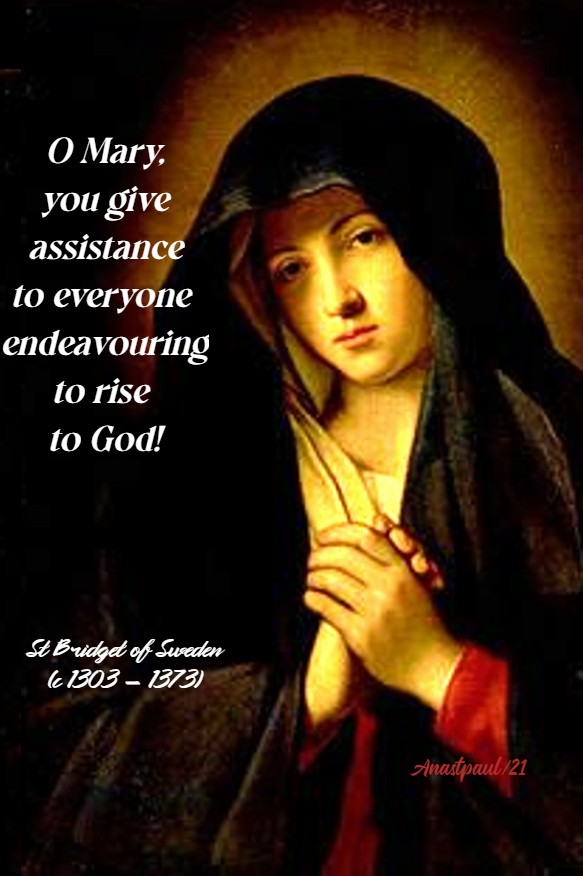
“O Mary, you give assistance to everyone endeavouring to rise to God!”
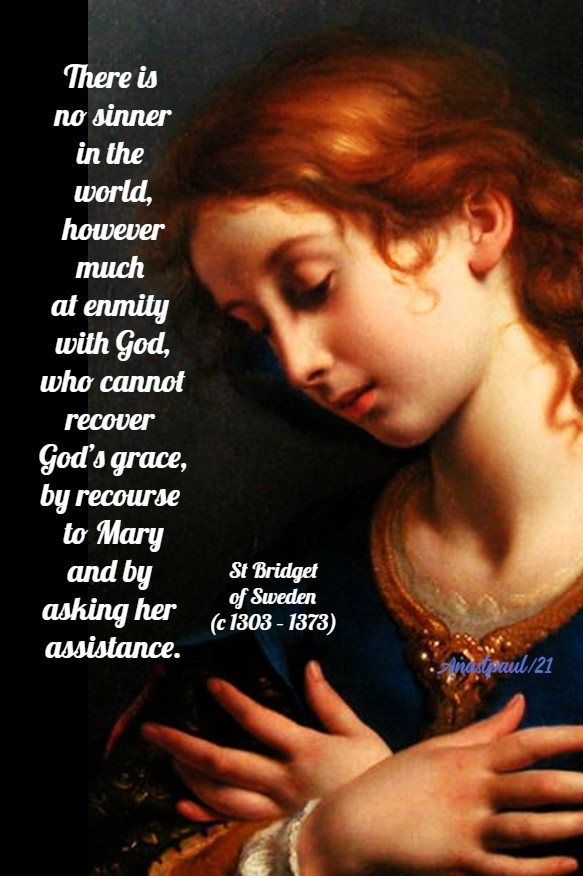
“There is no sinner in the world, however much at enmity with God, who cannot recover God’s grace, by recourse to Mary and by asking her assistance.”
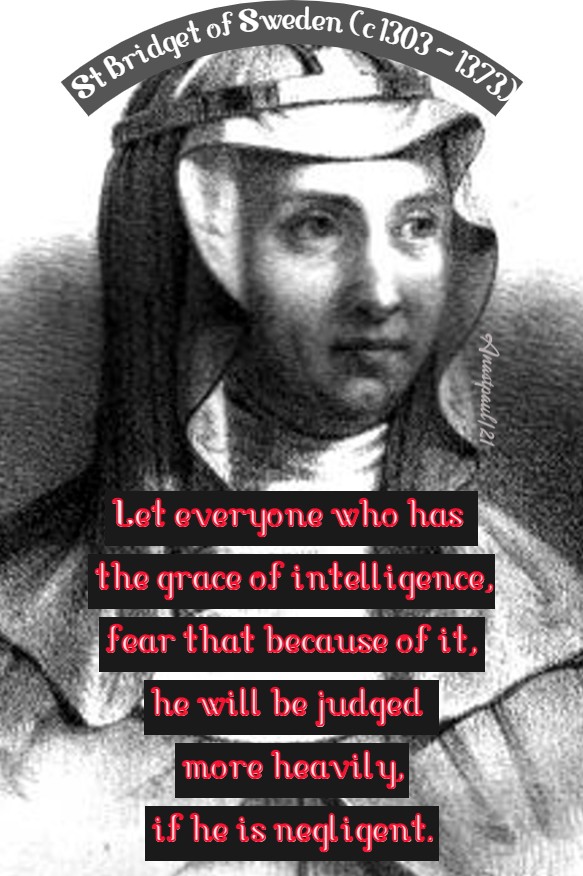
“Let everyone who has the grace of intelligence, fear that because of it, he will be judged more heavily, if he is negligent.”
Saint of the Day – 8 October – Saint Felix of Como (Died 390) the first Bishop of Como. Felix was a friend of Saint Ambrose, who praised him for his missionary activity and Ordained him a Priest in 379 and Consecrated him as Bishop in 386. St Ambrose sent him to evangelise the City of Como, as a testimony to the great missionary drive of the Church of Milan. When St Bassianus of Lodi (c 320 – 413 – feast day 10 June) built a Church dedicated to the Apostles at Lodi, he Consecrated it in the presence of Saints Ambrose and Felix. St Felix is honoured as a zealous shepherd of souls. Additional Memorials – 31 August in Milan and 14 July on some calendars.
The Roman Martyrology states: “In Como, St Felix, Bishop, who, Ordained by St Ambrose of Milan, was the first to rule the Church of this City.”
The first document that presents Felix, is a letter from St Ambrose of Milan, from which it is noted that the recent evangelisation work of the first Bishop, Felix, although it had led to the conversion of many people, required the indispensable and constant collaboration of some co-operators: “I know well that you do not lack work in the vineyard of the Lord, especially because there are few workers with you, who can help us but, this lament is old and too well known to us: the Hand of God, however, has not shortened; He will help you in your need and will send you new workers to harvest the grain of the Lord. I thank the Lord very much, He, Who favoured you in the conversion of these souls and cordially congratulate you, hearing how many of these citizens of Como have already accepted the Catholic faith.”
From the full text of the letter, which is undated, it appears that Felix enjoyed the familiarity and paternal predilection of Saint Ambrose, who had conferred on him the Episcopal Consecration on Sunday 1 November, almost certainly in 386 and had sent him to the Consecration of the Basilica of the Apostles built by St Bassianus in Lodi, Bishop of that City, who longed for the presence of the Bishop of Como.
In another letter, of exquisitely familiar and friendly tone, commonly ascribed to the year 387, Ambrose thanks Felix for the gift of a basket of truffles but also complains that he visits him too rarely.
According to an ancient tradition, Felix would have erected the first Church of Como on the open slope of the Baradello hill, in honour of the Saints Carpoforo and fellow martyrs and in it buried their bodies.
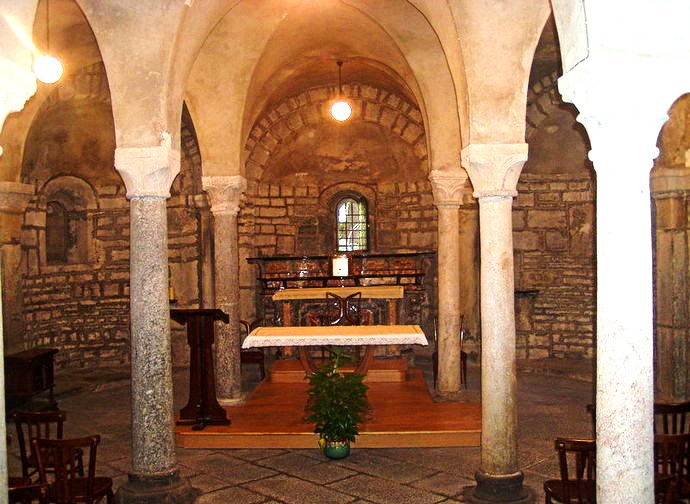
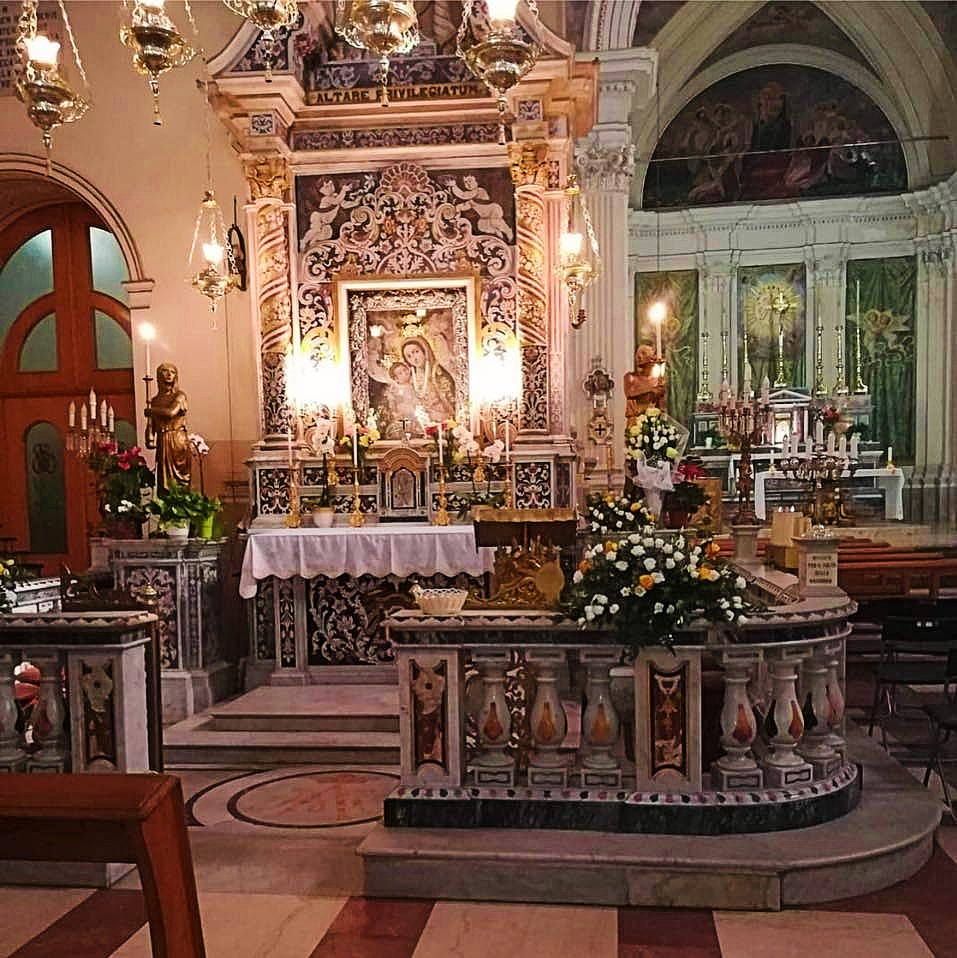
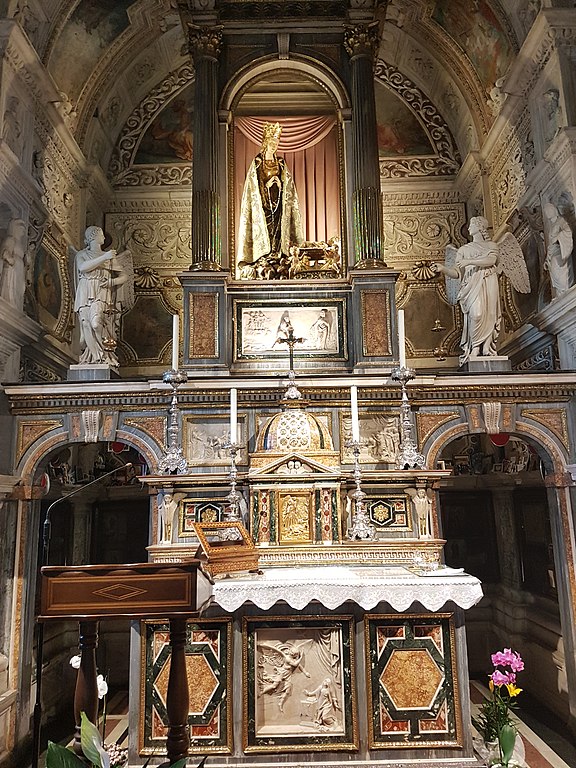
Tradition has handed down 8 October as the date of Felix’s death, also his feast day. He was buried in the primitive Church of San Carpoforo and subsequently in the enlarged Basilica of the same name, until, in 1932, his body was transferred to the new Parish Church of San Brigida, where his cult is still alive and placed under the main Altar.
A very unclear picture but it seems to be the Shrine of St Felix in the Church of St Brigid in Como
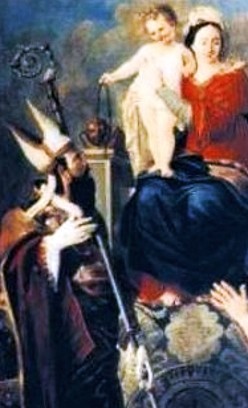
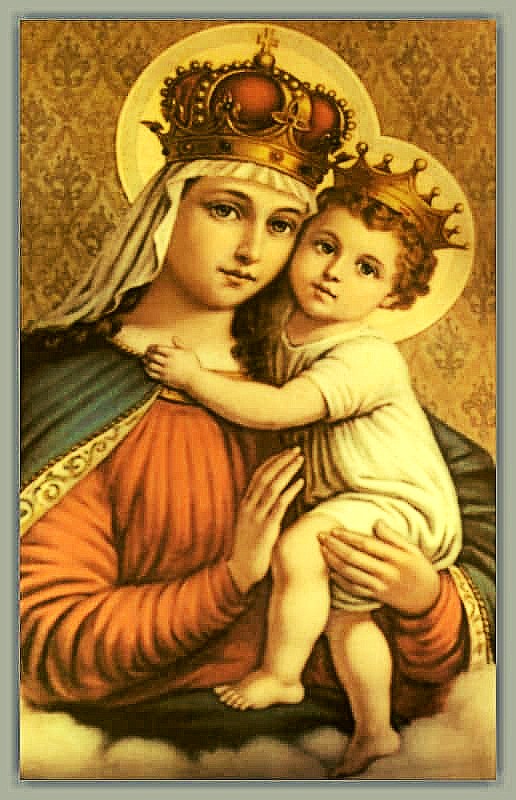
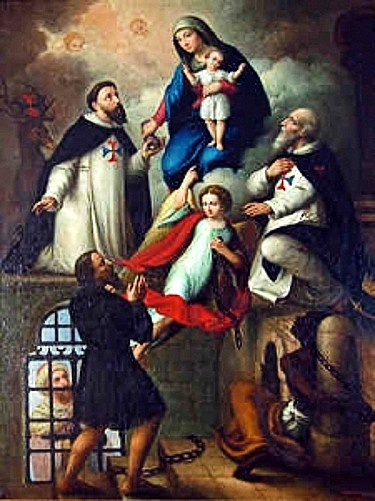
Notre-Dame du Bon Remède / Our Lady of Good Remedy, France (1197) – 8 October:
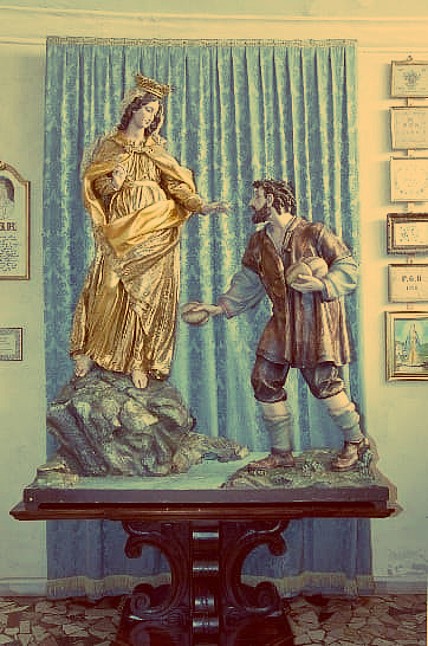
In 1197, a Sorbonne Doctor of Theology and newly Ordained Priest, Jean de Matha, while saying his first Holy Mass, saw a vision of an Angel with a red and blue cross on his chest and his hands resting on the heads of two captives. The following year, St Jean founded a religious order dedicated to the redemption of Christians held as slaves by Moslems — the Hospitaler Order of the Most Holy Trinity and of Captives, commonly called the Trinitarians. On their habit, Jean placed the Cross he had seen on the Angel,and, as their Patron, he gave them Notre-Dame du Bon Remède, a popular devotion in his Provençal homeland. Now devoted largely to education and evangelisation, for three centuries they raised funds and travelled from Europe into Africa to buy thousands of captives’ freedom with Our Lady’s help. A painting (right) in the Trinitarian Motherhouse of Cerfroid in northern France, shows Our Lady of Good Remedy giving a bag of money to St Jean/John of Matha, while a grateful freedman and St Felix of Valois, look on. The Order celebrates her feast day 8 October.
800 years ago Christians were being captured and sold into slavery by the thousands, and nobody knew what to do about it. Then, in the year 1198, a man had an idea. St. John of Matha founded the Trinitarians to go to the slave markets, buy the Christian slaves and set them free. To carry out this plan, the Trinitarians needed large amounts of money. So, they placed their fund-raising efforts under the patronage of Mary. They were so successful that, over the centuries, the Trinitarians were able to free thousands and thousands of people and to return them safely home. In gratitude for her miraculous assistance, St. John of Matha honoured Mary with the title of “Our Lady of Good Remedy.” Devotion to Mary under this ancient title is widely known in Europe and Latin America and the Church celebrates her feast day on 8 October. Our Lady of Good Remedy is often depicted as the Virgin Mary handing a bag of money to St. John of Matha. When in need – for whatever reason but especially where you have had difficulty obtaining help – invoke the aid of Our Lady of Good Remedy and you will surely experience the power of her intercession.
St Amor of Aquitaine St Artemon of Laodicia St Badilo St Benedicta of Laon St Benedicta of Origny-sur-Oise St Evodius of Rouen St Felix of Como (Died 390) Bishop St Gratus of Chalons
Saint of the Day – 7 October – Saint Augustus of Bourges (Died c 560) Priest and Abbot. He was miraculously cured of paralysis, with which he bas born, by the intercession of St Martin of Tours. Died in c 560 of natural causes. Also known as – Augustus of San Sinforiano, Augosto of….
The Roman Martyrolog states of him today: “Near Bourges in Aquitaine, France, Saint Augustus, Priest and Abbot, who had his hands and feet so contracted that he could not support himself except with his knees and elbows. He was healed through the intercession of St Martin of Tours. He gathered around himself some Monks and waited intently on prayer.”
Augustus was French, and lived in Bourges in the sixth century. His life and illness is known to us, with sufficient accuracy, from the pages of writers and above all from the artwork, which latter we have no access too online. In fact, St Gregory of Tours says that he was was paralysed from birth, in the feet and hands. To move, he dragged himself painfully on his elbows and knees.
But the infirmity of his limbs did not discourage him, nor hardened his heart and soul, which remained healthy and whole, as a Christian rich in devotion and goodwill.
Aided by the alms of the faithful, Augustus set out to build a Church dedicated to the great French Bishop, St Martin of Tours. In fact, he managed to accomplish this undertaking, which seemed so much superior to his strength.
When the construction of the Church was completed in Bourges, he had some precious relics of the titular saint brought there.
It is said that precisely because of the miraculous powers of these relics, the cripple, who had not surrendered to his infirmity, gained the use of his limbs. But he did not take the opportunity to leave but instead, Augustus stayed at the Church he had built, in a small monastic community. According to some hagiographic sources, he also had a mystical vision in which he learned of the location of the burial place of Saint Ursinus, the first Bishop of Bourges.
If as an infirm he had overcome the impairments of his shrunken body, healed, he knew how to subjugate the vigorous body. He refused his legs to vain movements, his hands to unworthy pursuits. He stood still and quiet, in prayer and penance.
The Bishop of the City Ordained Augustus as a Priest and also appointed him Abbot of the Monastery of St Sinforian and Augustus,, without abandoning his penitent Monks, wisely governed from there, both one and the other community. And in this task he died holy, it is believed around 560, in circumstances that we do not know.
Our Lady of the Holy Rosary/Our Lady of Victory – (Commemorating the Victory of Lepanto – 1571 [Mandatory Memorial):
On Sunday 7 October 1571 the combined Christian fleets under Don John of Austria achieved a significant naval victory over the Turks in the Straits of Lepanto. Thousands of Christians were liberated, the Turkish fleet was destroyed and they suffered their first great defeat at sea. In gratitude to God and Our Lady, Pope Saint Pius V ordered an annual commemoration to be made of Our Lady of Victory. In 1573 Pope Gregory XIII transferred the feast to the first Sunday of October with the title Feast of the Most Holy Rosary since the victory was won through invocation of Our Lady of the Rosary. In 1716 Pope Clement XII extended the feast to the whole Latin Rite calendar, assigning it to the first Sunday in October. Saint Pope Pius X changed the date to 7 October in 1913. In 1969 Pope Paul VI changed the name of the feast to Our Lady of the Holy Rosary.
St Adalgis of Novara (Died c 850) Bishop St Apuleius of Capua St Augustus of Bourges (Died c 560) Priest and Abbot St Canog ap Brychan St Dubtach of Armagh St Gerold of Cologne St Helanus
St Martin Cid Bl Matthew Carreri St Osith St Palladius of Saintes St Quarto of Capua St Rigaldo
Martyrs of Arima: Eight lay people Japan who were martyred together in the persecutions of Christianity in Japan: • Blessed Hadrianus Takahashi Mondo • Blessed Ioanna Takahashi • Blessed Leo Hayashida Sukeemon • Blessed Martha Hayashida • Blessed Magdalena Hayashida • Blessed Didacus Hayashida • Blessed Leo Takedomi Kan’Emon • Blessed Paulus Takedomi Dan’Emon They were martyred on 7 October 1613 in Arima, Hyogo, Japan and Beatified on 24 November 2008 by Pope Benedict XVI.
Mercedarian Nuns of Seville: Five Mercedarian nuns at the monastery of the Assumption in Seville, Spain noted for their piety – Sisters Agnese, Bianca, Caterina, Maddalena and Marianna.
Martyred in the Spanish Civil War • Blessed José Llosá Balaguer
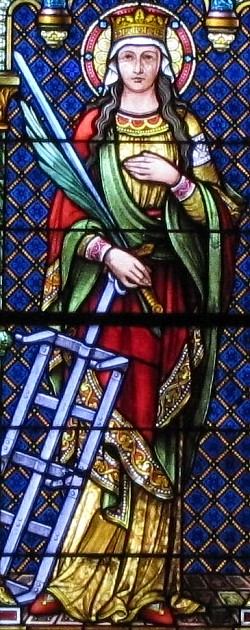
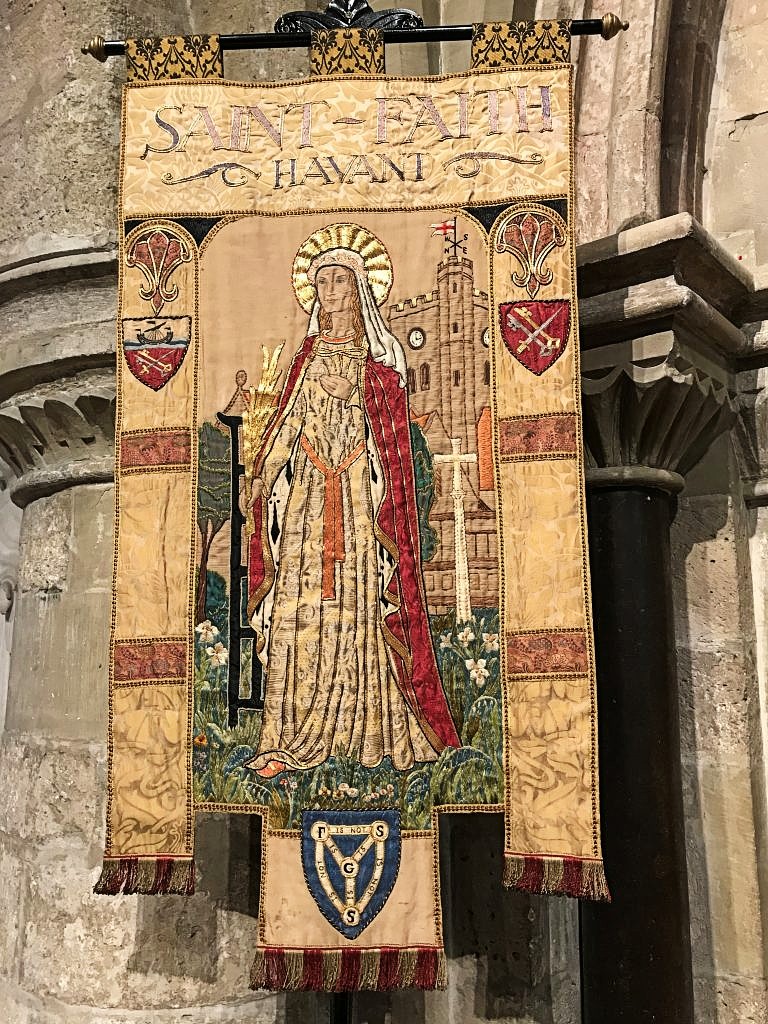
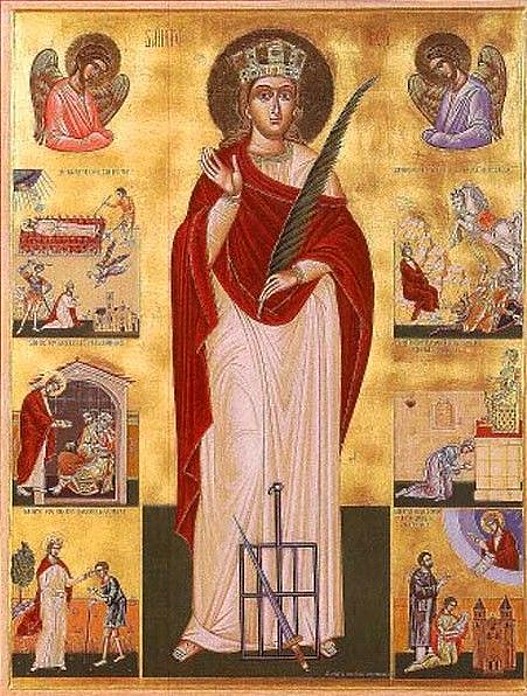
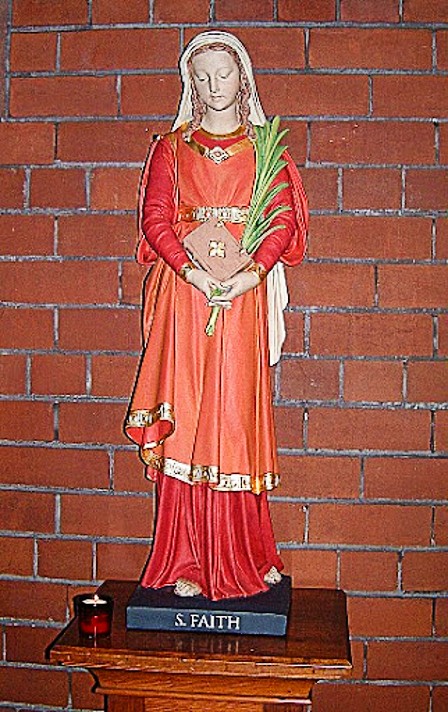
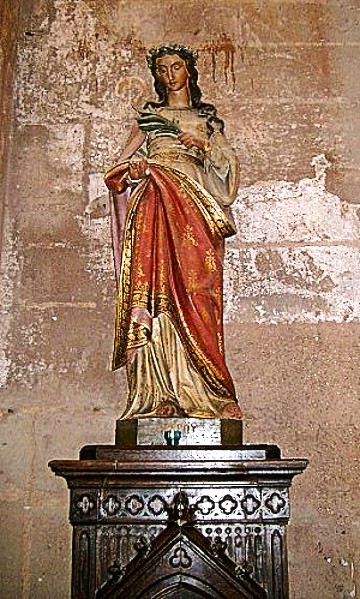
Saint of the Day – 6 October – Saint Faith of Agen (Died 3-4th Century) Virgin Martyr, Confessor. Born at Agen, Aquitaine, (modern France) and died by being cooked on a brazier, then beheaded. Also known as – Fides, Foi, Foy, Fe, Faith of Conques. Patronages – eye diseases and blindness, Pilgrims, prisoners. soldiers. Our little Faith today must not be was confused with the three legendary sisters known as Faith, Hope and Charity., Virgin Martyrs of the 2nd Century whose feast day is 1 August.
The Roman Martyrologgy states: “ At Agen, in France, the birthday of St Faith, Virgin and Martyr whose example encouraged the blessed Caprasius so much, that he happily terminated his combat by Martyrdom.“
Faith was a beautiful 12-year-old girl living in Agen, Aquitaine, France, during the reign of Diocletian and Maximian. Her parents, wealthy pagans, left her rearing to a nurse, who happened to be Christian. Growing up in a beautiful, mosaic-encrusted villa, Faith had everything the world could offer and her future looked bright, except for one thing – she had accepted her nurse’s Christian faith.
To understand why this was a problem, we must understand Emperor Diocletian. He had announced, on assuming office, his intention to revive morality within the realm, since immorality was sapping Roman virtue and, therefore, the Empire’s viability and strength. He also believed that a revival of the traditional Roman gods was key, because an empire united in its religious praxis would be stronger. This was not a problem for most pagans in most places because gods were gods, even if their names varied by region. This was obviously not the case for Christians, however.
Diocletian launched a persecution designed to force everyone to the same cult. Dacian, Prefect of the Province in which Faith lived, came to Agen to observe his subjects’ loyalty—that is, to see if they were being good pagans and, if not, to kill them.
While many Christians were terrified but Faith voluntarily surrendered to the authorities. Imagine how frightened she must have been. She likely prayed for strength and for the words to convert her persecutors. Dacian probably had some nervousness too. After all, putting a twelve-year-old girl on trial would be a touchy situation, especially for a capital crime. Who wants to execute a child? Better to get her to apostatise but how? During the trial Faith gave a brave, remarkable defense of Christianity. Fine, Dacian told her, keep your beliefs. Just sacrifice to the goddess Diana in the town’s temple.
Faith refused and Dacian lost patience with the girl. He ordered her bound to a brazen bed and roasted. Pitch was thrown on the fire to make its flames flare and burn her legs. This happened in public, so that the crowds could witness the fate awaiting Christians.
Medieval depiction of Faith’s Martyrdom.
The problem for Dacian was that little Faith refused to cooperate. She cried, yes but she did not scream or beg for mercy. After a miraculous rainstorm extinguished the flames, Dacian had her beheaded. Seeing all this, the mob was moved, not to contempt for Christianity but to pity for Faith. Their only contempt was for Dacian, the child executioner. They wondered what god of theirs could give a mere maiden such strength. Realising the answer was “None,” many converted on the spot. In turn, most of these received martyrdom days later.
After her death St Faith developed a reputation as something of a practical joker. If someone was stingy with a donation left for her Shrine’s upkeep, small misfortunes might befall them. For instance, a dying woman promised S. Faith she would will her most precious ring to the Abbey. Afterward her husband—possibly for its sentimental value, or maybe the thing had cost him a good deal of money—thought better of his wife’s last pledge. He instead used the ring as his second wife’s wedding band. Shortly the ring finger of the new wife swelled so much that it became unbearably painful. The couple beat a hasty path to the Shrine. There, when the lady blew her nose, the ring flew off her hand with such force that it left a crack in the flooring.
On another occasion, Faith’s prayers restored sight to a man named Guibert, whose eyes had been torn from their sockets. Wanting to keep the recipient of so great a miracle close, the Monks who cared for St Faith’s Shrine gave him the job of selling candles. It seems Guibert was a good businessman and soon became quite rich. But as so often happens, when success came, devotion to Our Lord went. St Faith reproached Guibert for his ingratitude. She had prayed Jesus would restore his sight, and this is how Guibert repaid her? So Guibert lost sight in one eye. This happened repeatedly: He would mend his ways, gain his eyes, grow successful again, fall into sin, lose the eye, and so on.
The Monks would parade Faith’s relics around the Monastery grounds. With the greatest pomp, they processed while holding candles and they sang all day. By evening they were exhausted and famished. Once when many people had prayed, the intercession of St Faith wrought many miracles. With each miracle the Monks would sing a Te Deum. At the end of the day, the Monks sat down under a tree to have a picnic but each time they were about to sink their teeth into their meager food, someone would cry, “A miracle!” and the Monks would have to get up and sing again.
Thirty-eight churches in England alone are named after St Faith. There are many more in northern Spain and southern France and her fame spread to the Americas via the conquistadors. Indeed, at least four Cities in the United States are named after her, including Santa Fe, New Mexico. And in Brazil alone 22 Cities bear her name.
Except for what she said in court, St. Faith never preached. She never wrote an epistle. Her preaching and writing were her actions. The bravery and resolve of this young maiden astounded the crowds. Perceiving something special about the God she worshiped, they converted. And she was just a child. God makes up for what we lack.
Holy Spirit, through Your ineffable gifts, draw us to constant conversion. Renew our hearts. Let our actions preach eloquent sermons that draw people to Christ, far better than our poor words could do. Help us to love You, Holy Father, to do everything for You, and to remain firm in that love, no matter the hardships we encounter, so that, with St Faith, we may wear an eternal crown in Heaven. (Partially excerpted from “Saint Who?: – 39 Holy Unknowns” by Brian O’Neel).
In the fifth century, Dulcitius, Bishop of Agen, ordered the construction of a Basilica dedicated to her, later restored in the 8th century and enlarged in the 15th but sadly demolished in 1892 for urban development – horrible
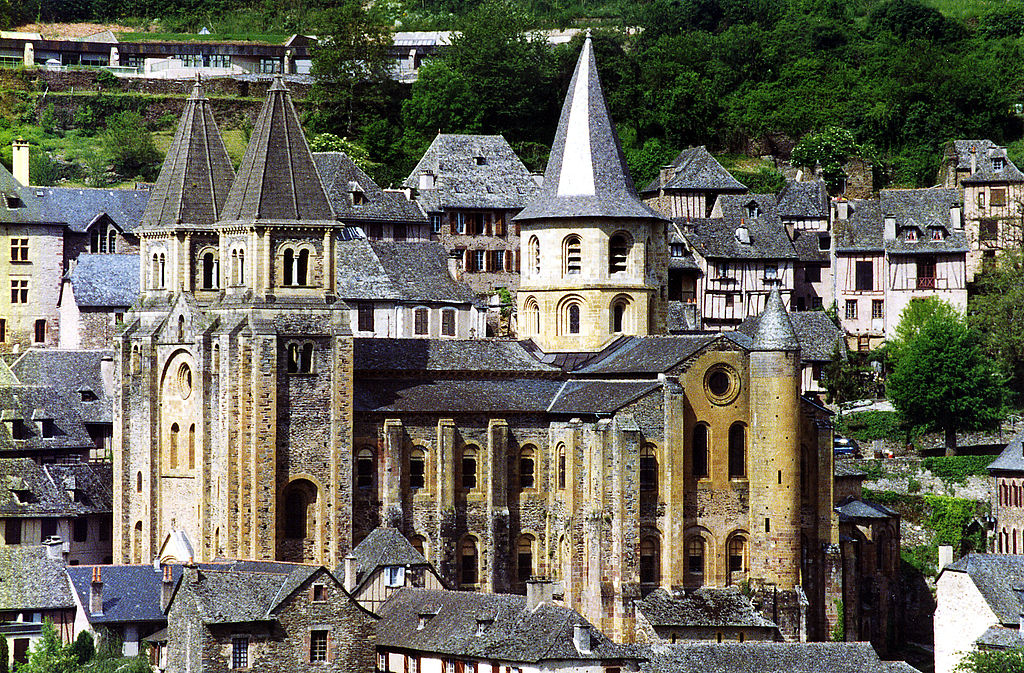
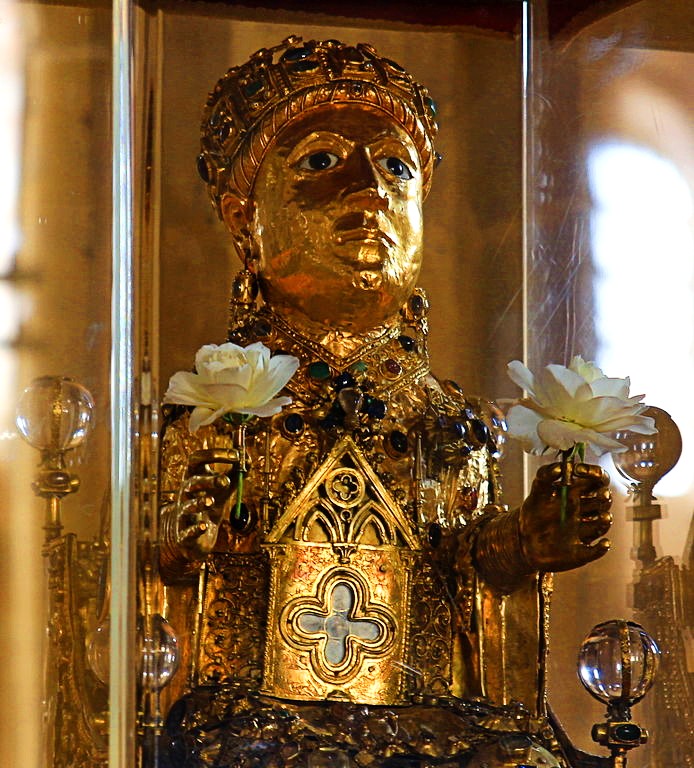
Contrary to all custom, however, the centre of the cult of Faith was not the Basilica but the Church of Conques-enRouergue, where in the 9th Century. some of her relics had been transported, see the Reliquary below. Here there was also a Monastery, which, due to being on the road frequented by pilgrims Compostella, became in turn, famous and a pilgrimage destination in its own right. The cult of Faith thus spread throughout Europe and then also in America, where numerous cities and churches were dedicated to her. Among the most important are the Conches Abbey in Normandy and the Church of Sélestat, in Alsace.
Ninth Century Reliquary of Saint Faith at Conques.
St Alberta of Agen Bl Artaldo of Belley St Aurea of Boves St Ceollach St Epiphania St Erotis St Faith of Agen (Died 3-4th Century) Virgin Martyr St Francis Trung Von Tran Bl François Hunot Bl Isidore of Saint Joseph St Iwi St John Xenos Bl Juan de Prunera St Magnus of Orderzo
St Pardulf St Renato of Sorrento St Romanus of Auxerre St Sagar of Laodicea — Martyrs of Capua – 4 saints: A group of martyrs who were either killed in Capua, Italy, or that’s where their relics were first enshrined. We now know nothing but their names – Aemilius, Castus, Marcellus and Saturninus.
Martyrs of Kyoto – 52 beati: Fifty-two Japanese lay people, some single, some married, some parents, some children, who were martyred together during one of the government sponsored persecutions of Christians.
Martyrs of Trier: Commemorates the large number of martyrs who died in Trier, Germany in the persecutions of Diocletian. 287 in Trier, Germany.
Saint of the Day – 5 October – Blessed Pietro of Imola (c1250-1320) Knight of the Order of St John of Jerusalem and Grand Prior , Lawyer, Jurist, Mediator, Peace-maker. Born in mid-13th century in Italy as Pietro Pattarini and died on 5 October 1320 in Campo Corbellini, Florence, Tuscany, Italy of natural causes . Also known as – Peter of Imola, Peter Pattarini, Pietro Pattarini de Imola.
The Roman Martyrology states: “In Florence, blessed Pietro da Imola, who, a Knight of the Order of St John of Jerusalem, took care of the sick with pious charity.”
Very little is known of the details of the life of Blessed Pietro of Imola whose memorial we celebrate today. He was born in the mid 1200s at Imola, in Italy, into the noble Pattarini family who had been the Lords of Linasio for over 100 years and part of the Ghibelline faction. Pietro was an excellent scholar and become a well-known lawyer and jurist. The respect held for his legal opinion is evident ,by the fact that his name is found on many important documents which are still preserved in Imola, giving his interpretation of the laws of his time. In 1289 he became a Court Magistrate and eight years later was to use all his skills and experience to negotiate a peace between the rival Guelph and Ghibelline factions in Romagna. The Guelphs were predominately from wealthy mercantile families who supported the Pope while the Ghibellines tended to come from families with wealthy agricultural estates who supported the Emperor. It was no easy task and took several years but, at last, Pietro was able to persuade the Ghibellines to leave Romagna.
After successfully mediating this conflict and crowning, what had been a successful secular career, Pietro sought a new vocation dedicated to charitable works, in helping the poor and the sick. He began working in one of the Order of St John’s hospitals in Florence and was invested as a Knight in 1310. His administrative skills were welcome and appreciated and put to good use as he assumed greater responsibilities in his work in the hospital. His talents were not unnoticed and after some years he was chosen Grand Prior of the Order in Rome. He again returned to Florence to the Commandery of St James in Campo Corbellini.
We do not know for certain if he became the Commander of St James or assumed other duties. Nevertheless, he continued performing great charitable works serving the sick who were either home-bound or in the hospital. Blessed Pietro died in Florence on 5 October 1320 and his loss was felt by everyone who knew him. He was buried in the Church of St James in Campo Corbellini which still belongs to the Order of the Knights.
One of the most remarkable stories about Blessed Pietro occurred after his death. One day in preparation for the feast of St James, the Church was being decorated by the brothers and a Priest had placed a ladder against the tomb of Blessed Pietro and was standing on it and working up high against the wall, hanging some decorations. The Priest lost his balance and the ladder began to fall. Suddenly, Bless Pietro’s tomb opened slightly and his hand reached out and steadied the ladder, no doubt saving the life of the Priest. This miracle was authenticated by several witnesses. Blessed Pietro’s relics were later translated to under the main Altar of the Church in a reliquary that Commander Fra Augustine Mego had made for it, and the miracle-working arm was kept in a separate little box. After the flooding of the Arno river in 1557, the documents and reliquary were submerged and greatly damaged. However ,the box containing his arm survived and is still venerated in the Imola Cathedral. The main relics of Blessed Pietro reside at St Lawrence’s Church in Florence on 10 June 2016 and further relics are contained in the Reliquary at the Chapel in the Grand Magistry of the Order of Malta in Rome. The skin and nails of the arm and hand remain intact, all these centuries later.
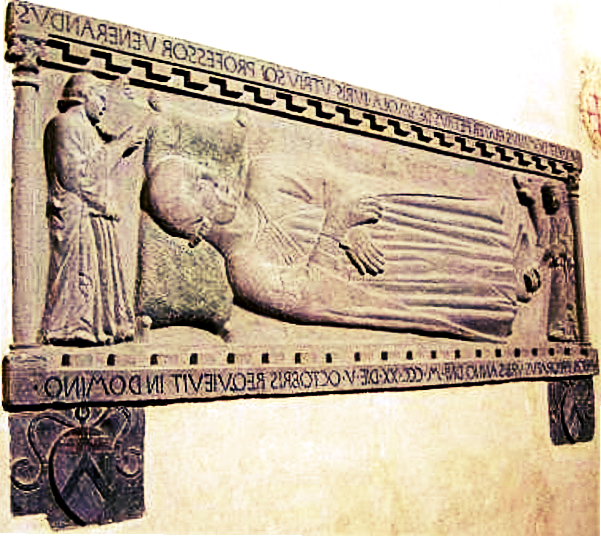
The tomb of Blessed Peter at the Church of St James in Campo Corbolini, Florence/Italy
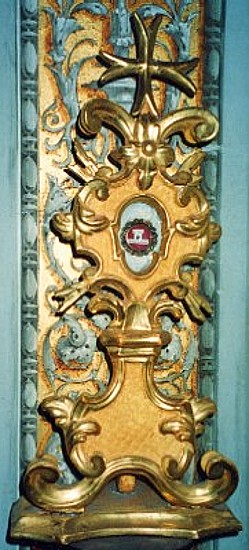
Reliquary at the Chapel in the Grand Magistry of the Order of Malta in Rome
The main relics of Blessed Pietro are in St Lawrence’s Church in Florence/Italy since 10 June 2016
St Firmatus of Auxerre St Flaviana of Auxerre Bl Flora of Beaulieu St Gallo of Aosta St Jerome of Nevers Bl John Hewett St Magdalveus of Verdun St Mamlacha St Marcellinus of Ravenna Bl Marian Skrzypczak St Meinulph St Palmatius of Trier Blessed Pietro of Imola (c1250-1320)
Bl Robert Sutton Bl Sante of Cori St Thraseas of Eumenia St Tranquilino Ubiarco Robles Bl William Hartley — Martyrs of Messina or St Placidus and Companions – 30 saints: A group of about 30 Benedictine monks and nuns, some blood relatives, who were sent in the early days of the order to establish monasteries in the vicinity of Messina, Sicily, Italy and who were martyred. We know the names, and a few details, about seven of them – • Donatus • Eutychius • Faustus • Firmatus • Flavia • Placidus • Victorinus 6th century Messina, Sicily, Italy.
Martyred in the Spanish Civil War: • Blessed Eugenio Andrés Amo • Blessed Sebastià Segarra Barberá • Blessed Rafael Alcocer Martínez
Quote/s of the Day – 4 October – The Memorial of St Francis of Assisi (c 1181–1226)
“Alms are an inheritance and a justice which is due to the poor and which Jesus has levied upon us.”
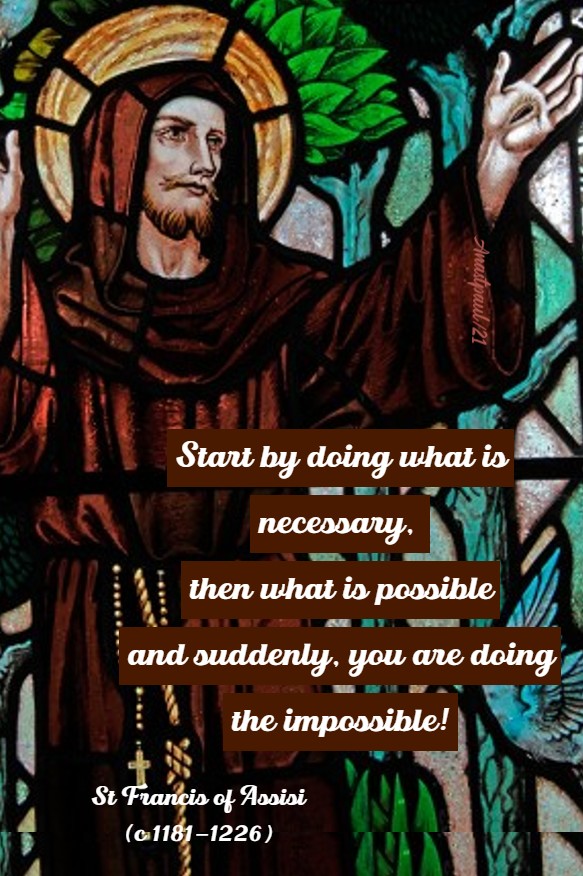
“Start by doing what is necessary, then what is possible and suddenly, you are doing the impossible!”
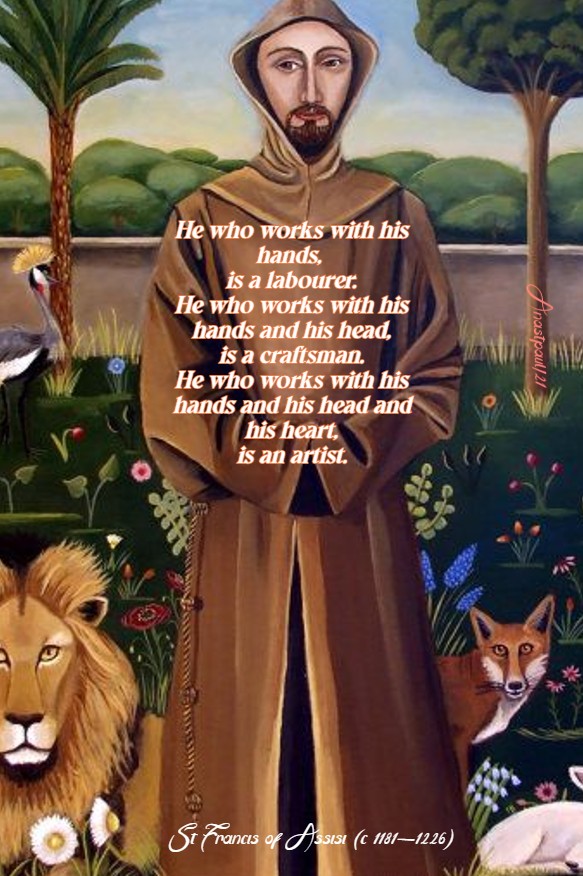
“He who works with his hands, is a labourer. He who works with his hands and his head, is a craftsman. He who works with his hands and his head and his heart, is an artist.”
One Minute Reflection – 4 October – “Month of the Holy Rosary” – Readings: Jonah 1: 1 – 2: 1-2, 11; Psalm Jonah 2: 3, 4, 5, 8; Luke 10: 25-37 The Memorial of St Francis of Assisi (c 1181–1226)
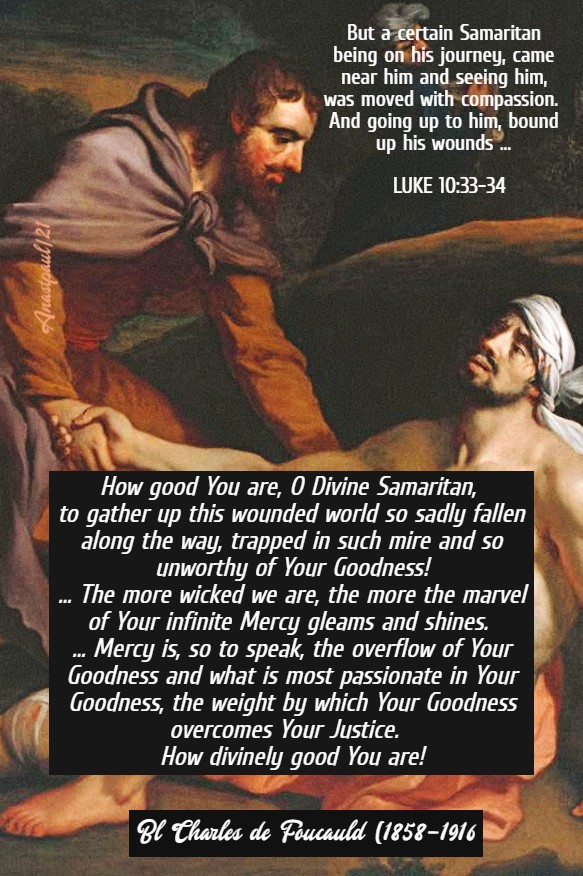
“But a certain Samaritan being on his journey, came near him and seeing him, was moved with compassion. And going up to him, bound up his wounds …” – Luke 10:33-34
REFLECTION – “ How good You are, O Divine Samaritan, to gather up this wounded world so sadly fallen along the way, trapped in such mire and so unworthy of Your Goodness!
The more wicked the world, the more Your Mercy shines forth: to be infinitely good to the good, is a thousand times less admirable, than to be infinitely good to souls, who, even though lavished with graces, are simply ungrateful, unfaithful, perverse. The more wicked we are, the more the marvel of Your infinite Mercy gleams and shines. This in itself, suffices to explain, the great good that sin produces on the earth and explains, why You permit it. It makes way for an incomparable greater good – the exercise and manifestation of Your divine Mercy. This divine attribute could not be put into practice without it; goodness could be exercised and shown without sin but failure is needed, if mercy is to be manifested. Ah! My Lord and God, how Good you are! How Merciful! Mercy is, so to speak, the overflow of Your Goodness and what is most passionate in Your Goodness, the weight by which Your Goodness overcomes Your Justice. How divinely good You are! (…)
Be kind to sinners, since God is so kind to us – pray for them, love them. … “Be merciful as our Father is merciful” (cf. Lk 6:36). God “prefers mercy to sacrifice” (cf. Mt 12:7).” – Bl Charles de Foucauld (1858-1916) Hermit and Missionary in the Sahara – (Meditations on the psalms 103, psalm 52)
PRAYER – All highest, glorious God, cast Your light into the darkness of our hearts, give us true faith, firm hope, perfect charity and profound humility, so that with wisdom, courage and perception, O Lord, we may do what is truly Your holy will. Amen. – St Francis of Assisi
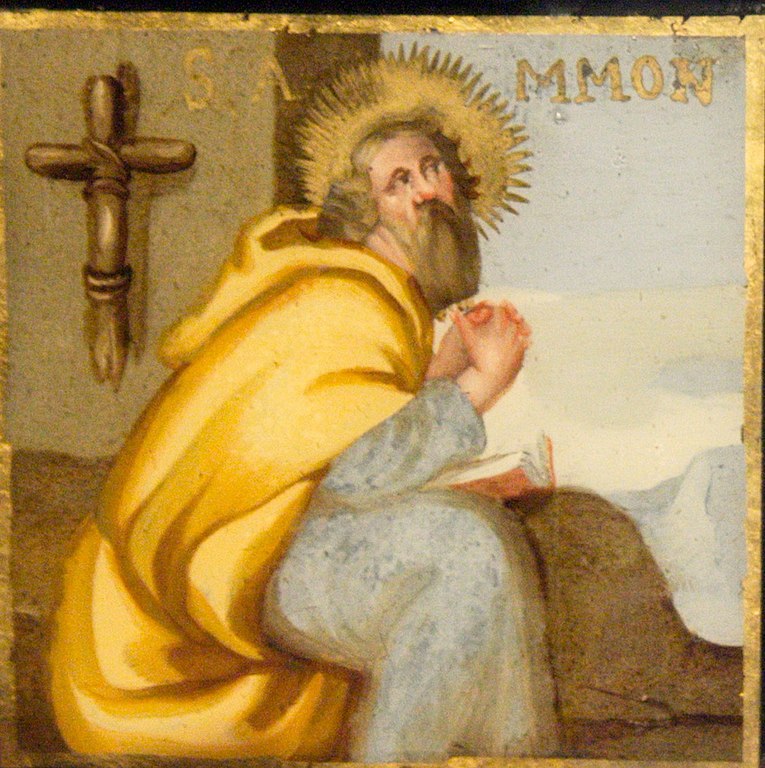
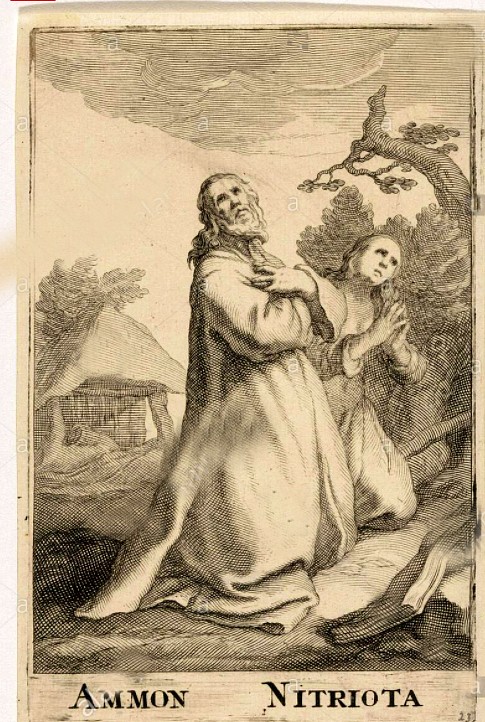
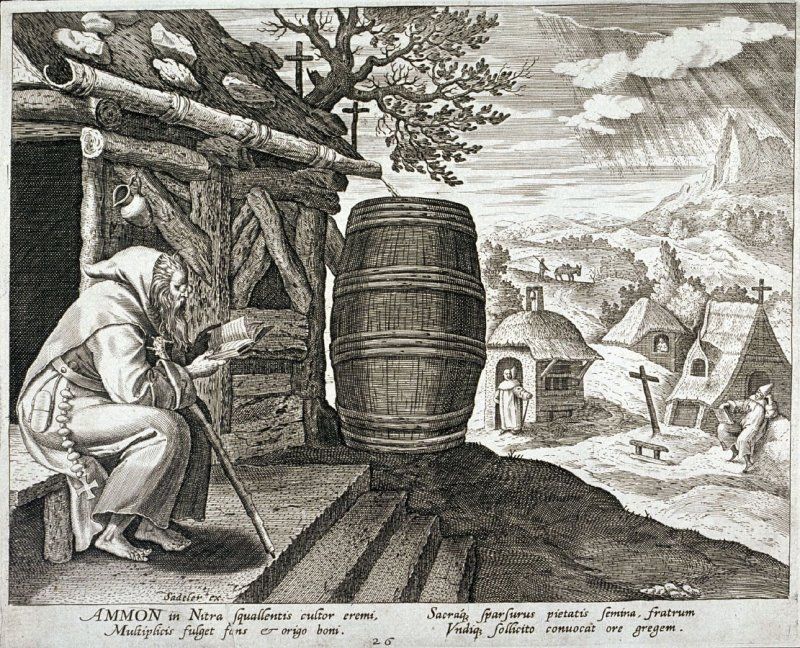
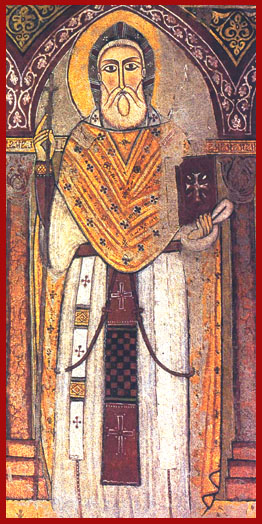
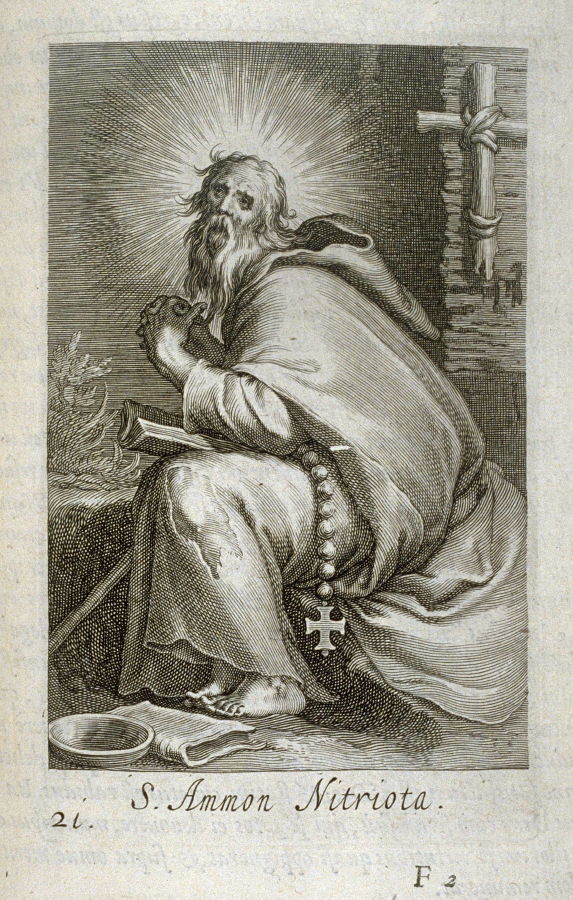
Saint of the Day – 4 October – Saint Ammon the Great (c 286-c 348) Layman, Married, Hermit, Ascetic, Founder of one of the most celebrated monastic communities in Egypt. Born in cc286 in Mariotis, Egypt and died in c 348 in Scetis, Egypt of natural causes. He was one of the most venerated ascetics of the Nitrian Desert and Saint Athanasius mentions him in his life of Saint Anthony. Also known as – Amon the Anchorite/Hermit, Ammonius, Amun, Ammon of Egypt.
Pushed into marriage by his family at the age of 20, he managed to persuade his bride to take a vow of chastity together with him by the authority of St. Paul’s Epistle to the Corinthians. They lived together this way for 18 years, when at her wish, they parted, and he retired to Scetis and Mount Nitria, to the south of Lake Mareotis, where he lived for 22 years, visiting his sister-wife twice a year. She had founded a convent in her own house.
He co-operated with St Anthony and gathered his Monks under his direct supervision, thus forming a Monastery from individual hermits. Traditionally, he is believed to have been the first hermit to have established a Monastery, known as Kellia, near Nitria. This is by no means verifiable but it is more certain that Ammon’s piety and fame drew others to the region. He died at the age of 62 years.
He died before St Anthony tof the Desert, from whom there is an epistle to him. that is, before the year 365, for the latter asserted that he “saw the soul of Ammon borne by angels to heaven” and as St Athanasius’ history of St Antony preserves the order of time, he died perhaps about 348. There are generally seventeen or nineteen Rules of Asceticism ascribed to him – the Greek original exists in manuscript; they were published in the Latin version of Gerardus Vossius. Twenty-two Ascetic Institutions of the same Ammon, exist also in manuscript. A collection of his letters remains extant.
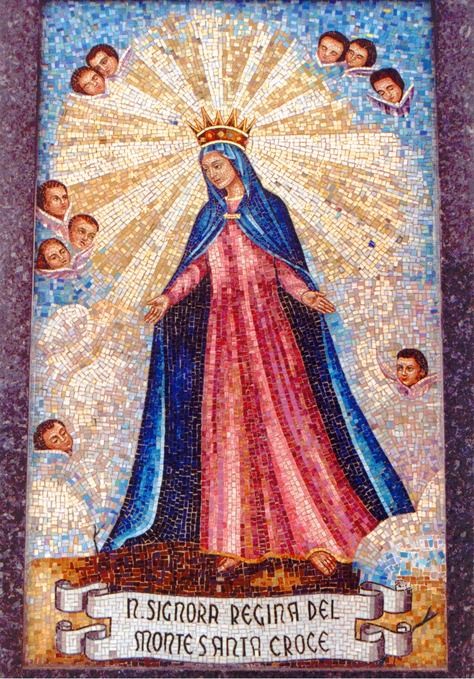
La Madonna della Riconciliazione e della Pace / Our Lady of Reconciliation and Peace, Balestrino Italy (1949) – 4 October
Caterina Richero was born on 7 October 1940 in Bergalla, the highest hamlet of Balestrino, of a humble peasant family. She was the first of four siblings and her life passed in the serenity of childhood until the age of nine. On 4 October 1949, something radically changed her life. Something that will lead Catherine to humbly sacrifice her life with a continuous and silent witness of faith. A life devoted to prayer and devotion to that female figure who appeared to her 138 times until 5 November 1986 and who, on 5 June 1950 when asked: ” Who are you?” replied: ” I am the Immaculate Conception.” Catarina’s life, from that distant day in 1949 was by no means easy. She had to face the ridicule and mistrust of many and above all, she had to stick to what was given to her by the Bishop. She was also forbidden to go to Mount Croce but the Madonna began to appear in Catarina’s home. In all those years, Our Lady asked her to pray constantly for the conversion of sinners and to do many penances for all, without faith. On 5 October 1971 she said: “ On Mount Croce you will find light and strength and I, in this place, will obtain many graces for you.” Now on Monte Croce there is a splendid Chapel with a Statue of Christ awaiting pilgrims at the top of a staircase. Inside, intent on arranging the flowers on the Altar or absorbed in prayers, Catarina … who with her silent presence tells everyone much more than thousands of articles and books could say. The Statue venerated in the Chapel of the Sanctuary was crowned on 7 October 1992 by Msgr. Mario Oliveri.
St Adauctus of Ephesus Bl Alfonso Tabela St Ammon the Great (c 286-c 348) Hermit, Layman St Aurea St Berenice St Caius of Corinth St Callisthene of Ephesus St Crispus of Corinth St Damaris of Athens St Diogenes of Milan St Domnina St Hierotheus Bl Julian Majali St Lucius of Alexandria St Peter of Damascus
St Prosdoce St Quintius of Tours — Martyrs of Alexandria – 2+ saints: A group of Christians, men and women, young and old, murdered together for their faith. The only names that have come down to us are the brothers Mark and Marcian.
Martyred in the Spanish Civil War: • Blessed Alfredo Pellicer Muñoz • Blessed Avelí Martínez de Arenzana Candela • Blessed Dionisio Ibáñez López • Blessed Francisco Martínez Granero • Blessed Fulgencio Martínez García • Blessed José Aloy Doménech • Blessed José Gafo Muñiz • Blessed José Miguel Peñarroya Dolz • Blessed Juan de Francisco Pío • Blessed Juan José Orayen Aizcorbe • Blessed Martina Vázquez Gordo • Blessed Publio Fernández González • Blessed Tomás Barrios Pérez
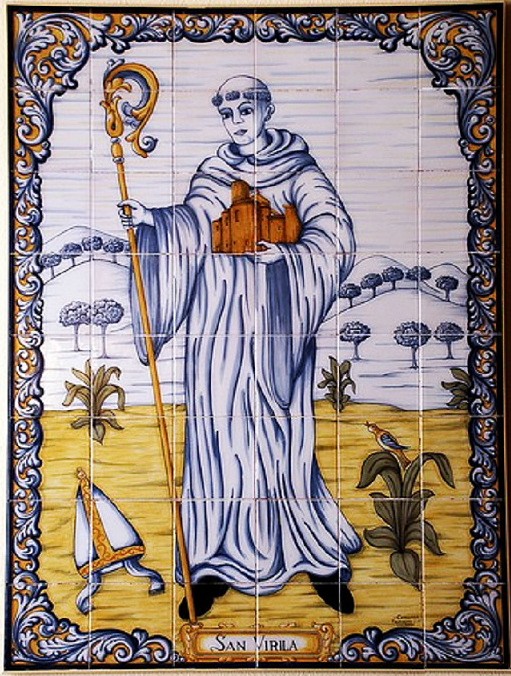
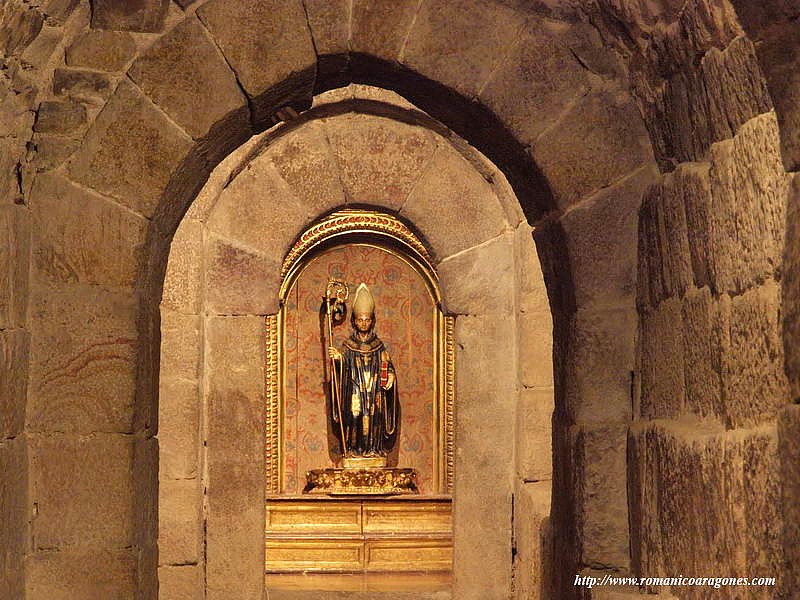
Saint of the Day – 3 October – St Virila OSB (c 870- c 950) Benedictine Monk, Abbot. Born in a small village near Tiermas, Spain and died in c 950 in Leyre, Navarre, Spain of natural causes. Also known as – St Virila of Navarre, Virila of Leyre.
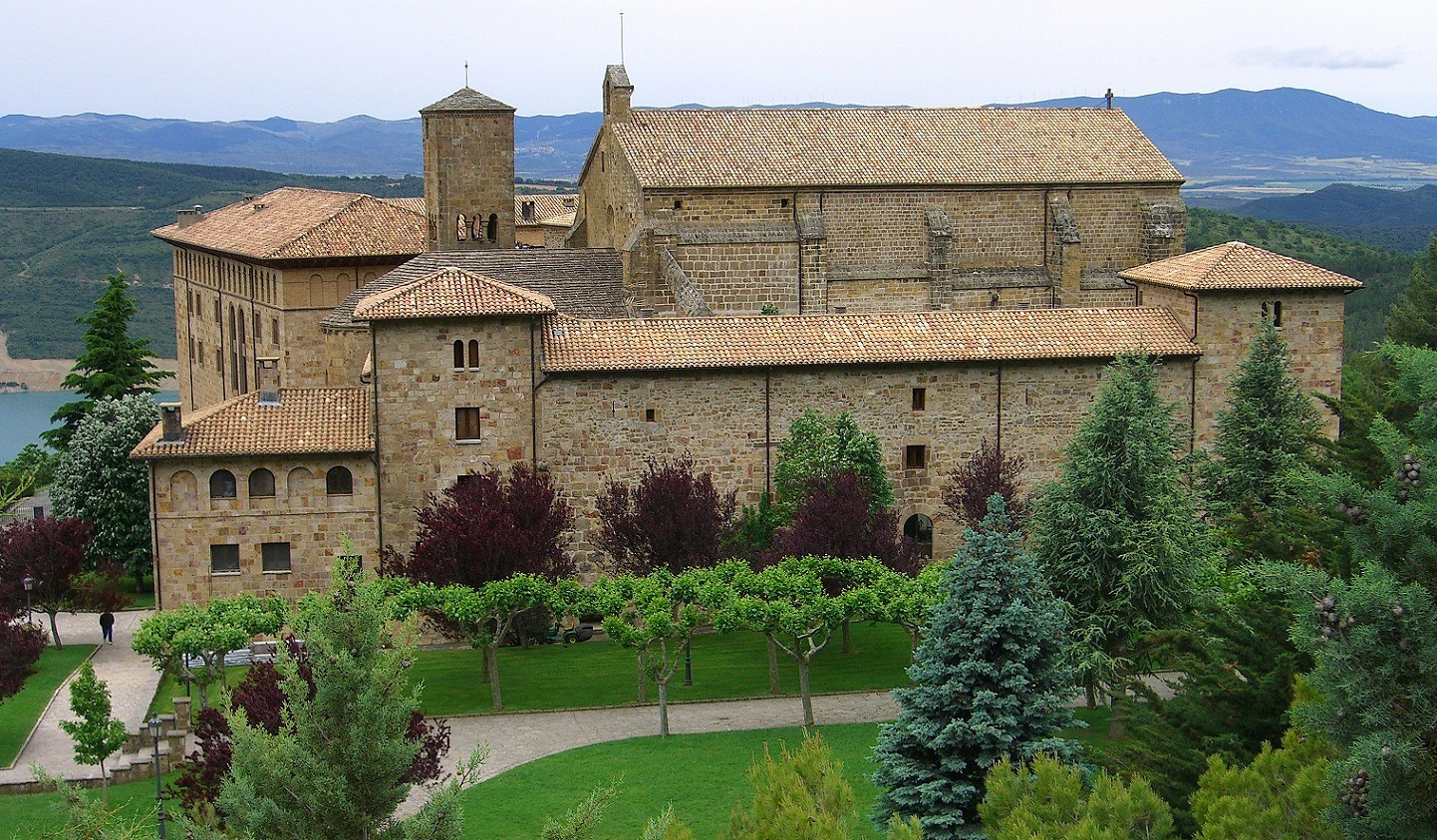
Virila was the Abbot of the Monastery of Saint Saviour of Leyre, Yesa of Navarre, Spain. He also restored the Monastery of St Julian de Samos and helped spread Benedictine monasticiasm in Galicia. He made a pilgrimage to Rome and then visited all the Monasteries in the Pyrenees mountains.
The Navarre Monastery
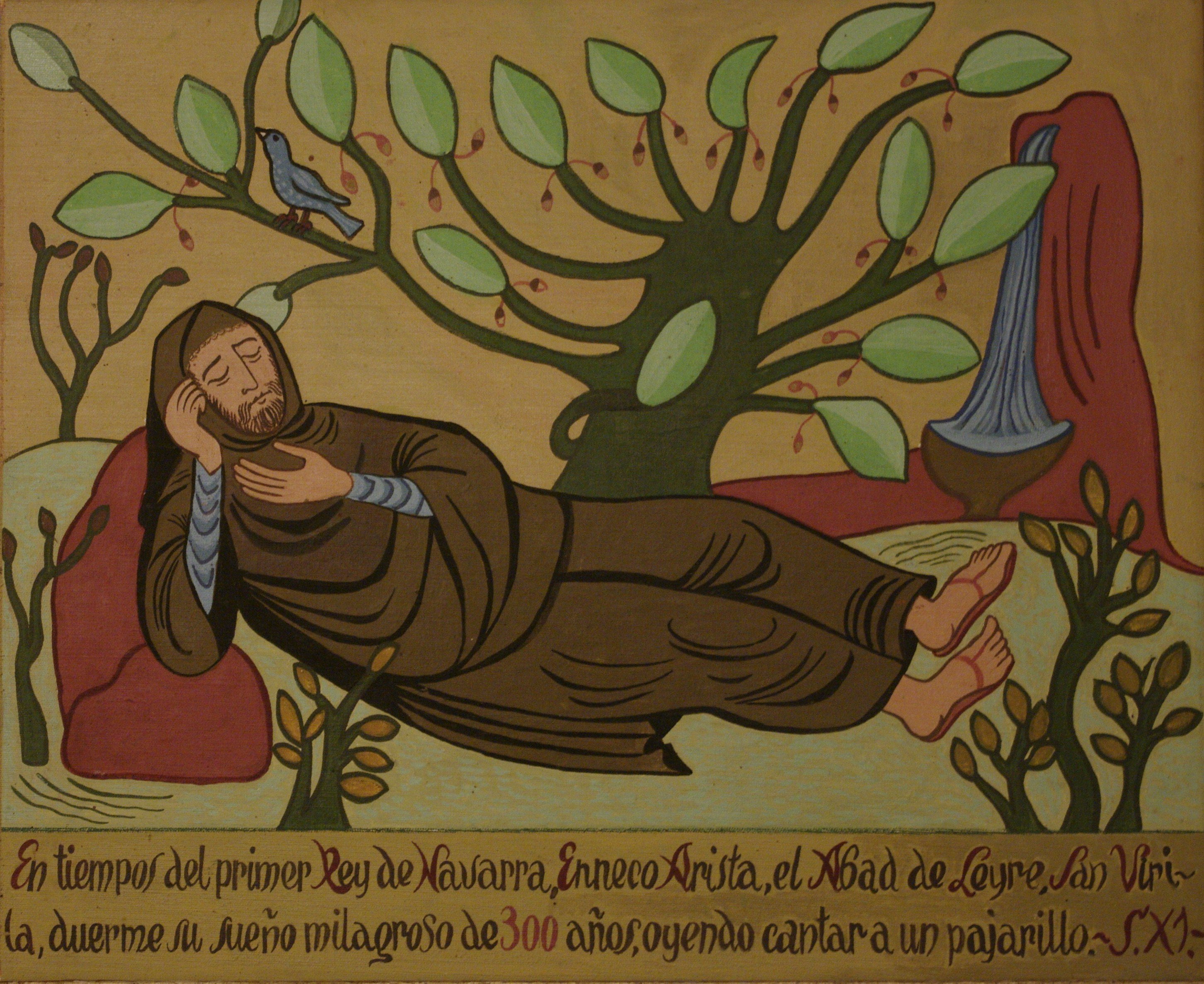
There is a famous miracle regarding Virila, relating to his desire to understand the Mystery of eternity. A legend tells of one day while meditating in the nearby woods, Vitila fell asleep. When the Abbot awoke he discovered that 300 years had passed.
Tradition has it, that Saint Virila himself told the tale: “… At that time the dilemma of eternity tormented me and doubts assailed me incessantly. I prayed to God, our Lord, to enlighten me on this Mystery and turn on the light in my heart. One spring evening, as I used to do, I went out for a walk among the leafy trees of the Sierra de Leyre. Fatigued, I sat down to rest next to a fountain and stood there absorbed and hypnotised, listening to the beautiful song of a nightingale. After a few hours, in my opinion, I returned to the Monastery. As I passed the main entrance, no Monk brothers were familiar to me. I walked around the various buildings, surprising myself with every detail and gradually realising that something strange had happened. Understanding that no-one recognised me, I went to the Prior who, astonished, listened to my story carefully. We went to the library to try to decipher this enigma and by consulting ancient documents, we discovered that “three hundred years ago, a holy monk, called Saint Virila, had ruled the Monastery and had been devoured by beasts during one of his spring walks” … With the tears in my eyes, I realised that I was that Monk and that God had finally answered my prayers. If the song of a single bird can entertain a man for three centuries, what cannot the divine light of the Saviour do?“
Then a nightingale entered the Abbey with a ring in its beak. The nightingale placed the ring on Saint Virila’s finger and he became Abbot again.
Notre-Dame de Bonne Nouvelle / Our Lady of Good News (Rennes, Ille-et-Vilaine, Brittany, France) 1720 – First Sunday of October, 23 December:
Jean de Montfort founded the Dominican Convent of Our Lady of Good News in Rennes to pay a vow taken during the battle of Auray in 1364, where his victory settled him as Duke of Brittany. In the following century, a panel painting in the Convent’s cloister gained a reputation for miracles, resulting in the building of a separate Chapel to give due veneration to Our Lady and to accommodate the pilgrims.
Another vow was paid after the plague of 1632, which spared Rennes the serious devastation which the surrounding regions suffered. In thanks,giving to the Madonna, the City gave Our Lady of Good News a solid silver model of the town and, from 1634, observed a votive celebration every year on 8 September, the Feast of Mary’s Birth. Another miracle occurred during the great fire of 23 December 1720, when, as their wooden houses burned, the people of Rennes saw Our Lady of Good News look down in compassion from the sky.
During the French Revolution, the silver model, was melted down. The Chapel was destroyed and the Convent used to store fodder. A gardener saved the holy image, which he gave to the neighbouring Church of St Aubin. In 1849, a cholera epidemic inspired a new vow. A new silver-plated model city was commissioned from Napoleon III’s goldsmith and the September votive feast reinstated. When St Aubin’s became too small for all the pilgrims, a new Church was built, dedicated in 1904 to St Aubin and Notre-Dame de Bonne Nouvelle.
The painting was canonically crowned in 1908. In recent years the votive feast has been held on the first Sunday in October rather than 8 September.
St Adalgott of Chur Bl Agostina of the Assumption St Candidus the Martyr St Cyprian of Toulon Bl Damian de Portu St Dionysius the Aeropagite Bl Dominic Spadafora St Ewald the Black St Ewald the Fair St Froilan
Bl Utto of Metten St Virila OSB (Died c 950) Abbot St Widradus — Martyrs of Alexandria – 9 saints: A number of Christian martyrs remembered together. We know the names Caius, Cheremone, Dionysius, Eusebio, Fausto, Lucio, Maximus, Paul, Peter and that there were at least two more whose names have not come down to us, and that’s about all we know.
Martyrs of Brazil – 30 beati: On 25 December 1597 an expedition of colonists, with two Jesuit and two Franciscan evangelists, arrived at Natal, Rio Grande do Norte, Brazil. The region was colonized by Portuguese Catholics but was invaded by Dutch Calvinists who soon took over the whole territory. They immediately made a policy of the persecution of Catholics. On Sunday 16 July 1645 at Cunhau, Brazil, 69 people were gathered in the Chapel of Our Lady of the Candles for Mass celebrated by Father Andre de Soveral. At the moment of the elevation a group of Dutch soldiers attack the Chapel, murdering many of the faithful including Father Andre; the parishioners died professing their faith and asking pardon for their sins. On 3 October 1645, 200 armed Indians and a band of Flemish troops, led by a fanatical Calvinist convert, hacked to death an unknown number of people of Rio Grande including: • Blessed Ambrosio Francisco Ferro • Blessed André de Soveral • Blessed Antônio Baracho • Blessed Antônio Vilela • Blessed Antônio Vilela Cid • Blessed Diogo Pereira • Blessed Domingos Carvalho • Blessed Estêvão Machado de Miranda • Blessed Francisco de Bastos • Blessed Francisco Mendes Pereira • Blessed João da Silveira • Blessed João Lostau Navarro • Blessed João Martins • Blessed José do Porto • Blessed Manuel Rodrigues de Moura • Blessed Mateus Moreira • Blessed Simão Correia • Blessed Vicente de Souza Pereira and other lay people whose names have not come down to us.
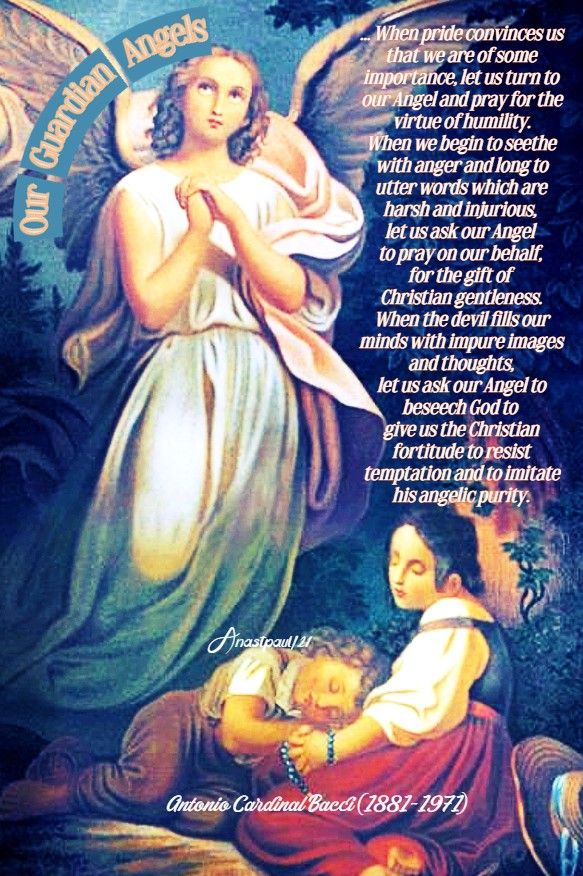
Thought for the Day – 2 October – Meditations with Antonio Cardinal Bacci (1881-1971)
Our Guardian Angels
“The realisation that our Guardian Angel is always close at hand, should be a warning to us. It should prevent us from doing anything displeasing to God. Would we venture to do anything unbecoming in the presence of our Father or Mother, or of anyone for whom we have any regard? Definitely not and still less, should we dare to perform an evil action in the presence of our Angel, to whom we owe such gratitude and in the presence of God, our Creator, Lord and Redeemer, Who could, at any moment, snap the thread which binds us to life and plunge us into eternity.
Furthermore, when pride convinces us that we are of some importance, let us turn to our Angel and pray for the virtue of humility. When we begin to seethe with anger and long to utter words which are harsh and injurious, let us ask our Angel to pray on our behalf, for the gift of Christian gentleness. When the devil fills our minds with impure images and thoughts, let us ask our Angel to beseech God to give us the Christian fortitude to resist temptation and to imitate his angelic purity.
Finally, when tepidity is sapping the vigour of our interior life, let us pray to our Guardian Angel in the hope of obtaining a share in his intimate union with God.
Let us pray the Guardian Angel prayer or at least say: “My Guardian Angel enlighten me. My Guardian Angel help me. My Guardian Angel, protect me.” Amen.”
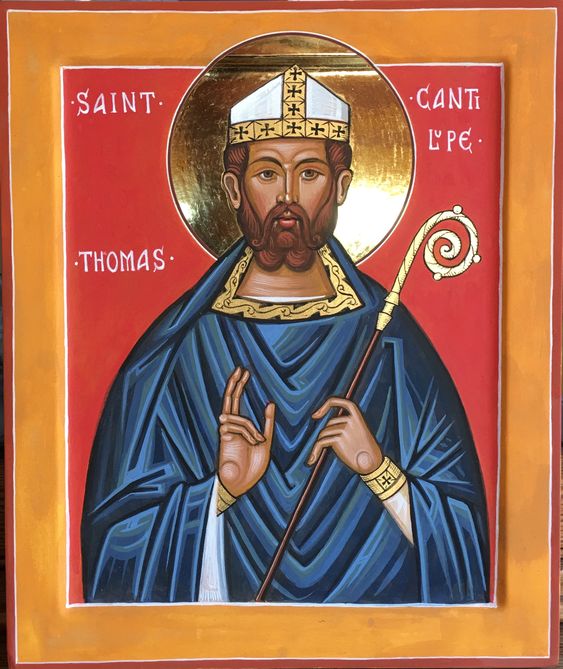
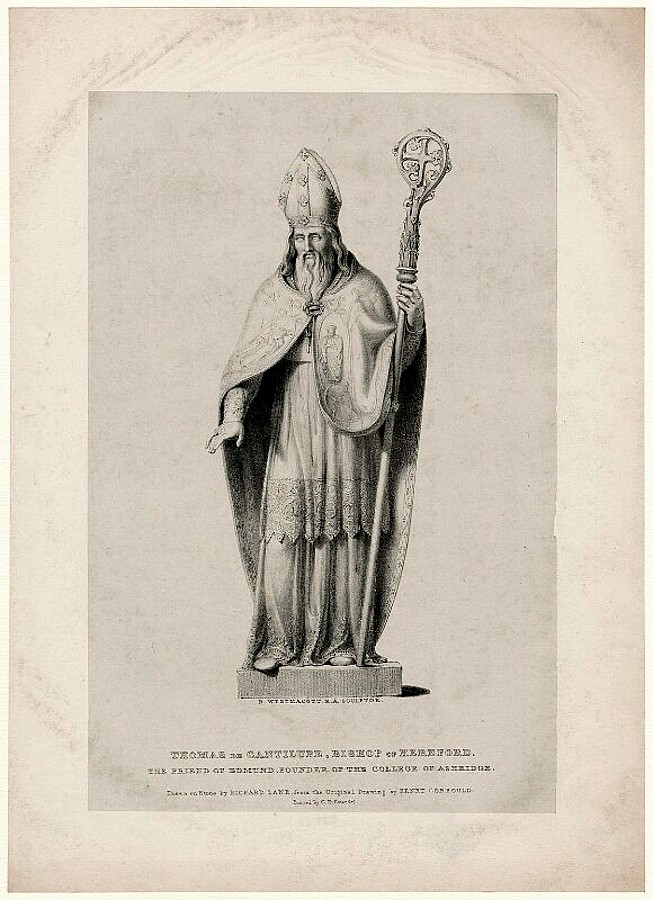
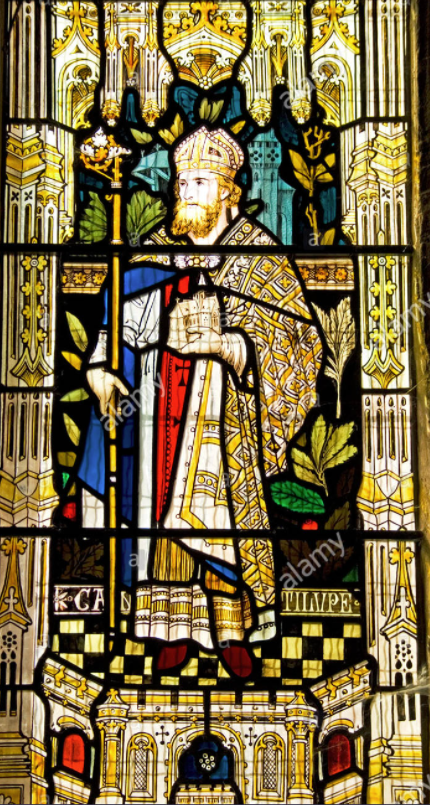
Saint of the Day – 2 October – Saint Thomas de Cantilupe of Hereford (c 1218-1282) Bishop of Hereford, Confessor, learned Scholar, known for his care of the poor and his protection of them against feaudal landlords, miracle-worker, Chancellor of Oxford University, Lord Chancellor of England. Born in c 1218 at Hambleden, Buckinghamshire and died on 25 August 1282 at Ferento, Montefiascone, Italy. Thomas de Cantilupe was the last Englishman Canonised before the Reformation. Also known as – St Thomas of Cantelow, Cantelou, Canteloupe, Cantelupo. Additional memorial – 25 August. Patronages – Hereford, Hambledon.
The Roman Martyrology states: “At Montefiascone in Tuscia, the passing of Saint Thomas Cantelupe, Bishop of Hereford in England, who, resplendent with learning, severe toward himself, to the poor however showed himself a generous benefactor.“
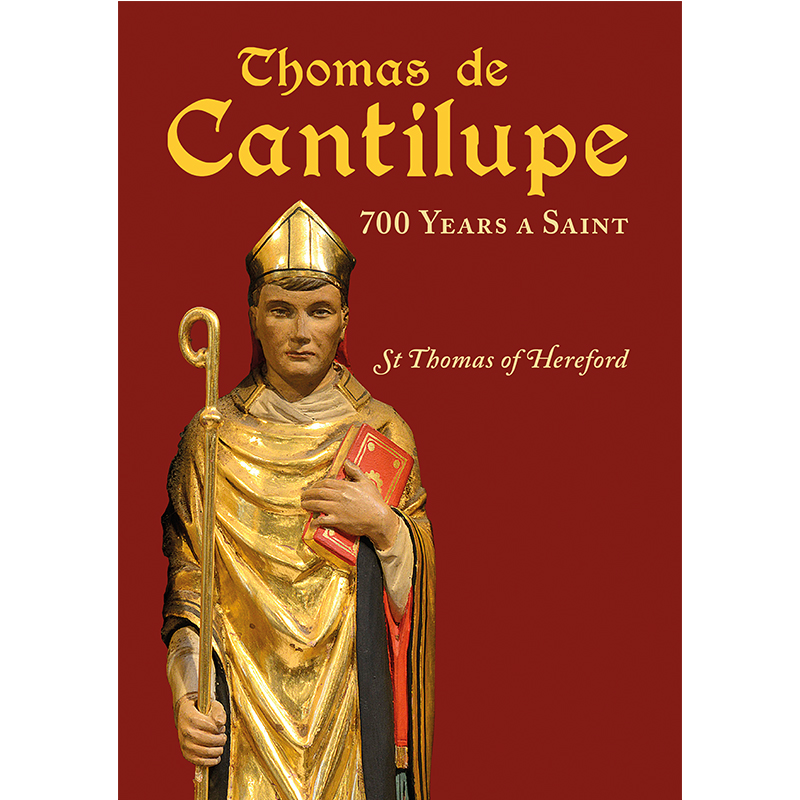
Publication issued in 2020
He was of noble and politically prominent Anglo-Norman family, the son of William, 2nd Baron Cantilupe and his wife Millicent de Gournay, widow of Amaury de Montfort, Count of Evreux. His father’s brother, Walter, was Bishop of Worcester and, by him, young Thomas was educated. The future bishop and saint also studied in Oxford and Paris and, before he had passed middle age, he was known everywhere as one of the most remarkable of scholar-ecclesiastics who did so much to redeem the name of the Church in the 13th century.
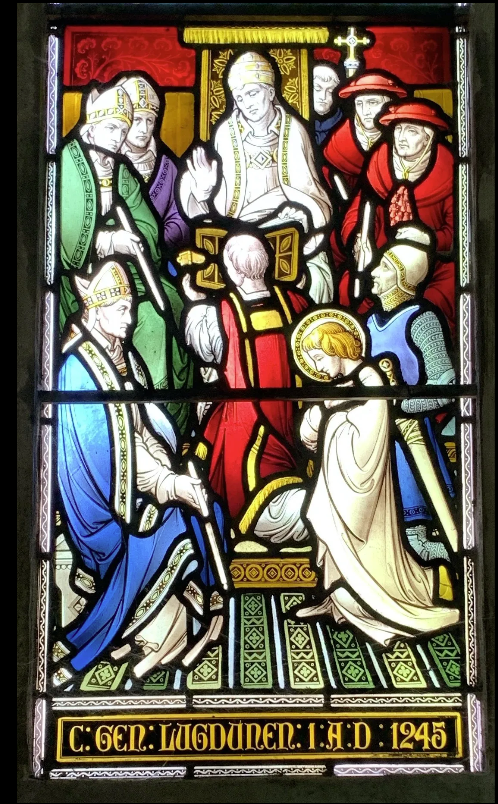
He was Ordained in c 1245 and made a career in Canon Law, lecturing at the Universities of Paris and Oxford. His lawyer’s training and innate Christian hatred of injustice, led to an involvement in politics. He was the Barons’ spokesman in their rebellion against Henry III and was named Chancellor of England by Simon de Montfort, Earl of Leicester and main opponent to Henry III. . When de Montfort was killed at the Battle of Evesham, Thomas was dismissed from the Chancellor’s post and went into exile
The Ordination of St Thomas
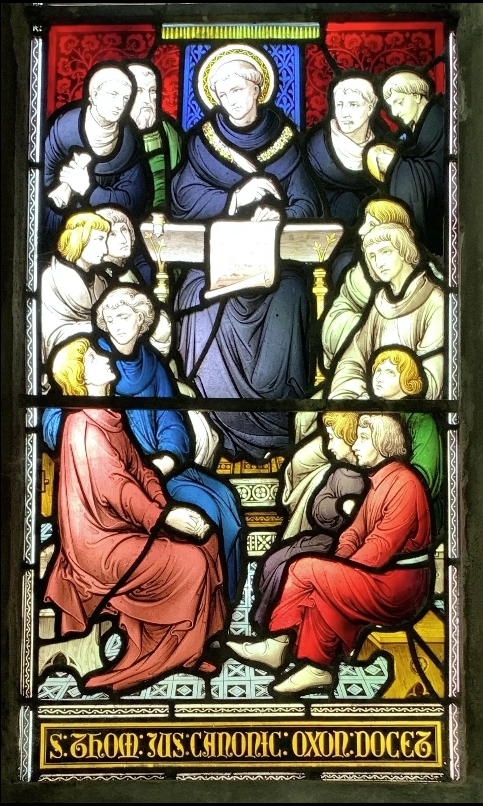
In 1273, he returned to England and was appointed Doctor of Divinity and, for the second time, elected Chancellor of Oxford University.
Chancellor of Oxford
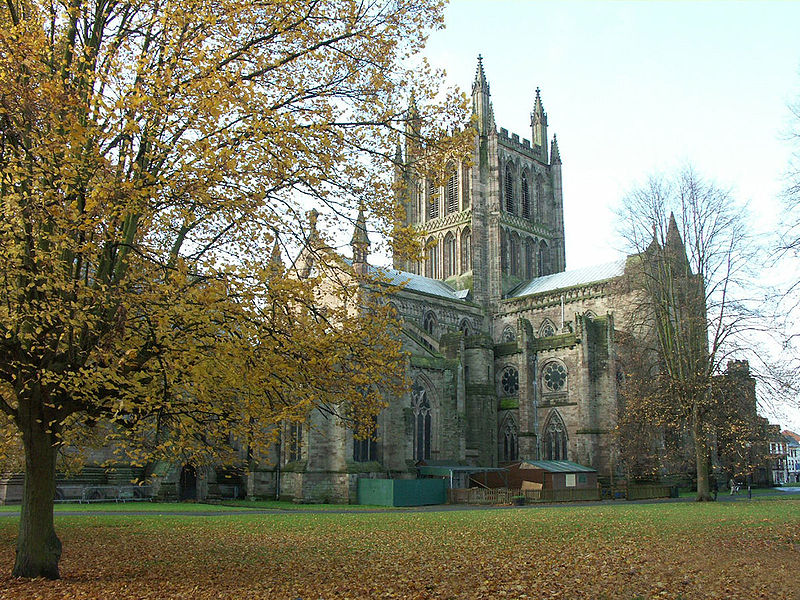
In 1275, Thomas was appointed Bishop of Hereford and set about defending the rights of the Diocese against the encroachments of, both fellow Bishops and lay lords. His combative approach made him many enemies. He insisted on a high standard of discipline and pastoral care from his Priests but was loved by the lay faithful for his large , gentle and kindly heart and holy life and their affection was not diminished by his hospitality and boundless charity. to those in any kind of need.
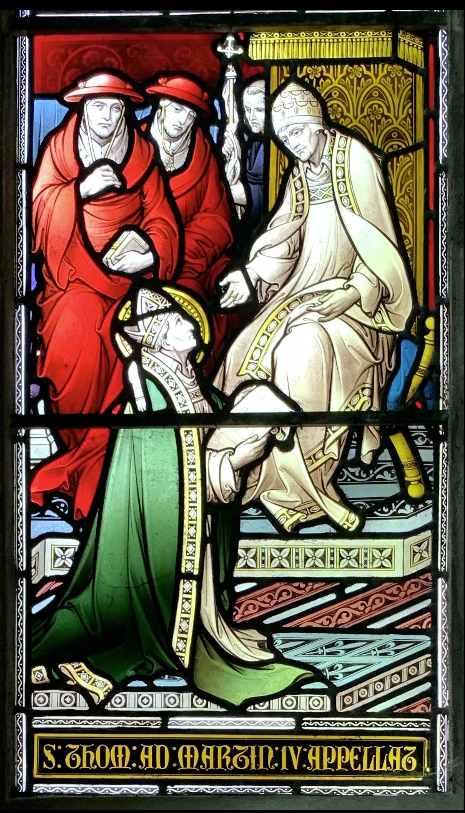
Thomas also fell foul of John Peckham, Archbishop of Canterbury, for his defence of the rights of individual Bishops against their Archbishop and Peckham excommunicated him. Thomas set off for Rome in 1282 to put his case before Pope Martin IV and it is believed that he obtained absolution;. Thomas, however, died near Orvieto (in Umbria, just north of Rome).
St Thomas de Cantelupe Appeals to Pope Martin IV
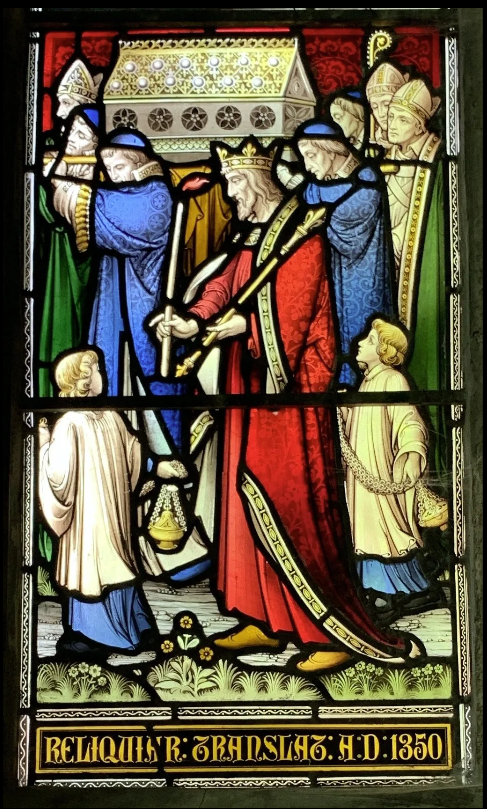
Richard Swinfield, his Successor in the See of Hereford, who had accompanied Bishop Cantilupe to Italy as his Chaplain, arranged that part of his relics were interred in the Church of Santo Severo, near Orvieto; the heart was conveyed to the Monastic Church of Ashridge in Buckinghamshire and the bones were brought to his own Cathedral at Hereford. As they were being conveyed into the Church, says the compiler of the Bishop’s ‘Life and Miracles,’ Gilbert Earl of Gloucester approached and touched the casket which contained them, whereupon they ‘bled-a-fresh’. The Earl was struck with compunction and made full restitution to the Church of all the lands which Bishop Cantilupe had rightly claimed from him.
St Thomas’ Death with King Edward I
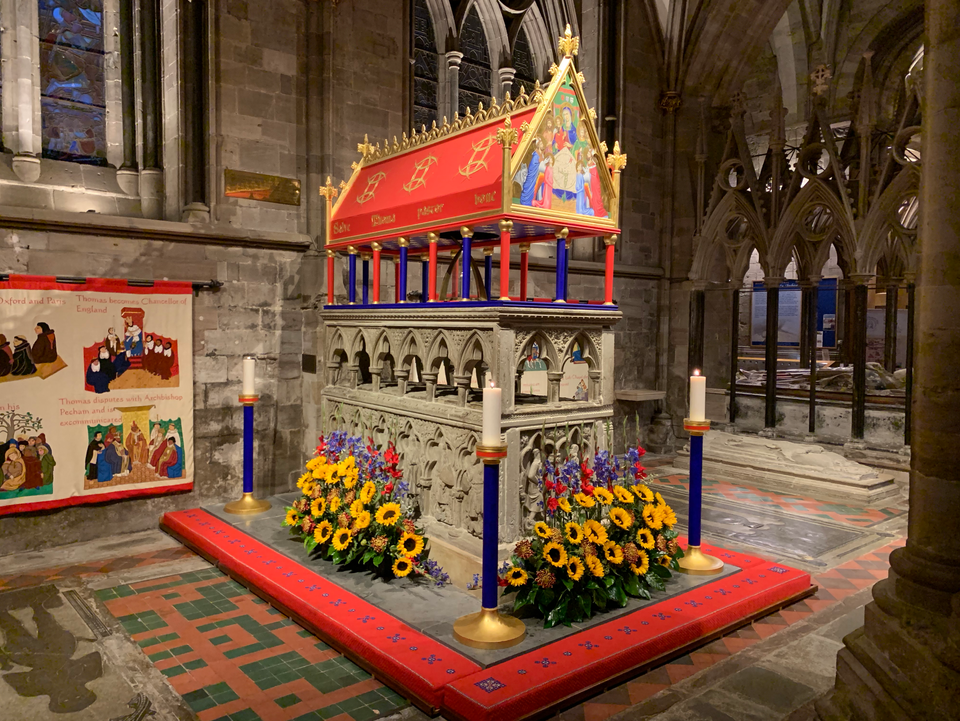
Bishop Swinfield, who had been the constant companion of Thomas and many of the contemporary chroniclers, bear witness to the purity and excellence of the Bishop’s life and his tomb soon became distinguished by miracles. The first of these, occurred in April 1287. At the time, of the removal of his remains from the tomb in the Lady Chapel to the Shrine which had been provided for them in the north transept. The number of marvels increased daily and, in 1289, Bishop Swinfield, wrote to the Pope requesting his Canonisation. Many difficulties, however, were interposed and in spite of numerous letters from King Edward I and his son, Edward II, it was not until May 1320 that Rome eventually found in his favour and the Bull of Canonisation was issued by Pope John XXII. Our Saint holds the dubious honour of being the only Canonised Saint to have been excommunicate at the time of his death.
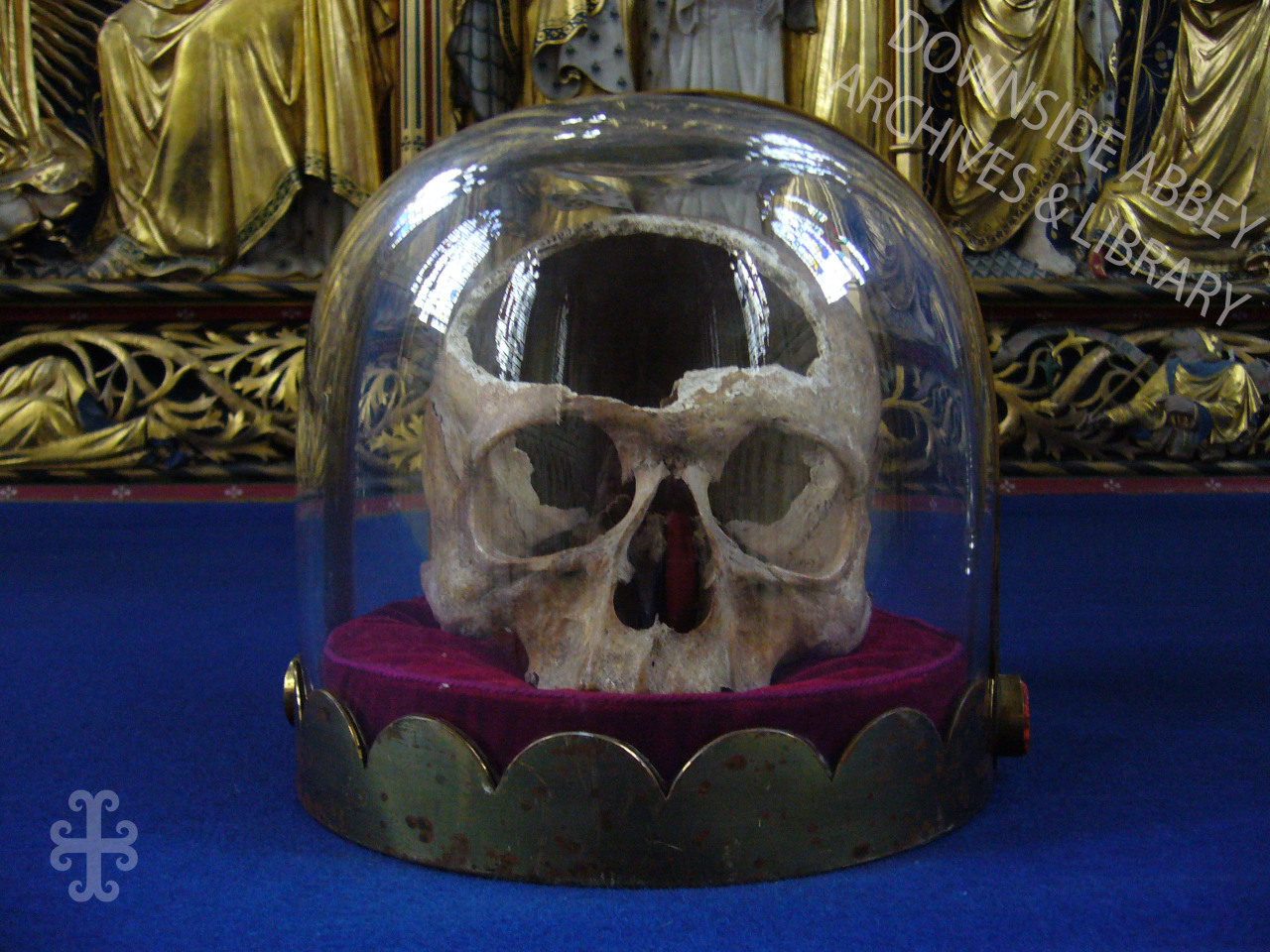
At the Reformation all the Shrines in Hereford Cathedral were swept away. St Thomas’ Shrine was wholly demolished but the faithful managed to rescue some of his relics, including his head. These bones were preserved until the seventeenth century by local Catholics but were dispersed thereafter, some of St Thomas’ relics are still honoured in England at Belmont Abbey in Herefordshire, Stonyhurst College in Lancashire and since 1881, St Thomas’ skull has be preserved at Downside Abbey.
St Thomas was an exemplary Bishop in both spiritual and secular affairs. His charities were large and his private life blameless. He was constantly visiting his Diocese, correcting offenders and discharging other episcopal duties and he compelled neighbouring landholders to restore estates which rightly belonged to the See of Hereford. St Thomas has been lauded as the “Father of Modern Charity” and is cited as an inspiration by Mother Teresa of Calcutta and other charitable people, apostolates and organisations.
A book entitled ‘The Life and Miracles of Saint Thomas Cantelupe,‘ said to be compiled from evidences at Rome, collected before his Canonisation, was published at Ghent in 1674. “No fewer than four hundred and twenty-five miracles are registered, reported to be wrought at his tomb. . . . Yea, it is recorded in his legend, that by his prayers were raised from death to life, three-score several persons, one-and-twenty lepers healed and three-and-twenty blind and dumb men to have received their sight and speech.”
Hail Thomas, good shepherd, patron of the flock of Christ and teacher of the Church, lend your help to the sick, I beg you, and confer on devout minds by your intercession, the light of grace, through Christ our Lord. Amen
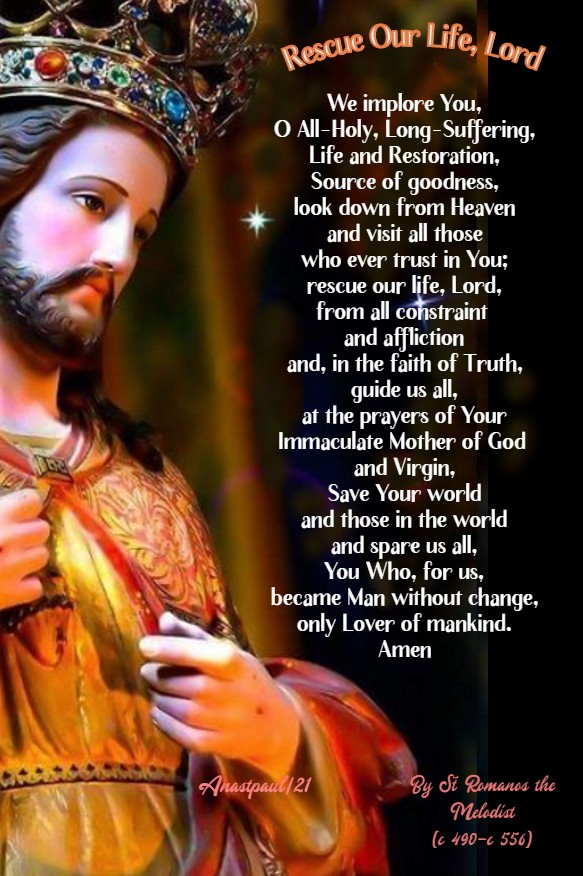
Our Morning Offering – 1 October – The Memorial of St Romanos the Melodist (c 490-c 556) Deacon, Hymnographer, Poet, Writer.
Rescue Our Life, Lord By St Romanos the Melodist (c 490-c 556)
We implore You, O All-Holy, Long-Suffering, Life and Restoration, Source of goodness, look down from Heaven and visit all those who ever trust in You; rescue our life, Lord, from all constraint and affliction and, in the faith of Truth, guide us all, at the prayers of Your Immaculate Mother of God and Virgin, Save Your world and those in the world and spare us all, You Who, for us, became Man without change, only Lover of mankind. Amen
Saint of the Day – 1 October – Saint Bavo of Ghent (c 589–654) Married. Widower, Soldier, Monk and Hermit, Penitent. Born in c 589 at Brabant, Liege, Belgium as Allowin and died on 1 October 654 at Saint Bavo’s Abbey of natural causes. Patronages – the Cities of Ghent, Zellik and Lauwe in Belgium, City of Haarlem, Netherlands, Diocese of Amsterdam, Netherlands, the Netherlands, of falcons and falconry. Also known as – Allowin, Bavone of Ghent.
The Roman Martyrology states of him today: “In Ghent in Flanders, in present-day Belgium, Saint Bavo, a Monk, who was a disciple of Saint Amand. He abandoned the world, distributed his goods to the poor and retired to the Monastery he founded in this place.“
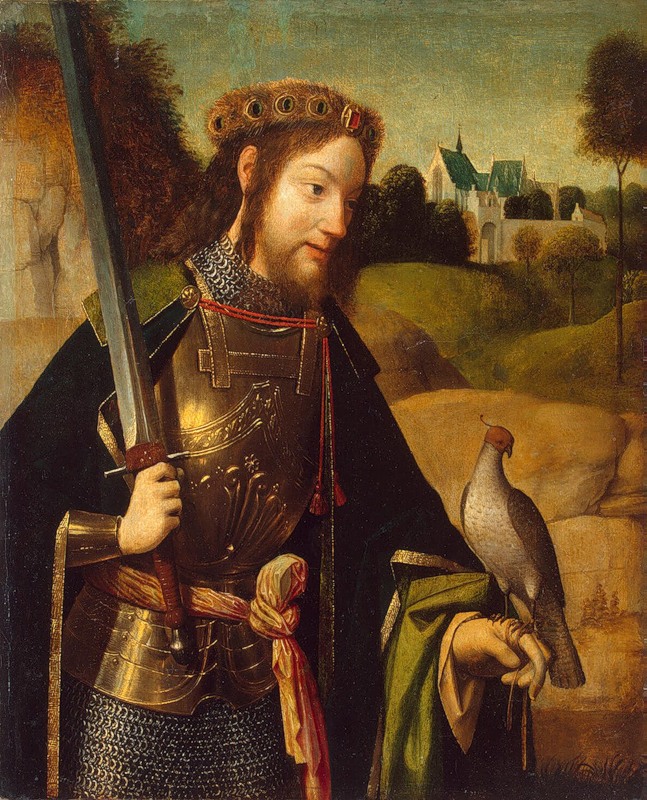
Saint Bavo with falcon and sword, by Geertgen tot Sint Jans, late 15th century
Bavo was born into a family of high social rank. His father was Pippin of Landen, the Mayor of the Palace and his mother, Itta of Metz.
A wild, young aristocrat of Brabant, he contracted a beneficial marriage to the daughter of the Merovingian Count Adilone and had a daughter named Agletrude. At that time, he was a soldier who led an undisciplined and disorderly life.
The young wife died, it is not known how and Bavo, deeply struck by the misfortune, interrupted his dissolute life and suffered a moral crisis, which was the starting point of his conversion.
He went to St Amand who was preaching to the still pagan populations of the Ghent region. On returning to his house he distributed his wealth to the poor, and then received the tonsure from Amand. He entered the Monastery of Ganda as a Monk., This Monastery had been founded by St Amando and was later renamed in Bavo’s honour.
He became a disciple of the missionary St Amand and followed him on his apostolic wanderings in Flanders and France. On one occasion, Bavo met a man whom he had sold into slavery years before. Wishing to atone for his earlier deed, Bavo had the man lead him by a chain to the town jail as penance and reparation for the sins of his past life.
After some time he returned to Ganda, where he had a small cell built in the hollow of a large tree and led a reclusive and ascetic life for three years.
But privations and sacrifices quickly weakened him, dying around 654. His body was buried in the Monastery of Ganda.
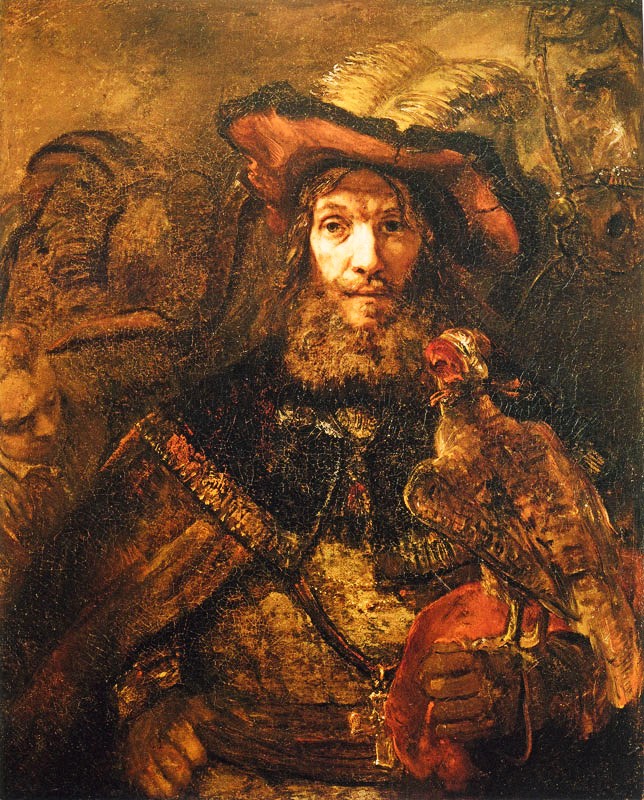
St Bavo by Rembrandt
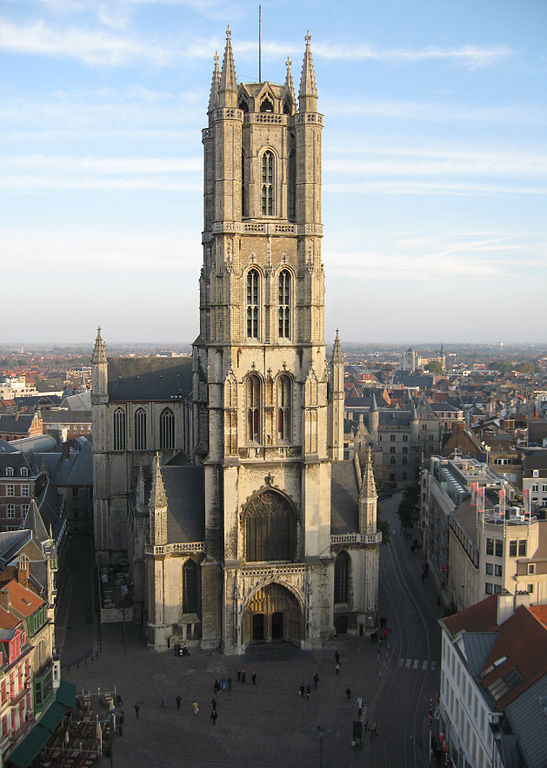
At present, his relics rest partly in the Cathedral of Ghent, which too is dedicated to St Bavo and partly in the Benedictine Abbey of Nesle-la-Reposte, the place where the Monks who fled from Ganda had taken refuge, to escape the Norman invasions, around 882- 883.
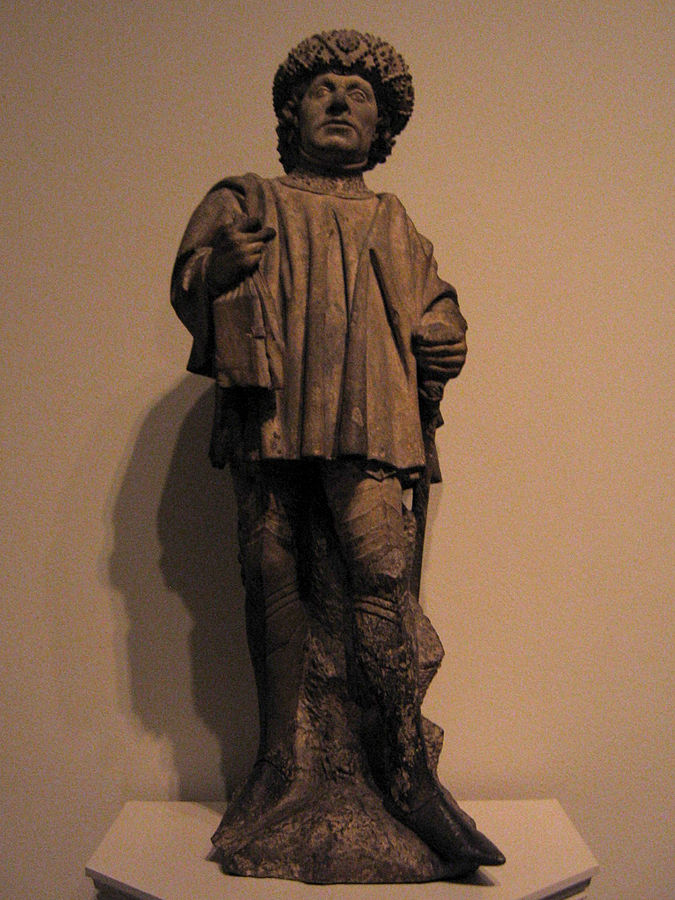
St Bavo saves Haarlem
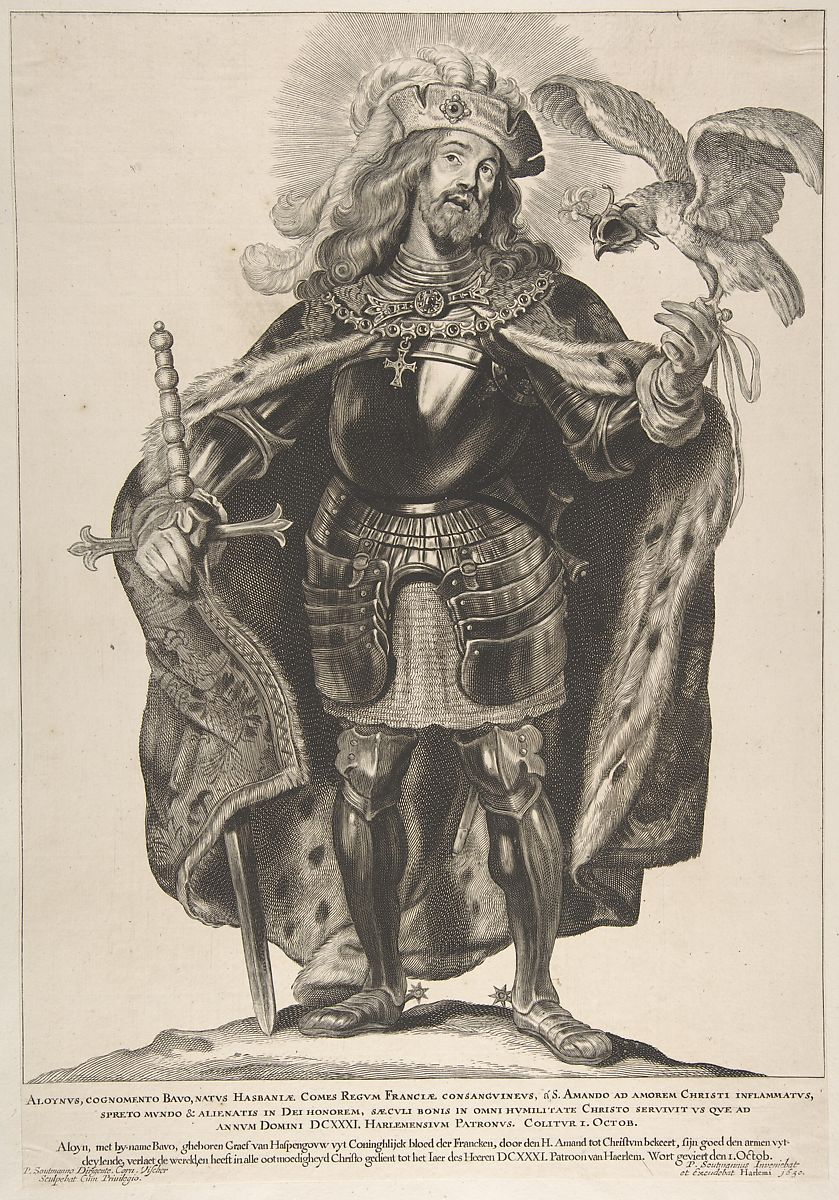
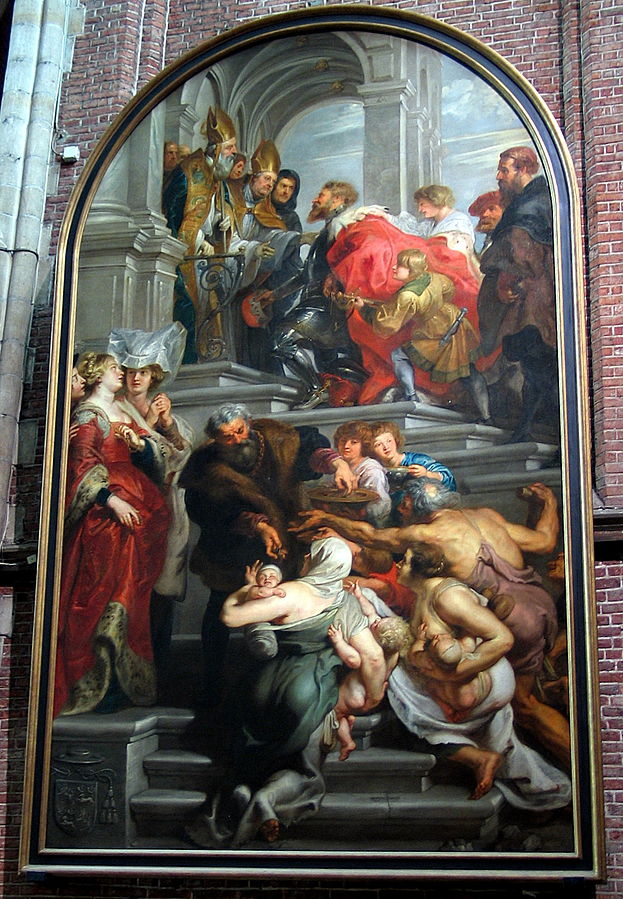
The most popular scene is the moment of his conversion, which has many legends attached to it. Because he is so often shown with a falcon, he came to be considered the patron saint of falconry. In medieval Ghent, taxes were paid on Bavo’s feast day, and it is for this reason, that he is often shown holding a purse or money bag.
The Conversion of St Bavo by Peter Paul Rubens
The City of Bamberg in Belgium is named after him, with Bamberg meaning “Mount of Bavo.” Several Churches are dedicated to him, including: Saint Bavo Cathedral, in Ghent which is most famous for housing the breath-taking Ghent Altarpiece by Jan van Eyck completed in 1432, see video below; Sint-Bavokerk and Cathedral of Saint Bavo, both in Haarlem; Sint-Bavokerk in Heemstede, Lauwe, and Zellik; Saint Bavo Church and School, in Mishawaka, Indiana; Sint-Bavokerk in Wilrijk.. His picture is also part of the Coat of Arms of the Antwerp Suburb Wilrijk.
Madonna di Valverde, / Our Lady of Valverde di Rezzato, Italy (1399 and 1711) – 1 October:
The Sanctuary of the Madonna di Valverde, belonging to the Parish of San Giovanni Battista di Rezzato Diocese of Brescia, is located in Valverde, at the foot of the Botticino and Serle hills. The Sanctuary was born in the places of the apparitions of 1399, the only one in history where both the Madonna and her Divine Son, Jesus Christ, the Saviour aooeared with His Mother and the second Marian Apparition of 1711.
For over six centuries the Sanctuary of the Madonna di Valverde has been a destination of pilgrimages from all over the north of Italy and is, above al,l in the heart of the community of Rezzato – Virle, which every year, on the Feast of St Anna on 26 July, recalls, with a solemn historical procession, the miracle of the apparitions.
In 1399, more than six hundred years ago, during the ploughing work in a field near Valverde, the oxen pulling the plough stopped and bent their knees. A man in a red robe and a blue mantle (Christ) appeared to the worker who guided them and ordered him to throw the three loaves that he kept in his saddlebag into the nearby pond. The peasant got ready to obey the order but was held back by the Apparition of the Madonna who advised him to return to beg the Lord, to revoke the order just given. If the three loaves had touched the waters of the lake, three scourges would have been unleashed (famine, plague and war) with which Christ intended to punish men for their impiety. Jesus, by the insistence of tHis Holy Mother, consented to the peasant’s plea and agreed that only one of the loaves need be thrown into the water and, therefore, only the scourge of the epidemic would spread throughout the area. Our Lady recommended to the peasant to announce to everyone, what he had seen with his own eyes, exhorting men to repent and to approach faith and the Sacraments again.
A Chapel was first built near the lake, then, in the early seventeenth century, a large and beautifully decorated Sanctuary followed.
St Thérèse of Lisieux/St Thérèse of the Child Jesus and the Holy Face/The Little Flower OCD (1873 – 1897) Virgin, Carmelite Nun, Doctor of the Church (Memorial) She was Canonised by Pope Pius XI on 17 May 1925. The same Pope proclaimed her Universal Patron of the Missions, alongside Saint Francis Xavier, on 14 December 1927. Up until 1969 her Memorial was celebrated on 3 October. Biography: https://anastpaul.com/2018/10/01/saint-of-the-day-st-therese-of-lisieux-o-c-d-1873-1897-doctor-of-the-church/
St Aizan of Abyssinia St Albaud of Toul Bl Andrew Sushinda Bl Antoni Rewera St Aretas of Rome St Bavo of Ghent (c 589–654) Married. Widower, Monk and Hermit. Bl Cecilia Eusepi Bl Christopher Buxton St Crescens of Tomi St Dodo Bl Dominic of Villanova Bl Edward James St Evagrius of Tomi St Fidharleus Bl Gaspar Fisogiro St Gregory the Illuminator St John Kukuzelis Bl John Robinson
St Maxima of Lisbon Bl Nikita Budka St Piaton of Tournai St Priscus of Tomi Bl Ralph Crockett Bl Robert Widmerpool Bl Robert Wilcox
St Romanos the Melodist (c 490-c 556) Deacon, Hymnographer, Poet, Writer. He is said to have composed more than 1,000 hymns celebrating various festivals of the ecclesiastical year, the lives of the saints and other sacred subjects, some 60 to 80 of which survive. Wonderful Saint Romanos! https://anastpaul.com/2020/10/01/saint-of-the-day-1-october-st-romanos-the-melodios-c-490-c-556/
St Sazan of Abyssinia St Verissimus of Lisbon St Virila St Wasnulf — Martyred in the Spanish Civil War: • Blessed Carmelo Juan Pérez Rodríguez • Blessed Higinio Mata Díez • Blessed Juan Mata Díez • Blessed Álvaro Sanjuán Canet • Blessed Florencia Caerols Martínez
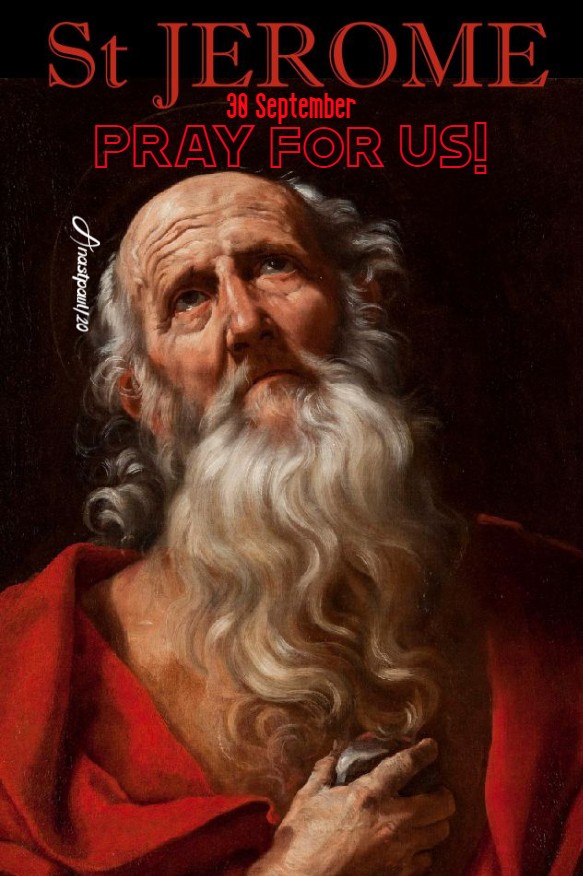
One Minute Reflection – 30 September – Readings: Nehemiah 8: 1-12; Psalm 19: 8-11; Luke 10: 1-12 – The Memorial of St Jerome (347-419) Father and Doctor
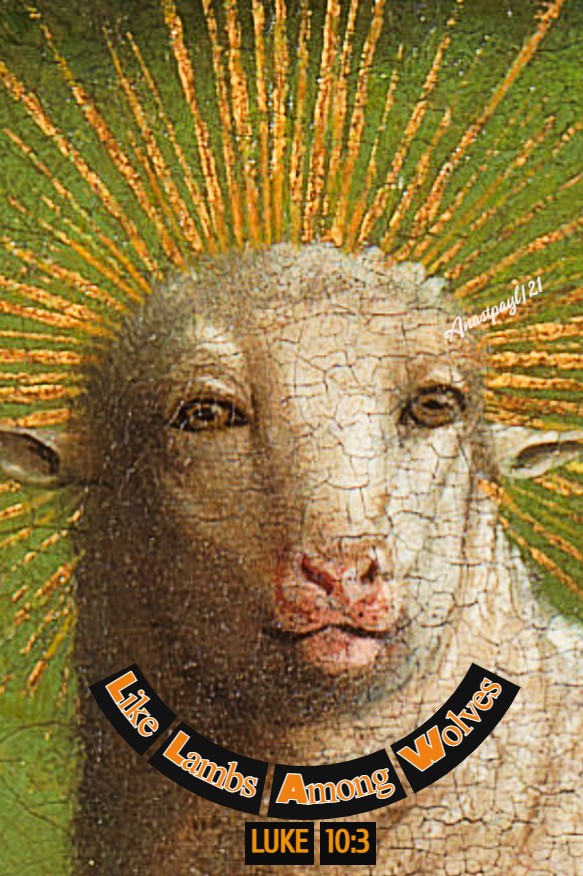
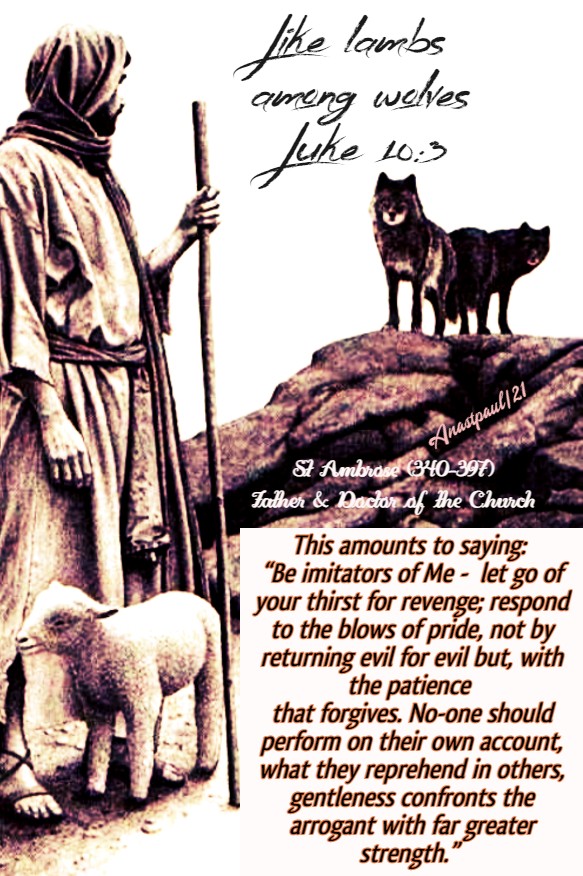
“Like lambs among wolves”– Luke 10:3
REFLECTION – “As He sent out disciples into His harvest – which had, in truth, been sown by the Father’s Word but, which required to be worked over, cultivated and carefully tended, if the birds were not to ravage the seed – Jesus said to them: “Behold, I send you out like lambs among wolves”. … The Good Shepherd could not but fear wolves in His flock – these disciples were sent to spread grace abroad, not to become a prey. But the Good Shepherd’s care prevented the wolves from doing anything against the lambs He sends out. He sends them that Isaiah’s prophecy might be fulfilled: “The wolf and the lamb shall graze alike” (Is 65:25) … And besides, were not the disciples who were sent out ordered not even to carry a staff? …
What our humble Lord laid down, His disciples also accomplished by practising humility. For He sends them out to broadcast the faith, not by force but by their teaching; not by exerting force of will but by exalting the doctrine of humility. And He thought it good to link patience to humility since, according to Peter’s testimony: “When he was insulted, he returned no insult; when he suffered, he did not threaten” (1 Pt 2:23).
This amounts to saying: “Be imitators of Me – let go of your thirst for revenge; respond to the blows of pride, not by returning evil for evil but, with the patience that forgives. No-one should perform on their own account, what they reprehend in others, gentleness confronts the arrogant with far greater strength.” – St Ambrose (340-397) Bishop of Milan Father and Doctor of the Church (Commentary on St Luke’s Gospel, 7, 45.59).
PRAYER – Almighty, ever-living God, You endowed Saint Jerome with a deep reverence and understanding of Holy Scripture, which he loved with all his heart. Sustain us evermore with Your word and teach us by their precepts. Help us to follow each word which Jesus, Your Son, our Redeemer, uttered that we may find therein the source of life. May the prayers of St Jerome assist us in our love and faithfulness. We ask this through Jesus our Lord, with the Holy Spirit, one God forever, Amen.
Saint of the Day – 30 September – St Honorius of Canterbury (Died 653) The Fifth Successor of St Augustine as Archbishop of Canterbury, Confessor, Missionary. Born at Rome, Italy and died in 653 at Canterbury, England of natural causes. Also known as Honoratus.
From St Bede we gather that he was a Roman Monk, a disciple of St. Gregory the Great and probably a Benedictine Monk. He either accompanied St.Augustine in 596 or was one of the second band of Missionaries sent by Pope Gregory in 601.
As a member of that apostolic company, he must have led that life of fervent piety, which, we are told, had so much effect in converting the inhabitants of Kent. When Honorius’s predecessor, Justus died, St Paulinus of York, fresh from the conversion of Northumbria, was the only English Bishop left to Consecrate him.
From two letters of Pope Honorius I, preserved in the writings of St Bede, it appears that Honorius and his Consecrator, in applying to Rome, asked that, in order to avoid the delays and uncertainties then involved in a journey to Italy, whenever the occupant of one of the metropolitan Sees should die, the survivor should have power to Consecrate the successor, a request which the Pope granted and sent a pallium.
The chief act of Honorius’s episcopate was the mission of St. Felix, whom he consecrated and sent to convert the East Angles, an expedition which was crowned with complete success. He administered his own Diocese with great zeal and energy. The Pope’s letter to him shows that his life was spent in the vigorous exercise of the duties of his office and in the faithful observance of the rule of his master, St. Gregory the Great. On the overthrow of the flourishing Kingdom and Church of Northumbria by Cadwalla of Wales and Penda of Mercia in 633, he received St Paulinus and appointed him to the vacant See of Rochester. On the death of Paulinus in 644, Honorius Consecrated Ithamar, a native of Kent, as his successor. And some years later, he Consecrated a deacon of Mercia, Thomas, to succeed Felix in East Anglia,and in or about 652 Beretgils or Boniface, a native of Kent, to succeed Thomas. The following year, 653, our Saint himself died and was buried with his predecessors in the Church of Saints Peter and Paul, founded by Saint Augustine.
Nostra Signora di Loreto di Forno / Our Lady of Loreto of Forno, Alpi Graie, Italy (1629) – 30 September:
At the beginning of the Vallone di Sea, at about 1340 metres above sea level, in the Forno di Groscavallo hamlet, stands the Sanctuary dedicated to the Madonna di Loreto, built around 1630, after the apparition occurred to Pietro Garino, a native of Forno. In those times, the region was tormented by the wars fought by Carlo Emanuele of Savoy against the neighbouring states; by the increasingly high taxes that weighed on the poor people, by hunger and the plague.
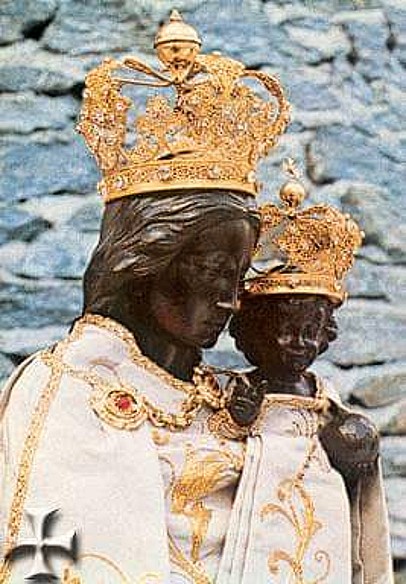
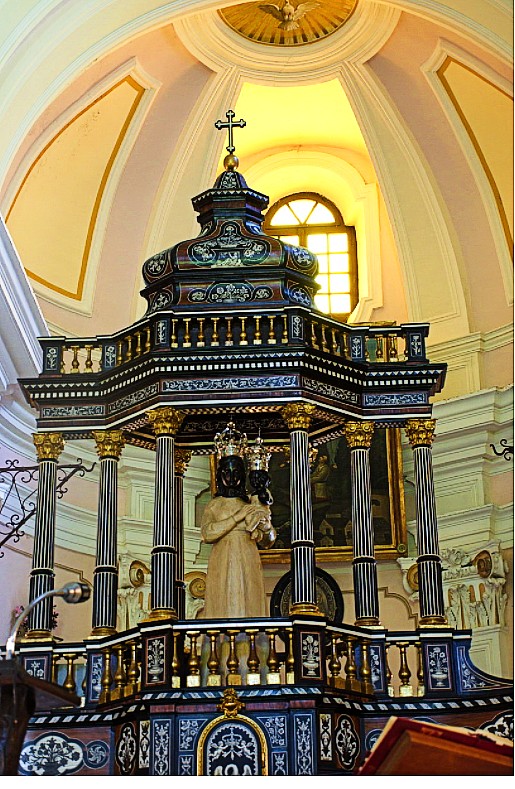
It was customary for devotees to go annually to the Chapel of the Virgin on Rocciamelone. On that occasion, Pietro Garino found the small pictures, which are still preserved in the Church, depicting the Madonna of Loreto and San Carlo Borromeo, leaning against the facade of the Chapel. They were in bad shape. Pietro took them with him to have them restored and promised himself to bring them back to the Chapel the following year, keeping them in the meantime at his home in Forno. Twice the pictures eluded his custody – the first time he found them right up there, at the mouth of the Vallone di Sea, where he had gone to collect leaves for the litter intended for livestock. On that occasion he had an apparition – the Virgin appeared to him between two women and promised him to stop the plague that claimed victims among the population of the plain. Brought home by Pietro, the paintings again disappeared from his home and were found in the same place as the apparition – it was a precise indication of the Virgin’s desire to see a Chapel built in that place. A Chapel was built at the spot of the apparition, of which the remains have recently been found. The current building dates back to the second half of the 1700s; it is the work of Luigi Baretta; internally it has elements of considerable artistic and historical interest. The marvelous Altar by Prinotto, a masterpiece of eighteenth-century cabinet-making; the baroque reliquary, in which the pictures are kept; hundreds of ex-votos, including some of considerable value. Historically, a Madonna with black features did not appear but the Sanctuary is known as such, as the faces of the Madonna and the Child she holds in her arms are ebony. The current Statue is the work of Raimondo Santifaller, from Ortisei and replaces the original one from the 18th century, stolen in 1977.
To access the Sanctuary it is necessary to climb the 440 steps that must be taken to reach the small square where the Sanctuary stands and which, pilgrims climb on their knees and in prayer.
The Sanctuary is open from July to September and Our Lady is celebrated annually on the Feast of the Assumption (16 August), the Nativity of Mary (8 September) and the Apparition of the Virgin Mary (30 September). The video below shows this beautiful Sanctuary very clearly.
St Antoninus of Piacenza St Castus of Piacenza St Colman of Clontibret St Desiderius of Piacenza St Enghenedl of Anglesey St Eusebia of Marseilles Bl Frederick Albert
St Honorius of Canterbury (Died 653) Archbishop of Canterbury St Ismidone of Die Bl Jean-Nicolas Cordier St Laurus St Leopardus the Slave Bl Ludwik Gietyngier St Midan of Anglesey St Simon of Crépy St Ursus the Theban St Victor the Theban — Martyrs of Valsery Abbey: An unknown number of Premonstratensian monks at the Abbey of Notre-Dame de Valsery, Picardie, France who were martyred by Calvinists. They were martyred in 1567 at Valsery, Pircardy, France.
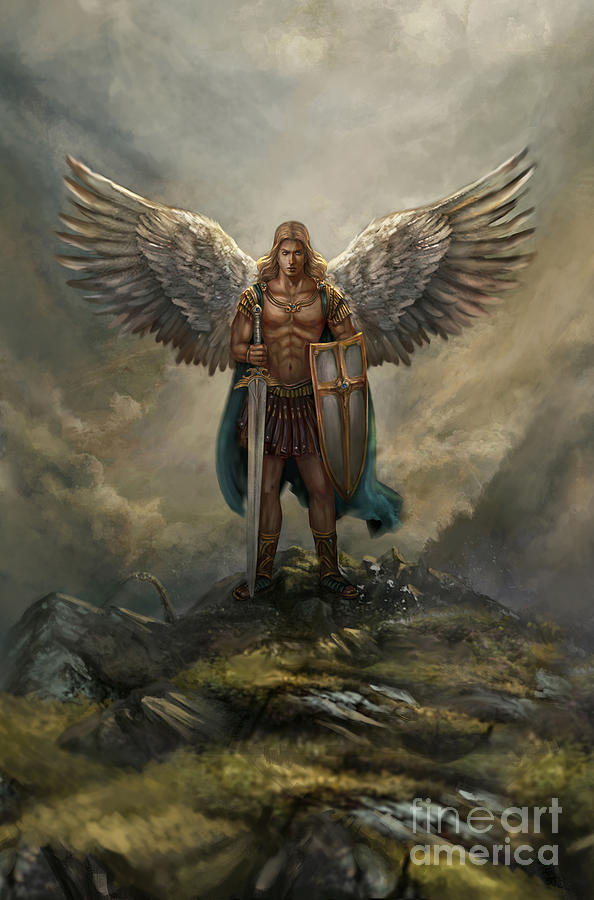
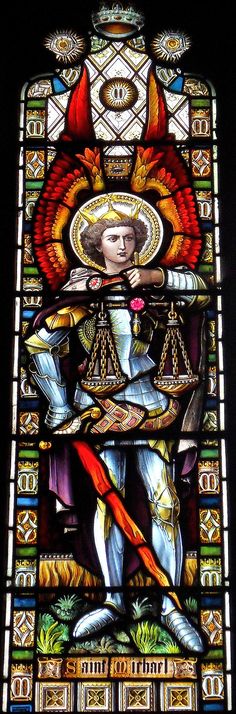
Saint of the Day – 29 September – Feast of the Dedication of St Michael the Archangel
By St Alphonsus Maria De Liguori (1696-1787)
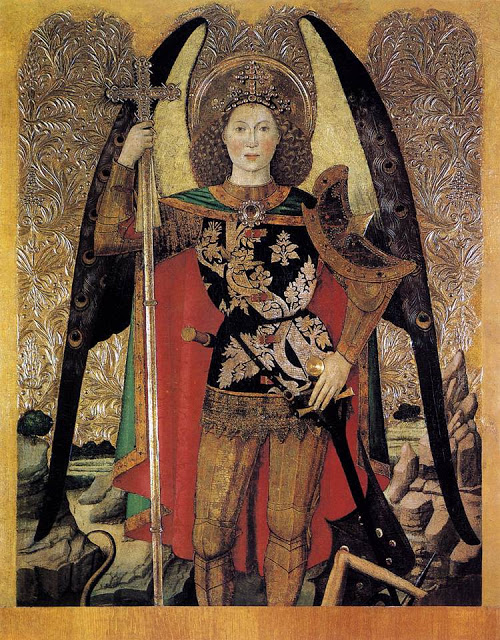
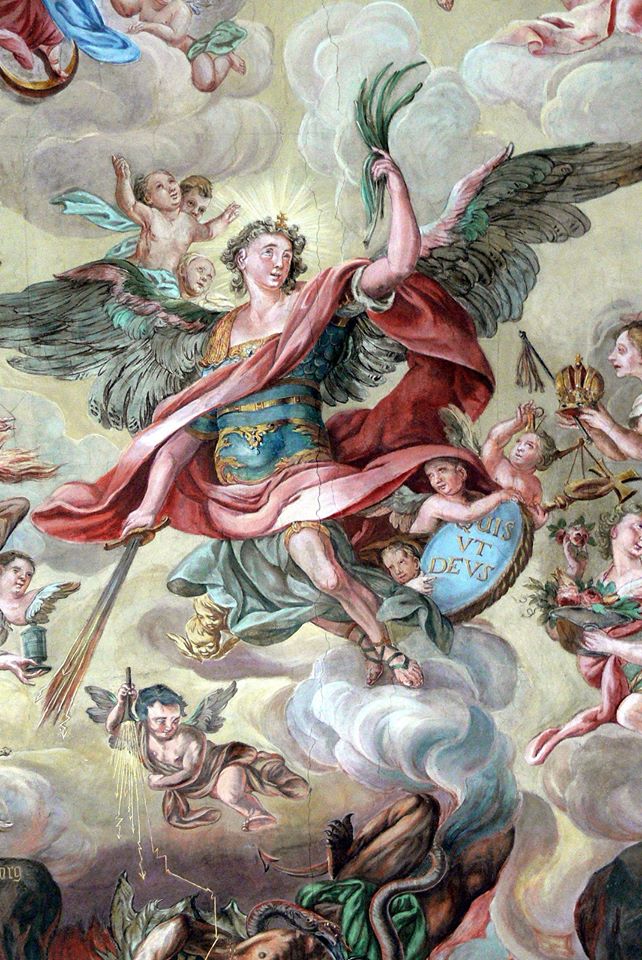
Among the Angels in heaven, none surpasses St Michael in glory and according to St Basil and others, there is none that equals him and with good reason because St Michael was chosen to subdue the pride of Lucifer and of all the rebel angels and, to expel them from heaven.
Christian, if thou lovest this Archangel, who has such great love for men, rejoice at the glory which he enjoys in heaven and beseech him, that, as he is the protector of the whole Church and of all the faithful, he will be thy special protector with God, Who loves him so much,and who rejoices in beholding one, who is so faithful to Him and so zealous for His honour, so much glorified by all.
In the Mass for the dead, the Church prays: “Let the standard bearer, St Michael, bring them into the holy light.” The learned explain this prayer and say, that St. Michael has the honourable office of presenting to Jesus Christ the Judge, all the souls that depart out of this world in the grace of God. Protect me, therefore, O holy Archangel and by your protection, enable my soul to become worthy of being presented, by your hands on the day of my death, ornamented with divine grace, before my Judge Jesus Christ.
Again, the Holy Church prays to St. Michael in the name of all the faithful, to defend us from the assaults of the wicked enemy at the hour of our death, that we may not be conquered and lose our souls: “Holy St Michael, the Archangel, defend us in battle, that we may not be lost at the dreadful judgement.“
O holy Archangel, the devil has many weapons to employ against me at the hour of my death; these weapons are my sins, by which he will then endeavour to throw me into despair; he is also preparing furious assaults of temptations to cause me then to fall again into sin. You, who conquered him and expelled him from heaven, conquer him again for me and drive him far away from me at the hour of my death; I beseech you to grant this my prayer, for the love of that God, Who so much loves you and whom you so much love. O Mary, Queen of heaven, procure for me the assistance of St Michael at the hour of my death. Amen!
St Michael as the Angel of death – Evelyn de Morgan
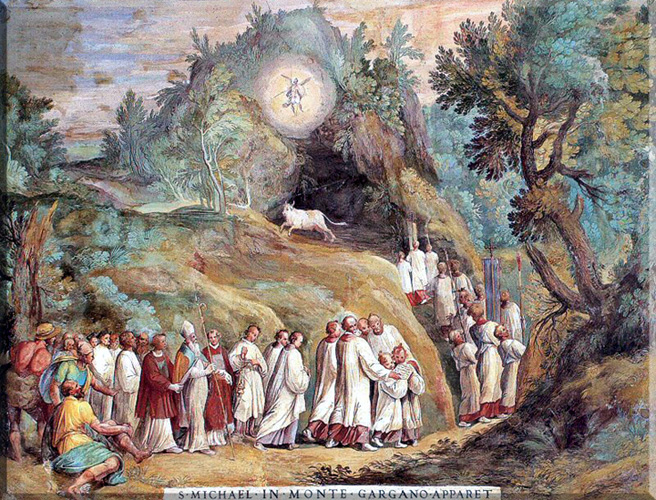
THIS festival has been kept with great solemnity on the 29th of September ever since the Fifth Century and was certainly initially celebrated in Apulia in 493. The Dedication of the famous Church of St Michael on Mount Gargano, in Italy, gave occasion to the institution of this feast in the West, which is hence called in the Martyrologies of St Jerome, St Bede and others, ‘The Dedication of St Michael.’ About the Apparition of St Michael at Mount Gargano in 492: https://anastpaul.com/2018/05/08/saint-of-the-day-8-may-apparition-of-michael-the-archangel-at-monte-gargano-italy-492/
The Apparition of St Michael at Gargano
The Dedication of the Church at Gargano
The Dedication of St Michael’s Church in Rome, which was performed by Pope Boniface IV. in 610 and that of several other Churches in the West, in honour of this Archangel, were also performed on this same day.
The name Michaelmas comes from a shortening of “Michael’s Mass,” in the same style as Christmas (Christ’s Mass) and Candlemas (Candle Mass, the Mass where traditionally the candles to be used throughout the year would be blessed). During the Middle Ages, Michaelmas was celebrated as a Holy Day of Obligation but this tradition was abolished in the 18th century.
The Church gives to St Michael four offices:
To fight against Satan.
To rescue the souls of the faithful from the power of the enemy, especially at the hour of death.
To be the champion of God’s people, the Jews in the Old Law, the Christians in the New Testament; therefore, he is the Patron of the Church and of the Orders of Knights during the Middle Age
To call away from earth and bring men’s souls to judgement.
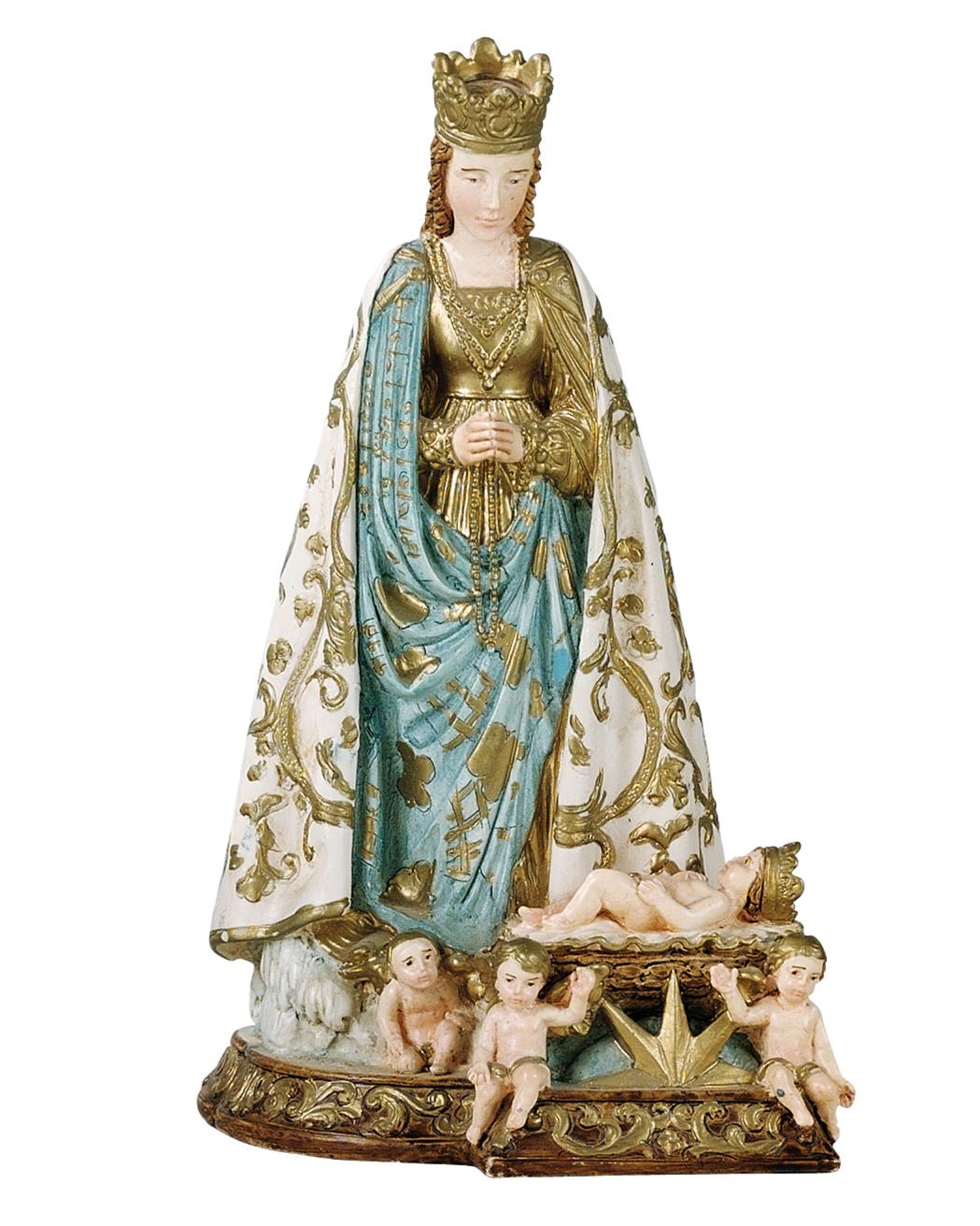
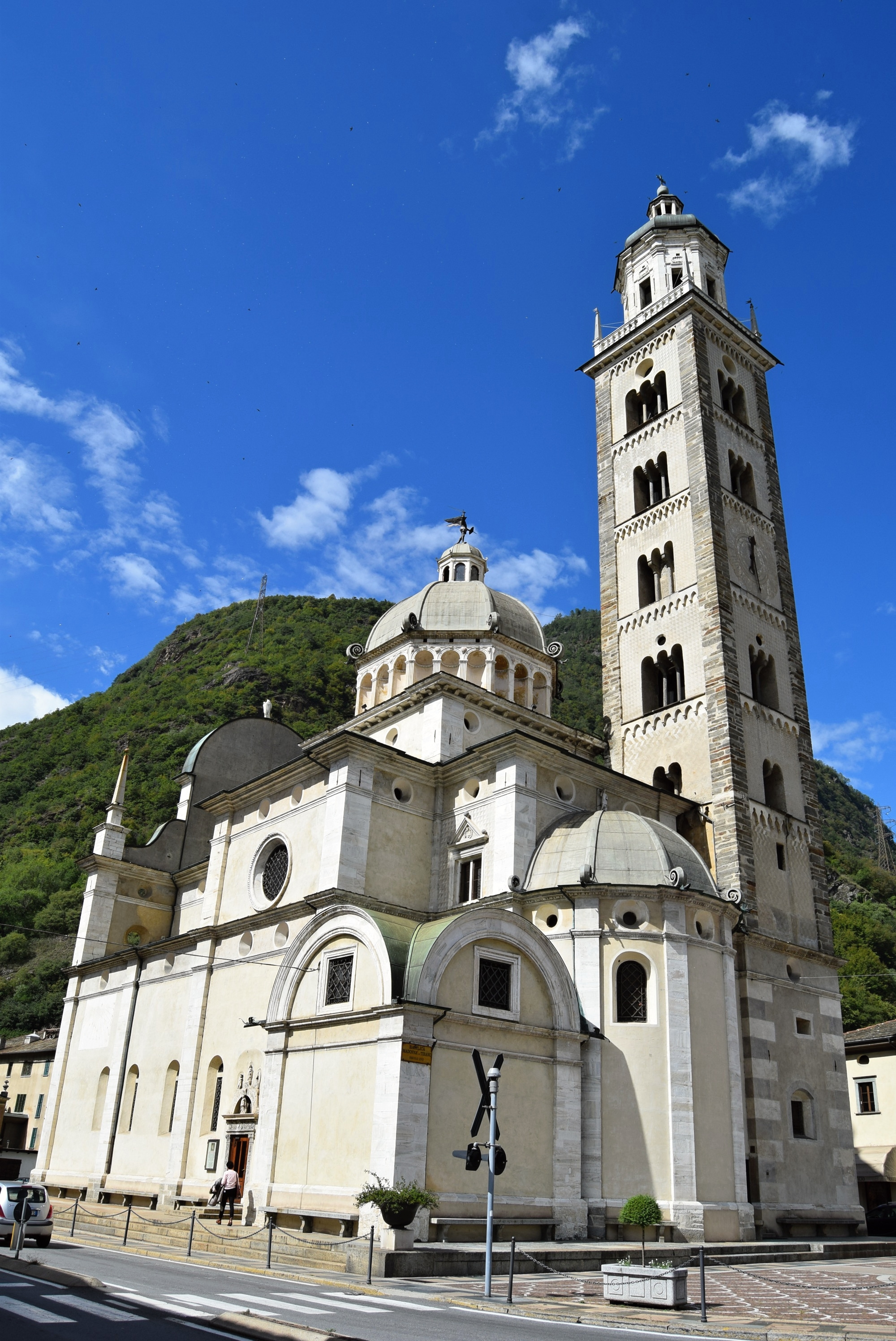
Madonna di Tirano / Our Lady of Tirano, Sondrio, Lombardy, Italy (1504) – 29 September:
The Sanctuary of the Madonna of Tirano stands on the Swiss-Italian border, where the Virgin appeared to Mario Omodei on 29 September 1504, promising an end to the plague which was decimating the region, if a Church in her honour would be built, on the spot outside the City walls. The epidemic subsided and the townspeople placed the first stone of the Sanctuary on 25 March 1505.
Because of its crossroads location, it has always drawn pilgrims from throughout Europe.
The Virgin’s Statue was part of a silver-clad grouping executed by woodcarver G Angelo Mayno around 1520. Napoleonic raiders stripped off the precious metal and destroyed the other Statues.
In 1946 Pope Pius XII proclaimed the Blessed Virgin of Tirano “special heavenly Patron of all Europe.”
Bl Alericus St Anno of Eichstätt St Casdoe of Persia St Catholdus of Eichstätt
St Dadas of Persia St Diethardus of Eichstätt St Fraternus of Auxerre St Gabdelas of Persia St Grimoaldus of Pontecorvo St Gudelia St Guillermo Courtet
St Miguel de Aozaraza St Quiriacus of Palestine St Rene Goupil St Rhipsime Bl Richard Rolle St Sapor of Persia St Theodota of Thrace St Vicente Shiwozuka de la Cruz — Martyrs of Thrace – 3 saints: Three Christian men murdered in Thrace for their faith. They are – Eutychius, Heracleas and Plautus.
Martyred in the Spanish Civil War: • Blessed Antonio Arribas Hortigüela • Blessed Antonio Martínez López • Blessed Dario Hernández Morató • Blessed Francesc de Paula Castelló Aleu • Blessed Francisco Edreira Mosquera • Blessed José Villanova Tormo • Blessed Pau Bori Puig • Blessed Vicente Sales Genovés • Blessed Virgilio Edreira Mosquera
Quote/s of the Day – 28 September – The Memorial of St Wenceslaus (907-935) King of Bohemia, Martyr
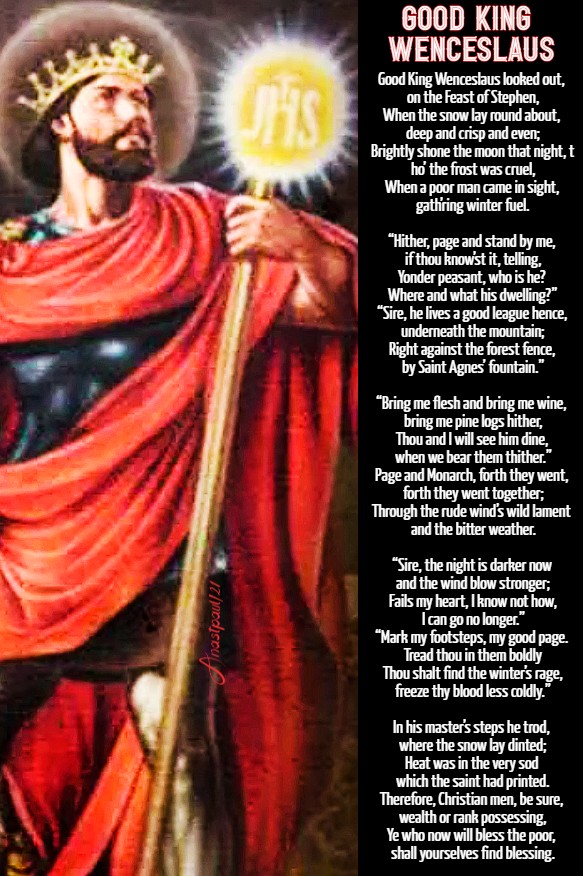
Good King Wenceslaus
Good King Wenceslaus looked out, on the Feast of Stephen, When the snow lay round about, deep and crisp and even; Brightly shone the moon that night, t ho’ the frost was cruel, When a poor man came in sight, gath’ring winter fuel.
“Hither, page and stand by me, if thou know’st it, telling, Yonder peasant, who is he? Where and what his dwelling?” “Sire, he lives a good league hence, underneath the mountain; Right against the forest fence, by Saint Agnes’ fountain.”
“Bring me flesh and bring me wine, bring me pine logs hither, Thou and I will see him dine, when we bear them thither.” Page and Monarch, forth they went, forth they went together; Through the rude wind’s wild lament and the bitter weather.
“Sire, the night is darker now and the wind blow stronger; Fails my heart, I know not how, I can go no longer.” “Mark my footsteps, my good page. Tread thou in them boldly Thou shalt find the winter’s rage, freeze thy blood less coldly.”
In his master’s steps he trod, where the snow lay dinted; Heat was in the very sod which the saint had printed. Therefore, Christian men, be sure, wealth or rank possessing, Ye who now will bless the poor, shall yourselves find blessing.
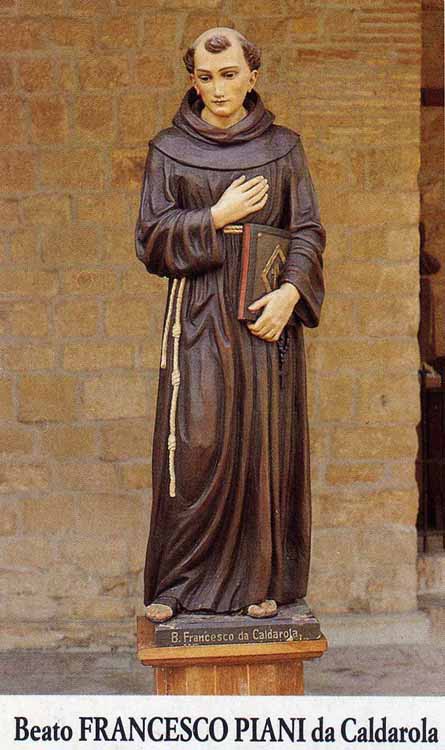
Saint of the Day – 28 September – Blessed Francesco Piani of Caldarola OFM (1424-1507) Franciscan Friar, renowned Preacher and Peacemaker, a collaborator in the fight against usury by the institution of the “Mount of Piety,” (a type of pawn shop), social activist and protector of the struggling rural communties. Born in 1424 in Caldarola, Macerata, Italy and died on 12 September 1507 in the Franciscan convent in Colfano, Italy of natural causes, aged 77.
Blessed Bernardine of Feltre OFM (1439-1494), propagator and Founder of the “Monti di Pietà, Mount of Piety” and whose Feast Day we celebrate today too, had as collaborator Blessed Francesco of Caldarola.
Francesco came from the Marche, a region with a predominantly agricultural economy, and was, therefore, well aware of the miseries of the rural workers forced to go into debt and become slaves of usurers and dedicated his life to them.
Francisco was also a very fervent preacher, who knew how to quell the frequent quarrels in the countries of his land, divided by violent struggles, between ambitious factions and powerful families.
The secret of the peace Preacher’s success was simple – talk to the people by day and spend the night in prayer.
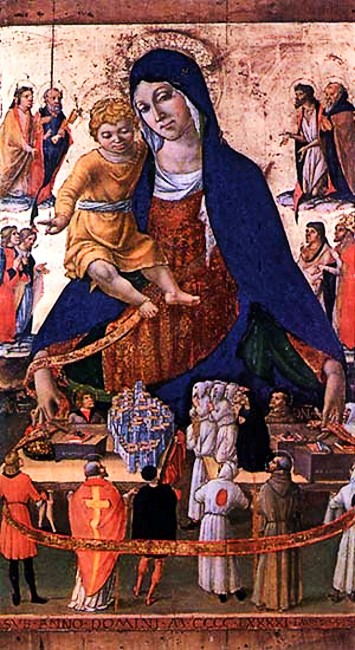
The establishment of the apostolate brotherhood of Santa Maria del Monte was also due to Blessed Francesco, the image below is of this Title of the Blessed Virgin Mother and perhaps one of the devotees is our Blessed.
The Blessed died on 12 September 1507 at the age of 77 in the Convent of Colfano, where he had spent most of his religious life.
After he died, numerous miracles were reported by his intercession and his cult is documented since 1511.
Blessed Francesco Piani precedes the Caldarolese Renaissance. While the closure of the Middle Ages can be attributed to him, we think that the opening of social care can also be entrusted to him. His fundamental works are born from the Franciscan lineage to which he belonged which, in him in Caldarola, was strengthened with three creations that were partly lost in future centuries and partly changed – the Compagnia di Santa Maria, an apostolate brotherhood of disciplines from which they derive the others, the hospital and the pawnshop. All the works of great sociality to be framed in the context of the faith and poverty of his time.
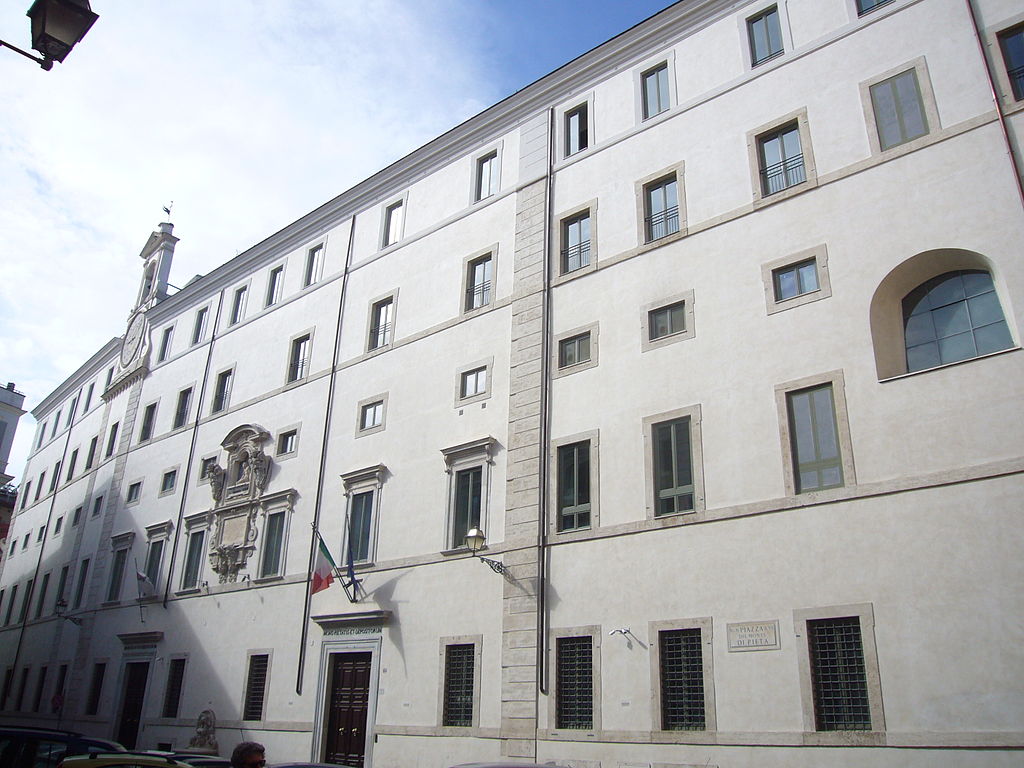
Monte di Pietà Offices in Rome today
Preacher and Peacemaker, he was Beatified by Pope Urban VII in 1634 – his cult was reaffirmed on 1 September 1843 by Pope Gregory XVI.. Perhaps without his work, which gave social consistency to the community, Caldarola would not have generated its own renaissance.
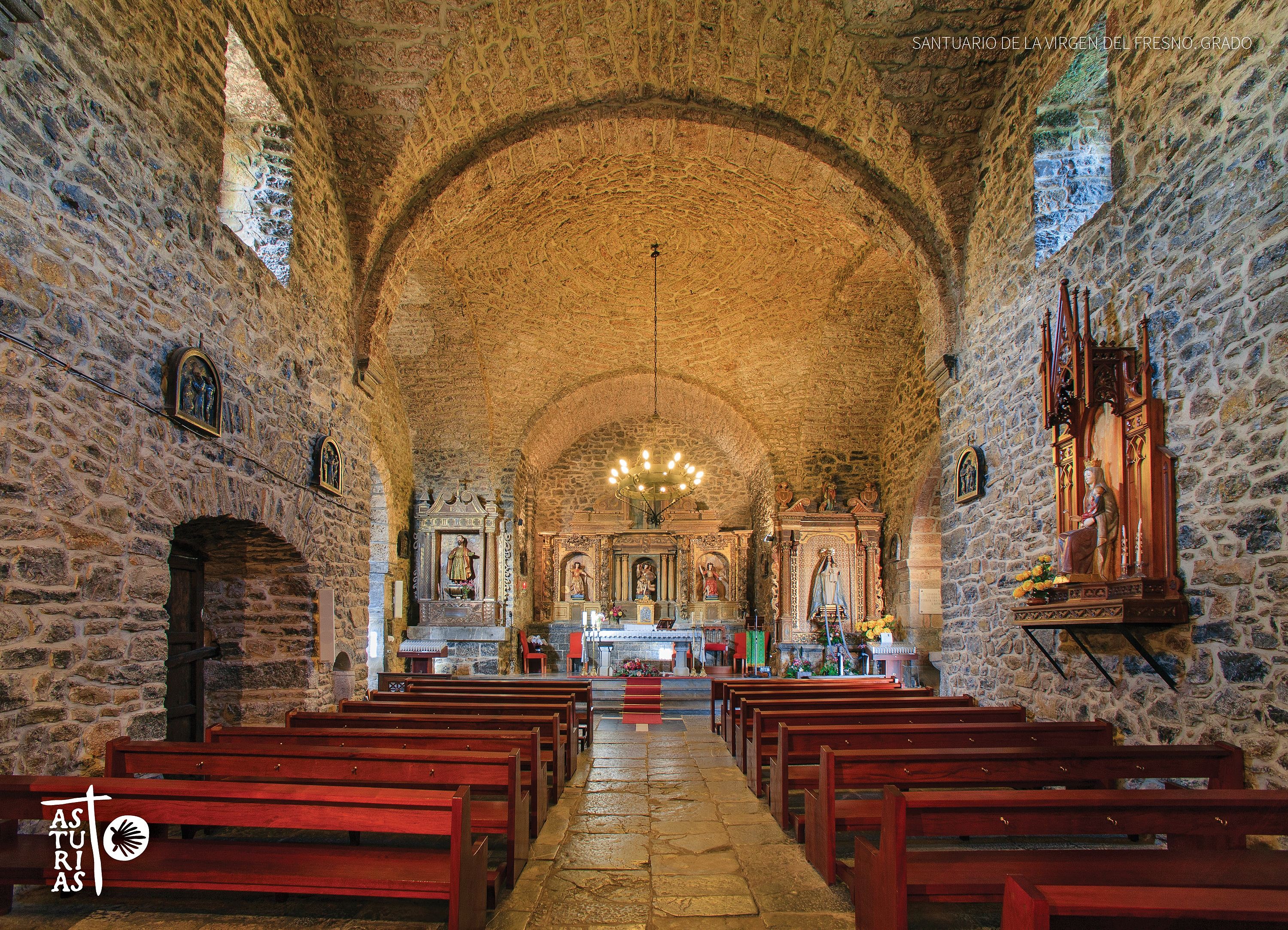
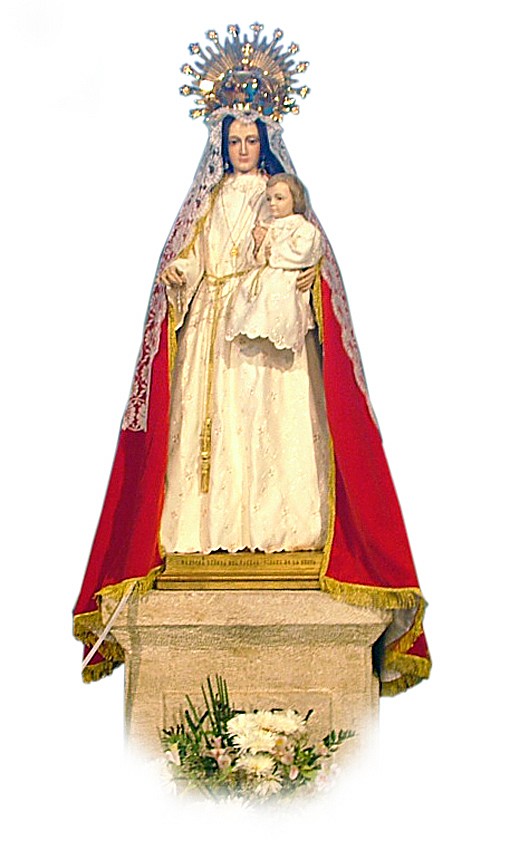
Nuestra Señora del Fresno / Our Lady of Fresno, Grado, Asturias, Spain (9th Century) – 8 and 28 September:
Copy of the original image
The Sanctuary of the Virgen del Fresno is one of the most visited Sanctuaries in the central area of Asturias despite the difficulty of its access. The Sanctuary is located on the Camino de Santiago hence it’s popularity dating from the 9th Century when pilgrims stopped to rest in the hostel provided. They were known as “the Novenarios” as, during their rest, they prayed the St Michael Novena before his Feast Day on 29 September.
In honour of the Virgen del Fresno two festivals are held, one on 8 September and the other 28 of the same month preceded by a Novena that has traditionally started at four in the afternoon.
The current image dates from 1975, since the original was lost in the looting it suffered in 1936. It is made of cedar from Lebanon, made in Madrid. She is dressed and holds the Child in her arms and the Rosary between her fingers. She remain above her Altar and another processional image accompanies the Novena.
Bl Aaron of Auxerre St Alodius of Auxerre St Annemond of Lyons St Bardomianus
Blessed Bernardine of Feltre OFM (1439-1494) Franciscan Priest and Friar, Missionary Preacher, Poet, peace-maker, Civil protestor against the practice of usury, defender of the poor. He was a true ‘child prodigy’ – by the time he was 12 he was fluent in Latin and at the age of 15 he composed a poem and read it in the Town Square to celebrate a local peace treaty. He is remembered most especially, in connection with the “Monti di Pietà” “Mount of Piety” of which he was the reorganiser and, in a certain sense, the Founder, together with the Blessed Michele Carcano. Biography: https://anastpaul.com/2020/09/28/saint-of-the-day-28-september-blessed-bernardine-of-feltre-ofm-1439-1494/
St Chariton of Palestine Bl Christian Franco St Conval of Strathclyde St Eucarpus St Eustochium St Exuperius of Toulouse St Faustus of Riez Blessed Francesco Piani of Caldarola OFM (1424-1507) Francisan Friar St John of Dukla St Laurence of North Africa St Lioba of Bischofsheim
St Solomon of Genoa St Stacteus St Tetta of Wimborne Bl Thiemo St Willigod of Moyenmoutier St Zama of Bologna — Augustinian Martyrs of Japan: The first Augustinian Missionaries arrived in Japan in 1602 and met with immediate success; many were brought to the faith; many of them became Augustinians; and many of them were martyred in the periodic persecutions of Christians. This memorial commemorates all of them, whether they have a sanctioned Cause for Canonisation or not. They include: • Blessed Bartolomé Gutiérrez Rodríguez • Blessed Ferdinand Ayala • Blessed Francisco Terrero de Ortega Pérez • Blessed Ioannes Mukuno Chozaburo • Blessed Laurentius Kaida Hachizo • Blessed Mancius Yukimoto Ichizaemon • Blessed Martín Lumbreras Peralta • Blessed Melchor Sánchez Pérez • Blessed Michaël Ichinose Sukezaemon • Blessed Pedro de Zúñiga • Blessed Petrus Sawaguchi Kuhyoe • Blessed Thomas Jihyoe of Saint Augustine • Blessed Thomas Terai Kahyoe • Blessed Vicente Simões de Carvalho • Saint Magdalena of Nagasaki
Martyrs of Antioch – 37 saints: A group of 30 soldiers and 7 civilians who were murdered together for their faith. The names that have come down to us are – Alexander, Alphinus, Heliodorus, Mark, Neon, Nicon and Zosumus. c 303 at Antioch, Pisidia (in modern Turkey).
Martyrs of China – 120 saints: A common memorial for the hundreds of the faithful, lay and clergy, who have died for their faith in the last couple of centuries in China.
Martyred in the Spanish Civil War: • Blessed Amalia Abad Casasempere de Maestre • Blessed Francesc Xavier Ponsa Casallach • Blessed Josep Casas Juliá • Blessed Josep Casas Ros • Blessed Josep Tarrats Comaposada • Blessed María Fenollosa Alcaina










































You must be logged in to post a comment.