St Abadiu of Antinoë Bl Agata Phutta Bi Bl Agnès Phila St Amaethlu of Anglesey St Archelaus of Mesopotamia Bl Bibiana Khamphai Bl Cecilia Butsi Bl Daniel of Villiers St Pope Dionysius (Died 268) St Euthymius of Sardis St Evaristo of Constantinople Bl Giovanni Orsini Bl Jean of Hainaut Bl Lucie Khambang St Margaret of Hohenfels Bl Maria Phon Bl Marinus of Rome Bl Paganus of Lecco Bl Pierre Boffet St Tathai of Wales St Theodore the Sacristan St Vincenza Maria Lopez (1847- 1890) Biography: https://anastpaul.com/2019/12/26/saint-of-the-day-26-december-saint-vincenza-maria-lopez-1847-1890/ St Zeno of Gaza St Pope Zosimus
Quote/s of the Day – 25 December – The Solemnity of the Nativity of Our Lord, Jesus Christ and remembering Blessed Jacopone da Todi OFM (1230-1306)
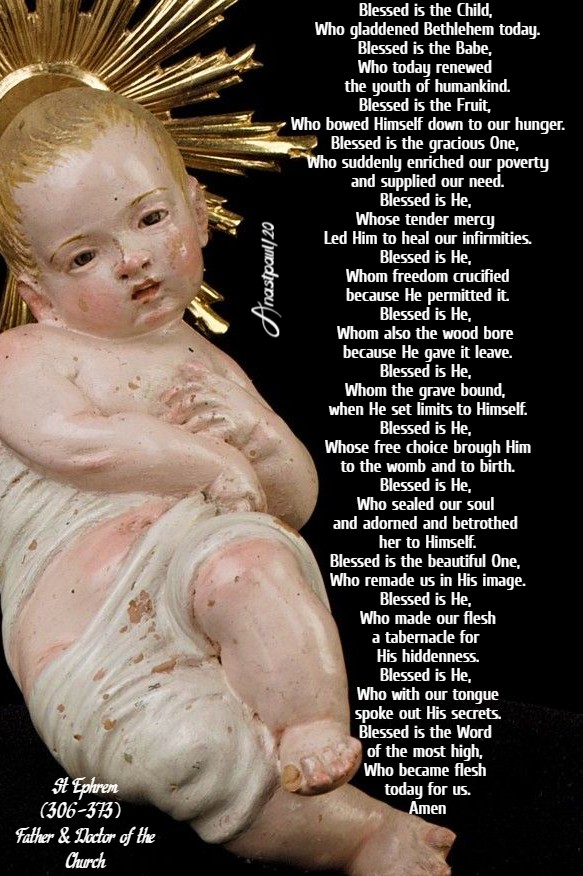
“Blessed is the Child, Who gladdened Bethlehem today. Blessed is the Babe, Who today renewed the youth of humankind. Blessed is the Fruit, Who bowed Himself down to our hunger. Blessed is the gracious One, Who suddenly enriched our poverty and supplied our need. Blessed is He, Whose tender mercy Led Him to heal our infirmities. Blessed is He, Whom freedom crucified because He permitted it. Blessed is He, Whom also the wood bore because He gave it leave. Blessed is He, Whom the grave bound, when He set limits to Himself. Blessed is He, Whose free choice brough Him to the womb and to birth. Blessed is He, Who sealed our soul and adorned and betrothed her to Himself. Blessed is the beautiful One, Who remade us in His image. Blessed is He, Who made our flesh a tabernacle for His hiddenness. Blessed is He, Who with our tongue spoke out His secrets. Blessed is the Word of the most high, Who became flesh today for us. Amen”
St Ephrem (306-373) Father & Doctor of the Church
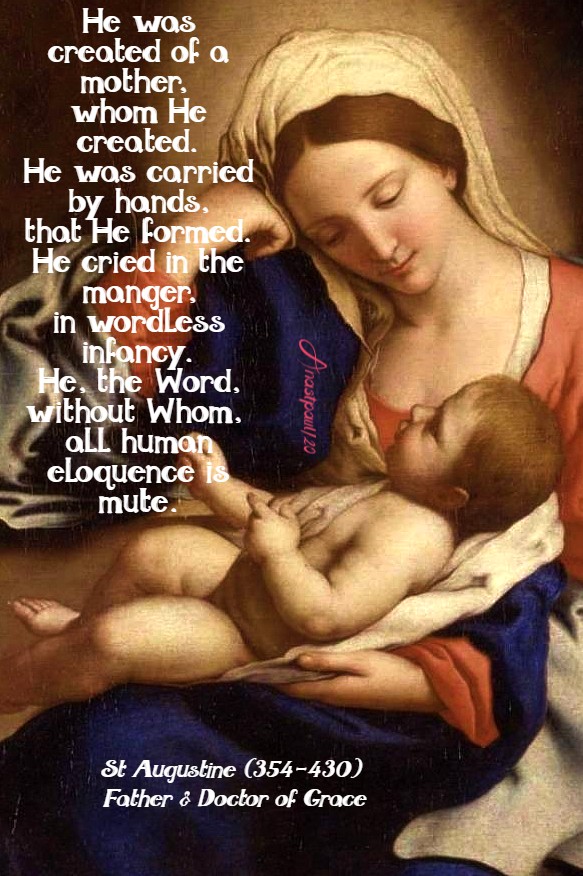
“He was created of a mother, whom He created. He was carried by hands, that He formed. He cried in the manger, in wordless infancy. He, the Word, without Whom, all human eloquence is mute.”
St Augustine (354-430) Father & Doctor of Grace
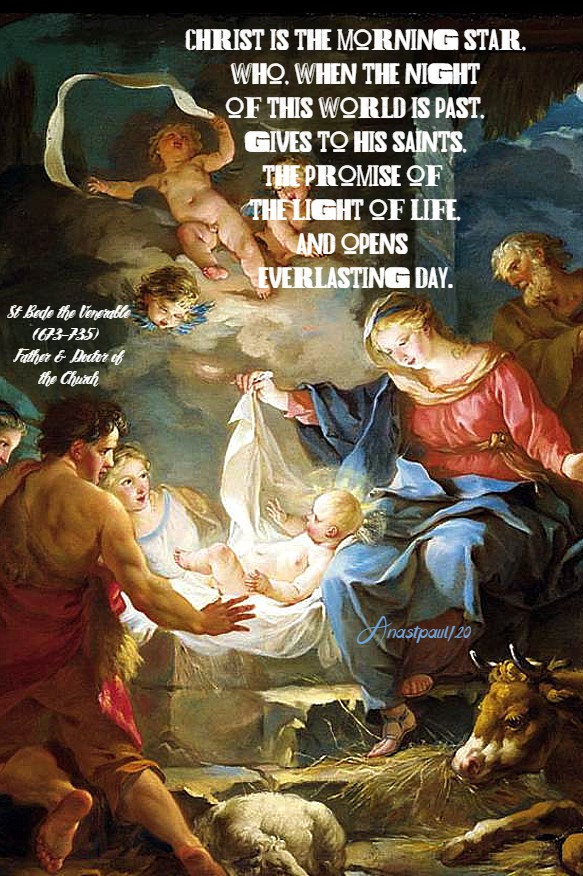
“Christ is the Morning Star, Who, when the night of this world is past, gives to His saints, the promise of the light of life, and opens everlasting day.”
St Bede the Venerable (673-735) Father & Doctor of the Church
“He came from His royal throne, the stern Conqueror of error and the gentle Apostle of love.”
William of Saint Thierry (c 1075-1148)
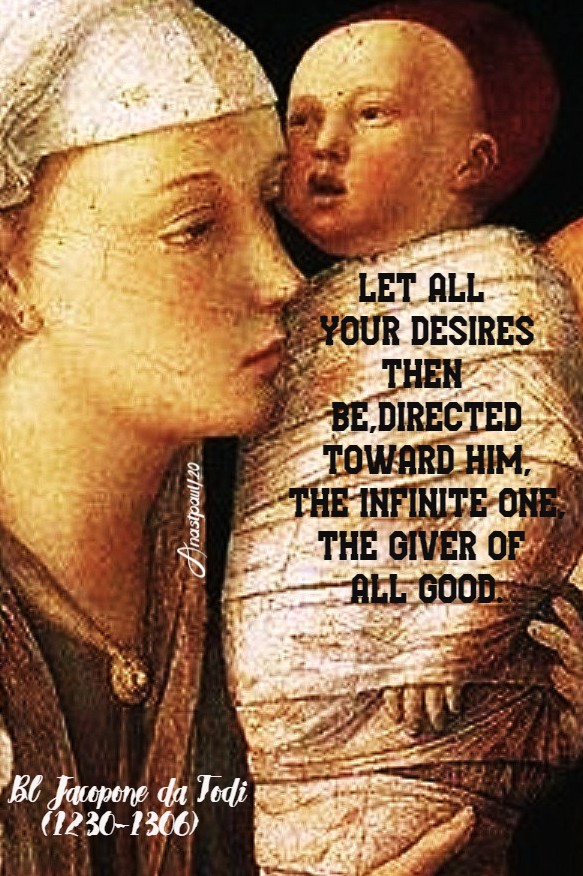
“Let all your desires then be, directed toward Him, the Infinite One, the Giver of all Good.”
Bl Jacopone da Todi (1230-1306)
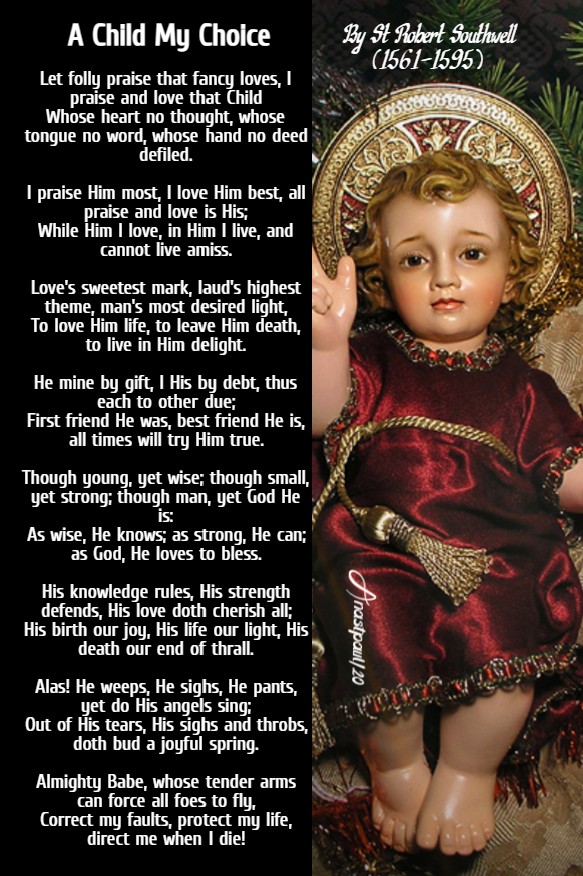
A Child My Choice By St Robert Southwell (1561-1595) Martyr
Let folly praise that fancy loves, I praise and love that Child Whose heart no thought, whose tongue no word, whose hand no deed defiled.
I praise Him most, I love Him best, all praise and love is His; While Him I love, in Him I live, and cannot live amiss.
Love’s sweetest mark, laud’s highest theme, man’s most desired light, To love Him life, to leave Him death, to live in Him delight.
He mine by gift, I His by debt, thus each to other due; First friend He was, best friend He is, all times will try Him true.
Though young, yet wise; though small, yet strong; though man, yet God He is: As wise, He knows; as strong, He can; as God, He loves to bless.
His knowledge rules, His strength defends, His love doth cherish all; His birth our joy, His life our light, His death our end of thrall.
Alas! He weeps, He sighs, He pants, yet do His angels sing; Out of His tears, His sighs and throbs, doth bud a joyful spring.
Almighty Babe, whose tender arms can force all foes to fly, Correct my faults, protect my life, direct me when I die!
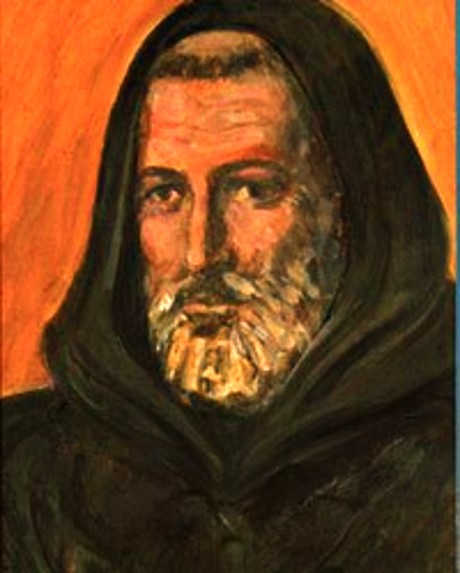
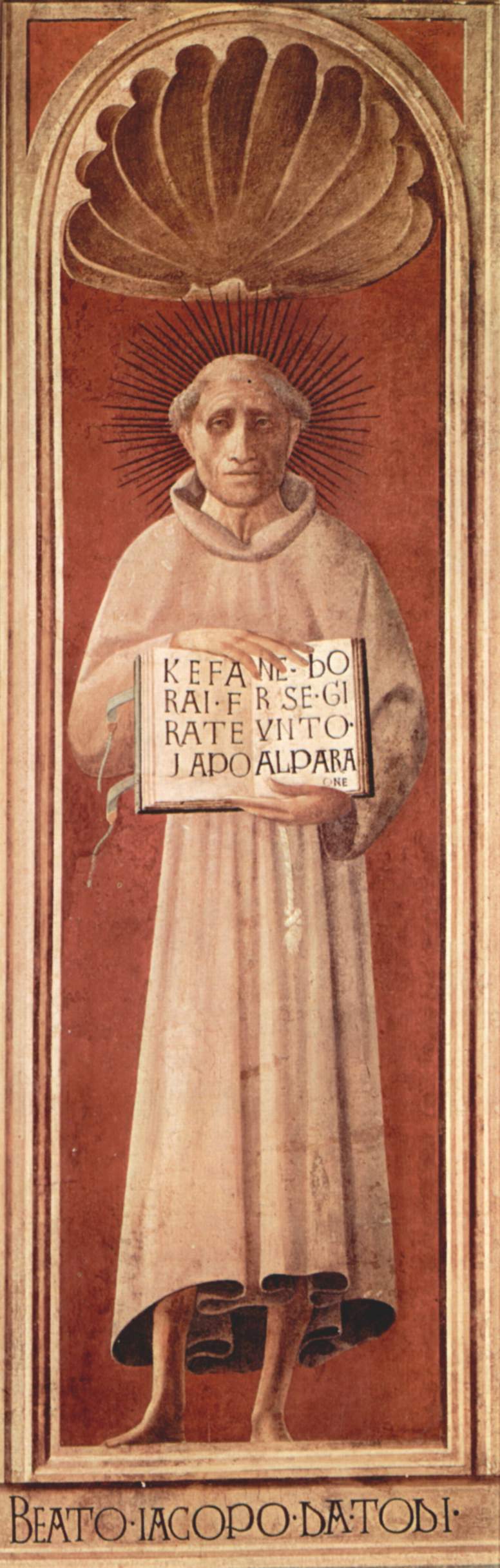
Saint of the Day – 25 December – Blessed Jacopone da Todi OFM (1230-1306) Franciscan Friar, Confessor, Hymnist, Poet, Mystic, Lawyer, – an Italian from Umbria in the 13th century. He wrote several laude (songs in praise of the Lord) in the local vernacular. He was an early pioneer in Italian theatre, being one of the earliest scholars who dramatised Gospel subjects. Born in c 1230 at Todi, Italy as Jacopo Benedetti and died on 25 December 1306 at Collazzone, Italy of natural causes, as the Priest intoned the Gloria from midnight Mass. He is also known as Jacomo da Todi, Jacopo Benedetti, Jacopo Benedicti, Jacopone Benedetti da Todi, Jacopone of Todi, James da Todi.
Jacomo, was born a noble member of the Benedetti family in the northern Italian city of Todi. He became a successful lawyer and married a pious, generous lady named Vanna.
His young wife took it upon herself to do penance for the worldly excesses of her husband. One day Vanna, at the insistence of Jacomo, attended a public tournament. She was sitting in the stands with the other noble ladies when the stands collapsed. Vanna was killed. Her shaken husband was even more disturbed when he realised that the penitential girdle she wore was for his sinfulness. On the spot, he vowed to radically change his life.
Jacomo divided his possessions among the poor and entered the Secular Franciscan Order. Often dressed in penitential rags, he was mocked as a fool and called Jacopone, or “Crazy Jim,” by his former associates. The name became dear to him.
After 10 years of such humiliation, Jacopone asked to be received into the Order of Friars Minor. Because of his reputation, his request was initially refused. He composed a beautiful poem on the vanities of the world, an act that eventually led to his admission into the Order in 1278. He continued to lead a life of strict penance, declining to be ordained a priest. Meanwhile, he was writing popular hymns in the vernacular.
Jacopone suddenly found himself a leader in a disturbing religious movement among the Franciscans. The Spirituals, as they were called, wanted a return to the strict poverty of Francis. They had on their side two cardinals of the Church and Pope Celestine V. These two cardinals though, opposed Celestine’s successor, Boniface VIII. At the age of 68, Jacopone was excommunicated and imprisoned. Although he acknowledged his mistake, Jacopone was not absolved and released until Benedict XI became Pope five years later. He had accepted his imprisonment as penance. He spent the final three years of his life more spiritual than ever, weeping “because Love is not loved.”During this time he wrote the famous Latin hymn, Stabat Mater.
On Christmas Eve in 1306 Jacopone felt that his end was near. He was in a convent of the Poor Clares with his friend, Blessed John of La Verna. Like Francis, Jacopone welcomed “Sister Death” with one of his favorite songs. It is said that he finished the song and died as the Priest intoned the “Gloria” from the midnight Mass at Christmas. From the time of his death, Brother Jacopone has been venerated as a saint, both within and outside of the Franciscan Order, although never formally Canonised.
Here lie the bones of Blessed Jacopone dei Benedetti da Todi, Friar Minor, who, having gone mad with love of Christ, by a new artifice deceived the world and took Heaven by violence. – from the tomb of Blessed Jacopone
Stabat Mater Dolorosa is a fine example of religious lyric in the Franciscan tradition. It was inserted into the Roman Missal and Breviary in 1727 for the Feast of the Seven Sorrows of the Blessed Virgin Mary, celebrated on the Friday before Good Friday. Following changes by Pope Pius XII, it now appears on the Feast of Our Lady’s Sorrows celebrated on 15 September. Many composers have set it to music
His contemporaries called Jacopone, “Crazy Jim.” We might well echo their taunt, for what else can you say about a man who broke into song in the midst of all his troubles? We still sing Jacopone’s saddest song, the Stabat Mater, but we Christians claim another song as our own, even when the daily headlines resound with discordant notes. Jacopone’s whole life rang out our song: “Alleluia!” May he inspire us to keep singing.
The Nativity of the Lord, Jesus Christ (Solemnity) Celebration of the anniversary of the birth of Our Lord. In the earliest days of the Church there was no such feast, the Saviour’s birth was commemorated with the Epiphany by the Greek and other Eastern Churches. First mention of the feast, then kept on 20 May, was made by Clement of Alexandria c 200. The Latin Church began c 300 to observe it on 25 December, though there is no certainty that Our Lord was born on that day. Priests have the privilege of saying three Masses, at midnight, daybreak and morning. This was originally reserved to the Holy Father alone – beginning about the 4th century he celebrated a midnight Mass in the Lateran Basilica (in which according to tradition, the manger of Bethlehem is preserved), a second in the church of Saint Anastasia, whose feast comes on 25 December and a third at the Vatican Basilica. Many peculiar customs of the day are the outcome of the pagan celebrations of the January calender. The Christmas tree, of which the first known mention was made in 1605 at Strasbourg, was introduced into France and England in 1840. The feast is a holy day of obligation, preceded by the preparatory season of Advent and by a special vigil – should it fall on a Friday it abrogates the law of abstinence. Today’s Gospel is the prologue of John.
St Adalsindis of Hamay St Alburga of Wilton St Anastasia of Sirmium Bl Artale St Basilée of the Via Latina Bl Bentivoglio de Bonis Bl Diego de Aro St Eugenia of Rome St Fulk of Toulouse Blessed Jacopone da Todi OFM (1230-1306) Franciscan Friar, Author of the “Stabat Mater” St Jovin of the Via Latina Bl Maria Therese von Wüllenweber Bl Matthew of Albano Bl Michael Nakashima Saburoemon Bl Nera St Romulus of Berry — Martyrs of Nicomedia: 20,000 Christians martyred by order of Diocletian. They were reported to have all been in the single basilica to celebrate Christmas. While there unquestionably was an endless series of martyrs under Diocletian, it’s likely the ancient sources exaggerated the numbers of this incident. And as the Christmas holy day was not celebrated in the East in 303, they were probably gathered for another feast. They were burned alive in 303 in the basilica of Nicomedia.
Saint of the Day – 24 December – Saint Hanno of Worms OSB (Died 978) Bishop of Worms from 950 until his death, Benedictine Monk – born in the 10th century Hesse, Germany and died on 24 December 978 in Worms, Germany of natural causes. St Hanno – also known as Anno – is also venerated on 20 September by the Benedictines and by the Diocese and City of Worms.
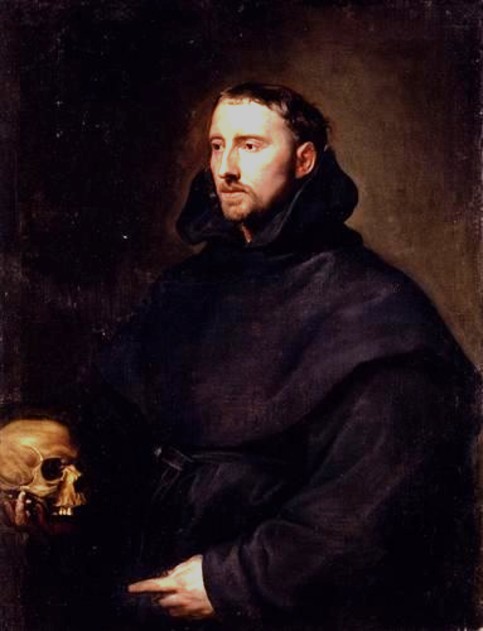
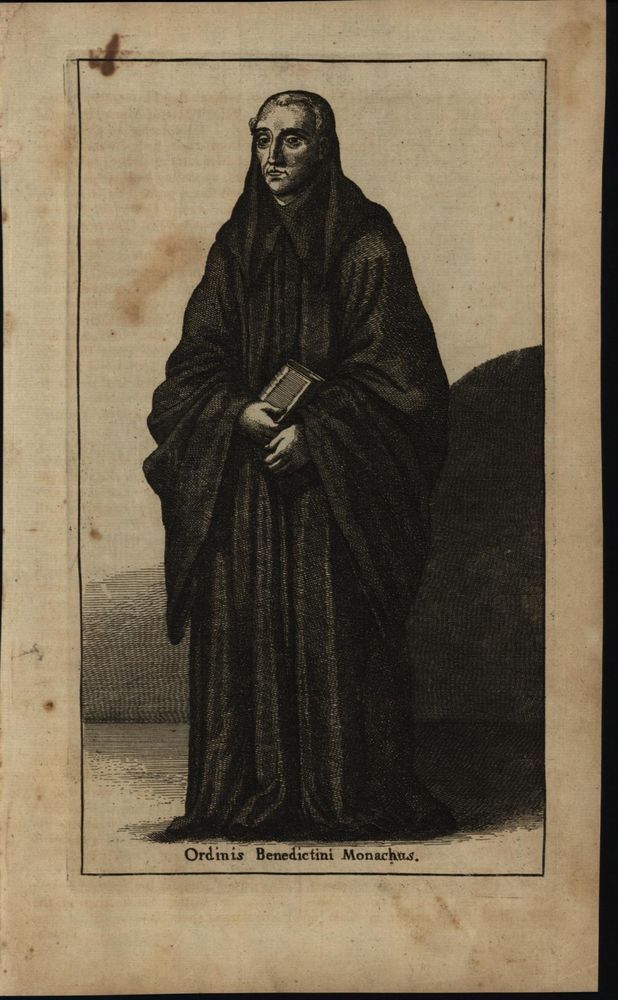
We have no image of St Hanno – this is a portrait of a Benedictine Monk by Sir Antony van Dyck
Hanno came from a noble family from the environment of Emperor Otto I. The Worms Chronicle of Friedrich Zorn (1604), based on older sources, says about the Bishop “a Hess with the name of Hanno” and also cites the text of his grave inscription. He began his Christian theological work as a Monk of the Benedictine Abbey of St Maximin in Trier. King Otto I appointed him first Abbot of the Mauritius monastery in Magdeburg in 937.
Thirteen years later in 950, Hanno became the 15th Bishop of Worms at the behest of the later emperor.
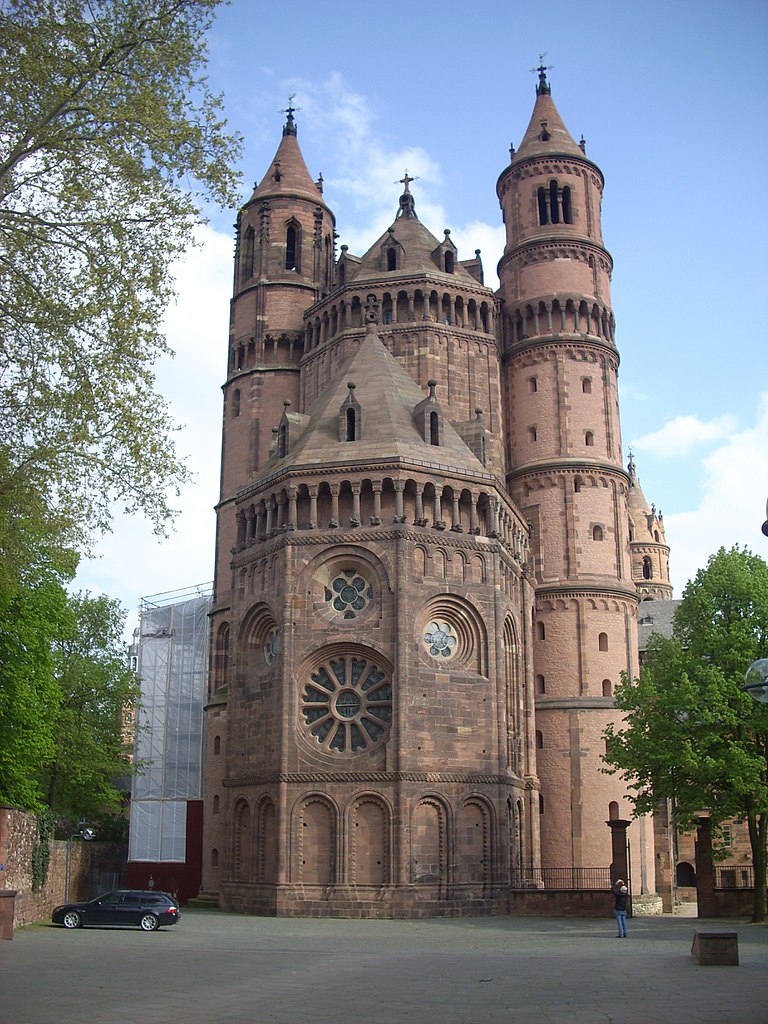
Worms Cathedral
In 952 he took part in the Synod of Augsburg with St Ulrich. In 964 Bishop Hanno visited Rome – in the consecration bull of angels relating to the Swiss Benedictine monastery Maria Einsiedeln, Pope Leo VIII named him on 11 November of that year among the prelates who had come to Rome from Germany and were consulted by him on this matter. Hanno visited Rome again in 970 and visited Ravenna on 29 March with the Empress and Crown Prince Otto. In 976 Emperor Otto II transferred the Mosbach Benedictine monastery to Hanno administration and care.
Since 24 December 978 has been passed down as the anniversary of Hanno’s death, today on Christmas Eve he is listed in the Roman Martyrology.
According to the Worms Chronicle by Friedrich Zorn (1604), the episcopal successor Hildebold, was his brother.
24 December – Vigil of the Nativity of the Lord/Mass at Midnight In many Western Christian traditions Midnight Mass is the first liturgy of Christmastide that is celebrated on the night of Christmas Eve, traditionally beginning at midnight when Christmas Eve gives way to Christmas Day. This popular Christmas custom is a jubilant celebration of the Mass in honour of the Nativity of Jesus, even many of those Christian denominations that do not regularly employ the word “Mass” uniquely use the term “Midnight Mass” for their Christmas Eve liturgy.
Saint Thomas Aquinas wrote a commentary on these words and explained in his Summa Theologiae, “And from this the Mass derives its name … the deacon on festival days ‘dismisses’ the people at the end of the Mass, by saying: ‘Ite, missa est,’ that is, the victim [Jesus] has been sent to God through the angel, so that it may be accepted by God.”
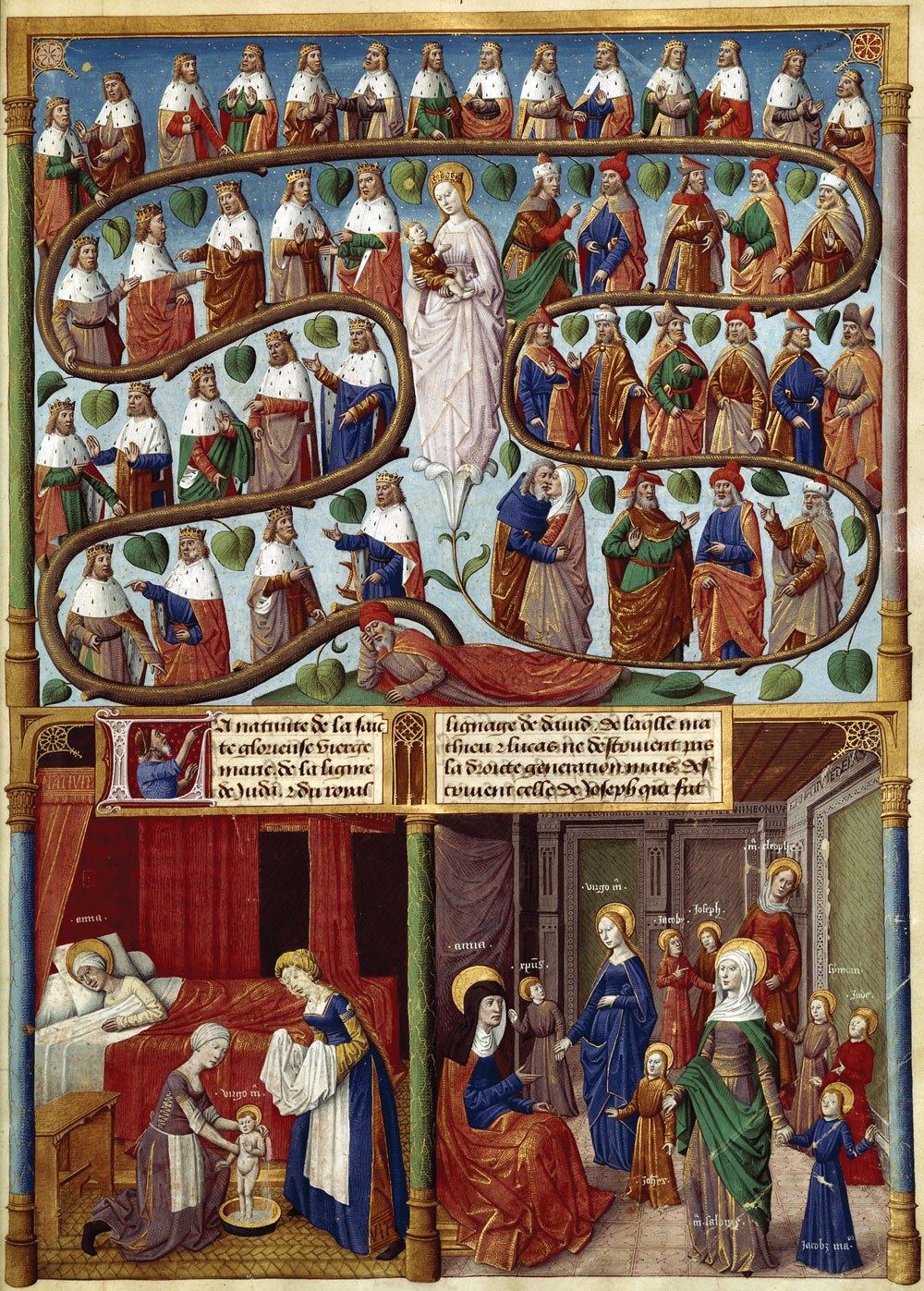
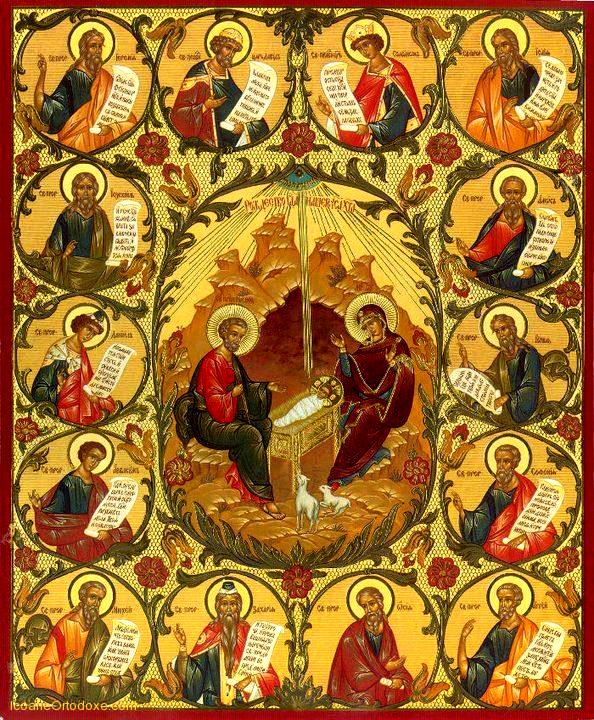
All the Holy Ancestors of Christ – A commemoration of all the holy ancestors of Jesus Christ.
The New Testament has preserved two different genealogies of Our Lord, in Matthew 1; and Luke 3.
Saint Matthew’s list is divided artificially into three equal parts of 14 names each, with several intentional omissions: from Abraham the father of the chosen people to David the king, to whose family the promise was made (2 Kings 7); David and the royal line after him to the Babylonian captivity; the descendants of the royal line from the captivity to Joseph, the legal father of Our Lord.
Saint Luke proceeds in reverse order; he starts from Joseph and goes, beyond Abraham, back to Adam the father of the human race, in accord with the character of his Gospel; and he merely enumerates the names without grouping them according to a thesis or point, as is the case in Saint Matthew.
Few names are common to both lists: viz., those between Abraham and David, then Salathiel and Zorobabel after the captivity, and Joseph the foster-father of Christ; the others are absent from Matthew’s list, or the persons are different. To account for these differences several explanations have been advanced, but no decisive evidence is extant. Not a few authors hold that Saint Luke gives Mary’s genealogy; but this view is more generally considered improbable, so that both lists are taken as giving Joseph’s ancestry. Only it must be supposed that at several points, instead of the actual descent, the one or the other of the lists gives the legal relationship based on adoption in some manner. Our Lord was considered to belong to the family of David; this seems to be taken for granted in the New Testament, where we find no difficulty raised against Him on the ground of His descent. The genealogies show His relationship to the royal family of Juda through Joseph, as it was only through the father, legal or natural, that the rights could be transmitted, and Joseph was the legal father of Jesus. To trace Our Lord’s ancestry through His mother would not have served the purpose of the Evangelists.
Matthew 1:1-17
The book of the genealogy of Jesus Christ, the son of David, the son of Abraham.
Abraham became the father of Isaac, Isaac the father of Jacob, Jacob the father of Judah and his brothers. Judah became the father of Perez and Zerah, whose mother was Tamar. Perez became the father of Hezron, Hezron the father of Ram, Ram the father of Amminadab. Amminadab became the father of Nahshon, Nahshon the father of Salmon, Salmon the father of Boaz, whose mother was Rahab. Boaz became the father of Obed, whose mother was Ruth. Obed became the father of Jesse, Jesse the father of David the king. David became the father of Solomon, whose mother had been the wife of Uriah. Solomon became the father of Rehoboam, Rehoboam the father of Abijah, Abijah the father of Asaph. Asaph became the father of Jehoshaphat, Jehoshaphat the father of Joram, Joram the father of Uzziah. Uzziah became the father of Jotham, Jotham the father of Ahaz, Ahaz the father of Hezekiah. Hezekiah became the father of Manasseh, Manasseh the father of Amos, Amos the father of Josiah. Josiah became the father of Jechoniah and his brothers at the time of the Babylonian exile. After the Babylonian exile, Jechoniah became the father of Shealtiel, Shealtiel the father of Zerubbabel, Zerubbabel the father of Abiud. Abiud became the father of Eliakim, Eliakim the father of Azor, Azor the father of Zadok. Zadok became the father of Achim, Achim the father of Eliud, Eliud the father of Eleazar. Eleazar became the father of Matthan, Matthan the father of Jacob, Jacob the father of Joseph, the husband of Mary. Of her was born Jesus who is called the Messiah.
Thus the total number of generations from Abraham to David is fourteen generations; from David to the Babylonian exile, fourteen generations; from the Babylonian exile to the Messiah, fourteen generations.
Luke 3:23-38
When Jesus began his ministry he was about thirty years of age. He was the son, as was thought, of Joseph, the son of Heli, the son of Matthat, the son of Levi, the son of Melchi, the son of Jannai, the son of Joseph, the son of Mattathias, the son of Amos, the son of Nahum, the son of Esli, the son of Naggai, the son of Maath, the son of Mattathias, the son of Semein, the son of Josech, the son of Joda, the son of Joanan, the son of Rhesa, the son of Zerubbabel, the son of Shealtiel, the son of Neri, the son of Melchi, the son of Addi, the son of Cosam, the son of Elmadam, the son of Er, the son of Joshua, the son of Eliezer, the son of Jorim, the son of Matthat, the son of Levi, the son of Simeon, the son of Judah, the son of Joseph, the son of Jonam, the son of Eliakim, the son of Melea, the son of Menna, the son of Mattatha, the son of Nathan, the son of David, the son of Jesse, the son of Obed, the son of Boaz, the son of Sala, the son of Nahshon, the son of Amminadab, the son of Admin, the son of Arni, the son of Hezron, the son of Perez, the son of Judah, the son of Jacob, the son of Isaac, the son of Abraham, the son of Terah, the son of Nahor, the son of Serug, the son of Reu, the son of Peleg, the son of Eber, the son of Shelah, the son of Cainan, the son of Arphaxad, the son of Shem, the son of Noah, the son of Lamech, the son of Methuselah, the son of Enoch, the son of Jared, the son of Mahalaleel, the son of Cainan, the son of Enos, the son of Seth, the son of Adam, the son of God.
Blessed Mercedarian Sisters – (6 beati): Six cloistered Mercedarian nuns at the convent of Vera Cruz in Berriz, Spain. Noted for their devotion to the rules of the Order and for their deep prayer lives. • Blessed Anna Maria Prieto • Blessed Anna de Arrano • Blessed Orsola de Larisgoizia • Blessed Maguna Mary • Blessed Margaret • Blessed Mary of the Assumption Sarria
Martyred Maidens of Antioch – (40 saints): A group of forty virgins martyred in the persecutions of Decius. None of their names have come down to us. They were martyred in 250 in Antioch, Syria.
Martyrs of Tripoli – (6 saints): A group of Christians martyred together, date unknown. The only details that have surived are six of the names – Drusus, Lucian, Metrobius, Paul, Theotimus and Zenobius. They were martyred in Tripoli, Libya.
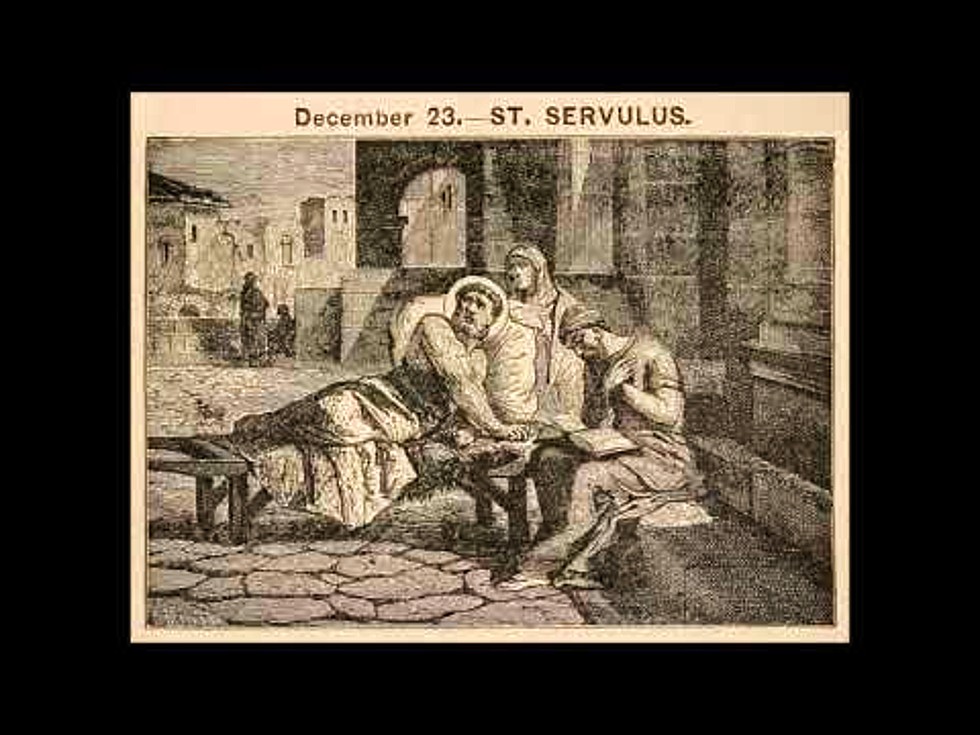
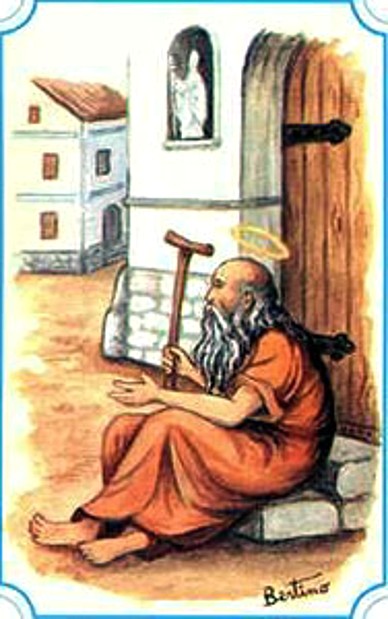
Saint of the Day – 23 December – Saint Servulus (Died c 590) Layman, Beggar, paralysed by Palsy from birth, – born in the 6th century in Rome, Italy and died in c 590 of natural causes.
Saint Servulus was a perfect model of submission to the divine Will; it would be difficult to offer a more consoling example to persons afflicted by poverty, illnesses and the other miseries of life. It is Saint Gregory the Great who narrates for us his edifying story:
“We have seen under the portico of the Church of Saint Clement, a poor man named Servulus, who is known to all the people of Rome as to Us. He was deprived of all the goods of this world; a long illness had reduced him to a pitiful state. From his youth he was paralysed in all his members. Not only could he not stand up but, he was unable to rise from his bed; he could neither sit down nor turn himself from one side to the other, nor bring his hand to his mouth. Nothing in him was sound except his eyes, ears, tongue, stomach and entrails.
This unfortunate man, who had learned the mysteries of religion, meditated unceasingly on the sufferings of the Saviour and never did he complain. He was surrounded by the loving care of his mother and brother. Neither the mother nor the children had ever studied, yet the paralytic had pious books bought for himself, in particular the Psalms and the Holy Gospels and he would ask the religious who came to visit him on his cot, to read from them to him. In this way he learned these books by heart; he spent days and part of the nights in singing or reciting them and meditating them and he constantly thanked the Lord for having taken him to be a victim associated with the pains and sufferings of Jesus Christ.
Many alms came to the little house of the paralytic, to such an extent that he became rich in his poverty. After having taken from these what was necessary for his subsistence and that of his mother, he gave the rest to the indigent, who often assembled around him to be edified by his words and his virtues. His bed of pain was a pulpit of preaching, from which he converted souls.
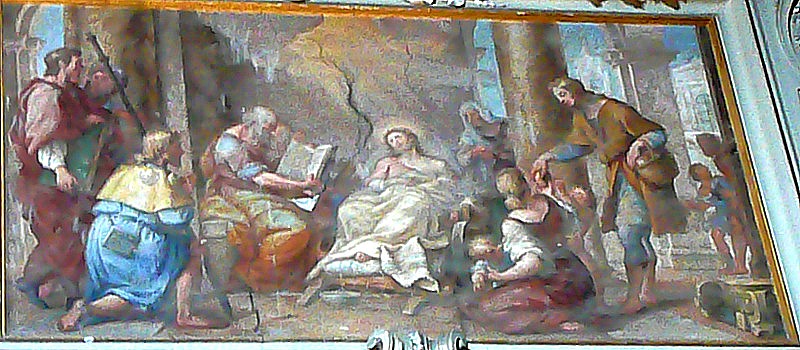
When the time came which was decreed by God to reward his patience and put an end to his painful life, Servulus felt the paralysis spreading to the vital parts of his body and he prepared for death. At the final moment, he asked those in attendance to recite Psalms with him. Suddenly he cried out: “Ah! Don’t you hear that melody resounding in heaven?’” At that moment his soul escaped from his body, which, until his buria,l gave forth a marvellous fragrance.”
St Gregory the Great concludes the account he gives of Servulus, in a sermon to his people, by observing that the behaviour of this poor sick begger loudly condemns those who, when blessed with good health and fortune, neither do good works nor suffer the least cross with tolerable patience. He speaks of him as one who was well known both to himself and his hearers and says, that one of his monks, who was present at his death, used to speak of the fragrant smell which came from the dead beggar’s body. Servulus was a true lover of God, not careful and troubled about his own life but solicitous that God be honoured and all that he could suffer for this end, he looked upon as reward. By his constancy and fidelity, he overcame the world and all bodily afflictions.
St Servulus was buried at Saint Clement’s Church, Rome, the place that had been his habitual place of prayer and veneration and where, so many came to pay their respects to him and learn from his holy and learned words. From the porch of this Church he was called to heaven. His feast is annually celebrated in that Church on the Coelian Hill outside of which he was wont to lay.
St Besa of Egypt Bl Bincema St Dagobert II of Austrasia Bl Epifanio Gómez Alvaro St Frithbert of Hexham Bl Hartmann of Brixen Bl Herman of Scheda Bl James Aymerich St John Cirita St John Stone St Joseph Cho Yun-ho St Mardonius of Rome St Mazota of Abernethy St Migdonius of Rome Blessed Nicolás Factor-Estaña OFM (1520-1583) His Life: https://anastpaul.com/2019/12/23/saint-of-the-day-23-december-blessed-nicolas-factor-estana-ofm-1520-1583/ St Servulus (Died c 590) Layman St Thorlac Thorhallsson St Victoria St Vintila of Orensee — Martyred Dominicans of Santander – (9 beati) – Martyred in the Spanish Civil War: • Blessed Bernardino Irurzun Otermín • Blessed Eleuterio Marne Mansilla • Blessed Eliseo Miguel Lagro • Blessed Enrique Cañal Gómez • Blessed Enrique Izquierdo Palacios • Blessed Epifanio Gómez Alvaro • Blessed José María García Tabar • Blessed Manuel Gutiérrez Ceballos • Blessed Miguel Rodríguez González • Blessed Pedro Luís y Luís
Martyrs of Crete – (10 saints): A group of ten Christians who died in the persecutions of Decius. They were – • Agathopus • Basilides • Cleomenes • Eunician • Euporus • Evaristus • Gelasius • Saturninus • Theodulus • Zeticus They were martyred in 250 on the island of Crete
Saint of the Day – 22 December – Saint Hungerus Frisus of Utrecht (Died 866) Bishop of Utrecht – born in the Low Countries, now the Netherlands and died in 866 at Prum, Germany of natural causes. Also known as Hunger.
Painting by Blessed Fra Angelico
St Hungerus was the Bishop of Utrecht from 854 to 866. We are not sure when he was born. After the death of his predecessor Luidger of Utrecht, Luidger’s nephew Craft, was offered the seat. However, Craft, a very wealthy person, refused because he was afraid that he would attract Viking raids.
Instead the Canon, St Hungerus was appointed. At first, his relations with the Vikings were peaceful but eventually Utrecht was threatened by the Vikings, at which the Bishop and the entire clergy of Utrecht fled to Saint Odilienberg, near Roermond. During this time of exile, Hungerus spent his time teaching the faith in the surrounding areas. In 858 King Lothair II made a Monastery available for them. Later, the Bishop settled in Prum and then in Deventer.
By all accounts, St Hungerus was a Godly and pious man, who unlike his predecessors, did not engage in nepotism. In the case of the childless marriage between King Lotharius and his wife, he defended the sanctity of their marriage on Biblical and theological grounds but against his counsel, to secure his succession, Lothair repudiated his wife and married Waldrada, with whom he had a son.
St Hungerus Died in Prum, Germany of natural causes and his feast is today 22 December.
St Catherine Cathedral, the Seat of the Bishop of Utrecht
Martyrs of Ostia – (3 saints): A group of Christians martyred together. The only details about them to survive are three names – Demetrius, Florus and Honoratus. They were martyred at Ostia, Italy.
Martyrs of Rhaitu – (43 saints): 43 monks martyred by Blemmyes, in Raíthu, Egypt, date unknown.
Martyrs of Via Lavicana – (30 saints): A group of 30 Christians martyred together in the persecutions of Diocletian. c 303 in Rome, Italy and were buried between two bay trees on the Via Lavicana outside Rome.
Quote/s of the Day – 21 December – O Oriens/O Radiant Dawn – Weekdays of Advent and The Memorial of St Peter Canisius (1521-1597) Doctor of the Church
“Better that only a few Catholics should be left, staunch and sincere in their religion, than that they should, remaining many, desire as it were, to be in collusion with the Church’s enemies and in conformity with the open foes of our faith.”
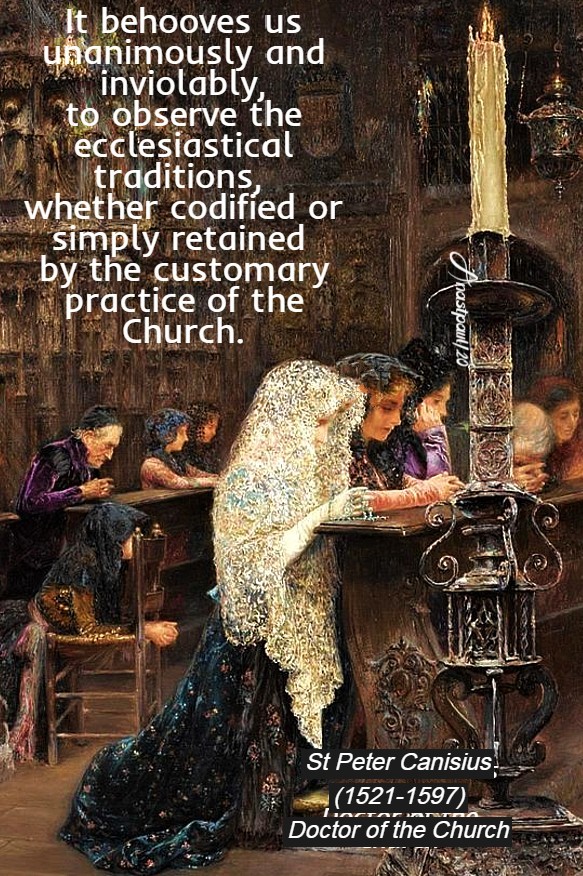
“It behooves us unanimously and inviolably, to observe the ecclesiastical traditions, whether codified or simply retained by the customary practice of the Church.”
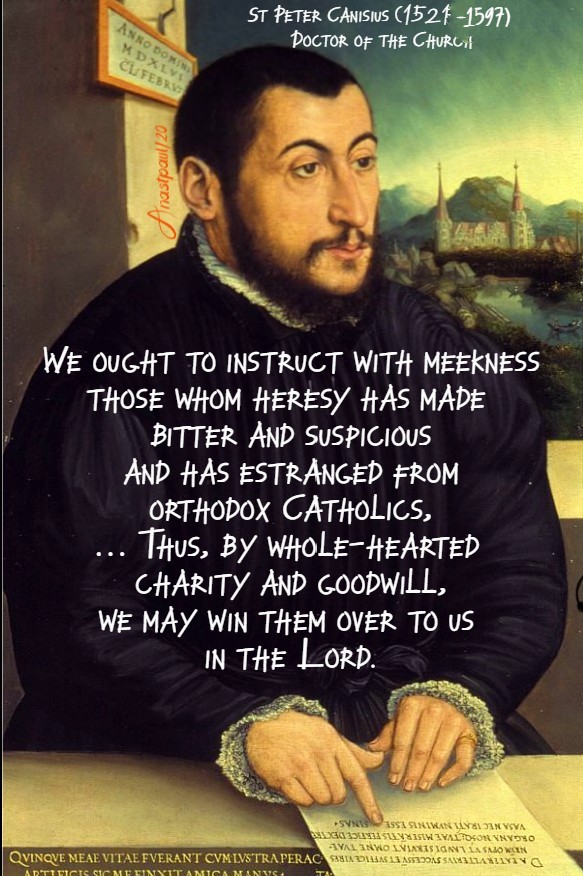
“We ought to instruct with meekness those whom heresy has made bitter and suspicious and has estranged from orthodox Catholics, … Thus, by whole-hearted charity and goodwill, we may win them over to us in the Lord.”
St Peter Canisius (1521-1597) Doctor of the Church
Our Morning Offering – 21 December and the Memorial of St Peter Canisius (1521-1397) Doctor of the Church
Hail Mary, the Angelic Salutation
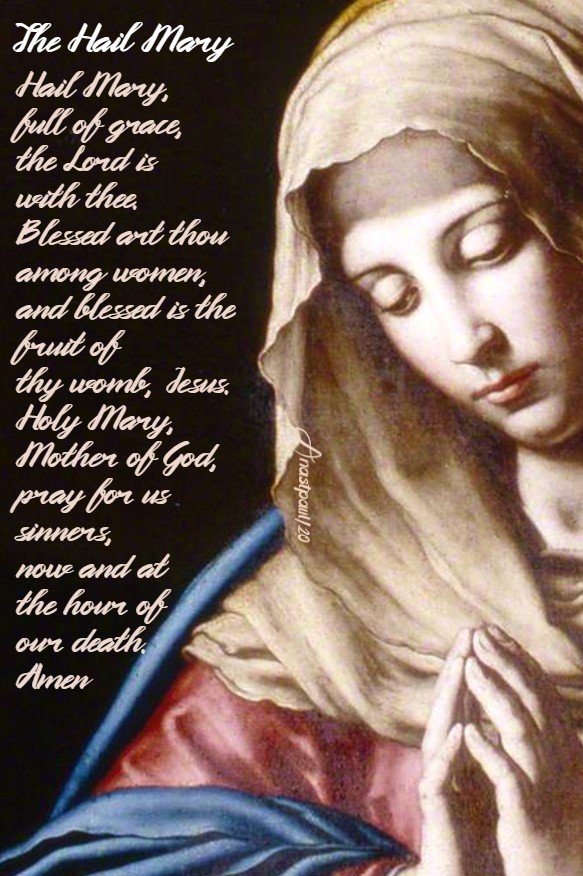
The Hail Mary/Ave Maria
Hail Mary, full of grace, the Lord is with thee. Blessed art thou among women, and blessed is the fruit of thy womb, Jesus. Holy Mary, Mother of God, pray for us sinners, now and at the hour of our death. Amen.
Áve María, grátia pléna, Dóminus técum. Benedícta tū in muliéribus, et benedíctus frúctus véntris túi, Iésus. Sáncta María, Máter Déi, óra pro nóbis peccatóribus, nunc et in hóra mórtis nóstrae. Ámen.
On today’s Memorial of St Peter Canisius, Catholics may wish to thank this Doctor of the Church for giving us the second half of the Hail Mary prayer.
This 16th-century saint, known as the second Apostle of Germany, followed in the giant footsteps of St Boniface, who evangelised Germany a thousand years earlier. He was also active at the Council of Trent and wrote much on the Blessed Virgin Mary.
The first half of the Hail Mary, of course, comes from Scripture. What many Catholics don’t know, is that the second half of this Catholic prayer is due to the intervention of St Peter Canisius at the Council of Trent. St Peter began adding on to the scriptural part of the Hail Mary, the “Holy Mary Mother of God pray for us sinners, now and at the hour of our death.” It was Trent that officially accepted this addition to the prayer and included it in their famous Catechism of the Council of Trent in 1566.
Saint of the Day – 21 December – Saint Anastasius II of Antioch (Died 609) Bishop and Martyr, Confessor, Defender of the Faith – also known as Anastasius the Younger. Anatasius II succeeded St Anastasius [the first] and was the Bishop of Antioch from 599 until his death by martyrdom in 609. He is known for his opposition and suppression of simony in his Diocese, with the support of St Pope Gregory the Great. He also supported the Emperor Phocas in Phocas’ efforts against the Monophysites.
The Martyrdom of St Anastasius II
In 609 the Syrian Jews revolted as they believed that they were being forcibly converted to Christianity by Emperor Phocas (reign 602-610). It was during these riots that Bishop Anastasius was abducted due to his support of Phocas. He was mutilated and then dragged through the streets, after which he was burnt to death in the marketplace of Antioch.
Emperor Phocas retaliated via military action which, in turn, led to a reverse persecution of the Jews of the area, when many were killed or exiled.
St Anastasius I and our Saint today, Anastasius II, are both venerated on the Colonnade of St Peter’s Square.
Bl Adrian of Dalmatia St Anastasius II of Antioch (Died 609) Bishop and Martyr St Anrê Tran An Dung St Baudacarius of Bobbio St Beornwald of Bampton Bl Bezela of Göda Bl Daniel of the Annunciation St Dioscorus Blessed Dominic Spadafora OP (1450-1521) Biography: https://anastpaul.com/2019/12/21/saint-of-the-day-21-december-blessed-dominic-spadafora-op-1450-1521/ St Festus of Tuscany St Glycerius of Nicomedia St James of Valencia St John of Tuscany St John Vincent St Micah the Prophet St Phêrô Truong Van Thi St Severinus of Trèves Bl Sibrand of Marigård St Themistocles of Lycia
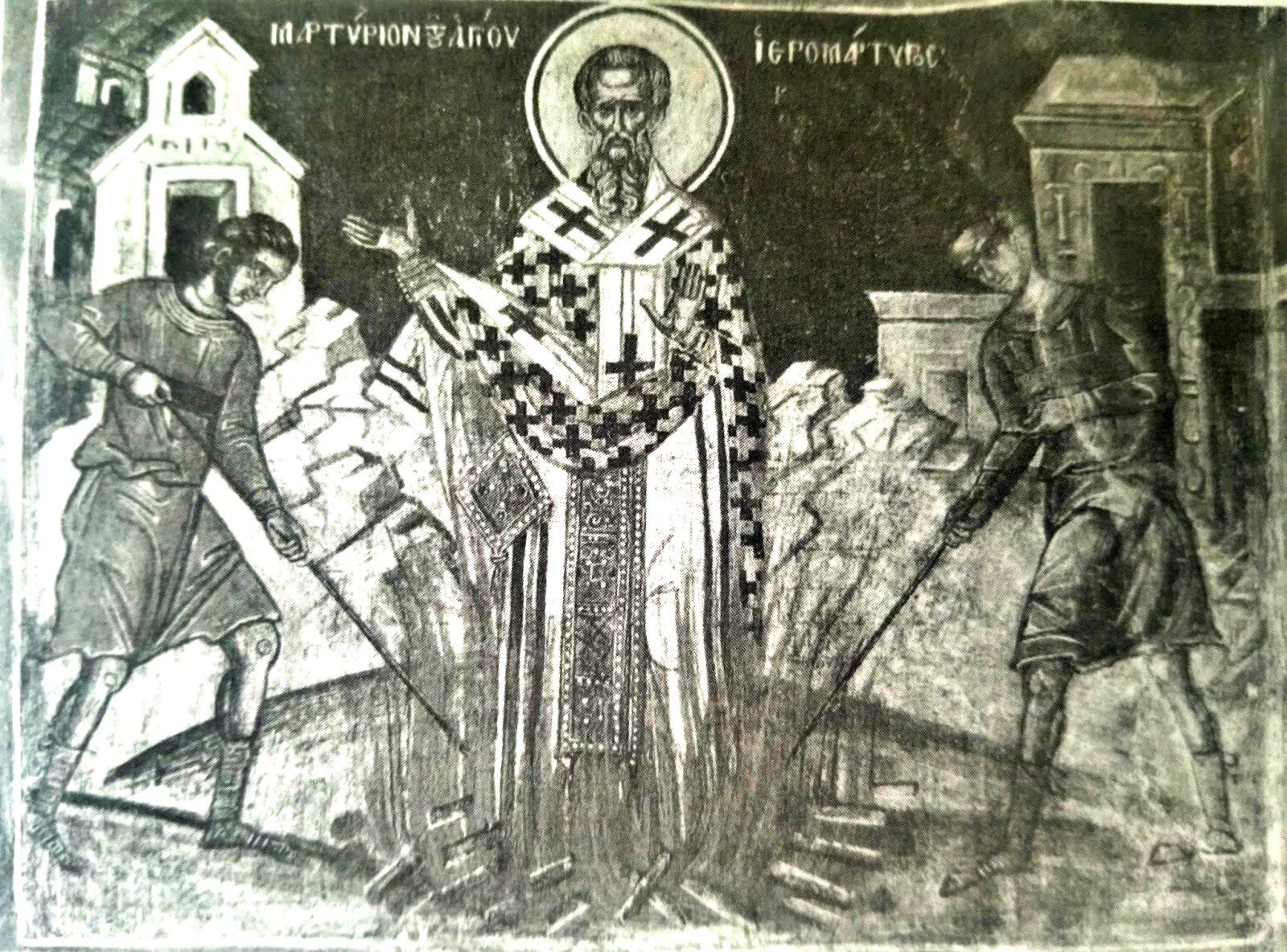
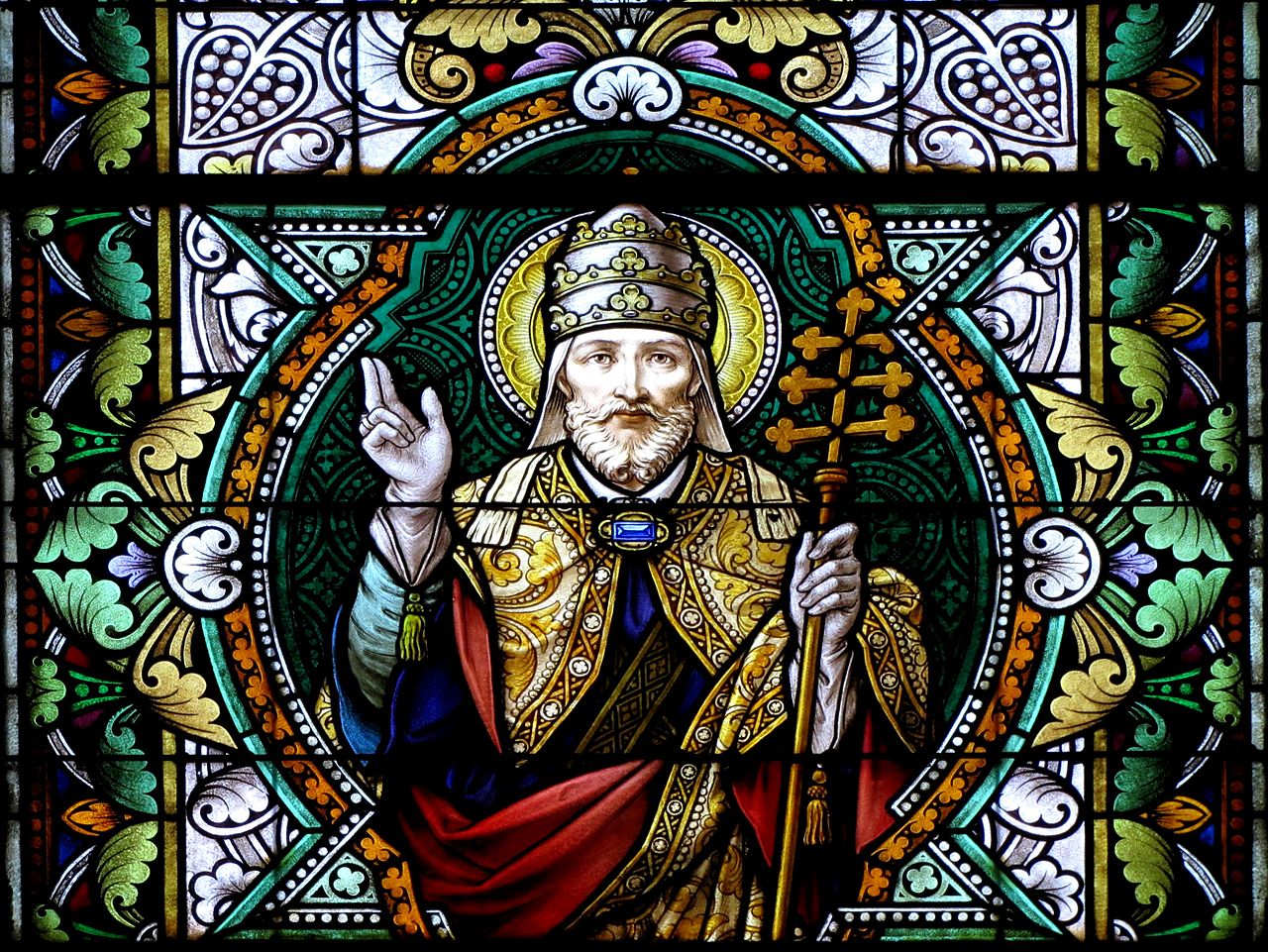
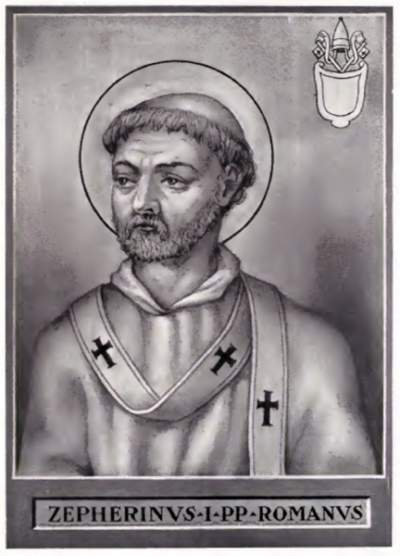
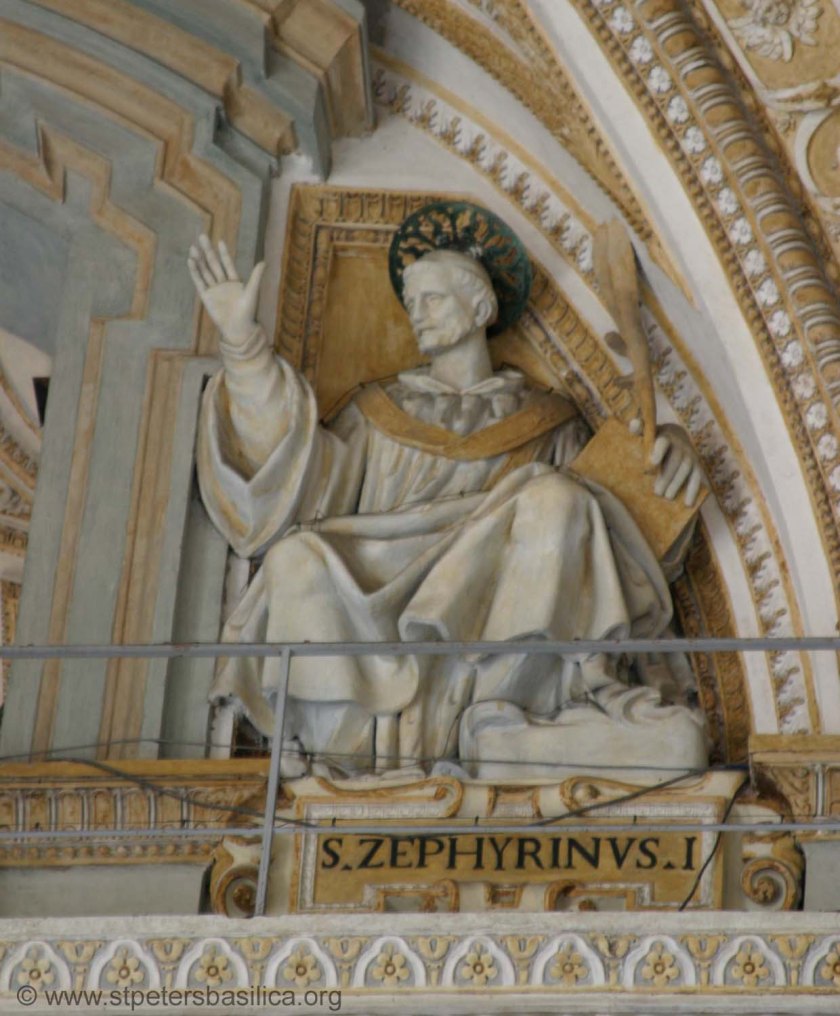
Saint of the Day – 20 December – Saint Pope Zephyrinus (Died 217) Bishop of Rome, Confessor, Defender of the Faith especially of the Doctrine of the Trinity. He is known for combatting heresies and defending the divinity of Christ. Although he was not physically martyred for the faith, his suffering – both mental and spiritual – during his Pontificate have earned him the title of martyr, a title that was repealed 132 years after his death. Born in Rome and died on 20 December 217 also in Rome.
Saint Zephyrinus, a native of Rome, succeeded Victor I in the Pontificate in the year 199.
Immediately after his elevation to the Roman See, Zephyrinus called to Rome the confessor Callistus, who lived at Antium and who had received a monthly pension from Pope Victor and entrusted him with the oversight of the coemeterium. It is evident that shortly before this, the Roman Christian community had, under Victor, become the owner of a common place of burial on the Via Appia and Zephyrinus now, placed Callistus over this cemetery, which was given the name of Callistus. Undoubtedly Callistus was also made a Deacon of the Roman Church by Zephyrinus. He was the confidential counsellor of the Pope, whom he succeeded.
In 202 Septimus Severus, a military despot, raised the fifth and most bloody persecution against the Church, which continued for nine years until the death of the Emperor in 211. Until this furious storm ended, the Holy Father remained concealed for the sake of his flock, supporting and comforting the distressed disciples of Christ.
He suffered by charity and compassion what every confessor underwent. The triumphs of the martyrs were indeed his joy but his heart received many deep wounds from the fall of apostates and heretics. Nor did this latter affliction cease, when peace was restored to the Church. The holy Pope had the affliction of witnessing the fall of Tertullian. He saw to his joy, however, the conversion of Natalis, who had become a heretical Bishop when he lapsed into the Theodotian heresy. God, wishing to bring him back to the Church, sent him a solid correction which opened his eyes and he came to kneel at the feet of the Vicar of Christ, wearing a hair shirt and humbly asking pardon for his revolt.
Eusebius tells us that this holy Pope exerted his zeal so strenuously against the blasphemies of the heretics, that they treated him with the utmost contempt. To his glory, however, they also called him the principal defender of Christ’s divinity.
Saint Zephyrinus governed the Church for eighteen years, dying in 217.
He was buried in his own cemetery on the 26th of August, which date was celebrated as his feast day until 1969 when it was changed to today which is the actual day of his birthday into heaven.
O ROOT OF JESSE, that stands for an ensign of the people, before whom the kings keep silence and unto whom the Gentiles shall make supplication, come, to deliver us and tarry not.
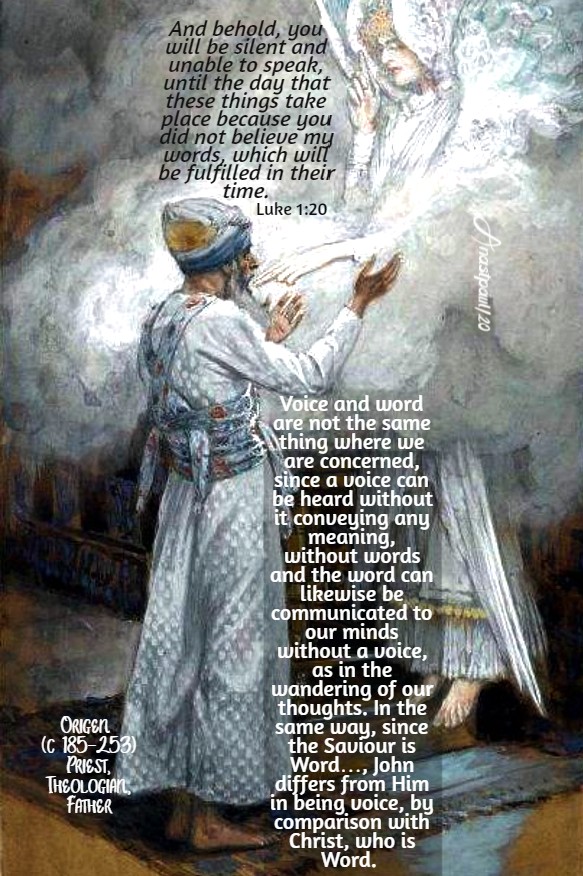
“And behold, you will be silent and unable to speak, until the day that these things take place because you did not believe my words, which will be fulfilled in their time.” – Luke 1:20
REFLECTION – “You will be speechless… until the day these things take place, because you did not believe my words.” Voice and word are not the same thing where we are concerned, since a voice can be heard without it conveying any meaning, without words and the word can likewise be communicated to our minds without a voice, as in the wandering of our thoughts. In the same way, since the Saviour is Word…, John differs from Him in being voice, by comparison with Christ, who is Word. This is what John himself answered to those who asked him who he was: “I am the voice of one crying out in the desert, ‘Prepare the way of the Lord; make straight his paths’” (Lk 3:4; Jn 1:23). Perhaps this is the reason – because he doubted the birth of the voice that would reveal the Word of God – why Zachariah lost his voice but recovered it again, when that voice was born, who is the Word’s forerunner (Lk 1:64). Since, for the mind to be able to grasp the word intended by the voice, we must hear the voice. It is also why, according to the time of his birth, John is slightly older than Christ – for we perceive the voice before the word. Thus John points to Christ since it is with the voice that the Word is made known. Likewise, Christ was baptised by John, who admitted his need of being baptised by Him (Mt 3:14)… In brief, when John pointed to Christ it was as a man pointing to God, the incorporeal Saviour, as a voice pointing to the Word…”… Origen (c 185-253) Priest, Theologian, Father
PRAYER – Deepen our faith Lord, as we celebrate the great mystery of the Incarnation, by which You revealed to the world the splendour of Your glory, through the most pure Virgin Mary when she gave birth to Your Son, who lives and reigns with You and the Holy Spirit, one God now and forever, amen.
Saint of the Day – 19 December – Blessed William of Fenoli O.Cart. (1065-1120) Carthusian Monk, Hermit, miracle-worker – born in 1965 in Garessio-Borgoratto, Diocese of Mondovi, Italy and died in 1120 in Casotto, Italy of natural causes. He is also known as Guglielmo, Gulielmus and is venerated by the Carthusians on 16 December but by the universal Church today, 19 December.
William was born in the early twelfth century, in the township of Monferrato, in the Diocese of Alba, in Northern Italy. His family was, no doubt, an ordinary but very devout family. He was drawn to solitude and did in fact become a hermit. We may think that his life of prayer as a hermit deeply united him to God. However, a woman of ill repute came to disturb him in his hermitage. He was able to resist her temptations but, afterwards, he realised that he needed the protection of a cloister.
So he took the road to the nearby Charterhouse of our Lady of Cazotto, Asti and asked to be admitted as a brother. As Brother William, he became an outstanding member of the community. He faithfully followed the observance of the Rule. He looked upon his superiors only with the eyes of faith and was always disposed to obey them immediately. The virtue by which he shone the most, was that of simplicity. “If the eminent practice of virtue is admirable when joined to the splendour of doctrine, better still is its charm when it has for its company the ingenuity, the candour, the simplicity of soul. This simplicity must serve as the supreme wisdom especially for those called to live in the obscurity of the cloister” (Statement of the Postulator). How well Saint Bruno’s words to the lay brothers of the Grande Chartreuse apply to William:
“As regards you lay monks, brothers so close to my heart, I have only this to say – My soul glorifies the Lord, since I can perceive the glories of His mercy toward you, from the account of your beloved Father and Prior, who boasts a great deal about you and rejoices over you. I share in this joy, since God in His power, never ceases to inscribe on your hearts, however little education you may have, not only love but understanding, of His holy law. For you show by your lives, what it is you really love and what you know. That is to say, when you are careful and zealous to observe a genuine obedience, conceived not only as the carrying out of God’s commands but as the original key to the spiritual life and its final stamp of authenticity, demanding as it does deep humility and outstanding patience, as well as sincere love for the Lord and our brothers, then it is clear, that you are gathering with relish, no less than the most delectable and life-giving fruits of Holy Scripture.”
His simplicity of heart was a great preparation for contemplation. His piety focused on Christ crucified and he could not think of the Passion of our Lord without becoming deeply afflicted. And so, freed from all fear and earthly plans, his only desire was for Eternity, preparing himself for it with constancy until his death, which occurred around the year 1120.
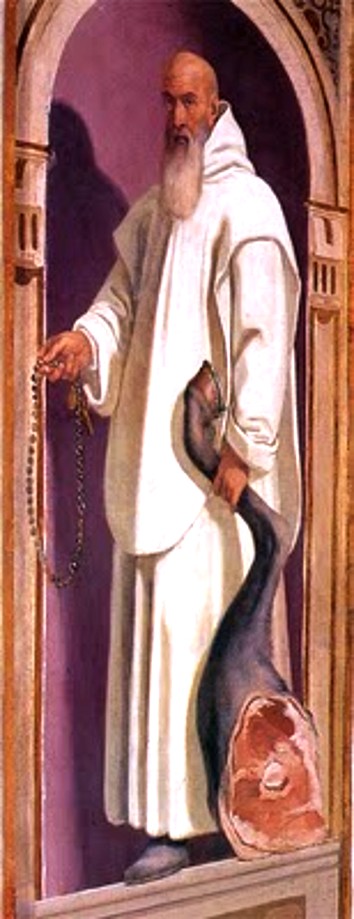
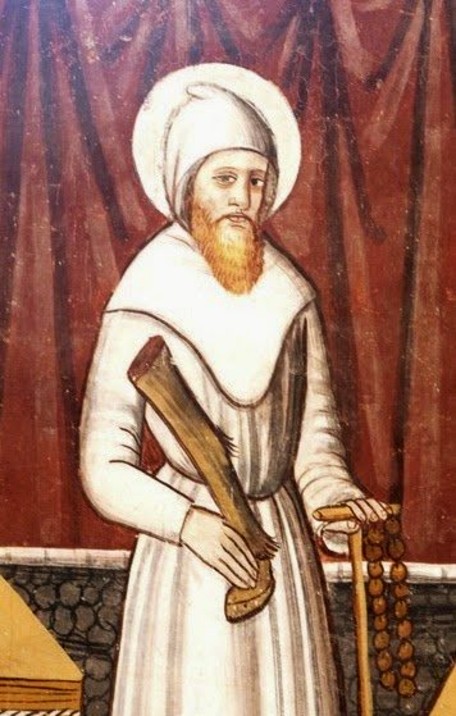
Bl William is widely known for the following miracle: One day, when he was returning from his field work, he was set upon by robbers and defended himself by tearing the leg off his donkey, using this as a cudgel to drive off his attackers. Afterwards, he miraculously healed the donkey, restoring it’s leg. Blessed William is, therefore, often depicted in iconography with his donkey, brandishing the donkey’s leg.
He was buried in the cloister cemetery of the Charterhouse but God let it emphatically be known that He wanted him to be buried at the gatehouse, outside the enclosure, so that the faithful could come to pilgrimage to his tomb. It is this popular veneration century after century, with accompanying miracles, which are the proof of the sanctity of this humble brother of whom we know so little. Pope Saint Pius V authorised the transfer of his relics in 1568 and Pope Blessed Pius IX authorised, in 1862, the veneration of Brother William, whose body was still incorrupt.
Rejoice, because you have escaped the various dangers and shipwrecks of the stormy world. Rejoice, because you have reached the quiet and safe anchorage of a secret harbour. <> Saint Bruno’s letter to his sons the Carthusians
Blessed Mercedarian Fathers – (6 beati): A group of Mercedarian monks noted for their dedication to the Order’s rule, for their continuous prayer life and their personal piety. • Blessed Bartolomeo of Podio • Blessed Giovanni of Verdera • Blessed Guglielmo de Gallinaris • Blessed Guglielmo of Prunera • Blessed Pietro of Benevento • Blessed Pietro of Gualba
Martyrs of Nicaea – (4 saints): A group of Christians martyred together. The only surviving details are four of their names – Darius, Paul, Secundus and Zosimus. They were martyred at Nicaea, Bithynia (modern Izmit, Turkey).
Martyrs of Nicomedia – (5 saints): A group of Christians martyred together in the persecutions of Diocletian. We know little more than the names of five – Anastasius, Cyriacus, Paulillus, Secundus and Syndimius. They were martyred in 303 at Nicomedia, Asia Minor.
Martyred in the Spanish Civil War: Thousands of people were murdered in the anti-Catholic persecutions of the Spanish Civil War from 1934 to 1939. Virtually each day of the year a Group are celebrated, usually individually but sometimes an entire Monastery or Convent or Lay Movement were martyred together. Today we remember: • Blessed Jaume Boguñá Casanovas • Blessed Jordi Sampé Tarragó • Blessed Josep Albareda Ramoneda
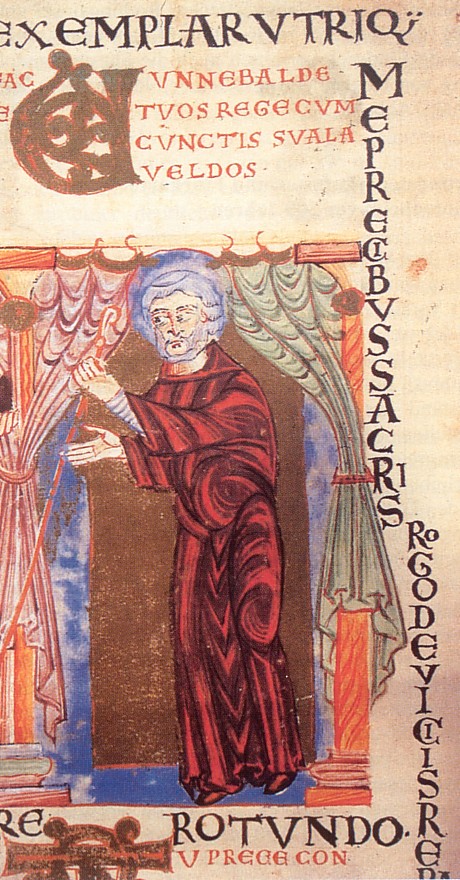
Saint of the Day – 18 December – Saint Winebald OSB (c 701-761) Priest, Abbot, Confessor, Missionary, Founder of many Monasteries, disciple of St Boniface – born in c 701 at Wessex, England and died on 18 December 761 at Heidenheim, Germany of natural causes. St Wieibald was the son of St Richard, Prince of Wessex, brother of St Willibald and St Walburga. Also known as – Winebaldus, Winnibald, Wunebald, Wunibald, Wynbald, Wynnebald, Vunibaldo, Vinebaldo. Patronages – construction workers, engaged couples.
God blessed St Richard with three saintly children, St Winebald, the eldest, St Willibald, who died Bishop of Eichstätt and St Walburga, Abbess. St Richard leaving his native country, took with him his two sons and landed on the coast of Normandy. They visited all the places of devotion on their way and then travelled into Italy, intending to go to Rome but at Lucca, St Richard fell sick and died about the year 722.
Winebald and Willibald accomplished their pilgrimage to Rome. After some stay there to perform their devotions, St Willibald undertook another pilgrimage to the holy places in Palestine but Winebald, who was from his childhood of a weak constitution, remained at Rome, where he pursued his studies for seven years, took the tonsure and devoted himself with his whole heart to the divine service. Then returning to England, he engaged several amongst his kindred and friends to accompany him in his journey back to Rome and there to dedicate themselves to God in a religious state.
Around 737, St Boniface, who was Uncle of St Winebald, visited Rome. By this time Willibald had returned from his travels and had become a Monk at Monte Cassino. Boniface recruited both nephews for the German mission. Willibald was Ordained and based in Eichstätt. Boniface received a promise that Winebald would go to Germany. Winebald arrived in Thuringia on 30 November, 740 and was Ordained Priest by his Uncle who, thereafter, placed him in charge of seven Churches.
Winebald established a Monastery in Schwanfeld but in 742 transferred it to Heidenheim, where the brothers founded a double Monastery for the training of Priests and as a centre of learning. Winibald became the first Abbot.
Winebald took part in the Concilium Germanicum, (the first major Synod of the German Church which was presided over by St Boniface) in 742, and subscribed Pepin’s donation to Fulda in 753. In 762, he joined the League of Attigny, a confraternity of prayer established by Chrodegang, Archbishop of Metz. All this the saint accomplished in spite of continual illness, which prevented him from ending his life at Monte Cassino as he had hoped. Wieibald died at Heidenheim on 18 December 761.
The Vita of St Winebald assures us of several miraculous cures which were performed at his tomb. St Ludger also writes in the life of St Gregory of Utrecht, “Winebald was very dear to my master Gregory and shows, by great miracles since his death what he did whilst living.”
Our Lady of the Expectation – This Feast originated in Spain. When the feast of the Annunciation (25 March) was transferred to 18 December because of the regulation forbidding feasts in Lent, it remained on this date after the Annunciation was again celebrated on its original date. It impressed on the faithful, the sentiments of the Blessed Virgin as the time of her delivery approached.
St Malachi the Prophet St Mawnan of Cornwall Bl Miguel San Román Fernández St Phaolô Nguyen Van My St Phêrô Truong Van Ðuong St Phêrô Vu Van Truat Bl Philip of Ratzeburg St Rufus of Philippi St Samthann of Clonbroney St Theotimus of Laodicea St Winebald OSB (c 701-761) Priest, Abbot St Zosimus of Philippi
Martyrs of Northwest Africa – 42 saints: Mercedarian Redeemers – 6 beati – These are a group of Mercedarian friars who worked together, under the leadership of Saint Peter de Amer, to ransom (e.g., redeem) prisoners and minister to them after.
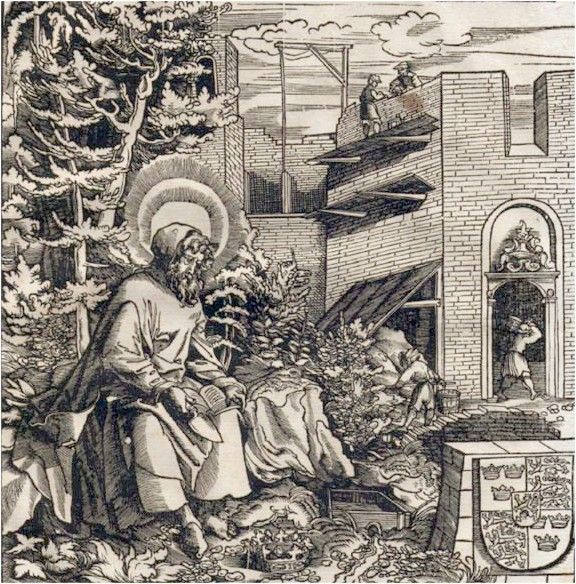
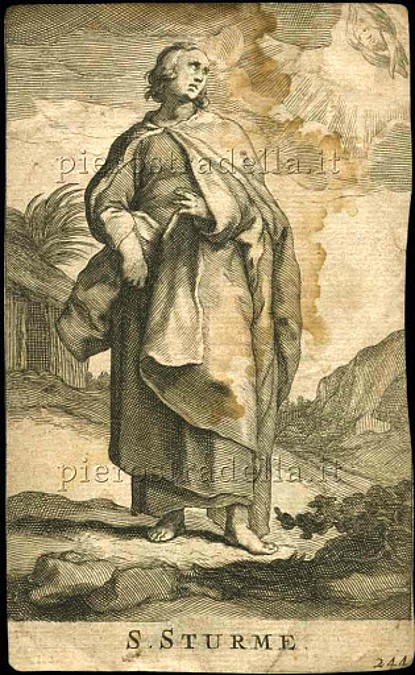
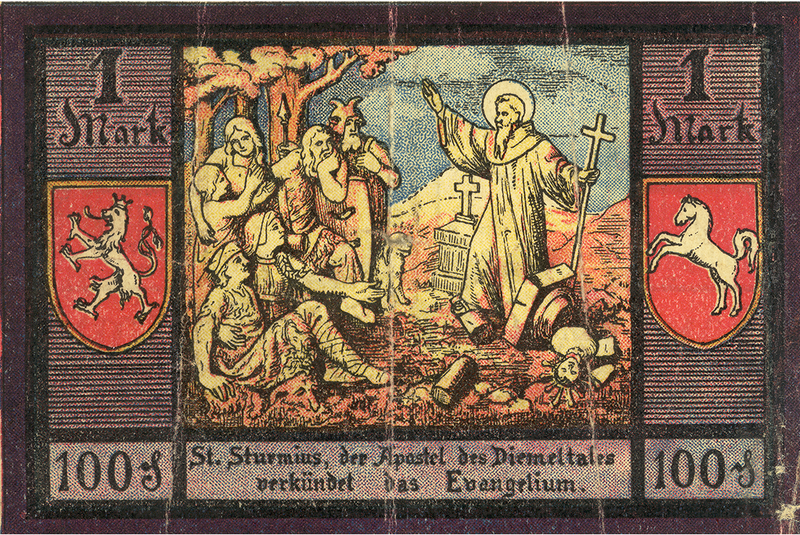
Saint of the Day – 17 December – Saint Sturmi of Fulda (c 705-779) Priest, Monk and Abbot, Missionary, disciple of Saint Boniface and Founder and first Abbot of the Benedictine Monastery and Abbey of Fulda. Sturmi’s tenure as Abbot lasted from 747 until 779. Also known as Apostle of the Saxons, Apostle of Germany, Sturm, Sturmius.
St Sturmi (kneeling) with St Boniface
Sturmi was born c 705 in Lorch, Austria and was most likely related to the Agilolfing Dukes of Bavaria. He met Saint Boniface when the latter was carrying out the church reorganisation in Bavaria and Austria (founding the Bishoprics of Salzburg, Regensburg and Würzburg). He joined Boniface and was educated in the Benedictine monastery of Fritzlar by Abbot Saint Wigbert. He was then active as a Missionary in northern Hesse, where in 736 he established a monastic settlement in Haerulfisfeld (Hersfeld).
Sturmi was Ordained in 740 as Priest in Fritzlar. In 744 he was instructed by St Boniface in 744 to establish a Monastery in the region of Eichloha, which had been granted to Boniface by the Frankish Mayor of the Palace Carloman. He established the Monastery in the ruins of a 6th-century Merovingian royal camp, destroyed 50 years earlier by the Saxons, at a ford on the Fulda River.
Following studies at St Benedict’s Monastery in Monte Cassino in 747–748, Sturmi was named first Abbot of the Fulda Monastery by St Boniface. In 751, St Boniface and his disciple and successor Lullus, obtained an exemption for Fulda, having it placed directly under the Papal See and making it independent of interference by Bishops or worldly princes.
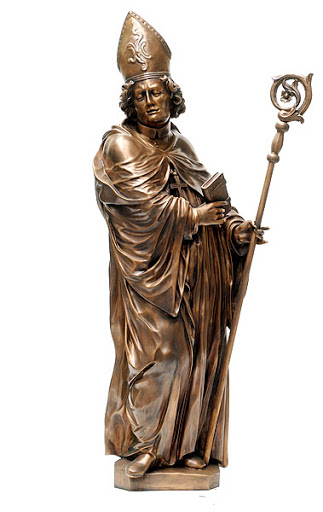
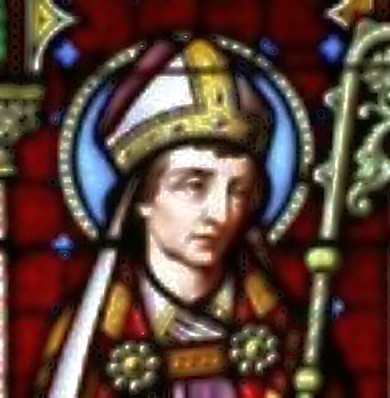
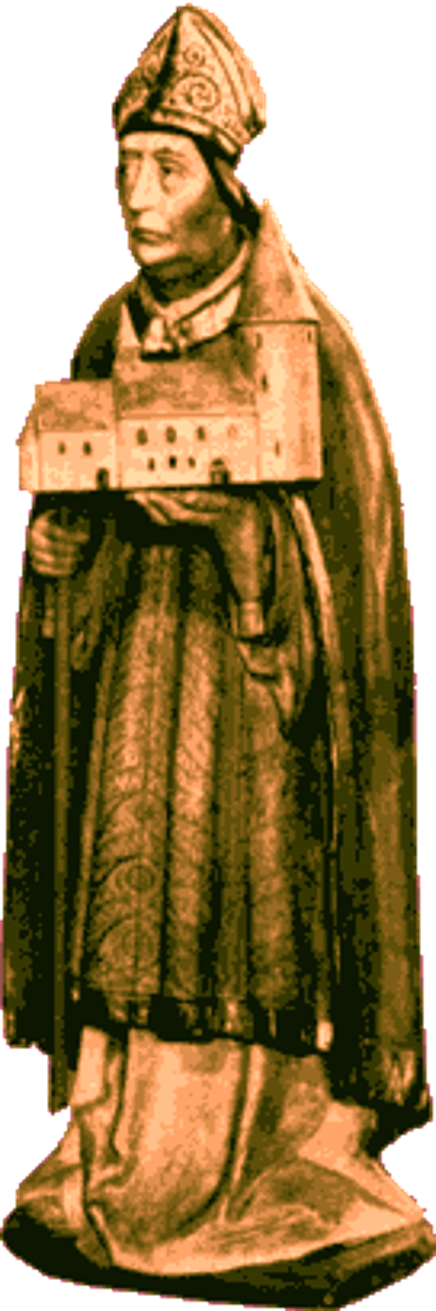
This is St Sturmi, I don’t know why he wears a Bishop’s Mitre
After the death of St Boniface, this exemption led to serious conflicts between Lullus, then Archbishop of Mainz and Abbot Sturmi. Nevertheless, Sturmi prevailed over the Bishops of Mainz and Utrecht in having Boniface, buried in Fulda after his Martyrdom in 754. This made Fulda a major place of pilgrimage for many peoples, including Anglo-Saxons and brought much prestige and a stream of gifts and donations to Fulda.
Building on this success, Sturmi was able to fend off efforts by the Bishops of Mainz and Würzburg to invalidate the Abbey’s exemption. He was sent into exile from 763 to 765 at Jumièges (Normandy) but was rehabilitated in 765 by Pippin the Younger. In 774, the Abbey of Fulda received Royal protection from Charlemagne. In the same year, Fulda was assigned missionary territories in heathen Saxony. Sturmi later established the Abbey of St Boniface at Hamelin. In 779, he accompanied Charlemagne into Saxony but fell ill and died soon after returning to Fulda on 17 December 779, where he was buried in the Cathedral.
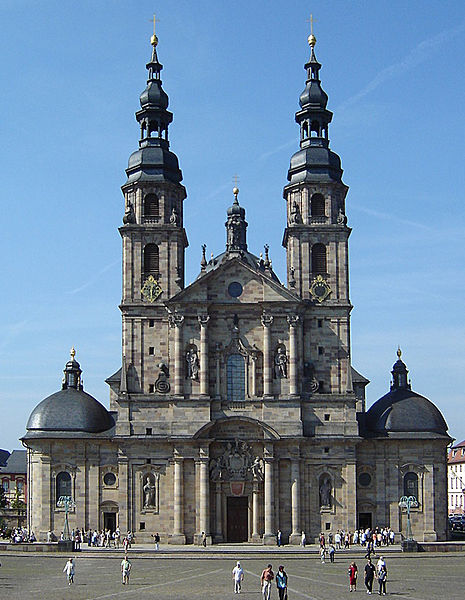
Fulda Abbey Cathedral
Sturmi was recognised as a Saint prior to the East–West Schism in 1054, hence the Orthodox Church continues to honour him. He was formally Canonised in 1139 by Pope Innocent II. His life was recorded in the Vita Sturmi by the fourth Abbot of Fulda, Eigil of Fulda (died 822[1]), a relative of his, who had been a Monk in Fulda for over 20 years under Abbot Sturmi.
Martyrs of Eleutheropolis – (60+ Martyrs-Beati): Approximately 60 Christian soldiers in the imperial Roman army of emperor Heraclius; they were murdered as a group for their faith by invading Saracen Muslims. We know the names of two of them – Calaoicus and Florian. 638 in Eleutheropolis (Beit Jibrin), Palestine.
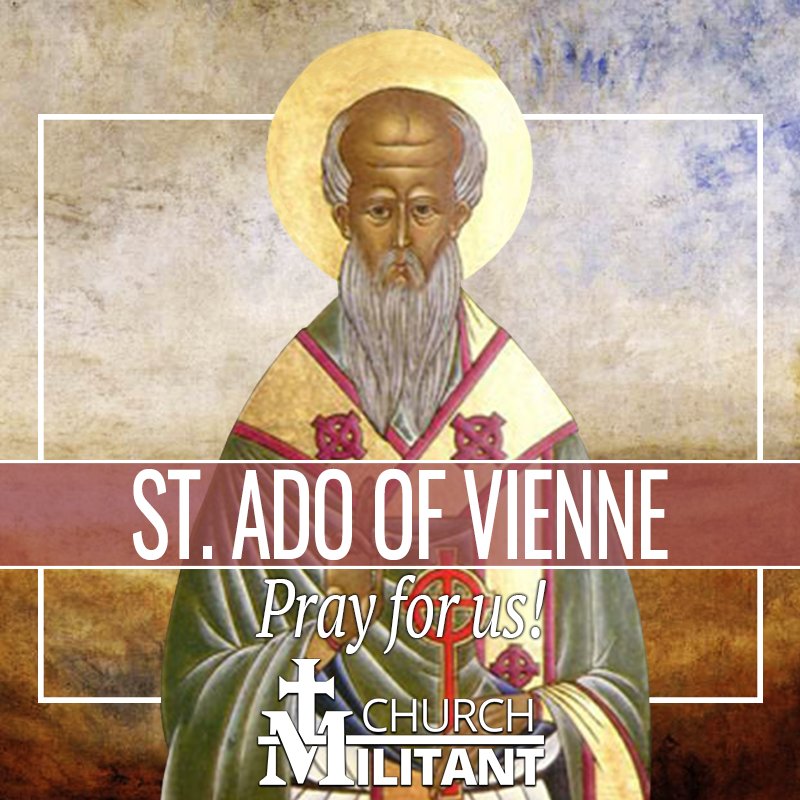
Saint of the Day – 16 December – Saint Ado of Vienne (Died 875) Archbishop of Vienne from 850 until his death, Writer, Reformer – Born in Sens, France and died in 875 in Vienne, France of natural causes. Also known as Adon, Adonis. Several of his letters are extant and reveal their writer as an energetic man of wide sympathies and considerable influence.
Ado was born into a noble family and was sent as a child for his education, first to Sigulfe, Abbot of Ferrières and then to Marcward, Abbot of Prüm near Trier. He had as one of his masters, the Benedictine Abbot Lupus Servatus, one of the most celebrated humanists of those times. By his brilliant talents and assiduous application, Ado gained the esteem of his masters and schoolmates, while his ready obedience, deep humility and sincere piety foreshadowed his future holiness.
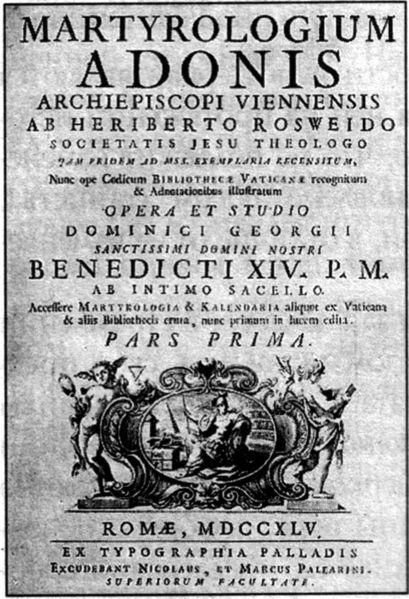
Though urged on all sides to enter upon a career in the world, to which his nobility of birth and great intellectual abilities entitled him, he consecrated himself entirely to God by taking the Benedictine habit at Ferrières. When Markward, a Monk of Ferrières, became Abbot of Prüm near Trier, he applied for Ado to teach the sacred sciences there. His request was granted. Soon, however, certain envious Monks of Prüm conceived an implacable hatred against Ado, due to his great intellect, humility and holiness and, upon the death of Markward, turned him out of their Monastery. With the permission of his Abbot, Ado now made a pilgrimage to Rome, where he remained five years. He then went to Ravenna, where he discovered an old Roman Martyrology which served as the basis for his own renowned Martyrology published in 858, which is generally known as the Martyrology of Ado. At Lyons he was received with open arms by the Archbishop, St Remigius, who, with the consent of the Abbot of Ferrières, appointed him pastor of the Church of St Roman near Vienne.
In 860 he became Archbishop of Vienne and a year later received the pallium from Pope Nicholas I. By word and exampl,e he began reforming the laxity of his priests and he gave them strict orders to instruct the laity in the necessary doctrines of Christianity. His own life was a model of humility and austerity. Ado participated in the Council of Tousy, near Toul in Lorraine, on 22 October 860 and held a council at Vienne in 870.
When Lothaire II, King of Lorraine, had unjustly dismissed his wife Theutberga and the papal legates at the Synod of Metz had been bribed to sanction the King’s marriage to his concubine Waldrada, Ado hastened to Rome and reported the crime to the Pope, who, thereupon, annulled the acts of the synod.
Besides the Martyrology mentioned above, Ado wrote a chronicle from the beginning of the world to 874, Chronicon de VI ætatibus mundi and the lives of St Desiderius, St Bernard – a previous Bishop of Vienne and St Theuderius.
Ado’s name is in the Roman Martyrology and at Vienne, his feast is celebrated on 16 December, the day of his death. His body was buried in the Church of the Apostles in Vienne, now called St Peter’s Church, the usual place of burial of the archbishops of Vienne.
Martyrs of Ravenna – (4 saints): A group of Christians martyred together. Four names and no other information has survived – Agricola, Concordius, Navalis and Valentine. c 305 at Ravenna, Italy.
Advent Reflection – 12 December – Feast of Our Lady of Guadalupe, Readings: Zechariah 2:14-17, Judith 13:18, 19, Luke 1:26-38.
Then the angel said to her, “Do not be afraid, Mary, for you have found favour with God. Behold, you will conceive in your womb and bear a son and you shall name him Jesus.” – Luke 1:30-31
REFLECTION – “Most blessed are you among women and blessed is the fruit of your womb ” For all ages will call you blessed, as you said (Lk 1:48). The daughters of Jerusalem, that is to say, the Church, saw you and proclaimed your happiness … For you are the royal throne near which the angels stood contemplating their Master and Creator, who was seated on it (Dan 7:9). You have become the spiritual Eden, more sacred and more divine than the former one. The earthly Adam lived in the former; in you, lives the Lord who came from heaven (1 Cor 15:47). Noah’s ark was a prefiguration of you; it saved the seed of the second creation, for you gave birth to Christ, the world’s salvation, who submerged sin and pacified the floods.
It was you whom the burning bush described ahead of time, whom the tablets depicted, on which God wrote (Ex 31:18), which the ark of the covenant told about; it is you whom the golden urn, the candelabra … and Aaron’s staff that blossomed (Num 17:23) clearly prefigured. … I almost left out Jacob’s ladder. Just as Jacob saw heaven united with the earth by means of the two ends of the ladder and the angels descending and ascending on it and as the one who is really the strong and invincible one engaged in a symbolic struggle with him, thus you yourself became the mediator and ladder by which God came down to us and took upon Himself the weakness of our substance, embracing it and closely uniting it to Himself.” – St John Damascene (675-749) Monk, Theologian, Father and Doctor of the Church – 1st Sermon on the Dormition
PRAYER – Lord Jesus Christ my Lord, help me to become a devoted client of Your holy Mother Mary. Through Your grace, may I receive the spiritual strength she has promised to all her clients. May I, in simplicity, like St Juan Diego, become her vessel to share Your Light, throughout my world. Our Lady of Guadalupe Pray for us! Jesus Christ, our Lord, one God with the Father and the Holy Spirit, now and for all ages, amen.
Saint of the Day – 12 December – Saint Vicelinus of Oldenburg (1086-1154) Bishop, Missionary, “the Apostle of Holstei,” zealous Preacher and as Bishop, he concentrated on education of his Priests and the spiritual growth of his Diocese as well as the needs of the poor, founder of numerous monasteries. Born in 1086 in the castle at Hemelin on the Weser, Lower Saxony, Germany and died on 12 December 1154 at Neumunster, Lorraine, France of natural causes. Also known as – Apostle of Obodriten, of the Wends, Vicelinus, Vincelin, Vizelin, Wissel, Witzel, Wizelin.
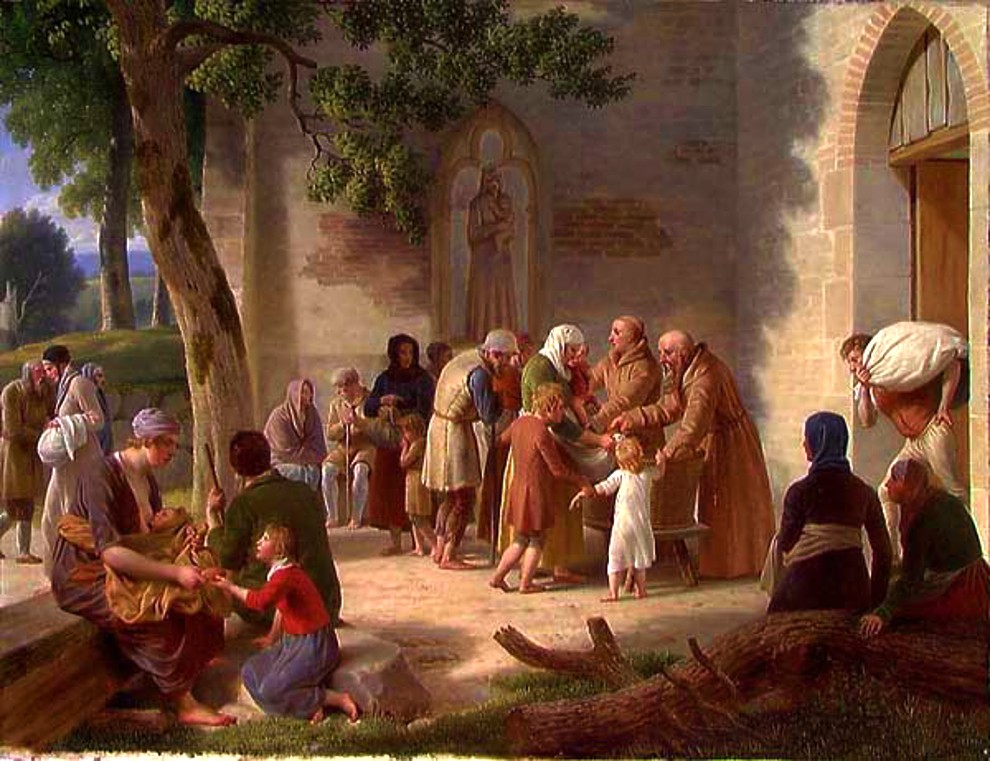
St Vicelinus distributes food to the needy. Oil painting by Christoffer Wilhelm Eckersberg, 1812
Vicelinus was born in Hemelin around 1086. He was orphaned at an early age and thereafter, raised by his uncle Ludolf, a Priest in a neighbouring village. He left to join the Cathedral school at Paderborn, where he soon surpassed his companions and assisted in the management of the Cathedral school.
Vicelinus was called to Bremen to act as teacher and principal of the school and was offered a canonry by Archbishop Frederick of the Archbishopric of Hamburg-Bremen. In 1122 he may have gone to Laon to complete his studies under St Abelard. In 1126, Vicelinus decided to travel to Madgeburg, in order to see St Norbert, who at that time was the Archbishop. He hoped that St Norbert would ordain him a Priest and he could begin missionary work among the Slavs. For one reason or another this plan failed and so Vicelinus returned to Bremen, where Bishop Albero Ordained him. Hamburg-Bremen’s Archbishop Adalbero sent him among the Polabian Slavs and in the fall of 1126 Henry, Prince of the Obotrites, gave him a Church in Liubice, near the site of the later Lübeck. At the death of Henry (22 March 1127) Vicelinus returned to Bremen and was appointed Parish Priest at Wippenthorp. This gave him an opportunity to work among the Wagrians and neighbouring Obotrites.
Vicelinus’s preaching gathered crowds of eager listeners and many Priests aided him in founding a new monastery in 1127 known as Neumünster. The monastery followed the Rule of St Augustine and was liberally endowed by the Archbishop. Wars among the tribes in 1137 caused the missionaries to abandon their labours for two years. Vicelinus sent two Priests to Liubice but with little success. In 1134 he founded a second monastery at Segeberg.
Some years later Vicelinus established a monastery at Hogersdorf. Archbishop Hartwig I made him Bishop of Starigard (or today’s Oldenburg) in 1149. There he did much for the spiritual and temporal welfare of his Diocese. In 1152 he was struck by paralysis and lingered amid much suffering for two years before dying in Neumünster.
In 1330 the Augustine canon-law college moved to Bordesholm and St Vicelinus relics were transferred there too in 1332 and his body was buried before the main altar.
Bl Ludwik Bartosik Bl Martin Sanz St Simon Phan Ðac Hòa St Spyridon of Cyprus St Synesius St Vicelinus of Oldenburg (1086-1154) Bishop
Martyrs of Alexandria – (6 saints): A group of six Christians martyred for their faith during the persecutions of Decius. We know little more than five of their names – Alexander, Ammonaria, Dionysia, Epimachus and Mercuria. They were burned to death c 250 in Alexandria, Egypt.
Martyrs of Trier – (4 saints): A group of six Christians martyred for their faith during the persecutions of Decius. We know little more than five of their names – Alexander, Ammonaria, Dionysia, Epimachus and Mercuria. They were burned to death c 250 in Alexandria, Egypt.
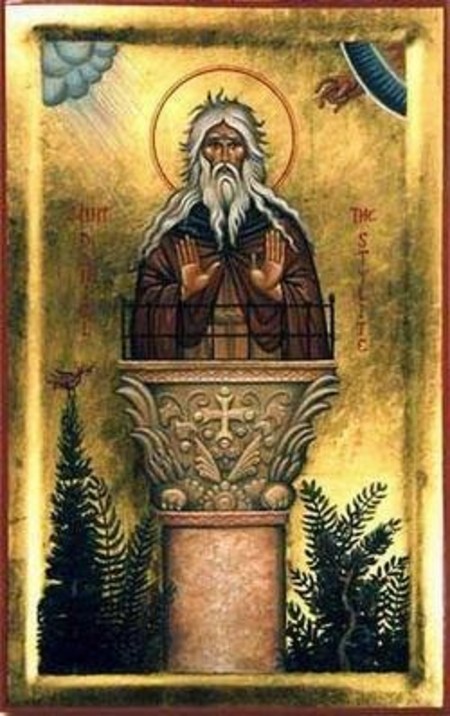
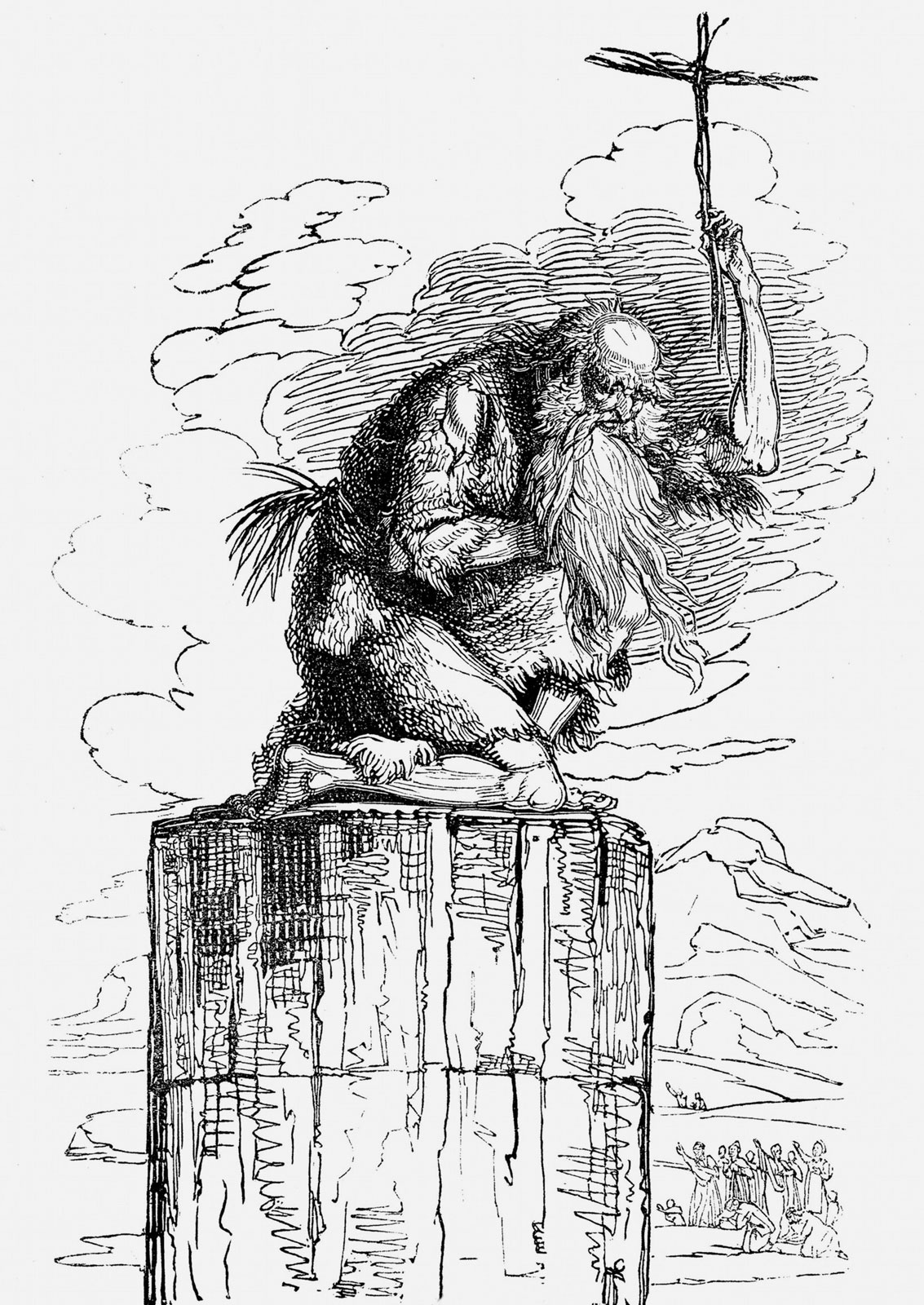
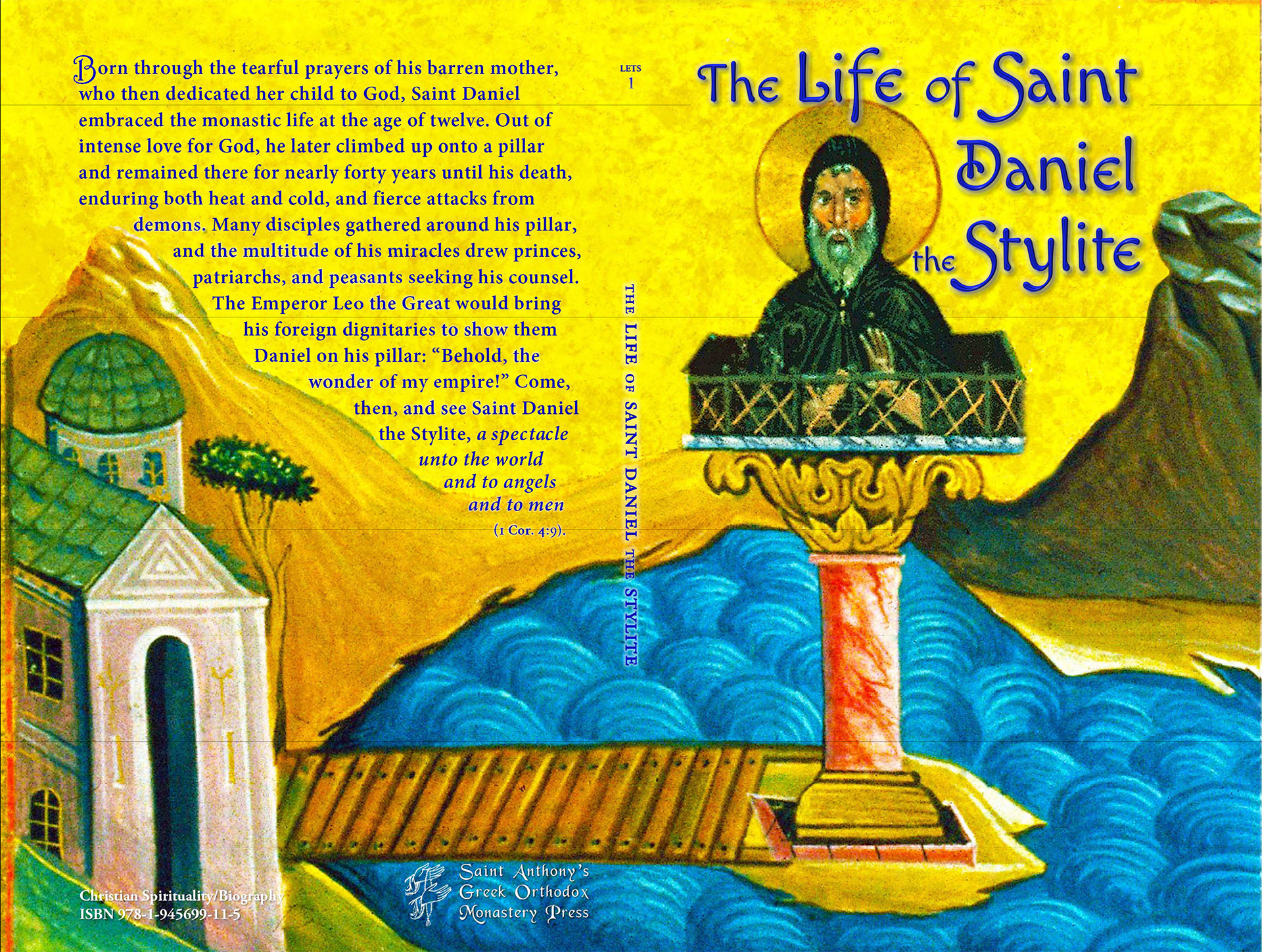
Saint of the Day – 11 December – Saint Daniel the Stylite of Constantinople (c 409–493) Priest, Monk, Abbot, Hermit, miracle-worker – born in c 409 at Maratha, Syria and died in 493 near Constantinople of natural causes.
Daniel was born in Maratha, Syria in 409 and became a monk in nearby Samosata on the Upper Euphrates. He learned of St Simeon Stylite, who lived on a pillar at Antioch and twice went to see him twice.
At the age of forty-two, Daniel decided that he too wanted to become a stylite (from the Greek word “stylos”, meaning pillar) and live on a pillar at a spot near Constantinople.
Emperor Leo I, built a series of pillars with a platform on top for him and Daniel was ordained there by St Gennadius. The saint quickly became an attraction for the people. He celebrated the Eucharist on his pillar, preached sermons, dispensed spiritual advice and cured the sick who were brought up to him. He also gave prudent counsel to Emperors Leo and Zeno and the Patriarch of Constantinople.
All the while, Daniel lived his particular type of pillar spirituality. He came down from his perch only once in thirty-three years – to turn Emperor Baliscus away from backing the heresy of Monophysitism.
Daniel died in 493 and after St Simeon, became the best-known and venerated Stylite.
The life of St Daniel the Stylite is an apt reminder that there are many ways to live the spiritual life. All of us have our own way to be close to God everyday. Our task is to find that way and follow it to the very end.
Bl Martín Lumbreras Peralta Bl Martino de Melgar Bl Melchor Sánchez PérezPens Bl Pilar Villalonga Villalba Bl Severin Ott Martyrs of Saint Aux-Bois – (3 saints): Two Christian missionaries and one of their local defenders who faith in the persecutions of governor Rictiovarus – Fuscian, Gentian and Victoricus. They were beheaded in 287 in Saint Aux-Bois, Gaul (in modern France).
Martyrs of Rome – (3 saints): Three Christians murdered in the persecutions of Diocletian for giving aid to Christian prisoners – Pontian, Practextatus and Trason. They were imperial Roman citizens. They were martyred in c 303 in Rome, Italy.















You must be logged in to post a comment.