Quote/s of the Day – 20 July – “Month of the Most Precious Blood” – Monday of the Sixteenth week in Ordinary Time, Year “A”, Readings: Micah 6:1-4, 6-8, Psalm 50:5-6, 8-9, 16-17, 21, 23, Matthew 12:38-42
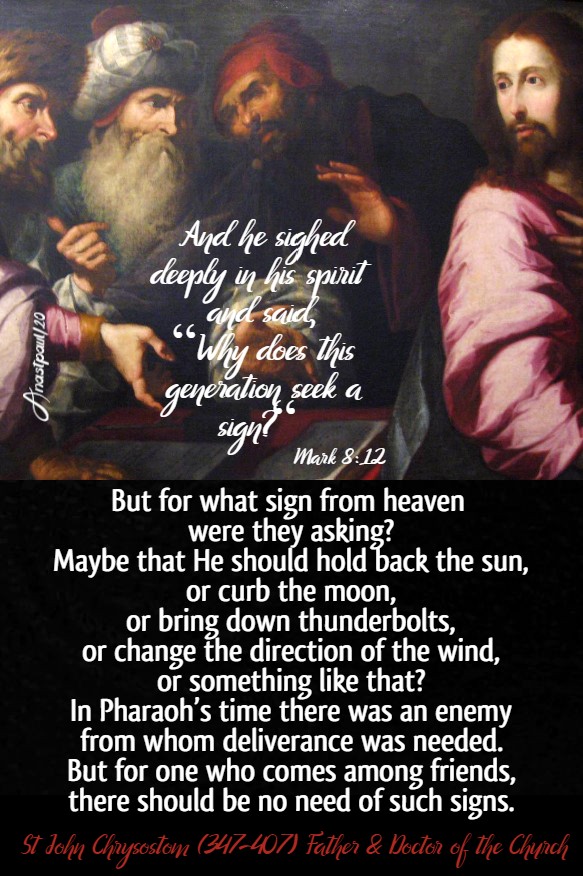
And he sighed deeply in his spirit and said, “Why does this generation seek a sign?
Mark 8:12
“But for what sign from heaven were they asking? Maybe that He should hold back the sun, or curb the moon, or bring down thunderbolts, or change the direction of the wind, or something like that? In Pharaoh’s time there was an enemy from whom deliverance was needed. But for one who comes among friends, there should be no need of such signs.”
St John Chrysostom (347-407)
Father & Doctor of the Church
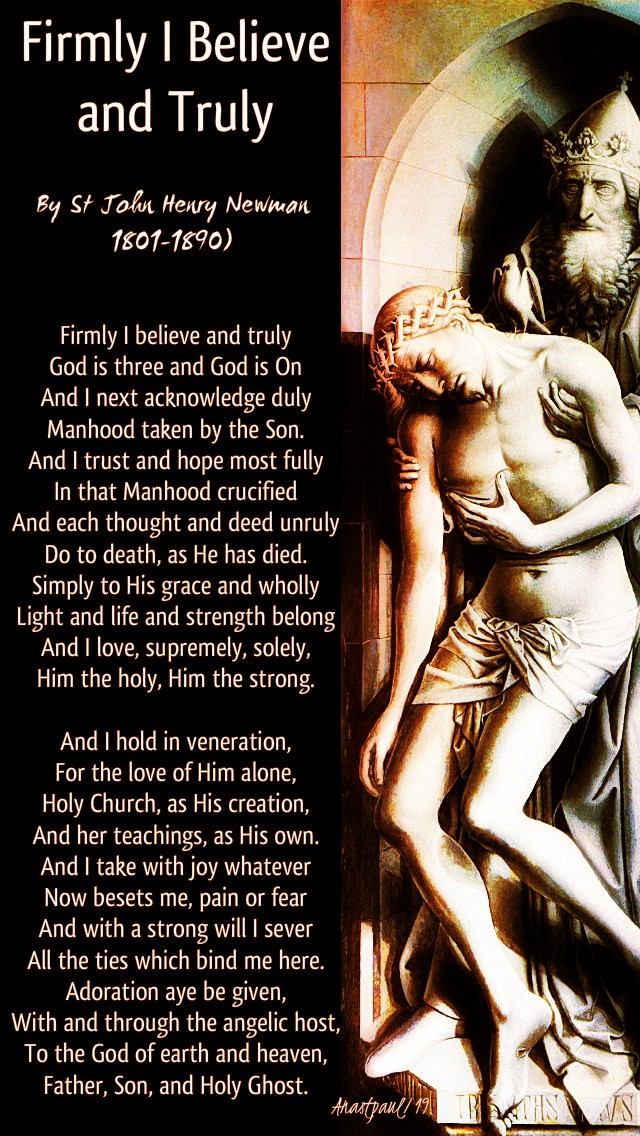
Firmly I Believe and Truly St John Henry Newman (1801-1890)
Firmly I believe and truly God is three and God is One And I next acknowledge duly Manhood taken by the Son. And I trust and hope most fully In that Manhood crucified And each thought and deed unruly Do to death, as He has died. Simply to His grace and wholly Light and life and strength belong And I love, supremely, solely, Him the holy, Him the strong.
And I hold in veneration, For the love of Him alone, Holy Church, as His creation, And her teachings, as His own. And I take with joy whatever Now besets me, pain or fear And with a strong will I sever All the ties which bind me here. Adoration aye be given, With and through the angelic host, To the God of earth and heaven, Father, Son, and Holy Ghost.
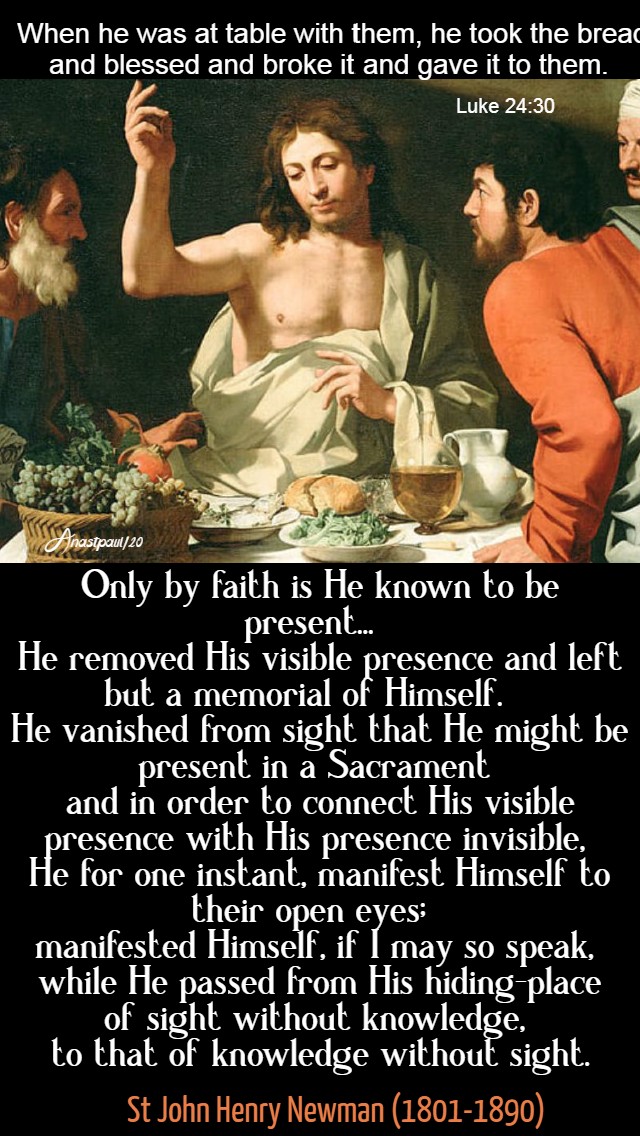
“… Only by faith is He known to be present… He removed His visible presence and left but a memorial of Himself. He vanished from sight that He might be present in a Sacrament and, in order to connect His visible presence with His presence invisible, He for one instant, manifest Himself to their open eyes; manifested Himself, if I may so speak, while He passed from His hiding-place of sight without knowledge, to that of knowledge without sight.”
The Sign of the Cross
WHENE’ER across this sinful flesh of mine I draw the Holy Sign, All good thoughts stir within me and renew Their slumbering strength divine, Till there springs up a courage high and true To suffer and to do.
And who shall say but hateful spirits around, For their brief hour unbound, Shudder to see and wail their overthrow? While on far heathen ground Some lonely Saint hails the fresh odour, though Its source he cannot know.
Quote/s of the Day – 7 July – “Month of the Most Precious Blood” – Friday of the Fifteenth Week in Ordinary Time, Year A, Readings: Isaiah 38:1-6, 21-22, 7-8, Responsorial psalm Isaiah 38:10-12, 16, Matthew 12:1-8
‘Take Christ’
“Fear not, for I have redeemed you, I have called you by name, you are mine.”
Isaiah 43:1
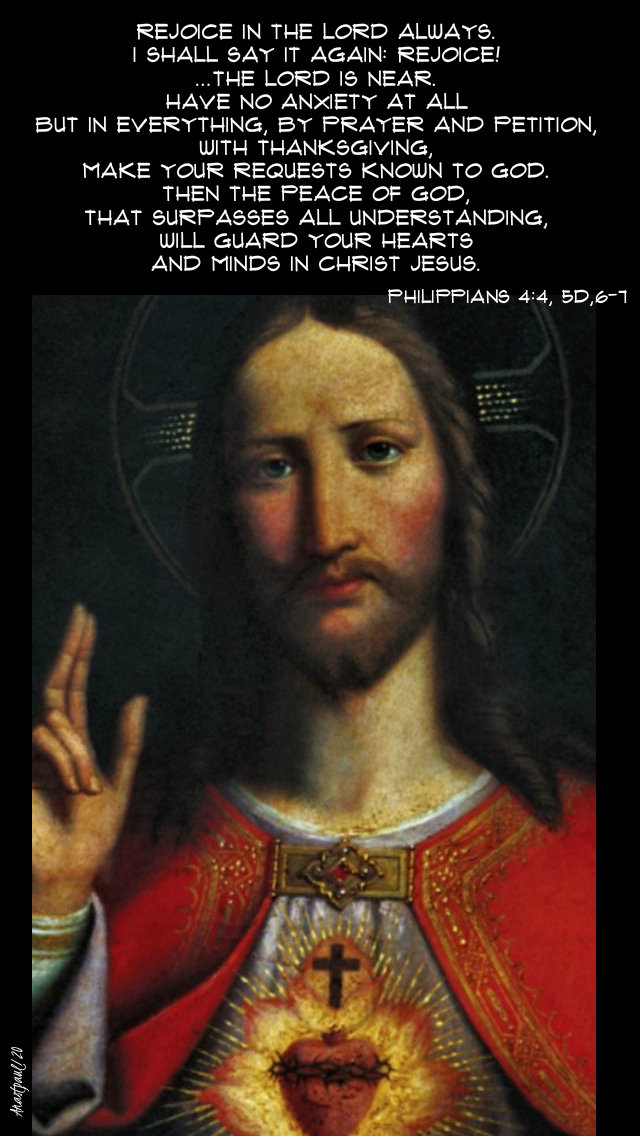
Rejoice in the Lord always. I shall say it again: rejoice! …The Lord is near. Have no anxiety at all but in everything, by prayer and petition, with thanksgiving, make your requests known to God. Then the peace of God, that surpasses all understanding, will guard your hearts and minds in Christ Jesus.
Philippians 4:4, 5d,6-7
“The Christian should be an ‘alleluia’ from head to foot.
St Augustine (354-430)
Father & Doctor of the Church
“May Christ be heard in our language, may Christ be seen in our life, may He be perceived in our hearts”
St Peter Damian (1007-1072)
Doctor of the Church
(Sermo VIII, 5)
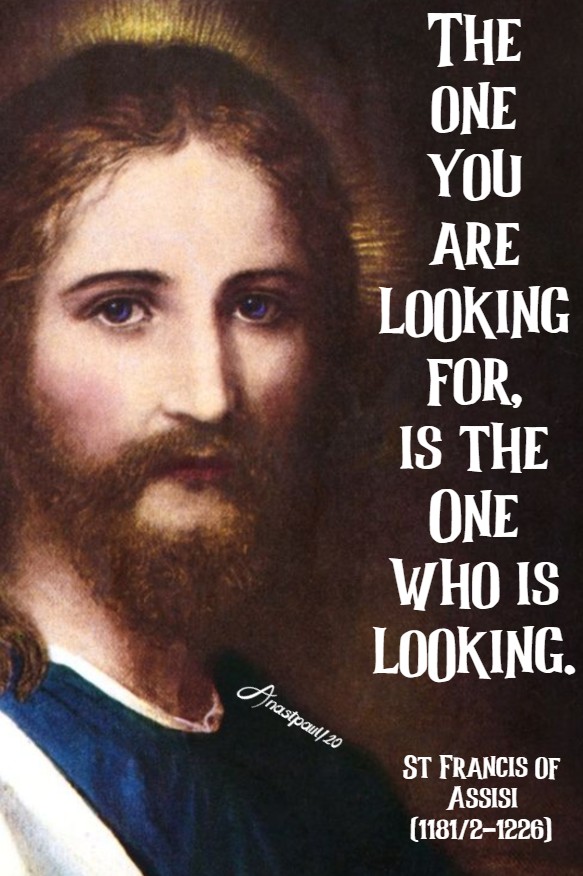
“The one you are looking for, is the One who is looking.”
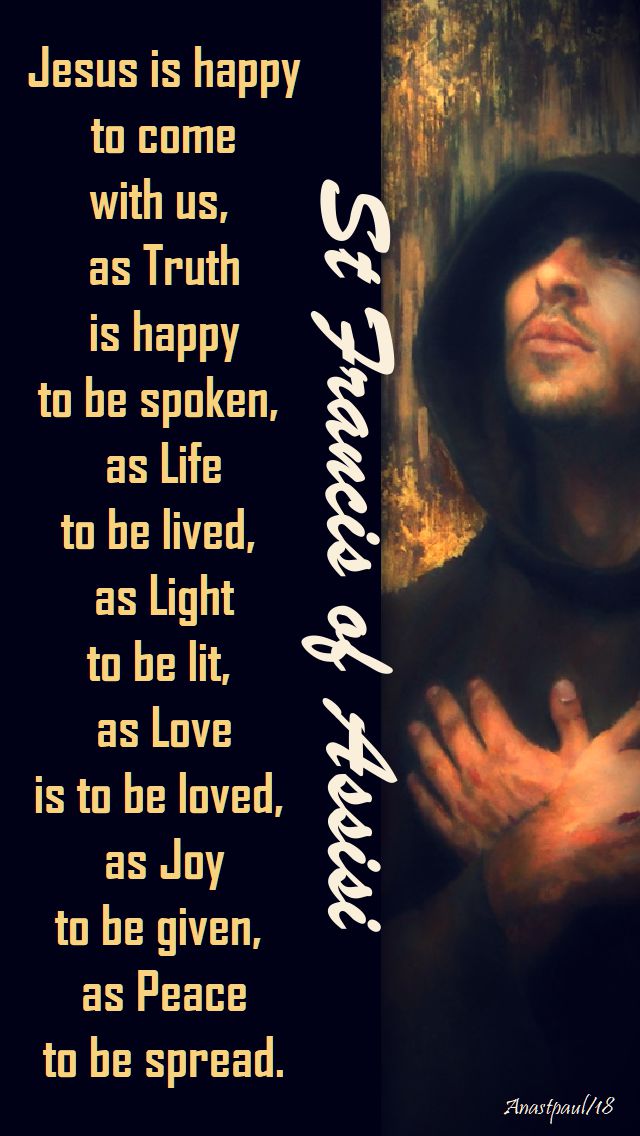
“Jesus is happy to come with us, as Truth is happy to be spoken, as Life to be lived, as Light to be lit, as Love is to be loved, as Joy to be given, as Peace to be spread.”
St Francis of Assisi (1181/2–1226)
“Love God, serve God, everything is in that.”
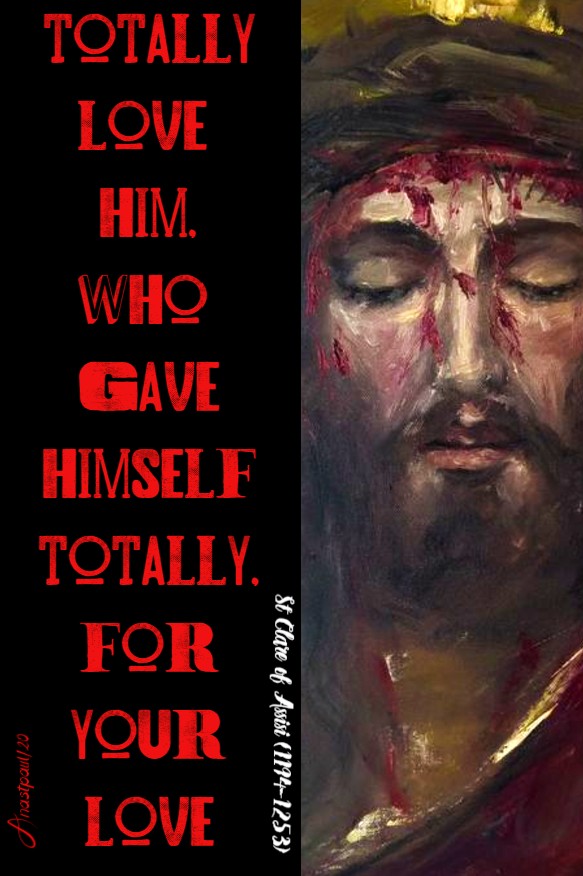
“Totally love Him, who gave Himself totally, for your love.”
St Clare of Assisi (1194-1253)
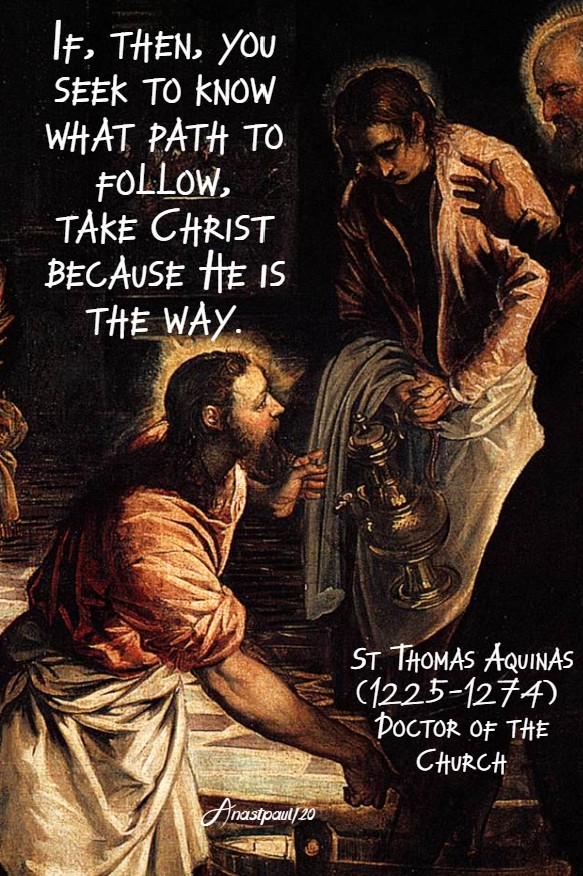
“If, then, you seek to know what path to follow, take Christ because He is the way.”
St Thomas Aquinas (1225-1274)
Doctor of the Church
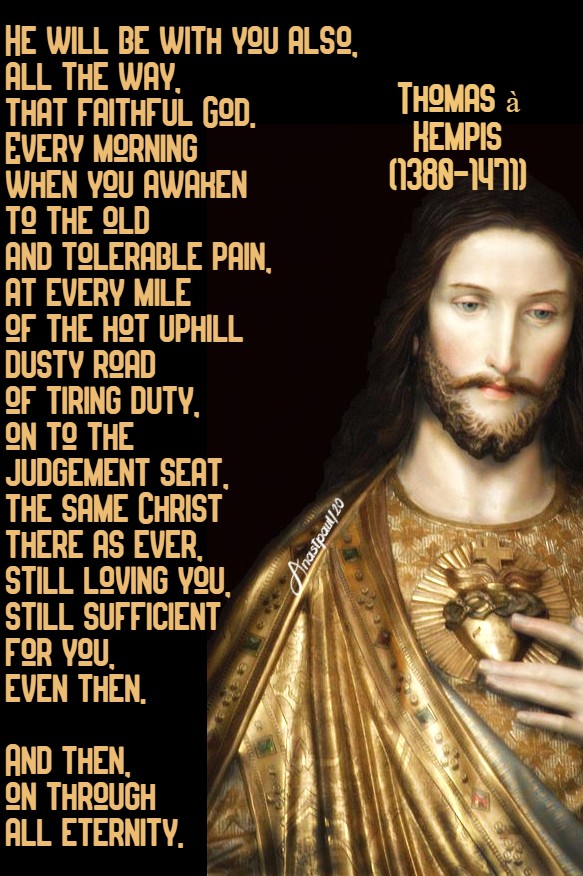
“He will be with you also, all the way, that faithful God. Every morning when you awaken to the old and tolerable pain, at every mile of the hot uphill dusty road of tiring duty, on to the judgement seat, the same Christ there as ever, still loving you, still sufficient for you, even then. And then, on through all eternity.”
Thomas à Kempis (1380-1471)
“Every Christian must be a living book wherein one can read the teaching of the gospel. This is what St Paul says to the Corinthians. Our heart is the parchment; through my ministry the Holy Spirit is the writer because ‘my tongue is like the pen of a ready scribe’ (Psalm 45:1).”
The Fifteenth Sunday of the Year in Ordinary Time, Year A +2020
__
St Agnes De
St Andreas the Soldier
St Ansbald of Prum
St Balay
St Clement Ignatius Delgado Cebrian
Bl David Gonson
St Epiphana
St Faustus the Soldier
St Felix of Milan
St Fortunatus of Aquileia
St Hermagorus of Aquileia
St Hilarion of Ancyra
St Jason of Tarsus
Bl Jeanne-Marie de Romillon St John Gualbert (c 985-1073) His Life: https://anastpaul.com/2019/07/12/saint-of-the-day-12-july-st-john-gualbert-c-985-1073-the-merciful-knight/ St John Jones OFM (c 1574 – 1598) Priest and Martyr
Bl Madeleine-Thérèse Talieu
Bl Marguerite-Eléonore de Justamond
Bl Marie Cluse
St Menas the Soldier
St Menulphus of Quimper
St Nabor of Milan
St Paternian of Bologna
St Paulinus of Antioch
St Phêrô Khan
St Proclus of Ancyra
St Proculus of Bologna
St Uguzo of Carvagna St Veronica St Veronica’s Story: https://anastpaul.wordpress.com/2017/07/12/saint-of-the-day-12-july-st-veonica/
St Viventiolus of Lyons
—
Martyrs of Nagasaki – 8 beati: Additional Memorial – 10 September as one of the 205 Martyrs of Japan
Eight lay people, many them related to each other, who were martyred together:
• Catharina Tanaka
• Ioannes Onizuka Naizen
• Ioannes Tanaka
• Ludovicus Onizuka
• Matthias Araki Hyozaemon
• Monica Onizuka
• Petrus Araki Chobyoe
• Susanna Chobyoe
12 July 1626 in Nagasaki, Japan
Beatified on 7 May 1867 by Pope Blessed Pius IX.
One Minute Reflection – 9 July – “Month of the Most Precious Blood” – Thursday of the Fourteenth week in Ordinary Time, Year A, Readings: Hosea 11:1-4, 8-9, Psalm 80:2-3, 15-16, Matthew 10:7-15 and the Memorial of Blessed Marija of Jesus Crucified Petković (1892-1966)
“And proclaim as you go, saying, ‘The kingdom of heaven is at hand.’” … Matthew 10:7
REFLECTION – “We Missionaries often wonder why the work of the conversion of the non-Christian world goes so slowly. We usually give various reasons to explain this painful fact and in truth, the problem may be considered from many angles, some of which do not concern our responsibility. But, for the part that does concern us and it is the main part, the problem has a very clear solution. To save the world, God in His infinite wisdom wanted to have co-workers. God does His part well – do the people called to help Him do their part equally well?
Let us work in such a way that the whole Church, all Christian people, led by their Bishops and clergy, truly feel the apostolic duty that is incumbent upon them to promote the propagation of the faith, with every means. Let us work in such a way that that Missionaries, the most direct instruments for the conversion of souls, are saints and non-Christians will not be slow to be converted.
… You, Missionaries in active service in the field, are particularly concerned with your part of co-operation. Therefore, I say to you, be holy Missionaries by following the footsteps of those great Missionaries who went before you and, for the part that concerns you, your apostolic duty will have been done to the full. The souls the Lord, in His merciful designs, has entrusted to each one of you that you may lead them to salvation, will be saved and at the end of your days you will be able to say with the Divine Redeemer: “(Father) I kept those you had given me true to you name. I have watched over them and not one is lost” (Jn 17:12).” … Blessed Paolo Manna PIME (1872-1952) Superior General of the PIME Founder of the Pontifical Missionary Union – “Holiness is the Soul of Mission”
PRAYER – “Lord, You have called us to the apostolate with the witness of our life and the proclamation of the Gospel, may we contribute to the coming of Your Kingdom in the nations to which you send us. Lord, You wish us to be Missionaries in communion with the Churches that have given us the faith and richness of Christian life, keep us united to our bishops and to the people they guide, that together we may carry out the mission You have entrusted to us in their name. Lord, You wanted our parents and benefactors, through their generosity and sacrifices, to participate in our apostolic life, may they share the reward You have prepared for those who work for the coming of Your Kingdom throughout the world. Merciful Lord, during their earthly life You assigned our deceased brethren the task of spreading Your Word, may they receive the reward for their apostolate in the glory of heaven. AMEN” … (From the Manual of PIME MIssionaries) And Lord, may the prayers of Your holy men and women, today we call on Bl Marija of Jesus Crucified Petković, who proclaimed Your Kingdom by her life, be every heard for our intercession.
Catholic doctrine teaches the faithful, that the Blood of Jesus Christ is part of His Sacred Humanity and hypostatically united to the Second Person of the Blessed Trinity.
And as such, it is worthy of adoration and veneration proper to latreutical worship (cultus latriae) which is rendered only to God. In other words, we adore the human nature of Christ because of its intimate and eternal union with the Person of the Divine Word.
It is for this same reason, that we honour the Most Sacred Heart or the Wounds of Our Lord Jesus Christ.
The Devotion to the Precious Blood:
This devotion is one of the most ancient of pious Church practices. It is said that the Blessed Virgin venerated the Most Precious Blood of her infant Son on the day of His circumcision as she collected the first relics of His Precious Blood on a piece of cloth.
On that momentous occasion she united her tears with that of the Word Incarnate on account of, not so much of the sensible pain bu,t of His supernatural sorrow for the hard-heartedness of mortals.
This was the first of seven Blood-Sheddings of Our Divine Saviour, The rest being:
2. The Agony in the Garden
3. The Scourging at the Pillar
4. The Crowning with Thorns
5. The Way of the Cross
6. The Crucifixion
7. The Piercing of His Heart
The old sacrifice took a new form in the New Testament when the Immaculate Lamb of God offered Himself on the altar of the Cross, to redeem mankind from sin and the slavery of Satan.
And during the Last Supper, Our Lord offered Himself in an unbloody, yet real sacrifice when He uttered the following words: “For this is my blood of the new testament, which shall be shed for many unto remission of sins.”(Matthew 26: 28)
Truly, this “shedding of blood’ or “pouring out of blood” took place and forms one of the glorious mysteries of our Faith.
St Adalbert of Egmond
St Amand of Coly
Bl Burchard of Mallersdorf
St Cyneburga of Gloucester
St Domingo Henares de Zafra Cubero
Bl Dorothy of Montau
St Eurosia of Jaca
St Febronia of Nisibis
Bl Fulgentius de Lara
St Gallicanus of Embrun
St Gallicanus of Ostia
St Gohard of Nantes
Bl Guy Maramaldi
Bl Henry Zdick
Bl John the Spaniard
St Luceias and Companions St Maximus of Turin (? – c 420) Biography: https://anastpaul.com/2018/06/25/saint-of-the-day-25-june-st-maximus-of-turin-c-420-father-of-the-church/
Quote/s of the Day – 22 June – The Memorial of St John Fisher (1469-1535) Bishop, Martyr
“I reckon in this realm, no one man, in wisdom, learning and long approved virtue together, meet to be matched and compared with him.”
St Thomas More speaking of St John Fisher
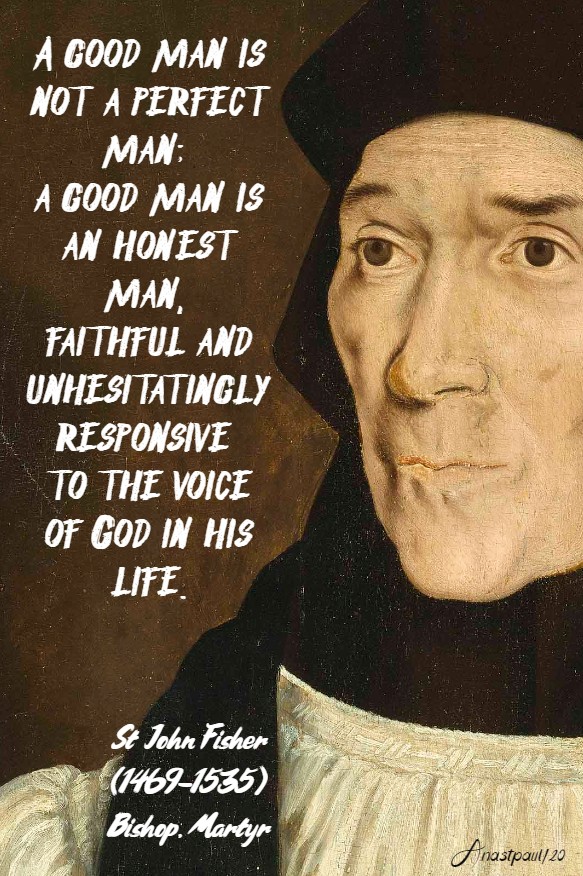
“A good man is not a perfect man; a good man is an honest man, faithful and unhesitatingly responsive to the voice of God in his life.”
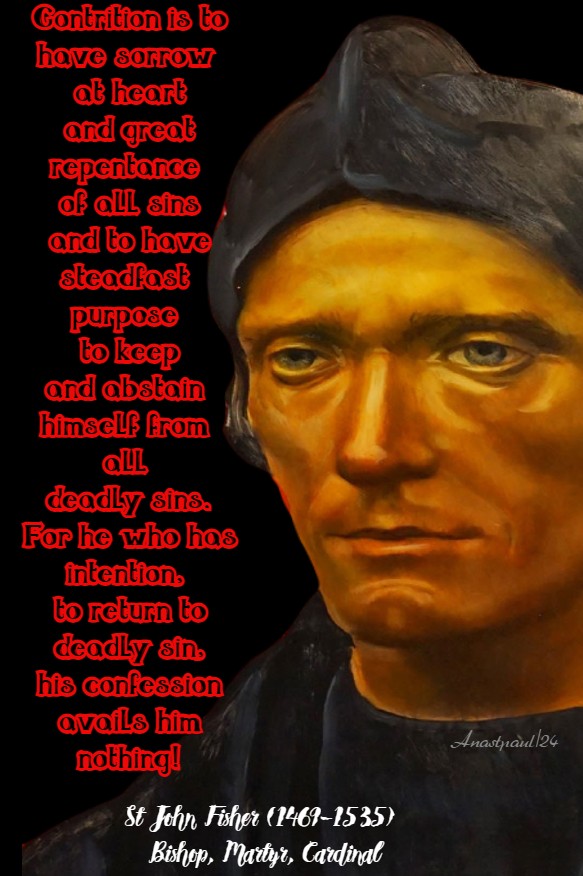
“Contrition is to have sorrow at heart and great repentance of all his sins and to have steadfast purpose to keep and abstain him from all deadly sins. For who has intention to return him to deadly sin, his confession avails him nothing!”
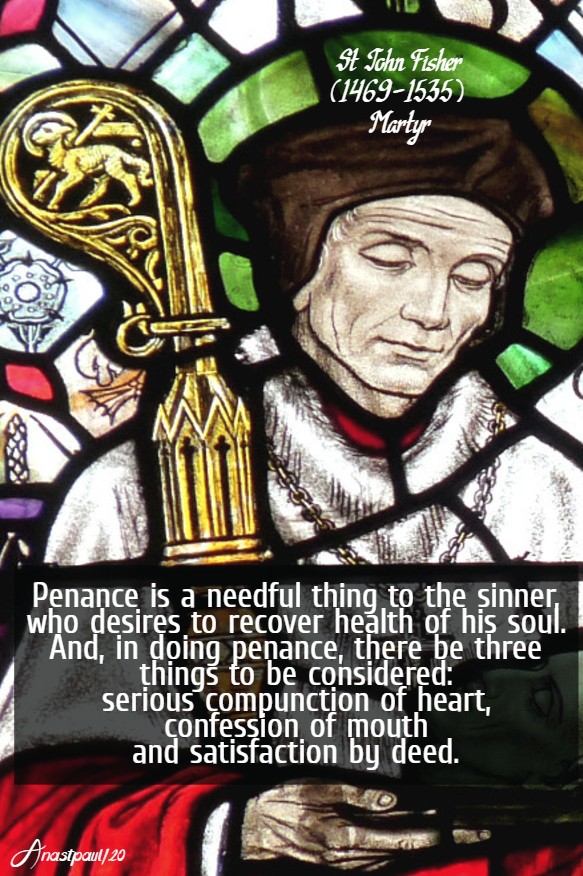
“Penance is a needful thing to the sinner, who desires to recover health of his soul. And, in doing penance, there be three things to be considered: serious compunction of heart, confession of mouth and satisfaction by deed.”
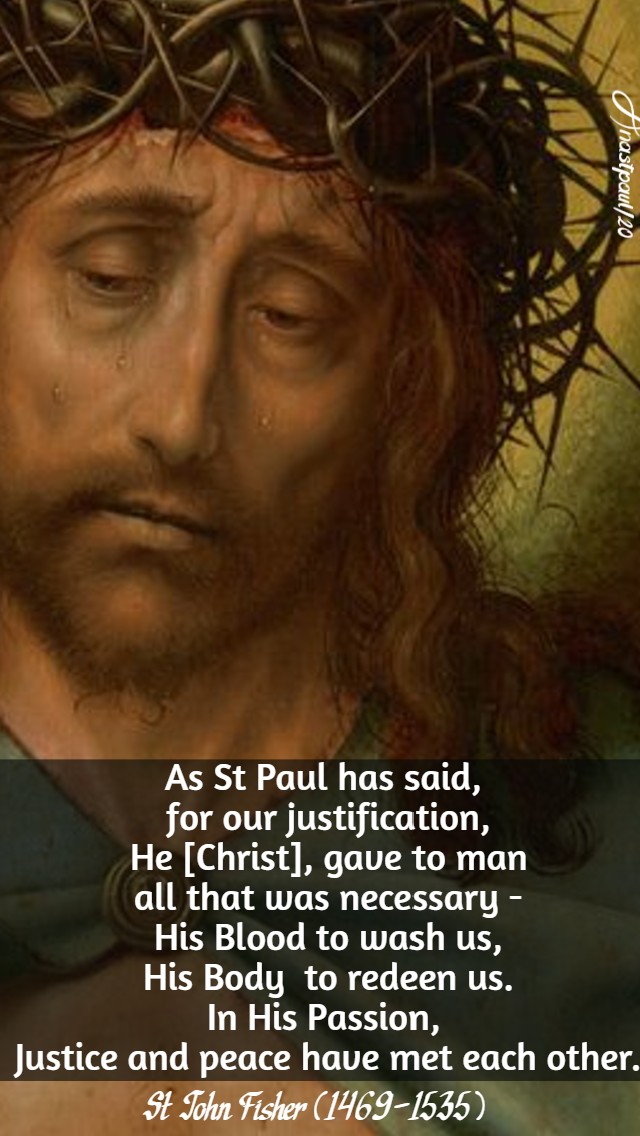
“As St Paul has said, for our justification, He [Christ], gave to man all that was necessary – His Blood to wash us, His Body to redeem us. In His Passion, Justice and peace have met each other.”
“Beware of those prophets who speak unto you and deceive you! They prophecy nothing but the imaginations and forgings of their own minds and not the truth of Holy Scripture!”
Quote/s of the Day – 18 June – Thursday of the Eleventh week in Ordinary Time, Year A, Readings: Sirach 48:1-14 (1-15), Psalm 97:1-7, Matthew 6:7-15
“Our Father who art in heaven, Hallowed be Thy name. Thy kingdom come. Thy will be done, On earth as it is in heaven. Give us this day our daily bread And forgive us our trespasses As we forgive those who trespass against us And lead us not into temptation but deliver us from evil. Amen”
Jesus
Matthew 6:9-13
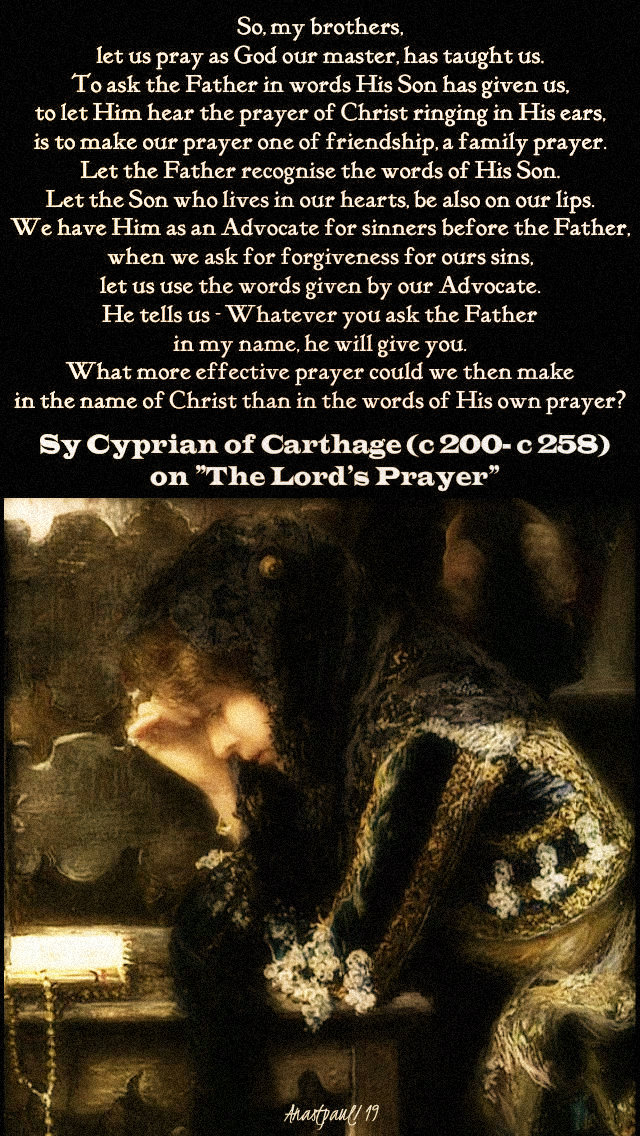
“So, my brothers, let us pray as God our master has taught us. To ask the Father in words His Son has given us, to let Him hear the prayer of Christ ringing in His ears, is to make our prayer one of friendship, a family prayer. Let the Father recognise the words of His Son. Let the Son who lives in our hearts, be also on our lips. We have Him as an Advocate for sinners, before the Father, when we ask for forgiveness for ours sins, let us use the words given by our Advocate. He tells us – Whatever you ask the Father in my name, He will give you. What more effective prayer could we then make, in the name of Christ, than in the words of His own prayer?”
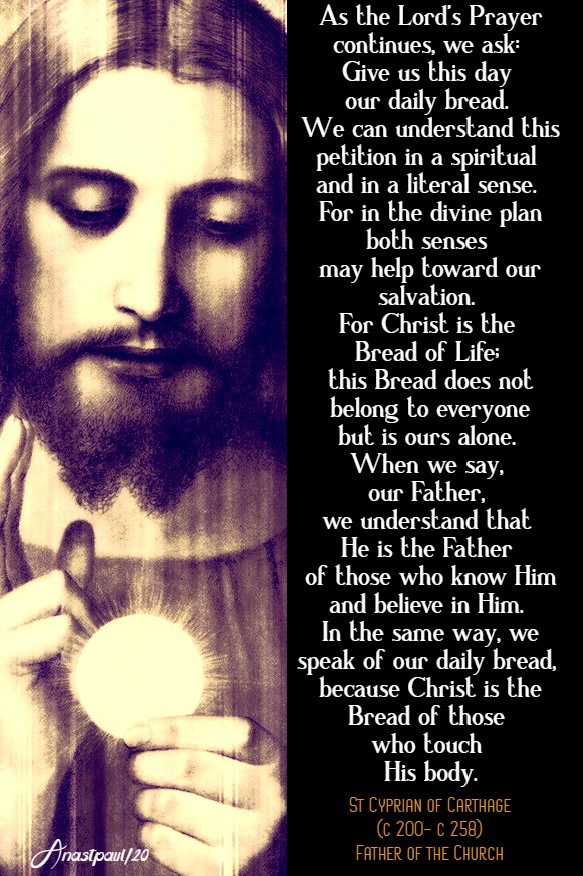
“As the Lord’s Prayer continues, we ask: Give us this day our daily bread. We can understand this petition in a spiritual and in a literal sense. For in the divine plan both senses may help toward our salvation. For Christ is the Bread of Life; this Bread does not belong to everyone but is ours alone. When we say, our Father, we understand that he is the Father of those who know Him and believe in Him. In the same way, we speak of our daily bread, because Christ is the Bread of those who touch His body.”
St Cyprian of Carthage (c 200- c 258)
Bishop, Father of the Church and Martyr
An excerpt from his “On the Lord’s Prayer”
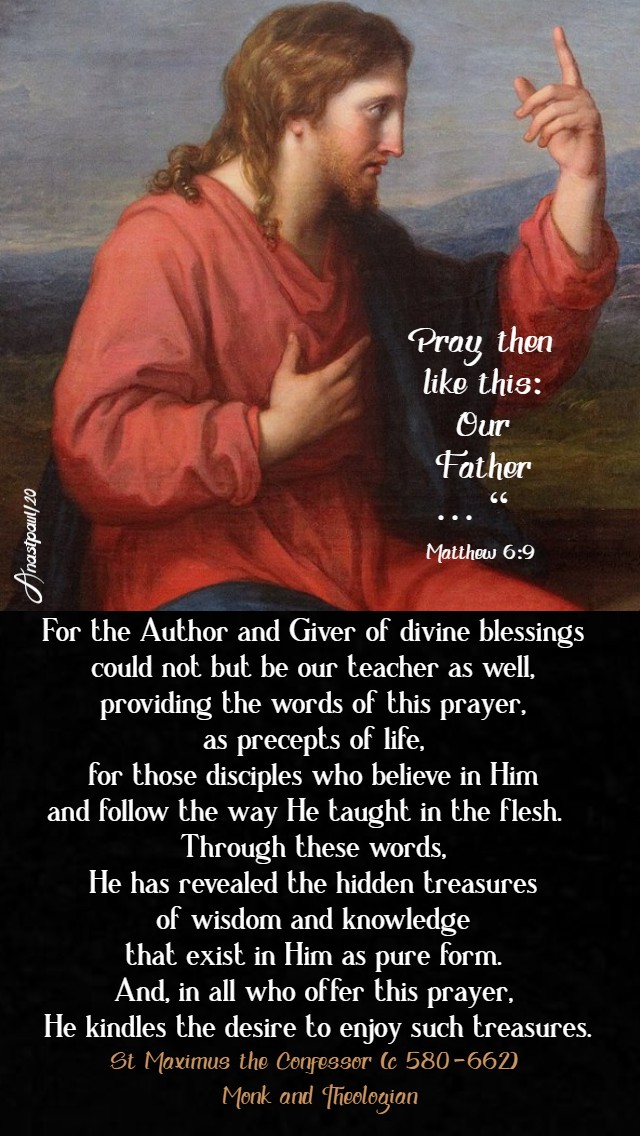
“For the author and giver of divine blessings could not but be our teacher as well, providing the words of this prayer, as precepts of life, for those disciples who believe in Him and follow the way He taught in the flesh. Through these words, He has revealed the hidden treasures of wisdom and knowledge (Col 2:3) that exist in Him as pure form. And, in all who offer this prayer, He kindles the desire to enjoy such treasures.”
St Maximus the Confessor (c 580-662)
Monk and Theologian
Interpretation of the Lord’s Prayer
“You see, my children, the Christian’s treasure is not on earth, it is in heaven (Mt 6:20). So our thinking must go to where our treasure is. The human person has a beautiful task, to pray and to love. You pray, you love – that is the human being’s happiness on earth.”
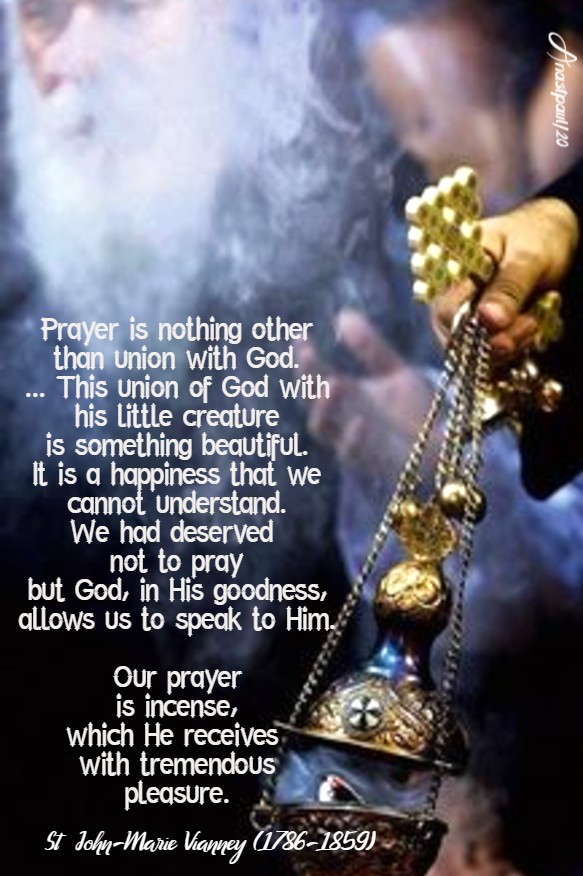
“Prayer is nothing other than union with God. … This union of God with his little creature is something beautiful. It is a happiness that we cannot understand. We had deserved not to pray but God, in His goodness, allows us to speak to Him. Our prayer is incense, which He receives with tremendous pleasure.”
St John-Marie Vianney (1786-1859)
Catechism on Prayer]
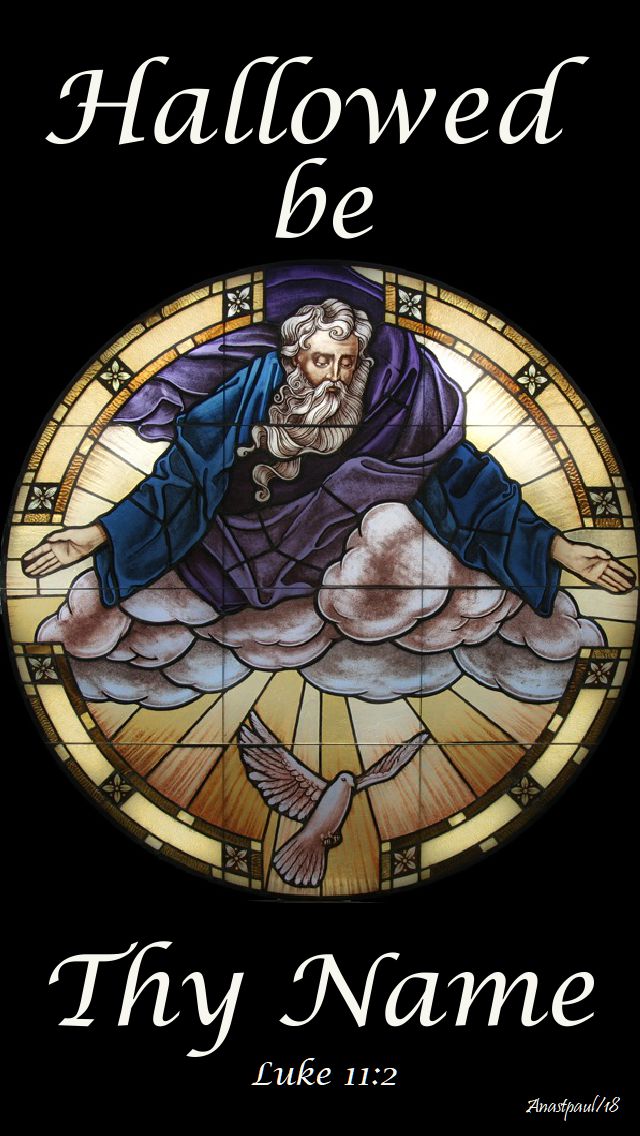
“Father, hallowed be thy name.”
Luke 11:2
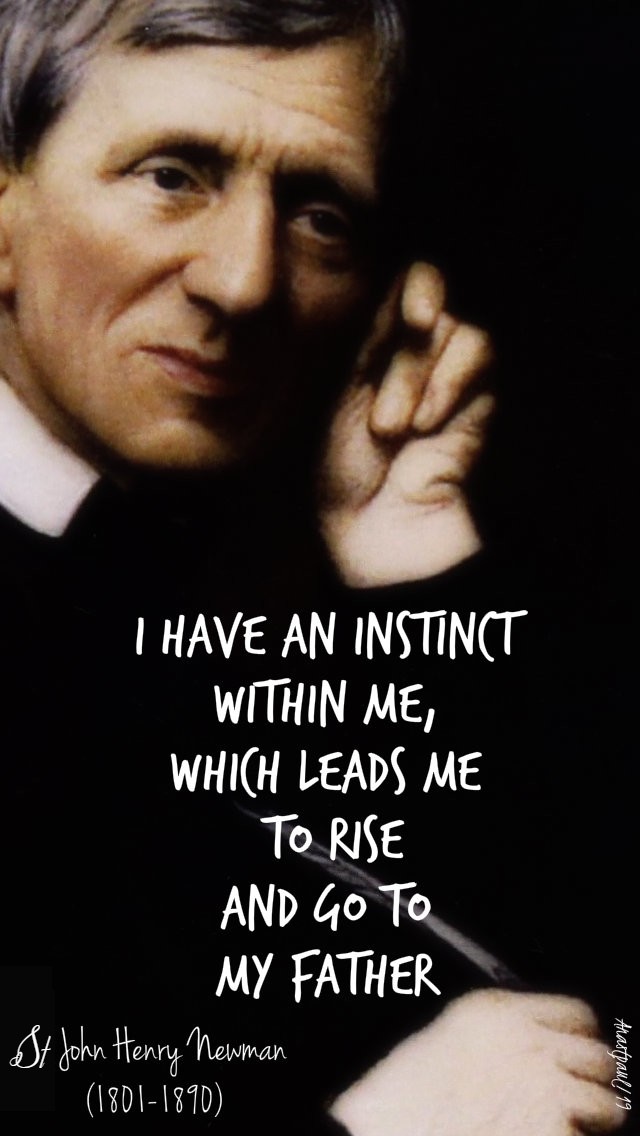
“I have an instinct within me, which leads me to rise and go to my Father, to name the Name of His well-beloved Son and having named it, to place myself, unreservedly in His hands, saying “if Thou, Lord, will mark iniquity, Lord, who shall stand it? For with Thee, there is merciful forgiveness.”
St John Henry Newman
(1801-1890)
To My Father
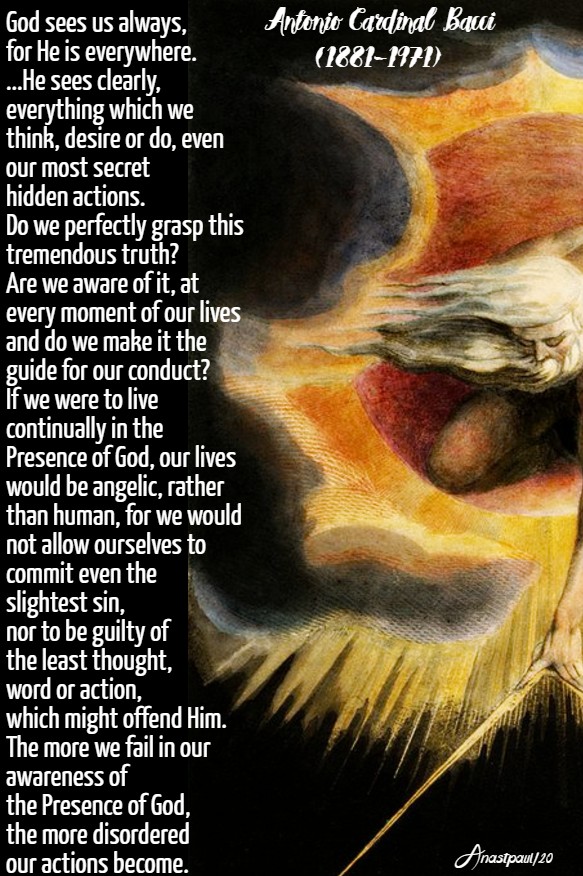
“God sees us always, for He is everywhere. …He sees clearly, everything which we think, desire or do, even our most secret hidden actions. Do we perfectly grasp this tremendous truth? Are we aware of it, at every moment of our lives and do we make it the guide for our conduct? If we were to live continually in the Presence of God, our lives would be angelic, rather than human, for we would not allow ourselves to commit even the slightest sin, nor to be guilty of the least thought, word or action, which might offend Him. The more we fail in our awareness of the Presence of God, the more disordered our actions become.”
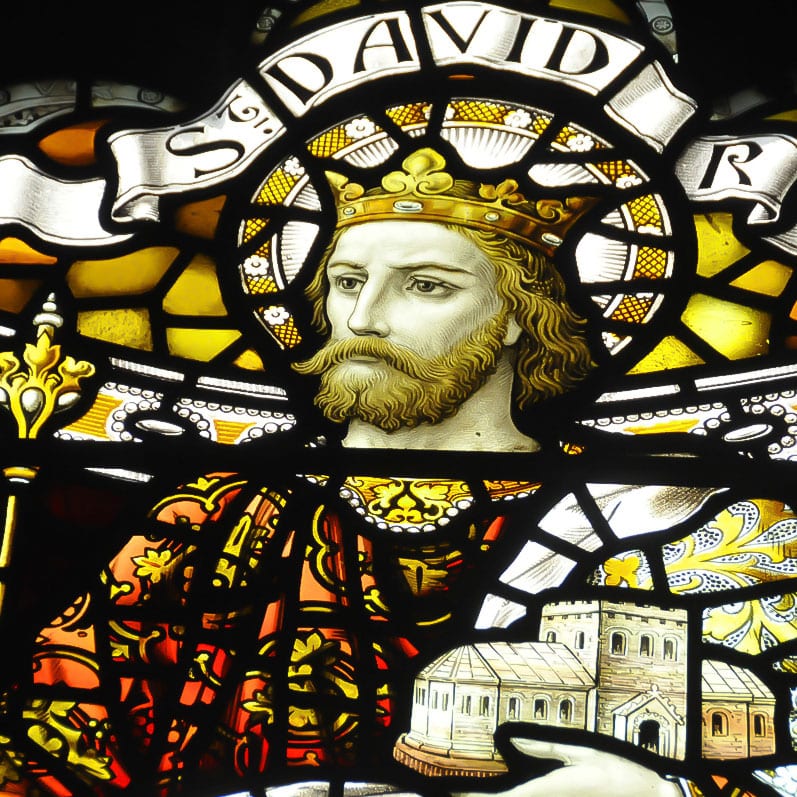
Saint of the Day – 24 May – St David, King of Scotland (1085-1183) King of Scotland from 1124 to 1153 – born as Dabíd mac Maíl Choluim in 1085 and died on 24 May 1183 in Carlisle, Scotland of natural causes. King David was a social and religious Reformer, a man of great administrative skills, apostle of charity and of holy piety. He transformed his Kingdom by the widespread introduction of Catholic Churches and Monasteries, thus also assisting in the international diplomatic influence of his country, it’s farming and agricultural wealth and it’s education. He was the main force and instrument of God in Christianising Scotland. Patronage – Scotland and various Dioceses and Churches there.
St David was the youngest son of King Malcolm III of Scotland and his wife Margaret who is herself a Saint. Although David spent most of his childhood in Scotland, he was educated for some years at the Anglo-Norman court in England. When his brother Alexander acceded to the throne of Scotland in 1107, David became Prince of Cumbria. He married Matilda, daughter of Waldef, Earl of Northampton and Huntingdon and thus became an English Earl. As Prince of Cumbria he was entitled to an inheritance in southern Scotland.
Upon Alexander’s death, David reluctantly became King of Scots in 1124. He brought with him many knights and courtiers from Norman England, many of whom became the future aristocrats and even Kings of Scotland including Bruce, Balliol and FitzAlan, who later became the Stewart kings.
King David oversaw the continuing development of the Scottish state and the organisation of Christianity within it. He established the Royal cities of Edinburgh, Berwick, Roxburgh, Stirling and perhaps Perth and founded Diocese at Brechin, Dunblane, Caithness, Ross and Aberdeen. He founded and endowed numerous Monasteries. Among them were the Cistercian Houses of Melrose, Kinloss, Newbattle and Dundrennan and Holyrood itself for Augustinian canons as well as the Benedictines at Dunfermline. This period in Scottish history has become known as the “Davidian Revolution.”
The ruins of Melrose Abbey. Founded in 1137, this Cistercian Monastery became one of David’s greatest legacies.
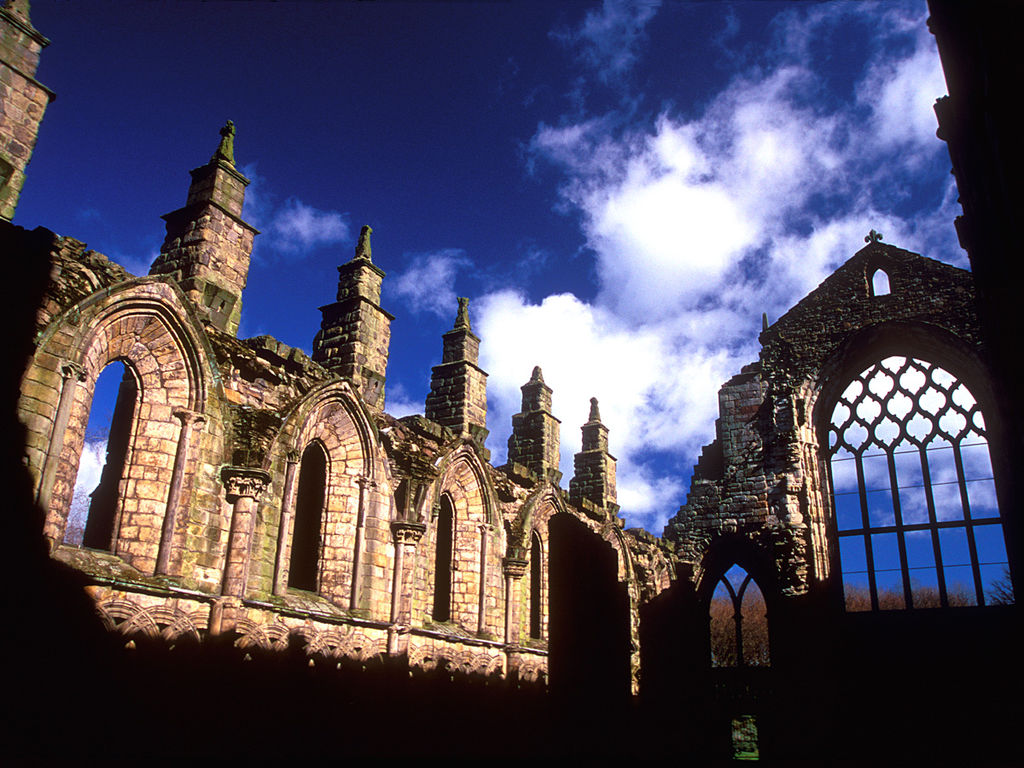
The ruins of Holyrood Abbey founded by David I in 1128. The royal lodging developed into Holyrood Palace.
Not only were such Monasteries an expression of David’s undoubted piety but they also functioned to transform Scottish society. Monasteries became centres of foreign influence and provided sources of literate men, able to serve the crown’s growing administrative needs. These new Monasteries and the Cistercian ones in particular, introduced new agricultural practices. Cistercian labour, for instance, transformed southern Scotland into one of northern Europe’s most important sources of sheep wool.
When Queen Matilda died, he gave even more attention to religious matters, reciting the Divine Office himself each day and devoting himself to almsgiving and other works of charity. In all he exercised a wholly civilising influence upon his family and upon the nation.
Perhaps the greatest blow to David’s plans came on 12 July 1152 when Henry, Earl of Northumberland, David’s only son and heir, died. David had under a year to live and he may have known that he was not going to be alive much longer. David quickly arranged for his grandson, Malcolm IV, to be made his successor and for his younger grandson William to be made Earl of Northumberland. The 11 year-old Malcolm around Scotland-proper on a tour to meet and gain the homage of his future Gaelic subjects.
St Ælred of Rievaulx (1110-1167) (his life here: https://anastpaul.com/2018/01/12/saint-of-the-day-12-january-st-aelred-of-rievaulx-1110-1167-saint-bernard-of-the-north/) who was, in his earlier years, master of the household to David with whom he kept up a close friendship with the King, gives a circumstantial account of David’s death at Carlisle on 24 May 1153. On the Friday he was anointed and given Viaticum and then spent much time in praying psalms with his attendants. On Saturday they urged him to rest but he replied, “Let me rather think about the things of God, so that my spirit may set out strengthened on its journey from exile to home. When I stand before God’s tremendous judgement-seat, you will not be able to answer for me or defend me, no-one will be able to deliver me from His hand.” And so, he continued to pray and at dawn of Sunday, he passed away peacefully as if he slept. St David had helped to endow Dunfermline Abbey, founded by his father and mother and he had peopled it with Benedictine monks from Canterbury. There he was buried and at his shrine, his memory was venerated until the Reformation.
After the King’s death, St Ælred delivered the eulogy at the Requiem Mass, praising Saint David’s reluctance to become king, his sense of justice and his accessibility to everyone, his efforts to maintain concord among the clergy, of his personal piety and in general, of the great work he did for the consolidation of the Kingdom of Scotland.
Ælred’s only criticism was of his failure to control the savagery and rapacity of his troops when he invaded England, on behalf of his niece Matilda, against Stephen. For this, David was very contrite and is said to have looked on his defeat at the Battle of the Standard and the early death of his only son, as just retribution therefor.
St David, Pray for Scotland, Pray for us all, amen!
Statue of St David on the West Door of St Giles, Edinburgh, formerly a Catholic Cathedral, of course but now protestant.
Fountain of Life
Moments with Saint Pope John XXIII (1881-1963)
“There is a passage from the pen of a distinguished English writer on religious subjects (F W Faber, The Blessed Sacrament 1855), which is so wonderful that I am sorry that I can do no more than briefly trace the main line of his thought.
The Immaculate Virgin is with us.
We still enjoy hearing our fathers describe the delight felt by the whole Catholic world in the middle of the last century, when the ancient doctrine of Mary having been preserved from all taint of original sin, was defined as Dogma.
That doctrine is like the mountain spring, purer than the waters of Sion, from which flow all the other mysteries of the Incarnation.
The whole Church gathers around this source to gaze at it’s reflection in the clear deep waters.
Kneeling on the bank is the supreme Pontiff, the teachers who thirst for the truth, hasten to drink from the spring.
Mitred and crowned heads and humble children of the people, the poor and afflicted of all classes, a whole multitude of pious folk, stoop down, drink and rise again – sight is restored, Mary shines more brightly than before.
Look well, my brothers, at those waters.
They are the elements of the Precious Blood of Jesus.
They flow mysteriously in the sanctified breast of Anna, they appear again, transfigured into the blood of Mary, the fair child, the maiden of fifteen years, the Bride of the Holy Spirit.
Through the power of the Spirit that overshadows her, this blood gathers into itself, the elements of the Sacred Humanity of Christ.
Behold the Spring and then the Blood!
Oh, what a miracle occurs!
The Blood is already beating in the Sacred Heart, it crimsons the cheeks of the Divine Child – it is sweated out from every pore of Jesus, in His Passion.”
Bercthun of Beverley
Bertha of Bingen
St Caecilius of Granada
St Caesarea of Otranto
St Cassius of Clermont
Bl Clemente of Bressanone
St Colman Mc O’Laoighse
St Ctesiphon of Verga
Bl Diego of Valdieri St Dymphna (7th Century) Virgin Martyr “The Lily of Éire”
St Euphrasius of Andujar (1st Century) Martyr St Euphrasius’ Life: https://anastpaul.com/2019/05/15/saint-of-the-day-15-may-saint-euphrasius-of-andujar-1st-century/
St Gerebernus
St Hallvard of Oslo
St Hesychius of Gibraltar
St Hilary of Galeata
St Indaletius of Urci
St Isaias
St Isidore of Chios
Bl Joan Montpeó Masip
St Maximus of Clermont
St Nicholas the Mystic
St Rupert of Bingen
St Secundus of Avila
St Simplicius of Sardinia
St Sophia of Rome
St Victorinus of Clermont
St Waldalenus of Beze
—
Martyrs of Maleville: 50 Mercedarian friars murdered for their faith by Huguenots. 1563 in the Mercedarian convent of Maleville in Rodez, France.
Martyrs of Persia: Three Christians who were tortured, mutilated, imprisoned, starved and finally executed together for refusing to worship the sun and fire during the persecutions of Shapur II. We know nothing else about them but their names: Bohtiso, Isaac and Simeon. They were beheaded or burned at the stake (records vary) in the late 3rd century somewhere in Persia
Martyrs of Lampsacus:
Andrew of Troas
Denysa of Troas
Paul of Troas
Peter of Lampsacus
Thought for the Day – 8 May – “Mary’s Month” Meditations with Antonio Cardinal Bacci (1881-1971)
The Theological Virtues of Our Lady
“The three theological virtues of faith, hope and charity, shone like constellations throughout the life of Mary. “Blessed is she who has believed” (Lk 1:45), St Elizabeth said of her. Mary’s life was one long act of faith and of love. She lived continuously in the presence of God, being united to Him by lively sentiments of faith, hope and charity. Her spirit of constant prayer was the result of her intense practice of these theological virtues. When the Archangel Gabriel came down from Heaven, to bring her the tidings of her divine motherhood, he found her absorbed in prayer. When St Elizabeth praised and called her the Mother of her Lord, Mary, from the depths of her faith, attributed everything to God and glorified Him in her Magnificat. When the baby Jesus was born in the cave of Bethlehem, she adored Him with faith, hope and love, as her God and future Saviour. When she realised that Herod was searching for her Son to put Him to death, she placed her confidence in Him. She fled with Him into Egypt and brought Him back later, to their land, always with the same faith, hope and love. Her faith and hope were not weakened by the loss of Jesus in Jerusalem, only her mother’s love was disturbed, on this occasion. When it seemed in that hidden life of Nazareth, that Jesus was leading a life of pointless silence, her faith and hope in Him, did not fade, while her love grew greater from day to day. In the triumphs and sorrows of His public life, she continued to practice, to an extraordinary degree, these three virtues – on the road to Calvary, at the foot of the Cross, at the removal of Our Lord’s body from the Cross, at the tomb, at the glorious Resurrection, Ascension and Pentecost. At last, when she was alone in this world without Jesus, these three virtues seemed to burn more brightly in her soul. She thought only of Jesus, hoped in Jesus alone and loved Jesus alone. Then Jesus rewarded the lively faith, expectant hope and flaming charity of His Mother, for on her assumption into Heaven, these three virtues shared in her triumph and coronation.”
Rejoice! It’s 1 May and the Month of the Blessed Virgin Mary
“God wills that all his gifts should come to us through Mary”
St Bernard of Clairvaux (1090-1153) Mellifluous Doctor
“This is the month in which, in the churches and individual homes, the most affectionate and fervent homage of prayers and devotions from the hearts of Christians are raised to Mary. It is also the month in which from His throne, descend upon us, the most generous and abundant gifts of the Divine Mercy.”
Please join me in wishing our beloved Pope Emeritus on his Birthday.
On Holy Saturday, 93 years ago today, Joseph Aloisius Ratzinger was born and Baptised. This baby was destined to be our Holy Father from 19 April 2005 to 26 February 2013.
This year’s birthday will be different given the restrictions and lockdowns in place, across Italy, Europe and the world, which will not permit his brother, Msgr. Georg Ratzinger, to join him this year.
Yet, “we are doing well,” Benedict’s personal secretary, Archbishop Georg Ganswein says.
Let us all pray a Rosary for beloved Pope Benedict today!
Saint of the Day – 31 March – Blessed Bonaventure Tornielli OSM (1411-1491) Priest of the Servite Order, called the “Apostolic Preacher”, Confessor, Biblical expert, Missionary Preacher – born in 1411 in Forli, Italy and died on 31 March 1491 of natural causes, aged 80 years old. Patronages – Missionaries, Catechists.
The Roman Martyrology says of him: “In Udine, in the territory of Venice, Blessed Bonaventure Tornielli, Priest of the Order of the Servants of Mary, who moved the villages to penance with his preaching in various regions of Italy. He died as an octogenarian, while preaching a Lenten sermon.”
Bonaventura Tornielli was born in 1411 in Forlì to the nobleman Giacomo Tornielli and he received a devout family education.
He enlisted into the Servite Order in 1448, where he became noted as a Biblical expert and was later Ordained as a Priest. He completed his studies in Venice in 1454 and earned his Master’s Degree in his Theological studies. After he was Ordained to the Priesthood, he made preparation for a life of apostolic work, by a year in solitude. After this period of retirement, he began to preach eloquently and successfully.
He became noted for his love of contemplative silence in which to meditate on the Gospel, while also preaching sermons and missions in the Papal States and in other Italian cities, all on the subject of repentance.
His fame for personal holiness spread at a rapid pace even to the ears of Pope Sixtus IV who named him as the “Apostolic Preacher.” Fr Bonaventura served for an unknown duration as his order’s Vicar-General. In this office, he gave proof of wonderful administrative ability and charity.
In 1468 he led a sermon before the Senate of the Republic of Venice (also to them in 1482) and in 1488 at the San Marco Basilica. He also led sermons in Florence at the Cathedral at the request of their Senate and also at the Cathedral of the Annunciation in 1481 . He preached during a period of plague in 1476 in both Bologna and Perugia . In 1483 he served as Prior of the San Marcello convent in Rome and there decided to retire, with six others, to a hermitage after receiving papal permission to do so. This was short lived, for Pope Sixtus IV on 31 May 1483, requested that he preach in the Papal States.
Fr Bonaventure participated in the General Chapter of his Order in 1485 in Vetralla and again in 1488 at Bologna where he preached.
It was said that he walked barefoot regardless of the weather conditions and also refrained from consuming both meat and wine. Fra Filippo Albrizzi wrote: “He was a priest of great holiness. His beard was unkempt, his feet were bare, suffering the heat of summer and the freezing cold of winter. He never wore shoes and his feet were often seen to be bleeding.” Fr Bonaventure also slept either on the floor or on a bed of wooden planks.
Fr Bonaventure died on 31 March 1491 – on Holy Thursday – in Udine where he was preaching during the Lenten season.
In 1507 the Lieutenant Andrea Loredan was on a trip from Venice to Udine when he fell ill and was cured, after turning to the late Fr Bonaventure for intercession. His remains were moved in 1509 to Venice to the Church of Saint Mary of the Servants that Loredan himself oversaw. His remains were relocated to the private home of a Servite priest – due to the Napoleonic invasion. In 1971 his remains were moved to Udine. In both Udine and the City of Venice, a cultus grew up around him, it was marked by many miraculous cures. This cultus was confirmed in 1911 when he was Beatified by St Pope Pius X.
Oh God, who didst impart to Blessed Bonaventure, the Confessor, the grace of recalling sinners to repentance, grant we beseech Thee, through his merits and intercession, that we may also weep over our sins, so that, renewed in heart and will, we may serve Thee faithfully, until death. Through Jesus Christ, Our Lord. Amen
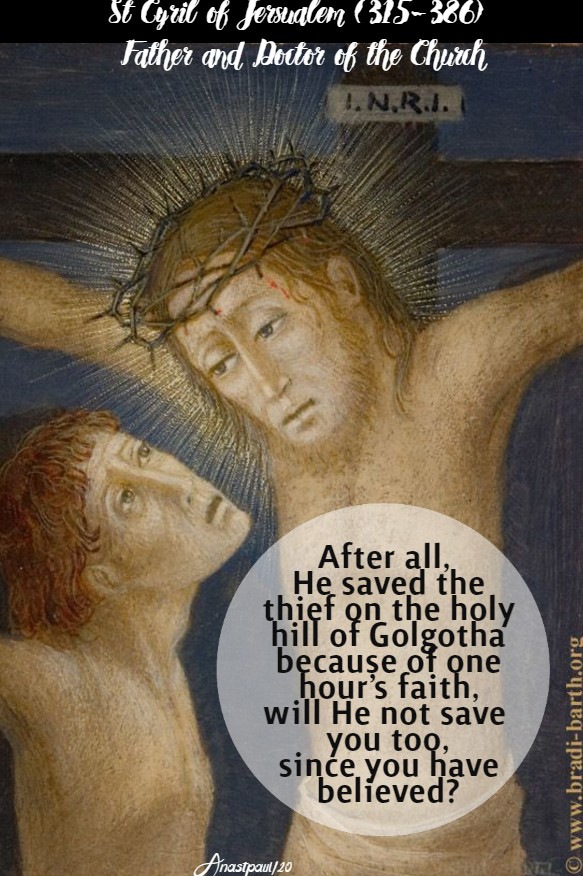
Quote/s of the Day – 18 March – The Memorial of St Cyril of Jerusalem (c 313-386) Father and Doctor of the Church
“After all, He saved the thief on the holy hill of Golgotha because of one hour’s faith, will He not save you too, since you have believed? “
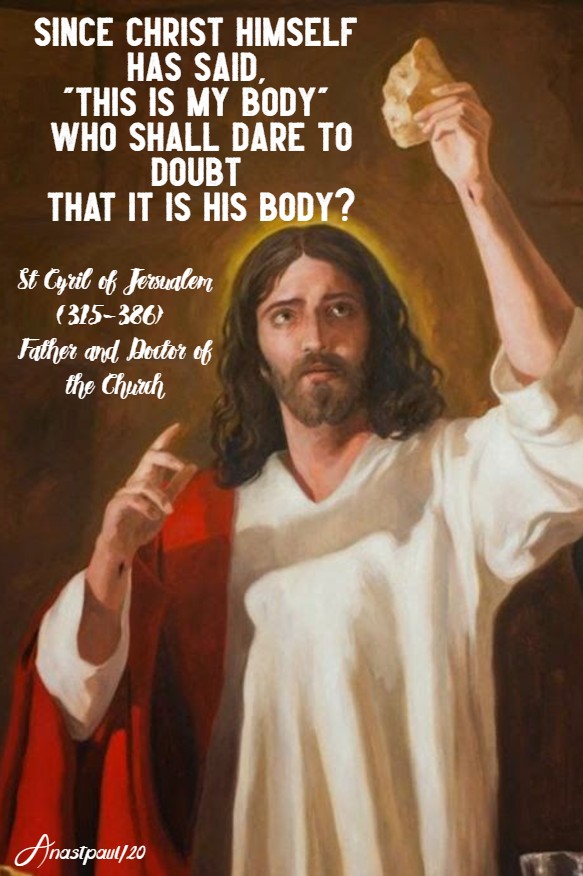
“Since Christ Himself has said, “This is My Body” who shall dare to doubt that It is His Body?”
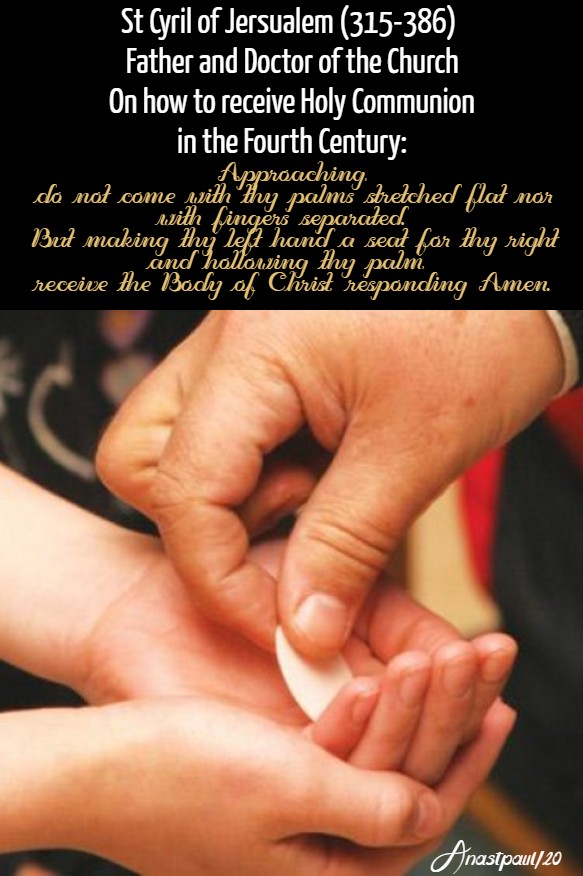
On how to receive Holy Communion in the hand in the Fourth Century:
“Approaching, do not come with thy palms stretched flat nor with fingers separated. But making thy left hand a seat for thy right and hollowing thy palm, receive the Body of Christ, responding Amen.”
St Cyril of Jersualem (315-386)
Father and Doctor of the Church
Lenten Reflection – 13 March – Friday of the Second Week of Lent, Readings: Genesis 37:3-4, 12-13, 17-28, Psalm 105:16-21, Matthew 21:33-43, 45-46
“Lord, open my lips, and my mouth shall declare your praise.”
Daily Meditation:
“God planted the vineyard of the human race when at the first he formed Adam (Gn 2:7) and chose the fathers. Then he let it out to husbandmen through the gift of the Law passed on to Moses. He hedged it round about, that is, he marked out the land they were to cultivate; he built a tower, that is, he chose Jerusalem; he dug a winepress, that is, he prepared those who were to receive the prophetic Spirit. And he sent them prophets prior to the Babylonian exile and then, after the exile, others again in even greater number to seek the fruits, saying to the : “Cleanse your ways and your doings” (Jer 7:3); “Execute just judgment and “Each one act with pity and compassion towards his brother. Do not oppress the widow, the orphan, the stranger or the poor, and let none of you treasure up evil against his brother in your hearts” (Zac 7:9-10) “Wash, make yourselves clean, put away evil from your hearts; learn to do good, seek judgment, protect the oppressed” (Is 1:16-17).
See by what preachings the prophets sought the fruits of righteousness. But last of all He sent to those unbelievers His own Son, our Lord Jesus Christ, whom those wicked husbandmen slew and cast out of the vineyard. That is why God entrusted it – no longer hedged around but thrown open throughout all the world – to other husbandmen, who would render the fruits in due season. The elect tower is raised everywhere in all its beauty, for everywhere the Church now shines and everywhere the winepress is dug because everywhere are they, who receive the Spirit of God.
That is why the Lord said to His disciples, to make us become good workmen: “Take heed to yourselves and watch at all times lest your hearts be overcharged with debauchery, drunkenness and the cares of this life” (Lk 21:34.36); “Let your loins be girded and your lamps burning, and be like those who wait for their master to come” (Lk 12:35-36).” … Saint Irenaeus (c 130-c 202) Bishop, Martyr, Theologian – Against the heresies, IV 36, 2-3
“Therefore, I say to you, the Kingdom of God will be taken away from you and be given to a people that will produce its fruit.”
— Matthew 21
Intercessions:
Let us pray to Christ our Saviour, who redeemed us by His death and resurrection::
Lord, have mercy on us.
You went up to Jerusalem to suffer and so enter into Your glory,
– bring Your Church to the Passover feast of heaven.
Lord, have mercy on us.
You were lifted high on the cross and pierced by the soldier’s lance,
– heal our wounds.
Lord, have mercy on us.
You made the cross the tree of life,
– give its fruit to those reborn in baptism.
Lord, have mercy on us.
On the cross You forgave the repentant thief,
– through which we are cleansed of our sins.
Lord Jesus Christ, Son of God, have mercy on me a sinner!
Closing Prayer:
Loving God, Caring parent,
I am a child who so often turns my back
on Your love.
Please accept my small acts of sorrow today
and help to release me from the self-absorption
that closes my heart to You.
As I journey through Lent,
let me remember the feast You have prepared for me
in the resurrection
and let me be filled with thanks to You.
May the Lord bless us,
protect us from all evil
and bring us to everlasting life.
Amen.
“Let us serve God but let us do so according to His will. He will then take the place of everything in our lives. He will be our strength and the reward of our labours.”
Quote/s of the Day – 11 March – Wednesday of the Second week of Lent
“As patience leads to peace and study to science, so are humiliations, the path that leads to humility.”
St Bernard of Clairvaux (1090-1153) Mellifluous Doctor
“If, when stung by slander or ill-nature, we wax proud and swell with anger, it is a proof that our gentleness and humility are unreal and mere artificial show.”
One Minute Reflection – 11 March – Wednesday of the Second Week of Lent, Readings: Jeremiah 18:18-20, Psalm 31:5-6, 14-16, Matthew 20:17-28
“You do not know what you are asking. Are you able to drink the cup that I am to drink?” They said to him, “We are able.” … the Son of Man came not to be served but to serve and to give his life as a ransom for many.” ... Matthew 20:22,28
REFLECTION – “It is our task and, in our case, an obligation, to make of you the object of all our care, our zeal, our ministrations, by word and deed, by warnings, encouragement, admonitions and incitement, (…) so that, in this way, we might insert you into the rhythm of the divine will and face you towards the goal set before us – to give pleasure to God. …
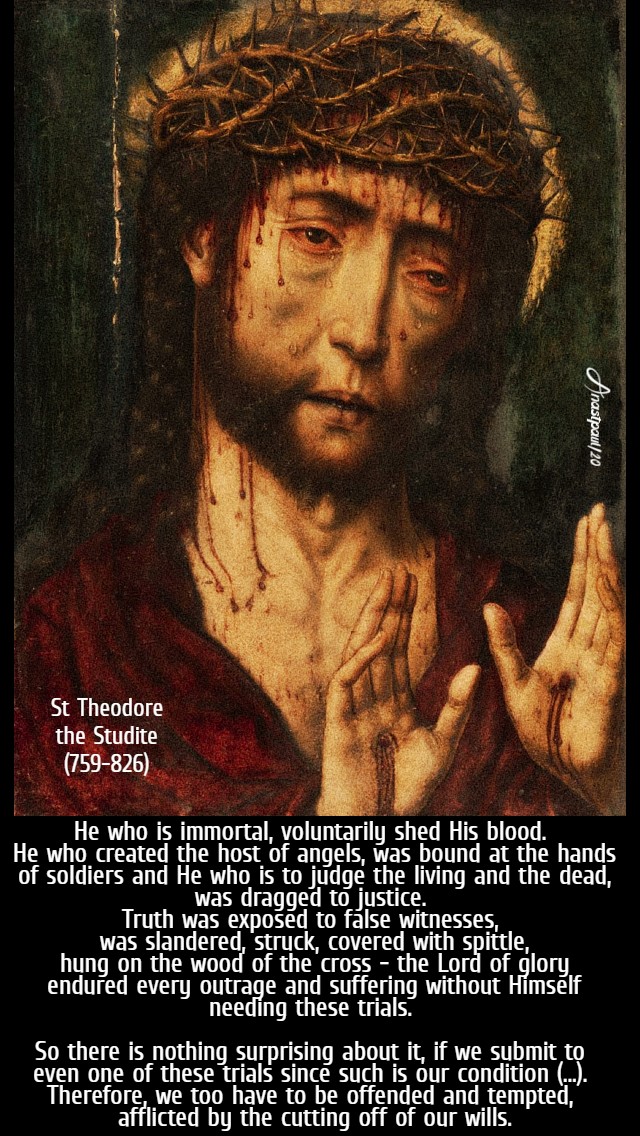
He who is immortal, voluntarily shed His blood. He who created the host of angels, was
bound at the hands of soldiers and He who is to judge the living and the dead, was dragged to justice (cf. Acts 10:42; 2 Tm 4:1). Truth was exposed to false witnesses, was slandered, struck, covered with spittle, hung on the wood of the cross – the Lord of glory (cf. 1 Cor 2:8) endured every outrage and suffering without Himself needing these trials. How could this have happened to Him who, even as man, was without sin and who, to the contrary, snatched us away from the tyranny of the sin through which death came into the world and falsely took possession of our first father?
So there is nothing surprising about it, if we submit to even one of these trials since such is our condition (…). Therefore, we too have to be offended and tempted, afflicted by the cutting off of our wills. According to the interpretation of our Fathers, there is in this, a shedding of blood for this is what it means to be a monk. And we must gain the Kingdom of heaven in that way, by spending our lives in imitation of the Lord. (…) Apply yourselves zealously to your duties in the thought that by means of them, far from being slaves of men, you are serving God.” … St Theodore the Studite (759- 826) Monk at Constantinople – Catecheses 1(load shedding about to happen – image to follow and rest of posts).
PRAYER – Protect Your family, Lord, trained as it is by the constant exercise of good works. Renew our spirit with the grace that teaches us how to imitate You, strengthen us with Your consoling presence and lead us, to the joys of heaven. May the intercession of our Mother, the Blessed Virgin Mary keep us on the path of Your kingdom’s glory. Through Christ our Lord, with the Holy Spirit, God forever, amen.
St Adela of Blois
Bl Antonio Taglia
Bl Arnold of Carcassonne
St Betto of Auxerre
Bl Berta of Busano Bl Constantius of Fabriano OP (1401-1481) Biography: https://anastpaul.com/2019/02/24/saint-of-the-day-24-february-blessed-constantius-of-fabriano-op-1401-1481/
St Cummian Albus of Iona
St Ethelbert of Kent
Evetius of Nicomedia Blessed Ascensión of the Heart of Jesus/Florentina Nicol y Goñi OP (1868-1940)
Bl Ida of Hohenfels
Bl Josefa Naval Girbes
St Liudhard
Bl Lotario Arnari
Bl Marco De’ Marconi
St Modestus of Trier
St Peter the Librarian
St Praetextatus of Rouen
St Primitiva
St Sergius of Caesarea
Bl Simon of Saint Bertin Blessed Tommaso Maria Fusco (1831-1891)
Our Morning Offering – 21 February – Friday of the Sixth Week in Ordinary Time, Year A
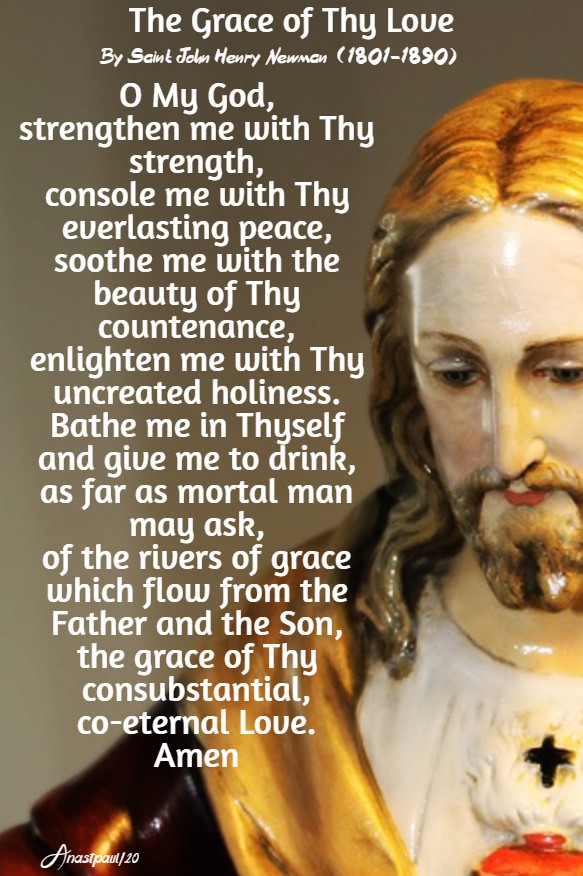
The Grace of Thy Love By St John Henry Newman (1801-1890)
O My God,
strengthen me with Thy strength,
console me with Thy everlasting peace,
soothe me with the beauty of Thy countenance,
enlighten me with Thy uncreated holiness.
Bathe me in Thyself
and give me to drink,
as far as mortal man may ask,
of the rivers of grace
which flow from the Father and the Son,
the grace of Thy consubstantial,
co-eternal Love.
Amen
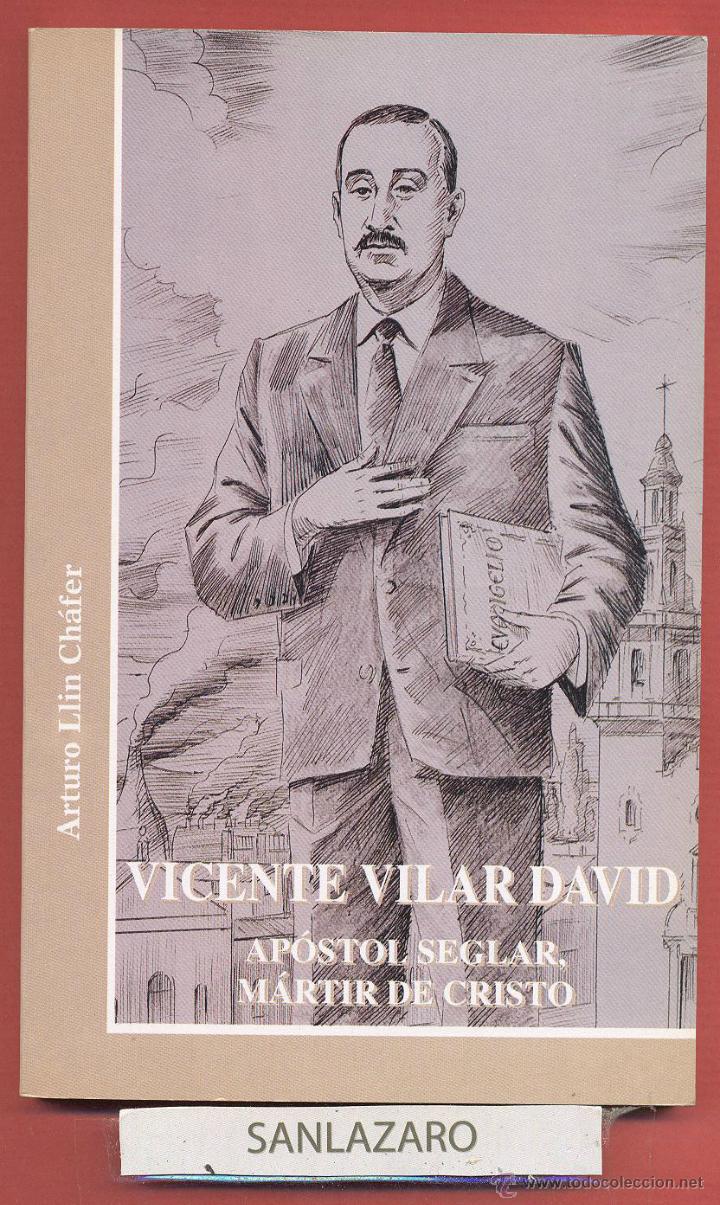
Saint of the Day – 14 February – Blessed Vicente Vilar David (1889-1937) Martyr, Layman, Social reformer, Worker for Justice and Peace, Apostle of Charity – born on 28 June 1889 in Manises, Spain and died on 14 February 1937 (aged 47) in Manises, by being shot to death. Patronages – Manises, Persecuted Christians, Engineers. As he was being taken away on the morning of 14 February 14, 1937, his wife called out to him and said, “See you tomorrow.” Vicente replied, “Until tomorrow or in heaven!”Minutes later he was shot to death.
The youngest of eight children, Blessed Vicente was born to a ceramics manufacturer and his wife on 28 June 1889, in Valencia, Spain. His parents were devoted to their Catholic faith and their children received a good Christian education. After attending a school run by the Piarist Fathers, Blessed Vicente enrolled at a technical school and earned an industrial engineer’s degree.
At the aged of 33, Blessed Vicente married a young woman named Isabel (died 1993) and the two lived a model Christian life together. Blessed Vicente became involved in his Parish, helping the Priests however he could. He spread fundamental Christian morals among his fellow colleagues and was known for his deep commitment to charitable works in the name of the poor. He served as an industrial engineer in his own ceramics farm that he had inherited and oversaw, with three of his brothers, after the premature death of their parents. David also held several important municipal positions where he put the social teachings of the faith into full practice and was renowned for his deep commitment to fundamental values and traditional principles. Youth organisations were also a forum for his work, as well as a range of parish activities.
He also took over the management of his father’s ceramics factory. His workers saw him, not only as their boss but also as a caring father. He was concerned that they would be treated with the justice and dignity to which all workers have a right.
In the summer of 1936, the Spanish Civil War was at its peak in Valencia. ,,The persecution of Catholics and of the Church by the governing regime was also very intense. Blessed Vicente, who had been teaching at a ceramics trade school, was fired because of his Catholic beliefs. He bravely continued to encourage other Catholics and to give the Priests whatever support and help he could by protecting their whereabouts and hiding them in his home.
On 14 February 1937, he was called to appear before a tribunal and commanded to stop his activities on behalf of the Catholic Church. Blessed Vicente replied that being a Catholic was his greatest calling and he would not give up, even if it meant death. He was immediately sentenced to be executed. He was permitted to see his wife and encouraged her with words of faith and conviction. He publicly forgave his persecutors and enemies. Then he was shot to death on the very same day he was arrested.
The ceramics factory workers were outraged. In protest at Blessed Vicente’s execution, they went on strike for three days. They told the socialist officials who tried to prevent their strike, “You have robbed us of our employer and our father. Because he was prudent, kind and concerned for our working conditions, we not only respected him, we loved him.”
Blessed Vicente was Beatified on 1 October 1995 by St Pope John Paul II. His death by violent hands was recognised as a true Martyrdom for the faith.
Our faith applies to every aspect of our lives. In our family and social life, our time at school, our time spent working, we are called to put into practice the values that Jesus taught in the Gospel.
Thought for the Day – 30 January – Meditations with Antonio Cardinal Bacci (1881-1971)
How to Guard Holy Purity
“Purity of heart is a quality which attracts everybody, even those who are evil themselves. It makes a man seem like an angel in human form, for it shines from his countenance.
Unfortunately, the virtue of purity, is as difficult as it is beautiful.
It is fatal for anyone to cast himself into the mire.
The first sin of impurity is a disaster, because it is often the first link in a tragic chain, which makes him the salve of his lower impulses and of the tyrannical enemy of souls, the devil.
We must resist the earliest suggestions of the flesh, by every means in our power, both natural and supernatural.
St Thomas Aquinas tells us that none of the passions dethrones reason so much as sensuality (Summa Theologiae, II-II, q.53, a.6).
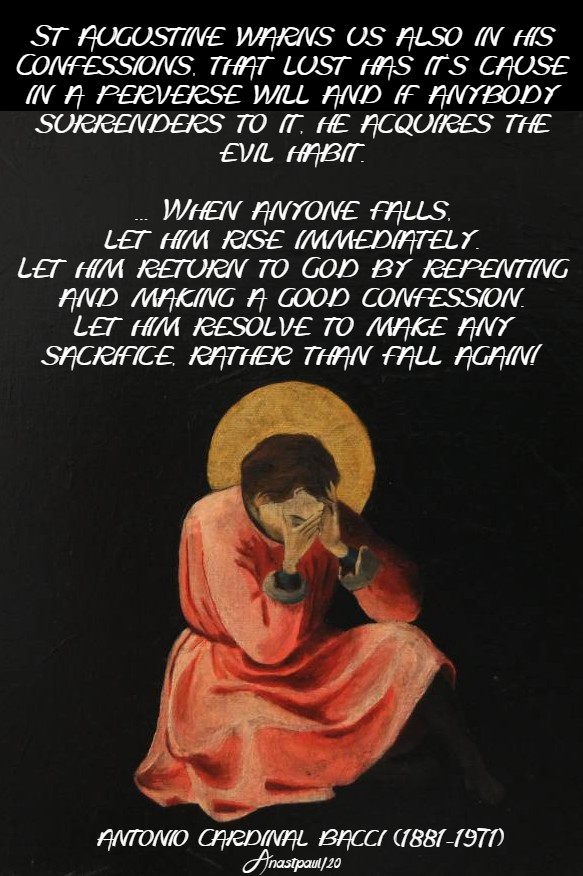
St Augustine warns us also in his Confessions, that lust has it’s cause in a perverse will and if anybody surrenders to it, he acquires the evil habit.
If this habit is not resisted, the sin becomes a frightening necessity.
Resist from the beginning, if you wish to avoid ruin and the slavery of the devil, who cunningly uses this passion, to capture souls.
If a man is overcome by violent temptation and falls into sin, however, he should not lose courage.
God is infinitely good and merciful.
He knows our weakness.
When anyone falls, let him rise immediately.
Let him return to God by repenting and making a good confession.
Let him resolve to make any sacrifice, rather than fall again!”
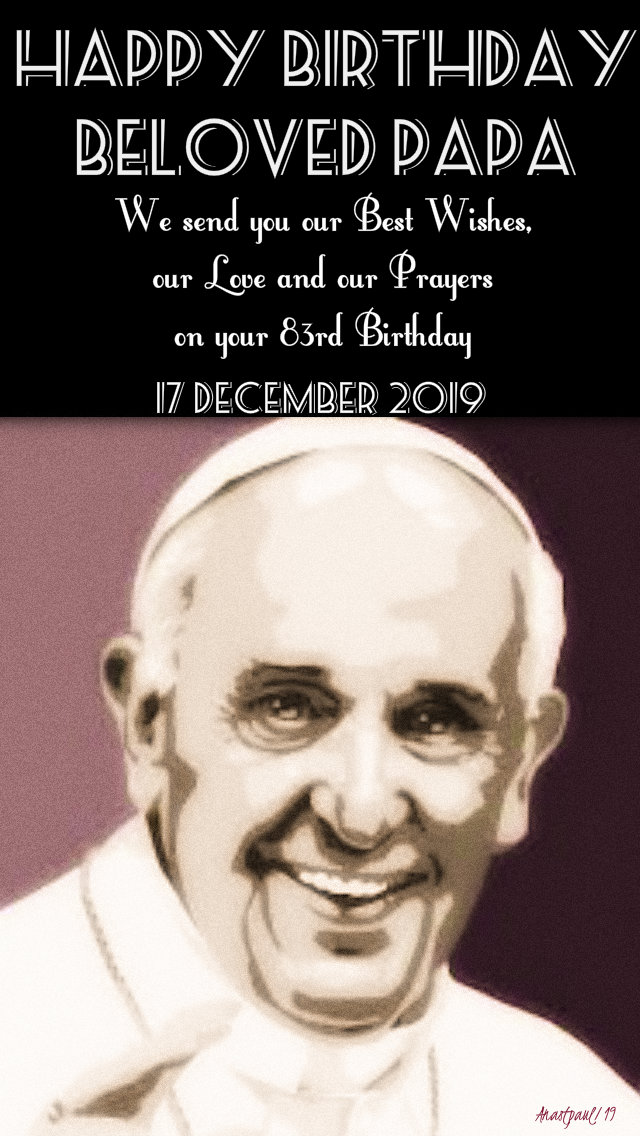
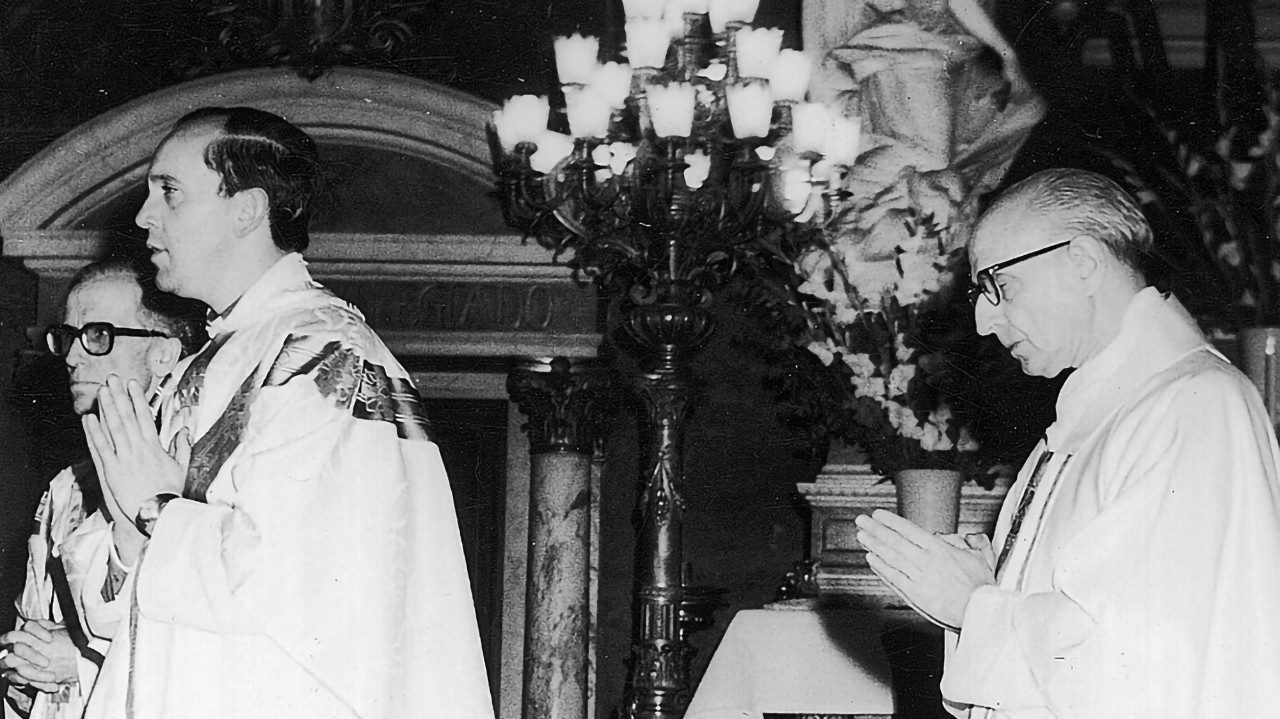
Today, 13 December 2019, may we all wish Pope Francis Congratulations on the 50th Anniversary of his Ordination on 13 December 1969
On 13 December 1969, four days before his 33rd birthday, Jorge Mario Bergoglio was ordained a priest.
The now Pope Francis, received this Sacrament with the imposition of hands of the Archbishop of Cordoba, Monsignor Ramon Jose Castellano.
Young Jorge discovered his vocation on 21 September 1953, the Memorial of Saint Matthew, the tax collector who converted when Jesus invited him to follow Him. During a Confession, he had a profound experience of God’s mercy, a joy that led him to decide to be a priest, reported “Vatican News.”
Our Congratulations, Best wishes and Prayers are yours, dear Holy Father Francis on the wonderful occasion of the 50th Anniversary of your Ordination
























You must be logged in to post a comment.