Vigil of the Immaculate Conception of the Blessed Virgin Mary – 7 December: On this vigil day, Catholics stand in the remains of the night as the dawn makes its appearance. This resplendent dawn is that Singular Conception, the Immaculate Conception, who ushers in the Light of Christ. A day of Fast and Abstinence following the Rubrics of Pope Pius X for the Universal Calendar of the Church.
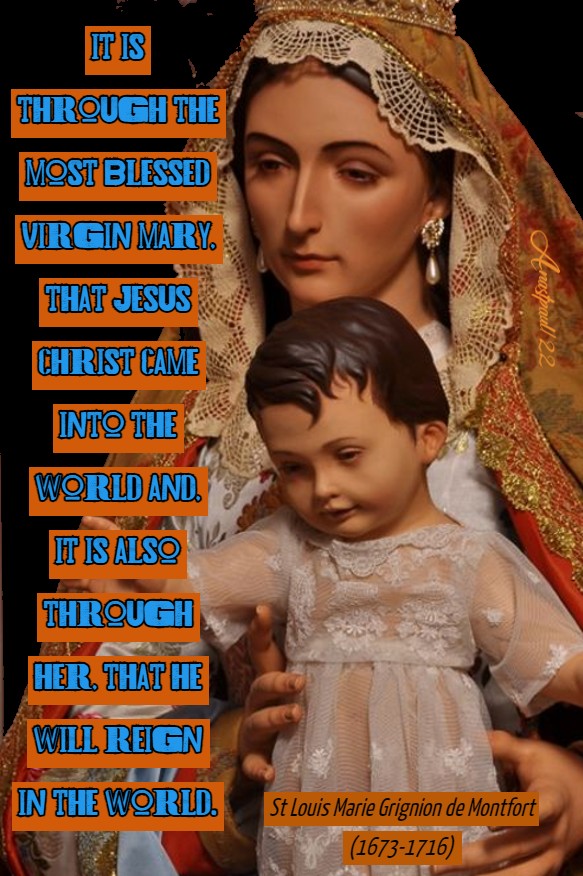
“It is through the most Blessed Virgin Mary, that Jesus Christ came into the world and, it is also through her, that He will reign in the world.” – St Louis Marie Grignion de Montfort (1673-1716)
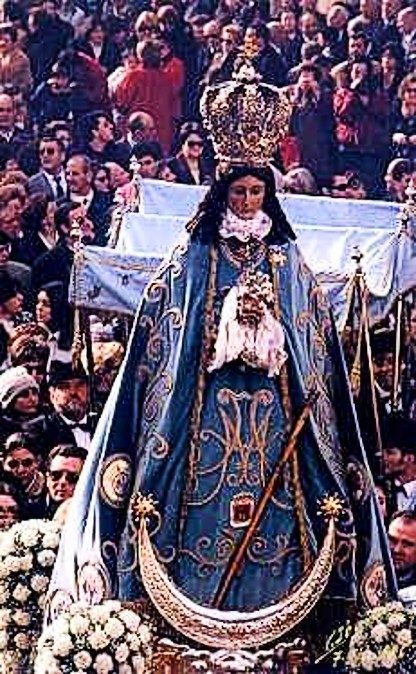
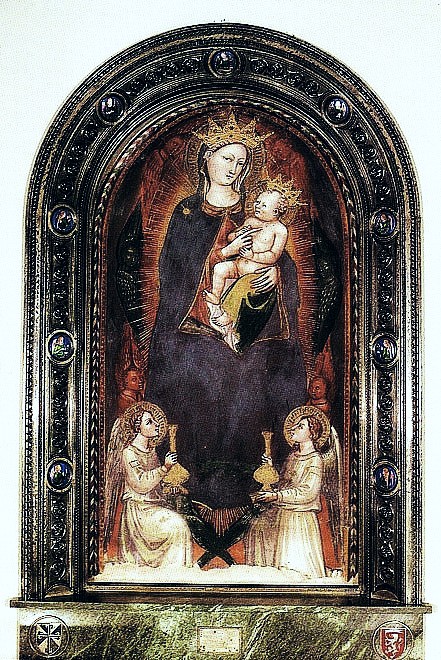
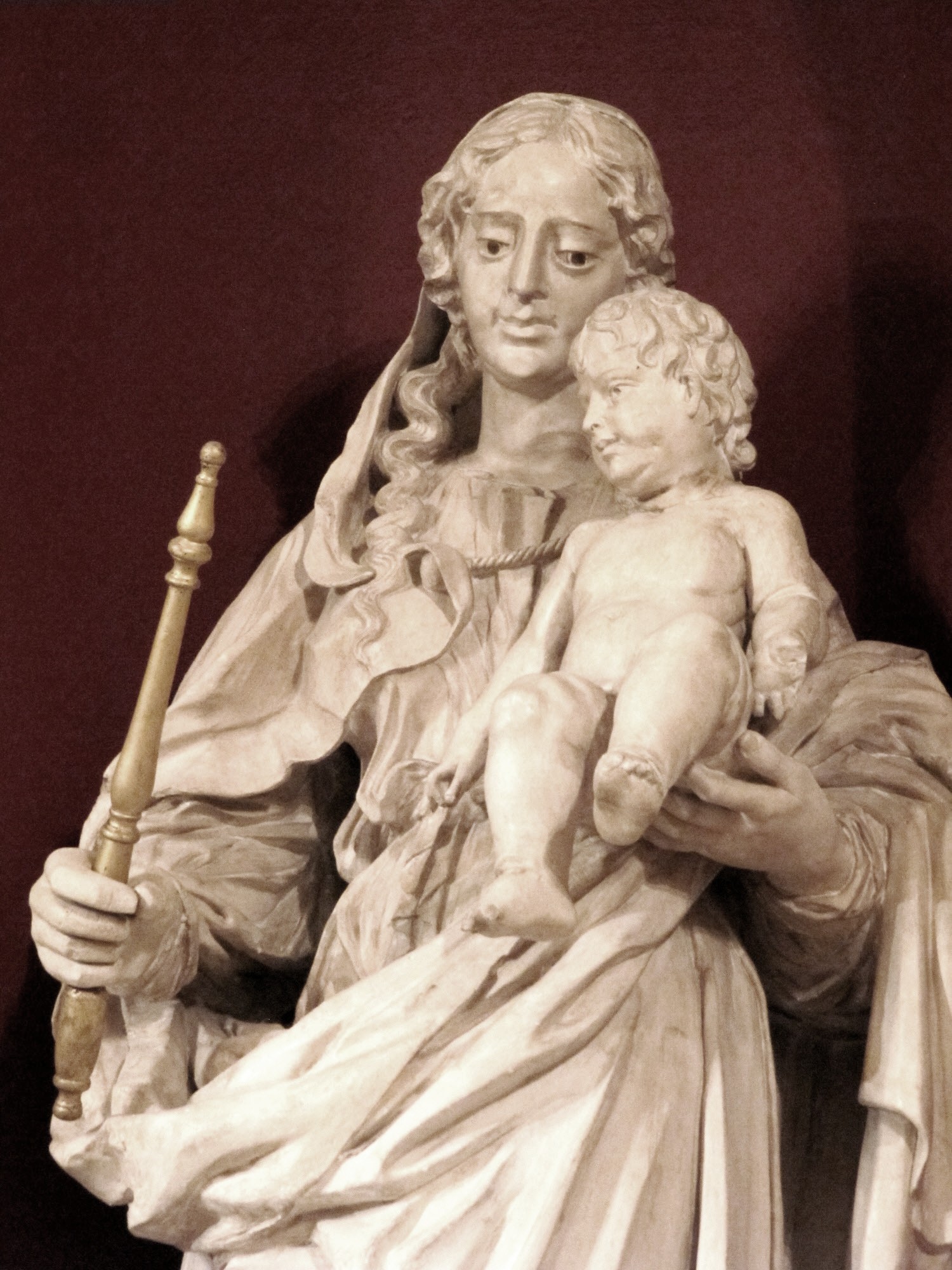
Virgen del Castillo, Inmaculada Concepción / Virgin of the Castle, Yecla, Spain (1642) – 7 and 8 December:
St Agatho of Alexandria St Anianas of Chartres St Athenodoros of Mesopotamia St Buithe of Monasterboice St Burgundofara / Fara (c 595-c 643) Nun, Abbess, Founder
St Boniface the Martyr St Dativa the Martyr St Dionysia the Martyr St Gerard of La Charité (Died c 1109) Abbot, Founder of Monasteries St Gertrude the Elder St Isserninus of Ireland St Leontia the Martyr St Majoricus the Martyr
Blessed Bartholomew Fanti of Mantua O.Carm. (c 1428-1495) Carmelite Priest, renowned Preacher. Humble and gentle, Bartholomew gave an example to everyone of a life of prayer, of loving kindness and generosity to all and of faithful service to the Lord. He was remembered and revered, even during his life, for his great love ot the Blessed Sacrament, which was the source and the summit of his apostolic life, together with his love and devotion to the Virgin Mother. His Beatification received the Papal approval of Pope Pius X on 18 March 1909. Biography: https://anastpaul.com/2021/12/05/saint-of-the-day-5-december-blessed-bartholomew-fanti-o-carm-c-1443-1495/
St Basilissa of Øhren St Bassus of Lucera St Bassus of Nice St Cawrdaf of Fferreg St Christina of Markyate St Consolata of Genoa St Crispina St Cyrinus of Salerno St Dalmatius of Pavia St Firminus of Verdun St Gerald of Braga (Died 1109) Bishop St Gerbold St Gratus St Joaquín Jovaní Marín Bl Giovanni/John Gradenigo St Justinian St Martiniano of Pecco Bl Narcyz Putz St Nicetius of Trier St Pelinus of Confinium St Vicente Jovaní Ávila
Martyrs of Thagura – (12 Saints): A group of twelve African Christians who were Martyred together in the persecutions of Diocletian. The only details about them that have survived are five of their names – Crispin, Felix, Gratus, Juliua and Potamia. They died in 302 in Thagura, Numidia
Two of the most famous conversions due to the Miraculous medal was that of Fr Alphonse Ratisbonne NDS (1814-1884), an anti-Catholic Jewish banker and Claude Newman (1923-1944). Fr Alphonse Ratisbonne received a vision of Our Lady of the Miraculous Medal. After his conversion, he became a Priest and worked for the conversion of the Jewish people.
St Acacius of Sebaste St Acharius of Noyon St Apollinaris of Monte Cassino St Barlaam
Blessed Bernardine of Fossa OFM (1420-1503) Priest, Friar of the Friars Minor, Missionary in Italy and a renowned Preacher, noted Historian, Lawyer, Ascetical Writer, rising within the Order to important positions. His cult was later confirmed by the Beatification of Pope Leo XII on 26 March 1828. The Roman Martyrology states: “At L’Aquila, blessed Bernardino da Fossa (Giovanni) Amici, Priest of the Order of Minors, who preached the Catholic Faith in many Provinces of Italy.“ Biography: https://anastpaul.com/2021/11/27/saint-of-the-day-27-november-blessed-bernardine-of-fossa-ofm-1420-1503/
St Bilhild of Altmünster St Eusician St Facundus St Fergus the Pict St Gallgo of Wales St Gregory of Sinai St Gulstan St Hirenarchus of Sebaste St James Intercisus St John Angeloptes St John of Pavia St Laverius
St Maximus of Reiz St Primitivus of Sahagun St Secundinus of Ireland (c 373-448) Bishop, Missionary St Severinus the Hermit St Siffred of Carpentras St Valerian of Aquileia
Martyrs of Antioch – 3 Saints: A group of Christians Martyred together for their faith. Little information has survived except for their names – Auxilius, Basileus and Saturninus.
Martyrs of Nagasaki – 11 Beati: A group of eleven Christians Martyred together for their faith during a period of official persecution in Japan. They are:
Blessed Alexius Nakamura
Blessed Antonius Kimura
Blessed Bartholomaeus Seki
Blessed Ioannes Iwanaga
Blessed Ioannes Motoyama
Blessed Leo Nakanishi
Blessed Matthias Kozasa
Blessed Matthias Nakano
Blessed Michaël Takeshita
Blessed Romanus Motoyama Myotaro
Blessed Thomas Koteda Kyumi They were Martyred on 27 November 1619 in Nagasaki, Japan and Beatified on 7 May 1867 by Pope Pius IX.
St Leonard of Port Maurice OFM (1676-1751) Confessor, Priest and Friar of the Friars Minor, reacher – in particular Parish Mission Preacher, Ascetic Writer, Spiritual Director. St Leonard founded many pious societies and confraternities and exerted himself to spread devotion to the Sacred Heart of Jesus, the Perpetual Adoration of the Most Blessed Sacrament, the Blessed Virgin Mary and the Passion of Christ. He was among the few to insist that the concept of the Immaculate Conception of Mary be defined as a Dogma of the Faith. He was Beatified on 19 June 1796 by Pope Pius VI and Canonised on 29 June 1867 by Pope Pius IX. About St Leonard: https://anastpaul.com/2018/11/27/saint-of-the-day-27-november-st-leonard-of-port-maurice-ofm-1676-1751/
Bl Albert of Haigerloch St Alypius Stylites St Amator of Autun St Basolus of Verzy St Bellinus of Padua (Died 1151) Bishop and Martyr St Bertger of Herzfeld St Conrad of Constance Bl Delphine of Glandèves St Egelwine of Athelney St Ida of Cologne St James the Hermit St Magnance of Ste-Magnance St Marcellus of Nicomedia St Martin of Arades St Nicon of Sparta Bl Pontius of Faucigny St Sabaudus of Trier St Siricius, Pope St Stylianus St Vacz
Martyrs of Alexandria – 650+- Saints: A group of approximately 650 Christian Priests, Bishops and Laity Martyred together in the persecution of Maximian Galerius. We have the names and a few details only seven of them – Ammonius, Didius, Faustus, Hesychius, Pachomius, Phileas and Theodore. The were born in Egypt and were martyred there in c 311 in Alexandria, Egypt.
Martyrs of Capua – 7 Saints: A group of seven Christians Martyred together. The only details about them to survive are the names – Ammonius, Cassianus, Felicissimus, Nicander, Romana, Saturnin and Serenus. They were martyred in Capua, Campania, Italy, date unknown.
Martyrs of Nicomedia – 6 Saints: A group of six Christians Martyred by Arians. Few details have survived except their names – Marcellus, Melisus, Numerius, Peter, Serenusa and Victorinus. Martyred in 349 in Nicomedia, Bithynia, Asia Minor (modern Izmit, Turkey).
Bl Adalbert of Caramaico St Alanus of Lavaur St Audentius of Milan
Blessed Beatrice d’Ornacieux O.Cart (c 1260–1303) Virgin, Carthusian Nun, Mystic, Founded a Monastery at Eymeu on France. The Roman Martyrology states: “In the territory of Valence in France, Blessed Beatrice d’Ornacieux, Virgin of the Carthusian Order, who, famous for her love for the Cross, lived and died in extreme poverty in the Monastery of Eymeu which she founded.” Biography: https://anastpaul.com/2021/11/25/saint-of-the-day-25-november-blessed-beatrice-dornacieux-o-cart-c-1260-1303/
St Bernold of Ottobeuren Bl Conrad of Heisterbach Bl Ekbert of Muensterschwarzach
St Erasmus of Antioch Bl Garcia of Arlanza Bl Guido of Casauria St Imma of Wurzburg Bl Jacinto Serrano López St Jucunda of Reggio Aemilia Bl Maria Corsini Beltrame Quattrocchi St Mercurius of Caesarea St Moses of Rome
Martyrs of Africa – (13 Saints): A group of 13 Christians murdered together for their faith in Africa, date unknown. The only details to have survived are their names – Claudian, Cyprian, Donatus, Felix, Januarius, Julian, Lucian, Marcian, Martialis, Peter, Quirianus, Victor and Vitalis.
St Agabbas of Syria St Amphilochius of Iconium St Ananias of Arbela St Apphia St Eugenia of Matera St Christian of Auxerre St Dayniolen the Younger St Joan of Montefalco St Mark of Antioch St Maurus of North Africa St Philemon St Pragmatius of Autun (Died c 520) Bishop St Sabinian the Abbot St Stephen of Antioch
We have been subjected to Blackouts for months (actually years) now usually staggered in 2 1/2 cuts and according to a schedule for each town, thus allowing for a stressful re-organisation of each day.
BUT sometimes … things go horribly wrong, whether intentionally or accidentally. Like yesterday, when they switched off at the expected time but failed to switch on again. One sits and waits and waits and waits and then goes to bed hungry.
I pray all will go well today and there will be posts tomorrow. I only managed to schedule the List of Feasts and Saints and dear Cardinal Bacci, ahead of the powercut yesterday.
I know this is not confined to South Africa alone, I have heard of a 7 day powerless period recently in Nigeria and know too of similar cuts in the USA, Middle East, England, France and various European countries (yep). So for whoever suffers in the same way – or worse – “hou vas!” 🙏 Ana 💖
St Vitalis (Died c 304) Martyr and St Agricola (Died c 304) Martyr St Amandus of Avignon St Amandus of Rodez St Birstan St Clarus the Hermit St Clether
Bl Frances d’Amboise St Gerard de Bazonches St Gregory of Burtscheid Bl Helen Enselmini Bl Henry of Zweifalten St Hermas of Myra St Joannicus of Mount Olympus St John Zedazneli St Modesta of Trier St Nicander of Lycia St Patrobas St Perpète St Philologus St Pierius St Proculus of Autun
All Souls Day – The Commemoration of All the Faithful Departed: Commemoration of the faithful departed in Purgatory. Abbot Odilo of Cluny instituted it in the Monasteries of his congregation in 998, other religious orders took up the observance and it was adopted by various Diocese and gradually by the whole Church. The Office of the Dead must be recited by the clergy on this day and Pope Benedict XV granted to all Priests, the privilege of saying three Masses of requiem – • one for the souls in Purgatory • one for the intention of the Holy Father • one for the Priest’s intentions If the feast should fall on Sunday it is kept on 3 November. Patronage: Monselice, Italy HERE: https://anastpaul.com/2018/11/02/commemoration-of-all-souls-day-2-november/ AND: https://anastpaul.wordpress.com/2017/11/02/the-commemoration-of-all-the-holy-souls-in-purgatory-2-november/
St Ambrose of Agaune St Ambrose of Agaune St Amicus of Fonte Avellana St Amicus of Rambone St Baya of Scotland St Domninus of Grenoble St Erc of Slane St Eustochium of Tarsus St George of Vienne Bl John Bodey St Jorandus of Kergrist St Justus of Trieste St Marcian of Chalcis Blessed Margaret of Lorraine OSC (1463-1521)Duchess of Alençon, Mother, Widow, Nun of the Poor Clares St Mateo López y López St Maura of Scotland St Theodotus of Laodicea
Martyrs of Isfahan – 5+ Saints: Acindynus, Pegasius and Anempodistus were Persian priests who were imprisoned, tortured, interrogated and Martyred in the persecutions of king Sapor II of Persia; he considered any Christian to be a Roman spy and anti-Persian.
Martyrs of Sebaste – 10 Saints: A group of ten soldiers in the imperial Roman army of Emperor Licinius Licinianus who were executed together for refusing to burn incense as a sacrifice to the emperor. The only details that have survived are five of their names – Agapius, Cartherius, Eudoxius, Styriacus and Tobias. They were burned at the stake in 315 in Sebaste (in modern Turkey).
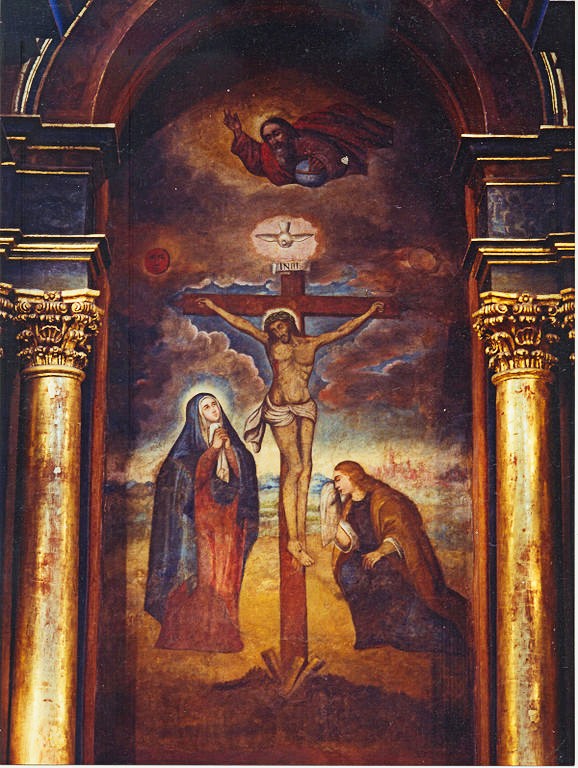
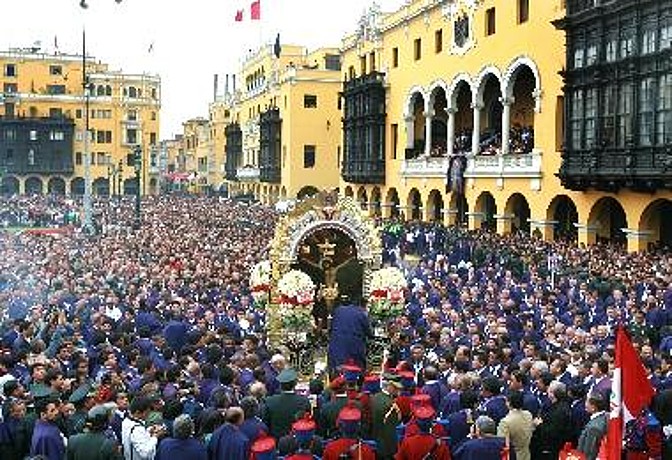
Lord of Miracles/Señor de los Milagros de Nazarenas – A mid-17th-century painting of the Crucifixion that is venerated in Lima, Peru and its celebration involves one of the largest processions in the world. It was painted by an unnamed African taken to Peru as a slave from what is now Angola. Above the Cross is the Holy Spirit and God the Father. Below and to the right of Jesus, is His mother, the Virgin Mary with her heart pierced by a sword of sorrow. Kneeling and weeping at the foot of the cross is St Mary Magdalene. The name originated on 13 November 1655 when everything around it was destroyed in an earthquake that left the painting standing and undamaged. Christ is shown enduring the pain of Crucifixion. Every year in October, hundreds of thousands of devotees from all races and economic backgrounds participate in a procession honouring the image through the streets of Lima. Boulevards are decorated in purple on 18,19 and the final Feast 28 October to celebrate the Lord of Miracles.
St Abdias of Babylon St Abraham of Ephesus St Alberic of Stavelot St Anastasia the Elder St Anglinus of Stavelot St Cyril of Rome St Cyrilla of Rome St Diomedes the Younger St Dorbhene of Iona
St Ferrutius St Genesius of Thiers Bl Germain of Talloires St Godwin of Stavelot St Maria Ascuncion St Remigius of Lyons St Rodrigo Aguilar Aleman St Salvius of Amiens
Martyrs of Avila – 3 Saints: Two sisters and a brother who, during a period of persecution, fled Talavera de la Reina, Spain, were caught and executed. Martyrs: Christeta, Sabina and Vincent. 303 in Avila, Spain.
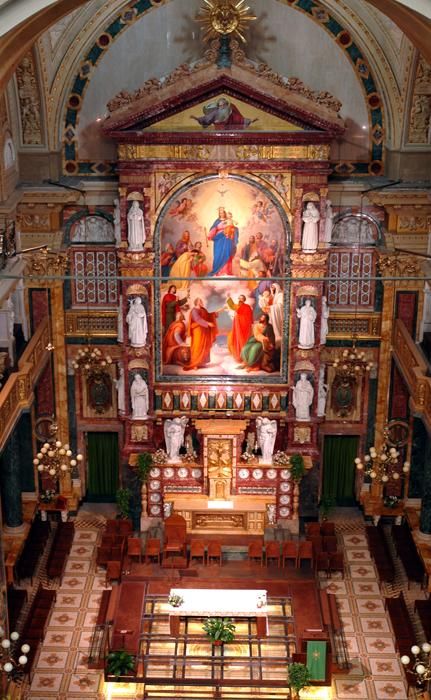
Dedication of the Basilica of Auxilium Christianorum / Our Lady Help of Christians, Turin, Italy, built by St John Bosco (1868) – 27 October: HERE: https://anastpaul.com/2021/10/27/88503/
St Gaudiosus of Naples Bl Goswin of Clairvaux St Namatius of Clermont St Odrian (c Died 563) Bishop, Abbot, Missionary Bl Salvador Mollar Ventura St Thraseas of Eumenia St Uni
Feast of the Most Holy Redeemer – The Feast of the Most Holy Redeemer is a Catholic liturgical feast. It is celebrated in Venice as the Festa del Redentore. It is also celebrated by the Redemptorists and was celebrated in the City of Rome. The feast is found only in the special calendar of some Diocese and religious Orders and is celebrated with proper Mass and Office either on the third Sunday of July or on 23 October. https://anastpaul.com/2019/10/23/the-feast-of-the-most-holy-redeemer-23-october/
St Anthony Mary Claret CMF (1807-1870) Known as “The Spiritual Father of Cuba.” In the first years, records show, that he Confirmed 100,000 people and performed 9,000 Sacramental Marriages.Archbishop of Cuba, one of the Fathers of the First Vatican Council,Confessor to the Queen of Spain, Missionary, Founder of the Congregation of Missionary Sons of the Immaculate Heart of Mary, commonly called the Claretians, Confessor, Mystic, Social Reformer, Spiritual Director, Writer, Publisher, Preacher, Apostle of Charity. He was declared venerable by Pope Leo XIII in 1899. He was Beatified in 1934 and in 1950, Canonised by Pope Pius XII. His heart is incorrupt. The 1969 revision of the calendar moved St Anthony Feast to the day of his death, 24 October (from the 23rd) which had been the Feast of Saint Raphael the Archangel since 1921. About St Anthony Mary here: https://anastpaul.wordpress.com/2017/10/24/saint-of-the-day-24-october-st-anthony-mary-claret-1807-1870-cmf/
Bl Anne-Joseph Leroux St Amo of Toul St Arethas of Negran St Benedict of Sebaste St Clether St Domitius St Elfleda St Ethelfleda Saints Germanus and Servandus of Cadiz St Gratien of Amiens St Henry of Cologne St Ignatius of Constantinople
Bl John Buoni St John of Syracuse St Oda of Aquitaine St Romanus of Rouen Blessed Severinus Boethius (c 475-524) Martyr St Severinus of Cologne St Syra of Faremoutiers St Theodoret of Antioch Bl Thomas Thwing St Verus of Salerno
Martyrs of Nicaea – 3 Saints Euerotas Socrates Theodota
Martyrs of Valenciennes – 6 Beati: A group of Urusuline and Briggittine nuns murdered together in the anti-Christian excesses of the French Revolution. They were guillotined on 23 October 1794 in Valenciennes, Nord, France and Beatified on 13 June 1920 by Pope Benedict XV. • Anne-Joseph Leroux • Clotilde-Joseph Paillot • Jeanne-Louise Barré • Marie-Augustine Erraux • Marie-Liévine Lacroix • Marie-Marguerite-Joseph Leroux
St Abericus Marcellus St Alodia of Huesca St Apollo of Bawit St Benedict of Macerac St Bertharius of Monte Cassino St Cordula
St Donatus of Fiesole (Died 874) Bishop of Fiesole, Confessor, Irish Nobleman, Monk, Priest, Poet, Writer, Scholar, Professor, Adviser to Emperors Louis the Pious and Lothair I, Founder of San Martino a Mensola Abbey and leader of two military expeditions against the Saracens. His Life: https://anastpaul.com/2020/10/22/saint-of-the-day-22-october-st-donatus-of-fiesole-died-874/
Bl Esclaramunda of Majorca St Hermes of Adrianople St Ingbert St Leothade of Auch
St Maroveus of Precipiano St Melanius (Died 314) Bishop, Confessor St Moderan of Rennes St Nepotian of Clermont St Nunctus of Mérida St Nunilo of Huesca St Philip of Adrianople St Philip of Fermo St Rufus of Egypt St Symmachus of Capua St Valerius of Langres St Verecundus of Verona
Martyrs of Heraclea – 4 Saints: A group of four clerics in Heraclea (modern Marmara Ereglisi, Turkey) who were arrested in the persecutions of Diocletian. They were imprisoned, abused and ordered to turn over all the scriptures that they had hidden from authorities; they refused and were executed together. Martyrs. – Eusebius, Hermes, Philip and Severus. They were burned at the stake in 304 in Adrianople (modern Edirne, Turkey).
Martyrs of Adianople: • Blessed Alexander • Blessed Anna • Blessed Elisabeth • Blessed Glyceria • Blessed Heraclius • Blessed Theodota
St Benedict of Cupra St Berthoald of Cambrai St Carpus of Troas St Chelidonia St Comgan the Monk St Florence of Thessalonica St Fyncana St Fyndoca Bl Gebrand of Klaarkamp
St Maurice of Carnoet St Regimbald of Speyer St Romulus of Genoa St Simbert of Augsburg (Died c 809) Bishop, Monk, Abbot St Theophilus of Antioch St Venantius
Three Crowns of Cordoba – (3 Saints): Three Christian men Martyred in the persecutions of Diocletian – Faustus, Januarius and Martial. They were burned to death in 304 in Cordoba, Spain.
St Evagrius the Martyr St Felix St Herlindis St Juan Osiense St Maximilian of Celeia St Meinards St Monas of Milan (Died 249) Saint Opilio of Piacenza Deacon (Died first half of the 5th Century) St Pantalus of Basle St Priscian the Martyr St Relindis
St Serafino of Montegranaro OFM Cap (1540-1604) Confessor, Franciscan Capuchin Lay Friar, gifted with the Charism of prophecy, Mystic, Apostle of the poor, Spiritual Advisor, devoted to the Blessed Sacrament, the Holy Rosary and to the Blessed Virgin Mary, Miracle-worker. The Roman Martyrology states: “At Ascoli, St Seraphinus, Confessor, of the Order of Minorite Capuchins, distinguished by holiness of life and humility. Hre was enrolled among the Saints by the Sovereign Pontiff Clement XIII.” Holy St Serafino: https://anastpaul.com/2021/10/12/saint-of-the-day-12-october-st-serafino-of-montegranaro-ofm-cap-1540-1604/
Martyrs of Arian North Africa: Commemoration of the 4,996 Martyrs who died in the persecutions of the Vandals in Africa mandated by the Arian King Huneric. The persecuted Christians include Bishops, Priests, Deacons and thousands of the lay faithful. They died in 483 at various locations in North Africa. (Would we follow Christ and stand true to the Faith today?)
Feast of the Divine Maternity – Second Sunday in October or 11 October:
The object of this feast is to commemorate the dignity of the Mary as Mother of God. Mary is truly the Mother of Christ, who in One Person unites the Human and Divine Nature. This title was solemnly ratified by the Council of Ephesus on 22 June, 431. It was long celebrated in Portugal, where the Maternity of Our Lady was declared a feast on 22 January in 1751, at the request of King Joseph Manuel. The feast, granted to the Dioceses of Portugal, Brazil, and Algeria, was assigned to the first Sunday in May. In the following year it was extended to the Province of Venice; in 1778, to the Kingdom of Naples; in 1807, to Tuscany. It was finally instituted in 1931 by Pope Pius XI in view of the fifteenth Centenary of the Council of Ephesus. At the same time the Pope ordered, at his own cost, the restoration of the Marian mosaics in Saint Mary Major, much decayed through age. He issued an encyclical letter, “Lux veritatis.”In this, among the objects of the new festival, is named one truth that was particularly close to the heart of Pius XI, “…that Mary, who is loved and revered so warmly by the separated Christians of the East, would not suffer them to wander and be unhappily led further away from the unity of the Church and, therefore, from her Son, whose Vicar on earth we are.” At present the feast is not found in the Universal Calendar of the Church but nearly all Diocesan calendars have adopted it.
St Agilbert of Paris
St Alexander Sauli CRSP (1534-1592) Bishop “The Apostle of Corsica,” Clerk Regular of the Congregation of Saint Paul (The Barnabites) – St Alexander is referred to as “The Second Founder,” Missionary, Writer, Teacher of philosophy and theology at the University of Pavia, Reformer, Evangeliser, Confessor, Superior-General of the Barnabites in 1565. In addition, St Alexander Sauli was both friend, advisor and spiritual comfort to St Charles Borromeo, who held him in very high esteem. His Life: https://anastpaul.com/2020/10/11/saint-of-the-day-11-october-saint-alexander-sauli-crsp-1534-1592/
St Anastasius V St Anastasius the Apocrisarius St Andronicus of Ephesus St Andronicus the Soldier St Ansilio St Bruno the Great St Canice St Digna of Sicily St Dionisio de Santarem St Emilian of Rennes St Ethelburgh of Barking St Eufridus St Firminus of Uzes St Germanus of Besancon St Gratus of Oloron St Guiadenzio of Gniezno
Blessed James Grissinger OP (c 1407-1491) Lay brother of the Order of Preachers, Artist of Religous imagery. St Juliana of Pavilly St Nectarius of Constantinople St Philip the Deacon St Philonilla St Placid St Placidia St Probus of Side St Santino of Verdun St Sarmata St Taracus of Cladiopolis St Zenaides
Martyrs of Vilcassin – 4 Saints: Four Christians who were Martyred together. We know little more than the names – Nicasius, Pienza, Quirinus and Scubicolus. Their martyrdom occurred in Vexin Lugdunense territory of Gaul (modern Vilcassin, France), date unknown.
Martyrs of Sicily: A group of eight Christians who were Martyred together. We know little more than the names – • Ampodus, • Anastasius, • Faustus, • Januarius, • Jovinian, • Marcellus, • Martialis and • Placidus. They died in Sicily, Italy,
Martyrs of Vilcassin: Four Christians who were Martyred together. We know little more than the names – Nicasius, Pienza, Quirinus and Scubicolus. They died in the Vexin Lugdunense territory of Gaul (modern Vilcassin, France).
St Adalgis of Novara (Died c 850) Bishop St Apuleius of Capua
St Augustus of Bourges (Died c 560) Priest and Abbot. The Roman Martyrolog states of him today: “Near Bourges in Aquitaine, France, Saint Augustus, Priest and Abbot, who had his hands and feet so contracted that he could not support himself except with his knees and elbows. He was healed through the intercession of St Martin of Tours. He gathered around himself some Monks and waited intently on prayer.” His Life: https://anastpaul.com/2021/10/07/saint-of-the-day-7-october-saint-augustus-of-bourges-died-c-560/
St Canog ap Brychan St Dubtach of Armagh St Gerold of Cologne St Helanus
St Julia the Martyr St Justina of Padua (Died c 304) Virgin and Martyr St Marcellus of Capua (Died Third or Fourth Century) Martyr St Martin Cid St Osith St Palladius of Saintes St Quarto of Capua St Rigaldo
Mercedarian Nuns of Seville: Five Mercedarian Nuns at the Monastery of the Assumption in Seville, Spain noted for their piety – Sisters Agnese, Bianca, Caterina, Maddalena and Marianna.
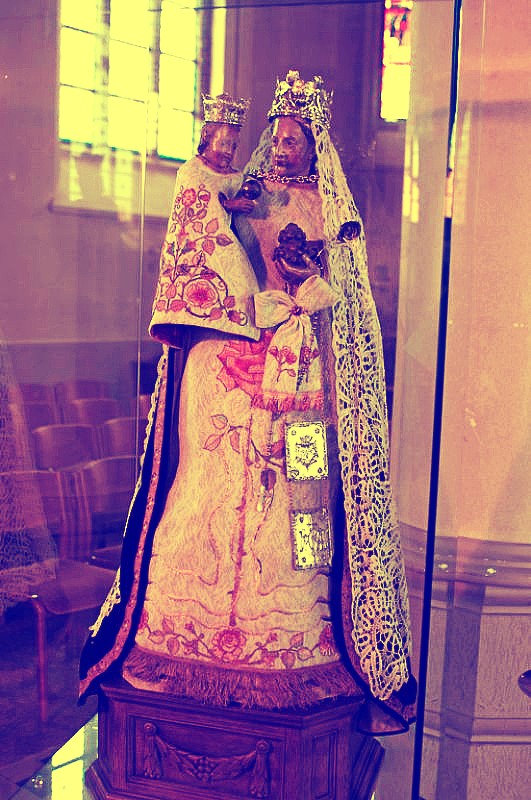
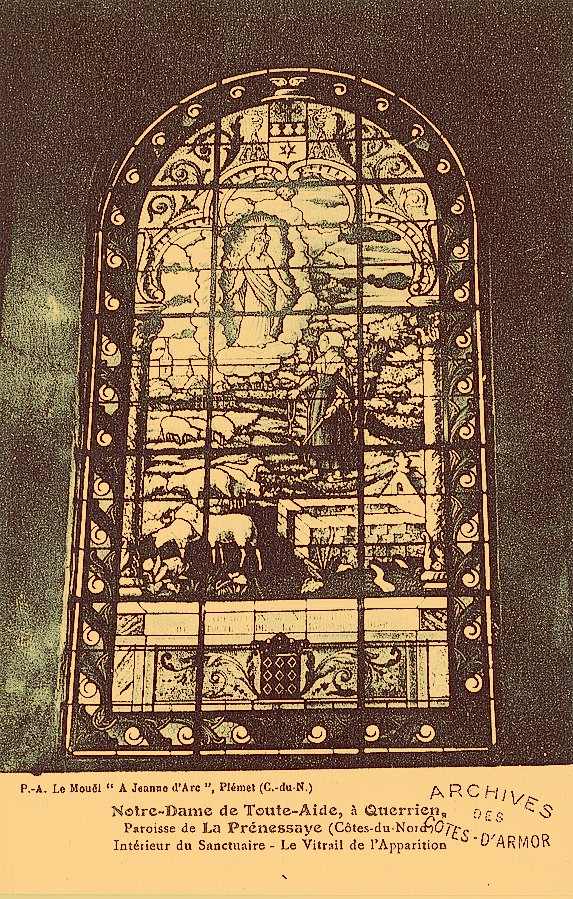
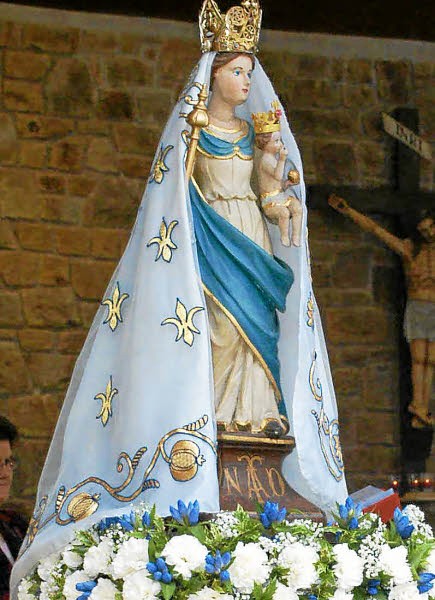
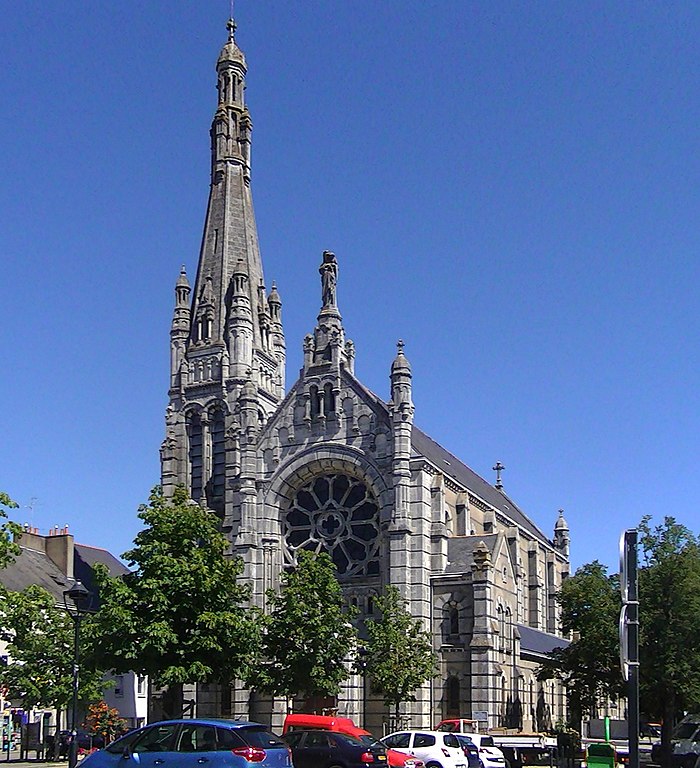
Notre-dame-de-toute-aide de Querrien, France / Our Lady of All Help (1652) – 6 October, for the Feast of the Holy Rosary on 7 October) 15 August (the Assumption) and the Sunday following 8 September (Feast of the Nativity of Our Lady):
According to legend, in 574, the Monk Saint Columban came from Ireland and landed on the coast of Brittany with 12 companions. The Monk Saint Gall, friend and companion of St Colomban, was part of the group. The latter stopped at Querrien and there, he found a clear and limpid spring gushing out of the ground “so that the inhabitants can knead bread there” . St Gall also built a wooden Oratory which he dedicated to Our Lady. He placed there, a wooden Statue, representing the Virgin and Child , a Statue he had sculpted himself. Over time, the Oratory was abandoned, it disintegrates and the Statue fell to the ground and was buried in the mud near the source of the spring..
On 15 August 1652, Jeanne Courtel a 12-year-old girl, deaf and dumb from birth. while guarding the family’s sheep saw a “beautiful lady” who spoke to her. Thereupon, Jeanne was immediately able to hear and to speak to the great astonishment of all the inhabitants of the village. A few days later, Jeanne saw the beautiful lady again who asked to have the ground dug up near the source of the spring, where the Statue of the Virgin was buried. The wooden Statuette was found at the place indicated,, confirming for the people, the authenticity of the Apparition. There were a total of fifteen appearances of Our Lady with which Jeanne was favoured, until September of the same year. From that time on, pilgrims arrived and numerous miracles were recorded.
Shortly after this miracle became known, there was a second one just as remarkable. There was a community benefactor whose son was at death’s door with a high fever. Invoking Our Lady before this same Statue the man saw his son instantly cured. After this second wondrous miracle, the Statue was moved into the Chapel and there were many miracles that followed. One miracle was worked in favour of a religious Sister who had been terribly burned and was she was instantly cured. A Priest, falsely accused of a crime, was acquitted after special prayers to the “miracle lady.” The statue had had no name before this but the Parishioners decided now to call her Our Lady of All Help, Quick Help, or Our Lady of Good Remedy. The local Bishop, Denis de La Barde, launched an investigation and went there to verify the child’s declarations. Satisfied with his hearings, he had a chapel erected in 1652 to organise the devotion of the faithful. After having carried out a canonical investigation, the Bishop of Saint-Brieuc issued a positive opinion on the Apparition and decided to have a Chapel built and to organise worship there. The following 29 September, the Bishop returned to bless the first stone of the Chapel during a celebration which brought together 1,500 pilgrims. On 14 August 1950, a great celebration was held in the Sanctuary. This celebration was attended by 20,000 pilgrims, several Bishops, the Abbots of Brittany and 200 Priests from Saint-Brieuc, Rennes and Vannes , for the crowning of the Statue of Notre-Dame de Tout-Aide . It was Archbishop Clément Roque of Rennes who placed the crown designed by Émile Daubé and made by goldsmith René Desury on the head of the Statue. This coronation was carried out with the authorisation and blessing of Pope Pius XII.
The Processional Statue of Our Lady of All Help
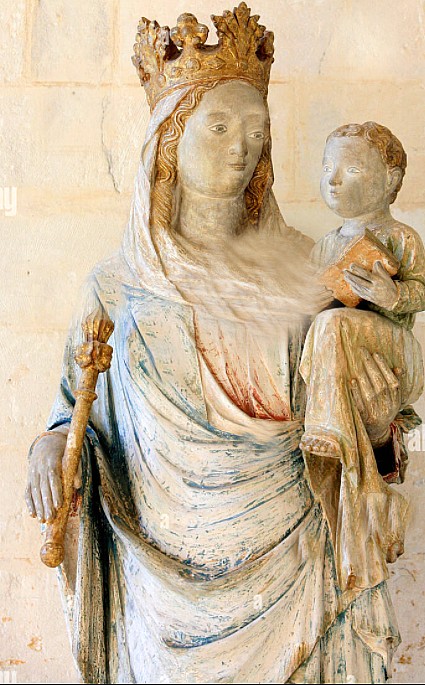
The Statue itself is only about 60 centimetres tall. The Blessed Virgin Mary is crowned, and holds her Infant Son in one arm, and a sceptre in the other. At the time of the French Revolution and during the accompanying Reign of Terror, the Abbey was destroyed. A pious lady took the Statue of Our Lady of All Help and safeguarded it until the trouble was over. After her death the Statue was restored to the community. The Statue of Our Lady of All Help has survived several wars since.
In 1998, a series of renovations began which would continue for several years. Today pilgrimages continue all year with often as many as 10 000 attending the major celebrations. The current Church incorporates the small Chapel (the remains of which, can still be seen on the north side of the building).
There is a short and very lovely prayer which, for centuries, has been associated with this Statue. It is, “Oh, Mother of All Help, say but one word in our behalf to Thy Divine Son, for He cannot refuse thee any favour. Amen.”
Bl Isidore of Saint Joseph St Iwi St John Xenos Bl Juan de Prunera St Magnus of Orderzo Saint Mary Frances of the Five Wounds of Jesus TOSF (1715-1791) Virgin, a member of the Third Order of the Friars Minor, Recluse.
St Pardulf St Renato of Sorrento St Romanus of Auxerre St Sagar of Laodicea
Martyrs of Capua – 4 Saints: A group of Martyrs who were either killed in Capua, Italy, or that’s where their relics were first enshrined. We now know nothing but their names – Aemilius, Castus, Marcellus and Saturninus.
Martyrs of Trier: Commemorates the large number of Martyrs who died in Trier, Germany in the persecutions of Diocletian.
St Eusignius St Gormeal of Ardoilen Bl James Gerius St Margaret the Barefooted (1335-1395) Married Laywoman St Mari St Memmius of Châlons-sur-Marne St Nonna
St Sobel St Theodoric of Cambrai-Arras St Venantius of Viviers St Viator
Martyrs of the Salarian Way: Twenty-three Christians who were Martyred together in the persecutions of Diocletian. 303 on the Salarian Way in Rome, Italy.
Saint of the Day – 18 March – Saint Edward the Martyr (c 962-978) Child King of England. Born in c 962 and died by stabbing to death in the evening of 18 March 978 at Corfe Castle, Dorsetshire, England. Patronage – against glandular diseases. Additional Memorial – 20 June (translation of relics). Not to be confused with Edmund the Martyr or Edward the Confessor.
The Roman Martyrology states today: “In England, the holy King Edward, who was assasinated by order of his treacherous stepmother and became celebrated for many miralces.”
Edward’s date of birth is unsure but he was the eldest son of King Edgar the Peaceful but was not his father’s acknowledged heir. On Edgar’s death, the leadership of England was contested, with some supporting Edward’s claim to be king and others supporting his younger half-brother Æthelred Edward was chosen as King and was crowned by his main clerical supporters, the Archbishops Dunstan of Canterbury and Oswald of York.
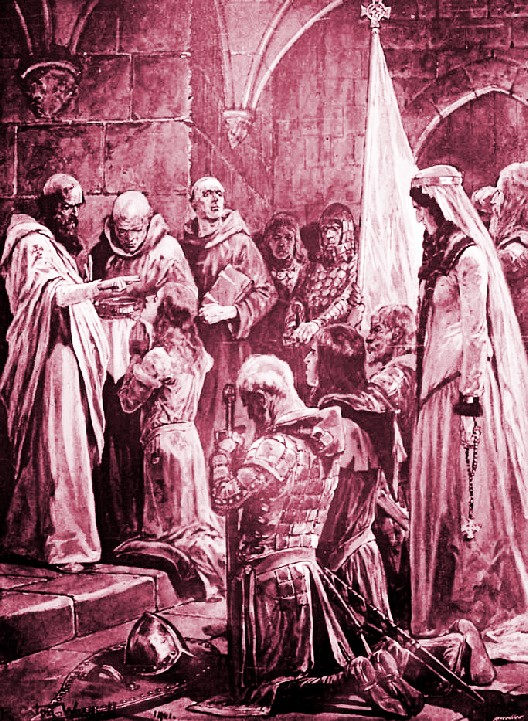
THE CORONATION OF ST EDWARD THE MARTYR – St Dunstan anointing Edward the Martyr at Kingston, 975.
In 978 Edward was murdered, after less than three years as King and Ælfthryth came to be blamed for his death. The extent of her involvement cannot be known for sure but the most lurid stories circulated about her guilt in later centuries . This is how William of Malmesbury (the foremost English historian of the 12th century. He has been ranked among the most talented English historians since St Bede), tells the story, writing in the twelfth century:
“King Edward treated his brother [Æthelred], who was still a boy, and his stepmother with proper warmth of feeling, keeping the royal title for himself alone but allowing them all other privileges. He followed in the footsteps of his father’s religious activity; he listened to good advice and took it to heart. The woman, however, with a stepmother’s hatred and a viper’s guile, in her anxiety that her son should also enjoy the title of King, laid plots against her stepson’s life, which she carried out as follows. He was coming back tired from hunting, breathless and thirsty from his exertions; his companions were following the hounds where chance had led each one; and hearing that they were quartered in a neighbouring village, the young man spurred his horse and hastened to join them, all by himself, too innocent to have fears and no doubt judging other people by himself.
On his arrival, his stepmother, with a woman’s wiles, distracted his attention and with a kiss of welcome offered him a drink. As he greedily drank it, she had him pierced with a dagger by one of her servants. Wounded mortally by the blow, he summoned up what breath he had left and spurred his horse to join the rest of the party but one foot slipped,and he was dragged through byways by the other, leaving streams of blood as a clear indication of his death to those who looked for him. At the time they ordered him to be buried without honour at Wareham,grudging him consecrated ground,when he was dead, as they had grudged him the royal title while he was alive. So they enjoyed a public festival of rejoicing, as though they had buried his memory along with his corpse.
But the Divine Serenity acknowledged him and did honour to the innocent victim with the glory of miracles : so far do Heaven’s judgements outweigh those of men. Therefore at his grave, lights shone in the sky, there a lame man walked, there a dumb man regained the use of his tongue, there every kind of sickness gave way to health. The story spread through all England and made the Martyr’s merits well known.
Aroused by this, the murderess planned a journey to the place; she had already mounted her horse and was spurring him on, when she felt the manifest anger of God. Her familiar palfrey on which she had been used to ride and which had before been swift as air and could outstrip the very winds, then by the will of God stood motionless. The grooms set about it with whips and shouting, to make it carry its powerful mistress with its wonted eagerness; their labour was spent in vain. She changed her mount but with the same result. At length, though slowly, her unfeeling heart understood the purport of the portent and what she did not deserve to do herself she agreed to get done by another hand.”
After its first burial at Wareham, Edward’s body was taken to Shaftesbury Abbey and there pilgrims continued to seek out the tomb of the young Martyred King. Ælfthryth retired to a nunnery at Wherwell, which she had founded (supposedly) in penance for the murder of Edward. William of Malmesbury goes on:
“And since an unruly spirit is its own tormen and an anxious mind, suffers its own evil geniu,s even in this present world, Ælfthryth fell from her pride of royalty into a dire repentance, such that for many years at Wherwell she clad her delicately-nurtured limbs in haircloth and at night slept stretched on the ground without her pillow, besides inventing all the tortures she could for her body, a beautiful woman and finely faithful to her husband but worthy of punishment for the great crime she committed. It is believed, and is a widely popular view, that it was through her cruelty to Edward, that the whole country, for a long time after, groaned under the barbarian yoke.”
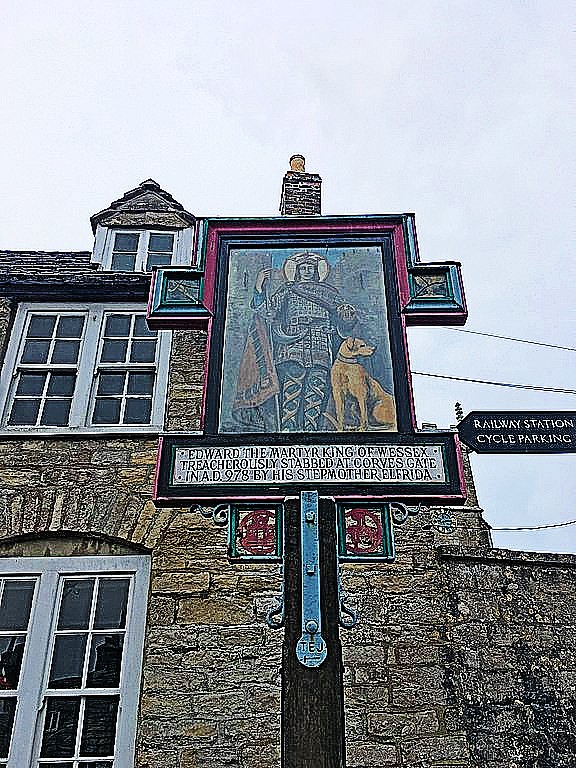
Commemorative sign for Saint Edward the Martyr at Corfe Castle, Dorset. Uunder the Painting of St Edward is written “Edward the Martyr King of Wessex treacherously stabbed at Corves gate in 978 by his stepmother Elfrida.
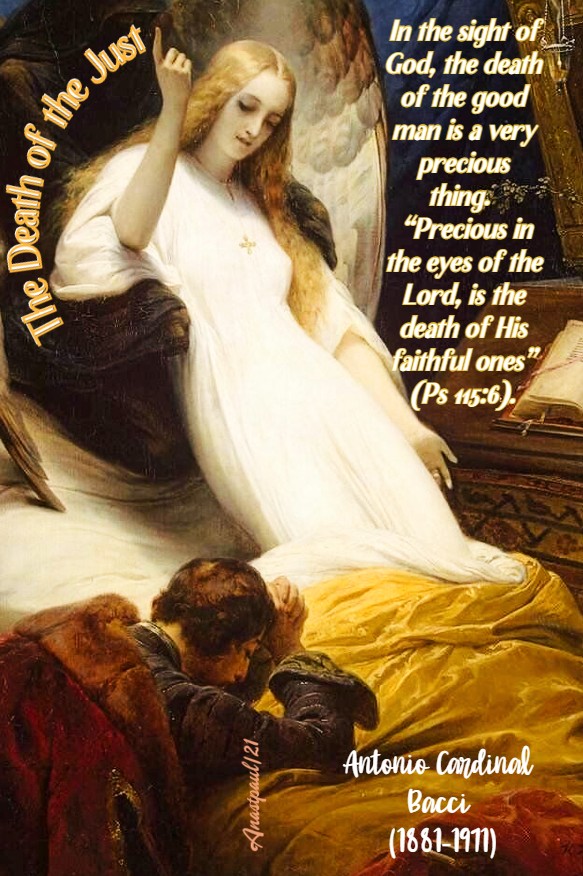
Thought for the Day – 30 September – Meditations with Antonio Cardinal Bacci (1881-1971)
The Death of the Just
Consider now the death of the just man. Through his dying tears, he also will see the world slipping away from him. But, one thing will remain to comfort him, namely, the memory of his good actions, of the virtues he acquired, of his fervent prayers and of his voluntary mortifications. Above all, there will remain his great love of God, for Whom he has lived, worked and drawn breath. In that moment, this love will even increase the flaming desire consuming his poor, frail body, to be united to God. He will be able to say, as some of the Saints have said – “I never thought it would be so sweet to die.” With St Louis, he will be able top say: “I am going joyfully to meet my God.” He will be able to exclaim with St Charles: “I long for my body to be dissolved, so that I may be with Christ!” (Phil 1:23)
In the sight of God, the death of the good man is a very precious thing. “Precious in the eyes of the Lord, is the death of His faithful ones” (Ps 115:6)
Thought for the Day – 8 September – Meditations with Antonio Cardinal Bacci (1881-1971)
Mary, Mother of God
“The near-infinite greatness of Mary, flows from the fact, that she is the Mother of God. The Eternal Word of the Father, consubstantial with Him in nature and equal to Him in majesty, willed to become man in order to set us free from the slavery of sin and to regain Heaven for us. He became man in the chaste womb of the Virgin Mary. He took a human body and soul and was born of her, as the God-Man. For this reason, there is attributed to His Divine Person, the title of Son of Mary and to Mary, the title of Mother of God.
There is a relationship between Mary and each of the three Divine Persons, for she is the daughter of God the Father, the spouse of the Holy Spirit by whose power the Word became incarnate in her and the mother of the Word made Man. She is, moreover, in the words of Dante, the “termine fisso di eterno consiglio” (Paradiso 33:1-3). In other words, she is the centre of the eternal plan which God established for the redemption of the human race. It was God’s eternal design to reunite creation to the Uncreated, by means of Mary. She became the mother of the Eternal Word, in whom the divine and human natures were indissolubly united. He redeemed us by His infinite merits but, in this work of redemption, He employed the co-operation of His holy Mother. All the graces, privileges and virtues of Mary, flow from this great mystery of her divine Motherhood. As befitted the future Mother of God, she was conceived free from the stain of original sin and full of grace. Her mortal life was a continuous ascent towards the highest peak of sanctity. When she died, she was assumed body and soul into Heaven, where she was crowned in glory, as Queen of Angels and Queen of Saints. When we consider the sublime nobility of Our Lady, we should be moved to love and venerate her. This love and veneration does not subtract in the slightest from God’s glory, because, she is the Mother of God. In fact, it is a great advantage to us, to imitate her and to call on her to intercede for us.”
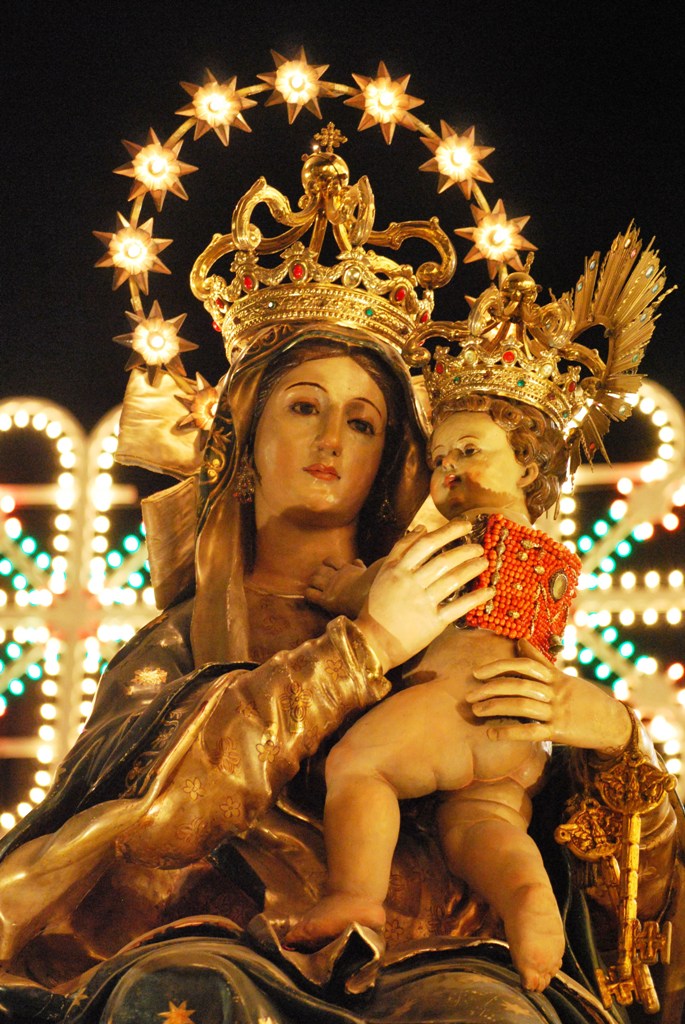
Madonna dei Miracoli / Our Lady of the Miracles, Alcamo, Sicily (1547) – 21 June:
The Processional Statue
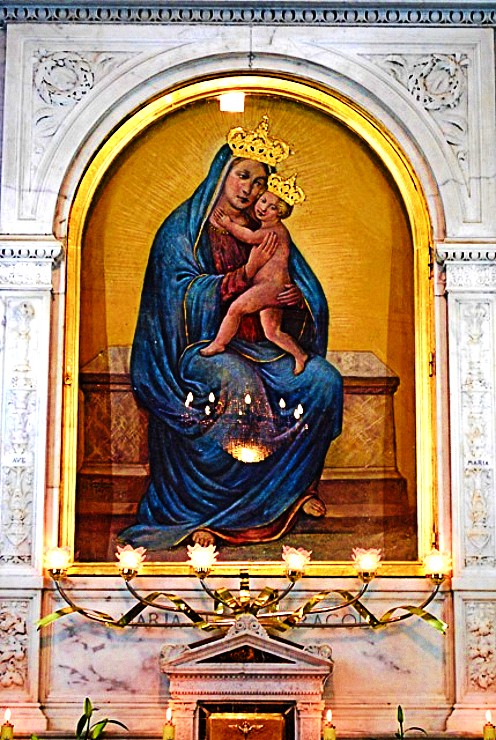
The cult of Our Lady of the Miracles in Alcamo dates to 21 June 1547, the day people remember the Madonna’s apparition to some women near a stream running north of Alcamo. According to tradition while washing their clothes in the stream, the women, with a blind and a deaf one among them, saw the apparition of a woman with a child and were hit by a gust of pebbles, during the apparition but without receiving any injury or pain; on the contrary, after being hit by the pebbles, they strangely felt a certain sense of wellbeing and recovered their health. After learning the news, the women’s husbands, thinking that it was a joke, went to investigate, thinking that someone was hidden among the bushes but they didn’t find anybody. Then the local authorities inquired on the spot, cut down the near grove and found the ruins of a “cuba,” an old arc of a mill that nobody remembered any longer and insidem there was a fresco on a stone made by an anonymous painter of the 13th century representing Our Lady with the Child Jesus, which at first. the believers called “Madonna Fons Misericordiae” (that is Our Lady Source of Mercy).
A representation of the discovery of Our Lady of Miracles’ image (inside its Chapel in the Basilica of Our Lady of the Assumption in Alcamo).
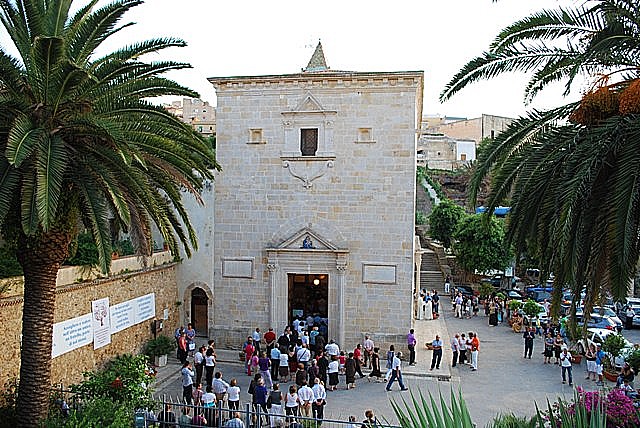
After this discovery, all the people started praying before the rediscovered image and in the following days there were several miracles. Our Lady of Miracles became the Patron of Alcamo, in substitution of the Holy Crucified, who was the Patron Saint of Alcamo and other near small towns (among which Calatafimi and Salemi). The old Patron Saint’s memory however, remains: in fact, they call St Francesco of Paola “santu patri” (whose translation means “Patron Saint”) as the Church named after him was called the Holy Crucified Church. The Madonna’s discovered image was first called “Our Lady Source of Mercy” but thanks to the high number of subsequent miracles, in 1583 the name was changed into “Our Lady of Miracles”. Further to these events, Don Fernando Vega, Alcamo’s governor, ordered the construction of the Sanctuary of Our Lady of Miracles, which hosts the Madonna’s image. Inside the Church there is a white marble sarcophagus containing the mortal remains of the governor Don Fernando Vega, according to his will.
The Crowned Painting of the Madonna of Miracles in the Sanctuary at Alcamo
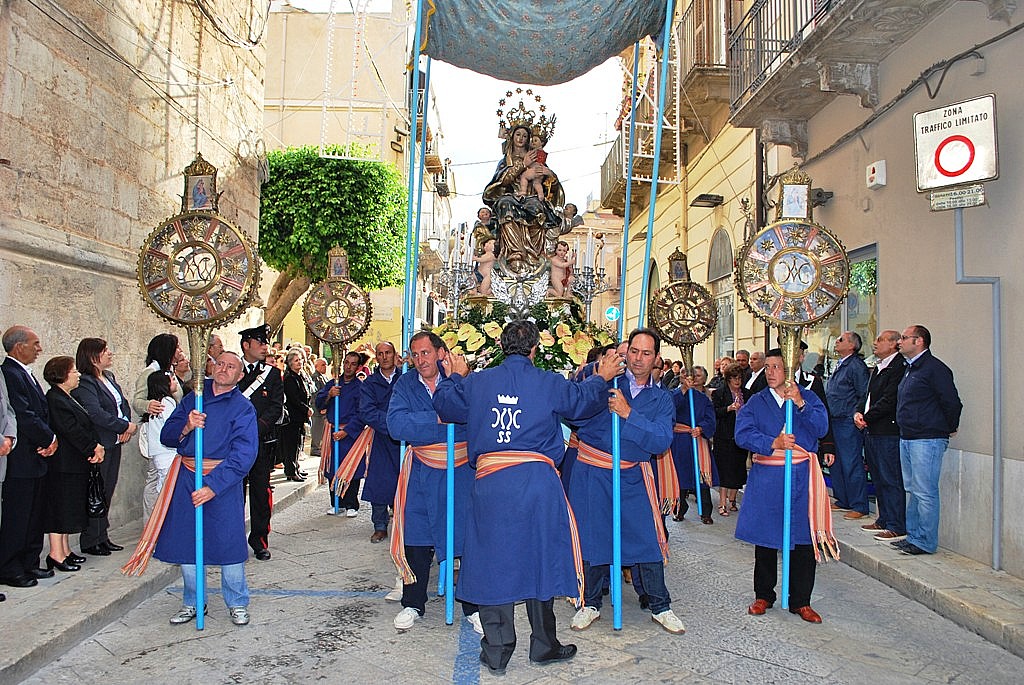
Every year in Alcamo there are the celebrations in honour of Our Lady of Miracles from 19 June until 21 of June. This is the most important religious festivity in Alcamo. The real celebrations are often anticipated by other events, so extending the feast to about two weeks, in this way the beginning of the celebrations changes every year, while the last day is always the 21 June. The celebrations include: The pealing of church bells” which opens the celebrations together with the burst of fireworks and the passing of the band through the town streets; in the past Alcamo’s band also joined the musical band of Partinico (a neighbouring small town). The Holy Mass in honour of Our Lady of Miracles in the Basilica di Santa Maria Assunta (also called “Mother Church”), in which all confraternities and laity groups in Alcamo take part. The procession to the Sanctuary of Madonna of Miracles (called “calata”), in which all civil and religious authorities of the town (together with the Mayor) take part; they are preceded by the band of the town. In old times people took also the animals that had recovered from an illness. Inside the Sanctuary they sing Vespers and then there is the Eucharistic Blessing/Benediction.
St Raymond of Barbastro St Rufinus of Syracuse St Suibhne the Sage St Terence St Ursicenus of Pavia — Martyrs of Taw – 3+ saints: Three Christians of different backgrounds who were martyred together – Moses, Paphnutius, Thomas. They were beheaded in Taw, Egypt, date unknown.
Easter Friday – Day Six in the Easter Octave +2021
Notre-Dames de Myans, Savoie / Our Lady of Myans, Savoy, France (1249) – 9 April:
The Abbot Orsini wrote: “It is believed that this image, in the year 1249, prevented the thunder, which had already consumed the Town of Saint Andre with sixteen villages, from going farther and was the cause of its stopping at Myans.”
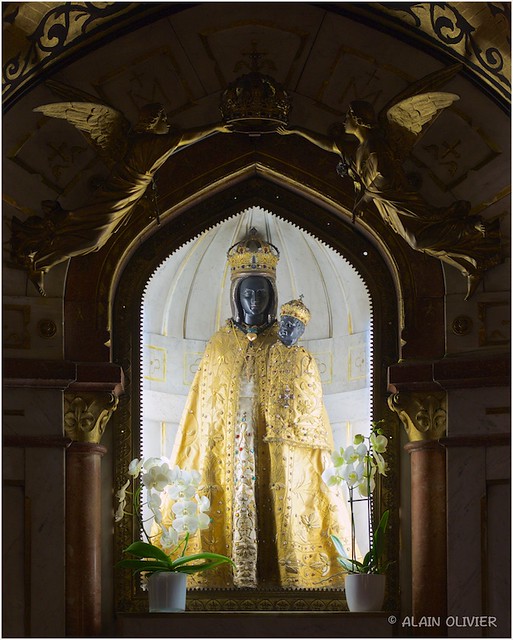
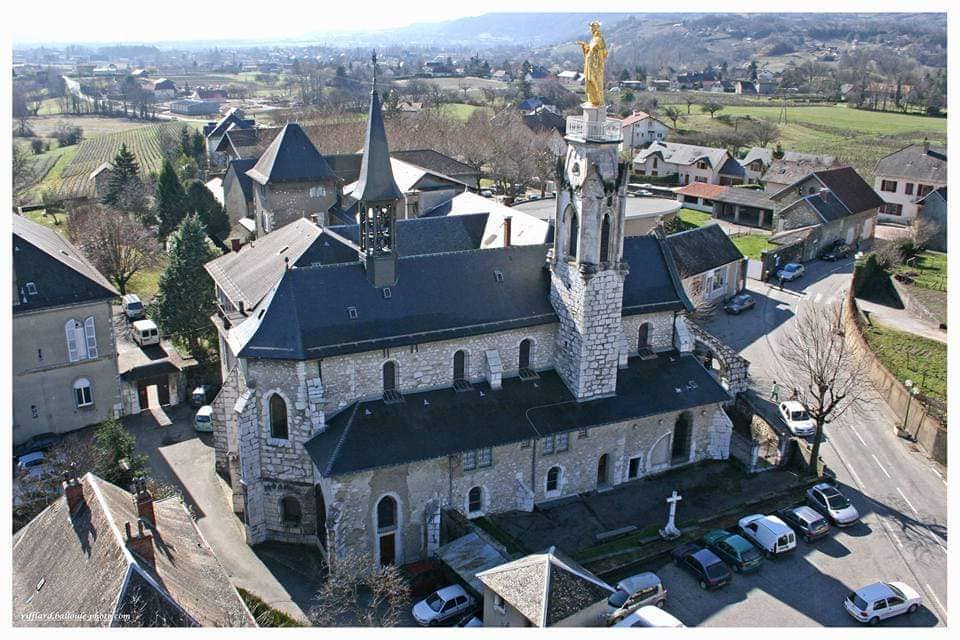
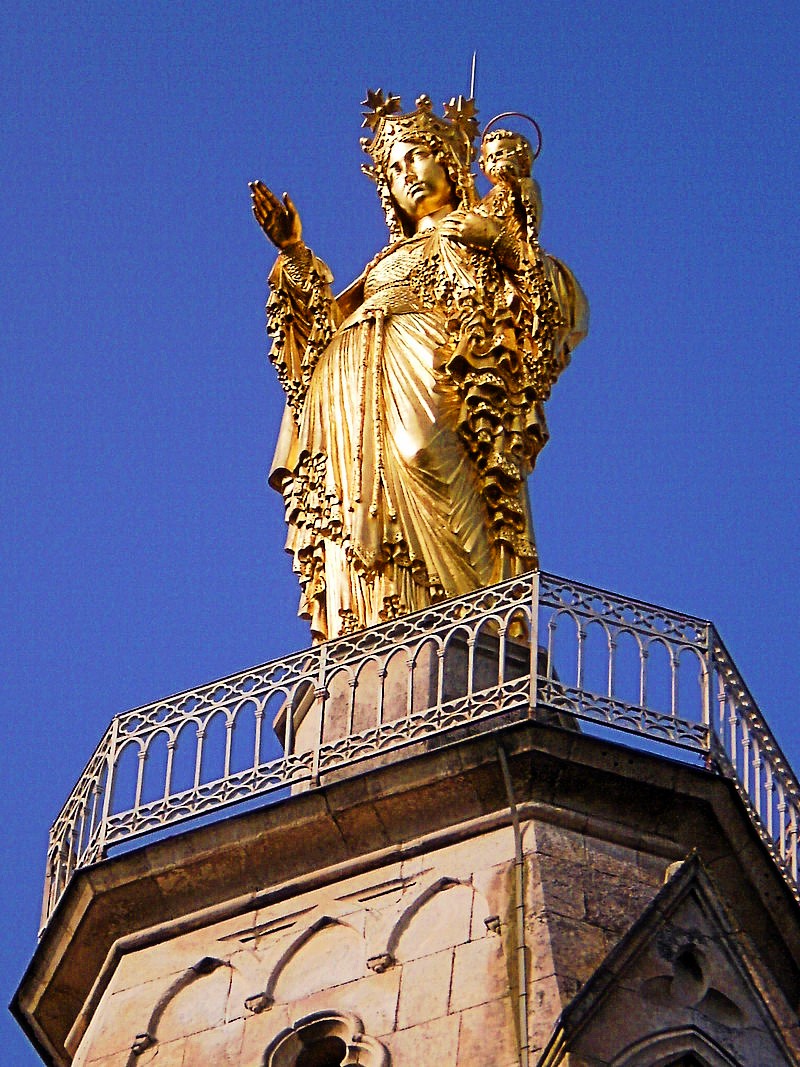
Our Lady of Myans in Savoy, is located on a little hill between Modane and Chambery near the Mont Cenis tunnel. It can be easily recognised, as there is a huge statue of the Blessed Virgin standing atop the Shrine’s belfry. The Shrine has been a pilgrimage site since at least the thirteenth century, and its small ‘Black Virgin’ was an object of the devotion of Saint Francis de Sales. The foundation of the Shrine is no longer remembered but the Church became famous for a miracle that occurred there in 1248.
On the evening of 24 November of that year, a tremendous earthquake shook the region causing Mont Granier, the tallest mountain of the Chartreuse Massif, to disintegrate into huge boulders, which came crashing down into the valley. Some of these boulders, were the size of a house, and 16 villages were crushed and 5,000 lives lost. The Shurch of Myans, however, was spared, though gigantic boulders were stopped abruptly at the very door of the Church. Some of these boulders can still be seen around the church grounds.
Unfortunately, we can’t see the boulders in this image of the Church
A marvellous answer to prayer occurred in 1534, in favour of Jean Grandis of Savoy, who was on a vessel bound from Genoa to Leghorn. When the ship was threatened during a tempest and seemed likely to sink, Jean Grandis called upon Our Lady of Myans, Queen of Savoy. Battered by the waves, the ship foundered and sank. Jean Grandis was the only survivor. As a gesture of thanksgiving, he travelled barefoot to the Shrine and there placed his ex-voto. It is said to be one of the oldest to survive.
Another miracle attributed to Our Lady of Myans was in favour of the brother of Saint Francis de Sales, Count Louis de Sales, who in 1603 was travelling to the Chateau of Cusy to marry Claudine Philiberte de Pingon. Since there was no bridge in sight, the Count attempted to cross the River Cheran at a place that he thought was shallow and safe. However, the Count was swept away by flood water. Invoking the name of Our Lady of Myans and promising to make a pilgrimage, he was suddenly thrust onto an obstruction that saved his life. The wedding ceremony was conducted on 2 April. The next day, Saint Francis de Sales offered a Mass of thanksgiving in the little Crypt Chapel before the miraculous image of Our Lady of Myans.
The Black Madonna of Myans, venerated in the Crypt (lower church), is a 70cm high wooden statue, representing the seated Virgin. It dates to around the 12 th century . With her left arm, she presents the Child Jesus seated on her knees. Under the stiff folds of the mantle, the detail of the attitudes fades and the Virgin appears to be standing. She is a virgin of majesty . The mantle of the Statue is in fine moiré gold cloth, revealing a dress in silver cloth. The whole forms a royal adornment. The Virgin was crowned on 17 August 1905 by decision of Pope Pius X who delegated, for this purpose, Cardinal Couillé, Prelate of Gauls, Archbishop of Lyon, surrounded by 5 Bishops and more than 20,000 faithful.
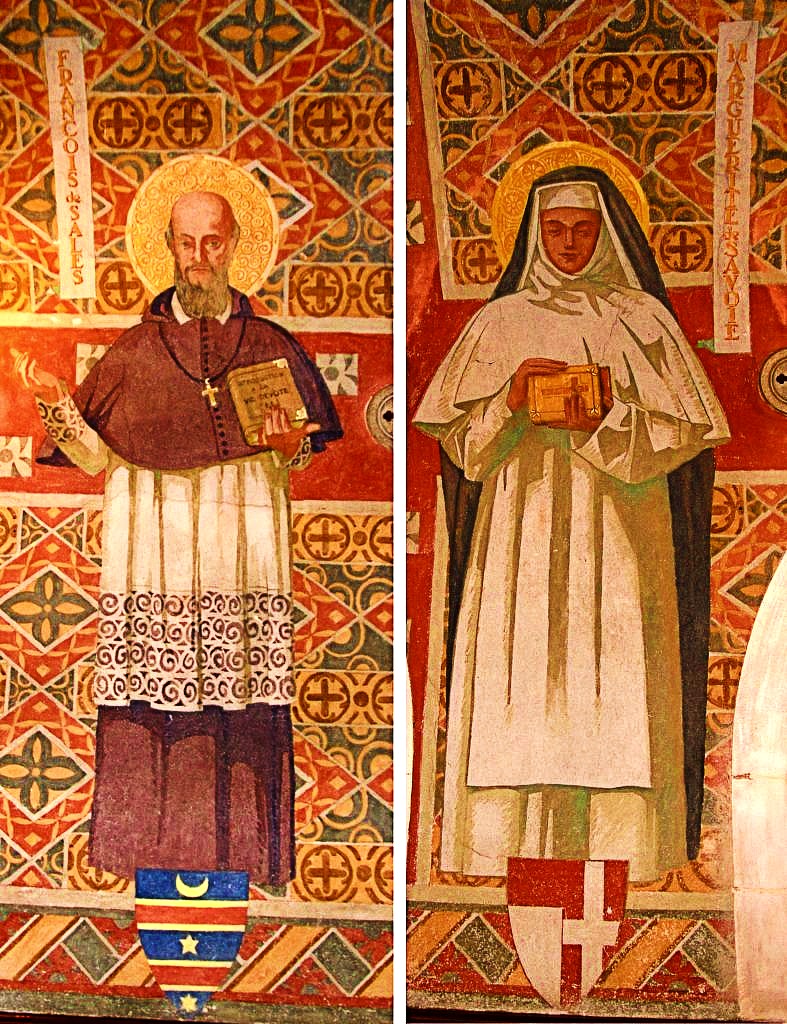
The Church was half destroyed during the French Revolution but the Statue was saved and later enshrined again in the restored building, where it was crowned in 1905. The Sanctuary is particularly resorted to by pilgrimages of men and the image was taken to Rome by a Savoyard pilgrimage for the definition of the Dogma of the Assumption in the year 1950. At the entrance to the choir is evoked the disaster of the landslide of Granier. In the vault of the nave of the lower Church are painted ten unforgettable figures of the Saints and blessed of Savoy and Dauphiné, including St Francis de Sales (1567-1622) and St Louis of Savoy (1462-1508).
In 1855, the steeple, half demolished during the revolution, was raised in its current form to serve as a pedestal for a monumental Statue which crowns its summit. This Statue, executed in Paris by the sculptor Louis Rochet, was inaugurated on 17 October 1855. It is in gilded bronze, measures 5.25m and weighs 3 tons . The Virgin holds the Child Jesus on her left arm, her right arm is extended as if to bless. She wears the ducal crown, emblem of her sovereignty over Savoy. It is draped in the costume of the 13th century, the time of the Granier disaster.
Martyrs of Masyla: Massylitan Martyrs Group of Christians martyred in Masyla in northwest Africa.
Martyrs of Pannonia: Seven virgin-martyrs in Sirmium, Pannonia (modern Sremska Mitrovica, Serbia).
Martyrs of Thorney Abbey – 3+ saints: A group of Hermits, hermitesses and monks who lived in or around Thorney Abbey who were martyred together during raids by pagan Danes. We know little more than the names of three – Tancred, Torthred and Tova. 869 by raiders at Thorney Abbey, Cambridgeshire, England.
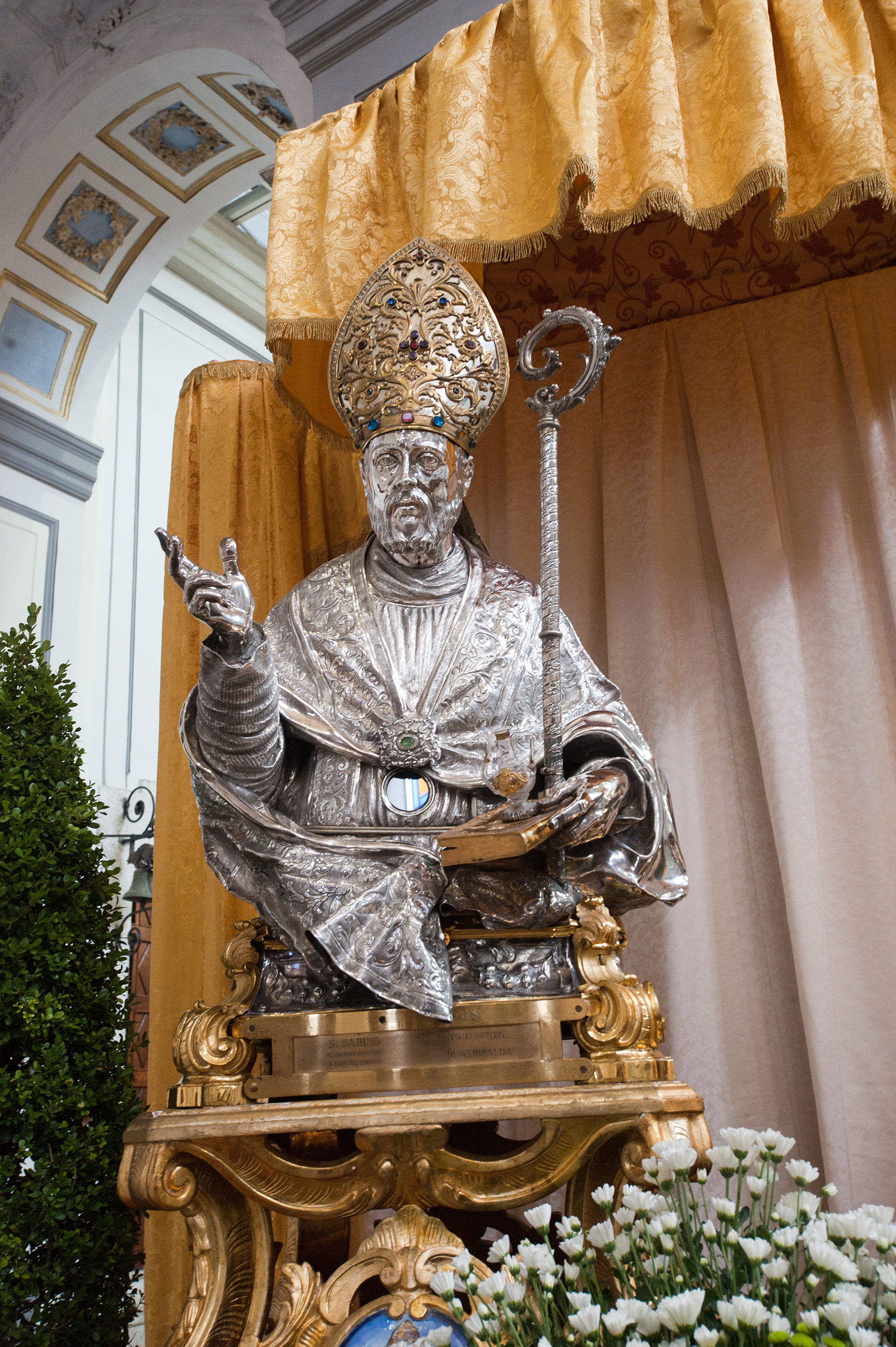
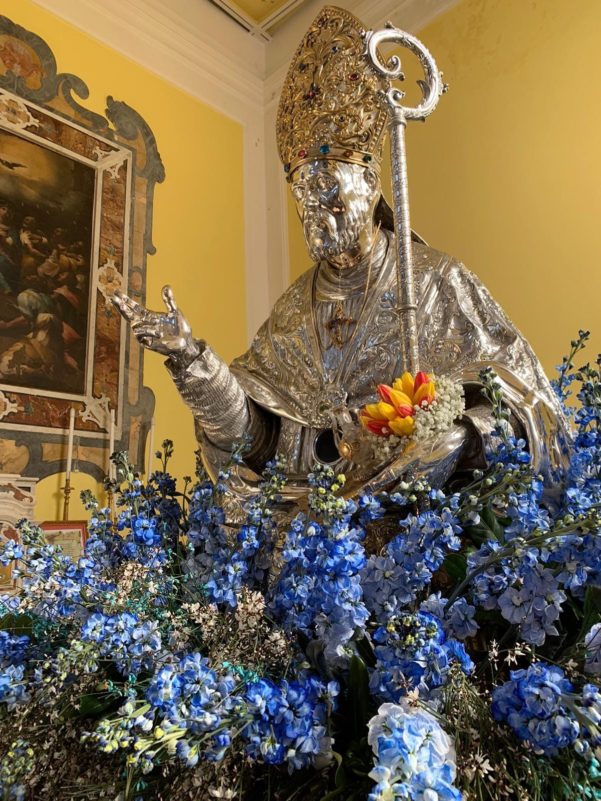
Saint of the Day – 9 February – Saint Sabinus of Canosa (c 461–566) Bishop, Confessor, Benedictine Monk, Papal Legate, miracle-worker, graced with the charism of prophecy, Defender of the Faith against heretics, friend of Saint Benedict of Nursia, builder of Churches and Monasteries, following the Benedictine discipline of Ora et labora. Born in c 461 in Italy and died on 9 February 556. Patronages – Atripalda, Canosa Italy, Torremaggiore and Furci and Bari, Italy, protector against poisoning. At some point Sabinus went blind but records do not reveal exactly when this occurred, nor is it revealed in the Dialogues of St Gregory. Additional Memorial – 14 September in Atripalda. Roman Martyrology: “At Canossa in Apulia, St Sabinus, Bishop and Confessor.”
Saint Pope Gregory tells that he was endowed with the spirit of prophecy and the power of miracles. After he had become blind, when a cup of poison was offered to him by a servant who was bribed, he knew it by divine instinct. He, however, declared that God would punish the one who had bribed the servant and, making the Sign of the Cross, he drank the poison without anxiety and without harmful effect.”
Sabinus was a friend of Saint Benedict, whom he visited at Montecassino and to whom, as recorded by St Gregory the Great, he once expressed his preoccupations on the incursions of the Ostrogoth King Totila into the Italian peninsula. According to the hagiographic legend, he succeeded in saving Canosa from the threat of the latter. In fact, the Dialogues of Pope Gregory I (Book III, Chapter 5) also contains a second anecdote relating to “Sabinus, Bishop of Canosa.” Totila, King of the Goths, who was sceptical about the prophetic powers of the blind St Sabinus, visited and had dinner with him. He handed him a glass of wine, in place of the cupbearer. “Then the man of God taking the cup but not seeing him that did deliver it, said: ‘Blessed be that hand.’ At which words, the King very merrily blushed because, albeit he was taken, yet he had found that gift in the man of God which before he desired to know.” Totila was so impressed that he renounced his pillaging.
In 531, under the Papacy of Boniface II, he participated in the Roman Synod. Sabinus was sent twice as a Papal Envoy to Constantinople, in 525, by Pope John I and in 536 to accompany Pope Agapitus I, (who lost his life on the journey,) to defend the true faith against the Monophysite heresy.
St Sabinus died after 52 years of dedicated service in the Episcopate.
Bishop Angelarius rescued the relics of St Sabinus from Canos Cathedral and took them to Bari when Canosa was destroyed by Saracens in 844. It is not clear how some of them came to be venerated in San Giovenale, Orvieto. The Cappella di San Sabino, to the left of the apse of this Church, was built at the end of the 13th century on what might have been the site of a free-standing Oratory of St Sabinus. This Church itself is referred to as Sts Giovenale and Sabinus in a document of 1314.
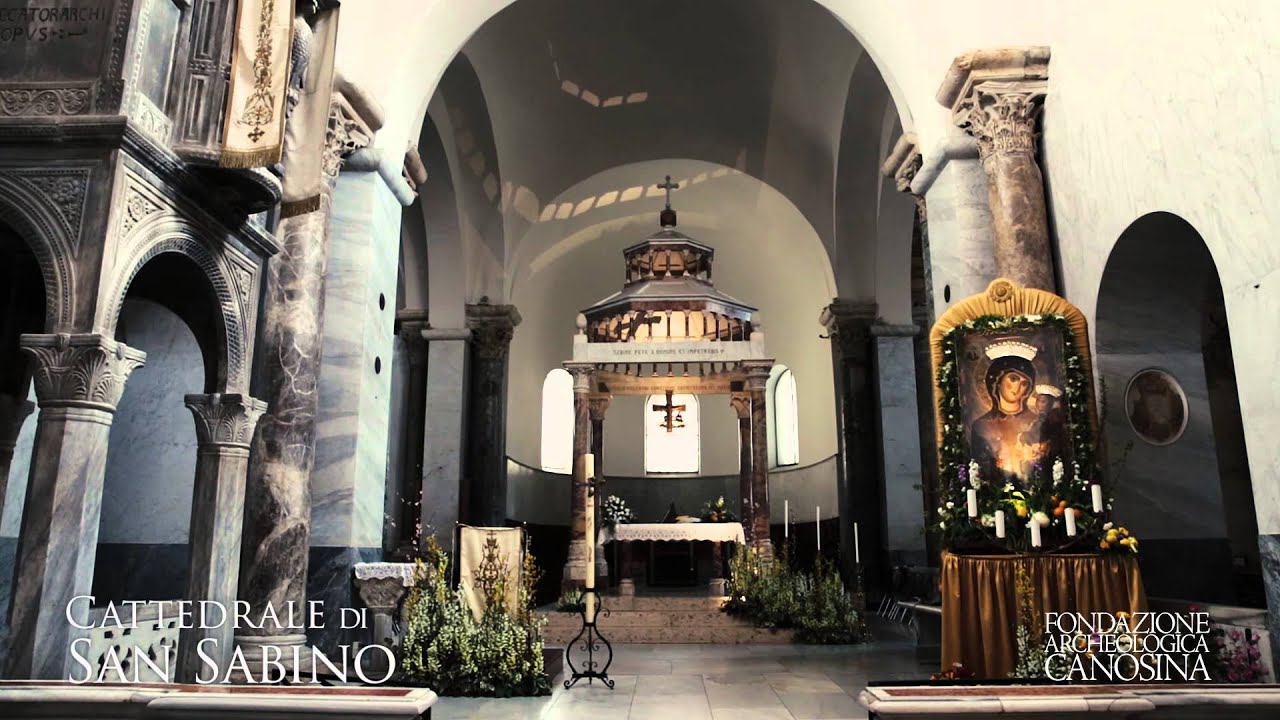
Cathedral of St Sabinus in Canosa
The Cathedral of St Sabinus in Bari
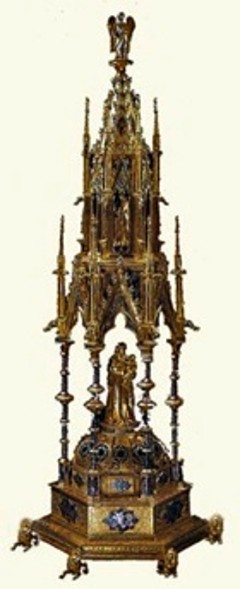
A reliquary (1340) by Ugolino di Vieri for the skull of St Sabinus of Canosa (see below) was displayed in this Chapel until 1845, when it was sold to the Museo dell’ Opera del Duomo. The rest of the saints’ relics are said to rest under its high altar.
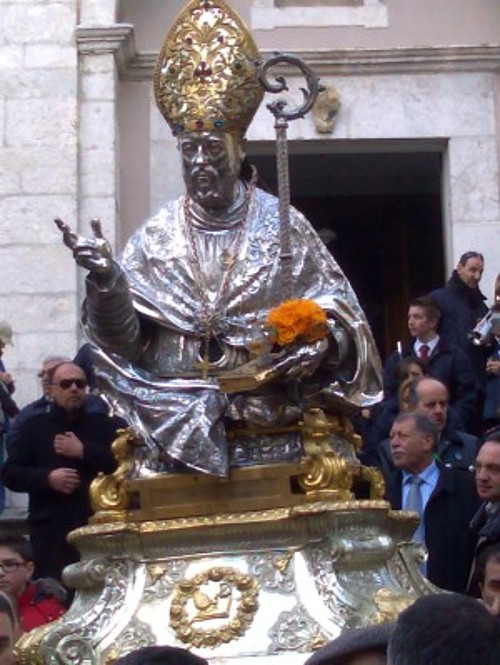
Week long festivities are celebrated each year in Atripalda prior to the Feast Day of our Saint, where St Sabinus’ memory is celebrated on 14 September.
Quote/s of the Day – The Weekdays of Advent, 18 December O Adonai/O Lord Jeremiah 23:5-8, Psalm 72:1-2, 12-13, 18-19, Matthew 1:18-24
“Only let it be in the name of Jesus Christ, that I may suffer together with Him! I endure everything because He Himself, Who is perfect man, empowers me.”
St Ignatius of Antioch (c 35 – 107) Father of the Church, Martyr
“And you shall call His name Jesus, because in His Name we adore the entire majesty of the Godhead. All who dwell in the heavens, those who abide upon the earth and everyone of those who are held in the depths of hell, bow down prostate to this Name. This is the Name which gave sight to the blind, hearing to the deaf, agility to the lame, speech to the mute and life to the dead, The power of this Name forced the mastery of the devil entirely, from the bodies of the possessed.”
St Peter Chrysologus (c 400-450) Father and Doctor of the Church
“The Name of Jesus is the purest and holiest, the noblest and most indulgent of names, the Name of all blessings and of all virtues, it is the Name of the God-Man, of sanctity itself.”
St Bernard of Clairvaux (1090-1153) Mellifluous Doctor of the Church
Jesus, Name Full of Glory By St Bernardine of Siena (1380-1444)
Jesus, Name full of glory, grace, love and strength! You are the refuge of those who repent, our banner of warfare in this life, the medicine of souls, the comfort of those who morn, the delight of those who believe, the light of those who preach the true faith, the wages of those who toil, the healing of the sick. To You our devotion aspires, by You our prayers are received; we delight in contemplating You. O Name of Jesus, You are the glory of all the saints for eternity. Amen
“The Holy Name of Jesus is, first of all, an all-powerful prayer. Our Lord, Himself, solemnly promises, that whatever we ask the Father in His Name, we shall receive. God never fails to keep His word. Each time we say “Jesus,” it is an act of perfect love, for, we offer to God, the infinite love of Jesus”
St Alphonsus Liguori (1696-1787) Doctor of the Church
“There is just one Name in the whole world that lives – it is the Name of One who passed His years in obscurity and who died a malefactor’s death. (Two thousand yeas) have gone by since that time but still It has It’s hold upon the human mind. It has possessed the world and It maintains possession. Amid the most various nations, under the most diversified circumstances, in the most cultivated, in the rudest races and intellects, in all classes of society, the Owner of that great Name reigns. High and low, rich and poor, acknowledge Him. Millions of souls are conversing with Him, are venturing at His word, are looking for His presence. Palaces, sumptuous, innumerable, are raised to His honour. His image, in it’s deepest humiliations, is triumphantly displayed in the proud city, in the open country, at the corners of streets, on the tops of mountains. It sanctifies the ancestral hall, the closet and the bedchamber, it is the subject for the exercise of the highest genius in the imitative arts. It is worn next to the heart in life, it is held before the failing eyes in death.”
St John Henry Newman (1801-1890)
Blessed be the Most Holy Name of Jesus without end!
One Minute Reflection -19 August – Wednesday of the Twentieth week in Ordinary Time, Readings: Ezekiel 34: 1-11, Psalms 23:1-3a, 3b-4, 5, 6, Matthew 20:1-16 and The Memorial of St John Eudes Orat. (1601-1680) “Apostle of Two Hearts” and St Louis of Toulouse OFM (1274-1297)
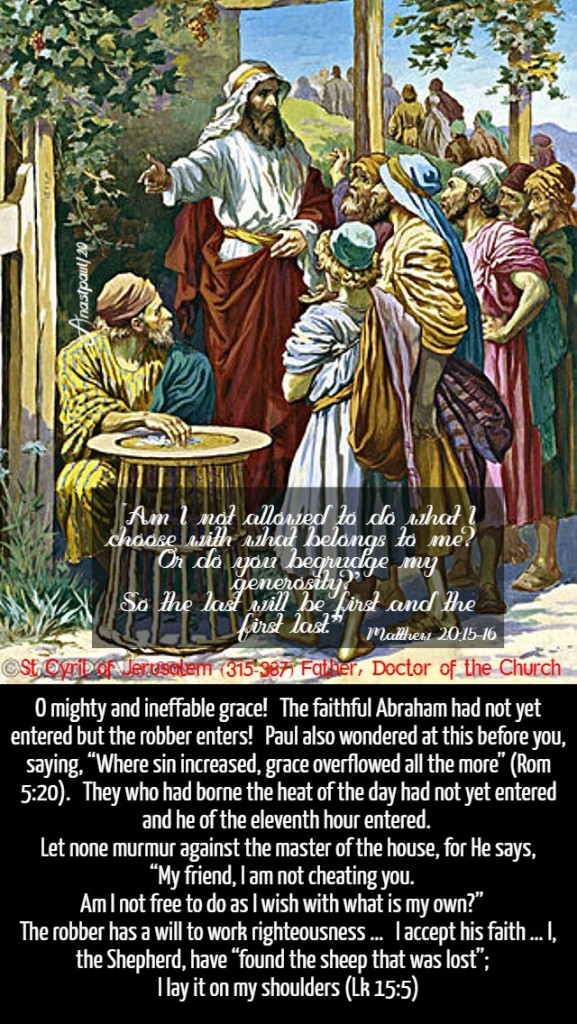
“Am I not allowed to do what I choose with what belongs to me? Or do you begrudge my generosity?’ So the last will be first and the first last.” … Matthew 20:15-16
REFLECTION – “One of the robbers crucified with Jesus cried out: “Lord, remember me; it is to you I now turn (…). Remember not my works, for of these I am afraid. Every man has a feeling for his fellow-traveller; I am travelling with you towards death; remember me, your fellow-wayfarer. I do not say, Remember me now, but, “when you come in your kingdom” (Lk 23:42).
What power, O robber, led you to the Light? Who taught you to worship that despised Man, your companion on the cross? O Light Eternal, which gives light to them that are in darkness! (Lk 1:79) “Take courage! Amen, I say to you, today you will be with me in paradise” because “today you have heard my voice, and have not hardened your heart” (Ps 95[94]:8). Very speedily I passed sentence upon Adam (…) but you, who today have obeyed the faith, today is your salvation. By the tree Adam fell away; by the tree you are brought into paradise (…)
O mighty and ineffable grace! The faithful Abraham had not yet entered but the robber enters! Paul also wondered at this before you, saying, “Where sin increased, grace overflowed all the more” (Rom 5:20). They who had borne the heat of the day had not yet entered and he of the eleventh hour entered. Let none murmur against the Master of the House, for He says, “My friend, I am not cheating you. Am I not free to do as I wish with what is my own?” The robber has a will to work righteousness … I accept his faith … I, the Shepherd, have “found the sheep that was lost”; I lay it on my shoulders (Lk 15:5); since he himself has said, “I have gone astray like a lost sheep; Lord, remember me when You come in Your kingdom.” … St Cyril of Jerusalem (315-387) Bishop of Jerusalem, Father, Doctor of the Church
PRAYER – Father of mercies and God of all consolation, You gave us the loving Heart of Your own beloved Son, because of the boundless love by which You have loved us, which no tongue can describe. May we render You a love that is perfect with hearts made one with His. Grant, we pray, that our hearts may be brought to perfect unity, each heart with the other and all hearts with the Heart of Jesus….and may the rightful yearnings of our hearts find fulfilment through Him, Our Lord Jesus Christ, Your Son, who lives and reigns with You, in the unity of the Holy Spirit, one God, forever and ever. – Collect from Saint John Eudes’ Mass, Gaudeamus, 1668 St John Eudes and St Louis of Toulouse, Pray for us! amen.
St Andrew the Tribune St Badulf of Ainay St Bertulf of Luxeuil St Calminius St Credan of Evesham St Donatus of Mount Jura St Elaphius of Châlons St Ezekiel Moreno Y Diaz St Guenninus Bl Guerricus Bl Hugh Green Blessed Jordan of Pisa OP (c 1255–1311) His Life: https://anastpaul.com/2019/08/19/saint-of-the-day-blessed-jordan-of-pisa-op-c-1255-1311/ St Julius of Rome St Louis of Toulouse OFM (1274-1297) Prince and Bishop
St Magnus of Anagni St Magnus of Avignon St Magnus of Cuneo St Marianus of Entreaigues St Marinus of Besalu St Magino of Tarragona St Mochta St Namadia of Marsat St Rufinus of Mantua St Sarah the Matriarch St Sebaldus St Thecla of Caesarea St Timothy of Gaza — Martyrs of Nagasaki – 15 beati: A group of missionaries and their laymen supporters who were executed for spreading Christianity in Japan. • Antonius Yamada • Bartholomaeus Mohyoe • Iacobus Matsuo Denji • Ioachim Díaz Hirayama • Ioannes Miyazaki Soemon • Ioannes Nagata Matashichi • Ioannes Yago • Laurentius Ikegami Rokusuke • Leo Sukeemon • Ludovic Frarijn • Marcus Takenoshita Shin’emon • Michaël Díaz Hori • Paulus Sankichi • Pedro de Zúñiga • Thomas Koyanagi They were beheaded on 19 August 1622 at Nagasaki, Japan and Beatified on 7 May 1867 by Pope Pius IX.
Martyred in the Spanish Civil War Martyred Carmelite Sisters of Charity – 9 beati Martyred Salesians of Ciudad Real – 8 beati Martyred Subiaco Benedictines of Barcelona – 7 beati • Blessed Agueda Hernández Amorós • Blessed Agustí Busquets Creixell • Blessed Andrés Pradas Lahoz • Blessed Antolín Martínez y Martínez • Blessed Antoni Pedró Minguella • Blessed Càndid Feliu Soler • Blessed Cipriano González Millán • Blessed Damián Gómez Jiménez • Blessed Elvira Torrentallé Paraire • Blessed Félix González Bustos • Blessed Francisca de Amézua Ibaibarriaga • Blessed Francisco de Paula Ibáñez y Ibáñez • Blessed Ignasi Guilà Ximenes • Blessed Isidro Muñoz Antolín • Blessed Joan Roca Bosch
St Rusicola of Arles
St Rufinus of Marsi
St Susanna of Rome
St Taurinus of Evreux
Bl Theobald of England and Companion
St Tiburtius of Rome
Bl William Lampley
—
Martyred in the Spanish Civil War
Bl Armando Óscar Valdés
Bl Benjamín Fernández de Legaria Goñi
Bl Carlos Díaz Gandía
Bl Rafael Alonso Gutiérrez
Bl Ramon Rosell Laboria

























You must be logged in to post a comment.