Posted in DOCTORS of the Church, FATHERS of the Church, MORNING Prayers, QUOTES on CHARITY, QUOTES on MERCY, SAINT of the DAY, SPEAKING of .....

Quote/s of the Day – 17 November – The Memorial of St Elizabeth of Hungary – Apostle of Charity (1207-1231) – Speaking of: Charity/Mercy

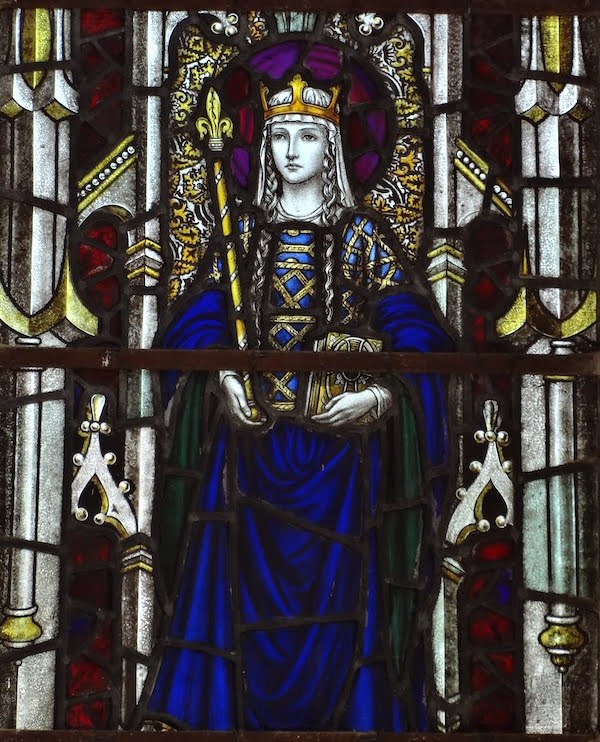
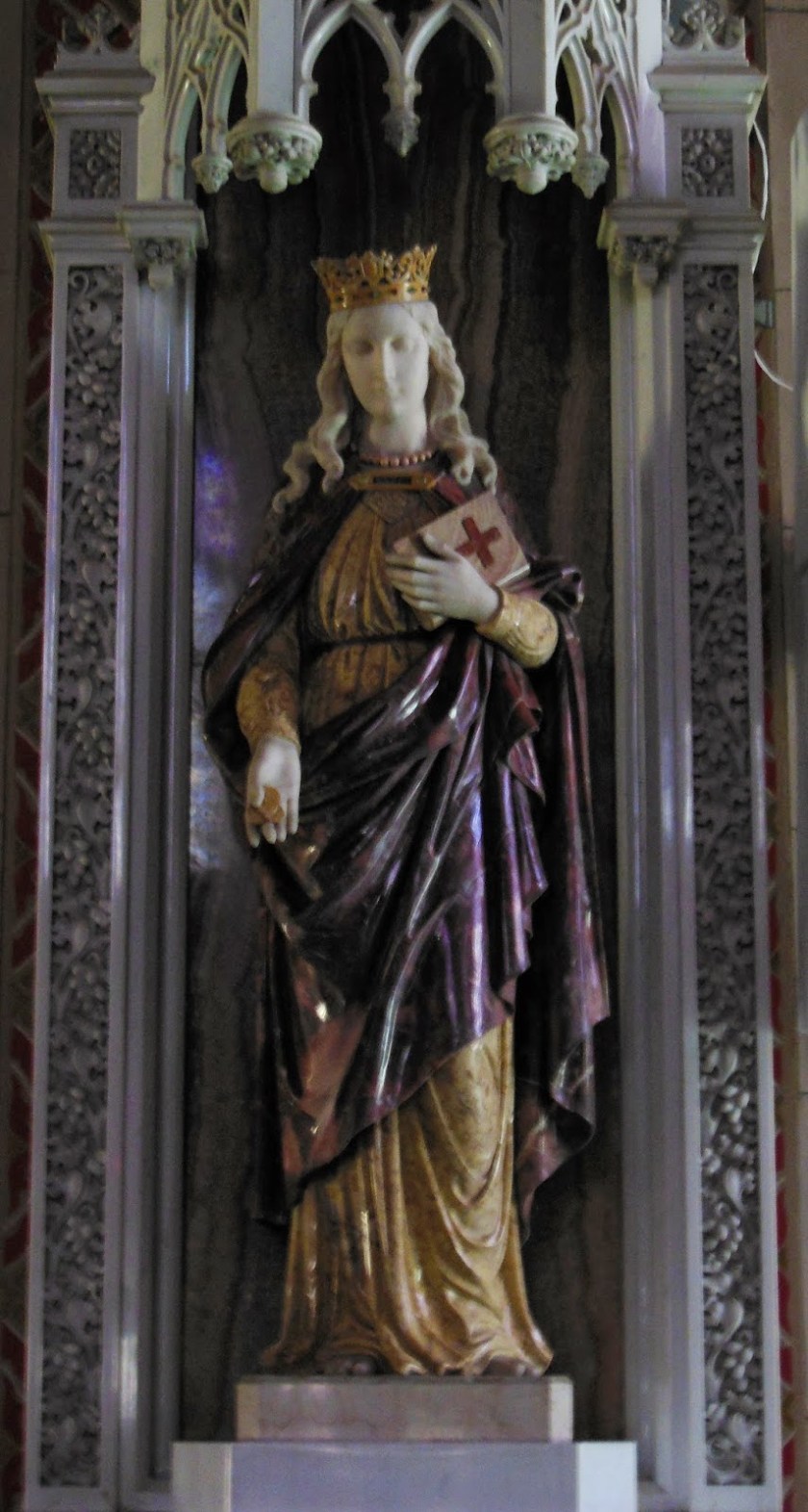
Quote/s of the Day – 17 November – The Memorial of St Elizabeth of Hungary – Apostle of Charity (1207-1231)
Speaking of:  Charity/Mercy

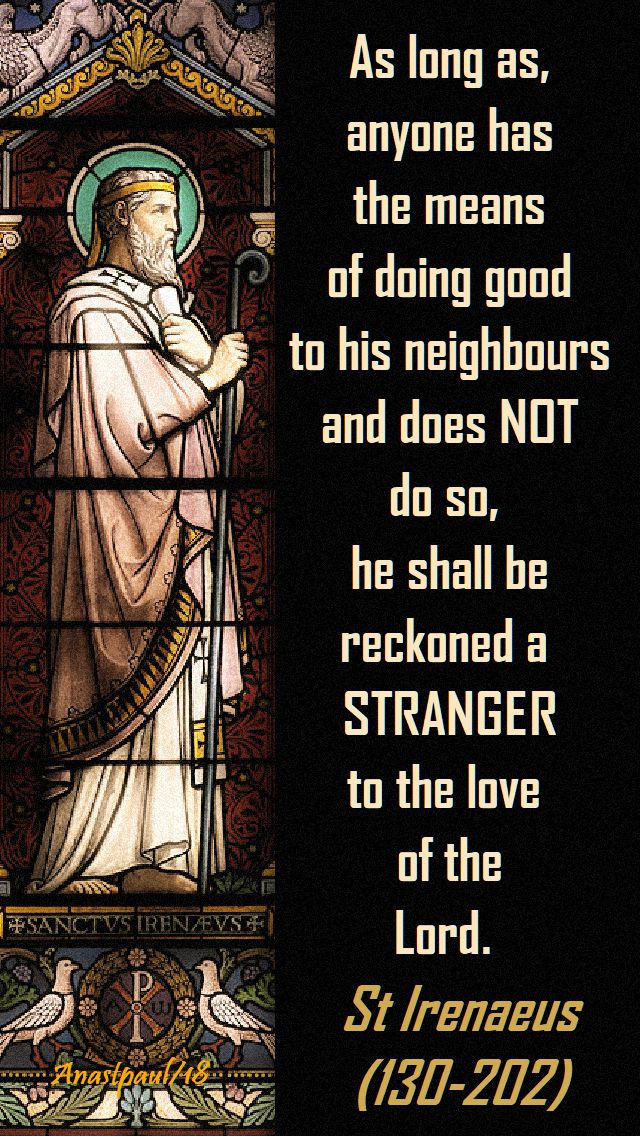
As long as anyone has the means
of doing good to his neighbours
and does not do so,
he shall be reckoned a stranger
to the love of the Lord.

St Irenaeus (130-202) Father of the Churchas-long-as-anyone-has-the-means-st-irenaeus-8-oct-2018-speaking-of-seeking-the-good-samaritan

“Mercy imitates God and disappoints Satan.”mercy imittes god - st john chrysostom - 17 nov 2018

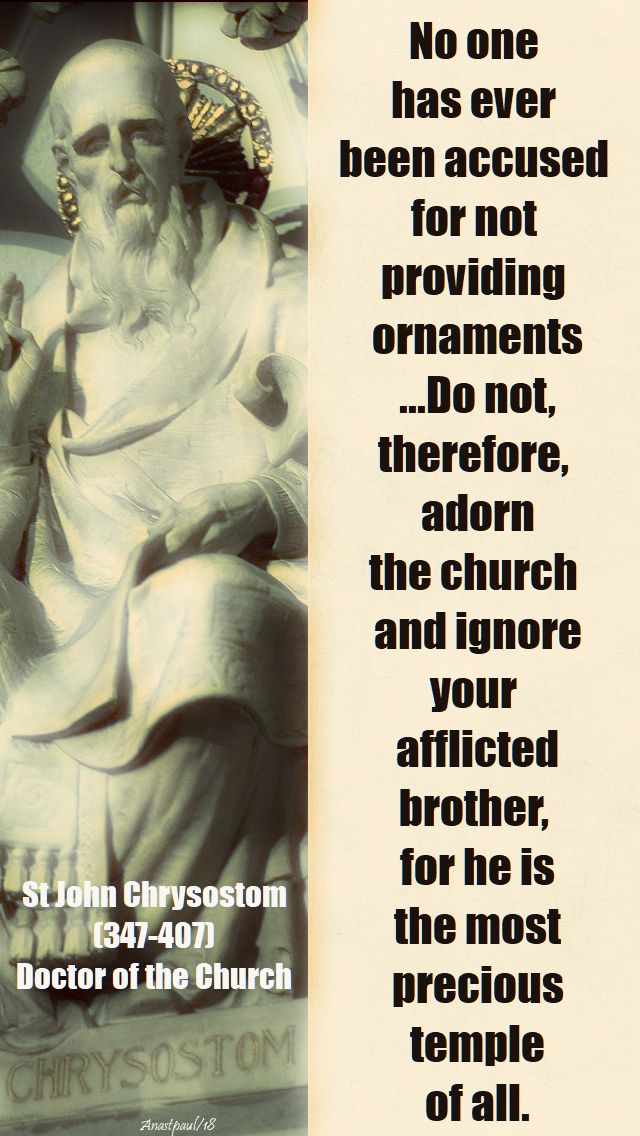
“No one has ever been accused for not providing ornaments
but for those who neglect their neighbour,
a hell awaits with an inextinguishable fire
and torment in the company of the demons.
Do not, therefore, adorn the church
and ignore your afflicted brother,
for he is the most precious temple of all.”

St John Chrysostom (347-407) Father & Doctor of the Churchno-one-has-ever-st-john-chrysostom-16-jan-2018

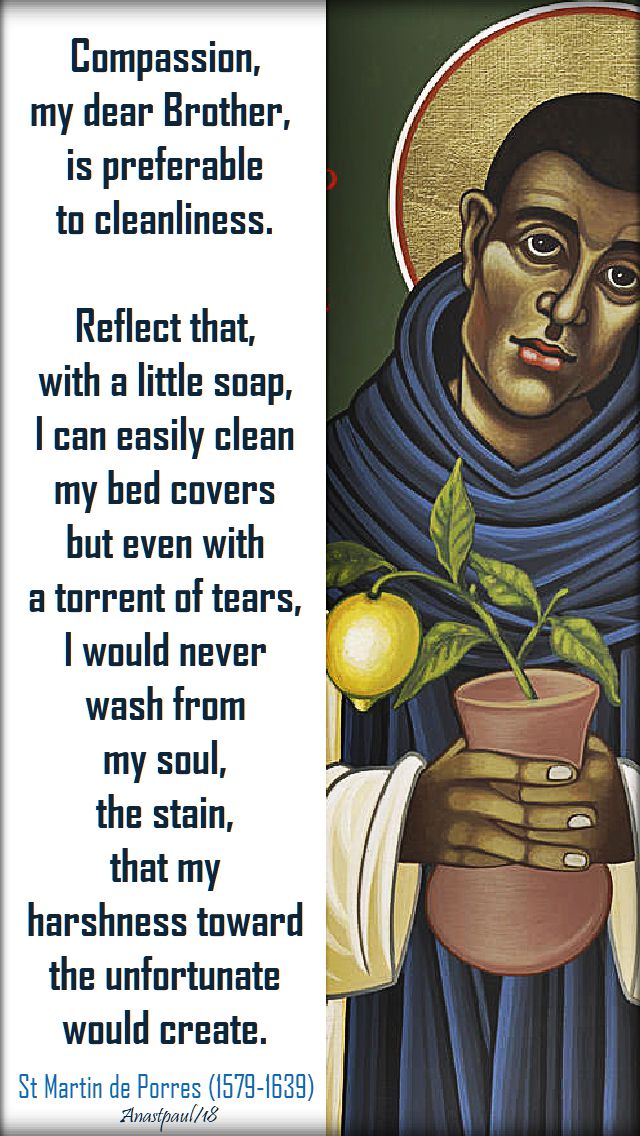
“Compassion, my dear Brother,
is preferable to cleanliness.
Reflect that with a little soap,
I can easily clean my bed covers
but even with a torrent of tears,
I would never wash from my soul,
the stain, that my harshness toward
the unfortunate would create.”

St Martin de Porres (1579-1639)compassion-my-dear-brother-st-martin-de-porres-3-nov-2018

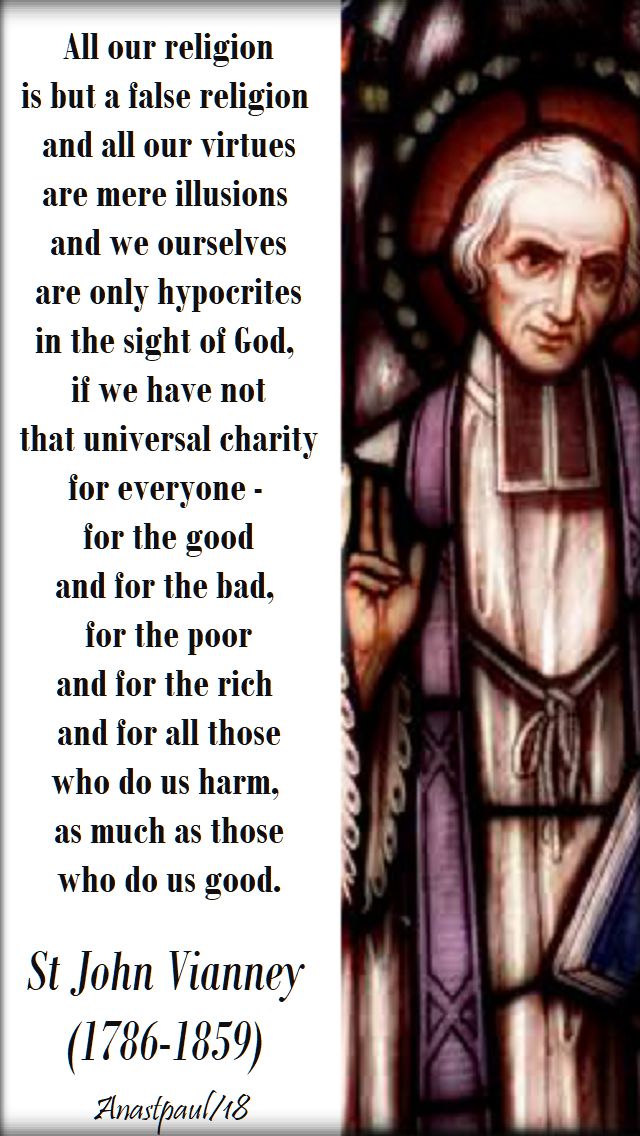
“All our religion is but a false religion
and all our virtues are mere illusions
and we ourselves are only hypocrites
in the sight of God,
if we have not that universal charity for everyone –
for the good and for the bad,
for the poor and for the rich
and for all those who do us harm,
as much as those who do us good.”

St John Vianney (1786-1859)all-our-religion-is-but-a-false-religion-st-john-vianney-4-aug-2018

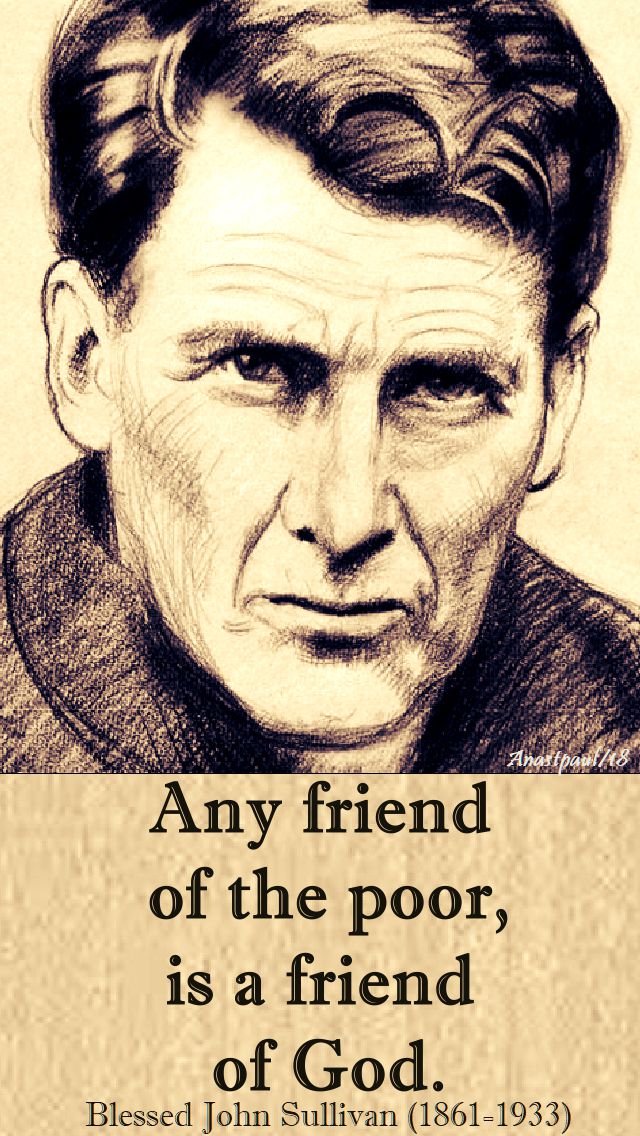
“Any friend of the poor, is a friend of God.”

Blessed John Sullivan SJ (1861-1933)any-friend-of-the-poor-is-a-friend-of-god-bl-john-sullivan-19-feb-2018

Posted in DOCTORS of the Church, FATHERS of the Church, MORNING Prayers, QUOTES of the SAINTS, QUOTES on FAITH, QUOTES on GRACE, QUOTES on PRAYER, SAINT of the DAY, The WORD

One Minute Reflection – 17 November – Today’s Gospel: Luke 18:1–8

One Minute Reflection – 17 November – Today’s Gospel: Luke 18:1–8 – Saturday of the Thirty Second week in Ordinary Time, Year B and The Memorial of St Elizabeth of Hungary (1207-1231)

“When the Son of man comes, will he find faith on earth?”...Luke 18:8

REFLECTION – “What more powerful incentive to prayer could be proposed to us than the parable of the unjust judge?   An unprincipled man, without fear of God or regard for other people, that judge nevertheless ended by granting the widow’s petition.   No kindly sentiment moved him to do so;  he was rather worn down by her pestering.   Now if a man can grant a request even when it is odious to him to be asked, how can we be refused by the one who urges us to ask?   Having persuaded us, therefore, by a comparison of opposites that “we ought always to pray and never lose heart,” the Lord goes on to put the question:  “Nevertheless, when the Son of Man comes, do you think he will find faith on earth?”
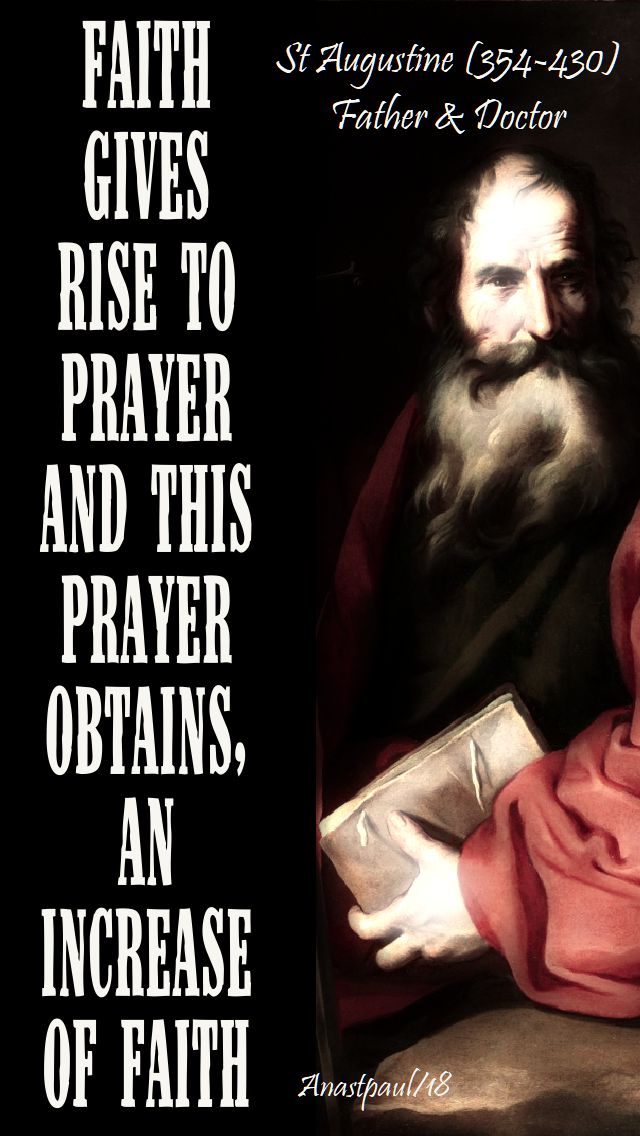
Where there is no faith, there is no prayer.   Who would pray for something he did not believe in?   So when the blessed Apostle exhorts us to pray he begins by declaring: “Whoever calls on the name of the Lord will be saved.”   But to show that faith is the source of prayer and the stream will not flow if its springs are dried up, he continues: “But how can people call on him in whom they do not believe?” (Rom 10:13-14).   We must believe, then, in order to pray and we must ask God, that the faith enabling us to pray, may not fail.   Faith gives rise to prayer and this prayer obtains, an increase of faith.”…St Augustine (354-430) Father & Doctor – Sermon 115, 1 ; PL 38, 655luke 18 8 - when the son of man comes - we must believe then, in order to pray - st augustine - 17 nov 2018

faith gives rise to prayer and this prayer - st augustine - 17 nov 2018

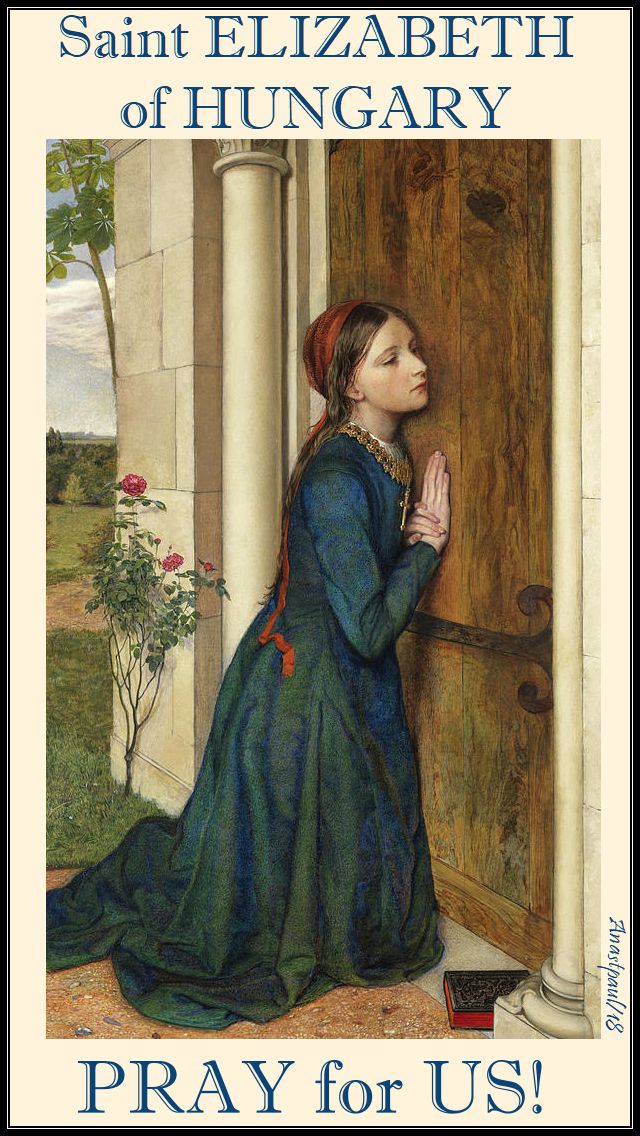
PRAYER – Holy Father, grant us a strong Faith!   Poor Your graces into our hearts that we may believe with all our hearts, minds and souls and that in believing, we may constantly raise our entire being to You in prayer and supplication, in prayer and adoration, in prayer and love.    May the intercession of St Elizabeth of Hungary, a woman of deep prayer from her youth, strengthen our perseverance.   Through Jesus Christ, our Lord in the unity of the Holy Spirit, God forever and ever, amen.st elizabeth of hungary pray for us - 17 nov 2018

Posted in MARIAN PRAYERS, MARIAN Saturdays, Our MORNING Offering, PRAYERS of the SAINTS, St Louis-Marie Grignion de MONTFORT, The BLESSED VIRGIN MARY

Our Morning Offering – 17 November – Make Me Like Yourself, Mary My Mother

Our Morning Offering – 17 November – Saturday of the Thirty Second week in Ordinary Time, Year B – Mary’s day

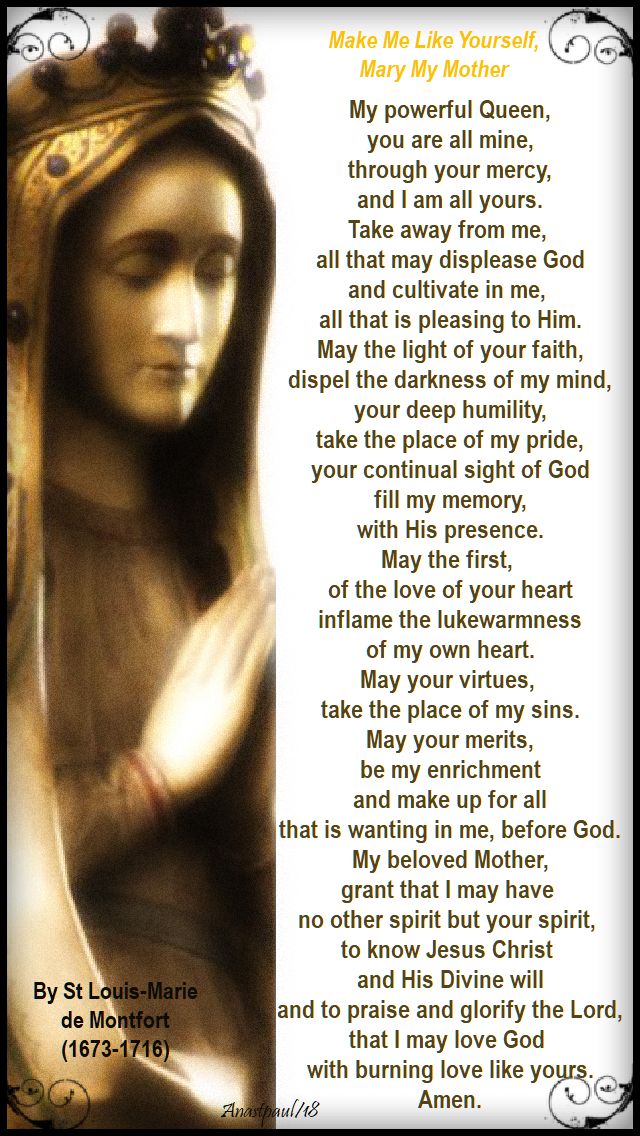
Make Me Like Yourself, Mary My Mother
By St Louis-Marie de Montfort (1673-1716)

My powerful Queen,
you are all mine, through your mercy,
and I am all yours.
Take away from me, all that may displease God
and cultivate in me, all that is pleasing to Him.
May the light of your faith,
dispel the darkness of my mind,
your deep humility,
take the place of my pride,
your continual sight of God,
fill my memory, with His presence.
May the first, of the love of your heart
inflame the lukewarmness, of my own heart.
May your virtues, take the place of my sins.
May your merits, be my enrichment
and make up for all
that is wanting in me, before God.
My beloved Mother,
grant that I may, have no other spirit but your spirit,
to know Jesus Christ and His Divine will
and to praise and glorify the Lord,
that I may love God, with burning love like yours.
Amen.make me like yourself mary my mother, - my power queen - st louis de montfort - 17 nov 2018

Posted in SAINT of the DAY

Saint of the Day – 17 November – St Gregory Thaumaturgus “the Wonder-Worker” (c 213-c 270)

Saint of the Day – 17 November – St Gregory Thaumaturgus (c 213-c 270) “the Wonder-Worker,” Bishop, Confessor, Miracle-worker, Writer, Preacher – also known as Gregory of Neocaesarea, Gregory the Wonder-Worker, Theodorus – born in c 213 at Pontus, Asia Minor (in modern Turkey) as Theodorus and died in c 270 at Pontus, Asia Minor (in modern Turkey) of natural causes.   Patronages – against earthquakes, desperate causes, floods, forgotten causes, impossible causes, lost causes.st gregory thaumaturgus - icon my edit
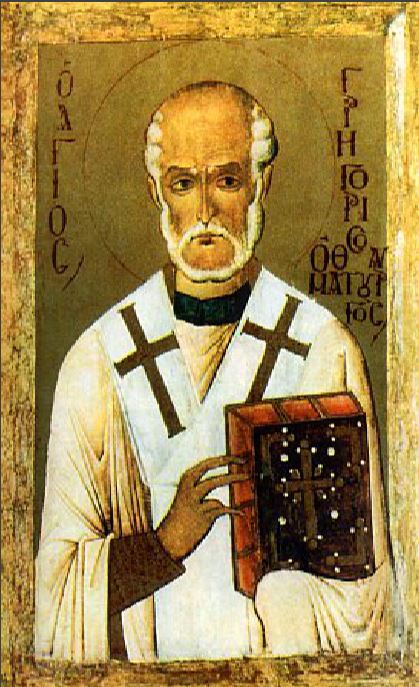
Gregory was born around 213 to a wealthy pagan family in Neocaesarea.   His surviving theological writings are in an incomplete state, thus this lack of knowledge partially obscures his personality, despite his historical importance and his memorial title Thaumaturgus meaning  “the wonder-worker” in Latinised Greek, casts an air of legend about him.   Nevertheless, the lives of few bishops of the third century are so well authenticated, the historical references to him permit a fairly detailed reconstruction of his work.

Originally he was known as Theodore (“gift of God”).   He was introduced to the Christian religion at the age of fourteen, after the death of his father.   He had a brother Athenodorus (who later also became a Bishop) and on the advice of one of their tutors, the young men were eager to study at the Berytus in Beirut, then one of the four or five famous schools in the Hellenic world.   At this time, their brother-in-law was appointed assessor (legal counsel) to the Roman Governor of Palestine;  the youths had therefore an occasion to act as an escort to their sister as far as Caesarea in Palestine.   On arrival in that town, they learned that the celebrated scholar Origen, head of the Catechetical School of Alexandria, resided there. Curiosity led them to hear and converse with the master.   Soon both youths forgot all about Beirut and Roman law and gave themselves up to the great Christian teacher, who gradually won them over to Christianity.

In his written oration on Origen, Gregory describes the method employed by that master to win the confidence and esteem of those he wished to convert, how he mingled a persuasive candour with outbursts of temper and theological argument put cleverly at once and unexpectedly.   Persuasive skill rather than bare reasoning and evident sincerity and an ardent conviction, were the means Origen used to make converts. Gregory took up at first the study of philosophy, theology was afterwards added but his mind remained always inclined to philosophical study, so much so indeed, that in his youth he cherished strongly the hope of demonstrating that the Christian religion was the only true and good philosophy.   For seven years he underwent the mental and moral discipline of Origen (231 to 238 or 239).   There is no reason to believe that his studies were interrupted by the persecutions of Maximinus of Thrace, his alleged journey to Alexandria, at this time, may therefore be considered at least doubtful and probably never occurred.St. Gregory Thaumaturgus
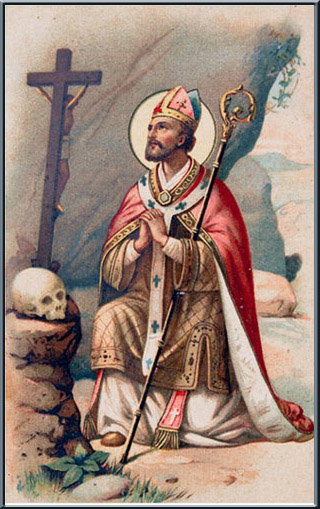
Before leaving Palestine, Gregory delivered, in presence of Origen, a public farewell oration in which he returned thanks to the illustrious master he was leaving.   This oration is valuable from many points of view.   As a rhetorical exercise it exhibits the excellent training given by Origen and his skill in developing literary taste and the amount of adulation then permissible, towards a living person, in an assembly composed mostly of Christians and Christian in temper.   It contains, moreover, much useful information concerning the youth of Gregory and his master’s method of teaching.   A letter of Origen refers to the departure of the two brothers but it is not easy to determine whether it was written before or after the delivery of this oration.   In it, Origen exhorts his pupils, to bring the intellectual treasures of the Greeks to the service of Christian philosophy and thus imitate the Jews, who employed the golden vessels of the Egyptians to adorn the Holy of Holies.

Gregory returned to Pontus with the intention of practising law.   His plan, however, was again laid aside, for he was soon consecrated bishop of his native Caesarea by Phoedimus, Bishop of Amasea and metropolitan of Pontus.   This fact illustrates in an interesting way the growth of the hierarchy in the primitive Church – the Christian community at Caesarea was very small, being only seventeen souls and yet it was given a bishop.   Ancient canonical documents indicate that it was possible, for a community of even ten Christians, to have their own bishop.   When Gregory was consecrated he was forty years old and he ruled his diocese for thirteen years.

Nothing definite is known about his methods but he must have shown much zeal in increasing the little flock with which he began his episcopal administration.   An ancient source attests to his missionary zeal by recording a curious coincidence, Gregory began with only seventeen Christians but at his death there remained only seventeen pagans in the whole town of Caesarea.   Presumably the many miracles which won for him the title of Thaumaturgus were performed during these years.

St Gregory of Nyssa (c 335-c 395) wrote the Life and Panegyric of Gregory drawing on family traditions and a knowledge of the neighbourhood, the facts for which, were supplied to the writer by his grandmother, St Macrina the Elder (c 270-c 340).   He relates that before his episcopal consecration, Gregory retired from Neocaesarea into a solitude and was favoured by an apparition of the Blessed Virgin and John the Apostle and that the latter dictated to him a creed or formula of Christian faith, of which the autograph existed at Neocaesarea when the biography was being written.   The creed itself is important for the history of Christian doctrine.

St Gregory of Nyssa describes at length the miracles that gained for the Bishop of Caesarea the title of Thaumaturgus.   It is clear that Gregory’s influence must have been considerable and his miraculous power undoubted.   It might have been expected that Gregory’s name would appear among those who took part in the First Council of Antioch against Paul of Samosata;  probably he took part also in the second council held there, for the letter of that council is signed by a bishop named Theodore, which had been originally Gregory’s name.   To attract the people to the festivals in honour of the martyrs, Gregory organised amusements that might appeal to pagans, who were accustomed to religious ceremonies that combined solemnity with pleasure and merrymaking.

When the persecution of Decius began in 250, the bishop counselled his faithful to depart and not expose themselves to trials perhaps too severe for their faith and none fell into apostasy.   He himself retired to a desert and when he was pursued, was not seen by the soldiers.   On a second attempt, they found him praying with his companion, the converted pagan priest, now a deacon – they had mistaken them the first time for trees. The captain of the soldiers was convinced this had been a miracle and became a Christian to join him.   Some of his Christians were captured, among them Saint Troadus the martyr, who merited the grace of dying for the Faith.   The persecution ended at the death of the emperor in 251.

It is believed that Saint Gregory died in the year 270, on 17 of November.    The death of St Gregory took place in the seventieth year of his age and the 270th of the Christian Era.
Shortly before closing his eyes, he asked if there were yet some in the city who had not received holy baptism.   ” Seventeen,” was the answer.   The Saint, already in his agony, raised his eyes to heaven and said:  ” Thanks and praise to God!   When I took possession of my See, I found only seventeen Christians.   May God preserve all in the true faith, and give to all infidels, in the whole world, the light of the Saviour’s divine Word!”

St Gregory’s remains were translated to Calabria, Italy, where many miracles once more occurred and continue so, as St Gregory intercedes for impossible causes.img-Saint-Gregory-Thaumaturgus

Some of the many miraculous events in Gregory’s life:

Saint Gregory of Nyssa writes that the Wonder-Worker was the first person known to receive a vision of the Mother of God.   The Virgin and Saint John the Baptist appeared to him in a vision and gave him what became a statement of doctrine on the Trinity.
Gregory had the power of healing by laying on of his hands.   Often the healing was so powerful that the patient was cured of his illness, and became a fervent convert on the spot.
During the construction of a church for his growing flock, the builders ran into a problem with a huge buried boulder.   Gregory ordered the rock to move out of the way of his church and it did.
In order to stop the River Lycus from its frequent and damaging floods, Gregory planted his staff at a safe point near the river bank.   He then prayed that the river would never rise past the staff.   The staff took root, grew into a large tree and the river never flooded past it again.   This act led to his patronage against floods and flooding.
Two local pagans, hearing that Gregory was an easy target for obtaining money, decided to con the bishop.   One lay beside the road where Gregory was travelling and pretended to be dead.   The other stopped the bishop, pleaded poverty and asked for money to bury his dead friend.   Gregory had no money with him, so he took off his cloak and threw it over the “dead” man, telling the “live” one to sell the cloak and use the funds.   When Gregory had moved on, the “live” con-man found that his friend had died.
Two brothers in Gregory’s diocese had inherited a piece of land that contained a lake. Unable to decide how to divide the lake, the two settled on armed combat to settle the matter.   On the night before the battle, Gregory prayed for a peaceful solution to the matter.   The next morning the brothers found that the lake had dried up leaving easily dividable farm land.   This is one of the miracles which led to his patronage of impossible causes.
When returning from the wilderness, Gregory had to seek shelter from a sudden and violent storm.   The only structure nearby was a pagan temple.   Gregory made the sign of the cross to purify the place, then spent the night there in prayer, waiting out the storm.   The next morning, the pagan priest arrived to receive his morning oracles.   The demons who had been masquerading as pagan gods advised him that they could not stay in the purified temple or near the holy man.   The priest threatened to summon the anti–Christian authorities to arrest Gregory.   The bishop wrote out a note reading “Gregory to Satan:  Enter”.   With this “permission slip” in hand, the pagan priest was able to summon his demons again.
The same pagan priest, realising that his gods unquestioningly obeyed Gregory’s single God, found the bishop and asked how it was done.   Gregory taught the priest the truth of Christianity.   Lacking faith, the priest asked for a sign of God’s power.   Gregory ordered a large rock to move from one place to another – it did.   The priest immediately abandoned his old life and eventually became a deacon under bishop Gregory.   This ordering about of boulders, led to Gregory’s patronage against earthquakes.

Posted in SAINT of the DAY

Memorials of the Saints – 17 November

St Elizabeth of Hungary TOSF (1207-1231) (Memorial)
About St Elizabeth:  https://anastpaul.wordpress.com/2017/11/17/saint-of-the-day-st-elizabeth-of-hungary-1207-1231-t-o-s-f/

St Acisclus
St Aignan of Orléans
St Alphaeus of Palestine
St Eugene of Florence
St Eusebio Roldán Vielva
St Florinus of Remüs
St Giacinto Ansalone
St Gregory of Tours
St Gregory Thaumaturgus (c 213-c 270) Bishop
St Hilda of Whitby
St Hugh of Lincoln
St Hugh of Noara
St Josefa Gironés Arteta
St Juan de Castillo-Rodriguez
St Laverius
St Lazarus Zographos
St Lorenza Díaz Bolaños
St Namasius of Vienne
Bl Salomea of Galicia
Bl Sébastien-Loup Hunot
St Thomas Hioji Nishi Rokuzaemon
St Victoria of Cordoba
Bl Yosafat Kotsylovsky
St Zacchaeus of Palestine

Jesuit Martyrs of Paraguay – 3 saints

Martyred in the Spanish Civil War:
• Blessed Eusebio Roldán Vielva
• Blessed Josefa Gironés Arteta
• Blessed Lorenza Díaz Bolaños

Posted in MARIAN DEVOTIONS, St Louis-Marie Grignion de MONTFORT, The BLESSED VIRGIN MARY, The INCARNATION, Thomas a Kempis, TOTAL Consecration to JESUS through MARY, Uncategorized

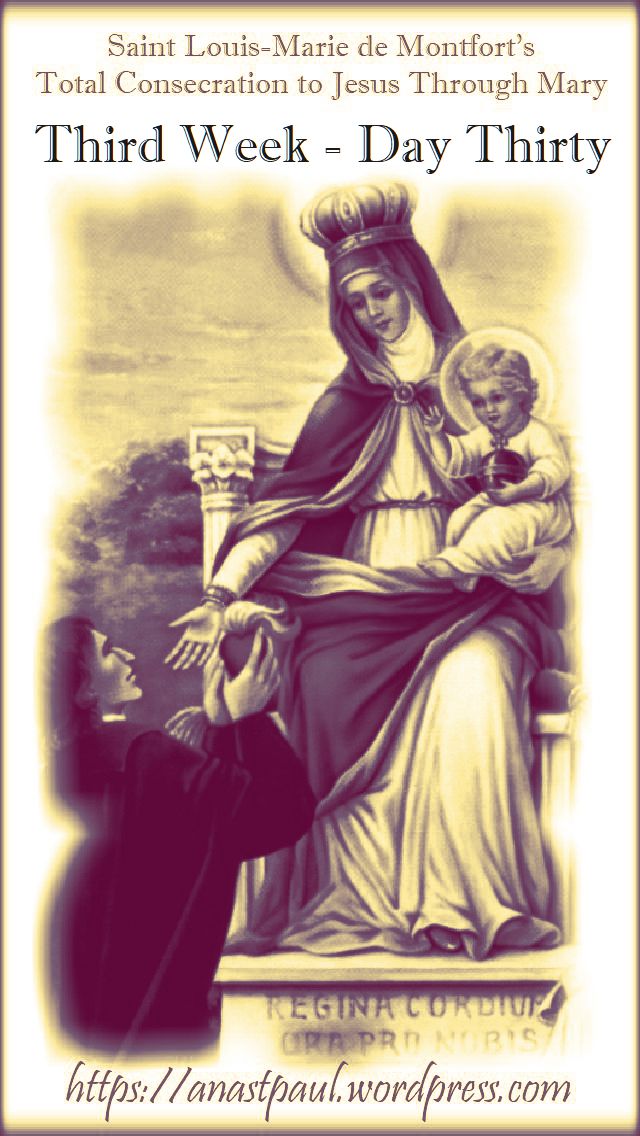
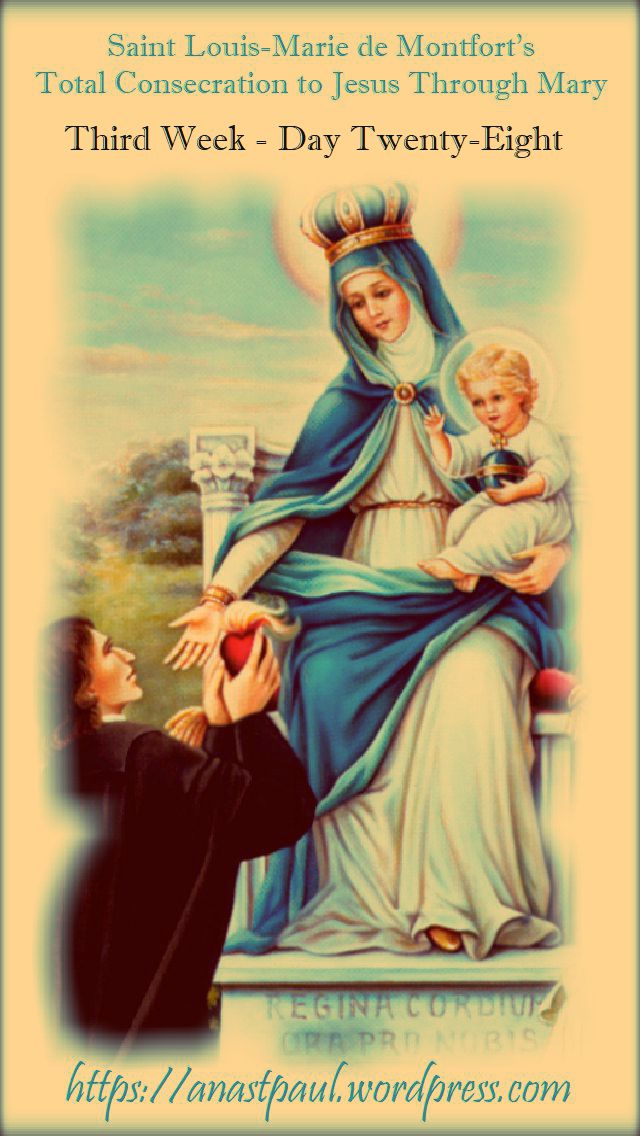
Saint Louis-Marie de Montfort’s Total Consecration to Jesus Through Mary – Third Week – Day Thirty-One – 16 November

Saint Louis-Marie de Montfort’s Total Consecration to Jesus Through Mary – Third Week – Day Thirty-One – 16 November

Third Week

Day 31 of 33

Imitation of Christ, by Thomas á Kempis:   Book 4, Chapter 2

That the Great Goodness and Love of God Is Exhibited to Man in This Sacrament

In confidence of Your goodness and great mercy, O Lord, I draw near, sick to the Healer, hungry and thirsty to the Fountain of life, needy to the King of Heaven, a servant to his Lord, a creature to the Creator, desolate to my own tender Comforter.   “But how is this to me,” that You come unto me (Luke 1:43)? What am I, that You should grant me Your own self? how dare a sinner appear before Your?

And how is it that You vouchsafe to come unto a sinner?   You know Your servant and are well aware that he has in him no good thing, for which You should grant him this.   I confess, therefore, my own vileness, I acknowledge Your goodness, I praise Your tender mercy and give You thanks for Your transcendent love.

From True Devotion To the Blessed Virgin Mary, Nos. 243-254 243.

Loving slaves of Jesus in Mary, should hold in high esteem devotion to Jesus, the Word of God, in the great mystery of the Incarnation, 25 March, which is the mystery proper to this devotion, because it was inspired by the Holy Spirit, for the following reasons:           a) That we might honour and imitate the wondrous dependence which God the Son chose to have on Mary, for the glory of His Father and for the redemption of man.   This dependence is revealed especially in this mystery where Jesus becomes a captive and slave in the womb of His Blessed Mother, depending on her for everything.                       b) That we might thank God for the incomparable graces He has conferred upon Mary and especially that of choosing her to be His most worthy Mother.   This choice was made in the mystery of the incarnation.   These are the two principal ends of the slavery of Jesus in Mary.

245. a) Since we live in an age of pride when a great number of haughty scholars, with proud and critical minds, find fault even with long-established and sound devotions, it is better to speak of “slavery of Jesus in Mary” and to call oneself “slave of Jesus” rather than “slave of Mary”.   We then avoid giving any pretext for criticism.   In this way, we name this devotion after its ultimate end which is Jesus, rather than after the way and the means to arrive there, which is Mary.   However, we can very well use either term without any scruple, as I myself do.

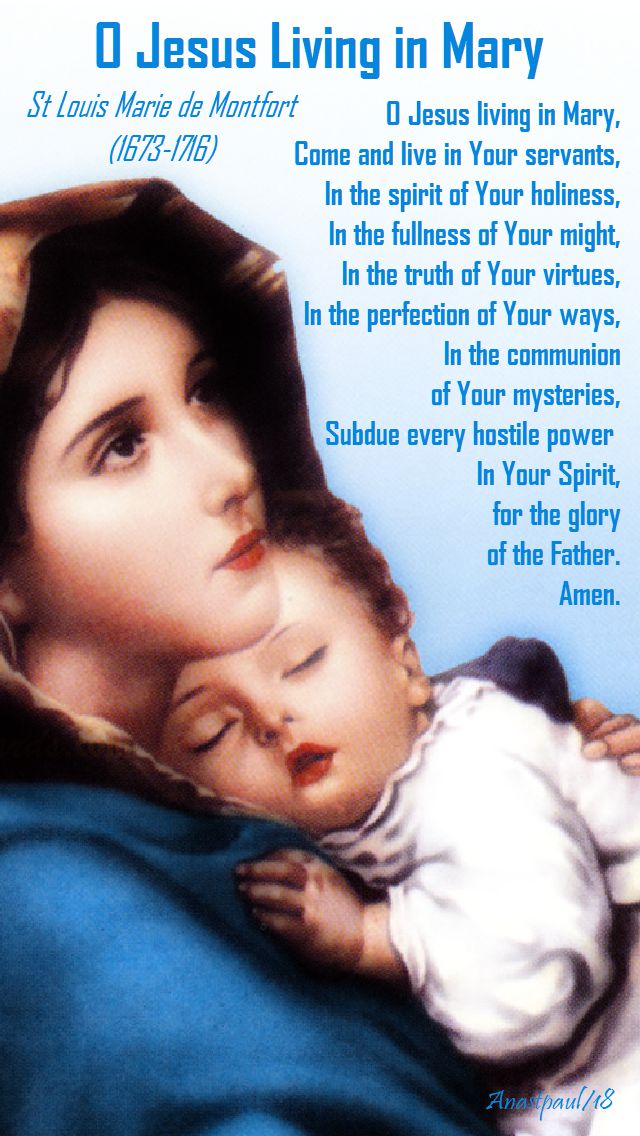
246. b) Since the principal mystery celebrated and honoured in this devotion is the mystery of the Incarnation where we find Jesus only in Mary, having become incarnate in her womb, it is appropriate for us to say, “slavery of Jesus in Mary”, of Jesus dwelling enthroned in Mary, according to the beautiful prayer, recited by so many great souls, “O Jesus living in Mary”. o jesus living in mary by st louis de montfort for total consecration - 12 nov 2018

249. Those who accept this devotion should have a great love for the Hail Mary, or, as it is called, the Angelic
Salutation.   Few Christians, however enlightened, understand the value, merit, excellence and necessity of the Hail Mary.   Our Blessed Lady herself had to appear on several occasions to men of great holiness and insight, such as St Dominic, St.John Capistran and Blessed Alan de Rupe, to convince them of the richness of this prayer.

Recite: Litany of the Holy Spirit, Ave Maris Stella: https://anastpaul.wordpress.com/2018/10/29/saint-louis-marie-de-montforts-total-consecration-to-jesus-through-mary-first-week-day-thirteen-29-october/

St Louis de Montfort’s Prayer to Mary: https://anastpaul.wordpress.com/2018/11/05/saint-louis-marie-de-montforts-total-consecration-to-jesus-through-mary-second-week-day-twenty-5-november/
AND
Litany of the Holy Name and O Jesus Living In Mary: https://anastpaul.wordpress.com/2018/11/12/saint-louis-marie-de-montforts-total-consecration-to-jesus-through-mary-third-week-day-twenty-seven-12-november/DAY THIRTY ONE - THIRD WEEK - TOTAL CONSECRATION 16 NOV 2018

Posted in SAINT of the DAY

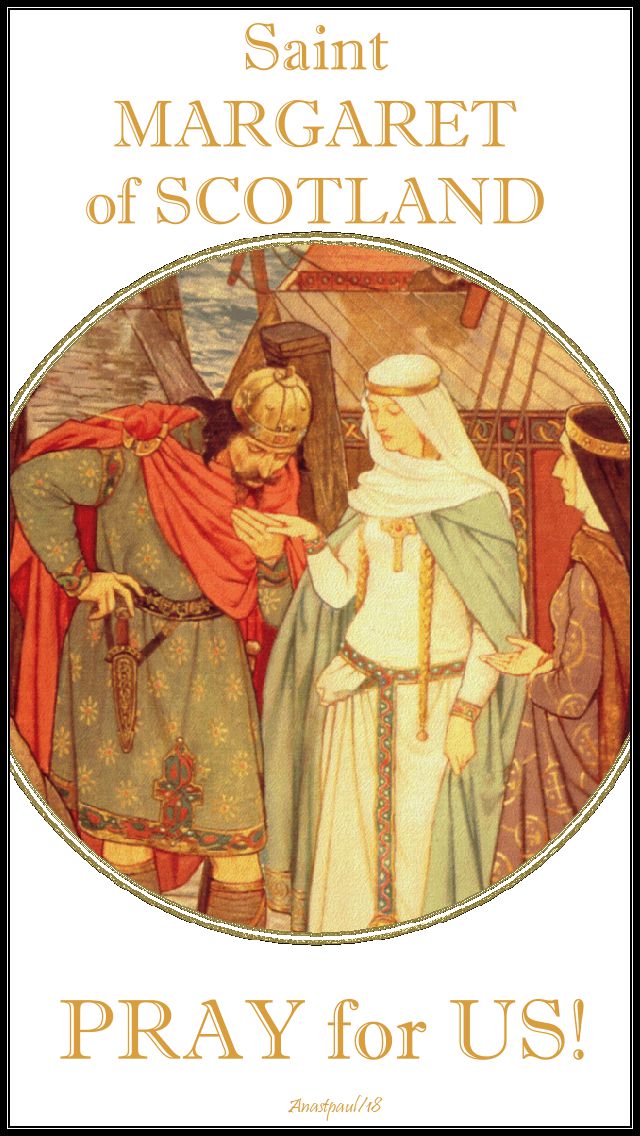
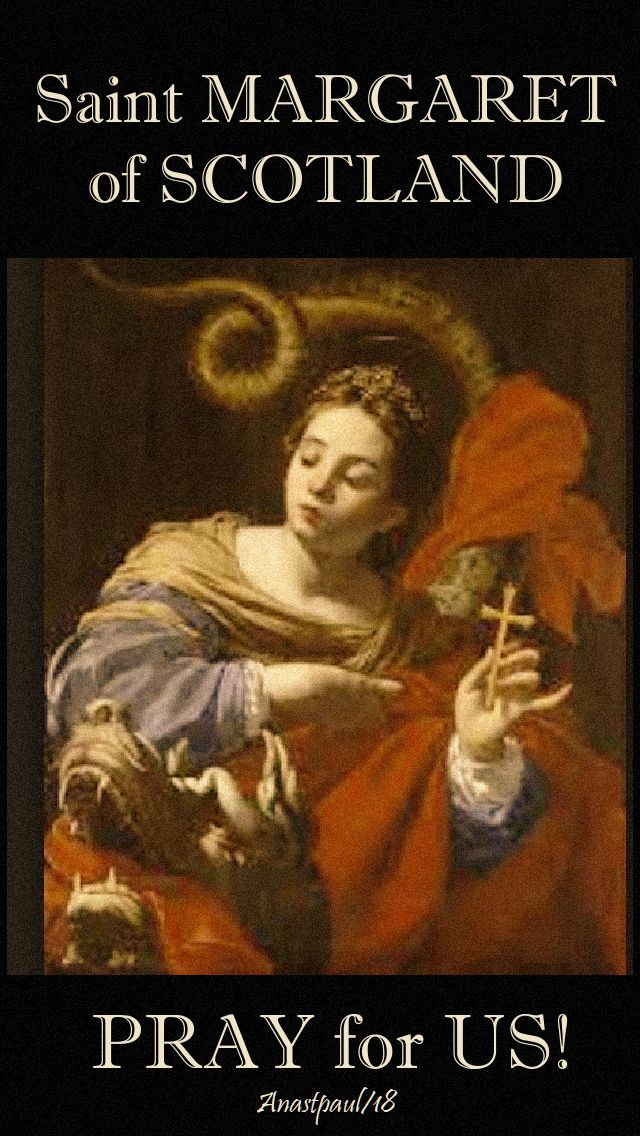
Thought for the Day – 16 November – The Memorial of St Margaret of Scotland (1045-1093)

Thought for the Day – 16 November – The Memorial of St Margaret of Scotland (1045-1093)

Margaret was not only a queen but a mother.   She and Malcolm had six sons and two daughters.   Margaret personally supervised their religious instruction and other studies.
Although she was very much caught up in the affairs of the household and country, she remained detached from the world.   Her private life was austere.   She had certain times for prayer and reading Scripture.   She ate sparingly and slept little, in order to have time for devotions.   She and Malcolm kept two Lents, one before Easter and one before Christmas.   During these times, she always rose at midnight for Mass.   On the way home, she would wash the feet of six poor persons and give them alms.   She was always surrounded by beggars in public and never refused them.   It is recorded, that she never sat down to eat without first feeding nine orphans and 24 adults.
There are two ways to be charitable – the “clean way” and the “messy way.”   The “clean way” is to give money or clothing to organisations that serve the poor.   The “messy way” is dirtying your own hands in personal service to the poor.   Margaret’s outstanding virtue, was her love of the poor.   Although very generous with material gifts, Margaret also visited the sick and nursed them with her own hands.   She and her husband served orphans and the poor on their knees during Advent and Lent.   Like Christ, she was charitable the “messy way.”

St Margaret of Scotland, Pray for Us!st margaret of scotland pray for us 16 nov 2018 no 2

Posted in ArchAngels and Angels, EUCHARISTIC Adoration, QUOTES of the SAINTS, QUOTES on ANGELS, QUOTES on DEATH, QUOTES on HEAVEN, QUOTES on SUFFERING, QUOTES on TEMPTATION, SAINT of the DAY, The BLESSED VIRGIN MARY, The HOLY EUCHARIST / The HOLY MASS, The HOLY FACE, The LAST THINGS, The WORD

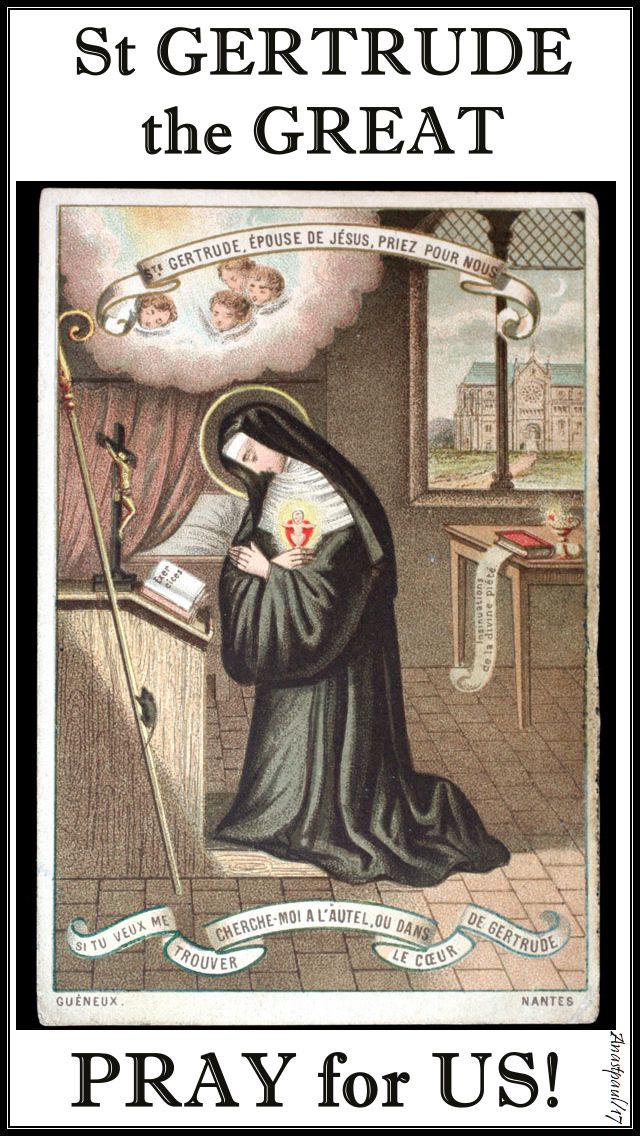
Quote/s of the Day – 16 November – The Memorial of St Gertrude the Great (1256-1302)

Quote/s of the Day – 16 November – The Memorial of St Gertrude the Great (1256-1302)

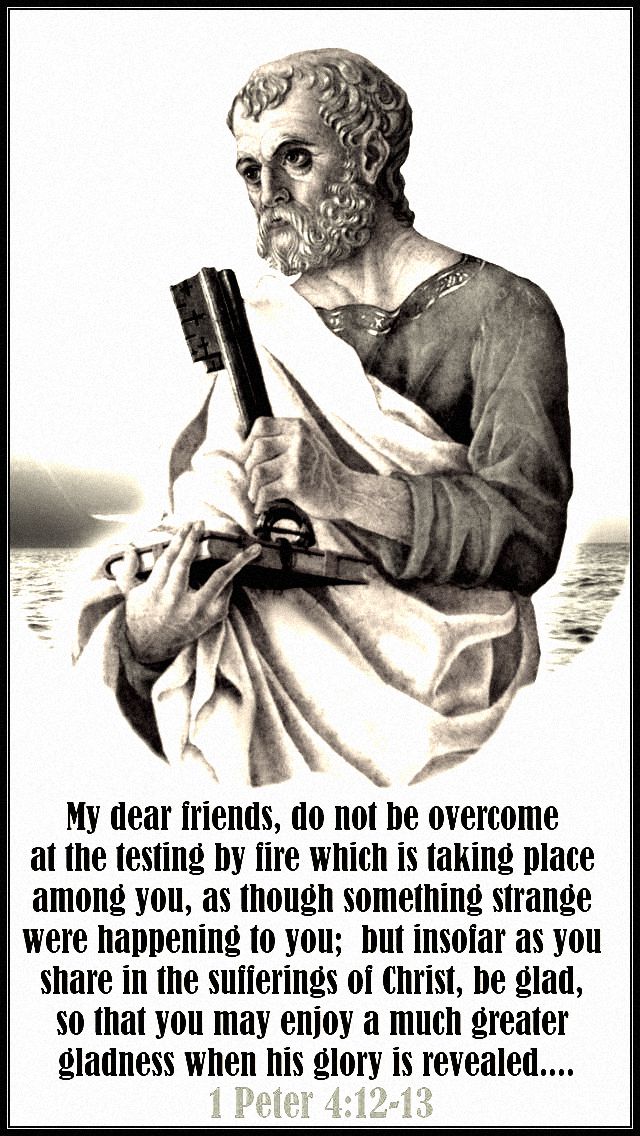
“My dear friends, do not be taken aback
at the testing by fire, which is taking place among you,
as though something strange, were happening to you
but insofar as you share in the sufferings of Christ,
be glad, so that you may enjoy
a much greater gladness, when his glory is revealed”

1 Peter 4:12-131-peter-4-12-13 - my dear friends, do not be overcome at the testing by fire - st peter 16 nov 2018

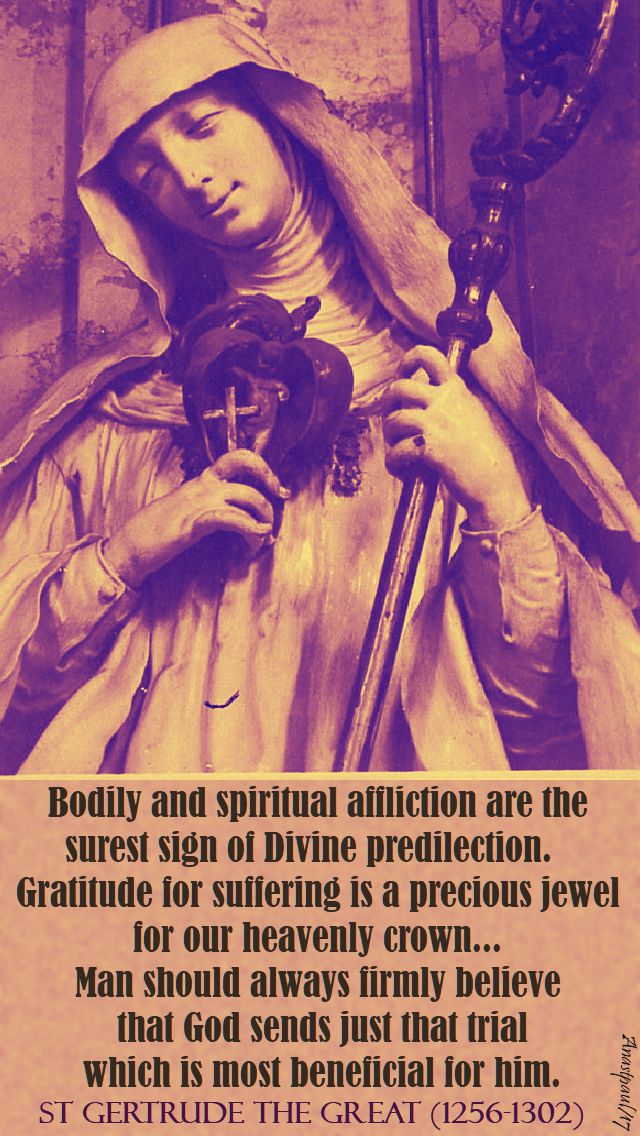
“Bodily and spiritual affliction
are the surest sign of Divine predilection.
Gratitude for suffering is a precious jewel
for our heavenly crown…
Man should always firmly believe that God
sends just that trial which is most beneficial for him.”bodily-and-spiritual-affliction-st-gertrude-16-nov-2017

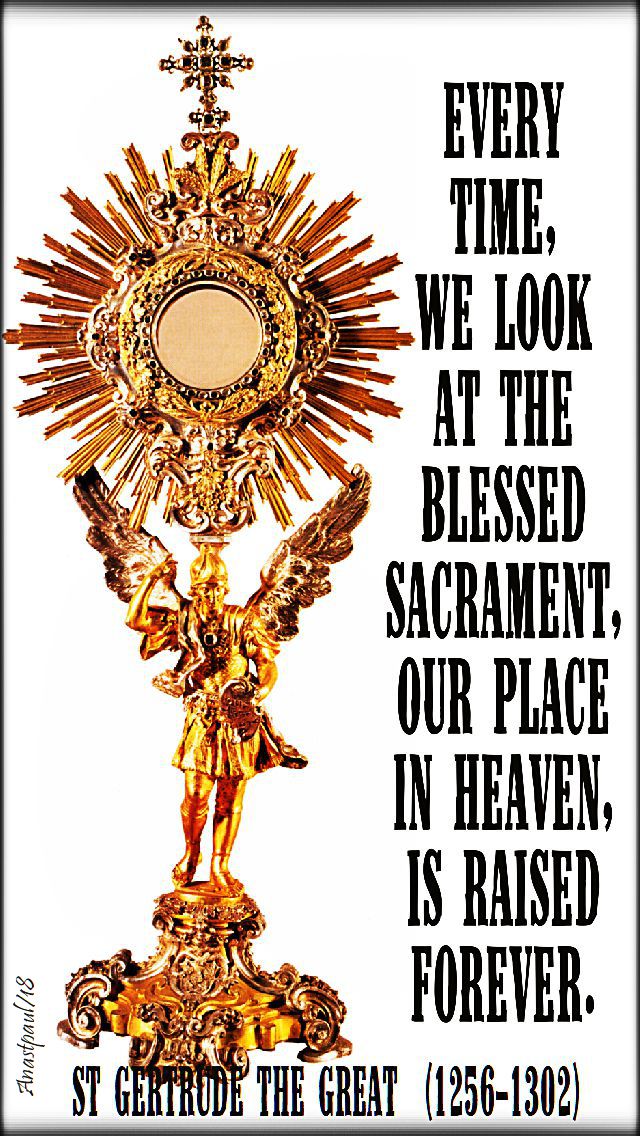
“Every time, we look
at the Blessed Sacrament,
our place in heaven,
is raised forever.”every time we look - st gertrude the great - 16 nov 2018

“I understand that,
each time we contemplate,
with desire and devotion,
the Host in which is hidden
Christ’s Eucharistic Body,
we increase our merits in heaven
and secure special joys to be ours,
later in the beatific vision of God.”i understand that - st gertrude 18 nov 2018.jpg

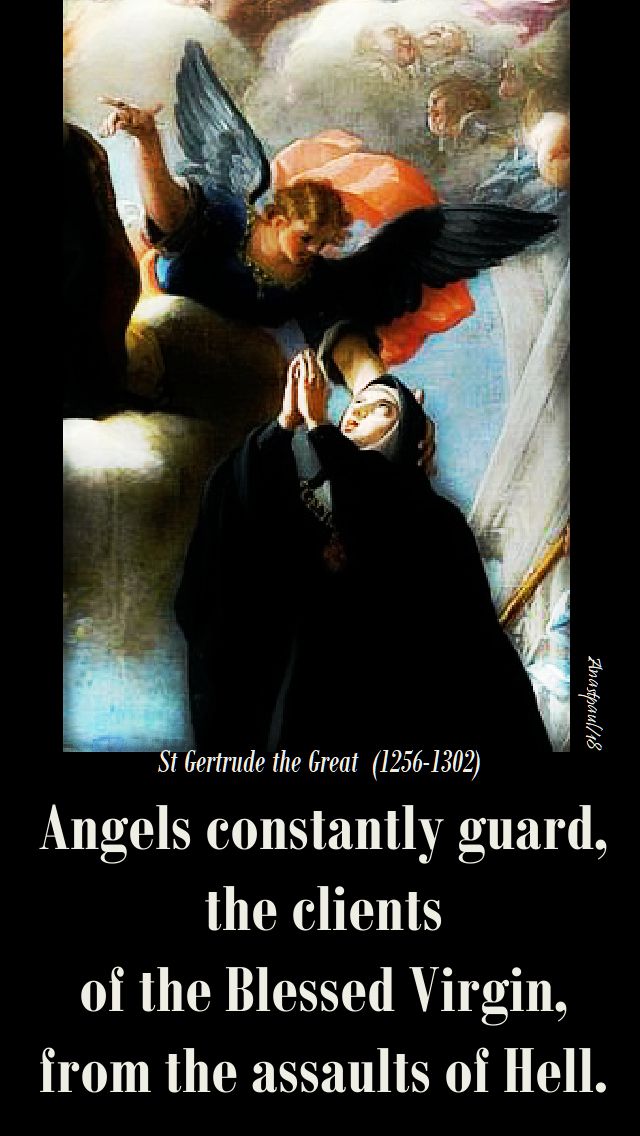
“Angels constantly guard,
the clients of the Blessed Virgin,
from the assaults of Hell.”

St Gertrude the Great (1256-1302)angels constantly guard the clients of the blessed virgin - st gertrude - 16 nov 2918

Posted in MORNING Prayers, PAPAL SERMONS, PRACTISING CATHOLIC, QUOTES on CONVERSION, QUOTES on DEATH, SAINT of the DAY, The WORD

One Minute Reflection – 16 November – Today’s Gospel: Luke 17:26–37

One Minute Reflection – 16 November – Today’s Gospel: Luke 17:26–37, Friday of the Thirty Second week in Ordinary Time, Year B and the memorial of St Margaret of Scotland (1045-1093) and St Gertrude the Great (1256-1302).

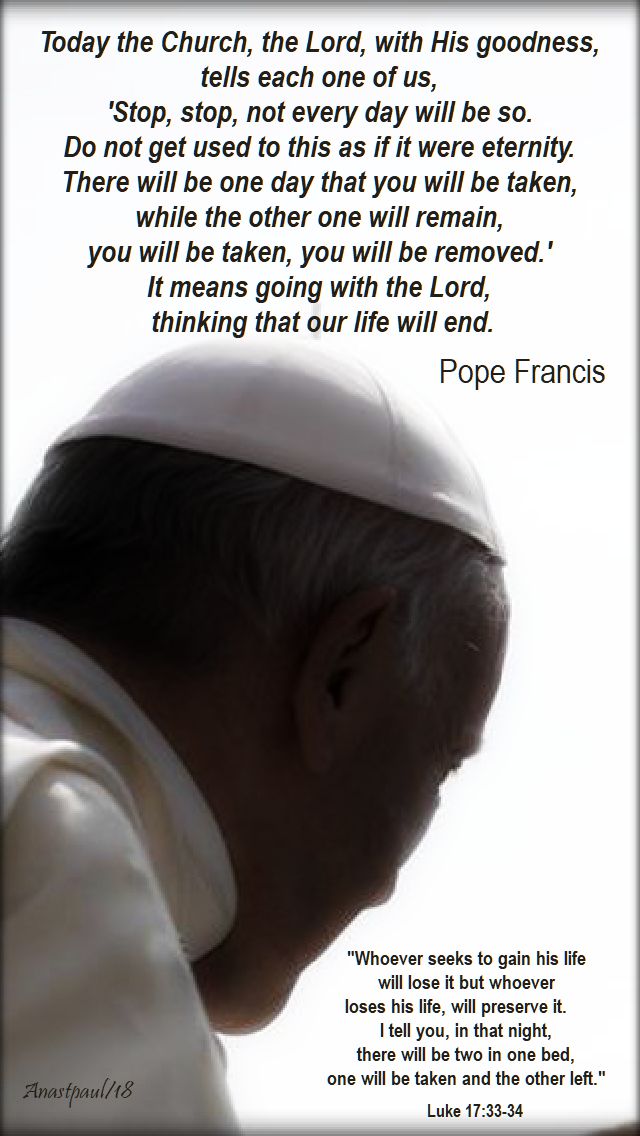
“Whoever seeks to gain his life, will lose it but whoever loses his life, will preserve it. I tell you, in that night there will be two in one bed; one will be taken and the other left.”…Luke 17:33-34

REFLECTION – “Today the Church, the Lord, with His goodness, tells each one of us, ‘Stop, stop, not every day will be so.   Do not get used to this as if it were eternity.   There will be one day that you will be taken, while the other one will remain, you will be taken, you will be removed.’    It means going with the Lord, thinking that our life will end.”…Pope Francis Santa Marta, 17 November 2017whoever seeks to gain his life - today the church, the lord - pope francis - 16 nov 2018

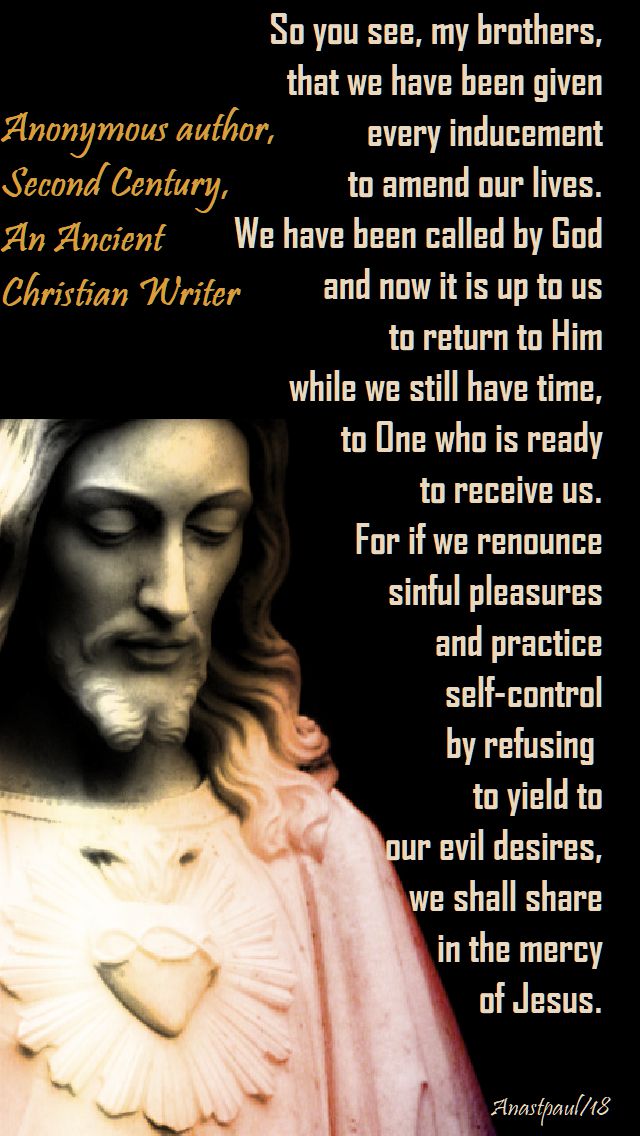
“So you see, my brothers, that we have been given every inducement, to amend our lives. We have been called by God and now it is up to us to return to Him, while we still have time to One, who is ready to receive us.   For if we renounce sinful pleasures and practice self-control, by refusing to yield to our evil desires, we shall share in the mercy of Jesus.
You must know, however, that the day of judgement, like a flaming furnace, is already approaching.   Sun, moon and stars will be consumed and the whole earth will become like lead melting in the fire.   All that each man has done, whether openly or in secret, will then be brought to light.   Therefore, a very good way of atoning for our sins is by being generous to the poor.   Fasting is better than prayer but almsgiving surpasses both, for love covers a multitude of sins.   Nevertheless, prayer delivers the soul from death, if it proceeds from a good conscience.   Happy the man who is found rich in these virtues; by relieving the poor, he himself will be relieved of his sins.
To make sure that none of us is lost, we must repent from the bottom of our hearts.”…Anonymous author, second century, An Ancient Christian Writer – An excerpt from A Homilyso you see my brothers, anonymous auther 2nd cent - 16 nov 2018

PRAYER – Lord God, grant to us that the power of Your protecting hand may keep us unshaken in the face of our ancient enemy and all his hidden snares.   Lighten our way so that, through the prayers of intercession of St Gertrude and St Margaret of Scotland, we may experience the joy of Your presence in our hearts and courage at times of suffering.   Through Jesus Christ, our Lord, with the Holy Spirit, one God for all eternity, amen.st margaret of scotland pray for us 16 nov 2018

st-gertrude-the-great-pray-for-us-16-nov-2017

Posted in GOD the FATHER, Our MORNING Offering, PRAYERS of the SAINTS, SAINT of the DAY

Our Morning Offering – 16 November – The Memorial of St Gertrude the Great (1256-1302)

Our Morning Offering – 16 November – The Memorial of St Gertrude the Great (1256-1302)

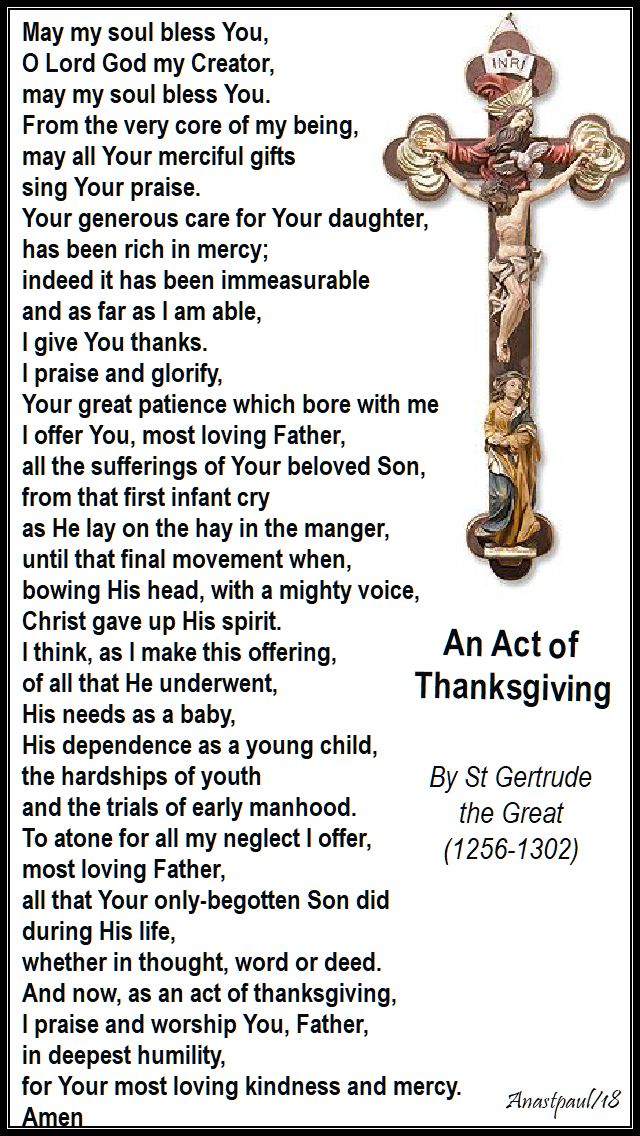
An Act of Thanksgiving
By St Gertrude the Great

May my soul bless You,
O Lord God my Creator,
may my soul bless You.
From the very core of my being,
may all Your merciful gifts sing Your praise.
Your generous care for Your daughter,
has been rich in mercy;
indeed it has been immeasurable
and as far as I am able,
I give You thanks.
I praise and glorify,
Your great patience which bore with me
I offer You, most loving Father,
all the sufferings of Your beloved Son,
from that first infant cry
as He lay on the hay in the manger,
until that final movement, when,
bowing His head, with a mighty voice,
Christ gave up His spirit.
I think, as I make this offering,
of all that He underwent,
His needs as a baby,
His dependence as a young child,
the hardships of youth
and the trials of early manhood.
To atone for all my neglect I offer,
most loving Father,
all that Your only-begotten Son did
during His life,
whether in thought, word or deed.
And now, as an act of thanksgiving,
I praise and worship You, Father,
in deepest humility,
for Your most loving kindness and mercy.
Amen

(Excerpt from the Revelations by Saint Gertrude)an act of thanksgiving to the father for the son by st gertrude the great 16 nov 2018.jpg

Posted in Of Catholic Education, Students, Schools, Colleges etc, Of PARENTS & FAMILIES of LARGE Families, QUOTES on DEATH, SAINT of the DAY, WIDOWS and WIDOWERS

Saint of the Day – 16 November – St Margaret of Scotland (1045-1093) Queen

Saint of the Day – 16 November – St Margaret of Scotland (1045-1093) Queen consort of Scotland – born in c 1045 in Hungary and died on 16 November 1093 at Edinburgh Castle, Scotland, four days after her husband and son died in defense of the castle.   Patronages – Scotland, Dunfermline, Fife, Shetland, The Queen’s Ferry, queens, widows, against the death of children and Anglo-Scottish relations.   St Margaret was the mother of three kings of Scotland, or four, if Edmund of Scotland, who ruled with his uncle, Donald III, is counted and of a queen consort of England.   According to the Vita S. Margaritae (Scotorum) Reginae (Life of St Margaret, Queen (of the Scots), attributed to Turgot of Durham, she died at Edinburgh Castle in Edinburgh, Scotland in 1093, merely days after receiving the news of her husband’s death in battle.HEADER - st-margaret-of-scotland-queen-mary-evans-picture-library

Saint Margaret’s name signifies “pearl” “a fitting name,” says Bishop Turgot, her confessor and her first biographer, “for one such as she.”   Her soul was like a precious pearl.   A life spent amidst the luxury of a royal court never dimmed its lustre, or stole it away from him who had bought it with his blood.   She was the grand-daughter of an English king and in 1070 she became the bride of Malcolm and reigned Queen of Scotland till her death in 1093.

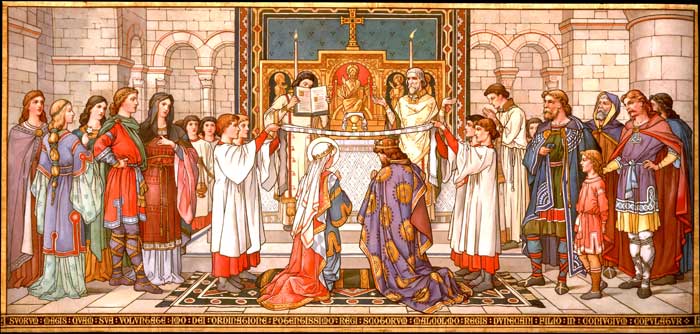
Malcolm_and_Margaret_at_Queensferry
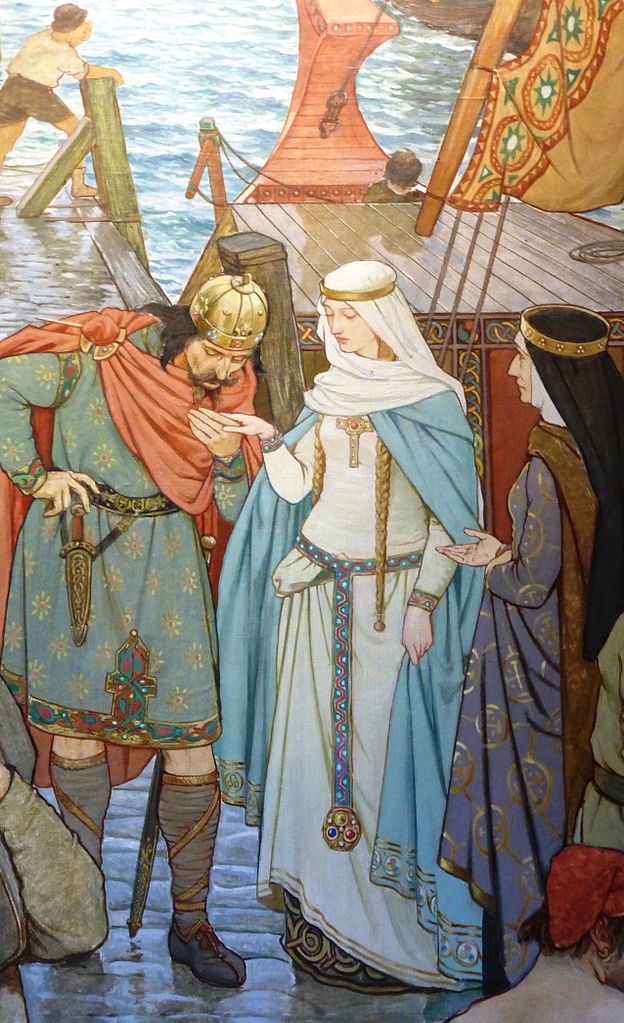
Malcolm greeting Margaret at her arrival in Scotland – detail of a mural by Victorian artist William Hole

3-marriage-of-st-margaret

How did she become a Saint in a position where sanctity is so difficult?

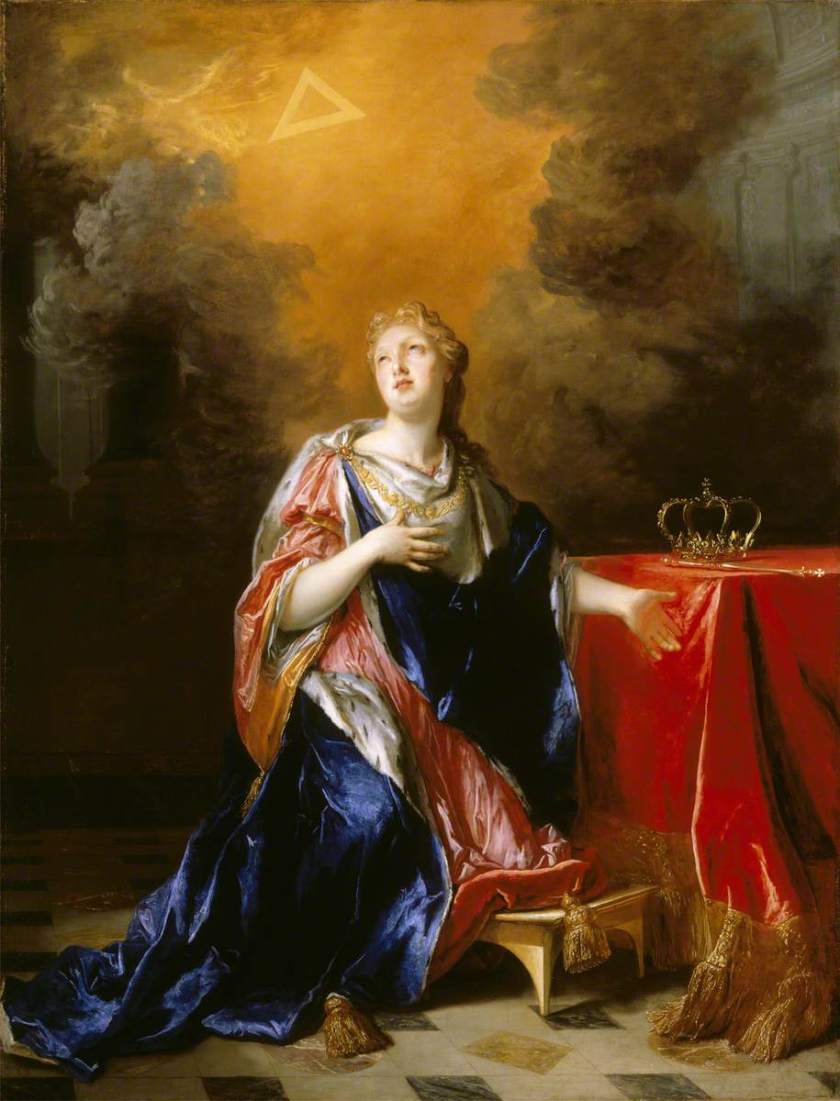
Margaret’s biographer Turgot of Durham, Bishop of St Andrew’s, credits her with having a civilising influence on her husband Malcolm by reading him narratives from the Bible. She instigated religious reform, striving to conform the worship and practices of the Church in Scotland to those of Rome.   This she did on the inspiration and with the guidance of Lanfranc, a future Archbishop of Canterbury.   She also worked to conform the practices of the Scottish Church to those of the continental Church, which she experienced in her childhood.   Due to these achievements, she was considered an exemplar of the “just ruler” and moreover influenced her husband and children, especially her youngest son, the future King David I of Scotland, to be just and holy rulers.de Largilliere, Nicolas, 1656-1746; Saint Margaret (c.1045-1093), Queen of Scotland

“The chroniclers all agree in depicting Queen Margaret as a strong, pure, noble character, who had very great influence over her husband and through him over Scottish history, especially in its ecclesiastical aspects.   Her religion, which was genuine and intense, was of the newest Roman style and to her are attributed a number of reforms by which the Church [in] Scotland was considerably modified from the insular and primitive type which down to her time it had exhibited.   Among those expressly mentioned are a change in the manner of observing Lent, which thenceforward began as elsewhere on Ash Wednesday and not as previously on the following Monday and the abolition of the old practice of observing Saturday (Sabbath), not Sunday, as the day of rest from labour (see Skene’s Celtic Scotland, book ii chap. 8).”   The later editions of the Encyclopædia Britannica, however, as an example, the Eleventh Edition, remove Skene’s opinion that Scottish Catholics formerly rested from work on Saturday, something for which there is no historical evidence.   Skene’s Celtic Scotland, vol. ii, chap. 8, pp. 348–350, quotes from a contemporary document regarding Margaret’s life but his source says nothing at all of Saturday Sabbath observance but rather says St Margaret exhorted the Scots to cease their tendency “to neglect the due observance of the Lord’s day.”

She attended to charitable works, serving orphans and the poor every day before she ate and washing the feet of the poor in imitation of Christ.   She rose at midnight every night to attend the liturgy.   She successfully invited the Benedictine Order to establish a monastery in Dunfermline, Fife in 1072 and established ferries at Queensferry and North Berwick to assist pilgrims journeying from south of the Firth of Forth to St Andrew’s in Fife.   She used a cave on the banks of the Tower Burn in Dunfermline as a place of devotion and prayer.   St Margaret’s Cave, now covered beneath a municipal car park, is open to the public.   Among other deeds, Margaret also instigated the restoration of Iona Abbey in Scotland.   She is also known to have interceded for the release of fellow English exiles who had been forced into serfdom by the Norman conquest of England.st margaret os cotland 3

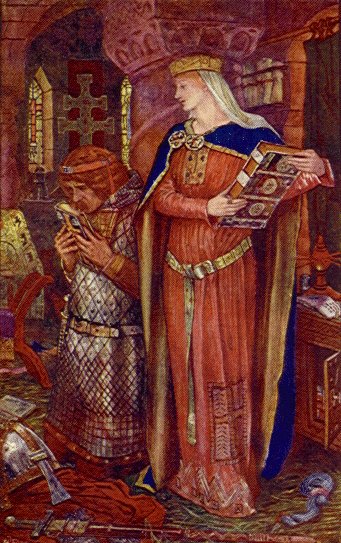
Margaret was as pious privately, as she was publicly.   She spent much of her time in prayer, devotional reading and ecclesiastical embroidery.   This apparently had considerable effect on the more uncouth Malcolm, who was illiterate – he so admired her piety that he had her books decorated in gold and silver.   One of these, a pocket gospel book with portraits of the Evangelists, is in the Bodleian Library in Oxford, England.[8]

Malcolm was apparently largely ignorant of the long-term effects of Margaret’s endeavours.   He was content for her to pursue her reforms as she desired, which was a testament to the strength of and affection in their marriage.MargarethavanSchotland

St Margaret did not neglect her duties in the world because she was not of it.   Never was a better mother.   She spared no pains in the education of her eight children, 6 sons and 2 daughters and their sanctity was the fruit of her prudence and her zeal.   Never was a better queen.   She was the most trusted counsellor of her husband and she laboured for the material improvement of the country.Saint_Margaret_of_Scotland

Her husband Malcolm III, and their eldest son Edward, were killed in the Battle of Alnwick against the English on 13 November 1093.   Her son Edgar was left with the task of informing his mother of their deaths.   Not yet 50 years old, Margaret died on 16 November 1093, three days after the deaths of her husband and eldest son.   The cause of death was reportedly grief.   After receiving Holy Viaticum, she was repeating the prayer from the Missal, “O Lord Jesus Christ, who by thy death didst give life to the world, deliver me.”   At the words “deliver me,” says her biographer, she took her departure to Christ, the Author of true liberty.

She was buried before the high altar in Dunfermline Abbey in Fife, Scotland.   In 1250, the year of her Canonisation, by Pope Innocent IV, her body and that of her husband were exhumed and placed in a new shrine in the Abbey.   Her relics were dispersed after the Scottish Reformation and subsequently lost.   Mary, Queen of Scots, at one time owned her head, which was subsequently preserved by Jesuits in the Scottish College, Douai, France, from where it was lost during the French Revolution.st margaret statue

Posted in MARIAN TITLES, SAINT of the DAY

Memorials of the Saints – 16 November

St Gertrude the Great (1256-1302) (Optional Memorial)

St Margaret of Scotland (1045-1093) Queen (Optional Memorial)

Patronage of Our Lady: Feast permitted by a 1679 decree of the Sacred Congregation of Rites for all provinces of Spain, in memory of the victories obtained there over infidels. Pope Benedict XIII granted it to the Papal States and it may now be celebrated with due permission by churches throughout the world.

Our Lady of the Gate of Dawn/Our Lady of Ostra Brama:  is the prominent Catholic painting of the Blessed Virgin Mary venerated by the faithful in the Chapel of the Gate of Dawn in Vilnius, Lithuania. The painting was historically displayed above the Vilnius city gate; city gates of the time often contained religious artefacts intended to ward off attacks and bless passing travellers.
The painting is in the Northern Renaissance style and was completed most likely around 1630.   The Virgin Mary is depicted without the infant Jesus  . The artwork soon became known as miraculous and inspired a following.   A dedicated chapel was built in 1671 by the Discalced Carmelites.   At the same time, possibly borrowing from the Eastern Orthodox tradition, the painting was covered inexpensive and elaborate silver and gold clothes leaving only the face and hands visible.
In 1702, when Vilnius was captured by the Swedish army during the Great Northern War, Our Lady of the Gate of Dawn came to her people’s rescue.   At dawn, the heavy iron city gates of the gate fell crushing and killing four Swedish sold  iers. After this, the Polish-Lithuanian Commonwealth Army successfully counter-attacked near the gate.
In the following centuries, the following grew stronger and Our Lady became an important part of religious life in Vilnius.   The following inspired many copies in Lithuania, Poland and diaspora communities worldwide.   In 5 July 1927, the image was canonically crowned as Mother of Mercy.   The chapel was visited by St Pope John Paul II in 1993.   It is a major site of pilgrimage in Vilnius and attracts many visitors, especially from Poland.

St Afan of Wales
St Africus of Comminges
Bl Agnes of Assisi
St Agostino of Capua
St Alfric of Canterbury
St Anianus of Asti
St Céronne
St Edmund Rich of Abingdon
Bl Edward Osbaldeston
St Elpidius the Martyr
St Eucherius of Lyon
St Eustochius the Martyr
St Felicita of Capua
St Fidentius of Padua
St Gobrain of Vannes
St Ludre
St Marcellus the Martyr
St Othmar of Saint Gal
Bl Simeon of Cava

Martyrs of Africa – (11 saints)

Martyrs of Almeria – (9 saints): Soon after the start of the Spanish Civil War in 1936, the Communist-oriented Popular Front had all clergy and religious arrested and abused as they considered staunch Christians to be enemies of the revolution. Many of these prisoners were executed for having promoted the faith and this memorial remembers several of them killed in the province of Almeria.
• Adrián Saiz y Saiz
• Bienvenido Villalón Acebrón
• Bonifacio Rodríguez González
• Diego Ventaja Milán
• Eusebio Alonso Uyarra
• Isidoro Primo Rodríguez
• Justo Zariquiegui Mendoza
• Manuel Medina Olmos
• Marciano Herrero Martínez
Beatification – 10 October 1993 by St Pope John Paul II

Posted in MARIAN DEVOTIONS, St Louis-Marie Grignion de MONTFORT, Thomas a Kempis, TOTAL Consecration to JESUS through MARY

Saint Louis-Marie de Montfort’s Total Consecration to Jesus Through Mary – Third Week – Day Thirty – 15 November

Saint Louis-Marie de Montfort’s Total Consecration to Jesus Through Mary – Third Week – Day Thirty – 15 November

Third Week

Day 30 of 33

Matthew 27:36-44

Then they sat down and kept watch over him there.   And over his head they put the charge against him, which read, “This is Jesus the King of the Jews.”   Then two robbers were crucified with him, one on the right and one on the left.   And those who passed by derided him, wagging their heads and saying, “You who would destroy the temple and build it in three days, save yourself!   If you are the Son of God, come down from the cross.”   So also the chief priests, with the scribes and elders, mocked him, saying, “He saved others, he cannot save himself.   He is the King of Israel, let him come down now from the cross and we will believe in him.   He trusts in God, let God deliver him now, if he desires him, for he said, ‘I am the Son of God.’ ”   And the robbers who were crucified with him also reviled him in the same way.

Imitation of Christ, by Thomas á Kempis:  Book 2, Chapter 12

Of the King’s High Way of the Holy Cross

Unto many this seems a hard saying, “Deny yourself, take up your cross and follow Jesus” (Matt. 16:24).   But much harder will it be to hear that last word, “Depart from Me, you cursed, into everlasting fire” (Matt. 25:41).   For they who now willingly hear and follow the word of the Cross, shall not then fear (Psalm 112:7) to hear the sentence of everlasting damnation.   This sign of the Cross shall be in the heaven, when the Lord shall come to judgement (Matt. 24:30).   Then all the servants of the Cross, who in their life-time conformed themselves unto Christ crucified, shall draw near unto Christ the Judge with great confidence.

Why therefore fear you to take up the Cross which leads you to the kingdom? In the Cross is salvation, in the Cross is life, in the Cross is protection against our enemies, in the Cross is infusion of heavenly sweetness, in the Cross is strength of mind, in the Cross joy of spirit, in the Cross the height of virtue, in the Cross the perfection of holiness.

Take up, therefore, your Cross and follow Jesus (Luke 14:27) and you shall go into life everlasting.

Recite:  Litany of the Holy Spirit, Ave Maris Stella: https://anastpaul.wordpress.com/2018/10/29/saint-louis-marie-de-montforts-total-consecration-to-jesus-through-mary-first-week-day-thirteen-29-october/

St Louis de Montfort’s Prayer to Mary: https://anastpaul.wordpress.com/2018/11/05/saint-louis-marie-de-montforts-total-consecration-to-jesus-through-mary-second-week-day-twenty-5-november/
AND
Litany of the Holy Name and O Jesus Living In Mary: https://anastpaul.wordpress.com/2018/11/12/saint-louis-marie-de-montforts-total-consecration-to-jesus-through-mary-third-week-day-twenty-seven-12-november/DAY TWENTY NINE - THIRD WEEK - TOTAL CONSECRATION 15 NOV 2018

Posted in SAINT of the DAY

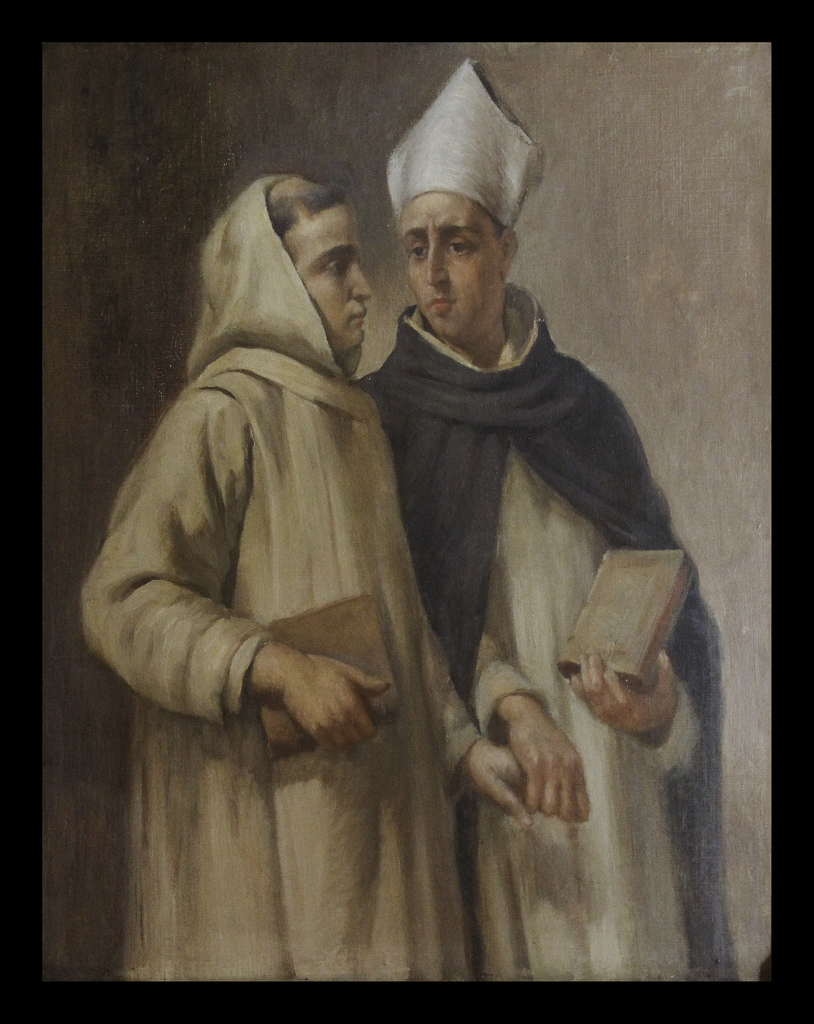
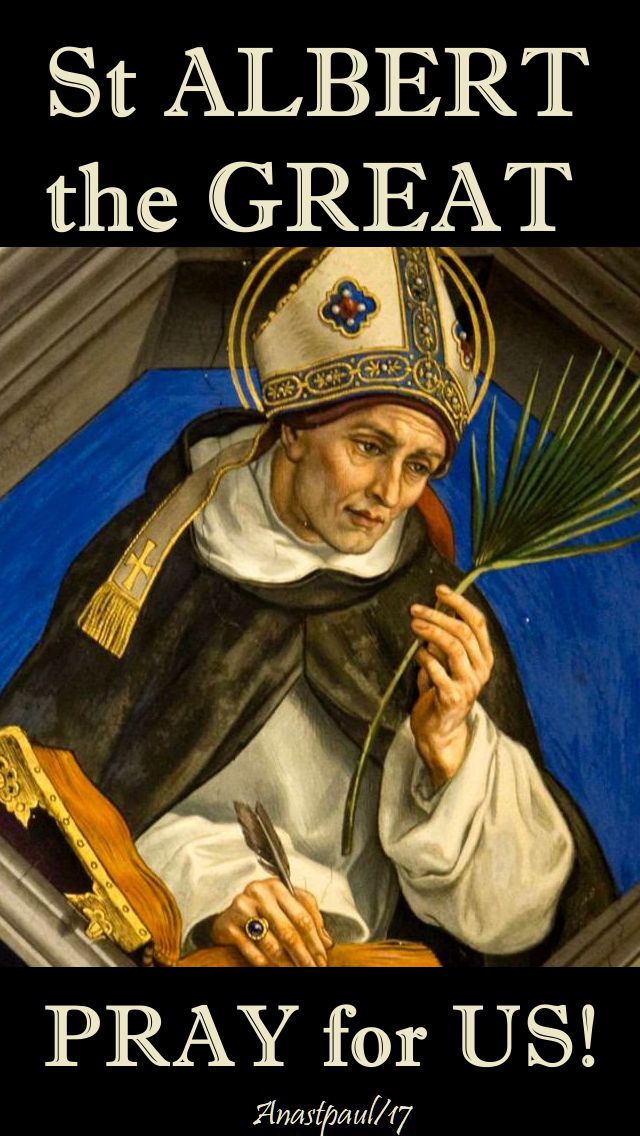
Thought for the Day – 15 November – St Albert Magnus OP (1200-1280) Doctor Universalis (“Universal Doctor”)

Thought for the Day – 15 November – St Albert Magnus OP (1200-1280) Doctor Universalis (“Universal Doctor”)

Albert the Great was a 13th-century German Dominican who decisively influenced the Church’s stance toward Aristotelian philosophy brought to Europe by the spread of Islam.

Students of philosophy know him as the master of Thomas Aquinas.   Albert’s attempt to understand Aristotle’s writings established the climate in which Thomas Aquinas developed his synthesis of Greek wisdom and Christian theology.   But Albert deserves recognition on his own merits as a curious, honest and diligent scholar.

He was the eldest son of a powerful and wealthy German lord of military rank.   He was educated in the liberal arts.   Despite fierce family opposition, he entered the Dominican novitiate.

His boundless interests prompted him to write a compendium of all knowledge:  natural science, logic, rhetoric, mathematics, astronomy, ethics, economics, politics and metaphysics.   His explanation of learning took 20 years to complete. “Our intention,” he said, “is to make all the aforesaid parts of knowledge intelligible to the Latins.”

He achieved his goal while serving as an educator at Paris and Cologne, as Dominican provincial and even as Bishop of Regensburg for a short time.   He defended the mendicant orders and preached the Crusade in Germany and Bohemia.

An information glut faces us Christians today in all branches of learning.   One needs only to read current Catholic periodicals, to experience the varied reactions to the findings of the social sciences, for example, in regard to Christian institutions, Christian life-styles and Christian theology.   Ultimately, in Canonising Albert, the Church seems to point to his openness to truth, wherever it may be found, as his claim to holiness.   His characteristic curiosity prompted Albert to mine deeply for wisdom within a philosophy his Church warmed to with great difficulty but his influence was vast and led the great minds who followed him, to delve more deeply and create greater clarity and understanding.

St Albert the Great, Pray for Us!

st-thomas-and-albert.jpg
St Thomas Aquinas and St Albert the Great

st-albert-the-great-pray-for-us 15 nov 2017 no 2

Posted in 7 GIFTS of the HOLY GHOST: Wisdom, Understanding, Prudence, Strength, Knowledge, Piety, Fear, DOCTORS of the Church, EUCHARISTIC Adoration, GOD is LOVE, MARIAN QUOTES, QUOTES of the SAINTS, QUOTES on CHARITY, QUOTES on DIVINE PROVIDENCE, QUOTES on FAITH, QUOTES on HOPE, QUOTES on LOVE of GOD, QUOTES on PATIENCE, QUOTES on PERSEVERANCE, QUOTES on PRAYER, QUOTES on PURITY, QUOTES on PURITY of INTENTION, QUOTES on SANCTITY, QUOTES on THE WORLD, QUOTES on TRUST and complete CONFIDENCE in GOD, SAINT of the DAY, St JOSEPH, The BLESSED VIRGIN MARY, The HOLY EUCHARIST / The HOLY MASS

Quote/s of the Day – 15 November – The Memorial of St Albert the Great (1200-1280) Doctor Universalis (“Universal Doctor”)

Quote/s of the Day – 15 November – The Memorial of St Albert the Great (1200-1  280) Doctor Universalis (“Universal Doctor”)

Known as Doctor Universalis (“Universal Doctor”) for the extraordinary depth of his knowledge and learning, Albertus Magnus wrote extensively on numerous subjects. Here are some words of wisdom from a variety of his writings.

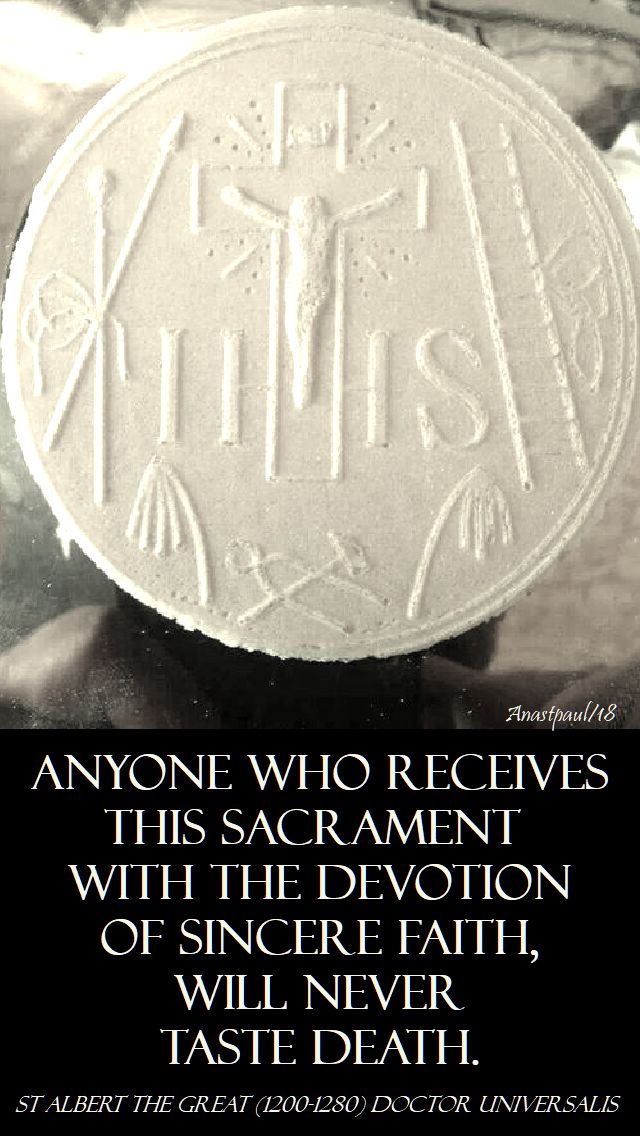
“Anyone who receives this Sacrament, 
with the devotion of sincere faith,
will never taste death.”anyone who receives this sacrament - st albert the great - 15 nov 2018

“The greater and more persistent,
your confidence in God, the more
abundantly you will receive, all that you ask.”the greater and more persistent - st albert the great - 15 nov 2018

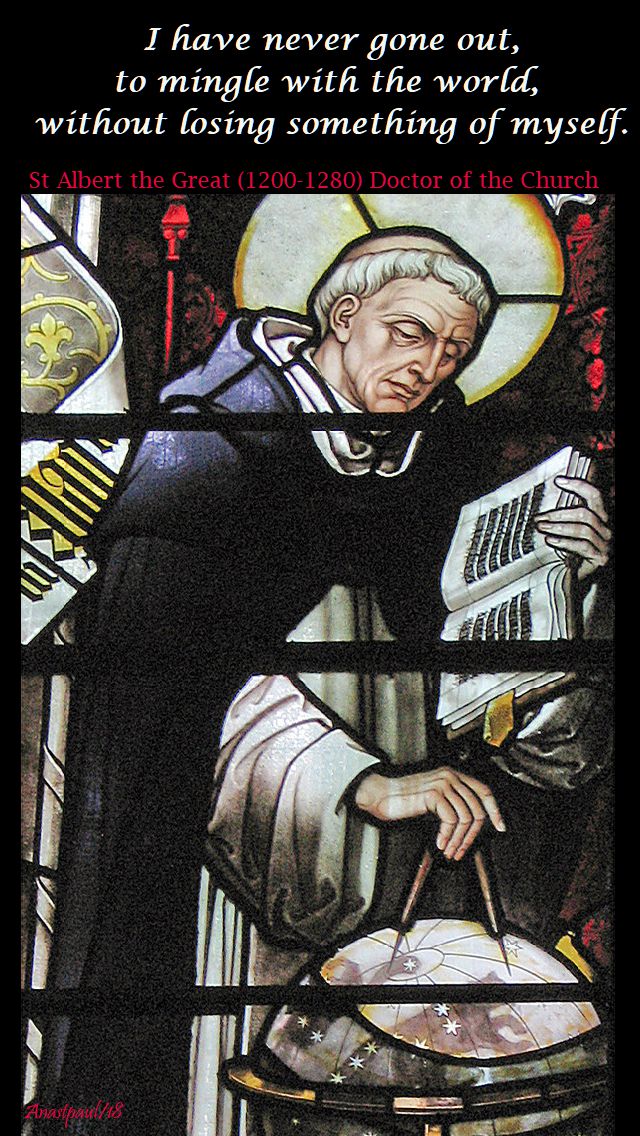
“I have never gone out, to mingle with the world, 
without losing something of myself.”i have never gone out to mingle - st albert the great - 15 nov 2018

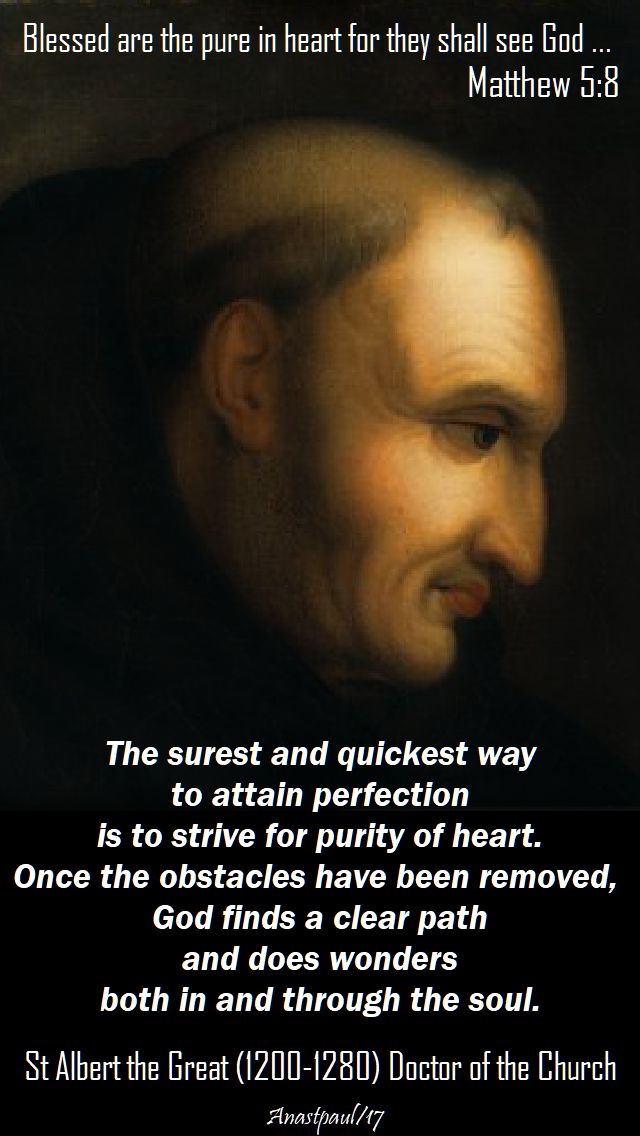
“The surest and quickest way
to attain perfection, is to strive,
for purity of heart.
Once the obstacles have been removed,
God finds a clear path and does wonders,
both in and through the soul.”the-surest-and-quickest-way-st-albert-the-great-15-nov-2017

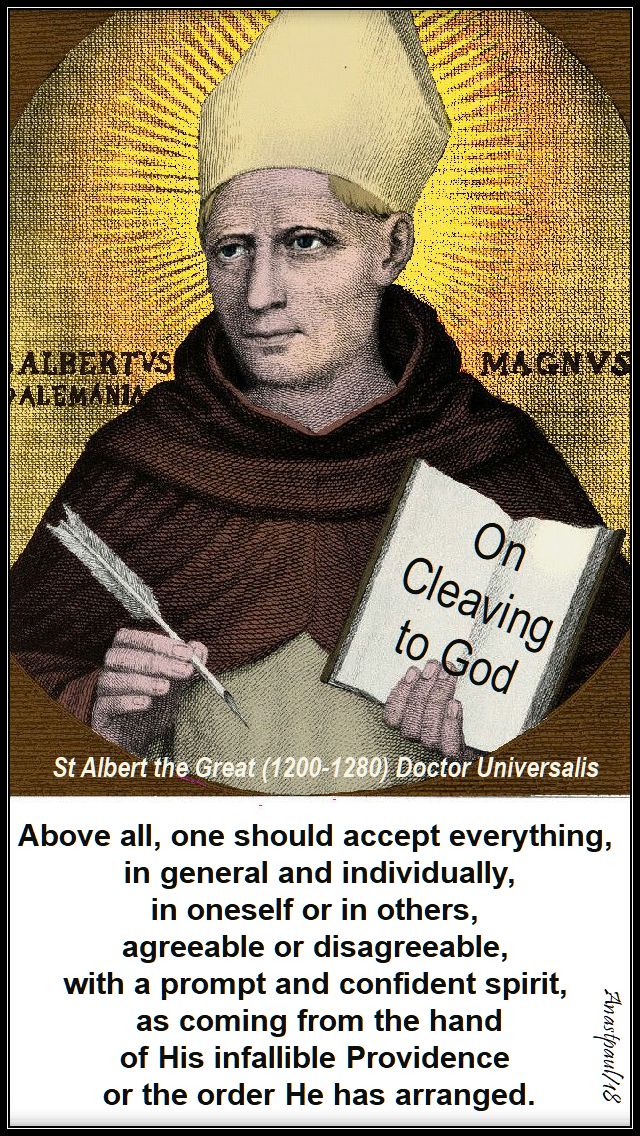
“Above all, one should accept everything,
in general and individually, in oneself or in others,
agreeable or disagreeable,
with a prompt and confident spirit,
as coming from the hand of His infallible Providence
or the order He has arranged.”

On Cleaving to Godabove all, one should accept - st albert the great - 15 nov 2018

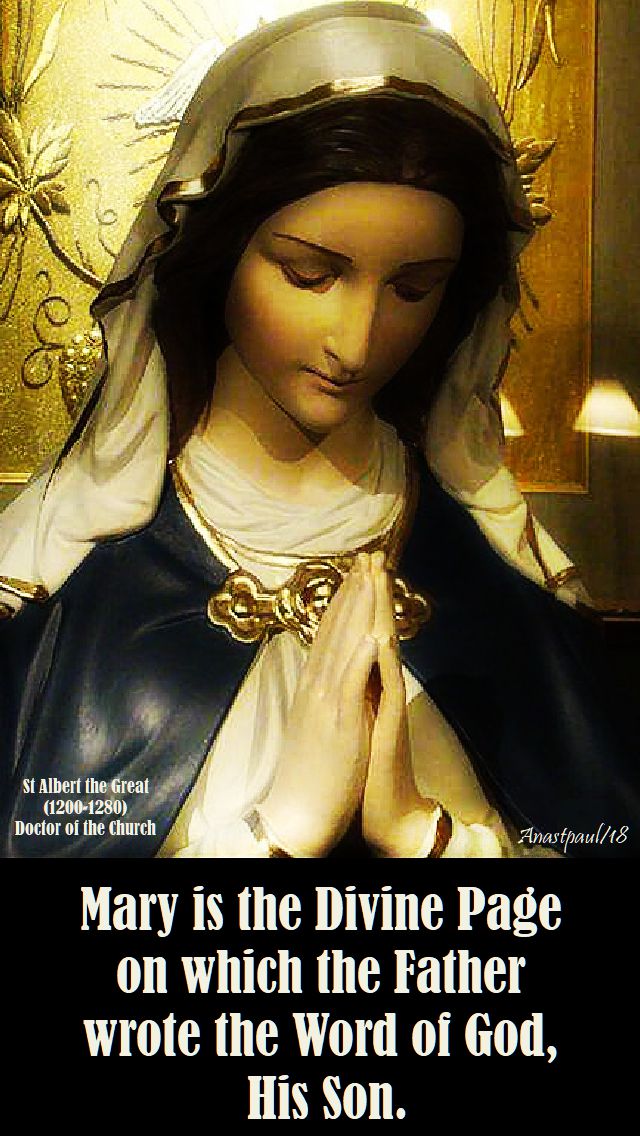
“Mary is the Divine Page
on which the Father
wrote the Word of God,
His Son.”

St Albert the Great (1200-1280) Doctor of the Church

mary is the divine page - st albert the great - 15 nov 2018

Posted in FATHERS of the Church, MORNING Prayers, QUOTES of the SAINTS, QUOTES on SANCTITY, SAINT of the DAY, The WORD

One Minute Reflection – 15 November – Today’s Gospel: Luke 17:20–25

One Minute Reflection – 15 November – Today’s Gospel: Luke 17:20–25 – Thursday of the Thirty Second week in Ordinary Time, Year B and the Memorial of St Albert the Great (1200-1280) and St Leopold the Good (1073-1136)

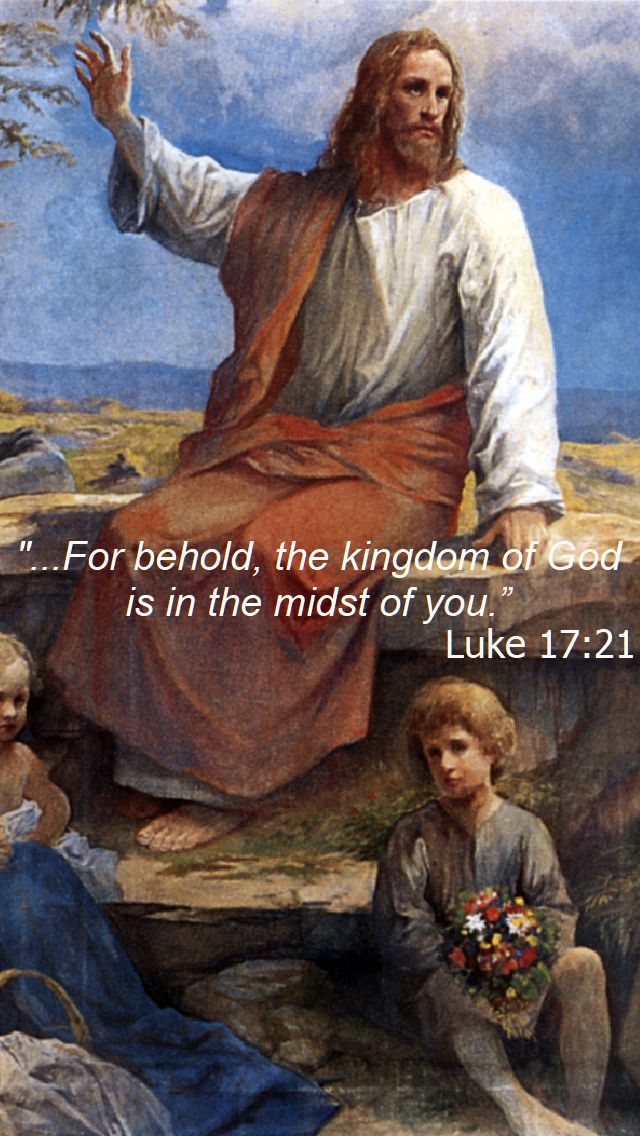
“…For behold, the kingdom of God is in the midst of you.”...Luke 17:21for behold, the kingdom of god is in the midst of you - luke 17 21 - 15 nov 2018

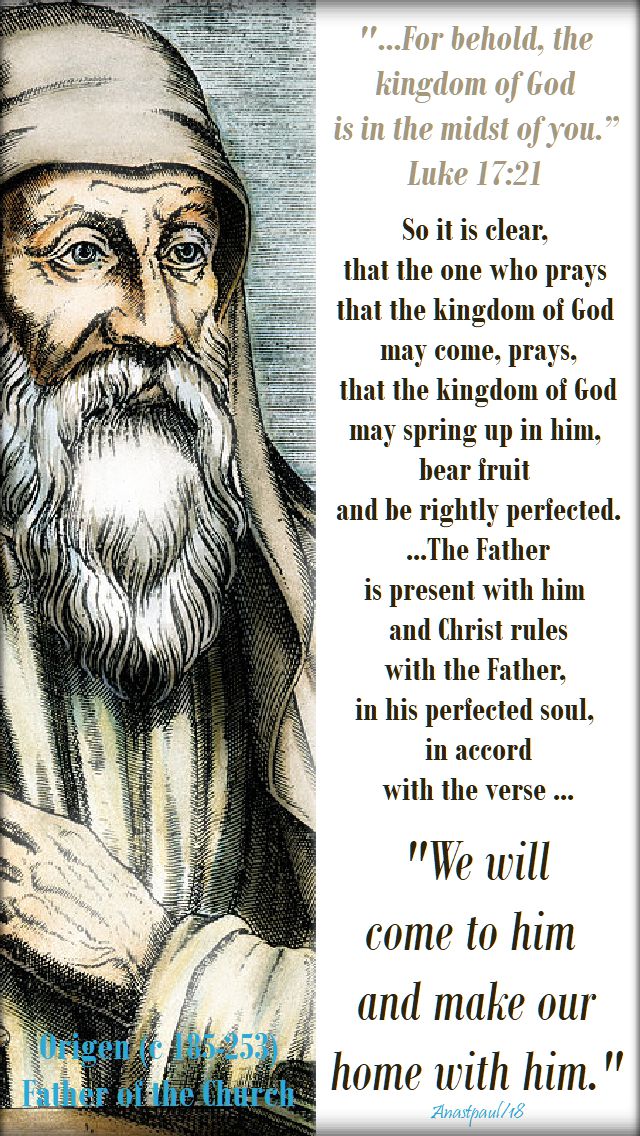
REFLECTION – “The kingdom of God according to our Lord and Saviour’s word “does not come with signs to be observed, nor will they say, ‘Lo, here it is!’ or ‘There!’ but the kingdom of God is within us”.   For the Word “is very near, in our mouth and in our heart” (cf. Dt 30:14; Rm 10:8).  So it is clear, that the one who prays that the kingdom of God may come, prays that the kingdom of God may spring up in him, bear fruit and be rightly perfected.   This is because every saint is ruled by God, obeys the spiritual laws of God and dwells in himself as in a well-ordered city.   The Father is present with him and Christ rules with the Father, in his perfected soul, in accord with the verse we called to mind a little earlier, “We will come to him and make our home with him” (Jn 14:23).
As we make continual progress, the highest point of the kingdom of God will be established for us when the apostle Paul’s word is fulfilled, when Christ with all His enemies made subject to Him will deliver “the kingdom to God the Father … that God may be all in all” (1 Cor 15:24, 28).
Therefore, let us pray constantly (cf. Thess 5:17) with a character being divinised by the Word and let us say to our Father in heaven, “hallowed be your name, your kingdom come” (Mt 6:9).”…Origen (c 185-253) Father of the Church

luke 17 21 - for behold the kingdom of god- so it is clear that the one who prays - origen 15 november 2018

PRAYER – Our Father, hallowed be Your name, Your kingdom come, Your will be done! Grant us Lord, a true knowledge of our salvation, so that freed from fear and from the power of our foes, we may serve You faithfully, all the days of our lives and thus attain eternal joy with You.   May the prayers of St Albert and St Leopold on our behalf, be a succour to us all.   Through our Lord Jesus Christ with the Holy Spirit, one God for all eternity, amen.

st-albert-the-great-pray-for-us-14-nov-2018

st leopold the good pray for us 15 nov 2018

Posted in DOCTORS of the Church, Our MORNING Offering, PRAYERS of the SAINTS, SAINT of the DAY

Our Morning Offering – 15 November – The Memorial of St Albert the Great (1200-1280)

Our Morning Offering – 15 November – The Memorial of St Albert the Great (1200-1280) Doctor of the Church

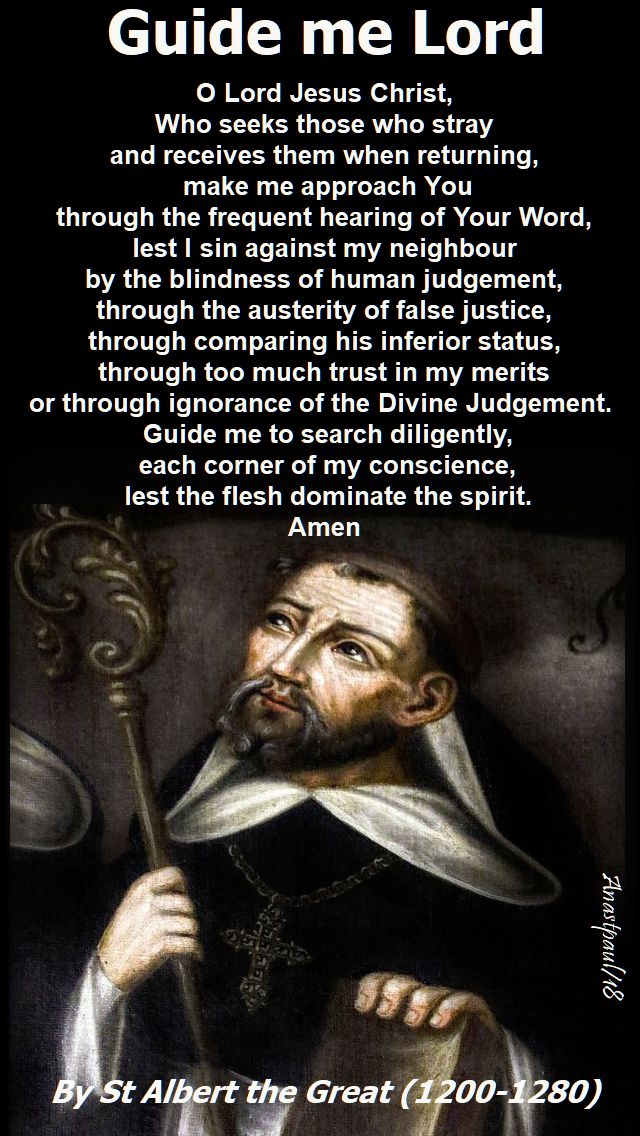
Guide me Lord
By St Albert

O Lord Jesus Christ,
Who seeks those who stray
and receives them when returning,
make me approach You
through the frequent hearing of Your Word,
lest I sin against my neighbour
by the blindness of human judgement,
through the austerity of false justice,
through comparing his inferior status,
through too much trust in my merits
or through ignorance of the Divine Judgement.
Guide me to search diligently,
each corner of my conscience,
lest the flesh dominate the spirit.
Amenguide me lord by st albert the great - 15 nov 2018

Posted in SAINT of the DAY

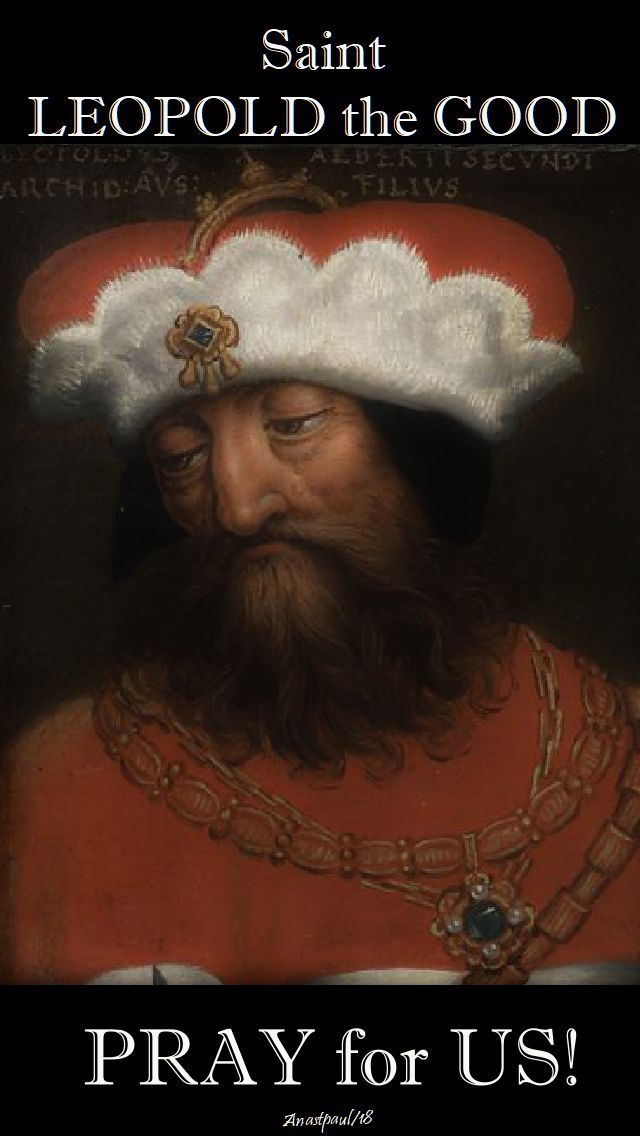
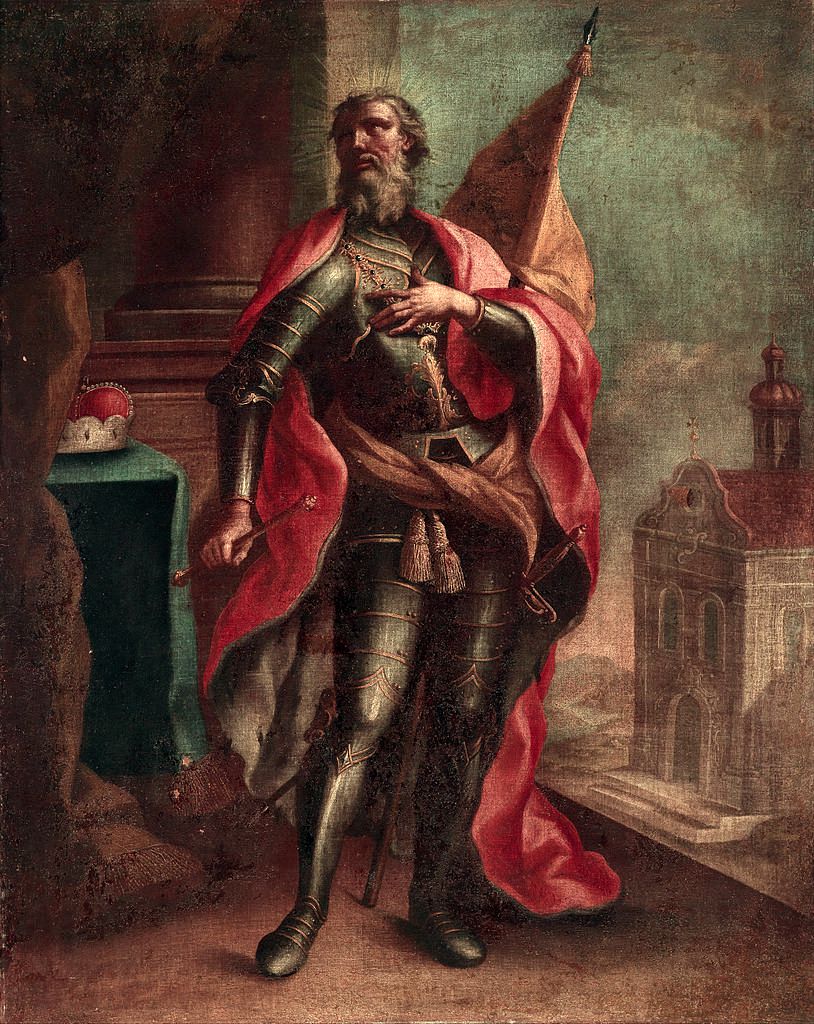
Saint of the Day – 15 November – St Leopold III (1073-1136) – “Leopold the Good”

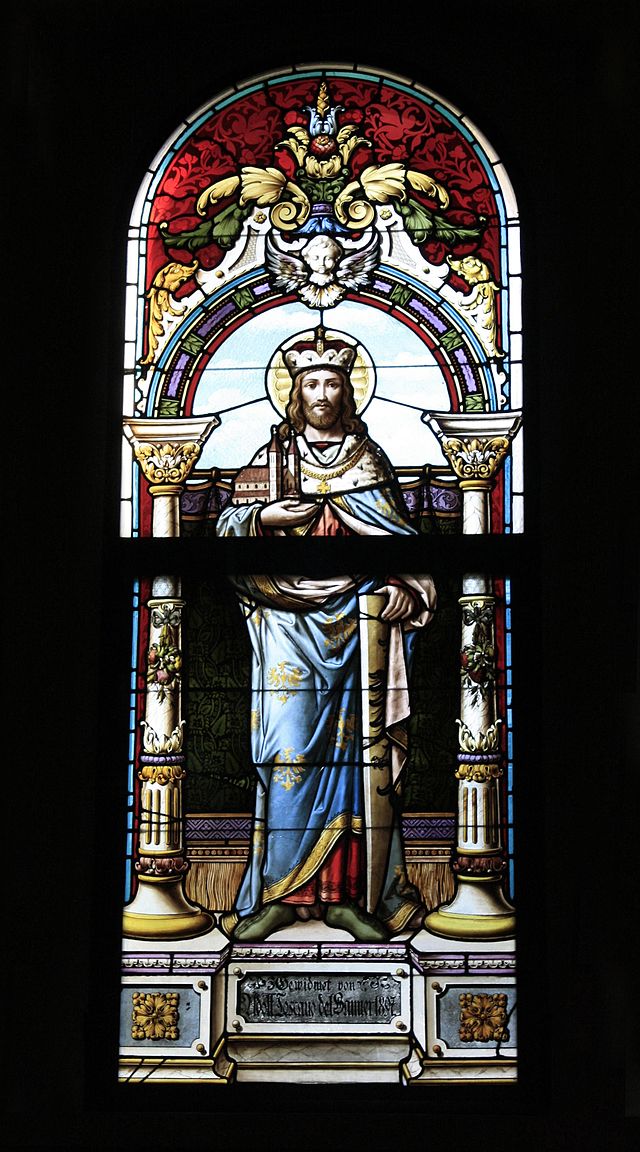
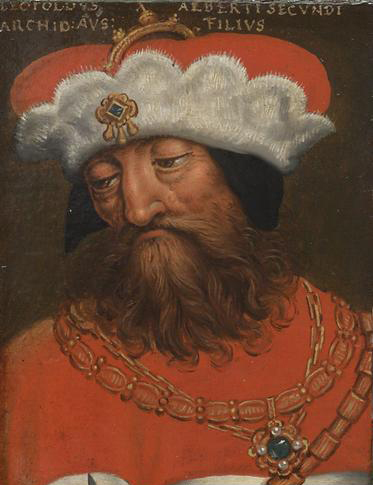
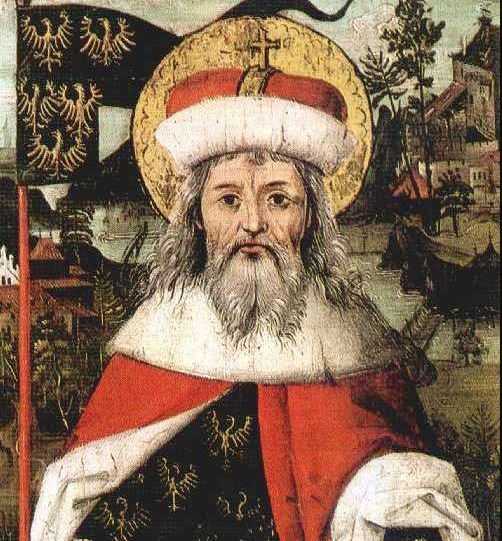
Saint of the Day – 15 November – St Leopold III (1073-1136) – “Leopold the Good” Margrave of Austria (the Margraviate of Austria was a southeastern frontier march (borderland) of the Holy Roman Empire created in 976 out of the territory on the border with the Principality of Hungary) – born in 1073 at Melk, Lower Austria, Austria and died in 1136 at the abbey of Klosternburg, Niederosterrich, Austria of natural causes. Patronages – against the death of children, large families, Lower Austria, step-parents, Austria (since 1663 but officially proclaimed on 17 December 1913 by Pope Pius X), Upper Austria, Abetone, Italy.814px-Hl_Leopold_(Österreich_18_Jh)

Leopold was born at Babenberg castle in Gars am Kamp, the son of Margrave Leopold II and Ida of Formbach-Ratelnberg.   The Babenbergs came to Austria from Bavaria where the family had risen to prominence in the 10th Century.   He grew up in the diocese of Passau under the influence of the reformer Bishop Altmann of Passau.

In 1096 Leopold succeeded his father as Margrave of Austria at the age of 23.   He married twice.   His first wife, who died in 1105, may have been one of the von Perg family.   The following year he married Agnes, the widowed sister of Emperor Henry V whom he had supported against her father Henry IV.   This connection to the Salians raised the importance of the House of Babenberg, to which important royal rights over the Margravate of Austria were granted.   Also, Agnes had influential connections through her previous marriage to Frederick of Hohenstaufen, one of her sons being Conrad III of Germany.

Leopold called himself “Princeps Terræ”, a reflection of his sense of territorial independence.   He was considered a candidate in the election of the Kaiser of the Holy Roman Empire in 1125 but declined this honour.Saint_Leopold_III_Margrave_of_Austria_(Church_at_Gaaden)

He is mainly remembered for the development of the country and, in particular, the founding of several monasteries.   His most important foundation is Klosterneuburg (1108).   According to legend, the Virgin Mary appeared to him and led him to a place where he found the veil of his wife Agnes, who had lost it years earlier.   He established the Klosterneuburg Monastery there.   He subsequently expanded the settlement to become his residence.   Leopold also founded the monasteries of Heiligenkreuz, Kleinmariazell and Seitenstetten which developed a territory still largely covered by forest.   All of these induced the church to Canonise him in 1485.Leopold_III_of_Austria

Leopold also fostered the development of cities, such as Klosterneuburg, Vienna and Krems.   The writings of Henry of Melk and Ava of Göttweig, which are the first literary texts from Austria, date back to Leopold’s time.

He is buried in the Klosterneuburg Monastery, which he founded.   His skull is kept in an embroidered reliquary, which leaves the forehead exposed, it also wears an archducal crown.

In 1663, under the rule of his namesake Emperor Leopold I, he was declared patron saint of Austria instead of Saint Koloman.

The brother, Joseph and Michael Haydn, each of whom sang in the choir of St Stephen’s Cathedral, both sang in that capacity at Klosterneuburg on this day.   Joseph Haydn later became the more famous composer of the two.   Michael Haydn later (1805) wrote a Mass in honour of Leopold, the Missa sub titulo Sancti Leopoldi.

St Leopold was Canonised on 6 January 1485 by Pope Innocent VIII.st leopold III snip

Posted in Uncategorized

Memorials of the Saints – 15 November

St Albertus Magnus OP (1200-1280) (Optional Memorial)

St Anianus of Wilparting
St Arnulf of Toul
Bl Caius of Korea
St Desiderius of Cahors
St Eugene of Toledo
St Felix of Nola
St Findan
St Fintan the Missionary
St Gurias of Edessa
Bl Hélène-Marie-Philippine de Chappotin de Neuville
Bl Hugh Faringdon
Bl John Eynon
Bl John Rugg
Bl John Thorne
St Joseph Mukasa
St Joseph Pignatelli
St Leopold III/Leopold the Good ( 1073 – 1136)
Bl Lucy of Narni
St Luperius of Verona
St Machudd of Llanfechell
St Malo of Aleth
St Marinus of Wilparting
Bl Miguel Díaz Sánchez
St Paduinus of Le Mans

Bl Richard Whiting
Bl Roger James
St Shamuna of Edessa
St Sidonius of Saint-Saens

Martyrs of Hippo – 20 saints: 20 Christians martyred together and celebrated by Saint Augustine. The only details about them to survive are three of the names – Fidenziano, Valerian and Victoria. Hippo, Numidia (in north Africa).

Martyrs of North Africa – 3 saints: A group of Christians murdered for their faith in imperial Roman north Africa. The only details that have survived are the names of three of them – Fidentian, Secundus and Varicus.

Posted in MARIAN DEVOTIONS, St Louis-Marie Grignion de MONTFORT, Thomas a Kempis, TOTAL Consecration to JESUS through MARY

Saint Louis-Marie de Montfort’s Total Consecration to Jesus Through Mary – Third Week – Day Twenty Nine – 14 November

Saint Louis-Marie de Montfort’s Total Consecration to Jesus Through Mary – Third Week – Day Twenty Nine – 14 November

Third Week

Day 29 of 33

Imitation of Christ, by Thomas á Kempis: Book 1, Chapter 1

Of the Imitation of Christ and Contempt of all the Vanities of the World

He that follows Me, walks not in darkness (John 8:12), says the Lord.   These are the words of Christ, by which we are admonished, how we ought to imitate His life and manners, if we would truly be enlightened and delivered from all blindness of heart.   Let, therefore, our chief endeavour be, to meditate upon the life of Jesus Christ.

The doctrine of Christ exceeds all the doctrine of holy men and he that has the Spirit will find therein the hidden manna (Apocalypse. 2:17).   But it happens that many, who often hear the Gospel of Christ, feel little desire after it, because they have not the Spirit of Christ (Rom. 8:9).   But whosoever will fully and with relish understand the words of Christ, must endeavour to conform his life wholly to the life of Christ.

2. What does it avail you to discourse profoundly of the Trinity, if you be void of humility and are thereby displeasing to the Trinity?   Surely profound words do not make a man holy and a just and a virtuous life makes him dear to God.   I had rather feel contrition, than know the definition thereof.   If you did know the whole Bible by heart and the sayings of all the philosophers, what would all that profit you without the love of God (1 Cor. 13:2) and without His grace?

Vanity of vanities and all is vanity (Eccles. 1:2), except to love God and to serve Him only. This is the highest wisdom, by contempt of the world, to press forward towards heavenly kingdoms.

Recite: Litany of the Holy Spirit, Ave Maris Stella: https://anastpaul.wordpress.com/2018/10/29/saint-louis-marie-de-montforts-total-consecration-to-jesus-through-mary-first-week-day-thirteen-29-october/

St Louis de Montfort’s Prayer to Mary: https://anastpaul.wordpress.com/2018/11/05/saint-louis-marie-de-montforts-total-consecration-to-jesus-through-mary-second-week-day-twenty-5-november/
AND
Litany of the Holy Name and O Jesus Living In Mary: https://anastpaul.wordpress.com/2018/11/12/saint-louis-marie-de-montforts-total-consecration-to-jesus-through-mary-third-week-day-twenty-seven-12-november/ DAY TWENTY NINE - THIRD WEEK - TOTAL CONSECRATION 14 NOV 2018

Posted in SAINT of the DAY

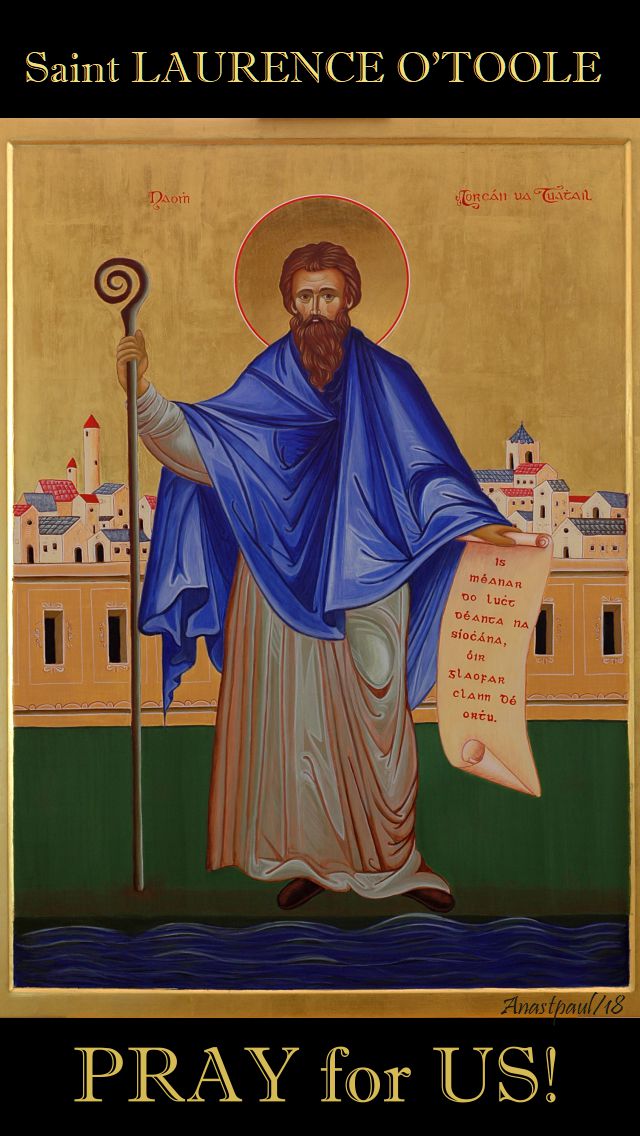
Thought for the Day – 14 November – The Memorial of St Laurence O’Toole (1128 – 1180)

Thought for the Day – 14 November – The Memorial of St Laurence O’Toole (1128 – 1180)

“In his letter announcing the Jubilee year Pope Francis describes Mercy as the ‘summary of the Christian faith… the mystery of the Trinity… the bridge between God and man’, ‘the ultimate and supreme act by which God comes to meet us’ (MV2).   These are very large claims and warrant our deep reflection and humble openness to receive. They are reflected in the actions of Pope Francis where he makes the work of compassion – Lampedusa, prisoners, travellers in mourning – take precedence over the defence of doctrine.   Cardinal Kasper, whose book on Mercy had such influence on him, tells us that compassion is the ultimate ethic and that mercy is the attribute of God which envelopes and infuses all the other divine attributes.   Mercy is not a piece of God beside other pieces, it is God-size.   Meister Eckhart says that we can call God good, we can call God love, but the best name for God is Mercy.   This is a far-cry from the narrow, wimpy, disparaging notion of mercy which often prevails among us.

St Laurence O’Toole was a prophetic witness to that power of mercy, an intercessor driven by his deep concern for his people.   As a ten year old he was the personification of intercession, the fragile guarantee of no harm to his family from a violent leader.   As Archbishop he was like a combination of a Bro Kevin and a Crosscare service at the frequent times of famine, siege and poverty in the city.   He was exercised by the hold which chieftains, rulers and corruption had over monastic, diocesan and Church life, and brought significant reform across them all including the abolition of slavery in 1170.

Again, in all his dealings with and journeys to meet Henry II he truly carried his suffering people on his shoulders, as the symbol for the Holy Year depicts, a shepherd pleading for and negotiating reconciliation at great cost to himself.   This hermit of Glendalough, this good shepherd of Dublin, died like his Lord, while on a last superhuman effort to soften the hard heart of Henry II.

Such is the quality and depth of advocacy and intercession. Where might find Laurence today in our seriously divided and pain-filled society?”…Sr Helena O’Donoghue RSM, Dublin, November 2015

St Laurence O’Toole, Pray for Us!st laurence o'toole pray for us no 2- 14 nov 2018

Posted in QUOTES of the SAINTS, QUOTES on SILENCE, Uncategorized

Quote of the Day – 14 November

Quote of the Day – 14 November

“There is One very near you
Who knocks at your door every hour of the day,
Who begs you to listen to Him
and to keep silence in order to hear Him.”

St Simon-Marie-Just Ranfer de Bretenières (1838-1866) Martyrthere is one very near you - st simon just de bretenieres - 14 nov 2018

Posted in DOCTORS of the Church, MORNING Prayers, QUOTES of the SAINTS, QUOTES on GRATITUDE, SAINT of the DAY, The WORD

One Minute Reflection – 14 November – Today’s Gospel: Luke 17:11–19

One Minute Reflection – 14 November – Today’s Gospel: Luke 17:11–19 -Wednesday of the Thirty Second week in Ordinary Time, Year B and the Memorial of St Laurence O’Toole (1128 – 1180)

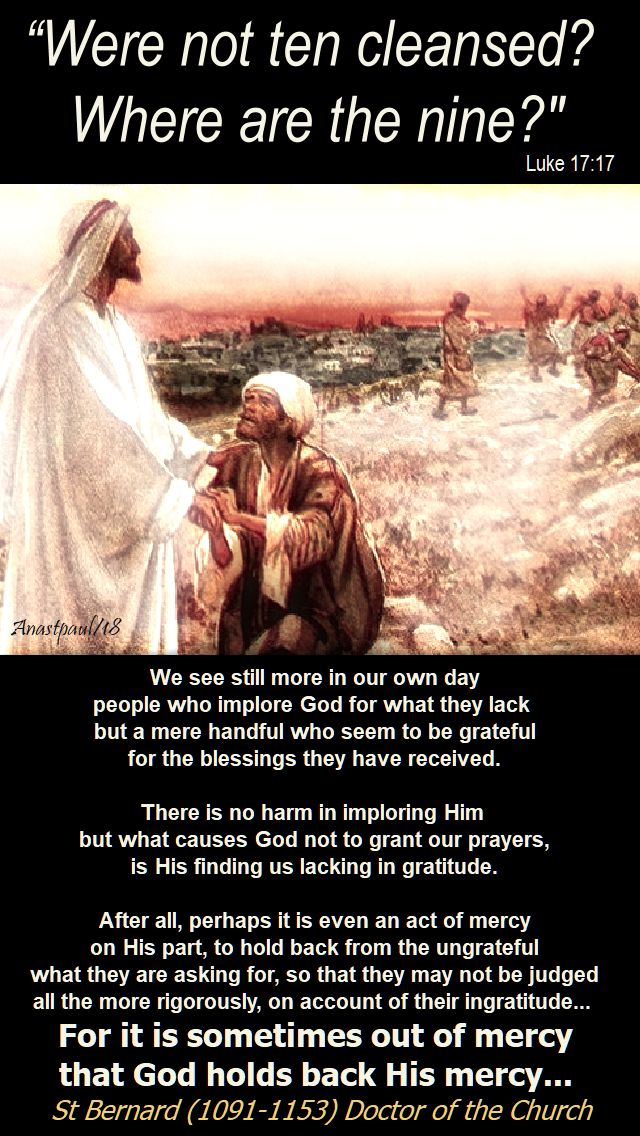
“Were not ten cleansed?  Where are the nine?”…Luke 17:17

REFLECTION – “In our own day we see many people at prayer but, unfortunately, we see none of them turning back to give thanks to God… “Ten were cleansed, were they not? Where are the other nine?” As I think you will remember, it was in these words that our Saviour complained about the lack of gratitude of the other nine lepers.   We read that they knew well how to make “supplications, prayers, petitions” since they lifted up their voices, crying out:  “Jesus, Master! Have pity on us!”   But they lacked the fourth thing required by the apostle Paul: “thanksgiving” (1Tm 2:1) for they did not turn back nor give thanks to God.
We see still more in our own day people who implore God for what they lack but a mere handful who seem to be grateful for the blessings they have received.   There is no harm in imploring Him but what causes God not to grant our prayers, is His finding us lacking in gratitude.   After all, perhaps it is even an act of mercy on His part to hold back from the ungrateful what they are asking for, so that they may not be judged all the more rigorously, on account of their ingratitude… For it is sometimes out of mercy that God holds back His mercy…
So you see that not all those who are healed of the leprosy of this world, I mean their manifest complaints, profit by their healing.   Indeed, many are secretly afflicted with an ulcer worse than leprosy, all the more dangerous in that it is more interior.   That is why it was right that the Saviour of the world should ask where the other nine lepers were, since sinners avoid healing.   So, too, after his sin, God questioned the first man:   “Where are you?” (Gn 3:9).”… St Bernard (1091-1153) Doctor of the Churchwere not ten cleansed. where are the nine - luke 17 17 - we see still more in our own day - st bernard - 14 nov 2018

PRAYER – You Lord, Holy Father, never forget Your solemn covenant and grant us new life each day. We though in our hearts of stone do forget and cease to thank and bless You. Make our hearts turn in gratitude, for all we are and have is by Your grace and we are as nothing without You. May our minds, hearts and souls sing with love and thanks to You, Lord our God. Grant us new hearts by the prayers of Your Saint Laurence O’Toole and all the saints in heaven, who always lived with grateful hearts, praising You always. We ask this this through Jesus Christ with the Holy Spirit, one God forever, amen.st laurence o'toole pray for us - 14 nov 2018

Posted in Our MORNING Offering, PRAYERS of the SAINTS, The WORD

Our Morning Offering – 14 November – Today’s Gospel: Luke 17:11–19

Our Morning Offering – 14 November – Today’s Gospel: Luke 17:11–19 -Wednesday of the Thirty Second week in Ordinary Time, Year B

“Was no one found to return and give praise to God except this foreigner?”...Luke 17:18

Thank you, Lord Jesus Christ
St Richard of Chichester (1198-1253)

Thank you, Lord Jesus Christ,
for all the benefits and blessings,
which You have given me,
for all the pains and insults,
which You have borne for me.
Merciful Friend, Brother and Redeemer,
may I know You more clearly,
love You more dearly
and follow You more nearly,
day by day.
Amenthank you lord jesus christ - st richard of chichester - 14 nov 2018

Posted in SAINT of the DAY

Saint of the Day – 14 November – St Laurence O’Toole (c 1128 – 1180) 

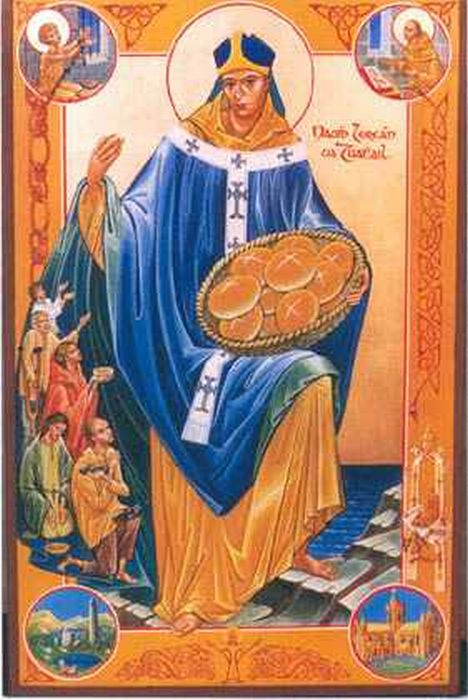
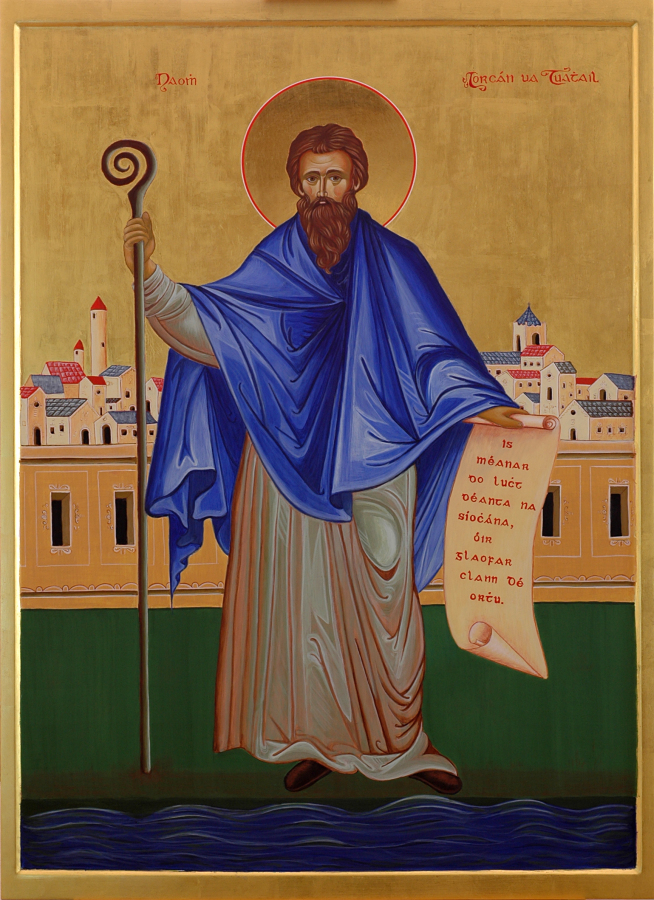
Saint of the Day – 14 November – St Laurence O’Toole (c 1128 – 1180)  – Archbishop of Dublin, Abbot, Reformer, Mediator, Preacher, Apostle of Charity, Papal Legate to Ireland, he established new Churches and monasteries – born Lorcan Ua Tuathail in 1128 at Castledermot, County Kildare, Ireland and died on 14 November 1180 at Eu, diocese of Rouen, Normandy, France of natural causes.   Patron of the Archdiocese of Dublin.St_-Laurence-O-Toole1

Saint Laurence was the son of the king of Leinster in Ireland.   His birth caused such great joy to his father, that in thanksgiving, to honour Christ, he pardoned a vassal who was an enemy and even chose him for sponsor of the child.   They were stopped on the way to church by a man who was regarded as a prophet and who told them in verse that the child would be magnificent on earth and glorious in heaven and that his name must be Laurence.   Though the king had decided otherwise, the infant was indeed given that name.

When only ten years old, his father delivered him up as a hostage to a rival prince who required this of his sincerity when there was a question of a treaty of peace but who treated the child with great inhumanity, leaving him to suffer hunger and cold and other inhuman conditions until his health was nearly ruined.   His father, hearing of this, by menaces obliged the tyrant to put him temporarily in the hands of the Bishop of Glendenoch in the county of Wicklow.   The holy youth was soon cured and, by his fidelity in corresponding with the divine grace, he grew to be a model of virtues.   When his father came for him, he declared he desired to enter into the service of the Church and remain with the good bishop.   To this his father willingly agreed.

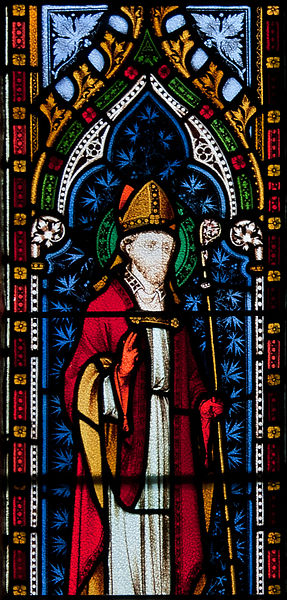
On the death of the bishop, who was also Abbot of a monastery of the same city, Saint Laurence was chosen Abbot in 1150, though only twenty years old and doubting his competence.   Nonetheless, he governed with a paternal spirit, employing all his revenues during a famine in the province, to procure food for the needy, remedies for the sick and aid of all kinds for the unfortunate.   Never did he use his revenues, even when prosperity returned, for anything but care of the poor, repairs for ruined or decrepit churches or the construction of new ones and the foundation of hospitals. When the see of Glendenoch became vacant once more in 1161, it was Saint Laurence who was chosen to fill it and although he could not resolve to accept that new dignity, he was obliged soon afterwards to become Archbishop of Dublin and he was told that to refuse would be to resist the Will of God.220px-Dublin_Christ_Church_Cathedral_Baptistery_Window_Saint_Laurence_O'Toole_2012_09_26

He established a regular life for the Canons of his cathedral, according to the example of Saint Augustine and he himself followed all the rules with exactitude, sharing their table, their prayer and their silence.  Each Lent he returned to Glendalough to make a forty days’ retreat in St. Kevin’s Cave on a precipice of Lugduff Mountain over the Upper Lake.Saint_Laurence_OToole

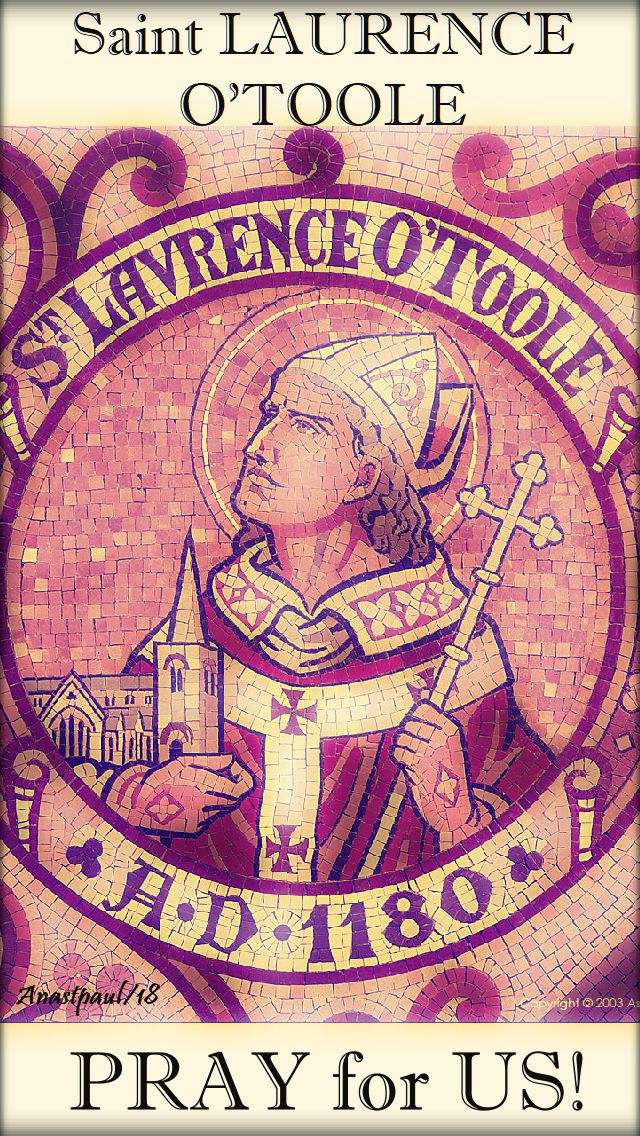
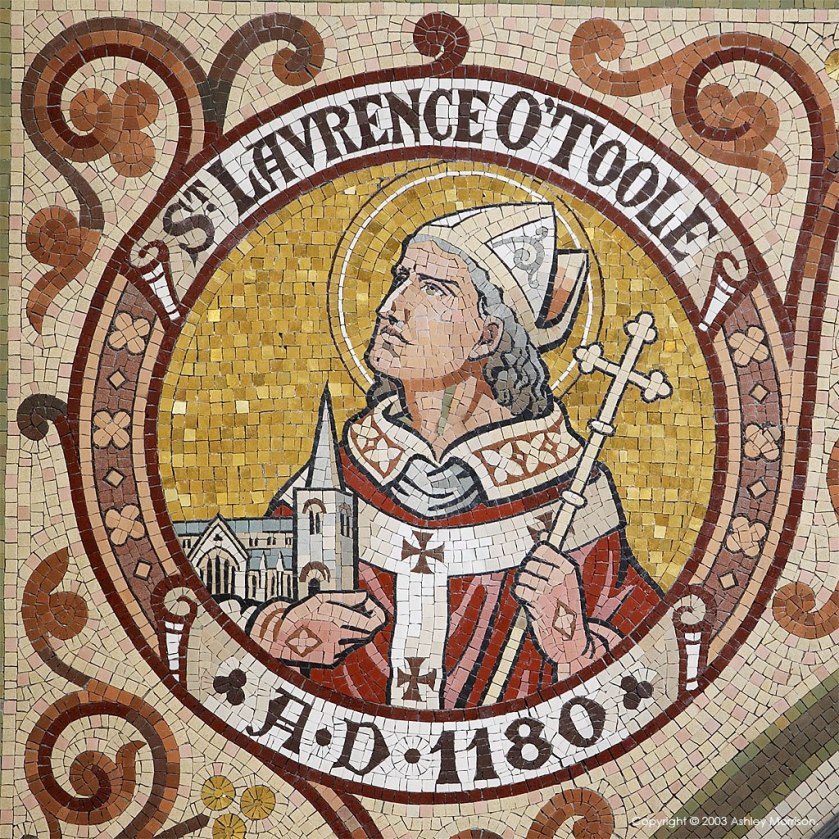
About the year 1171 Saint Laurence was obliged, for the affairs of his diocese, to go to England to see the king, Henry II, who was then at Canterbury.   He was received by the Benedictine monks of Christ Church with the greatest honour and respect.   On the following day, as the holy Archbishop was advancing to the altar to officiate, a maniac, who had heard much of his sanctity and who thought it would be a gift to the Church to make of him another martyr in the likeness of Saint Thomas Becket, struck him a violent blow on the head.   All present concluded that he was mortally wounded but the Saint recovered his senses and asked for some water, which he blessed.   He then requested that the wound be washed with it, and the blood was immediately stanched and the archbishop celebrated Mass.   He obtained the offender’s pardon from the king  . His prayers brought about many miracles, including the return to their senses for those who had become alienated, a miracle rare in the history of religion.   After he attended a General Council in Rome in 1179, the Pope made him his legate for all of Ireland and he visited all its provinces to re-establish ecclesiastical discipline everywhere.Mosaic medallion of St Lavrence O'Toole in St Patrick's Cathedral in Armagh.

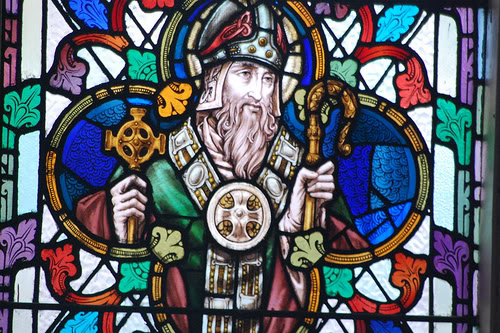
In 1175 Henry II of England became offended with Roderick, the monarch of Ireland and prudence that he granted him everything he asked and left the whole negotiation to his discretion.287px-Wexford_Church_of_the_Immaculate_Conception_South_Aisle_Window_Saint_Laurentius_O_Toole_Detail_2010_09_29

After a stay at the Monastery of Abingdon south of Oxford – necessitated by a closure of the ports – he landed at Le Tréport, Normandy, at a cove named after him, Saint-Laurent. He fell ill and was conveyed to the Abbey of St Victor at Eu.   Mortally ill, it was suggested that he should make his will, to which he replied:  “God knows, I have not a penny under the sun to leave anyone.”   His last thoughts were of his people in Dublin : “Alas, you poor, foolish people, what will you do now?   Who will take care of you in your trouble?   Who will help you?”   He died on 14 November 1180.

The Saint is described as tall and graceful in figure.   He was well known as an ascetic, wore a hair shirt, never ate meat and fasted every Friday on bread and water.   In contrast to this, it is said that when he entertained, his guests lacked for nothing, while he drank water coloured to look like wine so as not to spoil the feast.

Due to the great number of miracles that rapidly occurred either at his tomb or through his intercession, Lorcán was canonised only 45 years after his death in 1225 by Pope Honorius III.st-lorcan-o-toole

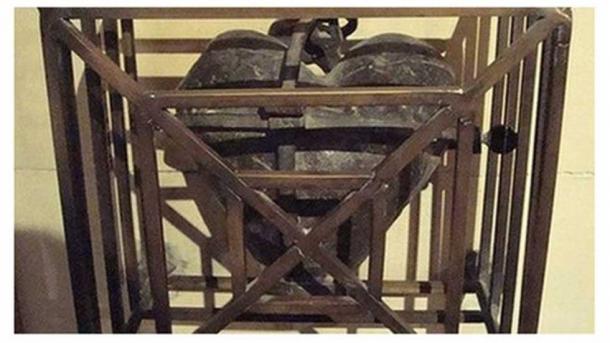
St Laurence’s heart was preserved in a reliquary in Christ Church Cathedral, Dublin from the 13th century. His skull was brought to England in 1442 by a nobleman named Sir Rowland Standish who had fought at Agincourt. The bones were interred at the parish church of Chorley in England, now named St Laurence’s, until they disappeared in the English Reformation. Lorcán’s heart remains in Christ Church Cathedral, Dublin. The reliquary was stolen in 2012, with the Dean of Christ Church saying “It has no economic value but it is a priceless treasure that links our present foundation with its founding father”. It was recovered in Phoenix Park in 2018 after a tip-off to the Garda Síochána. Media reported that the unidentified thieves thought it was cursed and caused family members’ illnesses. At a special ceremony in Christ Church on 26 April 2018, the heart was returned to it’s home.The-cage-and-heartthe-Stolen-Holy-Heart-of-St-Laurence

Posted in SAINT of the DAY

Memorials of the Saints – 14 November

St Adeltrude of Aurillac
St Alberic of Utrecht
St Antigius of Langres
St Dubricius of Wales
St Etienne-Théodore Cuenot
St Hypatius of Gangra
Bl Jean of Tufara
Bl John Licci OP (1400-1511)
Biography here: https://anastpaul.wordpress.com/2017/11/14/saint-of-the-day-14-november-blessed-john-licci-o-p-1400-1511/

St John Osorinus

St Joseph Pignatelli SJ (1737 – 1811) ‘Restorer of the Society of Jesus’
St Jucundus of Bologna
St Laurence O’Toole/Lorcán Ua Tuathail (c 1128 – 1180)

Bl Maria Louise Merkert
Bl Maria Teresa of Jesus
St Modanic
St Ruf of Avignon
St Serapion of Alexandria
St Serapion of Algiers
St Siard
St Venerando the Centurian
St Venerandus of Troyes

Holy Fathers of Merida

Martyrs of Emesa: Group of Christian women tortured and executed for their faith in the persecutions of the Arab chieftain Mady. They died in Emesa (modern Homs, Syria).

Martyrs of Heraclea – (3 saints): Group of Christians murdered together for their faith. The only details we have are three of their names – Clementinus, Philomenus and Theodotus. They were martyred in Heraclea, Thrace.

Martyrs of the Jaffa Gate:
• Blessed Déodat of Rodez
• Blessed Nikola Tavelic
• Blessed Pierre of Narbonne
• Blessed Stefano of Cuneo

Posted in MARIAN DEVOTIONS, St Louis-Marie Grignion de MONTFORT, TOTAL Consecration to JESUS through MARY

Saint Louis-Marie de Montfort’s Total Consecration to Jesus Through Mary – Third Week – Day Twenty-Eight – 13 November

Saint Louis-Marie de Montfort’s Total Consecration to Jesus Through Mary – Third Week – Day Twenty-Eight – 13 November

Third Week

Day 28 of 33

Matthew 26:1, 26-29, 36-46

And it came to pass, when Jesus had ended all these words, he said to his disciples:  You know that after two days shall be the pasch and the son of man shall be delivered up to be crucified…

…And whilst they were at supper, Jesus took bread and blessed, and broke it and gave to his disciples and said:  Take and eat.   This is my body.   And taking the chalice, he gave thanks and gave to them, saying:   Drink all of this  . For this is my blood of the new testament, which shall be shed for many unto remission of sins.   And I say to you, I will not drink from henceforth of this fruit of the vine, until that day when I shall drink it with you new in the kingdom of my Father…

…Then Jesus came with them into a country place which is called Gethsemani and he said to his disciples:  Sit you here, till I go yonder and pray.   And taking with him Peter and the two sons of Zebedee, he began to grow sorrowful and to be sad.   Then he said to them:  My soul is sorrowful even unto death, remain here and watch with me.   And going a little further, he fell upon his face, praying and s aying: My Father, if it be possible, let this chalice pass from me.   Nevertheless not as I will but as thou will.   And he came to his disciples and found them asleep and he said to Peter:  What?   Could you not watch one hour with me?   Watch and pray that you enter not into temptation.   The spirit indeed is willing but the flesh weak.   Again the second time, he went and prayed, saying:  My Father, if this chalice may not pass away but I must drink it, thy will be done. And he came again and found them sleeping, for their eyes were heavy.  And leaving them, he went again and he prayed the third time, saying the selfsame word.   Then he came to his disciples and said to them, Sleep now and take your rest, for behold the hour is at hand and the Son of man shall be betrayed into the hands of sinners.   Rise, let us go, behold he is at hand, that will betray me.

Recite: Litany of the Holy Spirit, Ave Maris Stella: https://anastpaul.wordpress.com/2018/10/29/saint-louis-marie-de-montforts-total-consecration-to-jesus-through-mary-first-week-day-thirteen-29-october/

St Louis de Montfort’s Prayer to Mary: https://anastpaul.wordpress.com/2018/11/05/saint-louis-marie-de-montforts-total-consecration-to-jesus-through-mary-second-week-day-twenty-5-november/
AND
Litany of the Holy Name and O Jesus Living In Mary:  https://anastpaul.wordpress.com/2018/11/12/saint-louis-marie-de-montforts-total-consecration-to-jesus-through-mary-third-week-day-twenty-seven-12-november/DAY TWENTY-EIGHT - THIRD WEEK - TOTAL CONSECRATION 13 NOV 2018

Posted in QUOTES of the SAINTS, QUOTES on WORK/LABOUR, SAINT of the DAY

Thought for the Day – 13 November – The Memorial of St Agostina Livia Pietrantoni S.D.C. (1864-1894)

Thought for the Day – 13 November – The Memorial of St Agostina Livia Pietrantoni S.D.C. (1864-1894)

We look to Saint Agostina and contemplate her life and the way that she lived it- always for others, never for herself.   First she laboured in the home, taking care of her younger siblings and helping out on the farm.   Then, she was a migrant farm worker to earn more money to support her family, while providing love and direction to the many other children in the same situation.   When she entered religious life, she dedicated her life to the sick and the poor in the tuberculosis ward- a place of constant suffering and death. Every day she faced the deadly disease and found joy and love in giving care to the people who contracted it.   She knew that she was nothing and was prepared to let go of herself entirely every day, in service to the lowest of the low, even after being so brutally attacked, she forgave instantly- she saw the best in the worst of people and knew what she had to do.

I am cowardly and weak and selfish and I hope that one day I can hold in my heart, a tiny fraction of the love and the self-giving of this gentle St Agostina.

We will lie down for such a long time after death that it is worth while to keep standing while we are alive.   Let us work now, one day we will rest. – St Agostina

St Agostina Pietrantoni – Pray for Us!st agostina pietrantoni pray for us no 2 13 nov 2018

Posted in QUOTES of the SAINTS, QUOTES on GRATITUDE, QUOTES on LOVE, QUOTES on SANCTITY, SAINT of the DAY, Uncategorized

Quote of the Day – 13 November – The Memorial of St Agostina Livia Pietrantoni S.D.C. (1864-1894)

Quote of the Day – 13 November – The Memorial of St Agostina Livia Pietrantoni S.D.C. (1864-1894)

“All, is too little for the Lord.”

St Agostina Pietrantoni (1864-1894)all, is too little for the lord - st agostina pietrantoni - 13 nov 2018

Posted in DOCTORS of the Church, FATHERS of the Church, JESUIT SJ, MORNING Prayers, QUOTES of the SAINTS, QUOTES on HUMILITY, QUOTES on OBEDIENCE, QUOTES on WORK/LABOUR, SAINT of the DAY, The WORD

One Minute Reflection – 13 November – Today’s Gospel: Luke 17:7–10

One Minute Reflection – 13 November – Today’s Gospel: Luke 17:7–10 – Tuesday of the Thirty Second week in Ordinary Time, Year B and the Memorial of St Stanislaus Kostka SJ (1550-1568) & St Agostina Livia Pietrantoni S.D.C. (1864-1894)

“So you also, when you have done all that is commanded you, say, ‘We are unworthy servants, we have only done what was our duty.’ ”…Luke 17:10

REFLECTION – “You do not say to your servant, “Sit down” but require more service from him and do not thank him.   The Lord also, does not allow only one work or labour for you, because so long as we live, we must always work.   Know that you are a servant overwhelmed by very much obedience.   You must not set yourself first, because you are called a son of God.   Grace must be acknowledged but nature not overlooked.  Do not boast of yourself if you have served well, as you should have done.   The sun obeys, the moon complies and the angels serve.   Let us not require praise for ourselves, nor prevent the judgement of God and anticipate the sentence of the Judge but reserve it, for its own time and Judge. ”…Saint Ambrose (340-397) Father & Doctor of the Church (Exposition of the Gospel of Luke, 8)so you also when you have done - luke 17 10 - do not boast of yourself st ambrose - 13 nov 2018

PRAYER– Holy Father, I beg Your grace to achieve sanctity.   Grant me the wisdom to follow Your Son, the fortitude to persevere in all trails and to be Your servant to all Your children but most of all Holy Father, grant me Your grace to obtain eternal life.   Precious youths, St Stanislaus and St Agostina, please pray for us all , amen.st-stanislaus-pray-for-us-13-nov-2017-no-3st agostini pietrantoni pray for us 13 nov 2018