
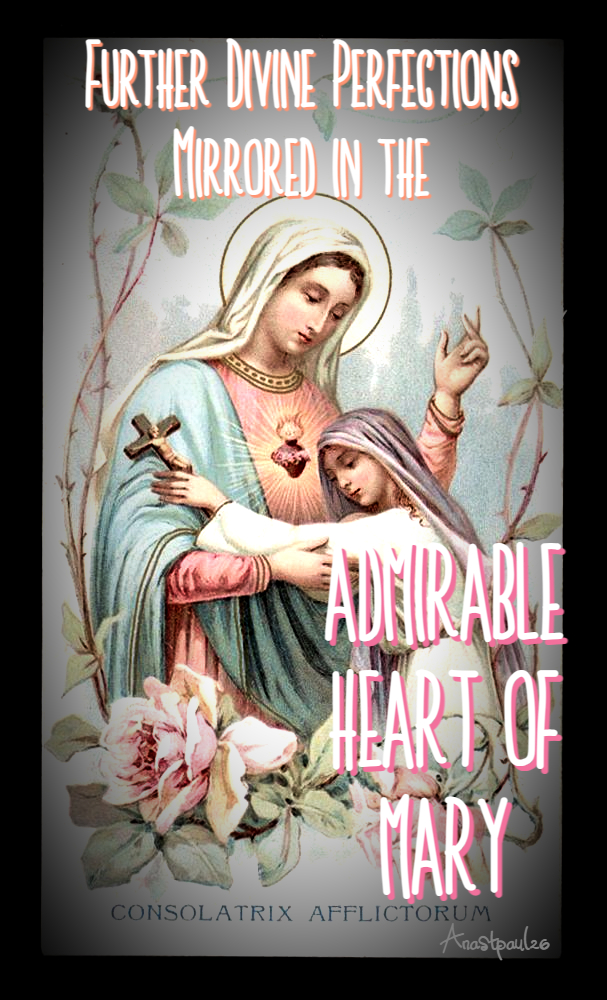
St John Eudes – The Admirable Heart of Mary
Further Divine Perfections Mirrored in the Admirable Heart of Mary
Divine Mercy is a perfection directed towards the miseries of creatures, tending to alleviate them and even to free them from created things when such a liberation enters into the designs of Divine Providence, which does all things with measure, number and weight. This adorable mercy extends, like goodness itself, to all God’s works: “His tender mercies are over all His works.” God’s mercy overshadows the works of nature, the works of grace and the works of glory.
Among the effects of divine Mercy, we must enumerate three principal realities, which in turn embody numberless effects. The first is the Incarnation of the God-Man; the second, His Mystical Body, namely Holy Church; the third is the Mother of the God-Man, namely the Most Blessed Virgin Mary. These constitute three admirable masterpieces of divine mercy.
Beyond this, God not only willed to become man that men might become partakers of the divine nature, but He willed that His only Son should become the Son of Man that men might become sons of God. God willed that His Son come into this world by being born of the seed of Adam and of a daughter of Adam that we might have the God-Man for our brother and the Mother of God for our mother. Thus we have the same father and the same mother as the Son of God Himself. We are His brothers, and as He is our mediator with His Father, so His heavenly Mother is a mediatrix between Himself and us.
In order to render His admirable Mother paramountly able to exercise her double office of Mother and Mediatrix, so that she might protect, favor and assist us with greater efficacy in all our needs, Divine Mercy constituted her, first of all, most agreeable and holy. Secondly, Mercy gave her dominion over everything in heaven and on earth. Thirdly, it gave her the mildest, sweetest and most loving heart save that of the God- Man. To the Heart of Mary God communicated in great abundance His merciful inclinations and established in it the throne and reign of His Mercy more gloriously than in the heart of any other creature, save the sacred humanity of Christ. Divine Mercy reigns so perfectly in Mary’s Heart that she bears the name of Queen and Mother of Mercy. And this most loving Mary has so completely won the heart of God’s mercy that He has given her the key to all His treasures and made her absolute mistress of them.
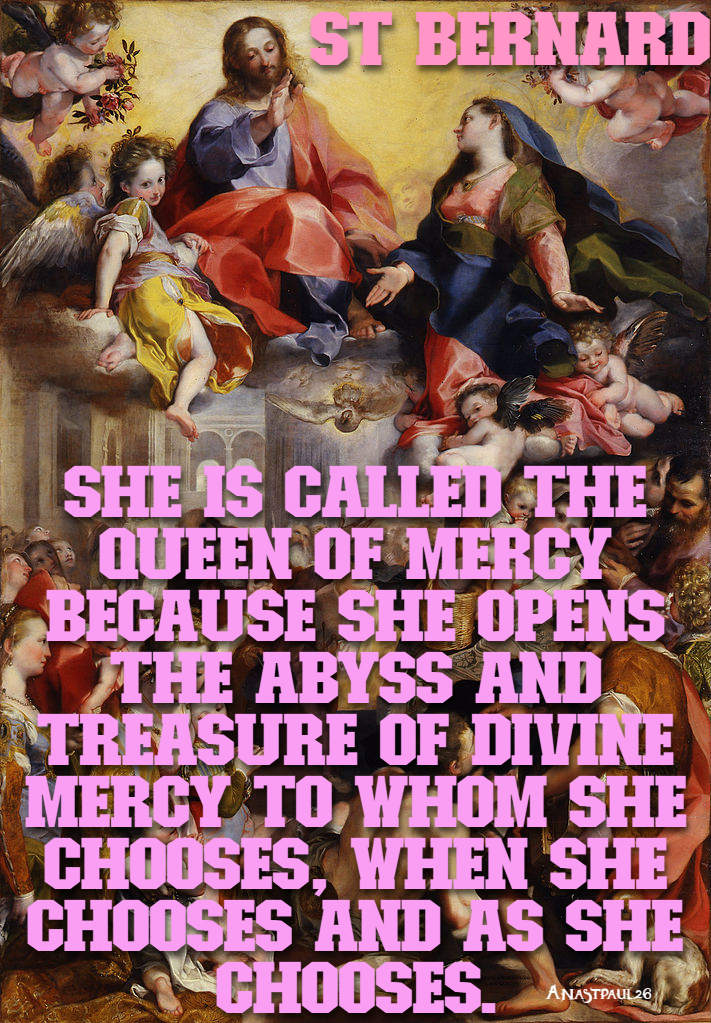
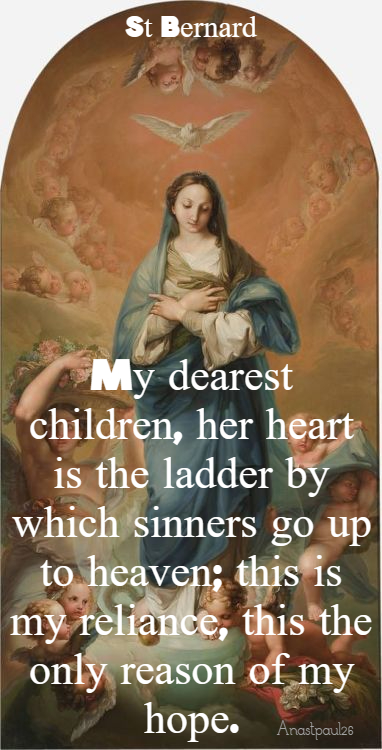
St. Bernard says: “She is called the Queen of Mercy because she opens the abyss and treasure of divine mercy to whom she chooses, when she chooses and as she chooses.” Divine Mercy holds such complete sway over Mary’s Heart and fills it with so much compassion for sinners and for all persons in need that St. Augustine addresses her thus: “Thou art the sinner’s only hope,” after God. “My dearest children,” says St. Bernard, “her heart is the ladder by which sinners go up to heaven; this is my reliance, this the only reason of my hope.” Euthymius, one of the ancient Fathers who lived over seven centuries ago, adds: “O most merciful Virgin, deign to cast thy pitiful eyes on thy poor servants, for, after God, we have placed all our hope in thee who are our life, our glory, and, as it were, our substance and our being.” St. John Damascene tells us that Our Lady is the only relief of the afflicted, the sovereign comforter of anguished hearts; and St. John Chrysostom declares her to be a boundless ocean of mercy.
Would you know in what further manner divine mercy lives and reigns in the Heart of the Mother of Mercy? Listen to St. Bonaventure: “Great was Mary’s mercy towards the wretched while she was living in exile here below; but immeasurably greater still now that she is happily reigning in heaven. She manifests this greater mercy through innumerable benefits, now that she possesses a clearer insight into the numberless woes of mankind. She does not require past merits, but grants the petitions of all men, out of charity, and opens the bosom of her clemency to everyone. She relieves every need and necessity with an incomparable affection and tenderness of heart.”
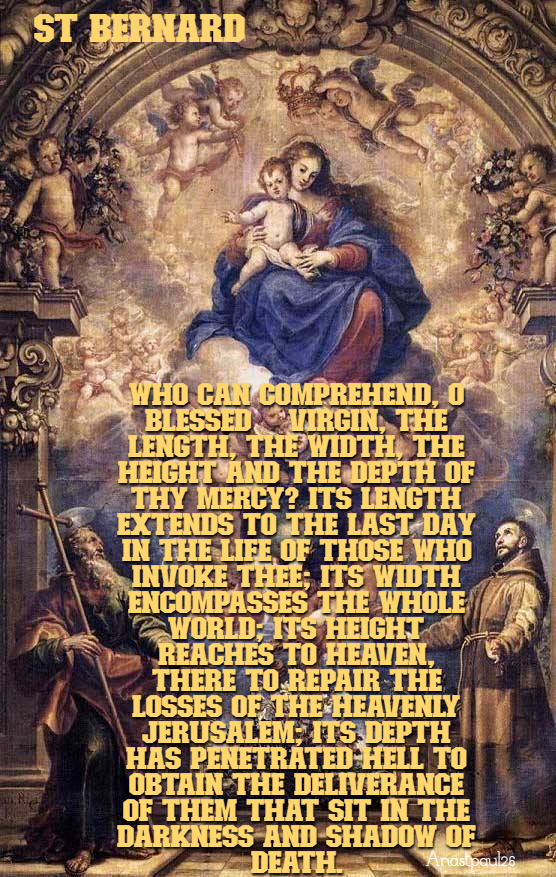
Her gentle Heart is so filled with mercy that it overflows on all sides and spreads itself in heaven, on earth and even in hell. Let us again listen to St. Bernard proclaiming this truth: “Who can comprehend, O Blessed – Virgin, the length, the width, the height and the depth of thy mercy? Its length extends to the last day in the life of those who invoke thee; its width encompasses the whole world; its height reaches to heaven, there to repair the losses of the heavenly Jerusalem; its depth has penetrated hell to obtain the deliverance of them that sit in the darkness and shadow of death.”
The virginal Heart of the Mother of Grace is filled with such exceeding mercy that she exercises it not only in favor of sinners who wish to be converted, but also towards many persons who never think of their eternal salvation. She implores her Blessed Son to inspire them, to excite in their hearts sentiments of fear of God and terror at the thought of His judgments. She asks Him to chastise them in divers ways, to raise in their midst persons leading holy and exemplary lives, whose example will draw them to Himself, and to use all other means of obtaining their conversion, or at least, if they will not mend their ways, to prevent them from multiplying their sins, that their damnation may be less terrible.
But what is even more, the Heart of Mary is so full of mercy that, using the extraordinary privileges God has granted to her alone, and out of her incomparable goodness, she often saves from eternal perdition souls who in the ordinary course of divine Justice would have been cast into hell. Such is the mind of that ancient and excellent author, Raymund Jourdain, who succeeded in hiding his name, but not the extent of his learning and holiness: “The Mother’s mercy often saves many whom the justice of the Son would have otherwise condemned.”
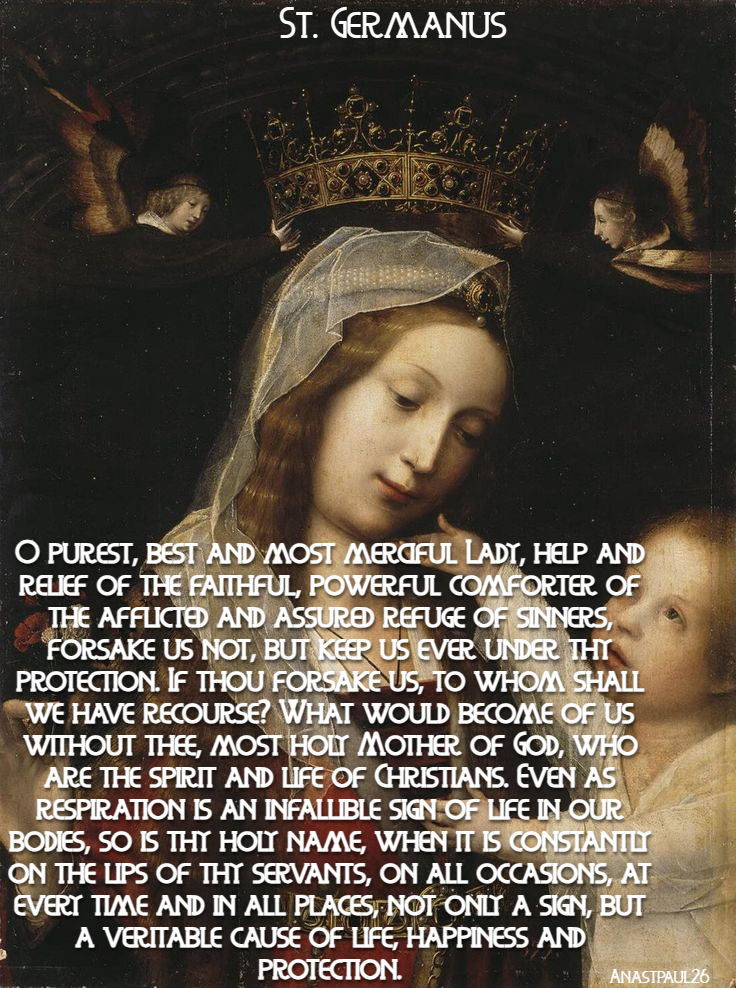
Hence St. Germanus, Patriarch of Constantinople, addresses these beautiful words to Mary: “O purest, best and most merciful Lady, help and relief of the faithful, powerful comforter of the afflicted and assured refuge of sinners, forsake us not, but keep us ever under thy protection. If thou forsake us, to whom shall we have recourse? What would become of us without thee, most holy Mother of God, who are the spirit and life of Christians. Even as respiration is an infallible sign of life in our bodies, so is thy holy name, when it is constantly on the lips of thy servants, on all occasions, at every time and in all places, not only a sign, but a veritable cause of life, happiness and protection.”


You must be logged in to post a comment.