
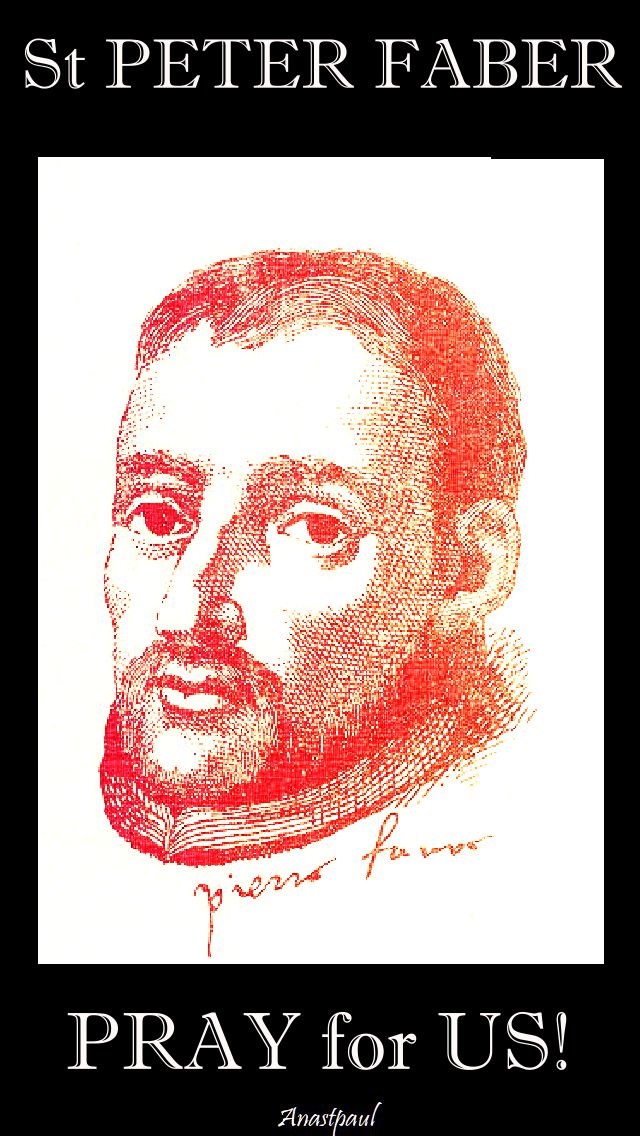
Thought for the Day – 1 August – The Feast of St Peter Faber S.J.
Annuncio vobis gaudium magnum! On 13 November 2013 Pope Francis announced the canonisation of Pierre Favre, SJ, aka Peter Faber (1506-46). For many Catholics the response was probably, “Who?”
For most Jesuits, though, the response was probably, “Finally!” For Pierre Favre has been a Blessed since…1872. Francis has announced this as an “equivalent canonization,” as Pope Benedict XVI had done with the canonization of St Hildegard of Bingen. In these cases the devotion to the saint is already well established.
In the Pope’s recent interview in America, he singled out for praise the man often called the “Second Jesuit.” The Pope was asked the reason for his devotion to this “First Companion” of St. Ignatius of Loyola, founder of the Society of Jesus. “[Pierre Favre’s] dialogue with all,” said the pope, “even the most remote and even with his opponents; his simple piety, a certain naïveté perhaps, his being available straightaway, his careful interior discernment, the fact that he was a man capable of great and strong decisions but also capable of being so gentle and loving.” Favre spent a great deal of his Jesuit life working with Protestants during the explosive time of the Reformation; and, as the pope intimated, he always did so with great openness and charity–during a time when they were called “heretics.”
One of my favorite quotes from Pierre–no, my favorite–is: “Take care, take care, never to close your heart to anyone.”
Favre was said by St. Ignatius to be the man best suited to direct others in the Spiritual Exercises–quite an accolade from the author of the Exercises. But, surprisingly, Favre’s story is not nearly as well known as those of his two famous college roommates, Ignatius Loyola and Francis Xavier. (When I once asked an elderly Jesuit why Favre was still a Blessed and not a saint, he said, “Even in heaven he is humble! He doesn’t want to place himself on par with Ignatius and Xavier.”) Many Jesuits are devoted to this humble spiritual master: the new Jesuit residence at Boston College for men in formation is named after him–though they may have to sandblast the “Blessed” on the stone sign in front of the house. But he still languishes in relative obscurity. Or will for another month. Indeed, that so many writers can’t even agree on a standard way of referring to the man–you will see, variously, the original French “Pierre Favre,” the somewhat modified Anglo-French “Peter Favre,” and the totally Anglicized “Peter Faber”–is an indication of the lack of attention given him. That of course changes with the canonisation.
For Favre, a man troubled all his life by a “scrupulous” conscience, that is, an excessive self-criticism, Ignatius was a literal godsend. “He gave me an understanding of my conscience,” wrote Favre. Ultimately, Ignatius led Peter through the Spiritual Exercises, something that dramatically altered Favre’s worldview.
This happened despite some very different backgrounds. And here is one area where Ignatius and his friends highlight an insight on relationships: friends need not be cut from the same cloth. The friend with whom you the least in common may be the most helpful for your personal growth. Ignatius and Peter had, until they met, led radically different lives. Peter came to Paris at age 19 after what his biographer called his “humble birth,” having spent his youth in the fields as a shepherd. Imbued with a simple piety toward Mary, the saints, relics, processions, and shrines and also angels, Peter clung to the simple faith of his childhood. Ignatius, on the other hand, had spent many years as a courtier and some of them as a soldier, undergone a dramatic conversion, subjected himself to extreme penances, wandered to Rome and the Holy Land in pursuit of his goal of following God’s will.
One friend had seen little of the world; the other much. One had always found religion a source of solace; the other had proceeded to God along a tortuous path.
Ultimately, Ignatius helped Peter to arrive at some important decisions through the freedom offered in the Spiritual Exercises. Peter’s indecision before this moment sounds refreshingly modern, much like the frustrating indecision of any college student today. He wrote about it in his journals:
“Before that–I mean before having settled on the course of my life through the help given to me by God through Inigo–I was always very unsure of myself and blown about by many winds: sometimes wishing to be married, sometimes a doctor, sometimes a lawyer, sometimes a professor of theology, sometimes a cleric without a degree–at times wishing me to be a monk.”
In time, Peter decided to join Ignatius on his new path, whose ultimate destination was still unclear. Peter, sometimes called the “Second Jesuit,” was enthusiastic about the risky venture from the start. “In the end,” he writes, “we became one in desire and will and one in a firm resolve to take up the life we lead today….” His friend changed his life. Later, Ignatius would say that Favre was the most skilled of all the Jesuits in giving the Spiritual Exercises. From The Jesuit Guide to Almost Everything.
So dear humble St Peter, we ask of you to pray that we too may become humble in the service of our Lord. Please pray for us!

 AnaStpaul