Posted in MORNING Prayers, QUOTES of the SAINTS, SAINT of the DAY

Thought for the Day – 16 August – The Memorial of St Stephen of Hungary

Thought for he Day – 16 August – The Memorial of St Stephen of Hungary

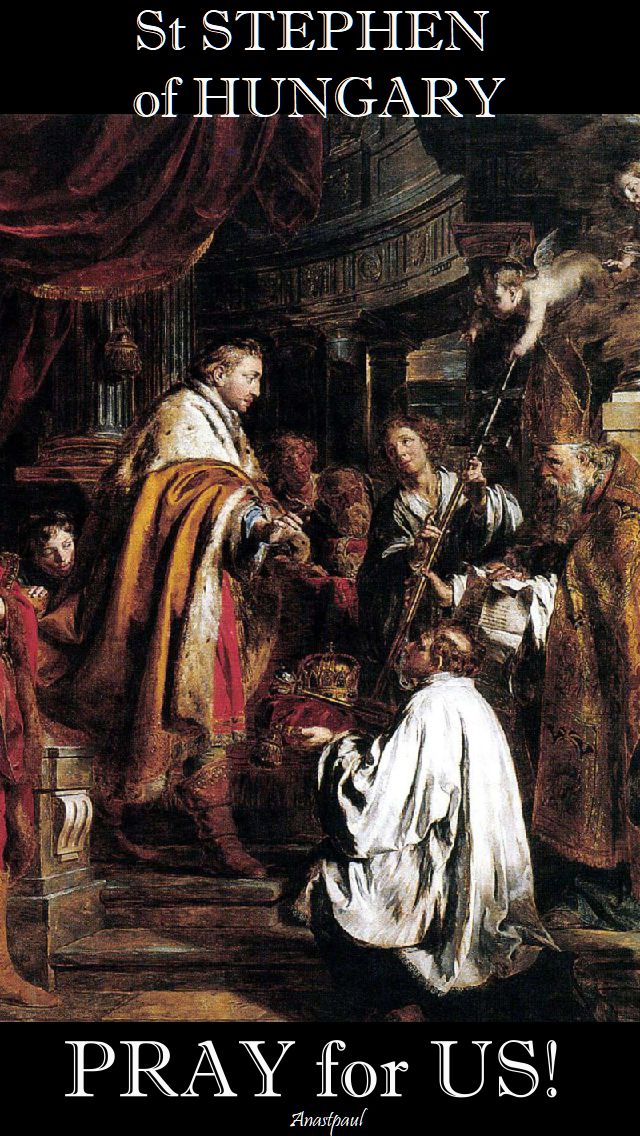
At the turn of the second millennium, St Stephen succeeded his father as leader of the Magyars in Hungary.   Looking to strengthen his authority, he determined to consolidate the state and extend Christianity throughout the land.   In 1001 he arranged to have Pope Sylvester II name him king of Hungary.   The pope obliged.   As an additional sign of support, Sylvester had a special crown fashioned for Stephen that has become world famous.

Stephen extended his control over Hungary by restricting the power of the nobles.   By creating dioceses and establishing monasteries, Stephen strengthened the church and positioned it for expansion.   Politically, he aggressively used his power to establish Christianity as Hungary’s religion.   He ruthlessly abolished pagan customs, outlawing adultery and blasphemy.   Stephen ordered everyone to marry, except religious and forbade marriages between Christians and pagans.

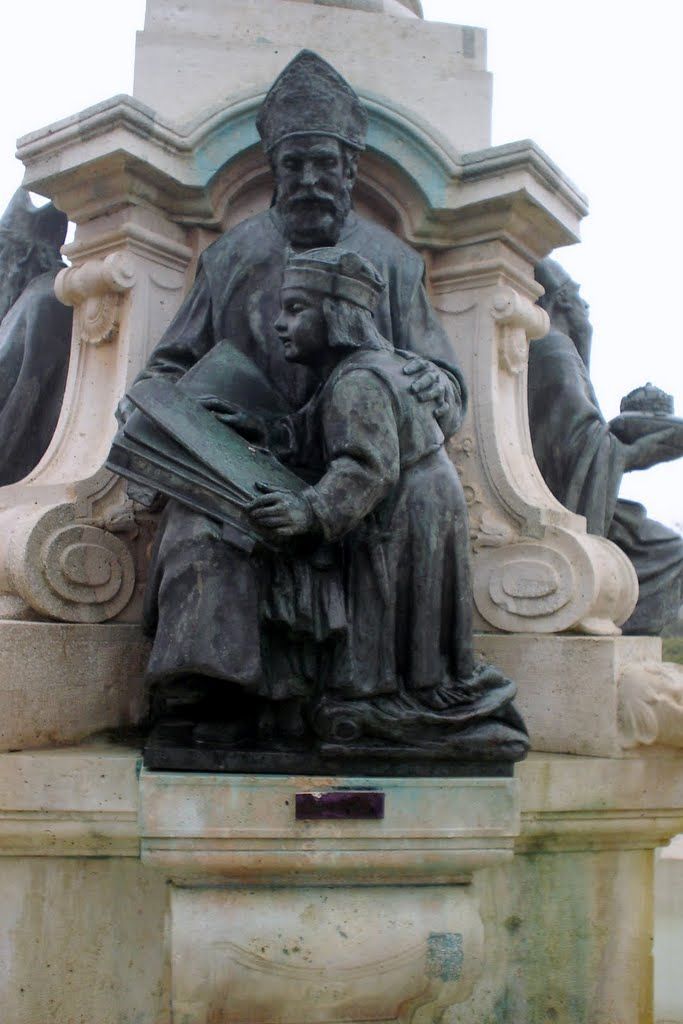
But Stephen had a kinder, gentler side.   Like St Louis IX, he made himself accessible to his people.   He also took personal concern for the poor.   He used to walk the streets in disguise so he could give alms to needy people.   Once he barely escaped when some beggars beat and robbed him.   But he refused to stop the practice.   Stephen was a family man.   In 1015 he had married Gisela, the sister of emperor St Henry II.   The couple had one son, Emeric, whom Stephen groomed as his successor.   In the following letter to his son, Stephen lays out his vision of what a Christian monarch must be:st stephen and his son emeric

“My dearest son, if you desire to honour the royal crown, I advise, I counsel, I urge you above all things to maintain the Catholic and apostolic faith with such diligence and care that you may be an example for all those placed under you by God and that all the clergy may rightly call you a man of true Christian profession. However, dearest son, even now in our kingdom the Church is proclaimed as young and newly planted;  and for that reason she needs more prudent and trustworthy guardians. . .

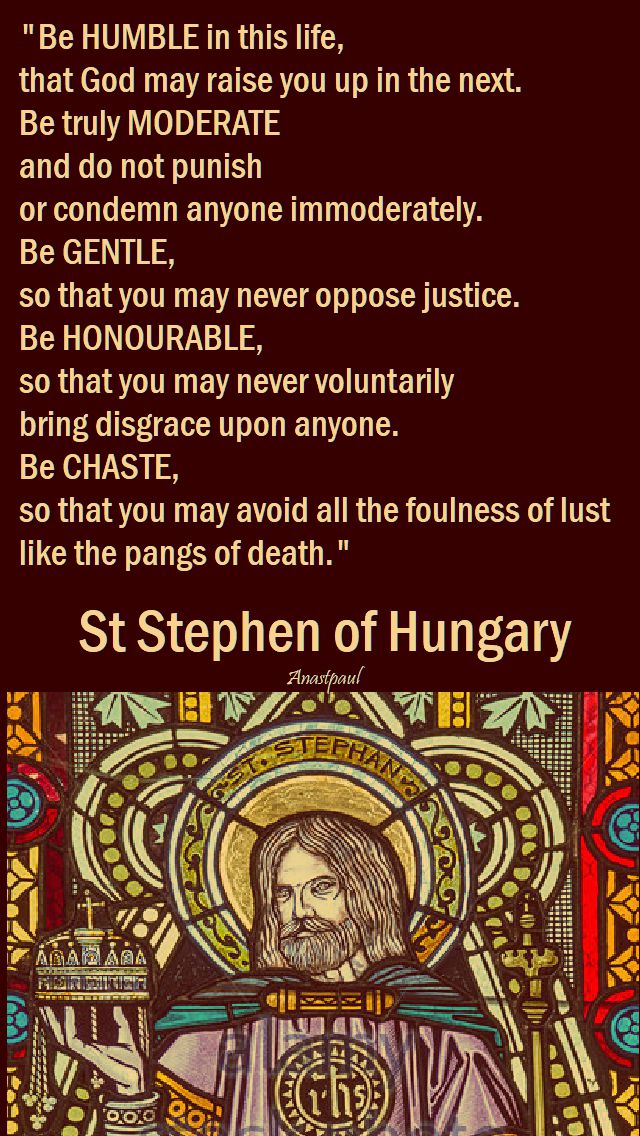
Finally, be strong lest prosperity lift you up too much or adversity cast you down. Be humble in this life, that God may raise you up in the next.   Be truly moderate and do not punish or condemn anyone immoderately.   Be gentle so that you may never oppose justice.   Be honourable so that you may never voluntarily bring disgrace upon anyone.   Be chaste so that you may avoid all the foulness of lust like the pangs of death.   All these virtues I have noted above make up the royal crown and without them no one is first to rule here on earth or attain to the heavenly kingdom.”

Sadly, Emeric died in a hunting accident, leaving Stephen no successor.   But Stephen is a Saint and is still loved and honoured by his people, for whom he is still an inspiration and a model – and for all of us!

St Stephen, icon of charity and love, pray for us!

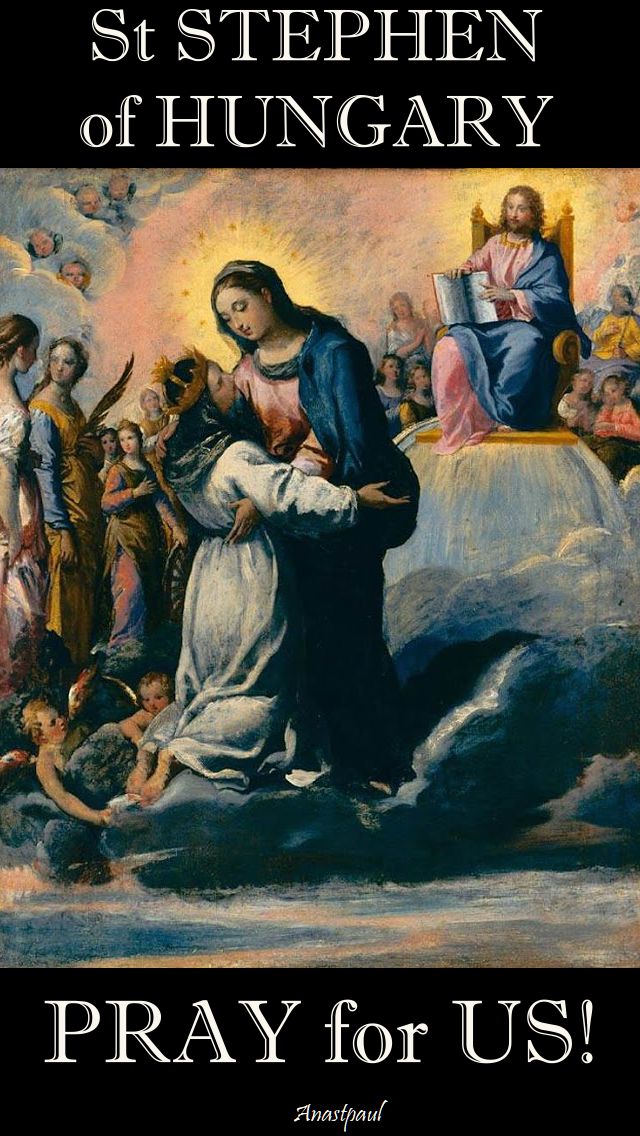
st stephen of hungary pray for us 2


Posted in DOCTORS of the Church, MORNING Prayers, QUOTES of the SAINTS, SAINT of the DAY

Quote/s of the Day – 16 August – The Memorial of St Stephen of Hungary

Quote/s of the Day – 16 August – The Memorial of St Stephen of Hungary

“Be HUMBLE in this life,
that God may raise you up in the next.
Be truly MODERATE
and do not punish or condemn anyone immoderately.
Be GENTLE,
so that you may never oppose justice.
Be HONOURABLE,
so that you may never voluntarily
bring disgrace upon anyone.
Be CHASTE,
so that you may avoid all the foulness of lust
like the pangs of death.”

be humble in this life - st stephen of hungary

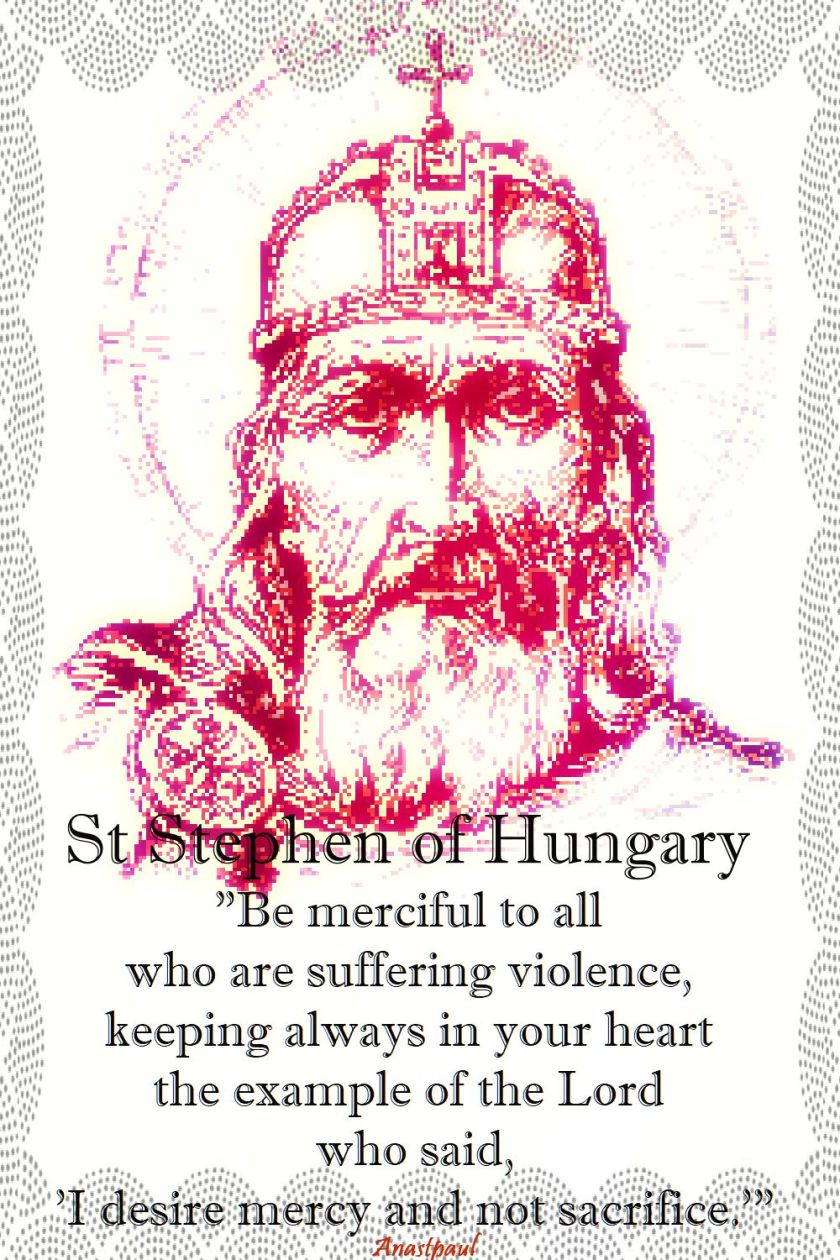
“Be merciful to all who are suffering violence,
keeping always in your heart the example of the Lord
who said, ‘I desire mercy and not sacrifice.'”

St Stephen of Hungary

be merciful to all - st stephen of hungary

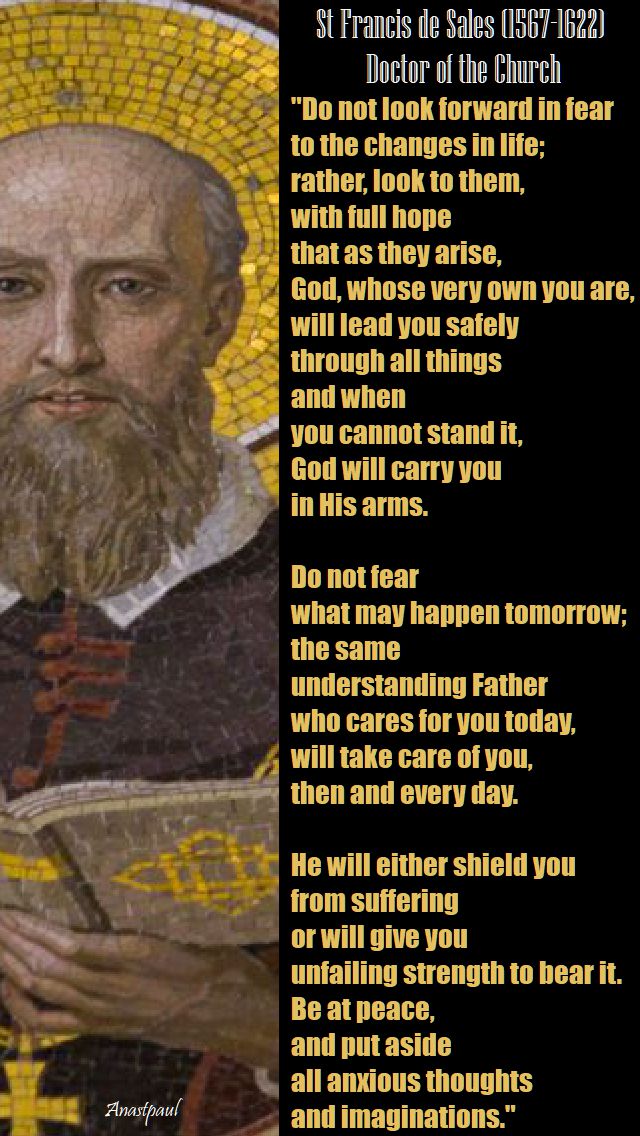
“Do not look forward in fear to the changes in life;
rather, look to them with full hope that as they arise,
God, whose very own you are,
will lead you safely through all things
and when you cannot stand it,
God will carry you in His arms.

Do not fear what may happen tomorrow;
the same understanding Father who cares for
you today, will take care of you then and every day.

He will either shield you from suffering
or will give you unfailing strength to bear it.
Be at peace,
and put aside all anxious thoughts and imaginations.”

St Francis de Sales (1567-1622) Doctor of the Church

do not look forward in fear - st francis de sales

Posted in MORNING Prayers, SAINT of the DAY, The WORD

One Minute Reflection – 16 August – The Memorial of St Stephen of Hungary

One Minute Reflection – 16 August – The Memorial of St Stephen of Hungary

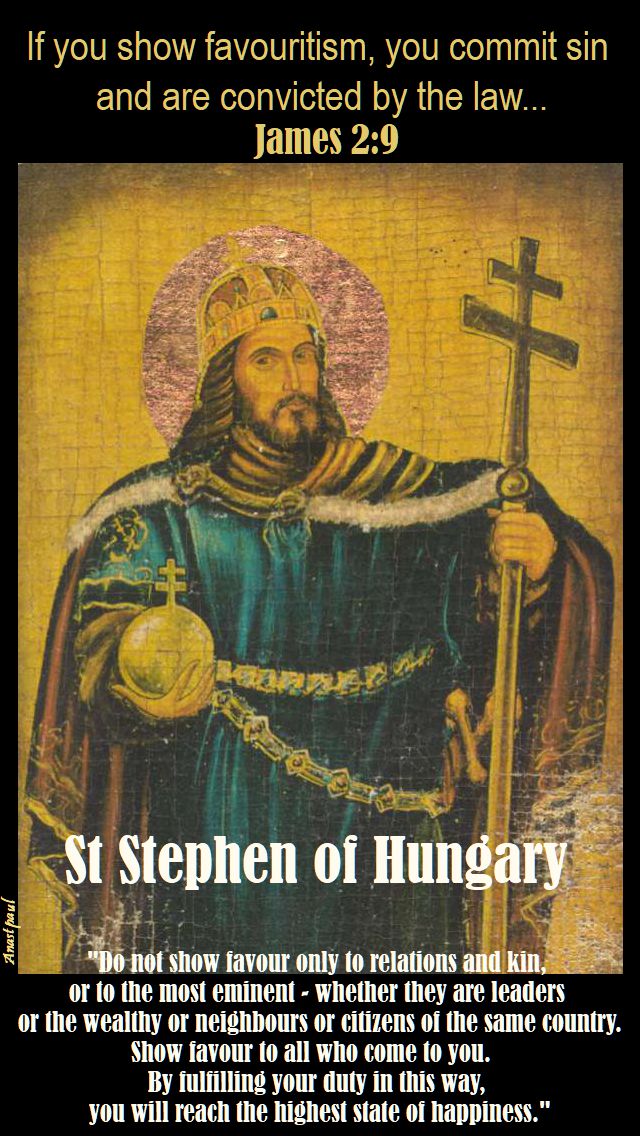
If you show favouritism, you commit sin and are convicted by the law…..James 2:9

REFLECTION – “Do not show favour only to relations and kin, or to the most eminent – whether they are leaders or the wealthy or neighbours or citizens of the same country.
Show favour to all who come to you. By fulfilling your duty in this way, you will reach the highest state of happiness.”…St Stephen of Hungary

do not show favour - st sephen of hungary

PRAYER – Just and Holy Father, help me to overcome all tendencies to show favourtisim in my life. Let me treat all persons as brothers and sisters in Christ and work and pray for their salvation. St Stephen of Hungary, pray for us, amen.

st stephen of hungary pray for us

Posted in DOCTORS of the Church, MORNING Prayers, PRAYERS of the SAINTS

Our Morning Offering – 16 August

Our Morning Offering – 16 August

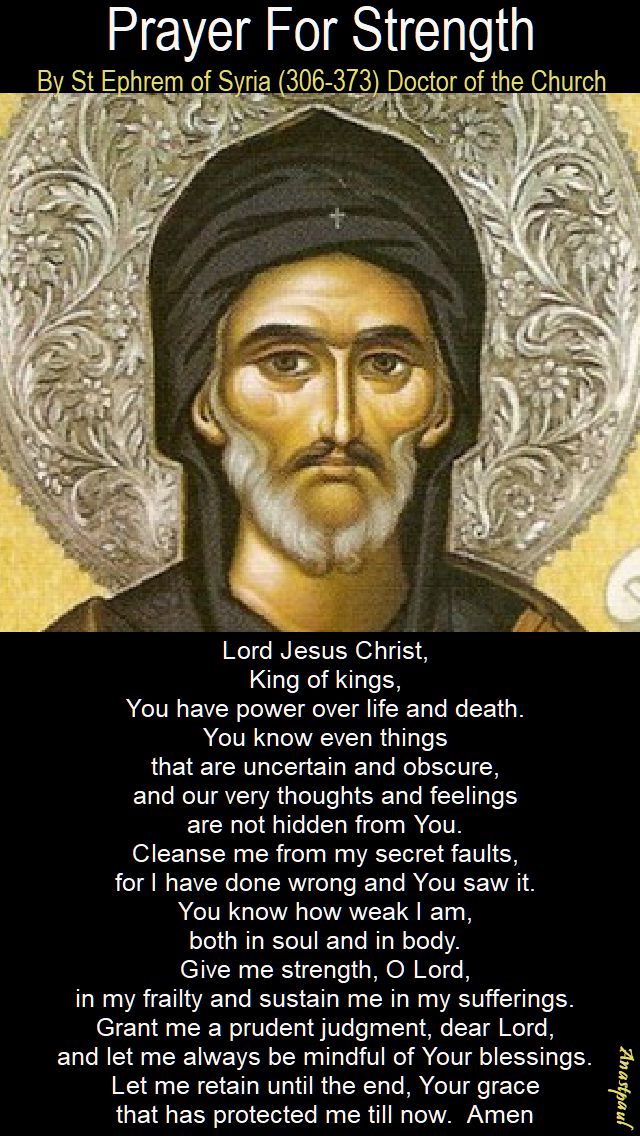
Prayer For Strength
By St EPHREM of Syria (306-373) Doctor of the Church

Lord Jesus Christ,
King of kings,
You have power over life and death.
You know even things that are uncertain and obscure,
and our very thoughts and feelings are not hidden from You.
Cleanse me from my secret faults,
for I have done wrong and You saw it.
You know how weak I am,
both in soul and in body.
Give me strength, O Lord,
in my frailty and sustain me in my sufferings.
Grant me a prudent judgment, dear Lord,
and let me always be mindful of Your blessings.
Let me retain until the end, Your grace
that has protected me till now.
Amen

prayer for strength by st ephrem of syria

Posted in Against EPIDEMICS, GOUT, KNEE PROBLEMS, ARTHRITIS, etc, Of ANIMALS / ANIMAL WELFARE, Of BACHELORS, Of the SICK, the INFIRM, All ILLNESS, PATRONAGE - OF DOGS and against DOG BITES and/or RABIES, SAINT of the DAY, SKIN DISEASES, RASHES

Saint of the Day – 16 August- St Roch (1295-1327) Confessor

Saint of the Day – 16 August- St Roch (1295-1327)  Confessor, Pilgrim, Hermit, Apostle of the Sick, Miracle Worker.   Born in 1295 at Montpelier, France and died in 1327 at Montpelier or Angleria, France of natural causes).   His relics are in Venice, Italy in the Church of San Rocco,some reside in Rome and others in Arles, France.   Patronages –  against cholera, against diseased cattle, against epidemics, against knee problems, against the plague, against skin diseases and rashes, bachelors, of dogs, falsely accused people, invalids, relief from pestilence, OF  surgeons, tile makers, The Diocese of Tagbilaran, Philippines,Constantinople, 24 other assorted Cities around the world.   Attributes – angel, bread, dog, pilgrim with staff, often displaying a plague wound on his leg, pilgrim with a dog, pilgrim with a dog licking the wound, pilgrim with a dog carrying a loaf of bread in its mouth.

According to his Acta and his vita in the Golden Legend, he was born at Montpellier, at that time “upon the border of France“, as the Golden Legend has it, the son of the noble governor of that city.   Even his birth was accounted a miracle, for his noble mother had been barren until she prayed to the Virgin Mary.   Miraculously marked from birth with a red cross on his breast which grew as he did, he began to manifest strict asceticism and great devotion and piety from a very early age.    On days when his “devout mother fasted twice in the week and the blessed child Rocke abstained twice also, he would drink from his mother but once that day.”

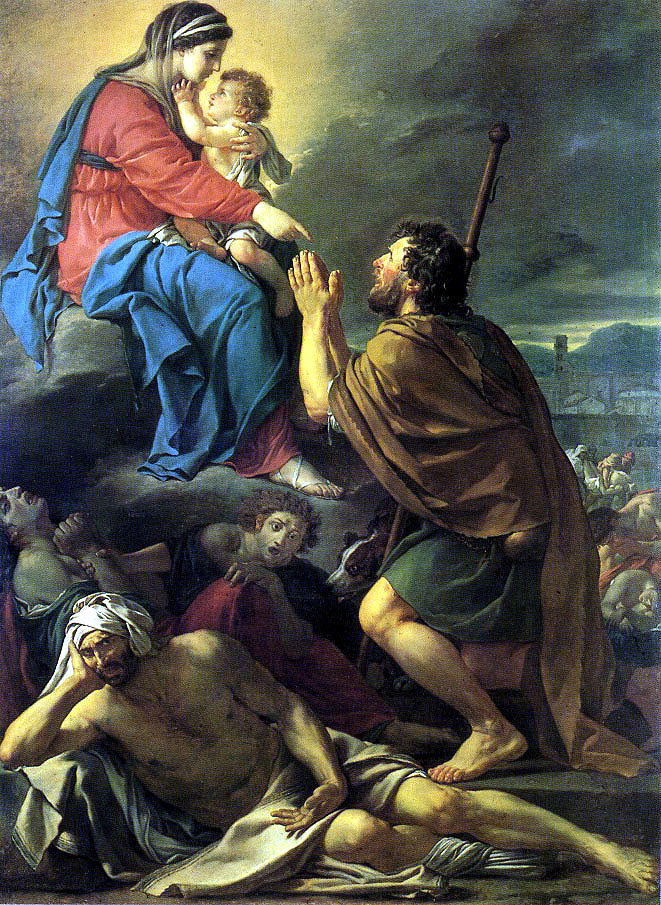
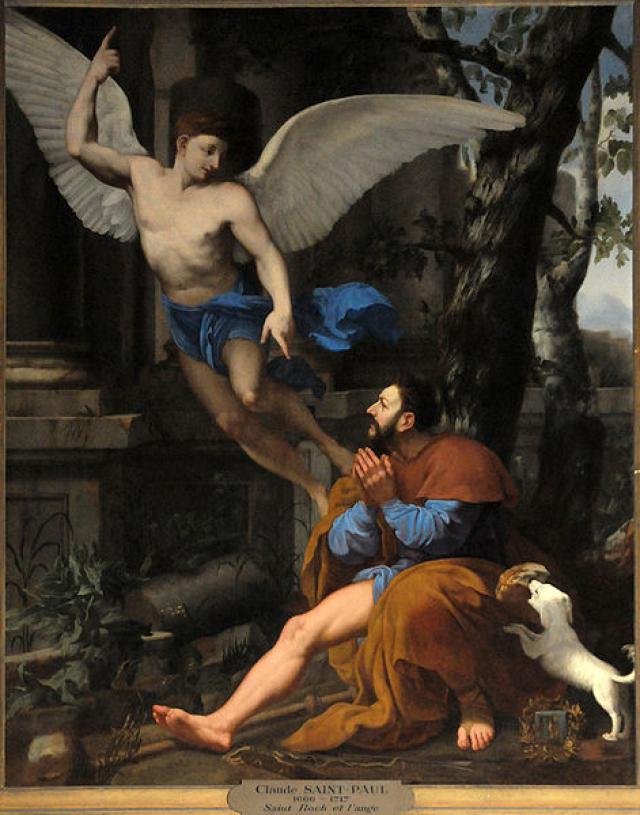
On the death of his parents in his twentieth year he distributed all his worldly goods among the poor like Francis of Assisi—although his father, on his deathbed, had ordained him governor of Montpellier—and set out as a mendicant pilgrim for Rome.   Coming into Italy during an epidemic of plague, he was very diligent in tending the sick in the public hospitals at Acquapendente, Cesena, Rimini, Novara and Rome, and is said to have effected many miraculous cures by prayer and the sign of the cross and the touch of his hand.   St Roch Praying to the Virgin for an End to the Plague Creator(s- Jacques-Louis DavidIn In Rome, according to the Golden Legend he preserved the “Cardinal of Angleria in Lombardy” by making the Sign of the Cross on his forehead, which miraculously remained there, visi nbble to all!    Ministering at Piacenza he himself finally fell ill.   He was expelled from the Town and withdrew into the forest, where he fashioned a shelter of boughs and leaves which was miraculously supplied with water, by a spring wic arose in the place;.   He would have perished, had not a dog belonging to a nobleman named Gothard Palastrelli, supplied him with bread and licked his wounds, healing them.   Count Gothard, following his hunting dog carrying the bread, discovered Saint Roch and became his acolyte.

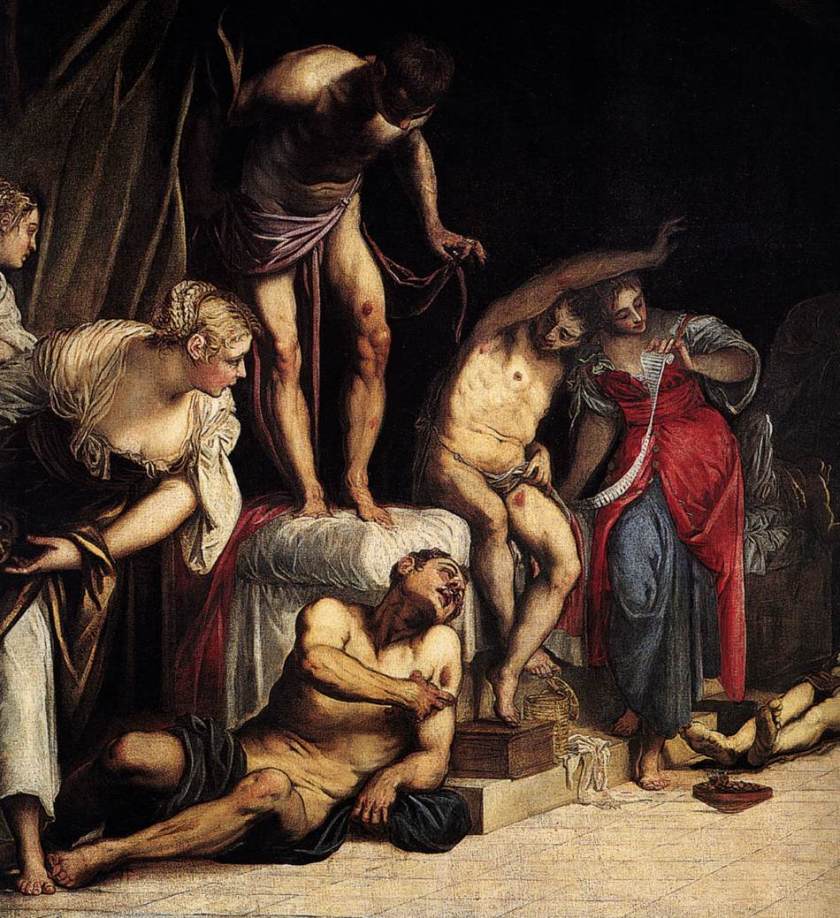
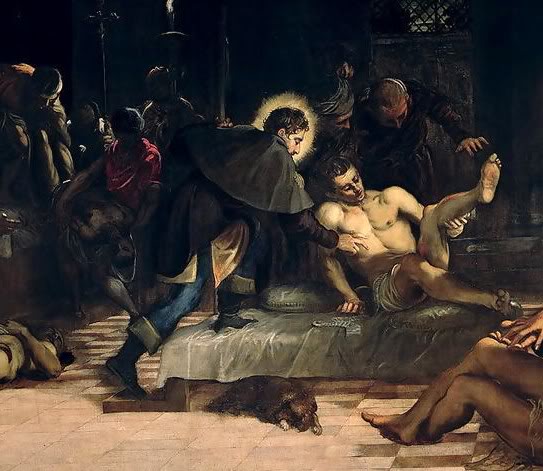
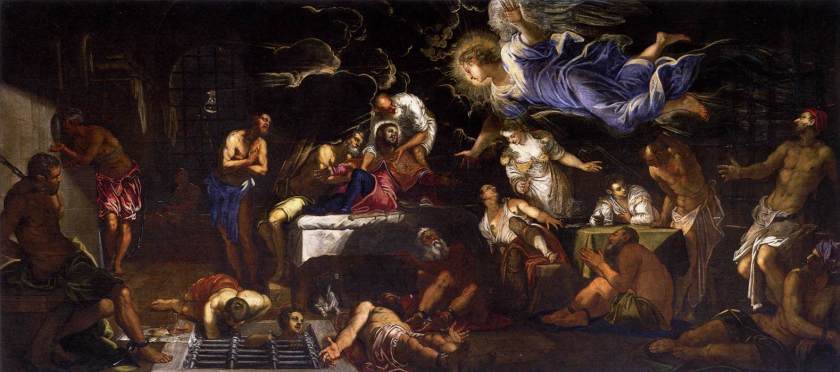
Jacopo_Tintoretto_-_St_Roch_in_the_Hospital_(detail)_-_WGA22606+(2)816roch16guido reni san roque 1617Saint_Paul_Saint_Roch

On his incognito return to Montpellier he was arrested as a spy (by orders of his own uncle) and thrown into prison, where he languished five years and died on 16 August 1327, without revealing his name, to avoid worldly glory.   After his death, according to the Golden Legend;

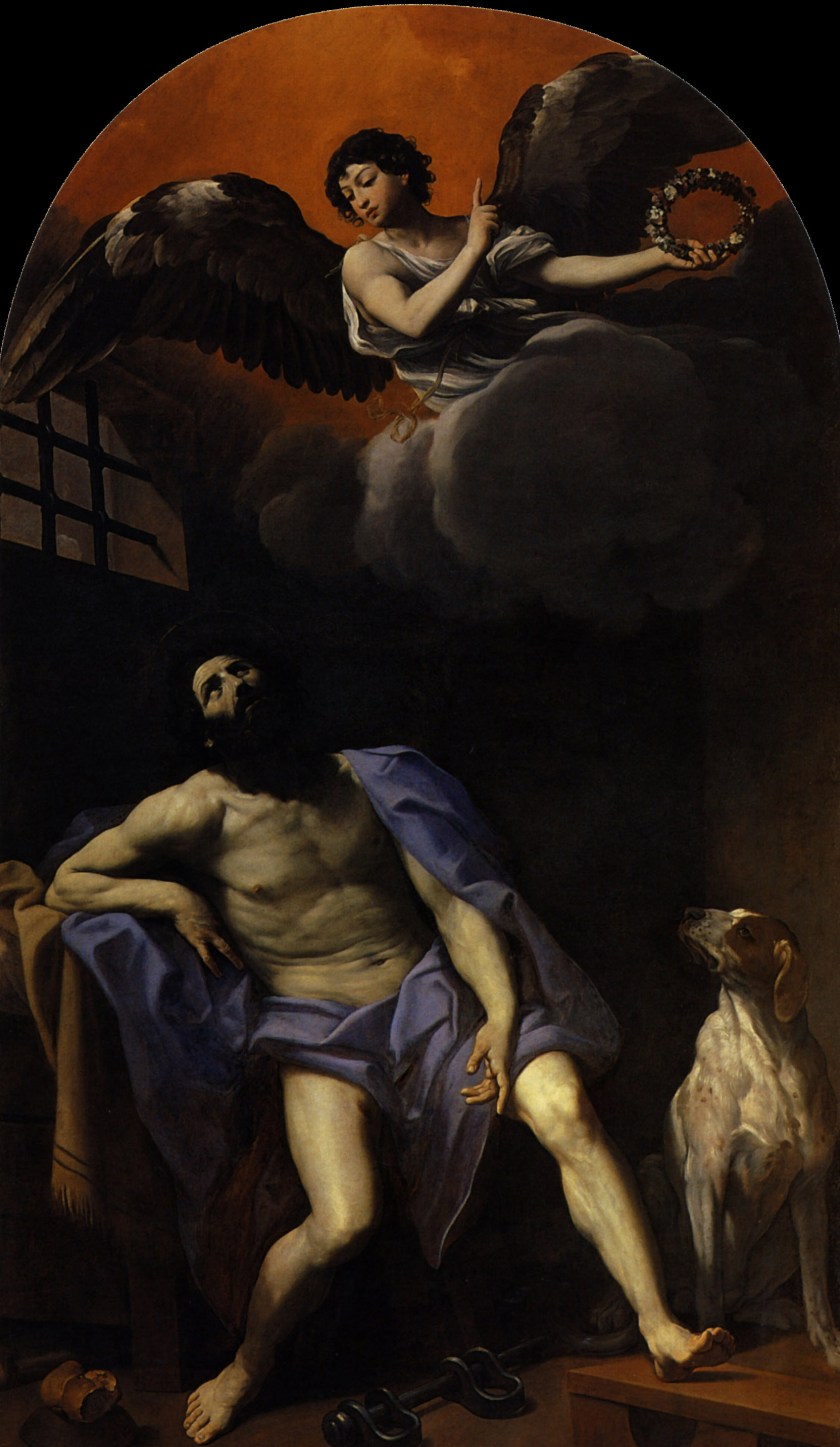
“anon, an Angel brought a table into the prison, from Heaven, divinely written with letters of gold, which he laid under the head of St Roch.   And on that table was written, God had granted to him his prayer, that is, to wit, that who that calleth meekly to St Roch shall not be hurt with any hurt of pestilence.”

The townspeople recognised him as well by his birthmark;  he was soon Canonised in the popular mind and a great Church erected in veneration.

The story that, in 1414,  when the Council of Constance was threatened with plague, public processions and prayers for the intercession of Roch were ordered and the outbreak ceased, is provided by Francesco Diedo, the Venetian governor of Brescia, in his Vita Sancti Rochi, 1478.   The cult of Roch gained momentum during the bubonic plague that passed through northern Italy in 1477–79.

His popularity, originally in central and northern Italy and at Montpellier, spread through Spain, France, Lebanon the Low Countries, Brazil and Germany, where he was often interpolated into the roster of the Fourteen Holy Helpers, whose veneration spread in the wake of the Black Death.   The magnificent 16th-century Scuola Grande di San Rocco and the adjacent church of San Rocco were dedicated to him by a confraternity at Venice, where his body was said to have been surreptitiously translated and was triumphantly inaugurated in 1485;  the Scuola Grande is famous for its sequence of paintings by Tintoretto, who painted St Roch visited by an angel, in a ceiling canvas (1564).

Tintoretto,_Jacopo_-_St_Roch_in_Prison_Visited_by_an_Angel_-_1567

We know for certain that, in 1465,  the body of St Roch was carried from Voghera, instead of Montpellier as previously thought, to Venice.   Pope Alexander VI (1492–1503) built a Church and a hospital in his honour.   Pope Paul III (1534–1549) instituted a confraternity of St Roch.   This was raised to an Arch-confraternity in 1556 by Pope Paul IV;  it still thrives today.

Saint Roch had not been officially recognised as a Saint as yet, however.   In 1590 the Venetian Ambassador to Rome reported to the Serenissima that he had been repeatedly urged to present the witnesses and documentation of the life and miracles of St Rocco, already deeply entrenched in the Venetian life because Pope Sixtus V “is strong in his opinion either to Canonise him or else to remove him from the ranks of the Saints.”    The Ambassador had warned a Cardinal of the general scandal that would result, if the widely venerated St Rocco, were impugned as an impostor.   Sixtus did not pursue the matter but left it to later Popes to proceed with the Canonisation process.   His successor, Pope Gregory XIV (1590–1591), added Roch of Montpellier, who had already been memorialised in the Holy Sacrifice of the Mass for two centuries, to the Roman Martyrology, thereby fixing 16 August as his universal Feast Day.

Numerous brotherhoods have been instituted in his honour.   He is usually represented in the garb of a pilgrim, often lifting his tunic to demonstrate the plague sore in his thigh and accompanied by a dog carrying a loaf in its mouth.   The Third Order of Saint Francis, by tradition, claims him as a member and includes his Feast on its own calendar, observing his Feast on 17 August.

Posted in SAINT of the DAY

Memorials of the Saints for 16 August

St Stephen of Hungary (Optional Memorial)

Bl Angelus Agostini Mazzinghi
St Armagillus of Brittany
St Arsacius of Nicomedia
St Frambaldo
Bl Iacobus Bunzo Gengoro
Bl Jean-Baptiste Menestrel
Bl John of Saint Martha
Bl Laurence Loricatus
Bl Magdalena Kiyota Bokusai
Bl Maria Gengoro
Bl Ralph de la Futaye
St Roch
St Serena
Bl Simon Kiyota Bokusai
Bl Thomas Gengoro
St Titus the Deacon

Martyrs of Palestine – 33 saints: Thirty-three Christians martyred in Palestine; they are commemorated in old martyrologies, but the date and exact location have been lost.

Martyred in the Spanish Civil War:
Bl Amadeu Monje Altés
Bl Antonio María Rodríguez Blanco
Bl Enrique García Beltrán
Bl José María Sanchís Mompó
Bl Laurentí Basil Matas

Posted in DOCTORS of the Church, FATHERS of the Church, MORNING Prayers, QUOTES of the SAINTS, SAINT of the DAY

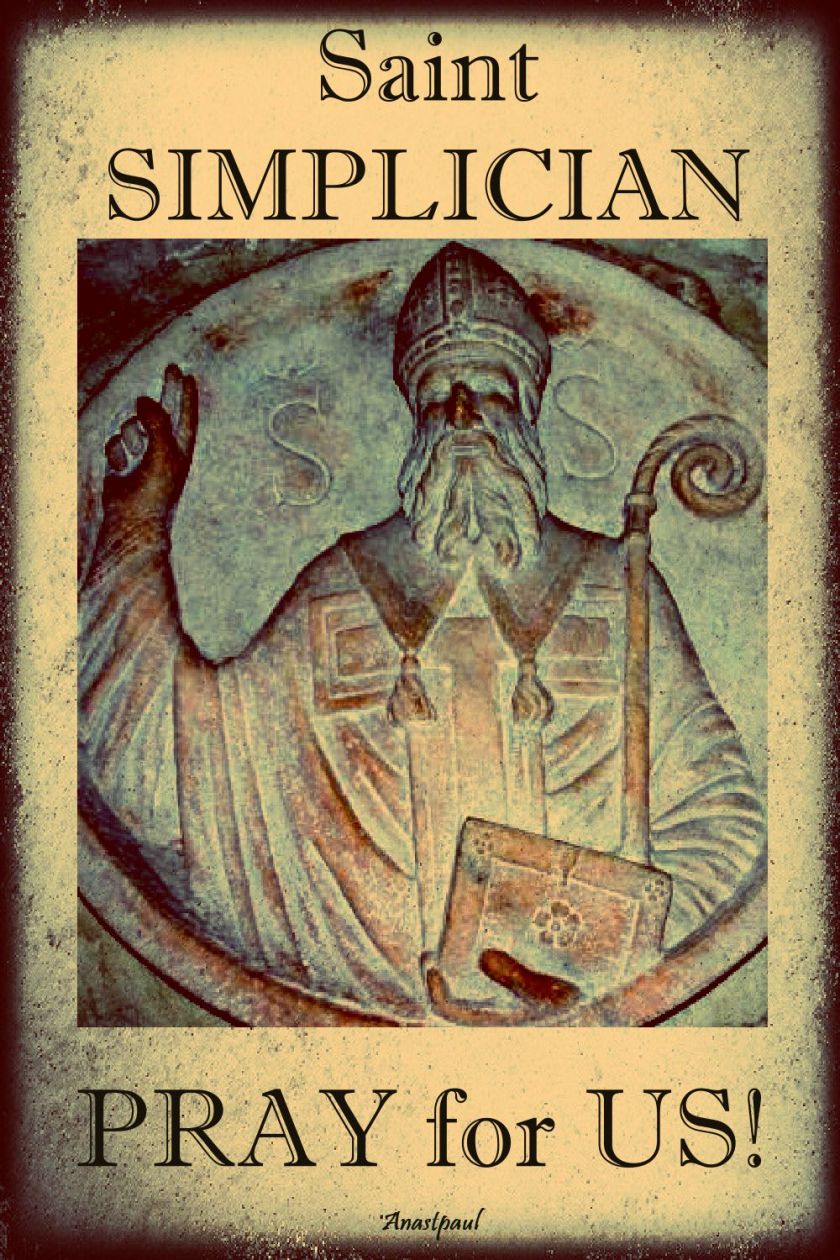
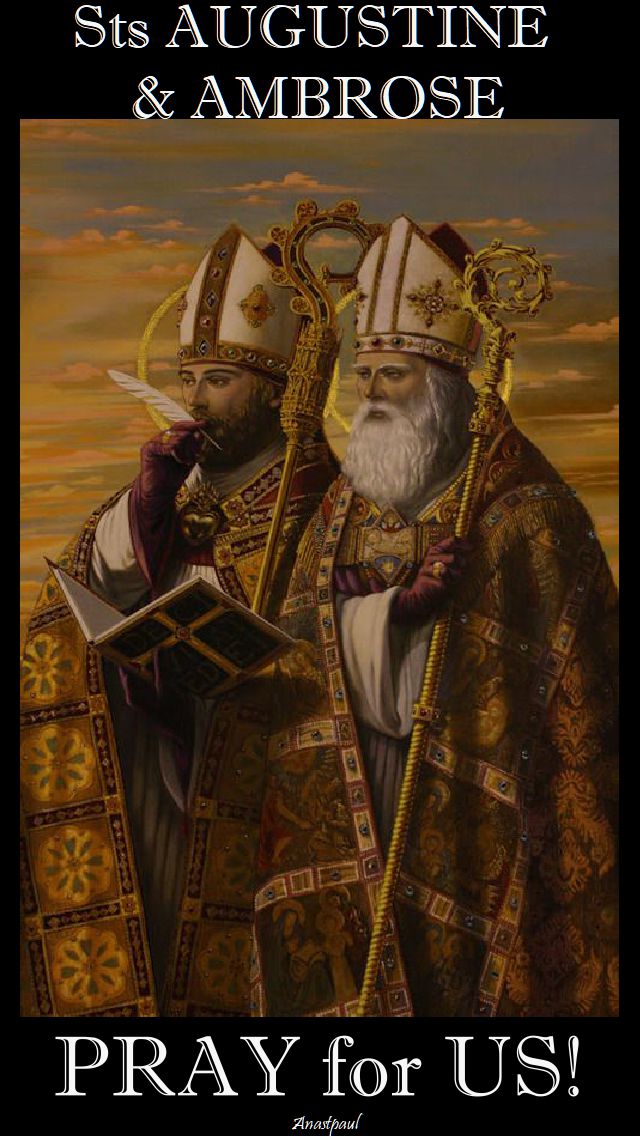
Thought for the Day – The Memorial of St Simplician – 15 August

Thought for the Day – The Memorial of St Simplician – 15 August

“Augustine and Simplician, sons of Milan, followers of Christ”

“Another great name enters Milan’s rich story in 384, that of the man who became St Augustine.   In 384 he was not yet a saint.   But he was a man who was searching, probing and asking questions, testing the spirits that drove him.   First he found Ambrose, who “welcomed me as a father would and like a good bishop approved of my journeying,” according to his Confessions.   Still, he was not ready to accept the Christian faith and way of life.   But Ambrose could not be the spiritual director he needed.

Augustine had gotten through his doctrinal doubts and he “liked the Way, which was our Saviour, though the tight and narrow parts of that way” annoyed him.   So God put it in his mind to go to Simplician, “whom I considered to be your good servant and your grace shone in him.   I heard that since his youth he lived most devoted to you.”   Now he had grown old and to Augustine he seemed to have become a great expert in studying God’s ways.   “And so he was! So I wanted to share with him my inner turmoil so he might teach me how best I, as I was, could walk in your ways.”

That is quite an endorsement!   From one saint-to-be about a wise and holy mentor, guide, companion on the road.   One intently searching, the other guiding that search.   We all need help from time as we make our authentic way.   Maybe it can sound trite, an easy image, our life as a journey or pilgrimage, our walking the camino to a holy goal. But it speaks a deep truth.“…(Fr Edward W Schmidt S.J.)

St Simplician, Sts Augustine & Ambrose, pray for us!

st simplician pray for us 2sts augustine and ambrose pray for us

Posted in DOCTORS of the Church, FATHERS of the Church, MORNING Prayers, QUOTES of the SAINTS

Quote/s of the Day – 15 August – The Memorial of St Simplicain, Friend and Teacher of St Ambrose and the “spiritual father of my soul” of St Augustine, both Fathers and Doctors of the Church

Quote/s of the Day – 15 August – The Memorial of St Simplicain, Friend and Teacher of St Ambrose and the “spiritual father of my soul” of St Augustine, both Fathers and Doctors of the Church

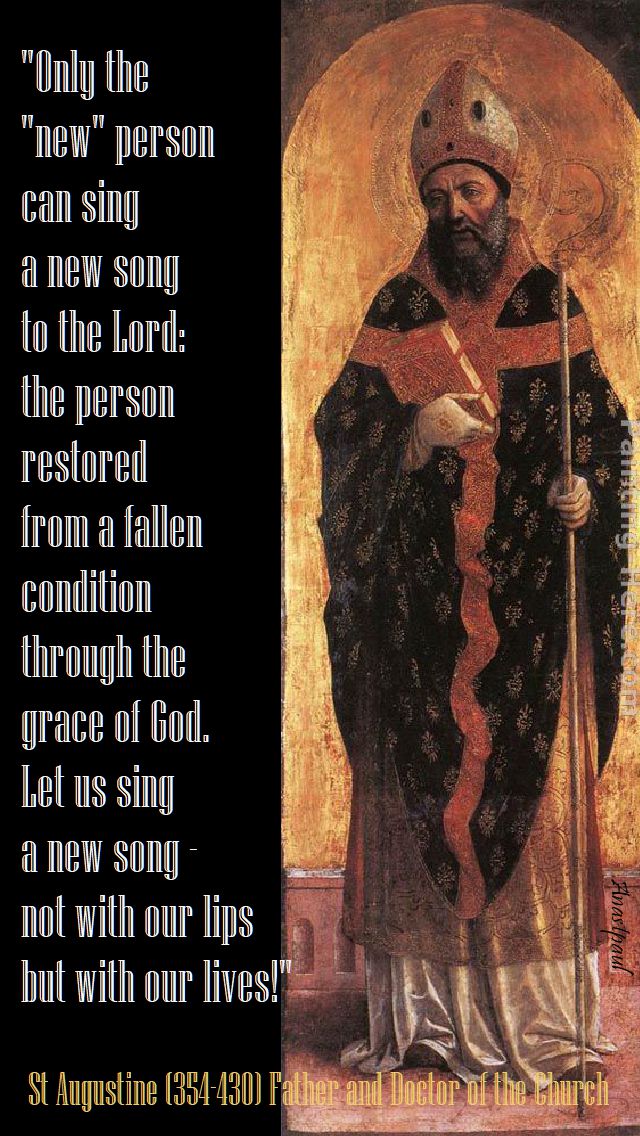
“Only the “new” person can sing a new song to the Lord:
the person restored from a fallen condition through the grace of God.
Let us sing a new song –
not with our lips
but with our lives!”

St Augustine (354-430) Father and Doctor of the Church

only the new person NO 2 - st augustine


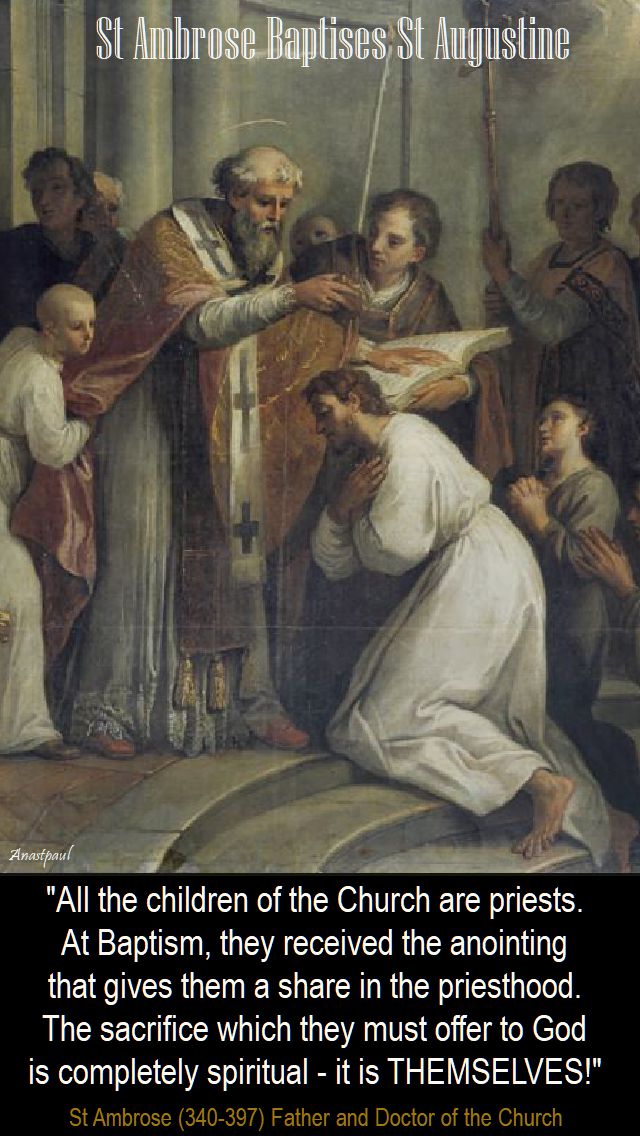
“All the children of the Church are priests.
At Baptism, they received the anointing
that gives them a share in the priesthood.
The sacrifice which they must offer to God
is completely spiritual – it is THEMSELVES!”

St Ambrose (340-397) Father and Doctor of the Church

ALL THE CHILDREN OF THE CHURCH - NO 2 - ST AMBROSE

Posted in CONFESSION/PENANCE, DOCTORS of the Church, FATHERS of the Church, MORNING Prayers, PRAYERS of the SAINTS, QUOTES of the SAINTS, SAINT of the DAY, The WORD

One Minute Reflection – 15 August

One Minute Reflection – 15 August

The Confessions – Book VIII – St Augustine’s Conversion to Christ.   Augustine is deeply impressed by Simplicianus’ story of the conversion to Christ of the famous orator and philosopher, Marius Victorinus.   He is stirred to emulate him but finds himself still enchained by his incontinence and preoccupation with worldly affairs.   He is then visited by a court official, Ponticianus, who tells him and Alypius the stories of the conversion of Anthony and also of two imperial “secret service agents.”   These stories throw him into a violent turmoil, in which his divided will struggles against himself.   He almost succeeds in making the decision for continence but is still held back.   Finally, a child’s song, overheard by chance, sends him to the Bible;  a text from Paul resolves the crisis;  the conversion is a fact.   Alypius also makes his decision and the two inform the rejoicing Monica.

“For I am the LORD, your God,
who grasp your right hand;
It is I who say to you, Do not fear,
I will help you.”….Isaiah 41:13

Isaiah 41 13

REFLECTION – “And Thou didst put it into my mind and it seemed good in my own sight, to go to Simplicianus, who appeared to me a faithful servant of Thine and Thy grace shone forth in him.   I had also been told that from his youth up he had lived in entire devotion to Thee.   He was already an old man and because of his great age, which he had passed in such a zealous discipleship in Thy way, he appeared to me likely to have gained much wisdom–and, indeed, he had.   From all his experience, I desired him to tell me–setting before him all my agitations–which would be the most fitting way for one who felt as I did to walk in thy way.”…St Augustine (From the Confessions – Book VIII – Chapter 1)

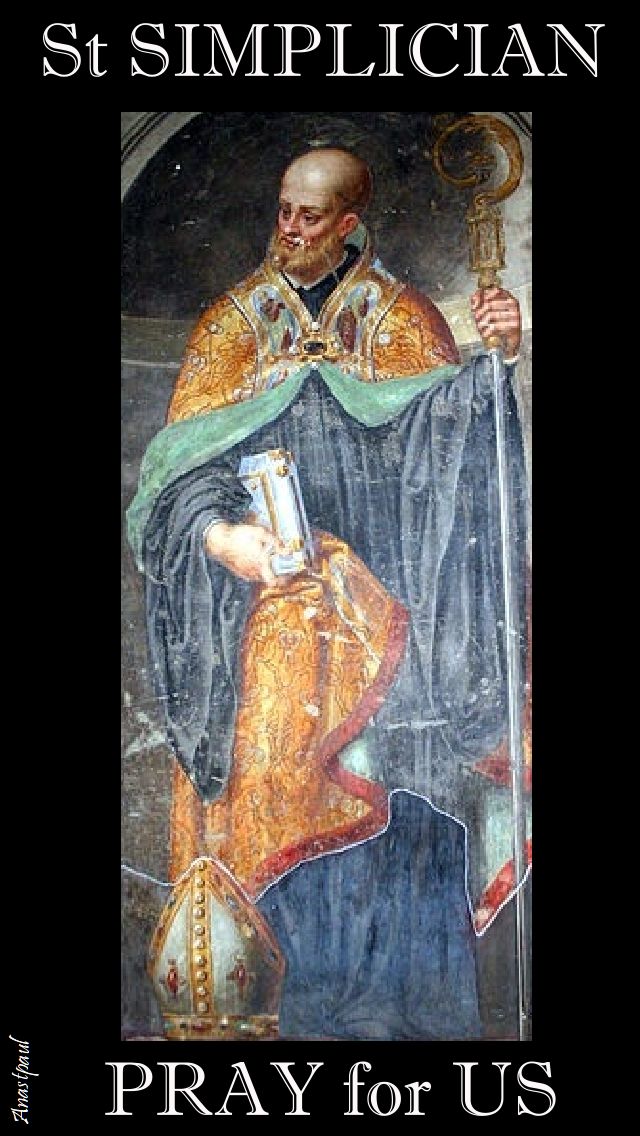
st simplician - pray for us

PRAYER – “Go on, O Lord and act: stir us up and call us back;  inflame us and draw us to Thee;  stir us up and grow sweet to us;  let us now love Thee, let us run to Thee.   Are there not many men … who, out of a deeper pit of darkess,.. return to Thee–who draw near to Thee and are illuminated by that light which gives those who receive it power from Thee to become Thy sons? “… (St Augustine – From the Confessions Book VIII – Chapter IV)  St Simplician, pray for us, Amen.

Posted in DOCTORS of the Church, FATHERS of the Church, MORNING Prayers, PRAYERS of the SAINTS

Our Morning Offering – 15 August

Our Morning Offering – 15 August

PRAYER of ST AMBROSE  (340-397) Father and Doctor of the Church

O Lord, who has mercy upon all,
take away from me my sins
and mercifully kindle in me
the fire of Your Holy Spirit.
Take away from me the heart of stone
and give me a heart of flesh,
a heart to love and adore You,
a heart to delight in You,
to follow and enjoy You,
for Christ’s sake. Amen

12_7_ _Saint_Ambrose_1_Francisco_de_Zurbarán

Posted in SAINT of the DAY

Saint of the Day – 15 August – St Simplician of Milan

Saint of the Day – 15 August – St Simplician (Simpliciano) of Milan – Archbishop of Milan, Teacher, Catechist, Writer, Mystic  successor to St Ambrose – (c 320 in Rome, Italy – c 401 in Milan, Liguria, Italy).


St Simplician was born about 320 probably in Rome, was raised in a Christian family and still young he became a Priest.   He became expert in the Holy Scripture and very educated.   In about 355 he took an active part in the conversion to Christianity of the philosopher Marius Victorinus.   When in 374 Ambrose was elected bishop of Milan and baptised, Simplician became his teacher of doctrine.   Ambrose used to call Simplician father, as a sign of spiritual relationship but they were also great friends.   St Simplician remained an advisor to and correspondent with Saint Ambrose.   Probably in this period Simplician moved to Milan where he remained.

Simplician took also an active part in the conversions of both Alypius of Thagaste and Augustine of Hippo.   The meeting between Augustine and Simplican occurred in Milan in 386 and it is recorded in Augustine’s Confessions.   After his conversion, Augustine also called Simplician father and in 397 he dedicated to Simplician two books on the issue of predestination, known as De Diversis Quaestionibus ad Simplicianum.   St Augustine, remembered and referred to him with deep gratitude, calling him the “spiritual father of my soul” and would submit his own writings to him to review and comment.

He also corresponded extensively with Pope Anastasius I and bishops in Africa and Gaul but none of the writings have survived.   St Simplician always wore a black leather belt; following a vision of the Blessed Virgin Mary by Saint Monica, the belt became part of the habit of the Augustinians

On his deathbed, St Ambrose supported Simplician as his own successor, stating that Simplician was “old but good”.   Thus in April 397, the aged Simplician was elected bishop of Milan, at that time capital of the Western Roman Empire.   A very important act of his episcopate was the receipt in Milan of the relics of the three martyrs Sisinnius, Martyrius and Alexander, sent from Trento by the bishop Vigilius.

St Simplician was asked to judge some doctrinal statements by the Council of Carthage (397) and by the First Council of Toledo.   He also consecrated Gaudentius of Novara a bishop and according to the 13th-century writer Goffredo of Bussero, he organised the texts of the Ambrosian liturgy.

His feast day was anciently set on 15 August, together with the feast of the translation to Milan of the relics of Sisinnius, Martyrius and Alexander; so his death was deemed to have been on 15 August 400.

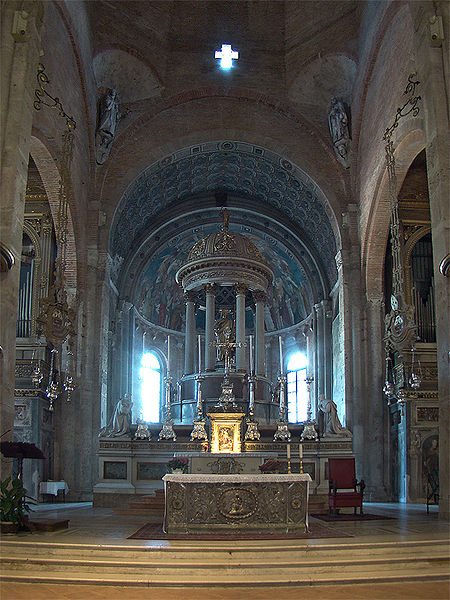
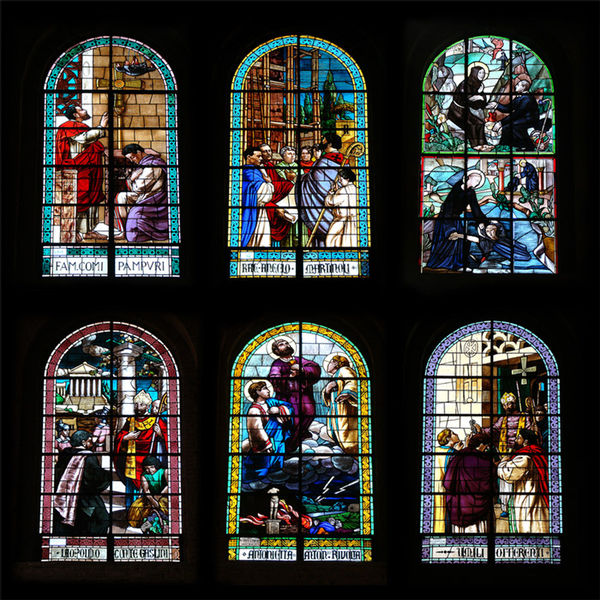
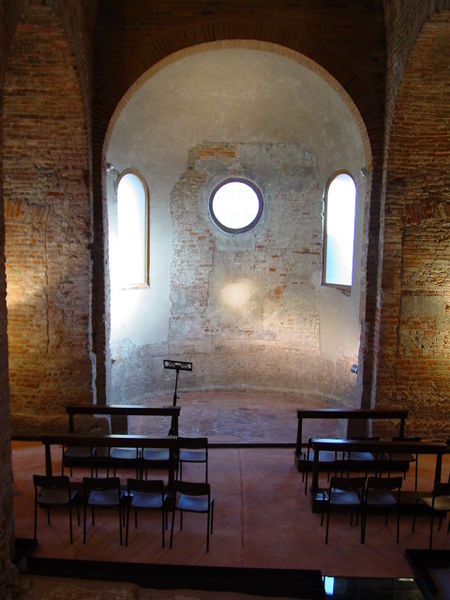
St Simplician was initially buried in the church of Saint Nabor and Felix in Milan and later translated, perhaps on 15 August, to the Basilica Virginum (“Basilica of the Virgins”) which was renamed in his honour; now it is known as Basilica of St Simplician.   The images below are the Basilica, with the Main Altar, Stained Glass windows and the Chapel of the Martyrs of Anaunia, in the Crypt of the Basilica.

St Ambrose began the construction of the Basilica Virginum (“Basilica of the Virgins”), which was finished by his successor Simplician, who is buried there.  A brick with the mark of the Lombard King Agilulf shows that repairs were made between 590 and 615 AD.

In the ninth century the Cluniac Benedictines took possession of the church.   In 1176 the church became famous when, according to the legend, the bodies of the martyrs housed here flew as doves to the field of Legnano, landing on the City’s Carroccio, (a ceremonial war waggon) as a sign of the imminent victory against Frederick Barbarossa’s army.

When the building was modified between the 12th and the 13th centuries, giving it the present Romanesque appearance, the original walls were preserved to a height of 22 meters.   On the night of 6–7 April 1252 the body of Peter of Verona (later St. Peter Martyr) lay in state after his assassination.   A great multitude came to watch vigil, and the origins of Peter’s cult began, as people started to report miraculous occurrences.


Basilica of Saint SimplicianMain Altar of Basilica of Saint SimplicianWINDOWS of Basilica of Saint SimplicianChapel of the Anaunia martyrs, behind the apse in the Crypt of San Simpliciano church.

Posted in FEASTS and SOLEMNITIES, SAINT of the DAY, The BLESSED VIRGIN MARY

Solemnity of the Assumption of the Blessed Virgin Mary and Memorials of the Saints – 15 August

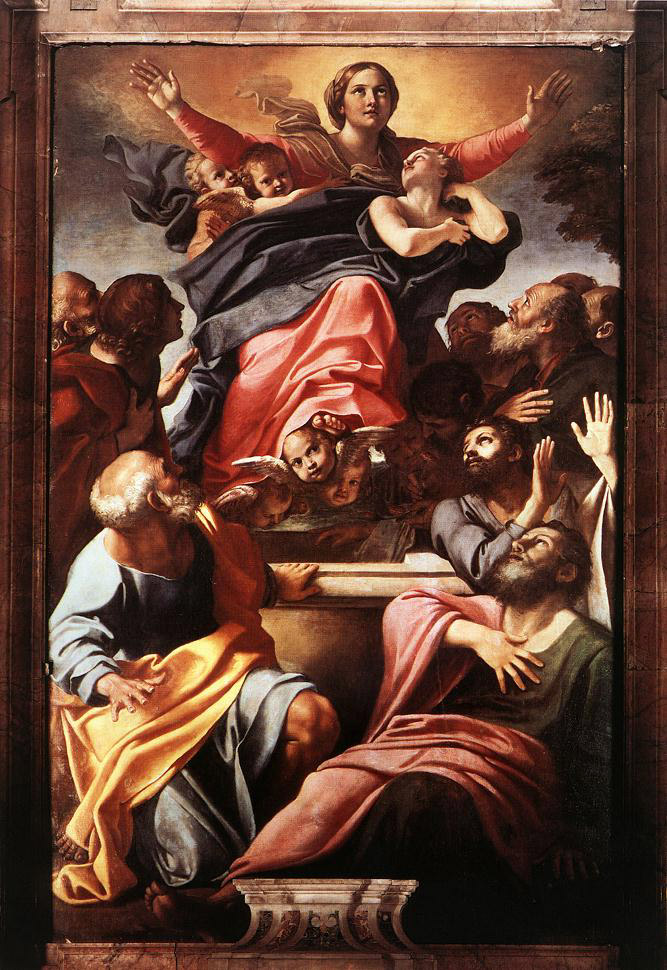
Solemnity of the Assumption of the Blessed Virgin Mary (in the US, however, in most countries of Africa, the Solemnity will celebrated on Sunday 20 AUGUST): The feast celebrates the assumption of the body of the Blessed Virgin Mary into heaven upon her death. According to Pope Benedict XIV, it is a probable opinion, which it is impious to deny, though not an article of faith but has since in 1950 has been raised to a DOGMA of the Faith.   The origin of the feast day is not known but it was celebrated in Palestine before the year 500. It is a holy day of obligation, its vigil being a fast day, in all English-speaking countries except Canada.   Among the many masters who have painted the subject of the Assumption are Fra Angelico, Ghirlandajo, Rubens, Del Sarto and Titian.
Patronages:
• Acadians, Cajuns
• Cistercian Order, Cistercians
• fish dealers, fishmongers
• French air crews
• harness makers
• —
• France
• Guatemala
• India
• Jamaica
• Malta
• Paraguay
• Slovakia
• —
• east Africa (region of east Africa which includes diverse countries, proclaimed on 15 March 1952 by Pope Pius XII)
• South Africa (THIS IS NOT AN REGION BUT A COUNTRY and the Assumption is, therefore, the Patronal Feast of the Country of South Africa – proclaimed on 15 March 1952 by Pope Pius XII)
• —
• 24 dioceses
• 38 cities

Assumption of the Virgin Mary, 1600 - 1601 - Annibale Carracci
Annabale Carraci 1600-1601


St Alipius of Tagaste
Bl Alfred of Hildesheim
Bl Agustín Hurtado Soler
St Arduinus of Rimini
St Arnulphus of Soissons
Bl Claudio Granzotto
Bl George Halley
St Napoleon of Alexandria
Bl Pio Alberto del Corona
St Simplician of Milan
St Tarcisius

Martyrs of Nicomedia – 3 saints: Three Christians martyred together. No details survive but the names – Eutychian, Philip and Straton. They were martyred in Nicomedia, Bithynia (in modern Turkey).

Martyred in the Mexican Revolution: 4 Saints –
St David Roldán Lara
St Luis Batiz Sainz
St Manuel Moralez
St Salvador Lara Puente

Martyred in the Spanish Civil War: Thousands of people were murdered in the anti-Catholic persecutions of the Spanish Civil War from 1934 to 1939.
• Blessed Agustì Ibarra Angüela
• Blessed Carmelo Sastre y Sastre
• Blessed Clemente Vea Balaguer
• Blessed Francisco Míguez Fernández
• Blessed Ildefonso Alberto Flos
• Blessed Jaume Bonet Nadal
• Blessed Joan Ceró Cedó
• Blessed Josep Santonja Pinsach
• Blessed Juan Francisco Barahona Martín
• Blessed Juan Mesonero Huerta
• Blessed Luis Ros Ezcurra
• Blessed Manuel Formigo Giráldez
• Blessed Miguel Alberto Flos
• Blessed Sebastià Balcells Tonijuan
• Blessed Severiano Montes Fernández

Posted in CONFESSION/PENANCE, EUCHARISTIC Adoration, franciscan OFM, MORNING Prayers, QUOTES of the SAINTS, SAINT of the DAY, The BLESSED VIRGIN MARY, The HOLY EUCHARIST / The HOLY MASS

Thought for the Day – 14 August – The Memorial of St Maximillian Kolbe

Thought for the Day – 14 August – The Memorial of St Maximillian Kolbe

St Maximilian’s “Secret” to Holiness and Happiness

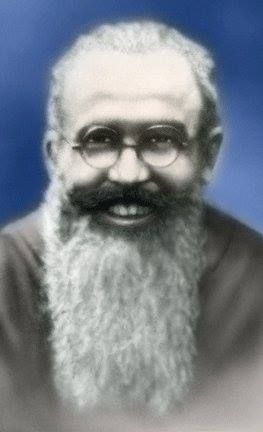
smiling kolbe

St. Maximilian says:  “It is a false and widely diffused idea that the saints were not like us.   They were also subject to temptation, they fell and got up, they also felt overwhelmed with sadness, weakened and paralyzed by discouragement.   But remember the words of the Saviour:  ‘Without me, you can do nothing’ (Jn 15:51) and those of St. Paul:  ‘I can do all things in him who strengthens me’ (Phil 4:13).   Not confiding in themselves, but, putting all their confidence in God after every humiliating fall, they repented sincerely, they purified their soul in the Sacrament of Penance and then they went back to work with still greater fervour.”
We are very much deceived if we think we cannot become a saint, or that we will be “lucky” if we even make it to Purgatory.   The great men of the world overcome all kinds of obstacles in order to become rich or famous.   Why do we not try harder to persevere, when that is precisely what Our Blessed Lord deserves?   After all, He poured Himself out for us so that we might be holy.   The saints were not supermen; they were sinners who persevered through hardship and adversity because they were humble and repentant and confident in God’s grace.”…(Fr Angelo M. Geiger F.I.)
In the end, holiness is not merely a warm feeling of God’s presence or even the ecstatic experiences of the saints.   St Maximilian tells us that true holiness is found in obedience and obedience is acquired through prayer, penance and perseverance.
And this obedience consists in living – truly living the life of a Catholic, St Maximillian said his own words):

“Go to confession with sincerity, diligence, a deep sorrow for his sins and a firm resolve to amend his life. He will suddenly feel a peace and happiness compared with which all the fleeting, unworthy pleasures of this world are really an odious torment.

Let everyone seek to come and receive Jesus in the Holy Eucharist with proper preparation.

Go to Eucharistic Adoration – for this is the the most important activity.

Let him never permit his soul to remain in sin but let him purify it immediately.

Let him do his duty manfully.

Let him address humble and frequent prayers to God’s throne, especially through the hands of the Immaculate Virgin.

Let him welcome his brethren with a charitable heart, bearing for God’s sake the sufferings and difficulties of life.

Let him do good to all, even his enemies, solely for the love of God and not in order to be praised or even thanked by men.”

Then we will come to understand what it means to have a foretaste of paradise;  and perhaps more than once we will find peace and joy even in poverty, suffering, disgrace, or illness.

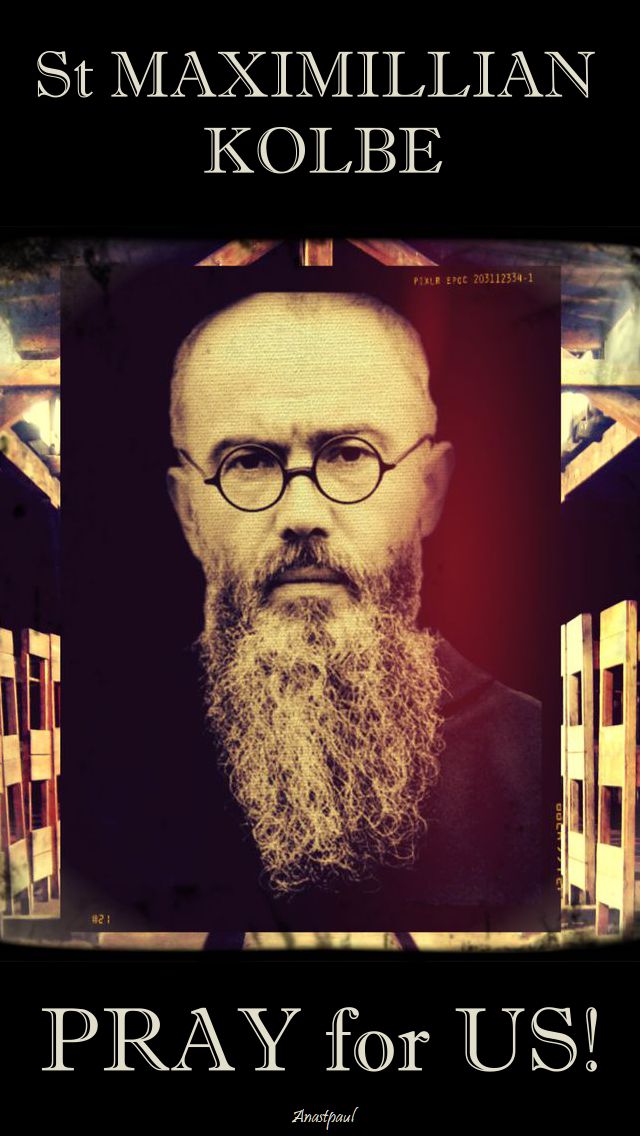
St Maximillian, pray for us!

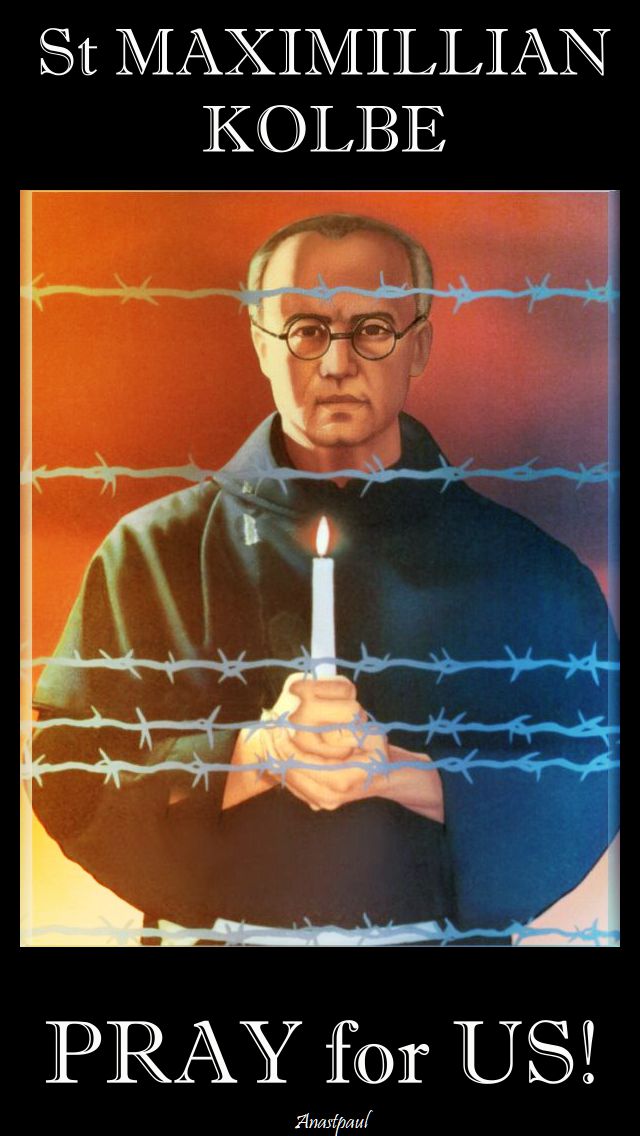
st max pray for us

Posted in EUCHARISTIC Adoration, franciscan OFM, MORNING Prayers, QUOTES of the SAINTS, QUOTES on SUFFERING, SAINT of the DAY, The BLESSED VIRGIN MARY, The HOLY EUCHARIST / The HOLY MASS

Quote/s of the Day – 14 August – The Memorial of St Maximillian Kolbe

Quote/s of the Day – 14 August – The Memorial of St Maximillian Kolbe

“If angels could be jealous of men,
they would be so, for one reason:
HOLY COMMUNION.”

if angels could be jealous of men - st maximillian kolbe

“Jesus honoured her before all ages
and will honour her for all ages.
No one comes to Him, nor even near Him,
no one is saved or sanctified,
if he too will not honour her.
This is the lot of Angels and of men.”

jesus honoured her before all ages - st maximillian kolbe

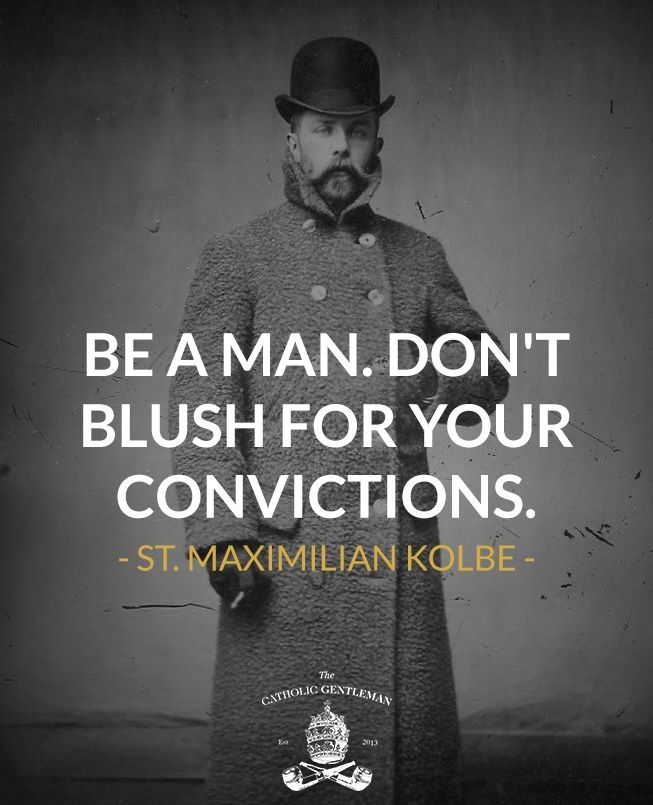
“Be a man! Don’t blush for your convictions.”

be a man! don't blush for your convictions - st maximillian kolbe

“Let us remember, that love lives through sacrifice
and is nourished by giving.
Without sacrifice, there is no love.”

remember that love lives through sacrifice - st maximillian kolbe

“My aim is to institute perpetual adoration,
for this is the the most important activity.”

my aim is to institute - st maximillian kolbe

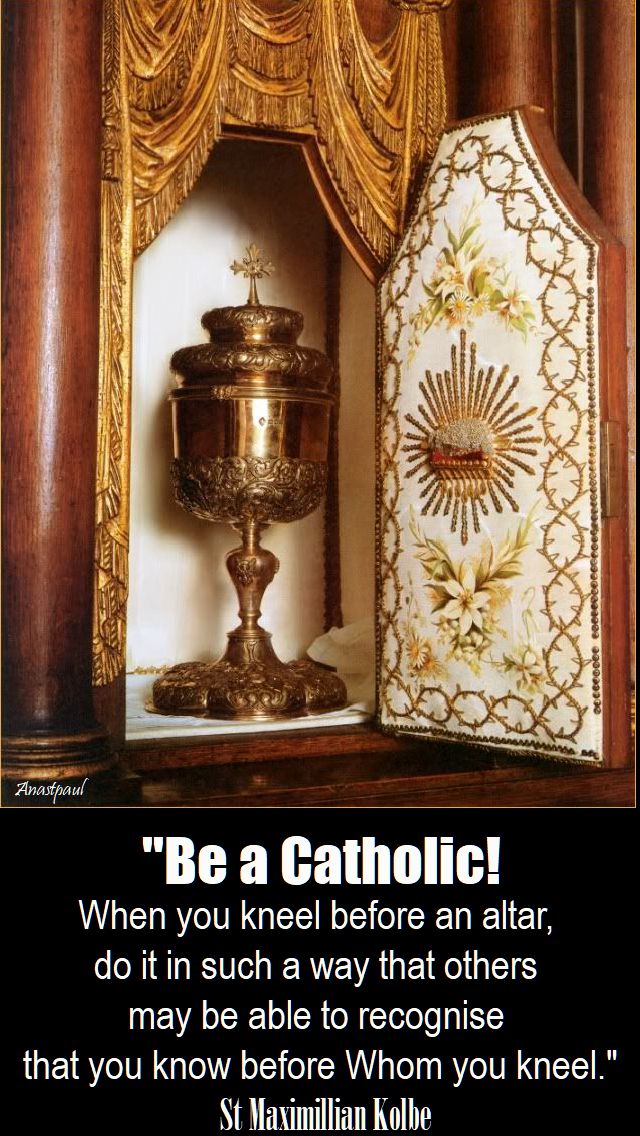
“Be a Catholic!
When you kneel before an altar,
do it in such a way that others
may be able to recognise
that you know before Whom you kneel.”

be a catholic - st maximillian kolbe

St Maximilian Kolbe

Posted in franciscan OFM, MORNING Prayers, QUOTES of the SAINTS, The BLESSED VIRGIN MARY, The WORD

One Minute Reflection – 14 August – The Memorial of St Maximillian Kolbe

One Minute Reflection – 14 August – The Memorial of St Maximillian Kolbe

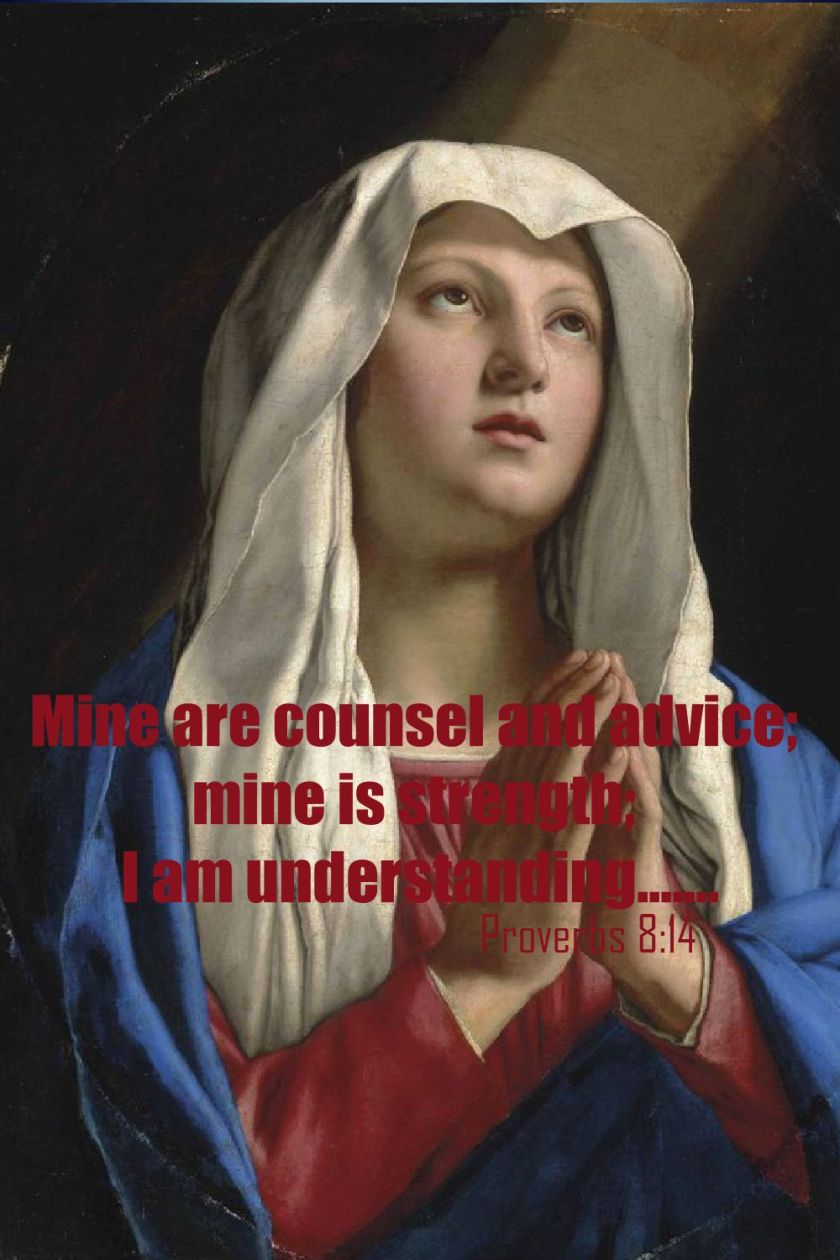
Mine are counsel and advice; mine is strength; I am understanding….Proverbs 8:14

Proverbs 8-14

REFLECTION – “When we dedicate ourselves to Mary, we become instruments in her hands, just as she is an instrument in God’s hands.   Let us then be guided by her, for she will provide for the needs of body and soul and overcome all difficulties and anxieties.”…St Maximillian Kolbe

when we dedicate ourselves to Mary - st maximillian kolbe

PRAYER – My Lord and my God, You who are the fruit of Mary’s blessed womb and the most Divine Son of our Father, grant that I may always have recourse to You, through her who bore You. Grant that she may help and comfort me and lead me to You. Mary, Holy and loving Mother of God, pray for us all, amen

st maximillian - pray for us

Posted in CONSECRATION Prayers, franciscan OFM, MORNING Prayers, SAINT of the DAY, The BLESSED VIRGIN MARY

Our Morning Offering – 14 August

Our Morning Offering – 14 August

Consecration to the Immaculata – By St Maximillian Kolbe

O Immaculata, Queen of Heaven and earth,
Refuge of sinners and our most loving Mother,
God has willed to entrust the entire order of mercy to you.
I, ……………(name), a repentant sinner,
cast myself at your feet, humbly imploring you
to take me with all that I am and have,
wholly to yourself as your possession and property.
Please make of me, of all my powers of soul and body,
of my whole life, death and eternity, whatever most pleases you.
If it pleases you, use all that I am and have without reserve,
wholly to accomplish what was said of you:
“She will crush your head,” and
“You alone have destroyed all heresies in the whole world.”
Let me be a fit instrument in your immaculate and merciful hands
for introducing and increasing your glory to the maximum
in all the many strayed and indifferent souls
and thus help extend as far as possible,
the blessed kingdom of the most Sacred Heart of Jesus.
For wherever you enter you obtain the grace of conversion
and growth in holiness, since it is through your hands
that all graces come to us from the most Sacred Heart of Jesus.
Allow me to praise you, O Sacred Virgin
Give me strength against your enemies
Amen

A shorter version of the prayer can be used for the daily renewal of the consecration:

Daily Consecration Renewal to the Immaculata
By St Maximillian Kolbe

Immaculata, Queen and Mother of the Church,
I renew my consecration to you for this day
and for always, so that you might use me
for the coming of the Kingdom of Jesus in the whole world.
To this end, I offer you all my prayers,
actions and sacrifices of this day.
Amen

daily consecration renewal to the immaculata by st maximillian kolbe

Posted in franciscan OFM, SAINT of the DAY

Saint of the Day – 14 August – St Maximillian Kolbe OFM Conv – “MARTYR of CHARITY” and “Apostle of Consecration to Mary”

Saint of the Day – 14 August – St Maximillian Kolbe OFM Conv – “MARTYR of Charity” and “Apostle of Consecration to Mary”- Born Maksymilian Maria Kolbe(7 January 1894 at Zdunska Wola, Poland as Raymond Kolbe – 14 August 1941 by lethal carbonic acid injection after three weeks of starvation and dehydration at the Auschwitz, Poland death camp).   His body was burned in the ovens and the ashes scattered.   Some relics have been preserved and distributed by the friars at Niepokalanów, Poland.   He was Beatified on 17 October 1971 by Pope Paul VI – his beatification miracles include the July 1948 cure of intestinal tuberculosis of Angela Testoni and August 1950 cure of calcification of the arteries/sclerosis of Francis Ranier.   He was Canonised on 10 October 1982 by St Pope John Paul II, who declared him a ‘Martyr of Charity.’   Patronages – drug addicts, political prisoners, families, journalists, prisoners, amateur radio, the pro-life movement, Esperanto.  St John Paul II declared him “The Patron Saint of Our Difficult Century”. Due to Kolbe’s efforts to promote consecration and entrustment to Mary, he is known as the “Apostle of Consecration to Mary”.

Childhood
Maximilian Kolbe was born on 8 January 1894 in Zduńska Wola, in the Kingdom of Poland, which was a part of the Russian Empire, the second son of weaver Julius Kolbe and midwife Maria Dąbrowska.   His father was an ethnic German and his mother was Polish. He had four brothers.

Kolbe’s life was strongly influenced in 1906 by a childhood vision of the Virgin Mary. He later described this incident:  “That night I asked the Mother of God what was to become of me.   Then she came to me holding two crowns, one white, the other red.   She asked me if I was willing to accept either of these crowns.   The white one meant that I should persevere in purity and the red that I should become a martyr.  I said that I would accept them both.”

Franciscan Friar
In 1907, Kolbe and his elder brother Francis joined the Conventual Franciscans.   They enrolled at the Conventual Franciscan minor seminary in Lwow later that year.   In 1910, Kolbe was allowed to enter the novitiate, where he was given the religious name Maximilian.   He professed his first vows in 1911 and final vows in 1914, adopting the additional name of Maria.   He was sent to Rome in 1912, where he attended the Pontifical Gregorian University.   He earned a doctorate in philosophy in 1915 there. From 1915 he continued his studies at the Pontifical University of St Bonaventure where he earned a doctorate in theology in 1919 or 1922 (sources vary).   He was active in the consecration and entrustment to Mary.   During his time as a student, he witnessed vehement demonstrations against Popes St. Pius X and Benedict XV in Rome during an anniversary celebration by the Freemasons.   According to Kolbe:

“They placed the black standard of the “Giordano Brunisti” under the windows of the Vatican.   On this standard the archangel, St Michael, was depicted lying under the feet of the triumphant Lucifer.   At the same time, countless pamphlets were distributed to the people in which the Holy Father was attacked shamefully.”

Soon afterward, Kolbe organised the Militia Immaculatae (Army of the Immaculate One), to work for conversion of sinners and enemies of the Catholic Church, specifically the Freemasons, through the intercession of the Virgin Mary.   So serious was Kolbe about this goal that he added to the Miraculous Medal prayer:

“O Mary, conceived without sin, pray for us who have recourse to thee.   And for all those who do not have recourse to thee;  especially the Masons and all those recommended to thee.”


In 1918, Kolbe was ordained a priest.   In July 1919 he returned to the newly independent Poland, where he was active in promoting the veneration of the Immaculate Virgin Mary. He was strongly opposed to leftist – in particular, communist – movements.   From 1919 to 1922 he taught at the Kraków seminary.   Around that time, as well as earlier in Rome, he suffered from tuberculosis, which forced him to take a lengthy leave of absence from his teaching duties.   In January 1922 he founded the monthly periodical Rycerz Niepokalanej (Knight of the Immaculate), a devotional publication based on French Le Messager du Coeur de Jesus (Messenger of the Heart of Jesus).    From 1922 to 1926 he operated a religious publishing press in Grodno.   As his activities grew in scope, in 1927 he founded a new Conventual Franciscan monastery at Niepokalanów near Warsaw, which became a major religious publishing center.   A junior seminary was opened there two years later.

Between 1930 and 1936, Kolbe undertook a series of missions to East Asia.   At first, he arrived in Shanghai, China but failed to gather a following there.   Next, he moved to Japan, where by 1931 he founded a monastery at the outskirts of Nagasaki (it later gained a novitiate and a seminary) and started publishing a Japanese edition of the Knight of the Immaculate.   The monastery he founded remains prominent in the Roman Catholic Church in Japan.   Kolbe built the monastery on a mountainside that, according to Shinto beliefs, was not the side best suited to be in harmony with nature.   When the atomic bomb was dropped on Nagasaki, Kolbe’s monastery was saved because the other side of the mountain took the main force of the blast.   In mid-1932 he left Japan for Malabar, India, where he founded another monastery;  this one however closed after a while.   Meanwhile, the monastery at Niepokalanów began in his absence to publish the daily newspaper, Mały Dziennik (The Little Daily), in alliance with the political group, the National Radical Camp (Obóz Narodowo Radykalny).   This publication reached a circulation of 137,000, and nearly double that, 225,000, on weekends.

Death at Auschwitz
After the outbreak of World War II, which started with the invasion of Poland by Germany, Kolbe was one of the few brothers who remained in the monastery, where he organised a temporary hospital.   After the town was captured by the Germans, he was briefly arrested by them on 19 September 1939 but released on 8 December.   He refused to sign the Deutsche Volksliste, which would have given him rights similar to those of German citizens in exchange for recognising his German ancestry.   Upon his release he continued work at his monastery, where he and other monks provided shelter to refugees from Greater Poland, including 2,000 Jews whom he hid from German persecution in their friary in Niepokalanów.   Kolbe also received permission to continue publishing religious works, though significantly reduced in scope.   The monastery thus continued to act as a publishing house, issuing a number of anti-Nazi German publications.   On 17 February 1941, the monastery was shut down by the German authorities.   That day Kolbe and four others were arrested by the German Gestapo and imprisoned in the Pawiak prison.   On 28 May, he was transferred to Auschwitz as prisoner #16670.

Continuing to act as a priest, Kolbe was subjected to violent harassment, including beating and lashings and once had to be smuggled to a prison hospital by friendly inmates.   At the end of July 1941, three prisoners disappeared from the camp, prompting SS-Hauptsturmführer Karl Fritzsch, the deputy camp commander, to pick 10 men to be starved to death in an underground bunker to deter further escape attempts.   When one of the selected men, Franciszek Gajowniczek, cried out, “My wife! My children!”, Kolbe volunteered to take his place.  (The last pic below with St John Paul is at the Canonisation of St Maximillian).

According to an eye witness, an assistant janitor at that time, in his prison cell, Kolbe led the prisoners in prayer to Our Lady.   Each time the guards checked on him, he was standing or kneeling in the middle of the cell and looking calmly at those who entered. After two weeks of dehydration and starvation, only Kolbe remained alive.   “The guards wanted the bunker emptied, so they gave Kolbe a lethal injection of carbolic acid.   Kolbe is said to have raised his left arm and calmly waited for the deadly injection.” His remains were cremated on 15 August, the feast day of the Assumption of Mary.

Kolbe’s influence has found fertile ground in his own Order of Conventual Franciscan friars, in the form of continued existence of the Militia Immaculatae movement.   In recent years new religious and secular institutes have been founded, inspired from this spiritual way.   Among these the Missionaries of the Immaculate Mary – Father Kolbe, the Franciscan Friars of Mary Immaculate, and a parallel congregation of Religious Sisters, and others.   The Franciscan Friars of Mary Immaculate are even taught basic Polish so they can sing the traditional hymns sung by Kolbe, in the saint’s native tongue.   According to the friars,

“Our patron, St. Maximilian Kolbe, inspires us with his unique Mariology and apostolic mission, which is to bring all souls to the Sacred Heart of Christ through the Immaculate Heart of Mary, Christ’s most pure, efficient and holy instrument of evangelisation – especially those most estranged from the Church.”

Kolbe’s views into Marian theology echo today through their influence on Vatican II.   His image may be found in churches across Europe.   Several churches in Poland are under his patronage, such as the Sanctuary of Saint Maxymilian in Zduńska Wola or the Church of Saint Maxymilian Kolbe in Szczecin.   A museum, Museum of St. Maximilian Kolbe “There was a Man”, was opened in Niepokalanów in 1998.

In 1963 Rolf Hochhuth published a play significantly influenced by Kolbe’s life and dedicated to him, The Deputy.   In 2000, the National Conference of Catholic Bishops (U.S.) designated Marytown, home to a community of Conventual Franciscan friars, as the National Shrine of St. Maximilian Kolbe.   Marytown is located in Libertyville, Illinois, and also features the Kolbe Holocaust Exhibit.   In 1991, Krzysztof Zanussi released a Polish film about the life of Kolbe.   The Polish Senate declared the year 2011 to be the year of St Maximilian Kolbe.

First-class relics of Kolbe exist, in the form of hairs from his head and beard, preserved without his knowledge by two friars at Niepokalanów who served as barbers in his friary between 1930 and 1941.   Since his beatification in 1971, more than 1,000 such relics have been distributed around the world for public veneration.   Second-class relics such as his personal effects, clothing and liturgical vestments, are preserved in his monastery cell and in a chapel at Niepokalanów and may be viewed by visitors.

St Maximillian Pray for us!

 

Posted in SAINT of the DAY

Memorials of the Saints for today – 14 August

St Maximillian Kolbe (Memorial) – https://www.youtube.com/watch?v=4sStd5Uq3fA

Bl Aimo Taparelli
St Antony Primaldo
St Arnulf of Soissons
St Athanasia of Timia
St Callistus of Todi
St Demetrius of Africa
St Domingo Ibáñez de Erquicia
St Eberhard of Einsiedeln
St Eusebius of Palestine
St Eusebius of Rome
St Fachanan of Ross
St Francisco Shoyemon
Bl Juliana Puricelli
St Marcellus of Apamea
Bl Sanctes Brancasino
St Ursicius of Nicomedia
St Werenfridus
__

Martyred in the Spanish Civil War: 11 Beati
Ángel de la Red Pérez
Antonio María Martín Povea
Basilio González Herrero
Ezequiél Prieto Otero
Félix Yuste Cava
Joaquín Frade Eiras
Jocund Bonet Mercadé
José García Librán
Ricardo Atanes Castro
Segundo Pérez Arias
Vicente Rubiols Castelló

Posted in MORNING Prayers, SAINT of the DAY

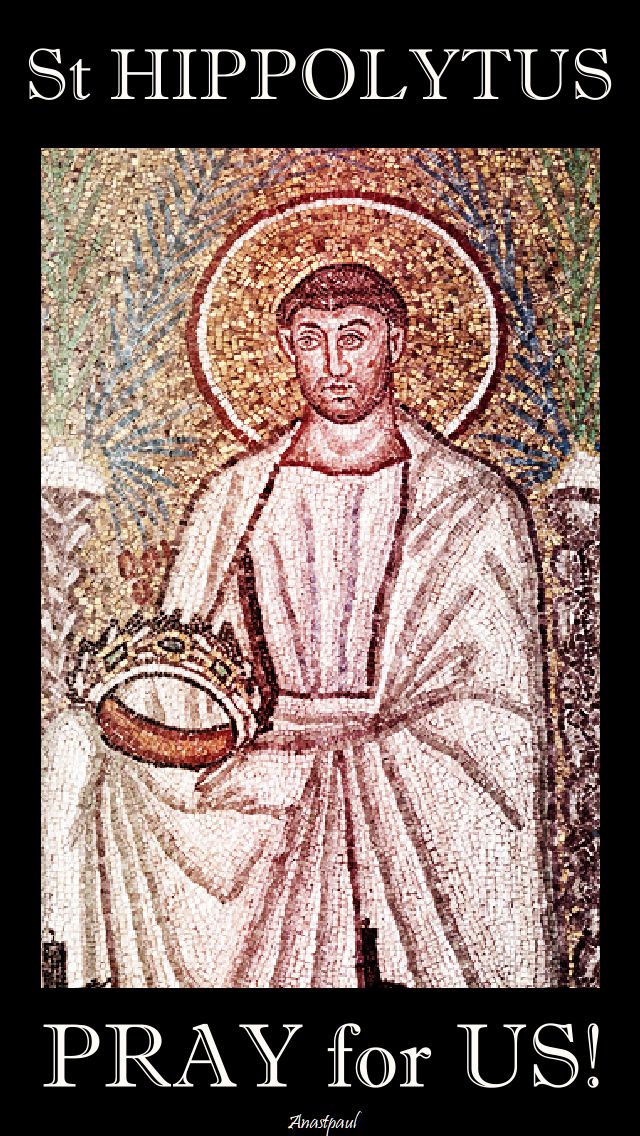
Thought for the Day – 13 August – The Memorial of Sts Pontian & Hippolytus

Thought for the Day – 13 August – The Memorial of Sts Pontian & Hippolytus

“It is in their captivity that Saints Pontian and Hippolytus reconciled with one another. Both died of torture and deprivation.

We have lived in an age when so many in the Church have divided themselves into factions, forsaking unity in Christ for the cause of ideology.   Being a member of Christ’s Body has, sadly, become for so many a question of choosing sides.   Sts Pontian and Hippolytus serve as a sign of contradiction to all this.

The substance of the apostolic faith is far greater than the pretenses of ideology that we would use to subvert the communion of the Church.  Great suffering revealed this truth to Saints Pontian and Hippolytus — I wonder what it will take for us to reach this conclusion?

Let us pray that the tired ideologies of the present will quickly become a thing of the past and that we all will find the richness of the apostolic faith, the faith of the martyrs Pontian and Hippolytus, unity and peace. “….Fr Steve Grunow CEO of Word on Fire
Sts Pontian and Hippolytus, pray for us!

sts pontian and hippolytus pray for us

Posted in MORNING Prayers, QUOTES of the SAINTS, SAINT of the DAY

Quote of the Day – 13 August – The Memorial of Sts Pontian & Hippolytus

Quote of the Day – 13 August – The Memorial of Sts Pontian & Hippolytus

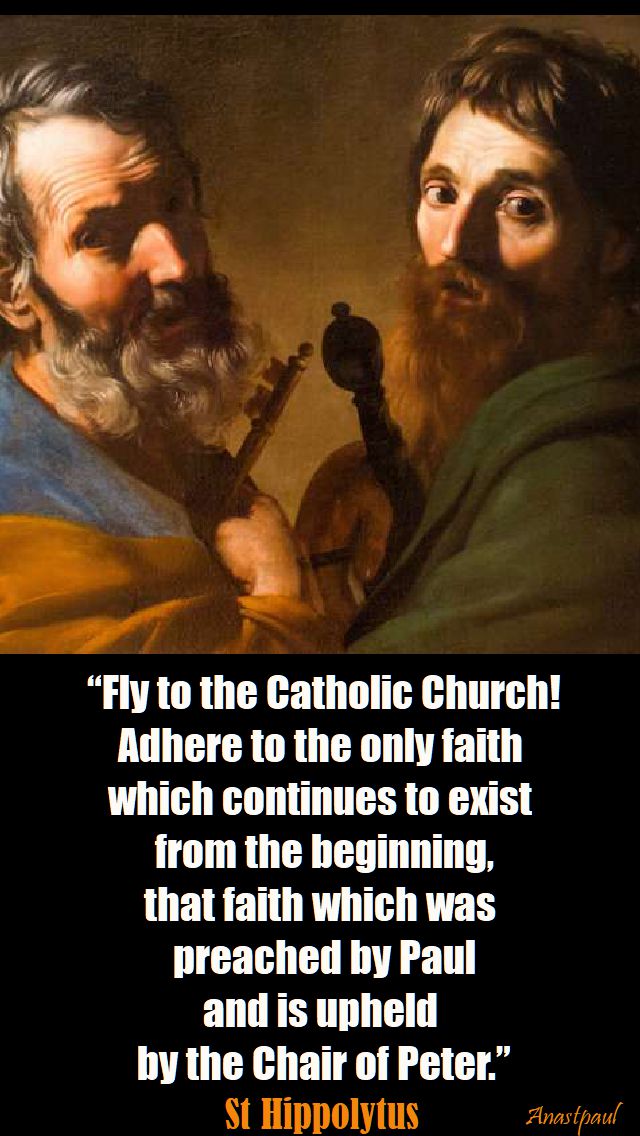
“Fly to the Catholic Church!

Adhere to the only faith which continues to exist from the beginning,

that faith which was preached by Paul

and is upheld by the Chair of Peter.”

St Hippolytus

fly to the catholic church - st hippolytus

Posted in MORNING Prayers, SAINT of the DAY, The WORD

One Minute Reflection – 13 August – The Memorial fo Sts Pontian and Hippolytus

One Minute Reflection – 13 August – The Memorial fo Sts Pontian and Hippolytus

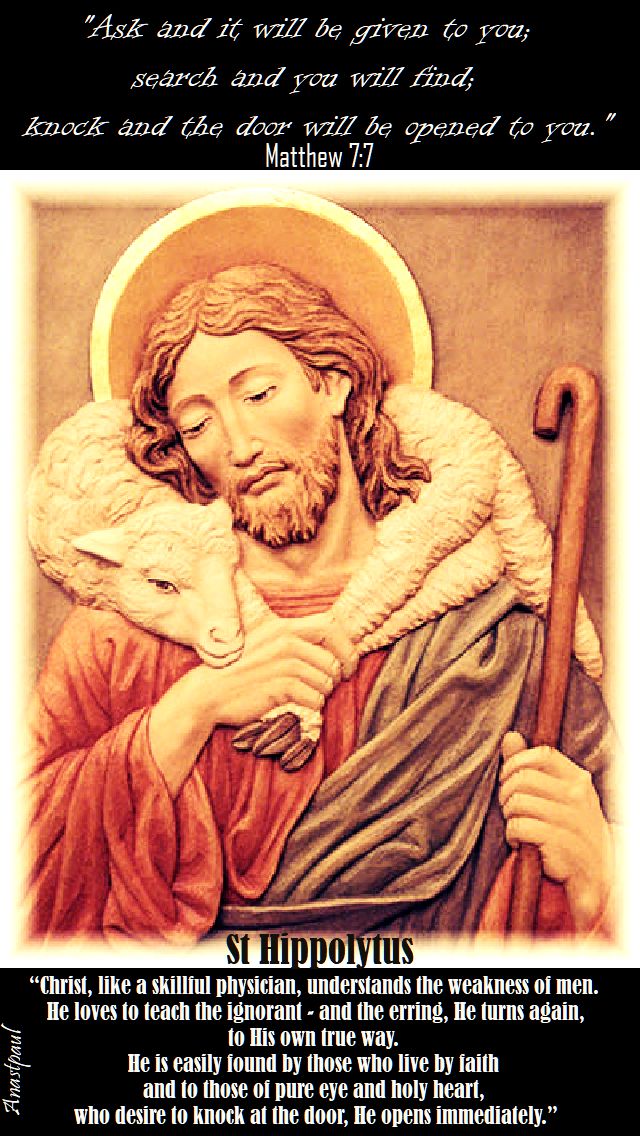
“Ask and it will be given to you; search and you will find; knock and the door will be opened to you.
Everyone who asks receives; everyone who searches finds; everyone who knocks will have the door opened.”…Matthew 7:7-8

christ, like a skillful physician - st hippolytus

REFLECTION – “Christ, like a skillful physician, understands the weakness of men.   He loves to teach the ignorant and the erring He turns again, to His own true way. He is easily found by those who live by faith and to those of pure eye and holy heart, who desire to knock at the door, He opens immediately.”….St Hippolytus

PRAYER – Lord God, Your Son has told us, ‘to knock and the door shall be opened’ – help us to be ever strong in faith that we may remember and trust that You will always open the door if we turn to You, at all times and in all circumstances, in true faith, hope, trust and love. St Hippolytus, pray for us, amen.

st hippolytus pray for us

Posted in CATHOLIC-PRAYERS OF THE CHURCH, MORNING Prayers, PRAYERS of the SAINTS, The HOLY EUCHARIST / The HOLY MASS

Our Morning Offering – 13 August

Our Morning Offering – 13 August

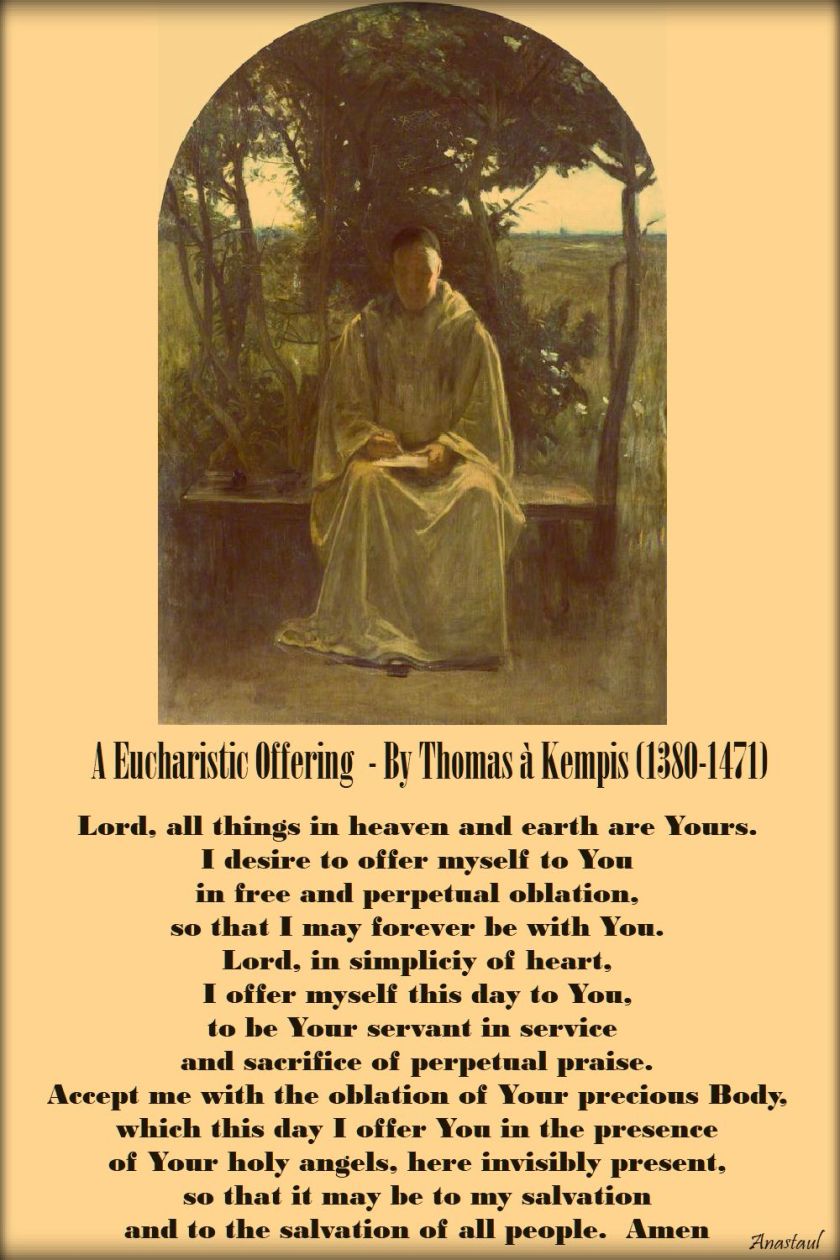
A Eucharistic Offering
By Thomas à Kempis (1380-1471)

Lord, all things in heaven and earth are Yours.
I desire to offer myself to You
in free and perpetual oblation,
so that I may forever be with You.
Lord, in simpliciy of heart,
I offer myself this day to You,
to be Your servant in service
and sacrifice of perpetual praise.
Accept me with the oblation of Your precious Body,
which this day I offer You in the presence
of Your holy angels, here invisibly present,
so that it may be to my salvation
and to the salvation of all people. Amen

a eucharistic offering - by thomas a kempis

Posted in SAINT of the DAY

Saints of the Day – 13 August – St Pope Pontian and St Hippolytus – Martyrs

Saints of the Day – 13 August – St Pope Pontian and St Hippolytus – Martyrs

St Pope Pontian (c 200 – October 235 in Sardinia, Roman Empire)   St Pope Pontian was the Bishop of Rome from 21 July 230 to 28 September 235.   In 235, during the persecution of Christians in the reign of the Emperor Maximinus the Thracian, Pontian was arrested and sent to the island of Sardinia.   He resigned to make the election of a new pope possible.

St Hippolytus (170 – 235 AD) was the most important 3rd-century theologian in the Christian Church in Rome, where he was probably born. Photios I of Constantinople describes him in his Bibliotheca (cod. 121) as a disciple of Irenaeus, who was said to be a disciple of Polycarp, and from the context of this passage it is supposed that he suggested that Hippolytus so styled himself. However, this assertion is doubtful. He came into conflict with the popes of his time and seems to have headed a schismatic group as a rival to the Bishop of Rome. He opposed the Roman bishops who softened the penitential system to accommodate the large number of new pagan converts. However, he was very probably reconciled to the Church when he died as a martyr.   Patronages –  horses, prison guards, officers and workers, Bibbiena, Italy, Laterina, Italy.

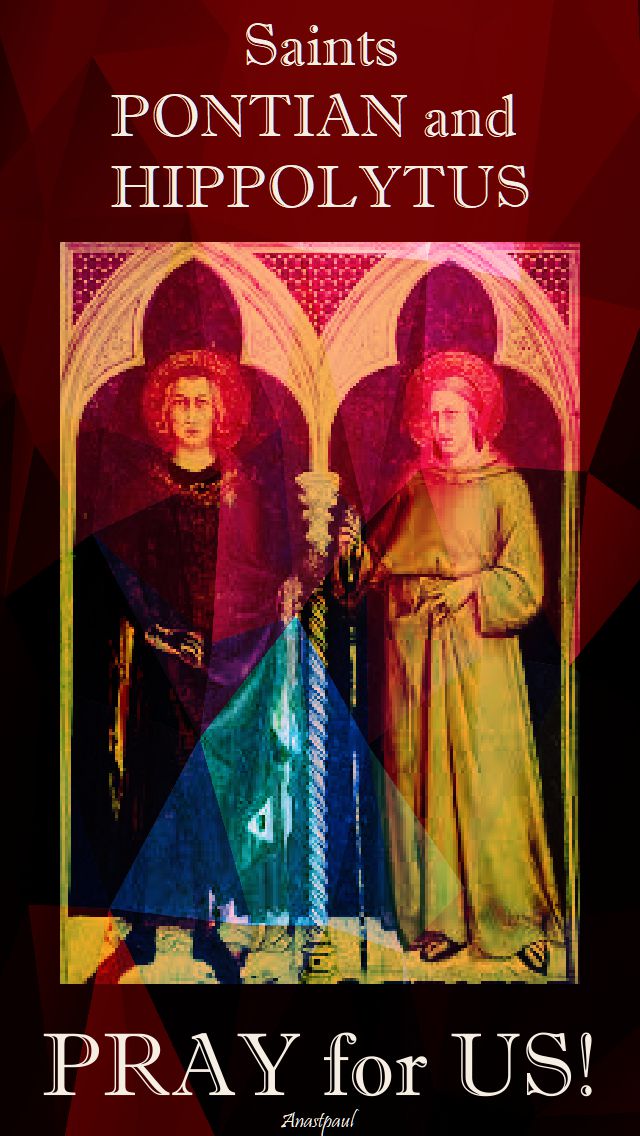
Today the Church celebrates the witness of the martyrs Saints Pontian and Hippolytus — theirs is not only a story of martyrdom but of reconciliation, forgiveness and enemies becoming friends.

St. Pontian was the successor to the apostles Peter and Paul, the bishop of the Church of Rome.   He was arrested during a persecution of the Church ordered by the Roman emperor Maximinus in the third century.   He was sentenced to a “living death” — slavery in the salt mines of Sardinia.

St. Hippolytus might have been remembered as a heretic and a schismatic if not for the strange workings of God’s providence.   He felt the bishop of Rome was not adequate enough in his defense of the apostolic faith, so he broke away from the Church’s communion and established himself as the Bishop of Rome.   He was the first “anti-pope.”  This distinction did not save him from arrest for being a Christian.   He too was sentenced to a “living death” in the mines of Sardinia.

It is in their captivity that Saints Pontian and Hippolytus reconciled with one another. Both died of torture and deprivation.

Pope Fabian had the bodies of both Pontian and Hippolytus brought back to Rome in 236 or 237 and buried in the papal crypt in the Catacomb of Callixtus on the Appian Way.   The slab covering his tomb was discovered in 1909.   On it is inscribed in Greek: Ποντιανός Επίσκ (Pontianus Episk; in English Pontianus Bish).   The inscription “Μάρτυρ”, “MARTUR” had been added in another hand.

Pontian’s feast day was previously celebrated on 19 November, but since 1969 both he and Hippolytus are commemorated jointly on 13 August.

sts pontian and hippolytus

Posted in SAINT of the DAY, The BLESSED VIRGIN MARY

Memorials of the Saints and Feast of the Blessed Virgin Mary – 13 August

St Hippolytus of Rome (Optional Memorial)
St Pope Pontian (Optional Memorial)

Our Lady, Refuge of Sinners:  St. John Damascene calls Mary a city of refuge to all who flee to Her.   This idea of a city of refuge is an old Scriptural fact calling attention to the humanity, the pity, of the old Jewish Law, which established certain cities of refuge where criminals might find escape from the arm of the authorities.   For instance there were no less than six Levitical Cities, three on either side of the Jordan, where men who had been guilty of the act of involuntary homicide might find protection and immunity, until they were released from banishment by the death of the High Priest.   These six cities were obliged to receive the homicides and to lodge them without any charge.   But there were at least 48 cities which had this privilege of asylum.   Nor was it a peculiarly Jewish custom.   Even the Greeks and Romans had their cities of asylum.   The Jewish idea was brought into Christianity.   One of the beautiful customs in the Middle Ages was “the right of sanctuary,” by which those who ran foul of the law could not be taken so long as they remained in the Church, or sanctuary.   And this is Our Lady, Refuge of Sinners!

Refuge-of-Sinners

St Anastasius the Monk
St Anastasius the Priest
St Benildus
St Cassian of Imola
St Cassian of Todi
St Concordia
St Conn O’Rourke
Bl Gertrude of Altenberg
St Helen of Burgos
St Herulph of Langres
Bl Jakob Gapp
Bl John of Alvernia
St Junian of Mairé
St Ludolph
Bl Mark of Aviano
St Maximus the Confessor
St Nerses Glaietsi
St Patrick O’Healy
Bl Pierre Gabilhaud
St Radegund
St Radegunde
St Wigbert of Fritzlar
Bl William Freeman

Martyred in the Spanish Civil War:
• Blessed Francesc Castells Areny
• Blessed Inocencio García Díez
• Blessed José Bonet Nadal
• Blessed José Boher y Foix
• Blessed José Juan Perot y Juanmarti
• Blessed Jose Tàpies y Sirvant
• Blessed Josep Alsina Casas
• Blessed Luciano Hernández Ramírez
• Blessed Maria de Puiggraciós Badia Flaquer
• Blessed Mateo Despóns Tena
• Blessed Modesto García Martí
• Blessed Pascual Araguàs y Guàrdia
• Blessed Pedro Martret y Molet
• Blessed Silvestre Arnau y Pascuet
Martyred Claretians of Barbastro – 51 beati:
• Blessed Agustín Viela Ezcurdia
• Blessed Alfons Miquel Garriga
• Blessed Alfons Sorribes Teixidó
• Blessed Antolín Calvo y Calvo
• Blessed Antoni Dalmau Rosich
• Blessed Atanasio Vidaurreta Labra
• Blessed Eduardo Ripoll Diego
• Blessed Esteve Casadevall Puig
• Blessed Eusebi Maria Codina Millà
• Blessed Felipe de Jesús Munárriz Azcona
• Blessed Francesc Roura Farró
• Blessed Francisco Castán Meseguer
• Blessed Gregorio Chirivas Lacamba
• Blessed Hilario Llorente Martín
• Blessed Jaume Falgarona Vilanova
• Blessed Joan Baixeras Berenguer
• Blessed Joan Codinachs Tuneu
• Blessed José Amorós Hernández
• Blessed José Blasco Juan
• Blessed José Figuero Beltrán
• Blessed José Pavón Bueno
• Blessed Josep Maria Badía Mateu
• Blessed Josep Ormo Seró
• Blessed Josep Ros Florensa
• Blessed Juan Díaz Nosti
• Blessed Juan Echarri Vique
• Blessed Juan Sánchez Munárriz
• Blessed Leoncio Pérez Ramos
• Blessed Lluís Escalé Binefa
• Blessed Lluís Lladó Teixidor
• Blessed Lluís Masferrer Vila
• Blessed Manuel Buil Lalueza
• Blessed Manuel Martínez Jarauta
• Blessed Manuel Torras Sais
• Blessed Miquel Masip González
• Blessed Nicasio Sierra Ucar
• Blessed Pedro García Bernal
• Blessed Pere Cunill Padrós
• Blessed Rafael Briega Morales
• Blessed Ramon Illa Salvia
• Blessed Ramon Novich Rabionet
• Blessed Salvador Pigem Serra
• Blessed Sebastià Riera Coromina
• Blessed Sebastián Calvo Martínez
• Blessed Secundino Ortega García
• Blessed Teodoro Ruiz de Larrinaga García
• Blessed Tomàs Capdevila Miró
• Blessed Wenceslau Clarís Vilaregut
They were martyred on 2 August through 18 August 1936 in Barbastro, Huesca, Spain and Beatified on 25 October 1992 by Pope John Paul II.

Posted in MORNING Prayers, QUOTES of the SAINTS, SAINT of the DAY

Thought for the Day – 12 August – The Memorial of St Jane Frances de Chantal (1572-1641)

Thought for the Day – 12 August – The Memorial of St Jane Frances de Chantal (1572-1641)

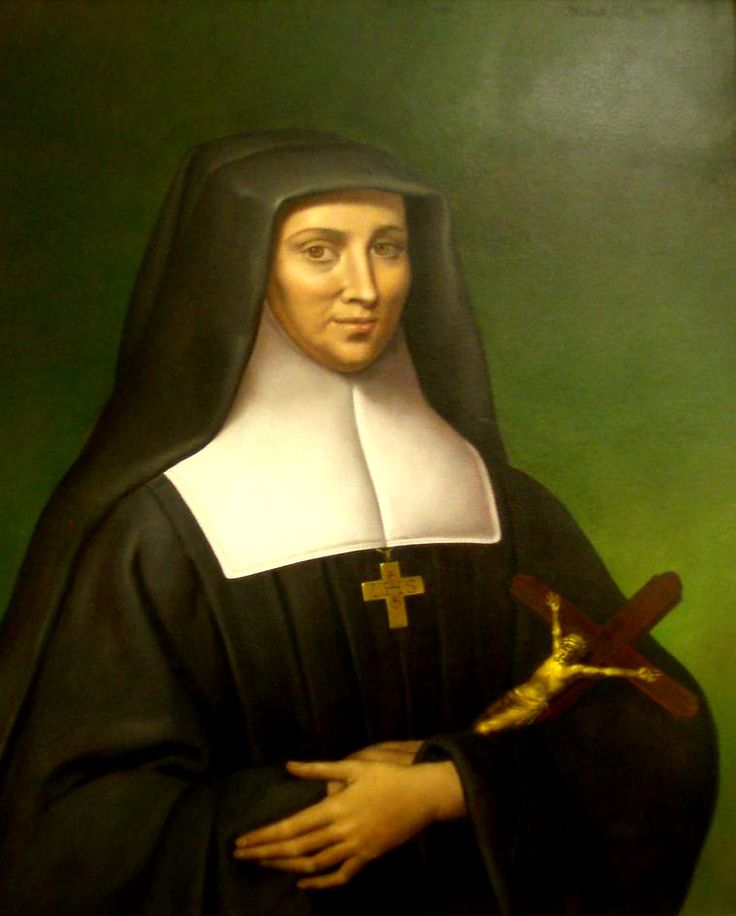
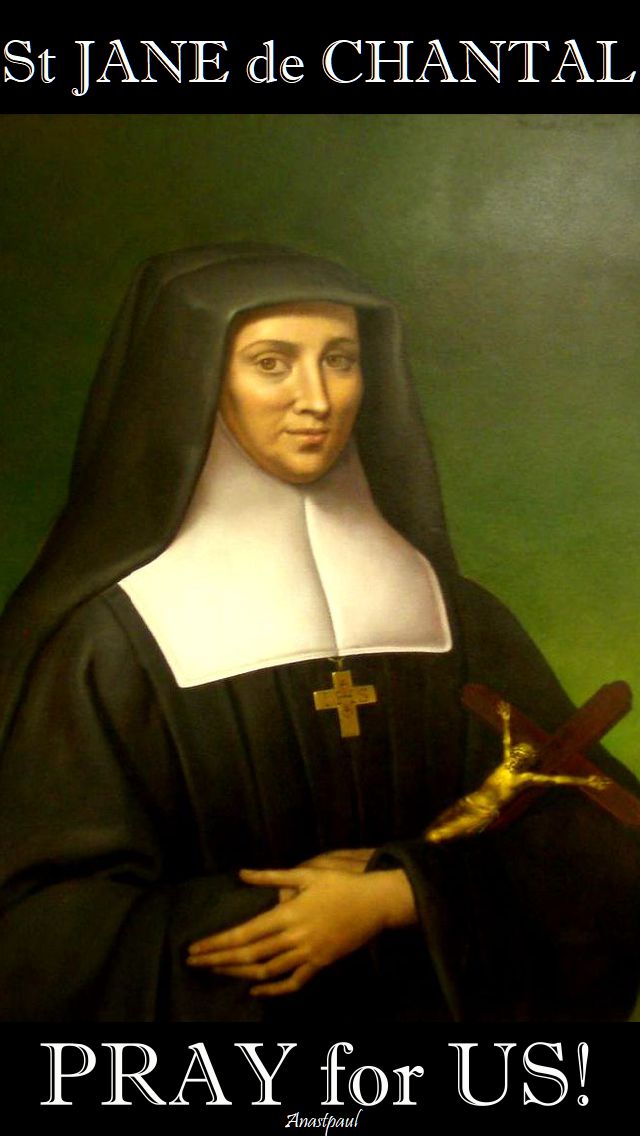
Saint Jane Frances de Chantal left behind a legacy of service, suffering, meekness and obedience.   She was willing to soften herself, giving up control of her life to the Lord and following the direction given to her.   Not without loss and sacrifice, her life was difficult—all of which she embraced with patience and joy.   When the daily struggles of our lives become too great, we might think of the message of St Jane Frances:  “You want to be humble? Try to know yourself well; desire for others to know you as imperfect; love contempt, in all its forms and in any which way it may come.   Don’t hide your defects;  let them be known, accepting with love the abjection that will come by them.   Never let your heart to be weakened because of a fault committed.   Distrust self and trust only and continuously in God, persuaded that not able to do anything by yourselves, you can do all with His grace and powerful help.”

St Jane de Chantal – pray for us!

st jane de chantal - pray for us 2

Posted in MORNING Prayers, QUOTES of the SAINTS, SAINT of the DAY, Uncategorized

Quote/s of the Day – 12 August – The Memorial of St Jane Frances de Chantal (1572-1641)

Quote/s of the Day – 12 August – The Memorial of St Jane Frances de Chantal (1572-1641)

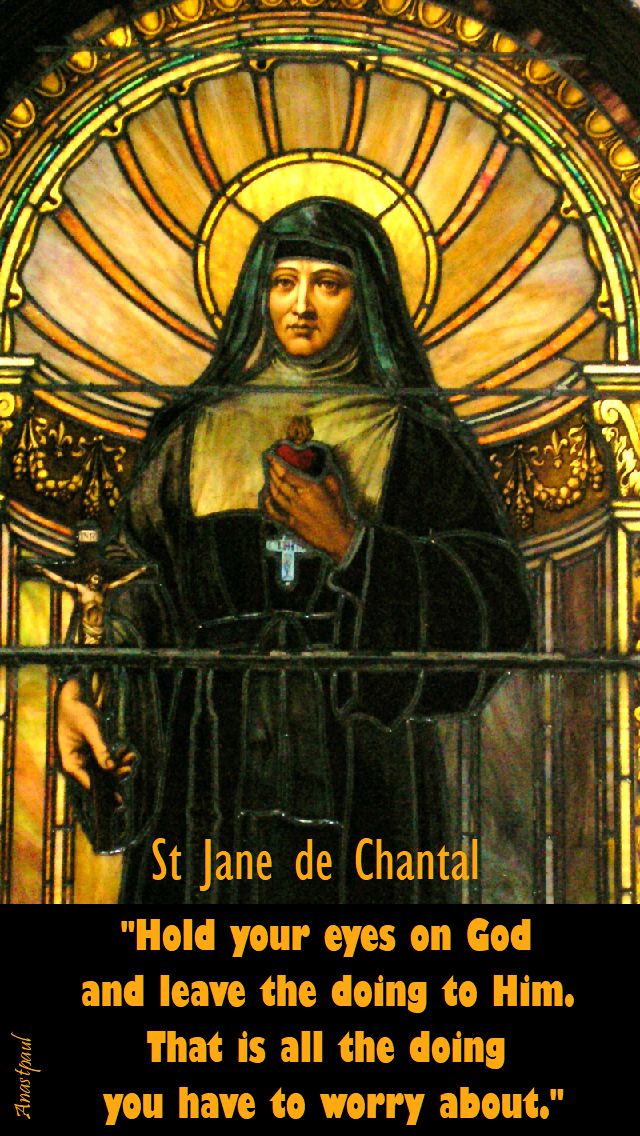
“Hold your eyes on God and leave the doing to Him.
That is all the doing you have to worry about.”

hold your eyes on god - st jane de chantal

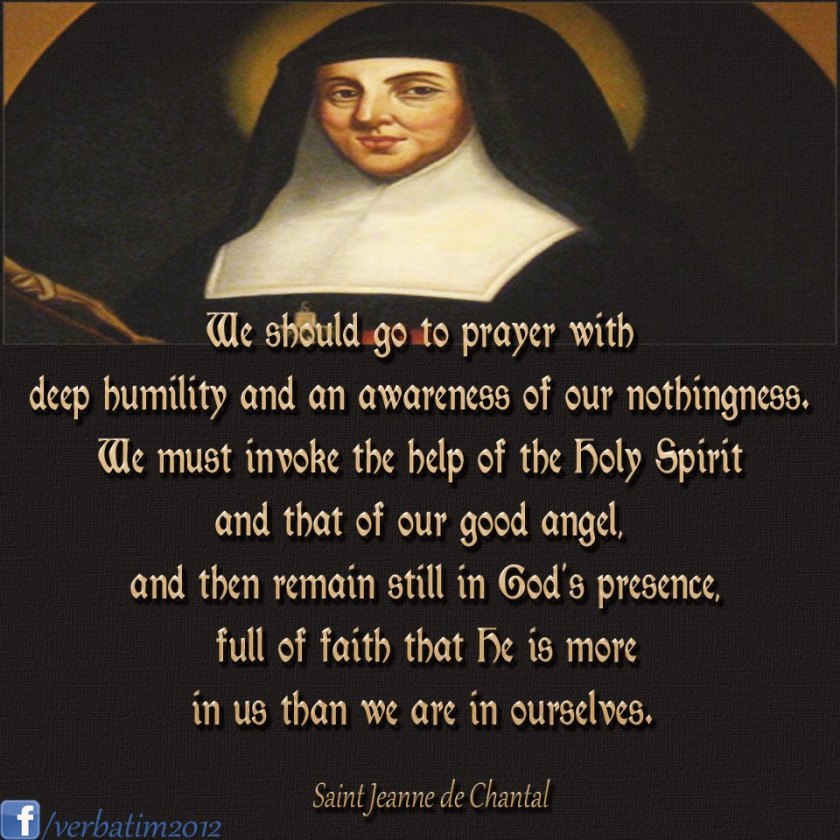
“We should go to prayer with deep humility
and an awareness of our nothingness.
We must invoke the help of the Holy Spirit
and that of our good angel
and then remain still in God’s presence,
full of faith, that He is more in us than we are in ourselves.”

st jane quote

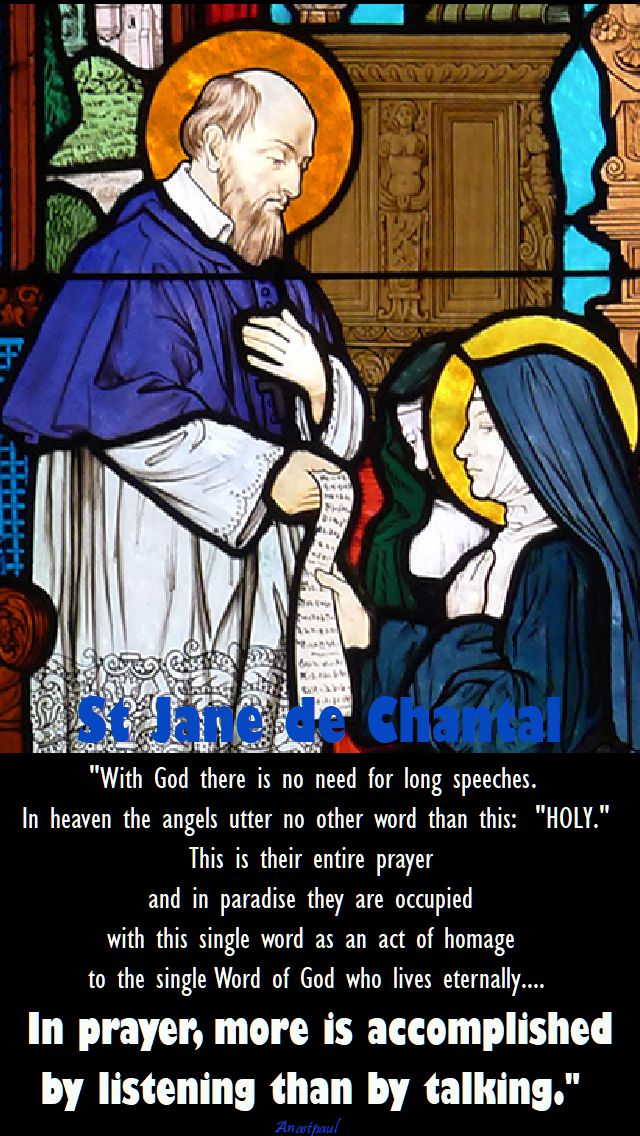
“With God there is no need for long speeches.
In heaven the angels utter no other word than this: “HOLY.”
This is their entire prayer and in paradise they are occupied
with this single word as an act of homage,
to the single Word of God, who lives eternally….
In prayer, more is accomplished by listening than by talking.”

St Jane Frances de Chantal

with god there is no need for long speeches - st jane de chantal

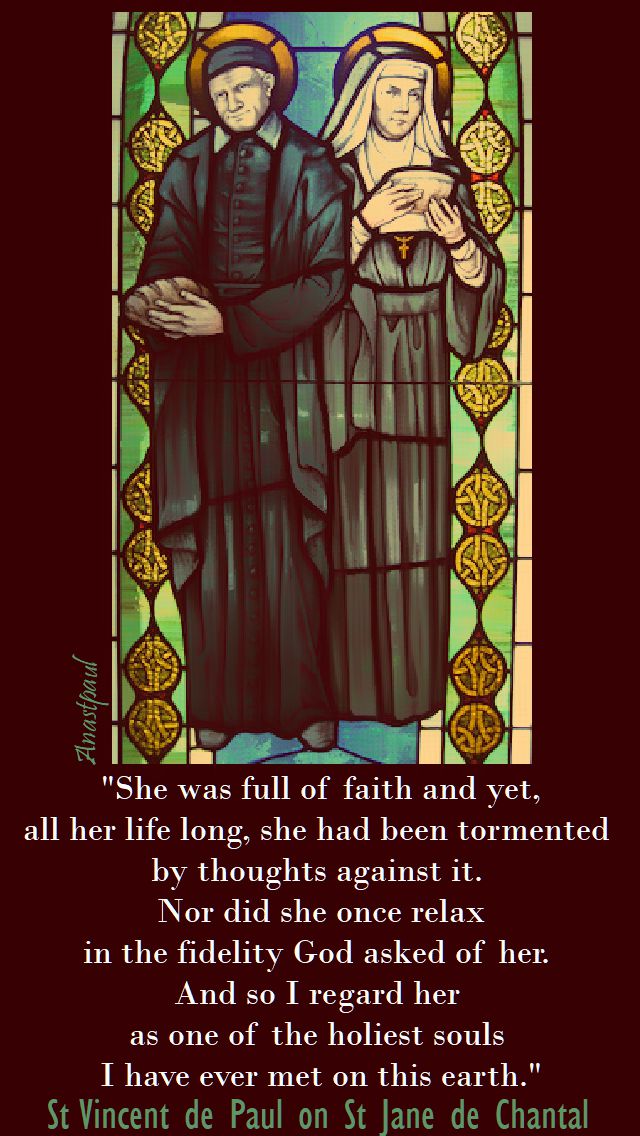
“She was full of faith and yet all her life long,
she had been tormented by thoughts against it.
Nor did she once relax in the fidelity God asked of her.
And so I regard her as one of the holiest souls
I have ever met on this earth.”

St Vincent de Paul

she was full of faith and yet - st vincent de paul


Posted in PATRONAGE - IN-LAW PROBLEMS, QUOTES of the SAINTS, SAINT of the DAY, WIDOWS and WIDOWERS

Saint of the Day – 12 August – St Jane Frances de Chantal VHM (1572-1641)

Saint of the Day – 12 August – St Jane Frances de Chantal VHM (1572-1641) – Mother, Widow, Foundress – born on 28 January 1572 at Dijon, Burgundy, France and died on  13 December 1641 at the Visitationist Convent, Moulins, France of natural causes.   Her relic sreside  at Annecy, Savoy    She was Beatified on 21 November 1751 by Pope Benedict XIV and Canonised on 16 July 1767 by Pope Clement XIII.   Patronages – against in-law problems, against the death of parents, forgotten people, parents separated from children, widows.

OLYMPUS DIGITAL CAMERA

Jane Frances de Chantal was born in Dijon, France, on 28 January 1572, the daughter of the royalist president of the Parliament of Burgundy.   Her mother died when Jane was 18 months old.   Her father became the main influence on her education.   She developed into a woman of beauty and refinement, lively and cheerful in temperament.   She married the Baron de Chantal when she was 21 and then lived in the feudal castle of Bourbilly.   Baron de Chantal was accidentally killed by an arquebus while out shooting in 1601.   Left a widow at 28, with four children, the broken-hearted baroness took a vow of chastity.   Her mother, step mother, sister, first two children and now her husband had died.   Chantal gained a reputation as an excellent manager of the estates of her husband, as well as of her difficult father-in-law, while also providing alms and nursing care to needy neighbours.

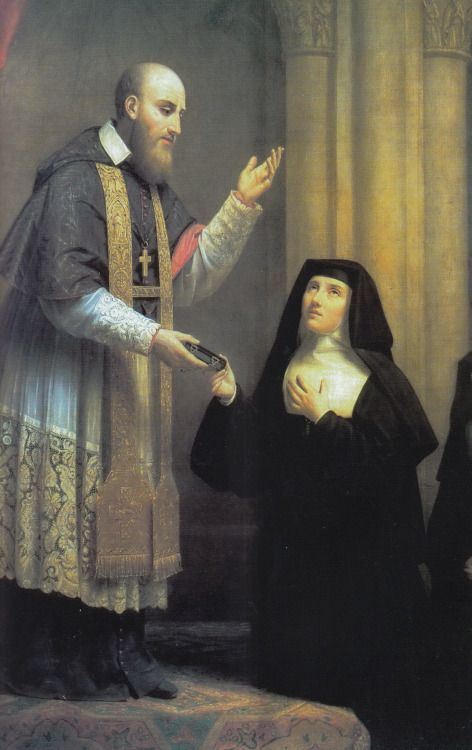
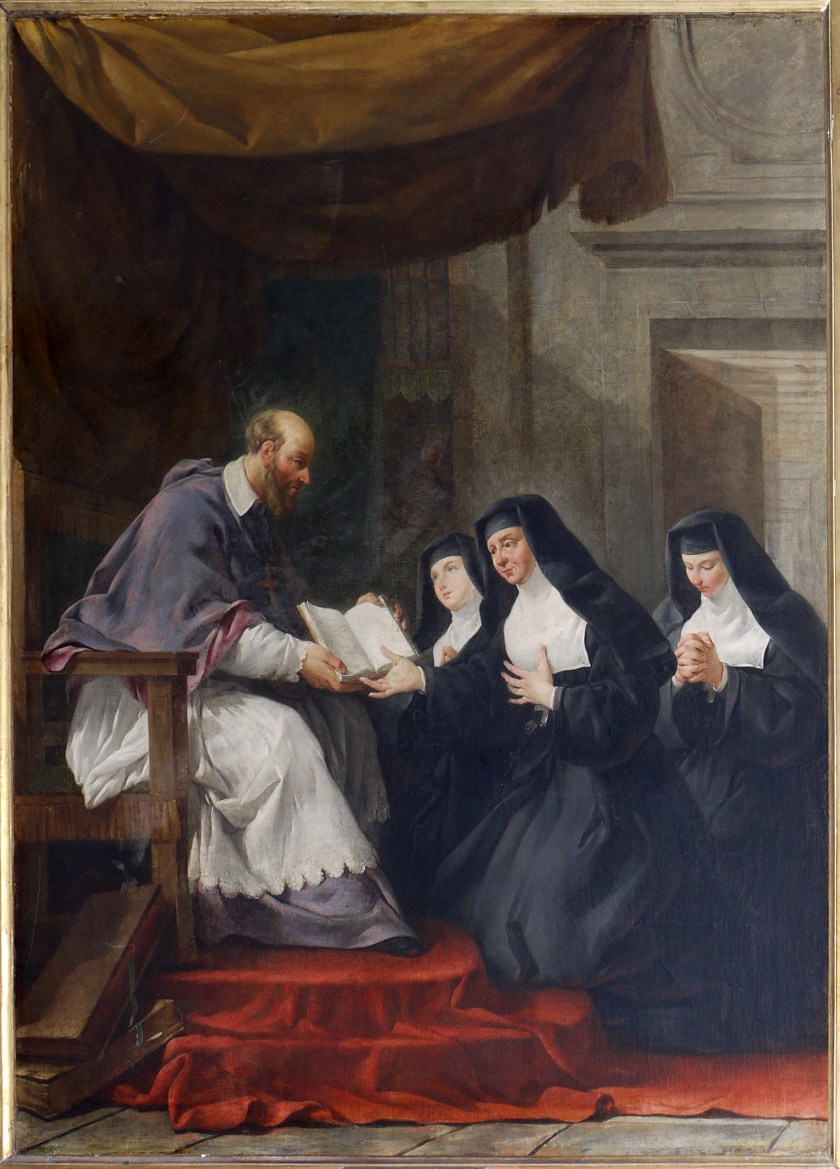
During Lent in 1604, the pious baroness met Saint Francis de Sales, the bishop of Geneva who was preaching at the Sainte Chapelle in Dijon.   They became close friends and de Sales became her spiritual director.   She wanted to become a nun but he persuaded her to defer this decision.   Later, with his support, and that of her father and brother (the Archbishop of Bourges) and, after providing for her children, Chantal left for Annecy, to start the Congregation of the Visitation.   The Congregation of the Visitation was canonically established at Annecy on Trinity Sunday, 6 June 1610.   The order accepted women who were rejected by other orders because of poor health or age.   During its first eight years, the new order also was unusual in its public outreach, in contrast to most female religious who remained cloistered and adopted strict ascetic practices.   The usual opposition to women in active ministry arose and Francis de Sales was obliged to make it a cloistered community following the Rule of St Augustine.   When people criticised her for accepting women of poor health and old age, Chantal famously said, “What do you want me to do?   I like sick people myself, I’m on their side.”st jane frances de chantal

Saint_François_de_Sales_donnant_à_sainte_Jeanne_de_Chantal_la_règle_de_l'ordre_de_la_Visitation_Noël_Hallé

Her reputation for sanctity and sound management resulted in many visits by (and donations from) aristocratic women.   The order had 13 houses by the time de Sales died, and 86 before Chantal herself died at the Visitation Convent in Moulins, aged 69.   St. Vincent de Paul served as her spiritual director after de Sales’ death.   Her favourite devotions involved the Sacred Heart of Jesus and the Heart of Mary.   Chantal was buried in the Annecy convent next to de Sales.   The order had 164 houses by 1767, when she was canonised.   Chantal outlived her son (who died fighting Huguenots and English on the Île de Ré during the century’s religious wars) and two of her three daughters but left extensive correspondence.   Her granddaughter also became a famous writer, Marie de Rabutin-Chantal, marquise de Sévigné.

Posted in MORNING Prayers, QUOTES of the SAINTS, SAINT of the DAY, The WORD

One Minute Reflection – 12 August

One Minute Reflection – 12 August

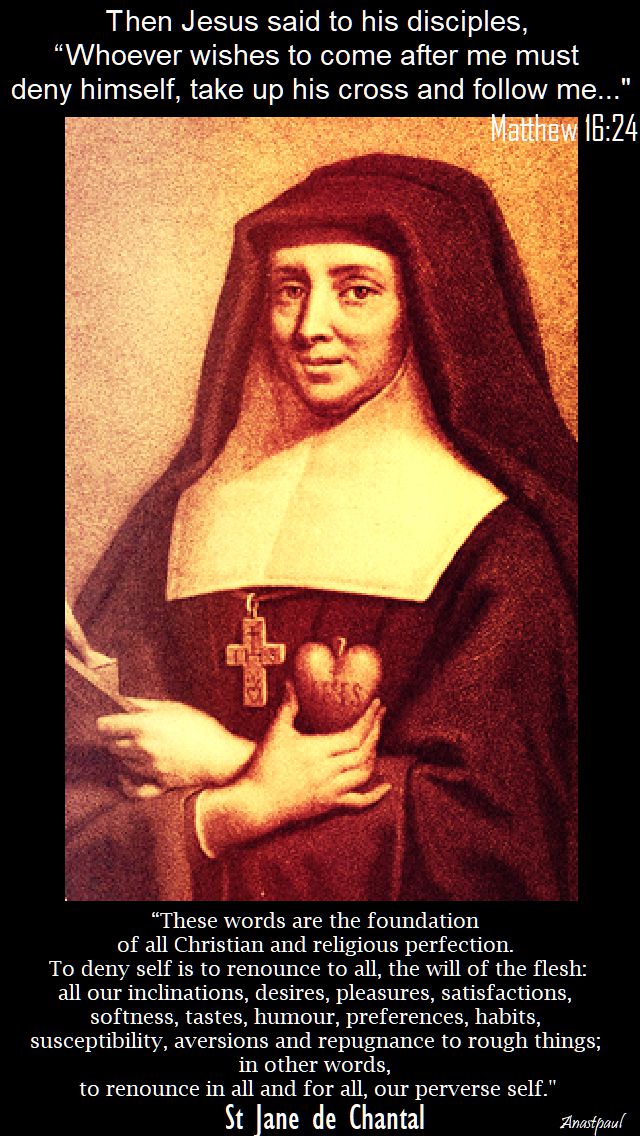
Then Jesus said to his disciples, “Whoever wishes to come after me must deny himself, take up his cross, and follow me…”…Matthew 16:24

REFLECTION – “These words are the foundation of all Christian and religious perfection.
To deny self is to renounce to all, the will of the flesh:
all our inclinations, desires, pleasures, satisfactions, softness, tastes, humour, preferences, habits, susceptibility, aversions and repugnance to rough things;
in other words, to renounce in all and for all, our perverse self.”…St Jane de Chantal

these words are the foundation - st jane de chantal

PRAYER – Lord, You chose St Jane Frances to serve You, both in marriage and in religious life. By her prayers help us to be faithful in our vocation and always to work against our perverse inclinations. Only in You and with You and through You may we attain perfection. Lead us Lord! We ask this through our Lord Jesus Christ, your Son, who lives and reigns with you and the Holy Spirit, one God, for ever and ever. St Jane de Chantal, pray for us, amen.

st jane de chantal - pray for us

Posted in MORNING Prayers, PRAYERS of the SAINTS, SAINT of the DAY

Our Morning Offering – 12 August

Our Morning Offering – 12 August

Prayer of Saint Jane de Chantal (1572-1641)

O Holy Mother of the children of God!
When shall I rest in your immortal arms?
Our souls should be wholly consumed by this desire.
But I will restrain myself and peacefully await the hour
which the divine Saviour has destined for me,
to overwhelm me with that bliss.
In the meantime let us have only one desire,
to please Him by doing His holy will in all things.
What God wishes for us, let it be done:
we are His for time and eternity. Amen

prayer of st jane de chantal

Posted in SAINT of the DAY

Memorials of the Saints – 12 August

St Jeanne de Chantal/Jane Frances (Optional Memorial)

St Anicetus of Marmora
St Antôn Nguyen Ðích
Bl Charles Meehan
St Discolio of Vercelli
St Euplus of Catania
St Eusebius of Milan
St Felicissima the Blind
St Giacobe do Mai Nam
St Gracilian
St Herculanus of Brescia
Bl Pope Innocent XI
St Jambert of Canterbury
Bl Józef Stepniak
Bl Józef Straszewski
St Julian of Syria
Bl Karl Leisner
St Macarius of Syria
St Merewenna
St Micae Nguyen Huy My
St Murtagh of Killala
St Photinus of Marmora
Bl Pierre Jarrige de la Morélie de Puyredon
St Porcarius of Lerins
St Simplicio of Vercelli
St Ust

Martyrs of Augsburg – 4 saints: The mother, Hilaria, and three friends of of Saint Afra of Augsburg. While visiting the tomb of Saint Afra who were seized by the authorities and martyred when they visited Afra’s tomb – Digna, Eunomia, Euprepia and Hilaria. They were burned alive c 304.

Martyrs of Rome – 5 saints: A group of Christians martyred together in the persecutions of Diocletian. We know little more than their names – Crescentian, Juliana, Largio, Nimmia and Quiriacus.
• c.304 in Rome, Italy
• buried on the Ostian Way outside Rome.

Martyred in the Spanish Civil War:
Martyrs of Barbastro – 6 beati: Six Claretian brothers and priests who were martyred together in the persecutions of the Spanish Civil War.
• Gregorio Chirivas Lacamba
• José Pavón Bueno
• Nicasio Sierra Ucar
• Pere Cunill Padrós
• Sebastián Calvo Martínez
• Wenceslau Clarís Vilaregut
They were martyred on 12 August 1936 in Barbastro, Huesca, Spain and Beatified on 25 October 1992 by Pope John Paul II.

Martyrs of La Torre de Fontaubella – 4 beati: Four parish priests who were murdered together in the persecutions of the Spanish Civil War.
• Antoni Nogués Martí
• Joan Rofes Sancho
• Josep Maria Sancho Toda
• Ramon Martí Amenós
They were martyred on 12 August 1936 in La Torre de Fontaubella, Tarragona, Spain and Beatified on 13 October 2013 by Pope Francis. Their beatification celebrated in Tarragona, Spain.

Martyrs of Puerta de Hierro – 5 beati: Five nun in the Archdiocese of Madrid, Spain, all members of the Daughters of Charity of Saint Vincent de Paul, and all martyred together in the Spanish Civil War.
• Estefanía Saldaña Mayoral
• María Asunción Mayoral Peña
• María Dolores Barroso Villaseñor
• María Severina Díaz-Pardo Gauna
• Melchora Adoración Cortés Bueno
They were martyred on 12 August 1936 in Puerta de Hierro, Aravaca, Madrid, Spain and Beatified on
27 October 2013 by Pope Benedict XVI.

Bl Antoni Perulles Estivill
Bl Atilano Dionisio Argüeso González
Bl Buenaventura García-Paredes Pallasá
Bl Carles Barrufet Tost
Bl Domingo Sánchez Lázaro
Bl Enrique María Gómez Jiménez
Bl Félix Pérez Portela
Bl Gabriel Albiol Plou
Bl José Jordán Blecua
Bl Josep Nadal Guiu
Bl Juana Pérez Abascal
Bl Manuel Basulto Jiménez
Bl Manuel Borràs Ferré
Bl Miquel Domingo Cendra
Bl Pau Figuerola Rovira
Pedro José Cano Cebrían
Ramona Cao Fernández