Thought for the Day – 11 August – The Memorial of St Clare of Assisi
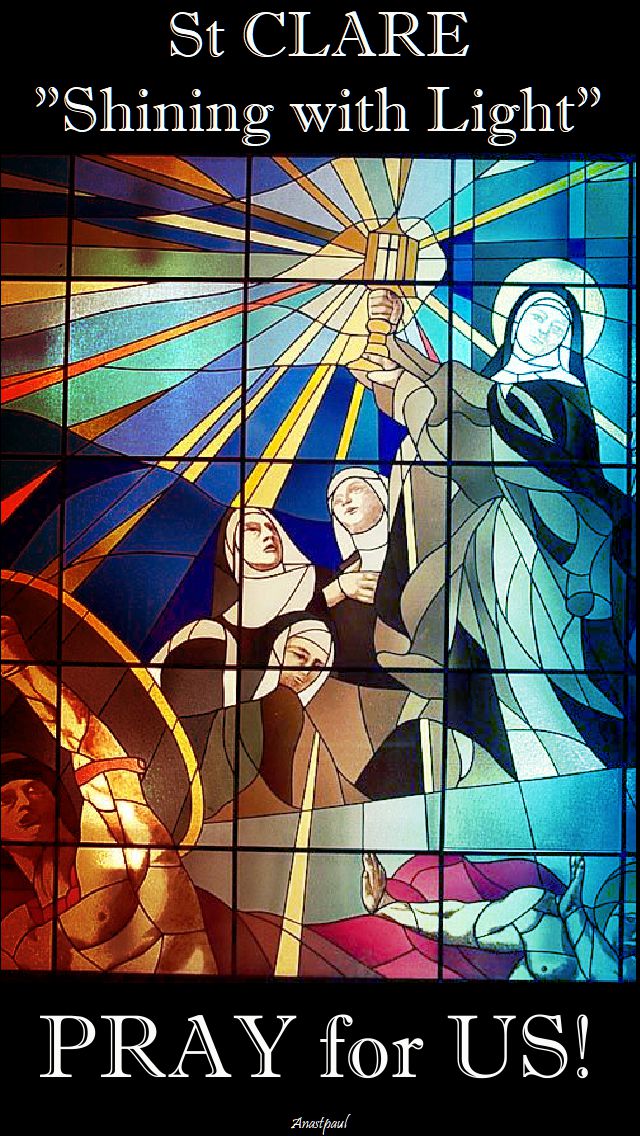
Clare (a name meaning “shining with light”)
The 41 years of Clare’s religious life are a model of piety and sanctity. She demonstrated an indomitable resolve to lead the simple, literal gospel life as Francis taught her, resisting worldly pressures to dilute the rules of her order. Through her commitment to the Gospel and her unwavering life of prayer, Clare established a new manner for women to live in community and serve the Lord—one of poverty and humility, service and contemplation, and generous concern for others. Saint Clare continues to inspire us today through the example set forth in her life, as well as her writings which survive her.
Her life is one of simple focus. From an early age she dedicated herself to the Lord and through a lifetime of humility, service, obedience, patient suffering, prayer and contemplation, Clare refined her being into a “model of perfection.” Miracles aside, the daily life of poverty and labour resonates today, reminding us of the Lord’s call to us: “He who is last shall be first.” Saint Clare depended completely on the Lord, looking to the Eucharist as a source of joy and sustenance and never taking the gifts of God for granted. Today, on her feast day, we might slow down and contemplate our relationship with the Lord, our dependence, the value we place upon our Eucharistic gift and privilege. How well do we live the advice of Saint Clare: “Totally love Him, Who gave Himself totally for your love.”
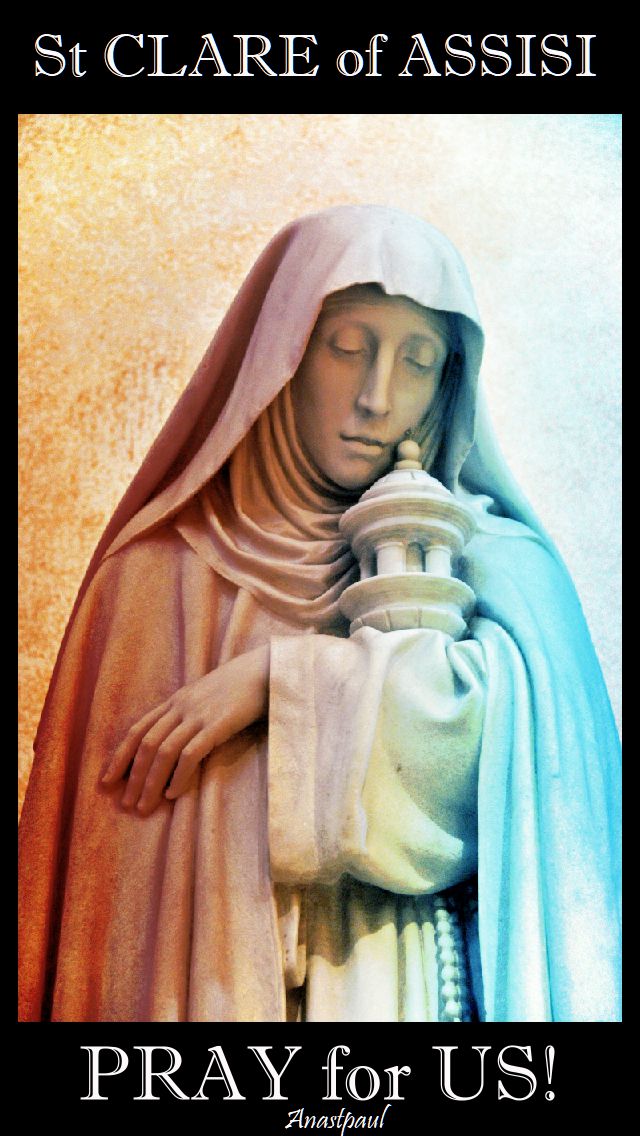
St Clare, shining with light – Pray for us!
O wondrous blessed clarity of Clare! In life she shone to a few; after death she shines on the whole world! On earth she was a clear light; Now in heaven she is a brilliant sun.
O how great the vehemence of the brilliance of this clarity! On earth this light was indeed kept within cloistered walls, yet shed abroad its shining rays; It was confined within a convent cell, yet spread itself through the wide world.
Quote/s of the Day – 11 August – The Memorial of St Clare of Assisi
“He, Christ, is the splendour of eternal glory, “the brightness of eternal light and the mirror without cloud.” Behold, I say, the birth of this mirror. Behold Christ’s poverty even as he was laid in the manger and wrapped in swaddling clothes. What wondrous humility, what marvellous poverty! The King of angels, the Lord of heaven and earth resting in a manger! Look more deeply into the mirror and meditate on His humility, or simply on His poverty. Behold the many labours and sufferings He endured to redeem the human race. Then, in the depths of this very mirror, ponder His unspeakable love which caused Him to suffer on the wood of the cross and to endure the most shameful kind of death. The mirror Himself, from His position on the cross, warned passers-by to weigh carefully this act, as He said: “All of you who pass by this way, behold and see if there is any sorrow like mine.” Let us answer His cries and lamentations with one voice and one spirit: “I will be mindful and remember and my soul will be consumed within me.”
Gerard Seghers – St. Clare and St. Francis of Assisi in adoration before the Child Jesus.
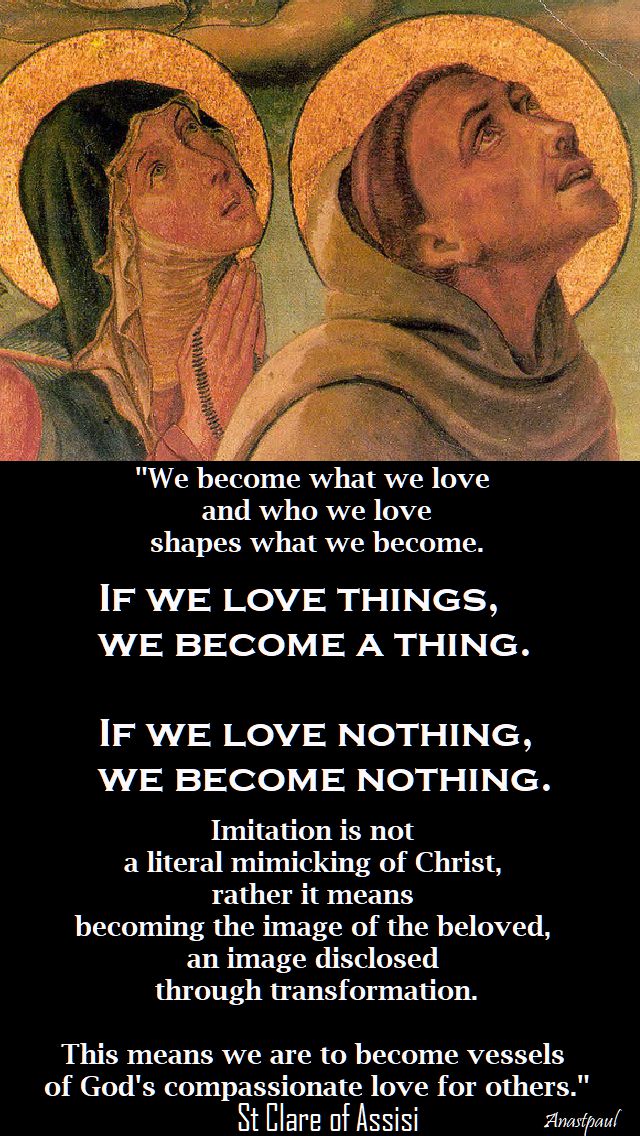
“We become what we love and who we love shapes what we become. If we love things, we become a thing. If we love nothing, we become nothing. Imitation is not a literal mimicking of Christ, rather it means becoming the image of the beloved, an image disclosed through transformation. This means we are to become vessels of God’s compassionate love for others.”
St Clare’s second letter to Blessed Agnes of Prague
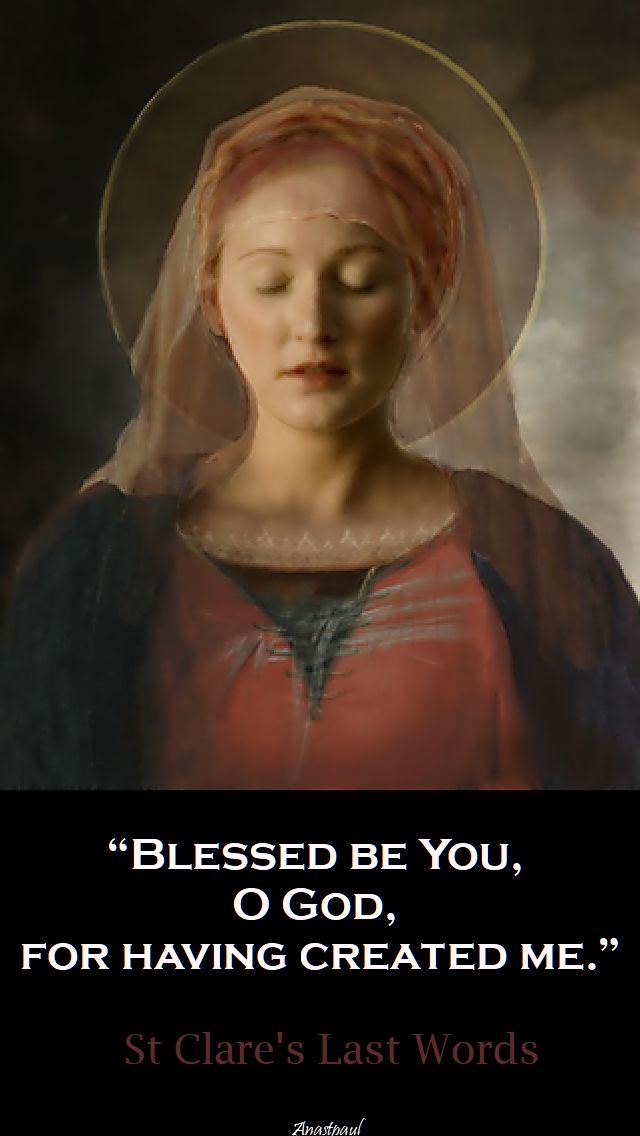
“ Blessed be You, O God, for having created me. ”
St Clare’s Last Words
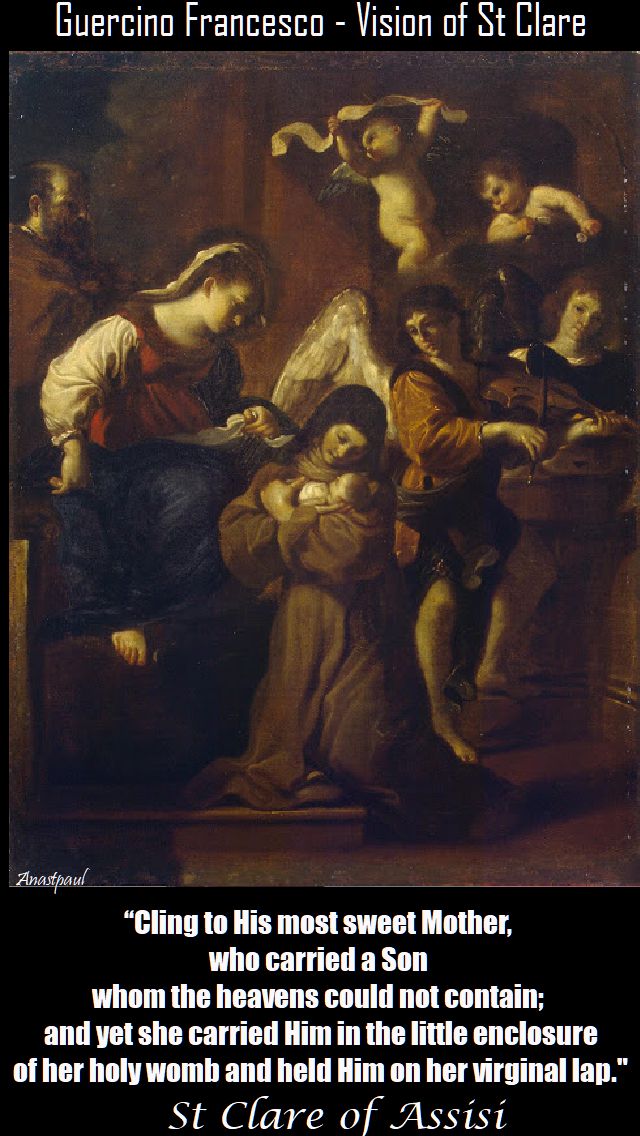
“Cling to His most sweet Mother, who carried a Son whom the heavens could not contain; and yet she carried Him in the little enclosure of her holy womb and held Him on her virginal lap.”
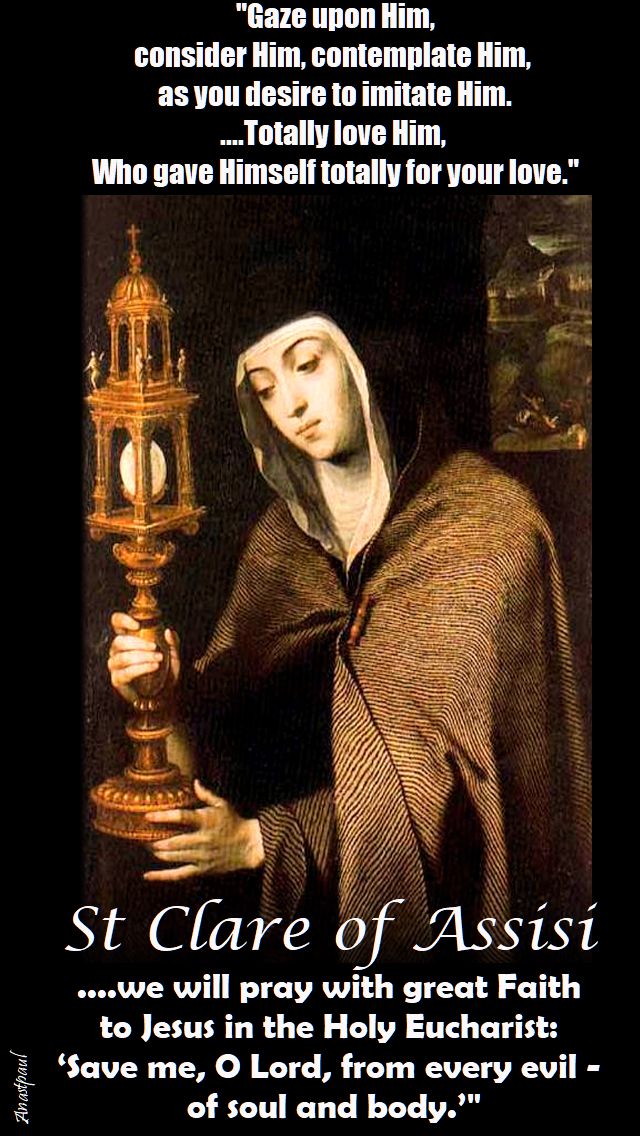
“Gaze upon Him, consider Him, contemplate Him, as you desire to imitate Him. ….Totally love Him, Who gave Himself totally for your love.”
“They say that we are too poor but can a heart which possesses the infinite God be truly called poor? We should remember this miracle of the Blessed Sacrament when in Church. Then we will pray with great Faith to Jesus in the Holy Eucharist: ‘Save me, O Lord, from every evil – of soul and body.’”
St Clare of Assisi
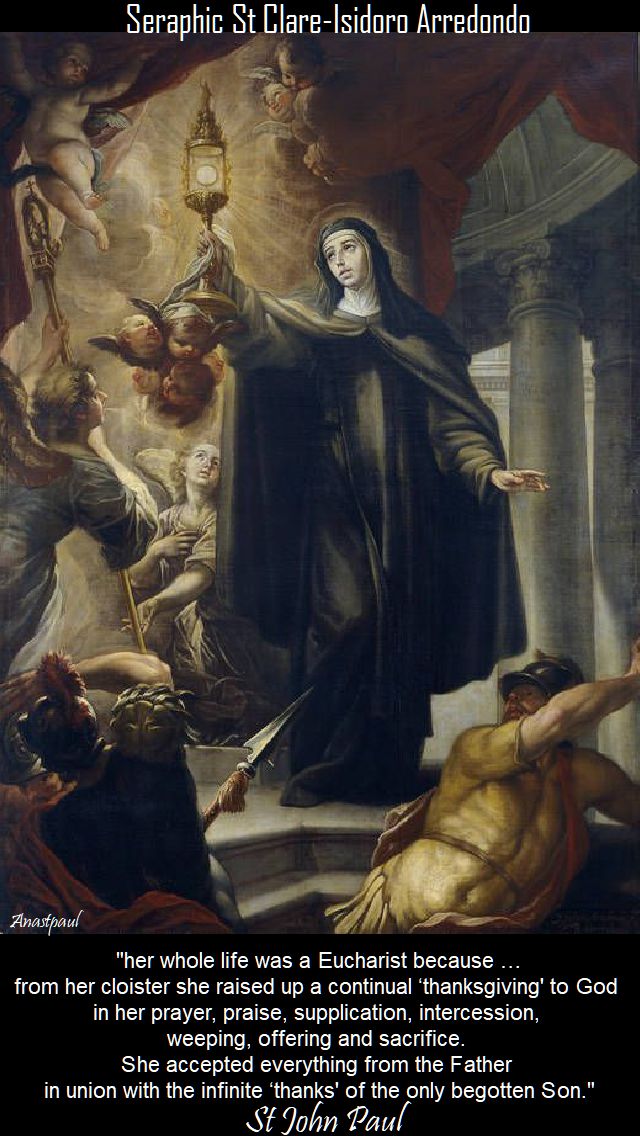
St Pope John Paul II said of Saint Clare:
“her whole life was a Eucharist because … from her cloister she raised up a continual ‘thanksgiving’ to God in her prayer, praise, supplication, intercession, weeping, offering and sacrifice.
She accepted everything from the Father in union with the infinite ‘thanks’ of the only begotten Son.
One Minute Reflection – 11 August – The Memorial of St Clare of Assisi
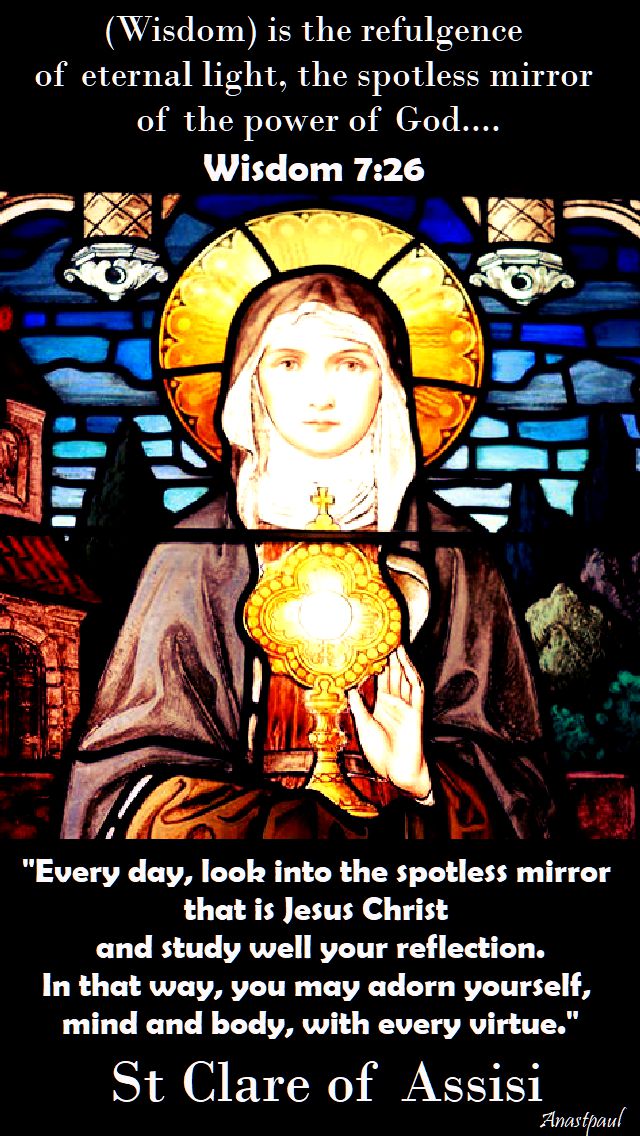
(Wisdom) is the refulgence of eternal light, the spotless mirror of the power of God….Wisdom 7:26
REFLECTION – “Every day, look into the spotless mirror that is Jesus Christ and study well your reflection.
In that way, you may adorn yourself, mind and body, with every virtue.”…St Clare of Assisi
PRAYER – Lord Jesus, help me to dwell often on the manner in which I am following You. Let me strive each day to become more and more like You in all things and eventually, to become the light of You to all the world around me. St Clare of Assisi, you who were a light to all those around you, pray for us, amen.
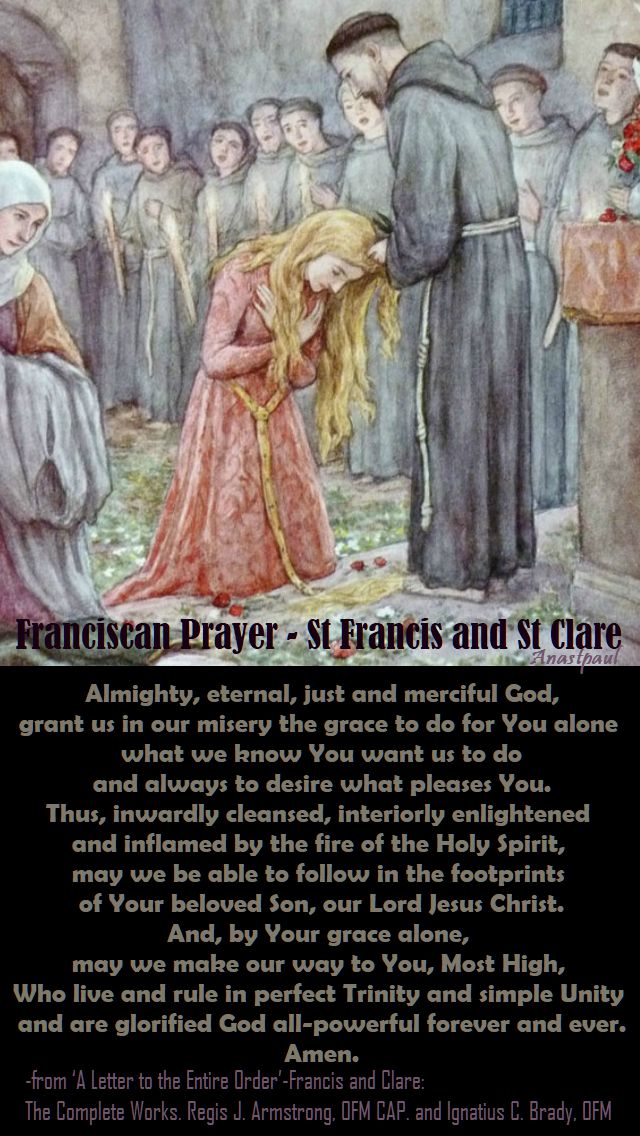
Almighty, eternal, just and merciful God,
grant us in our misery the grace to do for You alone
what we know You want us to do
and always to desire what pleases You.
Thus, inwardly cleansed, interiorly enlightened
and inflamed by the fire of the Holy Spirit,
may we be able to follow in the footprints
of Your beloved Son, our Lord Jesus Christ.
And, by Your grace alone,
may we make our way to You, Most High,
Who live and rule in perfect Trinity and simple Unity
and are glorified God all-powerful forever and ever.
Amen.
-from ‘A Letter to the Entire Order’
Francis and Clare: The Complete Works. Regis J. Armstrong, OFM
CAP. and Ignatius C. Brady, OFM
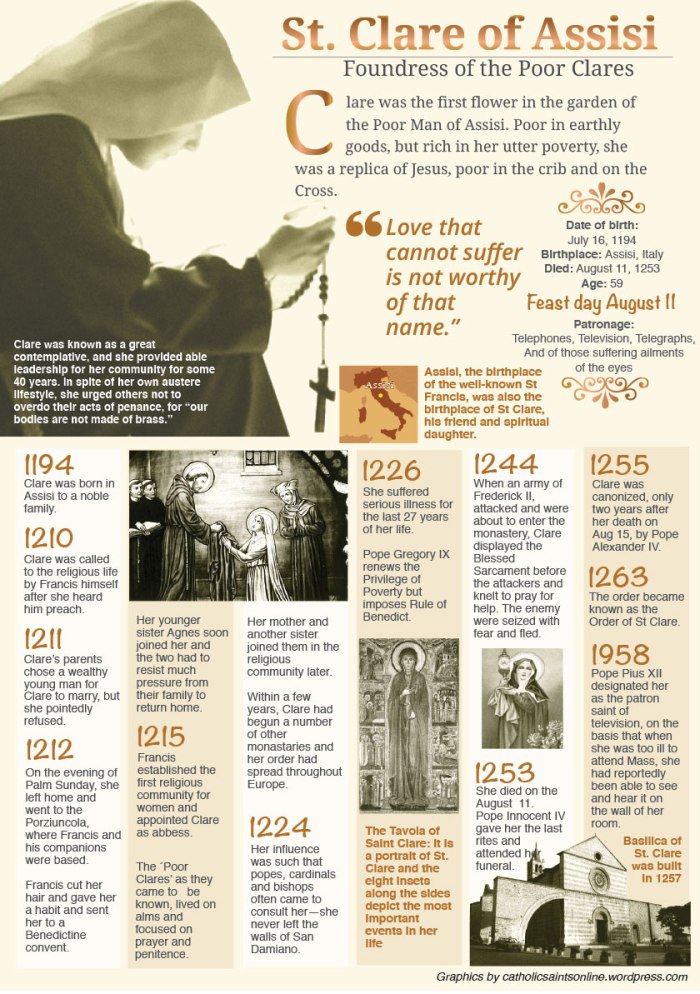
Saint of the Day – 11 August – St Clare of Assisi (1194-1253) – Virgin, Religious, Founder, Mystic, Friend and Follower of St Francis, Miracle-Worker – (16 July 1194 at Assisi, Italy – 11 August 1253 of natural causes). St Clare was Canonised on 26 September 1255 by Pope Alexander IV. St Clare was born Chiara Offreduccio (sometimes spelled Clair, Claire, etc.) is an Italian saint and one of the first followers of Saint Francis of Assisi. She founded the Order of Poor Ladies, a monastic religious order for women in the Franciscan tradition and wrote their Rule of Life, the first set of monastic guidelines known to have been written by a woman. Following her death, the Order she founded was renamed in her honour as the Order of Saint Clare, commonly referred to today as the Poor Clares. Patronages – embroiderers, needle workers, eyes, against eye disease, for good weather, gilders, gold workers, goldsmiths, laundry workers, television (proclaimed on 14 February 1958 by Pope Pius XII because when St Clare was too ill to attend the Holy Mass, she had been able to see and hear it, on the wall of her room.), television writers, Poor Clares, Assisi, Italy, Santa Clara Indian Pueblo.
St Clare was born in Assisi, the eldest daughter of Favorino Sciffi, Count of Sasso-Rosso and his wife Ortolana. Traditional accounts say that Clare’s father was a wealthy representative of an ancient Roman family, who owned a large palace in Assisi and a castle on the slope of Mount Subasio. Ortolana belonged to the noble family of Fiumi and was a very devout woman who had undertaken pilgrimages to Rome, Santiago de Compostela and the Holy Land. Later in life, Ortolana entered Clare’s monastery, as did Clare’s sisters, Beatrix and Catarina (who took the name Agnes).
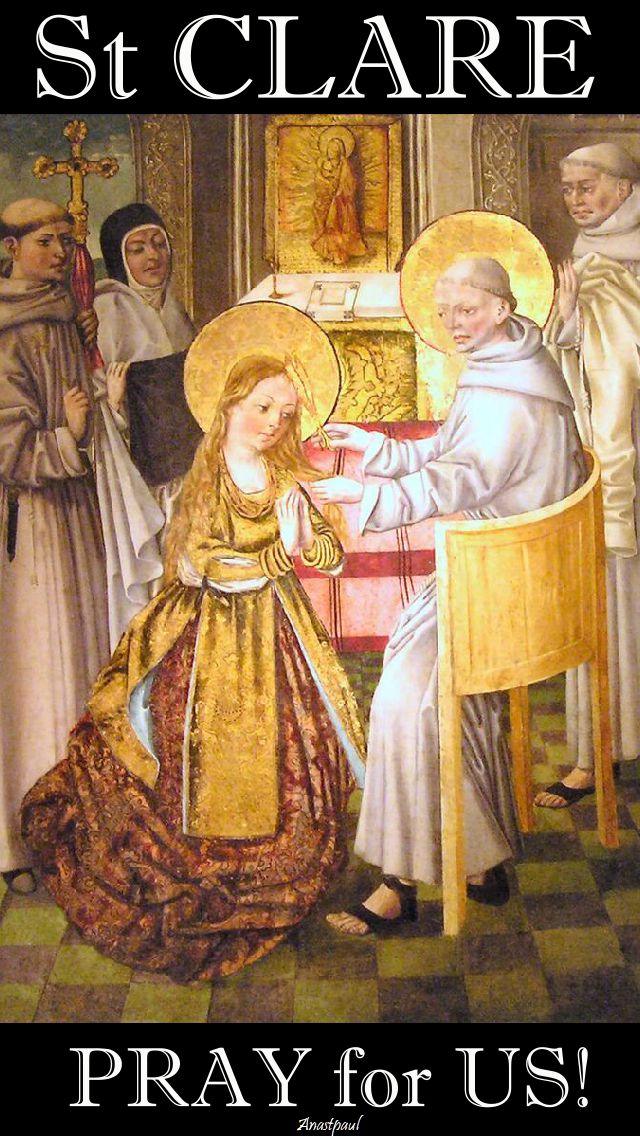
As a child, Clare was devoted to prayer. Although there is no mention of this in any historical record, it is assumed that Clare was to be married in line with the family tradition. However, at the age of 18 she heard Francis preach during a Lenten service in the church of San Giorgio at Assisi and asked him to help her to live after the manner of the Gospel. On the evening of Palm Sunday, 20 March 1212, she left her father’s house and accompanied by her aunt Bianca and another companion proceeded to the chapel of the Porziuncula to meet Francis. There, her hair was cut and she exchanged her rich gown for a plain robe and veil.
Francis placed Clare in the convent of the Benedictine nuns of San Paulo, near Bastia. Her father attempted to force her to return home. She clung to the altar of the church and threw aside her veil to show her cropped hair. She resisted any attempt, professing that she would have no other husband but Jesus Christ. In order to provide the greater solitude Clare desired, a few days later Francis sent her to Sant’ Angelo in Panzo, another monastery of the Benedictine nuns on one of the flanks of Subasio. Clare was soon joined by her sister Catarina, who took the name Agnes. They remained with the Benedictines until a small dwelling was built for them next to the church of San Damiano, which Francis had repaired some years earlier.
Other women joined them and they were known as the “Poor Ladies of San Damiano”. They lived a simple life of poverty, austerity and seclusion from the world, according to a Rule which Francis gave them as a Second Order (Poor Clares).
San Damiano became the centre of Clare’s new religious order, which was known in her lifetime as the “Order of Poor Ladies of San Damiano.” San Damiano was long thought to be the first house of this order, however, recent scholarship strongly suggests that San Damiano actually joined an existing network of women’s religious houses organised by Hugolino (who later became Pope Gregory IX). Hugolino wanted San Damiano as part of the order he founded because of the prestige of Clare’s monastery. San Damiano emerged as the most important house in the order and Clare became its undisputed leader. By 1263, just ten years after Clare’s death, the order had become known as the Order of Saint Clare. In 1228, when Gregory IX offered Clare a dispensation from the vow of strict poverty, she replied: “ I need to be absolved from my sins but not from the obligation of following Christ.” Accordingly, the Pope granted them the Privilegium Pauperitatis — that nobody could oblige them to accept any possession.
Unlike the Franciscan friars, whose members moved around the country to preach, Saint Clare’s sisters lived in enclosure, since an itinerant life was hardly conceivable at the time for women. Their life consisted of manual labour and prayer. The nuns went barefoot, slept on the ground, ate no meat and observed almost complete silence.
For a short period, the order was directed by Francis himself. Then in 1216, Clare accepted the role of abbess of San Damiano. As abbess, Clare had more authority to lead the order than when she was the prioress and required to follow the orders of a priest heading the community. Clare defended her order from the attempts of prelates to impose a rule on them that more closely resembled the Rule of Saint Benedict than Francis’ stricter vows. Clare sought to imitate Francis’ virtues and way of life so much so that she was sometimes titled alter Franciscus, another Francis. She also played a significant role in encouraging and aiding Francis, whom she saw as a spiritual father figure and she took care of him during his final illness.
After Francis’s death, Clare continued to promote the growth of her order, writing letters to abbesses in other parts of Europe and thwarting every attempt by each successive pope to impose a rule on her order which weakened the radical commitment to corporate poverty she had originally embraced. She did this despite enduring a long period of poor health until her death. Clare’s Franciscan theology of joyous poverty in imitation of Christ is evident in the rule she wrote for her community and in her four letters to Agnes of Prague.
In 1224, the army of Frederick II came to plunder Assisi. Clare went out to meet them with the Blessed Sacrament in her hands. Suddenly a mysterious terror seized the enemies, who fled without harming anybody in the city.
Before breathing her last in 1253, Clare said: “ Blessed be You, O God, for having created me.”
On 9 August 1253, the papal bull Solet annuere of Pope Innocent IV confirmed that Clare’s rule would serve as the governing rule for Clare’s Order of Poor Ladies. Two days later, on 11 August Clare died at the age of 59. Her remains were interred at the chapel of San Giorgio while a church to hold her remains was being constructed. At her funeral, Pope Innocent IV insisted the friars perform the Office for the Virgin Saints as opposed to the Office for the Dead (Bartoli, 1993). This move by Pope Innocent ensured that the Canonisation process for Clare would begin shortly after her funeral. Pope Innocent was cautioned by multiple advisers against having the Office for the Virgin Saints performed at Clare’s funeral (Bartoli, 1993). The most vocal of these advisers was Cardinal Raynaldus who would later become Pope Alexander IV, who in two years time would canonise Clare (Pattenden, 2008). At Pope Innocent’s request the canonisation process for Clare began immediately. While the whole process took two years, the examination of Clare’s miracles took just six days. On 26 September 1255, Pope Alexander IV Canonised Clare as Saint Clare of Assisi. Construction of the Basilica of Saint Clare was completed in 1260, and on October 3 of that year Clare’s remains were transferred to the newly completed basilica where they were buried beneath the high altar. In further recognition of the saint, Pope Urban IV officially changed the name of the Order of Poor Ladies to the Order of Saint Clare in 1263.
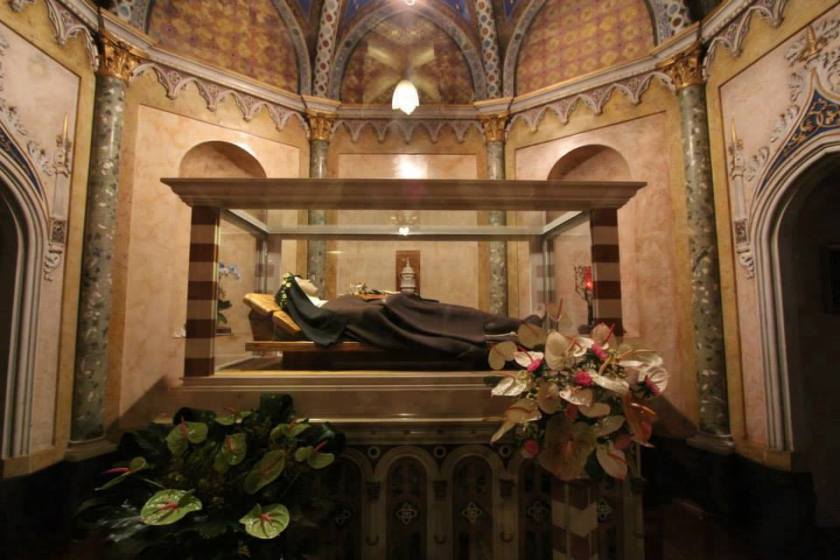
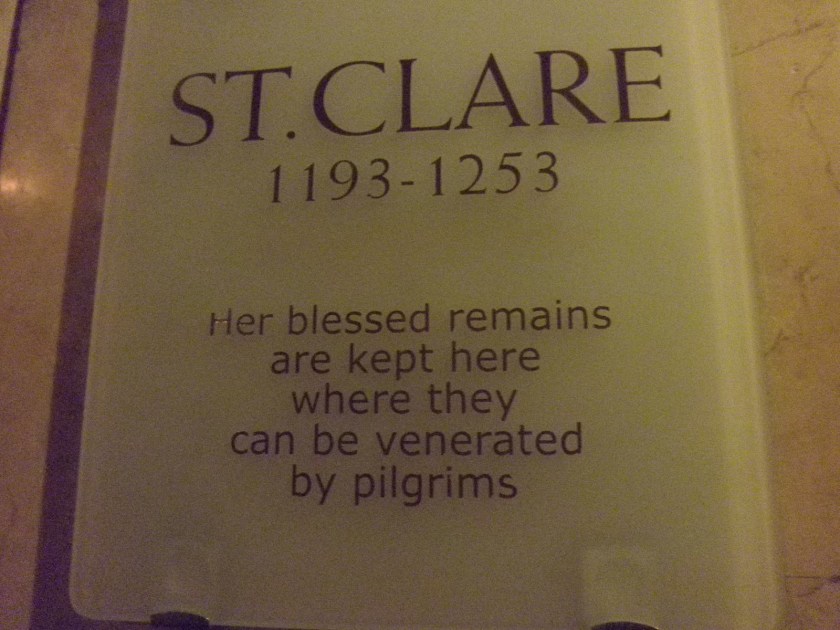
Some 600 years later in 1872, Saint Clare’s relics were transferred to a newly constructed shrine in the crypt of the Basilica of Saint Clare, where her relics can still be venerated today. Her body is incorrupt.
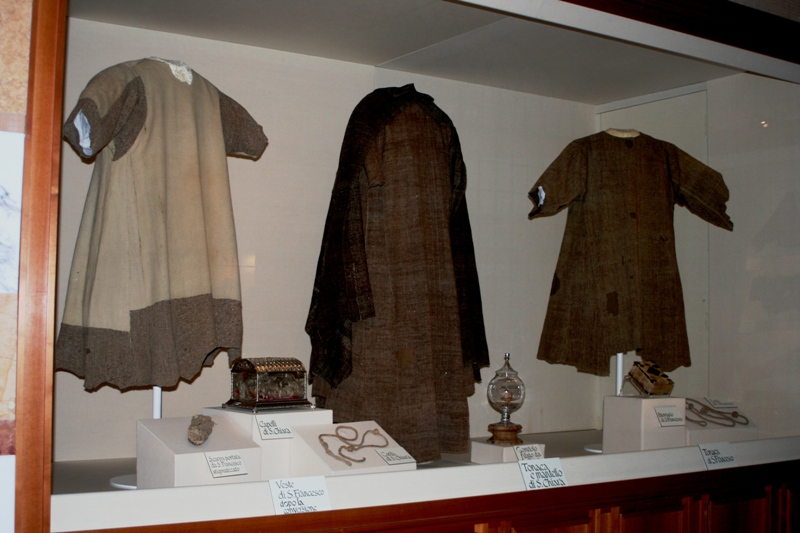
St Clare’s Garment in the Centre with St Francis’ on each side
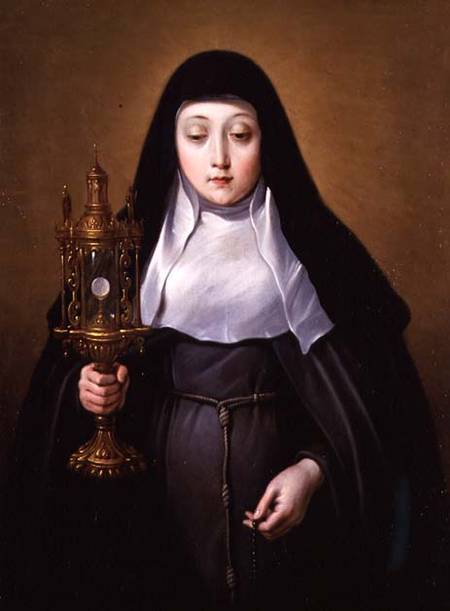
In art, Clare is often shown carrying a monstrance or pyx, in commemoration of the occasion when she warded away the soldiers of Frederick II at the gates of her convent by displaying the Blessed Sacrament and kneeling in prayer.
Pope Pius XII designated Clare as the Patron Saint of television in 1958 because when St Clare was too ill to attend the Holy Mass, she had been able to see and hear it, on the wall of her room.
There are traditions of bringing offerings of eggs to the Poor Clares for their intercessions for good weather, particularly for weddings. This tradition remains popular in the Philippines, particularly at the Real Monasterio de Santa Clara in Quezon City. According to the Filipino essayist Alejandro Roces, the practice arose because of Clare’s name. In Castilian clara refers to an interval of fair weather and in Spanish, it also refers to the white or albumen of the egg.
St Clare of Assisi (Memorial) – https://www.youtube.com/watch?v=cBHAb9_fwqc
—
St Alexander the Charcoal Burner
St Cassian of Benevento
St Chromatius the Prefect
St Digna of Todi
St Equitius of Valeria
St Gaugericus of Cambrai
Bl Jean-Georges Rehm
Bl John Sandys
St Lelia
St Philomena
St Rusicola of Arles
St Rufinus of Marsi
St Susanna of Rome
St Taurinus of Evreux
Bl Theobald of England and Companion
St Tiburtius of Rome
Bl William Lampley
—
Martyred in the Spanish Civil War
Bl Armando Óscar Valdés
Bl Benjamín Fernández de Legaria Goñi
Bl Carlos Díaz Gandía
Bl Rafael Alonso Gutiérrez
Bl Ramon Rosell Laboria
Thought for the Day – 10 August – The Feast of St Lawrence
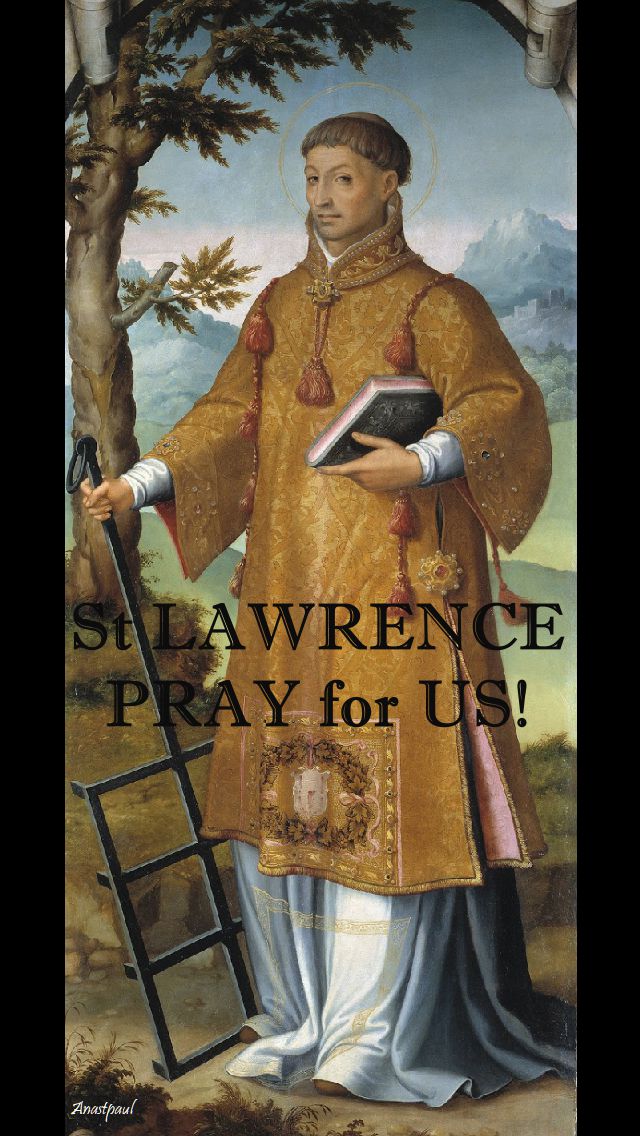
“The esteem in which the Church holds Lawrence is seen in the fact that today’s celebration ranks as a feast. We know very little about his life. He is one of those whose martyrdom made a deep and lasting impression on the early Church. Celebration of his feast day spread rapidly.
Once again we have a saint about whom almost nothing is known, yet one who has received extraordinary honour in the Church since the fourth century. Almost nothing—yet the greatest fact of his life is certain: He died for Christ. We who are hungry for details about the lives of the saints are again reminded that their holiness was after all, a total response to Christ, expressed perfectly by a death like this.” (Fr Don Miller OFM)
St Lawrence, your total and complete response to Christ is our example today, please pray for us!
Quote/s of the Day – 10 August – The Feast of St Lawrence of Rome
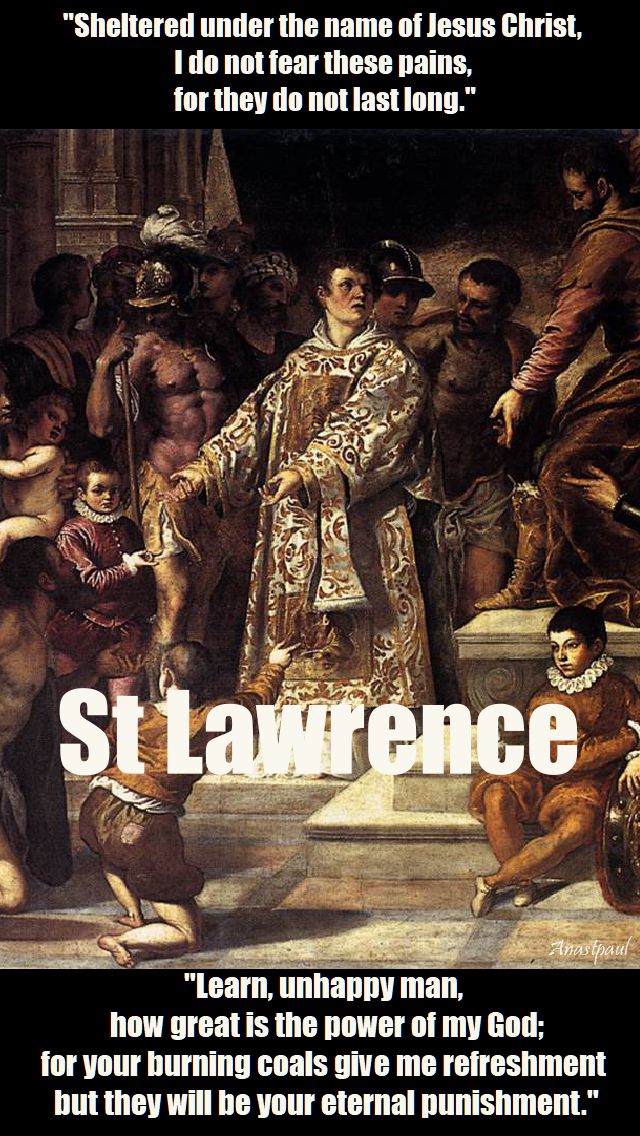
“Sheltered under the name of Jesus Christ, I do not fear these pains, for they do not last long.”
“Learn, unhappy man, how great is the power of my God; for your burning coals give me refreshment but they will be your eternal punishment.”
St Lawrence
“(St Lawrence) loved Christ in his life, he imitated Him in his death…After all, we shall not be able to give a better proof of love than by imitating His example…”
“Christ humbled himself: you have something, Christian, to latch on to. Christ became obedient. – Why do you behave proudly? After running the course of these humiliations and laying death low, Christ ascended into heaven – let us follow Him there. Let us listen to the Apostle telling us, ‘If you have risen with Christ, savour the things that are above and is, seated at God’s right hand.’ “
(From a sermon delivered by St. Augustine in about 400 AD on the occasion of the Feast of Saint Lawrence.)
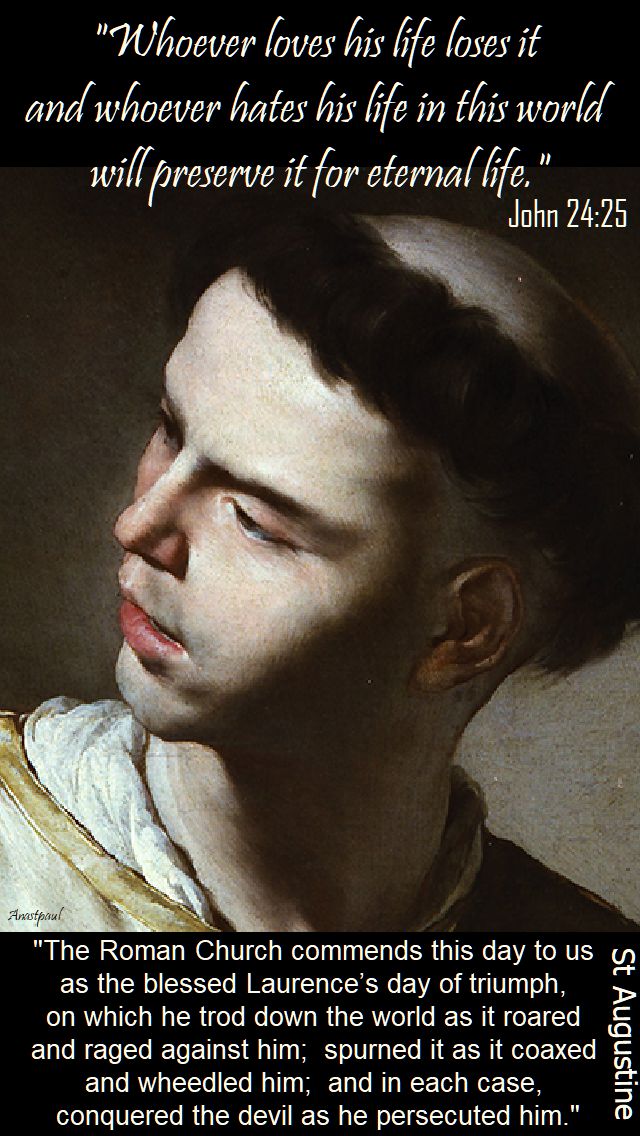
“I say to you, unless a grain of wheat falls to the ground and dies, it remains just a grain of wheat; but if it dies, it produces much fruit. Whoever loves his life loses it and whoever hates his life in this world will preserve it for eternal life.”…John 12:24-25
REFLECTION – “The Roman Church commends this day to us as the blessed Laurence’s day of triumph, on which he trod down the world as it roared and raged against him; spurned it as it coaxed and wheedled him; and in each case, conquered the devil as he persecuted him. For in that Church, you see, as you have regularly been told, he performed the office of deacon; it was there that he administered the sacred chalice of Christ’s blood; there that he shed his own blood for the name of Christ…And we too, brethren, if we truly love Him, let us imitate Him. After all, we shall not be able to give a better proof of love than by imitating His example; for Christ suffered for us, leaving us an example, so that we might follow in His footsteps.” …(From a sermon delivered by St. Augustine in about 400 AD on the occasion of the Feast of Saint Lawrence.)
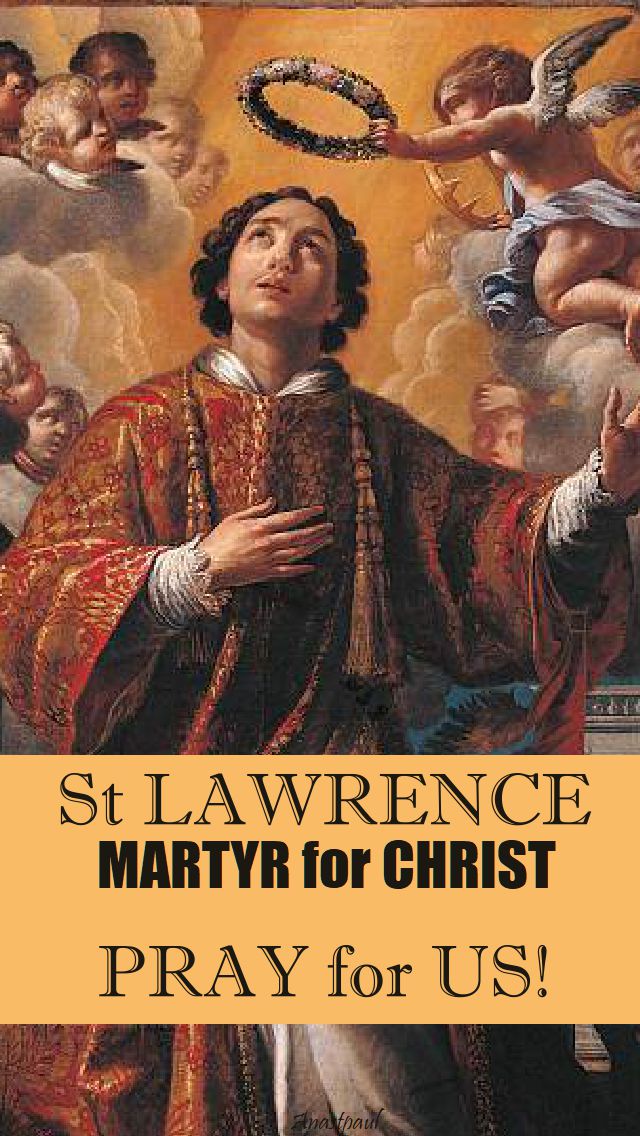
PRAYER – Lord God, You inspired St Lawrence with so ardent a love that his life was renowned for the service of Your people and his death for the splendour of his martyrdom. Help us to love what he loved and to life as he showed us. St Lawrence, Martyr for Christ and His Church, pray for us. Through our Lord, Jesus Christ, in union with the Holy Spirit, one God forever and ever amen.
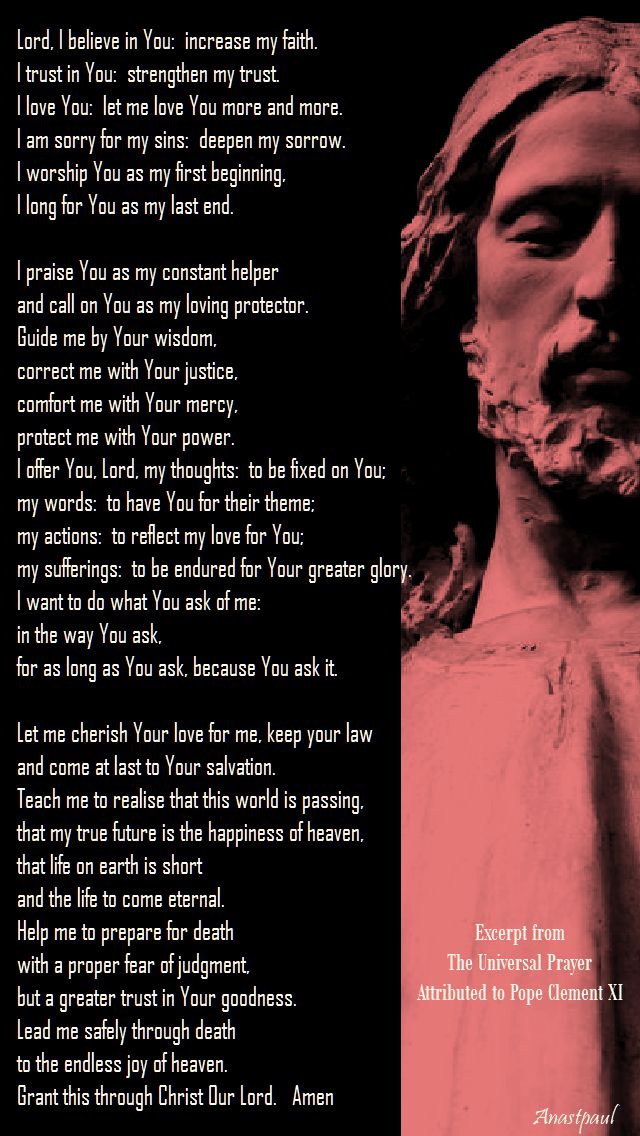
The Universal Prayer Attributed to Pope Clement XI (1700-1721)
Lord, I believe in You: increase my faith.
I trust in You: strengthen my trust.
I love You: let me love You more and more.
I am sorry for my sins: deepen my sorrow.
I worship You as my first beginning,
I long for You as my last end.
I praise You as my constant helper
and call on You as my loving protector.
Guide me by Your wisdom,
correct me with Your justice,
comfort me with Your mercy,
protect me with Your power.
I offer You, Lord, my thoughts: to be fixed on You;
my words: to have You for their theme;
my actions: to reflect my love for You;
my sufferings: to be endured for Your greater glory.
I want to do what You ask of me:
in the way You ask,
for as long as You ask, because You ask it.
Lord, enlighten my understanding, strengthen my will,
purify my heart and make me holy.
Help me to repent of my past sins
and to resist temptation in the future.
Help me to rise above my human weaknesses
and to grow stronger as a Christian.
Let me love You, my Lord and my God,
and see myself as I really am: a pilgrim in this world,
a Christian called to respect and love all those lives I touch,
those in authority over me or those under my authority,
my friends and my enemies.
Help me to conquer anger with gentleness,
greed by generosity, apathy by fervour.
Help me to forget myself and reach out toward others.
Make me prudent in planning, courageous in taking risks.
Make me patient in suffering, unassuming in prosperity.
Keep me, Lord, attentive at prayer,
temperate in food and drink, diligent in my work,
firm in my good intentions.
Let my conscience be clear, my conduct without fault,
my speech blameless, my life well-ordered.
Put me on guard against my human weaknesses.
Let me cherish Your love for me, keep your law
and come at last to Your salvation.
Teach me to realise that this world is passing,
that my true future is the happiness of heaven,
that life on earth is short and the life to come eternal.
Help me to prepare for death with a proper fear of judgment,
but a greater trust in Your goodness.
Lead me safely through death to the endless joy of heaven.
Grant this through Christ Our Lord. Amen
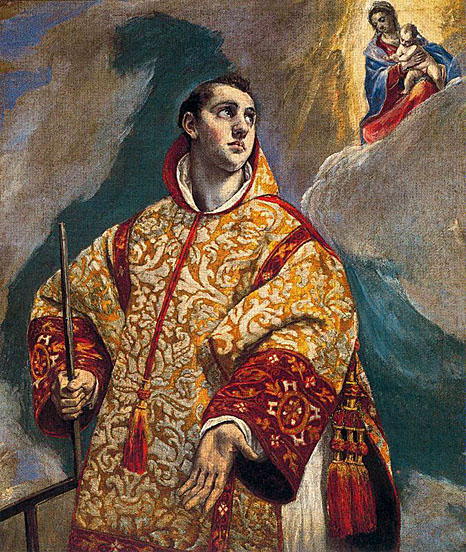
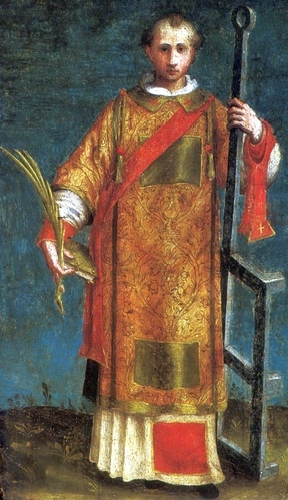
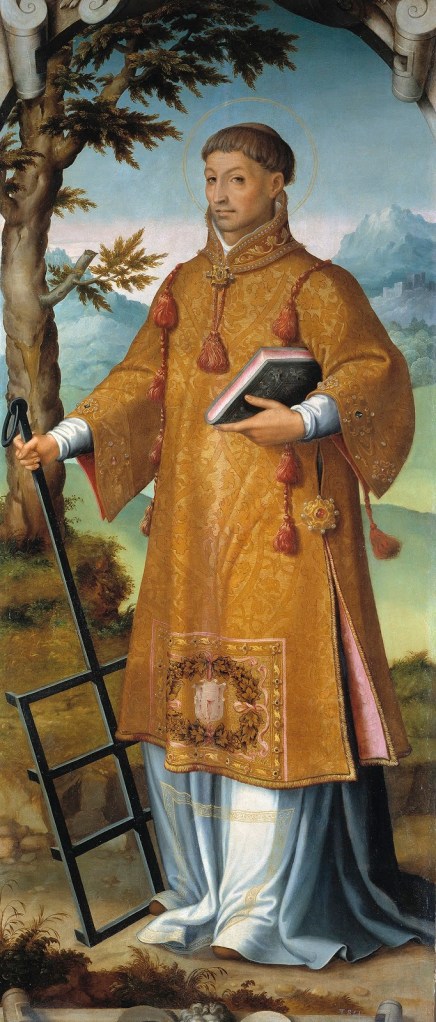
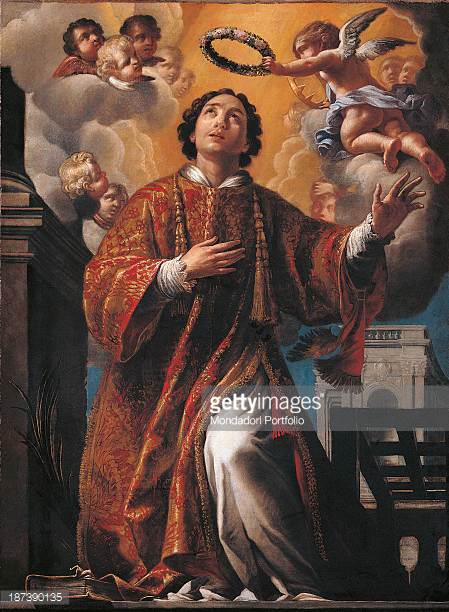
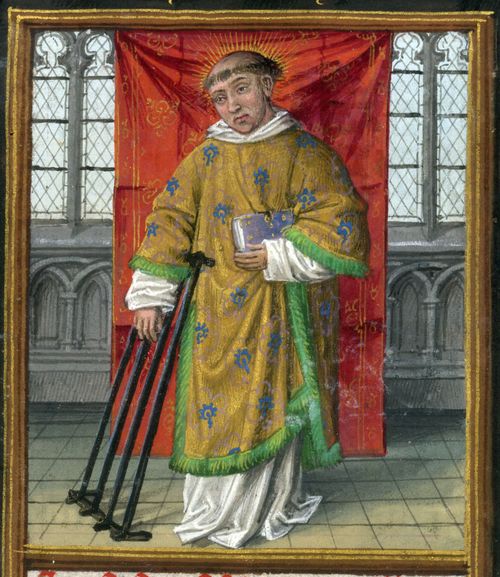
Saint of the Day – 10 August – St Lawrence of Rome (Died 258) – Martyr and Deacon (Archdeacon – distributor of alms and “Keeper of the Treasures of the Church”) Born at Huesca, Spain – cooked to death on a gridiron on 10 August 258). St Lawrence was one of the seven Deacons of the City of Rome, under Saint Pope Sixtus II who were martyred in the persecution of the Christians by decree of the Roman Emperor Valerian ordered in 258. His remains were buried in the cemetery of Saint Cyriaca on the road to Tivoli, Italy. His tomb was opened by Pelagius to inter the body of Saint Stephen the Martyr and his mummified head removed to the Quirinal Chapel. The gridiron believed to have been his deathbed is in San Lorenzo in Lucina and his garments in Our Lady’s Chapel in the Lateran Palace. Patronages – against fire, against lumbago, of archives, archivists, armories, armourers, brewers, butchers, chefs, cooks, comedians, comediennes, cutlers, deacons, glaziers, laundry workers, librarians, libraries, paupers, the poor, restauranteurs, schoolchildren, students, seminarians, stained glass workers, tanners, vine growers, vintners, wine makers, Ceylon, Sri Lanka, 38 cities and dioceses.
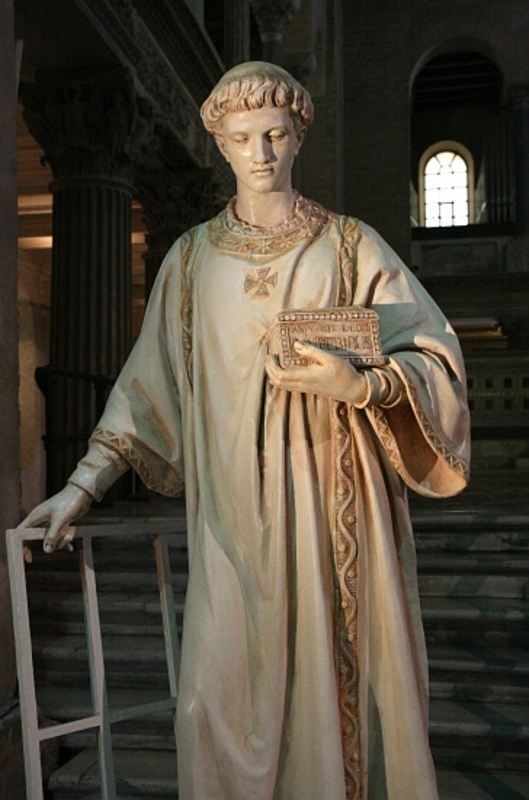
Saint Lawrence was chief of the seven Roman deacons of Pope Sixtus II who had been his mentor in Spain and taken him to Rome and ordained him as Deacon there, after he had been called to the Holy Office. In 258, Emperor Valerian increased his persecutions of the Christians. One day when Pope Sixtus II was in the cemetery of Saint Calistus celebrating Mass accompanied by some members of his clergy, he was arrested. Along with him, the other six Roman deacons were arrested. As the soldiers took the Pontiff to be put to death, Lawrence followed him in anguish crying out: “Where are you going, my father, without your son? Where are you going, Holy Pontiff, without your deacon? Isn’t it the custom to offer the sacrifice with an assistant? Let me prove I am worthy of the choice you made when you entrusted me with the distribution of the Blood of Our Lord.”
St Pope Sixtus II with the St Lawrence
The Pope replied to Saint Lawrence: “I am not leaving you, my son. They are lenient on old men, not the youth. A greater combat is reserved for you. You will follow me in three days.” With the Pontiff’s execution, Lawrence was the highest ranking church authority left in Rome.
Saint Lawrence was brought before Cornelius Secularis, prefect of Rome under the Emperor Valerian, who, according to Dom Prosper Guéranger in his Liturgical Year: “aimed at ruining the Christians by prohibiting their assemblies, putting their chief men to death, and confiscating their property.” Saint Lawrence asked for a short delay, so he could gather these riches for the prefect and true to the promise of Pope Sixtus, returned three days after the pontiff’s death to hand them over. However, heeding Pope Sixtus II’s final words, Lawrence used his three days to distribute the material wealth of the Church to the poor, before the Roman authorities could lay their hands on it.
When the archdeacon returned, instead of bringing vessels of gold and silver, he brought the poor of the city, saying, “Behold, these choice pearls, these sparkling gems that adorn the temple, these sacred virgins, I mean, and these widows who refuse second marriage…. Behold then, all our riches.” In response to his boldness, Cornelius ordered the scourging and torture of Saint Lawrence upon the rack.
From the Liturgical Year: “…Lawrence was taken down from the rack about midday. In his prison, however, he took no rest but wounded and bleeding as he was, he baptised the converts won to Christ by the sight of his courageous suffering. He confirmed their faith and fired their souls with a martyr’s intrepidity. When the evening hour summoned Rome to its pleasures, the prefect recalled the executioners to their work, for a few hours’ rest had sufficiently restored their energy to enable them to satisfy his cruelty.”
Surrounded by this ill-favoured company, the prefect thus addressed the valiant deacon: ‘Sacrifice to the gods, or else the whole night long shall be witness of your torments.’ ‘My night has no darkness,’answered Laurence, ‘and all things are full of light to me.’ They struck him on the mouth with stone, but he smiled and said, ‘I give Thee thanks, O Christ.’
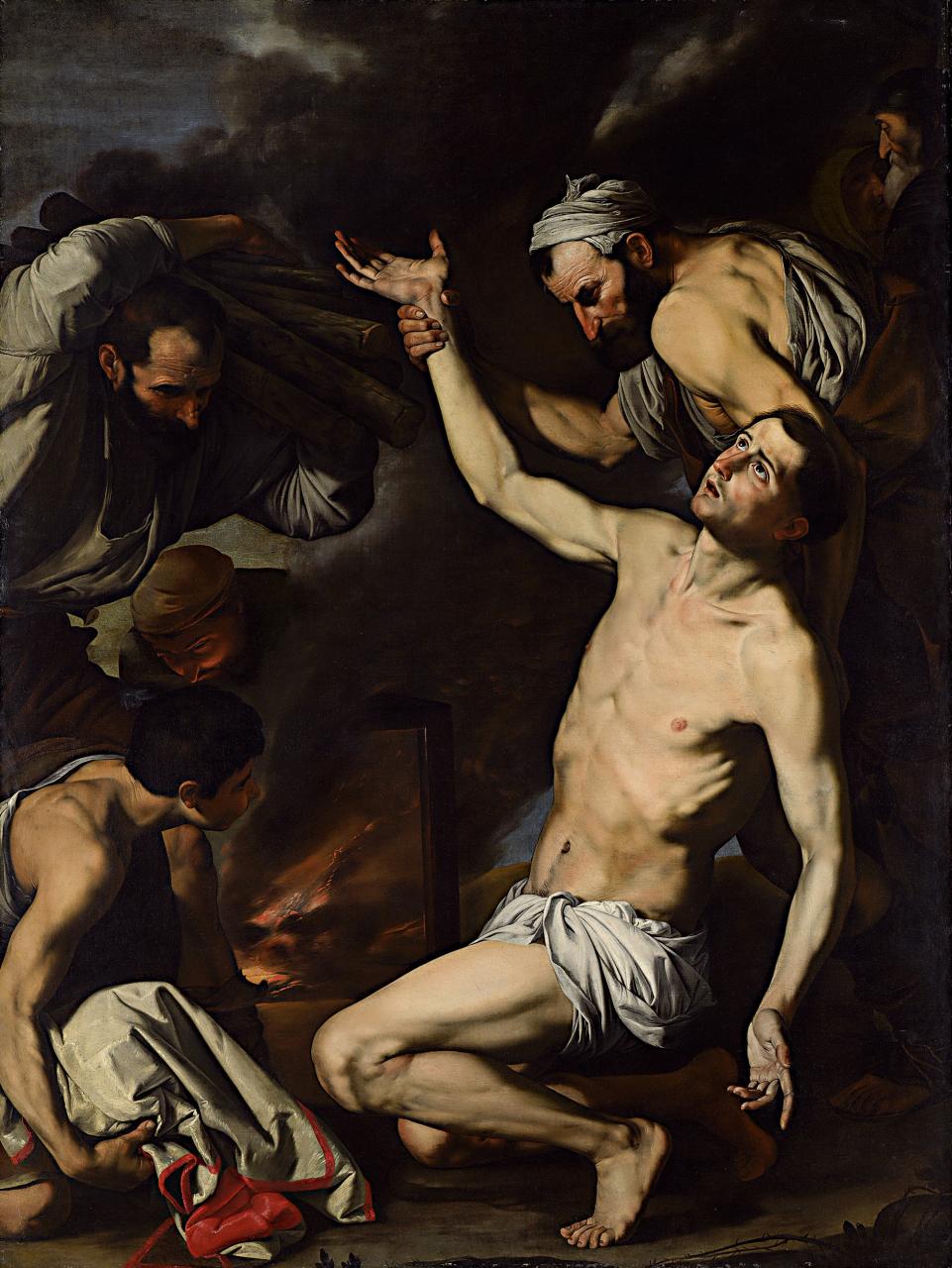
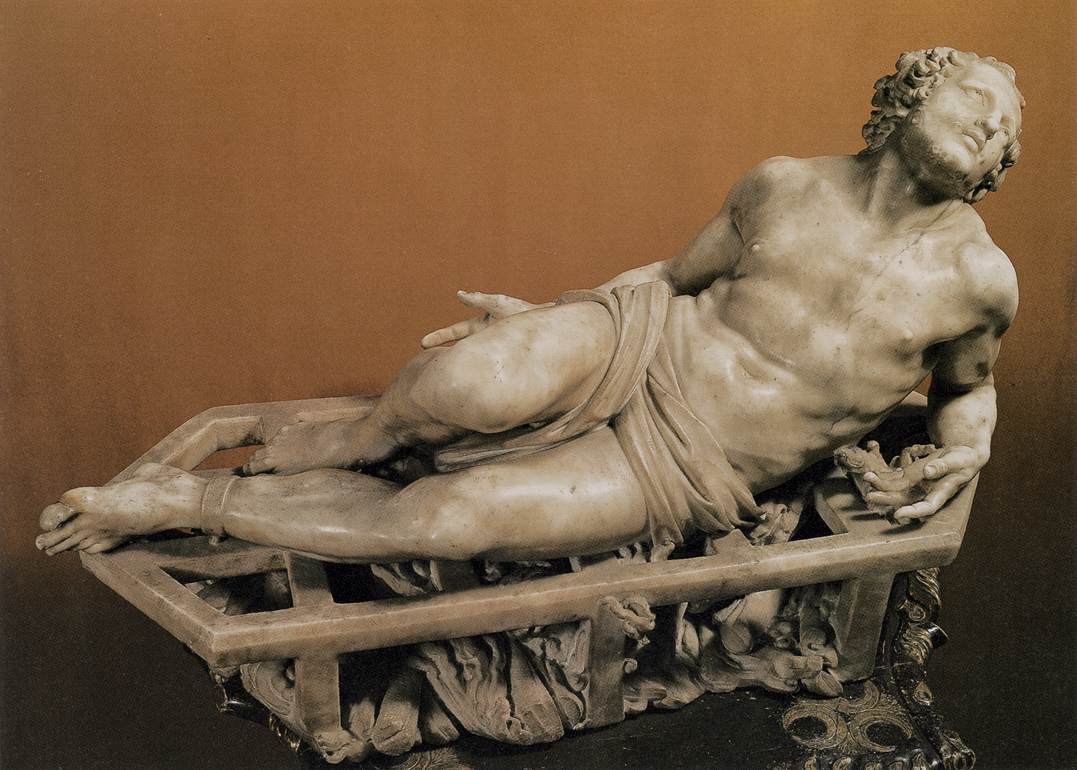
Then an iron bed or gridiron with three bars was brought in and the saint was stripped of his garments and extended upon it while burning coals were placed beneath it. As they were holding him down with iron fork, Lawrence said ‘I offer myself as a sacrifice to God for an odour of sweetness.’ The executioners continually stirred up the fire and brought fresh coals, while they still held him down with their forks. Then the saint said: ‘Learn, unhappy man, how great is the power of my God; for your burning coals give me refreshment but they will be your eternal punishment. I call Thee, O Lord, to witness: when I was accused, I did not deny Thee; when I was questioned, I confessed Thee, O Christ; on the red-hot coals I gave Thee thanks.’ And with his countenance radiant with heavenly beauty, he continued: ‘Yea, I give Thee thanks, O Lord Jesus Christ, for that Thou hast deigned to strengthen me.’ He then raised his eyes to his judge and said: ‘See, this side is well roasted; turn me on the other and eat.’ Then, continuing his canticle of praise to God [he said]: ‘I give Thee thanks, O Lord, that I have merited to enter into Thy dwelling place.’
As he was on the point of death, he remembered the Church. The thought of the eternal Rome gave him fresh strength and he breathed forth this ecstatic prayer: ‘O Christ, only God, O Splendour, O Power of the Father, O Maker of heaven and earth and builder of this city’s walls! Thou has placed Rome’s sceptre high over all; Thou hast willed to subject the world to it, in order to unite under one law the nations which differ in manners, customs, language, genius, and sacrifice. Behold the whole human race has submitted to its empire and all discord and dissensions disappear in its unity. Remember thy purpose: Thou didst will to bind the immense universe together into one Christian Kingdom. O Christ, for the sake of Thy Romans, make this city Christian; for to it Thou gavest the charge of leading all the rest to sacred unity. All its members in every place are united – a very type of Thy Kingdom; the conquered universe has bowed before it. Oh! may its royal head bowed in turn! Send Thy Gabriel and bid him heal the blindness of the sons of Iulus, that they may know the true God. I see a prince who is to come – an Emperor who is a servant of God. He will not suffer Rome to remain a slave; he will close the temples and fasten them with bolts forever.’
Thus he prayed and with these last words, he breathed forth his soul. Some noble Romans who had been conquered to Christ by the martyr’s admirable boldness, removed his body: the love of the most high God had suddenly filled their hearts and dispelled their former errors. From that day, the worship of the infamous gods grew cold; few people went now to the temples but hastened to the altars of Christ. Thus Lawrence, going unarmed to the battle, had wounded the enemy with his own sword.”
The burned body of Saint Lawrence was carried away by converted Roman Senators who buried him in a grotto in the Verano field, near Tivoli. On this day, the reliquary containing his burnt head is displayed in the Vatican for veneration. His feast spread throughout Italy and northern Africa after his martyrdom—and even Saint Augustine of Hippo wrote a beautiful sermon on St Lawrence’s life, connecting his “treasures of the Church” to martyrdom and the Holy Eucharist. Emperor Constantine built a beautiful basilica in Lawrence’s honour. Saint Lawrence is especially honoured in the city of Rome, where he is one of the city’s patrons. There are several churches in Rome dedicated to him, including San Lorenzo in Panisperna, traditionally identified as the place of his execution. The gridiron on which he was grilled is venerated there today.
Since the Perseid Meteor Shower typically occurs every year in mid-August, on or near Saint Lawrence’s feast day, some refer to the shower as the “Burning Tears of Saint Lawrence.” Saint Lawrence, for his care and love of the poor, is considered their patron. For having saved the treasures of the Church—including its documents, he is recognized as the patron saint of librarians. For his courage in being grilled to death, he is also the patron saint of cooks and kitchen workers.
St Lawrence of Rome (Feast) – https://www.youtube.com/watch?v=HlX5vBVi7kM
Our Lady of Good Success
—
St Agathonica of Carthage
St Agilberta of Jouarre
Bl Amadeus of Portugal
St Aredius of Lyon
St Asteria of Bergamo
Bl Augustine Ota
St Bassa of Carthage
St Bessus
St Bettelin
St Blane
Bl Claude-Joseph Jouffret de Bonnefont
St Deusdedit the Cobbler
Bl Edward Grzymala
Bl Franciszek Drzewiecki
Bl Francois François
St Gerontius
Bl Hugh of Montaigu
Bl Lazare Tiersot
St Paula of Carthage
St Thiento of Wessobrunn
—
Martyrs of Alexandria – 260+ saints: A large number of Christians who died in Alexandria, Egypt between 260 and 267 in the persecutions of Decius and Valerian, whose names have not come down to us and who are commemorated together.
Martyrs of Rome – 165 saints: Group of 165 Christians martyred in the persecutions of Aurelian. 274 in Rome, Italy.
Martyred in the Spanish Civil War:
• Blessed Antonio González Penín
• Blessed José Toledo Pellicer
• Blessed José Xavier Gorosterratzu Jaunarena
• Blessed Juan Martorell Soria
• Blessed Victoriano Calvo Lozano
Thought for the Day – 9 August – The Memorial of St Teresa Benedicta of the Cross
“Dear brothers and sisters! The love of Christ was the fire that inflamed the life of St Teresa Benedicta of the Cross. Long before she realised it, she was caught by this fire. At the beginning she devoted herself to freedom. For a long time Edith Stein was a seeker. Her mind never tired of searching and her heart always yearned for hope. She traveled the arduous path of philosophy with passionate enthusiasm. Eventually she was rewarded: she seized the truth. Or better: she was seized by it.Then she discovered that truth had a name: Jesus Christ. From that moment on, the incarnate Word was her One and All. Looking back as a Carmelite on this period of her life, she wrote to a Benedictine nun: “Whoever seeks the truth is seeking God, whether consciously or unconsciously”.
Although Edith Stein had been brought up religiously by her Jewish mother, at the age of 14 she “had consciously and deliberately stopped praying”. She wanted to rely exclusively on herself and was concerned to assert her freedom in making decisions about her life. At the end of a long journey, she came to the surprising realisation: only those who commit themselves to the love of Christ become truly free.
This woman had to face the challenges of such a radically changing century as our own. Her experience is an example to us. The modern world boasts of the enticing door which says: everything is permitted. It ignores the narrow gate of discernment and renunciation……Pay attention! Your life is not an endless series of open doors! Listen to your heart! Do not stay on the surface but go to the heart of things! And when the time is right, have the courage to decide! The Lord is waiting for you to put your freedom in his good hands.
…St Teresa Benedicta of the Cross says to us all: Do not accept anything as the truth if it lacks love. And do not accept anything as love which lacks truth! One without the other becomes a destructive lie. Finally, the new saint teaches us that love for Christ undergoes suffering. Whoever truly loves does not stop at the prospect of suffering: he accepts communion in suffering with the one he loves.”…(Excerpt from the Homily of St Pope John Paul for the Canonisation of St Teresa Benedicta – Sunday, 11 October 1998)
Quote/s of the Day – 9 August – The Memorial of St Teresa Benedicta of the Cross
“Today I stood with you beneath the cross And felt more clearly than I ever did That you became our Mother only there.
But those whom you have chosen for companions To stand with you around the eternal throne,
They must stand with you beneath the Cross, And with the lifeblood of their bitter pains, Must purchase heavenly glory for those souls Whom God’s own Son entrusted to their care.”
St Teresa Benedicta of the Cross – Good Friday 1938
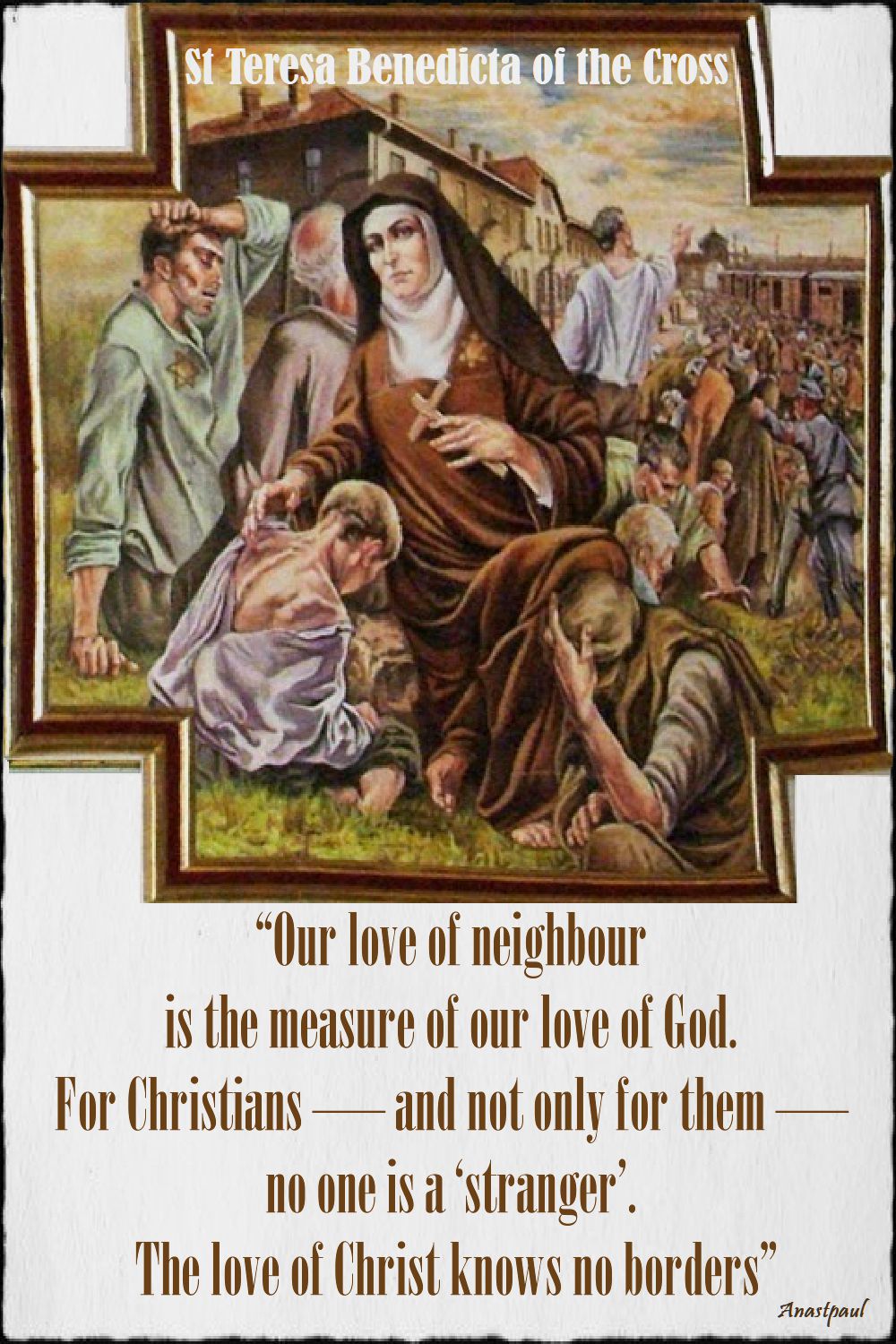
“Our love of neighbour is the measure of our love of God. For Christians — and not only for them — no one is a ‘stranger’. The love of Christ knows no borders”
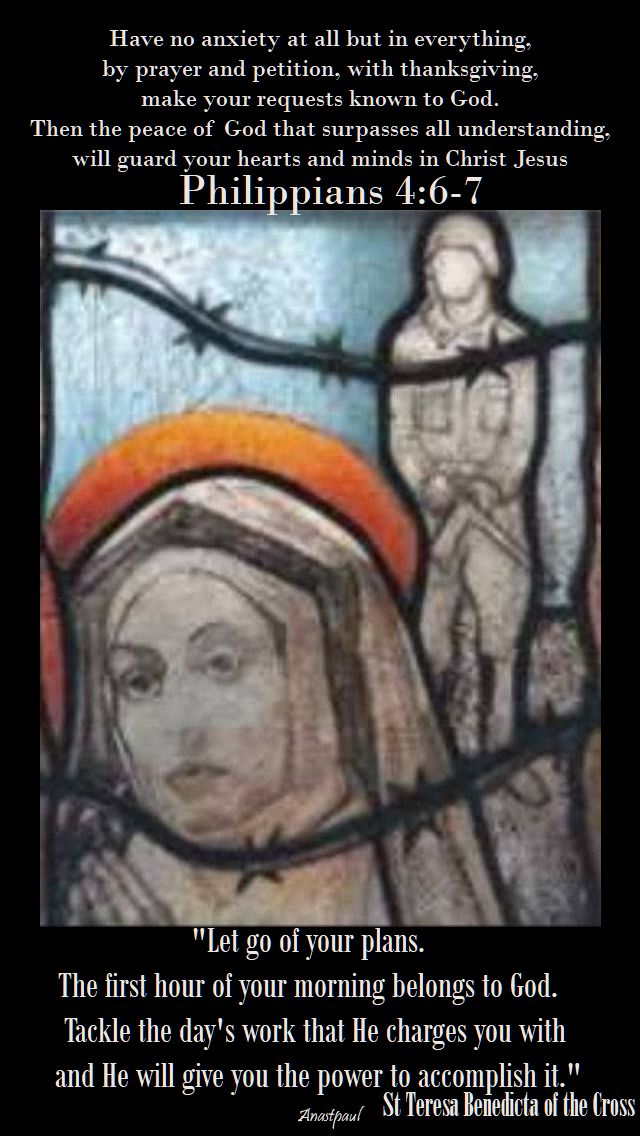
Have no anxiety at all but in everything, by prayer and petition, with thanksgiving, make your requests known to God.
Then the peace of God that surpasses all understanding, will guard your hearts and minds in Christ Jesus…Philippians 4:6-7
REFLECTION – “Let go of your plans. The first hour of your morning belongs to God. Tackle the day’s work that He charges you with and He will give you the power to accomplish it.”…..St Teresa Benedicta of the Cross
PRAYER – May St Teresa Benedicta pray for us Lord, as we celebrate with joy her yearly feast, her purity and strength of soul are precious gifts which light us on our way. Through our Lord Jesus Christ in unity with the Holy Spirit, one God forever and ever. St Teresa Benedicta of the Cross, please pray for us that we may manifest strength and courage with our hand in the hand of the Lord, amen.
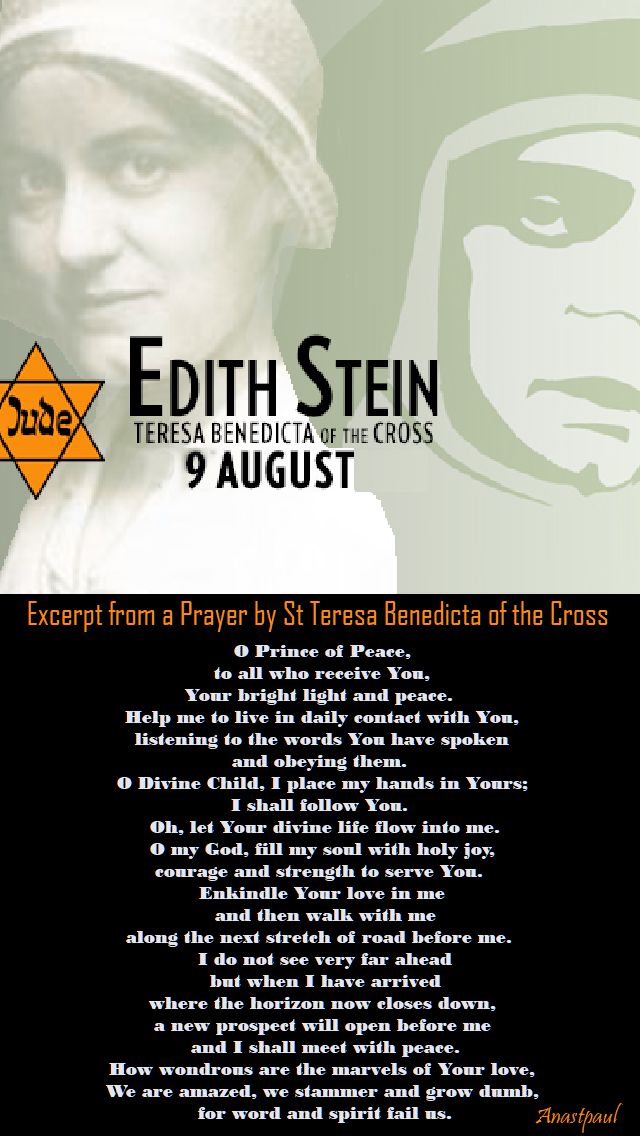
Excerpt from a Prayer By St Teresa Benedicta of the Cross
O Prince of Peace,
to all who receive You,
Your bright light and peace.
Help me to live in daily contact with You,
listening to the words You have spoken
and obeying them.
O Divine Child, I place my hands in Yours;
I shall follow You.
Oh, let Your divine life flow into me.
O my God, fill my soul with holy joy,
courage and strength to serve You.
Enkindle Your love in me
and then walk with me
along the next stretch of road before me.
I do not see very far ahead
but when I have arrived
where the horizon now closes down,
a new prospect will open before me
and I shall meet with peace.
How wondrous are the marvels of Your love,
We are amazed, we stammer and grow dumb,
for word and spirit fail us.
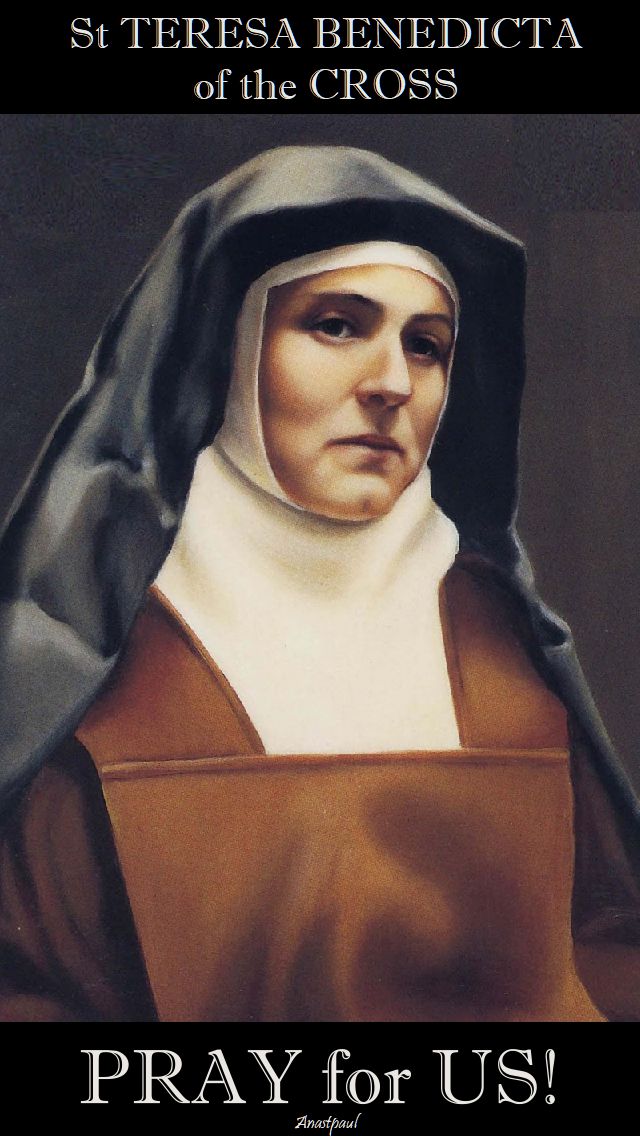
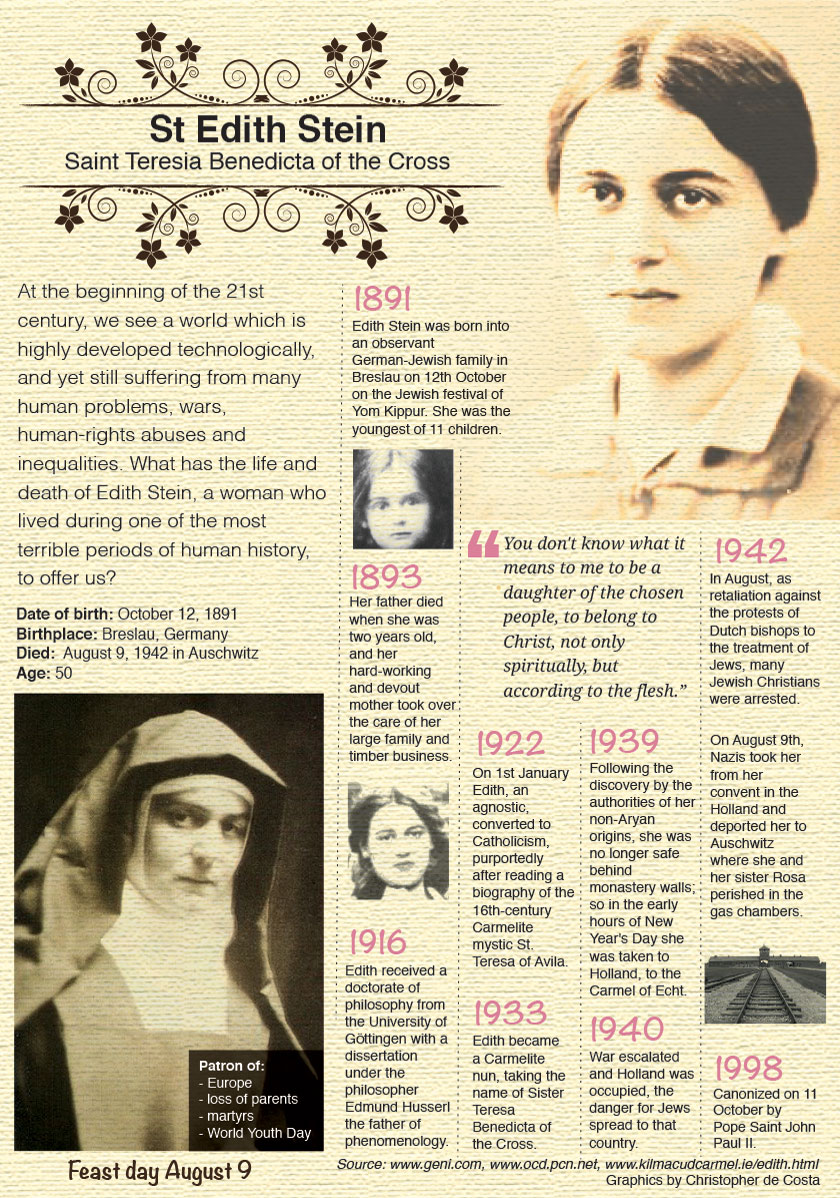
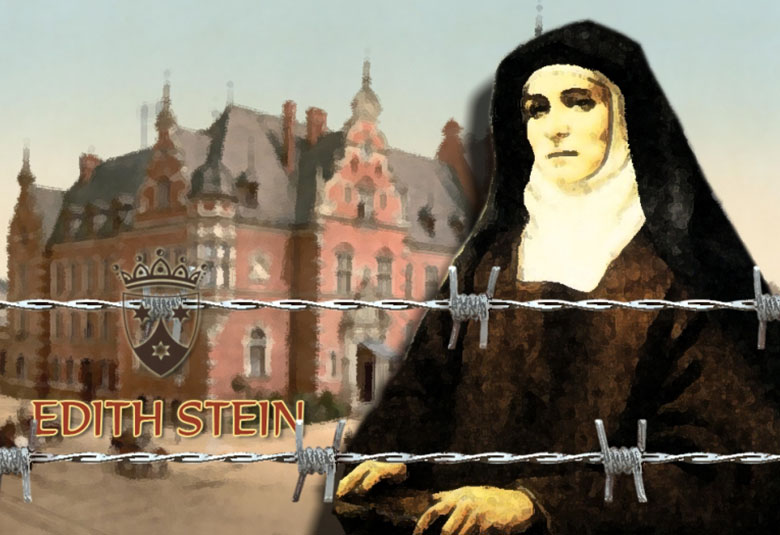
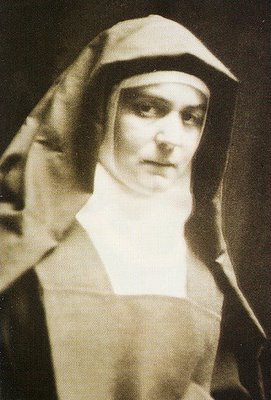
Saint of the Day – 9 August – St Teresa Benedicta of the Cross OCD Martyr, Carmelite Nun, Philosopher, Writer, Teacher and Lecturer – (12 October 1891 at Breslaw, Dolnoslaskie, Germany (now Wroclaw, Poland) as Edith Stein – gassed on 9 August 1942 in the ovens of Oswiecim (a.k.a. Auschwitz), Malopolskie, Poland). Canonised on 11 October 1998 by St Pope John Paul II. Patronages – Europe; loss of parents; converted Jews; Martyrs; World Youth Day. Attributes – Yellow Star of David on a Discalced Carmelite nun’s habit, flames, a book.
Edith Stein was born on October 12, 1891 – a date that coincided with her family’s celebration of Yom Kippur, the Jewish “day of atonement.” Edith’s father died when she was just two years old and she gave up the practice of her Jewish faith as an adolescent.
As a young woman with profound intellectual gifts, Edith gravitated toward the study of philosophy and became a pupil of the renowned professor Edmund Husserl in 1913. Through her studies, the non-religious Edith met several Christians whose intellectual and spiritual lives she admired.
After earning her degree with the highest honours from Gottingen University in 1915, she served as a nurse in an Austrian field hospital during World War I. She returned to academic work in 1916, earning her doctorate after writing a highly-regarded thesis on the phenomenon of empathy. She remained interested in the idea of religious commitment but had not yet made such a commitment herself. In 1921, while visiting friends, Edith spent an entire night reading the autobiography of the 16th century Carmelite nun St. Teresa of Avila. “When I had finished the book,” she later recalled, “I said to myself: This is the truth.” She was baptised into the Catholic Church on the first day of January, 1922.
Edith intended to join the Carmelites immediately after her conversion but would ultimately have to wait another 11 years before taking this step. Instead, she taught at a Dominican school and gave numerous public lectures on women’s issues. She spent 1931 writing a study of St. Thomas Aquinas and took a university teaching position in 1932.
In 1933, the rise of Nazism, combined with Edith’s Jewish ethnicity, put an end to her teaching career. After a painful parting with her mother, who did not understand her Christian conversion, she entered a Carmelite convent in 1934, taking the name “Teresa Benedicta of the Cross” as a symbol of her acceptance of suffering.
“I felt,” she wrote, “that those who understood the Cross of Christ should take upon themselves on everybody’s behalf.” She saw it as her vocation “to intercede with God for everyone” but she prayed especially for the Jews of Germany whose tragic fate was becoming clear.
“I ask the Lord to accept my life and my death,” she wrote in 1939, “so that the Lord will be accepted by His people and that His kingdom may come in glory, for the salvation of Germany and the peace of the world.”
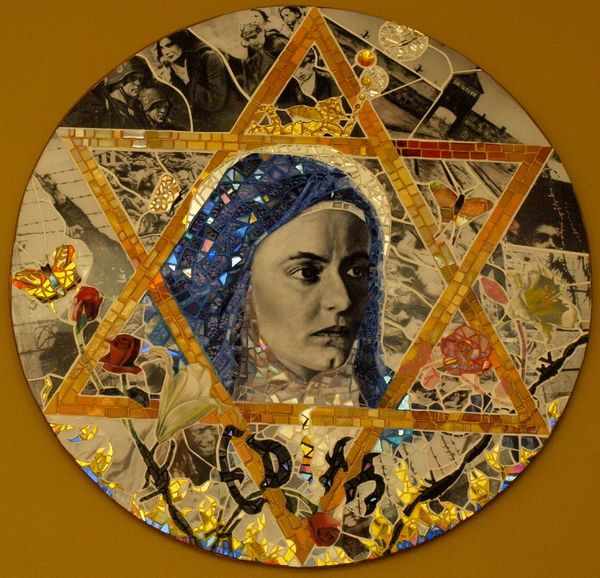
After completing her final work, a study of St. John of the Cross entitled “The Science of the Cross,” Teresa Benedicta was arrested along with her sister Rosa (who had also become a Catholic) and the members of her religious community, on August 7, 1942. The arrests came in retaliation against a protest letter by the Dutch Bishops, decrying the Nazi treatment of Jews. Edith commented, “I never knew that people could be like this, neither did I know that my brothers and sisters would have to suffer like this. … I pray for them every hour. Will God hear my prayers? He will certainly hear them in their distress.”Prof Jan Nota, who was greatly attached to her, wrote later: “She is a witness to God’s presence in a world where God is absent.” On 7 August, early in the morning, 987 Jews were deported to Auschwitz. It was too, on 9 August, that Sister Teresa Benedicta of the Cross, her sister and many other of her people were gassed.
When Edith Stein was beatified in Cologne on 1 May 1987, the Church honoured “a daughter of Israel”, as St Pope John Paul II put it, who, as a Catholic during Nazi persecution, remained faithful to the crucified Lord Jesus Christ and, as a Jew, to her people in loving faithfulness.” St John Paul II canonised her in 1998 and proclaimed her a co-patroness of Europe the next year.
St Teresa Benedicta of the Cross (Optional Memorial) – https://www.youtube.com/watch?v=vNR_e_vWsds and the Film Trailer – https://www.youtube.com/watch?v=wYdFmOqO0L8
—
St Amor of Franche-Comté
St Autor of Metz
St Bandaridus of Soissons
St Bonifacia Rodriguez Castro
St Candida Maria de Jesus Cipitria y Barriola
St Claude Richard
St Domitian of Châlons
Bl Falco the Hermit
St Firmus of Verona
Bl John Norton
Bl John of Salerno
Bl John Talbot
St Marcellian of Civitavecchia
St Marianne Cope
Bl Michal Tomaszek
St Nathy
St Numidicus of Carthage
St Phelim
Bl Richard Bere
St Romanus Ostiarius
St Rusticus of Sirmium
St Rusticus of Verona
St Secundian of Civitavecchia
St Stephen of Burgos
Bl Thomas Palaser
St Verian of Civitavecchia
Bl Zbigniew Adam Strzalkowski
—
Martyrs of Civitavecchia: Three Christians martyred together in the persecutions of Decius. We know little more than the names – Marcellian, Secundian and Verian. 250 near Civitavecchia, Italy.
Martyrs of Constantinople: 10 saints: A group of ten Christians who were arrested, tortured and executed for defending an icon of Christ in defiance of orders from Emperor Leo the Isaurian. We know the names of three, but nothing else about them – Julian, Marcian and Mary. They were beheaded in Constantinople.
Martyred in the Spanish Civil War:
Martyred Colombians of Barcelona: – 7 beati: Additional Memorial – 30 July as one of the Martyred Hospitallers of Spain
A group of Colombian members of the Hospitallers of Saint John of God who worked together in Spain, and who were martyred together in the Spanish Civil War.
• Blessed Alfonso Antonio Ramírez Salazar
• Blessed Gabriel Maya Gutiérrez
• Blessed José Velázquez Peláez
• Blessed Luis Ayala Niño
• Blessed Luis Modesto Páez Perdomo
• Blessed Ramón Ramírez Zuluoga
• Blessed Rubén de Jesús López Aguilar
They were martyred on 9 August 1936 in Barcelona, Spain and Beatified on 25 October 1992 by Pope John Paul II.
Martyred in the Spanish Civil War:
Bl Antonio Mateo Salamero
Bl Faustino Oteiza Segura
Bl Florentín Felipe Naya
Bl Florentino Asensio Barroso
Bl Francisco López-Gasco Fernández-Largo
Bl Guillermo Plaza Hernández
Bl Joan Vallés Anguera
Bl José María Garrigues Hernández
Bl Josep Figuera Rey
Bl Josep Maria Aragones Mateu
Bl Julián Pozo Ruiz de Samaniego
Bl Mateo Molinos Coloma
Bl Narcís Sitjà Basté
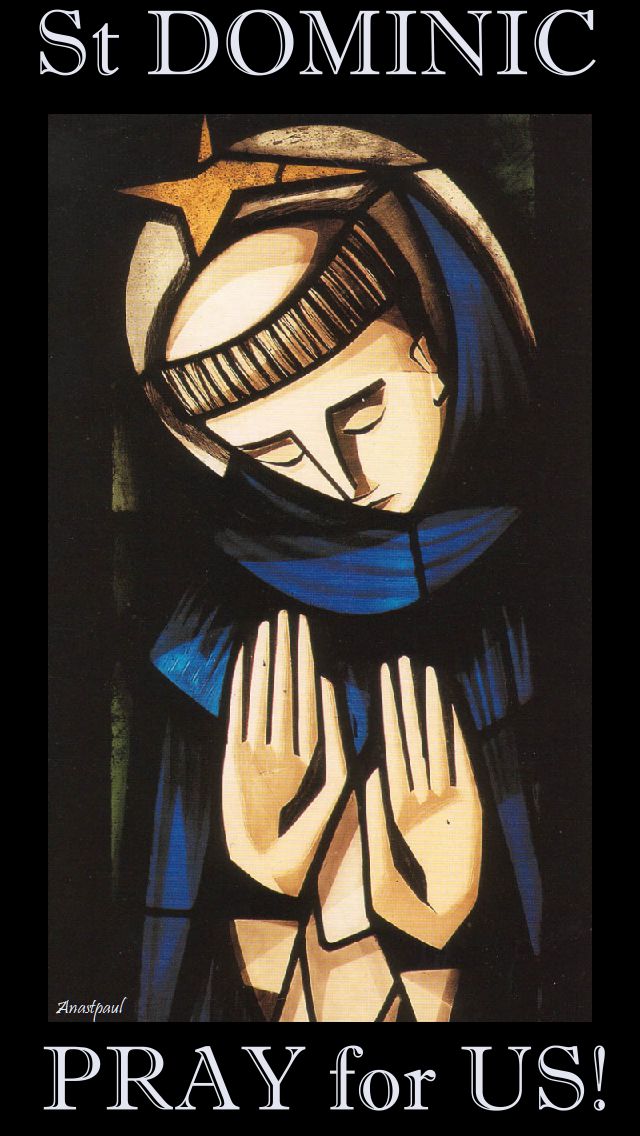
Thought for the Day – 8 August – The Memorial of St Dominic de Guzman
Words of Pope Benedict XVI on St Dominic
In the second volume of his work “Jesus of Nazareth”, in speaking of the first and last coming of Christ, he introduces a “middle coming”, through his word, the sacraments, events. And he continues: ” But there are also modalities of this coming season. The impact of two great figures -Francisco and Domingo- between the twelfth and thirteenth centuries, has been a way in which Christ has re-entered history, re-enforcing His word and his love; a way with which He has renewed the Church and has driven history to itself. ” In St Dominic’s words: “You are my companion and must walk with me. If we hold together, no earthly power can withstand us.”
Likewise, Benedict XVI, recognising the Marian devotion of Saint Dominic, manifested in his catechesis on February 3, 2010: ” First and foremost, Marian devotion, which he cultivated with tenderness and left his spiritual children as an inheritance, Which in the history of the Church have had the great merit of spreading the prayer of the holy rosary, so rooted in the Christian people and so rich in evangelical values, a true school of faith and piety.
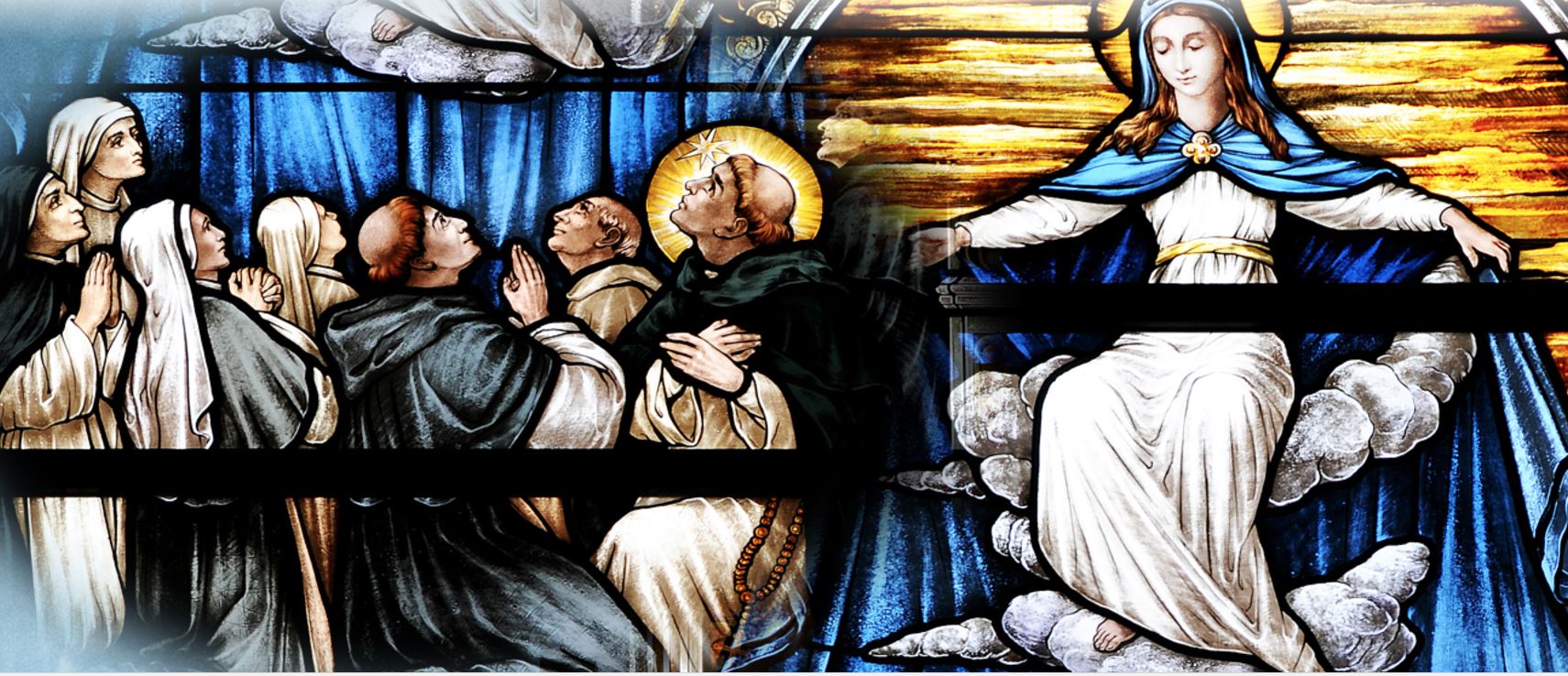
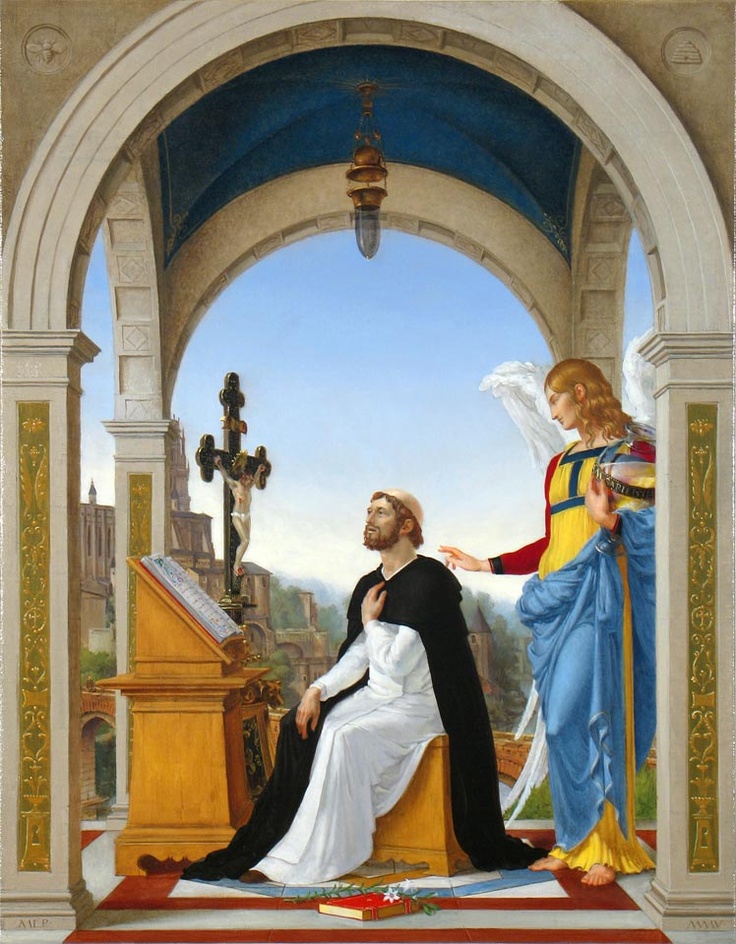
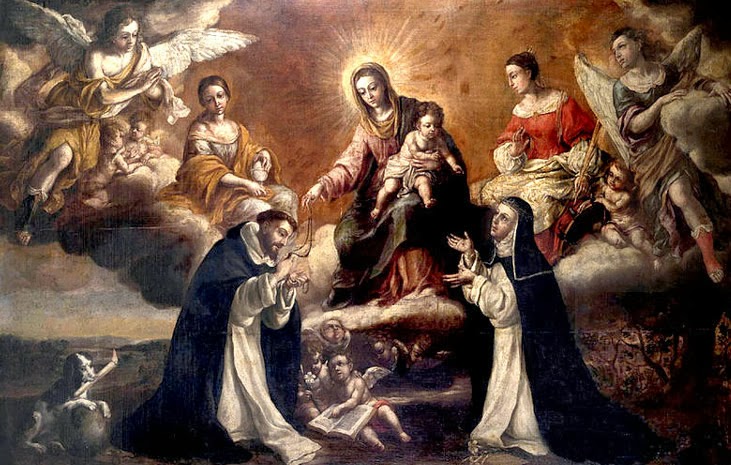
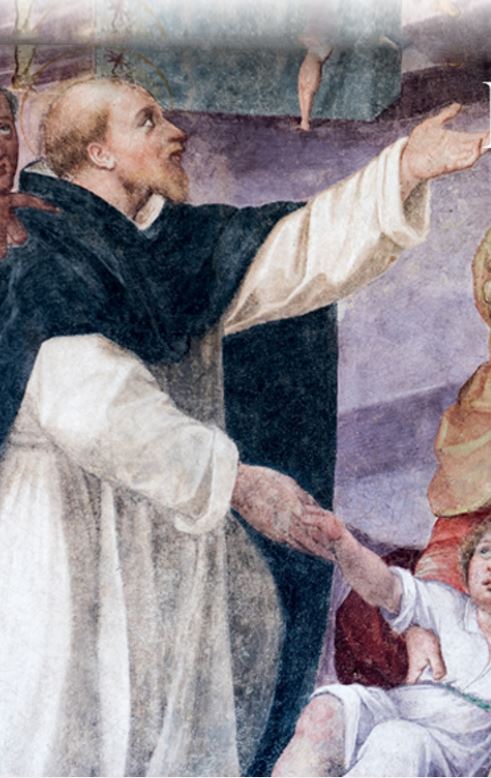
Once, at a difficult point in the preaching ministry, St Dominic had a dream in which he saw heaven. Christ was there, arrayed like a king, with His Mother beside Him cloaked in a magnificent mantle. Around the Blessed Mother were countless souls from all walks of life: clergy, laypersons, and members of every religious order ever founded. Among the religious there were Benedictines, Augustinians, Carmelites, Franciscans, everyone, except the Order of Preachers. Struck to the heart, Dominic said, “Is there not a single one of mine?” The Lord gestured to his Mother, who opened her mantle. There, under it, were hundreds and hundreds of Dominican souls in their black and white habits. The Lord said, “Behold, I have left your Order in the care of My Mother.”
And, in the catechesis of August 8, 2012, he referred to another characteristic of St Dominic, the prayer : “St Dominic was a man of prayer. In love with God, he had no other aspiration than the salvation of souls, especially those who had fallen into the webs of the heresies of his time; Imitator of Christ, incarnated radically the three evangelical counsels joining to the proclamation of the Word the testimony of a poor life; under the guidance of the Holy Spirit, progressed in the path of Christian perfection. At all times prayer was the force that renewed and made more and more fruitful his apostolic works.
St Dominic reminds us that at the origin of the witness of faith, which every Christian should give in family, work, social commitment and also in times of relaxation, is prayer, personal contact with God. Only this real relationship with God gives us the strength to live intensely every event, especially moments of greater suffering. “
Quote/s of the Day – 8 August – The Memorial of St Dominic de Guzman, Founder of the Dominicans
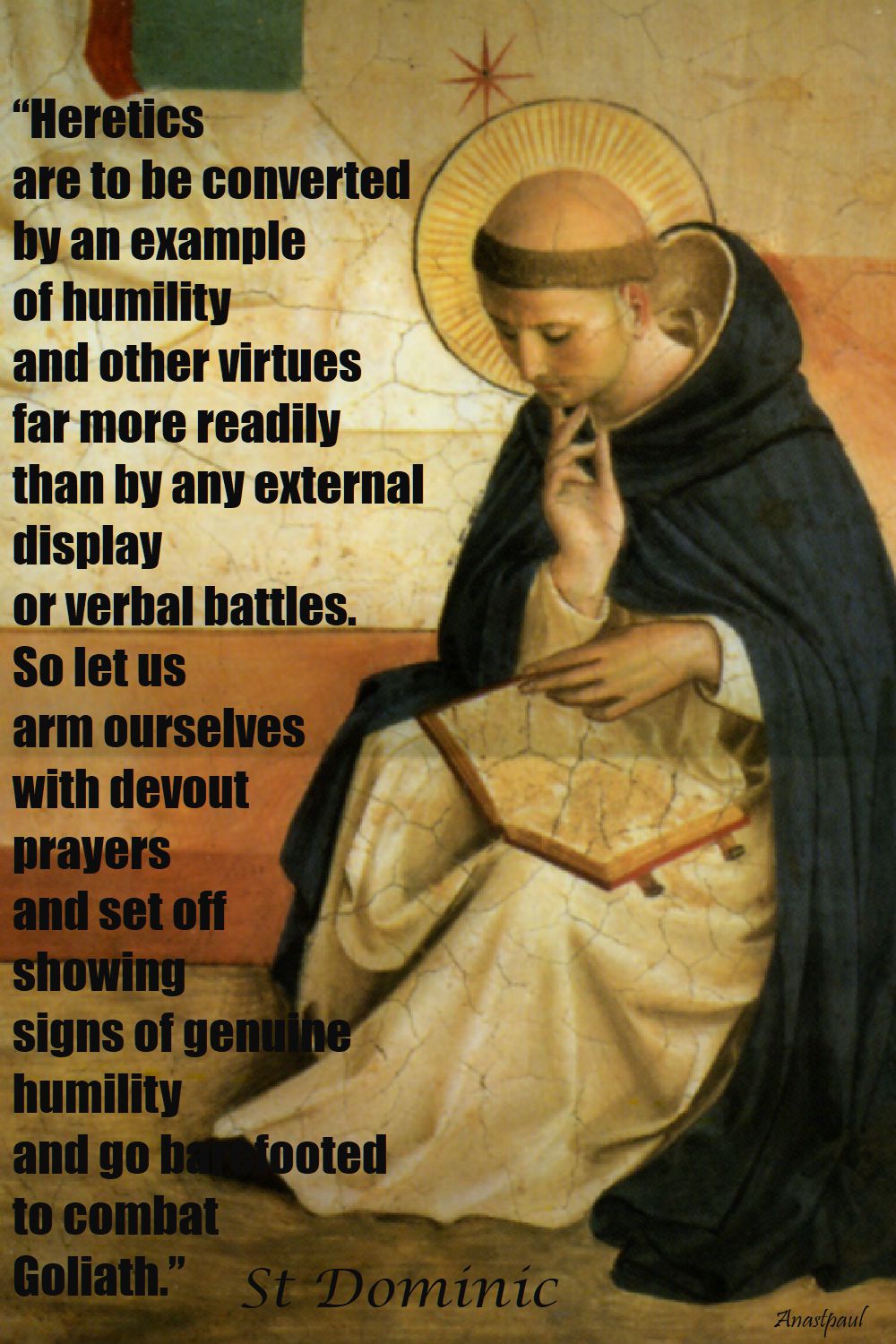
“Heretics are to be converted by an example of humility and other virtues far more readily than by any external display or verbal battles. So let us arm ourselves with devout prayers and set off showing signs of genuine humility and go barefooted to combat Goliath.”
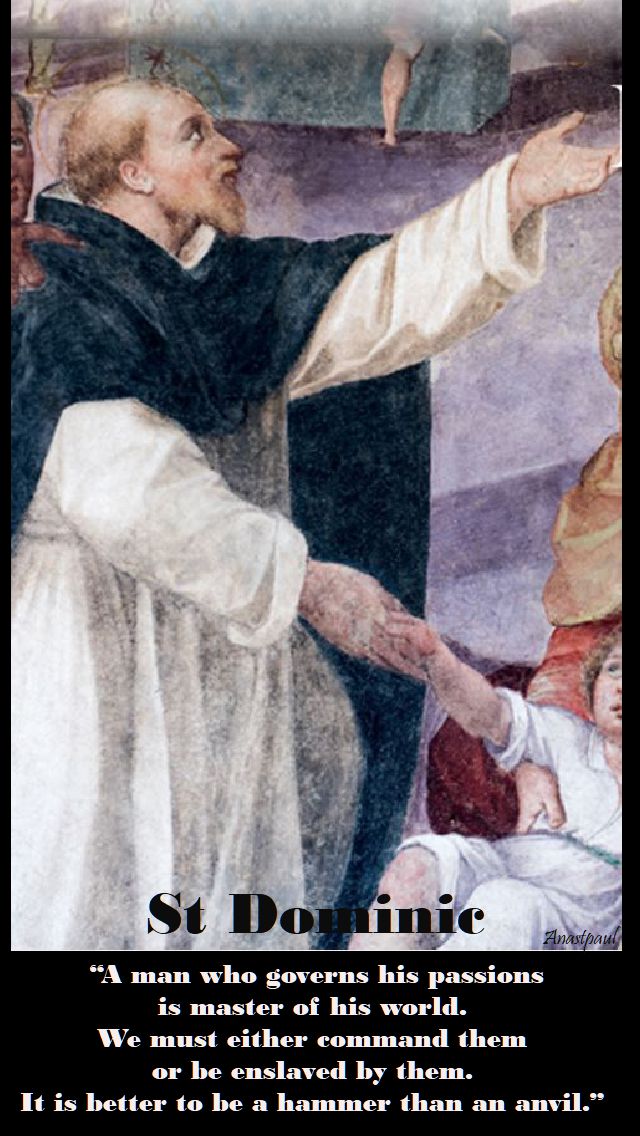
“A man who governs his passions is master of his world. We must either command them or be enslaved by them. It is better to be a hammer than an anvil.”
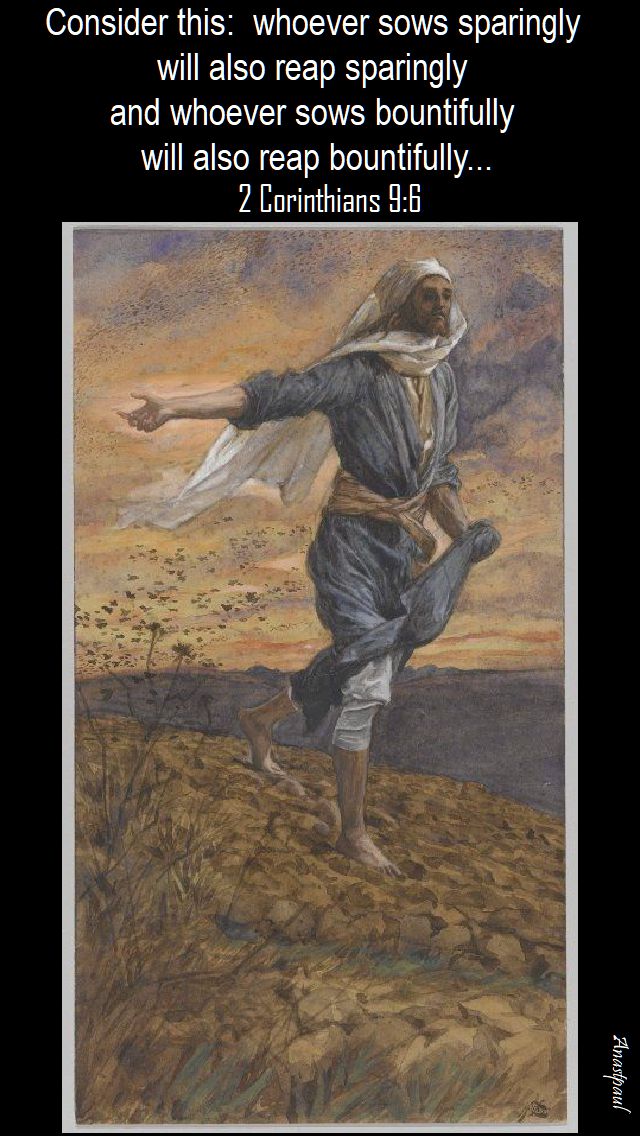
Consider this: whoever sows sparingly will also reap sparingly and whoever sows bountifully will also reap bountifully…2 Cor 9:6
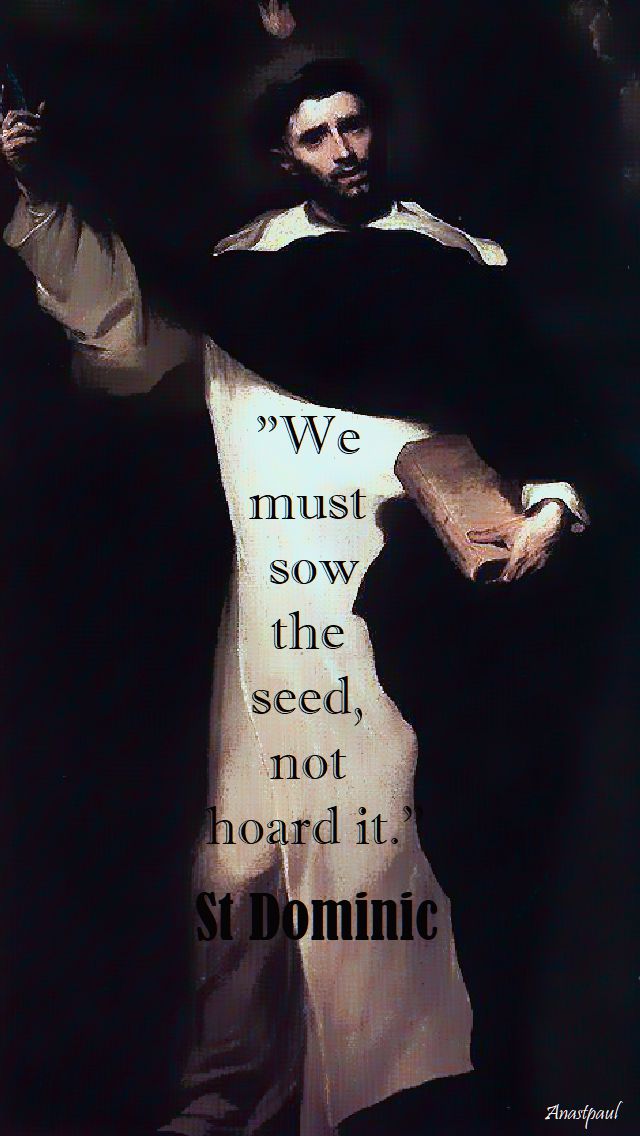
REFLECTION – “We must sow the seed, not hoard it.”…St Dominic de Guzman
PRAYER – O God, Who has enlightened Your Church by the eminent virtues and preaching of St. Dominic, Your confessor, holy Father mercifully grant that by his prayers we may be provided against all temporal necessities and daily improve in all spiritual good. Through Christ Our Lord. St Dominic pray for us, Amen.
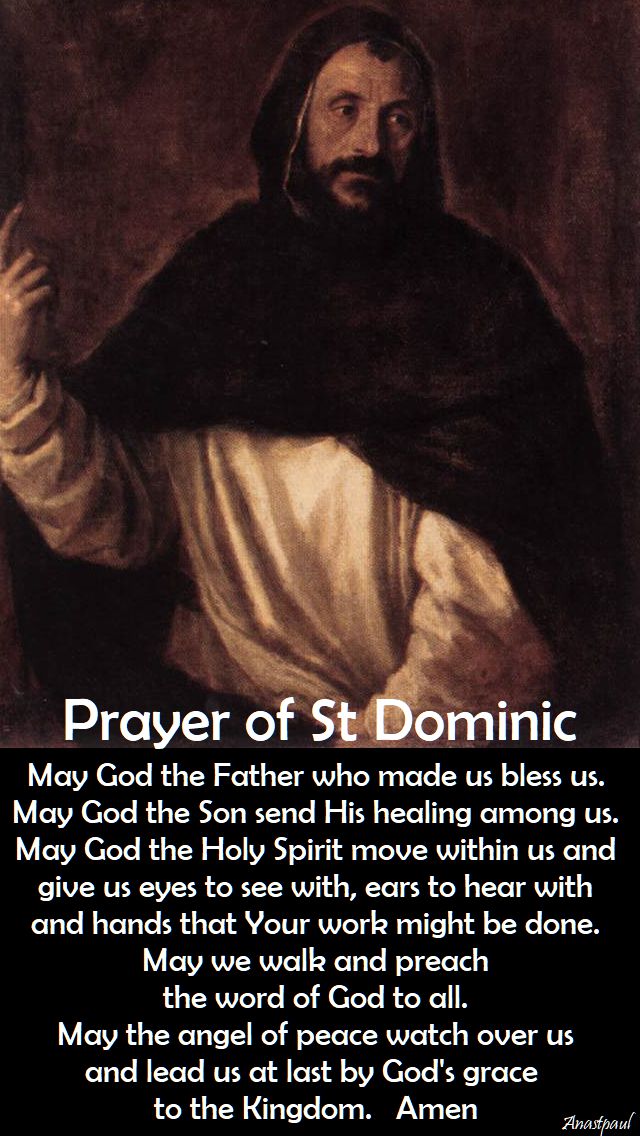
May God the Father who made us bless us.
May God the Son send His healing among us.
May God the Holy Spirit move within us and
give us eyes to see with, ears to hear with,
and hands that Your work might be done.
May we walk and preach
the word ofGod to all.
May the angel of peace watch over us
and lead us at last, by God’s grace,
to the Kingdom. Amen
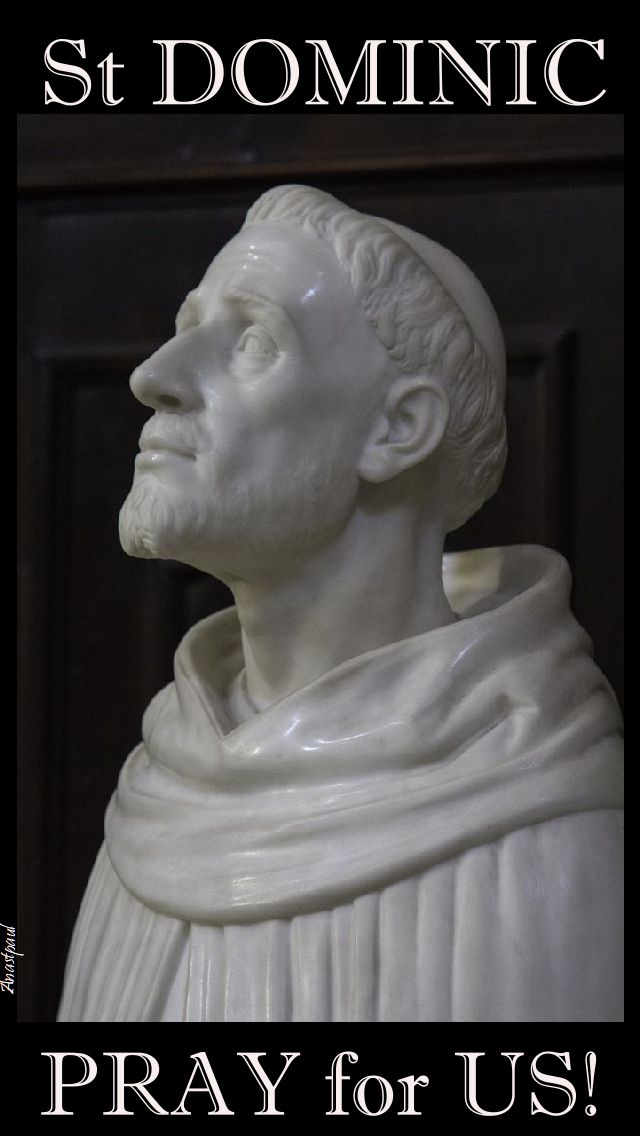
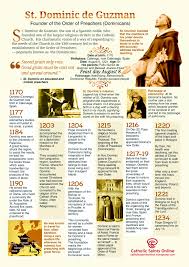
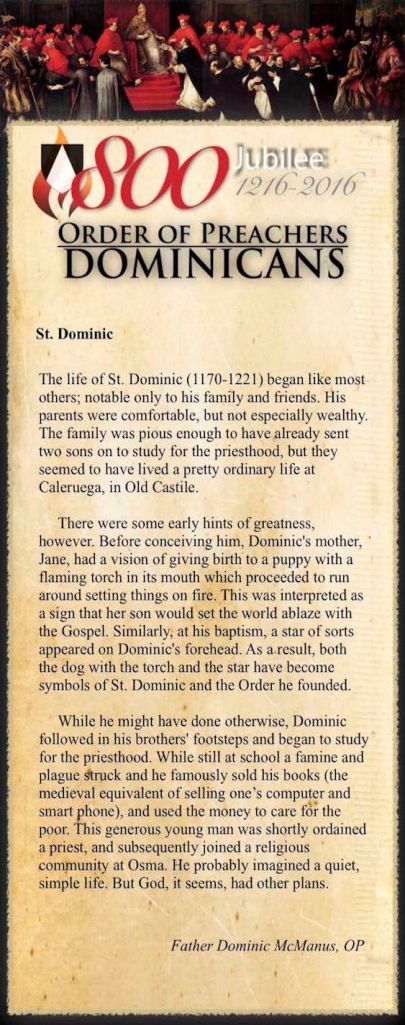
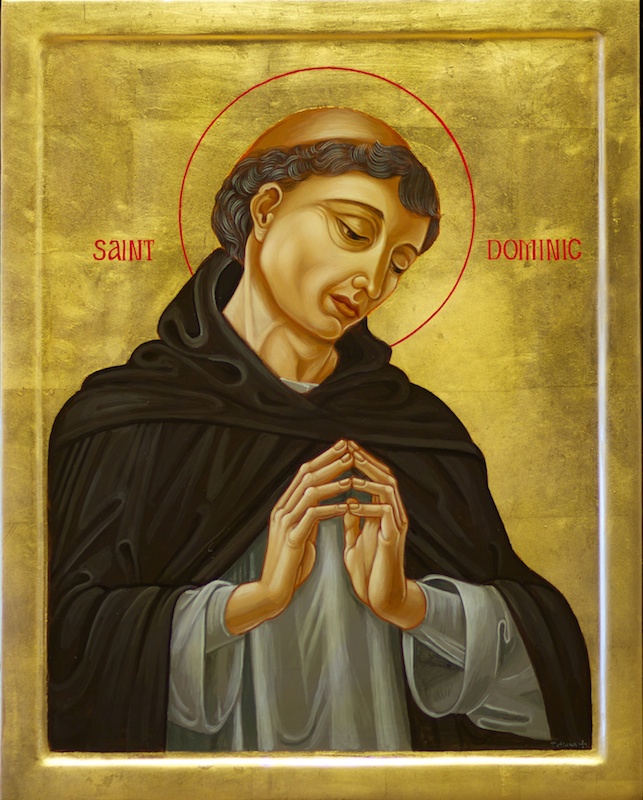
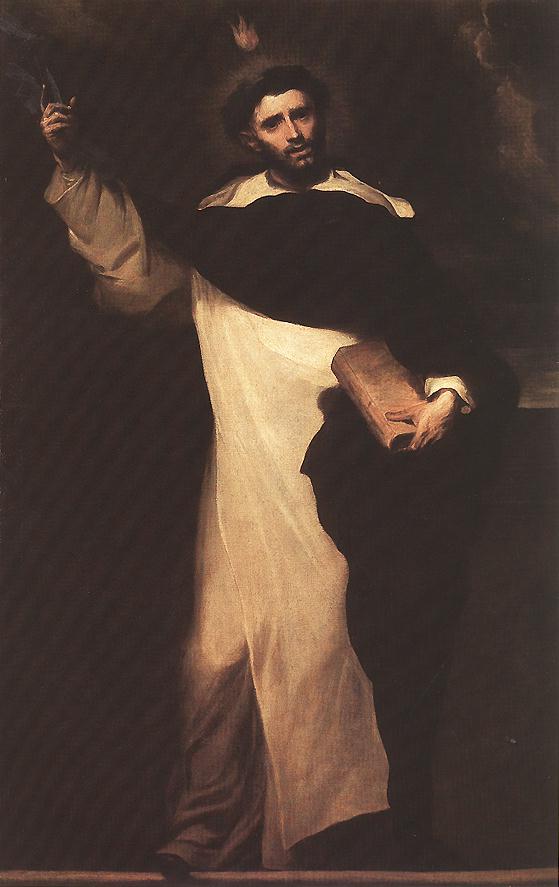
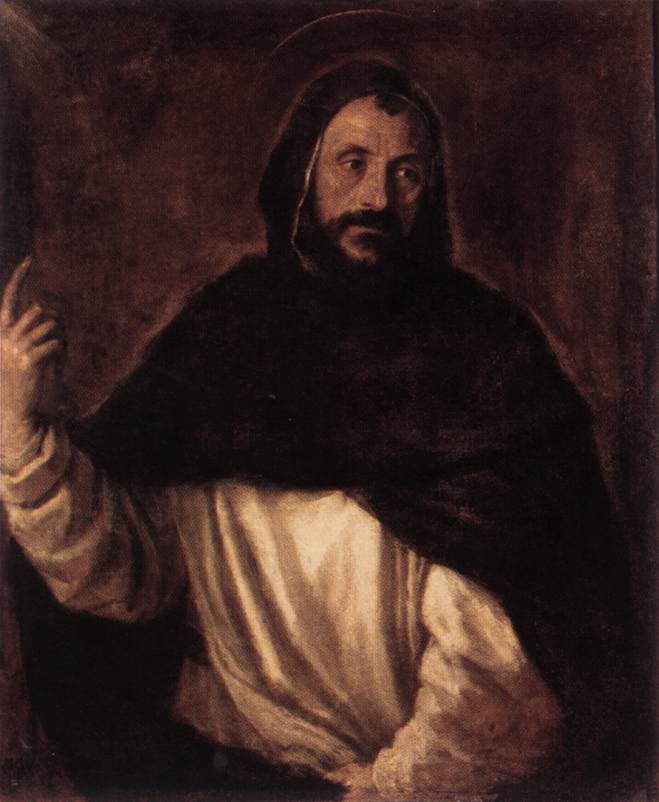
Saint of the Day – 8 August – St Dominic de Guzman (1170-1221) – Confessor, Founder of the Dominican Order of Preachers – Priest, Founder, Teacher, Preacher, Mystic, Miracle-Worker, Apostle of the Holy Rosary (1170 at Calaruega, Burgos, Old Castile – noon 6 August 1221 at Bologna, Italy). He was Canonised on 13 July 1234 by Pope Gregory IX at Rieti, Italy who declared, after signing the Bull of Canonisation on 13 July, 1234, Pope Gregory IX declared that he no more doubted the saintliness of Saint Dominic than he did that of Saint Peter and Saint Paul. Patronages: astronomers, astronomy, the falsely accused, of scientists, The Dominican Republic, Batanes-Babuyanes, in the Philippines, prelature of, Bayombong, Philippines, Diocese of, Santo Domingo, Santo Domingo Indian Pueblo, Valletta, Malta. Attributes – chaplet, Dominican carrying a rosary and a tall cross, Dominican holding a lily, Dominican with dog and globe, Dominican with fire, Dominican with star shining above his head, dog with a torch in its mouth, rosary, star.
Dominic de Guzman was born in Calaruega, Spain, son to noble parents Felix Guzman and Blessed Joan of Aza. While only a boy, he demonstrated great piety, spending his days in contemplation and prayer, under the influence of his mother’s great love of the Lord. At Dominic’s baptism, Blessed Joan saw a star shining from his chest, which became another of his symbols in art, and led to his patronage of astronomy.
Educated by his uncle, a Priest, Dominic soon travelled to Palencia, where he attended University and was eventually Ordained to the Priesthood. While at University, he demonstrated strict penances and rigorous study but his teachers and classmates soon also noted the tenderest of hearts and the gentlest of spirits. Dominic demonstrated great care for those in need, practising love and charity without judgement.
Following his Ordination, Dominic was appointed the Prior Superior of his Augustinian Order and strictly observed the Benedictine rule prescribed. Selected as Canon to the Bishop of Osma, he accompanied Bishop Diego de Avezedo to Languedoc to join with the Cistercian Order in their fight against heresy. It was here that the idea of founding an Order of Preachers, committed to eradicating heresy, first occurred to Dominic.
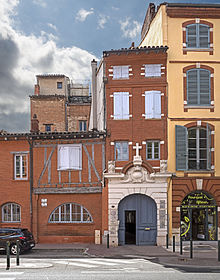
In 1215, Dominic established himself, with six followers, in a house given by Peter Seila, a rich resident of Toulouse. Dominic saw the need for a new type of organisation to address the spiritual needs of the growing cities of the era, one that would combine dedication and systematic education, with more organisational flexibility than either monastic orders or the secular clergy. He subjected himself and his companions to the monastic rules of prayer and penance; and meanwhile bishop Foulques gave them written authority to preach throughout the territory of Toulouse. In the same year, the year of the Fourth Lateran Council, Dominic and Foulques went to Rome to secure the approval of the Pope, Innocent III. Dominic returned to Rome a year later and was finally granted written authority in December 1216 and January 1217 by the new pope, Honorius III for an order to be named “The Order of Preachers” (“Ordo Praedicatorum”, or “O.P.,” popularly known as the Dominican Order).
St Dominic’s House in Toulouse
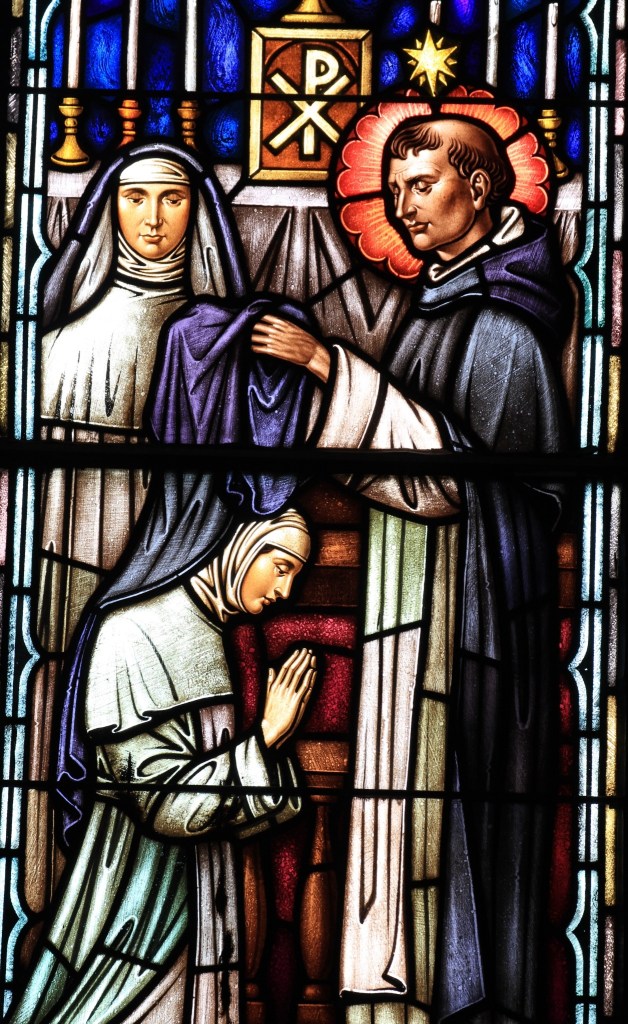
It was not long thereafter that Dominic founded an institute for women at and attached several preaching friars to it. During a subsequent crusade against the Albigensian heresy, Dominic followed the papal armies and preached to all who would listen. He had little success, however and returned home to a castle bequeathed to him, where he founded an order dedicated to the conversion of the Albigensians. The order was canonically approved by the bishop of Toulouse the following year and two years later received Pope Honorius III’s approval. The Order of Preachers, the Dominicans, was founded.
Saint Dominic spent the remaining years of his life organising his new order, traveling throughout Europe preaching and attracting new members and establishing new houses. The new order, under his direction, was astoundingly successful in conversion, based upon contemplative and intellectual approaches, coupled with the contemporary and popular needs of the people. His ideal, and that of his Order, was to link organically a life with God, study and prayer in all forms, with a ministry of salvation to people by the word of God. His ideal: contemplata tradere: “to pass on the fruits of contemplation” or “to speak only of God or with God.” (Read the Nine Ways of Prayer of St Dominic here: https://www.fisheaters.com/stdominic9ways.html)
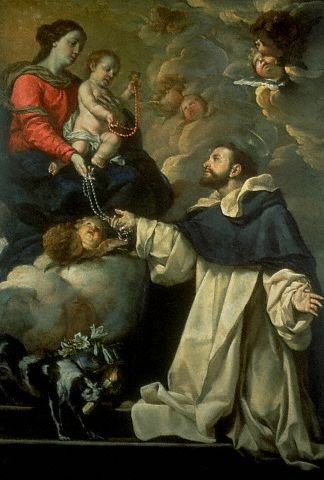
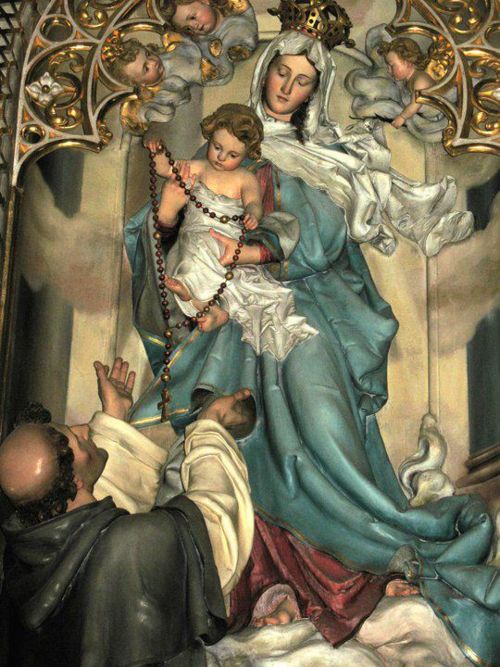
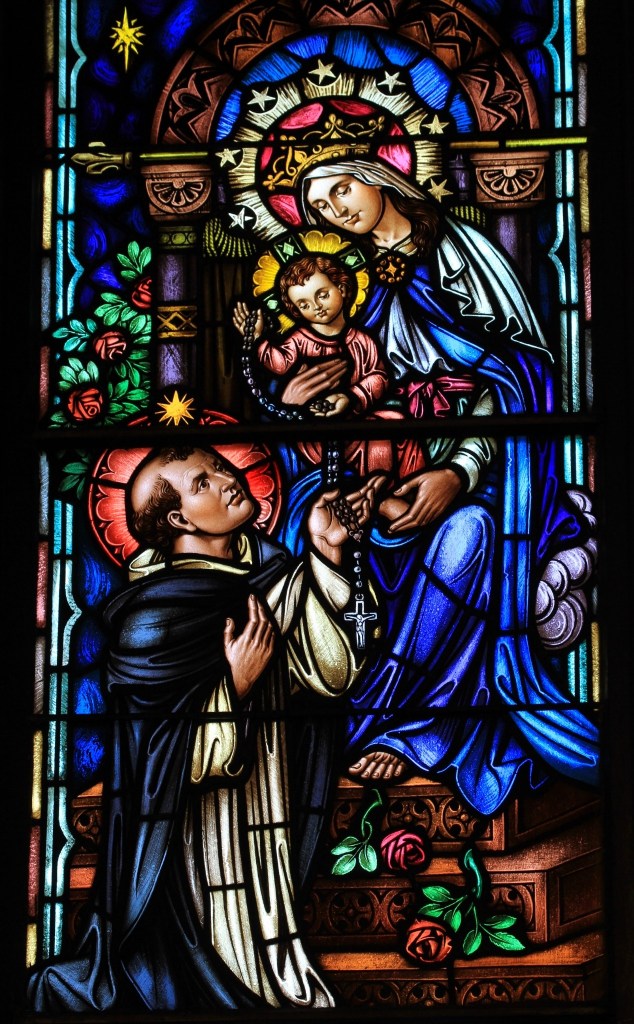
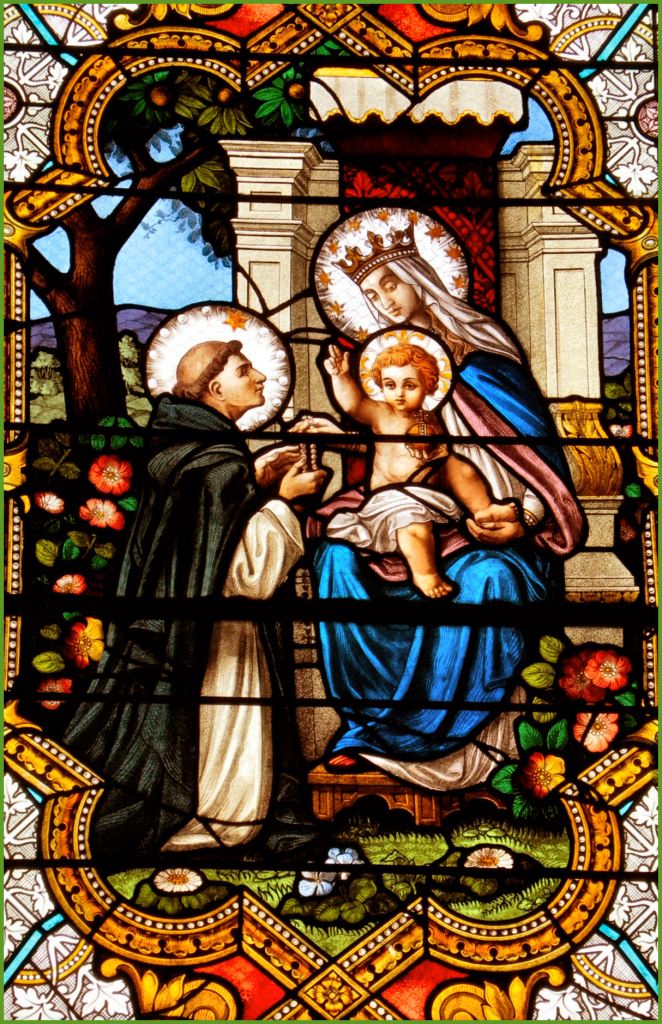
There was a time that St Dominic became discouraged at the progress of his mission. To him, it seemed that no matter how much he worked, heresy remained. As he contemplated the future of his order, he received a vision from Our Blessed Mother, who showed him a wreath of roses, representing the Holy Rosary. Mary told him to say the Rosary daily, to teach it to all who would listen and eventually the faith would defeat heresies. The spread of the Rosary, is attributed to the preaching of Saint Dominic. The Rosary has for centuries been at the heart of the Dominican Order. Pope Pius XI stated, “The Rosary of Mary is the principle and foundation on which the very Order of Saint Dominic rests for making perfect the life of its members and obtaining the salvation of others.” For centuries, Dominicans have been instrumental in spreading the rosary and emphasizing the Catholic belief in the power of the rosary. Saint Dominic is spread devotion to the Rosary, and used it to strengthen his own spiritual life.
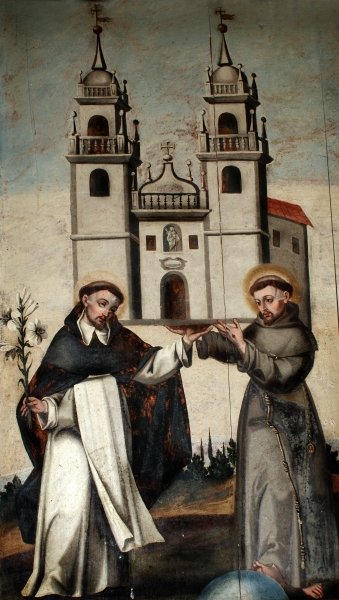
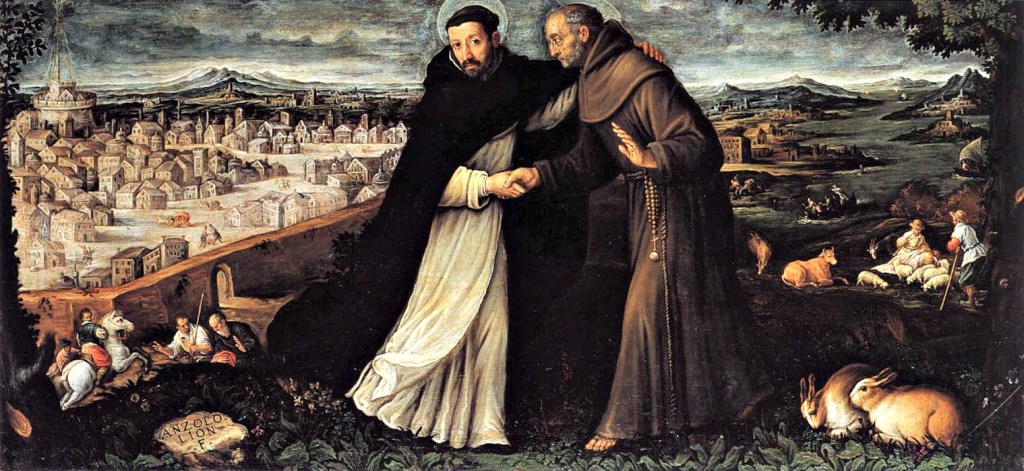
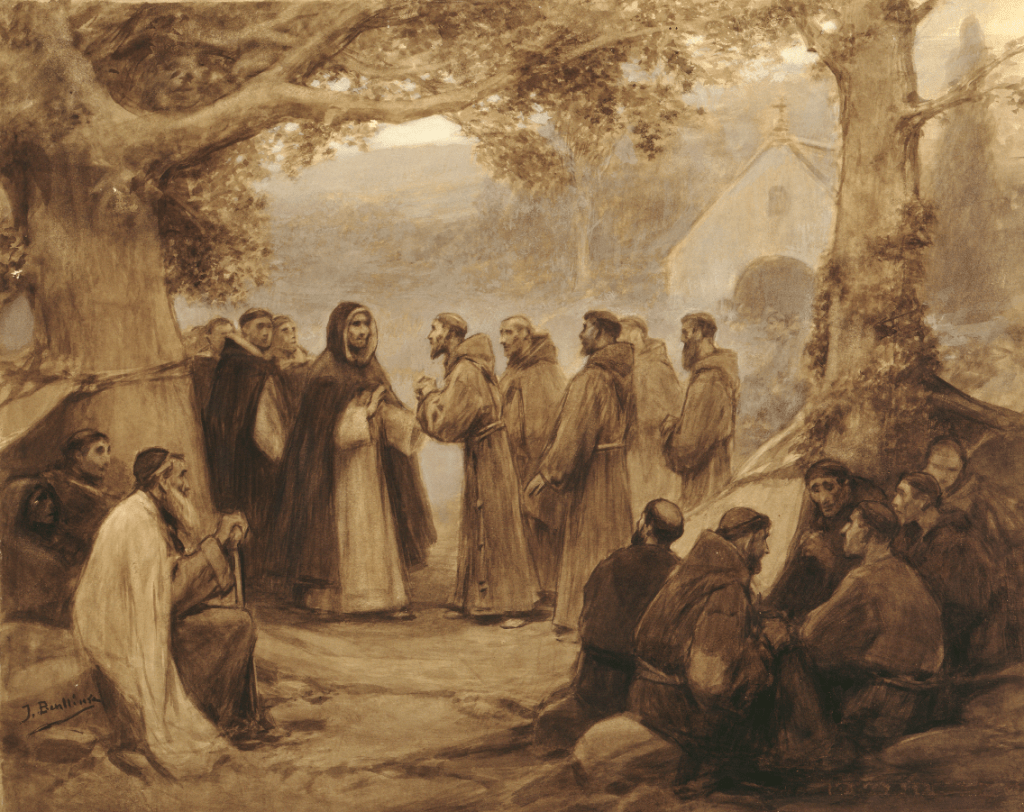
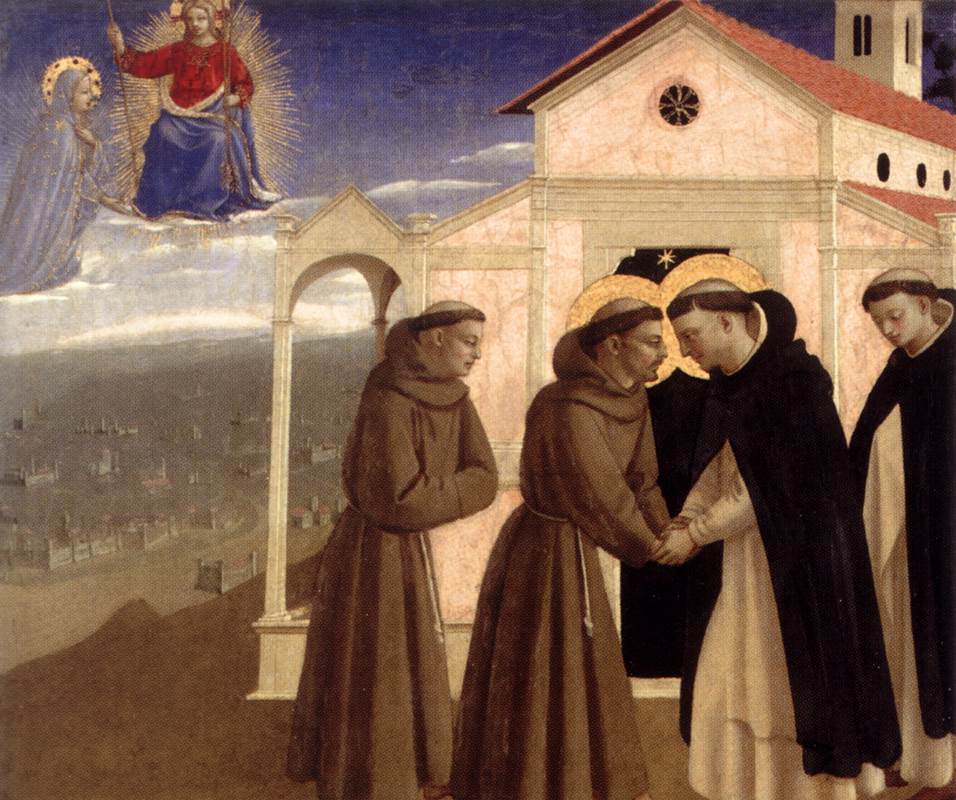
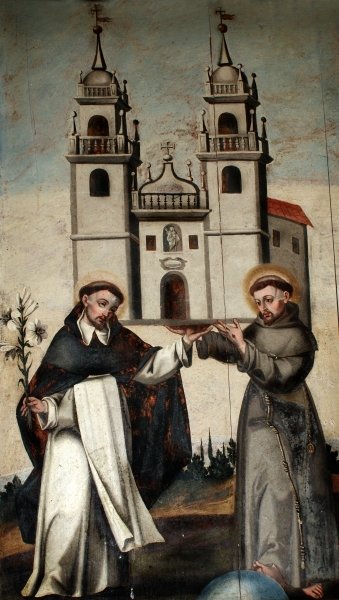
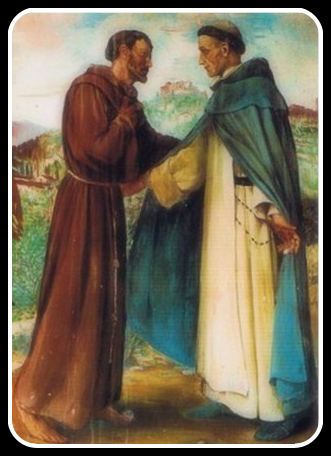
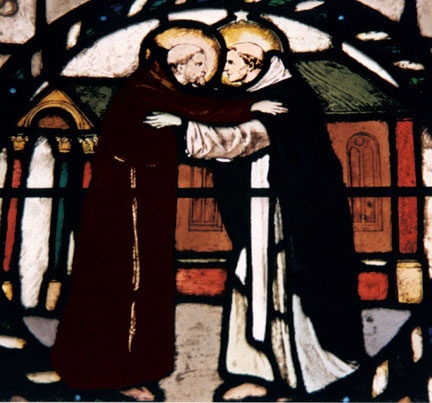
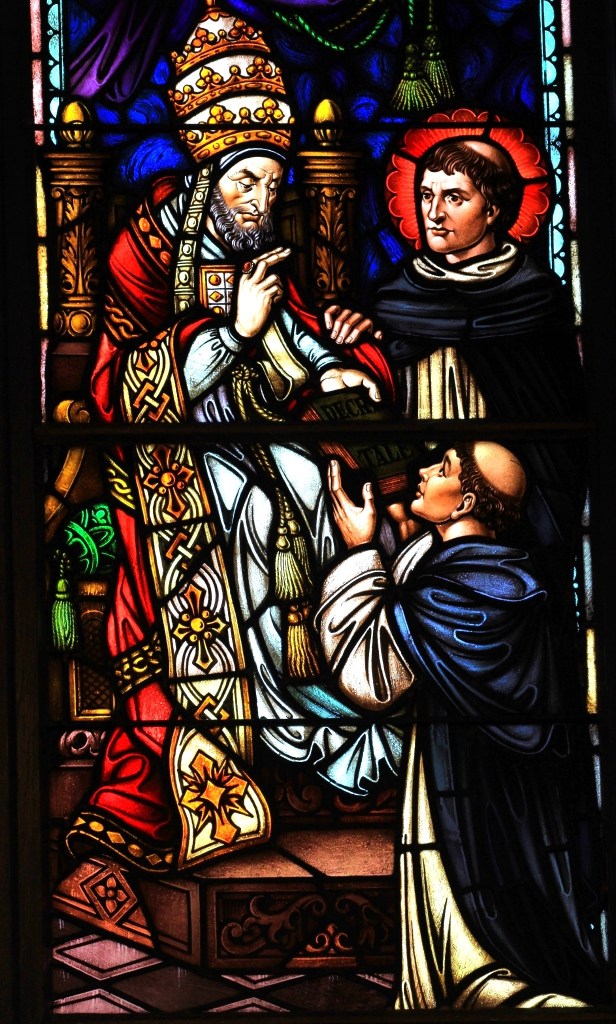
Saint Dominic is also remembered for miracles (raising four people from the dead) and miraculous visions. On one occasion, he received a vision of a poor beggar, who he sought out the following day. Finding the beggar, Dominic embraced him and said, “You are my companion and must walk with me. If we hold together, no earthly power can withstand us.” The beggar turned out to be Saint Francis of Assisi and the two holy men became the closest of friends.
St Dominic died at the age of fifty-one, “exhausted with the austerities and labours of his career”. He had reached the convent of St Nicholas at Bologna, Italy, “weary and sick with a fever”. He “made the monks lay him on some sacking stretched upon the ground” and that “the brief time that remained to him was spent in exhorting his followers to have charity, to guard their humility, and to make their treasure out of poverty”. He died at noon on 6 August 1221. His body was moved to a simple sarcophagus in 1233. Under the authority of Pope Gregory IX, Dominic was canonised in 1234. In 1267 Dominic’s remains were moved to the shrine, made by Nicola Pisano and his workshop. The feast of Saint Dominic is celebrated with great pomp and devotion in Malta, in the old city of Birgu and the capital city Valletta. The Dominican order has very strong links with Malta and Pope St. Pius V, a Dominican friar himself, aided the Knights of St. John to build the city of Valletta.
St Dominic de Guzman (Memorial) – – https://www.youtube.com/watch?v=1xLTJDlaVdo
—
St Aemilian of Cyzicus
St Altman of Passau
St Cyriacus the Martyr
St Eleutherius of Constantinople
St Ellidius
St Famianus of Compostela
St Gedeon of Besancon
St Hormisdas of Persia
Bl John Felton
Bl John Fingley
St Largus
St Leobald of Fleury
St Leonidas of Constantinople
St Marinus of Anzarba
St Mary MacKillop – the first Australian born Saint.
St Mummolus of Fleury
St Myron the Wonder Worker
St Paulus Ge Tingzhu
St Rathard of Diessen
St Severus of Vienne
St Sigrada
St Smaragdus
St Ternatius of Besançon
St Ultan of Crayke
Bl William of Castellammare di Stabia
Bl Wlodzimierz Laskowski
—
Martyrs of Albano – 4 saints: Four Christians who were martyred together, and about we today know little more than their names – Carpóforo, Secondo, Severiano and Vittorino. They were martyred in Albano, Italy – their remains are interred in the San Senator cemetery, on the Appian Way, 15 miles from Rome, Italy.
Martyrs of Rome – 5 saints: Five Christians martyred together; we know nothing else about them but the names – Ciriaco, Crescenziano, Giuliana, Memmia and Smaragdus. They were martyred at the 7 mile marker, on the Via Ostia, Rome, Italy.
Martyred in the Spanish Civil War – Martyrs of El Saler – 5 beati: Five nuns, all members of the Sisters of the Pious Schools, all teachers, and all martyred together in the Spanish Civil War.
• Antonia Riba Mestres
• Maria Baldillou Bullit
• María Luisa Girón Romera
• Nazaria Gómez Lezaun
• Pascuala Gallén Martí
They were martyred on 8 August 1936 in El Saler, Valencia, Spain and Beatified on 11 March 2001 by Pope John Paul II.
Martyred in the Spanish Civil War:
Bl Antero Mateo Garcia
Bl Antonio Silvestre Moya
Bl Cruz Laplana Laguna
Bl Fernando Español Berdie
Bl Leoncio López Ramos
Bl Manuel Aranda Espejo
Bl Mariano Pina Turón
Bl Pedro Álvarez Pérez
Thought for the Day – 7 August – The Memorial of St Cajetan
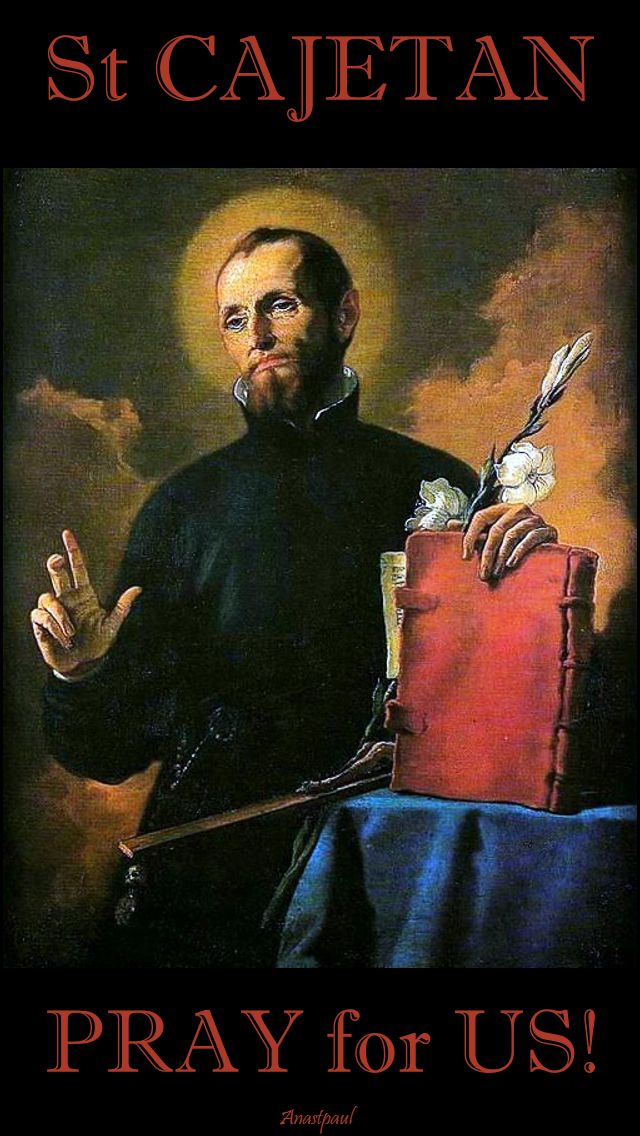
St Cajetan sought first and foremost, the will of the Lord in his life.
Dedicated not only to Church reform but to also reform of the evils of the world he encountered on a daily basis, this humble saint gave all that he had to service of those around him.
He worked with the poorest of the poor, the sickest of the sick, the most undesirable souls he could find—nursing them physically back to help, assisting with their finances and most of all, he worked hard to save and convert their souls.
The greatest need of the time was the reformation of a Church that was “sick in head and members.”
Cajetan and three friends decided that the best road to reformation lay in reviving the spirit and zeal of the clergy.
Together they founded a congregation known as the Theatines–from Teate [Chieti] where their first superior-bishop had his see. One of these friends later became Pope Paul IV.
Saint Cajetan is a model of obedience, service and Christian charity—three virtues we can all ascribe to.
We pray for the intercession of St Cajetan, that we, too, may turn our gaze from our own lives to those around us in greater need.
This is the covenant with them which I myself have made, says the Lord: and my words that I have put into your mouth shall never leave your mouth, nor the mouths of your children, nor the mouths of your children’s children, from now on and forever, says the Lord. (Isaiah 59:21)
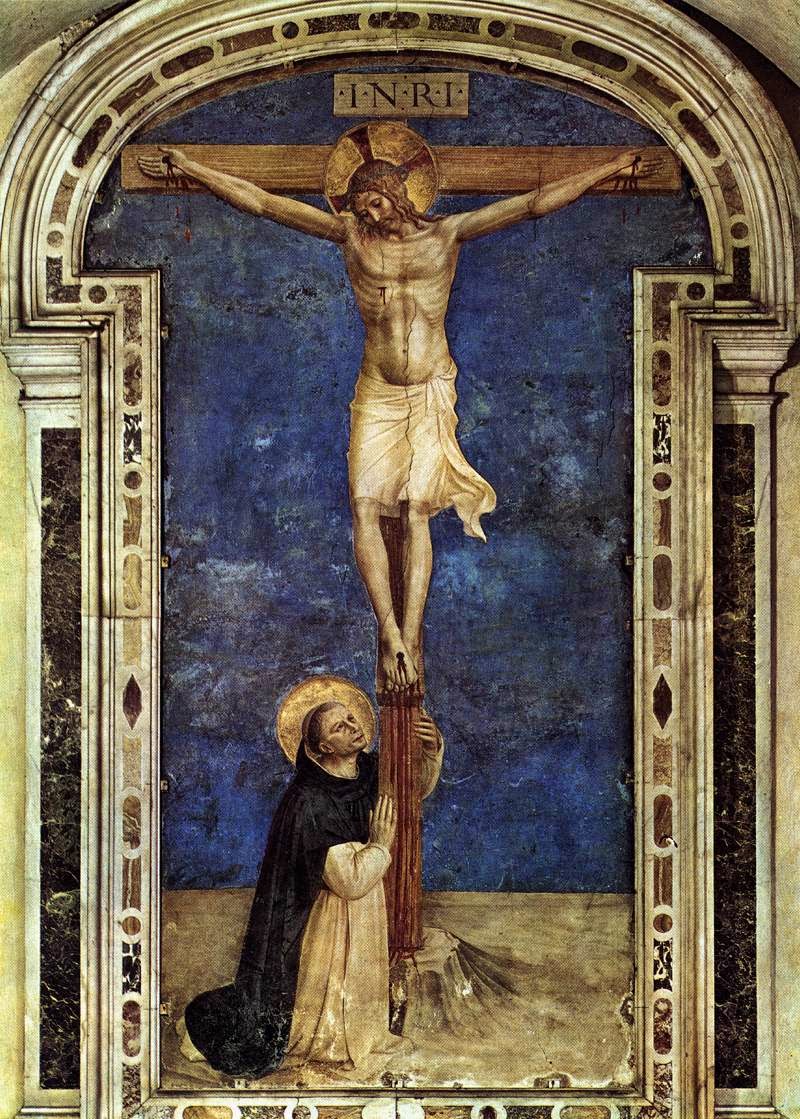
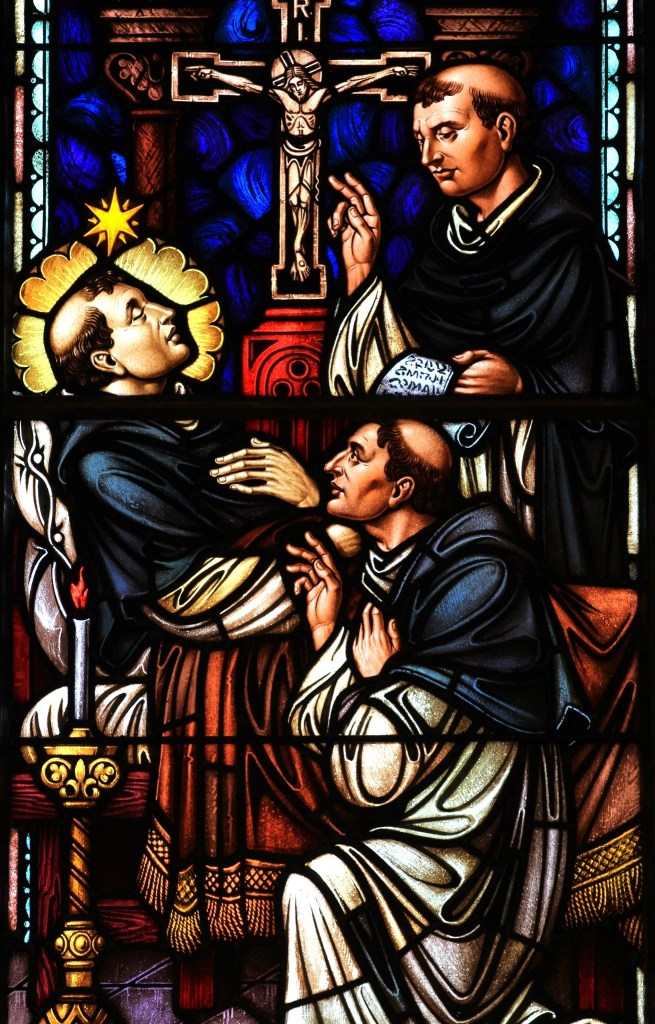
As St. Dominic lay dying just outside of Bologna at St. Mary of the Hills, he requested to be taken back at once to Bologna that he might be buried “under the feet of my brethren.” There, having assured his spiritual children that he would be of greater assistance where he was going, he left them his last will and testament: “Behold, my children, the heritage I leave you: have charity for one another, guard humility, make your treasure out of voluntary poverty.”
Be therefore followers of me, even as I also am of Christ. (1 Corinthians 11:1)
O wondrous hope that you did give at the hour of death to those who mourned you, when you did promise to help them even after death.
St Dominic, keep your word and aid us by your prayers.
You who did shine by so many signs in the bodies of the afflicted, bear us the help of Christ and heal our souls in illness and unrest.
St Dominic, keep your word and aid us by your prayers.
Glory to the Father, and to the Son, and to the Holy Spirit.
St Dominic, keep your word and aid us by your prayers.
Pray for us, blessed St Dominic, That we may be made worthy of the promises of Christ.
Let us pray:
O God, who enlightened Your Church
by the merits and teachings of blessed Dominic, Your confessor
grant through his intercession
we may never be destitute of temporal help
and may always increase in spiritual growth.
that persevering until death, we may,
ever work for the glory of God
and the salvation of souls,
especially the return to the one, true, faith
of our family and friends who have lapsed.
Finally, we ask for this our special intention …
(make your request)
Through Christ our Lord. Amen
Quotes of the Day – 7 August – The Memorial of St Cajetan
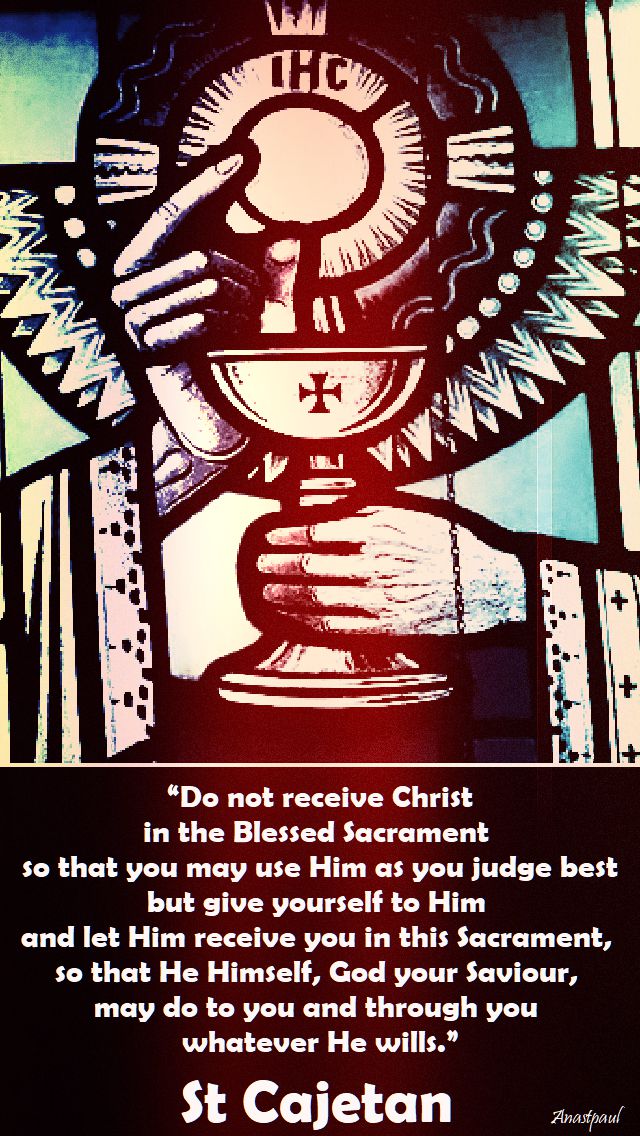
“Do not receive Christ in the Blessed Sacrament
so that you may use Him as you judge best
but give yourself to Him
and let Him receive you in this Sacrament,
so that He Himself, God your Saviour,
may do to you and through you whatever He wills.”
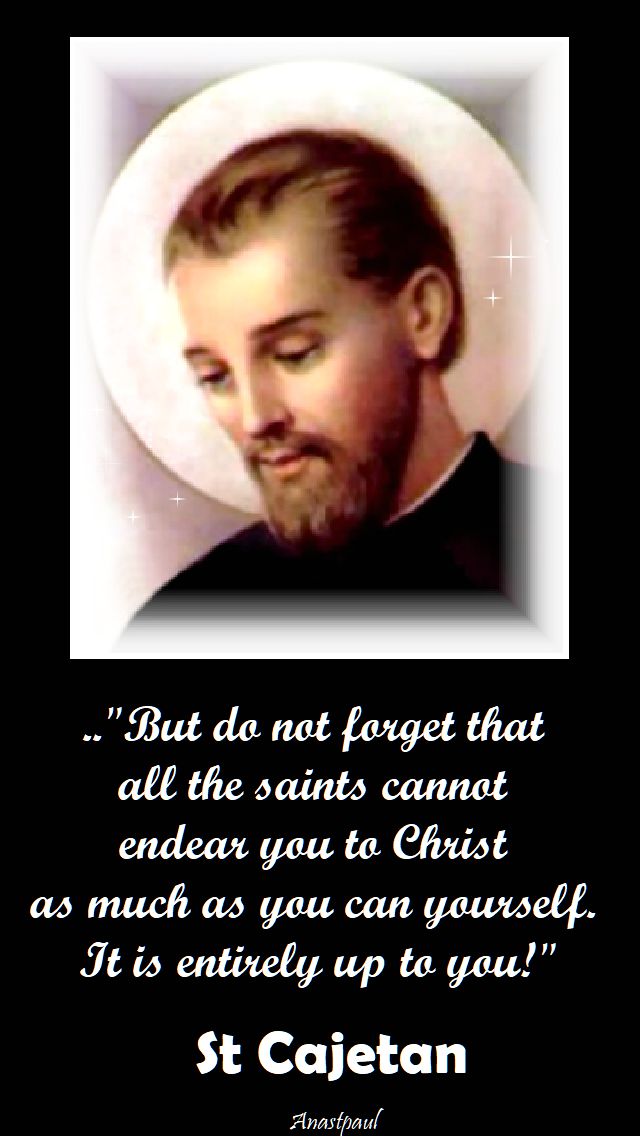
“I am a sinner and do not think much of myself;
I have recourse to the greatest servants of the Lord,
that they may pray for me to the blessed Christ and his Mother.
But do not forget that all the saints cannot endear you to Christ
as much as you can yourself.
It is entirely up to you!”
Though my father and my mother forsake me, yet will the Lord receive me….Psalm 27:10
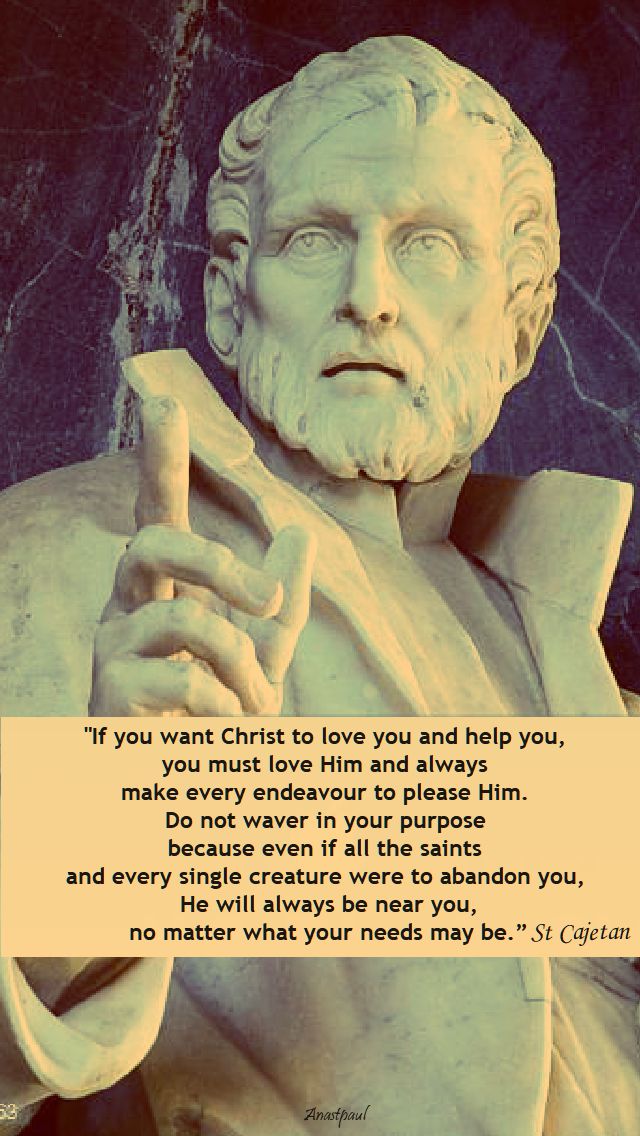
REFLECTION – “If you want Christ to love you and help you, you must love Him and always make every endeavour to please Him.
Do not waver in your purpose because even if all the saints and every single creature were to abandon you, He will always be near you, no matter what your needs may be.”….St Cajetan
PRAYER – Lord God, You inspired St Cajetan to live and work like the Apostles. Help us, by his example and prayers, to trust in You at all times and continually to seek Your Kingdom. St Cajetan pray for us, amen.
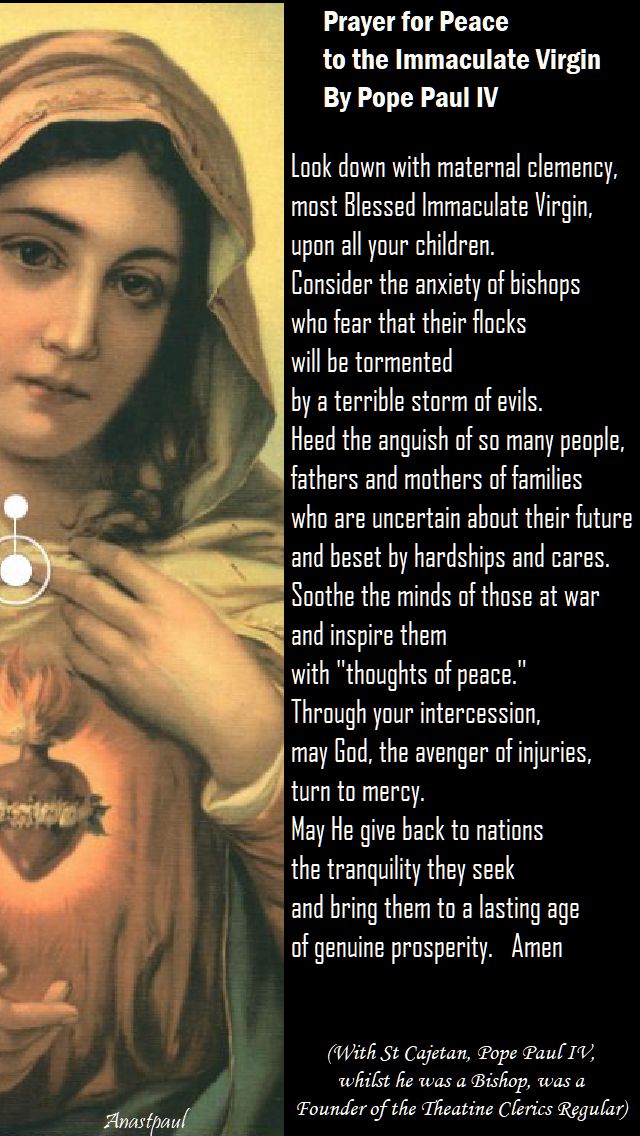
Prayer for Peace to the Immaculate Virgin By Pope Paul IV
Look down with maternal clemency,
most Blessed Immaculate Virgin,
upon all your children.
Consider the anxiety of bishops
who fear that their flocks
will be tormented by a terrible storm of evils.
Heed the anguish of so many people,
fathers and mothers of families
who are uncertain about their future
and beset by hardships and cares.
Soothe the minds of those at war
and inspire them with “thoughts of peace.”
Through your intercession,
may God, the avenger of injuries,
turn to mercy.
May He give back to nations
the tranquility they seek
and bring them to a lasting age
of genuine prosperity. Amen
(Juan Pedro Carrafa, Bishop of Chieti, who became Pope Paul IV,
was a friend of and one of the Founders with, our Saint today,
St Cajetan of the Theatine Clerics Regular)
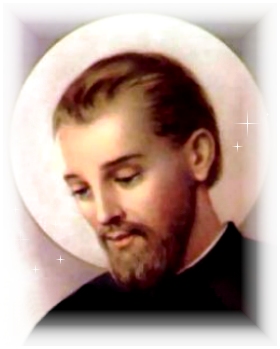
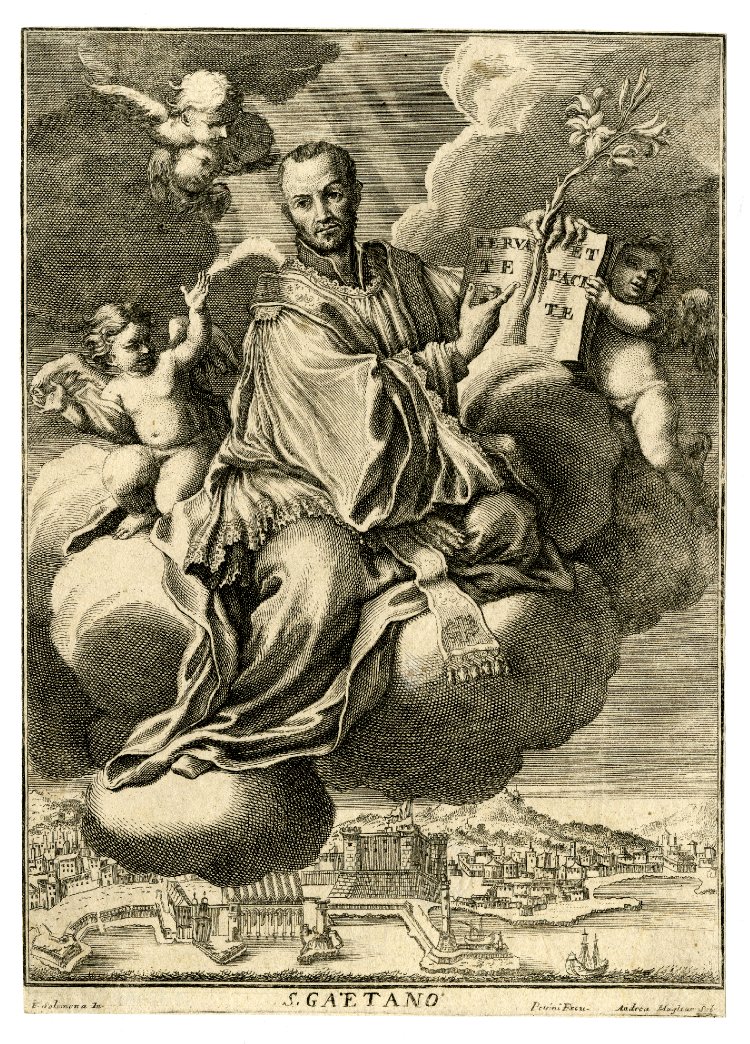
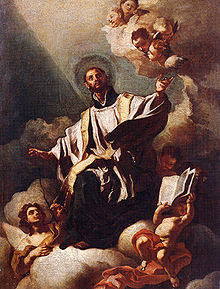
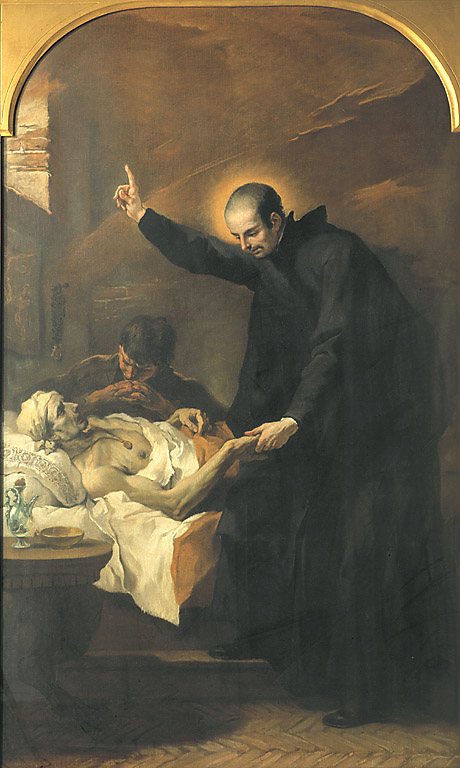
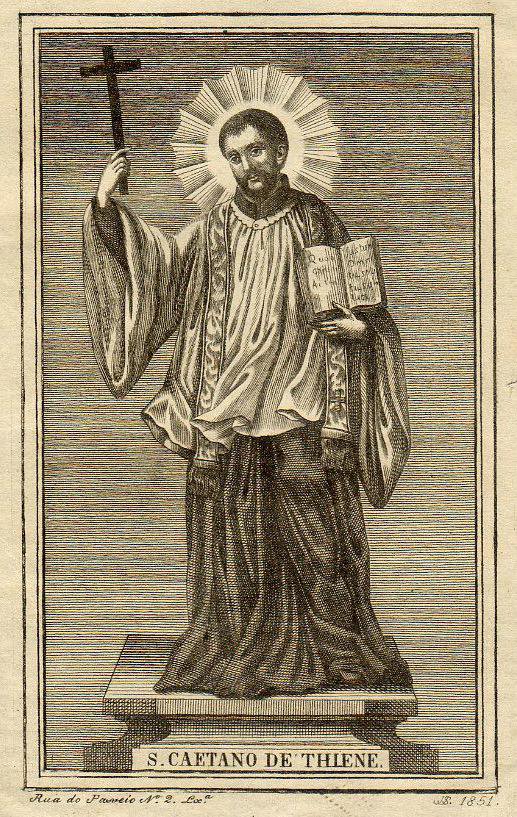
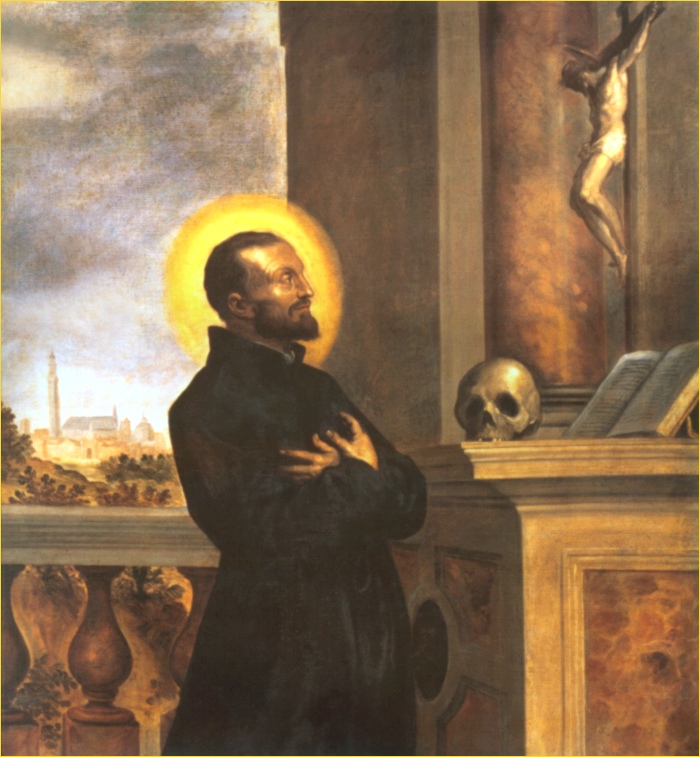
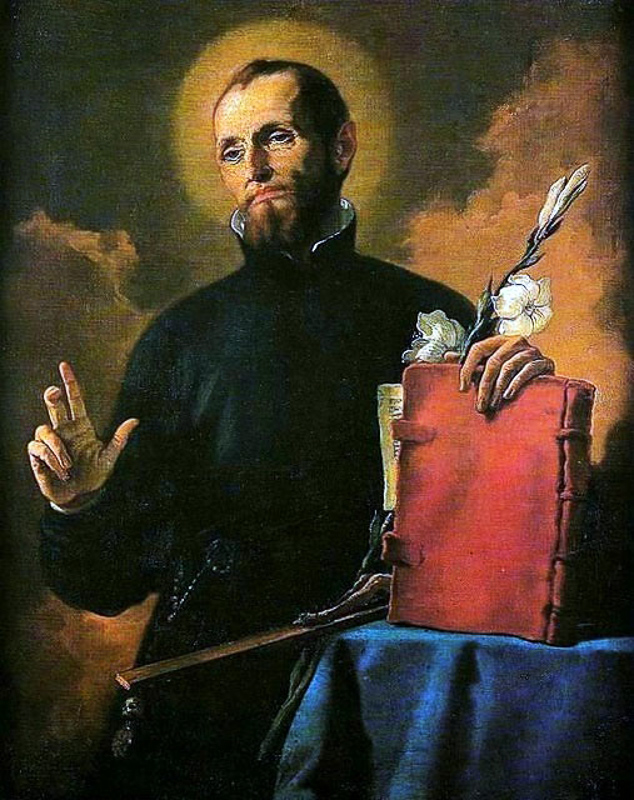
Saint of the Day – 7 August – St Cajetan – Founder of the Theatine Order – Priest, Confessor, Reformer, Doctor of Civil and Canon Law, Diplomat, Mystic, Miracle Worker, Apostle of the sick and the poor. Known as the “Father of Providence” and the “Huntsman of Souls” – (Born in October 1480 at Vicenza, Italy as Gaetano dei Conti di Tiene -and died in1547 at Naples, Italy of natural causes) – Beatified on 8 October 1629 by Pope Urban VIII and Canonised on 12 April 1671 by Pope Clement X. Patronages – bankers, gamblers;,unemployed, workers, document controllers, job seekers, Albania, Naples and Italy, Ħamrun (Malta), Argentina, Brazil, El Salvador, Guatemala.
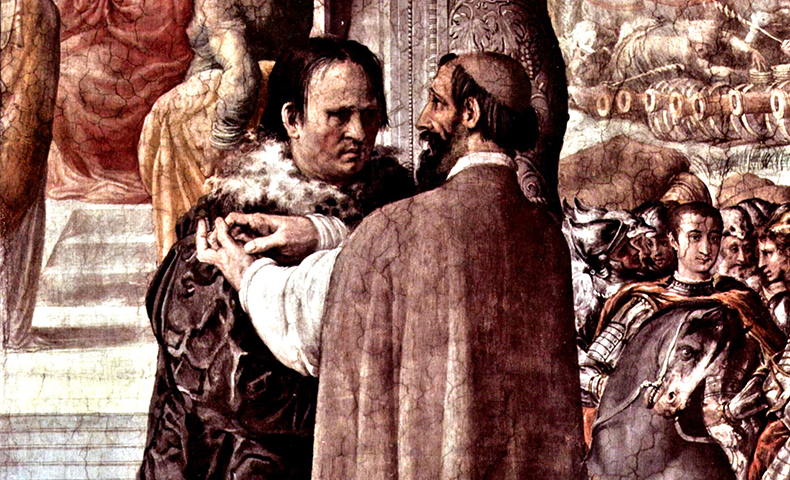
Cajetan and Luther| by Francesco de’ Rossi
St Cajetan was born of a noble family in Vicenza, Italy. He was the youngest of three sons born to Don Gaspar di Thiene and Dona Maria di Porto.
He studied civil and Canon Law at the University of Padua and moved to Rome where he worked in the Court of Julian II. He assisted at the fifth Council of the Lateran. He was ordained a priest and became part of the “company of Divine Love.” In 1518 he returned to Vicenza. After the death of his mother, he dedicated himself to the founding and directing of hospitals to treat the syphiletics in Vicenza, Verona and Venice. With his own hands he cared for the sick. Such zeal did he show for the salvation of his fellowmen that he was surnamed the “huntsman for souls.”
In 1524, with Juan Pedro Carrafa, Bishop of Chieti, he founded the Clerics Regular who later would be called the Theatines. One of the four men who joined him in his new order, Juan Pedro mentioned above, went on to become the pope (Pope Paul IV). The Theatines, as they were later to become, were to bea community of priests who were to lead an apostolic life. They were to look with disdain all earthly belongings, to accept no salaries from the faithful; only from that which was freely donated were they allowed to retain the means of livelihood. St Cajetan was tortured during the plunder of Rome in 1527 (the torturers hoping to obtain his inheritance which had long before been spent on the poor and sick), Cajetan later returned to Venice where for three years he directed the Religious Institute he had founded. In 1533, where he established a centre for opposing the spread of Lutheranism in Naples. He eventually extended that mission to the city of Verona where he would die fourteen years later in 1547. It was in this city that he planted the yeast of reform that made him worthy of the devotion with which the Neopolitans have always awarded him. He founded a bank to help the poor and offer an alternative to usurers (loan sharks). It later became the Bank of Naples. His concern for the unemployed, giving them the necessary financial help in their time of need, made him their patron. Later in his life, Saint Cajetan would introduce the Forty Hours’ Adoration of the Blessed Sacrament, as an antidote to the heresy of Calvin. In 1629, Urban VIII authorised public worship to Cajetan and on April 12, 1671, Clement X inscribed him in the catalogue of Saints.
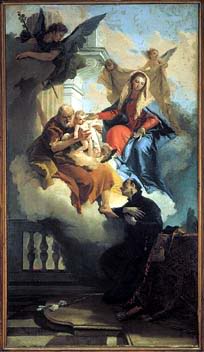
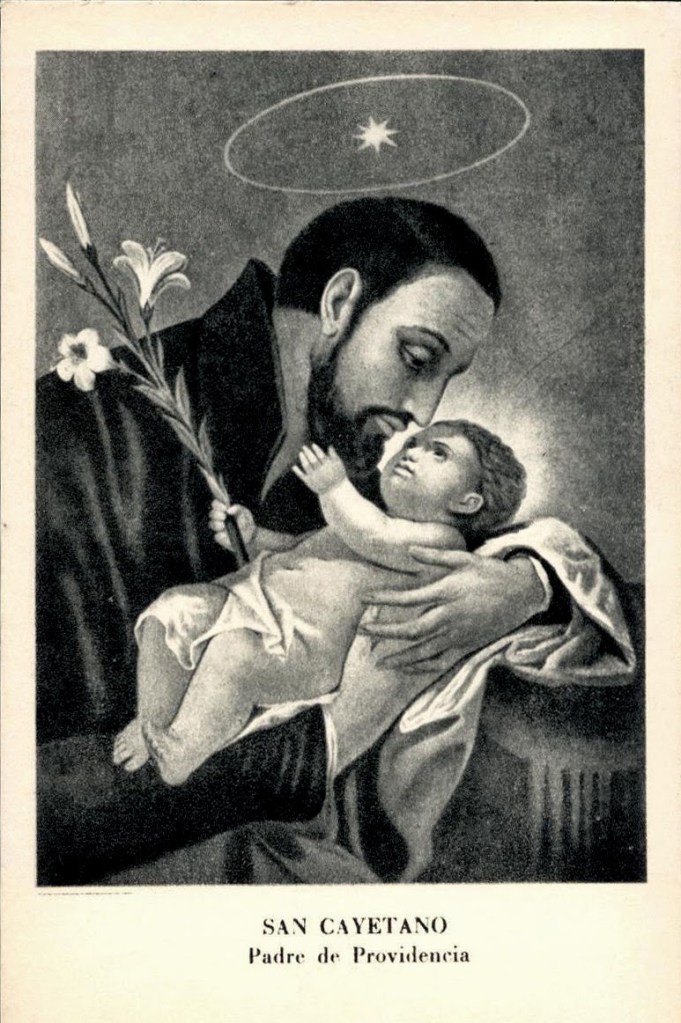
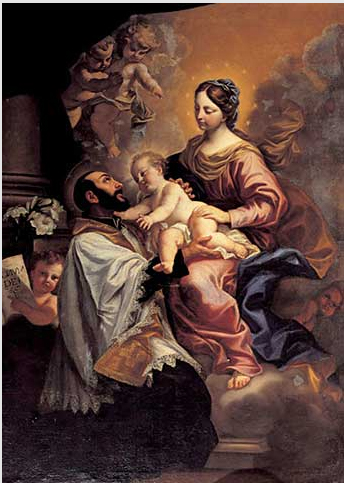
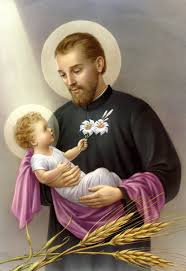
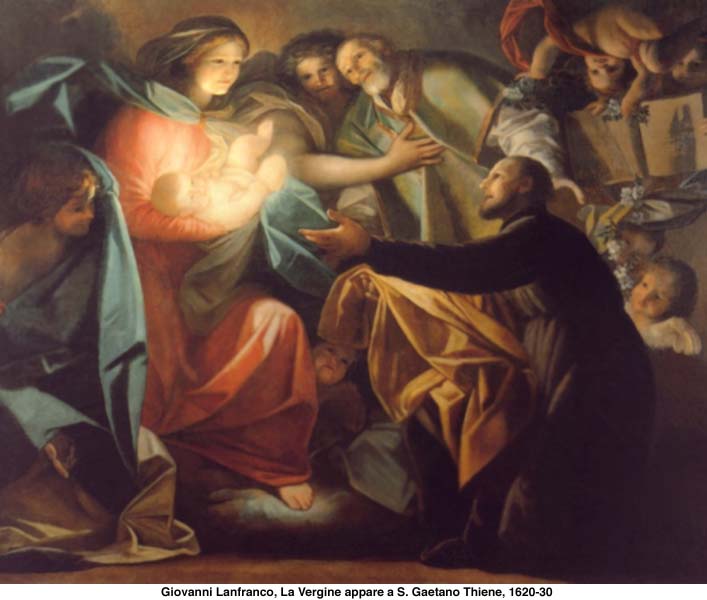
St Cajetan often prayed eight hours daily. On Christmas Eve at the Church of Saint Mary Major he was greeted with his first vision of Our Blessed mother. When he entered the church he saw the Mary, radiant with light, who came to him and placed Her divine Infant in his arms. These are the words he used to describe his vision: “….I boldly found myself, at the time of the Holy Nativity, in this crib; to give me courage I had with me Saint Jerome my father, who had the crib so close to his heart and whose remains were placed at the entrance of the same crib; and with a little bit of encouragement from the old man (St. Joseph), from the hands of the Virgin Mary, I took into my arms that little Baby: the Eternal Word Who became flesh. My heart was really hard, you must believe me, because if it were not as hard as a diamond, it was sure to liquefy at that moment… patience…”
St Cajetan is the “Heart” of the Catholic reformation, the founder of the Clerics Regular (Theatines) and the “Great Man and Great Saint” that Christians acclaim as “The Father of Providence” for he aids those who invoke him in their needs with great miracles.
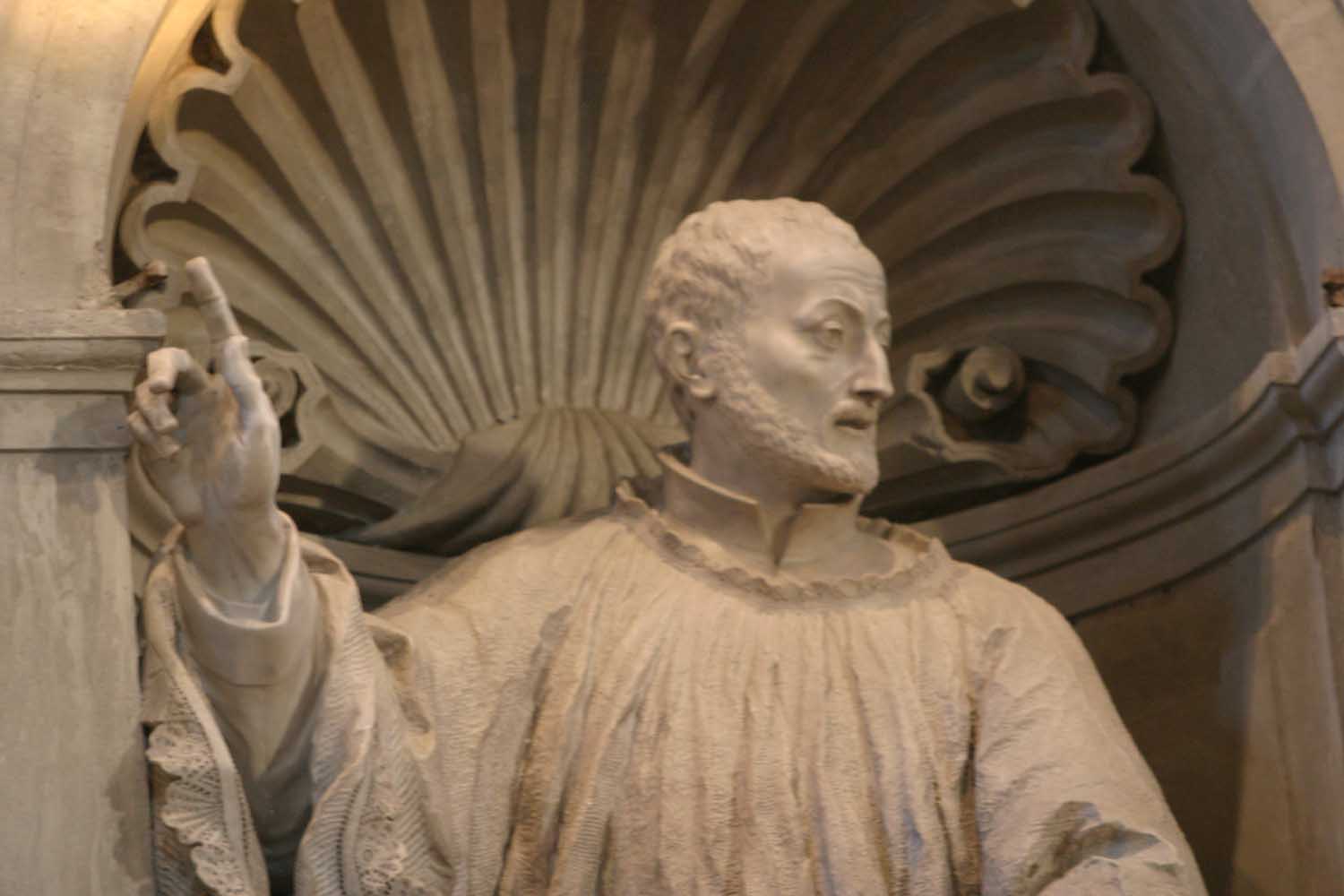
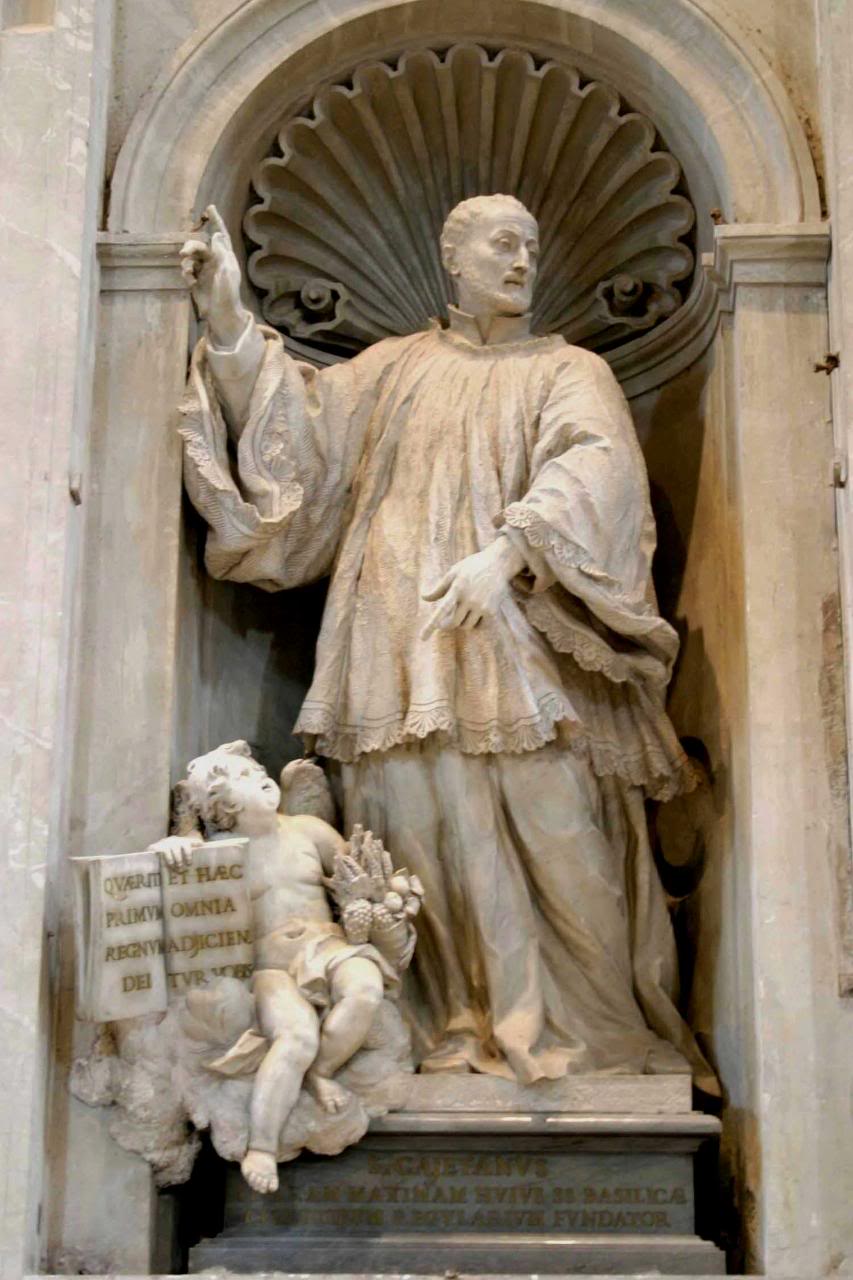
Founder Statue at St Peters Rome
Prayer of Saint Cajetan before a Crucifix
Look down, O Lord, from Your sanctuary, from Your dwelling in heaven on high and behold this sacred Victim which our great High Priest, Your Holy Son our Lord Jesus Christ, offers up to You for the sins of His brethren and be appeased despite the multitude of our sins. Behold, the voice of the Blood of Jesus, our Brother, cries to You from the cross. Listen, O Lord. Be appeased, O Lord. Hearken and do not delay for Your own sake, O my God; for Your Name is invoked upon this city and upon Your people and deal with us according to Your mercy. Amen.





















 AnaStpaul
You must be logged in to post a comment.