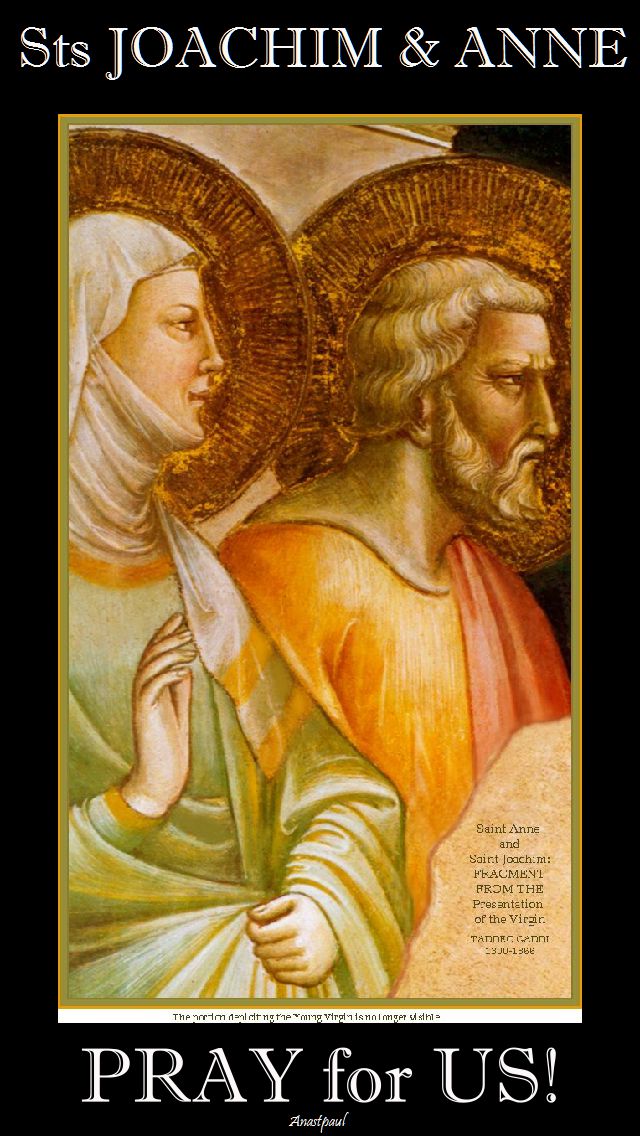
One Minute Reflection – 26 July – The Memorial of Sts Joachim and Anne, Parents of the Blessed Virgina nd Grandparents of Jesus
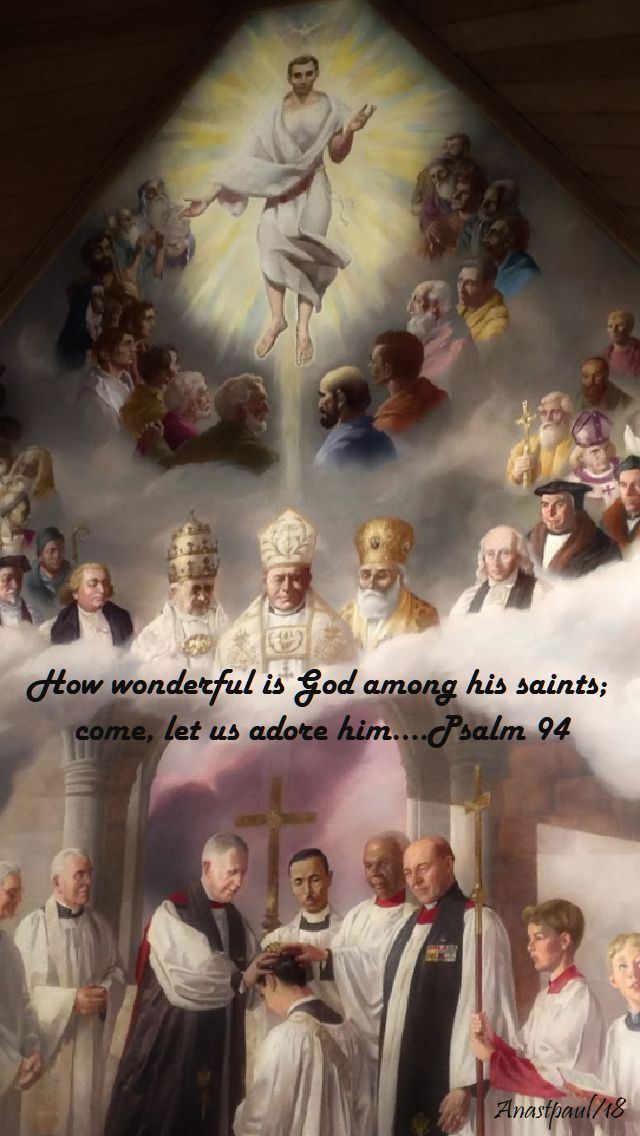
How wonderful is God among his saints; come, let us adore him…..Psalm 94
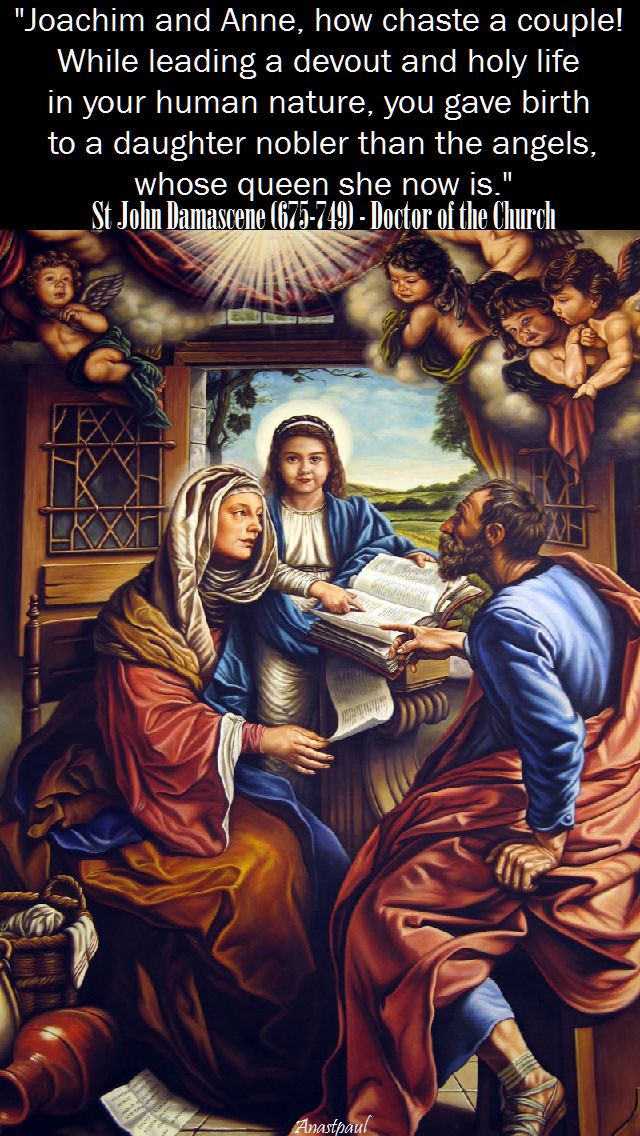
REFLECTION – “Joachim and Anne, how blessed a couple! All creation is indebted to you. For at your hands the Creator was offered a gift excelling all other gifts: a chaste mother, who alone was worthy of Him. Joachim and Anne, how blessed and spotless a couple! You will be known by the fruit you have borne, as the Lord says: “By their fruits you will know them.” The conduct of your life pleased God and was worthy of your daughter. For by the chaste and holy life you led together, you have fashioned a jewel of virginity: she who remained a virgin before, during and after giving birth . She alone for all time would maintain her virginity in mind and soul as well as in body. Joachim and Anne, how chaste a couple! While leading a devout and holy life in your human nature, you gave birth to a daughter nobler than the angels, whose queen she now is.” – from a sermon by Saint John Damascene (675-749) – Doctor of the Church
PRAYER – O Lord, God of our Fathers, who bestowed on Saints Joachim and Anne this grace, that of them should be born the Mother of your incarnate Son, grant, through the prayers of both, that we may attain the salvation you have promised to your people. Through our Lord Jesus Christ, your Son, who lives and reigns with you in the unity of the Holy Spirit, one God, for ever and ever. Sts Joachim and Anne, pray for us! Amen
Quote of the day -25 July – Feast of St James, Apostle of Christ
Since the ninth century Spain has claimed the honour of possessing St James relics, though it must be said that actual proof is far less in evidence than the devotion of the faithful. The pilgrimage to St James/Santiago of Compostela in the Middle Ages attracted immense crowds,after the pilgrimage to Rome or the Holy Land, it was the most famous and the most frequented pilgrimage in Christendom. The pilgrim paths to Compostela form a network over Europe; they are dotted with pilgrims’ hospices and chapels. Santiago de Compostela, is the third largest shrine in all of Christendom.
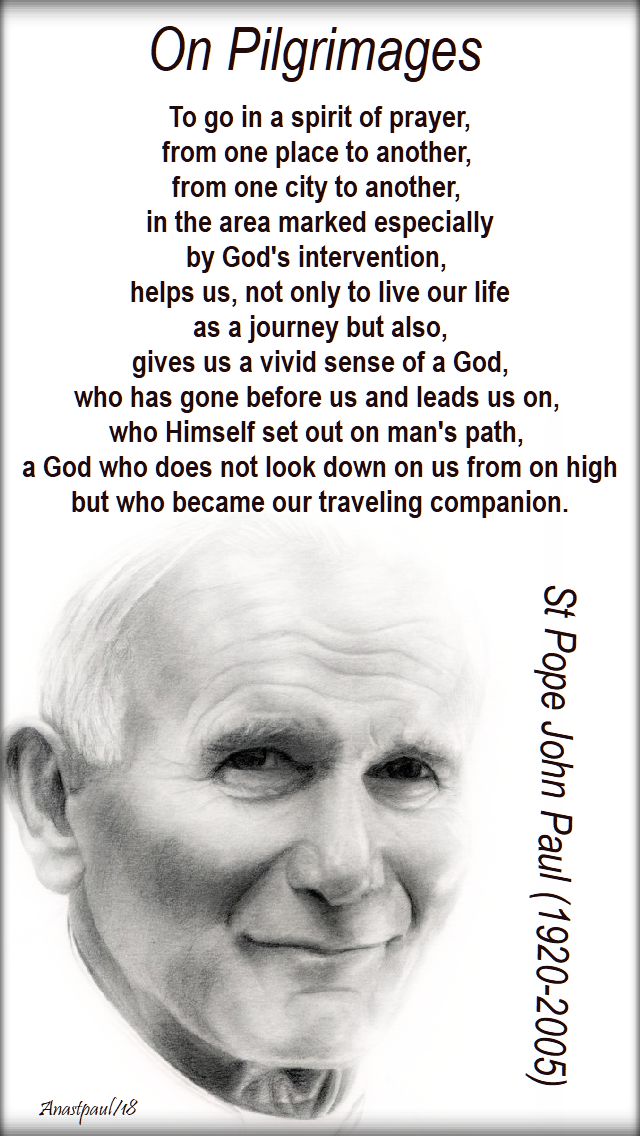
“To go in a spirit of prayer from one place to another, from one city to another, in the area marked especially by God’s intervention, helps us not only to live our life as a journey but also gives us a vivid sense of a God, who has gone before us and leads us on, who Himself set out on man’s path, a God who does not look down on us from on high but who became our travelling companion.”
One Minute Reflection – 25 July – The Memorial of St James the Greater, Apostle of Christ – Today’s Gospel: Matthew 20:20–28
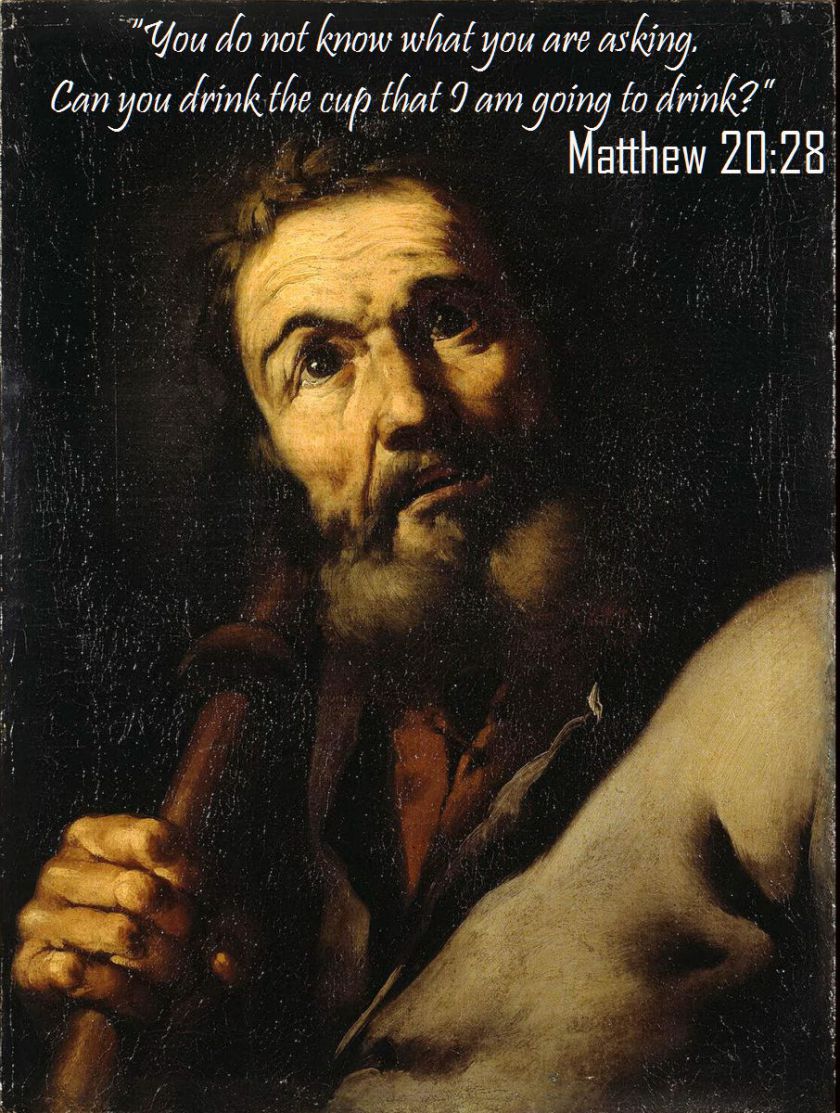
Jesus said in reply, “You do not know what you are asking. Can you drink the cup that I am going to drink?” They said to him, “We can.”……Matthew 20:28
REFLECTION – “Through their mother’s mediation, the sons of Zebedee press Christ as follows in the presence of their fellow apostles: “Command that we may sit, one at your right side and one at your left” (cf. Mk 10:35f.)… Christ hastens to free them from their illusions, telling them they must be prepared to suffer insults, persecutions, even death. “You do not know what you are asking. Are you able to drink the cup that I shall drink?” Let no one be surprised to see the apostles displaying such imperfect dispositions. Wait until the mystery of the cross has been fulfilled and the strength of the Holy Spirit given to them. If you want to see the strength of their souls, take a look at them later on and you will see them to be above all human weakness. Christ does not conceal their pettiness so you will be able to see what they become later on by the power of the grace that will transform them…”… St John Chrysostom (c 345-407) Father & Doctor of the Church
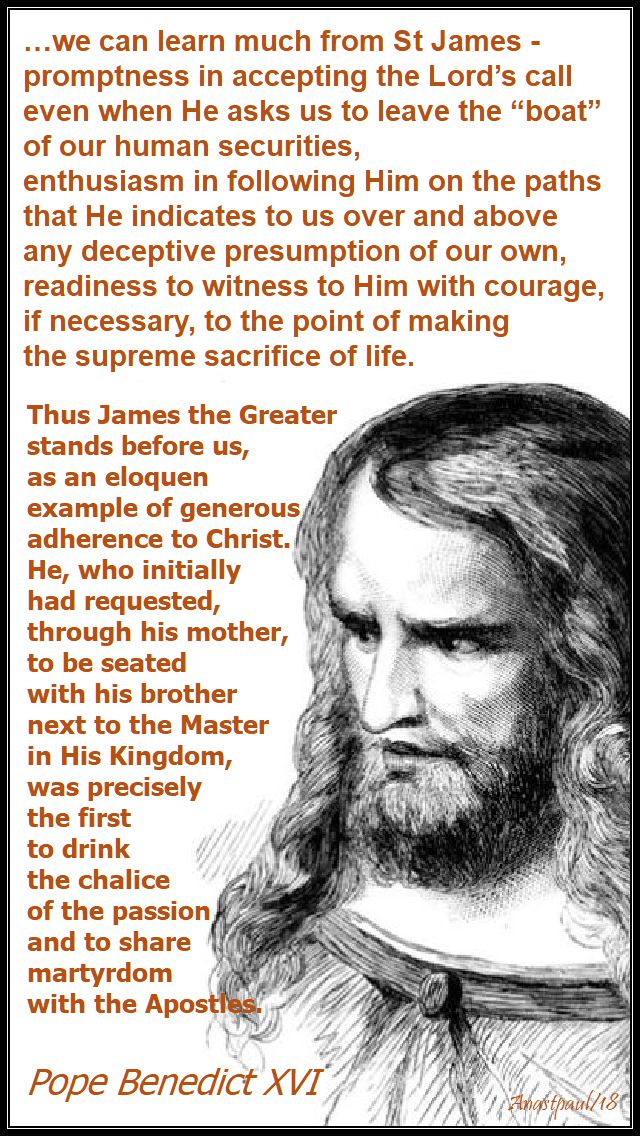
“…we can learn much from St James: promptness in accepting the Lord’s call even when He asks us to leave the “boat” of our human securities, enthusiasm in following Him on the paths that He indicates to us over and above any deceptive presumption of our own, readiness to witness to Him with courage, if necessary to the point of making the supreme sacrifice of life. Thus James the Greater stands before us, as an eloquent example of generous adherence to Christ. He, who initially had requested, through his mother, to be seated with his brother next to the Master in His Kingdom, was precisely the first to drink the chalice of the passion and to share martyrdom with the Apostles.”…Pope Benedict XVI – General Audience, 21 June 2006
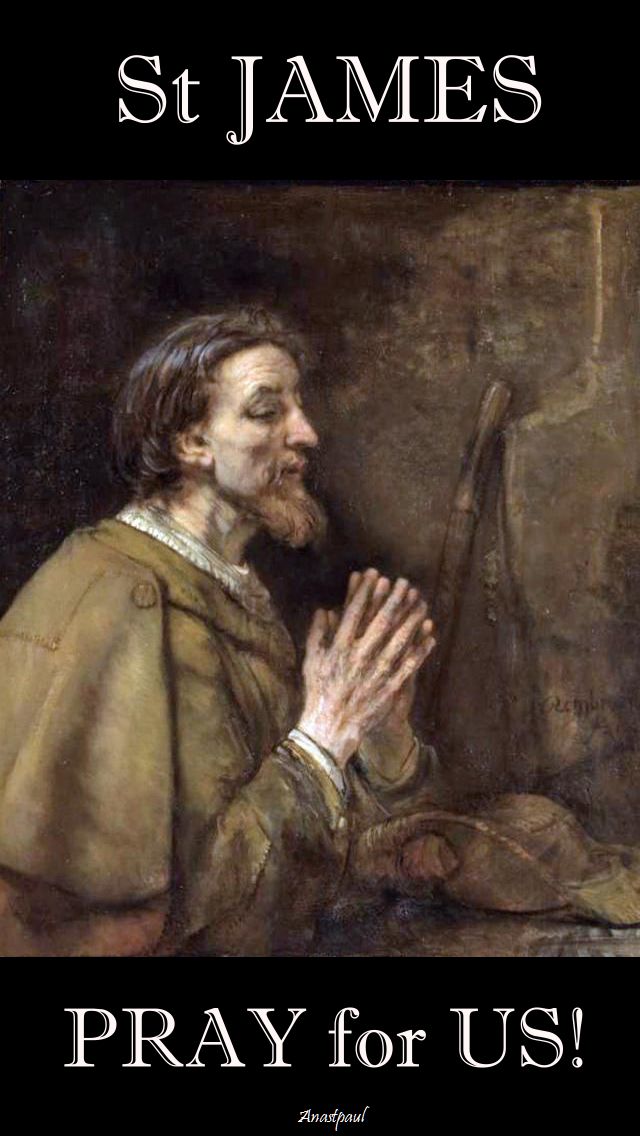
PRAYER – Lord our God, You accepted the sacrifice of St James, the first of Your Apostles to give his life for Your sake. May Your Church find strength in his martyrdom and support in his constant prayer. Through our Lord Jesus Christ, your Son, who lives and reigns with you in the unity of the Holy Spirit, one God, for ever and ever. St James the Greater, Apostle of Christ, Pray for us! Amen
Thought for the Day – 24 July – The Memorial of St Charbel Makhluf
Joseph Makhluf was born in 1828 at Beqa-Kafra, Lebanon. His peasant family lived a strong faith, were attentive to the Divine Liturgy and had a great devotion to the Mother of God.
At the age of 23, Charbel (the name he chose when entering Novitiate) left his closely knit family to enter the Lebanese-Maronite Monastery called Notre-Dame de Mayfouk. Following studies and profession at St Cyprian de Kfifane Monastery, he was ordained in 1859.
For the next seven years, Charbel lived in the mountainous community of Anaya. After that he spent the next twenty-three years in complete solitude at Sts Peter and Paul Hermitage near Anaya. He died there on Christmas Eve, 1898.
Charbel had a reputation for his austerity, penances, obedience and chastity. At times, Charbel was gifted with levitations during prayer and he had great devotion to the Most Blessed Sacrament.
In all things, Charbel maintained perfect serenity. He was beatified in 1965 by Blessed Pope Paul VI and canonised by him in 1977.
The spirit of Charbel still lives in many people. His miracles include numerous healings of the body and of the spirit. Thomas Merton, the American Hermit, wrote in his journal: “Charbel lived as a hermit in Lebanon—he was a Maronite. He died. Everyone forgot about him. Fifty years later, his body was discovered incorrupt and in short time he worked over 600 miracles. He is my new companion. My road has taken a new turning. It seems to me that I have been asleep for 9 years—and before that I was dead.”
At the closing of the Second Vatican Council, on 5 December 1965 when St Charbel was beatified by Pope Paul VI, he said:
“…a hermit of the Lebanese mountain is inscribed in the number of the blessed…a new eminent member of monastic sanctity is enriching, by his example and his intercession, the entire Christian people… May he make us understand, in a world largely fascinated by wealth and comfort, the paramount value of poverty, penance, and asceticism, to liberate the soul in its ascent to God…”
St Charbel Makhluf, Pray for us!
The Chaplet of St Charbel here: https://anastpaul.wordpress.com/2017/07/24/the-chaplet-of-st-charbel-makhluf/
And listen to this special song too:
and the lyrics here: https://anastpaul.wordpress.com/2017/07/24/thought-for-the-day-24-july-the-memorial-of-st-charbel-of-makhluf/
Quote of the Day – 24 July – Tuesday of the Sixteenth week in Ordinary Time, Year B – Today’s Gospel: Matthew 12:46-50
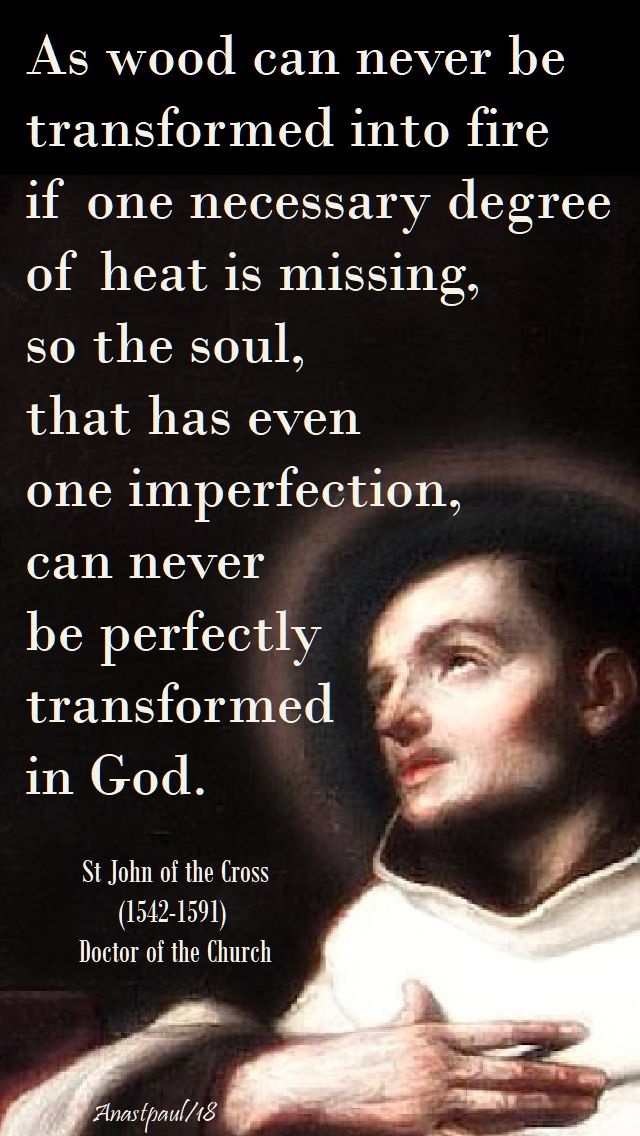
“For whoever does the will of my Father in heaven, is my brother and sister and mother.”…Matthew 12:50
It is a matter of real sorrow when God has given us strength to break stronger fetters, those of vanity and sin, that we neglect our own progress and the attainment of such great blessings, because we will not detach ourselves from trifles. Not only do we not advance, we fall back. For it is well known, that on the spiritual road, not to go on overcoming self, is to go backwards and not to increase our gain, is to lose. As wood can never be transformed into fire, if one necessary degree of heat is missing, so the soul, that has even one imperfection, can never be perfectly transformed in God.
St John of the Cross (1542-1591) Doctor of the Church
One Minute Reflection – 24 July 2018 – Tuesday of the Sixteenth week in Ordinary Time, Year B – Today’s Gospel: Matthew 12:46-50 and the Memorial of St Charbel Makhluf (1828-1898)
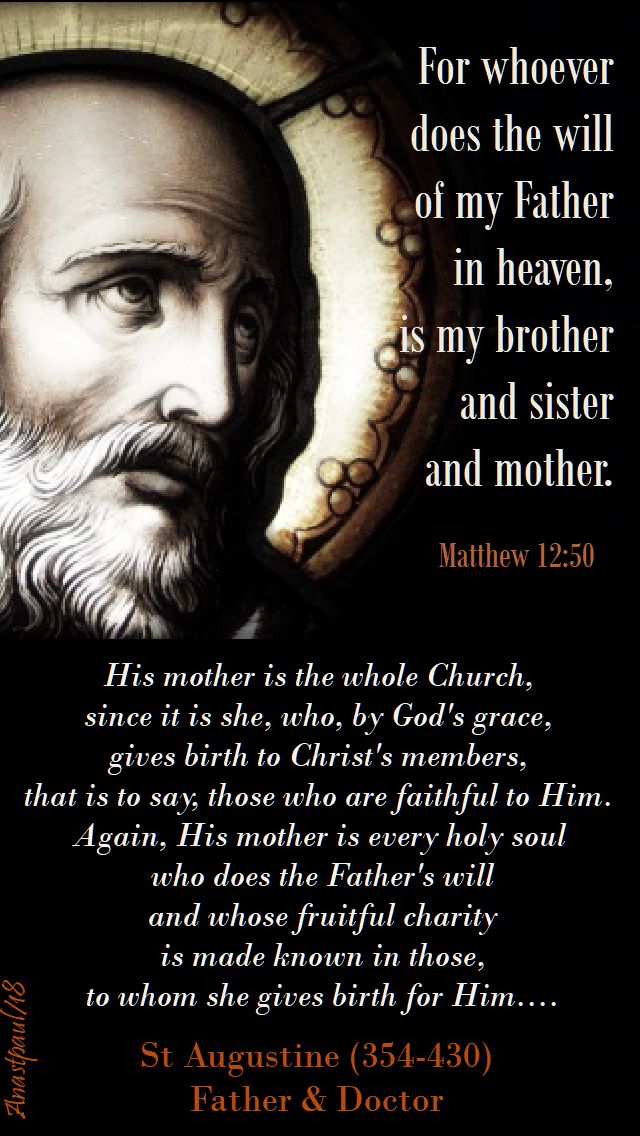
“For whoever does the will of my Father in heaven, is my brother and sister and mother.”…Matthew 12:50
REFLECTION – “His mother is the whole Church, since it is she, who, by God’s grace, gives birth to Christ’s members, that is to say, those who are faithful to Him. Again, His mother is every holy soul who does the Father’s will and whose fruitful charity is made known in those, to whom she gives birth for Him, “until he has been formed in them” (cf Gal 4:19)…St Augustine (354-430) Father & Doctor
PRAYER – Almighty Father, You made us Your children, You called us from all ages and You formed us by Holy Mother Church. Grant, we pray, that by Your grace, we may be ever faithful to her and be guided by Your Holy Spirit of love. O God may Your holy Saint Charbel Makhluf intercede for us that, being made imitators of the Lord’s Passion, we may merit to be co-heirs of His Kingdom. Who lives and reigns with You in the unity of the Holy Spirit, one God, forever, amen.
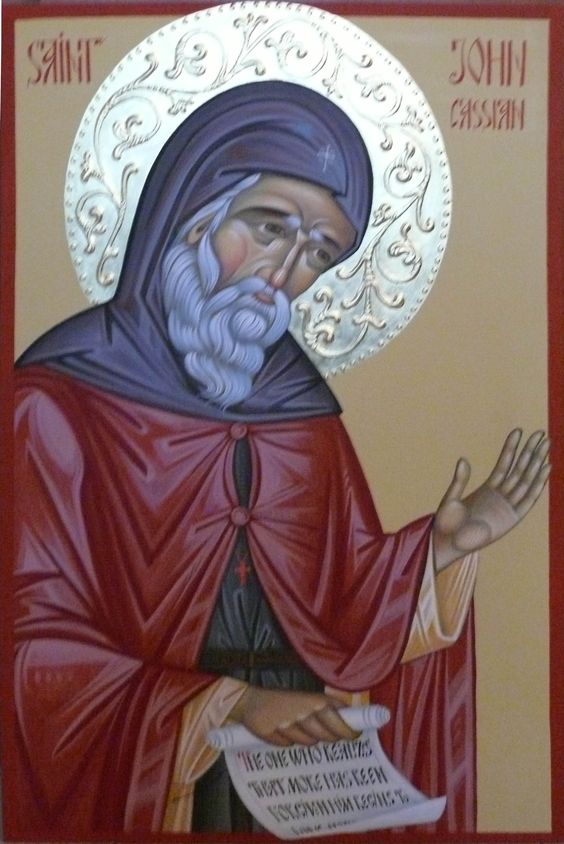
Quote of the Day – 23 July – The Memorial of St John Cassian (c 360- c 435)
“The thief on the cross certainly did not receive the Kingdom of Heaven as a reward for his virtues but as a grace and a mercy from God. He can serve as an authentic witness that our salvation is given to us only by God’s mercy and grace. All the holy masters knew this and unanimously taught that perfection in holiness can be achieved only through humility.”
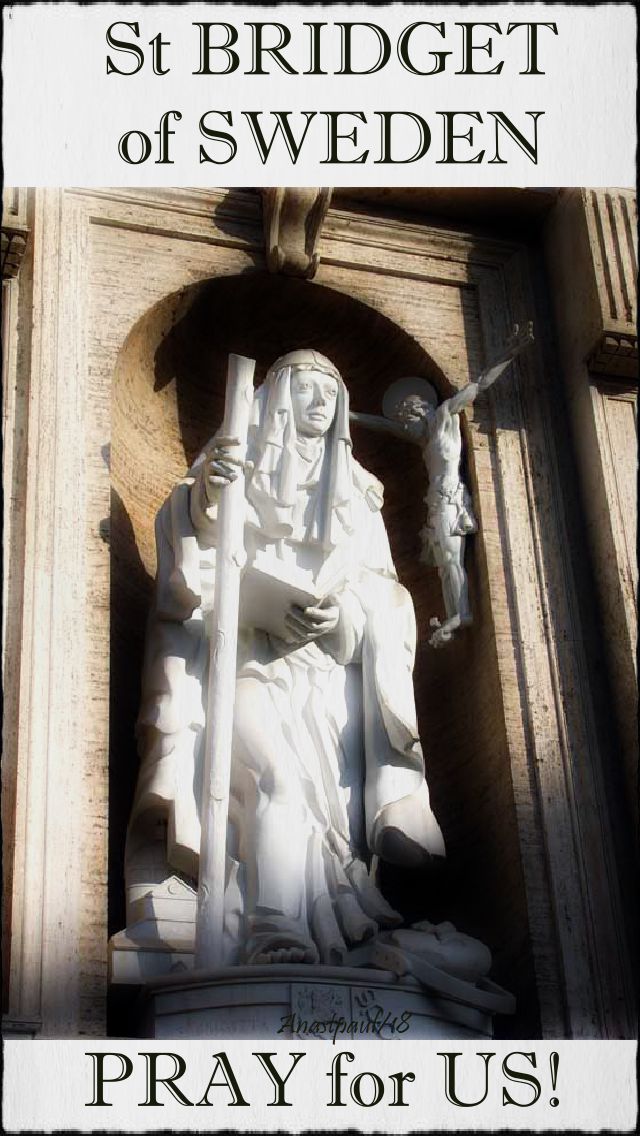
One Minute Reflection – 23 July – The Memorial of St Bridget of Sweden (c 1303 – 1373) – Today’s Gospel: Matthew 12:38-42
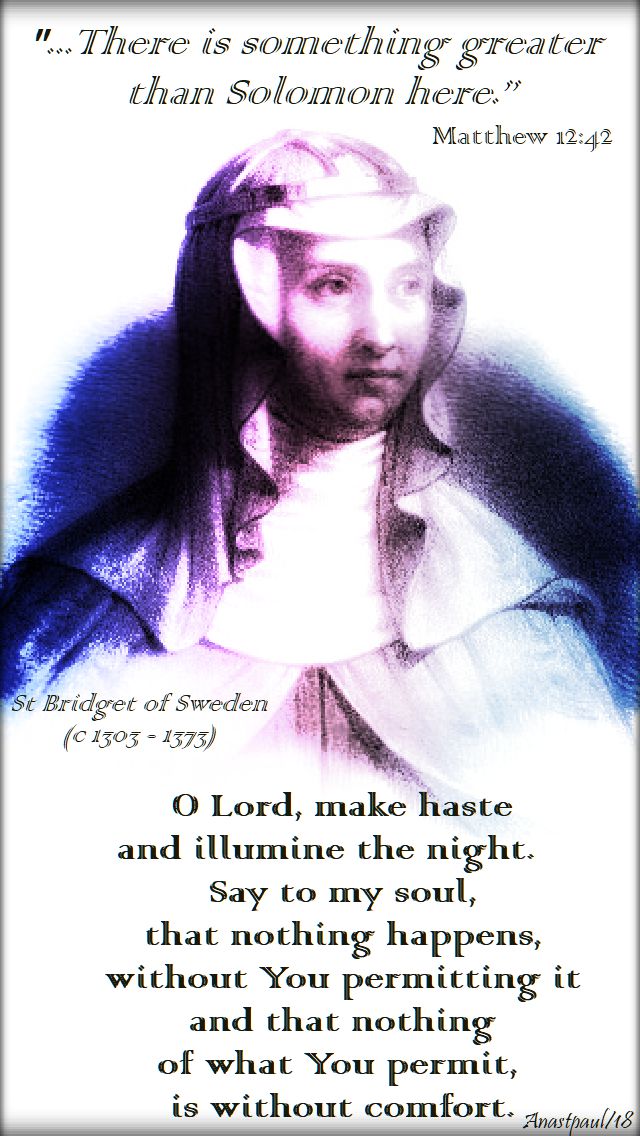
“…There is something greater than Solomon here.”…Matthew 12:42
REFLECTION – “O Lord, make haste and illumine the night. Say to my soul that nothing happens without You permitting it and that nothing of what You permit, is without comfort.”…St Bridget
PRAYER – “O Jesus, Son of God, You Who were silent in the presence of Your accusers, restrain my tongue until I find what should say and how to say it. Show me the way and make me ready to follow it. It is dangerous to delay, yet perilous to go forward. Answer my petition and show me the way. As the wounded go to the doctor in search of aid, so do I come to You. O Lord, give Your peace to my heart. “(St Bridget). And we ask God our Father that the prayers of St Bridget may serve as an aid as we strive to attain virtue, through Christ our Lord, with the Holy Spirit, God forever, amen.
Saint of the Day – 23 July – St John Cassian (c 360 – c 435) Priest, Monk, Theologian, Writer, Founder. Also known as John the Ascetic, or John Cassian the Roman (Latin: Ioannes Eremita Cassianus, Ioannus Cassianus, or Ioannes Massiliensis), was a Christian monk and theologian celebrated in both the Western and Eastern Churches for his mystical writings. St John Cassian is noted for his role in bringing the ideas and practices of Christian monasticism to the early medieval West. He was born in c 360 in Scythia Minor (modern-day Dobrogea, Romania) and died in c 435 in Massilia, Gaul (modern-day Marseilles, France), of natural causes.
Cassian was born around 360, most likely in the region of Scythia Minor (now Dobruja, a historical region shared today by Romania and Bulgaria), although some scholars assume a Gallic origin. The son of wealthy parents, he received a good education: his writings show the influence of Cicero and Persius. He was bilingual in Latin and Greek.
Cassian mentions having a sister in his first work, the Institutes, with whom he corresponded in his monastic life; she may have ended up with him in Marseilles.
Around 380, John Cassian migrated from Romania to Bethlehem, where he embraced the monastic life. After 385 he wandered the Egyptian desert, the heart of eastern monasticism. He visited abbots at monasteries and hermits in their caves, absorbing their teachings about the Christian life.
The year 400 found him on the staff of St John Chrysostom in Constantinople. When Chrysostom was unfairly deposed and exiled, Cassian was among his defenders who travelled to Rome to plead his case before the pope, who was Innocent I. At that time he was ordained a priest.
While he was in Rome, Cassian accepted the invitation to found an Egyptian-style monastery in southern Gaul, near Marseilles. He may also have spent time as a priest in Antioch between 404 and 415. In any case, he arrived in Marseilles around 415. His foundation, the Abbey of St Victor, was a complex of monasteries for both men and women, one of the first such institutes in the West and served as a model for later monastic development.
To instruct his monks and nuns, Cassian wrote two significant books. The Institutes described the eastern pattern of monastic life and the virtues required of monks. The Conferences presented the wisdom of the Egyptian desert in the form of discourses by famous abbots. In the following sample we hear “Abbot Isaac” on the practice of the presence of God:
“To keep the thought of God always in your mind you must cling totally to this formula for piety: ‘Come to my help, O God. Lord, hurry to my rescue’ (see Psalm 70:2).
“With good reason this verse has been chosen from the whole of Scripture as a device. It bears all the feelings that human nature can experience.
It can be adapted to every condition and deployed against every temptation. It carries a cry to God in the face of every danger. It piously confesses humility. It conveys our sense of frailty, our assurance of being heard, our confidence in help that is always and everywhere present. Someone forever calling out to his protector is very sure of his nearness. This short verse is an indomitable wall for all those struggling against the onslaught of demons.
Whatever the disgust, the anguish, or the gloom in our thoughts, it keeps us from despairing of our salvation since it reveals to us the One to whom we call, the One who sees our struggles and who is never far from those who pray to him.
If things go well for us in spirit, this verse is a warning. We must not get puffed up at being in a good condition that we cannot retain without the protection of God for whose continuous and speedy help it prays.
This little verse, I am saying, proves to be necessary and useful to each one of us in all circumstances.”
Cassian’s achievements and writings influenced Saint Benedict, who incorporated many of the principles into his monastic rule and recommended to his own monks that they read the works of Cassian. Since Benedict’s rule is still followed by Benedictine, Cistercian and Trappist monks, John Cassian’s thought still exercises influence over the spiritual lives of thousands of men and women in the Latin Church.
The Church also ranks him as a saint, with a feast day on 23 July. Like his contemporaries Saint Augustine of Hippo and Saint John Chrysostom, he was never formally canonised, a process that came into use several centuries after his death. Pope Urban V referred to him as sanctus (a saint) and he was included in the Gallican Martyrology. He is included also in the Roman Martyrology with a feast-day on 23 July. Like the great majority of recognised saints of the Church, he is not one of the saints in the General Roman Calendar, but the Archdiocese of Marseilles and some monastic orders celebrate his memorial on his feast day.
Cassian’s relics are kept in an underground chapel in the Monastery of St Victor in Marseilles. His head and right hand are in the main church there.
Today laypeople cannot practice the presence of God with the constancy that Cassian demanded. But we can frequently remind ourselves of God’s nearness and draw on his grace by praying “Come to my help, O God. Lord, hurry to my rescue.”
Thought for the Day – 22 July – Feast of St Mary of Magdala
“When Mary Magdalene came to the tomb and did not find the Lord’s body, she thought it had been taken away and so informed the disciples. After they came and saw the tomb, they too believed what Mary had told them. The text then says: “The disciples went back home,” and it adds: “but Mary wept and remained standing outside the tomb.”
We should reflect on Mary’s attitude and the great love she felt for Christ; for though the disciples had left the tomb, she remained. She was still seeking the one she had not found and while she sought she wept; burning with the fire of love, she longed for Him who she thought had been taken away.
And so it happened that the woman who stayed behind to seek Christ was the only one to see Him. For perseverance is essential to any good deed, as the voice of truth tell us: “Whoever perseveres to the end will be saved”…. Jesus says to her: “Mary.” Jesus is not recognised when He calls her “woman”, so He calls her by name, as though He were saying: ‘Recognise me as I recognise you, for I do not know you as I know others, I know you as yourself.’
And so Mary, once addressed by name, recognises who is speaking. She immediately calls Him ‘Rabboni’, that is to say, teacher, because the one whom she sought outwardly was the one who inwardly taught her to keep on searching.”
from a homily by St Pope Gregory the Great (540-604) Father & Doctor
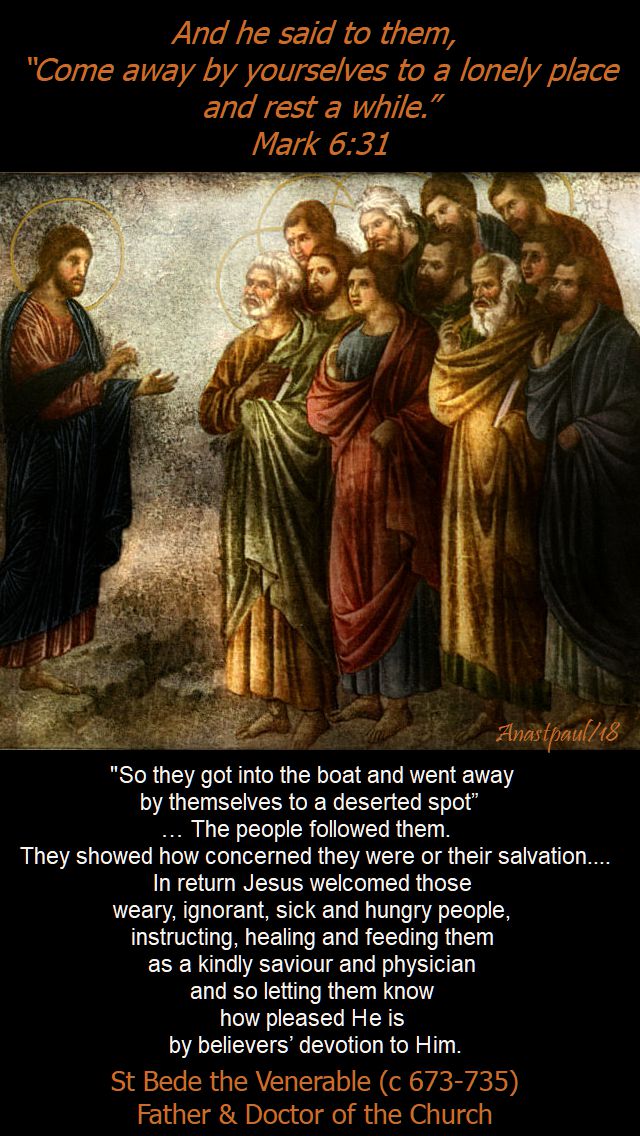
One Minute Reflection – 22 July – Sixteenth Sunday in Ordinary Time, Year B – Today’s Gospel: Mark 6:30-34
And he said to them, “Come away by yourselves to a lonely place and rest a while.”...Mark 6:31
REFLECTION – “So they got into the boat and went away by themselves to a deserted spot”… The people followed them. They showed how concerned they were for their salvation by the effort they made in going along the deserted road, not on donkeys or in carts of various kinds but on foot. In return Jesus welcomed those weary, ignorant, sick and hungry people, instructing, healing and feeding them as a kindly saviour and physician and so letting them know how pleased He is by believers’ devotion to Him.”…Saint Bede the Venerable (c 673-735) Father & Doctor of the Church (Commentary on Saint Mark’s gospel, 2 ; CCL 120, 510)
“Today we could pray during this mass for our shepherds, that the Lord may give them the grace to walk with the people and to be present for them with much tenderness and closeness. When people find their shepherd, they feel that special sensation only felt in the presence of God. The amazement comes from the feeling of the closeness and tenderness of God in the shepherd.”…Pope Francis – Santa Marta, 30 January 2018
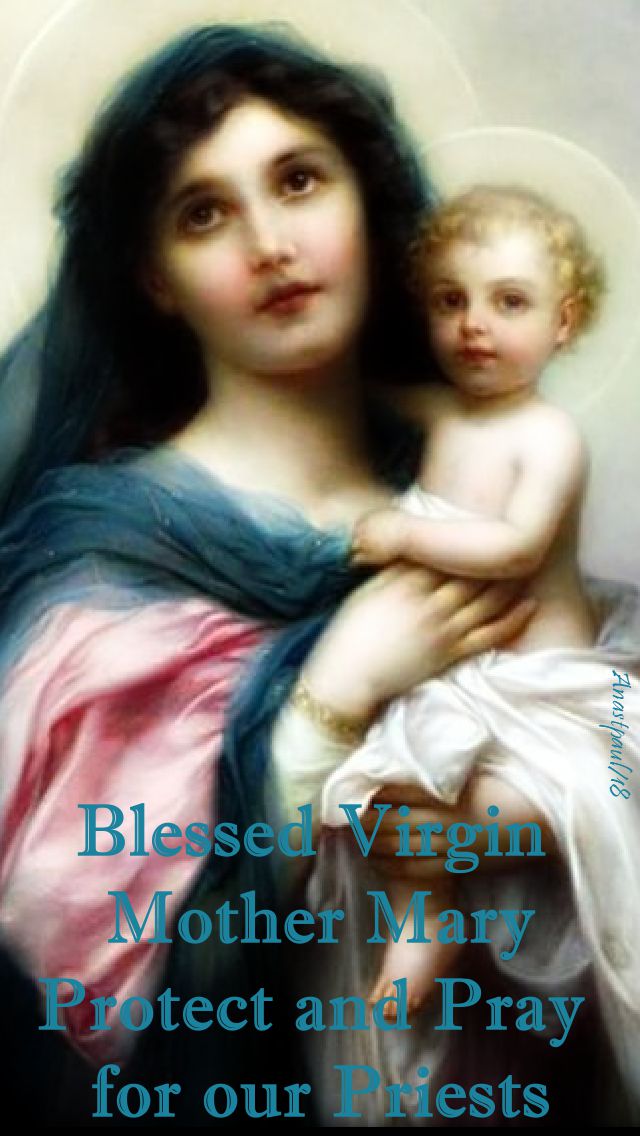
PRAYER – Be gracious, Lord, to us who serve You and in Your kindness increase Your gifts of grace within us, so that fervent in faith, hope and love, we may be ever on the watch and persevere in doing what You command. Guard, protect and inspire our own shepherds, our priests who serve Your people, keep them faithful, loyal and prayerful. May our Mother, the most Holy and Pure Blessed Virgin Mary, keep our priests and all of us at her side. Through our Lord Jesus Christ, one God with Holy Spirit, forever and ever, amen.
Quote/s of the Day – 21 July – The Memorial of St Lawrence of Brindisi OFM Cap (1559-1619) Doctor of the Church
“God is love and all his operations proceed from love. Once he wills to manifest that goodness by sharing His love outside Himself, then the Incarnation becomes the supreme manifestation of His goodness and love and glory. So, Christ was intended before all other creatures and for His own sake. For Him all things were created and to Him all things must be subject and God loves all creature, in and because of Christ. Christ is the first-born of every creature and the whole of humanity. as well as the created world, finds its foundation and meaning in Him. Moreover, this would have been the case, even if Adam had not sinned.”
“God is love and all His operations proceed from LOVE…”
“For Him all things were created and to Him all things must be subject and God loves all creature, in and because of Christ.”
“Christ is the first-born of every creature and the whole of humanity. as well as the created world, finds its foundation and meaning in Him.”
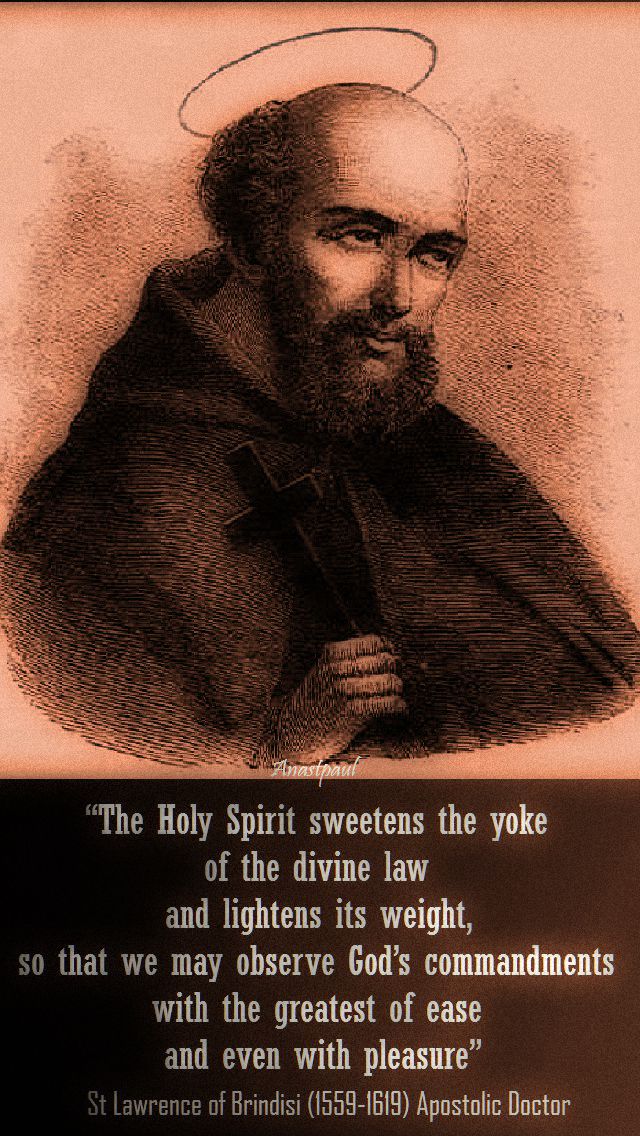
“The Holy Spirit sweetens the yoke of the divine law and lightens its weight, so that we may observe God’s commandments with the greatest of ease and even with pleasure”
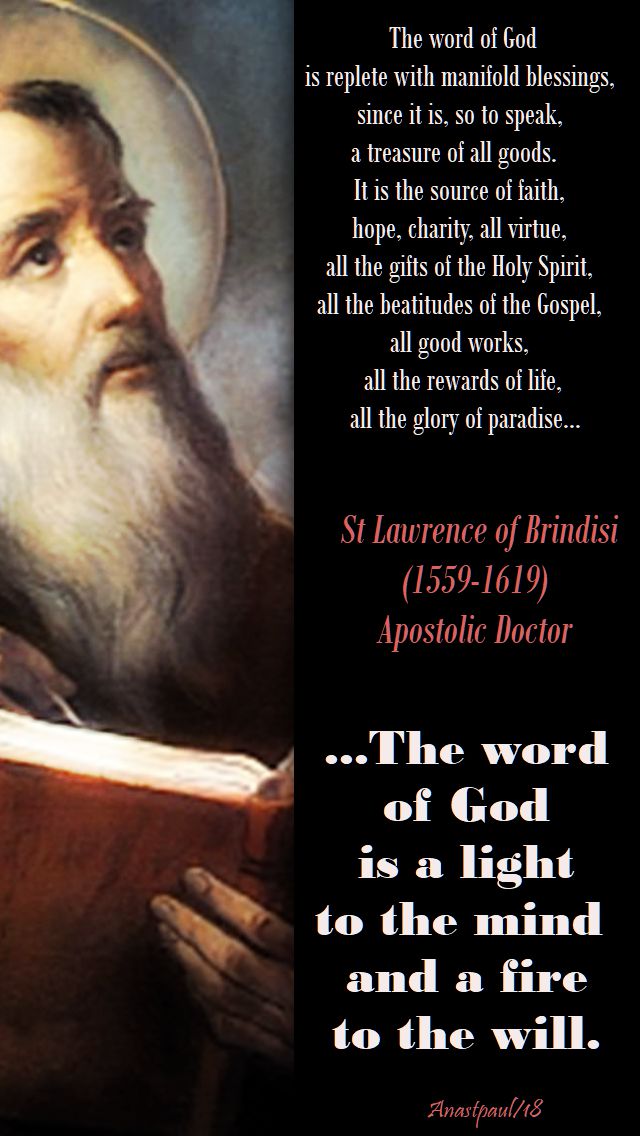
“The word of God is replete with manifold blessings, since it is, so to speak, a treasure of all goods. It is the source of faith, hope, charity, all virtue, all the gifts of the Holy Spirit, all the beatitudes of the Gospel, all good works, all the rewards of life, all the glory of paradise…”
“…The word of God is a light to the mind and a fire to the will.”
St Lawrence of Brindisi(1559-1619) Apostolic Doctor
One Minute Reflection – 21 July – Saturday of the Fifteenth week in Ordinary Time – The Memorial of St Lawrence of Brindisi OFM Cap (1559-1619) Doctor of the Church – Today’s Readings: Micah 2:1-5, Psalm 10:1-4, 7-8, 14, Matthew 12:14-21
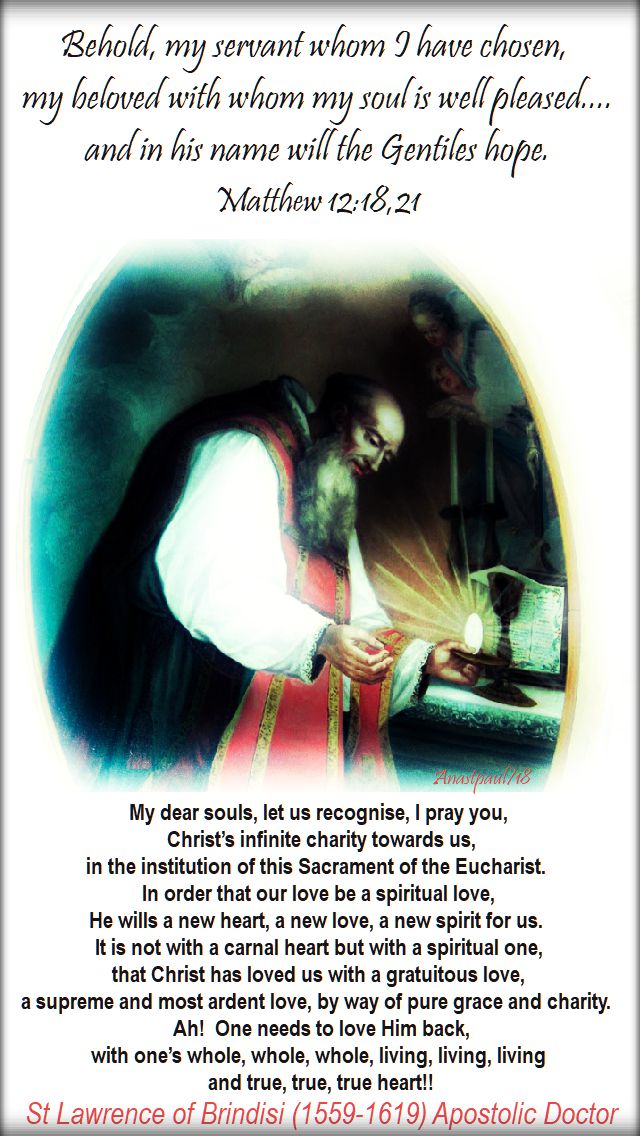
“Behold, my servant whom I have chosen, my beloved with whom my soul is well pleased…. and in his name will the Gentiles hope.”…Matthew 12:18,21
REFLECTION – “My dear souls, let us recognise, I pray you, Christ’s infinite charity towards us, in the institution of this Sacrament of the Eucharist. In order that our love be a spiritual love, He wills a new heart, a new love, a new spirit for us. It is not with a carnal heart but with a spiritual one, that Christ has loved us with a gratuitous love, a supreme and most ardent love, by way of pure grace and charity. Ah! One needs to love Him back with one’s whole, whole, whole, living, living, living and true, true, true heart!!” …… St Lawrence of Brindisi (1559-1619) Apostolic Doctor
PRAYER – Lord God, You bestowed on St Lawrence of Brindisi the spirit of counsel and fortitude, so that Your name might be glorified and souls be saved. At the intercession of St Lawrence, grant that we may see what we have to do and, in Your mercy give us the strength to do it and the courage, love and charity to persevere. Grant above all, that by his prayers we may love You above all and with all we are. St Lawrence pray for us, amen.
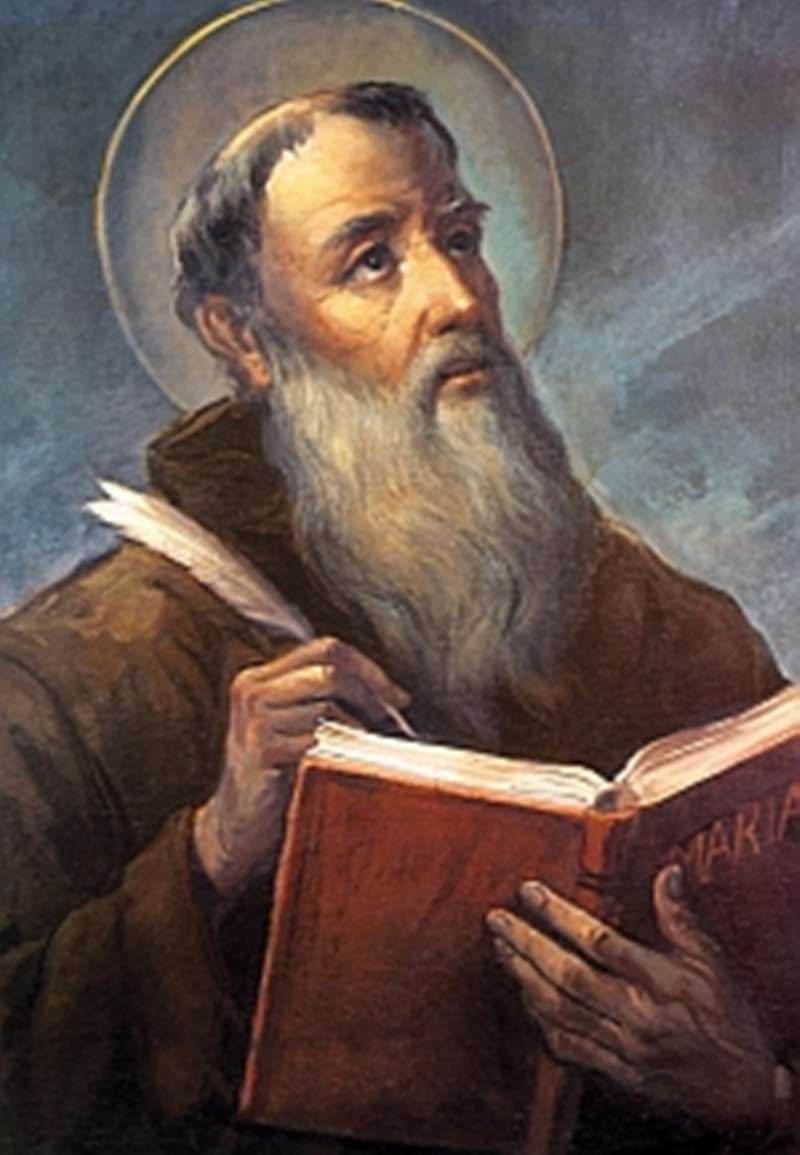
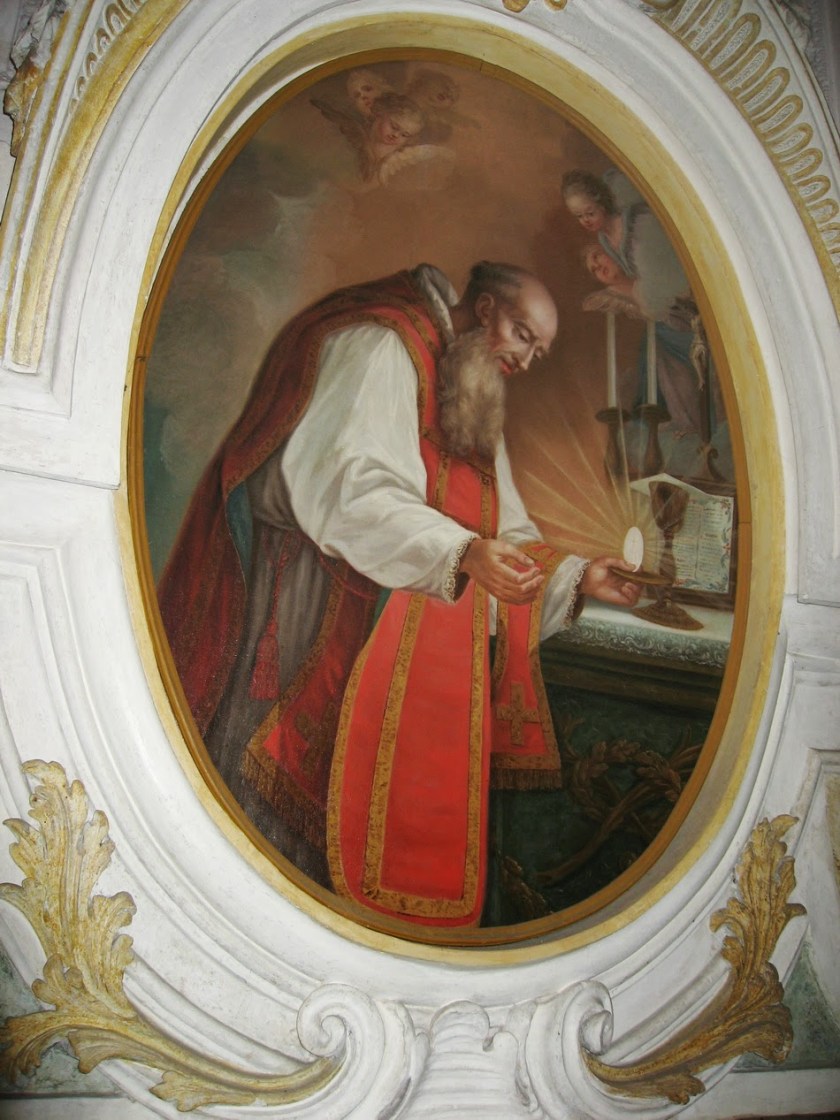
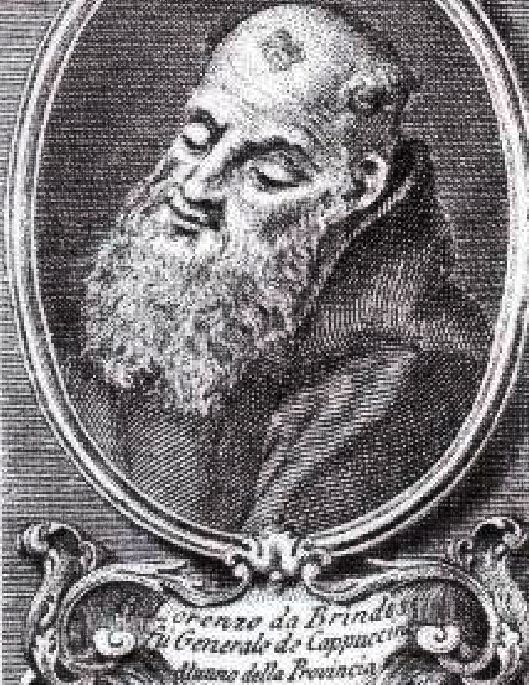
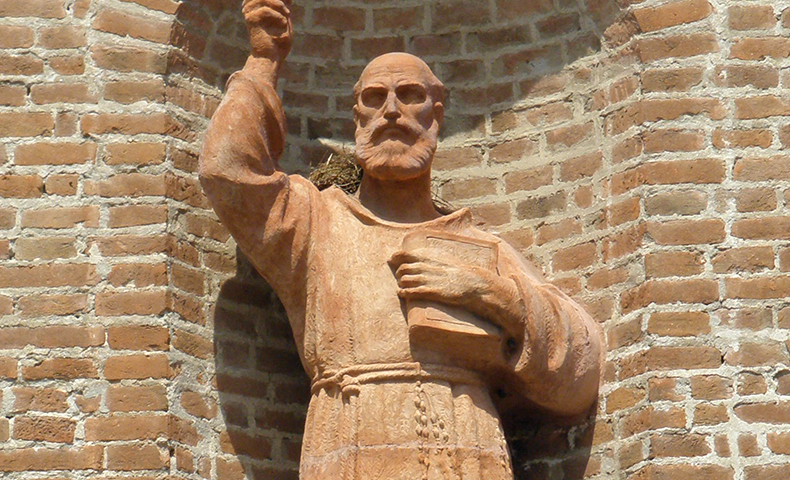
Saint of the Day – 21 July – St Lawrence of Brindisi OFM Cap (1559-1619) Doctor of the Church. He was created a Doctor of the Church by St Pope John XXIII in 1959 with the title Doctor apostolicus (Apostolic Doctor). Patronages – Brindisi, Italy.
St Lawrence is known as the “Franciscan Renaissance Man” – he was a Religious member of the Franciscan Friars Minor Capuchin, a Priest, Theologian, Vicar General of the Franciscans, Language scholar, Apologist of immense and calm resources, Humanist, Philosopher, Biblicist, Preacher, Missionary, Professor, International Administrator, Confidant of Popes, Emperors, Kings and Princes, Diplomatic envoy, Army Chaplain, Military Strategist and Morale builder, Polemicist, Prolific writer.
Saint Lawrence of Brindisi
By Pope Benedict XVI
General Audience, 23 March 2011
I still remember with joy the festive welcome I was given in Brindisi in 2008. It was in this city that in 1559 was born a distinguished Doctor of the Church, St Lawrence of Brindisi, the name that Julius Caesar Russo took upon entering the Capuchin Order.
He had been attracted since childhood by the family of St Francis of Assisi. In fact, his father died when he was seven years old and his mother entrusted him to the care of the Friars Minor Conventual in his hometown. A few years later, however, Lawrence and his mother moved to Venice and it was precisely there that he became acquainted with the Capuchins who in that period were generously dedicated to serving the whole Church in order to further the important spiritual reform promoted by the Council of Trent.
With his religious profession in 1575, Lawrence became a Capuchin friar and in 1582 he was ordained a priest. During his ecclesiastical studies for the priesthood he already showed the eminent intellectual qualities with which he had been endowed. He learned with ease the ancient languages, such as Greek, Hebrew and Syriac, as well as modern languages, such as French and German. He added these to his knowledge of Italian and of Latin that was once spoken fluently by all clerics and by all cultured people. Thanks to his mastery of so many languages, Lawrence was able to carry out a busy apostolate among the different categories of people. As an effective preacher, his knowledge, not only of the Bible but also of the rabbinic literature, was so profound that even the Rabbis, impressed and full of admiration, treated him with esteem and respect.
As a theologian steeped in Sacred Scripture and in the Fathers of the Church, he was also able to illustrate Catholic doctrine in an exemplary manner to Christians who, especially in Germany, had adhered to the Reformation. With his calm, clear exposition he demonstrated the biblical and patristic foundation of all the articles of faith disputed by Martin Luther. These included the primacy of St Peter and of his Successors, the divine origin of the Episcopate, justification as an inner transformation of man, and the need to do good works for salvation. Lawrence’s success helps us to realise that today too, in pursuing ecumenical dialogue with such great hope, the reference to Sacred Scripture, interpreted in accordance with the Tradition of the Church, is an indispensable element of fundamental importance. I wished to recall this in my Apostolic Exhortation Verbum Domini (n. 46). Even the simplest members of the faithful, those not endowed with great culture, benefited from the convincing words of Lawrence, who addressed humble people to remind them all to make their lives consistent with the faith they professed.
This was a great merit of the Capuchins and of other religious Orders which, in the 16th and 17th centuries, contributed to the renewal of Christian life, penetrating the depths of society with their witness of life and their teaching. Today too, the new evangelisation stands in need of well-trained apostles, zealous and courageous, so that the light and beauty of the Gospel, may prevail over the cultural tendencies of ethical relativism and religious indifference and transform the various ways of thinking and acting into genuine Christian humanism.
It is surprising that St Lawrence of Brindisi was able to continue without interruption his work as an appreciated and unflagging preacher in many cities of Italy and in different countries, in spite of holding other burdensome offices of great responsibility. Indeed, within the Order of Capuchins he was professor of theology, novice master, for several mandates minister provincial and definitor general and finally, from 1602 to 1605, minister general. In the midst of this mountain of work, Lawrence cultivated an exceptionally fervent spiritual life. He devoted much time to prayer and, especially, to the celebration of Holy Mass — often protracted for hours — caught up in and moved by the memorial of the Passion, death and Resurrection of the Lord.
At the school of the saints, every priest, as was emphasised frequently during the recent Year for Priests, may only avoid the danger of activism — acting, that is, without remembering the profound motives of his ministry — if he attends to his own inner life.
In speaking to priests and seminarians in the Cathedral of Brindisi, St Lawrence’s birthplace, I recalled that “the time he spends in prayer is the most important time in a priest’s life, in which divine grace acts with greater effectiveness, making his ministry fruitful. The first service to render to the community is prayer. And, therefore, time for prayer must be given true priority in our life… if we are not interiorly in communion with God, we cannot even give anything to others. Therefore, God is the first priority. We must always reserve the time necessary to be in communion of prayer with Our Lord” (Address of Benedict XVI to priests, deacons and seminarians of the Archdiocese of Brindisi, Cathedral of Brindisi, 15 June 2008).
Moreover, with the unmistakable ardour of his style, Lawrence urged everyone and not only priests, to cultivate a life of prayer, for it is through prayer that we speak to God and that God speaks to us: “Oh, if we were to consider this reality!”, he exclaimed. “In other words that God is truly present to us when we speak to him in prayer; that he truly listens to our prayers, even if we pray only with our hearts and minds. And that not only is he present and hears us, indeed he willingly and with the greatest of pleasure wishes to grant our requests”.
Another trait that characterises the opus of this son of St Frances, is his action for peace. Time and again both Supreme Pontiffs and Catholic Princes entrusted him with important diplomatic missions, to settle controversies and to encourage harmony among the European States, threatened in those days by the Ottoman Empire. The moral authority he enjoyed made him a counsellor both sought after and listened to. Today, as in the times of St Lawrence, the world is in great need of peace, it needs peaceful and peacemaking men and women. All who believe in God must always be sources and artisans of peace.
It was precisely on the occasion of one of these diplomatic missions that Lawrence’s earthly life ended, in 1619 in Lisbon, where he had gone to see King Philip III of Spain, to plead the cause of the Neapolitan subjects oppressed by the local authorities.
He was Canonised in 1881 and his vigorous and intense activity, his vast and harmonious knowledge, earned him the title of Doctor Apostolicus, “Apostolic Doctor”. The title was conferred on him by St Pope John XXIII in 1959, on the occasion of the fourth centenary of his birth. This recognition was also granted to Lawrence of Brindisi because he was the author of numerous works of biblical exegesis, theology and sermons. In them he offers an organic presentation of the history of salvation, centred on the mystery of the Incarnation, the greatest expression of divine love for humankind.
Furthermore, since he was a highly qualified Mariologist, the author of a collection of sermons on Our Lady entitled “Mariale”, he highlighted the unique role of the Virgin Mary, whose Immaculate Conception and whose role in the redemption brought about by Christ he clearly affirms.
With a fine theological sensitivity, Lawrence of Brindisi also pointed out the Holy Spirit’s action in the believer’s life. He reminds us that the Third Person of the Most Holy Trinity illumines and assists us with his gifts in our commitment to live joyously the Gospel message.
“The Holy Spirit”, St Lawrence wrote, “sweetens the yoke of the divine law and lightens its weight, so that we may observe God’s commandments with the greatest of ease and even with pleasure”.
I would like to complete this brief presentation of the life and doctrine of St Lawrence of Brindisi by underlining that the whole of his activity was inspired by great love for Sacred Scripture, which he knew thoroughly and by heart and by the conviction that listening to and the reception of the word of God produces an inner transformation that leads us to holiness.
“The word of the Lord”, he said, “is a light for the mind and a fire for the will, so that man may know and love God. For the inner man, who lives through the living grace of God’s Spirit, it is bread and water but bread sweeter than honey and water better than wine or milk…. It is a weapon against a heart stubbornly entrenched in vice. It is a sword against the flesh, the world and the devil, to destroy every sin”.
St Lawrence of Brindisi teaches us to love Sacred Scripture, to increase in familiarity with it, to cultivate daily relations of friendship with the Lord in prayer, so that our every action, our every activity, may have its beginning and its fulfilment in him. This is the source from which to draw so that our Christian witness may be luminous and able to lead the people of our time to God….vatican.va Pope Benedict
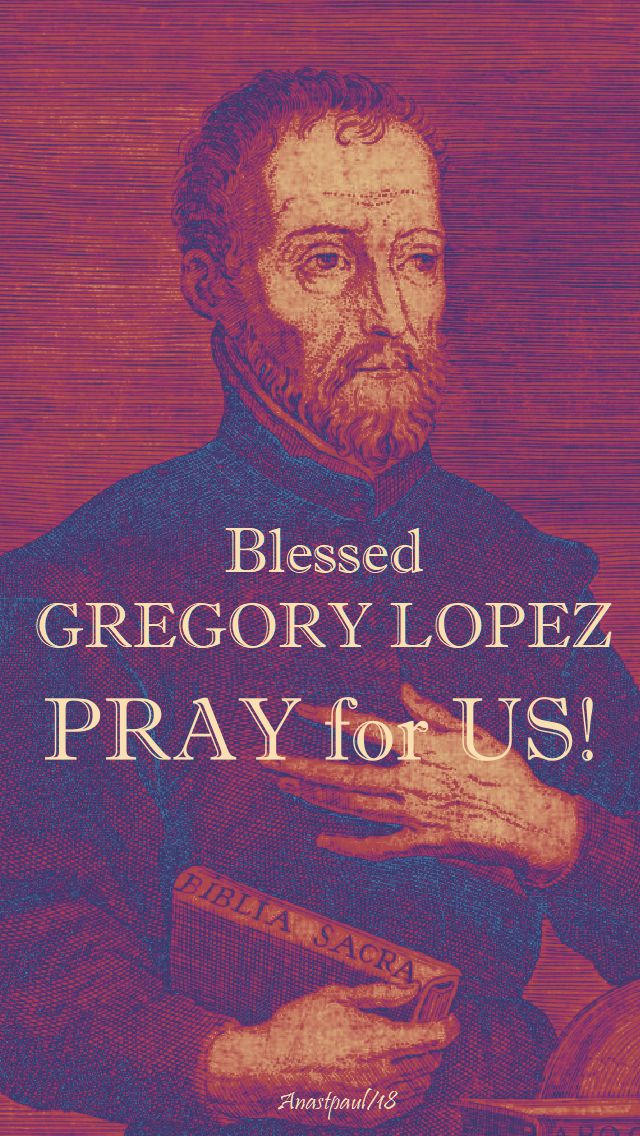
Thought for the Day – 20 July – The Memorial of Bl Gregory Lopez (1542-1596)
There are no patterns for sainthood and the Saints break all moulds.
God is interested in us, right where we are. He has placed us there and our own particular circumstances are as good a place as any other to become a saint . Holiness is within our reach! Only He knows where our pathways will lead. As Blessed Gregory and all our Saints show, it is about abandoning ourselves to Him and living our lives, where we are, in and for Him alone, keeping our eyes ever fixed on Christ . Over the course of time, our prayer evolves from acceptance of God’s will to a conscious act of love of God, to a devotion to and imitation of the person of Jesus, the Logos.
His Biographer, Fr Francisco de Losa said: “His soul appeared to be disengaged from all things else by a pure union with God.”
And as López said to him: “It is much better to treat with God than with man….The eyes of the true man are always fixed on Christ, who is his head and the soul that is touched with love of God is like a needle that is touched with the lodestone always pointing to the North.”…Blessed Gregory
An old print of this servant of God states in a few lines:
“The miser runs o’er sea and land His riches to increase, But Lopez, on the other hand, For poverty and peace.”
Many miracles were ascribed to him in life and after death. In February, 1620, the King of Spain ordered his Treatise on the Apocalypse published, adding, “I do not wish to lose a single moment in procuring the canonisation of this holy man, who,” as he says elsewhere, “passed thirty-three years in solitude in a marvellous penance, humility and love of God and his neighbour and had an admirable gift of prayer and understanding of the Holy Scriptures and the supernatural and human sciences, with the general approbation of the prelates and people of Mexico.” In fact, in the examinations that took place, bishops and theologians of all the religious orders, bore unanimous testimony to his extraordinary virtue and progress in the science of the saints.
Quote/s of the Day – 20 July – Today’s Gospel: Matthew 12:1-8
” And if you had known what this means, ‘I desire mercy and not sacrifice,’ you would not have condemned the guiltless…”.…Matthew 12:7
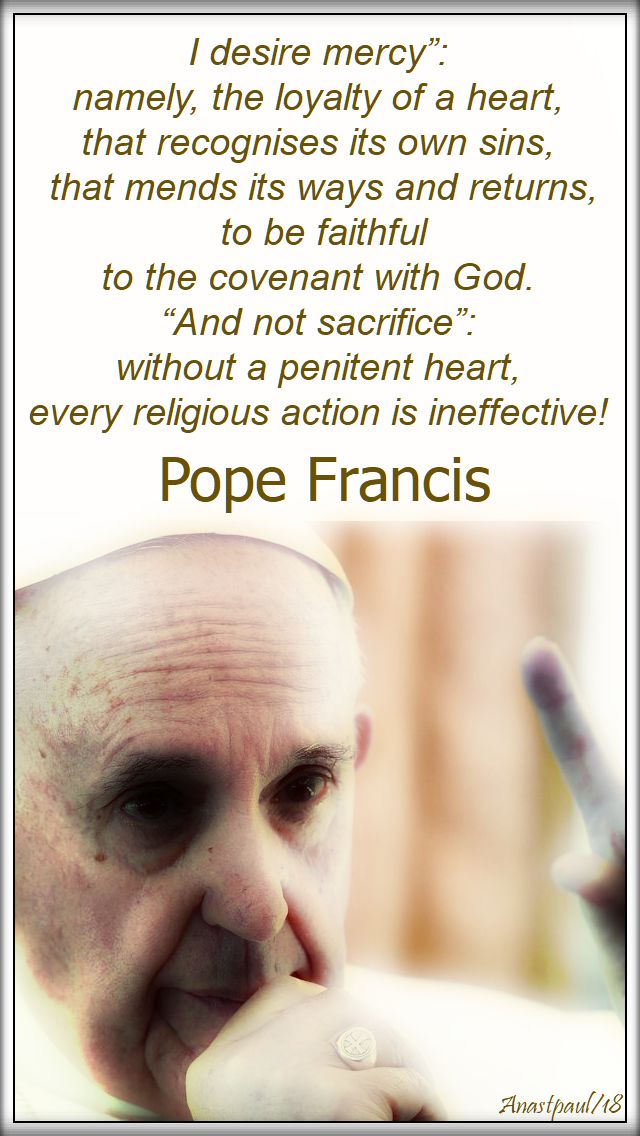
“I desire mercy”: namely, the loyalty of a heart, that recognises its own sins, that mends its ways and returns, to be faithful to the covenant with God. “And not sacrifice”: without a penitent heart, every religious action is ineffective!”
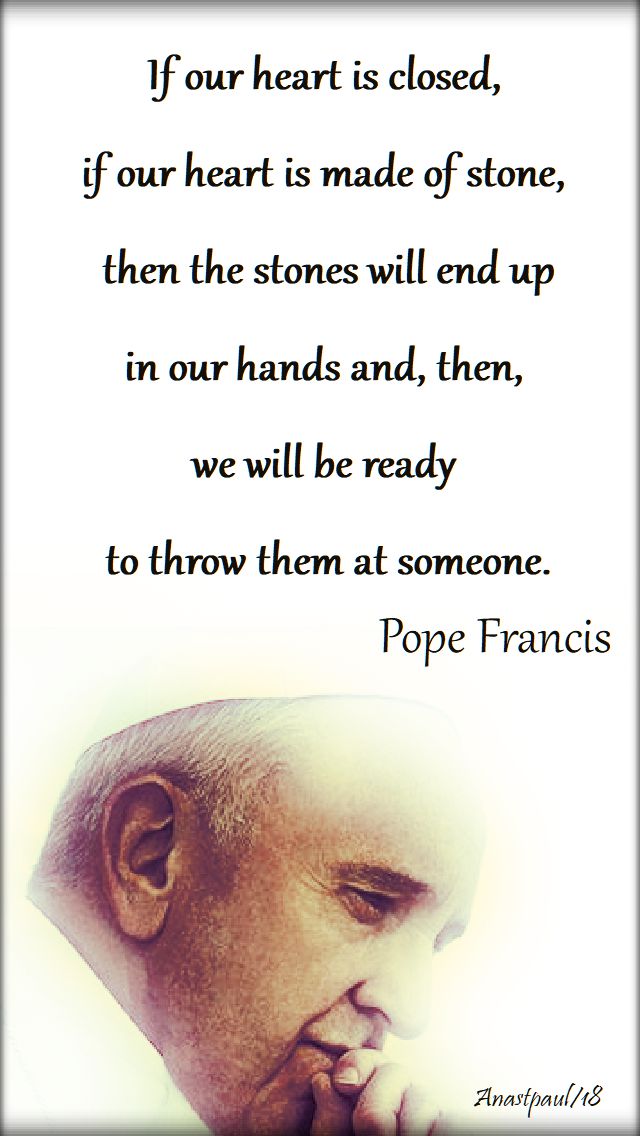
” If our heart is closed, if our heart is made of stone, then the stones will end up in our hands and, then, we will be ready to throw them at someone.”
One Minute Reflection – 20 July – Friday of the Fifteenth week in Ordinary Time, B – Today’s First Reading: Isaiah 38:1-6.,1-22,7-8 and the Memorial of Bl Gregory Lopez (1542-1596)
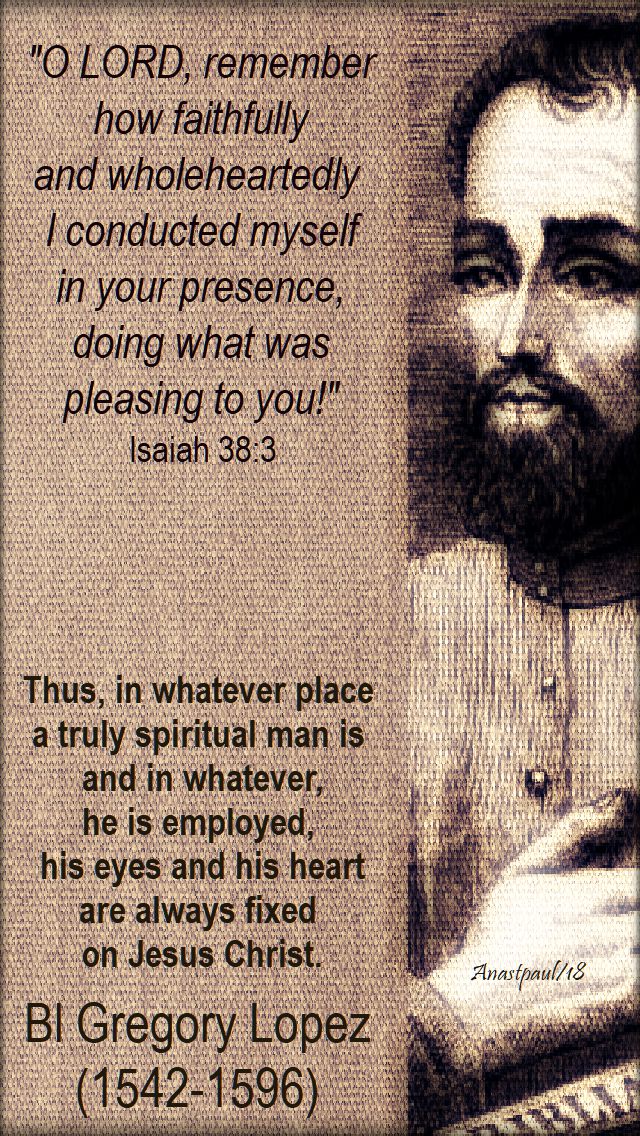
“O LORD, remember how faithfully and wholeheartedly I conducted myself in your presence, doing what was pleasing to you!” ….Isaiah 38:3
REFLECTION – “Thus, in whatever place a truly spiritual man is and in whatever, he is employed, his eyes and his heart are always fixed on Jesus Christ.”…Blessed Gregory Lopez
PRAYER – Almighty Father, let Your light so penetrate our minds, that walking by Your commandments, we may always follow You, our leader and our guide. Turn our hearts to see Your Son who “goes before us” and help us to never lose sight of His saving way. May the prayers of all Your holy ones in heaven, who are our examples and those of Blessed Gregory, be of assistance to us as we walk our earthly journey. We make our prayer through Christ, our Lord, amen.
Pope Francis announced this morning, 19 July 2018, during an Ordinary Public Consistory that he will canonise an additional person on October 14 along with Blessed Paul VI and Blessed Oscar Romero.
It is fitting that Blessed Nunzio Sulprizio, who died at the age of 19, be canonised during the Synod whose theme is Young People, the Faith and Vocational Discernment. Now with the addition of Blessed Nunzio, the canonisation will include people from every walk of life: clerical, religious and lay.
Blessed Nunzio was born in Pescosansonesco in Italy in April of 1817. He lost both of his parents while still a child and was brought up by an uncle. His uncle exploited him, not allowing him to go to school and forced him to work in his blacksmith shop. Regardless of extreme cold or intense heat, he was forced to carry enormous weights over great distances.
He found refuge before the Tabernacle where he would keep Jesus company.
After contracting gangrene in one of his legs, he was sent to a hospital for people with incurable diseases in Naples. He suffered tremendously on account of the pain. Yet, he is known to have said such things as:
Jesus suffered so much for us and by His merits we await eternal life. If we suffer a little bit, we will taste the joy of paradise. Jesus suffered a lot for me. Why should I not suffer for Him? I would die in order to convert even one sinner. When asked who was taking care of him, he would respond: “God’s Providence”.
Once he got better, he dedicated himself to helping other patients. But his health took a sudden turn for the worse. He died from bone cancer in May of 1836 before he reached his 20th birthday.
Pope Paul VI said the following when he Beatified Nunzio on 1 December 1963:
Nunzio Sulprizio will tell you that the period of youth should not be considered the age of free passions, of inevitable falls, of invincible crises, of decadent pessimism, of harmful selfishness. Rather, he will rather tell you how being young is a grace… St Philip used to repeat: Blessed are you, young people, who have the time to do good.
It is a grace, it is a blessing to be innocent, to be pure, to be happy, to be strong, to be full of ardour and life – just like those who receive the gift of fresh and new existence should be, regenerated and sanctified by baptism. They receive a treasure that should not be foolishly wasted but should be known, guarded, educated, developed and used to produce fruit for their own benefit and that of others.
He will tell you that no other age than yours, young people, is as suitable for great ideals, for generous heroism, for the coherent demands of thought and action.
He will teach you how you young people can regenerate the world in which Providence has called you to live and how it is up to you first to consecrate yourselves for the salvation of a society that needs strong and fearless souls.
He will teach you that the supreme word of Christ is to be the sacrifice, the cross, for our own salvation and that of the world. Young people understand this supreme vocation. (vaticannews.va)
Thought for the Day – 19 July – Thursday of the Fifteenth week in Ordinary Time, Year B – Today’s Gospel: Matthew 11:28-30.
“Come to me, all who labour and are heavy laden and I will give you rest. Take my yoke upon you and learn from me; for I am gentle and lowly in heart and you will find rest for your souls. For my yoke is easy, and my burden is light.”…Matthew 11:28-30
The light burden of the law of Christ
Saint Jerome (347-420)
Priest, Translator of the Bible,
Father & Doctor of the Church
“Bear one another’s burdens and so you will fulfil the law of Christ.” Sin is a burden as the psalmist attests when he says: “My sins weigh heavy upon me.” But the Lord has carried this burden for us, teaching us, by His example what we ourselves should do. For it is He who bore the burden of our sins; He was stricken for our sake (cf Is 53:8) and invites those who are weighed down by the heavy burden of the Law and of their sins to carry the easy burden of virtue, saying: “My yoke is easy and my burden is light” (Mt 11:30).
Therefore, whoever holds out a hand to the person who begs for support, not despairing of a neighbour’s salvation, who weeps with those who weep, is weak with those who are weak and who regards other’s sins as though they were his own – such a one, fulfils through charity, the law of Christ. What is this law of Christ? “I give you a new commandment, that you love one another” (Jn 13:34). What is the law of the Son of God? “Love one another as I have loved you.” How has the Son of God loved us? No one has greater love than this, “to lay down one’s life for one’s friends” (Jn 15:13).
Someone who shows no clemency, who is not clothed with the bowels of mercy and tears, no matter what sort of student he is in spirituality, such a one does not fulfil the law of Christ.
Someone who comes to the assistance of the poor weighed down by the burden of destitution and makes friends with dishonest wealth (Lk 16:9), such a one shoulders the needs of his neighbour. This is the one to whom Jesus will say after the general resurrection: “Come, you that are blessed by my Father, inherit the kingdom prepared for you from the foundation of the world. For I was hungry and you gave me food, I was thirsty and you gave me something to drink” (Mt 25:34-35).
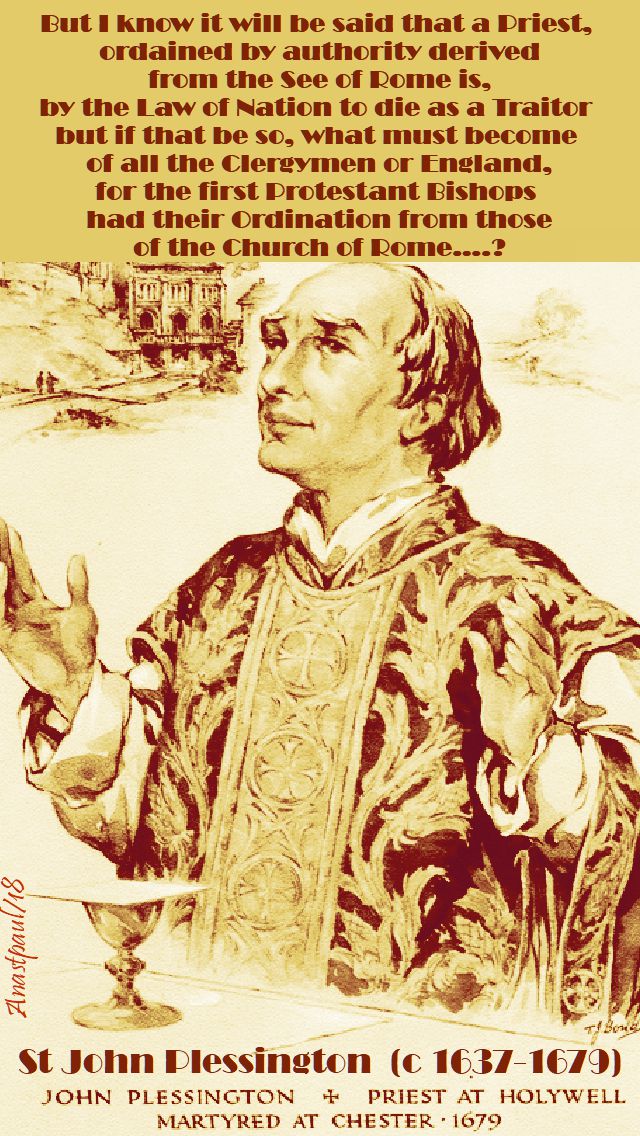
Quote/s of the Day – 19 July – The Memorial of St John Plessington (c 1637-1679) Martyr of England
“But I know it will be said that a Priest, ordained by authority derived from the See of Rome, is by the Law of Nation, to die as a Traitor but if that be so, what must become of all the Clergymen or England, for the first Protestant Bishops had their Ordination from those of the Church of Rome….?”
“Bear witness, good hearers, that I profess, that I undoubtedly and firmly believe, all the Articles of the Roman Catholic Faith and for the truth of any of them, (by the assistance of God), I am willing to die and I had rather die, than doubt of any Point of Faith, taught by our Holy Mother the Roman Catholic Church.”
St John Plessington (c 1637-1679)
Martyred because he was a Catholic Priest
by Elizabeth I of England
John Plessington was born at Dimples Hall, near Garstang, Lancashire in 1637, the son of Robert Plessington and Alice Rawstone, into a family at odds with the authorities, for both their religious and political beliefs. Educated by Jesuits at Scarisbrick Hall, at Saint Omer’s in France and then at the College of Saint Alban at Valladolid, Spain, he was ordained in Segovia on 25 March 1662. He returned to England in 1663 ministering to Catholics in the areas of Holywell and Cheshire, often hiding under the name William Scarisbrick. He was also tutor at Puddington Hall near Chester. Upon arrest in Chester during the Popish Plot scare caused by Titus Oates, he was imprisoned for two months, and then hanged, drawn and quartered for the crime of being a Catholic priest. His speech from the scaffold at Gallow’s Hill in Boughton, Cheshire was printed and distributed:
He said: “I know it will be said that a priest ordayned by authority derived from the See of Rome is, by the Law of the Nation, to die as a Traytor but if that be so what must become of all the Clergymen of the Church of England, for the first Church of England Bishops had their Ordination from those of the Church of Rome, or not at all, as appears by their own writers so that Ordination comes derivatively from those now living.”
He was martyred in 1679. He was beatified in 1929 by Pope Pius XI, and canonised as one of the Forty Martyrs on 25 October 1970 by Blessed Pope Paul VI.
A lot more detail about St John here: https://anastpaul.wordpress.com/2017/07/19/saint-of-the-day-19-july-st-john-plessington/
and his scaffold speech here: https://anastpaul.wordpress.com/2017/07/19/thought-for-the-day-19-july/
One Minute Reflection – 19 July – Thursday of the Fifteenth week in Ordinary Time, Year B – Today’s Gospel: Matthew 11:28-30.
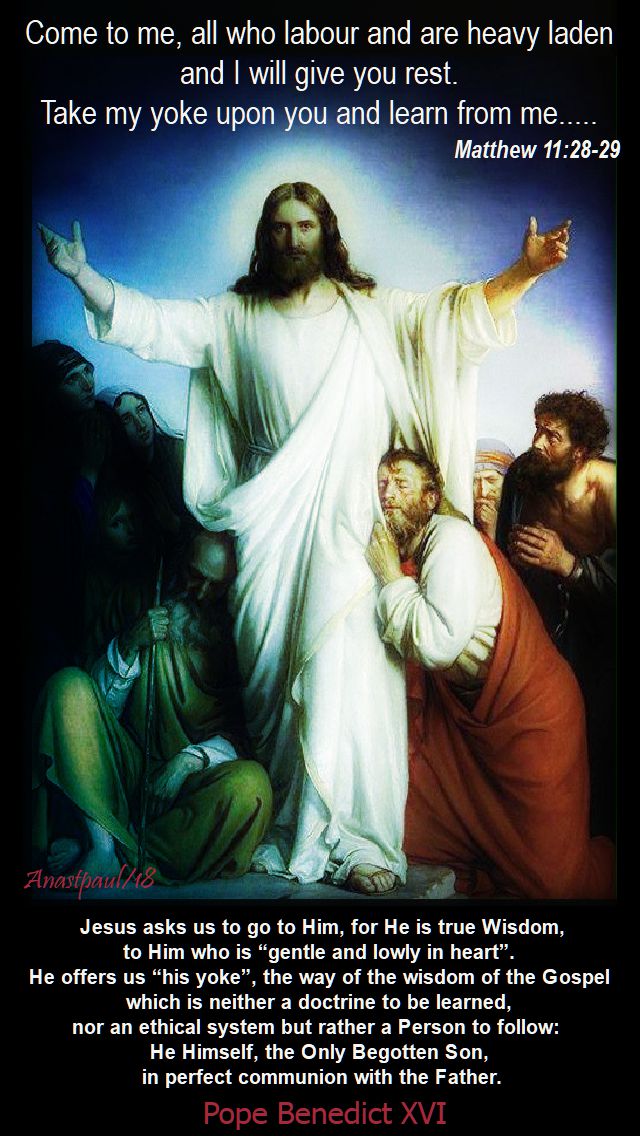
“Come to me, all who labour and are heavy laden and I will give you rest. Take my yoke upon you and learn from me; for I am gentle and lowly in heart and you will find rest for your souls. For my yoke is easy, and my burden is light.”…Matthew 11:28-30
REFLECTION – “Jesus asks us to go to Him, for He is true Wisdom, to Him who is “gentle and lowly in heart”. He offers us “his yoke”, the way of the wisdom of the Gospel which is neither a doctrine to be learned, nor an ethical system but rather a Person to follow: He Himself, the Only Begotten Son, in perfect communion with the Father.”…Pope Benedict, XVI, General Audience, 7 December 2011
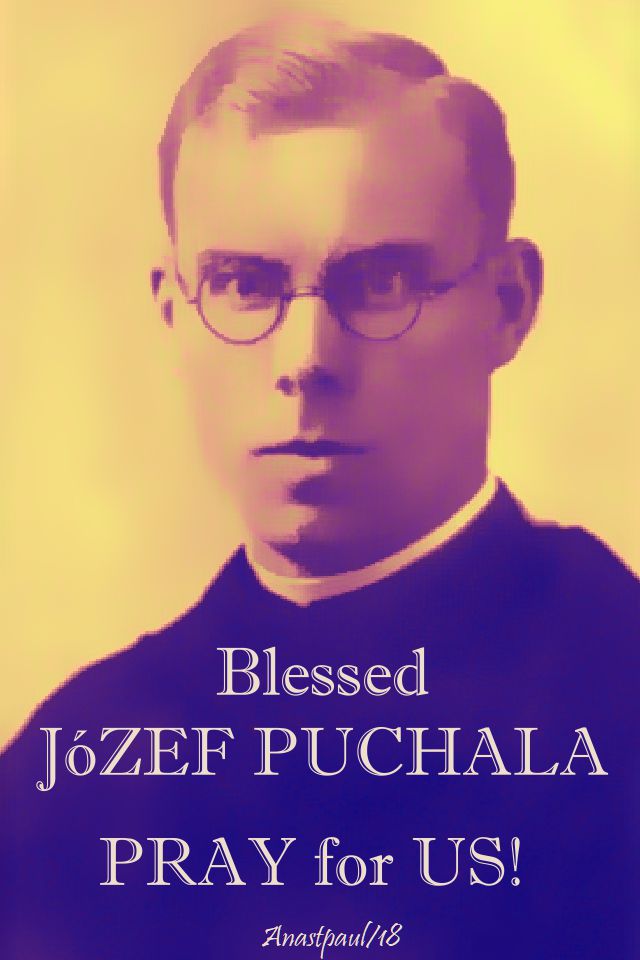
PRAYER – “Holy God, our Father, we turn to You in confidence as children and pray, give us meekness of heart, make us “poor in spirit” that we may recognise that we are not self-sufficient, that we are unable to build our lives on our own but need You, we need to encounter You, to listen to You, to speak to You. Help us to understand that we need Your gift, Your wisdom, which is Jesus Himself, in order to do the Your will in our lives and thus to find rest in the hardships of our journey.” Blessed Jozef Puchala, Holy Martyr for Christ, Pray for us, amen. (Adapted from the same homily above.)
NOTE: The Image used for the Reflection above is called “Christ the Consolator” by Carl Heinrich Bloch (1834-1890). You would be mistaken in believing that this great Artist was a Mormon but of course, he was a Danish Artist of a Christian leaning (Mormons are NOT Christians and were begun by Joseph Smith in the 1820s in New York), studied and was inspired and drawn to Catholicism (but did not convert) in Rome and was vastly influenced by Rembrandt (a protestant) in Holland. The Mormons have used his artworks endlessly – in their temples, advertising and media, he would be highly indignant I believe, without a doubt!
Thought for the Day – – 18 July – The Holy Father’s Prayer Intention for July “Pray for our Priests and their Pastoral Ministry”
What joy did the Apostles feel after the Resurrection of Our Lord, at seeing the Master whom they had loved so much! The priest must feel the same joy, at seeing Our Lord whom he holds in his hands. Great value is attached to objects which have been laid in the drinking cup of the Blessed Virgin and of the Child Jesus, at Loretto. But the fingers of the priest, that have touched the adorable Flesh of Jesus Christ, that have been plunged into the chalice which contained His Blood, into the pyx where His Body has lain, are they not still more precious?
The priesthood is the love of the Heart of Jesus.
When you see the priest, think of Our Lord Jesus Christ.
St John Vianney (1786-1859) Patron of Priests
Prayer for Priests By St John Vianney
God, please give to Your Church today
many more priests after Your own heart.
May they be worthy representatives
of Christ the Good Shepherd.
May they wholeheartedly devote themselves
to prayer and penance;
be examples of humility and poverty;
shining models of holiness;
tireless and powerful preachers
of the Word of God;
zealous dispensers of Your grace
in the sacraments.
May their loving devotion to Your Son,
Jesus in the Eucharist
and to Mary His Mother,
be the twin fountains of fruitfulness
for their ministry.
Amen
Quote/s of the Day – 18 July – The Holy Father’s Prayer Intention for July “Pray for our Priests and their Pastoral Ministry”
“He made them, the vicars of His love.
St Ambrose (340-397)
Father & Doctor of the Church
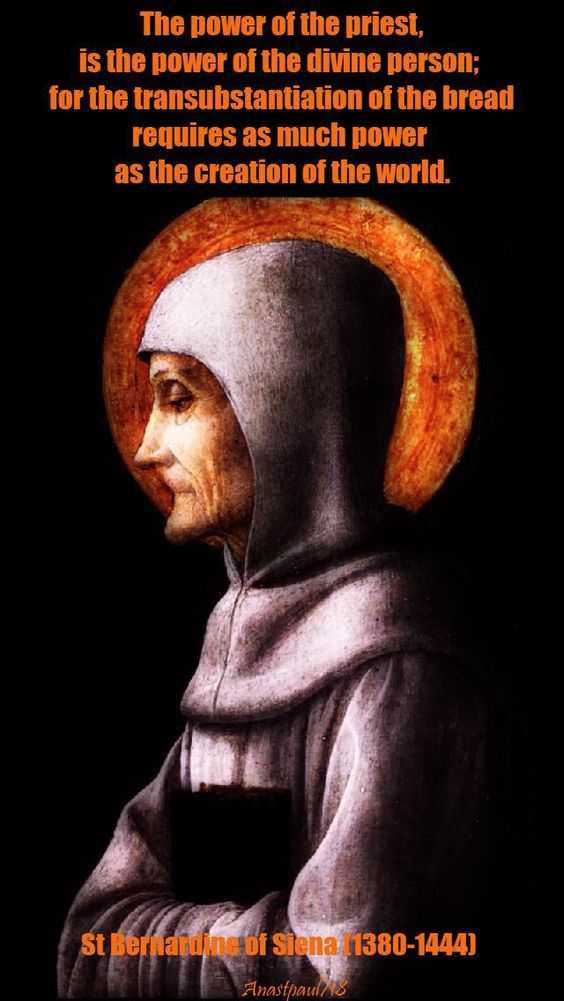
“The power of the priest, is the power of the divine person, for the transubstantiation of the bread, requires as much power, as the creation of the world.”
St Bernardine of Siena (1380-1444)
“St Bernard tells us that everything has come to us through Mary and we may also say that everything has come to us through the priest, yes, all happiness, all graces, all heavenly gifts. If we had not the Sacrament of Orders, we should not have Our Lord. Who placed Him there, in that tabernacle? It was the priest. Who was it that received your soul, on its entrance into life? The priest. Who nourishes it, to give it strength to make its pilgrimage? The priest. Who will prepare it to appear before God, by washing that soul, for the last time, in the blood of Jesus Christ? The priest – always the priest. And if that soul comes to the point of death, who will raise it up, who will restore it to calmness and peace? Again the priest. You cannot recall one single blessing from God, without finding, side by side with this recollection, the image of the priest.”
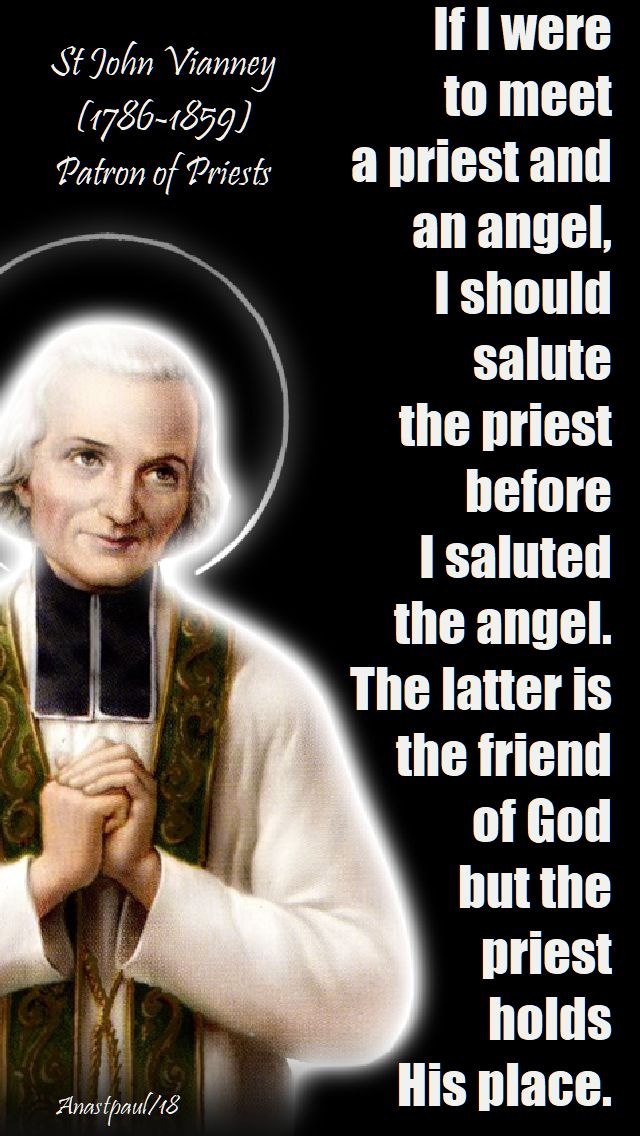
“If I were to meet a priest and an angel, I should salute the priest before I saluted the angel. The latter is the friend of God but the priest holds His place.”
St John Vianney (1786-1859) Patron of Priests
“Day after day, it is necessary to learn, that I do not possess my life for myself. Day by day, I must learn to abandon myself, to keep myself available for whatever He, the Lord, needs of me at a given moment, even if other things seem more appealing and more important to me, this means giving life, not taking it.”
One Minute Reflection – 18 July – Wednesday of the Fifteenth week in Ordinary Time, B – Today’s Gospel Matthew 11:25-27.
“You have hidden these things from the wise and the learned, you have revealed them, to the childlike”…Matthew 11:25
REFLECTION – “O my Saviour and my God! This ought to astonish us. We run after knowledge as if all our happiness depended on it. Woe to us if we don’t have it! We certainly need it but in its fullness, we ought to study but in moderation. Other people claim understanding of business and pass for people of substance and negotiation in the world. These are the ones from whom God takes away perception of Christian truths, from the learned and knowing of this world. Who does He give it to, then? To simple, ordinary people… Gentlemen, true religion is to be found among the poor. God enriches them with living faith, they believe, touch, taste the words of life… For the most part they preserve their peace in the midst of trouble and distress. What is the reason for this? Faith. Why? Because they are simple, God causes those graces to abound in them, that He refuses to the rich and learned of this world.”…St Vincent de Paul (1581-1660)
PRAYER – Lord God, in Your wisdom You created us, by Your Providence, You rule us. Penetrate our inmost being with Your holy light so that our way of life may always be one of faithful service and childlike trust in You. Grant that by the intercession of St Frederick, we may always follow behind Your Son and grasp His hand, to lead us to You, Through Jesus Christ our Lord with the Holy Spirit, one God, forever, amen.
Thought for the Day – 17 July – Tuesday of the Fifteenth week in Ordinary Time, B – Today’s Gospel: Matthew 11:20-24
To be converted and return to the Lord
Verse Homily of
Saint Jacob of Sarug (c 449-521)
Syrian monk and Bishop
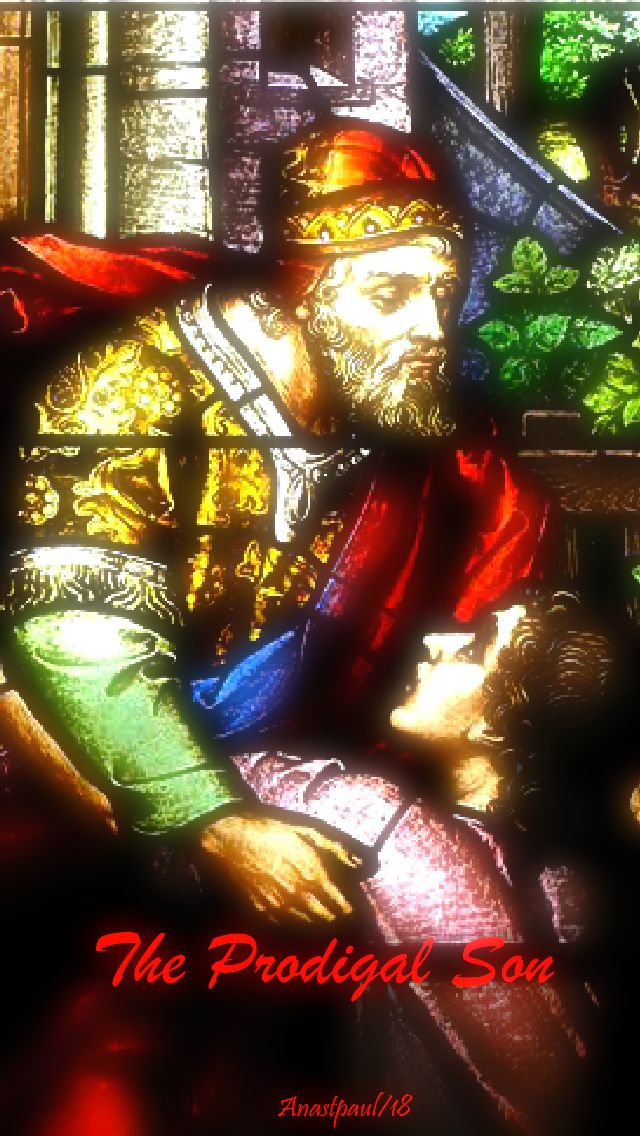
I will go back to my Father’s house like the prodigal son (Lk 15:18) and He will welcome me. For I was dead through sin as though by sickness; raise me up from my distress that I may praise Your name! O Lord of heaven and earth, come to my help and show me Your way, that I may come to You. Draw me to You, Son of the Most Good and bring Your compassion to completion. I will set out towards You and there be filled with joy. Knead for me now the grain of life at this time when I am crushed.
I set out in search of You and the Evil One spied on me like a thief (cf. Lk 10:30). He bound and chained me in the pleasures of this wicked world: he imprisoned me in its pleasures and slammed the door in my face. There was no one to free me, so that I might set out in search of You, O Lord, my good!… O Lord, I long to be Yours and walk Your way. See how I meditate Your commandments by day and by night (Ps 1:2). Grant my request and accept my prayer, O merciful one! Do not cast off the hope of Your servant, for he is waiting for you.
Quote/s of the Day – 17 July – Tuesday of the Fifteenth week in Ordinary Time, B – Today’s Gospel: Matthew 11:20-24
Speaking of: Seeking Repentance with the Fathers
“When once you have departed this life, there is no longer any place for repentance, no way of making satisfaction. Here, life is either lost or kept. Here, by the worship of God and by the fruit of faith, provision is made for eternal salvation. Let no one be kept back either by his sins or by his years from coming to obtain salvation. To him who still remains in this world, there is no repentance that is too late.”
St Cyprian of Carthage (c 200- c 258)
Father of the Church
“Do you fast? Then feed the hungry, give drink to the thirsty, visit the sick, do not forget the imprisoned, have pity on the tortured, comfort those who grieve and who weep, be merciful, humble, kind, calm, patient, sympathetic, forgiving, reverent, truthful and pious, so that God might accept your fasting and might plentifully grant you the fruits of repentance.”
“Since it is likely that, being men, they would sin every day, St Paul consoles his hearers by saying ‘renew yourselves’ from day to day. This is what we do with houses: we keep constantly repairing them as they wear old. You should do the same thing to yourself. Have you sinned today? Have you made your soul old? Do not despair, do not despond but renew your soul by repentance and tears and Confession and by doing good things. And never cease doing this.”
“If repentance is neglected for an instant, one can lose the power of the Resurrection as he lives with the weakness of tepidity and the potential of his fall.”
St John Chrysostom (347-407)
Father and Doctor of the Church
“Reform yourself and so be always ready. Be not afraid of the last day, as a thief, who will break up your house as you sleep but awake and reform yourself today.”
“In failing to confess, Lord, I would only hide You from myself, not myself from You.”
St Augustine (354-430) Father and Doctor of the Church
“To do penance is to bewail the evil we have done and to do no evil to bewail.”
St Pope Gregory the Great (540-604)
Father & Doctor of the Church
“Repentance raises the fallen, mourning knocks at the gate of Heaven and holy humility opens it.”
“Repentance is the renewal of baptism. Repentance is a contract with God for a second life. A penitent is a buyer of humility. Repentance is constant distrust of bodily comfort. Repentance is self-condemning reflection of carefree self-care. Repentance is the daughter of hope and the renunciation of despair. A penitent is an undisgraced convict. Repentance is reconciliation with the Lord by the practice of good deeds contrary to the sins. Repentance is purification of conscience. Repentance is the voluntary endurance of all afflictions. A penitent is the inflicter of his own punishments. Repentance is a mighty persecution of the stomach and a striking of the soul into vigorous awareness.”
“Confession is like a bridle that keeps the soul which reflects on it from committing sin but anything left unconfessed we continue to do without fear as if in the dark.”
One Minute Reflection – 17 July – Tuesday of the Fifteenth week in Ordinary Time, B – Today’s Gospel: Matthew 11:20-24.
“But I tell you, it will be more tolerable for Tyre and Sidon on the day of judgement than for you..”…Matthew 11:22
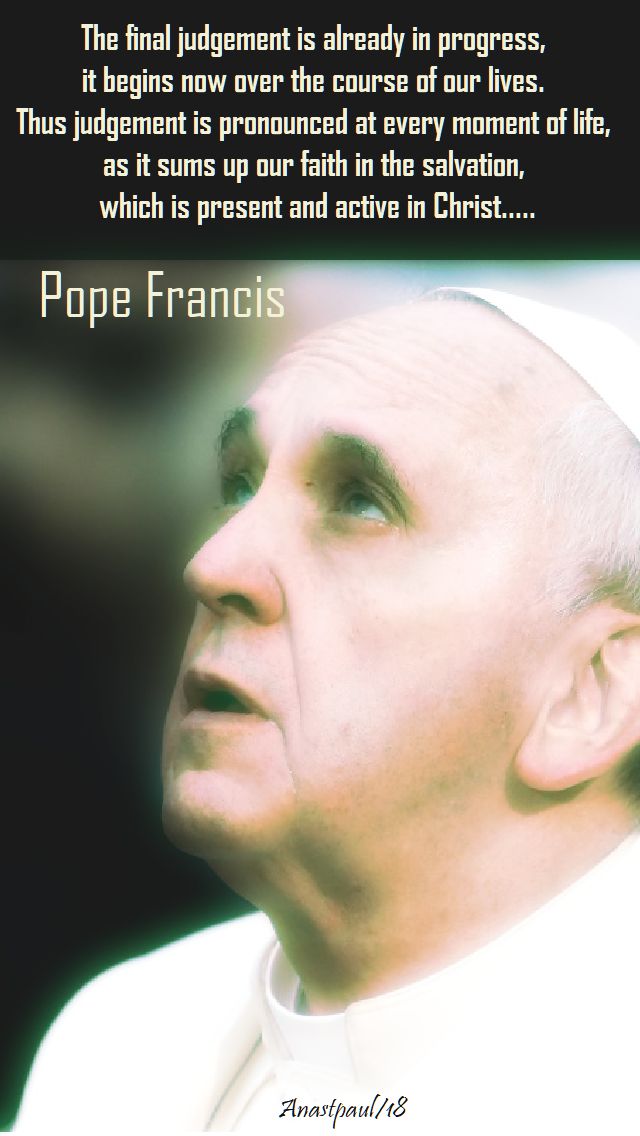
REFLECTION – “The final judgement is already in progress, it begins now over the course of our lives. Thus judgement is pronounced at every moment of life, as it sums up our faith in the salvation which is present and active in Christ, or of our unbelief, whereby we close in upon ourselves. But if we close ourselves to the love of Jesus, we condemn ourselves. Salvation is, to open oneself to Jesus, it is He who saves us.”…Pope Francis – General Audience, 11 December 2013
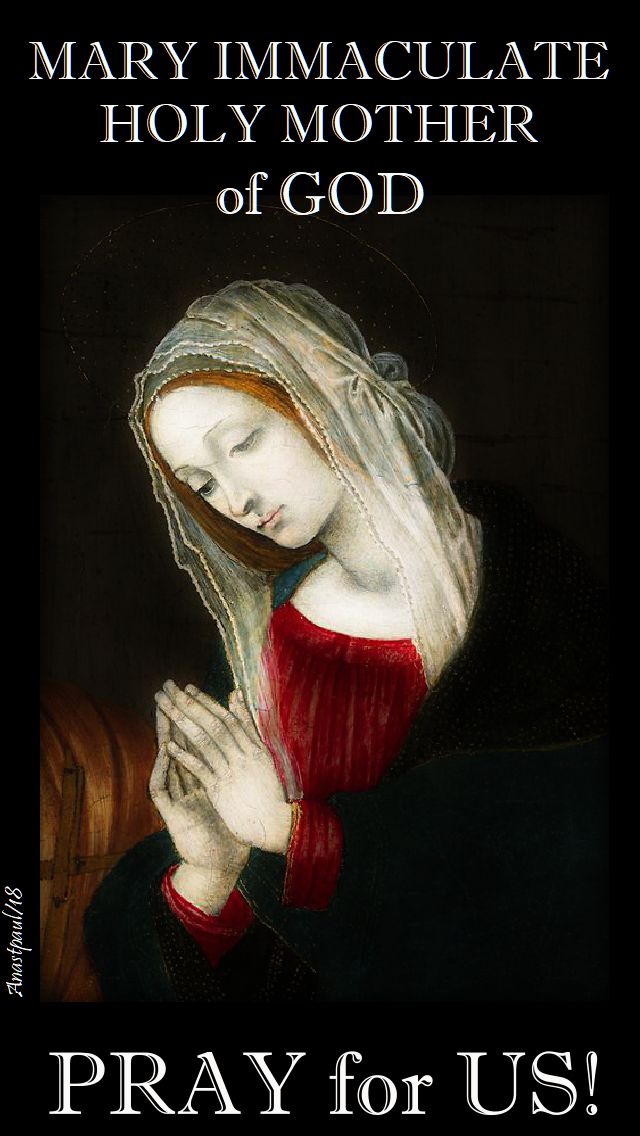
PRAYER – Almighty God, to whom this world with all its goodness and beauty belongs, give us grace joyfully to begin this day in Your name and to fill it, with an active love for You and for our neighbour. Grant us the grace to repent of our sins, to turn to the Cross of Your Son and to beg Him in His great love and suffering to forgive us again! Mary, Holy Mother, intercede for us in our weakness and help us to turn our backs on sin and look only at the face of Christ. Amen
Quote/s of the Day – 16 July 2018 – Monday of the Fifteenth week in Ordinary Time – Today’s Gospel: Matthew 10:34-42,11:1.
Speaking of: Seeking Abandonment to Divine Providence
with Father Jean-Pierre de Caussade S.J. (1675-1751)
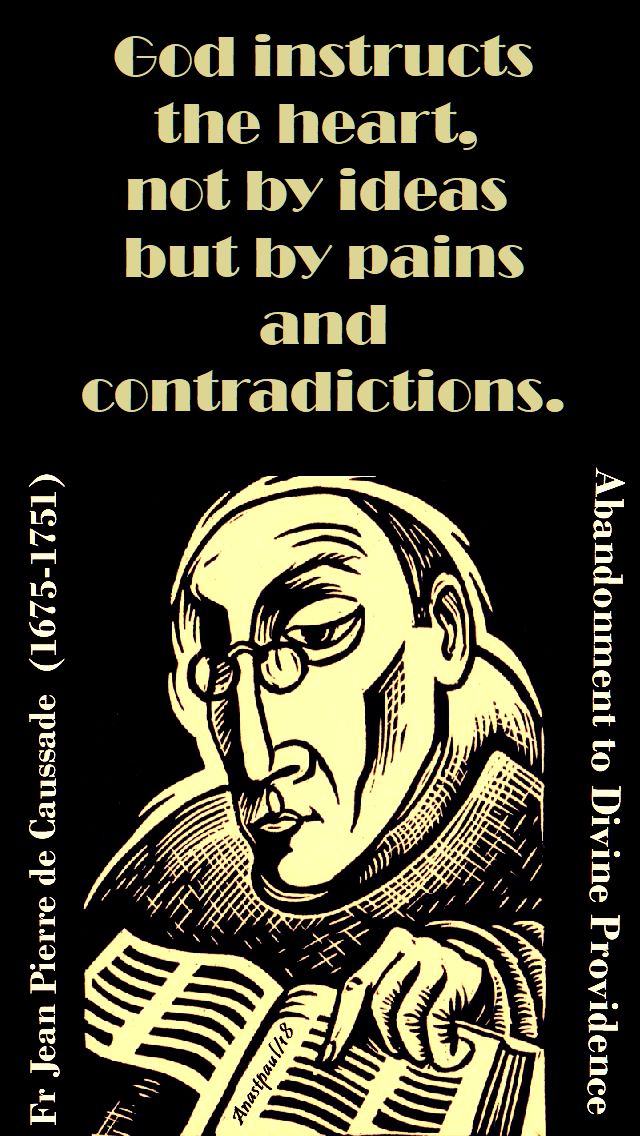
“God instructs the heart, not by ideas but by pains and contradictions.”
“There is not a moment in which God does not present Himself under the cover of some pain to be endured, of some consolation to be enjoyed, or of some duty to be performed. All that takes place within us, around us, or through us, contains and conceals His divine action.”
“The books the Holy Spirit is writing, are living and every soul a volume, in which the divine author, makes a true revelation of His word, explaining it to every heart, unfolding it in every moment.”
“The duties of each moment are the shadows beneath which, hides the divine operation.”
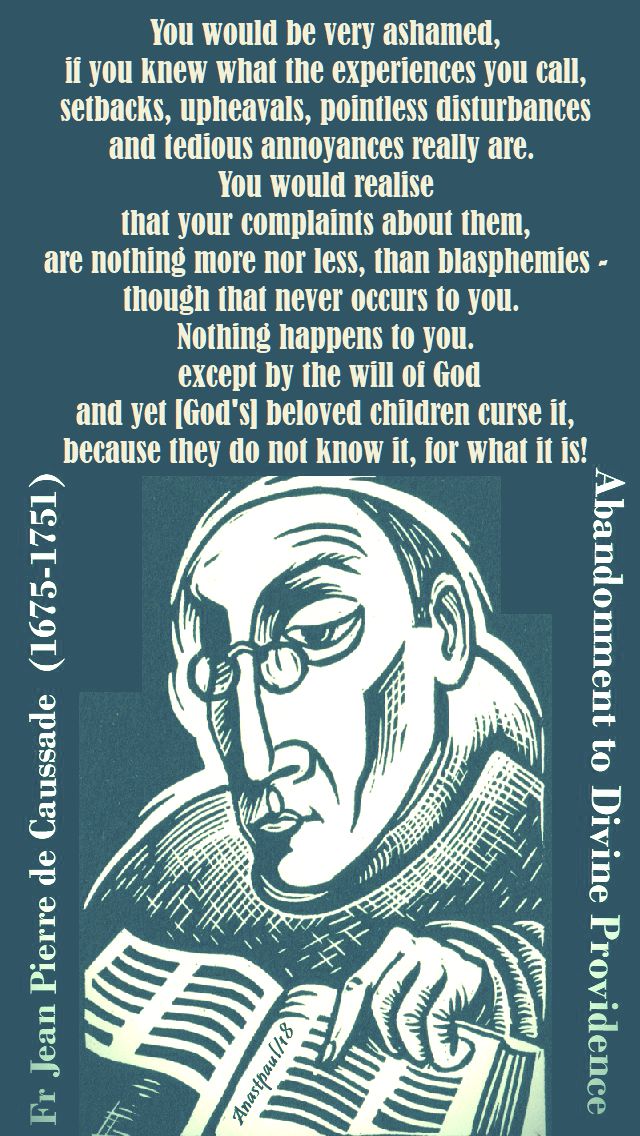
“You would be very ashamed, if you knew what the experiences you call, setbacks, upheavals, pointless disturbances and tedious annoyances really are. You would realise that your complaints about them, are nothing more nor less, than blasphemies – though that never occurs to you. Nothing happens to you except by the will of God and yet [God’s] beloved children curse it, because they do not know it, for what it is!”
One Minute Reflection – 16 July – Monday of the Fifteenth week in Ordinary Time, B – Today’s Gospel: Matthew 10:34-42,11:1.
Whoever loves father or mother more than me is not worthy of me and whoever loves son or daughter more than me is not worthy of me and whoever does not take up his cross and follow after me is not worthy of me...Matthew 10:37-38
REFLECTION – “A further means of staying faithful, Daughters, is perfect detachment from father, mother, relations and friends in such a way that you are God’s alone. And to possess this great good you have to strip yourself of everything and have nothing of your own. The apostles had just such a detachment. For one cent you will have a hundred, as many women, as many mothers which Providence, Daughters, will never fail you. Don’t you have any courage at all to give yourselves to the God who is so mindful of you? Never claim you are saving something for your own livelihood; always put your trust in Providence. Rich people can fall into need through the accidents that often happen but they will never be in want, who intend to rely solely on God.
Isn’t it good, Daughters, to live like this? What is there to fear? For God has promised that people who care for the poor will never lack anything. O my Daughters, would you not love God’s promises better than the world’s deceits? God is obliged to provide for all our needs.”…St Vincent de Paul (1581-1660) – Conferences to the Daughters of Charity
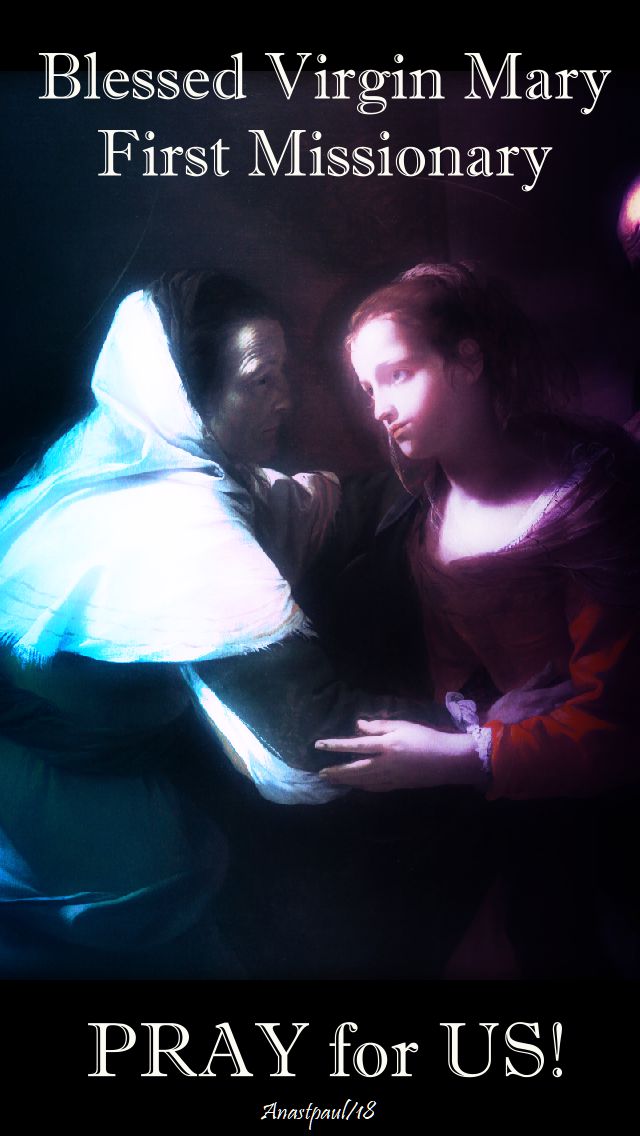
PRAYER – Grant us Your Grace O Holy God almighty, rule over our hearts and bodies this day. Sanctify us and guide our every thought, word and deed according to the commandments of Your divine Son, so that now and forever Your Grace may free us from the world and save us for Yourself. “May the Virgin Mary, first disciple and missionary of the Word of God, help us to take the message of the Gospel to the world, in humble and radiant exultance, beyond every rejection, incomprehension or tribulation. Amen”… Pope Francis
Sunday Reflection – 15 July – Fifteenth Sunday of the Year
“….in the Blessed Sacrament Our Lord Himself is the light which manifests Him as our model and reveals His beauties to us. He is Himself His light, His means of being known, just as the sun is itself its own proof. To make Himself known, He has only to show Himself. Recognition of Him need not come from its being reasoned out.
A child does not have to discourse with himself to recognise his parents. Our Lord reveals Himself through His presence, just as parents do. But as we grow to know His voice better and as our hearts become more sympathetic to Him in emptying themselves of what is not Him, our Lord manifests Himself in a clearer and more intimate manner, which only those know, who love Him. He gives the soul a divine conviction which overshadows the light of human reason.
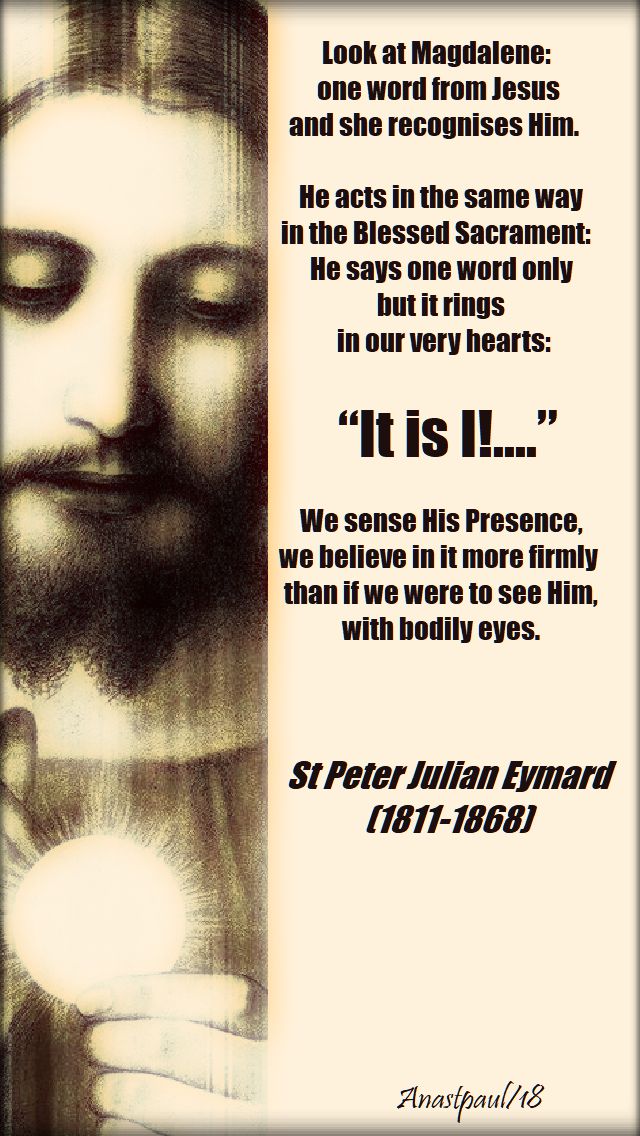
Look at Magdalene: one word from Jesus and she recognises Him. He acts in the same way in the Blessed Sacrament: He says one word only but it rings in our very hearts: “It is I!….” We sense His Presence, we believe in it more firmly than if we were to see Him with bodily eyes.”























You must be logged in to post a comment.