Vigil of All Saints Day or All Hallow’s Eve: Eve of the Feast of All Hallows, that is, All Saints Day. Halloween is a day on which many quaint customs are revived. It is popular in the United States and Scotland and in the US has become the second largest secular holiday of the year.
St Wolfgang of Regensburg (c934 –994) “The Great Almoner,” Bishop, Monk, Missionary, Ascetic, Apostle of Charity. He is regarded as one of the three great German Saints of the 10th Century, the other two being Saint Ulrich and Saint Conrad of Constance. He was Canonised in 1052 by Pope Leo IX. St Wolfgang’s life: https://anastpaul.com/2019/10/31/saint-of-the-day-31-october-saint-wolfgang-of-regensburg-c-934-994/
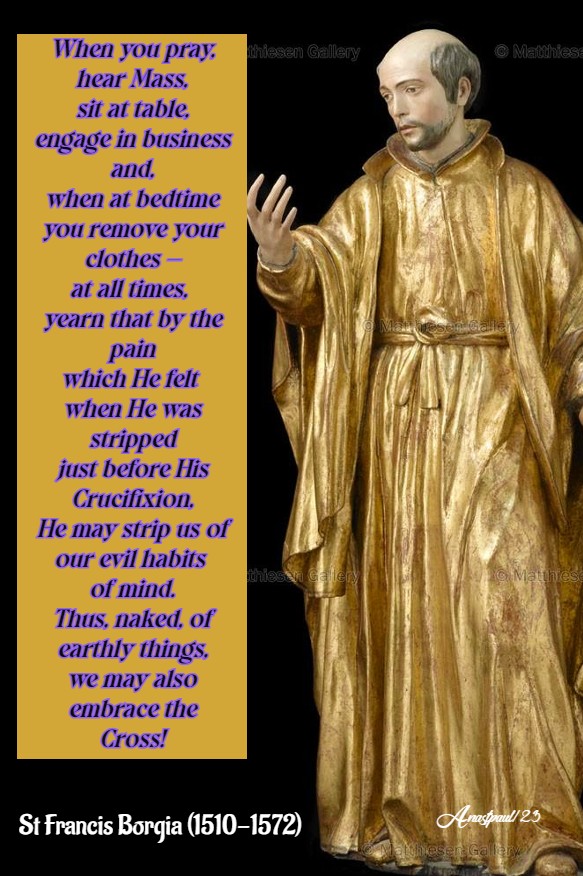
Quote/s of the Day – 10 October – St Francis Borgia SJ (1510-1572) Confessor
“When you pray, hear Mass, sit at table, engage in business and, when at bedtime you remove your clothes— at all times, yearn that by the pain which He felt when He was stripped just before His Crucifixion, He may strip us of our evil habits of mind. Thus, naked, of earthly things, we may also embrace the Cross!”
“What is it, my soul, that I seek in the world? How long shall I pursue and grasp at shadows? What is she already become, who was lately so beautiful, so great, so much revered? This death which has thus treated the imperial diadem, has already levelled his bow to strike me. Is it not prudent, to prevent its stroke, by dying now to the world that, at my death. I may live to God?”
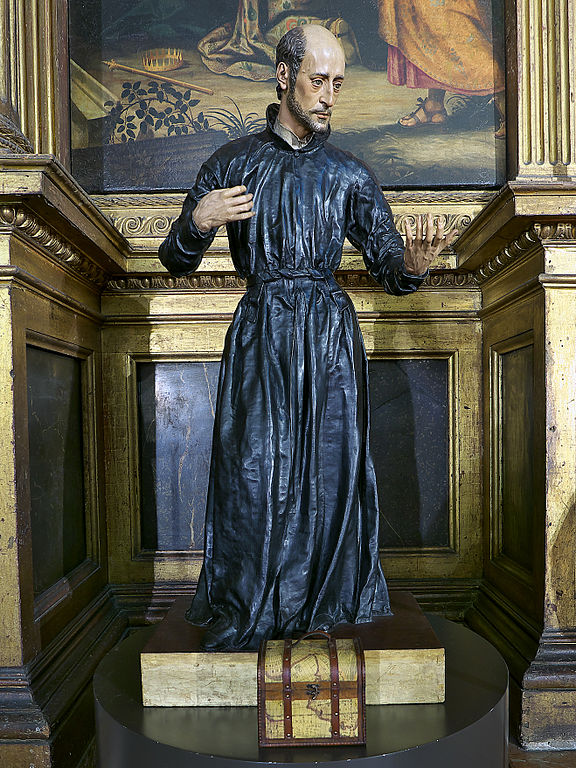
Saint of the Day – 10 October – St Francis Borgia SJ (1510-1572) Confessor, Priest of the Society of Jesus, Advisor, Missionary, Evangelist, Administrator par excelleance. Francisco de Borja y Aragon was the 4th Duke of Gandía, was a Grandee of Spain, a Spanish Jesuit and third Superior General of the Society of Jesus
A continuation of the life of St Francis Borgia – an entire year has slipped by, for which I should apologise, however, each day brings its own duties to the Saints being venerated on that particular day. Time runs away … Let us continue with a little more from Fr Alban Butler (1711-1773) who wrote his portrayal of our Saint from:
“The life, compiled by Fr Ribadeneira, who was for nine years, his Confessor, is the master-piece of that pious author, who, by his acquaintance with the holy man and his own experience in an interior life, was excellently qualified to animate, in his expression, the narrative of the actions of the Saint with that spirit with which they were performed.”
We continue – ST FRANCIS at COURT and his MARRIAGE until the DEATH of the EMPRESS – his “DAMASCUS MOMENT”:
Francis, although he delighted chiefly in the company of the most virtuous, was courteous and obliging to all, never spoke ill of anyone, nor ever suffered others to do it in his presence.
He was a stranger to envy, ambition, gallantry, luxury and gaming – vices which are often too fashionable in Courts and against which he armed himself with the utmost precaution. He not only never played but would never see others playing, saying that a man commonly loses by it four things – his money, his time, the devotion of his heart to God and his conscience.
One of his servants discovered, that on the days on which he was obliged to visit company in which ladies made a part, he wore a hair-shirt. In him it appeared, that there is no readier way to gain the esteem of men, though without seeking it, than by the heroic practice of Christian virtue. Nothing is so contemptible even amongst men of the world, as insolence, pride, injustice, or anger; nothing so hateful as one who loves nobody but himself, refers everything to himself and makes himself the centre of all his desires and actions.
Nor is there anything more amiable than a man who seeks not himself but refers himself to God and seeks and does all things for God, and the service of others; in which Christian piety consists. The wicked themselves, find no more solid comfort or protection in affliction, than the friendship of such a person; even those who persecute him,because his virtue is a censure of their irregularities, nevertheless admire in their breasts that sincere piety which condemns them. This is more conspicuous when such a virtue shines forth in an exalted station. It is not, therefore, to be wondered that Francis was honoured and beloved by all the Court, particularly by the Emperor, who called him the miracle of Princes!
… The Empress had so great an esteem for him and so high an idea of his merit, that she fixed her eye on him to marry Eleanor de Castro, a Portuguese lady of the first rank, a person of great piety and accomplishments, her principal favourite, who had been educated with her and whom, she had brought with her out of Portugal. The marriage was solemnised in the most Christian manner, to which state the Saint brought the best preparation – innocence of life with unsullied purity and an ardent spirit of religion and devotion. The Emperor on that occasion created him Marquis of Lombay and Master of the Horse to the Empress and having had experience of his wisdom, secrecy and fidelity, not only admitted him into his Privy-Council but took great delight in conferring, often privately, with him upon his most difficult undertakings and communicated to him his most important designs. …
Cristobal de Villalpando, Portrait of St. Francis Borgia , c1690
In 1537, being at the Court, which was then at Segovia, he fell ill of a dangerous quinsy, in which he never ceased praying in his heart, though he was not able to pronounce the words. These accidents were Divine graces which weaned Francis, daily more and more, from the world; although, whilst it smiled upon him, he saw the treachery, the shortness and the dangers of its flattering enjoyments, through that gaudy flash, in which it danced before his eyes.
… God blessed his marriage with a numerous and happy offspring – five boys and three girls: Charles, the eldest, who was Duke of Gandia, when Ribadeneira wrote the life of ourSaint; Isabel, John, Alvarez, Johanna, Fernandez, Dorothy and Alphonsus. Dorothy died young as a Poor Clare at Gandia; the rest all married, enjoyed different titles and posts of honour,and left families behind them.
St Francis was much affected, in 1537, by the death of his intimate friend, the famous poet, Garcilas de Vega, who was killed at the siege of a castle in Provence. The death of the pious Empress Isabel, happened two years after, on the 1st of May, 1539, whilst the Emperor was holding the states of Castile at Toledo, with the utmost pomp and magnificence. His majesty was much afflicted by the loss of so virtuous a consort. The Marquis and Marchioness of Lombay, were commissioned, by him, to attend her corpse to Granada, where she was to be buried. When the funeral convoy arrived at Granada and the Marquis delivered the corpse into the hands of the Magistrates of that City, they were on both sides, to make oath that it was the body of the late Empress. The coffin of lead was, therefore, opened and her face was uncovered but appeared so hideous and so much disfigured that no-one knew it and the stench was so noisome that everyone made, what haste he could away. Francis not knowing the face, would only swear it was the body of the Empress because, from the care he had taken, he was sure no-one could have changed it upon the road.
Being exceedingly struck at this spectacle, he repeated to himself:
“What is now become of those eyes, once so sparkling? Where is now the beauty and graceful air of that countenance which we so lately beheld? Are you her sacred majesty, Donna Isabel? Are you my Empress and my lady, my mistress?”
The impression which this spectacle made on his soul remained strong and lively during the thirty-three years by which he survived it, to his last breath!
Returning that evening from the Royal Chapel to his lodgings, Francis locked himself in his chamber and passed the whole night without a wink of sleep. Prostrate on the floor, shedding a torrent of tears, he said to himself,
“What is it, my soul, that I seek in the world? How long shall I pursue and grasp at shadows? What is she already become, who was lately so beautiful, so great, so much revered? This death which has thus treated the imperial diadem, has already levelled his bow to strike me. Is it not prudent, to prevent its stroke, by dying now to the world that at my death. I may live to God?”
St Aldericus St Cassius St Cerbonius of Populonia St Cerbonius of Verona St Clarus of Nantes Bl Demestrius of Albania Bl Edward Detkens St Eulampia St Eulampius St Florentius the Martyr St Fulk of Fontenelle St Gereon St Gundisalvus Bl Hugh of Macon
Bl Pedro de Alcantara de Forton de Cascajares St Pinytus of Crete Bl Pontius de Barellis St Tanca St Teodechilde St Victor of Xanten
Martyrs of Ceuta – 7 Beati: A group of seven Franciscan Friars Minor missionaries to Muslims in the Ceuta area of modern Morocco. Initially treated as madmen, within three weeks they were ordered to convert to Islam and when they would not they were first abused in the streets, then arrested, tortured and executed. Angelo, Daniele di Calabria, Donnolo, Hugolinus, Leone, Nicola, Samuele. They were beheaded in 1227 in Mauritania Tingitana (Ceuta, Morocco). Local Christians secreted the bodies away and gave them proper burial in Ceuta. They were Beatified in 1516 by Pope Leo X.
Quote/s of the Day – 2 October – “The Month of the Most Holy Rosary and of the Angels” and the Feast of the Guardian Angels
“. . . You should know that there is present with you, the Angel whom God has appointed for each man. . . This Angel, who is sleepless and cannot be deceived, is always present with you; he sees all things and is not hindered by darkness. You should know, too, that with him, is God!”
St Anthony Abbot (251-356)
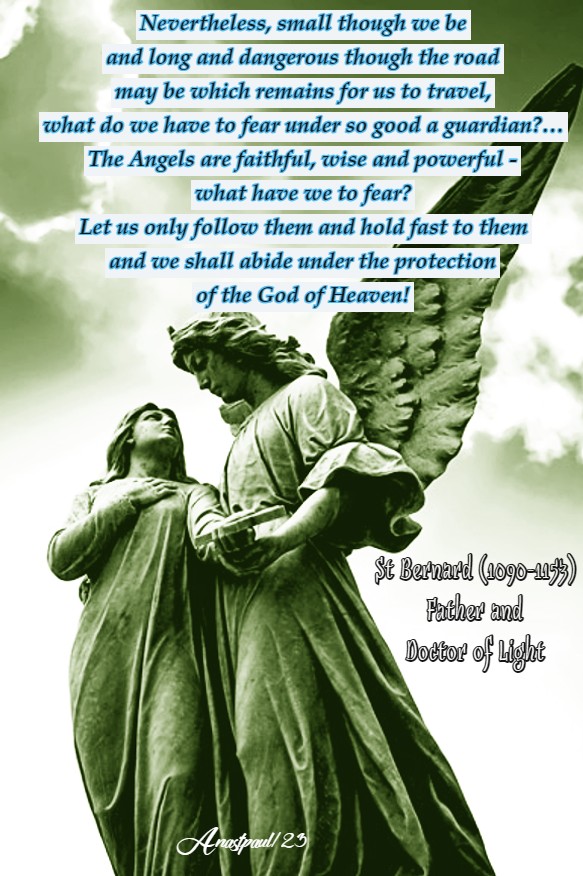
“Nevertheless, small though we be and long and dangerous though the road may be which remains for us to travel, what do we have to fear under so good a guardian?… The Angels are faithful, wise and powerful – what have we to fear? Let us only follow them and hold fast to them and we shall abide under the protection of the God of Heaven!”
St Bernard (1090-1153) Father and Doctor of Light
“Recommend yourself to your Angel Guardian three times a day – in the morning. by the prayer “Angele Dei” in the evening, by the same prayer and during the day, when you visit the Altars in Churches. Remember that you are to be guided by your Angel, like a blind man who cannot see the dangers of the streets and trusts entirely. to the person who leads him.”
Our Morning Offering – 2 October – “The Month of the Most Holy Rosary and of the Angels”
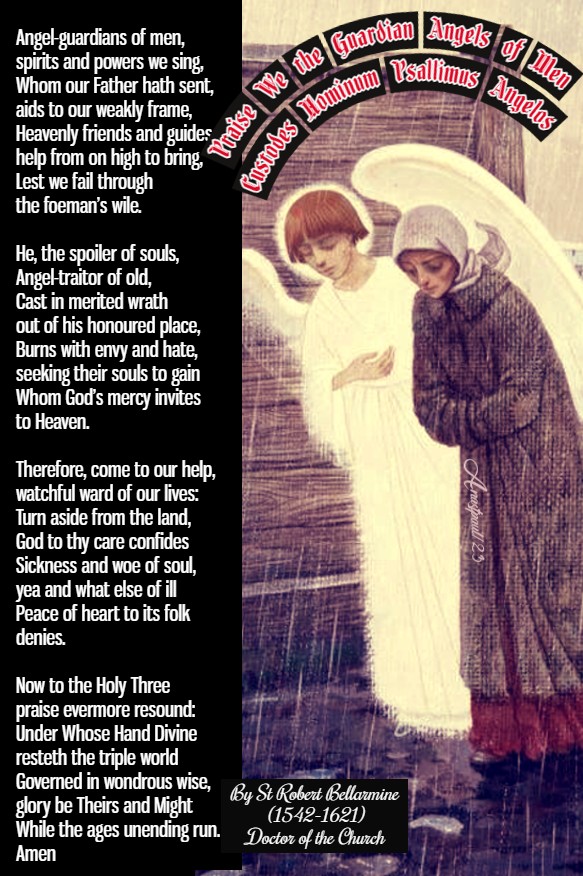
Custodes Hominum Psallimus Angelos Praise We the Guardian Angels of Men By St Robert Bellarmine SJ (1542-1621) Archbishop of Capua, Theologian Doctor of the Church
Angel-guardians of men, spirits and powers we sing, Whom our Father hath sent, aids to our weakly frame, Heavenly friends and guides, help from on high to bring, Lest we fail through the foeman’s wile.
He, the spoiler of souls, Angel-traitor of old, Cast in merited wrath out of his honoured place, Burns with envy and hate, seeking their souls to gain Whom God’s mercy invites to Heaven.
Therefore, come to our help, watchful ward of our lives: Turn aside from the land, God to thy care confides Sickness and woe of soul, yea and what else of ill Peace of heart to its folk denies.
Now to the Holy Three praise evermore resound: Under Whose Hand Divine resteth the triple world Governed in wondrous wise, glory be Theirs and Might While the ages unending run. Amen
This Hymn by St Robert Bellarmine,was added to the Roman Breviary in 1608, by command of Pope Paul V. It is for Vespers in the Office for “the Holy Guardian Angels. Double of the second class, 2 October.”
Quote/s of the Day – 29 September – The Feast of the Dedication of St Michael the Archangel – Apocalypse 1:1-5, Matthew 18:1-10 – Scripture Search here: https://www.drbo.org/
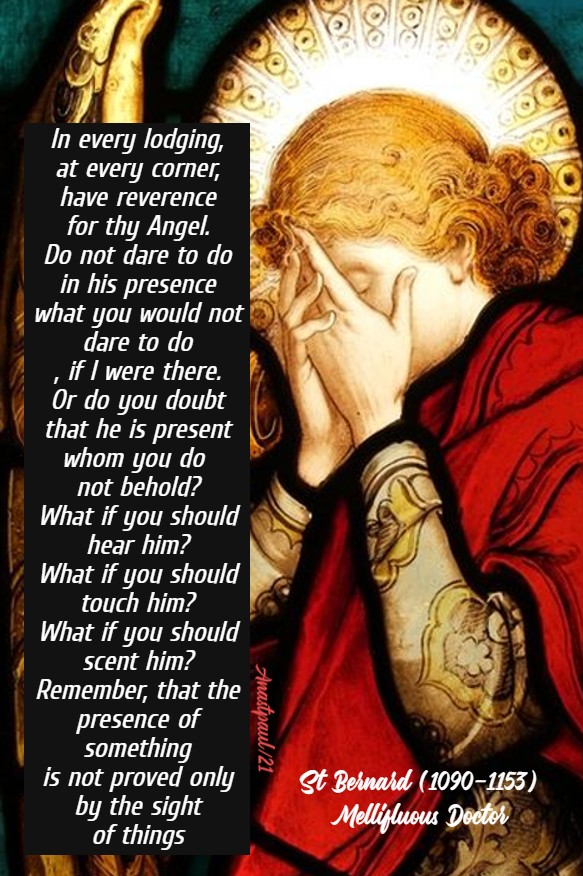
“In every lodging, at every corner, have reverence for thy Angel. Do not dare to do in his presence what you would not dare to do, if I were there. Or do you doubt that he is present whom you do not behold? What if you should hear him? What if you should touch him? What if you should scent him? Remember, that the presence of something is not proved only by the sight of things.”
St Bernard (1090-1153) Mellifluous Doctor of the Church
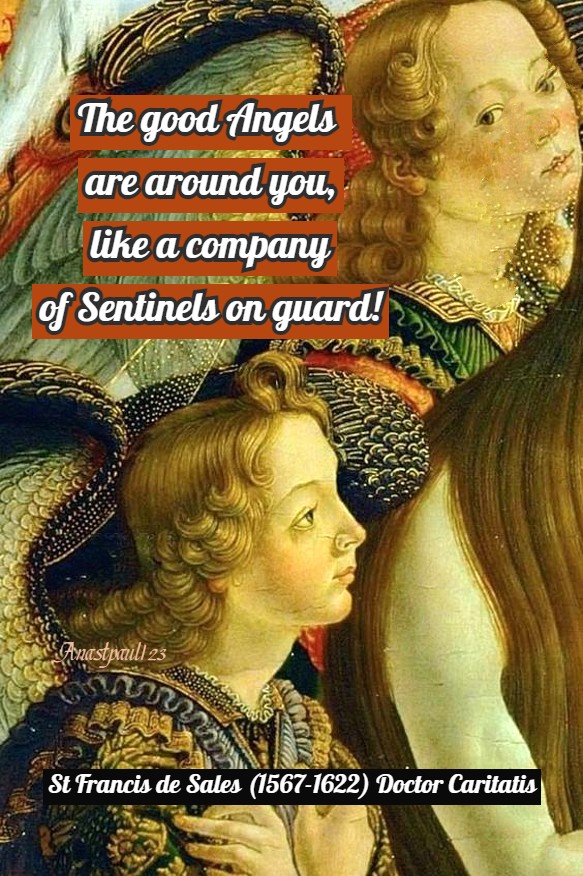
“The good Angels are around you, like a company of Sentinels on guard!”
St Francis de Sales (1567-1622) Doctor Caritatis
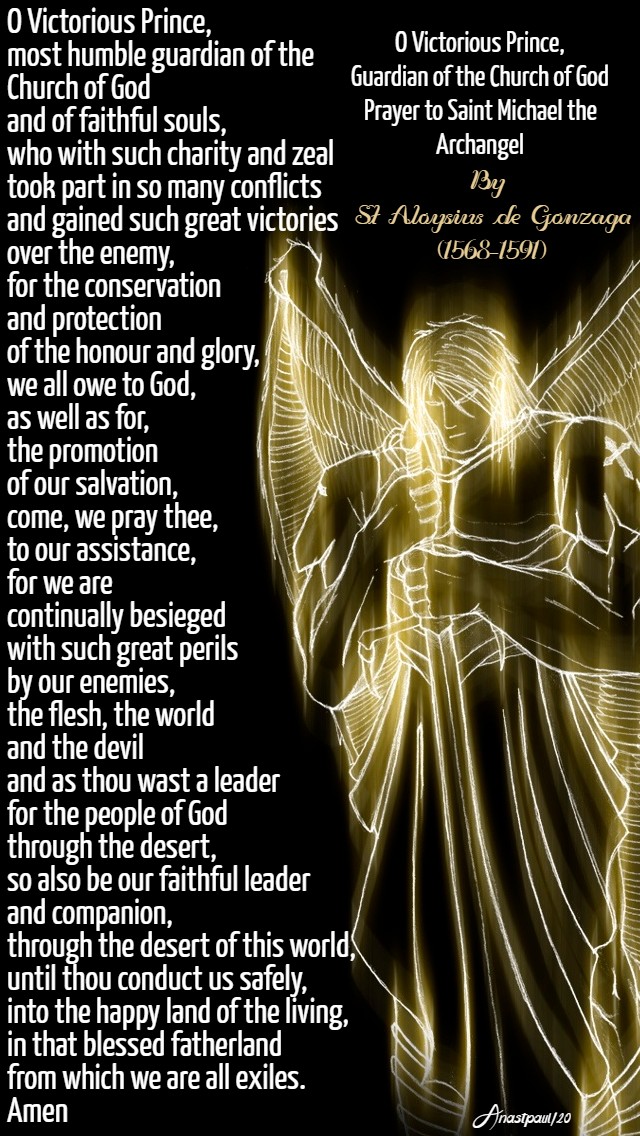
O Victorious Prince, Guardian of the Church of God By St Aloysius de Gonzaga SJ (1568-1591) Prayer to Saint Michael the Archangel
O Victorious Prince, most humble guardian of the Church of God and of faithful souls, who, with such charity and zeal, took part in so many conflicts and gained such great victories over the enemy, for the conservation and protection of the honour and glory, we all owe to God, as well as for the promotion of our salvation. Come, we pray Thee, to our assistance, for we are continually besieged with such great perils by our enemies, the flesh, the world and the devil and as Thou wast a leader for the people of God, through the desert, so also be our faithful leader and companion through the desert of this world, until Thou conduct us safely, into the happy land of the living, in that blessed fatherland from which we are all exiles. Amen.
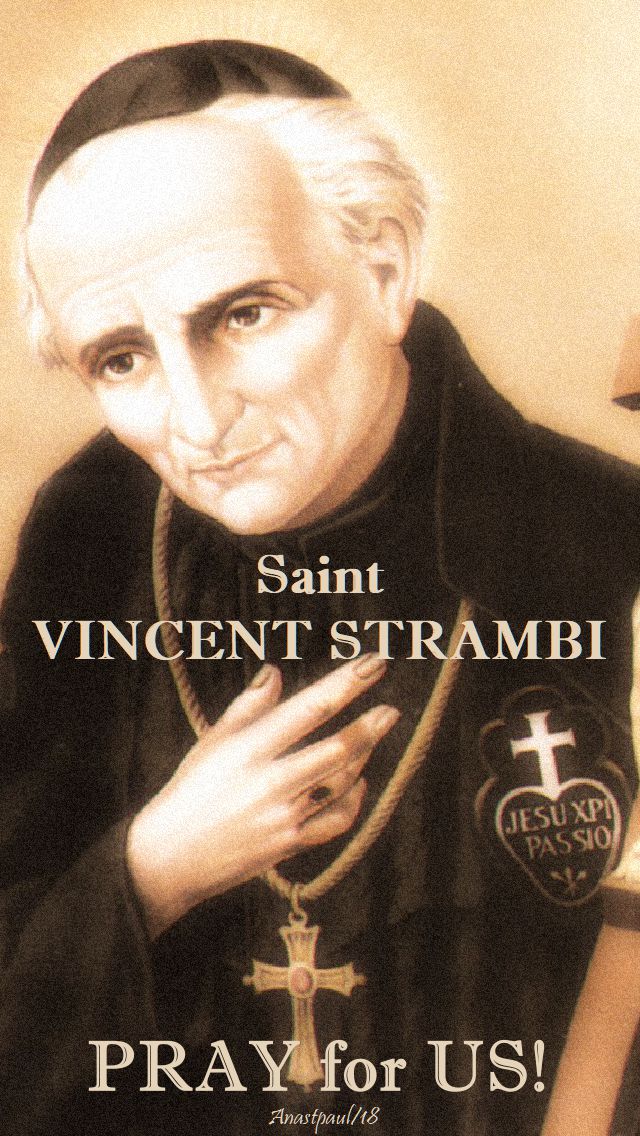
One Minute Reflection – 25 September – “Month of The Seven Sorrows of the Blessed Virgin Mary and The Holy Cross” – St Vincent Strambi CP (1745-1824) Bishop, Priest of the Passionist Order of St Paul of the Cross – Ferial Day, the 17th Sunday after Pentecost – Ephesians 4:1-6, Matthew 22:34-46 – Scripture search here: https://www.drbo.org/
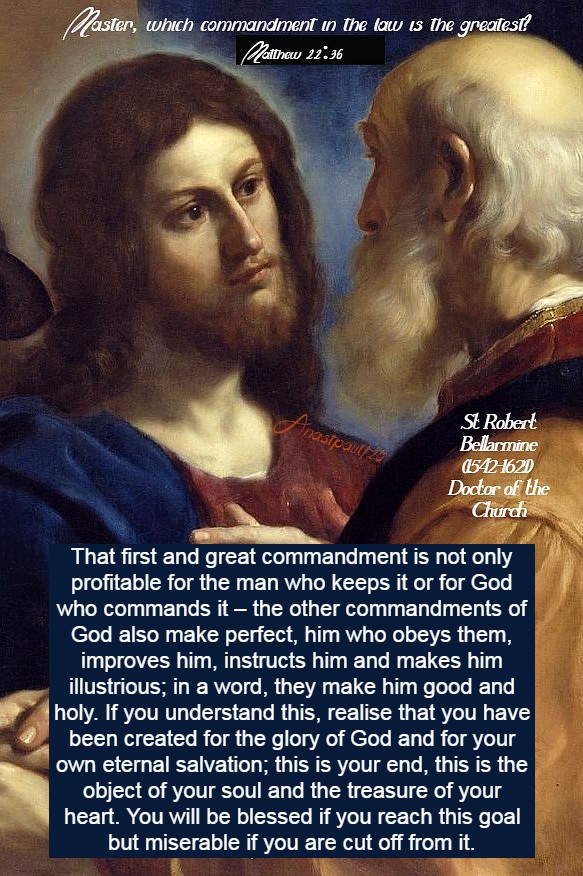
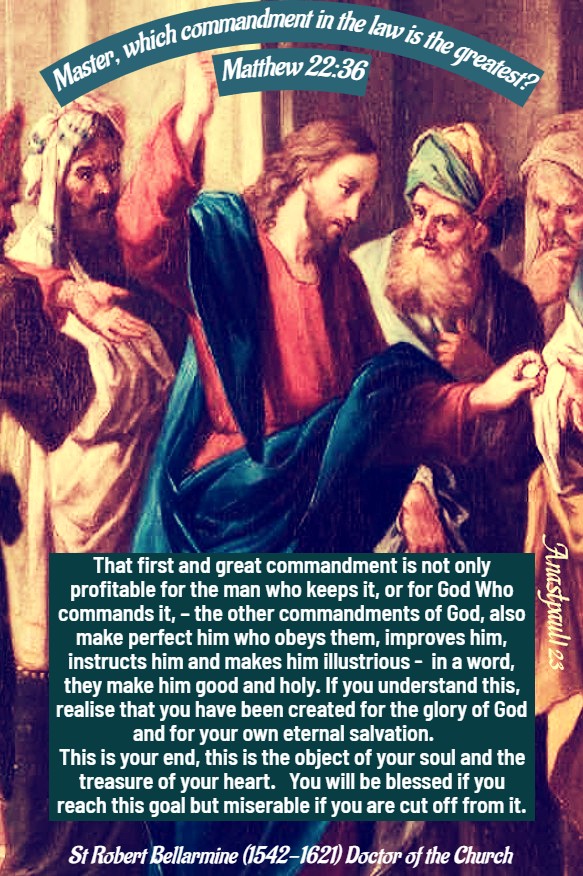
“Master, which commandment in the law is the greatest?” … Matthew 22:36
REFLECTION – “O Lord, what is it that you require of Your servants? “Take my yoke upon you,” you say. And what sort of yoke is this? “My yoke is easy and my burden light.” Now who would not willingly bear a yoke that does not press down but gives strength; a burden that does not weigh heavily but refreshes? As You rightly added: “And you will find rest” (Mt 11:29). And what is this yoke of Yours that does not tire but gives rest? It is the first and greatest of the commandments: “You shall love the Lord your God with all your heart.” What could be easier, better or more agreeable than to love the goodness, beauty and love that is most perfectly Yours, O Lord my God?
Do You not offer a reward to those who keep the commandments, which are “more desirable than a heap of gold and sweeter than honey from the comb?” (Ps 19[18]:11) So in every way You offer a very ample reward, as James the apostle says: “The Lord has prepared the crown of life for those who love him” (Jas 1:12) (…) And Paul quotes these words from Isaiah: “No eye has seen, nor ear heard, nor has the heart of man conceived, what God has prepared for those who love him” (1 Cor 2:9).
That first and great commandment is not only profitable for the man who keeps it or for God who commands it – the other commandments of God also make perfect, him who obeys them, improves him, instructs him and makes him illustrious; in a word, they make him good and holy. If you understand this, realise that you have been created for the glory of God and for your own eternal salvation; this is your end, this is the object of your soul and the treasure of your heart. You will be blessed if you reach this goal but miserable if you are cut off from it.” – St Robert Bellarmine (1542-1621) Doctor of the Church (The Ascent of the Mind to God, 1).
PRAYER – From all perils of soul and body defend us, O Lord, we beseech Thee and by the intercession of the blessed and gloriosus Ever-Virgin Mary, Mother of God, of blessed Joseph, of thy blessed apostles Peter and Paul, the blessed Vincent Strambi, Thy Confessor and all the Saints, graciously grant us safety and peace that all adversities and errors, being overcome, Thy Church may serve Thee in security and freedom. Through the same Jesus Christ, Thy Son our Lord, Who lives and reigns with Thee, in the unity of the Holy Ghost, God, world without end. Amen (Collect).
Quote/s of the Day – 20 September – Wisdom 5:16-20, Luke 6:17-23 – Scripture search here: https://www.drbo.org/
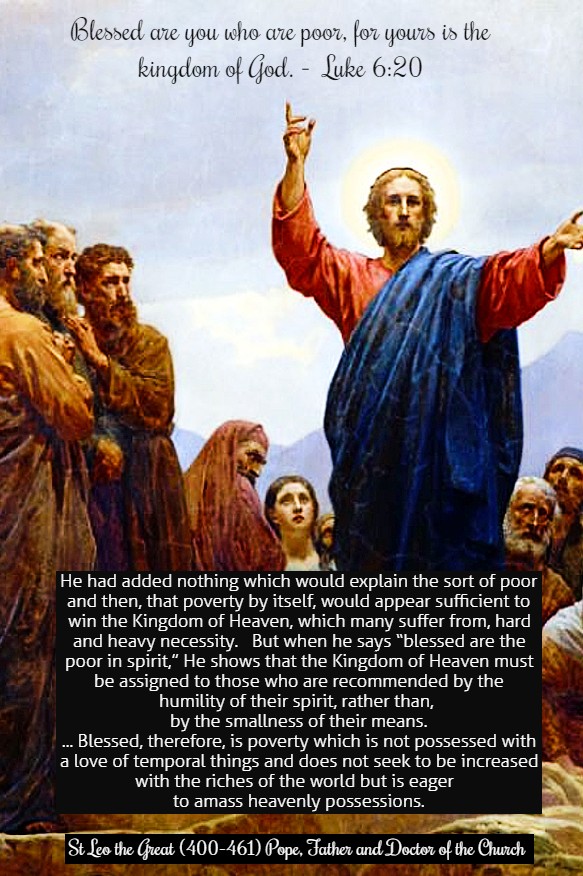
“Blessed are you who are poor, for yours is the Kingdom of God.”
Luke 6:20
“He had added nothing which would explain the sort of poor and then, that poverty by itself, would appear sufficient to win the Kingdom of Heaven, which many suffer from, hard and heavy necessity. But when He says “blessed are the poor in spirit,” He shows that the Kingdom of Heaven must be assigned to those who are recommended by the humility of their spirit, rather than, by the smallness of their means. Blessed, therefore, is poverty which is not possessed with a love of temporal things and does not seek to be increased with the riches of the world but is eager to amass heavenly possessions.”
St Leo the Great (400-461) Pope, Father and Doctor of the Church
“True humility consists in persuading and convincing oneself that without God, we are insignificant and despicable and, in accepting to be treated as such!”
St Ignatius Loyola SJ (1491-1556)
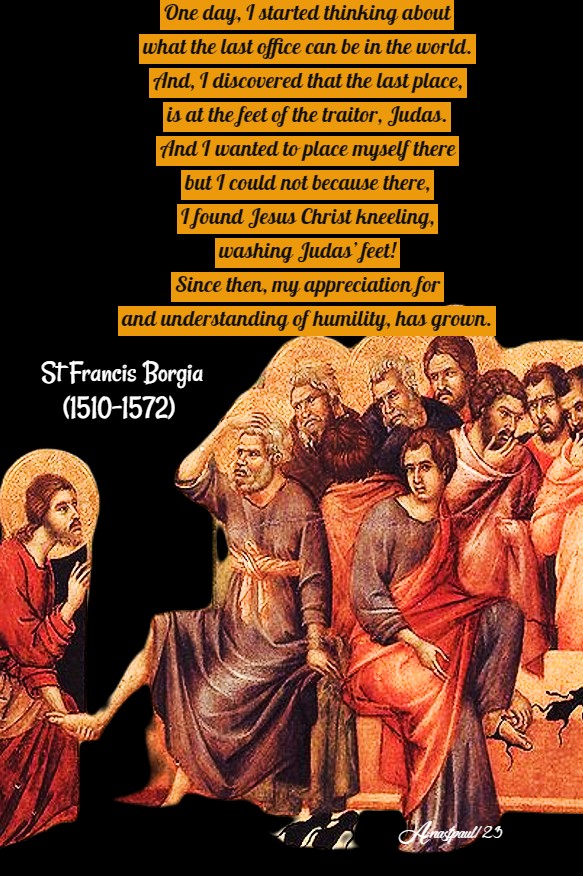
“One day, I started thinking about what the last office can be in the world. And, I discovered that the last place, is at the feet of the traitor, Judas. And I wanted to place myself there but I could not because there, I found Jesus Christ kneeling, washing Judas’ feet! Since then, my appreciation for and understanding of humility, has grown.”
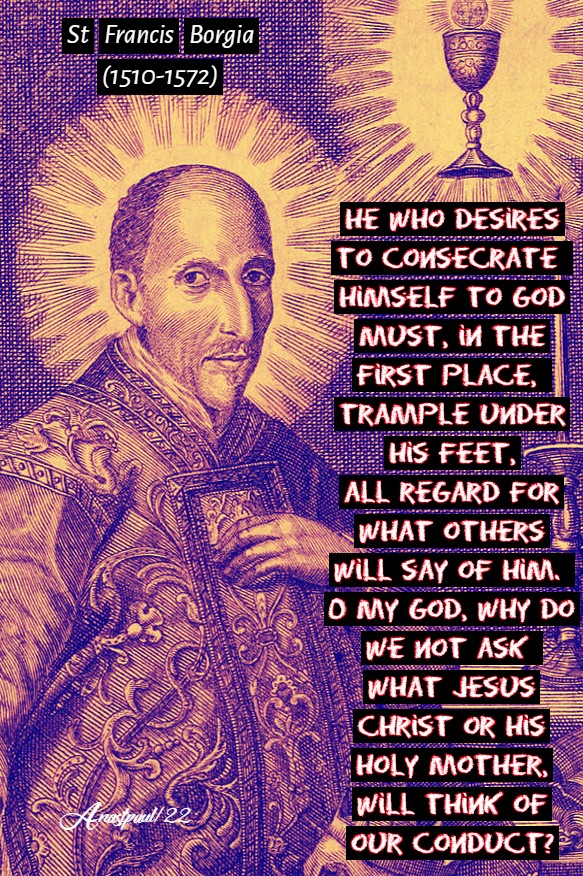
“He who desires to consecrate himself to God must, in the first place, trample under his feet, all regard for what others will say of him. O my God, why do we not ask what Jesus Christ or His holy Mother, will think of our conduct?”
Our Morning Offering – 14 September – “Month of The Seven Sorrows of the Blessed Virgin Mary and The Holy Cross” and the Feast of the Exaltation of the Holy Cross
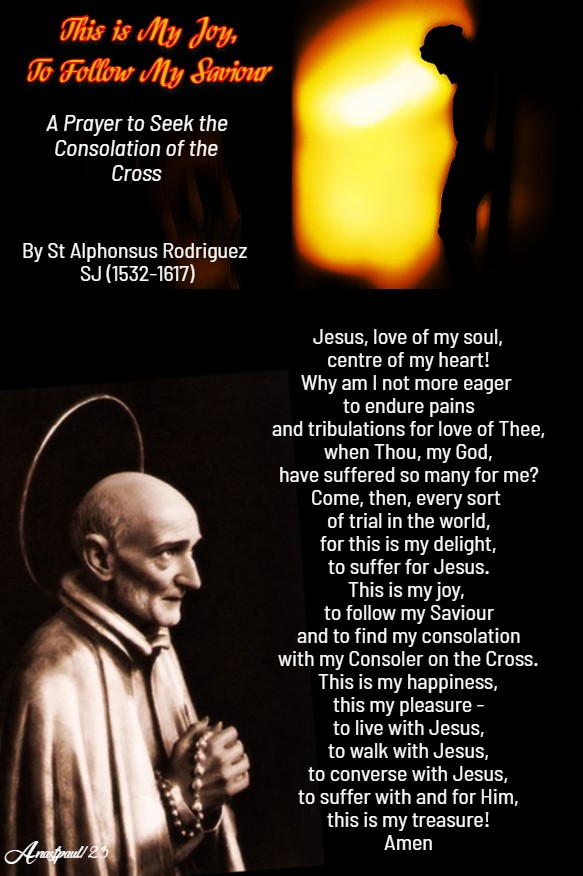
This is My Joy, To Follow My Saviour A Prayer to Seek the Consolation of the Cross By St Alphonsus Rodriguez SJ (1532-1617)
Jesus, love of my soul, centre of my heart! Why am I not more eager to endure pains and tribulations for love of Thee, when Thou, my God, have suffered so many for me? Come, then, every sort of trial in the world, for this is my delight, to suffer for Jesus. This is my joy, to follow my Saviour and to find my consolation with my Consoler on the Cross. This is my happiness, this my pleasure – to live with Jesus, to walk with Jesus, to converse with Jesus, to suffer with and for Him, this is my treasure! Amen
Our Morning Offering – 13 September – “Month of The Seven Sorrows of the Blessed Virgin Mary and The Holy Cross”
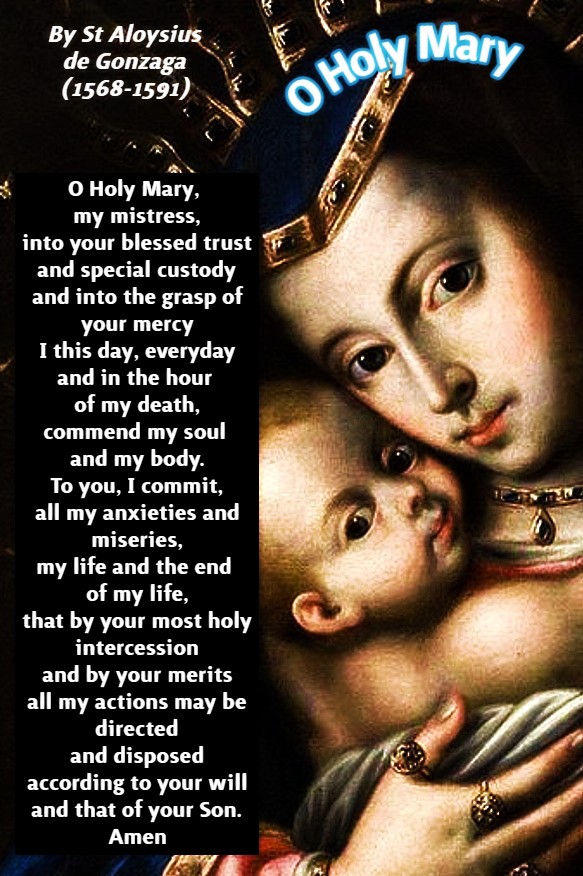
O Holy Mary By St Aloysius de Gonzaga (1568-1591)
O Holy Mary, my mistress, into your blessed trust and special custody and into the grasp of your mercy I this day, everyday and in the hour of my death, commend my soul and my body. To you, I commit, all my anxieties and miseries, my life and the end of my life, that by your most holy intercession and by your merits, all my actions may be directed and disposed according to your will and that of your Son. Amen
Quote/s of the Day – 9 September – St Peter Claver SJ (1581-1654) Confessor, “Slave of the slaves”
“To do the will of God, man must despise his own; the more he dies to himself, the more he will live to God.”
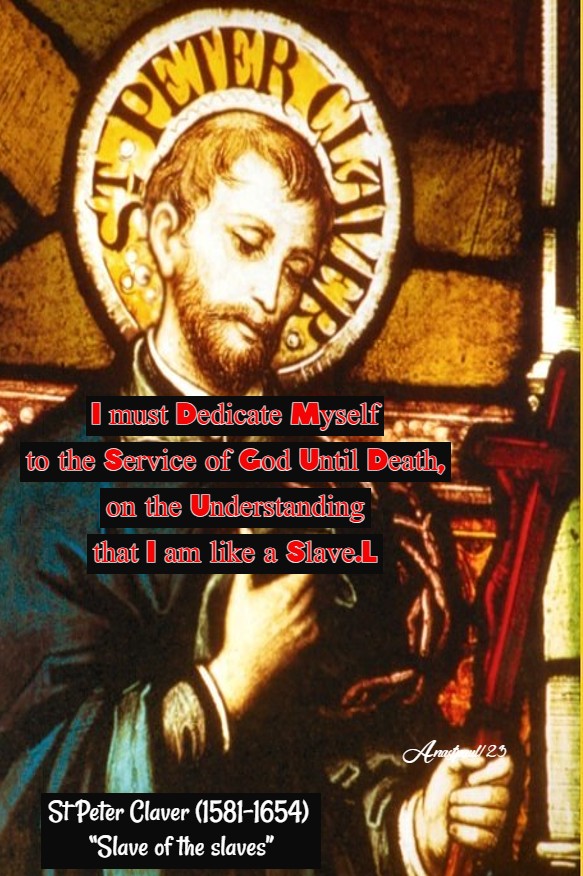
“I must dedicate myself to the service of God until death, on the understanding that I am like a slave.”
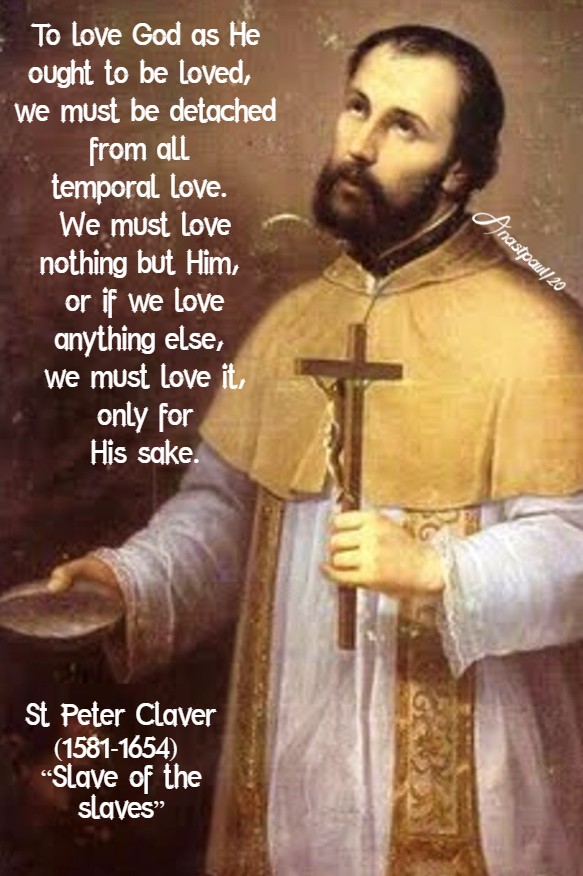
“To love God as He ought to be loved, we must be detached from all temporal love. We must love nothing but Him, or if we love anything else, we must love it, only for His sake.”
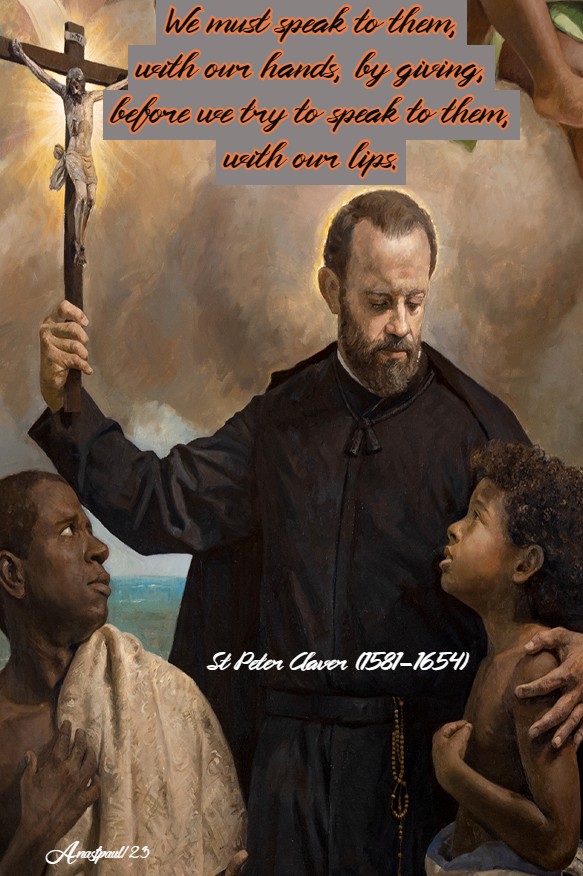
“We must speak to them, with our hands, by giving, before we try to speak to them, with our lips.”
St Peter Claver (1581-1654)
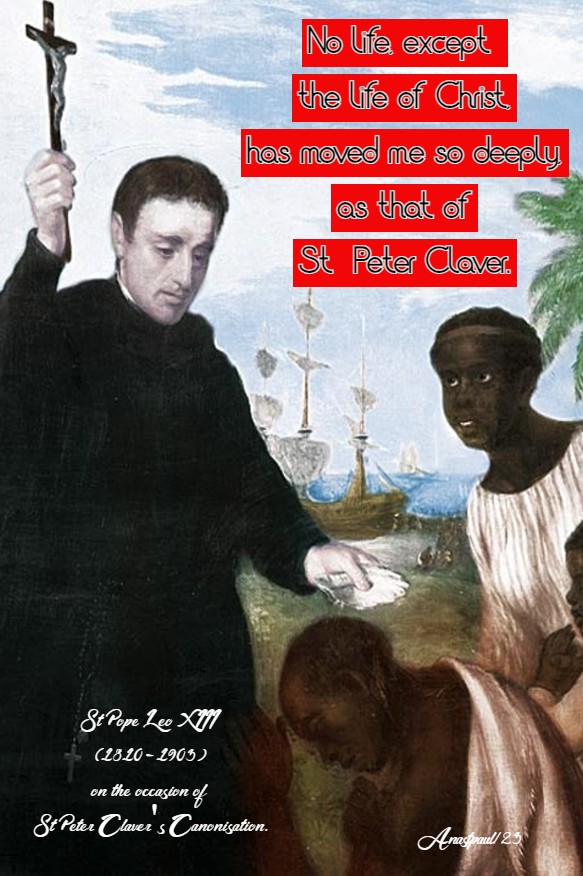
“No life, except the life of Christ, has moved me so deeply, as that of Peter Claver.”
St Pope Leo XIII (1810-1903) on the occasion of St Peter Claver’s Canonisation.
St Peter Claver SJ (1581-1654) Confessor, Priest of the Society of Jesus, Missionary, Confessor, Patron of the missions to African peoples and Human Rights Defender, Apostle of Charity. Also known as “The Apostle of Cartagena” and “The Slave of the Slaves.” Biography: https://anastpaul.com/2017/09/09/saint-of-the-day-9-september-st-peter-claver-s-j/
St Alexander of Sabine St Basura of Masil St Bettelin St Dorotheus of Nicomedia (Died c303) Martyr, Soldier Bl Gaudridus St Gorgonio of Rome St Gorgonius of Nicomedia(Died c303) Martyr, Soldier St Isaac the Great St Joseph of Volokolamsk (c1439-1515) Abbot, Founder
Bl Maria Eutimia Uffing Bl Mary de la Cabeza St Omer St Osmanna St Rufinian St Peter of Nicomedia (Died c303) Martyr, Soldier St Severian St Straton St Tiburtius St Valentinian of Chur St Wilfrida St Wulfhilda
St John Berchmans SJ (1599-1621) Jesuit Novice – born Jan Berchmans on 13 March 1599 at Driest, Brabant, Belgium and died on 13 August 1621 at Rome, Italy of natural causes. Patronages – Altar Servers, Jesuit novices and students. He had a special devotion to God’s Mother and to him is owed the Little Rosary of the Immaculate Conception. Biography: https://anastpaul.com/2019/08/13/saint-of-the-day-13-august-saint-john-berchmans-sj-1599-1621/
St Anastasius the Monk St Anastasius the Priest St Benildus Romançon FSC (1805-1862) Teacher of the Brothers of Christian Schools St Cassian of Todi St Concordia Bl Gertrude of Altenberg St Helen of Burgos St Herulph of Langres Bl John of Alvernia St Junian of Mairé St Ludolph
St Maximus the Confessor (c 580-662) Father of the Church, Monk, Abbot, Theologian, Confessor, Scholar, Writer. Also known as St Maximus of Constantinople and St Maximus the Theologian. St Maximus, a man of fearless courage in witnessing to – “confessing” – even while suffering, the integrity of his faith in Jesus Christ, true God and true man, Saviour of the world and of His Holy Catholic Church. His Life: https://anastpaul.com/2020/08/13/saint-of-the-day-13-august-saint-maximus-the-confessor-c-580-662-father-of-the-church/
St Wigbert of Fritzlar (c 675-c 746) Born in England, a learned Scholar and Abbot, Missionary, Miracle-worker, gifted with a penetrating understanding of Sacred Scripture as well as the gift of prophecy, companion of St Boniface, the Apostle of Germany. Wigbert was known as a quiet and gentle man and a great teacher. Both St Alcuin and St Bede knew and mentioned him in their historical writings of the times and of the Church. St Bede admired his contempt of this world and his learning. A fascinating and much-admired Saint: https://anastpaul.com/2022/08/13/saint-of-the-day-13-august-st-wigbert-of-fritzlar-c-675-c-746/
Quote/s of the Day – 17 July –The Feast of the Humility of the Blessed Virgin Mary
“To arrive at the knowledge of the Truth, there are many paths – the first is humility, the second is humility and the third is humility.”
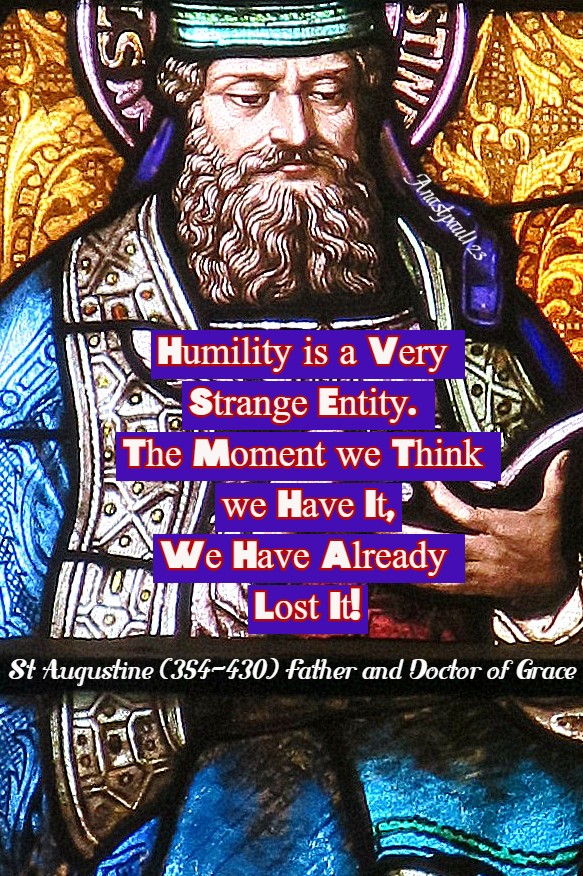
“Humility is a very strange entity. The moment we think we have it, we have already lost it!”
St Augustine (354-430) Father and Doctor of Grace)
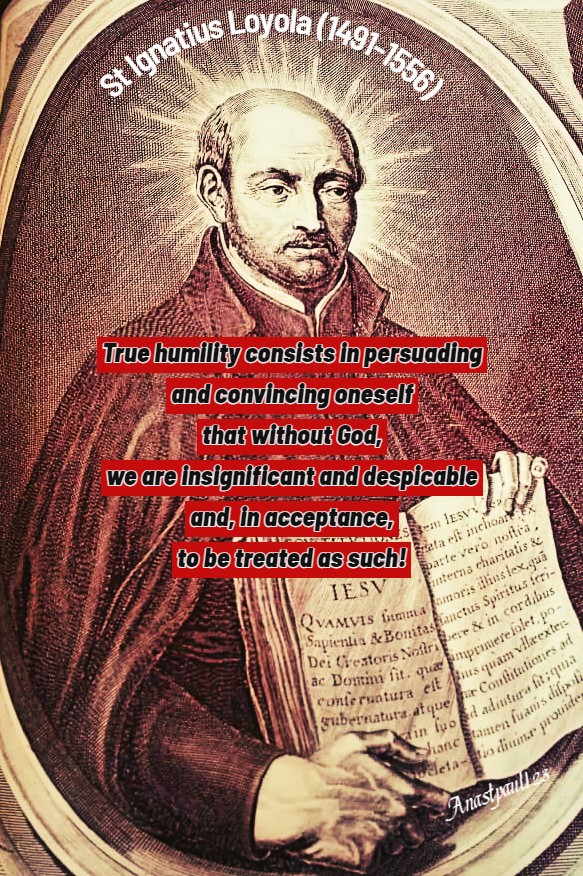
“True humility consists in persuading and convincing oneself that without God, we are insignificant and despicable and, in acceptance, to be treated as such!”
St Ignatius Loyola (1491-1556)
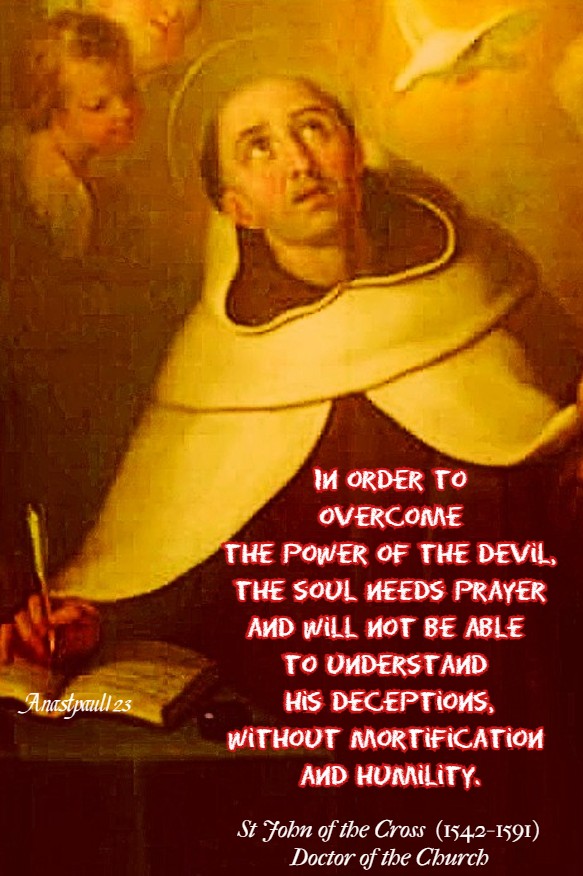
“In order to overcome the power of the devil, the soul needs prayer and will not be able to understand his deceptions, without mortification and humility.”
St John of the Cross (1542-1591) Doctor of the Church
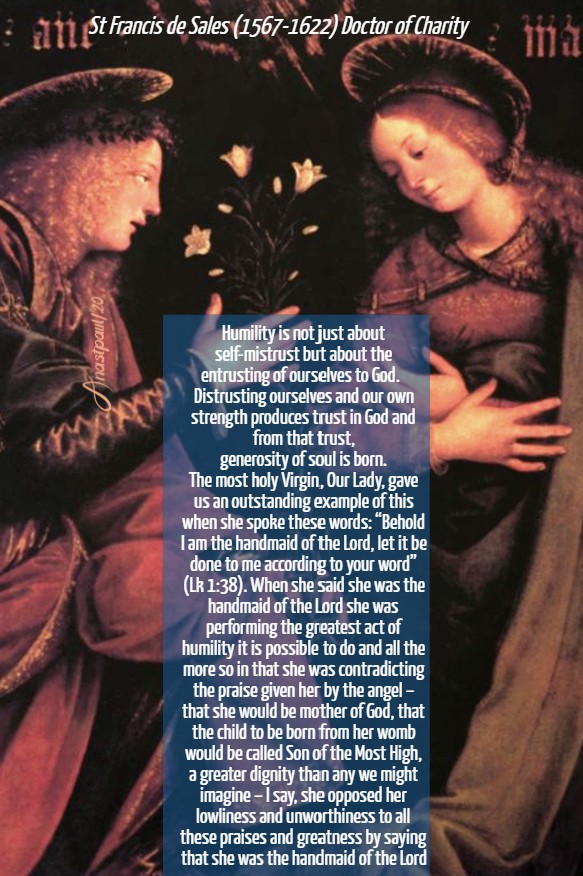
The most holy Virgin, Our Lady, gave us an outstanding example of this when she spoke these words: “Behold I am the handmaid of the Lord, let it be done to me according to your word” (Lk 1:38). When she said she was the handmaid of the Lord, she was performing the greatest act of humility it is possible to do and, all the more so, in that she was contradicting the praise given her by the angel – that she would be mother of God, that the child to be born from her womb would be called Son of the Most High, a greater dignity than any we might imagine – I say, she opposed her lowliness and unworthiness to all these praises and greatness, by saying that she was the handmaid of the Lord.”
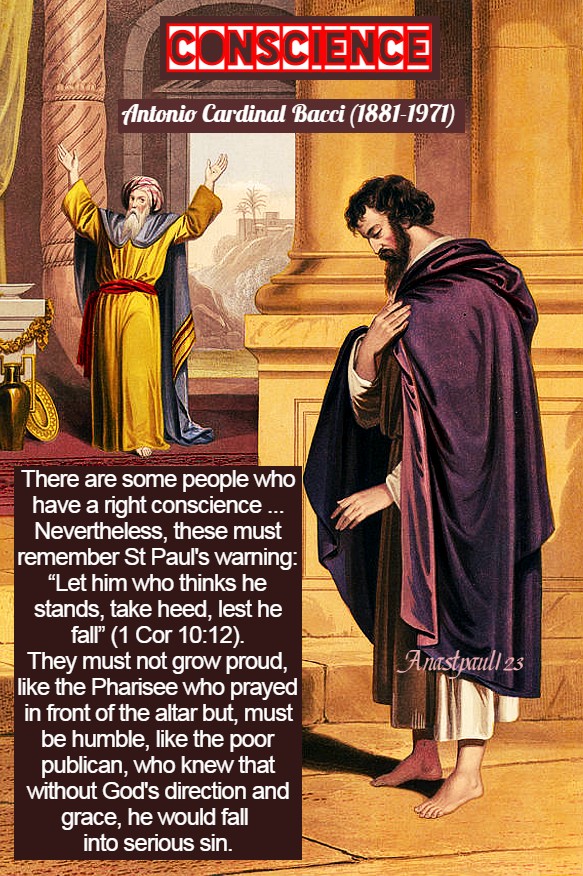
“There are some people who have a right conscience … Nevertheless, these must remember St Paul’s warning: “Let him who thinks he stands, take heed, lest he fall” (1 Cor 10:12). They must not grow proud, like the Pharisee who prayed in front of the altar but, must be humble, like the poor publican, who knew that without God’s direction and grace, he would fall into serious sin.”
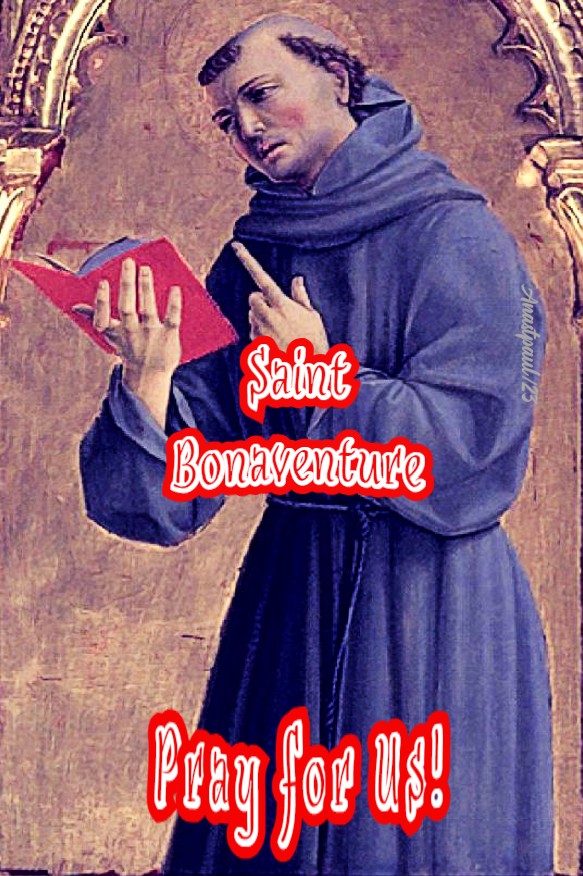
One Minute Reflection – 14 July – “The Month of the Most Precious Blood of Jesus” – St Bonaventure OFM (1221-1274) Seraphic Doctor of the Church – 2 Timothy 4:1-8, Matthew 5:13-19 – Scripture search here: https://www.drbo.org/
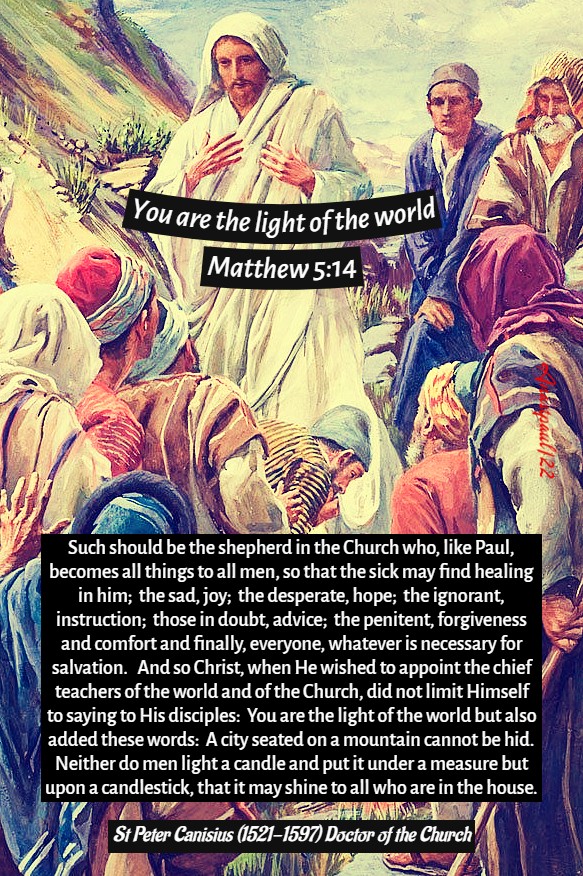
“You are the light of the world.” – Matthew 5:14
REFLECTION – “I shall always love and reverence the Apostles sent by Christ and their successors, in sowing the seed of the Gospel, those zealous and tireless co-operators in propagating the Word, who may justly say of themselves: Let a man so account of us as the ministers of Christ and the dispensers of the mysteries of God. For Christ, like a most watchful and most faithful householder, wished that the Gospel lamp should be lighted by such ministers and delegates, with fire sent down from Heaven and once lighted, should not be put under a measure but set upon a candlestick, so that it may spread its brightness far and wide and put to flight, all darkness and error, rife among both Jews and Gentiles.
Now it is not enough for the Gospel teacher to be a brilliant speaker in the eyes of the people; he must also be as a voice crying in the desert and endeavour, by his eloquence, to help many to lead good lives, lest, if he omit his duty of speaking, he be called the dumb dog that is not able to bark, spoken of by the prophet. Yes, he should also burn, in such a way, that, equipped with good works and love, he may adorn his evangelical office and follow the leadership of Paul. He indeed, was not satisfied with bidding the Bishop of the Ephesians: Thus command and teach: conduct thyself in work as a good soldier of Christ Jesus but he unflaggingly preached the Gospel to friend and foe alike and, said with a good conscience to the Bishops gathered at Ephesus: You know how I have kept back nothing that was for your good but have declared it to you and taught you in public and from house to house, urging Jews and Gentiles to turn to God in repentance and to believe in our Lord Jesus Christ.
Such should be the shepherd in the Church who, like Paul, becomes all things to all men, so that the sick may find healing in him; the sad, joy; the desperate, hope; the ignorant, instruction; those in doubt, advice; the penitent, forgiveness and comfort and finally, everyone, whatever is necessary for salvation. And so Christ, when He wished to appoint the chief teachers of the world and of the Church, did not limit Himself to saying to His disciples: You are the light of the world but also added these words: A city seated on a mountain cannot be hid. Neither do men light a candle and put it under a measure but upon a candlestick, that it may shine to all who are in the house. Those churchmen err, who imagine that it is by brilliant preaching, rather than by holiness of and all-embracing love, they fulfil their office.” – St Peter Canisius SJ (1521-1597) Doctor of the Church (Sermon excerpt).
PRAYER – O God, Who gave to Thy people, blessed Bonaventure, as a minister of salvation, grant, we beseech Thee, that we who cherished him on earth as a teacher of life, may be found worthy to have him as an intercessor in heaven. Through the same Jesus Christ, Thy Son our Lord, Who lives and reigns with Thee, in the unity of the Holy Ghost, God, world without end. Amen (Collect).
Bl Giovanni da Fabriano Becchetti St Jacques Fermin Bl Jarich of Mariengaarde St Jéroche St Lidanus of Sezze St Martinian of Rome * (Died c67) Martyr, Layman
Martyred Soldiers of Rome – 3 Saints: Three soldiers who were converted at the Martyrdom of Saint Paul the Apostle. Then they were martyred, as well. We known nothing else about them but their names – Acestes, Longinus and Megistus. Martyred c68 in Rome, Italy
Martyrs in Carthage by Hunneric – 7 Saints: A group of seven Christians tortured and murdered in the persecutions of the Arian Vandal king Hunneric for remaining loyal to the teachings of orthodox Christianity. They were some of the many who died for the faith during a period of active Arian heresy. – Boniface, Liberatus, Maximus, Rogatus, Rusticus, Septimus and Servus.
Martyrs of Campania – 10 Saints: A group of ten Christians Marytred together in the persecutions of Diocletian. The only details about them to have survived are their names – Ariston, Crescention, Eutychian, Felicissimus, Felix, Justus, Marcia, Symphorosa, Urban and Vitalis. Martyred in 284 in Campania, Italy.
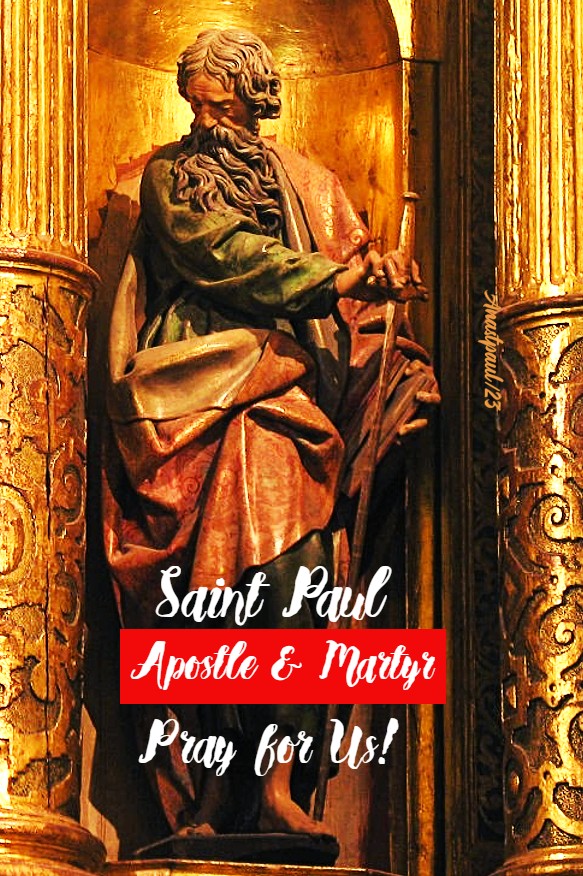
One Minute Reflection – 30 June – “The Month of the Sacred Heart of Jesus” – The Commemoration of St Paul, Apostle and Martyr – Galatians 1:11-20, Matthew 10:16-22 – Scripture search here: https://www.drbo.org/
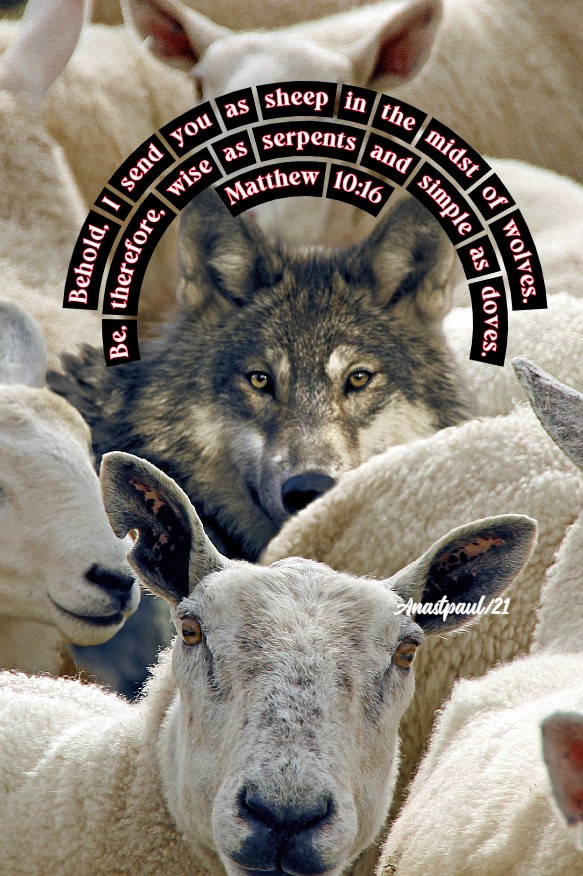
“Behold, I send you as sheep in the midst of wolves, therefore, wise as serpents and simple as doves.” – Matthew 10:16
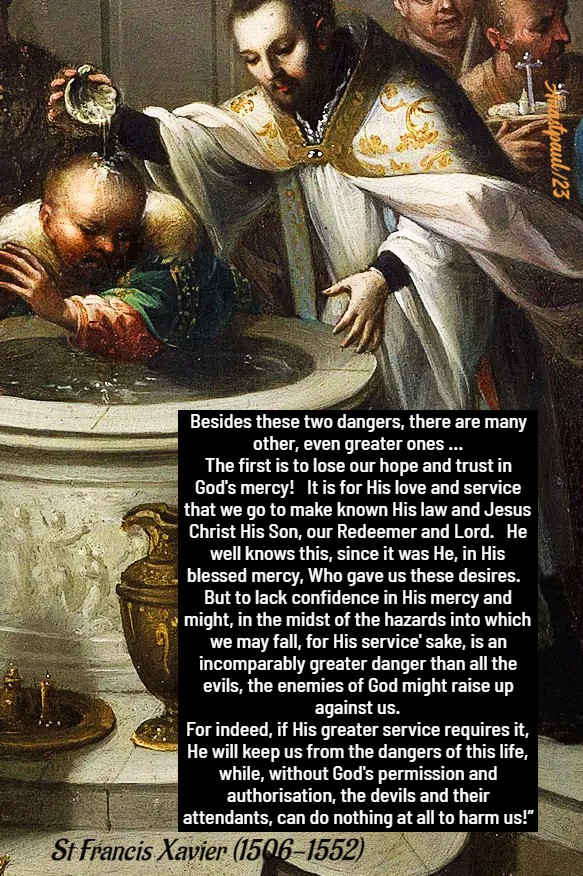
REFLECTION – “According to the people here,, we run two dangers. The first is that, after taking our money, our guide may leave us on some deserted island or throw us into the sea, so as to escape the Governor of Canton. The second is that, supposing he leads us to Canton and we come into the Governor’s presence, the latter will treat us badly or throw us into prison. For our proceeding is unheard of. Numerous decrees prevent anyone at all from gaining access to China and, it is strictly forbidden, for foreigners to make their way in, without the King’s authorisation. Besides these two dangers, there are many other, even greater ones – that the locals know nothing about. It would take a good deal of time to describe them all, however, I will not pass by without citing some of them.
The first is to lose our hope and trust in God’s mercy! It is for His love and service that we go to make known His law and Jesus Christ His Son, our Redeemer and Lord. He well knows this, since it was He, in His blessed mercy, Who gave us these desires. But to lack confidence in His mercy and might, in the midst of the hazards into which we may fall, for His service’ sake, is an incomparably greater danger than all the evils, the enemies of God might raise up against us. For indeed, if His greater service requires it, He will keep us from the dangers of this life, while, without God’s permission and authorisation, the devils and their attendants, can do nothing at all to harm us!” – St Francis Xavier (1506-1552) Jesuit Missionary (Letter 131:22 October 1552).
PRAYER – O God, Who taught vast numbers of the Gentiles by the preaching of the blessed Apostle Paul, grant we beseech Thee that, by honouring his memory, we may enjoy the benefit of his patronal intercession. Through Jesus Christ, Thy Son our Lord, Who lives and reigns with Thee, in the unity of the Holy Ghost, God, world without end. Amen (Collect).
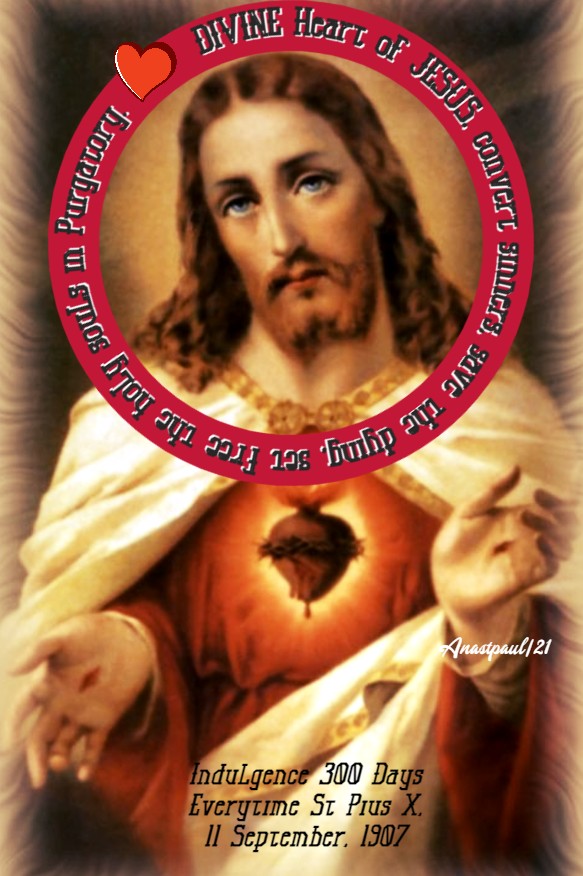
DIVINE Heart of JESUS, convert sinners, save the dying, set free the holy souls in Purgatory. Indulgence 300 Days Everytime – St Pius X, 11 September, 1907.
Thought for the Day – 21 June – Meditations with Antonio Cardinal Bacci (1881-1971)
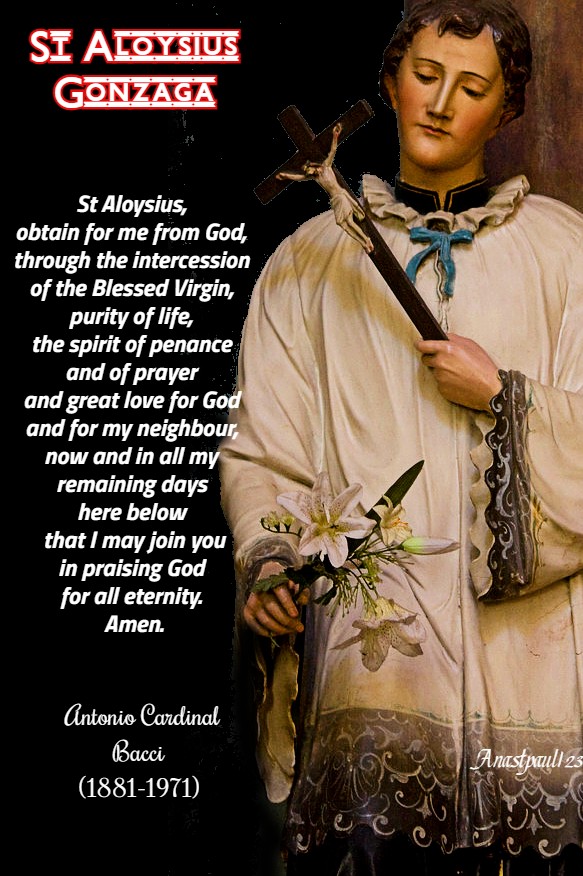
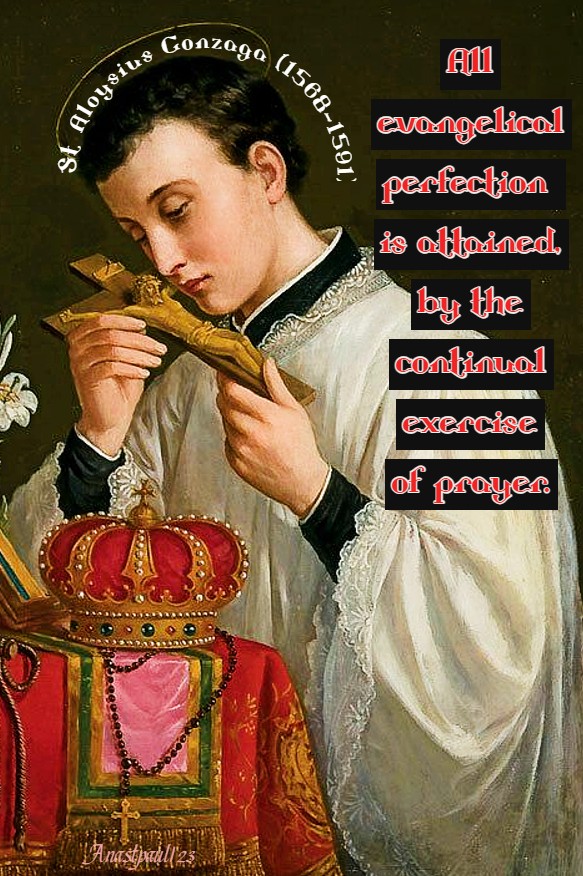
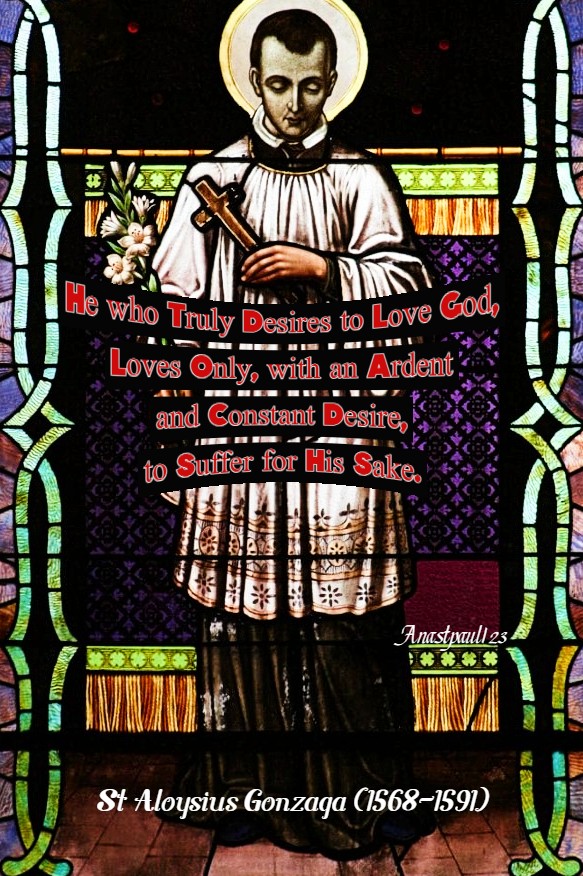
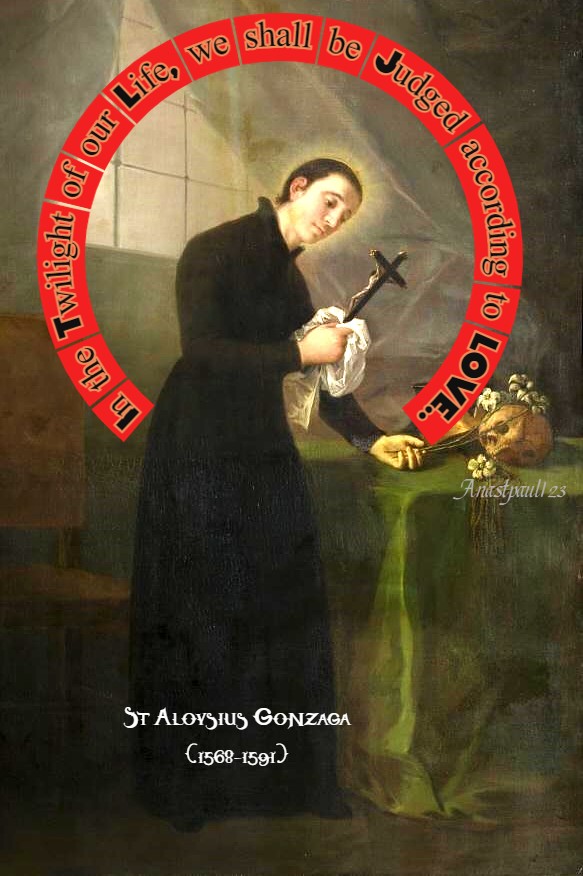
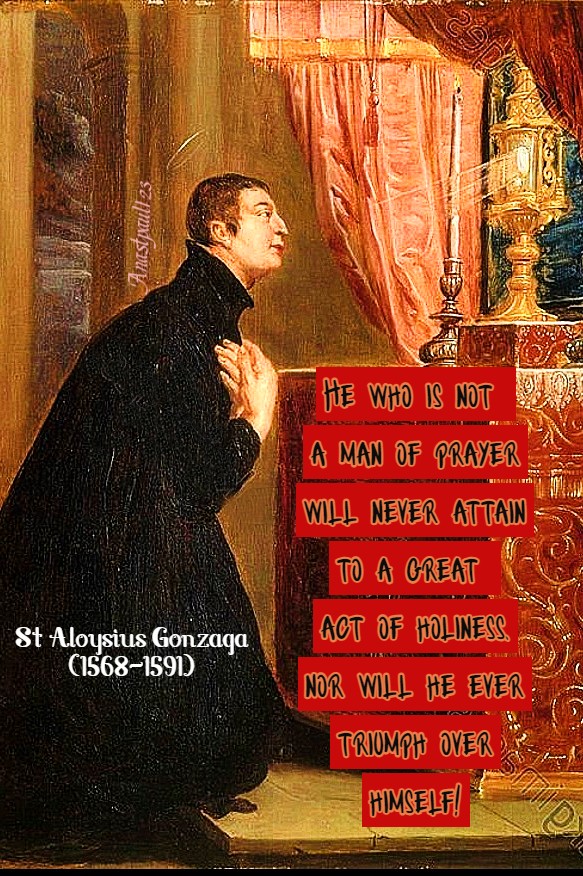
St Aloysius Gonzaga
“St Aloysius, obtain for me from God, through the intercession of the Blessed Virgin, purity of life, the spirit of penance and of prayer and great love for God and for my neighbour, now and in all my remaining days here below that I may join you in praising God for all eternity. Amen.”
One Minute Reflection – 21 June – “The Month of the Sacred Heart of Jesus” – The Feast of St Aloysius de Gonzaga SJ (1568-1591) Confessor – Ecclesiasticus 31:8-11, Matthew 22:29-40 – Scripture search here: https://www.drbo.org/
“Master, which commandment in the law is the greatest?” … Matthew 22:36
REFLECTION – “O Lord, what is it that you require of Your servants? “Take my yoke upon you,” you say. And what sort of yoke is this? “My yoke is easy and my burden light.” Now who would not willingly bear a yoke that does not press down but gives strength; a burden that does not weigh heavily but refreshes? As You rightly added: “And you will find rest” (Mt 11:29). And what is this yoke of Yours that does not tire but gives rest? It is the first and greatest of the commandments: “You shall love the Lord your God with all your heart.” What could be easier, better or more agreeable than to love the goodness, beauty and love that is most perfectly Yours, O Lord my God?
Do You not offer a reward to those who keep the commandments, which are “more desirable than a heap of gold and sweeter than honey from the comb?” (Ps 19[18]:11) So in every way You offer a very ample reward, as James the Apostle says: “The Lord has prepared, the crown of life, for those who love Him” (Jas 1:12) (…) And Paul quotes these words from Isaiah: “No eye has seen, nor ear heard, nor has the heart of man conceived, what God has prepared for those who love Him” (1 Cor 2:9).
That first and great commandment is not only profitable for the man who keeps it, or for God Who commands it, – the other commandments of God, also make perfect him who obeys them, improves him, instructs him and makes him illustrious – in a word, they make him good and holy. If you understand this, realise that you have been created for the glory of God and for your own eternal salvation. This is your end, this is the object of your soul and the treasure of your heart. You will be blessed if you reach this goal but miserable if you are cut off from it.” – St Robert Bellarmine (1542-1621) Doctor of the Church (The Ascent of the Mind to God, 1).
PRAYER – O God, bestower of heavenly gifts, Who in the angelic youth Aloysius joined wondrous innocence of life to an equally wondrous love of penance; grant, by his merits and prayers, that we who have not followed him in his innocence may imitate him in his penance. Through Jesus Christ, Thy Son our Lord, Who lives and reigns with Thee, in the unity of the Holy Ghost, God, world without end. Amen (Collect).
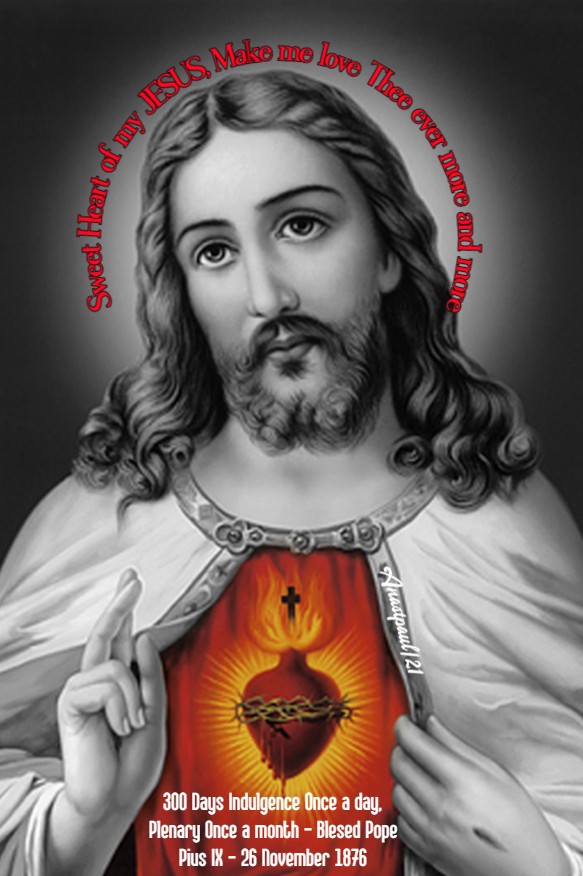
SWEET HEART of my JESUS, Make me love Thee ever more and more! – Indulgence 300 Days Everytime – Plenary Once a Month – Raccolta 162 – Pope Pius IX 26 November 1876.
Our Morning Offering – 21 June – The Feast of St Aloysius Gonzaga SJ (1568-1591) Confessor, Jesuit Seminarian, Mystic, Marian devote
O Holy Mary By St Aloysius de Gonzaga (1568-1591)
O Holy Mary, my mistress, into your blessed trust and special custody and into the grasp of your mercy I this day, everyday and in the hour of my death, commend my soul and my body. To you, I commit, all my anxieties and miseries, my life and the end of my life, that by your most holy intercession and by your merits, all my actions may be directed and disposed according to your will and that of your Son. Amen
St Apollinaris of Africa St Colagia St Corbmac St Cyriacus of Africa St Demetria of Rome St Dominic of Comacchio St Engelmund St John Rigby (1570-1600) Martyr, Confessor, Layman St Juan of Jesus St Lazarus the Leper St Leutfridus of La-Croix St Martia of Syracuse St Martin of Tongres St Melchiorre della Pace St Mewan of Bretagne Bl Nicholas Plutzer
St Raymond of Barbastro St Rufinus of Syracuse St Suibhne the Sage St Terence St Ursicenus of Pavia
Martyrs of Taw – 3+ Saints: Three Christians of different backgrounds who were Martyred together – Moses, Paphnutius, Thomas. They were beheaded in Taw, Egypt, date unknown.
Thought for the Day – 20 June – Meditations with Antonio Cardinal Bacci (1881-1971)
The Eucharistic Life
“May the Most Blessed Sacrament, be forever praised and adored!”
Anima Christi
Soul of Christ, sanctify me Body of Christ, save me Blood of Christ, inebriate me Water from the side of Christ, wash me Passion of Christ, strengthen me Good Jesus, hear me Within Your wounds, shelter me from turning away, keep me From the evil one, protect me At the hour of my death, call me Into Your presence lead me to praise You with all Your saints Forever and ever, Amen
Thought for the Day – 13 June – Meditations with Father Francis Xavier Weninger SJ (1805-1888) (Austrian Jesuit Missionary and Author).
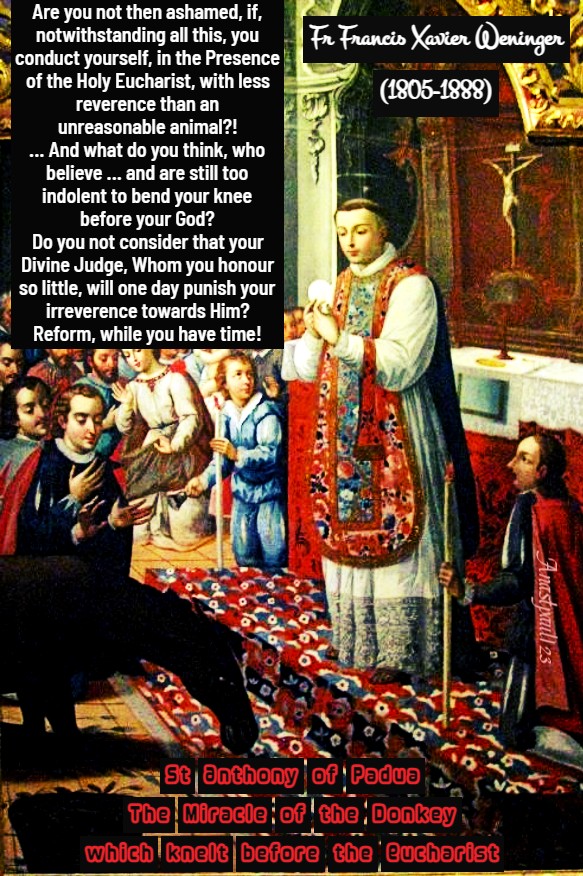
Practical Considerations on the Life of St Anthony of Padua The Miracle of the Donkey which knelt before the Eucharist
“St Antony commands a senseless animal to fall down before the Blessed Eucharist and to honour it – the animal obeys and thus honours its Creator. You have, in the Holy Sacrament, your Lord and God, your Redeemer and Judge before you. You know the command of the Most High – “The Lord, thy God, thou shalt adore” (St Mark 4). “For every knee shall be bowed to Thee ” (Isaiah 45). The Church of Christ says to you … “Come, let us bow down and worship God; let us weep before God Who has created us because He is our God and we are His people.”
Are you not then ashamed, if, notwithstanding all this, you conduct yourself, in the Presence of the Holy Eucharist, with less reverence than an unreasonable animal?! That those who are not Catholics should not manifest due honour to the Blessed Sacrament is wrong in them but they have, at least before man, the excuse that they do not believe in the Real Presence of Christ. But how can you excuse yourself, either before God or man, you who believe in the Presence of Christ and yet, give no due honour to your God? “If I believed,” said a Turkish Ambassador, one day, speaking of the little respect evinced by some Catholics in the Church, “that my God were substantially here, I would humble myself to the ground and if possible, even beneath it! ”
And what do you think, who believe it and are still too indolent to bend your knee before your God? Do you not consider that your Divine Judge, Whom you honour so little, will one day punish your irreverence towards Him? Reform, while you have time!”
One Minute Reflection – 1 June – “The Month of the Sacred Heart of Jesus” – Pentecost Thursday – Acts 8:5-8, Luke 9:1-6 – Scripture search here: https://www.drbo.org/
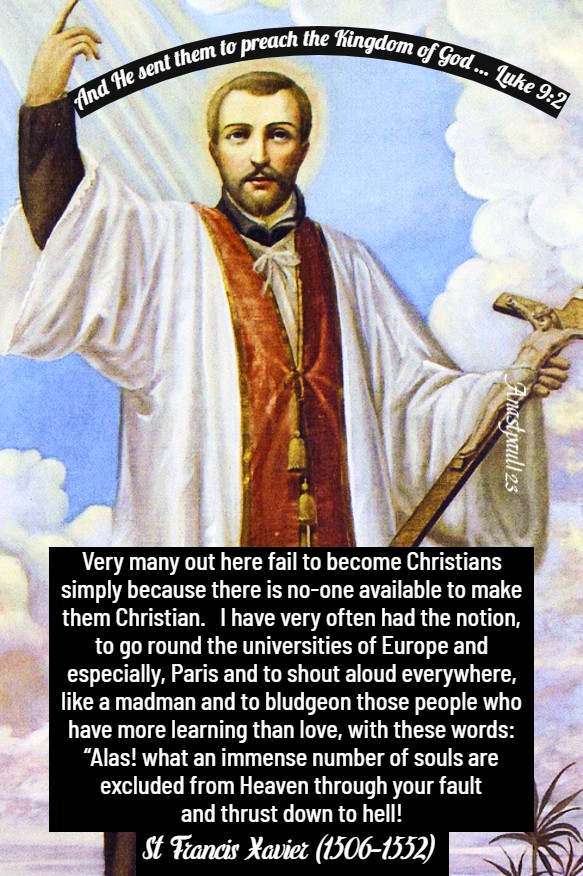
“And He sent them to preach the Kingdom of God …” – Luke 9:2
REFLECTION – “Since I came here, I have had no rest. I have been from village to village and every child not yet Baptised I have Baptised… But the children would not let me say my Office or eat or rest until I had taught them some prayers. It was then that I really began to feel that of such is the Kingdom of Heaven (Mk 10:14). I could not reject so religious a request without myself being irreligious. I made a start with the Sign of the Cross and taught them the Apostles’ Creed, the Our Father and the Hail Mary. I saw, immediately, that they were very intelligent. If only there were someone to train them in the principles of Christianity, I am sure that they would be extremely good Christians.
Very many out here fail to become Christians simply because there is no-one available to make them Christian. I have very often had the notion, to go round the universities of Europe and especially, Paris and to shout aloud everywhere, like a madman and to bludgeon those people who have more learning than love, with these words: “Alas! what an immense number of souls are excluded from Heaven through your fault and thrust down to hell!”
If only those people devoted themselves to this care in the way they do to literature. Then they would be able to render God an account of their doctrine and of the talents entrusted to them! Many of them, moved by this thought and helped by meditation on the things of God, would take pains to hear what the Lord is speaking in them and, putting aside their own selfish desires and worldly matters, would put themselves fully at God’s service and call. They would indeed cry from their soul: “Lord, here I am. What would you have me do? Send me wherever you wish, even as far as India.” – St Francis Xavier (1506-1552) Jesuit Missionary (Letters 4 and 5 to Saint Ignatius Loyola).
PRAYER – O God, Thou Who on this day have taught the hearts of the faithful by the Light of the Holy Spirit, grant us by that Holy Spirit Himself, to know what is right and ever to rejoice in His consolation. Through Jesus Christ, Thy Son our Lord, Who liveth and reigneth with Thee, in the unity of the same Holy Ghost, God, world without end. Amen (Collect). Sweet Heart of my JESUS, Make me love Thee ever more and more! – 300 Days Indulgence Once a day, Plenary Once a month – Blessed Pope Pius IX – 26 November 1876
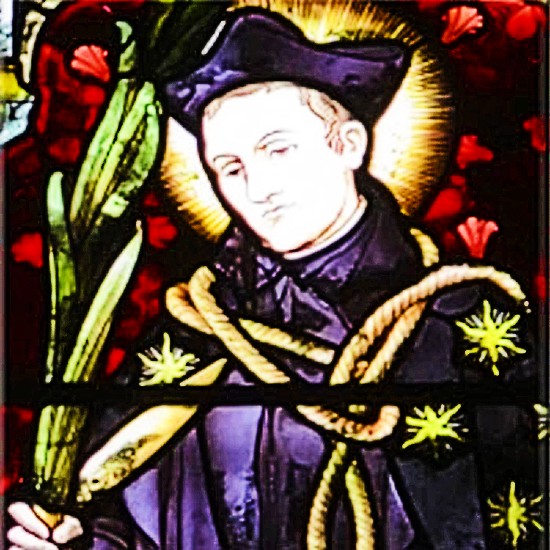
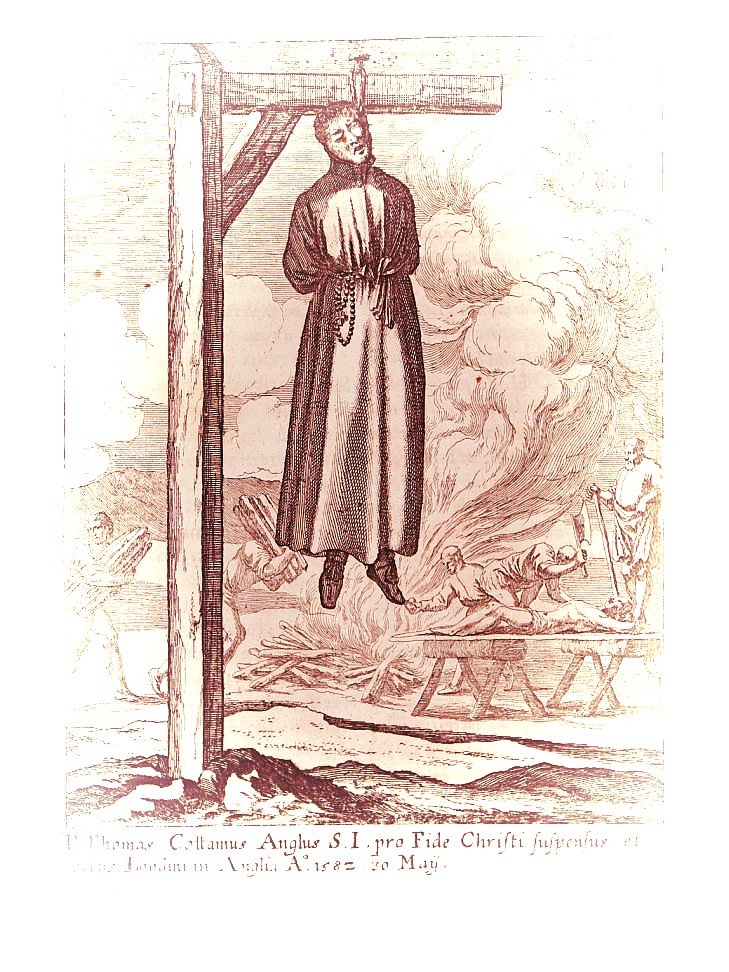
Saint of the Day – 30 May – Blessed Thomas Cottam SJ (1549-1582) Priest of the Society of Jesus, Martyr. Born in 1549 in Dilworth, Lancashire, England and died by being hanged on 30 May 1582 at Tyburn, London, England – another victim of Elizabeth I’s reign of terror. Additional Memorials – 29 October as one of the Martyrs of Douai, 1 December as one of the Martyrs of Oxford University.. Blessed Thomas was Beatified on 29 December 1886 by Pope Leo XIII .
Thomas Cottam was sentenced to death at the same trial as St Edmund Campion but had to wait six months to follow his more famous companion to Martyrdom. His ministry was very limited because English spies in France targeted him before he even left for England and he was arrested as soon as he arrived.
Thomas was born of Protestant parents and received a good education, earning a Bachelor’s Deegree from Oxford in 1569. He became a schoolmaster in London, where he also became a Catholic and was encouraged to become a Priest. In May 1577 he left England for Flanders to attend the English College at Douai. After he was Ordained a Deacon, he travelled to Rome and entered the Society in April 1579. He wanted to become a missionary to India but became ill so his Physician suggested that he first return north to recover his health.
A brief stay in Lyons, France, did not improve his physical condition but it set the stage for his eventual arrest because he met there a man named Sledd, an Englishman who sought to identify Priests who would be returning to England. Sledd pretended to befriend the young Jesuit and travelled with him as far as Rheims before leaving him to give the English Ambassador in Paris a detailed description of Thomas.
Thomas was Ordained a Priest at Soissons, France, on 28 May 1580 and departed for England a week later. Port authorities were waiting to arrest him because of the information from Sledd and they recognised the young Jesuit Priest immediately. Thomas was able to escape because the lawyer who was responsible for accompanying him to London, allowed him to get away. That act of kindness put the lawyer in peril, so Cottam turned himself in, to save the lawyer.
He was charged with being a Priest, which led to his imprisonment in the Tower of London where he suffered horrible tortures. He was tried along with Father Campion and condemned to die but he had to wait six more months for the sentence to be executed. On 30 May 1582, Thomas and three Diocesan Priests were dragged to Tyburn to be hung and quartered. The Jesuit had to watch his three companions die before his own turn came. Afterwards the four bodies were cast into vats of boiling water so that bystanders could not take relics.
Our Morning Offering – 21 May – “The Month of the Blessed Virgin Mary”
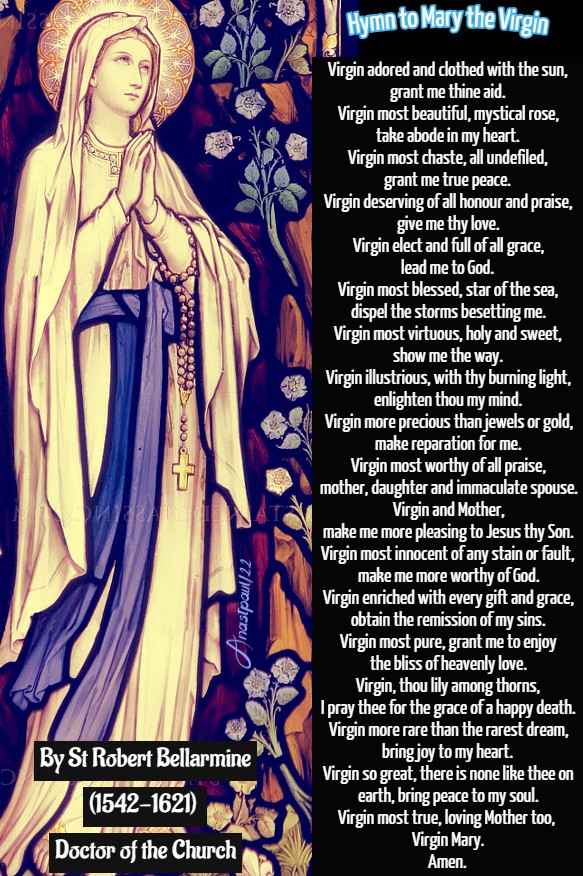
St Robert Bellarmine’s Hymn to Mary the Virgin: Among St Robert’s extant writing, there is a short poem of twenty stanzas which he composed in the nature of a Litany to the Blessed Virgin. The text was first published in Italian some fifty years ago and to the best of the writer’s knowledge, has never been translated into English. Each verse-line begins with the name “Virgin,” joined to a title and petition to Our Lady, starting with the letter “A” and going down the Italian alphabet to “V.” Thus the first seven verses begin with the invocation: “Vergine adorna … Vergine Bella …Vergine casta … Vergine degna … Vergine eletta … Vergine felice … Vergine gradita …”
A translation to this tribute to the Virgin Mother reads as follows: – Servant of God Fr John A Hardon SJ (1914-2000).
Hymn to Mary the Virgin By St Robert Bellarmine (1542-1621) Doctor of the Church.
Virgin adored and clothed with the sun, grant me thine aid. Virgin most beautiful, mystical rose, take abode in my heart. Virgin most chaste, all undefiled, grant me true peace. Virgin deserving of all honour and praise, give me thy love. Virgin elect and full of all grace, lead me to God. Virgin most blessed, star of the sea, dispel the storms besetting me. Virgin most virtuous, holy and sweet, show me the way. Virgin illustrious, with thy burning light, enlighten thou my mind. Virgin more precious than jewels or gold, make reparation for me. Virgin most worthy of all praise, mother, daughter and immaculate spouse. Virgin and Mother, make me more pleasing to Jesus thy Son. Virgin most innocent of any stain or fault, make me more worthy of God. Virgin enriched with every gift and grace, obtain the remission of my sins. Virgin most pure, grant me to enjoy the bliss of heavenly love. Virgin, thou lily among thorns, I pray thee for the grace of a happy death. Virgin more rare than the rarest dream, bring joy to my heart. Virgin so great, there is none like thee on earth, bring peace to my soul. Virgin most true, loving Mother too, Virgin Mary. Amen.
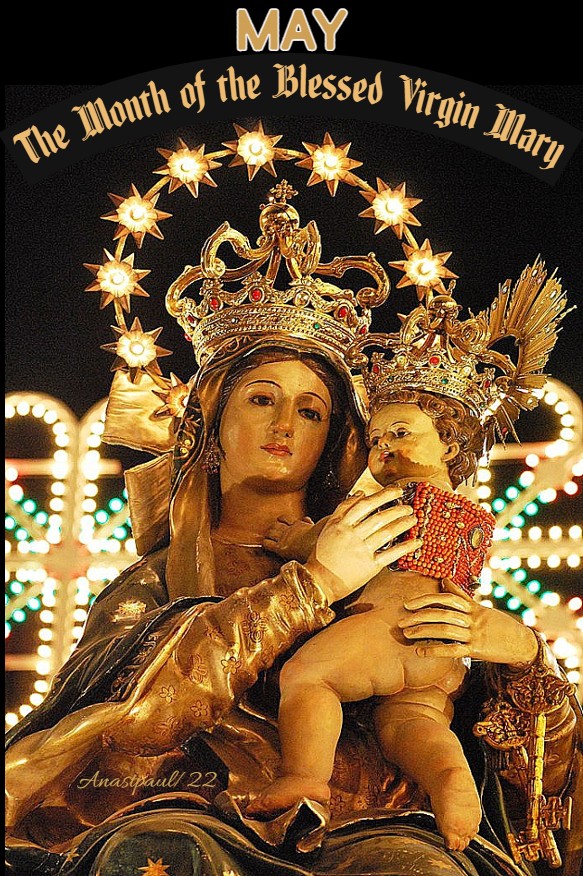
It’s 1 May Let us Rejoice in our Mother Mary! The Month of the Blessed Virgin Mary
“Bright Mother of our Maker, Hail! Thou Virgin ever blest, the Ocean’s Star by which we sail and gain the port of rest!” (Anonymous 8th Century Latin Hymn)
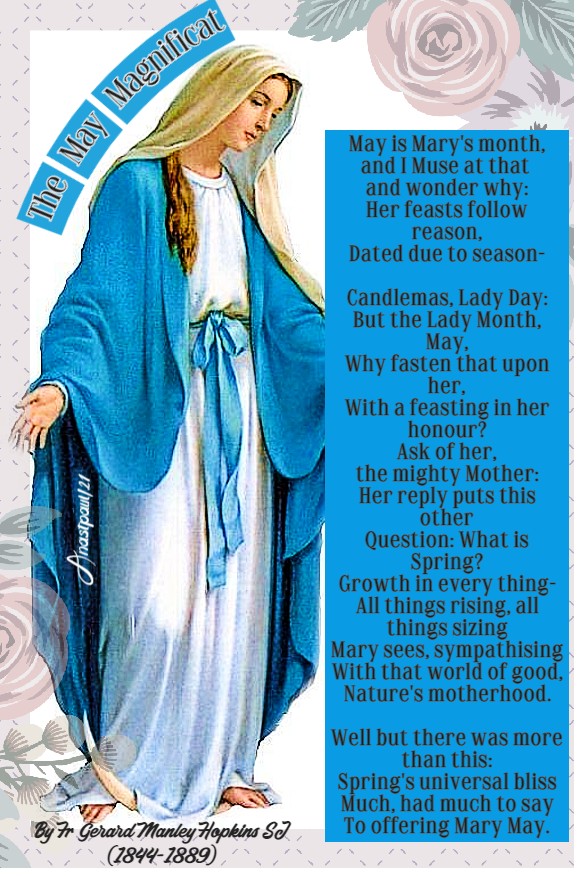
The May Magnificat By Gerard Manley Hopkins SJ (1844-1889)
May is Mary’s month and I Muse at that and wonder why: Her feasts follow reason, Dated due to season-
Candlemas, Lady Day: But the Lady Month, May, Why fasten that upon her, With a feasting in her honour? Ask of her, the mighty Mother: Her reply puts this other Question: What is Spring? Growth in everything- All things rising, all things sizing Mary sees, sympathising With that world of good, Nature’s motherhood.
Well but there was more than this: Spring’s universal bliss Much, had much to say To offering Mary May.
Visits to the Altar of Our Lady On the Love of Mary for Her Children (Imprimatur, 1867)
Mary loves us because we are her children. A loving and tender Mother is never wearied by the importunities of her little ones and Mary, who is the most loving and tender of all mothers, will never weary of hearing and answering our petitions. The one great thing that she desires, for all her children is that they should become like her Son Jesus. He is the only Child who never disobeyed her or grieved her. It is for His love that she loves us. How great must be His love for us, when He inspires Mary with such a love! The best return we can make Him is to have a perfect trust and confidence in His Blessed Mother. Those who are not devout to Mary cannot really understand the great Mystery of the Incarnation and do not love Jesus as they should – for, if they loved Him, they would love His Mother too, even a tiny bit as much as He loves her.
Let us try, then, during this Month of May, to become more like Jesus. Let us consider what spiritual grace we need most, in order to attain this great end and let us ask it with confidence everyday. Let us also try to induce others, to honour Mary, by special devotion to her during this most beautiful month.
Let Me Love Your Jesus By St Ildephonsus (c 607-670)
Virgin Mary, hear my prayer, through the Holy Spirit, you became the Mother of Jesus, from the Holy Spirit, may I too have Jesus. Through the Holy Spirit, your flesh conceived Jesus, through the same Spirit, may my soul receive Jesus. Through the Holy Spirit, you were able to know Jesus, to possess Jesus and to bring Him into the world. Through the Holy Spirit, may I too come to know your Jesus. Imbued with the Spirit, Mary, you could say “I am the handmaid of the Lord, be it done unto me according to your word,” in the Holy Spirit, lowly as I am, let me proclaim the great truths about Jesus. In the Spirit, you now adore Jesus as Lord and look on Him as Son, in the same Spirit, Mary, let me love your Jesus. Amen
Quote/s of the Day – 27 April – St Peter Canisius (1521-1597) Confessor, Doctor of the Church
This 16th Century Saint, known as the second Apostle of Germany, followed in the giant footsteps of St Boniface, who evangelised Germany a thousand years earlier. He was also active at the Council of Trent and wrote much on the Blessed Virgin Mary.
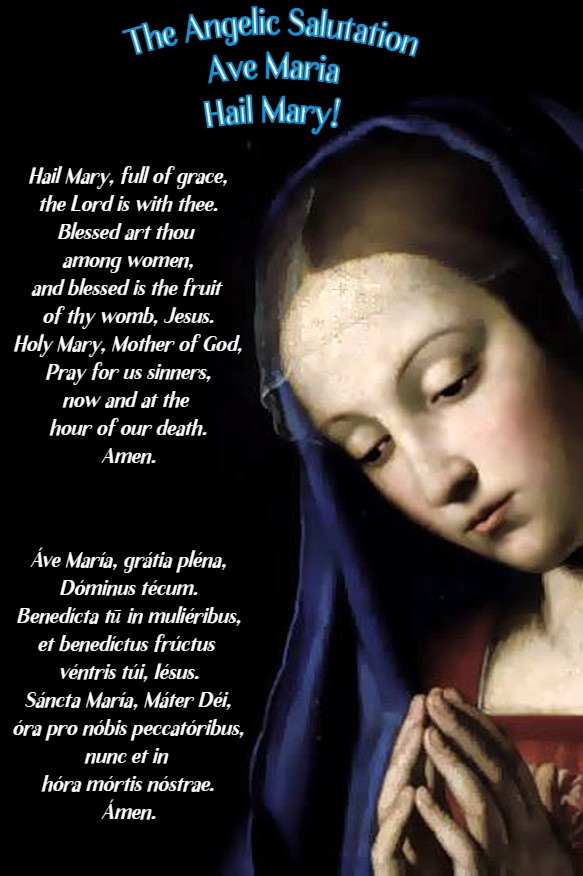
The first half of the Hail Mary, of course, comes from Scripture. What many Catholics do not know, is that the second half of this Catholic prayer is due to the intervention of St Peter Canisius at the Council of Trent. St Peter began adding onto the scriptural part of the Hail Mary the second half of this familiar prayer: “Holy Mary Mother of God, pray for us sinners, now, and at the hour of our death.” It was the Fathers of Trent who officially accepted this addition and included it in their famous Catechism of the Council of Trent in 1566.
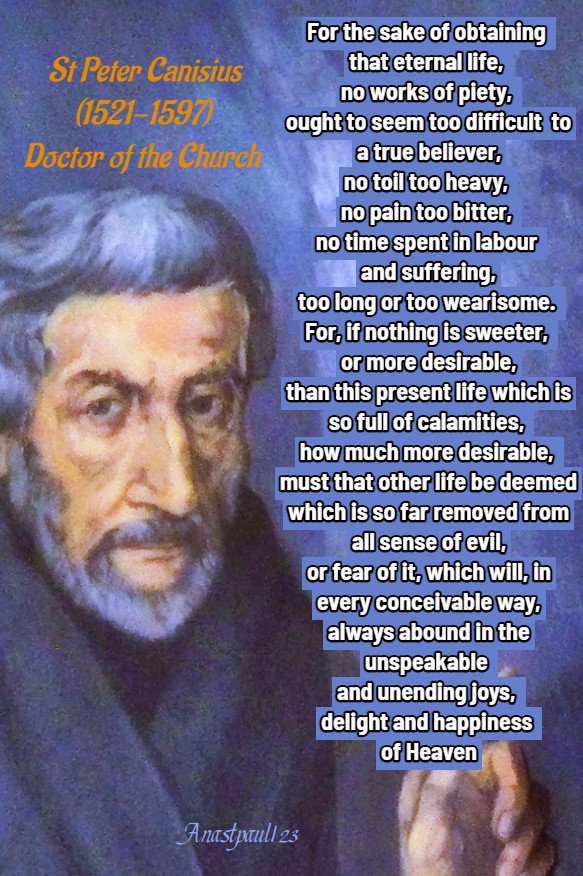
“For the sake of obtaining that eternal life, no works of piety, ought to seem too difficult to a true believer, no toil too heavy, no pain too bitter, no time spent in labour and suffering, too long or too wearisome. For, if nothing is sweeter, or more desirable, than this present life which is so full of calamities, how much more desirable, must that other life be deemed which is so far removed from all sense of evil, or fear of it, which will, in every conceivable way, always abound in the unspeakable and unending joys, delight and happiness of Heaven.”

























 AnaStpaul
You must be logged in to post a comment.