Posted in FEASTS and SOLEMNITIES, JULY - The MOST PRECIOUS BLOOD, MARIAN TITLES, SAINT of the DAY, The MOST PRECIOUS BLOOD

The Most Precious Blood of Our Lord, Jesus Christ , Dedication of the Church of Jumieges, Normandy, France (1067) and Memorials of the Saints – 1 July

July Devotion – The Most Precious Blood of Jesus

The Most Precious Blood of Our Lord, Jesus Christ – 1 July: The feast was removed from the General Roman Calendar in 1969, “because the Most Precious Blood of Christ the Redeemer is already venerated in the solemnities of the Passion, of Corpus Christi, of the Sacred Heart of Jesus and in the feast of the Exaltation of the Holy Cross.” However, as this is the Month of the Most Precious Blood, this day, is most worthy of celebrating this Feast Day everyday. There is a wonderful Sermon here: https://altcensored.com/watch?v=Lfju6KSKc5Q

Dedication of the Church of Jumieges, Normandy, France (1067) 1 July:
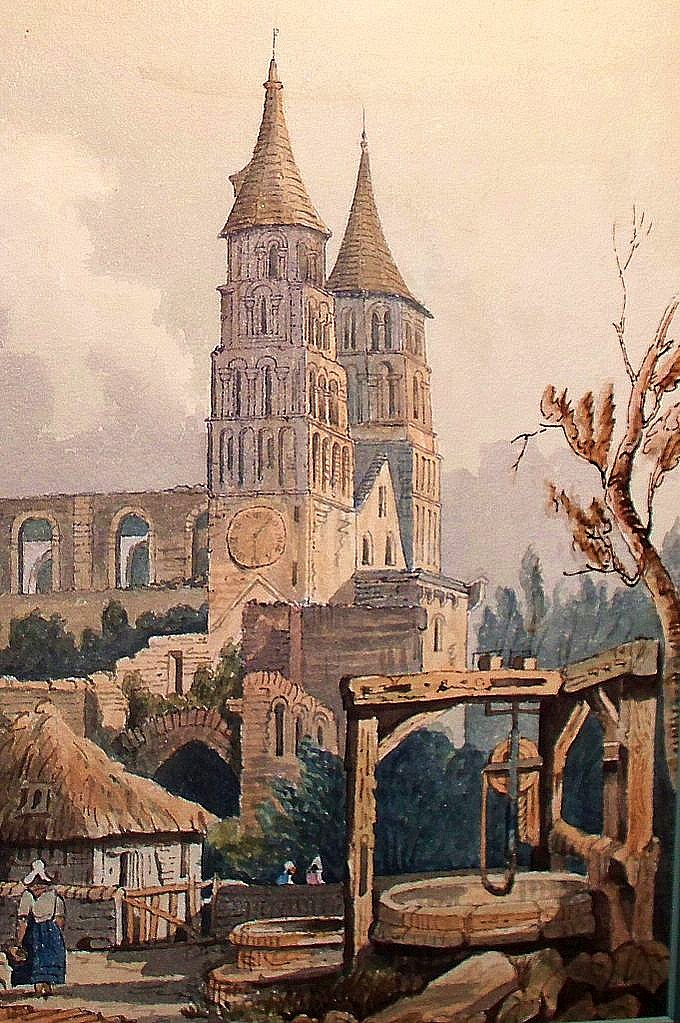
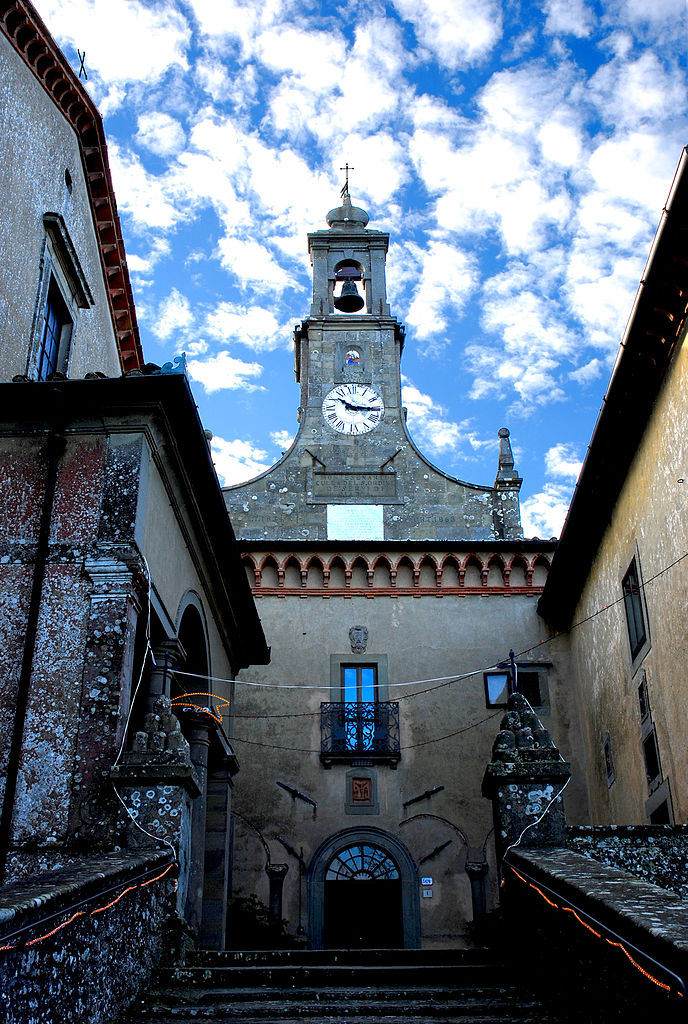
The Benedictine Abbey of Jumieges in Normandy has an ancient and remarkable history. Founded in the year 654 by Saint Philibert, it was once one of the magnificent Benedictine Monasteries in France and the home of some 700 Monks with over twice that number of lay brothers. Sadly, it is now nothing more than a tourist attraction and the vestiges of the surviving structures, though vacant, scarred and exposed to the elements, are celebrated as a magnificent example of Romanesque art.
All that remains standing today are the Church of Notre Dame with its impressive twin towers soaring to a height of 150 feet, the western façade, and sections of which, were once the cloisters and library. The rest is but a pile of rubble, though it is proudly proclaimed the largest medieval ruin in France. Victor Hugo notably Baptised there “the most beautiful ruin in France” but one is left to wonder how it once appeared when the Catholic Faith was still vibrant and alive in France.
Located a little west of Rouen along a bend in the Lower Seine, it was vulnerable to the attacks of the Vikings in the ninth and tenth centuries. During one invasion it was set on fire and pillaged of its wealth. It was soon lovingly rebuilt, however, by the Duke of Normandy. The Church of Jumieges was consecrated by Maurice, the Archbishop of Rouen, in the year 1067. William the Conqueror attended the dedication of the Church of Jumieges and the subsequent celebrations.
Larger and more beautiful than ever before, the Abbey once again became wealthy and influential. A centre of learning, it was famed for its Scriptorium where Monks worked diligently copying and illustrating manuscripts by hand.
The errors of Martin Luther came to France, as they did to all of Christendom, followed by the usual looting of Churches. The destruction was widespread and the Abbey of Jumieges was not spared. When the French Revolution came along, the Monastery was finished, and only the imposing ruins of what had once been a thriving community was left in its wake. In 1793 the whole was sold at auction and mined as a stone quarry. The Chancel, with its marble Altar and the lantern tower were intentionally imploded and the rest was subject to the deprivations of vandals.
What remained was rescued in the year 1852 by the Lepel-Cointet family. A lodge was built and the rest landscaped and made into a park before being sold to the State in the year 1946. The Church is not open but one can walk about the ruins and imagine the glory that once was.

St Junipero Serra (1713-1784) (Optional Memorial, USA) “Apostle of California,” Spanish Priest, Religious Friar, Missionary, Theologian, Philospher, Teacher, Evangelist.
Biography:

https://anastpaul.wordpress.com/2017/07/01/saint-of-the-day-st-junipero-serra-o-f-m-apostle-of-california-1-july/

St Aaron of Caerleon
St Aaron the Patriarch

Blessed Antonio Rosmini-Serbati (1797-1855) Priest, Founder of the Institute of Charity.
His Life:

https://anastpaul.com/2019/07/01/saint-of-the-day-1-july-blessed-antonio-rosmini-1797-1855/

St Arnulf of Mainz
Bl Assunta Marchetti
St Atilano Cruz Alvarado
St Calais of Anisole
St Carilephus
St Castus of Sinuessa
St Cewydd
St Concordius of Toledo
St Cuimmein of Nendrum
St Domitian of Lerins
Bl Elisabeth de Vans
St Eparchius of Perigord
St Eutychius of Umbria
St Esther the Queen
St Gall of Clermont
Bl George Beesley
St Golvinus of Leon
St Gwenyth of Cornwall
St Huailu Zhang
Bl Jan Nepomucen Chrzan
Bl Jean-Baptiste Duverneuil
St Julius of Caerleon
St Justino Orona Madrigal
St Juthware
St Leonorious of Brittany
St Leontius of Autun
Bl Luis Obdulio Navarro
St Martin of Vienne
Bl Montford Scott

Blessed Ignatius “Nazju” Falzon OFS (1813-1865) Catechist, Confessor, Evangelist, Apostle of seamen, the poor and the marginalised, Apostle of the Passion of Our Lord and of the Blessed Virgi Mary, Doctor of Civil and Canon Law, Writer. He spread devotion to both the Stations of the Cross and the Holy Rosary in all his works
His Life:

https://anastpaul.com/2020/07/01/saint-of-the-day-1-july-blessed-ignatius-nazju-falzon-ofs-1813-1865/

St Nicasius of Jerusalem

St Oliver Plunkett (1629-1681) Martyr, Archbishop and Primate of All Ireland

Bl Pierre-Yrieix Labrouhe de Laborderie
St Secundinus of Sinuessa
St Servan of Culross
St Theobald of Vicenza
St Theodoric of Mont d’Or
Bl Thomas Maxfield
Bl Tullio Maruzzo
St Veep

Martyrs of Rome – 6 saints: Six Christians who were martyred together. No details have survived except their names – Esicius, Antonius, Processus, Marina, Serenus and Victor. They were martyred in Rome, Italy, date unknown.

Posted in MARIAN TITLES, SAINT of the DAY, St PAUL!

Commemoration of St Paul. Apostle and Martyr, Notre-Dame-de-Bon-Secours / Our Lady of Good Help, Montréal, Québec, Canada (1672) and Memorials of the Saints – 30 June

Commemoration of St Paul. Apostle and Martyr

Notre-Dame-de-Bon-Secours / Our Lady of Good Help, Montréal, Québec, Canada (1672) – 30 June:

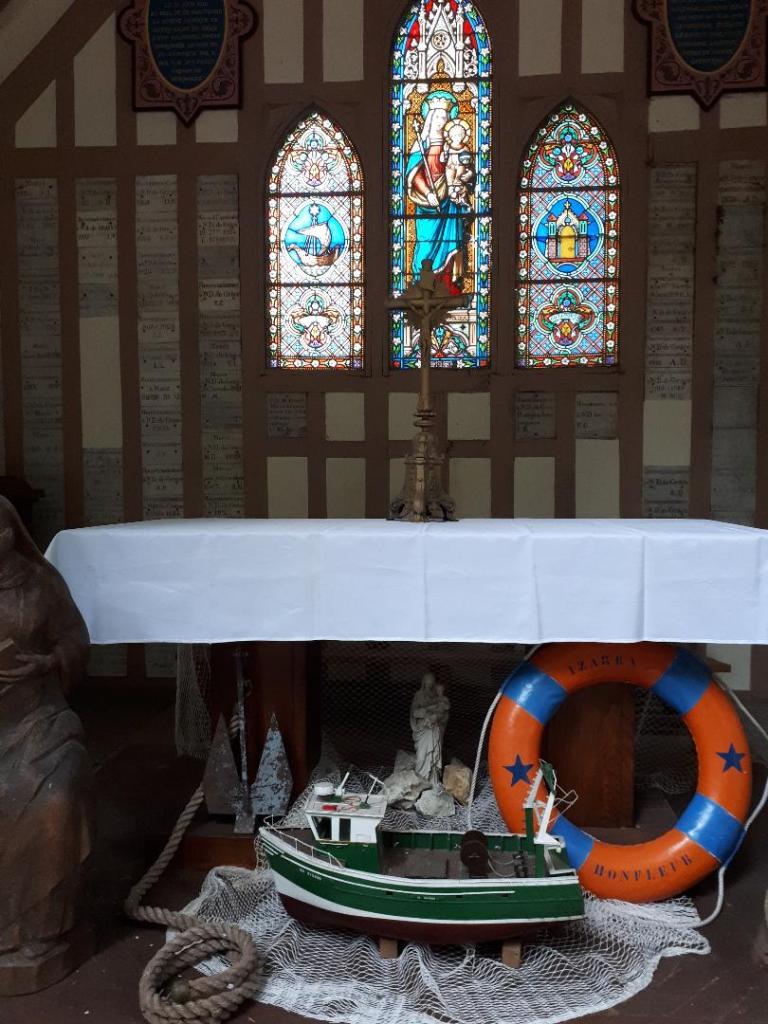
Dedicated to Our Lady of Good Help, Notre-Dame-de-Bon-Secours, has been for 350 years the Sanctuary for seamen leaving Montreal for the seven seas. A wooden Chapel was built in 1657, replaced in 1675 by a building whose foundations serve the present Church which was erected in 1771.

Over the entrance is an inscribed message: “If the love of Mary is graven in your heart, forget not a prayer in passing.”

Our Lady of Good Help is a beautiful little Church, with fine paintings. On the walls are mosaics of St Marguerite Bourgeoys, who inspired the first Chapel and of Maisonneuve, Founder of Montreal, said to have felled the first oak for the Chapel.
A narrow stairway, lined with pilgrims’ acknowledgments, leads to an aerial Chapel set in the roof. Here is a facsimile of the Santa Casa, the house of the Virgin carried by angels from Nazareth to Loreto.
Saint Marguerite Bourgeoys was the Founder of the Congregation of Notre Dame. When she returned from France in 1673 she brought back with her a wooden statue of Our Lady of Good Help. It can still be seen in the reliquary on the gospel side of the altar, for when the Church burned in 1754, the statue was saved from the fire. This is not to say that someone took the statue from the Church, for after the fire had ravaged the original Chapel, the statue was found uninjured among the smouldering embers that remained.
The mortal remains of Saint Marguerite Bourgeoys were interred in the Sanctuary of the Church in the year 2005, the 350th anniversary of Notre-Dame-de-Bon-Secours. She rests now at the feet of the statue she herself had brought from France.

In 1849 the Bishop of Montreal placed a statue of the Blessed Virgin, Star of the Sea, atop the tower facing the harbour. For this reason, the Chapel is also known as the Sailor’s Church. There are votive offerings, carved ships, models of sailing ships suspended from the vault of the Chapel in thanksgiving to the Blessed Virgin for her assistance in their safe return from the sea.

First Holy Martyrs of the Church of Rome (Optional Memorial) Christians Martyred in the City of Rome during Nero’s persecution in 64.
About:

https://anastpaul.com/2017/06/30/saints-of-the-day-30-june-the-first-martyrs-of-the-church-of-rome/

St Adolphus of Osnabrück
St Alpinian of Limoges
St Alrick the Hermit
Bl Ambrose de Feis
Bl Anthony de Tremoulières
Bl Arnulf of Villers
St Austriclinian of Limoges
St Basilides of Alexandria
St Bertrand of Le Mans
St Clotsindis of Marchiennes
St Donatus of Münstereifel (c 140-c 180) Roman Soldier and Martyr
Bl Elisabeth Heimburg

St Emiliana of Rome
St Erentrude
St Eurgain
St Gaius

Blessed Gennaro Maria Sarnelli C.Ss.R. (1702–1743) Redemptorist Priest, Lawyer, Writer, Preacher, Apostle of the Charity, Social Reformer, he also initiated a fervent movement against the spread of prostitution.
Biography:

https://anastpaul.com/2019/06/30/saint-of-the-day-30-june-blessed-gennaro-maria-sarnelli-c-ss-r-1702-1743/

Bl Jacob Clou
St Leo the Deacon
St Lucina of Rome
St Lucina of the Callistus Catacombs
St Marcian of Pampeluna
St Martial of Limoges
St Ostianus
St Otto of Bamberg
St Peter of Asti
St Petrus Li Quanhui

Blessed Philip Powell OSB (1594 – 1646) Priest and Martyr, Benedictine Monk.
His Life and Death:

https://anastpaul.com/2020/06/30/saint-of-the-day-30-june-blessed-philip-powell-osb-1594-1646-priest-martyr-benedictine-monk/

St Raimundus Li Quanzhen

Blessed Raymond Lull TOSF (c 1232 – c 1315) Martyr – known as “Doctor Illuminatus,” Raymond was a Philosopher, Logician, Writer, Poet, Pioneer in computation theory, Franciscan tertiary. Within the Franciscan Order he is honoured as a Martyr.
His Life:

https://anastpaul.com/2018/06/30/saint-of-the-day-30-june-blessed-raymond-lull-t-o-s-f-c-1232-c1315-martyr/

St Theobald of Provins
St Vihn Son Ðo Yen
Bl Zenon Kovalyk

Martyrs of Africa – 7 saints: Seven Christians martyred together. No detail about them have surived but the names – Cursicus, Gelatus, Italica, Leo, Timotheus, Zoilus, and Zoticus. Date and precise location in Africa unknown.

Posted in FEASTS and SOLEMNITIES, MARIAN TITLES

Solemnity of Sts Peter and Paul Apostles and Martyrs, Notre-Dame de Buglose / Our Lady of Buglose, France (1634) and Memorials of the Saints – 29 June

Sts Peter and Paul Apostles (Solemnity)

https://anastpaul.com/2020/06/29/a-blessed-and-holy-solemnity-of-saints-peter-and-paul-the-pillars-of-the-church/
https://anastpaul.com/2019/06/29/solemnity-of-saints-peter-and-paul-29-june/
https://anastpaul.com/2018/06/29/the-solemnity-of-saints-peter-and-paul-29-june/
https://anastpaul.com/2017/06/29/blessed-and-holy-solemnity-of-sts-peter-and-paul-29-june/

Notre-Dame de Buglose / Our Lady of Buglose, France (1634) – 29 June:

Located about two leagues from Acqe in Glascony is the Shrine containing a miraculous image of Our Lady of Buglose. The original Shrine of Notre-Dame de Buglose was burned and completely destroyed by the Huguenots, and the Statue of Our Lady was hidden in a marsh. The exact location of the Statue was eventually forgotten, as was the memory even that the place had once been the location of a Shrine in honour of the Blessed Virgin.
Years later, a shepherd led his herd into the marshes and observed that one of his oxen did not go with the others but went into an area of the marsh alone and began to bellow in a strange manner. The shepherd climbed a tree to see what was happening, and saw the ox licking an unknown object that was half buried in the mud. Not understanding the mystery, he ran into Town to bring others back with him to see what had happened.
When the shepherd returned, the Statue of the Blessed Virgin holding the baby Jesus in her arms had been revealed. It was respectfully removed from the water and the Bishop of Dax desired to take the image to his Church in Pouy. He placed the Statue in a cart that was pulled by oxen to transport it back to Pouy. The procession began with hymns and prayers but had only gone a short distance, when the oxen stopped and would not move any further. It was understood that the Blessed Virgin desired that her image should stay near the fountain.
The Bishop accepted the revelation as a divine order and thanks to the zeal and enthusiastic support of the people living in the region, a new Church was built with prodigious speed. The Shrine was, for a long time, popular as a place of pilgrimage in France – now it is further renowned as the birthplace of Saint Vincent de Paul. The house where he was born and where he spent his boyhood, is still visited as a Museum of the Saint.

|The Basilica of St Vincent de Paul and Our Lady of Buglose

There have been many miracles at the Shrine, as indeed Buglose had become known as a land of miracles. There were 19 miracles recorded in the year 1622 alone.
There is a fountain near the Chapel marking the place where the Statue of Our Lady of Buglose was found buried. In 1623, a man named Bernard Ducassou came to the shrine seeking a cure for the seven boils that covered his left leg. He spent the entire night in prayer and the next day bathed at the fountain. The ulcers that would not heal were suddenly closed.
Pilgrims still travel to the famous Shrine of Our Lady where miracles are continuously granted to pious devotees.

St Anastasius of Bourges
St Benedicta of Sens
St Cassius of Narni
St Ciwg ap Arawn
St Cocha
St Ilud Ferch Brychan
St Judith of Niederaltaich
St Marcellus of Bourges
St Mary, the Mother of John Mark
St Salome of Niederaltaich
St Syrus of Genoa
Bl William of Sann

Martyrs of China
Ioannes Baptista Wu Mantang
Magdalena Du Fengju
Maria Du Tianshi
Paulus Wu Anju
Paulus Wu Wanshu

Posted in DOCTORS of the Church, FATHERS of the Church, MARIAN TITLES, SAINT of the DAY

Madre del Perpetuo Soccorso / Mother of Perpetual Succour (Help), Matka Boża / Mother of God of Gietrzwald and Memorials of the Saints – 27 June

Fifth Sunday after Pentecost (Traditional Calendar) +2021
Thirteenth Sunday in Ordinary Time +2021

Madre del Perpetuo Soccorso / Mother of Perpetual Succour (Help) – Feast 27 June:
Patronage: Porto Cesareo, Italy, Haiti, Labrador City, Labrador, Yorkton, Saskatchewan, 8 Diocese.https://anastpaul.com/2018/06/27/thought-for-the-day-27-june-the-feast-of-our-lady-of-perpetual-succour/

Matka Boża / Mother of God of Gietrzwald, Gietrzwałd, Olsztyński, Warmia, Poland, 1877 – 27 June, 8 September;

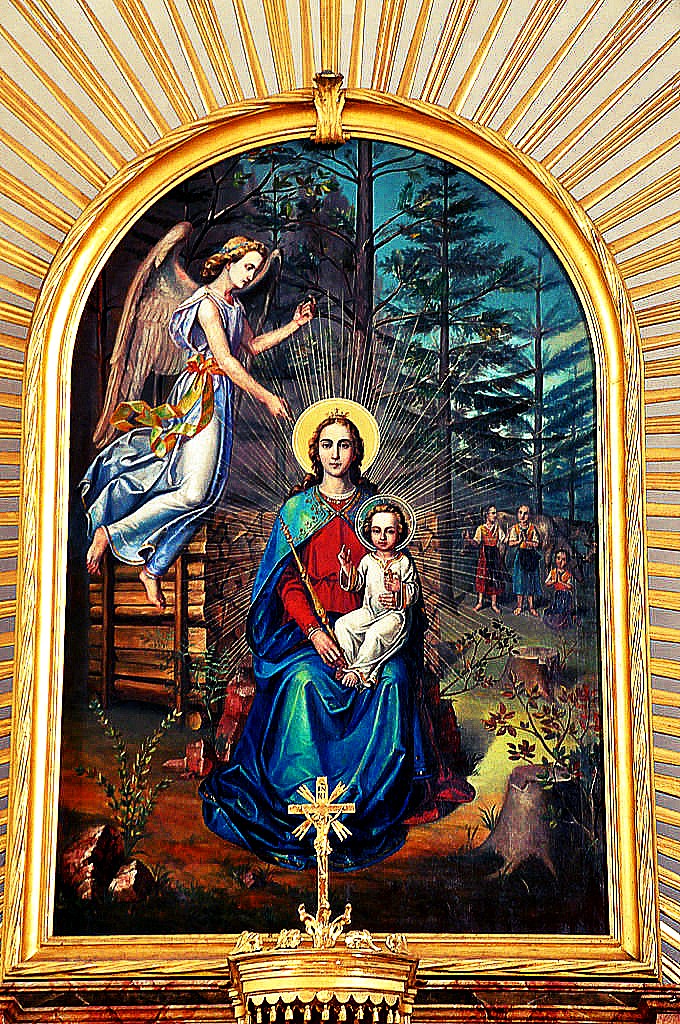
Our Lady appeared for the first time to Justyna Szafrynska (13) when she was returning home with her mother after having taken an examination prior to receiving the First Holy Communion. The next day, Barbara Samulowska (12) also saw the ‘Bright Lady’ sitting on the throne with Infant Christ among Angels over the maple tree in front of the church while reciting the rosary. The girls asked “Who are you?” she answered, “I am the Blessed Virgin Mary of the Immaculate Conception!“What do you require, Mother of God?” they asked, the answer was: “I wish you recite the Rosary everyday!” There were 13 more apparitions from 27 June 1877 to 16 September 1877.
2 February 1970 – Pope Paul VI elevated the Church in Gietrzwald to the rank of Basilica Minor.

St Cyril of Alexandria (376-444) Father and Doctor of the Church ) – “The Pillar of Faith” & “Seal of all the Fathers” – Doctor Incarnationis (Doctor of the Incarnation) – (Optional Memorial
Biography:

https://anastpaul.com/2018/06/27/saint-of-the-day-27-june-st-cyril-of-alexandria-376-444-father-and-doctor-of-the-church/
AND:
https://anastpaul.com/2017/06/27/saint-of-the-day-27-june-st-cyril-of-alexandria-doctor-father-of-the-church-the-pillar-of-faith-seal-of-all-the-fathers-doctor-incarnationis-doctor-of-the-incarnation/

St Adeodato of Naples
St Aedh McLugack
St Anectus of Caesarea
St Arialdus of Milan
St Arianell of Wales
Blessed Benvenutus of Gubbio OFM ) (Died 1232) Lay brother of the Order of the Friars Minor of St Francis
St Brogan
St Crescens of Galatia
St Crescentius of Mainz
Bl Daniel of Schönau
Bl Davanzato of Poggibonsi
St Desideratus of Gourdon
St Dimman
St Felix of Rome
St Ferdinand of Aragon
St Gudene of Carthage

Bl Hemma of Gurk
St Joanna the Myrrhbearer
St John of Chinon

St Ladislaus I – (c 1040-1095) King of Hungary, Apostle of Charity, Defender of the Faith.
His Life:

https://anastpaul.com/2019/06/27/saint-of-the-day-st-ladislaus-i-c-1040-1095/

Blessed Louise-Thérèse de Montaignac de Chauvance OSHJ (1820-1885) Religious Sister and Founder of the Pious Union of Oblates of the Sacred Heart of Jesus.
An Apostle of the Sacred Heart:

https://anastpaul.com/2020/06/27/saint-of-the-day-27-june-blessed-louise-therese-de-montaignac-de-chauvance-oshj-1820-1885/

Blessed Maria Pia Mastena
St Sampson of Constantinople
St Spinella of Rome
St Tôma Toán
St Zoilus of Cordoba

Martyrs Killed Under Communist Regimes in Eastern Europe: Among the thousands of Christians murdered by various Communist regimes in their hatred of the faith, there were 25 members of the Ukrainian Greek Catholic Church and Russian Byzantine Catholic Church, priests, bishops, sisters and lay people, whose stories are sufficiently well documented that we know they were murdered specifically for their faith in eastern Europe and whose Causes for Canonization were opened. Their Causes were combined and they were beatified together. They have separate memorials but are remembered together today. They are –
• Andrii Ischak • Hryhorii Khomyshyn • Hryhorii Lakota • Ivan Sleziuk • Ivan Ziatyk • Klymentii Sheptytskyi • Leonid Feodorov • Levkadia Harasymiv • Mykola Konrad • Mykola Tsehelskyi • Mykolai Charnetskyi • Mykyta Budka • Oleksa Zarytskyi • Ol’Ha Bida • Ol’Ha Matskiv • Petro Verhun • Roman Lysko • Stepan Baranyk • Symeon Lukach • Vasyl Vsevolod Velychkovskyi • Volodomyr Bairak • Volodymyr Ivanovych Pryima • Yakym Senkivsky • Yosafat Kotsylovskyi • Zenon Kovalyk. Beatified – 27 June 2001 by Pope John Paul II in Ukraine.

Posted in "Follow Me", FATHERS of the Church, MARIAN TITLES, ONE Minute REFLECTION, The WORD

One Minute Reflection – 27 June – ‘ … The slave’s sickness gives health to his owner. … ‘

One Minute Reflection – 27 June – “Month of the Sacred Heart”- Readings: Genesis 18: 1-15, Luke 1: 46-47, 48-49, 50 and 53, 54-55, Matthew 8: 5-17

“Many will come from the east and the west and shall sit down with Abraham, and Isaac and Jacob, in the kingdom of heaven” – Matthew 8:11

REFLECTION – “I have seen our Lord in the Gospel accomplish many miracles and, reassured by them, have strengthened my fearful words. I have seen the centurion throw himself at the Lord’s feet, nations send their firstfruits to Christ. The Cross has not yet been erected and already, pagans hasten towards their Master. The words “Go, teach all nations” have not yet been heard (Mt 28,19) but the nations are already hastening. Their race precedes their call, they are burning with desire for the Lord. The sound of preaching has not yet been heard but they are hurrying towards the one who preaches. Peter… they have now been instructed and they gather around the one who is teaching them; the light of Paul has not yet blazed beneath Christ’s standard and nations are coming with incense, to adore the King (Mt 2,11).

And now, see how a centurion begs Him and says to Him: “Lord, my servant is lying at home paralysed, suffering dreadfully.” Here is a new miracle indeed! The servant whose limbs are paralysed leads his master to the Lord; the slave’s sickness gives health to his owner. Seeking his servant’s healing, he finds our Lord and while he is seeking for his slave’s cure, he becomes Christ’s conquest.” Basil of Seleucia (?-c 468), Bishop, Father of the Church – Homily 19 on the Centurion.

PRAYER – God our Father, You open the gates of the kingdom of heaven to those who are born again of water and the Holy Spirit. Increase the grace You have given, so that the people who have been purified from all sin, may not forfeit the promised blessing of Your love. Grant that we may ever keep Your Son, the Lord Jesus Christ, before our eyes and do all in Him and through Him and for Him and may the prayers of our Mother of Perpetual Succour ever guide and bear us in her care! We make our pray through Christ, our Lord, in union with You and the Holy Spirit, one God forever, amen.

Posted in MARIAN DEVOTIONS, MARIAN PRAYERS, MARIAN Saturdays, MARIAN TITLES

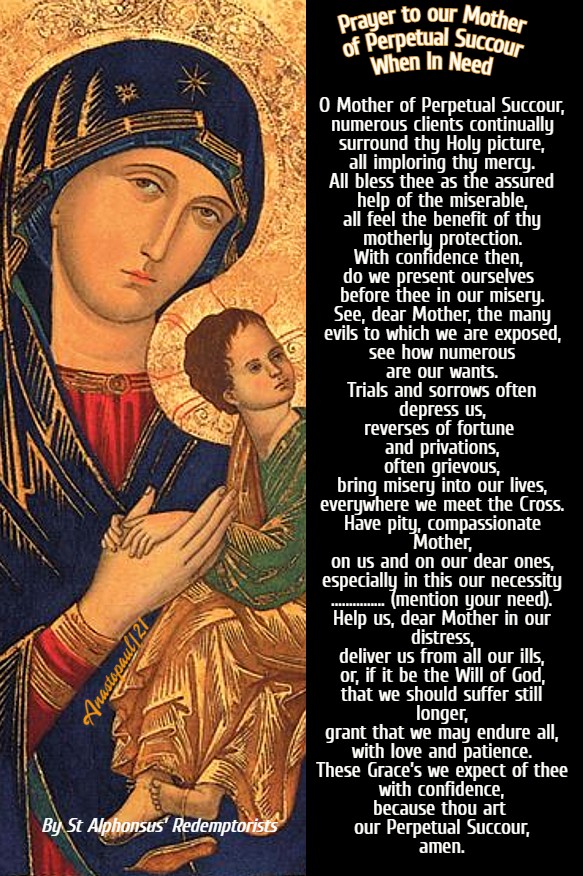
Our Morning Offering – 26 June – Prayer to our Mother of Perpetual Succour ,When In Need

Our Morning Offering – 26 June – “Month of the Sacred Heart”

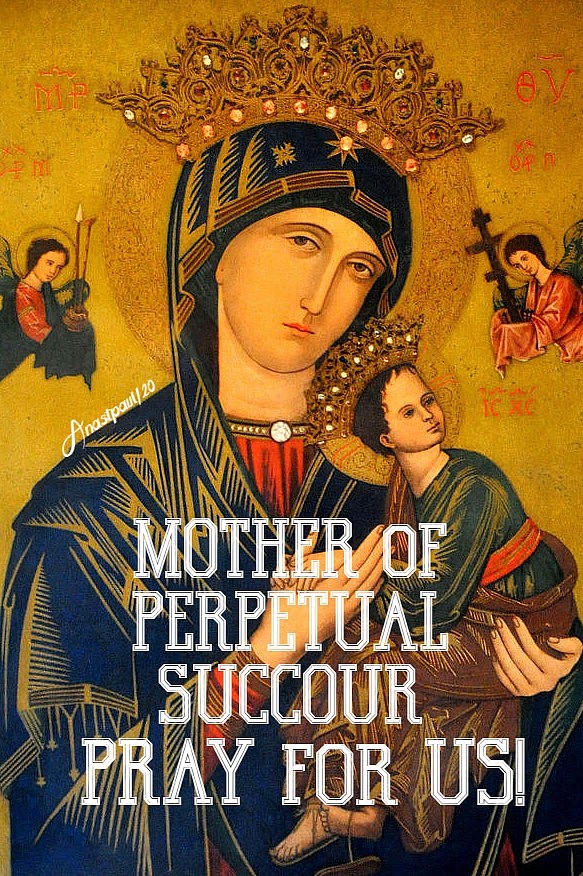
As the Feast day of Our Lady of Perpetual Succour falls tomorrow, being a Sunday, it is appropriate to remember her today instead. Let us remind ourselves of the great power of this Marian devotion.

Prayer to our Mother
of Perpetual Succour,
When In Need

By St Alphonsus’ Redemptorists

O Mother of Perpetual Succour,
numerous clients continually surround thy Holy picture,
all imploring thy mercy.
All bless thee as the assured help of the miserable,
all feel the benefit of thy motherly protection.
With confidence then, do we present ourselves before thee in our misery.
See, dear Mother, the many evils to which we are exposed,
see how numerous are our wants.
Trials and sorrows often depress us,
reverses of fortune and privations,
often grievous, bring misery into our lives,
everywhere we meet the Cross.
Have pity, compassionate Mother,
on us and on our dear ones,
especially in this our necessity
…………… (mention your need).
Help us, dear Mother in our distress,
deliver us from all our ills,
or, if it be the Will of God,
that we should suffer still longer,
grant that we may endure all,
with love and patience.
These Grace’s we expect of thee with confidence,
because thou art our Perpetual Succour,
amen.

Posted in franciscan OFM, MARIAN TITLES, SAINT of the DAY

Matka Boża Tęskniąca / Longing Mother of God, Warsaw, Poland and Memorials of the Saints – 26 June

Matka Boża Tęskniąca / Longing Mother of God, Warsaw, Poland – 26 June:

One of the oldest Churches in the Archdiocese of Warsaw is St Elizabeth Powsin Located on the main Altar is a painting of th Longing Mother of God– artist unknown – from the first half of the seventeenth century. At either side, the image is surrounded by statues of Saints Adalbert and Stanislaus – Polish Bishops and Martyrs.
The testimony of miracles and graces relating to the Longing Mother of God icon, have been collected at least since the mid-seventeenth century.
On 28 June 1998, the image became the fourth image of Mary in the Archdiocese of Warsaw to be canonically Crowned.

St Acteie of Rome
St Albinus of Rome

Blessed Andrea Giacinto Longhin OFM. Cap (1863 – 1936) Bishop of Treviso, Italy from 1904 until his death.
His Life:

https://anastpaul.com/2020/06/26/saint-of-the-day-26-june-blessed-andrea-giacinto-longhin-ofm-cap-1863-1936/

Bl Andrii Ischak
St Anthelm of Belley O. Cart. (c 1105-1178) Bishop, Prior
St Babolenus of Stavelot-Malmédy
St Barbolenus of Fossés
Bl Bartholomew of Vir
St Corbican
St David of Thessalonica
St Deodatus of Nola
St Dionysius of Bulgaria
St Edburga of Gloucester
St Hermogius of Tuy
St Iosephus Ma Taishun
St John of Rome
St John of the Goths
St José Maria Robles Hurtado

St Josemaria Escriva (1902-1975) “The Saint of Ordinary Life” – Priest, Founder of Opus Dei.
Biography:

https://anastpaul.com/2018/06/26/saint-of-the-day-26-june-st-josemaria-escriva-de-balaguer-y-albas-1902-1975-the-saint-of-ordinary-life/

Blessed Jacques Ghazir Haddad OFM Cap (1875-1954) the “St Vincent de Paul of Lebanon,“the Apostle of the Cross” and “the Apostle of Lebanon.” Priest, Religious of the Order of Friars Minor as a Capuchin Friar, Founder of the Franciscan Sisters of the Holy Cross of which he is the Patron, noted Preacher and founder of many orphanages and schools across Lebanon.
Beautiful Blessed Jacques:

https://anastpaul.com/2019/06/26/saint-of-the-day-blessed-jacques-ghazir-haddad-ofm-cap-1875-1954/

St Maxentius of Poitou
St Medico of Otricoli
Bl Mykola Konrad
St Paul of Rome
St Pelagius of Oviedo
St Perseveranda of Poitiers
Bl Raymond Petiniaud de Jourgnac
St Salvius
Bl Sebastian de Burgherre
St Soadbair
St Superius
St Terence of Rome
St Vigilius of Trent
Bl Volodymyr Ivanovych Pryima

Martyrs of Africa – 4 saints: Four Christians who were martyred together – Agapitus, Emerita, Felix and Gaudentius at an unknown location in Africa, date unknown.

Martyrs of Alexandria – 3 saints: Three Christians who were martyred together, but we really know little more that the names – Agatho, Diogenes and Luceja. They were martyred in Alexandria, Egypt, date unknown.

Martyrs of Cambrai – 4 beati: Four Daughters of Charity of Saint Vincent de Paul nuns at Arras, France. Imprisoned together in 1792 and executed together two years later in the anti-Catholic excesses of the French Revolution. They were:
• Jeanne Gerard
• Marie-Françoise Lanel
• Marie-Madeleine Fontaine
• Thérèse-Madeleine Fantou
They were guillotined on 26 June 1794 at Cambrai, Nord, France and Beatified in June 1920 by Pope Benedict XV.

Posted in MARIAN TITLES, SAINT of the DAY

Beata Vergine delle Grazie / Our Lady of Grace/Our Lady of the Bowed Head, Montegridolfo, Rimini, Emilia-Romagna, Italy (1548) and Memorials of the Saints – 25 June

Beata Vergine delle Grazie / Our Lady of Grace/Our Lady of the Bowed Head, Montegridolfo, Rimini, Emilia-Romagna, Italy (1548) – 25 June
About:

https://anastpaul.wordpress.com/2017/06/25/25-june-the-feast-of-our-lady-of-grace/

St Adalbert of Egmond (Died c 740) Deacon, Missionary_
St Amand of Coly
Bl Burchard of Mallersdorf
St Cyneburga of Gloucester
St Domingo Henares de Zafra Cubero
Bl Dorothy of Montau
St Eurosia of Jaca
St Febronia of Nisibis
Bl Fulgentius de Lara
St Gallicanus of Embrun
St Gallicanus of Ostia
St Gohard of Nantes
Bl Guy Maramaldi
Bl Henry Zdick
Bl John the Spaniard
St Luceias and Companions

St Maximus of Turin (? – c 420) Father of the Church, Bishop, Writer, Theologian. He was a prolific and inspirational Theological writer with 118 homilies, 116 sermons and 6 treatises surviving.
Biography:

https://anastpaul.com/2018/06/25/saint-of-the-day-25-june-st-maximus-of-turin-c-420-father-of-the-church/

St Moluag of Lismore (c 530–592) Bishop of Lismore, Missionary to Scotland and a contemporary of St Columba, Founder of Monasteries, Apostle of the Picts, Patron Saint of Argyll.
About St Mluag:

https://anastpaul.com/2020/06/25/saint-of-the-day-25-june-saint-moluag-of-lismore-c-520-592/

St Molonachus of Lismore
St Phanxicô Ðo Van Chieu

St Prosper of Reggio (Died c 466) Bishop and Patron of Reggio.
His Life:

https://anastpaul.com/2019/06/25/saint-of-the-day-25-june-saint-prosper-of-reggio-died-c-466/

St Selyf of Cornwall
St Solomon I
St Solomon III of Bretagne

St William of Vercelli (1085-1142) Hermit, Abbot, Founder of the Congregation of Monte Vergine, or “Williamites,” miracle-worker, Marian devotee. His Body is incorrupt.
Biography:

https://anastpaul.wordpress.com/2017/06/25/saint-of-the-day-25-june-st-william-of-vercelli/

Posted in FEASTS and SOLEMNITIES, MARIAN TITLES, SAINT of the DAY

Solemnity of the Nativity of Saint John the Baptist, Feast of The Madonna della Navicella / Our Lady of the Ship, Chioggia, Venezia, Veneto, Italy (1508) and Memorials of the Saints – 24 June

The Nativity of Saint John the Baptist (Solemnity) “The precursor of Jesus”
https://anastpaul.com/2018/06/24/the-solemnity-of-the-nativity-of-st-john-the-baptist-24-june/

Madonna della Navicella / Our Lady of the Ship , Chioggia, Venezia, Veneto, Italy (1508) – 24 June:

On 24 June 1508, in the afternoon, a strong storm, with disastrous effects, hit the inhabited area of ​​Chioggia and Sottomarina.   Rain, wind and storm had lashed the coast for a few hours.   In the evening, fortunately, the storm abated and the weather improved.
A greengrocer, Baldissera Zalon, went to the vegetable gardens, where the Sanctuary now stands , to see for himself the damage that the powerful storm had caused.   Baldissera was a simple man, a peasant, who lived near his fields and lived on his work in the vegetable gardens.
As soon as he left the house, after scanning the clouds of the sky that were moving away and the setting sun was peeping, he heard himself called by name.   After the first moments of amazement, Baldissera turned and saw a majestic Lady, all dressed in black, who sat on a treetrunk thrown on the beach by the waves of the stormy sea.
The greengrocer was stunned, so much so, that he was about to pass out, when the Lady revealed to him that she was the Mother of God, giving him courage and inviting him to go to the Bishop to warn him that the sins of the Chioggia challenged the justice of God and that penance had to be preached tenaciously, to avoid worse punishment.
Then the Lady got on a craft that was near the shore but before leaving and disappearing, she opened her cloak showing the wounded and bleeding body of Jesus, making it clear that it had also been reduced by the sins of the Chioggiotti.

Baldiserra wasted no time and went to the Bishop, who organised a pilgrimage to the place of the apparition and the turnout of the faithful became more and more consistent day after day.   In a short time, a Chapel was built on the spot and then, in 1515, a Sanctuary which was, however, destroyed in 1814.
The current Church was built between 1952 and 1958 and was Consecrated on 24-25 June 1958 by Bishop Piasentini.
The miraculous image was found, according to popular belief, a few days after the apparition, together with the log on which the Madonna sat when she appeared to Baldissera.   The image and the LOG are preserved and are visible in the Basilica of San Giacomo.

St Aglibert of Créteil
St Agoard of Créteil
St Alena of Brussels
St Amphibalus of Verulam

St Bartholomew of Farne OSB (Died 1193) Priest, Monk, Hermit
His Life:

https://anastpaul.com/2020/06/24/saint-of-the-day-24-june-saint-bartholomew-of-farne-osb-died-1193/

Bl Christopher de Albarran
St Erembert I of Kremsmünster
St Faustus of Rome and Companions
St Festus of Rome
St Germoc
St Gohardus of Nantes
Bl Henry of Auxerre/the Hagiographer
St Ivan of Bohemia
St John of Rome
St John Theristus (c 1049-1129) Monk
St John of Tuy
St Joseph Yuan Zaide
Bl Maksymilian Binkiewicz

St Maria Guadalupe García Zavala (1878-1963) Virgin and co-foundress of the Handmaids of Santa Margherita and the Poor.
Biography:

https://anastpaul.com/2019/06/24/saint-of-the-day-st-maria-guadalupe-garcia-zavala-1878-1963/

St Rumold
St Simplicio of Autun
Bl Theodgar of Vestervig
St Theodulphus of Lobbes

Martyrs of Satala: Seven Christian brothers who were soldiers in the imperial Roman army. They were kicked out of the military, exiled and eventually martyred in the persecutions of Maximian. We know little more about them than their names – Cyriacus, Firminus, Firmus, Longinus, Pharnacius, Heros and Orentius. The martyrdoms occurred in c 311 at assorted locations around the Black Sea.

Posted in MARIAN TITLES, SAINT of the DAY

Saint John‘s Eve, Madonna del Sasso, Bibbiena, Arezzo, Toscana, Italy (1347) and Memorials of the Saints – 23 June

Saint John‘s Eve
Vigil of the Feast of the Nativity of Saint John the Baptist

Madonna del Sasso, Bibbiena, Arezzo, Toscana, Italy (1347) – 23 June:

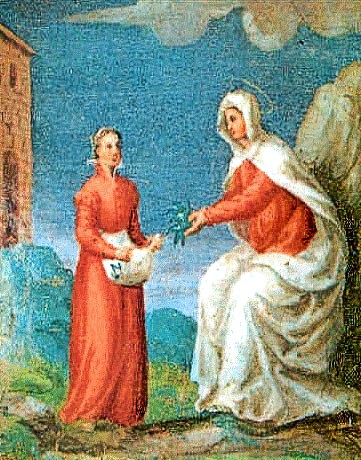
The little seer , Caterina, 7 years old, while her mother was washing clothes in the Vessa stream, moved away a little, placing herself near a stone . Here she saw a beautiful lady dressed all in white who, having entered the nearby field of beans, collected several and placed them in the bosom of the girl. Meanwhile, the mother was busy and the little girl ran to tell her of the lady and showed her the beans she had received but the mother paid no attention to her daughter’s meeting.

Returning to the village, Caterina complained to her mother because the beans had grown so much that their weight was difficult for her to bear but her mother told her to be patient as they would soon be home. In the evening, the mother wanted to cook some of those beans but she noticed that they were full of blood. The whole country ran to see the prodigy. The following morning, everyone went in procession to the stone and here they decided to build a Chapel in honour of the Madonna.
The apparition of the Madonna del Sasso was preceded and followed by two further miraculous events.

Also in 1347, shortly before the vision, a white dove appeared on the top of the stone and was approached only by children and an old hermit , Beato Martino da Poppi, a Camaldolese Monk, who had his hermitage nearby . When the children approached it, the dove pecked at their fingers and hands but if adults approached, it flew away. In 1444, several people saw golden-blue light globes inside and outside the C hurch these appeared for about three months The podestà, together with some family and friends, returning from a hunting party, about 300 meters away from the sacred stone, saw a crowd of white-dressed young men heading in procession to the Church.
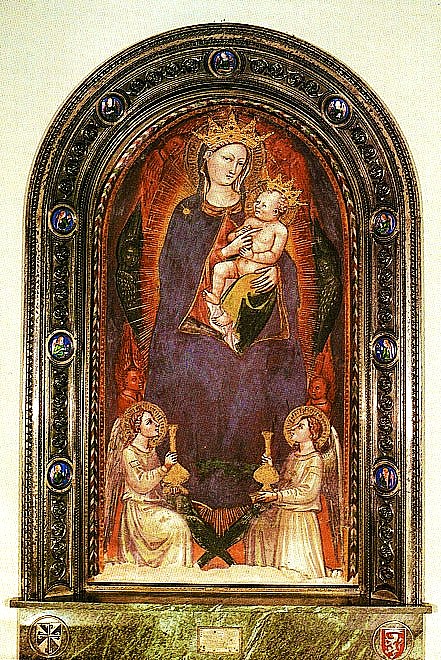
A small Chapel was immediately built next to the boulder, later enlarged to include the entire boulder. It now host sthe beautiful image of the Madonna del Sasso, painted by Bicci di Lorenzo in 1435 .
This image miraculously remained intact in the fire that completely destroyed the Church in 1486.

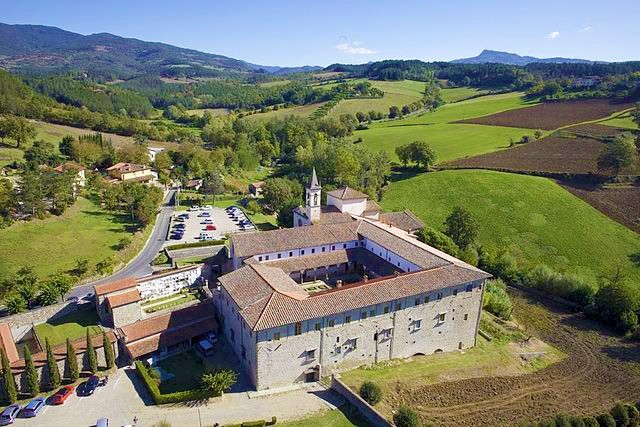
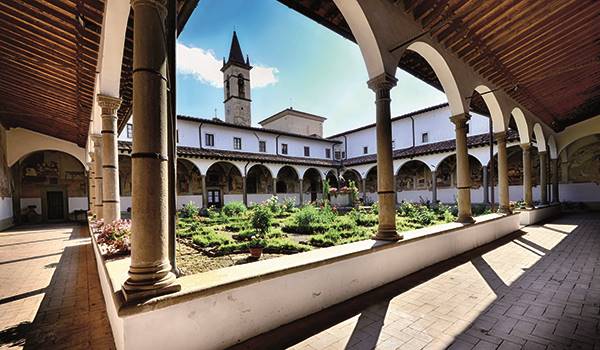
The Dominican Fathers were custodians of the Sanctuary since 1468,. They immediately worked on the construction of the current Sanctuary, in pure Renaissance style, based on a design by Giuliano da Maiano. A great amount of funds for the construction of the Sanctuary and Convent, came from Savonarola in 1495, who solicited help from noble families of Florence and from the Medici in particular.

St Agrippina of Rome
St Bilio of Vannes

St Etheldreda (c 636-679) Abbess and widow, an East Anglian Princess, a Fenland and Northumbrian Queen, who left all for a life of service to Christ. Abbess of Ely Monastery.
Her Life:

https://anastpaul.com/2019/06/23/saint-of-the-day-23-june-st-etheldreda-c-636-679/

Bl Félix of Cîteaux
St Felix of Sutri
Bl Frances Martel
Bl Francis O’Sullivan
St Hidulphus of Hainault
St James of Toul
St John of Rome

St Joseph Cafasso (1811-1860) “Priest of the Gallows”, Priest, Theology Lecturer, Social Reformer, Confessor, Spiritual Director (of St John Bosco and quite a few other Saints), Rector of a post-Ordination Theological College, member of the Third Order of St Francis. His will bequeathed everything to aid the Little House of Divine Providence which was the religious order founded by St Joseph Benedict Cottolengo (1786-1842). St John Bosco (1815-1888) preached the funeral Mass homily. Patronages – Italian prisons, Prison chaplains, Prisoners, those condemned to death.
St Joseph Cafasso’s Biography:

https://anastpaul.com/2018/06/23/saint-of-the-day-23-june-st-joseph-cafasso-1811-1860-priest-of-the-gallows/

St Lanfranco Beccari (c 1134-1198) Bishop of Pavia, Italy, Defender of the Rights of the Church, Apostle of prayer of the poor and those in situations of distress, miracle-worker.
His Lifestory:

https://anastpaul.com/2020/06/23/saint-of-the-day-23-june-saint-lanfranco-beccari-c-1134-1198/

Bl Lupo de Paredes
Blessed Marie of Oignies (1167-1213) Recluse, Mystic, Ascetic
St Moeliai of Nendrum
Bl Peter of Juilly
Bl Thomas Corsini of Orvieto
St Thomas Garnet
Bl Walhere of Dinant
St Zenas of Philadelphia
St Zeno of Philadelphia

Martyrs of Ancyra: A family of converts who were arrested, tortured and sent in chains to Ancyra, Galatia (modern Ankara, Turkey) where he was tortured more by order of governor Agrippinus during the persecutions of Diocletian. Martyr. They were – Eustochius, Gaius, Lollia, Probus, Urban. They were roasted over a fire and finally beheaded c 300 in Ancyra, Galatia (modern Ankara, Turkey).

Martyrs of Nicomedia: During the persecutions of Diocletian, many Christians fled their homes to live in caves in the area of Nicomedia. In 303 troops descended on the area, systematically hunted them down and murdered all they could find.

Posted in MARIAN TITLES, SAINT of the DAY

Madonna Ta’ Pinu, Gharb, Gozo, Malta ( 1883) and Memorials of the Saints – 22 June

Madonna Ta’ Pinu, Gharb, Gozo, Malta ( 1883) – 22 June and 15 Augus,the Feast of the Assumpton:

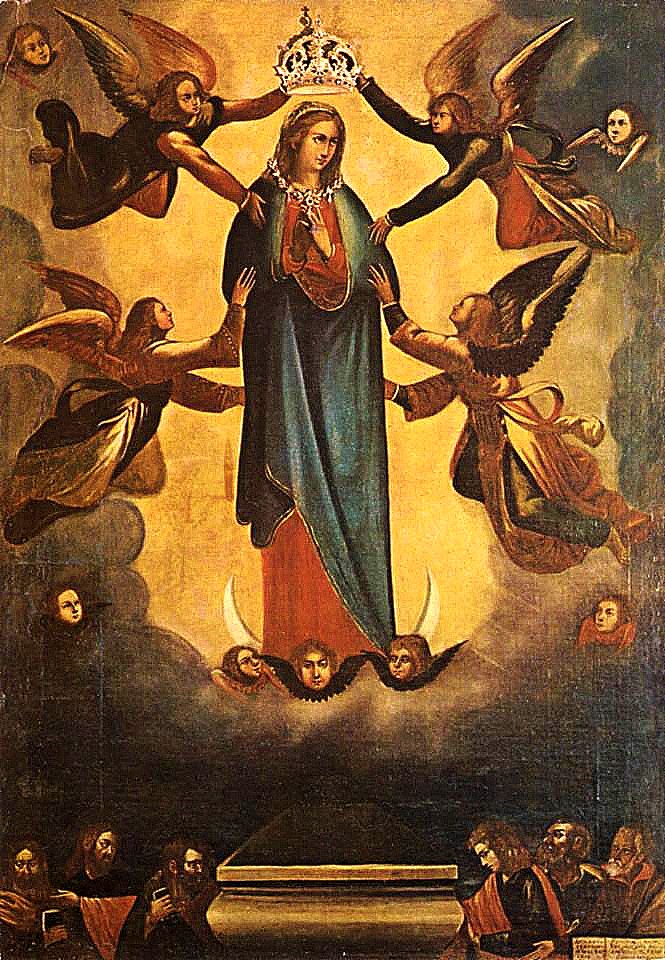
“Ta’ Pinu” means “Philip’s,” a reference to Pinu (Philip) Gauchi, who financed restoration of the country Chapel and in 1619, commissioned its Altarpiece, a painting of the Assumption by Amadeo Perugino.
The Chapel was again in disrepair by 22 June 1883, when Karmela Grima, a 40, year old woman, heard a female voice coming from the Chapel on her way home from the nearby fields:
“Come, because it will be another year before you will be able to return.”
After Karmela knelt to pray in the Chapel, the voice said,
“Recite three Hail Marys in honour of the three days my body remained in the tomb” (before being assumed into heaven).
Very soon the pious woman fell ill, remaining bedridden over a year without telling anyone about the voice.
In 1885, she told a friend, Francesco Pinelli, who revealed that about the same time, he also had heard a woman’s voice, asking for devotion to the “hidden wound” of her Son from carrying the Cross.
When Francesco’s mother was miraculously healed after praying to Our Lady of Ta Pinu, the isolated Chapel began attracting pilgrims. Soon a better building was needed.
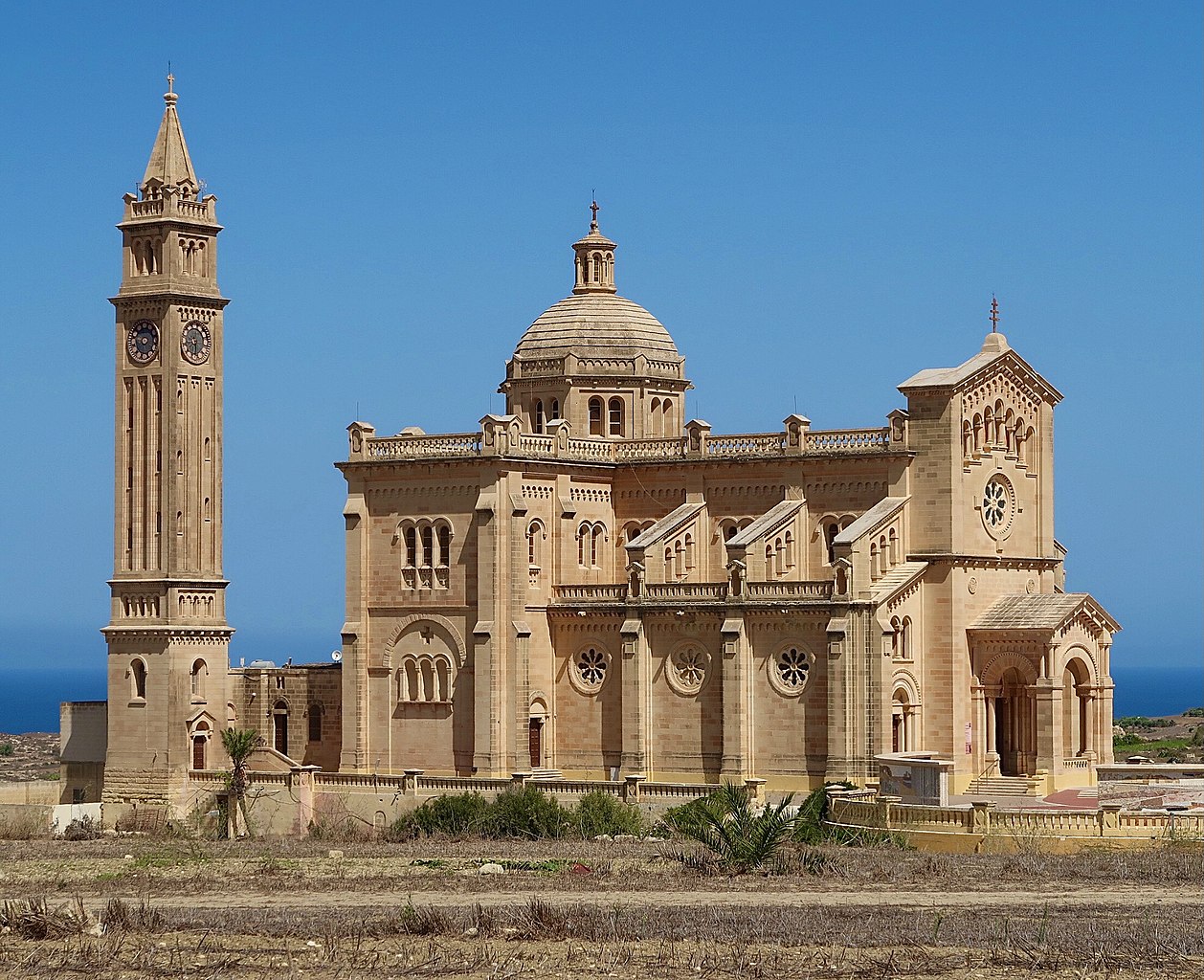
A new Church, begun in 1920, was finally Consecrated in 1932. Still a place of pilgrimage, its major festival is the Assumption, on 15 August.

Basilica of the Blessed Virgin Of Ta’ Pinu.

Ta’ Pinu Sanctuary holds an annual ceremony of the presentation of babies to Our Lady of Ta’ Pinu, during which. Baptised babies are presented to The Blessed Mother of Ta’ Pinu, while the parents pray to the Mother of God that she may keep her maternal protection over their children and families.
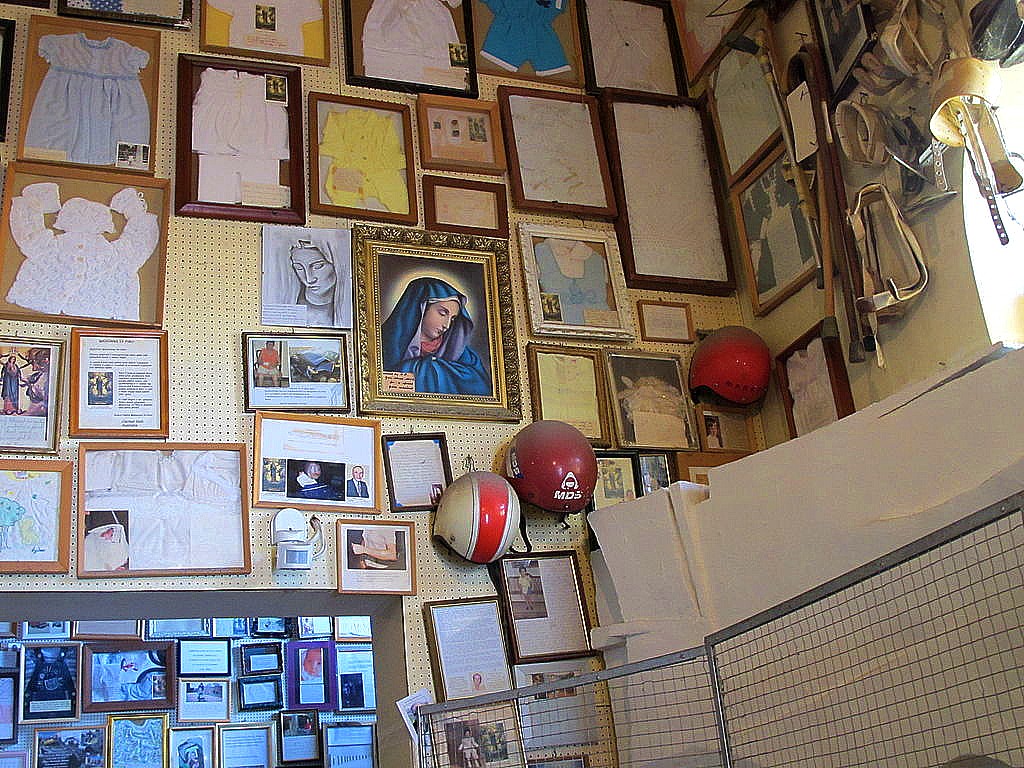
The Virgin of Ta’ Pinu has often been connected to several miraculous cures and graces, of both Maltese and foreigners, who have been saved, cured or helped through the intercession of the Virgin. The Sanctuary is adorned with many ex-votos which have been left by those who have either been cured, saved or received favours and graces through the intercession of Our Lady Of Ta’ Pinu. Today, these can still be seen by the many people who everyday visit the Basilica.

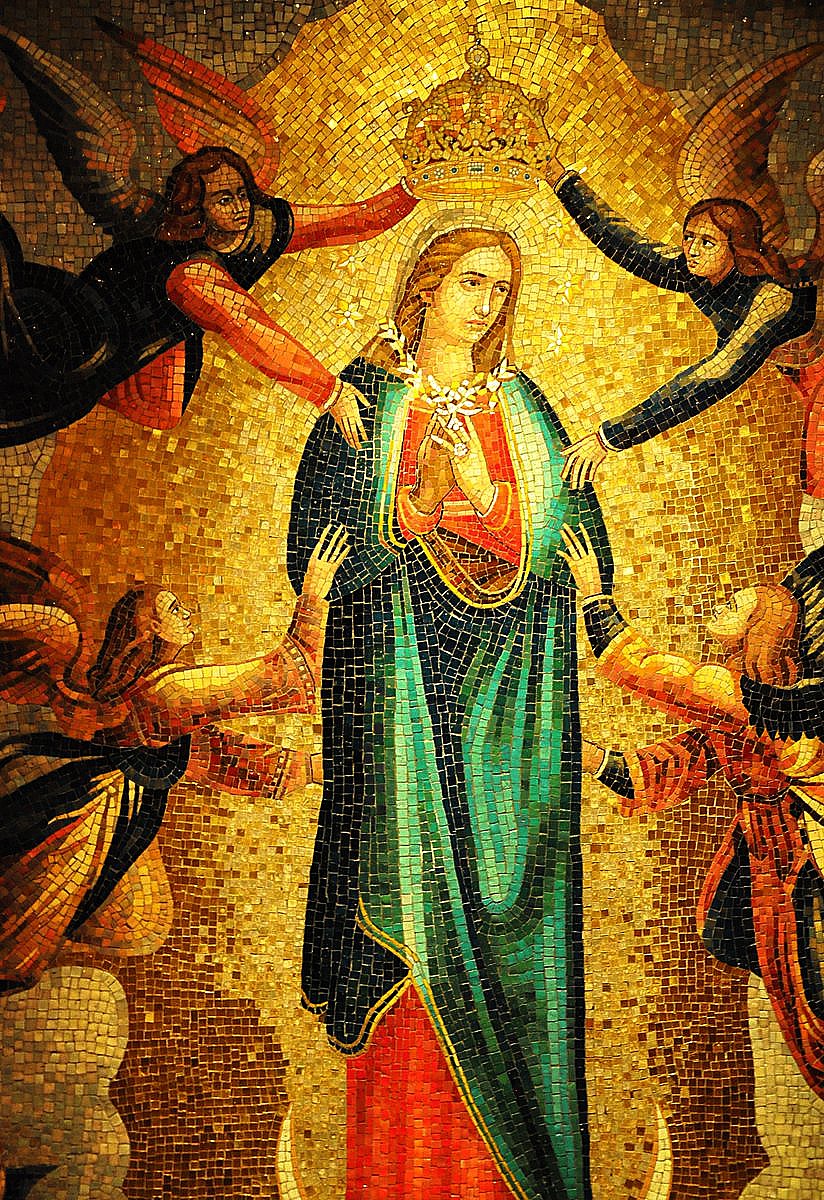
A mosaic of the Altarpiece image, one of 6 mosaics. There are also 76 stained glass windows in the Basilica.
Some of the ex-voto in the Ta’ Pinu Sanctuary.

St Paulinus of Nola (c 354-431) Bishop, Confessor, Poet, Writer, Apostle of Charity, Preacher, Orator, Senator and Governor.
St Paulinus was an inspiration to many—including six great Saints of the Church, who referenced him in letters of encouragement to others: St Augustine, St Jerome, Melania, St Martin of Tours, St Gregory and St Ambrose. St Augustine wrote, “Go to Campania– there study Paulinus, that choice servant of God. With what generosity, with what still greater humility, he has flung from himself the burden of this world’s grandeurs to take on him the yoke of Christ and in His service how serene and unobtrusive his life!”
About St Paulinus:

https://anastpaul.com/2018/06/22/saint-of-the-day-22-june-st-paulinus-of-nola-c-354-431/

St John Fisher (1469-1535) Bishop, Martyr, Cardinal, Theologian, Academic, Writer .
His Life:
https://anastpaul.com/2020/06/22/saint-of-the-day-22-june-saint-john-fisher-1469-1535-bishop-martyr/
Both were executed by order of Henry VIII during the English Reformation for refusing to accept him as the supreme head of the Church of England and for upholding the Catholic Church’s doctrine of Papal supremacy.
St Thomas More (1478-1535) Martyr (Optional Memorial) English lawyer, social philosopher, author, statesman and noted Renaissance humanist. He was also a councillor to Henry VIII and Lord High Chancellor of England from October 1529 to 16 May 1532.
His Life:

https://anastpaul.com/2019/06/22/saint-of-the-day-22-june-st-thomas-more-1478-1535-martyr/

St Aaron of Brettany
St Aaron of Pais-de-Laon
St Alban of Britain
Bl Altrude of Rome
St Consortia
St Cronan of Ferns
St Eberhard of Salzburg
St Eusebius of Samosata
St Exuperantius of Como
St Flavius Clemens
St Gregory of Agrigento
St Heraclius the Soldier
St Hespérius of Metz
Blessed Pope Innocent V OP (c 1225-1275) Papal Ascesion 21 January 1276
St John IV of Naples
St Julius of Pais-de-Laon
Bl Kristina Hamm
Bl Marie Lhuilier
St Nicetas of Remesiana
St Precia of Epinal
St Rotrudis of Saint-Omer
St Rufinus of Alexandria

Martyrs of Samaria – 1480 saints: 1480 Christians massacred in and near Samaria during the war between the Greek Emperor Heraclius and the pagan Chosroas of Persia. c 614 in the vicinity of Samaria, Palestine.

Posted in MARIAN TITLES, SAINT of the DAY, Uncategorized

Madonna dei Miracoli / Our Lady of the Miracles, Alcamo, Sicily (1547) and Memorials of the Saints – 21 June

Madonna dei Miracoli / Our Lady of the Miracles, Alcamo, Sicily (1547) – 21 June:

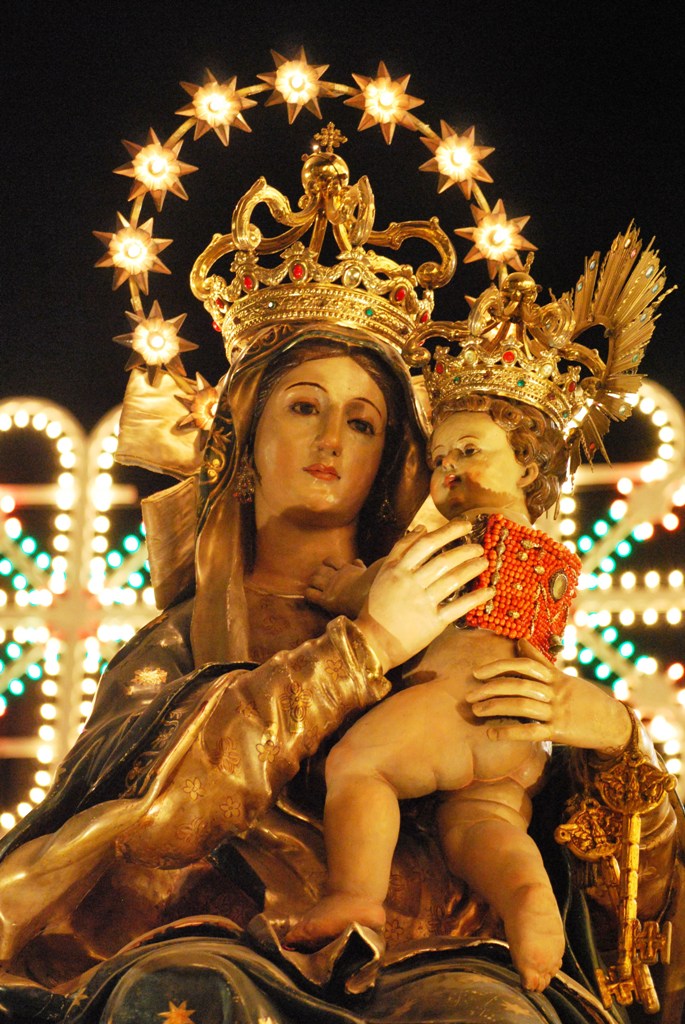
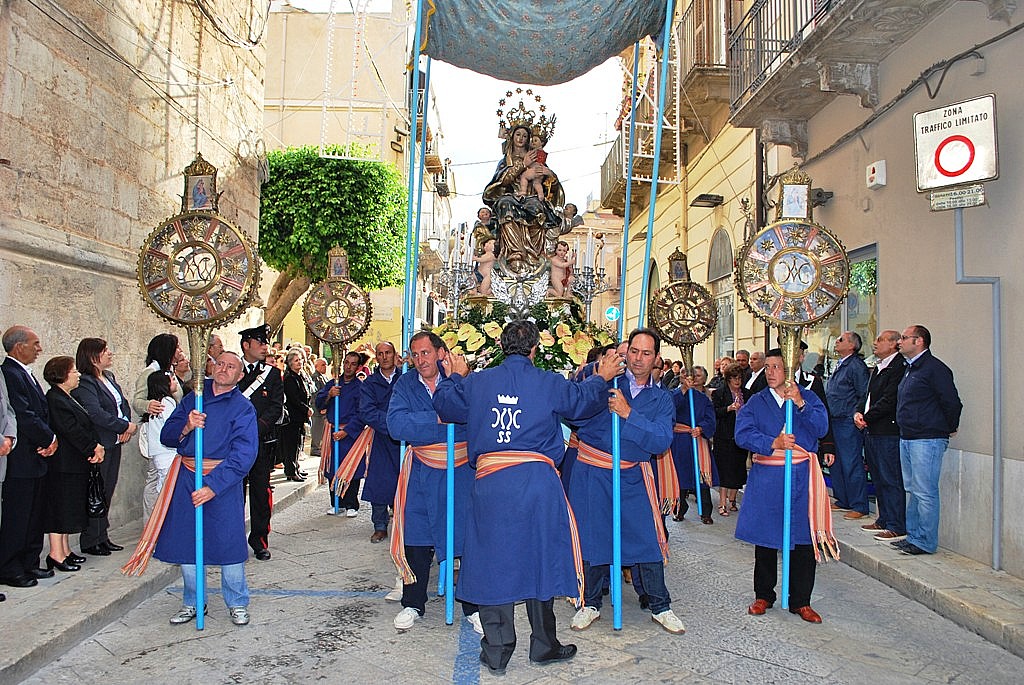
The Processional Statue

The cult of Our Lady of the Miracles in Alcamo dates to 21 June 1547, the day people remember the Madonna’s apparition to some women near a stream running north of Alcamo. According to tradition while washing their clothes in the stream, the women, with a blind and a deaf one among them, saw the apparition of a woman with a child and were hit by a gust of pebbles, during the apparition but without receiving any injury or pain; on the contrary, after being hit by the pebbles, they strangely felt a certain sense of wellbeing and recovered their health. After learning the news, the women’s husbands, thinking that it was a joke, went to investigate, thinking that someone was hidden among the bushes but they didn’t find anybody.
Then the local authorities inquired on the spot, cut down the near grove and found the ruins of a “cuba,” an old arc of a mill that nobody remembered any longer and insidem there was a fresco on a stone made by an anonymous painter of the 13th century representing Our Lady with the Child Jesus, which at first. the believers called “Madonna Fons Misericordiae” (that is Our Lady Source of Mercy).

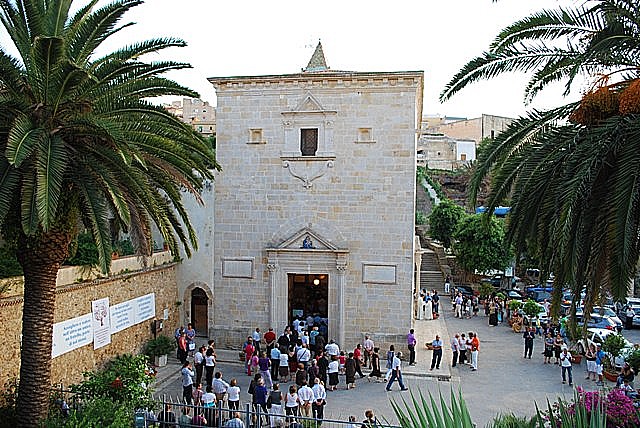
A representation of the discovery of Our Lady of Miracles’ image (inside its Chapel in the Basilica of Our Lady of the Assumption in Alcamo).

After this discovery, all the people started praying before the rediscovered image and in the following days there were several miracles. Our Lady of Miracles became the Patron of Alcamo, in substitution of the Holy Crucified, who was the Patron Saint of Alcamo and other near small towns (among which Calatafimi and Salemi). The old Patron Saint’s memory however, remains: in fact, they call St Francesco of Paola “santu patri” (whose translation means “Patron Saint”) as the Church named after him was called the Holy Crucified Church.
The Madonna’s discovered image was first called “Our Lady Source of Mercy” but thanks to the high number of subsequent miracles, in 1583 the name was changed into “Our Lady of Miracles”.
Further to these events, Don Fernando Vega, Alcamo’s governor, ordered the construction of the Sanctuary of Our Lady of Miracles, which hosts the Madonna’s image. Inside the Church there is a white marble sarcophagus containing the mortal remains of the governor Don Fernando Vega, according to his will.

The Crowned Painting of the Madonna of Miracles in the Sanctuary at Alcamo

Every year in Alcamo there are the celebrations in honour of Our Lady of Miracles from 19 June until 21 of June. This is the most important religious festivity in Alcamo. The real celebrations are often anticipated by other events, so extending the feast to about two weeks, in this way the beginning of the celebrations changes every year, while the last day is always the 21 June.
The celebrations include:
The pealing of church bells” which opens the celebrations together with the burst of fireworks and the passing of the band through the town streets; in the past Alcamo’s band also joined the musical band of Partinico (a neighbouring small town).
The Holy Mass in honour of Our Lady of Miracles in the Basilica di Santa Maria Assunta (also called “Mother Church”), in which all confraternities and laity groups in Alcamo take part.
The procession to the Sanctuary of Madonna of Miracles (called “calata”), in which all civil and religious authorities of the town (together with the Mayor) take part; they are preceded by the band of the town. In old times people took also the animals that had recovered from an illness. Inside the Sanctuary they sing Vespers and then there is the Eucharistic Blessing/Benediction.

St Aloysius Gonzaga SJ (1568-1591) (Memorial) Jesuit Seminarian, Mystic, Marian devotee, born of a noble family as Luigi.
About St Aloysius:
https://anastpaul.com/2018/06/21/saint-of-the-day-21-june-st-aloysius-de-gonzaga-s-j-1568-1591/
AND:
https://anastpaul.com/2019/06/21/saint-of-the-day-21-june-st-aloysius-de-gonzaga-sj-1568-1591/

St Agofredus of La-Croix
St Alban of Mainz (Died c 400) Martyr, Priest, Missionary

St Ralph of Bourges (Died 866) Archbishop of Bourges, Reformer.
His Life:
https://anastpaul.com/2020/06/21/saint-of-the-day-21-june-saint-ralph-of-bourges-died-866/

St Raymond of Barbastro
St Rufinus of Syracuse
St Suibhne the Sage
St Terence
St Ursicenus of Pavia

Martyrs of Taw – 3+ saints: Three Christians of different backgrounds who were martyred together – Moses, Paphnutius, Thomas. They were beheaded in Taw, Egypt, date unknown.

Posted in MARIAN TITLES, SAINT of the DAY

Notre-Dame-de-Grace / Our Lady of Grace / Our Lady of Consolation, Honfleur, France (1524) and Memorials of the Saints – 20 June

Fourth Sunday after Pentecost (Traditional Calendar) +2021
Twelfth Sunday in Ordinary Time +2021

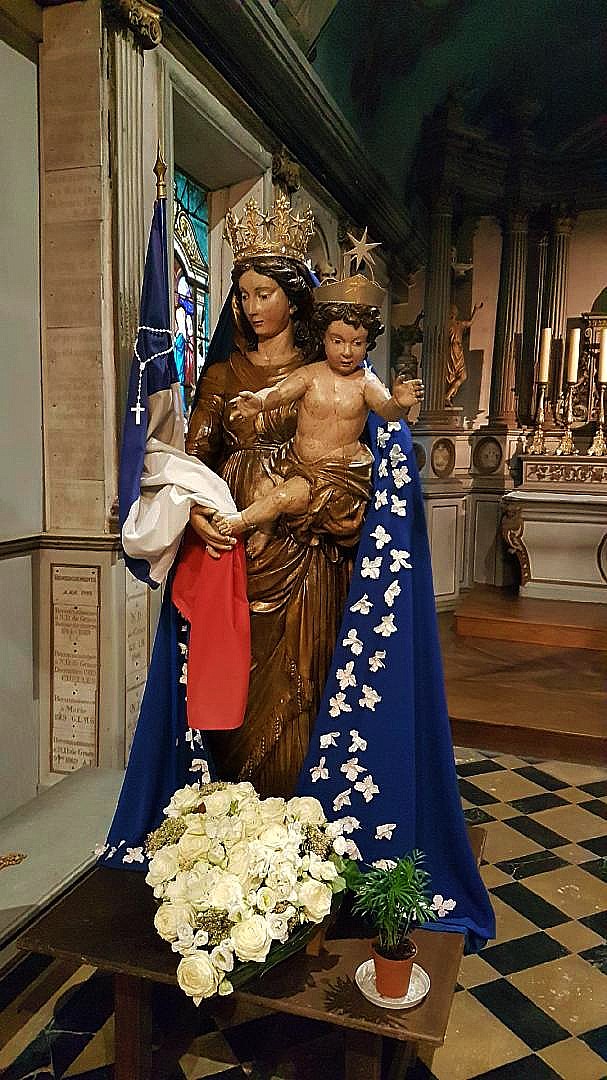
Notre-Dame-de-Grace / Our Lady of Grace in Equemauville, Honfleur, France – also known as Our Lady of Consolation (1524) 20 June (The Crowning) and 23 October:

The Abbot Orsini wrote: “Our Lady of Consolation, near Honfleur. This Chapel is much frequented; two children have been raised to life there, in memory of which ,their figures are there in silver.”

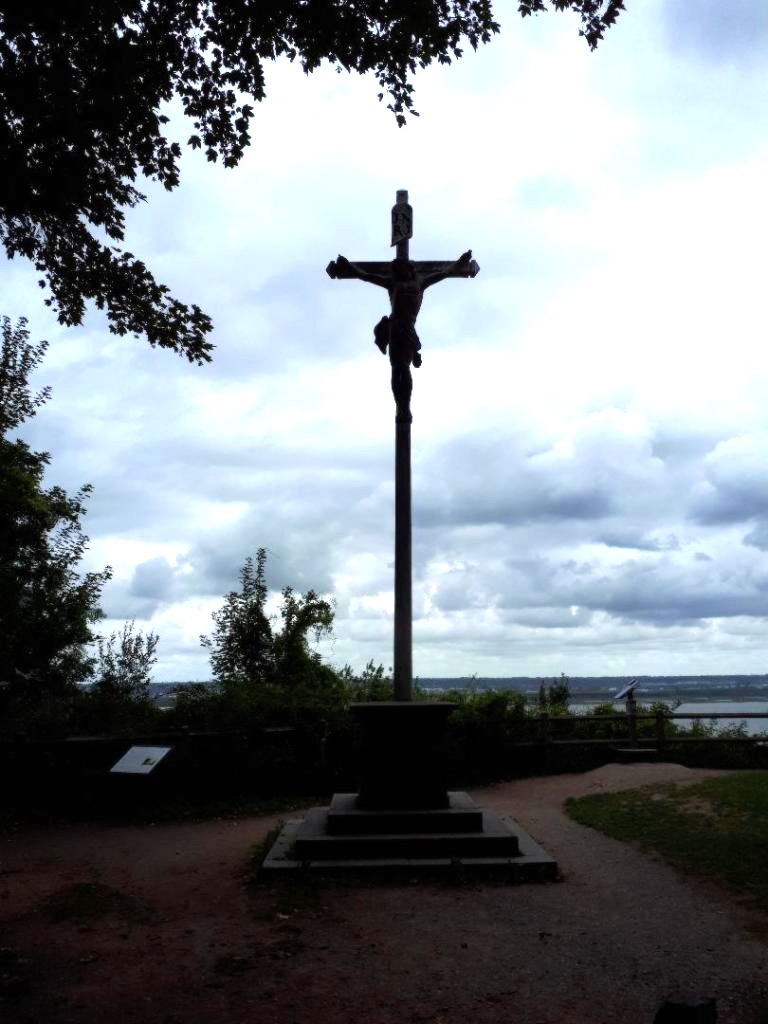
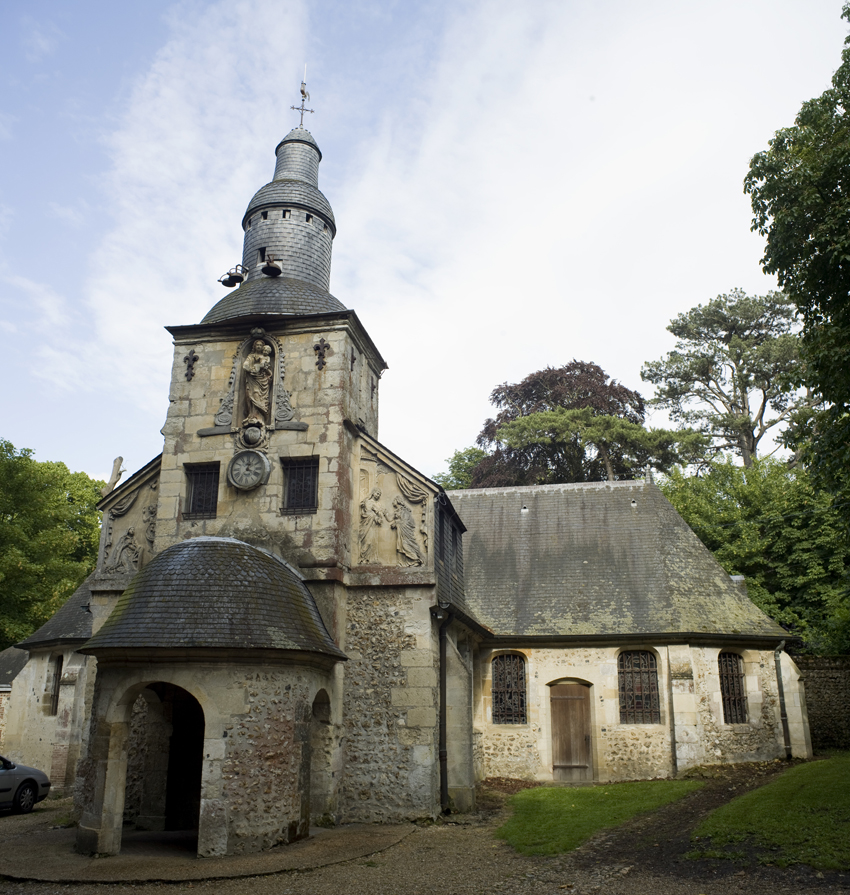
Also known as Our Lady of Grace, or Notre-Dame-de-Grace, the first thing that can be seen among the trees upon the height is a large Crucifix that seems to bless the sea, although the Chapelle Notre-Dame-de-Grace is still invisible, hidden under the old trees that surround it. The present Chapel is a small one, located a short distance from that Crucifix and the tall trees and lawns that surround the Church are in stark contrast to the Church’s humble dimensions.

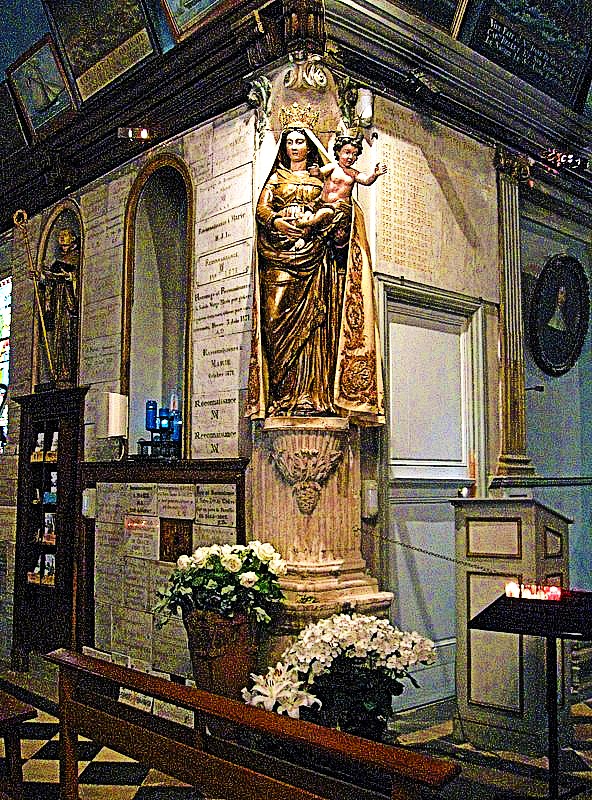
Once inside, everything is modest but exudes an atmosphere of holiness. There is a low arch, and passing beneath it, the view from the windows inside, is obscured by the thick foliage of the surrounding trees. On the Gospel side is the Statue of the Blessed Virgin on a short pillar. A fabric canopy frames the Statue which depicts the Mother of God holding her Divine Child.
At the feet of Our Lady are placed small anchors and hearts of silver gilt that shine on the dais and we see a small amount of flowers that are the humble obeisance’s of children and the poor. There are votive offerings hundreds of years old, and paintings of ships battered by storms, or broken upon the rocks, beneath which are brief accounts of the perils and the salvation sent after prayer to Notre-Dame-de Grace. Crutches lean against the wall as trophies demonstrating the victorious prayers of the healed cripples who now walk, and burning candles, are constantly renewed beneath the holy image, exhibiting the persevering ardoUr of the faithful. It is a collective testimony of piety and edification from the servants of Mary.

The origin of the pilgrimage to Notre-Dame de Grace goes back to the eleventh century. According to tradition, in the year 1034, Robert the Magnificent, Duke of Normandy, was sailing to England. He was suddenly assailed by a violent storm and at the height of the danger he promised to build three Chapelsdevoted to the Blessed Virgin if he returned safely to his lands. The storm ended at once and the Prince immediately returned home to take care of his vow. He built one of the Chapels promised near his Castle, and dedicated it to Our Lady of Mercy. Another he built near Caen, which he called Notre-Dame de la Deliverance,and the third he built on the plateau in Equemauville overlooking Honfleur, which was named Notre Dame de Grace.
This Chapel near Honfleur, soon became a busy place of pilgrimage. There is an authentic document at the Church from King Louis XI dated 28 January 1478 and letters showing that the Chapel was endowed with a certain tract of land containing a house, a barn, etc.

The Chapel partially collapsed and the sea swallowed part of the cliff near the Church during a violent earthquake that occurred on 29 September 1538. Only a section of one wall, the Altar, and the Statue of the Virgin Mary remained standing but such was the devotion of the people to this special place that many pilgrims continued to come and pray kneeling amid the debris. Unfortunately the landslides did not cease, so finally, in 1602, the last vestiges of the Sanctuary were removed to prevent the faithful from exposing their lives to the unremitting danger.
The faithful regretted the loss of their Chapel, and one of them, Mr. Gonnyer, undertook to raise a new one. He dug the foundations one hundred paces from the old Church to the south-west but he was forced to stop at that point for lack of money. Offerings from the inhabitants of Honfleur did the rest and in 1613 the Chapel was acquired. It was a small building three times as long as it was wide;,thatched, isolated among the heather and looked more like a barn than a chapel.
The Capuchins took possession on 16 March 1621, and they planted a large wooden Crucifix amid the ruins of the old chapel. They eventually replaced it with a stone Crucifix that they placed closer to the chapel than the old one had been.
In the Middle Ages people understood that the Church provided for the moral and physical welfare of the people, as well as, the state. They knew that the apostolate of the monastic orders was necessary to form and maintain the ties of charity between the rich and poor, adjust the opulent life of one to soften the sufferings of others and to communicate to all, through preaching and by the Sacraments and example, the secret of living and dying well.
When the Revolution erupted there was wide-spread desecration throughout France and all religious communities were dissolved. In vain the faithful recipients of so many graces endeavoured to protect their Sanctuary and the religious who served there. At one time it was hoped Honfleur could keep the Capuchins and so, a petition was drafted for that purpose in 1790.
“Through the removal of religious communities,” said the petitioners, “we fear being deprived of the significant relief that we receive from the Capuchins. These men are religious at all times, labour for the good of the City and the neighbouring countryside and through the uprightness of their intentions and the justice of their actions, they have earned public esteem and confidence. They have a small Chapel, located on the coast under the invocation of the Blessed Virgin, which is held in great reverence throughout the Country and we urge its conservation.”
The petition was sent to the National Assembly, who refused it. The Chapel was plundered and converted into a tavern. The old Statue was destroyed and sadly “those who were but lately to pray and ask for graces forgot themselves to commit orgies in a place where everything, even the walls, reproached them for their apostasy.”
That was so long ago and now the tides of commercial prosperity have come to caress the people and promote the development of the City and the Port of La Havre. Hanfleur possesses all the signs of a prosperous City that is increasing in wealth and population, regardless of the attendant demoralisation and miseries of every kind, that accompany the seeming prosperity. La Havre is the seat of business where speculators contest in the commercial sphere where they work without ceasing to earn their fortune and contribute to each other’s ruin. Without the aid of the Blessed Virgin, there was no longer any hope for relief. After the atrocities had subsided the Chapel was restored and a copy of the original Statue created from Church records.

It was on 15 February 1912 that the Chapter of Saint Peter in Rome awarded the Golden Crown to the sSatue of Our Lady of Grace. The solemn Feasts of her Coronation were celebrated on 20 June 1913. Many people from Honfleur think that it is thanks to the intercession of Notre Dame de Grâce that Honfleur is the only Norman city not to have been bombed during the Second World War. The Chapel was classified as a historical monument in 1938.

Still, it was here, at this remote Chapel about 5 kilometers from Honfleur, that Marie-Francoise-Therese Martin came with her father and sister Celine in July of the year 1887 to pray to Notre-Dame-de Grace that she might be able to enter Carmel. That woman is better known today as Saint Therese of the Child Jesus and the Holy Face, or simply Therese of Lisieux, the “Little Flower.”

St Adalbert of Magdeburg (910-981) “Apostle of the Slavs” – Bishop, Monk, Missionary .
Biography:
https://anastpaul.com/2018/06/20/saint-of-the-day-20-june-st-adalbert-of-magdeburg-910-981-apostle-of-the-slavs/

St Bagne of Thérouanne
St Edburga of Caistor

Blessed Francisco Pacheco SJ (1566-1626) Martyr, Priest of the Society of Jesus, Missionary

St Gemma of Saintonge
St Goban of Picardie
St Helen of Öehren

St John of Matera (c 1070-1139) Monk, Abbot, Mystic, renowned Preacher, miracle-worker, gifted with bilocation.
His Life:
https://anastpaul.com/2020/06/20/saint-of-the-day-20-june-saint-john-of-matera-c-1070-1139/

St Macarius of Petra
Bl Margareta Ebner
St Methodius of Olympus
Bl Michelina of Pesaro
St Novatus of Rome

St Pope Silverius (Died 538) Martyr ruled the Holy See from 8 June 536 to his deposition in 538, a few months before his death.
Biography:

https://anastpaul.com/2019/06/20/saint-of-the-day-20-june-st-pope-silverius-died-538-martyr/

Irish Martyrs – 17 beati – This is the collective title given to the 260 or more persons who are credited with dying for the faith in Ireland between 1537 and 1714. Seventeen of them were beatified together on 27 September 1992 by St Pope John Paul II.
• Blessed Conn O’Rourke• Blessed Conor O’Devany• Blessed Dermot O’Hurley• Blessed Dominic Collins• Blessed Edward Cheevers• Blessed Francis Taylor• Blessed George Halley• Blessed John Kearney• Blessed Matthew Lambert• Blessed Maurice Eustace• Blessed Patrick Cavanagh• Blessed Patrick O’Healy• Blessed Patrick O’Loughran• Blessed Peter Higgins• Blessed Robert Meyler• Blessed Terrence Albert O’Brien• Blessed William Tirry

Martyrs of Lower Moesia:
Martyred on the Black Sea at Lower Moesia (in modern Bulgaria), date unknown.
St Cyriacus
St Paul

Martyred in Nagasaki: 9 Beati : burned alive on 20 June 1626 in Nagasaki, Japan. Their ashes were thrown into the sea and no relics remain. They were Beatified on 7 May 1867 by Pope Pius IX.
• Blessed Baltasar de Torres Arias
• Blessed Francisco Pacheco
• Blessed Gaspar Sadamatsu
• Blessed Giovanni Battista Zola
• Blessed Ioannes Kisaku
• Blessed Michaël Tozo
• Blessed Paulus Shinsuke
• Blessed Petrus Rinsei
• Blessed Vincentius Kaun

Posted in MARIAN TITLES, MATER DOLOROSA - Mother of SORROWS, SAINT of the DAY

Nostra Signora d Montesenario / Our Lady of Monte Senario, Florence, Italy (1240) and Memorials of the Saints – 19 June

Nostra Signora d Montesenario / Our Lady of Monte Senario, Florence, Italy – Ordo Servorum Beatae Mariae Virginis (OSM) (1240) – 19 June:

The cradle of the Order of the Servants of Mary began at Monte Senario in the year 1233 in the City of Florence, Italy, by a group of Hermits now known as the Seven Holy Founders Saints of the Servite Order – Ordo Servorum Beatae Mariae Virginis (OSM). They were sons of wealthy families and they retired from the world for a life of prayer and devotion to the praises of Mary.
Leaving La Camarzia, a Suburb of Florence, the seven went to Monte Senario in the region of Tuscany. Uncertain of what way of life to follow, they turned to Our Lady in prayer and supplication and she appeared to them on the Feast of the Assumption in the year 1240.

Monte Senario

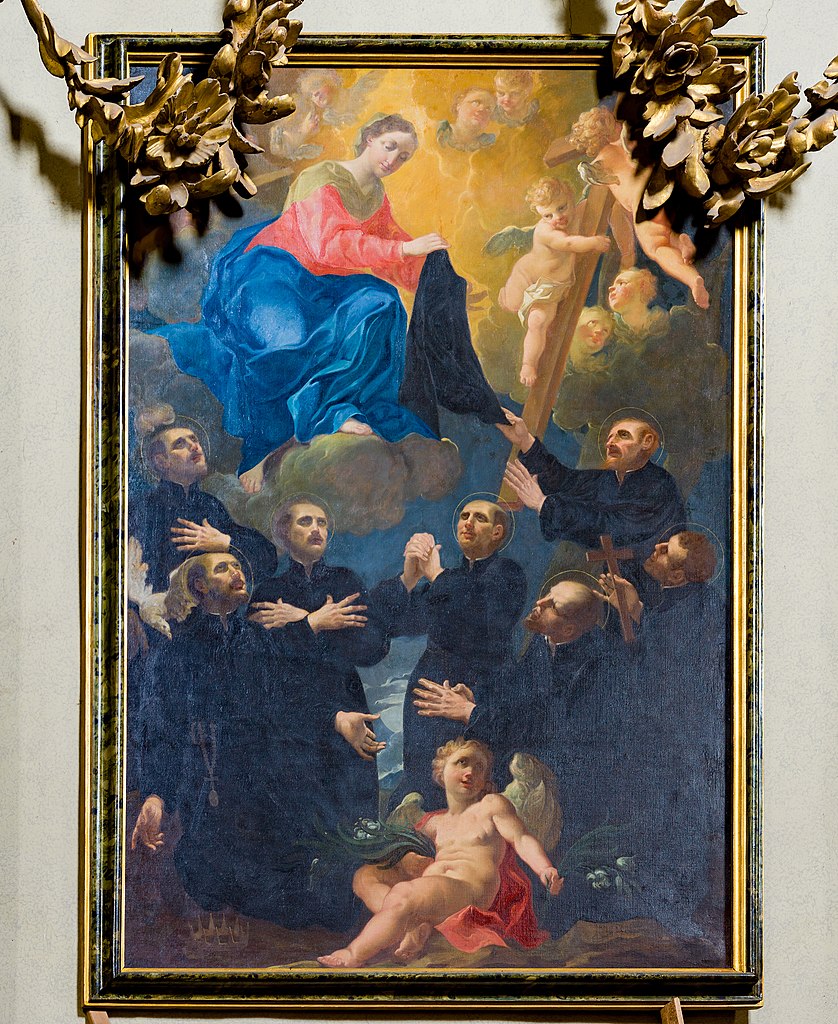
The Blessed Virgin, Our Lady of Monte Senario, presented the Seven Holy Founders with the Habit of their new Order and an Angel stood nearby bearing a scroll that was marked, “Servants of Mary.” He read to the Seven Holy Founders the following words: “You will found a new order, and you will be my witnesses throughout the world. This is your name: Servants of Mary. This is your rule: that of Saint Augustine. And here is your distinctive sign: the black scapular, in memory of my sufferings.”

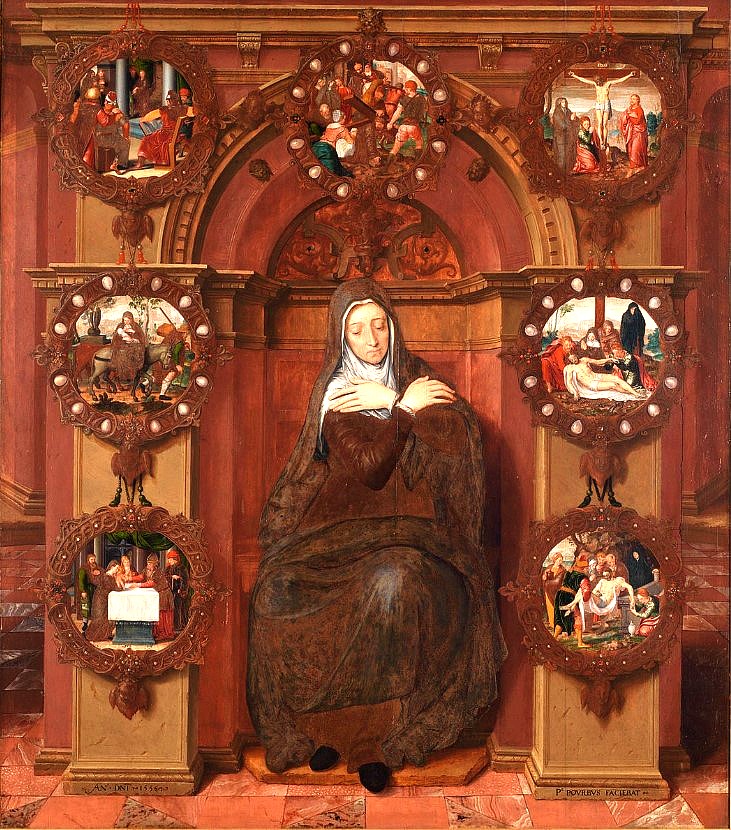
From that day in 1240, the seven were known as the Servants of Mary, the Order of Servants of Mary, or the Servites. under her title of Mother of Sorrows (Italian: Madonna Addolorata) Members of the Order take solemn vows to especially honour the Seven Sorrows of the Blessed Virgin Mary. The sorrows are, in order, the prophecy of Simeon, the flight into Egypt, the loss of the Holy Child at Jerusalem, meeting Jesus on His Way to Calvary, standing at te foot of the Cross, Jesus taken down from the Cross, and the burial of Christ.
According to an ancient document called the “Legenda de Origin ordini,” “Our Lady wanted to begin her Order with seven men to show everyone, with absolute clarity, that she wanted to adorn her Order, endowing it with the seven gifts of the Holy Spirit.”

The Order gained official recognition in 1249 but was not officially approved until Pope Benedict IX issued a Bull in 1304. Their Church on Monte Senario, rebuilt in 1700, is a favourite resort of pilgrims from Florence especially. Mary here, as Our Lady of Monte Senario, as well as elsewhere, proves herself the miraculous Mother of God.
The names of the Seven Holy Founders are Saint Alexis Falconieri, Saint Bartholomew degli Amidei, Saint Benedict dell’Antella, Saint Buonfiglio Monaldi, Saint Gherardino Sostegni, Saint Hugh dei Lippi-Uguccioni, and Saint John Buonagiunta Monetti.

St Romuald (c 951-1027) (Optional Memorial) Monk, Abbot, Ascetic, Founder of the Camaldolese Order and a major figure in the eleventh-century “Renaissance of eremitical asceticism.”
Biography of St Romuald:

https://anastpaul.com/2018/06/19/saint-of-the-day-19-june-st-romuald-c-951-1027/

St Adleida of Bergamo
Bl Arnaldo of Liniberio
St Culmatius of Arezzo
St Deodatus of Jointures
St Deodatus of Nevers
St Gaudentius of Arezzo
St Gervase and St Protase (Died c 165) Martyrs, Twin Brothers of Martyr Parents, Laymen
St Hildegrin of Châlons-sur-Marne
Bl Humphrey Middlemore
St Innocent of Le Mans

St Juliana Falconieri OSM (1270 – 1341) Virgin and Foundress of the Religious Sisters of the Order of Servites, Mystic.
Her Life:

https://anastpaul.com/2019/06/19/saint-of-the-day-19-june-st-juliana-falconieri-osm-1270-1341/

St Lambert of Saragossa
St Lupo of Bergamo

Blessed Maria Rosa/Margaretha Flesch FSMA (1826-1906) Religious Sister and Founder of the Franciscan Sisters of the Blessed Virgin Mary of the Angels, Apostle of the sick, the poor, orphans, spiritual writer, Nurse and Teacher.
Her Life:
https://anastpaul.com/2020/06/19/saint-of-the-day-blessed-maria-rosa-flesch-fsma-1826-1906/

St Modeste Andlauer
St Nazario of Koper
Bl Odo of Cambrai
St Rémi Isoré
Bl Sebastian Newdigate
Bl Thomas Woodhouse
Bl William Exmew
St Zosimus of Umbria

Posted in MARIAN PRAYERS, MARIAN TITLES, SAINT of the DAY

Notre-Dame-des-Oliviers / Our Lady of Olives (Murat, Cantal, France) (1881) and Mrmorials of the Saints – 18 June

Notre-Dame-des-Oliviers / Our Lady of Olives (Murat, Cantal, France) (1881 – 18 June:

In a pleasant valley of France there lies a little Town where, by the favour of God, lightning never strikes.
This favour, unique in the world, dates to the time when the Church of Murat (Cantal) was burned by lightning, except for a wooden statue of the Virgin Mary. In 1493, and ever since, the Town has been named Our Lady of Olives.
The Virgin Mary is the Olive recalled in the scriptures (Sirach 24:14) by whose intercession the Town was protected.

By virtue of the Medallion of Our Lady of Olives, the persons who carry it are preserved from lightning, wherever they may be during a storm. It is a privilege attached to the medallion which bears the unique name in the annals of the Church, “Our Lady of Olives.”
This marvellous way of being protected against lightning, deserves to be known throughout the world and ought to be extended to the four corners of the universe.
The second privilege of the Medallion is to protect, in an unmistakable manner, women who are about to become mothers and to assist them in the hour of deliverance.
Those who are afflicted with sickness and who pray to the Divine Mother, are promptly relieved.
The Virgin was Crowned on 18 June1881, by an Apostolic Brief given by Leo XIII on the tenth day of May 1878.

Prayer to Our Lady of Olives

Kneeling at thy feet, we pray thee Virgin Mary,
that through thine intercession,
there may be borne a new generation
who will unite all hearts and souls
in the same faith and the same charity.
We pray thee “Divine Olive of Peace,”
to implore God,
that harmony may reign between nations,
that true liberty be given to all people,
that heresies and all bad doctrines
condemned by the Pope may disappear.
We pray that all the treasures of the Divine Heart
be showered upon all men
and that we be preserved from all harm.
Pray for us, help us and save us.
Amen.

St Abraham of Clermont
St Alena of Dilbeek
St Amandus of Bordeaux
St Arcontius of Brioude
St Athenogenes of Pontus
St Calogero of Sicily
St Calogerus of Fragalata
St Calogerus the Anchorite
St Colman mac Mici
St Cyriacus of Malaga
St Demetrius of Fragalata
St Edith of Aylesbury

St Elisabeth of Schönau (1129-1164) Abbess, Mystic, Ascetic, Writer, Spiritual Adivisor
Biography:

https://anastpaul.com/2020/06/18/saint-of-the-day-18-june-saint-elisabeth-of-schonau-1129-1164/

St Elpidius of Brioude
St Equizio of Telese
St Erasmo
St Etherius of Nicomedia
Bl Euphemia of Altenmünster
St Fortunatus the Philosopher
St Gerland of Caltagirone

St Gregory Barbarigo (1625-1697) Cardinal who served as the Bishop of Bergamo and later as the Bishop of Padua, Canon and Civil lawyer, Vatican prelate, Reformer, Apostle of Charity.
About St Gregory:

https://anastpaul.com/2018/06/18/saint-of-the-day-18-june-2018-st-gregory-barbarigo-1625-1697/

St Gregory of Fragalata
St Guy of Baume
St Jerome of Vallumbrosa
Sts Marcus and Marcellianu (Died c 286) Martyrs, Twin Brothers
St Marina of Alexandria
St Marina of Bithynia
Bl Marina of Spoleto

Blessed Osanna Andreasi OP (1449-1505) Virgin, Mystic with a gift of prophecy and Stigmatist.
Biography:

https://anastpaul.com/2019/06/18/saint-of-the-day-18-june-blessed-osanna-andreasi-op-1449-1505/

St Osanna of Northumberland
St Osmanna of Jouarre
St Paula of Malaga
Bl Peter Sanchez

Hermits of Karden: A father (Felicio) and his two sons (Simplicio and Potentino)who became pilgrim to various European holy places and then hermits at Karden (modern Treis-Karden, Germany). (Born in Aquitaine (in modern France. ) Their relics transferred to places in the Eifel region of western Germany at some point prior to 930. They were canonised on 12 August 1908 by Pope Pius X (cultus confirmation).

Martyrs of Ravenna – 4 saints: A group of four Christians martyred together. We have no details but their names – Crispin, Cruciatus, Emilius and Felix. They were martyred in Ravenna, Italy, date unknown.

Martyrs of Rome – 3 saints: Three Christians martyred together . We have no details but their names – Cyriacus, Paul and Thomas. In Rome, Italy, date unknown.
Martyrs of Tripoli – 3 saints: Three imperial Roman soldiers, at last two of them recent converts, who were imprisoned, tortured and executed for their faith. Martyrs – Hypatius, Leontius and Theodulus. They were Greek born and they died c135 at Tripoli, Phoenicia (in modern Lebanon).

Posted in MARIAN TITLES, SAINT of the DAY

Heilige Maria im Walde / Holy Maria in the Forest, Dolina, Austria (1849) and Memorials of the Saints – 17 June

Heilige Maria im Walde / Holy Maria in the Forest, Dolina, Grafenstein, Carinthia, Austria (1849) – 17 June:

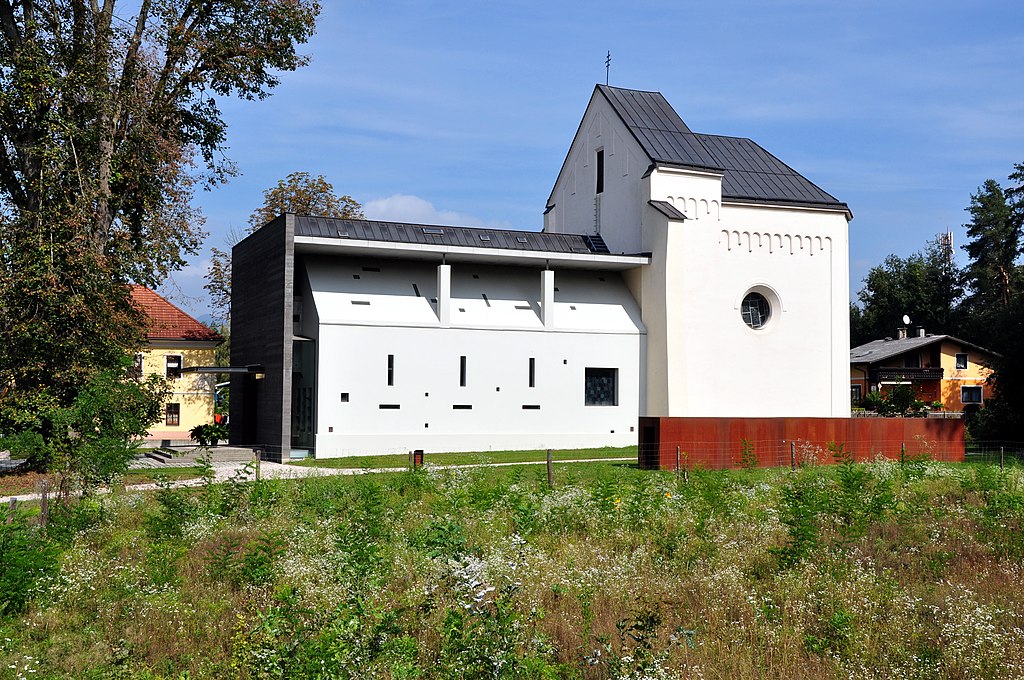
The Apparitions occurred, as the Immaculate Conception, in a wooded area near Dolina, Grafenstein, Carinthia, Austria on the 17, 18 and 19 June 1849 to three young shepherdesses, prior to the public proclamation of the Dogma of the Immaculate Conception ion 1854.
Thus began the influx of pilgrims and in the woods, just where she had appeared as the Immaculate Conception, a wooden Chapel was erected.
The Church, begun in 1861 but was never fully completed.
A local artist painted an image called the Madonna del Bosco, inspired by the descriptions of the three shepherdesses. This painting was a picture of grace that inspired faith and devotion of many.

St Adolph of Utrecht
St Agrippinus of Como

St Albert Chmielowski TOSF (1845-1916) The Painter Who Became an Advocate for the Poor and then a Saint! Artist, Founder, Tertiary Franciscan, Apostle of Charity.
His Life:

https://anastpaul.com/2017/06/17/saint-of-the-day-17-june-st-albert-chmielowski-t-o-s-f-the-19th-century-polish-saint-who-was-influenced-by-st-francis-of-assisi-later-influenced-pope-st-john-paul-ii/
AND:
https://anastpaul.com/2018/06/17/saint-of-the-day-17-june-st-albert-chmielowski-t-o-s-f-1845-1916/

St Antidius of Besançon
Bl Arnold of Foligno
St Avitus of Perche
St Blasto of Rome
St Botolph of Ikanhoe (Died 680) Abbot
St Briavel of Gloucestershire
St David of Bourges
St Dignamerita of Brescia
St Diogenes of Rome
St Emily de Vialar
St Gundulphus of Bourges

St Hervé (c 521–c 556) Hermit, Abbot, Musician and singer, miracle-worker, blind from birth.
His Holy Life:

https://anastpaul.com/2020/06/17/saint-of-the-day-17-june-st-herve-c-521-c-556/

St Himerius of Amelia
St Hypatius of Chalcedon
St Molling of Wexford
St Montanus of Gaeta
St Nectan of Hartland
Bl Paul Burali d’Arezzo
Bl Peter Gambacorta
St Phêrô Ða
Bl Philippe Papon

Blessed Joseph-Marie /Pierre-Joseph Cassant OCSO (1878-1903) Died aged 25 – Priest, Trappist Monk.
Biography:

https://anastpaul.com/2019/06/17/saint-of-the-day-17-june-blessed-joseph-marie-cassant-ocso-1878-1903/

St Prior
St Rambold of Ratisbon
Bl Ranieri Scaccero
St Theresa of Portugal

Martyrs of Apollonia – 7 saints: A group of Christians who fled to a cave near Apollonia, Macedonia to escape persecution for his faith, but were caught and executed. The names we know are – Basil, Ermia, Felix, Innocent, Isaurus, Jeremias and Peregrinus. They were beheaded at Apollonia, Macedonia.

Martyrs of Aquileia – 4 saints: Four Christian martyrs memorialised together. No details about them have survived, not even if they died together – Ciria, Maria, Musca and Valerian. c.100 in Aquileia, Italy.

Martyrs of Chalcedon – 3 saints: Three well-educated Christian men who were sent as ambassadors from King Baltan of Persia to the court of emperor Julian the Apostate to negotiate peace between the two states, and an end of Julian’s persecutions of Christians. Instead of negotiating, Julian imprisoned them, ordered them to make a sacrifice to pagan idols and when they refused, had them executed. Their names were Manuel, Sabel and Ismael. They were beheaded in 362 in Chalcedon (part of modern Istanbul, Turkey) and their bodies burned and no relics survive.

Martyrs of Fez – 4 beati: A group of Mercedarians sent to Fez, Morocco to ransom Christians imprisoned and enslaved by Muslims. For being openly Christian they were imprisoned, tortured, mutilated and executed. Martyrs – Egidio, John, Louis and Paul. They were martyred in Fez, Morocco.

Martyrs of Rome – 262 saints: A group of 262 Christians martyred in the persecutions of Diocletian. In c303 in Rome, Italy. They were buried on the old Via Salaria in Rome.

Martyrs of Venafro – 3 saints: Three Christian lay people, two of them imperial Roman soldiers, who were converts to Christianity and were martyred together in the persecutions of Maximian and Diocletian – Daria, Marcian and Nicander. They were beheaded c.303 in Venafro, Italy. By 313 a basilica had been built over their graves which were re-discovered in 1930. They are patrons of Venafro, Italy.

Posted in MARIAN TITLES, SAINT of the DAY

Beata Vergine Addolorata / The Blessed Virgin of Sorrows, Campocavallo, Osimo, Italy and Memorials of the Saints – 16 June

Beata Vergine Addolorata / The Blessed Virgin of Sorrows, Campocavallo, Osimo, Ancona, Marche, Italy (1892) 16 June, The first Sunday of August., 15 September (Feast o Our Lady of Sorrows), The last Sunday of September AND special Devotions thrughout May: 16 June

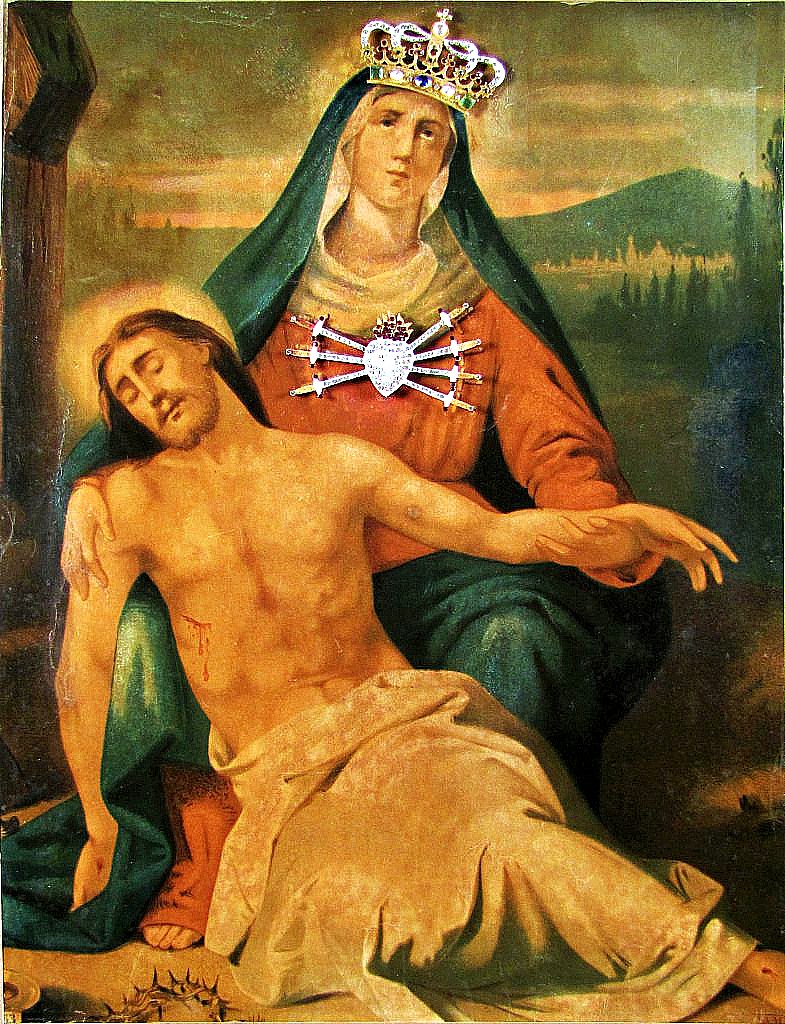
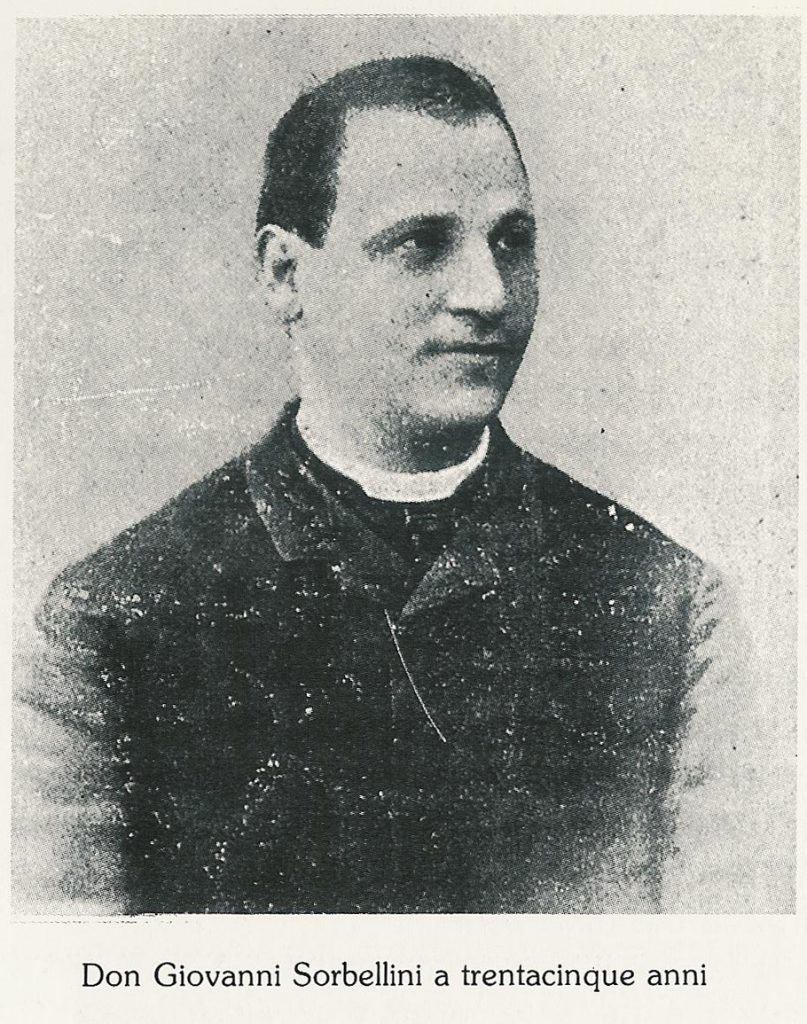
In the 1870s, a small country Chapel was built three miles from Osimo, a Town just inland from the Adriatic near the world-famous Shrine of Loreto. Don Giovanni Sorbellini, appointed in 1883 to say holy day Masses at the Campocavallo Chapel, hung in it an oleograph of the Pietà he had bought from a travelling salesman.

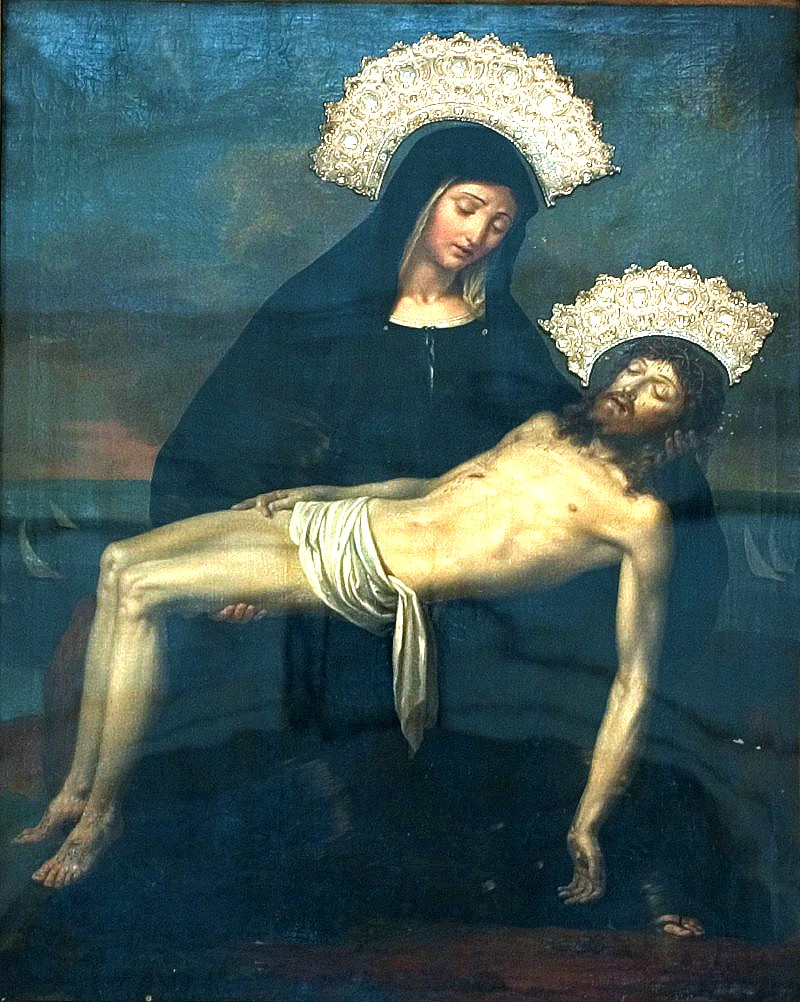
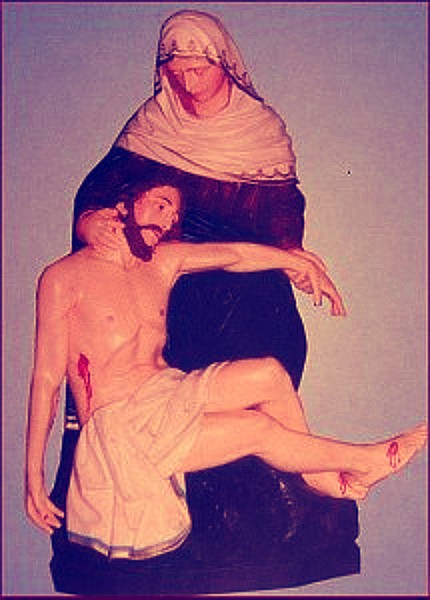
The Miraculous image is an oleograph, a particular type of print that imitates oil painting, measures 38cm x 52cm and portrays the Virgin holding the lifeless body of Jesus in her arms, just taken down from the Cross.
On the ground some instruments of the passion are depicted and in the background the City of Jerusalem. Our Lady has her gaze turned to heaven in action, not of resigned pain, but of complete uniformity of her will to that of God.

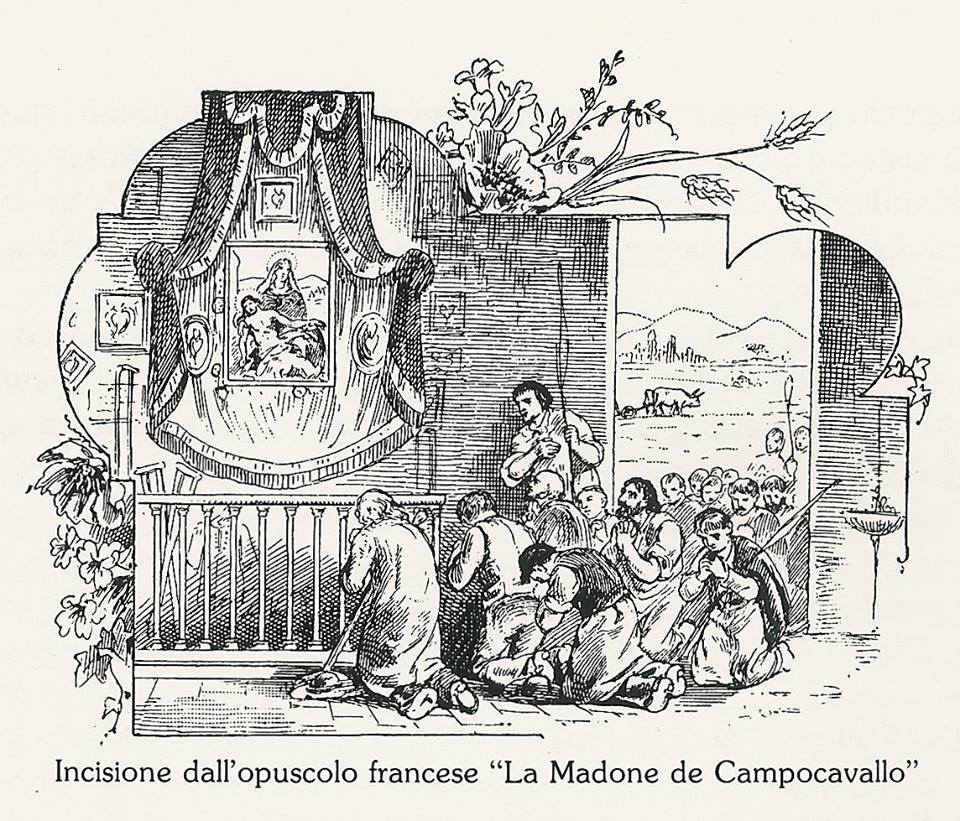
On 16 June 1892, a few families who stayed to pray after Mass saw the eyes of the Sorrowful Virgin move and blink and tears dropped onto her cheeks. Everyone then shouted: “Our Lady is crying!” . News of theMiracle travelled rapidly and widely.

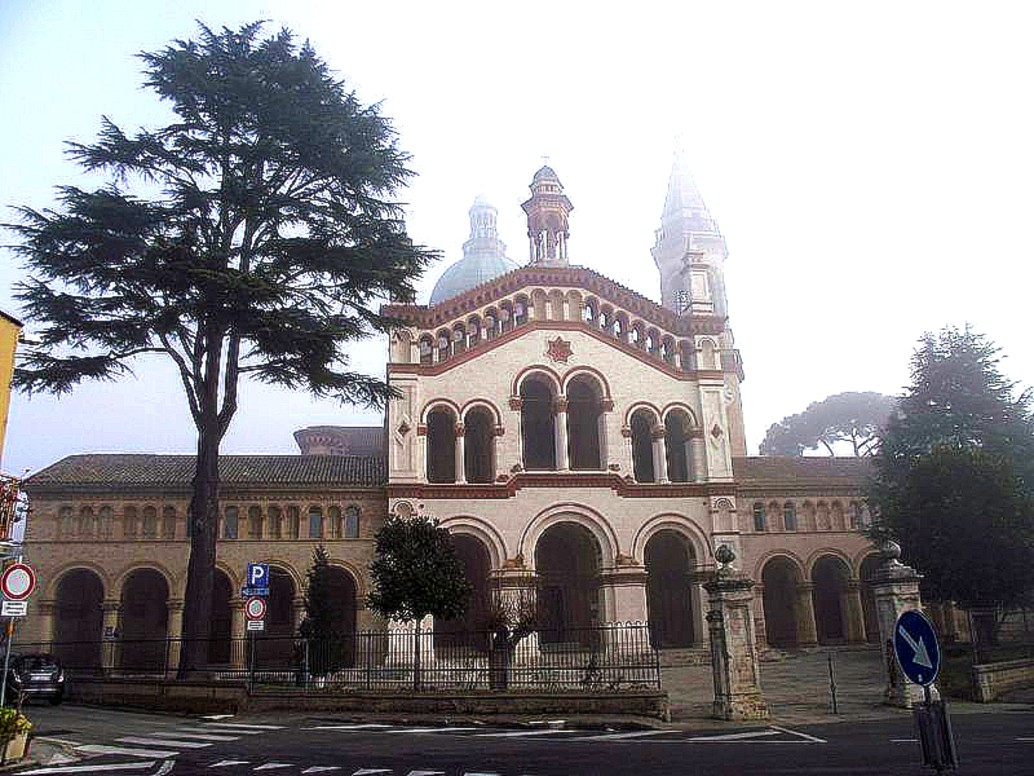
On 7 July a blind woman regained her sight whilst at prayer before the image. The same year, Don Sorbellini began building the present magnificent Sanctuary, consecrated in 1905.  For at least 10 years, in truth, there are many miracles and testimonies of those who saw the movement and tears and even today!

It’s the focus of the Festa del Covo, a Nativity-themed harvest festival the first Sunday of August, and the Festa dell’Addolorata the third Sunday of September, the date of the Consecration of the Church and Crowning of Mary. The Feast of the first Miracle is celebrated today, 16 June and of course, the Feast of Our Lady of Sorrows is celebrated o 15 September.

St Actinea of Volterra
St Aitheachan of Colpe
St Amandus of Beaumont
Bl Antoine Auriel
St Aurelian of Arles
St Aureus of Mainz

St Benno of Meissen (1010-1106) Bishop of Meissen, Germany, Confessor
Biography:

https://anastpaul.com/2018/06/16/saint-of-the-day-st-benno-1010-1106/

St Berthaldus
St Ceccardus of Luni
St Cettin of Oran
St Colman McRhoi
St Crescentius of Antioch
St Cunigunde of Rapperswil
St Curig of Wales
St Cyriacus of Iconium

Blessed Donizetti Tavares de Lima (1882-1961) Priest, Apostle of the poor, the elderly and the sick, miracle-worker, known to bilocate.
A prophecy related to Vatican II:
“No, no, Archbishop! We won’t see this disgrace (prophesying that they both would die soon) but it will come! This was not just a dream, nor a nightmare! The darkness will fall over this world! I beg you: don’t let them destroy the Altars!”
An amazing life:

https://anastpaul.com/2020/06/16/saint-of-the-day-16-june-blessed-donizetti-tavares-de-lima-1882-1961/

St Elidan
St Felix of San Felice
St Ferreolus of Besançon
St Ferrutio of Besançon
Bl Gaspare Burgherre
St Graecina of Volterra
St Ismael of Wales
St John Francis Régis SJ (1597-1640) Priest, Confessor

St Julitta of Iconium
St Justina of Mainz

St Lutgarde of Aywières (1182-1246) The first known woman stigmatic of the Church and one of the first promoters of devotion to the Sacred Heart
Her Life:

https://anastpaul.com/2017/06/16/saint-of-the-day-16-june-st-lutgarde-of-aywieres-the-first-known-woman-stigmatic-of-the-church-and-one-of-the-first-promoters-of-devotion-to-the-sacred-heart/

St Maurus of San Felice
St Palerio of Telese
St Similian of Nantes
Bl Thomas Redyng
St Tycho of Amathus

Martyrs of Africa: A group of five Christians martyred together. We know nothing else but the names – Cyriacus, Diogenes, Marcia, Mica, Valeria. They were martyred in an unknown location in Africa, date unknown.

Martyrs of Làng Cóc: A group of five Christian laymen, four farmers and a doctor, from the same village in the apostolic vicariate of Central Tonkin (in modern Vietnam). During the persecutions of emperor Tu Duc, they were each ordered to stomp on a cross to show their contempt for Christianity; they each refused. Imprisoned, tortured and martyred.
• Anrê Tuong
• Ðaminh Nguyen
• Ðaminh Nguyen Ðuc Mao
• Ðaminh Nhi
• Vinh Son Tuong
The were beheaded on 16 June 1862 in Làng Cóc, Nam Ðinh, Vietnam and canonised on 19 June 1988 by St Pope John Paul II.

Posted in INCORRUPTIBLES, MARIAN TITLES, SAINT of the DAY

Our Lady of the Taper of Cardigan (1100s) and Memorials of the Saints – 15 June:

Our Lady of the Taper of Cardigan (1100s)– 15 June:

During the middle ages there was a notable pilgrimage in honour of Our Lady in Cardigan. A beautiful legend describes how a Statue of Mary was found by the side of the river Teifi, “and her sonne upon her lappe and the taper bernynge in her hande.” It was taken to the Parish Church but would not remain there, returning three or four times to “the place where now is buyIded the Church of our Lady,” the present St.Mary’s Church. A chantry Priest sang Mass daily in honour of Our Lady for pilgrims who came to pray and leave gifts. They lodged with the Knights Hospitallers of S. John, where the Angel Hotel now stands.

St Mary’s dates from 1158, built to hold the Statue. It resembles an earlier Shrine in the city of Arras, which was then in Flanders. Did Flemish merchants, who settled in Cardigan and traded in Welsh wool out of the port, bring the Statue back with them?

Devotion to Mary was once universal in Wales. Many places are called Llanfair or Capel Mair (Mary’s Church, Chapel) and dozens of flowers and plants bear her name. No girl was given the name Mair (Mary), as it was reserved for Our Lady.

We do not know how the devotion transferred to Barcelona and Cagliari. In the 1320’s and 1330’s Catalonian sailors had thronged British waters. Did they come to Cardigan, see the Shrine and copy it? In 1904 Breton Monks, in exile near Cardigan, revived the devotion, giving the title Our Lady of Cardigan to their Abbey Church and also to the little Church they opened in Town in 1912. They left in 1916 and another generation passed before the name was heard again.

In 1952 Martin Gillett, who later was to found the Ecumenical Society of the Blessed Virgin Mary, told Bishop Petit that Cardigan had once possessed a famous Shrine. The Bishop instantly decided to restore it. In 1956 a new Statue was blessed by Cardinal Griffin in Westminster Cathedral and then taken to every Parish in the Diocese of Menevia before arriving in Cardigan. On 27 May 1956, a great concourse from all parts of Britain bore it to the little Church of Our Lady of Sorrows. On 23 July 1970 Bishops Petit and Fox consecrated the new church of Our Lady of the Taper, named after the Shrine. Three days later pilgrims transferred the Statue there.

The original Statue was taken to London and destroyed at Chelsea in 1538 along with other Marian images on the orders of Thomas Cromwell, 1st Earl of Essex, Chief Minister of King Henry VIII. Mother Concordia, OSB, was asked to make another in bronze. Designated as a Welsh National Shrine of Our Lady, it was blessed in Cardiff Metropolitan Cathedral and brought all over Wales before, on Pentecost Sunday, 18 May 1986, it was solemnly installed in the presence of 4,500 pilgrims. Its beauty catches the imagination and arouses devotion. Pope John Paul II wrote a special message for the occasion, and a taper he blessed in Rome was placed in the hand of the statue and lit.

Its symbolism is that Mary presents her Son to us, as she did to the Wise Men, to be adored. The taper testifies that He is Light of the World. Pilgrims come to pray individually and in groups. May they learn to treasure the word of God in their hearts, as Mary did, and live by the light of her Son, who is her Saviour and ours.

St Abraham of Saint-Cyriacus
St Achaicus of Corinth
St Barbara Cui Lianshi
St Benildis of Córdoba

St Bernard of Montjoux/Menthon CRSA (c 1020-1081) “Apostle of the Alps” Priest, Founder of a patrol that cleared robbers from the mountains and he established hospices for travellers and pilgrims. The large dogs, trained to search for lost victims in the mountains, are named for him. Patronages – Alpinists, Alps (proclaimed by Pope Pius XI on 20 August 1923), Campiglia Cervo, Italy, mountain climbers (proclaimed by Pope Pius XI on 20 August 1923), mountaineers, skiers, travellers in the mountains (proclaimed by Pope Pius XI on 20 August 1923).
Biography:

https://anastpaul.com/2018/06/15/saint-of-the-day-15-june-st-bernard-of-menthon-c-r-s-a-c-1020-1081-apostle-of-the-alps/

St Constantine of Beauvais
St Domitian of Lobbes
St Edburgh of Winchester
St Eigil
St Eutropia of Palmyra
St Fortunatus of Corinth

St Germaine Cousin (1579–1601) Incorrupt- Laywoman, Penitent, Apostle of Charity, miracle-worker. Patronages – abandoned people, abuse victims, child abuse victims, against poverty, disabled and handicapped, people, girls from rural areas, illness, impoverishment, loss of parents, shepherdesses, people disfigured by disease, physical therapists.
Her Holy Life:

https://anastpaul.com/2020/06/15/saint-of-the-day-15-june-saint-germaine-cousin-1579-1601/
https://youtu.be/NGY4xQp1FeE?list=PL5_ax08Z6UX_IS_p0gFisSs5wlM63KKL2

St Hadelinus of Lobbes
St Hesychius of Durostorum
St Hilarion of Espalion
Bl Juan Rodriguez
St Julius of Durostorum
St Landelin of Crespin
St Leonides of Palmyra
St Libya of Palmyra
St Lotharius of Séez
St Melan of Viviers
St Orsisius
Bl Pedro da Teruel
Bl Peter Snow
St Pierre de Cervis
Blessed Pietro Nolasco Perra OdeM (1574-1606)
Bl Ralph Grimston
St Tatian of Cilicia
Bl Thomas Scryven
St Trillo of Wales
St Vaughen of Ireland

St Vitus (c 290-c 303) – Martyr, One of the Seven Holy Helpers. Died aged 12-13 years of age. Patronages – against animal attacks, against dog bites, against epilepsy; epileptics, against lightning, against over-sleeping, against rheumatic chorea or Saint Vitus Dance, against snake bites, against storms, against wild beasts, of actors, comedians, dancers, dogs, Bohemia, Czech Republic, Serbia, 17 cities.
His very short life:

https://anastpaul.com/2017/06/15/saint-of-the-day-15-june-st-vitus/

St Vitus Cathedral, Prague, Czech Republic:
https://anastpaul.com/2017/06/15/celebrating-st-vitus-memorial-and-the-cathedral-in-his-honour-in-prague-czech-republic-the-country-for-which-he-is-a-patron-art-dei-series-2/

St Vouga of Lesneven

Martyr of Lucania – 11 saints: Eleven Christians martyred together. We known nothing else about them but the names – Anteon, Candidus, Cantianilla, Cantianus, Chrysogonus, Jocundus, Nivitus, Protus, Quintianus, Silvius, Theodolus in Lucania (modern Basilicata), Italy, date unknown.

Posted in MARIAN TITLES, SAINT of the DAY

Notre-Dame de la Treille / Our Lady of the Trellis, Lille, Nord, Flandres, France, 1234 and Memorials of the Saints – 14 June

Notre-Dame de la Treille / Our Lady of the Trellis, Lille, Nord, Flandres, France, 1234 – 14 June:

Three series of miraculous events are associated with the Statue, occurring in 1234, from 1519 to 1527 and from 1634 to 1638.
The miracle of 1234 was the healing of the 53 disabled patients who resorted to her intercession and were cured upon praying before the Statue of Our Lady of the Trellis, installed behind a latticework fence in St Peter’s Collegiate Church in Lille, France.
The miracles in the 16th century were varied and included deliverance from demonic possession, hernias, blindness, paralysis and plague.
In 1254, a Confraternity of Our Lady of the Treille was canonically established by Pope Alexander IV and since 1259, an annual procession in honour of Our Lady of the Treille was held – a practice which continued until the French Revolution and since then resumed and is continued today.
In 1634, Jean Le Vasseur, Mayor of Lille, Consecrated the City to Our Lady of the Treille.
In 1667, Louis XIV, who had just taken Flanders, took an oath to respect the freedoms of Lille before the Statue.
A procession held annually on the second Sunday after Pentecost commemorates the miracles. Saved during the destruction of St Peter’s Church in the French Revolution, the Statue moved afterwards to St Catherine’s Church.
Devotion to Our Lady of the Trellis revived in the mid-1800s and a grand neo-Gothic Church arose in her honour, where the Statue was installed in 1872 and canonically crowned in 1874.
After the theft of the original in 1959, sculptor Marie Madeleine Weerts carved the image now displayed in Lille’s Catholic Cathedral, the Basilica of Notre-Dame de la Treille.

The statue is described by Father Charles Bernard, Parish Priest of the Church of St Catherine, as a sSatue of stone “a little more than two and a half feet high; she has a scepter in her right hand and from her left. she supports the Baby Jesus on her knees.” He mentions the trellis of gilded wood surrounding the Statue and its pedestal, and specifies that the old trellis made of gilded iron was lost in 1792 during the destruction of the Collegiate Church of St. Peter. He speculates that this trellis is what gave the Statue its name, although it is more likely that the name came from Treola, a place existing in the 9th century in what is now Lille.

St Anastasius of Córdoba
St Burchard of Meissen
St Caomhán of Inisheer
St Castora Gabrielli
St Cearan the Devout
Bl Constance de Castro
St Cyprien
St Cyriacus of Zeganea
St Davnet
St Digna of Córdoba
St Dogmael of Wales
St Elgar of Bardsey

St Elisha the Prophet “My God is salvation” (790 BC) Prophetwas a a disciple and protégé of St Elijah.
St Elisha!

https://anastpaul.com/2020/06/14/saint-of-the-day-14-june-saint-elisha-the-prophet-my-god-is-salvation-790-bc/

St Etherius of Vienne
St Felix of Córdoba
Bl Fortunatus of Napoli
Bl Francisca de Paula de Jesus Isabel
St Gerold of Evreux
Bl Hartwig of Salzburg
St Joseph the Hymnographer
St Marcian of Syracuse (Died c 68) Bishop Martyr, Consecrated by St Peter
St Mark of Lucera

St Methodius of Constantinople (born 8th Century – 847)
His Life:
https://anastpaul.com/2018/06/14/saint-of-the-day-14-june-st-methodius-i-of-constantinople-8th-cent-847-defender-of-icons/

St Nennus of Arran
Bl Peter de Bustamante
St Protus of Aquileia
St Quintian
St Richard of Saint Vannes
St Rufinus of Soissons
St Thecla
St Theopista
St Valerius of Soissons
Bl Walter Eustace

Posted in DOCTORS of the Church, franciscan OFM, MARIAN TITLES, SAINT of the DAY

Sunday within the Octave of the Sacred Heart , 13 June 1917 – The Second Apparition of our Lady of Fatima, Madonna della Cava/ Our Lady of the Cave, Latera, Viterbo, Latium, Italy and Memorials of the Saints – 13 June

Sunday within the Octave of the Sacred Heart +2021

13 June 1917 – The Second Apparition of our Lady of Fatima

Madonna della Cava/ Our Lady of the Cave, Latera, Viterbo, Latium, Italy – 13 June:

The Church of the Madonna della Cava is a small Church located in an area of tufa quarries in one of the roads leading to the agricultural areas of the country.
It is the Church and above all, a painting depicting the Madonna and child, ae the subject of particular devotion on the part of the inhabitants of Latium. The Church, rebuilt today, was bombed during World War II and reduced to ruins, ruined from flying debris and explosions with only the framework surviving behind the Altar and the painting.

St Anthony of Padua OFM (1195-1231) (Memorial) (1195-1231) Doctor of the Church
The wonderful St Anthony:

https://anastpaul.com/2017/06/13/saint-of-the-day-13-june-st-anthony-of-paduao-f-m-evangelical-doctor-hammer-of-heretics-professor-of-miracles-wonder-worker-ark-of-the-covenant/
AND:
https://anastpaul.com/2018/06/13/saint-of-the-day-13-june-st-anthony-of-padua-o-f-m-evangelical-doctor-hammer-of-heretics-professor-of-miracles-wonder-worker-ark-of-the-tes/
AND A SERMON BY ST ANTHONY:
Actions Speak Louder than Words: https://anastpaul.com/2019/06/13/thought-for-the-day-13-june-actions-speak-louder-than-words/

Bl Achilleo of Alexandria
Bl Alfonso Gomez de Encinas
Bl Anthony of Ilbenstadt
St Aquilina of Syria
St Aventino of Arbusto
St Damhnade
St Diodorus of Emesa
St Eulogius of Alexandria
St Fandilas of Penamelaria
St Felicula of Rome
St Fortunatus of North Africa

Blessed Gerard of Clairvaux (Died 1138) – was the elder brother of Saint Bernard of Clairvaux. He was a Soldier. When he was wounded in combat at the siege of Grancy, Gerard resolved to become a Monk. He became a Benedictine Cistercian Monk at Citeaux. He worked with Saint Bernard at Clairvaux and became his closest confidant. He died in 1138 of natural causes.

St Lucian of North Africa
St Mac Nissi of Clonmacno

Blessed Marianna Biernacka (1888-1943) Martyr of the Nazi Regime, Laywoman, Mother, Grandmother, Widow
Her Life and Death:
https://anastpaul.com/2020/06/13/saint-of-the-day-13-june-blessed-marianna-biernacka-1888-1943-martyr/

St Maximus of Cravagliana
St Nicolas Bùi Ðuc The
St Peregrinus of Amiterno
St Rambert
St Salmodio
Bl Servatius Scharff
St Thecla
St Tryphillius (Died 370) Bishop
St Victorinus of Assisi
St Wilicarius of Vienne

Posted in AUGUST - The Immaculate Heart of Mary, FEASTS and SOLEMNITIES, MARIAN REFLECTIONS, MARIAN TITLES, MEDITATIONS - ANTONIO CARD BACCI, SACRED and IMMACULATE HEARTS, The BLESSED VIRGIN MARY

Thought for the Day – 12 June – “All Generations Shall Call Me Blessed”

Thought for the Day – 12 June – Meditations with Antonio Cardinal Bacci (1881-1971) “Month of the Sacred Heart” – Memorial of the Immaculate Heart of Mary

“All Generations Shall Call Me Blessed”

‘A Jewish girl, poor in this world’s goods but rich in virtue, arrived after a long and difficult journey at a village in the hills of Judea, called Hebron.
There, she paid a visit to her cousin, Elizabeth.
When Elizabeth saw the girl, she was immediately enlightened by the Holy Spirit with the knowledge, that her visitor, was the Mother of God.
“How have I deserved,” she cried out, “that the mother of my Lord, should come to me?” (Lk 1:43).
At these words, Mary looked up towards Heaven and gave spontaneous expression to a hymn of humble acknowledgement to God, Who had “regarded the lowliness of His Handmaid” (Lk 1:48).
Then she made a solemn prophecy, which would surely have assured the cynical intellectuals and nobles of the land but, which history has wonderfully fulfilled.
“Behold” she said, “all generations shall call me blessed” (ibid).  We can testify today, that this miracle came to pass.
All the nations have paid reverence to the Jewish girl, who became the Mother of God and our Mother, the Queen of Heaven and earth, the comforter of the afflicted, the conqueror of Satan and the invincible Guardian of the Church.
From the engravings in the Catacombs, to the celestial Madonnas of the Angelico, from the rudimentary sculpture of Roman art, to the prayerful statues on the pinnacles of more modern Cathedrals, the image of Mary has shone as a beacon of hope for all generations.
Men bow before her and ask for light, for comfort and for pardon.
“If anyone follows Mary,” says St Bernard, “he will not lose his way; if anyone pray to her, he will not despair; if anyone thinks of her, he will not sin; if anyone reaches out to her, he will not fall; if anyone places himself under her protection, he need have no fear; if anyone places himself under her leadership, he will never give up; if anyone pays homage to her, he is certain to reach his destination safely” (Homil Missus est 2:17).”

Antonio Cardinal Bacci

Posted in AUGUST - The Immaculate Heart of Mary, CATHOLIC-PRAYERS OF THE CHURCH, DECEMBER - The DIVINE INFANCY and The IMMACULATE CONCEPTION, DOCTORS of the Church, FEASTS and SOLEMNITIES, HYMNS, IMMACULATE HEART PRAYERS, MARIAN PRAYERS, MARIAN TITLES, Our MORNING Offering, PRAYERS of the CHURCH, REDEMPTORISTS CSSR, SACRED and IMMACULATE HEARTS, The BLESSED VIRGIN MARY

Our Morning Offering – 12 June – O Mother Blest

Our Morning Offering – 12 June – “Month of the Sacred Heart” Memorial of the Immaculate Heart of Mary

O Mother Blest
By St Alphonsus Maria Liguori (1696-1787)
Most Zealous Doctor of the Church

Trns. Fr Edmund Vaughn C.SS,R, (1827 – 1908 )

O Mother blest, whom God bestows
On sinners and on just,
What joy, what hope thou givest those
Who in thy mercy trust.
Thou are clement, thou are chaste,
Mary thou art fair,
Of all mothers, sweetest best,
none with thee compare.

O heavenly Mother, mistress sweet!
it never yet was told
that suppliant sinner left thy feet,
unpitied, unconsoled.
Thou are clement, thou are chaste, …

O Mother, pitiful and mild,
Cease not to pray for me;
For I do love thee as a child,
And sigh for love of thee.
Thou art clement, thou art chaste, …

Most powerful Mother, all men know
Thy Son denies thee nought;
Thou askest, wishest it, and lo!
His power thy will hath wrought.
Thou art clement, thou art chaste, …

O Mother blest, for me obtain,
Ungrateful though I be,
To love that God who first could deign
To show such love for me.
Thou art clement, thou art chaste,
Mary, thou art fair.
Of all mothers, sweetest, best,
None with thee compare.

Posted in FEASTS and SOLEMNITIES, JUNE-THE SACRED HEART, MARIAN TITLES, SACRED and IMMACULATE HEARTS, SAINT of the DAY, The APOSTLES & EVANGELISTS

Solemnity of the Most Sacred Heart of Jesus, Our Lady of Mantara / Our Lady of ‘Awaiting’, Maghdouché, Sidon, South Governorate, Lebanon (1721) and Memorials of the Saints – 11 June

Solemnity of the Most Sacred Heart of Jesus 
https://anastpaul.com/2020/06/19/solemnity-of-the-most-sacred-heart-of-jesus-19-june-a-little-of-the-history-of-the-devotion-to-the-sacred-heart/

Our Lady of Mantara / Our Lady of ‘Awaiting’, Maghdouché, Sidon, South Governorate, Lebanon (1721) – 11 June, 8 September:

While Jesus preached in Sidon, Mary is said to have waited here in the cave of Mantara (“awaiting” in Arabic).
Emperor Constantine’s wife Helena replaced a pagan shrine with one to the Holy Mother, donating to it an Icon and Altar furnishings. Three centuries later, after takeover by an intolerant Arab ruler, Christians sealed the cave and fled Maghdouché.
In 1683, descendants of the exiles returned to their homeland under the inclusive Prince Fakhreddin II.
On 8 September 1721, when a goat fell through a gap in the porous limestone, its young herder made a rope from vine twigs, tied it to a tree and followed the animal into the hole but the rope broke. The boy fell into the darkness, where eventually he made out the golden glimmer of an Icon of the Madonna and Child. On seeing the image, the Melkite Catholic clergy recognised it as St Helen’s Icon.

Christians now celebrate its rediscovery annually on 8 September, Feast of the Virgin’s Birth.
A Cathedral was added to the site in 1860 and a modern tower topped with a bronze Statue in the 1960s.

On 11 June 1911, some 400 people saw a silent, luminous apparition of the Madonna and Child near the cave.
Our Lady of Mantara is invoked for the healing of eye diseases and the protection of children, so the Shrine is a popular site for infant Baptisms.

St Barnabas the Apostle (Memorial) (Martyred in c 61 at Salamis)
St Barnabas!

https://anastpaul.com/2018/06/11/saint-of-the-day-11-june-st-barnabas-apostle-son-of-encouragement/
AND:
https://anastpaul.com/2017/06/11/saint-of-the-day-st-barnabas-the-apostle-11-june/

St Aleydis of Schaerbeek
St Blitharius of Seganne
Blessed Helen of Poland (c 1235-1298) Princess, Widow, Mother, Nun and Abbess of the Poor Clares

St Herebald of Bretagne
Bl Hugh of Marchiennes

Blessed Ignazio Shoukrallah Maloyan ICPB (1869-1915) Bishop and Martyr
His Life and Death:

https://anastpaul.com/2020/06/11/saint-of-the-day-11-june-blessed-ignazio-maloyan-icpb-1869-1915-bishop-and-martyr/

Bl Jean de Bracq

St Juan de Sahagun OESA (1419-1479) Priest and Friar of the Order of the Augustinians, Preacher, Social Reformer, Defender of workers.
Biography: His Memorial was on 12 June but moved in 1969.

https://anastpaul.com/2017/06/12/saint-of-the-day-12-june-st-john-of-sahagun-o-e-s-a/

Bl Kasper of Grimbergen
St Maximus of Naples
St Parisius
St Paula Frasinetti
St Riagail of Bangor
St Tochumra of Kilmore
St Tochumra of Tuam

Martyrs of Tavira – 7 beati: Members of the Knights of Santiago de Castilla. During the re-conquest of the Iberian peninsula from the Muslims by Christian forces, in a period of truce between the armies, the group was allowed to leave the Portuguese camp to hunt. Near Tavira, Portugal, he and his companions were ambushed and killed by a Muslim force. Making a reprisal attack, the Portuguese army took the city of Tavira. The murdered knights were considered to be martyrs as they died in an action defending the faith. They were –
• Blessed Alvarus Garcia
• Blessed Beltrão de Caia
• Blessed Damião Vaz
• Blessed Estêvão Vasques
• Blessed Garcia Roiz
• Blessed Mendus Valle
• Blessed Pedro Rodrigues
They were martyred in 1242 outside Tavira, Faro, Portugal. Their relics are enshrined under the altar of Saint Barnabas in the Church of Our Lady, Queen of the Angels (modern Santa Maria do Castelo) in Tavria

Mercedarian Martyrs of Damietta: Three Mercedarian lay knights who worked to ransom Christians enslaved by Muslims. During the 7th Crusade, a plague swept through the Christian army and these knights volunteered to work with the sick. During this work they were captured by Muslims and ordered to convert to Islam; they refused. They were tortured, taken to Damietta, Egypt where they were murdered for their faith. They were thrown from a tower in the mid-13th century in Damietta, Egypt.

Posted in MARIAN TITLES, SAINT of the DAY

Nossa Senhora da Lapa / Our Lady of the Grotto, Sernancelhe, Viseu, Douro, Norte, Portugal, 1498 and Memorials of the Saints – 10 June

Nossa Senhora da Lapa / Our Lady of the Grotto, Sernancelhe, Viseu, Douro, Norte, Portugal, 1498 – 10 June:

In 1498, a mute girl was herding her flock in the hills of Quintela, outside the Town of Sernancelhe in north central Portugal, when she found a Statue of the Virgin and Child in the cleft of a rock. Young Joana made the Statue an object of personal devotion, carrying it back and forth from home, where she made clothes for it, to the hills, where she would set it on a rock, surround it with flowers and pray, while the sheep grazed nearby. Her mother began to feel the “doll” was distracting the girl from her chores and one day threw it in the fireplace. Suddenly Joana spoke, for the first time in her life: “Mother! That’s Our Lady of the Grotto! What are you doing?” The girl grabbed the unburnt image out of the fire. She was cured but her mother’s arm became paralysed! After they both prayed, the mother regained use of her arm. As word spread through the area, people began coming to venerate the Statue, and the Parish Priest suggested moving it to the Church. But three times, the image vanished from the Church, reappearing in its original place between the rocks. So, a Chapel was built there, enclosing the location where Joana found the Statue. People believed that in 982, nuns fleeing the Islamic conqueror Almanzor, had hidden the image there.

Nossa Senhora da Lapa became one of Portugal’s major pilgrimage destinations, attracting devotion from colonies in Brazil and India, as well as from the Portuguese aristocracy. In 1575, Pope Gregory XIII approved the request of King Sebastian to transfer the Shrine to the Society of Jesus. Between 1610 and 1635, the Jesuits rebuilt the Church, decorating the interior with azulejo tilework. Later, they added a college and housing for pilgrims, students and themselves. From the 1700s to the 1900s, the complex changed hands several times, repeatedly taken over by the state then returned to the Church. Since 1929, it has belonged to the Roman Catholic Diocese of Lamego.

n addition to the huge boulders within the Sanctuary, another unusual feature of the Shrine is a crocodile hanging from the ceiling (as in the Church of Our Lady of the Cherry Tree in Belgium)—a wooden replica of the long-decayed stuffed skin, which some say a pilgrim brought to thank the Virgin for her help against the beast in India. A more fanciful local story relates that a monstrous lizard menaced a girl who was spinning by hand while watching her flock. After invoking Our Lady of Lapa, she was able to subdue the animal by stuffing its mouth with balls of wool, then lead it home by a thread to be killed and mounted.

Although the Shrine’s fame has been eclipsed by that of Fatima, it still hosts three big pilgrimages annually: on 10 June Portugal Day, on `15 August Feast of the Assumption (preceded by novenas) and on 8 September Feast of Mary’s Birth.

Bl Amata of San Sisto
St Amantius of Tivoli
St Asterius of Petra
St Bardo of Mainz
Blessed Bogumilus of Gniezno (c 1135-c 1182) Bishop, Camaldolese Hermit
St Caerealis of Tivoli
St Censurius of Auxerre
St Crispulus of Rome

Blessed Edward Johannes Maria Poppe (1890-1924) Priest – Apostle of Eucharistic Adoration, especially amongst children and of the Blessed Virgin Mary, Evangeliser, Reformer, Spiritual Director of Seminarians, Supporter of the Labourer.
Biography:

https://anastpaul.com/2017/06/10/saint-of-the-day-10-june-blessed-edward-joannes-maria-poppe/

Bl Elisabeth Hernden
Bl Elizabeth Guillen
St Evermund of Fontenay
St Faustina of Cyzicus
Bl Gerlac of Obermarchtal
St Getulius of Tivoli

Blessed Henry of Treviso (1250-1315) Layman, Widower and Father. Over two hundred miracles were reported within a few days after his death. Beatified by Pope Benedict XIV on 23 July 1750.
About Blessed Henry:

https://anastpaul.com/2020/06/10/saint-of-the-day-10-june-blessed-henry-of-treviso-1250-1315/

St Illadan of Rathlihen
St Ithamar of Rochester

Blessed John Dominici OP (c 1355-1419) ArchBishop, Cardinal, Religious Friar, Theologian, Preacher, Confessor, Reformer, Papal Legate, Papal Counsellor and Confessor, Writer, Evangeliser . Beatified by Pope Gregory XVI in 1837.
His Life:

https://anastpaul.com/2018/06/10/saint-of-the-day-10-june-blessed-john-dominici-o-p-c-1355-1419/

Bl José Manuel Claramonte Agut
Bl Joseph Kugler
St Landericus of Novalese
St Landericus of Paris
Bl Mary Magdalene of Carpi
St Maurinus of Cologne
St Primitivus of Tivoli
St Restitutus of Rome
Bl Thomas Green
St Timothy of Prusa
Bl Walter Pierson
St Zachary of Nicomedia

Martyrs of North Africa – 17 saints: A group of seventeen Christians martyred together in North Africa; the only surviving details are two of their names – Aresius and Rogatius. Both the precise location in North Africa and the date are unknown.

Martyrs of the Aurelian Way – 23 saints: A group of 23 martyrs who died together in the persecutions of Aurelian. The only details that survive are three of their names – Basilides, Mandal and Tripos. c.270-275 on the Aurelian Way, Rome, Italy.

Posted in DOCTORS of the Church, FATHERS of the Church, MARIAN TITLES, SAINT of the DAY

Madonna della Fontenuova / Our Lady of the Plain , Monsummano Terme, Pistoia, Tuscany, Italy, 1573 and Memorials of the Saints – 9 June

Madonna della Fontenuova / Our Lady of the Plain , Monsummano Terme, Pistoia, Tuscany, Italy, 1573 – 9 June

In the year 500, in the area where now stands the Church, there were only swamps, forests and meadows, an area used only by shepherds on the slopes of Monsummano Alto, with streets that wind their way through marshes and grassy fields., a place unlikely for a town to develop.

But what nature seems to deny was achieved, by a sudden and unexpected intervention of Our Lady. On 9 June 1573, in fact, Jacopina Mariotti, a shepherdess sweet and mild, as well as pious, simple and modest, prayed in front of one of the many pictures painted in fresco on the wall,s that dot the streets of the plan. After the prayer, she realised that she had lost her flock. Her crying moved the Virgin Mary who, according to a documented records, appearing to Jacopinam and showed her where her flock had wandered.

In addition, the Blessed Mother asked Jacopina to go to the Priest of the Church of the Castle, to sask him to build a Church in her honour on the spot where she had appeared. Devotion to Our Lady of the Plain grew with great fervour and faith. Just two months after the first event, local authorities, agreeing with the will of the people to build a Chapel to Our Lady of the Plain and allocated for this purpose, the many offerings of pilgrims from all over the Valdinievole area.

Another appearance, this time more crucial and decisive for the erection of the Shrine and the Marian movement resulting therefrom, occurred on10 June 1602 and was witnessed by the Priest of Monsummano, Alto Simone Casciani. On 7 July of the same year, during the celebration of the Mass, aftera long drought, the rain began to pour with abundance. The people attributed this long needed rain to their novena to Our Lady of the Plain. .

From that day, the Madonna del Piano was called: Our Lady of Fontenova. The explosion of devotion to Mary, already significant after the events of 9 June 1573, became even greater, requiring the intervention of the Grand Duke of Tuscany, Ferdinando I de ‘Medici. He ordered that the building work of the Marian Shrine proceed with speed, the first stone was laid 30 December 1602. On 13 February 1607 the Grand Duke of Tuscany approved the project for the construction of the Hostel for pilgrims to be administered by the Sanctuary.

On 8 June 1608 Cosimo de ‘Medici in fulfillment of a vow made by his father Ferdinand, crowned the Blessed Mother in a precious and costly diadem, finely crafted and carved. Experts consider it the best and most intricate example of the art of the period. This Crown was placed on the head of the Virgin Mary by the Vatican Chapter in 1782. (Apologies for this Italia translation).

St Ephrem of Syria – (Optional Memorial) “The Harp of the Holy Spirit!” Father & Doctor of the Church, Deacon and Confessor, Exegesist, Writer, Poet, Hymnographer, Theologian, Teacher, Orator, Defender of the Faith – declared Doctor of the Church in 1920 by Pope Benedict XV.
About St Ephrem!

https://anastpaul.com/2017/06/09/saint-of-the-day-9-june-st-ephrem-of-syria-father-and-doctor-of-the-church/

Bl Alexander of Kouchta
St Alexander of Prusa
Blessed Anna Maria Taigi O.SS.T. (1769-1837) Religious of the Secular Trinitarians, Married laywoma, Mystic
St Arnulf of Velseca
St Baithen of Iona

St Columba of Iona (521-597) Apostle of the Picts, Apostle to Scotland, Abbot, Missionary, Evangelist, Poet, Scholar and Writer .
He should not be confused with St Columban/us (543-615) – see here:

https://anastpaul.com/2018/11/23/saint-of-the-day-23-november-st-columban-543-615/
Biography:
https://anastpaul.com/2020/06/09/saint-of-the-day-9-june-saint-columba-of-iona-521-597-apostle-of-the-picts-apostle-to-scotland/

St Comus of Scotland
St Cumian of Bobbio
St Cyrus
Bl Diana d’Andalo
St Diomedes of Tarsus
St Felicianus
Bl Henry the Shoemaker
St Jose de Anchieta
Bl Joseph Imbert
St Julian of Mesopotamia
St Luciano Verdejo Acuña
Bl Luigi Boccardo
St Maximian of Syracuse
St Pelagia of Antioch
St Primus
St Richard of Andria
Bl Robert Salt
Bl Sylvester Ventura
St Valerius of Milan
St Vincent of Agen

Martyrs of Arbil – 5 saints: Five nuns who were martyred together in the persecutions of Tamsabur for refusing to renounce Christianity for sun-worship – Amai, Mariamne, Martha, Mary and Tecla. They were beheaded on 31 May 347 at Arbil, Assyria (in modern Kurdistan, Iraq).

Posted in MARIAN TITLES, SAINT of the DAY

Notre-Dame du Dimanche/ Our Lady of Sunday, Saint-Bauzille-de-la-Sylve, l’Hérault, France (1873) and Memorials of the Saints – 8 June

Notre-Dame du Dimanche/ Our Lady of Sunday, Saint-Bauzille-de-la-Sylve, l’Hérault, France (1873) – 8 June:

An apparition of the Blessed Virgin Mary to Auguste Arnaud on 8 June 1873 and 8 July 1873. Arnaud was married, the father of two,and a winemaker who regularly skipped Sunday Mass to work his vineyards.
Our Lady appeared to him in the vineyard on 8 June and reminded him:

“You must not work on Sundays.”

In honour of this blessing, Arnaud placed a Cross and a Statue of Mary at the site in the field. Later a little Chapel in honour of the Virgin was built there too.

On 8 July Our Lady appeared again, this time to both Auguste and his neighbours who had gathered there and told them again:

“You must never work on Sunday! Blessed are those who believe.”

In 1876, the Diocesan Bishop, Bishop De Cabrières, after the establishment of a commission of inquiry and having questioned several times the seer, he recognised the supernatural origin of the apparitions.

St Anne Mary Taigi
St Bron of Cassel
St Calliope
St Clodulf of Metz
Bl Engelbert of Schäftlarn
St Eustadiola of Moyen-Moutier
St Fortunato of Fano
St Gildard of Rouen * Twin Brother of St Medard below
Bl Giorgio Porta
Bl Giselbert of Cappenberg
St Heraclius of Sens
Bl István Sándor

St Jacques Berthieu SJ (1838-1896) Martyr, Priest, Missionary known as the “Martyr of Madagascar”
Biography:
https://anastpaul.com/2017/06/08/saint-of-the-day-8-june-st-jacques-berthieu-sj/

Bl John Davy
Bl John Rainuzzi
Bl Maddallena of the Conception
Bl Mariam Thresia Chiramel Mankidiyan
St Maximinus of Aix

St Medard (c 456-545) Bishop and Confessor * Twin Brother of St Gildard above
About this illustrious Saint:
https://anastpaul.com/2020/06/08/saint-of-the-day-8-june-saint-medard-c-456-545-bishop/

The Roman Martyrology states of St Medard and his twin brother, St Gildard, today: “At Soissons, in France, the birthday of St Medard, Bishop of Novon, whose life and precios death are illustrated by glorious miracles – at Rouen, St Gildard, Bishop, twin brother of St Medard,who was born with his brother on the same day, Consecrated Bishops at the same time and being taken away from this life, also on the same day, they entered Heaven together!”

St Melania the Elder
St Muirchu
St Pacificus of Cerano
Bl Peter de Amer
Bl Robert of Frassinoro
St Sallustian
St Syra of Troyes
St Victorinus of Camerino
St William of York (Died 1154) ArchBishop of York, Monk

Posted in MARIAN TITLES, SAINT of the DAY

Madonna della Quercia / Our Lady of the Oak – Visora di Conflenti, Italy (1578) and Memorials of the Saints – 7 June

Madonna della Quercia / Our Lady of the Oak – Visora di Conflenti, Italy (1578) – 7 June:

On 7 June 1578, the Virgin appeared for the first time to a shepherd of humble conditions, named Lorenzo Folino. Due to the sultry heat, the young man had lain down under a Chestnut tree and had fallen asleep. He was suddenly awakened by the sound of a beautiful melody, which became gradually clearer and more intense. Frightened, he looked at a small hill called Serracampanara and saw the Virgin Mary surrounded by angels, descending on a large Oak tree. Lorenzo immediately rushed to the tree and knelt devoutly in prayer. Smiling, Our Lady asked him to come closer and entrusted him with this message:

Go, my son, to the Mayor and the Parish Priest and tell them what you have seen. Say that I am the Mother of God and that I want a Church to be built in the place which I will show to you.

After showing him a large Oak tree, in the place called Visora, not far from the Town of Conflenti, she disappeared. Lorenzo ran into the village and told the Parish Priest and the Mayor what he had seen and heard, referring to Mary’s message. However, his story provoked general laughter, many believed he had gone mad and turned him away with derision.
The Madonna della Quercia then appeared to the peasant Vermiglia Mercuri and, finally, to the housewife Delicia Mastroianni always asking for the erection of a Church to be dedicated to her.
Since the reactions of the people did not change and even the ecclesiastical authorities did not give weight to the reports of the three visionaries, Mary reappeared many other times, both to individual citizens and to all the people. She worked numerous miracles, until it was evident that it was a supernatural event and was finally decided, that a Church had to be built.
In 1862 a Church was built ad even the Oak tree on which the Our Lady had appeared was kept as a part of the Shrine.

But, on the evening of 21 July 1921, the Church was destroyed by fire. After a decade of complete abandonment, the Church was eventually rebuilt, with the help of the emigrants of Conflenti, scattered around the world. On 7 Jue each year, a Procession and festival is held and attended by many from the Town and surrounding villages.

Blessed Ana of Saint Bartholomew OCD (1550-1626) Blessed Ana was an early member of St Teresa of Àvila’s Discalced Carmelite Order, Mystic, Spiritual writer.
Her Life:

https://anastpaul.com/2020/06/07/saint-of-the-day-7-june-blessed-ana-of-st-bartholomew-ocd-1550-1626/

St Anthony Mary Gianelli (1789-1846) Bishop, Founder of the Missionaries of
St Alphonsus, the Oblates of St Alphonsus and the Sisters of Our Lady of the Garden. – Canonised in on 25 October 1951 by Pope Pius XII.
Biography:

https://anastpaul.com/2018/06/07/saint-of-the-day-7-june-st-anthony-mary-gianelli-1789-1846/

St Aventinus of Larboust
Bl Basilissa Fernandez
St Colman of Dromore
Bl Demosthenes Ranzi
St Deochar
St Gotteschalk
St Justus of Condat
St Landulf of Yariglia
St Lycarion of Egypt

Venerable Matt Talbot (1856 – 1925) (born Matthew Talbot) – Layman, Ascetic, Mystic – known as the “Saint in Overalls” and “the Workers’ Saint” disciple of Eucharistic Adoration and the Blessed Virgin – Patron of Struggling and Recovering Addicts and Alcoholics and many addiction treatment programs, retreats and centres throughout the world bear his name.
The Matt Talbot Story:

https://anastpaul.com/2017/06/07/saint-of-the-day-7-june-venerable-matt-talbot-ofs/

St Meriadoc I of Vannes
St Meriadoc II of Vannes
St Odo of Massay
St Potamiaena of Alexandria the Younger
St Quirinus of Cluny
St Robert of Newminster O.Cist. (c 1100–1159) Priest, Abbot
St Sergius of Cluny
St Vulflagius of Abbeville

Martyrs of Africa – 7 saints: A group of seven Christians who were martyred together. No details about them have survived except the names – Donata, Evasius, Guirillus, Januaria, Privata, Spisinna, Victurus. The precise location in Africa and date are unknown.

Martyred in Córdoba, Spain:
Habentius of Córdoba
Jeremiah of Córdoba
Peter of Córdoba
Sabinian of Córdoba
Wallabonsus of Córdoba
Wistremundus of Córdoba

Posted in FEASTS and SOLEMNITIES, MARIAN TITLES, SAINT of the DAY

Solemnity of Corpus Christi , Panna Mária / Blessed Virgin Mary, Pozba, Nové Zámky, Nitra, Slovakia 1512 and Memorials of the Saints – 6 June

Solemnity of Corpus Christi – The Most Holy Body ad Blood of Our Lord Jesus Christ +2021 – celebrated today in many countries, where Thursday was not a Holy Day

Panna Mária,/ Blessed Virgin Mary, Pozba, Nové Zámky, Nitra, Slovakia 1512 – Second Sunday after Feast of the Ascension:

In 1512, the Pauline Fathers built a Marian Shrine, in the southwest Slovakian Town of Vel’ké Lovce. In the 1700s is was a popular place of pilgrimage.
One day in those years, shepherds and pilgrims, observed a white dove bathing in a spring in the woods five miles away, outside the village of Pozba.
The story circulated that a shepherd’s blind daughter regained her sight after washing her eyes with the dove’s bathwater. The landowner made fun of this, wondering if the spring could help his blind horse. It did, but he went blind instead.
A sick girl saw the Virgin, wearing a white dress and blue sash, in a pear tree and was immediately cured. From the wood of this tree, a Pietà was carved, still venerated in a Chapel by the spring, which hosts annual pilgrimages on Pentecost Sunday and on 15 September, Feast of Our Lady of Sorrows.

St Norbert (c 1080-1134) (Optional Memorial) Bishop, Confessor, Founder of the Premonstratensian or the Norbertine Canons and Sisters, “Defender of the Eucharist” and “Apostle of the Eucharist,” Exorcist, Reformer, Preacher
His amazing life:

https://anastpaul.com/2017/06/06/saint-of-the-day-6-june-st-norbert/

St Agobard of Lyon
St Alexander of Fiesole
St Alexander of Noyon
St Amantius of Noyon
St Anoub of Skete
St Artemius of Rome
St Bazalota of Abyssinia
St Bertrand of Aquileia (1258– 1350) Bishop
St Candida of Rome
St Ceratius of Grenoble
St Claudius of Besançon
St Cocca
St Colmán of Orkney
Bl Daniel of Bergamo
St Euphemia of Abyssinia
St Eustorgius II of Milan
Bl Falco of La Cava
Bl Gilbert of Neufontaines
St Grazia of Germagno
St Gudwall
Bl Gundisalvus of Azebeyro
St Hilarion the Younger

Blessed Innocenty Józef Wojciech Guz OFM (1890-1940) Priest of the Franciscan Conventual and Martyr of the Nazi Regime. He died from trauma resulting from having a charged fire hose stuffed down his throat in a prison camp in Germany.
His Life and Death:

https://anastpaul.com/2020/06/06/saint-of-the-day-6-june-blessed-innocenty-jozef-wojciech-guz-ofm-1890-1940-priest-and-martyr/

St Jarlath of Tuam (c 445-c 540) Bishop
St John of Verona
Bl Lorenzo de Masculis

St Marcellin Champagnat (1789-1840) Priest of the Society of Mary and Founder of the  the Institute of the Little Brothers of Mary (Marist Brothers) ‘FMS’ a religious congregation of brothers devoted to Mary and dedicated to education.
Wonderful St Marcellin:

https://anastpaul.com/2018/06/06/saint-of-the-day-6-june-saint-marcellin-champagnat-1789-1840/

St Paulina of Rome
St Phêrô Dung
St Phêrô Thuan
St Rafael Guízar y Valencia
St Vincent of Bevagna
St Vinh-Son Duong

Marytrs of Tarsus: A group of 20 martyrs who were killed together during the persecutions of Diocletian. They were martyred in Tarsus (in modern Turkey).

Mercedarian Fathers of Avignon: Several Mercedarians from the Santa Maria convent of Avignon, France who worked with plague victims in that city and died of the disease themselves. They died in Avignon, France of plague and are remembered together today for their great charity and commitment to their people.

Posted in MARIAN TITLES, SAINT of the DAY

Beata Vergine dell’Aiuto, / Our Lady of Help, Bobbio, Piacenza, Emilia Romagna, Italy 15th century – and Memorials of the Saints – 5 June

Beata Vergine dell’Aiuto, / Our Lady of Help, Bobbio, Piacenza, Emilia Romagna, Italy 15th century – 5 June :

In the 1400s, Adriano Repetino had a vineyard in fields of Corgnate outside Bobbio, on the road to the hub of Piacenza. He built a wall along the road,and in it, a niche, with an image of Mary seated with the Child, who held a bouquet with one hand and raised the other in blessing.
In the summer of 1472, the image became a focus of local devotion – there were miracles and the picture was seen to change its appearance.
After an investigation, Church authorities decided the site merited a Chapel. Adriano Repetino donated some property and the building was dedicated to the Annunciation of Maria.
On 5 June 1611, miracles resumed.
The picture was found covered in sweat. Cures and other miracles multiplied. The Bishop named the wonder-working image the “Blessed Virgin of Help.”
A larger, finer Church, begun in 1621, was finally consecrated on 13 July 1738 and construction continued into the 1800s. Built over the old, the newer Shrine houses the Madonna of Help’s processional Statue, modelled on the miraculous fresco in the old Shrine below.

In thanks for her protection during World War II, the Town of Bobbio named the Madonna of Help its principal Patron in 1947, when the image was officially Crowned. In 1970 Pope Paul VI elevated the Church to the rank of Basilica Minor.

St Boniface and Companions (Memorial) “The Apostle of Germany,” Bishop, Martyr, Missionary and Evangelist, Teacher, Writer, Preacher, Theologian, Founder of Schools, Convents, Monasteries and Churches.
The Life of St Boniface:

https://anastpaul.com/2018/06/05/saint-of-the-day-5-june-st-boniface-672-754-martyr-the-apostle-of-germany/
AND:
https://anastpaul.com/2017/06/05/saint-of-the-day-5-june-st-boniface/

St Adalar of Erfurt
Bl Adalbert Radiouski
Bl Adam Arakawa
St Austrebertus of Vienne
St Claudius of Egypt and Companions
St Ðaminh Huyen
St Ðaminh Toai
St Dorotheus of Tyre
St Elleher
St Eoban of Utrecht
St Eutichius of Como
St Evasius of Africa
St Felix of Fritzlar
Blessed Ferdinand of Portugal (1402-1443) “The Holy Prince”
St Franco of Assergi
St Genesius, Count of Clermont
St Gregory of Lilybaeum
St Gundekar
St Hadulph
St Luke Loan
Bl Meinwerk of Paderborn
St Privatus of Africa
St Sanctius of Córdoba
St Tudno of Caernarvon
St Waccar

Martyrs of Caesarea:
A group of Christians who converted together, were imprisoned together, tortured together, and martyred together. We know nothing more about them but their names – Cyria, Marcia, Valeria and Zenaides.
Died
Caesarea, Palestine, date unknown.
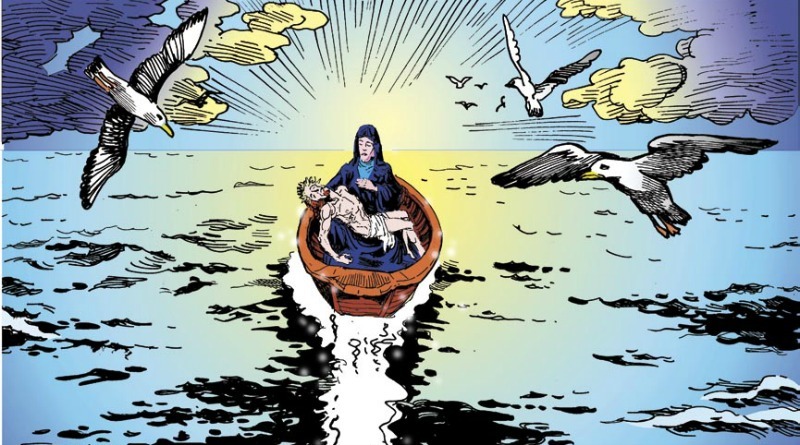
Martyrs of Egypt:
A group of Christians martyred together in the persecutions of Galerius Maximian. The only other information was have is three of their names – Apollonius, Marcian and Nicanor.
Died
in Egypt, date unknown.
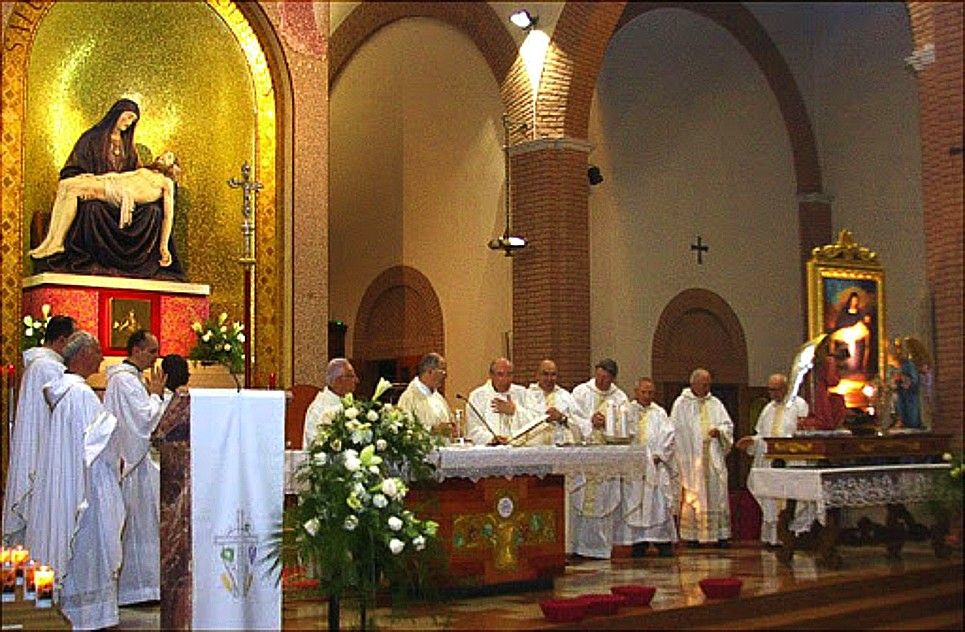
Martyrs of Perugia:
A group of Christians martyred together in the persecutions of Decius. We know little more than their names – Cyriacus, Faustinus, Florentius, Julian and Marcellinus.
Died
beheaded in 250 in Perugia, Italy

Martyrs of Rome:
26 Christians martyred together. We have no details about them but their names – Candida, Castula, Fappa, Felician, Felicitas (2 of), Felicula, Fortunatus, Gagus, Gregor, Hilarius, Ingenuus, Juliana, Martialis, Maurus, Mustilus, Nicander, Prima, Rogata, Rutianus, Sacrinus, Saturnin, Secundian, Secundus, Urbicus, Victurus.
Died
• Rome, Italy, date unknown
• relics transferred to Antwerp, Belgium, date unknown.

Posted in franciscan OFM, INCORRUPTIBLES, MARIAN TITLES, SAINT of the DAY

Virgen María Sembradora / Virgin Mary the Planter, Hurlingham, Buenos Aires, Argentina and Memorials of the Saints – 4 June

Virgen María Sembradora / Virgin Mary the Planter, Hurlingham, Buenos Aires, Argentina – 4 June :

She is a great sower in the world of the best Seed, that of her Son.
She was chosen to be the door of that great Seed that has changed the colour and flavour of all things and peoples of this world, Jesus Christ, the Son of God.
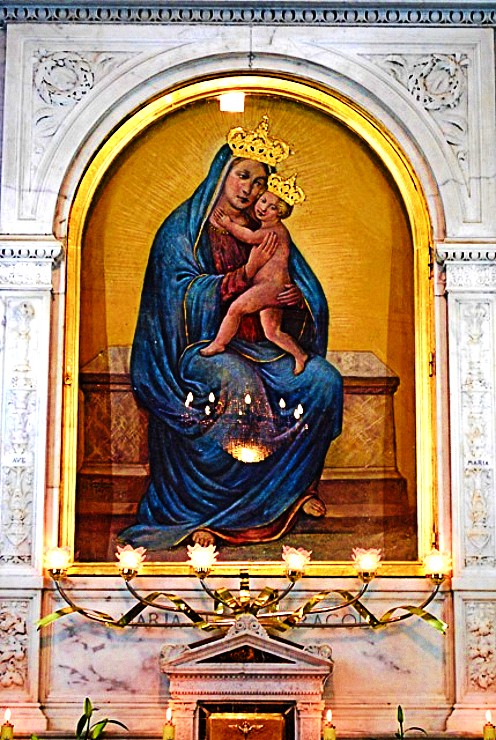
A planter of the Gospel as a woman in her home, in that family of Nazareth where Jesus grew in wisdom and truth.
She sowed silence around her Son, a silence of listening, of following, of accepting God’s will.
But she also sowed commitment to the need of Elizabeth her relative and at that wedding in Cana.
She again put seeds of the Kingdom at the foot of the Cross, welcoming that disconsolate disciple, becoming a Mother to him and to us all.
Her seeds of unity, affection and advice in the midst of the community bore fruit … Today she continues to plant all this in our hearts to love her Son Jesus and God our Father who chose her as His Masterpiece.

The image of Virgen Maria Sembradora / Virgin Mary the Planter is housed in the Parish “San Carlos Borromeo” in Hurlingham, Buenos Aires, Argentina. The Virgin carries in her right hand the Seed of the Word, planting it in the hearts of the faithful.

A Novena is begun on 25 May and on 4 June every year, the Statue is carried out in procession.
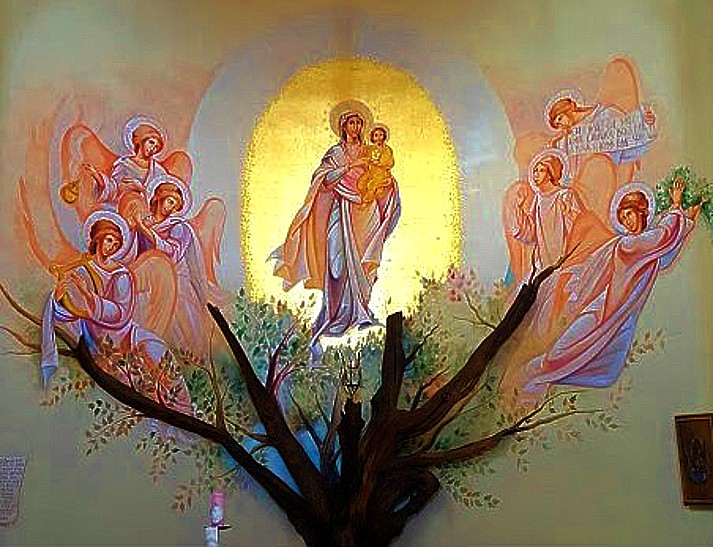
St Aldegrin of Baume
St Alexander of Verona
St Alonio
Bl Antoni Zawistowski
St Aretius of Rome
Bl Boniface of Villers
St Breaca of Cornwall
St Buriana of Cornwall
St Christa of Sicily
St Clateus of Brescia
St Cornelius McConchailleach
St Croidan
St Cyrinus of Aquileia
St Dacian of Rome
St Degan
St Edfrith of Lindisfarne
St Elsiar of Lavedan
St Ernin of Cluain

St Filippo Smaldone (1848-1923) Priest and Founder of the Salesian Sisters of the Sacred Hearts, Preacher, Catechist, Apostle of Eucharistic Adoration and Our Lady, Apostle of Charity and especially of orphans, the blind and the deaf.
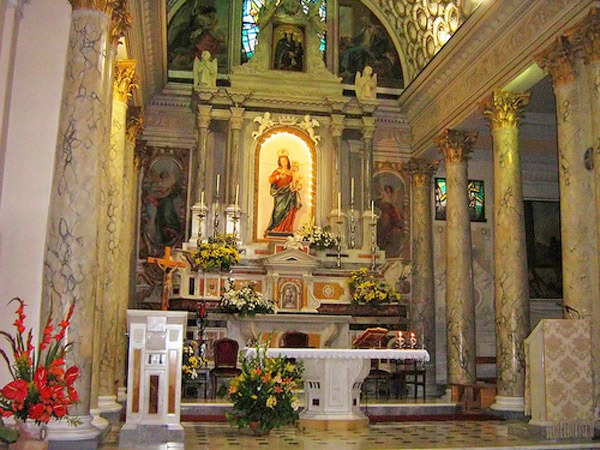
Biography:

https://anastpaul.com/2018/06/04/saint-of-the-day-4-june-st-filippo-smaldone-1848-1923/

Bl Francesco Pianzola

St Francis Caracciolo CRM (1563-1608) Priest, Co-Founder of the Congregation of the Clerics Regular Minor with Venerable John Augustine (1551-1587) the “Adorno Fathers,” Confessor, Apostle of the Eucharistic Adoration.
His body was given enough preparation for a long journey to Naples. Truly, God has left His own sign on him. When the body was lanced, the blood spouted a red and scented fluid and his vital organs were uncorrupted. Around his heart were printed the words of the Psalm: “The zeal of your house consumes me” (Ps 69:10).
Wow!:

https://anastpaul.com/2020/06/04/saint-of-the-day-4-june-saint-francis-caracciolo-crm-1563-1608/

Bl Francis Ronci
Bl Margaret of Vau-le-Duc
St Medan
Bl Menda Isategui
St Metrophanes of Byzantium
St Nennoc
St Nicolo of Sardinia
St Optatus of Milevis
Blessed Pacificus of Cerano OFM (c 1424-1482) Priest of the Order of the Friars Minor of St Francis
St Petroc of Cornwall
St Quirinus of Croatia
St Quirinus of Tivoli
St Rutilus of Sabaria
Saturnina of Arras
Bl Stanislaw Kostka Starowieyski
St Trano of Sardinia
St St Walter of Fontenelle
Walter of Serviliano

Martyrs of Cilicia – 13 saints: A group of 13 Christians who were martyred together. The only details about them that have survived are their names –
• Cama• Christa• Crescentia• Eiagonus• Expergentus• Fortunus• Italius
• Jucundian• Julia• Momna• Philip• Rustulus• Saturnin
They were martyred in in Cilicia, Asia Minor (in modern Turkey), date unknown

Martyrs of Nyon – 41 saints: A group of 41 Christians martyred together for refusing to sacrifice to imperial Roman idols. We know the names of some but no other details.
• Amatus• Attalus• Camasus• Cirinus• Dinocus• Ebustus• Euticus• Eutychius
• Fortunius• Galdunus• Julia• Quirinus• Rusticus• Saturnina• Saturninus
• Silvius• Uinnita• Zoticus
Martyred by being beheaded in Noviodunum (modern Nyon, Switzerland).