Posted in FATHERS of the Church, PAPAL SERMONS, SAINT of the DAY, VATICAN Resources

Saint of the Day – 25 June – St Maximus of Turin (? – c 420) Father of the Church

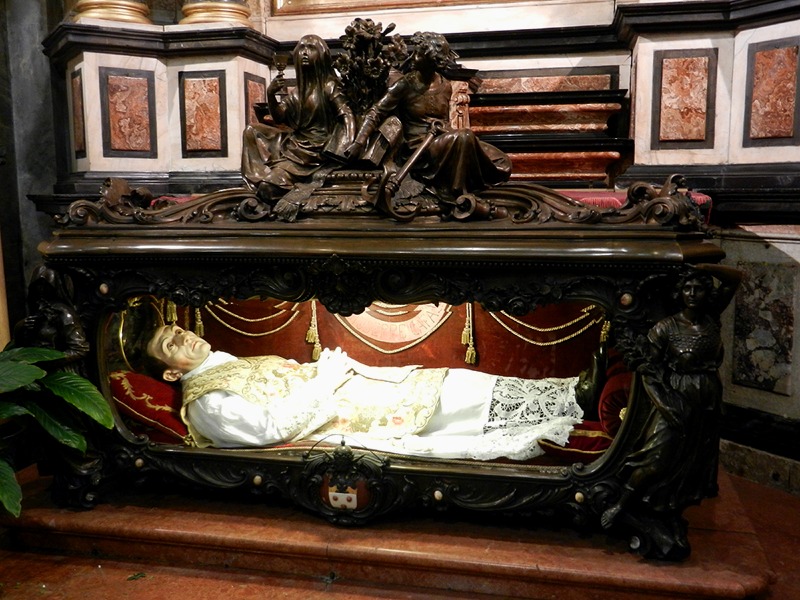
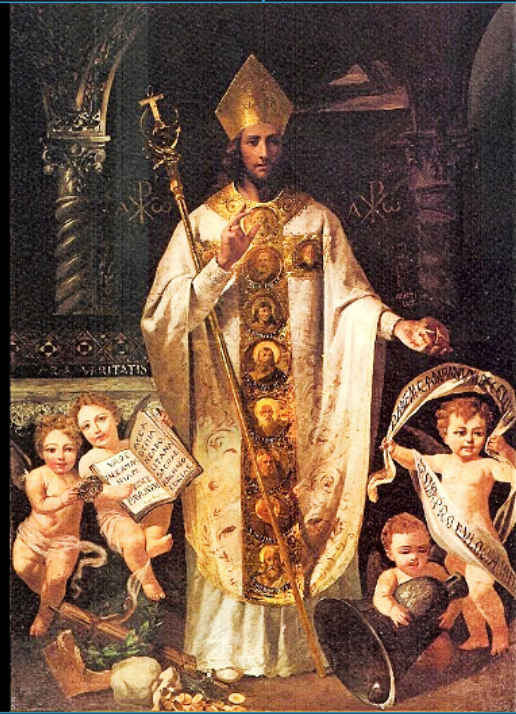
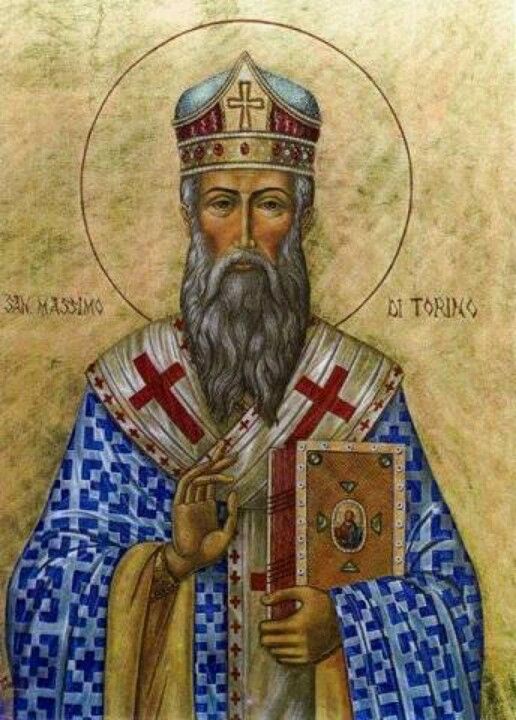
Saint of the Day – 25 June – St Maximus of Turin (? – c 420) Father of the Church, Bishop, Writer, Theologian  –  known as Massimo – date of birth unknown – his date of death is also not certain.   St Maximus is believed to have been a native of Rhaetia (modern day Northern Italy).  Patron of Turin, Italy.   St Maximus attended the synod of Milan where northern Italian bishops accepted the letter of Pope Leo I which set forth the orthodox doctrine of the Incarnation.   He also attended the the Synod of Rome in 465.   He was a prolific and inspirational Theological writer with 118 homilies, 116 sermons and 6 treatises surviving.
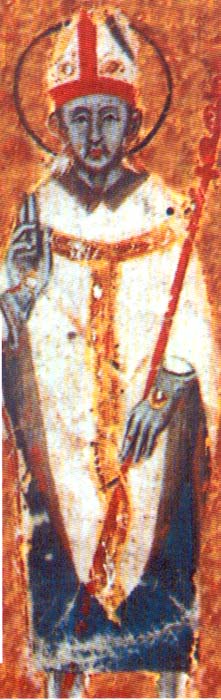
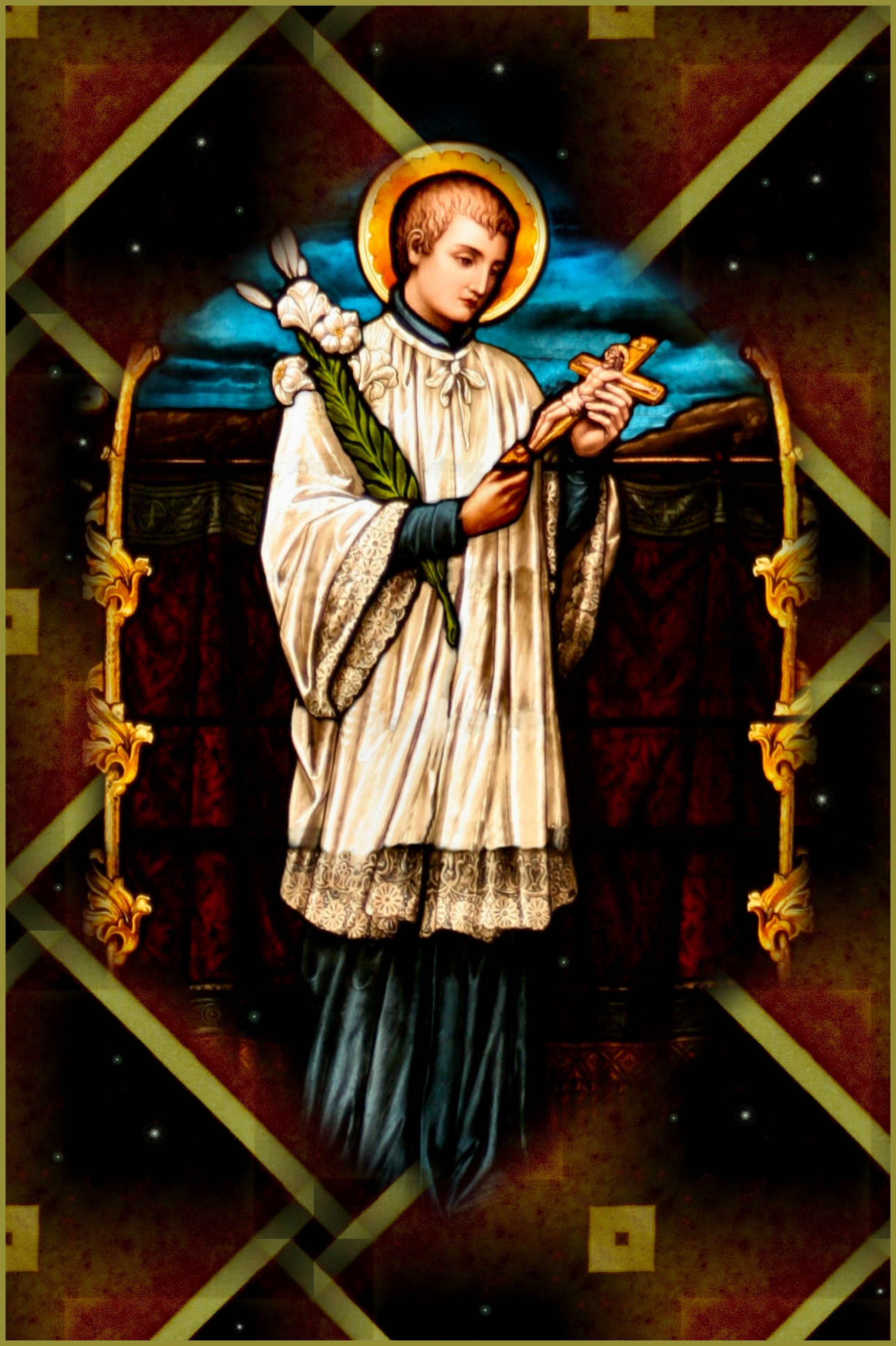
ST maximus of turin

“Between the end of the fourth century and the beginning of the fifth, another Father of the Church after St Ambrose made a great contribution to the spread and consolidation of Christianity in Northern Italy – St Maximus, whom we come across in 398 as Bishop of Turin, a year after St Ambrose’s death.   Very little is known about him, in compensation, we have inherited a collection of about 116 of his Sermons.   It is possible to perceive in them the Bishop’s profound and vital bond with his city, which attests to an evident point of contact between the episcopal ministry of Ambrose and that of Maximus.

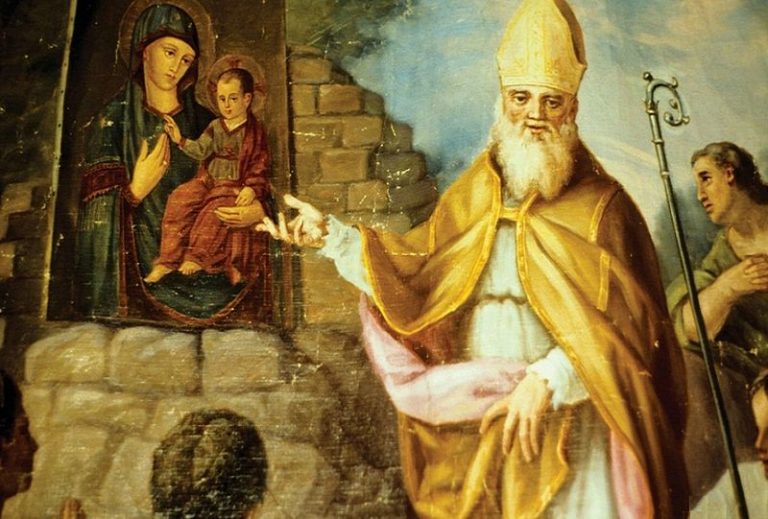
At that time serious tensions were disturbing orderly civil coexistence.   In this context, as pastor and teacher, Maximus succeeded in obtaining the Christian people’s support. The city was threatened by various groups of barbarians.   They entered by the Eastern passes, which went as far as the Western Alps.   Turin was therefore permanently garrisoned by troops and at critical moments became a refuge for the populations fleeing from the countryside and urban centres where there was no protection.   Maximus’ interventions in the face of this situation testify to his commitment to respond to the civil degradation and disintegration.   Although it is still difficult to determine the social composition of those for whom the Sermons were intended, it would seem that Maximus’ preaching – to avoid the risk of vagueness – was specifically addressed to a chosen nucleus of the Christian community of Turin, consisting of rich landowners who had property in the Turinese countryside and a house in the city.   This was a clear-sighted pastoral decision by the Bishop, who saw this type of preaching as the most effective way to preserve and strengthen his own ties with the people.St. Maximus presents to the people of Turin the Icon of the Madonna Consolata.
To illustrate this view of Maximus’ ministry in his city, I would like to point out for example Sermons 17 and 18, dedicated to an ever timely topic:  wealth and poverty in Christian communities.   In this context too, the city was fraught with serious tensions. Riches were accumulated and hidden.   “No one thinks about the needs of others”, the Bishop remarked bitterly in his 17th Sermon.   “In fact, not only do many Christians not share their own possessions but they also rob others of theirs.   Not only, I say, do they not bring the money they collect to the feet of the apostles but in addition, they drag from priests’ feet, their own brethren who are seeking help”.   And he concluded:  “In our cities there are many guests or pilgrims.   Do what you have promised”, adhering to faith, “so that what was said to Ananias will not be said to you as well:  “You have not lied to men but to God'” (Sermon 17, 2-3).

In the next Sermon, the 18th, Maximus condemns the recurring forms of exploitation of others’ misfortunes.   “Tell me, Christian”, the Bishop reprimands his faithful, “tell me why you snatched the booty abandoned by the plunderers?   Why did you take home “ill-gotten gains’ as you yourself think, torn apart and contaminated?”.   “But perhaps”, he continues, “you say you have purchased them and thereby believe you are avoiding the accusation of avarice.   However, this is not the way to equate purchasing with selling.   “It is a good thing to make purchases but that means what is sold freely in times of peace, not goods looted during the sack of a city… So act as a Christian and a citizen who purchases in order to repay”  (Sermon 18: 3).   Without being too obvious, Maximus thus managed to preach a profound relationship between a Christian’s and a citizen’s duties.   In his eyes, living a Christian life also meant assuming civil commitments.   Vice-versa, every Christian who, “despite being able to live by his own work, seizes the booty of others with the ferocity of wild beasts”;  who “tricks his neighbour, who tries every day to nibble away at the boundaries of others, to gain possession of their produce, does not compare to a fox biting off the heads of chickens but rather to a wolf savaging pigs.” (Sermon 41, 4).
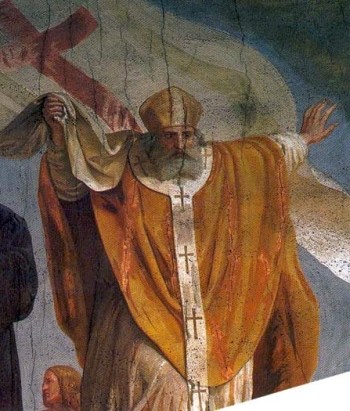
img-Saint-Maximus-of-Turin

In comparison with the cautious, defensive attitude that Ambrose adopted to justify his famous project of redeeming prisoners of war, the historical changes that occurred in the relationship between the Bishop and the municipal institutions are clearly evident. By now sustained through legislation that invited Christians to redeem prisoners, Maximus, with the collapse of the civil authority of the Roman Empire, felt fully authorised in this regard to exercise true control over the city.   This control was to become increasingly extensive and effective until it replaced the irresponsible evasion of the magistrates and civil institutions.   In this context, Maximus not only strove to rekindle in the faithful the traditional love for their hometown but he also proclaimed the precise duty to pay taxes, however burdensome and unpleasant they might appear (cf. Sermon 26, 2).   In short, the tone and substance of the Sermons imply an increased awareness of the Bishop’s political responsibility in the specific historical circumstances. He was “the lookout tower” posted in the city.   Whoever could these watchmen be, Maximus wonders in Sermon 92, “other than the most blessed Bishops set on a lofty rock of wisdom, so to speak, to defend the peoples and to warn them about the evils approaching in the distance?”.   And in Sermon 89 the Bishop of Turin describes his tasks to his faithful, making a unique comparison between the Bishop’s function and the function of bees:  “Like the bee”, he said, Bishops “observe bodily chastity, they offer the food of heavenly life using the sting of the law.   They are pure in sanctifying, gentle in restoring and severe in punishing”.   With these words, St Maximus described the task of the Bishop in his time.st maximus of turin - snip
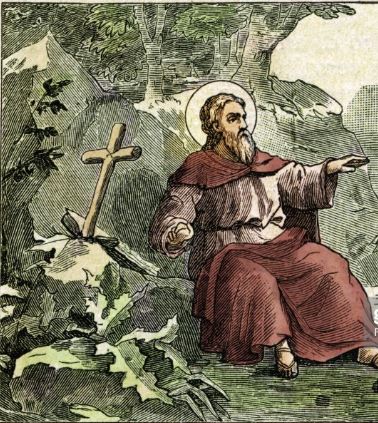
In short, historical and literary analysis show an increasing awareness of the political responsibility of the ecclesiastical authority in a context in which it continued de facto to replace the civil authority.
Indeed, the ministry of the Bishop of Northwest Italy, starting with Eusebius who dwelled in his Vercelli “like a monk” to Maximus of Turin, positioned “like a sentinel” on the highest rock in the city, developed along these lines.   It is obvious that the contemporary historical, cultural and social context is profoundly different.   Today’s context is rather the context outlined by my venerable Predecessor, Pope John Paul II, in the Post-Synodal Apostolic Exhortation Ecclesia in Europa, in which he offers an articulate analysis of the challenges and signs of hope for the Church in Europe today (nn. 6-22).   In any case, on the basis of the changed conditions, the believer’s duties to his city and his homeland still remain effective.   The combination of the commitments of the “honest citizen” with those of the “good Christian” has not in fact disappeared.

In conclusion, to highlight one of the most important aspects of the unity of Christian life, I would like to recall the words of the Pastoral Constitution Gaudium et Spes:  consistency between faith and conduct, between Gospel and culture.   The Council exhorts the faithful “to perform their duties faithfully in the spirit of the Gospel.   It is a mistake to think that because we have here no lasting city, but seek the city which is to come, we are entitled to shirk our earthly responsibilities;  this is to forget that by our faith we are bound all the more to fulfil these responsibilities according to the vocation of each one” (n. 43).   

In following the Magisterium of St Maximus and of many other Fathers, let us make our own, the Council’s desire, that the faithful may be increasingly anxious to “carry out their earthly activity in such a way as to integrate human, domestic, professional, scientific and technical enterprises with religious values, under whose supreme direction all things are ordered to the glory of God” (ibid.) and thus for humanity’s good.”…Pope Benedict XVI, General Audience, Wednesday, 31 October 2007header - st maximus of turin
Posted in SAINT of the DAY

Feast of Our Lady of Grace/Our Lady of the Bowed Head

Our Lady of Grace/Our Lady of the Bowed Head -https://anastpaul.wordpress.com/2017/06/25/25-june-the-feast-of-our-lady-of-grace/

St Adalbert of Egmond
St Amand of Coly
Bl Burchard of Mallersdorf
St Cyneburga of Gloucester
St Domingo Henares de Zafra Cubero
Bl Dorothy of Montau
St Eurosia of Jaca
St Febronia of Nisibis
Bl Fulgentius de Lara
St Gallicanus of Embrun
St Gallicanus of Ostia
St Gohard of Nantes
Bl Guy Maramaldi
Bl Henry Zdick
Bl John the Spaniard
St Luceias and Companions
St Maximus of Turin (? – c 420)
St Moloc of Mortlach
St Molonachus of Lismore
St Phanxicô Ðo Van Chieu
St Prosper of Reggio
St Selyf of Cornwall
St Solomon I
St Solomon III of Bretagne
St William of Vercelli (1085-1142) – https://anastpaul.wordpress.com/2017/06/25/saint-of-the-day-25-june-st-william-of-vercelli/

Posted in BREVIARY Prayers, CATHOLIC-PRAYERS OF THE CHURCH, FATHERS of the Church, MORNING Prayers, SAINT of the DAY, The WORD

Thought for the Day – 24 June – The Solemnity of the Nativity of St John the Baptist, B

Thought for the Day – 24 June – The Solemnity of the Nativity of St John the Baptist, B

John challenges us Christians to the fundamental attitude of Christianity—total dependence on the Father, in Christ.   Except for the Mother of God, no one had a higher function in the unfolding of salvation.   Yet the least in the kingdom, Jesus said, is greater than he, for the pure gift that the Father gives.   The attractiveness as well as the austerity of John, his fierce courage in denouncing evil—all stem from his fundamental and total placing of his life within the will of God.

The Benedictus, below, is prayed every morning in the Breviary and so, the Church remembers this “forerunner of Jesus” at the beginning of every day.   The opening words of this Canticle are the source of its Latin title, “Blessed be the Lord, the God of Israel”.

What does it mean for Catholics, that we sing this song about John the Baptists at the start of every new day?   After having been “silenced” by sleep throughout the night, God opens our mouths and one of the first things we do, is to sing this blessing of God, whose dawn breaks forth to shine on us and guide our way to peace.

In the Benedictus, we join ourselves to the mission of St John the Baptist, who came to prepare a way for the Lord by being a witness of God’s salvation, living a simple and penitential life and calling others to do the same.   Our work each day, then, is to use our voice – like Zechariah and his son – and the witness of our lives, to make God’s presence known wherever we go and to whom whomever we encounter.

Ant. The mouth of Zechariah was opened and he spoke this prophecy:  Blessed be the Lord, the God of Israel.

The Benedictus – Canticle of Zechariah
Luke 1:68-79
The Messiah and His forerunner

Blessed be the Lord, the God of Israel;
He has visited His people and redeemed them.

He has raised up for us a mighty saviour,
in the house of David, His servant,
as He promised by the lips of holy men,
those who were His prophets of old.

A Saviour who would free us from our foes,
from the hands of all who us.
So His love for our fathers is fulfilled
and His holy covenant remembered.

He swore to our father Abraham, our father, to grant us,
that free from fear and saved from the hands of our foes.
we might worship Him in justice and holiness
all the days of our lives, in His Presence.

As for you, little child,
you shall be called the prophet of God, the Most High.
You shall go ahead of the Lord
to prepare His ways before Him,

to make known to His people their salvation,
through forgiveness of all their sins,
the loving kindness of the heart of our God,
who visits us like the dawn from on high.

He will give light to those in darkness,
those who dwell in the shadow of death,
and to guide us into the way of peace.

Glory to the Father, and to the Son,
and to the Holy Spirit:
as it was in the beginning, is now,
and will be for ever. Amen

Ant. The mouth of Zechariah was opened and he spoke this prophecy:  Blessed be the Lord, the God of Israel.the benedictus - the birth of john the baptist - 24 june 2018 - from my lit of the hours

Posted in DOCTORS of the Church, MORNING Prayers, QUOTES of the SAINTS, QUOTES on SANCTITY, QUOTES on the CROSS of CHRIST, QUOTES on the DEVIL/EVIL, QUOTES on TRUST and complete CONFIDENCE in GOD, SUNDAY REFLECTIONS

Sunday Reflection – 24 June – Help to Holiness by St Alphonsus Liquori

Sunday Reflection – 24 June – Help to Holiness by St Alphonsus Liquori  (1696-1787)         Most Zealous Doctor

St Alphonsus helps us, with:
Help To Holiness – Desire And Resolution
Holiness means loving God.

To love God, we must first desire to love Him.
If we do not want something, we will, certainly go to little trouble to obtain it!
So it is with the love of God.
He that has a small wish to advance in divine love will become lukewarm and, continuing this tepidity,
will soon fall totally away from God.
On the other hand whoever aspires after holines, and makes daily efforts to advance, will, little by little, attain it.
Saint Teresa assures us:
God leaves no deisre without its reward.
But let us not trust to our own efforts, to advance in holiness but hope for all, from and through God.
He will give us strength which, of course, we do not possess.
I can do all things in him who strengthen me.
Philippians 4:13
Many desire holiness but never take the means to gain it!
They want to do great penance and practice great prayer,
but such desires are mere fancies.
Saint Teresa often said:
The devil has no dread of irresolute souls.

RESOLUTIONS

Let us then fix our minds in the ways of God.
Let us resolve to meditate each day on the passion of our Lord Jesus Christ.
Let us resign ourselves in peace to God’s plan for us.
Let us endeavour, in the time remaining to us, to give all to God.
Jesus has given Himself to us,
may God help us to give ourselves to Him.help to holiness - desire and resolution - 24 june 2018

Posted in FEASTS and SOLEMNITIES, MORNING Prayers, PAPAL SERMONS, QUOTES of the SAINTS, SAINT of the DAY

Quote/s of the Day – 24 June – The Solemnity of the Nativity of St John the Baptist, B

Quote/s of the Day – 24 June – The Solemnity of the Nativity of St John the Baptist, B

“The true secret of love consists in this:
we must forget self
like St John the Baptist
and exalt and glorify the Lord Jesus.”

St Peter Julian Eymard (1811-1868)the true secret of love is this - st peter julian eymard - 24 june 2018

“His name is John” (Lk 1:63)
…which in Hebrew means “God is benevolent”.
God is benevolent to human beings,
He wants them to live; He wants them to be saved.
God is benevolent to His people,
He wants to make of them a blessing, for all the nations of the earth.
God is benevolent to humanity,
He guides its pilgrim way, towards the land,
where peace and justice reign.
All this is contained in that name:
John!”his name is john - st john paul - 24 june 2018

“Look today to John the Baptist,
an enduring model of fidelity to God and His Law.
John prepared the way for Christ,
by the testimony of his word and his life.
Imitate him with docile and trusting generosity.”

St Pope John Paul (1920-2005)

(24 June 2001)look today to john - st john paul - 24 june 2018

Posted in FEASTS and SOLEMNITIES, MORNING Prayers, QUOTES of the SAINTS, SAINT of the DAY, The WORD

One Minute Reflection – 24 June – The Solemnity of the Nativity of St John the Baptist, B

One Minute Reflection – 24 June – The Solemnity of the Nativity of St John the Baptist, B

“He was a burning and shining lamp”…John 5:35

REFLECTION – “Our Lord says that John is a lamp:  “He was a burning and shining lamp” (Jn 5:35).   But the light of a lamp pales, when the sun shines, it’s flame dies down, overcome by an even more radiant light.   What sensible person uses a lamp in full sunlight?…  Who would still come for John’s baptism of repentance (Mk 1:4) when Jesus’ baptism brings salvation?… St Maximus of Turin (?-c 420) Bishop – Sermon 99 ; PL 57, 535john 5 - 35 - he was a burning and shining lamp - but the light of a lamp pales - st maximus of turin - 24 june 2018

PRAYER – Almighty God and Father, You sent St John the Baptist, to the people of Israel to make them ready for Christ the Lord.   Give us the grace of joy in the Spirit and guide the hearts of all the faithful, in the way of salvation and peace, as they harken to the voice of John, the Lord’s herald and bring them safely to Jesus, whom John foretold.   St John the Baptist, may your intercession for the Church, bring us to the Light and the Way.   We make our prayer through our Lord Jesus Christ, in the unity of the Holy Spirit, one God with You, forever amen.st john the baptist - pray for us - 24 june 2018

Posted in DOCTORS of the Church, FATHERS of the Church, MORNING Prayers, PRAYERS of the SAINTS, The HOLY EUCHARIST / The HOLY MASS

Our Morning Offering – 24 June – The Solemnity of the Nativity of St John the Baptist

Our Morning Offering – 24 June – The Solemnity of the Nativity of St John the Baptist

Prayer Before Holy Communion
By St John Chrysostom (347-407) Father & Doctor of the Church

O Lord, my God,
I am not worthy,
that You should come into my soul
but I am glad that You will come to me,
because in Your loving kindness,
You desire to dwell in me.
You ask me to open the door of my soul,
which You alone have created,
so that You may enter into it,
with Your loving kindness
and dispel the darkness of my mind.
I believe that You will do this
for You did not turn away Mary Magdalene
when she approached You in tears.
Neither did You withhold forgiveness
from the tax collector,
who repented of his sins,
or from the good thief,
who asked to be received into Your kingdom.
Indeed, You numbered as Your friends
all who came to You with repentant hearts.
O God, You alone are blessed always,
now and forever.
Amenprayer before holy communion by st john chrysostom - 24 june 2018 - solemnity of the birth of john baptist

Posted in Against EPIDEMICS, FEASTS and SOLEMNITIES, MORNING Prayers, PATRONAGE - WRITERS, PRINTERS, PUBLISHERS, EDITORS, etc

The Solemnity of the Nativity of St John the Baptist – 24 June

The Solemnity of the Nativity of St John the Baptist – 24 June.  Patronages – Baptism; bird dealers; converts; against convulsions; convulsive children; cutters; epilepsy; epileptics; farriers; hail; hailstorms; Knights Hospitaller; Knights of Malta; lambs;  lovers; monastic life; motorways; printers, spasms; tailors; Genoa, Italy; Quebec; Sassano, Italy; Diocese of Savannah, Georgia; Diocese of Charleston, South Carolina; Diocese of Dodge City, Kansas; Diocese of Paterson, New Jersey; Diocese of Portland, Maine.

young John the Baptist

“Today, 24 June, we are celebrating the Solemnity of St John the Baptist.   He is the only saint — with the exception of the Virgin Mary — whose birth the liturgy celebrates and it does so because it is closely connected with the mystery of the Incarnation of the Son of God.   In fact, from the time when he was in his mother’s womb, John was the precursor of Jesus:  the Angel announced to Mary his miraculous conception as a sign that “nothing is impossible to God” (Lk 1:37), six months before the great miracle that brings us salvation, God’s union with man, brought about by the Holy Spirit.birth_of_st_john_the_baptist

The four Gospels place great emphasis on the figure of John the Baptist, the prophet who concludes the Old Testament and inaugurates the New, by identifying Jesus of Nazareth as the Messiah, the Anointed One of the Lord.  In fact, Jesus Himself was to speak of John in these terms:  “This is he of whom it is written ‘Behold I send my messenger before your face, / who shall prepare your way before you.   Truly I say to you, among those born of women there has risen no one greater than John the Baptist;  yet he who is least in the kingdom of heaven is greater than he!” (Mt 11:10-11).

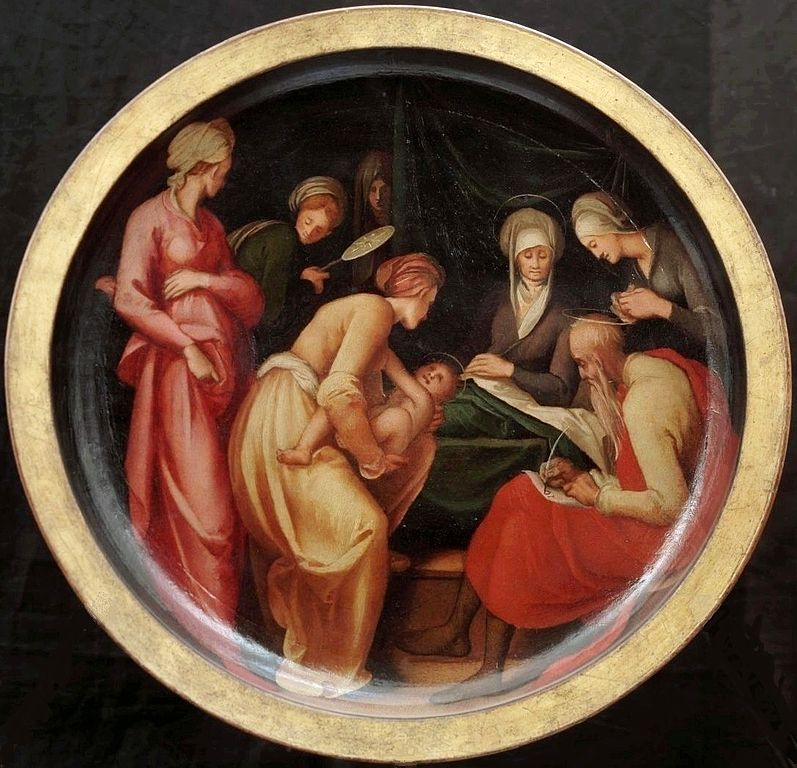
John’s father, Zechariah — Elizabeth’s husband and a relative of Mary — was a priest of Old Testament worship, he did not immediately believe in the announcement of such an unexpected fatherhood.   This is why he was left mute until the day of the circumcision of the child to whom he and his wife gave the name God had indicated to them, that is, John, which means “graced by God”.   Inspired by the Holy Spirit, Zechariah spoke thus of his son’s mission:  “And you, child, will be called the prophet of the Most High; for you will go before the Lord to prepare his ways, to give knowledge of salvation to his people in the forgiveness of their sins” (Lk 1:76-77).Pontormo,_natività_del_battista_01

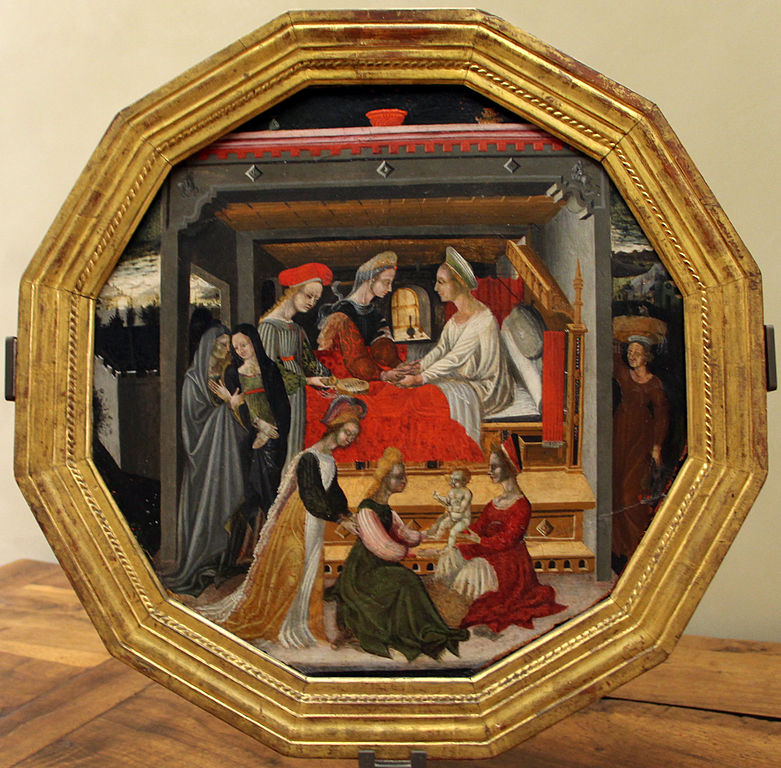
All this came to pass 30 years later when John began baptising people in the River Jordan, calling them to prepare themselves with this act of penance for the imminent coming of the Messiah, which God had revealed to them during their wanderings in the desert of Judaea.   This is why he was called the “Baptist”, the “Baptiser” (cf. Mt 3:1-6). When one day Jesus himself came from Nazareth to be baptised, John at first refused but then consented;  he saw the Holy Spirit settle on Jesus and heard the voice of the heavenly Father proclaiming him His Son (cf. Mt 3:13-17).   However, the Baptist’s mission was not yet complete.   Shortly afterwards he was also asked to precede Jesus in a violent death:   John was beheaded in King Herod’s prison and thus bore a full witness to the Lamb of God who had recognised him and publicly pointed him out beforehand.Domenico_di_bartolo,_desco_da_nozze_con_nascita_del_battista,_1420-40_ca._(siena)_01

Dear friends, the Virgin Mary helped her elderly kinswoman Elizabeth when she was expecting John to bring her pregnancy to completion.   May she help all people to follow Jesus, the Christ, the Son of God, whom the Baptist proclaimed with deep humility and prophetic fervour.”….Pope Benedict XVI, Angelus Address, 24 June 2012

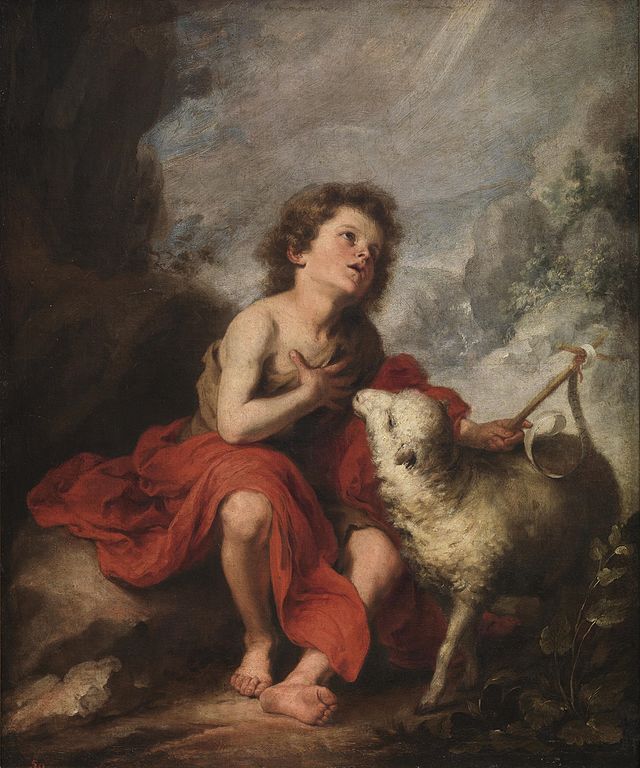
Here is a great sermon from St Augustine on the reason for this Solemnity:  https://anastpaul.wordpress.com/2017/06/24/solemnity-of-the-nativity-of-saint-john-the-baptist-24-june/Bartolomé_Esteban_Perez_Murillo_-_St_John_the_Baptist_as_a_Boy_-_WGA16373

Posted in FEASTS and SOLEMNITIES, SAINT of the DAY

Solemnity of the Nativity of St John the Baptist and Memorials of the Saints – 24 June

The Nativity of Saint John the Baptist (Solemnity) (2018)

St Aglibert of Créteil
St Agoard of Créteil
St Alena of Brussels
St Amphibalus of Verulam
St Anastasia Guadalupe García Zavala
St Bartholomew of Farne
Bl Christopher de Albarran
St Erembert I of Kremsmünster
St Faustus of Rome and Companions
St Festus of Rome
St Germoc
St Gohardus of Nantes
Bl Henry of Auxerre/the Hagiographer
St Ivan of Bohemia
St John of Rome
St John of Tuy
St Joseph Yuan Zaide
Bl Maksymilian Binkiewicz
St Rumold
St Simplicio of Autun
Bl Theodgar of Vestervig
St Theodulphus of Lobbes

Martyrs of Satala: Seven Christian brothers who were soldiers in the imperial Roman army. They were kicked out of the military, exiled and eventually martyred in the persecutions of Maximian. We know little more about them than their names – Cyriacus, Firminus, Firmus, Longinus, Pharnacius, Heros and Orentius. The martyrdoms occurred in c311 at assorted locations around the Black Sea.

Posted in EUCHARISTIC Adoration, MORNING Prayers, SAINT of the DAY

Thought for the Day – 23 June – The Memorial of St Joseph Cafasso (1811-1860)

Thought for the Day – 23 June – The Memorial of St Joseph Cafasso (1811-1860)

Fr Cafasso was truly a man of God, a holy priest.   All his words and acts breathed forth the delicious odour of celestial virtue.   Some saw in him a resemblance to St Philip Neri on account of his humility, others to St Alphonsus Liguori for his learning, others to St Vincent de Paul for his devotion to the poor and those in prison, others to St Aloysius Gonzaga for the innocence and purity of his life, others to St Francis de Sales for his burning love for God and his gentleness of manner, others to the Cure of Ars for the austerity of his life and his work in the Confessional.

Devotion to the Eucharist gave energy to all Joseph’s other activities.   Long prayer before the Blessed Sacrament has been characteristic of many Catholics who have lived out the Gospel well.   His great devotions were:  to the Passion, to the Sacred Heart, to the Mass, to the Stations of the Cross, to the Blessed Sacrament, to our Blessed Lady, to St Joseph, to many of the Saints, to the Souls in Purgatory in whose favour he recommended the his works and sufferings.

But the most telling element of his life, the one we should learn most from, was his compassion.   St Joseph realised that harshness with the weak, only does harm – for what straw can stand up in a gale?   It was his consummate compassion that was noted by everyone and he could face the most hardened criminals with his easy laugh and gentle manner.   He knew, that it is LOVE alone that conquers!

St Joseph Cafasso, pray for us!st joseph cafasso pray for us - 23 june 2018

Posted in MORNING Prayers, QUOTES of the SAINTS, QUOTES on LOVE, SAINT of the DAY

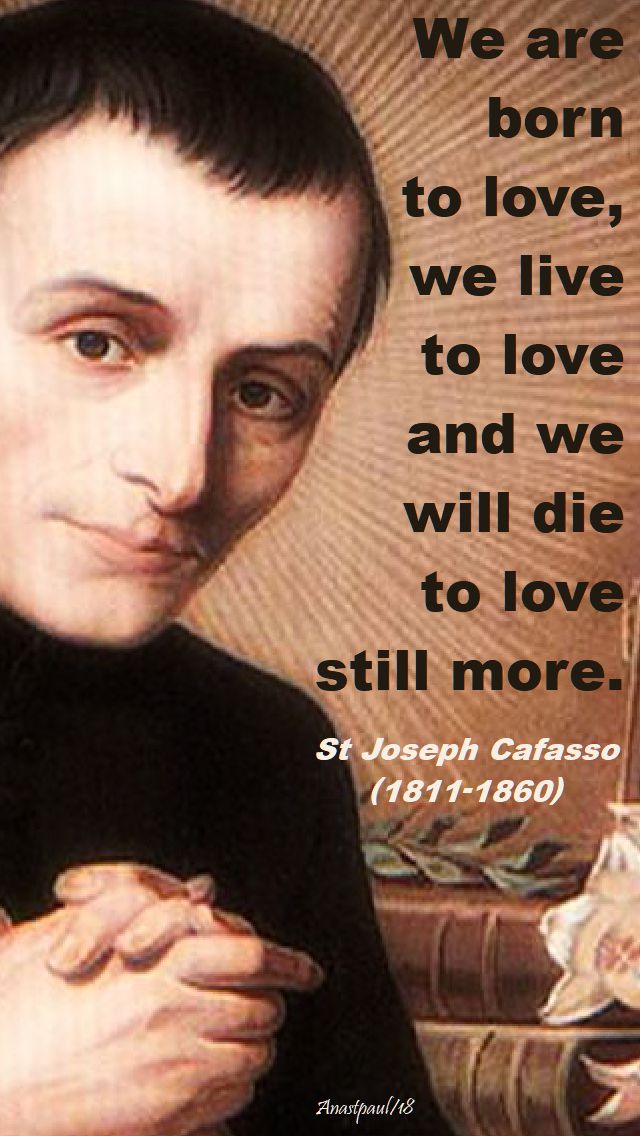
Quote of the Day – 23 June – The Memorial of St Joseph Cafasso (1811-1860)

Quote of the Day – 23 June – The Memorial of St Joseph Cafasso (1811-1860)

“We are born to love,
we live to love
and we will die
to love still more.”

St Joseph Cafassowe are norn to love - st joseph cafasso - 23 june 2018

Posted in MORNING Prayers, ON the SAINTS, PAPAL SERMONS, PRAYERS for PRIESTS, QUOTES on the PRIESTHOOD, The WORD, VATICAN Resources

One Minute Reflection – – 23 June – The Memorial of St Joseph Cafasso (1811-1860)

One Minute Reflection – – 23 June – The Memorial of St Joseph Cafasso (1811-1860)

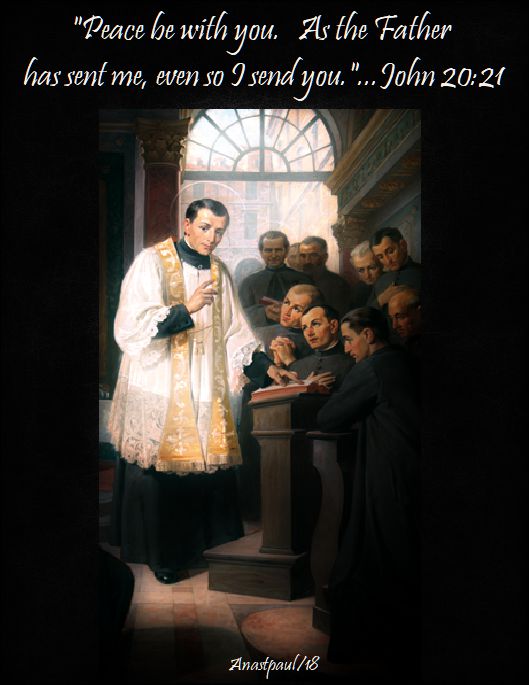
“Peace be with you.   As the Father has sent me, even so I send you.”…John 20:21as the father has sent me - john 20-21 - st joseph cafasso - 23 june 2018

REFLECTION – “Not without a special and beneficial disposition of Divine Goodness have we witnessed new stars rising on the horizon of the Catholic Church: the parish priest of Ars and the Venerable Servant of God, Joseph Cafasso.   These two beautiful, beloved, providently timely figures must be presented today; one, the parish priest of Ars, as small and humble, poor and simple as he was glorious and the other, a beautiful, great, complex and rich figure of a priest, the educator and formation teacher of priests, Venerable Joseph Cafasso”….Pope Pius XI

PRAYER – Holy God, may St Joseph Cafasso’s example serve as a reminder to all to hasten towards the perfection of Christian life, towards holiness.   In particular, may St Joseph Cafasso, remind priests of the importance of devoting time to the sacrament of Reconciliation and to spiritual direction and to all, the concern we should have for the most deprived.   May we find help in his intercession and that of the Blessed Virgin Mary, to whom St Joseph Cafasso was very devoted and whom he called “Our beloved Mother, our consolation, our hope”.   St Joseph Cafasso, St John Vianney, please pray for all our priests!   We make our prayer through our Lord Jesus Christ, with You, in the union of the Holy Spirit, one God forever, amen.sts joseph cafasso and john vianney - pray for us and all priests - 23 june 2018

Posted in DOCTORS of the Church, JESUIT SJ, MORNING Prayers, PRAYERS of the SAINTS, The HOLY EUCHARIST / The HOLY MASS

Our Morning Offering – 23 June

Our Morning Offering – 23 June

Wash Me With Your Precious Blood
By St Peter Canisius, S.J. (1521-1597)  Doctor of the Church

See, O merciful God, what return
I, Your thankless servant, have made
for the innumerable favors
and the wonderful love You have shown me!
What wrongs I have done, what good left undone!
Wash away, I beg You, these faults and stains
with Your precious blood, most kind Redeemer,
and make up for my poverty by applying our merits.
Give me the protection I need to amend my life.
I give and surrender myself wholly to You,
and offer You all I possess,
with the prayer that You bestow Your grace on me,
so that I may be able to devote and employ
all the thinking power of my mind
and the strength of my body in Your holy service,
who are God blessed for ever and ever.
Amen

see o merciful god - prayer of st peter canisius - 16 dec 2017
Posted in PAPAL SERMONS, SAINT of the DAY, VATICAN Resources

Saint of the Day – 23 June – St Joseph Cafasso (1811-1860) “Priest of the Gallows”

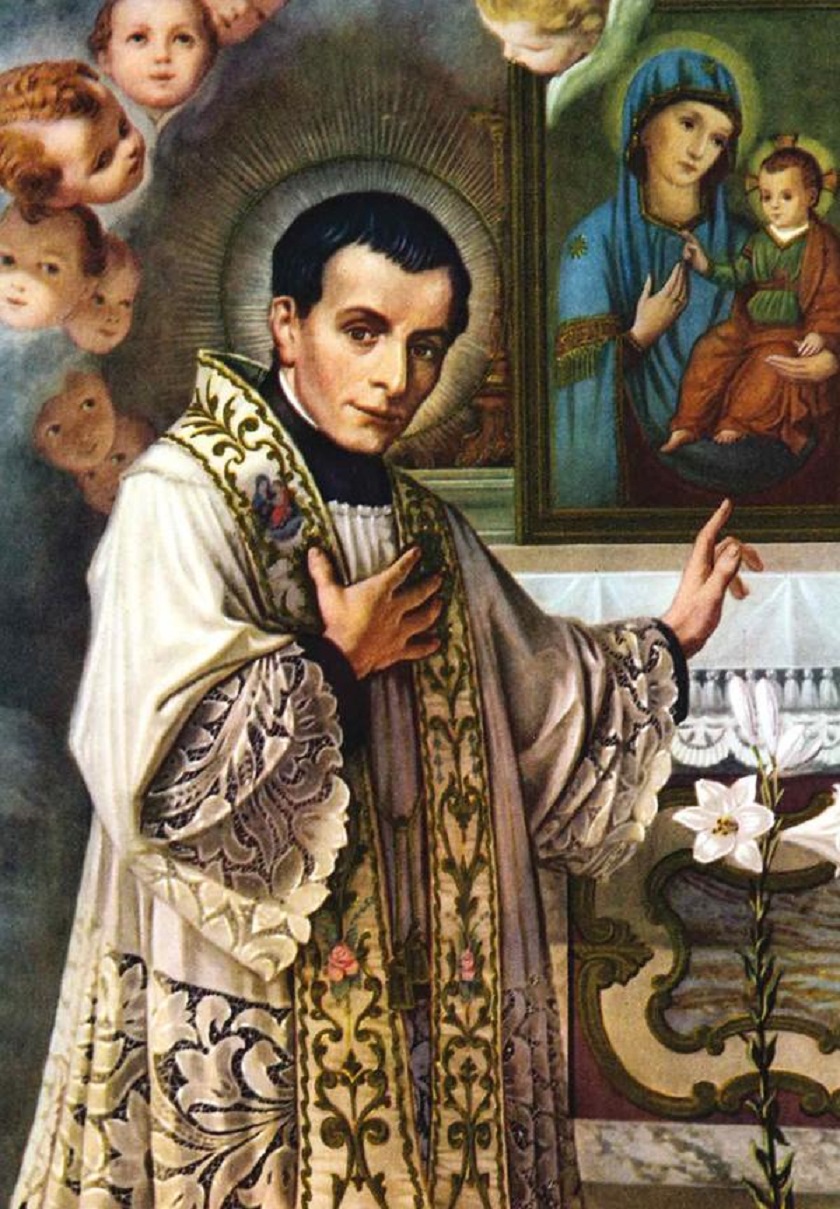
Saint of the Day – 23 June – St Joseph Cafasso (1811-1860) “Priest of the Gallows”, Priest, Theology Lecturer, Social Reformer, Confessor, Spiritual Director (of St John Bosco and quite a few other saints), Rector of a post-Ordination Theological College, member of the Third Order of St Francis – born Giuseppe Cafasso on 15 January 1811 at Castelnuovo d’Asti, Italy and died on 23 June 1860 at Turin, Italy of pneumonia, a stomach hemorrhage and complications of his congenital medical problems (he had been born with a deformed spine which contributed to his short stature and frail constitution).   His will bequeathed everything to aid the Little House of Divine Providence which was the religious order founded by St Joseph Benedict Cottolengo (1786-1842).    St John Bosco (1815-1888) preached the funeral Mass homily.  Patronages – Italian prisons, Prison chaplains, Prisoners, those condemned to death.0627giuseppe-cafasso-header no 2

Joseph Cafasso was born in Castelnuovo d’Asti, the same village in which St John Bosco was born, on 15 January 1811.   He was the third of four children.   The last, his sister Marianna, was to be the mother of Bl Joseph Allamano, Founder of the Consolata Missionary Fathers and the Consolata Missionary Sisters.   He was born in 19th-century Piedmont, marked by serious social problems but also by many Saints who strove to find remedies for them.   These Saints were bound to each other by total love of Christ and by their profound charity for the poorest people.   The grace of the Lord can spread and multiply the seeds of holiness!   

Cafasso completed his secondary school studies and the two years of philosophy at the College of Chieri and, in 1839, went on to the theological seminary where he was ordained a priest in 1833.   Four months later he entered what for him was to be the fundamental and only “stage” in his priestly life:  the “Convitto Ecclesiastico di S. Francesco d’Assisi” in Turin.   Having entered it to perfect himself in pastoral ministry, it was here that he brought to fruition his gifts as a spiritual director and his great spirit of charity.   The “Convitto” was in fact not only a school of moral theology where young priests, who came mainly from the countryside, learned how to become confessors and how to preach but was also a true and proper school of priestly life, where priests were formed in the spirituality of St Ignatius of Loyola and in the moral and pastoral theology of the great holy Bishop St Alphonsus Mary de’ Liguori.   The type of priest that Cafasso met at the “Convitto” and that he himself helped to strengthen especially as Recto, was that of the true pastor with a rich inner life and profound zeal in pastoral care, faithful to prayer, committed to preaching and to catechesis, dedicated to the celebration of the Eucharist and to the ministry of Confession, after the model embodied by St Charles Borromeo and St Francis de Sales and promoted by the Council of Trent.   A felicitous saying of St John Bosco sums up the meaning of educational work in that community:  “at the “Convitto’ men learn to be priests”.lg - st joseph cafasso

St Joseph Cafasso sought to bring this model into being in the formation of the young priests so that, in turn, they might become the formation teachers of other priests, religious and lay people, forming a special and effective chain.   From his chair of moral theology he taught them to be good confessors and spiritual directors, concerned for the true spiritual good of people, motivated equally by a desire to make God’s mercy felt and, by an acute and lively sense of sin.   Cafasso the teacher had three main virtues, as St John Bosco recalled:  calmness, wisdom and prudence.   For him the test of the lessons taught was the ministry of Confession, to which he himself devoted many hours of the day.   Bishops, priests, religious, eminent laymen and women and simple people sought him.   He was able to give them all the time they needed.   He was also a wise spiritual counsellor to many who became Saints and founders of religious institutes.   His teaching was never abstract, nor based exclusively on the books that were used in that period. Rather, it was born from the living experience of God’s mercy and the profound knowledge of the human soul that he acquired in the long hours he spent in the confessional and in spiritual direction:  his was a real school of priestly life.

His secret was simple:  to be a man of God; to do in small daily actions “what can result in the greater glory of God and the advantage of souls”.   He loved the Lord without reserve, he was enlivened by a firmly-rooted faith, supported by profound and prolonged prayer and exercised in sincere charity to all.   He was versed in moral theology but was likewise familiar with the situation and hearts of people, of whose good he took charge as the good pastor that he was.   Those who had the grace to be close to him were transformed into as many good pastors and sound confessors.   He would point out clearly to all priests the holiness to achieve in their own pastoral ministry.   Bl. Fr Clement Marchisio, Founder of the Daughters of St Joseph, declared:  “You entered the “Convitto’ as a very mischievous, thoughtless youth, with no idea of what it meant to be a priest;  and you came out entirely different, fully aware of the dignity of the priest”.   How many priests were trained by him at the “Convitto” and then accompanied by him spiritually!   Among them as I have said emerges St John Bosco who had him as his spiritual director for a good 25 years, from 1835 to 1860:  first as a seminarian, then as a priest and lastly as a Founder.   In all the fundamental decisions of his life St John Bosco had St Joseph Cafasso to advise him but in a very specific way – Cafasso never sought to form Don Bosco as a disciple “in his own image and likeness”and Don Bosco did not copy Cafasso –  he imitated Cafasso’s human and priestly virtues, certainly and described him as “a model of priestly life” but according to his own personal disposition and his own specific vocation;   a sign of the wisdom of the spiritual teacher and of the intelligence of the disciple,the former did not impose himself on the latter but respected his personality and helped him to interpret God’s will for him.

Dear friends, this is a valuable lesson for all who are involved in the formation and education of the young generations and also a strong reminder of how important it is to have a spiritual guide in one’s life, who helps one to understand what God expects of each of us.   Our Saint declared with simplicity and depth:   “All a person’s holiness, perfection and profit lies in doing God’s will perfectly…. Happy are we if we succeed in pouring out our heart into God’s, in uniting our desires and our will to His to the point, that one heart and one will are formed, wanting what God wants, wanting in the way, in the time and in the circumstances that He desires and willing it all for no other reason, than that God wills it”.st joseph cafasso - lovely

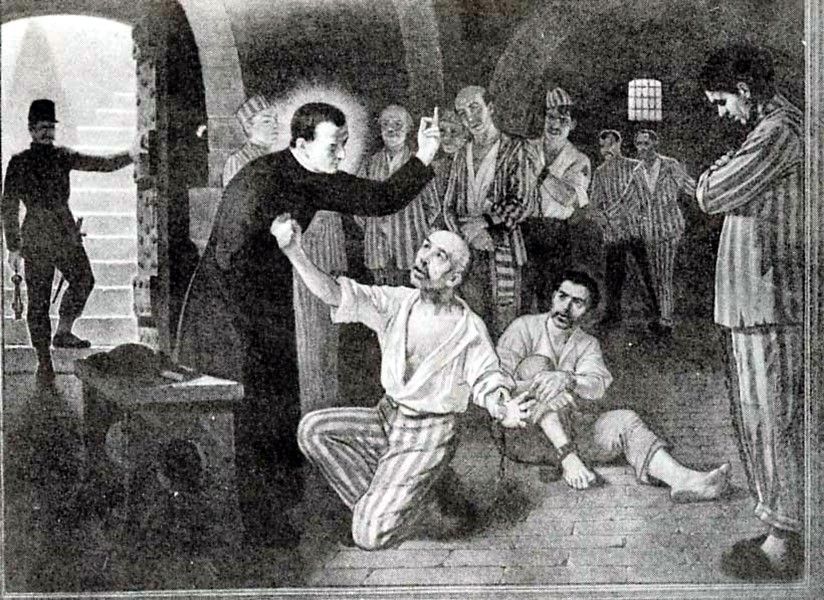
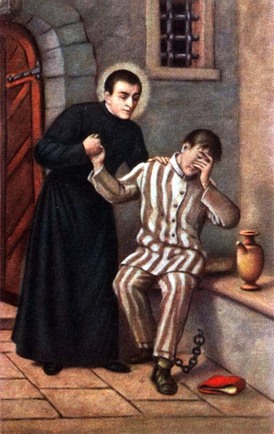
However, another element characterises the ministry of our Saint:  attention to the least and in particular to prisoners who in 19th-century Turin lived in inhumane and dehumanising conditions.   In this sensitive service too, which he carried out for more than 20 years, he was always a good, understanding and compassionate pastor, qualities perceived by the prisoners who ended up by being won over by his sincere love, whose origin lay in God himself.

Cafasso’s simple presence did good: it reassured, it moved hearts hardened by the events of life and above all it enlightened and jolted indifferent consciences.   In his early prison ministry he often had recourse to great sermons that managed to involve almost the entire population of the prison.   As time passed, he gave priority to plain catechesis in conversation and in personal meetings.   Respectful of each individual’s affairs, he addressed the important topics of Christian life, speaking of trust in God, of adherence to His will, of the usefulness of prayer and of the sacraments whose goal is Confession, the encounter with God who makes Himself infinite mercy for us.

Those condemned to death were the object of very special human and spiritual care.   He accompanied to the scaffold 57 of the men sentenced to death, having heard their confession and having administered the Eucharist to them.   He accompanied them with deep love until the last breath of their earthly existence.joseph with prisonersSt Joseph Cafasso-thumb-275x434-6841

Joseph Cafasso died on 23 June 1860, after a life offered entirely to the Lord and spent for his neighbour.   My Predecessor, the Venerable Servant of God Pope Pius XII, proclaimed him Patron of Italian prisons on 9 April 1948 and, with his Apostolic Exhortation Menti Nostrae, on 23 September 1950 held him up as a model to priests engaged in Confession and in spiritual direction.”…Pope Benedict XVI, General Audience,  30 June 2010

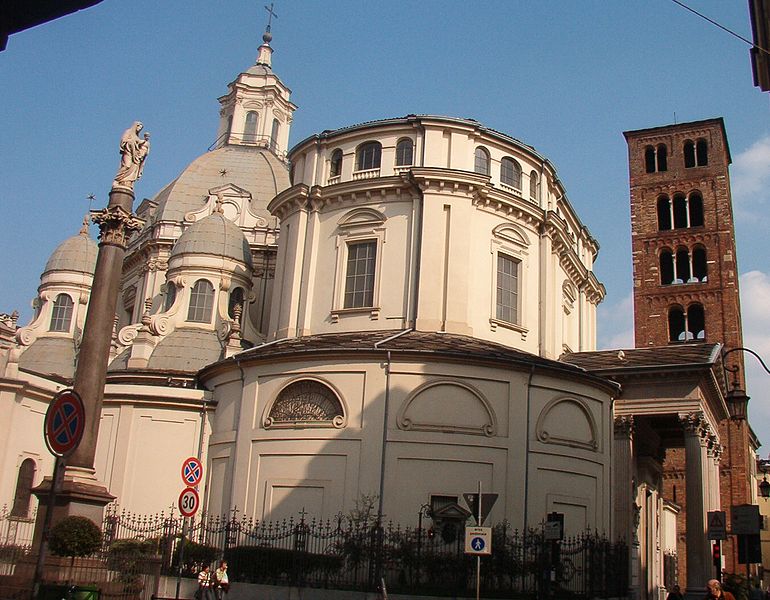
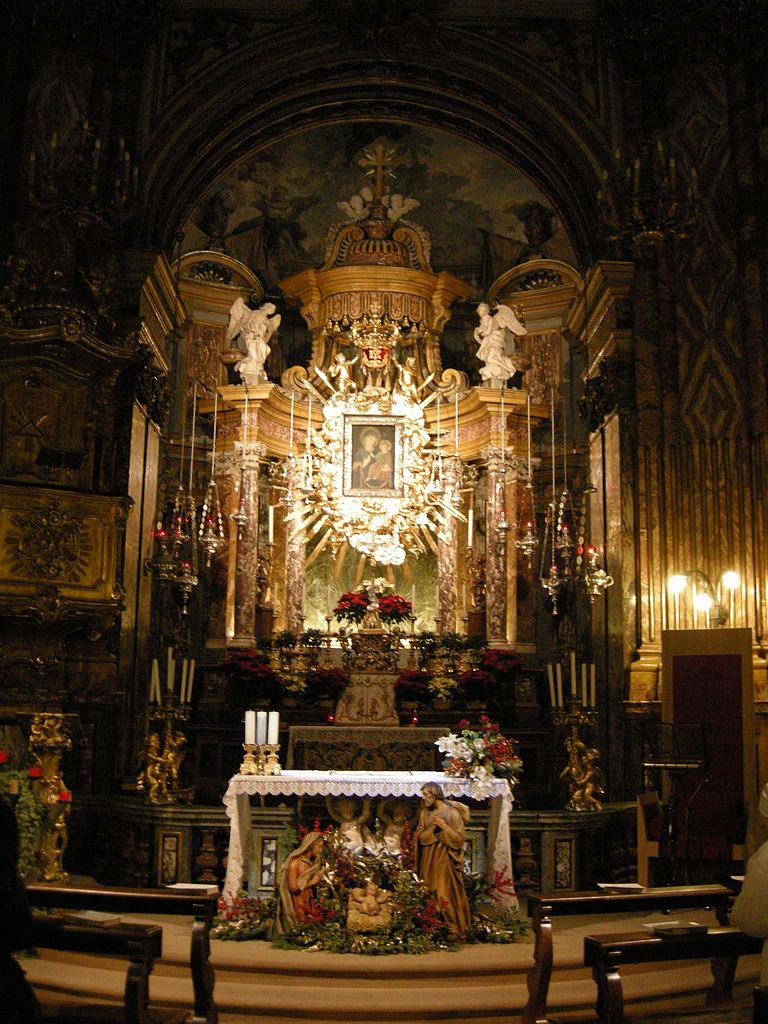
St Joseph was Beatified on 3 May 1925 by Pope Pius XI and Canonised 22 June 1947, by Pope Pius XII.   His Major shrine is Santuario della Consolata, Turin, Italy.3186TorinoConsolatainside770px-Santuario_della_Consolata_Torino768px-Consolata_di_torino,_interno,_25


Posted in SAINT of the DAY

Memorials of the Saints – 23 June

St Agrippina of Rome
St Bilio of Vannes
St Etheldreda of Ely
Bl Félix of Cîteaux
St Felix of Sutri
Bl Frances Martel
Bl Francis O’Sullivan
St Hidulphus of Hainault
St James of Toul
St John of Rome
St Joseph Cafasso (1811-1860)

Bl Lanfranco Beccari
St Lietbert
Bl Lupo de Paredes
Bl Mary of Oignies
St Moeliai of Nendrum
Bl Peter of Juilly
Bl Thomas Corsini of Orvieto
St Thomas Garnet
Bl Walhere of Dinant
St Zenas of Philadelphia
St Zeno of Philadelphia

Martyrs of Ancyra: A family of converts who were arrested, tortured and sent in chains to Ancyra, Galatia (modern Ankara, Turkey) where he was tortured more by order of governor Agrippinus during the persecutions of Diocletian. Martyr. They were – Eustochius, Gaius, Lollia, Probus, Urban. They were roasted over a fire and finally beheaded c 300 in Ancyra, Galatia (modern Ankara, Turkey).

Martyrs of Nicomedia: During the persecutions of Diocletian, many Christians fled their homes to live in caves in the area of Nicomedia. In 303 troops descended on the area, systematically hunted them down and murdered all they could find.

Posted in MORNING Prayers, ON the SAINTS, POETRY, SAINT of the DAY

Thought for the Day – 22 June – The Memorial of St Paulinus of Nola (c 354-431)

Thought for the Day – 22 June – The Memorial of St Paulinus of Nola (c 354-431)

Of him, Pope Benedict XVI said:

“In our catechesis on the great teachers of the early Church, we now turn to Saint Paulinus, the Bishop of Nola in southern Italy.
A native of Bordeaux in Gaul, Paulinus became the Roman governor of Campania, where, after encountering the depth of popular devotion to Saint Felix Martyr, he was led to embrace the Christian faith.   After the tragic loss of their first child, he and his wife sold their goods and undertook a life of chastity and prayer.
Ordained a priest and then Bishop of Nola, Paulinus distinguished himself by his charity to the poor during the troubled times of the barbarian invasions.
A man of letters and a gifted poet, Paulinus placed his art at the service of Christ and the Church. In his poetry and his vast correspondence, Paulinus expressed his deep faith and his love of the poor.   

His letters to such contemporary churchmen as Saints Ambrose, Augustine, Jerome and Martin of Tours, reflect his asceticism, his deep sense of the Church’s communion and his cultivation of the practice of spiritual friendship as a means of experiencing that communion within the mystery of Christ’s mystical Body, enlivened by the Holy Spirit.”

Many of us are tempted to “retire” early in life, after an initial burst of energy.   Devotion to Christ and His work is waiting to be done all around us.   Paulinus’ life had scarcely begun when he thought it was over, as he took his ease on that estate in Spain.   “Man proposes, but God disposes.”

The life of Saint Paulinus is one of great accomplishments and positions—none more important than those which began with his baptism into the faith.   As with all baptism, Paulinus was made anew, filled with the Holy Spirit and through this rebirth, was able to devote himself to the holy work of God, serving others and bringing many to the faith. Today, we pray for a renewal of our own baptismal promise, awake and alive in our faith!

The Word of the Cross

by Saint Paulinus of Nola

Look on thy God, Christ hidden in our flesh.
A bitter word, the cross, and bitter sight:
Hard rind without, to hold the heart of heaven.
Yet sweet it is; for God upon that tree
Did offer up His life: upon that rood
My Life hung, that my life might stand in God.
Christ, what am I to give Thee for my life?
Unless take from Thy hands the cup they hold,
To cleanse me with the precious draught of death.
What shall I do? My body to be burned?
Make myself vile? The debt’s not paid out yet.
Whate’er I do, it is but I and Thou,
And still do I come short, still must Thou pay
My debts, O Christ;  for debts Thyself hadst none.
What love may balance Thine? My Lord was found
In fashion like a slave, that so His slave
Might find himself in fashion like his Lord.
Think you the bargain’s hard, to have exchanged
The transient for the eternal, to have sold
Earth to buy Heaven? More dearly God bought me.

St Paulinus of Nola, Pray for us!st paulinus of nola pray for us - 22 june 2018

Posted in MORNING Prayers, ON the SAINTS, QUOTES of the SAINTS, QUOTES on DIVINE PROVIDENCE, QUOTES on FAITH, QUOTES on the CHURCH, QUOTES on TRUTH, SAINT of the DAY

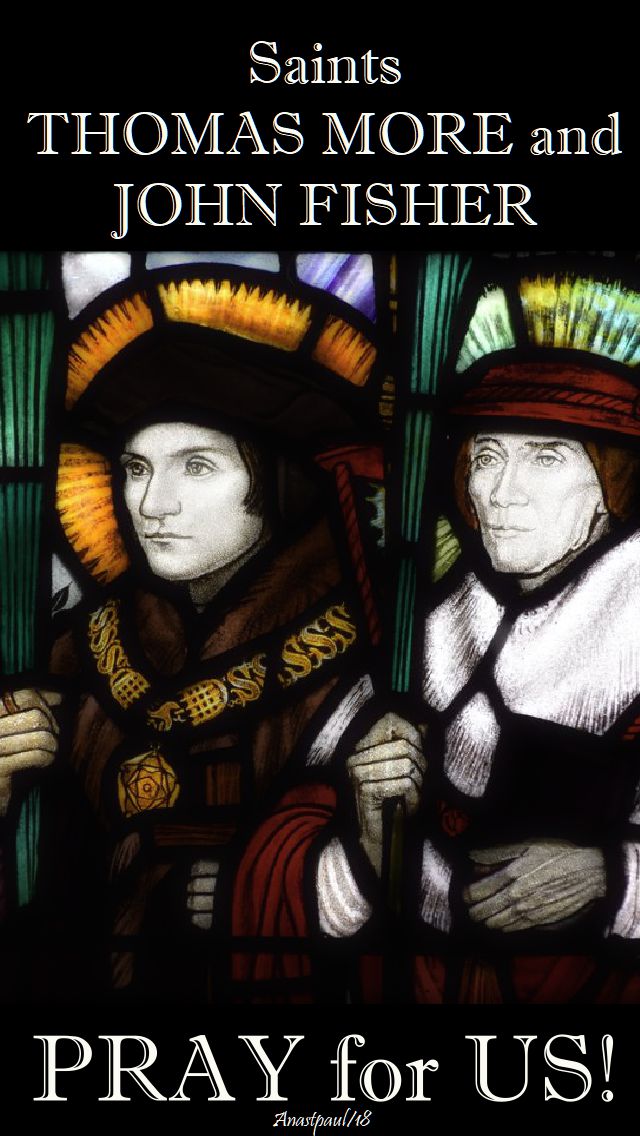
Quote/s of the Day – 22 June – The Memorial of St Paulinus of Nola (c 354-431) and St John Fisher (1469-1535) and St Thomas More (1478-1535) Martyrs

Quote/s of the Day – 22 June – The Memorial of St Paulinus of Nola (c 354-431) and St John Fisher (1469-1535) and St Thomas More (1478-1535) Martyrs

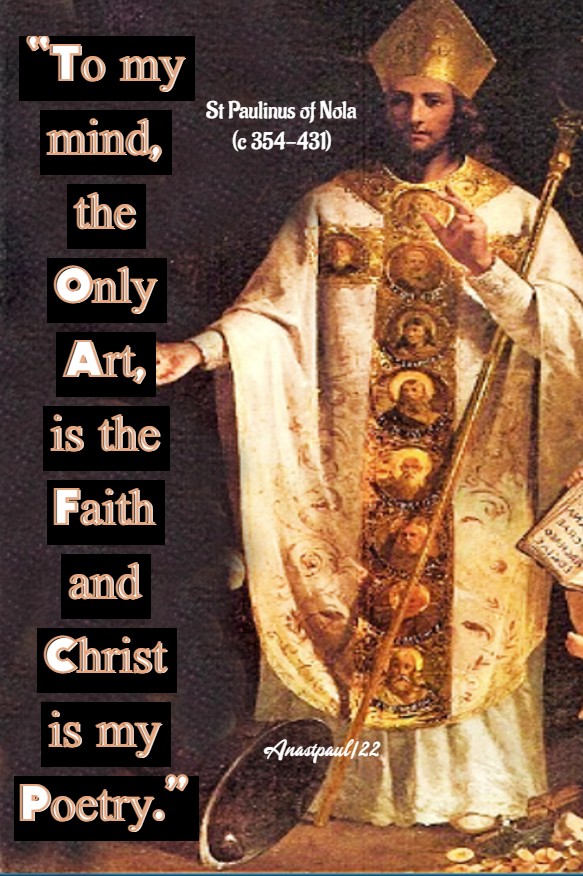
“To my mind the only art, is the faith
and Christ is my poetry.”

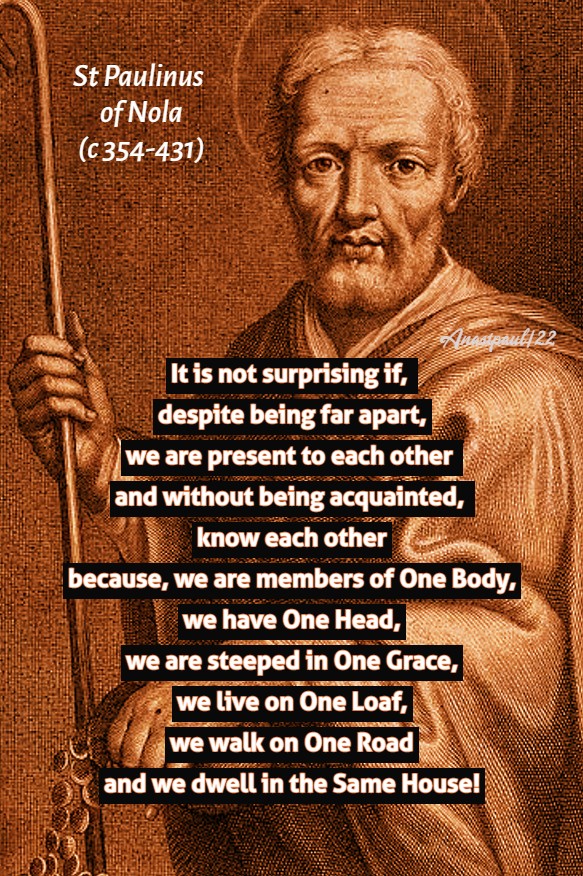
“It is not surprising if, despite being far apart,
we are present to each other and
without being acquainted, know each other
because we are members of One Body,
we have One Head,
we are steeped in One Grace,
we live on One Loaf,
we walk on One Road
and we dwell in the Same House.”

St Paulinus of Nola

St Paulinus of Nola (c 354-431)

“A good man is not a perfect man;
a good man is an honest man,
faithful and unhesitatingly responsive
to the voice of God in his life.”

St John Fishera good man is not a perfect man - st john fisher - 22 june 2018

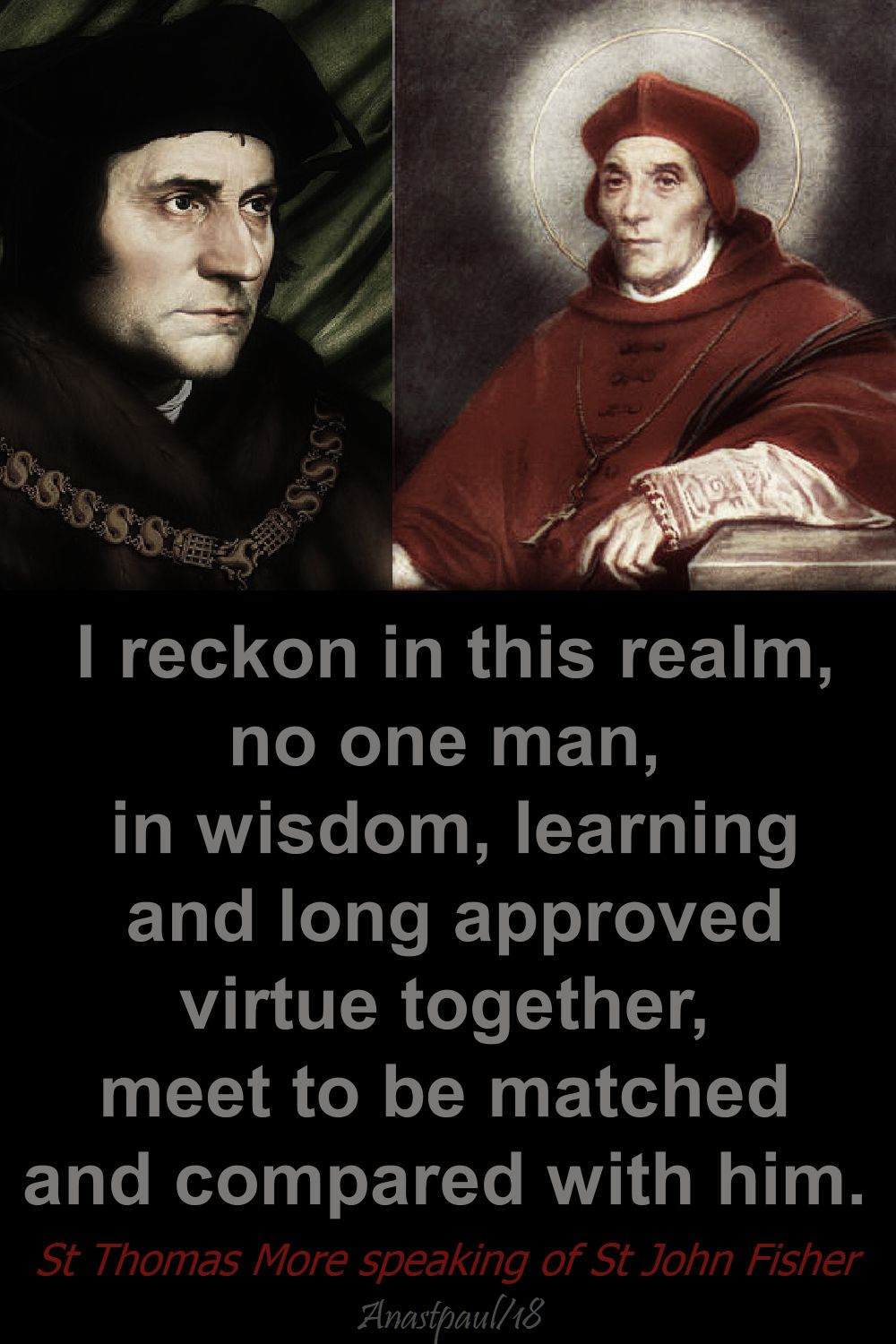
“I reckon in this realm no one man,
in wisdom, learning
and long approved virtue together,
meet to be matched and compared with him.”

St Thomas More speaking of St John Fisheri reckon in this realm - st thomas more speaking of st john fisher - 22 june 2018

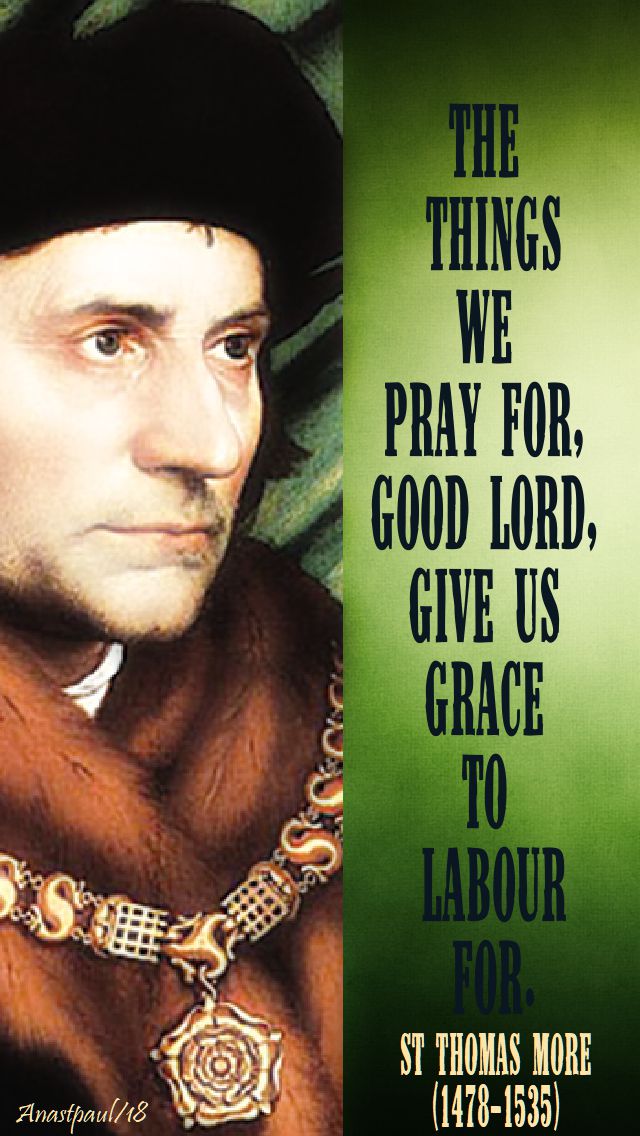
“The things we pray for, good Lord,
give us grace to labour for.”the things we pray for good lord give us grace to labour for - st thomas more - 22 june 2018.jpg

“We cannot go to heaven in featherbeds.”we cannot go to heaven - st thomas more - 22 june 2018

“One of the greatest problems of our time,
is that many are schooled
but few are educated.”one of the greatest problems - st thomas more - 22 june 2018

“If we lived in a state where virtue was profitable,
common sense would make us saintly.
But since we see that avarice, anger,
pride and stupidity commonly profit,
far beyond charity, modesty, justice and thought,
perhaps we must stand fast a little,
even at the risk of being heroes.”if we lived in a state - st thomas more - 22 june 2018

“You wouldn’t abandon ship in a storm,
just because you couldn’t control the winds.”

St Thomas Moreyou wouldn't abandon ship - st thomas more - 22 june 2018

Posted in MORNING Prayers, QUOTES of the SAINTS, QUOTES on DEATH, QUOTES on DIVINE PROVIDENCE, QUOTES on FAITH, QUOTES on FEAR, QUOTES on HOPE, QUOTES on MERCY, QUOTES on PEACE, QUOTES on SUFFERING, QUOTES on TRUST and complete CONFIDENCE in GOD, SAINT of the DAY, The WORD

One Minute Reflection – 22 June – The Memorial of St John Fisher (1469-1535) and St Thomas More (1478-1535) Martyrs

One Minute Reflection – 22 June – The Memorial of St John Fisher (1469-1535) and St Thomas More (1478-1535) Martyrs

More than that, I even consider everything as a loss because of the supreme good of knowing Christ Jesus my Lord.  For his sake I have accepted the loss of all things and I consider them so much refuse, that I may gain Christ and be found in him, not having any righteousness of my own based on the law but that which comes through faith in Christ, the righteousness from God, depending on faith to know him and the power of his resurrection and the sharing of his sufferings by being conformed to his death, if somehow I may attain the resurrection from the dead…Philippians 3:8-11i even consider everything as a loss - phil 3-8 - st paul - 22 june 2018

REFLECTION – “Although I know well, Margaret, that because of my past wickedness, I deserve to be abandoned by God, I cannot but trust in His merciful goodness.   His grace has strengthened me until now and made me content to lose goods, land and life as well, rather than to swear against my conscience.   God’s grace has given the king a gracious frame of mind toward me, so that as yet he has taken from me nothing but my liberty.   In doing this His Majesty has done me such great good, with respect to spiritual profit, that I trust, that among all the great benefits he has heaped so abundantly upon me, I count my imprisonment the very greatest.

I cannot, therefore, mistrust the grace of God. By the merits of His bitter passion joined to mine and far surpassing in merit for me, all that I can suffer myself, His bounteous goodness, shall release me from the pains of purgatory and shall increase my reward in heaven besides.

I will not mistrust Him, Meg, though I shall feel myself weakening and on the verge of being overcome with fear. I shall remember, how Saint Peter at a blast of wind, began to sink because of his lack of faith and I shall do as he did, call upon Christ and pray to Him for help.   And then I trust He shall place His holy hand on me and in the stormy seas, hold me up from drowning.

And finally, Margaret, I know this well, that without my fault He will not let me be lost.   I shall, therefore, with good hope commit myself wholly to Him.   And if He permits me to perish for my faults, then I shall serve as praise for His justice.   But in good faith, Meg, I trust that His tender pity shall keep my poor soul safe and make me commendHhis mercy.

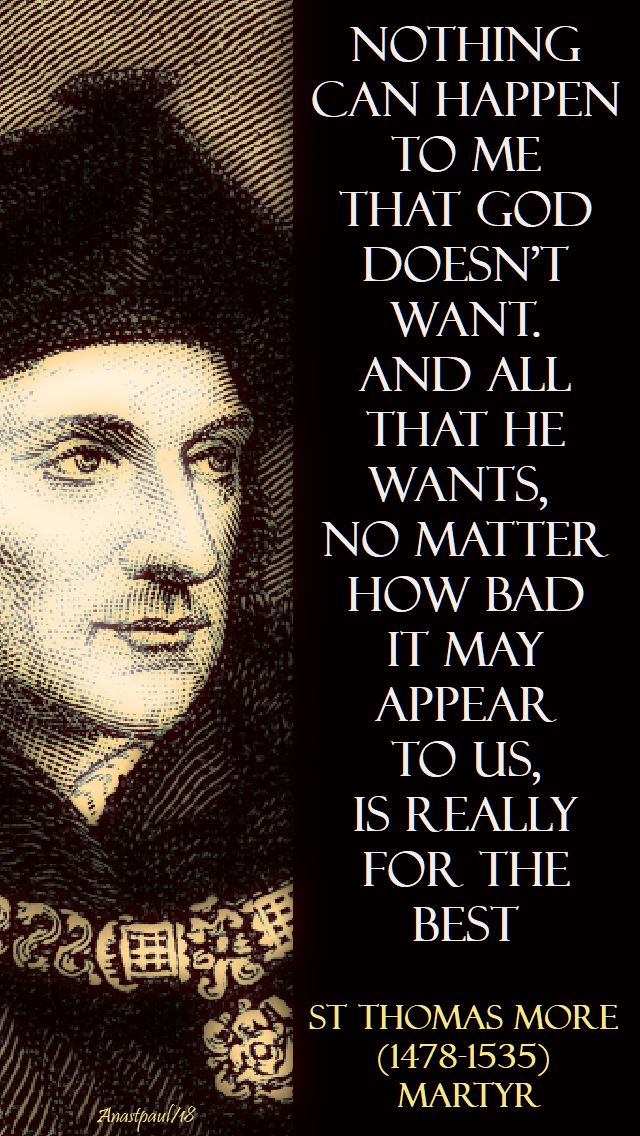
And, therefore, my own good daughter, do not let you mind be troubled over anything that shall happen to me in this world.   Nothing can come but what God wills.   And I am very sure, that whatever that be, however bad it may seem, it shall indeed be the best.” – from a letter written by Saint Thomas More from prison to his daughter Margareti will not distrust him Meg - st thomas more - 11 jan 2018nothing can happen to me - st thomas more - 16 march 2018

PRAYER – Almighty, ever-living God, You set the perfection of true faith in martyrdom. Strengthen us by the prayers of the martyrs, St Thomas More and St John Fisher , so that our lives may bear witness to the faith we profess. Through our Lord Jesus Christ, with You in the unity of the Holy Spirit, one God forever, amen.sts thomas moe and john fisher - pray for us

Posted in MORNING Prayers, PRAYERS of the SAINTS

Our Morning Offering – 22 June – The Memorial of St Thomas More (1478-1535)

Our Morning Offering – 22 June – The Memorial of St Thomas More (1478-1535)

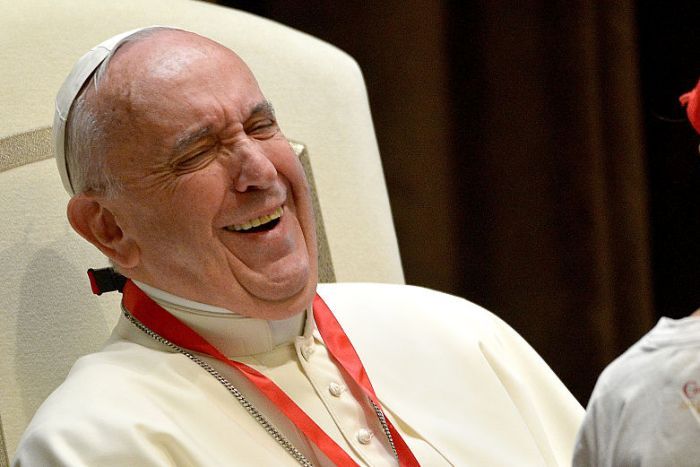
During his address to the Roman Curia on the occasion of the presentation of Christmas greetings, Pope Francis affirmed, “A bit of good humour is very good for us!   It will do us much good to pray St Thomas More’s prayer frequently, I pray it every day and it helps me.”pope francis laughing

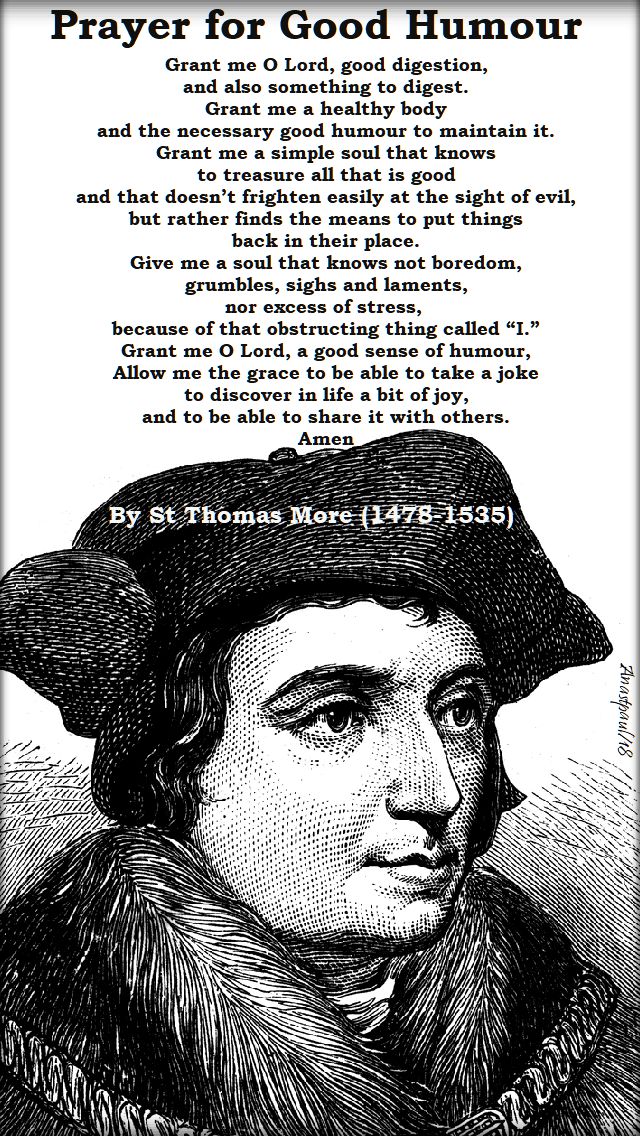
Prayer for Good Humour
By St Thomas More (1478-1535)

Grant me O Lord, good digestion,
and also something to digest.
Grant me a healthy body
and the necessary good humour to maintain it.
Grant me a simple soul that knows
to treasure all that is good
and that doesn’t frighten easily at the sight of evil,
but rather finds the means to put things
back in their place.
Give me a soul that knows not boredom,
grumbles, sighs and laments,
nor excess of stress,
because of that obstructing thing called “I.”
Grant me O Lord, a good sense of humour,
Allow me the grace to be able to take a joke
to discover in life a bit of joy,
and to be able to share it with others.
Amenprayer for good hmour - st thomas more - 22 june 2018

Posted in SAINT of the DAY

Saint of the Day – 22 June – St Paulinus of Nola (c 354-431)

Saint of the Day – 22 June – St Paulinus of Nola (c 354-431) Bishop, Confessor, Poet, Writer, Apostle of Charity, Preacher, Orator, Senator and Governor,  – born Pontius Meropius Anicius Paulinus in c354 at Burdigala, Gaul (modern Bordeaux, France) and died on 22 June 431 of natural causes. 768px-Linzer_Dom_-_Fenster_-_Paulinus_von_NolaSt Paulinus was an inspiration to many—including six great saint of the Church who referenced him in letters of encouragement to others: St Augustine, St Jerome,  Melania, St Martin of Tours, St Gregory and St Ambrose .   St Augustine wrote, “Go to Campania– there study Paulinus, that choice servant of God.   With what generosity, with what still greater humility, he has flung from him the burden of this world’s grandeurs to take on him the yoke of Christ and in His service how serene and unobtrusive his life!”
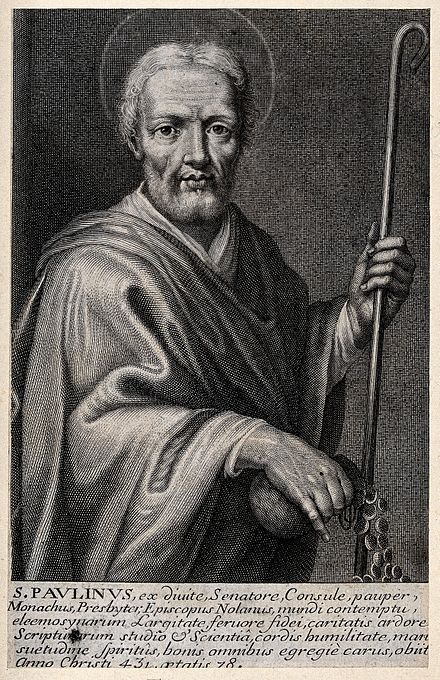
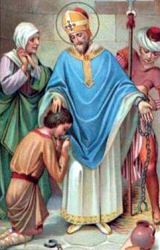
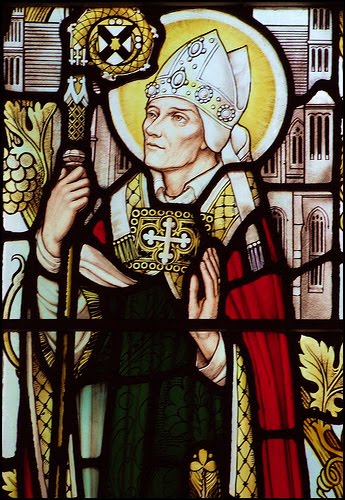
It is believed that St Ambrose would have chosen him to replace him as bishop of Milan, but Paulinus was far from Milan when Ambrose died.   He said of him that “Christians should follow and imitate Paulinus,” and that the greatest good fortune of the century in which they were living was to be “witness to the life of so rare and admirable a man.”  Throughout his life, Saint Paulinus devoted himself to the care and service of the poor, giving away all that he had to improve the lives of others.

Paulinus was born to a Roman family noteworthy for the long line of senators, prefects, consuls and other important governmental figures it produced.   Given the family’s status and station, Paulinus received the finest of educations available at the time.   He was soon recognised for his eloquence in oratory, prose and verse and was admired by many for his hymns, poetry and eloquent speeches.   Paulinus first served as Roman Consul, and then Prefect (or Governor) of Rome and had amassed a large fortune, which he promptly doubled by marring Theresia, a virtuous (yet rich!) Spanish noblewoman.   The couple became one of the wealthiest and most respected couples in Europe, owning property in several nations across the continent. Despite the admiration and respect he earned from many of his contemporaries (now saints), Paulinus was a catechumen and had yet to devote himself to the faith.   Rather, he attempted to maintain his status and riches in the world.   Only through suffering and sorrow was Paulinus more fully drawn into the holy life the Lord had planned for him. Sadly, the first and only child of Paulinus and Theresia died shortly after his birth.   Not long afterward, Paulinus was baptised into the faith, at the age of 38. 

st paulinus of nola 4

Paulinus and Theresia moved to Spain, and began to live lives of solitude and prayer and St Paulinus was ordained.   He and his wife liberated the slaves that worked in the area and then piece by piece, sold off their vast fortunes in real estate and holdings, distributing the earnings throughout the world—so widely and generously that St Jerome wrote “both East and West were filled with his alms.”He and his wife then moved to Nola, near Naples.   He had a great love for Saint Felix of Nola (died in 255),  he credited his conversion to S. Felix and each year would write a poem in honour of the saint and he spent much effort in promoting devotion to St Felix. Paulinus gave away most of his remaining property—to the consternation of his relatives—and continued his work for the poor.   Supporting a host of debtors, the homeless and other needy people, he lived a monastic life in another part of his home.   He had the beautiful Church of Saint Felix constructed, where he devoted himself at all hours of the day in service to others.   Paulinus undertook a life of extreme abstinence and toil, living a celibate life as brother to his wife, exchanging their fine robes for rough clothing and the fine silver furnishings of their home for wood.   Together, they embraced a life of true poverty, embracing the Gospel and giving all they had—sometimes to excess—to those in need.   They also founded a small community of monks in Nola and opened a hospice for the poor and for travellers to the region.At the age of 55, Paulinus was elected Bishop of Nola (by this time his wife had died) a post he served faithfully for 21 years.   He comforted his peoples during the invasion of the Vandals and subsequent enslavement of the community.   It is said that following the ransom of the captives, a poor widow, whose only son had been taken away by the Vandal king came to see Saint Paulinus, recounting her tale.   “What I have I give you,” said the Saint to her. ”We will go to Africa and you will offer me to the prince, saying I am one of your slaves, in exchange for the prisoner.”   This they did, and Paulinus was accepted in place of the widow’s son and employed as gardener.   After a time the king discovered, by divine interposition, that this valuable slave was the renowned Bishop of Nola.   He at once set him free, granting him also the freedom of the remainder of the townsmen of Nola who were enslaved.

Paulinus, having returned to Nola, died in 431.   His holy remains were transferred several times but restored to the cathedral of Nola in 1908.   Although some of his wonderful writings have been lost, thirty-two poems and fifty-one letters remain.   His writings contain one of the earliest examples of a Christian wedding song.

The life of St Paulinus is one of great accomplishments and positions—none more important than those which began with his baptism into the faith.   As with all baptism, Paulinus was made anew, filled with the Holy Spirit and through this rebirth, was able to devote himself to the holy work of God, serving others and bringing many to the faith.

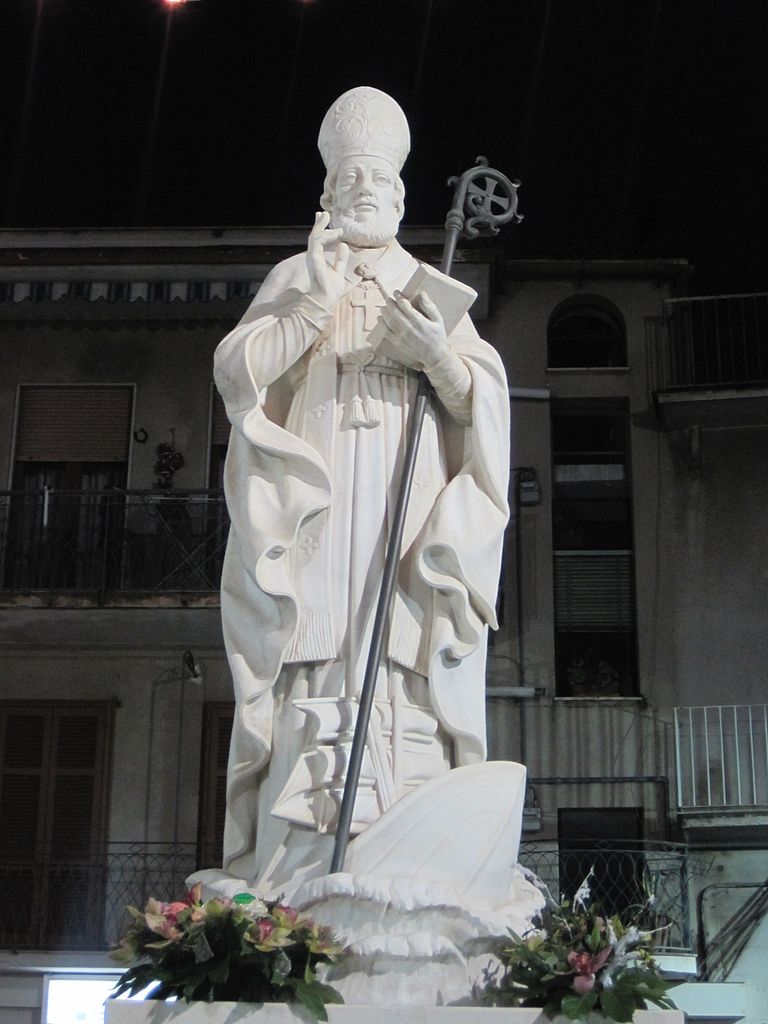
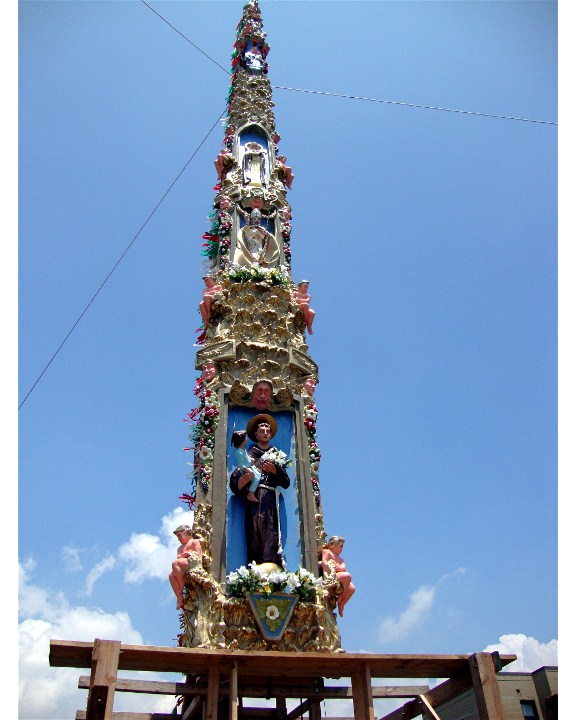
St Paulinus is credited with the introduction of bells in Christian worship and ecclesiastical celebrations and helped resolve the disputed election of Pope Boniface I.The people of modern-day Nola and the surrounding regions remain devoted to St Paulinus.   His feast day is celebrated annually in Nola during “La Festa dei Gigli” (the Feast of the Lilies), in which lilies and other flowers are arranged around large statues in honour of the saint which are then placed on tower-like structures,and carried upon the shoulders of the faithful around the city.   In the United States the descendants of Italian immigrants from Nola and Brusciano continue the tradition in Brooklyn.768px-StatuadiSanPaolinodaNola

2011 Franklin Square Giglio
Posted in SAINT of the DAY

Memorials of the Saints – 22 June

St John Fisher (1469-1535) (Optional Memorial)

St Paulinus of Nola (c 354-431) (Optional Memorial)

St Thomas More (1478-1535) (Optional Memorial)


St Aaron of Brettany
St Aaron of Pais-de-Laon
St Alban of Britain
Bl Altrude of Rome
St Consortia
St Cronan of Ferns
St Eberhard of Salzburg
St Eusebius of Samosata
St Exuperantius of Como
St Flavius Clemens
St Gregory of Agrigento
St Heraclius the Soldier
St Hespérius of Metz
Bl Pope Innocent V
St John IV of Naples
St Julius of Pais-de-Laon
Bl Kristina Hamm
Bl Marie Lhuilier
St Nicetas of Remesiana
St Precia of Epinal
St Rotrudis of Saint-Omer
St Rufinus of Alexandria

Martyrs of Samaria – 1480 saints: 1480 Christians massacred in and near Samaria during the war between the Greek Emperor Heraclius and the pagan Chosroas of Persia. c 614 in the vicinity of Samaria, Palestine.

Posted in JESUIT SJ, MORNING Prayers, QUOTES of the SAINTS, SAINT of the DAY

Thought for the Day – 21 June – The Memorial of St Aloysius de Gonzaga S.J. (1568-1591)

Thought for the Day – 21 June – The Memorial of St Aloysius de Gonzaga S.J. (1568-1591)

Aloysius also volunteered to work at the local hospital.   On closer inspection, this was heroic of him since he was very sensitive to disgusting sores and odors.   He strove to conquer his inborn squeamishness and attend to the most repulsive cases.   A fellow novice, Decio Striverio, remembers approaching a particularly loathsome patient, full of bleeding sores.   Aloysius turned completely pale as they approached but as if summoning some hidden strength, his colour returned and he approached the victim as if he were Christ Himself.   “Whatever you did for one of the least of these brothers of Mine, you did it for Me.” (Mt. 25:40)

Aloysius worked first at the overcrowded hospital of St Sixtus.   He traversed the streets of Rome and carried the ill on his back to the hospital;  when there, he undressed and washed the victims, gave them fresh clothing, placed them in a bed and fed them. However, the Jesuit superiors took alarm, as some of the novices started dying.   They assigned Aloysius to the hospital of Santa Maria di Consolazione, reserved for non-contagious patients.

While assisting at this hospital, he lifted an unknowingly infected man out of his bed, tended his needs and returned him to his bed.  Unfortunately, this act of charity cost Aloysius his life.   He received the diagnosis of infection on 3 March 1591, and died on 21 June 1591.   He was 23 years old.   In a letter addressed to his mother shortly before his death, he wrote, “Our parting will not be for long; we shall see each other again in heaven;  we shall be united with our Saviour;  there we shall praise Him with heart and soul, sing of His mercies forever, and enjoy eternal happiness.”aloysius gonzaga tending patients

Aloysius’ patronage extends foremost over the youth.   Thus, artists have made the effort to emphasise his angelic purity, as a role model for chastity.   While undoubtedly commendable, the realisation of this virtue in pictorial form often results in a caricature. There is a fine line between heroic purity and honey-dripping effeminacy, at least in artistic terms.   Interestingly, St Aloysius is also the patron of AIDS patients and caregivers, due to his compassionate care and ultimate infection of an incurable disease. In the final analysis, the sugarcoated holy card depiction of St Aloysius is misleading, as he possessed ferocious will power.   Moreover, one can easily absolve his youthful quirkiness before entering the Jesuits, in light of his large-hearted compassion revealed in the end….(Reference – The Life of St. Aloysius Gonzaga, Patron of Christian Youth by Maurice Meschler, S.J.)

Aloysius seems an unlikely patron of youth, in a society where asceticism is confined, to training camps of football teams and boxers and sexual permissiveness has little left to permit.   Can an overweight, sin-soaked and air-conditioned society deprive itself of anything?   It will, when it discovers a reason, as Aloysius did.   The motivation for letting God purify us is the experience of God loving us in prayer.  Prayer is our most urgent work!

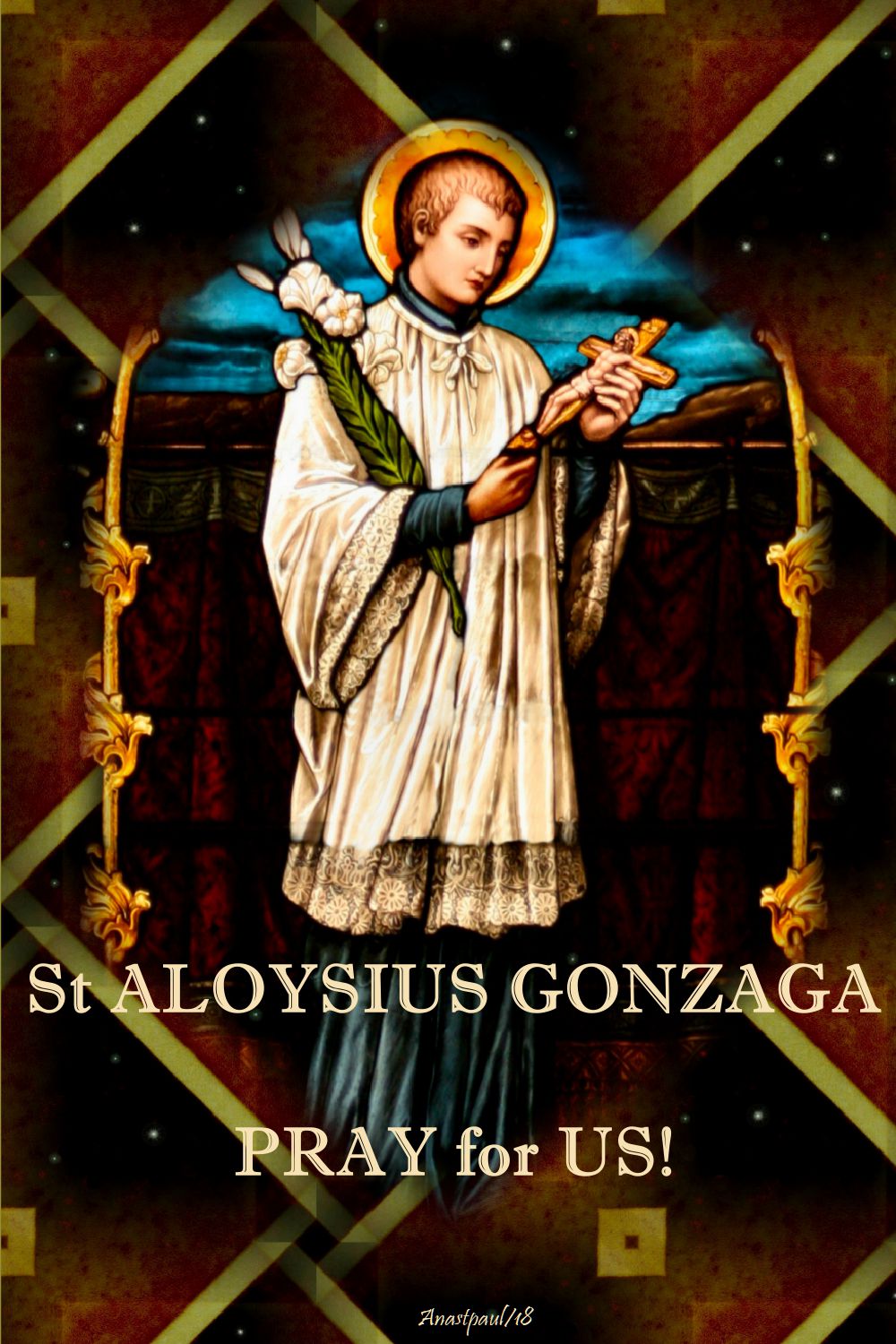
St Aloysius Gonzaga, help us to pray and please Pray for us all!st-aloysius-gonzaga. - pray for us - 21 june 2018.pg

Posted in JESUIT SJ, MORNING Prayers, QUOTES of the SAINTS, SAINT of the DAY

Quote of the Day – 21 June – The Memorial of St Aloysius de Gonzaga S.J. (1568-1591)

Quote of the Day – 21 June – The Memorial of St Aloysius de Gonzaga S.J. (1568-1591)

“May the comfort and grace of the Holy Spirit be yours for ever, most honoured lady.

Your letter found me lingering still in this region of the dead but now I must rouse myself to make my way on to heaven at last and to praise God for ever in the land of the living; indeed I had hoped that before this time my journey there would have been over.

If charity, as Saint Paul says, means “to weep with those who weep and rejoice with those who are glad,” then, dearest mother, you shall rejoice exceedingly that God in His grace and His love for you, is showing me the path to true happiness and assuring me, that I shall never lose Him.
Take care above all things, most honoured lady, not to insult God’s boundless loving kindness;  you would certainly do this, if you mourned as dead, one living face to face with God, one whose prayers, can bring you in your troubles, more powerful aid, than they ever could on earth.

And our parting will not be for long;  we shall see each other again in heaven;  we shall be united with our Saviour; there we shall praise Him with heart and soul, sing of His mercies forever and enjoy eternal happiness.”

– from a letter to his mother by Saint Aloysius Gonzagatake care above all things - st aloysius gonzaga - 21 june 2018

Posted in JESUIT SJ, MARIAN PRAYERS, MORNING Prayers, PRAYERS of the SAINTS, QUOTES of the SAINTS, QUOTES on SUFFERING, SAINT of the DAY, The WORD

One Minute Reflection – 21 June – The Memorial of St Aloysius de Gonzaga S.J. (1568-1591)

One Minute Reflection – 21 June – The Memorial of St Aloysius de Gonzaga S.J. (1568-1591)

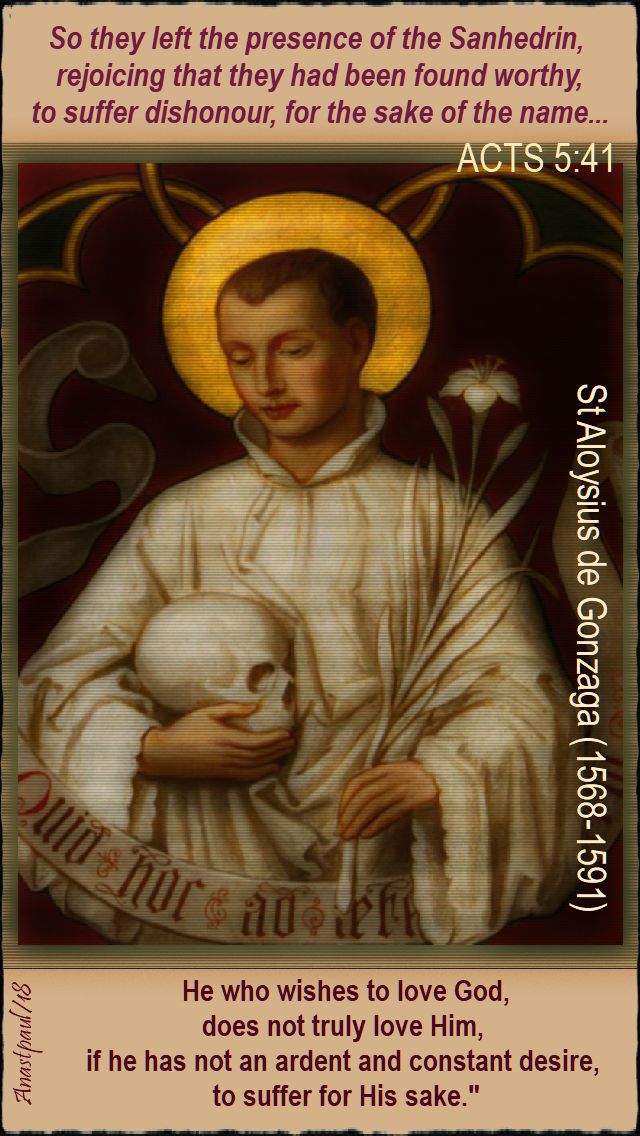
So they left the presence of the Sanhedrin, rejoicing that they had been found worthy, to suffer dishonour, for the sake of the name...Acts 5:41

REFLECTION – “He who wishes to love God, does not truly love Him, if he has not an ardent and constant desire, to suffer for His sake.”…St Aloysius de Gonzaga (1568-1591)acts 5-41 - he who wishes - st aloysius gonzaga - 21 june 2018

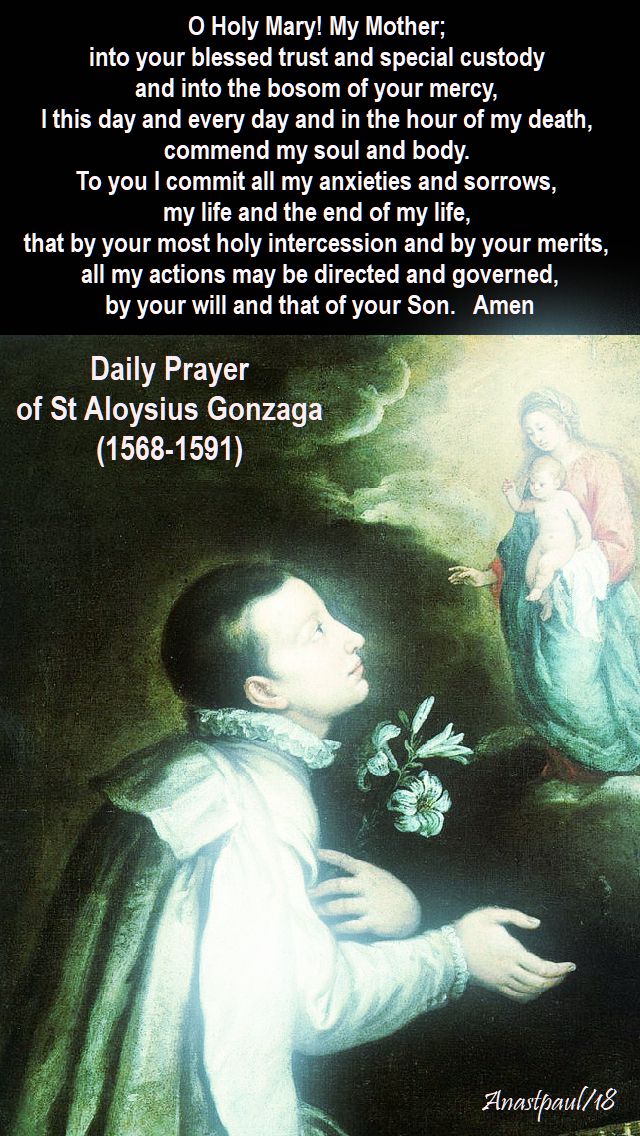
PRAYER – “O Holy Mary! My Mother;  into your blessed trust and special custody and into the bosom of your mercy, I this day and every day and in the hour of my death, commend my soul and body.   To you, I commit all my anxieties and sorrows, my life and the end of my life, that by your most holy intercession and by your merits, all my actions may be directed and governed by your will and that of your Son.”… by St Aloysius de Gonzaga (1568-1591)o holy mary my mother - daily prayer of st aloysius gonzaga - 21 june 2018

Posted in JESUIT SJ, MORNING Prayers, PRAYERS of the SAINTS

Our Morning Offering – 21 June – The Memorial of St Aloysius de Gonzaga S.J. (1568-1591)

Our Morning Offering – 21 June – The Memorial of St Aloysius de Gonzaga S.J. (1568-1591)

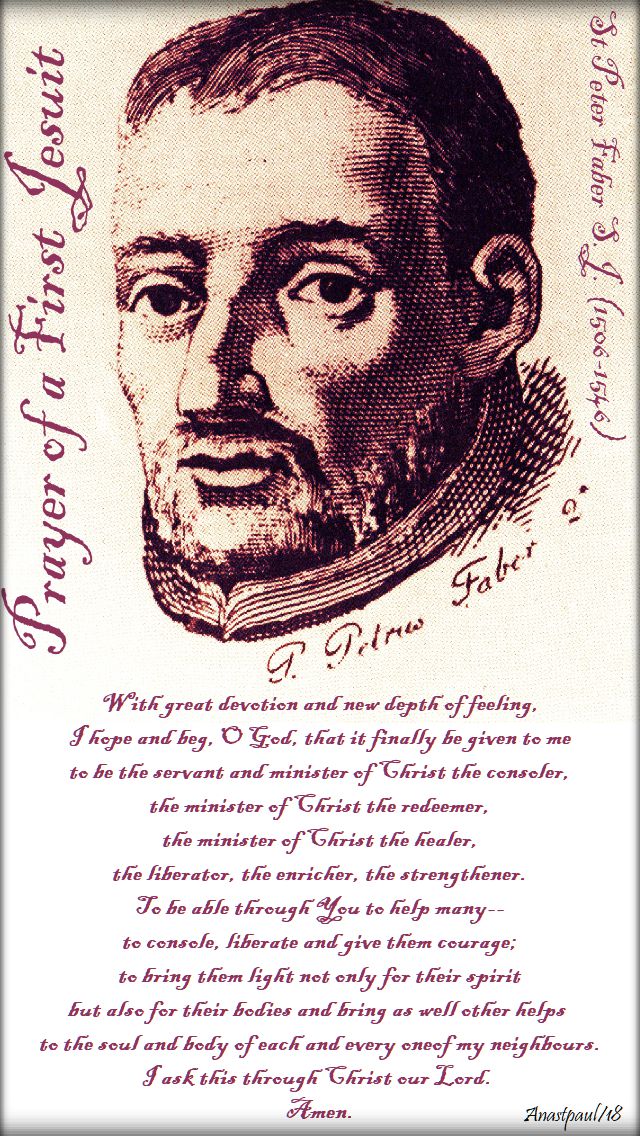
Prayer of a First Jesuit
By St Peter Faber S.J. (1506-1546)

With great devotion and new depth of feeling,
I hope and beg, O God, that it finally be given to me
to be the servant and minister of Christ the consoler,
the minister of Christ the redeemer,
the minister of Christ the healer,
the liberator, the enricher the strengthener.
To be able through You to help many–
to console, liberate and give them courage;
to bring them light not only for their spirit
but also for their bodies,
and bring as well other helps
to the soul and bodyof each and every one
of my neighbours.
I ask this through Christ our Lord.
Amen.

– from his Memorialewith great devotion and a new depth of feeling - prayer of a first jesuit - st peter faver - 21 june - feast of st aloysius gonzaga

Posted in CHILDREN / YOUTH, EYES - Diseases, of the BLIND, JESUIT SJ, SAINT of the DAY

Saint of the Day – 21 June – St Aloysius de Gonzaga S.J. (1568-1591)

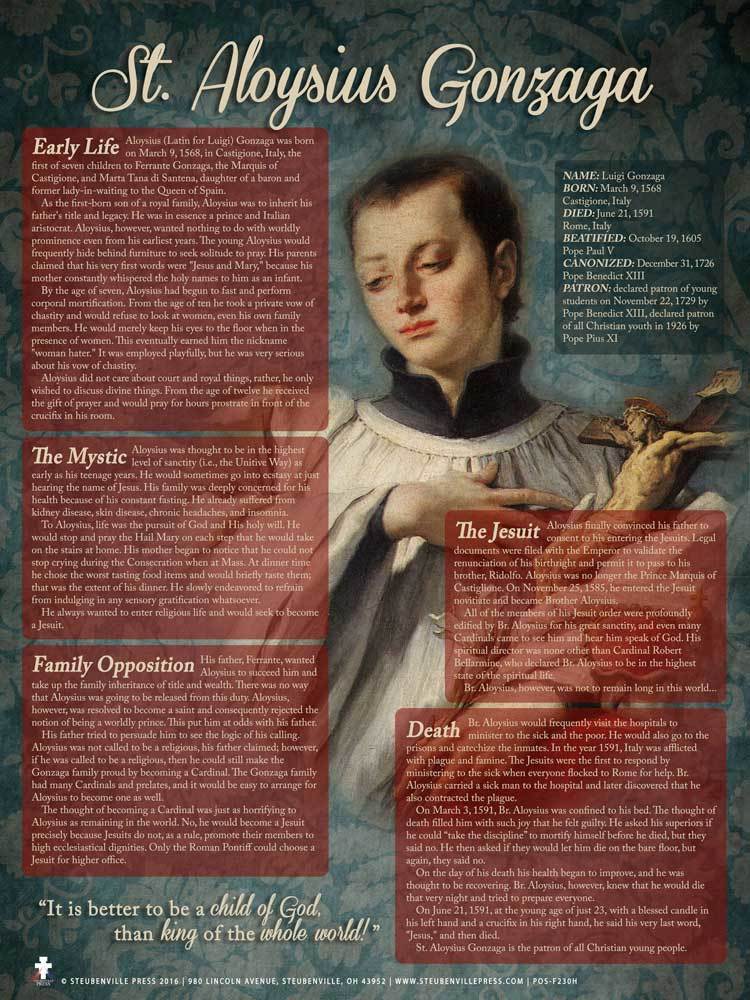
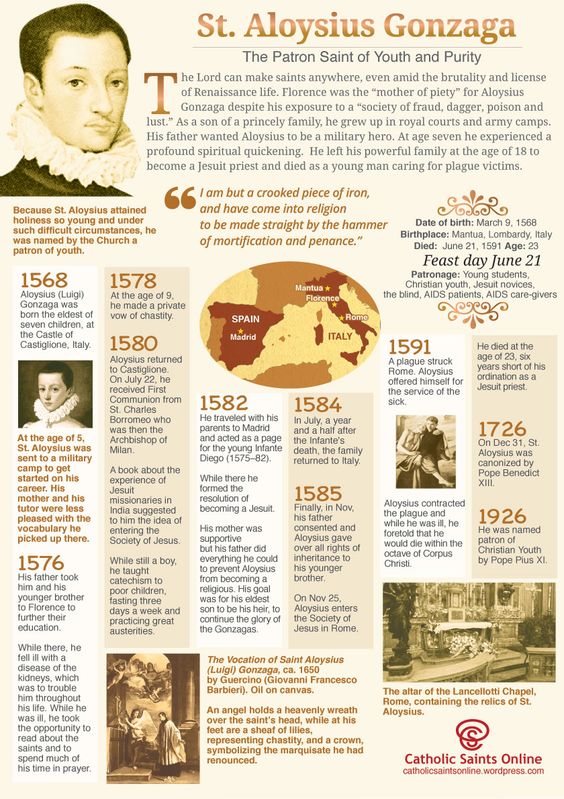
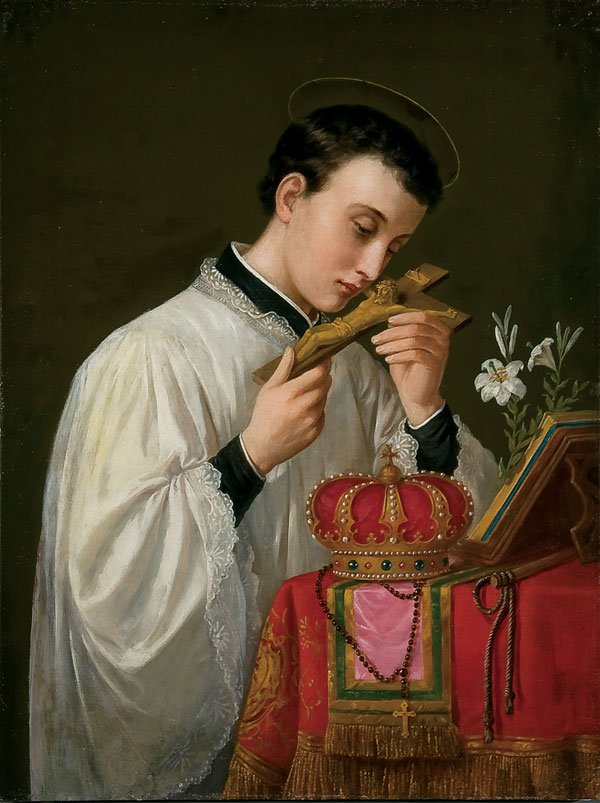
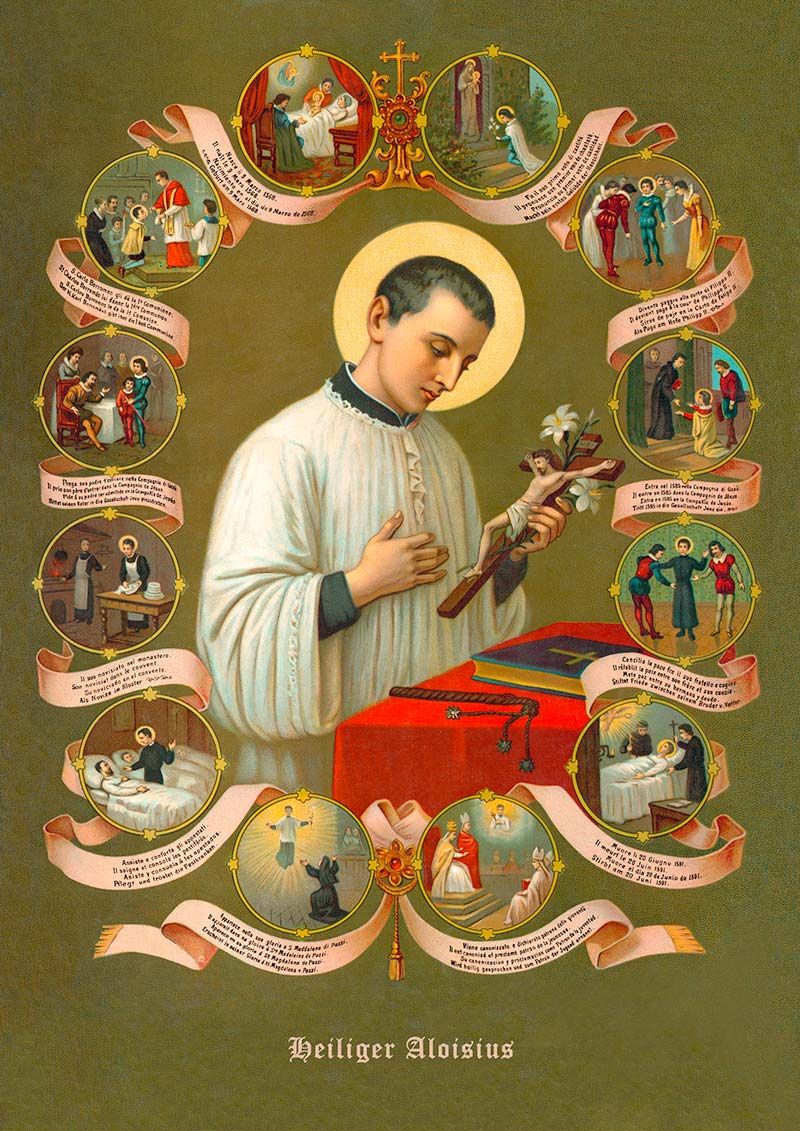
Saint of the Day – 21 June – St Aloysius de Gonzaga S.J. (1568-1591) Jesuit Seminarian, Mystic, Marian devotee, Apostle of Charity – born as Luigi de Gonzaga on 9 March 1568 in the family castle of Castiglione delle Stivieri in Montua, Lombardy, Italy and died on 21 June 1591 at Rome, Italy of plague, fever and desire to see God.   His relics are entombed under the Altar of Saint Ignatius Church, Rome.  Patronages – Catholic youth, Jesuit scholastics, the blind, eye ailments, AIDS patients, care-givers, Jesuit students, for relief from pestilence, young people, Castiglione delle Stiviere, Italy, Valmonte, Italy.   His attributes are a lily, referring to innocence;  a cross, referring to piety and sacrifice;  a skull, referring to his early death  and a Rosary, referring to his devotion to the Blessed Virgin Mary.st aloysius infoaloysius info 2

Aloysius de Gonzaga was born the eldest of seven children, at his family’s castle in Castiglione delle Stiviere, between Brescia and Mantua in northern Italy in what was then part of the Duchy of Mantua, into the illustrious House of Gonzaga.   “Aloysius” is the Latin form of Aloysius de Gonzaga’s given name in Italian, Luigi.   He was the son of Ferrante de Gonzaga (1544–1586), Marquis of Castiglione, and Marta Tana di Santena, daughter of a baron of the Piedmontese Della Rovere family.   His mother was a lady-in-waiting to Isabel, the wife of Philip II of Spain.beautiful lg - st aloysius

As the first-born son, he was in line to inherit his father’s title and status of Marquis.   His father assumed that Aloysius would become a soldier, as that was the norm for sons of the aristocracy and the family was often involved in the minor wars of the period.   His military training started at an early age but he also received an education in languages and the arts.   As early as age four, Luigi was given a set of miniature guns and accompanied his father on training expeditions so that the boy might learn “the art of arms.”   At age five, Aloysius was sent to a military camp to get started on his training. His father was pleased to see his son marching around camp at the head of a platoon of soldiers.   His mother and his tutor were less pleased with the vocabulary he picked up there.

He grew up amid the violence and brutality of Renaissance Italy and witnessed the murder of two of his brothers.   In 1576, at age 8, he was sent to Florence along with his younger brother, Rodolfo, to serve at the court of the Grand Duke Francesco I de’ Medici and to receive further education.   While there, he fell ill with a disease of the kidneys, which troubled him throughout his life.   While he was ill, he took the opportunity to read about the saints and to spend much of his time in prayer.   He is said to have taken a private vow of chastity at age 9.    In November 1579, the brothers were sent to the Duke of Mantua.   Aloysius was shocked by the violent and frivolous lifestyle he encountered there.

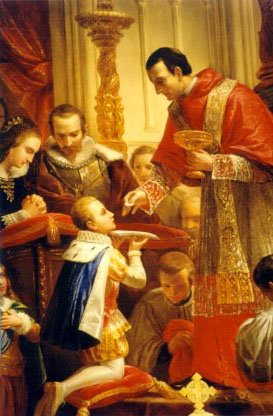
Aloysius returned to Castiglione where he met St Cardinal Charles Borromeo (1538-1584 – feast day 4 November) and from him received First Communion on 22 July 1580.   After reading a book about Jesuit missionaries in India, Aloysius felt strongly that he wanted to become a missionary.   He started practising by teaching catechism classes to young boys in Castiglione in the summers.   He also repeatedly visited the houses of the Capuchin friars and the Barnabites located in Casale Monferrato, the capital of the Gonzaga-ruled Duchy of Montferrat where the family spent the winter.   He also adopted an ascetic lifestyle.

aloysius and charles borromeo
St Aloysius receives his First Holy Communion from St Charles Borromeo

The family was called to Spain in 1581 to assist the Holy Roman Empress Maria of Austria.   They arrived in Madrid in March 1582, where Aloysius and Rodolfo became pages for the young Infante Diego.   Aloysius started thinking in earnest about joining a religious order.   He had considered joining the Capuchins but he had a Jesuit confessor in Madrid and decided instead to join that order.   His mother agreed to his request but his father was furious and prevented him from doing so.

In July 1584, a year and a half after the Infante’s death, the family returned to Italy. Aloysius still wanted to become a priest but several members of his family worked hard to persuade him to change his mind.   When they realised there was no way to make him give up his plan, they tried to persuade him to become a secular priest and offered to arrange for a bishopric for him.   If he were to become a Jesuit he would renounce any right to his inheritance or status in society.   His family’s attempts to dissuade him failed, Aloysius was not interested in higher office and still wanted to become a missionary.

In November 1585, Aloysius gave up all rights of inheritance, which was confirmed by the emperor.   He went to Rome and, because of his noble birth, gained an audience with Pope Sixtus V.   Following a brief stay at the Palazzo Aragona Gonzaga, the Roman home of his cousin, Cardinal Scipione Gonzaga, on 25 November 1585, he was accepted into the novitiate of the Society of Jesus in Rome.   During this period, he was asked to moderate his asceticism somewhat and to be more social with the other novices.

Aloysius’ health continued to cause problems.   In addition to the kidney disease, he also suffered from a skin disease, chronic headaches and insomnia.   He was sent to Milan for studies but after some time he was sent back to Rome because of his health.   On 25 November 1587, he took the three religious vows of chastity, poverty and obedience.   In February and March 1588, he received minor orders and started studying theology to prepare for ordination.   In 1589, he was called to Mantua to mediate between his brother Rodolfo and the Duke of Mantua.   He returned to Rome in May 1590.   It is said that later that year, he had a vision in which the Archangel Gabriel told him that he would die within a year.

In 1591, a plague broke out in Rome.   The Jesuits opened a hospital for the stricken and Aloysius volunteered to work there.   After begging alms for the victims, Aloysius began working with the sick, carrying the dying from the streets into a hospital founded by the Jesuits.   There he washed and fed the plague victims, preparing them as best he could to receive the sacraments.   But though he threw himself into his tasks, he privately confessed to his spiritual director, Fr Robert Bellarmine (St Robert Bellarmine (1542-1621) Doctor of the Church), that his constitution was revolted by the sights and smells of the work;  he had to work hard to overcome his physical repulsion.

At the time, many of the younger Jesuits had become infected with the disease, and so Aloysius’s superiors forbade him from returning to the hospital.   But Aloysius—long accustomed to refusals from his father—persisted and requested permission to return, which was granted.   Eventually he was allowed to care for the sick but only at another hospital, called Our Lady of Consolation, where those with contagious diseases were not admitted.   While there, Aloysius lifted a man out of his sickbed, tended to him, and brought him back to his bed.   But the man was infected with the plague.   Aloysius grew ill and was bedridden by 3 March 1591, a few days before his 23rd birthday.Gonzaga3

Aloysius rallied for a time but as fever and a cough set in, he declined for many weeks.   It seemed certain that he would die in a short tie, and he was given Extreme Unction. While he was ill, he spoke several times with his confessor, the cardinal and later saint, Robert Bellarmine.   Aloysius had another vision and told several people that he would die on the Octave of the feast of Corpus Christi.   On that day, 21 June 1591, he seemed very well in the morning but insisted that he would die before the day was over.   As he began to grow weak, Bellarmine gave him the last rites and recited the prayers for the dying.   He died just before midnight.   As Fr Tylenda tells the story, “When the two Jesuits came to his side, they noticed a change in his face and realised that their young Aloysius was dying.   His eyes were fixed on the crucifix he held in his hands and as he tried to pronounce the name of Jesus he died.”San_Luigi_Gonzaga_AU

Aloysius was buried in the Church of the Most Holy Annunciation, which later became the church of Saint Ignatius of Loyola (Sant’Ignazio) in Rome.   His name was changed to “Robert” before his death, in honour of his confessor.   Many people considered him to be a saint soon after his death and his remains were moved into the Sant’Ignazio church, where they now rest in an urn of lapis lazuli in the Lancellotti Chapel.   His head was later translated to the basilica bearing his name in Castiglione delle Stiviere.   He was beatified only fourteen years after his death by Pope Paul V, on 19 October 1605.   On 31 December 1726, he was canonised together with another young Jesuit novice, Stanislaus Kostka, by Pope Benedict XIII.

Purity was his notable virtue.   The Carmelite mystic St Maria Magdalena de Pazzi had a vision of him on 4 April 1600.   She described him as radiant in glory because of his “interior works,” a hidden martyr for his great love of God.The Life and Miracles of St. Aloysius Gonzagast aloysius by Fr Lawrence OPv lg - st aloysius gonzaga

Posted in FEASTS and SOLEMNITIES, MARIAN TITLES, MIRACLES, SAINT of the DAY, The BLESSED VIRGIN MARY

Feast of Our Lady of Miracles – 21 June

Feast of Our Lady of Miracles – 21 June – the patron of the town of Alcamo, Sicily.header - Maria_SS_dei_Miracoli_-_ALCAMO_processione_2010_198

The cult of Madonna of Miracles in Alcamo dates back to 21 June 1547, the day people remember the Madonna’s apparition to some women near a stream running north of Alcamo.   According to tradition while washing their clothes in the stream, the women, with a blind and a deaf one among them, saw the apparition of a woman with a child and were hit by a gust of pebbles, during the apparition but without receiving any injury or pain;   on the contrary, after being hit by the pebbles, they strangely felt a certain sense of wellbeing and recovered their health.   After learning the news, the women’s husbands, thinking that it was a joke, went to investigate, thinking that someone was hidden among the bushes around there but they didn’t find anybody.

Then the local authorities inquired on the spot, cut down the near grove and found the ruins of a “cuba”, an old arc of a mill that nobody remembered any longer and inside there was a fresco on a stone made by an anonymous painter of the 13th century representing Our Lady with the Child Jesus, which at first the believers called “Madonna Fons Misericordiae” (that is Our Lady Source of Mercy).

Chiesa_Basilica_S_Maria_Assunta_Alcamo_128
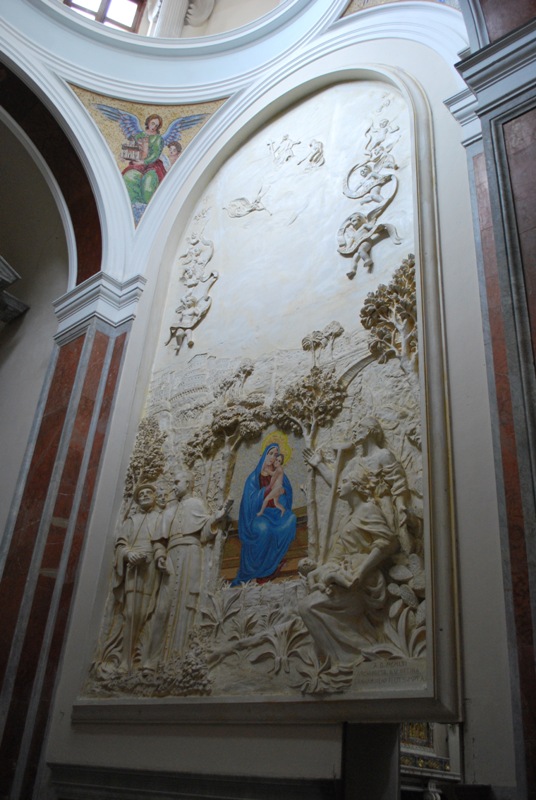
A representation of the discovery of Our Lady of Miracles’ image (inside its chapel in the Basilica of Our Lady of the Assumption in Alcamo).

After this discovery all the people started praying before the rediscovered image and in the following days there were several miracles.7, Our Lady of Miracles became the patron saint of Alcamo, in substitution of the Holy Crucified, who was the patron saint of Alcamo and other near small towns (among which Calatafimi and Salemi).   The old patron saint’s memory however remains in Alcamo people’s mind:  in fact they call San Francesco di Paola “santu patri” (whose translation means “patron saint”) as the Church named after him was called the Holy Crucified Church.

The Madonna’s discovered image was first called “Our Lady Source of Mercy” but thanks to the high number of subsequent miracles, in 1583 the name was changed into “Our Lady of Miracles”.

Further to these events, Don Fernando Vega, Alcamo’s governor, ordered the construction of the Sanctuary of Our Lady of Miracles, which hosts the Madonna’s image. Inside the Church there is a white marble sarcophagus containing the mortal remains of the governor Don Fernando Vega, according to his will.

Calata_al_Santuario_della_Madonna_dei_Miracoli_di_Alcamo_-_14
The Crowned Painting of the Madonna of Miracles in the Sanctuary at Alcamo

Calata_al_Santuario_della_Madonna_dei_Miracoli_di_Alcamo_-_11
Dome fresco “The Madonna of Miracles’ Glorification”

Celebrations:
Every year in Alcamo there are the celebrations in honour of Our Lady of Miracles from 19 June until 21 of June.   This is the most important religious festivity in Alcamo.   The real celebrations are often anticipated by other events, so extending the feast to about two weeks, in this way the beginning of the celebrations changes every year, while the last day is always the 21 June.

The celebrations include:
“The pealing of church bells” which opens the celebrations together with the burst of fireworks and the passing of the band through the town streets;  in the past Alcamo’s band also joined the musical band of Partinico (a neighbouring small town).
The holy Mass in honour of Our Lady of Miracles in the Basilica di Santa Maria Assunta (also called “mother church”), in which all confraternities and laity groups in Alcamo take part.
The procession to the Sanctuary of Madonna of Miracles (called “calata”), in which all civil and religious authorities of the town (together with the Mayor) take part;  they are preceded by the band of the town.   In old times people took also the animals that had recovered from an illness.   Inside the sanctuary they sing Vespers and then there is the Eucharistic Blessing/Benediction.

Calata_al_Santuario_della_Madonna_dei_Miracoli_di_Alcamo_-_04
Façade of the sanctuary of Madonna of Miracles

Santuario_della_Madonna_dei_Miracoli_(Alcamo)_-_Discesa_al_Santuario
Route to the Sanctuary

Dance, music and theatrical performances.
Sport events.
Exhibitions of various kinds, including one about local Craftmanship.
“The Market Fair” at Piazza della Repubblica.
The Streets entertainers (called “Madonnari”).
The Procession of Our Lady of Miracles’ statue along the town streets and return to the mother church. Before this solemn procession, the statue of Our Lady of Miracles, createdin 1720 by Lorenzo Curti from Castelvetrano (see the image of the statue above and the back below), is adorned with a silver 12 star crown (“stellario” in Italian), a crown and a hairpin embellished by precious stones (called “tuppu di la Maronna”) which is placed behind the Madonna’s nape.   After that, the statue goes out from the Church, taken along the streets by a group of believers on their shoulders and accompanied by the band and it comes back to the mother church at the end of the procession.

Maria_SS_dei_Miracoli_-_ALCAMO_preparazione_2010_032Maria_SS_dei_Miracoli_-_ALCAMO_processione_2010_042
Fireworks near the “bastione” in Piazza Bagolino.   They take place at the end of the feast, soon after the statue’s return into the church, at about midnight.
The traditional descent to the sanctuary takes place during the so-called “Historical Cortege” with period costumes.   This cortege, which anticipates the real “calata”, passes through Corso 6 Aprile and Piazza Ciullo and finally ends at the Castle of the Counts of Modica (also called “Castle of Alcamo”).   The workmen of the association “I Cavalieri di San Giorgio” (San Giorgio’s knights) and the Civil Authorities take part in the cortege too.  Translated from the Italian).I_Cavalieri_di_San_Giorgio_-_AlcamoCalata_al_Santuario_della_Madonna_dei_Miracoli_di_Alcamo_-_06

Posted in FEASTS and SOLEMNITIES, MARIAN TITLES, MORNING Prayers, SAINT of the DAY, The BLESSED VIRGIN MARY, Uncategorized

Feast of Our Lady of Miracles and Memorials of the Saints – 21 June

St Aloysius Gonzaga S.J. (1568-1591) (Memorial)

Madonna of Miracles – Our Lady of Miracles (or Madonna of Miracles) is the patron saint of the town of Alcamo, Italy.

Calata_al_Santuario_della_Madonna_dei_Miracoli_di_Alcamo_-_14

St Agofredus of La-Croix
St Alban of Mainz
St Apollinaris of Africa
Bl Colagia
St Corbmac
St Cyriacus of Africa
St Demetria of Rome
St Dominic of Comacchio
St Engelmund
Bl Jacques-Morelle Dupas
St John Rigby
St José Isabel Flores Varela
Bl Juan of Jesus
St Lazarus
St Leutfridus
St Martia of Syracuse
St Martin of Tongres
Bl Melchiorre della Pace
St Mewan of Bretagne
Bl Nicholas Plutzer
St Ralph of Bourges
St Raymond of Barbastro
St Rufinus of Syracuse
St Suibhne the Sage
St Terence
St Ursicenus of Pavia

Martyrs of Taw – 3+ saints: Three Christians of different backgrounds who were martyred together – Moses, Paphnutius, Thomas. They were beheaded in Taw, Egypt, date unknown.

Posted in MORNING Prayers, QUOTES of the SAINTS, QUOTES on HUMILITY, QUOTES on REPENTANCE

Thought for the Day – 20 June – Wednesday Eleventh Week of Ord Time Year B – Today’s Gospel Matthew 6:1-6.16-18

Thought for the Day – 20 June – Wednesday Eleventh Week of Ord Time Year B – Today’s Gospel Matthew 6:1-6.16-18

“We are Nothing in Ourselves”
St John Marie Baptiste Vianney (1786-1859)

“When we do nothing to be ashamed of, when everything is going along according to our wishes, we dare to believe that nothing could make us fall.   We forget our own nothingness and our utter weakness.   We make the most delightful protestations that we are ready to die rather than to allow ourselves to be conquered.   We see a splendid example of this in St Peter, who told our Lord that although all others might be scandalised in Him, yet he would never deny Him.

Alas!   To show him how man, left to himself, is nothing at all, God made use, not of kings or princes or weapons but simply of the voice of a maidservant, who even appeared to speak to him in a very indifferent sort of way.   A moment ago, he was ready to die for Him and now Peter protests, that he does not even know Him, that he does not know about whom they are speaking.   To assure them even more vehemently that he does not know Him, he swears an oath about it.

Dear Lord, what we are capable of when we are left to ourselves!   There are some who, in their own words, are envious of the saints who did great penances.   They believe that they could do as well.   When we read the lives of some of the martyrs, we would, we think, be ready to suffer all that they suffered for God;  the moment is short lived, we say, for an eternity of reward.   But what does God do to teach us to know ourselves or, rather, to know that we are nothing?   This is all He does:   He allows the Devil to come a little closer to us.   Look at this Christian who a moment ago was quite envious of the hermit who lived solely on roots and herbs and who made the stern resolution to treat his body as harshly.   Alas!   A slight headache, a prick of a pin, makes him, as big and strong is he is, sorry for himself.   He is very upset.   He cries with pain.   A moment ago he would have been willing to do all the penances of the anchorites — and the merest trifle makes him despair!

Look at this other one, who seems to want to give his whole life for God, whose ardour all the torments there are cannot damp.   A tiny bit of scandalmongering …. a word of calumny …. even a slightly cold reception or a small injustice done to him …. a kindness returned by ingratitude …. immediately gives birth in him to feelings of hatred, of revenge, of dislike, to the point, often, of his never wishing to see his neighbour again or at least of treating him coldly with an air which shows very plainly what is going on in his heart.   And how many times is this his waking thought, just as it was the thought that almost prevented him from sleeping?   Alas, my dear brethren, we are poor stuff and we should count very little upon our good resolutions!”
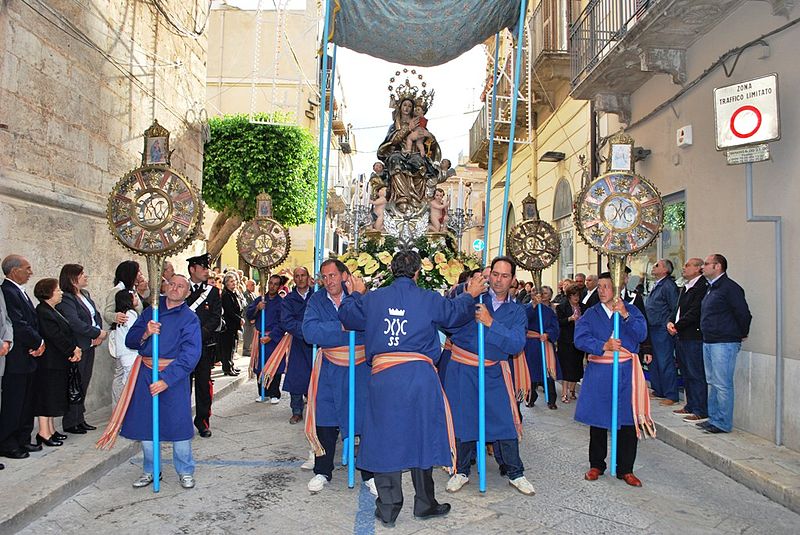
St John Vianney, Pray for us!

st john vianney pray for us - 20 june 2018

Posted in DOCTORS of the Church, FATHERS of the Church, MORNING Prayers, QUOTES of the SAINTS, QUOTES on HUMILITY, SPEAKING of ....., The WORD

Quote/s of the Day – – 20 June – Wednesday Eleventh Week of Ord Time Year B – Today’s Gospel Matthew 6:1-6.16-18

Quote/s of the Day – 20 June – Wednesday Eleventh Week of Ord Time Year B – Today’s Gospel Matthew 6:1-6.16-18

“Speaking of:  Humility”

“God resists the proud
but gives grace to the humble”

James 4:6god resists the proud - james 4 - 6

“Humility is the foundation of all the other virtues,
hence, in the soul in which this virtue does not exist,
there cannot be any other virtue,
except in mere appearance.”HUMILITY IS THE FOUNDATION-STAUGUSTINE

“It was pride that changed angels into devils;
it is humility that makes men as angels.”

St Augustine (354-430) Doctor of Graceit was pride - st augustine - 20 june 2018

“As patience leads to peace
and study to science,
so are humiliations,
the path that leads to humility.”

St Bernard of Clairvaux (1090-1153) Mellifluous Doctor

as patience leads to peace - st bernard - 20 june 2018

“In the difficulties which are placed before me,
why should I not act like a donkey?
When one speaks ill of him – the donkey says nothing.
When he is mistreated – he says nothing.
When he is forgotten – he says nothing.
When no food is given him – he says nothing.
When he is made to advance – he says nothing.
When he is despised – he says nothing.
When he is overburdened – he says nothing.
The true servant of God must do likewise
and say with David:
“Before Thee I have become like a beast of burden.”

St Alphonsus Rodriguez (1532-1617)in the difficulties which are placed before me - st alphonsus rodriguez - 20 june 2018

“True humility
scarcely ever
utters words
of humility.”

“Humility consists
in not esteeming ourselves above other men
and in not seeking
to be esteemed above them.”

“Humility makes our lives
acceptable to God,
meekness makes us
acceptable to men.”true humility - humility consists - humility makes our lives - st francis de sales - 20 june 2018

“If, when stung by slander or ill-nature,
we wax proud and swell with anger,
it is a proof that our gentleness
and humility are unreal
and mere artificial show.”

“The highest point of humility
consists in not merely acknowledging one’s abjection
but in taking pleasure therein,
not from any want of breadth or courage
but to give the more glory to God’s Divine Majesty
and to esteem one’s neighbour,
more highly than one’s self.”

St Francis de Sales (1567-1622) Doctor of Charityif when stung by slander - the highest point of humility - st francis de sales - 20 june 2018

“The truly humble
reject all praise for themselves
and refer it all to God.”

St Alphonsus Maria de Liguori (1696-1787) Most Zealous Doctorthe truly humble reject - st alphonsus liguori - 20 june 2018